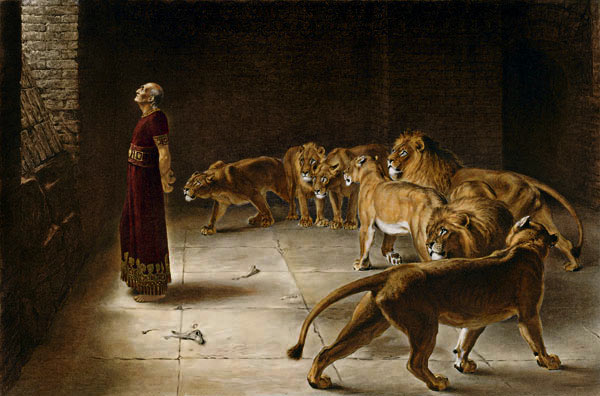
Daniel in the Lion's Den (Daniel 6)
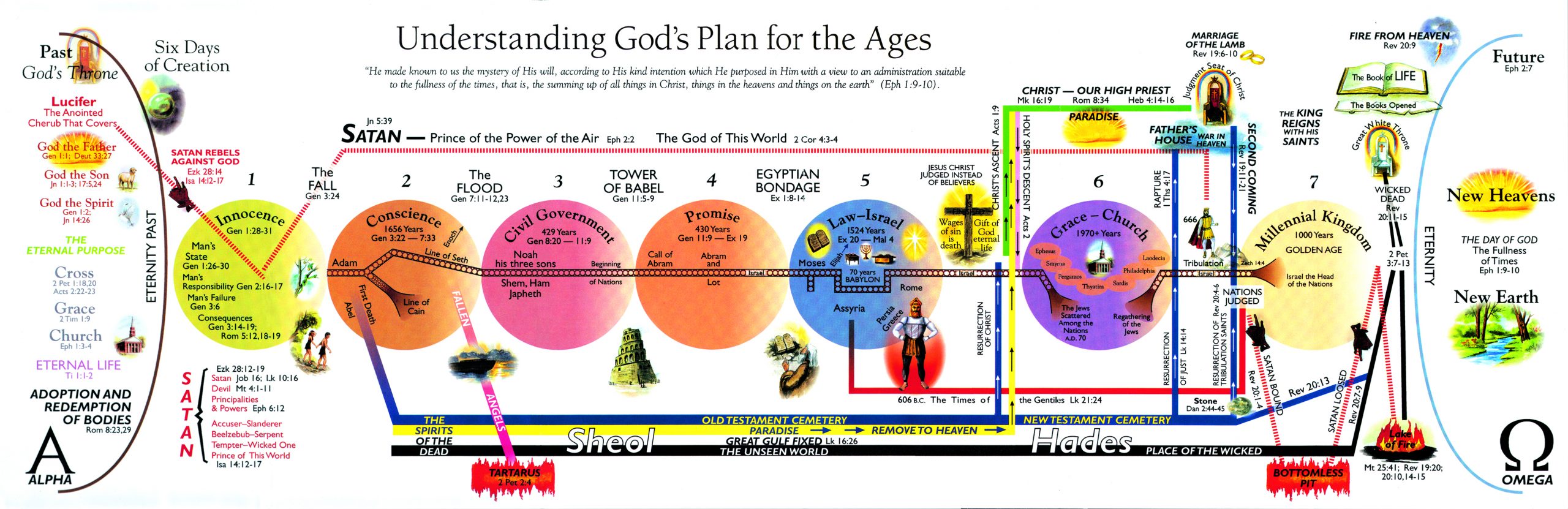
Source: Chart by Tim LaHaye and Thomas Ice - click to enlarge - Millenium on Right Side
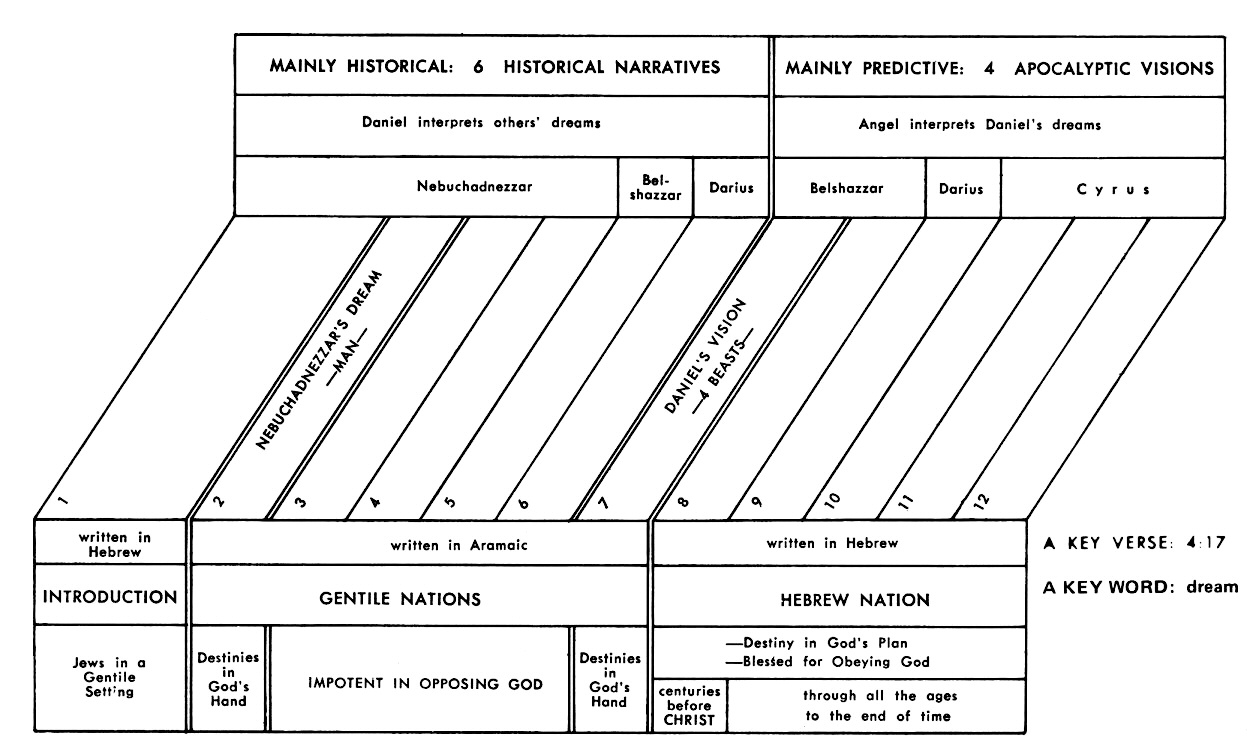
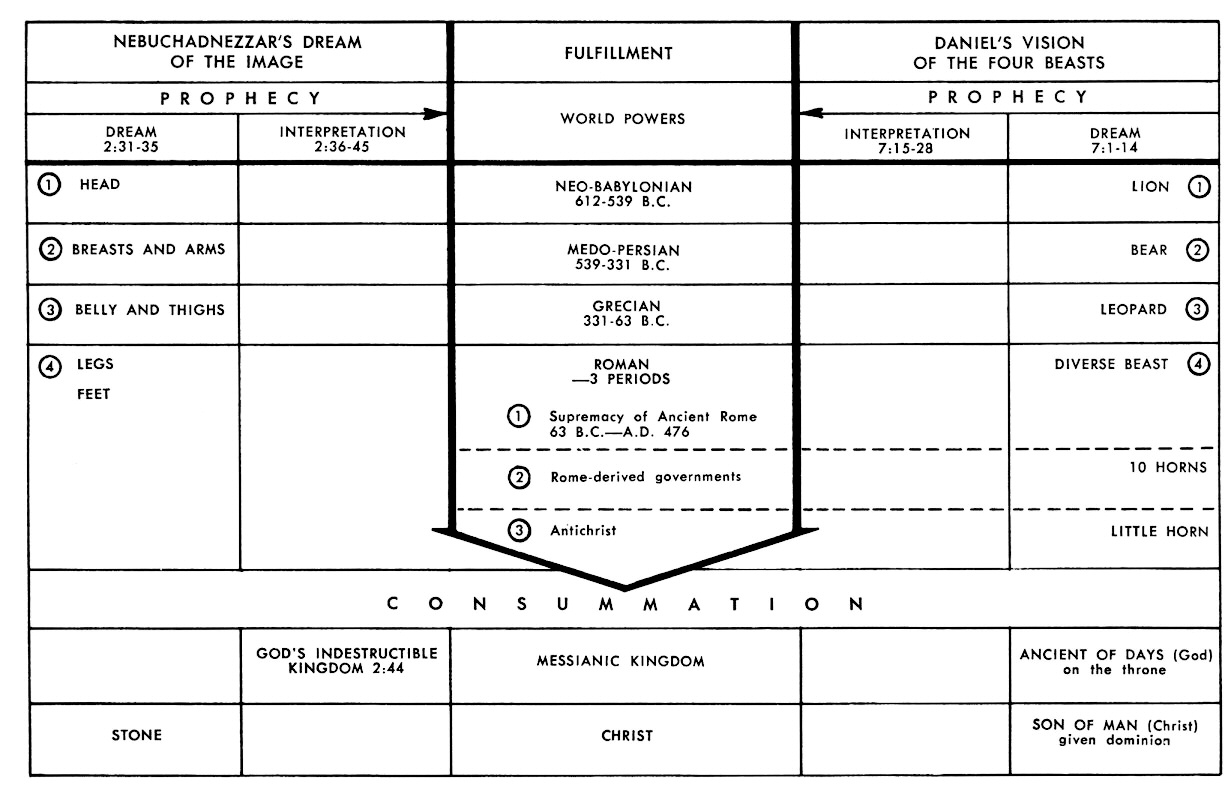
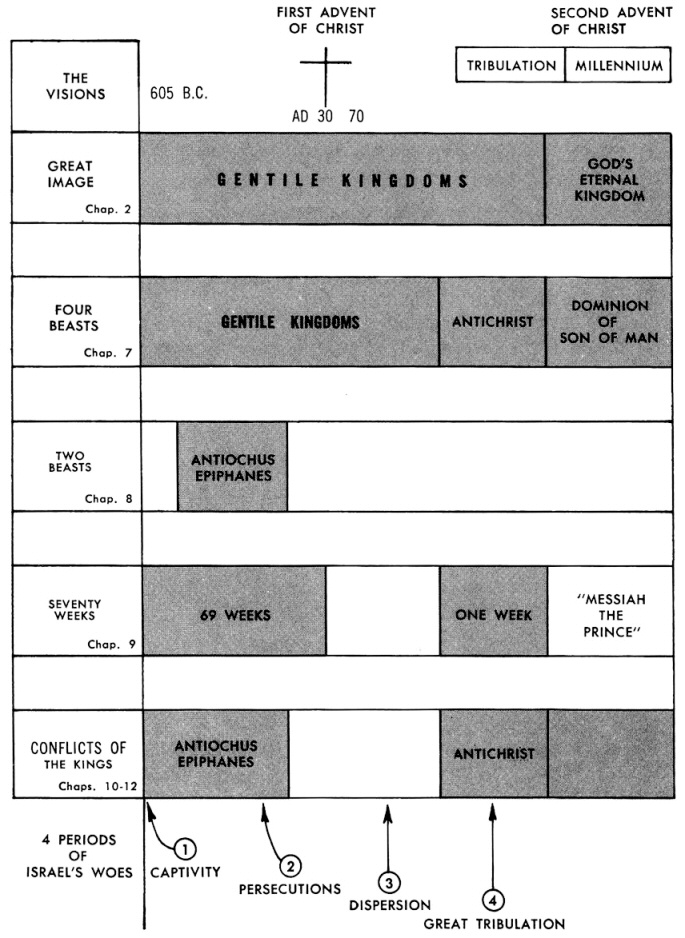
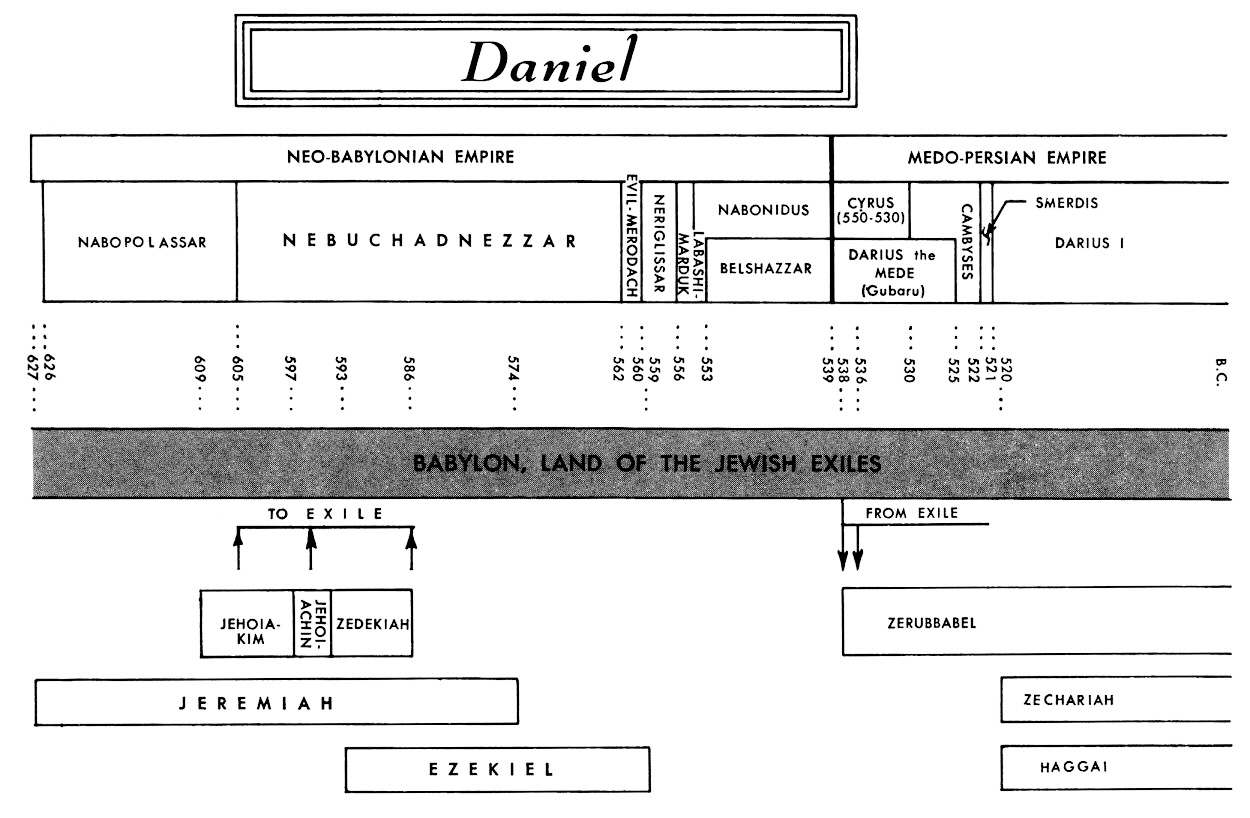
Click chart to enlarge
Charts from recommended resource Jensen's Survey of the OT - used by permission
Daniel Chart from Charles Swindoll
- Discussion of the Interpretative Approaches to the Book of Daniel
- Commentaries Classified by interpretative approach to Daniel 9:24-27
- Charts Related to Prophecy
- Best Commentaries on Daniel
Daniel 1:2
Daniel 1:3
Daniel 1:4
Daniel 1:5
Daniel 1:6
Daniel 1:7
Daniel 1:8
Daniel 1:9
Daniel 1:10
Daniel 1:11
Daniel 1:12
Daniel 1:13
Daniel 1:14
Daniel 1:15
Daniel 1:16
Daniel 1:17
Daniel 1:18
Daniel 1:19
Daniel 1:20
Daniel 1:21
Daniel 2:2
Daniel 2:3
Daniel 2:4
Daniel 2:5
Daniel 2:6
Daniel 2:7
Daniel 2:8
Daniel 2:9
Daniel 2:10
Daniel 2:11
Daniel 2:12
Daniel 2:13
Daniel 2:14
Daniel 2:15
Daniel 2:16
Daniel 2:17
Daniel 2:18
Daniel 2:19
Daniel 2:20
Daniel 2:21
Daniel 2:22
Daniel 2:23
Daniel 2:24
Daniel 2:25
Daniel 2:26
Daniel 2:27
Daniel 2:28
Daniel 2:29
Daniel 2:30
Daniel 2:31
Daniel 2:32
Daniel 2:33
Daniel 2:34
Daniel 2:35
Daniel 2:36
Daniel 2:37
Daniel 2:38
Daniel 2:39
Daniel 2:40
Daniel 2:41
Daniel 2:42
Daniel 2:43
Daniel 2:44
Daniel 2:45
Daniel 2:46
Daniel 2:47
Daniel 2:48
Daniel 2:49
Daniel 3:2
Daniel 3:3
Daniel 3:4
Daniel 3:5
Daniel 3:6
Daniel 3:7
Daniel 3:8
Daniel 3:9
Daniel 3:10
Daniel 3:11
Daniel 3:12
Daniel 3:13
Daniel 3:14
Daniel 3:15
Daniel 3:16
Daniel 3:17
Daniel 3:18
Daniel 3:19
Daniel 3:20
Daniel 3:21
Daniel 3:22
Daniel 3:23
Daniel 3:24
Daniel 3:25
Daniel 3:26
Daniel 3:27
Daniel 3:28
Daniel 3:29
Daniel 3:30
Daniel 4:2
Daniel 4:3
Daniel 4:4
Daniel 4:5
Daniel 4:6
Daniel 4:7
Daniel 4:8
Daniel 4:9
Daniel 4:10
Daniel 4:11
Daniel 4:12
Daniel 4:13
Daniel 4:14
Daniel 4:15
Daniel 4:16
Daniel 4:17
Daniel 4:18
Daniel 4:19
Daniel 4:20
Daniel 4:21
Daniel 4:22
Daniel 4:23
Daniel 4:24
Daniel 4:25
Daniel 4:26
Daniel 4:27
Daniel 4:28
Daniel 4:29
Daniel 4:30
Daniel 4:31
Daniel 4:32
Daniel 4:33
Daniel 4:34
Daniel 4:35
Daniel 4:36
Daniel 4:37
Daniel 5:2
Daniel 5:3
Daniel 5:4
Daniel 5:5
Daniel 5:6
Daniel 5:7
Daniel 5:8
Daniel 5:9
Daniel 5:10
Daniel 5:11
Daniel 5:12
Daniel 5:13
Daniel 5:14
Daniel 5:15
Daniel 5:16
Daniel 5:17
Daniel 5:18
Daniel 5:19
Daniel 5:20
Daniel 5:21
Daniel 5:22
Daniel 5:23
Daniel 5:24
Daniel 5:25
Daniel 5:26
Daniel 5:27
Daniel 5:28
Daniel 5:29
Daniel 5:30
Daniel 5:31
Daniel 6:2
Daniel 6:3
Daniel 6:4
Daniel 6:5
Daniel 6:6
Daniel 6:7
Daniel 6:8
Daniel 6:9
Daniel 6:10
Daniel 6:11
Daniel 6:12
Daniel 6:13
Daniel 6:14
Daniel 6:15
Daniel 6:16
Daniel 6:17
Daniel 6:18
Daniel 6:19
Daniel 6:20
Daniel 6:21
Daniel 6:22
Daniel 6:23
Daniel 6:24
Daniel 6:25
Daniel 6:26
Daniel 6:27
Daniel 6:28
Daniel 7:2
Daniel 7:3
Daniel 7:4
Daniel 7:5
Daniel 7:6
Daniel 7:7
Daniel 7:8
Daniel 7:9
Daniel 7:10
Daniel 7:11
Daniel 7:12
Daniel 7:13
Daniel 7:14
Daniel 7:15
Daniel 7:16
Daniel 7:17
Daniel 7:18
Daniel 7:19
Daniel 7:20
Daniel 7:21
Daniel 7:22
Daniel 7:23
Daniel 7:24
Daniel 7:25
Daniel 7:26
Daniel 7:27
Daniel 7:28
Daniel 8:2
Daniel 8:3
Daniel 8:4
Daniel 8:5
Daniel 8:6
Daniel 8:7
Daniel 8:8
Daniel 8:9
Daniel 8:10
Daniel 8:11
Daniel 8:12
Daniel 8:13
Daniel 8:14
Daniel 8:15
Daniel 8:16
Daniel 8:17
Daniel 8:18
Daniel 8:19
Daniel 8:20
Daniel 8:21
Daniel 8:22
Daniel 8:23
Daniel 8:24
Daniel 8:25
Daniel 8:26
Daniel 8:27
Daniel 9:2
Daniel 9:3
Daniel 9:4
Daniel 9:5
Daniel 9:6
Daniel 9:7
Daniel 9:8
Daniel 9:9
Daniel 9:10
Daniel 9:11
Daniel 9:12
Daniel 9:13
Daniel 9:14
Daniel 9:15
Daniel 9:16
Daniel 9:17
Daniel 9:18
Daniel 9:19
Daniel 9:20
Daniel 9:21
Daniel 9:22
Daniel 9:23
Daniel 9:24
Daniel 9:25
Daniel 9:26
Daniel 9:27
Daniel 10:2
Daniel 10:3
Daniel 10:4
Daniel 10:5
Daniel 10:6
Daniel 10:7
Daniel 10:8
Daniel 10:9
Daniel 10:10
Daniel 10:11
Daniel 10:12
Daniel 10:13
Daniel 10:14
Daniel 10:15
Daniel 10:16
Daniel 10:17
Daniel 10:18
Daniel 10:19
Daniel 10:20
Daniel 10:21
Daniel 11:2
Daniel 11:3
Daniel 11:4
Daniel 11:5
Daniel 11:6
Daniel 11:7
Daniel 11:8
Daniel 11:9
Daniel 11:10
Daniel 11:11
Daniel 11:12
Daniel 11:13
Daniel 11:14
Daniel 11:15
Daniel 11:16
Daniel 11:17
Daniel 11:18
Daniel 11:19
Daniel 11:20
Daniel 11:21
Daniel 11:22
Daniel 11:23
Daniel 11:24
Daniel 11:25
Daniel 11:26
Daniel 11:27
Daniel 11:28
Daniel 11:29
Daniel 11:30
Daniel 11:31
Daniel 11:32
Daniel 11:33
Daniel 11:34
Daniel 11:35
Daniel 11:36
Daniel 11:37
Daniel 11:38
Daniel 11:39
Daniel 11:40
Daniel 11:41
Daniel 11:42
Daniel 11:43
Daniel 11:44
Daniel 11:45
Daniel 12:2
Daniel 12:3
Daniel 12:4
Daniel 12:5
Daniel 12:6
Daniel 12:7
Daniel 12:8
Daniel 12:9
Daniel 12:10
Daniel 12:11
Daniel 12:12
Daniel 12:13
Tony Garland - Excellent Detailed Chronology of Events Related to Daniel (Reigns of various kings)
- Be Strong and of Good Courage – Daniel 1:1-21
- The Book of Daniel – Introduction
- An Explanation of Daniel 2 and 7 – Daniel 2 & 7
- God’s Kingdom: The Only Kingdom That Will Never Be Destroyed – Daniel 2:1-49
- Courage in the Fire – Daniel 3:1-30
- Learning the Hard Way That God Is God and We Are Not – Daniel 4:1-37
- SEBTS Chapel: The Handwriting is on the Wall – Daniel 5
- The Handwriting Is on the Wall – Daniel 5:1-31
- Daniel and the Lion’s Den – Daniel 6:1-28
- Is Anyone Really In Control? Yes, God is. – Daniel 7:1-28
- And the Visions Keep on Coming! An Apocalyptic Ram, Goat and Little Horn – Daniel 8:1-27
- Lessons on Prayer from a Man of God – Daniel 9:1-19
- Back to the Future – Daniel 9:20-27
- Daniel’s 70 Weeks and the Glorious Work of Messiah Jesus – Daniel 9:20-27
- Seventy Sevens of Daniel – Daniel 9:24-27
- The Incredible Realities of Spiritual Warfare – Daniel 10:1-21
- Civil War—Just Like God Said It Would Happen – Daniel 11:1-20
- Antiochus Epiphanes and Antichrist: The Arch Enemies of God’s People – Daniel 11:21-45
- Nine Marks of Eschatological Discipleship – Daniel 12:1-13
Sir Robert Anderson was the chief inspector for Scotland Yard. He was greatly respected for his skill as an investigator. When Anderson wasn't writing on subjects related to crime, he wrote books on Christian prophecy. He helped establish the fact that 69 of Daniel's 70 weeks have now transpired, and that the tribulation will be the 70th week.
Rosscup's review - The premillennial author presents a detailed work on the 70 weeks of Daniel 9. In this popular treatment he reckons the chronology of the first sixty-nine weeks from the decree of Artaxerxes (Nehemiah 2) to rebuild Jerusalem to the triumphal entry of Christ (Luke 19). He figures the exact number of days involved in 483 prophetic years which he believes would contain 360 days each, not 365 as Julian years. In his reckoning, the sixty-nine weeks end in A. D. 32 which poses a problem in light of more accepted views today that Christ died in A. D. 30 or 33. (Commentaries for Biblical Expositors - excellent resource)
Here is the Pdf of the book (contents below)
- Introductory
- Daniel And His Times
- The King's Dream And The Prophet's Visions
- The Vision By The River Of Ulai
- The Angel' s Message
- The Prophetic Year
- The Mystic Era Of The Weeks
- "Messiah The Prince"
- The Paschal Supper
- Fulfillment Of The Prophecy
- Principles Of Interpretation
- Fullness Of The Gentiles
- Second Sermon On The Mount
- The Patmos Visions
- The Coming Prince
APPENDICES - for these see Pdf of the book
- 1. Chronological Treatise And Tables
- 2. Miscellaneous: Who And When -Artaxerxes Longimanus & The Chronology Of His Reign / Date Of The Nativity /Continuous Historical System Of Prophetic Interpretation / The Ten Kingdoms / Chronological Diagram Of The History Of Judah
- 3. A Retrospect And A Reply
See also Anderson's related work - Daniel in the Critic's Den (or here)
- Open PDF file -281 pages
Explanation - The following list includes not only commentaries but other Christian works by well known evangelical writers. Most of the resources below are newer works (written after 1970) which previously were available only for purchase in book form or in a Bible computer program. The resources are made freely available by archive.org but have several caveats - (1) they do not allow copy and paste, (2) they can only be checked out for one hour (but can be checked out immediately when your hour expires giving you time to read or take notes on a lengthy section) and (3) they require creating an account which allows you to check out the books free of charge. To set up an account click archive.org and then click the picture of the person in right upper corner and enter email and a password. That's all you have to do. Then you can read these more modern resources free of charge! I have read or used many of these resources but not all of them so ultimately you will need to be a Berean (Acts 17:11+) as you use them. I have also selected works that are conservative and Biblically sound. If you find one that you think does not meet those criteria please send an email at https://www.preceptaustin.org/
Bible Knowledge Commentary - Daniel by Dwight Pentecost - unfortunately part of the margins are cut off on some pages.
Daniel: standing firm for God by Getz, Gene A
Cyril Barber - “This exposition of the book of Daniel, more so than any other commentary which I have read, is distinguished by its practical application and the reduction of difficult doctrines to explanations that anyone can understand. The challenge to us to be completely obedient to God in the most difficult circumstances is the outstanding message of the book.”—John F. Walvoord.
The Message of Daniel: His Kingdom Cannot Fail by Davis, Dale Ralph
Comment - Davis is an entertaining writer but some of his comments on prophetic passages are a bit "fuzzy."
Daniel, the Man and His Visions by Feinberg, Charles
Cyril Barber - Written for laypeople, this study adequately expounds the purpose and prophecies of Daniel. Recommended.
Rosscup - A quick-moving, simple dispensational work aimed at laymen by an astute Hebrew Christian scholar who has taught more than forty years, been Dean of Talbot Seminary, and authored many books. Usually the work does not take up problem areas in verses (except some aspects of more obvious ones, at times, as “Son of Man” in 7:13, 14, = Jesus Christ, using mostly New Testament evidence, and the first sixty-nine “weeks” in 9:25, 26 come to A. D. 32, he says).(Commentaries For Biblical Expositors)
Daniel, Decoder of Dreams by Campbell, Donald K
Cyril Barber - Thorough in interpretation and practical in application, this treatment of Daniel is ideal for use with laypeople. Premillennial.
The Prophet Daniel: a Key to the Visions and Prophecies of the Book of Daniel by Gaebelein, Arno Clemens,
Daniel the Prophet by DeHaan, M. R. (or here)
Cyril Barber - First published in 1947. Contains recorded messages delivered on the Radio Bible Class. An excellent introduction to Bible prophecy. Ideal for lay people.
Daniel: an Introduction and Commentary by Baldwin, Joyce G (be a Berean as not always literal)
Cyril Barber - A capable exposition by a respected OT scholar. Good treatment of textual matters but indifference to prophetic themes minimizes the value of this book.
James Rosscup - The main contribution of this brief work is in the many references to literature in Baldwin’s sometimes broad reading and awareness. Baldwin is also helpful in referring at times back and forth from liberal to conservative views (cf. on resurrection, 12:2), so that the reader sees the difference in interpretative systems. One is disappointed in what she does (or fails to do) with some texts, such as 7:12, “the rest of the beasts.” Cf. by comparison Leon Wood. Baldwin’s work seems to lack a grasp of eschatological details whereas Walvoord, Wood etc. are more clear-cut in a consistent system they can verify in a meaningful way from Scripture.
Daniel: the NIV Application Commentary from Biblical Text ... to contemporary life by Longman, Tremper
Rosscup - A Westmont College professor posits sixth century B. C. material in Daniel, but his work is soft toward late-daters, even toward one who denies the possibility of supernatural prophecy in Dan. 7–12 (23). Longman seeks to resolve alleged inaccuracies as in 1:1–2 (43), difficult phrases such as “ten times better” in 1:20 (54), usually meeting them head-on in a substantial commentary of 313 pp. He is of the opinion in Dan. 7 that the four beasts represent an unspecified number of evil kingdoms that will succeed one another from the exile to Christ’s future coming (190). Many principles help readers in application, but too often the comments on prophecy mislead or leave uncertainty, not help one have a sound view. (Commentaries For Biblical Expositors)
Ezekiel, Daniel : a Self-Study Guide by Jensen, Irving
Daniel by McGee, J. Vernon
Exploring the Book of Daniel - John Phillips and Jerry Vines
Cyril Barber - Deals cogently with the life experiences of Daniel as well as "the times of the Gentiles." Focuses on Daniel's commitment to holiness, and treats fairly the risks as well as the rewards of righteous living. Pastors as well as lay persons will find this work helpful.
The Second Coming of Christ in Daniel John Rice
Daniel: God's Pattern for the Future : Bible Study Guide by Swindoll, Charles
Remarks on the Prophetic Visions of the Book of Daniel - Samuel P Tregelles
Cyril Barber - A premillennial work based upon a thorough knowledge of the original text. Contains some exceptional material. First published 1847.
Be Resolute: Determining to Go God's Direction (Daniel) by Wiersbe, Warren
Bible Exposition Commentary - Old Testament - Warren Wiersbe - always worth checking
Wiersbe's Expository Outlines on the Old Testament by Wiersbe, Warren W 113 ratings
"Even the most difficult Scriptures come alive as Warren Wiersbe leads you book-by-book through the Old Testament and helps you to see the "big picture" of God's revelation. In this unique volume, you will find: • Introductions and/or outlines for every Old Testament book • Practical expositions of strategic chapters • Special studies on key topics, relating the Old Testament to the New Testament • Easy-to-understand expositions that are practical, preachable, and teachable If you have used Dr. Wiersbe's popular BE series, you know how simple and practical his Bible studies are, with outlines that almost teach themselves. If not, you can now discover a wonderful new resource. This work is a unique commentary on every book of the Old Testament. It contains new material not to be found in the BE series.
With the Word - Devotional Commentary - Warren Wiersbe - Chapter by chapter analysis
Daniel: Bible Study Commentary by Wood, Leon James
A Commentary on Daniel by Wood, Leon James
Cyril Barber - This is a fascinating and enlightening commentary. It is also an accurate and reliable one. Wood expounds the historic setting of the book, unfolds its prophetic message, and provides his readers with fresh insights into the text. Recommended. Premillennial
In and Around the Book of Daniel by Boutflower, Charles,
Cyril Barber - Reproduced from the 1923 edition. This work is indispensable to a study of the visions and prophecies of Daniel. It sets each incident in the historic context of the times and demonstrates how an understanding of the setting frequently contains the key to the correct interpretation of the passage. Recommended
Jeremiah-Daniel in Broadman Bible Commentary
The Handwriting on the Wall - David Jeremiah and C C Carlson - BORROW
Cyril Barber - A timely, relevant exposition of the Book of Daniel. Explains his prophecies in clear, understandable terms. From Daniel’s example Jeremiah shows readers how to live faithfully each day in spite of the pressures exerted by one’s pagan surroundings
The Lord is King: the Message of Daniel (The Bible Speaks Today series) by Wallace, Ronald S
The Climax of the Ages: Studies in the Prophecy of Daniel by Tatford, Frederick A
Cyril Barber - First published in 1953, this study exhibits a balance between extremes. It treats the prophetic word with respect but does not probe minutiae. Instead, the message of Daniel is explained to the enlightenment and edification of the reader. Throughout his exposition, Tatford blends history and theology, practical application and devotional stimulation in a most pleasing manner. Premillennial.
Daniel - Shepherd's Notes - by Miller, Stephen R - author of the New American Commentary volume on Daniel (Well done, premillennial).
STUDY BIBLE
NO RESTRICTIONS
(1) KJV Bible Commentary - Hindson, Edward E; Kroll, Woodrow Michael. Over 3000 pages of the entire OT/NT. Well done conservative commentary that interprets Scripture from a literal perspective. Pre-millennial.
Very well done conservative commentary that interprets Scripture from a literal perspective
The King James Version Bible Commentary is a complete verse-by-verse commentary. It is comprehensive in scope, reliable in scholarship, and easy to use. Its authors are leading evangelical theologians who provide practical truths and biblical principles. Any Bible student will gain new insights through this one-volume commentary based on the timeless King James Version of the Bible.
(2) The King James Study Bible Second Edition 2240 pages (2013) (Thomas Nelson) General Editor - Edward Hindson with multiple contributing editors. . Pre-millennial. See introduction on How to Use this Study Bible.
(3) NKJV Study Bible: New King James Version Study Bible (formerly "The Nelson Study Bible - NKJV") by Earl D Radmacher; Ronald Barclay Allen; Wayne H House. 2345 pages. (1997, 2007). Very helpful notes. Conservative. Pre-millennial.
STUDY BIBLES THAT
CAN BE BORROWED
The MacArthur Study Bible - John MacArthur. Brief but well done notes
ESV Study Bible - Excellent resource but not always literal in eschatology and the nation of Israel
HCSB Study Bible - conservative notes.
The Holman Illustrated Study Bible Includes the excellent Holman maps but otherwise of little help in serious study.
NIV Study Bible - (2011) 2570 pages - Use this one if available as it has more notes than edition below. This resource has been fully revised in 2020.
Life Application Study Bible : New Living Translation. Has some very helpful notes. 4,445 ratings
The Defender's Study Bible : King James Version by Morris, Henry M. Excellent notes for well known creationist.
Ryrie Study Bible Expanded Edition (1994) 2232 pages
The David Jeremiah study bible - (2013) 2208 pages. 2,272 ratings Logos.com - "Drawing on more than 40 years of study, Dr. David Jeremiah has compiled a legacy resource that will make an eternal impact on generations to come. 8,000 study notes. Hundreds of enriching word studies"50+ Essentials of the Christian Faith" articles."
The Apologetics Study Bible Understand Why You Believe by Norman Geisler
NIV Archaeological Study Bible (2005) 2360 pages 950 ratings (See also Archaeology and the Bible - OT and NT)
NIV Cultural Backgrounds Study Bible. Bringing to Life the Ancient World of Scripture Keener, Craig and Walton, John. Editors (2017)
Believer's Bible Commentary by MacDonald, William (1995) 2480 pages. One of my favorites. Often has some excellent devotional comments.
Dr. John MacArthur, Jr. - "Concise yet comprehensive - the most complete single-volume commentary I have seen."
Warren Wiersbe - "For the student who is serious about seeing Christ in the Word.
Rosscup - This work, originally issued in 1983, is conservative and premillennial, written to help teachers, preachers and people in every walk of life with different views, explanation and application. The 2-column format runs verse by verse for the most part, usually in a helpfully knowledgeable manner, and there are several special sections such as “Prayer” in Acts and “Legalism” in Galatians. The premillennial view is evident on Acts 1:6, 3:20, Romans 11:26, Galatians 6:16, Revelation 20, etc."
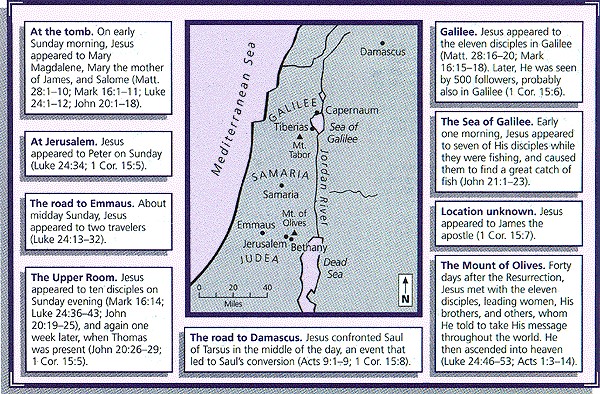
The Word in life Study Bible - interesting format. Not your routine study Bible. Worth checking the very informative notes. (e.g., here is a picture of Jesus' post-resurrection appearances.)
Wycliffe Bible Commentary - Charles Pfeiffer - 1560 pages (1962). 214 ratings Less detailed than the KJV Bible Commentary. Conservative. Notes are generally verse by verse but brief.
Rosscup - Conservative and premillennial scholars here have been experts in their fields. The work contains brief introductions and attempts to give a verse-by-verse exposition, though it does skip over some verses. The treatments vary with the authors, but as a whole it is a fine one-volume commentary for pastors and students to use or give to a layman. Outstanding sections include, for example: Whitcomb on Ezra-Nehemiah-Esther; Culver on Daniel; Ladd on Acts; Harrison on Galatians; Johnson on I Corinthians; and Ryrie on the Johannine Epistles.
New Bible Commentary - (1994)
The Experiencing God Study Bible : the Bible for knowing and doing the will of God - Blackaby, Henry (1996) 1968 pages - CHECK THIS ONE! Each chapter begins with several questions under the title "PREPARE TO MEET GOD." Then you will interesting symbols before many of the passages. The chapter ends with a "DID YOU NOTICE?" question. This might make a "dry chapter" jump off the page! Read some of the 48 ratings
Compact Bible commentary by Radmacher, Earl D; Allen, Ronald Barclay; House, H Wayne, et al - 954 pages. Multiple contributors to the comments which are often verse by verse. The comments are brief but meaty and can really help your study through a given book. A sleeper in my opinion.
NIV archaeological study Bible (2005) 2360 pages 950 ratings (See also Archaeology and the Bible - OT and NT)
NIV cultural backgrounds study Bible. bringing to life the ancient world of scripture Keener, Craig and Walton, John. Editors (2017)
Evangelical Commentary on the Bible - editor Walter Elwell (1989) 1239 pages.
MISCELLANEOUS RESOURCES
IVP Background Commentary - OT - John Walton
Zondervan Atlas of The Bible By: Umair Mirza
Dictionary of Biblical Imagery - free for use online with no restrictions (i.e., you do not need to borrow this book). Editors Leland Ryken, J C Wilhoit, Tremper Longman III - This is a potential treasure chest to aid your preaching and teaching as it analyzes the meaning of a host of Biblical figures of speech. Clue - use the "One-page view" which then allows you to copy and paste text. One downside is there is no index, so you need to search 3291 pages for entries which are alphabetical.
Dictionary of deities and demons in the Bible (DDD) - 950 pages (1995) Read some of the 65 ratings (4.8/5 Stars). A definitive in depth resource on this subject. Very expensive to purchase.
Unger's bible handbook : a best-selling guide to understanding the bible by Unger, Merrill F
Halley's Bible Handbook Henry H. Halley - (2000) 2720 pages (much larger than original edition in 1965 and no time limit on use). (Halley's Bible handbook : an abbreviated Bible commentary - one hour limit 1965 872 pages)
Rosscup - A much-used older evangelical handbook bringing together a brief commentary on Bible books, some key archaeological findings, historical background, maps, quotes, etc. It is helpful to a lay Bible teacher, Sunday School leader, or pastor looking for quick, pertinent information on a Bible book. This is the 72nd printing somewhat revised. Halley packed in much information. Unger’s is better overall, but that is not to say that Halley’s will not provide much help on basic information.
The Shaw Pocket Bible Handbook - Editor - Walter Elwell (1984) 408 pages.
"This hardback is small in size but packed full of content: Brief summaries of every book of the bible, cultural, archaeological and historical info, word definitions, pictures, maps and charts." Worth checking!
Eerdmans' Handbook to the Bible (1983) 688 pages
The New Unger's Bible Dictionary by Unger, Merrill Frederick, 1909-
Every prophecy of the Bible: Walvoord, John F
J.Sidlow Baxter: Explore The Book - pdf Vol. 4 Ezekiel to Malachi
Jensen's Survey of Bible (online) by Jensen, Irving 140 ratings (NT) 133 ratings (OT) This is a classic and in conjunction with the following three resources should give you an excellent background to the Bible book you are studying. Jensen has some of the best Book charts available and includes "key words." He also gives you some guidelines as to how to begin your inductive study of each book.
What the Bible is all about by Mears, Henrietta. This is a classic and is filled with "pearls" from this godly teacher of God's Word.
Talk thru the bible by Wilkinson, Bruce The Wilkinson & Boa Bible handbook : the ultimate guide to help you get more out of the Bible
Today's Handbook of Bible Times & Customs by Coleman, William L
Nelson's New Illustrated Bible Manners & Customs : How the People of the Bible Really Lived by Vos, Howard Frederic
The New Unger's Bible Dictionary by Unger, Merrill Frederick, 1909-
Nelson's Expository Dictionary of the Old Testament by Unger, Merrill. Indexed by English word and then any related Hebrew nouns or verbs. Definitions are solid and geared to the layperson.
HEBREW WORD STUDIES
Theological Wordbook of the Old Testament by Harris, R. Laird - (5/5 Stars) One of the best OT lexicons for studying Hebrew words.
Here is another link to the TWOT which has no time limit on use and does allow copy and paste. Can be downloaded as PDF.
Hebrew honey : a simple and deep word study of the Old Testament by Novak, Alfons, (332 pages) Indexed by English words. No Strong's numbers to help you determine if you are researching the correct Hebrew word. Here is a "work around" - go to page 289 and see if there is an annotation of the Scripture you are studying. E.g., say you want to see if there is anything for "heart" in Ezek 11:19. In the Scripture list find an entry for Ezek 11:19 with the English word "Heart." Now go look up "Heart" (on page 123). It does take some effort, but you might glean an insight not described in other Hebrew lexicons.
Vine's Expository Dictionary of Old Testament and New Testament Words - pdf. The old standby. You can also borrow Vine's complete expository dictionary of Old and New Testament words
Nelson's Expository Dictionary of the Old Testament by Unger, Merrill. Indexed by English word and then any related Hebrew nouns or verbs. Definitions are solid and geared to the lay person.
Expository Dictionary of Bible Words by Richards, Larry, It is does not go into great depth on the Greek or Hebrew words but does have some excellent insights.
So That's What it Means (Theological Wordbook) - Formerly titled "Theological Wordbook" edited by Charles Swindoll. It is now under this new title So That's What it Means and can be borrowed - it is more like a dictionary than a lexicon but the comments are superb! The contributors include Donald Campbell, Wendell Johnston, John Witmer, John Walvoord
Synonyms of the Old Testament - Robert Girdlestone
APOLOGETICS
The Apologetics Study Bible Understand Why You Believe - Comments from over 90 leading apologists, including: Ted Cabal, Lee Strobel, Chuck Colson, Norm Geisler, Josh McDowell, Albert Mohler, J.P. Moreland, see reviews. Here is a review from The Christian Reviewer.
Baker Encyclopedia of Christian Apologetics by Geisler, Norman
Cyril Barber - This is a goldmine of valuable information! Well-indexed. Covers everything from “Absolute Truth” to “Zen Buddhism.” Extensive articles on such topics as “Agnosticism,” “Annihilationism,” “Bible, Alleged Errors in,” “Gnosticism,” “Miracles in the Bible,” “New Testament Manuscripts,” and “Objections to Resurrection,” “Big Bang Theory,” “Edward John Carnell,” “Christ, Death of,” are only a few of the insightful essays in this masterful work. Each article has been written in an understandable way, and a 28 page bibliography forms a valuable source for further research. An excellent resource.
Evidence That Demands A Verdict - Josh McDowell
The New Evidence that Demands a Verdict - Josh McDowell
More Than A Carpenter - A modern classic by Josh McDowell - Great resource for those who are skeptical that Jesus is fully God, fully Man.
Encyclopedia of Bible difficulties by Archer, Gleason L - or here with no restrictions
Hard Sayings of the Bible - Walter Kaiser
When Critics Ask - Norman Geisler
MANNERS AND CUSTOMS
IN THE BIBLE
Today's Handbook of Bible Times & Customs by Coleman, William L
Nelson's New Illustrated Bible Manners & Customs : How the People of the Bible Really Lived by Vos, Howard Frederic
Manners & Customs of the Bible (The New Manners and Customs) Freeman, James M., 1827-1900 Published 1998
The New Manners and Customs of Bible Times: Gower, Ralph, 1933- Published 1987
Manners and Customs of Bible lands By: Wight, Fred Published 1983
Manners and Customs in the Bible By: Matthews, Victor Harold Published 1991
Handbook of life in Bible times By: Thompson, J. A. (John Arthur), 1913-2002 Published 1986
Illustrated dictionary of Bible manners and customs By: Deursen, A. van (Arie), 1891-1963 Published 1982
The Illustrated Guide to Bible Customs & Curiosities by Knight, George W.
Orientalisms in Bible lands, giving light from customs, habits, manners, imagery, thought and life in the East for Bible students By: Rice, Edwin Wilbur, 1831-1929 Published 1910
Bible manners and customs By: Mackie, G. M. 1854-1922 Published 1898
Teach it to your children : how kids lived in Bible days By: Vamosh, Miriam Feinberg, author
Everyday life in Bible times : work, worship, and war By: Embry, Margaret Published 1994
Everyday living : Bible life and times : fascinating, everyday customs and traditions from the people of the Bible Published 2006
The Land and the Book; or, Biblical illustrations drawn from the manners and customs, the scenes and scenery, of the Holy land By: Thomson, William M. (William McClure), 1806-1894 Published 1880
Eastern manners illustrative of the Old Testament history By: Jamieson, Robert, 1802-1880 Published 1838
Scripture manners and customs : being an account of the domestic habits, arts, etc., of Eastern nations mentioned in Holy Scripture Published 1895
- Daniel 1, 2, 3, 6
- Daniel 1
- Daniel 2
- Daniel 3
- Daniel 4
- Daniel 5
- Daniel 6, 1 Cor. 6:9-20
- Daniel 6
- Daniel 7
- Daniel 8, 9:24-27
- Daniel 9
- Daniel 10
- Daniel 11, 12
- Daniel Artwork
- Daniel 1 2 3 4 5 6 7 8 10 11 12
- Standing Out in the Crowd - multiple pictures related to Daniel 3
- Depictions of the City of Babylon
- Ancient Babylon
- Models of Ancient Babylon
- Depiction of the Hanging Gardens of Babylon
- Site of Modern Babylon in Iraq
- Nebuchadnezzar's Golden Headed Statute
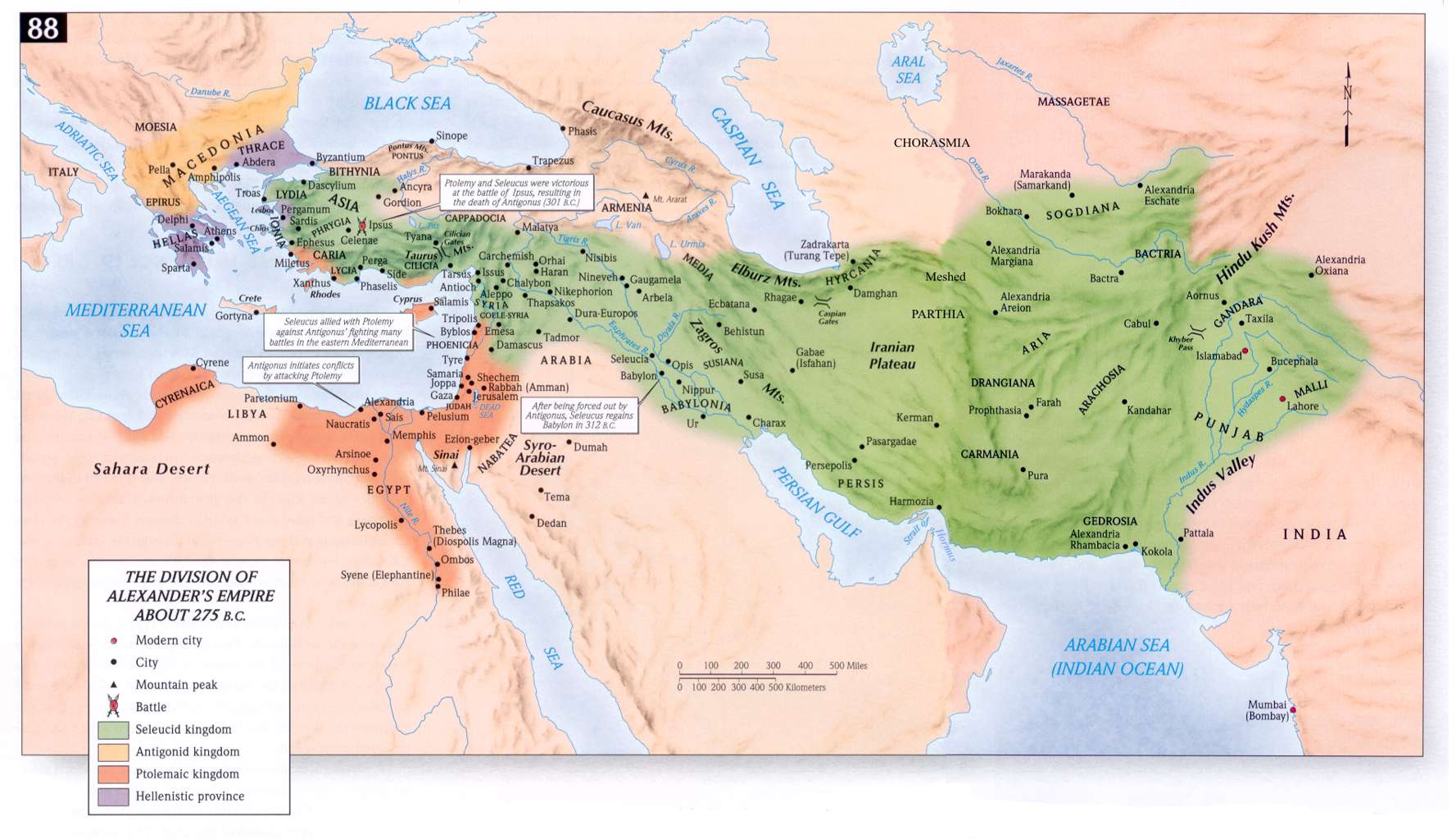
- Maps of Division of Alexander the Great's Empire among 4 Generals - cp "Four conspicuous horns" in Da 8:8
MAPS RELATED TO DANIEL - these maps are very high quality
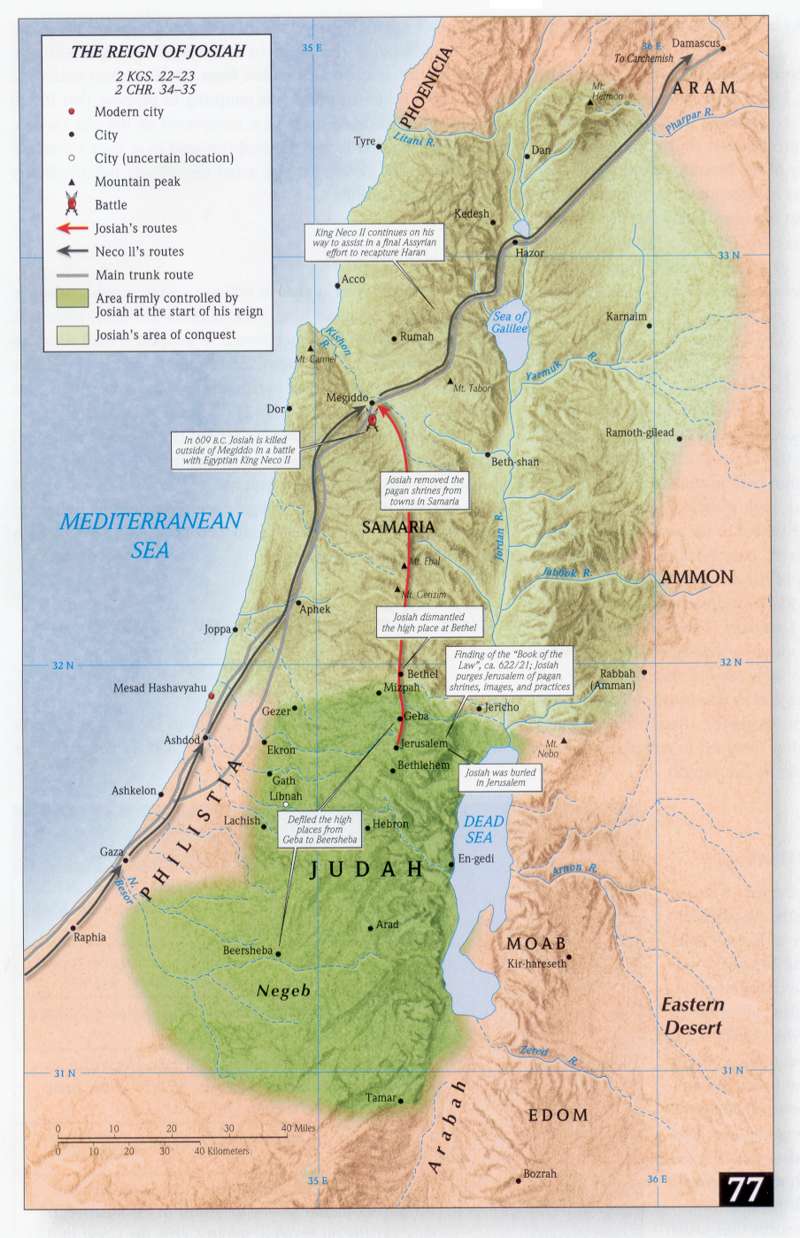
- The Reign of Josiah - Daniel would likely have lived during Josiah's reign before he was removed to Babylon
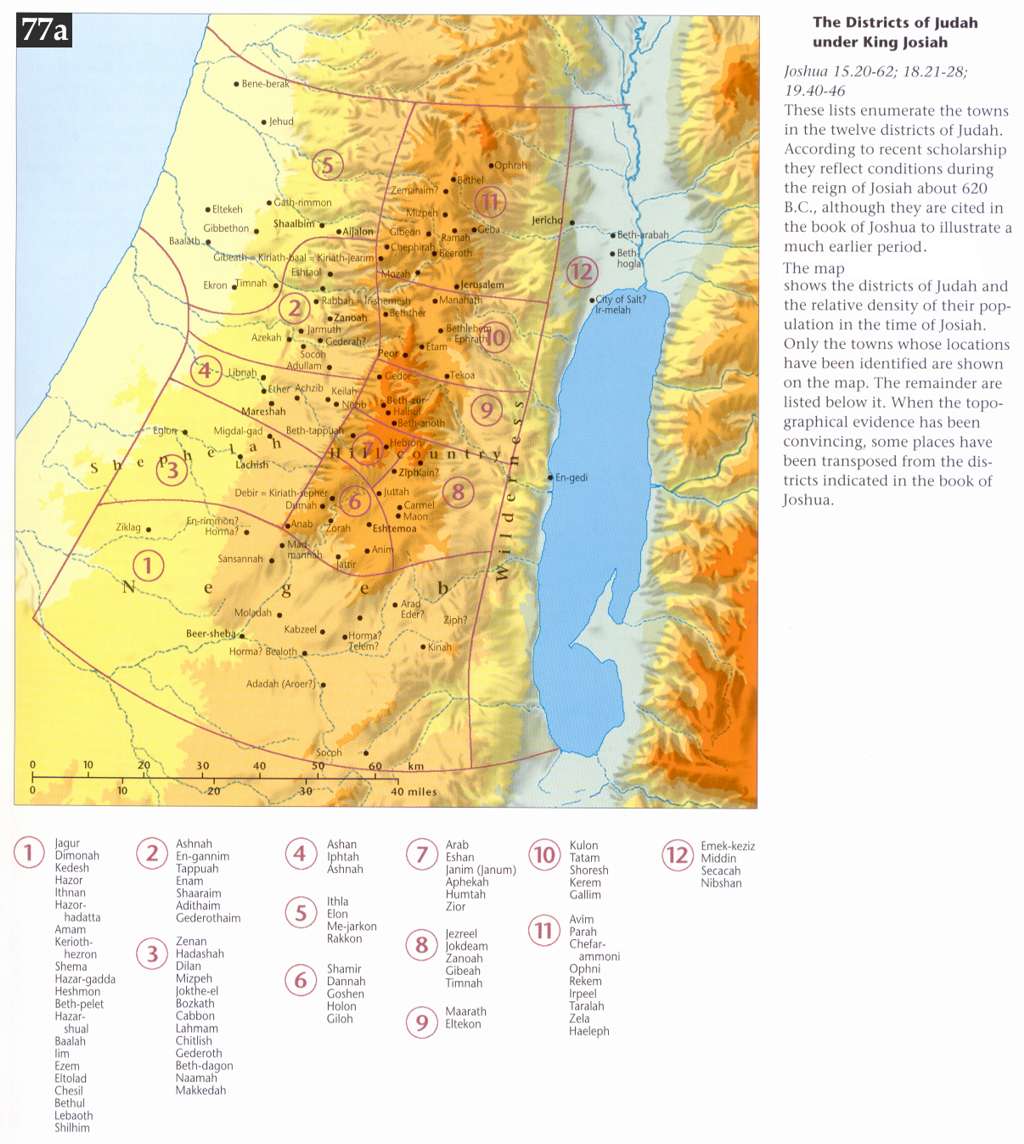
- The Districts of Judah under King Josiah
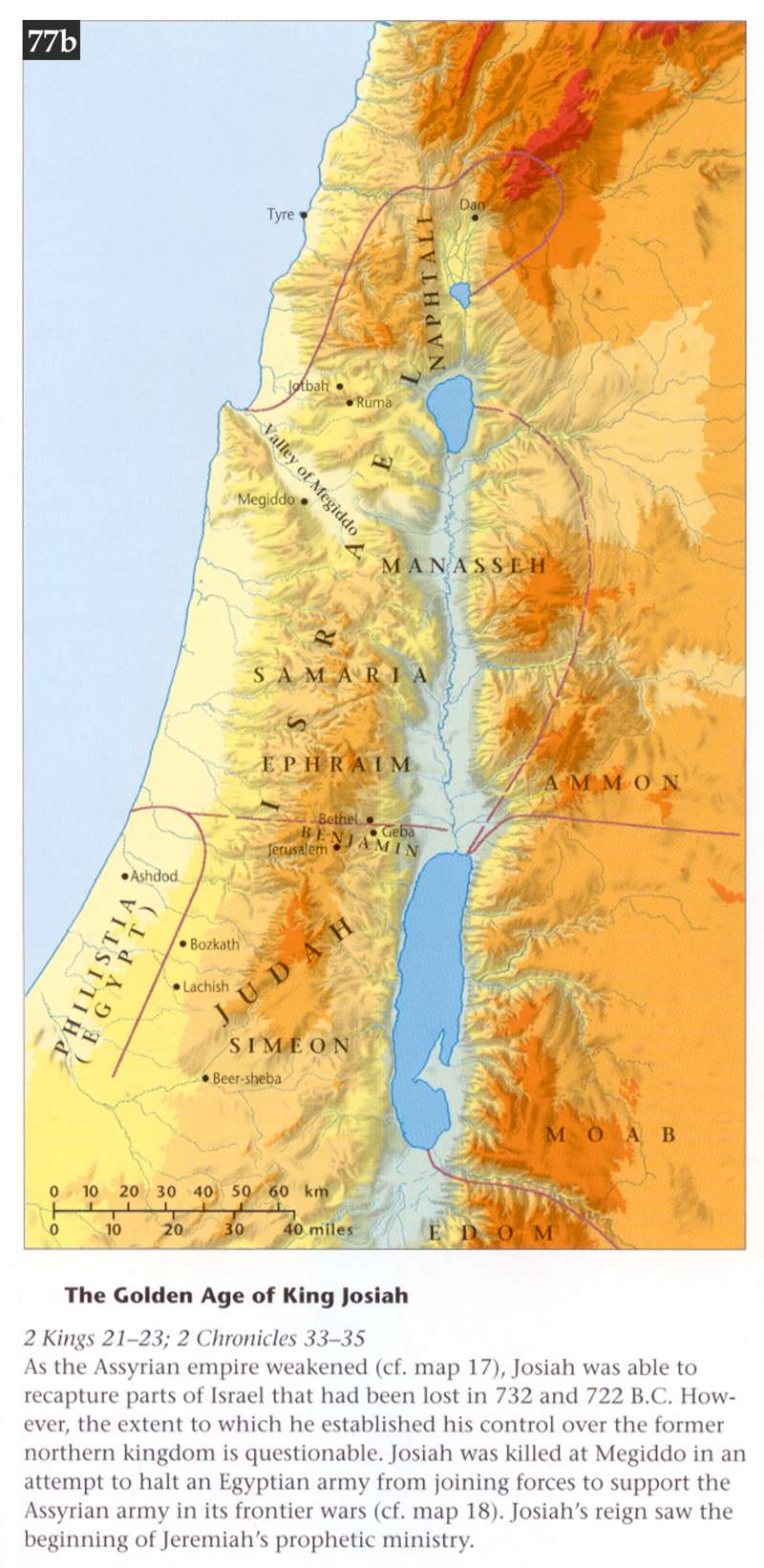
- The Golden Age of King Josiah
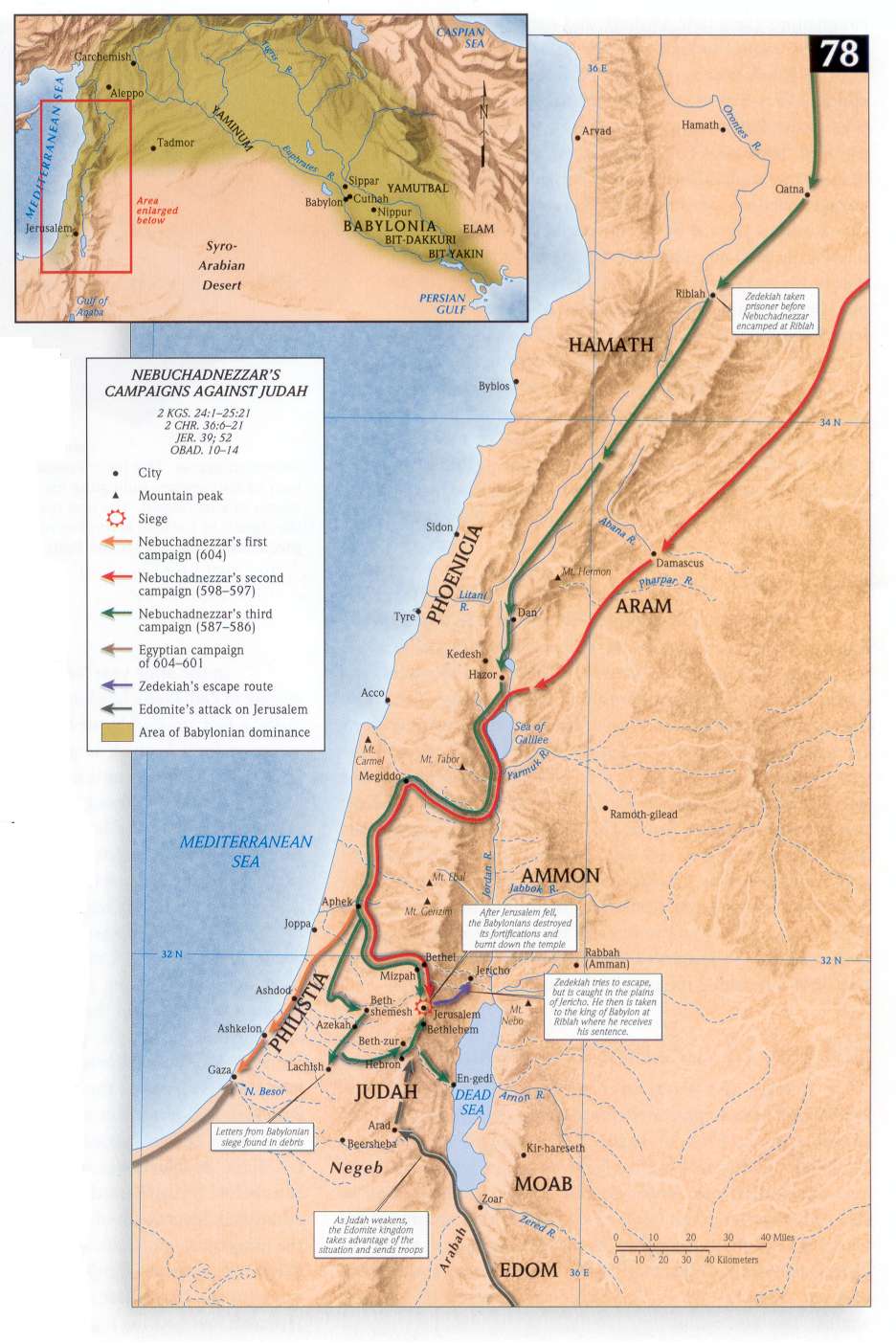
- Nebuchadnezzar’s Campaigns against Judah
- Assyria & Babylon
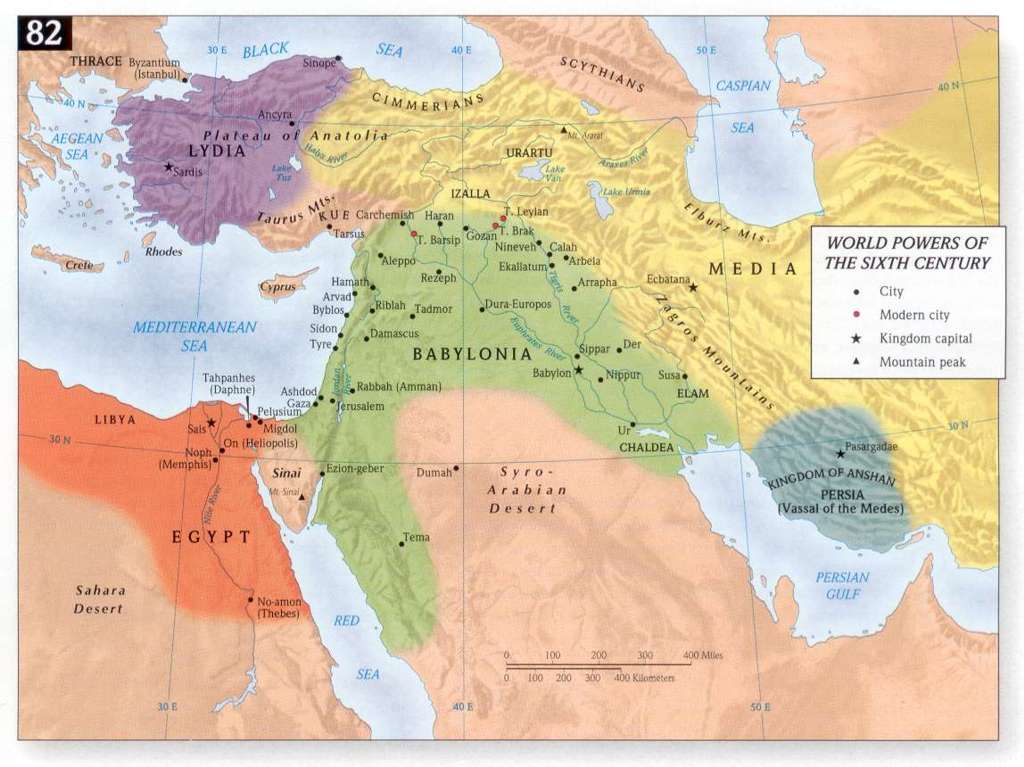
- World Powers of the 6th century BCE
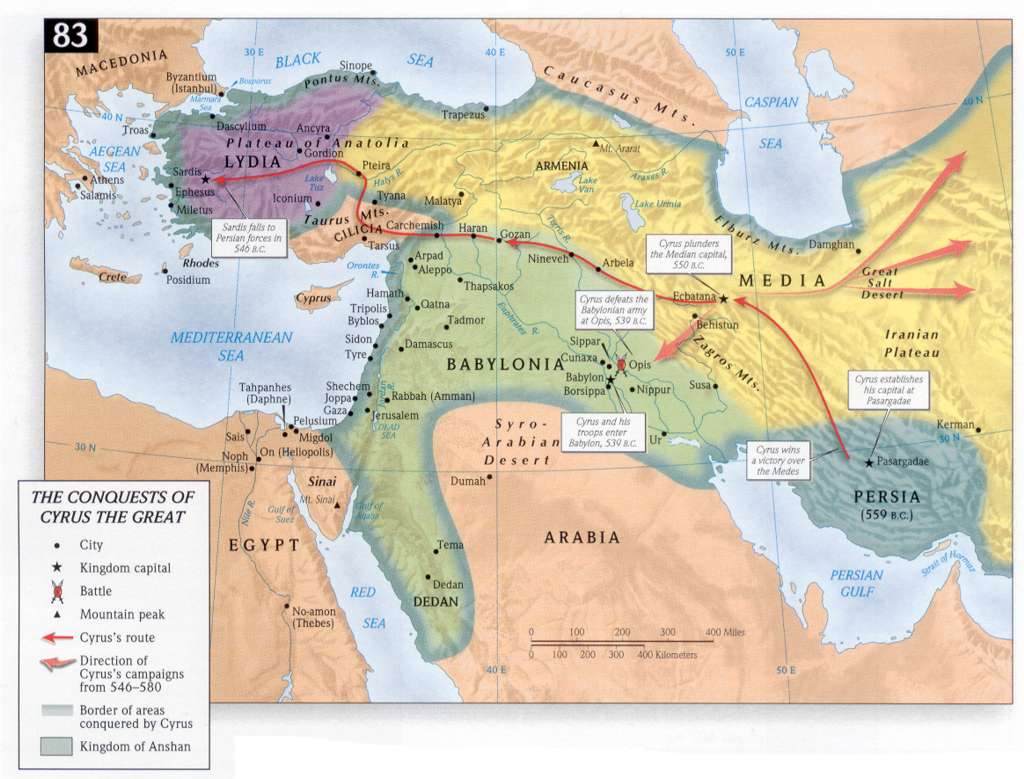
- The Conquests of Cyrus the Great
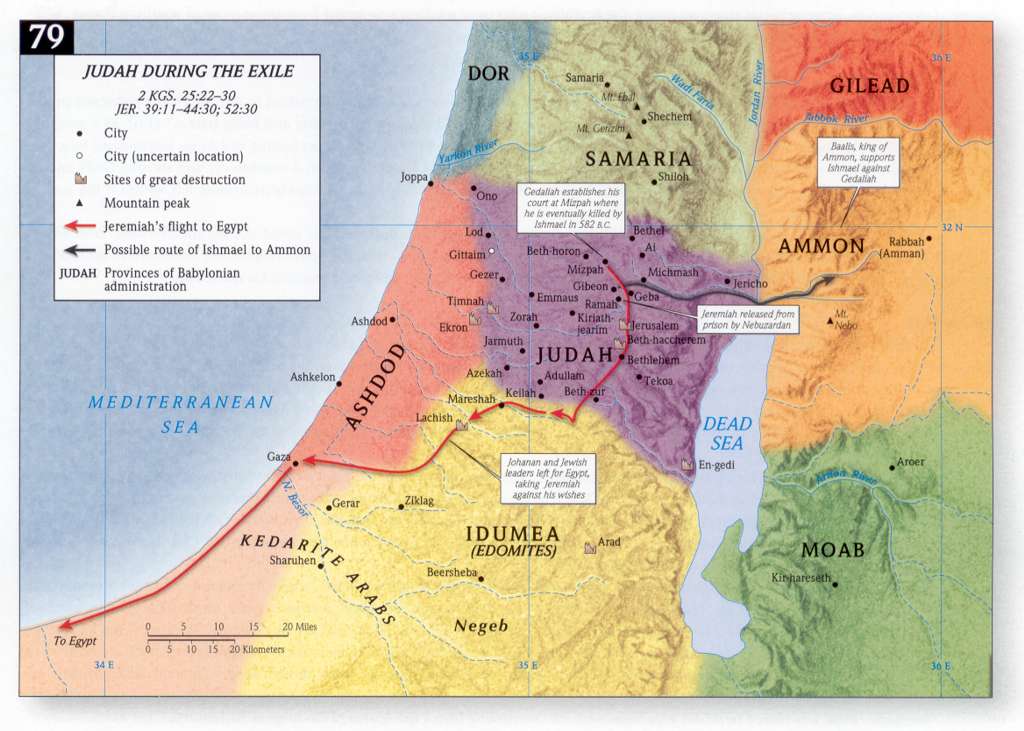
- Judah during the Exile
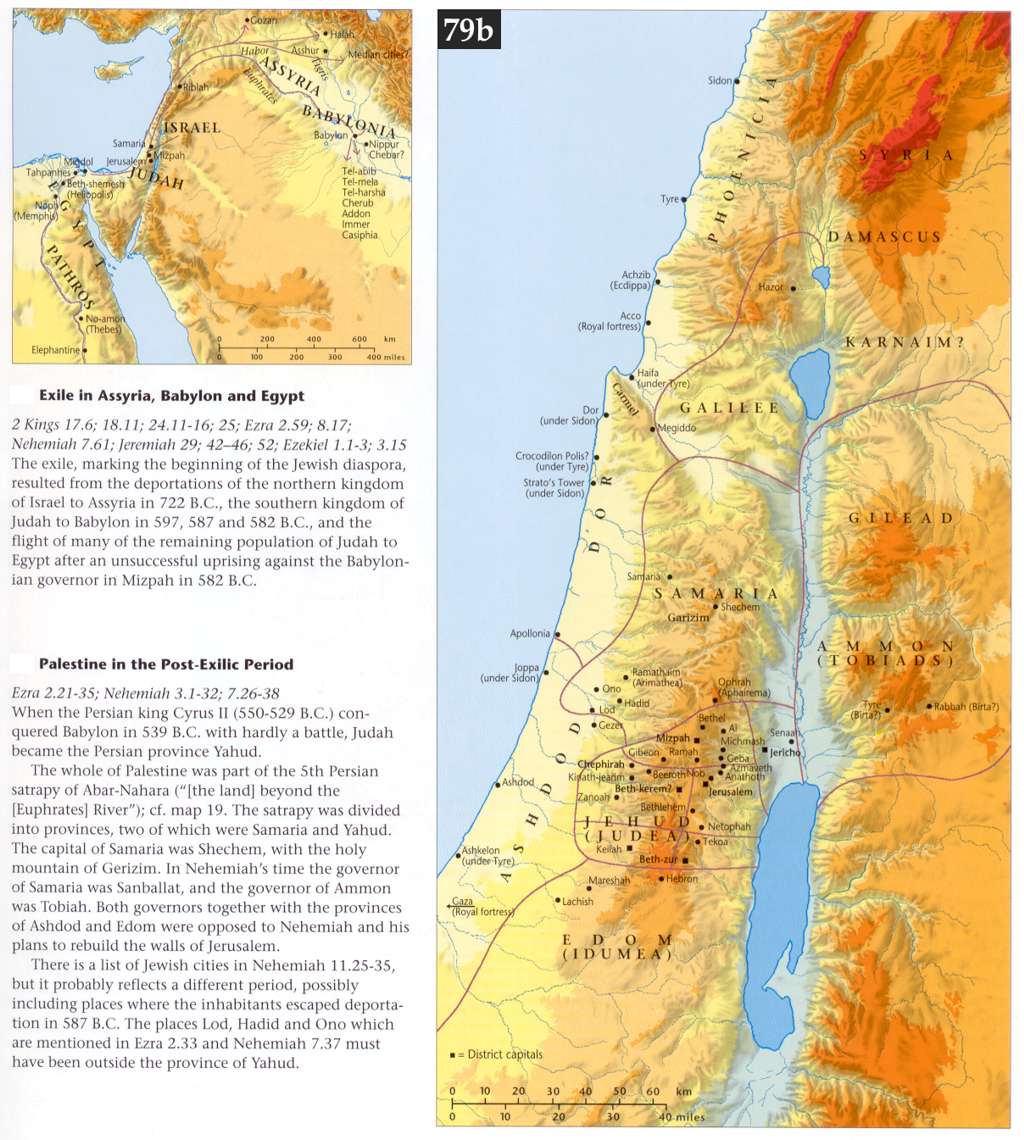
- Exile; Palestine in the Post-Exilic Period
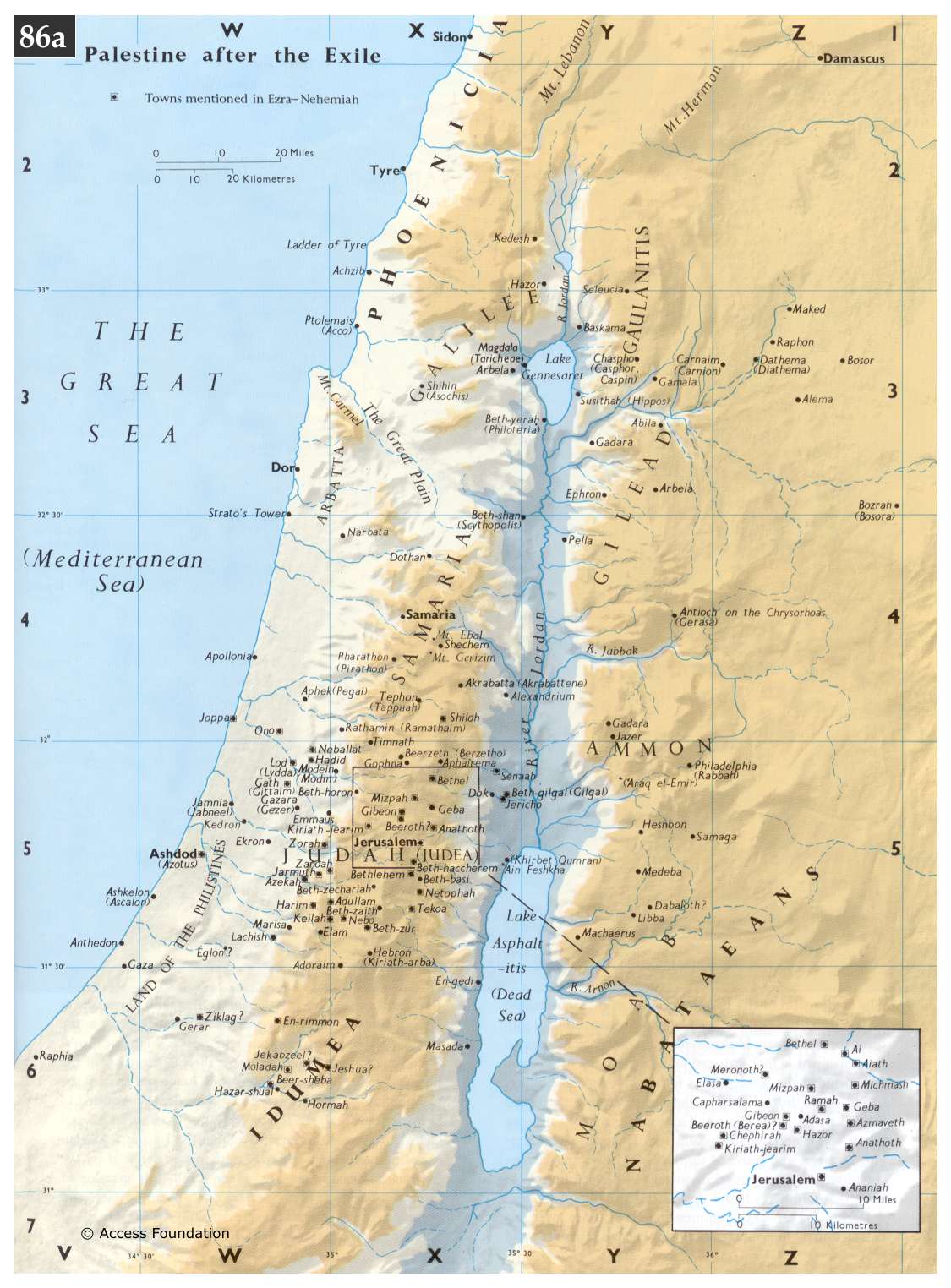
- Palestine after the Exile
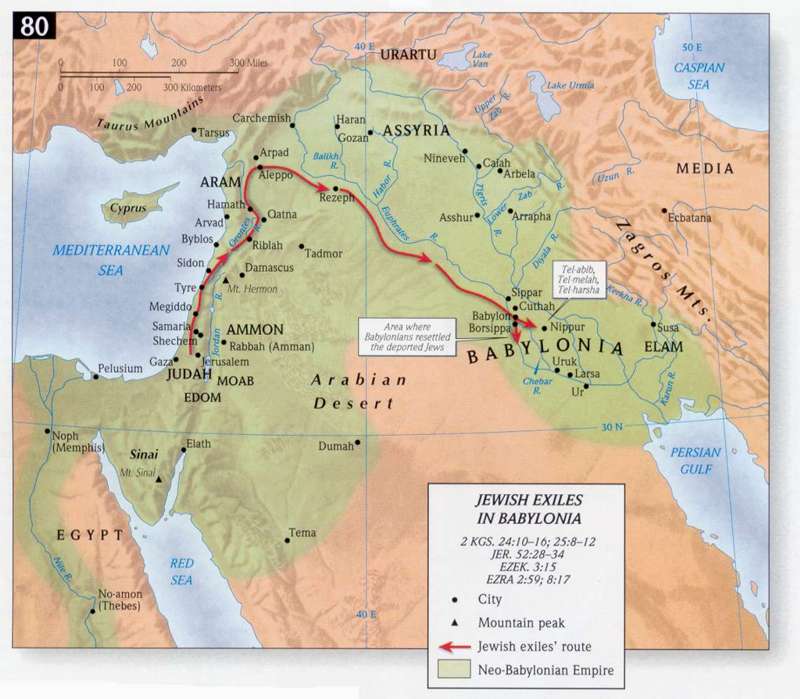
- Jewish Exiles in Babylon
- Judah during the Exile
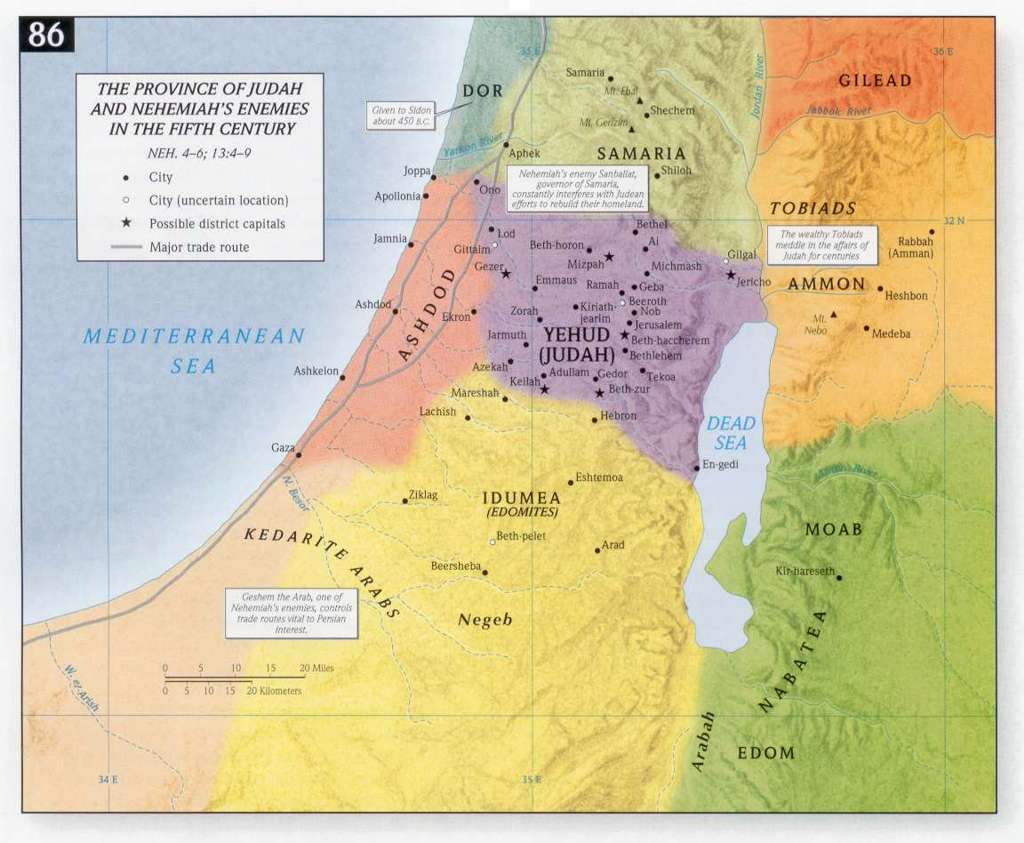
- Judah in the 5th century BCE
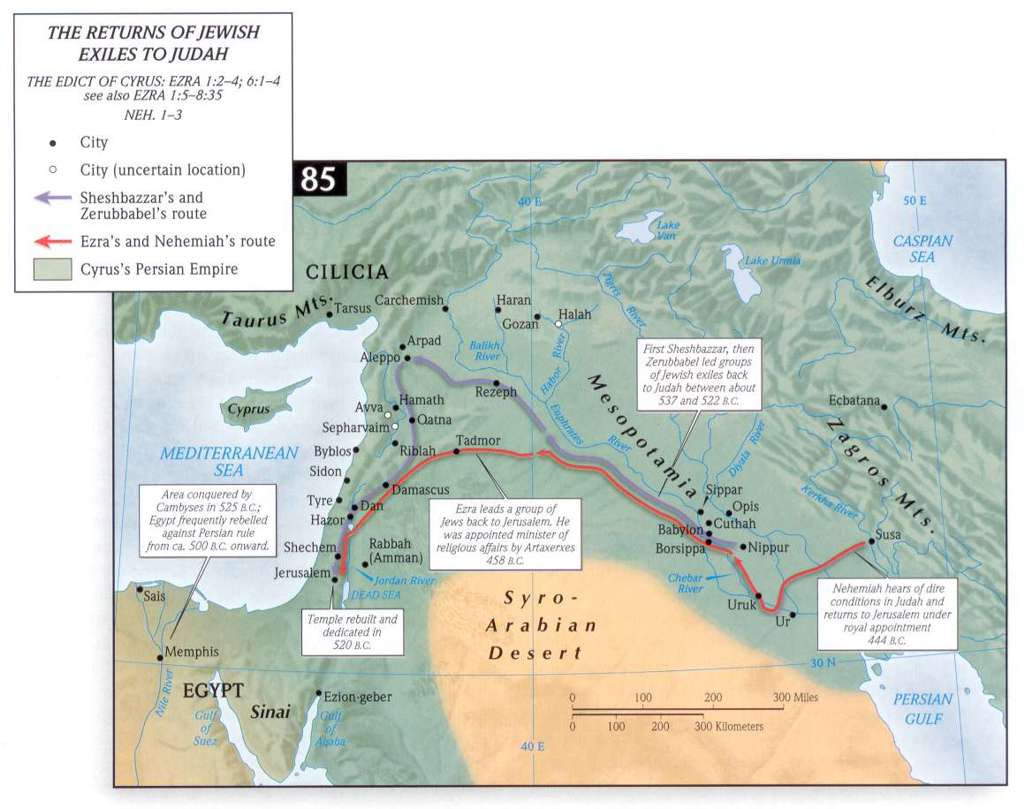
- The Return of the Jewish Exiles to Judah
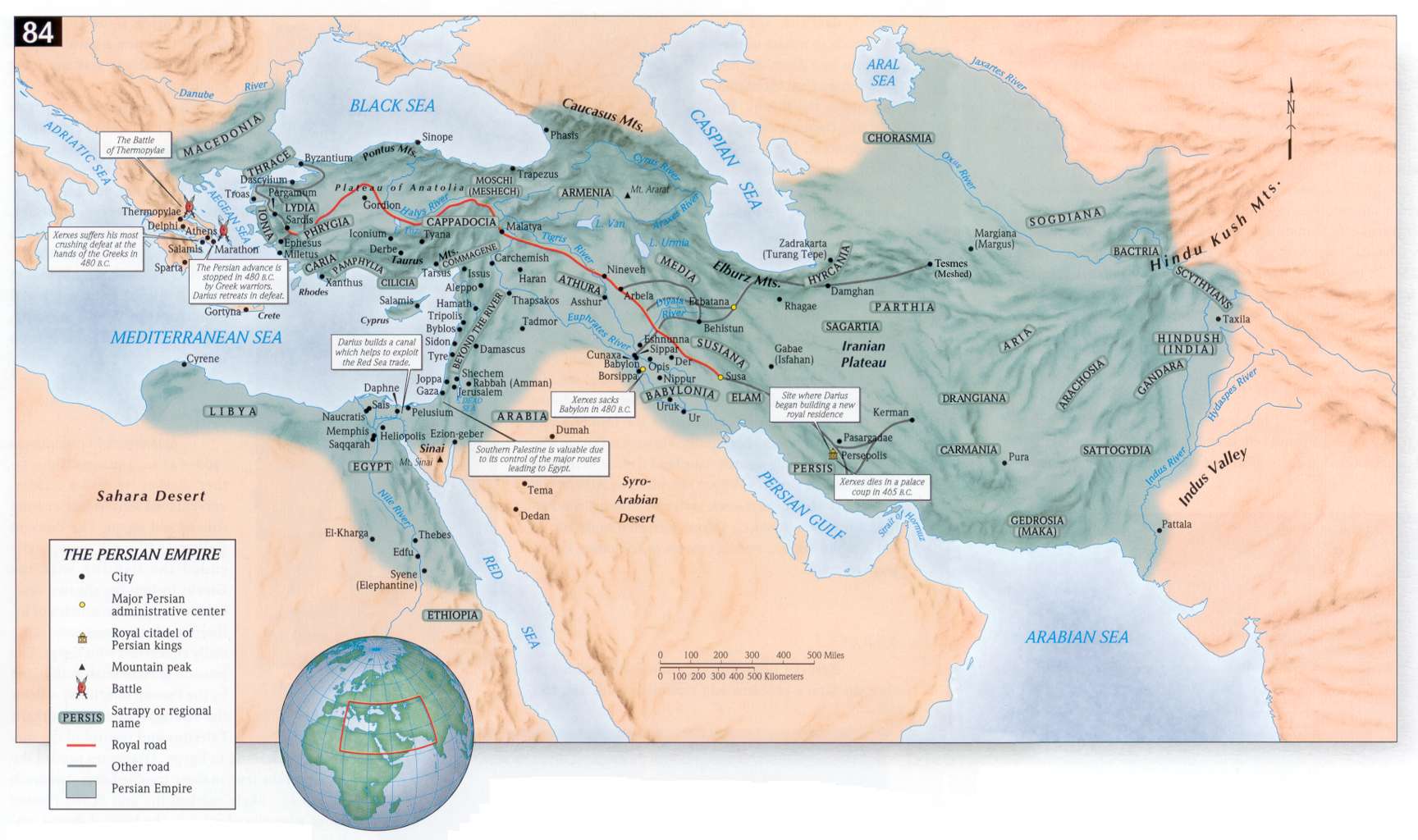
- The Persian Empire - Silver = Da 2:32, 39, Bear = Da 7:5; Ram = Da 8:6, 20 (539-323 BC)
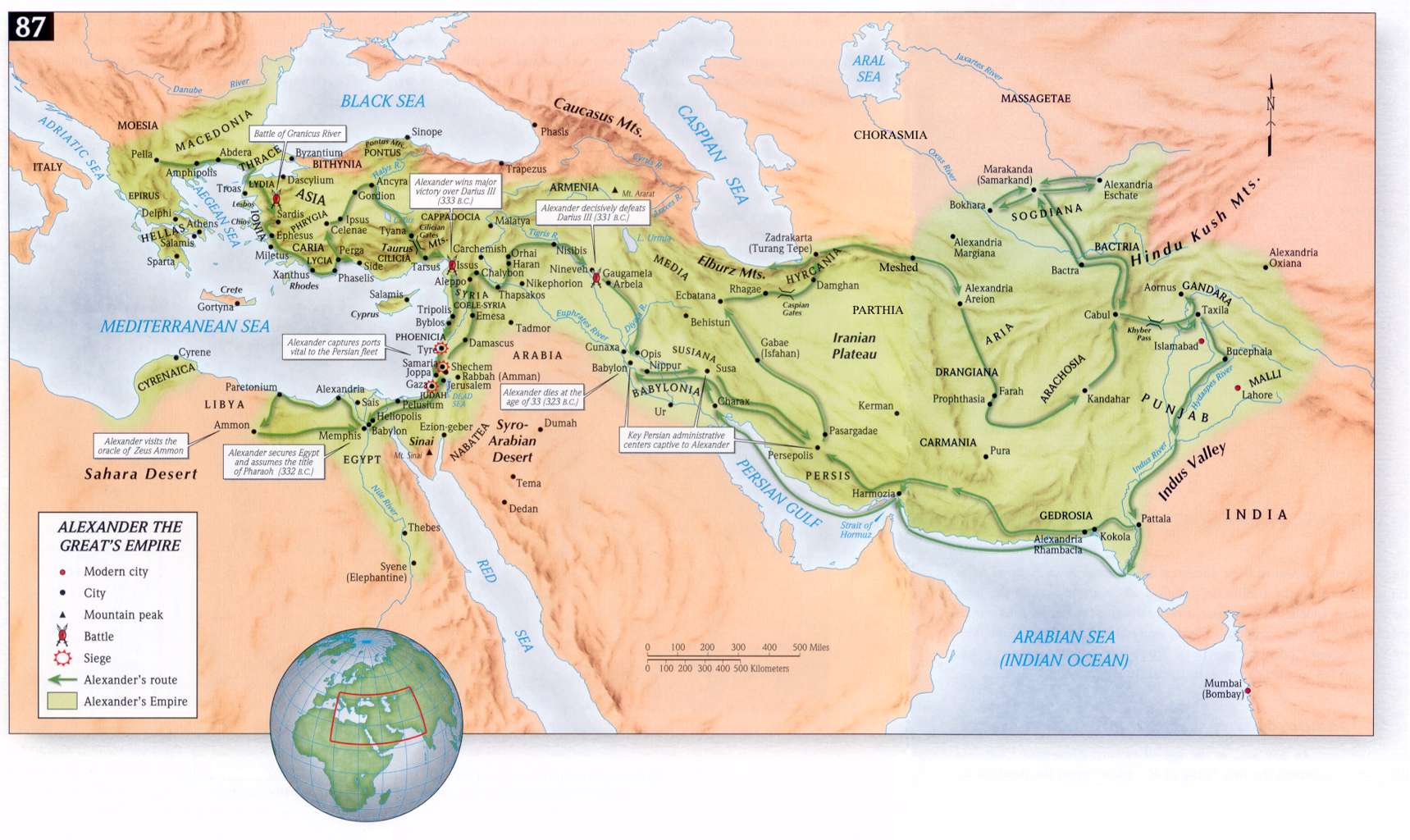
- Alexander the Great's Empire - Bronze = Da 2:32, 39; Leopard = Da 7:6; Male Goat = Da 8:5-8, 21 (323-63 BC)
- Division of Alexander's Empire - Da 8:8
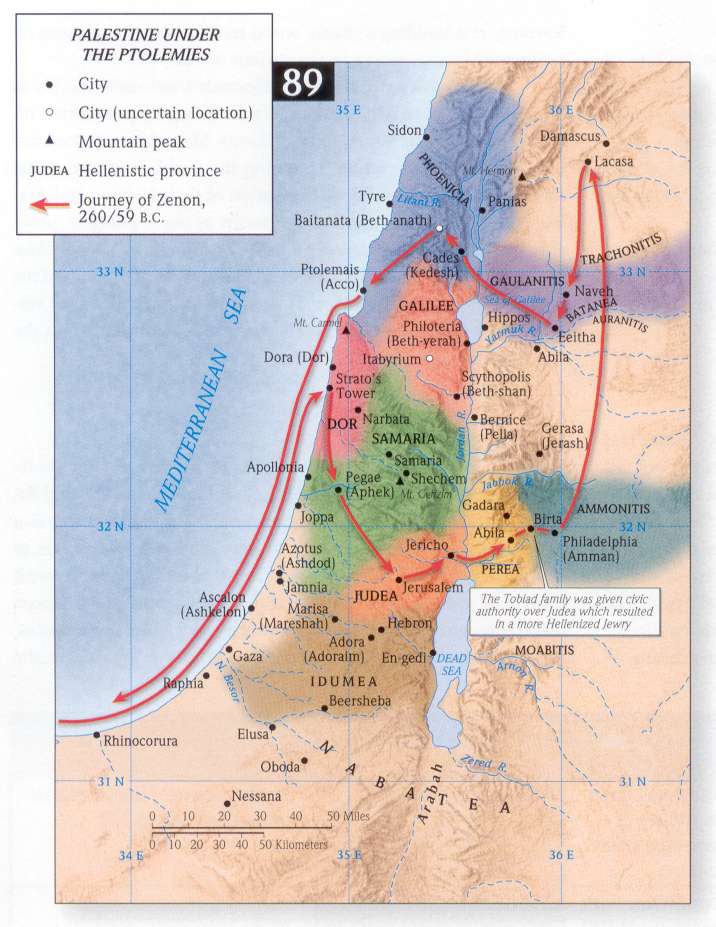
- Palestine Under the Ptolemies -
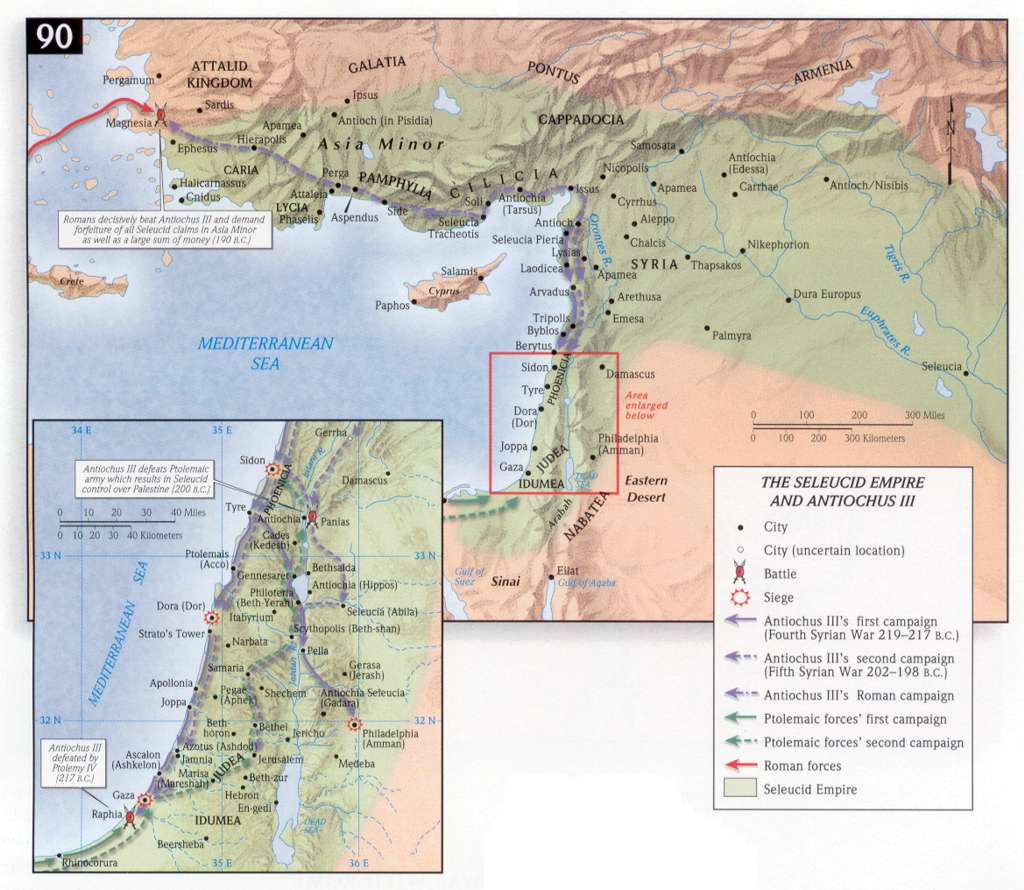
- The Seleucid Empire and Antiochus III
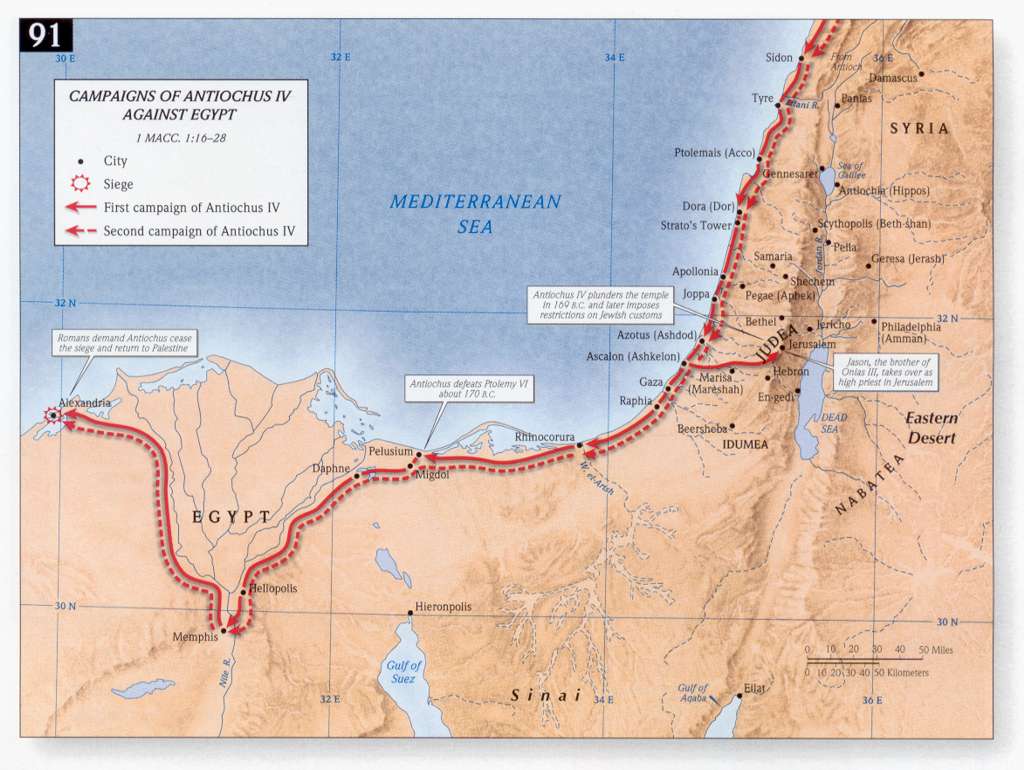
- Campaigns of Antiochus IV against Egypt - cp Da 8:9ff
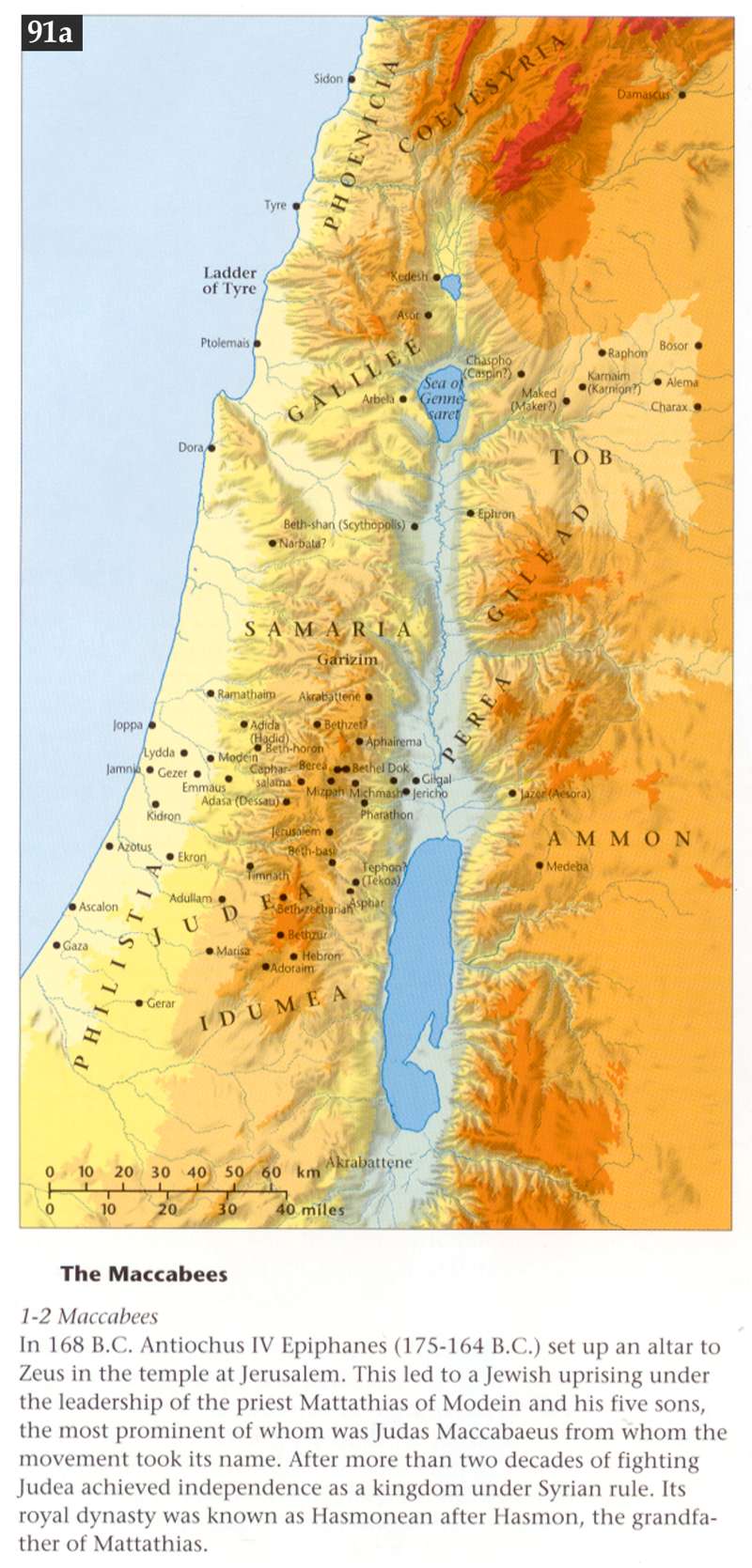
- The Maccabees in 168 BCE
- Assyrian Captivity of the 10 Tribes
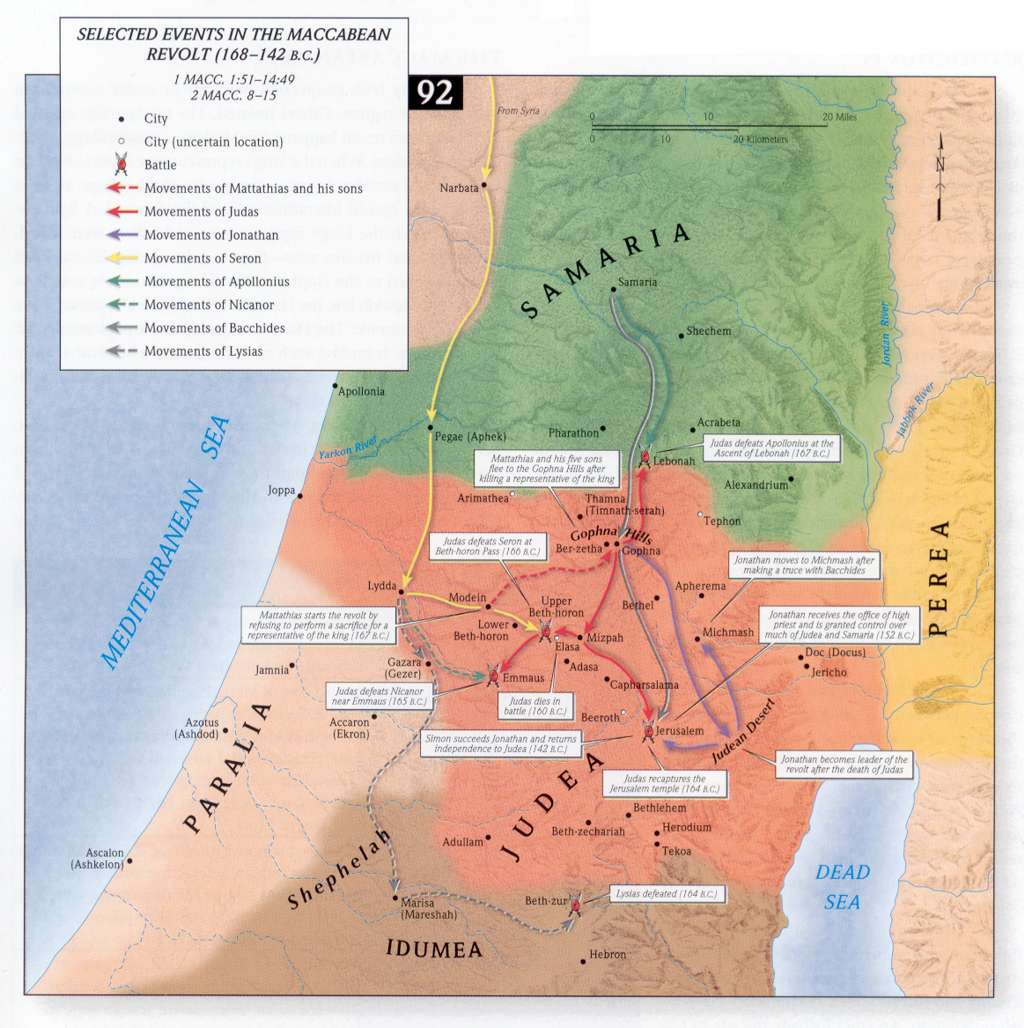
- Selected Events in the Maccabean Revolt
MORE MAPS - SOME DUPLICATION
The Kingdom of David and Solomon
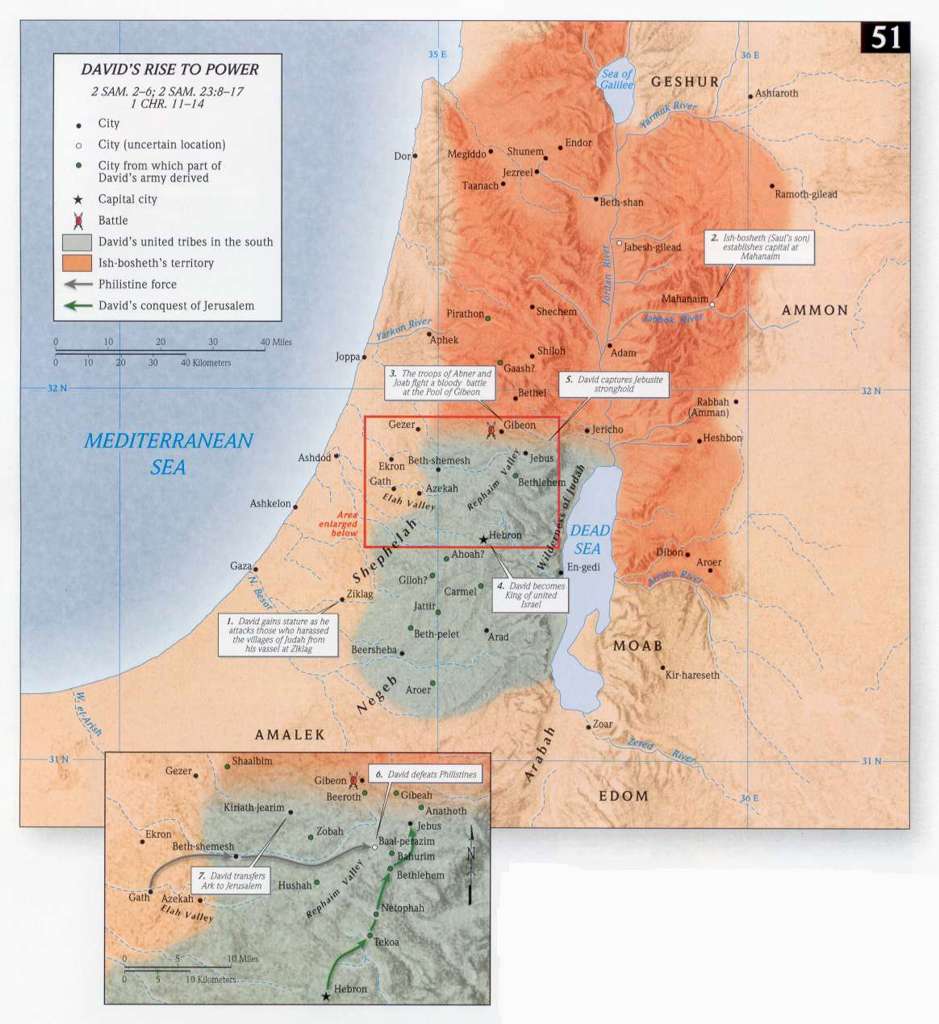
- David's Rise to Power
- David in Conquest of Canaan
- David's Wars of Conquest
- Kingdom of David and Solomon
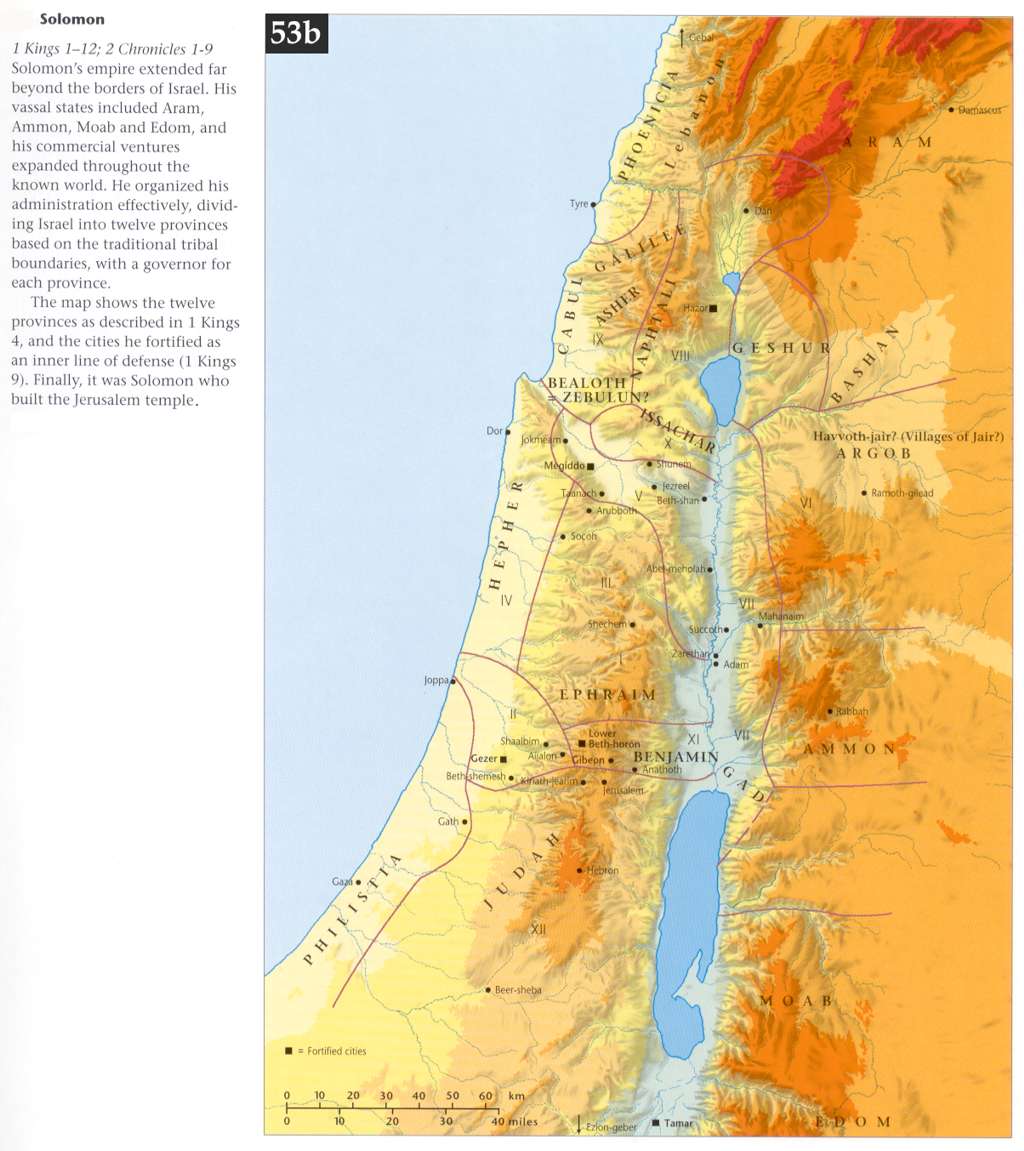
- The United Monarchy under Solomon (1)
- The United Monarchy under Solomon (2)
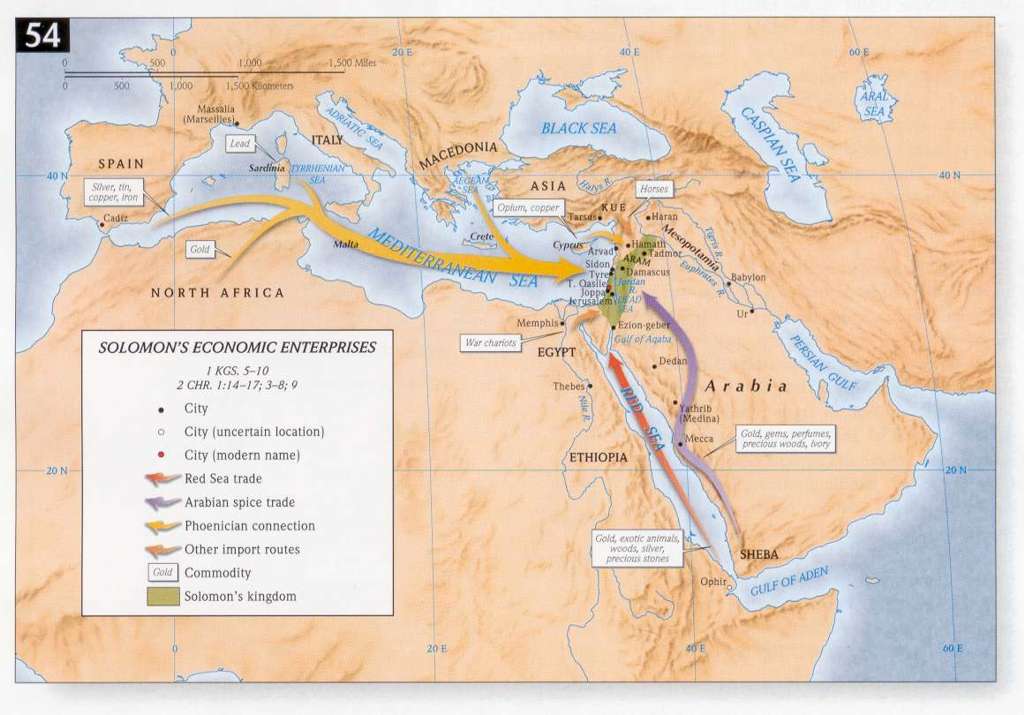
- Solomon's Economic Enterprises
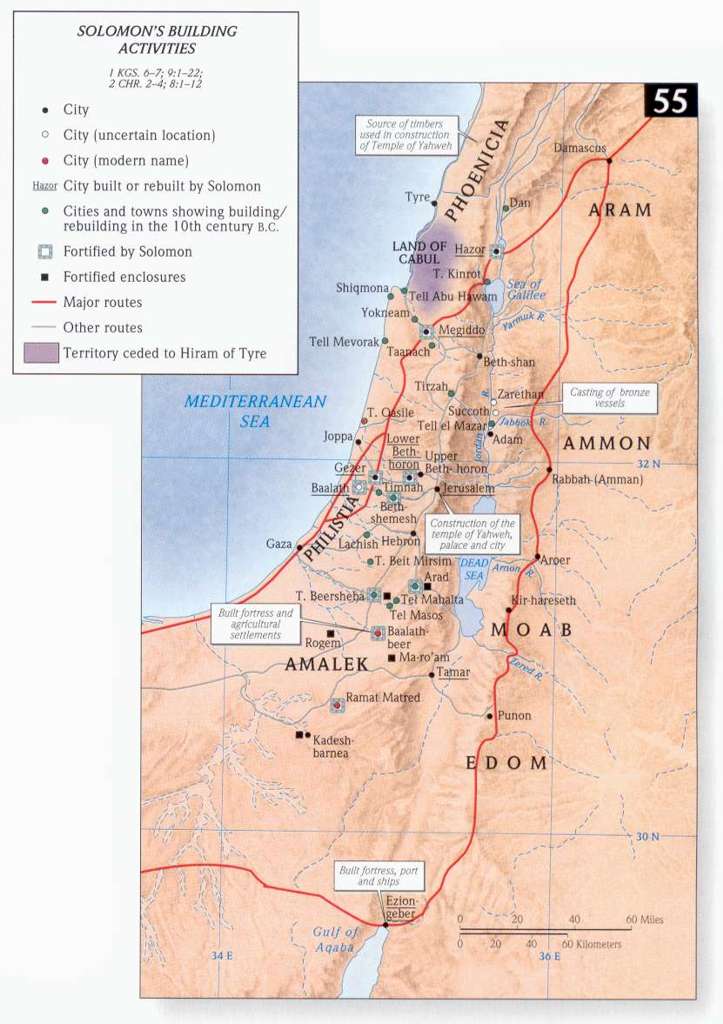
- Solomon's Building Activities
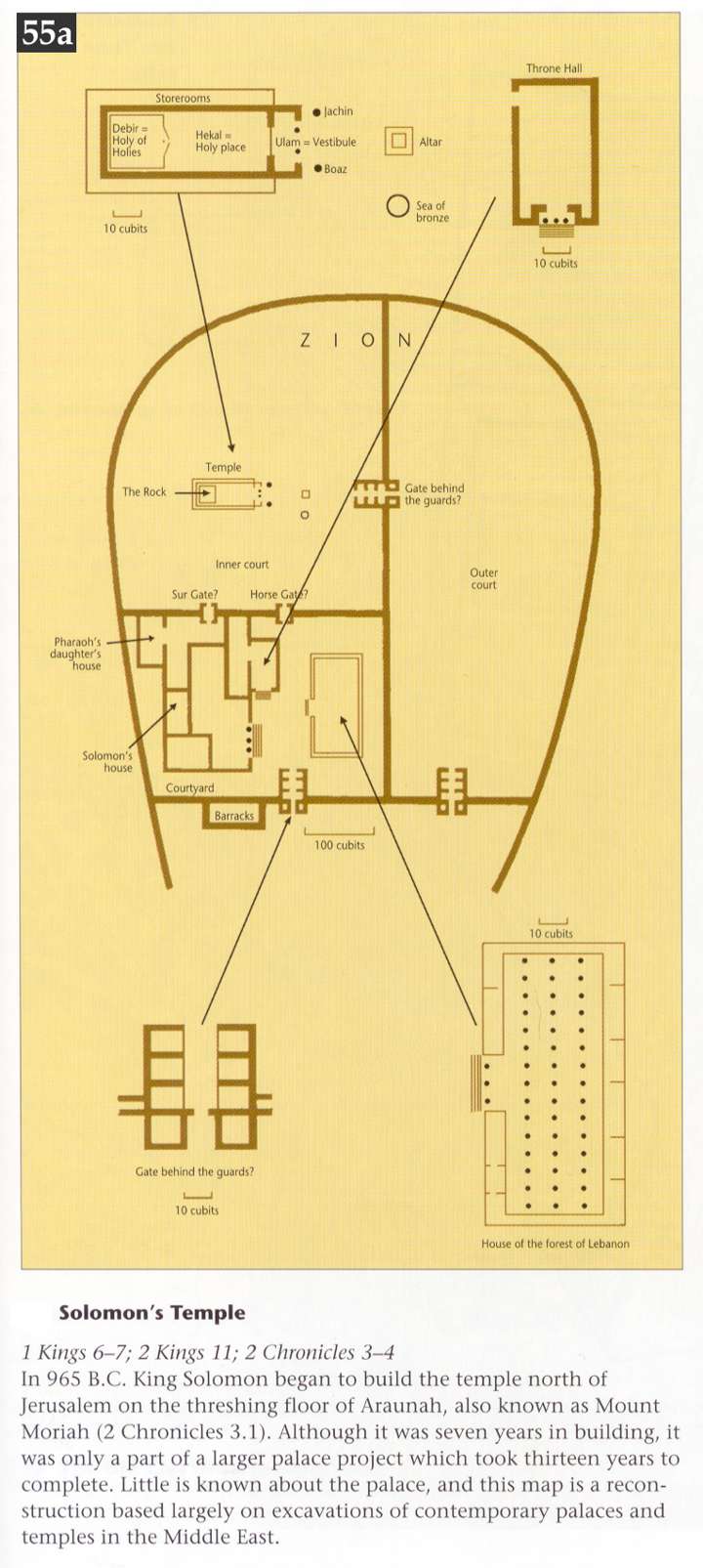
- Solomon's Temple
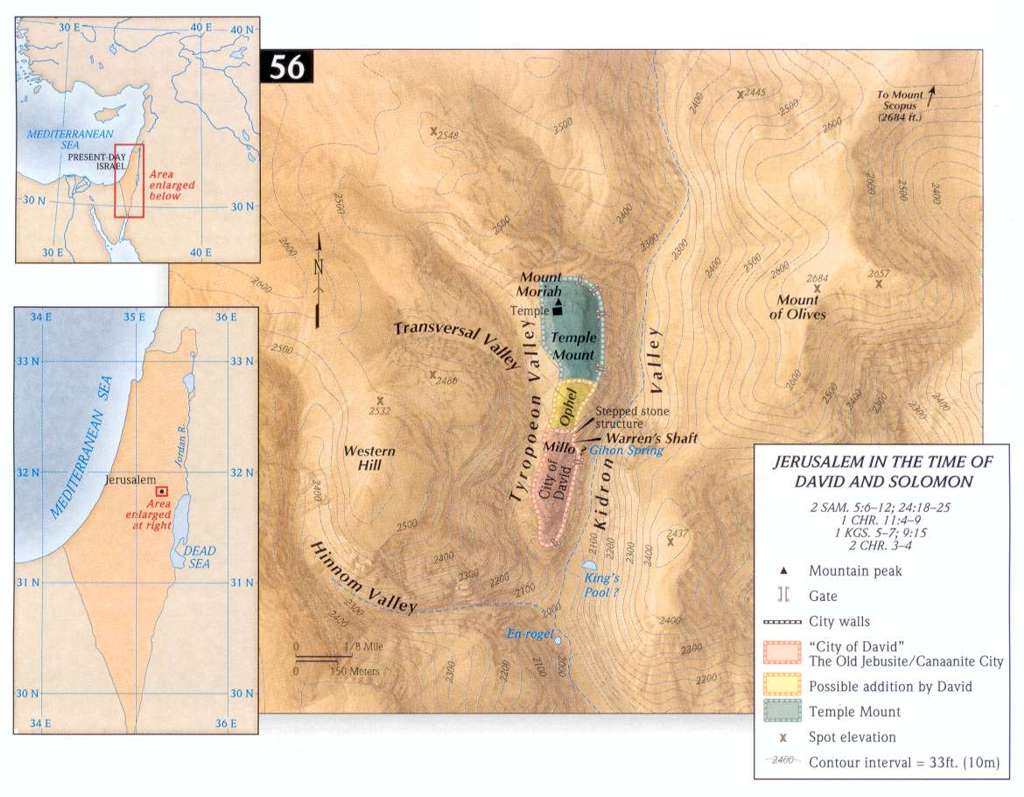
- Jerusalem in the Time of David and Solomon
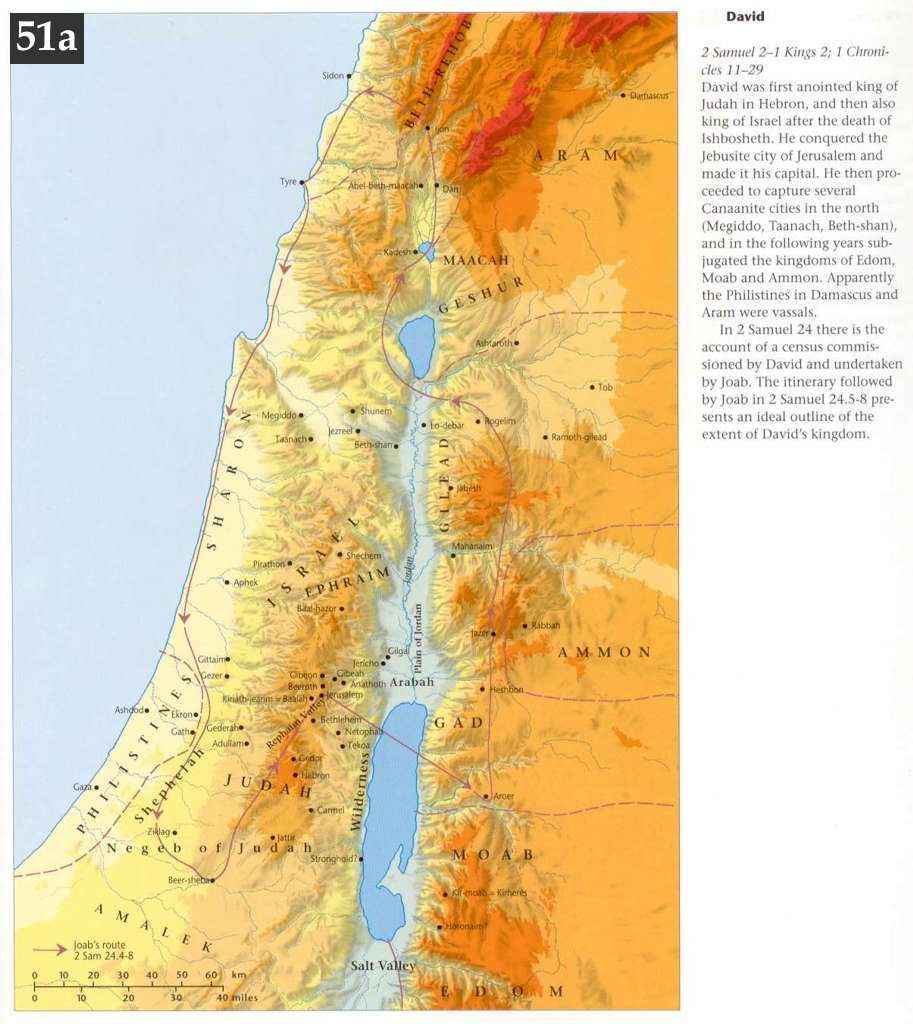
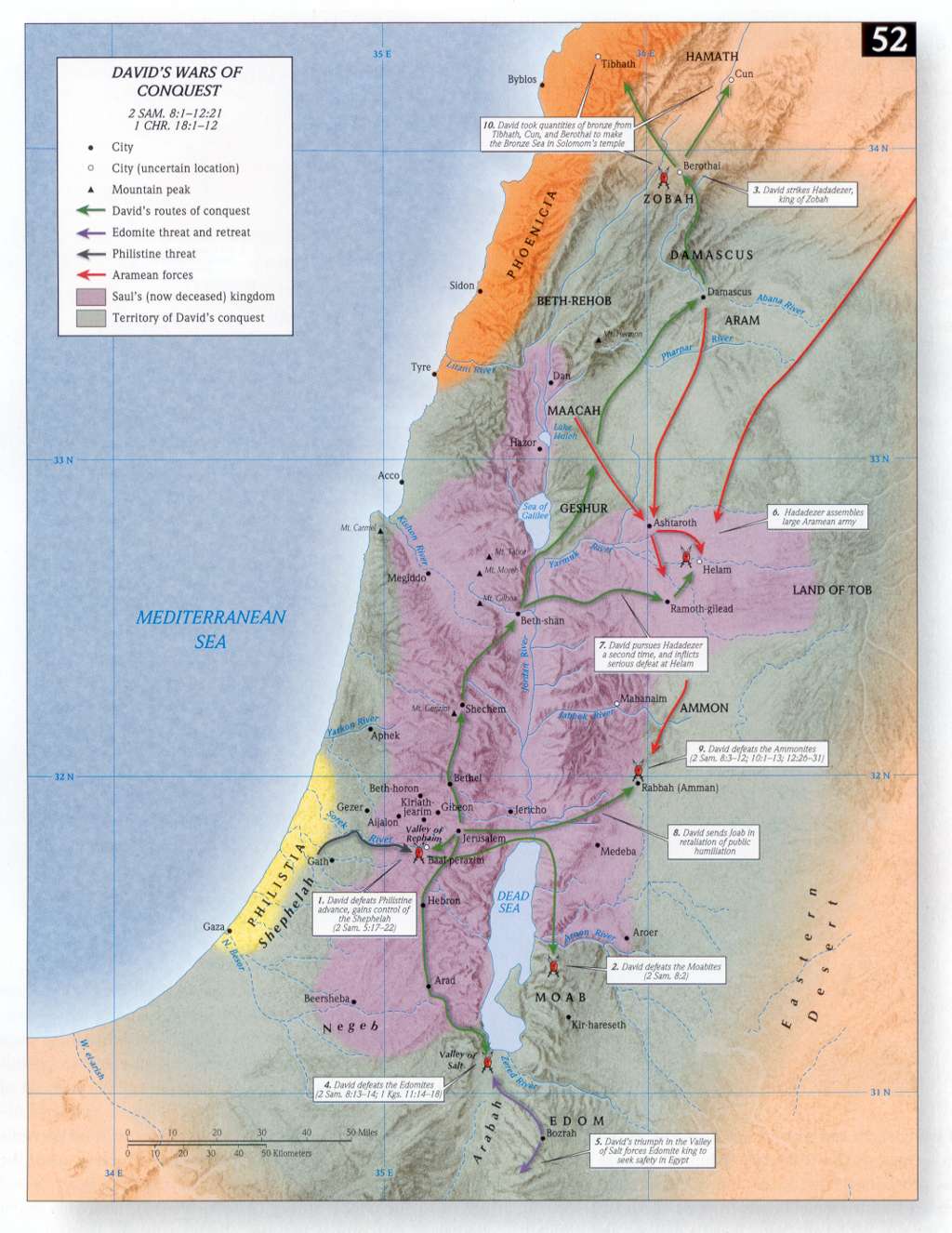
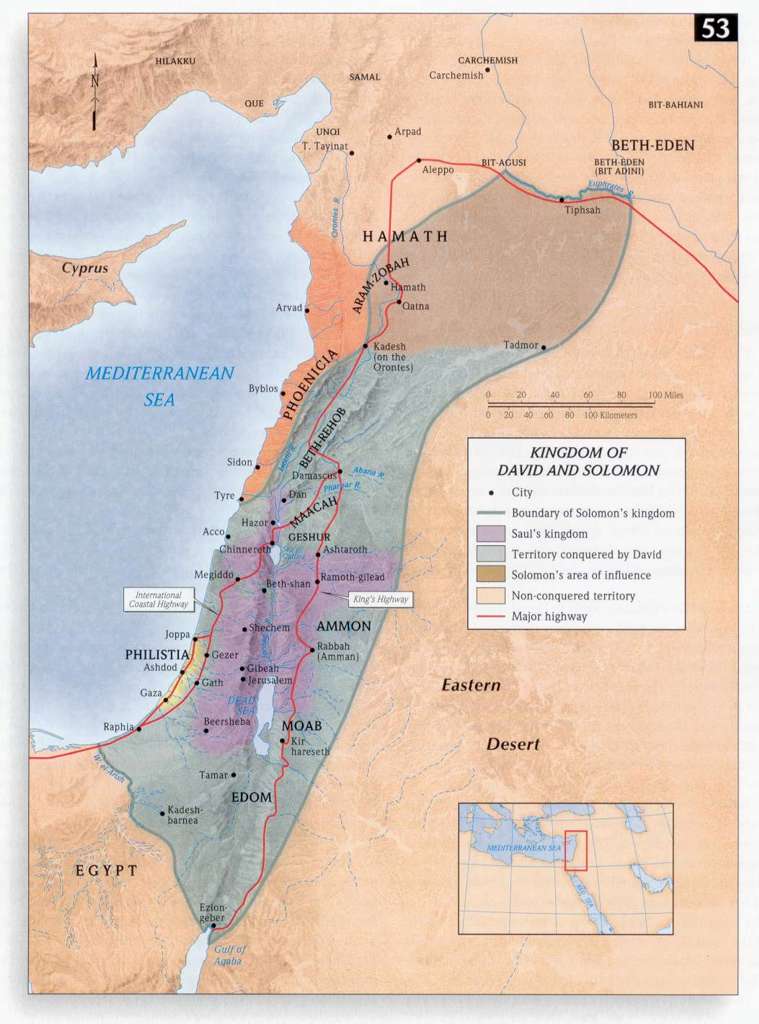
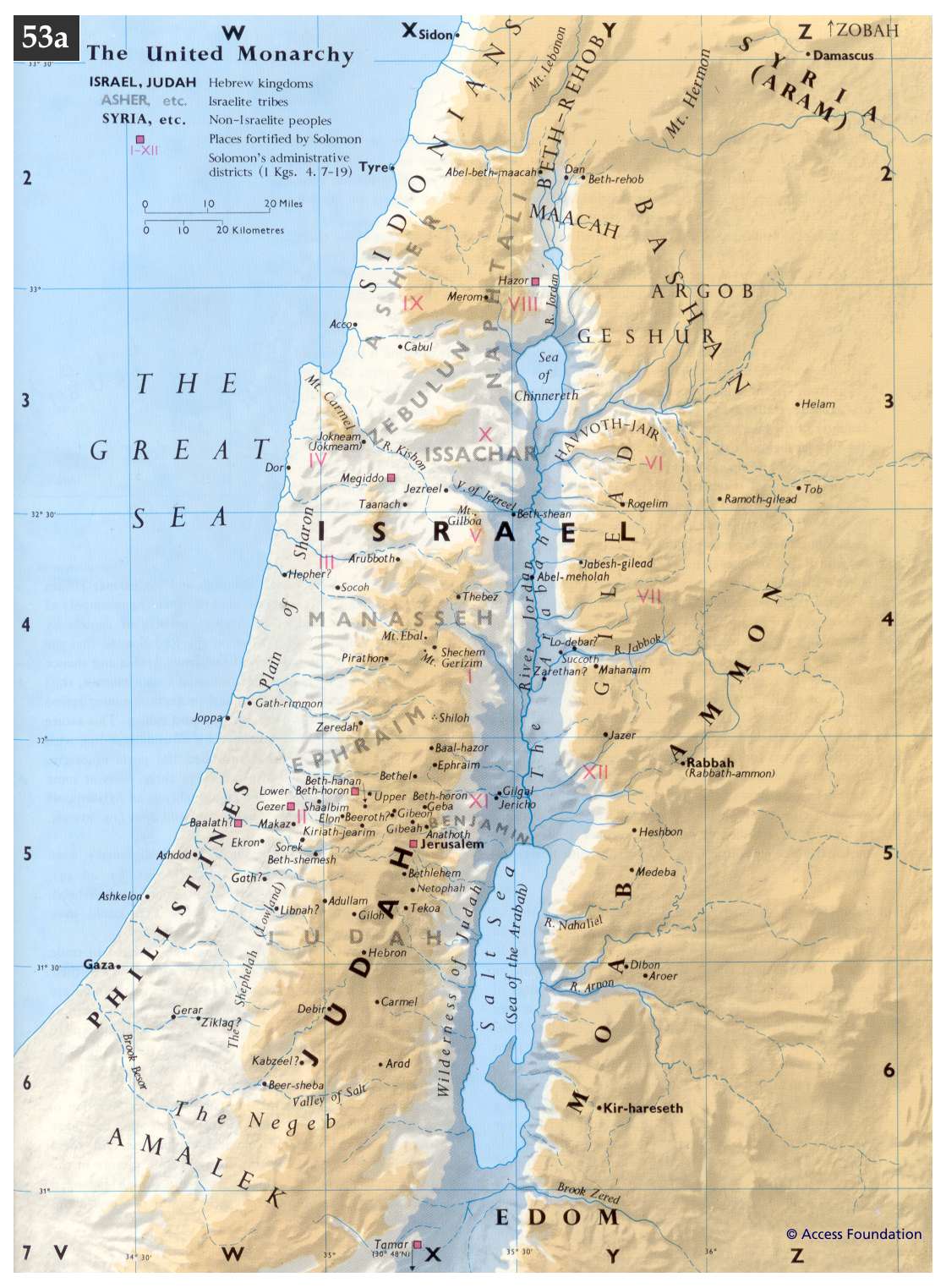
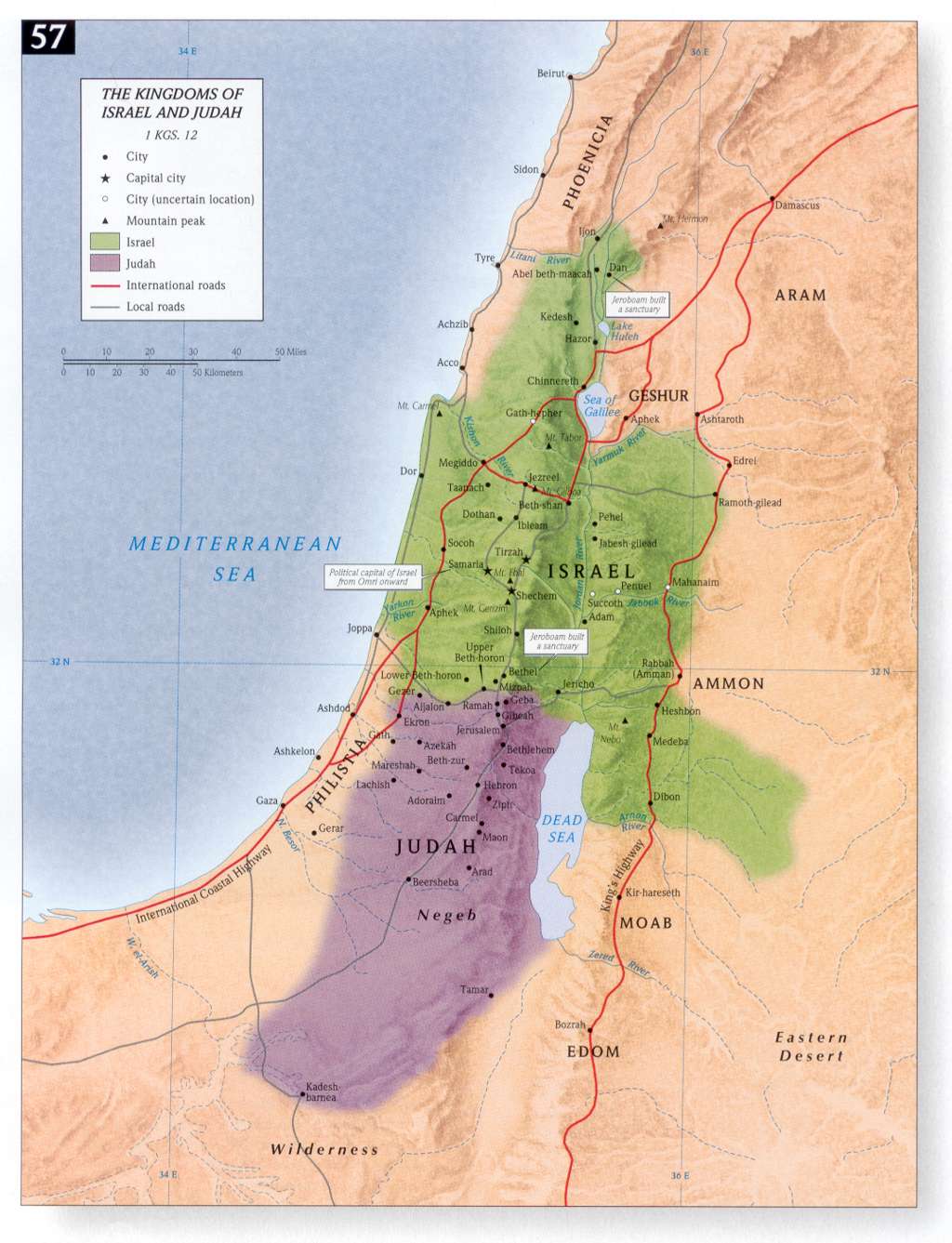
The Kingdoms of Israel and Judah
- The Kingdoms of Israel and Judah (1)
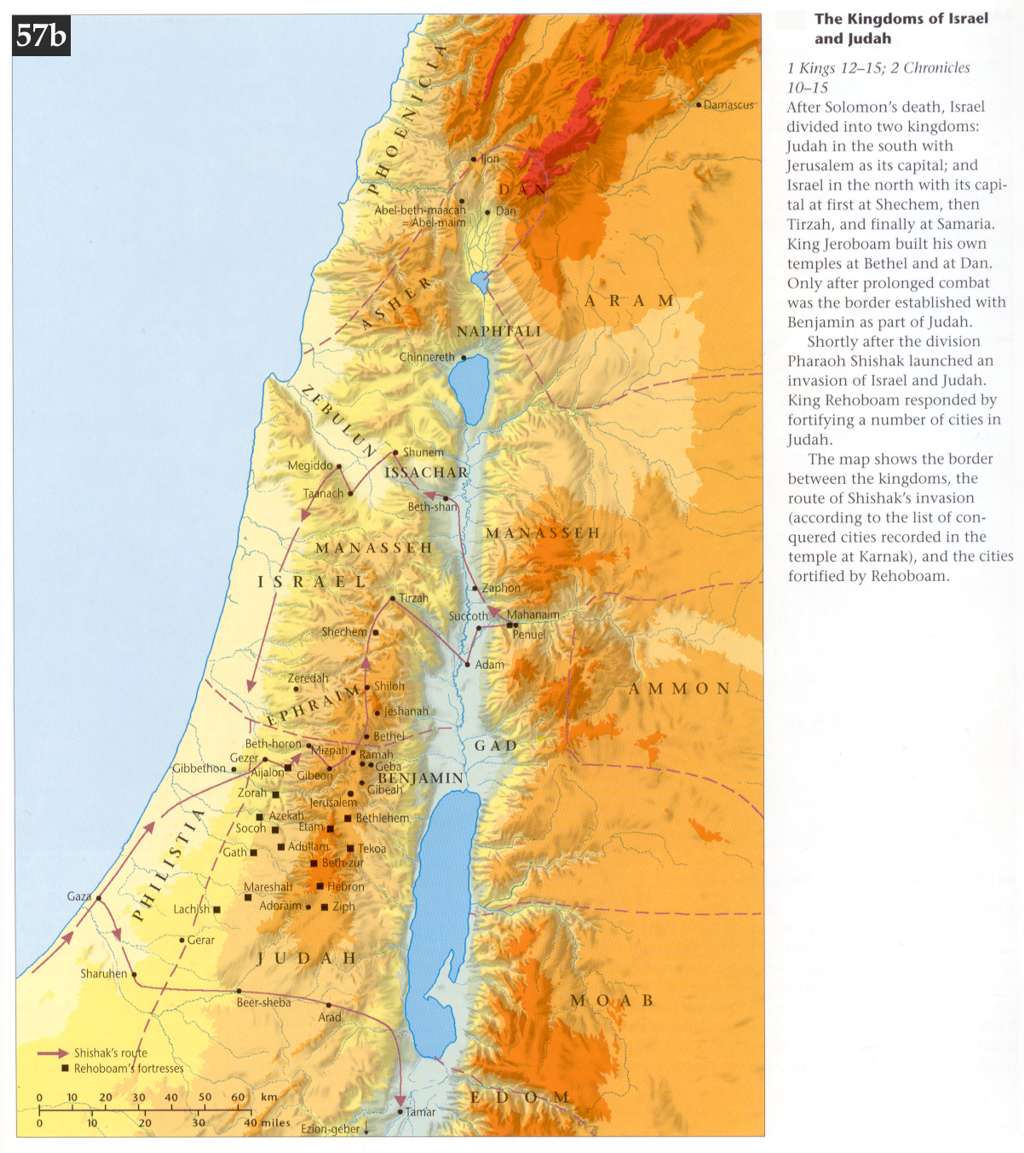
- The Kingdoms of Israel and Judah (2)
- The Kingdoms of Israel and Judah (3)
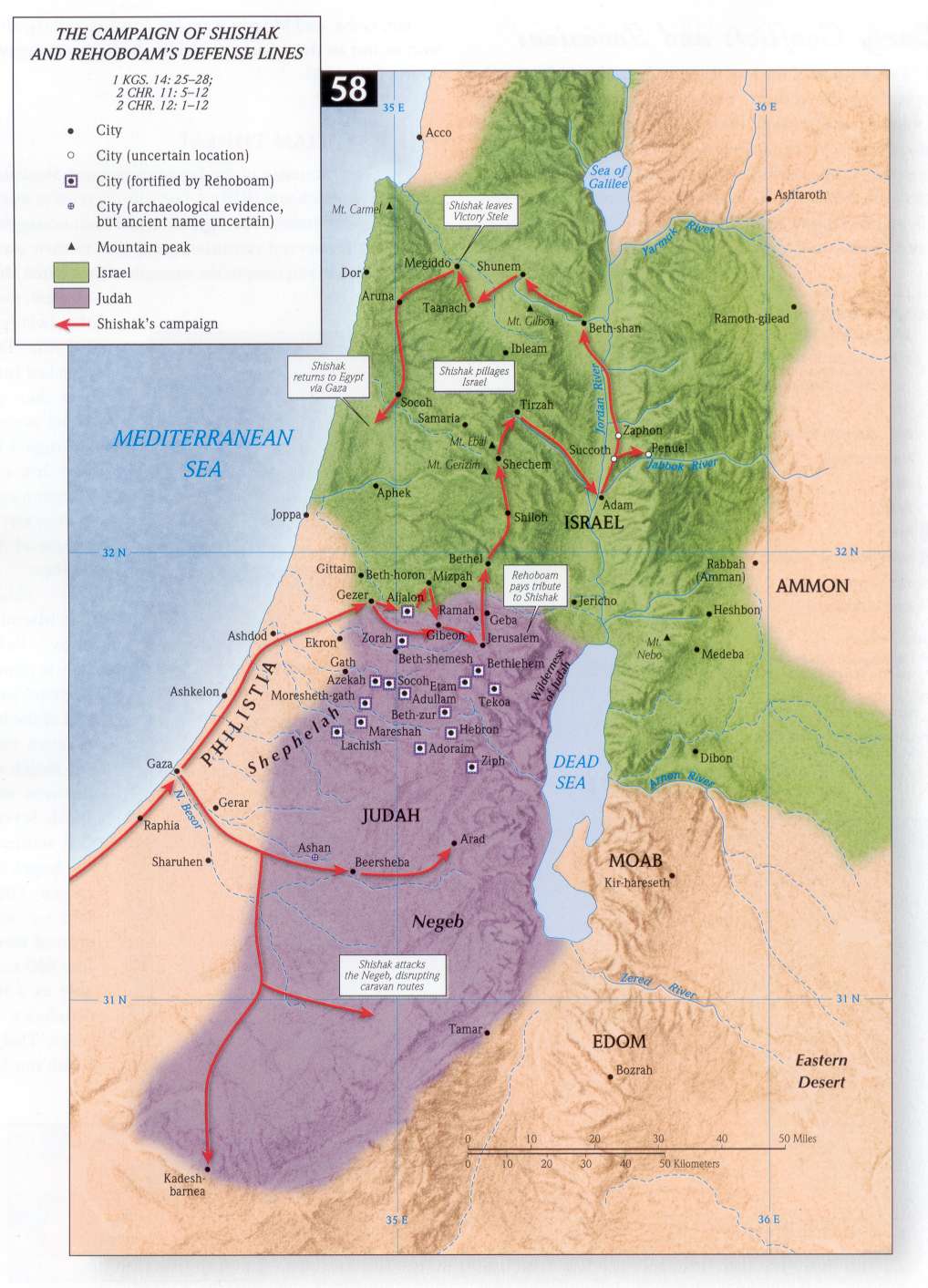
- The Campaign of Shishak
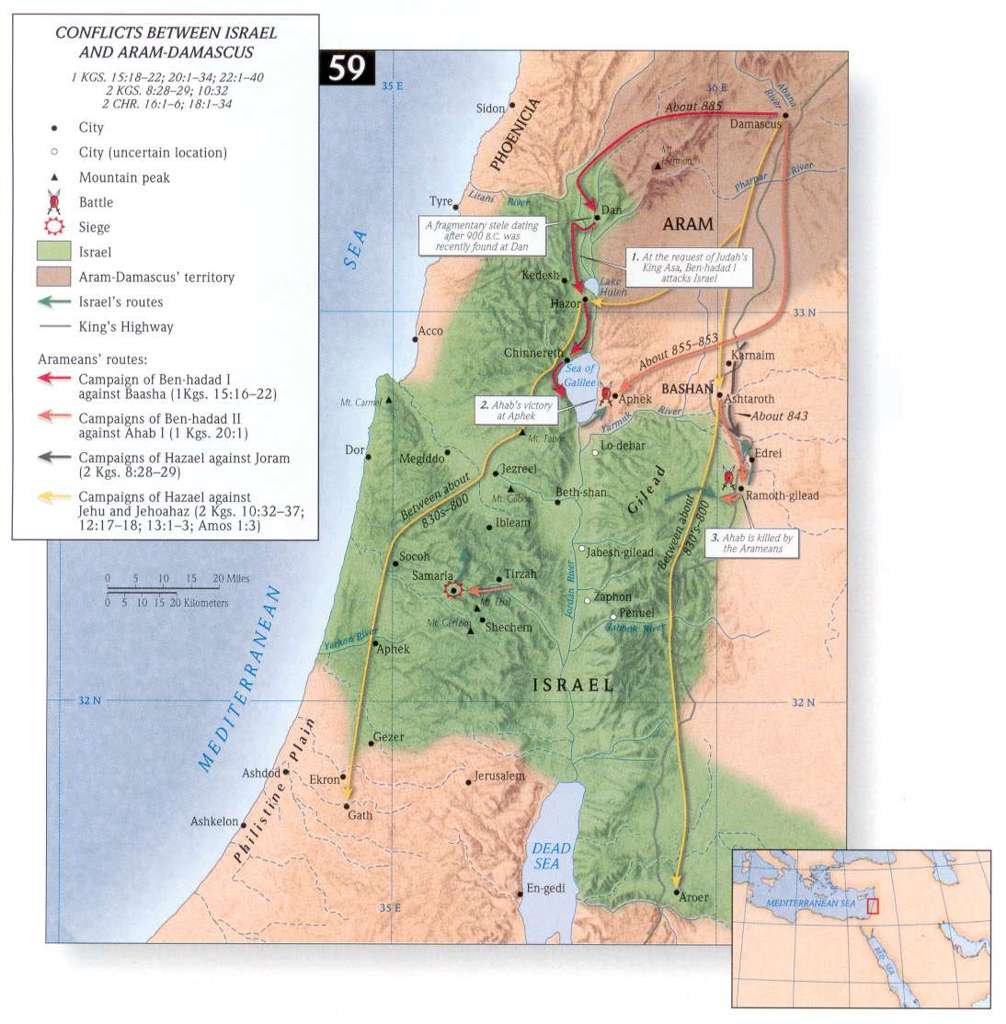
- Conflicts between Israel and Aram-Damascus
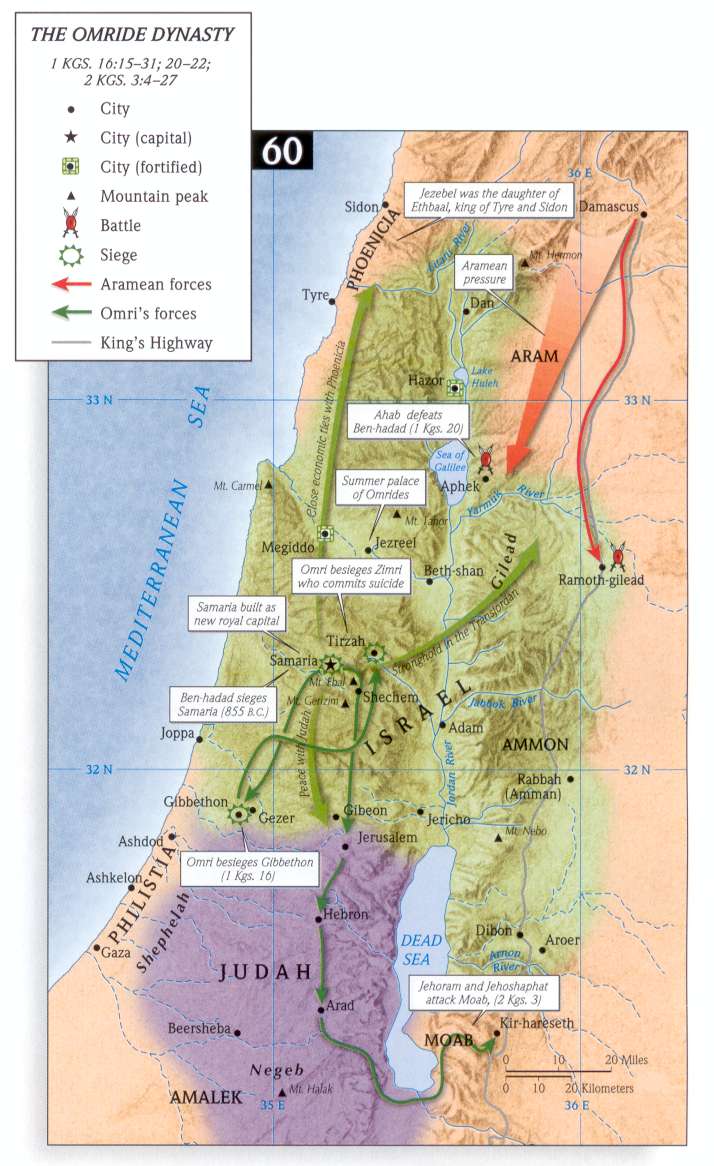
- The Omride Dynasty
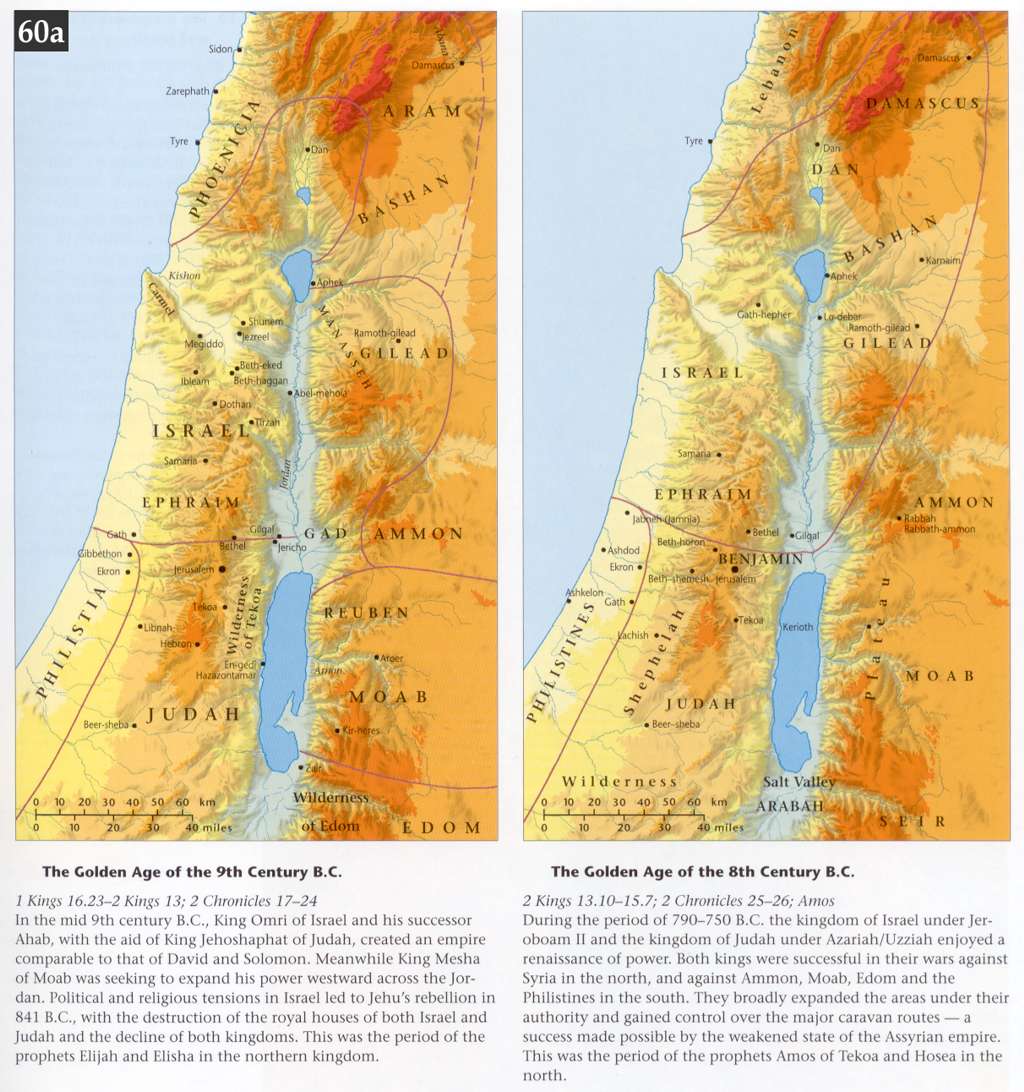
- The Golden Ages of the 9th & 8th centuries BCE
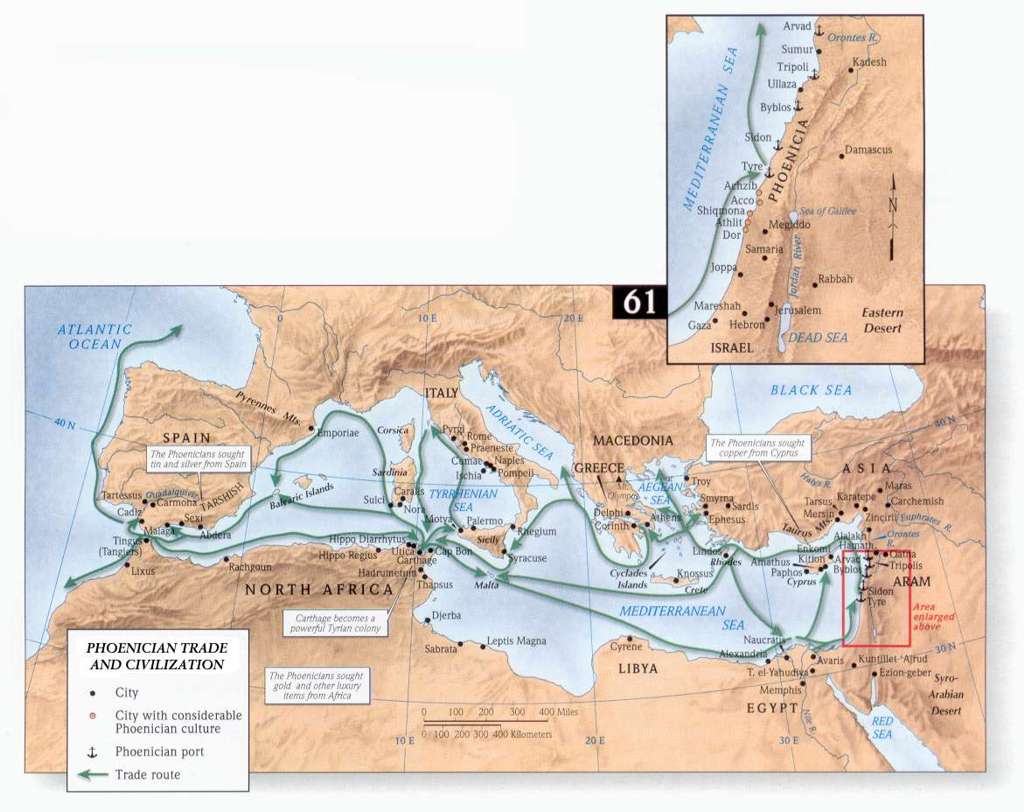
- Phoenician Trade and Civilization
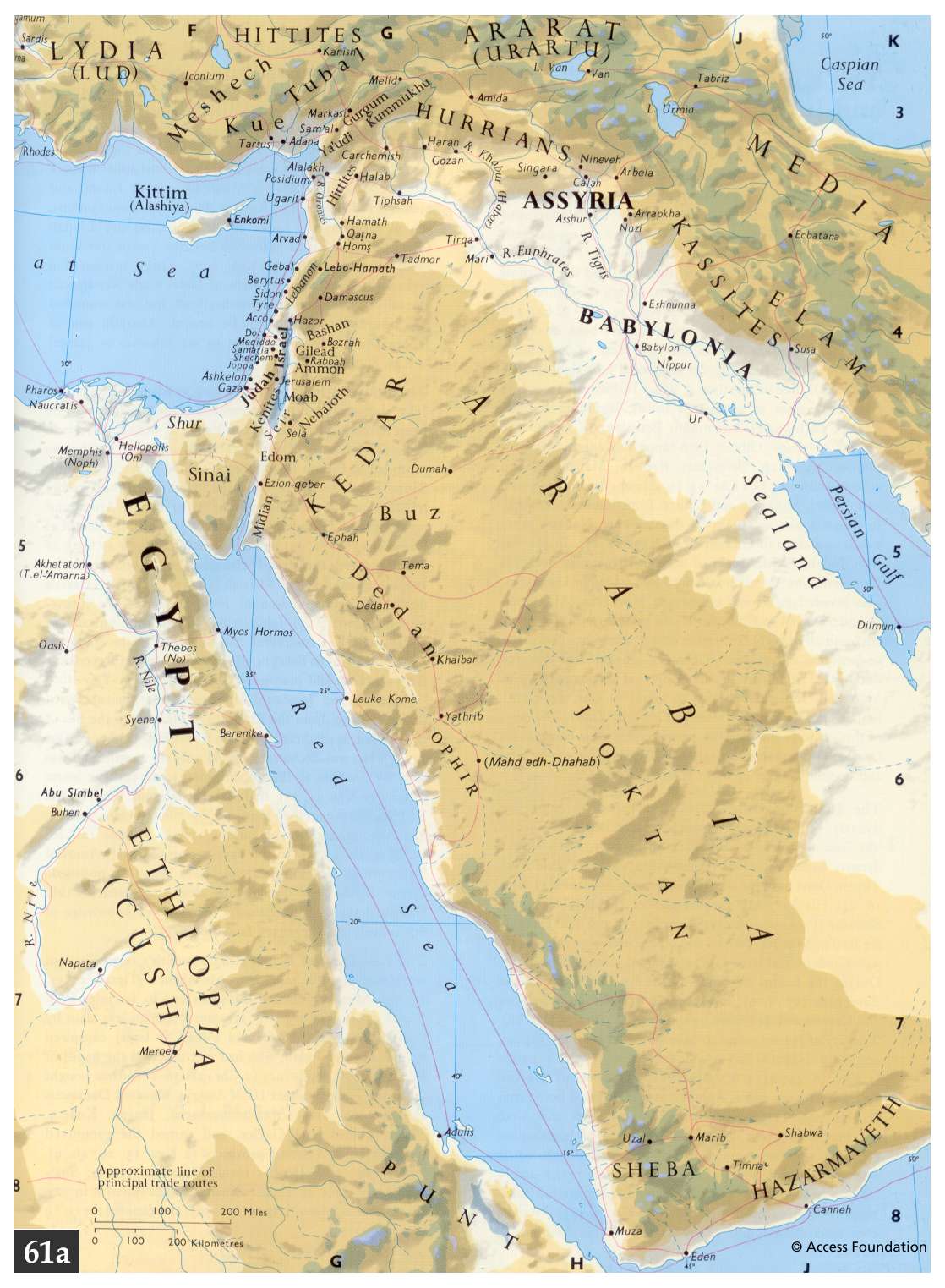
- Trade Routes throughout the Middle East
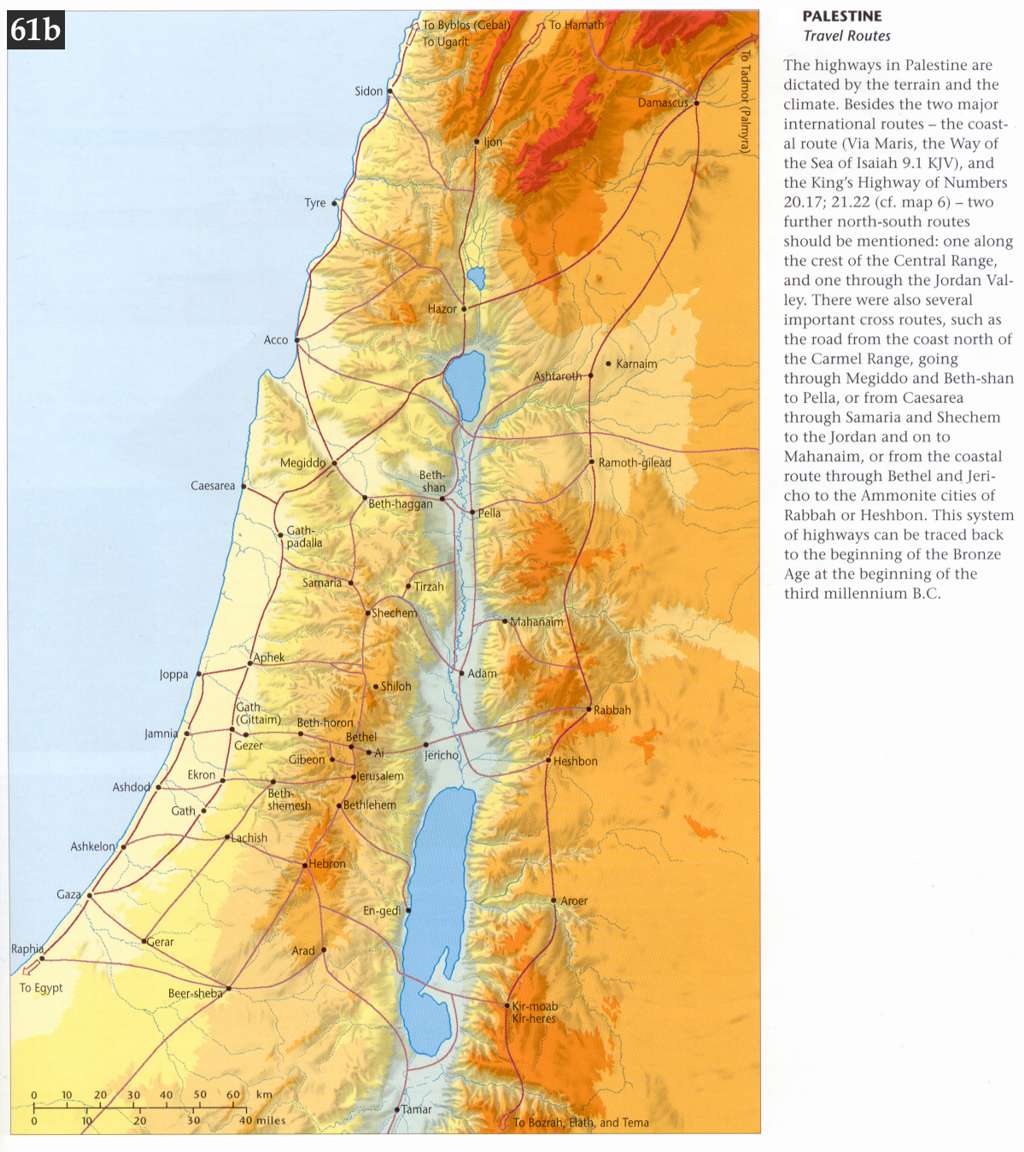
- Travel Routes throughout Palestine
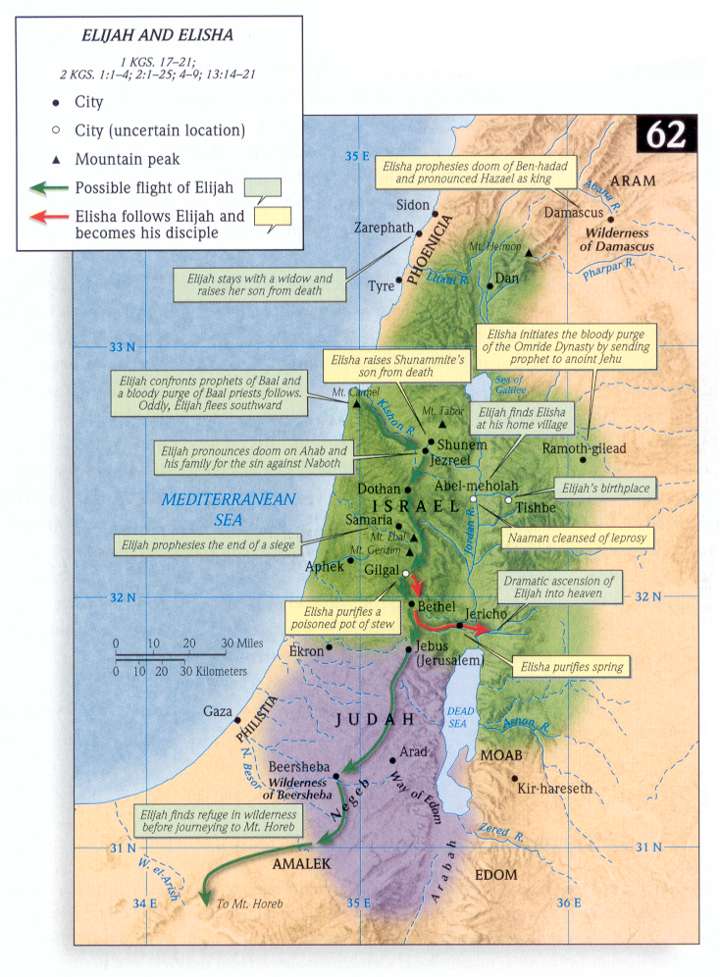
- Elijah and Elisha
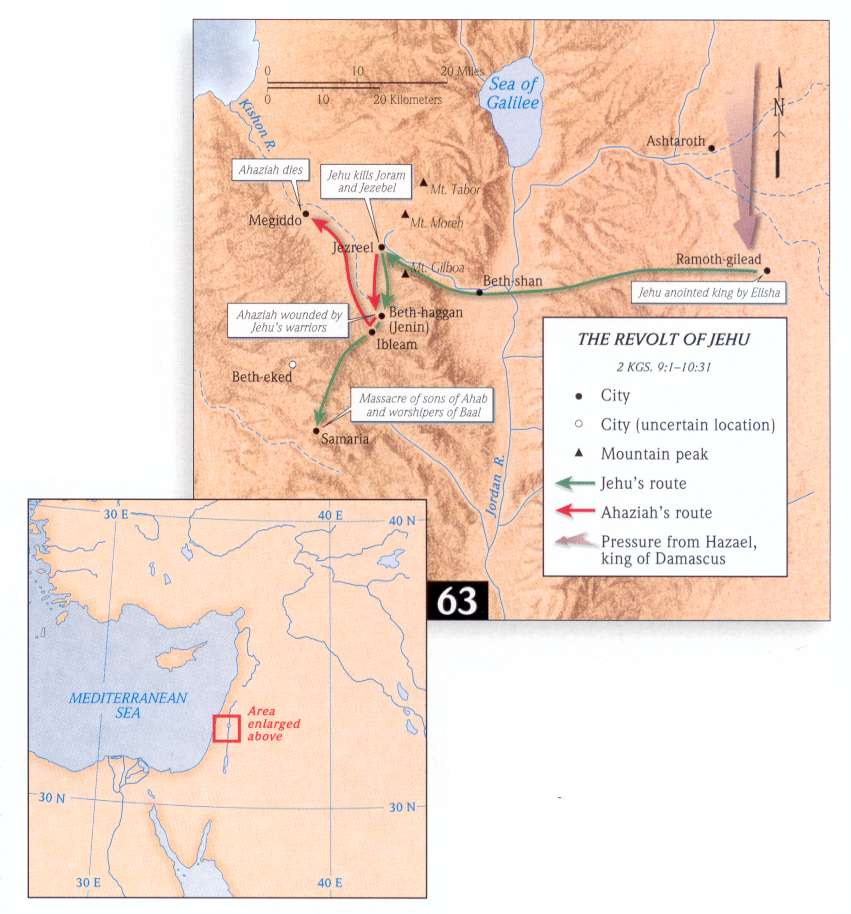
- The Revolt of Jehu
- The Rise of Assyria
- Israel & Judah in the days of Jeroboam II and Uzziah
- The Assyrian Empire under Tiglath-Pileser III
- The Syro-Ephraimite War
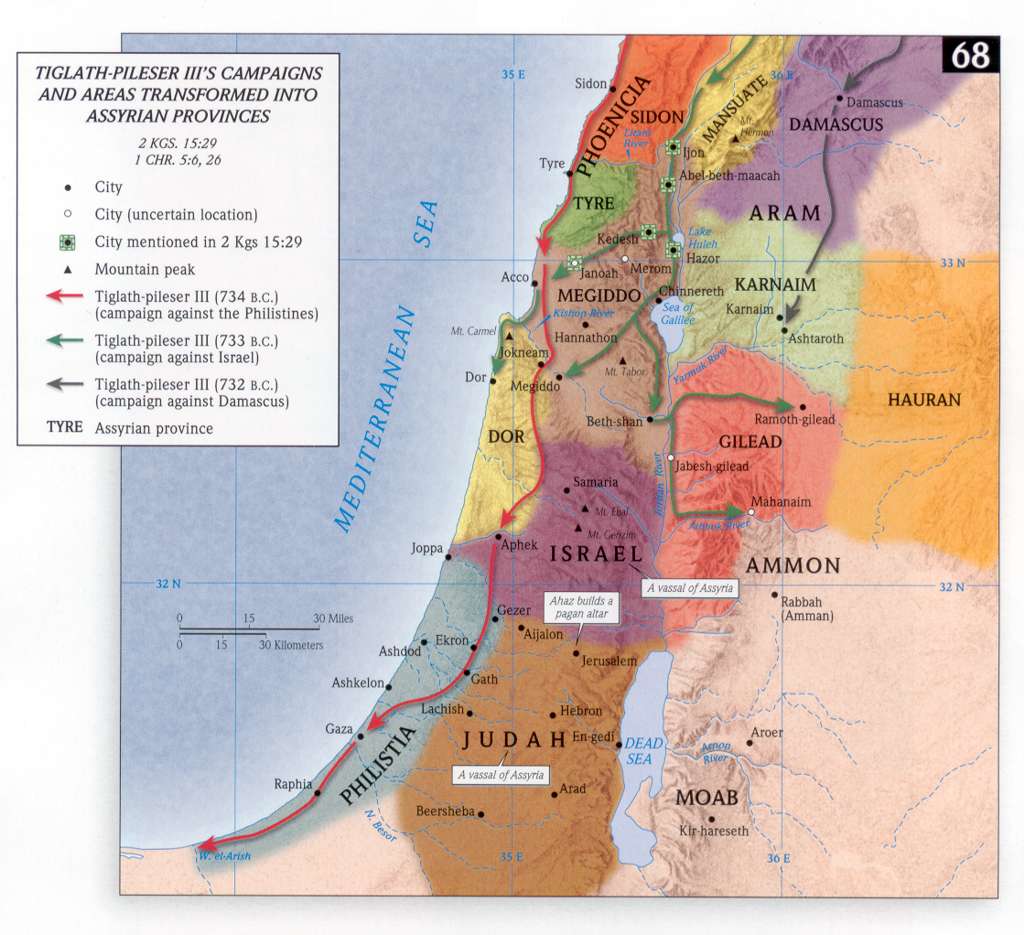
- Tiglath-Pileser III's Campaigns
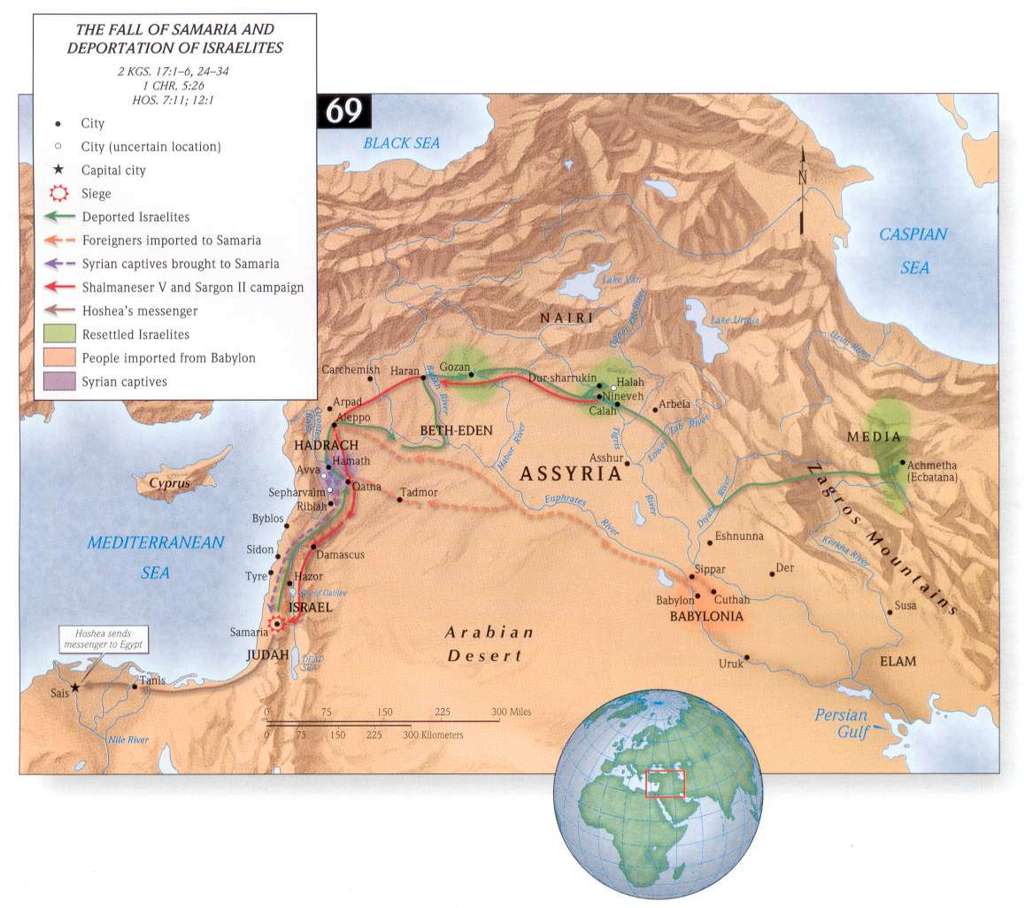
- Fall of Samaria and Deportation of Israelites
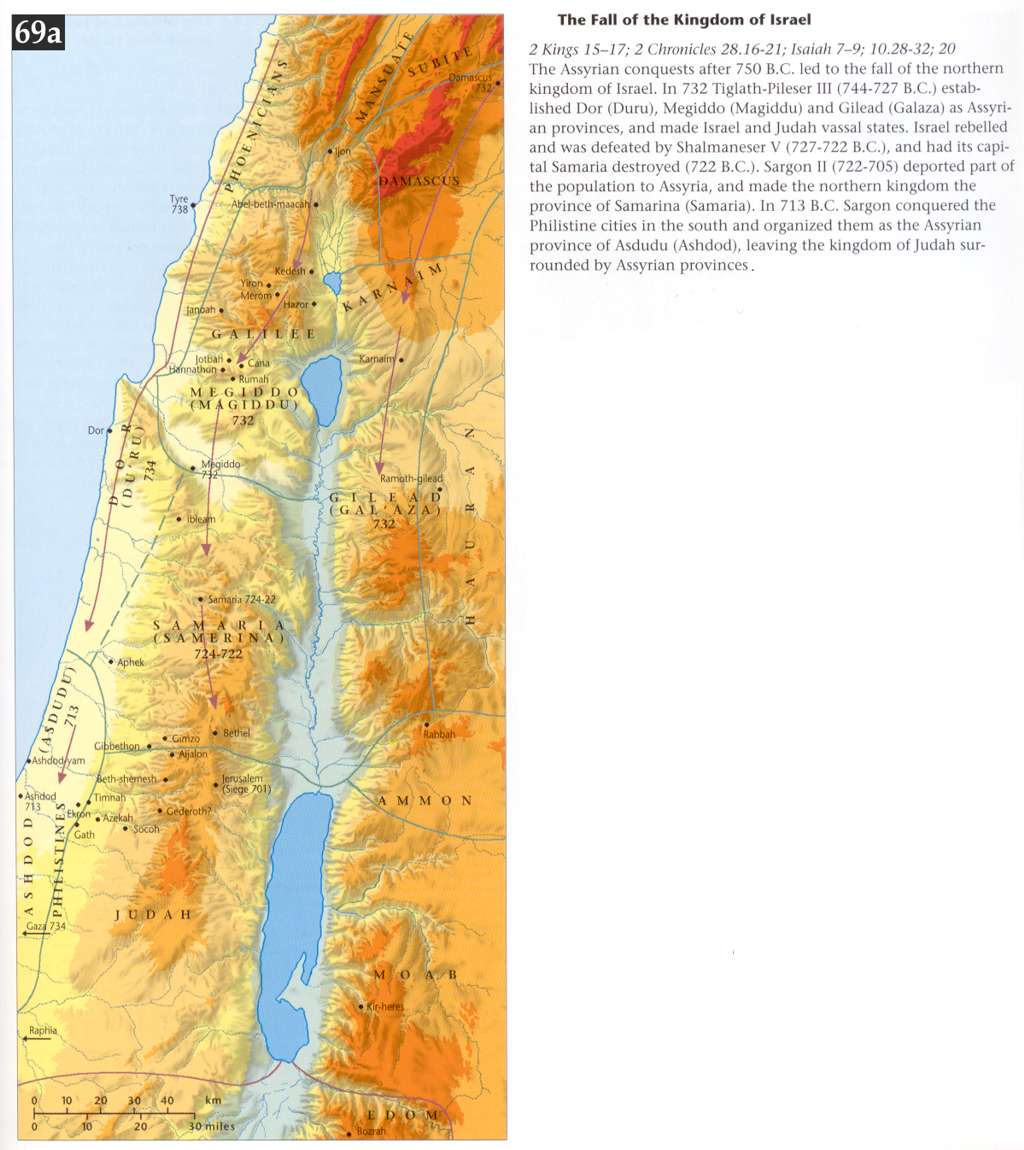
- The Fall of the Kingdom of Israel
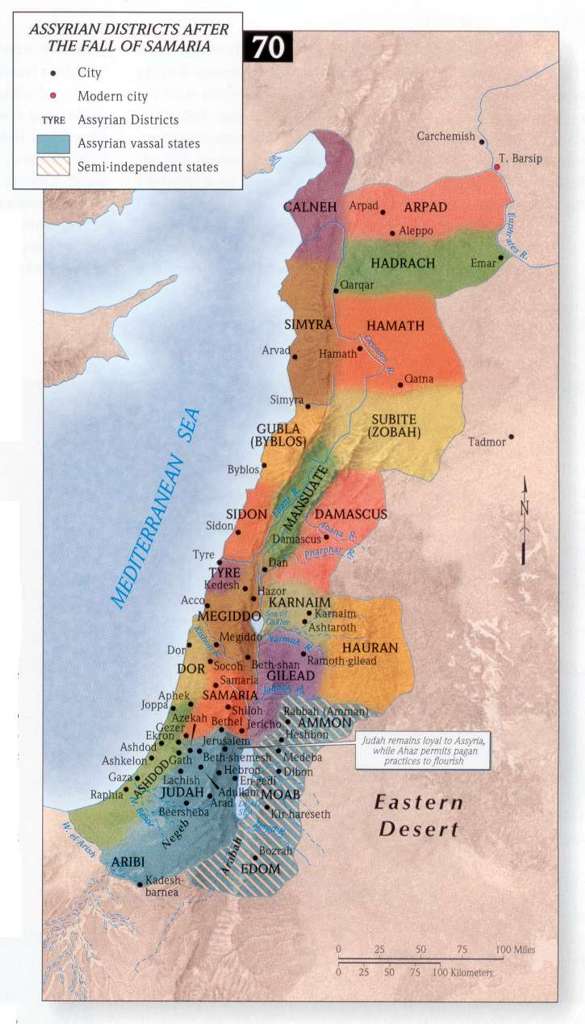
- Assyrian Districts after the Fall of Samaria
- Prophets of the 8th Century BCE

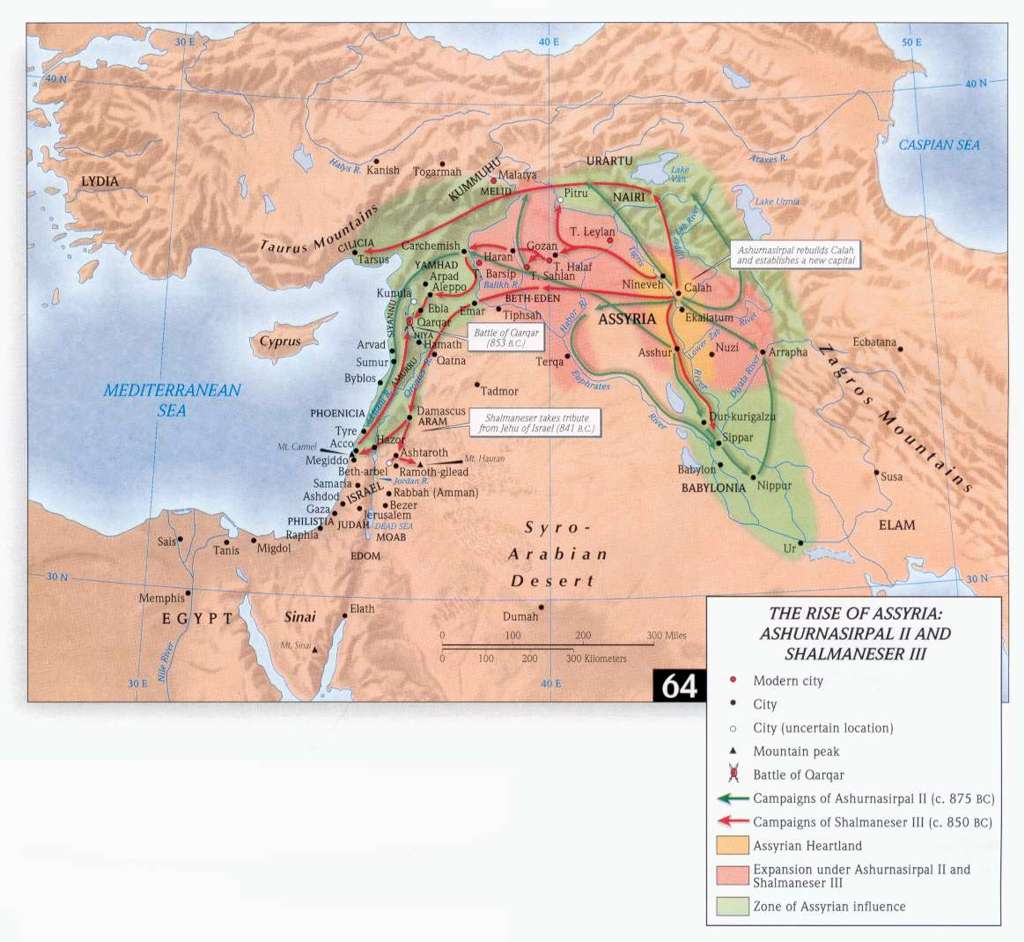
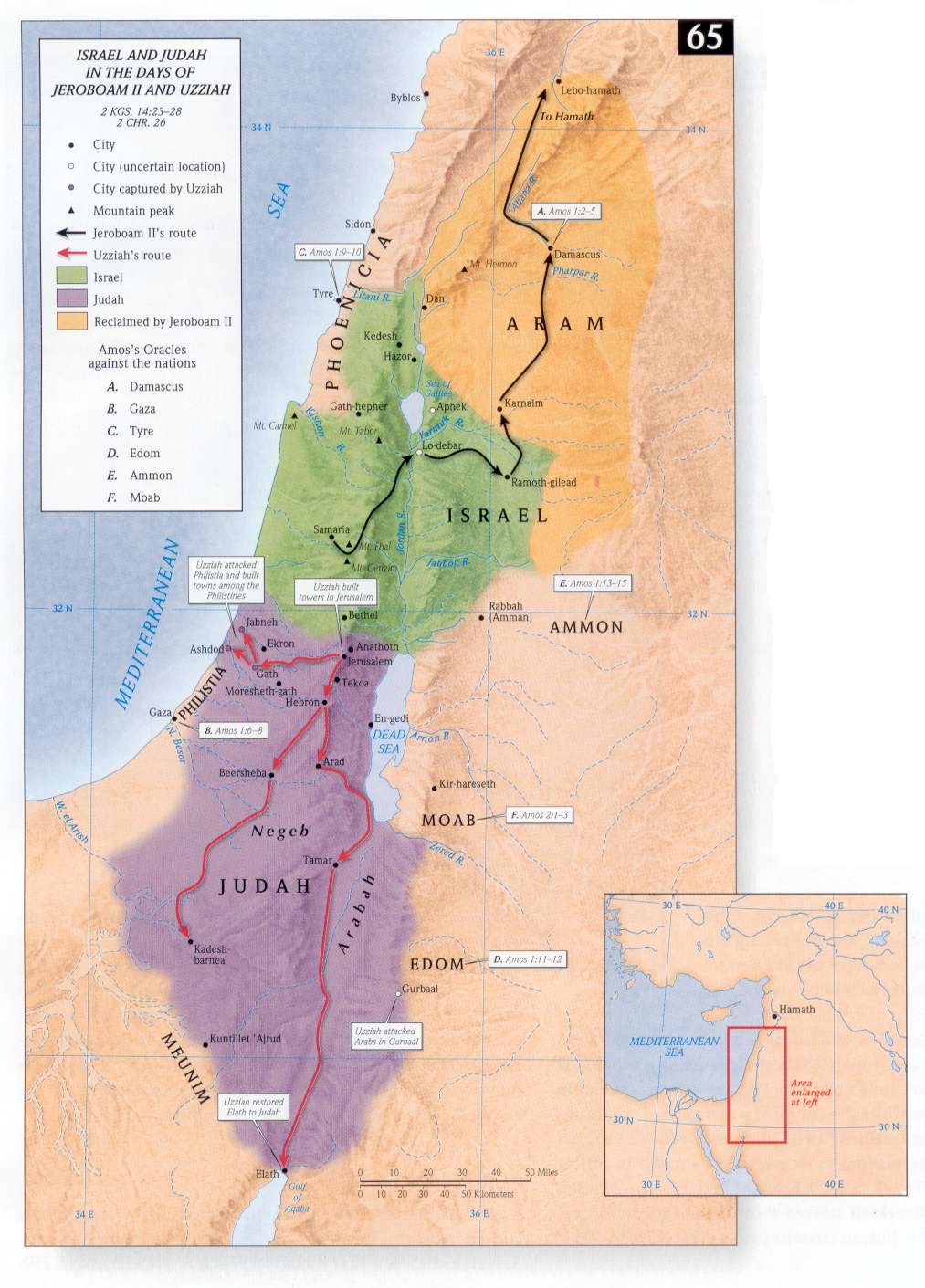
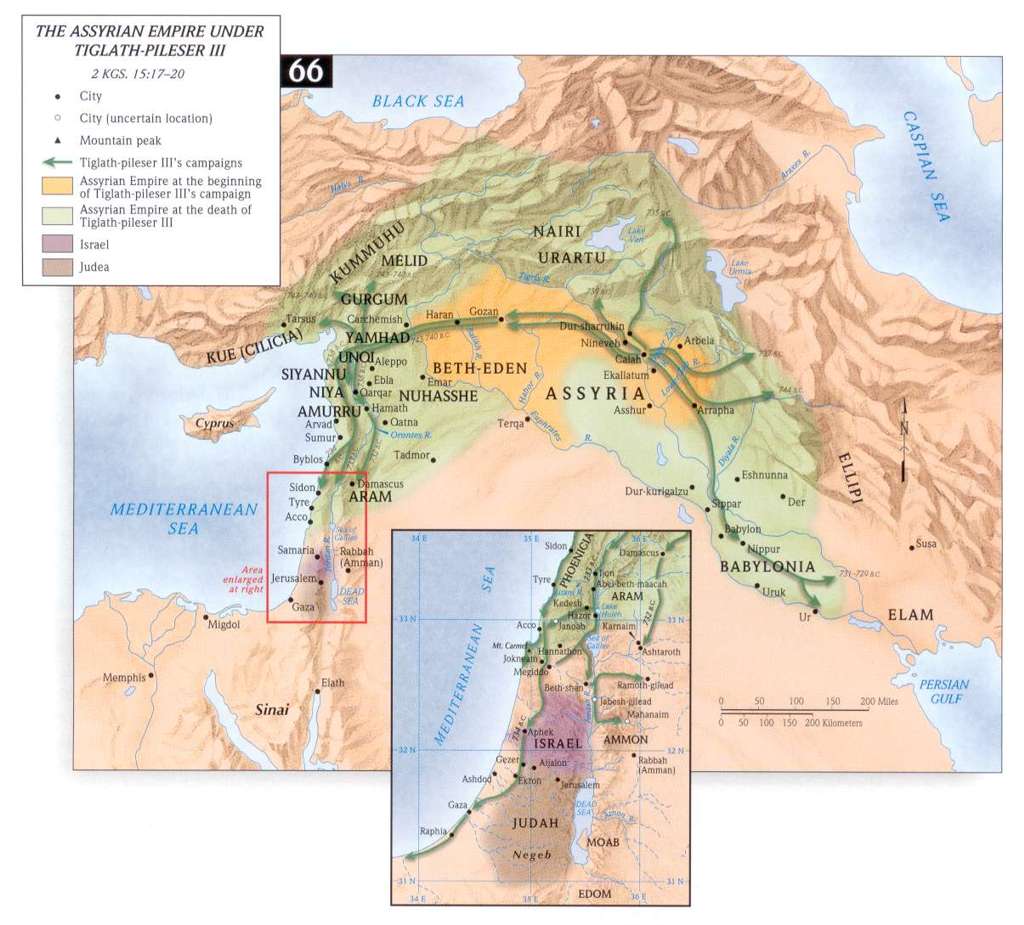
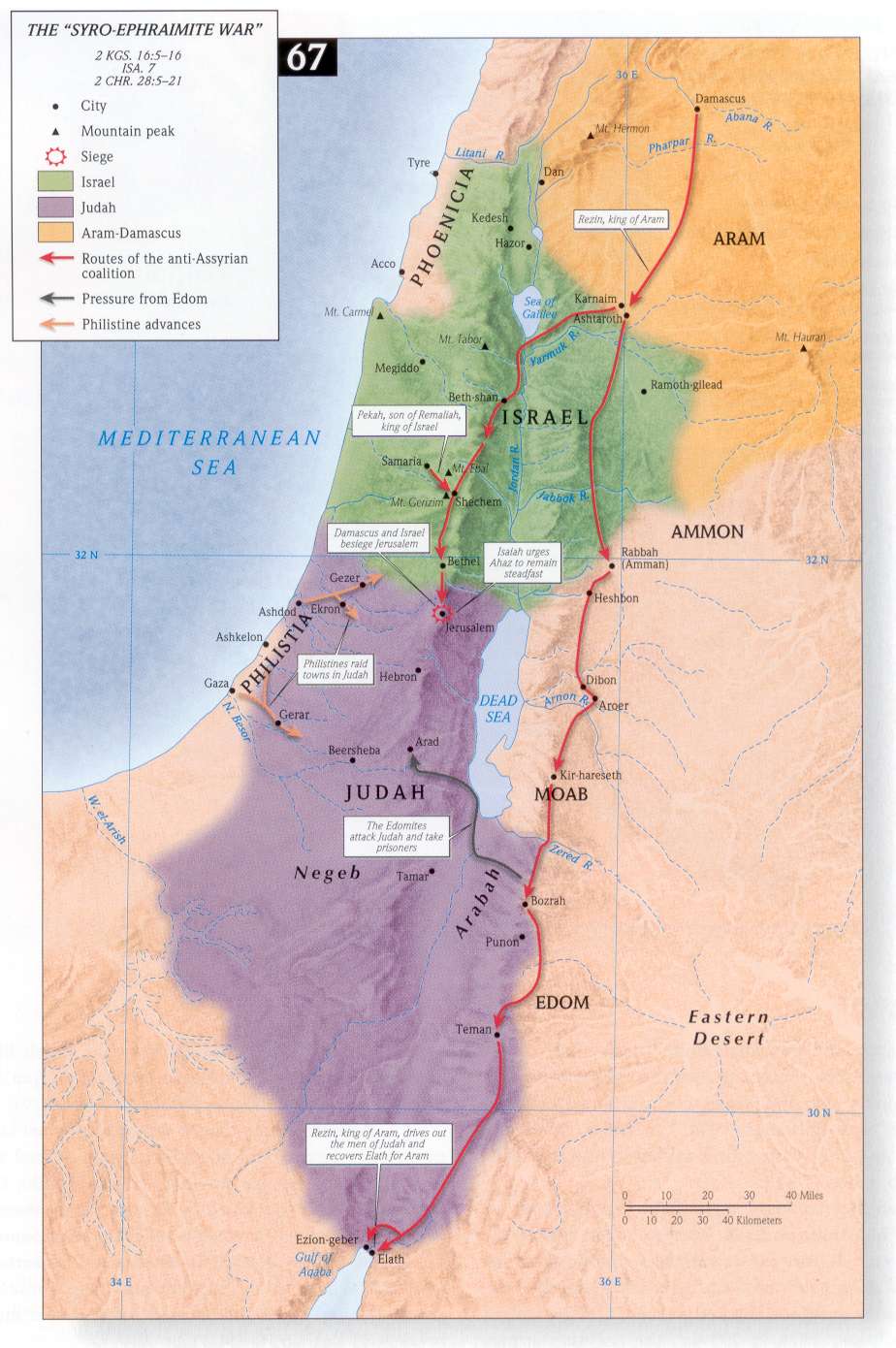
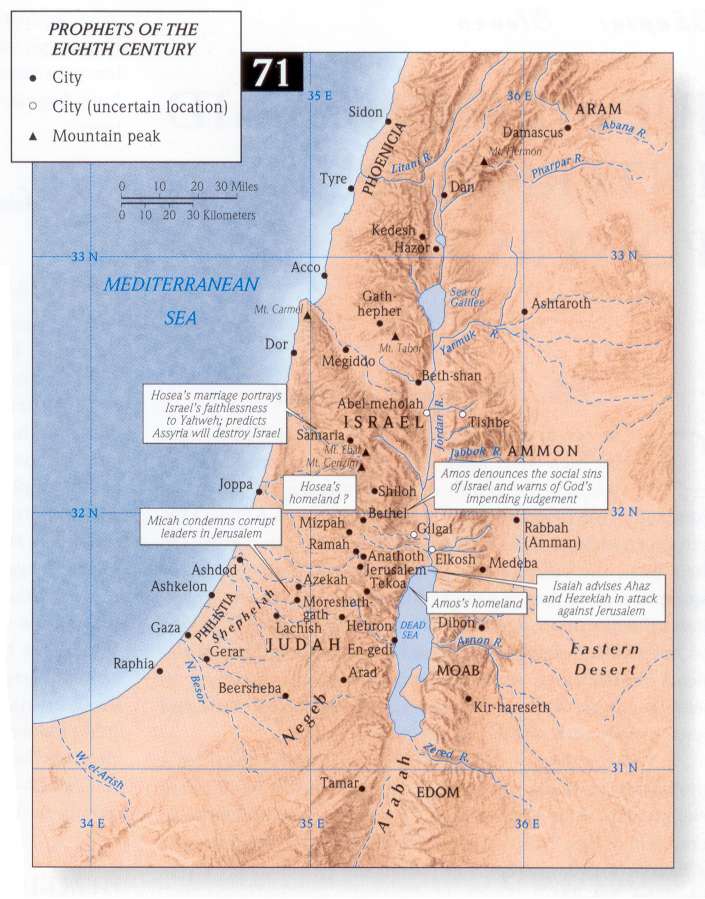
Judah Alone amid International Powers
- Hezekiah's Preparation for Revolt
- Judah under King Hezekiah
- Hezekiah's Jerusalem
- Sennacherib's Campaign against Judah
- Assyria in the 7th century BCE
- The Rise of the Neo-Babylonian Empire
- The Reign of Josiah
- The Districts of Judah under King Josiah
- The Golden Age of King Josiah
- Nebuchadnezzar's Campaigns against Judah
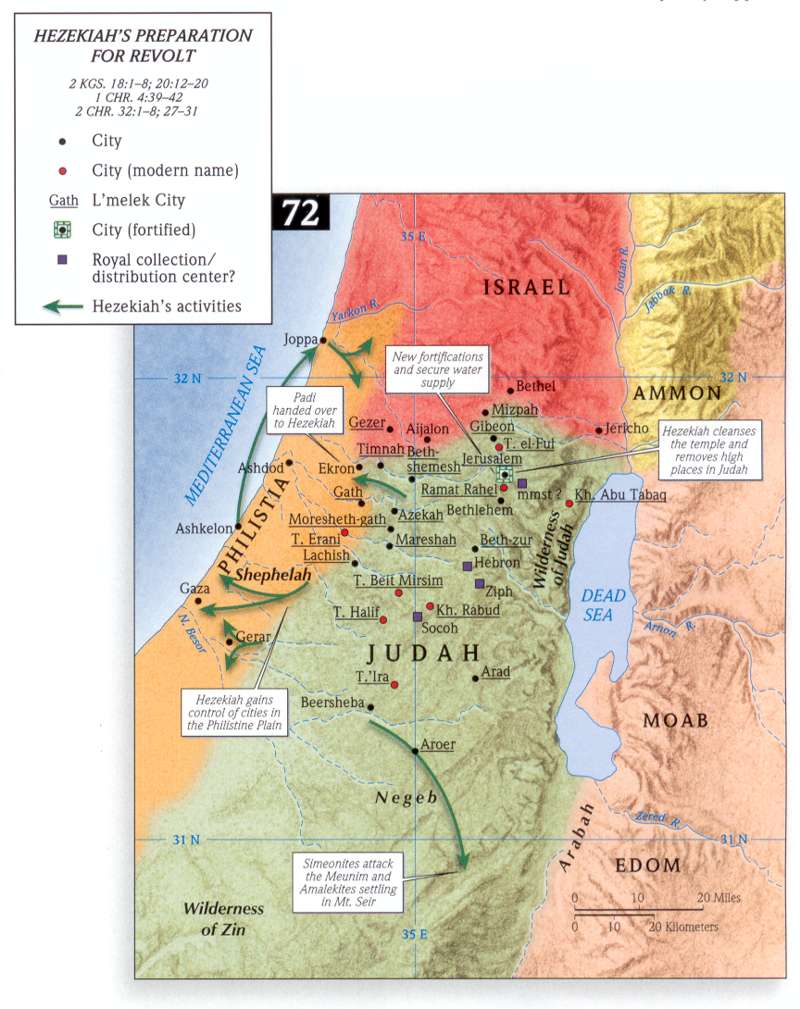
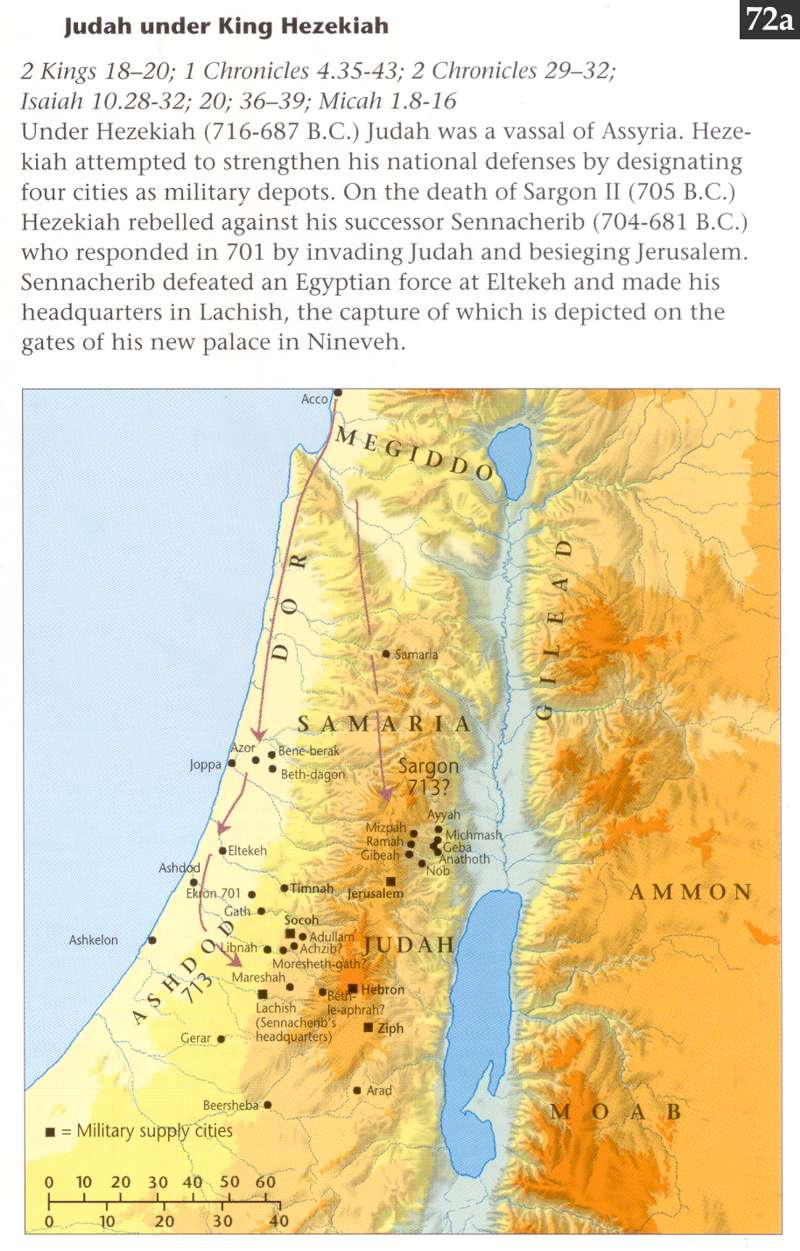
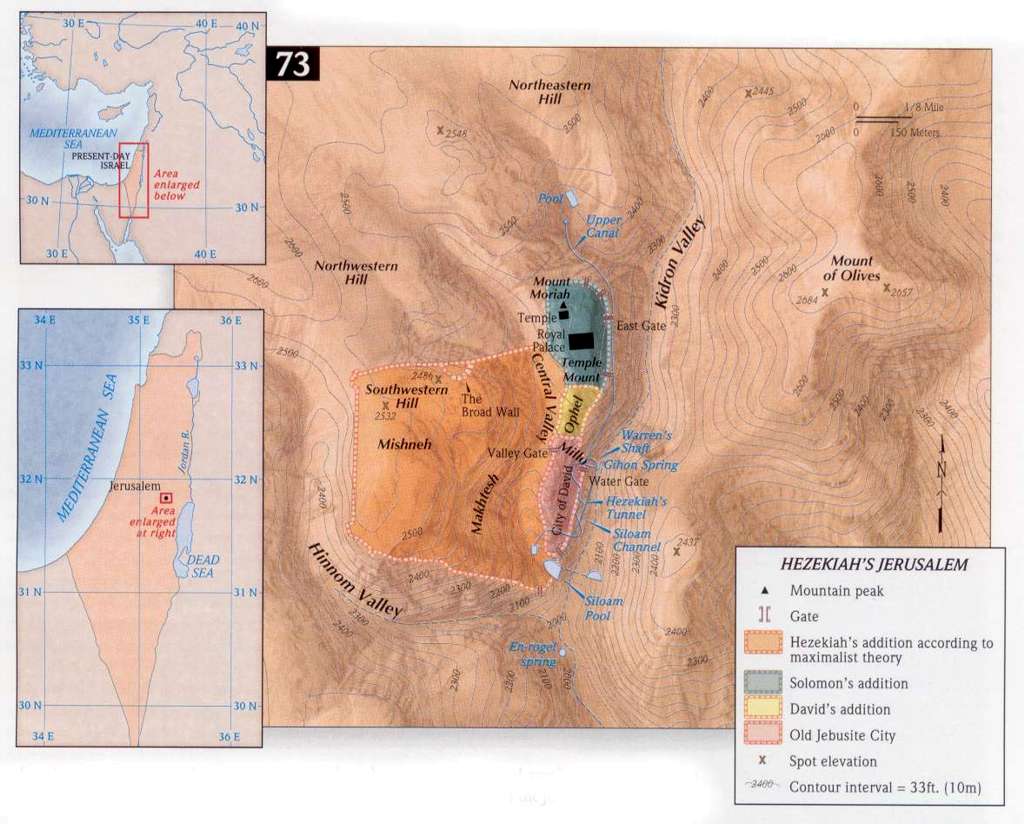
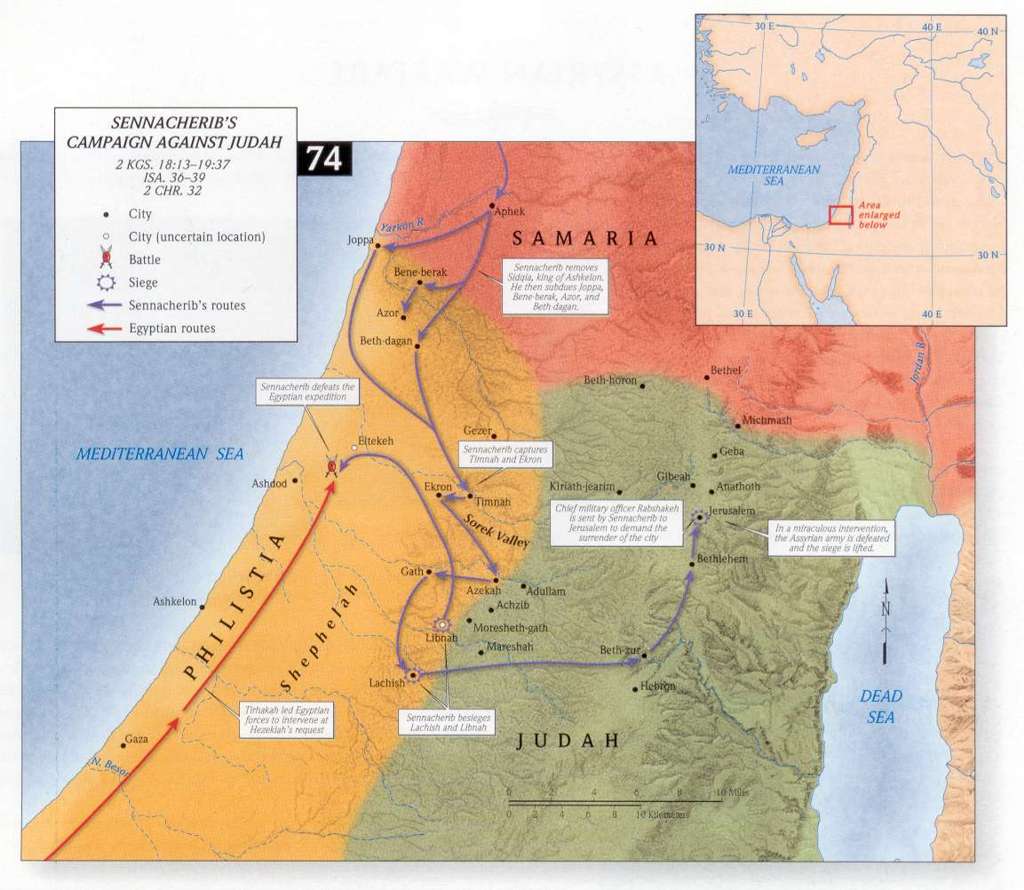
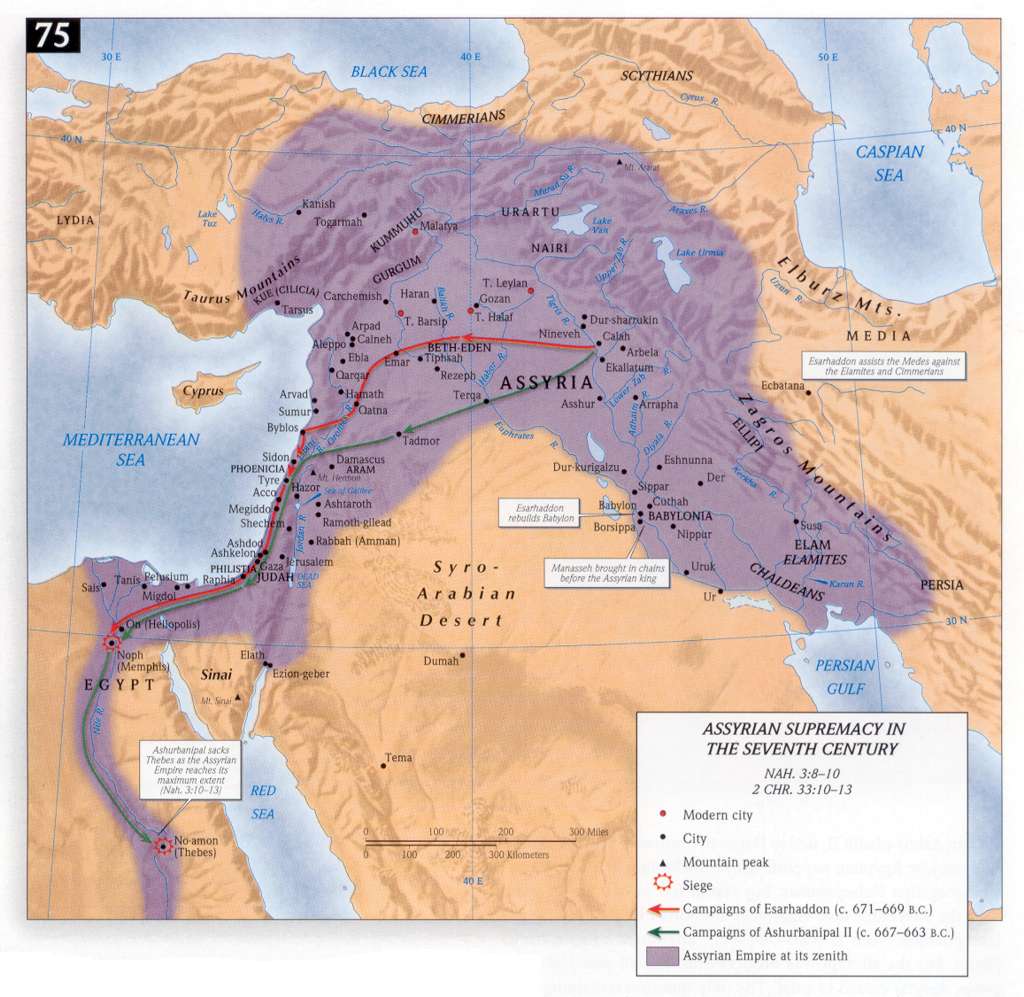
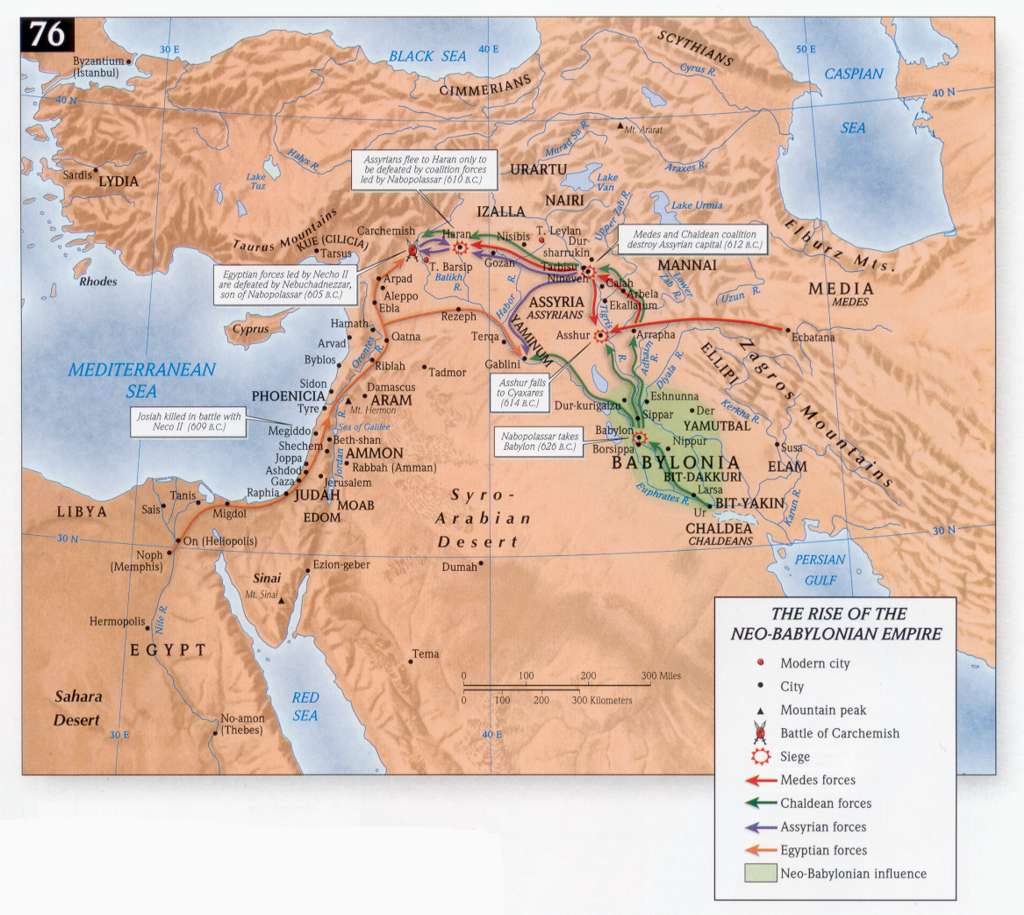
The Babylonian Exile Up to the Early Roman Empire
- Judah during the Exile
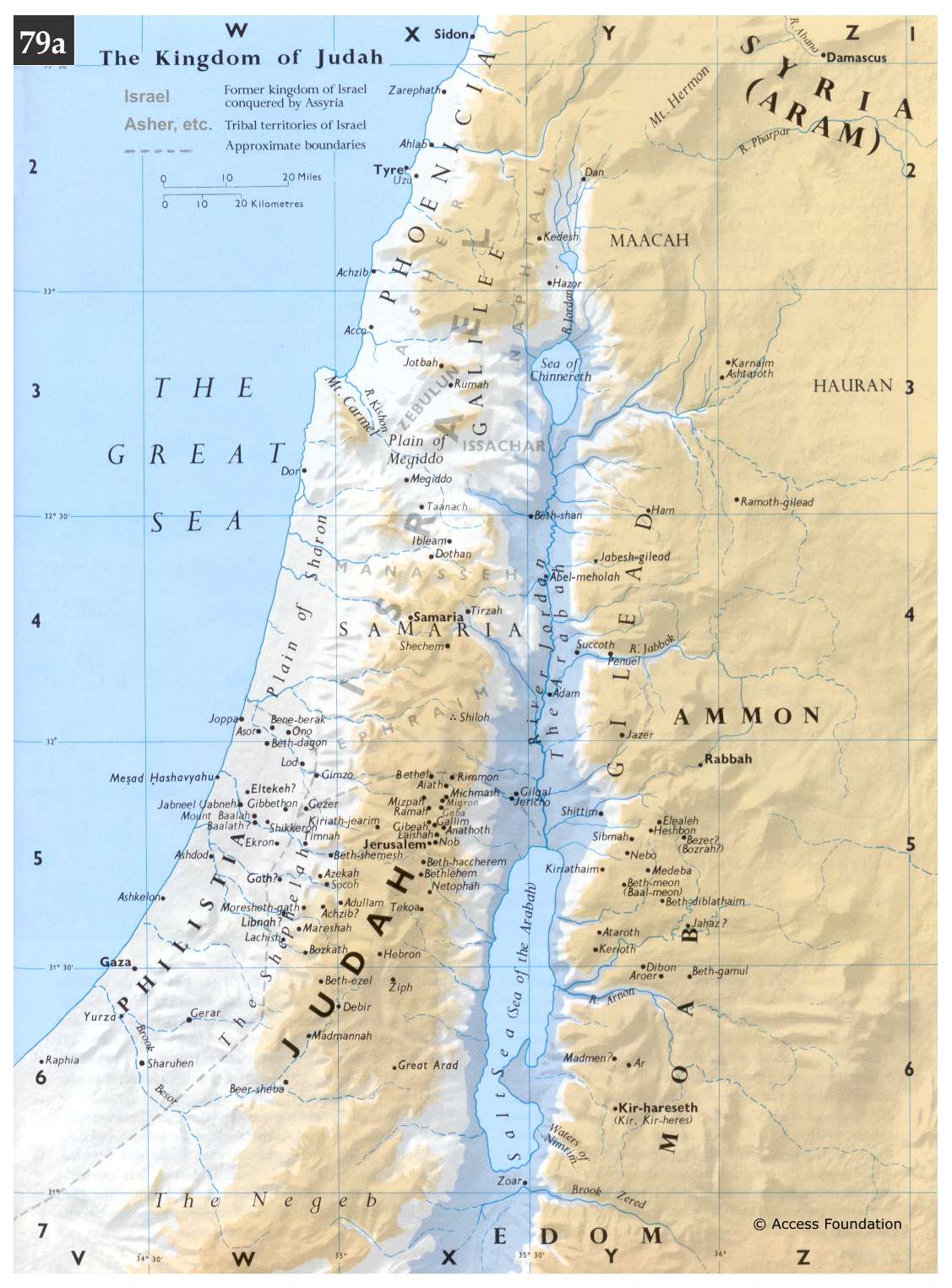
- The Kingdom of Judah
- Exile; Palestine in the Post-Exilic Period
- Jewish Exiles in Babylon
- World Powers of the 6th century BCE
- The Conquests of Cyrus the Great
- The Persian Empire
- The Return of the Jewish Exiles to Judah
- Judah in the 5th century BCE
- Palestine after the Exile
- Alexander the Great's Empire
- The Division of Alexander's Empire ca. 275 BCE
- Palestine under the Ptolemies
- The Seleucid Empire and Antiochus III
- Campaigns of Antiochus IV against Egypt
- The Maccabees in 168 BCE
- Selected Events in the Maccabean Revolt
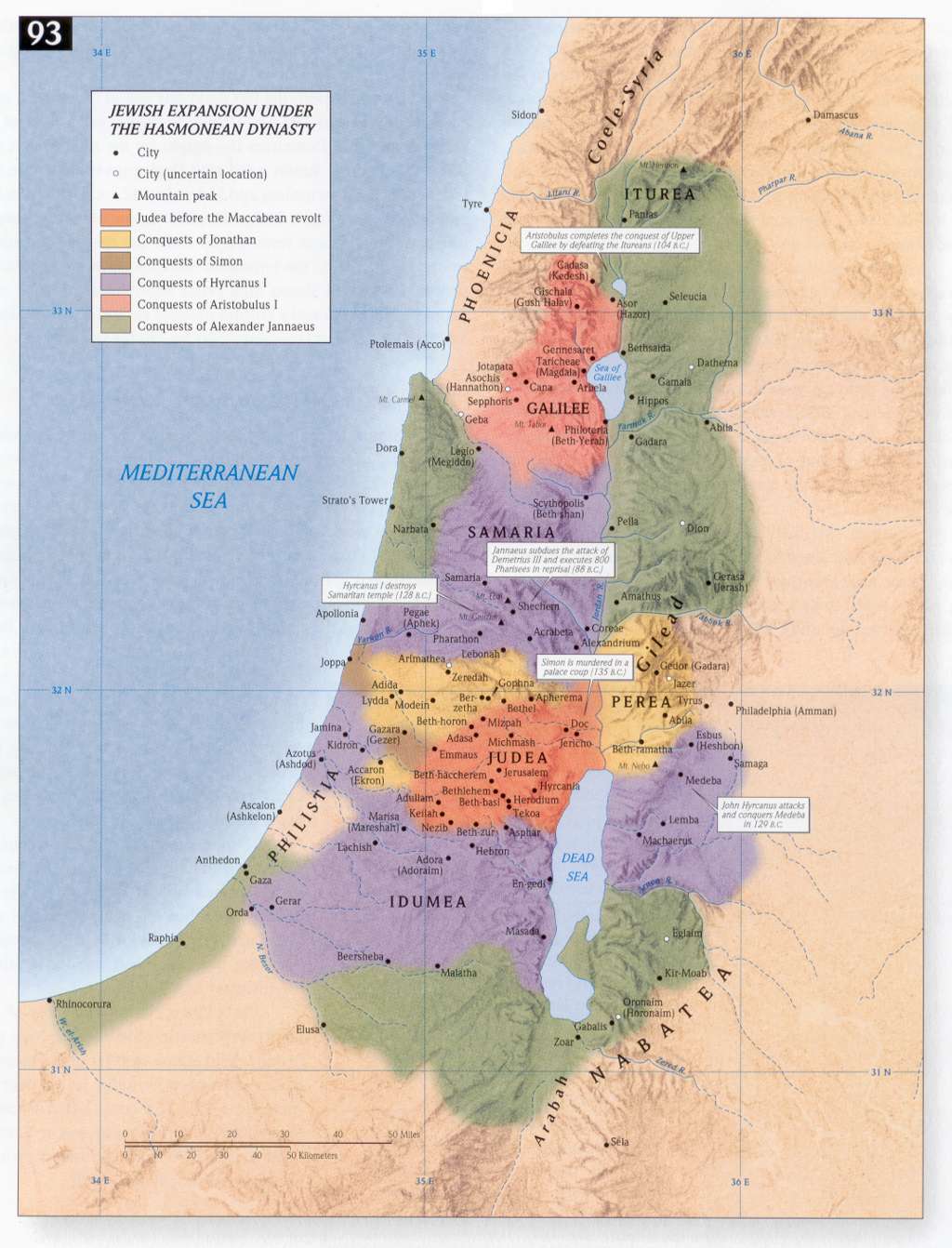
- Jewish Expansion under the Hasmonean Dynasty
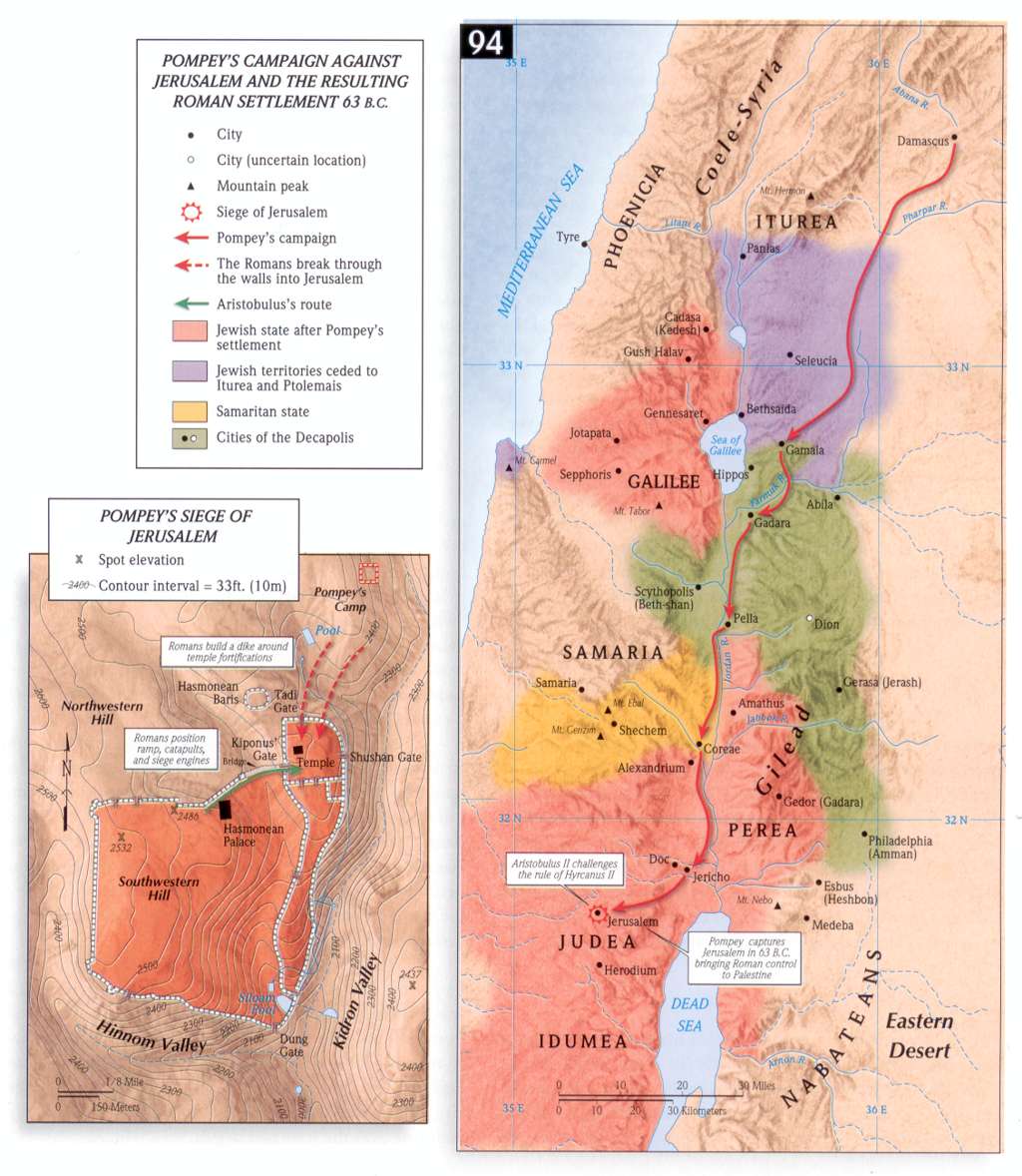
- Pompey's Campaign against Jerusalem
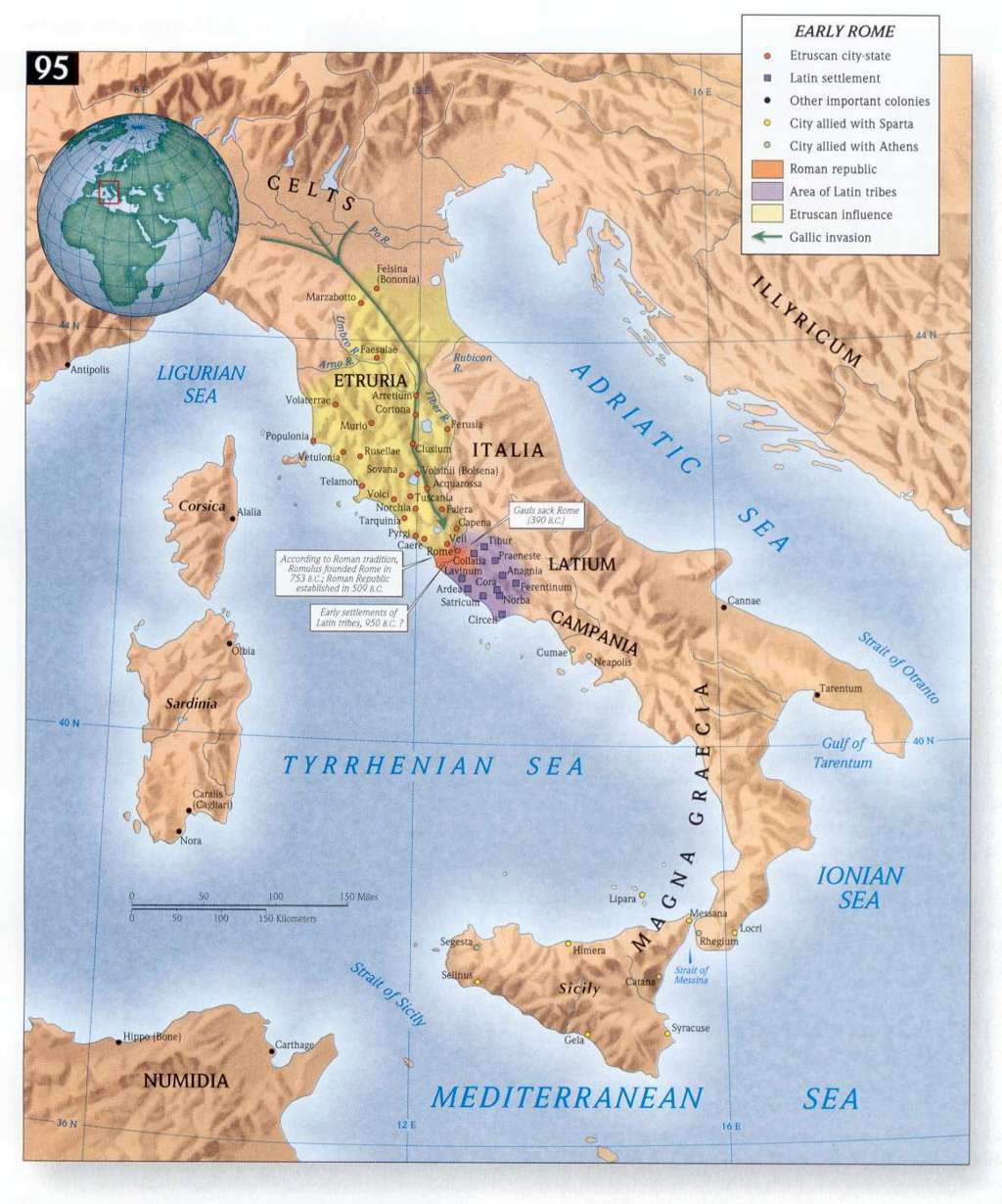
- Early Rome
- Be Strong and of Good Courage – Daniel 1:1-21
- The Book of Daniel – Introduction
- An Explanation of Daniel 2 and 7 – Daniel 2 & 7
- God’s Kingdom: The Only Kingdom That Will Never Be Destroyed – Daniel 2:1-49
- Courage in the Fire – Daniel 3:1-30
- Learning the Hard Way That God Is God and We Are Not – Daniel 4:1-37
- SEBTS Chapel: The Handwriting is on the Wall – Daniel 5
- The Handwriting Is on the Wall – Daniel 5:1-31
- Daniel and the Lion’s Den – Daniel 6:1-28
- Is Anyone Really In Control? Yes, God is. – Daniel 7:1-28
- And the Visions Keep on Coming! An Apocalyptic Ram, Goat and Little Horn – Daniel 8:1-27
- Lessons on Prayer from a Man of God – Daniel 9:1-19
- Back to the Future – Daniel 9:20-27
- Daniel’s 70 Weeks and the Glorious Work of Messiah Jesus – Daniel 9:20-27
- Seventy Sevens of Daniel – Daniel 9:24-27
- The Incredible Realities of Spiritual Warfare – Daniel 10:1-21
- Civil War—Just Like God Said It Would Happen – Daniel 11:1-20
- Antiochus Epiphanes and Antichrist: The Arch Enemies of God’s People – Daniel 11:21-45
- Nine Marks of Eschatological Discipleship – Daniel 12:1-13 - Comment - Akin writes "Gabriel promises Daniel, “at that time your people shall be delivered.” And, who are Daniel’s people? “Everyone whose name shall be written in the book.”" First, in his comment on Daniel 12:1 Akin is incorrect, as it is not Gabriel but Michael who makes the promise (cf Da 10:13). Second, note that Akin, who seems to be interpreting Daniel literally, does not seem to interpret "your people" literally. Letting the text speak for itself, clearly "your people" refers to Daniel's people, the Jews and thus the nation of Israel. If we let the context guide our interpretation, clearly the angel is speaking to the fate of the nation of Israel, not to the fate of all saints as Akin suggests. Criswell for example comments "At that time, those Jews who have been saved, i.e., those "found written in the book," will be delivered."
From Encyclopedia of Bible Difficulties.
- Must Daniel be dated in the sixth century? - see page 286 (page listing at top of the page)
- Is Daniel 1:1 wrong about the date of Nebuchadnezzar’s invasion? - see page 288 (page listing at top of the page)
- Why does Daniel refer to soothsayer-priests as Chaldeans? - see page 289 (page listing at top of the page)
- Is not Daniel 5 in error regarding the identity of the last king of Babylon? Wasn’t it Nabonidus rather than Belshazzar? - see page 290 (page listing at top of the page)
- Is there any confirmation for the existence of “Darius the Mede”? - see page 290 (page listing at top of the page)
- How can we make any sense out of Daniel’s prophecy of Seventy Weeks? - see page 293 (page listing at top of the page)
- Do not the detailed predictions of Daniel 11 regarding events taking place during the third century and early second century B.C. strongly indicate a date of composition during the 160s B.C.? - see page 296 (page listing at top of the page)
(Note: These are the older lectures not the new revised Daniel series).
- Daniel Intro - Lecture 1
- Daniel Intro - Lecture 2
- Daniel 1 - Lecture 3
- Daniel 2 - Lecture 4
- Daniel 3 - Lecture 5
- Daniel 4 - Lecture 6
- Daniel 5 - Lecture 7
- Daniel 6 - Lecture 8
- Daniel 7 - Lecture 9
- Daniel 7 - Lecture 10
- Daniel 7 - Lecture 11
- Daniel 7 - Lecture 12
- Daniel 8 - Lecture 13
- Daniel 9 - Lecture 14
- Daniel 9 - Lecture 15
- Daniel 9 - Lecture 16
- Daniel 10 - Lecture 17
- Daniel 11 - Lecture 18
- Daniel 12 - Lecture 19
The Material Below is related to the new Daniel Precepts Studies
Daniel 1-6 - Pt 1 - Living Out a Biblical Worldview
Download Lesson 1
Lesson One (Daniel 1-6) Overview
Lesson Two (Daniel 7-12) Overview II
Lesson Three Daniel Goes to Babylon
- Lecture 3 (Kay): What Happens to Worldview when World Changes
- Lecture 3 (Barber): Will You Please Make Up Your Mind?:
Lesson Four The King's Dream: Statue & Stone
- Lecture 4 (Kay): O God, When Is Your Kingdom Coming?
- Lecture 4 (Barber): Never Fear, History Has Already Been Written
Lesson 5: Will You Bow or Burn?
Lesson Six: God Humbles Nebuchadnezzar
Lesson Seven Handwriting on the Wall
- Lecture (Kay): Who, What are You Toasting with Your Vessel?
- Lecture (Wayne): Some People Never Learn
Lesson Eight Daniel in Lion's Den
Daniel 7-12 - Pt 2 - Gaining Understanding of the Time of the End
Download Lesson 1
Lesson One Overview of Daniel The Statue, Four Beasts
Lesson Two Time, Little Horn, & God
Lesson Three Coming Kingdom of God
Lesson Four History is His-Story
Lesson Five Prayer & 70 Weeks
Lesson Six "Highly Esteemed" of God
Lesson Seven Angels - Warfare - Prayer
Lesson Eight Prophecy Fulfilled!
Lesson Nine Abomination of Desolation (Only 1 Resource Available)
Lesson Ten The End of This Age Resurrection & Rewards
- Daniel- Three Requirements for Studying Daniel
- Daniel-Our God is an Awesome God - 1
- Daniel-Our God is an Awesome God - 2
- Daniel 1:1-5 Will You Please Make Up Your Mind
- Daniel 1:6-8 Will You Please Make Up Your Mind - 2
- Daniel 1:8-19 Will You Please Make Up Your Mind - 3
- Daniel 2:1-11 Godliness in the Face of Pressure
- Daniel 2:28-47 He's Got the Whole World in His Hands
- Daniel 2:48-3:18 Characteristics of Convictions - 1
- Daniel 3:19-30 Characteristics of Convictions - 2
- Daniel 4:1-18 The Dead End Street Called Pride - 1
- Daniel 4:19-37 The Dead End Street Called Pride - 2
- Daniel 5:1-31 The Dead End Street Called Pride - 3
- Daniel 6:1-28 How to Live with Pagans and Maintain Your Witness
- Daniel 7:1-8; 24-28 Hang on, Brother, the King is Coming
- Daniel 7:8-25 The Rise, Reign and Ruin of the Little Horn
- Daniel 7:9-14 Thy Kingdom Come
- Daniel 8:1-9 Just for the One Who Doubts - 1
- Daniel 8:10-14 Just for the One Who Doubts - 2
- Daniel 9:1-19 What Do You Pray When You Suffer from Someone Else's Sin
- Daniel 9:20-24 God's Faithfulness to Israel - 1
- Daniel 9:25-27 God's Faithfulness to Israel - 2
- Daniel 10:1-14 Three Insights to Prayer - 1
- Daniel 10:1-21 Three Insights to Prayer - 2
- Daniel 11:1-4 A Vision of Conflict - 1
- Daniel 11:21-35 A Vision of Conflict - 2
- Daniel 11:36-45 A Vision of Conflict - 3a
- Daniel 11:36-45 A Vision of Conflict - 3b
- Daniel 11:36-12:4 A Vision of Conflict - 4
- Daniel 12:4-9 Final Instructions for the Last Days - 1
- Daniel 12:10-13 Final Instructions for the Last Days - 2
- Daniel 2:24-49 Thy Kingdom Coming
- Daniel 3 Fiery Furnace Faith
- Daniel 4 A Stump of Hope
- Daniel 5 Party's Over
- Daniel 6 Hello Kitty
- Daniel 7 Daniel’s 1st Visions
- Daniel 8 Persian Vision
- Daniel 9 Prayer & Prophecy
- Daniel 10 Angel Fights
- Daniel 11 An Angels Apocalyptic Insight
- Daniel 12 Life is not a Rehearsal
Another Format
| Daniel 2 | Daniel 3 | Daniel 4 | Daniel 5 |
| Daniel 6 | Daniel 7 | Daniel 8 | Daniel 9 |
| Daniel 10 | Daniel 11 | Daniel 12 |
- Daniel 1:1-21 Purpose of Heart in a Pagan Land
- Daniel 2:1-49 The Greatest History Lesson Ever Given
- Daniel 3:1-30 Three Who Would Not Fall Down
- Daniel 4:1-37 Pride and Punishment
- Daniel 5:1-31 The Writing on the Wall
- Daniel 6:1-28 The God Who Delivers
- Daniel 7:1-28 The Vision of the Four Beasts
- Daniel 8:1-27 The Ram and the Goat
- Daniel 9:1-27 Seventy Weeks
- Nice Overview Handout of the 70 Weeks
- Daniel 10:1 - 11:1 The Unseen War
- Daniel 11:2-20 The Unfolding Drama of Pre-History (Pt. 1)
- Daniel 11:21-35 The Unfolding Drama of Pre-History (Pt. 2)
- Daniel 11:36-45 For the Time of the End
- Daniel 12:1-13 Sealed Till The Time of the End
- Daniel 1:1-21 Conquering Compromise
- Daniel 3:1-30 How To Fight Fire: God's Way
- Daniel 3:1-30 How To Get On Fire For God
- Daniel 3:19-30 Lessons From The Fiery Furnace
- Daniel 4:34-37 The Pathway To Brokenness
- Daniel 4:34-37 The Gospel According To Nebuchadnezzar
- Daniel 5:1-9; 17-28 The Path To Divine Judgment
- Daniel 5:1-31 What Happens When The Party's Over?
- Daniel 6:1-28 The Power Of A Consistent Faith
- Daniel 8:23-27 The Truth About Satan's Superman
- Daniel 8:23-27 Let's Meet The Antichrist
Frequent illustrations
Study Series 1
Study Series 2
- DANIEL-AN OVERVIEW OF THE BOOK OF DANIEL
- Daniel 1:1 THE BABYLONIAN CAPTIVITY THE BABYLONIAN CAPTIVITY THE BABYLONIAN CAPTIVITY
- Daniel 1 THE LIFE OF DANIEL/LANGUAGE OF GOD
- Daniel 1:1-2 A GODLY CHRISTIAN WITNESS
- Daniel 1:6-8 THE FORMATIVE YEARS OF DANIEL’S LIFE THE FORMATIVE YEARS OF DANIEL’S YOUTH
- Daniel 1:8-9 DO OR DIE DECISIONS
- Daniel 1:8-16 THE SOVEREIGNTY OF GOD
- Daniel 1:5-8 WINE OR WATER
- Daniel 1:8 DANIEL-AN OVERVIEW OF THE BOOK OF DANIEL
- Daniel 1:1-21 THE CAPTIVES IN THE COURT OF NEBUCHADNEZZAR THE CAPTIVES IN THE COURT OF NEBUCHADNEZZAR
- Daniel 1:17 WINE OR WATER WINE OR WATER
- Daniel 1:17 WHY THE CRITICS ASSAIL DANIEL WHY THE CRITICS ASSAIL DANIEL
- Daniel 1:17 DANIEL AND REVELATION DANIEL AND REVELATION
- Daniel 1:17 WHY CRITICS ASSAIL DANIEL
- Daniel 2:1-7 THE FIERY FURNACE
- Daniel 2:3-12 NEBUCHADNEZZAR OF BABYLON
- Daniel 2:3-12 NEBUCHADNEZZAR (CONCLUSION)
- Daniel 2 PROPHECY
- Daniel 2-7 THE SWEEP OF HUMAN HISTORY
- Daniel 2:4 THE LANGUAGE OF GOD THE LANGUAGE OF GOD
- Daniel 2:1-24 THE DREAM OF NEBUCHADNEZZAR THE DREAM OF NEBUCHADNEZZAR
- Daniel 2:34 THE MYSTIC STONE THE MYSTIC STONE THE MYSTIC STONE
- Daniel 2:36-45 THE SWEEP OF HUMAN HISTORY THE SWEEP OF HUMAN HISTORY
- Daniel 2:45 THE UNFAILING WORD OF GOD THE UNFAILING WORD OF GOD
- Daniel 2:48 THE TWO GREAT APOCALYPSES OF THE BIBLE
- Daniel 3:1-16 THE IMAGE OF GOLD THE IMAGE OF GOLD
- Daniel 3:1-16 FOR GOD FOREVER FOR GOD FOREVER
- Daniel 3:19-27 HOW THE CRITICS FARE IN THE FIERY FURNACE HOW THE CRITICS FARE IN THE FIERY FURNACE
- Daniel 3:19-27 IN THE FIERY FURNACE IN THE FIERY FURNACE
- Daniel 3:23-27 THE GLORIOUS PRESENCE THE GLORIOUS PRESENCE
- Daniel 4:1-29 LYCANTHROPY LYCANTHROPY
- Daniel 4:28-33 THE BEAST HEART THE BEAST HEART
- Daniel 4:30 MYSTERY BABYLON MYSTERY BABYLON
- Daniel 5:5-24 THE HANDWRITING ON THE WALL THE HANDWRITING ON THE WALL
- Daniel 5:24-28 WEIGHED AND WANTING WEIGHED AND FOUND WANTING
- Daniel 5:18 GOD’S SOVEREIGN CHOICE OF NEBUCHADNEZZAR GOD’S SOVEREIGN CHOICE OF NEBUCHADNEZZAR
- Daniel 5:30-31 THE GOVERNMENT OF GOD THE GOVERNMENT OF GOD
- Daniel 6:1-11 A SUPERLATIVE MINISTER A SUPERLATIVE MINISTER
- Daniel 6:10 WINDOWS OPEN TOWARD HEAVEN WINDOWS OPEN TOWARD HEAVEN
- Daniel 6:10 IF DANIEL WERE AN AMERICAN PRESIDENT IF DANIEL WERE AMERICAN PRESIDENT
- Daniel 6:16 DANIEL IN THE CRITIC’S DEN DANIEL IN THE CRITIC’S DEN
- Daniel 6:16-24 ANGELS AND LIONS ANGELS AND LIONS
- Daniel 6:24-28 TRIAL AND TRIUMPH TRIAL AND TRIUMPH
- Daniel 7-12 THE PURPOSE OF PROPHECY THE PURPOSE OF PROPHECY
- Daniel 7:1-28 THE BEAST NATIONS
- Daniel 7:7-8 DEMONOLOGY-THE ANTICHRIST
- Daniel 7-12 THE PURPOSE OF PROPHECY THE PURPOSE OF PROPHECY
- Daniel 7:9-14 THE COMING CHRIST THE COMING CHRIST
- Daniel 7:9-14 THE ANCIENT OF DAYS THE ANCIENT OF DAYS
- Daniel 8:1 WILL THE REAL DANIEL STAND UP WILL THE REAL DANIEL STAND UP
- Daniel 8:1-3 CONTRASTING KINGDOMS CONTRASTING KINGDOMS
- DAniel 8:1-8 GOD AND ALEXANDER THE GREAT
- Daniel 8:9-27 THE FINAL DICTATOR THE FINAL DICTATOR
- Daniel 9:1-4 THE BOOK, THE PRAYER, THE FAST THE BOOK, THE PRAYER, THE FAST
- Daniel 9:20-23 PREVAILING IN PRAYER PREVAILING IN PRAYER
- Daniel 9:24-27 DANIEL’S SEVENTIETH WEEK DANIEL’S SEVENTIETH WEEK
- Daniel 9:24-27 THE CHRONOLOGY OF THE END OF THE WORLD THE CHRONOLOGY OF THE END OF THE WORLD
- Daniel 9:26 THE DEATH OF MESSIAH
- Daniel 10:1-12 THE OVERWHELMING CHRIST THE OVERWHELMING CHRIST
- Daniel 10:11 DANIEL IN THE EYES OF HIS CONTEMPORARIES DANIEL IN THE EYES OF HIS CONTEMPORARIES
- Daniel 10:11-19 THE BELOVED MAN DANIEL THE BELOVED MAN, DANIEL
- Daniel 11:1-45 CONFLICT AND CONQUEST CONFLICT AND CONQUEST
- Daniel 12:1-3 THE SHINING SAINTS OF GOD
- Daniel 12 THE ETERNAL CONSUMMATION OF THE AGE
- Daniel 12:4-13 NUNC DIMITTIS NUNC DIMITTIS
- Daniel 1 Taking A Stand
- Daniel 2:1-30 Nebuchadnezzar's Nightmares
- Daniel 2:31-49 A Prophecy Of Kingdoms
- Daniel 3 Allowable Insubordination
- Daniel 4 Nebuchadnezzar's Testimony
- Daniel 5 The Finger Of God
- Daniel 6 Living Above Reproach
- Daniel 7:1-8 Four Beasts
- Daniel 7:9-18 Antichrist's Big Mouth
- Daniel 7:19-28 The Fourth Beast
- Daniel 8 Antiochus Epiphanes
- Daniel 9:1-3 70 Years Captivity
- Daniel 9:4-19 We Have Sinned
- Daniel 9:20-27 70 Weeks For Israel
- Daniel 10:1-12 Mourning & Denying Self
- Daniel 10:13-11:1 Waging Real Spiritual Warfare
- Daniel 11:2-35 Prophetic History Of The Jews
- Daniel 11:36-45 Rise & Fall Of Antichrist
- Daniel 12:1-4 A Time Of Distress
- Daniel 12:5-13 Events At The End
- Preface to Daniel
- Daring to Believe Daniel
- Daniel 1:3-21 - Between a Rock and a Hard Place
- Daniel 2:1-49 - The Dream Which Nearly Became a Nightmare
- Daniel 3:1-30 - Faith and the Furnace
- Daniel 4:1-37 - Nebuchadnezzar Learns About the Birds and the Beasts
- Daniel 5:1-31 - The Hand of God in History
- Daniel 6:1-28 - The Deliverance of Daniel and Darius
- Daniel 7:1-28 - Daniel’s Disturbing Dream
- Daniel 8:1-27 - The Ram, the Goat, and the Horn
- Daniel 9:1-27 - Daniel’s Prayer and Gabriel’s Proclamation
- Daniel 10:1-21 - Lifting the Veil
- Daniel 11:2-45 - From Here to Eternity
- Daniel 12:1-13 - The Hope of Heaven
- Daniel 1:1-21 Where Is God Now?
- Daniel 2:1-49 Babylonian Dreaming
- Daniel 3:1-30 Faith In The Fire
- Daniel 4:1-37 The King’s Madness
- Daniel 5:1-31 Writing On The Wall
- Daniel 6:1-28 A Night With Lions
- Daniel 7:1-14 God and Monsters
- Daniel 7:15-28 The Beast
- Daniel 8:1-27 East Meets West
- Daniel 9:1-27 The Numbers Don’t Lie
- Daniel 10:1-27 The Air War
- Daniel 11:1-45 Crimes, Follies And Misfortunes
- Daniel 12:1-13 The End Of Days
- Daniel 1 Uncompromising Conviction
- Daniel 1:3-6,8-9,11-21 Draw the Line
- Daniel 1:1-4:37 Use Godly Tact and Discretion
- Daniel 3:1,8-12,15b-18,24-25,28 Risk Everything for God
- Daniel 5:1-6:28 Stand Firm in Faith
- Daniel 5:1-6,16-17,23c-28 Tell It Like It Is
- Daniel 6:3-7,10-11,16-23 Never Give Up on Prayer
- Daniel 7:7-18 Live to Win in the End
- Daniel 7:1-8:27 Rejoice in the Lord’s Sovereignty
- Daniel 9:20-27; 12:9-13 Be Ready for Tribulation
- Daniel 9:1-12:13 Maintain Bible Study and Prayer
James Rosscup: Dividing the book of Daniel according to the languages in the original text, the writer gives a brief yet sometimes helpful survey of a dispensational interpretation. (Commentaries For Biblical Expositors - excellent resource)
- Daniel : Introduction
- Daniel 1: Daniel and His Companions in Babylon
- Daniel 2: Nebuchadnezzar's Dream
- Daniel 3-6 The Moral and Religious Conditions of the Times of the Gentiles
- Daniel 3: The Image of Gold
- Daniel 4: Nebuchadnezzar's Dream Vision, His Insanity and Restoration
- Daniel 5: Belshazzar's Feast and the Fall of Babylon
- Daniel 6: The Decree of Darius the Mede, Daniel in the Lion's Den and His Deliverance
- Daniel 7: Daniel's Night Visions and Their Meaning
- Daniel 8: The Vision of the Ram and the He-Goat
- Daniel 9 The Great Prophecy of Seventy Weeks
- Daniel 10: The Preparation for the Final Prophecy
- Daniel 11 The Wars of the Ptolemies and Seleucidae Predicted. The Coming Events of the Time of the End
- Daniel 12 The End of Prophecy. The Great Tribulation and Israel's Deliverance. The Epilogue
- General Resources
- Chronology of Daniel - Excellent
- Part 1 Introduction
- Part 2 Introduction
- Part 3 Introduction
- Part 4 Introduction
- Part 5 Introduction
- Part 6 Introduction
- Part 7 Introduction
- Daniel 1 Commentary Completed
- Daniel 2-Commentary Completed
- Daniel 3 Commentary Completed
- Daniel 4-Commentary Completed
- Daniel 5 Commentary Completed
- 2.1 - Audio Course
- 2.2 - As We Begin
- 2.3 - Authorship
- 2.4 - Date
- 2.5 - Language
- 2.6 - Versions
- 2.7 - Theme
- 2.8 - Structure
- 2.9 - Historical Setting
DANIEL 1:1a—Wasn’t the Book of Daniel actually written after about 170 B.C.?
PROBLEM: Daniel contains an incredible amount of detail concerning the kingdoms of the Gentiles from the reign of Nebuchadnezzar, from about 605 B.C., down to the Roman empire which began to exercise dominance as early as 241 B.C. and, under the Roman general Pompey, took over the Promised Land in 63 B.C. However, conservative scholars have maintained that Daniel wrote in the 6th century B.C. How could Daniel have given such historically accurate details of events in the future?
SOLUTION: The Book of Daniel contains supernatural prophecies that, from Daniel’s time, extended hundreds of years into the future (Dan. 2:7). Daniel 11 presents a sweeping display of detailed prophecy that stretches from the reign of Cyrus the Great to the reign of antichrist, to the millennial kingdom, to the end of the age and into eternity. The record of the movement of nations and events is so accurate, it reads as the historical account of an eyewitness. However, conservative scholarship places the date of the Book of Daniel at a time before any of these events took place. The book itself claims to be predictive prophecy (cf. 9:24ff). To avoid the conclusion that Daniel’s prophecy was a supernatural act of God, modern scholars have proposed a number of explanations including a late date of writing. However, the historical accuracy of Daniel’s record confirms a 6th century composition, and the best conclusion is that the Book of Daniel is a revelation from God about historical events that were future to Daniel, many of which are still future to us today.
DANIEL 1:1b—Is the date given here of Nebuchadnezzar’s invasion in contradiction to the date given in Jeremiah 46:2?
PROBLEM: The Book of Daniel begins with the dating of the invasion of Nebuchadnezzar in the third year of the reign of Jehoiakim of Judah. However, in Jeremiah 46:2, the date of Nebuchadnezzar’s invasion is given as during the fourth year of the reign of Jehoiakim of Judah. Which is correct?
SOLUTION: Both statements are correct. The difference is a result of two different calendar systems used by the two prophets. Daniel employed the Tishri (around October) calendar system which was the first month of the new year on the Hebrew calendar. Jeremiah, whose prophecy concerned the coming invasion of the Assyrian armies, employed the calendar of the Assyrians that marked Nisan (around April) as the first month of the new year. Jehoiakim came to the throne in the month of Tishri in 609 B.C. The official reckoning of a king’s first year starts on the first day of the new year, Tishri 1. Since Jehoiakim became king of Judah several days after the first day of the new year, his first official year as king did not begin until the first day of the following year. For Daniel, this meant that Jehoiakim’s first official year began on the first day of Tishri, almost a whole year later. For Jeremiah, this meant that Jehoiakim’s first official year began about six months later on the first day of Nisan.
Nebuchadnezzar’s invasion took place in the summer of 605 B.C., between the months of Nisan and Tishri. This means that according to Daniel’s reckoning, it was only the third official year of Jehoiakim’s reign, but according to Jeremiah’s reckoning it was Jehoiakim’s fourth official year as king of Judah.
DANIEL 2:2—Why does Daniel refer to the Chaldeans as a group of wise men here when he refers to them as an ethnic group in 5:30?
PROBLEM: When Daniel refers to those whom Nebuchadnezzar summoned to interpret his dream, he identifies these as magicians, astrologers, sorcerers, and Chaldeans. Each of these is a group of wise men who functioned as advisors to Nebuchadnezzar. However, in 5:30 Daniel refers to the Chaldeans as an ethnic group when he refers to Belshazzar as king of the Chaldeans.
SOLUTION: There is no contradiction here. Although these two verses use the same word, kasdim, this word has two distinct uses in the Hebrew language. The Hebrew word can refer to a class of astrologer-priests, as it is used in Daniel 2:2. It can also refer to the ethnic group of Chaldeans as it is used in 5:30. Due to its development through several languages and cultures, what originally started out as the Sumerian word Gal-du, which was applied to the astrologers meaning “master builder,” has ultimately become confused with the Hebrew word for the ethnic group, Chaldeans (kasdim). Consequently, Daniel employs the same word in its two common uses.
DANIEL 3:12—If Daniel was faithful to God, why did he not refuse to bow to this idol too?
PROBLEM: In the first chapter, Daniel and the three other young men refused to do anything that violated their conscience (cf. Dan. 1:8ff). However, here only the three young men refused to bow to the image. Why didn’t Daniel refuse to perform this idolatrous act also?
SOLUTION: He undoubtedly would have refused, if he had been there. But, there is absolutely no indication that Daniel was present. Since he was a government official (cf. Dan. 1:19), he may have been out of the capital on business at this time. We do know that later (Dan. 6) he stood firm on his spiritual convictions, even under the threat of death. So, had he been present, we can be assured that he would not have engaged in this idolatry either.
DANIEL 5:1—How can Daniel say the last king of Babylon was Belshazzar when history records that it was Nabonidus?
PROBLEM: Daniel 5 records the downfall of Babylon and identifies the king of Babylon as Belshazzar. However, neither Babylonian nor Greek historians record the existence of any such person. In fact, ancient historians report that Nabonidus was the last king of the Babylonian empire. Is Daniel’s record in error?
SOLUTION: Daniel’s historical record of Belshazzar has been confirmed by recent archaeological evidence. Nabonidus was the king of Babylon from 556 to 539 B.C. However, according to a cuneiform document known as the “Persian Verse Account of Nabonidus,” in the third year of his reign, about 553 B.C., Nabonidus departed from Babylon on a long journey and entrusted the rule of Babylon into the hands of his first born son, Belshazzar. When Cyrus overthrew Babylon, Nabonidus was in Tema in North Arabia. Since Belshazzar was the subordinate of Nabonidus, his name was forgotten, because the ancient Babylonian and Greek historians were primarily interested in the reigns of the official kings. Daniel’s record has proven to be amazingly accurate.
DANIEL 5:31—How can the Book of Daniel be inspired if it makes reference to a man that modern scholarship says never existed?
PROBLEM: According to Daniel 5:31, the kingdom of Belshazzar fell to the invading armies, and Darius the Mede took over as king. However, modern scholars have rejected the historical accuracy of the Book of Daniel. They argue that there never was a Darius the Mede, since there is no mention of such a person in ancient documents. Is this an error in Daniel’s historical account?
SOLUTION: Like the historical record of Belshazzar, which modern scholars questioned until archaeological evidence vindicated Daniel’s accuracy, Daniel has again recorded the existence of a man that other ancient historical documents omit.
Some modern scholars claim that the author of Daniel mistakenly thought that the Medes conquered Babylon instead of the Persians. They claim that this author then confused Darius I, king of Persia (521–486 B.C.) with the conqueror of Babylon and identified this figure as Darius the Mede. However, there is no reason to assume that the Book of Daniel is in error. Darius the Mede is a different person from Darius I of Persia. Darius the Mede was a subordinate to Cyrus the Great. Cuneiform texts refer to Darius the Mede as Gubaru who was appointed by Cyrus to be governor over all of Babylonia. The tendency to deny the historical accuracy of Daniel simply because there is currently no corroborating historical information stems from the antisupernatural bias of modern scholarship. Daniel’s historical record has proven to be a reliable source of information.
DANIEL 10:1—Did Daniel continue until the first year of Cyrus or the third year of his reign?
PROBLEM: Daniel 1:21 asserts that Daniel “continued until the first year of King Cyrus.” But Daniel 10:1 says that Daniel was still there until the “third year of Cyrus king of Persia.”
SOLUTION: The first passage (Dan. 1:21) does not say Daniel did not continue to live longer. It simply notes that he lived until that glorious year when the Jewish exiles received permission to return to their homeland (cf. Ezra 1:3). The second passage (Dan. 10:1) notes that Daniel also lived even beyond that time.
Further, the word “continued” may imply that he retained his position or continued in Babylon. Although he lived on after Cyrus took over, Daniel would not necessarily have retained his government position with Babylon (cf. Dan. 1:19) after this time, since the Medo-Persians took over
DANIEL 12:2—Will the resurrection be partial or universal?
PROBLEM: Some Scriptures leave the impression that only some will be raised from the dead. Daniel says “many of those who sleep in the dust of the earth shall awake” (Dan. 12:2). The NT often refers to resurrection “out from among” (Gk., ek) the dead, implying that not all will be raised (e.g., Luke 20:35; Acts 4:2; Rom. 1:4; 1 Cor. 15:12).
SOLUTION: There will be both a partial resurrection and then later a complete resurrection. There are two resurrections—the resurrection of the “just” and then later the resurrection of the “unjust” (Acts 24:15). First, “those who have done good” will come forth and then “those who have done evil” (John 5:29). John informs us that these two resurrections are separated by “a thousand years.” The “first resurrection” is before the thousand years (Rev. 20:6). This is the resurrection of the saved who “lived and reigned with Christ for a thousand years” (v. 4). But, “the rest of the dead [the unsaved] did not live again until the thousand years were finished” (v. 5). So, the first resurrection is partial, consisting only of the saved, and the second resurrection completes the picture, resurrecting all the rest, namely, the unsaved.
- Book of Daniel - Bible Survey
- What should we learn from the life of Daniel?
- Daniel 1 Who was Daniel in the Bible?
- Daniel 1 What is a Daniel Fast?
- Daniel 1 Was Daniel made a eunuch in Babylon?
- Daniel 1 What is biblical separation?
- Daniel 1 What does the Bible say about compromise?
- Daniel 1 What is the significance of Babylon in the Bible?
- Daniel 1 What is the significance of the land of Shinar in the Bible?
- Daniel 1 Who were the Chaldeans in the Bible?
- Daniel 1Who was King Jehoiakim in the Bible?
- Daniel 1:1, 2:1, et al - Who was Nebuchadnezzar?
- Daniel 1:7, 2:26, 4:8-9, 18-19, 5:12 - Why did Nebuchadnezzar change Daniel’s name to Belteshazzar?
- Daniel 2 - What is the meaning of Nebuchadnezzar's dream in Daniel 2?
- Daniel 2 What does it mean that God will reveal the hidden thing
- Daniel 2 - What are some biblical examples of dream interpretation?
- Daniel 3 - What should we learn from the account of Shadrach, Meshach, and Abednego?
- Daniel 3:2 Who were the satraps in the book of Daniel?
- Daniel 3 - Who was in the furnace with Shadrach, Meshach, and Abednego
- Daniel 3 - Shadrach, Meshach, and Abednego
- Daniel 3 - Where was Daniel during the fiery furnace incident
- Daniel 3 - What are practical ways to depend on God alone?
- Daniel 4:37 What happens to those who walk in pride (Daniel 4:37)?
- Daniel 4 - How can I overcome pride?
- Daniel 5 - Who was Belshazzar?
- Daniel 5:5, 24-28 - What is the meaning of mene mene tekel upharsin...the handwriting on the wall?
- Daniel 5:28, 31, 6:8, 12, 15, 11:1 - What is the significance of the Medo-Persian Empire in biblical history?
- Daniel 6:16, 19, 20, 22, 24, 27- What should we learn from the account of Daniel in the lion's den?
- Daniel 6:26 How do we know God’s dominion shall endure until the end (Daniel 6:26)?
- Daniel 6:28 Who was Darius in the Bible?
- Daniel 6:16 What is the significance of lions in the Bible?
- Daniel 3:2-3, 6:1-7 - Who were the satraps in the book of Daniel?
- Daniel 7:2 What does the Bible mean when it refers to the four winds?
- Daniel 7:1-8 - What are the four beasts in Daniel 7:1-5?
- Daniel 7:7ff - What is the Revived Roman Empire?
- Daniel 7:7 What is the little horn in the book of Daniel? (Who is the beast of Revelation?)
- Daniel 7 What is the Antichrist
- Daniel 7 What is the unholy trinity in the end times?
- Daniel 7:7 What are the ten horns of the beast?
- Daniel 7:7 Does the European Union have anything to do with the end times?
- Daniel 7:8, 20, 21, 24, 25, 26 - What (Who) is the little horn in the book of Daniel?
- Daniel 7:8 Does the Bible prophesy a one-world government and nd a one-world currency in the end times?
- Daniel 7:13 Who is the One like a Son of Man in Daniel 7:13?
- Daniel 7:13 What does it mean that God is the Ancient of Days
- Daniel 7:13 What does it mean that every eye will see Him when Jesus returns?
- Daniel 7:13-14 What does it mean that Jesus is the Son of Man?
- Daniel 7:23 What are tribulation saints?
- Daniel 7:24-25 Is it possible for a person to get the mark of the beast today?
- Daniel 7:25 What is the Tribulation?
- Daniel 8 What is the significance of the Greek Empire in biblical history?
- Daniel 8:5 Does the Bible mention Alexander the Great?
- Daniel 8:9, 11:21-35 - Who was Antiochus Epiphanes? ("Rather Small Horn")
- Daniel 8:14 - What is the prophecy of 2,300 days in Daniel? (What is the prophecy of 1260 days in Revelation?)
- Daniel 8:16, 9:21 - What does the Bible say about the angel Gabriel?
- Daniel 9:18 Why did Daniel ask God to “incline your ear and hear” in Daniel 9:18?
- Daniel 9:24-27 - What are the seventy weeks of Daniel?
- Daniel 9:24-27 - What are the seventy sevens in Daniel 9:24-27?
- Daniel 9:24-27 What is the Great Tribulation?
- Daniel 9:27 - What is the Tribulation? How do we know the Tribulation will last seven years?
- Daniel 9:27 What is the abomination of desolation?
- Daniel 9:27 What is going to happen according to end times prophecy?
- Daniel 9:27 Will there be an end times temple in Jerusalem?
- Daniel 8:5, 8 - Does the Bible mention Alexander the Great?
- Daniel 10:13, 21, 12:1 - Who is Michael the archangel?
- Daniel 10:20ff - Who is the prince of Persia in Daniel 10?
- Daniel 11 Who is the king of the North in Daniel 11?
- Daniel 11:5-6 Who is the king of the South in Daniel 11?
- Daniel 12:1 Who is Michael the archangel?
- Daniel 12:2 When will the Resurrection take place?
- Daniel 12:2 Who will occupy the Millennial Kingdom?
- Daniel 12:2 Is there life after death?
- Daniel 12:2 Where did Old Testament believers/saints go when they die?
- Daniel 12:3 What does it mean that he who wins souls is wise (Proverbs 11:30)?.
- Daniel 12:11, 12 - Why do Daniel & Revelation give 1,260, 1,290, 1,335 days for the tribulation?
DANIEL - I DARE YOU
2013
DANIEL 2005 SERIES
Loving God in a World That Doesn't
Daniel
DANIEL - 1991 SERIES
DANIEL - 1986 SERIES
- Daniel 1:1-21 Part I - Introductory Lesson – The Babylonian Captivity
- Daniel 2:1-13 Daniel, Hananiah, Mishael and Azariah – The Name Change
- Daniel 2:19-45 Nebuchadnezzar’s Dream
- Daniel 3:17 Better to Die in a Furnace than to Disobey God's WORD
- Daniel 3:19-25 The King’s Heart is Changed
- Daniel 4:1-18A Chapter Written by Nebuchadnezzar
- Daniel 5:1-31 Belshazzar: Weighed and Found Wanting
- Daniel 6:1-28 Daniel in the Lion’s Den
- Daniel 7:1-12 Part II - Daniel’s Vision of the Four Beasts
- Daniel 7:13-14 The Ten Horns on the Nondescript Beast
- Daniel 7:19-20 The Little Horn – A Symbol of the Antichrist
- Daniel 8:1-14 Antichrist to Be A Supreme Ruler for A Short Time
- Daniel 8:15-27 Daniel’s Mistaken Idea Corrected
- Daniel 9:1-19 The Wonderful Prayer of the Prophet
- Daniel 9:20-27 Seventy Years Determined Upon Thy People and Thy Holy City
- Daniel 9:25-27 The Message of the Seventy Weeks
- Daniel 10:1-21 Part III - Daniel: A Man Greatly Beloved
- Daniel 11:1-20 The Kings of the North and the Kings of the South
- Daniel 11:25-35 Two Hundred Years of Fulfilled Prophecy
- Daniel 11:36-45 The Antichrist of the Old Testament
- Daniel 12:1-13 The Great Tribulation and Michael’s Defense of the Children of Israel
- Daniel 9:24-27 Context & Meaning of Weeks
- Daniel 9:24 Six Prophetic Purpose Clauses 1
- Daniel 9:24 Six Prophetic Purpose Clauses 2
- Daniel 9:24-27 Israel's Sabbatical Year & 70 x 7
- Daniel 9:25 When Does the Prophecy Begin?
- Daniel 9:25 Messiah's Arrival Accurately Predicted
- Daniel 9:26 Seven Weeks, 62 Weeks, After 62 Weeks
- Daniel 9:26 Messiah Cut Off & Prince Who is to Come
- Daniel 9:27 He: Antichrist or Christ?
- Daniel 9:27 Middle of the Week & Abomination
- Daniel 9:24-27 Time Gap
- Daniel 9:24-27 Early Church Views
OTHER WRITINGS RELATED TO DANIEL, ISRAEL, PROPHECY INTERPRETATION, ETC
- Daniel 12:4 Running To and Fro
- Babylon In Bible Prophecy
- The Literal Interpretation of Prophecy
- Literal vs. Allegorical Interpretation
- Literal Interpretation of Bible Prophecy – Help or Hinderance?
- The First Foundation – Consistent Literal Interpretation
- The Literal Fulfillment of Bible Prophecy
- The Israel Of God
- Israel
- Is It Time for The Temple?
- Ready to Rebuild
- What About The Land Promises to Israel?
- What do you do with a future National Israel in the Bible?
- Answering Those Who Oppose Israel
- The Age to Come
- Is America In Bible Prophecy?
- Has Bible Prophecy Already Been Fulfilled?
- Salvation in The Tribulation
- Salvation in the Tribulation: Revisited
- God’s Purpose For The Tribulation
- Why God’s Purpose for the Tribulation excludes the Church
- Israel’s Fall Feasts and Date-Setting of the Rapture
- How Signs of the Times Relate to the Rapture and the Second Coming
- Necessity of an Interval between the Rapture and the 2nd Coming
- The Death and Resurrection of The Beast
- The Mark of the Beast
- Why I Believe The Bible Teaches Rapture Before Tribulation
- Perhaps Today – The Imminent Coming of Christ
- The Last Trumpet
- The Marriage Supper of the Lamb
- Literal Sacrifices In The Millennium
- One Thousand Years – Literal or Figurative?
Cyril Barber - First published in 1911. Contains an introduction and outline by John Phillips. Here is a book that is well-deserving of a lay person’s careful study. It explains the scope of God’s plans for Jew and Gentile, confirms the accuracy of Holy Scripture, and grounds the Christian beliefs in the Kingdom program. Though ideal for young adult and adult Bible study, the needs of the new generation would have been better served had Ironside’s use of the KJV been replaced with the text of a modern version (e.g., NKJV). As it stands, this work still provides readers with an indispensable introduction to the Book of Revelation.
- Daniel 1:1-21 The Preparation of a Prophet
- Daniel 2:1-35 God’s Portrait of Man’s History – I
- Daniel 2:1-35 God’s Portrait of Man’s History – II
- Daniel 2:1-49 The Course of World Empire, part I
- Daniel 2:1-49 The Course of World Empire, part II
- Daniel 3:1-30 The Golden Image, the Fiery Furnace and the Son of God
- Daniel 4:1-37 The Dream of the Great Tree, or Nebuchadnezzar’s Lesson in Systematic Theology
- Daniel 5:1-31 Weighed, but Wanting
- Daniel 6:1-28 Daniel in the Lion’s Den
- Daniel 7:1-14 The Four Beasts of Daniel
- Daniel 7:15-28 The Beast Vision Interpreted:
- Daniel 8:1-14 The Ram and the He-Goat
- Daniel 8:15-27 The Interpretation of the Ram and He-Goat Vision
- Daniel 9:1-27 The Prophecy of the Seventy Sevens, part I
- Daniel 9:24-27 The Prophecy of the Seventy Sevens – II
- Daniel 9:24-27 Concluding Thoughts on Daniel
- Daniel 10:1-10 Daniel and the Unseen
- Daniel 11:1-45 The Willful King
- Daniel 12:1-13 Tribulation, Resurrection, Testimony in Daniel’s Conclusion
- Daniel 1 Purpose in one's heart
- Daniel 2 Back to the future
- Daniel 3 Courage under fire
- Daniel 4 A confession of a prideful king
- Daniel 5 The handwriting on the wall
- Daniel 6 The lions in the den of the man of integrity
- Daniel 7 A prophetic puzzle
- Daniel 8 The Prophecy So Accurate That Is Almost Unbelievable
- Daniel 9:1-9:19 The prayer of Daniel
- Daniel 9:20-9:27 The backbone of the biblical prophecy
- Daniel 10 The unseen warfare
- Daniel 11 The kings of the South and the North and the antichrist
- Daniel 12 Living in a privileged time
- Click for illustrations on Daniel
- Daniel 2 Ether
- Daniel 5:25 Numbered Days
- Daniel 6:1-10 - Grass on Your Path
- Daniel 6:4-5 Super Fund Misuse
Daniel 1:17–2:23 Is Astrology Biblical?
Daniel 7:9 Did Daniel See God?
Daniel 9:24–27 A Prophecy of Christ?
Was Daniel’s prophecy about the coming “Anointed One,” that is, the Messiah, accurate? Or has the text been wrongly interpreted and is there a Messiah who comes at the end of the first set of seven sevens, that is, at the end of 49 years, and another Messiah who comes at the end of the sixty-two sevens, that is, after another 434 years? If there are two Messiahs spoken of in this text, then the text has been doctored to make it seem that there was only one who came at the end of the sixty-nine weeks, or 483 years after the decree went forth to rebuild and restore Jerusalem. And in that case, it cannot be a prophecy about Jesus.
Originally the 1611 edition of the KJV of the Bible rendered it this way:
Know therefore and vnderstand, that from the going foorth of the commandement to restore and to build Ierusalem, vnto the Messiah the Prince, shall be seuven weekes; and threescore and two weekes, the street shall be built againe, and the wall euen in troublous times. And after threescore and two weekes, shall Messiah be cut off, but not for himselfe, and the people of the Prince that shall come, shall destroy the citie, and the Sanctuarie, and the ende thereof shall be with a flood. (Dan 9:25–26)
The reason the 1611 edition put “Messiah the Prince” (Hebrew: māšîaḥ nāḡîḏ) at the end of the “seven sevens” was because the Hebrew text has an athnach at the end of this clause, which sometimes indicates a break in the thought. But neither a comma nor an athnach is sufficient in and of itself to require the conclusion that Daniel intended a break in thought at this point and a radical separation of the seven sevens from the sixty-two sevens, thus making two appearances of Messiah, one at the end of 49 years and the other at the end of 434 years. Of course there is always the possibility that the sixth-century Jewish scholars, the Masoretes, who supplied the vowel points to the original consonantal text as well as the accents that serve as a form of punctuation at times, were in error. But if the Masoretic athnach be retained, it may serve not to indicate a principal division of the text, as the 1611 edition of the KJV took it (which translation was in vogue up until 1885), but to indicate that one was not to confuse or to absorb the seven sevens into the sixty-two sevens. The point is that a violent separation of the two periods with a projection of two Messiahs is out of harmony with the context. Therefore, we contend that only one Anointed One is being addressed in this passage.
But what led Daniel to start talking about groups of sevens anyway? Daniel had been having devotions in the recent writings of Jeremiah (Dan 9:2) when he realized that Jeremiah’s predicted seventy years of captivity in Babylon had almost expired. Thus it happened that while he was praying, confessing his sin and the sin of his people, God answered his inquiry as to what was going to happen in the future. There would be an additional seventy sevens for Daniel’s people and for the holy city in order to do six things: (1) “to finish transgression,” (2) “to put an end to sin,” (3) “to atone for wickedness,” (4) “to bring in everlasting righteousness,” (5) “to seal up vision and prophecy” and (6) “to anoint the most holy [place?]” (Dan 9:24). That would embrace everything from Daniel’s day up to the introduction of the eternal state. What an omnibus plan!
But first the seventy sevens must take place. Now the Hebrew people were accustomed to reckoning time in terms of sevens, for the whole sabbatical cycle was laid out that way; accordingly, to equate the “sevens” with years was not a major problem for Jewish listeners. But these seventy sevens were divided up into three segments: (1) the first seven sevens were for the rebuilding of Jerusalem, which was consummated forty-nine years after the decree to rebuild the city was announced; (2) sixty-two additional sevens bring us to the time when Messiah the Prince will come; and (3) a remaining seven concludes the full seventy sevens as they were given to Daniel.
While the first two segments appear to be continuous, making up the first sixty-nine (7 + 62 = 69), Daniel 9:26 describes a gap after the first sixty-nine sevens. In this gap, Messiah will “be cut off,” a reference to the death of Messiah around A.D. 30, and the city and sanctuary of Jerusalem will be destroyed, a prediction of the Roman destruction of Jerusalem in A.D. 70. Given the forty-year spread between these two events, it is enough to indicate that the final seven in the seventy will not come in sequence with the other sixty-nine.
When was this “decree” or “word” to restore and rebuild Jerusalem issued? This constituted the terminus a quo, or the beginning point for this prophecy. One of three points has been variously adopted by interpreters for this terminus a quo, with a slight edge going to the third one. First, the decree was the one Cyrus issued in 538/37 B.C. (Ezra 1:2–4; 6:3–5). Second, the decree was the one Artaxerxes announced in 458 B.C., when Ezra returned to Jerusalem (Ezra 7:11–26). Third, it was the decree that the same Artaxerxes proclaimed in 445 B.C., when Nehemiah returned. Since it was Nehemiah who rebuilt the walls, while Cyrus’s decree focused on rebuilding the temple and Ezra focused on reestablishing proper services at the temple, 445 B.C. is favored as the terminus a quo.
The terminus ad quem (ending point) of the first sixty-nine sevens is usually put during the life of the Messiah; some preferring his birth (5/4 B.C.), others the beginning of his ministry at his baptism (A.D. 26/27) and some his triumphal entry into Jerusalem (A.D. 30).
So is this prophecy accurate in what it said about the coming Messiah, given in the sixth century B.C. to Daniel? Yes it was. It correctly said that Messiah the Prince would come and that he would die. Some have argued that it was possible to give the exact date for the announcement of Messiah’s kingdom by supposing that a “prophetic year” consists of 360 days (instead of 365 days of the solar year). This is based on the fact that during Noah’s flood, the 150 days equaled five months. There is no need, however, to make such an extrapolation. It is enough to know that there are some 483 years (69 x 7 = 483 years) from 445 B.C. to A.D. 30–33, when Christ was crucified.
Daniel 11:29–35 Antiochus or Antichrist?
Daniel 12:8–10 Clarity of Prophecy?
It has been argued that the prophets who wrote Scripture often did not understand what they wrote. Daniel’s plain assertion, “I heard, but I did not understand,” is used to prove that prophets often “spoke better than they knew.”
But this conclusion is too simplistic. It fails to ask the question, What was it that Daniel did not understand? Was it the meaning of his scriptural writings?
Not at all! The incomprehensible words were not his own, but those of the angel who had been speaking to him (Dan 12:7). Moreover, the angel’s words were never clarified. They were to be “closed up and sealed until the time of the end.” This expression echoes Isaiah 8:16, “Bind up the testimony and seal up the law.” In both of these texts, the “sealing” of the testimonies referred to the certainty of their predictions, not their mysteriousness to the prophet to whom they had been disclosed or unveiled (as the word revelation means).
In this case, Daniel’s question was a temporal one, “What will the outcome of all this be?” Daniel wanted to know the state of affairs at the close of the “time, times and half a time” (Dan 12:7). But to this question, as with most temporal questions arising from prophecy, God gives no further disclosure. Even the Son of Man did not know the time of his own Second Coming.
Failure to know the temporal details of prophecy is hardly a basis for asserting that “the prophets wrote better than they knew.” Unfortunately this dubious principle has gained widespread popularity. The obvious rejoinder is “Better than what?” What could be meant by the term better? Since our Lord has disclosed all that can be classified as Scripture, how then could he know less than he recorded? And if it is argued that this phrase means that the writers sometimes wrote things down but had little or no knowledge of what they had said or meant, then I will counter that a case for automatic or mechanical writing must be proven. The only biblical cases for mechanical writing are the Ten Commandments and the writing on the wall during Belshazzar’s feast in the book of Daniel. But these cases hardly set the pattern for all the other texts.
Because the “sealing up” of the prophecy indicated its certainty, not its hiddenness, Daniel was at times overcome by the meaning of his prophecies. On one occasion he lay sick for days (Dan 8:27).
I conclude, then, that Daniel knew all but two aspects of the prophecies revealed to him: (1) the temporal aspects (an exclusion we share even today, as noted in 1 Pet 1:10–12) and (2) additional information beyond that revealed to him. No prophet claimed omniscience, only an adequate, God-given knowledge of a limited topic of importance.
Let us acknowledge, of course, that we often are better able than the prophets themselves to understand the implications of prophecies because we can now see many different streams of history and prophecy coming together. This is similar to one person’s accurately describing a country he or she has never visited versus another person’s not only reading this author’s account but visiting that country as well. Nevertheless, our historical advantages cannot diminish the value of the original contributions by God’s earthly spokesmen.
There are 6 sermons on "The Seventy Weeks of Israel"
- Index to the Sermons - Messianic Jewish Pastor
TABLE OF CONTENTS
EXPOSITION OF THE BOOK
FIRST DIVISION-HISTORICAL. DANIEL 1 TO 6.
- Daniel 1. The Beginning of Gentile Dominion
- Daniel 2. Nebuchadnezzar’s Dream
- Daniel 3. The Golden Image
- Daniel 4. The Tree Dream
- Daniel 5. The Fall of Babylon
- Daniel 6. The Lions’ Den
SECOND DIVISION –PROPHETICAL CHAPTERS 7 TO 12
CHAPTERS 10-12: THE SCRIPTURES OF TRUTH
- Daniel 10:1-11:1 – The Relation of Supernatural Beings to the Earth.
- Daniel 11:2-35 The Pre-written History of the Kings of the North and South.
- Daniel 11:36-12:13 The ‘Time of the End.’
CHARTS
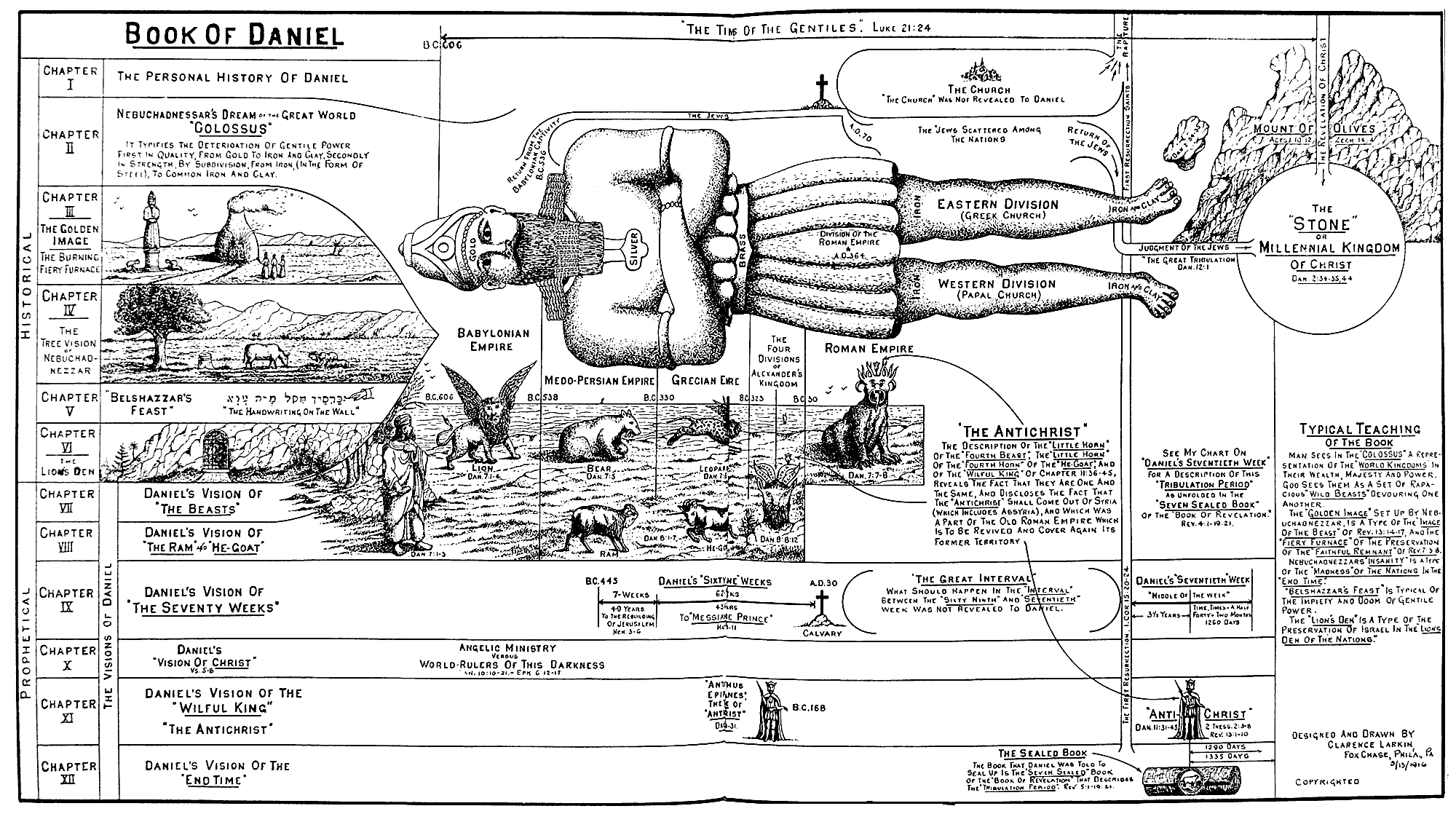
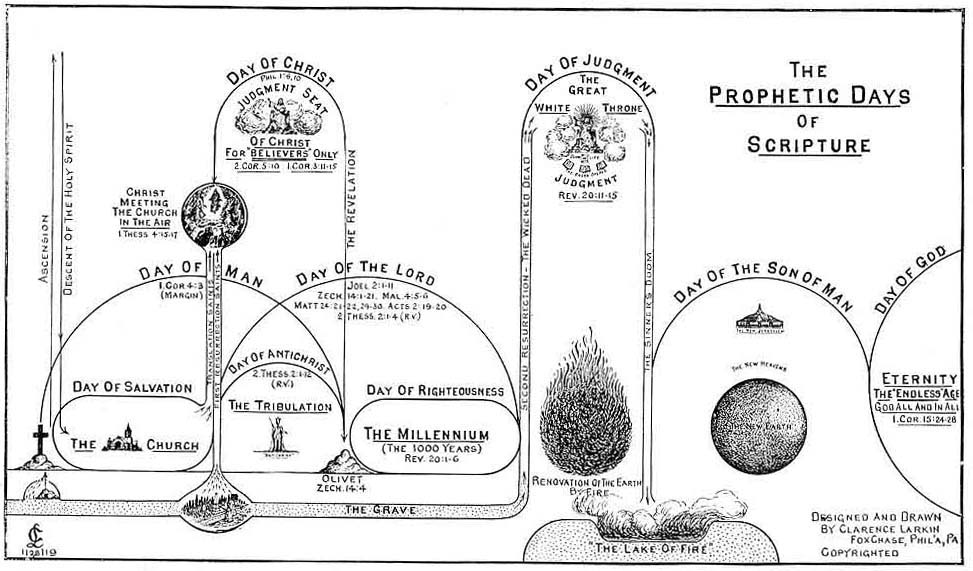
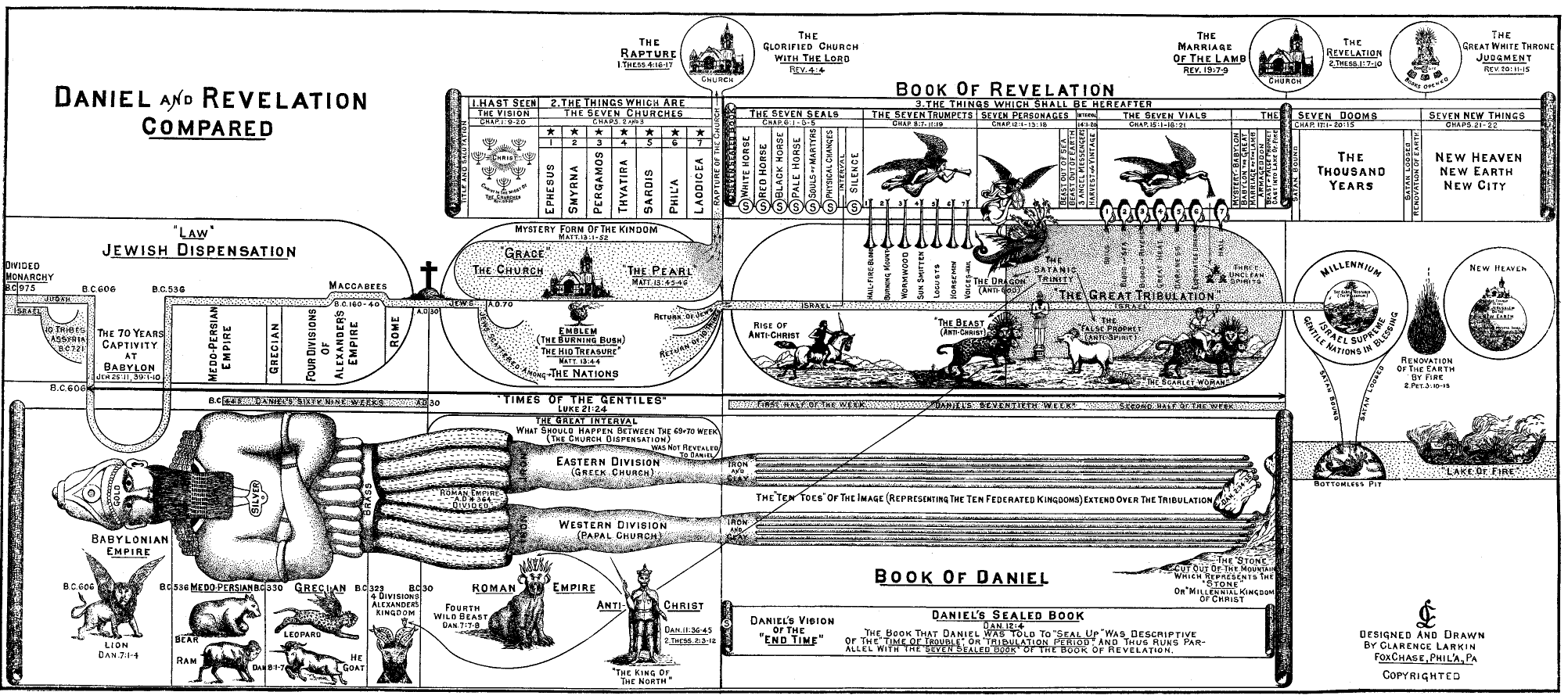


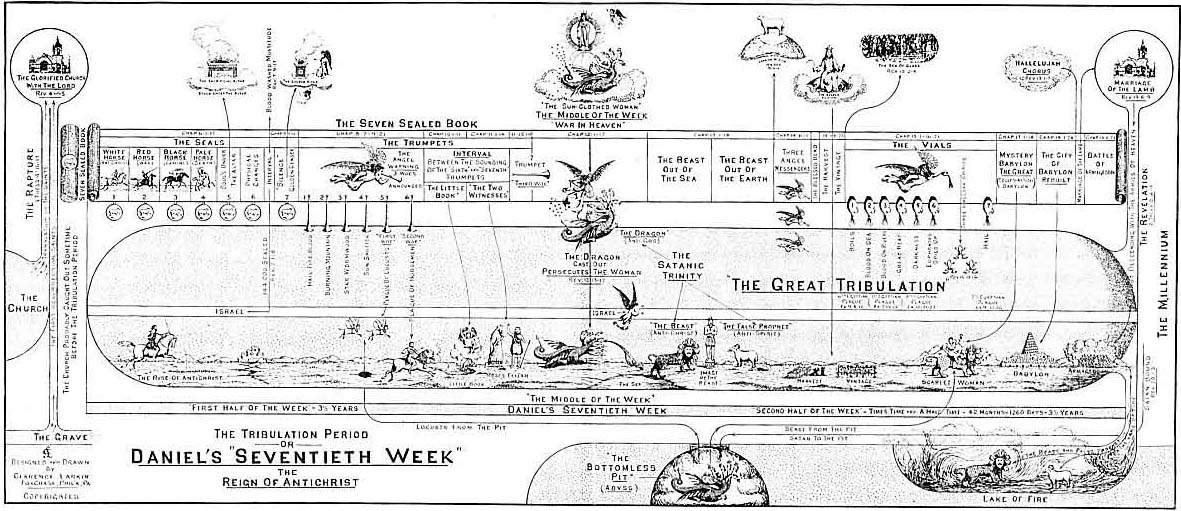

Highly Recommended
- See also MacArthur's Introduction with discussion of interpretative challenges
- Daniel 1 The Uncompromising Life
- Daniel 1:1-2 God's Man for a Time of Crisis, Pt. 1
- Daniel 1:1-2 God's Man for a Time of Crisis, Pt. 2
- Daniel 1:1‑8 An Uncompromising Life
- Daniel 1:8,9 The Consequences of an Uncompromising Life - Part 1
- Daniel 1:10‑21 The Consequences of an Uncompromising Life - Part 2
- Daniel 2:1-30: Forgotten Dream & Unforgettable Daniel
- Daniel 2:31-40: The Rise and Fall of the World--Part 1
- Daniel 2:31-40: The Rise and Fall of the World--Part 1 - Study Guide
- Daniel 2:41-43: The Rise and Fall of the World--Part 2
- Daniel 2:41-43: The Rise and Fall of the World--Part 2 - Study Guide
- Daniel 2:44-49: The Rise and Fall of the World--Part 3
- Daniel 2:44-49: The Rise and Fall of the World--Part 3 - Study Guide
- Daniel 3:1‑3 Uncompromising Faith in the Fiery Furnace - Part 1
- Daniel 3:4‑30 Uncompromising Faith in the Fiery Furnace - Part 2
- Daniel 4-1-37: How Are the Mighty Fallen!
- Daniel 5-1-31: Divine Graffiti- The End of an Empire
- Daniel 6:1-28 in the Lion's Den
- Daniel 7 The Coming Kingdom of Christ - Part 1
- Daniel 7:1-7 The Coming Kingdom of Christ - Part 2
- Daniel 7:8-28 The Coming Kingdom of Christ - Part 3
- Daniel 8:1-2, 15-19 False Messiahs - Part 1
- Daniel 8:3-9 False Messiahs, Part 2
- Daniel 8:9-14, 20 False Messiahs - Part 3
- Daniel 9:1-3 Elements of True Prayer, Part 1
- Daniel 9:3-15 Elements of True Prayer, Part 2
- Daniel 9:16-19 Elements of True Prayer, Part 3
- Daniel 9:1-19 Characteristics of True Confession
- Daniel 9:1-19 Pattern of Prayer from a Man of Prayer
- Daniel 9:1-19 A Prayer of Brokenness
- Daniel 9:1-19 Characteristics of a Fervent Prayer Life - Part 1
- Daniel 9:1-19 Characteristics of a Fervent Prayer Life - Part 2
- Daniel 9:20-27 The Arrival of the King
- Daniel 9:27 (Not a sermon but a Q/A post on Matthew 24:15) The Abomination of Desolation
- (Related message) Luke 21:20-24 The Terrors of the Great Tribulation, Part 1
- (Related message) Luke 21:20-24 The Terrors of the Great Tribulation, Part 2
- (Related message) 2Thessalonians 2:1-5 The Coming Man of Sin, Part 1
- (Related message) 2Thessalonians 2:1-5 The Coming Man of Sin, Part 2
- (Related message) 2Thessalonians 2:3-5 The Coming Man of Sin, Part 3
- (Related message) 2Thessalonians 2:6-10 The Coming Man of Sin, Part 4
- (Related message) 2Thessalonians 2:6-10 The Coming Man of Sin, Part 5
- Daniel 9:20-24: Israel's Future--Part 1
- Daniel 9:20-24: Israel's Future--Part 1 - Study Guide
- Daniel 9:24-25: Israel's Future--Part 2
- Daniel 9:24-25: Israel's Future--Part 2 - Study Guide
- Daniel 9:26-27: Israel's Future--Part 3
- Daniel 9:26-27: Israel's Future--Part 3 - Study Guide
- Daniel 10:1-21: The Vision of Glory
- Daniel 10:1-21: The Vision of Glory - Study Guide
- Daniel 11:1-35: The Reign of Rebellion--Part 1
- Daniel 11:1-35: The Reign of Rebellion--Part 1 - Study Guide
- Daniel 11:36-45: The Reign of Rebellion--Part 2
- Daniel 11:36-45: The Reign of Rebellion--Part 2 - Study Guide
- Daniel 12:1-3: The Great Tribulation--Part 1
- Daniel 12:1-3: The Great Tribulation--Part 1 - Study Guide
- Daniel 12:4-13: The Great Tribulation--Part 2
- Daniel 12:4-13: The Great Tribulation--Part 2 - Study Guide
The following is a great way to introduce children to Daniel
- Daniel the Captive - 19 Page Pdf with lots of colorful pictures!
- Daniel and the Mystery Dream - 21 Page Pdf with lots of colorful pictures!
- Daniel and the Lion's Den - 21 Page Pdf with lots of colorful pictures!
- Index page - stories for Ruth, Ezekiel, Jeremiah , Elijah, etc
- Millennium 1 - summary including overview of Rev 19:11-21:3,
- Millennium 2 - events leading up to the millennium, including Great Tribulation a
- Millennium 3 - description of this time on earth, primarily from the OT prophets
- Table comparing Rapture versus Second Coming
- Daniel's Seventieth Week Chart
- A Maranatha Mindset
- Daniel 2:24-49 Commentary
- Daniel's Seventieth Week
- Deuteronomy 4:30 Commentary
- Genesis 49:1 Commentary
- God's Plan for Jerusalem
- Jeremiah 30:7-The Time of Jacob's Trouble
- Last-Eschatos (Greek Word Study)
- Maranatha-Our Lord, Come!
- Second Coming of Christ
- The Great Tribulation
- The Last Days
- Verse by Verse Commentary on Revelation - links to Tony Garland's commentary
THE THEOCRATIC KINGDOM - written by a Lutheran pastor George N H Peters - an incredible work!
- Volume 1 - Propositions 1 - 106
- Volume 2 - Propositions 107 - 164
- Volume 3 - Propositions 165 - 206
- Index of Scriptures & Subjects
- Daniel 1 How to Survive and Thrive Amidst the Babylons of Life
- Daniel 1-3,6, Jeremiah 29-31 - Daniel in Exile
- Daniel 2 A King on a Couch
- Daniel 3 The Fourth Man in the Furnace
- Daniel 4 Insanity, Insomnia and Insight
- Daniel 5 The Handwriting on the Wall
- Daniel 6 The Lions in Daniel's Dan
- Daniel 7-12 - Profiting from Prophecy
- The 70 Weeks of Daniel - Pdf
- Early Promises of A Redeemer of Mankind
- The Sixty-Nine Weeks of Years
- The Prophetic Students of the First Century
- The Stopping of God's Clock
- The Seventieth Week
- Chart of Daniel's 70 Weeks = "The Jewish Calendar"
- Daniel 1 Studies in the Book of Daniel
- Daniel 2 Nebuchadnezzar's Vision (Chart of Daniel 2) (Chart of Daniel 7, Revelation 13, 17)
- Daniel 2 The Interpretation of Nebuchadnezzar's Dream
- Daniel 3 The Golden Image of Nebuchadnezzar
- Daniel 4 The Vision of a Tree
- Daniel 5 Belshazzar's Downfall
- Daniel 6 Daniel in the Lion's Den
- Daniel 7 The Four Visions
- Daniel 7 The Chronological Suspension Bridge
- Daniel - The World Kingdom Breaking Up
- Daniel 8 The World Kingdom Breaking Up
- Daniel 9 - The Program of Daniel Chapter Nine
- Daniel 9 Messiah: First Coming Scheduled
- Daniel 9:24-27 The Seventieth Week of Daniel
- The Seventieth Week of Years
- Daniel 7, 11 - The Great Tribulation
- Daniel 10-12 The Glory of God
- Daniel 10-12 Expounding the Word
- Daniel 10-12 The Close of Revelation
- Daniel 11 - False Messiah's Reign of Terror During the Time of Jacob's Trouble
- Daniel 11:38 Paronomasia
- The Act that Precipitates the Time of Jacob's Trouble
- BORROW - Holman Christian Standard Bible -Study Bible (HCSB Study Bible) - sample excerpts
Daniel 2:31-45 Daniel interpreted the parts of the colossal statue to represent four empires in historical succession. The head represented the kingdom of Babylon (605-539 B.C.). The chest and arms symbolized the Medo-Persian Empire (539-331 B.C.). The stomach and thighs stood for the Greek Empire (331-146 B.C.). The legs referred to the Roman Empire (146 B.C.-A.D. 1476 in the West and 1453 in the East). The feet were mixed of iron and clay and represented a future continuation or revival of Rome. The material of each section of the statue decreased in value but increased in strength. The decreased value may symbolize the moral decline of each succeeding kingdom. The increased strength refers to the harsher domination each successive kingdom would impose on its subjects. Daniel also described a stone that would shatter the final kingdom and grow into a mountain that filled the whole earth. This "stone" is the kingdom of God. Primarily because they disbelieve in the possibility of predictive prophecy, critical scholars assume that Daniel was written in 165 B.C. and therefore is looking backward rather than forward at the rise of earthly kingdoms such as the Roman Empire. They divide the four kingdoms into Babylon, Media, Persia, and Greece. On the other hand, most interpreters who accept the reality of predictive prophecy in Scripture believe Daniel was written in the late sixth century and view the fourth kingdom as Rome. They hold different opinions about the meaning of the stone, however. Some view it as a spiritual kingdom, embodied in the church, which gradually conquered the Roman Empire. Others more accurately view it as a future kingdom, when Messiah Jesus will return and establish His physical rule that will govern the whole earth and never be destroyed.Daniel 7:1-28 This chapter of Daniel is one of the most important in the entire OT, an essential guide to biblical prophecy. Moreover, the vision of the Son of Man is the centerpiece of OT revelation concerning the Messiah. The Aramaic section of Daniel begins in chapter 2 with Nebuchadnezzar's dream of the colossus and ends at the end of chapter 7. One reason for repeating the similar information in chapters 2 and 8 is that chapter 2 presents the world kingdoms from a Gentile perspective, while chapter 8 views the Gentile empires from the perspective of the Jewish people. Another reason for the repetition is to confirm the certainty of the predictions. As Joseph said, Pharaoh's dreams were repeated because "the matter has been determined by God, and He will carry it out soon" (Gen 41:32). The vision was included to give hope to Israel in captivity, informing the nation that life in the times of the Gentiles would get worse for God's covenant people, but ultimately the messianic kingdom would be established.
Daniel 7:3 The four huge beasts represent the four nations previously identified in the vision of the colossus in Daniel 2 (see note at Da 2:31-45). These four beasts are increasingly violent, perhaps indicating the growing moral degeneracy of the respective kingdoms they represent.
Daniel 7:4 The lion with eagle's wings represents the Babylonian Empire. The winged lion was a fitting symbol because some biblical passages represent Nebuchadnezzar as a lion (Jer 4:7; 49:19; 50:17,44) and others as an eagle (Jer 49:22; Lam 4:19; Ezek 17:3; Hab 1:8). The Babylonian Empire used lions to represent itself, and statues with winged lions were common there. Perhaps the wings being torn off represents Nebuchadnezzar's madness, and the lion's being set on its feet like a man indicates his restoration.
Daniel 7:5 The bear... with three ribs in its mouth represents the Medo-Persian Empire and its three main conquests: Babylon (539 B.C.), Lydia (546 B.C.), and Egypt (525 B.C.). Its lopsided nature expresses the Persian dominance in this joint empire.
Daniel 7:6 The leopard represents the Greek Empire. Its four wings refer to the great speed of Alexander's conquests and its four heads represent the four principle sections of the empire: Greece and Macedonia, Thrace and Asia Minor, Syria and Babylon, and Egypt and Israel.Daniel 7:7 The terrifying fourth beast represents the Roman Empire. It was different from the previous three because it was more powerful and had longer dominion. Horns commonly represent kings or kingdoms in Scripture (Ps 132:17; Zech 1:18; Rev 13:1; 17:12), as the angel's later interpretation plainly indicates (Da 7:24).
Daniel 7:8 A little...horn represents a king who starts small in power but becomes dominant. The little horn's eyes... like a man's indicates its shrewdness and its mouth that spoke arrogantly points to its boasting blasphemously against God (cp. Da 7:25). This little horn is a future world ruler whom Scripture also calls "the coming prince" (Da 9:26); the king who "will do whatever he wants" (Da 11:36); "the man of lawlessness," "the son of destruction," (2 Th 2:3-note); "the beast," (Rev 13:1-10-note); and the "Antichrist" (1 Jn 2:18-note). (Ed: "-note" are additons to comments on this website)
Daniel 7:18 The holy ones (saints) of the Most High is most likely a reference to Israel when the nation turns in faith to their Messiah Jesus (Zech 12:10; Ro 11:26-note). The literal covenant people will receive the kingdom, emphasizing that Messiah's final kingdom will be a literal kingdom on earth.
Daniel 7:23-24a After a summary of the vision's meaning (Da 7:19-22), the angel explains that the fourth kingdom, in its future state, will devour the whole earth, indicating world domination. The 10 kings could be a metaphor for completeness. More likely, it refers to an empire with a literal confederation of 10 kings (cp. Rev 17:12-13).
Daniel 7:24b-26 Another king, the Antichrist (cp.Da 7:7-8), described in the vision as the little horn, will arise and take control of this last human empire by subduing three kings. He will be characterized by blasphemy (words against the Most High), anti-Semitism (he will oppress the holy ones of the Most High), religious corruption (he will intend to change religious festivals and laws). He will oppress the Jewish people for time, times, and half a time, meaning three and one-half years, or the second half of the future tribulation (cp. Rev 7:14). Some conclude that this was fulfilled when Antiochus oppressed the Jewish people from 167-164 B.C. This is unlikely since that period was for only three years and not three and one-half years. It is better to view this oppression as yet future. When the heavenly court will convene, the Antichrist will be completely destroyed forever.
Daniel 8:8:9-12 As opposed to the little horn that will come from the fourth kingdom (Rome) described in Dan 7:8, a different little horn emerged out of one of the four kingdoms that divided the Greek Empire. This one was Antiochus IV (175-163 B.C.), ruler of the Seleucid dynasty, who conquered surrounding areas to the south and to the east but especially dominated the beautiful land of Israel. He brutally trampled and persecuted the Jewish people from 170-164 B.C. Antiochus blasphemously presented himself as the Prince of the host, God Himself (called the Prince of princes in 8:25), stopping daily sacrifice and defiling the holy temple (His sanctuary) in Jerusalem (167 B.C.). He will be successful, but only temporarily.
Daniel 9:24 Seventy weeks probably refers to 70 periods of seven years, or 490 years, during which six objectives would be accomplished. The first three pertain to bringing rebellion... sin, and iniquity to an end. The final three relate to consummating prophetic events by bringing in a kingdom of everlasting righteousness, fulfilling vision and prophecy and setting apart the most holy place (lit "the holy of holies"), referring to a yet future, literal, millennial temple (cp. Ezek 40-48).
Daniel 9:25 Those who advocate a symbolic interpretation of this verse identify it with Cyrus's decree allowing the captives to return to their homeland (2Ch 36:22-23; Ezr 1:1-3) in 539-538 B.C. Others hold a literal view of this verse and suggest that the starting point is Artaxerxes' first decree in 457 B.C. (Ezr 7:11-26). Since neither of these decrees pertains to the restoration of Jerusalem, it is more likely that the decree that is the beginning point is Artaxerxes' second decree in 444 B.C., authorizing Nehemiah to rebuild the walls of Jerusalem (Neh 2:1-8). There will be a period of seven weeks of years (49 years) followed by 62 weeks of years (434 years), making a total of 69 weeks of years or 483 years from the decree until the coming of Messiah the Prince. The starting point of the prophecy would have begun on Nisan 1 (March 5), 444 B.C., followed by 69 weeks of 360-day biblical/prophetic years or 173,880 days, and culminated on Nisan 10 (March 30), A.D. 33, the date of Jesus the Messiah's triumphal entry into Jerusalem (Lk 19:28-40).
Daniel 9:26 Several events are said to follow the seven weeks and the 62 weeks (or the 69 weeks). First, the Messiah would be cut off, a prediction of the death of the Messiah Jesus. Thus, the book of Daniel, written in the sixth century B.C., predicted not only the precise date of the Messiah's coming (Da 9:25) but also that the Messiah would be put to death some time before the destruction of Jerusalem in A.D. 70. This was fulfilled when Jesus was crucified in A.D. 33 (A.D. 30 according to some interpreters). Second, the people of the coming prince would destroy the city of Jerusalem and the second temple. The "coming prince" probably is a reference to the future ruler described as the little horn in Daniel 7, also known as the beast or the Antichrist. He is not said to be the one to destroy Jerusalem and the temple; rather it is his people who will do it. Since Daniel 7 clearly viewed this ruler as coming from the fourth major world power, or Rome, this prophecy predicts that the Romans would destroy Jerusalem, as they did in A.D. 70. Third, there appears to be a significant time gap from the end of the sixty-ninth week to the beginning of the seventieth week.
Daniel 9:27 The final seven-year period, or the seventieth week, will begin when he (the coming prince) will make a firm covenant of peace with many in the leadership of Israel. Although some consider the prince to be Messiah, he is more accurately identified as the antichrist, who will desecrate the future temple and put a stop to worship there. This covenant is yet future and will mark the beginning of a time of oppression of the Jewish people called "a time of trouble for Jacob" (Jer 30:7) or the tribulation period (Mt 24:29; Mk 13:24). In the middle of the week, or after the first three and one-half years, the antichrist will break his covenant with Israel, leading to a time of unprecedented persecution of the Jewish people (Mt 24:21; Mk 13:19) and followers of Jesus (Rev 7:14) that will last for another three and one-half years (Dan 7:25; Rev 11:2-3; 12:14; 13:5). When the antichrist breaks his covenant, he will also put a stop to sacrifice in the rebuilt temple (7:25) and will commit the abomination of desolation (Mt 24:15), desecrating the temple and declaring himself to be God (2Th 2:4; Rev 13:5-7). The antichrist's oppression and abominations will continue until God's decreed destruction is poured out on the desolator (11:45; Rev 19:20).
Daniel 11:36-45 At this point, the predictions shift away from Antiochus IV and focus on the end of days. The king mentioned in this section is the future Antichrist, already identified as "the little horn" (Da 7:8,20,24-25) and "the coming prince" (Da 9:26).
Daniel 11:36-39 These verses provide a clear description of the future Antichrist. The god longed for by women (lit "the desire of women") may be a reference to the longing of Jewish women to give birth to the Messiah
Daniel 11:40-44 During the great tribulation, the Antichrist will be attacked in a pincer movement from both the north and the south. Yet he will be successful, sweeping through like a flood. He will also invade Israel, the beautiful land, ignoring some nations that are in alliance with him but conquering others, including Egypt, Libya, and Sudan (the Cushites). Reports of nations from the east and the north coming to attack will both terrify and infuriate him, leading him to pursue a course of genocidal warfare against his enemies, especially many of the Jewish people (cp. Zech 13:8-9).
Daniel 11:45 The Antichrist will establish his military capital in Israel, pitching his royal tents between the Mediterranean Sea and the city of Jerusalem, situated on the beautiful holy mountain. There the nations of the earth will gather (Zech 14:2) at Mount Megiddo to begin the campaign of Armageddon (Rev 16:13-16). At that time, when the nation of Israel calls on the Messiah Jesus, He will return (Mt 23:37-39) to deliver them, and the Antichrist will meet his end with no one to help him.
Daniel 12:1 At that time refers to the events predicted in the previous paragraph (11:36-45), which details the Antichrist's furious attempt to destroy and annihilate the Jewish people (Da 11:44). Then the archangel Michael... who stands watch over the Jewish people will rise to their defense to preserve them (see note at Da 10:12-13; cp. Rev 12:7). This will be necessary because the great tribulation (the second half of Daniel's seventieth week; Dan 9:27) will be a time of unprecedented distress. Despite the horrific nature of the persecution of Israel, the result will be that the surviving remnant of the Jewish nation will turn in faith to their Messiah Jesus (Zech 12:10; Ro 11:25-27-note) and He will deliver them. The book refers to the heavenly Book of Life in which the names of the elect are listed (Ps 69:28; Php 4:3; Rev 13:8; 17:8; 20:15).
Daniel 12:2 Following the deliverance of Israel, there will be a resurrection of those who sleep in the dust. This verse does not imply any kind of soul sleep before the resurrection since the faithful go to be with God instantly upon dying (2Co 5:8; Php 1:21-23) and the faithless go to a place of suffering also immediately upon dying (Lk 16:22-23). The word "sleep" is used as a metaphor to emphasize the temporary state of bodily death before being physically raised at the resurrection (cp. Jn 11:11-15). Although telescoped together here (as is common in prophecy), the resurrection of the faithful and the unfaithful are two distinct events separated by the one-thousand-year messianic kingdom (Rev 20:4-6). Daniel 12:2 contains the clearest statement of resurrection in the OT, but by no means is it the only one (cp. Job 19:25-27; Isa 26:19).
Daniel 12:3 The phrase those who are wise refers to those with the wisdom to turn in faith to the Messiah Jesus. As a result, they will lead many others to faith and righteousness.
IVP BACKGROUND COMMENTARY - OLD TESTAMENT
- 23 pages of notes on all 12 chapters, beginning on page 729. Below is an example
Daniel 12:2. resurrection in the ancient Near East. There are several different concepts of afterlife that are evidenced in the ancient Near East. The most fundamental concept is continued existence in a gravelike netherworld where there is no differentiation in the treatment of the righteous and wicked. The Israelites called this place Sheol (see comments on Is 14:9), and they believed that it allowed for no interaction with God. In Canaan and Mesopotamia netherworld deities governed this realm. In Egypt the netherworld existence is more congenial for those who pass the judgment and enter its confines. Those who are not approved are devoured. None of these concepts include the idea of resurrection out of the netherworld. In general, in the ancient worldview the only awakening that took place was the calling up of spirits of the dead (which was not permanent and not a bodily presence) or the awakening of the fertility gods of nature cycles. These died annually when the agricultural cycle came to an end and “wintered” in the netherworld. Then they were ritually awakened in the spring. None of this bears any resemblance to a theological doctrine of resurrection. Likewise not comparable are the occasional revivifications (when an individual is restored to life) or the indications of national return to life (Ezekiel’s dry bones). A fully developed doctrine of resurrection in the modern sense includes six elements: (1) it is individual, not national; (2) it is material, not spiritual; (3) it is universal, not isolated; (4) it takes place outside the netherworld; (5) it leads to permanent immortality; and (6) it involves distinctions between the righteous and the wicked. Zoroastrianism appears to have all of these elements, but the nature of the sources makes it difficult to determine how early the Persians developed these concepts (for further discussion see comment on Is 26:19.
See related topics from Gotquestions.org
- What is the Judgment Seat of Christ / Bema Seat of Christ?
- What is the Great White Throne Judgment?
- What are all the different judgments in the Bible?
- What does the Bible say about when God will judge us?
- What does it mean that judgment begins at the house of God?
- What are the definitions of some common theological terms?
- What happens at the final judgment?
- What is the purpose of there being rewards in heaven?
- Our Eternal Home
- Questions Skeptics Ask About Messianic Prophecy (See also Messianic Prophecies; Messianic Prophecies in Isaiah)
- The Daniel Papers
- What Can We Know About The Antichrist?
- What Can We Know About The End times?
- What Can We Know About The Second Coming?
- What Does The Bible Say About Hell?
- List of charts and maps
- Book of Daniel
- Daniel's Seventy Weeks
- Daniel's Seventieth Week (or here)
- Daniel and Revelation Compared
- Map of Old Roman Empire
- Anti-Christ and Times of the Gentiles
- Daniel – Key to Understanding Revelation
- The First Pillar – The Revived Roman Empire
- The Second Pillar – Daniel and the Antichrist
- The Third Pillar – Daniel and the Future Tribulation
- The Fourth Pillar – Daniel and the Alignment of the Nations
- Daniel’s Amazing Prophecies About Our Day – Questions & Answers
- Daniel’s Amazing Prophecies About Our Day – Questions & Answers - 2
- Daniel’s Amazing Prophecies About Our Day – Questions & Answers – 3
- Daniel’s Amazing Prophecies About Our Day – Questions & Answers – 4
- The Coalition of Nations in Daniel 11
- Why do you believe Daniel’s Seventieth Week is the seven-year Tribulation period?
- The Prophet Daniel: Key to the Visions and Prophecies of the Book of Daniel-1911
- The Prophet Daniel (Annotated Bible)
- The Harmony of the Prophetic Word - A Key to Old Testament Prophecy Concerning Things to Come (1907)
- The Day of Jehovah
- The Great Tribulation
- The Nations the Enemies of Israel
- The Antichrist
- The Visible and Glorious Manifestation of Jehovah over the Earth
- The Conversion and Restoration of Israel
- The Theocratic Kingdom
- The Blessings of the Coming Age - Peace on Earth
- Daniel 1:1-2; God's Sovereignty and Human Freedom: Though God is sovereign and in control of the universe, we are responsible to obey His directives in the Word of God. Video
- Daniel 1:3-8; Total Commitment: To make deliberate and wise decisions to live in God's will day by day, we must make a heart decision to honor God in all we do. Video
- Daniel 1:9-21; Walking in Wisdom: We are to do all we can to win the trust and respect of non-Christians without compromising our biblical convictions. Video
- Daniel 2:1-18;The Power of Prayer: When we encounter challenges that seem insurmountable, we are to pray and ask God for His power to do what is right. Video
- Daniel 2:19-49; Honoring God: Though we are to make full use of our earthly talents and abilities to live in God's will, we?re always to honor and glorify Him for what He has accomplished through us. Video
- Daniel 3:1-4:3; Facing Persecution: We are to trust God to empower us to avoid any form of idolatry, regardless of the persecution we may experience. Video
- Daniel 4:4-37; Prideful Tendencies: Even as believers, we must constantly be on guard against our human tendencies to be prideful and take inappropriate credit for our accomplishments. Video
- Daniel 5:1-31;Learning from the Past: We are to learn from those who have gone before us, avoiding their mistakes and emulating their positive attitudes and actions. Video
- Daniel 6:1-24;Living without Compromise: We are to practice our faith boldly, but with wisdom, discretion, and humility. Video
- Daniel 7:1-28; Fulfilled Prophecy: We should become aware of those prophetic details that have not been fulfilled so we can be alert to how they may correlate with what is happening in the world today. Video
- Daniel 8:26-27; Our Holy God: In view of the way direct encounters with God impacted biblical personalities physically, psychologically, and spiritually, we should be very cautious in claiming to have similar experiences. Video
- Daniel 9:1-19; A Model Prayer: To pray effectively, we should acknowledge God's greatness, remind Him of His glorious promises, confess our sins, and be specific in our requests. Video
- Daniel 9:20-23;Eternal Rewards: We are to walk in God's will so He will be pleased with our attitudes and actions and reward us at the judgment seat of Christ. Video
- Daniel 9:24-27; Being Prepared: Though we don't know when Jesus Christ will return, we should always be prepared spiritually for this event. Video
- Daniel 10:1-11; Strength in Weakness: When we feel the most inadequate we should consider it an opportunity to experience God's supernatural enablement. Video
- Daniel 10:12-21; The Armor of God: We are to clothe ourselves with God's armor consistently so we can defeat Satan and his emissaries when they attack us in various ways. Video
- Daniel 11:1-35; Prophetic History: We must understand that the Holy Spirit at times inspired prophets to record prophetic history that has been fulfilled before our time so that we will take seriously future events that are still to be fulfilled. Video
- Daniel 11:36-12:13; The Great Tribulation: As members of the body of Jesus Christ (the church), we are to encourage one another with the great truth that we will not experience God?s wrath. Video
- Daniel 1-6 - Part 1 - Living Out a Biblical Worldview - Observation sheets Da 1-6, excellent detailed Timeline on page 43
- Daniel 7-12 - Part 2 - Gaining Understanding of the Time of the End - Statue and chart to compare Da 2 and Da 7 on page 53
- Sermon 1 - How to Survive ‘Babylon U’
- Sermon 2 -The Keyhole of Biblical Prophecy
- Sermon 3 - Profile of Coming Conflict
- Sermon 4 - Nebuchadnezzar: Standard and Exhortation to the Gentile World
- Sermon 5 -The Handwriting on the Wall-Final Notice to a Hardened Land
- Sermon 6 - Daniel: God’s Extraordinary Man in a Decadent World
- Sermon 7 - Antichrist: Thunderhead of Earth’s Final Days
- Sermon 8 - Antiochus and Anti-Christ: Wickedness Then and Evil to Come
- Sermon 9 - Keyhole of Bible Prophecy
- Sermon 10 - History Unmasked
- Sermon 11 - Panorama of Hostility
- Sermon 12 -The Final Word
JOE GUGLIELMO
- Daniel 1 Notes
- Daniel 2:1-40 Notes
- Daniel 2:41-49 Notes
- Daniel 3-4 Notes
- Daniel 5-6 Notes
- Daniel 7 Notes
- Daniel 8 Notes
- Daniel 9:1-19 Notes
- Daniel 9:20-27 Notes
- Daniel 10 Notes
- Daniel 11 Notes
- Daniel 12 Notes
JACK KELLEY
- Daniel 1 Commentary
- Daniel 2 Commentary
- Daniel 3 Commentary
- Daniel 4 Commentary
- Daniel 5 Commentary
- Daniel 6 Commentary
- Daniel 7 Commentary
- Daniel 8 Commentary
- Daniel 9 Commentary
- Daniel 10 Commentary
- Daniel 11 Commentary
- Daniel 12 Commentary
- Outline of the Book of Daniel {high-level overview}
- Study of the Book of Daniel (Daniel 1:1-12:13) - {detailed}
- Dare to be a Daniel (Daniel 1:1)
- The Thing Is Gone From Me (Daniel 2:1-8)
- Pinnacles in Prophecy (Daniel 2:36-45; Daniel 7)
- Real Faith: What Good Is It? (Daniel 3:16-18)
- Daniel’s 70th Week (Daniel 9:24-27)
- Be Standout People (Daniel 11:30-32)
- Introduction (pdf)
- Daniel 1:1-21 (pdf)
- Daniel 2:1-49 (pdf)
- Daniel 2:1-49 Part 2 (pdf)
- Daniel 2:1-49 Part 3 (pdf)
- Daniel 3:1-30 (pdf)
- Daniel 3:1-30 Part 2 (pdf)
- Daniel 4:1-37 (pdf)
- Daniel 5:1-31 (pdf)
- Daniel 5:1-31 Part 2 (pdf)
- Daniel 6:1-28 (pdf)
- Daniel 6:1-28 Part 2 (pdf)
- Daniel 7:1-28 (pdf)
- Daniel 7:1-28 Part 2 (pdf)
- Daniel 8:1-27 (pdf)
- Daniel 8:1-27 Part 2 (pdf)
- Daniel 8:1-27 Part 3 (pdf)
- Daniel 9:1-19 (pdf)
- Daniel 9:20-27 (pdf)
- Daniel 9:24-27 (pdf)
- Daniel 9:24-27 Part 2 (pdf)
- Daniel 10:1-21 (pdf)
- Daniel 10:1-21 Part 2 (pdf)
- Daniel 11:1-35 (pdf)
- Daniel 11:36-39 (pdf)
- Daniel 11:40-45 (pdf)
- Daniel 12:1-3 (pdf)
- Daniel 12:4-13 (pdf)
CLAUDE STAUFFER
- Daniel 1 God is My Judge
- Daniel 2 God is My Revealer
- Daniel 3 God is My Igniter
- Daniel 4 God is My Gracious King
- Daniel 5 God's Word Weighs My Life
- Daniel 6 God is My Deliverer
- Daniel 7 God is My Eternal King
- Daniel 8 My God Holds the Future
- Daniel 9 Greatly Beloved of God
- Daniel 10-12 God is My Strength
- Christ in the Old Testament
- Messianic Prophecies, types and applications in the Old Testament
- Daniel 2, 7, 9, 12 The Coming of Messiah the Prince
DAVID WILKERSON
- Daniel 1 Will You Please Make Up Your Mind? - Transcript
- Daniel 2 Never Fear, History Has Already Been Written - Transcript
- Daniel 1 - Exiled and Holy - excerpt
Application: Suffering reveals our functional hope and trust. We see clearly how we often run to the wrong things to find security, refuge, and comfort. What have you relied on as your hope apart from God? What experience, dream, or possession is often your source of strength? Will you resolve to remain holy to God in all things? Will you run to Him?
Conclusion idea - Hebrews reminds us to glance at the example of men like Daniel (Da 11:33). But we must not stop there. We must turn our eyes on the greater Daniel and gaze upon Him (Heb. 12:1-3-note). We must fix our eyes on Jesus who, though righteous, experienced the ultimate exile on the cross. He was forsaken to bring us in, and abandoned so God might welcome us. Only by trusting and treasuring him can we be holy in our times of suffering and exile.
- Daniel 1:8: Dare to Be a Daniel
Standing by a purpose true,
Heeding Gods command,
Honor them, the faithful few!
All hail to Daniels band!Refrain
Dare to be a Daniel,
Dare to stand alone!
Dare to have a purpose firm!
Dare to make it known.Many mighty men are lost
Daring not to stand,
Who for God had been a host
By joining Daniels band.
RefrainMany giants, great and tall,
Stalking through the land,
Headlong to the earth would fall,
If met by Daniels band.
RefrainHold the Gospel banner high!
On to victry grand!
Satan and his hosts defy,
And shout for Daniels band.
Refrain - Daniel 2:31-33: Look For the Way-Marks
- Daniel 3:17: He is Able to Deliver Thee
- Daniel 5:5: Handwriting on the Wall
- Daniel 6:10 Do You See the Hebrew Captive Kneeling
- Daniel 7:9: Ancient of Days
- Daniel 12:3: We Shall Shine As Stars
- More Hymns related to Daniel
JOE GUGLIELMO
JOE GUGLIELMO
- Daniel 9:24 Verse by Verse Notes
- Daniel 9:25 Verse by Verse Notes
- Daniel 9:26 Verse by Verse Notes
- Daniel 9:27 Verse by Verse Notes
- Daniel 9 God's Future Program for Israel
- Is Israel Prophetically Significant?
- Preterism
- Jerusalem in Prophecy
- Prophetic Postponement
- An Overview of the Antichrist
- Abomination of Desolation
- An Overview of the Tribulation
- The Feast of Tabernacles in the Millennial Kingdom
- A Brief History of the Jewish Temple
- An Overview of the Future Temples
- How To Have Faith
- The Evidence of Easter (Resurrection Sunday)
- The Eschatology of the Dead Sea Scrolls
- God’s Future Program for Israel (Daniel 9)
- Archaeology and the Bible
- Seventy Weeks of Daniel
ADRIAN ROGERS
Literal interpretation
- Treasures from Daniel - 360 pages - list of illustrations on page 356
Conservative notes from Dr Morris who approaches the text seeking it's literal meaning in the context. Millennial. Click the words or phrases after the Scripture for the Study Notes and note that they are from the KJV translation.
Daniel 1 Defender's Study Bible Notes
- Daniel 1:2 into his hand land of Shinar his god
- Daniel 1:3 children of Israel
- Daniel 1:6 Azariah
- Daniel 1:7 Abed-nego
- Daniel 1:8 defile himself
- Daniel 1:16 pulse
- Daniel 1:17 wisdom
- Daniel 1:18 end of the days
- Daniel 1:19 stood they before the king
- Daniel 1:21 continued
Daniel 2 Defender's Study Bible Notes
- Daniel 2:1 troubled
- Daniel 2:4 Syriac
- Daniel 2:10 not a man upon the earth
- Daniel 2:20 wisdom and might are his
- Daniel 2:21 times and seasons understanding
- Daniel 2:22 darkness
- Daniel 2:28 revealeth secrets
- Daniel 2:33 part of iron
- Daniel 2:38 head of gold
- Daniel 2:39 another kingdom kingdom of brass
- Daniel 2:40 fourth kingdom
- Daniel 2:41 kingdom shall be divided
- Daniel 2:42 partly broken
- Daniel 2:43 seed of men
- Daniel 2:44 days of these kings kingdom
- Daniel 2:45 without hands
- Daniel 2:47 God of gods
Daniel 3 Defender's Study Bible Notes
- Daniel 3:1 image of gold threescore cubits, and the breadth thereof six cubits
- Daniel 3:5 sackbut dulcimer all kinds of musick
- Daniel 3:10 worship the golden image
- Daniel 3:18 not serve thy gods
- Daniel 3:25 the Son of God
- Daniel 3:28 delivered his servants
Daniel 4 Defender's Study Bible Notes
- Daniel 4:3 great are his signs
- Daniel 4:8 spirit of the holy gods
- Daniel 4:13 watcher
- Daniel 4:16 seven times
- Daniel 4:17 the watchers basest of men
- Daniel 4:22 thy dominion
- Daniel 4:30 great Babylon that I have built
- Daniel 4:33 driven from men
- Daniel 4:37 able to abase
Daniel 5 Defender's Study Bible Notes
- Daniel 5:1 Belshazzar
- Daniel 5:4 drank wine
- Daniel 5:5 man’s hand
- Daniel 5:10 the queen
- Daniel 5:11 spirit of the holy gods
- Daniel 5:13 Jewry
- Daniel 5:16 have heard of thee third
- Daniel 5:30 In that night
- Daniel 5:31 Darius
Daniel 6 Defender's Study Bible Notes
- Daniel 6:1 Darius
- Daniel 6:2 Daniel was first
- Daniel 6:5 not find any occasion
- Daniel 6:8 which altereth not
- Daniel 6:16 den of lions
- Daniel 6:22 his angel
- Daniel 6:26 the living God
- Daniel 6:27 hath delivered Daniel
- Daniel 6:28 reign of Darius
Daniel 7 Defender's Study Bible Notes
- Daniel 7:2 four winds
- Daniel 7:3 up from the sea diverse one from another
- Daniel 7:4 eagle’s wings
- Daniel 7:5 bear three ribs
- Daniel 7:6 leopard
- Daniel 7:7 fourth beast before it
- Daniel 7:8 little horn mouth speaking great things
- Daniel 7:9 Ancient of days
- Daniel 7:12 prolonged
- Daniel 7:14 given him dominion
- Daniel 7:22 Ancient of days
- Daniel 7:25 dividing of time
Daniel 8 Defender's Study Bible Notes
- Daniel 8:1 In the third year
- Daniel 8:2 Shushan
- Daniel 8:3 two horns
- Daniel 8:4 no beasts might stand
- Daniel 8:5 he goat notable horn
- Daniel 8:8 great horn was broken four notable ones
- Daniel 8:9 little horn (Ed: I disagree with his interpretation - click here to see why)
- Daniel 8:10 waxed great
- Daniel 8:11 the daily sacrifice
- Daniel 8:14 two thousand and three hundred days
- Daniel 8:23 dark sentences
- Daniel 8:24 destroy the mighty and holy people
- Daniel 8:25 shall be broken
Daniel 9 Defender's Study Bible Notes
- Daniel 9:2 seventy years
- Daniel 9:3 prayer and supplication
- Daniel 9:5 from thy judgments
- Daniel 9:21 fly swiftly
- Daniel 9:24 Seventy weeks finish the transgression
- Daniel 9:25 commandment to restore and to build Jerusalem seven weeks threescore and two weeks
- Daniel 9:26 Messiah be cut off prince that shall come the sanctuary flood desolations are determined
- Daniel 9:27 he shall confirm one week midst of the week overspreading of abominations
Daniel 10 Defender's Study Bible Notes
- Daniel 10:1 third year of Cyrus
- Daniel 10:4 river, which is Hiddekel
- Daniel 10:6 appearance of lightning
- Daniel 10:13 prince of the kingdom of Persia
Daniel 11 Defender's Study Bible Notes
- Daniel 11:2 shew thee the truth three kings in Persia realm of Grecia
- Daniel 11:3 with great dominion
- Daniel 11:4 four winds of heaven
- Daniel 11:5 king of the south great dominion
- Daniel 11:6 king’s daughter
- Daniel 11:7 branch of her roots
- Daniel 11:10 his sons
- Daniel 11:11 king of the south
- Daniel 11:15 king of the north
- Daniel 11:16 glorious land
- Daniel 11:17 daughter of women
- Daniel 11:18 a prince
- Daniel 11:21 vile person
- Daniel 11:29 come toward the south
- Daniel 11:31 abomination that maketh desolate
- Daniel 11:32 do know their God.
- Daniel 11:33 many days
- Daniel 11:35 time of the end
- Daniel 11:36 the king against the God of gods
- Daniel 11:37 God of his fathers
- Daniel 11:38 God of forces
- Daniel 11:40 king of the south
- Daniel 11:41 glorious land Ammon
- Daniel 11:43 precious things of Egypt Ethiopians
- Daniel 11:44 out of the east
- Daniel 11:45 holy mountain
Daniel 12 Defender's Study Bible Notes
- Daniel 12:1 Michael time of trouble thy people shall be delivered
- Daniel 12:2 awake everlasting contempt
- Daniel 12:3 stars for ever
- Daniel 12:4 run to and fro knowledge shall be increased
- Daniel 12:11 thousand two hundred and ninety days
- Daniel 12:12 thousand three hundred and five and thirty days
These notes tend to be somewhat more technical but often yield very helpful insights. Below are some samples. For all the notes on each verse click the associated link. The NET Bible translation is also highly recommended as a trustworthy, literal rendering of the Greek and Hebrew (especially when combined with the notes that are always much more explanatory than other popular Bible versions like ESV, NIV, NLT or NAS).
- Daniel 1
Da 1:1 The third year of the reign of Jehoiakim would be ca. 605 B.C. At this time Daniel would have been a teenager. The reference to Jehoiakim’s third year poses a serious crux interpretum, since elsewhere these events are linked to his fourth year (Jer 25:1; cf. 2 Kgs 24:1; 2 Chr 36:5–8). Apparently Daniel is following an accession year chronology, whereby the first partial year of a king’s reign was reckoned as the accession year rather than as the first year of his reign. Jeremiah, on the other hand, is following a nonaccession year chronology, whereby the accession year is reckoned as the first year of the king’s reign. In that case, the conflict is only superficial. Most modern scholars, however, have concluded that Daniel is historically inaccurate here.Da 1:1 King Nebuchadnezzar ruled Babylon from ca. 605–562 B.C
Da 1:1 This attack culminated in the first of three major deportations of Jews to Babylon. The second one occurred in 597 B.C. and included among many other Jewish captives the prophet Ezekiel. The third deportation occurred in 586 B.C., at which time the temple and the city of Jerusalem were thoroughly destroyed.
Da 1:2 The land of Babylonia (Heb “the land of Shinar”) is another name for Sumer and Akkad, where Babylon was located (cf. Gen 10:10; 11:2; 14:1, 9; Josh 7:21; Isa 11:11; Zech 5:11).
Da 1:3 The word court official (Hebrew saris) need not mean “eunuch” in a technical sense (see Gen 37:36, where the term refers to Potiphar, who had a wife), although in the case of the book of Daniel there was in Jewish literature a common tradition to that effect. On the OT usage of this word see HALOT 769–70 s.v. סָרֹיס.
Da 1:4 The language of the Chaldeans referred to here is Akkadian, an East Semitic cuneiform language.
Da 1:6 The names reflect a Jewish heritage. In Hebrew Daniel means “God is my judge”; Hananiah means “the Lord is gracious”; Mishael means “who is what God is?”; Azariah means “the Lord has helped.”
Da 1:7 The meanings of the Babylonian names are more conjectural than is the case with the Hebrew names. The probable etymologies are as follows: Belteshazzar means “protect his life,” although the MT vocalization may suggest “Belti, protect the king” (cf. Dan 4:8); Shadrach perhaps means “command of Aku”; Meshach is of uncertain meaning; Abednego means “servant of Nego.” Assigning Babylonian names to the Hebrew youths may have been an attempt to erase from their memory their Israelite heritage.
Da 1:14 The number ten is sometimes used in the OT as an ideal number of completeness. Cf. v. 20; Zech 8:23; Rev 2:10.
Da 1:21 The Persian king Cyrus’ first year in control of Babylon was 539 B.C. Daniel actually lived beyond the first year of Cyrus, as is clear from 10:1. The purpose of the statement in 1:21 is merely to say that Daniel’s life spanned the entire period of the neo-Babylonian empire. His life span also included the early years of the Persian control of Babylon. However, by that time his age was quite advanced; he probably died sometime in the 530’s B.C.
- Daniel 2
Da 2:4 Contrary to common belief, the point here is not that the wise men (Chaldeans) replied to the king in the Aramaic language, or that this language was uniquely the language of the Chaldeans. It was this view that led in the past to Aramaic being referred to as “Chaldee.” Aramaic was used as a lingua franca during this period; its origins and usage were not restricted to the Babylonians. Rather, this phrase is better understood as an editorial note (cf. NAB) marking the fact that from 2:4b through 7:28 the language of the book shifts from Hebrew to Aramaic. In 8:1, and for the remainder of the book, the language returns to Hebrew. Various views have been advanced to account for this change of language, most of which are unconvincing. Most likely the change in language is a reflection of stages in the transmission history of the book of Daniel.Da 2:5 It seems clear from what follows that Nebuchadnezzar clearly recalls the content of the dream, although obviously he does not know what to make of it. By not divulging the dream itself to the would-be interpreters, he intends to find out whether they are simply leading him on. If they can tell him the dream’s content, which he is able to verify, he then can have confidence in their interpretation, which is what eludes him.
Da 2:25 Arioch’s claim is self-serving and exaggerated. It is Daniel who came to him, and not the other way around. By claiming to have found one capable of solving the king’s dilemma, Arioch probably hoped to ingratiate himself to the king.
Da 2:33 Clay refers to baked clay, which—though hard—was also fragile. Cf. the reference in Da 2:41 to “wet clay.”
Da 2:36 Various suggestions have been made concerning the plural “we.” It is probably the editorial plural and could be translated here as “I.”
Da 2:39 The identity of the first kingdom is clearly Babylon. The identification of the following three kingdoms is disputed. The common view is that they represent Media, Persia, and Greece. Most conservative scholars identify them as Media-Persia, Greece, and Rome.
Da 2:43 The reference to people being mixed is usually understood to refer to intermarriage.
- Daniel 3
Da 3:1 There is no need to think of Nebuchadnezzar’s image as being solid gold. No doubt the sense is that it was overlaid with gold (cf. Isa 40:19; Jer 10:3–4), with the result that it presented a dazzling self-compliment to the greatness of Nebuchadnezzar’s achievements. According to a number of patristic authors, the image represented a deification of Nebuchadnezzar himself. This is not clear from the biblical text, however. Aram “sixty cubits.” Assuming a length of 18 inches for the standard cubit, the image would be 90 feet (27.4 m) high. Aram “six cubits.” Assuming a length of 18 inches for the standard cubit, the image would be 9 feet (2.74 m) wide. The dimensions of the image (ninety feet high and nine feet wide) imply that it did not possess normal human proportions, unless a base for the image is included in the height dimension. The ancient world knew of other tall statues. For example, the Colossus of Rhodes—the huge statue of Helios which stood (ca. 280–224 B.C.) at the entrance to the harbor at Rhodes and was one of the seven wonders of the ancient world—was said to be seventy cubits (105 ft or 32 m) in height, which would make it even taller than Nebuchadnezzar’s image.Da 3:2 The specific duties of the seven types of officials listed here (cf. vv. 3, 27) are unclear. The Aramaic words that are used are transliterations of Akkadian or Persian technical terms whose exact meanings are uncertain. The translations given here follow suggestions set forth in BDB.
Da 3:5 The word zither (Aramaic קִיתָרוֹס [qitaros]), and the words for harp (Aramaic פְּסַנְתֵּרִין [pésanterin]) and pipes (Aramaic סוּמְפֹּנְיָה [sumponéyah]), are of Greek derivation. Though much has been made of this in terms of suggesting a date in the Hellenistic period for the writing of the book, it is not surprising that a few Greek cultural terms, all of them the names of musical instruments, should appear in this book. As a number of scholars have pointed out, the bigger surprise (if, in fact, the book is to be dated to the Hellenistic period) may be that there are so few Greek loanwords in Daniel.
Da 3:9 O king, live forever! is a comment of typical court courtesy that is not necessarily indicative of the real sentiments of the speaker. Ancient oriental court protocol could sometimes require a certain amount of hypocrisy.
Da 3:12 Daniel’s absence from this scene has sparked the imagination of commentators, some of whom have suggested that perhaps he was unable to attend the dedication due to sickness or due to being away on business. Hippolytus supposed that Daniel may have been watching from a distance.
Da 3:23 The deuterocanonical writings known as The Prayer of Azariah and The Song of the Three present at this point a confession and petition for God’s forgiveness and a celebration of God’s grace for the three Jewish youths in the fiery furnace. Though not found in the Hebrew/Aramaic text of Daniel, these compositions do appear in the ancient Greek versions.
Da 3:25 The phrase like that of a god is in Aramaic “like that of a son of the gods.” Many patristic writers understood this phrase in a christological sense (i.e., “the Son of God”). But it should be remembered that these are words spoken by a pagan who is seeking to explain things from his own polytheistic frame of reference; for him the phrase “like a son of the gods” is equivalent to “like a divine being.”
Da 3:28 The king identifies the “son of the gods” (v. 25) as an angel. Comparable Hebrew expressions are used elsewhere in the Hebrew Bible for the members of God’s angelic assembly (see Gen 6:2, 4; Job 1:6; 2:1; 38:7; Ps 29:1; 89:6). An angel later comes to rescue Daniel from the lions (Da 6:22). (Ed Comment: While this may be a created angel, the alternative view is that this was in fact the Angel of the LORD, a pre-incarnate Christophany. We will have to wait until heaven to know for sure - 1 Cor 13:12).
- Daniel 4
Da 4:15 The function of the band of iron and bronze is not entirely clear, but it may have had to do with preventing the splitting or further deterioration of the portion of the tree that was left after being chopped down. By application it would then refer to the preservation of Nebuchadnezzar’s life during the time of his insanity.Da 4:16 Aramaic “its heart.” The metaphor of the tree begins to fade here and the reality behind the symbol (the king) begins to emerge. The seven periods of time probably refer to seven years.
Da 4:25 Nebuchadnezzar’s insanity has features that are associated with the mental disorder known as boanthropy, in which the person so afflicted imagines himself to be an ox or a similar animal and behaves accordingly.
Da 4:26 The reference to heaven here is a circumlocution for God. There was a tendency in Jewish contexts to avoid direct reference to God. Cf. the expression “kingdom of heaven” in the NT and such statements as “I have sinned against heaven and in your sight” (Luke 15:21)
- Daniel 5
Da 5:1 As is clear from the extra-biblical records, it was actually Nabonidus (ca. 556–539 B.C.) who was king of Babylon at this time. However, Nabonidus spent long periods of time at Teima, and during those times Belshazzar his son was de facto king of Babylon. This arrangement may help to explain why later in this chapter Belshazzar promises that the successful interpreter of the handwriting on the wall will be made third ruler in the kingdom. If Belshazzar was in effect second ruler in the kingdom, this would be the highest honor he could grant. This scene of a Babylonian banquet calls to mind a similar grandiose event recorded in Esther 1:3–8. Persian kings were also renowned in the ancient Near Eastern world for their lavish banquets. The king probably sat at an elevated head table.Da 5:2 Making use of sacred temple vessels for an occasion of reveling and drunkenness such as this would have been a religious affront of shocking proportions to the Jewish captives.
Da 5:5 The mention of the lampstand in this context is of interest because it suggests that the writing was in clear view.
Da 5:10 Aram “the queen” (so NAB, NASB, NIV, NRSV). In the following discourse this woman is able to recall things about Daniel that go back to the days of Nebuchadnezzar, things that Belshazzar does not seem to recollect. It is likely that she was the wife not of Belshazzar but of Nabonidus or perhaps even Nebuchadnezzar. In that case, “queen” here means “queen mother” (cf. NCV “the king’s mother”).
Da 5:20 The point of describing Nebuchadnezzar as arrogant is that he had usurped divine prerogatives, and because of his immense arrogance God had dealt decisively with him.
Da 5:30 The year was 539 B.C. At this time Daniel would have been approximately eighty-one years old. The relevant extra-biblical records describing the fall of Babylon include portions of Herodotus, Xenophon, Berossus (cited in Josephus), the Cyrus Cylinder, and the Babylonian Chronicle.
- Daniel 6
Da 6:10 In later rabbinic thought this verse was sometimes cited as a proof text for the notion that one should pray only in a house with windows. See b. Berakhot 34b....This is apparently the only specific mention in the OT of prayer being regularly offered three times a day. The practice was probably not unique to Daniel, however....No specific posture for offering prayers is prescribed in the OT. Kneeling, as here, and standing were both practiced.Da 6:24 Aram “had eaten the pieces of.” The Aramaic expression is ironic, in that the accusers who had figuratively “eaten the pieces of Daniel” are themselves literally devoured by the lions.
Da 6:28 Or perhaps “in the reign of Darius, even in the reign of Cyrus.” The identity of this Darius is disputed. Some take the name to be referring to Cyrus, understanding the following vav (ו, “and”) in an epexegetical sense (“even”). Others identify Darius with a governor of Babylon known from extra-biblical records as Gubaru, or with Cambyses, son of Cyrus. Many scholars maintain that the reference is historically inaccurate.
- Daniel 7
Da 7:1 The first year of Belshazzar’s reign would have been ca. 553 B.C. Daniel would have been approximately 67 years old at the time of this vision.Da 7:4 The identity of the first animal, derived from v. 17 and the parallels in chap. 2, is Babylon. The reference to the plucking of its wings is probably a reference to the time of Nebuchadnezzar’s insanity (cf. chap. 4). The latter part of v. 4 then describes the restoration of Nebuchadnezzar. The other animals have traditionally been understood to represent respectively Media-Persia, Greece, and Rome, although most of modern scholarship identifies them as Media, Persia, and Greece. For a biblical parallel to the mention of lion, bear, and leopard together, see Hos 13:7–8.
Da 7:5 The three ribs held securely in the mouth of the bear, perhaps representing Media-Persia, apparently symbolize military conquest, but the exact identity of the “ribs” is not clear. Possibly it is a reference to the Persian conquest of Lydia, Egypt, and Babylonia.
Da 7:6 If the third animal is Greece, the most likely identification of these four heads is the four-fold division of the empire of Alexander the Great following his death. See note on Dan 8:8.
Da 7:7 The fourth animal differs from the others in that it is nondescript. Apparently it was so fearsome that Daniel could find nothing with which to compare it. Attempts to identify this animal as an elephant or other known creature are conjectural.....tn The Aramaic word for “teeth” is dual rather than plural, suggesting two rows of teeth.
Da 7:13 This text is probably the main OT background for Jesus’ use of the term “son of man.” In both Jewish and Christian circles the reference in the book of Daniel has traditionally been understood to refer to an individual, usually in a messianic sense. Many modern scholars, however, understand the reference to have a corporate identity. In this view, the “son of man” is to be equated with the “holy ones” (Da 7:18, 21, 22, 25) or the “people of the holy ones” (Da 7:27) and understood as a reference to the Jewish people. Others understand Daniel’s reference to be to the angel Michael.
- Daniel 8
Da 8:1 Dan 8:1 marks the switch from Aramaic (= 2:4b–7:28) back to Hebrew as the language in which the book is written in its present form. The remainder of the book from this point on (8:1–12:13) is in Hebrew. The bilingual nature of the book has been variously explained, but it most likely has to do with the book’s transmission history.....The third year of King Belshazzar’s reign would have been ca. 551 B.C. Daniel would have been approximately 69 years old at the time of this vision....Heb “in the beginning.” This refers to the vision described in chapter seven.Da 8:2 Susa (Heb. שׁוּשַׁן, shushan), located some 230 miles (380 km) east of Babylon, was a winter residence for Persian kings during the Achaemenid period. The language of v. 2 seems to suggest that Daniel may not have been physically present at Susa, but only saw himself there in the vision. However, the Hebrew is difficult, and some have concluded that the first four words of v. 2 in the MT are a later addition (cf. Theodotion).....The term אוּבַל (’uval = “stream, river”) is a relatively rare word in biblical Hebrew, found only here and in vv. 3 and 6. The Ulai was apparently a sizable artificial canal in Susa (cf. NASB, NIV, NCV), and not a river in the ordinary sense of that word.
Da 8:7 The goat of Daniel’s vision represents Greece; the large horn represents Alexander the Great. The ram stands for Media-Persia. Alexander’s rapid conquest of the Persians involved three battles of major significance which he won against overwhelming odds: Granicus (334 B.C.), Isus (333 B.C.), and Gaugemela (331 B.C.).
Da 8:8 The four conspicuous horns refer to Alexander’s successors. After his death, Alexander’s empire was divided up among four of his generals: Cassander, who took Macedonia and Greece; Lysimachus, who took Thrace and parts of Asia Minor; Seleucus, who took Syria and territory to its east; and Ptolemy, who took control of Egypt.
Da 8:9 This small horn is Antiochus IV Epiphanes, who controlled the Seleucid kingdom from ca. 175–164 B.C. Antiochus was extremely hostile toward the Jews and persecuted them mercilessly.....The expression the beautiful land (Heb. הַצֶּבִי [hatsévi] = “the beauty”) is a cryptic reference to the land of Israel. Cf. Da 11:16, 41, where it is preceded by the word אֶרֶץ (’erets, “land”).
Da 8:10 Traditionally, “host.” The term refers to God’s heavenly angelic assembly, which he sometimes leads into battle as an army..... In prescientific Israelite thinking the stars were associated with the angelic members of God’s heavenly assembly. See Judg 5:20; Job 38:7; Isa 40:26. In west Semitic mythology the stars were members of the high god’s divine assembly (see Isa 14:13).
Da 8:11 The prince of the army may refer to God (cf. “whose sanctuary” later in the verse) or to the angel Michael (cf. 12:1)....Or perhaps “and by him,” referring to Antiochus rather than to God....Here the sanctuary is a reference to the temple of God in Jerusalem.
Da 8:12 Truth here probably refers to the Torah. According to 1 Macc 1:56, Antiochus initiated destruction of the sacred books of the Jews.
Da 8:13 The holy one referred to here is presumably an angel. Cf. Da 4:13[10], Da 4:23 [20].
Da 8:14 The language of evenings and mornings is reminiscent of the creation account in Genesis 1. Since “evening and morning” is the equivalent of a day, the reference here would be to 2,300 days. However, some interpreters understand the reference to be to the evening sacrifice and the morning sacrifice, in which case the reference would be to only 1,150 days. Either way, the event that marked the commencement of this period is unclear. The event that marked the conclusion of the period is the rededication of the temple in Jerusalem following the atrocious and sacrilegious acts that Antiochus implemented. This took place on December 25, 165 B.C. The Jewish celebration of Hanukkah each year commemorates this victory.
Da 8:16 The only angels whose names are given in the OT are Gabriel (Dan 8:16; 9:21; cf. Luke 1:19, 26) and Michael (Dan 10:13, 21; 12:1; cf. Jude 9; Rev 12:7). The name Gabriel means in Hebrew “man of God,” and Michael means “who is like God?”
Da 8:23 The present translation reads הַפְּשָׁעִים (happésha’im, “rebellious acts”) for the MT הַפֹּשְׁעִים (happoshé’im, “rebels”). While the MT is understandable (cf. NIV, “when rebels have become completely wicked”), the filling up of transgressions is a familiar OT expression (cf. Gen 15:16) and fits this context well. Cf
- Daniel 9
Da 9:2 The tetragrammaton (the four Hebrew letters which constitute the divine Name, YHWH) appears eight times in this chapter, and nowhere else in the book of Daniel.Da 9:3 When lamenting, ancient Israelites would fast, wear sackcloth, and put ashes on their heads to show their sorrow and contrition.
Da 9:11 Or “transgressed.” The Hebrew verb has the primary sense of crossing a boundary, in this case, God’s law....Heb “the curse and the oath which is written.” The term “curse” refers here to the judgments threatened in the Mosaic law (see Deut 28) for rebellion. The expression “the curse and the oath” is probably a hendiadys (cf. Num 5:21; Neh 10:29) referring to the fact that the covenant with its threatened judgments was ratified by solemn oath and made legally binding upon the covenant community.
Da 9:16 Heb “your anger and your rage.” The synonyms are joined here to emphasize the degree of God’s anger. This is best expressed in English by making one of the terms adjectival (cf. NLT “your furious anger”; CEV “terribly angry”).
Da 9:17 Heb “let your face shine.” This idiom pictures God smiling in favor. See Ps 31:16; 67:1; 80:3, 7, 19.
Da 9:18 Heb “over which your name is called.” Cf. Da 9:19. This expression implies that God is the owner of his city, Jerusalem. Note the use of the idiom in 2 Sam 12:28; Isa 4:1; Amos 9:12.
Da 9:24 Heb “sevens.” Elsewhere the term is used of a literal week (a period of seven days), cf. Gen 29:27–28; Exod 34:22; Lev 12:5; Num 28:26; Deut 16:9–10; 2 Chr 8:13; Jer 5:24; Dan 10:2–3. Gabriel unfolds the future as if it were a calendar of successive weeks. Most understand the reference here as periods of seventy “sevens” of years, or a total of 490 years.....Or “the most holy place” (NASB, NLT); or “a most holy one”; or “the most holy one,” though the expression is used of places or objects elsewhere, not people.
Da 9:25 The accents in the MT indicate disjunction at this point, which would make it difficult, if not impossible, to identify the “anointed one/prince” of this verse as messianic. The reference in v. 26 to the sixty-two weeks as a unit favors the MT accentuation, not the traditional translation. If one follows the MT accentuation, one may translate “From the going forth of the message to restore and rebuild Jerusalem until an anointed one, a prince arrives, there will be a period of seven weeks. During a period of sixty-two weeks it will again be built, with plaza and moat, but in distressful times.” The present translation follows a traditional reading of the passage that deviates from the MT accentuation. (Editorial note: The ESV translation chooses to translate this verse in such a way that it does not readily suggest a Messianic prophecy = ESV reads "Know therefore and understand that from the going out of the word to restore and build Jerusalem to the coming of an anointed one, a prince, there shall be seven weeks. Then for sixty-two weeks it shall be built again with squares and moat, but in a troubled time." Of interest however is that the ESV Study Notes do suggest a Messianic interpretation! = "The first seven sevens would run from the issuing of the decree to restore and rebuild Jerusalem to the time when that rebuilding was complete (perhaps 458–409 B.C., or 445–396). This period of restoration, along with the subsequent sixty-two sevens after the city had been rebuilt, would be a time of trouble. The messianic ruler would make his appearance at the end of these 69 sevens.")"
Da 9:26 The expression have nothing is difficult. Presumably it refers to an absence of support or assistance for the anointed one at the time of his “cutting off.” The KJV rendering “but not for himself,” apparently suggesting a vicarious death, cannot be defended.....Flood here is a metaphor for sudden destruction.
- Daniel 10
Da 10:1 This chapter begins the final unit in the book of Daniel, consisting of chapters 10–12. The traditional chapter divisions to some extent obscure the relationship of these chapters.....Cyrus’ third year would have been ca. 536 B.C. Daniel would have been approximately eighty-four years old at this time.Da 10:3 Anointing oneself with oil (usually olive oil) was a common OT practice due to the severity of the Middle Eastern sun (cf. Ps 121:6). It was also associated with rejoicing (e.g., Prov 27:9) and was therefore usually not practiced during a period of mourning.
Da 10:5 The identity of the messenger is not specifically disclosed. Presumably he is an unnamed angel. Some interpreters identify him as Gabriel, but there is no adequate reason for doing so.
Da 10:11 (NET = "of great value") Or “a treasured person”; KJV “a man greatly beloved”; NASB “man of high esteem.”
- Daniel 11
Da 11:5 The king of the south is Ptolemy I Soter (ca. 323–285 B.C.). The following reference to one of his subordinates apparently has in view Seleucus I Nicator (ca. 311–280 B.C.). Throughout the remainder of chap. 11 the expressions “king of the south” and “king of the north” repeatedly occur. It is clear, however, that these terms are being used generically to describe the Ptolemaic king (i.e., “of the south”) or the Seleucid king (i.e., “of the north”) who happens to be in power at any particular time. The specific identity of these kings can be established more or less successfully by a comparison of this chapter with the available extra-biblical records that discuss the history of the intertestamental period. In the following notes the generally accepted identifications are briefly mentioned.Da 11:6 Here they refers to Ptolemy II Philadelphus (ca. 285–246 B.C.) and Antiochus II Theos (ca. 262–246 B.C.). The daughter refers to Berenice, who was given in marriage to Antiochus II Theos. Antiochus II eventually divorced Berenice and remarried his former wife Laodice, who then poisoned her husband, had Berenice put to death, and installed her own son, Seleucus II Callinicus (ca. 246–227 B.C.), as the Seleucid king.
Da 11:7 The reference is to the king of Egypt.....he reference to one from her family line is probably to Berenice’s brother, Ptolemy III Euergetes (ca. 246–221 B.C.).
Da 11:10 The sons of Seleucus II Callinicus were Seleucus III Ceraunus (ca. 227–223 B.C.) and Antiochus III the Great (ca. 223–187 B.C.).
Da 11:11 This king of the south refers to Ptolemy IV Philopator (ca. 221–204 B.C.).
Da 11:14 This was Ptolemy V Epiphanes (ca. 203–181 B.C.).
Da 11:15 This well-fortified city is apparently Sidon. Its capture from the Ptolemies by Antiochus the Great was a strategic victory for the Seleucid kingdom.
Da 11:17 The daughter refers to Cleopatra, the daughter of Antiochus, who was given in marriage to Ptolemy V.
Da 11:18 The commander is probably the Roman commander, Lucius Cornelius Scipio.
Da 11:20 The one who will send out an exactor of tribute was Seleucus IV Philopator (ca. 187–176 B.C.).
Da 11:21 This despicable person to whom the royal honor has not been rightfully conferred is Antiochus IV Epiphanes (ca. 175–164 B.C.).
Da 11:25 This king of the south was Ptolemy Philometer (ca. 181–145 B.C.).
Da 11:30 This is apparently a reference to the Roman forces, led by Gaius Popilius Laenas, which confronted Antiochus when he came to Egypt and demanded that he withdraw or face the wrath of Rome. Antiochus wisely withdrew from Egypt, albeit in a state of bitter frustration.
Da 11:32 This is an allusion to the Maccabean revolt, which struggled to bring about Jewish independence in the second century B.C.
Da 11:36 The identity of this king is problematic. If Da 11:36–45 continue the description of Antiochus Epiphanes, the account must be viewed as erroneous, since the details do not match what is known of Antiochus’ latter days. Most modern scholars take this view, concluding that this section was written just shortly before the death of Antiochus and that the writer erred on several key points as he tried to predict what would follow the events of his own day. Conservative scholars, however, usually understand the reference to shift at this point to an eschatological figure, viz., the Antichrist. The chronological gap that this would presuppose to be in the narrative is not necessarily a problem, since by all accounts there are many chronological gaps throughout the chapter, as the historical figures intended by such expressions as “king of the north” and “king of the south” repeatedly shift.
Da 11:40 (NET = "At the time of the end the king of the south will attack him. Then the king of the north will storm against him with chariots, horsemen, and a large armada of ships. He will invade lands, passing through them like an overflowing river") The referent of the pronoun is most likely the king of the south, in which case the text describes the king of the north countering the attack of the king of the south.....This most likely refers to the king of the north who, in response to the aggression of the king of the south, launches an invasion of the southern regions.
Da 11:41 The beautiful land is a cryptic reference to the land of Israel.
- Daniel 12
Da 12:2 This verse is the only undisputed reference to a literal resurrection found in the Hebrew Bible.Da 12:13 The deuterocanonical writings known as the Story of Susanna and Bel and the Dragon appear respectively as chapters 13 and 14 of the book of Daniel in the Greek version of this book. Although these writings are not part of the Hebrew/Aramaic text of Daniel, they were popular among certain early communities who valued traditions about the life of Daniel.
- Daniel 1 Set For Life! - J. Mike Minnix
- Daniel 1:1-20 Daniel: An Example of Christian Living in a Godless World - Jack Woodard
- Daniel 1:1-8 Faithfulness: Resolved or Reluctant - Jack Woodard
- Daniel 1:3-7 Pilgrim Patriotism - Terry Trivette
- Daniel 1:8 Determined Purity - Alan Stewart
- Daniel 1:8 Daniel's Holy Determination - Donnie L. Martin
- Related - Be Holy - Franklin L. Kirksey
- Related - Fasting and the Modern Day Christian - Donald Cantrell
- Daniel In Exile - Mark Adams
- Daniel 1:3-21 A Young Man Who Decided To Say NO! - Denis Lyle
- Daniel 2 Daniel and Nebuchadnezzar's Dream - Paul E. Brown
- Related - The Way to Wisdom Daniel 2:19-23 - J. Mike Minnix
- Daniel 2 The Difficult Dream - J. Mike Minnix
- Daniel 2 The Rock Cut Out of the Mountain - J. Mike Minnix
- Related: The Destiny of Nations - Franklin Kirksey
- Related: The Woeful Story of the World System - Franklin L. Kirksey
- Daniel 3 The Fiery Furnace - Paul E. Brown
- Daniel 3 They Would Not Bend, Bow Or Burn! - J. Mike Minnix
- Daniel 3 Do You Know What It Takes? - Vince Hefner
- Daniel 3:15-18 Faith Which Demands No Miracle - Frank Page
- Daniel 4 God's Man and the Wolf Man - J. Mike Minnix
- Daniel 4:8-18 Pride's Proud Prisoner - Donnie L. Martin
- Daniel 5 The Handwriting on the Wall - J. Mike Minnix
- Daniel 5 The Party's Over - We're Not Sober Enough To Realize It - Jack Woodard
- Daniel 6 Daniel in the Den of Lions - J. Mike Minnix
- Daniel 6:1-24 Saved from the Lions- William R. Shively
- Daniel 6 - An Example of Christian Living in a Godless World - Jack Woodard
- Daniel 7 End Times - J. Mike Minnix
- Daniel 7:25 Worn Out! - Alan Stewart
- Daniel 9 Moving Heaven And Earth Through Prayer - J. Mike Minnix
- Daniel 9:1-19 Down on our Knees - Denis Lyle
- Daniel 9 - The Three R's of a Devotional Life - Frank Kirksey
- Daniel 10 The Touch of the Master's Hand - J. Mike Minnix
- Daniel 11 The Tribulation - Michael A. Guido
- Related: The Resurrection Credible - Franklin L. Kirksey
- Related: The Day You Die - Paul E. Brown
- Related: Bringing People To Jesus - Jesse M. Hendley
- Daniel 12:4 Eight Signs Of The Return Of Christ - Jesse M. Hendley
- Daniel 12:9 - The Secret of the Hidden Treasure - Charles Massegee
- See also Daniel Devotionals - Our Daily Bread for more devotionals
- See also Daniel devotionals from Today in the Word
- Daniel 1 Just You and God
- Daniel 1:1-6 Shine On!
- Daniel 1:1-8 Refusing the Easy Way
- Daniel 1:1-16 Gaining Respect
- Daniel 1:8 Dare to Be a Daniel
- Daniel 1:8 Dare to Be a Daniel
- Daniel 1:11-21 Three Friends
- Daniel 1:12 Courage and Courtesy
- Daniel 1:17 Teens and Those Who Love Them
- Daniel 2:21 God Still Rules
- Daniel 2:24-28 God of the Stars
- Daniel 2:36-45 Broken Statues
- Daniel 3:1-18 But if not...
- Daniel 3:17-18 Hot Spot
- Daniel 3:8-18 Courage In The Crisis
- Daniel 3:8-20 Anger Management
- Daniel 3:8-30 God is God
- Daniel 3:10-25 Standing In The Fire
- Daniel 3:17 Conscience and Consequence
- Daniel 3:18 Tested and True
- Daniel 3:18 Isn’t a Lack of Deliverance from Sickness or Harm a Sign of Deficient Faith?
- Daniel 3:18 The Only One Standing
- Why Would a Good God Allow Suffering
- Daniel 4:17 God Still Reigns
- Daniel 4:28-37 Who Deserves the Credit?
- Daniel 4:28-34 Wake Up Calls
- Daniel 4:28-37 Empire Building
- Daniel 4:37 Living Like An Animal
- Daniel 4:29-31 Who's in the Spotlight?
- Sovereignty: How Much Does God Control?
- Daniel 5:11 Courage to Stand Alone
- Daniel 5:17 A Profile Of Courage
- Daniel 5:20 Where is Your Heart?
- Daniel 5:21 Power Struggle
- Daniel 6 Prayer Patrol
- Daniel 6:1-10 - Dare To Be A Daniel
- Daniel 6:1-10 - A Consistent Life
- Daniel 6:1-10 - Free To Choose
- Daniel 6:1-10 Ruts And Routines
- Daniel 6:1-10 Weekday Christians
- Daniel 6:1-9 - Works That Witness
- Daniel 6:4 Lessons for the Ages
- Daniel 6:10 God Will Make a Way
- Daniel 6:10 Getting Into the Habit
- Daniel 6:10 Pigeon Walk
- Daniel 6:10 Plan to Pray
- Daniel 6:10 Weekday Christians
- Daniel 6:10-23 - Emergency Prayers
- Daniel 7:9 - God’s Wheelchair
- Daniel 7:26 - Broken Statues
- Daniel 9:1-19 - Our Awesome God
- Daniel 9:3 An Old Man’s Prayer
- Daniel 9:4 Awesome
- Daniel 9:20-27 God’s Answers
- Daniel 9:21 He Always Answers
- Daniel 9:25 Always Right
- Daniel 10: A Significant Impact
- Daniel 10 A Basis For Confidence
- Daniel 10:13 The Courier
- Daniel 12:1-3 - Light Up The Night
- Daniel 12:1-13 - Candles Or Stars?
- Daniel 12:2 Bad Choice
- Daniel 12:3 - Be A Star
- Daniel 12:3 Flickering Candles or Shining Stars?
- Daniel 1:1-7: 4 Freshmen: How the World Tries to Seduce the Church
- Daniel 1:8-21: Dare to be a Daniel
- Daniel 2:The World According to God
- Daniel 3: A Time to Disobey
- Daniel 3:17-18 The Martyrs
- Daniel 4: The King Who Went Crazy
- Daniel 5: God’s Graffiti
- Daniel 6: How to Tame Lions
- Daniel 7: Animal Parade
- Daniel 8: Goats 1, Rams 0
- Daniel 9: The Positive Power of Prayer
- Daniel 9:24-27 Peek into God’s Calendar
- Daniel 10: War in Heavenly Places
- Daniel 11: Who is the Antichrist?
- Daniel 12: The Last Days According to Daniel
Click here for Pdf transcripts of sermons listed below on the book of Daniel -- 223 pages
- The Coming Kingdom of Christ—Daniel 2
- The Coming Kingdom of Christ—Daniel 2
- The Coming Kingdom of Christ—Daniel 2
- The Terminal Decade and the Second Coming of Christ—Daniel 2:19–45
- The Coming Kingdom of Christ—Daniel 2:31–45
- Facing the New Age—Daniel 3:1–6, 13–18
- When Faith Is in the Fire—Daniel 3:1–7, 13–29
- Taking a Stand in a Foreign Land—Daniel 3:1–28
- How to Pray for America—Daniel 9
- A Prayer for America—Daniel 9:1–3
- A Prayer for America—Daniel 9:1–14, 17–19
- Praying for America—Daniel 9:1–23
- Countdown in the Holy Land—Daniel 9:24
- An Outline of Things to Come—Daniel 9:24–27
- Bible Prophecy—Daniel 9:24–27
- When Time Runs Out—Daniel 9:24–27
- The War in the Middle East—Daniel 12:4–6
- Daniel 1:1-8 Introduction
- Daniel 1:1-21 Daring to Believe
- Daniel 2:1-30 Dreams and Interpretations, Part 1
- Daniel 2:31-49 Dreams and Interpretations, Part 2
- Daniel 3:1-30 Furnace Faith
- Daniel 4:1-37 Insomnia, Insanity and God
- Daniel 5:1-30 Divine Graffiti
- Daniel 6:1-28 In the Lion's Den
- Daniel 6:19-20 Is Your God Able to Deliver-
- Daniel 7:1-14 The Four Beasts
- Daniel 7:7-28 The 4th Beast
- Daniel 8:1-27 History in Advance
- Daniel 9:1-23 Daniel's Prayer
- Daniel 10:1-11-1 Prayer and Spiritual Warfare
- Daniel 11:1-35 The Reign of Rebellion
- Daniel 11:36-12-13 How Long Until...-
COMMENT - THIS WORK WAS WRITTEN LONG BEFORE DISPENSATIONALISM BECAME POPULAR AND IS A REMARKABLY INSIGHTFUL COMMENTARY ON THE PROPHECIES OF DANIEL. CLEARLY PASTOR SEISS WAS AN ANOINTED MAN WHO WAS WILLING TO LET THE TEXT SIMPLY SAY WHAT IT SAYS. IN MY OPINION, THIS WORK FAR SURPASSES MANY OF THE SO-CALLED "BEST" MODERN COMMENTARIES ON DANIEL BECAUSE THEIR TREATMENT OF THE PROPHETIC PASSAGES IS MUCH INFERIOR TO PASTOR SEISS' PRE-1900 EXPOSITION! AMAZING!
LECTURE FIRST THE FORMING PROPHET; OR, DANIEL IN THE ROYAL COLLEGE
The Book of Daniel and its critics.—Other Daniels.—The prophet’s early history.—His natural qualities.—Selected for service in the palace.—Change of his name.—Importance of names.—In the king’s college.—The king’s victuals.—Daniel’s high principle.—The root of his greatness.—The modesty of his spirit.—A grand example for young men.—The foundations of true success, 15–33
LECTURE SECOND THE VISION OF EMPIRE; OR, NEBUCHADNEZZAR’S DREAM
The scene of primeval history.—Babylon’s beginning.—Nimrod.—Names of succeeding Babylonian monarchs.—Nebuchadnezzar, his conquests and his greatness.—His public works.—His dream of the future of empire.—His earnestness in seeking for its meaning.—The masters of Chaldean wisdom.—Nebuchadnezzar’s severity toward them.—Incompetency of man without divine revelation.—Unspeakable worth of the Bible, 34–51
LECTURE THIRD THE SUCCESSION OF KINGDOMS; OR, THE FOUR GREAT SOVEREIGNTIES
Daniel surprised.—Engages to tell and explain the king’s dream.—Resorts to prayer.—Answers the king’s wishes.—Treats the dream as from God.—Dreams and tokens.—Nebuchadnezzar a proper organ for this revelation.—The momentousness of the disclosure.—An outline of all political history.—Babylon.—Medo-Persia.—Macedonian empire.—Rome.—A constant deterioration.—All actors and agencies work out God’s predictions.—History not accident.—Inspiration a reality, 52–73
LECTURE FOURTH THE FINAL DOMINION; OR, THE KINGDOM OF THE STONE
All worldly empire in the figure of a man.—The Roman dominion still exists.—To be followed by a new and peculiar power.—A real outward kingdom.—Entirely supernatural.—Is not the United States.—Is not Christianity as now in the world.—Christ its Head.—Christ the Stone in three relations.—The Stone kingdom now forming.—Will be manifested only in the judgment-time.—Prophecies concerning it.—A cavil on the subject, 74–95
LECTURE FIFTH THE GOLDEN MEMORIAL; OR, NEBUCHADNEZZAR’S GREAT IMAGE
Nebuchadnezzar’s character.—His wisdom as a king.—His motive in setting up the golden image.—A memorial of the Jehovah-power.—His good intentions in demanding homage to it.—Awakened no scruples in the Chaldeans.—Was contrary to the divine law.—The trial to Shadrach, Meshach and Abednego.—Their steadfastness.—The king’s anger.—Their miraculous preservation in the furnace of fire.—Vindication of the miracle.—Lessons from it, 96–115
LECTURE SIXTH THE GREAT MAN HUMBLED; OR, THE KING’S INSANITY
An ancient state paper.—Omens and tokens.—A second prophetic dream of the king.—Daniel’s feeling interpretation of it.—The cares and honors of the world adverse to piety.—Nebuchadnezzar’s grand achievements.—His self-glorifying pride.—Is overtaken with sudden judgment.—A case akin to lycanthropy.—The sad picture.—The recovery.—Good results of the affliction.—Was Nebuchadnezzar a converted man?—Warning against pride, 116–138
LECTURE SEVENTH THE DOOM OF SACRILEGE; OR, BELSHAZZAR’S FEAST
Who Belshazzar was.—His character.—Nature of his “feast.”—Exceedingly ill-timed.—Sacrilegious excesses of.—The writing on the wall.—The king’s terror.—The queen-mother.—Daniel summoned.—A sermon in the royal banquet-hall.—Belshazzar’s end.—God weighs men.—Is specially strict with those in power.—Hates sensuality.—Holds accountable for warnings neglected.—Belshazzar’s sacrilege in modern forms.—Admonition from his example, 139–160
LECTURE EIGHTH THE MEDO-PERSIAN PRIME MINISTER; OR, DANIELS FAITH TESTED
The change of government.—Darius the Median.—Selects Daniel for high office.—Malicious envy against Daniel.—His faultlessness.—Malignity the more inflamed in view of his impeccable worth.—The plot to destroy him.—Its flattering hypocrisy.—Daniel’s steadfastness.—The king’s sorrow.—Daniel cast into the lions’ den.—His miraculous preservation.—There is a righteous and merciful God at the helm of things.—To fear, love and trust Him above all things, man’s highest wisdom, 161–182
LECTURE NINTH THIS WORLD’S GOVERNMENTS; OR, THE VISION OF THE FOUR BEASTS
A new division of the Book.—Daniel’s dream of the four monsters from the agitated sea.—World-power viewed from the prophet’s stand-point.—Babylon, the winged Lion.—Medo-Persia, the Bear.—Alexander’s dominion, the four-headed Leopard.—Rome, the terrible nondescript.—The judgment.—Good and evil.—Coming of the Son of man.—The future kingdom.—The high portion of the saints, 183–205
LECTURE TENTH THE WORLD-POWERS AND ISRAEL; OR, THE RAM, HE-GOAT AND LITTLE HORN
Daniel’s second vision.—The same powers again.—Harmonies. Three different aspects of contemplation.—The world-powers with respect to the Jewish people.—Change of the symbols.—Medo-Persia.—Alexander and the Jews.—Division of his empire.—The Little Horn.—Antiochus Epiphanes.—Duration of his afflictions of Israel—His miserable end.—The type of another oppressor yet to come.—Instructions and warnings from his career as the type of the Antichrist.—The Jewish apostasies.—Signs of similar defections in our day.—Effect of the vision on Daniel.—The study of prophecy, 206–230
LECTURE ELEVENTH THE CHOSEN PEOPLE’S FORTUNES; OR, THE SEVENTY WEEKS
The inner life of the prophet.—His devotions intensified by the study of unfulfilled prophecy.—His great prayer.—God’s acceptance of it.—Gabriel sent to make known the truth.—The prophecy of the seventy sevens.—Relates exclusively to the fortunes of Israel.—What those seventy sevens were to bring.—Messiah Prince.—Years from the word to rebuild Jerusalem to His presentation to Israel.—How cut off.—Results of, to the Jewish people.—The final seven.—The final Antichrist.—Resumé of the contents of this chapter, 231–256
LECTURE TWELFTH THE PICTURE FILLED IN; OR, THE VISION OF THE HIDDEKEL
The Greek version of this Book.—Questions concerning portions of chapters x., xi.—Attempts to expurgate the sacred Books.—No vital points involved in omitting the disputed paragraphs in these chapters.—Daniel’s great fast.—The vision which followed it.—The prophet’s suffering from the vision.—The costs of divine revelations.—Offices and doings of the angels.—Conflicts with spiritual Powers.—Succession of kings in Persia.—The riches of Xerxes.—Decadence of Persian dominion from the battles of Marathon and Salamis.—Alexander and his empire.—“The king of the south” and “the king of the north.”—God with His people.—Angels their helpers.—The vanity of earthly riches and glory, 257–278
LECTURE THIRTEENTH THE REIGN OF THE ANTICHRIST; OR, THE WILFUL KING
An Antichrist yet to come.—Biblical descriptions of him.—The Christian Fathers on the subject.—“The king.”—The last bestial power on earth.—An individual person.—Opinions whence he shall come.—Wilfulness his great characteristic.—His self-exaltation above everything.—Patronizes a god.—His injustice and misrule.—His end.—Signs pre-intimating his coming.—Spirit of the times.—“The Coming Man.”—Mistaken hopes, 279–302
LECTURE FOURTEENTH THE FINAL OUTCOME; OR, THE GREAT CONSUMMATION
False impressions touching the shutting up and sealing of these visions.—True meaning of the angel.—The time of the Antichrist a time of unprecedented trouble.—The Jews under him.—Duration of his reign.—The standing up of Michael.—What it includes.—Ending of “the times of the Gentiles.”—A time of blessed resurrections.—The reign of death.—Its destruction.—The eternal rewards.—The conditions on which they depend, 303–329
- Sermon Notes for Daniel 1:8 Daniel Man of Commitment
- Sermon Notes for Daniel 2:36-45
- Sermon Notes for Daniel 2:44 The Coming Kingdom
- Sermon Notes for Daniel 2:45 The Coming King
- Sermon Notes for Daniel 3:16, 17 Commitment
- Sermon Notes for Daniel 3:16-18 The Commitment that Wins
- Sermon Notes for Daniel 3:22 With You In the Fire
- Sermon Notes for Daniel 4:34 Learning Important Lessons the Hard Way
- Sermon Notes for Daniel 5:25 Weighed In The Balances
- Sermon Notes for Daniel 6:1-3 Daniel a Man of Excellent Spirit
- Sermon Notes for Daniel 6:3 The Excelling Spirit
- Sermon Notes for Daniel 6:18 Is Your God Able To Deliver?
- Sermon Notes for Daniel 7:13 Thy Kingdom Come
- Sermon Notes for Daniel 8:27 Doing the Kings Business
- Sermon Notes for Daniel 9
- Sermon Notes for Daniel 9:1 The Prayer of Daniel
- Sermon Notes for Daniel 9:22 The Messiah the Prince
- Sermon Notes for Daniel 9:25 This Is The Day
- Sermon Notes for Daniel 10:12 Prayer
- Sermon Notes for Daniel 11:32 Knowing God
- Sermon Notes for Daniel 12 How Long Till the End?
- Sermon Notes for Daniel 12:2 Shining as the Stars
- Sermon Notes for Daniel 12:5
- Sermon Notes for Daniel 12:6 How Long Till the End?
- Daniel 1:8 Dare to be a Daniel
- Daniel 3:14 Is It True?
- Daniel 3:16-18: Three Names High on the Muster-roll
- Daniel 3:25: Consolation in the Furnace
- Daniel 4:34-35 The Unconquerable King
- Daniel 5:6 Sermon Notes - A Man troubled by His Thoughts
- Daniel 5:27: The Scales of Judgment
- Daniel 6:10 Daniel Facing the Lion's Den
- Daniel 6:10 Daniel's Undaunted Courage
- Daniel 6:20 The Lion’s Den
- Daniel 8:19 A Safe Perspective
- Daniel 9:17 Prayer for the Church
- Daniel 9:17 Sermon Notes - A Man Troubled by His Thoughts
- Daniel 9:19: Daniel: A Pattern for Pleaders
- Daniel 9:23 The Dawn of Revival; or, Prayer Speedily Answered
- Daniel 9:24 Shutting, Sealing and Covering; or Messiah's Glorious work
- Daniel 10:11: Daniel's Band
- Daniel 10:18 Our Lord's Humanity a Sweet Source of Comfort
- Daniel 10:19 The Man Greatly Beloved
- Daniel 11:32-33 Knowledge Commended
- Daniel 3: Through Floods and Flames
- Daniel 3:16-18: Lose all rather than lose your integrity
- Daniel 3:27: No Smell of Fire
- Daniel 5:27: Weighed and Found Wanting
- Daniel 5:27: Weighed in the Balance
- Daniel 9:8: A Deep Sense and Clear Sight of Sin
- Daniel 9:26: The Messiah Cut Off
- Daniel 10:11 Man of High Esteem
- Daniel 11:32 Valiant for Truth
- Daniel 11:32 People Who Know Their God
- Daniel 12:3 Shine As Many Stars
- Daniel 12:13 Nothing to Alarm Us
See also his summary of Daniel: On the Way to the Future
- Daniel 2:19-45: When Dreams Come True
- Daniel 2:32-45: The Last Act
- Daniel 7:1-14: The World Menagerie
- Daniel 7:15-28: The Coming Caesar
- Daniel 8:1-27: The Great Propagandist
- Daniel 9:1-23 Prayer's Humility
- Daniel 9:20-27: God's Countdown
- Daniel 10:1-21: The Other Side of Prayer
- Daniel 11: The Time of the End
- Daniel 12: The Last Word
Note that the links open to several formats - audio and transcripts
- Daniel 1:1-2 When Kingdoms Collide
- Daniel 1:3-21 When Allegiance is Expected
- Daniel 2:1-49 When Wisdom is a Window
- Daniel 3:1-30 When Everyone Worships
- Daniel 4:1-37 When Power Is a Paradox
- Daniel 5:1-31 When Forgetting Is Fatal
- Daniel 6:1-28 When Faithfulness is Freedom
- Daniel 7:1-28 When Justice Prevails
- Daniel 8:1-26 When Blasphemy Backfires
- Daniel 9:1-27 When Promises are Prolonged
- Daniel 10:1-12:13 When the End Arrives
- Daniel 1:1
- Daniel 1:1b
- Daniel 1:2
- Daniel 1:3-4
- Daniel 1:5-7
- Daniel 1:8
- Daniel 1:8b
- Daniel 1:9-10
- Daniel 1:11-16
- Daniel 1:17-21
- Daniel 2:1-3
- Daniel 2:4-13
- Daniel 2:14-16
- Daniel 2:17
- Daniel 2:18
- Daniel 2:19-20
- Daniel 2:21-23
- Daniel 2:24-30
- Daniel 2:31-35
- Daniel 2:36-40
- Daniel 2:41-42
- Daniel 2:43-45
- Daniel 2:46-49
- Daniel 3:1-7
- Daniel 3:8-17
- Daniel 3:18
- Daniel 3:19-23
- Daniel 3:24-25
- Daniel 3:26-30
- Daniel 4:1-5
- Daniel 4:6-7
- Daniel 4:8-18
- Daniel 4:19
- Daniel 4:20-23
- Daniel 4:24-27
- Daniel 4:28-37
- Daniel 5:1
- Daniel 5:2-8
- Daniel 5:9-12
- Daniel 5:13-17
- Daniel 5:18-19
- Daniel 5:20-21
- Daniel 5:22-31
- Daniel 6:1-3
- Daniel 6:4
- Daniel 6:5
- Daniel 6:6-9
- Daniel 6:10
- Daniel 6:11
- Daniel 6:12-18
- Daniel 6:19-20
- Daniel 6:21-22
- Daniel 6:23
- Daniel 7:1-2
- Daniel 7:3-6
- Daniel 7:7
- Daniel 7:8-13
- Daniel 7:14
- Daniel 7:15-18
- Daniel 7:19-23
- Daniel 7:24
- Daniel 7:25
- Daniel 7:26-28
- Daniel 8:1-4
- Daniel 8:5-8
- Daniel8:9-14
- Daniel 8:15-26
- Daniel 8:27
- Daniel 9:1-2
- Daniel 9:3
- Daniel 9:4
- Daniel 9:5
- Daniel 9:6-7
- Daniel 9:8
- Daniel 9:9-11
- Daniel 9:12-13
- Daniel 9:14
- Daniel 9:15
- Daniel 9:16
- Daniel 9:17-19
- Daniel 9:20
- Daniel 9:21-23
- Daniel 9:24
- Daniel 9:25
- Daniel 9:26
- Daniel 9:26b
- Daniel 9:27
- Daniel 10:1-3
- Daniel 10:4-7
- Daniel 10:8-10
- Daniel 10:11-12
- Daniel 10:13
- Daniel 10:13b
- Daniel 10:14-11:1
- Daniel 11:2-4
- Daniel 11:5-20
- Daniel 11:21
- Daniel 11:22-31
- Daniel 11:32-35
- Daniel 11:36
- Daniel 11:37-45
- Daniel 12:1
- Daniel 12:2
- Daniel 12:3
- Daniel 12:4
- Daniel 12:5-6
- Daniel 12:7-13
Note: This is Dr Walvoord's entire original book of Daniel.
BORROW these other books related to prophecy by Dr Walvoord
- Every prophecy of the Bible
- Every prophecy about Jesus
- Major Bible prophecies : 37 crucial prophecies that affect you today
- The final drama : 14 keys to understanding the prophetic scriptures
- End times
- Israel in Prophecy
- Prophecy in the new millennium : a fresh look at future events
- Armageddon, oil, and the Middle East crisis : what the Bible says about the future of the Middle East and the end of Western civilization
Rosscup - In the opinion of the reviewer, this, Stephen Miller’s effort, and Wood’s 1972 work are the finest overall commentaries of a popular nature on Daniel by premillennial dispensational scholars to date. Walvoord weaves into the work an up-to-date understanding of archaeological and historical confirmations of Daniel that offset the critics and also gives a solid reasoning for a premillennial perspective of Messianic prophecy. He very capably answers the late-daters of Daniel, argues that the four kingdoms of Daniel 2 and 7 are Babylon, Media-Persia, Greece, and Rome, and deals with most problem areas in adequate detail. Still he manages to keep the great theme of the work before the reader. (Ibid)
- Preface
- Introduction
- Chapter 1 Early Life Of Daniel In Babylon
- Chapter 2 Nebuchadnezzar’s Vision Of The Great Image
- Chapter 3 The Golden Image Of Nebuchadnezzar
- Chapter 4 Nebuchadnezzar’s Pride And Punishment
- Chapter 5 Belshazzar’s Feast And The Fall Of Babylon
- Chapter 6 Daniel In The Lions’ Den
- Chapter 7 Daniel’s Vision Of Future World History
- Chapter 8 The Vision Of The Ram And The Goat
- Chapter 9 The Prophecy Of The Seventy Weeks
- Chapter 10 The Vision Of The Glory Of God
- Chapter 11 World History From Darius To The Time Of The End
- Chapter 12 The Time Of The End
- Bibliography
| Praying During Uncertain Times | Daniel 9:1-19 | Burnham, Andy |
| When the End Arrives | Daniel 10:1-21, 11:1-45, 12:1-13 | Taylor, Paul |
| When Promises are Prolonged | Daniel 9:1-27 | Taylor, Paul |
| When Blasphemy Backfires | Daniel 8:1-26 | Taylor, Paul |
| When Justice Prevails | Daniel 7:1-28 | Taylor, Paul |
| When Faithfulness is Freedom | Daniel 6:1-28 | Taylor, Paul |
| When Forgetting Is Fatal | Daniel 5:1-31 | Taylor, Paul |
| When Power Is a Paradox | Daniel 4:1-37 | Taylor, Paul |
| When Everyone Worships | Daniel 3:1-30 | Taylor, Paul |
| When Wisdom is a Window | Daniel 2:1-49 | Taylor, Paul |
| When Allegiance is Expected | Daniel 1:3-21 | Taylor, Paul |
| When Kingdoms Collide | Daniel 1:1-2 | Taylor, Paul |
| Waiting And Watching | Daniel 11:2-45, 12:1-13 | Zeisler, Steve |
| Cosmic Conflict | Daniel 10:1-21, 11:1 | Zeisler, Steve |
| A Prayer And A Prophecy | Daniel 9:1-27 | Zeisler, Steve |
| The Enemy Of The People Of God | Daniel 8:1-27 | Zeisler, Steve |
| Four Beasts From The Sea | Daniel 7:1-28 | Zeisler, Steve |
| In A Pit With Hungry Lions | Daniel 6:1-28 | Zeisler, Steve |
| Handwriting On The Wall | Daniel 5:1-31 | Zeisler, Steve |
| The End Of Arrogance | Daniel 4:1-37 | Zeisler, Steve |
| The Furnace Of Blazing Fire | Daniel 3:1-27 | Zeisler, Steve |
| Nebuchadnezzar's Nightmare | Daniel 2:1-28 | Zeisler, Steve |
| The Courage To Be Different | Daniel 1:1-21 | Zeisler, Steve |
| Awakened from Arrogance | Daniel 2:1-49, 3:1-30, 4:1-37 | Zeisler, Steve |
There is considerable disagreement on how the book of the Daniel should be interpreted. Therefore it is strongly recommended that you consider performing your own inductive study prior to consulting any commentaries. The single best inductive study in my opinion is the Precept Ministries International study on Daniel, the understanding of which is crucial to an accurate interpretation of the prophecies in the book of the Revelation. To state it another way, a full understanding of the book of the Revelation is impossible without an accurate understanding of the book of Daniel.
The following is adapted from the introduction to the Revelation Resources because Daniel is replete with prophecies, some of which have been fulfilled (assuming a literal approach) and some of which are yet to be fulfilled. The approach one takes to the interpretation of the future prophecies in the book of the Revelation will greatly influence how one interprets the future prophecies in the book of Daniel. The following chart summarizes the four main "schools" of interpretation regarding the prophecies in the Revelation.
Even more important is to build a firm foundation from your own inductive study of Daniel before you consult even the most respected commentary, otherwise you may be confused by the diversity of interpretations!
The four views of interpretation of Revelation are summarized in the following chart. If you would like to see which "school" of interpretation your favorite commentator espouses, click here for a list of authors who are categorized by their main interpretative approach. Although there are probably some exceptions, the authors in this list undoubtedly take a similar interpretative approach to the unfulfilled prophecies in Daniel (Click here to see Daniel Commentaries categorized by the approach to the important prophecy in Daniel 9:24-27)
John MacArthur (any of his sermons or publications are highly recommended) nicely summarizes the "interpretative challenges" in Daniel noting that
The main challenges center on interpreting passages about future tribulation and kingdom promises. Though the use of Imperial Aramaic and archeology have confirmed the early date of writing, some skeptical interpreters, unwilling to acknowledge supernatural prophecies that came to pass (there are over 100 in Daniel 11 alone that were fulfilled), place these details in the intertestamental times. They see these prophecies, not as miraculously foretelling the future, but as simply the observations of a later writer, who is recording events of his own day. Thus, they date Daniel in the days of Antiochus IV Epiphanes (175–164 b.c., Daniel 8; 11:21–45). According to this scheme, the expectation of the Stone and Son of Man (Da 2, Da 7) turned out to be a mistaken notion that did not actually come to pass, or the writer was being intentionally deceptive." (Introduction to Daniel)
MacArthur takes a literal approach to the interpretation of Daniel (an approach also taken by this website) noting that there will be a literal "future 7 year judgment period (cf. Da 7:21,22; 11:36-45; 12:1) and a literal 1,000 year kingdom (cf. Rev. 20) after Christ’s second coming when He will reign over Israelites and Gentiles (Da 7:27)...an era before and distinct from the final, absolutely perfect, ultimate state, i.e., the new heaven and the new earth with its capital, the New Jerusalem (Rev 21,22). The literal interpretation of prophecy, including Daniel, leads to the premillennial perspective. (Introduction to Daniel)
Finally MacArthur adds that there are specific interpretative challenges such as "interpreting numbers (Da 1:12,20; 3:19; 9:24-27); identifying the one like a Son of Man (Da 7:13,14); determining whether to see Antiochus of the past or Antichrist of the far future in Da 8:19-23; explaining the “seventy sevens” in Da 9:24-27; and deciding whether Antiochus of Da 11:21-35 is still meant in Da 11:36-45, or whether it is the future Antichrist. (Introduction to Daniel)
| Preterist |
Preterist (from Latin praeter meaning "past") holds that through use of symbols and allegory, the Revelation deals with events that were fulfilled in John's time and that it was written primarily to provide hope and comfort to the first century church persecuted by Rome. For example, this view interprets the beasts of (Rev 13) as imperial Rome and the imperial priesthood. The preterist view is held by many modern scholars, especially liberals and those who deny that the Revelation predicts specific future events. |
| Historicist |
Views the Revelation as a symbolic or allegorical prophetic survey of church history from the first century up to the Second Coming of Christ and was the view espoused by most of the "reformers". This view however has been largely discounted as it does not adequately address the prophesy in the Revelation. The discerning reader needs to be aware that the historicist view is reflected in most of the "older" commentaries (many of which are public domain works easily accessible on the internet) including the works of John Knox, Martin Luther, John Calvin, John Wesley, Jonathan Edwards, George Whitefield, C. H. Spurgeon, Matthew Henry, Adam Clarke and Albert Barnes. Unless you understand their historicist approach to prophesy, you may become very confused when reading these older "classic" commentaries. Note that with the exception of Spurgeon, these works are not included in the list of resources. It is also important to realize that many of these "classic" commentaries tend to treat many of the promises to Israel as now having their primary application to the church, and this view is firmly disavowed by this website. An example of a historicist interpretation is the belief that the strong angel of Rev 10 symbolizes the Reformation and that the harlot in Rev 17 represents the Roman Catholic church. |
| Idealist |
Maintains that Revelation is not predictive prophecy, but a symbolic portrait of the cosmic conflict between the forces of good and evil. In this view the Revelation becomes merely a collection of stories designed to teach spiritual truth. Some refer to this method of interpretation as "Spiritual". |
| Futurist |
Interprets Revelation 4-22 as predictive of future end time historical events preceding, during and after the return of Jesus Christ, the establishment of His 1000 year, millennial kingdom on earth, followed by the creation of a new heaven and new earth. Variations of this view were held by the earliest expositors, such as Justin Martyr (d. 164), Irenaeus (d. c. 195), et al. This futurist approach has enjoyed a revival since the 19th century and is widely held among evangelicals today. Note that as best I can discern, most of the resources listed below interpret the book of Daniel using a literal ("futuristic") approach. |
The interpretative approach taken by this website regarding Revelation 4-22 and the prophetic sections of the book of Daniel is that these passages describe literal people, places and events that will be fulfilled in the future. As someone has well said "If the plain sense makes good sense seek no other sense lest it result in nonsense." Many of the resources on this page espouse a similar literal interpretative view, but this does not necessarily mean that we agree with every comment in all of the resources.
Bob Deffinbaugh notes that
"What makes the Book of Daniel most profitable for some makes it most problematic for others. Daniel is one of the great Old Testament prophets, and these prophecies have a great deal to say about things yet to come. For the Bible-believing Christian this puts Daniel on the “must read” list. For the unbelieving skeptic, it puts the message and meaning of this great book on the “hit list.” Much that is written about Daniel, then, is written from a critical perspective. Daniel is profitable for the Christian because it describes life in Babylon during the dark days of the captivity of the Jews, in fulfillment of the prophecies God had given this wayward people. Finally, Daniel is a most profitable book because it describes the life of a very godly man, living in an ungodly world."
The wide divergence of interpretative views in the realm of Scripture prophecy makes it imperative that the discerning reader be a "true blue" Berean (Acts 17:11) and perform his or her own inductive study prior to consulting any commentary, tape set, web site or sermon, lest he or she become mired down in confusing rhetoric and specious speculation. The Prophecies in Daniel and the Revelation of Jesus Christ were written to edify, equip, encourage and bless the saints, not to hopelessly confuse or divide them. Maranatha!
Addendum: Clearly any list of "Best Commentaries" on the Book of Daniel is going to be significantly influenced by one's interpretative view of Scripture (literal, figurative/allegorical, etc). That said, there are 3 sites that usually come up on a Google search of "best commentaries" so let's briefly "review" the "review sites:" See my critique on BEST COMMENTARIES ON DANIEL
(1) Best Commentaries - A helpful feature in this list is that it provides a notation regarding the view of the commentary on the millennium - Amillennial (often a non-literal approach to prophecy) versus Pre-millennial (usually reflects a literal interpretation of the text). You will note for example that the top two commentaries are both amilennial and as Rosscup's critique says both are somewhat "fuzzy" (my words) in regard to their interpretation of eschatological or prophetic passages, which would seem to me to be a serious deficiency in a commentary on a book in which 7 of the 12 chapters have some of the most incredible prophetic texts in all of Scripture! Read Rosscup's comments on three of the top five ranked Daniel commentaries- (#1) John Goldingjay (#2) Joyce Baldwin and (#5) Temper Longman. The take away is that the reader needs to be very discerning in any list of "best commentaries" lest he or she be misled as to the true interpretation. The best defense against this trap as mentioned above is to first do your own inductive Bible study of the text under the tutelage of the Holy Spirit and then you will in fact be able to comment on the commentaries! (See consulting conservative commentaries) Remember, while the commentary is usually written by someone with several degrees after they name, if you are a born again believer in Jesus Christ, you have "the Spirit of truth" (Jn 14:17) indwelling you, and He is every ready and able to lead you into all truth independent of whether or not you have an academic degree! Please do not misunderstand - I highly value the academic expertise of the commentaries written by those who are authorities in their field, but ultimately we must be like the ancient Berean followers of Christ "examining (literally "sifted up and down"!) the Scriptures daily, to see whether these things (the sermons preached, doctrine taught, and commentaries written)" are truly reflective of an accurate handling of "the Word of Truth." (Acts 17:11-note, 2 Ti 2:15-note)
(2) Ligonier Ministries Top Commentaries on the Book of Daniel - Suffice it to say that not even one of the top 5 commentaries on their list interprets Daniel 9:24-27 as a prophecy which has a yet future final fulfillment.
(3) Best Commentaries on Daniel - This is Tim Challies' list which is similar to Ligonier's, so it is not surprising that there is not one of these works (the one by Davis may be an exception but his comments on Da 9:24-27 are still somewhat vague) that sees Daniel 9:24-27 as having a component that his yet to be fulfilled in the future.
In summary, if you believe that the safest approach to interpretation of the Bible is literal, then suffice it to say you will likely be disappointed by the majority of the offerings of "best commentaries on Daniel." Therefore the watchword is "Caveat Emptor" when you go to either study or to purchase a commentary on the prophetic book of Daniel. Hopefully, the list below will give some guidance. And as you have surely already surmised, the majority of the works listed on this page of Daniel Commentaries and Sermons are from sources that seek to interpret the text literally, and also interpret figurative language (e.g., the statute in Daniel 2, the 4 beasts in Daniel 7, etc) with a literal interpretation. Remember that although the language of a text may be figurative or metaphorical, in the final analysis God always intends it to have a literal meaning.
For more discussion on the origin and spiritual danger of the allegorical method of interpretation especially as applied to prophetic books like Daniel click here for Anthony Garland's analysis. He also has an interesting discussion on
- Interpreting Symbols
- The Art and Science of Interpretation
- Understanding Symbols and Figures
- Abuse of Numbers in Biblical Interpretation - scroll down
- Literal Interpretation of Numbers
- A Brief History of Biblical Interpretation - Paul Henebury
- Enthroning the Interpreter: Dangerous Trends in Law and Theology - Andy Woods (Related Resource)
The first group of resources below accepts Daniel 9:25-26 as a prophecy of the Messiah and allows for a "Gap" Between Daniel's 69 and 70th Week. The works in this first group seek the normal, literal interpretation and would in general be classified as "futurists" and millennialists.
Disclaimer: Note that categorizing an entire work and/or writer's interpretative approach is undoubtedly somewhat subjective so if you see a commentary that you know is inappropriately classified, please email your concern and it will be researched and corrected as needed.
Anderson, Sir Robert: Daniel in the Critic's Den and The Coming Prince
Archer, Gleason L., Jr: "Daniel" in Expositor's Bible Commentary
Arthur, Kay: 19 Part Lecture Series on Daniel (Precept Ministries International)
Bible Knowledge Commentary - Daniel by Dwight Pentecost - BORROW - unfortunately part of the margins are cut off on some pages.
Boice, J M: Daniel: An Expositional Commentary
Campbell, Donald: Daniel, Decoder of Dreams - BORROW
Rosscup - A popular, brief premillennial exposition of Daniel by an expositor who is a master of synthesis. Campbell taught Bible exposition at Dallas Seminary for many years. He illustrates vividly and gears the work for lay people. (Commentaries For Biblical Expositors - excellent resource)
Constable, Thomas: Expository Notes on the Whole Bible
Culver, Robert D: Daniel and the Latter Days. (Moody Press, 1977)
Rosscup - In a very systematic and thorough way, the author delves into Daniel to compare the amillennial, premillennial and postmillennial interpretations. He defends the premillennial view and presents several arguments to show that it is superior. It is a penetrating work and very valuable to have. In an appendix, he gives seven arguments in support of his view that the new heavens and new earth will come at the beginning of the millennium and not at the end. Many will disagree that the Bible supports this idea.. (Commentaries For Biblical Expositors - excellent resource)
Deffinbaugh, Bob: Daniel: Relating Prophecy to Piety
Gangel, Kenneth. Daniel - Holman OT Commentary
James Rosscup: A light, cursory exposition is along popular and premillennial lines, using a lot of long quotes and doing little more than outline prophetical matters. But it has some good principles for application. For the most part, one would derive more benefit from various works that offer so much more than the appeal of packaging. (Commentaries For Biblical Expositors - excellent resource)
Guzik, Dave: Expository Notes - ONLINE
Ice, Thomas: Daniel 9:24-27: The Seventy Weeks of Daniel (pt 1) - ONLINE
Ironside, H. A.: The Great Parenthesis (1943) (See esp Chapter II) - ONLINE
Ironside, H. A.: Daniel - Ironside's Notes - ONLINE
Kelly, William: Daniel's Seventy Weeks (Colorado: Wilson Foundation) - ONLINE
KJV Bible commentary. ONLINE
Larkin, Clarence: The book of Daniel - BORROW
MacArthur, John: The MacArthur Study Bible BORROW
McClain, Alva J: Alva J. McClain Daniel's Prophecy of the Seventy Weeks -
Miller, Stephen R: Daniel: The New American Commentary. (Broadman & Holman, 1994)
BORROW his shorter work on Daniel - Shepherd's Notes - these often have helpful ideas for preaching and teaching
BORROW his work The complete guide to Bible prophecy
James Rosscup: Miller provides a careful premillennial, dispensational explanation on details, such as on Dan. 2, 7, and 11–12. His introduction upholds Daniel in the sixth century B. C. as author, and reviews the history of criticism, answering main reasons some use for a second century date, among other things. In the commentary, he offers competent light on many problems, and shows he is aware of views, often giving copious reasons for his own. He describes what the fiery furnace looked like (115), and has good discussions on such details as the Son of Man (7:13–14), and a defense of a premillennial view in 7:15ff, and a gap before the seventieth seven in 9:27 with the seven coming right before Christ’s Second Advent. Along premillennial lines it ranks close to Leon Wood’s work, and on discussing critical viewpoints offers more. (Commentaries For Biblical Expositors - excellent resource)
Newell, Phillip. Daniel, the Man Greatly Beloved and His Prophecies. (Moody, 1962)
Pentecost, J. Dwight: Things to come : a study in Biblical eschatology (BORROW)
Pritchard, Ray: Courageous Living in Turbulent Times
Radio Bible Class: What Can We Know About The Antichrist?;
Radio Bible Class: What Can We Know About The End times?;
Radio Bible Class: What Can We Know About The Second Coming?
Radio Bible Class: The Daniel Papers
Richison, Grant: Devotional Series on Daniel from Campus Crusades for Christ
Second Coming - Table comparing Rapture versus Second Coming
Stedman, Ray: Expository Series on Daniel (See also his summary of Daniel: On the Way to the Future)
Strauss, Lehman: The prophecies of Daniel - BORROW
Cyril Barber - Expository Messages on Daniel's prophecy. Thoroughly researched, premillennial, evangelical.
Verse by Verse Notes: On Daniel 9:24-27 on this website
The Handwriting on the Wall - David Jeremiah and C C Carlson - BORROW
Cyril Barber - A timely, relevant exposition of the Book of Daniel. Explains his prophecies in clear, understandable terms. From Daniel’s example Jeremiah shows readers how to live faithfully each day in spite of the pressures exerted by one’s pagan surroundings
Walvoord, John: Daniel: The Key to Prophetic Revelation (Online Version) - Recommended
Cyril Barber - Fully abreast of the latest archaeological material. Emphasizes the genuineness of the prophet and his writings, and provides a clear interpretation of the book. Thorough, well outlined and well documented. Premillennial.
Whitcomb, John: Daniel: Everyman's Bible Commentary
Rosscup - A dispensational survey, documenting his use of scholarly literature and mingling exegesis and devotional elements. His dispensational interpretations are fairly standard. .(Commentaries For Biblical Expositors - excellent resource)
A Commentary on Daniel by Wood, Leon James - BORROW
Cyril Barber - This is a fascinating and enlightening commentary. It is also an accurate and reliable one. Wood expounds the historic setting of the book, unfolds its prophetic message, and provides his readers with fresh insights into the text. Recommended. Premillennial.
Zeisler, Steve: Expository Sermon Series
Most of these works interpret Daniel's 70th week as literally following the 69th week and interpret the HE in Daniel 9:27 as the Messiah and not the Antichrist. Basically most of these writers also do not accept the 1000 year reign of Messiah on earth (i.e., they are amillennialists) as mentioned in Revelation 20.
Baldwin, Joyce G: Daniel: An Introduction and Commentary. (Inter-Varsity Press, 1978). (Baldwin makes an odd comment that "The numbers are symbolic and not arithmetical; by the time 69 sevens have passed, God's allotted seventy is almost complete" She goes on to add that "to him (Daniel) the 70 years covered the whole of future time, and the coming of the kingdom looked from his vantage-point like one event.")
Rosscup - The main contribution of this brief work is in the many references to literature in Baldwin’s sometimes broad reading and awareness. Baldwin is also helpful in referring at times back and forth from liberal to conservative views (cf. on resurrection, Da 12:2), so that the reader sees the difference in interpretative systems. One is disappointed in what she does (or fails to do) with some texts, such as Da 7:12, “the rest of the beasts.” Cf. by comparison Leon Wood. Baldwin’s work seems to lack a grasp of eschatological details whereas Walvoord, Wood etc. are more clear-cut in a consistent system they can verify in a meaningful way from Scripture. A dispensational survey, documenting his use of scholarly literature and mingling exegesis and devotional elements. His dispensational interpretations are fairly standard. .(Commentaries For Biblical Expositors - excellent resource)
Barnes, Albert: Barnes Notes on the Old Testament (ca 1942)
Calvin, John: Calvin's Commentaries (mid 1500's)
Rosscup - This work appeared first in Latin in 1561. The reader will find much judicious comment with spiritual perception on the character of Daniel. The prophetical view Calvin advocates is amillennial, so one will see how he explains and defends that perspective on such passages as Daniel 2, 7, 9, 11, and 12. (Commentaries For Biblical Expositors - excellent resource)
Clarke, A: Clarke's Commentary: Daniel (ca 1850's)
Gill, John: Exposition of the Old and New Testaments (ca mid-1700's)
Henry, Matthew: Matthew Henry's commentary on the whole Bible (1706)
Jamieson, R., Fausset, & Brown: A commentary, critical and explanatory (1871) - This is one of the better older commentaries and tends to interpret Scripture literally!
Keil, C. F., & Delitzsch, F: Commentary on the Old Testament (1866-1891) (Presents a difficult to follow discussion which seems to conclude the 70th week correlates with the end times in which Antichrist is exterminated, but they interpret the "seven's" symbolically and thus do not formally espouse a "gap")
Longman, Tremper III. Daniel (NIV Application Commentary)
James Rosscup: A Westmont College professor posits sixth century B. C. material in Daniel, but his work is soft toward late-daters, even toward one who denies the possibility of supernatural prophecy in Dan. 7–12 (23). Longman seeks to resolve alleged inaccuracies as in Da 1:1–2 (43), difficult phrases such as “ten times better” in Da 1:20 (54), usually meeting them head-on in a substantial commentary of 313 pp. He is of the opinion in Daniel 7:1-6 that the four beasts represent an unspecified number of evil kingdoms that will succeed one another from the exile to Christ’s future coming (190). Many principles help readers in application, but too often the comments on prophecy mislead or leave uncertainty, not help one have a sound view. (Commentaries For Biblical Expositors - excellent resource) (Bolding added for emphasis)
Young, E J: The Prophecy of Daniel (1949)
Rosscup (writing on Young's "The Messianic Prophecies of Daniel") has this comment - This is a solid work showing how an outstanding fairly recent amillennial scholar deals with so crucial a book on eschatology. It reveals the vital points at which he attacks dispensationalism. The commentary is very good in its verse by verse exegesis but is weak in eschatology, as shown by his treatment of Daniel 9:24–27 and the “stone” in chapter 2. He fastens upon the dispensational teaching that the kingdom of the future will be a thousand years, then argues from chapter 2 that the kingdom has to be eternal. Actually, dispensationalists are misrepresented here, for they believe in both. (Commentaries For Biblical Expositors - excellent resource) (Bolding added for emphasis) (Ed comment: It is indeed a sad paradox that in a clearly prophetic book like Daniel, the writer of a commentary on Daniel would be assessed as "weak in eschatology." And yet Young's work on Daniel is the #1 ranked commentary by Ligonier Ministries! So what is the upshot? As alluded to above, one must be very careful not to rely too heavily on the so-called "best commentary" lists! See my article on BEST COMMENTARIES ON DANIEL)
Geneva Study Bible: Study Notes (1599)
Mauro, Philip: The Seventy Weeks and the Great Tribulation (1921)
Leupold, H. C.: Exposition of Daniel (Baker Book House, 1949)
Rosscup - This amillennial work is quite detailed and helpful in showing the amillennial type of approach to the crucial prophecies, The work by Young, however, is better.(Commentaries For Biblical Expositors - excellent resource)
New Bible Commentary (Sinclair Ferguson)
This group generally argues that Daniel was written in the second century (late date) after all the historical events prophesied had come to pass and thus they conclude that the entire book represents the author's (not the original Daniel) interpretation of past history. In general the commentators this non-Christological group attempts to find fulfillment of the Daniel's 70 Weeks in the events leading up to the persecution of Antiochus Epiphanes. In 168 B.C., a pagan altar was constructed on top of the great altar of burnt sacrifices, and a pagan sacrifice was offered under the reign of Antiochus Epiphanes. This act precipitated the Maccabean revolt which Antiochus attempted unsuccessfully to put down with great cruelty (167-164 B.C.).
The works below have some excellent aspects from an academic aspect but on prophet passages "be a Berean"! (Acts 17:11-note) Note that several of these works are published by companies that one normally considered conservative evangelical sources, but clearly that does not guarantee that the contents are thoroughly conservative and evangelical. Examine every commentary (including the notes you are now reading!) carefully. Hold fast (present imperative = command to make this one's lifestyle) to those that are true (cf 1Th 5:21-note). The only way you will personally be able to achieve this goal is to learn to study the Scriptures inductively (Click introduction to inductive Bible study).
Solid food (as prepared by careful inductive study) is for the mature, who because of practice have their senses trained to discern good and evil (see Hebrews 5:14-note)
Goldingay, John E: Daniel. Word Biblical Commentary. Volume 30 (Dallas: Word Books, 1989) (For example he writes that "There is no reason to refer it exegetically to the first or second coming of Christ.", page 260)
Rosscup - Immense research in books and journals has gone into this. It has excellent footnote details, many word studies, and a long, learned discussion on introductory matters that is quite informative for many. It summarizes the history of interpreting Daniel from the LXX to Goldingay’s work. Goldingay favors a second century date and sees much fulfillment of prophecy in Maccabean times; it is history written after things happen. He feels the author stretches history at times, and favors saying that the fourth empire in Daniel 7 is an elephant. Often numbers are symbolical. The work has much to offer on literature and views in many cases but is not of reliable value in handling prophecy, in the minds of premillennialists. (Commentaries For Biblical Expositors - excellent resource)
Brown, R. E., Fitzmyer, J. A., & Murphy, R. E: The Jerome Biblical commentary (1968)
Matthews, V. H., Chavalas, M. W., & Walton, J. H: The IVP Bible background commentary: Old Testament (InterVarsity Press, 2000)
Montgomery, James A: A Critical and Exegetical Commentary on the Book of Daniel. The International Critical Commentary. (1964)
Rosscup: This is a detailed study of the text from a critical standpoint, and is, in this regard, very helpful to the serious student who is dealing with problems. Often the work is in a dense fog on prophetical positions, fostering confusion. (Commentaries For Biblical Expositors - excellent resource)
F F Bruce: A popular commentary series edited by F. F. Bruce and William Barclay (Abingdon Press) is full of modernistic thought and historical-critical discussion and specifically in the volume dealing with Daniel, the book of Daniel is said to have been written after the fulfillment of the events prophesied therein. In the same volume we are told that we cannot know who authored the book of Daniel (though Jesus Christ strongly implies that Daniel wrote it -- he certainly spoke it - Mt 24:15+!).
Russell, D. S: Daniel. The Daily Study Bible series. (Westminster John Knox Press, 1981)
This is by the famous author of The Method and Message of Jewish Apocalyptic (1964), later General Secretary of the Baptist Union of Great Britain. The series purports to have experts in their field write in a form that will appeal to the general public. Russell dates Daniel ca. 165 B. C., using arguments such as vocabulary and style. These have been answered well in favor of a 6th century date by such men as Edwin Yamauchi, Greece and Babylon. Yet there is much elucidation from careful scholarship even for evangelicals whose studies lead them to different conclusions. Russell in typical liberal fashion sees the parts of the image as depicting Neo-Babylon, Media, Persia and Greece. The fulfillment of God’s Kingdom is not in a far off kingdom (that, says Russell, is strained and fanciful exegesis), but in the writer’s own time. His hopes were not realized, for the kingdom did not come literally in the way he expected in his day (p. 54). Yet Russell does believe in the New Testament hope of the kingdom at the end of history. On 12:2, he says wrongly that the earlier Hebrews had no belief in individual life beyond the grave (p. 218). While the work often does not offer reliable help that understands the writer’s expectation in the futuristic way the writer most naturally seems to mean it, there is much to open up vividly many of the verses on other details. The work is helpful if one wants to see how a liberal mind deals with what is said. (Commentaries For Biblical Expositors - excellent resource)
- THE THREE DIVINE DAYS - Of The Lord, Of Christ, Of God)
- THE END TIME JUDGMENTS - Of Christ, Of the Sheep & Goats, Of Israel, Of the Great White Throne
- EZEKIEL TIMELINE - Ezekiel's prophecy in context of Israel's history
- GLORY OF THE LORD -Depicts the departure of God's glory and His return to the Temple
- GOD'S PLAN FOR THE AGES - God's Eye Overview from the first Adam to the second Adam
- GOD'S PLAN FOR JERUSALEM - Timeline chart of the "five" prophetic peaks of Jerusalem
- REVELATION CHARTED OUT - Allows comparison of events and timing Revelation 4-22
Revelation Part 3
- Lecture 00 Knowing Revelation Takes Away the Fear
- Lecture 01 Knowing Who God Is & Living Accordingly
- Lecture 02 Who Do You Bow Down To?
- Lecture 03 When Will the Mystery of God be Finished?
- Lecture 04 Date Setting and The Return of Christ
- Lecture 05 Matthew 24 and the Coming of the Son of Man
- Lecture 06 When Does the Tribulation Begin?
- Lecture 07 Why Is It So Important to Understand the Jew?
- Lecture 08 Is God Finished With the Jews?
- Lecture 09 This Land is Your Land...Forever!
- Lecture 10 What Happened to the Old Testament Promises Regarding Israel?
- Lecture 11 A Prophecy Regarding Israel: The Beginning of the End
Revelation Part 4
- Lecture 00 Where are the leaders? The Strong and Courageous? Those valiant for God's absolutes?
- Lecture 01 The Lord Jesus Christ is Returning: You Can Count on It!
- Lecture 02 Are the Events of Revelation Past? Happening Now? Or Yet Future?
- Lecture 03 It's the Last Hour! Don't be Misled by the Devil's Antichrists
- Lecture 04 What Will it be Like When the ''Real'' Antichrist Comes?
- Lecture 05 When Will the Antichrist rear his Destructive head?
- Lecture 06 The Devil's Beauty & Beast
- Lecture 07 Who is the Great harlot Babylon?
- Lecture 08 The Day of the Lord is Coming
- Lecture 09 Where Will the Church be When the Day of the Lord Comes?
- Lecture 10 What & When is Armageddon?
- Lecture 11 When Jesus Returns to the Earth Where Will the Church Be?
- Lecture 12 Where is the Church in the Book of the Revelation?
- Lecture 13 Where is the Church in the 1000 Year Reign?