Ephesians 1:2
Ephesians 1:3
Ephesians 1:4
Ephesians 1:5
Ephesians 1:6
Ephesians 1:7
Ephesians 1:8
Ephesians 1:9
Ephesians 1:10
Ephesians 1:11
Ephesians 1:12
Ephesians 1:13
Ephesians 1:14
Ephesians 1:15
Ephesians 1:16
Ephesians 1:17
Ephesians 1:18
Ephesians 1:19
Ephesians 1:20
Ephesians 1:21
Ephesians 1:22
Ephesians 1:23
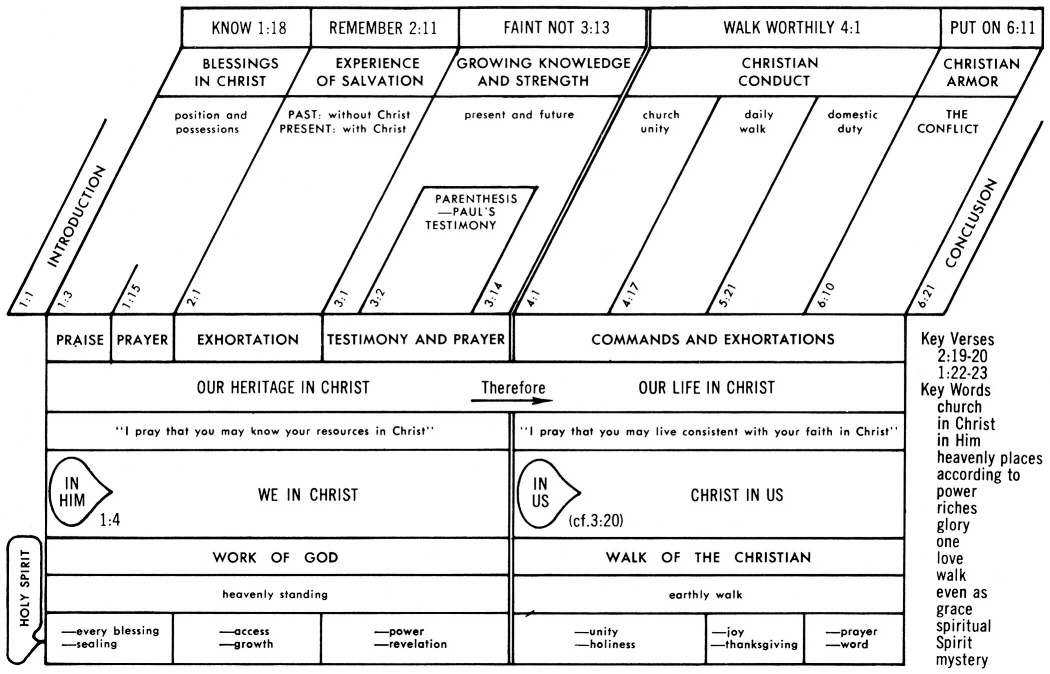
EPHESIANS - CHRIST AND THE CHURCH
Click chart to enlarge
Charts from Jensen's Survey of the NT - used by permission
Ryrie Study Bible - NAS
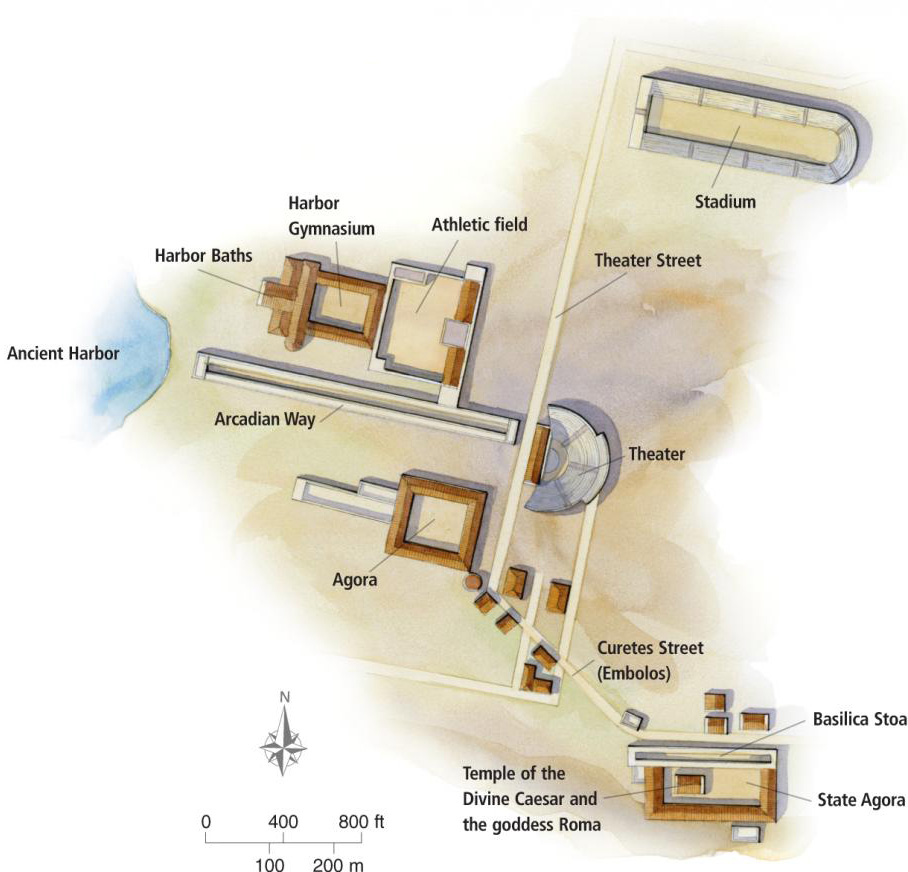
Ephesus in the Time of Paul (c. A.D. 60)
(Click to enlarge)
| SYMMETRY OF EPHESIANS "The Balanced Christian Life" |
|
| EPHESIANS 1-3 | EPHESIANS 4-6 |
| Doctrine | Duty |
| Doctrinal | Practical |
| The Root | The Fruit |
| Spiritual Wealth | Spiritual Walk |
| Christian Privilege | Christian Conduct |
| The Position of the Believer |
The Practice of the Believer |
| God Sees Us in Christ |
World Sees Christ in Us |
| Privilege | Practice |
| Revelation | Responsibility |
| Christian Blessings |
Christian Behavior |
| Belief | Behavior |
| Privileges of the Believer |
Responsibilities of the Believer |
| Our Heritage In Christ |
Our Life In Christ |
| Know your Resources (Riches) in Christ |
Live by faith in the light of your Resources (Riches) in Christ |
| The Finished Work of Christ |
The Faithful Walk of the Christian |
| Work of Christ In Us |
Work of Christ Through Us |
| We in Christ |
Christ in Us |
| Word of God |
Walk of the Christian |
| Heavenly Standing |
Earthly Walk |
| Who You Are In Christ |
Whose You Are In Christ |
| Identity | Responsibility |
| Theology | Ethics |
From the preceding table, it should be obvious that this epistle displays a "purposeful unity". In other words, the first 3 chapters are first because the spiritual truths therein are crucial to the fulfillment of the charges in the last 3 chapters to practice these truths. Because the first 3 are more doctrinal, I fear many saints "speed read" through these great passages because they desire to get to the "practical" section of Ephesians. And then they wonder why they have such difficulty in practicing the charges of chapters 4-6 (like "let no unwholesome word proceed from your mouth", "husbands love your wives", etc). Too often doctrine is perceived as "dry" and not as applicable to "real life". Beloved, we need to preach and teach and learn Ephesians 1-3, so that we can then more effectively practice Ephesians 4-6. To short change the former is to make the latter much more difficult to fulfill in practice.
I will begin this great epistle with a warning because within 60 years this great church heard those fateful words from the lips of their Lord "But I have this against you, that you have left your first love." (Rev 2:4+) How could this happen to a church that had the greatest teacher of the church era (Apostle Paul), not to mention other renowned leaders such as Timothy, Aquilla, Priscilla, and Apollos. And they even had a strong warning to the elders from the Apostle Paul "Be on guard (present imperative see our need to depend on the Holy Spirit to obey) for yourselves and for all the flock, among which the Holy Spirit has made you overseers, to shepherd the church of God which He purchased with His own blood. “I know that after my departure savage wolves will come in among you, not sparing the flock; and from among your own selves men will arise, speaking perverse things, to draw away the disciples after them. “Therefore be on the alert (present imperative see our need to depend on the Holy Spirit to obey), remembering that night and day for a period of three years I did not cease to admonish each one with tears." (Acts 20:28-31+) And yet slowly but surely over the next 6 decades the church faded from her first love, Jesus Christ. How could that happen? How could it happen to us beloved? Let me suggest a word picture of how it may have happened, little by little, like one tiny grain of sand after another piled up in the great harbor at Ephesus. Read the story below and as you read this incredible letter to the Ephesians, be aware that even with all the truth they had access to, their love still dwindled!
"Therefore let him who thinks he stands take heed (present imperative see our need to depend on the Holy Spirit to obey) that he does not fall." (1Cor 10:12+)
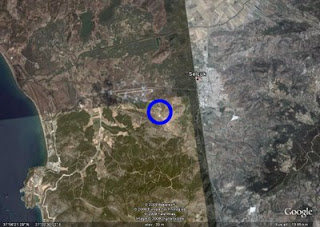
Left - Circle marks ancient city with harbor 2 miles away!
Right - Looking toward W to marshes & then ocean (hard to see)
Ephesus had a great harbor on the CAYSTER RIVER (Wikipedia)- "The ancient city of Ephesus was once an important port on the river,[1] but over the centuries, sedimentation gradually filled in the inlet around the city." (See picture above - today harbor is 2 miles from ancient city!) Beloved, is this not what "LITTLE SINS" can do in our life over days, months, years? That's rhetorical of course! We all need to pray for God to "catch the little foxes" before they completely corrupt the vineyard of our heart (cf Song 2:15+). What sin is laying down sediment so to speak in your (my) heart and impeding the flow of the rivers of living water from your innermost being (Jn 7:38-39+)? Sin is deceitful (Heb 3:13+) and convinces us these "LITTLE" sins will never take a BIG toll on our spiritual life! Wrong! Paul warns (commands) us not to continue to be deceived (by the deceitfulness of sin) "Do not be deceived (present imperative with a negative see our need to depend on the Holy Spirit to obey), God is not mocked; for whatever a man sows (even little sins), this he will also reap. For the one who sows to his own flesh will from the flesh reap corruption (AKA "SEDIMENT" BUILDING UP IN THE RIVERS BLOCKING THE OUTFLOW FROM OUR HEART!), but the one who sows to the Spirit will from the Spirit reap eternal life (AND MIGHTY RUSHING RIVERS)." (Gal 6:7-8+) By God's grace and for His glory, may the Spirit enable each of us to kill the "little foxes" (Ro 8:13+), that we might truly live for Jesus and for the glory of our Father. In the Conquering Name of Jesus Christ. Amen. And if we need additional motivation to kill the "LITTLE" sins that are laying down sediment in the rivers flowing from our heart, the writer of Hebrews adds "Therefore, since we have so great a cloud of witnesses surrounding us, let us also lay aside every encumbrance and the sin which so easily entangles us, (Are You Entangled?) and let us run with endurance the race that is set before us, fixing your eyes on Jesus (Vertical Vision)." (Hebrews 12:1-2+)) And now as they say "On with the show..."
Ephesians 1:1 Paul an apostle of Christ Jesus by the will of God, to the saints who are at Ephesus and who are faithful in Christ Jesus: (NASB: Lockman)
Greek: Paulos apostolos Christou Iesou dia thelematos theou tois hagiois tois ousin (PAPMPD) [en Epheso] kai pistois en Christo Iesou;
BGT Παῦλος ἀπόστολος Χριστοῦ Ἰησοῦ διὰ θελήματος θεοῦ τοῖς ἁγίοις τοῖς οὖσιν [ἐν Ἐφέσῳ] καὶ πιστοῖς ἐν Χριστῷ Ἰησοῦ,
Amplified: PAUL, AN apostle (special messenger) of Christ Jesus (the Messiah), by the divine will (the purpose and the choice of God) to the saints (the consecrated, set-apart ones) at Ephesus who are also faithful and loyal and steadfast in Christ Jesus: (Amplified Bible - Lockman)
BBE Paul, an Apostle of Christ Jesus by the purpose of God, to the saints who are at Ephesus, and those who have faith in Christ Jesus:
CSB Paul, an apostle of Christ Jesus by God's will: To the faithful saints in Christ Jesus at Ephesus.
ESV Paul, an apostle of Christ Jesus by the will of God, To the saints who are in Ephesus, and are faithful in Christ Jesus:
GWN From Paul, an apostle of Christ Jesus by God's will. To God's holy and faithful people who are united with Christ in the city of Ephesus.
KJV Paul, an apostle of Jesus Christ by the will of God, to the saints which are at Ephesus, and to the faithful in Christ Jesus:
NAB Paul, an apostle of Christ Jesus by the will of God, to the holy ones who are (in Ephesus) faithful in Christ Jesus:
NET From Paul, an apostle of Christ Jesus by the will of God, to the saints in Ephesus, the faithful in Christ Jesus.
NIV Paul, an apostle of Christ Jesus by the will of God, To the saints in Ephesus, the faithful in Christ Jesus:
NJB Paul, by the will of God an apostle of Christ Jesus, to God's holy people, faithful in Christ Jesus.
NKJ Paul, an apostle of Jesus Christ by the will of God, To the saints who are in Ephesus, and faithful in Christ Jesus:
NLT: This letter is from Paul, chosen by God to be an apostle of Christ Jesus. It is written to God's holy people in Ephesus, who are faithful followers of Christ Jesus. (NLT - Tyndale House)
NRS Paul, an apostle of Christ Jesus by the will of God, To the saints who are in Ephesus and are faithful in Christ Jesus:
Phillips: Paul, messenger of Jesus Christ by God's choice, to all faithful Christians at Ephesus (and other places where this letter is read): (Phillips: Touchstone)
Wuest: Paul, an ambassador of Christ Jesus through the will of God, to the saints, the ones who are [in Ephesus], namely, believing ones in Christ Jesus. (Eerdmans Publishing - used by permission)
Young's Literal: Paul, an apostle of Jesus Christ through the will of God, to the saints who are in Ephesus, and to the faithful in Christ Jesus:
PAUL AN APOSTLE OF CHRIST JESUS BY THE WILL OF GOD: Paulos apostolos Christou Iesou dia thelematos theou:
- Ephesians Study Notes 1
- Ephesians 1 Resources - Multiple Sermons and Commentaries
- Ephesians 1:1-2 Spiritual Wisdom for God's Saints - Steven Cole
- Ephesians 1:1-2 Introduction to Ephesians - John MacArthur
Related Passages:
Romans 1:1 Paul, a bond-servant of Christ Jesus, called as an apostle, set apart for the gospel of God,
1 Corinthians 1:1 Paul, called as an apostle of Jesus Christ by the will of God, and Sosthenes our brother,
Galatians 1:1 Paul, an apostle (not sent from men nor through the agency of man, but through Jesus Christ and God the Father, Who raised Him from the dead),
PAUL A GOD
CALLED APOSTLE
As you begin to read these notes, remember to read the book first, saturating your mind with the glorious and majestic truths that literally cascade off of the written pages.
As Sir Francis Bacon once wrote, “Some books are to be tasted, others to be swallowed, and some few to be chewed and digested.” Therefore enabled by the Spirit's illumination of the text of Ephesians "O taste and see that the LORD is good; How blessed is the man who takes refuge in Him!." (Ps 34:8)
Guzik - Ephesians has been called “the Queen of the Epistles,” “the quintessence of Paulinism,” “the divinest composition of man” and even “the Waterloo of commentators.” Some say that Ephesians reads “like a commentary on the Pauline letters” and probably it has been best termed “the crown of Paulinism.” (Bruce) If the Letter to the Romans focuses more on God’s work in the individual Christian, Ephesians includes the great themes of God’s work in the church, the community of believers.. Karl Marx wrote about a new man and a new society, but he saw man and society both in almost purely economic terms and offered only economic answers. In his letter to the Ephesians, Paul also saw the new man and a new society, but he saw it all accomplished by the work of Jesus.. Ephesians has many similarities with Paul’s letter to the Colossians. Since Paul wrote both of them from his Roman imprisonment, his mind may have worked on the same themes when he wrote each letter.
Salmond “Among the Epistles bearing the name of St. Paul there is none greater than this, nor any with a character more entirely its own … There is a peculiar and sustained loftiness in its teaching which has deeply impressed the greatest minds and has earned for it the title of the ‘Epistle of the Ascension.”)
Spurgeon - “The Epistle to the Ephesians is a complete Body of Divinity. In the first chapter you have the doctrines of the gospel; in the next, you have the experience of the Christians; and before the Epistle is finished, you have the precepts of the Christian faith. Whosoever would see Christianity in one treatise, let him ‘read, mark, learn, and inwardly digest’ the Epistle to the Ephesians.”
As as aside Dr John MacArthur credits the book of Ephesians which he preached at the beginning of his ministry as the pivotal teaching God used to grow the saints into a Biblically sound church Grace Community Church. He writes "Those months that we spent studying Ephesians eight years ago – seven or eight years ago (ED: ABOUT 1970)– were the months that formed the character of Grace Church in terms of its present dimensions of ministry." (Introduction to Ephesians)
THOUGHT - While it is not our goal to "copy" someone else's ministry because ultimately the work at Grace Church represents the work of God, not the work of a man (even one as gifted as Dr MacArthur), if I were a young pastor (I am 75 so too late for me), I would give prayerful consideration to preaching through Ephesians verse by verse. And doing it deliberately and slowly! Dr Martyn Lloyd-Jones preached 232 sermons from Ephesians and the impact of his ministry resonates even to the present day (2022). If you do preach through Ephesians, please don't rush. I attended a young church pastored by young preachers and recall how one of them preached through the entire incredible fourth chapter of Ephesians in one 35 minute sermon! I was greatly grieved that day. Within about 1 year that church "went out of business!" Just saying!
I love what Pastor Ray Stedman's introductory remarks to his series on Ephesians...
I hope that, as we begin this doctrinal portion of Ephesians, your heart will be anticipating tremendous truth. I would like to urge you to read this letter through once a week during the time that we are engaged in studying these first three chapters. Read it through in various versions, and in different ways. Read it through at one sitting the first week, and then the next week take a chapter a day. Other weeks read it in some of the paraphrases. Let this truth come to you afresh in new and different language. I can guarantee that if you will do this faithfully until we finish our study you will never be the same person again. This truth has the power to change you, and it will!
I think that, of all Paul's letters, the letter to the Romans and this one to Ephesians have affected me most profoundly. Both are attempts at a systematic and rather exhaustive setting forth of the whole Christian view of life and of the world. Others of Paul's letters deal with specific problems, and they are very helpful when we are involved with those same problems. But these two deal with the whole sweep of truth, the great canvas of God's painting of reality. Ephesians has changed my life again and again:
It was from this book that I learned how the body of Christ functions. The truth of the fourth chapter was strongly in my heart when I came to Palo Alto, as a young man fresh from seminary, and began to pastor a small group of people meeting here. It was the conviction that the ministry belongs to the saints, and that the business of a pastor is to help the people find their ministries and to prepare them to function in them, and to discover the excitement of living as Christians where they are, which was formative in the early years of Peninsula Bible Church and is still so strongly emphasized here. It was from this letter that I learned, as a young man, how to handle the sex drive which God had given me, as he has given it to all of us, and how to live properly in a sex-saturated society. This letter is most practical in that way. It teaches us how to come to grips with life as it is.
This letter taught me profound truths about marriage and about family life. I'm still learning in this area, and have a lot more to learn, but I've already learned a great deal about this subject from the letter to the Ephesians. It was this letter which taught me better than any other passage of Scripture how to understand the strange turbulence I often found in my own heart, the spiritual attacks to which I was subject, and how to deal with my fears and anxieties and my depressions -- where these were coming from, and what to do about them. So this is a great and practical letter, and I urge you to become familiar with it and to make it second nature to know the truth of Ephesians. Let me share with you the experience of another person in this respect. This is from the introduction to a book by Dr. John McKay, for many years the president of Princeton University:
I can never forget that the reading of this Pauline letter when I was a boy in my teens exercised a more decisive influence upon my thought and imagination than was ever wrought upon me before or since by the perusal of any piece of literature. The romance of the part played by Jesus Christ in making my personal salvation possible, and in mediating God's cosmic plan, so set my spirit aflame that I laid aside, in all ecstasy of delight, Dumas' Count of Monte Cristo which I happened to be reading at the time. That was my encounter with the Cosmic Christ. The Christ who was, and is, became the passion of my life. I have to admit without shame or reserve that as a result of that encounter I have been unable to think of my own life or the life of mankind or the life of the cosmos apart from Jesus Christ. He came to me and challenged me in the writings of St. Paul. I responded. The years that have followed have been but a footnote to that encounter.
So I would suggest that, if you feel the need for change in your own life and for deepening your relationship with our Lord, you would do well to expose yourself in a very personal way to these teachings from the letter to the Ephesians. (Read entire sermon Ephesians 1:1-14: God At Work)
John Stott, writes that “The letter to the Ephesians is a marvelously concise, yet comprehensive summary of the Christian good news and its implications. Nobody can read it without being moved to wonder and worship, and challenged to consistency of life.”
Stott goes on to say "we may perhaps analyse the letter as follows:
1. The new life which God has given us in Christ (Eph 1:3–2:10)
2. The new society which God has created through Christ (Eph 2:11–3:21)
3. The new standards which God expects of his new society, especially unity and purity (Eph 4:1–5:21)
4. The new relationships into which God has brought us—harmony in the home and hostility to the devil (Eph 5:21–6:24) (God's New Society: The Message of Ephesians)
Ephesians was John Calvin's favorite letter.
Armitage Robinson called it ‘the crown of St Paul’s writings’

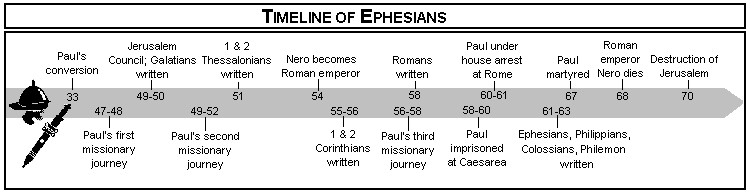
Paul ("I, Paul" in Ephesians 3:1-note) penned this letter from prison (Ep 3:1, 4:1, 6:20=notes Ep 3:1, 4:1, 6:20) in Rome sometime around 62 AD or at least 5 years after (these are approximations for Scripture is silent on these specific dates - see timeline above) he had last seen the saints in Ephesus and Asia (modern day western Turkey). It is interesting that only a small number of men and women throughout history can be identified immediately by only their first name. And yet we all know who Paul was because his life had such impact in the past and present.
Ephesians was one of Paul's "prison epistles" or "Christological Epistles" (Irving Jensen) (Colossians, Philippians, Philemon being the others) written during his first imprisonment. Prison has proved a fertile ground for writings of other men of God, such as John Bunyan's famous allegory, Pilgrim's Progress and in recent times, Watergate criminal Chuck Colson's "Born Again."
Irving Jensen - All four of the prison epistles contain direct references to Paul’s imprisonment. Read Ephesians 3:1; 4:1; 6:20; Philippians 1:7, 13; Colossians 4:3, 18; Philemon 1:10, 13, 22, 23. Paul had previously experienced being jailed (2Co 11:23), but the first Roman imprisonment was of long duration and involved extensive ministry out-reach. Read Acts 28:16-31+ for Luke’s reporting of some activities from part of that period. (Jensen's Survey of the New Testament)
As Jensen notes, Paul wrote Colossians while he was in prison at Rome (Col 4:18+) and sent the letter to them by Tychicus (Col 4:7+), by whom he also sent the Ephesian letter, presumably at the same time (Ep 6:21, 22+), as well as the letter to Philemon.
James Montgomery Boice called Ephesians "A mini-course in theology, centered on the church.” That is what Paul’s great letter to the Ephesians, written from Rome shortly after the midpoint of the first Christian century, is about. But what a course! What theology! Like Romans, Ephesians deals with the most fundamental Christian doctrines. But even more than that other great doctrinal book, it stresses the sovereignty of God in salvation and the eternal sweep of God’s great plan, by which believers are lifted from the depth of sin’s depravity and curse to the heights of eternal joy and communion with God. Like 1 and 2 Corinthians and the pastoral letters, Ephesians deals with the church. But even more than these very practical letters, Ephesians highlights the church’s true spiritual dynamics and gives guidelines for the new relationships in which the reality of the new humanity can be seen. Like 1 Peter and James, Ephesians speaks of the Christian’s spiritual warfare. But only in Ephesians is that warfare presented in such vivid imagery and unforgettable terms. ( Ephesians: An Expositional Commentary ).
In Inductive Bible study, a good understanding of the context is critical for accurate interpretation. With this in mind take a few moments and read through the Ephesians Study Notes on what the city and population of Ephesus was like in Paul's day. This study deals especially with Acts 19, in which Luke provides a synopsis of the longest stay of Paul in any one missionary city. Another suggestion is to watch this excellent 25 minute youtube video on ruins and history of Ephesus narrated by Dr Joseph Stowell.
See also Acts 28:11-31+ for a discussion of Paul's imprisonment in Rome, from which he penned this great letter, filled with sublime doctrines of the faith, so much so that one writer has called it "the Grand Canyon of Scripture" meaning that it is breathtakingly beautiful and apparently inexhaustible to the one who seeks to explore its breath and length and height and depth.
The English poet Samuel Taylor Coleridge termed Ephesians “the divinest composition of man....It embraces, first, those doctrines peculiar to Christianity, and, then, those precepts common with it in natural religion.”
John Mackay, former president of Princeton Theological Seminary who was converted at age 14 while reading Ephesians, called it the “greatest … maturest … (and) for our time the most relevant” of all Paul’s writings adding that “This letter is pure music”.
Irving Jensen - The distinctive language and style of Ephesians reflects the richness and depth of its message. Someone has observed that the letter contains forty-two words (e.g., “obtained an inheritance,” Ep 1:11) not found in any other New Testament book, and forty-three not used by Paul in his other writings. One of the prominent features of Paul’s style in Ephesians is its long sentences, described as follows by one writer: “The sentences flow on as it were in the full strong tide, wave after wave, of an immense and impetuous sea, swayed by a powerful wind, and brightened and sparkling with the golden rays of a rising sun.” This suggests something of the excitement and inspiration in store for all who study the Bible text. (Jensen's Survey of the New Testament)
James Montgomery Boice speaks to the appeal of this letter writing that "the focus for all the other doctrines in Ephesians is the church as God’s new society, so in a sense the book links these truths of Christianity to us, God’s people. In other words, it is practical. We are told who we are, how we came to be as we are, what we shall be, and what we must do now in light of that destiny. John R. W. Stott writes, “The whole letter is thus a magnificent combination of Christian doctrine and Christian duty, Christian faith and Christian life, what God has done through Christ and what we must be and do in consequence.” (Ephesians: An Expositional Commentary ).
Paul an apostle - This exact phrase 6x in 6v - 2 Cor 1:1; Gal 1:1; Eph 1:1; Col 1:1; 1 Tim 1:1; 2 Tim 1:1 (Peter used it twice - 1Pe 1:1, 2Pe 1:1)
Paul (3972) (paulos) is from the Latin word "paulos" and was a Romans surname meaning small or little but there is no evidence in the New Testament that either Paul or any of his contemporaries attached any personal significance to the meaning of his name. Hebrew parents often gave their sons a Gentile name in addition to a Jewish one. One wonders if the idea of "little" is not a play on words, that even as John wrote "He must increase, but I must increase." (John 3:30+ - note the order cannot be reversed - Christ first and foremost!) Today we write personal letters and sign our name at the end, but in the first century, the letters often began with the writer/author as in this letter.
Related Resources:
- Who was Paul in the Bible? | GotQuestions.org
- Why was Paul in prison? | GotQuestions.org
- International Standard Bible Encyclopedia Paul, the Apostle
- Kitto Biblical Cyclopedia Paul
- Baker's Evangelical Dictionary Paul the Apostle
- Fausset Bible Dictionary Paul
- Holman Bible Dictionary Paul
- Hastings' Dictionary of the Bible Paul the Apostle
Before his Damascus Road experience he was known by his Hebrew name Saul (Greek Saulos) which means "desired" or "ask or pray" (derived from Hebrew word for "ask") Paul is referred to as Saul in Acts until his clash with Bar Jesus at Paphos, when Luke writes,
"But Saul, who was also known as Paul, filled (pimplemi) with the Holy Spirit, fixed his gaze upon him (Elymas the magician - Acts 13:8)" (Acts 13:9+).
In this first Scriptural mention of the name Paul there is also the mention of his being filled with the Holy Spirit. What a wonderful description of this great man of God. Even here we see it was not Paul's strength and resolve, but it was the enduement and enablement of the Spirit of Jesus, Who had called him out of darkness into His marvelous light (1Pe 2:9+) as His "chosen (ekloge - used in 1Th 1:4, 2Pe1:10) instrument (skeuos = vessel)" to bear His Name "before the Gentiles and kings and the sons of Israel." (Acts 9:3-6, 15, 16+)
THOUGHT - In light of Paul's command that we are to imitate him, just as he imitated Christ (1 Cor 11:1+), can it be said of us "________ (insert your given first name), filled with the Holy Spirit?" If Jesus (cf Lk 4:14+, Acts 10:38+) and Paul relied on the power of the Spirit to fulfill their ministries (which they did), then beloved, we can do no less!
In view of Paul's extended stay in Ephesus (up to 3 years - Acts 20:31+), it would not have been unexpected in human terms had he begun his letter with a review of his many accomplishments or even a reminder of what he had personally endured to bring the gospel of Christ to Asia. But Paul was not into resting on laurels but had one purpose ("this one thing I do" Php 3:13+) and that was to press on toward the goal (Php 3:14+). In fact later in this epistle he describes himself as "the very least of all saints (to whom) this grace was given (Paul never saw himself as self made), to preach to the Gentiles the unfathomable riches of Christ." (Ep 3:8+) Generally speaking, God won't use a man who is filled with himself. He can and does use the man who is empty of self and filled with His Spirit and Word.
On the other hand as Paul says in his letter to the Corinthians the origin of the "things we also speak, (is) not in words taught by human wisdom, but in those taught by the Spirit, combining spiritual thoughts with spiritual words." (1Cor 2:13+)
Comment: In other words Paul is saying that the things he teaches are not really his but God's for they are their very words are taught by the Spirit and are not to be regarded as other books written by mere men. The upshot is that everything he has written is Truth and carries the authority of God! This is a clear claim to divine verbal inspiration of Paul's own epistles. This is not a "mechanical dictation" theory, nor does it nullify the personality of the author involved. On the other hand, Paul's affirmation does guarantee that when the Bible is heard, God is heard.
D. Martyn Lloyd-Jones has written that "Much of the trouble in the church today is due to the fact that we are so subjective, so interested in ourselves, so egocentric... Having forgotten God, and having become so interested in ourselves, we become miserable and wretched, and spend our time in ‘shallows and in miseries.’ The message of the Bible from beginning to end is designed to bring us back to God, to humble us before God, and to enable us to see our true relationship to him... And that is the great theme of this epistle.....Luther says of the Epistle to the Romans that it is ‘the most important document in the New Testament, the gospel in its purest expression’, and in many ways I agree that there is no purer, plainer statement of the gospel than in the Epistle to the Romans. Accepting that as true I would venture to add that if the Epistle to the Romans is the purest expression of the gospel, the Epistle to the Ephesians is the sublimest and the most majestic expression of it. Here the standpoint is a wider one, a larger one. There are statements and passages in this Epistle which really baffle description. The great Apostle piles epithet upon epithet, adjective upon adjective, and still he cannot express himself adequately. There are passages in this first chapter, and others in the third chapter, especially towards its end, where the Apostle is carried out above and beyond himself, and loses and abandons himself in a great outburst of worship and praise and thanksgiving. I repeat, therefore, that there is nothing more sublime in the whole range of Scripture than this Epistle to the Ephesians.....God, the eternal and everlasting God, self-sufficient in Himself, from eternity to eternity, needing the aid of no-one, living, dwelling in His own everlasting, absolute and eternal glory, is the great theme of this Epistle. We must not start by examining ourselves and our needs microscopically; we must start with God, and forget ourselves. In this Epistle we are taken as it were by the hand by the Apostle and are told that we are going to be given a view of the glory and the majesty of God. As we approach this study I seem to hear the voice that came of old to Moses from the burning bush saying, ‘Take off thy shoes from off thy feet for the ground whereon thou standest is holy ground.’ We are in the presence of God and His glory; so we must tread carefully and humbly(Exposition of Ephesians 1:1)
Comment: Notice that Lloyd-Jones' book is only on chapter 1 and is the first of 8 full books he wrote (based on 232 sermons!), testifying to the profundity of this 6 chapter epistle! Below are the three Mp3 sermons by Dr Lloyd-Jones on Ephesians 1:1-2
Apostle (652) (apostolos [word study] from apo = from +stello = send forth) one sent forth from by another, often with a special commission to represent another and to accomplish his work. Cargo ships were sometimes called apostolic, because they were dispatched with a specific shipment for a specific destination. In secular Greek apostolos was used of an admiral of a fleet sent out by the king on special assignment. In secular Greek apostle was commonly used to describe one who was sent in an official capacity as an ambassador, delegate, messenger or envoy.
A good parallel of apostle is our English word ambassador defined by Webster as "a diplomatic agent of the highest rank accredited to a foreign government as the resident representative of his own government for a special and often temporary diplomatic assignment". And this is exactly waht Paul called himself in Ep 6:20+.
Paul was an official ambassador of Christ with an official proclamation of the Gospel of good news.
Skevington Wood - The title (apostle) stresses the authority of the sender and the accountability of the one sent (The Expositor's Bible Commentary)
In its broadest sense, apostle can refer to all believers, because every believer is sent into the world as a messenger of and witness for Christ (cf Php 2:25+ where "messenger" is apostolos). But in the NT the term apostle is predominantly used as a specific and unique title for the thirteen men (the Twelve original disciples of Jesus, with Matthias replacing Judas, plus Paul, the thirteenth) whom Christ personally chose and commissioned to authoritatively proclaim the gospel and lead the early church. The thirteen apostles not only were all called directly by Jesus but all were witnesses of His resurrection, Paul having encountered Him on the Damascus Road after His ascension. Those thirteen apostles were given direct revelation of God’s Word to proclaim authoritatively, the gift of healing, and the power to cast out demons (Mt 10:1+). By these signs their teaching authority was verified (cf. 2Co 12:12+). Their teachings became the foundation of the church (Eph 2:20+), and their authority extended beyond local bodies of believers to the entire believing world. In the present context Paul uses apostle in its more common specialized, restricted meaning. The authority of Paul's message did not derive from the messenger but from the Sender.
In Acts 1:21. 22+ the Apostle Peter delineates the necessary qualifications of the original thirteen apostles...
Therefore it is necessary (dei) that of the men who have accompanied us all the time that the Lord Jesus went in and out among us--beginning with the baptism of John until the day that He was taken up from us--one of these must (dei) become a witness with us of His resurrection.
To reiterate, Peter is defining an apostle as a man who had seen the risen Messiah and who was sent forth by Him (NOTE: SEEN AND SENT) with His full authority to plant the flag of faith in every community to which His master led him. Peter was Christ's emissary and spoke with His authority as was Paul's. Their apostolic duties included the following:
- Preach the gospel (1Cor. 1:17+),
- Teach and pray (Acts 6:4+),
- Work miracles (2Cor. 12:12+),
- Build up other leaders of the church (Acts 14:23+),
- Write the Word of God (Ep 1:1).
Paul by mentioning his apostleship, simply establishes his divinely–bestowed authority to speak on behalf of God (a practice he repeats at the beginning of each epistle except Philippians and 1 and 2 Thessalonians)
While there are no apostles today in the sense that Paul and Peter were apostles (although we hear many who lay claim to this title -- beware!) it is certainly to be expected that believers, regardless of the spiritual gift they possess, minister their gift as those sent forth on a mission with authority for as Paul reminds us in (2Co 5:20+) "we are (all) ambassadors (presbeuo) for Christ."
Note that by designating himself an "apostle of Jesus Christ", Paul called attention not to himself but to the One Who commissioned him. The double designation (JESUS CHRIST) is by design as it summarizes His true nature, Jesus (Iesous) being the Greek form of the Hebrew name Joshua, both names meaning "salvation of Jehovah" (Mt 1:21+) and representing His humanity (fully Man). Christ is His kingly Name, emphasizing He is the Anointed One. Note also the phrase of Jesus Christ indicates Paul is not his own! He belongs to Jesus Christ. Jesus bought him with a price (cf 1Cor 6:19-20+) and Paul acknowledges His ownership with this description. And if he is not his own, it follows that he willingly surrenders his will to the will of his Lord (cf the concept of bond-servant).
Related Resources:
- What is an apostle? | GotQuestions.org
- Is God restoring the offices of apostle and prophet in the church today? | GotQuestions.org
- What are the biblical qualifications for apostleship?
- What is an evangelist?
- What is the difference between a disciple and apostle?
- What Are the Apostles Names?
Christ (5547) (Christos from chrio = to rub or anoint, consecrate to an office) refers to the Anointed One and thus is a title of the Messiah, the divine One (fully God) the Jews were looking for and of Whom the OT bore prophetic witness. Paul is clearly declaring that he did not teach and write by his own authority but by the dual yet totally unified authority of the Son, Christ Jesus, and God the Father ('by the will of God"). Thus whatever follows in this letter deserves to be heard and heeded.
Using this combined title, Christ Jesus, Paul affirms his full conviction that the human Jesus was also the Christ, the anointed Messiah, the Bringer of messianic redemption (cf Acts 3:20) and that this very One is He to whom Paul owes his allegiance as his apostle.
Handley C G Moule observes that "It is most important to remember that Christ is merely the Greek version of the Hebrew Messiah (Anointed). In the N. T. it thus constantly refers back to O. T. prophecy and to the truth (uttered by the Messiah Himself, John 4:22), that “salvation is of the Jews.” (Cambridge Bible)
Note also that the word Christos is masculine singular genitive, the genitive case signifying possession, the point being that Paul regarded himself as the property of his Lord! Believers of every age should do no less, for as Paul explains...
Or do you not know that your body is a temple of the Holy Spirit who is in you, whom you have from God, and that you are not your own? For you have been bought with a price: therefore glorify God in your body. (1Cor 6:19, 20)
(Jesus) gave Himself for us, that He might redeem us from every lawless deed and purify for Himself a people for His own possession, zealous for good deeds. (Titus 2:14-note)
Related Resource:
- Messiah - Anointed One
- Is Jesus the Messiah? | GotQuestions.org
- Where do the Hebrew Scriptures prophesy the death and resurrection of the Messiah? | GotQuestions.org
- Does the Bible teach that there would be two comings of the Messiah? | GotQuestions.org
- Which psalms predict the coming of Jesus Christ? | GotQuestions.org
- What does Messiah mean? | GotQuestions.org
Jesus (2424) (Iesous) is from the Hebrew Yeshu'a (see yeshua) which means Yahweh is salvation. Jesus called, saved and appointed Saul to be His apostle on a dusty Damascus road declaring (in His explanation to Ananias)
By the will of God - Paul did not just decide to be an apostle. Whatever aspect of ministry we are involved in, we want to be sure that we are in it by the will of God, not because we want to be in it. We need to be confident that He will place us where He sovereignly ordained we should serve Him. How sad to spend this short life doing ministry in our will, not His. Apostle by the will of God places emphasis on God's great attribute of sovereignty, which will stand out in all its glory everywhere in this epistle. By (1223) (dia) is a primary preposition denoting the channel of an act. God's will was the conduit so to speak by which Paul was called to be an apostle. Paul used dia to explain his apostleship in the opening verse of Galatians "Paul, an apostle (not sent from men, nor through [dia] the agency of man, but through [dia] Jesus Christ, and God the Father, Who raised Him from the dead)." (Gal 1:1+)
Moule notes that "by the will of God" expresses "the deep certainty of a direct Divine commission which underlay such a phrase in St Paul’s mind. He knew himself to be “a vessel of choice, to bear the name” (Acts 9:15) of his Lord." (Ref)
The following passage relate to Paul's call to be an apostle by the will of God....
"(JESUS SPEAKING TO ANANIAS Acts 9:13,14) Go (present imperative), for he (SAUL) is a chosen (ekloge = choice, cognate word of the verb eklego) instrument (skeuos = vessel = literally of a hollow vessel for containing things -- ponder that thought in terms of Paul's call, in terms of your call!) of Mine, to bear My name before (enopion = literally in the face of and so in the presence of) the Gentiles (the recipients of the great Ephesian epistle) and kings and the sons of Israel for I will show him how much he must (dei = it is necessary or binding [from deo = to bind or tie, also root of doulos = bondservant!]. Dei means it is an obligation out of intrinsic necessity or inevitability) suffer for My name's sake." (Acts 9:15, 16+)
COMMENT - In short, this passage explains "the will of God" for Paul, that is, to be an apostle of Christ Jesus.
(THE SPIRIT REAFFIRMED PAUL'S CALL AT ANTIOCH) And while they were ministering to the Lord and fasting, the Holy Spirit said, "Set apart (aorist imperative) for Me Barnabas and Saul for the work to which I have called them." (Acts 13:2+)
COMMENT - Don't miss it - the work has already been prepared reminding us of Eph 2:10+. What work has He called you for? You don't want to miss His "job description" for your life.
(PAUL RECALLED HIS CALL) "And He said to me, 'Go (present imperative)! For I will send you far away to the Gentiles (AND HERE HE IS IN EPHESUS MINISTERING TO GENTILES, THE RECIPIENTS OF THIS LETTER).'" (Acts 22:21+)
(AND ONE MORE TIME PAUL REPEATS HIS "MARCHING ORDERS" FROM CHRIST) 'But arise (aorist imperative), and stand (aorist imperative ) on your feet; for this purpose I have appeared to you, to appoint you a minister and a witness not only to the things which you have seen, but also to the things in which I will appear to you delivering you from the Jewish people and from the Gentiles, to whom I am sending you (AN APOSTLE SENT TO THE GENTILES) to open their eyes so that they may turn from darkness to light and from the dominion of Satan to God, in order that they may receive forgiveness of sins and an inheritance among those who have been sanctified by faith in Me.' (Acts 26:16, 17, 18+)
Paul far from boasting in his apostleship wrote to the Corinthians that Jesus "appeared to James, then to all the apostles and last of all, as it were to one untimely born, He appeared to me also. For I am the least of the apostles, who am not fit to be called an apostle, because I persecuted the church of God. (1 Cor 15:7, 8, 9+)
THOUGHT - Herein lies a basic principle of spiritual power - "God is opposed to the proud, but gives grace to the humble" (James 4:6+, cf 1Pe 5:5+) Paul saw himself as nobody Jim Elliot had this same attitude speaking of his call to be a missionary explaining "Missionaries are very human folks, just doing what they are asked. Simply a bunch of nobodies trying to exalt Somebody."
Will (2307)(thelema from thelo = to will with the "-ma" suffix indicating the result of the will = "a thing willed") generally speaks of the result of what one has decided. One sees this root word in the feminine name "Thelma." In its most basic form, thelema refers to a wish, a strong desire, and the willing of some event. God's will is His inclination of pleasure towards that which is liked, which pleases Him and creates joy. God’s will signifies His gracious disposition toward something. Gods' will is what He Himself does of His own good pleasure. It means in essence that God started it and He completes it. In the present context, Paul's life is a Christ-made life not a man-made life. Paul's commission as apostle was God’s will in Heaven and done on earth, not Paul's will done on earth. Zodhiates says that thelema is the "Will, not to be conceived as a demand, but as an expression or inclination of pleasure towards that which is liked, that which pleases and creates joy. When it denotes God's will, it signifies His gracious disposition toward something. Used to designate what God Himself does of His own good pleasure." ( Complete Word Study Dictionary: New Testament) Thelema has both an objective meaning (“what one wishes to happen” or what is willed) and a subjective connotation (“the act of willing or desiring”). The word conveys the idea of desire, even a heart’s desire, for the word primarily expresses emotion instead of volition. Thus God’s will is not so much God’s intention, as it is His heart’s desire.
Thelema - 62x in 58v -Mt 6:10; 7:21; 12:50; 18:14; 21:31; 26:42; Mark 3:35; Luke 12:47; 22:42; 23:25; Jn 1:13; 4:34; 5:30; 6:38, 39, 40; 7:17; 9:31; Acts 13:22; 21:14; 22:14; Ro 1:10+; Ro 2:18+; Ro 12:2+; Ro 15:32+; 1Cor 1:1; 7:37; 16:12; 2Cor 1:1; 8:5; Gal 1:4; Ep 1:1+, Ep 1:5+, Ep 1:9+, Ep 1:11+; Ep 2:3+; Ep 5:17+; Ep 6:6+; Col 1:1+, Col 1:9+; Col 4:12+; 1Th 4:3+; 1Th 5:18+; 2Ti 1:1+; 2Ti 2:26+; He 10:7+, He 10:9+, He 10:10+, He 10:36+; He 13:21+; 1Pe 2:15+; 1Pe 3:17+; 1Pe 4:2+, 1Pe 4:19+; 2Pe 1:21+; 1Jn 2:17; 5:14; Rev 4:11+. NAS = desire(1), desires(1), will(57).
Thelema is used four times in Ephesians 1 - take a moment and meditate on these uses in context
Ephesians 1:1+ Paul, an apostle of Christ Jesus by the will of God, To the saints who are at Ephesus and who are faithful in Christ Jesus:
Ephesians 1:5+ He predestined us to adoption as sons through Jesus Christ to Himself, according to the kind intention of His will,
Ephesians 1:9+ He made known to us the mystery of His will, according to His kind intention which He purposed in Him
Ephesians 1:11+ also we have obtained an inheritance, having been predestined according to His purpose who works all things after the counsel of His will,
God (2316) (theos) refers to the supreme divine being, the true, living, and personal God. We honor God's name when we call Him our Father live like His Son!"
Wayne Barber has an interesting note on God - The word "God" does not have the definite article in front of it. It refers to the whole Godhead. When the definite article is used it refers to God the Father. But here it is God the Father, God the Son and God the Holy Spirit. The whole Trinity was involved in Paul being an apostle of Christ Jesus.
TO THE SAINTS WHO ARE AT EPHESUS AND WHO ARE FAITHFUL IN CHRIST JESUS: tois hagiois tois ousin (PAPMPD) [en Epheso] kai pistois en Christo Iesou:
- Romans 1:7; 1Corinthians 1:2; 2Corinthians 1:1
- Eph 6:21; Nu 12:7; Luke 16:10; Acts 16:15; 1Cor 4:12,17; Gal 3:9; Col 1:2; Rev 2:10,13; 17:14
- Acts 19:1-20
- Ephesians 1 Resources - Multiple Sermons and Commentaries
- Ephesians 1:1-2 Spiritual Wisdom for God's Saints - Steven Cole
- Ephesians 1:1-2 Introduction to Ephesians - John MacArthur
Related Passages:
Romans 1:7 to all who are beloved of God in Rome, called as saints: Grace to you and peace from God our Father and the Lord Jesus Christ.
1 Corinthians 1:2 To the church of God which is at Corinth, to those who have been sanctified in Christ Jesus, saints by calling, with all who in every place call on the name of our Lord Jesus Christ, their Lord and ours:
RECIPIENTS - SET APART
FAITHFUL ONES
To the saints describes the recipients of this letter as those who have been set apart from eternity past from the world and unto God, to be His possession. This letter is His instruction on the how we became saints and how to faithfully, productively live out our lives as saints in our short time on earth.
Dr Martyn Lloyd-Jones on importance of saints - We find ourselves confronted here, then, by what the New Testament teaches is the basic irreducible minimum of what constitutes a Christian. I am emphasizing this because it seems to me that it is the primary need of the Christian Church at the present time to realize exactly what it means to be a Christian. How was it that the early Christians, who were but a handful of people, had such a profound impact on the pagan world in which they lived? It was because they were what they were. It was not their organization, it was the quality of their life, it was the power they possessed because they were truly Christian. That is how Christianity conquered the ancient world, and I am more and more convinced that it is the only way in which Christianity can truly influence the modern world. The lack of influence of the Christian Church in the world at large today is in my opinion due to one thing only, namely, (God forgive us!) that we are so unlike the description of the Christians that we find in the New Testament....The first thing to say of the Christian is that he is a saint. I fear that may sound rather strange to some of us. We tend to say, ‘Well, I am a Christian, but I am far from being a saint.’ We are afraid of making such a claim; somehow we are afraid of this particular designation; and yet in the New Testament we are addressed as ‘saints.’ The first thing it means is that we are people who are set apart. Primarily it means separated, set apart. A good illustration of this meaning is found in the nineteenth chapter of the Acts of the Apostles where we read that when certain difficulties and oppositions arose the Apostle separated the disciples and then began to meet with them in the school of Tyrannus (Acts 19:9+) and then taught and built them up in the faith; he separated them. That is the essential meaning of this word ‘saint’, and the Church is a collection of saints. The Church is not an institution, she is primarily a gathering, a meeting of saints....So the Christian is a man primarily who is segregated from the world.....The Christian today, like the children of Israel of old, while he is in the world is not of the world (cf Jn 17:14-18); he is a man like other men, and yet he is very different. This is primary, basic truth. The Christian is not like anybody else, he is separate, he is apart, he is unique. He stands out, he has been called out by God, he has been separated from the world, separated to God. Is this obvious about us Christians today? (Sermon Ephesians 1:1 Saints ... and Faithful in Christ Jesus)
In Galatians 1 Paul does not use the word "saint" even once in Galatians but he does give us a description of saints in his opening writing...
Grace to you and peace from God our Father and the Lord Jesus Christ, 4 Who gave Himself for () our sins so that He might rescue us from this present evil age, according to the will of our God and Father, (Gal 1:3-4)
THOUGHT - The preceding discussion of saints as separated ones who are different and distinct from the world begs the question - Am I living like a separated one or am I compromising who I am and living so much like the world that the world cannot see anything different, distinct or unique in me, in my lifestyle? As Lloyd-Jones asks "The question is, are we truly separated as persons, are we essentially different from the world?"
Saints (holy ones)(40) (hagios) refers to those set apart for a specific purpose, "persons possessed of holiness, separated from sin to God." In ancient Greek use, hagios originally was a cultic concept, describing the quality possessed by things and persons that could approach a divinity. Christians are saints, not in the sense that they are very pious, but because of the new relationship they have been brought into by God. It is not because of their own doing or good works but on account of what Christ has done. They are set apart for Him and His service. (See more detailed note on saints by Kenneth Wuest)
Hagios 15 uses in Ephesians - Eph. 1:1 (saints); Eph. 1:4; Eph. 1:13 (Holy Spirit); Eph. 1:15 (saints); Eph. 1:18 (saints); Eph. 2:19 (saints); Eph. 2:21; Eph. 3:5; Eph. 3:8 (saints); Eph. 3:18 (saints); Eph. 4:12 (saints); Eph. 4:30 (Holy Spirit); Eph. 5:3 (saints); Eph. 5:27; Eph. 6:18 (saints)
John Stott - Paul’s description of his readers is thus comprehensive. They are ‘saints’ because they belong to God; they are ‘believers’ because they have trusted to Christ; and they have two homes, for they reside equally ‘in Christ’ and ‘in Ephesus’. Indeed all Christian people are saints and believers, and live both in Christ and in the secular world, or ‘in the heavenlies’ and on earth. Many of our spiritual troubles arise from our failure to remember that we are citizens of two kingdoms. We tend either to pursue Christ and withdraw from the world, or to become preoccupied with the world and forget that we are also in Christ. (God's New Society: The Message of Ephesians)
S Lewis Johnson - The term “saints” refers to the believer’s standing, rather than to his state, because all believers are saints. It refers to his position, or our position as justified, rather than to our progress as sanctified individuals. Every believer is a saint. Of course, every believer ought to be saintly. Not every believer, at every point of his live, is saintly, but we who are saints, ought to live saintly. Matthew Henry said all Christians must be saints, and if they come not under that character on earth, they will never be saints in glory. Mr. Henry was trying to make a point that if we are true believers in Jesus Christ, it will be manifested down here on earth that we are saints. And if it’s not manifested down here on earth that we are saints, then we cannot expect to become saints when we get to heaven. (Ephesians 1:3-6 The Work of the Father)
As an extension of the common cultic use of the term hagios, the NT teaches that every believer is a saint and considers the saint as one dedicated to God and reserved for Him and His good purposes.
THOUGHT - Have you ever thought of your daily existence as "reserved for God" (why don't you write that phrase on some index cards and place them in your car, next to the television tuner, on your desk next to your computer screen at work and home, etc? May this reminder lead us to alter some of our attitudes and actions? An interesting thought to ponder for those bought with a price of the precious blood of Christ and who are no longer their own.
Hagios includes the idea of taking something filthy, washing it and setting it apart as something brand new and useful for a different purpose. What a beautiful picture of our salvation in Christ of salvation. We were dead in our trespasses and sins, filthy with sin as it were, but according to His mercy, by the washing of regeneration and renewing by the Holy Spirit we were saved. We were washed in the blood of Christ and set apart to God. Now believing sinners are "holy" a distinctive characteristic of their lives which marks their separation from the world.
THOUGHT - Would others say that a "holy" character and conduct (not a "holier than thou" attitude) characterizes your day to day life?
Paul identifies the Ephesians as saints nine times (Ep 1:1, 15, 18, 2:19, 3:8, 4:12, 5:3, 6:18-see notes Ep 1:1, 15, 18; 2:19; 3:8, 3:18; 4:12; 5:3; 6:18).
In this epistle the saints are Gentiles who once were "aint's" (separate from Christ...having no hope, without God in the world! Eph 2:11-12) darkened in their understanding, filled with futile thoughts, the callousness of their hearts leading them to give themselves over to sensuality for the practice of every kind of impurity (practice did not them make perfect!). And yet as Paul will soon explain to them that even before they were born ("chose us in Him before the foundation of the world" - Ep 1:4+), God selected them out of the moral morass of mankind to be His holy vessels in the midst of a crooked and perverse generation! This is grace, unmerited, unearned, amazing grace!
James Montgomery Boice on saints - Every Christian is a saint, and every saint is a Christian. Moreover, every true Christian is in some sense separated from the world. It does not mean that we are taken out of the world. That is not the way God operates. But it does mean that we are removed from it in the sense of not really belonging to the world any longer. If we are truly Christ’s, we have a new nature, a new set of loyalties, and a new agenda. (Boice, J. M.: Ephesians: An Expositional Commentary)
Ray Stedman in his usual pragmatic expositional style writes that "Saints is a word at which we all shudder a little. We don't like to be called saints because we have such a plaster idea of what a saint is. We think of them as being unreal -- so beatific, so holier-than-we, so unlike ordinary human beings. But the saints of the New Testament are not that way; they are people like us. Saints are people who are beset with struggles and difficulties, who have disturbances at home, and problems at work, and troubles everywhere else. They're normal people, in other words! But one thing is remarkable about them: They are different. That is really the basic meaning of this word saint. In the Greek it is a word derived from the word for holy. And holy means distinct, different, whole, belonging to God and, therefore, living differently (ED: ARE YOU LIVING DIFFERENTLY?). That is the mark of the saint. It isn't that he doesn't have problems, only that he approaches them differently. He handles them in a different way. He has a different lifestyle. That is what Paul is talking about here. Their characteristic is that they are faithful, which means, of course, that they can't quit (ED: BECAUSE THE SPIRIT LIVES INSIDE - SEE PERSEVERANCE). That's what a Christian is -- a person who can't quit being a Christian. A true Christian just can't stop! (Ephesians 1:1-14: God At Work)
Hughes comments on the fact that to call Gentiles saints was a radical concept "Because in the Greek translation of the Old Testament the people of Israel, and sometimes even the angels, were given the honored title “saints.” Therefore, as Marcus Barth explains, “By using the same designation … the author of Ephesians bestows upon all his pagan-born hearers a privilege formerly reserved for Israel, for special (especially priestly) servants of God, or for angels.” Applying the privileged word “saints” to pagan Greeks was mind-boggling to those with a Jewish background. Hebrew detractors considered it a rape of sacred vocabulary. But from the Christian perspective it was a fitting word to celebrate the miracle of God’s grace. (Ephesians: The Mystery of the Body of Christ. Crossway Books)
Phillips writes that "Ephesus rivaled Corinth as the "filth capital" of the Roman world. People from all over the world came to Ephesus to see the temple of Artemis and to patronize the sacred prostitutes whose services were offered as the consummation of "worship" (ED: USING THAT TERM LOOSELY! IF IDOLS ARE YOUR "JUDGES" YOU CAN "WORSHIP" ANY WAY THAT YOU PLEASE!). Sin was at the very heart of religion in Ephesus, as it is to this day in Hinduism and other Eastern religions. In contrast, God's people were to be saints- called-out ones- cleansed and made holy, separated unto the true and living God and His Son by the power of the indwelling Spirit of God. The true temple of God at Ephesus was to be found in the bodies of the believers where Jesus was enshrined as Lord (1Co 6:19). It was to these people- God's people- that Paul addressed his letter. (Exploring Ephesians. Kregel. 2002)
The concept of that which is set apart from common or profane use for divine use permeates the Scriptures. In the Old Testament many things and people were divinely set apart by God for His own purposes. The Tabernacle and Temple and all their furnishings -- supremely the Ark of the Covenant and the holy of holies -- were set apart to Him. The tribe of Levi was set apart for His priesthood, and the entire nation of Israel was set apart as His people. The tithes and offerings of the people of Israel consisted of money and other gifts specifically set apart for God. Under the New Covenant, however, such holy things as the Temple, priesthood, Ark, and tithes no longer exist. God’s only truly holy things on earth today are His people, those whom He has sovereignly and graciously set apart for Himself through Jesus Christ. The new temple of God and the new priesthood of God are His church.
Hagios is used throughout the New Testament to speak of anyone or anything that represents God’s holiness: Christ as the Holy One of God, the Holy Spirit, the Holy Father, holy Scriptures, holy angels, holy brethren, and so on. The secular and pagan use pictured a person separated and dedicated to the idolatrous "gods" and carried no idea of moral or spiritual purity. The man made gods were as sinful and degraded as the men who made them and there simply was no need for a word that represented righteousness! The worshipper of the pagan god acquired the character of that pagan god and the religious ceremonies connected with its worship. The Greek temple at Corinth housed a large number of harlots who were connected with the "worship" of the Greek god. Thus, the set-apartness or holiness of the Greek worshipper was in character licentious, totally depraved, and sinful.
Hodge writes that "The term “saints” means those who are cleansed by the blood of Christ and the renewal of the Holy Ghost, and thus separated from the world and consecrated to God (Ephesians 1 Commentary)
The fundamental ideas of a saint include...
- One who is separated from sin (cf Ro 6:11-14- notes Ro 6:11, 6:12, 6:13, 6:14)
- One who then has the responsibility to choose to consecrate themselves daily to God as "living sacrifices" (cf Ro 12:1+)
- One who is devoted to His service
- One who is a partaker of the divine nature (2Pe 1:4+)
- One who (enabled by and depending on the Holy Spirit) continually chooses to abstain from worldly defilement (1Th 4:3+, 1Th 5:22+, 2Ti 2:19+; 1Pe 2:11+)
Brian Harbour - Saints are those who are set apart to be in a special place, are provided special equipment, and are given a special assignment. The special place given to the saints is to be in Christ. That special relationship shapes every part of our life. The special equipment provided for the saints is the Holy Spirit. Every Christian receives the Holy Spirit the minute we accept Jesus Christ as Savior. The special assignment given to the saints is to carry the Gospel message to the world. We are to be His witnesses every day, everywhere we go. (Notable Harbour Verse Studies)
Although the saint lives in the world, he or she must always in one sense be different from the world (Jn 17:14, 16, 18) and continually choose to separate himself or herself from the world. His standards are not the world's standards. (see Romans 12:2+ regarding not being squeezed into world's mold) He is "in the world" but not "of the world".
ILLUSTRATION - A saint is like a boat -- the boat's purpose is fulfilled when it is in the water, but its function and usefulness deteriorates when water gets in the boat. So too for saints when too much of the world gets into them. Saints must keep their "vessels" in the water of this world but not let the water of the world get into their "vessel"! We are to be like boats in the water for that is our design but when water (world) gets in the boat, that is disaster! This truth is further illustrated by a submarine which is fully functional in water but is ruined if water gets in the cabin. A submarine on the ground (out of the water) is useless and is hardly able to accomplish its mission. When it is in the water it must be insulated from the water. If the water ever gets into the submarine then there is cause to sound the alarm. Believers are to be insulated from the world (like Daniel in the midst of idol infested Babylon) but not isolated from the world. Are you in a holy huddle or are you actively pursuing your calling to be salt and light to those who are dead in their trespasses and sins (Eph 2:1+) and need to be thrown the life preserving Gospel, which they may grab or may refuse and drown forever in the eternal abyss. We cannot save them but we can certainly throw them a Gospel life preserver! How are you doing dear "submarine saint?"
Paul has a parallel thought writing to young Timothy that "if a man cleanses himself from these (things, people that have an unholy influence, their doctrines, their practices), he will be a vessel for honor, sanctified (hagiazo - verb form of saint), useful to the Master, prepared for every good work." (2Ti 2:21+) This of course refers more to the practice rather than the possession of the saint. Here he is choosing to be a "saint" who makes a "saintly" choice, a choice to separate.
Spurgeon comments that "We are chosen, not because we are holy, but that we may be made holy. The election precedes the character, and is indeed the moving cause in producing the character. Before the foundation of the world, God chose us in Christ, "that we should be holy and without blame before him in love." (Ep 1:4+) You see, then, beloved brethren and sisters, the end for which the Lord chose you by His grace."
There is a common misconception concerning the Biblical meaning of the word saint. Many people have the notion that a saint is a special, higher order of Christians who have accomplished extraordinary good deeds and lived an exemplary life. To the contrary, the Bible teaches that sainthood is not an attainment (not some status a person earns by performing good deeds, for example) but a state into which God by grace through faith calls men and women from all stations of life. So the next time you meet a believer, you could rightfully address him (or her) as "Saint so-and-so" but be ready for their reaction! Tragically, most believers from time to time fail to think or act like saints, in the popular sense. However, if they are genuine believers, their designation as saints is independent of their behavior because it refers to their identity and/or their position in Christ (although ideally our saintly position should lead to saintly practices!). Being a saint has nothing to do with one’s degree of spiritual maturity but refers to every person who is saved for every saved person is set apart by God for Himself in His Son Jesus Christ. Because God sees us as He sees His Son, as "those who have been sanctified (consecrated, purified, made holy) in Christ Jesus, saints by calling." (1Cor 1:2+) Like all other believers, the Christians at Corinth were not saints because of their spiritual maturity (cf. 1Cor 3:1–3+), but because they were “saints by calling,” a reference to their call to salvation.
Wuest - The word saint is the translation of a Greek word meaning "to set apart," in its verb, and "set apart ones," in its noun form. The pagan Greeks set apart buildings as temples, consecrating them for non-secular, and therefore, religious purposes. These became the objects of veneration and reverence. Thus, saints are believing sinners set apart from sin to holiness, set apart from Satan to God, thus being consecrated for Gods’ sacred fellowship and service. The word "saint" as a designation of a Christian, brings at once to our attention the duty of every believer, that of living a separated life. The words, "saint, sanctify, holy," are all translations of this same Greek root. They all speak of the absolute separation from evil and dedication to God, that must always be true of the Christian believer." (Wuest Word Studies - Eerdman Publishing Company Volume 1, Volume 2, Volume 3 - used by permission)
Are (5607) (eimi = to be) is the present tense participle. So these saints literally are saints who are continually. Continually what? or continually where? Well, in view of the fact that most manuscripts lack the phrase "in Ephesus", it appears Paul is saying that these are saints who continually are! Continually are what? Well they are "continually saints". What would be the point? The point is that they aren't saints one day and not saints the next day but are genuine. And not only that but they are continually faithful. As the habit of their life they are faithful! Would Paul say this about me? Even more important, would God refer to me as faithful in Christ Jesus? Of course the other reason proposed for many ancient manuscripts lacking the phrase "in Ephesus" is because it was a letter not meant only for Ephesus but for other churches in Asia Minor (a so-called circular letter).
Swindoll does not favor this as a circular letter - However, the conclusion that Ephesians was originally meant to be a cyclical letter is unlikely for two reasons. First, after comparing all of the ancient Greek manuscripts and weighing the options, the evidence strongly favors including the words “at Ephesus” in Eph 1:1 (Eph. 6:21–22; cf. Acts 20:4; 2 Tim. 4:12; Titus 3:12.). Second, the apparently impersonal character of the letter is softened by the fact that Paul sent a personal representative, Tychicus, to share his personal greetings, to update the believers in Ephesus on his status, and to encourage them.[73] Though Paul likely expected the letter to be read in other churches in the region (cf. Col. 4:16), its first and primary audience was the famous and influential church in Ephesus. (Insights on Galatians, Ephesians)
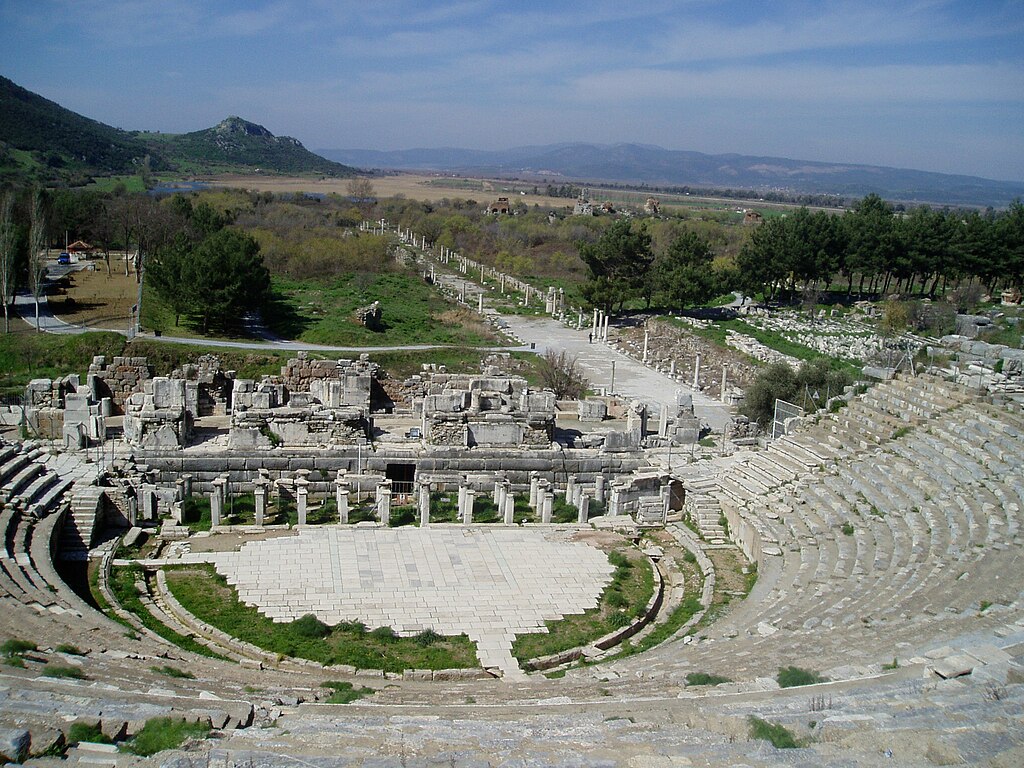
Ephesus (2181) (Ephesos) means beloved or permitted. It was on the highway to Rome. Christians brought from Asia to be flung to lions in arena in Rome, Ignatius called Ephesus the Highway of the Martyrs. Most important commercial city of Asia Minor, capital of Ionia on west coast. As noted above, this word is not present in all the Greek manuscripts.
FAITHFUL
IN CHRIST JESUS
Who are faithful in Christ Jesus - Note the NAS adds "who are." Literally it reads "faithful in Christ Jesus." Faithful (pistos) in passive sense means trustworthy, which would describe a saint who is trustworthy or dependable. Faithful (pistos) in the active sense means believing which is many writers favor (see more below on faithful).
Dr Martyn Lloyd-Jones comments on the meaning of faithful - Essentially this word ‘faithful’ means ‘exercising faith.’ To illustrate this, consider the case of Thomas the Apostle and how he refused to believe the testimony of his fellow disciples when he came back to them after an absence and when they told him that the Lord had appeared amongst them. Thomas said he would not believe unless he saw the mark of the nails and put his finger into the wounds. Then the Lord suddenly appeared and showed Himself to Thomas and told him to do what he had said. Thomas fell at His feet and said, ‘My Lord and my God.’ But remember how our Lord gently rebuked him and said, ‘Because thou hast seen me thou hast believed: blessed are they that have not seen and yet have believed’, And then He said, ‘Be not faithless but believing.’ The word translated in John 20:27 as ‘believing’ is the same word as is translated ‘faithful’ in our text. It means ‘to be full of faith’, to exercise faith. The Apostle addresses these Christians at Ephesus as those who are believers, people who exercise faith; they are Christians because they are believers....But there is a further meaning to this word ‘faithful’, the one that is generally given. It means that we keep the faith, that we hold to the faith, that we are constant in the faith, and loyal to the faith, and ready with Paul to defend the faith, and to contend earnestly for it. It means that we can be relied on, that we are dependable because we know the faith, and because we believe it and have trusted it. Let us not forget this secondary meaning, that we must be people upon whom others can rely and depend. (Saints ... and Faithful in Christ Jesus)
Wayne Barber on faithful - These were saintly saints. They were not just saints by position. Now what do I mean by that? When a person receives Christ he has been cleansed, set apart now, for the use of God. He is God’s own property. However, these were saints not just positionally. They lived saintly in this world. Experientially, daily, they lived faithfully, it says, "...in Christ Jesus."...Do you know the difference between reputation and character? Your reputation is what you want people to think you are. Your character is what everybody who lives with you and knows you knows that you are. The fact that they were faithful in Christ Jesus points to the character of these believers.
Skevington Wood - "Faithful" (pistoi) is a parallel designation of believers combining the ideas of trust and fidelity. This exercise of faith with its matching faithfulness is possible only "in Christ Jesus." (The Expositor's Bible Commentary)
Faithful (4103) (pistos) means trustworthy, dependable, reliable, inspiring trust or “faithful and not given to running away”. In the present context there are two meanings pistos could have in reference to the Gentile converts. Faithful in Christ Jesus could mean “believing ones” which stresses their intellectual response to the Gospel of Christ or it could also mean “faithful” which stresses their activity as believers. Obviously there could be a double meaning as neither would be inaccurate or inappropriate. Taking this approach one would see them as Gentile saints who were "believers" and in the midst of a society driven by sensuality and greed (sounds familiar doesn't it!) these believing Gentiles were those who showed themselves faithful in transaction of business and execution of commands or discharge of their official duties. They were those who trusted God's promises and lived as "saintly" saints in a society characterized by perversion, pornography and pollution, spiritually speaking. Faithful is used one other time in this letter to describe Tychicus "the beloved brother and faithful minister in the Lord" who would "make everything known to" the saints.
THOUGHT Dearly beloved of God, does your present practice match your privileged position? Are you being faithful to live a "set apart" life in a society where all lines of decency and morality have been virtually obliterated, where evil is now good and good is called evil? Isaiah issues a warning "Woe to those who call evil good, and good evil; Who substitute darkness for light and light for darkness; Who substitute bitter for sweet, and sweet for bitter!" (Isaiah 5:20+) As sons of the Living God (cf Hos 1:10, Ro 9:26, cf 2Cor 6:16), may our conduct match our creed! In Jesus' Name. Amen.
The absence of a definite article preceding pistos indicates that this is a further description of saints, indicating that both adjectives (hagios and pistis) refer to the same person or persons. (Note: this is the so-called Granville Sharp rule). Pistos is added in order to complete the description of the readers as Christians, not merely set apart…but specifically believers in Christ.
In the ancient secular Greek writings, we find the following uses of pistos --
"Whom no one would trust even if they were willing to work" = confidence in the person’s character and motives.
"I have trusted no one to take it to her" = confidence in the ability of another to perform a certain task
Webster says that "Faithful" means firm in adherence to whatever one owes allegiance and implies unswerving adherence to a person or thing or to the oath or promise by which a tie was contracted.
Vincent gives a nice summary (expanded in the discussion that follows) of the meaning of pistos, faithful, writing that it is used "(1), of one who shows Himself faithful in the discharge of a duty or the administration of a trust (Mt 24:45). Hence, trustworthy (2Ti 2:2-note). Of things that can be relied upon (2Ti 2:11-+). (2), Confiding; trusting; a believer (Gal 3:9; Acts 16:1; 2Cor 6:15; 1Ti 5:16) (Word Studies in the New Testament)
Moule notes that Paul's description of "faithful" refers to " the saints, under a different aspect. For the word as used, of Christian believers, see Acts 10:45 (“the faithful of the circumcision”); Acts 16:1+ (“a faithful Jewess”); 2 Corinthians 6:15 (“the faithful with the unfaithful,” i.e. the believer with the unbeliever); Colossians 1:2+; 1 Timothy 4:3 (“them who are faithful and know, etc.), 1 Timothy 4:12 (“the faithful”), 1 Timothy 5:16 (“any faithful man or faithful woman”), 1 Timothy 6:2 (“faithful,” i.e. Christian, “masters”); Titus 1:6+. These and similar passages, and the contrast of the word “unfaithful” (infidelis, infidel), shew that as a designation of Christians it means not trustworthy but trustful; full of faith, in the Christian sense." (Ref)
Related Resources:
- What do I need to do to hear, "Well done, good and faithful servant" when I arrive in heaven?
- What does the Bible say about faithfulness?
- The Fruit of the Holy Spirit – What is faithfulness?
- What is the Judgment Seat of Christ / Bema Seat of Christ?
- How can we store up treasures in heaven?
IN CHRIST JESUS
Boice on in Christ Jesus - “joined to Christ in one spiritual body so that what is true of Him is also true for us."
Harold Hoehner says the phrase and its equivalents, such as “in Him,” “in Christ,” or “in the Lord,” occur thirty-nine times in Ephesians.(Ephesians: An Exegetical Commentary)
In Christ Jesus defines the saints eternal, permanent, spiritual location. In Christ Jesus describes our position and our new sphere of existence. The preeminent idea brought out by this phrase (used over 130 times in some form - in Him, in the Beloved, etc) is that of the believers spiritual union with Christ (compare idea of Oneness of Covenant and Oneness Notes). Undoubtedly, considering its prevalence in his writings, this truth of in Christ is probably one of the most significant teachings of the Apostle Paul.
Dr Martyn Lloyd-Jones on in Christ Jesus - It means that the Christian is one who not only believes in Christ, he is in a real sense ‘in Christ.’ He belongs to Him, he is united to Him, he is joined to Him. Take the New Testament illustration of the body. ‘Ye are the body of Christ’, says Paul to the Corinthians, ‘and members in particular.’ In the fourth chapter of this Epistle to the Ephesians he uses the same analogy. He says that Christians, who form the Church, are built up like a body. He says: ‘Speaking the truth in love’ we are to ‘grow up into him in all things, which is the head, even Christ: from whom the whole body fitly joined together and compacted by that which every joint supplieth, according to the effectual working in the measure of every part, maketh increase of the body unto the edifying of itself in love’ (Eph 4:15–16). So to be a Christian means, not only that you are a believer in Christ, outside Him; you are a believer because you are joined to Him, you are ‘in Him.’.(Saints ... and Faithful in Christ Jesus)
John Stott on in Christ Jesus - This key expression of the letter thus occurs in its very first verse. To be ‘in Christ’ is to be personally and vitally united to Christ, as branches are to the vine and members to the body, and thereby also to Christ’s people. For it is impossible to be part of the Body without being related to both the Head and the members. Much of what the epistle later develops is already here in bud. According to the New Testament—and especially Paul—to be a Christian is in essence to be ‘in Christ’, one with him and with his people. (The Message of Ephesians)
In Christ Jesus alludes to the intimate, living union between a believer and his Lord. He is now our life (Gal 2:20-note, Col 3:4-note), our strength (Phil 4:13+), our sufficiency, our all in all.
THOUGHT - If you are a believer, this "address" IN CHRIST JESUS describes your permanent position. But does "in Christ Jesus" also describe your practical daily experience? It can if we learn to depend on the indwelling Spirit of Christ! In fact the only way to practice this position in Christ Jesus is by daily relying on His supernatural enabling power. That means we need to continually be filled with (controlled by, empowered by) His Spirit (Eph 5:18+). We need to jettison self-reliance and rely wholly on the Holy Spirit's supernatural provision. The Spirit will give us both the desire and the power to live out the Christ life ("in Christ Jesus") even as Paul explained in Philippians writing "God (HIS SPIRIT) is (CONTINUALLY) working in you, (CONTINUALLY) giving you the desire (THE "WANT TO" - TO OBEY HIM) and the power to do what pleases Him." (Phi 2:13NLT+)
If you are not in Christ today,
John MacArthur reaffirms the preceding THOUGHT writing "The key to living as a heavenly citizen while living in an unheavenly situation is walking by the Spirit. “Walk (ED: present imperative see our need to depend on the Holy Spirit to obey) by the Spirit,” Paul says, “and you will not carry out the desire of the flesh” (Gal. 5:16). When we walk in His power He produces His fruit in us: “love, joy, peace, patience, kindness, goodness, faithfulness, gentleness, self-control” (Gal 5:22–23). We receive our heavenly blessings by living in the power of God’s Holy Spirit." (Ephesians Commentary)
In (1722) (en) is "locative of sphere" meaning that their sainthood was in the sphere of Christ. As a goldfish lives and breathes and moves in the sphere of the aquarium, so too saints live in the sphere and influence of Christ Jesus their Lord. Stated another way, the believer’s new existence is circumscribed by Christ -- our life (Col 3:4+). Christ is the sphere in which the believer has his new life, his belief and all his interests and activities. Saints are believers in the sphere of fellowship and union with Christ, just as a fish has "fellowship" with the water in the tank. (See also Torrey's scriptures on the believer's Union With Christ) (See also F B Meyer - Chapter 3 - "In Him"; Chapter 4 - "Created in Him") (See Walter Wilson's CHRIST in Ephesians) Our eternal "location" in Christ Jesus is in direct contrast to our "location" in this temporal world, in which we are "aliens and strangers" (1 Peter 2:11+)
The great phrase in Christ Jesus - 50x in NAS - Acts 24:24; Rom. 3:24; 6:11, 23; 8:1, 2, 39; 15:17; 16:3; 1 Co. 1:2, 4, 30; 4:15; 15:31; 16:24; Gal. 2:4, 16; 3:14, 26, 28; 5:6; Eph. 1:1; 2:6, 7, 10, 13; 3:6, 11, 21; Phil. 1:1, 26; 2:5; 3:3, 14; 4:7, 19, 21; Col. 1:4; 1 Thess. 2:14; 5:18; 1 Tim. 1:14; 3:13; 2 Tim. 1:1, 9, 13; 2:1, 10; 3:12, 15; Philemon 1:23
Observe who uses this phrase most frequently!
The phrase in Christ - 37x in NASB (following do not include the entire phrase "in Christ Jesus") -Rom. 9:1; 12:5; 16:7, 9f; 1 Co. 3:1; 4:10, 17; 15:18f, 22; 2 Co. 1:21; 2:14, 17; 3:14; 5:17, 19; 12:2, 19; Gal. 1:22; 2:17; Eph. 1:3, 10, 12, 20; 4:32; Phil. 2:1; 3:9; Col. 1:2, 28; 2:5; 1 Thess. 4:16; Philemon 1:8, 20; 1 Pet. 3:16; 5:10, 14.
If you need to be encouraged and renewed in your mind [cp notes re "mind renewal" in Ro 12:2+; Eph 4:23+] about who you now are in Christ, consider making a list of the truth you glean from the NT passages listed above.
Harold Hoehner says the phrase and its equivalents, such as “in Him,” “in Christ,” or “in the Lord,” occur thirty-nine times in Ephesians
In Christ Jesus defines the saints eternal, permanent, spiritual location. In Christ Jesus describes our position and our new sphere of existence. The preeminent idea brought out by this phrase (used over 130 times in some form - in Him, in the Beloved, etc) is that of the believers spiritual union with Christ (compare idea of Oneness of Covenant and Oneness Notes). Undoubtedly, considering its prevalence in his writings, this truth of in Christ is probably one of the most significant teachings of the Apostle Paul.
Dr Martyn Lloyd-Jones on in Christ Jesus - It means that the Christian is one who not only believes in Christ, he is in a real sense ‘in Christ.’ He belongs to Him, he is united to Him, he is joined to Him. Take the New Testament illustration of the body. ‘Ye are the body of Christ’, says Paul to the Corinthians, ‘and members in particular.’ In the fourth chapter of this Epistle to the Ephesians he uses the same analogy. He says that Christians, who form the Church, are built up like a body. He says: ‘Speaking the truth in love’ we are to ‘grow up into him in all things, which is the head, even Christ: from whom the whole body fitly joined together and compacted by that which every joint supplieth, according to the effectual working in the measure of every part, maketh increase of the body unto the edifying of itself in love’ (Eph 4:15–16). So to be a Christian means, not only that you are a believer in Christ, outside Him; you are a believer because you are joined to Him, you are ‘in Him.’.(Saints ... and Faithful in Christ Jesus)
In Christ Jesus alludes to the intimate, living union between a believer and his Lord. He is now our life (Gal 2:20-note, Col 3:4-note), our strength (Phil 4:13+), our sufficiency, our all in all.
THOUGHT - If you are a believer, this "address" IN CHRIST JESUS describes your permanent position. But does "in Christ Jesus" also describe your practical daily experience? It can if we learn to depend on the indwelling Spirit of Christ! In fact the only way to practice this position in Christ Jesus is by daily relying on His supernatural enabling power. That means we need to continually be filled with (controlled by, empowered by) His Spirit (Eph 5:18+). We need to jettison self-reliance and rely wholly on the Holy Spirit's supernatural provision. The Spirit will give us both the desire and the power to live out the Christ life ("in Christ Jesus") even as Paul explained in Philippians writing "God (HIS SPIRIT) is (CONTINUALLY) working in you, (CONTINUALLY) giving you the desire (THE "WANT TO" - TO OBEY HIM) and the power to do what pleases Him." (Phi 2:13NLT+)
If you are not in Christ today,
You will be in Hell eternally!
William Barclay says "that when Paul spoke of the Christian being in Christ, he meant that the Christian lives in Christ as a bird in the air, a fish in the water, the roots of a tree in the soil. What makes the Christian different is that he is always and everywhere conscious of the encircling presence of Jesus Christ."....Barclay goes on to explain that "A Christian always moves in two spheres. He is in a certain place in this world; but he is also in Christ. He lives in two dimensions. He lives in this world whose duties he does not treat lightly; but above and beyond that he lives in Christ. In this world he may move from place to place; but wherever he is, he is in Christ. That is why outward circumstances make little difference to the Christian; his peace and his joy are not dependent on them. That is why he will do any job with all his heart. It may be menial, unpleasant, painful, it may be far less distinguished than he might expect to have; its rewards may be small and its praise non-existent; nevertheless the Christian will do it diligently, uncomplainingly and cheerfully, for he is in Christ and does all things as to the Lord. We are all in our own Colosse, but we are all in Christ, and it is Christ who sets the tone of our living." Barclay describes an ideal state writing that "There is the life that is dominated by the Spirit of God. As a man lives in the air, he lives in Christ, never separated from him. As he breathes in the air and the air fills him, so Christ fills him. He has no mind of his own; Christ is his mind. He has no desires of his own; the will of Christ is his only law. He is Spirit-controlled, Christ-controlled, God-focused." (Ephesians 1 Commentary)
RELATED RESOURCES:
- What does it mean to be in Christ?
- The Holy Spirit-Walking Like Jesus Walked!
- How does God see me in Christ?
- How should we live our lives in light of our identity in Christ?
- Covenant: The Oneness of Covenant
- Covenant: Oneness Notes
- The Believer's Position in Christ - Iain Gordon
- Oneness With Christ - Ruth Paxson - chapter from Called Unto Holiness
- Rivers of Living Water - Studies on believer's possessions in Christ by Ruth Paxson
- The Mystical Union with Immanuel - Abraham Kuyper (index to Work of the Holy Spirit)
- Vital Union with Christ - A T Pierson
- What Does God Think of Me Now? - 33 page booklet on believer's position in Christ
- Union with Christ - Charles Simeon
Boice writes that "The phrases in Christ, in Him, or the equivalent occur nine times just in Ephesians 1:3-23. They occur 164 times in all Paul’s writings. The phrases mean more than just believing on Christ or being saved by His atonement. They mean being joined to Christ in one spiritual body so that what is true of Him is also true for us...This is a difficult concept, and the Bible uses numerous images to teach it to us: the union of a man and woman in marriage (see notes Ephesians 5:22-33), the union of the vine and the branches (John 15:1-17), the wholeness of a spiritual temple in which Christ is the foundation and we the individual stones (Eph 2:20-22-see notes Ephesians 2:20; 2:21; 2:22), the union of the head and other members of the body in one organism (1Cor 12:12-27+). But whether we understand it or not, union with Christ is in one sense the very essence of salvation. John Murray, an able expositor of this theme, wrote,
“Union with Christ has its source in the election of God the Father before the foundation of the world and it has its fruition in the glorification of the sons of God. The perspective of God’s people is not narrow; it has the expanse of eternity. Its orbit has two foci, one the electing love of God the Father in the counsels of eternity, the other glorification with Christ in the manifestation of His glory. The former has no beginning, the latter has no end.” (John Murray - Redemption Accomplished and Applied )
Apart from Christ our condition is absolutely hopeless. In Him our condition is glorious to the extreme. (Boice, J. M.: Ephesians: An Expositional Commentary) (Bolding added)
Kenneth Wuest comments on our position in Christ noting that "Here again we have separation, for that which surrounds the believer, namely, Christ in Whom he is ensphered, separates him from all else." (Wuest Word Studies - Eerdman Publishing Company Volume 1, Volume 2, Volume 3 - used by permission)
MacArthur - A Buddhist does not speak of himself as in Buddha, nor does a Muslim speak of himself as in Mohammed. A Christian Scientist is not in Mary Baker Eddy or a Mormon in Joseph Smith or Brigham Young. They may faithfully follow the teaching and example of those religious leaders, but they are not in them. Only Christians can claim to be in their Lord, because they have been made spiritually one with Him (cf. Ro 6:1–11). (MacArthur, J. Philippians. Chicago: Moody Press )
It would seem to be that one of Paul's main reasons for so frequently using the phrase in Christ is to point to saints back to the sufficiency of Christ.
As Paul says later For to me to live is Christ (Php 1:21+ emphasizing that the new life Paul has is actually a Person, the Person Christ Jesus, and the result is a Christ-centered, Christ-like life, a life the dying world desperately needs to see in the saints!
Guy King in his exposition of Philippians comments on the phrase in Christ writing that...
Herein lay
(a) Their (referring to the saints at Philippi) protection from evil life. The moral condition of a heathen city would be a constant peril to any new converts, especially as they themselves had but just recently come out of that very heathenism. Philippi may not have been so utterly debased as Corinth, or Rome, but its atmosphere must have been a subversive influence threatening any who would live pure and true. Yet, they could be kept safe. Christians must, of course, remain in such hostile surroundings, for CHRIST must have there, as Mt 5:13+, Mt 5:14+ teaches, the salt, the light, and the testimony.
So He Himself prays "not that Thou shouldest take them out of the world, but that Thou shouldest keep them from the evil", John 17:15.
That keeping, that protection, is ministered to us in the fact of our being, not only "in the world", but more closely, "in Christ."
A shipwrecked man writes a message, and throws it into the sea, in the hope that it may reach some shore. But will not the water damage and destroy it? No; for, while it is cast into the sea, it is first sealed in a bottle - and so it arrives. Yes; in Philippi, with all its destructive influences, but "in Christ" - so they are secure, and so, in spite of all antagonistic forces, they arrive at "the haven where they would be." Herein lay also
(b) Their possibility of holy life. We are called not only to a negative but to a positive life - "eschew (abstain from) evil, and do good", as 1Pe 3:11+ says. But how can a holy life be lived in such unholy surroundings?
Mark that little water-spider going down to the bottom of that pond. It doesn't really belong there, even as we believers are: "in the world" ...but not of it, John 17:11, 16. The little creature has the queer, and amazing, ability of weaving a bubble of air around itself, and hidden in that it is able to pursue its way even amid such inimical conditions - in the water, but in the bubble!
So we come back to our glorious truth - in Philippi, but "in Christ"; then even in the midst of the most uncongenial surroundings, the Christ-life can be lived. ( King, Guy: Joy Way: An Exposition of the Epistle of Paul to the Philippians, 1952, Christian Literature Crusade ) (Bolding added)
William MacDonald makes an interesting observation (in comments on Colossians) that "In Christ speaks of their spiritual position. When they were saved, God placed them in Christ, “accepted in the beloved.” (Ep 1:6+) Henceforth, they had His life and nature (2Pe 1:4+). Henceforth, they would no longer be seen by God as children of Adam (1Cor 15:22+) or as unregenerate men, but He would now see them in all the acceptability of His own Son. The expression in Christ (see also in Christ and in Christ Jesus and in Christ) conveys more of intimacy, acceptance, and security than any human mind can understand. The geographical location of these believers is indicated by the expression who are in Colossae (ED: or in Ephesus as is the case in this letter). (Believer's Bible Commentary: Thomas Nelson )
Alexander Maclaren says it well - If we are to be in Christ when we are in Ephesus, we need to keep ourselves separate and faithful, and to keep ourselves in Christ. If the diver comes out of the diving-bell he is drowned. If he keeps inside its crystal walls he may be on the bottom of the ocean, but he is dry and safe. Keep in the fortress by loyal faith, by humble realisation of His presence, by continual effort (ED: NOT SELF EFFORT BUT THAT EFFORT ENABLED BY THE SPIRIT), and ‘nothing shall by any means harm you,’ but ‘your lives shall be holy, being hid with Christ in God (Col 3:3).’ (Read full sermon)
Hughes nicely sums up this letter writing that "the grand theme of Ephesians and its dual focus on Christ and on the Church — the “mystery” of “Christ and the church” (Ep 5:32+). The theme is clarified when we compare it to that of Colossians. Colossians explains Christ’s person and work in relation to the whole universe — the cosmic Christ; whereas Ephesians explains what the Church’s cosmic role is as the Body of the cosmic Christ. Ephesians reveals the position and job description of the Church in effecting God’s new order. It answers the question, what does it mean to be in Christ, and what does this demand of us?...Ephesians — carefully, reverently, prayerfully considered — will change our lives. It is not so much a question of what we will do with the epistle, but what it will do with us. (Hughes, R. K.: Ephesians: The Mystery of the Body of Christ. Crossway Books)
Kenneth Wuest more detailed note on SAINTS...
"Paul took it right out of the terminology of the pagan Greek religions. He had to. There were no other terms which he could use so long as he was confined to the Greek language. There it meant “devoted to the gods.” For instance, a Greek worshipper would bring an offering to the god as a gift. He devoted it to that god. Or, the Greeks would build a magnificent temple and devote it to a certain god. The building was thereby set apart from any secular use, and separated to a religious one. It was consecrated to the worship of that particular Greek god. The building was therefore holy, holy, not in our sense of the term, pure, for the Greek temples were filled with immoral practices that were part of their religious worship (the temple at Corinth housing 3000 “sacred” harlots), but holy in the sense of being non-secular, and therefore religious in nature, set apart for the worship of the Greek divinities.
The term was also used of persons who were devoted to the service of a god, separated to the service of the god, thus hagios consecrated, non-secular in character, but on the other hand, distinctively religious in nature and occupation. This is the genius of the Greek word translated “saint.” The verbal forms hagizo and hagiazo mean “to hallow, make sacred,” especially by burning a sacrifice. The foregoing estimate of hagios is taken from Greek-English Lexicon by Liddell and Scott.
We turn now to the Biblico-Theological Lexicon of Herman Cremer which specializes in the great doctrinal and theological words of the Greek New Testament. Cremer says that hagios “is the rarest of five synonyms which the Greeks had to express the idea of holiness, so far at least as they knew such an idea. In biblical Greek on the other hand, of the Old as well as the New Testament, it is the only word by which the biblical conception of holiness is expressed, that conception which pervade the Bible throughout, which molds the whole divine revelation, and in which, we may say with perfect truth, are centered the fundamental and leading principles and aims of that revelation. What constitutes the essence of holiness in the biblical sense is not primarily contained in any of the above named synonyms (hieros, hosios, semnos, hagios); the conception is of purely biblical growth, and whatever the Greeks surmised and thought concerning the holiness of Divinity in any sense remotely similar to that in which Holy Scripture speaks of it, they had not one distinct word for it, least of all did they express it in any of the terms in question.… As Greek of itself did not possess the right word for it, the only term presenting itself as in any degree appropriate—hagios—had to be filled and coined afresh with a new meaning; and thus hagiosis one of the words wherein the radical influence, the transforming and newly fashioning power of revealed religion is most clearly seen. Of all the ideas which, within the world subjected to the influence of Christianity or in the modern languages, are bound up in the word holy, none are to be found in the ancient tongues, Greek or Latin, in the terms above named, save those of ‘the sublime,’ ‘the consecrated,’ ‘the venerable.’ The main element—the moral—is utterly wanting. Hence it is not merely a topic of linguistic interest; it is a significant moral phenomenon which here presents itself to our inquiry.”
The word hagios when applied to God signifies “His opposition to sin manifesting itself in atonement and redemption or in judgment. Or as holiness, so far as it is embodied in law, must be the highest moral perfection, we may say.… holiness is the perfect purity of God, which in and for itself excludes all fellowship with the world, and can only establish a relationship of free electing love, whereby it asserts itself in the sanctification of God’s people, their cleansing and redemption” (Cremer).
The words, “saint, sanctify, sanctification, hallow, holy, holiness” in the New Testament are all translations of this same Greek root hagi. The verb hagiazo means “to set apart for God,” and refers to the act of the Holy Spirit setting apart for God the sinner who has been elected to salvation, taking him out of the first Adam and placing him in the Last Adam (1Cor 15:22, Ro 5:12-21). This is positional sanctification, an act performed once (ED: JUSTIFICATION) for all the moment the sinner places his faith in the Lord Jesus as his Saviour. This is followed by progressive sanctification, a process that goes on all through the earthly life of the Christian....in which that person is being gradually conformed to the image of the Lord Jesus. That person is called a hagios a "set apart for God person," a "consecrated person." He is, as such, looked upon as a non-secular person, a distinctively "religious" (ED: BY RELATIONSHIP) person, in that he has been set apart for God, His worship and service. This he is positionally. It is easy to see that this set apart position of separateness demands a separation of life in his experience, separation from the age system of evil, separation in his own sphere of life from everything that would interfere in the least from the worship and service which is due to the God to Whom he is set apart. This is a saint in the Bible sense of the term....Paul is writing to the saints. He identifies these saints as believing ones in Christ Jesus. There were two kinds of "saints" (hagios) in Ephesus, those who were devotees of the pagan religions, and those who were devotees of Christianity. The Greek word was taken by Paul from the Greek mystery religions and transplanted into Christianity. It therefore needed careful definition. It was the saints who were believers in Christ Jesus (FAITHFUL IN CHRIST JESUS) to whom Paul was writing, not the “saints” in the pagan religions. (Wuest Word Studies )
Rich! - Ephesians 1:1, 2
Hetty Green was known for a long time as the "America's greatest miser." Worth over $100 million when she died, she would eat cold oatmeal to save heating costs. Her son had a leg amputated because she spent so much time looking for a free clinic. She died after an attack of apoplexy (a stroke or sudden deprivation of all sense and voluntary motion, occasioned by repletion or whatever interrupts the action of the nerves upon the muscles), which was brought on by an argument over the value of skim milk over whole milk. She was for skim milk because it was cheaper.
Hetty Green did not enjoy her riches! The Book of Ephesians is the Bible Book that shows us our riches in Christ! Christians need to study this book so they will discover their riches in Christ and how to use them. We as Christians are often spiritual misers, because we don't use our riches in Christ.
Even the salutation in this book shows us our riches in Christ.
RICH IN STANDING (OR STATUS) - "Saints and faithful in Christ Jesus." - A saint is a person who has been set apart for God. The word "faithful" means believers. Saints become saints by being believers in Christ.
RICH IN SERVICE - "Paul, an apostle of Jesus Christ, by the will of God." - The Lord saved Paul with service for Him in mind (Acts 9:10, 11, 12, 13, 14, 15, 16). God has saved each Christian with service in mind for Him. What a privilege!
RICH IN SUPPLY - "Grace...and peace..." - God supplies us with what we need in order to serve Him well. God gives us grace and peace at salvation, and continues to supply them as we walk with Him. (Sermon Starter Rich! Ephesians 11-2)
What's In An Introduction?- Ephesians 1:1-2
We will have been introduced to thousands of people of the course of a lifetime. Many, if not most, of these introductions were so casual that we will forget them. However, many introductions that we have experienced were important.
As we read the Bible, we might not think much about the introductions found there, but they do contain important information and are worthy of our attention. We might quickly read over the introductions found in Paul's epistles, but there is valuable information contained there. For instance, let's consider Ephesians 1:1, 2
THE GREETER - Ep 1:1
1. "Paul" - A person - Acts 8:1, 2, 3, 9:1, 2, 3, 4, 5, 6, 7, 8, 9, 10, 11, 12, 13, 14, 15, 16, 17, 18, 19, 20, 21, 22
2. "An Apostle" - A position - Paul's position was as one of the Apostles. Each of us is given a position within the body of Christ, and a Spiritual gift to carry out that position. Romans 12:4, 5, 6, 7, 8
3. "By the will of God" - A plan - God has a specific plan for each one of our lives. Romans 12:2, Ephesians 5:15, 16, 17
THE GREETED - Ep 1:1
1. "Saints" - In the Bible a saint is simply a person who has come to know Christ as Savior. This means that anyone who is saved is a saint by position. The way a Christian conducts his life should make him a saint by practice. 1Peter 1:15, 16
2. "Faithful Brethren" - Paul is talking to the same people. Saints are to be faithful to their Lord (1Corinthians 4:2), and are brothers and sisters with other believers.
THE GREETING - Vs. 2
1. "Grace" - Paul desired that the Ephesians, who received grace for salvation (Ephesians 2:8, 9), would continue to be beneficiaries of God's grace. 2Peter 3:18
2. "Peace" - Paul also desired that the Ephesians, who also received peace with God at salvation (Romans 5:1), would continue to receive the peace of God (Isaiah 26:3, Philippians 4:6, 7)
3. Notice the source of grace and peace is God.Sermon Starter What's In An Introduction Ephesians 11-2)
Theodore Epp - Life, Eternal and Abundant Ephesians 1:1; John 3:13-21
Eternal life is procured by the death, burial and resurrection of Jesus Christ. By His death Jesus paid the penalty for sin; by His burial He took sin away; by His resurrection He lives in the believer.
This is all involved in the new birth. On the other hand, the abundant life is procured for the believer through the living, ascended Christ, who is seated at the right hand of the Father.
The believer who lives on the basis of what he possesses in Christ has an abundant life. He realizes the indwelling Christ is able to meet any need.
Eternal life is objective in the sense that a person obtains it by placing faith in the fact of Christ's shed blood for the remission of sins. The abundant life is subjective in that it is a personal response to what a believer has in Christ.
The one who knows that Christ is able to meet every need and who lives accordingly has the abundant life.
Eternal life is the same for all believers, regardless of their sinful past. It does not matter whether the person was guilty of gross sin, as society measures sin, or whether he was a person of high moral standards.
All who receive Christ have eternal life. However, not all believers have abundant life. The abundant life varies in believers according to their individual responses to Jesus Christ.
"He that hath the Son hath life; and he that hath not the Son of God hath not life" (1 John 5:12). (Back to the Bible)
Ruth Paxson has divided Ephesians as follows (THE WEALTH WALK AND WARFARE OF THE CHRISTIAN - 145 pages or here)
| THE WEALTH | Ephesians 1-3 |
| THE WALK | Ephesians 4-6:9 |
| THE WARFARE | Ephesians 6:10-18 |
Someone else has divided Ephesians into three similar segments...
| SIT | Our Position in Christ | Ephesians 1-3 |
| WALK | Our Life in the World | Ephesians 4–6a |
| STAND | Our Attitude to the Enemy | Ephesians 6b |
Parallel Passages in Ephesians and Colossians
|
Eph 1:1 |
Col 1:1 |
Ephesians 1:2 Grace to you and peace from God our Father and the Lord Jesus Christ. (NASB: Lockman)
Greek: charis humin kai eirene apo theou patros hemon kai kuriou Iesou Christou.
BGT χάρις ὑμῖν καὶ εἰρήνη ἀπὸ θεοῦ πατρὸς ἡμῶν καὶ κυρίου Ἰησοῦ Χριστοῦ.
Amplified: May grace (God’s unmerited favor) and spiritual peace [which means peace with God and harmony, unity, and undisturbedness] be yours from God our Father and from the Lord Jesus Christ. (Amplified Bible - Lockman)
ESV Ephesians 1:2 Grace to you and peace from God our Father and the Lord Jesus Christ.
KJV Grace be to you, and peace, from God our Father, and from the Lord Jesus Christ.
NET Grace and peace to you from God our Father and the Lord Jesus Christ!
NIV Ephesians 1:2 Grace and peace to you from God our Father and the Lord Jesus Christ
NLT: May grace and peace be yours, sent to you from God our Father and Jesus Christ our Lord. (NLT - Tyndale House)
Phillips: grace and peace be to you from God the Father and our Lord Jesus Christ. (Phillips: Touchstone)
Wuest: Grace to you and peace from God our Father and the Lord Jesus Christ. (Eerdmans Publishing - used by permission)
Young's Literal: Grace to you, and peace from God our Father, and the Lord Jesus Christ!
GRACE TO YOU AND PEACE FROM GOD OUR FATHER AND THE LORD JESUS CHRIST:
- Romans 1:7; 2Corinthians 1:2; Galatians 1:3; Titus 1:4
- Ephesians 1 Resources - Multiple Sermons and Commentaries
- Ephesians 1:1-2 Spiritual Wisdom for God's Saints - Steven Cole
- Ephesians 1:1-2 Introduction to Ephesians - John MacArthur
Related Passages:
Numbers 6:24-26+ (NOTE SIMILARITY TO THE AARONIC BLESSING - GRACE THEN PEACE) The LORD bless you, and keep you; 25 The LORD make His face shine on you, And be gracious to you; 26The LORD lift up His countenance on you, And give you peace.’
GRACE BEFORE
PEACE
Grace to you and peace - Note that grace and peace are always found in that order because grace is the foundation and peace is the result.
Know grace, know peace
No grace, no peace!
Spurgeon writes that "All down through the ages this benediction comes to us, even to as many of us as are " the faithful in Christ Jesus." "Grace be to you," brethren and sisters, grace in every form of it, the free favour of God, all that active force of grace which comes of his unmerited love. May you have a fresh draught of it at this time! "and peace." May you feel a deep peace with God, with your own conscience, and with all the world! Oh, that you might find an atmosphere of quiet calm about your mind at this very moment! The double blessing of "grace" and "peace" comes "from God our Father, and from the Lord Jesus Christ."
Again Spurgeon - Grace first, for that is the fountain; then peace comes, for that is the fitting stream to flow from the fountain of grace. Seek not peace first, for there is no peace for unregenerate man; grace first, then peace, and both must come “from God our Father, and from the Lord Jesus Christ.
This salutation is undoubtedly a form of a blessing or prayer. Notice that grace is like the "bookends" of this letter, Paul beginning and ending with a prayer for grace for the saints...
Grace be with all those who love our Lord Jesus Christ with a love incorruptible (a never diminishing love, one not even capable of corrupting!). (Ephesians 6:24-note)
In fact, with the exception of the epistle to Romans, every Pauline letter begins and ends with "grace", thus constantly emphasizing that the Christian life begins with grace, is lived by grace and ends with grace, not by reliance on self or works.
The book of Ephesians is so full of the subject, that it has been called “The Epistle of Grace.”
Ray Stedman writes that "The two great heritages of the Christian are grace and peace. These are two things you can always have, no matter what your circumstances. Grace is all God's power, all his love, all his beauty available to you. It is a marvelous term which wraps up all that God is and offers to us. It comes from the same Greek word from which we get our English word charm. Grace is charming, lovely, pleasant. It is something which pleases, which imparts charm and loveliness to a life. Peace is freedom from anxiety, fear, and worry. These are the two characteristics which ought to mark Christians all the time: Grace -- God at work in their life; and peace -- a sense of security, of trust... From here the letter follows the usual structure of Paul's letters. First comes the doctrine, the teaching, the great, revolutionary, radical facts that God is setting before us. And then comes the practice, the application, the working out of these in terms of the normal situations of life. Now, don't read these first three chapters of this letter as though they were mere theological gas. They are not! They are facts! They are what God says is real. They are what is actually happening in the world, and what is available to you. And if you once read them that way you won't treat them as merely academic. You'll begin to found your life upon these facts and act upon them. That is why Paul always begins his letters by setting forth the radical facts of life as God teaches them. (Read the entire sermon Ephesians 1:1-14: God At Work)
It is not so much a question of what we will do with the epistle, but what it will do with us.
- R Kent Hughes
Grace (5485) (charis) describes the undeserved, unmerited favor of God which He rains down upon us without expectation of return. A practical definition of grace is that it represents God's enabling power to overcome the world, my flesh and the devil. (Sanctifying grace). Without dependence upon the sanctifying grace, saints cannot live the supernatural (victorious) Christ life. One has said grace is "holy love on the move". Grace is the unmerited and "free favor and good-will of God, and all the blessed fruits and effects of it" (Matthew Henry). Note that contrary to popular belief in some circles, grace is not "cheap" and thus it not cart blanche or license willfully sin or to live the way we please (Jude 1:4), but to the contrary this grace is the power to do as we should. God’s grace insures that those who have been truly regenerated will persevere until the end of life. This entire work is called sanctification, a work of God “whereby we are renewed in the whole man and are enabled more and more to die daily unto sin and to live unto righteousness” as stated by the Westminster Shorter Catechism (Ro 12:2-note; 2Cor 4:16; Ep 4:23-note; Col 3:10-note).
It is hardly too much to say that God has in no word uttered Himself and all that was in His heart more distinctly than in this word grace (charis)!
Brian Harbour - Grace is a gift which a person could not have earned and did not deserve. It thus refers to the kindness of God toward undeserving people. Grace is the undeserved generosity of God. (Notable Harbour Verse Studies)
Martyn Lloyd-Jones - Grace essentially means ‘unmerited favour’, favour you do not deserve, favour you receive but to which you have no right or title in any shape or form, and of which you are entirely unworthy and undeserving. We may call it condescending love—love coming down, or stopping down. Or we may call it beneficent kindness....It is one of the most beautiful words in every language. (Grace; Peace; Glory)
Eadie comments that "The apostolical salutation (“Grace to you and peace”) is cordial and comprehensive....(Charis or Grace is) that goodwill on God's part which not only provides and applies salvation (ED: "JUSTIFYING GRACE"), but blesses, cheers, and assists believers (ED: "SANCTIFYING GRACE'). As a wish expressed for the Ephesian church, it does not denote mercy in its general aspect, but that many-sided favour that comes in the form of hope to saints in despondency, of joy to them in sorrow, of patience to them in suffering, of victory to them under assault, and of final triumph to them in the hour of death. And so the (writer of Hebrews) calls it grace in order to well-timed assistance. (He 4:16-note) (A Commentary on the Greek text)
Paul is opening this great letter with a blessing or even in one sense a prayer that the Lord's grace (His transforming, energizing enablement or power to live the supernatural, abundant life for His glory - see discussion of empowering aspect of grace in 2Ti 2:1+) be with all the the saints at Ephesus.
THOUGHT - Is this not a prayer we should pray for all the saints in Christ Jesus? Have you ever prayed grace and peace for other believers? (cp 1Pe 1:2b+) We should considering ending all our emails to brethren with something akin to "Grace and peace. Amen" not of course in a mechanical/liturgical sense, but as a genuine prayer for the recipient! Often we write "Blessings" and that is not bad but "Grace and peace to you. Amen" seems more specific. No legalism intended here. Just thinking.
F B Meyer in his Devotional Commentary on Ephesians writes that "Grace to help in our times of need; Peace to keep our heart and mind. The one as the blue vault of Heaven above us, with its smile of sun, and breath of air, and reviving rain; the other as the blue depths of the ocean, tranquil and calm. But neither of these blessed gifts can be ours till we have come to recognise God as our Father. Be doubtful about that, and you will not dare to exercise the child's privilege of claiming what you want from the Father's stores; and you will miss the unspeakable rest which breathes through the heart of the child, as it nestles to the father's side. Open your heart to the Spirit of Adoption that He may flutter, dove-like, into its depths; and, in the cry Abba, bear witness with your spirit that you are a child of God, and if a child, then a participator in his Grace and Peace. (Chapter 1 - The Father)
The Pulpit Commentary notes that "Peace is conjoined with grace; they are like mother and daughter, or like twin sisters. Grace is the only foundation of true peace—whether peace with God, peace of conscience, rest and satisfaction of soul, or peace toward our fellow-men. The source of grace and peace is “God our Father and the Lord Jesus Christ.” (Ephesians 1 Commentary)
Peace (1515) (eirene from eiro = to join or fasten together so as to bind together that which has been broken or divided) conveys the idea of setting at one again. Peace therefore is that common accord and tranquility which results in the joining together again those who were separated, such as a sinner and a holy God through the blood of Christ. Eirene is the root word for our English word "serene" (serenity) which means clear and free of storms or unpleasant change, stresses an unclouded and lofty tranquility. Peace implies health, well-being, and prosperity. Christ Jesus through the blood of His Cross binds together that which was separated by human sin when the sinner puts his or her faith in Christ Jesus the Lord.
In secular Greek eirene referred to cessation or absence of war. In Adam all men before salvation "were enemies" (Ro 5:10+, Ro 5:12+), "alienated and hostile in mind, engaged in evil deeds" (Col 1:21-note) and so were ''at war'' with the Almighty. Saints now have "been justified by faith" and "have peace with God through our Lord Jesus Christ" (Ro 5:1+) because they have "been reconciled" (Ro 5:10+) The war between the believer and God is over, and the treaty was written not with pen and ink but with on the Cross with the precious blood of Christ, the Lamb of God Who paid the price in full (Jn 19:30+) so that believers now can be at rest in Christ (cf Heb 4:10+). Paul writes later in this letter that the "peace of God… shall guard your hearts and your minds in Christ Jesus" (Php 4:7+), here referring to the peace that comes from being in unbroken communion or fellowship with God. Peace is the harmony that exists between God and those who "receive the reconciliation" (Ro 5:11+).
Peace is also the Greek equivalent of the Hebrew Shalom (see note) a word which speaks of spiritual prosperity. Given the fact that they are saints (believers), as alluded to in the preceding paragraph, they have experienced "justifying peace" or peace with God, so that the peace Paul is referring to in this passage most likely refers to "tranquilizing peace" or that moment by moment peace of God, which believers can experience reflecting the fruit of the Holy Spirit.
John Eadie explains that "Peace, is the Greek equivalent of the Hebrew Shalom—a term of familiar and beautiful significance. It includes every blessing—being and wellbeing. It was the formula of ordinary courtesy at meeting and parting. “Peace I leave with you,” said our Lord; but the term was no symbol of cold and formal politeness—“not as the world giveth, give I unto you.” (John 14:27). The word in this connection denotes that form of spiritual blessing which keeps the heart in a state of happy repose. It is therefore but another phase, or rather it is the result, of the previous charis...A conscious possession of the divine favour (grace) can alone create and sustain mental tranquility. To use an impressive figure of Scripture, the unsanctified heart resembles “the troubled sea,” (Isa 57:20KJV) in constant uproar and agitation—dark, muddy, and tempestuous; but the storm subsides, for a voice of power has cried, “Peace, be still,” and there is “a great calm” (Mk 4:39KJV, cp Mt 8:26KJV) -- the lowering clouds are dispelled, and the azure sky smiles on its own reflection in the bosom of the quiet and glassy deep. The favour of God and the felt enjoyment of it, the apostle wishes to the members of the Ephesian church in this salutation; yea, grace and peace. (A Commentary on the Greek text)
Read the fascinating illustration of peace from a primitive tribesman's perspective...
Jim Walton was translating the NT for the Muinane people of La Sabana in the jungles of Colombia. But he was having trouble with the word peace. During this time, Fernando, the village chief, was promised a 20-minute plane ride to a location that would have taken him 3 days to travel by walking. The plane was delayed in arriving at La Sabana, so Fernando departed on foot. When the plane finally came, a runner took off to bring Fernando back. But by the time he had returned, the plane had left. Fernando was livid because of the mix-up. He went to Jim and launched into an angry tirade. Fortunately, Walton had taped the chief's diatribe. When he later translated it, he discovered that the chief kept repeating the phrase, "I don't have one heart."
Jim asked other villagers what having "one heart" meant, and he found that it was like saying, "There is nothing between you and the other person."
That, Walton realized, was just what he needed to translate the word peace. To have peace with God means that there is nothing--no sin, no guilt, no condemnation--that separates us. And that peace with God is possible only through Christ (Ro 5:1+). Do you have "one heart" with God?
Grace is the fountain out of which peace is the stream. Because we have grace from God we have peace with God (Ro 5:1+) and can daily experience the peace of God which surpasses all comprehension (Php 4:7+), the fruit of the Spirit (Gal 5:22+).
THE SOURCE OF
GRACE AND PEACE
From God our Father and the Lord Jesus Christ - In explaining the Source, Paul repeatedly (twelve of his letters) links God the Father and Son which clearly serves to emphasize the divinity of Jesus. (Ro 1:7, 1Cor 1:3, 2Cor 1:2, Gal 1:3, Eph 1:2, Phil 1:2, Col 1:2, 2Th 1:2, 1Ti 1:2, 2Ti 1:2, Titus 1:4, Philemon 1:3. (cf 2Jn 1:3) While the Spirit is not mentioned here, we know that He is involved in dispensation of grace (Heb 10:29, Zech 12:10) and peace (Gal 5:22, Ro 8:6, Ro 14:17, Eph 4:3).
From (575) (apo) is a preposition which primarily means from. In this sense from is used as a function word to indicate the source, cause, agent, or basis of the grace and peace. From governs both objects, God our Father and the Lord Jesus Christ, Who together form one unit and are placed on a level of equality (co-equality of the Godhead) making this passage a definite affirmation of the deity of Jesus Christ.
John Eadie - Father and Son are both specified as the sources of grace and peace. Grace and peace are not earth-born blessings; they descend from heaven, from God on His glorious throne, whose high prerogative it is to send down those special influences; and from Christ at His right hand, who has provided these blessed gifts by His sufferings and death—who died to secure, and is exalted to bestow them, and whose constant living sympathy with His people enables Him to appreciate their wants, and prompts Him out of His own fulness to supply them. God is described as our Father—hemon. Our sonship will be illustrated under Ep 1:5. The universal Governor being the parent of believers, who have a common fatherhood in Him, grace and peace are viewed as paternal gifts. (A commentary on the Greek text)
S Lewis Johnson has an interesting comment - So much of our theology today is anthropological: men begin with men. And the result is a Pelagianism or Arminianism or that kind of theology in which the human is stressed. But in the Bible, the Apostles, our Lord, and the Prophets begin from the standpoint of God. They don’t do away with human responsibility, but they look at it from the standpoint of God. (Ephesians 1:1-4 Paul's Grandest Epistle)
Father (3962) (pater) is defined as the genitor, by whom one is begotten. God is not the Father of every human being but only those who are "born again" (John 3:3). “Father” suggests that the following description of "every spiritual blessing" is His provision for the members of his family, for all fathers desire to be the source of blessing for their children. And so too our great heavenly Father desires to be the Source of blessing for his family, and that is what he is in this passage.
The Jews in the OT did not know or refer to the Almighty One as Father. How great is our privilege as New Testament believers.
THOUGHT - Are modern believers really living in light of this great "family Name"? Lord, open our eyes to see not just who we are in Christ, but whose we are in the Father's heart before the world was even created, so that we might glorify (live in such a way that we give a proper opinion of our Father) God in our bodies before the people of the world who are desperately in danger of eternal destruction. Amen.
In the spiritual sense, God is our Eternal Father for when we are saved we are brought into His family...
(Jesus) came to His own, and those who were His own did not receive Him. But as many as received Him, to them He gave the right to become children of God, even to those who believe (by grace through faith we are saved) in His name, who were born not of blood, nor of the will of the flesh, nor of the will of man, but of God. (John 1:11-13+)
Now as His children we can approach Him as a child does his father for we are objects of His special watch care and love! This is a blessed thought which should encourage our praying, fully confident that He hears us.
Let us therefore draw near with confidence to the throne of grace, that we may receive mercy and may find grace to help in time of need. (Heb 4:16+)
F B Meyer writes that "WE NEED BOTH GRACE AND PEACE - Grace to help in our times of need; Peace to keep our heart and mind. The one as the blue vault of Heaven above us, with its smile of sun, and breath of air, and reviving rain; the other as the blue depths of the ocean, tranquil and calm. But neither of these blessed gifts can be ours till we have come to recognise God as our Father. Be doubtful about that, and you will not dare to exercise the child's privilege of claiming what you want from the Father's stores; and you will miss the unspeakable rest which breathes through the heart of the child, as it nestles to the father's side. Open your heart to the Spirit of Adoption that He may flutter, dove-like, into its depths; and, in the cry Abba, bear witness with your spirit that you are a child of God, and if a child, then a participator in his Grace and Peace. (Devotional Commentary of Ephesians)
And (2532) (kai) is used to simply join single words clauses. Paul's use of AND here is very significant as it clearly links God the Father the Lord Jesus Christ (see also discussion re "from" above) as the Source of grace and peace. It follows, that Jesus is Very God of Very God Himself, co-eternal, coequal, and coexistent with the Father.
Lord (2962) (kurios [word study] from kúros = might, power in turn from kuróo = give authority) describes the One Who has absolute ownership and sovereign power and authority. Kurios means master, owner, one who has absolute ownership power. Jesus is referred to some ten times as Savior and some seven hundred times as Lord. He is supreme in Authority. It is also notable that kurios is the noun the translators of the Septuagint (LXX) chose some 7000 times for the Hebrew word Jehovah (identified in the NAS by being in all capital letters "LORD" not Lord, which is Adonai).
John Eadie -The Saviour is characterized as Lord Jesus Christ; “Lord,” Master, or Proprietor. (O kurios is often applied to Jesus in the Pauline writings. It corresponds to the theocratic intimations of a king—a great king—to preside over the spiritual Zion. (Ps 110:1).... Like Theos in many places, it is often used without the article when it refers to Christ. In about two hundred and twenty instances in the writings of Paul, kurios denotes the Saviour, and in about a hundred instances it is joined to His other names, as in the phrase before us. Perhaps in not more than three places, which are not quotations or based on quotations, does Paul apply kurios to God. It was a familiar and favourite designation—the exalted Jesus is “Lord of all”—“He has made Him both Lord and Christ.” He has won this Lordship by His blood. Phil 2:8, 11. “He has been exalted,” that every tongue should salute Him as Lord. 1Cor. 12:3. While the title may belong to Him as Creator and Preserver, it is especially given Him as the enthroned God-man, for His sceptre controls the universe. The range of that Lordship has infinitude for its extent, and eternity for its duration. The term, as Suicer quaintly remarks, refers not to ousia, but to exousia. And as He is Head of the Church, and “Head over all things to the Church”—its Proprietor, Organizer, Governor, Guardian, Blesser, and Judge—whose law it obeys, whose ordinances it hallows, whose spirit it cherishes, whose truth it conserves, and whose welcome to glory it anticipates and prepares for; therefore may He, sustaining such a relation to His spiritual kingdom, be so often and so fondly named as Lord. The apostle invokes upon the Ephesians grace and peace from the Lord Jesus Christ, whose supreme administration was designed to secure, and does actually confer, those lordly gifts. (Ephesians 1 Commentary)
In one of the most beautiful passages in all of Scripture, Paul explains Christ's Lordship writing...
Therefore also God highly exalted Him, and bestowed on Him the name which is above every name, that at the name of Jesus EVERY KNEE SHOULD BOW, of those who are in heaven, and on earth, and under the earth, and that every tongue should confess that Jesus Christ is Lord, to the glory of God the Father. (Php 2:9, 10, 11- note)
Lord therefore is not merely a name that composes a title, but signifies a call to every saint to reverently bow down to Jesus Christ. If Christ is our Lord, we are to live under Him, consciously and continually submitting our wills to Him as His bondservants, always seeking first His Kingdom and His righteousness. According to this "definition" is He your Lord?
Theodore Epp - The Key to the Treasury - Ephesians 1:2,3; John 15:1-10
The believer's resources--all spiritual blessings--are "in Christ" (Eph. 1:3). Christ is the life of the believer and thus provides for him all that he needs.
Before salvation the individual was in Adam, but after salvation he is in Christ. In Adam the individual possessed only a sinful nature, but in Christ he possesses a divine nature. The divine nature of the believer causes him to want to do the will of God.
Apart from Christ, a person has no relationship to God and God has no relationship to him. Before a person receives Christ, he is unable to benefit from the spiritual blessings God has provided.
Only after a person becomes "in Christ" are all the resources of God available to him. God's wealth for the believer is deposited in Christ, and it is only when a person receives Christ that this spiritual wealth becomes available to him.
Without Christ one has no spiritual strength, but in Christ he is able to achieve any spiritual victory. However, even the believer must rely on spiritual provisions if he is to experience spiritual victories.
Jesus told believers, "I am the vine, ye are the branches: He that abideth in me, and I in him, the same bringeth forth much fruit: for without me ye can do nothing" (John 15:5).
Because Paul knew his spiritual resources he said, "I can do all things through Christ which strengtheneth me" (Phil. 4:13).
In Christ a person has position--where He is, the believer is; privilege--what He is, the believer is; possession--what He has, the believer shares. The two words "in Christ" open up all God's treasures for the believer.
"He that abideth in me, and I in him, the same bringeth forth much fruit: for without me ye can do nothing" (John 15:5).
Alexander Maclaren expository sermon on Ephesians 1:1
"SAINTS AND FAITHFUL"
That is Paul’s way of describing a church. There were plenty of very imperfect Christians in the community at Ephesus and in the other Asiatic churches to which this letter went: As we know, there were heretics amongst them, and many others to whom the designation of ‘holy’ seemed inapplicable. But Paul classes them all under one category, and describes the whole body of believing people by these two words, which must always go together if either of them is truly applied, ‘saints’ and ‘faithful.’
Now I think that from this simple designation we may gather two or three very obvious indeed, and very familiar and old-fashioned, but also very important, thoughts.
I. A Christian is a saint.
We are accustomed to confine the word to persons who tower above their brethren in holiness and manifest godliness and devoutness. The New Testament never does anything like that. Some people fancy that nobody can be a saint unless he wears a special uniform of certain conventional sanctities. The New Testament does not take that point of view at all, but regards all true believers in Jesus Christ as being, therein and thereby, saints.
Now, what does it mean by that? The word at bottom simply signifies separation. Whatever is told off from a mass for a specific purpose would be called, if it were a thing, ‘holy.’ But there is one special kind of separation which makes a person a saint, and that is separation to God, for His uses, in obedience to His commandment, that He may employ the man as He will. So in the Old Testament the designation ‘holy’ was applied quite as much to the high priest’s mitre or to the sacrificial vessels of the Temple as it was to the people who used them. It did not imply originally, and in the first place, moral qualities at all, but simply that this person or that thing belonged to God. But then you cannot belong to God unless you are like Him There can be no consecration to God except the heart is being purified. So the ordinary meaning of holiness, as moral purity and cleanness from sin, necessarily comes from the original meaning, separation and devotion to the service of God.
Thus we get the whole significance of Christian holiness. We are to belong to God, and to know that we do belong to Him. We are to be separated from the mass of people and things that have no consciousness of ownership and do not yield themselves up to Him for His use. But we cannot belong to Him, and be devoted to His service, unless we are being made day by day pure in heart, and like Him to whom we say that we belong. A human being can only be God’s by the surrender of heart and will, and through the continual appropriation into his own character and life, of righteousness and purity like that which belongs to God. Holiness is God’s stamp upon a man, His ‘mark,’ by which He says, — This man belongs to Me. As you write your name in a book, so God writes His name on His property, and the name that He writes is the likeness of His own character.
Note, again, that in God’s church there is no aristocracy of sanctity, nor does the name of saint belong only to those who live high above the ordinary tumults of life and the secularities of daily duty. You may be as true a saint in a factory — ay! and a far truer one — than in a hermitage. You do not need to cultivate a mediaeval or Roman Catholic type of ascetic piety in order to be called saints. You do not need to be amongst the select few to whom it is given here upon earth, but not given without their own effort, to rise to the highest summits of holy conformity with the divine will. But down amongst all the troubles and difficulties and engrossing occupations of our secular work, you may be living saintly lives; for the one condition of being holy is that we should know whose we are and whom we serve, and we can carry the consciousness of belonging to Him into every corner of the poorest, most crowded, and most distracted life, recognising His presence and seeking to do His will The saint is the man who says, ‘O Lord, truly I am Thy servant; Thou hast loosed my bonds.’ Because He has loosed my bonds, the bonds that held me to my sins. He has therein fastened me with far more stringent bonds of love to the sweet and free service of His redeeming love. All His children are His saints.
The Old Testament ritual had one sacrifice which carried this truth in it. It is the first prescribed in the Book of Leviticus, the ceremonial book — namely, the burnt offering. Its especial meaning was this, that the whole man is to be laid upon God’s altar and there consumed in the fire of a divine love. It began with expiation, as all sacrifices must, and on the footing of expiation there followed the transformation, by the fire of God, from gross earthliness into vapour and odour which went up in wreaths of fragrance acceptable to God. So we are to be laid upon the divine altar. So, because we have been accepted in the Beloved, and have received the atonement for our sins through His great sacrifice, we are to be consecrated to His service and, touched by the fire which He sends down, we are to be changed into a sweet odour acceptable to Him as were ‘the saints which are in Ephesus.’
II. Further, Christian men are saints because they are believers.
‘The saints’ and ‘the faithful’ are not two sets of people, but one. The Apostle starts, as it were, on the surface, and goes down; takes off the uppermost layer and lets us see what is below it; begins with the flowers or the fruit, and then carries us to the root. The saints are saints because they are first of all faithful. ‘Faithful’ here, of course, does not mean, as it usually does in our ordinary language, ‘true’ and ‘trusty,’ ‘reliable’ and ‘keeping our word,’ but it means simply ‘believing’; having faith, not in the sense of fidelity, but in the sense of trust.
So, then, here is Paul’s notion — and it is not only Paul’s notion, it is God’s truth — that the only way by which a man ever comes to realise that he belongs to God, and to yield himself in glad surrender to His uses, and so to become pure and holy like Him whom He loves and aspires to, is by humble faith in Jesus Christ. If you want to talk in theological terminology, sanctification follows upon faith. It is when we believe and trust in Jesus Christ that all the great motives begin to tell upon life and heart, which deliver us from our selfishness, which bind us to God, which make it a joy to do anything for His service, which kindle in our hearts the flame of fructifying and consecrating and transforming love. Faith, the simple reliance of a desperate and therefore trusting heart upon Jesus Christ for all that it needs, is the foundation of the loftiest elevation and attainment of the Christian character. We begin down there that we may set the shining topstone of ‘Holiness to the Lord’ upon the heaven-pointing summit of our lives.
Note how here Paul sets forth the object of our faith and the blessedness of it. I do not think I am forcing too much meaning into his words when I ask you to notice with what distinct emphasis and intentional fulness he employs the double name of our Lord here to describe the object upon which our faith fixes, ‘Faithful in Christ Jesus. ’ We must lay hold Of the Manhood, and we must lay hold of the office. We must rest our soul’s salvation on Him as our brother, Jesus who was incarnate in sinful flesh for us; and we must. also rest it on Him as God’s anointed, who came in human flesh to fulfil the divine loving-kindness and purposes, and in that flesh to die. A faith in a Jesus who was not a Christ would not sanctify; a faith in a Christ who is not Jesus would be impalpable and impotent. We must take the two together, believing and feeling that we lay hold upon a loving Man, ‘bone of our bone and flesh of our flesh’; and also upon Him who in His very humanity is the Messenger and Angel of God’s covenant; the Christ for whom the way has been being prepared from the beginning, and who has some to fulfil all the purposes of the divine heart.
And notice, too, how there is suggested here also, the blessedness of that faith, inasmuch as it is a faith in Christ. The New Testament speaks in diverse ways about the relation between the believing soul and Jesus Christ. It sometimes speaks of faith as being towards Him, and that suggests the going out of a hand that, as it were, stretches towards what it would lay hold of. It sometimes speaks of faith as being on Him, which suggests the idea of a building on its foundation, or a hand leaning on a support. And it sometimes speaks, as here, of faith being ‘in Him,’ which suggests the folded wings of the dove that has found its nest, the repose of faith, the quiet rest in the Lord, and ‘waiting patiently for Him.’ Such trust so directed is the one condition of such tranquillity. Then, again, note a Christian is all that he is because he is ‘in Christ.’ That phrase ‘in Him’ is in some sense the keynote of this Epistle to the Ephesians. If you will look over the letter, and pick out all the connections in which the expression ‘in Him’ occurs, I think you will be astonished to see how rich and full are its uses, and how manifold the blessings of which it is the condition. But the use which Paul makes of it here is just this — everything in our Christian life depends upon our being rooted and grafted in Jesus. Dear brethren, the main weakness, I believe, of what is called Evangelical Christianity has been that it has not always kept true to the proportionate prominence which the New Testament gives to the two thoughts, ‘Christ for us,’ and ‘Christ in us.’ For one sermon that you have heard which has dwelt earnestly and believingly on the thought of the indwelling Christ and the Christian indwelling in Him, you have heard a hundred about the Sacrifice on the Cross for sins, and the great atonement that was made by it. Those of you, who have listened to me from Sunday to Sunday, know that I am not to be charged with minimizing or neglecting that truth, but I want to lay upon all your hearts this earnest conviction, that s gospel which throws into enormous prominence’ Christ for us,’ and into very small prominence ‘Christ in us,’ is lame of one foot, is lopsided, untrue to the symmetry and proportion of the Gospel as it is revealed in the New Testament, and will never avail for the nourishment and maturity of Christian souls. ‘Christ for us’ by all means, and for evermore, but ‘Christ in us,’ or else He will not be ‘for us.’
III. Lastly, a Christian may be a saint, and a believer, and in Christ Jesus, though he is in Ephesus.
Many of you know that probably the words ‘in Ephesus’ are not part of the original text of this epistle, which was apparently a circular letter, in which the designation of the various churches to which it was sent was left blank, to be filled in with the name of each little community to which Paul’s messenger from Rome carried it. The copy from which our text was taken had probably been delivered at Ephesus; and, at any rate, one of the copies would go there. What was Ephesus? Satan’s very headquarters and seat in Asia Minor, a focus of idolatry, superstition, wealth, luxury springing from commerce, and moral corruption. ‘Great is Diana of the Ephesians.’ The books of Ephesus were a synonym for magical books. Many of us know how rotten to the core the society of that great city was. And there, on the dunghill, was this little garden of fragrant and flowering plants. They were ‘saints in Christ Jesus,’ though they were ‘saints in Ephesus.’
Never mind about surroundings. It is possible for us to keep ourselves in the love of God, and in the fellowship of His Son wherever we are, and whatever may He around us. You and I have too to live in a big, wicked city, and to work out our religion in a society honeycombed with corruption, because of commerce and other influences. Do not let us forget that these people whom Paul called ‘saints’ and ‘faithful’ had a harder fight to wage than we have, with less to hearten and strengthen them in it. Only remember if the ‘saints in Ephesus’ are to be ‘in Christ,’ they need to keep themselves very straight up. The carbonic acid gas is heavy and goes down to the bottom of the cave, and if a man will walk bolt upright, he will keep his nostrils above it; but if he stoops, he will get down into it. Walk straight up, with your head erect, looking to the Master, and your respiratory organs will be. above the poison.
If we are to be in Christ when we are in Ephesus, we need to keep ourselves separate and faithful, and to keep ourselves in Christ. If the diver comes out of the diving-bell he is drowned. If he keeps inside its crystal walls he may be on the bottom of the ocean, but he is dry and safe. Keep in the fortress by loyal faith, by humble realisation of His presence, by continual effort, and ‘nothing shall by any means harm you,’ but ‘your lives shall be holy, being hid with Christ in God.’ (Expositions of Holy Scripture)