Ephesians 1:2
Ephesians 1:3
Ephesians 1:4
Ephesians 1:5
Ephesians 1:6
Ephesians 1:7
Ephesians 1:8
Ephesians 1:9
Ephesians 1:10
Ephesians 1:11
Ephesians 1:12
Ephesians 1:13
Ephesians 1:14
Ephesians 1:15
Ephesians 1:16
Ephesians 1:17
Ephesians 1:18
Ephesians 1:19
Ephesians 1:20
Ephesians 1:21
Ephesians 1:22
Ephesians 1:23
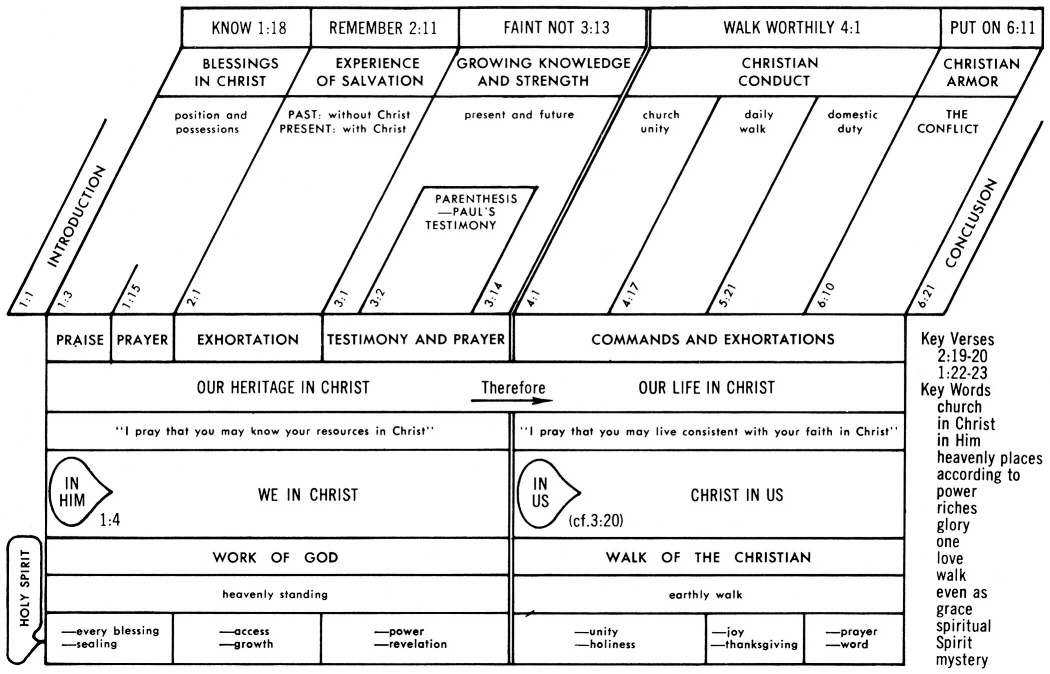
EPHESIANS - CHRIST AND THE CHURCH
Click chart to enlarge
Charts from Jensen's Survey of the NT - used by permission
Ephesians 1:18 I pray that the eyes of your heart may be enlightened, so that you will know what is the hope of His calling, what are the riches of the glory of His inheritance in the saints (NASB: Lockman)
Greek: pephotismenous (RPPMPA) tous ophthalmous tes kardias [humon] eis to eidenai (RAN) humas tis estin (PAI) e elpis tes kleseos autou, tis o ploutos tes doxes tes kleronomias autou en tois hagiois,
BGT πεφωτισμένους τοὺς ὀφθαλμοὺς τῆς καρδίας [ὑμῶν] εἰς τὸ εἰδέναι ὑμᾶς τίς ἐστιν ἡ ἐλπὶς τῆς κλήσεως αὐτοῦ, τίς ὁ πλοῦτος τῆς δόξης τῆς κληρονομίας αὐτοῦ ἐν τοῖς ἁγίοις,
Amplified: By having the eyes of your heart flooded with light, so that you can know and understand the hope to which He has called you, and how rich is His glorious inheritance in the saints (His set-apart ones), (Amplified Bible - Lockman)
ESV having the eyes of your hearts enlightened, that you may know what is the hope to which he has called you, what are the riches of his glorious inheritance in the saints,
KJV The eyes of your understanding being enlightened; that ye may know what is the hope of his calling, and what the riches of the glory of his inheritance in the saints,
NET – since the eyes of your heart have been enlightened– so that you may know what is the hope of his calling, what is the wealth of his glorious inheritance in the saints,
NIV I pray also that the eyes of your heart may be enlightened in order that you may know the hope to which he has called you, the riches of his glorious inheritance in the saints,
NLT (revised) I pray that your hearts will be flooded with light so that you can understand the confident hope he has given to those he called-- his holy people who are his rich and glorious inheritance.
NLT: I pray that your hearts will be flooded with light so that you can understand the wonderful future He has promised to those He called. I want you to realize what a rich and glorious inheritance He has given to his people. (NLT - Tyndale House)
Phillips: that you may receive that inner illumination of the spirit which will make you realise how great is the hope to which He is calling you - the magnificence and splendour of the inheritance promised to Christians - (Phillips: Touchstone)
Wuest: the eyes of your heart being in an enlightened state with a view to your knowing what is the hope of His calling, what is the wealth of the glory of His inheritance in the saints, (Eerdmans Publishing - used by permission)
Young's Literal: the eyes of your understanding being enlightened, for your knowing what is the hope of His calling, and what the riches of the glory of His inheritance in the saints
I PRAY THAT THE EYES OF YOUR HEART MAY BE ENLIGHTENED: pephotismenous (RPPMPA) tous ophthalmous tes kardias [humon] :
- the eyes of your heart - 1Pe 5:8; Ps 119:18; Isa 6:10; Isa 29:10,18; Isa 32:3; Isa 42:7; Mt 13:15; Lk 24:45; Acts 16:14; Acts 26:18; 2Cor 4:4,6; Heb 10:32
Related Passages:
Psalms 119:18 Open my eyes, that I may behold Wonderful things from Your law.
Luke 24:45 Then He (JESUS) opened (dianoigo) their minds (nous) to understand the Scriptures,
Acts 16:14 A woman named Lydia, from the city of Thyatira, a seller of purple fabrics, a worshiper of God, was listening; and the Lord opened (dianoigo) her heart to respond to the things spoken by Paul.
2 Corinthians 4:6 For God, Who said, “Light shall shine out of darkness,” (Ge 1:2-3-commentary) is the One who has shone in our hearts to give the Light of the knowledge of the glory of God in the face of Christ.
COMMENT - Note how Paul associates our New Creation in Christ (2Co 5:17) with the creation of the heavens and the earth. I submit that this argues strongly against so-called evolution in the first creation, as it was certainly not necessary in the second (new birth) creation. God miraculously did them both simply by speaking the Word of Truth as Hebrews 11:3 testifies. Believe or not!
Acts 26:18 to open their eyes so that they may turn from darkness to light and from the dominion of Satan to God, that they may receive forgiveness of sins and an inheritance among those who have been sanctified by faith in Me.’
Hebrews 10:32 But remember (present imperative see our need to depend on the Holy Spirit to obey) the former days, when, after being enlightened, you endured a great conflict of sufferings,
1 Peter 2:9 But you are A CHOSEN RACE, A royal PRIESTHOOD, A HOLY NATION, A PEOPLE FOR God’s OWN POSSESSION, so that you may proclaim the excellencies of Him who has called you out of darkness into His marvelous light;
2 Kings 6:17 Then Elisha prayed and said, “O LORD, I pray, open his eyes that he may see.” And the LORD opened the servant’s eyes and he saw; and behold, the mountain was full of horses and chariots of fire all around Elisha.
Proverbs 20:27 The spirit of man is the lamp of the LORD, Searching all the innermost parts of his being.
Psalm 13:3 Consider and answer me, O LORD my God; Enlighten my eyes, or I will sleep the sleep of death,
Psalm 18:28 For You light my lamp; The LORD my God illumines my darkness.
Psalms 119:130 The unfolding of Your words gives light; It gives understanding to the simple.
Ezra 9:8 “But now for a brief moment grace has been shown from the LORD our God, to leave us an escaped remnant and to give us a peg in His holy place, that our God may enlighten our eyes and grant us a little reviving in our bondage.
A PLEA FOR
SPIRITUAL VISION
I pray that the eyes of your heart may be enlightened - Physical eyes (or ears) cannot see (hear) these deeper truths. They must be revealed and as John MacArthur says "They are revealed only to those who love Him." (Ephesians Commentary)
THOUGHT - MacArthur's comment makes "sense" because if you love Him, you will obey Him (Jn 14:15) and (Spirit enabled) obedience to Him opens the "windows of heaven" to have spiritual blessings poured out (in this case enlightenment) from Him. Too many Christians are going hither and yon looking for more blessings, more secrets of how to live a victorious Christian life, etc. Paul would say "STOP IT!" Camp out here in a letter that begins with "every spiritual blessing in the heavenly in Christ." (Eph 1:3). Meditate on the truths in Ephesians Chapter One. Memorize them which will facilitate "meditation on the fly" (when you don't have your Bible open, but you do have the text written on the "tablet" of your heart). Pray Ephesians 1:17-19 (and other Pauline prayers). Practice these truths enabled by the Holy Spirit. The eyes of your heart will be enlightened!
MacArthur makes an interesting assessment commenting that "One cause of immaturity in the church at Corinth was reliance on feelings above knowledge. Many believers were more interested in doing what felt right than in doing what God declared to be right....Instead of their emotions being controlled by God’s truth, their emotions distorted their understanding of His truth. (cf 2Co 6:11-13)(Ephesians Commentary)
Note that while most versions render this as a prayer for "enlightenment," the fact is that Paul uses the perfect tense for photizo which describes them as having been enlightened in the past with continuing effect. With that thought in mind a more accurate rendering is that of Wuest who has "the eyes of your heart being in an enlightened state with a view to your knowing what is the hope of His calling." The NET Bible is similar translating it ""since the eyes of your heart have been enlightened". The ESV also picks up the perfect tense rendering it "having the eyes of your hearts enlightened," which also describes a past completed action. The literal rendering is "the eyes of your understanding being enlightened." So what are we saying? Paul is still praying for them to "know" (a Spirit enabled, beyond a shadow of a doubt knowing) about their hope, the inheritance and the power. He wants them to fully grasp the nature of all three aspects of their salvation. So even though many of the translations are not perfectly accurate to the Gree, they all retain the essence of Paul's desire for the saints to "know" these three things beyond a shadow of a doubt. Are you confused now?
NET NOTE - The perfect participle pephotismenous (ENLIGHTENED) may either be part of the prayer ("that the eyes of your heart may be enlightened") or part of the basis of the prayer ("since the eyes of your heart have been enlightened"). Although the participle follows the hina of Eph 1:17, it is awkward grammatically in the clause. Further, perfect adverbial participles are usually causal in NT Greek. Finally, the context both here and throughout Ephesians seems to emphasize the motif of light as a property belonging to believers. Thus, it seems that the author is saying, "I know that you are saved, that you have had the blinders of the devil removed; because of this, I can now pray that you will fully understand and see the light of God's glorious revelation." Hence, the translation takes the participle to form a part of the basis for the prayer.
Harold Hoehner points out that "The NEB, NASB, and NIV state another request: I pray also that the eyes of your heart may be enlightened. However, this is not a new sentence in Greek. It seems to be parenthetical, as in the KJV, ASV, and RSV (ED: NRSV = "so that, with the eyes of your heart enlightened"). In other words, Paul had prayed (Eph 1:17) that they might have true spiritual insight into God, and then he included the phrase, “having the eyes of your heart enlightened” (RSV). Paul’s request for them to know God was within proper bounds because their hearts had been enlightened (the Greek perfect tense indicates past action with continuing results), as discussed in verses 3–14, especially Eph 1:7–9 (previous note from Hoehner's discussion in Bible Knowledge Commentary) (Ed Note: Hoehner goes into greater detail regarding six ways this passage could be taken in his Ephesians: An Exegetical Commentary)
Lehman Strauss - The prayer continues: “The eyes of your understanding being enlightened” (1:18). The American Standard Version reads: “the eyes of your heart,” not mind. The “heart” is the inner man, including the emotion and will; it is the whole self, man’s inward being. This marvelous faculty of spiritual sight is lacking in the unregenerated man. He is powerless to apprehend spiritual things. “But the natural man receiveth not the things of the Spirit of God; for they are foolishness unto him: neither can he know them, because they are spiritually discerned” (1Cor. 2:14). Now the eyes of the believer’s heart must be continually taken up with his Lord in order that his knowledge of spiritual truth might increase. (Lehman Strauss Commentary – Devotional Studies on Paul's Letters to the Galatians and Ephesians - online)
Mal Couch - While this is Paul’s great desire, that believers truly have a deep spiritual understanding about their relationship with the Lord, this is rarely achieved by the average Christian. The world gets in the way, sin does its dirty deed, and carnality and strife and bitterness can rule. But what a high and lofty ideal the apostle sets forth. He wishes this knowledge of God would impact the minds and hearts of every child of God. (Twenty-First Century Biblical Commentary)
MacDonald - We have seen that the source of spiritual illumination is God; the channel is the Holy Spirit; and the supreme subject is the full knowledge of God. (Believer's Bible Commentary)
THOUGHT - Beloved, there is a powerful principle taught in this section. Did you see it? "That you will know..." Recall Paul's pronouncement of truth in Colossians 1:27 that believers (Jews and Gentiles) now have Christ in them and that this is their hope of glory. Here Paul in effect prays that they would come to a beyond the shadow of a doubt knowledge of the hope of their calling, God's inheritance in them and their power. The principle is that we should pray for the promises of God to be realized in our hearts (cf 2Pe 1:4) Only the Spirit can reveal spiritual truth. Are you praying the promises of God for yourself and your family and the body of Christ? Don't miss out on this "once in a lifetime" opportunity!
Those for whom Paul is praying were once "spiritually blind" darkened in their understanding, (Eph 4:18) walking around in "spiritual darkness" as he reminded them of later writing that "you were formerly darkness, but now you are light in the Lord; walk as children of light (Eph 5:8)
Wiersbe - In the prison prayers of Paul (Eph. 1:15–23; 3:14–21; Phil. 1:9–11; Col. 1:9–12), we discover the blessings he wanted his converts to enjoy. In none of these prayers does Paul request material things. His emphasis is on spiritual perception and real Christian character. He does not ask God to give them what they do not have, but rather prays that God will reveal to them what they already have.
Lawrence Richards has a pithy comment stating that "One way to build our own prayer lives, and to direct our intercession for others, is to model our prayers on those found in Scripture. Here we see a prayer Paul offered with the intention of strengthening Christ’s church. What did Paul ask? That we might know God better (Ep 1:17). That we might look beyond appearances, to see the church as God does—a people transformed to display His glory, unspeakably precious to Him (Ep 1:18). That we might sense and experience the working of “His incomparably great power for us who believe” (Ep 1:19a). I suppose it’s all right to pray for that addition to a new Sunday School wing. Or the funds to go on the radio. But if we want our church to truly be the church, the things Paul prayed for here are vastly more important. (The 365 Day Devotional Commentary)
Eyes (3788) (ophthalmos) is literally the organ of vision but in Paul's use is obviously figurative. It is a beautiful picture, the heart being regarded as having eyes looking out toward God and all of the spiritual blessings that have their source and supply in God's Beloved Son. Proper understanding of spiritual truth is not dependent on having a keen intellect but rather a tender heart!
THOUGHT - Is your heart tender to the Word of God? Do you hunger and thirst for God as a deer does for the water brooks? (cf Ps 42:1, Mt 5:6, 1Pe 2:2)
Paul is praying for a deeper spiritual understanding, that "Aha" reaction we have when we begin to really understand something and exclaim "I see it! I finally see what you’re telling me, Lord!" That's what Paul is praying for here. Why? Why would he be praying for this "Aha" enlightenment? Remember that the first three chapters are doctrine but the last three are "duty," calling for a walk "in step" with the doctrinal truths. Paul knows that as a man thinks in his heart, his spiritual interior, will determine how he walks (cf Pr 23:7). And so he prays that these saints might be able to grasp the breadth and length and height and depth (Eph 3:18) of the great truths in chapter one, so that they might be enabled by the indwelling Spirit and the riches of God's grace (DOCTRINAL TRUTH IN CHAPTERS 1-3) to order their steps so that they "walk in a manner worthy of the calling with which you have been called." (Eph 4:1).
The psalmist understood that the supernatural Word of God was unlike any writing of man and thus pleaded with God to...
Open (Hebrew galah = Piel stem always denotes "to uncover" something which otherwise is normally concealed. LXX translates with apokalupto from apó = from + kalúpto = cover, conceal which means literally to uncover and so to remove the veil or covering exposing to open view what was before hidden. The Greek tense is aorist imperative which speaks in context of a request in the form of a command and speaks of urgency and need) my eyes, that I may behold (careful, sustained, and favorable contemplation - LXX translates with katanoeo from kata = down + noeo is literally to the the mind down on and speaks of giving very careful consideration to some matter, think about very carefully, consider closely. observe fully, consider attentively denotes action of mind apprehending certain facts about a thing) wonderful (amazing, astounding, marvelous, extraordinary or even difficult - things beyond human capability) things from Thy law. (Psalm 119:18-see commentary or related commentary)
THOUGHT: When you open your Bible, ask the Author to open your heart!
Heart (2588) (kardia) is most often used in the Bible not of the literal organ that circulates blood in our body. Most uses are figurative. Even the ancients considered the heart to be the very center of a person -- the center of knowledge, understanding, thinking, wisdom. The heart the seat of the mind and will, and the heart could be taught what the brain could never know (or sadly the converse to know something intellectually but not in one's heart!) The "heart" in Scripture speaks of the very center and core of one's life, the seat of thoughts and moral judgments. The heart is the seat of emotions in some cultures, but in the Greek culture it was not. In the Greek culture the seat of emotions would be the intestines. The heart was the seat of understanding. In Ephesians 1:18 the Greek word for heart is singular so that Paul is praying for each individual person's heart!
Kardia in Ephesians - Eph. 1:18; Eph. 3:17 = so that Christ may dwell in your hearts through faith; Eph. 4:18 = hardness of heart; Eph. 5:19 = making melody with your heart to the Lord; Eph. 6:5 = in the sincerity of your heart, as to Christ;; Eph. 6:22 = that he may comfort your hearts.
This deep, interior "cardiac" enlightenment is clearly the result of the work of the Holy Spirit Who leads the believer to know (eido) intuitively all that God has made available to him in Christ (cf Jesus' promise to the disciples - Jn 16:13, cp 1Jn 2:20, 28, 1Cor 2:10-13, 15-16), and in essence to come to understand what it means to be "in Christ" or "in Him". The saints knew to a degree what the concept of being " in Christ" meant but not in a deep intuitive way. That is what Paul desires for them and for all believers. And given the fact that the truth of "in Christ" is transcendent, we should always pray this prayer for ourselves and others (remember that Eph 1:16 "making mention" is present tense = continuously) and of course the only way we can possibly "pray without ceasing" (1Th 5:17) is by the Spirit's enabling power.
To say it another way, Paul prayed that believers would know the hope, inheritance and power not in their head but in their hearts, the very essence of their being. When we know them in the head and not the heart, we are simply "smarter sinners" but when we know them in our heart, we will become more like our Savior.
TECHNICAL NOTE - Note that the KJV translated from the Greek Textus Receptus (the NASB, ESV, et al are from the Nestle-Aland Greek) does not have "heart" (kardia) but has the word "understanding" which in the is the noun dianoia an old word for the faculty of understanding. It speaks of a clarity of mind or understanding by which one is able to see things intelligibly and clearly and proceed accordingly. Virtually all the authorities agree that "heart" is the correct translation.
An almost identical prayer is recorded by Clement of Rome (written between 75-110 AD, cf to Ephesians 60-62 AD) asking God to “open the eyes of our heart to know you.” (Also a good prayer!)
Enlightened (5461) (photizo from phos = light) means to cause light to shine upon some object, in the sense of illuminating it. To give light to, to illuminate. It means to make known in reference to the inner life or transcendent matters and thus shed light upon. The idea is to cause something to be fully known by revealing clearly and in some detail. Figuratively, as used in this verse, photizo means to make clear, to cause to fully know or to cause to understand and is used of God's enlightenment through revelation. This effect in context undoubtedly refers to the ministry of the Holy Spirit Who illuminates spiritual truth to the hearts of believers (See Illumination of the Bible). The passive voice indicates that this action is performed on the subject by an outside source, clearly implying the work of the Holy Spirit (aka divine passive). The perfect tense speaks of an enlightenment that has occurred at a point in time and which persists. Paul says this enlightenment is abiding and permanent state (See previous note on what this means regarding the translation).
Photizo - 11v - Lk. 11:36; Jn. 1:9; 1 Co. 4:5; Eph. 1:18; Eph. 3:9 = "and to bring to light what is the administration of the mystery"; 2 Tim. 1:10; Heb. 6:4; Heb. 10:32; Rev. 18:1; Rev. 21:23; Rev. 22:5
It is interesting to note that photizo (enlightened) was used by the pagan Mystery religions as a technical term for the rite of initiation into their inner secrets! (See Paul and the Mystery Religions and What were the mystery religions?) They worship a lie (as do all cults who have exchanged the truth of God for the lie of Satan - cf Ro 1:25).
THOUGHT - Believers in Christ are privileged to worship the Truth personified and consummated in Christ Jesus! May His Spirit enable us to worship Him Monday - Saturday (not just on Sunday) in spirit and in truth. Amen
Luke used ophthalmos figuratively in recording Christ's charge to Paul that He was sending him to the Gentiles...
to open (anoigo) their eyes so that they may turn (epistrepho) from darkness (cf "prince of the power of the air" in Eph 2:2) to light (cf Col 1:13, 14) and from the dominion of Satan to God, in order that they may receive forgiveness (sending away) of sins and an inheritance (for which they were predestined before the foundation of the world, Ep 1:5) among those who have been sanctified (set apart - here referring to the initial act of belief although more commonly in NT referring to the ongoing day to day salvation of the believer = sanctification, which is also by faith) by faith in Me. (Acts 26:18)
Robert Morgan illustrates the truth in this verse with the following story - Recently when my CD player died, I asked a friend to look at it. “I think the needle is broken,” I told him. “CD players don’t have needles,” he said, laughing. “They use laser beams to read songs encoded on the disk. The eye on yours is dusty.” He cleaned it and the problems disappeared. In his prayer for the Ephesians, Paul asked God to enlighten their eyes so they could better understand the message encoded in His Word. (Nelson's Annual Preacher's Sourcebook, 2002 Edition)
Robert Gundry - The heart was considered an organ of knowing as well as of feeling. So that Paul portrays the heart as having eyes to see and by seeing to gain knowledge. “Having been enlightened” rests on the observation that you can’t see in the dark and implies that the addressees used to live in mental darkness but that at conversion they were transferred into the realm of mental light, so that now they can see what the Spirit reveals to them (Eph 4:17–18; Eph 5:8; Colossians 1:13). (Commentary on the New Testament:)
Warren Wiersbe - First, enlightenment comes from the Holy Spirit. He is the “Spirit of wisdom and revelation” (Isa. 11:2; John 14:25–26; 16:12–14). With his natural mind, man cannot understand the things of God. He needs the Spirit to enlighten him (1 Cor. 2:9–16). The Holy Spirit reveals truth to us from the Word, and then gives us the wisdom to understand and apply it. He also gives us the power—the enablement—to practice the truth (Eph. 3:14–21). Second, this enlightenment comes to the heart of the believer (Eph. 1:18) (ED: I WOULD SAY THIS IS ALSO THE WORK OF THE HOLY SPIRIT). Literally this verse reads, “The eyes of your heart being enlightened.” We think of the heart as the emotional part of man, but in the Bible, the heart means the inner man, and includes the emotions, the mind, and the will. The inner man, the heart, has spiritual faculties that parallel the physical senses. The inner man can see (Ps. 119:18; John 3:3), hear (Mt. 13:9; Heb 5:11), taste (Ps. 34:8; 1Pe 2:3), smell (Phil. 4:18; 2Co 2:14), and touch (Acts 17:27). This is what Jesus meant when He said of the people: “They seeing see not, and hearing they hear not” (Mt 13:13). The inability to see and understand spiritual things is not the fault of the intelligence but of the heart. The eyes of the heart must be opened by the Spirit of God. (Ephesians Through Revelation)
NET NOTE has an interesting comment that a paraphrase reads "Since you are enlightened by God’s Spirit, I pray that you may comprehend the hope to which he has called you, the spiritual riches that await the saints in glory, and the spiritual power that is available to the saints now.” Thus, the prayer focuses on all three temporal aspects of our salvation as these are embedded in the genitives—the past (calling), the future (inheritance), and the present (power toward us who believe).
Craig Evans - Old Testament prayers commonly asked for opening one’s eyes, particularly to God’s Word (Ps. 119:18) or other spiritual realities (2 Kings 6:17). A certain rabbi, Bar Kappara, said, “The soul and the Torah are compared to a lamp. The soul, as is written, The soul of man is the lamp of the Lord (Prov. 20:27)” (Deut. Rab. 4.4 [on Deut. 11:22]). Cf. Rom. 3:1. This expression was often used metaphorically for faith (Pss. 13:3; Ezra 9:8; Barn. 1.12; Odes Sol. 11.14; 4 Ezra 14:22; 1QS 2:3; 4:2). In later Christianity this enlightening was equated with baptism (cf. Odes Sol. 15.1–10; Sib. Or. 8.247; Justin Martyr, Apology 1.61.12; Dial 39.2; 122.1; cf. 1 Clem. 36.2; 59.3). A blessing found at Qumran reads, “May He illuminate your heart with the discernment of life and grace you with eternal knowledge” (1QS 2:3; cf. 1QS 11:3–6). (Bible Knowledge Background Commentary)
SO THAT YOU WILL KNOW WHAT IS THE HOPE OF HIS CALLING: to eidenai (RAN) humas tis estin (PAI) e elpis tes kleseos autou:
- What is the hope - Eph 2:12; 4:4; Ro 5:4-5; Ro 8:24-25; Gal 5:5; Col 1:5,23; 1Th 5:8; 2Th 2:16; Titus 2:13; 3:7; 1Pe 1:3; 1Jn 3:1, 2, 3)
- His calling Eph 4:1; Ro 8:28-29, 30; Phil 3:14; Col 3:15; 1Th 2:12; 2Th 1:11; 1Ti 6:12; 1Pe 3:9; 5:10
Related Passages:
Romans 5:4-5 and perseverance, proven character; and proven character, hope; 5 and hope does not disappoint, because the love of God has been poured out within our hearts through the Holy Spirit who was given to us.
Romans 8:24-25 For in hope we have been saved, but hope that is seen is not hope; for who hopes for what he already sees? 25 But if we hope for what we do not see, with perseverance we wait eagerly for it.
Galatians 5:5 For we through the Spirit, by faith, are waiting for the hope of righteousness.
Colossians 1:5; 23 because of the hope laid up for you in heaven, of which you previously heard in the word of truth, the gospel (1:23) if indeed you continue in the faith firmly established and steadfast, and not moved away from the hope of the gospel that you have heard, which was proclaimed in all creation under heaven, and of which I, Paul, was made a minister.
1 Thessalonians 5:8 But since we are of the day, let us be sober, having put on the breastplate of faith and love, and as a helmet, the hope of salvation.
2 Thessalonians 2:16 Now may our Lord Jesus Christ Himself and God our Father, who has loved us and given us eternal comfort and good hope by grace,
Romans 8:28-30 And we know that God causes all things to work together for good to those who love God, to those who are called according to His purpose. 29 For those whom He foreknew, He also predestined to become conformed to the image of His Son, so that He would be the firstborn among many brethren; 30 and these whom He predestined, He also called; and these whom He called, He also justified; and these whom He justified, He also glorified.
Ephesians 4:1 Therefore I, the prisoner of the Lord, implore you to walk in a manner worthy of the calling with which you have been called,
Philippians 3:14 I press on toward the goal for the prize of the upward call of God in Christ Jesus.
Colossians 3:15 Let the peace of Christ rule in your hearts, to which indeed you were called in one body; and be thankful.
1 Thessalonians 2:12 (1Th 2:10-11) so that you would walk in a manner worthy of the God Who calls you into His own kingdom and glory.
2 Thessalonians 1:11 To this end also we pray for you always, that our God will count you worthy of your calling, and fulfill every desire for goodness and the work of faith with power,
1 Timothy 6:12 Fight the good fight of faith; take hold of the eternal life to which you were called, and you made the good confession in the presence of many witnesses.
1 Peter 3:9 not returning evil for evil or insult for insult, but giving a blessing instead; for you were called for the very purpose that you might inherit a blessing.
1 Peter 5:10 After you have suffered for a little while, the God of all grace, who called you to His eternal glory in Christ, will Himself perfect, confirm, strengthen and establish you.
A HOPE FILLED
CALLING
So that you will know what is the hope of His calling - The purpose was that might be supernaturally enabled to know beyond a shadow of a doubt that their calling (their salvation that had occurred in the past) gave them a hope sure not a hope so.
So that (1519) (eis) conveys the primary idea of motion into any place or thing figuratively as here speaks of the purpose for the Ephesian saints having been enlightened. It is only as God's Spirit illuminates our mind that we actually can truly know the spiritual truth He wants us to know. See discussion of the value of pausing to ponder this term of purpose or result .
THOUGHT - As an aside, remember to pause, ponder and practice interrogating each term of purpose like so that asking questions such as "What is Paul explaining?", etc (See 5W/H questions). This simple discipline will serve to slow you down and allow you to more actively engage the text which facilitates more effective interaction with your Teacher the Spirit, the Author of the text! And as you pause to ponder, you are in effect beginning to practice the blessed discipline of Biblical Meditation.
Paul is praying for the Ephesians to be able to supernaturally grasp the truths in Ephesians 1:3-14 where we see that saints are (1) chosen (Eph 1:4), (2) predestined (Eph 1:5,, Eph 1:11), (3) adopted as sons (Eph 1:5), (4) accepted in the Beloved (Eph 1:6 - see article Accepted in the Beloved), (5) redeemed through His blood (Ephesians 1:7), (6) forgiven (Eph 1:7), (7) sealed with the Holy Spirit (Ep 1:13) and (8) given the earnest of our inheritance (Ep 1:14). In addition to a holy calling, saints also have a high ("upward") calling (Php 3:14) and a heavenly calling (Heb 3:1). Paul desires that they truly know these magnificent, priceless truths! He knows that future hope has the potential to motivate us to present obedience.
John MacArthur makes the excellent, Biblically logical point that "Until we comprehend who we truly are in Jesus Christ, it is impossible to live an obedient and fulfilling life. Only when we know who we really are can we live like who we are. Only when we come to understand how our lives are anchored in eternity (Heb 6:18-19) can we have the right perspective and motivation for living in time (1Jn 3:2-3). Only when we come to understand our heavenly citizenship can we live obedient and productive lives as godly citizens on earth (Php 3:20-21).....It is truth too magnificent for words to describe, which is why even God’s own revelation requires the illumination of His Spirit in order for believers even to begin to understand the marvelous magnitude of the blessings of salvation that exist in the sphere of the saints..... There is nothing more to seek, nothing more to be given or received. We have it all now, and we will have it throughout eternity." (see Ephesians MacArthur New Testament Commentary) (Bolding added)
Know (1492) (eido, oida - eido is used only in the perfect tense = oida) means in general to know by perception. It means denotes knowledge that is generally accepted, axiomatic, or intuitive. It does not require searching inquiry or scientific demonstration. It is self evident. Eido/oida is not so much that which is known by experience as an intuitive insight that is drilled into one's heart. Eido/oida is a perception, a being aware of, an understanding, an intuitive knowledge which in the case of believers can only be given by the Holy Spirit.
Eido/oida is distinguished from ginosko (epiginosko, epignosis - the other major NT word group for knowing) because ginosko generally refers to knowledge obtained by experience or "experiential knowledge". On the other hand, eido/oida often refers more to an intuitive knowledge, although this distinction is not always clear cut. Literally eido/oida refers to perception by sight (perceive, see) as in Mt 2:2 "Where is He who has been born King of the Jews? For we saw (eido) His star in the east, and have come to worship Him." In sum, for believers eido/oida suggests Spirit given fullness of knowledge, absolute knowledge (that which is without a doubt), rather than a progress in knowledge (cp ginosko) a distinction illustrated in the following passages.
Paul writes to the believers at Rome asking "Or do you not know (eido) what the Scripture says in the passage about Elijah, how he pleads with God against Israel?" (Ro 11:2)
Jesus is speaking to unbelieving Jews about His Father in Jn 8:54, and declares to these Jews that) "you have not come to know (ginosko) Him (GOD THE FATHER), but I know (eido - BEYOND A SHADOW OF A DOUBT) Him; and if I say that I do not know (eido) Him, I shall be a liar like you, but I do know (eido) Him, and keep His word. (John 8:55)
Vine comments - Eido/oida, to know, suggests intelligent perception, in contrast to ginōskō which indicates progressive knowledge. The contrast between the two verbs is illustrated in John 8:55, “Ye have not known Him [ginōskō, “you have not entered upon the knowledge”]: but I know Him” (oida, that is, I have perfect knowledge of Him).
Jesus answered and said to him (to Peter who was a bit "put off" that Jesus was preparing to wash his dirty feet!), "What I do you do not realize (eido - know beyond a shadow of a doubt) now, but you shall understand (ginosko - understand by your experience) hereafter. (John 13:7)
TECHNICAL Note that it is somewhat difficult to give a crisp, succinct definition of eido, so keep that caveat in mind as you read these notes. The uses of eido will not be listed because of the large number (656 hits in 619 verses searching on Strong's Number in the NT - if you want to see these uses CLICK HERE and go down to the "Frequency Lists" and you can study the uses in different translations book by book).
Eido was found in the Greek secular writings to describe a theory or hypothesis which had been confirmed.
Here is an example of a use of eido that illustrates the meaning...
But in order that you may know (eido) that the Son of Man has authority on earth to forgive sins-- He said to the paralytic--I say to you, rise, take up your pallet and go home. (Mark 2:10-11)
Comment: Here they would see and they would know beyond a shadow of a doubt about Jesus' authority.
Here is another use of eido, John writing that...
These things I have written to you who believe in the name of the Son of God, in order that (purpose clause - ask "What purpose?") you may know (eido) that you have eternal life. (1Jn 5:13)
Comment: A T Robertson writes that eido means "to know with settled intuitive knowledge. He wishes them to have eternal life in Christ [John 20:31] and to know that they have it...."
Now back to Paul's prayer, the point is that when the Holy Spirit opens the spiritual eyes of the heart of Paul's readers, they will be able to perceive and to know these great truths intuitively with a positive knowledge beyond a chance of a doubt. Note that all three clauses (hope, inheritance, power) are linked to the verb "will know". This earnest prayer reveals the infinite importance of knowledge as a foundation for walking worthy in this Christian life. Compare Peter's opening blessing for his readers in his second epistle...
Grace and peace be multiplied to you in the knowledge (epignosis) of God and of Jesus our Lord 3 seeing that His divine power has granted to us everything pertaining to life and godliness, through the true knowledge (epignosis) of Him Who called us by His own glory and excellence. 4 For by these He has granted to us His precious and magnificent promises, in order that by them you might become partakers of the divine nature, having escaped the corruption that is in the world by lust. (2Pe 1:2-4-notes 2Peter 1:2; 1:3; 1:4)
Here in Ephesians Paul first prays for God to grant them a true experiential knowledge (epignosis) of God (Eph 1:17) and then in Ephesians 1:18 appeals to God to illuminate their tender hearts, the very core of their being, with an intuitive, beyond a chance of doubt knowledge (eido) on three specific issues - hope, riches of His inheritance and power. Why? For as a man thinketh in his heart, so is he.
Lehman Strauss - Paul requests for the saints the spirit of wisdom and revelation in the knowledge of Christ that they might know three things:(1) “The hope of His calling.” God has called us, but to what purpose? He has called us to perfection in the likeness of Jesus Christ (Rom. 8:29; I John 3:1-2). He has called us to a completed righteousness and to the completed redemption of our bodies. He does not call a believer to hope for the forgiveness of his sins: they are gone. The hope of His calling is to see Him and be one with Him. One day our Lord will come again, and we shall all be changed to see Him as He is and to be like Him. Such a glorious hope inspires to holy living and to a hatred of all that is of this world. “Every man that hath this hope in Him purifieth himself, even as He is pure” (I John 3:3). All Christians have the same hope. It is Christ’s coming to take His own to be with Himself. (Lehman Strauss Commentary – Devotional Studies on Paul's Letters to the Galatians and Ephesians - online)
What (5101) (tis) is singular in contrast to the next clause regarding "riches" which is introduced with "what are" which is plural.
Is (2076) is the present tense of eimi = to be, and so conveys the idea "what is continually the hope...."
Hope (1680) (elpis) (See also study on Believer's Blessed Hope) expresses a desire of some good with the expectation of obtaining it. Hope in Scripture is the absolute certainty of future good. Not "I hope so" but strong confidence that God is going to do good to us in future. It is an expectation or confidence. Paul says that hope ultimately is a person "Christ Jesus...our hope" (1Timothy 1:1, cp Col 1:27).
Hoehner adds this description on elpis - In Greek thought hope consists merely of a consoling dream of the imagination designed to forget the present troubles but yet leaving one with many uncertainties. On the other hand, in the OT the hope of the righteous is directed toward the eternal God who will protect and ultimately deliver if not now, certainly in the future. The NT’s concept of hope is built on the OT and has the elements of expectation, a trust in God, and the patient waiting for God’s outworking of his plan. The ultimate hope for Christians is to be with their Lord (Rom 5:4–5; 8:20, 24–25; 12:12; 15:13; Gal 5:5; Col 1:5; Titus 1:2) and they eagerly wait for his coming, unlike the heathen who have no hope (Eph 2:12; 1 Thess 4:13–18; 5:8; Titus 2:13; 1 John 3:3). Hope in the present context is not the objective hope, that hope which is laid up for the believer (Col 1:5; Rom 8:24) but the subjective hope of all believers. One needs to realize that subjective hope is based on objective hope, a hope that looks back to God’s work of redemption in 1:3–14, especially in 1:9–10 where Paul relates that all things are going to be headed up in Christ. Nevertheless, in this verse Paul is referring to the subjective hope. Hope for believers is not the world’s wishful thinking, but the absolute certainty that God will make true what he has promised. (Ephesians: An Exegetical Commentary)
Christians are not like the Gentiles who have no hope (Eph 2:12), but are those who have hope or firm assurance (cf "full assurance of hope" Heb 6:11) that God will do good to us in the future because Christ has purchased salvation for us on the Cross in the past (see notes below on Ro 5:1-2), sanctifies them through His Spirit in the present (Gal 5:16-25), and will lead them to glory in the future (Col 1:27; 1Jn 3:2,3 ).
As stated above, because of Christ's work for us on the Cross means that in light of the truth that believers have "been justified (declared righteous or in right standing before God, acquitted of our sins) by faith, we have peace with God (cf peace "of" God in Php 4:6-7 where peace depends on how we respond to our circumstances, testings, etc, and if we do by walking in the Spirit as commanded in Gal 5:16, He gives us peace of God, the fruit of the Spirit, Gal 5:22) through our Lord Jesus Christ, through Whom also we have obtained our introduction by faith into this grace in which we stand (perfect tense speaks of the permanence or abiding nature of this condition) and we exult (continually boast, rejoice) in hope of the glory of God ( = when we see Jesus face to face - 1Jn 3:2-3)." (See Ro 5:1, 2)
Comment: The firm assurance or hope that believers have in this life is the return of Jesus Christ in glory to take them home into His presence and give them glorified bodies like His.
Paul's prayer that they come to intuitively, absolutely know the hope of their calling is in marked contrast to their former state as idol worshipping pagans who were without "hope and without God in the world." (Eph 2:12)
Hope gives us the assurance that we are going toward something better than this present life. Knowing with absolute certainty where we are going should give believers the confidence to live as more than conquerors now (Ro 8:37).
My hope is built on nothing less
Than Jesus’ blood and righteousness;
I dare not trust the sweetest frame,
But wholly lean on Jesus’ name.
On Christ, the solid Rock, I stand;
All other ground is sinking sand.
(play "The Solid Rock")
Latter in Ephesians, Paul reminded the Gentile believers that in Christ they "were called in one hope of your calling (Eph 4:4)
Comment: The fact that Paul qualifies this "hope" as "one hope" emphasizes that there is the same ultimate, glorious reality for all of the church, whether Jew or Gentile! Paul wants to make certain that both Jewish and Gentile believers fully understand that there is to be no differentiation between believers. This expectation of seeing Jesus, our "Blessed Hope" [see below] and being like Him is entertained equally by both Jewish and Gentile believers. All members of the true church are called to the one destiny of being taken out of this world, being like Christ [1John 3:2], and sharing His glory forever.
The hope of our calling is the absolute certainty of our heavenly destiny and includes all that awaits the saints at the return of the Lord Jesus and is what Paul referred to by the phrase the "Blessed hope" writing in Titus that...
the grace of God has appeared, bringing salvation to all men, instructing us to deny ungodliness and worldly desires and to live sensibly, righteously and godly in the present age, looking (not just any kind of looking but looking anxiously, eagerly, earnestly, expectantly) for the blessed hope and the appearing of the glory of our great God and Savior, Christ Jesus Who gave Himself for us, that He might redeem us from every lawless deed and purify for Himself a people for His own possession, zealous for good deeds. (Titus 2:11-14-See notes Titus 2:11; 2:12; 2:13; 2:14)
Comment: "The Blessed Hope" is not an abstract concept, but an Alive Christ, for it describes the appearing of Christ in His majesty and glory at His Second Coming.
In a similar way Peter encouraged his afflicted and persecuted readers with the assurance of their "hope" writing...
Blessed be the God and Father of our Lord Jesus Christ, who according to His great mercy has caused us to be born again to a living hope (living because of the resurrection of Christ Who ultimately is our "Hope" as Paul states in 1Timothy 1:1 "Christ Jesus, our hope") through the resurrection of Jesus Christ from the dead, to obtain an inheritance which is imperishable and undefiled and will not fade away, reserved in heaven for you, who are protected by the power of God through faith for a salvation ready to be revealed in the last time. (1Pe 1:3-5-See notes 1 Peter 1:3; 1:4; 1:5)
Comment: Our "living hope" guarantees our inheritance, our protection until the revelation of our the final aspect of our salvation - glorification - when Christ returns "in the last time"
Hoehner explains the relation of hope and calling - The genitive that follows (κλήσεως, “calling”) could be a genitive of source, “hope has its origin in his call” or more likely a subjective genitive “hope produced by his calling” (cf. Eph 4:4). (Ephesians: An Exegetical Commentary)
Calling (2821) (klesis) (Click for more in depth discussion of calling; see related word kletos, and discussion of who are "the called") refers to an invitation as to a banquet, a summons to court, and was a call for attention in Greek. In the NT klesis is used metaphorically of an invitation to enter the kingdom of God by grace through faith. In the New Testament it's a special invitation from God to man to accept the priceless benefits of His salvation. See more below on what it means to be called by God.
In the present context calling (klesis) refers to those who have been summoned by God (the following phrases might even be read as one long sentence which gives a Biblical description of our calling)...All believers have been called....
- according to His purpose (Romans 8:28)
- to salvation (Romans 8:30)
- saints by calling (1Cor 1:2)
- both Jews and Greeks (1Cor 1:24)
- having been called "with a holy" (2 Timothy 1:9)
- heavenly calling (Hebrews 3:1)
- out of darkness into His marvelous light (1 Peter 2:9)
- to walk worthy (Ephesians 4:1) (What does it mean to walk worthy?)
- by grace (Gal 1:6)
- not from among Jews only, but also from among Gentiles (Romans 9:24)
- through the "gospel" that we "may gain the glory of our Lord Jesus Christ" (2Th 2:14)
- and be brought "into fellowship with His Son, Jesus Christ our Lord" (1Cor 1:9)
- and return in triumph "with Him" at the end of this age (Revelation 17:14).
THOUGHT - God's great doctrine of our calling should cause all the "called of Jesus Christ" to exclaim "Glory!"...and to earnestly desire to walk worthy of the calling to which they have been called, motivated by the "hope of His calling".
The hope of His calling points to the certain eternal destiny and future glory of the saints, and especially the fact that these mortal bodies will but on immortality and will forever be like Christ (cf 1Co 15:53, Ro 8:29-30 where "glorified" is past tense it is so certain!, Php 3:21, 1Jn 3:2). Click for additional discussion on some of the aspects of the hope of this calling. See related in depth study of the Believer's Blessed Hope.
The better we truly know the "hope of His calling",
the more we will be motivated
to "walk in a manner worthy of the calling to which you have been called".
It is truth too magnificent for words to describe which is why even God’s own revelation requires illumination of His Spirit in order for believers to begin to understand the magnitude of the blessings of salvation that exist for saints.
Jon Courson - Throughout Scripture, the word “hope” always refers to that which is coming, to that which is ahead. I’m convinced the single greatest problem carnal Christians have is that they don’t know the hope of His calling. They don’t know the reality of heaven. Consequently, they constantly strive for material things and are continually caught up in carnal pursuits. They’re depressed and discouraged because they don’t see the big picture of eternity. (Jon Courson's Application Commentary)
In summary, Paul is praying for one of the things these believers need to fully understand and to deeply realize -- the hope of God's calling. In Ephesians 1:3-14 Paul had just summed up what their calling involved. Now they needed to understand the hope of that calling so that they would then walk worthy of that calling. When you begin to understand what is the hope of His calling in your life, the assurance and certainty associated with that calling and when you begin to realize that now we only have the earnest of that calling, but that one day we’ll have the full payment, then whatever comes your way you can stand fast on the truth of what God has accomplished for you in Christ in the past, present and future. Knowing these truths in a deeper, more intuitive way, you will be empowered by His Spirit to stand firm on Who He is and how faithful He will be to all of His promises towards you. This is why Paul prayed for the eyes of their hearts to really understand these truths.
Paul does not want these believers to be like Chief Crowfoot. As the story goes Crowfoot, the chief of the Blackfoot nation in southern Alberta, gave the Canadian Pacific Railway permission to lay track from Medicine Hat to Calgary, he was given in exchange a lifetime railroad pass. Reportedly, Crowfoot put the pass in a leather pouch and wore it around his neck for the rest of his life—but he never once availed himself of the rights and privileges it spelled out. What a tragedy when believers do the same thing with the riches they possess in Christ, failing to really possess their possessions!
QUESTION - What does it mean to be called by God?
ANSWER - The Bible often mentions people being called by God for a specific ministry or service. Paul was called by God: “Paul, a servant of Christ Jesus, called to be an apostle and set apart for the gospel of God” (Romans 1:1; cf. 1 Corinthians 1:1). The Old Testament priests were called by God to their special work (Hebrews 5:4; cf. Exodus 28:1). To be called by God is to be chosen by God for certain purposes. When a person is aware of that call and surrenders to it, he or she starts living out God’s purpose for him or her (see Jeremiah 1:4–5; Isaiah 49:1; Galatians 1:15).
God called the entire nation of Israel to be “a kingdom of priests and a holy nation” (Exodus 19:6). The church, redeemed by the blood of Jesus, is similarly called: “You have made them to be a kingdom and priests to serve our God, and they will reign on the earth” (Revelation 5:10). God’s calling of Israel was to showcase God’s salvation to the pagan world. But because Israel rejected that call and followed idols, they never flourished in the way God wanted to prosper them. His call now is to all those redeemed by the blood of Jesus to showcase to our world God’s mercy, grace, and salvation (Hebrews 12:14; Matthew 5:16).
God is far more involved with His universe than some would like to think. Isaiah 46:9–11 is the cornerstone passage that removes all doubt about God’s sovereignty. Even though He has given humankind the freedom to make choices, His choices have already been made (Exodus 33:19; Romans 9:10–18). “God’s gifts and his call are irrevocable” (Romans 11:29).
We are called by God to salvation. In fact, the Greek word translated “church” in the New Testament means “a called-out assembly.” The call to salvation involves conforming us “to the image of his Son.” His election and call to salvation are part of an eternal plan for us that guarantees our inheritance in heaven: “And those he predestined, he also called; those he called, he also justified; those he justified, he also glorified” (Romans 8:29–30).
After salvation, we are further called to grow in Christian virtue and serve God by good works; in fact, it is this maturation process that confirms our calling by God (2 Peter 1:5–10). God gives us spiritual gifts to aid us in our call to service. The Holy Spirit distributes the gifts as He sees fit and then calls us into a field of service that utilizes those gifts (1 Corinthians 12:1–11). For example, a young man may begin to have a burden for a particular foreign nation and its people. That burden was placed there by the Lord as part of His calling. The young man then begins to study that nation and enrolls in a missions-focused school. Once on the mission field, he is willing to suffer hardships and separation from family and friends because the call of God is his greatest motivation. Paul wrote, “I am compelled to preach. Woe to me if I do not preach the gospel” (1 Corinthians 9:16). God had placed a call on Paul’s life from the moment he was converted (Acts 9:15–16). That call became his motivating force.
Jonah was called by God but refused to surrender to that call; instead, he ran the other way (Jonah 1:1–3). The Lord pursued His disobedient servant until Jonah submitted himself to the call. Knowing of Jonah’s disobedience beforehand, God had already prepared a great fish to swallow him and spit him out when he was humbled enough to repent (Jonah 1:17—2:1). After Jonah was back on dry land, the word of the Lord came to him again with the same call, giving him another chance to obey. This time, Jonah did. God is patient with His children, working with us until we see things aright.
Every Christian has a calling on his or her life. We were designed before the foundation of the world to be His workmanship, glorifying Him as we bring forth the fruit He desires (Ephesians 1:4–5; 2:10). God’s specific call to service usually begins with a burden for a particular need that relates to the kingdom of God. Some are called to the political arena or to end human trafficking. Others are called to be pastors, teachers, worship leaders, Bible translators, or to a host of other avenues that honor the Lord. Each one utilizes the gifts the Spirit has given.
We discover our call to a specific area of service by walking closely with the Lord, practicing obedience, and offering ourselves as living sacrifices (Romans 12:1–2; Colossians 1:10). As we develop sensitivity to His voice, we move forward with what we know. When our hearts are set to obey the Lord, He confirms His call in a variety of ways: godly counsel, natural gifting, fruitful results, Scripture, and a sense of “rightness” that does not conflict with any of the other confirmations.
For example, a young nursery worker may read about babies languishing in Romanian orphanages. She loves small children, and what she learns pricks her heart as nothing else has. She pursues more information and educates herself as the burden grows stronger. She begins to pray for direction. Is she supposed to do something about this? She discusses her burden with her pastor and her spiritual mentor. She asks her Bible study group to pray with her about the matter. She contacts a Christian organization that operates orphanages in Europe and learns they have an opening for a worker. This seems to be a confirmation, but she continues to ask the Lord for wisdom (James 1:5). Then a distant aunt, unsolicited, sends her a sum of money, which happens to be the exact amount needed for airfare. With all these avenues confirming her decision, she feels confident moving forward into the call of God for her life. The orphans are helped, and God is glorified.
In following the call of God, we must be sure to obey His instructions in Scripture. When we are faithful to the call to obedience, He can call us to more specific areas (see Luke 16:10).GotQuestions.org
WHAT ARE THE RICHES OF THE GLORY OF HIS INHERITANCE IN THE SAINTS: tis o ploutos tes doxes tes kleronomias autou en tois hagiois:
- Eph 1:7,11; 3:8,16
BELIEVERS ARE RICH
BEYOND BELIEF!
There are two ways to interpret "the riches of the glory of His inheritance in the saints"...
(1) The saints are His inheritance He considers a treasure of incomparable worth! Amazing grace!
(2) The other view is that the inheritance means all that we will inherit in Christ. In Ephesians 1:14 (cf Eph 1:11) Paul spoke of our inheritance, but here the request seems to speak of God's inheritance in believers. As saints, we’re God’s inheritance, His treasure, His prize!
View (1) is probably the more valid interpretation although both views are taught in Scripture and the Greek text does allow for both interpretations.
Note the ESV rendering "what are the riches of His glorious inheritance in the saints." (Eph 1:18ESV) Notice how this rendering places the emphasis on God as the One Who "inherits"! And so the ESV Study Bible comments that "The “inheritance” here is not the Christian’s inheritance but his (God’s). This indicates how precious his people are to God. They are, so to speak, what he looks forward to enjoying forever."
Dr S Lewis Johnson agrees writing that Paul is "not speaking so much about what we have in Christ, but about what He has in us... He thinks of us as His inheritance. In the Old Testament, that’s what Israel was called; she was called “The Lord’s Portion,” the Lord’s inheritance. (cf Dt 32:9) And that’s what we are. We are the Lord’s Portion, the Lord’s Inheritance. We have an inheritance in him, and he has an inheritance in us. God glories in his saints. Isn’t that something? That’s amazing. (Ephesians 1:15-23 Possessing the Possessions in Christ)
John Piper does one of his "labs" on the question of inheritance and ends by saying possibly both aspects are true. Listen to his arguments here.
Harold Hoehner - In Eph 1:14 Paul wrote that the Christians’ “inheritance” is their final redemption from the presence of sin. Here in verse 18 he wrote about God’s inheritance, the saints themselves! Because of the “glorious grace” (v. 6) of “the glorious Father” (v. 17), He will receive “His glorious inheritance” (v. 18). (Bible Knowledge Commentary)
In another note Hoehner writes that "The word kleronomia occurred in Eph 1:14 and basically means property, possession, or inheritance. In that case, it was used of the believers’ inheritance which is their share in heaven. Here it is the other way around. The possessive pronoun αὐτοῦ shows that it is God’s inheritance....Because of His choosing, redeeming, adopting, and sealing us, we are his possession. Thus, His possession is located in the saints. He will fully gain His inheritance when the saints are removed from this earth and come into his presence. Therefore, not only do we have an inheritance (Eph 1:14) but He also has an inheritance (Eph 1:18). To summarize, Paul prayed that we would come to know God more intimately in order that we might know the wealth of His glorious inheritance in the saints. It shows that the believers are valuable to God because he purchased them in order to inherit them. This inheritance will be fully realized in the future. Therefore, whereas the hope that was produced by his calling looked back to the past, his inheritance in the saints will be fully realized in Christ’s coming to get his saints." (Ephesians: An Exegetical Commentary) (Bolding added)
Lehman Strauss - “The riches of the glory of His inheritance in the saints.” Here Paul prays that we might have a full appreciation of our worth to God. Already we have noted that God made us His heritage that we should be to the praise of His glory (1:11-12). God has an inheritance. His inheritance is in His saints. The gold and the silver and all the universes are His. He has riches untold. But His riches are not in the universes that He possesses, nor in the substance of the earth that is His, but in the saints that He purchased at infinite cost, namely, the precious blood of His only begotten Son (I Pet. 1:19). Beloved Christian, think not of what you can get from God but, rather, think of what you mean to God. The Christian Church is precious to God. He purchased it and paid for it with the blood of His Son. Paul would have us appreciate our dignity. I cannot understand how this can be, but I know that God has an inheritance even in me. (Lehman Strauss Commentary – Devotional Studies on Paul's Letters to the Galatians and Ephesians - online)
THOUGHT - May our great, grace filled Father grant each of us His grace to ponder this incredible truth so that it might motivate us, enabled by His Spirit, to walk worthy of the calling to which we have been called in Christ. Amen
Paxson - How seldom we think of what we are to God! We so selfishly begin in our thinking with ourselves. What we can get from God rather than what we can be to God is our continued concern. But Ephesians emphasizes God's inheritance in the saints. Someone has so well said, "God was not satisfied in possessing suns and stars; He wanted sons and saints." We are dearer to Him than all the worlds He has ever made; more precious than all His other creation. When this heaven and earth shall have passed away and a new heaven and earth shall have come, God's child, the redeemed sinner made a saint in Christ, shall abide forever. The Church as Christ's Body and the Christian as a member of that Body are the manifestation of God's glory on earth to-day, feeble and inadequate as it is. But a day is coming -- oh! that it might be soon! -- when His heart shall be fully satisfied in His inheritance, for His glory shall be perfectly manifested in the saints. Let this incomparable truth stir within your heart a passionate desire that He may be glorified in you more fully each day until that great day dawns for which both He and we look with such fervent expectation. (The Wealth, Walk and Warfare of the Christian )
In addition the view that the saints are God’s inheritance has precedence in the Old Testament, Moses recording that Israel was God's possession...
For the LORD'S portion is His people; Jacob is the allotment of His inheritance. (Dt 32:9)
In His devotional on Dt 32:9 Spurgeon asks "How are they his? By his own sovereign choice. He chose them, and set his love upon them. This he did altogether apart from any goodness in them at the time, or any goodness which he foresaw in them. He had mercy on whom he would have mercy, and ordained a chosen company unto eternal life; thus, therefore, are they his by his unconstrained election.
They are not only his by choice, but by purchase. He has bought and paid for them to the utmost farthing, hence about his title there can be no dispute. Not with corruptible things, as with silver and gold, but with the precious blood of the Lord Jesus Christ (1Pe 1:18-19), the Lord's portion has been fully redeemed. There is no mortgage on his estate; no suits can be raised by opposing claimants, the price was paid in open court (1Co 6:20, Rev 5:9), and the Church is the Lord's freehold for ever. See the blood-mark upon all the chosen, invisible to human eye, but known to Christ, for "the Lord knoweth them that are his"; (2Ti 2:19) he forgetteth none of those whom he has redeemed from among men; he counts the sheep for whom he laid down his life (Jn 10:14-15), and remembers well the Church for which he gave himself.
They are also his by conquest. What a battle He had in us before we would be won! How long he laid siege to our hearts! How often he sent us terms of capitulation! but we barred our gates, and fenced our walls against him. Do we not remember that glorious hour when He carried our hearts by storm? When He placed his cross against the wall, and scaled our ramparts, planting on our strongholds the blood-red flag of his omnipotent mercy? Yes, we are, indeed, the conquered captives of his omnipotent love. Thus chosen, purchased, and subdued, the rights of our divine possessor are inalienable: we rejoice that we never can be our own; and we desire, day by day, to do his will, and to show forth his glory.
Deuteronomy 9:29 ‘Yet they are Your people, even Your inheritance, whom You have brought out by Your great power and Your outstretched arm.’
It is amazing that God would even need an inheritance because He owns everything (cp Ps 50:10) and yet here Moses clearly states that the Lord’s portion is His people.
This same truth is found in the first epistle of Peter where we read that believers...
are A CHOSEN RACE, A royal PRIESTHOOD, A HOLY NATION, A PEOPLE FOR God's OWN POSSESSION so that you may proclaim the excellencies of Him who has called you out of darkness into His marvelous light" (1Pe 2:9)
It is an amazing thought (which calls for an appropriate response) that as believers in Christ we are no longer our own but that we belong to God. We are His own possession. He considers each us to be His precious portion. This thought is too great to fully comprehend in this life! We belong to Somebody. We have His "seal" on us, and more accurately within us in the presence of His Holy Spirit.
Paul applies this truth that we are God's inheritance in his letter to the Corinthians writing...
Or do you not know that your body is a temple of the Holy Spirit who is in you, whom you have from God, and that you are not your own? For you have been bought with a price: therefore glorify God in your body. (1Cor 6:19, 20)
Comment: In light of this incredible truth, walk in a manner worthy of your high calling (Eph 4:1), in a manner that gives [glory or] a proper opinion to others of your Owner!
Click for multiple Scriptures dealing with the other view (#2) that the inheritance refers to what believers will inherit one day by virtue of their position in Christ.
Riches (4149) (ploutos) refers to the abundance of earthly goods, but here refers to spiritual abundance. “The riches of His glory” refers to the abundant, preeminent glory of God as displayed in His saints.
Illustration - Brian Harbour - Back many years ago, a young boy accompanied his father and mother as they took the wagon into town for supplies. After the supplies had been purchased and were being loaded in the wagon, the owner of the store said to the boy, "Son, you have been such a good boy, I'm going to let you put your hand in the candy jar and get all the candy you can grab." The little boy just stood there and made no move for the candy. The owner put his hand into the jar, grabbed a handful of candy and handed it to the boy. On the way home, the father asked the boy why he didn't reach his own hand into the jar. He said, "It's not like you to be shy." The boy responded, "I wasn't shy. I was just waiting on him. I knew his hand was bigger than mine." That's a good description of the way God gives His riches to us. He gives them to us by the handfuls.
Glory (1391) (doxa) in this context seems to refer to the splendour, brightness or the brightness, shining or radiance.
Inheritance (2817) (kleronomia from kleros = a lot + nemo = to distribute) (see study of related Kleronomos) (see second word study kleronomia) is originally a portion which one receives by lot in a general distribution. In the NT the idea of chance attaching to the lot is eliminated for all believers we inherit all spiritual blessings in Christ. Kleronomia is literally what is received as a gift from someone who has died, but figuratively as in this verse it refers in a religious sense to God's promised salvation, gifts, and benefits. Note: This discussion of kleronomia is the same explanatory note that is found in Ephesians 1:14 (if you have already read that one). Kleronomia is the portion or heritage which one receives by virtue of birth or by special gift from someone who has died (Lk 12:13). In a figurative sense, kleronomia refers to God's promised salvation, gifts, and benefits as our inheritance (which is the use in Eph 5:5) and eternal possession for every believer. (See dictionary discussion of Inheritance)
Kleronomia - 14x in 14v - Mt 21:38; Mark 12:7; Luke 12:13; 20:14; Acts 7:5; 20:32; Gal 3:18; Eph 1:14, 18; 5:5; Col 3:24; Heb 9:15; He 11:8; 1Pet 1:4
Thayer summarizes kleronomia as (1) an inheritance, property received (or to be received) by inheritance, or (2) what is given to one as a possession.
NIDNTT says that in classical Greek the root word "kleros is derived from klao, break. In the first instance it means a lot. Used from Homer on it meant originally the fragment of stone or piece of wood which was used as a lot. Lots were drawn to discover the will of the gods. Since land was divided by lot, probably in the framework of common use of the fields, kleros came to mean a share, land received by lot, plot of land, and finally inheritance. The verb belonging to this is kleroo, to draw lots, apportion by lot (only in Eph 1:11, Heb 1:4). Kleronomia compounded from kleros and nemo, allot, is first the activity of dividing by lot, then the portion so divided, the inheritance. The Kleronomos is one who has been given a kleros, the inheritor. synkleronomos is a fellow heir, and kleronomeo means be an heir, inherit. What is the difference between kleros and kleronomia (in the context of the uses in the Septuagint)? Sometimes both terms are used interchangeably for nahªlâh (e.g. Nu. 18:23, 24.; 32:18, 19.; Josh 17:4; cf. Jdg. 2:9). However, kleros, which meant originally lot, stresses more the individual piece of land allotted by lot, whereas kleronomia points more to the fact of inheritance with all its connotations already mentioned. Kleros may be used in the plural, but kleronomia is never so used. Kleronomia has the richer associations in the context of salvation history. (Brown, Colin, Editor. New International Dictionary of NT Theology. 1986. Zondervan)
Here is an excerpt from Spurgeon's sermon on Ps 47:4 ("He chooses our inheritance for us") entitled "A Wise Desire" in which the prince of preachers speaks of God's inheritance in His Beloved and for the beloved in Christ...
It is a great truth that God does choose the inheritance for his people. It is a very high honor conferred upon God's servants, that it is said of them, "He shall choose their inheritance." As for the worldling, God gives him anything, but for the Christian, God selects the best portion, and chooses his inheritance for him. Says a good divine, "It is one of the greatest glories of the Church of Christ, that our mighty Maker, and our Friend, always chooses our inheritance for us." He gives the worldling husks; but he stops to find out the sweet fruits for his people. He gathers out the fruits from among the leaves, that his people might have the best food, and enjoy the richest pleasures. Oh! it is the satisfaction of God's people to believe in this exalting truth that he chooses their inheritance for them. But, since there are many who dispute it, allow me just to stir up your minds by way of remembrance, by mentioning certain facts which will lead you to see clearly that verily God does choose our lot, and apportion for us our inheritance. (Click to read more about your inheritance in Spurgeon's Sermon A Wise Desire based on Ps 47:4)
F B Meyer commenting on inheritance in 1Peter 1:4 sees it as view #2, but in the following note below he takes view #1!
Yes, it is an inheritance. It is a free gift, and yet we have a right to it. We do not ask for it — we were born into its blessed privilege. The child that lies in yonder cradle, over which the coronet is emblazoned, may claim his broad ancestral estates simply by right of birth: and it is on that tenure that the saints hold heaven. By God’s great mercy we have been begotten again (1Pet 1:3).
Oh, blessed heritage!
Incorruptible! The gnawing tooth of decay cannot injure it. Moth and rust cannot consume, nor thieves break through to steal. No spendthrift hand can scatter or over-spend its treasures.
Undefiled! Not a stain on its pure robes; not a freckle on its leaves; not a taint of miasma on its atmosphere. Into the city enters nothing that defiles, or works abomination, or makes a lie.
That fadeth not away! To use the Greek word, it is amaranthine (see amarantinos). Some of the fairest hopes that ever blessed human vision; the most delightful friendships; the most perfect dreams of delight, have faded and withered before our eyes. That never can.
It is kept for us, and we are kept for it. It is reserved in heaven for you.
I have a heritage of joy,
That yet I must not see;
The hand that bled to make it mine,
Is keeping it for me.
Who by the power of God are guarded through faith. (1Pe 1:5)— The idea is that we are being brought through an enemy’s country under a strong escortas (escort = a person or group of persons accompanying another to give protection ) the women and children from Lucknow, between the double line of English soldiers, till they were safe from the onset of the Sepoys. We are not in heaven yet; but we are as safe as if we were. (Meyer, F B: Our Daily Homily)
F B Meyer writes about THE SAINTS' INHERITANCE IN GOD (Ephesians 1:14, Ephesians 5:5). So here he takes view #2, but in the following note below he takes view #1!
When an emigrant first receives the title-deeds of the broad lands made over to him in the far West, he has no conception, as he descends the steps of the Government office and passes into the crowd, of all that has been conveyed to him in the schedule of parchment. And, though acres vast enough to make an English county are in his possession, rich and loamy soil, or stored with mines of ore, yet he is not sensibly the richer. For long days he travels, towards his inheritance and presently pitches his flimsy shanty upon its borders. But even though he has reached it, several years must pass before he can understand its value, or compel it to minister, with all its products, to his need.
O child of God, thy estate has been procured at the cost of blood and tears; but thou didst not buy it! Its broad acres have been made over to thee by deed of gift. They became thine in the Council chamber of eternity, when the Father gave Himself to thee in Jesus. And they became thine in fact, when thou wast born at the foot of the cross. As soon as thou didst open thine eyes to behold the crucified Lord, thou didst all unconsciously become heir to the lengths and breadths, and depths, and heights of God!
No sooner has the emigrant reached his estate, than he commences to prospect it. He makes a circuit of its bounds; he ascends its loftiest hills; he crosses and recrosses it, that he may know all that has come into his ownership. And this is God's message to thee, O Christian soul! Look from the place where thou art, northward, and southward, and eastward, and westward; for all this land is given to thee! Precious things of the sun and of the moon, for God is light; of the ancient mountains of his faithfulness, and the everlasting hills of his truth; of the fountains and brooks of his love, that gush spontaneously forth to satisfy and enrich.
But next to this, the emigrant encloses some small part of his inheritance, placing around it a tentative fence or partition; and here he begins to expend toil and skill. The giant trees are cut down; and their roots burnt out, or extracted by a team of horses. The unaccustomed soil is brought beneath the yoke of the plough. The grassland yields pasture to the cattle; and there is not a square inch of the enclosed territory that does not minister to the needs of the new proprietor. But not content with this, in the following year he pushes his fences back further into the depth of prairie or forest, and again renews his efforts to compel the land to yield him her secret stores. Year after year the process is repeated, until, perhaps when twenty years have come and gone, the fences are needed no longer, because the extent of occupation is commensurate with the extent of the original purchase.
Let every reader mark this, that supposing two men obtained a grant of an equal number of acres, if other things were equal, their wealth would be in exact proportion to the amount of use which each had made of his special acres. If one had learnt a swifter art of appropriating the wealth that lay open to his hand, he would be actually, though perhaps not potentially, richer than his neighbour. All of which is a parable.
The difference that obtains between Christians is not one of grace, but of the use we make of grace. That there are diversities of gift is manifest; and there always will be a vast difference between those who have five talents and those who have two, in the amount of work done for the kingdom of God. But as far as our inheritance of God's grace is concerned, there are no preferences, no step-children's portions, no arbitrary distinctions. It is not as under the laws of primogeniture, that one child takes all, while the younger children are dismissed with meagre allowances. Each soul has the whole of God. God gives Himself to each. He cannot give more; He will not give less than Himself.
If then you would know why it is that some of God's children live lives so much fuller and richer than others, you must seek it in the differences of their appropriation of God. Some have learnt the happy art of receiving and utilizing every square inch if we may use the expression of that knowledge of God which has been revealed to them. They have laid all God's revealed character under contribution. They have raised harvests of bread out of the Incarnation; and vintages of blood-red grape from the scenes of Gethsemane and Calvary; and pomegranates and all manner of fruit out of the mysteries of the Ascension and the gift of the Holy Ghost. In hours of weakness they drew on God's power; in those of suffering, on his patience; in those of misunderstanding and hatred, on his vindication; in those of apparent defeat and despair, on the promises that gleam over the smoke of the battle, as the Cross before the gaze of Constantine; in death itself, on the life and immortality which find their home in the being of Jehovah.
The analogy that we have quoted, however, fails us utterly in its final working out. The emigrant at last covers his estate, its mines become exhausted, its forests levelled, its soil impoverished; but when a million years have passed, the nature of God will lie before us as utterly unexplored and unexhausted, as when the first-born son of light commenced like a Columbus in the spiritual realm to explore the contents of the illimitable continent, God.
When we were children, the map of Africa gave us a few scattered names around the coast line; but the great interior was blank. Modern maps containing the results Of the explorations of Livingstone, Stanley, Burton, tell another story of river, Savannah, tableland, and of myriads of inhabitants. Probably, ere long the whole will have been opened up to European civilization and commerce. But with God this shall never be. We shall never know the far-away springs of the Niles and Congo's of his nature; we shall never unravel the innermost secret of his being. (The Reciprocal Inheritance)
Saints (40) (hagios) describes men and women who have been set apart from the world by the sanctifying work of the Spirit for a specific purpose determined by God before the foundation of the world (see notes Ephesians 2:10).
Paul uses saints nine times - Ep 1:1, Eph 1:15, Eph 1:18; Eph 2:19;; Eph 3:8, Eph 3:18; Eph 4:12; Eph 5:3; Eph 6:18
F B Meyer (takes view #1) here sees Paul as referring to believers as God's inheritance!
GOD'S INHERITANCE IN THE SAINTS. (Ephesians 1:18) What an extraordinary combination! It is a mystery that God should find his inheritance and portion in the love of men and women like ourselves. But that he should find the riches of glory in them!--this passes thought. It may, however, be explained by a piece of farming that I learnt recently. The other day, when travelling in Scotland, I was introduced to some farmers whose soil was naturally of the poorest description; and yet, in answer to my inquiries, I found that they were able to raise crops of considerable weight and value. This seemed to me very extraordinary. Out of nothing, nothing comes, is the usual rule. But they unravelled the mystery by telling me that they put in, in enriching manure, all that they took out in the days of golden harvest.
Is not this the secret of any grace or wealth there is in Christian lives? Not unto us, not unto us, but unto Thee, O Christ of God, be the glory! Whatever Thou dost get out of us, Thou must first put in. And all the crops of golden grain, all the fruits of Christian grace, are Thine from us, because Thou hast by thy blood and tears, by the sunshine of thy love, and the rain of thy grace, enriched natures which in themselves were arid as the desert and barren as the sand. Augustine therefore said truly, "Give what Thou commandest, and then command what Thou wilt."
But we must see to it that we keep nothing back. There must be no reserve put on any part of our being. Spirit, soul, and body must be freely yielded to the great Husbandman. We, who are God's tillage, must make no bargain with his ploughshare, and withhold no acre from the operations of his Spirit.
This is the curse of Christian living. Here is the reason why God is so little to us. We are mean enough to wish to make all we can of God, and to give Him as little as possible of ourselves. We fence off a part of ourselves for God, excluding Him from all the rest. But it is a compact that will not hold. Love will only give itself to love. The shadows of secrecy or reserve on either side will blight a friendship in which all the conditions seem perfectly adjusted. And many a life that might grow rich in its heritage of God is dwindled and marred, because it sets a limitation on God's heritage of itself.
Give all thou hast to God. As He bought, so let Him possess, everything. He will occupy and keep thee. He will bring fruit out of thy rockiest nature, as the Norwegians raise crops on every scrap of soil on their mountain slopes. He will put into thee the grace that thou shalt give back to Him in fruit. He will win for Himself a great name, as He turns thy desert places into gardens, and makes thy wildernesses blossom as the rose.
Oswald Chambers - The habit of rising to the occasion
That ye may know what is the hope of His calling … Eph. 1:18.
Remember what you are saved for—that the Son of God might be manifested in your mortal flesh. Bend the whole energy of your powers to realize your election as a child of God; rise to the occasion every time.
You cannot do anything for your salvation, but you must do something to manifest it, you must work out what God has worked in. Are you working it out with your tongue, and your brain and your nerves? If you are still the same miserable crosspatch, set on your own way, then it is a lie to say that God has saved and sanctified you.
God is the Master Engineer, He allows the difficulties to come in order to see if you can vault over them properly—“By my God have I leaped over a wall.” God will never shield you from any of the requirements of a son or daughter of His. Peter says—“Think it not strange concerning the fiery trial which is to try you.” Rise to the occasion; do the thing. It does not matter how it hurts as long as it gives God the chance to manifest Himself in your mortal flesh.
May God not find the whine in us any more, but may He find us full of spiritual pluck and athleticism, ready to face anything He brings. We have to exercise ourselves in order that the Son of God may be manifested in our mortal flesh. God never has museums. The only aim of the life is that the Son of God may be manifested, and all dictation to God vanishes. Our Lord never dictated to His Father, and we are not here to dictate to God; we are here to submit to His will so that He may work through us what He wants. When we realize this, He will make us broken bread and poured-out wine to feed and nourish others.
From this Verse - Robert Morgan - The Boxer and the Businessman (From This Verse)
Paul Rader, former wrestler and boxer, became one of the most powerful evangelists of the early 20th century. He was sometimes called the “New Elijah.” In 1916, while pastoring Moody Memorial Church of Chicago, Rader, 30, was asked to preach at Los Angeles’ Church of the Open Door.
On the Saturday before, California businessman Charles Fuller read about Rader’s visit in the newspaper. Arriving at the church the next day, he found a seat behind a large pillar. Peering around, he studied Rader. The man was powerfully built, and Fuller visualized how he must have looked in the ring. But now Rader was fighting for souls, and as he stood to speak he proclaimed his text, Ephesians 1:18. Rader said that without Christ people are in a moral and spiritual cave, blinded, darkened, and unaware of the glories God has in store for them. Finding Christ is like emerging from the cave into the light.
As Fuller listened, he suddenly recognized his own spiritual blindness. Leaning his head on the seat in front of him, he trembled. After the service, he drove to nearby Hollywood and stopped his car in the shade of a eucalyptus tree in Franklin Park. Kneeling in the back seat, Fuller gave his life to Christ in prayer. He returned home and wrote his wife, who was away: There has come a complete change into my life. Sunday I went up to Los Angeles and heard Paul Rader preach. I never heard such a sermon in all my life—Ephesians 1:18. Now my whole life’s aims and ambitions are changed. I feel now that I want to serve God, if He can use me, instead of making the goal of my life the making of money. I may have a call to go to the mission field in Africa.
In time, Fuller himself became a powerful evangelist, helping usher radio evangelism to the forefront with weekly broadcasts from Long Beach Municipal Auditorium, heard nationwide. He also helped found Fuller Seminary in 1947 and worked ceaselessly for Christ until his death in 1968.
Jon Courson- …That ye may know what is the hope of his calling… Ephesians 1:18
Throughout Scripture, the word ‘hope’ always refers to that which is coming, to that which is ahead. I’m convinced the single greatest problem carnal Christians have is that they don’t know the hope of His calling. They don’t know the reality of heaven. Consequently, they are constantly striving for material things and are continually chasing carnal pursuits. They remain in bondage, depressed, and discouraged because they don’t see the big picture of eternity.
If you’re not happy at this moment, neither will you be with a change of location, salary, or ministry. You’ll not be happy until you know the hope of His calling. That’s why Jesus said, ‘Let not your hearts be troubled... I go to prepare a place for you’ (John 14:1–2). The key to overcoming a troubled, perplexed, stressed heart is to focus on the hope of His calling, on what’s ahead, on heaven.
‘But heaven seems so far away,’ you say. ‘For years, I’ve been hearing Jesus could come at any time. But where is He?’
‘Beloved,’ Peter said, ‘be not ignorant of this one thing: one day is with the Lord as a thousand years, and a thousand years as one day’ (II Peter 3:8).
A day is as a thousand years. Maybe you’re saying, ‘Is that ever true! Will this day ever end?’ If you are in a strained marriage, a single person aware of your loneliness, or if you’re physically afflicted, a day can indeed seem like a thousand years.
‘Lord, where are You?’ you cry. ‘I’ve been talking to You. I have total trust in You. But where are You?’
This day is as a thousand years because in your day of difficulty and dilemma, pressure and pain, sadness and sorrow, you have the unique opportunity to share the fellowship of the Lord’s suffering and to pray for others in a way you never would have been able to otherwise. We want to get out of the trial, solve the problem, move on.
The Lord, however, says, ‘Not so fast. I want this day to be as a thousand years for you. The discoveries you’ll make, the understanding you will glean, the gifts of praise, the expression of even frustrated prayer will affect you for the next zillion years. Because My coming is near, and your heavenly account is pretty small, I’m giving you an opportunity to make some huge investments in the few days that remain before you go to heaven.’
You for whom this day has seemed as a thousand years—rejoice. Savor each moment. Extract each minute. Take every opportunity in this long, long day you’re in to thank the Father for the opportunity to store up treasure which will make you rich for eternity. (A Day's Journey: 365 Daily Meditations from the Word)
Jon Courson- …And what the riches of the glory of his inheritance in the saints. Ephesians 1:18
As saints, we’re God’s inheritance, His treasure, His prize.
Us?
Yes.
Me?
Yep.
In Jesus’ day, men would bury their treasure in a field for safekeeping. But if a man died before he could tell someone where his treasure was buried, it would be left in the field until someone stumbled upon it.
Such is the case in Matthew 13. One day a man is walking through a field. He trips over something, brushes the dirt from it, and discovers it’s a treasure. So what does he do? He does everything he can to buy the field in which the treasure is buried. Because he wants the field? No, because he’s after the treasure.
Jesus said that’s the way the Kingdom is. The field is the world. God the Father gave the world to Adam. But when Adam sinned, he inadvertently handed it over to Satan. That’s why there is rape and famine, pollution, corruption, and death on our planet.
But Jesus came to buy the world back. Why? Because He wants to hang out on the Columbia River? No. He’s not interested in the world. He bought the world to get the treasure. He bought the world to get you. (A Day's Journey: 365 Daily Meditations from the Word)
John MacArthur - RECEIVING SPIRITUAL ENLIGHTENMENT “I pray that the eyes of your heart may be enlightened” (Eph. 1:18).
Spiritual enlightenment doesn’t come through self-effort or introspective meditation but through God’s Holy Spirit.
Our society has been enamored with the pursuit of spiritual enlightenment, especially since the influx of Eastern thought into the West during the 1960s. Now we are drowning in a sea of false religions and New Age philosophies.
True enlightenment continues to elude many because they have denied its source and have turned to gurus and teachers who have no light to give. They propagate self-effort and introspective meditation, but spiritual enlightenment doesn’t come through such means. It comes only through the Holy Spirit (1 Cor. 2:14–16). That’s why Paul prayed that God Himself would enlighten the hearts of the Ephesian believers (Eph. 1:18).
We might expect Paul to pray for enlightened minds rather than hearts, but that’s because we associate the word heart with emotions rather than with thought. But in Hebrew and Greek thinking, the heart was considered the seat of knowledge, thinking, and understanding. For example, Jesus said that evil thoughts come out of the heart (Matt. 15:19). Emotions are important, but they must be guided and controlled by an enlightened mind.
How does the Spirit enlighten you? As you pray and study God’s Word, He transforms and renews your mind (Rom. 12:2) by filling you with “the knowledge of [God’s] will in all spiritual wisdom and understanding” (Col. 1:9). He teaches you to recognize and uphold what is excellent so that you will be “sincere and blameless” before God (Phil. 1:10). He implants Biblical truth into your thinking so that your responses become more and more like Christ’s.
How wonderful to know that each moment of the day God is working within you in such a way. Be diligent to pray and spend time in the Word so that your spiritual progress will be evident to all (1 Tim. 4:15).
✧✧✧
Suggestions for Prayer: Thank God for the Spirit’s transforming work within you. ✧ Reaffirm your love for Him, and express your willingness to be changed by His Spirit in any way He sees fit. ✧ Be alert for attitudes or actions that need to be changed. Rely on His grace and strength in doing so.
For Further Study: Read Genesis 27–33, noting how God used the events of Jacob’s life to transform his weak spiritual commitment to one that was strong and unconditional (see especially Gen. 28:20–22; 32:9–12). (Drawing Near: Daily Readings for a Deeper Faith)
John MacArthur- UNDERSTANDING YOUR CALLING
“I pray that … you may know what is the hope of [God’s] calling” (Eph. 1:18).
The hope of your calling is grounded in God’s promises and in Christ’s accomplishments. In Ephesians 1:3–14 Paul proclaims the blessings of our salvation. In verse 18 he prays that we will comprehend those great truths, which he summarizes in the phrase, “the hope of His calling.”
“Calling” here refers to God’s effectual calling—the calling that redeems the soul. Scripture speaks of two kinds of callings: the gospel or general call, and the effectual or specific call. The gospel call is given by men and is a universal call to repent and trust Christ for salvation (see, e.g., Matt. 28:19; Acts 17:30–31). It goes out to all sinners, but not all who hear it respond in faith.
The effectual call is given by God only to the elect. By it He speaks to the soul, grants saving faith, and ushers elect sinners into salvation (John 6:37–44, 65; Acts 2:39). All who receive it respond in faith.
The hope that your effectual calling instills is grounded in God’s promises and in Christ’s accomplishments (1 Peter 1:3), and is characterized by confidently expecting and yet patiently waiting for those promises to be fulfilled. It is your hope of final glorification and of sharing God’s glory when Christ returns (Col. 3:4). It is a source of strength and stability amid the trials of life (1 Peter 3:14–15). Consequently it should fill you with joy (Rom. 5:2) and motivate you to godly living (1 John 3:3).
As you face this new day, do so with the confidence that you are one of God’s elect. He called you to Himself and will hold you there, no matter what circumstances you face. Nothing can separate you from His love (Rom. 8:38–39)!
✧✧✧
Suggestions for Prayer: Thank God for the security of your salvation. ✧ Ask Him to impress on your heart the blessings and responsibilities of your calling. ✧ Live today in anticipation of Christ’s imminent return.
For Further Study: Joshua’s call to lead Israel was not a call to salvation, but it illustrates some important principles for spiritual leadership. You might not see yourself as a spiritual leader, but you are important to those who look to you as an example of Christian character.
Read Joshua 1:1–9 and then answer these questions: ✧ What were the circumstances of Joshua’s call (vv. 1–2)? ✧ What promises did God make to him (vv. 3–6)? ✧ What did God require of him (vv. 7–9)? (Drawing Near: Daily Readings for a Deeper Faith)
John MacArthur - MAINTAINING A CLEAR PERSPECTIVE
“I pray that … you may know … what are the riches of the glory of His inheritance in the saints” (Eph. 1:18).
How you perceive your spiritual resources dictates how you live.
Throughout Ephesians 1 Paul is clearly struck with the magnificence of our inheritance in Christ. Here he prays that we will know the riches of its glory.
Some commentators see “His inheritance” as a reference to believers, who are God’s inheritance or special possession (Eph 1:14). That view stresses the value God places on us as believers, as demonstrated in Christ’s death, the forgiveness of our sins, and the abundant grace that He lavishes on us (Eph 1: 7–8).
Others see it as referring to the believer’s inheritance, which Paul calls “His inheritance” because God is its source. Just as “His calling” (Eph 1:18) issued from Him and was received by believers, so His inheritance issues from Him.
Both views are theologically sound, but the second seems more consistent with Paul’s emphasis in Eph 1:11 and Eph 1:14. In either case Paul’s point is clear: redemption and its accompanying blessings are so profound that we must have supernatural help to understand them. That’s why he prayed for our enlightenment (Eph 1:18).
Such enlightenment is crucial because how you perceive your spiritual resources dictates how you live. If, for example, you realize you have every resource for godly living (Eph. 1:3), you are less likely to succumb to temptation. Knowing God has given you His very best in Christ (Rom. 8:32) assures you that He won’t withhold lesser things, and consequently you’ll not tend to worry about earthly needs. Understanding that you have already received “grace upon grace” (John 1:16), abundant life (John 10:10), and “everything pertaining to life and godliness” (2 Peter 1:3) gives you confidence that God’s future grace and resources will be more than sufficient (2 Cor. 12:9).
Let that motivate you to praise your rich and glorious God for His rich and glorious inheritance!
✧✧✧
Suggestions for Prayer: Thank God for the privilege of being His child. ✧ Memorize Ephesians 1:3 and 2 Peter 1:3 and recite them often as anthems of praise for the Lord’s abundant grace.
For Further Study: Read 2 Corinthians 11–12. ✧ What kinds of trials did Paul face? ✧ How did God respond to Paul’s prayer to remove his “thorn in the flesh”? ✧ How might Paul’s response influence you when you face difficulties? (Drawing Near: Daily Readings for a Deeper Faith)
John MacArthur - TRUSTING IN GOD’S POWER
“I pray that … you may know … the surpassing greatness of [God’s] power toward us who believe” (Eph. 1:18–19).
The same divine power that created, sustains, and controls the universe secures your salvation.
God’s power is awesome! David wrote, “Thine, O Lord, is the greatness and the power and the glory and the victory and the majesty, indeed everything that is in the heavens and the earth; Thine is the dominion, O Lord, and Thou dost exalt Thyself as head over all. Both riches and honor come from Thee, and Thou dost rule over all, and in Thy hand is power and might; and it lies in Thy hand to make great, and to strengthen everyone. Now therefore, our God, we thank Thee, and praise Thy glorious name” (1 Chron. 29:11–13).
In Ephesians 1:19 Paul focuses on one key feature of God’s power: His ability to secure the salvation of His people. And he prays for you to understand the surpassing greatness of that truth.
The Greek word translated “power” is dunamis, from which we get dynamite and dynamo. This power is active, dynamic, and compelling—and it is mightily at work on your behalf. You might not always sense it, but it’s there nonetheless.
Peter expresses the same thought in 1 Peter 1:5, where he says you are “protected by the power of God through faith” in Christ. In that verse “protected” means “to keep or guard” and reflects Peter’s confidence that salvation is inviolable.
The same limitless power that created, sustains, and controls the universe saved you and keeps you saved. That’s why Jesus said no one can snatch you out of the Father’s hand (John 10:29). Not even Satan has the power to do that. Paul confidently added that nothing therefore can separate you from God’s love (Rom. 8:38–39). That’s the confidence you should have as you live each day.
✧✧✧
Suggestions for Prayer: Pray for greater spiritual enlightenment and a clearer understanding of your security in Christ. ✧ Nothing will rob you of your assurance quicker than unconfessed sin. If that has happened to you, confess it immediately and turn from it. Then ask God to restore to you the joy of your salvation.
For Further Study: Read 1 Chronicles 29:11–13. ✧ What prerogatives did David attribute to God (vv. 11–12)? ✧ What was David’s response to God’s power (v. 13)? (Drawing Near: Daily Readings for a Deeper Faith)
Charles Stanley - LIFTING OUR LEVEL OF PRAYER
SCRIPTURE READING: EPHESIANS 1:18–23 KEY VERSE: EPHESIANS 1:18
… that you may know what is the hope of His calling, what are the riches of the glory of His inheritance in the saints.
Have you ever wondered why church prayer meetings tend to have low turnouts? Think about it: When the church holds a Bible study, concert, or picnic, many people show up. But prayer meetings often slip to the bottom of attendance records.
Perhaps it is because many of us assume in advance how the meeting will go. “It will be too depressing,” we say to ourselves. “I can’t handle hearing all of the heartbreaking prayer requests for sick children, terminally ill relatives, and church members in financial turmoil.”
If you identify with these sentiments, you are not alone. Prayer meetings that support only one aspect of prayer are imbalanced and can quickly be awash in negativity. To correct this problem, we must embrace all aspects of prayer. In the first chapter of Ephesians, Paul provided a wonderful starting point. He reminded us of the motivation behind prayer—communicating with the One who is in control of all things. In Ephesians 1:18, Paul wrote, “I pray that the eyes of your heart may be enlightened, so that you will know what is the hope of His calling” (NASB).
Though lifting our troubles and needs to God is both acceptable and important, we should never forget to express our thankfulness, jubilance, and praise to Him in prayer.
The next time you participate in a group prayer session, speak up with a bold heart and give honor to the almighty God. Your prayer will likely be a welcome reminder to others.
Lord, help me to influence prayer time at my church so that it is a healthy representation of the full Christian life, from supplication to praise. (Pathways to His Presence)
Craig Blomberg - To Let Us Experience God’s Mighty Power
I pray that the eyes of your heart may be enlightened in order that you may know the hope to which he has called you, the riches of his glorious inheritance in his holy people, and his incomparably great power for us who believe. That power is the same as the mighty strength he exerted when he raised Christ from the dead and seated him at his right hand in the heavenly realms. Ephesians 1:18–20
Where do we find the power to overcome anger, resist greed, offer forgiveness, or pursue sexual purity? The answer, according to one of the apostle Paul’s prayers, is found in the resurrection of Jesus Christ. In Ephesians 1:18–20, Paul prays for believers to experience God’s “resurrection power” through a personal, intimate relationship with God. Although Paul wrote his letter in Greek, he was steeped in the Hebrew Bible—that is, the Old Testament. When he prayed that believers would “know” God’s incomparably great power, his idea of “knowing” came right from the Old Testament.
Throughout the Old Testament, the verb know and the noun knowledge refer to intimacy and relationship, not simply a cognitive understanding of the facts. This is obvious when the writer of Genesis says that Adam “knew Eve his wife, and she conceived” (Gen. 4:1 ESV, emphasis added). This is also apparent when 1 Samuel 2:12 says that Eli’s sons were wicked men who did not know Yahweh. As priests, these sons certainly understood the facts about God, but they did not have a relationship with him. The prophet Jeremiah proclaims that knowledge of God is more valuable than anything else. According to Jeremiah 9:23–24,
This is what the Lord says: “Let not the wise boast of their wisdom or the strong boast of their strength or the rich boast of their riches, but let the one who boasts boast about this: that they have the understanding to know me, that I am the Lord, who exercises kindness, justice and righteousness on earth, for in these I delight,” declares the Lord.
In Ephesians 1:18–20, the apostle Paul’s prayer reveals that growing in the knowledge of God means growing in the knowledge of God’s mighty power. This power is one of three aspects of the mighty salvation God won for believers in Christ:
1. the hope to which God has called them,
2. the rich inheritance that he possesses in them, and
3. the mighty power by which he energizes them.[71]
God exercised this power in two ways. First, he raised Christ from the dead (v. 20). Second, he exalted him at his right hand (v. 20) to be head over everything for the church (vv. 21–23).
This is simply remarkable! The power of God we experience in our lives is the same power by which God raised Jesus Christ from death. Paul piles on words for power to make his point. The power he prays we will know is literally “according to the power of the strength of his might which he worked in Christ, raising him from the dead” (vv. 19–20).[72]
As believers in Jesus Christ, we have resurrection power! Oh, how we need to grow in our experience of it, because the struggles we face in life are not merely human conflicts. They are actually conflicts with evil spiritual forces (6:12). Yes, there are dark spiritual powers at work behind the problems Paul discusses in Ephesians—anger, stealing, bitterness, slander, sexual immorality, greed, deception, and so on. The way to combat these forces is to stand in God’s mighty power (v. 10)—that is, resurrection power. In Ephesians 6, Paul uses a memory device—the armor of a Roman soldier—to help the Ephesian believers remember the resources he has already discussed in his letter (vv. 13–17). These include truth, righteousness, the gospel of peace, faith, salvation, and the Word of God. All of these pieces of armor must be “put on” with prayer (v. 18).
In our struggle with everything that sets itself against the knowledge of God, we have some incredible resources. When we make use of these resources, we will experience the mighty power with which God raised Christ from death! (Risen: 50 Reasons Why the Resurrection Changed Everything)
A W Tozer - OUR INNER SIGHTS
The eyes of your understanding being enlightened; that ye may know what is the hope of his calling. Ephesians 1:18
Revival and blessing come to the church when we stop looking at a picture of God and look at God Himself! Revival comes when, no longer satisfied to know about a God in history, we meet the conditions of finding Him in living, personal experience.
Conversely, revival cannot come if we are far removed from God. It cannot come if, instead of hearing His voice, we are content with only an echo!
Put those deficiencies together and you have the reason why we are dissatisfied and empty. You have the reason why there is so little of vivid, vibrant joy in the things of God.
I hold fast to the opinion that our God is ever trying to reveal Himself to us. There is no way for sinful men and women to find their way into God’s presence unless He reveals Himself and appears to us. I do not mean that God is trying to appear to our physical eyesight. Rather, He is trying to appear to the eye of our soul through an inner consciousness. Never apologize for your inner eyes! They are the real eyes for discerning the nature of issues important to God. (Mornings with Tozer: Daily Devotional Readings)
Faith and Riches - Do you want to be rich? Do you think your faith will bring you riches? What kind of riches are you looking for?
There's good news and bad news if wealth is what you want. The good news is that God's Word does promise riches to the believer. The "bad" news is that it doesn't have anything to do with money.
Here are some examples of the riches that can be ours as believers in Jesus Christ:
An understanding of God the Father and the Son, "in whom are hidden all the treasures of wisdom and knowledge" (Colossians 2:2-3).(see note)
Christ, "the hope of glory," living in us (Colossians 1:27). (see note)
Mighty strength in our inner being, "through His Spirit" (Ephesians 3:16).
Having all our needs met by God (Philippians 4:19) (see note)
The "wisdom and knowledge of God" (Romans 11:33) (see note)
"Redemption through His blood, the forgiveness of sins," which comes from God's grace (Ephesians 1:7).
Yes, God's Word promises us great riches—treasures that we cannot even attempt to purchase with any amount of money. It is these riches that we must seek, enjoy, and use to glorify their source—our heavenly Father.—Dave Branon (Our Daily Bread, Copyright RBC Ministries, Grand Rapids, MI. Reprinted by permission. All rights reserved)
The treasures of earth are not mine,
I hold not its silver and gold;
But a treasure far greater is mine;
I have riches of value untold.
—Hartzler
God's Word promises riches
that money cannot buy.
Ephesians 1:19 and what is the surpassing greatness of His power toward us who believe. These are in accordance with the working of the strength of His might (NASB: Lockman)
Greek: kai ti to huperballon (PAPNSN) megethos tes dunameos autou eis hemas tous pisteuontas (PAPMPA) kata ten energeian tou kratous tes ischuos autou
BGT καὶ τί τὸ ὑπερβάλλον μέγεθος τῆς δυνάμεως αὐτοῦ εἰς ἡμᾶς τοὺς πιστεύοντας κατὰ τὴν ἐνέργειαν τοῦ κράτους τῆς ἰσχύος αὐτοῦ.
Amplified: By having the eyes of your heart flooded with light, so that you can know and understand the hope to which He has called you, and how rich is His glorious inheritance in the saints (His set-apart ones), (Amplified Bible - Lockman)
CSB and what is the immeasurable greatness of His power to us who believe, according to the working of His vast strength.
ESV and what is the immeasurable greatness of his power toward us who believe, according to the working of his great might
KJV And what is the exceeding greatness of his power to us-ward who believe, according to the working of his mighty power,
NET and what is the incomparable greatness of his power toward us who believe, as displayed in the exercise of his immense strength.
NIV and his incomparably great power for us who believe. That power is like the working of his mighty strength,
NLT (revised) I also pray that you will understand the incredible greatness of God's power for us who believe him. This is the same mighty power
NLT: I pray that you will begin to understand the incredible greatness of his power for us who believe Him. This is the same mighty power (NLT - Tyndale House)
Phillips: and how tremendous is the power available to us who believe in God. (Phillips: Touchstone)
Wuest: and what is the superabounding greatness of His inherent power to us who are believing ones as measured by the operative energy of the manifested strength of His might, (Eerdmans Publishing - used by permission)
Young's Literal: and what the exceeding greatness of His power to us who are believing, according to the working of the power of His might,
AND WHAT IS THE SURPASSING GREATNESS OF HIS POWER TOWARD US WHO BELIEVE: kai ti to huperballon (PAPNSN) megethos tes dunameos autou eis hemas tous pisteuontas (PAPMPA)
- Surpassing greatness of His power - Eph 2:10; Eph 3:7,Eph 3: 20; Ps 110:2,3; Isa 53:1; Jn 3:6; Acts 26:18; Ro 1:16; 2Cor 4:7; 5:17; Phil 2:13; Col 1:29; 2:12; 1Th 1:5; 2Th 1:11; James 1:18
Related Passages:
2 Corinthians 4:7 (But we have this treasure in earthen vessels, so that the surpassing greatness of the power (dunamis) will be of God and not from ourselves;
2 Corinthians 12:9 And He has said to me, “My grace is sufficient for you, for power (dunamai) is perfected in weakness.” Most gladly, therefore, I will rather boast about my weaknesses, so that the power (dunamai) of Christ may dwell in me.
Ephesians 3:7 of which I was made a minister, according to the gift of God’s grace which was given to me according to the working (energeia) of His power (dunamis) .
Ephesians 3:20 Now to Him Who is able (dunamai) to do far more abundantly beyond all that we ask or think, according to the power (dunamis) that works (energeo - present tense - continually working) within us,
Colossians 1:29 For this purpose (WHAT PURPOSE? Col 1:28) also I labor, striving according to His power (dunamis), which mightily works (energeo - present tense - continually works) within me.
RESURRECTION POWER
FILL ME THIS HOUR!
Ephesians 1:19 is a power packed passage with 4 Greek synonyms for power that give a great glimpse of the God's manifold power, especially His resurrection power (cf Ro 1:4). The four words are dunamis, energeia, ischus and kratos. Eph 3:16 is another "powerful" (power full - also using dunamis) passage indicating that the Holly Spirit is the Source of this incredible supernatural power (cf Lk 4:14 = Jesus' pattern for our lives today [1Co 11:1]!, Acts 1:8, Ro 15:19, 1Co 2:4, 1Th 1:5, Micah 3:8)!
Hoehner introduces the last section of chapter 1 - Paul prayed that they might know God more intimately in order to comprehend three things. The first dealt with the past, where the hope was produced by the calling of his people to himself. The second dealt with the future when God will gain his inheritance at the coming of Christ. Now Paul deals with the third area, that is, the greatness of his power which God directs toward believers (for a structural layout of the prayer, see 1:16b). Whereas the first and second concepts to be understood dealt with the past and future respectively, the third deals with the power of God in the present time toward believers. This may be the reason Paul spends more time on this area. (Ephesians: An Exegetical Commentary)
And what is the surpassing greatness of His power toward us who believe - Supernatural power for believers to enable them to live in triumph.
And what is... - And is a connective, which signifies that a word or part of a sentence is to be added to what precedes. And so inspired by the Spirit, Paul emphasizes that God has even more blessings to bestow on His children, the blessing of "resurrection power" so that saved sinners so that we might be enabled to live a supernatural life! Blessing upon blessings! This is amazing grace indeed! Note however that Paul did not pray for power to be given to believers. What he prayed was that they be given a divine awareness (eido = intuitive knowledge) of the power they possessed in Christ! He prayed that they might be enlightened so that experientially they might truly possess their possessions! Is this not every believers great challenge and need?! Our dear Father "has blessed (past tense - it is a completed act!) us with every (how many?) spiritual blessing in the heavenly places in Christ." (Eph 1:3)
THOUGHT - God grant all of Your children spiritual eyes to perceive and possess our possessions in Christ. Amen!
The surpassing greatness of His power toward us who believe. These are in accordance with the working of the strength of His might - Paul piles one word upon another in this incredible description. And what is he attempting to describe? The power that EVERY believer in Christ has access to every day of their life until they see Jesus face to face! There is no power shortage, just a shortage of our understanding of what we possess in Christ.
The power which is really at work in Christian men today is in its nature
properly transcendent and immeasurable, and passes thought and desire and knowledge.
-- Maclaren
Alexander Maclaren - It is 'exceeding.' (SURPASSING) Exceeding what? He does not tell us, but other words in this letter, in the other great prayer which it contains, may help us to supply the missing words. He speaks of the 'love of Christ which passeth knowledge,' and of God being 'able to do exceeding abundantly above all that we can ask or think.' The power which is really at work in Christian men to-day is in its nature properly transcendent and immeasurable, and passes thought and desire and knowledge. (THE MEASURE OF IMMEASURABLE POWER)
Surpassing (5235) (huperballo from hupér = above + bállo = cast) literally means to throw beyond the usual mark and figuratively means to excel or surpass. It refers to a degree which exceeds extraordinary and thus excels. It means to attain a degree that extraordinarily exceeds a point on a scale of extent. God's power goes far beyond all other power. The power of Christ applied in the believer’s behalf can't be defeated because the Creator's power exceeds that of the evil created beings, Satan and his minions. Huperballo is used only 5x in the NT but 3 are in Ephesians. In 2Co 3:10 = "surpassing glory" and 2Co 9:14 = "surpassing grace." Here are the other two uses in Ephesians
Ephesians 2:7 so that in the ages to come He might show the surpassing riches of His grace in kindness toward us in Christ Jesus.
Ephesians 3:19 and to know the love of Christ which surpasses knowledge, that you may be filled up to all the fullness of God.
TECHNICAL NOTE - There are 25 compounds with huper in the NT, and 16 are found only in the Pauline Epistles. Paul is "struggling" to say what cannot be said. It is utterly impossible to put the fullness of divine reality in human language, to compress the infinite into what is finite. That is why one cannot receive the full impact of the meaning of the Word of God except as the Holy Spirit illuminates his mind to understand it.
Note that huperballo is in the present tense indicating that this power is power which continually surpassing or excels all other power!
THOUGHT There will never be a day when God's power is not sufficient to accomplish what God purposes in us and through us to the praise of His glory (what He does in and through us will be seen by others who give Him praise and glory because they realize that it is a supernatural not natural work!) May we learn daily to surrender to the Spirit of Christ, Who energizes our walk, elevating it from a "natural" to a "supernatural" walk.
Greatness (3174) (megethos from megas = strong, great) refers to magnitude (great size or extent), greatness. Only here in the NT (hapax legomenon) BDAG - 1. quality of exceeding a standard involving physical magnitude (size), 2. quality of exceeding a standard of excellence, greatness."
In other words Paul is saying God's resurrection power is of such a magnitude and quality that it exceeds all standards of physical magnitude! Do we really believe this is true? Megethos is used in Lxx in Ex 15:16 "By the greatness of Thine arm' (Where "His arm" is tantamount to His power. And what did the greatness of His arm accomplish? His power delivered over 6 million people save through the Red Sea, while at the same time destroying the entire army of Egypt, the greatest army in the world at that time!
Megethos in the Septuagint - Ex. 15:16; 1Sa 16:7; 1 Ki. 6:23; 1 Ki. 7:35; 2 Ki. 19:23; Cant. 7:7; Ezek. 17:6; Ezek. 19:11; Ezek. 31:3; Ezek. 31:5; Ezek. 31:10; Ezek. 31:14
THOUGHT - Why do we doubt God's power to deliver us out of our "little Red Sea" experiences? Play Chris Tomlin's Resurrection Power.
Resurrection Power.
You called me from the grave by name
You called me out of all my shame
I see the old has passed away
The new has comeNow I have resurrection power living on the inside
Jesus, You have given us freedom
No longer bound by sin and darkness
Living in the light of Your goodness
You have given us freedomThat I'm dressed in Your royalty
Your Holy Spirit lives in me
And I see my past has been redeemed
The new has comeNow I have resurrection power living on the inside
Jesus, You have given us freedom
I'm no longer bound by sin and darkness
Living in the light of Your goodness
You have given us freedomFreedom, You have given us freedom
You have given us freedom, my chains are gone
Freedom, You have given us freedom
You have given us freedom, hallelujah
Freedom, You have given us freedom
You have given us freedom, my chains are gone
Freedom, You have given us freedom
You have given us freedom, hallelujahNow I have resurrection power living on the inside
Now, I'm no longer bound by sin and darkness
Living in the light of Your goodness
You have given us freedom!Now I have resurrection power living on the inside
Jesus, You have given us freedom
Now, I'm no longer bound by sin and darkness
Living in the light of Your goodness
You have given us freedom (You set us free)I have resurrection power living on the inside (You set us free)
Living on the inside (You set us free)
No longer bound by sin and darkness (You set us free)
You have given us freedom
Johnson asks "What is the greatness of the power to us what who believe? Well, look, it’s the power that he wrought in Christ when he raised him from the dead. The resurrection power that raised up the Lord Jesus Christ from the dead is the power that works in every single believer. Isn’t that magnificent? The power of God that was wrought, by God in Christ works in me. Look at our Lord’s body in the tomb. Cold, with the coldness of death. Still, with the stillness of death. Slain because of our sins. And then look at our Lord now at the right hand of the Father on high. Glorified in the life that is life indeed. And the measure of the power that is to us what who believe is that mighty power which entered into Jesus Christ and resurrected him from the dead. That power works in every one of us, as I stand before you. (Ref)
Wiersbe - He is talking about divine dynamic, eternal energy, available to us! After all, what good is it to have wealth if you are too weak to use it? Or if you are so afraid of robbers that you cannot really enjoy it? John D. Rockefeller was the world’s first billionaire. It is said that for many years, he lived on crackers and milk because of stomach troubles caused by worrying about his wealth. He rarely had a good night’s sleep, and guards stood constantly at his door. Wealthy—but miserable! When he began to share his wealth with others in great philanthropic endeavors, his health improved considerably and he lived to be an old man... God’s power enables us to use God’s wealth. But there is a second reason why we need God’s power. There are enemies who want to rob us of our wealth (Eph 1:21; 6:11; 6:12 see notes Ep 1:21; 6:11; 6:12). We could never defeat these spiritual foes in our own power, but we can through the Spirit’s power. (Ibid)
Life Application Study Bible - The world still marvels at the power of the atom, yet we belong to the God Who created atoms and the entire universe. With His unlimited power, He also raised Jesus Christ from the dead. God's incomparably great power helps us grow, change, love others. Because God's resurrection power continues to work in us, it helps us (ED: MORE ACCURATELY IT ENABLES US! WE DON'T JUST NEED A LITTLE HELP, A LITTLE "PUSH" SO TO SPEAK, BUT WE NEED HIS SUPERNATURAL POWER - cf Php 2:13NLT) overcome our difficulties each day. There is nothing too difficult for him. (Life Application Study Bible: New Living Translation)
Power (1411) (dunamis - words derived from the stem duna— all have the basic meaning of “being able,” of “capacity” in virtue of an ability) refers to inherent ability, the power or ability to carry out some function, the potential for functioning in some way, the power residing in a thing by virtue of its nature. It conveys the idea of effective, productive energy, rather than that which is raw and unbridled. Although dynamite is derived from this word, there is no suggestion here or anywhere in the Bible that God’s power is instantaneous or explosive. In this context dunamis refers to inherent power, found in and dispensed by God (cf Ro 1:16 = "the gospel, for it is the power of God for salvation").
Dunamis is the root from which we derive the English word dynamic, (synonyms = energetic, functioning, live, operative, working) which describes that which is marked by usually continuous and productive activity or change. That which is dynamic is characterized by energy or forces that produce motion, as opposed to that which is static. Another English word dynamite, is derived from dunamis and since dunamis is used by Paul to describe the "power of God", some have suggested that the gospel is "God’s dynamite". This is misapplication of this English derivative in an attempt to try to picture the life saving power of the gospel. Dunamis does not refer to explosive power, as if the gospel will blow men to bits but as discussed above, it refers to intrinsic power. The gospel is dynamic, God’s dynamic, and so is powerful in the transformation of human lives. This same power resides in believers because we are in Christ and He is in us.
Dunamis - 119x in 115v - Here are Paul's uses of dunamis in Ephesians...
Eph 1:19 and what is the surpassing greatness of His power toward us who believe. These are in accordance with the working of the strength of His might
Eph 1:21 far above all rule and authority and power and dominion, and every name that is named, not only in this age but also in the one to come.
COMMENT - This context refers to the spiritual powers of the heavenly beings.
Eph 3:7 of which I was made a minister, according to the gift of God’s grace which was given to me according to the working of His power.
Eph 3:16 that He would grant you, according to the riches of His glory, to be strengthened with power through His Spirit in the inner man,
Eph 3:20 Now to Him who is able to do far more abundantly beyond all that we ask or think, according to the power that works within us (speaking of the power of the Spirit that continually energizes us - see Php 2:13, cp the prayer in Eph 3:16!).
Notice in this one letter Paul prays twice for the saints to experience dunamis which He associates with the indwelling Holy Spirit. Perhaps he perceived a power shortage in the Ephesians saints!
THOUGHT - Is my life a living epistle, a vibrant testimony to God's supernatural power? (If not it should be - see Jesus' command in Mt 5:16!)
How is this resurrection power demonstrated even in this letter? Is it not in the resurrection of those who were dead in trespasses and sins from their spiritual stupor and separation from God, releasing them from the shackles of sin and subservience to Satan and setting them free in Christ? This is the miraculous power each believer has experienced at the moment of salvation and surely there is no greater manifestation of God's power than this. There stood that awful obstacle—and it is still the great obstacle that stands between all men and God—death in sin and nothing but the power of God could deal with such a situation. But let us not stop here - believers needed resurrection power to be saved the first time (justification) and are in continual need of this same power for "daily salvation" (progressive sanctification, "present tense" salvation) from the world, the flesh and the devil! (See the Three Tenses of Salvation)
Lehman Strauss - “And what is the exceeding greatness of His power to us-ward who believe” (1:19). What an objective in prayer! That men might know the measure of God’s power. The Christian needs supernatural power, and God would have us see how great is His power to accomplish His purposes in us. How much spiritual strength is available for me in my daily life? How much divine energy is at my disposal? The power that God has made available to the believer is “according to the working of His mighty power, which He wrought in Christ, when He raised Him from the dead, and set Him at His own right hand in the heavenly places, far above all principality, and power, and might, and dominion, and every name that is named, not only in this world, but also in that which is to come” (Eph 1:19-21). Here is the inexhaustible strength of God in taking His crucified Son who was dead and buried, and raising Him from among the dead to His present majestic position in heaven. What power! The same continuous current of His mighty power stands available to the faithful, to all who will believe. Can you conceive this? The power which raised Christ from the grave, lifted Him to heaven, put all things under His feet and made Him the Head over all to the Church, is to us-ward who believe. How can we fail with Him as our Head and with such power at our disposal? (Lehman Strauss Commentary – Devotional Studies on Paul's Letters to the Galatians and Ephesians - online)
Kenneth Wuest says that dunamis... "power in the sense of that which overcomes resistance or effects a change" (In Mark 5:30 literal Greek = “Jesus, perceiving in Himself the out from Him power going out”) It was some of (Jesus') supernatural power which He felt leaving Him in the accomplishing of the miraculous cure". (Wuest Word Studies - Eerdman Publishing Company Volume 1, Volume 2, Volume 3 - used by permission)
William Barclay says that dunamis "is the word from which dynamite comes. It can be used of any kind of extraordinary power. It can be used of the power of growth, of the powers of nature, of the power of a drug, of the power of a man’s genius. It always has the meaning of an effective power which does things and which any man can recognize." (Daily Bible Study)
Paul does not pray, “Lord, give them power.” He prays, “Lord, help their spiritual eyes see, and appropriate the power they already have resident within.” The incomprehensible, dynamic power of the resurrected Christ is already in us.
Wiersbe draws a fitting application of Paul's great prayer for our great need - "The greatest power shortage today is not in our generators or our gas tanks. It is in our personal lives. Will Paul’s prayer be answered in your life? Will you, starting today, begin to know by experience God—God’s calling—God’s riches—and God’s power?" (see Ephesians Through Revelation)
Complete Biblical Library - This power always operates "in Christ." In other words, believers cannot do with this power what they choose, but its use must conform to the direction given by Christ, the head of the Church. The proper exercise of this power requires continuous faith in Christ, just as we believed in Him at conversion. (Complete Biblical Library - Incredible Resource)
ESV Study Bible Power over supernatural forces through magic and the occult was a great concern in ancient Ephesus (Acts 19:19), but the power of the living God in Christ trumps all competing authorities (Acts 19:20). (ESV Study Bible)
Spurgeon - "See how high Christ is raised! The same power that brought Christ from the dead, and set him on high, works in the salvation of every believer. Nothing less than omnipotence can save a soul; and omnipotence at its very best in the glorification of Christ is none too great for the salvation of a sinner."
Toward (1519) (eis) motion toward = marking that which any person or thing inclines toward (in this case genuine belief)
"TO US-WARD WHO BELIEVE"
The KJV has a unique and memorable way of translating this verse...
And what is the exceeding greatness of his power to us-ward who believe, according to the working of his mighty power"
Paxson - God would then tell us that in this wonder-working power is all that is needed for the commencement, continuance and consummation of our salvation: that it is all-sufficient for every demand made upon the saint in appropriating his wealth, in walking worthily of his high calling, and in wrestling victoriously against Satanic powers. This mighty power is at the Christian's disposal upon one condition only -- that of faith. The surpassing-all-limit power of God can be limited in its working only by the believer's failure to believe. The only check that can ever be imposed upon the continuous current of His mighty power to usward is the self-imposed check of unbelief. (The Wealth, Walk and Warfare of the Christian )
Believe (4100) (pisteuo) refers not just to an intellectual assent to the truths of the gospel but to a saving belief that effects the heart, resulting in a transformed, supernaturally directed conduct based on the truth believed. Thus to believe is to obey and to stake one's life on the truth of the gospel manifesting a lifestyle in accordance with that truth. Vine explains that genuine belief is a firm conviction of the truth, a surrender to that truth and a conduct that results from that surrender. The conduct (works) doesn't save us but does demonstrate the belief to be genuine.
Paul shows the proper relationship of faith and works in this letter, explaining that believers are God's
"workmanship, created in Christ Jesus for good works, which God prepared beforehand, that we should walk in them." (See note Ephesians 2:10)
Notice that pisteuo is in the present tense which describes those who are continuously believing as for example would be demonstrated by their lifestyle, which is generally (not perfectly) directed God-ward and Heaven-ward (homeward). The definite article in Greek ("the") precedes pisteuo, which means these are literally "the" believing ones (i.e., they are genuine believers).
Hoehner adds that "Paul is not saying that the power is available at moments of belief, but rather he is stating that the power is available to “believers.” (Ephesians: An Exegetical Commentary)
Wiersbe - The very power that raised Jesus from the dead is available for our daily lives! Christ has already won the victory over sin, death, the world, and Satan. God's people do not fight for victory but from victory! Of course, all these blessings are only for those who meet the conditions set forth in Eph 1:1-2 (ED: THOSE WHO BELIEVE). Note that Paul writes to living saints (not dead ones), people who have put faith in Christ. (Wiersbe's Expository Outlines on the New Testament)
Glenn Spencer on believe - This is a condition for the victorious life. In referring to those who believe Paul goes beyond the initial act of faith in God for salvation and speaks of a continuing and growing faith. There are a good number of folks who have believed and been saved who's faith hasn't grown. Right here is where the average Christian fails. The faith that saves is not the faith whereby we live the victorious Christian life. Our faith must grow. Our Lord gave us an object lesson on this truth when He spoke about faith as a grain of mustard seed. Another parable put he forth unto them, saying, The kingdom of heaven is like to a grain of mustard seed, which a man took, and sowed in his field: Which indeed is the least of all seeds: but when it is grown, it is the greatest among herbs, and becomes a tree, so that the birds of the air come and lodge in the branches thereof. (Matthew 13:31-32) He used the mustard seed to teach His disciples an important lesson about faith and victory. Jesus was not teaching us that a little faith could accomplish great things. The emphasis is not on that which is little, but rather that which starts out small and grows into something bigger and stronger. Faith must be exercised in all areas of Christian growth. Saving faith is sufficient for trusting Christ and being saved, but such must grow into Sanctifying faith, Serving faith, Standing faith, and Suffering faith. It takes far more faith to encounter and endure the battles of the Christian life than it did to trust Christ and be born again. Why is there such a power shortage among professing Christians today? Why is there so little power when God states that He has given us His Divine power? Too many people are trusting Christ for the power to save their souls and not trusting Him for the power to live day by day. The power of God is most neglected resource in the Church. Leon Tucker wrote the following words back in 1917: "Power is the one thing the church of God needs most and has least. The work of the Lord languishes for lack of power. The church, like Samson in the lap of a harlot, has divulged the secret of strength and is shorn of power. The church cannot arise and go out as at other times, and this the Philistines well know." Do you have the power of God in your life? If not, why not? It is available. ...Walk in the Spirit, and ye shall not fulfil the lust of the flesh. (Galatians 5:16) Obeying that command would settle the matter of walking in the flesh verses walking in the Spirit. The text is clear! If we do walk in the Spirit we will not fulfil the lust of the flesh. Herein lies the means of victory! WALK IN THE SPIRIT. (Ephesians- Life In The Heights)
THOUGHT - Remember that believers are called to be imitators of Jesus (1Cor 11:1, cf 1Jn 2:6, 1Pe 2:21) and in that light we need to recall that during Jesus' earthly ministry, He lived out His life in the power of the Holy Spirit. Jesus was conceived of the Holy Spirit (Luke 1:35); empowered by the Holy Spirit (Mt 3:16, Lk 4:14); filled with and led by the Holy Spirit (Mt 4:1, Lk 4:1). Jesus healed by the power of the Holy Spirit (Acts 10:38); cast out demons by the power of the Holy Spirit (Mt 12:28); was resurrected from the dead by the power of the Holy Spirit (Ro 8:11); and was seated at God's right hand in the heavenly places through the power of the Holy Spirit (Eph 1:19, 20). We as His followers, can best imitate our Lord by learning to relinquish self reliance and instead relying on God's power which is manifest and effective through His Spirit in us, as we seek to continually be filled with Him (Eph 5:18) and to walk by Him (Gal 5:16). And remember that this "spiritual journey" is not an "arrival" in this life but is a life long journey (sanctification), albeit it is a journey which is "motivated" by the hope (guaranteed assurance 1Jn 3:2) of our final arrival one day in the future in twinkling of an eye (glorification - 1Cor 15:52). (See The Holy Spirit-Walking Like Jesus Walked!)
F B Meyer writes about...
THE POWER OF GOD IN THE ASCENSION LIFE. (Ephesians 1:19) We are bidden to follow our Master in his up ward track, and to sit with Him, in daily happy experience, where He is already seated at the right hand of God. But this is as impossible to our unaided energy, as for the swallow to follow the majestic flight of the golden eagle, soaring sunward. So strong is the gravitation that holds us to earth, so dissipating our cares, so fickle our resolution, that nought but the Divine power and grace can lift us to the level of the Divine life.
But God waits to realize in us all that He has prepared for us; and the third item in the apostle's prayer for his converts is that they might know "the exceeding greatness of his power to us-ward who believe."
It is power. It is his power. It is great power: nothing less would suffice. It is exceeding great power, beyond the furthest cast of thought (such is the literal rendering of the word, employed here). It is equivalent to "the energy of the strength of his might, which He energized in Christ, when He raised Him from the dead, and seated Him at his own right hand in the heavenlies."
A marvellous lift was there! From the grave of mortality to the throne of the eternal God, who only has immortality; from the darkness of the tomb to the insufferable light; from this small world to the centre and metropolis of the universe. Open the compasses of your faith to measure this measureless abyss; and then marvel at the power which bore your Lord across it, and know that that same power is towards you, if you believe, waiting to do as much for you in your daily experience if you will but let it have its blessed way.
It is a matter of constant complaint with Christian people that they fall so far below their aspirations and hopes. They sigh at the foot of cliffs they cannot scale. The fault is with themselves. As we step into the lifts which are attached to so many factories and offices, and expect them to bear us upward, never doubting for a moment that they will do it if only we keep in the line of their ascent; so, if we would keep in abiding fellowship with the Holy Spirit--i.e., if we would not wilfully step out of the range of his blessed help--we should find ourselves mounting with wings as eagles, and going from strength to strength.
THESE ARE IN ACCORDANCE WITH THE WORKING OF THE STRENGTH OF HIS MIGHT: kata ten energeian tou kratous tes ischuos autou:
INDESCRIBABLY TRANSCENDENT
POWER FOR EVERY SAINT
These are in accordance with the working of the strength of His might - Paul piles on the words in an attempt to describe the indescribably surpassing great power that is now available to every saint. We need to practice the Joshua rule "“Every place on which the sole of your foot treads, I have given it to you." (Joshua 1:3) In short, we need to lay hold of the power that resides within us in the form of the Holy Spirit. We need to step out in faith and this means faith that obeys (enabled by the Spirit). Then we begin to possess the power that God has already given us in Christ.
Hoeher comments that "Having mentioned the surpassing greatness of God’s power, Paul is now going to show that it is literally “according to the power of the power of his power.” Paul lists a series of three words for power used to describe the standard of the surpassing greatness of God’s power." (Ephesians: An Exegetical Commentary)
Wuest renders it "and what is the superabounding greatness of His inherent power to us who are believing ones as measured by the operative energy of the manifested strength of His might." (Eerdmans Publishing - used by permission)
It is difficult to give a clear distinction between the 3 Greek words that expand on the meaning of "the surpassing greatness of His power (dunamis)", but in simple terms it pictures the piling up of similar terms in an attempt to convey the magnitude and capability of God's incomprehensible, infinite power. And God's surpassing power is available to believers because we are in Christ and He is in us, these "positions" picturing an immutable union, a oneness, a solemn and binding covenant relationship. (See The Oneness of Covenant)
Harold Hoehner - Paul then used three additional words to describe God’s power. It is according to the working (energeian, “energetic power,” from which comes the Eng. “energy”) of the might (kratous, “power that overcomes resistance,” as in Christ’s miracles; this word is used only of God, never of believers) of God’s inherent strength (ischyos) which He provides (cf. Eph 6:10; 1 Peter 4:11). This magnificent accumulation of words for power underscores the magnitude of God’s “great power” available to Christians. (The Bible Knowledge Commentary)
John MacArthur has an excellent discussion of this verse - Paul uses four different Greek synonyms to emphasize the greatness of that power. First is dunamis (power), from which we get dynamite and dynamo. This power is only for Christians, for those who believe. Not only that, but it is all the power we are ever offered or could ever have. There could be no more, and it is foolish and presumptuous to ask for more. The surpassing greatness of God’s power is given to every believer, not just to those who believe and then have a mystical experience, second blessing, or some other supposed additional work of grace. When we are saved we receive all of God’s grace and all of His power, and that assures us of the realization of our eternal hope. Second is energeia (working), the energizing force of the Spirit that empowers believers to live for the Lord. Third is kratos (strength), which may also be translated “dominion” (1 Ti 6:16) or “power” (Heb. 2:14). Fourth is ischus (might), which carries the idea of endowed power or ability. In all those ways the Holy Spirit empowers God’s children. Paul did not pray for power to be given to believers. How could they have more than what they had? He prayed first of all that they be given a divine awareness of the power they possessed in Christ. Later in the letter (chaps. 4–6) he admonished them to employ that power in faithful living for their Lord. We need not pray for power to evangelize, to witness the gospel to others. Believers already have that power. The gospel itself “is the power of God for salvation to everyone who believes” (Rom. 1:16). Writing to the Thessalonians, Paul reminded them, “Our gospel did not come to you in word only, but also in power and in the Holy Spirit and with full conviction” (1 Thess. 1:5). We need not pray for power to endure suffering. As an introduction to mentioning the many afflictions he had endured for the Lord, Paul commented, “But we have this treasure in earthen vessels, that the surpassing greatness of the power may be of God and not from ourselves” (2 Cor. 4:7). Nor do we need to pray for power to do God’s will. “It is God who is at work in you,” Paul assures us, “both to will and to work for His good pleasure” (Phil. 2:13). Paul accomplished his work for the Lord through the strength the Lord supplied, “striving according to His power, which mightily works within me” (Col. 1:29). Just before His ascension Jesus assured the disciples, “You shall receive power when the Holy Spirit has come upon you” (Acts 1:8), an enduement every believer receives at the time he is saved. God “is able to do exceeding abundantly beyond all that we ask or think, according to the power that works within us” (Eph. 3:20). To ask God for more power is an affront to His gracious love which already has provided us everything. (see Ephesians MacArthur New Testament Commentary)
Old fashioned Holy Ghost power is the need of the day.
-- Glenn Spencer
Glenn Spencer - Old fashioned Holy Ghost power is the need of the day. God intends that His work be accomplished by His power. We live in a day when denominations, Churches, and religious organizations are running on man-made programs, social agendas, and orders handed down from denominational headquarters. The average ministry is fueled by the flesh. The Word of God is scarcely preached while rock music and religious performers entertain worldly pagans. Such activity is a far cry from what God intended and expects the local Church to be. No amount of worldly noise or manmade programming will make up for the sad lack of the Holy Spirit's presence. Samuel Chadwick writes: "The Church that is man-managed instead of God-governed is doomed to failure. A ministry that is College-trained but not Spirit-filled works no miracles. [Beloved, do you really believe that is true? - see related discussion - A Spirit Filled Church]The Church that multiplies committees and neglects prayer may be fussy, noisy, entertaining and enterprising, but it labours in vain and spends its strength for naught. It is possible to excel in mechanics and fail in dynamic. There is a superabundance of machinery; what is wanting is power. To run an organization needs no God. Man can supply the energy, enterprise and enthusiasm for things human. The real work of a Church depends upon the power of the Spirit." There are too many Christians trying to do the work of God without first being filled with God. (ED: AKA AS NOT "ABIDING IN CHRIST!" - Jn 15:5!) If we are to ever see revival (ED: PERSONAL OR CORPORATE!) we must have the power of God. The power of God in our lives is the result of being Spirit filled and we are commanded to be filled with the Spirit. And be not drunk with wine, wherein is excess; but be filled with the Spirit. (Ephesians 5:18) The filling of the Holy Spirit will result in power for service with souls being won to Christ and Christians growing in grace and knowledge. No one can do the work of God successfully without being filled with the Holy Spirit. (Ibid)
On the other hand Alexander Maclaren asks...
Is that heaping together of synonyms or all but synonyms, mere tautology? Surely not. Commentators tell us that they can distinguish differences of meaning between the words, in that the first of them is the more active and outward, and the last of them is the more inward. And so they liken them to fruit and branch and root; but we need simply say that the gathering together of words so nearly co-extensive in their meaning is witness to the effort to condense the infinite within the bounds of human tongue, to speak the unspeakable; and that these reiterated expressions, like the blows of the billows that succeed one another on the beach, are hints of the force of the infinite ocean that lies behind...
'According to the working of the strength of the might which He wrought in Christ' - the Resurrection, the Ascension, the session at the right hand of God, the rule over all creatures, and the exaltation above all things on earth or in the heavens - these are the facts which the Apostle brings before us as the pattern-works, the chefs-d'oeuvre of the power that is operating in all Christians. The present glories of the ascended Christ are glories possessed by a Man, and, that being so, they are available as evidences and measures of the power which works in believing souls. In them we see the possibilities of humanity, the ideal for man which God had when He created and breathed His blessing .upon him. It is one of ourselves who has strength enough to bear the burden of the glory, one of ourselves who can stand within the blaze of encircling and indwelling Divinity and be unconsumed. The possibilities of human nature are manifest there. If we want to know what the Divine Power can make of us, let us turn to look with the eye of faith upon what it has made of Jesus Christ. (THE MEASURE OF IMMEASURABLE POWER)
In accordance (2596) (kata) not out of but according to. Not a portion of but proportionate to! If I am a billionaire and I give you ten dollars, I have given you out of my riches, a small portion of my wealth. On the other hand if I give you a million dollars, I have given to you "according to" or more in proportion to my riches. God never gives niggardly to His children but according to the (infinite) riches of His grace!
Working (1753) (energeia from en = in + érgon = work, English = energy) describes effectual working, efficiency or active, effective power. It is exclusively a Pauline word used only to describe superhuman or supernatural power, whether of God or of the devil. It is energetic power, energy put forth or energy put in operation. Energeia is used only of supernatural power in the NT. Hoehner adds that "According to Aristotle ἐνέργεια is “actual” power whereas δύναμις is “potential” power. It is active energy as opposed to potential energy.....In the NT it occurs eight times and is used only by Paul, three times in Ephesians (1:19; 3:7; 4:16). It always refers to supernatural power: once of satanic power (2 Thess 2:9), while the others allude to God’s power directly (Eph 1:19; 3:7; Phil 3:21; Col 1:29; 2:12; 2 Thess 2:11) or indirectly (Eph 4:16). In conclusion, ἐνέργεια is supernatural power that is in actual operation. It is the active exercise of supernatural power." (Ephesians: An Exegetical Commentary)
Energeia - 7v - Eph. 1:19; Eph. 3:7; Eph. 4:16; Phil. 3:21; Col. 2:12; 2 Thess. 2:9; 2 Thess. 2:11
In this passage energeia describes the active, energetic, productive power of the Spirit of God at work.
Energeia describes God’s power in raising Christ, Paul instructing the Colossian saints that they have "been buried with Him (Christ) in baptism, in which you were also raised up with Him through faith in the (supernatural) working (energeia) of God, Who raised Him from the dead (Note well - Paul says the Holy Spirit is God and He was the the One Who "raised Jesus from the dead" - Ro 8:11) " (Col 2:12).
In Philippians 3:21 Paul states that the Lord Jesus Christ "will transform the body of our humble state into conformity with the body of His glory, by the (supernatural) exertion (energeia) of the power that He has (KJV - according to the working whereby He is able = dunamai in present tense = continuously able) even to subject all things to Himself (Php 3:21)
The surpassing power which God's Spirit uses in continually energizing our supernatural life (Php 2:13), in ministering to our spiritual needs, is in accordance with, commensurate with His infinite, immeasurable divine energy. Try to grasp the scope of that thought, dearly beloved of God! The next time we feel weak, we need to recall this passage to our mind (a present imperative command in Php 4:8), not in the sense of "mind over matter" but in the sense that this is what is true about us, a truth that we need to walk in by faith (2Cor 5:7, Col 2:6), even (especially) during those times we feel weak (cp 2Cor 12:9-10) or inadequate (2Cor 3:5-6, 1Cor 15:10)
Strength (2904) (kratos) refers to manifested power or power that is put forth in action. It is power to overcome what stands in the way. It is power which is able to overcome resistance. It refers to the inherent strength which displays itself in the rule over others. Kratos means strength or might, the power to rule or control or exert dominion (power to rule, supreme authority, sovereignty, the right to govern or rule or determine).
Hoehner on kratos - In the NT it is used twelve times, four times by Paul, twice in Ephesians (1:19; 6:10) and it always has reference to supernatural power: once of the devil (Heb 2:14), and the other eleven times of God. It is used in doxologies to extol the power or dominion of God (1 Pet 5:11; Jude 25; Rev 5:13) and of Christ (1 Tim 6:16; 1 Pet 4:11; Rev 1:6; 5:13), which has victory over all contrary powers. The verb form, κρατέω, makes the power obvious, for it means primarily to grasp, seize, or capture (Matt 9:25 = Mark 5:41; Matt 14:3 = Mark 6:17; Matt 26:48, 50, 55 = Mark 14:44, 46, 49; Rev 20:2). It is from κράτος from which we get theocracy, the rule of God; autocracy, absolute rule; democracy, the rule of the people; and plutocracy, the rule of the wealthy. Therefore, κράτος has the meaning of “strength, might, dominion, mastery.” (Ephesians: An Exegetical Commentary)
Kratos - 12v - Lk. 1:51; Acts 19:20; Eph. 1:19; Eph. 6:10; Col. 1:11; 1 Tim. 6:16; Heb. 2:14; 1 Pet. 4:11; 1 Pet. 5:11; Jude 1:25; Rev. 1:6; Rev. 5:13
Might (2479) (ischus) (see note by Wayne Barber ischus) refers to “power as an enduement.” Ischus is the inherent ability which stresses the factuality of the ability, not necessarily the accomplishment. Ischus is inherent power or force. A muscular man’s big muscles display his might, even if he doesn’t use them. It is the reserve of strength. Ischus therefore conveys the sense of endowed power or ability. The idea is that it is the active efficacy of the might that is inherent in God, His indwelling strength. Ischus is that strength which one has in possession or ability. One might think of ischus as God's latent power. It is His capability to function effectively. He is able!
Vincent has a discussion of two related words ischus and dunamis (in his note on 2 Peter 2:11) -
The radical idea of ischus, might, is that of indwelling strength, especially as embodied: might which inheres in physical powers organized and working under individual direction, as an army: which appears in the resistance of physical organisms, as the earth, against which one dashes himself in vain: which dwells in persons or things, and gives them influence or value: which resides in laws or punishments to make them irresistible. This sense comes out clearly in the New Testament in the use of the word and of its cognates. Thus, “Love the Lord thy God with all thy strength” (Mk 12:30): “according to the working of his mighty power” (Eph. 1:19). So the kindred adjective ἰσχυρός. “A strong man” (Mt. 12:29): a mighty famine (Lk 15:14): his letters are powerful (2 Cor. 10:10): a strong consolation (Heb 6:18): a mighty angel (Rev 18:21). Also the verb ischuoo “It is good for nothing” (Mt. 5:13): “shall not be able” (Lk 13:24): “I can do all things” (Phil 4:13): “availeth much” (Jas. 5:16).
Dunamis is rather ability, faculty: not necessarily manifest, as ischus: power residing in one by nature. Thus ability (Mt. 25:15): virtue (Mk 5:30): power (Lk 24:29; Acts 1:8; 1 Cor. 2:4): “strength of sin” (1 Cor. 15:56). So of moral vigor. “Strengthened with might in the inner man” (Eph 3:16): “with all might (Col. 1:11). Dunamis is, however, mostly power in action, as in the frequent use of dunamis for miracles, mighty works, they being exhibitions of divine virtue. Thus “power unto salvation” (Ro 1:16): the kingdom coming in power” (Mk 9:1): God himself called power—“the right hand of the power” (Mt. 26:64), and so in classical Greek used to denote the magistrates or authorities. Also of the angelic powers (Eph 1:21; Ro 8:38; 1 Pet 3:22).
Generally, then, it may be said that while both words include the idea of manifestation or of power in action, ischus emphasizes the outward, physical manifestations, and dunamis the inward, spiritual or moral virtue. Plato (“Protagoras,” 350) draws the distinction thus: “I should not have admitted that the able (dunatous) are strong (ischurous), though I have admitted that the strong are able. For there is a difference between ability (dunamin) and strength (ischuo). The former is given by knowledge as well as by madness or rage; but strength comes from nature and a healthy state of the body. Aristotle (“Rhet.,” i., 5) says “strength (ischus) is the power of moving another as one wills; and that other is to be moved either by drawing or pushing or carrying or pressing or compressing; so that the strong (ho ischuros) is strong for all or for some of these things.”
Ischus - 10 times in the NT translated: might, 5; power, 1; strength, 4.
Mark 12:30 and you shall love the Lord your God with all your heart, and with all your soul, and with all your mind, and with all your strength.'
Mark 12:33 and to love Him with all the heart and with all the understanding and with all the strength, and to love one's neighbor as himself, is much more than all burnt offerings and sacrifices."
Luke 10:27 And he answered and said, "You shall love the Lord your God with all your heart, and with all your soul, and with all your strength, and with all your mind; and your neighbor as yourself."
Ephesians 1:19 (note) and what is the surpassing greatness of His power toward us who believe. These are in accordance with the working of the strength of His might
Ephesians 6:10 (note) Finally, be strong in the Lord, and in the strength of His might.
2 Thessalonians 1:9 And these will pay the penalty of eternal destruction, away from the presence of the Lord and from the glory of His power,
1 Peter 4:11 (note) Whoever speaks, let him speak, as it were, the utterances of God; whoever serves, let him do so as by the strength which God supplies; so that in all things God may be glorified through Jesus Christ, to whom belongs the glory and dominion forever and ever. Amen.
2 Peter 2:11 (note) whereas angels who are greater in might and power do not bring a reviling judgment against them before the Lord.
Revelation 5:12 (note) saying with a loud voice, "Worthy is the Lamb that was slain to receive power and riches and wisdom and might and honor and glory and blessing."
Revelation 7:12 (note) saying, "Amen, blessing and glory and wisdom and thanksgiving and honor and power and might, be to our God forever and ever. Amen."
Ischus - 251 uses in the Septuagint (LXX) - Ge 4:12; 31:6; 49:3; Ex.9:16; 15:6, 13; 32:11, 18; Lev. 26:20; Num. 14:13, 17; 24:18; Deut. 3:24; 4:37; 8:17f; 9:26, 29; 26:8; 32:13; 33:11, 25, 27; Jos. 6:2; 8:3; 10:7; 17:17; Jdg. 6:14; 16:5f, 9, 15, 17, 19, 30; Ruth 2:1; 1 Sam. 2:9f; 28:20, 22; 30:4; 2 Sam. 6:5; 22:18; 24:2, 4; 1 Ki. 19:8; 2 Ki. 5:1; 15:20; 17:36; 19:3; 23:25; 24:14; 1 Chr. 5:2; 12:21, 25, 28, 30; 16:27f; 29:11f; 2 Chr. 3:17; 6:41; 13:20; 20:6, 12; 25:6; 26:13; 28:6; 35:19; Neh. 4:10; 8:10; Esther 4:17; 10:2; Job 4:2; 5:5; 6:11f, 22, 25; 9:19; 12:16; 16:5; 23:6; 26:2, 12; 30:2, 18; 31:24, 39; 36:5, 19, 22; 37:23; 39:11, 21; 40:16; Ps. 18:1; 22:15; 29:4, 11; 31:10; 33:16; 38:10; 39:10; 61:2; 65:6; 71:9; 78:61; 102:23; 103:20; 111:6; 118:14; 147:5; Prov. 5:10; 8:14; 14:4, 26; 15:6; 18:10; 27:24; 30:25; 31:25; Eccl. 4:1; Song 2:7; 3:5; 5:8; 8:4; Is. 1:31; 2:10, 19, 21; 3:1; 10:13, 33; 11:2; 23:4, 11; 28:6; 29:2; 30:15; 33:11, 13; 37:3; 40:9f, 26, 29, 31; 41:1; 42:13; 44:12; 45:1; 47:5, 9; 49:4f, 26; 51:9; 52:1; 58:1; 61:6; 62:8; 63:1, 15; Jer. 9:23; 10:12; 15:10, 13; 16:19; 20:5; 23:10; 27:5; 32:17; 49:16; 51:15, 53; Lam. 1:6, 14; Ezek. 7:24; 19:11f, 14; 24:21, 25; 26:11; 27:12; 30:6, 15, 18, 21; 31:18; 32:12, 16, 18, 20, 26, 29ff; 33:28; 34:27; Dan. 1:4; 2:37; 3:4, 20; 4:1, 13f, 21ff, 30f; 5:7; 7:7; 8:6f, 22, 24; 10:8, 16f; 11:1, 6f, 10, 15, 17, 19, 25, 34; Hos. 6:9; 7:9; 8:7; Joel 2:22; Amos 2:14; 3:11; 5:9; 6:13; Mic. 3:8; 4:13; 5:4; 7:16; Nah. 1:3; 2:1; 3:9; Hab. 1:11; 3:4; Zech. 4:6; 14:14
Gilbrant on ischus in classical Greek and the Septuagint - Classical Greek - Ischus is common in the most ancient Greek writings, but gradually it diminished in usage (see Moulton-Milligan for the few citations). Usually ischus denotes “power, might, strength, ability.” Ancient understanding is often linked to other kinds of power or authority (e.g., dunamis, exousia; cf. Josephus, Antiquities 11.3.4). Septuagint Usage - Grundmann (“ischuō,” Kittel, 3:397, note 3) asserts that ischus “is the most common word for ‘power’ in the LXX.” It substitutes for 30 Hebrew expressions in the Septuagint where it regularly translates such terms as kōach (“strength, power, ability”), chayil (“capacity, power”), and ‛az (“strength”). These refer to various kinds of ability ranging from physical/ mental expenditure (Genesis 31:6), sexual potency (Genesis 49:3), or God’s power (Exodus 9:16; 15:6). (Complete Biblical Library Greek-English Dictionary)
Ischus is used of the ability of human beings in Mark...
AND YOU SHALL LOVE THE LORD YOUR GOD WITH ALL YOUR HEART, AND WITH ALL YOUR SOUL, AND WITH ALL YOUR MIND, AND WITH ALL YOUR STRENGTH.' (Mark 12.30)
Ischus is used of angelic power in 2 Peter...
whereas angels who are greater in might and power do not bring a reviling judgment against them before the Lord. (2Pe 2:11)
Ischus is used as an attribute of God in the Revelation...
saying with a loud voice, "Worthy is the Lamb that was slain to receive power (dunamis) and riches and wisdom and might (ischus) and honor and glory and blessing." (Revelation 5:12)
Vincent - The radical idea of ischus, might, is that of indwelling strength, especially as embodied: might which inheres in physical powers organized and working under individual direction, as an army: which appears in the resistance of physical organisms, as the earth, against which one dashes himself in vain: which dwells in persons or things, and gives them influence or value: which resides in laws or punishments to make them irresistible
Kratos is exercised strength whereas ischus refers to great inherent strength. Nevertheless, the distinctions in these words is somewhat difficult to appreciate and convey in the form of a simple definition.
Constable strings these words together writing that "Power (Gr. dunamis) refers to a spiritually dynamic living force. “Working,” “strength,” and “might” or “mighty” further describe this power. These three words describe it as energetic, inherent in God, and able to overcome resistance respectively. This is the power of God that is available to believers.
In Ephesians 1:19 and Ephesians 6:10, ischus describes the strength of God bestowed upon believers.
What does this "working of the strength of His might" look like? Paul presents a fourfold demonstration of the very same power which God makes available to believers - God “raised Him from the dead” (Ep 1:20 ), “seated Him at His right hand in the heavenlies” (Ephesians 1:20), “subjected all things under His feet” (Ep 1:22), and “gave Him as head over the church” (Ephesians 1:22).
In summary, because we are in Christ and He is in us, believers possess resurrection (and ascension) power, and Paul's prayer is for the Spirit to shine the light on this incredible, difficult to comprehend truth that we might know it beyond a "shadow of a doubt" and live in the light of this truth. In short, Paul prays for our position in Christ to become our practice in Christ.
This was even Paul's desire expressed so powerfully in Philippians writing...
that I may know Him and the power of His resurrection and the fellowship of His sufferings, being conformed to His death (Php 3:10)
QUESTION - Do believers really have the same power that raised Jesus from the dead (Ephesians 1:19–20)?
ANSWER - Ephesians 1 contains Paul’s amazing prayer for the believers in Ephesus. Part of that prayer is, “I pray that . . . you may know . . . his incomparably great power for us who believe. That power is the same as the mighty strength he exerted when he raised Christ from the dead and seated him at his right hand in the heavenly realms” (Ephesians 1:18–20). The power behind Christ’s resurrection is now working on our behalf. This is a wonderful truth.
Ephesians 1 works through the various roles of the Trinity in the redemption of man. The Father has chosen (verse 4) and predestined (verse 5) believers to adoption in Jesus Christ. The Son has accomplished redemption through His death (Ephesians 1:7) and provided the necessary provisions for an inheritance for the believer (verse 11). The Holy Spirit has sealed the believer, providing the necessary down payment to give assurance and security of the eternal destination to the believer (Ephesians 1:13–14). All of this is for God’s glory (Ephesians 1:6, 12, 14).
After addressing the role and example of God’s power in Ephesians 1:1–14, Paul then informs the Ephesians that he gives thanks for them and their faith (verses 15–16). He makes supplication for the continued growth of the Ephesians in knowledge (Ephesians 1:17–19a) and explains truth regarding the power and position of Christ, including the subjection of all things to Christ (verses 19b–23).
Ephesians 1:19–20 is discussing Paul’s earnest desire for the Ephesians to attain knowledge regarding the power of God toward the believer. This is the same power God brought about in Christ. The context for this passage is important. Paul previously prays that the Ephesians would understand the hope, or certainty, of their calling and future inheritance (Ephesians 1:18). These things are brought about by the power of God for the believer.
How might the believer have certainty in the hope mentioned in Ephesians 1:18? It’s certainly not because of the power of the believer, but the power of God. The power mentioned in Ephesians 1:19–20 is continually attributed to God, not us. It is God’s power that accomplishes the many miracles of redemption mentioned in Ephesians 1. Without God’s power, these things would not be possible (see Luke 18:26–27).
Has God given this power to the believer according to Ephesians 1:19–20? The text doesn’t indicate that we personally have the power to raise the dead or perform other miracles. Instead, it is “power toward us” (Ephesians 1:19ESV, emphasis added). Paul is praying for the Ephesians’ understanding of God’s work on their behalf. It is a powerful work, past, present, and future: God’s power was evident in their conversion, God’s power is evident in their endurance, and God’s power will be evident in their resurrection. This certainty is provided in Jesus Christ.
In Jerusalem, on the hill of Calvary, the Jewish and Roman leaders successfully killed Jesus Christ, the Messiah (John 19:30). Jesus was buried and remained in the tomb for three days (John 19:42). After this time, Jesus rose from the dead, the miracle of miracles. It is the power of God that made this possible. Because of this event, the believer can have assurance that the same power—the immeasurable power of God—is working on his behalf today and will continue to provide what he needs until he arrives in heaven.
Ephesians 1:19–20 is not stating that believers have received the same power that raised Jesus from the dead. It is simply providing hope and certainty for the believer, who has assurance because of the power that raised Jesus from the dead. If God can raise Jesus from the dead, God can provide all that is promised to the believer. This was true for the Ephesians, and it is true for us today. We can read the promises of God and be certain of God’s ability to fulfill those promises, even those of redemption, resurrection, and glorification. GotQuestions.org
Related Resource:
- What does the Bible say about how much power Christians possess? | GotQuestions.org
- How can we rely on the power of God? | GotQuestions.org
- Is there power in the name of Jesus? | GotQuestions.org
- What is the power of the Holy Spirit? | GotQuestions.org
- Is there any power in positive thinking? | GotQuestions.org
- What does the Bible say about the power of words? | GotQuestions.org
- How much power does Satan possess? | GotQuestions.org
- What does God mean when He says, “Not by might nor by power but by My Spirit” (Zechariah 4:6)? | GotQuestions.org
Warren Wiersbe sums up Paul's prayer for the saints to know the power they possess - The power of the Holy Spirit, through the resurrected, ascended Christ, is available to all Christians—by faith. His power is to “us-ward who believe” (Eph. 1:19). It is grace that supplies the wealth, but it is faith that lays hold of the wealth (cp 2Cor 5:7). We are saved “by grace, through faith” (Eph. 2:8–9), and we live “by grace,” through faith (1Cor. 15:10). In the four Gospels, we see God’s power at work in the ministry of Jesus Christ, but in the Book of Acts, we see that same power at work in ordinary men and women, members of the body of Christ. What a transformation took place in Peter’s life between the end of the Gospels and the beginning of Acts. What made the difference? The resurrection power of Jesus Christ (Acts 1:8, cp Col 1:29, Eph 3:20). (Ibid)
J C Philpot - It is no great mystery that the Son of God should be exalted to the throne of power. It is but a step from the bosom of the Father to His right hand. But that one in our nature should be exalted to that seat of pre-eminence and power; that the Mediator between God and man should be the man Christ Jesus; that the hands which once were nailed to the cross should now hold the sceptre, and that the feet which once walked on Lake Gennesaret, which were weary and dust-soiled at Jacob’s well, which were washed with a sinful woman’s tears and kissed in penitential grief and love with polluted lips—that these very feet should now have all things put under them both in heaven and earth, there is the mystery. And yet what food for faith. The living family of God want a living Saviour, one who can hear and answer prayer, deliver out of soul-trouble, speak a word with power to the heart when bowed down with grief and sorrow, sympathise with them under powerful temptations, support them under the trials and afflictions of the way, maintain under a thousand discouragements His own life in their soul, sustain under bereavements the mourning widow, and be a father to her fatherless children; appear again and again in providence as a friend that loveth at all times and a brother born for adversity, smile upon them in death, and comforting them with His rod and staff as they walk through the valley of its dark shadow, land them at last safely in a happy eternity. -- Ears from Harvested Sheaves.
John Piper - Resurrection Power Now - So my message for believers in Jesus is this: The resurrection of Jesus Christ from the dead, and what became of him after his resurrection, shows the greatness of God’s power toward us now in this life. Perhaps you can remember three words to capture this message: resurrection power now. I’m taking this message from this phrase in Ephesians 1:19: “the immeasurable greatness of his power toward us who believe.” I know that the vast majority of you do not feel that power. It sounds idealistic. It sounds like religious hype. It sounds vague and theoretical. It does not correspond to experience, and so you instinctively feel like this sermon is going to be like a piece of fiction. I don’t blame you for feeling that way. I have often felt that way myself. But by God’s grace the word of God may change your mind and your heart. I can’t. God can. God may. (The Immeasurable Greatness of His Power Toward Us)
Adrian Rogers on Heaven Will Break Loose! - Now, I want to ask you a question: Are you sitting in this auditorium, this morning, or are you sitting in heavenly places? The answer is yes, yes, yes. Physically, we are here; but, in Christ, we have been raised. When He died, we died. His death had our name on it. When He was raised from the grave, we were raised from the grave. When He ascended, we ascended. When He is seated at the right hand of God, so are we, in Christ. If I were to put you in a barrel and put that barrel in the Mississippi River, where would you be? In the Mississippi River, right? Well, if you're in Christ, and Christ is at the right hand of God, where are you? Seated with Him. The devil hopes you don't understand this. That's the reason Paul said, "I am praying that your eyes will be opened, that you will be enlightened, that you will understand this" (Ephesians 1:18). That's my prayer, that you'll understand it: "the exceeding greatness of His power" (Ephesians 1:19). Imagine a couple of demons speaking. One demon says to the other, "Demon, if those liberal theologians ever really let Jesus Christ out of that tomb, and those so-called Baptist preachers begin to preach it—whew! Hell help us, all Heaven will break loose." Don't you think it's time all Heaven broke loose? Don't you think it's time that the people of God begin to understand and to exercise Kingdom Authority?
Morning and Evening, Spurgeon - In the resurrection of Christ, as in our salvation, there was put forth nothing short of a divine power. What shall we say of those who think that conversion is wrought by the free will of man, and is due to his own betterness of disposition? When we shall see the dead rise from the grave by their own power, then may we expect to see ungodly sinners of their own free will turning to Christ. It is not the word preached, nor the word read in itself; all quickening power proceeds from the Holy Ghost. This power was irresistible. All the soldiers and the high priests could not keep the body of Christ in the tomb; Death himself could not hold Jesus in his bonds: even thus irresistible is the power put forth in the believer when he is raised to newness of life. No sin, no corruption, no devils in hell nor sinners upon earth, can stay the hand of God's grace when it intends to convert a man. If God omnipotently says, "Thou shalt," man shall not say, "I will not." Observe that the power which raised Christ from the dead was glorious. It reflected honour upon God and wrought dismay in the hosts of evil. So there is great glory to God in the conversion of every sinner. It was everlasting power. "Christ being raised from the dead dieth no more; death hath no more dominion over him." So we, being raised from the dead, go not back to our dead works nor to our old corruptions, but we live unto God. "Because he lives we live also." "For we are dead, and our life is hid with Christ in God." "Like as Christ was raised up from the dead by the glory of the Father, even so we also should walk in newness of life. " Lastly, in the text mark the union of the new life to Jesus. The same power which raised the Head works life in the members. What a blessing to be quickened together with Christ!
Sublimal Messages Don't Work - Americans spend $50 million a year on subliminal message tapes designed to help them do everything from improve their self-image to stop smoking. But there's no hidden message in the National Research Council's verdict on such techniques. The Council's report, released in September 1991, concludes that subliminal messages simply don't work. They don't deliver the life-transforming power they promise. What a disappointment to someone who helped contribute to that $50 million figure! But while countless people place, or rather misplace, their faith in the transforming power of subliminal messages, living faith in Jesus Christ cannot fail to do its transforming work. (6000 Plus Illustrations for Communicating Biblical Truths)
Help Them To Achieve (Ephesians 1:15-23) - Newspaper columnist Jean Calmen once wrote about a teacher she called Miss K. In her youth, Calmen had been a student of Miss K's, so she sent the teacher a copy of a column she was especially proud of.
Miss K had always taught her students to have confidence in their abilities. That's why Calmen was disappointed when her aging teacher responded with a handwritten note that said, "I was aware of the fact that you were intelligent, but I never thought that someday I would be reading articles from your pen in the newspaper." Calmen had expected her former teacher to say, "I knew you could do that."
If anyone should instill hope and bring out the best in others, it should be the Christian. In Ephesians 1, the apostle Paul let his "students" know that he prayed for them constantly. And he did so with great expectations. He wanted them to rise above self-serving behavior and develop the character and likeness of Christ. He told them they could do anything God wanted them to do through Christ who would strengthen them (Phil. 4:13).
As we experience God's power in our own lives, we can encourage others. Together we can help each other achieve great things for Him. --M R De Haan II (Our Daily Bread, Copyright RBC Ministries, Grand Rapids, MI. Reprinted by permission. All rights reserved)
If someone sees the best in me,
I make the best my goal;
His faith that God will strengthen me
Encourages my soul. --DJDA little spark of accomplishment
can ignite great endeavors.
Illustration - In 218 b.c. Hannibal invaded Italy in the second of three Punic Wars that determined the fate of Rome and Carthage. From her own people Rome raised an army, animated it with patriotism, and ordered it to fight. The wealthy devoted their treasure to the cause, and all classes sacrificed everyday amenities for troops in the field. For fifteen years the Romans defended their homeland against the brilliant Carthaginian—and could never drive him out. But their willingness to persevere assured victory, for Hannibal could never conquer them. He finally disembarked his troops from a lack of support at home. God demands that we obstinately oppose Satan, as those Romans untiringly harried Hannibal. Victory is ours! We may not be able to conquer Satan all at once, but he cannot conquer us at all. No, not at all. We shall conquer him eventually, for God has willed his truth to triumph through us. (Hurley, V. Speaker's Sourcebook of New Illustrations Dallas: Word Publishers)
Power for You-Today! by Theodore Epp - Ephesians 1: 19-23 The Scriptures frequently refer to God's power as it relates to the believer.
Ephesians 6:10 says, "Be strong in the Lord and in the power of his might."
Philippians 1:6 says, "Being confident of this very thing, that he which hath begun a good work in you will perform it until the day of Jesus Christ."
Colossians 1:29 records Paul's testimony: "I also labour, striving according to his working, which worketh in me mightily."
God's power is sufficient for our every need. None of us has to live a defeated life. But those who do not make use of God's available power live miserable, defeated lives.
There's more than enough power to break the hold of all sinful habits; more than enough to give deliverance from temptation; more than enough to enable the believer to live above circumstances. Paul said that God's power is "to us-ward who believe" (Eph. 1:19).
God's power is made available to us by His indwelling presence. Paul referred to this when he told the Colossians that God's power "worketh in me mightily" (1:29).
So the dynamo of Christian living is within the believer because God is within the believer. Hebrews 13:21 records the prayer, "Make you perfect [mature] in every good work to do his will, working in you that which is wellpleasing in his sight."
The person who has received Christ is a new creation. Referring to himself as a believer, Paul wrote: "I am [have been] crucified with Christ: nevertheless I live; yet not I, but Christ liveth in me: and the life which I now live in the flesh I live by the faith of the Son of God, who loved me, and gave himself for me" (Gal. 2:20).
"Now unto him that is able to do exceeding abundantly above all that we ask or think, according to the power that worketh in us" (Eph. 3:20). (Back to the Bible)