Ephesians 2:2
Ephesians 2:3
Ephesians 2:4
Ephesians 2:5
Ephesians 2:6
Ephesians 2:7
Ephesians 2:8
Ephesians 2:9
Ephesians 2:10
Ephesians 2:11
Ephesians 2:12
Ephesians 2:13
Ephesians 2:14
Ephesians 2:15
Ephesians 2:16
Ephesians 2:17
Ephesians 2:18
Ephesians 2:19
Ephesians 2:20
Ephesians 2:21
Ephesians 2:22
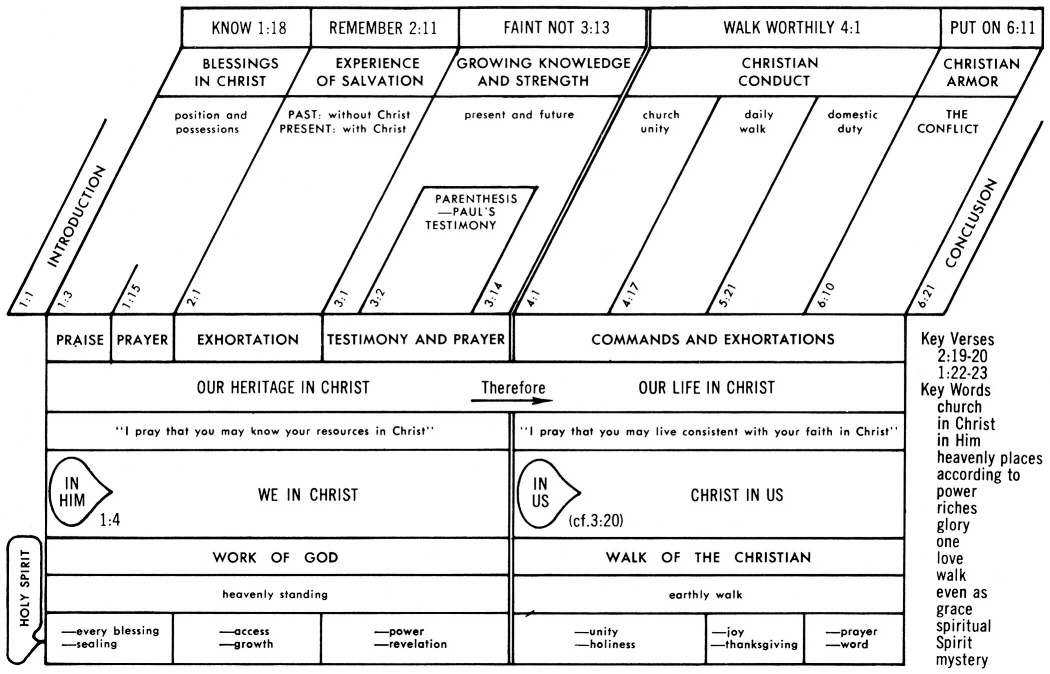
EPHESIANS - CHRIST AND THE CHURCH
Click chart to enlarge
Charts from Jensen's Survey of the NT - used by permission
Ephesians 2:10 For we are His workmanship, created in Christ Jesus for good works, which God prepared beforehand so that we would walk in them (NASB: Lockman)
Greek: autou gar esmen (1PPAI) poiema, ktisthentes (APPMPN) en Christo Iesou epi ergois agathois ois proetoimasen (PPPMPN) o theos hina en autois peripatesomen. (1PAAS)
BGT αὐτοῦ γάρ ἐσμεν ποίημα, κτισθέντες ἐν Χριστῷ Ἰησοῦ ἐπὶ ἔργοις ἀγαθοῖς οἷς προητοίμασεν ὁ θεὸς, ἵνα ἐν αὐτοῖς περιπατήσωμεν.
Amplified: For we are God’s [own] handiwork (His workmanship), recreated in Christ Jesus, [born anew] that we may do those good works which God predestined (planned beforehand) for us [taking paths which He prepared ahead of time], that we should walk in them [living the good life which He prearranged and made ready for us to live]. (Amplified Bible - Lockman)
NLT: For we are God's masterpiece. He has created us anew in Christ Jesus, so that we can do the good things he planned for us long ago. (NLT - Tyndale House)
NLT (revised) For we are God's masterpiece. He has created us anew in Christ Jesus, so we can do the good things he planned for us long ago.
Phillips: The fact is that what we are we owe to the hand of God upon us. We are born afresh in Christ, and born to do those good deeds which God planned for us to do. (Phillips: Touchstone)
Wuest: for we are His handiwork, created in Christ Jesus with a view to good works which God prepared beforehand in order that within their sphere we may order our behavior. (Eerdmans Publishing - used by permission)
Young's Literal: for of Him we are workmanship, created in Christ Jesus to good works, which God did before prepare, that in them we may walk.
KJV For we are his workmanship, created in Christ Jesus unto good works, which God hath before ordained that we should walk in them.
NKJ For we are His workmanship, created in Christ Jesus for good works, which God prepared beforehand that we should walk in them.
ESV For we are his workmanship, created in Christ Jesus for good works, which God prepared beforehand, that we should walk in them.
NET For we are his workmanship, having been created in Christ Jesus for good works that God prepared beforehand so we may do them.
NIV For we are God's workmanship, created in Christ Jesus to do good works, which God prepared in advance for us to do.
CSB For we are His creation, created in Christ Jesus for good works, which God prepared ahead of time so that we should walk in them.
NRS For we are what he has made us, created in Christ Jesus for good works, which God prepared beforehand to be our way of life.
NAB For we are his handiwork, created in Christ Jesus for the good works that God has prepared in advance, that we should live in them.
NJB We are God's work of art, created in Christ Jesus for the good works which God has already designated to make up our way of life.
GWN God has made us what we are. He has created us in Christ Jesus to live lives filled with good works that he has prepared for us to do.
BBE For by his act we were given existence in Christ Jesus to do those good works which God before made ready for us so that we might do them.
FOR WE ARE HIS WORKMANSHIP: autou gar esmen (1PPAI) poiema:
- For we are His workmanship, Dt 32:6; Ps 100:3; 138:8; Isa 19:25; 29:23; 43:21; 44:21; 60:21; 61:3; Jer 31:33; 32:39,40; Jn 3:3- 6,21; 1Cor 3:9; 2Co 5:5,17; Php 1:6; 2:13; Heb 13:21
- Ephesians 2 Resources - Multiple Sermons and Commentaries
- Ephesians 2:1-10: Coming Alive in Christ - John MacArthur
- Ephesians 2:1-10: Coming Alive in Christ - Study Guide (see dropdown menu) - John MacArthur
- Ephesians 2:1-10 Exchanging Living Death for Dying Life - John MacArthur
|
Ephesians 2 |
|
| Ephesians 2:1-3 | Amazing Depths |
| Ephesians 2:4-7 | Amazing Heights |
| Ephesians 2:8-9 | Amazing Grace |
| Ephesians 2:10 | Amazing Work |
|
Adapted from Kent Hughes: Preaching the Word: Ephesians |
|
For (1063) (gar) renders the reason for the statement in the previous two verses. Whenever you encounter a "for" at the beginning of passage always pause to ponder and interrogate this frequently found term of explanation. (there are over 7000 uses of for in the NAS and most are terms of explanation! The fact that we are His workmanship serves to prove that salvation is not a result of our works.
Hoehner - The conjunction γάρ, “for,” tells us why this salvation is not of human origin or by human works. The reason is that “we” (recipients of salvation) are “his” (God’s) workmanship. (See Ephesians: An Exegetical Commentary).
We are His workmanship - We belong to God. We are His property to do with as He chooses. But as someone has said "God don't make no junk!" As discussed more below the Master Artist has rendered each of us as His masterpiece (regardless of how we feel) if we are in Christ by grace through faith. This is amazing grace indeed!
His is placed first in the Greek sentence for emphasis = "His for we are workmanship" is the literal word order. Or "For of Him we are a product." The point is that we are not our masterpiece, not a masterpiece as a result of our making, but of His handiwork. We are a masterpiece only because we are His masterpiece totally unrelated to any effort or merit of our own.
THOUGHT- The possessive pronoun His begs the question - "Are my daily choices reflecting the truth that I am His workmanship, that I belong to Him, that I am not my own any longer?" We are now and forever HIS POSSESSION! (1Cor 6:19, 20, Titus 2:14, 1 Peter 2:9)
Charles Hodge - The position of the pronoun at the beginning of the sentence renders it emphatic. His workmanship are we. He has made us Christians. Our faith is not of ourselves. It is of God that we are in Christ Jesus. (Ephesians 2 Commentary)
Spurgeon's expositional thoughts on Eph 2:10...
Nothing without Christ Jesus, you see. The mark of the pierced hand is on everything: "We are his workmanship, created in Christ Jesus."
We should be sure to boast if we could. We are a boasting people. Man is a poor mass of flesh, and he is largely given to the corruption of pride, He will boast if he can.
If there is any good thing in us, He put it there. It is not for us to boast. It is for him to boast if he pleases.
God has decreed that He will have a holy people. This is His purpose, His ordinance, to which He will always stand. He will make it good. He will make sinful people holy, and disobedient people obedient to the faith. (Exposition)
Pulpit Commentary - Another illustration and evidence of grace We have to be fashioned anew by God before we can do anything aright. Anything right in us is not the cause of grace, but its fruit… It is not good works first, and grace after; but grace first, and good works after. (Ephesians 2 Commentary)
Workmanship (4161) (poiema from poieo = to make with the suffix –ma = the result of, source of our English word "poem") is the result of work (suffix -ma = result of) and thus means something that is composed or constructed, something that is made, that which is manufactured, a product, the thing made, a design produced by an artisan. Poiema meant any work of art --it could mean a statue, a song, architecture, a poem or a painting. It conveys the idea of something artfully created. In the Septuagint (Lxx), poiema refers to God's work in creation (Ps 143:5). Herodotus records the use of poiema in classic writings to describe the work of a craftsman, such as making a crown.
Rick Renner -"The Greek word for a poet, poietes, comes from this same word. In reference to a poet, this Greek word would denote one who has the extraordinary ability to write or create a literary masterpiece. Because Paul uses the word poiema to explain what happened when you became a child of God, it emphatically means that on the day you got saved, God put forth His most powerful and creative effort to make you new. Once God was finished making you new, you became a masterpiece, skillfully and artfully created in Christ Jesus. There's nothing cheap about you at all! God's creative, artistic, intelligent genius went into your making. Look how much you've been given in Jesus Christ! Don't you think it's time to stop moaning about how dumb, stupid, ugly, or untalented you "feel" compared to others? Those "feelings" are all lies. Some of that may have been true before you were born again, but none of it is true of you now that you are in Christ. God turned you into something spectacular. That's who you are now! So lay claim to your new identity Adjust your thinking and talking to reflect who you really are! Lord, forgive me for being so negative and for talking so badly about myself after You have given me so much! I have no excuse for accepting defeat or low self-esteem as a way of life, because You have made me totally new! Help me renew my mind to the truth about who You have made me to be, and help me guard the words of my mouth so that instead of speaking evil of myself I affirm the truth about who I am in Christ. I pray this in Jesus' name!"....(Renner in another note says) Ephesians 2:10 is another place where a form of this word poietes is used. Paul writes, "For we are his workmanship, created in Christ Jesus unto good works...." The word "workmanship" is the Greek word poiema, which comes from the same root word as poietes. This tells us that when we were saved, God put forth all His best efforts and creative powers to marvelously fashion and create us in Jesus Christ. Because the word poiema is used in Ephesians 2:10, it unmistakably means that God wielded His fullest, greatest, and most creative powers when we were born again. We weren't just mildly saved; rather, God took us into His hands and marvelously made us new in Jesus Christ as He released His most powerful creative forces and made us a workmanship that would be worthy to bear His name. Whether the word poietes is used to depict a poet, as mentioned above, or (in another form) to describe God's creative power, as in Ephesians 2:10, it always depicts someone putting forth his fullest creative abilities to achieve something. Now James uses this word poietes in James 1:22 to tell us that we must put forth our fullest efforts and most creative abilities in doing what we have heard preached! We cannot passively hope that the Word becomes a part of our lives; we have to get creative and find ways to make the Word a practical part of our lives. (Sparkling Gems from the Greek)
Believers are the result of His Spirit's work on those dead in their trespasses and sins, those who now are His "poetic masterpiece". Ponder this truth for a moment!
This word is used one other time in the NT to describe God's other "poetic masterpiece", the creation, Paul recording that…
For since the creation of the world His invisible attributes, His eternal power and divine nature, have been clearly seen, being understood through what has been made (all one word = poiema), so that they are without excuse. (Ro 1:20)
Pulpit Commentary Homily - Creation was grand; new creation is grander. To bring a world out of nothing was great; to restore a world from chaos is greater. At the first creation, God saw all that He had made, and it was good. At the new creation, He experiences even a deeper emotion of joy.
Lenski concludes that "Men cannot charge God with hiding Himself from them and thus excuse their irreligion and their immorality."
John Piper writes that "Creation is God's poiema - Work of Art - What does He do to make Himself evident? He made the world. He created - like a potter, or a sculptor or a poet, except He created out of nothing. In verse 20, when it says that God is "understood through what has been made," the words "what has been made" stand for one Greek word (which you will all recognize), the word poiema. It's the word from which we get "poem." The universe and everything in it is God's work of art. What's the point of this word? The point is that in a poem there is manifest design and intention and wisdom and power. The wind might create a letter in the sand, but not a poem. That's the point. God acted. God planned. God designed. God crafted. He created and made. And in doing that, Paul says in Ro 1:19, God made Himself evident to all mankind. The universe is a poem about God." (Displays of God Remove the Excuse for Failed Worship)
Poiema is used 27 times in the Septuagint (LXX) -
Judges 13:12; 1Sa 8:8; 19:4; Ezra 9:13; Neh 6:14; Ps 64:9; 92:4; Ps 143:5; Ecclesiastes 1:14; 2:4, 11, 17; 3:11, 17, 22; 4:3, 4; 5:6; 7:13; 8:9, 14, 17; 9:7, 10; 11:5; 12:14; Is 29:16
Ps 143:5 I remember the days of old; I meditate on all Thy doings; I muse on the work (Lxx = poiema) of Thy hands.
Eccl 3:11 He has made (Lxx verb = poieo) everything appropriate (KJV = beautiful) in its time. He has also set eternity in their heart, yet so that man will not find out the work which God has done (Lxx = poiema) from the beginning even to the end. (Eternity in the Heart by Alexander Maclaren)
Believers are God's workmanship and from other passages we know that we are works "under construction"…
Psalm 138:8 The LORD will accomplish what concerns me. Thy lovingkindness, O LORD, is everlasting. Do not forsake the works (Lxx = ergon) of Thy hands.
Spurgeon Comments: All my interests are safe in Jehovah’s hands. God is concerned in all that concerns his servants. He will see to it that none of their precious things fail of completion." (Reference)
Philippians 1:6 For I am confident of this very thing, that He who began a good work in you will perfect (complete) it until the day of Christ Jesus.
John Phillips - The Lord, when here on earth, lived a life of good works. He "went about doing good," Peter summarized (Acts 10:38). Now through His indwelling Spirit He continues to do His good works in us. This was all part of the eternal plan. The word translated "workmanship,"poiēma, indicates that we are His poem, His masterpiece. Each of our lives is the canvas on which the Master is producing a work of art that will fill the everlasting ages with His praise. A great dispositional change marks genuine conversion, so that a person who is still dead in trespasses and sins is in contrast to the believer who has been quickened together with Christ. If we profess to be Christians but our lives exhibit no evidence of behavioral change, we are self-deceived. (Exploring Ephesians)
James Hastings…
the idea is, that as a poem owes its conception to the singer’s intellect and fancy, so a believer in Christ owes his character and standing to God. We are indebted to the Greeks for the word, and for its beautiful meaning. A poem with them was, first, anything made; but as beauty and harmony are elements in all truly original or created works, the word “poem” came to be applied more and more exclusively to the expression of truth and beauty in rhythmical form.
“We are His poem!” Each Christian age has been a canto of it; each Christian life and death a word. Its strains have been pealing down the centuries, and “though set to a tune which admits of such endless variations that it is often difficult to detect the original melody amid the clash of the chords that conceal it, it will eventually be resolved, through many a swift modulation and startling cadence, back to the perfect key.”1 [Note: H. G. Miller, St. Paul’s Epistle to the Ephesians, 93.]
Biographers of Wordsworth have marked the exact period when his genius reached its height, and after that the glory came only at intervals, and the real poems were rare. And because a true poem is so rare a thing, it has always been appraised as the highest form of literature. Many great books come—and go; but a true poem is as fresh after long centuries as when it was first written. “Poesy never waxeth old,” and knows no decay. It knows no decay because it is permeated with the spirit of beauty; because it is the enduring monument of a combination of fine gifts, whose final result is a thing of beauty and a joy for ever. That is what a poem is, and St. Paul says that we are the expression of the mind of God, as the In Memoriam is the expression of the full mind and heart of Tennyson. We are God’s Poems.2 [Note: W. J. Dawson, The Divine Challenge, 111.]
The poem depends entirely upon the poet for its creation. It is the unveiling of the deepest and most intimate secrecies of his heart. His own image is projected over every page, and it is the poignant personal element in poetry that makes it so beautiful, and gives it its enduring charm. Men, then, are God’s poems. The intimacies of God’s heart are expressed in man—God’s highest thoughts, God’s deepest emotions. The prayer of Moses was that the beauty of God might rest upon him. When a man is finished at last in the likeness of Christ, God’s sense of beauty is satisfied in him, God’s art has found its finest expression and the beauty of God does rest upon him. The true Christian is God’s poem in a world of prose, God’s beauty in a world of gloom, God’s fine and finished art (Ed: Better stated works in progress!) in a world where men forget beauty, and are careless of moral symmetry and spiritual grace.
I remember once seeing a little fountain playing in the room of a house in which I was staying. I went near to examine it and heard the click and whirr of machinery! The fountain was the product of a mechanical contrivance; it went by clockwork. It was wound up and played for a little while and then sank into stagnancy again. How different from the spring! One plays in feverish spasms; the other flows in restful persistence. “Not of works”: that is the manufactured fountain. “We are his workmanship”: that is the life of the spring. The Christian life is quietly natural; it is the creation of the ceaseless energy of God.2 [Note: J. H. Jowett, in The Examiner, Nov. 19, 1903, p. 508.]
Now, if every Christian is a true poem of God, and if the Church is the supreme Divine epic “created” in our world, who is the Hero of the composition? Our text answers that the Hero is the Lord Jesus Christ. The poem is full of Him. God’s people are “created in Christ Jesus for good works.” This Hero is both Divine and human. He is the Son of God and the Flower of men, and also the one Mediator between God and us. God has purchased the Church, and every individual member of it, with His own blood. The Church is Christ’s body, “the fulness of him that filleth all in all.” His Spirit dwells in the heart of every believer. His glory fills the entire Society of His people. Every poem of which He is the Hero shall spread His name and His fame throughout the universe to all eternity.1 [Note: C. Jerdan, Manna for Young Pilgrims, 105.] (Ephesians 2:10 God's Workmanship)
Jonathan Edwards wrote that the "spiritual life which is reached in the work of conversion, is a far greater and more glorious effect than mere being and life."
God’s most stupendous creation is spiritually dead man made alive! Created in God's image, born in sin, and destined to be re-created in the image of God's Son, Christ Jesus! Dear saint, don't ever forget that you are the subject of Christ’s two creations, and as the result of His second Creation we are His ultimate workmanship, His masterwork! As you likely have have heard born once (creation #1), die twice (spiritually and physically). Born twice (creation #1, creation #2 = "re-creation" - redemption), die once (physically, but no longer spiritually).
Joni Eareckson Tada who became quadriplegic after a tragic accident, alludes to herself as a "poiema" in her book A Place of Healing "(God) has a plan and purpose for my time on earth. He is the master artist or sculptor, and He is the One Who chooses the tools He will use to perfect His workmanship. What of suffering, then? What of illness? What of disability? Am I to tell Him which tools He can use and which tools He can’t use in the lifelong task of perfecting me and molding me into the beautiful image of Jesus? Do I really know better than Him, so that I can state without equivocation that it’s always His will to heal me of every physical affliction? If I am His poem, do I have the right to say, “No, Lord. You need to trim line number two and brighten up lines three and five. They’re just a little bit dark.” Do I, the poem, the thing being written, know more than the poet?" (See A Place of Healing: Wrestling with the Mysteries of Suffering)
Kent Hughes - Michelangelo was once asked what he was doing as he chipped away at a shapeless rock. He replied, “I’m liberating an angel from this stone.” That’s what God is doing with us. We are in the hands of the great Maker, the ultimate sculptor who created the universe out of nothing, and he has never yet thrown away a rock on which he has begun a masterwork. His tools are Jesus Christ and the Holy Spirit, his Word, and the preaching of the Word. Very often he uses difficulties and difficult people, like David’s Shimei, to sculpt our character. Other times it is a great saint with which God carves his impression upon us. (see Ephesians: The Mystery of the Body of Christ)
Jack Hayford - Poiema emphasizes God as the Master Designer, the universe as His creation (Ro. 1:20), and the redeemed believer as His new creation (Eph. 2:10). Before conversion our lives had no rhyme or reason. Conversion brought us balance, symmetry, and order. We are God’s poem, His work of art. (Hayford's Bible Handbook)
Jon Courson - God is saying, “You are My poetry. You’re special to Me. I’m not giving up on you"… He is making you something not only useful but beautiful… something that is poetic."
We are his workmanship, created in Christ Jesus unto good works, which God hath before ordained that we should walk in them. The works are ready, waiting for us, all we have to do is to be willing to be led into them. How many disappointments we should have been spared in life if we had always acted on this conviction. God knows what we are fitted for far better than we know ourselves. He who made us knows whereof we are made. He won’t put “square pegs into round holes…” If we would be useful in Christ’s service our wisdom is “to have no plan except to enter into His plan for us,” and say with Paul, “Lord, what wilt Thou have me to do?” - E. W. MOORE.
No man is born into the world whose work is not born with him; there is always work, and tools to work withal, for those who will. - LOWELL.
Each redeemed soul should remember that God has sent us into the world with gifts, duties and opportunities, which He Who has ordained them will help us to cultivate, and expects us to improve. All God’s ways are consistent with each other, and complete each other. Every one has been sent into the world with a work to do, and with the means for doing it. He who does not see his work, probably has not taken the pains to discover it. He who morosely complains of his scanty opportunities might be surprised to hear that his own negligence has made them scantier. We can’t see with our eyes shut. - BISHOP THOROLD.
David Jeremiah - Let us ask Him to work in us to will those good works, so that our will, without being impaired in its free operation, may be permeated and molded by His will, just as light suffuses the atmosphere without displacing it. And let us also expect that He will infuse into us sufficient strength that we may be able to do His will unto all pleasing. Thus, day by day, our life will be a manifestation of those holy volitions and lovely deeds which shall attest the indwelling and inworking of God. And men shall see our good works, and glorify our Father which is in heaven.
J D Watson - our English word poem is derived from poiēma. So, we are God's workmanship, His "work of art," His "masterpiece," His "poem," if you will. While Milton's epic poems Paradise Lost and Paradise Regained are true masterpieces, they pale in comparison to the masterpiece of the true child of God. Notice more specifically that we are His, that is, God's workmanship. There's an important contrast between the English and Greek texts. In the English, this statement begins with "we," but in the Greek it—in fact, the whole verse—begins with "Him." Literally the verse reads: "For of Him we are a product." The world says that each of us is a product of our environment or a product of our own experience. Even Christians have a tendency to think that way. But God's Word declares that the believer is actually "the product of God." Many preachers are even products of a particular Bible college or seminary (warts and all). But what we really are, are products of God. Think of poiēma in the context of a potter. Does the pot say to the potter, "Well, you know that I had a little something to do with what I have become?" Of course not; the clay has nothing to do with the process. It's the potter who goes out and seeks the clay, brings it into his workshop, and molds it according to his own vision. Likewise, the "Divine Potter" molds us into vessels He can use. That's exactly what Paul illustrated to the Romans, in fact: "Nay but, O man, who art thou that repliest against God? Shall the thing formed say to him that formed it, Why hast thou made me thus? Hath not the potter power over the clay, of the same lump to make one vessel unto honour, and another unto dishonour?" (Rom. 9:20-21). (A Word for the Day - Key Words from the New Testament)
Greg Laurie - God says, “You are my work of art. You are my poem. You are my masterwork.” God is not like a doting father who’s oblivious to his child’s faults. Rather, He is your all-knowing, yet all-powerful Father in heaven who can envision what you will be when it is all said and done. God can look at you and can see what you will become before you have actually become it. We look at ourselves and say, “I don’t get it. This doesn’t look like a perfect person. This doesn’t look like a work of beauty.” But you are a work in progress. It is a process that doesn’t happen overnight. It is going to take all of your life on Earth. It won’t be completely finished until you get to heaven. Then you will see that you indeed are a perfect work of art — God’s masterpiece. (Greg Laurie's article on Ephesians 2:10)
You are God’s masterpiece. You are His poem. You are His work of art. When we look at ourselves this way, we begin to understand our incredible value in Christ. "If Rembrandt’s artistic masterpieces have great, undisputed value, would not God’s one-of-a-kind human masterpieces convey even greater value?" (D Robertson)
John Piper - What does God do to make himself evident? He made the world. He created—like a potter, or a sculptor or a poet, except he created out of nothing. In verse 20, when it says that God is “understood through what has been made,” the words “what has been made” stand for one Greek word (which you will all recognize), the word poiema. It’s the word from which we get “poem.” The universe and everything in it is God’s work of art. What’s the point of this word? The point is that in a poem there is manifest design and intention and wisdom and power. The wind might create a letter in the sand, but not a poem. That’s the point. God acted. God planned. God designed. God crafted. He created and made. And
F B Meyer - Let us ask Him to work in us to will those good works, so that our will, without being impaired in its free operation, may be permeated and molded by His will, just as light suffuses the atmosphere without displacing it. And let us also expect that He will infuse into us sufficient strength that we may be able to do His will unto all pleasing. Thus, day by day, our life will be a manifestation of those holy volitions and lovely deeds which shall attest the indwelling and inworking of God. And men shall see our good works, and glorify our Father which is in heaven.
J C Philpot - Consider what is here declared of those who are saved by grace through faith—that they are God’s “workmanship”—the fruit and product of His creative hand. All, then, that we are and all that we have that is spiritual, and as such acceptable to God, we owe to the special operation of His power. There is not a thought of our heart, word of our lips, or work of our hands, which is truly holy and heavenly, simple and sincere, glorifying to God or profitable to man, of which He is not by His Spirit and grace the divine and immediate Author!
Arno C Gaebelein - It is a beautiful thought in itself to think of those who are saved by grace, and united to Christ as “the poem of God.” But the word “Poiema” may also be rendered “Masterpiece” or “Masterwork.” Only once more is the same word found in the original language of the New Testament Scriptures. In Rom. 1:20 it is used in connection with the physical creation. God has produced two great masterworks in which He manifests His power. He called the universe into existence out of nothing. What He, as the omnipotent One can do, is seen in the creation of the heavens and the earth and in the sustenance of His creation. His eternal power and Godhead are revealed in creation (Ro 1:19–20). But the creation of the universe out of nothing is not the greatest masterpiece of God. God has done something greater. He has produced a work, which reveals Him in a far higher degree. That greater masterpiece is the redemption of sinners. God took only six days to bring order out of the chaos of the disturbed original creation and to call into existence the present earth and heavens, but He spent forty days with Moses in directing him to build the tabernacle, because the work of redemption is more glorious than the work of creation. (Ephesians 2:1-10 Commentary)
O TO BE LIKE THEE! Thomas O. Chisholm, 1866–1960 - For we are God’s workmanship, created in Christ Jesus to do good works, which God prepared in advance for us to do. (Ephesians 2:10)
Great Master, teach us with Your skillful hand;
Let not the music that is in us die!
Great Sculptor, hew and polish us; nor let
Hidden and lost, Your form within us lie!
—Horatius Bonar
The Bible teaches that God’s goal for His people is that they “become mature, attaining to the whole measure of the fullness of Christ” (Ephesians 4:13). We are to daily “put on Christ”—His love and character—even as we put on our garments (Romans 13:14). Christ-likeness is more than a religious profession or a weekly visit to church. It must become our total way of life. The Scriptures further teach that we are to carry the fragrance of Christ wherever we go—to unbelievers, the smell of death and to fellow believers, the fragrance of life (2 Corinthians 2:14–16). Our society is in desperate need of more Christ-like believers. The only thing many people will ever know about God is what they see of His radiance reflected in our daily lives. Our ability to represent our Lord worthily is only possible through the enabling power of the Holy Spirit. This hymn text by Thomas Chisholm is one of his more than 1,200 fine poems, many of which have been set to music and have become enduring hymns of the church. This one, published in 1897, was his first hymn to be widely received.
O to be like Thee! blessed Redeemer. This is my constant longing and prayer;
gladly I’ll forfeit all of earth’s treasures, Jesus, Thy perfect likeness to wear.O to be like Thee! full of compassion, loving, forgiving, tender and kind;
helping the helpless, cheering the fainting, seeking the wand’ring sinner to find.O to be like Thee lowly in spirit, holy and harmless, patient and brave;
meekly enduring cruel reproaches, willing to suffer others to save.O to be like Thee! while I am pleading, pour out Thy Spirit, fill with Thy love;
make me a temple meet for Thy dwelling; fit me for life and heaven above.Chorus:
O to be like Thee! O to be like Thee, Blessed Redeemer, pure as Thou art!
Come in Thy sweetness, come in Thy fullness; stamp Thine own image deep on my heart.
Sam Gordon in his book "The Genius of Grace The Message of Ephesians" writes
Each of our lives is the papyrus on which the Master is producing a work of art that will fill the everlasting ages with his praise.
• We are meant to be visual aids to a gawking world.
• We are live exhibits under the glare of staring eyes.
• We are an advertisement of all that the grace of God can do in the lives of ordinary people.
The story is often told of the rowdy, disruptive young boy in a Sunday school class who continually frustrated his teacher. One morning the teacher asked him: ‘Why do you act like that? Don’t you know who made you?’ To which the boy replied: ‘God did, but he ain’t through with me yet!’
Sure, we may be rough uncut diamonds, but he is still working on us and he has not finished with any one of us yet. When He does, that will be eternal ecstasy. And when we think of what we were and look at what we now are, we should get thrilled and excited with what we shall be. In moments like these, I often ponder on the words of the Seth Sykes chorus:
Thank you, Lord, for saving my soul,
Thank you, Lord, for making me whole,
Thank you, Lord, for giving to me,
Thy great salvation, so rich and free.
YOUR LIFE:
A POEM
Have you ever pondered the wonderful truth that your life is the Father's poem, authored by the Lamb and enabled by the Spirit? Think of your life as "canvas" on which the Master is producing a work of art which will bring Him eternal praise and glory!
Listen to Michael Card's song as you ponder the works prepared before time began which you are to live out the rest of your days on earth…
Life is a song we must sing with our days
A poem with meaning more than words can say
A painting with colors no rainbow can tell
A lyric that rhymes either heaven or hell!
We are living letters that doubt desecrates
We're the notes of the song of the chorus of faith
God shapes every second of our little lives
And minds every minute as the universe waits by
CHORUS:
The pain and the longing
The joy and the moments of light
Are the rhythm and rhyme
The free verse of the poem of life
So look in the mirror and pray for the grace
To tear off the mask, see the art of your face
Open your ear lids to hear the sweet song
Of each moment that passes and pray to prolong
Your time in the ball of the dance of your days
Your canvas of colors of moments ablaze
With all that is holy
With the joy and the strife
With the rhythm and rhyme of the poem of your life
With the rhythm and rhyme of the poem of your life
SUMMARY OF GOD’S POIEMA:
GOD'S WORKS OF ART!
Beloved, if you are IN CHRIST (note) by grace through faith (Eph 2:8, 9), do you know what God says about you in Ephesians 2:10? You are God’s “WORKMANSHIP, created IN CHRIST JESUS for good works, which God prepared beforehand that we should walk in them.” The Greek word for “WORKMANSHIP” is POIEMA which gives us our English words POEM and POETRY. As a new creation IN CHRIST (2Cor 5:17-note), have you ever thought of your new (now supernatural) life as a work of “divine poetry”, God's "literary masterpiece?"
The idea of poiema is that our new life in Christ is like poem which expresses “form and pattern along with beauty. Like the underside of grandmother’s cross-stitch, the everyday of our lives may look to be knotted and hopelessly tangled. But when we turn the fabric over, we see design and beauty that was there all along but that we never foresaw.” (Gage) Perhaps you don’t feel much like a work of divine poetry, but regardless of how you feel, the truth about you as God’s workmanship, is that you are God's "COMPOSITION" His “MASTERPIECE” (NLT), His “HANDIWORK” (NAB), His “WORK OF ART” (NJB), in fact, a work of art that is one of a kind! You are “custom designed”, “tailor-made,” by the Master’s hand.
C H Spurgeon says it this way - You have seen a painter with his palette on his finger and he has ugly little daubs of paint on the palette. What can he do with those spots? Go in and see the picture. What splendid painting! In an even wiser way does Jesus act toward us. He takes us, poor smudges of paint, and He makes the blessed pictures of His grace out of us. It is neither the brush nor the paint He uses, but it is the skill of His own hand which does it all.” PTL!
Indeed, the redeemed should sing out like David “I will give thanks to Thee, for I am fearfully and wonderfully made. Wonderful are Thy works, and my soul knows it very well.” (Ps 139:14) As Spurgeon says “If we are marvelously wrought upon even before we are born, what shall we say of the Lord's dealings with us after we quit His secret workshop, and He directs our pathway through the pilgrimage of life? What shall we not say of that new birth which is even more mysterious than the first, and exhibits even more the love and wisdom of the Lord.” It is notable that the only other NT use of the Greek word POIEMA is in Romans 1:20 where Paul writes “For since the creation of the world His invisible attributes, His eternal power and divine nature, have been clearly seen, being understood through WHAT HAS BEEN MADE (POIEMA) so that they are without excuse.”
As Henry Morris says “God has written TWO POETIC MASTERPIECES, as it were, one in the physical creation, one in the lives of men and women redeemed and saved by His grace (Eph 2:8). Both give eloquent testimony to the eternal power and Godhead of the Creator-Redeemer.” Two great “divine poems” - the created world and re-created men and women in that world. Even as the “heavens are telling of the glory of God and their expanse is declaring the work of His hands” (Ps 19:1), we too as God’s MASTER CREATIONS should never be ashamed to let men see His WORKMANSHIP in us by our Spirit enabled obedience to Jesus' command to “Let your light shine before men in such a way that they see your GOOD WORKS, and glorify (give a proper opinion of) your Father Who is in heaven.” (Mt 5:16) As new creatures in Christ, we need to remember that we were created for God’s glory, and created for good deeds, because it is by our good deeds that our Father gets all the glory (cf Ps 115:1). Indeed, the chief end of each of our lives is “To glorify God and to enjoy Him forever.” In summary, Eph 2:10 teaches that we are saved not BY good works but FOR good (supernatural) works and in the mystery of His amazing grace He even rewards us for those Spirit enabled works! (cf 2Cor 5:10-note; Rev 22:12)
Dr W H Houghton, pastored the Calvary Baptist Church in NYC and later served as president of Moody Bible Institute. When Dr. Houghton became pastor of the Baptist Tabernacle in Atlanta, a man in that city hired a private detective to follow Dr. Houghton and report on his conduct. After a few weeks, the detective was able to report to the man that Dr. Houghton’s life matched his preaching. As a result of Houghton's faithful life as God's "Poiema", that man became a Christian.
Anonymous Quote on who God uses - Excuses! - The next time you think you have an excuse why God can’t use you, consider the following: Noah was a drunkard, Abraham was too old, Isaac was a daydreamer, Jacob was a liar, Leah was ugly, Joseph was abused, Moses was a murderer, Gideon was afraid, Samson had long hair, Rahab was a prostitute, Timothy was too young, David had an illicit affair, Elijah was suicidal, Isaiah preached naked, Job was bankrupt, John the Baptist ran around in a loin-cloth and ate locusts, Peter has hot-tempered, John was self-righteous. The disciples fell asleep while praying, Martha fretted about everything, Mary Magdalene was demon-possessed, the boy with the fish and five rolls of bread was too obscure, the Samaritan woman was divorced more than once, Zacchaeus was too small, Paul was too religious, and Lazarus was dead. No more excuses!
In Ps 143:5 David prays
I remember the days of old. I meditate on all Your doings. I muse (meditate) on the WORK (LXX = POIEMA) of Your hands. (Commentary)
Have you meditated on the truth that now IN CHRIST, you are “the WORK (poiema) of” His hands? It is good to meditate on what God has made and rest in the confidence that regardless of what has transpired in your life to make you doubt your worth in Christ, you need to remember that you "are of untold worth" (Kent Hughes) and also that you are a canvas on which He is still painting, for "He Who began a good work in you will complete it in the day of Christ Jesus." (Php 1:6).
See related article "Believers Are God's Masterpiece, His Poiema"
CREATED IN CHRIST JESUS FOR GOOD WORKS: ktisthentes (APPMPN) en Christo Iesou epi ergois agathois:
- Ep 4:24; Psalms 51:10; 2Corinthians 5:17; Galatians 6:15; Colossians 3:10
- Ephesians 2 Resources - Multiple Sermons and Commentaries
SALVATION:
NOT BY WORKS
BUT FOR WORKS!
How do works relate to regeneration by grace through faith? "Works are to salvation, what thunder is to lightning, an inevitable result. Just as thunder does not generate lightning, our good deeds will not generate salvation. But on the other hand, just as you can't have lightning without the following thunderclap, you can't experience the transformation of salvation without a change in your attitudes and behaviors. And those changes are a gradual process called sanctification, that can be likened to an endurance race. The apostle Paul often compared the Christian life to a long race, as did the author of the book of Hebrews." (cp He 12:1) (Source - Steve Kreloff's broadcast on the The Spiritual Marathon - Mp3)
Created (2936) (ktizo [word study]) means to bring something into existence or of calling into being, used in the NT only of God's creativity. The Greeks used ktizo to describe the founding of a place, a city or colony.
Ktizo points to saved sinners as new creations in Christ (cp 2 Cor 5:17), having formerly been dead in trespasses and sins (Ep 2:1) and by His Spirit now called into an existence of eternal life (today, now)! The aorist tense points to this specific creative act as having taken place at a point in time in the past. The result is that believers are no longer their own (1Co 6:19, 1Co 6:20) but now are doubly His, created first in His image (Ge 1:26, 27), and then recreated based on His work of redemption. Hallelujah! Let us live out this truth before a dying world!
Paul again emphasizes the believer's new creation in Christ exhorting his readers to…
put on the new self, which in the likeness of God has been created (ktizo) in righteousness and holiness of the truth (i.e., to be like God - righteous, holy, and true). (Ep 4:24)
In a parallel passage in Colossians Paul reminded the saints that they…
have put on the new self (at the time of salvation) who is being renewed to a true knowledge according to the image of the One Who created (ktizo) him. (Col 3:10)
Comment: "Being renewed” is present tense = “constantly being renewed.” The crisis of salvation leads to the process of sanctification, daily becoming more like Jesus Christ, Who is to be our life-long goal taking priority over all other goals.
This verse is an answer to David's prayer…
Create (LXX = ktizo) in me a clean heart, O God, And renew a steadfast spirit within me. (Psalm 51:10) (See Spurgeon's note)
Writing to the church at Corinth Paul reminded them that…
if any man is in Christ, he is a new creature (literally = new creation, where kainos = new in kind or quality, unprecedented, unheard of, new in sense that it brings into the world a new quality of thing which did not exist before); the old things passed away (the aorist tense indicates a past completed action and speaks of the decisive change salvation brings); behold, new (kainos) things have come. (2Corinthians 5:17)
Comment: The miracle of regeneration, of being born again and baptized by the Holy Spirit into the spiritual body of Christ (1Co 12:13, cp Spirit in each member of the body = Ro 8:9), is a true miracle of special creation, not some psychological crutch as is so often argued by skeptics and scoffers. This creative act of the new birth is indeed comparable in quality to the creation of the universe! No natural process can accomplish or explain either miracle. The evolution of man is foolishness! Man is not getting better. Instead, the Best Man died that all men might attain to the best by grace through faith. That is the miracle of the new creation, God's workmanship!
Writing to the Galatians who were being tempted to add works (such as circumcision) to faith in Christ Paul declared that…
may it never be that I should boast, except in the cross of our Lord Jesus Christ, through which the world has been crucified to me, and I to the world. For neither is circumcision anything, nor uncircumcision, but a new creation. (Galatians 6:14, 15)
Comment: What really matters is not external works such as circumcision but whether we really have been changed into new and different people. Is your life different now that you are in Christ? If not then you might want to think about whether you are truly "in Christ".
The qualitatively new birth creates a qualitatively new appetite and requires a qualitatively new diet.
O child of God, guard well your eyes
From anything that stains the heart;
Forsake those things that soil the mind--
Your Father wants you set apart.
-Fasick
In Christ (See related discussion of in Christ and in Christ Jesus) - don't read over these words too quickly as they should be pondered every time we encounter them in Paul's writings. "In Christ" signifies a brief but most profound statement of the inexhaustible significance of the sinner's glorious salvation, which includes (among other things) (1) the believer’s security in Christ, Who bore in His body God’s judgment against sin, (2) the believer’s acceptance in Him with Whom God alone is well pleased, (3) the believer’s future assurance in Him Who is the Resurrection to eternal life and the sole Guarantor of the believer’s inheritance in heaven and (4) the believer’s participation in the divine nature of Christ (2Pe 1:4).
The Bible views all men as either in Christ, or in Adam with no middle ground.
Charles Hodge - Union with Him is a source of a new life (Ed: cf Col 3:4), and a life unto holiness; and therefore it is said created unto good works. Holiness is the end of redemption, for Christ gave himself for us that he might redeem us from all iniquity, and purify unto himself a peculiar people zealous of good works. Titus 2:14. Those therefore who live in sin are not the subjects of this redemption. (Ephesians 2:10 Commentary)
Works (2041) (ergon) describes that which displays itself in activity of any kind and so refers to deeds.
For (epi) literally means upon good works and indicates the God glorifying goal of our salvation. Good (the "God" variety) works should be the sum and substance of our behavior. Believers are saved to serve God, not self. This supernaturally enabled shift (even as imperfect as it is in this life, because of the continual struggle with the old flesh) is good evidence that a man or woman is in Christ. Be careful though, because just doing works in a church or a city or a country does not necessarily mean they are "good", Spirit initiated, Spirit enabled, "John 15:5 type" works!
Greene emphasizes that…
It is not the quantity of works (how much you do) that proves you are saved, but the fact that good works automatically follow salvation. The believers at Thessalonica proved their salvation by turning to GOD from idols, to serve GOD (Ed: Excellent illustration of repentance!) (1Thess 1:9). The Ephesian believers confessed, brought their books of magic and burned them before all the people, thereby proving that they had experienced a change of heart (~repentance) (Acts 19:18-20). The believers at Rome who were the servants of sin, obeyed from the heart the doctrine of salvation by grace through faith, and they became the servants of righteousness unto holiness (Ro 6:14-23). Works have nothing to do with redemption; but works testify that redemption has been wrought in the heart. We work because we are the sons of GOD. We do not work to try to gain Heaven - we work because we are on the way to Heaven. Salvation is totally and entirely by Grace, the gift of GOD. Our eternal reward will be determined by our faithful works … our faithful stewardship. (Study carefully 1Cor 3:11-15.) (Ref)
Spurgeon…
This new creation in connection with Christ, for we read in the text, "Created in Christ Jesus." We are the branches; He is the Vine out of which we grow. Your life, and all your fruit-producing power lie in your union to Christ. You are not merely new-created, but you are created in Christ Jesus. It is not merely a change from a lower nature to a higher, but from separation from Christ to union with Him. What a wonderful thing that is—that you and I should not only be creatures in the world, but new creatures in Christ Jesus! Creatures we were in the first Adam; but our new-creatureship is in the second Adam. Beloved, if you are what you profess to be, you are one with Jesus by that vital union which cannot be dissolved; and good works follow upon that union. Joined to Jesus by faith in Him, love to Him, and imitation of Him (1Cor 11:1, 1Cor 4:16, 1Jn 2:6, 1Pe 2:21, Jn 13:15), you walk in good works. Your creation to holiness is your creation in Christ Jesus. As you become one with the anointed Savior, His anointing (with His Spirit, even as He was anointed - 1Jn 2:20, 27, Acts 10:37-38) ordains you to service, and his salvation leads you into obedience. There cannot but be fruit on that blanch which is vitally joined to that fruitful stem, Christ Jesus, Who did always those things which pleased the Father.
Our good works must flow from our union with Christ by virtue of our faith in Him. We depend upon Him to make us holy. We depend upon Him to keep us holy. We overcome sin by the blood of the Lamb. We reach after holiness by the constraining love of Jesus. Love to Christ is the impelling cause of putting away, first one evil, and then another; and the energy enabling us to follow after one virtue, and then another. Love to Christ burns like a fire in the breast that has conceived it; and, as it burns, it makes the heart to glow, and to become transformed to its own nature. You have seen a piece of iron put into the fire, all black or rusty, and in the fire it has gradually become red with heat; and, as it has reddened, it has thrown off the scales of rust, until at last it has looked to be itself a mass of fire. The effect of the love of God, shed abroad in the heart by the Holy Ghost, is to burn off the rust and scales of sin and depravity, and we become pure love to God through the force of the love of God, which takes possession of our being.
Moreover, that love moves us to patient imitation of Christ. Do you know what that means? "The Imitation of Christ" is a wonderful book upon the subject, which every Christian should read. It has its faults, but its excellences are many. May we not only read the book, but write it out anew in our own life and character by seeking in everything to be like to Jesus! It is a good thing to put up in your house the question, "What would Jesus do?" It answers nine out of ten of the difficulties of moral casuistry. When you do not know what to do, and the law does not seem very explicit upon it, put it so—"What would Jesus do?" Here, then, stands the case: by your creation in Christ you come to exhibit faith in him, love to him, and imitation of him; and all these are the means by which good works are produced in you. You are "created in Christ Jesus unto good works." (Ephesians 2:9-10: Agreement of Salvation by Grace with Walking in Good Works)
Good (18) (agathos [word study]) means profitable, benefiting others, whereas the related word kalos means constitutionally good, but not necessarily benefiting others. Saints are made adequate and equipped for "agathos" works by God's Word for
All Scripture is inspired by God and profitable for teaching, for reproof, for correction, for training in righteousness that the man of God may be adequate, equipped for every good (agathos) work. (see note 2 Timothy 3:16-17).
Related resources:
Consider the fruit tree. It is not "conscious" of the bearing process. We are to be like the fruit tree for it is God (His Spirit, the Spirit of Christ indwelling us) Who is causing fruit be borne (Jn 6:63) in good works which blossom and ripen as we are walk obedient to His revealed will (cp Jn 15:5).
Vine comments that every good work
signifies every kind of activity undertaken for the name of Christ; everything so undertaken is a means of fruitfulness, and the operating power is the indwelling Holy Spirit, upon Whom the believer is entirely dependent. (Vine, W. Collected writings of W. E. Vine. Nashville: Thomas Nelson)
One way to think of this is as a process, so that in salvation God does work for us, in sanctification He does work in us and in service He does work through us and bears fruit that remains. God builds character before He calls to service. He must work in us before He can work through us. God spent 25 years working in Abraham before He gave him the promised son Isaac. Remember too that although we are not saved by good works, we are saved unto good works.
Luther - It’s not against works that we contend, it’s against trust in works that we contend.”
The Protestant Reformers spoke of this as "Sola fide justificat sid non fides qua est sola" which translated means
Faith alone justifies
but not the faith which is alone.
John Calvin phrases it very similarly "It is faith alone that justifies, but faith that justifies can never be alone."
True faith will issue in good works from a new creation in union with Vine Christ Jesus (Jn 15:5). Now the good works may not necessarily be seen by us, but there will be good works reflecting the truth that we are new creatures in Christ .
The KJV Bible Commentary has an excellent summary of good works…
Christ in us still goes “about doing good” (Acts 10:38). We are saved apart from good works, but saved unto good works. Good works are the aim of our salvation and the evidence of our faith (Jas 2:17,18). Works never produce salvation, but salvation always produces good works. A man is not justified by works, but a justified man works. Works are the consequences, not the causes of salvation. They are the fruit, not the root of salvation. One must be a Christian before he can live as a Christian; he must be good before he can do good. God is still working…
By grace (Eph 2:8), it was Christ for us;
Through faith (Eph 2:8), it was Christ in us; and
Unto good works, it is Christ through us.
(Dobson, E G, Charles Feinberg, E Hindson, Woodrow Kroll, H L. Wilmington: KJV Bible Commentary)
We are not saved by faith plus good works, but by a faith that works. Any declaration of faith that does not result in a changed life and good works is a false declaration. True saving faith can never be by itself for it always brings life, and life produces good works. The person with dead faith has only an intellectual experience. In his mind, he knows the doctrines of salvation, but he has never submitted himself to God and trusted Christ for salvation. He knows the right words, but he does not back up his words with his works. Faith in Christ brings eternal life right now (John 3:16), and where there is life there must be growth and fruit. (cf Jas 2:17)
Spurgeon on good works in Eph 2:10…
God desires that his people should abound in good works. It is his great object to produce a people fit to commune with himself: a holy people, with whom he can have fellowship in time and in eternity. He wishes us not only to produce good works, but to abound in them; and to abound in the highest order of them. He would have us become imitators of himself as dear children, possessing the same moral attributes as the Father in heaven possesses. Is it not written, "Be ye perfect, even as your rather which is in heaven is perfect"? Oh, that we came within measurable distance of this blissful consummation!
Are you bearing fruit in every good work? (Col 1:10-note) Dearly beloved, be encouraged for Paul is writing here in Ephesians 2:10 that your very purpose for existence is good works. And God never expects anything from us without first enabling us. We need to walk forth empowered by this truth and the indwelling Spirit.
Illustration of Faith and Good Works - An old Scotsman operated a little rowboat for transporting passengers. One day a passenger noticed that the good old man had carved on one oar the word “Faith,” and on the other oar the word “Works.” Curiosity led him to ask the meaning of this. The old man, being a well-balanced Christian and glad of the opportunity for testimony, said, “I will show you.” So saying, he dropped one oar and plied the other called Works, and they just went around in circles. Then he dropped that oar and began to ply the oar called Faith, and the little boat just went around in circles again—this time the other way around, but still in a circle. After this demonstration the old man picked up Faith and Works and plying both oars together, sped swiftly over the water, explaining to his inquiring passenger, “You see, that is the way it is in the Christian life. Dead works without faith are useless, and “faith without works is dead” also, getting you nowhere. But faith and works pulling together make for safety, progress, and blessing.”—Bible Friend
Many believers minimize the place of good works in the Christian life reasoning that because we are not saved by good works, then good works are something to be shunned. But our Lord reminds us that our incredible privilege is to
Let your light shine before men in such a way that they may see your good works, and glorify your Father Who is in heaven. (Mt 5:16)
It is not only by words that we give testimony to the greatness of God, but also by our works. Our good works in fact pave the way for witness with good words. If our walk contradicts our words, we lose our testimony. Our “walk” and our “talk” must agree. Good works and good words must come from the same yielded heart. Too many believers today emphasize guarding the truth, but downplay living the truth. One of the best ways to guard the truth is to put it into practice. It is good to be defenders of the faith, but we must not forget to be demonstrators of the faith by letting them see our good works!
You are writing a Gospel,
A chapter each day,
By the deeds that you do
And the words that you say.
Men read what you write,
Whether faithful or true:
Just what is the Gospel
According to you?
-- Author unknown
When doing good works, also remember that the following question is irrelevant
"Does this person deserve my good works?" We are to "abound to every good work" (NIV, 2Cor 9:8).
Paul reminded Titus (and us) that Jesus
gave Himself for us, that He might redeem us from every lawless deed and purify for Himself a people for His own possession, zealous (afire, ardent, fervent, eager, enthusiastic) for good deeds. (Titus 2:14)
The writer of Hebrews exhorts believers
do not neglect doing good and sharing; for with such sacrifices God is pleased (He 13:16)
Comment: And so we see that good works represent our acts of worship (it's not just Sunday morning when the worship team leads us, but its Monday through Saturday, as the Spirit leads us, fills us and empowers good works) for in God's eyes these good ("God") works are "spiritual sacrifices”!
Please do not misunderstand. Believers do not manufacture these good works but instead such works are to be the fruit of God's Spirit working in a believer's tender, surrendered, obedient heart. Good deeds are "God" deeds. "Good deeds" differ from "your deeds". Let me explain. Paul is calling for "good" (agathos = "good" in character or constitution, beneficial in effect) deeds, and the only "good" deeds are those supernaturally borne by believers (think of believers as "branches") who are abiding (believing, obeying) in Christ ("the Vine"). Good deeds reflect Christ's life flowing through us and are deeds which are initiated and energized by His Spirit and therefore are deeds which bring pleasure to our Father, for
it is God Who is at work in you, both to will and to work for His good pleasure. (Php 2:13, compare Php 2:13NLT version)
Jesus stated the vital truth concerning good deeds when He declared
"I am the vine, you are the branches; he who abides in Me, and I in him, he bears much fruit; for apart from Me you can do nothing (absolutely, totally nothing!)… By this is My Father glorified, that you bear much fruit (good deeds = good fruit) and so prove to be My disciples… You did not choose Me, but I chose you, and appointed you, that you should go and bear fruit, and that your fruit should remain… " (John 15:5,8,16)
Paul reminded the Corinthian church (in the context of giving of money, which is a good deed when motivated properly) of this same foundational principle regarding "good deeds", explaining that
God is able to make all grace abound to you, so that always having all sufficiency in everything (cp 2Co 12:9; 2Co 12:10, cp Name of God - EL Shaddai), you may have an abundance for every good deed (2Cor 9:8).
Paul acknowledged that the key to his good works was the grace of God writing that His
grace toward me did not prove vain; but I labored (kopiao = to the point of exhaustion) even more than all of them, yet not I, but the grace of God with me. (What a divine mystery - God's sovereign grace providing transforming power coupled with my responsibility to "labor"! Amazing, miraculous grace!) (1Cor 15:10).
Peter emphasizes the vital importance of good deeds exhorting his suffering readers to…
Keep your behavior excellent among the Gentiles, so that in the thing in which they slander you as evildoers, they may on account of your good deeds, as they observe them, glorify God in the day of visitation. (1Pe 2:12).
Comment: Thus a believer's good works are testimonies to the lost (like "Lighthouses" they serve to warn those otherwise destined to crash and die an eternal death).
In light of the importance of good deeds, the writer of Hebrews encourages saints to
consider how to stimulate one another to love and good deeds. (Heb 10:24)
Your "good works" will validate your "good words" which is in stark contrast to the false teachers who
“profess to know God, but by their deeds they (continually) deny Him, being detestable (root word = "to stink"!) and disobedient and worthless for any good deed” (Titus 1:16).
The lives of believers should continually demonstrate the reality of the spiritual regeneration and transformation they have received through faith in Jesus Christ. People don't care how much you know until they know how much you care.
Here in Ephesians 2:10, Paul is emphasizing that every believer was created for good works which signifies that God has a plan and purpose for each of our lives and that we should walk in His will and fulfill His plan. This is the state of true divine happiness or blessedness.
Writing to young Timothy in his last known written communication, Paul emphasized the principle that good deeds flow from "ready" vessels, writing that
if a man cleanses himself from these things (Amplified - "from what is ignoble and unclean, who separates himself from contact with contaminating and corrupting influences"), he will be a vessel (instrument) for honor, sanctified, useful (beneficial for honorable and noble purposes) to the Master, prepared (ready, ripe, primed) for every good work (ergon agathon)." (2Ti 2:21)
Pulpit Commentary homily…
Grace is the fountain at once of pardon and of holiness… The old man cannot work. The new man receives the power (Ed: Via learning to surrender, submit, yield to the indwelling Holy Spirit) in the very structure of his spiritual being; for, having died with Christ, he is risen with him that he should walk in newness of life.
(Another Homily) Bushnell wrote a famous sermon in which he tried to show that “every man’s life is a plan of God.” We modify the thought and recognize in every believer’s life a plan of God. Every good work is down in God’s design, it has its place, and it will exercise its influence. While, therefore, God will save no man for his good works, he saves every soul unto good works. They are the fruit, though they cannot be the root of salvation. Foreordination covers the effects of salvation as well as salvation itself. God’s plan embraces the whole problem, and it is thoughtless to rob him of a single element in the glorious result.—R. M. E.
Every morning presents us with another opportunity to fulfill our potential and produce (by the Spirit, not under law) good works. Thus we need to arise and
present (our) bodies a living and holy sacrifice, acceptable to God (Ro 12:1).
And we need to
redeem (present tense = continually buying up - see study of this verb exagorazo) the time (opportunities = kairos- word study), because the days are evil (Ep 5:16)
And finally we must daily be diligent to discipline (present imperative = command to do this continually) ourselves for godliness which is
profitable for all things, since it holds promise for the present life and also for the life to come." (1Ti 4:7, 8, 9, 10, 11-see notes 1Ti 4:7; 4:8; 4:9; 10; 11)
INVEST YOUR
"TALENTS" WISELY
Don't let the your "divine opportunities" slip by. Be "confessed up", "repented up" and "filled up" with the Holy Spirit and you will be ready to recognize the divine opportunities God graciously gives. One day we will give an account for how we "invested" our Master's gracious gifts (cp parable of the talents - Mt 25:13, 14, 15, 16, 17, 18, 19, 20, 21, 22, 23, 24, 25,26, 27, 28, 29, 30 - read Ray Pritchard's sermon on Mt 25:13-30 entitled Life on the Edge -- Make the Most of Every Moment)
- See related article - Redeem the Time
In his first letter to the Corinthians Paul emphasized that
no man can lay a foundation other than the one which is laid, which is Jesus Christ ("the Vine"). Now if any man builds upon the foundation with gold, silver, precious stones, wood, hay, straw, each man's work will become evident; for the day will show it, because it is to be revealed with fire; and the fire itself will test the quality of each man's work. If any man's work which he has built upon it remains, he shall receive a reward. If any man's work is burned up, he shall suffer loss; but he himself shall be saved, yet so as through fire. (1Cor 3:11, 12, 13, 14, 15)
One day in the future the Lord Jesus will
disclose the motives of men's hearts; and then each man's praise will come to him from God. (1Cor 4:5)
In sum, Paul is referring to a genuine, sincere, loving, Spirit empowered, God glorifying eagerness to serve others. No matter how hostile the society around us may be, we are to be good to the people in it whose lives intersect with ours. Paul reminded the Galatian believers that
While we have opportunity (kairos- word study), [we are to] do good (agathos) to all men, and especially to those who are of the household of the faith (Gal 6:10).
Comment: Webster defines "opportunity" as a favorable juncture of circumstances and in regard to good works, it is God Who gives us that "favorable juncture of circumstances". Thus we need to be abiding in Him, in communion with Him, filled with His Spirit, that we might always be ready to recognize those "God moments" He so graciously provides. Once that divine convergence of circumstances passes, that unique opportunity is irretrievable. I'm not saying He won't give us similar opportunities, but that moment in time once passed is gone forever! Lord, give us 20/20 spiritual vision to recognize the God glorifying opportunities you place "right before our face". Amen
Believers are to be known for what might be described as consistent aggressive goodness, done however not simply out of a sense of obligation or duty but out of an unselfish love for our Lord and for other people,
for (we) have been called (see related words klesis and kletos) for this purpose, since Christ also suffered for (us), leaving (us) an example… to follow in His steps… entrusting Himself to Him Who judges righteously. (1Pe 2:21, 22, 23-see notes 1Pe 2:21; 22; 23)
LET YOUR
WALK TALK!
We do not witness only with our lips; we must back up our "talk" with our "walk." There should be nothing in our conduct that will give the unsaved ammunition to attack Christ and the Gospel. Our good works must back up our good words. Consider this illustration - A church in Naperville, Illinois, had delayed its plans to hang bells in the open space above its sanctuary. As they approached their twenty-fifth anniversary, they decided that something needed to be done. The congregation's funds were limited, so instead of purchasing real bells, they elected to fill the spot with artificial bells made of resin without clappers. Although they looked like the genuine article, they were incapable of sounding a note.
Jesus commanded us "Let your light shine (aorist imperative = Don't delay! Do this now!)" (Mt 5:16), and the entire Bible echoes this truth (cp 1Co 6:20, Ps 115:1). The powerful impact Christians can make on the lost when they combine a godly life with a loving witness is well known to most believers. We all know of instances of some wonderful conversions simply because dedicated Christians let their lights shine.
The story has often been told about Dr. Will H. Houghton, who pastored the Calvary Baptist Church in New York City and later served as president of Chicago’s Moody Bible Institute till his death in 1946. When Dr. Houghton became pastor of the Baptist Tabernacle in Atlanta, a man in that city hired a private detective to follow Dr. Houghton and report on his conduct. After a few weeks, the detective was able to report to the man that Dr. Houghton’s life matched his preaching. As a result, that man became a Christian.
On the other hand, we can recall with grief some lost persons who rejected the Word because of the inconsistent lives of "professed" believers. Gandhi in his autobiography wrote that in his student days he was truly interested in the Bible. He was deeply touched by reading the Gospels, and seriously considered becoming a convert, since Christianity seemed to offer the real solution to the caste system that was dividing the people of India. One Sunday he went to a nearby church to seek the minister and ask for instruction in the way of salvation. But when he entered the sanctuary, the ushers refused to give him a seat and suggested that he go worship with his own people. Gandhi left and never came back. He reasoned that…
If Christians have caste differences also, I might as well remain a Hindu.
The partiality showed by those ushers proved to have a devastating effect on India and the world. As an aside we should never underestimate the impact of a "good work", for that is God's business. One cannot help but wonder (I know God is sovereign) what might have transpired had those ushers shown the compassion of Christ to the caste weary Gandhi. We must be careful to redeem every opportunity, even those that to our human minds seem quite mundane and ordinary. In God's hands "ordinary" good works become extraordinary.
William Penn expressed the following attitude toward "good works"…
I expect to pass through life but once. If therefore there be any kindness I can show or any good thing I can do to any fellow-being, let me do it now, and not defer or neglect it, for I shall not pass this way again.
Illustration - In the summer of 1805, a number of Indian chiefs and warriors met in council at Buffalo Creek, New York to hear a presentation of the Christian message by a Mr. Cram from the Boston Missionary Society. After the sermon, a response was given by Red Jacket, one of the leading chiefs. Among other things, the chief said:
"Brother, you say that there is but one way to worship and serve the Great Spirit. If there is but one religion, why do you white people differ so much about it? Why not all agree, as you can all read the Book?
"Brother, we are told that you have been preaching to the white people in this place. These people are our neighbors. We are acquainted with them. We will wait a little while and see what effect your preaching has upon them. If we find it does them good, makes them honest and less disposed to cheat Indians, we will then consider again of what you have said."
We are the Bibles the world is reading.
We are the truths the world is needing.
We are the sermons the world is heeding.
Charles Swindoll has a comment that relates to works "In his book I Surrender, Patrick Morley writes that the church's integrity problem is in the misconception "that we can add Christ to our lives, but not subtract sin. It is a change in belief without a change in behavior." He goes on to say, "It is revival without reformation, without repentance." (C. Swindoll, John The Baptizer, Bible Study Guide, p. 16)
Martin Luther who as a zealous monk well knew about fleshly works carried out in an attempt to earn salvation had the following to say regarding faith and works…
The question is asked: how can justification (one being declared righterous) take place without the works of the law, even though James says: "Faith without works is dead"? In answer, the apostle distinguishes between the law and faith, the letter and grace. The 'works of the law' are works done without faith and grace, by the law, which forces them to be done through fear or the enticing promise of temporal advantages. But 'works of faith' are those done in the spirit of liberty, purely out of love to God. And they can be done only by those who are justified by faith.
An ape can cleverly imitate the actions of humans. But he is not therefore a human. If he became a human, it would undoubtedly be not by virtue of the works by which he imitated man but by virtue of something else; namely, by an act of God. Then, having been made a human, he would perform the works of humans in proper fashion. Paul does not say that faith is without its characteristic works, but that it justifies without the works of the law. Therefore justification does not require the works of the law; but it does require a living faith, which performs its works… God our Father has made all things depend on faith so that whoever has faith will have everything, and whoever does not have faith will have nothing… The true, living faith, which the Holy Spirit instills into the heart, simply cannot be idle.
William Booth founder of the Salvation Army made the interesting statement that "Faith and works should travel side by side, step answering to step, like the legs of men walking. First faith, and then works; and then faith again, and then works again -- until they can scarcely distinguish which is the one and which is the other.
Dr Harlan Roper discussing the relationship of faith and works writes "To illustrate dead faith, "It is that kind of faith which would lead a man to take a bottle of medicine from his medicine cabinet. Looking at the instructions on it, he says, 'I'm sure they're correct. I have all confidence in the source of the medicine. I know who wrote these directions. I believe everything about it. I know this will relieve my headache, if I just take it.' But he takes the medicine bottle and puts it back on the shelf. He doesn't lose his headache. It continues on. Yet he can say I believe that medicine. I believe all about that medicine. But still he won't take it. That's dead faith."
A TOUCH OF THE MASTER'S HAND - A renowned violinist announced before a concert that he would play one of the worlds most expensive violins. His first composition was played flawlessly, and the audience was thrilled at the performance. After taking his bows, he suddenly smashed the instrument, completely demolishing it. The audience was horrified—that is, until the violinist explained that he had been playing a cheap violin.
Then, picking up the expensive instrument, the virtuoso began to draw the bow across the strings. The sound was beautiful, but most of the people couldn't tell any difference between the music from the expensive violin and the cheap one. The quality of the instrument was secondary to the skill of the violinist.
It's something like that in our service for the Lord. The apostle Paul said that "God has chosen the foolish things of the world to put to shame the wise" (1 Cor. 1:27). Like that cheap violin, we can be instruments in the Masters hands to magnify the Lord and bring blessing to others. —R W DeHaan (Our Daily Bread, Copyright RBC Ministries, Grand Rapids, MI. — Reprinted by permission. All rights reserved)
GOD CAN USE ORDINARY INSTRUMENTS TO PRODUCE A CONCERT OF PRAISE.
Wanted: Ordinary people to do extraordinary work.
- Play and ponder the words of The Touch of the Master's Hand by Wayne Watson
Casting Shadows
Read: 1 Corinthians 1:18-31
No flesh should glory in His presence. —1 Corinthians 1:29
Legend has it that Michelangelo painted with a brush in one hand and a candle in the other to prevent his shadow from covering his masterpiece in progress.
That’s the kind of attitude we should adopt if we are serious about wanting to display the masterpiece of God’s glory on the canvas of our lives. Unfortunately, we tend to live in a way that draws attention to ourselves—our cars, our clothes, our careers, our position, our cleverness, our success. And when life is all about us, it’s hard for people to see Jesus in us. Jesus saved us to be reflections of His glory (Rom. 8:29), but when we live for ourselves, our shadow gets cast on the canvas of His presence in us.
When the believers in Corinth were feeling too full of themselves, Paul warned them “that no flesh should glory [boast] in His presence” (1 Cor. 1:29), and reminded them of what Jeremiah said, “He who glories, let him glory in the Lord” (1 Cor 1:31; Jer. 9:24).
Think of your life as a canvas on which a picture is being painted. What would you rather have people see: the masterpiece of the presence of Jesus or the shadow of your own profile? Don’t get in the way of a great painting in progress. Live to let others see Jesus in you. (Our Daily Bread, Copyright RBC Ministries, Grand Rapids, MI. — Reprinted by permission. All rights reserved)
My life is a painting created by God,
And as such I’ve nothing to boast;
Reflecting the image of Christ to the world
Is what I desire the most.
—Sper
A Christian’s life is the canvas on which others can see Jesus.
Alexander Maclaren (God's Workmanship and Our Works) writes that…
THE metal is molten as it runs out of the blast furnace, but it soon cools and hardens. Paul’s teaching about salvation by grace and by faith came in a hot stream from his heart, but to this generation his words are apt to sound coldly, and hardly theological. But they only need to be reflected upon in connection with our own experience, to become vivid and vital again. The belief that a man may work towards salvation is a universal heresy. And the Apostle, in the context, summons all his force to destroy that error, and to substitute the great truth that we have to begin with an act of God’s, and only after that can think about our acts. To work up towards salvation is, in the strict sense of the words, preposterous; it is inverting the order of things. It is beginning at the wrong end. It is saying X Y Z before you have learnt to say A B C. We are to work downwards from salvation because we have it, not that we may get it. And whatever ‘good works’ may mean, they are the consequences, not the causes, of ‘salvation,’ whatever that may mean. But they are consequences, and they are the very purpose of it. So says Paul in the archaic language of my text — which only wants a little steadfast looking at to be turned into up-to-date gospel — ‘We are His workmanship, created unto good works’; and the fact that we are is one great reason for the assertion which he Brings it in to Buttress, that we are saved by grace, not by works.
Now, I wish, in the simplest possible way, to deal with these great words, and take them as they lie before us.
I. We have, first, then, this as the root of everything, the divine creation.
Now, you will find that in this profound letter of the Apostle there are two ideas cropping up over and over again, both of them representing the facts of the Christian life and of the transition from the unchristian to the Christian; and the one is Resurrection and the other is Creation. They have this in common, that they suggest the idea that the great gift which Christianity brings to men — no, do not let me use the abstract word ‘Christianity’ — the great gift which Christ brings to men — is a new life. The low popular notion that salvation means mainly and primarily immunity from the ultimate, most lasting future consequences of transgression, a change of place or of condition, infects us all, and is far too dominant in our popular notions of Christianity and of salvation. And it is Because people have such an unworthy, narrow, selfish idea of what ‘salvation’ is that they fall into the bog of misconception as to how it is to he attained. The ordinary man’s way of looking at the whole matter is summed up in a sentence which I heard not long since about a recently deceased friend of the speaker’s, and the like of which you have no doubt often heard and perhaps said, ‘He is sure to be saved because he has lived so straight.’ And at the foundation of that confident epitaph lay a tragical, profound misapprehension of what salvation was.
For it is something done in you; it is not something that you get, but it is something that you become. The teaching of this letter, and of the whole New Testament, is that the profoundest and most precious of all the gifts which come to us in Jesus Christ, and which in their totality are summed up in the one word that has so little power over us, because we understand it so little, and know it so well — ‘salvation’ — is a change in a man’s nature so deep, radical, vital, as that it may fairly be paralleled with a resurrection from the dead.
Now, I venture to believe that it is something more than a strong rhetorical figure when that change is described as being the creation of a new man within us. The resurrection symbol for the same fact may be treated as but a symbol. You cannot treat the teaching of a new life in Christ as being a mere figure. It is something a great deal more than that, and when once a man’s eye is opened to look for it in the New Testament it is wonderful how it flashes out from every page and underlies the whole teaching. The Gospel of John, for example, is but one long symphony which has for its dominant theme ‘I am come that they might have life.’ And that great teaching — which has been so vulgarised, narrowed, and mishandled by sacerdotal pretensions and sacramentarian superstitions — that great teaching of Regeneration, or the new birth, rests upon this as its very basis, that what takes place when a man turns to Jesus Christ, and is saved by Him, is that there is communicated to him not in symbol but in spiritual fact and spiritual facts are far more true than external ones which are called real, a spark of Christ’s own life, something of ‘that spirit of life which was in Christ Jesus,’ and by which, and by which alone, being transfused into us, we become ‘free from the law of sin and death.’ I beseech you, brethren, see that, in your perspective of Christian truth, the thought of a new life imparted to us has as prominent and as dominant a place as it obviously has in the teaching of the New Testament. It is not so dominant in the current notions of Christianity that prevail amongst average people, but it is so in all men who let themselves be guided by the plain teaching of Christ Himself and of all His servants. Salvation? Yes. And the very essence of the salvation is the breathing into me of a divine life, so that I become partaker of ‘the divine nature.’
Now, there is another step to be taken, and that is that this new life is realised in Christ Jesus. Now, this letter of the Apostle is distinguished even amongst his letters by the extraordinary frequency and emphasis with which he uses that expression ‘in Christ Jesus.’ If you will take up the epistle, and run your eye over it at your leisure, I think you will be surprised to find how, in all connections, and linked with every sort of blessing and good as its condition, there recurs that phrase. It is ‘in Christ’ that we obtain the inheritance; it is ‘in Christ’ that we receive ‘redemption, even the forgiveness of sins’; it is in Him that we are ‘builded together for a habitation of God’; it is in Him that all fulness of divine gifts, and all blessedness of spiritual capacities, is communicated to us; and unless, in our perspective of the Christian life, that expression has the same prominence as it has in this latter, we have yet to learn the sweetest sweetness, and have yet to receive the most mighty power, of the Gospel that we profess. ‘In Christ’ — a union which leaves the individuality of the Saviour and of the saint unimpaired, because without such individuality sweet love were slain, and there were no communion possible, but which is so close, so real, so vital, as that only the separating wall of personality and individual consciousness comes in between — that is the New Testament teaching of the relation of the Christian to Christ. Is it your experience, dear brother? Do not be frightened by talking about mysticism. If a Christianity has no mysticism it has no life. There is a wholesome mysticism and there is a morbid one, and the wholesome one is the very nerve of the Gospel as it is presented by Jesus Himself: ‘I am the Vine, ye are the branches. Abide in Me, and I in you.’ If our nineteenth century busy Christianity could only get hold of that truth as firmly as it grasps the representative and sacrificial character of Christ’s work, I believe it would come like a breath of spring over ‘the winter of our discontent,’ and would change profoundly and blessedly the whole contexture of modern Christianity.
And now there is another step to take, and that is that this union with Christ, which results in the communication of a new life, or, as my text puts it, a new creation, depends upon our faith. We are not passive in the matter. There is the condition on which the entrance of the life into our spirits is made possible. You must open the door, you must fling wide the casement, and the blessed warm morning air of the can of righteousness, with healing in its beams, will rush in, scatter the darkness and raise the temperature. ‘Faith,’ by which we simply mean the act of the mind in accepting and of the will and heart in casting one’s self upon Christ as the Saviour — that act is the condition of this new life. And so each Christian is ‘God’s workmanship, created in Christ Jesus.’
And now, says Paul — and here some of us will hesitate to follow him — that new creation has to go before what you call ‘good works.’ Now, do not let us exaggerate. There has seldom been a more disastrous and untrue thing said than what one of the Fathers dared to say, that the virtues of godless men were ‘splendid vices.’ That is not so, and that is not the New Testament teaching. Good is good, whoever does it. But, then, no man will say that actions, however they may meet the human conception of excellence, however bright, pure, lofty in motive and in aim they may be, reach their highest possible radiance and are as good as they ought to be, if they are done without any reference to God and His love. Dear brethren, we surely do not need to have the alphabet of morality repeated to us, that the worth of an action depends upon its motive, that no motive is correspondent to our capacities and our relation to God and our consequent responsibilities, except the motive of loving obedience to Him. Unless that be present, the brightest of human acts must be convicted of having dark shadows in it, and all the darker because of the brightness that may stream from it. And so I venture to assert that since the noblest systems of morality, apart from religion, will all coincide in saying that to be is more than to do, and that the worth of an action depends upon its motive, we are brought straight up to the ‘narrow, bigoted’ teaching of the New Testament, that unless a man is swayed by the love of God in what he does, you cannot, in the most searching analysis, say that his deed is as good as it ought to be, and as it might be. To be good is the first thing, to do good is the second. Make the tree good and its fruit good. And since, as we have made ourselves we are evil, there must come a re-creation before we can do the good deeds which our relation to God requires at our hands.
II. I ask you to look at the purpose of this new creation brought out in our text.
‘Created in Christ Jesus unto good works.’ That is what life is given to you for. That is why you are saved, says Paul. Instead of working upwards from works to salvation, take your stand at the received salvation, and understand what it is for, and work downwards from it.
Now, do not let us take that phrase, ‘good works,’ which I have already said came hot from the Apostle’s heart, and is now cold as a bar of iron, in the limited sense which it has come to bear in modern religious phraseology. It means something a great deal more than that. It covers the whole ground of what the Apostle, in another of his letters, speaks of when he says, ‘Whatsoever things are lovely and of good report, if there be any virtue’ — to use for a moment the world’s word, which has such power to conjure in Greek ethics — ‘or if there be any praise’ — to use for a moment the world’s low motive, which has such power to sway men — ‘think of these things,’ and these things do. That is the width of the conception of ‘good works’; everything that is ‘lovely and of good report,’ That is what you receive the new life for.
Contrast that with other notions of the purpose of revelation and redemption. Contrast it with what I have already referred to, and so need not enlarge upon now, the miserably inadequate and low notions of the essentials of salvation which one hears perpetually, and which many of us cherish. It is no mere immunity from a future hell. It is no mere entrance into a vague heaven. It is not escaping the penalty of the inexorable law, ‘Whatsoever a man soweth that shall he also reap,’ that is meant by ‘salvation; any more than it is putting away the rod, which the child would be all the better for having administered to him, that is meant by ‘forgiveness.’ But just as forgiveness, in its essence, means not suspension nor abolition of penalty, but the uninterrupted flow of the Father’s love, so salvation in its essence means, not the deliverance from any external evil or the alteration of anything in the external position, but the revolution and the re-creation of the man’s nature. And the purpose of it is that the saved man may live in conformity with the will of God, and that on his character there may be embroidered all the fair things which God desires to see on His child’s vesture.
Contrast it with the notion that an orthodox Belief, the purpose of revelation. I remember hearing once of a man that ‘he was a very shady character, but sound on the Atonement.’ What is the use of being ‘sound on the Atonement’ if the Atonement does not make you live the Christ life?
And what is the good of all your orthodoxy unless the orthodoxy of creed issues in orthopraxy of conduct? There are far too many of us who half-consciously do still hold by the notion that if a man behoves rightly then that makes him a Christian My text shatters to pieces any such conception. You are saved that you may be good, and do good continually; and unless you are so doing you may be steeped to the eyebrows in the correctest of creeds, and it will only drown you.
Contrast this conception of the purpose of Christianity with the far too common notion that we are saved, mainly in order that we may indulge in devout emotions, and in the outgoing of affection and confidence to Jesus Christ. Emotional Christianity is necessary, but Christianity, which is mainly or exclusively emotional, lives next door to hypocrisy, and there is a door of communication between them. For there is nothing more certain and more often illustrated in experience than that there is a strange underground connection between a Christianity which is mainly fervid and a very shady life. One sees it over and over again. And the cure of that is to apprehend the great truth of my text, that we are saved, not in order that we may know aright, nor in order that we may feel aright, hut in order that we may be good and do ‘good works.’ In the order of things, right thought touches the springs of right feeling, and right feeling sets going the wheels of right action. Do not let the steam all go roaring out of the waste-pipe in however sacred and blessed emotions. See that it is guided so as to drive the spindles and the shuttles and make the web.
III. And now, lastly, and only a word — here we have the field provided for the exercise of the ‘ good works.’
‘Created unto good works which God has before prepared’ — before the re-creation — ‘that we should walk in them.’ That is to say, the true way to look at the life is to regard it as the exercising-ground which God has prepared for the development of the life that, through Christ, is implanted in us. He cuts the channels that the stream may flow. That is the way to look at tasks, at difficulties. Difficulty is the parent of power, and God arranges our circumstances in order that, by wrestling with obstacles, we may gain the ‘thews that throw the world,’ and in order that in sorrows and in joys, in the rough places and the smooth, we may find occasions for the exercise of the goodness which is lodged potentially in us, when He creates us in Christ Jesus. So be sure that the path and the power will always correspond. God does not lead us on roads that are too steep for our weakness, and too long for our strength. What He bids us do He fits us for; what He fits us for He thereby bids us do.
And so, dear brother, take heed that you are fulfilling the purpose for which you receive this new life. And let us all remember the order in which being and doing come, We must be good first, and then, and only then, shall we do good. We must have Christ for us first, our sacrifice and our means of receiving that new life, and then, Christ in us, the soul of our souls, the Life of our lives, the source of all our goodness.
‘If any power we have, it is to ill,
And all the power is Thine to do and eke to will.’
WHICH GOD PREPARED BEFOREHAND: ois proetoimasen (PPPMPN) o theos:
- Eph 1:4; Romans 8:29
- Ephesians 2 Resources - Multiple Sermons and Commentaries
"PRE-PACKAGED
WORKS"
The church at Antioch (Acts 13:1) gives us a clue as to how we might discern the good works which God prepared beforehand…
Acts 13:2 And while they were ministering to the Lord and fasting, the Holy Spirit said, "Set apart for Me Barnabas and Saul for the work to which I have called them."
Comment: Notice that the Spirit of Christ already knew "the work to which" He had "called them." They did not yet know. They (the church in this case) was ministering to the Lord and fasting and the Spirit made clear the "good work" which He had prepared beforehand! Many folks want to go to the mission fields. That is a good thing. But it behooves all prospective candidates to soberly, seriously, seek the Spirit's guidance to make absolutely certain this is the work to which He has called them. The principle is applicable for all "good works."
Prepared beforehand (4282) (proetoimazo from pró = before + hetoimazo = to make ready) means to ordain before, to make ready in advance or to be made ready beforehand. The aorist tense points to a specific action that has taken place. This verb is used twice in the Septuagint (Wis 9:8, Isa 28:24)
When is "beforehand?" Paul gives us a clue In chapter 1 where he says that God "chose us in Him (Christ) before the foundation of the world, that we should be holy and blameless before Him." (Eph 1:4)
The only two times this verb is used in the NT, it is used of God's foreordaining for good, referring to glory and to good works. In the only other use Paul explains that…
He did so (He withheld demonstration of His wrath on those who were fit only for destruction) in order that He might make known the riches of His glory upon vessels of mercy, which He prepared beforehand (proetoimazo) for glory, (Ro 9:23)
Vessels of mercy prepared beforehand
for good works prepared beforehand!
Vincent - God prearranged a sphere of moral action for us to walk in. Not only are works the necessary outcome of faith, but the character and direction of the works are made ready by God. (Word Studies)
Expositors Greek Testament - Proetoimazo It means to prepare or place in readiness before, not specifically to foreordain (Aug., Harl.). The pro- describes the preparation as prior to the creation… (Good works) are the goal to which God’s new creation of us looked; they are also in God’s eternal plan. Before He created us in Christ by our conversion, He had destined these good works and made them ready for us in His purpose and decree. There is the unseen source from which they spring, and there is their final explanation. (Expositor's Greek Testament)
Pulpit Commentary - A further proof of the true origin of good works. They are the subjects of a Divine decree. Before the foundation of the world it was ordained that whoever should be saved by grace should walk in good works. The term “walk” here denotes the habitual tenor of the life; it is to be spent in an atmosphere of good works. Here we have one of the Divine safeguards against the abuse of the doctrine of salvation by grace. When men hear of salvation irrespective of works, they are apt to fancy that works are of little use, and do not need to be carefully attended to. On the contrary, they are part of the Divine decree, and if we are not living a life of good works, we have no reason to believe that we have been saved by grace.
Ray Stedman illustrates this passage…
Paul says that God has prepared these works beforehand. I experienced an interesting illustration of this. One of our interns flew to Albuquerque with me. We decided, as the plane was landing, that we would have some prayer together. I hadn't talked to him about this passage at all, but I was struck by the way he prayed. He said, “Father, thank You for the good works already prepared for us in Albuquerque, for the fact that they are waiting for us to step into them and experience them.” Sure enough, after we got to Albuquerque these began to unfold.
There was a missionary there from the Amazon region of South America who was discouraged and terribly upset, ready to quit the ministry. Through the ministry we had there he came alive and began to see again what God could do. He came to us with a light on his face and said, “I'm going back to my field completely revolutionized in my approach. Now I've learned how God operates.”
A young pastor was facing dissension in his church. He wanted some counsel on how to handle it. God enabled the Scriptures to speak to that situation and give him wisdom and guidance for it. All these good works had been prepared beforehand. All we did was step into them.
Do you have any idea how many good works God has prepared for you? They are waiting for you to enter into as you walk in faith and trust and dependence upon Christ. The situations are there, ready and waiting for you to step into. This is what God has called you to. As you do so, you become a vivid display of the greatness and the glory of God.
Thank You, Father, that You have prepared beforehand good works for me to walk in. Grant that I might see these opportunities and take full advantage of them in the power of your Spirit.
Life Application: Before we step out from home, we usually think about how we look. Do we also think about God's plan for us today how He is going to display Himself through us today? (On Display Daily Devotion)
Jeremiah’s good works were assigned before his birth
Before I formed you in the womb I knew you, and before you were born I consecrated you; I have appointed you a prophet to the nations. (Jeremiah 1:5)
Paul records God preparing beforehand writing that…
when He who had set me apart, even from my mother's womb, and called me through His grace, was pleased to reveal His Son in me, that I might preach Him among the Gentiles, I did not immediately consult with flesh and blood (Galatians 1:15-16)
David testifies that…
Thine eyes have seen my unformed substance; and in Thy book they were all written, the days that were ordained for me, when as yet there was not one of them. (Psalm 139:16) (See Spurgeon's Note)
SO THAT WE WOULD WALK IN THEM: hina en autois peripatesomen (1PAAS):
- Ep 2:2; 4:1; Deut 5:33; Ps 81:13; 119:3; Isa 2:3, 4, 5; Acts 9:31; Ro 8:1; 1Jn 1:7; 1Jn 2:6
- Ephesians 2 Resources - Multiple Sermons and Commentaries
WALKING IN THE
GOOD WORKS
NET Bible Notes - Before the devil began to control our walk in sin and among sinful people, God had already planned good works for us to do.
Expositor's explains it this way - God’s purpose in the place which He gave to good works in His decree was that they should actually and habitually be done by us. His final object was to make good works the very element of our life, the domain in which our action should move. That this should be the nature of our walk is implied in our being His handiwork, made anew by Him in Christ; that the good works which are the divine aim of our life shall be realized, is implied in their being designed and made ready for us in God’s decree; and that they are of God’s originating, and not of our action and merit, is implied in the fact that we had ourselves to be made a new creation in Christ with a view to them. (The Expositor's Greek Testament)
So that (Literally "in order that in them we might walk") (2443) (hina) expresses purpose. This shows the purpose of the good works prepared beforehand. - that we might walk in them. In short, we are saved not by good works but for good works prepared in eternity past. The NT bears ample testimony to the fact that believers are to perform good works.
See importance of pausing to ponder and query terms of purpose or result like so that.
In them - "In them" is locative of sphere meaning that we are to order our behavior within the sphere of these good works.
Related Resource:
- See study of meaning and significance of locative of sphere
Paul prayed…
that you may walk in a manner worthy of the Lord, to please Him in all respects, bearing fruit in every good work and increasing in the knowledge of God (Col 1:10)
Now may our Lord Jesus Christ Himself and God our Father, who has loved us and given us eternal comfort and good hope by grace, comfort and strengthen your hearts in every good work and word. (2Th 2:16, 17)
Writing to the saints at Philippi Paul exhorted them to
work out (present imperative) your salvation with fear and trembling; for (term of explanation) it is God who is at work in you (the Holy Spirit, Spirit of Christ in us), both to will (the "want to") and to work for His good pleasure. (Php 2:12, Php 2:13NLT)
Comment: Notice that Paul says "work out" not "work for" his point being that once we are saved we are to continue to walk daily in that salvation which includes good works, worked out by God Who is working in us.
The writer of Hebrews prayed…
Now the God of peace, who brought up from the dead the great Shepherd of the sheep through the blood of the eternal covenant, even Jesus our Lord, equip you in every good thing (Stop right there - Who's part has been described? Obviously God's!) to do (Who's part is described? So juxtaposed we see God's sovereign provision and man's responsibility to perform! What a wonderful, divine mystery!) His will, working in us (Again emphasizing God's sovereign energizing) that which is pleasing in His sight (the only thing that pleases God is what God works out in and through yielded, obedient saints), through Jesus Christ, to whom be the glory forever and ever. Amen. (Hebrews 13:20, 21)
Comment: And so we see that it is God working in and through us, not us working in our own strength and will.
Hughes explains the believer's work noting that…
Each of us has an eternally-designed job description which includes the task, the ability, and the place to serve. You may prefer Jerusalem, but you will glorify him more in Babylon if he has called you there. And whatever the task to which he has called you, you will be equipped for it as surely as a bird is capable of flight. And in doing the works he has called you to do, you will be both more and more his workmanship and more and more your true self. Sometimes as I have been preaching I have become aware of an unnatural silence. The ever-present coughing ceases and the pews stop creaking, bringing an almost physical silence to the sanctuary through which my words sail like arrows. A heightened eloquence invades my speech so that the cadence and volume of my voice intensify the truth I am preaching. Though I know that I am speaking, I have thought at these times, “What is going on here? Is this me?” And then, seeing it for what it is, my heart has cried, “Lord, help me!”… There is nothing more beautiful than his workmanship working for him. Are we doing this? (See Ephesians (ESV Edition): The Mystery of the Body of Christ)
Walk (4043) (peripateo from peri = about, around + pateo = walk, tread) means literally to go here and there or to tread all around. Most NT uses are figurative referring to the daily conduct of one's life or how they order their behavior or pass their life. The present tense indicates that this is now to be the believer's lifestyle - "keep on walking". To walk means to take a series of small steps in the same direction over a long period of time. Walking implies steady progress in one direction by means of deliberate choices over a long period of time. Disciples of Christ can sing the well known secular song "I'll Never Walk Alone" because we have the Spirit of Christ wherever we go (Ro 8:9). The Spirit supplies the power which enables our supernatural walk (cp Gal 5:16). It is our part to continually renounce our self sufficiency (cp flesh) and rely on His sufficient supply (cp Phil 4:13).
Contrast the previous use of peripateo in Eph 2:2! What a difference regeneration makes!
In the figurative sense, peripateo refers to one's habitual way or direction of life, and so to their life-style.
For example, in a good sense, Luke describes Zacharias and Elizabeth, the parents of John the Baptist, as being
righteous in the sight of God, walking (peripateo) blamelessly in all the commandments and requirements of the Lord (Lk 1:6).
In contrast, Paul refers in Ep 2:2 (note) to the lifestyle of unbelievers and later in this same letter counseled the Ephesian believers to
walk no longer just as the Gentiles (in context a description of all the unsaved) also walk, in the futility of their mind (Ep 4:17).
John declares that,
if we walk (peripateo) in the light as [God] Himself is in the light, we have fellowship with one another, and the blood of Jesus His Son cleanses us from all sin (1Jn 1:7).
In Colossians 4 uses peripateo in a similar manner charging the saints to
Conduct (command to continually - present imperative) yourselves with wisdom (living prudently and with discretion) toward outsiders (non-Christians, whether Jew or Gentile), making the most of the opportunity (present tense - continually seizing, redeeming or buying up the opportunity). (Col 4:5)
In (the sphere of immorality, etc, all things that on account of the wrath of God will come - Col 3:5, 6-see notes Col 3:5, 3:6) you also once walked (peripateo), when you were living in them. (Col 3:7)
J Vernon McGee - Walking is not a balloon ascension. A great many people think the Christian life is some great, overwhelming experience and you take off like a rocket going out into space. That’s not where you live the Christian life. Rather, it is in your home, in your office, in the schoolroom, on the street. The way you get around in this life is to walk. You are to walk in Christ. God grant that you and I might be joined to Him in our daily walk. (McGee, J V: Thru the Bible Commentary: Nashville: Thomas Nelson)
Ray Stedman simplifies the idea of the Christian walk in works God prepared beforehand writing that…
a walk, of course, merely consists of two simple steps, repeated over and over again. It is not a complicated thing. In the same way, the Christian life is a matter of taking two steps, one step after another. Then you are beginning to walk. Those two steps follow in this passage. Paul describes them as, "Put off the old man" (Ep 4:22 Col 3:5, 6, 7, 8, 9, 10 where "self" in NAS is "man" in KJV) and "put on the new self." (see Ep 4:24) then read Ep 4:25, 26, 27, 28, 29, 30, 31, 32-Ep 4:25 26; 27; 28; 29; 30; 31; 32 for what the walk of the "new man" looks like) Then repeat them. That is all. Keep walking through every day like that. That is how Scripture exhorts us to live. (Click for full text of True Human Potential)
In several letters Paul commanded and encouraged the saints to walk worthy and in Colossians 1:10 (see note) he prays to God asking that they would be enabled to walk worthy of the Name they represent to a lost world. Remember the important principle that the purpose of correct knowledge is right conduct. A Christian’s walk is no less than a Christian’s life. Every saint's walk and talk should be twins going along on the same trail. Christian works in Christ are the corollary of our worship of Christ. The works that we do are the outflow of His life in us as we live, ever learning how to continually abide in Christ (Jn 15:1, 2, 3, 4, 5, 6, 7, 8). God must make the worker before He can do the work.
Warren Wiersbe reminds us that
Practical obedience means pleasing God, serving Him, and getting to know Him better. Any doctrine that isolates the believer from the needs of the world around him is not spiritual doctrine.
Milburn Cockrell wrote that our…
Salvation depends upon Christ's work for us, while rewards depend upon our works for Christ.
Spurgeon said that regarding "we are His workmanship" that…
You have seen a painter with his palette on his finger, and he has ugly little daubs of paint on the palette. What can he do with those spots? Go in and see the picture. What splendid painting!
The Believer’s Walk
Seven times the Apostle Paul speaks of the believer’s walk, in the book of Ephesians. This walk refers to how the Christian is to conduct himself before a holy God and a Godless world. It speaks of a course of life that one is following; a manner of living; a lifetime experience. How one walks (behaves himself) reflects on his entire Christian testimony.
(1) Our previous walk: “Wherein in time past ye walked according to the course of this world, according to the prince of the power of the air” (Ep 2:2). Our old walk is finished.
(2) Our present walk: “For we are His workmanship, created in Christ Jesus unto good works, which God hath before ordained that we should walk in them” (Ephesians 2:10-noe). Our manner of living should be filled with good works.
(3) Our privileged walk: “I beseech you that ye walk worthy of the vocation wherewith ye are called” (Ep 4:1).
(4) (Ep 4:17)
(5) Our humble walk: “And walk in love, as Christ also hath loved us, and hath given Himself for us an offering and a sacrifice to God for a sweet smelling savour” (Ep 5:2). The essence of love is self-sacrifice.
(6) Our changed walk: “For ye were sometimes darkness, but now are ye light in the Lord: walk as children of light” (Ep 5:8).
(7) Our wise walk: “See then that ye walk circumspectly, not as fools, but as wise” (Ep 5:15). (From Days of Praise, August 27, 1992)
WHY ARE WE STILL HERE? - Pastor Ray Pritchard discusses a provocative question - Have you ever wondered why, when God saved you, He left you on the earth? I pause to say that this is the sort of question that would never occur to most people—it certainly hadn’t occurred to me—and when you first hear it, no quick answer comes to mind.....If God had wanted to, He could have taken you directly to heaven the moment you trusted Christ as Savior. But He didn’t, which means that He left you on the earth for a particular purpose. Read that last sentence again because it contains a vital truth you need to know. William Arnot, a distinguished Scottish pastor in the last century, put the matter this way: “To every true Christian these two things may be said: You have need of Christ and Christ has need of you.” He then adds this thought: “The simple fact that a Christian is on earth and not in heaven, is proof that there is something for him here to do; and if he is not doing it, the neglect shows either that he is not yet a Christian or that he is a Christian who grieves Christ.” What is it that God left you on earth to do? Let me put the matter another way. What is it that we can do on earth that we can’t do in heaven? We can sing on earth and we can sing in heaven....We can fellowship with other believers on earth and we will certainly fellowship with them in heaven. The list could be lengthened. But when you think about it, there is one main thing you can do on earth that you will never do in heaven: You can tell a lost sinner about Jesus Christ. There will be no sinners in heaven, so if you’re going to tell them the Good News, you’ve got to do it while you’re here on earth. (You Will Be My Witnesses: God's Job Description for Every Christian)
F B Meyer writes…
CREATE is one of the great words of the Bible. It is its peculiar possession. Other religious books have their cosmogonies, and attempt to explain how all things came to be. The process of production is traced as far back as possible; but they dare not speak this wonderful word. It is left to the Bible to inscribe the name of God on all things visible and invisible, and append to it the word create. "In the beginning God." "In the beginning God created."
IT IS, HOWEVER, NOT WITH THE MATERIAL BUT WITH THE SPIRITUAL CREATION THAT WE HAVE TO DEAL (Ephesians 2:10)
When we first knelt at the Cross of the Lord Jesus, we were made new creatures. "If any man is in Christ, there is a new creation; the old things are passed away, behold they are become new" (2Corinthians 5:17).
But there was an older creation than that. If we read aright the apostle's thought, he takes us back, beyond the limits of our mortal life, to the eternal past, and reveals to us the workings of God's thought before even the earth or the world was made. We were created in Christ Jesus, in the purpose and intention of God, before an angel sped through the newly-created ether, or a seraph raised his first sonnet of adoration. Our creation at the Cross was the realization in our experience of an eternal thought of God.
Let us ponder deeply the Divine purpose in thus creating us in Christ. It was unto good works. The apostle was eager to put these in their legitimate and proper place. There was apparently a tendency among the converts whom he addressed to associate their salvation with their works, or, at the least, to get credit for their faith. He therefore reaffirms our entire indebtedness to grace, and says that even our faith is not of ourselves, it is the gift of God; "not of works, that no man should glory." We are not to work up to the new life, but from it. The good works we do before regeneration are not even reckoned to our account. The apostle calls them dead works. They are the automatic convulsive movements of a corpse. The only works that please God, and are accepted through the mediation of Christ, are those which emanate from that new life which He imparts in regeneration by the Holy Ghost. We are created unto good works. "He gave Himself for us, that He might redeem us from all iniquity, and purify unto Himself a people for his own possession, zealous of good works." Cain's gift of fruit may be both fair and fragrant; but it is rejected because it is an attempt to purchase God's favour, instead of being the outcome and flower of his faith. It is very blessed to know that our good works have been prepared for us to walk in. Walking implies a path, whether through the cornfield, or over the stretch of moorland, or beside the sea; and we may think, therefore, of our life-course as a path which starts from the Cross, where we entered on our real life, and ends, as Christian's did, at the gate of the Golden City.
All the paths begin and end at the same points; but how different their character! and how different the character of the same path at different places! Sometimes a bit of greensward, where at every step the foot sinks deep in flowers; then a few miles of rough walking over jagged flints, which cut the feet; then a climb up the Hill Difficulty, in the face of the pitiless blast; and finally a descent into the Valley of the Shadow. Now we shiver amid the snows of the mountains; and again we are enervated by the scorching heat of the plains. At times we come into the midst of congenial companions, and enjoy their blessed fellowship in the Gospel; at other times we are carried into loneliness and isolation, and the work itself tries us to the uttermost.
But when once we have learned to believe that the pathway of our good works was before prepared for us by God; that He created for us the prepared path, endowing us with all the qualities it might demand; and that He prepared the path for us whom He created, in order to afford scope for our special powers, we come to rest in the perfect adaptation between God's creations and his preparations. Fear not: go forward! He gives what He commands, and then commands what He wills.
WHAT RELIEF IS HERE!--We have no longer to choose our pathway; or to cut it through the thick undergrowth of the forest; or to scheme it through the trackless waste. It is all prepared, and we have but to walk in it, with God, one step at a time. Put your hand into God's, look up into his face, saying, "Lead me, Father, in the prepared way;" "Teach me thy way;" "Make me to know the way wherein I should walk."
WHAT CONFIDENCE IS HERE!--The only serious matter is to discover the prepared path. We may do this by abiding fellowship with the Spirit. Remember how when Paul essayed to turn aside from the prepared path of his life, and to go first to the left to Ephesus and then to the right into Bithynia, in each case the Spirit of Jesus suffered him not. For the most part the trend of daily circumstance will indicate the prepared path; but whenever we come to a standstill, puzzled to know which path to take of three or four that converge at a given point, let us stand still and consider the matter, asking God to speak to us through our judgment, and to bar every path but the right.
When once the decision is made, let us never look back. Let us never dare to suppose that God could fail them that trust Him, or permit them to make a mistake. If difficulties arise, they do not prove us to be wrong; and probably they are less by this path than they would have been by any other. Go forward!--the way has been prepared. The mountains are a way; the rivers have fords; the lions are chained; the very waves shall yield a path; the desert shall be a highway to the land which flows with milk and honey.
WHAT SCOPE FOR LOVE IS HERE!--Envy and jealousy need have no place. God has prepared the path for each of us, according to His infinite wisdom and love. One way is adapted for one, and another for another. Peter is girded and carried whither he would not go; whilst John tarries until the Master comes for him in the peaceful decease of old age. "What is that to thee? follow thou Me." Each, then, can take a loving interest in the life-plan of another, sure that nothing can interfere with the evolution of his own, save his indolence or sin. Prepare us, O God, for all that Thou hast prepared for us. We will not be ambitious of great things, but to walk, day by day, humbly with Thee, and so fulfil our course. Thus shall we become thy workmanship.
Evangelist D. L. Moody often said, "Every Bible should be bound in shoe-leather."
Illustration - The Way People Choose - Michelangelo and Raphael had totally different perspectives on lifestyle. Michelangelo lived alone, with only a servant; Raphael traveled with a retinue. “You go about with a suite, like a general,” Michelangelo stormed at him. “And you go about alone, like a hangman,” Raphael sniped in reply. City dwellers of the Renaissance urged escape to the country to enjoy its delights and pleasures. One farmer replied: “Had I not been born a rustic, I should readily have been touched with pleasure” by the descriptions of rural happiness. However, being a farmer “what to you are delights are to me a bore.” Contrary to his brother’s greed for multiplied possessions, Prospero declared, “My library was dukedom large enough.” God orders no single lifestyle for humanity. Instead, by stressing our individuality, he allows each person to determine how to dress, where to live, or what career to pursue. But we must not confuse personal lifestyle with the life God planned when he created us. When God envisioned beings to share his fellowship, he created a person in his own image. (Hurley, V. Speaker's Sourcebook of New Illustrations Dallas: Word Publishers)
Raku - Some friends gave us a piece of Raku pottery. "Each pot is hand-formed," the tag explained, "a process that allows the spirit of the artist to speak through the finished work with particular directness and intimacy." Once the clay has been shaped by the potter it is fired in a kiln. Then, glowing red hot, it is thrust into a smoldering sawdust pile where it remains until finished. The result is a unique product—"one of a kind," the tag on our piece insists. So it is with us. We bear the imprint of the Potter's hand. He too has spoken through His work "with particular directness and intimacy." Each of us is formed in a unique way for a unique work: "We are His workmanship, created in Christ Jesus for good works, which God prepared beforehand that we should walk in them" (Ephesians 2:10).
But though we are created for good works, we're not yet finished. We must experience the kiln of affliction. Aching hearts, weary spirits, aging bodies are the processes God uses to finish the work He has begun. Don't fear the furnace that surrounds you. Be "patient in tribulation" and await the finished product. "Let patience have its perfect work, that you may be perfect and complete, lacking nothing" (James 1:4).—David H. Roper (Our Daily Bread, Copyright RBC Ministries, Grand Rapids, MI. Reprinted by permission. All rights reserved)
We are here to be perfected,
Only God our needs can see;
Rarest gems bear hardest grinding,
God's own workmanship are we.
—Anon.
Home Improvement - If you've ever wanted to live in a castle, this is your chance. The state of Saxony in eastern Germany has a dozen castles for sale, each priced at one German mark (which is just over half a US dollar).
There is a catch, however. According to a New York Times article, the historic structures are in advanced stages of disrepair, and buyers must restore each property "consistent with its historical architecture." Estimates for restoration run from $7 million to $60 million per castle.
It has occurred to me that buying a fixer-upper's nightmare gives us a picture of what God has done for each of us in Jesus. Ep 2:1 (note) bluntly states our condition without Christ--"dead in trespasses and sins." But the hopelessness of the human condition never deters God's love.
The renovation and renewal the Father carries out in all who receive His Son begins with new life. "But God, … even when we were dead in trespasses, made us alive together with Christ" (Ep 2:4, 5). And what God purchased at the great cost of His only Son, He gives to us freely (Ep 2:5, 6, 7, 8, 9-see notes Ep 2:5; 2:6; 2:7; 2:8; 2:9).
Like derelict castles restored far beyond their former glory, our transformed lives point others to God, who is rich in mercy, grace, and love. --D C McCasland (Ibid)
When we receive Christ,
God's work isn't over--it has just begun.
Living Up To The Name - A new Christian was reading through the Gospels. After she finished, she told a friend she wanted to read a book on church history. When her friend asked why, the woman replied, "I'm curious. I've been wondering when Christians started to become so unlike Christ."
We can understand why this new convert was perplexed. There is a great disparity between the life of Christ and the lives of many who bear His name. In fact, some believers are even imitating the world instead of trying to live like Jesus.
Almost 2,000 years have passed since followers of Jesus were first called Christians (Acts 11:26). Today, we who have placed our trust in the Savior still bear that name and march under the same banner as those early believers.
The Bible says that we are God's "workmanship, created in Christ Jesus for good works, which God prepared beforehand that we should walk in them" (Eph. 2:10). When we call ourselves Christians, we are saying to the world that Christ is our Savior and that we are following Him.
Christians have a glorious name. It is a great privilege to be identified with Christ--and a great obligation to live up to His name! --R W De Haan (Ibid)
More like the Master I would live and grow,
More of His love to others I would show;
More self-denial, like His in Galilee,
More like the Master I long to ever be.
--GabrielWhen you walk with Christ,
you'll be out of step with the world.
Crucible Steel - Frank has a toolbox full of knives and chisels that are designed for his woodcarving hobby. His favorite is a German-made, all-purpose carving knife. He has honed it repeatedly, and it still holds an edge. "I'm going to be sad," Frank said, looking fondly at his knife, "when this blade gets too thin to sharpen."
Like all reliable carving tools, that knife is constructed of "crucible steel." To produce this durable metal, raw material is placed in a crucible where it is subjected to intense heat. Once it is glowing with molten brightness, the white-hot metal is maintained at precisely the right temperature until it qualifies as crucible steel. When it cools, it is neither so soft that it won't hold an edge nor so hard that it is brittle.
Christians, as the handiwork of God, are shaped and formed by His will. Sometimes He places us in a crucible of affliction. Peter wrote about the faith of Christians and said that it may be "tested by fire" (1Pe 1:7). That testing may come in the form of "various trials" to refine our faith (1Pe 1:6).
If you're in a crucible of testing right now, don't be discouraged. God knows what He is doing. He has promised to stay with you and help you to become a useful tool in His strong, loving hands. --D C Egner (Ibid)
All things work out for good we know--
Such is God's great design;
He orders all our steps below
For purposes divine.
--Peterson
© 1961 Singspiration, Inc.Gold is tested by fire;
man is tested by adversity.
Saved--To Be Good - Many people assume that we qualify for heaven by doing good deeds. This fallacy is illustrated by a comment made after the death of a man who had been held in high esteem. A friend said, "If anyone goes to heaven, he'll certainly be there, for he was such a good man!"
According to the apostle Paul, however, salvation is based on God's gift of grace and not on good works that anyone can boast about (Ep 2:8, 9). So where, then, do works belong? In the next verse, Paul described believers as "created in Christ Jesus for good works [not by good works], which God prepared beforehand that we should walk in them" (Ep 2:10).
If we're not straight on this matter, we'll make the mistake of trying to earn our way into heaven, which the Bible says no one can do (Ro 3:23, Ro 3:24, Ro 3:25, 26, Ro 3:27, 28). How does grace deal with this problem? An elderly man on his deathbed said it well: "I have just taken all my good works and all my bad works and thrown them right overboard, and I am going to heaven on the basis of free grace."
The only safe and sure foundation for both life and death is God's free gift of grace. That's not cheap grace, however, for remember that Jesus died to pay the penalty for our sin. We are saved for good works. --J E Yoder (Ibid)
Naught have I gotten but what I received,
Grace has bestowed it since I have believed;
Boasting excluded, pride I abase--
I'm only a sinner saved by grace!
--GrayWe are not saved by good works
but for good works.
The Sculptor - Early in the last century, sculptor Gutzon Borglum (1867-1941) gazed at the cliffs of South Dakota's Black Hills. He envisioned what no one else could—the sculpted faces of US presidents George Washington, Thomas Jefferson, Abraham Lincoln, and Theodore Roosevelt.
Borglum and his crew were suspended on ropes 500 feet above the valley floor. They used everything from chisels to dynamite to create the 5-story-high visages. It took 14 years to complete the project.
Borglum's housekeeper occasionally went to visit the site. She once asked a worker, "How did Mr. Borglum know that Mr. Lincoln was in that rock?"
How indeed? Borglum knew what was in the rock because he saw with his artist's eye what he could create out of the raw material with which he had to work.
And so it is with God. With His artistic eye, He sees the potential in the most unpromising, hardest human material. With His loving hands, He begins to make of us a monument to His genius and grace. God "loved us, even when we were dead in trespasses" (Ephesians 2:4, 5), and made us alive in Christ. And He can make you more and more like Christ—if you put yourself in His hands. —D H Roper (Ibid)
In ourselves we may see hardened ground,
Empty spaces that long to be filled;
But God sees our heart, and if we let Him start,
An image of Christ He will build. —CarbaughOur rough edges must be chipped away to bring out the image of Chris
God's Song - A church organist was practicing a piece by Felix Mendelssohn and not doing too well. Frustrated, he gathered up his music and started to leave. He had not noticed a stranger come in and sit in a rear pew.
As the organist turned to go, the stranger came forward and asked if he could play the piece. "I never let anyone touch this organ!" came the blunt reply. Finally, after two more polite requests, the grumpy musician reluctantly gave him permission.
The stranger sat down and filled the sanctuary with beautiful, flawless music. When he finished, the organist asked, "Who are you?" The man replied, "I am Felix Mendelssohn." The organist had almost prevented the song's creator from playing his own music!
There are times when we too try to play the chords of our lives and prevent our Creator from making beautiful music. Like that stubborn organist, we only reluctantly take our hands off the keys. As His people, we are "created in Christ Jesus for good works, which God prepared beforehand" (Ephesians 2:10). But our lives won't produce beautiful music unless we let Him work through us.
God has a symphony written for our lives. Let's allow Him to have His way in us. —David C. Egner (Ibid)
Once we stop our own devising,
Quit the schemes of our own choosing,
Cease from all our fruitless striving,
God steps in with grace and power! —D. De HaanGod's ability is not limited
by our inability.
Our Very Best - Chilean poet Pablo Neruda was a lonely and unhappy child, with no siblings or friends. One day he was investigating the backyard of his home and discovered a hole in the fence surrounding the yard. Suddenly a small hand reached out toward him from the other side of the fence. Then just as suddenly the hand was gone. On the ground was a small toy sheep.
Pablo ran inside the house and brought back the best thing he had—a pinecone. He set it down in the same spot and ran off with the sheep. That toy lamb became his most cherished possession.
The exchange brought home to him a profound yet simple fact: To know that you are cared for by someone is one of life's greatest gifts. "This small and mysterious exchange of gifts remained inside of me," he said, "deep and indestructible."
Reading this story made me think of God's gift to you and me—His hand reaching out to us with His love that sent His Son Jesus to die for our sins. Salvation is the "deep and indestructible" gift of God, received by grace through faith.
What should our response be to our God's infinite love and grace? Let's give Him in return our very best—our heart.—David H. Roper (Ibid)
Oh, help me, Lord, to take by grace divine
Yet more and more of that great love of Thine;
That day by day my heart may give to Thee
A deeper love, and grow more constantly. —MountainJesus gave His all for us;
are we giving our all for Him?
Our Daily Bread- But do you want to know, 0 foolish man, that faith without works is dead? (James 2:20).
In nature, lightning and thunder present a striking illustration of the relationship between faith and works. When lightning flashes across the sky, we know that the roar of thunder will follow. Without lightning, there would be no thunder, because the one is the cause of the other. Likewise, good works always accompany saving faith, because one causes the other.
We must keep before us the clear truth that we are saved by grace and grace alone. Ephesians 2:8, 9 (notes) says,
"For by grace you have been saved through faith, and that not of yourselves; it is the gift of God, not of works, lest anyone should boast."
But many believers who glibly quote this passage ignore the verse that follows: "For we are His workmanship, created in Christ Jesus for good works, which God prepared beforehand that we should walk in them" (Ep 2:10).
In the same manner that thunder contributes nothing to lightning, good works add nothing to our salvation. Rather, they are the "sound" of faith and will follow every genuine conversion experience. The one without the other is not the real thing.
Genuine faith is always evident by what follows—a life of good works. —R W De Haan (Ibid)
Faith without works is presumptuous
Faith with works is precious.
In Our Daily Homily F B Meyer writes the following…
We are his workmanship.
The Greek word might be literally rendered his poem. As the meter varies in the poems of a laureate, so does the course of one life differ from another; but God has a thought, a plan, a purpose for each. This lyric, that heroic, another dramatic.
Created for good works. —
How carefully the apostle defines the true position of works in the divine life. In the foregoing verses he insists that we are not saved by our works, that none should boast; but, as though to meet the objection that his system was inconsistent with holy living, he affirms that the whole intention of God was that we should manifest our new life in Christ by the holy life in which it fruits. We were created in Him unto good works. Whatever good works may be demanded of you, dare to believe that you were created in Christ Jesus to do them. There is a perfect adjustment between the two.
The good works prepared. —
Our new creation in Christ Jesus and the preparation of our life-work are due to the same mind. God who made us has prepared our path for us. It may lie up hill or down dale; may be lined with grassy sward or be full of jagged stones; may be short with the years of childhood or long with those of old age; may consist in lying on a couch to suffer or in strenuous activity — but every yard has been prepared.
Our daily walk. —
We have not to cut or make our path; but simply to follow it, one step at a time. And when the heart or flesh fails, when the way seems too difficult, or the door too strait — we must look always unto Jesus, who has gone along the same track, asking that his righteousness may go before us, and set us in the way of his steps (Psalm 85:13. - see Spurgeon's note)