Ephesians 2:2
Ephesians 2:3
Ephesians 2:4
Ephesians 2:5
Ephesians 2:6
Ephesians 2:7
Ephesians 2:8
Ephesians 2:9
Ephesians 2:10
Ephesians 2:11
Ephesians 2:12
Ephesians 2:13
Ephesians 2:14
Ephesians 2:15
Ephesians 2:16
Ephesians 2:17
Ephesians 2:18
Ephesians 2:19
Ephesians 2:20
Ephesians 2:21
Ephesians 2:22
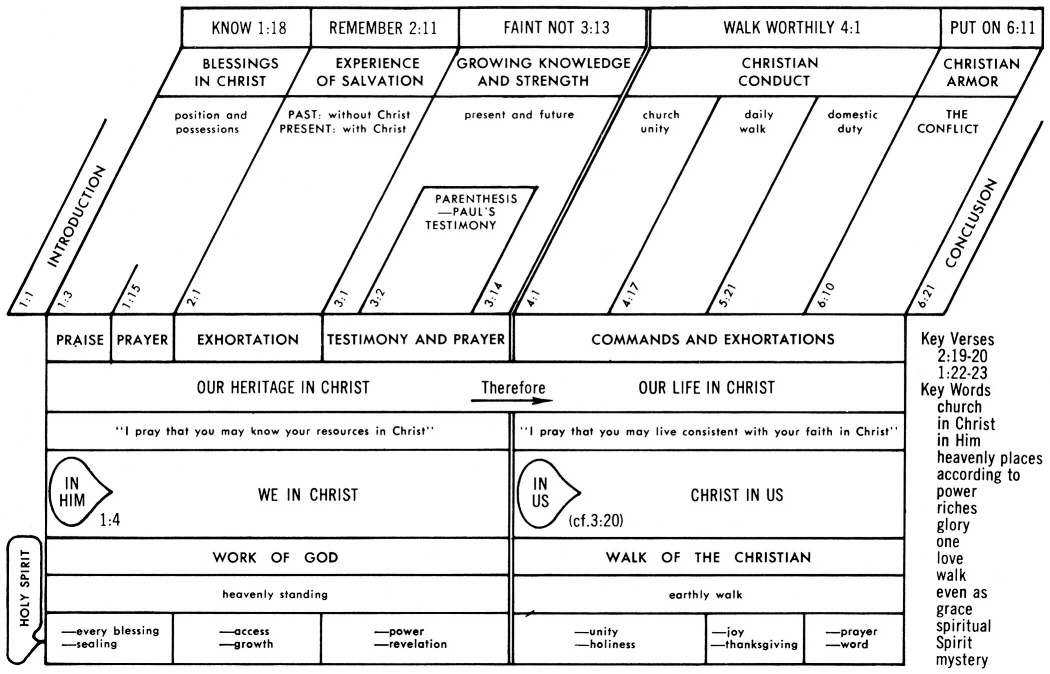
EPHESIANS - CHRIST AND THE CHURCH
Click chart to enlarge
Charts from Jensen's Survey of the NT - used by permission
Ephesians 2:11 Therefore remember that formerly you, the Gentiles in the flesh, who are called "Uncircumcision" by the so-called "Circumcision," which is performed in the flesh by human hands (NASB: Lockman)
Greek: Dio mnemoneuete (2PPAM) hoti pote humeis ta ethne en sarki, oi legomenoi (PPPMPN) akrobustia hupo tes legomenes (PPPFSG) peritomes en sarki cheiropoietou,
BGT Διὸ μνημονεύετε ὅτι ποτὲ ὑμεῖς τὰ ἔθνη ἐν σαρκί, οἱ λεγόμενοι ἀκροβυστία ὑπὸ τῆς λεγομένης περιτομῆς ἐν σαρκὶ χειροποιήτου,
Amplified: Therefore, remember that at one time you were Gentiles (heathens) in the flesh, called Uncircumcision by those who called themselves Circumcision, [itself a mere mark] in the flesh made by human hands. (Amplified Bible - Lockman)
NET: Therefore remember that formerly you, the Gentiles in the flesh – who are called “uncircumcision” by the so-called “circumcision” that is performed on the body by human hands – (NET Bible)
NLT: Don't forget that you Gentiles used to be outsiders by birth. You were called "the uncircumcised ones" by the Jews, who were proud of their circumcision, even though it affected only their bodies and not their hearts. (NLT - Tyndale House)
NLT (Revised) Don't forget that you Gentiles used to be outsiders. You were called "uncircumcised heathens" by the Jews, who were proud of their circumcision, even though it affected only their bodies and not their hearts.
Phillips: Do not lose sight of the fact that you were born "Gentiles", known by those whose bodies were circumcised as "the uncircumcised". (Phillips: Touchstone)
Wuest: On this account be remembering that at one time, you, the Gentiles in the flesh, the ones habitually called uncircumcision by that which is called circumcision in the flesh made by hand, (Eerdmans Publishing - used by permission)
Young's Literal: Wherefore, remember, that ye were once the nations in the flesh, who are called Uncircumcision by that called Circumcision in the flesh made by hands
KJV Wherefore remember, that ye being in time past Gentiles in the flesh, who are called Uncircumcision by that which is called the Circumcision in the flesh made by hands;
NKJ Therefore remember that you, once Gentiles in the flesh-- who are called Uncircumcision by what is called the Circumcision made in the flesh by hands--
ESV Therefore remember that at one time you Gentiles in the flesh, called "the uncircumcision" by what is called the circumcision, which is made in the flesh by hands--
NIV Therefore, remember that formerly you who are Gentiles by birth and called "uncircumcised" by those who call themselves "the circumcision" (that done in the body by the hands of men)--
CSB So then, remember that at one time you were Gentiles in the flesh-- called "the uncircumcised" by those called "the circumcised," which is done in the flesh by human hands.
NRS So then, remember that at one time you Gentiles by birth, called "the uncircumcision" by those who are called "the circumcision"-- a physical circumcision made in the flesh by human hands--
NAB Therefore, remember that at one time you, Gentiles in the flesh, called the uncircumcision by those called the circumcision, which is done in the flesh by human hands,
NJB Do not forget, then, that there was a time when you who were gentiles by physical descent, termed the uncircumcised by those who speak of themselves as the circumcised by reason of a physical operation,
GWN Remember that once you were not Jewish physically. Those who called themselves "the circumcised" because of what they had done to their bodies called you "the uncircumcised."
BBE For this reason keep it in mind that in the past you, the Gentiles in the flesh, who are looked on as being outside the circumcision by those who have circumcision, in the flesh, made by hands;
THEREFORE REMEMBER THAT FORMERLY YOU, THE GENTILES IN THE FLESH: Dio mnemoneuete (2PPAM) hoti pote humeis ta ethne en sarki:
- Eph 5:8; Deut 5:15; 8:2; 9:7; 15:15; 16:12; Isa 51:1,2; Ezek 16:61-63; 20:43; Ezekiel 36:31; 1Cor 6:11; 12:2; Gal 4:8,9
- Ephesians 2 Resources - Multiple Sermons and Commentaries
- Ephesians 2:11-13 Remembering Then, but Now! - Steven Cole
- Ephesians 2:11-22 Our Biography In Brief - Steven Cole
- Ephesians 2:11-12 The Unity of the Body, Part 1 - John MacArthur
Related Passages:
1 Corinthians 6:11+ Such were some of you; but you were washed, but you were sanctified, but you were justified in the name of the Lord Jesus Christ and in the Spirit of our God.
Harold Hoehner divides Ephesians 2:11-20 into 3 sections:
- the statement of the union (vv. 11–13),
- the explanation of the union of believing Jews and Gentiles into one “new humanity” (vv. 14–18),
- the consequences of that union (vv. 19–22).
THE BLESSED DISCIPLINE
OF REMEMBERING
OVERVIEW - In Ephesians 2:11-22 Paul is painting a picture of how the body of Christ was formed in the beginning. He is unveiling the mystery of the Church, and how it began with Jews and Gentiles who were hostile to each other. He begins by emphasizing the impossible to cross magnitude of the division, and then how God through Christ's work on the Cross and the work of the Spirit supernaturally bridged the centuries long unbridgeable spiritual chasm! He uses many pictures and phrases to essentially point out how such diverse groups were brought into one, the Church, His Body (Eph 1:22-23) -- OBSERVE - "but now," "brought near by the blood of Christ," "He is our peace" (peace = joining together that which was separated), "made both one," "broke down the barrier," "abolishing...enmity," "make (create) the two into one new man," "establishing peace (joining together)," "reconcile (make enemies into friends)," "both in one body (Eph 1:23)," "put to death the enmity (that which separated)," "preached peace (Gospel of peace - joining together that which was separate)...you...far away...those who were near," "one Spirit." As you look at those words and phrases do you see the repeating pattern of supernaturally bringing Jews and Gentiles together (first to God then to each other), and in so doing describing how the church was "born," realizing of course that it was inaugurated by the Spirit at Pentecost (Acts 2:1-4)? Then in Ephesians 2:19-22 he summarizes the beautiful union/oneness/intimacy of the Body by brushing his canvas with 5 metaphors, 5 pictures of the unity of the Body - fellow citizens, God's household, whole building, holy temple, dwelling of God! And all God's children shout "Hallelujah! All praise to the Lord. Amen"
Therefore (for this reason) (1352) (dio) is a term of conclusion which can also be translated "on this account" or "consequently". This charge to remember refers the reader not just to the preceding verses but all the way back to Ephesians 2:1 (And you were dead in your trespasses and sins), because this entire section is a single sentence in the original Greek. It is also notable this is the first command Paul gives in Ephesians and there is not another until chapter 4 (Eph 4:17)!
In Eph 2:10 Paul had just spoken of a new "creation" a "poiema," a masterpiece of God in creating a saint out of a dead sinner. Now he moves into another new creation explaining how Jews and Gentiles have now been made ("created") into one body, the Church.
W G Blaikie comments on "therefore" noting that " The practical tenor of the apostle’s teaching is indicated by his “therefores.” He is always gathering up his views into some lesson. They are to “remember” the change between the past and the present—what they were by nature, and what they had become by grace. This is most useful to all, even though the contrast between the two be not so vivid as in the case of Paul and the Ephesians. The contrast is indicated in various particulars, both of outward condition and of inward privilege and character. First, the old condition. They were “Gentiles in respect of the flesh”—not bearing on their bodies the mark of the Israel of God, therefore not marked out for blessing, not apparently near it. (Ephesians 2 Exposition)
Expositors agrees noting that "As dio (therefore) indicates, what follows is a personal, ethical application of what has been said; and the application is drawn, not from the immediate preceding sentence, but from the contents of the prior paragraph as a whole. The great things done for them by God’s grace should incline them to think of the past from which they have been delivered. The remembrance of that past will make them more thankful for their present privilege, and more careful to walk in the good works which God has in view for them. (The Expositor's Greek Testament)
John Eadie - lest any feeling of self-satisfaction should spring up within them, they were not to forget their previous state and character. This exercise of memory would deepen their humility, elevate their ideas of Divine grace, and incite them to ardent and continued thankfulness. The apostle honestly refers them to their previous Gentilism. (Commentary)
S Lewis Johnson writes that "it is never bad for us to take a look back at what we were and what we have become by virtue of the saving work of the Lord Jesus Christ. Never bad to shed a tear or two for the salvation that has come to us. John Newton, who is known for many things, was known also for the fact that he had on his desk a text from the Book of Deuteronomy 15:15+, it stayed on his desk after he had become a minister of the Lord Jesus Christ: “Remember that you were a bondman in the land of Egypt, and the Lord thy God redeemed thee. Therefore…”And then he goes on to speak about the things that have to do with response to the revelation to God. So it is always good to remember the place from which we have come. Therefore: that’s a good thing to apply, too. If you know what it is to be lost, and then to be saved, “Therefore” remember what you were. It always has a most salutary effect on our Christian life. (Made Nigh by Blood of Christ )
Bless the LORD, O my soul,
And forget none of His benefits
Psalm 103:2+
Remember (mnemoneuo) that formerly (pote) you, the Gentiles (ethnos) in the flesh - The remembering Paul is calling for is not simply a recalling of certain facts or situations nor simply a mental exercise but involved an meditation on what had happened and an acting upon it as a result. Paul uses the present imperative a command calling for them to continually remember the dismal spiritual condition they once were in as pagan Gentiles (Eph 2:1-3). And "remember" (pun intended) that all God's commands include the divine provision of His enabling power supplied by His indwelling Spirit, Who provides not only the power to obey but the desire to obey - see Phil 2:13NLT+). (cf need to depend on the Holy Spirit to obey all the commands)! Second-generation Gentile believers, such as is likely the case with many who were reading Paul's epistle might be beginning to forget their former abysmal dead spiritual condition outside of Christ. Paul is desirous for the Ephesian saints to remember they once were "aint's" and thus to truly apprehend what a tremendous thing it was that they should ever have become Christians, and not just that but that they should be members of the body of Christ Who is their Head!
THOUGHT - We ALL must keep remembering these great truths, lest we slip into apathy and leave our first love as Ephesus did in only one generation removed from the readers. John records Christ's woeful words to the church at Ephesus (only some 30+ years later - beware of backsliding beloved!), the Lord Jesus Christ declaring…
But I have this against you, that you have left your first love. Remember (present imperative) therefore from where you have fallen, and repent (aorist imperative) and do (aorist imperative) the deeds you did at first; or else I am coming to you, and will remove your lampstand out of its place-- unless you repent. (Rev 2:4+, Rev 2:5-+)
Comment: The Ephesian church had lost its focus. They had taken their eyes off of Jesus and were now focusing on their works done for His name. This is the essence of idolatry. An important function of festivals, signs, and altars is to help men remember the earlier works of God and the dedications they made - Ge 9:15-16; Nu 15:39-40; Dt 16:13; Jos. 22:10, 27-28.
THOUGHT- When was the last time you remembered your salvation experience or better yet remember your former state of utter depravity and desperation outside of Christ? Perhaps now is a good time to pause and recall your "so great a salvation" (Heb 2:3+). It is excellent "preventative medicine" for your soul. Nothing inspires gratitude more in a saved sinner than a look back to the pit from which he or she has been extracted by Divine, Amazing, Abounding Grace! Glory!!!
Remembering should stimulate in believers an attitude of gratitude as well as an attitude of humility as we recall the striking contrast of the before/after pictures presented in the opening verses in Ephesians 2 (see notes Ephesians 2:1; 2:2; 2:3). Paul later emphasized the practical application of present remembering writing "for you were formerly darkness (THE DREAD BEFORE), but now you are light in the Lord (THE DIVINE AFTER); walk (present imperative = Command to make this your lifestyle only possible as we depend on the Holy Spirit to obey) as children of light (Eph 5:8+): And so we see the power of memory to motivate right conduct. Remember that God's commands such as to walk in the light always include His enablements. Without the enabling power of His indwelling Holy Spirit, it would be impossible to obey for our old nature naturally is repelled by the light and runs from it. Praise God for His amazing, superabounding grace to enable His children to walk in the light as He Himself is in the light [1Jn 1:7+, cf fact that He is literally "Light" 1Jn 1:5+)!
Note also that remember calls for one to make a decision (Remember is in the active voice = volitional choice, choice of one's will) with the implication that from that thought recalled flows heartfelt gratitude to God and a desire to please (Php 2:13NLT explains how God gives us the "desire" and the "power!"). If this discussion finds you in the valley of despond or deviation from righteousness, failing to remember God's rich mercy, great love undeserved grace here is is a petition you might considering praying to your Father…
Enable me to remember that blood which cleanses
all sin,
to believe in that grace which subdues
all iniquities,
to resign myself to that agency which can
deliver me from the bondage of corruption
into the glorious liberty of the sons of God.
(Valley of Vision compilation of Puritan prayers)
THOUGHT - Now take a moment and bless the LORD, as you remember some of His great benefits. This will be good for your soul. (Ps 103:1,2)
The great Scottish expositor John Eadie wrote that "This exercise of memory would deepen their humility, elevate their ideas of Divine grace, and incite them to ardent and continued thankfulness (John Eadie Commentary)
The famous Puritan Pastor John Bunyan penned these thoughts on "remembering" which are apropos to this verse and to most of us for most reading these notes are Gentile believers…
My dear children, call to mind the former days, and the years of ancient times: remember also your songs in the night; and commune with your own heart ( Ps. 77.5-12+). Yea, look diligently, and leave no corner therein unsearched, for there is treasure hid, even the treasure of your first and second experience of the grace of God toward you. Remember, I say, the word that first laid hold upon you; remember your terrors of conscience, and fear of death and hell; remember also your tears and prayers to God; yea, how you sighed under every hedge for mercy. Have you never a hill Mizar (or here) (Ed: Quoted in Ps 42:6+, read Ps 46:1-5+ for context) to remember? Have you forgot the close (Ed: Archaic meaning = a hostile encounter), the milk house, the stable, the barn, and the like, where God did visit your soul? Remember also the Word-the Word, I say, upon which the Lord hath caused you to hope. If you have sinned against light; if you are tempted to blaspheme; if you are down in despair; if you think God fights against you; or if heaven is hid from your eyes, remember it was thus with your father, but out of them all the Lord delivered me. (John Bunyan - Grace Abounding To The Chief Of Sinners Published in 1666) (Bolding and notes Added)
The Pulpit Commentary has a nice section on "The Uses of Remembrance"…
The uses of remembrance. “Wherefore remember.” The present is built upon the past, and the memory of the past has much to do with the joys and sorrows of the present, as well as with the hopes and achievements of the future. It is well for believers to remember what they have been in view of their present mercies. Remembrance may thus become a means of grace.
I. IT TENDS TO DEEPEN THE HUMILITY OF SAINTS AS WELL AS TO INCREASE THEIR GODLY SORROW FOR SIN.
II. IT TENDS TO MAKE US GRATEFUL FOR OUR MERCIES AND TO MAKE US MAGNIFY THE GREATNESS AND FREENESS OF DIVINE LOVE. Where sin did much abound, we have found that grace did much more abound.
III. IT TENDS TO INSPIRE US WITH A STRONGER LOVE FOR CHRIST, WHO HAS PLACED US SO HIGH IN HEAVENLY PLACES. The woman in the gospel loved much when she remembered how much was forgiven her. “The grace of our Lord was exceeding abundant in faith and love” (1 Tim. 1:14) to the Apostle Paul in the remembrance of his old blasphemies and injuries to the gospel.
IV. IT TENDS TO QUICKEN US TO GREATER ZEAL AND ACTIVITY IN THE LORD’S SERVICE. We think sadly of our lost time in the service of sin, and are led now to work with increased energy for the cause of our Redeemer.
V. IT TENDS TO MAKE US MORE HOPEFUL OF THE CONVERSION OF OTHERS WHO ARE NOW WHAT WE ONCE WERE AS SINNERS.
The importance of the principle of remembering what we formerly were is firmly rooted in the Old Testament, for Moses repeatedly issued the warning to the second generation to remember...(and think about this for a moment -- they were going into the Promised Land and would be blessed with abundant milk and honey and it would be tempting to quickly forget about the One Who bestow every good and perfect gift. And beloved, we who have entered the Promised Life in Christ Jesus have been blessed with every spiritual blessing and it is so easy for us to forget the Giver of this incredible gift. We all need to have as part of our spiritual disciplines remembrance of the "before/after" of how lost we were in Adam and how alive we are in Christ! Remembrance of God's goodness to us in our badness will help motivate a godly walk that seeks to please Him.)
- 'And you shall remember that you were a slave in the land of Egypt, and the LORD your God brought you out of there by a mighty hand and by an outstretched arm; therefore the LORD your God commanded you to observe the Sabbath day. (Deut 5:15)
- “But you shall remember the LORD your God, for it is He who is giving you power to make wealth, that He may confirm His covenant which He swore to your fathers, as it is this day. (Deut. 8:18)
- you shall not be afraid of them; you shall well remember what the LORD your God did to Pharaoh and to all Egypt: (Deut. 7:18)
- "And you shall remember all the way which the LORD your God has led you in the wilderness these forty years, that He might humble you, testing you, to know what was in your heart, whether you would keep His commandments or not. (Deut 8:2)
- "Remember, do not forget how you provoked the LORD your God to wrath in the wilderness; from the day that you left the land of Egypt until you arrived at this place, you have been rebellious against the LORD." (Deut 9:7)
- "And you shall remember that you were a slave in the land of Egypt, and the LORD your God redeemed you; therefore I command you this today. (Deut 15:15) (NOTE: THIS VERSE WAS ON A PLAGUE THAT SET ON THE FORMER SLAVE TRADER JOHN NEWTON'S DESK).
- “You shall not eat leavened bread with it; seven days you shall eat with it unleavened bread, the bread of affliction (for you came out of the land of Egypt in haste), so that you may remember all the days of your life the day when you came out of the land of Egypt. (Deut. 16:3)
- "And you shall remember that you were a slave in Egypt, and you shall be careful to observe these statutes. (Deut 16:12)
- “Remember what the LORD your God did to Miriam on the way as you came out of Egypt. (Deut. 24:9)
- “But you shall remember that you were a slave in Egypt, and that the LORD your God redeemed you from there; therefore I am commanding you to do this thing. (Deut. 24:18)
- “You shall remember that you were a slave in the land of Egypt; therefore I am commanding you to do this thing.(Deut. 24:22)
- “Remember what Amalek did to you along the way when you came out from Egypt, (Deut. 25:17)
- “Remember the days of old, Consider the years of all generations. Ask your father, and he will inform you, Your elders, and they will tell you. (Deut. 32:7)
THOUGHT - Have you ever considered "remembering" to be a spiritual discipline? I think it is and it is a very profitable one to practice! Humility and gratitude are two of the more obvious spiritual fruits that are wrought by the Spirit when we practice this discipline.
In these OT passages, observe the repetition of the theme to remember what slavery was like (cf, Ex 2:23 "the sons of Israel sighed because of the bondage, and they cried out; and their cry for help because of their bondage rose up to God"). How appropriate for Gentiles who are now believers to remember their former bondage to Sin and Satan! How prone to wander we all are! The remedy is to remember!
The "remember principle" is repeated in the New Testament…
You know that when you were pagans, you were led astray to the dumb idols (they were led to worship idols by powers outside themselves; i.e., demons), however you were led. (1 Corinthians 12:2+)
However at that time, when you did not know God, you were slaves to those which by nature are no gods. But now that you have come to know God, or rather to be known by God ( Paul places special emphasis on being known by God. God knew us before we knew Him!), how is it that you turn back again to the weak and worthless (literally describes a pauper who has to crouch and cower to beg alms) elemental things, to which you desire to be enslaved all over again? (Galatians 4:8-9+)
Lehman Strauss has an interesting note - Before the day of Pentecost, which day was the birthday of the Church, the Gentiles included all people in the earth who were not Jews. Since Pentecost God sees a threefold division of the human race: the Jew, the Gentile, and the Church of God (1 Cor. 10:32), the last being made up of Jew and Gentile who have been saved through faith in the Lord Jesus Christ. (Commentary)
From Genesis 12+ onward the majority of the Scriptures are about the Jews, with the Gentiles mentioned as they interface with the Jews. The NT does have more mention of the Gentiles after the formation of the Church (and Acts was written by a Gentile, Dr Luke), but the last book, the book of Revelation is predominantly Jewish with over 200 OT quotes or allusions to OT passages. Beloved, God is not finished with the literal nation of Israel as is erroneously and sadly taught even in evangelical churches. (See What is replacement theology / supersessionism? | GotQuestions.org)
In the flesh - Paul is not contrasting "in the flesh" (fallen flesh, sinful nature) versus "in the Spirit" as he does in Galatians 5:16+ (a different context) but in this context is referring to the covering of the body (specifically the prepuce). Paul uses this imagery in Colossians writing to the predominantly Gentile church reminding them that…
when you were dead (cf Eph 2:1+) in your transgressions and the uncircumcision of your flesh, He made you alive together with Him (cf Eph 2:5+), having forgiven us all our transgressions, having canceled out the certificate of debt consisting of decrees against us and which was hostile to us; and He has taken it out of the way, having nailed it to the cross. (Col 2:13+; Col 2:14+)
The Pulpit Commentary adds a good "caveat" regarding remembering - "Yet this remembrance of our past condition is not to be a rueful, self-accusing thing that will kill hope and heart, but rather that which leads onward to a higher joy and a more complete consecration to the Lord’s work."—T. C.
Remember (3421) (mnemoneuo from mnaomai = remember, call to mind, recall information) means to use the faculty of memory given by God and keep in one’s mind people, things, and circumstances because memory is basis of learning and of motivation for future action. This is the only use of this verb in Ephesians.
Mnemoneuo - 21x in 21v - Mt 16:9; Mark 8:18; Luke 17:32; Jn 15:20; 16:4, 21; Acts 20:31, 35; Gal 2:10; Eph 2:11; Col 4:18; 1Th 1:3; 2:9; 2Th 2:5; 2Ti 2:8; Heb 11:15, 22; 13:7; Rev 2:5; 3:3; 18:5.
Formerly (4218) (pote) means at some time and in context refers to the past. "You were at one time" is the idea. Note the repetition of pote in Ephesians and note also the synonymous time phrase "at that time". (Ep 2:12+). Clearly this time phrase is a key word in this section.
Pote in Ephesians - Eph. 2:2+; Eph. 2:3+; Eph. 2:11+; Eph. 2:13+; Eph. 5:8; Eph. 5:29;
Gentiles (1484) (ethnos - English "ethnic") defines a body of persons united by kinship, culture, and common traditions. In this verse Gentiles is preceded by the definite article ("the") in the Greek text, marking Gentiles out as a distinct class. Basically all of mankind can be divided into Jew and Gentile and thus "Gentile" is a synonym for anyone who is non-Jew, who is not a member of the "chosen people". The Hebrew word corresponding to Gentile is goyim. This description arises from a Jewish standpoint since neither Romans nor Greeks would call themselves Gentiles.
The Religious Position of Gentiles Ephesians 2:11, 12 - Sermon Outline - Archie Edwards
I. They Were Uncircumcised.
II. They Were Without Christ.
III. They Were Aliens from the Commonwealth of Israel.
IV. They Were Strangers to the Covenant of Promise.
V. They Were Without Hope.
VI. They Were Without God in the World.
From 365 Days with Wilberforce: - In the summer of 1817, Wilberforce penned a lengthy review of his life with a view towards remembering all that God had done in his life. Though it reads in a somewhat fragmentary fashion—almost like a catalogue—what comes through is a profound sense of gratitude.
‘Early advantages abused, and benefits often lost.—What an (almost) hell of bad passions (despair absent) in my soul when a youth, from emulation, envy, hatred, jealousy, selfishness! (Yet, alas! justice to myself requires my adding how ill-treated here.) Time, talents, substance, etc. wasted, and shocking goings-on (Christianity considered): and after the revellings over, as egregious waste of faculties and means among the fellows; card-playing, etc. Consequent course of living almost without God in the world, till God’s good providence checked and turned me, oh miracle of mercy in 1785, through the Dean’s (Dean of Carlisle, Isaac Milner 1750–1820) instrumentality.’
J.C. Philpot, Ears from Harvested Sheaves. Ephesians 2:12 - The apostle here tells the Ephesians that in their natural state, before divinely quickened and made alive unto God, they were “without Christ,” that is, without manifest union and communion with Him. Though in the purposes of God, and by their eternal election in Christ, they were members of His mystical body, they had not been baptized into Christ by the Spirit so as to be made living members of His spiritual body, the Church, and therefore had not “put on Christ.” And as they were, such were we. We were “without Christ” in our gentile days. He had no place in our thoughts. We knew nothing of His Person and work, blood and righteousness, beauty aand blessedness, grace and glory. He was to us a root out of a dry ground, and in our eyes He had no form nor comeliness. His name might have been on our lips, but His Spirit and grace were not in our hearts. And if matters be in any way different now with us, if there be any faith on Him, hope in Him, or love to Him, grace has wrought it all. Let us never forget what we were before we were called by grace. Let the remembrance of our sins and of the whole bent and current of our lives be bitter to us, that we may all the more prize and admire the riches of that sovereign grace which stooped to us in our low and lost estate. The paschal lamb was to be eaten with bitter herbs. The remembrance of Egyptian bondage should ever accompany the enjoyment of gospel liberty, and godly sorrow for sin the feeding on the flesh of Christ.
WHO ARE CALLED "UNCIRCUMCISION" BY THE SO-CALLED CIRCUMCISION: oi legomenoi (PPPMPN) akrobustia hupo tes legomenes (PPPFSG) peritomes:
- Who are called "Uncircumcision" by the so-called "Circumcision 1Sa 17:26,36; Jer 9:25,26; Phil 3:3; Col 3:11
- Ephesians 2 Resources - Multiple Sermons and Commentaries
- Ephesians 2:11-13 Remembering Then, but Now! - Steven Cole
- Ephesians 2:11-22 Our Biography In Brief - Steven Cole
- Ephesians 2:11-12 The Unity of the Body, Part 1 - John MacArthur
DEROGATORY DESCRIPTION
OF THE GENTILES
Who are called "Uncircumcision" (akrobustia) by the so-called "Circumcision (peritome)," which is performed in the flesh by human hands - Called (lego) means to say or explain something more fully and in this context is a "derogatory" call (cf 1Sa 17:26, 36, 2Sa 1:20). Since the Gentiles were physically uncircumcised, the physically circumcised Jews interpreted this as an absence of divine favor with God because they did not have the "sign" of the Covenant. Paul says they were "so-called" Jews, Jews in name and physical descent bearing the external sign of circumcision, but not Jews internally because their hearts (not all of course but a majority) had never experienced the "circumcision" that most pleases God, circumcision of their hearts (tantamount to being born again by the Spirit and Word - Jn 3:3-8, cf Dt 10:16, Dt 30:6, Ro 2:28-29, et al), as discussed in more detail below.
For modern day Christians it is somewhat difficult to fully appreciate the impediment that existed between those of the "uncircumcision" and those of the "circumcision". And yet the ancient world was truly divided into these two main groups, Jews and Gentiles. Not only was it a fact that the Gentiles had not been circumcised but sadly the Jews had exaggerated that fact, and had made it a wall of division which seemed to create a gap that could not be bridged! The uncircumcision of Gentiles was evidence of their estrangement from God, which in Jewish eyes could only be dealt with if a Gentile became a proselyte to the Jewish faith.
Hoehner on "Circumcision...in the flesh" - The Jews were widely known in the ancient world as those who were circumcised. They were proud of the distinctive of circumcision, a God-ordained covenantal sign that goes back to Abraham (Ge 17:9–14). Paul, in his pre-conversion days, was proud to state that he was “circumcised on the eighth day” (Phil 3:5), and it seems that Jews were zealous to have Gentiles circumcised so that they would come under the covenant (Gal 6:12–13; cf. 5:2–6, 11; Phil 3:2–3). The prepositional phrase “in the flesh” has reference to where this circumcision was done. In the present context the contrast is between the Jew who has this physical mark in his flesh and the Gentile who has his foreskin, and is thus disdained by the Jew. The gracious work of Christ in the lives of both Jew and Gentile profoundly changed this situation. (See Ephesians: An Exegetical Commentary)
Lloyd-Jones explains that "The division seemed absolute, and any talk about reconciliation seemed monstrous and impossible. Jew and Gentile! Jews and ‘dogs’! But on the other hand the Gentiles had their classification, and particularly the Greeks. The whole world, for them, was divided up into Greeks and Barbarians—the knowledgeable people, the philosophers, the Greeks on the one hand; the ignoramuses, the illiterate, the Barbarians on the other. That was the position, and it seemed utterly impossible that these two sections, these warring sections who despised each other so heartily, could ever be brought together and reconciled, still less that they should ever be found on bended knee together worshipping and adoring the same God and the same Lord. But it has happened, says Paul. The astounding thing is that it is true. These Ephesians have been brought in, and are likewise in the membership. This is the astounding thing that nothing less than ‘the exceeding greatness of God’s power’ could ever have brought to pass. (Exposition of Ephesians)
Hodge writes that the term uncircumcision (akrobustia) "to the Jews it expressed a self-righteous abhorrence of the Gentiles as unclean and profane. This feeling on their part arose because they supposed that the mere outward rite of circumcision conveyed holiness and secured God’s favor… The Jews were a striking illustration of the effect of ascribing objective power to external rites and regarding them as conveying grace and securing the favor of God, irrespective of the subjective state of the recipient. This teaching made them proud, self-righteous, malignant, and contemptuous and led them to regard religion as an external service which was compatible with a profane heart and life. This teaching the apostle repudiates everywhere and denounces it as fatal. And therefore in this connection, while speaking of the real advantage of circumcision and of the covenant union with God, of which it was the seal, the apostle was careful to indicate clearly that it was not the circumcision in the flesh made with hands which secured the blessings of which he speaks." (Ephesians 2 Commentary)
Gilbrant on the derogatory term uncircumcision (akrobustia) - Notice the exclusiveness and contempt that most Jews ("the Circumcision") held for Gentiles ("Uncircumcision"). Circumcision was instituted by God himself (Genesis 17:10-14) as an external sign of the covenant He made with Abraham. This important rite signified externally what had happened to Abraham internally. However, by Paul's time this physical sign had become more of a sign of the difference between Jew and Gentile than of a person's relationship to God. Paul reminds people that internal—not external—circumcision is what really matters (Galatians 5:6; Colossians 2:11). The apostle certainly did not share the contempt most Jews held for Gentiles. Incidentally, most Gentiles at that time also looked at Jews with contempt. (Complete Biblical Library - Incredible Resource)
W G Blaikie comments on "uncircumcision" (akrobustia) noting that the Gentiles "had a name which denoted the very opposite of that given to God’s people—another illustration of their apparent distance from blessing; they revolved round the sun, as it were, not in the nearer orbits of planets warmed, brightened, and beautified by the solar beams, but in the outermost ring of all—like the cold, dark orbit of Uranus or Neptune, which the sunbeams hardly reach to lighten or to warm. (Ephesians 2 Commentary)
David uses this same disparaging name ("uncircumcision") in his description of Goliath asking…
the men who were standing by him, saying, "What will be done for the man who kills this Philistine, and takes away the reproach from Israel? For who is this uncircumcised Philistine, that he should taunt the armies of the living God?"… (addressing King Saul) "Your servant has killed both the lion and the bear; and this uncircumcised Philistine will be like one of them, since he has taunted the armies of the living God." (1Sa 17:26, 36)
John MacArthur - A rabbinic writer tells of an incident that explains the common Jewish attitude toward Gentiles. A certain Gentile woman came to Rabbi Eleazar, confessed that she was sinful, and told him that she wanted to become righteous. She wanted to be accepted into the Jewish faith because she had heard that the Jews were near to God. The rabbi is said to have responded, “No. You cannot come near,” and then shut the door in her face… God made Israel distinct for two reasons. First, He wanted the world to see and notice them, to realize that they did not live and act like other men. Second, He wanted them to be so distinct that they would never be amalgamated with other peoples. He gave them such strict dietary, clothing, marriage, ceremonial, and other laws that they could never fit easily into another society. Those distinctions, like the special blessings God gave them, were intended to be a tool for witness. But Israel continually perverted them into a source for pride, isolation, and self–glory… When a Jew entered Palestine he would often shake the dust off his sandals and clothing in order not to contaminate the Holy Land with Gentile dust. Because Samaritans were partly Gentile, most Jews would go far out of their way to avoid traveling through Samaria. If a young Jewish man or woman married a Gentile, their families would have a funeral service, symbolizing the death of their child as far as religion, race, and family were concerned. For fear of contamination, many Jews would not enter a Gentile home or allow a Gentile to enter theirs. For many hundreds of years the animosity between Jew and Gentile had festered and grown. Although they were not always in open conflict, their mutual contempt continued to widen the gulf between them. (See Ephesians MacArthur New Testament Commentary)
Warren Wiersbe - God called Abraham, God made a difference between Jews and Gentiles. He made this difference, not that the Jews might boast, but that they might be a blessing and a help to the Gentiles. God set them apart that He might use them to be a channel of His revelation and goodness to the heathen nations. Sad to say, Israel kept this difference nationally and ritually, but not morally. Israel became like the lost nations around her. For this reason, God often had to discipline the Jews because they would not maintain their spiritual separation and minister to the nations in the name of the true God. (See Ephesians Through Revelation)
John Eadie writes that circumcision "was the national distinction on which the Jews flattered themselves. Other Abrahamic tribes, indeed, were circumcised, but the special promise was—“In Isaac shall thy seed be called.” (Ephesians Commentary)
The sign of circumcision (peritome) was given as a command by God to Abraham in Genesis 17:11…
"And you shall be circumcised in the flesh of your foreskin; and it shall be the sign of the covenant between Me and you."
As time went on the command was neglected, especially during the days when the people of Israel wandered in the wilderness. Perhaps this was a sign that the nation had broken their covenant with God through their disobedience. The rite of circumcision was resumed when they entered the land of Canaan, with Joshua performing the ritual on the generation born in the wilderness (Joshua 5:1-9+). Over the years that followed, the Jews came to take great pride in circumcision and in fact as alluded to here in Ephesians 2:11, circumcision came to be synonymous with Judaism and was touted as a badge of their spiritual and national superiority! This practice fostered an exclusivist mentality instead of a missionary zeal to reach the Gentiles which was God's original intent for His "chosen" people who were to be lights unto the Gentiles.
ILLUSTRATION - A daily prayer of a strict Jewish male was to thank God that he was neither a woman, a Samaritan, nor a Gentile. Gentiles came to be regarded by the Jews as the “uncircumcision,” a term of disrespect implying that non-Jewish peoples were outside the circle of God’s love. In divine irony God applied the same term ("uncircumcised") to His "chosen" people. The terms “circumcised” and “uncircumcised” became emotionally charged symbols to Israel and their Gentile neighbors. This issue later brought discord into the fellowship of the New Testament church (see Acts 15:1-41+) and especially caused confusion about how one obtained genuine salvation (read the epistle to the Galatians).
The Jews should have known the true spiritual meaning of circumcision for several reasons. One of the most important reasons is "chronological". That is God's command to Abraham to undergo circumcision was many years after his "day of salvation" recorded by Moses in Genesis 15…
Then he believed in the LORD (he believed the "gospel" - see Gal 3:8+. He believed in "the Seed", the Messiah - see Gal 3:16+); and He (God) reckoned (imputed, placed on his spiritual "bank account") it to him as righteousness. (Genesis 15:6+)
Another reason the Jews should have understood the symbolic nature of circumcision was that Moses and several of Israel's prophets used the term “circumcised” as a symbol for purity of heart and readiness to hear and obey. For example, through Moses the Lord challenged the Israelites to submit and
“Circumcise then your heart (clearly this could not have been a reference to external circumcision or to literal circumcision and by default had to be a call for spiritual circumcision, which in its essence would represent their salvation), and stiffen your neck no more.” (Dt 10:16+).
Comment: An uncircumcised heart reflected a will that was hardened toward God’s commands.
In short, the most significant aspect of the physical act of circumcision was that it was a symbol or sign and as such it pictured man's need for his heart to be cleansed from sin’s deadly disease. This "cutting" needed to happen internally, for God was calling for the removal of the "body of the flesh" (Col 2:11+), which represent the "sin virus" inherited from Adam and which kept man dead in his transgressions and alienated and hostile toward God. It may be that God selected the reproductive organ as the location of the symbol for man’s need of cleansing for sin, because it is the instrument that sadly is most indicative of man's depravity and since by it he reproduces new little sinners (who are infected with the same "sin virus" from Adam - Ro 5:12+). In summary, physical circumcision was a sign of being under God’s covenant with Abraham, a covenant that was entered into by faith, not by works. But the Jews for the most part turned it around and made circumcision a work by which they falsely thought one could enter into covenant with God.
In the midst of a series of warnings to Israel regarding punishment for disobedience to the LORD, Moses records a ray of hope in God's gracious promise that
"If they confess their iniquity and the iniquity of their forefathers, in their unfaithfulness which they committed against Me, and also in their acting with hostility against Me— I also was acting with hostility against them, to bring them into the land of their enemies—or if their uncircumcised heart becomes humbled (conveys the basic sense of being lowly, meek) so that they then make amends for their iniquity, then I will remember My covenant with Jacob, and I will remember also My covenant with Isaac, and My covenant with Abraham as well, and I will remember the land (this is the same covenant Abraham entered into by faith not works)." (Lev 26:40-42+)
Comment: Note that the covenant God would remember was not the Mosaic covenant, the covenant of law, but was the Abrahamic covenant, the covenant of grace, the covenant that could only be entered into by faith not by works
Much of the Old Testament is a record of Israel's continual rebellion against God, and the root cause of this rebellion was an “uncircumcised heart,” a heart that had never been changed by the LORD and one which therefore refused to bow and to be humbled before Him.
Moses gave Israel a prophetic promise that
"the LORD your God will circumcise your heart and the heart of your descendants, to love the LORD your God with all your heart and with all your soul, in order that you may live." (Dt 30:6+)
Comment: Read the preceding verses, Deut 30:1-5, for the context of which indicates that this promise will ultimately be fulfilled just prior to the Millennial Reign of Christ. Of course it is also fulfilled every time a Jewish person places their faith in the Messiah (see some incredible testimonies of this spiritual circumcision at OneforIsrael)
What God's law demanded, God's grace enabled. As noted above, Deuteronomy 30:6 primarily refers to the future salvation of Jews alive at the return of Christ, when by faith they will have their hearts circumcised. In the intervening centuries, God has partially fulfilled this promise, as there have always been physical Jews who by faith received God's promise of new life in Christ (and how we praise God for these dear souls who compose the remnant!) In the OT, the believers were looking forward to the Cross (cf Gal 3:8, 16), whereas in the NT they (and all believers today) look back to the finished work of Christ on the Cross. Thus circumcision of heart defines an internal work by God's Spirit and is another way to describe genuine salvation, a salvation that imparts to that individual a new heart and a new will (a "want to") that out of love and a longing for holiness, desires to to obey God instead of to rebel against Him. This promise of a new heart would allow the Israelites to love the Lord with all their heart and soul, and reaches its fullest expression in the New Covenant (read Jer 31:31-34, Ezek 11:19, Ezek 36:26 - see also notes on topic New Covenant in the Old Testament).
The physical circumcision God had called for was always meant to be an external sign of an internal change of heart resulting in a love for God. Thus Paul wrote that in Christ the believers at Colossae
"were also circumcised with a circumcision made without hands, in the removal of the body of the flesh by the circumcision of Christ" (Col 2:11+)
Comment - Here Paul is explaining the figurative meaning of circumcision as the "cutting off" of Christ at His Crucifixion.
In Romans Paul had made it clear that
"he is not a Jew who is one outwardly; neither is circumcision that which is outward in the flesh. But he is a Jew who is one inwardly; and circumcision is that which is of the heart, by the Spirit, not by the letter; and his praise is not from men, but from God." (Ro 2:28, 29+).
Comment - The circumcision was not to the end but the sign pointed to internal circumcision of the heart.
This internal "circumcision" is what Jesus was alluding to when He declared
"You blind Pharisee, first clean the inside of the cup and of the dish, so that the outside of it may become clean also." (Mt 23:26)
On the basis of the previous explanation, now you can understand what Jeremiah meant when he addressed faithless, unbelieving Judah and Jerusalem commanding them to…
"Circumcise yourselves to the Lord and remove the foreskins of your heart, men of Judah and inhabitants of Jerusalem, lest My wrath go forth like fire and burn with none to quench it." (Jer 4:4)
As Biblical history records they refused to heed the warning and were utterly defeated by Nebuchadnezzar in 589BC.
Jeremiah characterized rebellious Israel as having “uncircumcised” ears declaring
"To whom shall I speak and give warning, that they may hear? Behold, their ears are closed (Hebrew literally = uncircumcised) and they cannot listen. Behold, the word of the LORD has become a reproach to them." (Jer 6:10)
Comment: Note the effect of the Word of God when a person is a non-believer!
Through Jeremiah the LORD later says
"Behold, the days are coming, that I will punish all who are circumcised and yet uncircumcised (alluding to failure to receive spiritual, internal circumcision of the heart by faith in Messiah - it always surprises many today to discover that from a Biblical perspective, the majority of OT Israel was not saved, a sad truth to which the Old Testament repeatedly testifies!)-- Egypt, and Judah, and Edom, and the sons of Ammon, and Moab, and all those inhabiting the desert who clip the hair on their temples; for all the nations are uncircumcised (referring to the fact that most of the Gentiles were physically uncircumcised), and all the house of Israel are uncircumcised of heart. (referring to spiritual circumcision)" (Jer 9:25, 26)
The Jews boasted in the covenant sign of circumcision, but it was only in their physical flesh and not "the foreskin of their heart". The true spiritual circumcision God always desired had never transpired in their hard hearts. In a similar way, people today who depend on baptism, any church sacrament (ordinance) or any supposed "meritorious" work, and yet who have never repented and trusted in Christ, are in the same situation as the Jews in Jeremiah’s day - they may think that they are a part of the God's New Covenant, but their confidence is false and they stand deceived and in imminent danger of entering into a Christ-less eternity. (cf Jesus' loving but stern warning to His Jewish audience in Mt 7:21+, Mt 7:22-23+)
In Acts Stephen infuriated his Jewish audience with the indictment that
"You men who are stiff-necked (literally "hard necked" and thus obstinate, stubborn, rebellious) and uncircumcised in heart and ears are always resisting (rushing against; striving against, opposing, resisting by actively pressure) the Holy Spirit; you are doing just as your fathers did." (Acts 7:51+)
Comment: Unsaved men resist the warnings and wooing of the Holy Spirit.
Their uncircumcision in heart and ears marks the Jews as just like the unsaved Gentiles (who Paul refers to here in Ephesians 2:11 as the "uncircumcision"). Their sin had never been forgiven. They were as unclean before God as uncircumcised Gentiles and they therefore stood condemned before God.
A crisis erupted in the church at Antioch when some men
“some men (Judaizers) came down from Judea and began teaching the brethren, "Unless you are circumcised according to the custom of Moses, you cannot be saved." (Acts 15:1+)
The Judaizers insisted that a believer from a non-Jewish background (Gentile) must first become a Jew ceremonially (by being circumcised) before he could be admitted to the Christian brotherhood. A council of apostles and elders was convened in Jerusalem to resolve the issue (Acts 15:6-29). Among those attending were Paul, Barnabas, Simon Peter, and James, a leader of the Jerusalem church. To insist on circumcision for the Gentiles, Peter argued, would amount to a burdensome yoke (Acts 15:10,19). This was the decision handed down by the council, and the church broke away from the binding legalism of Judaism which demanded physical circumcision.
Related Resource:
How do these truths about circumcision apply today? We have already inferred that there are many who may have been taught as children, and even as adults that the thing that makes them acceptable to God is the fact that they were baptized or that they joined a church, etc. To the Jew it was the rite of circumcision that gave them the false confidence that they were acceptable to God. But tragically they distorted the clear teaching of both the Old and New Testaments. Why? Because they failed to read what had been clearly stated -- that circumcision as originally commanded was only meant to be a sign of the covenant (Ge 17:11). To reiterate, circumcision was an external sign of an internal work of grace by faith (Genesis 15:6), when Abraham believed. Remember, as discussed above, that Abraham's belief and "day of salvation" (the day his heart was "spiritually circumcised") preceded by many years God's call for physical circumcision.
The Jews read what the "sages" and "wise" rabbis wrote in the Talmud and other writings about the meaning of circumcision -- they read and heard what other men said (the "commentaries" so to speak) but failed to check it out with what God said (Acts 17:11) and it cost them dearly (and eternally). The question one must ask is have many in the modern day church gone the same route placing more emphasis on what men say about the Word of God than in what God says in His Word? Have many based their eternal destiny on a physical act performed in the flesh or on a spiritual transaction performed on the heart by the Spirit?
Uncircumcision (203) (akrobustia from ákros = “running up to a point” or “that which stands on the outer edge" + búo = cover, stop up, close) refers to the prepuce or foreskin and thus to one who is uncircumcised and is known as the uncircumcision, which in context refers to the pagan Gentile. Uncircumcision was a name of contempt that the Jews flung at the Gentiles and was indicative of the low regard in which they were held.
Akrobustia - 20x in 17v - Acts 11:3; Ro 2:25, 26, 27; 3:30; 4:9, 10, 11; 1 Cor 7:18, 19; Gal 2:7; 5:6; 6:15; Eph 2:11; Col 2:13; 3:11.
Akrobustia is found in 16 verses in the non-apocryphal Septuagint all except Jeremiah speaking of literal circumcision - Ge 17:11, 14, 23, 24, 25; 34:14, 24; Ex 4:25; Lev 12:3; Josh 5:3; 1Sa 18:25, 27; 2Sa 3:14; Jer 9:25
Jer 9:25 “Behold, the days are coming,” declares the LORD, “that I will punish all who are circumcised and yet uncircumcised– (used figuratively of their spiritually "uncircumcised" hearts -
Circumcision (4061) (peritome from perí = around + témno = cut off) refers literally to cutting and removal of the foreskin. In context Paul is using peritome to refer not to the act of circumcision but to the people who were commanded to carry out this act, specifically the Jews.
Peritome - 36x in 32v - John 7:22, 23; Acts 7:8; 10:45; 11:2; Rom 2:25, 26, 27, 28, 29; 3:1, 30; 4:9, 10, 11, 12, ; 15:8; 1Cor 7:19; Gal 2:7, 8, 9, 12; 5:6, 11; 6:15; Eph 2:11; Phil 3:3, 5; Col 2:11; 3:11; 4:11; Titus 1:10
WHICH IS PERFORMED IN THE FLESH BY HUMAN HANDS : en sarki cheiropoietou:
- Colossians 2:11
- Ephesians 2 Resources - Multiple Sermons and Commentaries
- Ephesians 2:11-13 Remembering Then, but Now! - Steven Cole
- Ephesians 2:11-22 Our Biography In Brief - Steven Cole
- Ephesians 2:11-12 The Unity of the Body, Part 1 - John MacArthur
Related Passages:
Genesis 17:9-12 God said further to Abraham, “Now as for you, you shall keep My covenant, you and your descendants after you throughout their generations. 10 “This is My covenant, which you shall keep, between Me and you and your descendants after you: every male among you shall be circumcised. 11 “And you shall be circumcised in the flesh of your foreskin, and it shall be the sign of the covenant between Me and you. 12“And every male among you who is eight days old shall be circumcised throughout your generations, a servant who is born in the house or who is bought with money from any foreigner, who is not of your descendants.
COMMENT - Note the word "sign." A sign on a highway intersection points you to the town to which you are seeking to travel. It points to your destination. The sign is not the town. By the same token, the sign is not the covenant, but points to the covenant (the Abrahamic Covenant which is entered by grace through faith as in Genesis 15:6). The Jews had made physical circumcision the "means to the end" (salvation, entrance into the Kingdom of God). But the sign is not the destination, and tragically instead of leading to heaven, it leads to hell (unless they experience supernatural, internal circumcision).
EXTERNAL
CIRCUMCISION
Which is performed in the flesh by human hands - Paul emphasizes that circumcision is performed “in the flesh by human hands” so that the reader will recognize circumcision for what it is, an external sign which originally was meant to be a sign of an internal spiritual reality. In contrast to God's desire that they be circumcised in their hearts by supernatural "hands."The New Testament parallel over which many stumble is baptism. The physical act of baptism doesn’t save but is merely an outward expression of the inner heart transformation the Spirit of God produces when one is saved by grace through faith.
Paul describes the circumcision God honors writing to the believers in Colossae declaring that in Christ "you were also circumcised with a circumcision made without hands, in the removal of the body of the flesh by the circumcision of Christ; (Colossians 2:11)
Performed by human hands (5499) (cheiropoietos from cheir = hand + poieo = make) describes whatever is handmade or is manufactured and thus is of human construction and human skill. In classical Greek and elsewhere it means “made with hands” or “artificial.” It stands in contrast to something “natural” (autophuēs), and it can suggest something done intentionally (Liddell-Scott).
Gilbrant - Although cheiropoiētos occurs only six times in the New Testament, the fact that four different writers use it indicates it was in common circulation at that time. The Septuagint appears to be a major factor for the understanding of the term in the New Testament. This is clearly seen in Mark 14:58; Acts 7:48; 17:24; Hebrews 9:11; and 9:24. Each of these texts emphasizes that the one true God dwells not in man-made temples or tabernacles but in heaven (Acts 7:48,49; Hebrews 9:24; cf. 1 Kings 8:27). As creator of all things God does not need to have a sanctuary fashioned by man (Acts 17:24). He exists on a plane above the created order itself (Hebrews 9:11).
Because of the plain association of cheiropoiētos with pagan idols in the Septuagint, the false witnesses against Jesus are almost certainly implying that Jesus had called the temple an idolatrous shrine (Mark 14:58). Interestingly Mark does not record the incident itself, but we learn from John that Jesus had made a statement similar to that. However, Jesus’ reference to a temple “not made with hands” (acheiropoiētos [879]) did not refer to another temple but to His body; at least that is how John understands it (John 2:21f.; cf. 2 Corinthians 5:1).
Cheiropoiētos is also applied to the man-made rite of circumcision. The idea here is how ineffective such human efforts are for establishing a covenant relationship with God. Only through Christ can we be truly circumcised before God (Colossians 2:11). God had always expected Israel to be circumcised in their hearts as well as their flesh (e.g., Leviticus 26:41; Deuteronomy 30:6; Jeremiah 4:4; 9:26; cf. Jeremiah 31:31-33; Acts 7:51).(Complete Biblical Library - Incredible Resource)
O'Brien adds that the "adjective cheiropoietos (‘made with hands’) was employed in the LXX to denote idols (Lev. 26:1; Isa. 2:18), an idol’s sanctuary (Isa. 16:12), false gods (Isa. 11:9), or images (Lev. 26:30). It therefore described the gods as made with human hands and standing over against the living God. In all of its New Testament occurrences cheiropoietos (‘made with hands’) is used to set forth the contrast between what is constructed by human beings and the work of God (E. Lohse, TDNT 9:436; cf. Mark 14:58; Acts 7:48; 17:24; Heb. 9:11, 24). So to speak of something ‘not made with hands’ (cheiropoietos) is to assert that God himself has created it: e.g., the temple that Jesus would erect in three days (Mark 14:58), the heavenly house that will be given to believers at death (2Co 5:1), and that circumcision which stood in contrast to Jewish circumcision and was truly the work of God, namely, Christ’s death (Col 2:11). (See The Letter to the Ephesians)
Cheiropoietos - Mk. 14:58; Acts 7:48; Acts 17:24; Eph. 2:11; Heb. 9:11; Heb. 9:24
Cheiropoietos in the Septuagint- Lev. 26:1; Lev. 26:30; Isa. 2:18; Isa. 10:11; Isa. 16:12; Isa. 19:1; Isa. 21:9; Isa. 31:7; Isa. 46:6; Dan. 5:4; Dan. 5:23; Dan. 6:27
In the Septuagint (LXX) cheiropoietos is used of idols. For example in Leviticus 26 we read "I am the Lord your God: ye shall not make to yourselves gods made with hands, or graven; neither shall ye rear up a pillar for yourselves, neither shall ye set up a stone for an object in your land to worship it: I am the Lord your God. (Lev 26:1+ from Brenton's translation of the Septuagint, cf similar meaning in Isa 2:18, Isa 10:11)
Flesh (4561) (sarx) has many meanings so one must carefully examine the context to arrive at the correct nuance. In this context sarx refers to the physical flesh, the foreskin.
In summary, in using the term "so called circumcision" Paul makes it abundantly clear that the Jews to whom he refers are not saved (Ro 2:28-29+).
Harry Ironside was on a train going to a preaching assignment in southern California when he was accosted by a gypsy who said
“How do you do, gentleman. Would you like to have your fortune told? Cross my palm with a silver quarter, and I will give you your past, present, and future.”
To which Ironside replied…
“Are you very sure you can do that? You see, I am Scottish, and I wouldn’t want to part with silver without getting a full value for it.”
The gypsy replied earnestly
“Oh, yes, gentleman. Please. I will tell you all.”
At that point Ironside reached into his pocket and brought out his New Testament.
“It is not really necessary for me to have you tell my fortune, because here I have a book that gives me my past, present, and future. Let me read it to you.”
With that introduction Ironside turned to Ephesians 2 and read the words “you were dead in your transgressions and sins… ” declaring…
“That is my past”
The woman tried to get away protesting
“That is enough! I do not care to hear more.”
To which Ironside replied…
“But wait. There is more. Here is my present: ‘But because of his great love for us, God, who is rich in mercy, made us alive with Christ even when we were dead in transgressions—it is by grace you have been saved. And God raised us up with Christ and seated us with him in the heavenly realms in Christ Jesus. …’ ”
“No more!” she protested.
Undeterred Ironside continued
“Here is my future, too ‘… in order that in the coming ages he might show the incomparable riches of his grace, expressed in his kindness to us in Christ Jesus ”
By this time the gypsy was on her feet and on her way down the aisle, exclaiming…
“I took the wrong man!” (Adapted from H. A. Ironside, In the Heavenlies: Practical Expository Addresses on the Epistle to the Ephesians: Loizeaux Brothers, 1938), 96–98)
Ephesians 2:12 remember that you were at that time separate from Christ, excluded from the commonwealth of Israel, and strangers to the covenants of promise, having no hope and without God in the world. (NASB: Lockman)
Greek: hoti ete (2PIAI) to kairo ekeino choris Christou, apellotriomenoi (RPPMPN) tes politeias tou Israel kai xenoi ton diathekon tes epaggelias, elpida me echontes (PAPMPN) kai atheoi en to kosmo.
Amplified: [Remember] that you were at that time separated (living apart) from Christ [excluded from all part in Him], utterly estranged and outlawed from the rights of Israel as a nation, and strangers with no share in the sacred compacts of the [Messianic] promise [with no knowledge of or right in God’s agreements, His covenants]. And you had no hope (no promise); you were in the world without God. (Amplified Bible - Lockman)
BGT ὅτι ἦτε τῷ καιρῷ ἐκείνῳ χωρὶς Χριστοῦ, ἀπηλλοτριωμένοι τῆς πολιτείας τοῦ Ἰσραὴλ καὶ ξένοι τῶν διαθηκῶν τῆς ἐπαγγελίας, ἐλπίδα μὴ ἔχοντες καὶ ἄθεοι ἐν τῷ κόσμῳ.
NET: that you were at that time without the Messiah, alienated from the citizenship of Israel and strangers to the covenants of promise, having no hope and without God in the world (NET Bible)
NLT: In those days you were living apart from Christ. You were excluded from God's people, Israel, and you did not know the promises God had made to them. You lived in this world without God and without hope. (NLT - Tyndale House)
NLT (revised) In those days you were living apart from Christ. You were excluded from citizenship among the people of Israel, and you did not know the covenant promises God had made to them. You lived in this world without God and without hope.
Phillips: You were without Christ, you were utter strangers to God's chosen community, the Jews, and you had no knowledge of, or right to, the promised agreements. You had nothing to look forward to and no God to whom you could turn. (Phillips: Touchstone)
Wuest: that you were at that time without a Messiah, alienated from the commonwealth of the Israel and strangers from the covenants of the promise, not having hope and without God in the world. (Eerdmans Publishing - used by permission)
Young's Literal: that ye were at that time apart from Christ, having been alienated from the commonwealth of Israel, and strangers to the covenants of the promise, having no hope, and without God, in the world;
KJV That at that time ye were without Christ, being aliens from the commonwealth of Israel, and strangers from the covenants of promise, having no hope, and without God in the world:
NKJ that at that time you were without Christ, being aliens from the commonwealth of Israel and strangers from the covenants of promise, having no hope and without God in the world.
ESV remember that you were at that time separated from Christ, alienated from the commonwealth of Israel and strangers to the covenants of promise, having no hope and without God in the world.
NET that you were at that time without the Messiah, alienated from the citizenship of Israel and strangers to the covenants of promise, having no hope and without God in the world.
NIV remember that at that time you were separate from Christ, excluded from citizenship in Israel and foreigners to the covenants of the promise, without hope and without God in the world.
CSB At that time you were without the Messiah, excluded from the citizenship of Israel, and foreigners to the covenants of the promise, without hope and without God in the world.
NRS remember that you were at that time without Christ, being aliens from the commonwealth of Israel, and strangers to the covenants of promise, having no hope and without God in the world.
NAB were at that time without Christ, alienated from the community of Israel and strangers to the covenants of promise, without hope and without God in the world.
NJB do not forget, I say, that you were at that time separate from Christ and excluded from membership of Israel, aliens with no part in the covenants of the Promise, limited to this world, without hope and without God.
GWN Also, at that time you were without Christ. You were excluded from citizenship in Israel, and the pledges God made in his promise were foreign to you. You had no hope and were in the world without God.
BBE That you were at that time without Christ, being cut off from any part in Israel's rights as a nation, having no part in God's agreement, having no hope, and without God in the world.
REMEMBER THAT YOU WERE AT THAT TIME SEPARATE FROM CHRIST: hoti ete (2PIAI) to kairo ekeino choris Christou:
- John 10:16; 15:5; Colossians 1:21
- Ephesians 2 Resources - Multiple Sermons and Commentaries
- Ephesians 2:11-13 Remembering Then, but Now! - Steven Cole
- Ephesians 2:11-22 Our Biography In Brief - Steven Cole
- Ephesians 2:11-12 The Unity of the Body, Part 1 - John MacArthur
Related Passages:
Romans 9:4-5 (PRIVILEGES OF THE JEWS) who are Israelites, to whom belongs the adoption as sons, and the glory and the covenants and the giving of the Law and the temple service and the promises, (9:5) whose are the fathers, and from whom is the Christ according to the flesh, Who is over all, God blessed forever. Amen.
Colossians 1:21 And although you were formerly alienated and hostile in mind, engaged in evil deeds,
CHRIST-LESS
PAGANS
Remember that you were at that time (kairos) separate (choris) from Christ (Christos) - Paul now helps the Gentile's memory, reminding them that they were without Christ, country, covenant, hope or God. Or stated another way the Gentiles were characterized by 5 "less attributes" - Christ-less, country-less, covenant-less, hope-less and god-less! The Uncircumcised Gentiles had no connection with Christ. The Jews (even those who were not saved) lived with an attitude of at least hoping and waiting for the coming of their Messiah (e.g., note this same belief among Orthodox Jews in Israel persists in our time - but they are looking for His "first coming" not accepting the truth that He has already come once as Savior and next as King of kings - see also Jewish Tradition Of Two Messiahs). On the other hand the Gentiles had no expectation of a Messiah to light up their spiritual darkness and they knew nothing at all about Him.
Without a hope to cheer, a Pilot to steer, a Friend to counsel,
grace to sustain, Heaven to welcome us, and God to console!
Chafer - the prejudice of the Jew toward the Gentile, based upon divine favor, had come to be nothing less than hatred and contempt. To the Jew the Gentile was a "dog," and it was contrary to custom for a Jew to speak to a Gentile, let alone enter his house. Only divine command could persuade Peter to enter the house of Cornelius (Acts 10:20+). (Note)
Remember has been added here by the translators for continuity. Even though it is not in the Greek text, it is still a good reminder to remember, which in fact is what Jesus called for in our celebration of communion...
nd when He had given thanks, He broke it and said, “This is My body, which is for you; do (present imperative see our need to depend on the Holy Spirit to obey) this in remembrance of Me.” 25 In the same way He took the cup also after supper, saying, “This cup is the new covenant in My blood; do (present imperative see our need to depend on the Holy Spirit to obey) this, as often as you drink it, in remembrance of Me.” (1 Cor 11:24-25+)
Now Paul enumerates five things that were true of the uncircumcised Gentiles. If you don’t understand the history behind the Gentile nations and where Israel came from, then you don’t really understand the significance of how powerful the before/after truths in Ephesians 2:11-22 really are. You must grasp the "before," before you can grasp the amazing supernatural magnitude of the "after!" Most of us are Gentiles and naturally we have a "Gentile mentality" thinking we deserve salvation and the Jews have received their due (cf "enmity" which Paul discusses). We mistakenly think that God immediately came to save Gentiles. Many even forget that Jesus Himself was a Jew! Gentiles don’t seem to understand we are the late comers and we forget that the "First Baptist Church of Jerusalem" (so to speak) was almost entirely Jewish and remained so for almost the first 8 years of the book of Acts. Indeed, Gentiles were the ones far off who needed to be brought near as Paul describes in Ep 2:13+.
Were (2258) (ete) is in the imperfect tense which pictures ongoing "lostness". The idea of this tense is over and over. Again and again everything they (Gentiles - including yours truly before Christ saved me) was futile (1Pe 1:18), empty, meaningless (in context of eternity). Titus 3:3+ paints this ongong picture in vivid terms Paul explaining we "once were foolish ourselves, disobedient, deceived, enslaved to various lusts and pleasures, spending our life in malice and envy, hateful, hating one another." Woe!
At that time - Whenever you encounter an expression of time, always pause to ask "What time?" ("What's happening?" "Who is this affecting?", etc). In this case the context shows us this was the time before their salvation experience when you were still dead in your trespasses and sins (Eph 2:1-3). This phrase is essentially a synonym of "formerly" as discussed above.
Time (2540) (kairos) means a point of time or period of time, time, period, frequently with the implication of being especially fit for something and without emphasis on precise chronology. It means a moment or period as especially appropriate the right, proper, favorable time (at the right time). Kairos speaks of a limited period of time, with the added notion of suitableness ("the suitable time", "the right moment", "the convenient time"). Kairos refers to a distinct, fixed time period, rather than occasional moments. Kairos is not so much a succession of minutes (Greek chronos 5550), but a period of opportunity. Chronos refers to chronological time, to clock time or calendar time, to a general space or succession of time. Kairos, on the other hand, refers to a specific and often predetermined period or moment of time and so views time in terms of events, eras, or seasons. In other words, kairos defines the best time to do something, the moment when circumstances are most suitable, the psychologically "ripe" moment.
Separate (5565) (choris) is used as an improper preposition to mean apart from, separate from, at a space. It means separately and serves as a marker of dissociation indicating a distinct separation from something, in this context from any knowledge of Christ, Who was revealed to the Jews in their holy writings. All godless pagan writings, rituals and cults were completely separated from the saving truth of Jesus Christ.
Choris - 41x in 38v - Matt 13:34; 14:21; 15:38; Mark 4:34; Luke 6:49; John 1:3; 15:5; 20:7; Rom 3:21, 28; 4:6; 7:8f; 10:14; 1 Cor 4:8; 11:11; 2 Cor 11:28; 12:3; Eph 2:12; Phil 2:14; 1 Tim 2:8; 5:21; Philemon 1:14; Heb 4:15; 7:7, 20; 9:7, 18, 22, 28; 10:28; 11:6, 40; 12:8, 14; Jas 2:18, 20, 26
Christ (5547) (Christos from chrio = to rub or anoint, consecrate to an office) is a transliteration of the Greek word Christos and refers to the Anointed One and thus is a title of the Messiah (the English translation of the Hebrew word Mashiach = besmeared or anointed - some versions like the HCSB insert the Name "Messiah" ), Who is the Divine One the Jews were looking for and of Whom the Old Testament bore prolific prophetic witness.
NET Note - Both “Christ” (Greek) and “Messiah” (Hebrew and Aramaic) mean “one who has been anointed.” Because the context refers to ancient Israel’s messianic expectation, (Ed note: not that the majority Jews had received Messiah as Savior though, cf John 1:11,12 and remnant) “Messiah” was employed in the translation at this point rather than “Christ.”
Albert Barnes - You were without the knowledge of the Messiah. You had not heard of him; of course you had not embraced him. You were living without any of the hopes and consolations which you now have, from having embraced him. The object of the apostle is to remind them of the deplorable condition in which they were by nature; and nothing would better express it than to say they were "without Christ," or that they had no knowledge of a Saviour. They knew of no atonement for sin. They had no assurance of pardon. They had no well-founded hope of eternal life. They were in a state of darkness and condemnation, from which nothing but a knowledge of Christ could deliver them. All Christians may, in like manner, be reminded of the fact that, before their conversion, they were "without Christ." Though they had heard of him, and were constantly under the instruction which reminded them of him, yet they were without any true knowledge of him, and without any of the hopes which result from having embraced him. Many were infidels. Many were scoffers. Many were profane, sensual, corrupt. Many rejected Christ with scorn; many by simple neglect. All were without any true knowledge of him; all were destitute of the peace and hope which result from a saving acquaintance with him. We may add, that there is no more affecting description of the state of man by nature than to say, he is without a Saviour. Sad would be the condition of the world without a Redeemer-sad is the state of that portion of mankind who reject him. Reader, are you without Christ? (Ephesians 2 Commentary)
MacArthur writes that the Gentile's "history had no purpose, no plan, and no destiny—except the ultimate judgment of God, of which they were unaware. The popular Stoic philosophers taught that history repeated itself in three–thousand–year cycles. At the end of each cycle the universe is burned up and then reborn to repeat the same futile pattern. (MacArthur, J: Ephesians. Chicago: Moody Press)
Eadie - The Jewish nation had Christ in some sense in which the Gentiles had Him not. It had the Messiah—not Jesus indeed—but the Christ in promise. He was the great subject—the one glowing, pervading promise of their inspired oracles. But the Gentiles were “without Christ.” No such hopes or promises were made known to them. No such predictions were given to them, so that they were in contrast to the chosen seed—“without Christ.” The rites, blessings, commonwealth, and covenants of old Israel had their origin in this promise of Messiah. On the other hand, the Gentiles being without Messiah, were of necessity destitute of such theocratic blessings and institutions. Such seems to be the contrast intended by the apostle. (John Eadie Commentary)
Wuest explains that "The word “Christ” here is not to be taken in its Christian sense, but in its Jewish one. The point is not that these Ephesians were without Christ as Saviour, but as Gentiles, they had no covenant connection with Him as the Jews had with Him as Messiah. (Wuest Word Studies - Eerdman Publishing Company Volume 1, Volume 2, Volume 3 - used by permission)
Jeremiah pleaded with God on the basis of His Messianic Name, the "Hope of Israel" (God's Names all reveal some aspect or attribute of His character), declaring "Thou Hope of Israel, its Savior in time of distress. Why art Thou like a stranger in the land Or like a traveler who has pitched his tent for the night?" (Jer 14:8)
In spiritual terms to be without Christ meant the Gentiles were (among other things) without salvation for there is none in any other name (Acts 4:12), without the real Life of which He is the Only Source (John 14:6), without the Light of which He is the Only Source (John 8:12), without peace for He Alone made peace through the blood of His Cross and without the rest He Alone gives (Mt 11:28).
In Romans 9 Paul has a similar list of "Jewish advantages" writing…
For I could wish that I myself were accursed, separated from Christ for the sake of my brethren, my kinsmen according to the flesh, who are Israelites, to whom belongs the adoption as sons and the glory and the covenants and the giving of the Law and the temple service and the promises, whose are the fathers, and from whom is the Christ according to the flesh, Who is over all, God blessed forever. Amen. (Ro 9:3-5-See notes Romans 9:3; 9:4; 9:5) (Comment: The Messiah came to Jews and was perceived by Jews. Since they were not Jews, Gentiles were cut off from this advantage)
It is interesting that although the Gentiles were separated from Christ, Christ still had them on His heart declaring in John…
I have other sheep (referring to Gentiles), which are not of this fold (referring to Jews); I must bring them also, and they shall hear My voice; and they shall become one flock (parallels "one body" Ep 2:16+ "might reconcile them both in one body to God through the cross") with one shepherd (parallels Christ the Head - Eph 1:22+).
James Smith - To be without Christ is to be—
1. Without God. “God was in Christ” (2 Cor. 5:19).
2. Without Life. “I am the Life” (John 14:6).
3. Without Light. He is “The Light of the World.”.
4. Without Salvation. “None other name.”
5. Without Promise. “All the promises are in Christ.”
6. Without Hope. “Without hope in the world.”
J C Ryle - WITHOUT CHRIST! “Ye were without Christ.”—Ephesians 2:12
THE text which heads this paper describes the state of the Ephesians before they became Christians. But that is not all. It describes the state of every man and woman in England who is not yet converted to God. A more miserable state cannot be conceived! It is bad enough to be without money, or without health, or without home, or without friends. But it is far worse to be “without Christ.”
Let us examine the text this day, and see what it contains. Who can tell but it may prove a message from God to some reader of this paper?
I. Let us consider, in the first place, when it can be said of a man that he is “without Christ”
The expression “without Christ,” be it remembered, is not one of my own invention. The words were not first coined by me, but were written under the inspiration of the Holy Ghost. They were used by St. Paul when he was reminding the Ephesian Christians what their former condition was, before they heard the Gospel and believed. Ignorant and dark no doubt they had been, buried in idolatry and heathenism, worshippers of the false goddess Diana. But all this he passes over completely. He seems to think that this would only partially describe their state. So he draws a picture, of which the very first feature is the expression before us: “At that time ye were without Christ” (Ephes. 2:12.) Now what does the expression mean?
(a) A man is “without Christ” when he has no head-knowledge of Him. Millions, no doubt, are in this condition. They neither know who Christ is,—nor what He has done,—nor what He taught,—nor why He was crucified,—nor where He is now,—nor what He is to mankind. In short, they are entirely ignorant of Him. The heathen, of course, who never yet heard the Gospel come first under this description. But unhappily they do not stand alone. There are thousands of people living in England at this very day, who have hardly any clearer ideas about Christ than the very heathen. Ask them what they know about Jesus Christ, and you will be astounded at the gross darkness which covers their minds. Visit them on their death-beds, and you will find that they can tell you no more about Christ than about Mahomet. Thousands are in this state in country parishes, and thousands in towns. And about all such persons but one account can be given. They are “without Christ.”
I am aware that some modern divines do not take the view which I have just stated. They tell us that all mankind have a part and interest in Christ, whether they know Him or not. They say that all men and women, however ignorant while they live, shall be taken by Christ’s mercy to heaven when they die! Such views, I firmly believe, cannot be reconciled with God’s Word. It is written, “This is life eternal, that they might know Thee the only true God, and Jesus Christ, whom Thou hast sent.” (John 17:3.) It is one of the marks of the wicked, on whom God shall take vengeance at the last day, that they “know not God.” (2 Thess. 1:8.) An unknown Christ is no Saviour. What shall be the state of the heathen after death?—how the savage who never heard the Gospel shall be judged?—in what manner God will deal with the helplessly ignorant and uneducated?—all these are questions which we may safely let alone. We may rest assured that “the Judge of all the earth will do right.” (Gen. 18:25.) But we must not fly in the face of Scripture. If Bible words mean anything, to be ignorant of Christ is to be “without Christ.”
(b) But this is not all. A man is “without Christ” when he has no heart-faith in Him as his Saviour. It is quite possible to know all about Christ, and yet not to put our trust in Him. There are multitudes who know every article of the Belief, and can tell you glibly that Christ was “born of the Virgin Mary, suffered under Pontius Pilate, was crucified, dead, and buried.” They learned it at school. They have it sticking fast in their memories. But they make no practical use of their knowledge. They put their trust in something which is not “Christ.” They hope to go to heaven because they are moral and well-conducted,—because they say their prayers and go to Church,—because they have been baptized and go to the Lord’s Table. But as to a lively faith in God’s mercy through Christ,—a real, intelligent confidence in Christ’s blood, and righteousness, and intercession,—they are things of which they know nothing at all. And of all such persons I can see but one true account. They are “without Christ.”
I am aware that many do not admit the truth of what I have just said. Some tell us that all baptized people are members of Christ by virtue of their baptism. Others tell us that where there is a head-knowledge we have no right to question a person’s interest in Christ. To these views I have only one plain answer. The Bible forbids us to say that any man is joined to Christ until he believes. Baptism is no proof that we are joined to Christ. Simon Magus was baptized, and yet was distinctly told that he had “no part or lot in this matter.” (Acts 8:21.) Head-knowledge is no proof that we are joined to Christ. The devils know Christ well enough, but have no portion in Him. God knows, no doubt, who are His from all eternity. But man knows nothing of any one’s justification until he believes. The grand question is, “Do we believe?” It is written, “He that believeth not the Son shall not see life; but the wrath of God abideth on him.” “He that believeth not shall be damned.” (John 3:36; Mark 16:16.) If Bible words mean anything, to be without faith is to be “without Christ.”
(c) But I have yet one thing more to say. A man is “without Christ” when the Holy Spirit’s work cannot be seen in his life. Who can avoid seeing, if he uses his eyes, that myriads of professing Christians know nothing of inward conversion of heart. They will tell you that they believe the Christian religion; they go to their places of worship with tolerable regularity; they think it a proper thing to be married and buried with all the ceremonies of the Church; they would be much offended if their Christianity were doubted. But where is the Holy Ghost to be seen in their lives? What are their hearts and affections set upon? Whose is the image and superscription that stands out in their tastes, and habits, and ways? Alas, there can only be one reply! They know nothing experimentally of the renewing, sanctifying work of the Holy Ghost. They are yet dead to God. And of all such only one account can be given. They are “without Christ.”
I am well aware, again, that few will admit this. The vast majority will tell you that it is extreme, and wild, and extravagant to require so much in Christians, and to press on every one conversion. They will say that it is impossible to keep up the high standard which I have just referred to, without going out of the world; and that we may surely go to heaven without being such very great saints. To all this, I can only reply, What saith the Scripture? What saith the Lord? It is written, “Except a man be born again, he cannot see the kingdom of God.”—“Except ye be converted, and become as little children, ye shall not enter into the kingdom of heaven.”—“He that saith he abideth in Christ, ought himself also so to walk, even as He walked.”—“If any man have not the Spirit of Christ, he is none of His.” (John 3:3; Matt. 18:3; 1 John 2:6; Rom. 8:9.) The Scripture cannot be broken. If Bible words mean anything, to be without the Spirit is to be “without Christ.”
I commend the three propositions I have just laid down to your serious and prayerful consideration. Mark well what they come to. Examine them carefully on every side. In order to have a saving interest in Christ, knowledge, faith, and the grace of the Holy Ghost are absolutely needful. He that is without them is “without Christ.”
How painfully ignorant are many! They know literally nothing about religion. Christ, and the Holy Ghost, and faith, and grace, and conversion, and sanctification are mere “words and names” to them. They could not explain what they mean, if it were to save their lives. And can such ignorance as this take any one to heaven? Impossible! Without knowledge, “without Christ!”
How painfully self-righteous are many! They can talk complacently about having “done their duty,” and being “kind to everybody,” and having always “kept to their Church,” and having “never been so very bad” as some;—and therefore they seem to think, they must go to heaven! And as to deep sense of sin and simple faith in Christ’s blood and sacrifice, it seems to have no place in their religion. Their talk is all of doing and never of believing. And will such self-righteousness as this land any one in heaven? Never! Without faith, “without Christ!”
How painfully ungodly are many! They live in the habitual neglect of God’s Sabbath, God’s Bible, God’s ordinances, and God’s sacraments. They think nothing of doing things which God has flatly forbidden. They are constantly living in ways which are directly contrary to God’s commandments. And can such ungodliness end in salvation? Impossible! Without the Holy Ghost, “without Christ!”
I know well that at first sight these statements seem hard, and sharp, and rough, and severe. But after all, are they not God’s truth as revealed to us in Scripture? If truth, ought they not to be made known? If necessary to be known, ought they not to be plainly laid down? If I know anything of my own heart, I desire above all things to magnify the riches of God’s love to sinners. I long to tell all mankind what a wealth of mercy and loving-kindness there is laid up in God’s heart for all who will seek it. But I cannot find anywhere that ignorant, and unbelieving, and unconverted people have any part in Christ! If I am wrong, I shall be thankful to any one who will show me a more excellent way. But till I am shown it, I must stand fast on the positions I have already laid down. I dare not forsake them, lest I be found guilty of handling God’s Word deceitfully. I dare not be silent about them, lest the blood of souls be required at my hands. The man without knowledge, without faith, and without the Holy Ghost, is a man “without Christ!”
II. Let me now turn to another point which I wish to consider. What is the actual condition of a man “without Christ”?
This is a branch of our present subject that demands very special attention. Thankful indeed should I be if I could exhibit it in its true colours. I can easily imagine some reader saying to himself, “Well, suppose I am without Christ, where is the mighty harm? I hope God will be merciful. I am no worse than many others. I trust all will be right at last.” Listen to me, and, by God’s help, I will try to show that you are sadly deceived. “Without Christ” all will not be right, but all desperately wrong.
(a) For one thing, to be without Christ is to be without God. The Apostle St. Paul told the Ephesians as much as this in plain words. He ends the famous sentence which begins,—“Ye were without Christ,” by saying,—“Ye were without God in the world.” And who that thinks can wonder? That man can have very low ideas of God who does not conceive Him a most pure, and holy, and glorious, and spiritual Being. That man must be very blind who does not see that human nature is corrupt, and sinful, and defiled. How then can such a worm as man draw near to God with comfort? How can he look up to Him with confidence and not feel afraid? How can he speak to Him, have dealings with Him, look forward to dwelling with Him, without dread and alarm? There must be a Mediator between God and man, and there is but One that can fill the office. That One is Christ.
Who art thou that talkest of God’s mercy and God’s love separate from and independent of Christ? There is no such love and mercy recorded in Scripture. Know this day that God out of Christ is “a consuming fire.” (Heb. 12:29.) Merciful He is, beyond all question: rich in mercy, plenteous in mercy. But His mercy is inseparably connected with the mediation of His beloved Son Jesus Christ. It must flow through Him as the appointed channel, or it cannot flow at all. It is written, “He that honoureth not the Son, honoureth not the Father which hath sent Him.”—“I am the way, the truth, and the life: No man cometh unto the Father but by Me.” (John 5:23; 14:6.) “Without Christ” we are without God.
(b) For another thing, to be without Christ is to be without peace. Every man has a conscience within him, which must be satisfied before he can be truly happy. So long as this conscience is asleep or half dead, so long, no doubt, he gets along pretty well. But as soon as a man’s conscience wakes up, and he begins to think of past sins, and present failings, and future judgment, at once he finds out that he needs something to give him inward rest. But what can do it? Repenting, and praying, and Bible-reading, and church-going, and sacrament-receiving, and self-mortification may be tried, and tried in vain. They never yet took off the burden from any one’s conscience. And yet peace must be had!
There is only one thing can give peace to the conscience, and that is the blood of Jesus Christ sprinkled on it. A clear understanding that Christ’s death was an actual payment of our debt to God, and that the merit of that death is made over to man when he believes, is the grand secret of inward peace. It meets every craving of conscience. It answers every accusation. It calms every fear. It is written, “These things I have spoken unto you, that in Me ye might have peace.” “He is our peace.” “Being justified by faith, we have peace with God through our Lord Jesus Christ.” (John 16:33; Ephes. 2:14; Rom. 5:1.) We have peace through the blood of His cross: peace like a deep mine,—peace like an everflowing stream. But “without Christ” we are without peace.
(c) For another thing, to be without Christ is to be without hope. Hope of some sort or other almost every one thinks he possesses. Rarely indeed will you find a man who will boldly tell you that he has no hope at all about his soul. But how few there are that can give “a reason of the hope that is in them!” (1 Pet. 3:15.) How few can explain it, describe it, and show its foundations! How many a hope is nothing better than a vague empty feeling, which the day of sickness and the hour of death will prove to be utterly useless,—impotent alike to comfort or to save.
There is but one hope that has roots, life, strength, and solidity, and that is the hope which is built on the great rock of Christ’s work and office as man’s Redeemer. “Other foundation can no man lay than that is laid, which is Jesus Christ.” (1 Cor. 3:11.) He that buildeth on this cornerstone “shall not be confounded.” About this hope there is reality. It will bear looking at and handling. It will meet every enquiry. Search it through and through, and you will find no flaw whatever in it. All other hopes besides this are worthless. Like summer-dried fountains, they fail man just when his need is the sorest. They are like unsound ships, which look well so long as they lie quiet in harbour, but when the winds and the waves of ocean begin to try them, their rotten condition is discovered, and they sink beneath the waters. There is no such thing as a good hope without Christ, and “without Christ” is to have “no hope.” (Eph. 2:12.)
(d) For another thing, to be without Christ is to be without heaven. In saying this I do not merely mean that there is no entrance into heaven, but that “without Christ” there could be no happiness in being there. A man without a Saviour and Redeemer could never feel at home in heaven. He would feel that he had no lawful right or title to be there: boldness and confidence and ease of heart would be impossible. Amidst pure and holy angels, under the eyes of a pure and holy God, he could not hold up his head: he would feel confounded and ashamed. It is the very essence of all true views of heaven that Christ is there.
Who art thou that dreamest of a heaven in which Christ has no place? Awake to know thy folly. Know that in every description of heaven which the Bible contains, the presence of Christ is one essential feature. “In the midst of the throne,” says St. John, “stood a Lamb as it had been slain.” The very throne of heaven is called the “throne of God and of the Lamb.”—“The Lamb is the light of heaven, and the temple of it.”—The saints who dwell in heaven are to be “fed by the Lamb,” and “led to living fountains of waters.” The meeting of the saints in heaven is called, “the marriage supper of the Lamb.” (Rev. 5:6; 22:3; 21:22, 23; 7:17; 19:9.) A heaven without Christ would not be the heaven of the Bible. To be “without Christ” is to be without heaven.
I might easily add to these things. I might tell you that to be without Christ is to be without life, without strength, without safety, without foundation, without a friend in heaven, without righteousness. None so badly off as those that are without Christ!
What the ark was to Noah, what the passover lamb was to Israel in Egypt, what the manna, the smitten rock, the brazen serpent, the pillar of cloud and fire, the scape-goat, were to the tribes in the wilderness, all this the Lord Jesus is meant to be to man’s soul. None so destitute as those that are without Christ!
What the root is to the branches, what the air is to our lungs, what food and water are to our bodies, what the sun is to creation, all this and much more Christ is intended to be to us. None so helpless, none so pitiable as those that are without Christ!
I grant that if there were no such things as sickness and death,—if men and women never grew old, and lived on this earth for ever,—the subject of this paper would be of no importance. But you must know that sickness, death, and the grave, are sad realities.
If this life were all,—if there were no judgment, no heaven, no hell, no eternity,—it would be mere waste of time to trouble yourself with such inquiries as this tract suggests. But you have got a conscience. You know well that there is a reckoning-day beyond the grave. There is a judgment yet to come.
Surely the subject of this paper is no light matter. It is not a small thing, and one that does not signify. It demands the attention of every sensible person. It lies at the very root of that all-important question, the salvation of our souls. To be “without Christ” is to be most miserable.
(1) And now I ask every one who has read this paper through to examine himself and find out his own precise condition. Are you without Christ?
Do not allow life to pass away without some serious thoughts and self-inquiry. You cannot always go on as you do now. A day must come when eating, and drinking, and sleeping, and dressing, and making merry, and spending money, will have an end. There will be a day when your place will be empty, and you will be only spoken of as one dead and gone. And where will you be then, if you have lived and died without thought about your soul, without God, and without Christ? Oh, remember, it is better a thousand times to be without money, and health, and friends, and company, and good cheer, than to be without Christ!
(2) If you have lived without Christ hitherto, I invite you in all affection to change your course without delay. Seek the Lord Jesus while He can be found. Call upon Him while He is near. He is sitting at God’s right hand, able to save to the uttermost every one who comes to Him, however sinful and careless he may have been. He is sitting at God’s right hand, willing to hear the prayer of every one who feels that his past life has been all wrong, and wants to be set right. Seek Christ, seek Christ without delay. Acquaint yourself with Him. Do not be ashamed to apply to Him. Only become one of Christ’s friends this year, and you will say one day, it was the happiest year that you ever had.
(3) If you have become one of Christ’s friends already, I exhort you to be a thankful man. Awake to a deeper sense of the infinite mercy of having an Almighty Saviour, a title to heaven, a home that is eternal, a Friend that never dies! A few more years and all our family gatherings will be over. What a comfort to think that we have in Christ something that we can never lose!
Awake to a deeper sense of the sorrowful state of those who are “without Christ.” We are often reminded of the many who are without food, or clothing, or school, or church. Let us pity them, and help them, as far as we can. But let us never forget that there are people whose state is far more pitiable. Who are they? The people “without Christ!”
Have we relatives “without Christ”? Let us feel for them, pray for them, speak to the King about them, strive to recommend the Gospel to them. Let us leave no stone unturned in our efforts to bring them to Christ.
Have we neighbours “without Christ”? Let us labour in every way for their soul’s salvation. The night cometh when none can work. Happy is he who lives under the abiding conviction that to be “in Christ” is peace, safety, and happiness; and that to be “without Christ” is to be on the brink of destruction.
Excerpt from C H Spurgeon's sermon - A SOLEMN DEPRIVAL “Without Christ.”—Ephesians 2:12. (Full sermon or here)
WE shall have two things to consider this evening—the misery of our past estate, and the great deliverance which God has wrought for us. As for:—
I. THE MISERY OF OUR PAST ESTATE, be it known unto you that, in common with the rest of mankind, believers were once without Christ. No tongue can tell the depth of wretchedness that lies in those two words. There is no poverty like it, no want like it, and for those who die so, there is no ruin like that it will bring. Without Christ! If this be the description of some of you, we need not talk to you about the fires of hell; let this be enough to startle you, that you are in such a desperate state as to be without Christ. Oh! what terrible evils lie clustering thick within these two words!
The man who is without Christ is without any of those spiritual blessings which only Christ can bestow. Christ is the life of the believer, but the man who is without Christ is dead in trespasses and sins. There he lies; let us stand and weep over his corpse. It is decent and clean, and well laid out, but life is absent, and, life being absent, there is no knowledge, no feeling, no power. What can we do? Shall we take the word of God and preach to this dead sinner? We are bidden to do so, and, therefore, we will attempt it; but so long as he is without Christ no result will follow, any more than when Elisha’s servant laid the staff upon the child—there was no noise, nor sound, nor hearing. As long as that sinner is without Christ, we may give him ordinances, if we dare; we may pray for him, we may keep him under the sound of the ministry, but everything will be in vain. Till thou, O quickening Spirit, come to that sinner, he will still be dead in trespasses and sins. Till Jesus is revealed to him there can be no life.
So, too, Christ is the light of the world. Light is the gift of Christ. “In him was light, and the light was the life of men.” Men sit in darkness until Jesus appears. The gloom is thick and dense; not sun, nor moon, nor star appeareth, and there can he no light to illumine the understanding, the affections, the conscience. Man has no power to get light. He may strike the damp match of reason, but it will not yield him a clear flame. The candle of superstition, with its tiny glare, will but expose the darkness in which he is wrapped. Rise, morning star! Come, Jesus, come! Thou art the sun of righteousness, and healing is beneath thy wings. Without Christ there is no light of true spiritual knowledge, no light of true spiritual enjoyment, no light in which the brightness of truth can be seen, or the warmth of fellowship proved. The soul, like the men of Napthali, sits in darkness, and seeth no light.
Without Christ there is no peace. See that poor soul hunted by the dogs of hell. It flies swift as the wind, but faster far do the hunters pursue. It seeks a covert yonder in the pleasures of the world, but the baying of the hell-hounds affright it in the festive haunts. It seeks to toil up the mountain of good works, but its legs are all too weak to bear it beyond the oppressor’s rule. It doubles; it changes its tack; it goes from right to left but the hell-dogs are too swift of foot, and too strong of wind to lose their prey, and till Jesus Christ shall open his bosom for that poor hunted thing to hide itself within, it shall have no peace.
Without Christ there is no rest. The wicked are like the troubled sea, which cannot rest, and only Jesus can say to that sea, “Peace, be still.”
Without Christ there is no safety. The vessel must fly before the gale, for it has no anchor on board; it may dash upon the rocks, for it has no chart and no pilot. Come what may, it is given up to the mercy of wind and waves. Safety it cannot know without Christ. But let Christ come on board that soul, and it may laugh at all the storms of earth, and e’en the whirlwinds which the Prince of the Power of the air may raise need not confound it, but without Christ there is no safety for it.
Without Christ again, there is no hope. Sitting wrecked upon this desert rock, the lone soul looks far away, but marks nothing that can give it joy. If, perchance, it fancies that a sail is in the distance, it is soon undeceived. The poor soul is thirsty, and around it flows only a sea of brine, soon to change to an ocean of fire. It looks upward, and there is an angry God—downward, and there are yawning gulfs—on the right hand, and there are accusing sounds—on the left hand, and there are tempting fiends. It is all lost! lost! lost! without Christ, utterly lost, and until Christ comes not a single beam of hope can make glad that anxious eye.
Without Christ, beloved, remember that all the religious acts of men are vanity. What are they but mere air-bags, having nothing in them whatever that God can accept? There is the semblance of worship, the altar, the victim, the wood laid in order, and the votaries bow the knee, or prostrate their bodies, but Christ alone can send the fire of heaven’s acceptance. Without Christ the offering, like that of Cain’s, shall lie upon the stones, but it shall never rise in fragrant smoke, accepted by the God of heaven. Without Christ your church-goings are a form of slavery, your chapel-meetings a bondage. Without Christ your prayers are but empty wind, your repentances are wasted tears, your almsgivings and your good deeds are but a coating of thin veneer to hide your base iniquities. Your professions are white-washed sepulchres, fair to look upon, but inwardly full of rottenness. Without Christ your religion is dead, corrupt, a stench, a nuisance before God—a thing of abhorrence, for where there is no Christ there is no life in any devotion, nothing in it for God to see that can possibly please him. And this, mark you, is a true description, not of some, but of all who are without Christ. You moral people without Christ, you are lost as much as the immoral. You rich and respectable people, without Christ, you will be as surely damned as the prostitute that walks the streets at midnight. Without Christ, though you should heap up your charitable donations, endow your almshouses and hospitals, yea, though you should give your bodies to be burned, no merit would be imputed to you. All these things would profit you nothing. Without Christ, e’en if you might be raised on the wings of flaming zeal, or pursue your eager course with the enthusiasm of a martyr, you shall yet prove to be but the slave of your own passion, and the victim of your own folly. Unsanctified and unblest, you must, then, be shut out of heaven, and banished from the presence of God. Without Christ, you are destitute of every benefit which he, and he alone, can bestow.
- For the good news after this "Bad News" read Spurgeon's Full sermon or here
EXCLUDED FROM THE COMMONWEALTH OF ISRAEL: apellotriomenoi (RPPMPN) tes politeias tou Israel:
- Eph 4:18; Ezra 4:3; Isaiah 61:5; Ezekiel 13:9; Hebrews 11:34
- Ephesians 2 Resources - Multiple Sermons and Commentaries
- Ephesians 2:11-13 Remembering Then, but Now! - Steven Cole
- Ephesians 2:11-22 Our Biography In Brief - Steven Cole
- Ephesians 2:11-12 The Unity of the Body, Part 1 - John MacArthur
COUNTRY-LESS
ESTRANGED PAGANS
Excluded (apallotrioo) from the commonwealth (politeia) of Israel - NET = "excluded from the citizenship of Israel." NAB = "alienated from the community of Israel" NJB = "excluded from membership of Israel" Excluded includes the ideas of estranged or alienated and is in perfect tense speaking of the permanence of the Gentile condition of alienation, indicating the desperate and settled state of these Gentiles. Had God's Spirit not intervened this would have been our settled state, fellow saint. This truth should stimulate frequent prayers of thanksgiving to our Father for having chosen in Him (Christ) us before the foundation of the world and having predestined us to adoption as His sons through Jesus Christ to Himself (Eph 1:4-5+)! Commonwealth figuratively is also an allusion to the privileged religious position of Israel in God's plan of the ages.
KJV translates excluded "aliens from". In respect to the nation of Israel, the Gentiles were aliens or those who did not “belong.” They were strangers and foreigners, without the rights and privileges of citizenship in the nation of Israel. As far as the community of Israel was concerned, the Gentiles were on the outside, looking in. In the OT God had cut the Mosaic covenant with the nation of Israel which was to govern their state. Strictly speaking Yahweh was to have been their King, so one might say they were excluded from the divine "monarchy." Those who were not Jews were foreigners or aliens.
Barnes writes that "excluded from the commonwealth of Israel" "means more than that they were not Jews. It means that they were strangers to that polity--politeia or arrangement by which the worship of the true God had been kept up in the world, and of course were strangers to the true religion. The arrangements for the public worship of Jehovah were made among the Jews. They had His law, His temple, His sabbaths, and the ordinances of His religion. See Ro 3:2+. To all these the heathen had been strangers, and of course they were deprived of all the privileges which resulted from having the true religion. The word here rendered commonwealth--politeia--means, properly, citizenship, or the right of citizenship, and then a community, or state. It means here that arrangement or organization by which the worship of the true God was maintained. (Ephesians 2 Commentary)
Hoehner - They did not belong to the theocratic state of Israel (cf. Rom. 9:4)....Though some Gentiles were admitted into Judaism as proselytes, Gentiles as a whole were excluded; they were thus alienated. (See The Bible Knowledge Commentary Acts and Epistles)
Constable summarizes this Gentile deficit writing that "God excluded them as a people from citizenship in Israel. Individual Gentiles could become members of the nation of Israel, but as a whole the Gentiles had no part in what God planned to do in and through Israel. The Gentiles were aliens from Israel in this sense (Ephesians Expository Notes)
Excluded (526) (apallotrioo from apó = marker of dissociation implying rupture of former association with emphasis on the idea of separation + allotrióo = alienate from allotrios = strange, foreign, an enemy) means to alienate entirely, to be alienated or to be estranged from. To be cut off entirely. Alienated always implies loss of affection or interest. It is not simply being called aliens but living in that state, a state of complete estrangement, the state prior to man’s reconciliation to God. The idea of separation and estrangement is strongly expressed by apallotrioo. Webster adds that alienate means to to make unfriendly, hostile, or indifferent where attachment formerly existed. Apallotrioo is used by Josephus to denote a sentence of expatriation. (Antiquities 11.4)
In Ephesians 4 Paul is describing lost Gentiles as…
being darkened in their understanding, excluded (apallotrioo in the perfect tense = speaks of the permanence of this condition) from the life of God, because of the ignorance that is in them, because of the hardness of their heart (Eph 4:18+)
The only other NT use of apallotrioo is also by Paul and again to remind his believing readers that…
And although you were formerly alienated (apallotrioo in the perfect tense = speaks of the permanence of this condition) and hostile (hateful to God by attitude!) in mind, engaged in evil deeds (Col 1:21+)
Comment: Non-Christians are detached from God because of sin. Stated another way, there is no such thing as an “innocent heathen.” They are hostile toward God - they hate Him and resent His holy standards and commands because they are engaged in evil deeds. Thus all unbelievers suffer separation from God unless they receive the reconciliation provided in Jesus Christ.
In sum, the three NT uses of apallotrioo describe the tragic threefold state of alienation of every unbeliever - from God (Colossians 1:21), from life of God (Ephesians 4:18) and from the commonwealth of Israel.
There are 9 uses of apallotrioo in the Septuagint (LXX) (Josh 22:25; Job 21:29; Ps 58:3; 69:8; Jer 19:4; 50:8; Ezek 14:5, 7; Hos 9:10)
Apallotrioo is used in the Septuagint where David explains that "The wicked are estranged (apallotrioo) from the womb. These who speak lies go astray from birth." (Ps 58:3)
David's point is that their corruption is not a development of later life but can be traced back to their birth - they were alienated and estranged from birth. Their lawlessness and rebellion are inborn, so that as men begin to talk, they begin to lie! They don't have to be taught! In Ezekiel God says that "the hearts of the house of Israel… are estranged (apallotrioo) from Me through all their idols.” (Ezekiel14:5)
Commonwealth (4174) (politeia from politeúo = to behave or act as a free citizen <> compare polites = citizen, inhabitant of a city, one who has the right of citizenship) is literally the condition and the civic rights belonging to members of a political entity. It defines the right to be a member of a sociopolitical entity. The literal use thus describes citizenship, with the inherent rights and freedom belonging to a citizen. Politeia indicates the government of Israel framed by God in which religion and polity were joined (a far cry from the so-called separation of church and state argument we hear almost daily on the news in post-Christian America).
Gilbrant - Politeia in classical Greek can manifest a wide range of meanings. Its primary meaning is “citizenship” or “the condition and rights of a citizen.” But politeia can also mean the daily life of a citizen, government, administration, a body of citizens, and civil polity (cf. Liddell-Scott). Politeia does not occur in any of the canonical books of the Septuagint, but it is found in the historical books of the intertestamental literature (2, 3, 4 Maccabees). In these books, with the exception of one occurrence (3 Maccabees 3:21,23) where it means “civil rights,” politeia always means “legal piety.” That is, politeia is a pious way of life or conduct lived in accordance with the Mosaic law. Politeia occurs twice in the New Testament. In Acts 22:28 it has its basic meaning of “citizenship” where it is used of the Roman citizenship of Paul and the Roman commander. Politeia occurs again in Ephesians 2:12 where it refers to Israel’s privileged position as a commonwealth or state under God in His redemptive plan. The Gentiles in times past had been excluded as strangers and foreigners (2:19) but through Calvary have become part of “the household of God.”
Politeia was a significant word in the Roman Empire and Paul draws on his privilege as Roman citizen in order to keep from being scourged, Luke recording that…
the (Roman) commander answered, "I acquired this citizenship (politeia) with a large sum of money." And Paul said, "But I was actually born a citizen." (Acts 22:28+)
S F D Salmond comments that "excluded from the commonwealth" “does not necessarily imply a lapse from a former condition of attachment or fellowship, but expresses generally the idea of being a stranger as contrasted with one who is at home with a person or an object. The term politeia (commonwealth) has two main senses—a state or commonwealth, and citizenship or the rights of a citizen. The first of these is most in harmony with the theocratic term ‘the Israel,’ and so it is understood by most. These Ephesians, therefore, had no part in the theocracy, the OT constitution under which God made Himself known to the Jew and entered into relation with him.” (Ephesians 2 Commentary)
John Eadie has an interesting note writing that "“The commonwealth of Israel” is that government framed by God, in which religion and polity were so conjoined, that piety and loyalty were synonymous, and to fear God and honour the king were the same obligation. The nation was, at the same time, the only church of God, and the archives of the country were also the records of its faith. Civil and sacred were not distinguished; municipal immunity was identical with religious privilege; and a spiritual meaning was attached to dress and diet, as well as to altar and temple. And this entire arrangement had its origin and its form in the grand national characteristic—the promise of Messiah. The Gentiles had not the Messiah, and therefore were not included in such a commonwealth… National distinction did not, indeed, exist in patriarchal times, but by the formation of the theocracy the other races of men were formally alienated from Israel, and no doubt their own vices and idolatry justified their exclusion. And therefore they were destitute of religious privilege, knowledge of God, modes of accepted worship, enjoyment of Divine patronage and protection, oracle and prophet, priest and sacrifice. (John Eadie Commentary)
Israel (2474) (Israel) refers to the people and/or nation of Israel.
Marvin Vincent in his note on Acts 3:12 explains that the title Israel was "An honorable and conciliatory form of address. The term Israelite gradually gave place to that of Jew; but Israel was the sacred name for the Jews, as the nation of the theocracy, the people under God’s covenant, and hence was for the Jew his especial badge and title of honor. “To be descendants of Abraham, this honor they must share with the Ishmaelites; of Abraham and Isaac, with the Edomites; but none except themselves were the seed of Jacob, such as in this name of Israelite they were declared to be. Nor was this all, but more gloriously still, their descent was herein traced up to him, not as he was Jacob, but as he was Israel, who, as a prince, had power with God and with men, and had prevailed” (Trench, “Synonyms”). So Paul, in enumerating to the Philippians his claims to have confidence in the flesh, says he was “of the stock of Israel.” It is said that the modern Jews in the East still delight in this title. (Ephesians 2 Greek Word Studies) (Bolding added)
AND STRANGERS TO THE COVENANTS OF PROMISE: kai xenoi ton diathekon tes epaggelias:
- Genesis 15:18; 17:7, 8, 9; Exodus 24:3-11; Numbers 18:19; Ps 89:3-18; Jeremiah 31:31, 32, 33, 34; Jeremiah 33:20, 21, 22, 23, 24, 25, 26; Ezekiel 37:26; Luke 1:72; Acts 3:25; Romans 9:4,5,8; Galatians 3:16,17
- Ephesians 2 Resources - Multiple Sermons and Commentaries
- Ephesians 2:11-13 Remembering Then, but Now! - Steven Cole
- Ephesians 2:11-22 Our Biography In Brief - Steven Cole
- Ephesians 2:11-12 The Unity of the Body, Part 1 - John MacArthur
COVENANT-LESS
PAGANS
And strangers (xenos) to the covenants (diatheke) of promise (epaggelia) - Strangers are those who are ignorant of or unacquainted with someone or something, in this case the "covenants of promise" which God gave specifically to Israel and in a certain sense this is still true of all unbelievers. Covenants of promise means covenants having the promise as their distinctive possession, and characterized by it. Regarding promises one can find numerous books in Christian bookstores which catalogue the thousands of promises of God in the Bible, but Paul's implication in this verse is that (with few exceptions), the Gentiles had no access or right to partake of these "promise books" because the majority of the promises apply to those who are in Christ (in covenant with Him)! Peter writes of the exclusivity of the divine promises explaining that God "has granted (perfect tense = speaks of permanence of the promises) to us (believers - those in the New Covenant) His precious and magnificent promises, in order that by them you might become partakers of the divine nature, having escaped the corruption that is in the world by lust." (2Pe 1:4+)
D. Martyn Lloyd-Jones writes that unbelievers "They can read their Bible and it does not move them. They can look at these ‘exceeding great and precious promises’ and say: To whom does this apply, what is all this about? They are strangers; they are like people from another country; they do not understand the language.”
Strangers (3581) (xenos) describes a person (Gentile) belonging to socio-political group other than reference group (Jew). Xenos has the particular meaning of one who is not a member of a state or city, is used here in a general sense of foreign to a thing, having no share in it. Gentiles were spiritually "homeless", not having any share in or access to the Messianic promises in the Covenants. In this respect, the Gentiles were in the position of aliens who could not claim the prerogatives of nationals.
Wayne Barber writes that "These covenants were the anchor that pointed to the faithfulness of a God to deliver what He promised. The Gentiles had no anchor. They were sailors on a captain less boat on uncharted seas. (Ephesians 2:11-15 Christ the Author of Our Peace - 1)
Covenants (1242) (diatheke from dia = two + tithemi = to place pictures that which is placed between two Thus, a covenant is something placed between two, an arrangement between two parties.) was a commonly used in the Greco-Roman world to define a legal transaction in settling an inheritance. Diatheke denotes an irrevocable decision, which cannot be cancelled by anyone. A prerequisite of its effectiveness before the law is the death of the disposer and thus diatheke was like a "final will and testament". In reference to the divine covenants, such as the Abrahamic covenant, diatheke is not a covenant in the sense that God came to agreement or compromise with fallen man as if signing a contract. Rather, it involves declaration of God’s unconditional promise to make Abraham and his seed the recipients of certain blessings.
Promise (1860) (epaggelia/epangelia from epí = intensifies verbal meaning + aggéllo = to tell, declare) originally referred to an announcement or declaration but in later Greek came to mean a declaration to do something with the implication of obligation to carry out what is stated (thus a promise or pledge). It is notable that in the Greek the definite article ("the" - tes epaggelias) indicates not just any promise but "the" promise, which in turn probably alludes to the promised Messiah as the ultimate promise.
In Acts Luke records this instructive passage "And we preach to you the good news of the promise made to the fathers, (Abraham, Isaac, Jacob to whom and through whom the Abrahamic Covenant passed) that God has fulfilled this promise to our children in that He raised up Jesus, as it is also written in the second Psalm, 'THOU ART MY SON; TODAY I HAVE BEGOTTEN THEE.' (Acts 13:32-33+)
In Romans Paul speaks of the promise of the Abrahamic Covenant writing…
For if those who are of the Law are heirs, faith is made void and the promise is nullified; for the Law brings about wrath, but where there is no law, neither is there violation. For this reason it is by faith, that it might be in accordance with grace, in order that the promise may be certain to all the descendants, not only to those who are of the Law, but also to those who are of the faith of Abraham, who is the father of us all, (as it is written, "A FATHER OF MANY NATIONS HAVE I MADE YOU") in the sight of Him whom he believed, even God, who gives life to the dead and calls into being that which does not exist. (See notes Romans 4:14; 4:15; 4:16; 4:17)
Barnes - The covenants of promise were those various arrangements which God made with his people, by which he promised them future blessings, and especially by which he promised that the Messiah should come. To be in possession of them was regarded as a high honour and privilege; and Paul refers to it here to show that, though the Ephesians had been by nature without these, yet they had now been brought to enjoy all the benefits of them. (Ephesians 2 Commentary)
Vincent feels the promise here is specifically
The messianic promise, which was the basis of all the covenants. (Word Studies)
The Covenants of promise would include the Abrahamic Covenant, the Davidic Covenant, and the New Covenant.
Now the LORD said to Abram, "Go forth from your country, And from your relatives And from your father's house, To the land which I will show you; 2 And I will make you a great nation, And I will bless you, And make your name great; And so you shall be a blessing; 3 And I will bless those who bless you, And the one who curses you I will curse. And in you all the families of the earth shall be blessed." (Genesis 12:1-3)
The promises to Abraham were based on this covenant, a covenant the Gentiles had no share in. In the same way the Gentiles were "strangers to" the encouraging blessing of the Abrahamic Covenant.
And He (Jehovah) took him (Abram) outside and said, "Now look toward the heavens, and count the stars, if you are able to count them." And He said to him, "So shall your descendants be." 6 Then he believed in the LORD; and He reckoned it to him as righteousness… 18 On that day the LORD made a covenant with Abram… (Genesis 15:5-6, 18)
And so we see that the Gentiles were "strangers to this covenant of promise" the ultimate promise being that of righteousness imputed by God through faith in God's promises which ultimately culminated in the promised Messiah as Paul explains to the Galatians writing that…
And the Scripture (reference to the Old Testament), foreseeing that God would justify (declare righteous) the Gentiles by faith (so even though the Gentiles were strangers to the covenants of promise, God had not totally forsaken them), preached the gospel beforehand to Abraham, saying, "ALL THE NATIONS SHALL BE BLESSED IN YOU (this promise would include the Gentiles)." So then those who are of faith are blessed with Abraham, the believer… 16 Now the promises were spoken to Abraham and to his Seed. He does not say, "And to seeds," as referring to many, but rather to One, "And to your Seed," that is, Christ. (Galatians 3:8-9, 16) (Comment: And although we do not fully comprehend the specific facts Abraham was aware of concerning Messiah, we see that in Genesis 15:6 Abraham believed the good news and ultimately believed in the Seed that would could from his line. He was looking forward to the Cross in faith. Believers today look back to the Cross in faith. Salvation in both the Old and New Testaments has always been by faith alone, in Christ alone. Abram was childless, but God promised a son of faith from his own body. He believed the Lord and was counted righteous. Abraham was declared righteous or saved by faith not works.)
The New Covenant was first given to Israel (not to the "Church" as is commonly misunderstood) in the prophecy of Jeremiah.
"Behold, days are coming," declares the LORD, "when I will make a new covenant with the house of Israel and with the house of Judah (note who this covenant is initially promised to!), 32 not like the covenant which I made with their fathers in the day I took them by the hand to bring them out of the land of Egypt, My covenant which they broke, although I was a husband to them," declares the LORD. 33 "But this is the covenant which I will make with the house of Israel after those days," declares the LORD, "I will put My law within them, and on their heart I will write it; and I will be their God, and they shall be My people. 34 And they shall not teach again, each man his neighbor and each man his brother, saying, 'Know the LORD,' for they shall all know Me, from the least of them to the greatest of them," declares the LORD, "for I will forgive their iniquity, and their sin I will remember no more." (Jeremiah 31:31-34 )
Although the name "New Covenant" is not found in Ezekiel's prophecy, nevertheless this prophecy clearly gives further truths regarding this covenant.
"Moreover, I will give you a new heart and put a new spirit within you; and I will remove the heart of stone from your flesh and give you a heart of flesh. 27 "And I will put My Spirit within you and cause you to walk in My statutes, and you will be careful to observe My ordinances. (Ezekiel 36:26-27)
At the Last Supper (the Passover meal) Jesus shared with His disciples, He explained to them that what they were about to partake of was symbolic of His coming sacrifice on the Cross. When Jesus offered His body as the perfect sin offering, the New Covenant was inaugurated, His blood representing the blood of the New Covenant. Remembering that this covenant was initially offered to Jews in the OT and was inaugurated in the presence of Jesus' Jewish disciples, we begin to understand the import of the declaration that they Gentiles were "strangers to the covenants of promise."
And when the hour had come He reclined at the table, and the apostles with Him… 19 And when He had taken some bread and given thanks, He broke it, and gave it to them, saying, "This is My body which is given for you; do this in remembrance of Me." 20 And in the same way He took the cup after they had eaten, saying, "This cup which is poured out for you is the new covenant in My blood. (Luke 22:14, 19-20)
The promises of this covenant are first described in 2 Samuel 7 where we see God speaking to King David declaring…
"When your days are complete and you lie down with your fathers, I will raise up your descendant after you, who will come forth from you, and I will establish his kingdom (fulfilled first in Solomon but ultimately fulfilled in the Messiah as explained below). 13 He shall build a house for My name, and I will establish the throne of his kingdom forever… 16 And your house and your kingdom shall endure before Me forever; your throne shall be established forever." (2 Samuel 7:12-13,16)
Although the word "covenant" is not used in this preceding passage, the following passage identifies God's word as one of the "covenants of promise".
Yet the LORD was not willing to destroy the house of David because of the covenant which He had made with David, and since He had promised to give a lamp to him and his sons forever. (2 Chronicles 21:7)
The fulfillment of the Davidic Covenant which was promised "forever" would of necessity have to pass through the line of David, a lineage which Paul summarizes in the opening verses of Romans writing…
Paul, a bond-servant of Christ Jesus, called as an apostle, set apart for the gospel of God, 2 which He promised beforehand through His prophets in the holy Scriptures, 3 concerning His Son, who was born of a descendant of David according to the flesh, 4 who was declared the Son of God with power by the resurrection from the dead, according to the Spirit of holiness, Jesus Christ our Lord, 5 through Whom we have received grace and apostleship to bring about the obedience of faith among all the Gentiles, for His name's sake (See notes Romans 1:1; 1:2; 1:3; 1:4; 1:5)
Jesus Christ was in the line of David and it would be through Him that the covenant promises of an everlasting kingdom would be fulfilled. The apostle John elaborates on this fulfillment in the Revelation, explaining that when Jesus returns at the end of this age…
on His robe and on His thigh He has a name written, "KING OF KINGS, AND LORD OF LORDS." (Re 19:16-note)
And thus we see the fulfillment of the promises of the Davidic Covenant as the Suffering Servant returns as King of kings to begin His reign on earth for 1000 years (Millennium, Part 2, Part 3) after His defeat of the Antichrist and his allies. John records this in a vision writing…
And I saw thrones, and they sat upon them, and judgment was given to them. And I saw the souls of those who had been beheaded because of the testimony of Jesus and because of the word of God, and those who had not worshiped the beast or his image, and had not received the mark upon their forehead and upon their hand; and they came to life and reigned with Christ for a thousand years (Millennium, Part 2 , Part 3). (See Re 20:4-note) (See Millennial Reign of the Saints.)
HAVING NO HOPE: elpida me echontes (PAPMPN):
- Jer 14:8; 17:13; John 4:22; Acts 28:20; Col 1:5,27; 1Th 4:13; 2Th 2:16; 1Ti 1:1; Heb 6:18; 1Pe 1:3,21; 3:15; 1Jn 3:3
- Ephesians 2 Resources - Multiple Sermons and Commentaries
- Ephesians 2:11-13 Remembering Then, but Now! - Steven Cole
- Ephesians 2:11-22 Our Biography In Brief - Steven Cole
- Ephesians 2:11-12 The Unity of the Body, Part 1 - John MacArthur
HOPELESS
HEATHENS
Heathen is defined as "An adherent of a religion that does not worship the God of Judaism and Christianity. An adherent of a Neopagan religion that seeks to revive the religious beliefs and practices of the ancient Germanic peoples."
Having no hope - Having (echo) is in the present tense which means they continually have no true Biblical hope. They continually have no ground for looking forward to better times, no reasonable expectation of improvement in the life to come. Gentiles had aspirations for the present and lived for the present, but possessed no hope for the future and the life after death. If there is no hope, all is lost. Without hope there is nothing. Hopeless is one of the most dreadful words in the English language.
Spurgeon said regarding "Ye were without Christ … aliens … strangers … having no hope … without God - "I saw on a board this morning words announcing that an asylum was to be built on a plot of ground for a class of persons who are described in three terrible words—"HELPLESS, HOMELESS, HOPELESS." These are the kind of people whom God receives; to them he gives His mercy. Are you helpless? He will help you. Are you homeless? He will house you. Are you hopeless? He is the hope of those who have no other confidence. Come then to Him at once!
As Hodge writes "They had nothing to hope for, as they were shut out of the covenant of promise. The promise of God is the only foundation of hope, and therefore those to whom there is no promise have no hope. (Ephesians 2 Commentary)
Hoehner - Unlike Israel they had no expectation of a personal Messiah-Deliverer and the Messianic Age. (See The Bible Knowledge Commentary Acts and Epistles)
Hope (1680) (elpis) in Scripture is not the world's definition of "I hope so", with a few rare exceptions (e.g., Acts 27:20.) Hope is defined as a desire for some future good with the expectation of obtaining it. Hope is confident expectancy. Hope is the looking forward to something with some reason for confidence respecting fulfillment. All of these aspects of Biblical "hope" were something the pagan Gentiles sorely lack. Elpis is used 3 times in Ephesians - Eph 1:18, Eph 2:12, Eph 4:4.
John MacArthur explains hope writing that "True hope can be based only on a true promise, on confidence in someone who can perform what he promises. Hope is a profound blessing that gives meaning and security to life. Living without hope of future joy and enrichment reduces man to a piece of meaningless protoplasm. Hope is the consummation of life, the confident assurance that we have a blessed future in the plan of God. The saddest feature of Job’s great lament is found in these words: “My days are swifter than a weaver’s shuttle, and come to an end without hope” (Job 7:6). The opposite of that pessimistic outlook is the joyous truth celebrated among the Jews and stated succinctly in Psalm 146:5—“How blessed is he whose help is the God of Jacob, whose hope is in the Lord his God!” (See Ephesians MacArthur New Testament Commentary)
In the OT we see that God is referred to by this term "hope", Jeremiah recording "Thou Hope of Israel, Its Savior in time of distress, Why art Thou like a stranger in the land Or like a traveler who has pitched his tent for the night? (Jeremiah 14:8) "O LORD, the hope of Israel, All who forsake Thee will be put to shame. Those who turn away on earth will be written down, Because they have forsaken the fountain of living water, even the LORD. (Jeremiah 17:13)
In Acts Paul testifies "For this reason therefore, I requested to see you and to speak with you, for I am wearing this chain for the sake of the hope of Israel." (Acts 28:20+)
Comment: The hope of Israel, as explained previously, refers to the fulfillment of the promises made to the Jewish patriarchs, especially the promise of the Messiah. Inherent in the fulfillment of these promises was the resurrection of the dead. The messianic hope, incarnate in Jesus Christ, the fulfiller of OT promises.
Paul mentions "no hope" in his letter to the saints at Thessalonica writing that "we do not want you to be uninformed, brethren, about those who are asleep, that you may not grieve, as do the rest who have no hope. (1Th 4:13+)
S F D Salmond adds that “It is not only that they had not the hope, the Messianic hope which was one of the distinctions of the Israelite, but that they were utterly without hope. Ignorant of the divine salvation and of Christ in whom it was found, they had nothing to hope for beyond this world.” (The Expositor's Greek Testament)
The only hope a pagan Gentile could count on was a desire for some future occurrence of which they could not be assured of attaining. In fact, because of this fact, the ancient world did not generally regard hope as a virtue, but merely as a temporary illusion. Historians tell us that a great cloud of hopelessness covered the Gentile world. Philosophies were empty; traditions were disappearing; religions were powerless to help men face either life or death. People longed to pierce the veil and get some message of hope from the other side, but there found none unless they found Christ.
Seneca, Rome's leading intellectual figure, tutor of the depraved emperor Nero (who forced Seneca to commit suicide!) and contemporary of Paul, tragically defined hope as “an uncertain good”, the antithesis of Biblical hope! but really the only correct definition of a Gentile's hope! What a difference the new birth in Christ makes in one's perspective.
The German philosopher Friedrich Nietzsche's gave a Gentile perspective on hope writing that it is “the worst of all evils, because it prolongs the torments of man.”
A study of WWII concentration camp survivors found that those prisoners who were able to hold onto their sense of hope (‘things are going to get better’ or ‘we’re going to get out of here one day’) were much more likely to survive. Hope was not optional but for the prisoners proved to be a matter of life and death.
Hope in Scripture is the absolute certainty of future good and believers are to be continually, actively, expectantly "looking for (prosdechomai) the blessed hope and the appearing of the glory of our great God and Savior, Christ Jesus." (Titus 2:13-note)
A living hope motivates a "looking" hope"
A living hope motivates a "looking" hope" so that believers are those who are (at least they should be) waiting eagerly, expectantly and anxiously for Christ's return at any moment, this Messianic hope (certainty) providing great incentive to "discipline (one's self) for the purpose of godliness" (1Ti 4:7+) knowing that godliness "is profitable for all things, since it holds promise for the present life and also for the life to come." (1Ti 4:8+)
When Faith …
When faith in God goes, man, the thinker, loses his greatest thought.
When faith in God goes, man, the worker, loses his strongest help.
When faith in God goes, man, the sinner, loses his strongest help.
When faith in God goes, man, the sufferer, loses his securest refuge.
When faith in God goes, man, the lover, loses his fairest vision.
When faith in God goes, man, the mortal, loses his only hope.
Source unknown (Bible.org)
Saddest Words
Several famous people were asked what they felt was the saddest word in the English language. Here’s what some of them said. Poet T.S. Eliot: “The saddest word in the English language is, of course, ‘saddest.’” Lyricist Oscar Hammerstein II: “But.” Writer John Dos Passos quoted John Keats: “Forlorn! the very word is like a bell.” Psychiatrist Karl Menninger: “Unloved.” Statesman Bernard M. Baruch: “Hopeless.” President Harry Truman quoted John Greenleaf Whittier: “For of all sad words of tongue or pen, the saddest are these: ‘It might have been!’” Alexandra Tolstoi: “The saddest word in all languages, which has brought the world to its present condition, is ‘atheism.’”
Put all of these answers together and you have a faint picture of a soul without Christ. I think of that word which Keats used so dramatically—“forlorn.” It is the English form of the Dutch word verloren, which means “lost.” But the Word of God, through the apostle Paul, gives the ultimate description, “without Christ, being aliens from the commonwealth of Israel, and strangers from the covenants of promise, having no hope, and without God in the world” (Eph. 2:12).
Source unknown (Bible.org)
R A Torrey - NO HOPE
“Ye were at that time separated from Christ, alienated from the commonwealth of Israel, and strangers from the covenants of the promise, having no hope and without God in the world.”—Eph. 2:12.
THESE words describe the appalling condition of the Ephesians before they were saved, but to-night I wish to impress upon you just three words in this dark picture, “having no hope.” There are no words in the language more dreadful than those two words, “no hope.” A doctor stands beside a bed upon which lies a man who is very ill. The doctor’s finger is upon the sick man’s pulse; he is looking intently into the sick man’s eyes; he is eagerly watching every movement and the way in which the sick man breathes. The sick man’s wife and children are gathered around the bed, looking anxiously first at the husband and father, and then at the doctor. At last the doctor looks up and says, “no hope.” A ship has sprung a leak in mid-ocean; the sailors are working with all their might at the pumps; the water from the hold dashes across the deck into the ocean. An officer stands by, now and then dropping a line into the hold measuring the depth of the water, seeking to find if it is falling or increasing. At last he looks up and cries, “It is no use, boys; there is no hope.” A man has been making every effort to keep off financial ruin, but at last he is obliged to throw up his hands in despair and cry out, “No hope.” A little company of men are defending a citadel against a yelling horde of murderous, bloodthirsty Turks without. Gathered in the citadel are not only the men who are defending it, but a company of women and children. The men know well that if they surrender it means death to them and worse than death to the women and children, and bravely they fight on to defend the citadel, but now their last round of ammunition is exhausted; there is a crash as the doors give way below, and a cry rings through the citadel, “No hope, no hope!” Ah, those are dark words, but they are even darker yet in import in the connection in which we find them in our text. Better be without anything else than be without hope. We may be in great present distress, but if we have a good and sure hope for the future, it matters little. We may have great present prosperity, but if we have no good hope for the future it is of little worth. I would rather be the poorest man who walks the streets of this city to-night and have a good hope for the future, than to be the richest millionaire and have no hope for the future.
I. WHO HAVE NO HOPE?
There are three classes who have no hope. But what do we mean by hope? Desire, no matter how strong it may be, is not hope. Mere expectation, no matter how confident it may be, is not hope. We use the word hope in a very careless way in much of our modern speech, but in the Bible the word is used with great care. Hope is a well-founded expectation for the future. Any expectation that has not a sure foundation is not really hope.
1. First of all the man who denies or doubts the existence of a personal God, a wise, mighty, loving ruler of the universe, has no hope. He may cherish fond wishes about the future; he may even entertain confident expectations about it, but wishes are not hope, and expectations, no matter how confident, are not hope. His expectations are not well founded, and therefore they are not hope. The man who denies or doubts that a wise, mighty and loving Father presides over his destiny and that of others, can have no well founded expectations for the future. If he has what he calls a hope it is utterly irrational and baseless. If there is not a God who is wise enough to know what is best, and loving enough to desire what is best, and powerful enough to carry out what is best, if there is not such a God as that, there is absolutely no guarantee that at any moment nature may not plunge into chaos and human history into pandemonium, absolutely no guarantee that both nature and man may not be involved any day in a universal sway of pain, destruction and despair; no guarantee that both nature and society may not become hell. Man’s only rational foundation for hope in the future is the existence of an intelligent, beneficent, and omnipotent God ruling nature and the affairs of men. Atheism and agnosticism are unspeakably dark faiths if any man has the courage to think them out to their logical conclusion; most atheists and agnostics dare not do it. But some agnostics and atheists have done it. Listen to the words of two men men who were agnostics and who have thought through their creed of unbelief toward its logical and utterly dark conclusion. First of all listen to the words of David Strauss, who began by questioning the miraculous and by trying to reconstruct the life of the Lord Jesus from the Gospel material, eliminating the supernatural and having the character and conduct left, but who wound up in blank agnotisticism. He says: “In the enormous machine of the universe, amid the whirl and hiss of its jagged iron wheels, amid the deafening crash of its ponderous stamps and hammers, in the midst of this whole terrific commotion, man finds himself placed with no security, for a moment, that on an imprudent motion a wheel may not seize and rend him, or a hammer crush him to powder.” That is an awful picture, but if there is no personal God, no God wise enough to know what is best, loving enough to desire what is best, and powerful enough to carry out what is best, no such God as the Bible presents, then Strauss’s conclusion is inevitable, only he has understated rather than overstated the darkness of the outlook. Now listen to another, Morley: “The millions of hewers of wood and drawers of water, come upon the earth that greets them with no smile, stagger blindly under dull burdens for a season, and are then shoveled silently back under the ground with no outlook and no hope.” Pretty dark is it not this creed of agnosticism? but if there is no God these statements, terrible as they are, appalling as they are, full of utter despair as they are, are understatements of the hopelessness and blackness of the outlook. One night some years ago the thought came to me, suppose that instead of the God of wisdom and love in whom we believe, there sat upon the throne of this universe a malignant being, a being just the opposite of the God of the Bible, what then? and I began to think it out until my brain almost reeled. The denier or the doubter of the existence of an omniscient, omnipotent, loving God, has no hope, no rational, well-founded expectation for the future, a very dark hell may be his portion any moment. No wonder the inspired Psalmist calls the one who says in his heart there is no God a fool (Ps. 14:1).
2. The man who denies the truth of the Bible has no hope. It does not necessarily follow because a man denies the truth of the Bible that he does not believe in the existence of God. A man may believe in God, he may be a theist, and yet not believe the Bible. But even though a man is a believer in God, if he rejects the Bible he has no hope, i.e., he has no expectation for the future that has a solid and certain foundation underneath it. The conception that one gets of God from mere philosophy and pure reasoning is altogether too inadequate to form a rational foundation for an intelligent hope. Furthermore, the God of philosophy is necessarily an ever vanishing quantity, for philosophy is always in a flux. Philosophy never reaches conclusions that are final and settled. I once was very fond of the study of philosophy; I waded through the teachings of the great philosophers from the time of Socrates down to the time of the modern German philosophers. It seemed a fascinating study. At times I thought I had reached settled conclusions, but at last I discovered what every other thoughtful student of philosophy discovers sooner or later, that one philosopher comes upon the scene to demolish all who have gone before him, only in turn to have his own conclusions demolished by those who follow him. The only conception of God that gives a man a good basis for expectation for the life that now is, or the life which is to come, is the conception of God found in the Bible. It is true many who reject the Bible borrow their idea of God from the Bible and build up a superstructure of hope upon the conception of God which they have borrowed from the Bible, and then fancy they have reasoned it out, and then they go on to discredit the Bible and throw it away; but by so doing unwittingly they tear out the very foundation of their own faith. If you give up the Bible you most logically give up the contents of the Bible, the teachings of the Bible—and if you give up the teachings of the Bible you must give up hope. There is no hope for the man who discards the Bible; that is, no well founded expectation for the future. Discard the Bible, discredit the Bible, and the future is dark and full of possibilities of evil, awful possibilities of evil.
3. The man who believes in the Bible but does not accept and confess the Christ the Bible presents as his own personal Saviour and Master, has no hope. Many a man fancies he has a ground for hope because he is not an infidel or an atheist. Many a man says to me, “Why, I believe the Bible, sir,” but that is not the whole question. Have you accepted the Christ of the Bible as your own personal Saviour, and are you confessing Him before the world as your Lord, and are you proving that to be an honest confession by doing as He says? The Bible holds out absolutely no hope to any except those who accept the Saviour whom it is its main purpose to reveal. In this Bible which you profess to believe we read in John 3:36, “He that believeth on the Son hath everlasting life; and he that believeth not the Son shall not see life; but the wrath of God abideth on him.” Again we read in this Bible which you profess to believe, in 2 Thess. 1:7–9, “The Lord Jesus shall be revealed from heaven with the angels of His power in flaming fire, rendering vengeance to them that know not God, and that obey not the Gospel of our Lord Jesus Christ; who shall suffer everlasting destruction from the face of the Lord and from the glory of His might.” And still further we read in this Bible which you profess to believe, “If we sin wilfully after we have received the knowledge of the truth, there remaineth no more sacrifice for sins, but a certain fearful looking for of judgment and fiery indignation, which shall devour the adversaries. He that despised Moses’ law died without mercy under two or three witnesses; of how much sorer punishment, suppose ye, shall he be thought worthy, who hath trodden under foot the Son of God (and that is what you are doing if you have not accepted Him as your Saviour and confessed Him as your Lord), and hath counted the blood of the covenant, wherewith he was sanctified, a common thing, and hath insulted the Spirit of grace?” Heb. 10:26–29). The one who believes the Bible but rejects the Saviour whom the Bible presents, has every vestige of hope swept away by that very book he believes. The man who believes the Bible but rejects the Christ of the Bible has no hope, the future has in it nothing but the appalling blackness of utter despair.
II. IN WHAT SENSE HAVE THESE THREE CLASSES NO HOPE?
We see, then, that the atheist and the agnostic have no hope, that the infidel and sceptic have no hope, that the orthodox believer in the Bible who rejects Christ as a personal Saviour and Lord has no hope. In what sense have they no hope?
1. They have no hope for the life that now is, no well-founded and sure expectation of blessedness for the life that now is.
(1) In the first place, they have no guarantee of continued prosperity. They may be very prosperous to-day, they may have perfect health, a comfortable income, hosts of friends, every earthly thing that heart would desire, but unless they are right with God, unless they have accepted His Son Jesus Christ and therefore have a right to claim the promises of the Bible as their own, there is absolutely no guarantee that these things which they now possess will continue to be theirs twenty-four hours. A thousand things may occur to change it all. Upheavals of nature may come, such as laid San Francisco in ruins a few years ago, wrecking the fortunes of thousands and bringing bereavement to many homes; social upheavals may come, political catastrophes may come, war may come; indeed the black portent of war overhangs every people on earth to-day. This country by its recent election may have expressed its unwillingness to go to war, but that will not necessarily keep us out of war. What may other countries plan regarding us? Innumerable other diverse occurrences may come. A thoughtful man can conceive of many things that might occur that would sweep away in a few minutes the vast fortunes of even a Rockefeller or a Morgan. Indeed, I am strongly inclined to believe that it is almost certain that all these fortunes will be swept away in the next ten or twenty years as an outside limit, either by great social and political revolutions, or by the coming of the Lord Jesus Christ.
(2) In the next place they have no guarantee of continued capacity to enjoy prosperity, even if it continues. A man’s prosperity may continue and he lose all capacity to enjoy it. When I lived in Chicago, one of its wealthiest men had been for several years in a madhouse. His business continued to prosper, prosper enormously, but what good did that fact do him? He had no capacity to enjoy what he possessed. No man out of Christ has any guarantee of continued capacity to enjoy the things of the life that now is. He may have the money to spread his table with all the delicacies that a gourmand might desire, but if he has dyspepsia what good will it do him? No, the man out of Christ has no hope, no well-founded expectation, for the life that now is.
(3) Furthermore, the man out of Christ has no guarantee of continued life. There is never but a step between any man and death. Every step that each one of us takes each day is but a march toward the grave. Every step we take is along the edge of the grave, and any moment the edge may crumble away and we fall into the grave. It takes but one little snip of the shears of fate to sever the cord of life. Of course if a man is a true Christian this fact has no terrors for him; for what men call death is simply departing to be with Christ, “which is very far better.” No man out of Christ has a good hope for the next ten minutes. Let us go back some years and go to New York City. We stand in the doorway of the library of the richest American of his day. His property inventories at one hundred and ninety-six millions of dollars. He is in close conversation with a business friend; they are discussing how to make that one hundred and ninety-six millions a little more. Ah, you say, as you look on that multimillionaire, he has bright hopes for many years to come. You are absolutely mistaken; no hope, absolutely no hope, for ten minutes; even as you look at him he pitches forward from the chair to the floor, and when Mr. Garrett picks William H. Vanderbilt from the floor he is a corpse. How much is he worth now? The next day one man asked another on ’change in New York, “how much did William H. Vanderbilt leave?” The other man replied, “He left it all.” Yes, he left it all. Men out of Christ have “no hope” for the life that now is.
2. But infinitely worse than this is the fact that they have no hope for the life that is to come. This earthly life is but a brief span at the very longest. Earthly life when I was a boy appeared very long to me, but the other day I was reading some words that I wrote about twenty years ago. I said, “Life used to appear long when I was a boy, but now that I have just passed the fortieth milestone and feel confident my race is more than half run, it seems very short, very short.” But now that twenty years more have passed, it seems shorter still. It seems shorter every year. I never knew time to fly as it has the past month. We are hurrying on toward the grave and eternity faster than the automobiles yesterday whirled around the course in the Vanderbilt Cup Race. Do you realize, men and women, that in thirty years you will be in heaven or in hell? Yes, some of you in twenty years, some of you in five years? Do you realize that some of you who are here to-night will be in heaven or hell within a year? But ETERNITY IS LONG; how it stretches out. Let us stand now and look out down through the stretches of eternity, look yonder, a thousand years have passed, are we any nearer the end of eternity? No. A million years have passed and still it stretches on before us; a billion, a trillion, a quadrillion, a vingintillion, are we any nearer the end? Ah, no! On and on and on! The farther we look ahead the longer it stretches out. It is an awful thing to have no hope for eternity.
(1) The man out of Christ has no hope of blessedness after death. No, there is no light in the grave for the Christless man. Let us stand and look into the Christless man’s grave right now. What do you see? Oh, it is dark and cold. Black, black, black, eternal blackness, eternal despair.
(2) There is no hope of glad reunion with friends who have gone or who may go. The believer loses his friends, but he does not sorrow as those who have no hope (1 Thess. 4:13), he knows that the time is fast hurrying on when the Lord Himself shall descend from heaven with a shout, with the voice of the archangel, and with the trump of God; and when the bodies of his loved ones who have gone before shall be raised, and when he “shall be caught up together with them to meet the Lord in the air,” and so shall they ever be with the Lord and with one another (1Th. 4:14–16). Ah, Christless man, you will never meet that sainted mother again. What a noble woman she was, what a dark hour it was when she left you to depart and be with Christ. How you have longed for a reunion with that woman who, as you thought, was the noblest woman that ever lived on earth. But you will never meet again. Ah, Christless woman, you will never meet again that sweet and innocent babe who has departed to be with Christ. When God put that babe in your arms how you hugged it to your breast; how as the days went by you looked down into those eyes so full of mystery and meaning; but the day came when God in His infinite wisdom took that child from this world, and now it is safe in the arms of Jesus, but you are out of Christ and you will never depart to be with Christ. You will never meet that sweet babe again. Oh, Christless husband, how dear and noble was that woman who for some years walked by your side, and then she was called away and now she is with Christ in the glory, but you will never meet her again. No, there is no hope for the man out of Christ of happy reunions in that world where there is no sorrow, no pain, no sickness, no death, no separation.
3. For the man out of Christ there is not hope of pardon in the eternal world. Pardon is freely offered here to any one who will accept Christ, but there is no pardon beyond the grave. Our Lord Himself has told us that those who die in their sins, whither He goes they cannot come (John 8:21). There is no hope of escaping from the wrath of God against the sin of unbelief. “The wages of sin is death. The gift of God is eternal life,” but that life is “in Jesus Christ our Lord,” and if you reject Him and die without Him there is no hope. “He that believeth on the Son hath everlasting life, but he that believeth not the Son, shall not see life, but the wrath of God abideth upon him.” No, there is no hope of escaping the wrath of God against sin and unbelief, if one goes out of this world without Christ.
“No hope,” “no hope,” “no hope,” for the man out of Christ, no hope for the life that now is, no hope for the life to come, no hope for time, no hope for eternity. There is nothing ahead but the blackness of darkness. The joys of the present may last a few days, but even that is not certain, but it is certain that they cannot last long, and then nothing left but separation from God with all its consequent misery and degradation for all eternity.
III. THE BELIEVER IN CHRIST HAS HOPE
Before we close let it be said that the believer in Christ has hope.
1. He has hope for the life that now is. It is true that he does not know what the future may bring, but he has the sure Word of God for it that it will bring nothing but good, he knows that all things work together for good for those that love God (Rom. 8:28). He knows that he needs to be careful for nothing, but in everything by prayer and supplication with thanksgiving, make his requests known unto God, and that the peace of God which passeth all understanding shall keep his mind and heart in Christ Jesus. He knows that God will supply his every need according to His riches in glory, in Christ Jesus (Phil. 4:6, 7, 19). He knows that “God spared not His only begotten Son but freely gave Him for” him, and by that guarantee he knows that He will withhold no good thing from him, that with Him He will freely give him all things (Ro 8:32).
2. The Christian has hope for the life to come; he has “hope of eternal life which God who cannot lie hath promised” (Titus 1:2). How certain that hope, resting upon the Word of God who cannot lie; how magnificent that hope, eternal life. He has in the world to come “an inheritance incorruptible and undefiled, and that fadeth not away, reserved in heaven for” him (1 Pet. 1:4). He has the assurance of the Word of God and the indwelling Spirit of God that he is a child of God, and if a child, then an heir, an heir of God and a joint heir with Jesus Christ, and that any “sufferings of this present time are not worthy to be compared with the glory which shall be revealed in” Him (Rom. 8:16). Wonderful hope, immeasurable hope, glorious hope of the Christian, but the man out of Christ has “no hope.”
Friends, which do you prefer to-night, the no hope of a man out of Christ, or the glorious hope of the one who has received Christ as his Saviour, surrendered to Him as his Lord and Master, and confessed Him as such before the world? You have your choice. Every one here has his choice. Which will you take? All of us here to-night are like men standing on the seashore and looking out over the boundless ocean of eternity. Toward some of us, toward every one of us here to-night who is a true Christian, there come gallant vessels loaded with gold and silver and precious stones, with every sail set, wafted swiftly toward us by the breezes of God’s favour. But toward those of us who have rejected Him or neglected Him, those of us who have never publicly confessed Him before the world, there come no vessels, but dismantled wrecks, with no cargoes but the livid corpses of lost opportunities, over which hover the vultures of eternal despair, driven on toward us with mad velocity before the fast rising tempest of the wrath and indignation of an all holy and almighty God. Glorious hope, and no hope, which will you take? (From his book "The Voice of God in this Present Hour")
AND WITHOUT GOD IN THE WORLD: kai atheoi en to kosmo:
- 2Chr 15:3; Isaiah 44:6; 45:20; Hosea 3:4; Acts 14:15,16; Ro 1:28, 29, 30, 31, 32; 1Co 8:4, 5, 6; 10:19,20; Galatians 4:8; 1Th 4:5
- Ephesians 2 Resources - Multiple Sermons and Commentaries
- Ephesians 2:11-13 Remembering Then, but Now! - Steven Cole
- Ephesians 2:11-22 Our Biography In Brief - Steven Cole
- Ephesians 2:11-12 The Unity of the Body, Part 1 - John MacArthur
A PLETHORA OF "GODS"
BUT ULTIMATELY GODLESS
And without God (atheos) in the world (kosmos) - They were "apart from God." It describes the absence of any relationship to God. The verse could be paraphrased "and atheists in the world". This is a horrible statement. God created the world but here the idol worshipping Gentiles have no God. The Gentiles were atheists in the original sense of being without God and also in the sense of hostility to God from failure to worship Him. It was not that the Gentiles were intellectual atheists, because most of them believed in many gods. Some were pantheists, believing that divinity was in everything, animate and inanimate. To reiterate, the problem was not that the Gentiles had no god but that they did not have the true God. The Gentiles were without God, specifically without the knowledge of the only true, living God and thus destitute of any God.
Paul address this Gentile disadvantage in Galatians writing "at that time when you did not know God, you were slaves (in bondage, devoid of spiritual freedom) to those which by nature (their inherent constitution or natural condition) are no gods. But now that you have come to know God, or rather to be known by God (Salvation begins with God's knowledge of us, rather than our knowledge of Him), how is it that you turn back again to the weak and worthless elemental things, to which you desire to be enslaved all over again (Those who know God must recognize and live in light that they have been freed from all masters but Christ)? (Galatians 4:8-9+)
Without God (112) (atheos from a = without + Theós = God) is used only here (Hapax legomenon) and literally means without God and is equivalent to an "atheist"! In Classic Greek atheos primarily meant godless, describing one who did not care about existence of gods and consequently did not honor them. In Sophocles "Oedipus Tyrannus, 661" we read "“Since I wish to die godless, friendless,” etc. and thus is used in the sense of "without God's help".
Gilbrant - In classical Greek atheos (a = “not” + theos, = “God”) usually refers to someone who either denies the gods or is abandoned by them. In either case, he is godless and ungodly. In this sense, the pagan world called all Jews and Christians “atheists” because they denied the existence of the Graeco-Roman deities. Atheos does not appear in the Septuagint. The New Testament uses atheos only once to describe the wretched condition of the pagan world without Christ: “having no hope, and without God in the world” (Ephesians 2:12). They are thus Christless, churchless, promiseless, hopeless, and godless, cut off from loving friendship with the God of love. But Paul did not mean in that verse that the pagans refused to believe actively in God or that they were forsaken by God or godless in conduct. Within the context of Ephesians 2, Paul meant they possessed no real knowledge of the one true and living God (Galatians 4:8-10; 1 Thessalonians 4:5). They were unconnected with God, without any friendly relations with Him. To the Christian, all paganism is engulfed in ignorance and is therefore “without God, godless, atheistic.”
ILLUSTRATION - The life and death conflict between Christianity and paganism surrounds this little word atheos. According to Eusebius (Ecclesiastical History 1.4.15,18-20), when the Roman magistrate demanded that Polycarp, the bold and glorious preacher of righteousness in Smyrna, renounce his Christian faith by swearing allegiance to Caesar and crying, “Away with the atheists” (“atheists” here referring to Christians), Polycarp instead turned his eyes to the pagan crowd of lawless Gentiles in the stadium and said to them, “Away with the atheists!” but he refused to take the oath of allegiance to Caesar. He then sealed his eloquent confession of faith in Christ with his own blood. Instead of cursing the Christ and the cause he loved by calling them atheoi, Polycarp chose to die for the fact that all outside Christ are really atheoi, atheists, ungodly. (Complete Biblical Library - Incredible Resource)
Blaikie writes that atheos means "atheists; but not in the active sense of denying God, rather in the passive sense of unconnected with God; without any friendly and beneficial relation to him, without any vital nexus that would bring into their soul the fulness of God. The words “in the world” intensify “without God.” (Ephesians 2 Commentary)
John Eadie writes that the idea is "The Gentile world were without God to counsel, befriend, guide, bless, and save them. In this sense they were godless, having no one to cry to, to trust in, to love, praise, and serve; whereas Jehovah, in His glory, unity, spirituality, condescension, wisdom, power, and grace, was ever present to the thinking mind and the pious heart in the Israelites theocracy, and the idea of God combined itself with daily duty as well as with solemn and Sabbatical service. (Ephesians 2 Commentary)
Notice how Paul begins with separated from Christ and ends with without God. This is a dismal description of their former state. God is the source of every good thing bestowed (James 1:17+), including hope. So if we are without God, we are without everything, despite appearances to the contrary.
World (2889) (kosmos) in this context some writers favor that kosmos refers to the planet earth as their place of inhabitation (and does not have any moral connotations) but others favor kosmos refers to the present evil, godless world system dominated by Satan (1Jn 5:19) and which is actively opposed to and alienated from God.
In the world - what does Paul mean by this addendum? Blaikie has an interesting thought noting that "It were bad enough to be without God (without his holy fellowship and blessed influence) anywhere, but it is worse to be without him in the world, in “this present evil world” (Gal. 1:4+), in a world dominated by so subtle and evil a god (v2 and 2Cor. 4:4+). The fivefold negative description of this verse has a cumulative effect; the situation becomes graver and more terrible, and the last clause is the climax. (The Pulpit Commentary)
Barnes writes the following regarding "without God in the world" that they are "those who had no knowledge of the true God. This is the last specification of their miserable condition before they were converted; and it is an appropriate crowning of the climax. What an expression! To be without God--without God in His own world, and where He is all around us! To have no evidence of His favour, no assurance of His love, no hope of dwelling with Him! The meaning, as applied to the heathen Ephesians, was, that they had no knowledge of the true God. This was true of the heathen, and in an important sense also it is true of all impenitent sinners, and was once true of all who are now Christians They had no God. They did not worship Him, or love Him, or serve Him, or seek His favors, or act with reference to Him and His glory. Nothing can be a more appropriate and striking description of a sinner now than to say that he is "without God in the world." He lives, and feels, and acts, as if there were no God. He neither worships Him in secret, nor in His family, nor in public. He acts with no reference to His will. He puts no confidence in his promises, and fears not when he threatens; and were it announced to him that there is no God, it would produce no change in his plan of life, or in his emotions. The announcement that the emperor of China, or the king of Siam, or the sultan of Constantinople, was dead, would produce some emotion, and might change some of his commercial arrangements; but the announcement that there is no God would interfere with none of his plans, and demand no change of life. And if so, what is man in this beautiful world without a God? A traveler to eternity without a God! Standing over the grave without a God! An immortal being without a God! A man--fallen, sunk, ruined, with no God to praise, to love, to confide in; with no altar, no sacrifice, no worship, no hope; with no Father in trial, no counselor in perplexity, no support in death! Such is the state of man by nature. Such are the effects of sin. (Ephesians 2 Commentary)
Hughes writes that "The first century was an age of suicide. Tacitus tells of a man who killed himself in indignation that he had been born. The French philosophers are not so nouveau after all! For the Gentiles, history was going nowhere. There was no Messiah, no hope. That is the way it is today also, apart from Christ. Social Darwinist Herbert Spencer wrote: “My own feeling respecting the ultimate mystery is such that I cannot even try to think of it without some feeling of terror so that I habitually shun the thought.” Those apart from Christ typically wrap their lives around things and refuse to think about ultimate reality. The escape can be very intellectual on one hand, or on the other an eternal Nintendo game. As a believer who has found hope, I cannot imagine living without God. The word which describes all of this is alienation. The Gentile dilemma (which is the world’s dilemma) produces alienation from God and alienation from man with all its dehumanizing and debilitating results. (See Ephesians (ESV Edition): The Mystery of the Body of Christ)
Warren Wiersbe nicely sums up this first section writing "It is worth noting that the spiritual plight of the Gentiles was caused not by God but by their own willful sin. Paul said the Gentiles knew the true God but deliberately refused to honor Him (Ro 1:18, 19, 20, 21, 22, 23-see notes Ro 1:18; 19; 20; 21; 22; 23). Religious history is not a record of man starting with many gods (idolatry) and gradually discovering the one true God. Rather, it is the sad story of man knowing the truth about God and deliberately turning away from it! It is a story of devolution, not evolution! The first eleven chapters of Genesis give the story of the decline of the Gentiles; and from Genesis 12 on (the call of Abraham), it is the story of the Jews. God separated the Jews from the Gentiles that He might be able to save the Gentiles also. “Salvation is of the Jews” (John 4:22). God called the Jews, beginning with Abraham, that through them He might reveal Himself as the one true God. With the Jews He deposited His Word, and through the Jews He gave the world the Saviour (Ro 9:1, 2, 3, 4, 5-see notes Ro 9:1; 9:2; 9:3; 9:4; 9:5). Israel was to be a light to the Gentiles that they too might be saved. But sad to say, Israel became like the Gentiles, and the light burned but dimly. This fact is a warning to the church today. When the church is least like the world, it does the most for the world. (See The Wiersbe Bible Commentary: New Testament)
Diogenes a Gentile (Greek) philosopher wrote: “I rejoice in sport in my youth. Long enough will I lie beneath the earth bereft of life, voiceless as a stone, and shall leave the sunlight which I love, good man though I am. Then shall I see nothing more. Rejoice, O my soul, in thy youth.”
The Roman poet Catullus (circa 50BC) wrote: "The sun can set and rise again but once our brief light sets, there is one unending night to be slept through." Sadly he is not even close to the truth of eternal punishment!
Calvin - The Ephesians had enjoyed the light of the sun. All the elements had served them, and they had received many good things by God’s gift in all his creatures. Yet they had not known Christ. And what is the world but an open stage on which God will have his majesty seen?
So, let us lift up our eyes. Do not the sun, the moon, and the stars lead us to him who gave the qualities we perceive in them? For behold, the sun is far away from us and yet always gives us light. It causes the earth to bring forth fruits. We see the double course it keeps; though it ranges now on one side and then on the other, it nevertheless continuously keeps its circuit and never forgets how far it ought to go on one side or the other, huge mass that it is. If a tennis ball were to be held up, it would need some help, but consider that the sun has nothing to hold it up but the secret power of God. Yet the sun is so huge and infinite a mass that it exceeds the whole earth. Whether it rises or goes down, turns or returns on one side or the other, yet it keeps its course every day and each year around the whole world. It does not fail in any of those things.
In short, when we behold the sky, we ought to be ravished with desire to go to God. Such should also be the case when we contemplate things that are closer to us, namely, the variety of good things that God bestows upon us. Finally, let us turn our eyes to ourselves. If we only look at one of our fingers, what workmanship and what goodness of God it shows!
Without God in the World Eph. 2:12
When the apostle wrote to the Ephesians that before they believed, they were without God in the world, he did not want to say that they were devoid of all religion. From the book of Acts we know how highly they esteemed the goddess Diana. Also in their hearts lived the indelible need for a higher power to trust in; but of the living God, who had revealed Himself in the appearance of Jesus Christ and who had revealed His will in His Word, they had no knowledge. They did bow down themselves before idols, yet they were without God in the world.
Is it not sad that in our times this paganism has revived? In many circles of our society people are satisfied with vague religious feelings, undefined pious aspirations, an interest in the infinite, as if that were the faith that must give peace to the restless heart. Such do not know the only true God nor Jesus Christ whom He has sent, but in spite of all their religion they are without God in the world; they do not consider the Word in which He has deposited the firm foundations for human life; and thus we find around us a science without God, art without God, literature without God, a society without God, education without God, family life without God, politics without God, and even piety without God,—in none of these aspects of life people ask for the principles that God revealed in the Scriptures for them.
Without God in the world,—let it not be said of us also. The first thing we need is a God for our hearts, a God who comforts us with His redeeming grace in our sorrow over sin; a God who hears our groaning and crying, our thanking and praising; a God who strengthens us in our weakness, who carries us in our impossibilities, who lifts us up in our stumblings and who also empowers our weak hands. However, once we have found this God by Jesus Christ, who has brought us near, while we were afar off, by His blood, then our whole life must be directed according to the will of that God and in dependence upon His grace. No work duties without God. No association with the world without God. No play of thoughts in our hearts without God. No future plans without God. No day, no hour, no moment without God. Rather a walking in the fear of His Name and in the path of His commandments, avoiding all that displeases Him, a life in communion of faith with Him, who bears the blessed Name of Immanuel,—God with us! (J J Knap - The Loins Girded)
Several famous people were asked what they felt was the saddest word in the English language. Here’s what some of them said…
Poet T. S. Eliot:
“The saddest word in the English language is, of course, ‘saddest.’”
Lyricist Oscar Hammerstein II:
“But.”
Writer John Dos Passos quoted John Keats:
“Forlorn! the very word is like a bell.”
Psychiatrist Karl Menninger:
“Unloved.”
Statesman Bernard M. Baruch:
“Hopeless.”
President Harry Truman quoted John Greenleaf Whittier:
“For of all sad words of tongue or pen, the saddest are these: ‘It might have been!’”
Alexandra Tolstoy:
“The saddest word in all languages, which has brought the world to its present condition, is ‘atheism.’”
Put all of these answers together and you have a faint picture of a soul without Christ. I think of that word which Keats used so dramatically—“forlorn.” It is the English form of the Dutch word verloren, which means “lost.” But the Word of God, through the apostle Paul, gives the ultimate description, “without Christ, being aliens from the commonwealth of Israel, and strangers from the covenants of promise, having no hope, and without God in the world” (Ephesians 2:12). (Source unknown)
HOW COULD ISRAELITES CIRCUMCISE THEIR HEART?
So circumcise (mul) your heart, and stiffen your neck no longer - (Deuteronomy 10:16) - While this is not actually a command in the Hebrew, the instruction nevertheless conveys that sense and a parallel passage in Jer 4:4 is definitely a command to the Jews to "circumcise yourselves." Clearly the reference to circumcision of one's heart signifies that this is a figure of speech and not literal circumcision as described and prescribed in Genesis 17. In short, this passage calls for "spiritual surgery," and of the type that only Yahweh Himself could accomplish. Remember that God had given five requirements/commandments in Dt 10:12+. However God never gives commandments without providing the means to obey the commandments. To say it another way God's commandments always include His enablements! In Dt 30:6+ we see it is the LORD Who would "circumcise" their heart. While this latter passage is a prophecy that will be filled at the end of this age, one can deduce that the call for Israel to circumcise their hearts is a call for them to trust God to carry out this transaction. How does this take place? Look first at Stephen's sermon in Acts 7:51+ addressed to his non-believing Jewish persecutors...
“You men who are stiff-necked and uncircumcised in heart and ears are always resisting the Holy Spirit; you are doing just as your fathers did.
Notice how Stephen's words parallel the words of Moses in Dt 10:16+. Specifically notice that they both passages allude to the heart, either uncircumcised and or as a call to circumcise your heart. Notice also that both passages speak of stiff-necked ("stiffen your neck no longer"). So what can we conclude from Stephen's words that helps explain the charge in Dt 10:16? Note that Stephen states that his hearers were always resisting the Holy Spirit and says this is what their fathers had also done. In context the phrase "as your fathers did" is a reference to their Jewish "fathers" in the Old Testament. Compare the continual resistance of the fathers to the Holy Spirit in Nehemiah 9:30 ("You bore with them for many years, and admonished them by Your Spirit through Your prophets, yet they would not give ear.") and Isaiah 63:10 ("they rebelled and grieved His Holy Spirit"). Based on these observations, one can deduce that in the Old Testament it was the Holy Spirit Who was active in performing the radical spiritual surgery necessary to circumcise a heart. Paul supports the premise that was the Holy Spirit Who was the active Agent in spiritual circumcision, writing in Romans 2:29+ (cf Col 2:11+)
"But he is a Jew who is one inwardly; and circumcision is that which is of the heart, by the Spirit, not by the letter; and his praise is not from men, but from God."
And since we know from Genesis 1:2 (among many other OT passages) that the Holy Spirit was active in the OT, it follows that the charge to circumcise their hearts was a charge that only the Holy Spirit could accomplish. Further, it would seem to fair when comparing spiritual circumcision with other Scriptures, that circumcision of the heart is synonymous with genuine salvation. And so if we look at the "salvation" of Abraham in Genesis 15:6+ we read...
Then he believed in the LORD; and He reckoned it to him as righteousness.
Abraham was declared righteous by God by faith. It therefore is Biblically logical to say that Abraham had a circumcised heart and that the only way the Israelites could receive a "circumcised heart" would be by faith, a faith just like Abraham had. How many of the Israelites received circumcised hearts? It is difficult to say with certainty but OT history supports that most of the nation had uncircumcised hearts (were not saved). One other point that should be made is that while the Spirit was active in the OT and in bringing about "salvation," the Spirit did not permanently indwell OT believers as He does every NT believer. As an aside we know the Spirit did occasionally indwell men in the OT including Joshua of whom God Himself said he was "a man in whom is the Spirit." (Nu 27:18) How much of Joshua's life did the Spirit indwell him? The Bible does not say so we will have to wait until we arrive in Heaven to answer questions like that (cf Dt 29:29).
Related Resource:
- See also circumcision of the heart discussed in Joshua 22.
- What was the role of the Holy Spirit in the Old Testament? | GotQuestions.org
Guzik - All males among Israel had to be circumcised eight days after they were born. But this minor surgery was merely a symbol for the real work of cutting away the flesh God that desired; the work of taking our hearts inclined after the flesh and giving us hearts inclined after the Spirit. This theme (stiffen your neck no longer.) would be repeated later in the prophets. "Circumcise yourselves to the Lord, and take away the foreskins of your hearts." (Jeremiah 4:4). To fulfill God’s law, it takes more than being given a command – it takes an inner transformation, a transformation that only God can bring. God commands them to do something that only He could do in them to show them the need to have the inner transformation, and to compel them to seek Him for this inner work. Israel is said to have uncircumcised hearts in Leviticus 26:41, Jeremiah 9:26, and Ezekiel 44:7 and Ezek 44:9. (Deuteronomy 10)
Nelson Study Bible - Circumcision was a physical sign of the covenant; faith and repentance were spiritual signs. Since the Canaanite worship system involved sexual excess, the distinctive sign on the body of the male Hebrew would be a significant reminder not to participate in the rituals of the Canaanites. But circumcision was to be done within as well as without. Marking the body as a sign of dedication to the Lord is unimportant unless there is a change of heart. The covenant administered by Moses required a spiritual change (Dt 30:6).
MacArthur - Moses called the Israelites to cut away all the sin in their hearts, as the circumcision surgery cut away the skin. This would leave them with a clean relationship to God (cf. 30:6; Lv 26:40, 41; Jer 4:4; 9:25; Ro 2:29).
ESV Study Bible - Here, circumcision symbolizes removing the stubbornness that prevents the heart from properly loving God (cf. Ex 6:12, where “uncircumcised lips” do not speak well; Jer. 6:10, where “uncircumcised ears” do not hear clearly). This is a command beyond any human’s competence to fulfill (see Dt. 30:6).
NET Note - Heb "circumcise the foreskin of" (cf. KJV, ASV, NRSV). Reference to the Abrahamic covenant prompts Moses to recall the sign of that covenant, namely, physical circumcision ( Gen 17:9–14). Just as that act signified total covenant obedience, so spiritual circumcision (cleansing of the heart) signifies more internally a commitment to be pliable and obedient to the will of God (cf. Deut 30:6; Jer 4:4; 9:26).
Circumcise (04135)(mul) means to cut short, to cut off, to circumcise with most uses in the Torah (Pentateuch) with 17 uses in Genesis but 8 uses are found in Joshua (see below). Its usage is continued in rabbinic and modern Hebrew. However, the verb "to cut off" is not found in other Semitic languages. The only derivative of mul is mûlôt found in Ex. 4:26 "So He let him alone. At that time she said, “You are a bridegroom of blood”–because of the circumcision.' The physical act of circumcision was introduced by God as a sign of the Abrahamic covenant (see Ge 17:10ff)
Mul - 32v - circumcise(4), circumcised(25), circumcising(1), cut off(3), shafts(1), surely be circumcised(1). Gen. 17:10; Gen. 17:11; Gen. 17:12; Gen. 17:13; Gen. 17:14; Gen. 17:23; Gen. 17:24; Gen. 17:25; Gen. 17:26; Gen. 17:27; Gen. 21:4; Gen. 34:15; Gen. 34:17; Gen. 34:22; Gen. 34:24; Exod. 12:44; Exod. 12:48; Lev. 12:3; Deut. 10:16; Deut. 30:6; Jos. 5:2; Jos. 5:3; Jos. 5:4; Jos. 5:5; Jos. 5:7; Jos. 5:8; Ps. 58:7; Ps. 118:10; Ps. 118:11; Ps. 118:12; Jer. 4:4; Jer. 9:25
Stiffen (07185)(qashah) means to be hard, to be hardened, to be stiff-necked. Coppes writes that "The root qāshî apparently arose from an agricultural milieu. It emphasizes, first, the subjective effect exerted by an overly heavy yoke, which is hard to bear, and secondarily, the rebellious resistance of oxen to the yoke." (TWOT) This passage gives a good picture of the meaning of qashah speaking of Israel which often stiffened their neck to Yahweh or His prophets - "“Yet they did not listen to Me or incline their ear, but stiffened their neck; they did more evil than their fathers." (Jer 7:26). So a stiffened neck (or hardened heart) does not listen but does evil! Woe! God keep all of us from falling into the deadly trap of a stiff neck or hard heart to Your loving truth, grace, and mercy in Jesus' Name. Amen Qashah in Deuteronomy - Deut. 1:17; Deut. 2:30; Deut. 10:16; Deut. 15:18
Deuteronomy 10:12-11:32
Circumcise your hearts, therefore, and do not be stiff-necked any longer. - Deuteronomy 10:16
TODAY IN THE WORD
Martin Luther once commented: “As it is now, people go to hear a sermon and leave again unchanged. They act like a sermon is only worth the time that it takes to hear it. No one thinks about learning anything from it or remembering it. Some people listen to sermons for three or four years and still don’t learn enough to respond to a single question about faith. More than enough has been written in books, but not nearly enough has been driven into our hearts.”
Luther was saying much the same thing as Moses in today’s verse: circumcise your hearts! Our reading today captures the greatness of God and of Israel’s calling as the people of God. He is the supreme Ruler of the entire universe, yet He’d specially chosen Israel: “The Lord set His affection on your forefathers and loved them. . . . He is your praise; He is your God, who performed for you those great and awesome wonders” (Dt 10:15, 21).
Therefore, because of God’s greatness and choice, the people were to circumcise their hearts (10:16). Circumcision was a physical sign of the covenant; as a metaphor, it also signifies submission and consecration. Moses might have said: “Stop being rebellious! Cease and desist! Instead, behave like the people of God you are! Bow to His rightful authority and pursue holiness.” That’s a daunting assignment, for it means no less than to be like God (cf. Matt. 5:48). God is just, fair, and holy; He defends the victimized and loves the stranger. How could they reach such lofty goals? “Fear the Lord your God and serve Him. Hold fast to Him and take your oaths in His name” (Dt 10:20; cf. Deuteronomy 30:6). Hold fast, or cling (NASB), is a powerful verb to describe trust and intimacy--it’s the same Hebrew word used in Genesis 2:24 to describe marriage.
TODAY ALONG THE WAY
Have you tied God’s words on your hand or bound them to your forehead? Have you fixed them in your heart and mind (11:18)?
Genesis 17:9 God said further to Abraham, "Now as for you, you shall keep My covenant, you and your descendants after you throughout their generations. 10 "This is My covenant, which you shall keep, between Me and you and your descendants after you: every male among you shall be circumcised. 11 "And you shall be circumcised in the flesh of your foreskin; and it shall be the sign of the covenant between Me and you. 12 "And every male among you who is eight days old shall be circumcised throughout your generations, a servant who is born in the house or who is bought with money from any foreigner, who is not of your descendants. 13 "A servant who is born in your house or who is bought with your money shall surely be circumcised; thus shall My covenant be in your flesh for an everlasting covenant. 14 "But an uncircumcised male who is not circumcised in the flesh of his foreskin, that person shall be cut off from his people; he has broken My covenant."
Circumcision (cutting away the male foreskin) was not entirely new in this period of history, but the special religious and theocratic significance then applied to it was entirely new, thus identifying the circumcised as belonging to the physical and ethnical lineage of Abraham (cf. Acts 7:8; Ro 4:11). Without divine revelation, the rite would not have had this distinctive significance, thus it remained a theocratic distinctive of Israel (cf. v13). There was a health benefit, since disease could be kept in the folds of the foreskin, so that removing it prevented that. Historically, Jewish women have had the lowest rate of cervical cancer. But the symbolism had to do with the need to cut away sin and be cleansed. It was the male organ which most clearly demonstrated the depth of depravity because it carried the seed that produced depraved sinners....This cleansing of the physical organ so as not to pass on disease... was a picture of the deep need for cleansing from depravity, which is most clearly revealed by procreation, as men produce sinners and only sinners. Circumcision points to the fact that cleansing is needed at the very core of a human being, a cleansing God offers to the faithful and penitent through the sacrifice of Christ to come. (MacArthur, J. J. The MacArthur Study Bible. Nashville: Word Pub) (Bolding added)
Circumcision was God’s appointed “sign of the covenant” (Ge 17:11), which signified Abraham’s covenanted commitment to the Lord—that the Lord alone would be his God, whom he would trust and serve. It symbolized a self-maledictory oath (analogous to the oath to which God had submitted himself; see Ge 15:17): “If I am not loyal in faith and obedience to the Lord, may the sword of the Lord cut off me and my offspring (Ge 17:14) as I have cut off my foreskin.” Thus Abraham was to place himself under the rule of the Lord as his King, consecrating himself, his offspring and all he possessed to the service of the Lord. (NIV Study Bible. Zondervan)
Leviticus 26:41+ I also was acting with hostility against them, to bring them into the land of their enemies-- or if their uncircumcised heart becomes humbled so that they then make amends for their iniquity, 42 then (Don't miss these critical expressions of time in your Bible reading!) I will remember My covenant with Jacob, and I will remember also My covenant with Isaac, and My covenant with Abraham as well, and I will remember the land.
Deuteronomy 10:16+ "Circumcise then your heart, and stiffen your neck no more."
Physical circumcision was important as the sign of the covenant (cf. Gen. 17:10 and Gen. 17:9, note), and was intended as an outward act bearing eloquent witness to the cutting away of the hardness of sin from the heart of man (cf. Jer. 6:10; Ex. 6:12). (Criswell, W A. Believer's Study Bible: New King James Version. 1991. Thomas Nelson)
The proper response to their election by the sovereign Lord was to circumcise their hearts (cf. Dt 30:6). An uncircumcised heart means a will that is hardened against God’s commands. It is another way of saying the person is stiff-necked or stubborn (cf. Dt 9:6KJV, Dt 9:13KJV; Dt 31:27KJV). Thus the command to circumcise their hearts assumes that human hearts are naturally rebellious and need correction. Though human hearts are slow to change, Moses warned the nation that no bribe or anything less than an inward transformation could satisfy the Lord, who is the great God. God’s treatment of the helpless (the fatherless . . . the widow, and the alien) further illustrates His absolutely just character (showing no partiality) and highlights His requirement for Israel to be just. (Walvoord, J. F., Zuck, R. B., & Dallas Theological Seminary. The Bible knowledge commentary : An Exposition of the Scriptures. Wheaton, IL: Victor Books) (Bolding added)
Deuteronomy 30:6+ "Moreover the LORD your God will circumcise your heart and the heart of your descendants, to love the LORD your God with all your heart and with all your soul, in order that you may live.
(Deut 30:1-5 prophesies of) The gathering of Jews out of all the countries of the earth (that) will follow Israel’s final redemption. Restoration to the Land will be in fulfillment of the promise of the covenant given to Abraham (see Ge 12:7; 13:15; 15:18, 19, 20, 21; 17:8) and so often reiterated by Moses and the prophets. (Circumcision of their heart is a) work of God in the innermost being of the individual is the true salvation that grants a new will to obey Him in place of the former spiritual insensitivity and stubbornness (cf. Jer. 4:4; 9:25; Ro 2:28, 29). This new heart will allow the Israelite to love the Lord wholeheartedly, and is the essential feature of the New Covenant. (MacArthur, J. J. The MacArthur Study Bible. Nashville: Word Pub) (Bolding added)
The promise that the Lord your God will circumcise your hearts (cf. Dt 10:16) means that God will graciously grant the nation a new will to obey Him in place of their former spiritual insensitivity and stubbornness. After returning to the Promised Land with a new heart they will remain committed to the Lord and therefore will experience abundant blessing (live). Loving Him wholeheartedly (cf. Dt 30:16, 20; see Dt 6:5), they would not fall back into apostasy as they had done before. A new heart is an essential feature of the New Covenant (cf. Ezek. 36:24, 25, 26, 27, 28, 29, 30, 31, 32-see notes), which will not be fulfilled for Israel as a nation until the return of Jesus Christ (cf. Jer. 31:31, 32, 33, 34). (Walvoord, J. F., Zuck, R. B., & Dallas Theological Seminary. The Bible knowledge commentary : An Exposition of the Scriptures. Wheaton, IL: Victor Books) (Bolding added)
Jeremiah 4:4 "Circumcise yourselves to the LORD and remove the foreskins of your heart, men of Judah and inhabitants of Jerusalem, lest My wrath go forth like fire and burn with none to quench it, because of the evil of your deeds."
Here the meaning of circumcision is the idea of purifying, separating from the sinful tendency of the flesh, that propensity inherited from Adam in which the unregenerate seeks only to please self, never God. In other words, God desires that the inward condition match one's outward profession, which pf course is not just an OT idea related to circumcision. God's intent has always been that the outward symbols (e.g., circumcision, baptism) should be signs of an inward reality of a new heart willing to and now able to obey Him. Mere outward conformity to the standards of the covenant does not please God
(MacArthur writes) This surgery (Ge 17:10, 11, 12, 13, 14) was to cut away flesh that could hold disease in its folds and could pass the disease on to wives. It was important for the preservation of God’s people physically. But it was also a symbol of the need for the heart to be cleansed from sin’s deadly disease. The really essential surgery needed to happen on the inside, where God calls for taking away fleshly things that keep the heart from being spiritually devoted to Him and from true faith in Him and His will. Jeremiah later expanded on this theme (Jeremiah 31:31, 32, 33, 34; cf. Deut. 10:16; 30:6; Ro 2:29). God selected the reproductive organ as the location of the symbol for man’s need of cleansing for sin, because it is the instrument most indicative of his depravity, since by it he reproduces generations of sinners. (The MacArthur Study Bible. Nashville: Word Pub) (Bolding added)
Jeremiah 9:25 "Behold, the days are coming," declares the LORD, "that I will punish all who are circumcised and yet uncircumcised (now he lists several examples of ancient nations that practiced circumcision and to Judah's dismay placed her right in the middle of the loathed Gentiles!)--26 Egypt, and Judah, and Edom, and the sons of Ammon, and Moab, and all those inhabiting the desert who clip the hair on their temples; for all the nations are uncircumcised, and all the house of Israel are uncircumcised of heart."
Conformity to the external standard of circumcision must be accompanied by "circumcision" of the heart to please God. To see how one can "circumcise the heart" see the teaching by Paul in Romans 2 and Colossians 2 (below).
Bible Knowledge Commentary - If personal achievement or ability would not please God (Jer 9:23), neither would outward conformity to religious rituals. God would punish those circumcised only in the flesh whether they were near or far (Ed: near = Jew; far = Gentile). Judah’s faith in her covenant sign (Ed: cp Ge 17:11) was a misplaced faith because people in some other nations also practiced this ritual-and they were not under God’s covenant. Judah’s actions exposed the fact that the nation was really uncircumcised of heart (cf. Jer 4:4).
Ezekiel 44:6 "And you shall say to the rebellious ones, to the house of Israel, 'Thus says the Lord GOD, "Enough of all your abominations, O house of Israel, 7 when you brought in foreigners, uncircumcised in heart (spiritual circumcision, a new heart) and uncircumcised in flesh, (physical circumcision) to be in My sanctuary to profane it, even My house (the Temple in Jerusalem), when you offered My food, the fat and the blood; for they made My covenant void-- this in addition to all your abominations. 8 "And you have not kept charge of My holy things yourselves, but you have set foreigners to keep charge of My sanctuary." 9 'Thus says the Lord GOD, "No foreigner, uncircumcised in heart and uncircumcised in flesh, of all the foreigners who are among the sons of Israel, shall enter My sanctuary.
Romans 2:28 For he is not a Jew who is one outwardly; neither is circumcision that which is outward in the flesh. 29 But he is a Jew who is one inwardly; and circumcision is that which is of the heart, by the Spirit, not by the letter; and his praise is not from men, but from God.
Due to the passing down of teaching from one rabbi to another over the centuries ("traditions of men") the true meaning and requirement of circumcision had been lost. And so by the 1st century we find rabbinical "traditions" teaching such fallacies as:
“No circumcised Jewish man will see hell” and “Circumcision saves us from hell.”
The Midrash says
“God swore to Abraham that no one who was circumcised would be sent to hell. Abraham sits before the gate of hell and never allows any circumcised Israelite to enter.”
Here Paul Paul corrects this serious error in rabbinical interpretation and also explains the somewhat enigmatic OT passages alluding to "circumcision of the heart", clearly stating that it is a spiritual circumcision performed by the Holy Spirit at the time one receives the Messiah as Savior. It is salvation by grace through faith -- in the OT it was placing one's faith in a prophesied, promised Deliverer as one looked forward to the Cross of Messiah and in the NT it is looking back to Messiah's finished work of redemption at Calvary. Colossians 2:11 (below) also amplifies the true meaning of the circumcision that God has always desired.
Colossians 2:9 (see notes Colossians 2:9-10, 2:11-12) For in Him all the fulness of Deity dwells in bodily form, 10 and in Him you have been made complete, and He is the head over all rule and authority; 11 and in Him you were also circumcised with a circumcision made without hands, in the removal of the body of the flesh by the circumcision of Christ; 12 having been buried with Him in baptism, in which you were also raised up with Him through faith in the working of God, who raised Him from the dead.
Circumcision is a cutting away of something and therefore signifies a removal of that which has been cut away. In this verse Paul is clearly using the well known procedure of circumcision not to describe the physical act but ["without hands"] to describe spiritual circumcision. Here Paul uses the circumcision metaphor to explain the same spiritual transaction he discussed in Romans 6:1-11(notes) which describes in detail of the events that occurred when we placed our faith in Christ. At that very moment we were "circumcised with a circumcision made without hands", we were "baptized into Christ" (Galatians 3:27 = identified with Christ) and we experienced a death, burial and resurrection by virtue of our very real spiritual union with Christ. (Col 2:11, 12, 13-notes)
Regarding the "removal of the body of the flesh" the Greek verb gives us the picture of taking off and putting away clothes. And so by analogy "the body of the flesh" is taken off like an old garment (by the Spirit at the time of salvation when Galatians 3:27 teaches we "clothed ourselves with Christ", we exchanged our filthy rags of righteousness for His garment of righteousness). At the moment of salvation, the "body of the flesh" was put off in the sense that it was rendered inoperative (Ro 6:6-note) and now can no longer reign like a cruel dictator over believers as it did when we were unregenerate. The ruling power of this old sinful nature has been broken (Ro 6:7-note, Ro 6:12,13, 14-note , Ro 6:18-note, Ro 6:22- note). Note that the evil nature is not eradicated, for we still sin, but the power of Sin (our old "dictator") has been broken, and as we yield to and are led by the Spirit of Christ (Ro 8:14- note Romans 8:14) we are enabled to walk in the power of the Spirit (Ro 8:4, 5, 6- notes 8:4, 8:5, 8:6) and "by the Spirit" to put "to death the deeds of the body" (note on Ro 8:13). "The flesh" now can exert no more power over a believer than he or she allows it to have.
In short the distinguishing features of the circumcision made without hands are:
(1) not external but internal and not made with hands,
(2) It divests not of part of the flesh, but of the whole body of carnal affections (the power of sin has been rendered inoperative so now we truly can say "no") and
(3) this circumcision is not of Moses nor of Abraham but of Christ.
Ray Stedman writes: "I will never forget an incident that occurred a number of years ago here at the church. A young man came to my office carrying a thick Bible under his arm, which he had been reading. Looking at me very earnestly, he said to me, "Would you circumcise me?" After I had picked myself up from the floor, I explained to him why, one, he did not need physical circumcision, and, two, what circumcision meant. I pointed out that it was an eloquent symbol when it was properly understood." (Beware! Colossians 2:8-15)
MacDonald on "circumcision made without hands") "This circumcision speaks of death to the fleshly nature. It is true positionally of every believer (the moment we receive Jesus as Lord and Savior), but should be followed by a practical mortifying of the sinful deeds of the flesh (Col 3:5-note). The apostle speaks of believers as the true circumcision (Phil. 3:3), in contrast to a party of Jewish legalists known as “the circumcision” (Gal. 2:12).(MacDonald, W., & Farstad, A. Believer's Bible Commentary : Old and New Testaments. Nashville: Thomas Nelson) (Bolding added)
Question: "What is circumcision of the heart?" (from Gotquestions)
Answer: The idea of “circumcision of the heart” is found in Romans 2:29. It refers to having a pure heart, separated unto God. Paul writes, “A Jew is one inwardly, and circumcision is a matter of the heart, by the Spirit, not by the letter.” These words conclude a sometimes confusing passage of Scripture regarding circumcision and the Christian. Verses 25-29 provide context:
“For circumcision indeed is of value if you obey the law, but if you break the law, your circumcision becomes uncircumcision. So, if a man who is uncircumcised keeps the precepts of the law, will not his uncircumcision be regarded as circumcision? Then he who is physically uncircumcised but keeps the law will condemn you who have the written code and circumcision but break the law. For no one is a Jew who is merely one outwardly, nor is circumcision outward and physical. But a Jew is one inwardly, and circumcision is a matter of the heart, by the Spirit, not by the letter. His praise is not from man but from God.”
Paul is discussing the role of the Old Testament Law as it relates to Christianity. He argues that Jewish circumcision is only an outward sign of being set apart to God. However, if the heart is sinful, then physical circumcision is of no avail. A circumcised body and a sinful heart are at odds with each other. Rather than focus on external rites, Paul focuses on the condition of the heart. Using circumcision as a metaphor, he says that only the Holy Spirit can purify a heart and set us apart to God. Ultimately, circumcision cannot make a person right with God; the Law is not enough. A person’s heart must change. Paul calls this change “circumcision of the heart.”
This concept was not original with the apostle Paul. As a Jew trained in the Law of Moses, he was certainly aware of this discussion from Deuteronomy 30. There, the Lord used the same metaphor to communicate His desire for a holy people: “And the LORD your God will circumcise your heart and the heart of your offspring, so that you will love the LORD your God with all your heart and with all your soul, that you may live” (Deuteronomy 30:6). Physical circumcision was a sign of Israel’s covenant with God; circumcision of the heart, therefore, would indicate Israel’s being set apart to love God fully, inside and out.
John the Baptist warned the Pharisees against taking pride in their physical heritage and boasting in their circumcision: “Do not think you can say to yourselves, 'We have Abraham as our father.' I tell you that out of these stones God can raise up children for Abraham” (Matthew 3:9).
True “children of Abraham” are those who follow Abraham’s example of believing God (Genesis 15:6). Physical circumcision does not make one a child of God; faith does. Believers in Jesus Christ can truly say they are children of “Father Abraham.” “If you belong to Christ, then you are Abraham’s seed, and heirs according to the promise” (Galatians 3:29).
God has always wanted more from His people than just external conformity to a set of rules. He has always wanted them to possess a heart to love, know and follow Him. That’s why God is not concerned with a circumcision of the flesh. Even in the Old Testament, God’s priority was a spiritual circumcision of the heart: “Circumcise yourselves to the LORD, circumcise your hearts, you men of Judah and people of Jerusalem, or my wrath will break out and burn like fire because of the evil you have done” (Jeremiah 4:4).
Both Testaments focus on the need for repentance and inward change in order to be right with God. In Jesus, the Law has been fulfilled (Matthew 5:17). Through Him, a person can be made right with God and receive eternal life (John 3:16; Ephesians 2:8-9). As Paul said, true circumcision is a matter of the heart, performed by the Spirit of God.