Ephesians 2:2
Ephesians 2:3
Ephesians 2:4
Ephesians 2:5
Ephesians 2:6
Ephesians 2:7
Ephesians 2:8
Ephesians 2:9
Ephesians 2:10
Ephesians 2:11
Ephesians 2:12
Ephesians 2:13
Ephesians 2:14
Ephesians 2:15
Ephesians 2:16
Ephesians 2:17
Ephesians 2:18
Ephesians 2:19
Ephesians 2:20
Ephesians 2:21
Ephesians 2:22
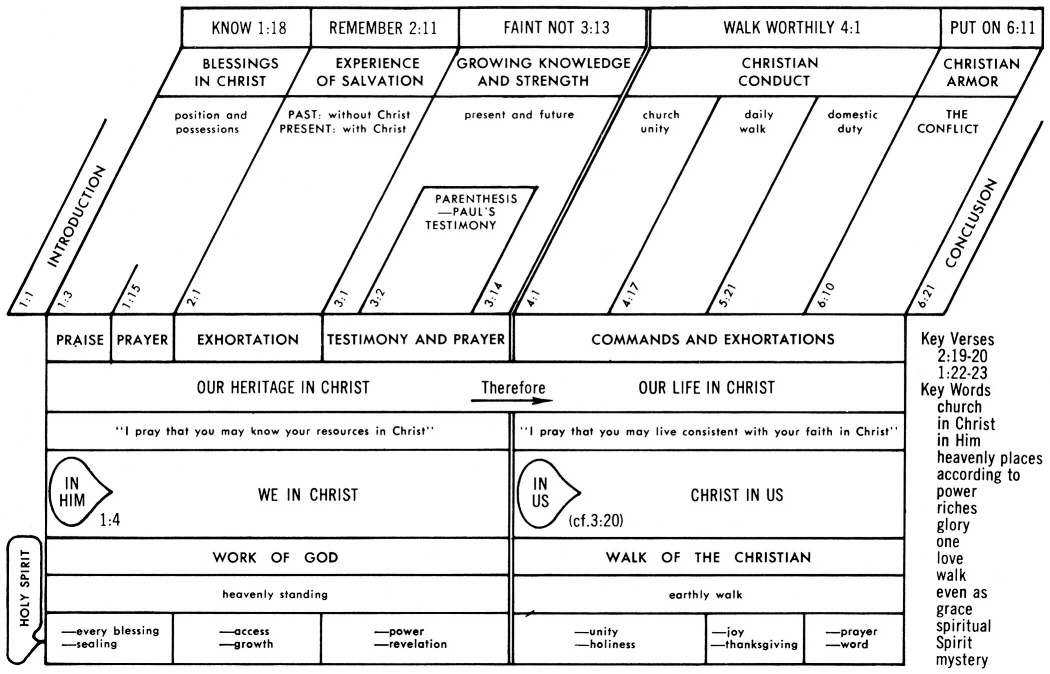
EPHESIANS - CHRIST AND THE CHURCH
Click chart to enlarge
Charts from Jensen's Survey of the NT - used by permission
Ephesians 2:13 But now in Christ Jesus you who formerly were far off have been brought near by the blood of Christ (NASB: Lockman)
Greek: nuni de en Christo Iesou humeis hoi pote ontes (PAPMPN) makran egenethete (2PAPI) eggus en to haimati tou Christou.
BGT νυνὶ δὲ ἐν Χριστῷ Ἰησοῦ ὑμεῖς οἵ ποτε ὄντες μακρὰν ἐγενήθητε ἐγγὺς ἐν τῷ αἵματι τοῦ Χριστοῦ.
Amplified: But now in Christ Jesus, you who once were [so] far away, through (by, in) the blood of Christ have been brought near. (Amplified Bible - Lockman)
NET: But now in Christ Jesus you who used to be far away have been brought near by the blood of Christ. (NET Bible)
NLT: But now you belong to Christ Jesus. Though you once were far away from God, now you have been brought near to him because of the blood of Christ. (NLT - Tyndale House)
NLT (revised) But now you have been united with Christ Jesus. Once you were far away from God, but now you have been brought near to him through the blood of Christ.
Phillips: But now, through the blood of Christ, you who were once outside the pale are with us inside the circle of God's love and purpose. (Phillips: Touchstone)
Wuest: But now in Christ Jesus you, who at one time were far off, have become near by the blood of the Christ. (Eerdmans Publishing - used by permission)
Young's Literal: and now, in Christ Jesus, ye being once afar off became nigh in the blood of the Christ,
KJV But now in Christ Jesus ye who sometimes were far off are made nigh by the blood of Christ.
NKJ But now in Christ Jesus you who once were far off have been brought near by the blood of Christ.
ESV But now in Christ Jesus you who once were far off have been brought near by the blood of Christ.
NET But now in Christ Jesus you who used to be far away have been brought near by the blood of Christ.
NIV But now in Christ Jesus you who once were far away have been brought near through the blood of Christ.
CSB But now in Christ Jesus, you who were far away have been brought near by the blood of the Messiah.
NRS But now in Christ Jesus you who once were far off have been brought near by the blood of Christ.
NAB But now in Christ Jesus you who once were far off have become near by the blood of Christ.
NJB But now in Christ Jesus, you that used to be so far off have been brought close, by the blood of Christ.
GWN But now through Christ Jesus you, who were once far away, have been brought near by the blood of Christ.
BBE But now in Christ Jesus you who at one time were far off are made near in the b
BUT NOW IN CHRIST JESUS YOU WHO FORMERLY WERE FAR OFF: nuni de en Christo Iesou humeis hoi pote ontes (PAPMPN) makran:
- But now in Christ Jesus Ro 8:1; 1 Cor 1:30; 2 Cor 5:17; Gal 3:28
- you who formerly were far off Ep 2:12,17,19, 20, 21, 22; 3:5, 6, 7, 8; Ps 22:7; 73:27; Isa 11:10; 24:15,16; 43:6; 49:12; Isa 57:19; 60:4,9; 66:19; Jer 16:19; Acts 2:39; 15:14; 22:21; 26:18; Ro 15:8, 9, 10, 11, 12
- Ephesians 2 Resources - Multiple Sermons and Commentaries
- Ephesians 2:11-13 Remembering Then, but Now! - Steven Cole
- Ephesians 2:11-22 Our Biography In Brief - Steven Cole
- Ephesians 2:13-15 The Unity of the Body, Part 2 - John MacArthur
"BUT NOW" ANOTHER DRAMATIC
SPIRITUAL REVERSAL
But now in Christ Jesus you who formerly (pote) were far off - But now (nuni) (cf "but God" Eph 2:4+) is a strong adversative, highlighting the glorious, dramatic contrast with their dismal state just described. The Gentiles who had been far off from salvation and a Savior, were now in covenant with the Savior Christ Jesus. They were formerly Christ-less, separate from Christ (Eph 2:12+), but now are spiritually, positionally in Christ Jesus. (as a result of God's gracious acts described in Eph 2:4-8) When they trusted the Savior, God placed them in Christ Jesus and accepted them in the Beloved. From then on they were as near to God as Christ is. There can be no greater contrast in time or eternity!
Paul reverses the picture, begins to paint a fresh and glowing contrast. There is particular strong contrast with the words in Eph 2:12 + "at that time".
Here are the NT uses of BUT NOW - Luke 16:25; 19:42; 22:36; John 15:22, 24; 16:5; 17:13; Rom 3:21; 6:22; 7:6; 11:30; 15:23, 25; 16:26; 1 Cor 7:14; 12:18, 20; 13:13; 14:6; 15:20; 2 Cor 8:11, 22; Gal 3:25; 4:9; Eph 2:13; 5:8; Phil 2:12; Col 3:8; 1 Thess 3:6; 2 Tim 1:10; Philemon 1:11; Heb 2:8; 8:6; 9:26; 12:26; 1 Pet 2:10, 25
"Jesus is the `meeting point' with God for all mankind" (Thompson, p. 48). (Quoted in the Expositor's Bible Commentary)
O'Brien explains that "The words in Christ Jesus are not to be interpreted predicatively, meaning [But now] you are in Christ Jesus. Instead, they are connected with you have come near. It was not that the readers were in Christ prior to their approach; rather, their being in Christ was the immediate consequence of this coming near. They were brought near to God in Him, and the means by which this approach occurred is spelled out in the concluding phrase it was through Christ's sacrificial death. (The Letter to the Ephesians. Eerdmans)
Formerly (4218) (pote) in the past. "Formerly" is a key word in Ephesians 2, used 4 times (Ep 2:2, 3, 11, 13-Ep 2:2; 2:3; Eph 2:11+; Eph 2:13+ Once more in Eph 5:8+) in addition to the synonymous time phrase "at that time". (Ep 2:12+).
Far off (3112) (makran) - As illustrated below, the words "far… near" were used in rabbinical writings to indicate, among other things, non-Jew (far) and Jews (near), or those who were righteous and near God or those who were godless and far away. In the present context "formerly far off" describes those Gentiles who had received Christ as Savior and Lord.
Hodge explains that in the Old Testament "God lived in the temple, those living near His dwelling-place and having access to Him were His people. Israel was near; the Gentiles were far away. They lived at a distance and had no freedom of access to the place where God revealed His presence… Among the later Jews the act of receiving a proselyte was called “making him near.” Being far from God included both separation from his people and spiritual distance or alienation from God himself; so to be brought near includes both introduction into the church and reconciliation with God. And these two ideas are clearly presented and intended by the apostle in this whole context. This double reconciliation is effected through the blood of Christ. (Ephesians 2 Commentary)
Through His prophet Isaiah God declares…
"I have seen his ways (referring to faithless Israel), but I will heal him; I will lead him and restore comfort to him and to his mourners, creating the praise of the lips. Peace, peace to him who is far (Gentiles) and to him who is near (Jews)," Says the LORD, "and I will heal him." (Isaiah 57:18-19)
Peter reaffirms that even though the Gentiles were "far off" they were not forsaken, for He desires for none to perish but for all to come to repentance and be saved…
"For the promise (of salvation and forgiveness in Christ) is for you and your children (referring to Jews), and for all who are far off (Gentiles who are called), as many as the Lord our God shall call to Himself." (Acts 2:39+)
If you have time read Spurgeon's sermon on this verse - Our Glorious Transforming
HAVE BEEN BROUGHT NEAR BY THE BLOOD OF CHRIST: egenethete (2PAPI) eggus en to haimati tou Christou:
- have been brought near by the blood of Christ Ep 2:16; 1:7; Ro 3:23-30; 5:9,10; 1Cor 6:11; 2Cor 5:20,21; Col 1:13,14,21,22; He 9:18; 1Pe 1:18,19; 3:18; Rev 5:9
- Ephesians 2 Resources - Multiple Sermons and Commentaries
- Ephesians 2:11-13 Remembering Then, but Now! - Steven Cole
- Ephesians 2:11-22 Our Biography In Brief - Steven Cole
- Ephesians 2:13-15 The Unity of the Body, Part 2 - John MacArthur
BROUGHT NEAR
BY BLOOD
have been brought near by the blood of Christ What Paul does in this verse is summarize the new position of (spiritual) nearness for the Gentiles. In the subsequent passages he elaborates on the significance of this truth climaxing it with the truth that those who were once far off now in Christ have access in one Spirit to the Father! (Ep 2:18+)
Harold Hoehner writes that "The Gentiles who once were far away (cf. Ep 2:17) from both God and the Jews (Ep 2:12+) have been brought near through the blood of Christ (cf. redemption in Ep 1:7+). They have come near to God and to the Jews by means of Christ’s sacrificial death. Sin separates people from God and only Christ’s atonement can remove that sin barrier. (See The Bible Knowledge Commentary Acts and Epistles)
John MacArthur explains that brought near "is not an external, dispensational, national, geographic, or ceremonial nearness—but is a spiritual intimacy of union with the Lord Jesus Christ… Every person who trusts in Christ alone for salvation, Jew or Gentile, is brought into spiritual union and intimacy with God. (See Ephesians MacArthur New Testament Commentary)
William Barclay - When the Rabbis spoke about accepting a convert into Judaism, they said that he had been brought near. For instance, the Jewish Rabbinic writers tell how a Gentile woman came to Rabbi Eliezer. She confessed that she was a sinner and asked to be admitted to the Jewish faith. “Rabbi,” she said, “bring me near.” The Rabbi refused. The door was shut in her face; but now the door was open. Those who had been far from God were brought near, and the door was shut to no one. (Ephesians 2 Commentary)
J Vernon McGee explains brought near writing that "In the temple was the court of the Gentiles way off to the side. Gentiles were permitted to come, but they were away far off. But now—for the Gentiles who are in Christ—all has changed. They were without Christ; now they are in Christ. The distance and barriers which separated them from God have been removed. They have been made nigh, not by their efforts or merits, but by the blood of Christ. (Thru the Bible Commentary)
John Eadie commenting on "brought near" writes that "The presence of Jehovah was enjoyed in His temple, and that temple was in the heart of Judaea, but the extra-Palestinian nations were “far off” from it, and this actual measurement of space naturally became the symbol of moral distance. Israel was near, but non-Israel was remote, and would have remained so but for Jesus. His advent and death changed the scene, and destroyed the wide interval, as the apostle shows in the subsequent verses. They who had been “aliens from the commonwealth of Israel,” were now incorporated into the spiritual community, were partakers of “a better covenant established on better promises,” were filled with “good hope through grace,” knew God, or rather “were known of God,” and were no longer “in the world,” but of the “household of God.” The Gentile Christians enjoyed spiritually all that was characteristic of the Hebrew theocracy. As the “true circumcision,” they were “near,” spiritually as near as the Israelites whom a few steps brought to the temple, altar, and Shechinah. (Ephesians 2 Commentary)
John Phillips draws an interesting parallel with the prodigal of Luke 15 writing "Once we were prodigals of the universe dwelling in the far country. We had spent our substance in riotous living and were in the grip of famine and want. Nobody cared. Our place was with the swine, and our daily bread was the husks that they ate. In our sin we were a disgrace to the One who had created us. We did not even have the good sense of the prodigal mentioned in the Lord's parable (Luke 15), for we did not know our way home. We groped in darkness and blindly longed for a God we did not know. But when we were yet a great way off, the Father saw us and had compassion on us. He ran and fell on our necks and kissed us. Now we who "were far off" are "made nigh by the blood of Christ." (Phillips, J. Exploring Ephesians)
Have been brought (1096) (ginomai) means to come into existence or cause to be or to become. Gentiles have become near. The Gentiles have been made nigh. Literally it reads "ye being once afar off became nigh in the blood of the Christ."
Near (1451) (eggus) indicates a position relatively close to another position. The Jews considered themselves and their converts to be brought near to God because of their covenant relation to Him and the presence of His Temple in Jerusalem.
So near, so very near to God
Nearer I cannot be;
For in the Person of His Son
I am as near as He
--Paget
Paul describes our having been brought near in Romans 5 writing "Therefore having been justified by faith, we have peace with God through our Lord Jesus Christ, through whom also we have obtained (perfect tense = signifies it is the believer's permanent possession and nothing can remove us from it) our introduction (access much as one would gain entree to a king's presence through the favor of another) by faith into this grace in which we stand; and we exult in hope of the glory of God. (see notes Romans 5:1; 5:2)
BY THE BLOOD
OF CHRIST
KJV Bible Commentary emphasizes that "We are made nigh by the blood of Christ; not by becoming a proselyte of Judaism, not by the sincerity of our repentance, not by the strength of our faith, not by the depth of our devotion, not by the joy of our spiritual experience. A new relationship has been established in a new covenant sealed with the sacrificial blood of Christ, who suffered the just for the unjust, that He might bring us to God (1Pe 3:18-note).
John Eadie - The apostle's object is to show that by the death of Christ the exclusiveness of the theocracy was abolished, that Jew and Gentile, by the abrogation of the Mosaic law, are placed on the same level, and that both, in the blood of Christ, are reconciled to God. (Ephesians 2 Commentary)
Regarding the "blood of Christ" Ray Stedman points out "that it isn't merely the death of Christ. Paul says that it is the blood of Christ. It is significant that he uses that term. Death, of course, is not always bloody. You can die without losing your blood. The Scriptures sometimes speak of the death of Christ, and more often of the cross of Christ. But still more often they speak of the blood of Christ. Why this emphasis? Many don't like this today. They don't like to think of the cross or of the death of Jesus as being bloody. But God emphasizes it. God wants us to think about it, because blood is always a sign of violence. You see, the death of Jesus was not just a simple passing away -- dying of old age on a comfortable bed. No, no. It was a violent death, a bloody, gory, ugly, revolting scene -- a man hanging torn and wretched upon a cross, with blood streaming down his sides and running down the cross. God wants us to remember that violent death, because violence is the ultimate result of paganism. It is the final expression of a godless society. Cruelty arises immediately when love and truth disappear from society. And God is simply reminding us that when humanity had done its worst, had sunk to its lowest, had vented its anger in the utter wretchedness and violence and blood of the cross, his love reached down to that very place and, utilizing that violent act, began to redeem, to call back those who were far off and bring them near -- in the blood of Christ. And, in the blood of Jesus, all the advantages the Jews had were conferred upon the Gentiles. Ignorant, pagan, darkened, foolish, struggling, hopeless -- nevertheless, they had just as much access to God, in the blood of Christ, as any Jew ever had with his temple, his Law, his priesthood, and his sacrifice. By this the apostle is trying to emphasize to us the exceedingly amazing wonder of the grace of God, which laid all these liabilities aside and reached out to us and found us just as we were, and brought us near by the blood of Jesus Christ our Lord. What a gift to give thanks for! (Read the full sermon Strangers In Darkness)
The cleansing value of the blood of Christ immediately washes away the penalty (and power) of sin and ultimately washes away even its presence (this latter speaks of the believer's blessed hope that when we see Him someday in the near future, we shall be like Him, glorified and forever free of the presence of sin and the passing pleasure of sin. Hallelujah!).
By (1711) (en) is literally in the blood of Christ. The power which has changed farness into nearness, resides in the blood of Christ.
Blood (129) (haima) is the basis of life (Lev 17:11+) (click for all 90 uses) Haima is literally the red fluid that circulates in the heart, arteries, capillaries, and veins of a vertebrate animal carrying nourishment and oxygen to and bringing away waste products from all parts of the body and thus is essential for the preservation of life. Haima gives us English words like hemorrhage (Gk - haimorragia from haimo- + rragia from regnuo - to burst) English derivatives include hematology (study of blood) and "leukemia" which is from leuco (white) plus haima (blood), which is fitting as leukemia is a disease that affects the white blood cells. Derivatives of haima are : haimatekchusía (130), shedding of blood; haimorroéō (131), to hemorrhage. Haima was used to describe “descent” or “family” in ancient times. “To shed blood” is to destroy life.
Blood of Christ - 1 Cor 10:16 Eph 2:13 Heb 9:14 1 Pet 1:19
Zodhiates says "haima is used to denote life given up or offered as an atonement since, in the ritual of sacrifice, special emphasis is laid upon it as the material basis of the individual life. The life of the animal offered for propitiation appears in the blood separated from the flesh which the Jews were forbidden to eat (Ge. 9:4; Lev. 3:17; 17:10-14; Deut. 12:23; Heb. 9:7-13, 18-25; 11:28; 13:11). This life is, on the one hand, in the blood, presented to God; on the other hand by sprinkling, appropriated to man (Heb. 9:7, 19, 20). This blood thus becomes the blood of the covenant or testament (see diathekē) which God commanded to us (Heb. 9:20). (Complete Word Study Dictionary- New Testament)
Blood "has great significance in the Bible. Its meanings involve profound aspects of human life and God's desire to transform human existence. Blood is intimately associated with physical life. Blood and “life” or “living being” are closely associated." (Blood - Holman Bible Dictionary)
This is Paul's second mention of the blood of Christ, for earlier he had explained that "In Him we have redemption through His blood, the forgiveness of our trespasses, according to the riches of His grace, which He lavished upon us. (See notes Ephesians 1:7; 1:8a)
Of Christ - No other blood sacrifice could satisfy the righteous demands of God's holiness and His just hatred of sin. Only the blood of the spotless, sinless Lamb of God could take away the sins of the world and bring men near. The writer of Hebrews expounds on the importance of the blood of Christ in Hebrews 9 writing…
But when (in contrast to the Jewish high priests who were sinners) Christ appeared as a high priest of the good things to come, He entered through the greater and more perfect tabernacle, not made with hands, that is to say, not of this creation; 12 and not through the blood of goats and calves, but through His own blood, He entered the holy place once for all, having obtained eternal redemption. 13 For if the blood of goats and bulls and the ashes of a heifer sprinkling those who have been defiled, sanctify for the cleansing of the flesh, 14 how much more will the blood of Christ, Who through the eternal Spirit offered Himself without blemish to God, cleanse your conscience from dead works to serve the living God? (Hebrews 9:11-14+)
Peter explains that believers "were not redeemed with perishable things like silver or gold from your futile way of life inherited from your forefathers, but with precious blood, as of a lamb unblemished and spotless, the blood of Christ. (1Pe 1:18-19+)
Peter writes that "Christ also died for sins once for all, the just for the unjust, in order that He might bring us to God, having been put to death in the flesh, but made alive in the spirit (1Pe 3:18+)
QUESTION - What is the meaning of the blood of Christ?
ANSWER - The phrase “blood of Christ” is used several times in the New Testament and is the expression of the sacrificial death and full atoning work of Jesus on our behalf. References to the Savior’s blood include the reality that He literally bled on the cross, but more significantly that He bled and died for sinners. The blood of Christ has the power to atone for an infinite number of sins committed by an infinite number of people throughout the ages, and all whose faith rests in that blood will be saved.
The reality of the blood of Christ as the means of atonement for sin has its origin in the Mosaic Law. Once a year, the priest was to make an offering of the blood of animals on the altar of the temple for the sins of the people. “In fact, the law requires that nearly everything be cleansed with blood, and without the shedding of blood there is no forgiveness” (Hebrews 9:22). But this was a blood offering that was limited in its effectiveness, which is why it had to be offered again and again. This was a foreshadowing of the “once for all” sacrifice which Jesus offered on the cross (Hebrews 7:27). Once that sacrifice was made, there was no longer a need for the blood of bulls and goats.
The blood of Christ is the basis of the New Covenant. On the night before He went to the cross, Jesus offered the cup of wine to His disciples and said, "This cup is the new covenant in my blood, which is poured out for you” (Luke 22:20). The pouring of the wine in the cup symbolized the blood of Christ which would be poured out for all who would ever believe in Him. When He shed His blood on the cross, He did away with the Old Covenant requirement for the continual sacrifices of animals. Their blood was not sufficient to cover the sins of the people, except on a temporary basis, because sin against a holy and infinite God requires a holy and infinite sacrifice. “But those sacrifices are an annual reminder of sins, because it is impossible for the blood of bulls and goats to take away sins” (Hebrews 10:3). While the blood of bulls and goats were a “reminder” of sin, “the precious blood of Christ, a lamb without blemish or defect” (1 Peter 1:19) paid in full the debt of sin we owe to God, and we need no further sacrifices for sin. Jesus said, “It is finished” as He was dying, and He meant just that—the entire work of redemption was completed forever, “having obtained eternal redemption” for us (Hebrews 9:12).
Not only does the blood of Christ redeem believers from sin and eternal punishment, but “His blood will make our consciences pure from useless acts so we may serve the living God” (Hebrews 9:14 NCV). This means that not only are we now free from having to offer sacrifices which are “useless” to obtain salvation, but we are free from having to rely on worthless and unproductive works of the flesh to please God. Because the blood of Christ has redeemed us, we are now new creations in Christ (2 Corinthians 5:17), and by His blood we are freed from sin to serve the living God, to glorify Him, and to enjoy Him forever.GotQuestions.org
Related Resources:
- American Tract Society Blood
- Bridgeway Bible Dictionary Blood
- Easton's Bible Dictionary Blood
- Fausset Bible Dictionary Blood
- Holman Bible Dictionary Blood
- Hastings' Dictionary of the Bible Blood
- King James Dictionary Blood
- Morrish Bible Dictionary Blood
- Hawker's Poor Man's Dictionary Blood
- Smith Bible Dictionary Blood
- Vines' Expository Dictionary Blood
- Watson's Theological Dictionary Blood
- 1911 Encyclopedia Britannica Blood
- International Standard Bible Encyclopedia Blood
- Kitto Biblical Cyclopedia Blood
- The Jewish Encyclopedia Blood
BENEFITS OF GRACE - Mornings with Tozer
But now in Christ Jesus ye…are made nigh by the blood of Christ. Ephesians 2:13
Only a believing Christian can testify, “I am a sinner—saved by the grace of God!” But that is not the whole story. All that we have is cut of His grace. Jesus Christ, the eternal Word who became flesh and dwelt among us, is the open channel through whom God moves to provide all the benefits He gives, both to saints and to sinners—yes, even to sinners!
Even though you may still be unconverted and going your own way, you have received much out of the ocean of His fullness. You have received the pulsing life that beats in your bosom.
You have received the brilliant mind and the brain without which you could not function. You have received a memory that strings the events you cherish as a jeweler strings pearls into a necklace.
When we say to an unbelieving man, “Believe on the Lord Jesus Christ,” we are actually saying to him: “Believe on the One who sustains you and upholds you and who has given you life. Believe in the One who pities you and spares you and keeps you. Believe on the One out of whom you came!”
John Butler - Sermon Starters, Volume 1 - SINNER’S PAST Ephesians 2:13
“But now in Christ Jesus ye who sometimes were far off are made nigh by the blood of Christ” (Ephesians 2:13).
The book of Ephesians gives some wonderful truths about salvation. From this text we note four great truths which are often repeated throughout the Scriptures.
FIRST—THE PERSON OF SALVATION
“Christ Jesus.” Salvation is in Christ. He is the only One Who can saved. There is not such thing as salvation outside of Jesus Christ. “Neither is there salvation in any other, for there is none other name under heaven given among men, whereby we must be saved” (Acts 4:12). Christ is the beginning and the ending of salvation and all that is in between (Revelation 1:8, 11). If Christ is not in our theology, then we do not have a Redeemer in our theology. A religion that does not focus on Christ is a religion that has no salvation in it. Much of our world is antiChrist today, for the devil has influenced much of the world and would take Christ out of the picture so souls will be damned to hell with him. The many attacks upon the person of Christ are to make it look as though He could not save souls. These attacks are authored by Satan. But leave Christ out of the plan of salvation and you will not have any salvation.
SECOND—THE PROBLEM FOR SALVATION
“Ye who sometimes were far off.” Why do we need to be saved? Because we are “far off” from God. To be “far off” from God is to be “far off” from the best things in life, and especially to be “far off” from eternity in heaven. Sin has put us far from God. “All we like sheep have gone astray” (Isaiah 53:6) is why we are “far off” from God. God has not moved, we have moved. And by the sound of things, much of our society is not interested in moving near God but prefers to be “far off” from God.
THIRD—THE PLAN FOR SALVATION
“Made nigh by the blood of Christ.” The plan for salvation was Calvary where Christ shed His blood for the souls of mankind. Christ blood is the only agent that will wash away our sins for it is “the blood of Jesus Christ … [that] cleanseth us from all sin” (1 John 1:7). It is not Christ’s life and example that saves us, but we can be saved because of His shed blood at Calvary.
FOURTH—THE PRODUCT OF SALVATION
“Are made nigh.” Salvation solves the problem of being at a distance from God. Salvation brings us near to everything that matters spiritually. Salvation brings us near to God. It brings us hear enough to God to experience the blessings from God. Foreigners have learned to stay near the ambassador of the United States if they are hunted, for it is very difficult to kill the foreigner who is with the ambassador. Likewise the closer we are to God the more protection we have from Him especially for eternity where we need the greatest protection.
Once Alienated, Now Reconciled - Archie Edwards Ephesians 2:13–18
I. Distance—Closed. “Ye … are made nigh by the blood of Christ.”
II. Division—Joined. “He hath made both one, and hath broken down the middle wall of partition between us.”
III. Dissension—Appeased. “Having abolished … the enmity.”
IV. Distinction—Forgotten. “Of twain one new man, so making peace.”
THERE IS A FOUNTAIN William Cowper, 1731–1800
But now in Christ Jesus you who once were far away have been brought near through the blood of Christ. (Ephesians 2:13)
William Cowper is viewed by some as one of the finest of all English writers. But Cowper’s emotional life was one of great turmoil. At an early age he was directed by his father to study law. Upon completion of his studies, however, the prospect of appearing for his final examination before the bar so frightened him that it caused a mental breakdown and even an attempted suicide. Later he was placed in an insane asylum for 18 months. During this detention, he one day read from the Scriptures the passage in Romans 3:25 that Jesus Christ is “set forth to be a propitiation through faith in His blood, to declare His righteousness for the remission of sins that are past, through the forbearance of God.” Through his reading of the Bible, Cowper soon developed a personal relationship with Christ and a sense of forgiveness of sin. This was in 1764, when he was 33 years old.
Three years later, Cowper was invited to move to Olney, England, where John Newton pastored the parish Anglican Church. It was here for nearly two decades that Newton and Cowper had a close personal friendship. In 1799 their combined talents produced the famous Olney Hymns hymnal, one of the most important single contributions made to the field of evangelical hymnody. In this ambitious collection of 349 hymns, sixty-seven were written by Cowper with the remainder by Newton.
“There Is a Fountain” was originally titled “Peace for the Fountain Opened.” The hymn, with its vivid imagery, is based on the Old Testament text, Zechariah 13:1—“In that day there shall be a fountain opened to the house of David and to the inhabitants of Jerusalem for sin and uncleanness.”
Only eternity will reveal the hosts who, through the singing of this hymn, have been made aware of the efficacy of Christ’s complete atonement.
There is a fountain filled with blood drawn from Immanuel’s veins, and sinners plunged beneath that flood lose all their guilty stains.
The dying thief rejoiced to see that fountain in his day, and there may I, though vile as he, wash all my sins away.
Dear dying Lamb, Thy precious blood shall never lose its pow’r, till all the ransomed Church of God be saved to sin no more.
E’er since by faith I saw the stream Thy flowing wounds supply, redeeming love has been my theme and shall be till I die.
When this poor lisping, stamm’ring tongue lies silent in the grave, then in a nobler, sweeter song, I’ll sing Thy pow’r to save.
(Kenneth Osbeck - Amazing Grace: 366 Inspiring Hymn Stories )
Sermon Outline - Archie Edwards - Once Alienated, Now Reconciled Ephesians 2:13–18
I. Distance—Closed. “Ye … are made nigh by the blood of Christ.”
II. Division—Joined. “He hath made both one, and hath broken down the middle wall of partition between us.”
III. Dissension—Appeased. “Having abolished … the enmity.”
IV. Distinction—Forgotten. “Of twain one new man, so making peace.”
Family Tie - An elderly man who visited an art gallery was deeply moved by a painting that portrayed Christ on the cross. It was so realistic in depicting the suffering of the Savior that his heart was filled with gratitude for the great price the Lord Jesus paid for his redemption. With tears trickling down his cheeks, he exclaimed, “Bless Him! I love Him! I love Him!"
Other visitors standing nearby wondered what the man was talking about. One person walked over and looked at the painting. Soon he too felt deep emotion welling up in his heart. Turning to the old man, he gave him a firm handshake and said, “So do I! I love Him too!” The scene was repeated as a third man and then a fourth walked over, gazed at the painting, and exclaimed, “I love Him too!” Although these men were from different churches, they felt a common bond because of their faith in Christ.
As believers, we need an awareness of our spiritual unity with other Christians. We need to focus on the fundamentals on which we agree—such as our love for the Savior who died for us—rather than bicker about lesser issues.
Regardless of sincere disagreements, we as blood-bought believers should recognize that we have a strong family tie in Christ.—Richard De Haan
Blest be the tie that binds
Our hearts in Christian love!
The fellowship of kindred minds
Is like to that above. —FawcettAs we draw near to Christ
we are drawn near to each other.
Ephesians 2:14 For He Himself is our peace, who made both groups into one and broke down the barrier of the dividing wall (NASB: Lockman)
Greek: Autos gar estin (3SPAI) e eirene hemon, o poiesas (AAPMSN) ta amphotera en kai to mesotoichon tou fragmou lusas, (AAPMSN) ten echthran, en te sarki autou,
BGT Αὐτὸς γάρ ἐστιν ἡ εἰρήνη ἡμῶν, ὁ ποιήσας τὰ ἀμφότερα ἓν καὶ τὸ μεσότοιχον τοῦ φραγμοῦ λύσας, τὴν ἔχθραν ἐν τῇ σαρκὶ αὐτοῦ,
Amplified: For He is [Himself] our peace (our bond of unity and harmony). He has made us both [Jew and Gentile] one [body], and has broken down (destroyed, abolished) the hostile dividing wall between us, (Amplified Bible - Lockman)
NET: For He is our peace, the One Who made both groups into one and Who destroyed the middle wall of partition, the hostility, (NET Bible)
NLT: For Christ himself has made peace between us Jews and you Gentiles by making us all one people. He has broken down the wall of hostility that used to separate us. (NLT - Tyndale House)
NLT (revised) For Christ himself has brought peace to us. He united Jews and Gentiles into one people when, in his own body on the cross, he broke down the wall of hostility that separated us. 15 He did this by ending the system of law with its commandments and regulations. He made peace between Jews and Gentiles by creating in himself one new people from the two groups.
Phillips: For Christ is our living peace. He has made a unity of the conflicting elements of Jew and Gentile by breaking down the barrier which lay between us. (Phillips: Touchstone)
Wuest: For He himself is our peace, the One who made the both one, having broken down the middle wall of the partition, (Eerdmans Publishing - used by permission)
Young's Literal: for he is our peace, who did make both one, and the middle wall of the enclosure did break down,
Weymouth - For He is our peace—He who has made Jews and Gentiles one, and in His own human nature has broken down the hostile dividing wall,
KJV For he is our peace, who hath made both one, and hath broken down the middle wall of partition between us;
NKJ For He Himself is our peace, who has made both one, and has broken down the middle wall of separation, 15 having abolished in His flesh the enmity, that is, the law of commandments contained in ordinances, so as to create in Himself one new man from the two, thus making peace,
ESV For he himself is our peace, who has made us both one and has broken down in his flesh the dividing wall of hostility
NET For he is our peace, the one who made both groups into one and who destroyed the middle wall of partition, the hostility, 15 when he nullified in his flesh the law of commandments in decrees. He did this to create in himself one new man out of two, thus making peace,
NIV For he himself is our peace, who has made the two one and has destroyed the barrier, the dividing wall of hostility, 15 by abolishing in his flesh the law with its commandments and regulations. His purpose was to create in himself one new man out of the two, thus making peace,
CSB For He is our peace, who made both groups one and tore down the dividing wall of hostility. In His flesh,
NRS For he is our peace; in his flesh he has made both groups into one and has broken down the dividing wall, that is, the hostility between us.
NAB For he is our peace, he who made both one and broke down the dividing wall of enmity, through his flesh,
NJB For he is the peace between us, and has made the two into one entity and broken down the barrier which used to keep them apart, by destroying in his own person the hostility,
GWN So he is our peace. In his body he has made Jewish and non-Jewish people one by breaking down the wall of hostility that kept them apart.
BBE For he is our peace, who has made the two into one, and by whom the middle wall of division has been broken down, 15 Having in his flesh put an end to that which made the division between us, even the law with its rules and orders, so that he might make in himself, of the two, one new man, so making peace;
FOR HE HIMSELF IS OUR PEACE: Autos gar estin (3SPAI) e eirene hemon:
- For He (Himself) is our peace - Isaiah 9:6,7; Ezek 34:24,25; Mic 5:5; Zech 6:13; Luke 1:79; 2:14; John 16:33; Acts 10:36; Ro 5:1; Col 1:20; Heb 7:2; 13:20
- Ephesians 2 Resources - Multiple Sermons and Commentaries
- Ephesians 2:11-13 Remembering Then, but Now! - Steven Cole
- Ephesians 2:11-22 Our Biography In Brief - Steven Cole
- Ephesians 2:13-15 The Unity of the Body, Part 2 - John MacArthur
From "Wealth, Walk and Warfare of the Christian "
OUR PEACE IS
A PERSON!
For (gar) introduces the reason of the previous statement. Remember to pause, ponder and query this term of explanation. Hoehner explains "Having defined the union, Paul introduces this section with an explanatory gar, “for,” in order to explain how this union was accomplished." (Ephesians- An Exegetical Commentary)
He (autos) Himself is our peace (eirene)- Himself is not in the Greek text. However Paul places He first in the Greek for emphasis and the addition of Himself in the translation serves to emphasize Paul's point that it was “He and none other.” Weymouth has "in His own human nature." Christ Himself, not just what He did (which of course was necessary). Christ is our peace with God and so with each other, be they Jew or Gentile. Christ is thus not merely our Peace-maker, but our very Peace itself. Note Paul does not say Christ made peace (which is true from other Scriptures) but that He is Peace! Note also Paul's change of pronouns from "you" (Gentiles) in the previous verses to "our" in this verse, clearly signaling that this peace refers to Paul and all believing Jews and Gentiles.
Salmond adds that "It is not only that the peace was made by Christ and ranks as His achievement, but that it is so identified with Him that were He away it would also fail,—so dependent on Him that apart from Him we cannot have it.” (Ephesians 2:13 Commentary)
In this verse we see a fulfillment of Isaiah's famous prophecy "For a child will be born to us, a son will be given to us; And the government will rest on His shoulders; And His name will be called Wonderful Counselor, Mighty God, Eternal Father, Prince of Peace. There will be no end to the increase of His government or of peace, On the throne of David and over his kingdom, To establish it and to uphold it with justice and righteousness From then on and forevermore. The zeal of the LORD of hosts will accomplish this. (Isaiah 9:6-7+)
Comment: Messiah's title "Prince of peace" indicates He is the very first leader Who will bring true peace to the world. The word for "Prince" however means not only the giver of peace but also the one who maintains it. Christ gives the peace, and He maintains the peace. He brings peace in the fullest sense of wholeness, prosperity, and tranquillity. Saved Jews and Gentiles can now know His peace, and one day the world will experience it as well.
Albert Barnes explains Jesus Himself being our Peace writing that "The peace here referred to is that by which a union in worship and in feeling has been produced between the Jews and the Gentiles. Formerly they were alienated and separate. They had different objects of worship; different religious rites; different views and feelings. The Jews regarded the Gentiles with hatred, and the Gentiles the Jews with scorn. Now, says the apostle, they are at peace. They worship the same God. They have the same Saviour. They depend on the same atonement. They have the same hope. They look forward to the same heaven. They belong to the same redeemed family. Reconciliation has not only taken place with God, but with each other. The best way to produce peace between alienated minds is to bring them to the same Saviour. That will do more to silence contentions, and to heal alienations, than any or all other means. Bring men around the same cross; fill them with love to the same Redeemer, and give them the same hope of heaven, and you put a period to alienation and strife. The love of Christ is so absorbing, and the dependence in his blood so entire, that they will lay aside these alienations, and cease their contentions. The work of the atonement is thus designed not only to produce peace with God, but peace between alienated and contending minds. The feeling that we are redeemed by the same blood, and that we have the same Saviour, will unite the rich and the poor, the bond and the free, the high and the low, in the ties of brotherhood, and make them feel that they are one. This great work of the atonement is thus designed to produce peace in alienated minds everywhere, and to diffuse abroad the feeling of universal brotherhood. (Ephesians 2 Commentary)
MacDonald after asking how Jesus, a Person, can be Peace, answers "This is how: When a Jew believes on the Lord Jesus, he loses his national identity; from then on he is “in Christ.” Likewise, when a Gentile receives the Savior, he is no longer a Gentile; henceforth he is “in Christ.” In other words, believing Jew and believing Gentile, once divided by enmity, are now both one in Christ. Their union with Christ necessarily unites them with one another. Therefore a Man is the peace, just as Micah predicted (Mic. 5:5). (Believer's Bible Commentary)
Peace (1515) (eirene from the verb eiro = to bind or join together what is broken or divided) means in essence to set at one again or join together that which is separated. In secular Greek eirene described the cessation or absence of war.
Eirene in Ephesians - Eph. 1:2; Eph. 2:14; Eph. 2:15; Eph. 2:17; Eph. 4:3; Eph. 6:15; Eph. 6:23;
Wayne Barber reminds us that "Peace is never going to be present until Jesus is in an individual’s life. Until a man has received God’s grace, he will never know His peace. Look in Eph 1:2: "Grace to you and peace from God our Father and the Lord Jesus Christ. " You see the first thing that must be received is God’s grace. God’s grace is what God does to a man, in a man, for a man and through a man that a man can’t do himself. God came down. Man could not ascend. He tried that in Genesis 11. That’s where the Gentile nations came from. God came down as He told Nicodemus in John 3. He came down to die for our sin. The greatest picture of grace in all of Scripture is Jesus coming to die for our sin and shedding His blood to redeem us off the slave block of bondage to sin. When man receives God’s grace, then and only then can he be at peace with the God that he has been estranged from since Adam’s sin. So before we can talk about peace with man, we must realize that Jesus is the essence of our peace with God. So often we do it the reverse. So often there is a problem between two of us, and we try to major on our relationship to make our relationship with God better. No, you major on your relationship with God, and that makes your relationship with others what it ought to be. Jesus is the essence of God’s peace, the essence of our peace with God. (God so Loved the World)
Jesus as our peace is a fulfillment of Micah's prophecy…
And this One will be our peace.
When the Assyrian invades our land,
When he tramples on our citadels,
Then we will raise against him
Micah prophesies of this peace as a Person in Micah 5:5+ - This One will be our peace (shalom) - To reemphasize true peace is not just a precept but a Person! This One is the Prince of Peace (Isa 9:6+, Lk 1:79+, Lk 2:14+, Lk 19:38, 42+, Jn 14:27. 16:33), the Messiah - Anointed One Who alone will bring peace - He brought peace to hearts of believers with His first coming (Ro 5:1-2+, cf Isa 52:7 where "announces peace" and "brings good news" are the same verb in Septuagint -Lxx = euaggelizo/euangelizo), but will bring peace to the earth at His Second Coming (after He destroys His enemies). Peace will characterize the Millennial reign of Messiah (Isa 11:6-9+, Isa 55:12; 66:12; Jer 33:6+; Ezek 34:25; 37:26+).
THOUGHT - Are we telling the lost around us of this promised personal peace available on a Person named Jesus Christ? (Acts 10:36+, Mt 5:9+, Eph 6:15+)
In Paul's writings we discover that Christ "seeing that His divine power has granted to us everything pertaining to life and godliness, through the true knowledge of Him who called us by His own glory and excellence." (2Pe 1:3+). And Christ is....
Our Peace (Ephesians 2:14)
Our Life (Col 3:4+)
Our Hope (Col 1:27+)
Salmond writes that "Christ and no other "has solved the problem of our relationships with God and man" (Barclay, p. 120). He draws men to God and to each other in His own person. It is not simply the message He proclaimed or even the message proclaimed about Him that effects this reconciliation. It is Himself. (Expositor's Bible Commentary)
Wuest explains that "Jew and Gentile, by God’s act of selecting the Jewish nation to be the channel through which He will bring salvation to the lost, had been separated. Now, in the blood of Christ they in the Church have been joined. This is the peace spoken of here. (Wuest Word Studies - Eerdman Publishing Company Volume 1, Volume 2, Volume 3 - used by permission)
Ray Stedman writes that "In this very remarkable passage, the apostle gives us the way of peace. He uses as an illustration the fact that Jesus Christ bridged the widest chasm which ever has existed between men -- the gulf between the Jew and the Gentile. If you don't think that conflict can claim title to being the most difficult gulf to bridge, I suggest you consider why it is it has been so difficult to settle the Arab-Israeli problem in the Middle East. The greatest minds of our day have tried to work that out, and no one has gotten anywhere near a settlement. It is because this conflict is extremely difficult to bridge. Paul describes how Christ actually does it. And this is a wonderful picture for us of how peace can be brought in any area of conflict or hostility, whether among individuals or groups or nations. (Prince of Peace)
John MacArthur has an interesting illustration writing that "During World War II a group of American soldiers was exchanging fire with some Germans who occupied a farm house. The family who lived in the house had run to the barn for protection. Suddenly their little three–year–old daughter became frightened and ran out into the field between the two groups of soldiers. When they saw the little girl, both sides immediately ceased firing until she was safe. A little child brought peace, brief as it was, as almost nothing else could have done. Jesus Christ came as a babe to earth, and in His sacrifice on the cross He Himself became peace for those who trust in Him. His peace is not temporary but permanent. (Ephesians Commentary)
Warren Wiersbe comments on Christ as our peace writing "Peace in our time! Peace with honor!” Some of us still remember those words of British Prime Minister, Sir Neville Chamberlain, when he returned from conferences in Germany in September 1938. He was sure that he had stopped Adolf Hitler. Yet one year later, Hitler invaded Poland, and on September 3, 1939, Great Britain declared war on Germany. Chamberlain’s great peace mission had failed. It seems that most peace missions fail. I read somewhere that from 1500 b.c. to a.d. 850 there were 7,500 “eternal covenants” agreed on among various nations with the hope of bringing peace, but that no covenant had lasted longer than two years. The only “eternal covenant” that has lasted—and that will last—is the one made by the eternal God, sealed by the blood of Jesus Christ. It is Christ’s peace mission that Paul explains in this section, and three very important words summarize this great work: separation, reconciliation, and unification. (See The Wiersbe Bible Commentary: New Testament)
Eadie explains that "In its widest sense, as this paragraph teaches, “Christ is the peace,” and not merely the peacemaker; the Author of it, for He “makes both one,” and “reconciles them to God;” the Basis of it, for He has “abolished the enmity in His flesh,” and “by His cross;” the Medium of it, for “through Him we both have access to the Father;” and the Proclaimer of it, for “He came and preached peace.” (Ephesians 2 Commentary) (Bolding added)
Blaikie -Christ is not only our Peacemaker, but our Peace, and that in the fullest sense, the very substance and living spring of it, establishing it at the beginning, keeping it up to the end; and the complex notion of peace is here not only peace between Jew and Gentile, but between God and both. (Ephesians 2 Pulpit Commentary)
William Barclay explains how Jesus Himself is our peace writing "Let us use a human analogy. Suppose two people have a difference and go to law about it; and the experts in the law draw up a document, which states the rights of the case, and ask the two conflicting parties to come together on the basis of that document. All the chances are that the breach will remain unhealed, for peace is seldom made on the basis of a legal document. But suppose that someone whom both of these conflicting parties love comes and talks to them, there is every chance that peace will be made. When two parties are at variance, the surest way to bring them together is through someone whom they both love. That is what Christ does. He is our peace. It is in a common love of him that people come to love each other. That peace is won at the price of his blood, for the great awakener of love is the Cross. The sight of that Cross awakens in the hearts of men of all nations love for Christ, and only when they all love Christ will they love each other. It is not in treaties and leagues to produce peace. There can be peace only in Jesus Christ. (Ephesians 2 Commentary)
|
God's way of Conciliation |
|
|
IN HIMSELF |
Christ is the Mediator between
|
|
Christ is the Eradicator of
|
|
|
Christ is the Conciliator of
|
|
|
Christ is the Reconciler of
|
|
|
Christ is the Centre of the new
|
|
J.C. Philpot, Ears from Harvested Sheaves. “He is our peace.” This necessarily springs from being reconciled and brought nigh by the blood of Christ. Sin has not only made us enemies to God, but made God an enemy to us. What peace, then, can there be between us whilst thus mutual enemies? Peace is between friends, not between foes. During this state of hostility and warfare, as there is no real, so there can be no felt or enjoyed peace. But the removal of the cause of the war brings about peace, first really and then experimentally. Christ has made peace through the blood of His cross. There is now no enmity on the part of God, for it was a law enmity. God always loved His people in Christ; and as He is unchanging and unchangeable, He never could or did hate them. But as a judge is an enemy to a criminal, even were than criminal his own son, so, as Judge and Lawgiver, God was an enemy to His own elect, viewed as law-breakers. But when the law was fulfilled, and all the breaches of it atoned for by the obedience and death of His dear Son, then this law enmity was removed, and the anger of God against sin and the sinner pacified. Sin, therefore, being put away, the whole cause of that law enmity is removed; and when we believe in the Son of God, and receive the atonement by His precious blood, then there is no enmity on our side; for the goodness, mercy, and love of God melt the heart into the sweetest humility, affection, and love to and before Him.
Charles Stanley - THE PRINCE OF PEACE - Pathways to His Presence
SCRIPTURE READING: EPHESIANS 2:14–18
KEY VERSES: EPHESIANS 2:14–15
For He Himself is our peace, who has made both one, and has broken down the middle wall of separation, having abolished in His flesh the enmity, that is, the law of commandments contained in ordinances, so as to create in Himself one new man from the two, thus making peace.
It is one of modern culture’s great tragedies: what many people seek and work so hard to achieve is in fact not a product of all their accomplishments and effort. Millions of people are turning the world upside down looking for peace, while never realizing that the “genuine article” is simply not of this world. Money cannot buy it; success and fame can never guarantee it. Until you have peace with God, you will never experience inner serenity.
Since genuine peace is not dependent upon outward circumstances, it is possible to experience a tranquility beyond our comprehension, even in the midst of life’s most tragic moments. But this real peace is not possible unless there exists absolutely no impediment between us and God, and the only way the barrier of sin and self can be removed is through the cross of Calvary. If we would simply bring our struggles and needs to the foot of the cross, we would find an abundant source of peace. A heart at rest is not rooted in some worldly principle or philosophy; it can be realized only through an intimate relationship with the person of Jesus Christ (Ephesians 2:14–15).
The devil will take every opportunity to destroy our calm by drawing attention away from Christ to things that may seem important at the time, but in reality have no other purpose than to distract. Don’t waste your life looking for peace in all the wrong places—just remember, the Prince of Peace is its only true source.
Lord, I seek no other source of peace. You are the Prince of Peace. Keep my eyes focused on You and eliminate every distraction.
Our Peace - Eph. 2:14 - J J Knap The Loins Girded
The Apostle addressed with this word the Ephesian faithful, who had come by God’s grace from the darkness of the service of idols to His marvellous light. Although first far removed from God, now they had come nigh by the blood of Jesus Christ. Nigh! For centuries Israel had enjoyed this privilege exclusively. The ceremonies of the old dispensation separated this nation from the world of the heathen and elevated themselves as a wall of partition, erected by God Himself. But Christ had broken down this wall of partition. He had made the salvation that initially remained concluded in Israel, to flow forth to the Heathen. In this manner He made both one and placed upon the lips of Jews and Heathen the words: “He is our peace.”
“He is our peace,”—is He truly? There is a false peace, in which one does not make himself concerned about the God-despising nature of sin, yes, in which it is hardly realized that what is done is evil in the sight of the Lord’s holy eye. That is certainly not the peace that has descended in Christ from the kingdom of eternal peace to the world. That blessed peace starts with making the heart restless, so that our soul bows down within us and we begin to wonder what we shall meet our God with and what we shall bow ourselves before Him with. The answer to that moving question is given us in the gospel. Whoever shall meet God with the sacrifice of redemption of Christ, by which all our sins are covered, and whoever shall bend down at the foot of the cross, where the inviolable justice of God was fulfilled, receives the blessing of a peaceful conscience and enjoys holy stillness within.
“He is our peace,”—is He truly? Certainly, He has made peace by the blood of the cross, but He also makes peace between Heathen and Jew, between brothers and sisters, between members of the same household, and He makes enmity to disappear, because He always is in the midst of His elect with the comforting words: “Peace I leave with you, my peace I give unto you: not as the world giveth, give I unto you. Let not your heart be troubled, neither let it be afraid.”
“He is our peace,”—is He truly? He has to become our peace continually, as often as we by our stumblings change the ’nigh to God’ into ’far from God’. He must remain so and continue to fulfil the peace of God in us, also when the Almighty places us into His mortar and grinds our expectations into the dust with an overpowering pestle. He must remain so ever increasingly till the very banks of death, so that we do not have to separate with a cry of despair, but shall be able to die with the words of Simeon: “Lord, now lettest thou thy servant depart in peace, according to thy word. For mine eyes have seen thy salvation, Which thou hast prepared before the face of all people.”
Lasting Peace
He Himself is our peace, who has made both one, and has broken down the middle wall of separation. — Ephesians 2:14
Today's Scripture & Insight: Ephesians 2:13-19
On Christmas Eve 1914, during the First World War, the guns fell silent along a 30-mile stretch of the Western Front. Soldiers peered cautiously over the tops of trenches while a few emerged to repair their positions and bury the dead. As darkness fell, some German troops set out lanterns and sang Christmas carols. Men on the British side applauded and shouted greetings.
The next day, German, French, and British troops met in no man’s land to shake hands, share food, and exchange gifts. It was a brief respite from war that soon ended when the artillery and machine guns roared to life again. But no one who experienced “The Christmas Truce,” as it became known, would ever forget how it felt and how it fueled their longing for lasting peace.
In Isaiah’s prophecy of the coming Messiah we read, “His name will be called Wonderful, Counselor, Mighty God, Everlasting Father, Prince of Peace” (Isa. 9:6). By His death on the cross, Jesus removed the “no man’s land” between us and God. “For He Himself is our peace” (Eph. 2:14).
In Jesus we can find lasting peace with God and harmony with each other. This is the life-changing message of Christmas! By: David C. McCasland (Our Daily Bread, Copyright RBC Ministries, Grand Rapids, MI. — Reprinted by permission. All rights reserved)
Hark! The herald angels sing,
“Glory to the newborn King;
Peace on earth, and mercy mild,
God and sinners reconciled!”
—Wesley
Only in Christ can true peace be realized.
WHO MADE BOTH GROUPS INTO ONE: o poiesas (AAPMSN) ta amphotera en:
- Ep 2:15; 3:15; 4:16; Isaiah 19:24,25; Ezekiel 37:19,20; John 10:16; 11:52; 1Cor 12:12; Gal 3:28; Col 3:11
- Esther 3:8; Acts 10:28; Colossians 2:10, 11, 12, 13, 14,20
- Ephesians 2 Resources - Multiple Sermons and Commentaries
- Ephesians 2:11-13 Remembering Then, but Now! - Steven Cole
- Ephesians 2:11-22 Our Biography In Brief - Steven Cole
- Ephesians 2:13-15 The Unity of the Body, Part 2 - John MacArthur
SUPERNATURAL UNION
OF JEWS AND GENTILES
Who made (poieo) both groups into one - Literally "did make both one." NLT has "He united Jews and Gentiles into one people." (Eph 2:14NLT)
Who - Christ (Christos from chrio = to rub or anoint, consecrate to an office) means one who has been anointed, symbolizing appointment to a task. The majority of the NT uses refer to Jesus (exceptions = "false Christs" - Mt 24:24, Mk 13:22).
Both (297) (amphoteros) means each of two. Literally the Greek reads "the both", "both things", "both elements" so that there is now no ground for separating between a Jewish element and a Gentile element. They are now unified.
Jesus alluded to this bringing together of Jew and Gentile in John when He declared that…
I have other sheep, which are not of this fold (not of the fold of Israel and thus a description of the Gentiles who would one day believe in Him); I must bring them also, and they shall hear My voice; and they shall become one flock with one shepherd (Believing Jew and believing Gentile forming one spiritual body, the church, under Christ, the Chief Shepherd). (John 10:16)
One (1520) (heis) is the cardinal numeral one and in this verse defines that which is united as one in contrast to being divided or consisting of separate parts. BDAG - a single pers. or thing, with focus on quantitative aspect, one. Heis speaks of oneness, unity and identity, believing Jew and Gentile united in position and privilege. They are no longer Jews or Gentiles, but Christians. And to go one step further, strictly speaking it is not accurate to speak of them as Jewish Christians or Gentile Christians because all distinctions such as nationality were nailed to the cross.
Heis in Ephesians -Eph 2:14; Eph. 2:15; Eph. 2:16; Eph. 2:18; Eph. 4:4; Eph. 4:5; Eph. 4:6; Eph. 4:7; Eph. 4:16; Eph. 5:31; Eph. 5:33
Because of Christ work in bringing about this union between Jew and Gentile, now race and national distinctions disappear as Paul explained to the Galatians writing that "There is neither Jew nor Greek (Gentile), there is neither slave nor free man, there is neither male nor female; for you are all one (heis) in Christ Jesus." (Galatians 3:28+)
The Scottish expositor John Eadie explains that "Jew and Gentile are not changed in race, nor amalgamated in blood, but they are “one” in point of privilege and position toward God. The figure employed by Chrysostom is very striking:—“He does not mean that He has elevated us to that high dignity of theirs, but He has raised both us and them to one still higher… I will give you an illustration. Let us imagine that there are two statues, one of silver and the other of lead, and then that both shall be melted down, and the two shall come out gold. So thus He has made the two one.” (Ephesians 2 Commentary)
AND BROKE DOWN THE BARRIER OF THE DIVIDING WALL: kai to mesotoichon tou phragmou lusas (AAPMSN):
- Esther 3:8; Acts 10:28; Col 2:10, 11, 12, 13, 14,20
- Ephesians 2 Resources - Multiple Sermons and Commentaries
- Ephesians 2:11-13 Remembering Then, but Now! - Steven Cole
- Ephesians 2:11-22 Our Biography In Brief - Steven Cole
- Ephesians 2:13-15 The Unity of the Body, Part 2 - John MacArthur
CHRIST THE BREAKER
BROKE DOWN THE BARRIER
One of the many great names of Jesus is Christ The Breaker.
For He....broke down (luo) the barrier of the dividing wall - The ESV translation makes the meaning of this passage clear for it reads "he....has broken down in his flesh the dividing wall of hostility." The NET is similar and has "destroyed the middle wall of partition, the hostility." NAS places the word "hostility" in the next verse and makes it read as if the Law itself were the "hostility" (or enmity). That is not exactly the case. The Law was not the hostility but more accurately it was the cause of the hostility.
Christian unity begins at the cross.
Harold Hoehner on the meaning of the barrier of the dividing wall - Various interpretations have been given regarding this “dividing wall,” which is mentioned only here in the New Testament. Some have thought it refers to the wall in the Jerusalem temple precincts that separated the Court of the Gentiles from the Court of the Jews. But this view is invalid because Paul makes no reference to the temple in Jerusalem and because this wall was still standing when Paul wrote this epistle. Some think it referred to the curtain in the Jerusalem temple between the holy place and the holy of holies. But that was a curtain, not a wall. Others have suggested it meant the “fence” around the Law mentioned by some Rabbis. But that referred more to the protection of the Law than to the hostility mentioned in this context. The structure of the Greek words suggests that the dividing wall describes not a physical barrier, but the spiritual enmity between Jews and Gentiles, which separated them. Since Christ destroyed this enmity (cf. v. 16), Jewish and Gentile believers should have no hostility. (See The Bible Knowledge Commentary Acts and Epistles)
While I agree with Hoehner's preceding analysis that the interpretation is not a literal physical barrier, it is not unreasonable to see the barrier in the Temple as a symbol of separation between Jews and Gentiles. Since it threatened death to any Gentile who crossed it, it clearly was a manifestation of hostility (and I do not know of any place in God's Word that He invokes the death penalty if a Gentile crosses over).
John MacArthur writes "The barrier of the dividing wall alludes to the separation of the Court of the Gentiles from the rest of the Temple. Between that court and the Court of the Israelites was a sign that read, “No Gentile may enter within the barricade which surrounds the sanctuary and enclosure. Anyone who is caught doing so will have himself to blame for his ensuing death.” This physical barrier illustrated the barrier of hostility and hate that also separated the two groups. (ED: HERE MACARTHUR WOULD SEEM TO AGREE WITH HOEHNER) As we learn from the book of Acts, even a Jew who brought a Gentile into the restricted part of the Temple risked being put to death. Although Paul had not done so, certain Jews from Asia accused him of taking Trophimus, a Gentile from Ephesus, into the Temple. They would have stoned Paul to death had he not been rescued by Roman soldiers (Acts 21:27–32). God had originally separated Jews from Gentiles (cf. Isa. 5:1–7; Matt. 21:33) for the purpose of redeeming both groups, not for saving the Jews alone. He placed the Court of the Gentiles in the Temple for the very purpose of winning Gentiles to Himself. It was meant to be a place for Jewish evangelism of Gentiles, a place for winning proselytes to Judaism and of thereby bringing them “near.” It was that court, however, that the Jewish leaders of Jesus’ day used as “a robbers’ den” (Mk 11:17) rather than as a place of witness! (See Ephesians MacArthur New Testament Commentary)
Broke down (3089) (luo) means to loose, release, dissolve. Christ loosened or dissolved the barrier. The aorist tense points to the past completed action.
e
Click to enlarge
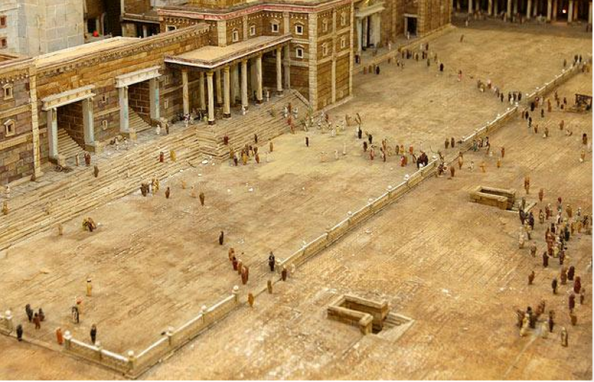
Barrier (5418) (phragmos from phrasso = to fence or hedge in) describes a fence, or enclosing barrier. It signified originally a fence or railing erected for protection rather than separation. It could be a fence, hedge, a thorn hedge around a vineyard, beside which there was often a wall.
Gilbrant - Phragmos is literally the “fence” around a vineyard. It can also take the form of a wall or a living hedge. The word is used in the Septuagint in the Parable of the Vineyard (Isaiah 5:2+). It occurs twice in the Gospels in Jesus’ Parable of the Vineyard (Matthew 21:33; Mark 12:1) and once of the host of a great supper who sent his servants into “the highways and hedges” (of the vineyards) to bring the workers in (Luke 14:23). The only other reference is figurative, of the Law that separates Jews and Gentiles, leading to enmity. Christ has broken down this “middle wall of partition” (Ephesians 2:14) and has united all believers in himself. (Complete Biblical Library Greek-English Dictionary)
Josephus used phragmos to refer to the balustrade in the Jerusalem temple separating the court of the Gentiles from the temple proper. (see the "fence" above - to the right of the low fence is The Court of the Gentiles in Herod's Temple).
When Jerusalem fell in A.D. 70, this partition was demolished along with the temple itself, but Paul saw it as already destroyed by Christ on the Cross. Ironically enough, Paul himself had been wrongfully accused of taking an Asian Gentile, Trophimus, past this checkpoint Acts 21:29+.
Phragmos - 4x - barrier(1), hedges(1), wall(2) - Matt. 21:33; Mk. 12:1; Lk. 14:23; Eph. 2:14
Wikipedia Note on the Barrier
THE BARRIER WAS LIKE A JEWISH "NO TRESPASSING" SIGN -The Temple Warning inscription, also known as the Temple Balustrade inscription or the Soreg inscription[2], is an inscription that hung along the balustrade outside the Sanctuary of the Second Temple in Jerusalem. Two of these tablets have been found.[3] (HERE IS THE TRANSLATION OF ONE OF THESE RECOVERED STONES) -
"No stranger is to enter within the balustrade round the temple and enclosure. Whoever is caught will be himself responsible for his ensuing death."
NOTE: For more detailed note from the Temple Institute click "soreg" which was the low, latticed railing in the diagram above and it separated the Temple courts (only for Jews) from the Court of the Gentiles.
Josephus writes of the second court of the Temple around 75AD - When you go through these [first] cloisters, unto the second [court of the] temple, there was a partition made of stone all round, whose height was three cubits: its construction was very elegant; upon it stood pillars, at equal distances from one another, declaring the law of purity, some in Greek, and some in Roman letters, that “no foreigner should go within that sanctuary” for that second [court of the] temple was called “the Sanctuary,” and was ascended to by fourteen steps from the first court. (A description of the temple – Wars of the Jews Book 5, Chapter 5, Verse 2)
The Roman government gave the Jews permission to execute any Gentile, even those who were Roman citizens, if they proceeded beyond this barrier!
Observe from the diagram below that Gentiles were restricted to the outer court of the temple, the court of the Gentiles (they were "far off") and they could not go beyond the sacred enclosure into the women’s court, or into the court of Israel, much less into the court of the priests, on penalty of death.
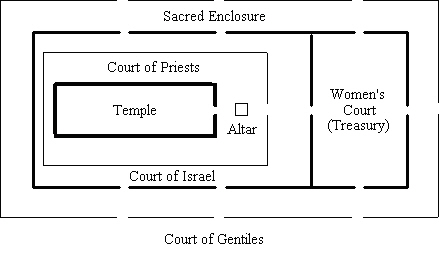
Dividing Wall (3320) (mesótoichon from mésos = middle + toíchos = wall) means middle wall or partition. Metaphorically mesótoichon referred to the Mosaic Law separating Jews and Gentiles and recalled the common rabbinic idea of the law as a fence dividing the Jews by their observance of it from all other races and thus arousing hostility.
What is the "barrier of the dividing wall"? As Hoehner explains above Paul in the present context is not referring to a literal wall, but to the invisible barrier set up by the Mosaic Law of commandments contained in ordinances which separated the people of Israel from the nations. The sad irony is that "the dividing wall" of the Law of Moses was the very "barrier" that has kept countless Jews through the millennia from entering by a new and living way through the veil of the Temple and into the Holy of holies! (see Heb 10:19-20+).
Vincent explains the spiritual implications of the barrier writing that it represented "the whole Mosaic economy which separated Jew from Gentile. (Ephesians 2 Commentary)
Luke records an event in Paul's life that underscores the fact that the Jews were deadly serious about this warning to Gentiles not to transgress this barrier…
And when the seven days (the length of the purification process) were almost over, the Jews from Asia, upon seeing him (Paul) in the temple, began to stir up all the multitude and laid hands on him, crying out, "Men of Israel, come to our aid! This is the man who preaches to all men everywhere against our people, and the Law, and this place; and besides he has even brought Greeks (Gentiles) into the temple and has defiled this holy place." For they had previously seen Trophimus the Ephesian in the city with him, and they supposed that Paul had brought him into the temple." (Acts 21:27-29+)
And so we see that Paul was all too familiar with a literal barrier, and it is possible (this is speculation of course) that thoughts of his former encounter associated with the barrier of the dividing wall flooded his mind as he wrote the words in Ephesians 2:14, here referring not to a literal dividing wall but a spiritual dividing wall as discussed above. Paul would have recalled that his arrest at Jerusalem, which led to his final imprisonment and death, was due to the fact that he had been wrongly accused of bringing Trophimus, an Ephesian Gentile, into the Temple beyond the barrier of the dividing wall.
The Story Of A Wall
He Himself is our peace, who has made both one, and has broken down the middle wall of separation. —Ephesians 2:14
Today's Scripture: Ephesians 2:11-22
While visiting the ruins of Hadrian’s Wall in Northern England, I reflected on the fact that this may be the most remembered achievement of the Roman emperor who came to power in ad 117. As many as 18,000 Roman soldiers manned this 80-mile-long barrier, built to keep the northern barbarians from invading the south.
Hadrian is remembered for building a physical wall to keep people out. In contrast, Jesus Christ is remembered for tearing down a spiritual wall to let people in.
When the early church experienced tension between believers of Jewish and non-Jewish birth, Paul told them that, through Christ, they stood equally in the family of God. “For He Himself is our peace, who has made both one, and has broken down the middle wall of separation . . . so as to create in Himself one new man from the two, thus making peace . . . . For through Him we both have access by one Spirit to the Father” (Eph. 2:14-15,18).
One of the most beautiful aspects of the Christian faith is the unity among those who follow Jesus. Through His death on the cross, Christ has removed the barriers that so often separate people and has drawn us together in true friendship and love. By: David C. McCasland (Our Daily Bread, Copyright RBC Ministries, Grand Rapids, MI. — Reprinted by permission. All rights reserved)
God’s people have so much to do
In serving Christ today
That they should use their precious time
To share, to love, to pray.
—Branon
Christian unity begins at the cross.
The Dividing Wall
He Himself is our peace, who has made both one, and has broken down the middle wall of separation. —Ephesians 2:14
Today's Scripture: Ephesians 2:11-22; 4:1-3
November 9, 2010, marked the 21st anniversary of the fall of the Berlin wall. On that day in 1989, an announcement over East German TV informed people that they were free to travel to West Germany. A day later, East German bulldozers began to dismantle the wall that for 28 years had divided East and West Germany.
Jesus Christ “has broken down the middle wall of separation” between Jew and Gentile (Eph. 2:14). But there was an even more impenetrable barrier that separated man from God. Jesus’ death and resurrection made the reconciliation between man and man and between man and God possible (v.16).
All believers are now “members of the household of God” (v.19). Together, we are to grow into “a holy temple in the Lord” (v.21) with God’s Holy Spirit living among and within us (v.22).
But sadly, Christians often re-erect walls between one another. That is why Paul urges us to “walk worthy of the calling . . . , bearing with one another in love, endeavoring to keep the unity of the Spirit in the bond of peace” (4:1-3). Rather than building walls, let’s work to dismantle what separates us. Let the world see that we are indeed of the same household. By: C. P. Hiac (Our Daily Bread, Copyright RBC Ministries, Grand Rapids, MI. — Reprinted by permission. All rights reserved)
We’re members of Christ’s body,
A blessed family;
So let’s not fight or quarrel,
But live in harmony.
—Fitzhugh
Unity among believers comes from their union with Christ.
QUESTION - What was the Court of the Gentiles in the Jewish temple?
ANSWER - Herod’s temple, destroyed along with the rest of Jerusalem by the Romans in AD 70, contained four separate “courts,” separated from one another and each designed for a different purpose: the Court of the Gentiles, the Court of the Women, the Court of Israel (or the Court of Men), and the Court of Priests. The Court of the Gentiles is referred to as “the outer court” in Revelation 11:2.
The Court of the Gentiles was the outermost courtyard and the only area of the temple where non-Jews were allowed. As its name implies, the Court of the Gentiles was accessible to Gentiles, foreigners, and those who were considered impure. There, worshippers could mill about, exchange money, and even buy animals for sacrifices. It was from the Court of the Gentiles that Jesus, on two occasions (John 2:11–12; Matthew 21:17–23), drove out the money changers, declaring, “It is written, ‘My house shall be called a house of prayer,’ but you make it a den of robbers” (Matthew 21:13). The Court of the Women, the only area of the temple complex in which women could worship, contained the poor boxes. One of these boxes was where the poor widow offered her two mites (Luke 21:1–4). Ceremonially clean Jewish men could enter the Court of Israel, and the Court of Priests, where the altar stood, was accessible only to Levitical priests.
Non-Jews were allowed to enter the Court of the Gentiles, but they were forbidden to go any farther than the outer court. The inner temple courtyards were enclosed by a balustrade, and at the entrances to it notices were posted in both Greek and Latin, warning foreigners and uncircumcised persons that crossing into one of the other courtyards was punishable by death. One of those ancient notices is now on display in a museum in Istanbul. On Paul’s last visit to Jerusalem, some Jews stirred up a crowd and grabbed Paul in the temple, alleging that he had taken Trophimus, a Gentile, into one of the forbidden courtyards (Acts 21:27–29). Paul was innocent of the charge, but the mob beat him with the intent to kill him; it was the quick action of a Roman garrison commander that preserved Paul’s life on that occasion (verses 30–34). GotQuestions.org