Ephesians 2:2
Ephesians 2:3
Ephesians 2:4
Ephesians 2:5
Ephesians 2:6
Ephesians 2:7
Ephesians 2:8
Ephesians 2:9
Ephesians 2:10
Ephesians 2:11
Ephesians 2:12
Ephesians 2:13
Ephesians 2:14
Ephesians 2:15
Ephesians 2:16
Ephesians 2:17
Ephesians 2:18
Ephesians 2:19
Ephesians 2:20
Ephesians 2:21
Ephesians 2:22
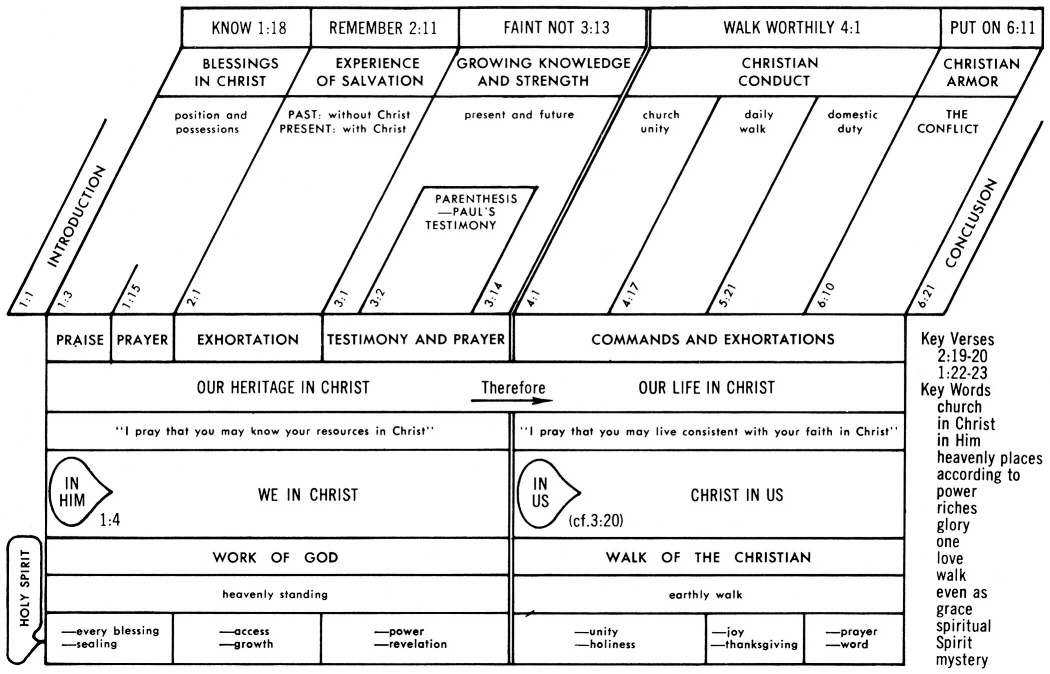
EPHESIANS - CHRIST AND THE CHURCH
Click chart to enlarge
Charts from Jensen's Survey of the NT - used by permission
Ephesians 2:17 AND HE CAME AND PREACHED PEACE TO YOU WHO WERE FAR AWAY, AND PEACE TO THOSE WHO WERE NEAR (NASB: Lockman)
Greek: kai elthon (AAPMSN) eueggelisato (3SAMI) eirenen humin tois makran kai eirenen tois eggus;
BGT καὶ ἐλθὼν εὐηγγελίσατο εἰρήνην ὑμῖν τοῖς μακρὰν καὶ εἰρήνην τοῖς ἐγγύς·
Amplified: And He came and preached the glad tidings of peace to you who were afar off and [peace] to those who were near. (Amplified Bible - Lockman)
NLT: He has brought this Good News of peace to you Gentiles who were far away from him, and to us Jews who were near. (NLT - Tyndale House)
Phillips: Then he came and told both you who were far from God and us who were near that the war was over. (Phillips: Touchstone)
Wuest: and having come, He proclaimed glad tidings of peace to you who were far off, and to you who were near (Eerdmans Publishing - used by permission)
Young's Literal: and having come, he did proclaim good news -- peace to you -- the far-off and the nigh,
Weymouth - So He came and proclaimed good news of peace to you who were so far away, and peace to those who were near; 18 because it is through Him that Jews and Gentiles alike have access through one Spirit to the Father.
KJV And came and preached peace to you which were afar off, and to them that were nigh.
NKJ And He came and preached peace to you who were afar off and to those who were near.
ESV And he came and preached peace to you who were far off and peace to those who were near.
NET And he came and preached peace to you who were far off and peace to those who were near,
NIV He came and preached peace to you who were far away and peace to those who were near.
NLT (revised) He brought this Good News of peace to you Gentiles who were far away from him, and peace to the Jews who were near.
CSB When the Messiah came, He proclaimed the good news of peace to you who were far away and peace to those who were near.
NRS So he came and proclaimed peace to you who were far off and peace to those who were near;
NAB He came and preached peace to you who were far off and peace to those who were near,
NJB He came to bring the good news of peace to you who were far off and peace to those who were near.
GWN He came with the Good News of peace for you who were far away and for those who were near.
BBE And he came preaching peace to you who were far off, and to those who were near;
AND HE CAME AND PREACHED PEACE TO YOU WHO WERE FAR AWAY: kai elthon (AAPMSN) eueggelisato (3SAMI) eirenen humin tois makran:
- He came and preached peace - Ps 85:10; Isaiah 27:5; 52:7; 57:19, 20, 21; Zechariah 9:10; Matthew 10:13; Luke 2:14; Luke 15:5,6; Acts 2:39; 10:36; Ro 5:1; 2Co 5:20
- Ephesians 2 Resources - Multiple Sermons and Commentaries
- Ephesians 2:11-22 Our Biography In Brief - Steven Cole
- Ephesians 2:16-22 The Unity of the Body, Part 3 - John MacArthur
PEACE WITH GOD
FOR THE GENTILE
He came and preached (euaggelizo/euangelizo) peace (eirene) to you who were far away (makran) - Christ.Came in (aorist tense = past completed action) refers to His first advent.The verb is more literally rendered Jesus gospeled peace .The same verb preached (euaggelizo/euangelizo) is used by Jesus in first sermon (when He preached to those who were near) in a synagogue in Nazareth. Jesus gospeled peace to the Jews in His hometown (Isa 61:1+ Lk 4:18+). You far away refers to the Gentiles. To whom does this refer? It must refer to Christ's ambassadors, even as Paul preached to the Gentiles in Ephesus, a location which Jesus never visited.
S Lewis Johnson has an interesting comment on this verse writing that "we read, “And came and preached peace.” That seems strange, isn’t it? You would think that he would’ve put, “And he came and preached peace, and then he reconciled men to himself by the death of the cross.” In fact, if you were in a Bible class with the Apostle Paul you might raise your hand and say, “Paul, haven’t you got the order reversed there? You say, he’s abolished in the flesh the enmity by means of the cross, he’s reconciled us through the cross slaying the enmity, and then say, and he came and preached peace. Shouldn’t you reverse those?” Paul would probably say, “I’m not surprised you asked a question like that. But, I want you to understand what I mean by “and he came and preached peace,” is this is preaching by means of the Holy Spirit. It is the Holy Spirit who is the means by which men preach Christ, so that we preach him, by means of the Holy Spirit. And that, I think, is the force: “and he came and preached to you who were far off and you who were nigh.” Ultimately, it is the word of Christ through the messenger… “Faith cometh by hearing and hearing through the word of Christ.” (see note Romans 10:17) And in the course of the exposition, I tried to make the point that faith comes by the message, but it’s a message through Jesus Christ. In other words, it’s Christ in the word that is the saving instrumentality. So the word is an instrumentality by which Christ himself, in His messages, reaches us. That, I think, is perfectly harmonious with this: “He came and preached peace.” Men were doing it, Apostles were doing it, but they were giving out the word and Christ Himself was coming to them through the word of the apostles. So he came and preached peace. I think the order of the words demands that interpretation. (pdf )
Preached (2097) (euaggelizo/euangelizo from eu = good, well + aggéllo = proclaim, tell) means to announce good news (gospel) or bring glad tidings. Literally one could say that Christ "gospelized peace!" to both Jew and Gentile.
Euaggelizo - 52x in NT - bring… good news(2), bring good news(1), brought… good news(1), good news(5), good news preached(2), gospel(2), gospel preached(2), preach(4), preach the gospel(11), preach… a gospel(1), preach… the good news(1), preached(11), preached the gospel(4), preaching(8), preaching the good news(1), preaching the gospel(4), preaching… a gospel(1). Matt. 11:5; Lk. 1:19; 2:10; 3:18; 4:18, 43; 7:22; 8:1; 9:6; 16:16; 20:1; Acts 5:42; 8:4, 12, 25, 35, 40; 10:36; 11:20; 13:32; 14:7, 15, 21; 15:35; 16:10; 17:18; Rom. 1:15; 10:15; 15:20; 1 Co. 1:17; 9:16, 18; 15:1f; 2 Co. 10:16; 11:7; Gal. 1:8f, 11, 16, 23; 4:13; Eph. 2:17; 3:8; 1 Thess. 3:6; Heb. 4:2, 6; 1 Pet. 1:12, 25; 4:6; Rev. 10:7; 14:6
In the OT euaggelizo was used of any kind of good news including the joyful tidings of God's kindnesses especially as they related to the promised Messianic blessings. In the NT euaggelizo was used especially of the glad tidings of the coming kingdom of God and of the salvation through Christ Jesus, the Lamb of God Who took away the sins of the world. Here euaggelizo is used to instruct men concerning the things that pertain to salvation, specifically the peace Paul has been explaining.
Morris explains "This "[preaching] of peace"--not only peace between Jew and Gentile but also individual peace with God through the forgiveness of sins--had long been in God's plan. The promised Messiah was "anointed" to "preach good tidings unto the meek" first among the Jews, but then also to "declare my glory among the Gentiles" (Isaiah 61:1; 66:19). Jesus not only confirmed that He had come in fulfillment of this prophecy to "preach the gospel to the poor" (Luke 4:18) but also reminded the Jews that He had "other sheep" which were "not of this fold; them also I must bring, and they shall hear my voice; and there shall be one fold; and one shepherd" (John 10:16). Later He commissioned His disciples to "be witnesses unto me… unto the uttermost part of the earth" (Acts 1:8). Then, through Paul and others, He had been "preached unto the Gentiles" and "believed on in the world" (1Timothy 3:16). (Defenders Study Bible)
Peace (1515) (eirene from the verb eiro = to bind or join together what is broken or divided) means in essence to set at one again or join together that which is separated. In secular Greek eirene described the cessation or absence of war. By Christ's vicarious death He procured peace and by His servants He proclaimed glad tidings of peace based on His atoning work on the Cross.
Eirene - 85x in NT - Matt. 10:13, 34; Mk. 5:34; Lk. 1:79; 2:14, 29; 7:50; 8:48; 10:5f; 11:21; 12:51; 14:32; 19:38, 42; 24:36; Jn. 14:27; 16:33; 20:19, 21, 26; Acts 7:26; 9:31; 10:36; 12:20; 15:33; 16:36; 24:2; Rom. 1:7; 2:10; 3:17; 5:1; 8:6; 14:17, 19; 15:13, 33; 16:20; 1 Co. 1:3; 7:15; 14:33; 16:11; 2 Co. 1:2; 13:11; Gal. 1:3; 5:22; 6:16; Eph. 1:2; 2:14f, 17; 4:3; 6:15, 23; Phil. 1:2; 4:7, 9; Col. 1:2; 3:15; 1 Thess. 1:1; 5:3, 23; 2 Thess. 1:2; 3:16; 1 Tim. 1:2; 2 Tim. 1:2; 2:22; Titus 1:4; Philemon. 1:3; Heb. 7:2; 11:31; 12:14; 13:20; Jas. 2:16; 3:18; 1 Pet. 1:2; 3:11; 5:14; 2 Pet. 1:2; 3:14; 2 Jn. 1:3; 3 Jn. 1:15; Jude 1:2; Rev. 1:4; 6:4
Did you observe the progression? In Eph 2:14+ Christ is our peace. In Eph 2:15+ He made peace. In this verse He came and preached peace.
When did Christ preach peace? John records in one of His first post-resurrection appearances to His disciples…
When therefore it was evening, on that day, the first day of the week, and when the doors were shut where the disciples were, for fear of the Jews, Jesus came and stood in their midst, and said to them, "Peace be with you."… Jesus therefore said to them again, "Peace be with you; as the Father has sent Me, I also send you."… And after eight days again His disciples were inside, and Thomas with them. Jesus came, the doors having been shut, and stood in their midst, and said, "Peace be with you." (John 20:19, 21, 26)
Note in the preceding passage, that Jesus sent out the apostles in the power of the Holy Spirit (John 20:22 "Receive the Holy Spirit", cf Acts 1:8) and they obediently went forth and preached peace Luke recording Peter's proclamation that…
"The word which He (Jesus) sent to the sons of Israel, preaching peace through Jesus Christ (He is Lord of all)… (Acts 10:36+).
Paul records that now all believers "are ambassadors for Christ, as though God were entreating (begging) through us; we beg you on behalf of Christ, be reconciled to God." (2Cor 5:20+)
Later in this same letter, Paul exhorts his readers to have their feet shod with the "preparation (firm footing) of the gospel of peace" (Eph 6:15+). Apart from proclaiming peace, there is no way for those in rebellion to know, understand, and act on the terms of that peace. Years after World War II there were Japanese soldiers discovered on several islands still waging war who had never heard of the peace that had been declared in 1945 when the Emperor of Japan surrendered to the Allied forces. In the same way, there are many today who are uninformed of the good news that through the Cross of Christ they can experience eternal peace with God, the One with Whom they are otherwise in perpetual conflict (see "enemies"-Ro 5:10-note, "alienated, hostile in mind, engaged in evil deeds" Col 1:21+)
Paxson writes that "Having become peace and having made it, Christ now preaches peace. It was His personal message after His resurrection (Luke 24:36; John 20:19,21,26). He preached it later through His apostles, and continues to preach peace through His Word faithfully given by His ministers. It is God’s clearly declared purpose to heal the schism made by sin in humanity; otherwise His plan of salvation would be incomplete. In this present age He would do it through grace. Peace has not been established on earth because men will not follow God’s way. But in the age to come, through government the Lord Jesus Christ shall rule over the earth as King of kings and Lord of lords. Then righteousness shall prevail and peace shall be its fruit. (The Wealth, Walk and Warfare of the Christian)
Far off (3112) (makran from makros = far) literally means a long way off but is used figuratively here to describe the Gentiles who were separated from Christ, etc, and thus were a long way off from God. Analytical Greek New Testament = (1) as an adverb (originally an accusative of extent, with hodon [road] implied); literally, of extent of space far away, at a distance, far off (MT 8.30); figuratively, of separation from God (Eph 2.13, 17); (2) as an improper preposition with the genitive far away from (Lk 7.6) Zodhiates - Long, as used of space, meaning from one point to another and hence far, far distant (Lk 15:13; 19:12); as used of time, only in the neut. pl. makrá as an adv., meaning long, e.g., praying long or making long prayers (Mt. 23:14; Mk 12:40; Lk 20:47). (Complete Word Study Dictionary)
Gilbrant - Classical Greek This adjective, like its adverbial form makran (3084), is used to express the extension of both time and space. When applied to time it may mean “long-lasting” or “enduring.” Referring to space the meaning again denotes “distant, far,” or it may mean “far-stretching” or even “tall, lofty” or “deep” (Liddell-Scott). In the New Testament makros was used by Jesus when He denounced the scribes for the hypocritical pretense of their long prayers (Mark 12:40; Luke 20:47). It was also used by Luke to refer to space when speaking of a far or distant country, as in the Parable of the Prodigal Son (Luke 15:13) and the Parable of the Ten Talents (Luke 19:12).(Complete Biblical Library - Incredible Resource)
Makran - 10x in 9v NT - distance(1), far(5), far away(1), far off(2), long way(1). Matt. 8:30; Mk. 12:34; Lk. 7:6; 15:20; Jn. 21:8; Acts 17:27; 22:21; Eph. 2:13, 17
Makran in the Septuagint - Gen. 44:4; Exod. 8:24; Exod. 33:7; Num. 9:10; Deut. 13:8; Deut. 14:24; Deut. 20:15; Deut. 30:11; Jos. 3:4; Jos. 3:16; Jos. 8:4; Jos. 9:22; Jdg. 18:7; Jdg. 18:28; 2 Sam. 7:19; 2 Sam. 15:17; 1 Ki. 8:46; 2 Chr. 6:36; Ezr. 6:6; Neh. 4:13; Est. 9:20; Ps. 21:2; Ps. 64:6; Ps. 118:155; Prov. 2:16; Prov. 4:24; Prov. 5:8; Prov. 13:19; Prov. 15:29; Prov. 19:7; Prov. 22:15; Prov. 27:10; Prov. 30:8; Eccl. 7:24; Job 30:10; Job 36:3; Mic. 4:3; Joel 4:8; Zech. 6:15; Zech. 10:9; Isa. 5:26; Isa. 27:9; Isa. 46:12; Isa. 57:9; Isa. 57:19; Isa. 59:11; Isa. 59:14; Jer. 2:5; Jer. 36:28; Ezek. 6:12; Ezek. 11:15; Ezek. 12:22; Ezek. 22:5;
This preaching of peace was not only peace between Jew and Gentile but also between believing Jew and Gentile and God, with Whom they had been enemies and hostile. This had always been God's plan and had been prophesied, for example, in Isaiah who recorded the actual words of the promised Messiah…
The Spirit of the Lord GOD is upon me, because the LORD has anointed (mashach - related to the Hebrew word Mashiach, Anointed One, the Messiah) me to bring good news (euaggelizo in the Septuagint =LXX) to the afflicted; He has sent me to bind up the brokenhearted, to proclaim liberty to captives, and freedom to prisoners. To proclaim the favorable year of the LORD. (Isaiah 61:1-2a+) (Luke 4:18+)
Comment: Isaiah 61:1-2a was the very passage that Jesus read in the synagogue in Nazareth, closing the book with the words ""Today this Scripture has been fulfilled in your hearing." He could not have been much clearer about Who He was and what His purpose was!)
AND PEACE TO THOSE WHO WERE NEAR: kai eirenen tois eggus:
- Peace to those who were near - Ep 2:13,14; Deut 4:7; Ps 75:1; Ps 76:1,2; Ps 147:19,20; Ps 148:14; Luke 10:9-11
- Ephesians 2 Resources - Multiple Sermons and Commentaries
- Ephesians 2:11-22 Our Biography In Brief - Steven Cole
- Ephesians 2:16-22 The Unity of the Body, Part 3 - John MacArthur
Related Passages:
Deuteronomy 4:7 “For what great nation is there that has a god so near to it as is the LORD our God whenever we call on Him?
Psalm 75:1 For the choir director; set to Al-tashheth. A Psalm of Asaph, a Song. We give thanks to You, O God, we give thanks, For Your name is near; Men declare Your wondrous works.
PEACE WITH GOD
FOR THE JEW
Those who were near - The Jews were near but still just as needy as the Gentiles for they too were dead in their trespasses and sins. In Eph 2:12+ Paul list 5 ways the Jews were nearer to Christ and God - but salvation is not like horseshoes -- nearer to the goal does not count. Only being in Christ counts! Every person, far or near, Gentile or Jew, has access to God's peace through Christ.
Near (1451) (eggus) indicates a position relatively close to another position and figuratively refers to the Jews who were "near" to God in the sense of having Messianic prophecies, a national identity and government set up by God, covenants that promised salvation by faith, a hope in the coming of Messiah and the presence of God in their midst (the Tabernacle in the wilderness, the Temple in Jerusalem).
Eggus - 31x in NT - Matt. 24:32f; 26:18; Mk. 13:28f; Lk. 19:11; 21:30f; Jn. 2:13; 3:23; 6:4, 19, 23; 7:2; 11:18, 54, 55; 19:20, 42; Acts 1:12; 9:38; 27:8; Rom. 10:8; 13:11; Eph. 2:13, 17; Phil. 4:5; Heb. 6:8; 8:13; Rev. 1:3; 22:10
This peace that was preached to both Gentiles and Jews is a fulfillment of the a prophecy given hundreds of years earlier, Isaiah recording Jehovah's promise…
"I have seen his (wayward Israel's) ways, but I will heal him (those Israelites who would humble themselves and repent of their rebellion and unfaithfulness). I will lead him and restore comfort to him and to his mourners, creating (Hebrew = barah = to create out of nothing) the praise of the lips. Peace, peace to him who is far (Gentile) and to him who is near (Jehovah)," Says the LORD, "and I will heal (rapha cf Jehovah Rapha - The LORD our Healer) him." (Isaiah 57:18,19) (Comment: The repetition of peace is a Hebrew idiom or way of saying that something is superlative in kind and total in extent! What amazing grace is seen in this passage.)
Even in His birth peace was "preached"…
"Glory to God in the highest, And on earth peace among men with whom He is pleased." (Luke 2:14) (Comment: Who is He pleased with? Those with whom the Lord is pleased are those who trust in His Son, Jesus Christ.)
Jesus is the Prince of Peace…
For a child will be born to us, a son will be given to us; And the government will rest on His shoulders; And His name will be called Wonderful Counselor, Mighty God, Eternal Father, Prince of Peace. (Isa. 9:6)
He promised His disciples,
"Peace I leave with you; My peace I give to you." (John 14:27).
Like their Master, His disciples are also to be peacemakers "Blessed are the peacemakers, for they shall be called sons of God. (Matthew 5:9-note)
When Jesus sent forth the seventy He commissioned them: "Whatever house you enter, first say, 'Peace be to this house.' And if a man of peace is there, your peace will rest upon him; but if not, it will return to you (Luke 10:5, 6).
Peace surrounded the ministry of Jesus as an aura that continually blessed those who believed in Him. Among His last words to His disciples were, "These things I have spoken to you, that in Me you may have peace." (John 16:33).
The ministry of the apostles and other preachers of the early church was characterized by "preaching peace through Jesus Christ" (Acts 10:36).
The ministry of the Spirit of Christ is characterized by the giving of
God's kingdom is characterized by "righteousness and peace and joy in the Holy Spirit" (Ro 14:17-note).
God is the God of peace…
for God is not a God of confusion but of peace, as in all the churches of the saints." (1Cor. 14:33)
Now the God of peace, who brought up from the dead the great Shepherd of the sheep through the blood of the eternal covenant, even Jesus our Lord, (Heb 13:20, 21-note)
Now the God of peace be with you all. Amen. (Ro 15:33-note)
And the God of peace (notice the "irony" that a peaceful God will crush!) will soon crush Satan under your feet. The grace of our Lord Jesus be with you. (see note Romans 16:20)
Now may the God of peace Himself sanctify you entirely; and may your spirit and soul and body be preserved complete, without blame at the coming of our Lord Jesus Christ. (see note 1Thessalonians 5:23)
The War is Over- The bitter conflict had finally ended between the North and the South. The soldiers of the US Civil War were free to return to their families. But a number of them remained hidden in the woods, living on berries. They either didn't hear or didn't believe that the war was over, so they continued enduring miserable conditions when they could have been back home.
It's something like that in the spiritual realm too. Christ made peace between God and man by dying in our place. He paid sin's penalty on the cross. Anyone who accepts His sacrifice will be forgiven by a holy God.
Sadly, many people refuse to believe the gospel and continue to live as spiritual fugitives. Sometimes even those who have placed their trust in Christ live on almost the same level. Either out of ignorance or unwillingness, they fail to claim the promises of God's Word. They do not experience the joy and assurance that should accompany salvation. They do not draw from their relationship with God the comfort and peace He intends for His children. They are the objects of His love, care, and provision but live as if they were orphans.
Have you been living apart from the comfort, love, and care of your heavenly Father? Come on home. The war is over!—Richard De Haan (Our Daily Bread, Copyright RBC Ministries, Grand Rapids, MI. Reprinted by permission. All rights reserved)
We fail, O Lord, to realize
The fullness of what You have done,
So help us trust Your saving work
And claim the triumph You have won. —D. De Haan
Christ's victory over death means peace for His saints.
The Peace Initiative - It was the night before Christmas in 1870. French and German armies faced each other on the field of battle in the Franco-Prussian War. A French soldier started walking toward the German lines. His comrades watched breathlessly, expecting to hear at any instant the crack of a rifle that would end his life. As he neared the enemy lines, he stopped and began singing, "Noel, noel! Noel, noel! Born is the King of Israel!" No shot rang out.
Slowly the Frenchman returned to his ranks. There was silence! Then from the German side came a lone soldier to that same spot and sang the German version of the same song. After each stanza both armies united in the chorus. For a few minutes Christ brought peace to that battlefield.
God is a peacemaker who always takes the first step. Jesus came as a baby, and when He grew to manhood He preached peace to a warring world. Then, in the greatest peace initiative this world has ever seen, Christ made peace between God and man by dying for our sins (Col 1:20-note).
Peacemaking efforts may be rejected, but the alternative is continued hostility. God didn't settle for that, nor should we. Let's take the first step in healing a broken relationship, even at the risk of being "shot down." --D J De Haan (Ibid)
O Prince of Peace, keep us, we pray,
From strife and enmity;
Help us to speak with loving words
That quell hostility. --JDBWhat this world needs is the peace that passes all misunderstanding
Ephesians 2:18 for through Him we both have our access in one Spirit to the Father (NASB: Lockman)
Greek: hoti di' autou echomen (1PPAI) ten prosagogen oi amphoteroi en eni pneumati pros ton patera.
BGT ὅτι δι᾽ αὐτοῦ ἔχομεν τὴν προσαγωγὴν οἱ ἀμφότεροι ἐν ἑνὶ πνεύματι πρὸς τὸν πατέρα.
Amplified: For it is through Him that we both [whether far off or near] now have an introduction (access) by one [Holy] Spirit to the Father [so that we are able to approach Him]. (Amplified Bible - Lockman)
NLT: Now all of us, both Jews and Gentiles, may come to the Father through the same Holy Spirit because of what Christ has done for us. (NLT - Tyndale House)
NLT (revised) Now all of us can come to the Father through the same Holy Spirit because of what Christ has done for us.
Phillips: And it is through him that both of us now can approach the Father in the one Spirit. (Phillips: Touchstone)
Wuest: because through Him we have our entree, the both of us, by one Spirit into the presence of the Father. (Eerdmans Publishing - used by permission)
Young's Literal: because through him we have the access -- we both -- in one Spirit unto the Father.
KJV For through him we both have access by one Spirit unto the Father.
NKJ For through Him we both have access by one Spirit to the Father.
ESV For through him we both have access in one Spirit to the Father.
NET so that through him we both have access in one Spirit to the Father.
NIV For through him we both have access to the Father by one Spirit.
CSB For through Him we both have access by one Spirit to the Father.
NRS for through him both of us have access in one Spirit to the Father.
NAB for through him we both have access in one Spirit to the Father.
NJB Through him, then, we both in the one Spirit have free access to the Father.
GWN So Jewish and non-Jewish people can go to the Father in one Spirit.
BBE Because through him the two of us are able to come near in one Spirit to the Father.
Weymouth - because it is through Him that Jews and Gentiles alike have access through one Spirit to the Father.
FOR THROUGH HIM WE BOTH HAVE OUR ACCESS: hoti di' autou echomen (1PPAI) ten prosagogen oi amphoteroi:
- for through Him we both have our access Ep 3:12; Jn 10:7,9; 14:6; Ro 5:2; Heb 4:15,16; Heb 7:19; Heb 10:19,20; 1Pe 1:21; 1Pe 3:18; 1Jn 2:1,2
- Ephesians 2 Resources - Multiple Sermons and Commentaries
- Ephesians 2:11-22 Our Biography In Brief - Steven Cole
- Ephesians 2:16-22 The Unity of the Body, Part 3 - John MacArthur
Related Passages:
Ephesians 3:12 in Whom (Christ) we have boldness and confident access through faith in Him.
John 10:7-9 Jesus therefore said to them again, "Truly, truly, I say to you, I am the door of the sheep. "All who came before Me are thieves and robbers, but the sheep did not hear them. "I am the door; if anyone enters through (dia) Me, he shall be saved, and shall go in and out, and find pasture.
John 14:6 Jesus (responding to Thomas' question of how the disciples could know the way where He was going) said to him, "I am the way, and the truth, and the life; no one comes to the Father, but through (dia) Me.
1Jn 4:9 By this the love of God was manifested in us, that God has sent His only begotten Son into the world so that we might live through (dia) Him.
CHRIST IS THE ONLY WAY
TO THE FATHER
For through (dia) Him we both (amphoteros) have our access (prosagoge) - For is probably better rendered "so that" indicating that the result of Christ preaching peace to the Gentiles (far away) and the Jews (near) resulted in salvation for both groups and one result of salvation is that now both groups had access to God the Father. In other words the Christ and the Good News that He brings is the "Channel" (and the only One) through which believing Jews and Gentiles could come into the presence of God. The benefits of our salvation come through Christ, our Mediator and Great High Priest. We enter in and draw near through Him, for He is the "Author of salvation" (Heb 2:10+). He is the Forerunner (Heb 6:20+), having entered Himself through "the veil" (His Flesh - see below) that we might now have a new and living way into the Holy of Holies, the very presence of God the Father!
Note that have (echo) is in the present tense indicating this access through Christ is continuous possession. In the Old Testament no Jew save the High Priest had the privilege of entree into the Holy of Holies, and that but only once per year on the Day of Atonement. The Cross of Christ has opened the floodgates of grace so that now every believer has continual access to the Throne Room.
Lehman Strauss - There can be no boast as to which man’s religion or church gives him access to God. There are no advantages in being a Jew or a Gentile now. Christ is the Mediator of the new covenant and only “through Him” can there be access to the Father. The Lord Jesus said: “No man cometh unto the Father but by Me” (John 14:6), and that through the present ministry of the Holy Spirit. (The Calling and Design of the Church)
John Eadie eloquently highlights every believer's high privilege writing that "now the most distant Gentile who is in Christ really and continuously enjoys that august spiritual privilege, which the one man of the one tribe of the one nation on the one day of the year, only typically and periodically possessed. (Ephesians 2 Commentary)
Click the following links to study parallel passages regarding Christ our "Mediator", the channel of blessing and channel of access -- "through Christ", "through Jesus Christ" cf "through Him"
Christ is now the believer's Great High Priest, the writer of Hebrews repeatedly emphasizing He provides believers access to the Father....
we do not have a high priest who cannot sympathize with our weaknesses, but One who has been tempted in all things as we are, yet without sin. Let us therefore draw near (implied that this drawing near is "through Him") with confidence to the throne of grace, that we may receive mercy and may find grace to help in time of need. (Heb 4:15+, Heb 4:16+)
Hence, also, He is able to save forever those who draw near to God through Him, since He always lives to make intercession for them. (Heb 7:25+)
Since therefore, brethren, we have confidence to enter the holy place by the blood of Jesus, by a new and living way which He inaugurated for us through the veil, that is, His flesh, and since we have a great priest over the house of God, let us draw near with a sincere heart in full assurance of faith, having our hearts sprinkled clean from an evil conscience and our bodies washed with pure water. (Hebrew 10:19-21+, Heb 10:22+)
Comment: Matthew 27:50 records that at the end of the crucifixion "Jesus cried out again with a loud voice, and yielded up His spirit." which was contemporaneous with "the sun being obscured; and the veil of the temple was torn in two" as Luke 23:43 relates. The point is that the rent flesh of Jesus accomplished the rending of the veil separating the Holy Place from the Holy of Holies, thus providing full access to the throne of God. All those who are now in Christ have unhindered access to God's holy throne!
Through Him (Christ our Great High Priest) then, let us continually offer up a sacrifice of praise to God, that is, the fruit of lips that give thanks to His name. (Heb 13:15+)
Related Resources:
Both (297) (amphoteros from ámpho = both, the two) refers to each of two or both, one and the other. In Eph 2:18 we both (near and far) refers to both Jew and Gentile. This adjective is used 3 times in Ephesians all in this section (Eph 2:14, 16, 18).
Gilbrant - Classical Greek This adjective, which means “both,” only rarely appears in its singular form amphoteros (“either”) in classical Greek. Beyond the classical period it also meant “all” (Liddell-Scott). In the Septuagint it always appears in the plural form where it translates three Hebrew words. One, shᵉnayim (“two”), clearly predominates. The term occurs in the Pentateuch, the Former Prophets (except for Joshua), and Ruth. Apart from apocryphal writings it appears only rarely after that. It signifies “both” or “two” persons (e.g., Genesis 21:27; 22:8; Leviticus 20:12) or “both” of two objects (e.g., Numbers 7:13,19ff.). Fourteen instances of amphoteroi are found in the New Testament. Only Matthew and Luke use it of the Gospel writers (also in Acts), and it occurs only in Paul’s letter to the Ephesians otherwise. Generally “both” is the proper translation, whether objects, persons, or groups (e.g., Matthew 9:17; 13:30; Luke 5:7; 7:42; Ephesians 2:14,16). And yet when amphoteroi modifies more than two things, it can also be translated as “all” (e.g., Acts 19:16, of “all” of the seven sons of Sceva; 23:8, of “all” of the things acknowledged by Pharisees). (Complete Biblical Library - Incredible Resource)
Amphoteros - all(2), both(12). Matt. 9:17; Matt. 13:30; Matt. 15:14; Lk. 1:6; Lk. 1:7; Lk. 5:7; Lk. 6:39; Lk. 7:42; Acts 8:38; Acts 19:16; Acts 23:8; Eph. 2:14; Eph. 2:16; Eph. 2:18
Septuagint - Gen. 21:27; Gen. 21:31; Gen. 22:8; Gen. 33:4; Gen. 40:5; Exod. 12:22; Exod. 12:23; Exod. 22:9; Exod. 22:11; Exod. 25:18; Exod. 26:19; Exod. 26:21; Exod. 26:24; Exod. 26:25; Exod. 28:23; Exod. 32:15; Exod. 37:17; Exod. 39:4; Exod. 39:6; Exod. 39:16; Exod. 39:17; Exod. 39:20; Lev. 3:10; Lev. 3:15; Lev. 8:16; Lev. 20:11; Lev. 20:12; Lev. 20:13; Lev. 20:18; Lev. 20:27; Num. 7:13; Num. 7:19; Num. 7:25; Num. 7:31; Num. 7:37; Num. 7:43; Num. 7:49; Num. 7:55; Num. 7:61; Num. 7:67; Num. 7:73; Num. 7:79; Num. 12:5; Num. 25:8; Deut. 22:22; Deut. 22:24; Deut. 23:18; Ruth 1:5; Ruth 1:19; Ruth 4:11; 1 Sam. 2:34; 1 Sam. 3:11; 1 Sam. 4:4; 1 Sam. 4:11; 1 Sam. 4:17; 1 Sam. 5:4; 1 Sam. 14:11; 1 Sam. 17:10; 1 Sam. 20:11; 1 Sam. 20:42; 1 Sam. 23:18; 1 Sam. 25:43; 1 Sam. 27:3; 1 Sam. 30:5; 1 Sam. 30:18; 2 Sam. 2:2; 2 Sam. 9:13; 2 Sam. 14:6; 1 Ki. 3:18; 1 Ki. 6:25; 1 Ki. 6:27; 1 Ki. 6:34; 1 Ki. 7:20; 1 Ki. 7:41; 1 Ki. 7:42; 1 Ki. 11:29; 1 Ki. 18:21; 2 Ki. 2:6; 2 Ki. 2:7; 2 Ki. 2:8; 2 Ki. 2:11; 2 Ki. 21:12; Est. 1:1; Est. 5:5; Job 9:33; Prov. 20:10; Prov. 20:12; Prov. 22:2; Prov. 24:22; Prov. 27:3; Prov. 29:13; Jer. 19:3; Jer. 46:12; Zech. 6:13
Access (4318) (prosagoge from pros = toward + ago = bring) literally means "a bringing near" or providing access (freedom, permission and/or the ability to enter). It describes a continuous and unhindered approach to God, One Whom we could never approach in our unredeemed, unholy, sinful state. Prosagoge was used to describe the introduction to or audience which one is permitted to have with a king or other person of high rank. This introduction or audience must be effected through an officer of court to whom the duty is entrusted. Prosagoge carries the idea not of possessing access in our own right but of being granted the right to come to God with boldness, knowing we will be welcomed. It is only through our Savior’s shedding of His blood in sacrificial death on Calvary and by faith in Him that we have union in His Holy Spirit and have access to the Father. The Spirit is at work to draw us continually to God (Ro 8:15, 16, 17-notes; Gal. 4:6, 7). Both and one spirit emphasize again the commonality of Jew and Gentile.
MacArthur sums up the significance of prosagoge writing that "Those who once were socially and spiritually alienated are in Christ united with God and with each other. Because they have Christ they have both peace and access in one Spirit to the Father. They have an Introducer who presents them at the heavenly throne of God, before whom they can come at any time. They can now come to God as their own Father, knowing that He no longer judges or condemns but only forgives and blesses. Even His discipline is an act of love, given to cleanse and restore His precious children to purity and spiritual richness. (MacArthur, J: Ephesians. Chicago: Moody Press)
In a parallel passage in Romans regarding Jesus as our way "through" to God, Paul writes…
Therefore having been justified by faith, we have peace with God through our Lord Jesus Christ, through (dia) Whom also we have obtained our introduction (prosagoge) by faith into this grace in which we stand; and we exult in hope of the glory of God. (see notes Romans 5:1; 5:2)
The other use of prosagoge in Ephesians declares that…
in (Christ) we have boldness and confident access (prosagoge) through faith in Him. (see note Ephesians 3:12)
Notice that prosagoge always refers to the believer’s access to God through Christ. What was unthinkable to the Old Testament Jew is now available to all who come to Christ by grace through faith.
To summarize, from the 3 NT uses of prosagoge observe that…
1. We have access into grace (Ro 5:2-note) God’s throne is the throne of grace (Heb 4:16-note).
2. We have access to the Father (Ep 2:18-note). Though He is sovereign, we can still approach Him as a child does a father (Luke 11:11, 12, 13, Ro 8:15-note).
3. We have access through Jesus Christ (1Ti 2:5). The blood gives us boldness (Heb 10:19).
4. We have access by our faith (Ro 5:2-note; Ep 3:12-note). The essential ingredient is prayer (Heb 10:22-note).
Prosagoge also pictures fellowship and communion (see communion, fellowship) available with the Father through Christ for all who have been redeemed by His blood! The French word for this is entree meaning freedom of entry or access. And that is exactly what our Lord Jesus Christ provides for a believing sinner. He clothes him with Himself as his righteousness, cleanses him in His precious blood, and brings him into the full unmerited favor (grace) of God the Father. This is a believers entree. It is a priceless boon to have the right to go to some lovely and wise and saintly person at any time, to have the right to break in upon him, to take our troubles, our problems, our loneliness, our sorrow to him. That is exactly the right that Jesus gives us in regard to our Father, the All Wise God.
Prosagoge pictures provision of access into the presence of One Whom we would normally be restricted from approaching. In the Orient, one who came to see a king needed both access—the right to come and an introduction—the proper presentation. You couldn't just waltz into a king's presence. To do so would invite death. In fact the Persian royal court actually had an official called the prosagogeus whose function was to introduce people who desired an audience with the king.
William MacDonald applies the truths in this passage to prayer writing that "Through prayer any believer can enter the throne room of heaven, kneel before the Sovereign of the universe, and address Him as Father. The normal order to be followed in prayer is given here. First, it is through Him (the Lord Jesus). He is the one Mediator between God and man. His death, burial, and resurrection removed every legal obstacle to our admission to God’s presence. Now as Mediator He lives on high to maintain us in a condition of fellowship with the Father. We approach God in His name; we have no worthiness of our own, so we plead His worthiness. The participants in prayer are we both—believing Jews and believing Gentiles. The privilege is that we have access. Our Helper in prayer is the Holy Spirit—by one Spirit. “The Spirit helps in our weaknesses. For we do not know what we should pray for as we ought, but the Spirit Himself makes intercession for us with groanings which cannot be uttered” (Ro 8:26-note). The One we approach is the Father. No OT saint ever knew God as Father. Before the resurrection of Christ, men stood before God as creatures before the Creator. It was after He rose that He said, “Go to my brethren and say to them, ‘I am ascending to My Father and your Father, and to My God and your God’.” (John 20:17). As a result of His redemptive work, believers were then able for the first time to address God as Father. In verse 18 all three Persons of the Trinity (see note) are directly involved in the prayers of the humblest believer: he prays to God the Father, approaching Him through the Lord Jesus Christ, in the power of the Holy Spirit. (Believer's Bible Commentary)
Related Resource:
In an illustration of Jesus as "the way through" we read the following devotional "Dwight Slater, who is a retired missionary doctor, told me that while serving in Africa he had trained a brilliant but unschooled man to serve as his surgical assistant. Kolo was a quick learner, and soon he was able to perform surgeries. A team of doctors from the United States was in Africa to provide some short-term help. They were performing operations when they came across a condition rare in the US but common in Africa. When they weren't sure what to do, Kolo took the surgical instruments, cut through layers of tissue and ligaments, and corrected the problem. When the amazed doctors began quizzing Kolo on the specifics of the complicated procedure, he answered simply, "I do not know the terms; I just know the way." Many Christians may not be able to define complex theological terms like redemption, justification, and propitiation, but they can still be effective witnesses because they know Jesus, who is the way to God (Jn14:6). Unbelievers need the simple gospel-that Jesus died for their sin and that they must accept Him by faith. You don't need to be afraid to witness. If you know the "Way Shower", you can show others the way-Jesus Christ! Daily Bread 6/27/00
ILLUSTRATION OF ACCESS - There is an Old Testament story in the book of Esther which is a beautiful illustration of prosagoge. Esther sought to plead with King Ahasuerus for the safety of her Jewish countrymen but she knew what fate might await her for approaching the King without an introduction (see Esther 4:11). Esther risked her life by doing this, not knowing beforehand whether Ahasuerus would grant her an "introduction." Fortunately for her, he granted her grace.
Ray Stedman fills in the details writing that "There is a beautiful picture in the book of Esther that illustrates this: Remember Esther, that lovely Jewish maiden, a captive in the land of Persia? The king, seeking a bride, found her and made her his queen. After Esther ascended to the throne as queen, a plot was hatched against the Jews. The king, unwittingly, signed a decree that meant death for all Jews in the land of Persia. Esther's godly uncle, Mordecai, said it would be necessary for her to go to the king and tell him what he had unwittingly done. Esther knew that was a dangerous thing, because it was the law of the Medes and Persians that no one could come before the king without first being summoned by him. It meant death for anyone to dare come before the king in that manner. There were no exceptions -- even for a queen -- for this was the law of the Medes and the Persians and could not be changed. Unless the king extended his golden scepter to that person, he must die. Yet Esther knew that she had to dare to take her life in her hands and go before the king. The story tells us that she fasted for three days and three nights before she went. I am sure that was to prepare her heart and her courage. It doesn't say what else she did during that time, when she was getting ready to come before the king. With a wife, four daughters, and a mother-in-law in my home, I've observed women getting themselves ready for some years now. I'm sure that what Esther was doing was fixing her hair. It probably took three days and three nights to get ready! Then we are told that she dressed herself in robes of beauty and glory. When she was all ready, she stepped into the audience hall of the king, appearing all alone before him. The king was so smitten with her beauty that his heart went out to her. He stretched forth his scepter and accepted her. She had access to the king. Dressed in robes of beauty and glory that do not belong to us -- for they are the garments of Jesus -- we have access to the King, to receive from him all that we need to handle any threat that has come into our lives. We have continual acceptance before him." (Rejoicing in Hope)
Consider the following simple study - observe and record the wonderful truths that accrue through Him - this would make an edifying, easy to prepare Sunday School lesson - then take some time to give thanks for these great truths by offering up a sacrifice of praise… through Him.
Jn 1:3 [NIV reads "through Him"], Jn 1:7, John 1:10, Jn 3:17, Jn 14:6, Acts 2:22, 3:16, Acts 7:25, Acts 10:43, Acts 13:38, 39, Ro 5:9 [note], Ro 8:37 [note], Ro 11:36 [note]; 1Co 8:6, Ep 2:18 [note], Php 4:13 [note], Col 1:20 [note], Col 2:15 [note], Col 3:17 [note], Heb 7:25 [note], Heb 13:15 [note], 1Pe 1:21[note], 1John 4:9
Would you like more study on the wonderful topic of through Him? Study also the NT uses of the parallel phrase through Jesus (or similar phrases - "through Whom", "through our Lord", etc) - John 1:17, Acts 10:36, Ro 1:4, 5- note; Ro 1:8-note, Ro 2:16-note, Ro 5:1-note; Ro 5:2-note Ro 5:11-note, Ro 5:21-note, Ro 7:25-note, Ro 16:27-note, 1Cor 15:57, 2Cor 1:5, 3:4, 5:18, Gal 1:1, Eph 1:5-note, Php 1:11-note, 1Th 5:9-note; Titus 3:6-note, He 1:2-note; He 2:10-note, Heb 13:21-note, 1Pe 2:5-note, 1Pe 4:11-note, Jude 1:25)
All things are from Him, through Him and to Him. To Him be the glory forever. Amen.
From a practical standpoint, how do we know that we now have peace with God? Is it not because we can now have bold access to our Father's throne of grace anytime and any place? Do you take advantage of this incredible privilege beloved? Probably few of us do enough! May His Spirit so incline our hearts that they lean more and more in the direction of the waiting ear of our Father in heaven. Amen.
F B Meyer writes that "Prayer assumes a new complexion so soon as we properly appreciate God's Fatherliness. Granted that it must always be through Jesus, and by the Holy Spirit, yet, ultimately, it is access to the Father. The first thought of a little child in any need is Mother, Father. There is instant movement of eyes, and feet, and voice, towards the one dear source of help and comfort. And so, when we have learnt to know the Father, as revealed in Jesus, our heart will be constantly going out towards Him. The Father's heart has twelve gates, that one of them may be contiguous to every conceivable position in which his children may be placed. Of course there will be times when we shall deliberately bow our knees unto the Father; but there will be many more when we shall have access to Him in a swift-winged thought, a tear hastily brushed away, a yearning, an ejaculation (a short sudden emotional utterance), a loving, restful glance of mutual understanding. Strange that we make so little of these wonderful opportunities of access to the Father! (Devotional Commentary of Ephesians)
We Have Access! Walter L. Spratt, Galt, Missouri
The word “access” is found only 3 times in the N.T. (Rom. 5:1-2; Eph. 2:18, Eph. 3:12). These 3 passages teach us 4 things about access.
1. We have access into grace (Rom. 5:2) God’s throne is the throne of grace (Heb. 4:16).
2. We have access unto the Father (Eph. 2:18). Though He is sovereign, we can still approach Him as a child does a father (Luke 11:11-13, Rom. 8:15).
3. We have access through Jesus Christ (I Tim. 2:5). The blood gives us boldness (Heb. 10:19).
4. We have access by our faith (Rom. 5:2; Eph. 3:12). The essential ingredient is prayer (Heb. 10:22). (Bible.org)
Anytime, Anywhere
Through Him we both have access by one Spirit to the Father. — Ephesians 2:18
Today's Scripture: Ephesians 2:11-19
When Mike Marolt is out of town, he remotely accesses the computer and files in his Aspen, Colorado, office. On a recent overseas trip, Marolt answered e-mails and kept in touch with his clients by using his laptop through a satellite phone hookup. This time, however, he was sitting in a base camp tent at 21,000 feet on the side of Mt. Everest. These days even that doesn’t surprise us because we have become used to the technology that provides access to the rest of the world anytime, anywhere.
We can easily develop a similar lack of amazement toward prayer. Talk to God? “Of course.” We don’t have to wait in line, enter a building, or wear nice clothing. We can pour out our hearts to the Lord anytime, anywhere. It’s easy to lose the wonder of that because it has become so familiar.
Paul always seemed to marvel at the door opened wide into the presence of God. “In Christ Jesus you who once were far off have been brought near by the blood of Christ,” he wrote. “For through Him we both [Gentiles and Jews] have access by one Spirit to the Father” (Eph. 2:13,18).
The door is open for everyone. God welcomes all who come by faith. Through Christ we can enter His presence— anytime, anywhere. Amazing!
Let’s always keep the prayer lines open,
Knowing God is always there;
For we upon His name may call
Anytime and anywhere.
—D. De Haan
There is no place or time we cannot pray.
Open Invitation
Let us therefore come boldly to the throne of grace, that we may obtain mercy and find grace to help in time of need. —Hebrews 4:16
Today's Scripture: Ephesians 2:14-22
Versailles was made the capital of France by King Louis XIV in 1682 and remained the capital (except for a short time) until 1789 when it was moved back to Paris. The beautiful palace of Versailles included an opulent 241-foot-long Hall of Mirrors. When a visitor approached the king, he had to curtsy every five steps as he walked the entire distance to meet the king sitting on his dazzling silver throne!
Foreign emissaries to France submitted to that humiliating ritual to court the French monarch’s favor toward their country. By contrast, our God, the King of kings, invites His people to come to His throne freely. We can come to Him anytime—no advance appointments and no bowing required!
How grateful we should be that our heavenly Father is so much more inviting! “Through [Christ] we . . . have access by one Spirit to the Father” (Eph. 2:18). Because of this, the writer of Hebrews urges us to “come boldly to the throne of grace, that we may obtain mercy and find grace to help in time of need” (Heb. 4:16).
Have you responded to God’s open invitation? Come in awe and gratitude, for the God of this universe is willing to hear your petitions anytime. By: C. P. Hia(Our Daily Bread, Copyright RBC Ministries, Grand Rapids, MI. — Reprinted by permission. All rights reserved)
You need to talk with God today,
Your heart’s bowed down with care;
Just speak the words you have to say—
He’ll always hear your prayer.
—Hess
Access to God’s throne is always open.
Unlimited Access
Through Him we both have access by one Spirit to the Father. —Ephesians 2:18
Today's Scripture: Ephesians 2:11-22
Last November, news sources said that a shocking breach of security occurred when a couple brazenly walked into a White House state dinner—even getting close enough to have their picture taken with the President of the United States. Usually, extensive background checks and careful scrutiny of the guest list screens out the uninvited.
It’s a rare day for any of us that our access is not restricted in some way. Signs warn us: Employees Only, Do Not Enter, Authorized Vehicles Only, No Trespassing. None of us want to be told that we are not welcome. But the fact is that there will always be some places from which we will be barred. It makes me grateful that God sets no restriction on who may come to Him.
Those who come to God encounter no “Keep Out” signs. Through prayer, God the Father allows us immediate and unlimited access to Him because His Son Jesus Christ has opened the way to all who receive Him (Eph. 2:18). “Come to Me, all you who labor and are heavy laden” (Matt. 11:28). “The one who comes to Me I will by no means cast out” (John 6:37). “If anyone thirsts, let him come to Me and drink” (7:37).
Once you come to Christ for salvation, you can enjoy unrestricted fellowship. The door is always open. By: Cindy Hess Kasper (Our Daily Bread, Copyright RBC Ministries, Grand Rapids, MI. — Reprinted by permission. All rights reserved)
Our prayers ascend to heaven’s throne
Regardless of the form we use;
Our Father always hears His own
Regardless of the words we choose.
—D. De Haan
God’s throne is always accessible to His children.
IN ONE SPIRIT TO THE FATHER: en eni pneumati pros ton patera:
- in one Spirit Eph 4:4; Eph 6:18; Zech 12:10; Ro 8:15,26,27; 1Cor 12:13; Jude 1:20
- to the Father. Ep 3:14; Mt 28:19; Jn 4:21, 22, 23; 1Co 8:6; Galatians 4:6; James 3:9; 1 Pe 1:17
- Ephesians 2 Resources - Multiple Sermons and Commentaries
- Ephesians 2:11-22 Our Biography In Brief - Steven Cole
- Ephesians 2:16-22 The Unity of the Body, Part 3 - John MacArthur
Related Passages:
Ephesians 4:4+ There is one body and one Spirit, just as also you were called in one hope of your calling;
1Corinthians 12:13+ For by one Spirit we were all baptized into one body, whether Jews or Greeks, whether slaves or free, and we were all made to drink of one Spirit.
TRINITY ACTIVE
IN THE UNITY
in one Spirit (pneuma) to the Father (pater) - The Spirit is the Holy Spirit as determined from the context (and not just because the translation capitalize it!) One (heis) serves to underscore the picture Paul has been painting of unity having previously described the Jews and Gentiles as both one (Eph 2:14), two into one new man (Ep 2:15) and both in one body (Ep 2:16). Note the activity of all three persons of the Godhead in reference to the peace associated with our salvation. We have access to the Father only through faith in the Son and by the implementing work of the Spirit.
Hoehner on in one Spirit - Although some think that the preposition ἐν should indicate the means by which we have access to the Father (AV, NIV), that was shown to have been already accomplished through Christ as mentioned earlier in the verse (δι ̓ αὐτοῦ). It is preferable to see it as sphere (RV, ASV, RSV, NASB, NEB, TEV, JB, NJB, NRSV) in which both parties have common access. The numeral ἑνί, “one,” fortifies the idea of unity. The use of the preposition with the numeral emphasizes both being reconciled ἐν ἑνὶ σώματι τῷ θεῷ, “in one body to God” (v. 16), and both having access ἐν ἑνὶ πνεύματι πρὸς τὸν πατέρα, “in one Spirit to the Father.” This coincides with the fact that the body of Christ is united in one Spirit (Eph 4:4; 1Cor 12:13), which is the Holy Spirit who empowers the union of Jews and Gentiles in their access to God. This access is πρὸς τὸν πατέρα, “to the Father.” The preposition πρός can denote a friendly relationship and can be translated “to, toward, with, before.” Because of Christ’s work, God is approachable. Without Christ’s work sinful humans could not approach God. (See Ephesians: An Exegetical Commentary)
Non-Trinitarians argue that God is not a Trinity. Their weak argument against the existence of the Trinity is based upon the fact that the Bible does not use the word "Trinity" (which is true). Such an argument fails to take note of such clear passages like Ephesians 2:18 which speak of Father, Son and Holy Spirit, working as One God!
Unity among believers comes from their union with Christ.
S Lewis Johnson writes that 'it is through the instrumentality of the Son in the sphere of the Holy Spirit that we are brought to the place where we have access to the Father. All the persons of the Trinity working in beautiful concert: the Son, laying down his life; the Holy Spirit applying the ministry; and it is the Father who has chosen us as he said in the beginning and has determined the whole means by which the program shall be carried out. So that the electing Father, the atoning Son, the administrating Holy Spirit – all work toward the same end, and that is that the people of God may have access. That’s why to me, the doctrine of the sovereign grace of God in our salvation is so beautiful: the whole Trinity working together in beautiful unison, in beautiful harmony… What does it mean to have access? He’s saying here that it’s not just salvation, in a narrow sense, that is the aim of the Trinity in salvation. But access – what does that mean? What’s implied in that? Well now, of course, it’s a great thing to have the forgiveness of sins. It’s a great thing to know the penalty for sin, past, present and future, has been paid for by our substitute. But that is a means to an end. In fact, if you just looked at it from the standpoint of heaven and the life of the future, you would see that the atoning work is simply a means to an end. Now, it’s something we’ll always remember, for he’s the lamb of God who leads the flock to ever lengthening pastures throughout all eternity. But, what about in the meantime? Access.
Now access means that we have the remarkable, glorious privilege of carrying on a relationship with our Father by virtue of what Christ has done through the Holy Spirit, in all of the days and months and years that transpire between the time of our salvation and the time of our catching up to be with the Lord Jesus. Daily, our life is a life of access. We’re able, at night, to get down by our bedside, or in our beds, as we may pray, and lift our voices and say, “Father, we thank Thee for this day, that you’ve preserved us and kept us, that you’ve used us, that you’ve provided for us.”
And then in the morning, you may offer your prayers as you read the Scripture. And throughout the day, in the experiences of life, you have a companion, one who is always with you. Every day for the believer is the Emmaus road experience. We travel with the Lord Jesus by our side. Now it is true that for many of us, He is about as unknown to us in our daily life as He was to his two disciples (on the Emmaus Road), until he revealed himself. They turned to Him – here He is walking along with them, the Lord Jesus, about Whom they were speaking – they said to Him, “Haven’t You heard what happened in Jerusalem over the weekend?” Why He was the One to Whom it had happened! And it was not until their eyes were opened that they saw Him for what He was. That’s one beautiful picture of the life of a Christian; it’s an Emmaus road experience from conversion to translation to heaven. Access. We have access. We can call God, Father. We can say, “Our Father.”
We don’t have any record of any individual Jewish man until the days of the Lord Jesus, lifting up his voice to heaven and saying, “Father.” The Lord Jesus is the first One Who used that term in the individual sense, so far as we know. Isn’t that amazing? We take it for granted. Don’t we pray in our churches, “Our Father, who art in heaven, hallowed by thy name”? Yes, we do. That’s what’s called saying the word of God and not really hearing it. I said that many times in our Presbyterian church, and I didn’t even know what it meant. You can say good Scripture words and not know what they mean. Don’t say the word “access” and not come to know what it means. Access: the opportunity and privilege to enter into the presence of this God Who is no potential, provisional Savior, but a definite Savior and Lord. Access.
I guess one of the most vivid things, an illustration, was the experience of the Apostles on the Sea of Galilee when the sea arose. That wonderful time when the miracle of the walking on the water took place. I don’t want to go into the exposition of it, because you are very familiar with it. But you’ll remember that after the Lord Jesus had walked on the water, and after Peter had walked on the water and after he had begun to sink, the Lord Jesus had taken his hand and saved, that they both came to the boat and the wind ceased. And then they that were in the boat came and worshiped Him, saying of the truth, “Thou art the Son of God.” That’s the proper response, to worship. Access. Oh, what a privilege it is to have access to the Father. (Ephesians 2:11-22 Made Nigh by the Blood of Christ)
As an aside observe the work of the "Trinity" in the following passages…
In our redemption and forgiveness
How much more will the blood of Christ, who through the eternal Spirit offered Himself without blemish to God, cleanse your conscience from dead works to serve the living God? (Hebrews 9:14)
In our baptismal testimony
"Go therefore and make disciples of all the nations, baptizing them in the name of the Father and the Son and the Holy Spirit (Matthew 28:19)
In our experience of regeneration
And because you are sons, God has sent forth the Spirit of His Son into our hearts, crying, "Abba! Father!" (Galatians 4:6)
In our assurance and fellowship
The grace of the Lord Jesus Christ, and the love of God, and the fellowship of the Holy Spirit, be with you all. (2 Corinthians 13:14)
In witnessing
"When the Helper comes, whom I will send to you from the Father, that is the Spirit of truth, who proceeds from the Father, He will bear witness of Me (John 15:26)
In teaching
"But the Helper, the Holy Spirit, whom the Father will send in My name, He will teach you all things, and bring to your remembrance all that I said to you. (John 14:26)
Related Resources:
- See a summary of the 9 Trinitarian Formulas and Expressions in Ephesians - ESV Study Bible Chart (Interesting!)
- What does the Bible teach about the Trinity? | GotQuestions.org
- What is the origin of the doctrine of the Trinity? | GotQuestions.org
- What are some popular illustrations of the Holy Trinity? | GotQuestions.org
- What does it mean that the Trinity is God in three Persons? | GotQuestions.org
- How is the doctrine of the Trinity not tritheism? | GotQuestions.org