Ephesians 2:2
Ephesians 2:3
Ephesians 2:4
Ephesians 2:5
Ephesians 2:6
Ephesians 2:7
Ephesians 2:8
Ephesians 2:9
Ephesians 2:10
Ephesians 2:11
Ephesians 2:12
Ephesians 2:13
Ephesians 2:14
Ephesians 2:15
Ephesians 2:16
Ephesians 2:17
Ephesians 2:18
Ephesians 2:19
Ephesians 2:20
Ephesians 2:21
Ephesians 2:22
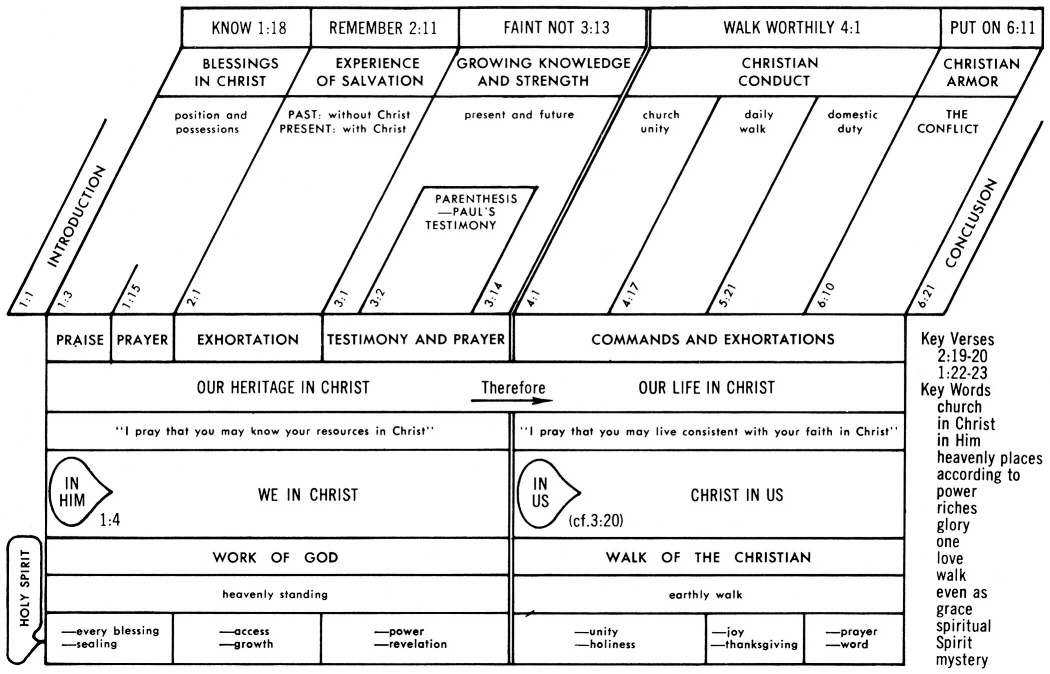
EPHESIANS - CHRIST AND THE CHURCH
Click chart to enlarge
Charts from Jensen's Survey of the NT - used by permission
Ephesians 2:21 in Whom the whole building, being fitted together, is growing into a holy temple in the Lord, (NASB: Lockman)
Greek: en o pasa oikodome sunarmologoumene (PPPFSN) auxei (3SPAI) eis naon hagion en kurio,
BGT ἐν ᾧ πᾶσα οἰκοδομὴ συναρμολογουμένη αὔξει εἰς ναὸν ἅγιον ἐν κυρίῳ,
Amplified: In Him the whole structure is joined (bound, welded) together harmoniously, and it continues to rise (grow, increase) into a holy temple in the Lord [a sanctuary dedicated, consecrated, and sacred to the presence of the Lord]. (Amplified Bible - Lockman)
NLT: We who believe are carefully joined together, becoming a holy temple for the Lord. (NLT - Tyndale House)
NLT (revised) We are carefully joined together in him, becoming a holy temple for the Lord.
Phillips: In him each separate piece of building, properly fitting into its neighbour, grows together into a temple consecrated to God. (Phillips: Touchstone)
Wuest: in whom the whole building closely joined together grows into a holy inner sanctuary in the Lord, (Eerdmans Publishing - used by permission)
Young's Literal: in whom all the building fitly framed together doth increase to an holy sanctuary in the Lord,
KJV In whom all the building fitly framed together groweth unto an holy temple in the Lord:
ESV in whom the whole structure, being joined together, grows into a holy temple in the Lord.
NET In him the whole building, being joined together, grows into a holy temple in the Lord,
NIV In him the whole building is joined together and rises to become a holy temple in the Lord.
CSB The whole building, being put together by Him, grows into a holy sanctuary in the Lord.
NKJ in whom the whole building, being joined together, grows into a holy temple in the Lord,
NRS In him the whole structure is joined together and grows into a holy temple in the Lord;
NAB Through him the whole structure is held together and grows into a temple sacred in the Lord;
NJB Every structure knit together in him grows into a holy temple in the Lord;
GWN In him all the parts of the building fit together and grow into a holy temple in the Lord.
BBE In whom all the building, rightly joined together, comes to be a holy house of God in the Lord;
Weymouth - in union with whom the whole fabric, fitted and closely joined together, is growing so as to form a holy sanctuary in the Lord;
IN WHOM THE WHOLE BUILDING, BEING FITTED TOGETHER: en o pasa oikodome sunarmologoumene (PPPFSN):
- Eph 4:13, 14, 15, 16; Ezekiel 40:1-42; 1Co 3:9; He 3:3,4
- Ex 26:1-37; 1Ki 6:7
- Ephesians 2 Resources - Multiple Sermons and Commentaries
- Ephesians 2:11-22 Our Biography In Brief - Steven Cole
- Ephesians 2:16-22 The Unity of the Body, Part 3 - John MacArthur
In Whom - refers to Christ, the sole Source of the Church's life and growth. How often we tend to forget this small but vital principle!
In Him we are added to it; in Him we grow in it; in Him the whole temple grows towards the final consummation, when the Topstone (Capstone) shall be brought out with shouts of ‘Grace, grace unto it.’ (see Zech 4:6,7) (The Pulpit Commentary: Ephesians)
Whole (3956) (pas) means all without exception. More literally it reads "every building" although in context it refers to only one building.
Building (3619) (oikodome from oikos = dwelling, house + doma = building or demo = to build) is literally the building of a house and came to refer to any building process. Oikodome can refer to the actual process of building or construction. Another literal meaning is as a reference to a building or edifice which is the result of a construction process (Mt 24:1, Mk 13:1, 2 are the only literal uses of oikodome in the NT). (See sermon by Alexander Maclaren entitled "Edification")
Most of the NT uses of oikodome are metaphorical or figurative, obviously an architectural metaphor. As used here in Eph 2:21, oikodome refers to the church as the building for God's indwelling (cp 1Co 3:9 - see discussion below). Figuratively the idea is the process of edification or building up spiritually or spiritual strengthening.
Other figurative meanings include our physical bodies (2Co 5:1), as a reference to the process of spiritual growth, edification or building up (some contexts speak primarily to the individual, some to the corporate body of Christ) (Ro 14:19, 15:2, 1Co 3:9, 14:3, 5, 12, 26, 2Co 10:8),
Webster's English dictionary says that edify is from Latin aedificare meaning to construct, to instruct or improve spiritually, from Latin to erect a house, from aedes temple, house and facio, to make. In English edify means . To build, in a literal sense. [Not now used.] To instruct and improve the mind in knowledge generally, and particularly in moral and religious knowledge, in faith and holiness. To improve the morality, intellect, etc, especially by instruction.
Vine summarizes the word group of oikodome (noun) and oikodomeo (verb) noting that these is used…
both in a literal sense, Mt 7:24; Lk 4:29, and in a figurative, Ac 20:32; Ga 2:18. The corresponding noun, oikodome, building, edification, is used in a similar way, literally, Matthew 24:1 (noun - oikodome), figuratively, Ro 14:19 (noun - oikodome).
The word expresses the strengthening effect of teaching, 1Co 14:3 (noun - oikodome), and example, 1Co 10:23, upon oneself and upon others, 1Co 14:4, whether for good, 2Co 10:8, or for evil, 1Co 8:10, “emboldened.” From the familiar spectacle of building operations it transfers to the spiritual realm the idea of assured progress as the result of patient labor. The word is used of national life, Mt 21:42, and of church life, Ac 9:31, as well as of the individual, Ro 15:2 (noun - oikodome). It is used of the “Church which is His Body” in Mt 16:18; Ep 4:12 (noun - oikodome), cp. 1Pe 2:5, and of the local church in 1Co 3:9; 14:5, 12; Ep 2:21 (noun - oikodome). Once it describes the resurrection body, 2Co 5:1. God is said to be the Builder, in 1Co 3:9 (noun - oikodome); Christ in Mt 16:18; Paul in Ro 15:20, cp. 1Co 3:10; 2Co 10:8; 13:10 (both use the noun - oikodome); the “gifts” of the ascended Lord are the builders in Ep 4:12 (noun - oikodome), cp. 1Co 14:12; individual believers, here; and in Ep 4:16 (noun - oikodome) the church is said to build itself up in love. Building up is effected by: (1) love, 1Co 8:1, cp. Ep 4:16 (noun - oikodome): (2) prophesying, 1Co 14:3, 4 (noun in 14:3 - oikodome), (3) exhortation, 1Th 5:11, cp. He 10:25. (Vine, W. Collected writings of W. E. Vine. Nashville: Thomas Nelson)
Oikodome is used 18 times in the NT and is rendered in the NAS as building(8), buildings(3), edification(5), edifying(1), upbuilding(1) and in the KJV as edifying 7, building 6, edification 4, wherewith (one) may edify 1
Matthew 24:1 And Jesus came out from the temple and was going away when His disciples came up to point out the temple buildings to Him.
Mark 13:1+ And as He was going out of the temple, one of His disciples said to Him, "Teacher, behold what wonderful stones and what wonderful buildings!" 2 And Jesus said to him, "Do you see these great buildings? Not one stone shall be left upon another which will not be torn down."
Romans 14:19-note So then let us pursue the things which make for peace and the building up of one another.
Comment: This conveys the sense that the building is a process (not an arrival - that's where the metaphor "breaks down" - in this earthly life we will need to be continually building up one another.
Vincent - Lit., things of edification, that, namely, which is with reference to one another. The definite article thus points Paul’s reference to individuals rather than to the Church as a whole.
Romans 15:2-note Let each of us please his neighbor for his good, to his edification.
1Corinthians 3:9+ For we are God's fellow workers; you (plural - the Corinthian believers were in view) are God's field, God's building.
Comment: Corinth was known for its magnificent buildings and pagan temples which were but temporal works of human hands. Little wonder that Paul would introduce the imagery of an architectural metaphor, one which all Corinthians could readily understand (cp 1Co 3:16, 6:19, 2Co 6:16). In context, Paul is in a sense contrasting the temporal, transient nature of human works with the supernatural, eternal character of "good" (God) works (see study of Good Deeds), in and through believers who are continually choosing to yield to the Holy Spirit, Who enables the believers to "build" - (1Co 3:9, 10, 11, 12, 13, 14, 15) (cp Jn 15:5, Ga 5:16-note, Ga 5:18-note, Ga 5:22-note, Ga 5:23-note, Ga 5:25-note), cp 2Co 5:10, 1Co 4:5). While this verse (and the following passages certainly can be applied to building of the individual's life in Christ, some like Warren Wiersbe [others such as John MacArthur agree] interpret this as primarily a reference to the local church and offers the interesting conclusion that "one day God will judge our labors as related to the local assembly" [Bible Exposition Commentary]. In 1Cor 6:19, 20, clearly the individual believer is in view as God's temple.)
Vincent has this note on oikodome - Paul’s metaphors are drawn from the works and customs of men rather than from the works of nature. “In his epistles,” says Archdeacon Farrar, “we only breathe the air of cities and synagogues.” The abundance of architectural metaphors is not strange in view of the magnificent temples and public buildings which he was continually seeing at Antioch, Athens, Corinth, and Ephesus. His frequent use of to build and building in a moral and spiritual sense is noteworthy. In this sense the two words oikodomeo and oikodome occur twenty-six times in the New Testament, and in all but two cases in Paul’s writings. Peter uses build in a similar sense; 1Pet. 2:5. See edify, edification, build, Acts 9:31; Ro 15:20; 1Co 8:1; 1Co 8:10, where emboldened is literally built up, and is used ironically. Also Ro 14:19; 15:2; 1 Cor. 14:3; Eph. 2:21, etc. It is worth noting that in the Epistle to the Hebrews, while the same metaphor occurs, different words are used. Thus in He 3:3, 4, built, bullied, represent kataskeuazo to prepare. In Heb 11:10, technites artificer, and demiourgos, lit., a workman for the public: A. V., builder and maker. This fact has a bearing on the authorship of the epistle. In earlier English, edify was used for build in the literal sense. Thus Piers Ploughman: “I shal overturne this temple and a-down throwe it, and in thre daies after edifie it newe.” See on Acts 20:32. In the double metaphor of the field and the building, the former furnishes the mould of Paul’s thought in 1Co 3:6, 7, 8, 9, and the latter in 1Cor 3:10, 11, 12, 13, 14, 15, 16, 17. Edwards remarks that the field describes the raw material on which God works, the house the result of the work.
1Corinthians 14:3+ But one who prophesies speaks to men for edification and exhortation and consolation. 4 One who speaks in a tongue edifies (verb - oikodomeo) himself; but one who prophesies edifies (verb - oikodomeo) the church. 5 Now I wish that you all spoke in tongues, but even more that you would prophesy; and greater is one who prophesies than one who speaks in tongues, unless he interprets, so that the church may receive edifying.
Comment: Edification is the main test of tongues in this chapter. In public worship we should have only what "builds up" the church
1Corinthians 14:12+ So also you (plural), since you are zealous of spiritual gifts, seek to abound for the edification of the church.
1Corinthians 14:26+ What is the outcome then, brethren? When you assemble, each one has a psalm, has a teaching, has a revelation, has a tongue, has an interpretation. Let all things be done (3rd person singular) for edification.
Comment: John MacArthur writes that oikodome…
literally means “house building,” the construction of a house. Figuratively, it refers to growing, improving, or maturing. The spiritual lives of Christians need to be built up and improved, expanded to fulness and completeness. The primary responsibility of Christians to each other is to build each other up.
Edification is a major responsibility of church leaders (Ep 4:11,12), but it is also the responsibility of all other Christians. Every believer is called to be an edifier.
“Therefore encourage one another, and build up one another, just as you also are doing” (1Th 5:11).
“Let each of us please his neighbor for his good, to his edification. For even Christ did not please Himself” (Ro 15:2, 3).
Jesus “did not come to be served, but to serve, and to give His life a ransom for many” (Matt. 20:28). Our Lord did not seek what was beneficial to Himself but what was beneficial to those He came to save.
As Paul repeatedly points out in this fourteenth chapter, a major evidence of the Corinthians’ loveless immaturity was their selfish concern for themselves, the other side of which was lack of concern for the edification, the building up, of their brothers and sisters in Christ (1Co 14:3, 4, 5, 12, 17, 26, 31) They did not, as Paul commanded, “pursue the things which make for peace and the building up of one another” (Ro 14:19).
That which builds others up is also that which brings harmony, just as that which is selfish is also that which brings disharmony.
Christians are built up by only one thing, the Word of God. That is the tool with which all spiritual building is done. (2Ti3:16,17). That is the tool with which every believer should be skilled. (MacArthur, J: 1Corinthians. Chicago: Moody Press)
2Corinthians 5:1+ For we know that if the earthly tent which is our house is torn down, we have a building from God (our physical body), a house not made with hands, eternal in the heavens.
Comment: A building suggests something on a solid foundation that is fixed, secure, and permanent. Since it replaced his earthly tent (his physical body), the building from God Paul referred to must be his glorified body (cp 2Co 4:14).
2Corinthians 10:8 For even if I should boast somewhat further about our authority, which the Lord gave for building you up and not for destroying (pulling you down - NIV) you (plural), I shall not be put to shame,
2Corinthians 12:19 All this time you have been thinking that we are defending ourselves to you. Actually, it is in the sight of God that we have been speaking in Christ; and all for your (plural) upbuilding, beloved.
2Corinthians 13:10 For this reason I am writing these things while absent, in order that when present I may not use severity, in accordance with the authority which the Lord gave me, for building up and not for tearing down.
Ephesians 2:21-note in whom the whole building, being fitted together is growing into a holy temple in the Lord;
Ephesians 4:12-note for the equipping (verb was a medical technical term for the setting of a bone) of the saints for the work of service, to the building up of the body of Christ;
Vincent writes that
Building defines the nature of the work of ministry, and perfecting comes through a process.
John MacArthur writes that oikodome…
literally refers to the building of a house, and was used figuratively of any sort of construction. It is the spiritual edification and development of the church of which Paul is speaking here. The body is built up externally through evangelism as more believers are added, but the emphasis here is on its being built up internally as all believers are nurtured to fruitful service through the Word. Paul’s exhortation to the Ephesian elders emphasizes this process: “I commend you to God and to the word of His grace, … which is able to build you up” (Greek = epoikodomeo:G2026) (Acts 20:32).
The maturation of the church is tied to learning of and obedience to the holy revelation of Scripture. Just as newborn babes desire physical milk, so should believers desire the spiritual nourishment of the Word (1Pe 2:2-note). (MacArthur, J: Ephesians. Chicago: Moody Press)
Ephesians 4:16-note from whom the whole body, being fitted and held together by that which every joint supplies, according to the proper working of each individual part, causes the growth of the body for the building up of itself in love.
Expositor's Greek Testament says
The idea appears to be that the body is fitly framed and knit together by means of the joints, every one of them in its own place and function, as the points of connection between member and member, and the points of communication between the different parts and the supply which comes from the Head. The joints are the constituents of union in the body and the media of the impartation of the life drawn by the members from the head.” (Online)
Ephesians 4:29-note Let no unwholesome word proceed from your mouth, but only such a word as is good for edification according to the need of the moment, that it may give grace to those who hear.
Oikodome is used 5x in the non-apocryphal Septuagint - 1 Chr. 26:27; 29:1; Ezek. 16:61; 17:17; 40:2
Being fitted together (4883) (sunarmologeo from sun = together + harmologeo = join together from harmos = joint) means to be fitted or joined together with, literally used of the parts of the body or the stones of the building.
Note that both here (sunarmologeo) and in the next verse (sunoikodomeo) Paul selects compound verbs that begin with the preposition "sun -" (or "syn-") which is the Greek word for "with" that expresses intimate union. Wayne Barber illustrates the distinction of sun from the other Greek preposition for "with" (meta) explaining that…
sun means not only are we together with one another, but we are so mixed in that nobody can tell the difference one from the other. We can’t get apart from each other. Let me give you the illustration… making biscuits. Let’s just say you take all the ingredients and put them out on a piece of waxed paper. You put the flour down and the shortening or whatever else goes in them. You put it all on the piece of paper. Now all of those ingredients can still be separated, but at the same time they are with each other—meta. But take all of those ingredients and mix them together… Cut them out and put them on a pan. Put them in the oven, and bake them. After they have baked for a while they come out as biscuits. Once they are baked, that (tasty union of ingredients pictures the meaning of) sun. No one can separate those ingredients! (See full note)
In construction terms sunarmologeo represents the whole of the elaborate process by which stones are fitted together, this process including the preparation of the surfaces, the cutting, rubbing, and testing; the preparation of the dowels and the dowel holes and finally the fitting of the dowels with molten lead. In short it represents the careful joining of every component of a structure, each part is precisely cut to fit snugly, strongly, and beautifully with every other part. Nothing is out of place, defective, misshapen, or inappropriate. Now take those ideas and apply them to the church composed of individual saints ("living stones" - 1Pe 2:5-note).
Sunarmologeo is in the present tense picturing this as an ongoing process… the framing is seen as in progress. The passive voice indicates the fitting is occurring from an outside source, God. And yet as "living stones" (1Pe 2:5-note) we each must be willing to allow the Master Architect to fit us just as He desires. So although the action is passive, it does require an act of our wills to submit to the hand of the Master!
Barnes explains being fitted together writing that "The word here used means, to joint together, as a carpenter does the frame-work of a building. The materials are accurately and carefully united by mortices and tenons, so that the building shall be firm. Different materials may be used, and different kinds of timber may be employed; but one part shall be worked into another, so as to constitute a durable and beautiful edifice. So in the church. The different materials of the Jews and Gentiles; the people of various nations, though heretofore separated and discordant, become now united, and form an harmonious society. They believe the same doctrines; worship the same God; practise the same holiness, and look forward to the same heaven. (Barnes Notes)
Paul's point with this architectural metaphor is that God places each believer, be they Jew or Gentile, exactly where He wants him.
Blaikie phrases it this way "There is a jointing and joining of the various parts to each other, forming a symmetrical, compact, well-ordered building. The Church has many members in one body, and all members have not the same office. It is a co-operative body, each aiding in his own way and with his own talent. The Church is not a collection of loose stones and timbers; its members are in vital union with Christ, and ought to be in living and loving and considerate fellowship with each other. (The Pulpit Commentary: Ephesians)
MacDonald explains that "The unity and symmetry of the temple are indicated by the expression, the whole building, being fitted together. It is a unity made up of many individual members. Each member has a specific place in the building for which he or she is exactly suited. Stones excavated from the valley of death by the grace of God are found to fit together perfectly. The unique feature of this building is that it grows. However, this feature is not the same as the growth of a building through the addition of bricks and cement. Think of it rather as the growth of a living organism, such as the human body. After all, the church is not an inanimate building. Neither is it an organization. It is a living entity with Christ as its Head and all believers forming the Body. It was born on the day of Pentecost, has been growing ever since, and will continue to grow until the Rapture. (MacDonald, W & Farstad, A. Believer's Bible Commentary: Thomas Nelson)
Paul (in the only other Biblical use of this verb) uses sunarmologeo in Ephesians 4 writing…
Ephesians 4:16 from Whom (Christ) the whole body, being fitted (present tense) and held together by that which every joint supplies, according to the proper working of each individual part, causes the growth of the body for the building up of itself in love. (see note Ephesians 4:16)
Wayne Barber writes that …
we saw the stones in the Temple, and the fact that we are being fitted into the Temple… The word "fitted" there is rendered in most places in the passive voice, so when you think of being fitted into the holy temple, you think of the fact that God is doing it. Certainly He is. That is a truth. But there is another understanding of that: not only is God fitting us, we have the responsibility to put ourselves into a position so that He can fit us into that holy temple. That makes the rest of Ephesians make a whole lot of sense, doesn’t it? That’s why we have to choose to be filled with the Spirit of God. It is very important to realize, yes, God is fitting us, but we are responsible to put ourselves into a position to be fitted into this holy temple.
What does it mean to be fitted? Well, in construction terms, it is the whole process of what they would do with a stone to make it fit into the temple. Remember when they brought the stones to fit them into the Temple, there was not a sound of hammer or chisel. Does that mean God just developed the stones in heaven and dropped them on the earth so they could go and find them, pick them up and build the Temple? Oh, no. There was a quarry somewhere, and there was a lot of hammering and chiseling and rubbing and sand papering and getting the rough edges off. Some were too big, and some were too small. They had to be exactly measured to the design of the Master Architect, who is the cornerstone. He is the one who has the design. He is the only one who can oversee the process.
The fitting is not too much fun to talk about. We are in the quarry. Last time we talked about what it meant to be a nursery Christian. A lot of Christians are in the nursery. They are the ones who are in the quarry, but they don’t want to be fitted. They are fighting against the hammer, and they are fighting against the chisel. They don’t understand that everything in their life is overseen by the master architect who is Christ Himself. They would rather blame the devil. They would rather go off and chase something else. They don’t realize that everything going on in their life is a process, and God, the Architect, is seeing to it that a chiseling process can be useable in their life. The nursery folks are the whiners. They are the ones who are always griping and judging everybody else.
You are in the quarry whether you like it or not. When you get saved, you are put in the quarry. Now the key is, are you going to let God fit you or are you going to fight Him in the process? The key is, bow down, come out of the nursery, quit whining and go on and let God work in your life. You see, one of the things about a stone is, he doesn’t get to choose the chisel God uses in his life to make him like He wants him to be. A lot of us have different tools in our life that God is using. I might be one in your life, I don’t know. God is using a lot of things and circumstances. Go on and trust Him. Find your sufficiency in Him. That is what it is all about. God will mold you, make you and conform you into the image of Christ Jesus. The hammer that drives the chisel appears, to me, to be the Word of God.
If you will go over to Ephesians 4:16 (note), he uses the same phrase in a different context…
"from whom the whole body, being fitted and held together by that which every joint supplies, according to the proper working of each individual part, causes the growth of the body for the building up of itself in love."
That is in the context of God giving apostles, prophets, evangelists, and pastor-teachers to the church. They are equipping the body for the work of the ministry. So the Word of God appears to be the "hammer". It’s either the studying of it, the preaching of it, or the teaching of it. Somehow that’s where we find the hammer that drives that chisel that is conforming us into the image of Christ Jesus. (Ephesians 2:19-22 We Are the Temple of God - 1)
In Christ There Is No East or West
John Oxenham (1908)
(Solo Vocal) (Congregation)
In Christ there is no east or west,
in him no south or north,
but one great fellowship of love
throughout the whole wide earth.
In Christ shall true hearts ev’rywhere
their high communion find.
His service is the golden cord
close binding humankind.
Join hands, then, people of the faith,
whate’er your race may be.
All children of the living God
are surely kin to me.
In Christ now meet both east and west,
in him meet south and north.
All Christly souls are joined as one
throughout the whole wide earth.
IS GROWING INTO A HOLY TEMPLE IN THE LORD: auxei (3SPAI) eis naon hagion en kurio:
- Exodus 26:1-37; 1Ki 6:7
- Ps 93:5; Ezek 42:12; 1Co 3:17; 2Co 6:16
- Ephesians 2 Resources - Multiple Sermons and Commentaries
- Ephesians 2:11-22 Our Biography In Brief - Steven Cole
- Ephesians 2:16-22 The Unity of the Body, Part 3 - John MacArthur
Is growing (837) (auxano [word study]) means to cause to become greater in extent, size, state or quality. The present tense pictures this as an ongoing process. The passive voice indicates the power producing the growth comes from an outside Source, in this case God. In one sense though the building is structurally complete, it continues to grow with the addition of individual stones.
The Church is also a growing temple in that it is continually undergoing construction and it is holy in the sense that it is being progressively set apart in Christ for God’s glory.
The Church or Body of Christ will not be complete until every person who will believe in Him has done so. Every new believer is a new "living stone" in Christ’s building, His holy temple. Thus Paul says the temple is growing because believers are continually being added.
Surveys show that as much as 85 percent of church membership growth is made up of people who church-hop. Other surveys show that there has been no real growth in church membership in recent years; increase in some denominations is simply offset by decrease in others. Gallup says 81 percent of those who have changed are Protestant, and one out of four have changed faiths or denominations (23 percent). He writes:
"A superficial view of the statistics on religious life in America would suggest that there is little change over the decades" (this, in spite of what he calls "constant denominational shifting") (PRRC Emerging Trends (May 1991)
We are building day by day,
As the moments glide away,
Our temple, which the world may not see;
Every victory won by grace
Will be sure to find its place
In our building for eternity.
—Fanny J. Crosby, “We are Building”
Wayne Barber writes that …
there is the growth of the temple… That term "is growing" is the word auxano. Now that word is very interesting, and I want you to understand it. It is something that man cannot do. Whenever you talk about church growth, the word in Greek that means to grow is something that a man cannot do. It is what God alone can do. God is causing it to grow. Now, He is using living stones as we will see later on, but it is God who gives the growth. It is God who causes the growth of the temple. It is in the present tense which means it is going on right now. The church, the living temple of God, is in the development stage.
What does that mean? It means that it is not finished yet. It means there is still room in the kingdom. There is still room in the family. There is still room in the temple. It is not finished yet. You see, the word "growing" means it is increasing. It is being added to consistently. Oh, the Gentiles of Ephesus that Paul was writing to, were just a small speck in the gigantic building that God was making here on this earth, that spiritual dwelling, that spiritual house that He wanted to live in. When the last Gentile is brought in, then God is going to turn His attention towards Israel. Right now, the Gentiles are coming in and coming in and coming in. That is what he is trying to tell the church at Ephesus: You can come in now. The building is still under development.
You see, a lot of folks misunderstand. In chapter 2, it says the Jew and the Gentile had been made one in Christ Jesus. He didn’t say Israel. He said the Jew. You see, a Jew is an individual. Israel is a nation. Israel as a nation has shut down the process because they have rejected Christ as the Messiah. That doesn’t mean that God has gotten them out of His mind. He made an everlasting covenant with Abraham. He’s got them on a shelf right now. He’s got them on hold right now. He is in the process of bringing in the Gentiles. When that last Gentile comes in and He takes us out of here, then He will put His whole attention upon Israel.
If you will look in Romans 11:25, to me it is so clear. Paul says,
"For I do not want you, brethren, to be uninformed of this mystery, lest you be wise in your own estimation, that a partial hardening has happened to Israel until the fulness of the Gentiles has come in." (Ro 11:25-note)
What is going on with Israel right now? There is a mask over their faces. They can’t see it. Why? They rejected Christ. Through the whole Old Testament and up until the book of Acts, the Gentiles were shut out. They were strangers to the covenant of promise. Now the wall has been torn down. Now the doors have been thrown open, and God has appointed the apostle Paul with a ministry to the Gentiles. He is saying,
"Listen, this is now open to you. It is open to all the world and to whoever will come to Christ. There is room in the kingdom. There is room in the family. There is also room in the temple."
I tell you, this ought to excite us to missions. One of the things that worries me sometimes is when I preach I can’t convict hearts. I might convince you, motivate you, inspire you, but as soon as you walk out of here, all of that burns out. Somehow, we have got to be overwhelmed with our salvation to the point that we realize it could be offered to others. The family still has room. The kingdom still has room. The temple still has room. Folks, you need to get excited about the fact it is just growing now. There is still room! There are people in your family who are desperate to hear this. There are people in your neighborhood who are desperate to hear this. What is wrong with us? We don’t even think about the fact that there is a lost world out there. The family has room. The kingdom has room. The Temple has room. It is in the development stage. There are others who can come in!
If you can’t take the first chapter of Ephesians and the second Chapter of Ephesians and get pumped up about the fact that there are people who are lost out there in this world, then something is wrong in your life. (Ephesians 2:19-22 We Are the Temple of God - 1)
Holy (40) (hagios [word study]) means that which is set apart, and so is dedicated or consecrated to the service of God.
Temple - the Holy of holies, not the "suburbs" but the sanctuary! The place where God dwelt manifesting Himself in the cloud of glory! (see notes on Shekinah glory cloud)
Temple (3485) (naos from naio = “to dwell) is the "abode of gods" or the place or structure specifically associated with or set apart for a deity, who is frequently perceived to be using it as a dwelling. In Biblical use naos referred to the inner sanctuary of the Holy Temple, the Holy Place and the Holy of Holies, but not to the entire temple complex (which is the word hieron = 2311)
Naos - 45x in 39v - Matt 23:16f, 21, 35; 26:61; 27:5, 40, 51; Mark 14:58; 15:29, 38; Luke 1:9, 21f; 23:45; John 2:19ff; Acts 17:24; 19:24; 1 Cor 3:16f; 6:19; 2 Cor 6:16; Eph 2:21; 2 Thess 2:4; Rev 3:12; 7:15; 11:1f, 19; 14:15, 17; 15:5f, 8; 16:1, 17; 21:22
It is interesting to note that for three hundred years Christians had no buildings of their own.
Another interesting thought is Paul's previous allusion to the Jesus' breaking down the barrier of the dividing wall for the Gentiles. But what about the Jews? Did they not have a barrier in the form of the veil separating the Holy of holies (ark of the covenant, mercy seat, the Shekinah glory indicating God's very presence) through which only the high priest could pass only once per year? Thus every other Jew had a "barrier of a dividing wall" preventing them from entering the very presence of God. However just as Jesus abolished the enmity of the dividing wall in His flesh (on the Cross), so too did He rend the veil that separated the Jew from God. Matthew records that as our Savior offered up His life (as our High Priest He offered the perfect sacrificial Lamb… Himself) that…
"behold, the veil of the temple (naos = same word Paul uses for Temple) was torn in two from top to bottom, and the earth shook; and the rocks were split" (Mt 27:51)
The writer of Hebrews offers the best commentary on this earth shaking (literally) event exhorting believing Jews…
Since therefore, brethren, we have confidence to enter the holy place (Holy of holies) by the blood of Jesus, by a new and living way which He inaugurated for us (when he inaugurated the "New Covenant" in His blood) through the veil (same word that Matthew used above), that is, His flesh, and since we have a great priest over the house of God, let us draw near (which is what Paul is saying is now made available to both Jew and Greek in one body) with a sincere heart in full assurance of faith, having our hearts sprinkled clean from an evil conscience and our bodies washed with pure water. (Hebrews 10:19-22-note)
MacDonald reminds us that "There are several lessons for us here: (1) God indwells the church. Saved Jews and Gentiles form a living sanctuary in which He dwells and where He reveals His glory. (2) This temple is holy. It is set apart from the world and dedicated to Him for sacred purposes. (3) As a holy temple, the church is a center from which praise, worship, and adoration ascend to God through the Lord Jesus Christ. (Ibid)
In the Lord - in the sphere of the presence and power of the Lord. He is the Source of the holiness.
Lord (2962) (kurios from kúros = might) in classical Greek was used of gods, inscriptions applied to different gods, Hermes, Zeus, etc as well as to the head of the family, who is lord of wife and children. The inherent idea of Kurios is one who has absolute ownership, uncontrolled power and supreme authority.
The Lord is the center of its unity of the Church and its members are holy (their position) by virtue of their indissoluble union with Christ, and are now to be holy out of love for Him (their practice).
Johnson explains that the church collectively is a holy temple…
We should think of ourselves as a holy temple of the Lord… That means that everything we say should be thought out before we utter. We shouldn’t bound up on our feet and say things without thinking. We should observe what is transpiring, how the Holy Spirit guides our meeting, how the things that are said meet together and create a teaching concerning the Lord Jesus Christ. It’s very important.
Habitation of God. God dwelt in Israel, they were His habitation. The Tabernacle was His figure of it. And He dwelt in Israel for communion, that they might have communion with Him. And He has this great temple of which we are apart that we might have communion with Him. He dwelt in Israel in order to instruct them, and we, too, meet as a holy temple of the Lord with the gifted men to give us instruction. And He dwelt in Israel that they may serve him properly. And we, of course, meet with the Lord for the same purposes. (Ephesians 2:11-22 Made Nigh by the Blood of Christ)
Wayne Barber has these practical comments on "Holy Temple" and "dwelling of God"…
The final thing I want to share with you before we close out chapter 2 is this, the Purpose of the Temple. What is a Temple for? Now he tells you very clearly in verses 21 and 22:
"being fitted together is growing into a holy temple in the Lord; in whom you also are being built together into a dwelling of God in the Spirit."
The normal word for temple is the word hieron. It means the whole complex, all the precincts of the temple. This word is the word naos. It is the word that doesn’t describe the whole temple, it describes the Holy of Holies where God would meet with man and dwell and fellowship with man.
So, what is this temple all about? What is our purpose of being put into this temple? That God might indwell us, that God might commune with us, that God might fellowship with us. God desires to fellowship with us, and He wants us to be the vessel on this earth that He indwells. He wants to meet with us. He is the architect. He wants to give us His design. He wants to empower us for His ministry and His work.
In the Old Testament, God came down to dwell with the people in the Tabernacle. That is what "tabernacle" means, the dwelling of God. Wherever they would go, they would fold up that Tabernacle and carry it with them. It was a tent of meeting, and inside that Tent of Meeting, there were two rooms. One of them the priests could go into, but one only the High Priest could go into, once a year, and meet with God in representation of the people and atone for their sins by the sacrifices that he would make. That went on and went on and went on. Once a year man could meet with God. Finally it moved into a permanent Temple which was a little different, but it had the same basic idea and still had that Holy of Holies, that inner sanctum, that naos, where God would meet with man based on the sacrifice, based on the blood that had been shed.
In the book of Malachi, however, God decided not to dwell with man anymore. Man became so stubborn and so hard-headed that God withdrew the fire out of the Temple. For 400 years it was a period of darkness. Now obviously God was here. He is omnipresent, but He didn’t allow man to know that He was there. He said nothing for 400 years. Then finally, He broke the silence. This time the Temple didn’t come with brick and mortar and stone. It came in the body of human flesh. It was born in a manger. The Temple on this earth, God’s dwelling with man on this earth, was the Lord Jesus Himself. He said, "I am going to tear this Temple down, and in three days, I am going to raise it up." He was talking about His own body and being God inside of a body.
Joseph Parker - The life-tabernacle is a wondrous building; there is room for workers of all kinds in the uprearing of its mysterious and glorious walls. If we cannot do the greatest work, we may do the least. Our heaven will come out of the realization of the fact that it was God’s tabernacle we were building, and under God’s blessing that we were working.
Alexander Maclaren preached the following sermon on 1 Thessalonians 5:11…
DO not intend to preach about that clause only, but I take it as containing, in the simplest form, one of the Apostle’s favourite metaphors which runs through all his ‘letters, and the significance of which, I think; is very little grasped by ordinary readers.
‘Edify one another.’ All metaphorical words tend to lose their light and colour, and the figure to get faint, in popular understanding. We all know that’ edifice’ means a building; we do not all realize that ‘edify’ means to build up. And it is a great misfortune that our Authorized Version, in accordance with the somewhat doubtful principle on which its translators proceeded, varies the rendering of the one Greek word so as to hide the frequent recurrence of it in the apostolic teaching. The metaphor that underlies it is the notion of building up a structure. The Christian idea of the structure to be built up is that it is a temple. I wish in this sermon to try to bring out some of the manifold lessons and truths that lie in this great figure, as applied to the Christian life.
Now, glancing over the various uses of the phrase in the New Testament, I find that the figure of ‘ building,’ as the great duty of the Christian life, is set forth under three aspects; serf-edification, united edification, and divine edification. And I purpose to look at these in order.
I. First, self-edification.
According to the ideal of the Christian life that runs through the New Testament, each Christian man is a dwelling-place of God’s, and his work is to build himself up into a temple worthy of the divine indwelling. Now, I suppose that the metaphor is such a natural and simple one that we do not need to look for any Scriptural basis of it. But if we did, I should be disposed to find it in the solemn antithesis with which the Sermon on the Mount is closed, where there are the two houses pictured, the one built upon the rock and standing firm, and the other built upon the sand. But that is perhaps unnecessary.
We are all builders; Building up — what? Character. ourselves. But what sort of a thing is it that we are building? Some of us pigsties, in which gross, swinish lusts-wallow in filth; some of us shops; some of us laboratories, studies, museums; some of us amorphous structures that cannot be described. But the Christian man is to be building himself up into a temple of God. The aim which should ever burn clear before us, and preside over even our smallest actions, is that which lies in this misused old word, ‘edify’ yourselves.
The first thing about a structure is the foundation And Paul was narrow enough to believe that the one foundation upon which a human spirit could be built up into a hallowed character is Jesus Christ. He is the basis of all our certitude. He is the anchor for all our hopes. To Him should be referred all our actions; for Him and by Him our lives should be lived. On Him should rest, solid and inexpugnable, standing foursquare to all the winds that blow, the fabric of our characters. Jesus Christ is the pattern, the motive which impels, and the power which enables, me to rear myself into a habitation of God through the Spirit. Whilst I gladly acknowledge that very lovely structures may be reared upon another foundation than Him, I would beseech you all to lay this on your hearts and consciences, that for the loftiest, serenest beauty of character there is but one basis upon which it can be rested. ‘Other foundation can no man lay than that which is laid, which is Jesus Christ.’
Then there is another aspect of this same metaphor, not in Paul’s writings but in another part of the New Testament, where we read: ‘Ye, beloved, building up yourselves on your most holy faith.’ So that, in a subordinate sense, a man’s faith is the basis upon which he can build such a structure of character; or, to put it into other words — in regard to the man himself, the first requisite to the rearing of such a fabric as God will dwell in is that he, by his own personal act of faith, should have allied himself to Jesus Christ, who is the foundation; and should be in a position to draw from Him all the power, and to feel raying out from Him all the impulses, and lovingly to discern in Him all the characteristics, which make Him a pattern for all men in their building.
The first course of stone that we lay is Faith; and that course is, as it were, mortised into the foundation, the living Rock He that builds on Christ cannot build but by faith. The two representations are complementary to one another, the one, which represents Jesus Christ as the foundation, stating the ultimate fact, and the other, which represents faith as the foundation, stating the condition on which we come into vital contact with Christ Himself.
Then, further, in this great thought of the Christian life being substantially a building up of oneself on Jesus is implied the need for continuous labour. You cannot build up a house in half an hour. You cannot do it, as the old fable told us that Orpheus did, by music, or by wishing. There must be dogged, hard, continuous, life-long effort if there is to be this building up. No man becomes a saint per saltum. No man makes a character at a flash. The stones are actions; the mortar is that mystical, awful thing, habit; and deeds cemented together by custom rise into that stately dwelling-place in which God abides. So, there is to be a life-long work in character, gradually rearing it into His likeness.
The metaphor also carries with it the idea of orderly progression. There are a number of other New Testament emblems which set forth this notion of the true Christian ideal as being continual growth. For instance, ‘first the blade, then the ear, then the full corn in the ear,’ represents it as resembling vegetable growth, while elsewhere it is likened to the growth of the human body. Both of these are beautiful images, in that they suggest that such progressive advance-sent is the natural consequence of life; and is in one aspect effortless and instinctive.
But then you have to supplement that emblem with others, and there comes in sharp contrast to it the metaphor which represents the Christian progress as being warfare. There the element of resistance is emphasised, and the thought is brought out that progress is to be made in spite of strong antagonisms, partly to be found in external circumstances, and partly to be found in our own treacherous selves. The growth of the corn or of the body does not cover the whole facts of the case but there must be warfare in order to growth.
There is also the other metaphor by which this Christian progress, which is indispensable to the Christian life, and is to be carried on, whatever may oppose it, is regarded as a race. There the idea of the great, attractive, but far-off future reward comes into view, as well as the strained muscles and the screwed-up energy with which the runner presses towards the mark. But we have not only to fling the result forward into the future, and to think of the Christian life as all tending towards an end, which end is not realised here; but we have to think of it, in accordance with this metaphor of my text, as being continuously progressive, so as that, though unfinished, the building is there; and much is done, though all is not accomplished, and the courses rise slowly, surely, partially realising the divine Architect’s ideal, long before the head-stone is brought out with shoutings and tumult of acclaim. A continuous progress and approximation towards the perfect ideal of the temple completed, consecrated, and inhabited by God, lies in this metaphor.
Is that you, Christian man and woman? Is the notion of progress a part of your working belief? Are you growing, fighting, running, building up yourselves more and more in your holy faith? Alas! I cannot but believe that the very notion of progress has died out from a great many professing Christians.
There is one more idea in this metaphor of self-edification, viz., that our characters should be being modelled by us on a definite plan, and into a harmonious whole. I wonder how many of us in this chapel this morning have ever spent a quiet hour in trying to set clearly before ourselves what we want to make of ourselves, and how we mean to go about it. Most of us live by haphazard very largely, even in regard to outward things, and still more entirely in regard to our characters. Most of us have not consciously before us, as you put a pattern-line before a child learning to write, any ideal of ourselves to which we are really seeking to approximate. Have you? And could you put it into words? And are you making any kind of intelligent and habitual effort to get at it? I am afraid a great many of us, if we were honest, would have to say, No! If a man goes to work as his own architect, and has a very hazy idea of what it is that he means to build, he will not build anything worth the trouble. If your way of building up yourselves is, as Aaron said his way of making the calf was, putting all into the fire, and letting chance settle what comes out, nothing will come out better than a calf. Brother! if you are going to build, have a plan, and let the plan be the likeness of Jesus Christ. And then, with continuous work, and the exercise of continuous faith, which knits you to the foundation, ‘build up yourselves for an habitation of God.’
II. We have to consider united edification.
There are two streams of representation about this matter in the Pauline Epistles, the one with which I have already been dealing, which does not so often appear, and the other which is the habitual form of the representation, according to which the Christian community, as a whole, is a temple, and building up is a work to be done reciprocally and in common.
We have that representation with special frequency and detail in the Epistle to the Ephesians, where perhaps we may not be fanciful in supposing that the great prominence given to it, and to the idea of the Church as the temple of God, may have been in some degree due to the existence, in that city, of one of the seven wonders of the world, the Temple of Diana of the Ephesians.
But, be that as it may, what I want to point out is that united building is inseparable from the individual building up of which I have been speaking.
Now, it is often very hard for good, conscientious people to determine how much of their efforts ought be given to the perfecting of their own characters in any department, and how much ought to be given to trying to benefit and help other people. I wish you to notice that one of the most powerful ways of building up myself is to do my very best to build up others. Some, like men in my position, for instance, and others whose office requires them to spend a great deal of time and energy in the service of their fellows, are tempted to devote themselves too much to building up character in other people, and to neglect their own. It is a temptation that we need to fight against, and which can only be overcome by much solitary meditation Some of us, on the other hand, may be tempted, for the sake of our own perfecting, intellectual cultivation, or improvement in other ways, to minimise the extent to which we are responsible for helping and blessing other people. But let us remember that the two things cannot be separated; and that there is nothing that will make a man more like Christ, which is the end of all our building, than casting himself into the service of his fellows with self-oblivion.
Peter said, ‘Master! let us make here three tabernacles.’ Ay! But there was a demoniac boy down below, and the disciples could not cast out the demon. The Apostle did not know what he said when he preferred building up himself, by communion With God and His glorified servants, to hurrying down into the valley, where there were devils to fight and broken hearts to heal Build up yourselves, by all means; if you do you will have to build up your brethren. ‘The edifying of the body of Christ’ is a plain duty which no Christian man can neglect without leaving a tremendous gap in the structure which he ought to rear.
The building resulting from united edification is represented in Scripture, not as the agglomeration of a number of little shrines, the individuals, but as one great temple. That temple grows in two respects, both of which carry with them imperative duties to us Christian people. It grows by the addition of new stones. And so every Christian is bound to seek to gather into the fold those that are wandering far away, and to lay some stone upon that sure foundation. It grows, also, by the closer approximation of all the members one to another, and the individual increase of each in Christ-like characteristics. And we are bound to help one another therein, and to labour earnestly for the advancement of our brethren, and for the unity of God’s Church. Apart from such efforts our individual edifying of ourselves will become isolated, the results one-sided, and we ourselves shall lose much of what is essential to the rearing in ourselves of a holy character. ‘ What God hath joined together let not man put asunder.’ Neither seek to build up yourselves apart from the community, nor seek to build up the community apart from yourselves
III. Lastly, the Apostle, in his writings, sets forth another aspect of this general thought, viz., divine edification.
When he spoke to the elders of the church of Ephesus he said that Christ was able ‘to build them up.’ When he wrote to the Corinthians he said, ‘Ye are God’s building.’ To the Ephesians he wrote, ‘Ye are built for an habitation of God through the Spirit.’ And so high above all our individual and all our united effort he carries up our thoughts to the divine Master-builder, by whose work alone a Paul, when he lays the foundation, and an Apollos, when he builds thereupon, are of any use at all.
Thus, dear brethren, we have to base all our efforts on this deeper truth, that it is God who builds us into a temple meet for Himself, and then comes to dwell in the temple that He has built.
So let us keep our hearts and minds expectant of, and open for, that Spirit’s influences. Let us be sure that we are using all the power that God does give us, His work does not supersede mine. My work is to avail myself of His. The two thoughts are not contradictory. They correspond to, and fill out, each other, though warring schools of one-eyed theologians and teachers have set them in antagonism. ‘Work out.., for it is God that worketh in.’ That is the true reconciliation. ‘Ye are God’s building; build up yourselves in your most holy faith.’
If God is the builder, then boundless, indomitable hope should be ours. No man can look at his own character, after all his efforts to mend it, without being smitten by a sense of despair, if he has only his own resources to fall back upon. Our experience is like that of the monkish builders, according to many an old legend, who found every morning that yesterday’s work had been pulled down in the darkness by demon hands. There is no man whose character is anything more than a torso, an incomplete attempt to build up the structure that was in his mind — like the ruins of half-finished palaces and temples which travellers came across sometimes in lands now desolate, reared by a forgotten race who were swept away by some unknown calamity, and have left the stones half-lifted to their courses, half-hewed in their quarries, and the building gaunt and incomplete. But men will never have to say about any of God’s architecture, He ‘began to build and was not able to finish.’ As the old prophecy has it, ‘His hands have laid the foundation of the house, His hands shall also finish it.’ Therefore, we are entitled to cherish endless hope and quiet confidence that we, even we, shall be reared up into an habitation of God through the Spirit.
What are you building? ‘Behold, I lay in Zion for a foundation a stone.’ Let every man take heed what and how and that he buildeth thereon.
Ephesians 2:22 in whom you also are being built together into a dwelling of God in the Spirit (NASB: Lockman)
Greek: en o kai humeis sunoikodomeisthe (2PPPI) eis katoiketerion tou theou en pneumati.
BGT ἐν ᾧ καὶ ὑμεῖς συνοικοδομεῖσθε εἰς κατοικητήριον τοῦ θεοῦ ἐν πνεύματι.
Amplified: In Him [and in fellowship with one another] you yourselves also are being built up [into this structure] with the rest, to form a fixed abode (dwelling place) of God in (by, through) the Spirit. (Amplified Bible - Lockman)
NLT: Through him you Gentiles are also joined together as part of this dwelling where God lives by his Spirit. (NLT - Tyndale House)
Phillips: You are all part of this building in which God himself lives by his spirit. (Phillips: Touchstone)
Wuest: in whom also you are being built together into a permanent dwelling place of God by the Spirit. (Eerdmans Publishing - used by permission)
Young's Literal: in whom also ye are builded together, for a habitation of God in the Spirit.
KJV In whom ye also are builded together for an habitation of God through the Spirit.
ESV In him you also are being built together into a dwelling place for God by the Spirit.
NET in whom you also are being built together into a dwelling place of God in the Spirit.
NIV And in him you too are being built together to become a dwelling in which God lives by his Spirit.
NLT (revised) Through him you Gentiles are also being made part of this dwelling where God lives by his Spirit.
CSB You also are being built together for God's dwelling in the Spirit.
NKJ in whom you also are being built together for a dwelling place of God in the Spirit.
NRS in whom you also are built together spiritually into a dwelling place for God.
NAB in him you also are being built together into a dwelling place of God in the Spirit.
NJB and you too, in him, are being built up into a dwelling-place of God in the Spirit.
GWN Through him you, also, are being built in the Spirit together with others into a place where God lives.
BBE In whom you, with the rest, are united together as a living-place of God in the Spirit.
Weymouth - in whom you also are being built up together to become a fixed abode for God through the Spirit.
IN WHOM YOU ALSO ARE BEING BUILT TOGETHER INTO A DWELLING OF GOD IN THE SPIRIT: en o kai humeis sunoikodomeisthe (2PPPI) eis katoiketerion tou theou en pneumati:
- John 14:17, 18, 19, 20, 21, 22, 23; 17:21, 22, 23; Ro 8:9, 10, 11; 1Cor 3:16; 6:19; 1Pe 2:4,5; 1Jn 3:24; 4:13,16
- Ephesians 2 Resources - Multiple Sermons and Commentaries
- Ephesians 2:11-22 Our Biography In Brief - Steven Cole
- Ephesians 2:16-22 The Unity of the Body, Part 3 - John MacArthur
In Whom (Christ) you also are being built together into a dwelling of God in the Spirit - You also refers to believing Gentiles, who are included in the Church.
Dwelling of God - What a dramatic contrast this truth presents. Before receiving Christ, the Gentiles were “without God in the world.” Now they were being prepared as His dwelling place! The picture of God dwelling in His people reminds us of His three fold promise in the Old Testament
“I will be their God"
"They shall be be My people"
"I will dwell in their midst.”
Paul speaks of God dwelling in His people asking…
Or what agreement has the temple of God with idols? For we are the temple of the living God; just as God said, "I WILL DWELL IN THEM AND WALK AMONG THEM; AND I WILL BE THEIR GOD, AND THEY SHALL BE MY PEOPLE. (2Cor 6:16+)
Similarly Peter writes…
And coming to Him as to a living stone, rejected by men, but choice and precious in the sight of God, you also, as living stones, are being built up as a spiritual house for a holy priesthood, to offer up spiritual sacrifices acceptable to God through Jesus Christ. (1Pe 2:4, 5+)
MacDonald writes that…"In this wonderful temple, believing Gentiles have an equal place with believing Jews. It should thrill us to read this, as it must have thrilled the Ephesians and others when they heard it for the first time. The tremendous dignity of the believers’ position is that they form a dwelling place of God in the Spirit. This is the purpose of the temple—to provide a place where God can live in fellowship with His people. The church is that place. Compare this with the position of the Gentiles in the OT. At that time they could not get near God’s dwelling. Now they themselves form a good part of it! (Ibid)
Being built together (4925) (sunoikodomeo from sun = together speaks of intimacy and indissoluble union + oikodomeo [word study] = to build from oikos = dwelling + doma = building > literally the building of a house) means to build or construct of various parts. It is used only figuratively and only in this verse to describe the community of saints in Christ who are continually being formed into a dwelling place for God. The present tense pictures this as an ongoing process. The passive voice indicates the power producing the growth comes from an outside Source, in this case God.
You are not merely added to it, but you constitute a part of the building.
Lehman Strauss - Think of it, dear Christian, we are the habitation of God (Eph 2:22), His dwelling place on earth. Does your heart enter into this blessed truth? God has taken up His residence in the Church, in each believer. The true Church is of perfect and harmonious design, its beauty and holiness surpassing any shrine or building made with human hands. The most sacred spot on earth is no towering cathedral with stained glass windows, but the believer’s heart where God has come to dwell. While the building is not now complete, it will be one day, and then all creation will view its splendor and give praise and glory to its Creator and Designer. (Ephesians 1-3 The Calling and Design of the Church)
Dwelling (2732) (katoiketerion from kata = intensifies meaning and also implies permanency + oikeo = dwell, reside in a house) is a place of dwelling or a place of settling down and conveys the idea of a permanent home. The term occurs only here and in Revelation 18:2 in the NT but is frequent in Septuagint (LXX) (Ex 12:20; 15:17; 1Ki. 8:39, 43, 49; 2Chr. 6:30, 33, 39; 30:27; Ps 33:14; 76:2; 107:4, 7; Jer. 9:11; 21:13; Dan. 2:11; Nah. 2:11-12) to denote the divine resting place either on earth or in heaven. For example in 1Kings we see a representative use "1Ki 8:49 then hear their prayer and their supplication in heaven Thy dwelling place (LXX = katoiketerion), and maintain their cause."
Formerly, God's earthly abode was thought to be on Mount Zion and in the Jerusalem temple. Now he makes His abode in the church.
In Ezekiel 37 which alludes to the New Covenant, we see God's promise "My dwelling place also will be with them; and I will be their God, and they will be My people." (Ezekiel 37:27)
In this verse in Ephesians Paul explains that the great objective of the saints being built together is to provide a place of habitation for God, Who by the Spirit permanently dwells in His holy temple. Imagine how the original recipients of this letter must have been struck by Paul's imagery. After all they were pagan, idol worshipping heathen who had been living amongst temples in which dead deities were believed to dwell, as in the temple to Artemis in Ephesus (see Acts 19:23-41). What a dramatic contrast Paul paints, for now they as the Body of Christ, the Church, are no small physical chamber in which an idol is kept but are in fact a vast spiritual body of the redeemed, wherein resides the Spirit of the Living and True God!
In Old Testament times, God dwelt with His people in the Tabernacle and later the Temple. Under the New Covenant, God dwells in His people.
Note once again the work of the Trinity. In Christ all believers are being fitted and formed into one building by the Holy Spirit Who regenerates and indwells them so that we are a dwelling place for God.
In a parallel passage Paul writes…
1Corinthians 3:16+: Do you (plural speaks of all believers collectively and so of the church) not know that you (plural) are a temple of God, and that the Spirit of God dwells in you?
Comment: This verse views the local church as the Temple of God inhabited by His Spirit)
Here in Ephesians 2:22, Paul is speaking of the Body of Christ corporately. Elsewhere he uses a similar image with reference to individual believers writing …
1 Corinthians 6:19-20+: Or do you not know that your body is a temple (naos = Holy of holies) of the Holy Spirit Who is in you, whom you have from God, and that you are not your own? For you have been bought with a price: therefore glorify God in your body.
Comment: In contrast to the Paul's intended meaning of the "holy temple in the Lord" in Ephesians 2:21 [referring to Jew and Gentile in one body = corporately, as the body of Christ, the mystical church], this verse refers to the body of each individual believer. As an aside, ponder for a moment the practical significance of this passage -- every act of fornication, adultery, or any other sin is committed by the believer in the sanctuary, the Holy of Holies, where God dwells. In the OT, the High-Priest only went in there once a year, and only after extensive cleansing, lest he be killed. Remember we are holy ones who are growing into a holy temple in the holy Lord!
Spirit (4151) (pneuma) is from the Greek word that describes air in movement (i.e., blowing or breathing) and is that which animates or gives life to the body. Think of these literal meanings of pneuma in the context of the Holy Spirit. Pneuma thus refers to God’s being as a controlling influence in this context focusing on the association with humans. All those who belong to God possess or receive His Spirit and hence have a share in God’s life, the life He has in a sense "breathed" into dead sinners, animating them and giving them life eternal and potentially abundant (depending on one's obedience).
Related Resource:
- Trinitarian Formulas and Expressions in Ephesians - ESV Study Bible Chart (Interesting!)
Blaikie writes that "In this verse, again, we find the three Persons of the Trinity: the temple is the habitation of the First Person; the source of its life and growth and symmetry is the Son; the actual upbuilding and glorifying of it is by the Spirit. This is the climax of privilege, and no contrast could be greater than that between the death in trespasses and sins with which the chapter begins, and this sublime temple, where God dwells and bestows his fulness, with which it ends. (The Pulpit Commentary: Ephesians)
Spurgeon - At last they come to these stones. But how rough, how hard, how unhewn. Yes, but these are the stones ordained of old in the decree, and these must be the stones, and none other. There must be a change effected. These must be brought in and shaped and cut and polished, and put into their places. I see the workmen at their labour. The great saw of the law cuts through the stone, and then comes the polishing chisel of the gospel. I see the stones lying in their places, and the church is rising. The ministers, like wise master-builders, are there running along the wall, putting each spiritual stone in its place; each stone is leaning on that massive corner stone, and every stone depending on the blood, and finding its security and its strength in Jesus Christ, the corner stone, elect, and precious. Do you see the building rise as each one of God’s chosen is brought in, called by grace and quickened? Do you mark the living stones as in sacred love and holy brotherhood they are knit together? Have you ever entered the building, and seen how these stones lean upon one another bearing each other’s burden, so fulfilling the law of Christ? Do you mark how the church loves Christ, and how the members love each other? How first the church is joined to the corner stone, and then each stone bound to the next, and the next to the next, till the whole building becomes one? Lo! The structure rises, and it is complete, and at last it is built. And now open wide your eyes, and see what a glorious building this is—the church of God. Men talk of the splendour of their architecture—this is architecture indeed.
J.C. Philpot, Ears from Harvested Sheaves. These words will apply both to the whole body of Christ viewed collectively, and to each separate member of that body viewed individually; and what the Church of God is in its completeness in Christ, as it will be in heaven above, and what it is in its visible and militant state on earth now, so is every individual member of that Church in this time state; and it is this solemn truth which makes the words before us to have such a forcible application to every individual believer. As we shall all have to answer for ourselves, “to die,” as one said, “alone,” and as religion is a personal matter, how careful should it make each individual believer so to walk before God and man that he may have both an inward and outward evidence that his body is the temple of the Holy Ghost, and that he is a habitation of God by the Spirit. If he realise this, and live under its solemn weight and influence, how careful he will be not to defile that body which is the temple of the Holy Ghost; how desirous and anxious not to defile his eyes by wandering lusts, nor his ears by listening to worldly and carnal conversation, nor his lips by speaking guile, or indulging in light and frothy talk, nor his hands by putting them to anything that is evil, nor his feet by running on errands of vanity and folly; but to view his body as a member of Christ, and therefore sanctified to His service and to His glory
Ephesians 2, what a chapter - beginning with a horrible description of Gentiles as dead, depraved, diabolical, and disobedient and closing with those same Gentiles now cleansed from all guilt and defilement, and forming a dwelling place of the living and true God in the Spirit! The more we read His Word, the more amazing we find His grace! Walk in the light of these glorious truths dear saint!
The soul wherein God dwells —
What church could holier be? —
Becomes a walking tent
Of heavenly majesty.
Johannes Scheffler