Ephesians 2:3
Ephesians 2:4
Ephesians 2:5
Ephesians 2:6
Ephesians 2:7
Ephesians 2:8
Ephesians 2:9
Ephesians 2:10
Ephesians 2:11
Ephesians 2:12
Ephesians 2:13
Ephesians 2:14
Ephesians 2:15
Ephesians 2:16
Ephesians 2:17
Ephesians 2:18
Ephesians 2:19
Ephesians 2:20
Ephesians 2:21
Ephesians 2:22
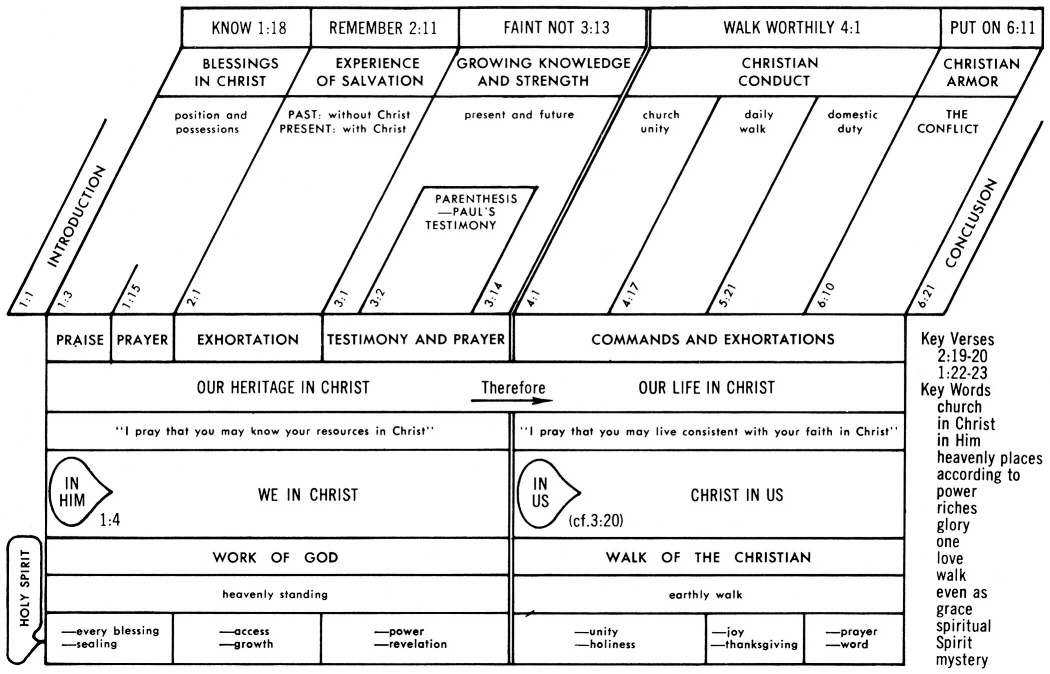
EPHESIANS - CHRIST AND THE CHURCH
Click chart to enlarge
Charts from Jensen's Survey of the NT - used by permission
Ephesians 2:3 Among them we too all formerly lived in the lusts of our flesh, indulging the desires of the flesh and of the mind, and were by nature children of wrath, even as the rest. (NASB: Lockman)
Greek: en ois kai hemeis pantes anestraphemen (1PAPI) pote en tais epithumiais tes sarkos hemon, poiountes (PAPMPN) ta thelemata tes sarkos kai ton dianoion, kai emetha (1PIMI) tekna phusei orges os kai oi loipoi
BGT ἐν οἷς καὶ ἡμεῖς πάντες ἀνεστράφημέν ποτε ἐν ταῖς ἐπιθυμίαις τῆς σαρκὸς ἡμῶν ποιοῦντες τὰ θελήματα τῆς σαρκὸς καὶ τῶν διανοιῶν, καὶ ἤμεθα τέκνα φύσει ὀργῆς ὡς καὶ οἱ λοιποί·
Amplified: Among these we as well as you once lived and conducted ourselves in the passions of our flesh [our behavior governed by our corrupt and sensual nature], obeying the impulses of the flesh and the thoughts of the mind [our cravings dictated by our senses and our dark imaginings]. We were then by nature children of [God’s] wrath and heirs of [His] indignation, like the rest of mankind. (Amplified Bible - Lockman)
Hoehner - “among whom also we all were formerly living in the desires of our flesh doing the wishes of the flesh and the reasoning processes, and we were by nature the children of wrath as even the rest.”
NLT: All of us used to live that way, following the passions and desires of our evil nature. We were born with an evil nature, and we were under God's anger just like everyone else. (NLT - Tyndale House)
NLT (revised) All of us used to live that way, following the passionate desires and inclinations of our sinful nature. By our very nature we were subject to God's anger, just like everyone else.
Phillips: We all lived like that in the past, and followed the impulses and imaginations of our evil nature, being in fact under the wrath of God by nature, like everyone else. (Phillips: Touchstone)
Wuest: among whom also we all ordered our behavior in the sphere of the cravings of our evil nature, continually practicing the desires of our evil nature and of our thoughts, and were continually children of wrath by nature, as also the rest. (Eerdmans Publishing - used by permission)
Young's Literal: among whom also we all did walk once in the desires of our flesh, doing the wishes of the flesh and of the thoughts, and were by nature children of wrath -- as also the others
KJV Among whom also we all had our conversation in times past in the lusts of our flesh, fulfilling the desires of the flesh and of the mind; and were by nature the children of wrath, even as others.
NKJ among whom also we all once conducted ourselves in the lusts of our flesh, fulfilling the desires of the flesh and of the mind, and were by nature children of wrath, just as the others.
ESV among whom we all once lived in the passions of our flesh, carrying out the desires of the body and the mind, and were by nature children of wrath, like the rest of mankind.
NET among whom all of us also formerly lived out our lives in the cravings of our flesh, indulging the desires of the flesh and the mind, and were by nature children of wrath even as the rest…
NIV All of us also lived among them at one time, gratifying the cravings of our sinful nature and following its desires and thoughts. Like the rest, we were by nature objects of wrath.
CSB We too all previously lived among them in our fleshly desires, carrying out the inclinations of our flesh and thoughts, and we were by nature children under wrath as the others were also.
NRS All of us once lived among them in the passions of our flesh, following the desires of flesh and senses, and we were by nature children of wrath, like everyone else.
NAB All of us once lived among them in the desires of our flesh, following the wishes of the flesh and the impulses, and we were by nature children of wrath, like the rest.
NJB We too were all among them once, living only by our natural inclinations, obeying the demands of human self-indulgence and our own whim; our nature made us no less liable to God's retribution than the rest of the world.
GWN All of us once lived among these people, and followed the desires of our corrupt nature. We did what our corrupt desires and thoughts wanted us to do. So, because of our nature, we deserved God's anger just like everyone else.
BBE Among whom we all at one time were living in the pleasures of our flesh, giving way to the desires of the flesh and of the mind, and the punishment of God was waiting for us even as for the rest.
AMONG THEM WE TOO ALL FORMERLY LIVED IN THE LUSTS OF OUR FLESH: en ois kai hemeis pantes anestraphemen (1PAPI) pote en tais epithumiais tes sarkos hemon:
- Among them Is 53:6; 64:6,7; Da 9:5-9; Ro 3:9+, Ro 3:10+, Ro 3:11+, Ro 3:12+, Ro 3:13+, Ro 3:14+, Ro 3:15+, Ro 3:16+, Ro 3:17+, Ro 3:18+, Ro 3:19+; 1Co 6:9-11; Gal 2:15,16; 3:22; Titus 3:3+; 1Pe 4:3+; 1Jn 1:8, 9, 10
- we too all formerly lived Ep 4:17+, Ep 4:18+, Ep 4:19+; Acts 14:16; 17:30,31+; Ro 11:30+; 1Pe 2:10+; 1Jn 2:8
- in the lusts of our flesh Ep 4:22+; Mark 4:19; John 8:44; Ro 1:24+; Ro 6:12+; Ro 13:14+; Galatians 5:16-24; 1Ti 6:9; Jas 4:1, 2, 3; 1Pe 1:14+; 1Pe 2:11+; 1Pe 4:2+; 2Pe 2:18+; 1Jn 2:16; Jude 1:16, 17, 18
- Ephesians 2 Resources - Multiple Sermons and Commentaries
- Ephesians 2:1-3 The Deadly Power of Sin - Steven Cole
- Ephesians 2:1-10: Coming Alive in Christ - John MacArthur
- Ephesians 2:1-10: Coming Alive in Christ - Study Guide (see dropdown menu) - John MacArthur
- Ephesians 2:1-10 Exchanging Living Death for Dying Life - John MacArthur
Related Passages:
Isaiah 53:6+ All of us like sheep have gone astray, Each of us has turned to his own way; But the LORD has caused the iniquity of us all To fall on Him.
Isaiah 64:6 For all of us have become like one who is unclean, And all our righteous deeds are like a filthy garment; And all of us wither like a leaf, And our iniquities, like the wind, take us away.
Ephesians 4:17+ So this I say, and affirm together with the Lord, that you walk no longer just as the Gentiles also walk, in the futility of their mind, 18 being darkened in their understanding, excluded from the life of God because of the ignorance that is in them, because of the hardness of their heart; 19 and they, having become callous, have given themselves over to sensuality for the practice of every kind of impurity with greediness.
Ephesians 4:22+ that, in reference to your former manner of life, you lay aside the old self, which is being corrupted in accordance with the lusts of deceit,
1Pe 2:10+ for you once were NOT A PEOPLE, but now you are THE PEOPLE OF GOD; you had NOT RECEIVED MERCY, but now you have RECEIVED MERCY.
1 Peter 4:1-3+ Therefore, since Christ has suffered in the flesh, arm yourselves also with the same purpose, because he who has suffered in the flesh has ceased from sin, 2 so as to live the rest of the time in the flesh (SPEAKING OF PHYSICAL CONDITION, NOT ETHICALLY) no longer for the lusts of men, but for the will of God. 3 For the time already past is sufficient for you to have carried out the desire of the Gentiles, having pursued a course of sensuality, lusts, drunkenness, carousing, drinking parties and abominable idolatries.
THE ENEMY WITHIN
THE FALLEN FLESH
Paul now describes the internal enemy that joins the external enemy Satan.
Among them we too all formerly (pote) lived (anastrepho) in the lusts (epithumia) of our flesh (sarx) - Among (1722) (en) refers to the "children of disobedience". Paul says "we" were once numbered among them. Note Paul's change of pronoun from "you" to "we." Paul is saying that the Jewish believers were once no better off than the Gentile believers. And all (pas) means all without exception so that all people were in that same sinful condition. Flesh ethically refers to that part of man which, because of the fall, is opposed to God and to holiness. The flesh is the source of those strong desires just described. Flesh as used in this context refers to that entity which is inherited from Adam, is present in every human being and which is centered upon self, prone to sin, and opposed to God The flesh is the ugly complex of human sinful desires that includes the ungodly motives, affections, principles, purposes, words, and actions that sin generates through our bodies. To live according to the flesh is to be ruled and controlled by that evil complex.
NET Note on among them - By the structure, the author is building an argument for our hopeless condition: We lived in sin and we lived among sinful people. Our doom looked to be sealed as well in v. 2: Both the external environment (kingdom of the air) and our internal motivation and attitude (the spirit that is now energizing) were under the devil’s thumb (cf. 2 Cor 4:4).
Steven Cole - We too refers to religious Jews, including Paul. “The flesh” refers to “human nature as conditioned by the fall” (Moule, p. 72). In Galatians 5, Paul sets the desires and deeds of the flesh against power and fruit of the indwelling Holy Spirit (Gal. 5:16-23). This shows that although believers have been delivered from the dominating power of the flesh, we still must do battle against it by walking in the power of the Holy Spirit. But unbelievers are totally dominated by the desires of the flesh. In Romans 8:6-8, Paul states, “For the mind set on the flesh is death, but the mind set on the Spirit is life and peace, because the mind set on the flesh is hostile toward God; for it does not subject itself to the law of God, for it is not even able to do so, and those who are in the flesh cannot please God.” Note, again, the emphasis on inability. Unbelievers, who do not have the indwelling Holy Spirit, have only one option: they live to gratify the flesh. This includes, of course, sensual desires and living according to what feels good at the moment. But it also includes what Paul here calls the desires of the mind. This includes such sins as pride and selfish ambition. His point is that before God saved us, even those of us who were religious lived to gratify selfish desires, whether physical or intellectual.
John Piper writes that flesh "is the old ego that is self-reliant and does not delight to yield to any authority or depend on any mercy. Flesh craves the sensation of self-generated power and loves the praise of men… in its conservative form it produces legalism -- keeping rules by its own power for its own glory… (in its more liberal form) produces grossly immoral attitudes and acts (Gal 5:19, 20, 21-see notes Galatians 5:19; 20; 21) The Flesh is the proud and unsubmissive root of depravity in every human heart which exalts itself subtly through proud, self-reliant morality, or flaunts itself blatantly through self-assertive, authority-despising immorality. (from his sermon Walk By the Spirit!)
Strauss - With our sin-controlled nature we formerly behaved ourselves according to our sensual appetites. Beloved Christian, this was our past. When I look at the pleasure-mad, lust-craving throngs today, I see myself as I was before God saved me by His power. And all Christians, Jews and Gentiles alike, yielded to the desires of the flesh and the cravings after those things that were not good for them. I was a corpse in the cesspool of corruption when the Lord Jesus found me, but, praise God, He has given me His life and now my desires are toward Him. I was worthy to be judged, but now I am justified in Christ. (Ephesians 1-3 Commentary)
Spurgeon - You that now commune with God at the mercy-seat, you that are now his favoured children, and have received power to become the sons of God, you were once heirs of wrath: "By nature the children of wrath, even as others." Holy Scripture is not complimentary to unrenewed human nature. You may search it through and through to find a single flattering word to unregenerate man; but you will search in vain. This style of speech is left to those who scout divine inspiration. They draw their inspiration from another fount, from a desire to walk according to the course of this world, according to the prince of the power of the air. They can se flattering speeches in addressing the ungodly; but the Holy Ghost never does. (Exposition)
Adrian Rogers - Just as we have an external foe—the world—we also have an internal foe—the flesh. The Bible uses the word "flesh" to refer to our predisposition toward sin, the old Adamic nature that we inherited from our parents, which they also inherited from their parents. Like it or not, we all have an enemy inside. You know it's there. It's present in all of us. Do you ever have to teach a little child to lie? No, you have to teach a child to tell the truth. You don't have to teach a child to be selfish. You have to teach him not to be selfish. We all have an enemy inside the gates.
A Synopsis of "The Flesh"…
- Flesh is the root of man's problems - Satan's appeal is to "be like God" and he appealed to Eve's flesh Genesis 3:5
- Flesh then becomes the carrier or bearer of sin Sin dwells within - Ro 7:5, 17, 23-see notes Romans 7:5; 7:17; 7:23
- Flesh is the instrument of sin - Ro 6:13-note
- The mind/heart is a part of the flesh Mt 15:18-20, Gal 5:19, 20, 21-see notes Ga 5:19; 20; 21
- The world's or devil's foothold comes by means of flesh
- Flesh is the base of all enemy operations.
Lived (390) anastrepho from aná = again, back + strépho = turn) means literally to turn back and forth or to and fro and hence to conduct or behave one or act in accordance with certain principles. To order one’s behavior. Thus, the saints at one time ordered their behavior or conducted themselves among the sons of disobedient (unpersuadable), in the (in the "atmosphere" of the) lusts of their flesh.
Anastrepho - 9x in 9v - conduct(3), conducted(1), live(1), lived(1), return(1), returned(1), treated(1). Acts 5:22; 15:16; 2 Cor 1:12; Eph 2:3; 1 Tim 3:15; Heb 10:33; 13:18; 1 Pet 1:17; 2 Pet 2:18.
Lusts (passions)(1939) (epithumia from epi = at, toward {the preposition "epi-" in the compound is directive conveying the picture of "having one’s passion toward" } + thumos = passion. The root verb epithumeo = set heart upon) is a neutral term denoting the presence of strong desires or impulses, longings or passionate craving (whether it is good or evil is determined by the context) directed toward an object. In this verse epithumia clearly indicates it is an evil craving that originates from from the godless flesh.
Epithumia - 38x in 37v - coveting(2), desire(4), desires(8), earnestly(1), impulses(1), long(1), lust(5), lustful(1), lusts(15). Mark 4:19; Luke 22:15; John 8:44; Rom 1:24; 6:12; 7:7f; 13:14; Gal 5:16, 24; Eph 2:3; 4:22; Phil 1:23; Col 3:5; 1 Thess 2:17; 4:5; 1 Tim 6:9; 2 Tim 2:22; 3:6; 4:3; Titus 2:12; 3:3; Jas 1:14f; 1 Pet 1:14; 2:11; 4:2f; 2 Pet 1:4; 2:10, 18; 3:3; 1 John 2:16f; Jude 1:16, 18; Rev 18:14.
Flesh (4561) (sarx) has several meanings but here is used in the ethical sense referring to the totally depraved nature as dominating the unsaved individual and represents the entirety of one's being orientated away from God and towards selfish interests.
Sarx in Ephesians - Eph. 2:3; Eph. 2:11; Eph. 2:15; Eph. 5:29; Eph. 5:31; Eph. 6:5; Eph. 6:12;
Hiebert has an interesting note that the "degeneration in the meaning of the term (epithumia from God given desires to perverted desires) is a revealing commentary on human nature. Left to himself, instead of gaining mastery over his base desires and steadfastly adhering to the good, the individual is characteristically overcome by his evil cravings, so that they become the dominating force of his life." (Hiebert, D. Edmond: 1 Peter. Page 94. Moody)
W. E. Vine summarizes epithumia as follows: epithumia denotes "strong desire" of any kind, the various kinds being frequently specified by some adjective (see below). The word is used of a good desire only in Lu 22:15; Phil 1:23 [note]; 1Thes 2:17 [note]. Everywhere else it has a bad sense. In Ro 6:12 [note] the injunction against letting sin reign in our mortal body to obey the "lust" thereof, refers to those evil desires which are ready to express themselves in bodily activity. They are equally the "lusts" of the flesh, Ro 13:14 [note]; Gal 5:16 [note], Gal 5:24 [note]; Eph 2:3 [note]; 2Pe 2:18 [note]; 1Jn 2:16, a phrase which describes the emotions of the soul, the natural tendency towards things evil. Such "lusts" are not necessarily base and immoral, they may be refined in character, but are evil if inconsistent with the will of God. Other descriptions besides those already mentioned are: "of the mind," Ephesians 2:3 [note]; "evil (desire)," Colossians 3:5 [note]; "the passion of," 1Thessalonians 4:5 [note], RV; "foolish and hurtful," 1Ti 6:9; "youthful," 2Ti 2:22 [note]; "divers," 2Ti 3:6 [note]; Titus 3:3 [note]; "their own," 2Ti 4:3 [note]; 2Pe 3:3 [note]; Jude 1:16; "worldly," Titus 2:12 [note]; "his own," Jas 1:14 [note]; "your former," 1P 1:14 [note], RV; "fleshly," 1Pe 2:11 [note]; "of men," 1Pe 4:2 [note]; "of defilement," 2Pe 2:10 [note]; "of the eyes," 1Jn 2:16; of the world ("thereof"), 1Jn 2:17; "their own ungodly," Jude 1:18. In Re 18:14 [note] "(the fruits) which thy soul lusted after" is, lit., "of thy soul's lust." (Vine's Expository Dictionary of Old Testament and New Testament Words)
SINNERS BY NATURE An elderly Gospel preacher told how he and his wife once went to worship at a certain church, only to discover that the Bible was not believed and taught there. In the Sunday school class the teacher declared that no intelligent person today holds to the obsolete doctrine that people are sinners. He stated that we must not seek the salvation of lost souls, but rather try to improve conditions in general. He asked if any of his audience disagreed. The Bible-believing pastor stood up and announced that he was one of those old-fashioned individuals who still looked upon all human beings as sinners in need of salvation by grace. Turning to the class, he asked, "How many of you had to teach your children to be bad?" Not a hand was raised. Then he inquired, "How many of you had to instruct your children to be good?" Every hand went up. "I have proved my point," he said. "If children were basically good, they would become evil only if you had trained them in wrongdoing. It is because they are sinners that we must first put so much emphasis upon their need of Christ, and then, even after they are saved, continue diligently to teach them, discipline them, and sometimes chasten them so that they will avoid the evil and do that which is good."
This faithful servant of God was right. The Bible teaches us that we are born with a sinful nature which we inherit from our parents, and which can be traced back to Adam and Eve. Paul tells believers that before their conversion they were "by nature the children of wrath, even as others" (Eph. 2:3).
Even for Christians it is easy to fall into sinful ways, for they still possess the old Adamic nature. Recognizing this, Paul urged Titus to instruct the believers to whom he ministered concerning Christian conduct. A godly life is not an easy achievement. It is attained only by those who nourish their souls constantly through prayer and the reading of God's Word.
Would you be free from the burden of sin?
There's pow'r in the blood, pow'r in the blood;
Would you o'er evil a victory win?
There's wonderful pow'r in the blood.
—L. E. Jones
God formed us, sin deformed us, but only Christ can trans-form us!
INDULGING THE DESIRES OF THE FLESH AND OF THE MIND: poiountes (PAPMPN) ta thelemata tes sarkos kai ton dianoion:
- Indulging the desires of the flesh - John 1:13
- Ephesians 2 Resources - Multiple Sermons and Commentaries
- Ephesians 2:1-3 The Deadly Power of Sin - Steven Cole
- Ephesians 2:1-10: Coming Alive in Christ - John MacArthur
- Ephesians 2:1-10: Coming Alive in Christ - Study Guide (see dropdown menu) - John MacArthur
- Ephesians 2:1-10 Exchanging Living Death for Dying Life - John MacArthur
DOING DESPICABLE
DEEDS
Indulging (poieo) the desires (thelema) of the flesh (sarx) and of the mind (dianoia) - Indulge means to yield to a desire, in this context the sinful desire stirred up by the fallen flesh. Their sin is not accidental but willful. As noted below indulging is present tense depicting this sinful indulging as one's way of life. It marks their inevitable direction toward perdition short of intervention by divinely initiated and orchestrated regeneration! Wuest adds that present tense, "speaks of the habitual performing of acts that satisfy the desires of the evil nature and of the evil thoughts, thus a fulfilling of those desires. We went the limit in sin. The evil nature had full sway."
Do believers ever indulge the desires of the flesh? Or perhaps better stated - do I even need to ask that question? Clearly, genuine believers do from time to time sadly indulge these corrupt desires, and as disobedient children of God, do subject themselves to the disciplining hand of their Father (Heb 12:5, 6+, He 12:7-10+, He 12:11+). In contrast to the children of wrath (note that while it may be "painful", our Father's discipline is not "wrath") indulge their flesh continually, habitually and as their "normal" pattern of life (cp John's characterization of the two "fathers" and the two families into which all mankind can be placed - 1Jn 3:7-12+ "little children" is John's description of those who have been born from above. Note also that verbs "practice" and "sin" are present tense = picturing continuous action).
Indulging (4160) (poieo) means doing with the implication of the context being not only performing of these desires but the accomplishment of them also! Successful at sinning as it were!
Desires (2307)(thelema from thelo = to will with the "-ma" suffix indicating the result of the will = "a thing willed") generally speaks of the result of what one has decided. One sees this root word in the feminine name "Thelma." In its most basic form, thelema refers to a wish, a strong desire, and the willing of some event. It refers to the "wishes" or the desires that come from one's emotions. Thelema emphasizes strong will-fulness, wanting and seeking something with great diligence. The life of the unsaved is swayed by emotions rather than reason and those emotions emanate from the fallen flesh nature, that evil disposition which is opposed to God. Thelema means what one wishes or has determined shall be done or that which is desired or wished for. As noted above, thelema refers to a desire which proceeds from one’s heart or emotions. This term expresses the result of one’s purpose or desire. Thelema has both an objective meaning (“what one wishes to happen”) and a subjective connotation (“the act of willing or desiring”). Zodhiates adds that thelema is the "Will, not to be conceived as a demand, but as an expression or inclination of pleasure towards that which is liked, that which pleases and creates joy. When it denotes God's will, it signifies His gracious disposition toward something. Used to designate what God Himself does of His own good pleasure. (Complete Word Study Dictionary: New Testament)
Thelema in Ephesians - Ep 1:1+, Ep 1:5+, Ep 1:9+, Ep 1:11+; Ep 2:3+; Ep 5:17+; Ep 6:6+.
Mind (1271) (dianoia from dia = denotes separation + noeo = to think over) describes the mind as the faculty of understanding, feeling, desiring and in the plural as in this verse, refers to the thoughts (especially understanding regarding morality according to Vincent), specifically evil thoughts. Dianoia refers to not simply intellectual faculties but that which guides and directs conduct. Dianoia does not mean only the mind but includes the plans and projects it entertains with uncontrolled, evil abandon. Paul says that the unsaved (natural) man is altogether at the mercy of the harsh taskmaster self (flesh) and its rash impulses. He is saying that when were without God in the world, we did whatever our bodies wished or whatever our minds imagined!
Dianoia - 12x in 12v - Matt 22:37; Mark 12:30; Luke 1:51; 10:27; Eph 2:3; Eph 4:18; Col 1:21; Heb 8:10; 10:16; 1 Pet 1:13; 2 Pet 3:1; 1 John 5:20. NAS = mind(7), minds(2), thoughts(1), understanding(2).
Illustration of Indulging the desires of the flesh and of the mind - At the start of last year’s Christmas shopping season (2008), a woman was trampled by a crowd intent on grabbing DVD players on sale at a Florida Wal-Mart. She was the first person in line, but when the store opened the other shoppers rushed forward and knocked her to the ground. When paramedics arrived, they found her unconscious. Only a few people had tried to help her--most continued their “urgent business” of buying a DVD player.
AND WERE BY NATURE CHILDREN OF WRATH, EVEN AS THE REST: kai emetha (1PIMI) tekna phusei orges os kai oi loipoi:
- and were by nature children of wrath Ge 5:3; 6:5; 8:21; Job 14:4; 15:14, 15, 16; 25:4; Ps 51:5; Mk 7:21,22; Jn 3:1-6; Ro 5:12-19+; Ro 7:18+; Gal 2:15,16
- even as the rest. Ro 3:9-note, Ro 3:22,23-notes; 1Co 4:7
- Ephesians 2 Resources - Multiple Sermons and Commentaries
- Ephesians 2:1-3 The Deadly Power of Sin - Steven Cole
- Ephesians 2:1-10: Coming Alive in Christ - John MacArthur
- Ephesians 2:1-10: Coming Alive in Christ - Study Guide (see dropdown menu) - John MacArthur
- Ephesians 2:1-10 Exchanging Living Death for Dying Life - John MacArthur
Related Passage:
Romans 3:9+ What then? Are we better than they? Not at all; for we have already charged that both Jews and Greeks are all under sin;

Damocles Sword
Click to Enlarge
DESTINED FOR
DOOM AND DESTRUCTION
And were by nature (phusis/physis) children (teknon) of wrath (orge), even as the rest (loipos) - And (kai) indicates the dreadful description has more dreadful news. Were is imperfect tense, which depicts continuous action or state of being. Our totally depraved condition before salvation was a continuous one, from birth on without a cessation of that condition (from the cesspool)! By nature refers to the essence of their being (see more below). Children of wrath could be rephrased "children destined for wrath." In simple terms wrath (orge) is God’s settled opposition to and displeasure with sin. Picture a tomato ripening and finally the surface beginning to crack open because it is ripe. That is what is happening to the wrath these children of wrath will fully experience (when the ripened tomato ruptures so to speak)! We were all worthy of and subject to God's wrath. Praise God that in Christ He provided a way of escape from our imprisonment in Adam!
Kenneth Wuest explains that this verse means "that in their pre-Christian life those meant by the "we all" were in the condition of subjection to the divine wrath; and that they were so not by deed merely, nor by circumstance, nor by passing into it, but by nature. Their universal sin has already been affirmed. This universal sin is now described as sin by nature. Beyond this, Paul does not go in this present passage. But the one is the explanation of the other. Universal sin implies a law of sinning, a sin that is of the nature; and this, again, is the explanation of the fact that all are under the divine wrath, for the divine wrath operates only where sin is. Here is the essential meaning of the doctrine of original sin.” (Wuest Word Studies - Eerdman Publishing Company Volume 1, Volume 2, Volume 3 - used by permission)
What natural condition is Paul referring to here? In Romans he explains that "Therefore, just as through one man (Adam) Sin entered into the world, and death through Sin, and so death spread to all men, because all sinned (Ro 5:12+)" Every person ever born, except Jesus, is by birth a "little sinner". Our spiritual father was the first sinner, Adam. If follows that in this state all men stand condemned to eternal death, experiencing forever the wrath of God. This is why unbelievers cannot exercise their “free will” to believe the gospel: they do not have a nature that is inclined toward God. They may dress up their old nature with good works, but it’s like dressing a pig in a tuxedo. He may look nice for a short while, but his nature will drive him back to wallowing in the mud. To change the pig, you’ve got to change his basic nature!
Cole adds (commenting on Ro 5:12-21) - This means that we are not sinners because we sin; rather, we sin because we are by nature sinners. We are born alienated from God, in rebellion against Him.
Spurgeon once said “He who doubts human depravity had better begin to study himself.” Comment: Or simply look in the mirror each morning!
Jesus spoke of the fate of the children of wrath declaring that...
He who believes in the Son has (right now! the moment of belief in Jesus) eternal life; but (A DREADFUL CONTRAST) he who does not obey (apeitheo in present tense = their habitual practice) the Son shall not see (ETERNAL) life, but the wrath of God abides (present tense - like the Sword of Damocles) on him." (John 3:36+)
Comment: Vincent writes that "Abides is present tense. As the believer has life, so the unbeliever has wrath abiding on him. He lives continually in an economy which is alienated from God, and which, in itself, must be habitually the subject of God’s displeasure and indignation."
In Romans Paul spoke of the abiding nature of God's wrath on sinners explaining that "the wrath (orge) of God is revealed (apokalupto - present tense = continually, divine passive - first word in Greek for emphasis) from heaven (DIVINELY DIRECTED) against all ungodliness and unrighteousness of men, who suppress (present tense - continually) the truth (cf Jn 8:44 - they are children of their father, the chief liar) in unrighteousness, (Ro 1:18+)
Paul's description as children of wrath reminds men of Jonathan Edwards' sermon Sinners In the Hands of an Angry God taken from Dt 32:35+ "their foot shall slide in due time."
Paul again alludes to the certainty of divine wrath from children of wrath warning his readers to "Let no one deceive you (present imperative with a negative see our need to depend on the Holy Spirit to obey) with empty words, for because of these things the wrath of God comes upon the sons of disobedience. (Eph 5:6+)
Evans - The expression Children of wrath is, like “sons of disobedience” (v. 2), a Semitism, similar to “son of stripes” (Deut. 25:2), describing one who deserves a flogging, or “son of death” (1 Sam. 26:16; 2 Sam. 12:5; Ps. 102:20), used of someone doomed to die. For killing his brother Abel (Gen. 4:8), Cain is called a “son of wrath” (Ap. Moses 3.1–14; cf. Gen. 4:11). (The Bible Knowledge Background Commentary)
NET Note - Children of wrath is a Semitic idiom which may mean either “people characterized by wrath” or “people destined for wrath.”
Cole Paul says that those apart from Christ are “by nature children of wrath.” This Hebrew expression means that they are characterized by being under God’s holy wrath against sin. While modern man scoffs at the notion of God’s wrath, it is a concept that occurs hundreds of times in both the Old and New Testaments, especially in the final book of the Bible, Revelation. It refers to God’s holy, settled hatred against all sin that will result in His final, eternal judgment against all sinners, casting them into the lake of fire (Rev. 20:11-15). John 3:36 states, “He who believes in the Son has eternal life; but he who does not obey the Son will not see life, but the wrath of God abides on him.” I realize that this is a rather negative, depressing message, but I believe that Paul wants us to gather around the edge of the cesspool of what we once were so that we won’t forget it. He wants us to remember our former condition so that we will appreciate what he goes on to proclaim (Eph. 2:4-5), “But God, being rich in mercy, because of His great love with which He loved us, even when we were dead in our transgressions, made us alive together with Christ (by grace you have been saved)…” I leave you with this question: Is there a “but God” in your life? As you look at this gruesome portrait of the deadly power of sin, can you say, “Yes, that describes what I once was! But God by His grace broke into my life and made me alive together with Christ!” If so, let it flood you with thankfulness for His abundant grace!
By nature (5449) (phusis/physis from phúo = to bring forth) (note contrast with "by grace" in Eph 2:5-note) refers to that which is innate and implanted in one by nature. It refers to our natural condition and means that we didn’t have to develop to become children of wrath. “By nature” denies any process of development so that we were born with the destiny of children of wrath.
Phusis - 14x in 11v - instinctively(1), natural(1), natural*(1), nature(7), physically(1), race(1), species(1), unnatural*(1). Rom 1:26; 2:14, 27; 11:21, 24; 1 Cor 11:14; Gal 2:15; 4:8; Eph 2:3; Jas 3:7; 2 Pet 1:4.
Children (5043) (teknon from tikto = to give birth to) is a word for children that emphasizes the birth relationship. Paul's point is that we were born children having Adam's depraved nature (Ro 5:12) and were thus fully deserving of the wrath of God.
Teknon in Ephesians - Eph. 2:3; Eph. 5:1; Eph. 5:8; Eph. 6:1; Eph. 6:4
Wrath (3709) (orge from orgaô = to teem, to swell) is God's holy hatred of sin representing His essential divine antagonism against everything that is evil. Orge is derived from the idea of a swelling which eventually bursts, and applies more to an anger that proceeds from one’s settled nature. MacArthur comments that "Orge does not refer to an explosive outburst of temper but to an inner, deep resentment that seethes and smolders, often unnoticed by others" (James) (See Martyn Lloyd-Jones sermon Ephesians 2:3: The Wrath of God)
Orge in Ephesians - Eph. 2:3; Eph. 4:31; Eph. 5:6
Rest (3062) (loipos from leipo = to leave or to lack) is an adjective which refers to that which remains over - where it refers to people the sense is the rest, those that are left, the remainder (cf. Mt 22: 6; Mk 16:13; Lk 24: 9; Acts 2:37; Ro 11: 7; 1Co. 7:12; Rev. 12:17; 19:21). In the plural, loipos means remaining ones (Mt. 25:11; Acts 2:37; Ro 1:13; 2Cor. 12:13; 2Pet. 3:16) Loipos is used several times with the meaning of "other" which Webster defines as being the one (as of two or more) remaining or not included (Mk 4:19, 16:13, Lk 18:9, Acts 17:19, Rev 9:20)
There is a very important use in 2Peter 3:16 where Peter uses loipos to indicate that he considers the letters of Paul to belong to the category of “Scripture.”
Loipos is occasionally used in a soteriological sense (describing the saved or the unsaved) - Thus in the parable (Mt 22:6) loipos speaks of those outside the Kingdom of God (cf 1Thes 4:13), whereas in other contexts loipos speaks of those in the Kingdom of God (Rev 2:24)
Mounce - It can describe persons or things that “remain” or are “left over” after an action has been taken. In Rev 8:13, loipos refers to the final blasts of the trumpet that follow the first four blasts, “woe to those who dwell on the earth, because of the remaining blasts of the trumpet” (cf. Mt 22:6; 27:49; Rev 9:20; 11:13). It can also refer to “other people,” either those previously mentioned (Acts 2:37) or, more often, an undefined group of people not previously specified (Lk 8:10; 18:11; Acts 17:9). (Mounce's Complete Expository Dictionary of Old and New Testament Words)
Here Paul's reference to "the rest" is meant to include the Jews not just the Gentiles to whom he was writing.
W E Vine has 3 entries (Remnant; Other)
loipos (λοιποί, 3062), an adjective (akin to leipo, “to leave”) signifying “remaining,” is used as a noun and translated “the rest” in the rv, where the kjv has “the remnant,” Matt. 22:6; Rev. 11:13; 12:17; 19:21.
loipos (λοιποί, 3062), “remaining” (for which see remnant), is frequently used to mean “the rest,” and is generally so translated in the rv (kjv, “others” in Lk 8:10; Acts 28:9; Eph. 2:3; 1Th 4:13; 5:6; 1Ti 5:20; kjv, “other” in Lk 18:11; Acts 17:9; Ro 1:13; 2Cor 12:13; 13:2; Gal. 2:13; Phil 1:13; 4:3); the neut. plur., lit., “remaining things,” is used in Luke 12:26; 1Co 11:34.
loipos (λοιποί, 3062) signifies “remaining, the rest.” It is translated “other,” or “others,” e.g., in Matt. 25:11: Mark 4:19; Luke 18:9; 24:10 (in v. 9, “the rest”); but in Luke 8:10; Acts 28:9; Rom. 1:13; 1 Cor. 9:5; Eph. 2:3; 1Thess. 4:13; 5:6; 1Ti 5:20, e.g., the rv renders this word “the rest” (kjv, “other” or “others”); in Eph. 4:17, some mss. have loipa, neuter plural, kjv, “other (Gentiles)”
Friberg summarizes loipos - λοιπός, ή, όν (1) as an adjective remaining, left, other (Rev 8.13); (2) as a substantive οi λοιποί the rest, the others, the remaining ones (Lk 24.9); neuter as a substantive τa λοιπά the rest (of the things), other things (MK 4.19); (3) as an adverb; (a) to indicate time τo λοιπόν or το λοιποu from now on, henceforth, in the future (Heb 10.13); (b) to mark a further fact furthermore, in addition, beyond that (1Co 1.16); (c) to indicate a conclusion finally, for the rest (2Co 13.11) (Analytical Lexicon of the Greek New Testament-highly recommended resource)
Loipos - 55x in 55v - Usage: beyond(1), else(2), finally(6), in the future(1x = 2Ti 4:8), moreover(1), now(2), other(1), other matters(1), other people(1), other things(1), other women(1), others(4), remaining(2), rest(26), still(2), then(1), things that remain(1), time onward(1).
Matthew 22:6 and the rest seized his slaves and mistreated them and killed them.
Comment: In this parable (Mt 22:6) loipos speaks of those outside the Kingdom of God, whereas in other context loipos speaks of those in the Kingdom of God (Rev 2:24)
Matthew 25:11 "Later the other virgins also came, saying, 'Lord, lord, open up for us.'
Matthew 26:45 Then He came to the disciples and said to them, "Are you still sleeping and resting? Behold, the hour is at hand and the Son of Man is being betrayed into the hands of sinners.
Matthew 27:49 But the rest of them said, "Let us see whether Elijah will come to save Him."
Mark 4:19 but the worries of the world, and the deceitfulness of riches, and the desires for other things enter in and choke the word, and it becomes unfruitful.
Mark 14:41 And He came the third time, and said to them, "Are you still sleeping and resting? It is enough; the hour has come; behold, the Son of Man is being betrayed into the hands of sinners.
Mark 16:13 They went away and reported it to the others, but they did not believe them either.
Luke 8:10 And He said, "To you it has been granted to know the mysteries of the kingdom of God, but to the rest it is in parables, so that SEEING THEY MAY NOT SEE, AND HEARING THEY MAY NOT UNDERSTAND.
Luke 12:26 "If then you cannot do even a very little thing, why do you worry about other matters?
Luke 18:9 And He also told this parable to some people who trusted in themselves that they were righteous, and viewed others with contempt:
11 "The Pharisee stood and was praying this to himself: 'God, I thank You that I am not like other people: swindlers, unjust, adulterers, or even like this tax collector.
Luke 24:9 and returned from the tomb and reported all these things to the eleven and to all the rest.
10 Now they were Mary Magdalene and Joanna and Mary the mother of James; also the other women with them were telling these things to the apostles.
Acts 2:37 Now when they heard this, they were pierced to the heart, and said to Peter and the rest of the apostles, "Brethren, what shall we do?"
Acts 5:13 But none of the rest dared to associate with them; however, the people held them in high esteem.
Acts 17:9 And when they had received a pledge from Jason and the others, they released them.
Acts 27:20 Since neither sun nor stars appeared for many days, and no small storm was assailing us, from then on all hope of our being saved was gradually abandoned.
44 and the rest should follow, some on planks, and others on various things from the ship. And so it happened that they all were brought safely to land.
Acts 28:9 After this had happened, the rest of the people on the island who had diseases were coming to him and getting cured.
Romans 1:13-note I do not want you to be unaware, brethren, that often I have planned to come to you (and have been prevented so far) so that I may obtain some fruit among you also, even as among the rest of the Gentiles.
Romans 11:7-note What then? What Israel is seeking, it has not obtained, but those who were chosen obtained it, and the rest were hardened;
1 Corinthians 1:16 Now I did baptize also the household of Stephanas; beyond that, I do not know whether I baptized any other.
1 Corinthians 4:2 In this case, moreover, it is required of stewards that one be found trustworthy.
1 Corinthians 7:12 But to the rest I say, not the Lord, that if any brother has a wife who is an unbeliever, and she consents to live with him, he must not divorce her.
29 But this I say, brethren, the time has been shortened, so that from now on those who have wives should be as though they had none;
1 Corinthians 9:5 Do we not have a right to take along a believing wife, even as the rest of the apostles and the brothers of the Lord and Cephas?
1 Corinthians 11:34 If anyone is hungry, let him eat at home, so that you will not come together for judgment. The remaining matters I will arrange when I come.
1 Corinthians 15:37 and that which you sow, you do not sow the body which is to be, but a bare grain, perhaps of wheat or of something else.
2 Corinthians 12:13 For in what respect were you treated as inferior to the rest of the churches, except that I myself did not become a burden to you? Forgive me this wrong!
2 Corinthians 13:2 I have previously said when present the second time, and though now absent I say in advance to those who have sinned in the past and to all the rest as well, that if I come again I will not spare anyone,
11 Finally, brethren, rejoice, be made complete, be comforted, be like-minded, live in peace; and the God of love and peace will be with you.
Galatians 2:13 The rest of the Jews joined him in hypocrisy, with the result that even Barnabas was carried away by their hypocrisy.
Galatians 6:17 From now on let no one cause trouble for me, for I bear on my body the brand-marks of Jesus.
Ephesians 2:3 Among them we too all formerly lived in the lusts of our flesh, indulging the desires of the flesh and of the mind, and were by nature children of wrath, even as the rest.
Ephesians 6:10-note Finally, be strong in the Lord and in the strength of His might.
Philippians 1:13-note so that my imprisonment in the cause of Christ has become well known throughout the whole praetorian guard and to everyone (pas = all - so "all the remaining") else (loipos),
Vine - Here the distinction is between the soldiers in whose keeping he (Paul) was and the other inhabitants of the city, civil and military. Paul’s influence had extended far beyond those who were in immediate contact with him. (Ponder this beloved - your influence, if an aroma of Christ, is like a rock thrown in a pond, for it ripples out far more than you can even see or understand in this present life! Upshot? May we all give off the fragrant aroma of Christ in us, the hope (certainty) of (future, redemptive) glory. Amen)
Philippians 3:1-note Finally, my brethren, rejoice in the Lord. To write the same things again is no trouble to me, and it is a safeguard for you.
Philippians 4:3-note Indeed, true companion, I ask you also to help these women who have shared my struggle in the cause of the gospel, together with Clement also and the rest of my fellow workers, whose names are in the book of life.
Philippians 4:8-note ¶ Finally, brethren, whatever is true, whatever is honorable, whatever is right, whatever is pure, whatever is lovely, whatever is of good repute, if there is any excellence and if anything worthy of praise, dwell on these things.
1 Thessalonians 4:1-note Finally then, brethren, we request and exhort you in the Lord Jesus, that as you received from us instruction as to how you ought to walk and please God (just as you actually do walk), that you excel still more.
1 Thessalonians 4:13-note But we do not want you to be uninformed, brethren, about those who are asleep, so that you will not grieve as do the rest who have no hope.
1 Thessalonians 5:6-note so then let us not sleep as others do, but let us be alert and sober.
2 Thessalonians 3:1 Finally, brethren, pray for us that the word of the Lord will spread rapidly and be glorified, just as it did also with you;
Comment by MacArthur: Finally (loipos) can have the sense of finality, but it literally means “for the rest,” or “besides that” (e.g., 1Cor 1:16). Paul used the same term in Philippians 3:1 and 1Th 4:1, and in neither instance was he ready to conclude his epistle; he was simply making a transition (“besides that … this”). In several uses of the word, it marks the transition from the letter’s doctrinal content to its practical content, as it does here. By it Paul marked his subject change from eschatology to matters of practical sanctification. (1 & 2 Thessalonians 293. Chicago: Moody Press)
1 Timothy 5:20 Those who continue in sin, rebuke in the presence of all, so that the rest also will be fearful of sinning.
MacArthur comments: Loipos (the rest) refers to the others in the same class. The class in view here is that of elders. When one elder is publicly disgraced because of sin, that puts a healthy fear into the hearts of the others. It also puts that same fear into the hearts of the congregation (cf.. Matt. 18:17). Fear, along with love, is a proper motive for avoiding sin and obeying God (Dt. 13:6–11; 17:12–13; 19:16–20; Acts 5:5–11). Proverbs 9:10 says, “The fear of the Lord is the beginning of wisdom.” Second Corinthians 7:1 admonishes believers to “cleanse [themselves] from all defilement of flesh and spirit, perfecting holiness in the fear of God” (cf.. Acts 9:31; Eph. 5:21; Heb. 12:28; 1 Peter 2:17). Such fear is not sheer terror, but rather a sense of the ominous reality of God’s hatred of evil. (1Timothy 222. Chicago: Moody Press)
2 Timothy 4:8-note in the future there is laid up for me the crown of righteousness, which the Lord, the righteous Judge, will award to me on that day; and not only to me, but also to all who have loved His appearing.
Comment: Here the idea is loipos refers to what remains, that which is left to come. What yet remained for Paul, after the past and present were finished (2Ti 4:7), would be by far the most glorious part of his life in Christ. Beloved, loipos is what remains for you and for me in the future - indeed, that which remains (and will remain eternally) is truly reflective of the saying "the best (the rest, the remainder) is yet to come!"
Hebrews 10:13-note (Christ is) waiting from that time onward UNTIL HIS ENEMIES BE MADE A FOOTSTOOL FOR HIS FEET.
2 Peter 3:16-note as also in all his letters, speaking in them of these things, in which are some things hard to understand, which the untaught and unstable distort, as they do also the rest of the Scriptures, to their own destruction.
Revelation 2:24-note 'But I say to you, the rest who are in Thyatira, who do not hold this teaching, who have not known the deep things of Satan, as they call them-- I place no other burden on you.
Comment: The book of Revelation uses Gk. loipós several times; the faithful in Thyatira (Rev. 2:24); the unsullied “few” in Sardis (Rev 3:2); a surviving group which praises God for his salvation (Rev 11:13); those faithful to God’s commandments and having the testimony of Jesus (Rev 12:17; cf. Rev 14:12; 19:10), while the “rest” (the unfaithful) are destroyed by God (Rev 19:21). (Eerdman's Dictionary)
Revelation 3:2-note 'Wake up, and strengthen the things that remain, which were about to die; for I have not found your deeds completed in the sight of My God.
Revelation 8:13-note Then I looked, and I heard an eagle flying in midheaven, saying with a loud voice, "Woe, woe, woe to those who dwell on the earth, because of the remaining blasts of the trumpet of the three angels who are about to sound!"
Revelation 9:20-note The rest of mankind, who were not killed by these plagues, did not repent of the works of their hands, so as not to worship demons, and the idols of gold and of silver and of brass and of stone and of wood, which can neither see nor hear nor walk;
Revelation 11:13-note And in that hour there was a great earthquake, and a tenth of the city fell; seven thousand people were killed in the earthquake, and the rest were terrified and gave glory to the God of heaven.
Revelation 12:17-note So the dragon was enraged with the woman, and went off to make war with the rest of her children, who keep the commandments of God and hold to the testimony of Jesus.
Revelation 19:21-note And the rest were killed with the sword which came from the mouth of Him who sat on the horse, and all the birds were filled with their flesh.
Revelation 20:5-note The rest of the dead (Eph 2:1 spiritually dead! And sadly now eternally dead!) did not come to life until the thousand years were completed. This is the first resurrection.
Loipos - 117x in the non-apocryphal Septuagint (Lxx) - Ge 45:6; Ex 28:10; 29:12, 34; 39:32, 34; Lev 2:3; 23:22; Dt 8:20; 17:14; Josh 6:13; 13:27; 17:2; 21:34; Jdg 20:45, 47; 1Sa 8:5; 15:15; 1Kgs 11:41; 14:29; 15:7, 23, 31; 16:5, 14, 20, 27f; 22:39, 45; 2Kgs 1:18; 8:23; 10:34; 12:19; 13:8, 12; 14:15, 18, 28; 15:6, 11, 15, 21, 26, 31, 36; 16:19; 20:20; 21:17, 25; 23:28; 24:5; 25:11; 1Chr 16:41; 29:29; 2Chr 13:22; 20:34; 24:27; 25:26; 26:22; 27:7; 28:26; 33:18; 36:8; Ezra 4:7; Esther 1:3, 18; 2:3; 9:16; Isa 9:1; 17:3; 38:12; 44:15, 17, 19; Jer 41:16; Ezek 34:18; 36:5; Da 7:12, 20
Illustration - The Hindenburg was a German airship that arrived in America on May 6, 1937, after cruising across the Atlantic. It was coming in for a landing at an airfield in New Jersey at 7:25 at night, and it was a thrilling sight, three football fields in length, held aloft by 7 million cubit feet of hydrogen. It could fly 84 miles an hour. It was luxurious, with a dining salon, lounges, and staterooms. Gigantic Nazi swastikas were painted on its tail fins. Hundreds of people gathered to watch it land. Suddenly a lapping tongue of fire appeared near the stern, and within a few seconds the Hindenburg exploded in a huge ball of fire, falling tail first with flames shooting out the nose. In one moment, the wonder and excitement and beauty was turned to fire and terror and destruction. Without Christ all of us are passengers aboard the Hindenburg. We may be enjoying ourselves to the fullest, but we don’t realize that the next moment is going to bring us to judgment for without Christ we remain "children of wrath".
Illustration - A Real Threat - A. B. Earle, a nineteenth-century evangelist, insisted on preaching the judgment of God against sinners. He did so, he said, because people have to see themselves as lost before they seek salvation. They won’t escape from the wrath to come until they believe it exists. Two hurdles must be overcome in convincing people that God is angry with unrepentant sinners. One, the very idea that God has communicated with humanity is unacceptable in “sophisticated” company. They feel that we are nobodies who came from nothing; the little whimper left from the Big Bang. How could nobodies need to repent? Two, human pride resents being called sinful. In this regard, the apostles had an easier task, as C. S. Lewis said. They preached to a people aware of their sins, while we preach to a people adamant in their self-righteousness. (Hurley, V. Speaker's Sourcebook of New Illustrations Dallas: Word Publishers)