Ephesians 2:2
Ephesians 2:3
Ephesians 2:4
Ephesians 2:5
Ephesians 2:6
Ephesians 2:7
Ephesians 2:8
Ephesians 2:9
Ephesians 2:10
Ephesians 2:11
Ephesians 2:12
Ephesians 2:13
Ephesians 2:14
Ephesians 2:15
Ephesians 2:16
Ephesians 2:17
Ephesians 2:18
Ephesians 2:19
Ephesians 2:20
Ephesians 2:21
Ephesians 2:22

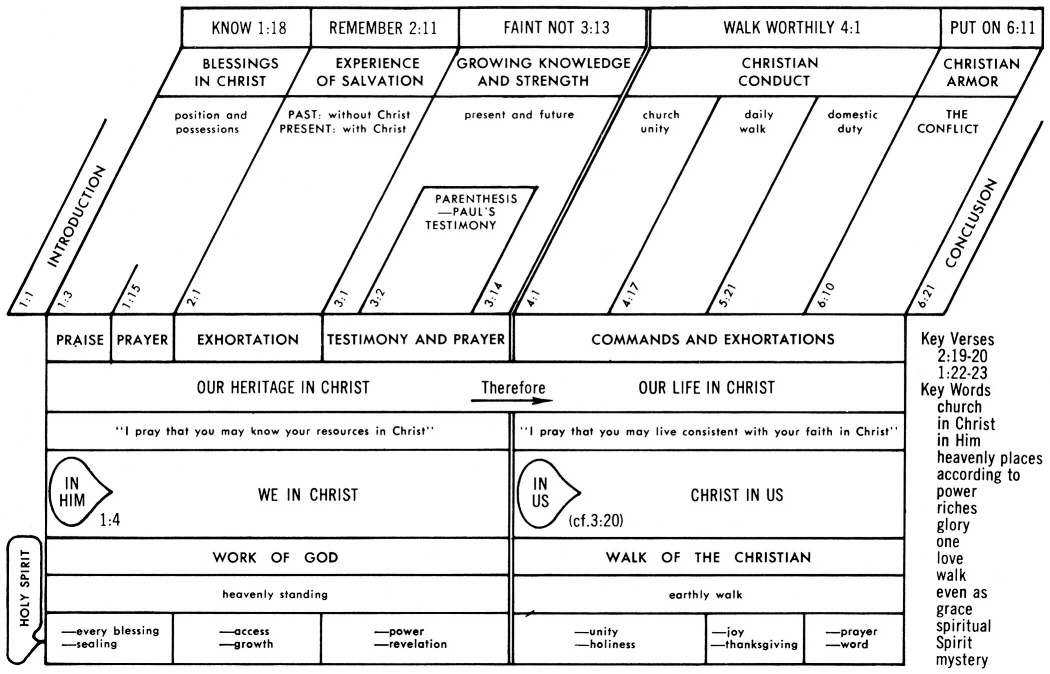
EPHESIANS - CHRIST AND THE CHURCH
Click chart to enlarge
Charts from Jensen's Survey of the NT - used by permission
| SYMMETRY OF EPHESIANS |
|
| EPHESIANS 1-3 | EPHESIANS 4-6 |
| The Root | The Fruit |
| Spiritual Wealth | Spiritual Walk |
| Christian Privilege | Christian Conduct |
| The Position of the Believer |
The Practice of the Believer |
| God Sees Us in Christ |
World Sees Christ in Us |
| Privilege | Practice |
| Doctrine | Duty |
| Doctrinal | Practical |
| Revelation | Responsibility |
| Christian Blessings |
Christian Behavior |
| Belief | Behavior |
| Privileges of the Believer |
Responsibilities of the Believer |
| Our Heritage In Christ |
Our Life In Christ |
| Know your Resources (Riches) in Christ |
Live by faith in the light of your Resources (Riches) in Christ |
| The Finished Work of Christ |
The Faithful Walk of the Christian |
| Work of Christ In Us |
Work of Christ Through Us |
| We in Christ |
Christ in Us |
| Word of God |
Walk of the Christian |
| Heavenly Standing |
Earthly Walk |
| Who You Are In Christ |
Whose You Are In Christ |
| Identity | Responsibility |
| Theology | Ethics |
Ephesians 2:4 But God, being rich in mercy, because of His great love with which He loved us, (NASB: Lockman)
Greek: o de theos plousios on (PAPMSN) en eleei, dia ten pollen agapen autou en egapesen (3SAAI) hemas,
BGT ὁ δὲ θεὸς πλούσιος ὢν ἐν ἐλέει, διὰ τὴν πολλὴν ἀγάπην αὐτοῦ ἣν ἠγάπησεν ἡμᾶς,
Amplified: But God—so rich is He in His mercy! Because of and in order to satisfy the great and wonderful and intense love with which He loved us, (Amplified Bible - Lockman)
NLT: But God is so rich in mercy, and he loved us so very much (NLT - Tyndale House)
NLT (revised) But God is so rich in mercy, and he loved us so much,
Phillips: But even though we were dead in our sins God, who is rich in mercy, because of the great love he had for us (Phillips: Touchstone)
Wuest: But God, being wealthy in the sphere of mercy, because of His great love with which He loved us (Eerdmans Publishing - used by permission)
Young's Literal: and God, being rich in kindness, because of His great love with which He loved us
KJV But God, who is rich in mercy, for his great love wherewith he loved us,
NKJ But God, who is rich in mercy, because of His great love with which He loved us,
ESV But God, being rich in mercy, because of the great love with which he loved us,
NET But God, being rich in mercy, because of his great love with which he loved us,
NIV But because of his great love for us, God, who is rich in mercy,
CSB But God, who is rich in mercy, because of His great love that He had for us,
NRS But God, who is rich in mercy, out of the great love with which he loved us
NAB But God, who is rich in mercy, because of the great love he had for us,
NJB But God, being rich in faithful love, through the great love with which he loved us,
GWN But God is rich in mercy because of his great love for us.
BBE But God, being full of mercy, through the great love which he had for us,
BUT GOD, BEING RICH IN MERCY: o de theos plousios on (PAPMSN) en eleei:
- But God being rich in mercy - Eph 2:7; 1:7; 3:8; Ex 33:19; Ex 34:6-7; Neh 9:17; Ps 51:1; 86:5,15; Ps 103:8, 9 10, 11; Ps 145:8; Isa 55:6, 7, 8; Da 9:9; Jonah 4:2; Micah 7:18-20; Luke 1:78; Ro 2:4; Ro 5:20,21; 9:23; 10:12; 1 Ti 1:14; 1 Pe 1:3
- Ephesians 2 Resources - Multiples Sermons and Commentaries
- Ephesians 2:1-10: Coming Alive in Christ - John MacArthur
- Ephesians 2:1-10: Coming Alive in Christ - Study Guide (see dropdown menu) - John MacArthur
- Ephesians 2:1-10 Exchanging Living Death for Dying Life - John MacArthur
Exodus 33:19 And He said, “I Myself will make all My goodness pass before you, and will proclaim the name of the LORD before you; and I will be gracious to whom I will be gracious, and will show compassion on whom I will show compassion.
Exodus 34:6-7 Then the LORD passed by in front of him and proclaimed, “The LORD, the LORD God, compassionate and gracious, slow to anger, and abounding in lovingkindness and truth; 7 who keeps lovingkindness for thousands, who forgives iniquity, transgression and sin; yet He will by no means leave the guilty unpunished, visiting the iniquity of fathers on the children and on the grandchildren to the third and fourth generations.”
Nehemiah 9:17 “They refused to listen, And did not remember Your wondrous deeds which You had performed among them; So they became stubborn and appointed a leader to return to their slavery in Egypt. But You are a God of forgiveness, Gracious and compassionate, Slow to anger and abounding in lovingkindness; And You did not forsake them.
Deuteronomy 4:31 “For the LORD your God is a compassionate God; He will not fail you nor destroy you nor forget the covenant with your fathers which He swore to them.
Psalms 103:8 The LORD is compassionate and gracious, Slow to anger and abounding in lovingkindness.
Micah 7:18-20 Who is a God like You, who pardons iniquity And passes over the rebellious act of the remnant of His possession? He does not retain His anger forever, Because He delights in unchanging love. 19 He will again have compassion on us; He will tread our iniquities under foot. Yes, You will cast all their sins Into the depths of the sea. 20 You will give truth to Jacob And unchanging love to Abraham, Which You swore to our forefathers From the days of old.
2 Corinthians 8:9+ For you know the grace of our Lord Jesus Christ, that though He was rich, yet for your sake He became poor, so that you through His poverty might become rich.
Romans 2:4+ Or do you think lightly of the riches of His kindness and tolerance and patience, not knowing that the kindness of God leads you to repentance?
Romans 11:32 For God has shut up all in disobedience so that He may show mercy to all.
BUT GOD
RICH IN MERCY
There is an old "Rolaids" commercial (upset stomach) and the jingle was "How do you spell relief?" How do you spell "relief" from spiritual death and despair? You spell it "But God". You were going straight to hell and eternal separation from God (2Th 1:8-9+) until those great words sounded forth… BUT GOD! Praise God for His "but God's" in Scripture (see below noting the very first use in Genesis! What a merciful God we serve.) for without them mankind would have no hope of spending eternity with Him. In the wonderful passages that follow we read of the Divine motivation for reaching down and saving us.
In the declaration of the two words "but God" hangs the destiny of every person ever born!
But God being rich (plousios) in mercy (eleos) - Being (eimi) in the present tense indicates this is God's continual state, rich in mercy. How grateful we are for the present tense in this description. In (en) indicates the "sphere" in which God is rich, in this case it is mercy! God being rich in mercy is God's character, one of the immutable, infinite attributes (See mercy). God is "plentifully supplied", overabounding, without measure, very rich and wealthy in regard to His mercy. Rich means God's mercy is not miserly but magnanimous!
Steven Cole on but God - Those are the greatest words of hope that we could want to hear! Death robs us of hope. When someone dies, hope of him returning to life is gone. And to be spiritually dead is to be without hope—unless you bring God into the equation.
But God - 41x in the NASB (95) - Gen 8:1; 17:19; 20:3; 21:12; 45:8; 48:21; 50:20, 24; Exod 21:13; Num 22:22; Jdg 15:19; 1 Sam 23:14; 1Chr 28:3; Job 34:5; Ps 49:15; 52:5; 64:7; 73:26; 75:7; Jonah 4:7; Mark 2:7; Luke 5:21; 12:20; 16:15; Acts 2:24; 7:6, 42; 13:30; Ro 5:8; 1Cor 1:27; 3:6, 7; 6:13; 7:15; 12:24; 15:38; 2Cor 7:6; Gal 3:18; Eph 2:4; Phil 2:27; 1Th 2:4
In a similar divine reversal of destiny, Paul reiterates the "before" and "after" in his letter to Titus…
For we also once were foolish ourselves, disobedient, deceived, enslaved to various lusts and pleasures, spending our life in malice and envy, hateful, hating one another. BUT WHEN the kindness of God our Savior and His love for mankind appeared, 5 He saved us, not on the basis of deeds which we have done in righteousness, but according to His mercy, by the washing of regeneration and renewing by the Holy Spirit, 6 whom He poured out upon us richly through Jesus Christ our Savior, 7 that being justified by His grace we might be made heirs according to the hope of eternal life. (Titus 3:3+, Titus 3:4+, Titus 3:5+, Titus 3:6, 7+)
But (1161) (de) introduces a contrast (term of contrast) and what a dramatic contrast this presents with the preceding dreary description of an unbeliever (Ep 2:1-2+; Ep 2:3+) and here the description of a believer! One "three letter conjunction" (2 letters in Greek) changes the fate of mankind from certain eternal death to the potential for eternal life! The phrase "but God" also shows the problem of alienation was not with God but with man. To the contrary, "but God" shows that it is God Who initiates the salvation which Paul goes on to describe. Our salvation hangs entirely on those two words. We were dead…But God! We were enslaved…But God! We were trapped…but God! We were self-destructing…but God! We were lost in sin…but God! And I am sure you could add to this list! We were children of wrath and deserving of an eternity in the torments of hell, BUT GOD instead of pouring out wrath God will spend eternity showing the immeasurable riches of his kindness to us in Christ Jesus (Eph 2:7).
POSB - God is full of mercy: feelings of pity, compassion, affection, kindness. It is a desire to succor, to tenderly draw unto oneself and to care for. Two things are essential in order to have mercy: seeing a need and being able to meet that need. God sees our need and feels for us (Ephes. 2:1-3). Therefore, He acts; He has mercy upon us... God withholds His judgment.God provides a way for us to be saved. (Preacher's Outline and Sermon Bible-KJV-Galatians-Colossians)
Expositors Greek NT comments "A return is now made to the statement which was interrupted at Eph 2:2. The resumption might have been made by oun (therefore). The adversative de (but), however, is the more appropriate, as the other side of our case is now set forth—the divine grace which meets the sinful, condemned condition, and which stands over the dark background of our death by sin and our subjection by nature to the divine wrath. God who is wroth with sin, is a God of grace. His disposition towards those who are dead by trespasses and sins is one of mercy, and this is no stinted mercy, but a mercy that is rich, exhaustless.” The word “rich” is the translation of plousios, “wealthy, abounding in material resources, abounding, abundantly supplied.” (The Expositor's Greek Testament)
G Campbell Morgan - The word "But" here puts two matters into contrast. The first contrast is between man and God; the second is between the state of man and the mercy of God, and this is the main thought in the mind of the writer. The picture of man's state is very dark: "dead through your trespasses and sins"—that is, cut off from all the true things of life; therefore, walking under the dominion of "the spirit that now worketh in the sons of disobedience"; therefore living "in the lusts of the flesh"; therefore "children of wrath." Can any conditions more hopeless be imagined? How can it ever be that those living under such conditions shall become "holy and without blemish?" What wisdom can plan such a deliverance? What power can be equal to carrying out such a purpose? The complete and final answer is given in these words: "But God, being rich in mercy!"In the wealth of His mercy there the wisdom that plans, and the might that accomplishes. Mercy is compassion, and in God that is more than passive, it is active; it is pity, working on behalf of those who are helpless; it is love, doing the things that love desires to be done. When that compassion, pity, love, is predicated of God, the vastness of it is postulated, the sufficiency of it is recognized. This is the very heart of the Gospel. Over against all the appalling facts of our weakness and wickedness, we must place the wealth of the mercy of God, which had its unveiling and found its mode of action in Christ. Presently Paul referred to the "exceeding riches of His grace"; and we feel the power of the expression. It exceeds all our need. It is an ocean in which all our emptiness is filled without loss to its superabundance. (Morgan, G. C. Life Applications from Every Chapter of the Bible).
Ephesians 2:4, 2:5 offer three words which answer to the desperate state of mankind:
Mercy, Love and Grace
As someone has said, mercy is God not giving us what we do deserve—Judgment. Grace is God giving us what we don’t deserve—Salvation. Grace is shown to the undeserving, while mercy is compassion to the miserable. Grace is God’s solution to man’s sin. Mercy is God’s solution to man’s misery. Grace covers the sin, while mercy removes the pain. Grace forgives, while mercy restores. Grace gives us what we don’t deserve while mercy withholds what we do deserve.
Grace is getting what we do not deserve.
Justice is getting what we do deserve.
Mercy is not getting what we do deserve.
Strauss adds that mercy "is God’s exercise of pity and compassion upon the sinner with a forbearance he does not deserve. The whole of our salvation is ascribed to the mercy of God, and He is “rich in mercy.” Indeed, the Lord is merciful, full of mercy (Psalm 103:8). When the holy and eternal God who hates sin, loves and saves the sinner, that is mercy. He is the “Father of mercies” (2Co 1:3+), and we need only come to His throne of grace to obtain mercy (Heb. 4:16+). In chapter one we saw “the riches of His grace” (Eph 1:7) and “the riches of His glory” (Ep 1:18), and here we read that He is rich in mercy. Let us say with the Apostle Peter: “Blessed be the God and Father of our Lord Jesus Christ, which according to His abundant mercy hath begotten us again unto a lively hope by the resurrection of Jesus Christ from the dead” (1Pe 1:3+). (Ephesians 1-3 Commentary)
Rich (4145) (plousios from ploutos = wealth, abundance, riches) is an adjective which defines that which exists in a large amount with implication of its being valuable. Literally plousios refers to having an abundance of earthly possessions that exceeds normal experience. As used in Eph 2:4 plousios refers to being plentifully supplied with something. Rich is used most often in the NT in the sense of having abundant possessions and especially material wealth and was a frequent topic addressed by the Lord Jesus. It is used figuratively in James to describe those who are rich in faith (Jas 2:5, cp similar use to describe the believers in Smyrna - Rev 2:9).
Gilbrant writes that in Classical Greek "This term is an adjective from a word whose root means “to fill, to be filled.” Customarily this concerns the fullness of material possessions, i.e., “rich.” Sometimes, however, it does carry the more general sense of “well-being.” The idea of being materially affluent and rich dominates its secular usage. Plousios occurs in the Septuagint with much the same meaning as it has in secular Greek—denoting material wealth. We read that Abram was “very rich” in livestock, silver, and gold (Genesis 13:2; cf. Ruth 3:10). Much of the language of “rich and poor” occurs in the Wisdom literature (Proverbs, Wisdom of Solomon, Sirach). Here “rich” begins to take on more negative overtones (e.g., Proverbs 10:15; 14:20; 18:11; Sirach 8:2; 13:3,18). The rich must never trust their riches; rather, they must trust the Lord (Jeremiah 9:23). The 28 instances of plousios in the New Testament echo the attitude toward riches encountered in the Old Testament, especially in the Wisdom literature; that is, it is largely negative. Riches are an impediment to participating in God’s kingdom (Matthew 19:23). Believers are not to put their hope in their wealth, but in God, who “richly” (plousiōs) provides them with everything (1 Timothy 6:17; cf. Ephesians 2:4, of God’s richness in mercy). Jesus even pronounced “Woe” upon those who are rich, whose heart is tied to their possessions (Luke 6:24; cf. His woes against others, Luke 11:42ff.). Clearly it is no accident that the rich man is targeted for correction and reproof on more than one occasion (e.g., Luke 12:16; 16:1,19; cf. Mark 12:41f.). The Book of James openly scathes the rich who put too much stock in their wealth. James even goes so far to assert that God has “chosen” the poor of the world to be “rich” (plousios) in faith. Does God favor the poor? In a sense, yes; but not in the sense that He shows partiality. Rather, the poor of this world (especially for James) are those who have become poor for the sake of God. Conversely, the rich are exploiting the poor and making it hard on them (James 2:5ff.). Thus God favors the poor just as He favors those who through grace are righteous. He executes justice on behalf of those treated unjustly—the poor (James 5:1). Poverty continues to be somewhat “virtuous” in the Book of Revelation (2:9). The rich again are described as proud and misguided; they put their trust in their wealth and in themselves rather than in the living God (Revelation 3:17). The rich are among those judged by the opening of the seals (Rev 6:15). (Complete Biblical Library Greek-English Dictionary)
Plousios - 28x in 28v - NAS = people(1), rich(19), rich man(7), rich man's(1), rich people(1). Matt. 9:13; Matt. 12:7; Matt. 23:23; Lk. 1:50; Lk. 1:54; Lk. 1:58; Lk. 1:72; Lk. 1:78; Lk. 10:37; Rom. 9:23; Rom. 11:31; Rom. 15:9; Gal. 6:16; Eph. 2:4; 1 Tim. 1:2; 2 Tim. 1:2; 2 Tim. 1:16; 2 Tim. 1:18; Tit. 3:5; Heb. 4:16; Jas. 2:13; Jas. 3:17; 1 Pet. 1:3; 2 Jn. 1:3; Jude 1:2; Jude 1:21
Revelation 2:9+ 'I know your tribulation and your poverty (but you are rich), and the blasphemy by those who say they are Jews and are not, but are a synagogue of Satan.
Revelation 3:17+ 'Because you say, "I am rich, and have become wealthy, and have need of nothing," and you do not know that you are wretched and miserable and poor and blind and naked,
Comment: Same word rich presents a striking contrast between the believers in Rev 2:9 in Smyrna and those described in Laodicea! Riches have a distinct tendency to "blur" our spiritual vision. We lose sight of what is truly (eternally) important, those things that make us rich in God's eyes! Beware all who read this and are financially well off!
Plousios - 56x in the non-apocryphal Septuagint (Lxx) - Ge 13:2; Ruth 3:10; 1Sam 2:10; 2 Sam 12:1f, 4; Esth 1:20; Job 27:19; Ps 10:8; 34:10; 45:11; 49:2; Pr 10:15; 14:20; 18:11; 19:22; 22:2, 7, 16; 23:4; Pr 28:6, 11; Eccl 10:6, 20; Isa 5:14; 32:9, 13; 33:20; 53:9; Jer 9:23; 24:1
Pr 10:15 The rich man’s wealth is his fortress, The ruin of the poor is their poverty.
Pr 14:20 The poor is hated even by his neighbor, But those who love the rich are many.
Pr 18:11 A rich man’s wealth is his strong city, And like a high wall in his own imagination.
Pr 22:2 The rich and the poor have a common bond, The LORD is the maker of them all.
Pr 22:7 The rich rules over the poor, And the borrower becomes the lender’s slave.
Pr 22:16 He who oppresses the poor to make much for himself Or who gives to the rich, will only come to poverty.
Pr 23:4 Do not weary yourself to gain wealth, Cease from your consideration of it.
Pr 28:6 Better is the poor who walks in his integrity, Than he who is crooked though he be rich.
Pr 28:11 The rich man is wise in his own eyes, But the poor who has understanding sees through him.
Mercy (1656) (eleos) is the outward manifestation of pity. Aristotle says eleos is an emotional concern for those who undeservedly suffered some calamity. That's a good definition except that mankind has DESERVEDLY suffered the calamity of sin and spiritual death through Adam! This fact makes God's "definition" of mercy even more "altruistic!" Ephesians 2:4 is the only use of eleos in Ephesians.
In the Septuagint (LXX) mercy (eleos) often translates the Hebrew word hesed which speaks of God's loyal or steadfast love, His unfailing love and His tenderness (cf Lxx uses of eleos for Hebrew hesed in 1Ki 8:23, Ps 89:49, Isa 63:7). Eleos in the NT describes kindness or concern expressed for someone in need. Mercy indicates the emotion aroused by someone in need (all mankind dead in their trespasses and sins) and the attempt to relieve that one and remove his trouble. Mercy is the outward manifestation of pity, which assumes a need on the part of him who receives it and resources adequate (God is "rich") to meet need on part of him who shows. Mercy implies compassion that forbears punishing even when justice demands compassion or forbearance shown esp to an offender or to one subject to one’s power.
Mercy is God's kindness and good will towards miserable and afflicted sinners, joined with His desire to help them. It is much more than being merciful because God instead of dealing with us as those who rightly deserve wrath and judgment, deals with us in compassionate mercy.
Wuest writes that eleos is "God’s “kindness and goodwill toward the miserable and afflicted, joined with a desire to relieve them” (Vincent). Grace meets man’s need in respect to his guilt and lost condition; mercy, with reference to his suffering as a result of that sin. (Wuest Word Studies - Eerdman Publishing Company Volume 1, Volume 2, Volume 3 - used by permission)
Hiebert defines mercy as “the self-moved, spontaneous loving kindness of God which causes Him to deal in compassion and tender affection with the miserable and distressed.”
QUESTION - What is the definition of mercy?
ANSWER - Mercy, pity, and compassion are roughly synonymous. While most modern versions are very good at capturing the meaning of the original languages, the best way to get at the meaning of a word as it is used in Scripture is to read every instance of the word in Scripture. One can do this using a standard concordance or any of several online Bible programs or Logos Bible Software. These methods make it easy to find every instance of a word used in the Bible.
A few verses will serve to illustrate. The following verses highlight mercy as it relates to forgiveness or the withholding of punishment:
• Have mercy on me, O God, according to your unfailing love; according to your great compassion blot out my transgressions. (Psalm 51:1)
• You, Lord God Almighty, you who are the God of Israel, rouse yourself to punish all the nations; show no mercy to wicked traitors. (Psalm 59:5)
• Let the wicked forsake their ways and the unrighteous their thoughts. Let them turn to the Lord, and he will have mercy on them, and to our God, for he will freely pardon. (Isaiah 55:7)
• So he called to him, “Father Abraham, have pity on me and send Lazarus to dip the tip of his finger in water and cool my tongue, because I am in agony in this fire.” (Luke 16:24)
• But the tax collector stood at a distance. He would not even look up to heaven, but beat his breast and said, “God, have mercy on me, a sinner.” (Luke 18:13)
• Just as you who were at one time disobedient to God have now received mercy as a result of their disobedience, so they too have now become disobedient in order that they too may now receive mercy as a result of God’s mercy to you. For God has bound everyone over to disobedience so that he may have mercy on them all. (Romans 11:30–32)
• But for that very reason I was shown mercy so that in me, the worst of sinners, Christ Jesus might display his immense patience as an example for those who would believe in him and receive eternal life. (1 Timothy 1:16)
These verses highlight mercy as it relates to having compassion upon a person with a need:
• A Canaanite woman from that vicinity came to him, crying out, “Lord, Son of David, have mercy on me! My daughter is demon-possessed and suffering terribly.” (Matthew 15:22)
• “Lord, have mercy on my son,” he said. “He has seizures and is suffering greatly. He often falls into the fire or into the water.” (Matthew 17:15)
• Two blind men were sitting by the roadside, and when they heard that Jesus was going by, they shouted, “Lord, Son of David, have mercy on us!” (Matthew 20:30)
• As Jesus was getting into the boat, the man who had been demon-possessed begged to go with him. Jesus did not let him, but said, “Go home to your own people and tell them how much the Lord has done for you, and how he has had mercy on you.” (Mark 5:18–19)
• We have different gifts, according to the grace given to each of us. If your gift is prophesying, then prophesy in accordance with your faith; if it is serving, then serve; if it is teaching, then teach; if it is to encourage, then give encouragement; if it is giving, then give generously; if it is to lead, do it diligently; if it is to show mercy, do it cheerfully. (Romans 12:6–8)
In the Bible, mercy is extended to an offender in the form of forgiveness or to the suffering in the form of healing or other comfort. In any case, mercy can be characterized as compassionate treatment of those in distress. Whether the distress is caused by the guilt or penalty of sin or by a debilitating physical condition, mercy is there to help.
In common usage, mercy and grace are often used interchangeably. They do not mean the same thing, but they are integrally related and may be considered two sides of the same coin in salvation. When God saves a person, He extends both mercy and grace. Mercy is forgiving the sinner and withholding the punishment that is justly deserved. Grace is heaping undeserved blessings upon the sinner. In salvation, God does not show one without the other. In Christ, the believer experiences both mercy and grace.GotQuestions.org
QUESTION - What does it mean that God is rich in mercy (Ephesians 2:4)?
ANSWER - The phrase rich in mercy is found in Ephesians 2:4 as part of a passage contrasting the condition of believers before they came to Christ and their state after responding to His call. In order to understand what it means that God is rich in mercy, we need to consider the context of the passage:
“And you were dead in the trespasses and sins in which you once walked, following the course of this world, following the prince of the power of the air . . . carrying out the desires of the body and the mind, and were by nature children of wrath, like the rest of mankind. But God, being rich in mercy, because of the great love with which he loved us, even when we were dead in our trespasses, made us alive together with Christ—by grace you have been saved—and raised us up with him and seated us with him in the heavenly places in Christ Jesus, so that in the coming ages he might show the immeasurable riches of his grace in kindness toward us in Christ Jesus” (Ephesians 2:1–7ESV, emphasis added).
In this passage, Paul first describes humanity’s deplorable condition in rebellion against God’s rich mercy. We were not only sinful, but we were “dead” in our sins. In other words, because of the sin nature that controls us, we were doomed to an eternity without God and without life (Romans 6:23). We deserved God’s wrath, and we could do nothing to save ourselves. Then comes the “but,” and the focus of the passage shifts to God’s mercy, love, grace, and kindness.
The phrase rich in mercy is a counterbalance to the description of humanity being rich in sin. Only a God rich in mercy would conceive a plan to save and redeem such wicked creatures. Mercy is compassion or forgiveness extended to someone who deserves punishment or harm. Mercy is undeserved pardon. Mercy is the only explanation for Christ’s great sacrifice on our behalf (2 Corinthians 5:21).
People can show mercy to one another on a limited, human basis. But our offenses against God were so heinous, so unforgivable, that His forgiveness shows Him to be more than merciful—He is rich in mercy. A God rich in mercy “demonstrates his own love for us in this: While we were still sinners, Christ died for us” (Romans 5:8). Before we cared or knew Him, God had already extended mercy toward us. First Peter 1:3 counters any tendency to believe that our salvation is due to some merit within ourselves: “Praise be to the God and Father of our Lord Jesus Christ! In his great mercy he has given us new birth into a living hope through the resurrection of Jesus Christ from the dead.”
God’s mercies continue after salvation as He offers His redeemed children forgiveness when we sin (1 John 1:9). Because He is rich in mercy, His mercies never end. They are “new every morning” (Lamentations 3:23). We never have to fear that one day God will get fed up and stop His patient working in our lives (2 Peter 3:9). We never need to worry that we have “used up” our portion of grace and kindness because our God is rich in mercy.GotQuestions.org
Related Resources:
- How do God’s mercy and justice work together in salvation? | GotQuestions.org
- What is the difference between mercy and grace?| GotQuestions.org
- American Tract Society Mercy
- Bridgeway Bible Dictionary Mercy
- Baker's Evangelical Dictionary Mercy
- Charles Buck Dictionary Mercy
- Hastings' Dictionary of the NT Mercy (2) Mercy
- King James Dictionary Mercy
- Morrish Bible Dictionary Mercy
- Hawker's Poor Man's Dictionary Mercy
- The Jewish Encyclopedia Mercy
BECAUSE OF HIS GREAT LOVE WITH WHICH HE LOVED US: dia ten pollen agapen autou en egapesen (3SAAI) hemas:
- Because of His great love - Dt 7:7-8; Dt 9:5,6; Jer 31:3; Ezek 16:6-8; John 3:14-17; Ro 5:8; 9:15,16; 2 Th 2:13; 2 Ti 1:9; Titus 3:4-7; 1 Jn 4:10-19
- Ephesians 2 Resources - Multiples Sermons and Commentaries
WHY DID GOD
SAVE US?
Because of His great love (agape) with which He loved (agapao) us (Jews and Gentiles) - Because (dia) God bestowed His rich mercy on us on account of the fact that He was great (adds to the intensity) in love and His indicates it was the Father's personal love for us! I did not have the experience of either a loving father or step-father, so this truth is so encouraging now that I am His adopted son! Vincent explains the because as indicating "it is in order to satisfy His great love." Stated another way, the term of explanation (because) explains the cause for the demonstration of mercy in the previous clause. What is the "cause?" God's love, love that seeks the highest good in the one who is loved and which is bestowed independent of merit (of which we had NONE) to those who are totally undeserving! Paul uses the phrase great (polus - relatively large in quantity or measure) love in an attempt to describe what is indescribable for God's love is infinite like all of His attributes. Pause and ponder our great God Who is rich in mercy and great in love! God's love to any degree would have been enough, but Paul says it was His great love. God is not miserly, withholding His best from those who deserve nothing at all! He bestowed on us His love, a love that seeks the greatest good for the one who receives it and for us that greatest good was salvation from sins, even sins that were against the very One Who has shown us His love! Amazing love indeed! He loved us is past tense, indicating that even before we were created and before He created of the universe, He loved us, as Paul explained earlier writing that "in love (agape) He predestined (proorizo) us to adoption as sons through Jesus Christ to Himself." (Eph 1:4-5+). The result of His great love is described in Eph 2:5-6.
Hoehner adds that "Certainly, this love of God for sinners is demonstrated in Christ’s sacrifice for them as so clearly seen in Ro 5:5, 6, 8; Ro 8:35–39 and later in the present epistle (Eph 5:2, 25). In conclusion, in these verses God’s character is portrayed as rich in mercy, the cause or motivation is his great love, and the basis is his grace. The latter will be demonstrated in the next verse." (See Ephesians: An Exegetical Commentary)
John MacArthur - God's mercy and love provide a way for them to participate in the righteousness of His crucifixion. "I know what you are and what you have done," He says; "but because of My great love for you, your penalty has been paid, My law's judgment against you has been satisfied, through the work of My Son on your behalf. For His sake I offer you forgiveness. To come to Me you need only to come to Him." Not only did He love enough to forgive but also enough to die for the very ones who had offended Him. "Greater love has no one than this, that one lay down his life for his friends" (John 15:13). Compassionate love for those who do not deserve it makes salvation possible. (See Ephesians MacArthur New Testament Commentary)
Frederick M. Lehman's hymn is a beautiful description of The Love of God…
The love of God is greater far
Than tongue or pen can ever tell;
It goes beyond the highest star,
And reaches to the lowest hell;
The guilty pair, bowed down with care,
God gave His Son to win;
His erring child He reconciled,
And pardoned from his sin.
Refrain:
Oh, love of God, how rich and pure!
How measureless and strong!
It shall forevermore endure—
The saints’ and angels’ song.
When hoary time shall pass away,
And earthly thrones and kingdoms fall,
When men who here refuse to pray,
On rocks and hills and mountains call,
God’s love so sure, shall still endure,
All measureless and strong;
Redeeming grace to Adam’s race—
The saints’ and angels’ song.
Could we with ink the ocean fill,
And were the skies of parchment made,
Were every stalk on earth a quill,
And every man a scribe by trade;
To write the love of God above
Would drain the ocean dry;
Nor could the scroll contain the whole,
Though stretched from sky to sky.
There is a story of this last verse of Lehman's hymn ("Could we with ink the ocean fill....) being penciled on the wall of a narrow room in an insane asylum by a man said to have been demented (perhaps, but his acknowledgment of this precious truth might make him more "sane" then many outside the asylum!). The profound lines were discovered when they laid him in his coffin.
Strauss - Abundant mercy and great love! Oh, the love of God! Who can fathom it? Who can explain it? We can do nothing better than ponder His own Word: “For God so loved the world, that He gave His only begotten Son, that whosoever believeth in Him should not perish, but have everlasting life” (John 3:16); “But God commendeth His love toward us, in that, while we were yet sinners, Christ died for us” (Rom. 5:8); “In this was manifested the love of God toward us, because that God sent His only begotten Son into the world, that we might live through Him” (1 John 4:9). (Ephesians 1-3 Commentary)
Love (26) (agape) is unconditional, sacrificial love. Agape love speaks of a love called out of one’s heart by the preciousness of the one loved, a love that impels one to sacrifice one’s self for the benefit of the object loved. It is the love shown at Calvary to undeserving sinners (Jn 3:16, Ro 5:5, 6, 8, Ro 8:35-39, Eph 5:2, 25).
Jesus expounded on this great "Calvary" love declaring that…
as Moses lifted up the serpent in the wilderness, even so must the Son of Man be lifted up; that whoever believes may in Him have eternal life. For God so loved the world, that He gave His only begotten Son, that whoever believes in Him should not perish, but have eternal life. For God did not send the Son into the world to judge the world, but that the world should be saved through Him. He who believes in Him is not judged; he who does not believe has been judged already, because he has not believed in the name of the only begotten Son of God. (John 3:14-18+)
“Greater love has no one than this, that one lay down his life for his friends” (John 15:13)
Paul emphasizes the greatness of this love for those so unlovely writing that…
But God demonstrates His own love toward us, in that while we were yet sinners, Christ died for us. (Ro 5:8+)
The apostle John adds that…
In this is love, not that we loved God, but that He loved us and sent His Son to be the propitiation for our sins. (1John 4:10+)
Loved (25) (agapao) describes the love God gives freely and unconditionally regardless of response -- love that goes out not only to lovable but to one’s enemies. Agape is God's willful direction toward man. It involves God doing what He knows is best for man and not necessarily what man desires. For example, John 3:16+ states, "For God so loved the world, that he gave." What did He give? Not what man wanted, but what God knew man needed, i.e., His Son to bring forgiveness to man.
Speaking to faithless Israel God speaks of coming days of restoration declaring "I have loved you with an everlasting love; Therefore I have drawn you with lovingkindness. (Jeremiah 31:3+) Amazing divine love to love the unlovely! Here is another hymn exalting the glory of the Father's love for sinners:
How deep the Father's love for us
How vast beyond all measure
That He should give His only Son
To make a wretch His treasure
How great the pain of searing loss
The Father turns His face away
As wounds which mar the Chosen One
Bring many sons to gloryBehold the man upon a cross
My sin upon His shoulders
Ashamed, I hear my mocking voice
Call out among the scoffers
It was my sin that held Him there
Until it was accomplished
His dying breath has brought me life
I know that it is finishedI will not boast in anything
No gifts, no power, no wisdom
But I will boast in Jesus Christ
His death and resurrection
Why should I gain from His reward?
I cannot give an answer
But this I know with all my heart
His wounds have paid my ransom
F B Meyer writes that GOD'S LOVE WAS NOT DAUNTED BY OUR SIN. (Ephesians 2:5)
In the day that we were born, we were cast out in the open field, dead in trespasses and sins, and to the abhorring of our person. But He loved us even then. His great love was not diverted by the spectacle of our loathsomeness. He knew what we were, and what we should be, and how much pain and sorrow we should cost Him; but He loved us still. He foresaw our failures and backslidings, and lapses into the darkness of shadow; but none of these things availed to quench his love. So rich was He in mercy that He could afford to be prodigal of his wealth.
It is a great comfort to know that God loved us when there was nothing to attract his love; because He will not be surprised by anything He discovers in us, and He will not turn from us at those manifestations of evil which sometimes make us lose heart. He knew the worst from the first. He did not love us because we were fair, but to make us so. We cannot understand it; but since He began He will not fail nor be discouraged until He has finished his work. (Love: On God's Side)
During the Spanish-American War, Clara Barton was overseeing the work of the Red Cross in Cuba. One day Colonel Theodore Roosevelt came to her, wanted to buy food for his sick and wounded Rough Riders. But she refused to sell him any. Roosevelt was perplexed. His men needed the help and he was prepared to pay out of his own funds. When he asked someone why he could not buy the supplies, he was told, “Colonel, just ask for it!” A smile broke over Roosevelt’s face. Now he understood—the provisions were not for sale. All he had to do was simply ask and they would be given freely.
ILLUSTRATION - Never underestimate the God factor and the power of His Word to intervene in your life when you are desperate and save your soul. A fellow in Alaska has been throwing the Word of God into the ocean for a third of a century. Missionary Everett Bachelder, who, with his wife Mina, operates the Nome Gospel Home in the city. He has tossed more than 1,000 mayonnaise jars and ketchup bottles into the Bering Sea, crammed with Scripture messages written in 100 languages.
Wind and waves have carried the story of God's love to the far comers of the earth, bringing responses from as far as 10,000 miles away. Kids from the various area churches help him fold the messages and put them in the jars and bottles.
One bottle was taken from the Atlantic Ocean ten years after Everett tossed it into the icy Bering waters. Around 5700 miles away, a man in Singapore, distraught over a romance gone sour, was about to commit suicide by jumping into the waters from a cliff, when he saw a bottle wash up against the rocks below him. Deciding to leap when the bottle broke, he watched it hit the rocks again and again without breaking.
Curious, he climbed down the cliff, saw the messages, opened the bottle, discovered it related to the Word of God, sought out a missionary in Singapore, and ended up trusting Jesus Christ as his personal Savior. Praise the Lord for His amazing grace and salvation.(Treasures from the Scriptures )
QUESTION - What does it mean that God is love? See accompanying video
ANSWER - Let’s look at how the Bible describes love, and then we will see a few ways in which God is the essence of love. “Love is patient, love is kind. It does not envy, it does not boast, it is not proud. It is not rude, it is not self-seeking, it is not easily angered, it keeps no record of wrongs. Love does not delight in evil but rejoices with the truth. It always protects, always trusts, always hopes, always perseveres. Love never fails” (1 Corinthians 13:4-8a). This is God’s description of love, and because God is love (1 John 4:8), this is what He is like. In love, God does not force Himself on anyone. Those who come to Him do so in response to His love. In love, God shows kindness to all. In love, Jesus went about doing good to everyone without partiality. In love, Jesus did not covet what others had, living a humble life without complaining. In love, Jesus did not brag about who He was in the flesh, although He could have overpowered anyone He ever came in contact with. In love, Jesus willingly obeyed His Father in heaven. “The world must learn that I love the Father and that I do exactly what my Father has commanded me” (John 14:31). In love, Jesus was/is always looking out for the interests of others.
The greatest expression of God’s love is communicated to us in John 3:16: “For God so loved the world that he gave his one and only Son, that whoever believes in him shall not perish but have eternal life.” Romans 5:8 proclaims the same message: “But God demonstrates his own love for us in this: While we were still sinners, Christ died for us.” We can see from these verses that it is God’s greatest desire that we join Him in His eternal home, heaven. He has made the way possible by paying the price for our sins. He loves us because He chose to as an act of His will. Love forgives. “If we confess our sins, he is faithful and just and will forgive us our sins and purify us from all unrighteousness” (1 John 1:9).
So, what does it mean that God is love? Love is an attribute of God. Love is a core aspect of God’s character, His Person. God’s love is in no sense in conflict with His holiness, righteousness, justice, or even His wrath. All of God’s attributes are in perfect harmony. Everything God does is loving, just as everything He does is just and right. God is the perfect example of true love. Amazingly, God has given those who receive His Son Jesus as their personal Savior the ability to love as He does, through the power of the Holy Spirit (John 1:12; 1 John 3:1, 23-24).GotQuestions.org
Related Resource:
Ephesians 2:5 even when we were dead in our transgressions, made us alive together with Christ (by grace you have been saved ), (NASB: Lockman)
Greek: kai ontas (PAPMPA) hemas nekrous tois paraptomasin sunezoopoiesen (3SAA1) to Christo chariti este (2PPAI) sesosmenoi (RPPNPN)
BGT καὶ ὄντας ἡμᾶς νεκροὺς τοῖς παραπτώμασιν συνεζωοποίησεν τῷ Χριστῷ,- χάριτί ἐστε σεσῳσμένοι-
Amplified: Even when we were dead (slain) by [our own] shortcomings and trespasses, He made us alive together in fellowship and in union with Christ; [He gave us the very life of Christ Himself, the same new life with which He quickened Him, for] it is by grace (His favor and mercy which you did not deserve) that you are saved (delivered from judgment and made partakers of Christ’s salvation). (Amplified Bible - Lockman)
NLT: that even while we were dead because of our sins, he gave us life when he raised Christ from the dead. (It is only by God's special favor that you have been saved!) (NLT - Tyndale House)
NLT (revised) that even though we were dead because of our sins, he gave us life when he raised Christ from the dead. (It is only by God's grace that you have been saved!)
Phillips: But even though we were dead in our sins God, who is rich in mercy, because of the great love he had for us, gave us life together with Christ - it is, remember, by grace and not by achievement that you are saved (Phillips: Touchstone)
Wuest: and we, being dead with respect to our trespasses, made us alive together with the Christ; by grace have you been saved completely in past time, with the present result that you are in a state of salvation which persists through present time (Eerdmans Publishing - used by permission)
Young's Literal: even being dead in the trespasses, did make us to live together with the Christ, (by grace ye are having been saved
KJV Even when we were dead in sins, hath quickened us together with Christ, (by grace ye are saved;)
NKJ even when we were dead in trespasses, made us alive together with Christ (by grace you have been saved),
ESV even when we were dead in our trespasses, made us alive together with Christ-- by grace you have been saved--
NET even though we were dead in transgressions, made us alive together with Christ– by grace you are saved!–
NIV made us alive with Christ even when we were dead in transgressions--it is by grace you have been saved.
CSB made us alive with the Messiah even though we were dead in trespasses. You are saved by grace!
NRS even when we were dead through our trespasses, made us alive together with Christ-- by grace you have been saved--
NAB even when we were dead in our transgressions, brought us to life with Christ (by grace you have been saved),
NJB even when we were dead in our sins, brought us to life with Christ -- it is through grace that you have been saved-
GWN We were dead because of our failures, but he made us alive together with Christ. (It is God's kindness that saved you.)
BBE Even when we were dead through our sins, gave us life together with Christ (by grace you have salvation),
EVEN WHEN WE WERE DEAD IN OUR TRANSGRESSIONS: kai ontas (PAPMPA) hemas nekrous tois paraptomasin:
- We were dead - Eph 2:1; Ro 5:6,8,10
- Ephesians 2 Resources - Multiples Sermons and Commentaries
Related Passages:
Romans 5:6 For while we were still helpless, at the right time Christ died for the ungodly.
Romans 5:8 But God demonstrates His own love toward us, in that while we were yet sinners, Christ died for us.
Romans 5:10 For if while we were enemies we were reconciled to God through the death of His Son, much more, having been reconciled, we shall be saved by His life.
Eph 2:12 that you were at that time separate from Christ, excluded from the commonwealth of Israel, and strangers to the covenants of promise, having no hope (hopeless) and without God in the world.
DEAD AS A
DOORNAIL!
Dead as a doornail means dead, deceased, definitively not alive.
Even when we (Jew and Gentile) were dead (nekros) in our transgressions (paraptoma) - Paul reiterates Eph 2:1 but now adds himself (changed from "you" to "we"). Even when serves as a reminder of our helpless, hopeless, hostile state in Adam. Were is in the present tense referring to our former existence, our continual state of spiritual death. We were like corpses, devoid of spiritual life and unable to attain to life by their own power (powerlessness)!
Spiritual death is the state of the natural or unregenerate man as still in his sins (see Eph 2:1+), alienated from the life of God (Ep 4:18, 19+), and destitute of the Spirit (Ro 8:9+). If a man remains in this state up to the point of physical death, his spiritual death results in eternal state of separation from God in conscious suffering. This is called "the second death" (Rev 2:11+, Rev 20:6,14+) (See also Births, Deaths, and Resurrections.)
THOUGHT - There is an old saying - Born once, die twice; Born twice, die once. Have you been born again? (John 3:3-8+)
Spurgeon - God loved us even when we were dead in sins. His love does not depend upon what we are; it flows from his own heart. It is not love of something good in us; it is love of us because of everything good in him. Here you see the greatness of his grace, in that "he loved us, even when we were dead in sins." (Exposition)
Wuest points out that Paul uses "two parallel phrases here, “God being wealthy in the sphere of mercy,” and “we being dead with respect to our trespasses.” The entire translation is, “But God being wealthy in the sphere of mercy, on account of His great love with which He loved us, and we being dead with respect to our trespasses, hath quickened us together with Christ.” (Eerdman Publishing Company Volume 1, Volume 2, Volume 3 - used by permission)
Transgressions (3900) (paraptoma rom parapipto = fall aside from para = aside + pipto = fall) means a deviation from living according to what has been revealed as the right way to live. The basic idea conveyed is that of stumbling or falling so as to lose one's footing. Paraptoma conveys the idea of a false step and so often is translated a transgression. The idea behind transgressions (transgress in English means to to go beyond or overstep a limit or boundary and is from Latin trans- across + gradi = to step) is that we have crossed a line, challenging God's boundaries. Similarly, the word derived via the Old French from a word meaning "to pass over" or "to go across" to commit an offense against a person or a set of rules.
Paraptoma in Ephesians - Eph 1:7, Eph 2:1, Eph 2:5
ILLUSTRATION OF DEAD - R Kent Hughes - I have in my file a photograph of the corpse of the philosopher Jeremy Bentham, father of utilitarianism (SEE this picture; see also Death and the auto-icon). The photo shows his body sitting in a chair, dressed and hatted in early nineteenth-century gentleman's wear. The whole thing is a result of his dark humor, for when he died he gave orders that his entire estate be given to the University College Hospital in London on the condition that his body be preserved and placed in attendance at all the hospital's board meetings. This was duly carried out, and every year to this day Bentham is wheeled up to the board table and the chairman says, "Jeremy Bentham, present but not voting." This is, of course, a great joke on his utilitarianism. Jeremy Bentham will never raise his hand in response, he will never submit a motion—because he has been dead for nearly a hundred and sixty years. The fact is, dead people can't do anything, and that is what Paul is talking to us about—the spiritual state of those apart from Christ. (See Ephesians (ESV Edition): The Mystery of the Body of Christ)

MADE US ALIVE TOGETHER WITH CHRIST (BY GRACE YOU HAVE BEEN SAVED): sunezoopoiesen (3SAA1) to Christo chariti este (2PPAI) sesosmenoi (RPPNPN):
- made us alive together with Christ Ep 2:1; 5:14; John 5:21; 6:63; Ro 8:2
- by grace you have been saved Ep 2:8; Acts 15:11; Ro 3:24; 4:16; 11:5,6; 16:20; 2Cor 13:14; Titus 2:11; 3:5; Rev 22:21
- Ephesians 2 Resources - Multiples Sermons and Commentaries
"REVIVIFICATION" OF
SPIRITUAL CORPSES
Made us (Jews and Gentiles) alive together with Christ - Spiritual death can only be rectified by supernatural spiritual revivification, so to speak. In other words, God caused spiritually dead men to be born again, born alive spiritually (1Pe 1:3+). In other words God regenerated us (see note below).
Spurgeon on "made us alive" - Ah! That accounts for everything: "together with Christ." When we get "together with Christ", then are we made alive, then are we saved. Are you. my dear hearers, "quickened together with Christ"? (Exposition)
Steven Cole - There are many evangelicals today who view salvation as a joint project between God and men. God has done all that He can do, and the rest is up to the free will of the sinner. They don’t view him as dead, but rather as sick or wounded. Like a drowning man, there still is life in him. He can grab the rope if we throw it to him. But, if he refuses to cooperate, even God can’t save him. That is an unbiblical view of salvation! The biblical view is summed up in the short sentence, “Jesus saves!” As the angel announced to Joseph concerning Jesus (Matt. 1:21), “He will save His people from their sins.” He didn’t say, “He will do all that He can, but He is limited by the sinner’s stubborn will.” He didn’t say, “He will throw the rope to everyone, but they’ve got to grab on to be saved.” God isn’t frustrated in heaven, wishing that He could do more: “I’d like to save Saul of Tarsus, but the guy is so stubborn!” No, the hope of the gospel is that God saves sinners. We were dead—but God! He made us alive!....We need to understand that salvation is not a matter of a spiritually sick sinner deciding to take the medicine. If it were, we could perhaps talk him into making that decision. It is not a matter of a drowning man grabbing the life ring. Who wouldn’t grab it, if he knew his desperate condition? Rather, the sinner is a corpse, floating face down in the water. He’s dead. God must raise him from the dead. But the good news is, God can raise the dead! He can impart new life to dead sinners. If He can’t, then why pray for the conversion of anyone? Is God in heaven saying, “Yes, I wish I could save him, but he just won’t take the life ring”? No, God made us alive even when we were dead in our sins.
Made us alive together with (4806) (suzoopoieo from sun/syn = together with, speaks of intimate union with + zoopoiéo = make alive, quicken) means to cause to live with Christ or to give life with Christ. Either idea is utterly amazing considering unregenerate man's dire straits. To an extent this verb could be seen as somewhat synonymous with "saved" but it can also have the meanings of to keep alive or to preserve life. As Paul writes to the Colossians the result of regeneration is that now "Christ is our life (Col 3:4+)
Jesus explained that the Trinity was involved in making spiritually dead people made alive"
"For just as the Father raises the dead and gives them life, even so the Son also gives life to whom He wishes. (John 5:21)
"It is the Spirit who gives life; the flesh profits nothing; the words that I have spoken to you are spirit and are life. (John 6:63)
Paul adds that "the law of the Spirit of life in Christ Jesus has set you free from the law of sin and of death." (Ro 8:2+)
The apostle John writes "And the witness is this, that God has given us eternal life, and this life is in His Son. He who has the Son has the life; he who does not have the Son of God does not have the life." (1 John 5:11-12+)
With is a small but critically important preposition we must understand (see word study on sun) because Paul uses sun as a prefix in three compound verbs in Ephesians 2:5 ("made alive together with") and Ep 2:6-note ("raised up with", "seated us with") each of which conveys a truth regarding our salvation. Sun means not only are we together with Christ, but we are so "mixed together" (so to speak) with Him that no one can separate us from Him or Him from us! This is good news and serves as just another marker that underscores the believer's eternal security in Christ.
John MacArthur explains made alive together with - We became spiritually alive through union with the death and resurrection of Christ and thereby for the first time became sensitive to God. Paul calls it walking in "newness of life" (Rom. 6:4). For the first time we could understand spiritual truth and desire spiritual things. Because we now have God's nature, we now can seek godly things, "the things above" rather than "the things that are on earth" (Col. 3:2). That is what results from being alive together with Christ. "We shall also live with Him" (Rom. 6:8) says the apostle, and our new life is indistinguishable from His life lived in us (Gal. 2:20). In Christ we cannot help but be pleasing to God. (See Ephesians MacArthur New Testament Commentary)
Wayne Barber addresses the practical implications of this great truth asking ""You mean to tell me that I’ve been united so much into His death that now I am united in His resurrection? When He raised from the dead, that’s when the newness of life started for me?" Absolutely. Now let me ask you again. Can a believer, one who has put his faith into Jesus Christ, go back and live as if he is still in Adam? You make up your own mind! No wonder John says you can’t habitually sin and call yourself a Christian! You are dead to that lifestyle! You have been united with Christ. The word "united" (KJV = planted) has the idea of being planted together with. It’s analogous to taking a branch and grafting it onto a tree. The life of the tree now floods and feeds the branch. Jesus used this same picture of vital union in John 15 when He declared that "I am the vine; you are the branches. And because you abide in Me, you will bear much fruit. It’s not you doing it, it’s Me in you doing it!" Christ's life is the resurrected life that we are now intertwined into. There is nothing that can separate us from this new life in Him! When you were in Adam, sin caused you to do what you were doing. You couldn’t escape away the domination and enslavement to sin. But now that you have put your faith into Christ, you have been taken out of Adam and put into Christ and you are so united with Him that His Spirit lives in you. The "Divine Referee of God" has changed you from within which is effect of regeneration. "You mean I sinned before because I was a sinner, so now if I sin it is only because of choice. Is that right?" You are exactly right! When you find a Christian saying, "Hey, I can’t stop sinning," you have a Christian who is really saying, "No, I won’t!" You have the life of Jesus Christ living within you now! You can’t go back and live any way you want to live. There is no way you can do that! You bring total blasphemy to everything Jesus Christ did for you. You shame what salvation accomplished. You are a now a new person in Christ. You’re saved "out of sin" and "into Him." "Why do I still sin?" Paul says that the lust of our flesh is entrenched in this physical body that we still live in. This lust still pulls us away from what our spirit is trying to get us to do. But we are no longer in Adam. That means that I am responsible for choices of sin. You see, when I come to Christ… I confess my sins to give evidence that I am a sinner. I’m saved from sin—the sin of Adam that I was tagged with and which made me do what I did! Now God has changed me. ("newness of life") Now I have to deal with sins… As a believer, we must remember that we don’t sweep sin under the rug. We must put it under the blood. John tells us how to deal with it. There is only one way to deal with it. Confess it with a willingness to turn away from it in the power of His life that now lives resident within us. We can live in the victory that God gives to us." (The New Life in Jesus)
Paul uses suzoopoieo in one other letter writing to the saints at Colossian explaining this same truth that "when you were dead in your transgressions and the uncircumcision of your flesh, He made you alive together with Him, having forgiven us all our transgressions." (Col 2:15+)
Paul expands on this wonderful truth in Romans 6 asking…
Or do you not know that all of us who have been baptized (he is not speaking of water baptism but of a spiritual baptism, an identification with) into Christ Jesus have been baptized into His death? Therefore we have been buried with Him through baptism into death, in order that as Christ was raised from the dead through the glory of the Father, so we too might walk in newness of life. (Ro 6:3+, Ro 6:4+)
This walk in newness (brand new quality unlike anything experienced before) of life is a new life God gives every believer through his or her identification with Christ in His resurrection. On one hand, our identification with Christ in His death broke the power of indwelling Sin. Our identification with Him in His resurrection resulted in the implantation of Christ's divine life. This spiritual transaction is what Paul is referring to when he says, “We were made alive together with Christ”.
By grace you have been saved (sozo) - Paul interjects (something that interrupts) a parenthetical declaration. As discussed more below (see note) , they were saved in the past with the effects of their salvation continuing into the present. They were brought to a place of safety, rescued from danger, the ultimate danger being eternal death as the wages of one's sin.
Strauss - Grace is everything for nothing. It is helping the helpless, going to those who cannot come in their own strength. Grace sets aside my unrighteousness and demerit and gives me a righteousness I do not merit. God owes me nothing but He offers me complete salvation. That is grace. Man could do nothing whatever to plan his own salvation. It was planned by God before the foundation of the world. The world, the devil, and the flesh separated me from God; but by His mercy, love, and grace, He saved me. (Ephesians 1-3 Commentary)
Grace (5485) (charis from chairo = to rejoice, be glad) in this context defines God's beneficent disposition toward sinners. The grace of God is undeserved, unsought, and unbought (except that it is made available by the precious blood of the Lamb of God). Salvation or giving us new life had to be all of grace because we were all dead in our trespasses and sins!
The infinitely high price of redemption was paid (Eph 1:7+) for by "the grace of our Lord Jesus Christ, that though He was rich, yet for your sake He became poor (His incarnation), that you through His poverty might become rich (spiritual riches that Jesus gives to all who place their trust in Him). (2Cor 8:9+) So the riches of our salvation (calling, election, justification, sanctification, really all of Eph 1:3-14) were all made possible by the "impoverishment" of Christ Who became a man, suffered and died a cruel death on the cross so that grace could be manifested in our life. When we realize what it cost God to express grace, it helps us realize the wickedness of our sin and the undeserving state of mankind. What an amazing divine paradox -- grace was immeasurably costly for God to express and yet is unconditionally free to all men. Grace is God’s favor freely offered but expensively expressed!
Grace not what we do or don't do is the ultimate ground of salvation, Paul recording that God "saved us, and called us with a holy calling, not according to our works, but according to His own purpose and grace which was granted us in Christ Jesus from all eternity." (2Ti 1:9+) Here we see a clear distinction between God's grace and man's works. All of this grace was given to us in Jesus Christ. We could not earn it; we did not merit it. This is the grace of God! Believers must remember that the same grace that saved them the first time is the same grace that "saves" us every day (present tense salvation [see Three Tenses of Salvation], progression sanctification, grow in holiness and Christlikeness). Believers tend to forget their continual (lifelong) need to remain dependent on (and confident in) God's sufficient grace to meet our every need every day. (cp 2Cor 12:9+, 2Co 12:10+)
An atheist said, "If there is a God, may he prove himself by striking me dead right now."
Nothing happened. "You see, there is no God."
Another responded, "You've only proved that He is a God Who possesses amazing grace."
Saved (4982) (sozo) has the basic meaning of rescuing one from great peril, in context the inevitable wrath of God on all sons of disobedience. Additional nuances include to protect, keep alive, preserve life, deliver, heal, be made whole. Notice that sozo is in the perfect tense, which pictures a past completed action with enduring effect, thus emphasizing once again the permanence of the sinner's salvation in Christ. See note on Ephesians 2:8 where Paul again uses sozo in the perfect tense! The perfect tense expresses a completed action with continuing results in the present. God's grace saved us in a moment in time and God's grace keeps us saved eternally. The passive voice is often referred to as the divine passive where God is clearly the Doer of the action of producing salvation.
Wuest explains that "The perfect tense speaks of the existence of finished results in present time. But Paul is not satisfied with showing the existence of finished results in present time. He wants to show the persistence of results through present time. So he uses the verb “to be” in the present tense which gives durative force to the finished results. Thus, the full translation is, “By grace you have been saved in past time completely, with the result that you are in a state of salvation which persists through present time.” The unending state of the believer in salvation could not have been put in stronger or clearer language. The finished results of the past act of salvation are always present with the reader. His present state of salvation is dependent upon one thing and one thing only, his past appropriation of the Lord Jesus as Saviour. His initial act of faith brought him salvation in its three aspects, justification, (Ed note: see discussion of Three Tenses of Salvation) the removal of the guilt and penalty of sin and the impartation of a positive righteousness, Jesus Christ Himself, an act which occurs at the moment of believing, and a position that remains static for time and eternity; sanctification, positional, the act of the Holy Spirit taking the believing sinner out of the first Adam with his (Adam’s) sin and death, and placing him in the Last Adam (Jesus Christ) with His righteousness and life, an act that occurs at the moment of believing; (sanctification) progressive, the process by which the Holy Spirit eliminates sin from the experience of the believer and produces His fruit, gradually conforming him into the image of the Lord Jesus, a process that goes on all through the life of a Christian and continues all through eternity, and which never is completed, for a finite creature can never equal an infinite one in any quality; and glorification the act of the Holy Spirit, transforming the mortal bodies of believers into glorified, perfect bodies at the Rapture of the Church. The believer has had his justification, he is having his sanctification, and he is yet to have his glorification. The earnest of the Spirit guarantees to him his glorification. (Wuest Word Studies - Eerdman Publishing Company Volume 1, Volume 2, Volume 3 - used by permission)
QUESTION - What is regeneration according to the Bible?
ANSWER - Another word for regeneration is rebirth, related to the biblical phrase “born again.” Our rebirth is distinguished from our first birth, when we were conceived physically and inherited our sin nature. The new birth is a spiritual, holy, and heavenly birth that results in our being made alive spiritually. Man in his natural state is “dead in trespasses and sins” until he is “made alive” (regenerated) by Christ. This happens when he places his faith in Christ (Ephesians 2:1).
Regeneration is a radical change. Just as our physical birth resulted in a new individual entering the earthly realm, our spiritual birth results in a new person entering the heavenly realm (Ephesians 2:6). After regeneration, we begin to see and hear and seek after divine things; we begin to live a life of faith and holiness. Now Christ is formed in the hearts; now we are partakers of the divine nature, having been made new creatures (2 Corinthians 5:17). God, not man, is the source of this transformation (Ephesians 2:1, 8). God’s great love and free gift, His rich grace and abundant mercy, are the cause of the rebirth. The mighty power of God—the power that raised Christ from the dead—is displayed in the regeneration and conversion of sinners (Ephesians 1:19–20).
Regeneration is necessary. Sinful human flesh cannot stand in God’s presence. In His conversation with Nicodemus, Jesus said twice that a man must be born again in order to see the kingdom of God (John 3:3, 7). Regeneration is not optional, for “flesh gives birth to flesh, but the Spirit gives birth to spirit” (John 3:6). Physical birth fits us for earth; spiritual rebirth fits us for heaven. See Ephesians 2:1; 1 Peter 1:23; John 1:13; 1 John 3:9; 4:7; 5:1, 4, 18. Regeneration is part of what God does for us at the moment of salvation, along with sealing (Ephesians 1:14), adoption (Galatians 4:5), reconciliation (2 Corinthians 5:18–20), etc. Regeneration is God’s making a person spiritually alive, as a result of faith in Jesus Christ. Prior to salvation we were not God’s children (John 1:12–13); rather, we were children of wrath (Ephesians 2:3; Romans 5:18–20). Before salvation, we were degenerate; after salvation we are regenerated. The result of regeneration is peace with God (Romans 5:1), new life (Titus 3:5; 2 Corinthians 5:17), and eternal sonship (John 1:12–13; Galatians 3:26). Regeneration begins the process of sanctification wherein we become the people God intends us to be (Romans 8:28–30).
The only means of regeneration is by faith in the finished work of Christ on the cross. No amount of good works or keeping of the Law can regenerate the heart. “By works of the law no human being will be justified in [God’s] sight” (Romans 3:20). Only Christ offers a cure for the total depravity of the human heart. We don’t need renovation or reformation or reorganization; we need rebirth.GotQuestions.org
Related Resources:
- Does regeneration come before faith? | GotQuestions.org
- What is baptismal regeneration? | GotQuestions.org
The late Bible teacher, Harry Ironside, was quite a character. On one occasion, he was on a trolley car in Los Angeles when a rather peculiar looking lady got on board and sat down beside him. She was dressed in what he described as red bandanna handkerchiefs pieced together, with a shawl over her head and a lot of spangles on her forehead. As soon as she sat down, she asked Ironside if he would like to have his fortune told. Her fee was a quarter.
Ironside asked her if she was sure that she could do it. He explained that he was Scotch, and he hated to part with a quarter if she could not deliver the goods. She looked a bit bewildered, but then assured him that she could reveal his past, his present, and his future. Just give her the quarter and she would tell all.
Ironside said, “It’s really not necessary because I have had my fortune told already. I have a little book in my pocket that tells my past, present, and future.” She said, “You have it in a book?” “Yes,” he said, “and it’s absolutely infallible. Let me read it to you.” He got out his New Testament and the fortuneteller looked startled. He opened to Ephesians 2 and said, “Here is my past.” He read verses 1-3, about being dead in his trespasses and sins and living in the lusts of his flesh.
The nervous fortuneteller said, “I don’t care to hear more.” But Ironside held her gently by the arm and said, “But I want to tell you my present.” He read (2:4-6), “But God, being rich in mercy, because of His great love with which He loved us, even when we were dead in our transgressions, made us alive together with Christ (by grace you have been saved), and raised us up with Him, and seated us with Him in the heavenly places in Christ Jesus.”
“That’s plenty,” the woman said, “I do not wish to hear any more.” But Ironside said, “There is more yet, and I won’t charge you a quarter to hear it. Here is my future.” And he read verse 7, “so that in the ages to come He might show the surpassing riches of His grace in kindness toward us in Christ Jesus.”
By now, the woman was on her feet and Ironside could not hold on to her arm any tighter, lest he be charged with assault. She fled down the aisle, saying, “I took the wrong man! I took the wrong man!” (Adapted from, In the Heavenlies [Loizeaux Brothers], pp. 97-98).
Ironside was right: these verses reveal our spiritual past, present, and future. In the past, we were dead in our sins, living for selfish pleasure, completely alienated from the living God. We were mercifully saved by His grace alone when He made us alive together with Christ. In the present, God raised us up with Christ, and seated us with Him in the heavenly places. And in the future, we will be trophies of the surpassing riches of His grace in kindness toward us. The overarching theme of these verses is that salvation is totally of God. Because salvation is God’s doing, there is hope for even the worst of sinners.(Steven Cole)