Ephesians 2:2
Ephesians 2:3
Ephesians 2:4
Ephesians 2:5
Ephesians 2:6
Ephesians 2:7
Ephesians 2:8
Ephesians 2:9
Ephesians 2:10
Ephesians 2:11
Ephesians 2:12
Ephesians 2:13
Ephesians 2:14
Ephesians 2:15
Ephesians 2:16
Ephesians 2:17
Ephesians 2:18
Ephesians 2:19
Ephesians 2:20
Ephesians 2:21
Ephesians 2:22

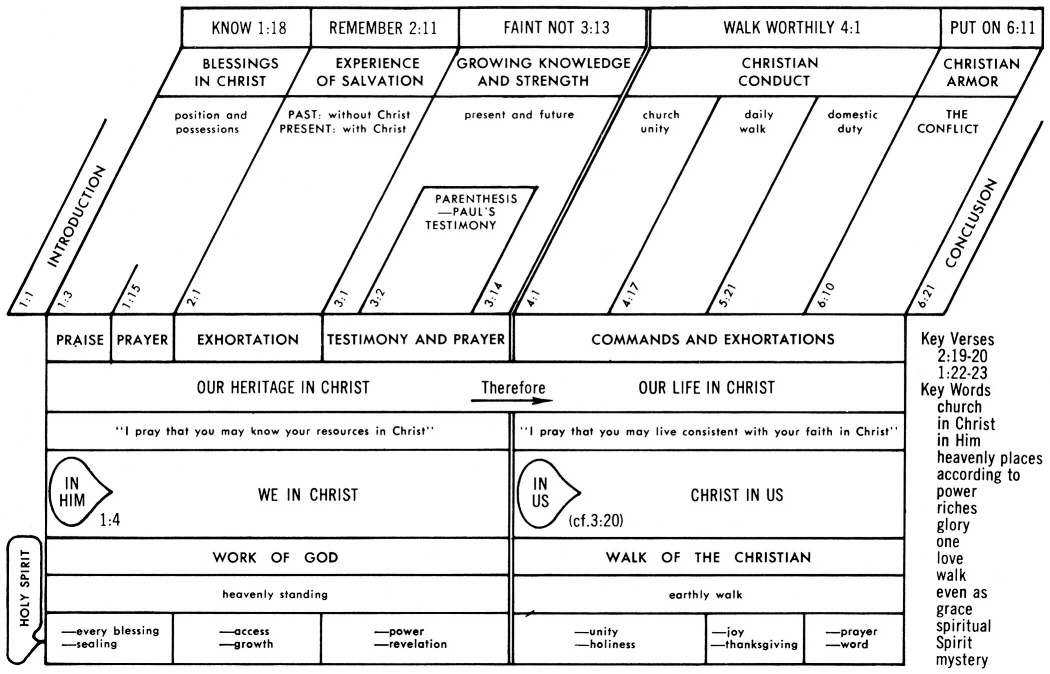
EPHESIANS - CHRIST AND THE CHURCH
Click chart to enlarge
Charts from Jensen's Survey of the NT - used by permission
Ephesians 2:6 and raised us up with Him, and seated us with Him in the heavenly places in Christ Jesus, (NASB: Lockman)
Greek: kai sunegeiren (3SAAI) kai sunekathisen (3SAAI) en tois epouraniois en Christo Iesou,
Amplified: And He raised us up together with Him and made us sit down together [giving us joint seating with Him] in the heavenly sphere [by virtue of our being] in Christ Jesus (the Messiah, the Anointed One) (Amplified Bible - Lockman)
NLT: For he raised us from the dead along with Christ, and we are seated with him in the heavenly realms--all because we are one with Christ Jesus. (NLT - Tyndale House)
Phillips: and has lifted us right out of the old life to take our place with him in Christ in the Heavens (Phillips: Touchstone)
Wuest: and raised us with Him and seated us with Him in the heavenly places in Christ Jesus, (Eerdmans Publishing - used by permission)
Young's Literal: and did raise us up together, and did seat us together in the heavenly places in Christ Jesus
AND RAISED US UP WITH HIM: kai sunegeiren (3SAAI):
- Ep 1:19,20; Romans 6:4,5; Colossians 1:18; 2:12,13; 3:1-3
- Ephesians 2 Resources - Multiple Sermons and Commentaries
- Ephesians 2:4-7 Salvation is Totally of God - Steven Cole
- Ephesians 2:8,9 Salvation by Grace through Faith Alone - Steven Cole
- Ephesians 2:1-10: Coming Alive in Christ - John MacArthur
- Ephesians 2:1-10: Coming Alive in Christ - Study Guide (see dropdown menu) - John MacArthur
- Ephesians 2:1-10 Exchanging Living Death for Dying Life - John MacArthur
Paul speaks here of our spiritual resurrection with Christ (our blessed hope is of a bodily resurrection which is yet future) (See related topic Order of Resurrection). In Colossians Paul repeats this truth at the beginning of his charge to walk in the light of the truth in the first two chapters…
If (since = fulfilled condition) then you have been raised up with Christ, keep seeking the things above, where Christ is, seated at the right hand of God. Set your mind on the things above, not on the things that are on earth. (Col 3:1, 2-See notes Colossians 3:1; 3:2)
Raised up with Him - Believers are in a solemn, binding, indissoluble covenant with Christ and so are eternally in union with Him and identified with Him. When He died, we died. When He was buried, we were buried. When he was raised up, we were raised up. When He was seated at the right hand of His Father, we were seated at the right hand of our Father in heaven. These great truths of the believer's identification with Christ are more thoroughly expounded by Paul in Romans 6, using the figure of baptism (not speaking of water but of identification)…
Or do you not know that all of us who have been baptized into Christ Jesus have been baptized into His death? 4 Therefore we have been buried with Him through baptism into death, in order that as Christ was raised from the dead through the glory of the Father, so we too might walk in newness of life. 5 For if we have become united with Him in the likeness of His death, certainly we shall be also in the likeness of His resurrection, 6 knowing this, that our old self was crucified with Him, that our body of sin might be done away with, that we should no longer be slaves to sin; 7 for he who has died is freed from sin. 8 Now if we have died with Christ, we believe that we shall also live with Him, 9 knowing that Christ, having been raised from the dead, is never to die again; death no longer is master over Him. 10 For the death that He died, He died to sin, onc0e for all; but the life that He lives, He lives to God. 11 Even so consider yourselves to be dead to sin, but alive to God in Christ Jesus. (See notes Romans 6:3; 6:4; 6:5; 6:6; 6:7; 6:8; 6:9; 6:10; 6:11) (See parallel discussion in Colossians 2:11-13)
Raised up with (4891) (sungeiro from sun/syn = with, speaking of an intimate relationship or intimate union + egeiro = raise) is more literally "raised up together", the pronoun "Him" being added to indicate it was with Jesus we were raised up. Obviously this is a spiritual resurrection that follows our crucifixion with Christ and our entombment with Christ. Christ's resurrection was physical while ours was a spiritual resurrection. On the basis of the believer's past spiritual resurrection, there is the guarantee of a future physical resurrection and transformation (glorification = future redemption = "the day of redemption" in Eph 4:30-note) when
we shall all be changed, in a moment, in the twinkling of an eye, at the last trumpet; for the trumpet will sound, and the dead will be raised imperishable, and we shall be changed. For this perishable (earthly body) must put on the imperishable, and this mortal must put on immortality. (1 Cor 15:51, 52, 53)
Sunegeiro means to be roused (from sleep but here used figuratively as a reference to death) in company with and figuratively as used by Paul means to revivify spiritually. Plutarch has a writing which uses sunegeiro in a secular sense meaning "waking up together".
Believers don't just receive life (Ep 2:5-note), but experience resurrection life in Christ (and it is something we should pray for to be fully realized - see verse 20 of Paul's great prayer in Eph 1:18-20-note! Practically this truth means that we now can walk in His resurrection power as discussed more below. The aorist tense indicates that this co-resurrection is a past completed event.
John Brown - Christ rose again, but our sins did not; they are buried forever in his grave.
It bears re-emphasizing that each of the verbs made alive with, raised with, seated with has the identical prepositional prefix "sun/syn" which means with in Greek but is significantly different than the other Greek word for with (meta) which conveys the of beside, whereas sun speaks of an intimate, indissoluble union. Let's illustrate using a well known event, the crucifixion. Two criminals were punished with Jesus and both were crucified with (metá) Him, i.e., in His company, but only one was spiritually crucified with (sún/syn) Christ, i.e., bound up or in union with Him while the other thief was not. The first thief entered paradise, while the second entered hell. And so we get a glimpse of the significance of Paul's three combination verbs used to explain our salvation. Clearly, he is driving home not only these basic truths of our salvation but also emphasizing with the use of sun- that this salvation is irrevocable. You cannot lose your salvation. The believer who has been made alive with Christ, raised with Christ and seated with Christ is eternally secure in Christ (see Eternal security)! Christ is our covenant partner and the "covenant Head" of the redeemed family. What Christ does, He does for us. What we do is done because we are in union with Him. We are eternally identified with Him. While unconfessed sin can disrupt our communion with Him, it cannot break the infinitely omnipotent bonds of our union with Him. We are one with Christ in time and eternity and nothing, absolutely nothing can negate or reverse that glorious truth beloved!
On the basis of our past resurrection with Christ, we have the sure "hope of our calling", of a future physical resurrection and transformation of our bodies into conformity with His glorious body. (See related topics The Two Resurrections - "First" and "Second" - on a timeline and Order of Resurrection)
J Vernon McGee - "Lord Lyndhurst was the Lord Chancellor of Great Britain and possessed a sharp legal mind. He made this statement: “I know pretty well what evidence is; and I tell you, such evidence as that for the Resurrection has never broken down yet.” The death and resurrection of Christ is an historical fact. When Christ died you and I died with Him; He took our place. And when He was raised, we were raised in Him, and we are now joined to a living Christ. It is so important for us to see that we are joined to a living Savior. (Ed note: italics mine) It is so important to keep in mind that no outward ceremony brings us to Christ. The issue is whether or not we are born again, whether we really know Christ as Savior. If we do know Him, we are identified with Him. Identification with Christ is “putting off the body of the sins of the flesh by the circumcision of Christ,” which is a spiritual circumcision. When you put your trust in the Lord Jesus Christ, the Holy Spirit baptizes you into the body of Christ. It is by this baptism that we are identified with Christ, and we are also “risen with him”—joined to the living Christ." (McGee, J V: Thru the Bible Commentary: Thomas Nelson)
In the epistle to the Colossians Paul explained to the saints the grand truth that they had
been buried with Him (Christ) in baptism (a spiritual baptism, an identification and union with His death), in which you were also raised up with (sunegeiro) Him through faith in the working of God, who raised Him from the dead. (Col 2:12- note)
Paul emphasizes this truth of our co-resurrection as he begins his exhortation to live a new style of life, a supernatural life enabled by resurrection power…
If then (since) you have been raised up with Christ, keep seeking the things above, where Christ is, seated at the right hand of God. Set your mind on the things above, not on the things that are on earth. (Col 3:1, 2-see note Col 3:1; 3:2)
MacDonald has some interesting thoughts:
"Baptism is burial, the burial of all that we were as children of Adam. In baptism we acknowledge that nothing in ourselves could ever please God, and so we are putting the flesh out of God’s sight forever. But it does not end with burial. Not only have we been crucified with Christ and buried with Him, but we have also risen with Him to walk in newness of life. All of this takes place at the time of conversion." (MacDonald, W & Farstad, A. Believer's Bible Commentary: Thomas Nelson)
Earlier Paul had explained to the saints that he was praying for them to experience the "surpassing greatness of His power" (Eph 1:19-note) and that this power was…
in accordance with the working of the strength of His might (i.e., that power was the same mighty power) which He (God the Father) brought about in Christ, when He raised Him from the dead, and seated Him at His right hand in the heavenly places.
It follows that we too were raised with "resurrection power" and in Romans 6 we now have the privilege to life our daily life enabled by that same inestimable resource, Paul asking…
Or do you not know that all of us who have been baptized (he is not speaking of water baptism but of a spiritual baptism, an identification with) into Christ Jesus have been baptized into His death? Therefore we have been buried with Him through baptism into death (this cannot refer to water baptism, but has to be a figurative usage, reflecting our spiritual emersion so to speak with Christ when He experienced the "baptism of death" on the Cross), in order that as Christ was raised from the dead through the glory of the Father, so we too might walk in newness of life. (Ro 6:3, 4-see notes Romans 6:3; 6:4)
THOUGHT - Let me ask you, beloved of the Father, would you say that your life is a living testimony to His resurrection power? Repeatedly in the New Testament, the writers emphasize that this is every believer's potential in Christ because of the fact that the Father has raised us up with Him (cf Ro 6:4, Gal 2:20, Col 3:1, Ro 8:11, Php 3:10)
Wuest explains that "we were not only placed in Christ by God the Holy Spirit in order that we might share His death and thus be separated from the evil nature, but we were placed in Him in order that we might share His resurrection and thus have divine life imparted to us. (2Pe 1:4-note)… The newness of life does not refer to a new quality of experience or conduct but to a new quality of life imparted to the individual. Romans 6 does not deal with the Christian’s experience or behavior. Paul treats that in Romans 12-16. In this chapter the key word is machinery, the "mechanics" of the Spirit-filled life being Paul’s subject. The newness of life therefore refers, not to a new kind of life the believer is to live, but to a new Source of ethical and spiritual energy imparted to him by God by which he is enabled to live the life to which Paul exhorts in Romans 12-16… we shared Christ’s resurrection in order that we may order our behavior in the power of a new life imparted. Here we have then the two-fold result of the major surgical operation God performs in the inner being of the sinner when he places his trust in the Saviour. He is disengaged from the evil nature, separated from it, no longer compelled to obey it. He has imparted to him the divine nature (2Pe 1:4-note) which becomes in him the new Source of ethical, moral, and spiritual life, which causes him to hate sin and love righteousness, and which gives him both the desire and the power to do God’s will. Paul, speaking of the same thing in (Php 2:12, 13-see notes Php 2:12; 2:13). The Christian’s will has been made absolutely free. Before salvation it was not free so far as choosing between good and evil is concerned. It was enslaved to the evil nature. But now, it stands poised between the evil nature and the divine nature, with the responsibility to reject the behests of the former and obey the exhortations of the latter. To constantly say no to the former and yes to the latter becomes a habit, and then the victorious life has been reached. (Ro 6:12, 13-notes) (Wuest Word Studies - Eerdman Publishing Company Volume 1, Volume 2, Volume 3 - used by permission)
AND SEATED US WITH HIM IN THE HEAVENLY PLACES IN CHRIST JESUS: kai sunekathisen (3SAAI) en tois epouraniois en Christo Iesou:
- Matthew 26:29; Luke 12:37; 22:29,30; John 12:26; 14:3; 17:21, 22, 23, 24, 25, 26; Revelation 3:20,21
- Eph 1:3
- Ephesians 2 Resources - Multiple Sermons and Commentaries
- Ephesians 2:4-7 Salvation is Totally of God - Steven Cole
- Ephesians 2:8,9 Salvation by Grace through Faith Alone - Steven Cole
- Ephesians 2:1-10: Coming Alive in Christ - John MacArthur
- Ephesians 2:1-10: Coming Alive in Christ - Study Guide (see dropdown menu) - John MacArthur
- Ephesians 2:1-10 Exchanging Living Death for Dying Life - John MacArthur
ANOTHER FACET
OF GOD'S MARVELOUS GRACE
Seated us with (4776) (sugkathizo from sun/syn = with speaking of an intimate union + kathízo = to set or sit down) means to cause to sit down with. Paul uses the aorist tense, which here speaks of a past completed action. Paul is so certain of this grand truth, that he records it as if it has already occurred! So certain is every word of God, every promise! Why are we so often, so prone to wonder, so little in our faith? And so with the eyes of faith we see that this seating with Christ has occurred, even if we from our finite human perspective cannot fully comprehend its practical import. Will it is humanly inexplicable, our union with Him in covenant, this mystical union helps give us a sense of how we are seated with Him. Just as we were crucified and resurrected, so too in the immutable bond of covenant, we are just as truly seated with Him (see more on this below). And this should elicit a heart-felt "Hallelujah!"
Three great uses of the prefix sun/syn = we are… made alive, raised, seated - all with Christ.
How incredible the contrast with the only other NT use of sugkathizo in the context of Peter sitting among those who sat down together just prior to denying His Lord…
And after they (those who had seized Christ) had kindled a fire in the middle of the courtyard and had sat down together (sugkathizo - remembering how "sun-" speaks of intimacy, these men were all of one mind, determined to kill Christ), Peter was sitting among them. (Luke 22:55-note)
Earlier Paul had mention the heavenly places…
(speaking of the "surpassing greatness of His power" and the "strength of His might") which He brought about in Christ, when He raised Him from the dead, and seated Him at His right hand in the heavenly places, (Eph 1:20-note)
We don't sit in the heavenly places with Christ Jesus (yet) but we do sit in the heavenly places in Christ Jesus. Since our life and identity is in Christ, as He sits in the heavenly places, so do we. And even though we are not yet in possession of all the inheritance that God has for us in Christ, to be in the heavenly places is to be in God’s domain instead of Satan’s ("For He delivered us from the domain of darkness, and transferred us to the kingdom of His beloved Son" Col 1:13 [note] and we were turned "from darkness to light and from the dominion of Satan to God" Acts 26:18). Now, we are in the sphere of spiritual life instead of the sphere of spiritual death. "In the heavenly places" is where our blessings are (Ep 1:3-note) and where we have fellowship with the Father, the Son, the Holy Spirit, and with all the saints who have gone before us and will come after us. "In the heavenly places" is where all our commands come from and where all our praise and petitions go.
The practical import of our new position as recipients of grace is that our "heavenly status" gives us "heavenly power" to overcome the power of sin and death (Daily! Daily we are being saved by the Gospel!) Our unbreakable union with Christ affords us eternal access to the heavenly places and His heavenly power (every spiritual blessing in the heavenly place in Christ - Eph 1:3-note) to live as more than conquerors through Him Who loved us and continues to love us, even when we are not very "lovable!" Seated with Christ is our present positional reality, even though it is not yet fully realized eschatology. This now-then (present-future) tension is similar to other NT doctrines, such as our adoption as sons (Ro 8:15-note), but our eager awaiting for the fulfillment of our adoption coinciding with the redemption of our bodies (Ro 8:23-note).
Sugkathizo is used 4x in the non-apocryphal Septuagint (Lxx) - First use of sugkathizo in context of grace = Ge 15:11 ("Abram sat down by" the carcasses when God cut the covenant with him), Second use of sugkathizo in context of Law! = Ex 18:13 ("Moses sat to judge the people"); Nu 22:27 describes what happened when the donkey saw the Angel of the LORD - "she lay down under Balaam"); Jer 16:8 - where the prophet was instructed not to sit down and feast with those who mourn over deaths in Judah.
Let us not miss the wonder and awe of a chapter that began with us dead in our sins, but now alive in the heavenlies with Christ! Is this not truly Amazing Grace!
Warren Wiersbe gives an illustration writing…
While attending a convention in Washington, D.C., I watched a Senate committee hearing over television. I believe they were considering a new ambassador to the United Nations. The late Senator Hubert Humphrey was making a comment as I turned on the television set:
“You must remember that in politics, how you stand depends on where you sit.”
He was referring, of course, to the political party seating arrangement in the Senate, but I immediately applied it to my position in Christ. How I stand—and walk—depends on where I sit; and I am seated with Christ in the heavenlies!
The Queen of England exercises certain powers and privileges because she sits on the throne. The President of the United States has privileges and powers because he sits behind the desk in the oval office of the White House. The believer is seated on the throne with Christ. We must constantly keep our affection and our attention fixed on the things of heaven, through the Word and prayer, as well as through worship and service. We can enjoy “days of heaven upon the earth” (Deut. 11:21) if we will keep our hearts and minds in the heavenlies. (Wiersbe, W: Bible Exposition Commentary. 1989. Victor)
Heavenly places (2032) (epouranios from epí = upon, in sense of pertaining to above + ouranos = heaven) encompasses the entire supernatural realm of God, His complete domain (it is the supernatural sphere where God rules) and the full extent of His divine operation. The true citizenship of every saint is not this present earth (which is passing away) but is heaven, Paul explaining to the saints at Philippi that…
our citizenship is in heaven, from which also we eagerly wait (Are you eagerly waiting for Him?) for a Savior, the Lord Jesus Christ who will transform the body of our humble state into conformity with the body of His glory, by the exertion of the power that He has even to subject all things to Himself. (Php 3:20, 21-note)
Because our new citizenship through Christ is in heaven, God seats us with Him in the heavenly places, in Christ Jesus. We are no longer of this present world or in its sphere of sinfulness and rebellion. We have been rescued from spiritual death and given spiritual life in order to be in Christ Jesus in the heavenly places.
Spurgeon once said…
Little faith will bring your soul to heaven; great faith will bring heaven to your soul.
In Christ Jesus - all of the glorious truths are predicated on this powerful phrase "in Christ Jesus". Marvin Vincent agrees writing that "in Christ Jesus" is to be connected with…
raised up, made us sit, and in heavenly places. Resurrection, enthronement, heaven, all are in Christ.
John Piper has some interesting thoughts on what "seated with Him in heavenly places" means writing…
Now what does that mean? We are all right here in this room, aren't we. Or are we? What did Tony Bennet mean twenty years ago when he sang, "I left my heart in San Francisco"? Well, he meant that San Francisco still holds his affections. San Francisco is always pulling him back. San Francisco governs his tastes. He may look like he is in Chicago. But Chicago has no claim on his affections. It's a foreign land. He is not interested in being like the natives of the windy city. That is the way it is with us when we are converted. God takes our heart and puts it in heaven with Christ. Colossians 3:3 says, "For you have died, and your life is hid with Christ in God." So just like it is with Tony Bennet and San Francisco, so it is with us and heaven. It's heaven that holds our affections. It's heaven that's always pulling us upwards, its heaven that governs our tastes. We may look like we are in the world. But the world has no claim on our affections. It's a foreign land. We are exiles and aliens.
In a word, when we are converted God frees us from the spirit of the age and the god of the age. It's as though we had been kidnapped and brainwashed and made to think we were really citizens of the enemy territory. And then the king's intelligence finds you and shocks you out of your stupor, and you suddenly realize that what the enemy has to offer would never satisfy the deepest longings of your heart. Your heart is in the homeland. But the king says stay for now, and, though it may be dangerous, live like an alien in love with the homeland, and when you come home bring as many with you as you can. Don't you really want to be FREE from the spirit of the age. Why would anybody want to be jelly fish carried around by currents in the sea of secularism? You can be a dolphin, and swim against the currents and against the tide. Jelly fish aren't free. Dolphins are free. (Full sermon Ephesians 2:4 But God… )
F B Meyer once said…
THE PSALM OF ASCENSION - "But God, being rich in mercy, for His great love wherewith He loved us, even when we were dead through our trespasses, quickened us together with Christ, and raised us up with Him, and made us to sit with Him in the heavenly places, in Christ Jesus."-- Eph 2:4-6.
THIS 24th Psalm is apparently in two parts, and yet there is one theme, the ascent of the holy soul and the triumphant Saviour into the presence of God. For us, the ascension of our Lord precedes our own; but in the days of the Psalmist that order was reversed.
Our Lord's Ascension. In an outburst of poetry, kindled by the Divine Spirit, the Psalmist anticipates the coming of the King of Glory to the doors of the Eternal City--that ideal City which through the ages has beckoned forward the hearts of saints and patriots, and which in Rev. 21. is seen descending to our earth. It was as though the doors of the Unseen barred His entrance. They had opened to God, but never before to "God manifest in the flesh." It was a new thing that He should take our nature with Him into the unseen and eternal world.
The soul's ascension (Ps 24:3, 4, 5, 6). In Christ we have ascended and are seated at God's right hand. No change in your emotions, not even the being overtaken by a fault can alter that. But we have to make our calling sure. What is ours in the divine purpose must be claimed and appropriated as a living daily experience. There are certain qualities of character which are requisite to those who should be accounted worthy to stand before the Son of Man, not hereafter only, but now and here and always (Lk 21:36).
We must have clean hands. The money that we earn must be clean money. If we are writers, artists, mechanics, professional or commercial men or women, we must never produce anything which would defile the imagination or heart. We must have a pure heart. In Isa 33:14, 15, 16, 17, which is a parallel passage, the Holy Spirit is compared to a devouring fire, in the presence of which no evil thing can five. Let us ask Him so to possess us, and to cleanse the thoughts of our hearts by His inspiration. We must not lift up our soul to vanity, i.e., we must not allow ourselves to be inflated with the applause or rewards of the world. Many sell their souls for these, and only at the end of life awaken to discover how worthless they are. We must not swear deceitfully, i.e., we must be absolutely transparent and sincere, for only the true can stand in the presence of the King of Truth.
PRAYER - May we live as those who have been raised with Christ, and who are seated with Him. AMEN. (Meyer, F B. Our Daily Walk)
And hath raised us up together A. B. Simpson
Ascension is more than resurrection. Much is said of it in the New Testament. Christ rises above all things. We see Him in the very act of ascending, as we do not in the actual resurrection. With hands and lips engaged in blessing, He gently parts from His disciples. So simply, so unostentatiously, He has brought heaven near to our common life. We, too, must ascend, even here. If ye then be risen with Christ, seek those things which are above (Colossians 3:1). We must learn to live on the heavenly side and look at things from above. To contemplate all things as God sees them, as Christ beholds them, overcomes sin, defies Satan, dissolves perplexities, lifts us above trials, separates us from the world and conquers fear of death. Such a perspective enables us to view them as we shall one day look back upon them from His glory, and as if we were now really seated with Him, as indeed we are, in heavenly places (Ephesians 2:6). Let us arise with His resurrection and, in fellowship with His glorious ascension, learn to live above.
A devotional from Our Daily Bread -entitled "Heavenly People"
If then you were raised with Christ, seek those things which are above (Colossians 3:1).
Christians are a "heavenly" people. That's what Paul meant when he told the Ephesians that God has "raised us up together, and made us sit together in the heavenly places in Christ Jesus" (Eph 2:6). We live on earth, but "our citizenship is in heaven" (Php 3:20-note). We should therefore "seek those things which are above," and store up treasures in heaven.
We see a graphic difference between an earthly minded person and a heavenly minded person when we look at two Middle Eastern tombs. The first is the burial place of King Tut in Egypt. Inside, precious metal and blue porcelain cover the walls. The mummy of the king is en-closed in a beautifully inscribed, gold-covered sarcophagus. Although King Tut apparently believed in an afterlife, he thought of it in terms of this world's possessions, which he wanted to take with him.
The other tomb, in Palestine, is a simple rock-hewn cave believed by many to be Jesus' burial site. Inside, there is no gold, no earthly treasure, and no body. Jesus had no reason to store up this world's treasures. His goal was to fulfill all righteousness by doing His Father's will. His was a spiritual kingdom of truth and love.
The treasures we store up on earth will all stay behind when this life ends. But the treasures we store up in heaven we'll have for eternity. When we seek to be Christlike in thought, word, and deed, we will live like "heavenly" people. —P R Van Gorder. (Our Daily Bread, Copyright RBC Ministries, Grand Rapids, MI. Reprinted by permission. All rights reserved)
Wise are those who gear their goals to heavenly gains.
A devotional from Our Daily Bread -
As Charles Simeon (Click John Piper's deeply convicting overview of Simeon's life and work), the great nineteenth century English preacher, lay mortally ill in his Cambridge home, he realized that his time on earth was fast slipping away. He turned to those at his bedside and asked, "Do you know what comforts me just now? I find infinite consolation in the fact that in the beginning God created the heaven and the earth." His friends asked how that thought could give solace as he faced death. He answered with the confidence of one about to meet the Lord, "Why, if God can bring all the wonder of the worlds out of nothing, He may still make something out of me!"
To think of the glory that awaits God's children—to have a spirit perfectly pure and a resurrected body that will enable us to enjoy eternity to its fullest—staggers the imagination. The great changes we will experience in glory are beyond our understanding.
Even now God's transforming power is at work in us. At conversion we became children of God and were made "alive together with Christ" (Ep 2:5-note). But that is not all. Paul said that in the future God will "show the exceeding riches of His grace in His kindness toward us in Christ Jesus" (Ephesians 2:7). No wonder the apostle John exclaimed with astonishment, "It has not yet been revealed what we shall be."
Glorious prospects await those who have trusted Christ for salvation. God is not done with us yet. The best is yet to be. —P R Van Gorder (Ibid)
While you prepare a place for us, Lord,
prepare us for that place.
Ephesians 2:7 so that in the ages to come He might show the surpassing riches of His grace in kindness toward us in Christ Jesus. (NASB: Lockman)
Greek: hina endeixetai (3SAMS) en tois aiosin tois eperchomenois (PMPMPD) to huperballon (PAPNSA) ploutos tes charitos autou en chrestoteti eph' hemas en Christo Iesou.
Amplified: He did this that He might clearly demonstrate through the ages to come the immeasurable (limitless, surpassing) riches of His free grace (His unmerited favor) in [His] kindness and goodness of heart toward us in Christ Jesus. (Amplified Bible - Lockman)
NLT: And so God can always point to us as examples of the incredible wealth of his favor and kindness toward us, as shown in all he has done for us through Christ Jesus. (NLT - Tyndale House)
Phillips: Thus he shows for all time the tremendous generosity of the grace and kindness he has expressed towards us in Christ Jesus. (Phillips: Touchstone)
Wuest: in order that He might exhibit for His own glory in the ages that will pile themselves one upon another in continuous succession, the surpassing wealth of His grace in kindness to us in Christ Jesus. (Eerdmans Publishing - used by permission)
Young's Literal: that He might show, in the ages that are coming, the exceeding riches of His grace in kindness toward us in Christ Jesus
SO THAT IN THE AGES TO COME: hina endeixetai (3SAMS) en tois aiosin tois eperchomenois (PMPMPD):
- Ep 3:5,21; Psalms 41:13; 106:48; Isaiah 60:15; 1Timothy 1:17
- Ephesians 2 Resources - Multiple Sermons and Commentaries
- Ephesians 2:4-7 Salvation is Totally of God - Steven Cole
- Ephesians 2:8,9 Salvation by Grace through Faith Alone - Steven Cole
- Ephesians 2:1-10: Coming Alive in Christ - John MacArthur
- Ephesians 2:1-10: Coming Alive in Christ - Study Guide (see dropdown menu) - John MacArthur
- Ephesians 2:1-10 Exchanging Living Death for Dying Life - John MacArthur
Wuest: in order that He might exhibit for His own glory in the ages that will pile themselves one upon another in continuous succession, the surpassing wealth of His grace in kindness to us in Christ Jesus. (Eerdmans Publishing - used by permission)
So that (in order that) (2443) (hina) expresses purpose of something (marking the end), the cause for or on account of which anything is done ("toward that end"). "It may also be used simply to indicate a happening, event or result of anything, or that in which the action terminates." (Zodhiates) Here it introduces a purpose clause (Always pause to ponder this term of conclusion) explaining why believers have been made alive, raised and seated with Christ. The reason God accomplished these three aspects of our salvation, is that He might demonstrate His grace in the coming ages.
ETERNAL LIFE DEPENDS ON ETERNAL GRACE!
Ages (165) (aion [word study]) in this context refers to a period of time and thus denotes duration or continuance of time. Aion can refer to an indefinitely long period or lapse of time (perpetuity, forever, eternity) or as in this verse to an "age" of time and space in which people now live and have lived since the world was drastically changed by the Flood in the days of Noah.
What are the ages to come? The first age in which we will see some of these "surpassing riches" is the present age in which we live. The next age is the Messianic age (cf Heb 6:5 "powers of the age to come"). Then Christ will deliver up the kingdom to His Father (1Cor 15:24) which would begin another "age" with a New Heaven and a New Earth (Rev 21:1ff). Could there be still other "ages"? Let us not speculate but set our mind on the things above, seeking first His Kingdom and His righteousness (Col 3:1-2-see notes Colossians 3:1; 3:2, Mt 6:33-note) knowing with confidence what Paul writes to the saints at Corinth…
For now we see in a mirror dimly, but then face to face; now I know in part, but then I shall know fully just as I also have been fully known. But now abide faith, hope, love, these three; but the greatest of these is love. (1Cor 13:12-13).
To come (1904) (eperchomai from epí = upon, to + érchomai = come) literally means to go or come upon or over a person or place. Literally this verb describes the indescribable wonder of "the ages that are coming one upon another". The present tense pictures these ages as already (continually) approaching.
THOUGHT - Dear set apart saved sinner are you living with this "other age, world to come" mindset in this present evil age which is passing away even along with its wicked lusts?
HE MIGHT SHOW THE SURPASSING RICHES OF HIS GRACE: to huperballon (PAPNSA) ploutos tes charitos autou:
- Eph 2:4; 2Thessalonians 1:12; 1Timothy 1:16; 1Peter 1:12; Revelation 5:9, 10, 11, 12, 13, 14
- Ephesians 2 Resources - Multiple Sermons and Commentaries
- Ephesians 2:4-7 Salvation is Totally of God - Steven Cole
- Ephesians 2:8,9 Salvation by Grace through Faith Alone - Steven Cole
- Ephesians 2:1-10: Coming Alive in Christ - John MacArthur
- Ephesians 2:1-10: Coming Alive in Christ - Study Guide (see dropdown menu) - John MacArthur
- Ephesians 2:1-10 Exchanging Living Death for Dying Life - John MacArthur
He might show (1731) (endeíknumi [word study] from en = in, to, this prefix suggesting "complete demonstration" + deíknumi = show) means to show forth, to display, to cause to be made known, to point out. The idea is that of giving outward proof (Heb 6:10) or as "perpetrating something openly against someone" (used once this way - 2Ti 4:14). This is a verb of striking contrast for in Ro 9:22 we it speaks of the demonstration of God's wrath and here in Eph 2:7 it is a demonstration of God's grace! Hallelujah!
In the Greek papyri endeiknumi could have a quasi-legal sense of proving a petition or charge or of proving that a charge was wrong. Josephus used the word to describe Herod Agrippa's display of generosity to those of other nations (Josephus Antiquities, 19:30)
Paul uses the middle voice which is significant as it indicates that the subject of the verb acts in his own interest. God is the subject and He will exhibit His kindness to the saints for His own glory, in order that He may be glorified. The middle voice signifies that God demonstrates for Himself to His cosmic audience the wonders of His gracious generosity. Spectators will be the angels and saints will be the objects of this ineffably sublime kindness and will be on eternal display, basking in the sunshine of God’s smile, enjoying the riches of His blessings, all, in order that He might be glorified by the angelic hosts and indeed by all heaven. As we ponder these truly transcendent truths, may the Spirit of the Living God prompt us to pause and proclaim with all our heart that All Heavens Declares.
Endeíknumi - 11x in 11v - Usage: demonstrate(4), did(1), show(4), showing(2), shown(1).
Romans 2:15-note in that they show the work of the Law written in their hearts, their conscience bearing witness and their thoughts alternately accusing or else defending them,
Romans 9:17-note For the Scripture says to Pharaoh, "FOR THIS VERY PURPOSE I RAISED YOU UP, TO DEMONSTRATE MY POWER IN YOU, AND THAT MY NAME MIGHT BE PROCLAIMED THROUGHOUT THE WHOLE EARTH."
THOUGHT: As practical application, God still uses weak vessels to display His mighty power. May He strengthen each us so that we might fully accomplish this high and holy purpose during our short stay on terra firma! Amen Let us wisely redeem the time!
Romans 9:22-note What if God, although willing to demonstrate His wrath and to make His power known, endured with much patience vessels of wrath prepared for destruction?
2 Corinthians 8:24 Therefore openly before the churches, show them the proof of your love and of our reason for boasting about you.
Ephesians 2:7 so that in the ages to come He might show the surpassing riches of His grace in kindness toward us in Christ Jesus.
1 Timothy 1:16 Yet for this reason I found mercy, so that in me as the foremost, Jesus Christ might demonstrate His perfect patience as an example for those who would believe in Him for eternal life.
2 Timothy 4:14-note Alexander the coppersmith did me much harm ("showed me much evil"); the Lord will repay him according to his deeds.
Titus 2:10-note not pilfering, but showing all good faith so that they will adorn the doctrine of God our Savior in every respect.
Titus 3:2-note to malign no one, to be peaceable, gentle, showing every consideration for all men.
Hebrews 6:10-note For God is not unjust so as to forget your work and the love which you have shown toward His name, in having ministered and in still ministering to the saints. 11 And we desire that each one of you show the same diligence so as to realize the full assurance of hope until the end,
Endeíknumi - 7x in non-apocryphal Septuagint (Lxx) - Gen 50:15, 17; Ex 9:16; Josh 7:15, 16, 17;
The Life Application Bible Commentary - There is an expression: “When you see a turtle on a fence post, you know he didn’t get there by himself.” It’s obvious that someone had to put the turtle up there. In a very real sense, Christians are turtles sitting atop fence posts, put there by the grace of God. It’s as if someone asked God, “How can I be sure you’re as loving and gracious as you say you are?” His response is simply to display the church—flawed, sinful, capable of stupidity and faithlessness—as Exhibit A, demonstrating his infinite patience and mercy. How else would a group of such obviously fallen men and women get together and do anything for the glory of God? Who else but God would use people like us? You are a display case for the grace of God. Demonstrate his great kindness to you by sharing it with others. Use his patience with you to witness to others. (Barton, B, et al: The NIV Life Application Commentary Series: Tyndale)
William MacDonald explains that the "miracle of transforming grace will be the subject of eternal revelation. Throughout the endless ages God will be unveiling to the heavenly throng what it cost Him to send His Son to this jungle of sin, and what it cost the Lord Jesus to bear our sins at the cross." (Believer's Bible Commentary)
The KJV Bible Commentary agrees writing that "God delights to show great grace to great sinners. God will display the trophies of His grace throughout the endless ages of eternity. Saints will be concrete demonstrations of the overflowing wealth of His grace." (Dobson, E G, Charles Feinberg, E Hindson, Woodrow Kroll, H L. Wilmington: KJV Bible Commentary)
Surpassing (5235) (huperballo from hupér = above + bállo = cast, put) literally means to throw beyond the usual mark and was used in this way in secular Greek in a description of a spear throwing contest. All the NT uses are by Paul, and all are figurative uses expressing a degree which exceeds extraordinary. It means to attain a degree that extraordinarily exceeds a point on a scale of extent. To be surpassing, extraordinary, outstanding, exceeding, highly eminent.
Huperballo - 5x in 5v - Usage: surpasses(2), surpassing(3).
2 Corinthians 3:10 For indeed what had glory, in this case has no glory because of the glory that surpasses it.
2 Corinthians 9:14 while they also, by prayer on your behalf, yearn for you because of the surpassing grace of God in you.
Ephesians 1:19 and what is the surpassing greatness of His power toward us who believe. These are in accordance with the working of the strength of His might
Ephesians 2:7 so that in the ages to come He might show the surpassing riches of His grace in kindness toward us in Christ Jesus.
Ephesians 3:19 and to know the love of Christ which surpasses knowledge, that you may be filled up to all the fullness of God.
Huperballo is used 6x in the apocrypha and none in the Non-apocryphal Septuagint - 2 Macc 4:13, 24; 7:42; 3 Macc 2:23; Sir 5:7; 25:11;
In a word, God's riches are immeasurable, extraordinary, outstanding! We need to recall this great truth to our minds (and turn it into a praise in prayer) when we are tempted to think otherwise and be pulled down into the miry clay of this present world ruled by the Evil One. The Fortune 500 list of the World's Wealthiest, pales in comparison to the inestimable, inexhaustible wealth of our very own dear Heavenly Father!
Riches (4149) (ploutos from pletho = fill) defines a plentiful supply, a wealth, an abundance, plentitude.
ILLUSTRATION - A Roman matron was once asked, “Where are your jewels?” She responded by calling her two sons and, pointing to them, said, “These are my jewels.” So it is with Christ and his Church. He is going to show the all-surpassing riches of his grace to his children in the what F F Bruce referred to as the “limitless future, as age succeeds age."
F B Meyer writes that WE ARE MONUMENTS OF GOD'S WEALTH (Ephesians 2:4-8)
That He could love us when we were dead like Lazarus, in trespasses and sins; that He has linked us in the bonds of indissoluble union with his Son; that He had made it possible for us to share his Resurrection, his Triumph, and his Throne; that we, the poor children of earth and sin, should be admitted into the inner circle of Deity--this will be, to all eternity, the mightiest proof of the exceeding riches of his grace.
The word "exceeding" might be rendered "beyond throwing distance." Fling your thoughts forward as far as you can, and there will always be an immense beyond; throw them as high as you may, till they out soar the stars, and there will always be an above; let them sink for ever, and there will always be a beneath--in the exceeding riches of God's grace.
"The heavens declare the glory of God, and the firmament showeth his handiwork"; but the glory of the position and character of the saints, contrasted with the degradation from which they were raised, will be accounted in coming ages a more extraordinary exemplification of the riches of Divine grace than the splendour of the heavens is of the wealth of his skill. (The Father's Wealth)
Grace (5485) (charis) is God’s generous favor to undeserving sinners and needy saints. In this verse Paul indicates that God's exceedingly abundant grace will be put on display throughout eternity for all the saints to revel in and give God glory. This is amazing, eternal grace. How will God's grace be demonstrated throughout eternity? One of the most obvious ways is that every believer will be an eternal display of the grace of the Father.
S Lewis Johnson writes "I think one of the most wonderful things about heaven is going to be revelation and the manifestation of the wonderful ways in which God has shown grace to the saints of God. All of the countless myriads of saints, for there shall be many. (Ephesians 2:1-10 His Power and Our Salvation)
IN KINDNESS TOWARD US IN CHRIST JESUS: en chrestoteti eph' hemas en Christo Iesou:
- Titus 3:4
- Ephesians 2 Resources - Multiple Sermons and Commentaries
- Ephesians 2:4-7 Salvation is Totally of God - Steven Cole
- Ephesians 2:8,9 Salvation by Grace through Faith Alone - Steven Cole
- Ephesians 2:1-10: Coming Alive in Christ - John MacArthur
- Ephesians 2:1-10: Coming Alive in Christ - Study Guide (see dropdown menu) - John MacArthur
- Ephesians 2:1-10 Exchanging Living Death for Dying Life - John MacArthur
Spurgeon - See how Paul's language grows and swells and rises as he proceeds! Just now, we read of "God, who is rich in mercy"; now the apostle speaks of "the exceeding riches of his grace", exceeding expression, exceeding comprehension, exceeding even sin itself, though that is all but infinite. "The exceeding riches of his grace" are infinity itself; but they all come to us "through Christ Jesus." Paul will speak of nothing good except that which comes "through Christ Jesus." This is the one conduit-pipe through which the streams of living water flow to the dead in sin; God's grace comes to us "Through Christ Jesus", and through him alone. (Exposition)
In kindness - The preposition "in" (en) denotes the sphere of God's action, conveying the idea that God will demonstrate the wealth of His amazing grace "in the sphere of that which is His goodness or kindness appropriate to God. It describes the entire work of salvation." (Hoehner)
Kindness (5544) (chrestotes from adjective chrestos = useful, profitable in turn from chraomai = to furnish what is needed in turn from chráo = lend, furnish as a loan) is a gracious attitude, and thus describes the quality of being helpful and beneficial, furnishing that which is needed. Chrestotes is benevolence in action which is what we first experienced at salvation and will experience throughout eternity. Kindness in short is God's beneficial provision that meets the need of sinful man in this life and that to come.
Chrestotes is a critical divine component of our salvation as Paul explained to Titus writing that just like the saints at Ephesus who were dead in their trespasses and sins …
we also once were foolish ourselves, disobedient, deceived, enslaved to various lusts and pleasures, spending our life in malice and envy, hateful, hating one another. But when the kindness of God our Savior and His love for mankind appeared, He saved us, not on the basis of deeds which we have done in righteousness, but according to His mercy, by the washing of regeneration and renewing by the Holy Spirit, whom He poured out upon us richly through Jesus Christ our Savior, that being justified by His grace we might be made heirs according to the hope of eternal life. (See notes Titus 3:3; 3:4; 3:5; 3:6)
Trench describes chrestotes as a "beautiful word, as it is the expression of a beautiful grace… one pervading and penetrating the whole nature, mellowing there all which would have been harsh and austere (Ed note: this latter applicable only to men but not to God for He is never harsh or austere)… a goodness which has no edge, no sharpness in it… " (Trench, R. C. Synonyms of the New Testament. Hendrickson Publishers. 2000)
Although Alexander Maclaren's quote on kindness is not directly applicable to the present context, it is so thought provoking I am compelled to repeat it…
Kindness makes a person attractive. If you would win the world, melt it, do not hammer it.
Toward (1909) (epi) signifies direction and here it means upon as to rest upon. What a wonderful weight to have "upon" us for all eternity, the kindness of God!
In Christ Jesus - The sphere of all God's kindness toward us -- it is located in Christ Jesus. We experience God's kindness not because of our own sin-tainted efforts but because we are in the Beloved!
Paul explains that one purpose of our being exalted to the supernatural sphere is that we may forever be blessed but not just for our benefit for God’s greater purpose in salvation is for His own sake. God will display for all eternity the surpassing riches of His grace (cf. Eph 3:10). The amazing truth is that through God's endless kindness toward us in Christ Jesus, the Father glorifies Himself even as He blesses us. From the moment of salvation throughout the ages to come we never stop receiving the grace and kindness of God.
John Piper writes that in this incredible verse…
Paul piles up words to to make a deep and lasting impression on our hearts. God's settled purpose is to be gracious to those who are in Christ Jesus. And lest we miss the sweetness and gentleness and gladness of the word "grace" he adds the words, "in kindness toward us." Now ask yourself this question: If there were one person in all the universe the benefits of whose kindness you could choose, who would it be? Would it not be God? You might be able to think of a thousand things that would be kindness to you. But then your imagination would run out. But God's imagination will never run out.
And to make this clear Paul uses the word "riches." God's purpose is to spend the "riches of his grace in kindness on us." And then to assist our faltering imagination he adds the word "immeasurable" or "surpassing" or "incomparable." How rich is God? I read in the paper recently that Queen Elizabeth is worth about four billion dollars. Now if you got a letter in the mail from Queen Elizabeth which said that she had taken an oath by the blood of her son to spend her riches to show you as much kindness as she could for the rest of your life, wouldn't you get excited. And her wealth compares to God's like a grain of sand to the Sahara Desert.
But that's not all. She could only show you kindness for a few years -- ten, thirty, sixty maybe. But look what Paul says God intends to do for you? "That in the coming ages he might show the immeasurable riches of his grace in kindness to us in Christ Jesus." How long is and age? And how many ages are coming? Well, the answer is simple: all of them that lie in the future are coming. So it doesn't matter how long one of them is.
Do you know why Paul had to say it this way? Because that's how long it will take God to run out of fresh ideas about how to show you kindness. When eternity ends, God will have run out of ways to show you kindness. Now tell me, when does eternity end? (See full sermon Ephesians 2:4 But God… )
Illustration - All Eternity - In January 1983, a three-nation infrared astronomy satellite soared into a 560-mile orbit above the earth and pointed its tracking antennae toward deep space. Almost at once, an avalanche of information poured into the computers at an English ground station. More than two hundred thousand new objects were soon spotted in the heavens, including twenty thousand galaxies in interstellar space. Astronomers couldn’t believe their good fortune. Having convinced themselves of the universe’s emptiness, the new treasures stunned them. Christians are delighted, but not surprised. The God of Scripture created more in this world than can ever be investigated, studied, or understood. As a dim reflection of God’s incomparably resplendent grandeur we expect what the satellite revealed. Yet, all we have experienced here, or ever shall, reads like an empty page compared to the fullness of life to come in his presence. (Hurley, V. Speaker's Sourcebook of New Illustrations Dallas: Word Publishers)