Ephesians 3:2
Ephesians 3:3
Ephesians 3:4
Ephesians 3:5
Ephesians 3:6
Ephesians 3:7
Ephesians 3:8
Ephesians 3:9
Ephesians 3:10
Ephesians 3:11
Ephesians 3:12
Ephesians 3:13
Ephesians 3:14
Ephesians 3:15
Ephesians 3:16
Ephesians 3:17
Ephesians 3:18
Ephesians 3:19
Ephesians 3:20
Ephesians 3:21
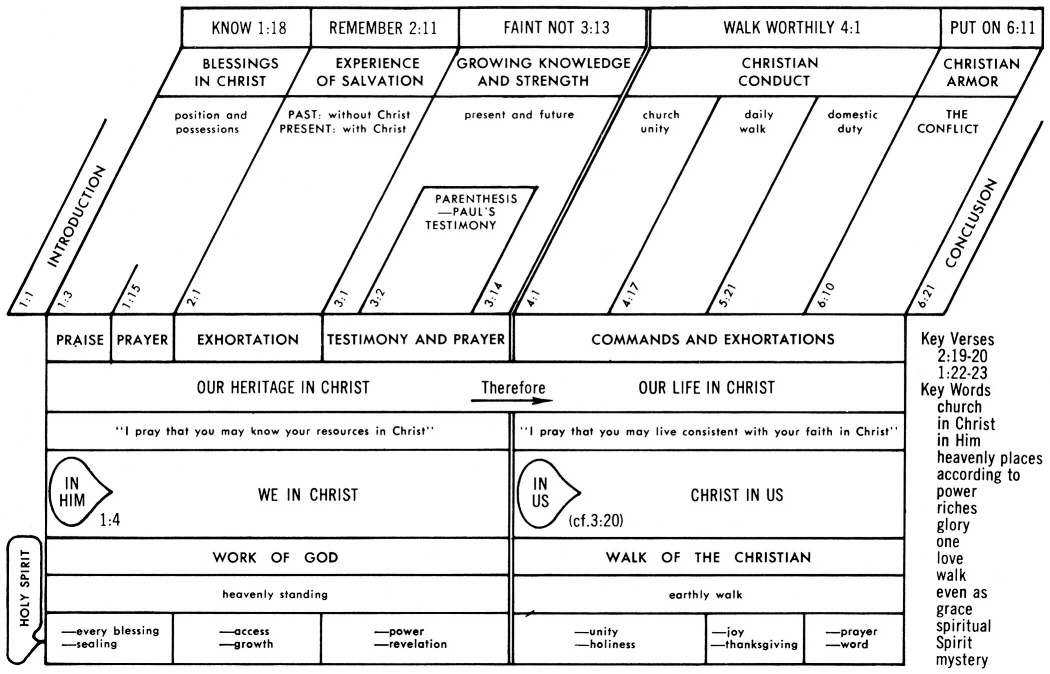
EPHESIANS - CHRIST AND THE CHURCH
Click chart to enlarge
Charts from Jensen's Survey of the NT - used by permission
Ephesians 3:4 By referring to this, when you read you can understand my insight into the mystery of Christ (NASB: Lockman)
Greek: pros o dunasthe (2PPPI) anaginoskontes (PAPMPN) noesai (AAN) ten sunesin mou en to musterio tou Christou,
Amplified: When you read this you can understand my insight into the mystery of Christ. (Amplified Bible - Lockman)
Barclay: and you can read again what I have just written, if you wish to know what I understand of the meaning of that secret which Christ brought (Westminster Press)
ESV When you read this, you can perceive my insight into the mystery of Christ,
Hoehner - “whereby when reading it you are able to perceive my insight into the mystery of Christ,”
NET: When reading this, you will be able to understand my insight into this secret of Christ. (NET Bible)
NIV In reading this, then, you will be able to understand my insight into the mystery of Christ,
NLT: As you read what I have written, you will understand what I know about this plan regarding Christ. (NLT - Tyndale House)
NLT (Revised) As you read what I have written, you will understand my insight into this plan regarding Christ.
Phillips: (What I have written briefly of this above will explain to you my knowledge of the mystery of Christ.) (Phillips: Touchstone)
Wuest: in accordance with which you are able when you read to understand my insight into the mystery of the Christ (Eerdmans Publishing - used by permission)
Young's Literal: in regard to which ye are able, reading it, to understand my knowledge in the secret of the Christ,
BY REFERRING TO THIS WHEN YOU READ YOU CAN UNDERSTAND MY INSIGHT INTO THE MYSTERY OF CHRIST: pros o dunasthe (2PPPI) anaginoskontes (PAPMPN) noesai (AAN) ten sunesin mou en to musterio tou Christou:
- By referring to this, when you read you can understand my insight into the mystery of Christ, Matthew 13:11; 1Corinthians 2:6,7; 13:2; 2Cor 11:6
- my insight into the mystery of Christ, Eph 1:9; 5:32; 6:19; Lk 2:10,11; 8:10; 1Cor 4:1; Colossians 2:2; 4:3; 1Ti 3:9,16
- Ephesians 3 Resources - Multiple Sermons and Commentaries
- Ephesians 3:1-7 Grateful for the Gospel - Steven Cole
- Ephesians 3:1-4 The Unity of the Body, Part 4 - John MacArthur
- Ephesians 3:5-6 The Mystery Revealed, Part 2 - John MacArthur
PAUL'S DESIRED THE SAINTS
TO UNDERSTAND THE MYSTERY
By referring to this, when you read (anaginosko) you can (dunamai) understand (noeo) my insight (sunesis) into the mystery (musterion) of Christ (Christos) - By referring to this refers to what he previously wrote in brief (Ep 3:3). Paul had just stated that the mystery had been revealed to him and that he had written "before in brief". This brief writing could refer to what he had written in his one verse introduction of the divine secret in (Ep 1:9+) In Ep 1:9+ however Paul did not explain the mystery. Beginning in Ephesians 2 although not actually using the word "mystery", Paul began to explain that "He (Jesus) Himself is our (yours as believing Gentiles and mine as a believing Jew) peace, Who made both groups (believing Jews and Gentiles) into one, and broke down the barrier of the dividing wall, by abolishing (annulling, making it ineffective) in His flesh (on the Cross) the enmity (hostility), [which is] the Law of commandments contained in ordinances, that in Himself He might make the two into one new man, thus establishing peace." (Eph 2:14-15+) What Paul is saying here is that "now that you have this information, you are able to comprehend my God-given insight in the mystery of Christ, God’s eternal purpose in Christ." Of Christ is genitive (possessive case) of description which serves to define the mystery as one which relates to Christ. Specifically it is the the mystery relating to Christ, the revelation of the long-hidden purpose of God regarding Christ as not for Israel only, but also for the Gentiles as he had explained in detail in Ep 2:11ff+.
Ray Stedman adds "If you read that as merely theological language, you have missed the import of what he is saying -- that every bit of life finds its final solution in the person and being of the Lord Jesus Himself. God has set His Son at the heart of all things. Therefore the understanding of this great mystery is the key to the ultimate solutions for which men are seeking today. If we begin to understand what Christ is, Who He is, what He does, how we can lay hold of Him -- we will begin to see the solutions of these problems unfold, as they are indeed unfolding in many of our lives. Solutions are coming into being as we grasp what Christ has made available to us. I know that sometimes we are so blinded by familiarity with these terms that we miss the impact of this. But I pray that God will open the eyes of your understanding, that you will see how fantastic is this great mystery, and how important it is to understand it thoroughly, and to enter into it. (Ephesians 3:1-6: Great Mystery)
MacArthur - Paul’s hope was that they would come to understand his God-given insight into the mystery of Christ. Sunesis (insight) literally means to bring together and metaphorically refers to comprehension and understanding, mentally bringing knowledge together in order to grasp its full meaning and significance. Spiritual insight must always precede practical application, because what is not properly understood cannot be properly applied. (See Ephesians MacArthur New Testament Commentary)
Read (314) (anaginosko from aná = again + ginosko = know) literally means to know again and in the NT usually refers to public reading. The consequential meaning is to know by reading. The use of this verb indicates that this epistle was to be read in public.
Can (1410) (dunamai) means to have power by virtue of inherent ability and resources and so to be able. In context do you see what Paul is saying? We would not be able to understand the supernatural Word without the Spirit's supernatural enablement, His dunamis, His enabling power! The Spirit of Truth (Jn 14:17, 15:26, 16:13) takes the Word of Truth and daily (if we go to His Word daily - you do don't you?) opens our "minds to understand (suniemi) the Scriptures" just as Jesus did for His first disciples (Lk 24:45)..
but just as it is written, "THINGS WHICH EYE HAS NOT SEEN AND EAR HAS NOT HEARD, AND which HAVE NOT ENTERED THE HEART OF MAN, ALL THAT GOD HAS PREPARED FOR THOSE WHO LOVE HIM." (Ed: Yes, this could be applied to our glorious future, our Blessed Hope, but in context it applies to our blessed now) For to us God revealed (apokalupto = the Holy Spirit "takes the lid" off of the supernatural Word so that we might see the Truth therein! Hallelujah!) them through the Spirit; for the Spirit searches all things, even the depths of God. Now we have received, not the spirit of the world, but the Spirit Who is from God, that we might know the things freely given to us by God (Ed: Especially His Word of grace" Acts 20:32), which things we also speak, not in words taught by human wisdom, but in those taught by the Spirit, combining spiritual thoughts with spiritual words. (1Cor 2:9-13+).
Understand (3539) (noeo from noús = the mind. the faculty of reasoning and deciding, "the seat of reflective consciousness, comprising the faculties of perception and understanding, and those of feeling, judging and determining"-Vine) means to direct one's mind to (in the sense of receiving both sensual and mental impressions) and thus to perceive mentally, to think (out), to grasp, to understand, to weigh, to have a definite sense. Noeo denotes clear perception, full understanding, and careful consideration. It means to perceive with reflective intelligence as distinguished from the act of merely seeing something. It can convey the meaning of to comprehend on basis of careful thought and consideration. In the Septuagint noeo is often used of the heart. Noeo is used twice in Ephesians - Eph 3:4, Eph 3:20
Moulton and Milligan - The phrase "noon and phronon" (Ed: loosely translated "I am keeping watch over my mind") is common in wills of both the Ptolemaic and the Roman periods… the testator thus certifying himself as “being sane and in his right mind”.
Matthew 15:17 "Do you not understand that everything that goes into the mouth passes into the stomach, and is eliminated (Literally "into the toilet or latrine" YLT = "into the drain", NET Bible note = "into the latrine")?
Matthew 16:9 "Do you not yet understand or remember the five loaves of the five thousand, and how many baskets full you picked up?
Comment: Jesus rhetorical question is meant to rebuke the disciples for not perceiving the true significance of the miracle. But beloved, are we not so often like them, slow to understand the things of the supernatural Word, the things unseen, the things eternal (2Cor 4:18-note)!
D A Carson makes an excellent point regarding the relationship between understanding spiritual truths and faith writing that "The miracles Jesus performs, unlike the signs the Pharisees demand, do not compel faith; but those with faith will perceive their significance.”
Matthew 16:11 "How is it that you do not understand that I did not speak to you concerning bread? But beware of the leaven of the Pharisees and Sadducees."
Matthew 24:15 "Therefore when you see the ABOMINATION OF DESOLATION which was spoken of through Daniel the prophet, standing in the holy place (let the reader understand),
Mark 7:18 And He said to them, "Are you so lacking in understanding also? Do you not understand that whatever goes into the man from outside cannot defile him,
Mark 8:17 And Jesus, aware of this, said to them, "Why do you discuss the fact that you have no bread? Do you not yet see or understand? Do you have a hardened heart?
Mark 13:14 "But when you see the ABOMINATION OF DESOLATION standing where it should not be (let the reader understand), then those who are in Judea must flee to the mountains.
John 12:40 "HE HAS BLINDED THEIR EYES AND HE HARDENED THEIR HEART, SO THAT THEY WOULD NOT SEE WITH THEIR EYES AND PERCEIVE WITH THEIR HEART, AND BE CONVERTED AND I HEAL THEM."
Romans 1:20 For since the creation of the world His invisible attributes, His eternal power and divine nature, have been clearly seen, being understood through what has been made, so that they are without excuse.
Ephesians 3:4 By referring to this, when you read you can understand my insight into the mystery of Christ… 20 Now to Him who is able to do far more abundantly beyond all that we ask or think, according to the power that works within us,
1 Timothy 1:7 wanting to be teachers of the Law, even though they do not understand either what they are saying or the matters about which they make confident assertions.
2 Timothy 2:7 Consider what I say, for the Lord will give you understanding in everything.
Hebrews 11:3 By faith we understand that the worlds were prepared by the word of God, so that what is seen was not made out of things which are visible.
A T Robertson makes a pithy statement here writing that "Every sermon reveals the preacher’s grasp of “the mystery of Christ.” If he has no insight into Christ, he has no call to preach. (Word Pictures in the NT)
Insight (4907) (sunesis from suniemi = to comprehend, reason out in turn derived from sun = with + hiemi = send) literally is a sending together or a bringing together. Sunesis describes the putting together, grasping or exhibiting quick comprehension. Sunesis is the ability to understand concepts and see relationships between them and thus describes the faculty of comprehension, intelligence, acuteness, shrewdness. Sunesis suggests quickness of apprehension, the penetrating consideration which precedes action. Sunesis was originally used by Homer in the Odyssey to describe the running together or a flowing together of two rivers. In secular Greek sunesis first meant union and confluence (cf two rivers becoming one) and then comprehension, understanding and discernment. Sunesis describes "a union or bringing together of the mind with an object, and so used to denote the faculty of quick comprehension, intelligence, sagacity… that quality of mind which combines: understanding not only of facts, but of facts in their mutual relations. (Vincent)
Sunesis - 7x in NT - Mk. 12:33; Lk. 2:47; 1 Co. 1:19; Eph. 3:4; Col. 1:9; 2:2; 2 Tim. 2:7
Mystery (3466) (musterion from mustes = one initiated [as into the Greco-Roman religious "mystery" cults] from mueo = to close or shut)) as used in classical Greek conveyed the idea of silence in the rites of the "mystery" religions so common in the Greco-Roman Empire where the religious secrets which were confided only to the initiated. The idea was "a secret rite," "a secret teaching," or "a divine mystery which is beyond human comprehension." Musterion in Scripture by contrast does not refer to truths know only to the initiated few but refers to a previously hidden purpose of God which when uncovered is understood by the Spirit-taught believer. Musterion is a truth which without special revelation would have been unknown and thus is commonly used with words denoting revelation or knowledge (e.g., "to know the mysteries", (Mt 13:11), "revelation of the mystery", (Ro 16:25+) or "made known… the mystery", see Eph 3:3+) Musterion - 28x in NT -Mt. 13:11; Mk. 4:11; Lk. 8:10; Ro 11:25; 16:25; 1Co 2:1, 7; 4:1; 13:2; 14:2; 15:51; Ep 1:9; 3:3f, 9; 5:32; 6:19; Col. 1:26-27; 2:2; 4:3; 2Th. 2:7; 1Ti 3:9, 16; Rev 1:20; 10:7; 17:5, 7
Henry Morris on mystery - "The term "mystery" in New Testament times was familiarly associated with the "mystery religions" of the Graeco-Roman world. The initiates in these cults were given access to the pantheistic and occultistic secrets of the spirit world, which were hidden from ordinary adherents of those cults. These secrets were popularly practiced in the polytheistic idolatry devoted to various gods and goddesses representing the different forces and systems of nature. Christ and the apostles adapted the term to refer to God's plans which previously had been kept secret from His people in earlier dispensations, except in types and shadows, but were now being revealed in all their fullness and grandeur. (Defenders Study Bible)
The mysteries are:
(1) kingdom of heaven Mt 13:11
(2) Israel's blindness during this age Ro 11:25
(3) rapture 1Co 15:51,52;1Th 4:13-17
(4) Church = body of Jews & Gentiles Ep 3:3, 5-6
(5) Church as bride of Christ Ep 5:23-32
(6) Christ living in believers Col 1:26,27 Gal 2:20
(7) mystery of God ~ Christ incarnate fullness of Godhead embodied, in Whom all divine wisdom for man subsists (1Co 2:7; Col 2:2,9)
(8) of the processes by which godlikeness is restored to man 1Ti 3:16
(9) of lawlessness 2Th 2:7
Priceless Letters - If you have a letter from Mark Twain in your attic, it could be worth a lot of money. A personal, 9-page letter written to his daughter in 1875 sold for $33,000 back in 1991. Ordinary correspondence from the author of Tom Sawyer usually brings $1,200 to $1,500 a page. Experts say that even though Twain wrote 50,000 letters during his lifetime, demand is still strong for these personal notes from one of America's favorite authors.
You probably don't have any correspondence from Mark Twain, but chances are you own a priceless collection of letters. Twenty-one of the 27 books in the New Testament are letters written to encourage and instruct Christians. They contain the priceless revelation of Jesus Christ.
In his letter to the Ephesians, Paul wrote, "By revelation He made known to me the mystery … of which I became a minister" (Eph 3:3,7). He had received a message from God and was told to preach it to the world (Eph 3:8). The letters we hold in our hands today contain God's special revelation to us.
To every Christian, the value of the New Testament letters is not their cash value, but the wisdom they bring to an open heart—wisdom from God Himself. —David C. McCasland (Our Daily Bread, Copyright RBC Ministries, Grand Rapids, MI. Reprinted by permission. All rights reserved)
Exceeding great and precious
Are the promises of God,
Inscribed in golden letters
In the pages of His Word. —CockrellIf you want life-changing mail,
open your Bible and read a letter from God.
Ephesians 3:5 which in other generations was not made known to the sons of men, as it has now been revealed to His holy apostles and prophets in the Spirit; (NASB: Lockman)
Greek: o heterais geneais ouk egnoristhe (3SAPI) tois huiois ton anthropon os nun apekaluphthe (3SAPI) tois hagiois apostolois autou kai prophetais en pneumati,
BGT ὃ ἑτέραις γενεαῖς οὐκ ἐγνωρίσθη τοῖς υἱοῖς τῶν ἀνθρώπων ὡς νῦν ἀπεκαλύφθη τοῖς ἁγίοις ἀποστόλοις αὐτοῦ καὶ προφήταις ἐν πνεύματι,
Amplified: [This mystery] was never disclosed to human beings in past generations as it has now been revealed to His holy apostles (consecrated messengers) and prophets by the [Holy] Spirit. (Amplified Bible - Lockman)
Barclay: a secret which was not revealed to the sons of men in other generations as it has now been revealed to his consecrated apostles and prophets by the work of the Spirit. (Westminster Press)
NET: Now this secret was not disclosed to mankind in former generations as it has now been revealed to his holy apostles and prophets by the Spirit, (NET Bible)
NLT: God did not reveal it to previous generations, but now he has revealed it by the Holy Spirit to his holy apostles and prophets. (NLT - Tyndale House)
NLT (revised) God did not reveal it to previous generations, but now by his Spirit he has revealed it to his holy apostles and prophets.
Phillips: This secret was hidden to past generations of mankind, but it has now, by the spirit, been made plain to God's consecrated messengers and prophets. (Phillips: Touchstone)
Wuest: which in other and different generations was not made known to the sons of men as now it has been revealed to His holy apostles and prophets by the Spirit, (Eerdmans Publishing - used by permission)
Young's Literal: which in other generations was not made known to the sons of men, as it was now revealed to His holy apostles and prophets in the Spirit--
KJV Which in other ages was not made known unto the sons of men, as it is now revealed unto his holy apostles and prophets by the Spirit;
NKJ which in other ages was not made known to the sons of men, as it has now been revealed by the Spirit to His holy apostles and prophets:
ESV which was not made known to the sons of men in other generations as it has now been revealed to his holy apostles and prophets by the Spirit.
NIV which was not made known to men in other generations as it has now been revealed by the Spirit to God's holy apostles and prophets.
CSB This was not made known to people in other generations as it is now revealed to His holy apostles and prophets by the Spirit:
NRS In former generations this mystery was not made known to humankind, as it has now been revealed to his holy apostles and prophets by the Spirit:
NAB which was not made known to human beings in other generations as it has now been revealed to his holy apostles and prophets by the Spirit,
NJB This mystery, as it is now revealed in the Spirit to his holy apostles and prophets, was unknown to humanity in previous generations:
GWN In the past, this mystery was not known by people as it is now. The Spirit has now revealed it to his holy apostles and prophets.
BBE Which in other generations was not given to the sons of men, but the revelation of it has now been made to his holy Apostles and prophets in the Spirit;
WHICH IN OTHER GENERATIONS WAS NOT MADE KNOWN TO THE SONS OF MEN: o heterais geneais ouk egnoristhe (3SAPI) tois huiois ton anthropon:
- which in other generations was not made known to the sons of men Ep 3:9; Matthew 13:17; Luke 10:24; Acts 10:28; Romans 16:25; 2Ti 1:10,11; Titus 1:1, 2, 3; Heb 11:39,40; 1Peter 1:10, 11, 12
- Ephesians 3 Resources - Multiple Sermons and Commentaries
- Ephesians 3:1-7 Grateful for the Gospel - Steven Cole
- Ephesians 3:1-4 The Unity of the Body, Part 4 - John MacArthur
THE MYSTERY WAS
UNKNOWN IN THE PAST
Which in other generations was not made known to the sons of men - Which refers to the mystery of Christ just mentioned (Eph 3:4). The mystery is that the Church is one body composed of Jews and Gentile. Sons of men is a Semitic idiom referring to human beings, hence, “people” ot men in general. In Ephesians 3:5, 6 Paul gives us the most complete definition we have of the mystery explaining what a mystery is and then explaining what the mystery of the Christ is. Notice the word "not" which is the strongest Greek word for negation - the point is that this mystery was absolutely not known in the past (including the OT). He is not saying Gentiles were not saved in the OT, because they were, but like Naaman (2Ki 5:15, 17-19) they were saved through contact with the Jews who in some form gave them the Gospel, but they did not become "one" with believing Jews until the mystery of the "one new man" (Ep 2:15) was revealed.
None of the OT prophets understood the great truth of the church, united as one body and without racial (or other) distinctions.
Cole - When Paul says that this aspect of the mystery had not been made known in other generations as it has now been revealed to His holy apostles and prophets, he means that God has revealed new truth with regard to the church. The Old Testament often spoke of God’s blessing on the Gentiles, but it was always through the Jews. But now, (Gal. 3:14) “in Christ Jesus the blessing of Abraham might come to the Gentiles, so that we would receive the promise of the Spirit through faith.” In other words, the newly revealed truth that Paul and the New Testament (“holy apostles and prophets in the Spirit”) proclaim is that the Gentiles are equal with the Jews in the church. They are (3:6) “fellow heirs and fellow members of the body and fellow partakers of the promise in Christ Jesus through the gospel.” (Grateful for the Gospel)
Wiersbe - God made Paul a steward of "the mystery" with the responsibility of sharing it with the Gentiles. It was not enough simply to win them to Christ and form them into local assemblies. He was also to teach them their wonderful position in Christ as members of the body, sharing God's grace equally with the Jews. This truth had not been revealed in the Old Testament Scriptures. (Be Rich - Ephesians: Gaining the Things That Money Can't Buy)
MacArthur on not made known - There were little hints, but it wasn’t ever made known. Those Old Testament saints, they really never did see this. They really never did comprehend this. In fact, it wasn’t until the New Testament time that the Old Testament truths were really understood....the mystery of the old was never understood until the time of the new (testament). The Old Testament saints didn’t know what was happening. They didn’t know what was coming. They couldn’t see the church. They couldn’t see this amazing fusion. They couldn’t see the death of the old theocracy. That’s why, even in the early church, it was hard for them to understand it. Even the leaders of the early church had a hard time with it. But here, we see the apostle Paul say, this mystery in other ages was not made known to the sons of man. It was hidden. It was a secret. (Sermon)
In his commentary MacArthur adds "Before the church age no person, not even the greatest of God’s prophets, had anything but a glimpse of the truth that Paul now discloses. The Old Testament teachings that relate to this mystery can only be understood clearly in light of New Testament revelation. We know the meaning of many Old Testament passages only because they are explained in the New (cf. Heb. 11:39–40; 1 Pet. 1:10–12). No one knew the full meaning of God’s promise to Abraham that “in you all the families of the earth shall be blessed” (Gen. 12:3) until Paul wrote, “And the Scripture, foreseeing that God would justify the Gentiles by faith, preached the gospel beforehand to Abraham, saying, ‘All the nations shall be blessed in you.’ ” (Gal. 3:8). No one knew the full meaning of Isaiah’s prediction, “I will also make You a light of the nations so that My salvation may reach to the end of the earth” (Isa. 49:6), until it was explained by Paul to mean the offering of the gospel of Jesus Christ (the Messiah) to the Gentiles as well as the Jews (Acts 13:46–47). (See Ephesians MacArthur New Testament Commentary)
Note that God had promised a blessing that would include the Gentiles when He blessed Abraham…
Genesis 12:3 And I will bless those who bless you, and the one who curses you I will curse. And in you all the families of the earth (this would include both Jew and Gentile) shall be blessed."
However Paul's point here is that the full import of this beatitude would not be made known until the NT times as in this passage...
Gal 3:28+ There is neither Jew nor Greek, there is neither slave nor free man, there is neither male nor female; for you are all one in Christ Jesus.
In Isaiah we see that God's heart had also planned for the Gentiles, the LORD declaring…
Isaiah 49:6 (Context: The Father is here speaking to the Messiah, His Son) "It is too small a thing that You should be My Servant to raise up the tribes of Jacob, and to restore the preserved ones of Israel; I will also make You a light (John 8:12) of the nations (goyim ~ the Gentile nations) so that My salvation may reach to the end of the earth."
Comment: Note that although Isaiah did predict the call of the Gentiles, neither he nor the other OT prophets anywhere hinted that Gentiles would be fellow members of a body in which Jews did not have a privileged position over the Gentiles.
Paul wrote of the fulfillment of this prophetic promise…
Acts 13:46-47+ And Paul and Barnabas spoke out boldly and said, "It was necessary that the word of God should be spoken to you first; since you repudiate it, and judge yourselves unworthy of eternal life, behold, we are turning to the Gentiles. For thus the Lord has commanded us, 'I HAVE PLACED YOU AS A LIGHT FOR THE GENTILES, THAT YOU SHOULD BRING SALVATION TO THE END OF THE EARTH.'"
Other (2087) (heteros) means another but of a different kind.
Generations (1074) (genea from gínomai = to become) primarily signifies a birth or a descent. Hence genea refers to that which has been begotten, such as a family or successive members of a genealogy. Genea as in the present context refers to the whole multitude of people living at the same time and belonging to the same reproductive age-class. In other words genea refers to a group of individuals born and living contemporaneously. It refers to all of the people born and living at about the same time, regarded collectively.
Genea is used 43 times in the NT - Matt. 1:17; 11:16; 12:39, 41f, 45; 16:4; 17:17; 23:36; 24:34; Mk. 8:12, 38; 9:19; 13:30; Lk. 1:48, 50; 7:31; 9:41; 11:29ff, 50f; 16:8; 17:25; 21:32; Acts 2:40; 8:33; 13:36; 14:16; 15:21; Eph. 3:5, 21; Phil. 2:15; Col. 1:26; Heb. 3:10
Not (3756) (ou) signifies absolute negation. In other words God's revelation that Paul is unveiling here had not been known up until now (at the time of his writing). It follows that it is futile to try to find this truth in the Old Testament! Yes, there might be some shadows and some so-called "types" (one must be very careful however in saying something is a "type" or see biblical typology) in the Old Testament, but the truth Paul is now explaining was absolutely not known at that time.
Made known (1107) (gnorizo from ginosko = acquire information by whatever means but often with the implication of personal involvement or experience) mans to cause information to be known by someone. It involves communicating things which before were unknown or reasserting things already known. Gnorizo is used 6 times in Ephesians out of a total of 26 NT uses (so almost 25% in Ephesians) - Eph. 1:9; Eph. 3:3; Eph. 3:5; Eph. 3:10; Eph. 6:19; Eph. 6:21
Sons (huios) refers to a male offspring, but here is used with the meaning of a "son of something" indicating something to which one is connected, or of which one partakes or to which one is exposed. Here sons is used more generically to refer to the descendants of men.
Of men (anthropos) refers to human beings, men and women, individual members of the human race.
AS IT HAS NOW BEEN REVEALED TO HIS HOLY APOSTLES AND PROPHETS IN THE SPIRIT: os nun apekaluphthe (3SAPI) tois hagiois apostolois autou kai prophetais en pneumati:
- as it has now been revealed to His holy apostles and prophets Eph 2:20; 4:11,12; Mt 23:34; Luke 11:49; 1Cor 12:28,29; 2Pe 3:2; Jude 1:17)
- in the Spirit; Luke 2:26,27; Jn 14:26; 16:13; Acts 10:19,20,28; 1Cor 12:8-10
- Ephesians 3 Resources - Multiple Sermons and Commentaries
- Ephesians 3:1-7 Grateful for the Gospel - Steven Cole
- Ephesians 3:5-6 The Mystery Revealed, Part 2 - John MacArthur
THE MYSTERY
WAS MADE KNOWN
as it has now been revealed to His holy apostles and prophets in the Spirit - This passage has caused disagreement with revolves around the meaning of the little word "as." Some think "as (hos)" is used here in a comparative sense, so the idea would be the mystery was revealed in the OT, but not with the clarity as it is revealed in the NT. However in the parallel passage in Colossians Paul writes that "the mystery which has been hidden (perfect tense - hidden and remained hidden) from the past ages and generations; but has now been manifested to His saints" (Col 1:26+) This passage teaches that the "mystery", was hidden in the heart of God through all the ages of time and from all generations of men but is now revealed to His apostles in the church age. That is, both Jew and Gentile will make up the household of faith, the church. Remember however that it was not a secret that God intended to bless the Gentiles for even in the promise to Abraham He said "in you all the families of the earth shall be blessed" - Genesis 12:3 -- that was not the secret. But sadly the Jews often ignored the promises to the Gentiles through their pride of religion and race. It was no accident, surely, that the promised land was a bridge connecting Europe, Asia, and Africa, and that the great arterial highways of international commerce, communication, and conflict passed through it. God had always intended that His chosen people would become a spiritual blessing to all mankind- a truth that had too easily been forgotten. Even in the deportations and dispersal, God intended for His chosen people to have a redemptive impact on other nations. The book of Acts makes it abundantly clear that Jewish communities around the world formed a natural springboard for global evangelism.
In the Spirit could be translated by the Spirit. The point is it was not Paul who told the other apostles and prophets. They each had a separate supernatural revelation, these multiple "witnesses" (so to speak) serving to underscore the veracity and authenticity of this truth.
Ryrie on "as" - Not a comparison (ED: WHICH WOULD READ - the mystery was not so much revealed in the OT as it is in the NT). Rather, it introduces new information.
That this mystery of the Church, the one body, the one new man, is new information is underscored by the "expression of time" NOW. In other words the idea is NOW, not THEN or not before. NOW in the New Testament to the apostles and prophets by the inspiration and revelation from the Holy Spirit. Also compare the clear statement in Eph 3:9 "the mystery which for ages has been hidden in God." Has been hidden is perfect tense signifying it was hidden in the past and remained hidden, until it was revealed to God's holy apostles and prophets! The mystery of the church was not revealed in the OT but was hidden. Hidden means concealed, hidden from view.
Now (nun) means at the present time as a direct antithesis to something done in the past. In a sense, God has always been revealing "bits and pieces" about the "mystery of Christ", but there was never a clear, complete picture in the Old Testament. Paul says the picture has now been revealed. If you will think about it, even in Genesis 3 God began to give clues of His eternal purpose in Christ Jesus when He made animal skins to cover their nakedness, of which they were made aware because sin had entered their hearts. In this event, God began to show a preview of the picture that there would have to be a death and shedding of blood shed in order to deal fully with the sin problem. But now in Ephesians, that picture is explained in a glorious panorama, in which we see now that God had always had His plan of salvation for both Jews and Gentiles. He was not surprised by Adam's fall and sin entering His perfect world.
Wayne Barber clarifies that "To say that the Old Testament never mentions anything about the Gentiles being allowed in would be wrong. As a matter of fact, Paul continuously spoke of the Old Testament when he spoke before the Jews to let them know he was not preaching heresy. In their own Scriptures, through their own prophets, God had already mentioned that others, who were not called His people, would be allowed in one day. The difference is, as he says in verse 5, it has not been known as it has now been revealed. In other words, yes, it was alluded to, but it had never been as clear as it was in that day. It had been made clear to the apostles and to the prophets in his generation. You see, the prophets he speaks of there are not Old Testament prophets. The word "now" distinguishes the New Testament prophets from the Old Testament prophets. It has been revealed to them by the Spirit. (Ephesians 3:1-9 God's Divine Mystery - 2)
Now been revealed to… prophets - Don't be confused by this statement. Paul is not speaking of OT prophets but NT prophets. First note the context - Paul says "in other generations not made known" so this cannot refer to the previous generations of OT prophets. This same phrase (the apostles and prophets) is used to describe those who compose the foundation of the church, an entity not known to the OT prophets and which not begin until Acts 2 (Eph 2:20+) Finally, the parallel passage in Colossians states emphatically that “the mystery which has been hidden from the past ages and generations… has now been manifested to His saints" (Col 126 see notes Colossians 1:26). Thus, the “prophets” to whom this mystery was made known were NT prophets (cf. 1Cor 12:28; Eph 4:11-note)
MacArthur on the words "now" and "been revealed" - "The Greek behind has … been revealed is in the aorist tense, which refers to specific acts or events. Coupled with NOW, it here indicates the present immediacy of the revelation, which was given exclusively to New Testament holy apostles and prophets, and not to any other persons before or after them....They (apostles) are referred to in Ephesians 2:20 and Ephesians 4:11, but only here are they called holy, to affirm that they were fit for such revelation and were authentic. Some have noted that the personal pronoun (autou, His) is linked with apostles and that there is no such pronoun with prophets. This would be an emphasis on both the primacy and chronological priority of the apostles over the prophets who followed them. (See Ephesians MacArthur New Testament Commentary)
The inclusion of Gentiles in God's purposes remained mysteriously unclear under the old covenant. It became clear in Christ. The revelation of this "mystery" of the Church was foretold but not explained by Christ
Mt 16:18 "And I also say to you that you are Peter, and upon this rock I will build My church; and the gates of Hades shall not overpower it"
Jesus did not reveal the joining together of Jew and Gentile in one body. The details of the Church were committed to Paul and his fellow "apostles and prophets" by the Spirit.
S Lewis Johnson former professor at Dallas Theological Seminary has the following lengthy explanation of the meaning of "as"…It would seem from a reading of these verses in Ephesians and Colossians, that the Apostle is speaking about something that is new. He calls it a secret. Someone might say, “Well does he not say in verse 5 of Ephesians, “which in other ages was not made known unto the sons of men, as it is now revealed unto his holy apostles and prophets by the Spirit” – does not that suggest that there is some revelation in Old Testament times? In other words, there was a revelation of some parts of that mystery, but in other ages it was not made known unto the sons of men in the way that, or in the manner that it was revealed unto his holy apostles and prophets now. Well, if that is the Apostle’s meaning, then we would simply say the Lord Jesus anticipated the coming of the church and the union of the Jew and Gentile into the church. He anticipated in the passages like Matthew 16:18 where he said, “I will build my church.” That’s an anticipation of the doctrine of the church. Furthermore, in the tenth chapter of the Book of John, in those great parables that he tells there, he does speak of other “sheep I have who are not of this fold, them also I must bring” (John 10:16)—he’s talking about Israel—“other sheep I have”— this is the Gentiles; “other sheep I have not of this fold (Israel) them I shall also bring, and they shall hear my voice and there shall be one fold”—now the Greek says not “one fold” but “one flock,” and if you have an American Standard Bible they probably have rendered that “one flock,” “one shepherd.” In other words, the time is coming, the Lord says, when the Jews and Gentiles will be gathered together in a body which may be called by the metaphor of the shepherd and the sheep, “one flock”—the other sheep which are not of this fold. So in that sense, there would be a revelation of part of this mystery in other times, but not as it is now revealed to his holy apostles and prophets. I know that some of you may be puzzling and saying, “Wait, doesn’t he say here holy apostles and prophets? Well, if it was revealed to the apostles and prophets, the prophets ministered in the Old Testament times, did they not? Therefore, this says it was revealed to the apostles and the prophets.” Well, did you notice the order of those words? He says, “apostles and prophets.” He does not say, “prophets and apostles.” Now we learn from the study of the Book of Acts that there were prophets in the New Testament church. Can you think of some? Well, you probably could. If you read the Book of Acts, Agabus is one of the prophets. Silas is said to be a prophet. John calls his Book of Revelation a prophecy. So, the Apostles carried out a work of prophecy. The holy apostles and prophets are New Testament prophets, and New Testament apostles. Well then, what about that word “as” though, “which in other ages was not made known unto the sons of men, as it is now revealed unto his holy apostles and prophets by the Spirit”? Well, we don’t have to say that that means necessarily that there is a great revelation of truth in Old Testament times, the revelation of this truth, I mean. Because do we not use an expression like this, “The sun doesn’t shine in the nighttime as it does in the daytime”—wouldn’t that be alright? “The sun doesn’t shine at night, as it does during the day.” Well the fact is that the sun doesn’t shine at night at all. So, the idea that “as” must mean a measure of revelation of this in Old Testament times is not necessarily so. I’m inclined to think, and this is my own opinion, I’m inclined to think that what the Apostle Paul is saying is that there is now a new relationship between Jew and Gentile that did not attain in Old Testament times. I think we have to face that. “Which in other ages was not made known unto the sons of men, as it is now revealed unto his holy apostles and prophets by the Spirit” – well, what is this new arrangement, what is this mystery that was not revealed in ancient times? Well, did you notice the sixth verse? “That the Gentiles should be fellow heirs, and of the same body, and partakers of his promise in Christ by the gospel.” That’s the content of the mystery. That’s the one new man, and the relationship between Jew and Gentile in the one new man. Remember in verse 15, chapter 2 (see note), the Apostle had said, “Having abolished in his flesh the enmity, even the law of commandments contained in ordinances; to make in himself of two one new man, so making peace.” And this by the cross. (Ephesians 3:1-13 Dispensation of Grace)
Harold Hoehner addresses the significance of "as" - Paul then revealed the time when the mystery was disclosed. The mystery was not made known to men in other generations as it has … been revealed. This statement has caused some debate among Bible students. The problem hinges on the comparative adverb “as” (hōs). Some take this as restrictive (a comparison of degree), which would mean that the mystery was partially revealed in the Old Testament but is now fully revealed in the Church Age. The thought of the verse should be, God has not revealed this mystery in the past to the extent He has now. Others see the adverb “as” to be descriptive (a comparison of kind), which means that no revelation of this mystery was given in the Old Testament but that this mystery was revealed for the first time in the New Testament.
The second view is a better interpretation for five reasons:
(1) Though the restrictive sense for “as” is more common, the descriptive sense is used sometimes (e.g., Peter said that the disciples were not drunk “as” the Jews thought [Acts 2:15]). (In fact, sometimes “as” could be trans. “because,” e.g., the second “as” in 2 Tim. 1:3.)
(2) The context supports this view for Paul wrote that this mystery was hidden in the past (Eph. 3:9).
(3) Colossians 1:26, parallel to Ephesians 3:5, does not use the comparative adverb “as,” but clearly states that the mystery was “kept hidden for ages … but is now” (nun de) made manifest to the saints.
(4) The position of the temporal adverb “now” (nun) agrees with Colossians 1:26 in marking the contrast between the two Ages. In the past the mystery was not known but “now” it is. This is substantiated by the same temporal adverb (nun) in Ephesians 3:10: “The manifold wisdom of God” (which is the mystery) is “now” to be made known to the heavenly hosts. If the heavenly hosts did not know of the mystery in the Old Testament, how would people have found out about it? Since the heavenly hosts learned of the mystery through the church (which did not exist before Pentecost) certainly people in the Old Testament did not know.
(5) “Revealed” means “to uncover or unveil” something that has previously been completely covered or hidden. Therefore it would be wrong to say the mystery was partially uncovered in the Old Testament.
Those who hold the first view (“as” is a comparison of degree) argue that passages such as Isaiah 2:1–4 and 61:5–6 indicate that Gentiles received God’s blessings along with Israel. However, these passages speak of the Millennium, not of the concept of Gentiles and Jews being in one body, the church. (See Bible Knowledge Commentary)
MacArthur on in the Spirit - The Spirit is the divine agency of God’s revelation through these men. “Know this first of all,” Peter explains, “that no prophecy of Scripture is a matter of one’s own interpretation, for no prophecy was ever made by an act of human will, but men moved by the Holy Spirit spoke from God” (2 Pet. 1:20–21). This was the fulfillment of our Lord’s promise in John 14:25–26 and 15:26–27. (See Ephesians MacArthur New Testament Commentary)
Revealed (601) (apokalupto from apó = from + kalúpto = cover, conceal) means literally to uncover. (See word study on related word - apokalupsis) The idea is to cause something to be fully known by "removing the veil or covering" which then exposes to full view what was previously hidden. Apokalupto means to make manifest or reveal a thing previously secret or unknown and is especially applied to supernatural revelation. God's Holy Spirit is the Revealer and the Channel to those men who had been set apart (root meaning of holy) to receive and transmit His revelation.
Holy (40) (hagios) is literally holy one and depending on the context refers to whoever or whatever is set apart (sanctified) for a special purpose. It follows that holy is not used to imply any sense of moral superiority.
In the New Testament, saints, apostles and prophets are holy ones both in character and conduct having been set apart by God to be exclusively His, to be dedicated to Him and to manifest holiness of heart and conduct in contrast to the impurity of pagan unbelievers. They are set aside for sacred use.
Hagios is used throughout the New Testament to speak of anyone or anything that represents God’s holiness: Christ as the Holy One of God, the Holy Spirit, the Holy Father, holy Scriptures, holy angels, holy brethren, and so on. The secular and pagan use pictured a person separated and dedicated to the idolatrous "gods" and carried no idea of moral or spiritual purity. The manmade gods were as sinful and degraded as the men who made them and there simply was no need for a word that represented righteousness! The worshipper of the pagan god acquired the character of that pagan god and the religious ceremonies connected with its worship. The Greek temple at Corinth housed a large number of harlots who were connected with the "worship" of the Greek god. Thus, the set-apartness or holiness of the Greek worshipper was in character licentious, totally depraved, and sinful.
Apostles and prophets - refers to NT men, not those in the OT.
Apostles (652) (apostolos from apo = from + stello = send forth)) signifies a person sent forth from by another, often with a special commission to represent another and to accomplish his work. It can be a delegate, commissioner, ambassador sent out on a mission or orders or commission and with the authority of the one who sent him. The apostolos was officially commissioned for the position or task.
In the ancient world a apostle was the personal representatives of the king, functioning as an ambassador with the king’s authority and provided with credentials to prove he was the king's envoy. Cargo ships were sometimes even called apostolic, because they were dispatched with a specific shipment for a specific destination. In secular Greek apostolos was used of the admiral of a fleet sent out by the king on special assignment.
Unger's Bible Dictionary writes that "The Jews, it is said, called the collector of the half shekel, which every Israelite paid annually to the Temple, an apostle; also those who carried about encyclical letters from their rulers." (The New Unger's Bible Dictionary)
A good parallel of apostle is our English word ambassador defined by Webster as "a diplomatic agent of the highest rank accredited to a foreign government as the resident representative of his own government for a special and often temporary diplomatic assignment". (cf Eph 6:20-note)
At times in the NT apostle carried the broad meaning of one sent as a messenger or delegate with instructions from a group or an individual (cf 2Cor 8:23, Php 2:25-note).
In its broadest sense, apostle can refer to all believers, because every believer is sent into the world as a witness for Christ. But the term is primarily used as a specific and unique title for the thirteen men (the Twelve, with Matthias replacing Judas, and Paul) whom Christ personally chose and commissioned to authoritatively proclaim the gospel and lead the early church. The thirteen apostles not only were all called directly by Jesus but all were witnesses of His resurrection, Paul having encountered Him on the Damascus Road after His ascension. Those thirteen apostles were given direct revelation of God’s Word to proclaim authoritatively, the gift of healing, and the power to cast out demons (Mt 10:1). By these signs their teaching authority was verified (cf. 2Co 12:12). Their teachings became the foundation of the church (Eph 2:20-note), and their authority extended beyond local bodies of believers to the entire believing world. In the present context Peter uses apostle in its more common specialized or restricted meaning. The authority of Peter's message did not derive from the messenger but from the Sender.
Prophets (4396) (prophetes from pró = before or forth + phemí = tell) refers in the present context to those who speak under divine influence and inspiration foretelling future events or exhorting, reproving, and admonishing individuals or nations as the ambassador of God and the interpreter of His will to men. The prophets speak not their own thought but what they received from God, retaining, however, their own consciousness and self–possession (cf 1Pe 1:21-note)
In the Spirit - Refers not to man's spirit but God's Holy Spirit Who is the Agent of inspiration and illumination. Jesus taught that…
the Helper, the Holy Spirit, Whom the Father will send in My name, He will teach you all things, and bring to your remembrance all that I said to you. (John 14:26)
"I have many more things to say to you, but you cannot bear them now. But when He, the Spirit of truth, comes, He will guide you into all the truth; for He will not speak on His own initiative, but whatever He hears, He will speak; and He will disclose to you what is to come. He shall glorify Me; for He shall take of Mine, and shall disclose it to you. All things that the Father has are Mine; therefore I said, that He takes of Mine, and will disclose it to you. (John 16:12-15)
William MacDonald has an important comment on the truth in this passage noting that "It is only fair to mention that many Christians take quite a different view from that given above. They say the church actually did exist in the OT; that Israel was then the church; but that the truth of the church has now been more fully revealed. They say, “The mystery was not known in other ages as it is now revealed. It was known but not to the same extent as now. We have a fuller revelation, but we are still the Israel of God, that is, a continuation of God’s people.” To support their argument, they point to Acts 7:38 in the 1611 KJV, where the nation of Israel is called “the church (NKJV, NASB,: congregation) in the wilderness.” It is true that God’s chosen people are spoken of as the congregation in the wilderness, but this does not mean they have any connection with the Christian church. After all, the Greek word ekklesia is a general term which can mean any assembly, congregation, or called-out group. It is not only applied to Israel in Acts 7:38; the same word, translated assembly, is used in Acts 19:32, 41 of a heathen mob. We have to determine from the context (Ed note: See related study on importance of context in accurate interpretation) which “church” or assembly is meant. But what about the argument that verse 5 means the church existed in the OT though it was not as fully revealed then as now? This is answered in Colossians 1:26 (see notes Colossians 1:26), which states flatly that the mystery was “hidden from ages and from generations, but now has been revealed to His saints.” It is not a question of the degree of revelation but of the fact of it. (Believer's Bible Commentary)
Related Resource:
- The phrase Israel of God