Ephesians 4:2
Ephesians 4:3
Ephesians 4:4
Ephesians 4:5
Ephesians 4:6
Ephesians 4:7
Ephesians 4:8
Ephesians 4:9
Ephesians 4:10
Ephesians 4:11
Ephesians 4:12
Ephesians 4:13
Ephesians 4:14
Ephesians 4:15
Ephesians 4:16
Ephesians 4:17
Ephesians 4:18
Ephesians 4:19
Ephesians 4:20
Ephesians 4:21
Ephesians 4:22
Ephesians 4:23
Ephesians 4:24
Ephesians 4:25
Ephesians 4:26
Ephesians 4:27
Ephesians 4:28
Ephesians 4:29
Ephesians 4:30
Ephesians 4:31
Ephesians 4:32
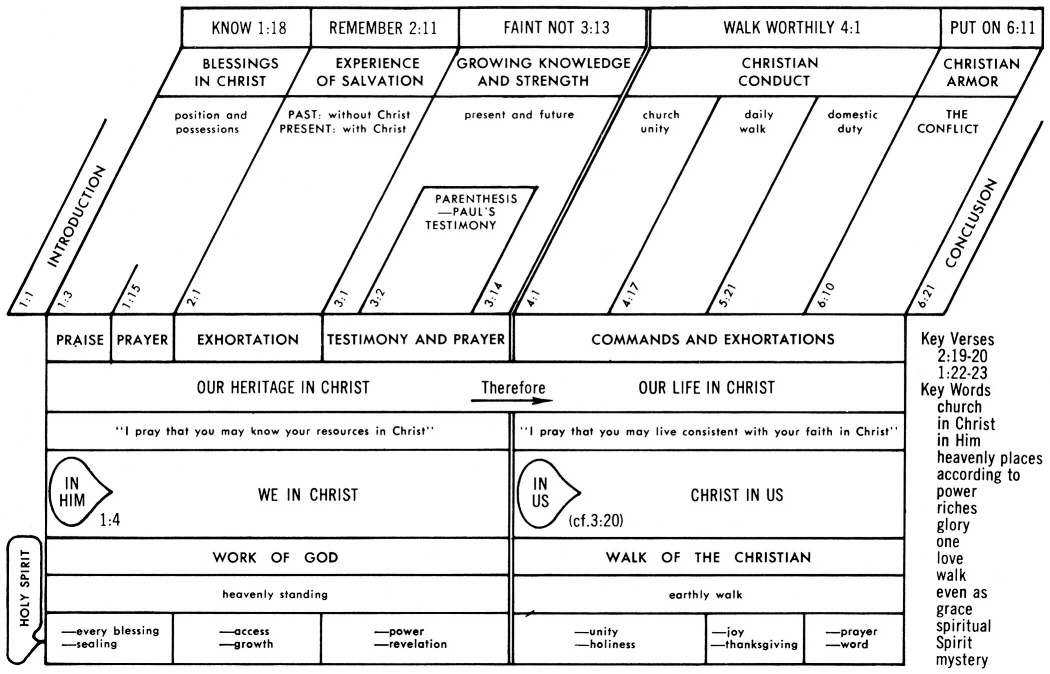
EPHESIANS - CHRIST AND THE CHURCH
Click chart to enlarge
Charts from Jensen's Survey of the NT - used by permission
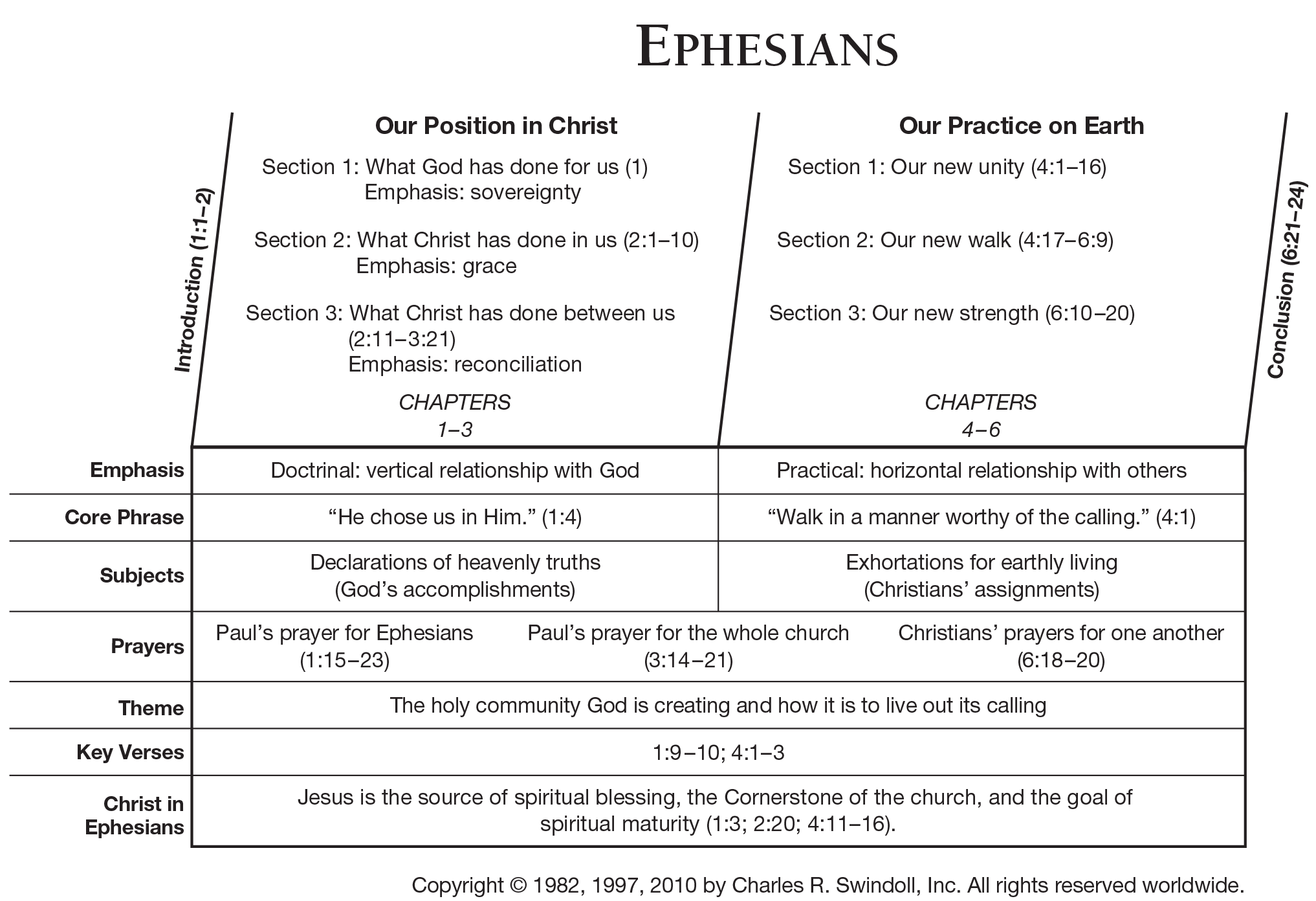
Click chart by Charles Swindoll -Note "EMPHASIS" --
Ephesians 1-3 = Doctrinal: vertical relationship with God
Ephesians 4-6 = Practical: horizontal relationship with others
Ephesians 4:1 Therefore I, the prisoner of the Lord, implore you to walk in a manner worthy of the calling with which you have been called, (NASB: Lockman)
Greek: Parakalo (1SPAI) oun humas ego o desmios en kurio axios peripatesai (AAN) tes kleseos es eklethete, (2PAPI)
BGT Παρακαλῶ οὖν ὑμᾶς ἐγὼ ὁ δέσμιος ἐν κυρίῳ ἀξίως περιπατῆσαι τῆς κλήσεως ἧς ἐκλήθητε,
Amplified: I THEREFORE, the prisoner for the Lord, appeal to and beg you to walk (lead a life) worthy of the [divine] calling to which you have been called [with behavior that is a credit to the summons to God’s service, (Amplified Bible - Lockman)
ESV I therefore, a prisoner for the Lord, urge you to walk in a manner worthy of the calling to which you have been called,
KJV I therefore, the prisoner of the Lord, beseech you that ye walk worthy of the vocation wherewith ye are called,
NET therefore, the prisoner for the Lord, urge you to live worthily of the calling with which you have been called,
NIV As a prisoner for the Lord, then, I urge you to live a life worthy of the calling you have received.
NLT (Revised) Therefore I, a prisoner for serving the Lord, beg you to lead a life worthy of your calling, for you have been called by God.
NLT: Therefore I, a prisoner for serving the Lord, beg you to lead a life worthy of your calling, for you have been called by God. (NLT - Tyndale House)
Phillips: As God's prisoner, then, I beg you to live lives worthy of your high calling. (Phillips: Touchstone)
Wuest: I beg of you, please, therefore, I, the prisoner in the Lord, order your behavior in a manner worthy of the divine summons with which you were called, (Eerdmans Publishing - used by permission)
Young's Literal: I, then, the prisoner for the Master's sake, entreat you to live and act as becomes those who have received the call that you have received
CSB Therefore I, the prisoner for the Lord, urge you to walk worthy of the calling you have received,
NKJ I, therefore, the prisoner of the Lord, beseech you to walk worthy of the calling with which you were called,
NRS I therefore, the prisoner in the Lord, beg you to lead a life worthy of the calling to which you have been called,
NAB I, then, a prisoner for the Lord, urge you to live in a manner worthy of the call you have received,
NJB I, the prisoner in the Lord, urge you therefore to lead a life worthy of the vocation to which you were called.
GWN I, a prisoner in the Lord, encourage you to live the kind of life which proves that God has called you.
BBE I then, the prisoner in the Lord, make this request from my heart, that you will see that your behaviour is a credit to the position which God's purpose has given you,
| THE SYMMETRICAL STRUCTURE OF EPHESIANS |
|
| EPHESIANS 1-3 | EPHESIANS 4-6 |
| Spiritual Wealth | Spiritual Walk |
| The Position of the Believer |
The Practice of the Believer |
| God Sees Us in Christ |
The World Should See Christ in Us |
| Privilege | Practice |
| Doctrine | Duty |
| Doctrinal | Practical |
| Revelation | Responsibility |
| Christian Blessings |
Christian Behavior |
| Belief | Behavior |
| Privileges of the Believer |
Responsibilities of the Believer |
| Our Heritage In Christ |
Our Life In Christ |
| Know your Resources (Riches) in Christ |
Live by faith in the light of your Resources (Riches) in Christ |
| Work of Christ |
Walk of the Christian |
| Work of Christ In Us |
Work of Christ Through Us |
| We in Christ |
Christ in Us |
| Word of God |
Walk of the Christian |
| Heavenly Standing |
Earthly Walk |
| Who You Are In Christ |
Whose You Are In Christ |
| Identity | Responsibility |
| Theology | Ethics |
THEREFORE I, THE PRISONER OF THE LORD, IMPLORE YOU: Parakalo (1SPAI) oun humas ego o desmios en kurio:
- The prisoner - Eph 3:1
- Implore - Jeremiah 38:20; Romans 12:1; 1 Cor 4:16; 2 Cor 5:20; 6:1; 10:1; Gal 4:12; Phile 1:9,10; 1 Pe 2:11; 2Jn 1:5
- Ephesians 4 Resources - Multiple Sermons and Commentaries
- Ephesians 4:1-3 Preserving Unity - Steven Cole
- Ephesians 4:1: The Lowly Walk-1 - John MacArthur
- Ephesians 4:1: The Lowly Walk-1 Study Guide (see dropdown menu) - John MacArthur
- Ephesians 4:1: The Lowly Walk-2 - John MacArthur
Related Passages
Romans 12:1-2+ Therefore I urge (parakaleo in present tense - the first 3 words in Greek are identical in Ro 12:1 and Eph 4:1) you, brethren, by the mercies of God, to present your bodies a living and holy sacrifice, acceptable to God, which is your spiritual service of worship. 2 And do not be conformed to this world, but be transformed by the renewing of your mind, so that you may prove what the will of God is, that which is good and acceptable and perfect.
1 Thessalonians 4:1+ Finally then (THEREFORE), brethren, we request and exhort (parakaleo in present tense) you in the Lord Jesus, that as you received from us instruction as to how you ought to walk and please God (just as you actually do walk), that you excel still more.
Ephesians 4:1-6 (See Hiebert's Outline below)
- Ephesians 4:1-3 - Preservation of Unity (Exhortation to Unity)
- Ephesians 4:4-6 - Foundation for Unity (Essentials of Unity)
A CRITICAL/CRUX
CONCLUSION
Crux (from Latin "crux" = cross) means the most important point; the central or critical feature; a vital, pivotal or decisive point. In mountaineering crux is the most difficult and often decisive part of the climb (interesting thought as it is easy to bask in the glorious truths in 1-3, but requires a conscious choice to walk in those truths enabled by the Spirit). In a word, our practice must balance with our profession (otherwise we are hypocrites and the world hates hypocrites).
Hoehner sums up Ephesians 4:1-6 - Paul exhorts believers to have a proper attitude toward unity (vv. 1–3) and then illustrates how the three persons of the Trinity serve as the basis of this unity (vv. 4–6). (See Ephesians: An Exegetical Commentary)
A Skevington Wood - As is his method in other writings, Paul turns from the doctrinal to the practical. It must not be imagined, however, that the break is complete. Theology is not left behind but interwoven with the moral exhortations that make up the bulk of chapters 4–6....It is highly significant that the first item on the agenda is the need for Christians to live together in love and unity. (The Expositor's Bible Commentary)
John Stott introduces Ephesians 4-6 this way - "Now the apostle moves on from the new society to the new standards which are expected of it. So he turns from exposition to exhortation, from what God has done (in the indicative) to what we must be and do (in the imperative), from doctrine to duty, ‘from the credenda … to the agenda’, from mind-stretching theology to its down-to-earth, concrete implications in everyday living....He has taught them, and he has prayed for them (Eph 1:15–23 and Eph 3:14–19); now he addresses to them a solemn appeal. Instruction, intercession and exhortation constitute a formidable trio of weapons in any Christian teacher’s armoury." (See The Message of Ephesians )
Therefore (oun) is a term of conclusion drawing attention to draws an inference or a result from the preceding section. In context, Paul is saying that you Gentiles have been blessed with every spiritual blessing (Eph 1:3). You were once spiritually dead in your sins (Eph 2:1-3) but are now alive in Christ (Eph 2:5, 8-9). You once were far off from Christ, country (citizenship), covenants of promise, hope and God, (Eph 2:12) but now you have been brought near by the blood of Christ (Eph 2:13) Who is your peace and Who has broken down the enmity between you and the Jews, making you both into one body or one new man, both now being reconciled to God because Christ put to death the enmity on the Cross (Eph 2:14-16). Furthermore you are no longer strangers and aliens, but are in the family of God, are a building of God, a holy Temple of God and a dwelling of God (Eph 2:19-22). Not to mention that you are fellow heirs, fellow members of the body and fellow partakers of the promise (Eph 3:6). And besides all these spiritual blessings, I have prayed for you to be enlightened to these truths and to be empowered by the Spirit (Eph 3:16-21). So you have the truth and you have the power. Now walk worthy of this high, holy calling in Christ Jesus!
In this chapter therefore marks the transition from positional truth to practical truth, from principle to practice. Right practice must always be based on right principle. It is impossible to have a Christian lifestyle without knowing the realities of the life that Christ has provided. Paul has turned from the credendum (things to be believed) to the agenda of the things to be done. Belief always precedes behavior. Doctrine before deportment. Calling before conduct. Position before practice. Wealth before walk. Revelation before responsibility. The Christian life is not based on ignorance but knowledge, and the better we understand Bible doctrine, the easier it is to obey Bible duties (recalling that the last 3 chapters have 40 commands!) When people say, “Don’t talk to me about doctrine—just let me live my Christian life!” they are revealing their ignorance of the way the Holy Spirit works in the life of the believer. We must think rightly if we are to act righteously! When we begin to grasp our high calling, we are ready to hear the exhortation to holy conduct.
One writer (Meyer) sees the therefore as mainly referring to the single previous passage Eph 3:21, and others go back to Eph 3:14-21 and some like Alford all the way back to chapter 1 (I am inclined to agree with Henry Alford for all the wealth beginning in Eph 1:3 calls for a worthy walk!) Indeed Harold Hoehner agrees that "this conjunction is drawing an inference from all the preceding chapters of Ephesians."
Lehman Strauss - The “therefore’s” of Paul are significant. Here the “therefore” stands as a signboard to tell us that there is no divorcement of Christian doctrine from Christian duty. Wherever there is faith, there will works be found also. (Ephesians 4-6 The Conduct and Duty of the Church)
Warren Wiersbe observes that "All of Paul’s letters contain a beautiful balance between doctrine and duty, and Ephesians is the perfect example. The first three chapters deal with doctrine, our riches in Christ, while the last three chapters explain duty, our responsibilities in Christ. The key word in this last half of the book is walk (Eph 4:1, 17; 5:2, 8, 15), while the key idea in the first half is wealth. In these last three chapters, Paul admonishes us to walk in unity (Eph. 4:1-6), purity (Eph 4:17-5:17), harmony (Eph. 5:18–6:9), and victory (Eph 6:10-24). These four “walks” perfectly parallel the basic doctrines Paul has taught us in the first three chapters. (See Bible Exposition Commentary. 1989. Victor)
Ephesians 1-3 = How God sees us in Christ
Ephesians 4-6 = How the world should see Christ in us
Charles Swindoll has an excellent summary of the "EMPHASIS"of Ephesians - Ephesians 1-3 = Doctrinal: vertical relationship with God and Ephesians 4-6 = Practical: horizontal relationship with others.
PAUL THE PRISONER
OF THE LORD
I, the prisoner (desmios) of the Lord, implore (parakaleo in present tense - first in Greek for emphasis) you - Paul begins with the emphatic personal pronoun "I" (ego). Recall that in Ephesians 3:1+ he had begun in a similar manner writing "I, Paul, the prisoner" clearly identifying Paul as the author of this letter. Paul became the Lord’s prisoner on the road to Damascus and never sought to be free of that divine imprisonment. But why does he repeat this fact about his imprisonment? Is is a plea for sympathy? Of course not! One reason is that it would be a sobering reminder to his readers (and to us) of the cost of following the Lord Jesus and the power of His Spirit to enable one to faithfully walk worthy regardless of the cost (cf Mk 8:34-38+, Lk 14:28-33+). (See note on Paul a Prisoner)
Of the Lord - The phrase prisoner of the Lord is more literally "The prisoner in the Lord," which is locative of sphere which speaks of Paul's union with Christ. Paul does not see himself as a prisoner of Rome (Nero) (which was the reality). Paul walked not by sight (seeing Roman prison, even if it was house arrest) but by faith (seeing His risen Lord) and with an eternal perspective, for he knew that his tribulations were not wasted but were for the sake of the Gentile believers in Ephesus. This divine purpose gave him an eternal perspective on his afflictions.
John Stott on prisoner of the Lord - He is both a prisoner of Christ and a prisoner for Christ, both bound to Him by the chains of love and in custody out of loyalty to His gospel. (See The Message of Ephesians )
Brian Bell on prisoner of the Lord - Paul, thrown in the Pen...so that’s what he picks up & writes away. Barred from the world...yet no bar could barricade his Prayers. Silenced in prison...no, his prison became his Pulpit. Nothing but chains...so, he made them dance, cling-n-clang God Praise. From prison came his Plea...to be set free? No, for us to Walk Worthy.
Peter O'Brien on prisoner of the Lord - Just as the whole of his Christian life is ‘in the Lord’, so his being a prisoner comes within the same sphere of Christ’s lordship. This recurrent prisoner theme appears to have a rhetorical function: Paul’s pastoral appeal is underscored by reference to his own costly commitment. He was imprisoned for the sake of those whom he now addresses, and because he was committed to the unity that he now requests of them (see Eph 3:13+). (See The Letter to the Ephesians )
S Lewis Johnson explains "in the Lord" - In the Greek text, it is not “of” but “in,” so he speaks of himself as the prisoner in the Lord. In other words, it is his relationship of vital communion to the Lord Jesus Christ that lends authority to what he is saying. He’s a prisoner alright, but he’s a prisoner in the Lord. So what he says is to be regarded as coming from someone who is in vital union with the Lord Jesus Christ. One of the ancient church fathers said, “He glories in his chains more than a king in his diadem.” Paul had reason to glory in the chains in which he found himself, because he was in those chains because of his testimony for Jesus Christ. A man has a perfect right to glory (cf Ro 5:3KJV+, cf Acts 9:16+) in the marks that mark him out as one who belongs to the Lord Jesus Christ (cf Gal 6:17+), if it is because of his relationship to the Lord. But of course if he suffers merely because he has been out of the will of God or has done something foolish, and as a Christian at the same time, then he has no right to glory in the things that have happened to him. Peter tells us that we ought to suffer as Christians in our suffering. So, the Apostle speaks of himself as a prisoner in the Lord. (Unity of the Body)
The Prisoner of the Lord
The great Apostle called himself
"The prisoner of the Lord;"
He was not held by Roman chains
Nor kept in Caesar's ward;
Constrained by love alone,
By cords of kindness bound,
The bondslave of the living Christ,
True liberty he found.
Oh, happy those who see
In poverty and pain,
In weakness and in toil,
Their Father's golden chain;
Who feel no prison walls
Though shut in narrow ways,
And though in darkness fettered fast
Can still rejoice and praise;
From sin's dread bondage bought,
They own their Master's ward,
They bear the brand of Christ,
Blest prisoners of the Lord!
--Annie Johnson Flint
I implore (parakaleo) you - The in present tense can be rendered "I beseech you continually. I beg you continually. I am earnestly asking you." He is urging them in order to stimulate them to begin the process of progressive, step by step (walking), sanctification (growth in holiness), growing in the grace and knowledge of our Lord and Savior Jesus Christ (2Pe 3:18+). He is saying in essence that truth demands an appropriate response. In other words, a true understanding of Christian doctrine should stimulate a desire to live a holy life (cf their position in Eph 1:4+), and the practical outworking of the life continually growing in Christ-likeness is described in Ephesians 4-6.
THOUGHT - Are you living in the light of the of the surpassing greatness of His power (Eph 1:19, Eph 3:16) and the unfathomable riches of Christ (Eph 3:8) which you are learning that you possess from your study in Ephesians? Are these great truths in Ephesians making any perceptible difference in your Christian life? If not, why not?
It is interesting that of the 41 commands (imperatives) in the book of Ephesians, only 1 occurs in the first 3 chapters (Eph 2:11+) and the other 40 in the so-called "practical section," chapters 4-6. As someone has said the indicatives (mood of reality) precede the imperatives. God's commands are always based on truths previously revealed. One other point to note is that commandments always call for the believer to depend on the Holy Spirit for obedience. We must still make the choice to obey, but the Spirit is working in us giving us the desire and the power to obey and please God (Php 2:13NLT+). O'Brien adds that "This appeal, like other Pauline ethical ‘imperatives’, is grounded in the ‘indicatives’ of God’s saving work in Christ."
In Paul's benediction which immediately precedes chapter 4 he writes. "To Him be the glory in the church" (Ep 3:21+) And the very next word in the Greek text is his imploring the members of the church to walk worthy of their calling. Clearly these are related ideas because when believers walk worthy, they fulfill one of their to "Let your light shine (aorist imperative see our need to depend on the Holy Spirit to obey) before men in such a way that they may see your good works, and glorify your Father who is in heaven." (Mt 5:16+) In other words, when formerly godless, hopeless, Christless, idol worshiping Gentiles walk worthy of their calling before the dead world (Eph 2:1+), it provides an irrefutable visible testimony of the invisible God and in this way He receives glory in the church. And the lost world receives a proper opinion of our great God and Father when they see His good works in and through His sons and daughters in the church.
The truths about our heavenly position and possession are wonderful but Paul wants to make sure that these believers are not so heavenly minded that they are no earthly good to God and His work! Faith in the truth of Ephesians 1-3 will (should) result in the works of Ephesians 4-6, works empowered by the Holy Spirit and for the glory of God.
Walter Taylor adds another thought on why Paul mentioned prison a second time -- “Paul” speaks with the authority of one who is in prison because of his loyalty to the Lord, and therefore his ethical directives carry a particular weight." (Augsburg Commentary on the New Testament)
Moule on prisoner of the Lord - Paul's bonds are due to his union with Christ. They are thus a strong Christian argument with his converts...Under all aspects of life Paul belongs to Christ. Whatever he is, does, or suffers, it is as Christ’s property (cf 1Cor 6:19-20+, Acts 20:24+, Acts 21:13+). There is also an obvious reference to the fact that his imprisonment was for Christ’s cause; but this is not all. (Ephesians 3 Cambridge Bible Commentary)
John Eadie comments on the significance of Paul as a prisoner of the Lord "writing to them while he was in chains proved the deep interest he took in them and in their spiritual welfare—showed them that his faith in Jesus, and his love to His cause, were not shaken by persecution (THIS WOULD BE ENCOURAGING - ED: cf Eph 3:13+, see also Phil 1:12-14+)—that the iron which lay upon his limb had not entered into his soul (ED: cf 2Co 4:17-18+)—and that his apostolic prerogative was as intact, his pastoral anxiety as powerful, and his relation to the Lord as close and tender as when on his visit to them he disputed in the school of Tyrannus, or uttered his solemn and pathetic valediction to their elders at Miletus. Letters inspired by love in a dungeon might also have a greater charm than his oral address. (cp Gal 6:17+) Ephesians 4 Commentary
John Phillips "He was not the prisoner of Nero. He was the prisoner of the Lord. A mere caesar could not arrest an apostle without God’s permission. Paul was undaunted. Since he had to wear a chain, he wore it like a chain of office. If every move he made had to be accompanied by the rattle of fetters, he made each clank of iron a note in a melody of praise to God. He converted his prison into a palace. He considered himself shut up with God....God shut Paul up with his pen and his prayers, so Paul praised Him by writing letters and interceding at the throne." (See Exploring Ephesians & Philippians: An Expository Commentary)
John MacArthur - By mentioning his imprisonment he gently reminds his readers that he knows the worthy Christian walk can be costly and that he has paid considerable cost himself because of his obedience to the Lord. He would not ask them to walk in a way in which he had not himself walked or pay a price that he himself was not willing to pay. His present physical circumstance seemed extremely negative from a human perspective, but Paul wanted his readers to know that this did not change his commitment to or his confidence in the Lord. (See Ephesians MacArthur New Testament Commentary)
J Vernon McGee comments that Paul "is a “prisoner of the Lord.” He is a prisoner because of his position in Christ. Isn’t it interesting that Paul can be seated in the heavenlies in Christ and can also be seated in a prison because he was a witness for Christ to the Gentiles?....McGee makes an interesting observation of the flow of these first six verses writing that "In his discussion of this walk of the believer, Paul speaks first to the individual. The individual is to walk in lowliness and meekness. Then he widens out to the entire church, which is one body and one spirit. Finally, he brings this passage to a great, tremendous crescendo, which pictures the eminence and transcendence of God (Eph 4:6). (Thru the Bible Commentary)
Prisoner (1198) (desmios from desméo = bind from desmos = bind, chain) is a captive or one who is bound or who is in bonds. One under custody in prison.
Webster says that a prisoner is "a person deprived of liberty and kept under involuntary restraint, confinement, or custody." Yes, Paul was a prisoner to Rome but much more significantly he was a prisoner of Christ voluntarily and at liberty, which is the antithesis of the worldly definition of a prisoner! May God grant each of us the will by His Spirit to make the wise choice to be prisoners of Christ! Amen
TDNT...Actual imprisonment underlies the usage, but the real bondage is to Christ for whose sake it is suffered and to whom self-will is offered in sacrifice. In answer to the idea that Paul borrows here from the concept in the mysteries that katoche precedes the final dedication, it should be noted that Paul nowhere calls imprisonment a penultimate stage prior to being with Christ ( Phil. 1:23). Imprisonment symbolizes his whole life and ministry.
Desmios - 16x in 16v - Mt 27:15, 16; Mark 15:6; Acts 16:25, 27; 23:18; 25:14, 27; Acts 28:17 (Desmios has no definite article which stresses the character); Eph 3:1 (Prisoners often had time to think, read, write, etc); Eph 4:1; 2Ti 1:8 (To show sympathy to a prisoner and to offer him help could be very dangerous since it involved one in the charges against the prisoner); Philemon 1:1, 9; Heb 10:34; 13:3. NAS translates as prisoner(12), prisoners(4).
Desmios - 4x in the non-apocryphal Septuagint - Eccl 4:14; Lam 3:34; Zech 9:11, 12. Uses in the Apocrypha - 2 Macc 14:27, 33; 3 Macc 4:7; 7:5; Wis 17:2;
Implore (3870) (parakaleo from para = side of, alongside, beside + kaleo = call) means literally to call one alongside, to call someone to oneself, to call for, to summon. Parakaleo can include the idea of giving help or aid but the primary sense in the NT is to urge someone to take some action, especially some ethical course of action. Sometimes the word means convey the idea of comfort, sometimes of exhortation but always at the root there is the idea of enabling a person to meet some difficult situation with confidence and with gallantry. See the following discussion for elaboration on the nuances of this great Greek verb.
Some Nuances of parakaleo - (1) To encourage / strengthen - “Cheer up, hearten” = Acts 11:23, (2) To comfort / console - “Soothe, support” = 2 Cor 1:4 (3) To invite / summon - “Call to come” = Matt 8:5 (4) To beseech / entreat - “Implore, plead” = 2 Cor 5:20 (5) To exhort / urge“ - Appeal, admonish” = Ro 12:1.
In the context of Ephesians 4:1, parakaleo is not simply a request but a plea, an imploring or begging. The idea of implore is to beg earnestly or even desperately. Interestingly, the English word implore is from the Latin implorare meaning to "invoke with tears"! Clearly, Paul wants the Gentile believers in Ephesus to be all they can be in Christ (cp one of Paul's life goals for all disciples - Col 1:28-note, Col 1:29-note, which is a good goal for all believers to pursue given the fact that we have all been commissioned by our Lord to go and make disciples. Mt 28:18, 19, 20)
The present tense indicates that it was Paul's practice (even though separated from them physically in prison) to continually come alongside the believers (via this epistle, and surely also via his prayers for them). It is notable that Paul does not issue a command to walk worthy (even as he did not make Ro 12:1 a command). Instead Paul based his call upon the glorious truths that had brought his readers from far away to near (to God), and in so doing was enderly appealing to them in the "language of grace" (cp Ep 4:29+).
Regarding implore (beseech, urge, beg) Paxson writes "Oh! the intensity of desire and the deep sense of responsibility which the aged apostle writes into that word "beseech!" He has already given them a marvellous revelation of their heavenly calling. Now with equal clarity he would show their responsibility for a corresponding conduct. It would well repay you to make a study of such words and phrases as "therefore," "wherefore," "for," "that," "as," "so," "let," "be ye," "be not ye," "see then," in Ephesians to see how Paul's appeals are always made on the ground of one's condition corresponding with one's position. "Ye are" -- "therefore be ye" -- is invariably the basis of Paul's appeal. (The Wealth, Walk and Warfare of the Christian)
D Edmond Hiebert's Outline of Ephesians 4:1-16 (An Introduction to the New Testament, Volume 2: The Pauline Epistles)
PRACTICAL: THE LIFE OF BELIEVERS HERE ON EARTH (Eph 4:1–6:20)
1. The walk of believers as God’s saints (Eph 4:1–5:21)
a. The exhortation to walk worthily, in inward realization of Christian unity (Eph 4:1–16)
i. The appeal for a walk worthy of their calling (Eph 4:1)
ii. The duty of keeping the unity of the Spirit (Eph 4:2–3)
iii. The description of this unity (Eph 4:4–6)
iv. The achievement of spiritual unity (Eph 4: 7–16)
a. The gifts of Christ to His Church (Eph 4:7–11)
1. The diversity of the gifts to the members (Eph 4:7)
2. The gifts as the outcome of Christs victory (Eph 4:8–10)
i. The quotation of Scripture (Eph 4:8)
ii. The inferences from the Scripture (Eph 4:9–10)
3. The enumeration of the gifts to the Church (Eph 4:11)
b. The achievement of unity as the purpose of the gifts (Eph 4:12–13)
1. The purpose in reference to the individual saint (Eph 4:12)
2. The purpose in reference to the whole Church (Eph 4:13)
c. The results of the unity achieved (Eph 4:14–16)
1. Negative—The results avoided (Eph 4:14)
2. Positive—The results achieved (Eph 4:15–16)
i. The result for the individual (Eph 4:15)
ii. The result for the whole Body (Eph 4:16)
Other comments on the significance of therefore -
Peter O'brien - The readers have been reminded of the high destiny to which God has called them, and now they are shown that the hope of this calling requires them to live lives in keeping with it. ‘Behaviour is thus seen in Ephesians as both response to what God has done in Christ, and as the proper accompaniment to the praise of God, the two themes present in chaps. 1–3’.
Paxson puts it this way Therefore" does not indicate the commencement of something altogether new, but rather the consequence of what has preceded. Here it does not present a change of thought, but a call to prove the reality of our wealth through the rightness of our walk. "To turn from the doctrinal to the practical is not a break or a breach. There is no divorcement between Christian doctrine and Christian doing." The condition of the Christian must harmonize with his position. Being in Christ he should grow up into Christ. ....Ephesians 1-3 has given us a revelation of our wealth in Christ. Wealth is never to be hoarded, but rather kept in circulation, that it may minister to the needs of all. The wealth of the Christian should be manifest in his walk. This revelation of divine truth becomes fruitful only as it is transmuted into life. Revelation must eventuate into realization; illumination into application. One of the brightest converts of a Gospel Mission had become a backslider. In an interview with him, he thought he would gladden my heart by telling me that he believed everything in the Bible from Genesis through Revelation. The only reply that seemed applicable was, "If you believe it, then why do you not live it?" When a friend was speaking to the prisoners in Sing Sing prison, one prisoner said to her very boastfully, "I would have you know that I did not come in here as these other fellows did. I came in here a Christian." (ED: NOT LIKE PAUL A PRISONER OF THE LORD!) My friend quietly replied, "I am very sorry that being a Christian did not keep you out of here." The more we know the truth and believe it, the greater is our responsibility to live it. Head knowledge must become heart experience. Consistency in his daily walk should be the vital concern of the Christian. Ephesians 1-3 tells us how God sees us in Christ in the heavenlies; 4-6 how men should see Christ in us on earth (ED: SEE SWINDOLL'S SUMMARY). They unfold with crystal clearness the sevenfold walk of the Christian which is the divine standard for every Christian's life. (The Wealth, Walk and Warfare of the Christian)
John Eadie introduces the last 3 chapters noting that...THE practical portion of the Epistle now commences...But doctrine has been expounded ere duty is enforced. Instructions as to change of spiritual relation precede exhortations as to change of life. It is in vain to tell the dead man to rise and walk, till the principle of animation be restored. One must be a child of God before he can be a servant of God. Pardon and purity, faith and holiness, are indissolubly united. Ethics therefore follow theology. And now the apostle first proceeds to enjoin the possession of such graces as promote and sustain the unity of the church, the members of which are “rooted and grounded in love” (Ep 3:17-note)—a unity which, as he is anxious to show, is quite compatible with variety of gift, office, and station. Then he dwells on the nature, design, and results of the ministerial functions belonging to the church, points out its special and divine organization, and goes on to the reprobation of certain vices, and the inculcation of opposite graces.... The retrospective oun (therefore) refers us to the preceding paragraph—Christian privilege or calling being so rich and full, and his prayer for them being so fervent and extensive. (Ephesians 4 Commentary)
Oliver Greene - In chapter one we studied the most wonderful story ever heard . . . the story of how GOD provided redemption in CHRIST. In chapter two we learned that believers are a living organism . . . the church is made up of born again persons, members of the most wonderful body ever known. In chapter three we learned further that we are the building of GOD . . . yea, we are the temple of The HOLY SPIRIT. All believers are built together into one holy temple, the habitation of GOD. In our present chapter, Paul begins to outline the walk and the service of the believer. (The Epistle of Paul the Apostle to the Ephesians)
Paxson explains therefore - Therefore" does not indicate the commencement of something altogether new, but rather the consequence of what has preceded. Here it does not present a change of thought, but a call to prove the reality of our wealth through the rightness of our walk. "To turn from the doctrinal to the practical is not a break or a breach. There is no divorcement between Christian doctrine and Christian doing." The condition of the Christian must harmonize with his position. Being in Christ he should grow up into Christ. (The Wealth, Walk and Warfare of the Christian)
Barnes explains the therefore this way - "Such being your exalted privileges; since God has done so much for you; since he has revealed for you such a glorious system; since he has bestowed on you the honour of calling you into his kingdom, and making you partakers of his mercy, I entreat you to live in accordance with these elevated privileges, and to show your sense of his goodness by devoting your all to his service." (Albert Barnes. Barnes NT Commentary)
William MacDonald writes "The position into which grace has lifted us was the dominant theme up to now. From here on it will be the practical outworking of that position. Our exalted standing in Christ calls for corresponding godly conduct. So it is true that Ephesians moves from the heavenlies in chapters 1-3, to the local church, to the home, and to general society in chapters 4-6. As Stott has pointed out, these closing chapters teach that “we must cultivate unity in the church, purity in our personal lives, harmony in our homes and stability in our combat with the powers of evil.” (Believer's Bible Commentary)
Martyn Lloyd-Jones writes that "The first section, consisting of the first three chapters, has been entirely doctrinal. The Apostle has been unfolding and displaying in his own marvelous manner the great essential doctrines of the Christian faith, everything that is central and vital to an understanding of the way of salvation. There is no greater display of the doctrines of the Christian faith than that found in the first three chapters of this Epistle. But having done that, the Apostle now moves on to the practical application of his doctrine; he goes on to show how it is related to daily life and living. So we are really at a most important point in this Epistle, a point that marks a very real division....The Apostle Paul, when he used the word ‘therefore’, makes the connection between faith and practice quite clear. He has laid down the doctrine; it has now got to be applied....Here, then, in chapter 4, the Apostle proceeds to make a great appeal to the Ephesian believers to put into operation the things he has been teaching them. He reminds them of the things that inevitably follow as a natural consequence from an understanding of the great doctrines of the Christian faith....There is always the danger—and it affects some people more than others—of forgetting that Christianity is, after all, a way of life and a way of living. Of course there are certain people who emphasize that alone, and who know nothing about doctrine and are not interested in doctrine. Such people regard Christianity as a system of morality or of ethics. But I am dealing, rather, with people who are evangelically minded, and whose danger is to stop at doctrine only....If we really do know these things, then more is expected of us. From the man who has, much is expected; to whom much has been given, much is also expected. So if we really have been grasping the great doctrines of the first three chapters of this Epistle let us remember this word therefore. We are not to call a halt; we are to go on to the practical life and living, to the ordinary day-to-day application of basic Christian doctrine. It is a glorious experience to be on top of that mountain; but we must go down to the valleys, to all the problems of daily life and living. Around us is this godless world which cannot know about Christ unless you and I tell them about Christ, either by preaching or by mixing with them in our work and employment and the ordinary avocations in life. We must show what we know, and what we have, and above all show Him in whom we have believed....Doctrine must always come first; and we must never reverse this order. It is, I repeat, the invariable practice in the New Testament itself to speak of doctrine before the application of doctrine. We must not act until we are clear about our doctrine. This is, beyond all question, the most vital principle of all in connection with the New Testament doctrine of sanctification. So we are entitled to say that this word therefore introduces us to the doctrine of sanctification. The first three chapters of our Epistle with all their astonishing teaching have not considered the doctrine of sanctification as such...The doctrine of the sealing of the Spirit, and the experience of it, is not sanctification. To know the love of Christ is not sanctification. To be filled with all the fulness of God is not sanctification. What then is the relationship between these things? It is that those are things that promote sanctification, that encourage sanctification, and give us motives for sanctification; but they are not sanctification itself....It (Sanctification) is the outworking, the outliving, by the power that God gives us and that is already in us, of the doctrine we have believed and the experiences we have enjoyed from His gracious hands (Ed: cp Jesus' prayer for us in Jn 17:17 which shows us the "modus operandi", the role of Truth, the Word, in growing us in Christ-likeness! Are you daily in the Word of Truth? If not, you are short cutting your sanctification process. It's that simple! In the Word-Grow. Not in the Word-No Growth!). ((Ephesians 4:1-16Mp3's - click to listen to the sermon "Worthy of our Calling")
EVEN THE "GREATEST" SAINT NEEDS ENCOURAGEMENT - For years William Wilberforce pushed Britain's Parliament to abolish slavery. Discouraged, he was about to give up. In 1791, his elderly friend, John Wesley, heard of it and from his deathbed called for pen and paper.
With trembling hand, Wesley wrote: "Unless God has raised you up for this very thing, you will be worn out by the opposition of men and devils. But if God be for you, who can be against you? Are all of them stronger than God? Oh be not weary of well-doing! Go on, in the name of God and in the power of his might, till even American slavery shall vanish away before it."
Though Wesley died less than a week after writing that letter, it remained an inspiration to Wilberforce through years of disappointment after disappointment. Wilberforce fought for forty-five more years and in 1833, three days before his own death, saw slavery abolished in Britain. Wilberforce might not have prevailed if it had not been for the encouragement of his friend who strengthened him in the Lord. Before you pray, "Lord, give me a friend like that," try praying: "Lord, make me a friend like that." Remember, even the greatest ones need encouragement.
ILLUSTRATION - A doctor wrote a letter of thanks to a schoolteacher for having given him so much encouragement when he had been in her class 30 years before. He later received this reply: "I want you to know what your note meant to me. I am an old lady in my eighties, living alone in a small room, cooking my own meals, lonely, and seeming like the last leaf on the tree. You will be interested to know that I taught school for 50 years, and yours is the first letter of appreciation I have ever received. It came on a cold, blue morning and cheered my lonely old heart as nothing has cheered me in many years." – A Treasury of Bible Illustrations.
n the cold days of winter, one often finds that the car battery has lost its charge during the night. The engine will not turn over because the battery is too weak. The ministry of encouragement is like a car that comes alongside ours and gives us a jump start. The strength of the operative car is transferred into the weak battery, and the inoperative car is rejuvenated to action. When we see people who are discouraged, saddened by the trials and afflictions, or straying from the path of obedience, we need to recognize these moments as opportunities (see study of kairos, the Greek word for opportunity) and come alongside to give them a spiritual jump start. Has God placed a someone in your path who is need of a spiritual "jump start"?
| BEFORE FORMERLY FAR OFF |
AFTER BROUGHT NEAR BY BLOOD OF CHRIST (CROSS) |
| Dead in trespasses and sins Slaves to... The world, the flesh, the devil |
Alive with Christ Raised with Christ Seated with Christ |
| Separated from Christ No country No covenants No hope No God |
Enmity abolished One new man Reconciled to each other Reconciled to God Access to God |
| Strangers and Aliens |
Fellow Citizens Family of God Temple of God Dwelling of God |
ILLUSTRATION OF OUR NEED FOR ENCOURAGEMENT - Years ago, a Dear Abby column ran a story by a retired schoolteacher. One day she had her students take out two sheets of paper and list the names of the other students in the room. Then she told them to think of the nicest thing they could say about each of their classmates and write it down by their names. She took the papers home that weekend and compiled a list for each student of what the others had said about him or her. On Monday she gave each student his or her list. Before long, everyone was smiling. Really? one whispered. I never knew that meant anything to anyone. I didn't know anyone liked me that much! Years later, the teacher went to the funeral of one of her former students, who had been killed in Vietnam. Many who had been in that class years before were there. After the service, the young mans parents approached the teacher and said, We want to show you something. Mark was carrying this when he was killed. The father pulled out of a wallet the list of all the good things Marks classmates had said about him. Thank you so much for doing that, Marks mother said. As you can see, Mark treasured it. A group of Marks classmates overheard the exchange. One smiled sheepishly and said, I still have my list. Its in my top desk drawer at home. Another said, I have mine, too. Its in my diary. I put mine in our wedding album, said a third. I bet we all saved them, said a fourth. I carry mine with me at all times. At that point, the teacher sat down and cried. And, she used that assignment in every class for the rest of her teaching career. Robert Orben said it well "A compliment is verbal sunshine." THE LESSON: We all need encouragement, which is "like oxygen" to our soul.
Nothing succeeds like encouragement.
Who have you encouraged this week?
GROW IN GROVES- If we are going to be spiritually healthy, we need all the encouragement and support we can get. And in this section our "trainer" is telling us that spiritual fitness calls for team effort. Yes, we are to be oaks of righteousness, but God desires us not to be isolated oaks but growing "groves" of oaks, as is so well illustrated in nature by the giant sequoia trees of California that tower up to 300 feet. These beautiful behemoths belie their unusually shallow root systems that reach out in all directions to capture the greatest amount of surface moisture. As their roots extend horizontally, the intertwining roots of the juxtaposed trees weave a network of support which provides stability against violent storms (think "storms of life"). In short, these gentle giants are so constructed by their Creator that they need each other, which explains why you virtually always see them growing assembled together in clusters ("not forsaking their assembling together"). Seldom do you see a Giant Redwood standing alone, because the high winds would quickly uproot the shallow root system of these "loners". Because of the opposition to "The Way", the believers of the first century desperately needed to grow in groves and we of the 21st century are no different!
Christian fellowship provides us
With encouragement and love;
It will help us in our journey,
Till we reach our home above.
--Sper
Mark Dever has this note especially for pastors - Giving and receiving godly encouragement and criticism. This is a skill set that too few pastors have deliberately developed among local church leaders. Improving the mechanics and underpinnings of your church comes only through constructive criticism and encouragement. Provide a periodic time for trusted leaders to give godly, gentle, but forthright feedback on the weekly services, your sermons, the prayers or Scripture readings of other leaders, the business/members’ meetings, and even the elders’ meetings. Providing that periodic time—whether weekly, twice a month, or monthly—will help sharpen the spiritual senses of your leaders, give them practice at encouraging and sharpening you, and give you practice at receiving godly encouragement and criticism. (The Deliberate Church- Building Your Ministry on the Gospel
D G Reid has an excellent summary of Paul the Prisoner
Paul employs several words to speak of prison and being a prisoner. He can speak of “chains” (desmoi, always plural in Paul), by which he means “imprisonment.” He frequently refers to them as “my chains” (Phil 1:7, 13, 14, 17; Col 4:18) and sometimes uses them to speak of his situation “in prison” (Philem 10; 13; 2 Tim 2:9). In 2 Corinthians, when speaking of his afflictions as an apostle, he refers to being en phylakais, “in prison” (2 Cor 6:5; 11:23). In Ephesians 6:20 and 2 Timothy 1:16 the apostle’s imprisonment is indicated by the word halysis, “chain,” and in Colossians 4:3 Paul speaks of being “bound” (dedemai).
Paul’s repeated references in Philippians 1 to “my chains” offer insight into his experience and how he reconciled it with his calling as apostle, presumably questioned at Philippi by those who supposed that a suffering apostle was a contradiction (see Bloomquist). Paul speaks from his imprisonment with a note of joy, untarnished by self-pity, and confident that though he is confined to prison, the word of God is not confined. Hence the frequent mention of “my imprisonment” functions rhetorically as apologetic. Through his imprisonment it has “come to light” (phanerous ginomai) in all the praetorium and among those outside the praetorium that his imprisonment is en Christō, “for Christ” (Phil 1:13; see Caesar’s Household). This effect, Paul implies, is due to divine providence, to which he appeals as a theodicy. Some of his fellow believers have found in Paul’s imprisonment more confidence and motivation to preach the gospel (Phil 1:14), knowing that Paul is held in prison so that he might give his defense of the gospel (Phil 1:16). Sadly for their sake, but happily for the gospel, others have been motivated out of selfish ambition to preach the gospel with the hope of increasing Paul’s suffering in prison (Phil 1:17), perhaps by insinuating that he was not a true apostle since he was in jail and under sentence (Phil 1:22–23). But the Philippians, even at a distance, partake of Paul’s ministry by their prayers and gifts, and so they too partake of the divine grace of Paul’s apostolic commission in its Christ-like afflictions (Phil 3:10) and defense of the gospel (see Hawthorne, 23; O’Brien, 70).
When Paul speaks of himself as “prisoner” (desmios), it is always as “prisoner of Christ Jesus” (Philem 1; 9; Eph 3:1), “prisoner in the Lord” (Eph 4:1) or “prisoner of him [our Lord]” (2 Tim 1:8). Though the phrase “prisoner of Christ Jesus” and its equivalents appears three out of five times in the contested Pauline letters, its presence in Philemon calls for it to be reckoned as an authentic piece of Pauline vocabulary and self-understanding. Does the genitive in the expression desmios Christou Iēsou (“prisoner of Christ Jesus”) indicate that Paul sees himself as one taken prisoner by Christ or as one who suffers imprisonment for the sake of Christ? Most commentators have understood it in the latter sense, appealing to Philippians 1:29–30. This seems to be the most likely meaning, with the implied nuance that it is Christ who is truly sovereign over Paul’s circumstances. In Philemon 13 Paul refers to his desmoi tou euangeliou, which can scarcely be rendered “imprisonment of the gospel” and must be read “imprisonment for the gospel,” an emphasis similar to that of Colossians 4:3, where Paul writes that he is in prison (dedemai, lit. “bound”) for declaring the “mystery of Christ.” In opening the letter to Philemon with the words “Paul a prisoner of Christ Jesus,” Paul is substituting this identification for his more usual “called to be an apostle,” “an apostle of Christ Jesus” and “a slave of Christ Jesus.” Whereas Paul elsewhere can pair “apostle” and “slave,” in Philemon 9 he speaks of himself as “ambassador” (presbytēs should probably be so translated rather than “old man,” see commentaries) and “prisoner” (cf. Eph 6:20, presbeuō en halysei, “I serve as ambassador in chains”). The situation from which Paul writes to Philemon is by all indications an actual imprisonment, so while “prisoner” does take on metaphorical overtones, it is rooted in Paul’s simultaneous situation as a literal prisoner.
Paul’s self-identification as a “prisoner of Christ Jesus” plays a rhetorical function in Paul’s appeal to Philemon (as it does in Philippians for a different reason; see above). The humility Paul enacts in his submission and obedience to Christ—to the point of imprisonment—is the very humility Paul expects of Philemon as he responds to Onesimus “in the Lord” (see Petersen, 124–28). Clearly, Paul views his imprisonment as part of his apostolic activity. Inasmuch as his imprisonments are among his trials and afflictions as an apostle, he lives out his commitment to the “word of the cross” as a prisoner of Jesus Christ, who took upon himself the end-time messianic woes. In his cruciform “weakness” he finds and displays the power of God (cf. 2 Cor 13:1–4). Thus Paul’s identity as a prisoner serves both as an emblem of Christ’s humiliation upon the apostle’s life and as a symbol of Paul’s apostolic authority. Thus when he asks the Colossians to “remember my bonds” (Col 4:18), it is “not chiefly a matter of pathos but of authority” (Moule, 139). The rhetorical function of the prisoner theme is also evident in Ephesians 4:1: “I, therefore, the prisoner in the Lord, beg you to lead a life worthy of the calling to which you have been called.” Here the pastoral appeal of the letter is underscored by the costly commitment of the apostle, who was imprisoned for the sake of the Gentiles now addressed (Eph 3:1; see Lincoln 234, cf. 171–72).
The interpretation of R. Reitzenstein bears mention here. Reitzenstein explained Paul’s status as a “prisoner of Christ Jesus” not as literal imprisonment but as a metaphor shaped by the mystery religions in which the devotee was purportedly detained (katochē), or “imprisoned,” prior to initiation. Paul, it was reasoned, regarded his imprisonment as preparation for entrance into the final mystery of Christ (Phil 1:23). Apart from the unproven influence of the mystery religions on Paul (see Religions), such an interpretation comes to grief on Paul’s view of his imprisonment in Philippians, where he clearly wrestles with the possible outcomes of his imprisonment as either life or death (Phil 1:19–24), the desirable outcome being life and the opportunity to visit the Philippians again (Phil 1:25–26; 2:24; cf. Philem 22; see Kittel 43). (See Dictionary of Paul and his letters and Dictionary of Paul and his letters)
SIX WAYS TO BE A MODERN DAY "BARNABAS" -- Son of Encouragement - Acts 4:36
Below are six ways to encourage someone - When was the last time you encouraged someone in any of the following ways? Have you ignored some gentle promptings by the Spirit to encourage someone? Perhaps today you might ask God to whom you might send a note or make a call? Yes, dear brother or sister in Christ, it does cost to encourage another (eg, it always costs our time, our "agenda", etc), but it might just be the most wisely invested moment of your day!
1) Provide materially – meet their material needs.
2) Drop a line – send notes of encouragement.
3) Reach out and touch – give an appropriate touch such as a pat, hug, etc.
4) Listen up – listen actively. (Oh my, I need to heed this one!)
5) Empathize – comfort others in their pain.
6) Give of your time – give your undivided attention.
Debora Coty summarizes her article encouraging us all to become active, intentional encouragers...
The encouragement we pour into the lives of those around us will spill over into the lives of countless others, even as it buoys our own spirits. Proverbs 11:25 states, “A generous man will prosper; he who refreshes others will himself be refreshed.” When we encourage others, we cannot help but be encouraged ourselves. (Just What They Need - 6 Ways to Encourage Others": Discipleship Journal: 147 - May/June 2005)
To whom can you be a "Barnabas" today?
Being an encourager requires thought, time, and energy. Most of us live such fast paced, self-centered lives that it can be very difficult to even see another person's need for encouragement. We need to remember that God commands us to be encouragers (Heb 3:13 encourage is present imperative = command to make it our lifestyle), to build each other up (1Th 5:11-note - present imperative), to bear (present imperative) one another's burdens (Gal 6:2, cp Pr 17:17), to regard one another as more important than our self (Php 2:3-note) and to look out for the interests of others (Php 2:4-note). In short, being an encourager requires (supernatural) intentionality. Encouragement is not doing for someone what they can do for themselves and is not removing pain from their lives, but instead is noticing them, feeling with them, and reminding them of the great hope (absolute assurance of future good) we have in Christ as we persevere in our walk with Him.
It is difficult to improve on God's charge in Isaiah...
Encourage the exhausted,
and strengthen the feeble.
Say to those with anxious heart,
"Take courage (parakaleo) , fear not."
(Isaiah 35:3, 4)
TO WALK IN A MANNER WORTHY OF THE CALLING WITH WHICH YOU HAVE BEEN CALLED: axios peripatesai (AAN) tes kleseos es eklethete, (2PAPI):
- To walk in a manner worthy - Ep 4:17; 5:2; Ge 5:24; 17:1; Acts 9:31; Php 1:27; 3:17,18; Col 1:10; 4:12; 1Th 2:12; 4:1,2; Titus 2:10; He 13:21
- Of the calling with which you have been called - Ep 4:4; Ro 8:28-30; Php 3:14; 2Th 1:11; 2Ti 1:9; He 3:1; 1Pe 3:9; 5:10; 2Pe 1:3
- Ephesians 4 Resources - Multiple Sermons and Commentaries
- Ephesians 4:1-3 Preserving Unity - Steven Cole
- Ephesians 4:1: The Lowly Walk-1 - John MacArthur
- Ephesians 4:1: The Lowly Walk-1 Study Guide (see dropdown menu) - John MacArthur
- Ephesians 4:1: The Lowly Walk-2 - John MacArthur
Related Passages:
Genesis 5:24; Enoch walked with God; and he was not, for God took him.
Genesis 17:1 Now when Abram was ninety-nine years old, the LORD appeared to Abram and said to him, “I am God Almighty; Walk before Me, and be blameless.
Romans 8:28-30+ And we know that God causes all things to work together for good to those who love God, to those who are called according to His purpose. 29 For those whom He foreknew, He also predestined to become conformed to the image of His Son, so that He would be the firstborn among many brethren; 30 and these whom He predestined, He also called; and these whom He called, He also justified; and these whom He justified, He also glorified (NOTE: "GLORIFIED" IS AORIST WHICH IS USUALLY PAST TENSE BECAUSE THIS "HOPE" IS NOT A HOPE SO BUT A HOPE SURE - THIS IS THE PROLEPTIC AORIST - SEE ALSO MOUNCE)..
1 Corinthians 10:31+ Whether, then, you eat or drink or whatever you do, do all to the glory of God.
Philippians 1:27+ Only conduct (peripateo in present imperative see our need to depend on the Holy Spirit to obey)) yourselves in a manner worthy (axios) of the gospel of Christ; so that whether I come and see you or remain absent, I may hear of you that you are standing firm in one spirit, with one mind striving together for the faith of the gospel;
Comment: Paul is exhorting the church at Philippi to live their lives like what they are -- citizens of heaven (Php 3:20+) -- [see Phil 3:17 below] so their conduct in a sense "weighs as much as" (worthy of) the gospel they preach and the faith they profess. In other words, they are to see to it that they practice what they preach, that their experience measures up to their new standing as children of the King. We do not behave (or conduct ourselves in a certain way) in order to go to heaven, as though we could be saved by our good works, but we conduct ourselves because our names are already written in heaven, and our citizenship is in heaven and we desire to glorify our Father Who is in Heaven (cf Mt 5:16+, Php 2:14-15+) and be an aroma of Christ to those who are being saved (2Cor 2:14-16+, cf 1Pe 3:15+).
Philippians 3:17+ Brethren, join (present imperative see our need to depend on the Holy Spirit to obey) in following my example (~ "WALK WORTHY"), and observe those who walk (peripateo) according to the pattern you have in us. 3:18 For many walk (peripateo), of whom I often told you, and now tell you even weeping, that they are enemies of the cross of Christ, 3:19 whose end is destruction, whose god is their appetite, and whose glory is in their shame, who set their minds on earthly things (CONTRA Col 3:2+).
Colossians 1:9+ For this reason also, since the day we heard of it (cf Col 1:8), we have not ceased to pray for you and to ask that you may be filled with the knowledge of His will in all spiritual wisdom and understanding, 1:10 so that you may walk (peripateo) in a manner worthy (axios) of the Lord (see WALK LIKE JESUS WALKED), to please Him in all respects, bearing fruit in every good work and increasing in the knowledge of God;
Colossians 3:17+ Whatever you do in word or deed, do all in the name of the Lord Jesus, giving thanks through Him to God the Father.
1 Thessalonians 2:11+ (CONTEXT - 1Th 2:10) just as you know how we were exhorting and encouraging and imploring each one of you as a father would his own children, 12 so that you may walk (peripateo) in a manner worthy (axios) of the God Who calls (cf CALLING in Ep 4:1) you into His own kingdom and glory.
HOLY CALLING HOLY WALK
A BALANCED
WALK
Our Holy Calling (which equates with our salvation) is majestically described by Paul in Ephesians 1-3 and prepares us for his exhortation to a Holy Walk, described in Ephesians 4-6. To say it another way, we cannot walk worthy of our calling unless we understand what our calling entails and how it in effect "energizes" our walk (cf "the power [dunamis] that works [energeo in present tense continually] within us" in Eph 3:20+). The same Holy Spirit Who called us now enables us to carry out this Holy Walk. Practicing the 40 commands in Ephesians 4-6 requires continual dependence on the supernatural power of the Holy Spirit working in our inner man (Eph 3:16+, Eph 3:20+), which is why we must continually beseech our Father to fulfill in and through us the 4 requests in Ephesians 3:14-21.
To walk (peripateo) in a manner worthy (axíōs) of the calling (klesis) with which you have been called - Walk of course is not literal but figurative, commonly used by Paul to describe the manner of our life, our daily conduct, our lifestyle or how we live each day. Paul had already reminded the Ephesian saints that before they were saved or made alive by grace (Eph 2:5+, Ep 2:8, 9+), they had "walked (peripateo) according to the course of this world, according to the prince of the power of the air, of the spirit that is now working (energeo in present tense continually) in the sons of disobedience...in the lusts of our flesh, indulging the desires of the flesh and of the mind" (Eph 2:2-3+) In other words, they had walked like men whose spirits were dead to God so that their walk or daily conduct was essentially under the control of the evil spirit (devil), the fallen world and the fallen flesh (sin nature from Adam Ro 5:12). In short their daily walk was wholly unholy and UNWORTHY except that it was "wholly (justly) worth" their reception of the righteous wrath of a Holy God (Ep 2:3).
Paul used walk (peripateo) to describe the before and after:
Ephesians 2:2 (WALKING DEAD) in which you formerly walked according to the course of this world, according to the prince of the power of the air, of the spirit that is now working in the sons of disobedience.
Ephesians 2:10 (WALKING ALIVE) For we are His workmanship, created in Christ Jesus for good works, which God prepared beforehand so that we would walk in them.
Brian Bell - Ch.1-3 was about understanding our spiritual wealth [our heavenly bank account] Ch.4-6 is about understanding our spiritual walk [how we should behave ourselves] The Christian life is compared to a walk because it starts with 1 step of faith (2Co 5:7), involves progress (1Pe 2:2b), and demands balance and strength (Gal 5:16, Eph 5:18, Eph 3:16). If we do not learn to walk, we will never be able to run (Heb 12:1-2) or stand in the battle (Eph 6:11, 13). (Scriptures added)
Earlier Paul had taught that our "walk" has been prepared for us even before we were created writing that "we are His workmanship, created in Christ Jesus for good works, which God prepared beforehand, that we should walk in them." (Eph 2:10+) Some of the good works they were to carry out are described in Ephesians 4-6 but to reiterate are based on the firm foundation of the truths in Ephesians 1-3. The corollary is we should not attempt to live out the commands of Ephesians 4-6 without appropriating the principles of Ephesians 1-3. Paul's pattern is that we first grasp our privileges in Christ and then (and only then) practice those privileges in the power of the Holy Spirit for the glory of God the Father and Christ Jesus His Son. Paul is saying conduct your life in a manner consistent with (worthy of) your glorious position as a member of the body of Christ (your calling). Let me make it very simple - Ephesians 1-3 might be summed up in the call to "BE," while Ephesians 4-6 could be summed up as "DO!" If we attempt to DO, DO, DO (remember there are 40 commands to "DO" in Ephesians 4-6) without soaking in and savoring the BE, which includes the unfathomable riches of Christ, etc, in Ephesians 1-3, we are (at best) likely to experience frustration and futility in our daily WALK, or (at worst) we may fall into the grace killing trap of legalism ("Do this. Do that. Do, Do, Do!")
THOUGHT - Dear pastor are you considering preaching/teaching through the magnificent letter of Ephesians? Good for you, for it is a letter that has the potential to radically transform the flock you shepherd (cf Jn 21:15-17+). But as you plan your sermons, avoid the temptation to "fly through" the rich, deep doctrinal waters of Ephesians 1-3, because if you do that, the sheep will not be well fed with spiritual truth necessary for the spiritual walk called for in Ephesians 4-6.
Ray Stedman simplifies the idea of the Christian walk in works God prepared beforehand writing that ""a walk, of course, merely consists of two simple steps, repeated over and over again. It is not a complicated thing. In the same way, the Christian life is a matter of taking two steps, one step after another. Then you are beginning to walk. Those two steps follow in this passage. Paul describes them as, "Put off the old man" (Eph 4:22+ where "self" in NAS is "man" in KJV) and "put on the new self." (Read following for what new man looks like - Eph 4:24-32+) Then repeat them. That is all. Keep walking through every day like that. That is how Scripture exhorts us to live." (full text of True Human Potential)
J Vernon McGee explains that ""Walking is not a balloon ascension. A great many people think the Christian life is some great, overwhelming experience and you take off like a rocket going out into space. That’s not where you live the Christian life. Rather, it is in your home, in your office, in the schoolroom, on the street. The way you get around in this life is to walk. You are to walk in Christ. God grant that you and I might be joined to Him in our daily walk."...(Dr McGee adds that here in Ephesians 4:1) Paul begs us to walk worthy of the gospel. People may not be telling you this, but they are evaluating whether you are a real child of God through faith in Christ. The only way they can tell is by your walk. It’s not so much how you walk as it is where you walk!..We have previously told the incident of a man handing out tracts, a ministry, by the way, that takes much prayer and intelligence. A black man who could neither read nor write was handed a tract. He asked, “What is this?” When he was told it was a tract, he said, “Well I can’t read it; so I’ll watch your tracks.” That was the greatest short sermon this Christian could ever have had preached to him. Someone was watching his tracks. (Thru the Bible Commentary) (Bolding added)
Moule on the metaphor of "walk" - The distinctive notion of the word is that of the moral action and conduct of life....Ideally, of course, no human walk is “worthy of” the Gospel, the Call, or the Divine Caller. But practically it can and should be so, in the sense of being governed at every step by the Divine motives (Ed: In other words, only as enabled by the Holy Spirit!), applied by grace, and so presenting a true correspondence to those motives. (The Cambridge Bible Commentary)
John Eadie - It is a stroke of very miserable wit which Adam Clarke ascribes to the apostle, when he represents him as saying, “Ye have your liberty and may walk, I am deprived of mine and cannot.” Their calling, so high, so holy, and so authoritative, and which had come to them in such power, was to be honored by a walk in perfect correspondence with its origin and spirit, its claims and destiny. (Ephesians 4 Commentary)
Walk worthy - Paul is not asking too much of the saints (set apart ones) at Ephesus. Indeed, this is a call to walk on a plane commensurate with our heavenly position in Christ and our earthly possession of every spiritual blessing in Christ (Eph 1:3). Our walk have an "equal weight" with the truth in chapters 1-3. Our calling and our conduct should be in balance. We do not become Christians by living the Christian life; rather, we are exhorted to live the Christian life because we are Christians, that our lives may measure up to our position in Christ. Paul's call for a worthy walk resonates throughout his epistles. The point is that it is not enough to just know the truth, but we must live it out.
The Westminster Shorter Catechism explains calling this way. "Effectual calling is the work of God's Spirit, whereby convincing us of our sin and misery, enlightening our minds in the knowledge of Christ, and renewing our wills, he doth persuade and enable us to embrace Jesus Christ freely offered to us in the gospel."
To Walk (4043) (peripateo from peri = about, around + pateo = walk, tread) (Click word study on peripateo) means literally to go here and there or to tread all around. Most NT uses are figurative referring to the daily conduct of one's life or how they order their behavior or pass their life. In the figurative sense then peripateo refers to one's habitual way or direction of life, and so to their life-style. In simple terms to walk in the Christian life pictures (1) activity and (2) an advance step by step. We see this figurative use of peripateo throughout Paul's letters...
and (Abraham) the father of circumcision to those who not only are of the circumcision, but who also follow in the steps of the faith of our father Abraham which he had while uncircumcised. (Ro 4:12+)
Comment: Although peripateo is not used Ro 4:12 clearly illustrates the essential dynamic of the spiritual life which is pictured as a walk.
Therefore we have been buried with Him through baptism into death, in order that as Christ was raised from the dead through the glory of the Father, so we too might walk (peripateo) in newness (a brand new life heretofore unknown, "resurrection life" in resurrection power enabled by the indwelling Spirit of the living God) of life. (Ro 6:4+)
We walk by faith, not by sight (2Cor 5:7)
Comment: Although we cannot see Christ visibly today, we can live by faith in the reality of His presence in us and the certainty of all His promises concerning our future
Peripateo used in a good sense by Luke describes Zacharias and Elizabeth, the parents of John the Baptist, as being “righteous in the sight of God, walking (peripateo) blamelessly in all the commandments and requirements of the Lord” (Lk 1:6).
In contrast, earlier (Ep 2:2+) Paul referred to the lifestyle of unbelievers and in this same chapter counsels the Ephesian believers to "walk no longer just as the Gentiles (in context a description of all the unsaved) also walk, in the futility of their mind (Eph 4:17+).
In Colossians 1:10 Paul prayed for the saints to be filled with a knowledge of God's will in all spiritual wisdom, which the specific practical purpose that they would 'walk in a manner worthy of the Lord to please Him in all respects bearing fruit in every good work and increasing in the knowledge of God (Col 1:10+)
The concept of a Christian's walk that matches our Christian talk is reiterated in the last 3 chapters of Ephesians...
Ephesians 5:1+ Therefore be imitators of God, as beloved children; 5:2 and walk in love, just as Christ also loved you, and gave Himself up for us, an offering and a sacrifice to God as a fragrant aroma.
Ephesians 5:8+ for you were formerly darkness, but now you are light in the Lord; walk as children of light
Ephesians 5:15+ Therefore be careful how you walk, not as unwise men, but as wise, 16+ making the most of your time, because the days are evil.
In Colossians 4 Paul uses peripateo charging the saints to "Conduct (command to continually - present imperative) yourselves with wisdom (living prudently and with discretion) toward outsiders (non-Christians, whether Jew or Gentile), making the most of the opportunity (present tense - continually seizing, redeeming or buying up the opportunity). (Col 4:5+)
To walk implies purpose, starting for a goal; progress,
steadily advancing step by step; perseverance, keeping on until the goal is reached.
-- Paxson
Ruth Paxson explains that "Before making this appeal Paul has shown them what is their high calling. How could they be expected to walk worthily without knowing what their calling was? Yet this is the mistake which many Christians make. They know that they are not living as they ought, and they try to mend their ways and improve their manner of living without having knowledge of the divine standard and its requirements. They try to "be" (See Ephesians 4:32+; Eph 5:1+), before they "know what" (Ep 1:18+). There is tremendous danger in some present-day movements that ignore or even discard doctrine and place emphasis primarily, or even solely, upon experience. Such experiences are as untrustworthy and unacceptable to the Lord as the premises upon which they are built. "Therefore -- walk." To walk indicates motion. There are many words that indicate motion, such as leap, run, float, drift, creep, but you cannot substitute one of them for the word "walk." To walk implies purpose, starting for a goal; progress, steadily advancing step by step; perseverance, keeping on until the goal is reached. Walking stands for steady, sustained motion, and involves the action of the mind in the decision to start; of the heart in the desire to continue, and of the will in the determination to arrive. Then what does to "walk" mean in relation to the Christian's life? The whole course of his daily living; his habitual conduct before men; his life lived out in the open. (The Wealth, Walk and Warfare of the Christian)
Paul wants his readers to clearly understand that the purpose of correct knowledge is right conduct --not smarter sinners but saved sinners more like their Savior. The ultimate goal of all inductive Bible study is life transformation!
As the well known Evangelist D. L. Moody once said, “Every Bible should be bound in shoe-leather.”
S Lewis Johnson - There’s an old story about St. Francis of Assisi, who one morning said to the disciples that he was responsible for training, let’s go down into the village from the monastery and preach. And, according to this ancient story, St. Francis went out with a group of young men, they walked down from the monastery into the village, they walked through the streets of the village, they made contact with a number of people, primarily about the things of ordinary life. They walked up and down the few streets of the village, finally walked out of the village. Walked to the next little community and then finally made their way back to the monastery when one of the young men said, “But, sir, you said we were going down to the village and preach.” And he is reported to have said, “That’s exactly what we did. We went down to preach. My sons, it is of no use that we walk anywhere to preach unless we preach as walk.” He was trying to make the point that in our daily life, we preach. (Unity of One Body)
THOUGHT - THIS IS A NICE STORY BUT WE SHOULD NEVER FORGET THAT THE GOSPEL MUST BE SPOKEN TO BE HEARD AND RECEIVED! AN AUTHENTIC WALK MAY BE WINSOME BUT WE WILL ONLY "WIN SOME" WHEN WE SPEAK THE GOSPEL!)
WALK CALLING
WORTHY
To walk (peripateo) in a manner worthy (axíōs) of the calling (klesis) with which you have been called - As alluded to earlier the spiritual wealth of Eph 1-3 needs to be possessed so to speak. Not that we do not have all of the spiritual blessings in Eph 1-3, because we do. The real question is simply will we make the daily choice to walk in the wealth "which He freely bestowed on us in the Beloved?" (Eph 1:6). If we are in Christ, we have access to the "unfathomable riches of Christ." One is reminded of Jehovah's promise to Joshua prior to entering the promised land "Every place on which the sole of your foot treads, I have given it to you, just as I spoke to Moses." (Joshua 1:3+) Joshua had to "walk worthy" of his calling as commander so Israel might possess her possessions. Believers have something far better than a promised land, for in Christ we have a promised life. Paul therefore is begging (present tense) the saints to walk forth "on" and "in" these promises and in so doing they will be walking worthy of the calling with which they have been called. And even as Jehovah assured Joshua " I will be with you; I will not fail you or forsake you." (Josh 1:5) Not only is He "with us" as we walk worthy, but His Spirit is now in us, providing power to our inner man, so that we now can walk "according to the power that works (energeo in present tense) within us," and when we do, God will receive the glory in the church and in Christ Jesus, now and forever and ever. Amen. How are you walking beloved?
In a manner worthy (516) (axíōs from axios [514] = having the weight of another) means weighing as much as, of like value, worth as much. "Literally, “bringing up the other beam of the scales” suggests that there must be a balance between one’s profession and one’s practice. So Paul provides a criterion by which possible courses of action can be weighed. Christians will always seek to do what is most in keeping with their “calling.” By definition this is a calling they have received, not one they have acquired by self-effort. Those who share such a divine call constitute the church (ekklesia), the “called-out company” of those who are in Christ." (Expositor's Bible Commentary).
Axios means having the weight of another thing and so being of like value or worth as much. Worthy (axios) is literally "bringing up the other beam of the scales" and hence indicates equivalence. In other words axios has the root meaning of balancing the scales—what is on one side of the scale should be equal in weight to what is on the other side. By extension, the word came to be applied to anything that was expected to correspond to something else. A person worthy of his pay was one whose day’s work corresponded to his day’s wages. True grace in the heart must show itself by true goodness in the life. Walk is on one side and calling on the other side of the "scales".
Paul is saying in essence, I implore you to let your walk be balanced by your calling. He is exhorting them to demonstrate a balance between their profession and their practice. Our profession is we are Christians. Our practice is we live like Christ. And the only way to "balance" our profession and practice is to renounce self-reliance and rely wholly on the Holy Spirit to give us the desire and power to live like Jesus (Php 2:13+)
Your conduct should "balance the scales" the other side of the scale being Christ's life (our pattern to imitate - cp 1Pe 2:21+) and the riches of His grace (His transforming power to live a "balanced" life enabled by His Spirit - Eph 1:7+)! It's a high calling but is to be our goal and is our potential since the Spirit of Christ is in us (Ro 8:9+) to strengthen our inner man for such a supernatural walk (Eph 3:16+). There is no way a man or woman can "balance the scales" in their own strength or self efforts (cp our need to "cooperate" with the Spirit = Ro 8:13+, 2Cor 3:5, 6+).
In the context of Ephesians which emphasizes Jew and Gentile in one body, to walk worthy entails both groups behaving in a united way despite their racial/ethnic/custom differences.
As Jesus says, He and the Father (along with the Spirit) "make their abode" with us! (John 14:23) That is why it is so essential that you and I "walk in a manner worthy of the calling with which you have been called." Our lives are to demonstrate Him (Mt 5:16+, cp Php 2:15+)! We bear His name (Acts 11:26, cp Jesus' charge to Paul - Acts 9:15)!
Martyn Lloyd-Jones writes that worthy describes the "idea is that of equal weight or balancing. Think of two things which are of the same weight, so that when you put them on opposite sides of the scale there is no tilting to one side or the other, but they balance perfectly. That is the original derivation of the word translated here by ‘worthy’. So what the Apostle is saying is that he is beseeching them and exhorting them always to give equal weight in their lives to doctrine and practice. They must not put all the weight on doctrine and none on practice; nor all the weight on practice and just a little, if any at all, on doctrine. To do so produces imbalance and lopsidedness. The Ephesians must take great pains to see that the scales are perfectly balanced. However packed your head may be with knowledge, if you are failing in your life you will be a hindrance to the spreading of the Kingdom, you will bring the cause of God and His Christ into disrepute. But it is equally true to say that if your conception of the Christian life is that it means no more than that you live a good life, that you should be moral, and that doctrine is of no importance, again you will be a hindrance to the cause. There must be true balance, we must be ‘worthy of the vocation wherewith we are called’. (Ephesians 4:1-16Mp3's - click to listen to the sermon "Worthy of our Calling")
Ruth Paxson has a well done discussion of the appeal to walk worthy (I have added a number of notes)...
The characteristics of a worthy walk are given (ED: NOT JUST IN Eph 4:2 BUT) in Eph 4:1-6:9... But here let us consider briefly the Godward and the manward aspects of such a walk. God has already determined both its starting point and its goal, and the road over which the walk is to be made. His starting point is Ephesians 1:4+, His goal is Ephesians 5:27+, and His path of travel is Eph 5:18+ (ED: I THINK "HIS POWER FOR TRAVEL" IS A BETTER DESCRIPTION OF THIS SUPERNATURAL WALK). God has determined that we shall "walk even as He (Christ) walked" (1John 2:6+). God's goal for every Christian is complete conformity to the image of His Son (ED: Ro 8:29, cf 2Cor 3:18), and He would have every step in our walk bring us that much nearer to the goal.
Such a walk requires on the manward side fullest cooperation with God (See Php 2:12+; Php 2:13NLT+). It demands a set purpose, a steady progress, and a strong perseverance. (ED: AND CONTINUAL SURRENDER OR YIELDING TO THE SPIRITS POSITIVE AND NEGATIVE IMPULSES AND POWER) The Christian must resolutely purpose to "put off the old man," (Eph 4:22+; compare Colossians 3:8+; Colossians 3:9+) and to "put on the new man" (see Eph 4:24+; compare Colossians 3:10+); he must not be content without a step-by-step growth "up into Him in all things"; and be must keep steadily on his course without faltering or fainting in spite of all opposition by not "giving place to the devil," or "grieving the Spirit," (Eph 4:30+) but rather by being filled with the Spirit and empowered by Him (ED: YES "AMEN" THIS IS KEY TO PUTTING OFF AND PUTTING ON - Ephesians 5:18+).
But how exceedingly difficult is such a walk! (ED: I THINK IN FACT IT IS IN ONE SENSE IMPOSSIBLE BUT IT IS "HIM-POSSIBLE - SEE The Holy Spirit-Walking Like Jesus Walked!) The old habits of life are so binding; the worldly currents about us are so strong; the temptations of the world, the flesh and the devil are so subtle; the fear of being considered peculiar is so gripping; the opportunity of fellowship with spiritually-minded Christians is so limited (ED: SEEK AN ACCOUNTABILITY PARTNER - cf Pr 27:17, 2Ti 2:22, SEE DANGER OF NO ACCOUNTABILITY IN 2Sa 11:1-3) . To maintain a steady, sustained consistency in daily conduct is not an easy task. It is far easier to float downstream with the tide of nominal Christianity (ED: BEWARE FOR THIS MAY FLOAT ONE ALL THE WAY TO THE LAKE OF FIRE!); to drift in the listlessness and lukewarmness of a worldly church (Rev 3:17-20); to creep along as a spiritual babe, fed on the milk of elementary doctrines of salvation (Heb 5:12-14+); easier even to mount up with eagle's wing and soar to spiritual heights of sudden inspiration on some spiritual Mount of Transfiguration only to relapse into a backslidden condition when facing the stern realities of Christian living in an unsympathetic atmosphere; very much easier, even, to run, rising to some particular task such as teaching a Bible class, or leading a meeting, or preaching a sermon, than to practice consistently in the home, office, or social circle the truth preached. A daily, consistent Christlike walk; no stagnancy, slump or sloth -- how hard!
So the aged apostle devotes the very heart of this epistle to telling us what a worthy walk is. Eight times he uses the word "walk." (Eph. 2:2; Eph. 2:10; Eph. 4:1; Eph. 4:17; Eph. 5:2; Eph. 5:8; Eph. 5:15) What shall we do with this divine standard set for the Christian's walk? We may reject it as impossible and impracticable, or we may receive it as possible (ED: "HIM-POSSIBLE") and livable and rejoice in it, as daily our faithful Father enables us "to walk even as He (JESUS) walked" by the power of the divine Spirit. (The Wealth, Walk and Warfare of the Christian). (See more on this vitally important truth - The Holy Spirit-Walking Like Jesus Walked!)
Doctrine without practice leads to bitter orthodoxy;
it gives correctness of thought without the practical vitality of the life of Christ.
Practice without doctrine leads to aberrations;
it gives intensity of feeling, but it is feeling apt to go off in any (and often a wrong) direction.
-- James Montgomery Boice
Boice has explains walking in a manner worthy in much the same way as Lloyd-Jones did earlier "There are some Christians who are primarily intellectual in nature. They love books, enjoy study, and delight in the exposition of the Bible’s great doctrinal passages. This is a good thing. It is proper to love doctrine and rejoice at what God has done for us in Christ. Paul himself obviously did this; we can tell from the way he has unfolded his doctrines in the first three chapters of this letter. But the intellectual believer faces a great danger and often has a great weakness as a result of failing to overcome the danger. He loves doctrine so much that he stops with doctrine. He reads the first three chapters of Ephesians and delights in them; but when he comes to chapter 4 he says, “Oh, the rest is just application. I know all about that.” Then he skips ahead to the next doctrinal section and neglects what he perhaps most needs to assimilate. On the other hand, some Christians are primarily oriented to experience. They thrive under the teaching found in the second half of this book. They want to know about spiritual gifts and their own exercise of them. They are excited about Paul’s teaching about the family and other such things. This is “where it’s at” for them; they find the doctrinal section dry and impractical. But, you see, each of these is an error. Doctrine without practice leads to bitter orthodoxy; it gives correctness of thought without the practical vitality of the life of Christ. Practice without doctrine leads to aberrations; it gives intensity of feeling, but it is feeling apt to go off in any (and often a wrong) direction. What we need is both, as Paul’s letters and the whole of Scripture teach us. We can never attach too much importance to doctrine, for it is out of the doctrines of God, man, and salvation that the direction and impetus for the living of the Christian life spring. At the same time, we can never attach too much importance to practice, for it is the result of doctrine and proof of its divine nature. (Boice, J. M.: Ephesians: An Expositional Commentary)
THE CALLING OF
THE CALLED
To walk (peripateo) in a manner worthy (axíōs) of the calling (klesis) with which you have been called - Here "klesis" refers to the divine call by which Christians are introduced into the privileges of the gospel. You have been called clearly indicates this calling is not related to their effort but only to their "reception" (hearing) of the call (even that hearing being supernaturally enabled - Oh, mystery of mysteries - God's sovereignty, man's free will!) God’s invitation (klesis) to man to accept the benefits of His salvation is what this calling is all about, particularly in the gospels. Fittingly the souls called out of darkness into His marvelous light (1Pe 2:9+) are called the church, the ekklesia, the "called out ones!" Calling to spiritually dead men (Eph 2:1, 5+) is God’s first act in the application of redemption according to His eternal purpose (read the "golden chain" of redemption ending in glorification - Ro 8:28, 30+). I agree with Hoehner who says that “The calling” refers not only to believers’ salvation (cf. Ro1:5; 1:6+; 1Co 1:9+) but also to their union in one body. Therefore a Christian’s conduct concerns both his personal life and his responsibility to other believers in the church." (BKC). The NET Bible agrees writing that "The calling refers to the Holy Spirit’s prompting that caused them to believe. The author is thus urging his readers to live a life that conforms to their saved status before God."
A distinction is made between God’s calling and men’s acceptance of it (Mt 20:16) and John Piper has an excellent analysis in his 13 minute video God Calls the Spiritually Dead to Life in which he discusses calling using John 11:43-44 and 1Cor 1:23-24 to help understand the meaning of supernatural calling heard by some and not heard by others (e.g., Lazarus was dead when Jesus said "Come forth Lazarus."!) If you are unsure about the meaning of general and effectual calling Piper's analysis is very insightful and should clear this up for you. (See also Wayne Grudem's discussion of Calling on page 601 of the Pdf Systematic Theology).
Spurgeon makes the distinction between "general" and "special" calling writing that "By the word "calling" in Scripture, we understand two things—one, the general call, which in the preaching of the gospel is given to every creature under heaven; the second call (that which is here intended) is the special call—which we call the effectual call, whereby God secretly, in the use of means, by the irresistible power of his Holy Spirit, calls out of mankind a certain number, whom he himself hath before elected, calling them from their sins to become righteous, from their death in trespasses and sins to become living spiritual men, and from their worldly pursuits to become the lovers of Jesus Christ."
In Matthew 22:1-14 we see that many were "called" to the "wedding feast" but few were "chosen" (Mt 22:14). John MacArthur has a helpful note explaining that in Matthew 22, "The call spoken of...is sometimes referred to as the “general call” (or the “external” call)—a summons to repentance and faith that is inherent in the gospel message. This call extends to all who hear the gospel. “Many” hear it; “few” respond... Those who respond are the “chosen,” the elect. In the Pauline writings, the word “call” usually refers to God’s irresistible calling extended to the elect alone (Ro 8:30-note)—known as the “effectual call” (or the “internal” call). The effectual call is the supernatural drawing of God which Jesus speaks of in John 6:44. Here (in Matthew's gospel) a general call is in view, and this call extends to all who hear the gospel—this call is the great “whosoever will” of the gospel (cf. Rev 22:17+, Ro 10:13+). Here, then, is the proper balance between human responsibility and divine sovereignty: the “called” who reject the invitation do so willingly, and therefore their exclusion from the kingdom is perfectly just. The “chosen” enter the kingdom only because of the grace of God in choosing and drawing them." (MacArthur Study Bible)
F B Meyer - The simplest words are the deepest. Take, for example, the word call. It is constantly on our lips. The shepherd's call to his sheep, the herdsman's on the hills, the mother's to her child. And God appropriates it in his dealings with men. He calls them. From the throne of his glory He speaks to every soul of man once, twice, many times; as when He said "Samuel, Samuel," or "Saul, Saul." In some solemn hour of decision, in a moment of awful crisis, by human voice or written word, or by the pleading and remonstrance of conscience, God's voice may be heard calling men to Himself, to Heaven, and to a saintly life. On that call the apostle bases his argument for holiness. Act worthily of the love which summoned you, and of the goal to which you have been called. Stand still and ask yourself before you speak, or act, or decide--Is this worthy of that great ideal which God has conceived for me, when He called me from the rest of men to be his priest, his saint, his son? If not, eschew (avoid habitually especially on moral or practical grounds) it! (Ephesians - A Devotional Commentary - go to page 44)
These magnificent truths on "called" should cause all the "called of Jesus Christ" to cry out "Glory!" Thank You Father for calling me into Christ Jesus my Lord!
Calling (2821) (klesis from kaléo = to call) means a call and was used for an invitation to a banquet. In the context of Ephesians the calling is the sovereign, saving calling of God to the Gentile resulting their receipt of every spiritual blessing and their new position as fellow heirs, fellow members of the body and as fellow partakers of the promise in Christ Jesus. Calling places "The emphasis is upon what God has done, which is the point Paul has been elaborating in the opening chapters of Ephesians. Because God has set his hand upon us and called us, changing us from what we were into what we have now become, we are to live as Christians in this world. (Ibid) In the NT the metaphorical meaning is that of an invitation by God to come into His Kingdom with all the privileges of a Kingdom citizen...and with all the responsibilities of such a citizen! Uses of Klesis in Ephesians - Ephesians 1:18; 4:1, 4
Louw Nida defines klesis as an "urgent invitation to someone to accept responsibilities for a particular task, implying a new relationship to the one who does the calling; the station in life or social role which one has." Vines defines klesis as "a calling, is always used in NT of that calling the origin, nature and destiny of which are heavenly (the idea of invitation being implied); it is used esp of God's invitation to man to accept the benefits of salvation." (Louw,, & Nid. Greek-English Lexicon of the New Testament
Have Been Called (2564) (kaleo) means to speak to another in order to bring them nearer, either physically or in a personal relationship. The Gentile believers were supernaturally called into the kingdom of God and its requisite duties, privileges, and bliss in this world and the world to come. The passive voice is the divine passive, for it was God Who called them from far off and brought them near through the Cross of His Son. Who are the called? In the New Testament, they are those who have heard (See Piper's analysis above). The Lord Jesus made it clear when He said, "My sheep hear My voice, and I know them, and they follow Me” (Jn 10:27). If you are following someone or something else, you haven’t heard Him, but that does not mean you may not hear His voice at some later time in your life (ED: I DID NOT HEAR HIS CALL UNTIL AGE 39 WHEN THE SPIRIT OPENED BY HEART IN A BIBLE STUDY FELLOWSHIP STUDY OF THE MINOR PROPHETS - F B Meyer says it this way "In some solemn hour of decision, in a moment of awful crisis, by human voice or written word, or by the pleading and remonstrance of conscience, God's voice may be heard calling men to Himself, to Heaven, and to a saintly life.").. The ones who hear and follow Him are the called ones. Let’s not argue about election. It is as simple as this: He calls, and you answer. If you have answered, you are among the elect, one of “the called of Jesus Christ.”
The called are those who have been summoned by God, called… (the following phrases could be read as one long sentence which gives a Biblical statement regarding calling)...
- according to His purpose (kletos- Ro 8:28+)
- to salvation (kaleo- Ro 8:30+)
- saints by calling (kletos- 1Co 1:2+)
- both Jews and Greeks (kletos- 1Co 1:24+)
- having been called (kaleo) "with a holy" calling (klesis) (2Ti 1:9+
- heavenly calling (klesis) (Heb 3:1+)
- out of darkness into His marvelous light (kaleo- 1Pe 2:9+)
- to walk worthy (kaleo- Ep 4:1+)
- by grace (kaleo- Gal 1:6+)
- not from among Jews only, but also from among Gentiles (kaleo- Ro 9:24+)
- through the "gospel" that we "may gain the glory of our Lord Jesus Christ" (kaleo- 2Th 2:14+)
- and be brought "into fellowship with His Son, Jesus Christ our Lord" (kaleo- 1Co 1:9+)
- and return in triumph "with Him" at the end of this age (kaleo- Re 17:14+).
QUESTION - What does “Many are called but few are chosen” in Matthew 22:14 mean?
ANSWER - This statement is the conclusion to the Parable of the Wedding Feast. Jesus spoke this parable to show what the kingdom of heaven will be like when the end of the age comes. In the parable, the king sends his servants out to gather the wedding guests to the wedding feast. But those invited refused to come, some because they were too busy with their own worldly pursuits and some because they were positively hostile toward the king. So the king commands his servants to go out and invite anyone they find, and many come and fill the wedding hall. But the king sees one man without wedding clothes, and he sends him away. Jesus concludes by saying that many are called/invited to the kingdom, but only those who have been “chosen” and have received Christ will come. Those who try to come without the covering of the blood of Christ for their sins are inadequately clothed and will be sent into “outer darkness” (Mt 22:13) i.e., hell.
Many people hear the call of God coming through His revelation of Himself through creation, the conscience, and the preaching of the Word. But only the “few” will respond because they are the ones who are truly hearing. Jesus said many times, “He who has ears to hear, let him hear” (Matthew 11:15; Mark 4:9; Luke 8:8, 14:35). The point is that everyone has ears, but only a few are listening and responding. Not everyone who hears the Gospel receives it but only the “few” who have ears to hear. The “many” hear, but there is no interest or there is outright antagonism toward God.
Many are called or invited into the kingdom, but none are able to come on their own. God must draw the hearts of those who come; otherwise they will not (John 6:44).
2 Corinthians 5:17 says, “Therefore, if anyone is in Christ, he is a new creation; the old has gone, the new has come.” God creates life, grants repentance and gives faith. Man is totally unable by himself to do these things which are necessary to enter the kingdom of heaven. Ephesians 1:4-6: “For he chose us in him before the creation of the world to be holy and blameless in his sight. In love he predestined us to be adopted as his sons through Jesus Christ, in accordance with his pleasure and will—to the praise of his glorious grace, which he has freely given us in the One he loves.” Salvation is by God’s will and pleasure for His glory.
John 6:37-39, 44-45: “All that the Father gives me will come to me, and whoever comes to me I will never drive away. For I have come down from heaven not to do my will but to do the will of him who sent me. And this is the will of him who sent me, that I shall lose none of all that he has given me, but raise them up at the last day…No one can come to me unless the Father who sent me draws him, and I will raise him up at the last day. It is written in the Prophets: ‘They will all be taught by God.’ Everyone who listens to the Father and learns from him comes to me.”
So, all of God’s “chosen” will be saved without exception; they will hear and respond because they have spiritual ears to hear the truth. God’s power makes this certain.
Romans 8:28-30: “And we know that in all things God works for the good of those who love him, who have been called according to his purpose. For those God foreknew (loved) he also predestined to be conformed to the likeness of his Son, that he might be the firstborn among many brothers. And those he predestined, he also called; those he called, he also justified; those he justified, he also glorified.”
How do we know if we are among the few that have ears to hear? By responding to the call. Assurance of this certain call, this chosen call, is from the Holy Spirit. Consider Philippians 1:6, which says,
“Being confident of this, that he who began a good work in you will carry it on to completion until the day of Christ Jesus.”
“Therefore, my dear friends, as you have always obeyed—not only in my presence, but now much more in my absence—continue to work out your salvation with fear and trembling, for it is God who works in you to will and to act according to his good purpose” (Philippians 2:12-13.)
If we listen with our spiritual ears and respond to the invitation, there will be fear and trembling in our souls as we recognize that it was God’s work in us that caused our salvation. GotQuestions.org (Note: Bolding added for emphasis)
Octavius Winslow. Daily Walking with God
The calling here referred to is that inward, effectual calling of which the same apostle speaks in another place "Among whom are you also the called of Jesus Christ: to all that be in Rome, beloved of God, called to be saints." What a glorious vocation is this! To have heard the Holy Spirit's divine yet gentle voice in the deep recesses of the soul—to have felt the drawings of the Savior's love upon the heart—to have listened to a Father's persuasive assurance of a love that has forgotten all our enmity, forgiven all our rebellion, and that remembers only the kindness of our youth, and the love of our espousals—"called to be saints," God's holy ones—called to be sons, the Father's adopted ones—oh, this were a vocation worthy indeed of God, and demanding in return our supremest, deepest affection!
The principle upon which this call proceeds, is said to be "according to His purpose." Thus it is a calling over which we have no control, either in originating or frustrating it, and therefore there is no ground of self-boasting. "In whom also we have obtained an inheritance, being predestinated according to the purpose of Him who works all things after the counsel of His own will." It excludes all idea of merit on the part of the called. "Who has saved us, and called us with an holy calling, not according to our works, but according to His own purpose and grace, which was given us in Christ Jesus before the world began." Oh, yield your heart to the full belief and holy influence of this truth. Does it clash with your creed?—then your creed is defective. Does it awaken the opposition of your heart?— then your heart is not right. Are you really among the "called of God"?—then ascribe it to His eternal purpose, and believe that you have no ground of boasting, in the possession of a favor so distinguished, save in the sovereign will and most free grace of the most holy Lord God who has called you. Has this call reached you, my reader? Ministers have called you—the gospel has called you—providences have called you—conscience has called you—but has the Spirit called you with an inward and effectual vocation? Have you been called, spiritually called, from darkness to light—from death to life—from sin to holiness—from the world to Christ—from self to God? Examine your heart and ascertain. It is a matter of the greatest moment that you know that you are truly converted—that you are called of God. Has the thrilling, life-inspiring music of that call sounded and reverberated through all the chambers of your soul?
Are we called? Then let us heed the earnest entreaty of the apostle, in the words of our motto, "I therefore, the prisoner of the Lord, beseech you that you walk worthy of the vocation with which you are called." Let the lowliest and the highest vocation of life be dignified and sanctified by the heavenly calling. Wherever you are, and in whatever engaged, do not forget your high calling of God. You are called to be saints; called to a separation from the world; called to a holy, heavenly life; called to live for God, to labor for Christ; and soon will be called to be with the Lord forever!
Implore (3870) (parakaleo from para = side of, alongside, beside + kaleo = call) means literally to call one alongside, to call someone to oneself, to call for, to summon. Parakaleo can include the idea of giving help or aid but the primary sense in the NT is to urge someone to take some action, especially some ethical course of action. Sometimes the word means convey the idea of comfort, sometimes of exhortation but always at the root there is the idea of enabling a person to meet some difficult situation with confidence and with gallantry. See the following discussion for elaboration on the nuances of this great Greek verb. Our English word "encourage" means literally “with heart.” To encourage in a sense is to give them new heart. Shallow sympathy makes people feel worse --- true spiritual encouragement makes them feel better. It brings out the best in people.
Kent Hughes illustrates the root idea of parakaleo "to come alongside and encourage" with the following example - I see this exemplified every time my church has a roller skating party, and the parents put their little ones on skates for the first time. Mom and Dad skate with their child, holding on to his or her hands, sometimes with the child’s feet on the ground and sometimes in the air. But all the time the parents are alongside encouraging....[exhortation] is a wonderful gift, and we are to place it at Christ’s feet and be willing to be worn out in its use.
Encourage one another - Study the "one anothers" - most positive, some negative
It is worth noting that parakaleo is the verb root of parakletos, our Helper (Comforter = The Holy Spirit) in Jn 14:16;26;15:26;16:7 and our “Advocate” (Jesus)1Jn 2:1;. Kenneth Wuest adds that...
The verb parakaleo refers to the act of calling someone to one’s side in order to help one. The noun parakletos refers to the one who is called upon to render aid. It was used in the law courts of one who pleads another’s cause before a judge, a counsel for the defence, an advocate. In the widest sense it means “a helper, a succorer, one who aids another.” In the three passages in the Gospel noted above, the Holy Spirit is the Comforter to the saint, not that He comforts him in the sense of consoling him merely, but that He is sent to be the One to come to the aid of the Christian in the sense of ministering to him in his spiritual life. In the first epistle of John (1Jn 2:1), the Lord Jesus is the parakletos of the believer in the sense that He pleads our cause before our heavenly Father in relation to sin in the life of the Christian, praying us back into fellowship with God by the way of our confession and the cleansing blood. (Wuest Word Studies - Eerdman Publishing Company)
Since a person can be called alongside for many purposes, the Greek word parakaleo has a wide range of meanings as evidenced by the many ways it is translated into English in the NAS version (kaleo). The meanings of parakaleo include to entreat, to appeal to, to summon, to comfort, to exhort, or to encourage.
The familiar English word paraclete (transliteration of the Greek term parakletos) is derived from parakaleo. Webster's 1828 dictionary defines paraclete as "Properly, an advocate; one called to aid or support; hence, the consoler, comforter or intercessor, a term applied to the Holy Spirit." Nelson's New Illustrated Bible Dictionary adds that paraclete is “one who speaks in favor of” as an intercessor, advocate, or legal assistant. The word, translated as “Comforter” or “Counselor,” appears only in the Gospel of John. Jesus applied the term to the Holy Spirit, who would be an advocate on behalf of Jesus’ followers after His ascension; the Spirit would plead their cause before God (John 14:16, 26; 15:26; 16:7)." In sum, the idea of paraclete is one who speaks or intercedes for someone in the presence of another, often with a legal connotation in the ancient world.
The meanings of parakaleo include the following nuances, with the context determining which is the most appropriate in a given verse. One often encounters different English words when comparing translations of parakaleo on the same verse, and this simply reflects the overlap of these various meanings. For example, to make this point notice that parakaleo in Mt 8:5 is translated with almost every one of the possible English words -- imploring = NAS, asking for help = NIV, NET, beseeching = KJV, Geneva, ASV, RSV, pleading with = NKJV, calling upon = Young's Literal, plead with = Living Bible, begged = Good News Translation, with a request = Bible in Basic English, begging = Amplified, entreated = Weymouth, appealed to = New American Bible., appealing to = NRSV, ESV, begged him repeatedly = International Std Version, Take a moment and read through the NT occurrences of parakaleo below (click) to give you a better sense of how this word is used by the NT writers.
(1) To exhort: (Related Resource: See Brief Discussion of the Spiritual Gift of Exhortation)
Our English word is derived from Latin exhortari, from ex = out + hortari = to excite. Exhort = to incite or stimulate to exertion or action by argument or advice, to strongly urge, to persuade someone strongly, to make urgent appeal to someone. Some synonyms for exhort = egg on, goad, prick, prod, prompt, spur. The idea of exhort (giving exhortation) is to motivate someone to action, to rouse them (eg, out of there "spiritual stupor") to their godly duty by virtue of proposing suitable motives (eg, see Ro 12:8-note). Do you have the "gift" of exhortation? Are you using your gift in the body in which God has placed you? Does your exhortation sound more like a goad or an appealing appeal? Remember also that it's difficult for "spiritual hermits" to come alongside other believers unless they come out of their isolation. Like the old secular commercial said "Reach out and touch someone". Good advice for believers!
Closely related to the meaning "to exhort" is the meaning "to urge" (Urge from Latin urgere = to press, push) which means to press, to push, to drive, to impel, to apply force to, to press the mind or will, to press by motives, arguments, persuasion or importunity.
The New Unger's Bible Dictionary says that exhortation has been defined as "the act of presenting such motives before a person as may excite him to the performance of duty." (E.g., a good example of motivating one to action is seen in use of parakaleo in the LXX of Dt 3:28)
(2) To implore, to beg, to beseech, to entreat, to earnestly ask for, to appeal to (Mt 8:5, 18:32, Mk 1:40, Acts 9:38, 16:9, Philemon 1:10. In Lk 8:41 clearly parakaleo conveys the sense of to help or bring aid.) - The idea here in part is that one is speaking with persistence to another person, making a strong request.
The demons entreat Jesus in Mt 8:31, 18:29, Mk 5:12, Lk 7:4. How sad that men entreated Jesus to depart (Mk 5:17, Mt 8:34). On the other hand those who were suffering entreated Him for healing and relief (Mt 14:36, Mk 5:18, 6:56, 7:32, 8:22)
Entreat means ask earnestly; to beseech, to petition or plead with urgency and especially in order to persuade, to solicit pressingly, to beg, to importune.
Implore (see above)
Beseech means to ask urgently and fervently for something.
Therefore, we are ;;ambassadors for Christ, ;;as though God were making an appeal (parakaleo) through us; we beg you on behalf of Christ, be ;;reconciled to God. (2 Co 5:20).
(3) To console, to comfort (Ep 6:22-note, 2Th 2:17, In the Greek or LXX of Ps 23:4-note [where God parakaleo's David] and Ru 2:13-note, where Ruth is referring to the comfort Boaz had shown her. Men, do you "comfort" your wives or "combat" with your wives? cp Pr 31:28) Notice how the literal meaning of parakaleo (to come alongside) comes into play when comforting someone. We can hardly comfort them if we don't draw near (which can be physically, by phone, email, etc).
Comfort (from Late Latin confortāre to strengthen very much, from Latin con- = intensives meaning + fortis = strong = to strengthen much) means to ease the pain of, to strengthen, to invigorate, to cheer, to enliven, to soothe. Webster's 1828 definition says that to comfort is "To strengthen the mind when depressed or enfeebled; to console; to give new vigor to the spirits; to cheer, or relieve from depression, or trouble."
Note the source of the Psalmist's comfort in the following verse which uses parakaleo...in each case in some way connected with the Word of God (Are you going to the Word to be comforted? Or are you looking for comfort in all the wrong places, to make a play on an old country and western song?)
Psalm 119:50 This is my comfort (LXX = parakaleo) in my affliction, that Your word has revived me.
Spurgeon comments: it is clear that the Psalmist had affliction -- affliction peculiar to himself, which he calls "my affliction"; that he had comfort in it, -- comfort specially his own, for he styles it "my comfort"; and that he knew what the comfort was, and where it came from, for exclaims -- "this is my comfort". The worldling clutches his money bag and says, "this is my comfort"; the spendthrift points to his gaiety, shouts, "this is my comfort"; the drunkard lifts his glass, and sings, "this is my comfort"; but the man whose hope comes from God feels the giving power of the word of the Lord, and he testifies, "this is my fort." Paul said, "I know whom I have believed." Comfort is desirable all times; but comfort in affliction is like a lamp in a dark place. Some unable to find comfort at such times; but it is not so with believers, their Savour has said to them, "I will not leave you comfortless." have comfort and no affliction, others have affliction and no comfort; the saints have comfort in their affliction.
The word frequently comforts us by increasing the force of our inner "this is my comfort; thy word hath quickened me." To quicken the is to cheer the whole man. Often the near way to consolation is sanctification and invigoration. If we cannot clear away the fog, it may be to rise to a higher level, and so to get above it. Troubles which weigh down while we are half dead become mere trifles when we are full of Thus have we often been raised in spirit by quickening grace, and the thing will happen again, for the Comforter is still with us, the Consolation of Israel ever liveth, and the very God of peace is evermore our Father. Looking back upon our past life there is one ground of comfort as to state -- the word of God has made us alive, and kept us so. We were but we are dead no longer. From this we gladly infer that if the had meant to destroy he would not have quickened us. If we were only hypocrites worthy of derision, as the proud ones say, he would not revived us by his grace. An experience of quickening is a fountain of cheer.
Psalm 119:52 I have remembered Your ordinances from of old, O LORD, and comfort (LXX = parakaleo) myself.
When we see no present display of the divine power it is wise to fall back upon the records of former ages, since they are just as available as if the transactions were of yesterday, seeing the Lord is always the same. Our true comfort must be found in what our God works on behalf of truth and right, and as the histories of the olden times are full of divine interpositions it is well to be thoroughly acquainted with them (Ed: In other words, make sure you spend some time in the Old Testament. It is very "modern" when it comes to its salutary effects to one's soul!). Moreover, if we are advanced in years we have the providence of our early days to review, and these should by no means be forgotten or left out of our thoughts. The argument is good and solid: He who has shown Himself strong on behalf of His believing people is the immutable God, and therefore we may expect deliverance at His hands. The grinning of the proud will not trouble us when we remember how the Lord dealt with their predecessors in by gone periods; He destroyed them at the deluge, He confounded them at Babel, He drowned them at the Red Sea, He drove them out of Canaan: He has in all ages bared His arm against the haughty, and broken them as potters' vessels. While in our own hearts we humbly drink of the mercy of God in quietude, we are not without comfort in seasons of turmoil and derision; for then we resort to God's justice, and remember how He scoffs at the scoffers: "He that sitteth in the heavens doth laugh, the Lord doth have them in derision." (Ps 2:4-note)
When he was greatly derided the Psalmist did not sit down in despair, but rallied his spirits. He knew that comfort is needful for strength in service, and for the endurance of persecution, and therefore he comforted himself. In doing this he resorted not so much to the sweet as to the stern side of the Lord's dealings, and dwelt upon His judgments. If we can find sweetness in the divine justice, how much more shall we perceive it in divine love and grace. How thoroughly must that man be at peace with God who can find comfort, not only in His promises, but in His judgments. Even the terrible things of God are cheering to believers. They know that nothing is more to the advantage of all God's creatures than to be ruled by a strong hand which will deal out justice. The righteous man, has no fear of the ruler's sword, which is only a terror to evil doers. When the godly man is unjustly treated he finds comfort in the fact that there is a Judge of all the earth who will avenge his own elect, and redress the ills of these disordered times.
Psalm 119:76-note O may Your lovingkindness comfort (LXX = parakaleo) me, According to Your word to Your servant.
Verse 76. -- Comfort
1) May be a matter of prayer.
2) Is provided for in the Lord.
3) Is promised in the word.
4) Is of great value to the believer.
Verse 76. --
1) The need of comfort.
2) The source of comfort: "Thy merciful kindness."
3) The rule of comfort: "According to thy word." --G.R.
Psalm 119:82-note My eyes fail with longing for Your word, while I say, "When will You comfort (LXX = parakaleo) me?"
(4) To encourage (Col 2:2-note; Col 4:8-note, LXX = Isa 35:3) This sense is often very difficult for me to separate from the idea of exhorting as discussed in #1 above.
MacArthur notes that the "the ministry of exhortation has several elements. It involves persuasion (;Acts 2:14;14:22;Titus 1:9), pleading (2Co 8:17), comforting (1Th 2:11), encouraging (1Th 4:1), and patient reiterating of important doctrine (;2Ti 4:2;)."
Encourage (From French = encourager in turn from en- + courage, which is from coeur, = the heart) from it's derivation means “with heart”. To encourage means to (in a sense) give another person "new heart". Webster's 1828 dictionary says encourage means "To give courage to; to give or increase confidence of success; to inspire with courage, spirit, or strength of mind; to embolden; to animate; to incite; to inspirit." To encourage means to fill with courage or strength of purpose especially in preparation for a hard task. Synonyms include to animate, buoy up, cheer, embolden, enhearten, hearten, inspire, inspirit, nerve, reassure, rouse, steel, strengthen. Shallow sympathy makes people feel worse- genuine spiritual encouragement makes them not just feel better but most importantly brings out the best in them. It is instructive to study the antonyms of encourage including words like "daunt, depress, deter, discourage, dishearten, dispirit, dissuade, hinder, inhibit, intimidate, prevent, retard, scare, throw cold water on" (from Collins Thesaurus. Glasgow: HarperCollins) Dearly beloved of God, would you place yourself in the "synonym" or the "antonym" group?
Note that this sense of parakaleo is found especially in the Epistle to the Hebrews, which the author even refers to as a "word of exhortation (or encouragement)" (He 13:22-note)
But (see context He 3:12-note) encourage (present imperative = not a suggestion but a command for these Hebrew Christians to make this a continual practice in light of the ever present danger he goes on to explain [by way of application there is a continual need for this genre of encouragement in our churches for the same reason - so they do not become hardened!]) one another day after day, as long as it is still called "Today," so that none of you will be hardened by the deceitfulness of sin. (Heb 3:13-note including in depth discussion about the "deceitful" nature of sin.)
He 10:25-note (context = He 10:24) not forsaking our own assembling together (Note how forsaking impedes "coming alongside"! You cannot truly "do church" unless you are mingling with the members!), as is the habit of some, but encouraging one another; (What should motivate all believers to be encouragers? What "time" is it? What "day" is "drawing near"?) and all the more as you see the day drawing near.
(5) With the nuance of to teach or to instruct (Titus 1:9)
(6) To summon (as to one's aid - Mt 26:53), to call for, to call to one's side (Acts 28:20).
(7) To invite (Acts 28:14)
William Barclay has a very insightful note on some of the secular uses of parakaleo and the derivative word parakletos...
(i) At its most general parakalein (parakaleo) means to call in, to summon. So a man is said to call in an ally (summachos) (Herodotus, 7.158); to call in a counselor to give advice (sumboulos) (Xenophon, Anabasis 1.6.5); to call in an advocate to plead a case in the law courts (sunegoros) (Aeschines, 2.184).
It is also used of calling upon a man to undertake a public duty such as the duty of gymnasiarch, whose duty it was to maintain and train a team at his own expense to run in the torch race.
Finally, it is used of calling in the gods as helpers (boethoi) (Epictetus, 3.21.12).
It is clear that in every case the summons is to help, to service, to assistance. Therefore at its widest a parakletos (derived from parakaleo - used of the Holy Spirit in Jn 14:16, 26, 15:26, 16:7, and Jesus in 1Jn 2:1) is a person who is called in to help in a situation with which a man by himself cannot cope. It is true that the basic meaning of parakletos is helper, but we must now try to put some more definite content into the meaning of the help which is sought and given.
(ii) Let us look next at one of the rare meanings of the word parakalein (parakaleo). In ordinary secular Greek the word parakalein very rarely means to comfort, in the sense of to console. But it does have that meaning in the Septuagint. It is so used in Ps 71.21, `Thou shalt increase my greatness and comfort me on every side.' It is the word which is used in the great passage in Isa 40.1, 2, `Comfort ye, comfort ye, my people, saith your God.' In the two later versions of the Septuagint, those of Aquila and Theodotion, parakletos is the word used in Job 16.2, `Miserable comforters are ye all.' It is then possible to take parakletos to mean one called in to comfort and to console; but two things have to be noted. First, it is by far the rarest meaning of the word. Second, even if it be taken in that sense, it still has the background of a comfort which makes a man able to stand on his two feet and face life. In Job 4.4 the Moffatt translation is, `Your words have kept men on their feet,' and that is a description of the effect of the comfort which parakalein describes.
(iii) In ordinary secular Greek by far the most characteristic usage both of parakalein (parakaleo) and parakletos is in connexion with help given in some kind of legal trial. In Greece the parakletos was the friend of the accused person, called in to speak in support of his character, in order to enlist the sympathy of the judges in his favour. In Demosthenes it can be used for the counsel for the defence. It means someone who will present someone else's case to some other person or to some other authority in the most favourable light. Diogenes Laertius (4.50) tells about the answer of the philosopher Bion to a man who was a talkative nuisance. Bion said : 'I will do my of the Law gains for himself one parakletos, advocate; he who commits one transgression gains to himself one kategoros, accuser."In the heavenly judgment a man's parakletoi, advocates, are repentance and good works."All the righteousness and mercy which an Israelite doeth in the world, are great peace and great parakletoi, advocates, between him and his Father in heaven.'...
But above all parakalein (parakaleo) is used of exhorting troops who are about to go into battle. Aeschylus (Persae 380) says of the ships sailing into battle;
'The long galleys cheered (parakalein) each other, line by line.'
Euripides (Phoenissae 1254) describing the plans for battle says:
'So did they hail them, cheering them to fight.'
Xenophon uses it of urging the soldiers to embark upon the ships and to set out on an adventurous voyage (Anabasis 5.6. 19).
Polybius uses it of Lutatius addressing his troops before a naval battle with the Carthaginians (1.60.5). He uses it of Demetrius rallying his men and addressing the ranks before they embarked upon battle (3.19.4). And the word he uses of embarking upon battle is diakinduneuein, which means to accept the risk of battle.
Again and again we find that parakalein (parakaleo) is the word of the rallying-call; it is the word used of the speeches of leaders and of soldiers who urge each other on. It is the word used of words which send fearful and timorous and hesitant soldiers and sailors courageously into battle. (Ed comment: Brethren, does this not have an excellent application!? Believers are engaged in a continual war with the world, the flesh and the devil -- how important are our encouragements/exhortations to fellow soldiers of the Cross, that they might be thereby strengthened to persevere in the fight, to finish the course, to keep the faith! Who have you encouraged today? this week? Do it while today is still called today [cp Heb 3:13-note].)
A parakletos is therefore an encourager, one who puts courage into the faint-hearted, one who nerves the feeble arm for fight, one who makes a very ordinary man cope gallantly with a perilous and a dangerous situation. Here then we have the great work of the Holy Spirit. To put it in modern language, the Holy Spirit makes men able to cope with life. The Holy Spirit is in fact the fulfilment of the promise, 'Lo, I am with you always even unto the end of the world' (Matt. 28.20).
It is quite clear that the translation comforted which in the days of Wycliffe was perfectly adequate and correct for parakletos has now become much too narrow and much too limited. To limit, even by suggestion, the work of the Holy Spirit to consolation and to comfort is sadly to belittle the work of the Spirit. By the study of the word parakletos we have come to see the wide scope in time and eternity of the parakletos.
(i) The word parakletos always means someone called in to help and to render some service; therefore the Holy Spirit is essentially the helper of men.
(ii) The word parakletos has a great Septuagint background to that kind of comfort and consolation in distress which keeps a man on his feet, when, left to himself, he would collapse. It is the comfort which enables a man to pass the breaking-point and not to break.
(ill) The word parakletos has a great background in Greek law. The parakletos was the prisoner's friend, the advocate and counsel for the defence, the man who bore witness to his friend's character when he most needed it, and when others wished to condemn him; therefore when we describe the glorified Christ as our parakletos we mean that he is there to speak for us before God.
(iv) The word parakalein (parakaleo) is the word for exhorting men to noble deeds and high thoughts; it is especially the word of courage before battle. Life is always calling us into battle and the one who makes us able to stand up to the opposing forces, to cope with life and to conquer life is the parakletos, the Holy Spirit, who is none other than the presence and the power of the risen Christ. (Barclay, William: New Testament Words:. Westminster John Know Press, 1964)
PARAKALEO
109x in 105v in NAS
Gospel Uses of Parakaleo = Mt 2:18; 5:4; 8:5, 31, 34; 14:36; 18:29, 32; 26:53; Mk 1:40; 5:10, 12, 17, 18, 23; 6:56; 7:32; 8:22; Lk 3:18; 7:4; 8:31, 32, 41; 15:28; 16:25;
Acts Uses of Parakaleo = Acts 2:40; 8:31; 9:38; 11:23; 13:42; 14:22; 15:32; 16:9, 15, 39, 40; 19:31; 20:1, 2, 12; 21:12; 24:4; 25:2; 27:33, 28; 28:14, 20;
Pauline Uses of Parakaleo = Ro 12:1-note, Ro 12:8-note; Ro 15:30-note; Ro 16:17-note; 1Cor 1:10; 4:13, 16; 14:31; 16:12, 15; 2Co 1:4, 6; 2:7, 8; 5:20; 6:1; 7:6, 7, 13; 8:6; 9:5; 10:1; 12:8, 18; 13:11; Ep 4:1-note; Ep 6:22-note; Php 4:2-note; Col 2:2-note; Col 4:8-note; 1Th 2:12-note; 1Th 3:2-note, 1Th 3:7-note; 1Th 4:1-note, 1Th 4:10-note, 1Th 4:18-note; 1Th 5:11-note, 1Th 5:14-note; 2Th 2:17; 3:12; 1Ti 1:3; 2:1; 5:1; 6:2; 2Ti 4:2-note; Titus 1:9-note; Titus 2:6-note, Titus 2:15-note; Philemon 1:9, 10;
Non-Pauline Uses of Parakaleo = Heb 3:13-note; He 10:25-note; He 13:19-note, He 13:22-note; 1Pe 2:11-note; 1Pe 5:1-note, 12; Jude 1:3
Parakaleo has a host of renderings in the English (NAS) reflecting the various nuances of meaning of this major NT verb = appeal(4), appealed(1), appealing(2), beg(1), begging(2), beseeching(1), comfort(5), comforted(11), comforts(2), conciliate(1), encourage(6), encouraged(4), encouraging(3), entreat(1), exhort(8), exhortation*(1), exhortations(1), exhorted(2), exhorting(3), exhorts(1), given(1), implore(4), implored(9), imploring(5), invited(2), making an appeal(1), plead(1), pleaded(1), pleading(1), preach(1), requested(1), urge(17), urged(5), urging(1). (The KJV versions translates parakaleo as beseech 43, comfort 23, exhort 21, desire 8, pray 6, intreat 3, misc 4, vr besought 1)
Parakaleo - 82v in the non-apocryphal Septuagint (LXX) - Ge 24:67 (comforted); Ge 37:35 (comforted); Ge 38:12; 50:21; Ex 15:13; Dt 3:28; 13:6; 32:36; Jdg 2:18; 21:6, 15; Ru 2:13; 1Sa 15:11; 22:4; 2Sa 10:2, 3; 12:24; 13:39; 24:16; 1Chr 7:22; 19:2, ; Es 5:1, 2; Job 2:11; 4:3; 7:13; 21:34; 29:25; 42:11; Ps 23:4; 69:20; 71:21; 77:2; 86:17; 90:13; 119:50, 52, 76, 82; 126:1; 135:14; Pr 1:10; 8:4; Ec 4:1; Is 10:31, 32; 13:2; 21:2; 22:4; 33:7; 35:4; 38:16; 40:1, 2, 11; 41:27; 49:10, 13; 51:3, 12, 18, 19; 54:11; 57:5, 18; 61:2; 66:12, 13; Lam 1:2, 9, 16, 21; 2:13; Ezek 14:23; 24:17, 22, 23, 31:16; 32:31; Zech 10:2. Notice especially the 16 uses in Isaiah 40-66, chapters in which deliverance is promised to the people, truth which would bring comfort to those (who had ears to hear) who were in Babylonian captivity.
Isaiah 35:4 Say to those with anxious heart, "Take courage (a command in Hebrew) (LXX = parakaleo; Brenton's English translation = "Comfort [parakaleo] one another" = a command in the aorist imperative calling for immediate attention!), fear not. Behold, your God will come with vengeance; The recompense of God will come, But He will save you."
Comment: God is speaking to Israel, but the principle is applicable to any believer who is suffering from an "anxious heart" condition.
Isaiah 40:1 "Comfort (LXX = parakaleo in the present imperative = continually comfort is the idea!), O comfort (see prior comment) My people," says your God. (Listen to Handel's beautiful 'Comfort Ye My People' and ponder His comfort for you as His child by grace through faith')
Isaiah 51:12 "I, even I, am He who comforts (LXX = parakaleo) you. Who are you that you are afraid of man who dies And of the son of man who is made like grass,
Isaiah 61:2 To proclaim the favorable year of the LORD (The first part of the verse is quoted by Jesus in Lk 4:19 but not the second part of the verse and he declared these prophecies as fulfilled in Lk 4:20, 21. There is a clear gap of time [See discussion of Prophetic Time Gaps] between the first part of Isa 61:2 fulfilled in Messiah's First Coming and the second part which is yet to be fulfilled at His Second Coming - notice that although there will be vengeance when Messiah returns, there will be comfort for those who mourn - see Zech 12:10 for those Jews who will mourn) and the day of vengeance of our God; To comfort all who mourn.
Here are all the uses of parakaleo in the NT...
Matthew 2:18 "A VOICE WAS HEARD IN RAMAH, WEEPING AND GREAT MOURNING, RACHEL WEEPING FOR HER CHILDREN; AND SHE REFUSED TO BE COMFORTED, BECAUSE THEY WERE NO MORE."
Matthew 5:4 "Blessed are those who mourn, for they shall be comforted.
Matthew 8:5 And when Jesus entered Capernaum, a centurion came to Him, imploring (present tense = continually) Him,
Matthew 8:31 The demons began to entreat Him, saying, "If You are going to cast us out, send us into the herd of swine."
Matthew 8:34 And behold, the whole city came out to meet Jesus; and when they saw Him, they implored Him to leave their region.
Matthew 14:36 and they implored Him that they might just touch the fringe of His cloak; and as many as touched it were cured.
Matthew 18:29 "So his fellow slave fell to the ground and began to plead with him, saying, 'Have patience with me and I will repay you.'
Matthew 18:32 "Then summoning him, his lord said to him, 'You wicked slave, I forgave you all that debt because you pleaded with me.
Matthew 26:53 "Or do you think that I cannot appeal to My Father, and He will at once put at My disposal more than twelve legions of angels?
Mark 1:40 And a leper came to Jesus, beseeching Him and falling on his knees before Him, and saying, "If You are willing, You can make me clean."
Mark 5:10 And he began to implore Him earnestly not to send them out of the country.
Mark 5:12 The demons implored Him, saying, "Send us into the swine so that we may enter them."
Mark 5:17 And they began to implore Him to leave their region.
Mark 5:18 As He was getting into the boat, the man who had been demon-possessed was imploring Him that he might accompany Him.
Mark 5:23 and implored Him earnestly, saying, "My little daughter is at the point of death; please come and lay Your hands on her, so that she will get well and live."
Mark 6:56 Wherever He entered villages, or cities, or countryside, they were laying the sick in the market places, and imploring Him that they might just touch the fringe of His cloak; and as many as touched it were being cured.
Mark 7:32 They brought to Him one who was deaf and spoke with difficulty, and they implored Him to lay His hand on him.
Mark 8:22 And they came to Bethsaida. And they brought a blind man to Jesus and implored Him to touch him.
Luke 3:18 So with many other exhortations he preached the gospel to the people.
Luke 7:4 When they came to Jesus, they earnestly implored Him, saying, "He is worthy for You to grant this to him;
Luke 8:31 They were imploring Him not to command them to go away into the abyss. 32 Now there was a herd of many swine feeding there on the mountain; and the demons implored Him to permit them to enter the swine. And He gave them permission.
Luke 8:41 And there came a man named Jairus, and he was an official of the synagogue; and he fell at Jesus' feet, and began to implore Him to come to his house;
Luke 15:28 "But he became angry and was not willing to go in; and his father came out and began pleading with him.
Luke 16:25 "But Abraham said, 'Child, remember that during your life you received your good things, and likewise Lazarus bad things; but now he is being comforted here, and you are in agony.
Acts 2:40 And with many other words he solemnly testified and kept on exhorting them, saying, "Be saved from this perverse generation!"
Acts 8:31 And he said, "Well, how could I, unless someone guides me?" And he invited Philip to come up and sit with him.
Acts 9:38 Since Lydda was near Joppa, the disciples, having heard that Peter was there, sent two men to him, imploring (KJV = desiring) him, "Do not delay in coming to us."
Acts 11:23 Then when he arrived and witnessed the grace of God, he rejoiced and began to encourage them all with resolute heart to remain true to the Lord;
Comment: As an aside the call or encouragement to remain faithful is common in Acts - Acts 2:40, 14:22, 15:32, 16:39, 20:1,2.
Acts 13:42 As Paul and Barnabas were going out, the people kept begging that these things might be spoken to them the next Sabbath.
Acts 14:22 strengthening the souls of the disciples, encouraging them to continue in the faith, and saying, "Through many tribulations we must enter the kingdom of God."
Acts 15:32 Judas and Silas, also being prophets themselves, encouraged and strengthened the brethren with a lengthy message.
Acts 16:9 A vision appeared to Paul in the night: a man of Macedonia was standing and appealing to him, and saying, "Come over to Macedonia and help us."
Acts 16:15 And when she and her household had been baptized, she urged us, saying, "If you have judged me to be faithful to the Lord, come into my house and stay." And she prevailed upon us.
Acts 16:39 and they came and appealed to them, and when they had brought them out, they kept begging them to leave the city. 40 They went out of the prison and entered the house of Lydia, and when they saw the brethren, they encouraged them and departed.
Acts 19:31 Also some of the Asiarchs who were friends of his sent to him and repeatedly urged him not to venture into the theater.
Acts 20:1 After the uproar had ceased, Paul sent for the disciples, and when he had exhorted them and taken his leave of them, he left to go to Macedonia. 2 When he had gone through those districts and had given them much exhortation, he came to Greece.
Acts 20:12 They took away the boy alive, and were greatly comforted.
Acts 21:12 When we had heard this, we as well as the local residents began begging him not to go up to Jerusalem.
Acts 24:4 "But, that I may not weary you any further, I beg you to grant us, by your kindness, a brief hearing.
Acts 25:2 And the chief priests and the leading men of the Jews brought charges against Paul, and they were urging him,
Acts 27:33 Until the day was about to dawn, Paul was encouraging them all to take some food, saying, "Today is the fourteenth day that you have been constantly watching and going without eating, having taken nothing. 34 "Therefore I encourage you to take some food, for this is for your preservation, for not a hair from the head of any of you will perish."
Acts 28:14 There we found some brethren, and were invited to stay with them for seven days; and thus we came to Rome.
Acts 28:20 "For this reason, therefore, I requested to see you and to speak with you, for I am wearing this chain for the sake of the hope of Israel."
Romans 12:1 Therefore I urge you, brethren, by the mercies of God, to present your bodies a living and holy sacrifice, acceptable to God, which is your spiritual service of worship.
Romans 12:8 or he who exhorts, in his exhortation; he who gives, with liberality; he who leads, with diligence; he who shows mercy, with cheerfulness.
Romans 15:30 Now I urge you, brethren, by our Lord Jesus Christ and by the love of the Spirit, to strive together with me in your prayers to God for me,
Romans 16:17 Now I urge you, brethren, keep your eye on those who cause dissensions and hindrances contrary to the teaching which you learned, and turn away from them.
1 Corinthians 1:10 Now I exhort you, brethren, by the name of our Lord Jesus Christ, that you all agree and that there be no divisions among you, but that you be made complete in the same mind and in the same judgment.
1 Corinthians 4:13 when we are slandered, we try to conciliate; we have become as the scum of the world, the dregs of all things, even until now.
1 Corinthians 4:16 Therefore I exhort you, be imitators of me.
1 Corinthians 14:31 For you can all prophesy one by one, so that all may learn and all may be exhorted;
1 Corinthians 16:12 But concerning Apollos our brother, I encouraged him greatly to come to you with the brethren; and it was not at all his desire to come now, but he will come when he has opportunity.
1 Corinthians 16:15 Now I urge you, brethren (you know the household of Stephanas, that they were the first fruits of Achaia, and that they have devoted themselves for ministry to the saints),
2 Corinthians 1:4 who comforts us in all our affliction so that we will be able to comfort those who are in any affliction with the comfort (paraklesis = act of emboldening another in belief or course of action) with which we ourselves are comforted by God....6 But if we are afflicted, it is for your comfort and salvation; or if we are comforted, it is for your comfort, which is effective in the patient enduring of the same sufferings which we also suffer;
2 Corinthians 2:7 so that on the contrary you should rather forgive and comfort him, otherwise such a one might be overwhelmed by excessive sorrow. 8 Wherefore I urge you to reaffirm your love for him.
The believers at Corinth were to come alongside a repentant sinner and strengthen him (cp Gal 6:1), to lift him up and to give him aid so that he is able to walk worthy of his calling henceforth.
2 Corinthians 5:20 Therefore, we are ambassadors for Christ, as though God were making an appeal through us; we beg (deomai = to ask for with pleading) you on behalf of Christ, be reconciled to God.
2 Corinthians 6:1 And working together with Him, we also urge you not to receive the grace of God in vain--
2 Corinthians 7:6 But God, who comforts the depressed, comforted us by the coming of Titus; 7 and not only by his coming, but also by the comfort with which he was comforted in you, as he reported to us your longing, your mourning, your zeal for me; so that I rejoiced even more.
2 Corinthians 7:13 For this reason we have been comforted. And besides our comfort, we rejoiced even much more for the joy of Titus, because his spirit has been refreshed by you all.
2 Corinthians 8:6 So we urged Titus that as he had previously made a beginning, so he would also complete in you this gracious work as well.
2 Corinthians 9:5 So I thought it necessary to urge the brethren that they would go on ahead to you and arrange beforehand your previously promised bountiful gift, so that the same would be ready as a bountiful gift and not affected by covetousness.
2 Corinthians 10:1 Now I, Paul, myself urge you by the meekness and gentleness of Christ-- I who am meek when face to face with you, but bold toward you when absent!
2 Corinthians 12:8 Concerning this I implored the Lord three times that it might leave me.
Compare uses of parakaleo in the Gospels which also convey the sense of implore ((Matt. 8:5; 14:36; Mark 1:40; 5:23; 6:56; 7:32; 8:22; Luke 7:4; 8:41).
2 Corinthians 12:18 I urged Titus to go, and I sent the brother with him. Titus did not take any advantage of you, did he? Did we not conduct ourselves in the same spirit and walk in the same steps?
2 Corinthians 13:11 Finally, brethren, rejoice, be made complete, be comforted, be like-minded, live in peace; and the God of love and peace will be with you.
Ephesians 4:1 Therefore I, the prisoner of the Lord, implore you to walk in a manner worthy of the calling with which you have been called,
In context Paul uses parakaleo to convey an intense feeling, strong desire, not simply a request but a plea or a begging.
Ephesians 6:22 I have sent him to you for this very purpose, so that you may know about us, and that he may comfort your hearts.
Philippians 4:2 I urge Euodia and I urge Syntyche to live in harmony in the Lord.
Colossians 2:2 that their hearts may be encouraged, having been knit together in love, and attaining to all the wealth that comes from the full assurance of understanding, resulting in a true knowledge of God's mystery, that is, Christ Himself,
Vine: (Parakaleo) denotes either to comfort or encourage or exhort. Here the context points to the meaning to encourage, to kindle spiritual activity
Barclay: It should be a Church of courageous hearts. Paul prays that their hearts may be encouraged. The word which he uses is parakalein (parakaleo). Sometimes that word means to comfort, sometimes to exhort, but always at the back of it there is the idea of enabling a person to meet some difficult situation with confidence and with gallantry. One of the Greek historians uses it in a most interesting and suggestive way. There was a Greek regiment which had lost heart and was utterly dejected. The general sent a leader to talk to it to such purpose that courage was reborn and a body of dispirited men became fit again for heroic action. That is what parakalein means here. It is Paul’s prayer that the Church may be filled with that courage which can cope with any situation.
Colossians 4:8 For I have sent him to you for this very purpose, that you may know about our circumstances and that he may encourage your hearts;
1 Thessalonians 2:11 (Note some versions have this in 1Th 2:12ESV) just as you know how we were exhorting and encouraging (paramutheomai = console, cheer up) and imploring each one of you as a father would his own children,
1 Thessalonians 3:2 and we sent Timothy, our brother and God's fellow worker in the gospel of Christ, to strengthen and encourage you as to your faith,
What is the potential effect of encouragement? What will be impacted according to this verse? Beloved, we are all involved in a "good fight of faith" and it behooves each of us to seek to intentional encouragers of one another (not flatters, but encouragers).
1 Thessalonians 3:7 for this reason, brethren, in all our distress and affliction we were comforted about you through your faith;
1 Thessalonians 4:1 Finally then, brethren, we request and exhort you in the Lord Jesus, that as you received from us instruction as to how you ought to walk and please God (just as you actually do walk), that you excel still more.
Notice this exhortation parallels that found in Eph 4:1 and Ro 12:1.
1 Thessalonians 4:10 for indeed you do practice it toward all the brethren who are in all Macedonia. But we urge you, brethren, to excel still more,
Paul does not command them to excel but urges or pleads with them.
1 Thessalonians 4:18 Therefore comfort (come alongside) one another with these words.
1 Thessalonians 5:11 Therefore encourage one another and build up one another, just as you also are doing.
1 Thessalonians 5:14 We urge you, brethren, admonish the unruly, encourage the fainthearted, help the weak, be patient with everyone.
2 Thessalonians 2:17 comfort and strengthen your hearts in every good work and word.
2 Thessalonians 3:12 Now such persons we command and exhort in the Lord Jesus Christ to work in quiet fashion and eat their own bread.
1 Timothy 1:3 As I urged you upon my departure for Macedonia, remain on at Ephesus so that you may instruct certain men not to teach strange doctrines,
Here parakaleo has the sense of Paul pleading with Timothy to stay on at Ephesus.
1 Timothy 2:1 First of all, then, I urge that entreaties and prayers, petitions and thanksgivings, be made on behalf of all men,
1 Timothy 5:1 Do not sharply rebuke an older man, but rather appeal to him as a father, to the younger men as brothers,
The idea of parakaleo in this context is "I beg of you".
1 Timothy 6:2 Those who have believers as their masters must not be disrespectful to them because they are brethren, but must serve them all the more, because those who partake of the benefit are believers and beloved. Teach and preach these principles.
2 Timothy 4:2 preach the word; be ready in season and out of season; reprove, rebuke, exhort, with great patience and instruction. (All verbs in red are aorist imperative = command to do this now. The need is urgent!)
John MacArthur comments that the meaning of parakaleo ranges "from simply calling out to someone to admonishing, which is clearly the meaning in this context. It also carries the idea of encouragement. After having reproved and rebuked disobedient believers under his care, the faithful preacher is then to come alongside them in love and encourage them to spiritual change."
Titus 1:9 holding fast (continually clinging strong to) the faithful word which is in accordance with the teaching, so that he will be able both to exhort in sound doctrine and to refute those who contradict.
How can one (context refers primarily to elders, but applicable to all saints) best exhort? Clearly he needs to be holding fast the trustworthy Word, which is the source of sound doctrine and doctrine that counters erroneous teaching.
MacArthur writes: "It is failure in the area of holding fast the faithful word that is largely responsible for the superficial, self-elevating preaching and teaching in many evangelical churches. Here is the real culprit in the weak, shallow, insipid “;sermonettes for Christianettes;” that are such common church fare today. Here is the real villain that has led so many to be converted to what they consider relevancy and therefore to preach a pampering psychology or become stand-up comics, storytellers, clever speechmakers or entertainers who turn churches into what John Piper in his most excellent book The Supremacy of God in Preaching has called “;the slapstick of evangelical worship;” ([Grand Rapids: Baker, 1990], p. 21)."
William Barclay emphasizes that pastors, elders and overseers "must be able to encourage the (saints)...The navy has a rule which says that no officer shall speak discouragingly to any other officer in the performance of his duties. There is always something wrong with preaching or teaching whose effect is to discourage others. The function of the true Christian preacher and teacher is not to drive a man to despair, but to lift him up to hope." (Barclay, W: The Daily Study Bible Series, Rev. ed. Philadelphia: The Westminster Press)
Titus 2:6 Likewise urge the young men to be sensible
The idea of parakaleo in this verse is to strongly entreat or admonish.
Titus 2:15 These things speak and exhort and reprove with all authority. Let no one disregard you.
Philemon 1:9 yet for love's sake I rather appeal to you-- since I am such a person as Paul, the aged, and now also a prisoner of Christ Jesus--10 I appeal to you for my child Onesimus, whom I have begotten in my imprisonment,
Hebrews 3:13 But encourage one another day after day, as long as it is still called "Today," so that none of you will be hardened by the deceitfulness of sin.
Hebrews 10:25 not forsaking our own assembling together, as is the habit of some, but encouraging one another; and all the more as you see the day drawing near.
Hebrews 13:19 And I urge you all the more to do this, so that I may be restored to you the sooner.
Hebrews 13:22 But I urge you, brethren, bear with this word of exhortation, for I have written to you briefly.
1 Peter 2:11 Beloved, I urge you as aliens and strangers to abstain from fleshly lusts which wage war against the soul.
1 Peter 5:1 Therefore, I exhort the elders among you, as your fellow elder and witness of the sufferings of Christ, and a partaker also of the glory that is to be revealed,
1 Peter 5:12 Through Silvanus, our faithful brother (for so I regard him), I have written to you briefly, exhorting and testifying that this is the true grace of God. Stand firm in it!
Jude 1:3 Beloved, while I was making every effort to write you about our common salvation, I felt the necessity to write to you appealing that you contend earnestly for the faith which was once for all handed down to the saints.
Our Daily Bread Devotionals Related to Encouragement and Comfort:
- Encouraging Words;
- Ongoing Encouragement;
- Dying For Encouragement;
- Encourage The Faithful;
- Encouraging Words;
- Encouraging People;
- Encouraging Examples;
- Encourage Yourself;
- Help Them To Achieve;
- Teamwork;
- It Takes Just One (The "Antonym of Encouragement");
- A Kind Word;
- The Gifted Church;
- Ring The Bell; Life Words;
- A Good Word;
- A Letter From Dad;
- The Value Of Friends;
- Comforted To Comfort;
- Learning To Comfort;
- I Was Wrong!;
- Booster Words;
- Seize The Day;
- Cheering Each Other On;
- Truth And Tenderness
Devotionals from Bible.org:
- Light-Weight Championship;
- Car Accident;
- The Pianist;
- Playing Darts;
- A Compliment—great-motivator;
- Photographer Nothing Like a Hug.
Here's a great example of an encouraging illustration called "Helpful Honks"...
Each fall we are visited by flocks of migrating geese who stop off at a meadow near our home. For several weeks those birds fly in long, wavy V-formations over our house, honking as they go. But then, as winter approaches, they are off again on their long flight south.
A student of mine furthered my education and my appreciation for these visitors from the north. I learned that geese fly at speeds of 40 to 50 miles per hour. They travel in formation because as each bird flaps its wings, it creates an updraft for the bird behind it. They can go 70 percent farther in a group than they could if they flew alone.
Christians are like that in a way. When we have a common purpose, we are propelled by the thrust of others who share those same goals. We can get a lot further together than we can alone.
Geese also honk at one another. They are not critics but encouragers. Those in the rear sound off to exhort those up front to stay on course and maintain their speed.
We too move ahead much more easily if there is someone behind us encouraging us to stay on track and keep going.
Is there someone flying in formation with you today to whom you might give some “helpful honks?” --by Haddon W. Robinson (Our Daily Bread, Copyright RBC Ministries, Grand Rapids, MI. Reprinted by permission. All rights reserved) (Bolding and color added)
Let’s encourage one another
As we seek to stay on track;
If we keep our goal before us,
We will not be looking back. —SperWe can go a lot farther together than we can alone.
Correction may mold us, but encouragement will motivate us.
(See Six Ways You Can Encourage Someone Today)
Someone has written that more people fail for lack of encouragement than for any other reason. Chuck Swindoll rightly remarked "How many people stop because so few say, 'Go!'" Even in the secular world encouragement is a powerful motivator. How much more so when Spirit controlled believers let their light shine by giving encouragement that brings glory to their Father in heaven (Mt 5:16)! Spurgeon once said "It does people good to be told how highly we value them. There is many a Christian man and woman who would do better if now and then someone would speak a kindly word to them, and let them know that they had done well." Encouragement is like a peanut butter sandwich—the more you spread it around, the better things stick together.
Flatter me, and I may not believe you.
Criticize me, and I may not like you.
Ignore me, and I may not forgive you.
Encourage me, and I will not forget you.
- William Arthur Ward