Ephesians 4:2
Ephesians 4:3
Ephesians 4:4
Ephesians 4:5
Ephesians 4:6
Ephesians 4:7
Ephesians 4:8
Ephesians 4:9
Ephesians 4:10
Ephesians 4:11
Ephesians 4:12
Ephesians 4:13
Ephesians 4:14
Ephesians 4:15
Ephesians 4:16
Ephesians 4:17
Ephesians 4:18
Ephesians 4:19
Ephesians 4:20
Ephesians 4:21
Ephesians 4:22
Ephesians 4:23
Ephesians 4:24
Ephesians 4:25
Ephesians 4:26
Ephesians 4:27
Ephesians 4:28
Ephesians 4:29
Ephesians 4:30
Ephesians 4:31
Ephesians 4:32
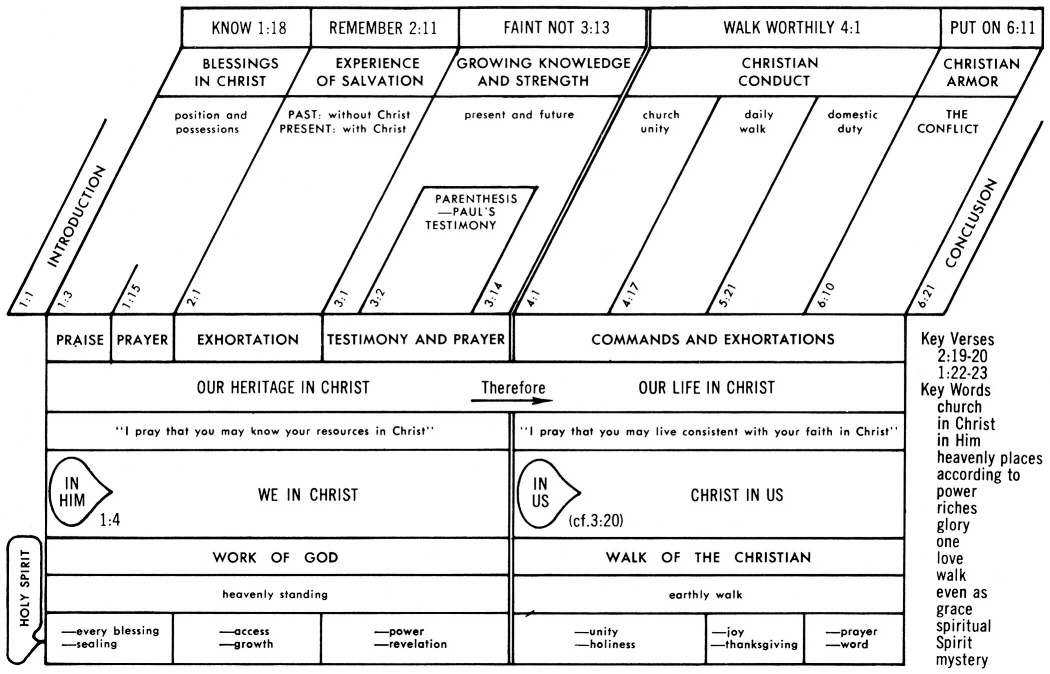
EPHESIANS - CHRIST AND THE CHURCH
Click chart to enlarge
Charts from Jensen's Survey of the NT - used by permission
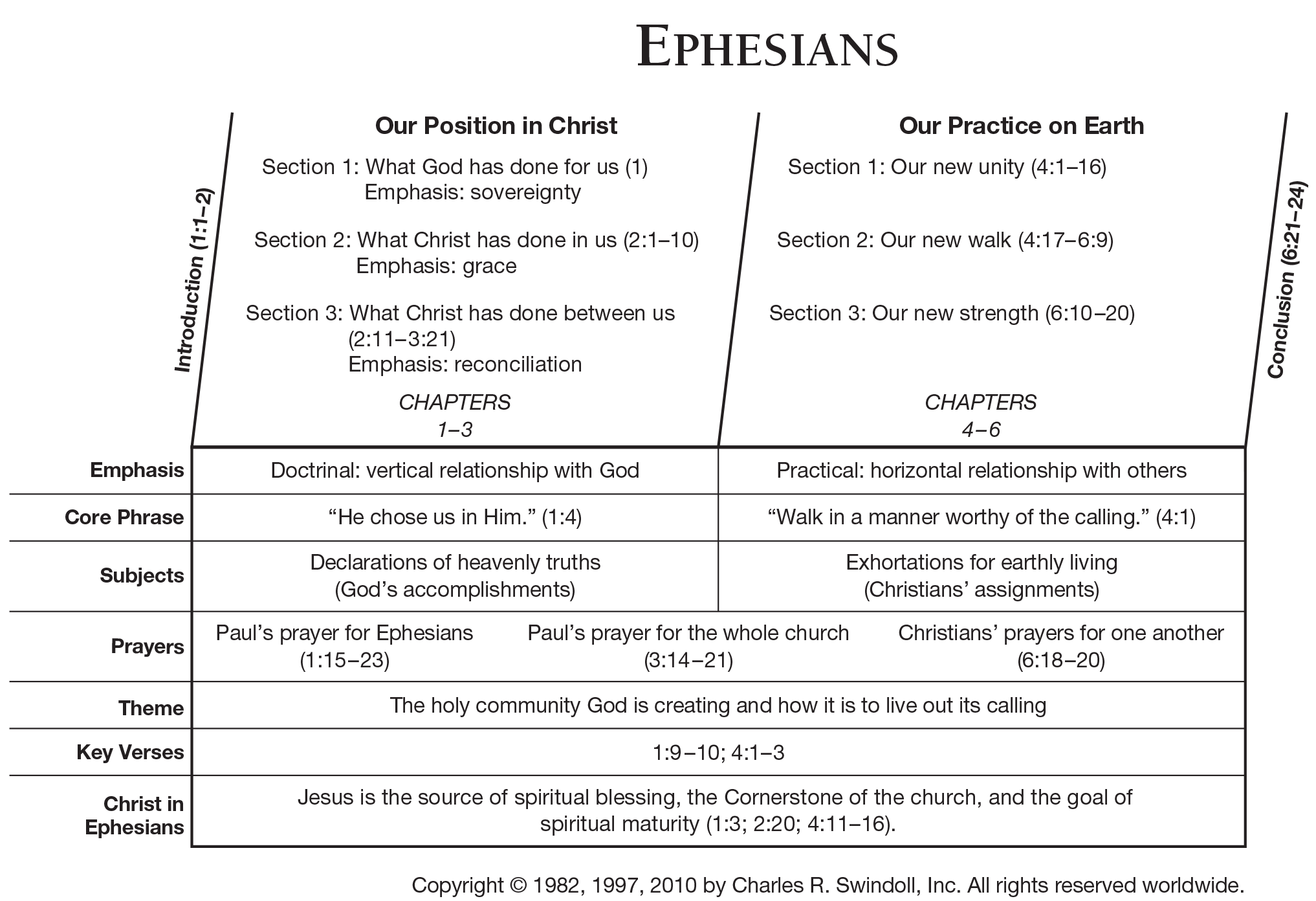
Click chart by Charles Swindoll -Note "EMPHASIS" --
Ephesians 1-3 = Doctrinal: vertical relationship with God
Ephesians 4-6 = Practical: horizontal relationship with others
Ephesians 4:12 for the equipping of the saints for the work of service, to the building up of the body of Christ; (NASB: Lockman)
Greek: pros ton katartismon ton hagion eis ergon diakonias, eis oikodomen tou somatos tou Christou,
BGT πρὸς τὸν καταρτισμὸν τῶν ἁγίων εἰς ἔργον διακονίας, εἰς οἰκοδομὴν τοῦ σώματος τοῦ Χριστοῦ,
Amplified: His intention was the perfecting and the full equipping of the saints (His consecrated people), [that they should do] the work of ministering toward building up Christ’s body (the church), (Amplified Bible - Lockman)
BBE For the training of the saints as servants in the church, for the building up of the body of Christ:
CSB for the training of the saints in the work of ministry, to build up the body of Christ,
ESV to equip the saints for the work of ministry, for building up the body of Christ,
GWN Their purpose is to prepare God's people to serve and to build up the body of Christ.
NKJV: for the equipping of the saints for the work of ministry, for the edifying of the body of Christ,
KJV For the perfecting of the saints, for the work of the ministry, for the edifying of the body of Christ:
NET to equip the saints for the work of ministry, that is, to build up the body of Christ,
NIV to prepare God's people for works of service, so that the body of Christ may be built up
NLT (Revised) Their responsibility is to equip God's people to do his work and build up the church, the body of Christ.
NLT: Their responsibility is to equip God's people to do his work and build up the church, the body of Christ, (NLT - Tyndale House)
NRS to equip the saints for the work of ministry, for building up the body of Christ,
NAB to equip the holy ones for the work of ministry, for building up the body of Christ,
NJB to knit God's holy people together for the work of service to build up the Body of Christ,
Phillips: His gifts were made that Christians might be properly equipped for their service, that the whole body might be built up until the time comes when,. (Phillips: Touchstone)
Wuest: for the equipping of the saints for ministering work with a view to the building up of the Body of Christ,
Young's Literal: in order fully to equip His people for the work of serving—for the building up of Christ's body—
FOR THE EQUIPPING OF THE SAINTS FOR THE WORK OF SERVICE: pros ton katartismon ton hagion eis ergon diakonias:
- Equipping of the saints - Luke 22:32; John 21:15, 16, 17; Acts 9:31; 11:23; 14:22,23; 20:28; Romans 15:14,29; 1Cor 12:7; 2Cor 7:1; Php 1:25,26; 3:12, 13, 14, 15, 16, 17, 18; Colossians 1:28; 1Th 5:11, 12, 1,3, 14; Heb 6:1; 13:17
- for the work of service Acts 1:17,25; 20:24; Ro 12:7; 1Co 4:1,2; 2Cor 3:8; 4:1; 5:18; 6:3; Col 4:17; 1Ti 1:12; 2Ti 4:5,11
- Ephesians 4 Resources - Multiple Sermons and Commentaries
- Ephesians 4:11-13 Growing into a Mature Church - Steven Cole
- Ephesians 4:13-16 - Wayne Barber
- Ephesians 4:13: The Goal of Equipping the Saints - Wayne Barber
- Ephesians 4:11-16 Building the Body of Christ, Part 2 - John MacArthur
EQUIPPING
THE SAINTS
For the equipping (katartismos) of the saints - KJV has "perfecting of the saints" which conveys the wrong idea, for the purpose of Christs gifts ("gifted men") to the Church is not to make saints sinlessly perfect but is to completely outfit them for service or as Paul describes to make them...
a vessel for honor, sanctified (set aside), useful (easy to make use of) to the Master, prepared (carries idea of willingness and eagerness as well as of readiness) for every good (God) work. (2Ti 2:21+)
John MacArthur gives some sage advice in this vital area of pastor-teachers equipping their sheep writing "The surest road to a church’s spiritual stagnation, to the pastor’s burnout, or to both is for the pastor to become so engulfed in activities and programs that he has too little time for prayer and the Word. And programs that “succeed” can be even more destructive than those that fail if they are done in the flesh and for human satisfaction rather than the Lord’s glory. It is lack of knowledge of God’s Word and obedience to it (Hos. 4:6), not lack of programs and methods, that destroy His people. When they fail it is not because of weak programs but because of weak teaching. The first concern of the leadership of the church should be for the filled seats, not the empty ones. When a young preacher complained to Charles Spurgeon that his own congregation was too small, Spurgeon replied, “Well, maybe it is as large as you’d like to give account for in the day of judgment.” Spiritual growth does not always involve learning something new. Our most important growth often is in regard to truth we have already heard but have not fully applied. (See Ephesians MacArthur New Testament Commentary)
Dr S Lewis Johnson explains this important passage writing that
what Paul is really saying is these gifted men, apostles, prophets, evangelists, pastors and teachers, are given for the equipping of the saints – that’s their one duty, to equip the saints – that the saints might do the work of ministry that the body of Christ might be edified. So that the work of the ministry is not the work of the gifted man; he’s simply to equip them from the word of God. He’s to teach the Scriptures so that they, built up in the faith, strengthened, given doctrine of biblical knowledge and the application of it, are then able to carry on ministry. Everyone is a minister in the body of Christ. So you are a minister in the body of Christ...
Now in the case of each of these gifts, assuming that this last is one gift, pastor hyphen teacher, you’ll notice that each one has something to do with the word of God. So, the concept that Paul is speaking about here is the concept of men who have utterance gifts to teach the word of God, to equip us, to do the work that will lead to the edifying of the body of Christ. And I read the statement from Calvin, to the effect, in which Calvin says,
“He could not exalt more highly the ministry of the word than by attributing to it this effect. For what higher work can there be than to build up the church that it may reach its perfection. They, therefore, are insane, who neglecting this means hope to be perfect in Christ, as is the case with the fanatics who pretend secret revelations of the spirit (that is, they pretend they have prophets), and the proud, who content themselves with the private reading of Scripture and imagine that they do not need the ministry of the church.”
So Calvin made, I think, a very valid point that what leads to the edification of the church, the body of Christ, is the ministry of gifted men who bring the word of God to us. The word is the source of the edification of the body of Christ.
Now I’d like to just draw a little contrast here, based on that. You’ll note that it all comes from the word. He does not say that God has given to us educators, that they might instruct us. He does not say that he has given us organizers, that the body may be built up. He does not say that he gives us administrators, that the body of Christ may be built up. He does not say that we have been given counselors, or psychologists, or fundraisers, that the church may be built up.
In other words, the edification of the body of Christ comes from the ministry of every believer who is equipped for his task by the apostles, the prophets, the evangelists, the pastor-teacher, or, in their teaching of the word of God. It is the word of God that equips the saints for ministry. So the Apostle, I think, lays great stress upon that. (Pdf)
For the work of service - Literally unto spiritual service. Service for the Lord will require some expenditure of ergs! Note that the pastor-teachers are not doing their work for the saints, but are preparing the saints for their (the saint's) work! Radical! The leaders are God's gift to the church for the purpose of perfecting or equipping believers to carry on this work. We seem to have forgotten that the church is not to be a spiritual rest home, but a barracks for training soldiers of the cross! So many today think that it is the job of the pastoral staff to do the work of ministry! This is not the divine design! All (each and every single one) of the saints and not just a few (church staff) leaders are to carry on the work of the ministry (cp 1Pe 4:10, 11-note). Tragically, most local churches today do not follow this NT template for "success". It is common practice to let the pastor do the ministering when his job is actually to be the training up of the saints to be the workers, which will make the overall ministry more effective.
It is vitally important to understand that the bulk of the work (ministry) in the church is to be accomplished not by the paid staff but by the men and women in the pews. They are not there to just sit and soak but to hear and grow and serve! Equipping of the saints is the primary responsibility of the leadership, especially the pastor-teacher. But 1Pe 2:5 (note) makes it clear that every believer is a “priest.” (cp 1Pe 2:9-note) How tragic it is that in most churches the work of God is greatly hindered because the leadership tries to perform the services and doesn’t make adequate use of the sheep.
D. L. Moody hit the proverbial nail on the head when he said "It is better to put ten men to work than to do the work of ten men."
Equipping (2677) (katartismos from katartizo = mend, repair, make whole or perfect, of setting bones, mending nets in turn from katá = with + artízo = adjust, fit, finish related to ) means to make something or someone (in this case the "sheep" in the flock) completely adequate or sufficient for something. The noun describes the dynamic act by which persons or things are properly conditioned. The basic idea is that of putting a thing into the condition in which it ought to be. In politics it is used for bringing together opposing factions so that government can go on.
The English word equip means to furnish for service or action by appropriate provisioning. Equip describes the supplying with the items needed for a particular purpose, both of these definitions providing excellent pictures of the effect the gifted men should have on the body of Christ, fitting or preparing them fully, so that thus equipped they might serve the purpose for which they were made new creatures in Christ (2Cor 5:17+).
Paul used the verb form (katartizo) in the context of a call for unity writing...
Now I exhort you, brethren, by the name of our Lord Jesus Christ, that you all agree, and there be no divisions (schisma - schisms, parties, in present context [1Co 1:11-13+] referring to no division over personalities) among you, but you be made complete in the same mind and in the same judgment. (Comment: Paul appeals for adjustments to be made in these personality divisions so that there might be unity in the church. (1Co 1:10+)
Other issues that divided the Corinthian church included libertinism (1Cor 6:13), the relation of men and women in the church (1Cor 11:2-16), food laws (1Cor 8:10; 10:25), speaking in tongues (1Cor 14), and resurrection of the dead (1Cor 15).
Paul used the verb form (katartizo) again in second epistle to the Corinthians in his closing admonition to the believers:
Finally, brethren, rejoice (present imperative), be made complete (katartizo in present imperative = command for lifelong, daily process until we see Jesus face to face! Until then we need to depend on His Spirit to obey) (2Co 13:11+)
Comment: Katartizo conveys the sense here not of adding something that is lacking, but of putting things in order, of adjusting things that are out of adjustment as for example in describing fisherman mending their nets. Paul was commanding the Corinthian saints to mend their ways, to straighten themselves out, and restore harmony among themselves. Spiritual wholeness comes when the church, both collectively and individually, is in complete conformity to God’s Word. To equip the saints to do so is the responsibility of the church’s leaders.
It is worth noting that in classical Greek this word group is derived from the root "ar-" which indicates appropriateness, suitability, usefulness, aptitude. Artios (katartismos) for example means suitable, appropriate, fitting a situation or requirements; hence also respectively, normal, perfect, sound in physical, intellectual, moral and religious respects. In mathematics it is used to describe what is straight and to denote even numbers.
Artios properly signifies an integer or whole number in arithmetic, to which nothing needs to be added to make it complete. This word describes those persons who are complete, capable and proficient in everything they are called to be or do. When you're packing to go on a trip you have everything you need for the journey and you're ready to go! You are ready for the WORK of God once you have been trained by WORD of God!
Regarding artios NIDNTT adds that "Of particular importance are those passages in which artios and its derivatives are used in connexion with the preparation and equipment of the believer and the church, for the service of God and their fellow-men. The adj. artios occurs only at 2Ti 3:17-note (see below), together with the perfect pass. participle exertismenos. In the OT scriptures the church of the New Testament has an indispensable, God-given guide to living, through which the man of God may achieve an appropriate state, viz. be equipped for every work of love: “so that the man who belongs to God may be efficient and equipped for good work of every kind” (NEB). Artios here does not imply perfection, as was originally thought, doubtless because of the variant reading teleios, perfect, in Codex D. Rather it refers to the state of being equipped for a delegated task... The terms artios and katartismos thus have not so much a qualitative meaning as a functional one. (Brown, Colin, Editor. New International Dictionary of NT Theology)
As noted in the NIDNTT preceding definition, there are two cognates (relatives of katartismos) used in 2 Timothy which are very instructive regarding the primary tool God provides for the equipping of the saints...
All Scripture is inspired by God and profitable for teaching, for reproof, for correction, for training in righteousness; that the man of God may be adequate (artios), equipped for every good work. (2Ti 3:16, 17-note)
Comment: The primary tool God provides for the equipping of saints is His Word (see Simple Study on the Power of God's Word).
THOUGHT Pastors (shepherds) are you feeding the sheep solid food (Heb 5:14+ = no solid food , no maturity, no discernment!), preaching the pure milk of the word (1Pe 2:2+ = no milk, no growth!) in season and out of season, reproving, rebuking and exhorting with great patience and instruction (2Ti 4:2, 3+)? You must feed yourself first (cp Paul to the Ephesian elders = Acts 20:32a+), then feed your sheep and then teach them how to feed themselves on the word - see Inductive Bible study. Don't just give them "fish" to eat, but equip them with the tools that will enable them to "fish" for themselves anywhere in the Word.
Basically katartismos refers to that which has been restored to its original condition, is being made fit or being made complete. The root word was used as a medical term used for setting bones! Secular Greek also used it to refer to the furnishing a house.
Paul's use in the context of the body, the church, pictures the complete furnishing of the believer so that he/her might be made ready to fulfill his/her purpose in the body of Christ where he/she had been placed by God's Spirit.
It follows quite logically that if the "sheep" are not equipped by the shepherds, the body will not function to its full potential or capacity, just as human body that is deficient in vital nutrients fails to fulfill its function optimally. If this is an important truth for the temporal, physical body, how much more important is it for the eternal, spiritual body! Shepherds, feed your sheep. Have you ever just read an entire letter of Paul's together with your flock? This letter was meant to be read publicly but it seems we have drifted from such practices, for a variety of reasons. Are you encouraging your sheep to memorize the Word? (Ps 119:9, 10, 11+)... to meditate on the Word? (Ps 1:2,3+, Josh 1:8+)
Ray Stedman offers an excellent illustration (mending nets) of the practical meaning of katartismos. First observe the passage Stedman is referring to...
Mt 4:21+ And going on from there He saw two other brothers, James the son of Zebedee, and John his brother, in the boat with Zebedee their father, mending (katartizo) their nets; and He called them.
Stedman comments...
In the original Greek, the word is katartismos, from which we get our English word "artisan"--an artist or craftsman, someone who works with his hands to make or build things. It is a special point of interest that this word first appears in the New Testament in connection with the calling of the disciples. As Jesus walked along the Sea of Galilee, he saw two pairs of brothers, Peter and Andrew, and James and John, sitting in a boat busily working. What were they doing? They were mending their nets. The word "mending" is the (Ed note: actually the related verb katartizo) word translated in Ephesians 4 as "equipping." They were equipping their nets by mending them. They were fixing their nets, making them strong, preparing them for service, getting them ready for action!
Mending the Saints - The use of this particular word suggests that the role of the four support gifts (Ed note: the gifted men in Ep 4:11+) within the church is essentially that of mending the saints, preparing them for service, getting them ready for action. This Greek word is also translated as "fitting them out" or "preparing." The Greek authority, J. H. Thayer, says it means "to make one what he ought to be." Perhaps the nearest modern equivalent is "to shape up." The ultimate aim of apostles, prophets, evangelists, and pastor--teachers is the shaping up of the saints to do the work of the ministry. A moment's thought will make clear that the instrument to be used by the four support gifts in equipping the saints is the word of God. Obviously, all four support ministries relate somehow to that word...The task of the pastor-teacher is to use the Word of God to cleanse and feed the flock. The early church clearly understood that the word of God was the instrument of growth in the lives of Christians. Paul once spoke to the very elders to whom this Ephesian letter is addressed and said to them,
And now I commend (paratithemi place you beside is the idea = commercial technical term for giving something to someone in trust for safekeeping = to "deposit") you to God (NOTE THE ORDER) and to the word of his grace, which is able to build you up and to give you the inheritance among all those who are sanctified (Acts 20:32+).
And again, at the close of his career, he wrote to his son in the faith, young Timothy, and urged him to teach the inspired Scripture which were given, that the man of God may be complete, equipped for every good work. If pastors and teachers ignore the Word, God's divinely-provided instrument of equipping, then they should not be surprised if the saints in their charge are ill-equipped for--and ineffective in--the work of the ministry. That is why so many churches today are little more than spectator arenas where unequipped, unmotivated, uninvolved people sit around, waiting only to be kept amused and occupied.
The teaching of the truth of the Word of God is what Peter calls "feeding the flock of God which is among you" (1Pe 5:2+). The Word can both feed (see He 5:12+;He 5:13+ and 1Pe 2:2+), and cleanse (John 15:3 and Eph 5:26+), and the true pastor will constantly be using it to do both. He will seek to teach the whole truth of God. There is no better means to do this than through the expository preaching of the whole Bible. The expository method of teaching or preaching is to go through a book, or a section of a book of the Bible, leaving out nothing, commenting on everything, touching it all. That prevents a pastor from only skewing his preaching only to a few favorite "pet passages," and forces that pastor to keep truth in balance...
Unfortunately, in many churches (and particularly American churches), there has come a strange reversal of roles between the pastor and the evangelist. This has effectively deprived churches of the biblical ministry of a pastor and has resulted in a sadly impoverished, untaught, unequipped people. The work of evangelism has been exalted over that of pastoral teaching in many American churches. (Body Life - see "Ch 8: Shaping Up the Saints") (Bolding added)
In the time of Nehemiah and the rebuilding of the Temple, the Jews who returned from captivity were in great need of "shaping up", and so the following solution should not surprise us...
While they stood (you mean they didn't even have wooden pews or padded chairs?) in their place, they read from the book of the law of the LORD their God for a fourth of the day; (note the effect the Word of God has on a tender, teachable heart!) and for another fourth they confessed and worshiped the LORD their God. (Nehemiah 9:3, cp Neh 8:5 = The people often stood as a sign of reverence and humility = 1Sa 1:26; 1Ki 8:22; Lk 18:11,13)
Comment: How many congregations would sit still for a fourth of a day to hear the book of the law read? ("In Nehemiah 8 we discover that apparently the congregation stood on their feet from morning until noon, for seven days, as the Scriptures were read and expounded compare Neh8:3,7,8,18. This is an amazing testimony of reverence toward God's Word, seldom, if ever, repeated since." Morris, Henry: Defenders Study Bible)
One day we will be standing before the throne and before the Lamb, the Word of God, (Re 7:9+), so why not "practice" standing now when the Word of God is read (no legalism here, all of grace motivated by love and reverential awe for so great a salvation and a Book so precious, standing as an act of worship. We stand when we sing songs written by men. Why do we not stand when we read Words written by God?
Saints (40) (hagios) is literally holy one and refers to one set apart (sanctified) for a special purpose. Hagios describes all who have been saved by grace through faith and whom God has set apart from that which is secular, profane, and evil and on the other hand dedicated to worship and service of God. Saints are those who have been taken out of Adam and placed into Christ. Saints are holy ones in character and are to manifest a conduct reflective of their high position and privilege. They have been set apart by God to be exclusively His, dedicated to Him and manifesting holiness of heart and conduct.
Saints in Ephesians - Eph 1:1 Eph 1:15 Eph 1:18 Eph 2:19 Eph 3:8 Eph 3:18 Eph 4:12 Eph 5:3 Eph 6:18
Hagios was used throughout the NT to speak of anyone or anything that represents God’s holiness, anything set apart from the common and profane -- Christ as the Holy One of God, the Holy Spirit, the Holy Father, holy Scriptures, holy angels, holy brethren, and so on.
The Gentiles (the church at Ephesus was primarily Gentile) understood the term hagios because among the pagans, hagios was a term commonly used to signify that which was separated and dedicated to the base, idolatrous gods (cp Gal 4:8+, 1Co 8:4,5+, 1Co 10:19, 20+, Dt 32:17, Lv 17:7+, 1Th 1:9b-+) but which of course carried no idea of moral or spiritual purity as in Scripture. It was primarily the idea of that which set apart from the commonplace. In fact, the manmade gods were as sinful and degraded as the men who made them! The worshipper of the pagan god acquired the character of their pagan god and the religious ceremonies connected with their base (anything but "holy") worship. In fact the Greek temple at Corinth housed a large number of harlots ("spiritual priestesses"!) who were connected with the "worship" of the Greek god. Thus, the set-apartness or holiness of the Greek worshipper was characterized by licentious, totally depraved, sinful conduct.
Work (2041) (ergon from érgo = to work) describes toil as an effort or occupation. In English an erg is a unit of work or energy, equal to the work done by a force of one dyne when its point of application moves one centimeter in the direction of action of the force.
Ergon in Ephesians - Eph 2:9 Eph 2:10 Eph 4:12 Eph 5:11
Service (1248) (diakonia) means the rendering or assistance or help by performing certain duties, often of a humble or menial nature, including such mundane activities as waiting on tables or caring for household needs—activities that in men's eyes (but not God's!) are without apparent dignity.
A caveat - Martha's serving (diakonia) serves as a reminder that we are not to work for "work's sake"! Martha worked so hard that she was distracted (literally was being drawn different directions at the same time!) with all her preparations (Lk 10:40, 41) and missed the good part (Lk 10:42) of sitting at the Lord's feet (Lk 10:39, 42 = she was also "worried and bothered"). Spirit empowered work (cp Paul's pattern in Col 1:28-note, Col 1:29-note, 1Co 15:10) proceeds from Christ centered worship, time with the Master, in His Word, listening to His voice, speaking with Him. We must continually keep in mind our Lord's warning that apart from abiding in Him as our Vine we can do absolutely nothing of eternal value (Jn 15:5).
Diakonia - 34x in 32v - ministries(1), ministry(19), mission(1), preparations(1), relief(1), serve(1),service(7), serving(2), support(1). Luke 10:40; Acts 1:17, 25; 6:1, 4; 11:29; 12:25; 20:24; 21:19; Rom 11:13; 12:7; 15:31; 1 Cor 12:5; 16:15; 2 Cor 3:7, 8, 9; 4:1; 5:18; 6:3; 8:4; 9:1, 12f; 11:8; Eph 4:12; Col 4:17; 1 Tim 1:12; 2 Tim 4:5, 11; Heb 1:14; Rev 2:19.
Paul is describing the spiritual service expected of every believer, not just of church leaders. As he wrote to the Corinthians...
Therefore, my beloved brethren, be (present imperative = Paul commands these attitudes to continually be the believer's lifestyle) steadfast (from hedra =seat, chair, thus picturing a metaphor to describe one settled or steady in mind and purpose), immovable, always abounding (superabounding continually) in the work of the Lord (Whose work? Be careful to make that distinction!), knowing that your toil is not in vain in the Lord (Why is your toil not empty, futile, fruitless?). (1Cor 15:58)
Comment: Paul says that as believers we know without a doubt that whatever we do for Him (and "in Him", Jn 15:5, see Good Deeds) will not be wasted or lost in time or eternity! 1Cor 15:58 is the Scriptural answer to Solomon's repeated refrain of vanity in Ecclesiastes (Eccl 1:2, 14; 2:11, 15, 19, 21, 23, 26; 3:19; 4:4, 7, 8, 16; 5:10; 6:2; 12:8)!
Since service associated with the word diakonia necessarily involved dependence, submission, and constraints of time and freedom, the Greeks regarded diakonia as degrading and dishonorable. Service for the public good was honored, but
“voluntary giving of oneself in service of one’s fellow man is alien to Greek thought. The highest goal before a man was the development of his own personality.”
That last sentence is strikingly contemporary, and is mindful of the fact that a culture that is focused on self-actualization and self-fulfillment will find little value in servant hood.
In the view of the erudite, elite Greeks, diakonia service was not dignified. They saw ruling, not serving as that which was proper for a man. The formula of the sophist ("wise ones") expressed their basic attitude
“How can a man be happy when he has to serve someone?”
For the Greek who "worshiped" wisdom and intellectual freedom there was be no thought of their existence being that to serve others.
Judaism had no philosophy of ministry involving diakonia. Judaism, however, adopted a philosophy of service not unlike that of the Greeks. If service was rendered at all, it was done as an act of social obligation or as an act to those more worthy. A superior would not stoop to become a servant! Such an attitude, which conforms so closely to man’s natural prejudices, causes the Lord’s example and teaching to stand out in brilliant contrast. By our Lord's own testimony (using the verb diakoneo)...
"the Son of Man did not come to be served, but to serve, and to give His life a ransom for many." (Mt 20:28)
Though Judaism in the time of Jesus knew and practiced its social responsibilities, e.g., to the poor, this was done mainly by alms, not by service (cf. Lk 10:30, 31, 32, 33, 34 35). Lowly service such as waiting at table, was beneath the dignity of a free man (cf. Lk 7:44, 45, 46, 47, 48). Sometimes, the "greater" would wait at table, but this was unusual. Jesus' example and the NT introduced a radically new attitude toward diakonia.
Diakonia is not the activity of a lesser to a greater, but is the lifestyle of a follower of the Lord Jesus. “Serving” in the form of diakonia pervades the NT, not merely in the frequency of the word’s usage but in the constant recurrence of attitudes and examples of service.
Luke records that in the early period of the newly born church...
"while the disciples were increasing in number, a complaint arose on the part of the Hellenistic Jews against the native Hebrews, because their widows were being overlooked in the daily serving (diakonia) of food." (Acts 6:1)
Diakonia is modeled on the pattern and command of the Savior and represents the practical outworking of God’s love, especially toward fellow believers.
“Ministry” (including "mission" as shown in the reference below) is not the activity of an elite class, but the mutual caring of a band of brothers. Luke records that
"Barnabas and Saul returned from Jerusalem when they had fulfilled their mission (diakonia), taking along with them John, who was also called Mark." (Acts 12:25)
Such service is personal and practical, rather than institutional. A diakonos is one who by choice and position has come to be under the authority of his Master and who therefore serves others in love and gratitude. Paul had been called and set apart to be a servant, Luke quoting Paul who testified...
"I do not consider my life of any account as dear to myself, in order that I may finish my course, and the ministry (diakonia) which I received from the Lord Jesus, to testify solemnly of the gospel of the grace of God." (Acts 20:24)
Martha is an example of service of a menial nature but without the proper attitude, Luke recording that
"Martha was distracted with all her preparations; and she came up to Him, and said, "Lord, do You not care that my sister has left me to do all the serving (diakonia) alone? Then tell her to help me." (Lu 10:40)
Diakonía involves compassionate love towards the needy within the Christian community. Paul and Luke in the Acts use the word to designate those who preach the gospel and have care of the churches, even as Paul instructed Timothy to...
"be sober in all things, endure hardship, do the work of an evangelist, fulfill your ministry (diakonia)" (See note 2 Timothy 4:5)
Therefore, diakonia is an office or ministration in the Christian community viewed with reference to the labor needed for others.
THOUGHT: Having studied the NT nuances of diakonia, can you see how much more meaningful Paul's statement was that Mark (who previously had not been useful to Paul) was now "useful...for diakonia"? Is there a "Mark" in your life, who you might have discounted in the past for right or wrong reasons, but whose "ministry" you now need to re-evaluate? And possibly whom you need to restore? Would you classify your service in your local body as "diakonia"?
Moving Toward Maturity
Become mature, attaining to the whole measure of the fullness of Christ. Ephesians 4:13
Today's Scripture & Insight: Ephesians 4:11–16
A recent survey asked respondents to identify the age at which they believed they became adults. Those who considered themselves adults pointed to specific behaviors as evidence of their status. Having a budget and buying a house topped the list as being marks of “adulting.” Other adult activities ranged from cooking dinner every weeknight and scheduling one’s own medical appointments, to the more humorous ability to choose to eat snacks for dinner or being excited to stay at home on a Saturday evening instead of going out.
The Bible says we should press on toward spiritual maturity as well. Paul wrote to the church at Ephesus, urging the people to “become mature, attaining to the whole measure of the fullness of Christ” (Ephesians 4:13). While we’re “young” in our faith, we’re vulnerable to “every wind of teaching” (v. 14), which often results in division among us. Instead, as we mature in our understanding of the truth, we function as a unified body under “him who is the head, that is, Christ” (v. 15).
God gave us His Spirit to help us grow into a full understanding of who He is (John 14:26), and He equips pastors and teachers to instruct and lead us toward maturity in our faith (Ephesians 4:11–12). Just as certain characteristics are evidence of physical maturity, our unity as His body is evidence of our spiritual growth. By: Kirsten Holmberg (Our Daily Bread, Copyright RBC Ministries, Grand Rapids, MI. — Reprinted by permission. All rights reserved)
In what ways are you still vulnerable to “every wind of teaching”? How can you continue to grow spiritually?
Loving God, You’re the author of my growth and maturity. Please help me to see where my understanding of You is still immature and teach me more of Your wisdom.
To learn more about growing toward spiritual maturity, visit ChristianUniversity.org/SF212.
We’re A Community
[The Lord] gave some . . . for the equipping of the saints for the work of ministry, for the edifying of the body of Christ. —Ephesians 4:11-12
Today's Scripture & Insight: 1 Corinthians 12:1-11
A pastor’s wife was diagnosed with Parkinson’s disease. That put the family in a difficult, stressful situation. The pastor wondered how he was going to be able to take good care of her while he still had responsibilities for his church family. But he needn’t have worried because church members stepped up and volunteered to assist him with meals and some of her care.
The apostle Paul wrote to the Corinthian church about the purpose for which the Lord gave them their spiritual gifts. Before he listed the diversity of gifts in 1 Corinthians 12:8-10, he reminded them that “a spiritual gift is given to each of us so we can help each other” (v.7 nlt). God does not give His spiritual gifts for our own selfish use but to serve others, and in so doing, we serve Him.
We are all given different gifts to be used at different times and in different ways. But they are all to be used in love for the “edifying of the body of Christ” (Eph. 4:12). Wherever God has placed us, we can use what He has gifted us to do as we see the need, remembering that we are all part of the church—the body of Christ (1 Cor. 12:13-14). By: C. P. Hia (Our Daily Bread, Copyright RBC Ministries, Grand Rapids, MI. — Reprinted by permission. All rights reserved)
Thank You, Father, for the wonderful gifts You have given Your church. Help me to understand how You have gifted me to encourage other believers, and to spread the message of Your love to the world.
Use your gifts to exercise care for others.
Job Titles
For the equipping of the saints for the work of ministry, for the edifying of the body of Christ, till we all come to the unity of the faith. — Ephesians 4:12-13
Today's Scripture & Insight: Ephesians 4:11-16
When the British Broadcasting Corporation asked for examples of important-sounding, obscure, and even bizarre job titles, one writer offered hers: Underwater Ceramic Technician. She was a dishwasher at a restaurant. Sometimes titles are used to make a job sound more important.
When the apostle Paul listed some of God’s gifts to the church in Ephesians 4:11, he did not intend for these to be understood as high-sounding job titles. All the parts of the body are necessary for the body to function properly. No one part is better than another.
What was of primary importance was the purpose of these gifts. They were “for the equipping of the saints for the work of ministry, for the edifying of the body of Christ, till we all come to . . . the stature of the fullness of Christ” (vv.12-13).
It matters little what title we hold. What is important is that we strengthen the faith of God’s people. When we gauge our effectiveness by the standard that the Bible gives us, it will not matter when we are moved to another role or no longer hold a specific title. Out of love for God, we serve to build up fellow believers, and we let God give His commendation in heaven as He sees fit (Matt. 25:21). By: C. P. Hia (Our Daily Bread, Copyright RBC Ministries, Grand Rapids, MI. — Reprinted by permission. All rights reserved)
Lord, please use me as Your instrument to touch
others’ lives. Help me not to be concerned
about what title I hold but instead that my
life might show others Your grace.
God’s gifts to us are not for us but for others.
TO THE BUILDING UP OF THE BODY OF CHRIST: eis oikodomen tou somatos tou Christou:
- To the building up of the body of Christ - Eph 4:6,29; Ro 14:19; Ro 15:2; 1Co 14:4-5,12,14,26; 2Co 12:19; 1Th 5:11
- Eph 4:4; 1:23; Col 1:24
- Ephesians 4 Resources - Multiple Sermons and Commentaries
- Ephesians 4:11-13 Growing into a Mature Church - Steven Cole
- Ephesians 4:13-16 - Wayne Barber
- Ephesians 4:13: The Goal of Equipping the Saints - Wayne Barber
- Ephesians 4:11-16 Building the Body of Christ, Part 2 - John MacArthur
Related Passages:
Romans 14:19+ So then we pursue the things which make for peace and the building up of one another.
Romans 15:2+ Each of us is to please his neighbor for his good, to his edification.
2 Corinthians 12:19+ All this time you have been thinking that we are defending ourselves to you. Actually, it is in the sight of God that we have been speaking in Christ; and all for your upbuilding, beloved.
1 Thessalonians 5:11+ Therefore encourage (present imperative see our need to depend on the Holy Spirit to obey) one another and build up (present imperative see our need to depend on the Holy Spirit to obey) one another, just as you also are doing.
Ephesians 4:4+ There is one body and one Spirit, just as also you were called in one hope of your calling;
Ephesians 1:23+ which is His body, the fullness of Him who fills all in all.
Colossians 1:24+ Now I rejoice in my sufferings for your sake, and in my flesh I do my share on behalf of His body, which is the church, in filling up what is lacking in Christ’s afflictions.
THE SPIRIT'S ONGOING
"CONSTRUCTION PROJECT"
Ray Stedman wrote "We easily forget that the church is a body. We have tried to operate the church as an institution, a corporation, a business. But the reality Paul wants us to grasp in Ephesians is that the church is a body, made up of “cells”—and the cells are individual believers, you and me and our other brothers and sisters in Christ. Each cell has a unique role to play in keeping the entire body healthy." (See Our Riches in Christ: Discovering the Believer's Inheritance)
To the building up (oikodome) of the body (soma) of Christ (Christos) - Note that Paul does not say for the increasing of the number of attendees on a given Sunday! The critical issue in view here is not quantity of saints, but quality of saints, saints equipped for the work of edifying so that they can then be engaged in edification of other saints! Does this describe the philosophy and practice of your local church? It should because it's God's pattern for real "church growth"! The body is built up externally through evangelism as more believers are added (evangelists are the "obstetricians" so to speak), but the emphasis in this verse is on its being built up internally (pastor-teachers are the "pediatricians" so to speak) as all believers are nurtured to fruitful service through the Word.
Charles Swindoll writes "Let me point out what is perhaps the greatest benefit of...spiritual gifts that I’ve had the privilege of seeing over the course of my ministry -- the promotion, under the gifted leadership of evangelists and shepherding teachers, of a full-bodied ministry. That is, when the ministry model outlined in Ephesians 4:11–16 becomes a reality in our churches, people begin to grow by leaps and bounds. I’m not talking about numerical growth—an explosion of warm bodies suddenly flocking to hear the latest gifted preacher or to respond to the newest fad. I mean deep spiritual growth resulting in changed lives, love for fellow believers, and an uncontrollable drive for evangelism and missions. Yet this kind of growth does result in numerical growth as unbelievers are saved and floundering believers find their way to a vibrant ministry centered on actually making disciples. (Insights on Galatians, Ephesians)
Once again Paul mixes metaphors - a body and a building, but both representing a dynamic, living entity. Peter explained that every genuine believer is also a living stone writing to the saints explaining...
you also, as living stones, are being built up as a spiritual house for a holy priesthood, to offer up spiritual sacrifices acceptable to God through Jesus Christ. (1Pe 2:5+, cf Eph 2:20-22+)
Gifted people are to minister the Word to others so that they in turn are readied to get involved in ministering to others. This same pattern is seen in 2 Timothy where in his last letter Paul exhorts young Timothy...
And the things which you have heard from me in the presence of many witnesses, these entrust to faithful men, who will be able to teach others also. (2Ti 2:2+)
THOUGHT: Equip faithful men who will be able to equip others also! This has always been God's pattern for disciple making. Dear mature believer, are you obeying Jesus' last command to make disciples (aorist imperative = "JUST DO IT!" see our need to depend on the Holy Spirit to obey) (Mt 28:19+)? What is it called when we disobey one of the Lord's commands? (sin) Not prying, just asking! But be motivated, because making disciples is a good deed and you will be rewarded with a reward that lasts throughout eternity (ponder the thought of eternity for a moment [pun intended] -- does it not motivate you at least a little to begin to seriously redeem the precious passing moments you have left on this earth? I do not know what those eternal rewards will be, but I know God gives good gifts (Jas 1:17+) and they will not be rewards that will disappoint us! Beloved, let me encourage you to obey one of our Lord's other commands Matthew 6, enabled by the Holy Spirit. Read Jesus' "investment advice" in Mt 6:19-21+! Redeem the time while you still have time! Ponder the sobering reality of James 4:14+ and Psalm 144:3-4. Pray Psalm 139:23,34 and Psalm 90:12. And remember that this is all to be carried out by grace (cf Heb 10:29b) not works. Only Spirit energized works will be works that are rewarded at the Bema Seat of Christ (2Cor 5:10+, cf Daniel 12:3+).
Building (3619) (oikodome from oikos = dwelling, house + doma = building or demo = to build) is literally the building of a house and came to refer to any building process. Oikodome can refer to the actual process of building or construction. Another literal meaning is as a reference to a building or edifice which is the result of a construction process (Mt 24:1, Mk 13:1, 2 are the only literal uses of oikodome in the NT). (See sermon by Alexander Maclaren entitled "Edification")
Oikodome - 19x in 19v - building(8), buildings(3), edification(5), edifying(1), upbuilding(1).Matt 24:1; Mark 13:1f; Rom 14:19; 15:2; 1 Cor 3:9; 14:3, 5, 12, 26; 2Cor 5:1; 10:8; 12:19; 13:10; Eph 2:21; 4:12, 16, 29; 1 Tim 1:4.
Figuratively, as used in this verse, oikodome refers to the church as the building for God's indwelling and the spiritual edification of the body of Christ. Building is a process of spiritual strengthening. It speaks of development. It is an interesting "architectural" word for Paul to use because the Ephesians were familiar with many magnificent edifices and temples in their famous city. Paul of course is elevating this word to refer to a spiritual edifice, one, which unlike the decaying Ephesian edifices, which would endure forever.
Most of the NT uses of oikodome are metaphorical or figurative, obviously an architectural metaphor. As used here in Eph 2:21, oikodome refers to the church as the building for God's indwelling (cp 1Co 3:9 - see discussion below). Figuratively the idea is the process of edification or building up spiritually or spiritual strengthening.
In this same chapter Paul uses oikodome to describe building up of other saints...
Let no unwholesome ("rotten") word proceed from your mouth, but only such a word as is good for edification according to the need of the moment, that it may give grace to those who hear. (Eph 4:29+)
How fitting that in his last emotion filled encounter with the elders of the Ephesian church he reiterated the vital importance truth of Ephesians 4:12 declaring...
"And now I commend (literally means to place near = a banking term - Paul deposits the elders first near to God and then near to the Word of God's grace!) you to God and to the word of His grace, which is able (dunamai = the word of God has the inherent ability or resources) to to build you up (epoikodomeo = to build upon or erect a superstructure) and to give you the inheritance (part of which is "every spiritual blessing in the heavenly places in Christ" - Eph 1:3+) among all those who are sanctified (positional sanctification is in view - perfect tense describes their permanent condition. Progressive sanctification is daily walking worthy, pursuing holiness, growing in grace). (Acts 20:32+)
Body of Christ - the church, local and universal. This same phrase is found in Ro 7:4 and 1Co 10:16.
Body (4983) (soma) refers not to a literal physical body in this verse but to the figurative ("mystical" - Paul chooses the metaphor) body of Christ, the church, the Bride of Christ. Paul explains the figurative use of body writing...
For even as the body is one and yet has many members, and all the members of the body, though they are many, are one body, so also is Christ. (1Cor 12:12+)
Christ (5547) (Christos from chrio= to anoint, rub with oil, consecrate to an office) is the Anointed One, the Messiah, Christos being the Greek equivalent of the transliterated Hebrew word Messiah. As a Jew learned the Torah, now the Christian learns Christ!
Wayne Barber has an interesting illustration of unity in the face of diversity in the realm of spiritual gifts - "Remember in Ephesians 2 we are told we are of God’s household and also His Temple. We are living stones being fitted into His Temple, each one of us with different sizes, shapes, gifts, personalities and individualities, but every one of us under the control of the Spirit of God. If someone played a middle C on the piano for a while, it is a pretty note. If he played it for a long time, you would say, "Will you quit? You are driving me crazy!" Isn’t it great that unity doesn’t mean uniformity? It doesn’t mean we are all alike. Wouldn’t that make church the most boring place you have ever been in your life? If that fellow added an E and a G and a high C, all of a sudden you would say, "Whew, that sounds good! Now that blends." You’ve got more than just one. You’ve got other diversified notes. But when you put them together played by the same hand, you have unity amongst the diversity. That is what Paul wants you to see. This is the body. This is how it functions. When we are each functioning under the Spirit’s power, letting His ability be ours, then our gifts begin to function. Even though our gifts are different, we are still preserving the unity of the Spirit in the bond of peace. We are different. Folks, you need to grasp that and stop coveting somebody else’s gift and somebody else’s ministry and simply say, "God, anything short of hell is grace. I accept what you have given to me. I receive what you have given to me. Let me just be who I am in your power. When you do that, the unity of the body is being preserved....The word for grace, charis, means that which you don’t deserve. It is Christ who is the Source of every bit of it." (bolding added)
Ray Stedman offers a penetrating assessment of how well the church has followed the "Divine Blueprint" for the building up of the Body of Christ...
When we compare present-day churches to the original blueprint, it is strikingly apparent that many deviations have been permitted which have been detrimental to the life of the church. Through the centuries, the church gradually turned away from the simple provisions which made it such a powerful and compelling force in its early years, and terrible distortions entered into the church which continue to weaken the church today. Popular thinking fastened onto the church building--the physical stone-and-glass edifice--as the identifying symbol of the church. Emphasis was placed upon great imposing structures, massive ornate cathedrals with stained glass windows and flying buttresses.
In the beginning, "working in the church" meant to exercise a gift or perform a ministry anywhere within the far-flung body of Christ--even in a home, out on a mission field, or in a hospital. Gradually, however, "working in the church" came to mean performing some religious act within a specific building which was called "the church."
At the same time, there was a gradual transfer of ministry responsibility from the people (whom we now call the "laity") to the few pastor-teachers (whom we now call the "clergy," a term derived from the Latin clericus, meaning a priest. The scriptural concept that every believer is a priest before God was gradually lost, and a special class of super-Christians emerged who were looked to for practically everything, and who came to be called the "ministry." Somehow, the church lost sight of the concept, so clearly stated in Ephesians 4, that all Christians are "in the ministry." The proper task of the four support ministries we have examined is to train, motivate, and strengthen the people--so-called "ordinary laypeople"--to do the work of the ministry.
When the ministry was left to the "professionals," there was nothing left for the people to do other than come to church and listen. They were told that it was their responsibility to bring the world into the church building to hear the pastor preach the Gospel. Soon Christianity became little more than a Sunday-morning spectator sport, much like the definition of football: twenty-two men down on the field, desperately in need of rest, and twenty thousand in the grandstands, desperately in need of exercise!
This unbiblical distortion has placed pastors under an unbearable burden. They have proved completely unequal to the task of evangelizing the world, counseling the wounded and brokenhearted, ministering to the poor and needy, relieving the oppressed and afflicted, expounding the Scriptures, and challenging the entrenched forces of evil in an increasingly darkened world. Pastors were never, ever meant to do it all! To even attempt it is to end up frustrated, exhausted, and emotionally drained--which, of course, is exactly the state in which you find many pastors today!
Further, this distortion has resulted in a sadly impoverished church which has made little impact on the world and increasingly withdraws into weakness, irrelevance, and isolation. We desperately need to return to the dynamic of the early church. We can no longer defend our ivy-clad traditions which leave no room for the original, power-packed New Testament strategy. Pastors, particularly, must restore to the people the ministry which was taken from them with the best of intentions.
The work of the ministry belongs to the entire body of believers, who should be equipped, guided, and encouraged by those who are gifted by God to expound and apply His Word with wisdom and power. The entire body has received gifts from the Spirit, and it is the task of those in the pastoral ministry to encourage the entire body to discover and exercise those gifts. When we rediscover the pattern and strategy of Ephesians 4, when we have given all Christians in the body their God-given role as ministers of God's eternal plan, then the entire body comes alive with resurrection power. Lives are changed. Ministries explode. Communities are touched and healed. The church becomes healthy and vital and exciting again.
If we can recapture God's original strategy for the church, then we will again see churches that are modern extensions of the church of Acts. The trademarks of the true, living church of Jesus Christ are boldness, power, transformation, and love, lived out in act after act of Christian service. There is no place in this world more exciting to be than a church that operates as God designed it to! (from Pastor Stedman's book Body Life and the chapter entitled How the Body Works)
William MacDonald illustrates Ephesians 4:11-12 schematically as shown below and explains it as follows: "The circle in the center depicts, let us say, the gift of a teacher. He ministers to those in the circle around him so that they are equipped, that is, built up in the faith. Then they go forth and minister to others according to the gifts God has given them. In this way the church grows and expands. It is the divine method of producing growth in the body of Christ, both in size and spirituality. Limitation of Christian service to a select class of men hinders the development of God’s people, stifles the cause of world evangelism, and stunts the growth of the church. The distinction between clergy and laity is unscriptural and perhaps the greatest single hindrance to the spread of the gospel." (Ibid)

Ephesians 4:13 until we all attain to the unity of the faith, and of the knowledge of the Son of God, to a mature man, to the measure of the stature which belongs to the fullness of Christ. (NASB: Lockman)
Greek: mechri katantesomen (1PAAS) oi pantes eis ten enoteta tes pisteos kai tes epignoseos tou huiou tou theou, eis andra teleion, eis metron hlikias tou pleromatos tou Christou,
BGT μέχρι καταντήσωμεν οἱ πάντες εἰς τὴν ἑνότητα τῆς πίστεως καὶ τῆς ἐπιγνώσεως τοῦ υἱοῦ τοῦ θεοῦ, εἰς ἄνδρα τέλειον, εἰς μέτρον ἡλικίας τοῦ πληρώματος τοῦ Χριστοῦ,
Amplified: [That it might develop] until we all attain oneness in the faith and in the comprehension of the [full and accurate] knowledge of the Son of God, that [we might arrive] at really mature manhood (the completeness of personality which is nothing less than the standard height of Christ’s own perfection), the measure of the stature of the fullness of the Christ and the completeness found in Him. (Amplified Bible - Lockman)
BBE Till we all come to the harmony of the faith, and of the knowledge of the Son of God, to full growth, to the full measure of Christ:
CSB until we all reach unity in the faith and in the knowledge of God's Son, growing into a mature man with a stature measured by Christ's fullness.
ESV until we all attain to the unity of the faith and of the knowledge of the Son of God, to mature manhood, to the measure of the stature of the fullness of Christ,
GWN This is to continue until all of us are united in our faith and in our knowledge about God's Son, until we become mature, until we measure up to Christ, who is the standard.
KJV Till we all come in the unity of the faith, and of the knowledge of the Son of God, unto a perfect man, unto the measure of the stature of the fulness of Christ:
NKJ till we all come to the unity of the faith and of the knowledge of the Son of God, to a perfect man, to the measure of the stature of the fullness of Christ;
NET until we all attain to the unity of the faith and of the knowledge of the Son of God– a mature person, attaining to the measure of Christ's full stature.
NIV until we all reach unity in the faith and in the knowledge of the Son of God and become mature, attaining to the whole measure of the fullness of Christ.
NLT (revised) This will continue until we all come to such unity in our faith and knowledge of God's Son that we will be mature in the Lord, measuring up to the full and complete standard of Christ.
NLT: until we come to such unity in our faith and knowledge of God's Son that we will be mature and full grown in the Lord, measuring up to the full stature of Christ. (NLT - Tyndale House)
NRS until all of us come to the unity of the faith and of the knowledge of the Son of God, to maturity, to the measure of the full stature of Christ.
NAB until we all attain to the unity of faith and knowledge of the Son of God, to mature manhood, to the extent of the full stature of Christ,
NJB until we all reach unity in faith and knowledge of the Son of God and form the perfect Man, fully mature with the fullness of Christ himself.
Phillips: in the unity of the common faith and common knowledge of the Son of God, we arrive at real maturity - that measure of development which is meant by the "fullness of Christ". (Phillips: Touchstone)
Wuest: until we all attain to the unity of the Faith and of the experiential, full, and precise knowledge of the Son of God, to a spiritually mature man, to the measure of the stature of the fulness of the Christ,
Young's Literal: till we all of us arrive at oneness in faith and in the knowledge of the Son of God, and at mature manhood and the stature of full-grown men in Christ
UNTIL WE ALL ATTAIN TO THE UNITY OF THE FAITH: mechri katantesomen (1PAAS) oi pantes eis ten enoteta tes pisteos:
- We all attain - Ep 4:3,5; Jer 32:38,39; Ezek 37:21,22; Zeph 3:9; Zech 14:9; Jn 17:21; Acts 4:32; 1Co 1:10; Phil 2:1-3
- Ephesians 4 Resources - Multiple Sermons and Commentaries
- Ephesians 4:11-13 Growing into a Mature Church - Steven Cole
- Ephesians 4:13-16 - Wayne Barber
- Ephesians 4:13: The Goal of Equipping the Saints - Wayne Barber
- Ephesians 4:11-16 Building the Body of Christ, Part 2 - John MacArthur
WE ARE ALL ON
A SPIRITUAL JOURNEY
Until we all attain to the unity of the faith - Until (mechri) is an adverb marking a terminus both of place and time and in this context mechri introduces the goals of the equipping. The idea of the verb attain is to arrive at a destination (used literally most often that way in Acts), but in this passage is clearly a figurative "spiritual" journey, we all (Paul includes himself) signifying not individuals per se but all the members of the Body. The idea of "until" implies that we will attain it, but the question is when is the terminus or the attainment? Some think it is in this lifetime, but I am more inclined to interpret it as "progressing" toward the goal, but that the goal is not fully attained until the day of the Lord's return.
We All (pas = all without exception) as noted above invokes a collective thought and indicates that Christian growth or progress does not occur in isolation. God’s people collectively are envisioned as en route to this destination. It is not a goal to be attained be a select few "elite" Christians, but by all believers.
Attain (2658) (katantao from katá = intensifies meaning + antáo = meet) means to happen to, with the implication of something definitive and final coming upon one. Katantao is used figuratively in this verse and means to arrive at a particular state, with the focus on the end point. One gets a sense of the meaning of katantao observing the repeated use in the book of Acts to describe travelers arriving at their destination. In this verse katantao conveys the thought of believers arriving at their "destinations" of "unity of the faith" and full knowledge of Christ, and ultimately mature man.
Katantao - 13x in 13v - Acts 16:1; 18:19, 24; 20:15; 21:7; 25:13; 26:7; 27:12; 28:13; 1 Cor 10:11; 14:36; Eph 4:13; Phil 3:11. NAS translates as arrived(4), attain(3), came(3), come(2), reach(1).
To the unity of the faith - oneness is reached when one body of doctrinal truth ("the faith") is adhered to, and is lived out in the body by grace through faith (believing). Paul had earlier mentioned the importance of "one faith" (Eph 4:4) and his point here is that the Church is now moving towards the goal of appropriating all that is included in "one faith". The final perfection of this unity will not be attained until the moment of glorification. Nevertheless, this goal is practical for there can never be unity in the church apart from doctrinal integrity. Since "the faith", the body of doctrine, is not fragmented, logic tells us that when the body is divided, it has to be related to some departure or distortion of "the faith", the doctrines propounded in the Bible. In Ep 4:3+ "the unity of the Spirit" is a gift to be guarded whereas in the present verse the "unity in the faith" is a goal to be reached and it is reached as pastor-teachers are preaching expository messages from the whole counsel of God's Word (both Testaments, not just the New! When one looks at the sermon series of great preachers of past ages such as Spurgeon and Maclaren, it is amazing how many sermons they preached from the Old Testament.) To reiterate perfect unity of the faith will not be attained until we see our Head face to face. But that does not give us an excuse to not press on toward this goal.
Peter O'Brien on [until we attain] to the unity of the faith and of the knowledge of the Son of God’ - The unity which has been inaugurated in Christ through the events described in Eph 2:11-22, and which the readers are strongly urged to maintain (i.e., ‘the unity of the Spirit’, Eph 4:3), is here spoken of as a unity to which they are to attain. This oneness thus partakes of the tension between the ‘already’ and the ‘not yet’: it has been proclaimed as a given fact, but is now presented as the goal of Christian endeavour, a goal which can only be reached by all collectively, and will finally occur at Christ’s coming, when He brings His people to complete maturity. (See The Letter to the Ephesians)
Ray Stedman explains that "The unity of the faith is the shared understanding, in the church, of the great truths revealed in the Scriptures. Though the Scriptures are unchanging, new light is continually issuing forth from them through individual prophets and teachers who are given these new insights by the Holy Spirit. But then they must be shared widely in the body or no new truth is given. New Christians grow when they exert themselves to understand the Scriptures with the help of the teachers and leaders who make themselves available to them within the body of Christ. No growth toward wholeness and perfection can occur without this increase in the unity of the faith through the understanding of Christian doctrine. (Body Life - chapter entitled The Goal is Maturity)
John MacArthur makes an excellent point that "The ultimate spiritual target for the church begins with the unity of the faith (cf. Eph 4:3). As in Eph 4:5, faith does not here refer to the act of belief or of obedience but to the body of Christian truth, to Christian doctrine. The faith (see the faith) is the content of the gospel in its most complete form. As the church at Corinth so clearly illustrates, disunity in the church comes from doctrinal ignorance and spiritual immaturity. When believers are properly taught, when they faithfully do the work of service, and when the body is thereby built up in spiritual maturity, unity of the faith is an inevitable result. Oneness in fellowship is impossible unless it is built on the foundation of commonly believed truth. The solution to the divisions in Corinth was for everyone to hold the same understandings and opinions and to speak the same truths (1Co 1:10). (See The MacArthur New Testament Commentary)
Robertson agrees that here "the faith" means "the gospel, the faith system as in Gal 1:23; Jude 1:3, etc. Here the (phrase "the faith") means more than individual trust in Christ." (Word Pictures in the New Testament)
Unity (1775) (henotes from heís = one + genitive of henós = of one) describes a oneness or unanimity. This oneness and harmony among believers is possible only when it is built on the firm foundation of sound doctrine. The only other use of henotes is Ep 4:3.
The faith (4101) (pistis) subjectively refers to one's trust or belief and thus their conviction of the truth of anything (i.e., everyone lives on faith, e.g., that the red light works to stop the oncoming car, that the plane will lift off, etc). However in this context the phrase "the faith" (the definite article "the" indicating not just any belief system but a very specific belief) refers to the content of what is believed. It is the body of revealed truth that constitutes Christian teaching, particularly featuring the complete content of the gospel. Approximately one-half of the 38 occurrences of the specific phrase "the faith" refer not to the ACT of believing but rather to WHAT is believed, the latter being the usage that the present context calls for. It follows that the specific meaning of this phrase is dependent on the context (the text that goes with the text in question). See the study on this phrase the faith".
The first use of "the faith" referring to the body of truth believed is recorded by Luke who writes that "the word of God kept on spreading; and the number of the disciples continued to increase greatly in Jerusalem, and a great many of the priests were becoming obedient to the faith." (Acts 6:7+)
In a similar use we read of "Elymas the magician (for thus his name is translated) was opposing them, seeking to turn the proconsul away from the faith." (Acts 13:8+)
Similarly we read that "the churches were being strengthened in the faith, (in the doctrinal truths concerning the gospel) and were increasing in number daily." (Acts 16:5+)
Paul and Barnabas "returned to Lystra and to Iconium and to Antioch, strengthening the souls of the disciples, encouraging them to continue in the faith, (not in "their faith" but in the body of truth they had placed their faith in) and saying, "Through many tribulations we must enter the kingdom of God." (Acts 14:21, 22+)
The believers in Jerusalem only knew Paul by reputation and "they kept hearing, “He who once persecuted us is now preaching the faith which he once tried to destroy.” (Gal 1:23+) This is another clear example of "the faith" referring to the objective body of truth that composed the gospel message which Paul preached ceaselessly (1Co 1:17+, 1Co 2:1-2+).
Paul commands (all 4 are present imperative see our need to depend on the Holy Spirit to obey) the Corinthians to "be on the alert, stand firm in the faith, (sound doctrine they had believed) act like men, be strong." (1Co16:13)
The faith is used in a similar way in Paul's first letter to Timothy (1Ti 3:9,4:1, 5:8, 6:10).
Jude writes that we are to "contend earnestly for the faith which was once for all delivered to the saints" which is clearly not a reference to the believers' faith but to the whole body of revealed salvation truth contained in the Scriptures, the objective truths which were to be believed, and the very truths which Jude warns were in danger of being distorted (Jude 1:3).
AND OF THE KNOWLEDGE OF THE SON OF GOD: kai tes epignoseos tou huiou tou theou:
- of the knowledge of the Son of God - Isaiah 53:11; Mt 11:27; Jn 16:3; 17:3,25,26; 2Co 4:6; Phil 3:8; Col 2:2; 2Pe 1:1-3; 3:18; 1Jn 5:20
- Ephesians 4 Resources - Multiple Sermons and Commentaries
- Ephesians 4:11-13 Growing into a Mature Church - Steven Cole
- Ephesians 4:13-16 - Wayne Barber
- Ephesians 4:13: The Goal of Equipping the Saints - Wayne Barber
- Ephesians 4:11-16 Building the Body of Christ, Part 2 - John MacArthur
ANOTHER ASPECT OF
OUR ARRIVAL
In Eph 4:13 the gifts were given to the Church to equip the saints to the end that “we all come (katantesomen) in the unity of the faith, and of the knowledge of the Son of God.” Recall Paul's prayer in Eph 3:19 that we come "to know (ginosko) the love of Christ which surpasses knowledge, that you may be filled up to all the fullness of God."
Knowledge of the Son of God - This is not a reference to the knowledge of Christ by which we were first saved but refers to a deeper, more intimate and experiential knowledge. This refers to a growing encounter with the Lord Jesus Himself, so that we come to know Him more and more--not just know about Him, but know Him, directly and personally. That is a glorious component of a maturing faith. Don't become discouraged for this growing in the deeper knowledge of the Son of God is a lifelong process that will not be complete until we see our Lord face to face. Keep pressing on!
MacArthur - Growing in the deeper knowledge of the Son of God is a life-long process that will not be complete until we see our Lord face-to-face. (See The MacArthur New Testament Commentary )
Knowledge (1922) (epignosis from epí = upon + ginosko = to know) is a strengthened form of gnosis (1108) and conveys the thought of a more full, larger and thorough knowledge. Epígnosis also conveys the idea of an intimate and personal relationship. Vine says the related verb epiginosko suggests in general a directed or more special, recognition of the object known than does the simple verb ginosko. In fairness it should be stated that there are a few resources that suggest there is very little difference between gnósis and epignosis. This discussion holds the opinion that epignosis does have subtle but real differences. Epígnosis refers to exact, complete, thorough, accurate, experiential knowledge, not just abstract, intellectual, head knowledge of God or even facts about Him. Epígnosis always describes moral and religious knowledge in the NT and especially refers to full and comprehensive knowledge of God’s will that rests on the knowledge of God and of Christ found today in His Word.
Epignosis - 20x in 20v - acknowledge*(1), knowledge(14), real knowledge(1), true knowledge(4). Rom 1:28; 3:20; 10:2; Eph 1:17; 4:13; Phil 1:9; Col 1:9f; 2:2; 3:10; 1 Tim 2:4; 2 Tim 2:25; 3:7; Titus 1:1; Philemon 1:6; Heb 10:26; 2 Pet 1:2f, 8; 2:20.
Son (5207)(huios) refers literally to a male offspring or descendant. The Son of God is the One Who has the essential characteristics and nature of God.
TO A MATURE MAN: eis andra teleion:
- To a mature man - Eph 4:12; 2:15; 1Corinthians 14:20; Colossians 1:28
- Ephesians 4 Resources - Multiple Sermons and Commentaries
- Ephesians 4:11-13 Growing into a Mature Church - Steven Cole
- Ephesians 4:13-16 - Wayne Barber
- Ephesians 4:13: The Goal of Equipping the Saints - Wayne Barber
- Ephesians 4:11-16 Building the Body of Christ, Part 2 - John MacArthur
PERFECT MATURITY
To a mature (teleios) man - Mature manhood conveys the idea that God wants believers to fulfill their humanity, the design which He intended for each of us when He created the first man and the first woman. Ponder this incredible thought for a moment. What satisfaction to be all that the All Wise God created us to be. Not to be the richest. Not to be the smartest. Not to be the best looking. But to be what God originally intended for us. This is surely a mountain worthy of the cost it will take to climb it! Some might see it as an arrival but I see it more as a pursuit, like Paul's pressing on toward the goal of the upward call of God in Christ Jesus... to be all you can be in Christ and all for the glory of God.
Ray Stedman puts it this way - It is important to realize that, according to this passage in Ephesians, the supreme purpose of the church is not the evangelization of the world. The Great Commission is often held up to us as the supreme aim and purpose of the church, and it is certainly a crucial and essential task. Jesus has clearly sent us out to preach the Gospel to every creature. But the Great Commission is not God's supreme and ultimate goal. Romans 8:29 tells us that God's ultimate plan for us is that we be "conformed to the image of his Son." Evangelization is a means of bringing people into a relationship with God, so that God's ultimate goal for them--Christlikeness--can be achieved in their lives...God's overarching goal is to produce men and women who demonstrate the character qualities of Jesus Christ. God does not want a church filled with white robed saints. He does not want a church filled with theological authorities or cultured clergyman. He wants a church filled with ordinary men and women who exemplify the extraordinary integrity, temperament, wholeness, compassion, individuality, boldness, righteousness, earnestness, love, forgiveness, selflessness, and faithfulness of Jesus Christ! Deep in your own heart, isn't that what you truly desire? You want to be a whole person, a complete human being. You want to discover and fulfill all that God has built into you...we long to fulfill our humanity, to be the kind of idealized persons that God originally designed us to be. But that is what the church is all about. It is the vehicle designed by God to achieve mature humanity--a humanity exactly like that which was exemplified by the life of Jesus Christ. We have now come full circle, for this is where the apostle began: the church is to fulfill its calling--the calling of demonstrating to the world a new character, a spirit of lowliness, love, and unity, coupled with resurrection power, proving that the church is a body inhabited by God Himself! (Body Life - chapter entitled The Goal Is Maturity)
Mature (5046) (teleios from telos = an end, a purpose, an aim, a goal) means complete, mature, fully developed, full grown, brought to its end, finished, wanting nothing necessary to completeness, in good working order. Teleios signifies consummate soundness, includes the idea of being whole. Interestingly the Gnostics used teleios of the one fully initiated into their mysteries and that may have been why Paul used teleios in this epistle.
Teleios - 19x in 17v - Matt 5:48; 19:21; Rom 12:2; 1 Cor 2:6; 13:10; 14:20; Eph 4:13; Phil 3:15; Col 1:28; 4:12; Heb 5:14; 9:11; Jas 1:4, 17, 25; 3:2; 1 John 4:18. The NAS translates teleios as complete(2), mature(4), more perfect(1), perfect(12).
Teleios has at three shades of meaning:
(1) Teleios speaks of totality, as opposed to partial or limited and when used of things means in full measure, undivided, complete or entire (as in Ro 12:2 - {see note} referring to "the will of God" which is "good and acceptable and perfect"). When referring to persons the idea is that of complete or perfect ("Therefore you are to be perfect (teleios), as your heavenly Father is perfect (teleios)." see Mt 5:48-note - see more discussion below) Teleios describes a victim which is fit for a sacrifice to God as without blemish.
(2) Teleios also speaks of that which is fully development as opposed to that which is immature. And so it describes persons who are full grown or mature (especially referring to spiritual maturity). In Greek teleios was applied to physical growth and so a man who has reached his full-grown stature is teleios in contradistinction to a half-grown lad. A student who has reached a mature knowledge of his subject is teleios as opposed to a learner who is just beginning, and who as yet has no grasp of things. For example Pythagoras divided his students into the learners, and the mature. (teleios). Philo divided his students into three classes—those just beginning (archomenoi), those making progress (prokoptontes), and those beginning to reach maturity (teleios).
Teleios does not imply complete knowledge but a certain spiritual maturity in the faith. That is Epaphras' desire for the saints at Colossae.
(3) Teleios can refer to that which is in a state of full preparation or readiness
In all the above variations of meaning the underlying idea is that a purpose has been achieved or that a thing or person has reached its intended goal or end. The basic meaning of teleios in the New Testament is always that the thing or person so described fully carries out the purpose for which designed. And so when Greek speaks of "perfect" (teleios) it is in fact such if it perfectly carries out the purpose for which it was designed.
Richards explains teleios (and related words in this group such as teleioo, teleiotes) writing that the emphasis is on ""wholeness and completeness. In the biological sense they mean "mature," or "full grown": the person, animal, or plant achieved the potential inherent in its nature. The perfect is the thing or person that is complete, in which nothing that belongs to its essence has been left out. It is perfect because every potential it possesses has been realized." (Richards, L O: Expository Dictionary of Bible Words: Regency)
As Paul explained to the saints at Colossae, his heartbeat in discipleship was to see believers continually growing in maturity...
And we proclaim Him (Christ in believers the hope or certainty of their future glorification - note that "Him" is the first word in Greek sentence for emphasis = "Him we proclaim..."), admonishing (placing in one's mind = cautioning, gently reproving) every man and teaching every man with all wisdom, that we may present every man complete in Christ. And for this purpose also I labor (kopiao - present tense - constantly toiling to the point of being weary, worn out, exhausted, even faint), striving (agonizomai - present tense - continually contending, fighting, wrestling, straining every nerve to the uttermost to reach the goal) according to His power (THE HOLY SPIRIT'S ENABLING POWER - cf Eph 3:16+, Eph 3:20b+, Eph 1:19-20+ = "resurrection power"), which mightily works (energeo - present tense - cf parallel passage Php 2:13NLT+ which also uses energeo) within me. (Colossians 1:28+, Col 1:29+)
In a parallel motivational message to the saints at Philippi Paul wrote...
I press on toward the goal for the prize of the upward call of God in Christ Jesus. (Php 3:14-note)
Man (435) (aner) refers to an adult male person and in context as shown in the next verse stands is stark contrast to the believer who is still in spiritual diapers.
J Vernon McGee in a pithy statement said on his radio broadcast one day "I am going to talk to you very frankly. Don’t expect your pastor to do it all. He is there to train you that you might do the work of the ministry and that the church might become mature. We are not to act like a bunch of nitwits today. We are to give a good, clear-cut, intelligent witness to the world. I think the greatest sin in the local church today is the ignorance of the man sitting in the pew; he doesn’t know the Word of God, and that is a tragedy. I would hate to get into an airplane if the pilot didn’t know any more about flying than the average church member knows about Christianity and the Word of God. The plane wouldn’t make it—I think it would crash before it got ten feet into the air. That is the condition of the church today. All believers need to be trained in the Word of God so they can do the work of the ministry. (McGee, J V: Thru the Bible Commentary: Thomas Nelson)
TO THE MEASURE OF THE STATURE WHICH BELONGS TO THE FULLNESS OF CHRIST: eis metron hlikias tou pleromatos tou Christou:
- to the measure of the stature which belongs to the fulness of Christ Ep 1:23
- Ephesians 4 Resources - Multiple Sermons and Commentaries
- Ephesians 4:11-13 Growing into a Mature Church - Steven Cole
- Ephesians 4:13-16 - Wayne Barber
- Ephesians 4:13: The Goal of Equipping the Saints - Wayne Barber
- Ephesians 4:11-16 Building the Body of Christ, Part 2 - John MacArthur
To the measure of the stature which belongs to the fullness of Christ - In a word this is Christlikeness or conformity to the image of Christ.
As Paul explained to the saints at Rome, God has "predestined (every believer) to become conformed to the image of His Son (Ro 8:29+) Howard Hendricks once said that “The Bible was not written to satisfy your curiosity, but to make you conform to Christ’s image. Not to make you a smarter sinner, but to make you like the Saviour. Not to fill your head with a collection of biblical facts, but to transform your life.”
On a wall near the main entrance to the Alamo in San Antonio, Texas, is a portrait with the following inscription:
James Butler Bonham—no picture of him exists. This portrait is of his nephew, Major James Bonham, deceased, who greatly resembled his uncle. It is placed here by the family that people may know the appearance of the man who died for freedom.
No literal portrait of Jesus exists either. But the likeness of the Son Who makes us free can and should be seen in the lives of His true followers who are being equipped and built up by sound doctrine expounded by Spirit filled pastor-teachers. The church in the world is the body of Jesus Christ in the world, for as Paul explained earlier...
And the church is his body; it is filled by Christ, who fills everything everywhere with his presence. (Eph 1:23NLT+)
The Body of Christ is to radiate the beauty of Christ to a spiritually dead world by walking in a manner worthy of the calling to which we have been called (Ep 4:1+)!
Measure (3358) (metron) is a measure of capacity.
Metron - 14x in 12v - Matt 7:2; 23:32; Mark 4:24; Luke 6:38; John 3:34; Rom 12:3; 2 Cor 10:13; Eph 4:7, 13, 16; Rev 21:15, 17. The NAS renders metron as measure(8), measurements(1), proper(1), standard(4).
Stature (2244) (helikia from helix = adult, full–aged) conveys the idea of maturity in years or size. It speaks of the "ripeness" of full age. In this context it speaks of the maturity of one's renewed Christian mind.
Gilbrant - Hēlikia in classical Greek means (1) “the age of adulthood, physical maturity, or discretion,” (2) “age” or “generation” as a measure of time, or (3) physical “size” as the sign of a particular age or level of maturity. The papyri contain the word in the first two meanings only (Moulton-Milligan). In the Septuagint hēlikia generally means “age”; 2, 3, and 4 Maccabees refer to the four ages of youth, maturity, advancing years, and old age. Less frequently used is the meaning of “maturity” or “adulthood.” All three meanings of hēlikia are found in the New Testament. Zaccheus is described in Lk 19:3 as “little of stature.” But the meanings of “age” and “maturity” are by far the most common. The context of Mt 6:27 and Lk 12:25 makes “length of life” a more appropriate meaning than the “size” of the person. Jesus said that worry or anxious care cannot lengthen a man’s life or age by even a minute fraction of time. Hēlikia means “age of maturity” in John 9:21,23 and “age of fertility” in Heb 11:11 (Sarah was “past age”). The use of hēlikia in Ep 4:13 conveys a special metaphoric sense: “Till we all come . . . unto the measure of the stature of the fulness of Christ.” Here spiritual maturity is a goal which all Christians should strive to reach in their daily spiritual journey. (Complete Biblical Library)
Helikia - 8x in 8v - age (2), life (1), life's span (2), stature (3). - Mt 6:27; Lk 2:52; 12:25; 19:3; Jn 9:21, 23; Ep 4:13; Heb 11:11.
Fullness (4138) (pleroma from pleroo = make full, fill, fill up) speaks of a full measure with emphasis upon completeness. God wants every believer to manifest the qualities of His Son, Who is Himself the standard for their spiritual maturity and perfection. As an aside the Gnostics taught that Christ was a kind of “halfway house” to God, a link in the chain with other better links on ahead. Paul says "no way" -- the complete embodiment of God dwells permanently in Christ and that is to be the goal toward which the equipping of the saints is to continually press.
Pleroma - 17x in 17v - all it contains(m)(1), fulfillment(2), full(2), fulness(10), patch(m)(2). Matt 9:16; Mark 2:21; 6:43; 8:20; John 1:16; Rom 11:12, 25; 13:10; 15:29; 1 Cor 10:26; Gal 4:4; Eph 1:10, 23; 3:19; 4:13; Col 1:19; 2:9.
F F Bruce makes an interesting observation writing that "When the goal is ultimately reached, and the body of Christ has grown up sufficiently to match the Head Himself, then will be seen that full-grown Man which is Christ together with His members. That spectacle will not fully appear until the day when they are glorified together with Him; but the expectation of that day will act as a powerful incentive to spiritual development in the present time’ (Bruce, FF: Ephesians)
McGee writes "This may sound selfish, but I trust it is understood. What is the purpose of the church in the world? It is to complete itself that it might grow up. (McGee, J V: Thru the Bible Commentary: Thomas Nelson)
I like Ray Stedman's advice regarding our growth in Christlikeness...
Since growth is a matter of knowledge plus obedience plus time, we do not need to be discouraged if we find that we are not yet completely like Christ. Some years ago, a button could be seen on the lapels of many Christians. The button read:
P B P G I N T W M Y
When you asked that person, "What do those letters stand for?" he or she would reply, "Please Be Patient, God Is Not Through With Me Yet."
This is a great truth! It is not a statement of an unwillingness to change, but of a recognition that change takes time--but it is taking place! The proper attitude for a healthy Christian is an eagerness to grow.
I once asked a boy how old be was. Quick as a flash he said, "I'm twelve, going on thirteen, but soon to be fourteen." That's the kind of eagerness for maturity we all should have! We do not need to ask ourselves, "Am I mature? Am I completely like Christ?" Instead, we should ask ourselves, "Am I on the way? Is there progress? Am I growing in the right direction?" (Body Life - chapter entitled The Goal Is Maturity)
Do not be discouraged if you are not experiencing overnight spiritual maturity. Remember that it takes God years to grow an oak tree, but He can grow a squash in three months and a radish plant in a few weeks! Which would you rather be!
Oswald Chambers - The spiritual society
Till we all come … unto the measure of the stature of the fulness of Christ. Eph. 4:13.
Rehabilitation means the putting back of the whole human race into the relationship God designed it to be in, and this is what Jesus Christ did in Redemption. The Church ceases to be a spiritual society when it is on the look-out for the development of its own organization. The rehabilitation of the human race on Jesus Christ’s plan means the realization of Jesus Christ in corporate life as well as in individual life. Jesus Christ sent apostles and teachers for this purpose—that the corporate Personality might be realized. We are not here to develop a spiritual life of our own, or to enjoy spiritual retirement; we are here so to realize Jesus Christ that the Body of Christ may be built up.
Am I building up the Body of Christ, or am I looking for my own personal development only? The essential thing is my personal relationship to Jesus Christ—“That I may know Him. “To fulfil God’s design means entire abandonment to him. Whenever I want things for myself, the relationship is distorted. It will be a big humiliation to realize that I have not been concerned about realizing Jesus Christ, but only about realizing what He has done for me.
‘My goal is God Himself, not joy nor peace,
Nor even blessing, but Himself, my God.’
Am I measuring my life by this standard or by anything less?
F B Meyer writes the following devotional entitled "Our Sheet Anchor" which speaks to our present striving toward Christlikeness...
OUR DESTINY is the highest possible--"We shall be like Him." (1John 3:2) For this we were created, redeemed, and sanctified, that we should be conformed to the image of God's Son, that He might be the First Born among many brethren (see note Romans 8:29).
The Apostle says that those who have this Hope will purify themselves (1John 3:3). A young friend of mine once asked me if I would try to see her lover, as my train stopped at a wayside station in a far-distant western State. It was a dark night when we arrived, and a hurried conversation took place on the steps of the great Pullman car. I found that amid the many temptations of a rancher's life, this young fellow was holding on to purity and truth. He said that he had very infrequent opportunities of attending any religious services, but that the letters which came from the old country had been his sheet anchor. I understood what he meant. He realized the strong drift of circumstances, but to be loved by a sweet pure girl, who made him the object of her incessant prayer, and to receive her inspiring letters, kept him from yielding to the evil which enveloped him as an atmosphere; the thought that before long he might claim her as his bride helped to purify and steady his life. So the expectation of being with, and like Christ, should be to us as a sheet-anchor, who bear His Name. (Ed note: The body of Christ, the Church, it the Bride of Christ for we are betrothed to our Bridegroom and are to be anxiously awaiting His return to take us home)
To see Christ face to face, to be with Him in unbroken fellowship, and to be like Him--this is the threefold destiny of every Christian soul. But how little can we imagine our future life! We strive to penetrate the dense veil of mist in vain--what the resurrection body will be like; what the converse with holy beings will amount to; what ministry may be assigned to us--we know not what we shall be, but "we know that we shall be like Him"--and it is enough! All that we have ever dreamed and hoped for will find its flower and fruitage in that glad summer time.
PRAYER -O God, it is my earnest desire that I may not only live, but grow: grow in grace, and in the knowledge of my Lord and Saviour Jesus Christ. May I grow in patience and fortitude of soul, in humility and zeal, in spirituality and a heavenly disposition of mind. AMEN.