Ephesians 4:2
Ephesians 4:3
Ephesians 4:4
Ephesians 4:5
Ephesians 4:6
Ephesians 4:7
Ephesians 4:8
Ephesians 4:9
Ephesians 4:10
Ephesians 4:11
Ephesians 4:12
Ephesians 4:13
Ephesians 4:14
Ephesians 4:15
Ephesians 4:16
Ephesians 4:17
Ephesians 4:18
Ephesians 4:19
Ephesians 4:20
Ephesians 4:21
Ephesians 4:22
Ephesians 4:23
Ephesians 4:24
Ephesians 4:25
Ephesians 4:26
Ephesians 4:27
Ephesians 4:28
Ephesians 4:29
Ephesians 4:30
Ephesians 4:31
Ephesians 4:32
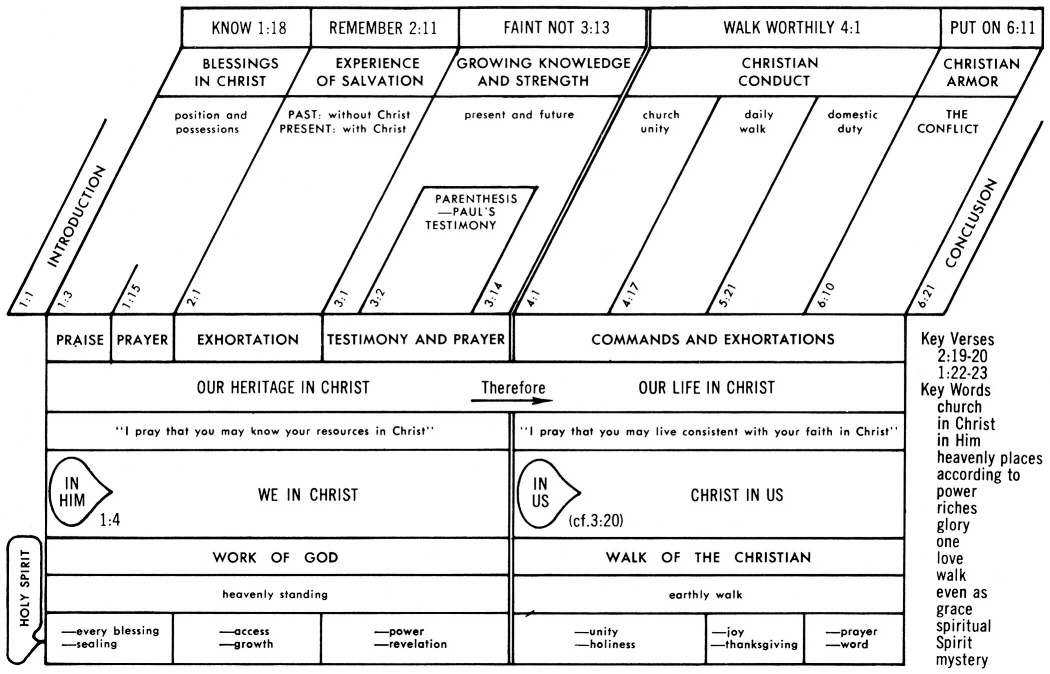
EPHESIANS - CHRIST AND THE CHURCH
Click chart to enlarge
Charts from Jensen's Survey of the NT - used by permission
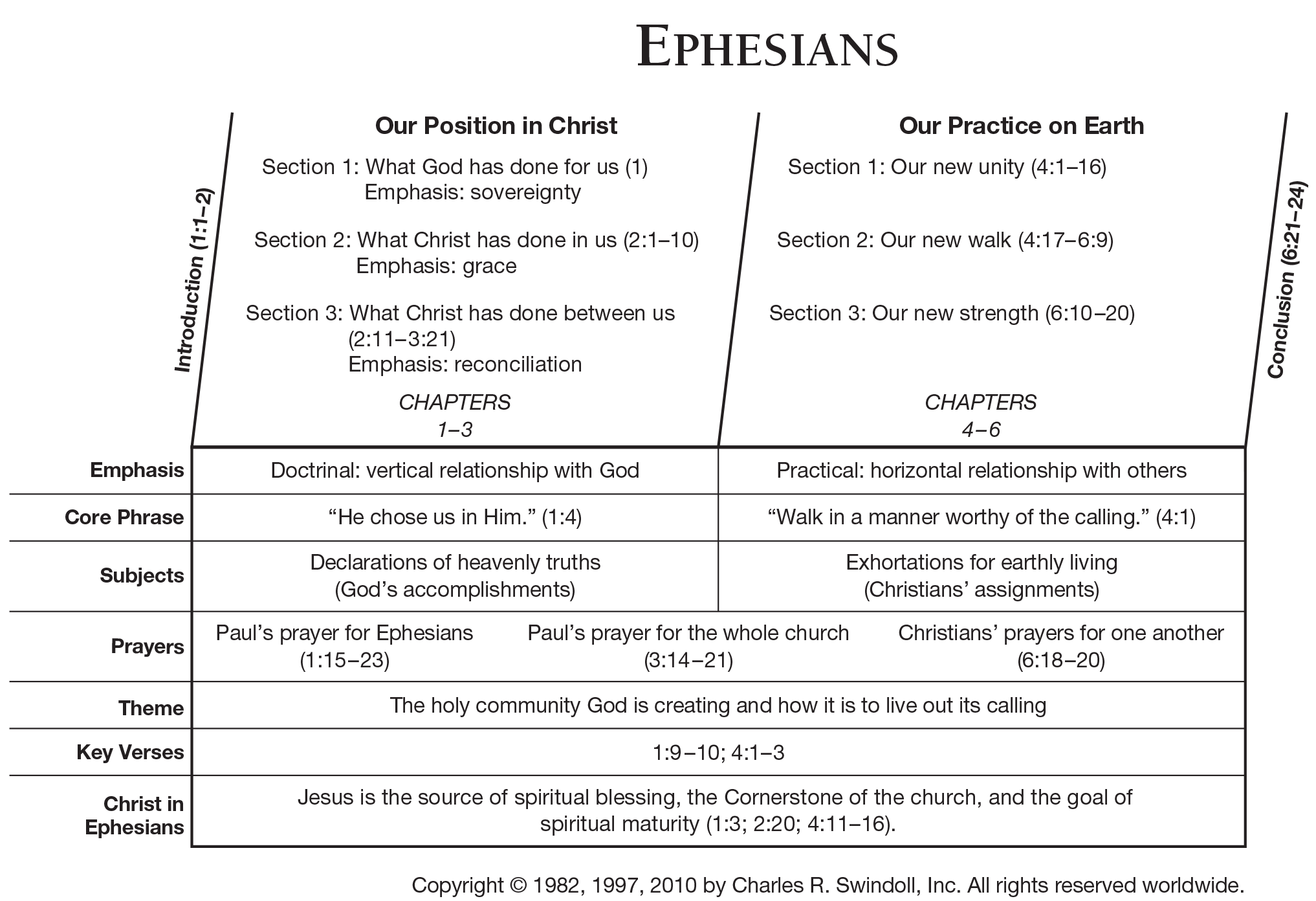
Click chart by Charles Swindoll -Note "EMPHASIS" --
Ephesians 1-3 = Doctrinal: vertical relationship with God
Ephesians 4-6 = Practical: horizontal relationship with others
Ephesians 4:14 As a result, we are no longer to be children, tossed here and there by waves and carried about by every wind of doctrine, by the trickery of men, by craftiness in deceitful scheming; (NASB: Lockman)
Greek: hina meketi omen (1PPAS) nepioi, kludonizomenoi (PPPMPN) kai peripheromenoi (PPPMPN) panti anemo tes didaskalias en te kubeia ton anthropon en panourgia pros ten methodeian tes planes,
BGT ἵνα μηκέτι ὦμεν νήπιοι, κλυδωνιζόμενοι καὶ περιφερόμενοι παντὶ ἀνέμῳ τῆς διδασκαλίας ἐν τῇ κυβείᾳ τῶν ἀνθρώπων, ἐν πανουργίᾳ πρὸς τὴν μεθοδείαν τῆς πλάνης,
Amplified: So then, we may no longer be children, tossed [like ships] to and fro between chance gusts of teaching and wavering with every changing wind of doctrine, [the prey of] the cunning and cleverness of unscrupulous men, [gamblers engaged] in every shifting form of trickery in inventing errors to mislead. (Amplified Bible - Lockman)
BBE So that we may be no longer children, sent this way and that, turned about by every wind of teaching, by the twisting and tricks of men, by the deceits of error;
CSB Then we will no longer be little children, tossed by the waves and blown around by every wind of teaching, by human cunning with cleverness in the techniques of deceit.
ESV so that we may no longer be children, tossed to and fro by the waves and carried about by every wind of doctrine, by human cunning, by craftiness in deceitful schemes.
GWN Then we will no longer be little children, tossed and carried about by all kinds of teachings that change like the wind. We will no longer be influenced by people who use cunning and clever strategies to lead us astray.
NKJV: that we should no longer be children, tossed to and fro and carried about with every wind of doctrine, by the trickery of men, in the cunning craftiness of deceitful plotting,
KJV That we henceforth be no more children, tossed to and fro, and carried about with every wind of doctrine, by the sleight of men, and cunning craftiness, whereby they lie in wait to deceive;
NET So we are no longer to be children, tossed back and forth by waves and carried about by every wind of teaching by the trickery of people who craftily carry out their deceitful schemes.
NIV Then we will no longer be infants, tossed back and forth by the waves, and blown here and there by every wind of teaching and by the cunning and craftiness of men in their deceitful scheming.
NLT (revised) Then we will no longer be immature like children. We won't be tossed and blown about by every wind of new teaching. We will not be influenced when people try to trick us with lies so clever they sound like the truth.
NLT: Then we will no longer be like children, forever changing our minds about what we believe because someone has told us something different or because someone has cleverly lied to us and made the lie sound like the truth. (NLT - Tyndale House)
NRS We must no longer be children, tossed to and fro and blown about by every wind of doctrine, by people's trickery, by their craftiness in deceitful scheming.
NAB so that we may no longer be infants, tossed by waves and swept along by every wind of teaching arising from human trickery, from their cunning in the interests of deceitful scheming.
NJB Then we shall no longer be children, or tossed one way and another, and carried hither and thither by every new gust of teaching, at the mercy of all the tricks people play and their unscrupulousness in deliberate deception.
Phillips: We are not meant to remain as children at the mercy of every chance wind of teaching and the jockeying of men who are expert in the craft presentation of lies. (Phillips: Touchstone)
Wuest: in order that we no longer may be immature ones, tossed to and fro and carried around in circles by every wind of teaching in the cunning adroitness of men, in craftiness which furthers the scheming deceitful art of error,
Young's Literal: So we shall no longer be babes nor shall we resemble mariners tossed on the waves and carried about with every changing wind of doctrine according to men's cleverness and unscrupulous cunning, making use of every shifting device to mislead.
AS A RESULT, WE ARE NO LONGER TO BE CHILDREN: hina meketi omen (1PPAS) nepioi:
- As a result we are no longer to be children - Isaiah 28:9; Matthew 18:3,4; 1 Cor 3:1,2; 14:20; Hebrews 5:12 13, 14
- Ephesians 4 Resources - Multiple Sermons and Commentaries
- Ephesians 4:14-16 Vital Signs of a Healthy Body - Steven Cole
- Ephesians 4:11-16 Building the Body of Christ, Part 2 - John MacArthur

"Still in Diapers"
PURPOSE OF EQUIPPING
OF THE SAINTS - MATURITY
As a result, we are no longer (meketi) to be children (nepios) - As a result (hina) defines the purpose of attaining to the Christlikeness. Here the purpose of the maturity discussed in the previous verse is emphasized by presentation of the contrasting picture of an immature, indecisive child who is spiritually unstable, easily tricked in spiritual matters and easily led astray from the truth. Always pause to ponder terms of purpose or result. The word no-longer implies that it was actual present among the Christians of Paul’s day. Spiritually immature believers ("still in diapers" so to speak) who are not grounded in the knowledge of Christ through God’s Word are inclined to uncritically accept every sort of beguiling doctrinal error and fallacious interpretation of Scripture promulgated by deceitful, false teachers in the church. They must learn discernment.
S Lewis Johnson comments on two traits that characterize spiritual children - One of the things that characterizes a child is a lack of stability. Any new sight or sound is sufficient to change the purpose of a child. You notice that particularly in children. Nothing holds their attention for very long. To speak of it scientifically, they have a very short attention span. Now that is characteristic of new believers. When they are listening to the minister of the word of God, their attention span is often very short. Let me give you an illustration.....Now a second thing that’s characteristic of children is that they are easily deceived...You can play trick after trick on children. I did it with all of my children...Christians are easily deceived. It’s amazing the things we are deceived by: by the false teaching, by the cults, and not only by the false teachers and the cultists, but even by other new Christians. And then some who are just a little above them, who don’t have any real deep comprehension of doctrine, but who have some really wild ideas. And so they are deceived by them. One of the duties of all teachers of the word is to seek to answer the questions that the children have. So, easily deceived. (Ephesians 4:7-12 The Work of the Ministry - I)
John Stott - Of course we are to resemble children in their humility and innocence, but not in their ignorance or instability. Unstable children are like little boats in a stormy sea, entirely at the mercy of wind and waves. Paul paints a graphic picture, tossed to and fro (klydōnizomenoi, from klydōn, rough water or surf) meaning ‘tossed here and there by waves’ (AG) and carried about (peripheromenoi) meaning ‘swung round by shifting winds’. Apparently Plato used this latter word of tops, which led E. K. Simpsom to dub such people ‘whirligigs’.7 NEB brings the two storm pictures together by translating ‘tossed by the waves and whirled about by every fresh gust of teaching’. Such are immature Christians. They never seem to know their own mind or come to settled convictions. Instead, their opinions tend to be those of the last preacher they heard or the last book they read, and they fall an easy prey to each new theological fad.
Mature believers are commanded to "examine (present imperative - see our need to depend on the Holy Spirit to obey - dokimazo conveys idea of proving a thing whether it is worthy or not, whether genuine or not) everything carefully; hold fast to that which is good. Abstain (present imperative) every form of evil." (1Th 5:21, 22+)
Paul chided believers in the church at Corinth for their spiritual immaturity writing...
And I, brethren, could not speak to you as to spiritual men, but as to men of flesh, as to babes in Christ. I gave you milk to drink (easily digestible Truth given to new believers), not solid food (difference is not in kind of truth, but degree of depth); for you were not yet able to receive it. Indeed, even now you are not yet able, for you are still (their condition was inexcusable, for they had been saved long enough to have grown up) fleshly. For since there is jealousy and strife among you, are you not fleshly, and are you not walking like mere men (spiritually immature believers are scarcely distinguishable from natural or unsaved men)? (1Cor 3:1-3+ - SEE "CARNAL CHRISTIAN" BELOW)
ILLUSTRATION - A new Christian was reading through the Gospels. After she finished, she told a friend she wanted to read a book on church history. When her friend asked why, the woman replied, "I'm curious. I've been wondering when Christians started to become so unlike Christ."
ILLUSTRATION - The American Banking Association once sponsored a two-week training program to help tellers detect counterfeit bills. The program was unique--never during the two-week training did the tellers even look at a counterfeit bill, not did they listen to any lectures concerning the characteristics of counterfeit bills....All they did for two weeks was handle authentic currency, hour after hour and day after day, until they were so familiar with the true that they could not possibly be fooled by the false.
No longer (3371) (meketi from me = not + éti = anymore, yet, with k kappa inserted for phonics) means no more, no further.
Gilbrant - This term is a combination of the negative particle mē (3231) and the adverb eti (2068), meaning “yet” or “still.” It is used with the moods of possibility—the subjunctive, optative, or imperative: Mark 9:25: “Come out of him and never enter him again” (NIV, RSV); Mark 11:14: “May no one ever eat fruit from you again” (NIV, RSV; cf. Matthew 21:19; Luke 8:49; Romans 14:13; 2 Corinthians 5:15; Ephesians 4:14,28; 1 Timothy 5:23). It also occurs with the infinitive (Mark 1:45: “...insomuch that Jesus could no more [no longer] openly enter into the city”; cf. Acts 4:17; 25:24; Ephesians 4:17) or with the participle (Acts 13:34: “no more [never] to return to corruption”; cf. Romans 15:23; 1 Thessalonians 3:1,5).
Children (3516) (nepios from negative nê + epos = not able to talk) means literally not speaking and so a helpless infant. Figuratively as in this verse nepios refers to one who is unlearned, unenlightened or simple. Paul is referring to the spiritual immaturity of a child as opposed to the relative perfection of a man of full stature in Christ. Have you ever noticed how children are often unaware of danger? They may play in dangerous situations and be totally unaware that anything is threatening them.
QUESTION - What is a carnal Christian?
ANSWER - Can a true Christian be carnal? In answering this question, let’s first define the term “carnal.” The word “carnal” is translated from the Greek word sarkikos, which literally means “fleshly.” This descriptive word is seen in the context of Christians in 1 Corinthians 3:1-3+. In this passage, the apostle Paul is addressing the readers as “brethren,” a term he uses almost exclusively to refer to other Christians; he then goes on to describe them as “carnal.” Therefore, we can conclude that Christians can be carnal. The Bible is absolutely clear that no one is sinless (1 John 1:8). Every time we sin, we are acting carnally. (ED: ARE YOU AS CONVICTED AS I AM?)
The key thing to understand is that while a Christian can be, for a time (ED: ITALICS, UNDERLINING, BOLDING EMPHASIS MINE), carnal, a true Christian will not remain carnal for a lifetime. Some have abused the idea of a “carnal Christian” by saying that it is possible for people to come to faith in Christ and then proceed to live the rest of their lives in a completely carnal manner, with no evidence of being born again or a new creation (ED: SEE What is cheap grace? and What is free grace? - THIS IS A VERY DANGEROUS TEACHING - cf A "WIND OF DOCTRINE") (2 Corinthians 5:17). Such a concept is completely unbiblical. James 2:14-26+ makes it abundantly clear that genuine faith will always result in good works. Ephesians 2:8-10+ declares that while we are saved by grace alone through faith alone, that salvation will result in works. Can a Christian, in a time of failure and/or rebellion, appear to be carnal? Yes. Will a true Christian remain carnal? No.
Since eternal security is a fact of Scripture, even the "carnal Christian" is still saved. Salvation cannot be lost, because salvation is a gift of God that He will not take away (see John 10:28; Romans 8:37-39; 1 John 5:13). Even in 1 Corinthians 3:15+, the "carnal Christian: is assured of salvation: “If anyone’s work is burned, he will suffer loss; but he himself will be saved, yet so as through fire.” The question is not whether a person who claims to be a Christian but lives carnally has lost his salvation, but whether that person was truly saved in the first place (1 John 2:19+).
Christians who become carnal in their behavior can expect God to lovingly discipline them (Hebrews 12:5-11+) so they can be restored to close fellowship with Him and be trained to obey Him. God’s desire in saving us is that we would progressively grow closer to the image of Christ (Romans 12:1-2), becoming increasingly spiritual and decreasingly carnal, a process known as sanctification. Until we are delivered from our sinful flesh, there will be outbreaks of carnality. For a genuine believer in Christ, though, these outbreaks of carnality will be the exception, not the rule.GotQuestions.org (Bolding Added for emphasis)
TOSSED HERE AND THERE BY WAVES AND CARRIED ABOUT BY EVERY WIND OF DOCTRINE: kludonizomenoi (PPPMPN) kai peripheromenoi (PPPMPN) panti anemo tes didaskalias:
- tossed here and there by waves Acts 20:30,31; Ro 16:17,18; 2Co 11:3,4; Gal 1:6,7; 3:1; Col 2:4-8; 2Th 2:2-5; 1Ti 3:6; 4:6,7; 2Ti 1:15; 2:17,18; 3:6-9,13; 4:3; Heb 13:9; 2Pe 2:1-3; 1Jn 2:19,26; 4:1
- carried about by every wind of doctrine Mt 11:7; 1Co 12:2; Jas 1:6; 3:4
- Ephesians 4 Resources - Multiple Sermons and Commentaries
- Ephesians 4:14-16 Vital Signs of a Healthy Body - Steven Cole
- Ephesians 4:11-16 Building the Body of Christ, Part 2 - John MacArthur
THE DANGER OF
SPIRITUAL IMMATURITY
Tossed here and there by waves (kludonizomai) and carried about (periphero) by every wind of doctrine (didaskalia) - Paul paints a vivid picture using the power of nature (waves and wind) to illustrate the effects of false teaching on immature saints. Tossed describes a saint who is unstable regarding spiritual matters and who fluctuates or frequently changes the way they think or believe depending on the latest fad teaching. Picture a small sail boat being blown in one direction and then another by the waves and the wind, blowing one direction then another.
Every wind of doctrine pictures teachings like fashion fads and suggests childish caprice in taking up with these latest spiritual teachings. These "winds" are like the wind coming off the sea (I live on the sea and can attest to this truth) - it is always blowing, sometimes gently, sometimes gusting with gale force. These "winds" are always "blowing" through the body of Christ.
THOUGHT - What "winds" are blowing through your local body? Are the gifted men, especially the pastor-teachers, setting the correct course, fulfilling their purpose? Without being specific, on one occasion I became aware of false teaching on prayer advocated by one of the church leaders. I alerted the elders of the danger of this wind of doctrine (cf "be diligent to preserve the unity of the Spirit..." Ep 4:3) but the elders never took action (probably because of this person's high position). What happened? In subsequent months an appreciable number of saints became disturbed and there was a significant exodus by those saints. In short, the result was a major assault on the unity of this large, influential local body!
To avoid being pulled into error, hold fast to the truth.
J Vernon McGee - Notice that Paul does some mixing of metaphors here. He is trying to bring out vividly the danger of a believer continuing as a babe. You wouldn’t, for example, put a baby in a plane to pilot it. My little grandson is a smart boy, but he is not that smart. I wouldn’t allow him up there; he would crash. If children were in command of a ship, they would be tossed up and down, driven here and there without direction over the vast expanse of sea. They would become discouraged and seasick. They would lose their way. This is a frightful picture of the possible fate of a child of God. (Ephesians 4 Commentary)
William MacDonald has a picturesque comment writing that "Immature Christians are susceptible to the grotesque novelties and fads of professional quacks. They become religious gypsies, moving to and fro from one appealing fantasy to another. (See Believer's Bible Commentary)
Salmond - In the changefulness and agitation which were the results of their unthinking submission to false teaching their childishness or lack of Christian manhood (maturity) was seen. (Ephesians 4 Commentary)
John Eadie comments on doctrine noting that "The (definitive) article (tes in the Greek) before didaskalia gives definitive prominence to “the teaching,” which, as a high function respected and implicitly obeyed, was very capable of seducing, since whatever false phases it assumed, it might find and secure followers. Such wind, not from this or that direction only, but blowing from any or “every” quarter, causes the imperfect and inexperienced to surge about in fruitless commotion. The moral phenomenon is common. Some men have just enough of Christian intelligence to unsettle them, and make them the prey of every idle suggestion, the sport of every religious novelty. How many go the round of all sects, parties, and creeds, and never receive satisfaction! If in the pride of reason they fall into rationalism, then if they recover they rebound into mysticism. From the one extreme of legalism they recoil to the farthest verge of antinomianism, having traveled at easy stages all the intermediate distances. (Ephesians 4 Commentary).
ILLUSTRATION - Kent Hughes has an interesting illustration writing that "When my children were small, we paid many family visits to 31 Flavors ice cream stores. Thirty-one choices! Sometimes it took them so long to choose a flavor, and when we got in the car and they saw what the others had chosen they changed their minds. This is the way the immature believer is: fickle — unstable — gullible — easily influenced by the latest book or preacher or fad — vulnerable to the wolves, of which there are plenty. (See Ephesians: The Mystery of the Body of Christ)
Tossed by waves (2831) (kludonizomai from kludôn = wave, especially dashing or surging waves, Lk 8:24) means to surge, be tossed in billows or the waves. Metaphorically, it means to be agitated mentally like the waves in a stormy sea. To be disturbed. To be thrown in confusion.
There is one NT use of kludonizomai and one use in the Septuagint (LXX)...
Isaiah 57:20 But the wicked are like the tossing sea (kludonizomai ), for it cannot be quiet, And its waters toss up refuse and mud.
Carried about (4064) (periphero from perí = around + phéro = carry) literally means to carry about from one place to another, to carry here and there or to transport hither and thither. It is used of spinning tops. Such is the confusing effect of false doctrine. It pictures one whirled around as by a violent swinging that makes them dizzy. Picture a small dingy caught in a tempestuous storm and unable to hold a steady course to safety in the harbor ("the word of truth, the gospel of your salvation" - see note Ephesians 1:13).
Here are the other 4 NT (note that 2 uses are only found in the Textus Receptus) uses of periphero at least 3 of which are also used in the context of aberrant teaching of some sort....
Mark 6:55+ and ran about that whole country and began to carry about on their pallets those who were sick, to the place they heard He was.
2Cor 4:10+ always carrying about in the body the dying of Jesus, that the life of Jesus also may be manifested in our body. 11 For we who live are constantly being delivered over to death for Jesus' sake, that the life of Jesus also may be manifested in our mortal flesh.
Comment: Paul uses periphero figuratively to describe his carrying about of persecutions for the sake of Jesus
Hebrews 13:9 Do not be carried away (Note: Textus Receptus has periphero but other manuscripts have paraphero) by varied and strange teachings (any teaching contrary to God’s Word - message = know God's Word!); for it is good for the heart to be strengthened by grace (those experiencing God’s grace in Christ have hearts and minds that remain stable), not by foods (Grace is internal, foods are external = Jewish legalistic requirements regarding food), through which those who were thus occupied were not benefited (not profited).
Comment: The Greek is a present imperative with a negative particle [not = Greek word "me"] and is better translated "Stop being carried away..." indicating they this sad plight was a real and present danger!
Jude 1:12+ These men (who seek to turn the grace of God into licentiousness) are those who are hidden reefs in your love feasts when they feast with you without fear, caring for themselves; clouds without water, carried along (Note: Textus Receptus has periphero but other manuscripts have paraphero) by winds; autumn trees without fruit, doubly dead, uprooted
Comment: The mists, like the false teachers, seem to promise refreshment but in reality do no good. Marvin Vincent writes that these men are "As clouds which seem to be charged with refreshing showers, but are borne past and yield no rain.”
Every (3956) (pas) means all without exception. In context it suggests these winds can blow in from all directions.
Wind (417) (anemos) literally refers to wind but here is a figurative description of doctrinal instability.
Doctrine (1319) (didaskalia related to didasko which pictures the process of shaping one's will by word of mouth) refers to that which is taught, not to the method of teaching. It is the content or teaching.
BY THE TRICKERY OF MEN BY CRAFTINESS IN DECEITFUL SCHEMING: en te kubeia ton anthropon en panourgia pros ten methodeian tes planes::
- By the trickery of men Mt 24:11,24; 2Co 2:17; 4:2; 11:13, 14,15; 2Th 2:9,10; 2Pe 2:18; Rev 13:11, 12, 13, 14; 19:20
- by craftiness in deceitful scheming Ps 10:9; 59:3; Micah 7:2; Acts 23:21
- Ephesians 4 Resources - Multiple Sermons and Commentaries
- Ephesians 4:14-16 Vital Signs of a Healthy Body - Steven Cole
- Ephesians 4:11-16 Building the Body of Christ, Part 2 - John MacArthur

DUPED BY SPIRITUAL
"DICE THROWERS"
By the trickery of men by craftiness in deceitful scheming - Trickery refers to dice throwing and alludes for example the fact that a clever dice thrower could conceal two sets of dice in his hand and throw at any time he chose the set which had been altered. Think of a false teacher - how could he manipulate the "sheep?" Speak a veneer of truth to hide the deadly, poisonous doctrine beneath the surface! Antidote - true dice - in context the Word of Truth! By craftiness in deceitful scheming is somewhat difficult to translate clearly into English but in simple terms I have paraphrased it as "cunning methods which deceive, delude and lead astray (from the truth)" NEB paraphrases it “dupes of crafty rogues and their deceitful schemes.” This is an apt description of the many cultists, religious racketeers, charlatans, false prophets and teachers, and manipulative religious leaders who abound in our day. They trap many immature Christians (including many spiritually immature Christians who are chronologically "mature") with their teachings that sound so right and enticing.
Spurgeon insightfully warned "Beware! Error often rides to its deadly work on the back of truth!
Warren Wiersbe has an insightful comment warning that "The cultists do not try to win lost souls to Christ. They do not establish rescue missions in the slum areas of our cities, because they have no good news for the man on skid row. Instead, these false teachers try to capture immature Christians, and for this reason, most of the membership of the false cults comes from local churches, particularly churches that do not feed their people the Word of God. (See The Wiersbe Bible Commentary)
MacDonald - Most serious of all is the danger of deception. Those who are babes are unskillful in the word of righteousness, their senses are not exercised to discern between good and evil (Heb. 5:13, 14). They inevitably meet some false cultist who impresses them by his zeal and apparent sincerity. Because he uses religious words, they think he must be a true Christian. If they had studied the Bible for themselves, they would be able to see through his deceitful juggling of words. But now they are carried about by his wind of doctrine and led by unprincipled cunning into a form of systematized error. (Believer's Bible Commentary)
McGee - If you sent babes into the gambling den, the sharpies would take them in with their system of error. I wouldn’t think of sending my grandson to Las Vegas to play the slot machines! In fact, I wouldn’t want him there even if he lived to be a hundred years old. Christ’s purpose in giving men with different gifts to the church is to develop believers from babyhood to full maturity. Teachers are to be pediatricians. I sometimes use the expression that I am primarily a pediatrician, not an obstetrician. The obstetrician brings the baby into the world. I know he has to get up sometimes at one o’clock in the morning to deliver a baby and that he spends many nights at his work, but he is through with the little angel after he is born. He turns him over to the pediatrician, who makes sure he has everything he needs for normal growth. I have been a pediatrician in my ministry and, only secondly, an obstetrician. I feel that I am called to be the pediatrician—that is, to give the saints the Word of God so they can grow. (Ephesians 4 Commentary)
In a parallel passage on immature believers the writer of Hebrews tells his readers...
For though by this time you ought to be teachers, you have need again for someone to teach you the elementary principles (1st principles of Christian doctrine = the "ABC's") of the oracles of God, and you have come to need milk and not solid food (they are like adults who are still nursing on a bottle spiritually speaking!). 13 For everyone who partakes only of milk is not accustomed to the word of righteousness (they don't know how to practice the Biblical truths calling for and enabling righteous living), for he is a babe (nepios).
14 But solid food (strong, sure, firm, immovable "food" - Sermons are good, but they are not to be compared with personal Spirit illuminated Bible study as soul food) is for the mature, who because of practice (habit) have their senses ( implies a sort of spiritual intuition by which the sensitive Christian can, more or less, automatically discern whether something is right or wrong) trained (gymnazo - exercised) to discern good and evil. (Heb 5:12-14+)
(Comment: A maturing Christian must be a Biblically saturated Christian. and so the author assaults the readers with a vivid image of adult infants who are still nursing. Think of the tragic absurdity of full-grown believers in diapers, still not capable of ingesting, nor even desiring solid food and who sit around sucking their thumbs. Such full grown infants amount to a huge disgrace and drain on the Church. The truth is, there is simply no such thing as a static Christian. We either move forward or fall back. We are either climbing or falling. We are either winning or losing. Static, status quo Christianity is a delusion! This training in discernment is vital)
Trickery (2940) (kubeia from kubos ~ gives us our English "cube", dice) literally refers to wicked dice playing or throwing dice and figuratively refers to intentional fraud or sleight of hand in the spiritual sense. Kubeia, the term for dice became synonymous with trickery of any sort. The dice were often “loaded” or otherwise manipulated by professional gamblers to their own advantage which is a perfect picture of men coming into a congregation and manipulating the Word of God to make it say what they want it to say!
Craftiness (3834) (panourgia from pas = all + ergon = work) is literally "all working" or capable of all work. In the NT it takes on a negative meaning and conveys the ideas of trickery involving cunning, cleverness, craftiness or treachery. Panourgia conveys the the idea of clever manipulation of error to make it look like the truth. Someone who practiced panourgia would be willing to do anything to achieve his goals. Panourgia is the unscrupulousness that stops at nothing.
NIDNTT has the following note regarding its classic use - Its first appearance is in Aeschylus; and from then on in secular Greek its connotation is most commonly pejorative, an unprincipled “capable of doing anything” (e.g. Aristotle, Lysias). Even as a divine attribute (in Euripides, Artemis applies it to Aphrodite) the connotation is negative. In the few instances where the word bears a positive sense, there is a hint of presumption or perhaps deceptive evaluation (Plato, Plutarch). It is possible that the positive ability implicit in the etymology of the word group never got off the ground because in Gk. thought the very idea of such ability is indicative of an arrogance which soon tinges the panourgia with undesirable characteristics. (Brown, Colin, Editor. New International Dictionary of NT Theology. 1986. Zondervan)
J D Watson's Word for the Day - Panourgia - Cunning Craftiness - Continuing our study of discernment, Ephesians 4:14 declares, "That we henceforth be no more children, tossed to and fro, and carried about with every wind of doctrine, by the sleight of men, and cunning craftiness, whereby they lie in wait to deceive." A second way false teaching comes is by cunning craftiness. This expression is one word in the Greek, panourgia, a compound made from two roots, pas ("all") and ergon ("work"), yielding the meaning "capable of all work," or as Aristotle viewed it, "an unprincipled [capability] to do anything." That is the false teacher. He will do anything, stoop to any level needed to manipulate error, to make something look like truth and thereby lead others away from truth. A vivid example is how the Jehovah's Witness "bible" (The New World Translation) deliberately (and dishonestly) alters John 1:1 for the express purpose of denying the deity of Christ: "In [the] beginning the Word was, and the Word was with God, and the Word was a god." What is the source of that rendering? Supposedly, it's based upon the "oldest manuscripts," which is patently false and is easily shown to be so. In point of fact, it was translated thusly from German by Johannes Greber in 1937, a former Catholic priest turned spiritist who claimed the translation came from God's spirits. Paul also uses panourgia in 2 Corinthians 4:2+, where believers should "[renounce] the hidden things of dishonesty, not walking in craftiness, nor handling the word of God deceitfully; but by manifestation of the truth commending ourselves to every man's conscience in the sight of God." Tragically, almost every day so-called Christian books hit the shelves—books that do not handle the Scripture rightly, but twist it to say what the writer wants it to say. Scripture is misread, misinterpreted, and misapplied to conform to the writer's preconceived ideas. While we most certainly do not think those authors are purposely trying to deceive, and still love them as Christian brothers, such developments are no less terrifying because people (even some pastors) are not recognizing obvious error.
Panourgia - 5x in NT and 4x in Septuagint (LXX) - Nu 24:22, Jos. 9:4; Pr 1:4; Pr 8:5
Luke 20:23+ But He detected their (Scribes and chief priests - Lk 20:19) trickery and said to them, (Lk 20:24-26).
Comment on Mark 12:15+ from Ralph Earle (Word Meanings in the NT) - This verse and its two parallels (Mt. 22:18; Luke 20:23+) furnish an interesting example of how the three Synoptic accounts supplement each other. Three different verbs and three different nouns are used. Let us look first at the nouns. Matthew has poneria, Luke has panourgia, while Mark has hupokrisis. In his excellent commentary on the Greek text of Mark, Swete writes: "Malice (poneria) lay at the root of their conduct, unscrupulous cunning (panourgia) supplied them with the means of seeking their end, whilst they sought to screen themselves under the pretence (hupokrisis) of a desire for guidance and an admiration of fearless truthfulness" (p. 259). Now to the verbs. Mark uses eidos, a form of the verb oida (eido)(know intuitively). Matthew has gnous, the aorist of ginosko (know by experience or experimentation). Luke has katanoesas. The verb is katanoeo, which means "notice" or "observe" (AG). Swete comments: "The Lord detected their true character intuitively (eidos), He knew it by experience (gnous), and He perceived it by tokens which did not escape His observation (katanoesas)." He adds: "Thus each Evangelist contributes to the completeness of the picture."
1 Corinthians 3:19+ For the wisdom of this world is foolishness before God. For it is written, “He is THE ONE WHO CATCHES THE WISE IN THEIR CRAFTINESS”;
2 Corinthians 4:2+ but we have renounced the things hidden because of shame, not walking in craftiness or adulterating the word of God, but by the manifestation of truth commending ourselves to every man’s conscience in the sight of God.
2 Corinthians 11:3 But I am afraid that, as the serpent deceived Eve by his craftiness, your minds will be led astray from the simplicity and purity of devotion to Christ.
Ephesians 4:14+ As a result, we are no longer to be children, tossed here and there by waves and carried about by every wind of doctrine, by the trickery of men, by craftiness in deceitful scheming;
Joshua 9:4 they also acted craftily and set out as envoys, and took worn-out sacks on their donkeys, and wineskins, worn-out and torn and mended
Deceitful (4106) (plane from planos = deceitful, root idea = has idea of wandering) (Click word study of related verb planao) describes a roaming or a wandering and then figuratively a going astray or a wandering out of the right way. The verbal form planao means to cause to wander off the path, to cause someone to hold a wrong view and so to mislead or deceive. The literal use in the sense of roaming is found in the Greek historian Herodotus who records this note of Solon "who roamed the earth in search of new information". Plane in the present verse describes one who wanders from the path of truth, orthodoxy or piety and into error, delusion or deceit.
Vincent says plane is an "error which shows itself in action...It may imply deceit as accompanying or causing error"
TDNT has the following note on secular uses of plane writing that "The life of men who strive after various things (Critias Fr., 15 [Diels7, II, 381, 20]), indeed, the action of many men (Philodem. Philos. Volumina Rhetorica, VIII, 33) can be called an “error.” In the NT, plane is used only in the figurative sense to describe straying or wandering from the path of truth. The idea of plane is error, delusion, deception. Plane describes a wanderer, as a star or planet that appears not to stay on course. Planes is frequent in Greek secular writings to mean deceit. Aristotle uses plane for mistakes in investigation...Plane used in the active sense of deceit is late and rare (secular Greek). The passive (meaning) "illusion" in seeing and sense perception generally, the vacillation of knowledge found even in wise men, the error which is to be explained by overestimation of a hedone (pleasure) -- all these things can be denoted plane. (Theological Dictionary of the New Testament)
Plane - 10x in NT (below) and 3x in Septuagint (LXX) Pr 14:8 ("The wisdom of the prudent is to understand his way, but the folly of fools is deceit."), Jer 23:17, Ezek 33:10
Matthew 27:64 "Therefore, give orders for the grave to be made secure until the third day, lest the disciples come and steal Him away and say to the people, 'He has risen from the dead,' and the last deception will be worse than the first."
Romans 1:27+ and in the same way also the men abandoned the natural function of the woman and burned in their desire toward one another, men with men committing indecent acts and receiving in their own persons the due penalty of their error.
Comment: Here plane describes a behavior which deviates seriously from that which is morally correct and in context refers to a "perversion"
1 Thessalonians 2:3+ For our exhortation does not come from error or impurity or by way of deceit;
2 Thessalonians 2:11+ And for this reason God will send upon them a deluding influence so that they might believe what is false,
James 5:20+ let him know that he who turns a sinner from the error of his way will save his soul from death, and will cover a multitude of sins. (Comment: Here plane speaks more of conduct that is in error)
2 Peter 2:18+ For speaking out arrogant words of vanity they entice by fleshly desires, by sensuality, those who barely escape from the ones who live in error,
2 Peter 3:17+ You therefore, beloved, knowing this beforehand, be on your guard lest, being carried away by the error of unprincipled men, you fall from your own steadfastness,
1 John 4:6+ We are from God; he who knows God listens to us; he who is not from God does not listen to us. By this we know the spirit of truth and the spirit of error ("the spirit which misleads us to hold the wrong view or be mistaken")
Jude 1:11+ Woe to them! For they have gone the way of Cain, and for pay they have rushed headlong into the error of Balaam, and perished in the rebellion of Korah.
Scheming (3180) (methodeia from verb methodeúo = follow up or investigate by method and settled plan. Methodeuo is derived from meta = with, after + hodos = a way) refers to an orderly logical effective arrangement usually in steps. It is a deliberate planning or system. Methodeia has reference to planned, subtle, systematized error. Error organizes. It has its systems and its logic. Be alert! Be mature! Satan’s scheming, crafty actions and artful designs have ‘method’ and purpose, for his aim is to mislead the immature who are not grounded on apostolic doctrine. Behind the evil men and women who seek to expound false teaching, there is also a supernatural evil power who seeks to deceive unwary saints with his "devilish" cunning. The English word scheming means given to making plots; shrewdly devious and intriguing. Synonyms include artful, calculating, conniving, cunning, deceitful, designing, duplicitous, foxy, Machiavellian, slippery, sly, tricky, underhand, wily.
Paul uses methodeia in his description of the wiles of the devil issuing a command to all believers to "Put on (aorist imperative) the full armor of God, that you may be able to stand firm against the schemes (planned, subtle, methodical, deliberate, systematized error) of the devil." (Ep 6:11+)
Paul writing about the snake in the garden gives us a very instructive use of methodeia in his second letter to the Corinthians "But I am afraid, lest as the serpent deceived (beguiled thoroughly, deceived wholly, led astray) Eve by his craftiness, (NIV = cunning, YLT = subtilty) should be led astray from the simplicity and purity of devotion to Christ. (2Cor 11:3) Craftiness in this context is that which beguiles [leads astray by underhandedness and stresses the use of charm and persuasion in deceiving] or leads astray from the truth.
Methodeia refers to an orderly, logical, effective arrangement, usually in steps followed to achieve an end. It describes deliberate planning or a systematic approach and can have a positive or negative connotation. The negative meaning of methodeia implies the use of clever methods or strategies to attain the desired end. The Scripture always uses methodeia with a negative connotation.
Think about this simple definition in the context of spiritual warfare. Satan is orderly and logical in his steps employed against you to achieve his nefarious purposes. This realization should prompt each of us to be even more appreciative of the fact that we cannot stand against our invisible enemy in our own intelligence, our own strength or our own human "methods" or "schemes". We must put on the full armor that God supplies in Christ.
As alluded to above, the negative connotation of methodeia implies the use of cleverness, craftiness, cunning and deception. The "deceiver" uses specific, subtle, stealthy plans to target each individual, his goal being to defeat, discourage and dishearten. Stated another way, Satan's attacks are "tailor made", carefully and methodically selected to attack each person's specific weaknesses and vulnerabilities. His wiles and methods are usually attractive, always deceptive, and often ensnaring.