Ephesians 4:2
Ephesians 4:3
Ephesians 4:4
Ephesians 4:5
Ephesians 4:6
Ephesians 4:7
Ephesians 4:8
Ephesians 4:9
Ephesians 4:10
Ephesians 4:11
Ephesians 4:12
Ephesians 4:13
Ephesians 4:14
Ephesians 4:15
Ephesians 4:16
Ephesians 4:17
Ephesians 4:18
Ephesians 4:19
Ephesians 4:20
Ephesians 4:21
Ephesians 4:22
Ephesians 4:23
Ephesians 4:24
Ephesians 4:25
Ephesians 4:26
Ephesians 4:27
Ephesians 4:28
Ephesians 4:29
Ephesians 4:30
Ephesians 4:31
Ephesians 4:32
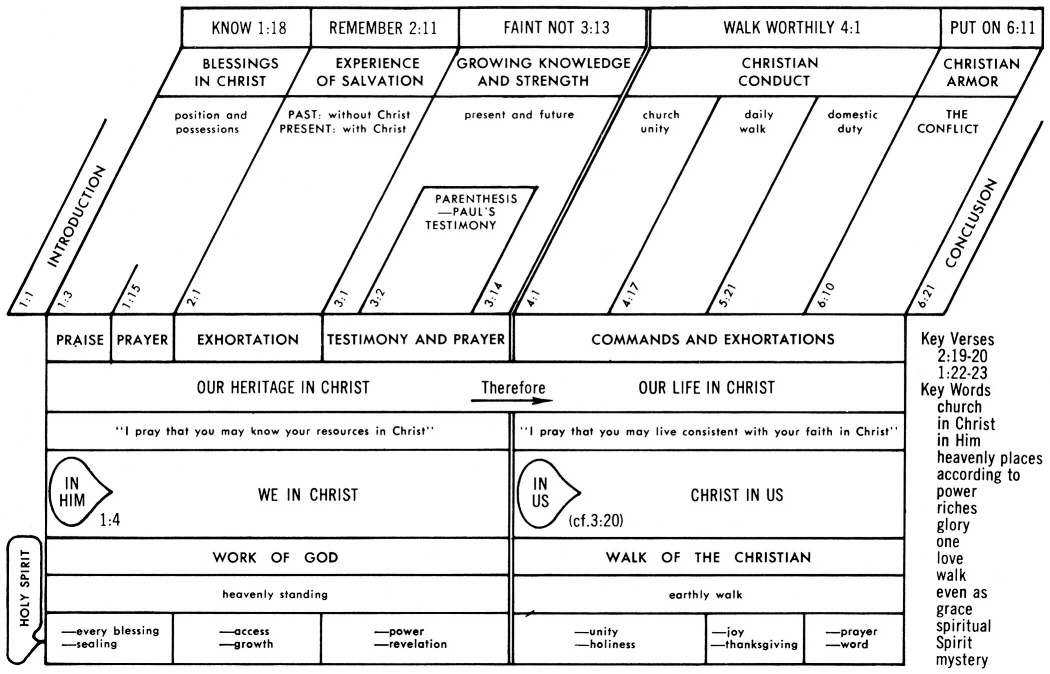
EPHESIANS - CHRIST AND THE CHURCH
Click chart to enlarge
Charts from Jensen's Survey of the NT - used by permission
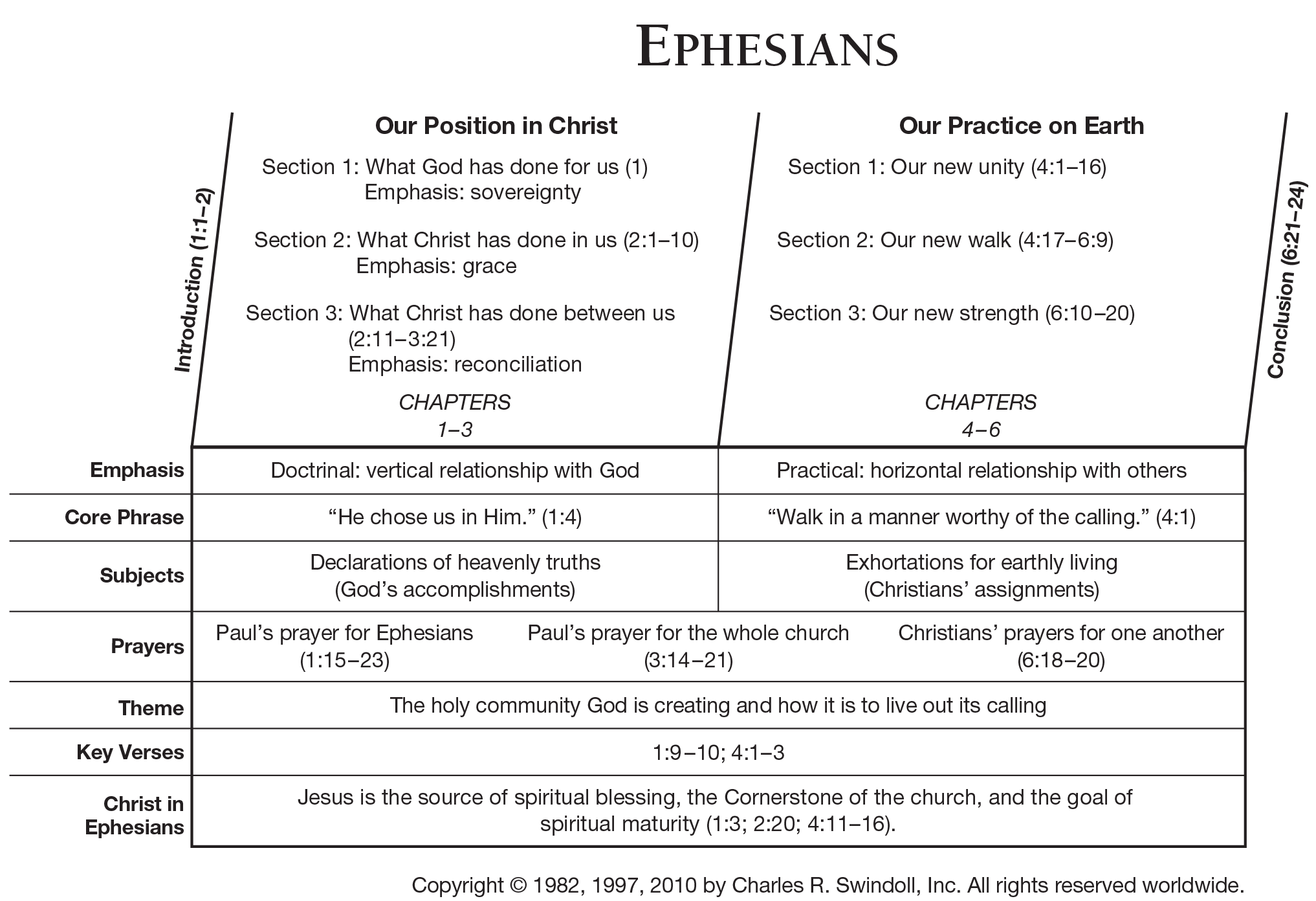
Click chart by Charles Swindoll -Note "EMPHASIS" --
Ephesians 1-3 = Doctrinal: vertical relationship with God
Ephesians 4-6 = Practical: horizontal relationship with others
Ephesians 4:17 So this I say, and affirm together with the Lord, that you walk no longer just as the Gentiles also walk, in the futility of their mind, (NASB: Lockman)
Greek: Touto oun lego (1SPAI) kai marturomai (1SPMI) en kurio, meketi humas peripatein (PAN) kathos kai ta ethne peripatei (3SPAI) en mataioteti tou noos auton,
BGT Τοῦτο οὖν λέγω καὶ μαρτύρομαι ἐν κυρίῳ, μηκέτι ὑμᾶς περιπατεῖν, καθὼς καὶ τὰ ἔθνη περιπατεῖ ἐν ματαιότητι τοῦ νοὸς αὐτῶν,
Amplified: So this I say and solemnly testify in [the name of] the Lord [as in His presence], that you must no longer live as the heathen (the Gentiles) do in their perverseness [in the folly, vanity, and emptiness of their souls and the futility] of their minds. (Amplified Bible - Lockman)
ESV Now this I say and testify in the Lord, that you must no longer walk as the Gentiles do, in the futility of their minds.
NKJV: This I say, therefore, and testify in the Lord, that you should no longer walk as the rest of the Gentiles walk, in the futility of their mind,
KJV This I say therefore, and testify in the Lord, that ye henceforth walk not as other Gentiles walk, in the vanity of their mind,
NET So I say this, and insist in the Lord, that you no longer live as the Gentiles do, in the futility of their thinking.
NIV So I tell you this, and insist on it in the Lord, that you must no longer live as the Gentiles do, in the futility of their thinking.
NLT (revised) With the Lord's authority I say this: Live no longer as the Gentiles do, for they are hopelessly confused.
NLT: With the Lord's authority let me say this: Live no longer as the ungodly do, for they are hopelessly confused. (NLT - Tyndale House)
Phillips: This is my instruction, then, which I give you from God. Do not live any longer as the Gentiles live. (Phillips: Touchstone)
Wuest: This, therefore, I am saying and solemnly declaring in the Lord, that no longer are you to be ordering your behavior as the Gentiles order their behavior in the futility of their mind, (Eerdmans Publishing - used by permission)
Young's Literal: Therefore I warn you, and I implore you in the name of the Master, no longer to live as the Gentiles in their perverseness live,
SO THIS I SAY, AND AFFIRM TOGETHER WITH THE LORD: Touto oun lego (1SPAI) kai marturomai (1SPMI) en kurio:
- I say - 1Co 1:12; 15:50; 2Co 9:6; Gal 3:17; Col 2:4
- Affirm - Nehemiah 9:29,30; 13:15; Jeremiah 42:19; Acts 2:40; 18:5; 20:21; Gal 5:3; 1Th 4:6
- in the Lord: 1Th 4:1,2 1Ti 5:21 6:13 2Ti 4:1
- Ephesians 4 Resources - Multiple Sermons and Commentaries
- Ephesians 4:17-19 How Not to Live - Steven Cole
- Ephesians 4:17-32 Solving Conflicts - Steven Cole
- Ephesians 4:17-27 - Wayne Barber
- Ephesians 4:17-19: A Brand New Way of Life - 1 - Wayne Barber
- Ephesians 4:19-24: Off w the Old, On w the New-2 - John MacArthur
- Ephesians 4:17-5:14 Study Guide (see dropdown menu)
The Christian and His Behavior - Eph 4:1-6:9
In His Mystical Relationships - Eph 4:1-16
In His Moral Relationships - Eph 4:17-5:21
1. A Complete Deliverance - Eph 4:17-24
A New Life - Eph 4:17-21
The Sinner’s Condition (Eph 4:17–19)
(a) His Intellect Darkened (Eph 4:17–18)
(b) His Inclinations Depraved (Eph 4:19)
The Saint’s Conversion (Eph 4:20–21)
(a) The Change (Eph 4:20)
(b) The Challenge (Eph 4:21)
A New Look - Eph 4:22-24
What Must Be Put Off (Eph 4:22–23)
(a) The Old Disposition (Eph 4:22a)
(b) The Old Desires (Eph 4:22b)
(c) The Old Direction (Eph 4:23)
What Must Be Put On (Eph 4:24)
2. A Converted Disposition - Eph 4:25-26
A Transformed Tongue (Eph 4:25)
A Transformed Temper (Eph 4:26)
3. A Conquered Devil - Eph 4:27
4. A Conspicuous Difference - Eph 4:28-29
In Conduct (Eph 4:28)
In Conversation (Eph 4:29)
5. A Christlike Demeanor - Eph 4:30–32
An Ungrieved Holy Spirit (Eph 4:30)
An Ungrudging Human Spirit (Eph 4:31–32)
Things to Be Discarded (Eph 4:31)
Things to Be Displayed (Eph 4:32)
6. A Categorical Demand - Eph 5:1–7
Love Is to Be Enthroned (Eph 5:1–2)
The Exhortation (Eph 5:1)
The Example (Eph 5:2)
Lust Is to Be Dethroned (Eph 5:3–7)
God’s Demands Are Not to Be Underestimated (Eph 5:3–5)
(a) The Principle Is Underlined (Eph 5:3–4)
(b) The Penalty Is Underlined (Eph 5:5)
God’s Demands Are Not to Be Undermined (Eph 5:6–7)
(a) We Are to Recognize Deception (Eph 5:6)
(b) We Are to Repudiate Deception (Eph 5:7)
7. A Convicting Distinction - Eph 5:8–14
Where Light Radiates (Eph 5:8–10)
It Brings a Change of Character (Eph 5:8)
It Brings a Change of Conduct (Eph 5:9)
It Brings a Change of Criterion (Eph 5:10)
What Light Repudiates (Eph 5:11–12)
What Is Done in Darkness Is Not Something with Which We Can Compromise (Eph 5:11)
What Is Done in Darkness Is Not Something about Which We Can Converse (Eph 5:12)
Why Light Regenerates (Eph 5:13–14)
The Work of the Spirit (Eph 5:13)
The Work of the Savior (Eph 5:14)
PAUL TESTIFIES WITH
THE LORD'S AUTHORITY
So (therefore) this I say, and affirm (testify - marturomai) together with (literally "in") the Lord - So (oun) (oun) means therefore or consequently and is a term of conclusion and in draws us back to the worthy walk described in Eph 4:1-3. Based upon what Paul has just explained about the importance of unity and diversity, Paul now gives a charge which further explains what a worthy walk looks like in "shoe leather" so to speak. And in context, this walk is vital to preserving the unity of the Spirit (Eph 4:3). So Paul begins his appeal for a new morality, a new lifestyle, an appeal which continues to Ephesians 5:21.
Strauss - The Scriptures do not waste words. Paul is not merely talking; he is testifying (marturomai), that is, making a solemn appeal in the name of Jesus Christ.
Hendriksen on so (therefore) - “therefore” connects the present paragraph with all that has gone before in Eph 4:1–16. “Because of your high calling, your duty to render service with a view to the building up of Christ’s body, no longer conduct yourselves as do the Gentiles.” (Ephesians)
MacArthur agrees on so (therefore) writing that "The therefore refers back to what Paul has been saying about our high calling in Jesus Christ. Because we are called to salvation, unified in the Body of Christ, gifted by the Holy Spirit, and built up by the gifted men (Eph 4:1–16), (See Ephesians Commentary)
THOUGHT - Beloved, by way of application, our Lord is clearly speaking to us who live in the midst of a crooked and perverse generation (Php 2:15) that is literally disintegrating morally and ethically before our very eyes! What a vital message Paul gives and one to which all believers must diligently hearken!
Note that by prefacing his exhortation with "I say and affirm (testify - marturomai; NET = "insist") together (literally "in") with the Lord" Paul is solemnly testifying to the vital importance of what he is about to say. With (literally "in" - cf locative of sphere) the Lord (kurios) identifies Paul as one with Christ and thus speaking this solemn exhortation as if it were made by Christ Himself. Paul wants his readers to know that he is not stating personal conviction regarding the holy pattern he is about to describe, but that it is the living Lord speaking in and through him, the Head speaking as it were to the members of His Body!
Hendriksen on I say and affirm - As Bengel has pointed out: when the apostle admonishes he does it so that those addressed may act freely; when he encourages, so that they may act gladly; and when he testifies, so that they may act reverently (with a proper respect for the will of God). (cf Paul's use of testify in Acts 20:26; Gal. 5:3) (Ephesians)
Charles Hodge on affirm (marturomai) - To testify, in this case, is solemnly to enjoin, as a man does who calls upon God to bear witness to the truth and importance of what he says. Martureo is to act as a witness, and marturomai to invoke as a witness. The latter is the word here used. In the Lord, means in communion with the Lord. Paul speaks as one who had access to the mind of Christ, knew his will, and could therefore speak in his name.
As Wayne Barber says, Paul "wants them to see that Christianity is radically different from the way the world lives. These people had come out of the world. The temptation is always to go back to where we have come from. Paul says, "Oh no." He has given us a picture of what the Christian life is all about, being strengthened in the inner man by the Spirit of God. Now he is saying, "Don’t go back. Live differently. It is a radically different lifestyle that you have now as a believer." (Ephesians 4:17-19: A Brand New Way of Life)
Say (3004) (lego) means to speak or talk, with apparent focus upon the content of what is said.
Affirm (3143) (marturomai from mártus = witness) (See related word studies - epimartureo; diamarturomai) means to testify or bear witness. The idea is to make an emphatic demand, to speak with a note of solemnity. To urge as a matter of great importance. The idea of marturomai is to bear witness with a solemn protestation, making an emphatic affirmation or a serious declaration (Acts 20:26, 26:22, Gal 5:3). To make a serious declaration on the basis of presumed personal knowledge. To affirm (state positively, assert as valid or confirmed, implying conviction based on evidence, experience or faith) something with solemnity. The verb means to appeal to by something sacred. To urge as a matter of great importance and thus to affirm, insist or implore (see this sense in 1Th 2:11) To be emphatic in stating an opinion or desire. It is used in the present verse to convey a solemn declaration of the nature of an appeal to God. What follows is of vital importance for the Gentile believers to hear for they still live within the cauldron of rank paganism and it's manifold and subtle temptations are prone to rear their ugly head.
Together (1722) (en) is actually the preposition meaning "in" signifying in this context Paul is in union/communion with the Lord.
THAT YOU WALK NO LONGER JUST AS THE GENTILES ALSO WALK: meketi humas peripatein (PAN) kathos kai ta ethne peripatei (3SPAI):
- That you walk no longer just as the Gentiles also walk - Ep 1:22; 2:1-8; Ro 1:23-32; 1Co 6:9-11; Gal 5:19-21; Col 3:5-8; 1Pe 4:3,4
- Ephesians 4 Resources - Multiple Sermons and Commentaries
- Ephesians 4:17-19 How Not to Live - Steven Cole
- Ephesians 4:17-32 Solving Conflicts - Steven Cole
- Ephesians 4:17-27 - Wayne Barber
- Ephesians 4:17-19: A Brand New Way of Life - 1 - Wayne Barber
- Ephesians 4:19-24: Off w the Old, On w the New-2 - John MacArthur
- Ephesians 4:17-5:14 Study Guide (see dropdown menu)
Related Passages:
Leviticus 18:2-4 (OT PARALLEL - A HOLY PEOPLE TO THE LORD) “Speak to the Israelites and say to them: ‘I am the LORD your God. You must not do as they do in Egypt, where you used to live, and you must not do as they do in the land of Canaan, where I am bringing you. Do not follow their practices. You must obey my laws and be careful to follow my decrees. I am the LORD your God.
1 Corinthians 6:9-11 Or do you not know that the unrighteous will not inherit the kingdom of God? Do not be deceived; neither fornicators, nor idolaters, nor adulterers, nor effeminate, nor homosexuals, 10 nor thieves, nor the covetous, nor drunkards, nor revilers, nor swindlers, will inherit the kingdom of God. 11 Such were some of you; but you were washed, but you were sanctified, but you were justified in the name of the Lord Jesus Christ and in the Spirit of our God.
Colossians 3:5-8 (PAUL CHARGED THE SAINTS AT COLOSSAE IN CONTRAST TO THEIR FORMER "WALK" NOW TO KILL SIN!) Therefore consider the members of your earthly body as dead (aorist imperative see our need to depend on the Holy Spirit to obey) To immorality, impurity, passion, evil desire, and greed, which amounts to idolatry. 6 For it is because of these things that the wrath of God will come upon the sons of disobedience (Cf the Ephesians picture before salvation in Eph 2:2), 7 and in them you also once walked, when you were living in them
Titus 3:3 we also once were foolish ourselves, disobedient, deceived, enslaved to various lusts and pleasures, spending our life in malice and envy, hateful, hating one another.
1 Peter 4:3-4 For the time already past is sufficient for you to have carried out the desire of the Gentiles, having pursued a course of sensuality, lusts, drunkenness, carousing, drinking parties and abominable idolatries. 4 In all this, they are surprised that you do not run with them into the same excesses of dissipation, and they malign you;
WARNING: DON'T WALK
LIKE THE GENTILES
Foulkes points out that in this next section "The true nature of that old way of life is described now in a series of devastating phrases, quite closely comparable to the expressions of Romans 1:18–31. It is true that there were some noble figures in the ancient world of Greece and Rome in which Paul lived, but classical literature as it throws light on the life of the masses indicates that the apostle’s description was not wide of the mark. There was a mental, spiritual and moral decadence in that society. (Ephesians: An Introduction and Commentary)
That you walk (peripateo) no longer just as the Gentiles (ethnos) also walk (peripateo) - This exhortation picks up the theme of the worthy walk in Eph 4:1-3, where he had given them the "positive" attributes of a worthy walk. Now he presents the characteristics of an "unworthy" walk of the unsaved Gentiles which they are to avoid. You of course refers to the saved Gentiles. Gentiles in this context however refers to all ungodly, unregenerate, pagans. So while in one sense the Ephesians were still "Gentiles," in the eternal sense, they belong to a "new race," for they were each a new creation (2Cor 5:17) and corporately composed one new man (the body of Christ - Ep 2:15). In a sense then, there are now "3 races", Jews, Gentiles and Christians. In chapter 1 Paul had explained what transpired to transfer them from the Kingdom of darkness to the Kingdom of light writing "In Him [Jesus], you also, after listening to the message of the truth, of the gospel of your salvation—having also believed, you were sealed in Him with the Holy Spirit of promise." (Eph 1:13, cf Eph 2:5-10)
The prevalent way of Gentile living was futile
because futility was characteristic of their minds.
Hodge has a good description of walk (peripateo) - To walk, in Scripture language, includes all the manifestations of life, inward and outward, seen and unseen. It does not express merely the outward, visible deportment. Men are said to walk with God, which refers to the secret fellowship of the soul with its Maker, more than to the outward life. So here the walk, which the apostle enjoins us to avoid, is not only the visible deportment characteristic of the Gentiles, but also the inward life of which the outward deportment is the manifestation.
Wayne Barber paraphrases what Paul is saying "I have just raised you up to the highest level of understanding that you could possibly get to. Now I am warning you. Don’t you go back and live like you used to live. When you do, sin will take you further than you ever wanted to stray, keep you longer than you ever wanted to stay and cost you more than you ever dreamed you would pay." Imagine going back to live that way...It is amazing...how quickly we forget what has caused us so much pain. (Ephesians 4:17-19: A Brand New Way of Life)
MacArthur on walk no longer - We cannot accomplish the glorious work of Christ by continuing to live the way the world lives. (See Ephesians Commentary)
Barry - ‘In losing the living conception of a living God’, pagan society had ‘lost also the conception of the true object and perfection of human life; and so wandered on aimless, hopeless, reckless’
J Vernon McGee on walk no longer - There is the negative side of the believer’s life, which I think is important for us to see. There is not enough emphasis on it. We talk about “new morality” which is nothing in the world but old sin. There is a liberty in Christ, but it is not a license to sin. (Thru the Bible Commentary: Thomas Nelson)
Cultural Context - Ephesus, a veritable moral cesspool in Paul's day - The Temple of Artemis was the center of much of the wickedness. Like those in most pagan religions, its rituals and practices were but extensions of man’s vilest and most perverted sins. Male and female roles were interchanged, and orgiastic sex, homosexuality, and every other sexual perversion were common. Artemis was herself a sex goddess, represented by an ugly, repulsive black female idol that looked something like a cross between a cow and a wolf. She was served by thousands of temple prostitutes, eunuchs, singers, dancers, and priests and priestesses. Idols of Artemis and other deities were to be seen everywhere, in every size and made out of many different materials. Of special popularity were silver idols and religious artifacts. It was because Paul’s preaching cut deeply into that trade that the Ephesian silversmiths rallied the populace against him and his fellow believers (Acts 19:24–28). The temple of Artemis contained one of the richest art collections then in existence. It was also used as a bank, because most people feared stealing from within its walls lest they incur the wrath of the goddess or other deities. A quarter mile-wide perimeter served as an asylum for criminals, who were safe from apprehension and punishment as long as they remained within the temple confines. For obvious reasons, the presence of hundreds of hardened criminals added still further to Ephesus’s corruption and vice. The fifth-century B.C. Greek philosopher Heraclitus, himself a pagan, referred to Ephesus as “the darkness of vileness. The morals were lower than animals and the inhabitants of Ephesus were fit only to be drowned.” There is no reason to believe that the situation had changed much by Paul’s day. If anything, it may have been worse. The church at Ephesus was a small island of despised people in a giant cesspool of wickedness. Most of the believers had themselves once been a part of that paganism. They frequently passed by places where they once caroused and ran into friends with whom they once indulged in debauchery. They faced continual temptations to revert to the old ways, and the apostle therefore admonished them to resist. (See MacArthur New Testament Commentary)
So now don't walk like you used to walk when you were pagan, idol worshipping, God haters. Don't do it! You are saved to live life on a high plane, and not in the "sewer" of godless men. Yes, you still live (temporarily) in this fallen, sin sick, morally decaying world but you have been set free from it (Gal 6:14) and are to be "lighthouses" permeating it with the light of Christ (Php 2:15, Mt 5:16), not being drawn back into its moral mire and spiritual decay and deadening darkness.
Paxson adds that "To be in Christ and not grow up into Christ makes the Christian life an anachronism, a monstrosity, a lie. The revelation of Christ in truth must result in the realization of Christ in life. Paul writes, Ye have heard and accepted "the truth as it is in Jesus"; now you must live, act and speak according to this new standard. There can be no compromising alliances, no stultifying reserves, no divided interests. "Ye were" "Ye are" "Be ye" Here is Paul's forceful challenge to become what you are. It leads very naturally into his next practical exhortation: Call to Put Off The Old and to Put On The New. (The Wealth, Walk and Warfare of the Christian)
IF I WALK WITH THE WORLD, I CAN'T WALK WITH GOD!
-- D L Moody
Just as the Gentiles (ethnos) also walk (peripateo) - Walk is present tense describing their empty walk as their lifestyle! Their new position in Christ was the fulcrum of Paul's argument for a new walk, for he knew that new practice must result from a new position. So with invincible logic he proceeds to call them to an altogether different walk from that of the unsaved Gentiles among whom they still lived. Since the recipients were Gentiles this seems strange, but the effect would be to point out that yes they were ethnically Gentiles, but not culturally and their citizenship was now in heaven (Php 3:20-21). One is reminded of Jesus' words that they were to be IN the world but not OF the world. (Jn 17:14-16) In chapter 2 Paul had reminded the Gentiles of their former manner of walking writing...
And you were dead in your trespasses and sins, 2 in which you formerly walked according to the course of this world, according to the prince of the power of the air, of the spirit that is now working in the sons of disobedience. 3 Among them we too all formerly lived in the lusts of our flesh, indulging the desires of the flesh and of the mind, and were by nature children of wrath, even as the rest (Ep 2:1-3)
Before they were saved, they were dead toward God, alive to Satan's power leading them to disobey and were enslaved to the power of the wicked lusts of their flesh with no power to change! Paul is saying don't walk that way anymore. You have been freed from that vile prison. Don't go back and put those chains on.
As Wayne Barber reminds us "spirituality is a pursuit, not an arrival. The moment I stop pursuing Him (Christ), guess what I am pursuing? I am letting the flesh dictate my life. There are fleshly lusts we have to deal with. So Paul is saying, "Don’t go back and live like you used to live. Be careful. There is a tendency like a magnet which is pulling you back to live after the flesh... The Apostle Paul is warning them: "Look out. Look out. You came out of the world." Ephesus was the most wicked place you could find on the face of this earth. These young Christians had to live in the midst of all of that wickedness. He is saying, "Listen, don’t you dare go back to it. You have come out of it. Now be strengthened in the inner man by the power of God." (Ephesians 4:17-19: A Brand New Way of Life)
KJV Bible Commentary - Let the daily conduct of your lives conform with your new life in Christ. Make a clean break with your old life and stop living by the standards of behavior of the pagan people. The low standards of the world must be abandoned and repudiated, and the Christian must live ethically and morally in segregation from the world (2 Cor 6:14). The church is a colony of heaven living here on earth (Dobson, E G, Charles Feinberg, E Hindson, Woodrow Kroll, H L. Wilmington: KJV Bible Commentary)
Paxson commenting on "walk no longer" writes that "These words have an authoritative tone of finality about them. "Put off" demands unconditional renunciation (Ep 4:22). The Christian has begun a walk on a new road in a new sphere leading to a new goal. Then he must be prepared at the very beginning with deliberate determination to make a full and final abandonment of the old life in its entirety. But a walk is taken step by step. So as one goes along the new road and recognizes soft spots in character, backslidings in conduct, danger points in companionships, discrepancies in ethics, departures in morals, and compromises in standard, there must be an immediate putting off of that old remnant of the abandoned life. Paul makes this quite clear in Chapters four and five, as he mentions definite sins still to be found in the lives of these Ephesian Christians. (The Wealth, Walk and Warfare of the Christian )
THOUGHT - What is the problem? Why do believers need this warning since we have been delivered from our past enslavement to the power of Sin (Ro 6:11-14)? The problem all believers must still contend with is what the Bible refers to as flesh (see note), that evil disposition inherited from Adam and which still resides in the mortal (physical) bodies even of believers. Peter for example is addressing believers and exhorts them "as aliens and strangers to (continually - present tense) abstain from fleshly lusts, which wage war (continually - present tense) against the soul." (1Pe 2:11)
Clearly Paul is implying that the flesh remains a force with which every believer must daily, earnestly contend. The flesh reflects what remains of the “old man” (inherited from Adam see Ro 5:12) and which still exists even after a person is saved. Flesh is that unredeemed part of a believer that awaits future redemption at the time of glorification (Ro 8:23). At that glorious time we will be completely free of not only the presence of sin but the "pleasure" of sin. Flesh is that moral and spiritual weakness and helplessness of human nature that still clings to redeemed souls. In short, the flesh of Christians is that entity that remains within us that stimulates evil desires to commit trespasses and sins. As long as we inhabit these mortal bodies, we have to contend with the flesh which gives rise to deceitful lusts or strong desires that ever tend to pull us back to the miry clay from which we were transferred by God when He took us from the kingdom of darkness and into His marvelous light, the kingdom of His beloved Son, in Whom we have redemption, the forgiveness of sins.
Gentiles (1484) (ethnos) in context refers to the unsaved pagan idol worshipers who were far off from God. Paul defined them as “the Gentiles who do not know God” (1Th. 4:5). "Jews used the term in two common ways, first to distinguish all other people from Jews and second to distinguish all religions from Judaism. Gentiles therefore referred racially and ethnically to all non-Jews and religiously to all pagans (What is a pagan and paganism?)." (MacArthur) Gentile believers were no longer pagan Gentiles but a new race called "Christians", a new man who should demonstrate a clean cut cleavage from their former life of rank paganism. There was a moment in time in the past when they had crossed the boundary line from eternal death into eternal life. In that moment of spiritual rebirth something so tremendously revolutionary had taken place that the sinner had been made into a saint and thus life could never be as it was before.
Walk (4043) (peripateo from peri = about, around + pateo = walk, tread) (Click word study on peripateo) means literally to walk about here and there or to tread all around. Peripateo then came to mean, to make one’s way, to make progress, to make due use of one’s opportunities and finally (as used by Paul in Ephesians), to live, to regulate one’s life, to conduct one’s self. Most of the NT uses refer to the daily conduct of one's life or how one orders their behavior or passes their life. The present tense points to a habitual action - don't fall back into the habitual practices of those who do not know Christ as Lord.
Ray Stedman commenting on [Col 3:1-17] writes about "walk": That (referring to Col 3:1-4) is the true basis for living a Christian life. Scripture calls it "walking with the Lord." I like that figure because a walk, of course, merely consists of two simple steps, repeated over and over again. It is not a complicated thing. In the same way, the Christian life is a matter of taking two steps, one step after another. Then you are beginning to walk. Those two steps follow in this passage. Paul describes them as, "Put off the old man," and "put on the new." Then repeat them. That is all. Keep walking through every day like that. That is how Scripture exhorts us to live.
Walk Like An Ephesian.
- Ephesians 2:10 THE WORKING WALK
- Ephesians 4:1 THE WORTHY WALK
- Ephesians 4:17 THE WHOLEHEARTED WALK
- Ephesians 5:2 THE WONDERFUL WALK
- Ephesians 5:8 THE WITNESSING WALK
- Ephesians 5:15 THE WISE WALK
IN THE FUTILITY OF THEIR MIND: en mataioteti tou noos auton:
- In the futility of their mind - Ps 94:8-11; Acts 14:15
- Ephesians 4 Resources - Multiple Sermons and Commentaries
- Ephesians 4:17-19 How Not to Live - Steven Cole
- Ephesians 4:17-32 Solving Conflicts - Steven Cole
- Ephesians 4:17-27 - Wayne Barber
- Ephesians 4:17-19: A Brand New Way of Life - 1 - Wayne Barber
- Ephesians 4:19-24: Off w the Old, On w the New-2 - John MacArthur
- Ephesians 4:17-5:14 Study Guide (see dropdown menu)
Related Passage:
Genesis 6:5 Then the LORD saw that the wickedness of man was great on the earth, and that every intent of the thoughts of his heart was only evil continually.
Acts 14:15 and saying, “Men, why are you doing these things? We are also men of the same nature as you, and preach the gospel to you that you should turn from these vain things to a living God, WHO MADE THE HEAVEN AND THE EARTH AND THE SEA AND ALL THAT IS IN THEM.
1 Corinthians 3:20 and again, “THE LORD KNOWS THE REASONINGS of the wise, THAT THEY ARE USELESS (mataios).”
Psalm 94:11 (QUOTED BY PAUL IN PASSAGE ABOVE) The LORD knows the thoughts of man, That they are a mere breath.
Psalm 10:4 The wicked, in the haughtiness of his countenance, does not seek Him. All his thoughts are, “There is no God.”
EMPTY, AIMLESS
UNGUIDED UNGODLY MINDS
In the futility (mataiotes) of their mind (nous) - So not only are the "Gentiles" spiritually dead (Eph 2:1), but they walk in the vanity of their sinful, depraved mind! This is a bad combination, spiritually dead men with a sinful depraved mind! This describes the saints' unsaved mind before Christ saved them - vain, useless, without (eternal) purpose! When men push God out of their minds, their minds are void and empty of God (cf Ps 10:4). The word futility or vanity is mataiotes which describes that which is aimless, futile, empty, fruitless, and worthless. In the final analysis all man's thinking is aimless and futile because it is totally self centered and totally focused on this present world which is passing away (1Jn 2:17), without any regard for God, eternity and eternal life! God and His ways are not in their thoughts. And so Paul reminds them of their former manner of life as taking place continually in (locative of sphere) the futility of their mind (nous). Not a ray of light from God, nothing of God's righteousness or goodness, and not a single good thing from God penetrated their circle (sphere) of "conduct". All their thoughts, words, and deeds were enveloped and energized in an atmosphere of sin, self and vanity. Not one of their thoughts ever got outside this "atmosphere" of uselessness.
So the Gentiles were (and in our society today are) living in a ''fog'' -- a quality of thinking that leads to no purpose and is profitless and depraved. Their life was empty, purposeless, and fruitless. There was great activity but no progress. They chased bubbles and shadows (cf 2Co 4:18), and neglected the great realities of life. Depravity blinds one to the nature and will of God. Human reason can defend any life-style because sin controls reason (cf Jdg 21:25). Sin hardens (Heb 3:13) our intellectual capacities and leads us away from TRUE LIFE. Sin results in a consuming desire to do what is wrong. The life of a pagan Gentile compared to a Gentile believer was (is) like the difference between light and dark, Heaven and Hell.
THOUGHT- Picking up on Solomon's use of mataiotes in Ecclesiastes Paul might say of the unsaved Gentiles' minds something like "Meaningless! Meaningless! Utterly meaningless! Everything is meaningless." (cf Eccl 1:2) The ideas of unregenerate men and women produce a life of purposelessness and ineffectiveness! Imagine living your entire life and coming to the end and realizing that in the eyes of God your entire life was utterly meaningless! This pathetic plight of unsaved men is very sad and should make all of us zealously desirous to share the life giving, "mind changing" Gospel with all the lost souls around us! Father, give us opportunities and Spirit enabled boldness to follow through for our dear Lord Jesus. Amen. Thank the Lord for the meaning and purpose which He alone brings to life.
Paul's point is that when they were unregenerate Gentiles, they could not understand spiritual truth. The way the pagan world thinks is totally foreign to they way God thinks. In fact, every person still spiritually dead in their trespasses and sins does not even have the capability to comprehend God. As Paul explained to the church at Corinth...
"a natural (unsaved, still "in Adam", not "in Christ") man does not accept (dechomai = deliberately and readily, receive kindly, they do not "put out a welcome mat"! = present tense) the things of the Spirit of God; for they are foolishness (moria = that which is considered intellectually weak, irrational) to him, and he cannot (dunamai = present tense = have intrinsic power - natural men lack the inner, inherent ability and resources on their own to) understand (verb ginosko = know by experience) them, because they are spiritually appraised (anakrino = sift up and down and so to scrutinize, to examine accurately and carefully with exact research like in legal processes)." (1Cor 2:14)
In the next verse Paul explains why the unsaved man cannot comprehend the things of God. Wrong belief always leads to wrong behavior. The Ephesian saints were to avoid this wrong thinking, which ultimately was wrong thinking about God, which in turn affected everything they thought, said and did (all was pervaded by godlessness).
S F D Salmond writes that "It is a description of the walk of the heathen world generally—a walk moving within the limits of intellectual and moral "resultlessness," given over to things devoid of worth or reality. (Ephesians 4 Commentary)
John MacArthur - Unbelievers are intellectually unproductive. As far as spiritual and moral issues are concerned, their rational processes are distorted and inadequate, inevitably failing to produce godly understanding or moral living. Their life is empty, vain, and without meaning (cf. Ro 1:21-28; 1Co 2:14; Col 2:18). (See MacArthur Study Bible)
Harold Hoehner - Unbelieving Gentiles failed to attain the true purpose of the mind, namely, to receive God's revelation which would guide them in their conduct. (See Bible Knowledge Commentary)
John Phillips - Man's thinking, alienated from God, is vanity. He thinks up all kinds of false religions and philosophies, and boasts of how right he is. Yet his notions are empty and dangerous. (See Exploring Ephesians & Philippians: An Expository Commentary)
Regarding Paul's use of mataiotes (futility) there may be a slight play on words for mataiotes was used in the Septuagint for "vain idols" (Ps 31:6), which is a perfect description of the Gentile idols, which represented their (futile) imaginations and vain conceptions of gods that had no intrinsic value or correspondence to the real truth of the Living God. The Gentiles in the futility of their mind were concerned with "empty" things which had absolutely no value in the eternal scheme of things. Their mind was void of useful aims or goals (eternally speaking).
In Romans 1 we see how this futility of their mind was a consequence of their rejection of the truth about God - "For even though they knew God, they did not honor Him as God, or give thanks; but they became futile (related verb mataioo in passive voice) in their speculations, and their foolish heart was darkened (divine passive = judicial hardening from God)." (Ro 1:21) Unbelieving Gentiles rejected the truth about God (Ro 1:20) and thus failed to attain the true purpose of the mind God had given them, a mind capable to receive God’s natural revelation which would have led them to see there is a Creator and seek His special revelation! later in Romans 1 Paul explains that "as they (GENTILES) did not approve of having God in knowledge (dokimazo THEY PUT GOD TO THE TEST AND HE DID NOT PASS THEIR TEST!), God gave them up to a disapproved mind (DEPRAVED MIND ~ "FUTILE MIND"), to do the things not seemly (WHICH ARE NOT PROPER); (Ro 1:28YLT - Young's Literal) (See the horrible list of improper things they did in Ro 1:29-32!)
McGee comments that the futility of their mind "means the empty illusion of the life that thinks there is satisfaction in sin. Oh, how many people walk that way! I feel so sorry for these young people who have been taken in by the promoters of immorality as a life style. (McGee, J V: Thru the Bible Commentary: Thomas Nelson)
THOUGHT - Let me be very practical. If you want to avoid living in the futility of your mind, think often about your death. Join Jonathan Edwards, who as a young man resolved, among many other things, “to think much, on all occasions, of my dying, and of the common circumstances which attend death” (The Works of Jonathan Edwards [Banner of Truth], 1:xx). You may think that that is morbid, but it is a vital principle for wise living! Then, keeping the shortness of life in view, join Moses in praying (Ps. 90:12), “So teach us to number our days, that we may present to You a heart of wisdom.” In light of standing before God and in light of what you know of His Word, how do you want to spend the fleeting years that the Lord gives you? When you look back from the end, what do you want to have accomplished in light of eternity? (Steven Cole)
Warren Wiersbe on mind - Christians think differently from unsaved people. Note the emphasis here on thinking: mind (Eph. 4:17, 23), understanding (Eph. 4:18), ignorance (Eph. 4:18), "learned Christ" (Eph. 4:20). Salvation begins with repentance, which is a change of mind. The whole outlook of a person changes when he trusts Christ, including his values, goals, and interpretation of life....Our world today possesses a great deal of knowledge, but very little wisdom. Thoreau (ED: INTERESTINGLY A GENTILE WITH AN UNSAVED MIND [HE WAS A transcendentalist]!) put it beautifully when he said that we have "improved means to unimproved ends." (See Wiersbe Bible Commentary)
MacDonald puts it this way - Their life was empty, purposeless, and fruitless. There was great activity but no progress. They chased bubbles and shadows, and neglected the great realities of life. (Believer's Bible Commentary)
Matthew Poole in a commentary published in the 1680's writes that "Their minds themselves, and understandings, the highest and noblest faculties in them being conversant about things empty, transient, and unprofitable, and which deceive their expectations (are) therefore are vain, viz. their idols, their worldly enjoyment, etc.”
THOUGHT - Is your life different from the world? If not, remember that God delivered you from worldliness so you could know him and live for him. Application Questions: In what ways has God delivered you from worldliness? How do you guard yourself from falling back into it? (Gregory Brown)
Futility (3153) (mataiotes from mataios = vain, empty <> derived from maten = to no purpose or in vain) means emptiness, vanity, nonsense, nothingness, , frailty, folly, purposelessness, transitoriness! Thayer says mataiotes is a "purely Biblical and ecclesiastical word" which describes "what is devoid of truth and appropriateness". It defines the inability to reach a goal or achieve a purpose. Mataiotes describes the state of being without use or value, emptiness, futility, purposelessness, transitoriness. It includes the idea of being without success, of being unable to achieve a goal or purpose. It has the quality of being empty, fruitless, nonproductive, useless. Mataiotes speaks of want of attainment with the idea of aimlessness or of leading to no object or end.
See also lengthy discussion by Trench in Synonyms of the New Testament.
Futility is best pictured in Greek mythology. Doomed to Tatarus (hell) forever, Sisyphus is given the endless task of trying to roll a huge stone up to the top of a mountain. But just when he gets within sight of the pinnacle, the weight of the stone pushes him and the stone all the way down to the bottom, where he begins again the futile attempt to push the stone to the top. Complete futility!
Kenos and mataiotes are frequently used together in the Septuagint (e.g., Job 20:18; Is 37:7; Hos 12:1), in classical Greek, and in Hellenistic Greek.
Sanday and Headlam write "That is mataion which is 'without result' (maten), 'ineffective,' 'which does not reach its end'—the opposite of teleios: the word is therefore appropriately used of the disappointing character of present existence, which nowhere reaches the perfection of which it is capable"" Denney says: "The idea is that of looking for what one does not find—hence of futility, frustration, disappointment"
Gilbrant adds that in the Septuagint "Most commonly, mataiotēs is a translation of the Hebrew word hebel, “vanity, nothingness,” but there are a variety of Hebrew words that describe different facets of “nothingness.” These words generally speak of ways in which human beings can resist the reality of God. In Ecclesiastes (mataiotes in Eccl 1:2, 14, 2:1, 11, 15, 17, etc), however, the Preacher is keenly aware of the futility and vanity of the human life and thought that ignores God and His commandments. A tone of lamenting tragedy for the vanity of everything runs through the book. (Complete Biblical Library)
Vincent has an interesting note on mataiotes in (Romans 8:20) writing that "Kenos (2756) signifies empty; mataios idle, resultless. Kenos, used of persons, implies not merely the absence of good, but the presence of evil. (See Ja 2:20). The Greek proverb runs: “The empty think empty things.” Mataios expresses aimlessness. All which has not God for the true end of its being is mataios . Pindar describes the vain man as one who hunts bootless things with fruitless hopes. Plato (“Laws,” 735) of labor to no purpose. Ezek. 13:6, “prophesying vain things (mataia),” things which God will not bring to pass. Compare Titus 3:9. In Ro 8:20 the reference is to a perishable and decaying condition, separate from God, and pursuing false ends.
J D Watson - Man is pretty smart. There's no denying his astounding advancements and achievements. Having taught computer science and studied its history, for example, I learned that the brilliance of its early pioneers and subsequent developers is absolutely amazing. Likewise, many other inventions—from the automobile to the airplane to the aerosol can—illustrate man's intelligence and cleverness. Yet, in all that genius, Paul describes the unregenerate man as walking in the vanity of the mind (Eph. 4:17). The Greek behind the word "mind" is nous, which speaks of intellect, thought, reason, and understanding. Vanity, then, is mataiotēs, that which is aimless, futile, empty, fruitless, and worthless. In the end, all man's thinking is aimless and futile because it's totally of self, without regard for God. (A Word for the Day: Key Words from New Testament)
Gilbrant - Classical Greek - The general sense of mataiotēs indicates a lack of or attainment of true purpose (see Moulton-Milligan). Classical Greek writings rarely use mataiotēs and its cognates. Its word group includes both mataios, “folly, fault,” and matia, “vain effort,” and can mean “deceptive, fictitious, groundless.” It can also mean “in vain, ineffectual, purposeless, pointless.” Mataiotēs implies a particular set of values, a religious or moral standard, a norm by which truth is measured. When something is mataiotēs then, it is by implication something contrary to the norm, unexpected, something that ought not to be. In addition, it refers to something that is worthless due to its deceptive or ineffectual quality (Tiedtke, “Empty,” Colin Brown, 1:549–553; Bauernfeind, “mataiotēs,” Kittel, 4:519–524). (Complete Biblical Library)
TDNT - The word Mataios —and the related word group—corresponds to the older sense of “vain.” It denotes the world of appearance as distinct from that of being. The emphasis may be on the fact that what is called Mataios, e.g., a word, does not rest on the causes which it alleges, “deceptive,” Hdt., VII, 10 η. The absence of an effect may also be stressed, “in vain,” “to no purpose”: τὰ μάταια ἀναλώματα, P. Oxy., I, 58, 20. If the ref. is to the human will, μάταιος may castigate an offence, “wicked”: αὐτουργίαι μάταιαι, of the act of Oresres, Aesch. Eum., 337; but often it simply means “pointless,” χαρὰ ματαία, Aesch. Sept. c. Theb., 442. Both the basic meaning and the more detailed senses may be applied to persons too.
Wuest - “Mataiotes (Ματαιοτες) (what is devoid of truth and appropriateness, perverseness, depravity) is a word altogether strange to profane Greek; one too to which the old heathen world, had it possessed it, could never have imparted that depth of meaning which in Scripture it has obtained. For indeed that heathen world was itself too deeply and hopelessly sunken in ‘vanity’ to be fully alive to the fact that it was sunken in it at all; was committed so far as to have lost all power to pronounce that judgment upon itself which in this word is pronounced upon it. One must, in part at least, have been delivered from the mataiotes (ματαιοτες), to be in a condition at all to esteem it for what it truly is. When the Preacher exclaimed ‘All is vanity’ (Eccl. 1:2), it is clear that something in him was not vanity, else he could never have arrived at this conclusion.… It is not too much to say that of one book in Scripture, I mean of course the book of The Preacher, it is the key-word. In that book mataiotes (ματαιοτες), or its Hebrew equivalent, … occurs nearly forty times; and this ‘vanity,’ after the preacher has counted and cast up the total good of man’s life and labors apart from God, constitutes the zero at which the sum of all is rated by him. The false gods of heathendom are eminently ta mataia (τα ματαια) (the vain things) (Acts 14:15; cf. 2Chr 11:15; Jer. 10:15; John 2:8); the mataiousthai (ματαιουσθαι) (the becoming vain) is ascribed to as many as become followers of these (Ro 1:21; II Kin. 17:15; Jer. 2:5; 28:17, 18); inasmuch as they, following after vain things, become themselves mataiophrones (ματαιοφρονες), (3 Macc. 6:11), like the vain things which they follow (Wisd. 13:1; 14:21–31); their whole conversation vain (I Pet. 1:18), the mataiotes (ματαιοτες) (the vanity) having reached to the very center and citadel of their moral being, to the nous (νους) (mind) itself (Eph. 4:17). Nor is this all; this mataiotes (ματαιοτες), or douleia tes phthoras (δουλεια τες φθορας) (bondage of corruption) (Rom. 8:21), for the phrases are convertible, of which the end is death, reaches to that entire creation which was made dependant on man; and which with a certain blind consciousness of this is ever reaching out after a deliverance, such as it is never able to grasp, seeing that the restitution of all other things can only follow on the previous restitution of man.” But let us look at this word mataios (ματαιος) again. Our word “vain” today usually means pride. It is so used once in the N.T. Thayer gives us further light on this word. He says it means, “devoid of force, truth, success, result, useless, to no purpose.” Moulton and Milligan quote a clause from the papyri which perfectly illustrates the use of the word mataios (ματαιος): “wherein he vainly relates that he was ignorant of the securities which had been given him.” They gave an illustration of the use of mataiotes (ματαιοτες): “suggests either absence of purpose or failure to attain any true purpose.” Thus, these words refer to an ineffectual effort to attain some end or to the inability of something to function with respect to the purpose for which it is in existence or is intended. A vain religion is one which fails to measure up to what that life should be. (Wuest Word Studies - Eerdman Publishing Company Volume 1, Volume 2, Volume 3 - used by permission)
There are three uses of mataiotes in the NT, the other 2 NT uses of mataiotes are...
Romans 8:20 For the creation was subjected to futility, not of its own will, but because of Him who subjected it, in hope
2 Peter 2:18 For speaking out arrogant words of vanity they entice by fleshly desires, by sensuality, those who barely escape from the ones who live in error,
There are 46 verses (most in Ecclesiastes) in the Septuagint (LXX) Ps. 4:2; Ps. 26:4; Ps. 31:6; Ps. 38:12; Ps. 39:5; Ps. 40:4; Ps. 52:7; Ps. 62:9; Ps. 78:33; Ps. 119:37; Ps. 139:20; Ps. 144:4; Ps. 144:8; Ps. 144:11; Prov. 22:8;
THE KEYWORD IN ECCLESIASTES - Eccl. 1:2; Eccl. 1:14; Eccl. 2:1; Eccl. 2:11; Eccl. 2:15; Eccl. 2:17; Eccl. 2:19; Eccl. 2:21; Eccl. 2:23; Eccl. 2:26; Eccl. 3:19; Eccl. 4:4; Eccl. 4:7; Eccl. 4:8; Eccl. 4:16; Eccl. 5:7; Eccl. 5:10; Eccl. 6:2; Eccl. 6:4; Eccl. 6:9; Eccl. 6:11; Eccl. 6:12; Eccl. 7:6; Eccl. 7:15; Eccl. 8:10; Eccl. 8:14; Eccl. 9:2; Eccl. 9:9; Eccl. 11:8; Eccl. 11:10; Eccl. 12:8
Mataiotes is used FIVE times in one verse (words in bold below translated in LXX with mataiotes) by Solomon the wisest and richest man in the world at the time, so if anyone should know vanity it would be Solomon!
Eccl. 1:2 “Vanity of vanities,” says the Preacher, “Vanity of vanities! All is vanity.”
Brown comments "The Greek word for “futility” is translated “vanity” thirty-six times in the Septuagint version of Ecclesiastes. Throughout the book, Solomon describes how he tried money, knowledge, women, pleasure, etc., and how everything was “vanity of vanities”—a grasping of the air." The Septuagint "was the version of the Old Testament Paul commonly quoted in his epistles, so he probably chose this word intentionally to describe the vain thinking and pursuits of the world. Isn’t this a true description of the world? The world tries to find success and happiness through money, education, sex, entertainment, and pleasure, and yet continually find themselves empty. When Solomon described his journey in Ecclesiastes, he called it “life under the sun” (Eccl 2:17)—essentially, life without God. As believers, our thinking should be different from that of the world—we need to consider what is above the sun. We must consider God when it comes to education, marriage, success, and purpose. The world’s thought process is vanity—just a grasping of the air—but the believer’s thought process must be saturated with God."
Mind (3563) (nous) refers to the organ of mental perception and apprehension, of conscious life, of the consciousness preceding actions or recognizing and judging them. Nous includes the ability to will and to do the truth as well as know the truth; it includes morality as well as reasoning and understanding. Nous is the God given faculty of perceiving and understanding and is the channel through which truth reaches the heart. Nous represents the seat of understanding and intellect, the reasoning capacity or the thinking faculty. Believers have a new mind "the mind (nous) of Christ" (1 Cor 2:16) which can be renewed (cf nous in Eph 4:23) as they chose not to be conformed to this world's way of thinking but to be radically transformed (Ro 12:2). The mind (nous) Paul is describing in this verse is what he refers to elsewhere as the "fleshly mind". Marvin Vincent calls nous "the intellectual faculty in its moral aspects as determined by the fleshly, sinful nature" (see note Colossians 2:18)
Lk. 24:45; Ro 1:28; Ro 7:23; Ro 7:25; Ro 11:34; Ro 12:2; Ro 14:5; 1Co 1:10; 1Co 2:16; 1Co 14:14; 1Co 14:15; 1Co 14:19; Ep 4:17; Ep 4:23; Php 4:7; Col 2:18; 2Th. 2:2; 1Ti 6:5; 2Ti 3:8; Titus 1:15; Rev 13:18; Rev. 17:9
Ephesians 4:18 being darkened in their understanding, excluded from the life of God because of the ignorance that is in them, because of the hardness of their heart; (NASB: Lockman)
Greek: eskotomenoi (RPPMPN) te dianoia ontes, (PAPMPN) apellotriomenoi (RPPMPN) tes zoes tou theou dia ten agnoian ten ousan (PAPFSA) en autois, dia ten porosin tes kardias auton,
BGT ἐσκοτωμένοι τῇ διανοίᾳ ὄντες, ἀπηλλοτριωμένοι τῆς ζωῆς τοῦ θεοῦ διὰ τὴν ἄγνοιαν τὴν οὖσαν ἐν αὐτοῖς, διὰ τὴν πώρωσιν τῆς καρδίας αὐτῶν,
Amplified: Their moral understanding is darkened and their reasoning is beclouded. [They are] alienated (estranged, self-banished) from the life of God [with no share in it; this is] because of the ignorance (the want of knowledge and perception, the willful blindness) that is deep-seated in them, due to their hardness of heart [to the insensitiveness of their moral nature]. (Amplified Bible - Lockman)
BBE Whose thoughts are dark, to whom the life of God is strange because they are without knowledge, and their hearts have been made hard;
CSB They are darkened in their understanding, excluded from the life of God, because of the ignorance that is in them and because of the hardness of their hearts.
ESV They are darkened in their understanding, alienated from the life of God because of the ignorance that is in them, due to their hardness of heart.
GWN They can't understand because they are in the dark. They are excluded from the life that God approves of because of their ignorance and stubbornness.
KJV Having the understanding darkened, being alienated from the life of God through the ignorance that is in them, because of the blindness of their heart:
NET They are darkened in their understanding, being alienated from the life of God because of the ignorance that is in them due to the hardness of their hearts.
NIV They are darkened in their understanding and separated from the life of God because of the ignorance that is in them due to the hardening of their hearts.
NAB darkened in understanding, alienated from the life of God because of their ignorance, because of their hardness of heart,
NJB Intellectually they are in the dark, and they are estranged from the life of God, because of the ignorance which is the consequence of closed minds.
NKJV: having their understanding darkened, being alienated from the life of God, because of the ignorance that is in them, because of the blindness of their heart;
NLT: Their closed minds are full of darkness; they are far away from the life of God because they have shut their minds and hardened their hearts against him. (NLT - Tyndale House)
NLT (revised) Their minds are full of darkness; they wander far from the life God gives because they have closed their minds and hardened their hearts against him.
NRS They are darkened in their understanding, alienated from the life of God because of their ignorance and hardness of heart.
Phillips: For they live blindfold in a world of illusion, and cut off from the life of God through ignorance and insensitiveness. (Phillips: Touchstone)
Wuest: being those who have their understanding darkened, who have been alienated from the life of God through the ignorance which is in them, through the hardening of their hearts, (Eerdmans)
Young's Literal: with darkened understandings, having by reason of the ignorance which is deep-seated in them and the insensibility of their moral nature, no share in the Life which God gives.
BEING DARKENED IN THEIR UNDERSTANDING: eskotomenoi (RPPMPN) te dianoia ontes:
- being darkened in their understanding Ps 74:20; Ps 115:4, 6-8; Isa 44:18-20; 46:5-8; Acts 17:30; Acts 26:17-18; Ro 1:21-23,28; 1Cor 1:21; 2Cor 4:4; Gal 4:8; 1Th 4:5
- Ephesians 4 Resources - Multiple Sermons and Commentaries
- Ephesians 4:17-19 How Not to Live - Steven Cole
- Ephesians 4:17-32 Solving Conflicts - Steven Cole
- Ephesians 4:17-27 - Wayne Barber
- Ephesians 4:17-19: A Brand New Way of Life - 1 - Wayne Barber
- Ephesians 4:19-24: Off w the Old, On w the New-2 - John MacArthur
- Ephesians 4:17-5:14 Study Guide (see dropdown menu)
Related Passages:
Ezekiel 8:12 Then He said to me, “Son of man, do you see what the elders of the house of Israel are committing in the dark, each man in the room of his carved images? For they say, ‘The LORD does not see us; the LORD has forsaken the land.’”
Psalm 82:5 They do not know nor do they understand; They walk about in darkness; All the foundations of the earth are shaken.
Proverbs 2:13 From those who leave the paths of uprightness To walk in the ways of darkness;
Proverbs 4:19 The way of the wicked is like darkness; They do not know over what they stumble.
Acts 26:17-18 (JESUS' WORDS TO PAUL WHEN HE SAVED HIM) rescuing you from the Jewish people and from the Gentiles, to whom I am sending you, 18to open their eyes so that they may turn from darkness to light and from the dominion of Satan (cf Lk 22:53) to God, that they may receive forgiveness of sins and an inheritance among those who have been sanctified by faith in Me.’
Acts 28:27 FOR THE HEART OF THIS PEOPLE HAS BECOME DULL, AND WITH THEIR EARS THEY SCARCELY HEAR, AND THEY HAVE CLOSED THEIR EYES; OTHERWISE THEY MIGHT SEE WITH THEIR EYES, AND HEAR WITH THEIR EARS, AND UNDERSTAND WITH THEIR HEART AND RETURN, AND I WOULD HEAL THEM.”’
Romans 1:18-23 For the wrath of God is revealed from heaven against all ungodliness and unrighteousness of men who suppress the truth in unrighteousness, 19 because that which is known about God is evident within them; for God made it evident to them. 20 For since the creation of the world His invisible attributes, His eternal power and divine nature, have been clearly seen, being understood through what has been made, so that they are without excuse. 21 For even though they knew God, they did not honor Him as God or give thanks, but they became futile (mataioo) in their speculations, and their foolish heart was darkened (skotizo - divine [judicial] passive) 22 Professing to be wise (DECEIVED BY THEIR DARK THOUGHTS, THEY THINK THEY ARE THE "ENLIGHTENED ELITE!"), they became fools, 23 and exchanged the glory of the incorruptible God for an image in the form of corruptible man and of birds and four-footed animals and crawling creatures. (Ro 1:28) And just as they did not see fit to acknowledge God any longer, God gave them over to a depraved mind, to do those things which are not proper, (See table comparing Ro 1:18-32 with Ephesians 4:17-19).
Colossians 1:13 For He delivered ( rhuomai) us from the domain of darkness, and transferred us to the kingdom of His beloved Son,
2 Timothy 3:7 always learning and never able to come to the knowledge of the truth.
DARK THINKING
BREEDS DARK THOUGHTS
Hodge writes that "This verse at once explains and confirms the preceding statement. The heathen walk in vanity, i. e. in intellectual and moral darkness, because their understanding is darkened, and because they are alienated from the life of God." (Ephesians 4 Commentar)
Being darkened (skotoo) in their understanding (dianoia ~ "operation of thinking") Paul continues painting a picture of the futile minds of the Gentiles, this description in essence explaining in part why their mind was futile (Eph 4:17). Being darkened speaks of their innate sensitivity to the spiritual truths of God. Being darkened is in the passive voice which means the effect of darkening comes from outside, specifically from God's judicial darkening that follows their rejection of natural revelation that clearly, unequivocally points to the Creator (See Romans passages above) (Can you see the deceptive, dulling danger of the lie of evolution? - See Genesis 1 Commentary). The perfect tense describes the initial darkening as given by God at a point in time in the past with continuing spiritually blinding effect (unless the Gospel light breaks through!). The perfect tense describes the persistent state of spiritual darkness Paul's readers were in before they were saved by the Gospel of grace (Eph 1:13, Eph 2:5, Eph 2:8-9). The irony of their darkened understanding is that their rejection of the knowledge of God deceived them (and continues to deceive modern Gentiles) into thinking they are ones who are truly “enlightened”! The Gentiles were like men on a ship in a deep (mental) fog that impeded their ability to see the "Gospel lighthouse" their only protection protected from a deadly "crash" and eternal loss of life.
Wayne Barber - "Being darkened" has the idea that God darkened them, but remember this. They would not, so therefore, they could not. It is not a matter of God being a mean God, and just darkening them. No, He knows the hearts of all men and nations who have turned against Him. He knows that. It began with Adam and filtered down through the nations and because of that, they have been unwilling to bow to Him. Therefore, God has darkened their minds. In reality, it is their own unwillingness that has brought the darkness upon them....The ignorance is there for a reason. It is because of the hardness of their heart that the ignorance is there. A person who won’t believe can’t believe, and he is, therefore, rendered unable to understand the truths of God. (Ephesians 4:17-19: A Brand New Way of Life - 1)
In addition the god of this world had blinded their eyes (their minds) as Paul explained "And even if our Gospel is veiled (perfect tense and passive voice just as with the verb "darkened"), it is veiled to those who are perishing, in whose case the god of this world has blinded (Again perfect tense and passive [divine] voice = speaking of the permanent condition unless such a one is born again) the minds of the unbelieving, that (TERM OF PURPOSE) they MIGHT NOT SEE the light of the Gospel of the glory of Christ (Note that the Gospel is light for spiritual darkness), Who is the image of God. (2 Co 4:3, 4)
Observe an interesting "cascade" from effect descending to cause in Eph 4:17-18, that is the last description of their heart is the root of the problem - Gentiles walk the way they way because of (1) futility because of (2) darkened because of (3) ignorance and because of (4) heart is hard. These causes of their godless walk are intimately interrelated. They all in some way deal with the mind. Even though the last states "heart" the Bible often sees "mind" and "heart" as interconnected. (See John Stott's table comparing Romans 1 with Ephesians 4)
R Kent Hughes explains this cascade this way - What a withering description! That kind of life, life apart from God, is a downward spiral which begins, as John Stott has outlined it, with 1) hardness of heart and then moves to 2) darkness of heart, and then 3) deadness, and finally 4) recklessness — unrestrained abandonment to sin. (See Ephesians: The Mystery of the Body of Christ)
John Stott has a more in depth description of this moral declension - If we put Paul’s expressions together noting carefully their logical connections (especially because of and due to both translating dia), he seems to be depicting the terrible downward path of evil, which begins with an obstinate rejection of God’s known truth. First comes their hardness of heart, then their ignorance, being darkened in their understanding, next and consequently they are alienated from the life of God, since he turns away from them, until finally they have become callous and have given themselves up to licentiousness greedy to practice every kind of uncleanness. NEB has “They stop at nothing to satisfy their foul desire.” Thus hardness of heart leads first to darkness of mind, then to deadness of soul under the judgment of God, and finally to recklessness of life. Having lost all sensitivity, people lose all self-control. It is exactly the sequence which Paul elaborates in the latter part of Romans 1. (See The Message of Ephesians)
Steven Cole points out that "Not only are unbelievers darkened in their understanding, but also they love it! Jesus said (John 3:19-20), “This is the judgment, that the Light has come into the world, and men loved the darkness rather than the Light, for their deeds were evil. For everyone who does evil hates the Light, and does not come to the Light for fear that his deeds will be exposed.” So the biblical picture is not that sinners are crying out, “O, if only I could see!” No, they’re partying in the dark and don’t want the light to expose their sin. Paul says, “Don’t live that way! Don’t walk around with a darkened understanding!” To put it positively (1 John 1:7), “walk in the Light, as He Himself is in the Light.” Again, Paul is referring to the understanding, to how you think. As a Christian, you need to be renewed and transformed in your mind (Eph. 4:23; Ro 12:2) through God’s Word. Sound doctrine about God, man, sin, salvation, and every area of life is the foundation for spiritual understanding and light. Become a biblical thinker about every issue that you face, whether how to relate to others, how to manage your time and money, or how to act on the job."
Wayne Barber - So when we go out into darkness, among people with darkened minds, we are not to allow our flesh to pull us back to the way we used to live. They are living a detestable lifestyle. They are a generation after generation after generation of people who don’t have a capacity to even understand God. (Ephesians 4:17-19: A Brand New Way of Life - 1 )
But praise God for the truth of Colossians 1:12-13 for which we can continually give ""thanks to the Father, Who has qualified us to share in the inheritance of the saints in LIGHT (WE ARE NOW IN THE KINGDOM OF LIGHT). For (term of explanation) He rescued (see this great verb rhuomai) us from the domain (exousia = RIGHT AND MIGHT) of darkness (skotos - A KINGDOM RULED BY THE "WORLD FORCES OF DARKNESS" Eph 6:12), and transferred us (methistemi - LITERALLY MOVED US FROM THE KINGDOM OF DARKNESS) to the kingdom of His beloved Son (THE GLORIOUS KINGDOM OF LIGHT), 14 in Whom we have redemption (apolutrosis), the forgiveness of sins.
THOUGHT - It's dangerous enough to walk in the physical darkness, unable to understand where you are. It is even more dangerous to walk in spiritual darkness, which is exactly what these Gentile believers (and you and I dear believing reader) did for all of their life until Christ rescued them from the darkness and into the His marvelous Light. How foolish are we when we choose to walk back into this darkness, even for a moment, now that we have been graced with so great a salvation. What is your view of salvation -- high or low? Is it just a "ticket to ride" the escalator to heaven? Or is it a gracious entree into a whole new way of walking, supernaturally, in His power, in His light and love for His glory? God grant us grace to daily surrender our will to the Spirit's sweet will and walk worthy of our high calling in Christ for the glory of our Father Who art in heaven. Amen.
KJV Bible Commentary phrases it this way - Their beclouded intellect and their emotions have been darkened permanently so that they are without the faculty of discernment and are unable to distinguish clearly between right and wrong. (Dobson, E G, Charles Feinberg, E Hindson, Woodrow Kroll, H L. Wilmington: KJV Bible Commentary: Nelson)
Hendriksen - The “understanding” or power of discursive reasoning had been affected by sin. This understanding is treated here as if it were an eye that had become blind. This darkening, moreover, is far worse than physical blindness, for the man who is physically blind knows it and admits it, but the person who is spiritually and morally darkened is blind even to the fact that he is blind (John 9:40, 41). Not only is it true that people of this kind dwell in the darkness, but the darkness dwells in them. They have imbibed it, just as one day they will imbibe (“drink”) God’s wrath (Rev. 14:10). Contrast these blind eyes with the “enlightened” eyes of believers (Eph 2:18). (Ephesians)
POSB on darkened understanding - To understand means to grasp, comprehend, perceive. To be darkened means to be blinded and unable to see. The unbeliever does not grasp or understand God; his understanding is darkened and blinded and unable to see God. He often understands this world and the things of this world, and he gives his life over to the things of this world. But he is not able to understand God and His eternal plan for the world through the Lord Jesus Christ. The believer is not to allow his understanding to become darkened. He is not to return to the world of the spiritually blind, the world of those who walk with darkened understanding. (See Preacher's Outline and Sermon Bible-KJV-Galatians-Colossians)
McGee explains that being darkened "means that the lost man has lost his perception of moral values. That is exactly what is being promoted in our day—a loss of perception of moral values (Ed: "Values clarification", "If it feels good...just do it", "You only go around once, grab for all the gusto you can", etc). (McGee, J V: Thru the Bible Commentary: Thomas Nelson)
Wayne Barber reminds us to "Think about this when you think of the world. When you go to school next week, when you go to work next week, you are walking out into this. The Gentile nations, the world, has no ability on their own to understand spiritual truths because their ability to understand has been darkened. As a result, they live totally unacceptable lives. So when we go out into darkness, among people with darkened minds, we are not to allow our flesh to pull us back to the way we used to live. They are living a detestable lifestyle. They are a generation after generation after generation of people who don’t have a capacity to even understand God. There is one thing I want you to get in your mind. "Being darkened" has the idea that God darkened them, but remember this. They would not, so therefore, they could not. It is not a matter of God being a mean God, and just darkening them. No, He knows the hearts of all men and nations who have turned against Him. He knows that. It began with Adam and filtered down through the nations and because of that, they have been unwilling to bow to Him. Therefore, God has darkened their minds. In reality, it is their own unwillingness that has brought the darkness upon them. (A Brand New Way of Life - Part 1)
John Phillips - The nonsense some men believe shows how darkened their understanding is. Christian Scientists, for instance, believe that death is not real and that pain is an error of the mortal mind. Mormons believe that they can become gods. Hindus believe that, depending on how we behave in this life, we might come back as a cow, a cuckoo, or a cockroach. The scientific community embraces the theory of evolution. The humanist thinks that man is essentially good and quite able to cope with moral problems. In practice, humanism licenses lawlessness and lust. Lost people proclaim lies as truth, immorality as morality, high-sounding nonsense as science, and philosophical speculations as religion. Their lack of understanding results from “being alienated from the life of God.” The opposite of life is death. Men without God are spiritually dead. No wonder they are unable to think straight in matters of faith and morals. (See Exploring Ephesians & Philippians: An Expository Commentary)
Related Resources:
- Multiple related passages dealing with "judicial hardening" and the related topic of Jesus speaking in parables - Dt 29:4, Isa 6:9,10 Mt 13:11-15 Mk 4:11-12 Lk 8:10 Jn 9:39-41, Jn 12:38-40 Acts 28:26,27 Ro 11:7-10, 2Co 3:14-15, Eph 4:17-18, 2Th 2:10-12.
- What is the meaning of, “Today if you will hear His voice, do not harden your heart” in Psalm 95:8? | GotQuestions.org
- Why did God harden Pharaoh’s heart? | GotQuestions.org
Being darkened (4656) (skotoo from skotos = darkness, gloom) (Note that Textus Receptus - KJV - has skotizo 4654) literally means to be or become dark, to cover with darkness. Figuratively, skotoo means to darken or blind the mind. It means to become unable to perceive and thus unable to understand. We see a secular use of skotoo in the following sentence “I think that the new wine has already blinded them”.
The only other Biblical uses of skotoo refer to the literal darkening of the heavenly bodies in the Revelation...
Revelation 9:2 And he ("A STAR FROM HEAVEN" - Rev 9:1) opened the bottomless pit; and smoke went up out of the pit, like the smoke of a great furnace; and the sun and the air were darkened by the smoke of the pit.
Revelation 16:10 (CONTEXT = FINAL BOWL JUDGMENTS) And the fifth angel poured out his bowl upon the throne of the beast; and his kingdom became darkened; and they gnawed their tongues because of pain
NIDNTT adds this comment on the word group dealing with darkness, noting that...In classic Greek darkness applies primarily to the state characterized by the absence of light (phos) without any special metaphysical overtones. The thought is chiefly of the effect of darkness upon man. In the dark man gropes around uncertainly (Plato, Phaedo, 99b), since his ability to see is severely limited. Thus the man who can see may become blind in the darkness, and no longer know which way to turn. Hence darkness appears as the “sphere of objective peril and of subjective anxiety” (H. Conzelmann, TDNT VII 424). Since all anxiety ultimately derives from the fear of death, the ominous character of darkness culminates in the darkness of death which no man can escape (cf. Homer, Il., 4, 461). Darkness is therefore Hades, the world of the dead, which already reaches out into our world in the mythical figures of the Eumenides, the children of Skotos and Gaia (Soph., Oedipus Coloneus, 40). Freed from their proper, temporal sense, the words of this group can be used in a metaphorical sense to describe human ways of life and behaviour. Thus they can describe a man’s seclusion or obscurity. They can also indicate the secrecy, furtiveness or deceitfulness of his activity, the abstruseness of his speech, lack of enlightenment, insight and knowledge. “The word does not attain to high conceptual rank in philosophy. Mention of darkness serves to set off light; it has no philosophical content of its own” (TDNT VII 425f). (Brown, Colin, Editor. New International Dictionary of NT Theology. 1986. Zondervan)
Understanding (1271) (dianoia from dianoéomai = to agitate in mind in turn from dia = separation + noeo = to think over, nous = mind, intellect, thought, reason) means thinking through (dia means "through") something, meditating, reflecting. It refers to the intellect, moral understanding or the way of thinking. It is the faculty of thinking, comprehending, and reasoning. Dianoia is the seat of perception and thinking, the faculty of understanding, feeling, desiring.
Dianoia is often interchangeable with heart and is used in the LXX for the center of human perception (see Ge 8:21; Ge 17:17; Ge 24:45; 27:41; Ex 28:3).
Vine - The word dianoia, “mind,” is not merely, like nous, the seat of the faculty of perception, it is the thinking faculty of reflection itself, a disposition (not a function, but a product), which may be good, e.g., He 8:10 and He 10:16, or evil, as here (Col 1:21) and in Luke 1:51, “imagination.” (Vine, W. Collected writings of W. E. Vine. Nashville: Thomas Nelson
Richards on dianoia - Dianoia: the faculty or organ of perception. This is one of the nous group in its root and has a meaning very close to nous itself. It focuses on one's ability to think or perceive and thus designates the mind with which one organizes perceptions. This is the word chosen in the Gospels where Jesus states the first and great commandment of the law: "Love the Lord your God with all your heart and with all your soul and with all your mind" (Mt 22:37; Mk 12:30). But again the NT witnesses against the bent of mind of the unsaved: "They are darkened in their understanding and separated from the life of God because of the ignorance that is in them due to the hardening of their hearts" (Ep 4:18). "Once you were alienated from God and were enemies in your minds because of your evil behavior" (Col 1:21). Two passages remind us again that only God can open the human understanding to spiritual truth. Hebrews twice quotes God's promise under the new covenant: "I will put my laws into their minds" (He 8:10 and He 10:16).An inner transformation of the human personality, accomplished by a work of God, is necessary to open man's mind to the Lord. This is why Paul focuses his prayers on the minds of the Ephesian believers, that they might be "enlightened in order" that they might "know the hope to which he [had] called [them]" (Ep 1:18). (Richards, L O: Expository Dictionary of Bible Words: Regency)
TDNT writes that dianoia is the "common word for “thought” has such varied senses as (1) thought as a function, (2) the power of thought, the thinking consciousness, (3) the way of thought, (4) the result of thought, e.g., thought, idea, opinion, or judgment, (5) resolve of intention, and (6) the meaning of words or statements. The LXX uses it as an equivalent of kardia, and the usage is much the same in other Jewish works. (Kittel, G., Friedrich, G., & Bromiley, G. W. Theological Dictionary of the New Testament. Eerdmans)
NIDNTT has this to say about the use of this word group (nous = mind is the basic integer)...
(In Classic Greek usage) 1. (a) The Gk. word nous, attested since Linear B, probably goes back etymologically to the root snu (cf. Ger. schnaufen, to pant; schnuppern, to sniff). Originally it refers to the inner sense, directed at an object; then, disposition, understanding, insight, reason, mind. Along with feeling and will, understanding belongs, as the ability to think, to the inner powers of man (e.g. Parmenides, 16, 2). Plutarch (On the Education of Children 8) puts logos, word, and nous in a definite relationship to one another: the understanding rules the word, the word serves the understanding. nous is also, however, the moral attitude, disposition, which is determined by the reflection of the mind (e.g. Hdt., 7, 150; Soph., OT 600). It also means resolve and intention (e.g. Homer, Il. 9, 104 f.; Hdt., 1, 27)....
(In Septuagint usage) dianoia is also used in the LXX to translate heart. It can be used to express the idea of to oneself, in one’s heart, in one’s mind, and so comes to be used to express emotions and acts of will (Is 35:4; Ex 35:22). It can also express the whole of one’s inner life (Ge 8:21). Occasionally it renders the Heb. mahªsabôt, plots, plans (Da 11:25), and also bînâh, understanding (Da 9:22). In the apocryphal writings dianoia means spirit, mind, consciousness, disposition, especially in a moral sense. God is the guide of the dianoia (Aristeas 238). The good, moral, pure mind can be beguiled (Test.Ben. 8:2; Test.Jud. 11:1) (Brown, Colin, Editor. New International Dictionary of NT Theology. 1986. Zondervan)
Dianoia occurs 81 times in Scripture, 12 times in the NT (see below) and 69 times in the Septuagint (LXX) = Ge. 8:21; 17:17; 24:15, 45; 27:41; 34:3; 45:26; Ex. 9:21; 28:3; 35:22, 25, 26, 29, 34, 35; 36:1; Lev. 19:17; Num. 15:39; 22:18; 32:7; Deut. 4:39; 7:17; 28:28; 29:18; Jos. 5:1; 22:5; 1 Chr. 29:18; Job 1:5, 8; 9:4; 36:28; Pr. 2:10; 9:10; 13:15; Isa. 14:13; 35:4; 55:9; 57:11; 59:15; Jer. 31:33; Ezek. 14:4; Dan. 9:22; 11:14, 25
Below are all the NT uses of dianoia...
Matthew 22:37 And He said to him, "'You shall love the LORD your God with all your heart, and with all your soul, and with all your mind.'
Mark 12:30 and you shall love the Lord your God with all your heart, and with all your soul, and with all your mind, and with all your strength.'
Luke 1:51 "He has done mighty deeds with His arm; He has scattered those who were proud in the thoughts of their heart.
Luke 10:27 And he answered and said, "You shall love the Lord your God with all your heart, and with all your soul, and with all your strength, and with all your mind; and your neighbor as yourself."
Ephesians 1:18 (note) (Only in the Textus Receptus) I pray that the eyes of your heart (NAS = Kardia) (Ep 1:18KJV = understanding = dianoia) may be enlightened, so that you may know what is the hope of His calling, what are the riches of the glory of His inheritance in the saints,
Ephesians 2:3 (note) Among them we too all formerly lived in the lusts of our flesh, indulging the desires of the flesh and of the mind, and were by nature children of wrath, even as the rest
Ephesians 4:18 being darkened in their understanding, excluded from the life of God, because of the ignorance that is in them, because of the hardness of their heart;
Colossians 1:21 (note) And although you were formerly alienated and hostile in mind, engaged in evil deeds,
Hebrews 8:10 (note) "For this is the covenant that I will make with the house of Israel After those days, says the Lord: I will put My laws into their minds, And I will write them upon their hearts. And I will be their God, And they shall be My people.
Hebrews 10:16 (note) This is the covenant that I will make with them After those days, says the Lord: I will put My laws upon their heart, And upon their mind I will write them," He then says,
1 Peter 1:13 (note) Therefore, gird your minds for action, keep sober in spirit, fix your hope completely on the grace to be brought to you at the revelation of Jesus Christ.
2 Peter 3:1 This is now, beloved, the second letter I am writing to you in which I am stirring up your sincere mind by way of reminder,
1 John 5:20 And we know that the Son of God has come, and has given us understanding, in order that we might know Him who is true, and we are in Him who is true, in His Son Jesus Christ. This is the true God and eternal life.
EXCLUDED FROM THE LIFE OF GOD BECAUSE OF THE IGNORANCE THAT IS IN THEM: apellotriomenoi (RPPMPN) tes zoes tou theou dia ten agnoian ten ousan (PAPFSA) en autois:
- excluded from the life of God, Eph 2:12; Ro 8:7-8; Gal 4:8; Col 1:21; 1Th 4:5; Jas 4:4
- because of the ignorance that is in them, Romans 1:21; Ro 2:19; 1Jn 2:11
- Ephesians 4 Resources - Multiple Sermons and Commentaries
- Ephesians 4:17-19 How Not to Live - Steven Cole
- Ephesians 4:17-32 Solving Conflicts - Steven Cole
- Ephesians 4:17-27 - Wayne Barber
- Ephesians 4:17-19: A Brand New Way of Life - 1 - Wayne Barber
- Ephesians 4:19-24: Off w the Old, On w the New-2 - John MacArthur
- Ephesians 4:17-5:14 Study Guide (see dropdown menu)
Related Passages:
Ephesians 2:12 remember that you were at that time separate from Christ, excluded (apallotrioo) from the commonwealth of Israel, and strangers to the covenants of promise, having no hope and without God in the world.
John 1:4 In Him was life, and the life was the Light of men.
1 John 5:11 And the testimony is this, that God has given us eternal life, and this life is in His Son.
KNOW GOD, KNOW LIFE
NO GOD, NO LIFE
Excluded (apallotrioo) from the life (zoe) of God because of the ignorance (agnoia) that is in them - Ignorance is not bliss when it comes to God! Amplified = "[They are] alienated (estranged, self-banished) from the life of God" The Gentiles' exclusion was not arbitrary but mandatory. It was imminently fair that they be excluded from the life of God because their ignorance was not accidental but willful! Thus they " are without excuse" (Ro 1:20 see why in Ro 1:18-19-). Note that excluded (like darkened in the previous clause) is in the perfect tense which indicates a past completed action with ongoing effect or results. Because of Adam's sin all his offspring are born as "little sinners" (cf Ps 51:5, Ro 5:12) alienated from God out of the womb, with this alienation persisting all their life (unless they are saved by the gospel by grace through faith). In other words the Gentile believers reading Paul's letter had previously been in an enduring state of separation, alienation and estrangement from God because of sin but had been rescued from that state. Why would they want to return to that dismal situation?
Because of (dia) is a marker of instrumentality by which something is accomplished and serves as a primary preposition denoting the channel of an act. The fact that the Gentiles were excluded from the life of God was because of their ignorance of God and this in turn (see "CASCADE") is because of the hardening of their hearts, their being insensitive to God and His ways.
Salmond writes that "This sentence is a further description of the walk of the Gentiles and an explanation of its vanity (ED: SEE "CASCADE" OF EFFECT/CAUSE ABOVE). Their walk is what it is because of their condition of moral darkness into which they were born and in which they continued...."Being in a state of moral darkness, they also become alienated from the true life...Salmond adds that agnoia "is not a term merely of intellect. It denotes an ignorance of divine things, a want of knowledge that is inexcusable and involves moral blindness (Acts 3:17, Acts 17:30, 1Pe 1:14). It is further defined here not simply as ‘their ignorance,’ but as an ignorance ‘being in them’—surely a phrase that is neither tautological nor without a purpose, but one that describes their ignorance in respect to its seat. Their alienation had its cause, not in something external, casual, or superficial, but in themselves,—in a culpable ignorance in their own nature or heart.” (Ephesians 4 Commentary)
Phillips on excluded (alienated) - Man’s thinking, alienated from God, is vanity. He thinks up all kinds of false religions and philosophies, and boasts of how right he is. Yet his notions are empty and dangerous....Man was created to be inhabited by God. God intended for the human spirit to be inhabited by the Holy Spirit. The indwelling Holy Spirit was to enlighten the intellect, ennoble the emotions, and energize the will. Thus the life of man would express, in human terms, the life of God. The fall ruined all that. Sin entered and the Holy Spirit left. Without the life of the indwelling Holy Spirit, the natural man is spiritually dead, “alienated from the life of God.” (See Exploring Ephesians & Philippians: An Expository Commentary)
Steven Cole - The phrase, “because of the ignorance that is in them,” explains why unbelievers are alienated from the life of God. They do not know God personally. Ignorance translates the Greek word from which we get our word, agnostic. It means to be without knowledge. It is ironic that agnostics often boast of their great knowledge, as if it were their knowledge that led them to their “enlightened” state of not knowing if there is a God! But, Paul traces their spiritual ignorance to something else, namely, to “the hardness of their heart.”
In Romans Paul explains that the Gentiles' ignorance was willful ignorance based on rejection of God's revelation of Himself in nature. It all began with sin entering the world, this sin principle then manifesting itself in Romans 1 with a progressive decline of man's moral/ethical mind.
Romans 5:12 Therefore, just as through one man sin entered into the world, and death through sin, and so death spread to all men, because all sinned.
Romans 1:21 For even though they knew God (Man is conscious of God’s existence, power, and divine nature through His Creation, general revelation "For since the creation of the world His invisible attributes, His eternal power and divine nature, have been clearly seen, being understood through what has been made, so that they are without excuse" - Ro 1:20), they did not honor (they glorified Him not as God = they did not have a proper opinion of Him. Man’s chief end is to glorify God) Him as God or give thanks (Thanklessness toward God is a proof of alienation from Him), but they became futile (worthless, meaningless, vain) in their speculations, (compare to "walk in the futility of their mind") and their foolish heart was darkened.
Comment: The problem is not that men did not know God, but that they did know Him and yet they (all of us before Christ saved us) refused to glorify Him as God. They (we) were darkened in their understanding because they rejected God and hardened their hearts toward what He had revealed of Himself. Ignorance is not sin, but willful ignorance is. The light that God had given men in nature became darkness in them. The faculty of reason becomes impaired by its abuse. See Mt 6:23
Aristotle spoke of God as the supreme cause (supreme cause), by all men dreamed of and by no man known. The ancient world did not doubt that there was a God or gods but it believed that such gods as there were were quite unknowable and totally uninterested in men and the universe. In a world without Christ God was a being of mystery and power but not a God of infinite, indescribable love. The tragedy of the philosophical views like Aristotle is that there was no so-called god to whom men could reach out to for help or hope. The ancient world was filled with hopelessness, as is every person outside of Christ. (cp Ep 2:12)
ILLUSTRATION - In the 18th century, John and Charles Wesley and George Whitefield, along with some others, formed a club at Oxford called “The Holy Club.” Through self-denial, discipline, good works, and reading and studying their Greek New Testaments and other books, these young men sought to be holy. But it all stemmed from human effort. None of these young men were born again.
Then, George Whitefield read a little book, The Life of God in the Soul of Man, written in the previous century by a young Scotsman, Henry Scougal. Whitefield said that by that book, “God showed me that I must be born again, or be damned! I learned that a man may go to church, say his prayers, receive the sacrament, and yet not be a Christian. How did my heart rise and shudder, like a poor man that is afraid to look into his account-books, lest he should find himself a bankrupt.” (Cited in Arnold Dallimore, George Whitefield [Cornerstone Books], 1:73.) Whitefield thought of throwing that book away, but instead he searched it more and asked God to make him a real Christian. He came to realize that being a true Christian involves “a union of the soul with God, and Christ formed within us” (ibid.). It was the first time that he realized that he must become a new creature.
After a lot more effort and agony of soul, he finally came to reject all self-trust and cast himself on the mercy of God through Christ. He said, “God was pleased to remove the heavy load, to enable me to lay hold of His dear Son by a living faith, and by giving me the Spirit of adoption, to seal me even to the day of everlasting redemption” (ibid., p. 77). After that, God used George Whitefield’s preaching to bring many from empty religion to new life in Jesus Christ. Paul is saying to us, “Don’t live as unbelievers do, being excluded from the life of God.” Make sure that you have eternal life through genuine faith in Jesus Christ! (Steven Cole)
Excluded (526) (apallotrioo from apó = marker of dissociation implying rupture of former association emphasizing separation + allotrióo = alienate) means to alienate entirely, to be estranged, which is hostility with consequent separation or divorcement. They were at a great distance from God. To alienate always implies loss of affection or interest.
Apallotrioo is used in the Septuagint where David explains that "The wicked are estranged (apallotrioo) from the womb. These who speak lies go astray from birth." (Ps 58:3) David's point is that their corruption was not a development of later life but could be traced to their birth. They were alienated and estranged from birth. Their lawlessness and rebellion are inborn, so that as men begin to talk, they begin to lie! They don't have to be taught!
In Ezekiel God shows that this was not just the unsaved Gentiles condition but also applied to the unsaved Jew declaring that "the hearts of the house of Israel...are estranged (apallotrioo) from Me through all their idols.” (Ezekiel 14:5)
Life (2222) (zoe) state of one who is possessed of vitality or is animate. Life as a principle. It is the absolute fullness of life, both essential and ethical, which belongs to the Father. Paul is referring to life that is real and genuine, active and vigorous. Zoe does not refer to the course of one's life but to life itself, as the principle which is opposed to death. In this verse zoe refers to the spiritual life conferred by God to men who are otherwise dead in their trespasses and sins. The life of God is the life that God has in Himself and that which He imparts to the believing sinner. The unregenerate Gentiles have no concept of the life that God commands, of which He approves and whereby God in the Spirit of Christ lives in believers and they in Him (Gal 2:20).
Ignorance (52) (agnoia from agnoeo = not to know in turn from a = not + noeo = perceive, understand) means want of knowledge. The pagan world was always haunted by the unknowability of God; at best men could but grope after his mystery.
Agnoia - 4x - Acts 3:17 Acts 17:30 Eph 4:18 1 Pet 1:14
BECAUSE OF THE HARDNESS OF THEIR HEART: dia ten porosin tes kardias auton:
- Because of the hardness of their heart - Daniel 5:20; Matthew 13:15; John 12:40; Romans 11:25
- Ephesians 4 Resources - Multiple Sermons and Commentaries
- Ephesians 4:17-19 How Not to Live - Steven Cole
- Ephesians 4:17-32 Solving Conflicts - Steven Cole
- Ephesians 4:17-27 - Wayne Barber
- Ephesians 4:17-19: A Brand New Way of Life - 1 - Wayne Barber
- Ephesians 4:19-24: Off w the Old, On w the New-2 - John MacArthur
- Ephesians 4:17-5:14 Study Guide (see dropdown menu)
HARD HEARTED
GENTILES
Because of the hardness of their heart - Because of (dia) (dia) is a marker of instrumentality by which something is accomplished It is a primary preposition denoting the channel of an act. In this context because marks the reason for the previously stated exclusion.
INDUCTIVE BIBLE STUDY POINT - Remember that whenever you encounter one of these terms of explanation (like "for" or "because"), you want to stop and interrogate the text with with the 5W/H questions. In so doing you are practicing meditating on the passage, not to mention that you are carefully observing the text which will yield the most accurate interpretation of the text and in turn the most appropriate application of the text! So to pause and ponder is by no means a "waste of time", but to the contrary is a inestimably valuable way to redeem the time (cp Eph 5:16).
Have you ever done hard manual labor especially the type that required you to repetitively use your hands? If you have, you probably developed a callus (which makes the nerves beneath less sensitive to touch) and you can better understand what Paul is portraying figuratively with this word. In this verse he is using porosis figuratively to describe the moral or ethical hardness, callousness, blindness or insensitivity of the hearts of the Gentiles in their former unregenerate state. Ellicott adds it speaks of the moral insensibility or "the (spiritual) deadness that supervenes when the heart has ceased to be sensible of the stimuli of the conscience" (Ellicott).
Steven Cole - Paul traces their spiritual ignorance to “the hardness of their heart.” (The KJV wrongly translates it, “blindness,” but the word means, “hardness,” as in a stone.) The person who is hard of heart ignores God and His commands. He refuses to bow before God as the sovereign Lord. Hardness of heart results in not knowing God. That spiritual ignorance due to sin is why unbelievers are cut off from the very life of God. This means that people are not agnostics because they have intellectual problems with the Bible. Rather, they are agnostics because of moral rebellion against God. They want to live as they please, not as God commands. In order to justify and excuse their sinful lifestyle, they have to get rid of God. So, they claim that they have intellectual problems with the existence of God. They may use evolution or the problem of evil and suffering in the world, or whatever. But get through the smokescreen and behind it you will find sin. They do not want to acknowledge the existence of God because they know that they are in big trouble if He exists! When you’re talking with such a person and he throws at you some intellectual objection to the gospel, ask him, “Are you saying that if I can give you a reasonable answer to that problem, you would follow Jesus Christ as Lord?” Invariably, he will say, “Well, no, there are a lot more problems.” But keep pushing him and the real problem will become evident: he does not want to submit to Jesus as Lord. He loves his sin!
Paul Gardner on callus - They lose all sensitivity in the sense of not even being aware of their disobedience to God. It is like the person who has become so used to uttering blasphemy and coarse language at work that they are no longer even aware of when they are using such language. Darkness is so much part and parcel now of who they are, that it has affected every area of life, not just their lack of awareness of God, but also their own self-awareness and sensibilities. (Ephesians: Encouragement and Joy in Christ )
Hardness (4457) (porosis from poroo = to harden, petrify, render insensitive) literally describes the covering of a part with a callus or thick growth of skin (Hippocrates used it as a technical medical term).
There are 3 uses of porosis in Scripture and here are the other two uses...
Mark 3:5 And after looking around at them with anger, grieved at their hardness of heart, He said to the man, "Stretch out your hand." And he stretched it out, and his hand was restored. (DON'T MISS THE CONTEXT - THE NEXT VERSE SHOWS WHAT THEIR HARD HEART LED TO - " The Pharisees went out and immediately began conspiring with the Herodians against Him, as to how they might destroy Him!")
Romans 11:25 For I do not want you, brethren, to be uninformed of this mystery, lest you be wise in your own estimation, that a partial hardening has happened to Israel until the fulness of the Gentiles has come in;
Barclay writes that "Porosis comes from poros, which originally meant a stone that was harder than marble. It came to have certain medical uses. It was used for the chalk stone which can form in the joints and completely paralyze action. It was used of the callus that forms where a bone has been broken and reset, a callus which is harder than the bone itself. Finally the word came to mean the loss of all power of sensation; it described something which had become so hardened, so petrified that it had no power to feel at all. That is what Paul says the heathen life is like (Eph 4:18) It has become so hardened that it has lost the power of feeling. In the Epistle to a Young Friend, Robert Burns wrote about sin:
“I waive the quantum o’ the sin,
The hazard of concealing;
But och! it hardens a’ within,
And petrifies the feeling!”
The terror of sin is its petrifying effect. (ED: BELOVED WE ALL NEED TO READ THAT STATEMENT AGAIN - READ AND HEED!) The process of sin is quite discernible. No man becomes a great sinner all at once. At first he regards sin with horror. When he sins, there enters into his heart remorse and regret. But if he continues to sin there comes a time when he loses all sensation and can do the most shameful things without any feeling at all. His conscience is petrified. (Ed note: This is because all men in Adam are totally depraved and have an inherent sin nature from Adam to commit sins). (Daily Study Bible)
Heart (2588) (kardia) does not refer to the physical organ but is always used figuratively in Scripture to refer to the seat and center of human life. The heart is the center of the personality, and it controls the intellect, emotions, and will. No outward obedience is of the slightest value unless the heart turns to God. While kardia does represent the inner person, the seat of motives and attitudes, the center of personality, in Scripture it represents much more than emotion, feelings. In Biblical usage (as alluded to above) the heart also includes the thinking process and particularly the will. For example, in Proverbs we are told, “As (a man) thinks in his heart, so is he” (Proverbs 23:7). Jesus asked a group of scribes, “Why are you thinking evil in your hearts?” (Matthew 9:4). The heart is the control center of mind and will as well as emotion.
Vine writes that kardia "came to denote man’s entire mental and moral activities, and to stand figuratively for the hidden springs of the personal life, and so here signifies the seat of thought and feeling. (Vine, W. Collected writings of W. E. Vine. Nashville: Thomas Nelson )
MacArthur commenting on kardia writes that "While we often relate heart to the emotions (e.g., “He has a broken heart”), the Bible relates it primarily to the intellect (e.g., “Out of the heart come evil thoughts, murders, adulteries, fornications, thefts, false witness, slanders,” Matt 15:19). That’s why you must “watch over your heart with all diligence” (Proverbs 4:23). In a secondary way, however, heart relates to the will and emotions because they are influenced by the intellect. If you are committed to something, it will affect your will, which in turn will affect your emotions." (Drawing Near Daily Devotional)
MacArthur adds that "In most modern cultures, the heart is thought of as the seat of emotions and feelings. But most ancients—Hebrews, Greeks, and many others—considered the heart to be the center of knowledge, understanding, thinking, and wisdom. The New Testament also uses it in that way. The heart was considered to be the seat of the mind and will, and it could be taught what the brain could never know. Emotions and feelings were associated with the intestines, or bowels." (See Ephesians MacArthur New Testament Commentary)
In summary, these Gentiles were alienated from God through their culpable moral and spiritual ignorance and through the hardening of their hearts.
John Stott (see The Message of Ephesians) observes that "Thus hardness of heart leads first to darkness of mind, then to deadness of soul under the judgment of God, and finally to recklessness of life. Having lost all sensitivity, people lose all self-control. It is exactly the sequence which Paul elaborates in the latter part of Romans 1. Comparative tables may help to demonstrate this:
|
Romans 1:18–32 |
Ephesians 4:17–19 |
|
Stage 1: Obstinacy |
|
|
18 ‘Men … by their wickedness suppress the truth’ |
18 ‘Due to their hardness (pōrōsis) of heart’
|
|
Stage 2: Darkness |
|
|
21 ‘They became futile in their thinking and their senseless minds were darkened’ 22 ‘They became fools’ |
17 ‘The futility of their minds’
18a ‘They are darkened in their understanding’ |
|
Stage 3: Death or judgment |
|
|
24 ‘Therefore God gave them up’ 26 ‘For this reason God gave them up’ 28 ‘God gave them up’ |
18 ‘They are … alienated from the life of God’
|
|
Stage 4: Recklessness |
|
|
God gave them up to— |
19 ‘They have become callous and have given themselves up to licentiousness (aselgeia, meaning public indecency of a shameless kind), greedy to practise every kind of uncleanness’
|
Ephesians 4:19 and they, having become callous, have given themselves over to sensuality for the practice of every kind of impurity with greediness. (NASB: Lockman)
Greek: hoitines apelgekotes (RAPMPN) heautous paredokan (3SPAI) te aselgeia eis ergasian akatharsias pases en pleonexia.
Amplified: In their spiritual apathy they have become callous and past feeling and reckless and have abandoned themselves [a prey] to unbridled sensuality, eager and greedy to indulge in every form of impurity [that their depraved desires may suggest and demand]. (Amplified Bible - Lockman)
BBE Who having no more power of feeling, have given themselves up to evil passions, to do all unclean things with overmuch desire.
CSB They became callous and gave themselves over to promiscuity for the practice of every kind of impurity with a desire for more and more.
ESV They have become callous and have given themselves up to sensuality, greedy to practice every kind of impurity.
GWN Since they no longer have any sense of shame, they have become promiscuous. They practice every kind of sexual perversion with a constant desire for more.
Hendriksen - because they have become callous and have abandoned themselves to licentiousness for the greedy practice of every type of impurity
NET Because they are callous, they have given themselves over to indecency for the practice of every kind of impurity with greediness.
NIV Having lost all sensitivity, they have given themselves over to sensuality so as to indulge in every kind of impurity, with a continual lust for more.
NRS They have lost all sensitivity and have abandoned themselves to licentiousness, greedy to practice every kind of impurity.
NAB they have become callous and have handed themselves over to licentiousness for the practice of every kind of impurity to excess.
NJB Their sense of right and wrong once dulled, they have abandoned all self-control and pursue to excess every kind of uncleanness.
NKJV: who, being past feeling, have given themselves over to lewdness, to work all uncleanness with greediness.
KJV Who being past feeling have given themselves over unto lasciviousness, to work all uncleanness with greediness.
NLT (revised) They have no sense of shame. They live for lustful pleasure and eagerly practice every kind of impurity.
NLT: They don't care anymore about right and wrong, and they have given themselves over to immoral ways. Their lives are filled with all kinds of impurity and greed. (NLT - Tyndale House)
Phillips: They have stifled their consciences and then surrendered themselves to sensuality, practising any form of impurity which lust can suggest. (Phillips: Touchstone)
Wuest: who, being of such a nature as to have become callous, abandoned themselves to wantonness, resulting in a performing of every uncleanness in the sphere of greediness. (Eerdmans Publishing - used by permission)
Young's Literal: Such men being past feeling have abandoned themselves to impurity, greedily indulging in every kind of profligacy.
AND THEY, HAVING BECOME CALLOUS: hoitines apelgekotes (RAPMPN):
- Ephesians 4 Resources - Multiple Sermons and Commentaries
- Ephesians 4:17-19 How Not to Live - Steven Cole
- Ephesians 4:17-32 Solving Conflicts - Steven Cole
- Ephesians 4:17-27 - Wayne Barber
- Ephesians 4:17-19: A Brand New Way of Life - 1 - Wayne Barber
- Ephesians 4:19-24: Off w the Old, On w the New-2 - John MacArthur
- Ephesians 4:17-5:14 Study Guide (see dropdown menu)
INSENSITIVE
"SPIRITUAL LEPERS"
John Phillips rightly observes that "The next step downward from willful blindness and wicked beliefs is wanton behavior, a theme Paul developed in Romans 1." (See Exploring Ephesians & Philippians: An Expository Commentary)
And they, having become callous - This is the final result of the Gentiles' downward spiral into sin. KJV gives a vivid portrait = "being past feeling have given themselves over unto lasciviousness." Having become callous is again in the perfect tense indicating past completed action with ongoing effect thus describing the permanence or the enduring state of the mind/heart of the Gentiles. Note the active voice of the verb indicating they have made a once and for all choice to be past moral feeling! Darkened in Eph 4:18 was passive (judicial divine passive), but the "stifling of their consciences" is active! Woe!!! The godless, God hating Gentiles (Ro 1:30) were past feeling and could no longer respond to moral stimuli. Their consciences had become so "atrophied" that sin registered no stab of pain in their heart! Their lack of moral feeling and discernment resulted in absence of proper restraint in moral and ethical matters. They had in effect lost the capacity to feel shame or even be embarrassed over their sin! Their tragic state recalls Judah in Jeremiah's day who "did not even know how to blush!" (Jer 6:15, 8:12). This is the description of a depraved mind (Ro 1:28). While not all men are as depraved as they might be, their mind and heart always has that potential be become worse and worse! They have no hope, for the only hope is Christ and His Gospel!
Steven Cole describes the gradual loss of sensitivity - The first time a person commits a sin, he thinks, “I’ll just do it this once.” But, after he does it, his conscience bothers him. He feels guilty. But, the next time, it’s a bit easier. He rationalizes it by thinking, “Well, others do worse!” Each time, it becomes easier to sin as his conscience develops a spiritual callus. Finally, he gives himself over to sin with abandon. He has no shame about it. In fact, he goes on TV talk shows to boast about it! In Romans 1:24, 26, 28, there is the repeated frightening phrase, “God gave them over.” (paradidomi) But here, they “have given themselves over (paradidomi) to sensuality, for the practice of every kind of impurity with greediness.” It is describing the same thing from the sinner’s perspective.
Wright quotes Moule's translation - “having got over the pain.” How expressive! When conscience is at first denied, there is a twinge of pain; there is a protest that can be heard. But if the voice is silenced, presently the voice becomes less clear and clamant; the protest is smothered; the twinge is less acute, until at last it is possible to “get over the pain.” (The Old Heart and the New Life)
What Paul is saying is that they don’t experience "pain" any more. Beloved, our physical bodies are in great danger when we don’t experience physical pain. You might think, "I don’t want pain". Sure pain is an uncomfortable sensation but it serves a vital function, as it warns the body that something is wrong. Pain causes us to experience caution. Picture, the tragic state of a leper who has lost the sensation of touch and pain in his hands. And because the leper cannot feel, he can burn himself producing far greater damage. How tragic to keep hurting himself, because he doesn’t feel pain any longer. That's what the unregenerate sinner does to himself or herself. And it is a tragic state, producing damage far greater than the physical damage inflicted by the leper. Paul says don't go back to your spiritually "leprous" state!
Now ponder these "attributes" of the unregenerate pagans for a moment. Is it any wonder that it very difficult to speak with them about the Truth about God and the Bible! But remember that this picture describes not just "them" but it was "us" before we were saved by grace through faith. We should never forget what God has saved us from. We need to continually remember where we came from, so that we maintain a high view of His miracle working gift of salvation transferring us from the kingdom of darkness to light (Acts 26:18 where "domain" = Satan's right to rule over us! Col 1:13 = where "domain" ='s the right and might of the darkness to control us! 1Pe 2:9). Remembering from where God has rescued us, should keep us grateful and foster loving obedience (Jn 14:15, 21, 23), and even that obedience (Php 2:12) only possible by His grace and Spirit (Php 2:13NLT, Ro 8:13). I think that is one aspect of what Jesus meant when He said "Do this in remembrance of me" (1Co 11:24-25). The Lord's Supper can be a profitable time to ponder what it cost God to redeem us from the guttermost to the uttermost!
John reminds us that we as believers have been rescued from futile thinking and darkened understanding, writing "And we know that the Son of God has come, and has given us understanding (dianoia), in order that we might know Him who is true, and we are in Him who is true, in His Son Jesus Christ. This is the true God and eternal life." (1Jn 5:20)
In his first epistle to Timothy, Paul paints a parallel picture of those who have fallen from the faith (not lost their salvation - they were never saved in the first place) and paid attention to deceitful spirits and doctrines of demons (1Ti 4:1) and who...
by means of the hypocrisy of liars (speak lies disguised as truth, pretending to be religious, wrong doctrinally and so wrong morally - believing and behaving always travel the same road) seared in their own conscience ( scarred to the point where they can carry on their hypocritical lies with no compunctions because their consciences have been destroyed) as with a branding iron (branded with a hot iron - gives us English cauterize or sear tissues with heat) (1Ti 4:2)
Having become callous (524) (apalgeo from apó = denoting privation + algéo = to feel pain) means to become apathetic, to cease to feel pain or grief or to be insensitive to pain. It is used metaphorically meaning to be insensitive to honor or shame. It means to lose the ability to feel shame or embarrassment. To be so accustomed to something undesirable that one is not bothered by the implications of what one is doing. This is the word from which the English. "analgesic" is derived which is that which takes away pain!
Vincent writes that apalgeo "means to cease from feeling pain. Hence to be apathetic. (Ephesians 4)
Salmond says that apalgeo "expresses the condition, not of despair merely, but of moral insensibility, ‘the deadness that supervenes when the heart has ceased to be sensible to the stimuli of the conscience’ (Ellicott). (Ephesians 4 Commentary)
HAVE GIVEN THEMSELVES OVER TO SENSUALITY FOR THE PRACTICE OF EVERY KIND OF IMPURITY WITH GREEDINESS: heautous paredokan (3SPAI) te aselgeia eis ergasian akatharsias pases en pleonexia:
- Have given themselves over to sensuality Eph 4:17; Romans 1:24, 25, 26; 1Pe 4:3
- with greediness Job 15:16; Isaiah 56:11; 2Pe 2:12-14,22; Jude 1:11; Rev 17:1-6; 18:3
- Ephesians 4 Resources - Multiple Sermons and Commentaries
- Ephesians 4:17-19 How Not to Live - Steven Cole
- Ephesians 4:17-32 Solving Conflicts - Steven Cole
- Ephesians 4:17-27 - Wayne Barber
- Ephesians 4:17-19: A Brand New Way of Life - 1 - Wayne Barber
- Ephesians 4:19-24: Off w the Old, On w the New-2 - John MacArthur
- Ephesians 4:17-5:14 Study Guide (see dropdown menu)
AN UGLY DESCRIPTION OF
THE CESSPOOL OF MORAL DEPRAVITY
Their spiritual declension culminates in an abominable description of their warped behavior.
Have given themselves over (paradidomi) to sensuality (aselgeia) for the practice (ergasia) of every kind of impurity (akatharsia) with greediness (pleonexia) - There is an interesting irony in that although they were callous (insensitive to ethical demands) they had given themselves over to sensual stimuli. Detachment from spiritual sensitivity led to the Gentiles to feed the appetites of their senses, behaving like animals! When they became spiritually callous, their hearts were insensitive to pain and to God, and being "past feeling", the sins governed by sensuality become easy choices to make. Have given is better rendered they delivered (active voice = as a choice of their will!) themselves over (paradidomi) to the power and passing pleasure of lasciviousness which is a choice which always leads spiritually and morally deeper and deeper into the grip of the power of sin! See the verses below from Romans 1 which describe God's giving them over to the power of their fallen nature! Note the word practice (ergasia) which was used to describe regular, gainful occupation but here Paul applies it to the depraved Gentiles who are so past feeling shame and guilt that they actually "work hard" at their vile practices! Their depraved sensuality defies description (at least one that could be printed)!
It is as if Paul paints such a horribly depraved pictures so that the readers will have no hesitancy in laying aside the old rotten, stinking garments of their former fleshly existence (Eph 4:22).
Sensuality (aselgeia) speaks of unrestrained living or shameless wantonness! F F Bruce calls it “vice that throws off all restraint and flaunts itself." The walls of Pompeii tell the story of shame and lost decency and the same sins characterize the Gentile world today via a new, even more sinister modality, the internet.
Sensuality does not satisfy, but only creates a greater appetite.
-- R Kent Hughes
Steven Cole adds that "Sensuality (aselgeia) refers to a person who casts off all restraint and has no regard even for public decency. It is to be openly, shamelessly in violation of God’s moral standards. In this context, impurity with greediness (pleonexia) probably refers to an insatiable appetite for sexual sin. For the practice of (ergasia) has the nuance of making an occupation out of impurity! Pursuing sensuality and greed feeds on itself, because what once was new, exciting, and pleasurable soon becomes boring and unfulfilling. So the sinner has to seek new depths of perversion. Like using drugs, giving yourself over to sensuality and impurity becomes enslaving.
Hughes makes a good point - Though many in our world-system never come close to approaching the debauchery so recklessly flaunted by some, still the culture provides a comfortable environment for their life’s direction. Hearts which are hard and dark and dead to spirituality would rather keep their old clothing, musty and decaying as it is, than change. They may not like all that goes on, but as long as they are allowed to pursue life in their own way, everything and everyone is simpatico — “live and let live.” (See Ephesians: The Mystery of the Body of Christ)
J Vernon McGee writes that the Gentile's "continuance in this state of moral ineptitude brings them down to the level where they have no feeling of wrongdoing. There are a lot of folk like that today. They are apathetic. The resultant condition is to plunge further into immorality and lasciviousness. This vicious cycle leads to a desire to go even deeper into sin. If you paint the town red tonight, you have to have a bigger bucket and a bigger brush for tomorrow night. The meaning here is to covet the very depths of immorality. Men in sin are never satisfied with sin. They become abandoned to sin. This is what it means in chapter 1 of Romans that God gave them up to all uncleanness through their own lusts. You can reach the place, my friend, where you are an abandoned sinner. (Thru the Bible Commentary)
With greediness (pleonexia) is literally "in (locative of sphere) greediness (covetousness)" which Wuest renders "in the sphere of greediness." HCSB renders it "with a desire for more and more" which pictures the fallen flesh crying out "Gimme! Gimme! Gimme!" And when it gets, it still wants more. This is a sad, sordid picture of a godless, self-centered mind. These men were not merely indulging in moral impurity but indulging in it with a greedy desire to have more but ever unable to satisfy their insatiable fallen flesh!
KJV Bible Commentary adds that with greediness describes "insatiable desires to have more, with no regard for the person or property of others. He gets what he wants no matter whom he hurts and no matter what methods he uses. (Dobson, E G, Charles Feinberg, E Hindson, Woodrow Kroll, H L. Wilmington: KJV Bible Commentary: Nelson)
Have given over (3860) (paradidomi from para = alongside, beside + didomi = give) means literally to give over. It means to give over into (one’s) power or use and involves either the handing over of a presumably guilty person for punishment by authorities or the handing over of an individual to an enemy who will presumably take undue advantage of the victim. Vincent comments that paradidomi "is frequently used of Christ giving Himself for the world. (Ro 4:25; Gal 2:20; Eph 5:5, Eph 5:25. It indicates a complete surrender. Meyer says, “with frightful emphasis.” Where men persistently give themselves up to evil, God gives them up to its power. (Ephesians 4)
Paul gives the other side of the tragedy in Romans 1. Here in Ephesians 4, they had volitionally, of their free choice, given themselves over (surrendered, yielded) to unrestrained living and licentiousness. In Romans we see that it is God Who gives them over (so in a sense their giving over becomes at once their own guilty choice and at the same time a judicial act of God!)...
Therefore (because they exchanged the glory of the incorruptible God for an image) God gave them over (paradidomi)in the lusts of their hearts to impurity, that their bodies might be dishonored among them. (Ro 1:24)
For this reason God gave them over (paradidomi) to degrading passions; for their women exchanged the natural function for that which is unnatural, (Ro 1:26)
And just as they did not see fit to acknowledge God any longer, God gave them over (paradidomi) to a depraved mind, to do those things which are not proper, (Ro 1:28)
Sensuality (766) (aselgeia from aselges = licentious, brutal in turn from a = negates next word + selges = continent) originally referred to any excess or lack of restraint and came to be associated primarily with sexual excess. It is uninhibited sexual indulgence without shame and w/o concern for what others think or how affected (or infected). Aselgeia was used almost exclusively of especially lewd sexual immorality, of uninhibited and unabashed lasciviousness. It refers to the kind of sexual debauchery and abandonment that characterizes much of modern society and that is often flaunted almost as a badge of distinction! The Greeks defined aselgeia as “a disposition of soul that resents all discipline,” as “a spirit that acknowledges no restraints, dares whatsoever its caprice and wanton insolence may suggest.”
Wuest comments that "The aselgeia person is one who acknowledges no restraints, who dares whatsoever his caprice and wanton petulance may suggest. “Wantonness” is the best word to describe it. The word speaks of a complete surrender of self. (Wuest, K. S. Wuest's Word Studies from the Greek New Testament: Eerdmans)
MacArthur writes that "Aselgeia (sensuality) refers to total licentiousness, the absence of all moral restraint, especially in the area of sexual sins. One commentator says the term relates to “a disposition of the soul incapable of bearing the pain of discipline.” The idea is that of unbridled self–indulgence and undisciplined obscenity... All people initially recognize at least some standard of right and wrong and have a certain sense of shame when they act against that standard. Consequently, they usually try to hide their wrongdoing. They may continually fall back into it but still recognize it as wrong, as something they should not be doing; and conscience will not let them remain comfortable. But as they continue to overrule conscience and train themselves to do evil and to ignore guilt, they eventually reject those standards and determine to live solely by their own desires, thereby revealing an already seared conscience. Having rejected all divine guidelines and protection, they become depraved in mind and give themselves over to sensuality. Such a person cares nothing about what other people think—not to mention about what God thinks—but only about what gratifies the cravings of his own warped mind. (See The MacArthur New Testament Commentary)
Barclay writes that aselgeia "does not solely mean sexual uncleanness; it is sheer wanton insolence. As Basil defined it, “It is that attitude of the soul which has never borne and never will bear the pain of discipline.” It is the insolence that knows no restraint, that has no sense of the decencies of things, that will dare anything that wanton caprice demands, that is careless of public opinion and its own good name so long as it gets what it wants...It has been defined as “readiness for any pleasure.”...The great characteristic of aselgeia is this—the bad man usually tries to hide his sin (they have enough respect for common decency not to wish to be found out); but the man who has aselgeia in his soul does not care how much he shocks public opinion so long as he can gratify his desires...the man who is guilty of aselgeia is that he is lost to decency and to shame... he does not care who sees his sin. It is not that he arrogantly and proudly flaunts it; it is simply that he can publicly do the most shameless things, because he has ceased to care for decency at all...Sin can get such a grip of a man that he is lost to decency and shame. He is like a drug taker who first takes the drug in secret, but comes to a stage when he openly pleads for the drug on which he has become dependent. A man can become such a slave of liquor that he does not care who sees him drunk. A man can let his sexual desires so master him that he does not care who sees him satisfy them...It has been defined as “readiness for any pleasure.”...Jezebel was the classic instance of aselgeia when she built a heathen shrine in Jerusalem the Holy City. Josephus ascribed it to Jezebel when she built a temple to Baal in Jerusalem. The idea is that of a man who is so far gone in desire that he has ceased to care what people say or think... Aselgeia is the insolently selfish spirit, which is lost to honour, and which will take what it wants, where it wants, in shameless disregard of God and man. (Ephesians 4 Commentary)
Practice (2039) (ergasia from ergázomai = to toil, work) means to engage in some type of activity or behavior with sustained interest and thus describes a pursuit. Ergasia can mean employment, craft, profession; profit or gain, this latter describing the outcome of work. Ergasia is used of business (see uses in Acts), giving us the horrible picture here in Ephesians 4, that these unsaved men actually made a business of every kind of moral uncleanness! It does not take much thought to imagine what kind of vile business and illicit profit was associated with every kind of impurity! It reminds one of John's statement about the final destruction of the evil world system which had made a business trafficking in "human lives" (Rev 18:13).
John MacArthur elaborates on this same idea noting that...Ergasia (practice) can refer to a business enterprise, and that idea could apply here. The ungodly person often makes business out of every kind of impurity. A Christian leader commented some years ago that many of the books published in the United States today rival the drippings of a broken sewer. Yet pornography, prostitution, X–rated films, suggestive TV programs, and every kind of impurity form perhaps the largest industry in our country. The vast majority of it is open, unashamed, and legally protected. An article in Forbes magazine (Sept. 18, 1978, pp. 81–92) entitled “The X–Rated Economy” began by stating the obvious—pornography is no longer an illegal business. The market for pornography is not confined to perverts or other emotional cripples. To the contrary, the largest part of the market is middle class people. In an increasingly permissive society those who enjoy pornography are free to revel in it. The surprising revelation was that, according to one official estimate, the nation’s pornographers do more than four billion dollars worth of business a year—more than the combined incomes of the often supportive movie and music industries! Other estimates place the total pornographic business—including a large segment of the burgeoning home video market—at three times that much. (Ed note: And now we can add internet pornography - as Paul said in Romans 1 rejectors of the truth about God will become "inventors of evil"!) (MacArthur, J: Ephesians. Chicago: Moody Press)
Ergasia is found 6 times in the NT...
Luke 12:58 "For while you are going with your opponent to appear before the magistrate, on your way there make an effort to settle with him, in order that he may not drag you before the judge, and the judge turn you over to the constable, and the constable throw you into prison. (Comment: Ergasia in this context means to do one’s best in attempting to accomplish something).
Acts 16:16 And it happened that as we were going to the place of prayer, a certain slave-girl having a spirit of divination met us, who was bringing her masters much profit by fortunetelling.
Acts 16:19 But when her masters saw that their hope of profit was gone, they seized Paul and Silas and dragged them into the market place before the authorities,
Acts 19:24 For a certain man named Demetrius, a silversmith, who made silver shrines of Artemis, was bringing no little business to the craftsmen;25 these he gathered together with the workmen of similar trades, and said, "Men, you know that our prosperity depends upon this business.
Ephesians 4:19 and they, having become callous, have given themselves over to sensuality, for the practice of every kind of impurity with greediness.
Ergasia is used 32 times in the Septuagint (LXX) Ge 29:27; Ex 26:1; 38:24; Lev 13:51; Num. 31:20; Ruth 2:12; 1 Chr. 6:48f; 9:13; 26:8, 29, 30; 28:13, 20; 2 Chr. 4:11; 5:1; 8:16; 15:7; 24:12; 31:21; 34:13, 17; Ps. 104:23; 107:23; Pr. 6:8; Eccl. 9:1; Isa. 1:31; 41:24; Ezek. 15:3, 4, 5, Jon 1:8
Vincent notes that ergasia -- In Acts 19:25, used of a trade. Not precisely in this sense here, yet with a shade of it. They gave themselves up as to the prosecution of a business. The preposition eis or unto is very forcible. (Ephesians 4)
Every kind (3956) (pas) means all without exception which is a striking way to describe their impurities, indicating they trafficked in moral uncleanness in the widest sense.
Impurity (167) (akatharsia from a = without + kathaíro = cleanse) is a broad term referring to moral uncleanness in thought, word, and deed. It describes a state of moral impurity, especially sexual sin. The term akatharsia refers to filth or refuse. Akatharsia describes a filthiness of heart and mind (so it is internal as compared to anomia discussed below) that makes the person defiled. The unclean person sees dirt in everything. The word akatharsia suggests especially that it defiles its participants, making them unusable for sacred purpose. While akatharsia includes sexual sin, it comes from a wider Septuagint (Greek translation of the Hebrew OT) usage where “unclean” could refer to anything that made a person unfit to go to the temple and appear before God. In a medical sense Hippocrates used this word to describe an infected, oozing wound with pus and crusty impurities that gather around the sore or wound. What is “impure” is filthy and repulsive, especially to God. Akatharsia was a general term often used of decaying matter, like the contents of a grave. In short akatharsia describes any excessive behavior or lack of restraint and speaks more of an internal disposition. An immoral filthiness on the inside whereas the lawless acts of ''immorality'' are on the outside.
Barton says that akatharsia refers to "Moral uncleanness. Perhaps no sexual act has taken place, but the person exhibits a crudeness or insensitivity in sexual matters that offends others and leads them to false conclusions about the other person’s character. An example today would be the excessive use of sexual humor (or what is supposed to be humor), where people make statements with a sexual double meaning." (Barton, B. B. Life application Bible commentary. Wheaton, Ill.: Tyndale House)
William Barclay writes that akatharsia means "...everything which would unfit a man to enter into God’s presence. It describes the life muddied with wallowing in the world’s ways. Kipling prayed, “Teach us to rule ourselves always, Controlled and cleanly night and day.” Akatharsia is the very opposite of that clean purity...It can be used for the pus of an unclean wound, for a tree that has never been pruned, for material which has never been sifted. In its positive form (katharos, an adjective meaning pure) it is commonly used in housing contracts to describe a house that is left clean and in good condition. But its most suggestive use is that katharos is used of that ceremonial cleanness which entitles a man to approach his gods. Impurity, then, is that which makes a man unfit to come before God, the soiling of life with the things which separate us from him....Jesus used the word to describe the rottenness of decaying bodies in a tomb (Matthew 23:27). The other ten times the word is used in the New Testament it is associated with sexual sin. It refers to immoral thoughts, passions, ideas, fantasies, and every other form of sexual corruption." (Ephesians 4 Commentary) (Bolding added)
Greediness (4124) (pleonexia from pleíon = more + écho = have) (Click word study on pleonexia) literally to have more. Pleonexia is a strong desire to acquire more and more material possessions, especially that which is forbidden. It is a desire to have more irrespective of one's need and is always used in bad sense. It describes an insatiable selfishness. Is describes the attitude of heart in which one desires to have more than one's due. In short, pleonexia describes an insatiable craving greed, consuming ambition and/or giving rein to the appetites and desires which are against the laws of God and man. The picture is of indulging in self-gratification with no regard for others, willing to do almost anything in an attempt to gratify their flesh. It describes covetous, a trait marked by inordinate desire for wealth or possessions or for another’s possessions. Contentment is the opposite of covetousness. Attacking covetousness lays the ax to a root cause of sin because pleonexia is the root of the other sins listed in this verse. When contentment replaces covetousness, the latter cannot give rise to the process that culminates in an act of sin. Greed is what you desire and what you desire more of becomes your ''god'' and you end up serving (latreuo) that ''god.'' In God's sight, greed is worshipping the god mammon, and "you cannot serve God and mammon" (see note Matthew 6:24)
Vincent notes that pleonexia is "Covetousness Lit., the desire of having more. It is to be distinguished from philarguria rendered love of money, 1Tim. 6:10, and its kindred adjective, philarguros which A. V. renders covetous, Luke 16:14; 2 Timothy 3:2 (see note); properly changed by Rev. into lovers of money. The distinction is expressed by covetousness and avarice. The one is the desire of getting, the other of keeping. Covetousness has a wider and deeper sense, as designating the sinful desire which goes out after things of time and sense of every form and kind. Hence it is defined by Paul (see note Colossians 3:5) as idolatry, the worship of another object than God, and is so often associated with fleshly sins, as 1Cor. 5:11; Ephesians 5:3 (note), 5; Col. 3:5. Lightfoot says: “Impurity and covetousness may be said to divide between them nearly the whole domain of selfishness and vice.” Socrates quotes an anonymous author who compares the region of the desires in the wicked to a vessel full of holes, and says that, of all the souls in Hades, these uninitiated or leaky persons are the most miserable, and that they carry water to a vessel which is full of holes in a similarly holey colander. The colander is the soul of the ignorant (Plato, “Gorgias,” 493). Compare, also, the description of covetousness and avarice by Chaucer, “Romaunt of the Rose,” 183–246. (Ephesians 4 Word Studies) (Bolding added)
Salmond sums up this section writing that "Uncleanness and greed or covetousness ranked as the two great heathen vices. So the Gentiles, darkened and alienated from the life of God, had become men of such a character that they gave themselves willfully over to wanton sensuality, in order that they might practice every kind of uncleanness and do that with unbridled greedy desire. (Ephesians 4 Commentary)