Ephesians 5:2
Ephesians 5:3
Ephesians 5:4
Ephesians 5:5
Ephesians 5:6
Ephesians 5:7
Ephesians 5:8
Ephesians 5:9
Ephesians 5:10
Ephesians 5:11
Ephesians 5:12
Ephesians 5:13
Ephesians 5:14
Ephesians 5:15
Ephesians 5:16
Ephesians 5:17
Ephesians 5:18
Ephesians 5:19
Ephesians 5:20
Ephesians 5:21
Ephesians 5:22
Ephesians 5:23
Ephesians 5:24
Ephesians 5:25
Ephesians 5:26
Ephesians 5:27
Ephesians 5:28
Ephesians 5:29
Ephesians 5:30
Ephesians 5:31
Ephesians 5:32
Ephesians 5:33
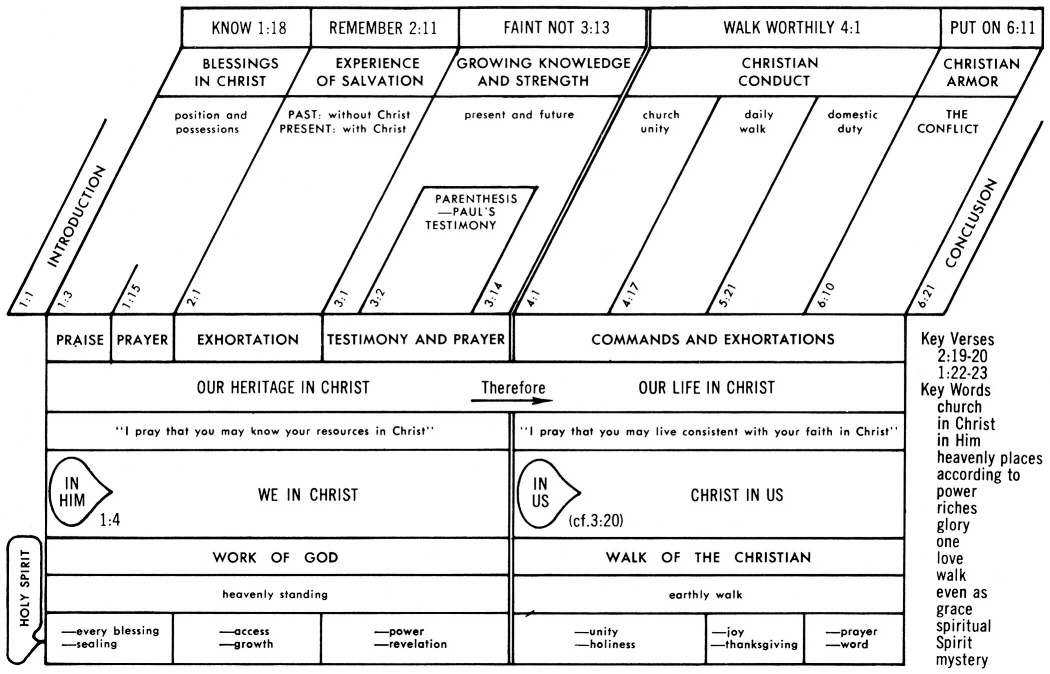
EPHESIANS - CHRIST AND THE CHURCH
Click chart to enlarge
Charts from Jensen's Survey of the NT - used by permission
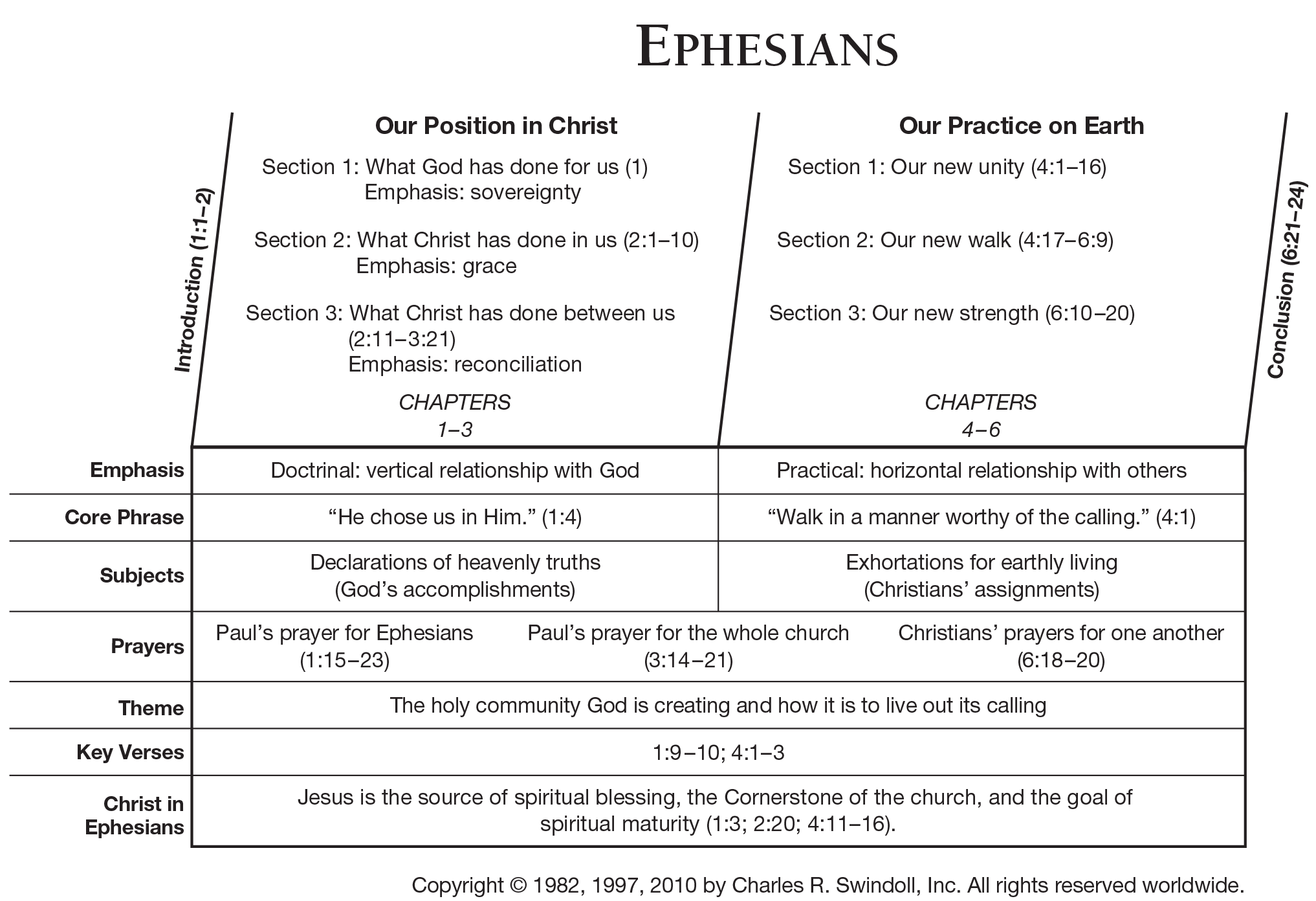
Click chart by Charles Swindoll -Note "EMPHASIS" --
Ephesians 1-3 = Doctrinal: vertical relationship with God
Ephesians 4-6 = Practical: horizontal relationship with others
Ephesians 5:1 Therefore be imitators of God, as beloved children; (NASB: Lockman)
Greek: ginesthe (2PPMM) oun mimetai tou theou os tekna agapeta,
Amplified: THEREFORE BE imitators of God [copy Him and follow His example], as well-beloved children [imitate their father]. (Amplified Bible - Lockman)
NLT: Follow God's example in everything you do, because you are his dear children. (NLT - Tyndale House)
Phillips: As children copy their fathers you, as God's children, are to copy him. (Phillips: Touchstone)
Wuest: Be becoming therefore imitators of God, as children beloved. (Eerdmans Publishing - used by permission)
Young's Literal: Become, then, followers of God, as children beloved,
| THE SYMMETRY OF EPHESIANS |
|
| EPHESIANS 1-3 | EPHESIANS 4-6 |
| Spiritual Wealth | Spiritual Walk |
| The Position of the Believer |
The Practice of the Believer |
| God Sees Us in Christ |
The World Should See Christ in Us |
| Privilege | Practice |
| Doctrine | Duty |
| Doctrinal | Practical |
| Revelation | Responsibility |
| Christian Blessings |
Christian Behavior |
| Belief | Behavior |
| Privileges of the Believer |
Responsibilities of the Believer |
| Our Heritage In Christ |
Our Life In Christ |
| Know your Resources (Riches) in Christ |
Live by faith in the light of your Resources (Riches) in Christ |
| Work of Christ |
Walk of the Christian |
| Work of Christ In Us |
Work of Christ Through Us |
| We in Christ |
Christ in Us |
| Word of God |
Walk of the Christian |
| Heavenly Standing |
Earthly Walk |
| Who You Are In Christ |
Whose You Are In Christ |
| Identity | Responsibility |
| Theology | Ethics |
THEREFORE BE IMITATORS OF GOD: ginesthe (2PPMM) oun mimetai tou theou:
- Eph 4:32; Leviticus 11:45; Matthew 5:45,48; Luke 6:35,36; 1Peter 1:15,16; 1John 4:11)
- Note: All verbs in bold red indicate commands, not suggestions!
- Ephesians 5 Resources - Multiple Sermons and Commentaries
- Ephesians 5:1-4 - Wayne Barber
- Ephesians 5:1-2: Be Imitators of God's Love - 1 - Wayne Barber
- Ephesians 5:1-2 Imitating the God of Love - Steven Cole
- Ephesians 5:1-2: Walking in Love - John MacArthur
- Ephesians 4:17-5:14 Study Guide (see dropdown menu) - John MacArthur
DON'T JUST TALK IT!
WALK IT!
Therefore (3767) (oun) is a strategic term of conclusion which introduces a logical result or inference from what precedes (so, consequently). Always pause and ponder "therefore." What has Paul just said? (See esp Eph 4:29-32-note; Eph 4:31-32-note).
Be imitators of God - Practically this is synonymous with the charge for believers to be imitators of Jesus (God). Watch how Jesus walked and walk like Him (Read 1Jn 2:6-note where such a walk is also evidence that one is a genuine believer! cp 1Pe 2:21-note, 1Cor 11:1). Note how Jesus was enabled to walk the way He walked, recalling that He emptied Himself of His divine prerogatives (Php 2:5-7-note).
Be (1096) (ginomai) means to become or come into existence (to be born). They were already "born" again (justified by grace through faith, past tense salvation, Ephesians 1-3 = gives their "Position" in Christ) but now were to live as ("be") newly born ones (as alluded to in the second column in the table above = their "Practice" in Christ, enabled by His Spirit, nourished by His Word, aka, progressive sanctification or present tense salvation). The verb is in the present imperative, a command calling for continual imitation! Just try to keep this command in your OWN strength! You can't. But fortunately (because of God's grace), God's commandments always include His enablements! The only way to imitate the life of Jesus is by relying on the same power Jesus relied upon to obey His Father, the power of the Holy Spirit. Note that just after Jesus' ministry was inaugurated by the Spirit coming upon Him at His baptism, the same Spirit filled Him and led Him into the wilderness and then empowered his 3 year ministry! (Mt 3:16, Mk 1:12, Mt 4:1, Lk 4:1-2, Lk 4:14, cf Acts 10:38). The Jesus way is the only way we can obey this command to be imitators!
Related Resource:
Imitators (3402) (mimetes [word study] from miméomai = imitate <> English = mimic) is an imitator, follower, actor, impostor. Plato said a mimetes was one who represents characters. Aristotle said it was one who is like another.
A mime is one who acts a part with mimic gestures and action. Have you ever seen somebody mime? They don’t say anything, do they? In other words, what Paul is saying is, "Don’t talk about His love, walk in His love, live it, express it. Don’t tell everybody you have it, show them that you have it. Do as God does. Mime. In other words, live it out before the world."
Mimetes means "do as I do." As noted above the present imperative is a command calling for divine imitation to be their way of life. Paul says for us to continually "mimic" God's attitudes and actions just described (strengthened by His Spirit cf prayer of Eph 3:16-note). It speaks of the direction of our life, not perfection.
Remember that when you mime you let your actions speak in place of your words. If we are to be like God, we must mime Him and let our actions speak louder than our words by being kind, tender hearted, forgiving (Eph 4:32 -note)!
Barclay - "When Paul talked of imitation he was using language which the wise men of Greece could understand. Mimesis, imitation, was a main part in the training of an orator. The teachers of rhetoric declared that the learning of oratory depended on three things-theory, imitation and practice. The main part of their training was the study and the imitation of the masters who had gone before. It is as if Paul said: "If you were to train to be an orator, you would be told to imitate the masters of speech. Since you are training in life, you must imitate the Lord of all good life." (1Pe 2:21) (Ephesians 5 Commentary)
THOUGHT - What a lofty and privileged call this is - called to to be imitators of the Living and True God. Oh, Father, forgive us for forgetting all too often who we now are and more importantly "Whose" we now are (not our own but bought with a price to glorify or give a proper opinion of You in our bodies to everyone we encounter) For the sake of Your Son. Amen.
Jesus gave a similar exalted charge in His Sermon on the Mount...
Love (as your lifestyle - something you can only accomplish by the enabling power of the indwelling Spirit! = present imperative) your enemies and pray (as a lifestyle, again a call for us to depend on the Spirit not ourselves! = present imperative) for those who persecute you so that you may be sons of your Father who is in heaven; for He causes His sun to rise on the evil and the good, and sends rain on the righteous and the unrighteous (See notes Matthew 5:44; Matthew 5:45)
Therefore you are to be (functionally an imperative) perfect, as your heavenly Father is perfect (See note Matthew 5:48)
Illustration of Imitators of God - Welsh Revival of 1904 -- In an eyewitness report of the great Welsh revival of 1904, G. Campbell Morgan wrote, “The horses are terribly puzzled. A manager said to me. ‘The haulers are some of the very lowest. They have driven their horses by obscenity and kicks. Now they can hardly persuade the horses to start working, because there is no obscenity and no kicks.’”
AS BELOVED CHILDREN: os tekna agapeta:
- Jeremiah 31:20; Hosea 1:10; John 1:12; Colossians 3:12; 1John 3:1,2
- Ephesians 5 Resources - Multiple Sermons and Commentaries
- Ephesians 5:1-4 - Wayne Barber
- Ephesians 5:1-2: Be Imitators of God's Love - 1 - Wayne Barber
- Ephesians 5:1-2 Imitating the God of Love - Steven Cole
- Ephesians 5:1-2: Walking in Love - John MacArthur
- Ephesians 4:17-5:14 Study Guide (see dropdown menu) - John MacArthur
In Colossians 3 Paul used a similar affirmation (even adding "chosen" and "holy") preceding his call to motivate the saints at Colossae to live like God would live...
And so, as those who have been chosen of God, holy and beloved, put on a heart of compassion, kindness, humility, gentleness and patience (Col 3:12-note)
As (5613)(os) is a comparative particle (learn to meditate on these terms of comparison, seeking to know what is being compared, etc). Here it points to the manner or character in which the imitation is to be made good, and indicates at the same time a reason for it. They are children of God, experiencing His love and this should motivate them to imitate His forgiveness. Children should be like their father, and love should meet love (Like Father, like son)! How are you doing beloved of God? Do men see your good ("God") works done in such a way that they bring glory to your Father? (Mt 5:16-note).
Beloved (27) (agapetos from agape) means dear or very much loved (in context by God their Father!). It is a love called out of one’s heart by preciousness of the object loved. And best of all it's the same word the Father used to describe His Son! In other words, He now and forever sees us as His very own sons and daughters, because we are eternally IN His Son! Amazing truth for wretches such as us! Amazing grace, indeed! If you need motivation today to walk the talk (living out the exhorations and commandments in Ephesians chapters 3-6), ask the Spirit to frequently recall to your mind throughout the day the truths of your eternal position and precious privilege in Christ Jesus your Lord (Amen!). And remember don't TRY to live the Christ life. Instead daily choose to DIE to live the Christ life (Mk 8:34, "daily" = Lk 9:23). Yielding daily to the Spirit of Christ to live His life through you (Galatians 2:20). Remember that sin shall no longer be master over you for you are no longer under law but under grace (Ro 6:14) and the Spirit of grace (Heb 10:29b) is the gift of the Father to empower life on a higher plane (Jn 14:16, 15:26, cf Ro 5:5). So remember your new family lineage, forever in Christ and children of the living God.
The "Beloved" are those to whom Christ has shown love, as so wonderfully described by John...
See how great a love the Father has bestowed upon us, that we should be called children of God; and [such] we are. For this reason the world does not know us, because it did not know Him. 3:2 Beloved, now we are children of God, and it has not appeared as yet what we shall be. We know that, when He appears, we shall be like Him, because we shall see Him just as He is. (1Jn 3:1-note, 1Jn 3:2-note, cf 1 Th 1:4)
Children (5043) (teknon from tikto = bring forth, bear children, be born) is strictly a child produced, male or female, son or daughter. Teknon is thus a child as viewed in relation to his or her parents or family. In the plural, teknon is used generically of descendants, posterity or children.
Paul used teknon earlier (Eph 2:3-note) to point that we were all born with Adam's depraved nature and were fully deserving of the wrath of God ("children of wrath"). What a contrast a 3 chapters makes (and the love of God poured out on and in our hearts)! Paul is reminding his readers that they were in Christ, were empowered by His Spirit and should now be continually motivated by a desire to walk in a manner pleasing to their new Father (formerly Satan had been their father, John 8:44, 1Jn 3:8-10,12).
Note that another Greek word huios (5207), translated son, differs from teknon in that teknon gives prominence to the fact of birth, whereas huios stresses the dignity and character of the relationship and usually speaks of one who is fully mature. Despite these distinctions, these words often overlap in meaning and thus are often used seemingly without discrimination. Therefore we should not press their semantic differences in every case but allow the context to rule in the interpretation (always a good rule!)
To reiterate, teknon is a word for children that emphasizes the birth relationship.
Teknon was used in secular Greek writings as a form of familiar, tender or affectionate address to speak of one kindly even if they were adults referring to them as "my son" or "my child". For example Jesus speaking to the paralytic declared
Take courage, My son (teknon), your sins are forgiven. (Mt 9:2)
In the NT, pupils or disciples are called children of their teachers, because the latter by their instruction nourish the minds of their pupils and mold their characters. For example Paul writes...
For this reason I have sent to you Timothy, who is my beloved and faithful child (teknon) in the Lord (2Ti 1:2-notes), and he will remind you of my ways which are in Christ, just as I teach everywhere in every church. (1Co 4:17) (Comment: In his first epistle Paul writes as a spiritual father "to Timothy, my true child [teknon] in the faith: Grace, mercy and peace from God the Father and Christ Jesus our Lord." 1Ti 1:2. In Titus Paul again writes as a spiritual father "to Titus, my true child [teknon] in a common faith: Grace and peace from God the Father and Christ Jesus our Savior." see Titus 1:2-note)
Teknon takes on special theological significance when the Bible calls believers the children of God (John 1:12; 11:52; Acts 17:29; Rom 8:16, 21; 9:8; Phil 2:15; 1 John 3:1f, 10; 5:2 - note one use by Paul is not of those who are born again and uses genos -- "offspring" -- not teknon in the Greek text - see if you can determine which one is not referring to the members of the family of God) or more literally "born ones" of God. In using teknon in this context the NT is not saying believers are "childlike" but tat we are members of God's family as thus heirs, Paul affirming...
and if children (teknon), heirs also, heirs of God and fellow heirs with Christ, if indeed we suffer with Him in order that we may also be glorified with Him. (Ro 8:17-note)
William Barclay has an illustration of one who sought to imitate His Father writing that "In the early church, when a man gave his life to Jesus Christ as Savior, he often had to leave his job because it conflicted with his profession of faith. William Barclay points out that some years ago, the same thing happened to F. W. Charrington, the heir to a fortune made by brewing." “Charrington was passing a tavern one night. There was a woman waiting at the door. A man, obviously her husband, came out, and she was trying to keep him from going back in. With one blow of his fist, the man felled her. Charrington started forward and then he looked up; the name above the tavern was his own. Charrington said, ‘With that one blow that man did not only knock his wife out, he also knocked me clean out of that business forever.’” Charrington gave up the fortune he might have had, rather than touch money earned in such a way. (From Morning Glory, July 26, 1993) (Ephesians 5 Commentary)
Copy The Master - The Louvre in Paris is perhaps the most famous art museum in the world. It displays originals by such masters as Delacroix, Michelangelo, Rubens, da Vinci, Ingres, Vermeer, and many others.
Since 1793, the Louvre has encouraged aspiring artists to come and copy the masters. Some of our most famous modern artists have done that and have become better painters by copying the best the world has ever known.
An article in Smithsonian magazine tells about Amal Dagher, a 63-year-old man who has been duplicating art at the Louvre for 30 years. Dagher remains in awe of the masters and continues to learn from them. He said, "If you're too satisfied with yourself, you can't improve."
Paul instructed us to be "imitators of God" (Ephesians 5:1). In his first letter to the Thessalonians, he commended the believers because they were becoming like the Lord and setting an example for others (1Thessalonians 1:6, 7, 8, 9, 10).
Like the Louvre copyists, we'll never reach perfection before we get to heaven. Even so, we must resist the temptation to be satisfied with our present imitation of Jesus. We need to keep looking to Him, learning from Him, and asking for His help. Let's copy the Master. —David C. Egner (Our Daily Bread, Copyright RBC Ministries, Grand Rapids, MI. Reprinted by permission. All rights reserved)
More like the Master I would live and grow,
More of His love to others I would show;
More self-denial, like His in Galilee,
More like the Master I long to ever be. —Gabriel
To become like Christ, we must learn from the Master
Ephesians 5:1 - F B Meyer - Be ye therefore imitators of God, as beloved children. (r.v.)
Children mostly resemble their father. There is often an unmistakable family likeness, which compels the most casual observer to exclaim, “The very image of his father.” Oh that in each of us there might be that which would make men think of God!
Put away your former manner of life (Ephesians 4:22). — The old man stands for the collection of habits, sayings, and doings which characterised our unregenerate days. The apostle says that they are to be put away suddenly, instantly. Evidently this is possible, or such a command would not be issued. Men speak of a gradual reformation, and advise the piecemeal discontinuance of evil. God, on the contrary, bids us treat the evil past as a company of soldiers would bandits and outlaws. There is the greater reason for this, as the old man waxeth corrupt. Even Martha could not bear the opening of her brothers vault.
Be renewed in the spirit of your mind (Ephesians 4:23). — We are reminded of Romans 12:2. The mind needs to be brought into daily, hourly contact with God’s thoughts, as contained in Scripture, that it may be renewed; else our constant association with the men and women of the world, their maxims and practices, will inevitably and sorrowfully deteriorate it. The only source of daily renewal is fellowship with God.
Put on the new man. — Of this the apostle affirms that it is according to God, and has been created. Our Lord created this beauteous dress when He rose from the dead. The day of resurrection was one of creation. All the habits and dispositions of a holy, godlike life have been prepared for us in Him, and await our appropriation; and as they are according to God, so soon as we put them on we shall become imitators of God as dear children. (Meyer, F. B. Our Daily Homily)
Fly the Flag - Therefore be imitators of God as dear children. — Ephesians 5:1
Queen Elizabeth II has reigned for more than 60 years. Her monarchy has been characterized by grace and class. She has diligently given her life to serve her people well, and as a result she is deeply loved and highly revered. So, you can understand the importance of the flag flying above Buckingham Palace. When the flag is flying, it means that she is in residence in the heart of London. The flag is a public statement that the queen is present with her people. As I was thinking about that, it occurred to me that our King Jesus is in residence in our hearts as our “never leave you nor forsake you” Monarch (Heb. 13:5). As wonderful as that is to us personally, I wonder if those around us would recognize that He is in residence based on the way we live? If He is within us, that will show on the outside. As Paul says, we are to be “imitators of God” and to “walk in love, as Christ also has loved us” (Eph. 5:1-2). As we do so, we will display joy, peace, patience, kindness, goodness, faithfulness, gentleness, and self-control (Gal. 5:22-23).
So let’s fly the flag of His presence—the flag of His grace, righteousness, and love—so that others may see Him through us. — Joe Stowell (Our Daily Bread, Copyright RBC Ministries, Grand Rapids, MI. Reprinted by permission. All rights reserved)
Lord, remind me that Your presence in my heart is intended to be a public reality. May I so value all the blessings of Your presence that I am willing to share them generously with others.
Fly the flag of Christ’s presence to show that the King is in residence in your life.
Living Up To The Name - Our 9-pound Yorkie was barking frantically and digging furiously to get at a chipmunk that had scurried under a shed. She looked at me with an expression that seemed to say, "Can't you do something to help me catch it?" I didn't help her, but neither did I scold her. While I wish she could distinguish between rats and chipmunks, it's natural for her to go after any rodent. She is, after all, from a family of small terriers that were bred in Yorkshire, England, to kill rats. So she's living up to her family name.
God expects His "dear children" (Eph. 5:1), who have been delivered from spiritual darkness and made to be "light in the Lord" (v.8), to do what we were redeemed to do. He wants us to "walk in love, as Christ also has loved us" (Ep 5:2), and not to speak or live as unbelievers who have no share in God's eternal kingdom (Ep 5:5, 6).
Obviously, living as God's children is not a matter of instinct. We are challenged to remind ourselves daily of who we are by God's grace. Only as we do this consistently and become "imitators of God as dear children" can we have the joy of knowing that we please the Lord.
When we do what God saved us to do, we'll be living up to the family name. --H V Lugt (Our Daily Bread, Copyright RBC Ministries, Grand Rapids, MI. Reprinted by permission. All rights reserved)
Dear Jesus, take my heart and hand,
And grant me this, I pray:
That I through Your sweet love may grow
More like You day by day. --Garrison
How we behave reveals what we believe.
The Privilege
"Be imitators of God, therefore, as dearly loved children and live a life of love, just as Christ loved us and gave himself up for us as a flagrant offering and sacrifice to God."—Ephesians 5:1-2
In 1839 David Livingstone heard Robert Moffat speak about missionary opportunities in Africa:
"I have sometimes seen, in the morning sun, the smoke of a thousand villages where no missionary has ever been."
Livingstone was accepted as a missionary to the African interior. Livingstone discovered Victoria Falls (aerial view) and was awarded the London Royal Geographical Society's gold medal for crossing the African continent from west to east. But he paid dearly: A lion mauled his left arm and rendered it useless; his wife died while in Africa when he was forty-nine; he lost a son in the Battle of Gettysburg; his daughter died of fever in the jungle; his house was destroyed during the Boer War; and he himself endured rheumatic fever and other illnesses.

Livingstone wrote in his journal:
"People talk of the sacrifice I have made... Can that be called a sacrifice which is simply paying back a small part of the great debt owing to our God, which we can never repay? Is that a sacrifice which brings its own blest reward in healthful activity, the consciousness of doing good, peace of mind and a bright hope of glorious destiny hereafter? Away with the word in such a view and with such a thought! It is emphatically no sacrifice. Say rather it is a privilege."
Do you desire to imitate Jesus Christ? Today in prayer, thank Christ for the love that He has given you. It is a privilege to live a life of love.
"Circumstances may appear to wreck our lives and God's plans, but God is not helpless among ruins. Our broken lives are not lost or useless. God's love is still working. He comes in and takes the calamity and uses it victoriously, working out his plan of love."—Eric Liddell (Generation to Generation - Peter Kennedy)
The Careful Walk Ephesians 5:1-17
See then that you walk circumspectly, not as fools but as wise. — Ephesians 5:15
One of my favorite places to visit in Jamaica is Ocho Rios, home of Dunn’s River Falls—a spectacle that never ceases to amaze. Water cascades down a long series of rocks as it makes its way to the Caribbean Sea. Adventurers can climb the falls, scrambling over rounded rocks on an invigorating trek to the top. The flowing water, the potentially slippery surface, and the steep angles make the going slow and a bit treacherous. To make it safely to the top, climbers must watch every step. If a person is not careful, he or she could fall on the journey. The keys to a successful climb are concentration and caution.
I can’t think of a better picture of what Paul is saying in Ephesians 5:15 when he says, “walk circumspectly.” We should “be very careful . . . how [we] live” (niv). Clearly, with all of life’s possible dangers coming our way as we climb through life, it is vital that we take each step with Jesus wisely and cautiously. A fool, the passage says, lives carelessly; a wise person watches each step so he does not stumble or fall.
Our goal of being “imitators of God” (v.1) is met, Paul says, as we walk carefully in love (vv.2,15). Through the Holy Spirit’s guidance, we can walk in a way that honors God. — Dave Branon (Our Daily Bread, Copyright RBC Ministries, Grand Rapids, MI. Reprinted by permission. All rights reserved)
Consistency! How much we need
To walk a measured pace,
To live the life of which we speak,
Until we see Christ’s face. — Anon.
As we trust God to rule our hearts our feet can walk His way.
James Smith has a related note YE SHALL BE HOLY. Leviticus 11 (note)
Holiness, or separation from the unclean, is the burden of this chapter. After a full atonement has been made, and the Lord has revealed Himself to His people, as we have seen in chapter 9, it surely becomes His redeemed ones to be imitators of God as dear children (Eph. 5:1). This is the desire of His heart, "Ye shall be holy, for I am holy." We cannot be followers of the Holy One and take pleasure in those things which are unclean in His sight. We shall look at—
1. The warning given. "They are unclean to you, they are an abomination unto you." Other people may eat of those unclean animals, but it shall not be so with you. Ye are My people, redeemed by blood, and separated for My Name's glory, so your manner of living must not be after the indiscriminating fashion of the ungodly. The lesson for us is plain.
2. The distinctions made. God Himself distinguishes what is clean or unclean for His people. The clean animals are known by their feet and mouth, they part the hoof and chew the cud. What God hath cleansed, that call not common or unclean (Acts 10:12). The feet and mouth marks point to our walk and word as evidence of our being clean before the Lord. Many professing Christians are sorely troubled with the "foot and mouth disease," they delight not to walk in His ways or to speak in His Name. "All fowls (flying things) that creep shall be an abomination unto you" (v. 20). All those who have power to rise up into the heavenly places, and who spend their time in crawling on the earth, are in an unclean state, and are abominable in the sight of God. "I would that thou wert cold or hot; because thou art neither cold nor hot I will spue thee out of My mouth" (Rev. 3:15, 16). "Thou shalt not eat or become a partaker of any abominable thing" (Deut. 14:3). Those gifted with the wings of faith become unclean when they get among the "creeping things."
3. The reasons urged. There are several powerful arguments here given why we as God's redeemed people should live a separated life. Because of—
1. HIS SOVEREIGN CLAIM OVER US. "I am the Lord your God" (v. 44). This is a blessed revelation indeed. "I am your God." Did not the risen Saviour say, "I ascend unto My Father and your Father, unto My God and your God?" When ye pray, say, "Our Father."
2. WHAT HE HATH DONE FOR US. "I am the Lord that bringeth you up out of the land of Egypt" (v. 45). We have been delivered out of the hand of our enemies that we might serve Him without fear in holiness (Luke 1:74, 75). Redeemed by His Blood, and the dominion of sin over us and in us broken up.
3. HIS IMMACULATE CHARACTER. "I am holy" (v. 45). He is perfect in holiness. The wholeness of His character is eternally and unchangeably complete in all His attributes and works.
4. OUR RELATIONSHIP TO HIM. "I am your God, ye shall therefore be holy, for I am holy" (v. 45). "Ye shall therefore sanctify yourselves" (v. 44). How can two walk together except they be agreed? "What communion hath light with darkness? Ye are the temple of the living God. As God hath said I will dwell in them, and walk in them; and I will be their God, and they shall be My people. Wherefore come out from among them, and be ye separate, saith the Lord, and touch not the unclean thing; and I will receive you, and be a Father unto you, and ye shall be My sons and daughters, saith the Lord Almighty. Having therefore these promises, dearly beloved, let us cleanse ourselves, and perfect holiness in the fear of God" (2 Cor. 6:14-18).
Copy The Master Ephesians 5:1
November 10, 2003
The Louvre in Paris is perhaps the most famous art museum in the world. It displays originals by such masters as Delacroix, Michelangelo, Rubens, da Vinci, Ingres, Vermeer, and many others.
Since 1793, the Louvre has encouraged aspiring artists to come and copy the masters. Some of our most famous modern artists have done that and have become better painters by copying the best the world has ever known.
An article in Smithsonian magazine tells about Amal Dagher, a 63-year-old man who has been duplicating art at the Louvre for 30 years. Dagher remains in awe of the masters and continues to learn from them. He said, "If you're too satisfied with yourself, you can't improve."
Paul instructed us to be "imitators of God" (Ephesians 5:1). In his first letter to the Thessalonians, he commended the believers because they were becoming like the Lord and setting an example for others (1Th 1:6, 7, 8, 9, 10-note).
Like the Louvre copyists, we'll never reach perfection before we get to heaven. Even so, we must resist the temptation to be satisfied with our present imitation of Jesus. We need to keep looking to Him, learning from Him, and asking for His help. Let's copy the Master. —David C. Egner (Our Daily Bread, Copyright RBC Ministries, Grand Rapids, MI. Reprinted by permission. All rights reserved)
More like the Master I would live and grow,
More of His love to others I would show;
More self-denial, like His in Galilee,
More like the Master I long to ever be. —Gabriel
To become like Christ, we must learn from the Master
Ephesians 5:1 F B Meyer
Be ye therefore imitators of God, as beloved children. (r.v.)
Children mostly resemble their father. There is often an unmistakable family likeness, which compels the most casual observer to exclaim, “The very image of his father.” Oh that in each of us there might be that which would make men think of God!
Put away your former manner of life (Ephesians 4:22). — The old man stands for the collection of habits, sayings, and doings which characterised our unregenerate days. The apostle says that they are to be put away suddenly, instantly. Evidently this is possible, or such a command would not be issued. Men speak of a gradual reformation, and advise the piecemeal discontinuance of evil. God, on the contrary, bids us treat the evil past as a company of soldiers would bandits and outlaws. There is the greater reason for this, as the old man waxeth corrupt. Even Martha could not bear the opening of her brothers vault.
Be renewed in the spirit of your mind (Ephesians 4:23). — We are reminded of Romans 12:2-note. The mind needs to be brought into daily, hourly contact with God’s thoughts, as contained in Scripture, that it may be renewed; else our constant association with the men and women of the world, their maxims and practices, will inevitably and sorrowfully deteriorate it. The only source of daily renewal is fellowship with God.
Put on the new man. — Of this the apostle affirms that it is according to God, and has been created. Our Lord created this beauteous dress when He rose from the dead. The day of resurrection was one of creation. All the habits and dispositions of a holy, godlike life have been prepared for us in Him, and await our appropriation; and as they are according to God, so soon as we put them on we shall become imitators of God as dear children. (Meyer, F. B. Our Daily Homily)
Just Like My Dad! - Like so many kids her age, my daughter Julie loves to play basketball. Of course she's had more than a little encouragement, since that is my sport of choice.
Much of what Julie knows about the game has come from our driveway sessions. Occasionally, as I have watched her playing ball with friends, I've heard her remark after making a long shot, "Just like my dad!"
That's a good feeling, but the other day she said something that made me feel even better. We were talking about how she imitates me on the court, and she said, "Dad, Christians should be imitators too. We should imitate Jesus. Then we could say, 'Just like Jesus.'"
Julie is right. We need to know how Jesus responded to trouble--and react as He did. We need to know how He answered critics--and answer as He did. We need to know how Jesus cared for others--and treat them as He did.
That's a lofty aim, but it should be the goal of every Christian. We can only begin to do this by regularly studying God's Word and daily seeking the Holy Spirit's guidance in all that we do.
Imagine the joy it would give our Lord if we would always try to handle life just like Jesus. --J D Brannon (Our Daily Bread, Copyright RBC Ministries, Grand Rapids, MI. Reprinted by permission. All rights reserved)
O blessed Jesus, help us
To ever be like Thee;
Till at the throne of glory
Thy loving face we see. --Haan
God's children should bear a likeness
to their Father.
Ephesians 5:2 and walk in love, just as Christ also loved you and gave Himself up for us, an offering and a sacrifice to God as a fragrant aroma (NASB: Lockman)
Greek: kai peripateite (2PPAM) en agape, kathos kai o Christos egapesen (3SAAI) hemas kai paredoken (3SAAI) heauton huper hemon prosphoran kai thusian to theo eis osmen euodias.
Amplified: And walk in love, [esteeming and delighting in one another] as Christ loved us and gave Himself up for us, a slain offering and sacrifice to God [for you, so that it became] a sweet fragrance. (Amplified Bible - Lockman)
NLT: Live a life filled with love for others, following the example of Christ, who loved you and gave himself as a sacrifice to take away your sins. And God was pleased, because that sacrifice was like sweet perfume to him. (NLT - Tyndale House)
Phillips: Live your lives in love - the same sort of love which Christ gives us and which he perfectly expressed when he gave himself up for us in sacrifice to God. (Phillips: Touchstone)
Wuest: be ordering your behavior within the sphere of love, even as Christ also loved you and gave himself up in our behalf and in our stead as an offering and a sacrifice to God for an aroma of a sweet smell (Eerdmans Publishing - used by permission)
Young's Literal: and walk in love, as also the Christ did love us, and did give himself for us, an offering and a sacrifice to God for an odour of a sweet smell,
AND WALK IN LOVE: kai peripateite (2PPAM) en agape:
- Eph 3:17; 4:2,15; Jn 13:34; Ro 14:16; 1Cor 16:14; Col 3:14; 1Th 4:9; 1Ti 4:12; 1Pe 4:8; 1Jn 3:11,12,23; 4:20,21
- Ephesians 5 Resources - Multiple Sermons and Commentaries
- Ephesians 5:1-4 - Wayne Barber
- Ephesians 5:1-2: Be Imitators of God's Love - 1 - Wayne Barber
- Ephesians 5:1-2 Imitating the God of Love - Steven Cole
- Ephesians 5:1-2: Walking in Love - John MacArthur
- Ephesians 4:17-5:14 Study Guide (see dropdown menu) - John MacArthur
A SUPERNATURAL
LIFE OF LOVE
Walk in love - As imitators of God, Who is love.
Walk (4043) (peripateo from peri = about, around + pateo = walk, tread) literally means to walk about here and there or to tread all around. Peripateo then came to mean to make one’s way, to make progress, to make due use of one’s opportunities and finally (as used by Paul in Ephesians), to live, to regulate one’s life, to conduct one’s live. Most of the NT uses of peripateo refer to daily conduct.
Paul uses the present imperative which is a command calling for their way of life and daily conduct to be in the sphere of unconditional, sacrificial love, the love that God is, the love that is a fruit of His indwelling Spirit in the yielded, obedient saint (Gal 5:22-note, Ro 5:5-note). In short Paul is calling not for a natural walk (in our own innate power), but a supernatural walk (enabled by the power of the Spirit Who indwells us). If you try to obey this command in your own strength, you will place yourself under legalism and you will fail! Instead of "self-reliance" we need "Spirit-dependence!" Continually!
Paul's point is that we are a new creation in Christ (Ephesians 1-3) and should demonstrate this new life by relying on a new power (the Spirit) Who enables us to continually order our behavior in love (within the sphere of love, the "atmosphere" if you will, of supernaturally empowered agape love).
Related Resource:
Peripateo is a favorite word of Paul in Ephesians, used to describe our behavior both before and after we are saved...
Ephesians 2:1 And you were dead in your trespasses and sins, 2 in which you formerly walked according to the course of this world, according to the prince of the power of the air, of the spirit that is now working in the sons of disobedience. (See notes Ephesians 2:1; 2:2)
Ephesians 2:10 For we are His workmanship, created in Christ Jesus for good works, which God prepared beforehand, that we should walk in them. (see note Ephesians 2:10)
Ephesians 4:1 I, therefore, the prisoner of the Lord, entreat you to walk in a manner worthy of the calling with which you have been called, (see note Ephesians 4:1)
Ephesians 4:17 This I say therefore, and affirm together with the Lord, that you walk no longer just as the Gentiles also walk, in the futility of their mind (see note Ephesians 4:17)
Ephesians 5:8 for you were formerly darkness, but now you are light in the Lord; walk as children of light (See note Ephesians 5:8)
Ephesians 5:15 Therefore be careful how you walk, not as unwise men, but as wise, 5:16 making the most of your time, because the days are evil. (See note Ephesians 5:16)
In Colossians 4 Paul uses peripateo charging the saints to
Conduct (command to continually - present imperative - a command calling for us to rely on the Spirit, not self!) yourselves with wisdom (living prudently and with discretion) toward outsiders (non-Christians, whether Jew or Gentile), making the most of (present tense - continually seizing, redeeming or buying up the opportunity - see Redeem the Time) the opportunity (kairos) ." (Col 4:5-note)
Love (26) (agape) is unconditional, sacrificial love which God is. It is love which is commanded in believers, empowered by His Spirit, activated by personal choice of one's will, is not based on one's feelings toward the object of one's love and is manifested by specific actions (see 1Cor 13:4, 5, 6, 7, 8 (notes) for a succinct list of these actions). Agape love speaks of a love called out of one’s heart by the preciousness of the one loved, a love that impels one to sacrifice one’s self for the benefit of the object loved. It is the love shown at Calvary. The prototype of this quality of supernatural love is the Father's love for sinful men as manifest by the Son's sacrifice on the Cross. That is the love in which we are to be rooted and grounded and in which we are called to walk!
Agape is God's willful direction toward man. It involves God doing what He knows is best for man and not necessarily what man desires. For example, John 3:16 states, "For God so loved the world, that he gave." What did He give? Not what man wanted, but what God knew man needed, i.e., His Son to bring forgiveness to man.
Loved (25) (agapao) describes the love God gives freely, sacrificially and unconditionally regardless of response -- love that goes out not only to the lovable but to one’s enemies or those that don't "deserve" it. Agapao speaks especially of love as based on evaluation and choice, a matter of will and action. This love is not sentimental or emotional but obedient and reflective of the act of one's will with the ultimate desire being for another's highest good. Since it is unconditional, this love is still given if it's not received/returned! Agape gives and give and gives. It is not withheld.
Agape love is commanded of believers, empowered by His Spirit, activated by personal choice of one's will, not based on one's feelings toward the object of one's love and manifested by specific actions (see 1Cor 13:4-8 (notes) for a succinct list of these actions). Agape love speaks of a love called out of one’s heart by the preciousness of the one loved, a love that impels one to sacrifice one’s self for the benefit of the object loved. It is the love shown at Calvary. The prototype of this quality of supernatural love is the Father's love for sinful men as manifest by the Son's sacrifice on the Cross.
Wuest - This love is the agape love which God is, which God exhibited at the Cross, which Paul analyzes in 1 Corinthians 13, and which is the fruit of the Spirit in the yielded saint. The saint is to order his behavior or manner of life within the sphere of this divine, supernatural love produced in his heart by the Holy Spirit. When this love becomes the deciding factor in his choices and the motivating power in his actions, he will be walking in love. He will be exemplifying in his life the self-sacrificial love shown at Calvary and the Christian graces mentioned in 1 Corinthians 13. (Wuest's Word Studies from the Greek New Testament: Eerdmans)
Speaking to faithless Israel God speaks of coming days of restoration declaring...
"I have loved you with an everlasting love; Therefore I have drawn you with lovingkindness. (Jeremiah 31:3)
In Romans Paul explains that even while we were helpless and ungodly, Christ died for the ungodly adding...
But God demonstrates His own love toward us, in that while we were yet sinners, Christ died for us. (Ro 5:8-note)
John writes...
In this is love, not that we loved God, but that He loved us and sent His Son to be the propitiation for our sins. (1 John 4:10)
JUST AS CHRIST ALSO LOVED YOU AND GAVE HIMSELF UP FOR US: kathos kai o Christos egapesen (3SAAI) hemas kai paredoken (3SAAI) heauton huper hemon:
- Ep 5:25; 3:19; Matthew 20:28; John 15:12,13; 2Cor 5:14,15; 8:9; Gal 1:4; 2:20; 1Ti 2:6; Titus 2:14; Heb 7:25, 26, 27; 9:14,26; 10:10,11; 1Pe 2:21, 22, 23, 24; 1Jn 3:16; Rev 1:5; 5:9
- Ephesians 5 Resources - Multiple Sermons and Commentaries
- Ephesians 5:1-4 - Wayne Barber
- Ephesians 5:1-2: Be Imitators of God's Love - 1 - Wayne Barber
- Ephesians 5:1-2 Imitating the God of Love - Steven Cole
- Ephesians 5:1-2: Walking in Love - John MacArthur
- Ephesians 4:17-5:14 Study Guide (see dropdown menu) - John MacArthur
Just as (2531) (kathos) -- Christ's life and love is our example, a love which led Him to sacrifice His life for us on the cross. Notice that this is a term of comparison, calling for us to ponder what is being compared, why, etc? In light of the incredible truth in Romans 1-11, Paul then urged the saints in Rome (and us) to present ourselves to God as a living sacrifice, holy and acceptable to Him, our spiritual service of worship (Ro 12:1-note), yea, even a "sweet smelling savor" unto Jehovah! How is this even possible? Because we now are in Christ, possessing His perfect righteousness (Ro 1:16-17-note) and in His Son, the Beloved, we are "accepted" (Eph 1:7KJV-note) and can now offer up an acceptable sacrifice. Is this not good news! Is this not another way to describe "death to self?" (Mk 8:34-36) And don't miss the "sanctifying power" of your sweet smelling sacrifice. What do I mean by "sanctifying power?" First, note that in the immediate context (only a "but" separates "sweet smelling aroma" in Eph 5:2 from the next word in Eph 5:3) Paul mentions immorality, a sin (and really the only sin that functions this way - 1Cor 6:18) in which we offer to the idol of pleasure and perversion (all sex outside of marriage is essentially a perversion) our bodies as a living sacrifice! (1Cor 6:15-17)
For we never can know
What the Lord will bestow
Of the blessings for which we have prayed,
Till our body and soul
He doth fully control,
And our all on the altar is laid.
Christ (5547) (Christos from chrio = to anoint, rub with oil, consecrate to an office) is the Anointed One, the Messiah, Christos being the Greek equivalent of the transliterated Hebrew word Messiah.
Loved (25) (agapao) - see agape. Paul is previewing a theme he will return to at the end of this chapter. Christ sacrificed Himself for the church because He loves her and wants to make her holy and blameless. Believing husbands and wives and all Christians are to love each other with the same kind of sacrificial love.
Gave Himself up - ultimately this speaks of His death in our place! In the context of Christian's being commanded to walk in love, we see that such a walk means a death to self and a giving of self to others (as Christ did).
He who was delivered up because of our transgressions, and was raised because of our justification. (See note Romans 4:25)
He who did not spare His own Son, but delivered Him up for us all, how will He not also with Him freely give us all things? (See note Romans 8:32)
"I have been crucified with Christ; and it is no longer I who live, but Christ lives in me; and the life which I now live in the flesh I live by faith in the Son of God, who loved me, and delivered Himself up for me. (See note Galatians 2:20)
Himself (heautois) is a reflexive pronoun, emphasizing Christ's personal involvement (He initiated the action and carried out the action ... all for us).
Gave...up (3860) (paradidomi from para = alongside, beside + didomi = give) means to give alongside. The basic idea is to give over from one's hand to someone or something with particular reference to a right or an authority. This concept is illustrated in the devil's attempt to tempt our Lord...
And the devil said to Him, "I will give You all this domain and its glory; for it has been handed over to (paradidomi) me, and I give it to whomever I wish. (Luke 4:6)
In the ancient world paradidomi was used as a technical term of police and courts = ‘hand over into the custody of’. The idea is to give over into one’s power or use and involves either the handing over of a presumably guilty person for punishment by authorities or the handing over of an individual to an enemy who will presumably take undue advantage of the victim, as was the case in the arrest and trials that followed our Lord's being giving over.
In Galatians 2:20 (see note) paradidomi is in the aorist tense which Vine states "is in the point tense (Ed: "aorist") because it refers to the “one act of righteousness,” Romans 5:18 (see note), in which the eternal love of God found its highest expression, and by which the salvation of believers was secured...Complete comprehension of “the mystery of God, even Christ” lies beyond the capacity of the human mind. The more closely it is considered the greater grows the wonder of its unfathomable depths. Not only was God in Christ during His life on earth, John 14:10 , God was in Christ in His reconciling death, 2 Corinthians 5:19 . This ground is holy, yet is it to be approached, albeit with “reverence and awe,” for all that God has been pleased to reveal is proper subject for the worshipful consideration of His children. Two cautions are needful here, however. We may not go beyond what is written, and we may not expect to eliminate mystery from the Divine sacrifice or to reconcile all that is revealed concerning it; the human point of view is far too low, the human outlook far too limited, to admit of that. (Vine, W. Collected writings of W. E. Vine. Nashville: Thomas Nelson )
In the introductory verses to this letter to the Galatians, Paul explained that Jesus
"gave (didomi = active voice = of His own volition) Himself for (huper = on behalf of = speaks of His substitutionary death for) our sins, that He might deliver us out of this present evil age, according to the will of our God and Father" (Galatians 1:4)
Later Paul taught that...
Christ redeemed us from the curse of the Law, having become a curse for us-- for it is written, "CURSED IS EVERYONE WHO HANGS ON A TREE"-- in order that in Christ Jesus the blessing of Abraham might come to the Gentiles, so that we might receive the promise of the Spirit through faith. (Gal 3:13-14)
Comment: Note He was not "accursed" but became a curse in the same sense that "He was made to be sin" in 2Cor 5:21. He voluntarily submitted himself to the curse of the law that that curse might be removed from us.
Preacher's Commentary illustrates Christ giving Himself up fro us with the following story - Following the success of the communist revolution in China in 1948, two young men were given the job of destroying Christian chapels. One evening at dusk, after they had devastated a small chapel, they decided to sleep in it that night. As they were lying on the floor there, one of them saw a crucifix so high on the wall they had not been able to reach it. He looked at it steadily for a while, then said to his companion, “Do you see the picture of God nailed to that stick of wood?” “Yes,” the other responded, “but what of it?” The first answered, “You know, I never saw a God who suffered before.” This is something new—a Savior who voluntarily suffers. (Briscoe, D. S., & Ogilvie, L. J. The Preacher's Commentary Series, New Testament. 2003; Thomas Nelson)
Jesus explained His purpose to the disciples declaring that "the Son of Man did not come to be served, but to serve, and to give His life a ransom for many." (Mt 20:28)
In John Jesus declared "I am the good shepherd; the good shepherd lays down His life for the sheep...For this reason the Father loves Me, because I lay down My life that I may take it again. No one has taken it away from Me, but I lay it down on My own initiative. I have authority to lay it down, and I have authority to take it up again. This commandment I received from My Father." (John 10:11, 17-18)
The awesome truth about Jesus' life for our life cannot be repeated enough, as Paul emphasized in many of his letters...
He who was delivered up (paradidomi) because of our transgressions, and was raised because of our justification. (see note Romans 4:25)
"Walk in love, just as Christ also loved you, and gave Himself up (paradidomi) for us, an offering and a sacrifice to God as a fragrant aroma. (see note Ephesians 5:2)
Husbands, love your wives, just as Christ also loved the church and gave Himself up (paradidomi) for her (see note Ephesians 5:25)
(Jesus) gave Himself as a ransom for all, the testimony borne at the proper time. (1Ti 2:6)
(Jesus) gave Himself for us, that He might redeem us from every lawless deed and purify for Himself a people for His own possession, zealous for good deeds. (see note Titus 2:14)
Although Paul clearly states that Jesus of His own volition gave Himself over into the hands of evil men, many of the other uses of paradidomi in the gospels describe the giving over of our Lord Jesus Christ into the hand's and the authority of His various and manifold adversaries...and so we read that Jesus was given over...
By Judas - And Judas Iscariot, who was one of the twelve, went off to the chief priests, in order to betray (paradidomi - to hand Him over to them) Him to them. (Mark 14:10) (Compare: Simon the Zealot, and Judas Iscariot, the one who betrayed [paradidomi] Him. - Mt 10:4)
By the Sanhedrin to Pilate - And early in the morning the chief priests with the elders and scribes, and the whole Council, immediately held a consultation; and binding Jesus, they led Him away, and delivered Him up (paradidomi) to Pilate (Mark 15:1)
By Pilate to the people's will - And he released the man they were asking for who had been thrown into prison for insurrection and murder, but he delivered (paradidomi) Jesus to their will. (Luke 23:25)
By Pilate to the soldiers for execution - And wishing to satisfy the multitude, Pilate released Barabbas for them, and after having Jesus scourged, he delivered (paradidomi) Him to be crucified. (Mk 15:15)
S Lewis Johnson speaking of living our lives now based on faith in the Son of God asks...
But do we have good reasons to rest in Him? The final words of Galatians 2:20 supply ample grounds. Our faith is in the Son of God, "who loved me and gave himself for me." Cf. Gal 1:4. All of the essentials of the atonement are found here. His redemptive work is grounded in the love that expressed itself in the cross, the word "loved" being an aorist in tense and referring to the event of the cross as the issue of eternal, electing love (cf. Eph 1:3, 4, 5, 6; 2:4, etc.). The verb, "gave," means to hand over, to deliver over (cf. Ro 4:25-note; Ro 8:32-note; Eph. 5:2). It in this context suggests these important things:
(1) First, His death was voluntary. He gave Himself.
(2) Second, His death was a penal sacrifice, for He had to deliver Himself over to the cross. The aorist of the participle again points to the cross as the event at which the delivering took place. And it was a delivering of Himself over to the divine penalty for sin. He, thus, was a sacrifice.
(3) Third, His death was substitutionary. It was "for me," Paul says, a personal reference that is expanded to all the elect in other places in his writings (cf. Eph 5:2; Gal. 1:4). The use of the first person here "indicates the deep personal feeling with which the apostle writes," Burton believes.
Incidentally, it is never said in the New Testament that Christ loves the world. He loved the church, and He loves me; the special relation that He bears to His own is the New Testament stress (cf. Rev 1:5).
The apostle has set forth for us the secret of true life. It is found in the voluntary, penal substitutionary sacrifice of the Son of God who, uniting us with Himself, has died our death under judgment and has raised us up with Him in His resurrection to enjoy forever His life beyond the sphere of the Mosaic Law. It is no longer the hopeless struggle to keep the Law, but it is now the confident trust in the Lawgiver Himself, who lives His life out within me and through me. Can we not count on Him who loved me in all my sin and iniquity and, in spite of that, gave Himself for me? Cf. Ro 5:9,10, 8:32-notes Ro 5:9, 10; 8:32. (Read his full message on Galatians 2:15-21)
For (5228) (huper) means for the sake of, in the sense of protection, care, favor, benefit. means in behalf of, for the sake of. In other words died on behalf of us. In short this describes the Christ's substitutionary atonement. It does not merely mean that Christ died for us, for our benefit, but He died instead of us, in our place. He substituted for us, receiving the full impact of the divine wrath against sin.
For us - for our sake, in our place, as our Substitute! He died the death we should have died so that we can live the life abundantly and eternally in Him. See What is the substitutionary atonement?
AN OFFERING AND A SACRIFICE TO GOD AS A FRAGRANT AROMA: prosphoran kai thusian to theo eis osmen euodias:
- Ro 8:3; 1Cor 5:7; Heb 9:23; 10:12
- Ge 8:21; Lev 1:9,13,17; 3:16; Amos 5:21; 2Co 2:15
Gen 8:21 And Jehovah smelled the soothing aroma; and the LORD said to Himself, “I will never again curse the ground on account of man, for the intent of man’s heart is evil from his youth; and I will never again destroy every living thing, as I have done.
Lev 1:9 ‘Its entrails, however, and its legs he shall wash with water. And the priest shall offer up in smoke all of it on the altar for a burnt ('olah) offering (In Hebrew for offering is qorban which in Greek = doron = a gift!), an offering by fire of a soothing aroma to Jehovah.
Lev 1:13 ‘The entrails, however, and the legs he shall wash with water. And the priest shall offer all of it, and offer it up in smoke on the altar; it is a burnt offering, an offering by fire of a soothing aroma to the LORD.
Lev 1:17 ‘Then he shall tear it by its wings, [but] shall not sever [it]. And the priest shall offer it up in smoke on the altar on the wood which is on the fire; it is a burnt offering, an offering by fire of a soothing aroma to the LORD.
Lev 3:16 ‘And the priest shall offer them up in smoke on the altar [as] food, an offering by fire for a soothing aroma; all fat is the LORD’s.
A SOOTHING AROMA
ON THE ALTAR
Does this not recall Paul's great exhortation in Romans 12:1-2 which is based on the incredible truths expounded in Romans 1-11? May God grant this would be our daily offering which is pleasing to Him and give us the desire and power of His Spirit (Php 2:13NLT) to not "crawl off the altar" during the day as we work out our salvation in fear and trembling (Php 2:12)...
Therefore I urge you, brethren, by the mercies of God, to present your bodies a living and holy sacrifice, acceptable to God, which is your spiritual service of worship. And (NOW PAUL GETS PRACTICAL ABOUT OUR "OFFERING") do not be conformed (present imperative with a negative) to this world, but be transformed (present imperative) by the renewing of your mind, so that you may prove what the will of God is, that which is good and acceptable and perfect.
Barclay on fragrant aroma - Paul uses a typical OT phrase, "odor of a sweet savor," which goes back to a very old idea, as old as sacrifice itself. When a sacrifice was offered on an altar, the odor of the burning meat went up to heaven and the god to whom the sacrifice was offered was supposed to feast upon that odor (Ed: Be careful here! Our God is not like the pagan deities and He does not need actually eat the food provided to Him in the offerings! See Leviticus 3:11 Comment). A sacrifice which had the odor of a sweet savor was specially pleasing and specially acceptable to the god to whom it was offered. Paul takes the old phrase which time had hallowed--it occurs almost fifty times in the Old Testament and uses it of the sacrifice that Jesus brought to God. The sacrifice of Jesus was well-pleasing to God. What was that sacrifice? It was a life of perfect obedience to God and of perfect love to men, an obedience so absolute and a love so infinite that they accepted the Cross. What Paul says is: "Imitate God. And you can do so only by loving men with the same sacrificial love with which Jesus loved them and forgiving them in love as God has done." (Ephesians 5 Commentary)
Offering (4376) (phosphora from prosphero = offer in turn from prós = to, toward + phéro = bring) literally describes a "carrying or bringing to" and thus pictures a presentation. Prosphora in this verse stands for the thing offered, Christ's body and blood offered to His Father in our behalf. The offering includes Christ's life as well as His death.
Prosphora was also used to describe the blood offerings of the Levitical system
After saying above, "SACRIFICES AND OFFERINGS (prosphora) AND WHOLE BURNT OFFERINGS AND sacrifices FOR SIN THOU HAST NOT DESIRED, NOR HAST THOU TAKEN PLEASURE in them" (which are offered according to the Law), (Hebrews 10:8-note).
Jesus Christ fully God became fully Man that He might be the perfect sacrifice, the Lamb of God slain from the foundation of the world to take away sins (Jn 1:29) fulfilled the shadows of the Levitical offering by becoming an offering for sin on the Cross. for those OT sacrifices were "a mere shadow of what is to come; but to substance belongs to Christ. (Col 2:17-note)
Sacrifice (2378) (thusia from thúo = to sacrifice or kill a sacrificial victim) is that which is offered as a sacrifice. Metonymically it refers to the thing sacrificed, the victim, the flesh of victims, or the part of which was burned on altar (See Commentary on Whole Burnt Offerings). Again Paul digresses to speak of our Lord Jesus Christ in terms of Old Testament shadows, those OT sacrifices of animals killed and offered on the Brazen Offer being a picture of Christ's once for all perfect sacrifice. He offered Himself as a sacrifice to God in full payment of the debt of sin which we as sinners owed, and which the violated law demanded.
As a fragrant (osme - odor) aroma (euodia - fragrance) is related to the OT phrase "soothing aroma," the "odor of rest" (Click Dr Johnson's explanation and application of "odor of rest"; See also the discussion of Soothing Aroma in Leviticus Commentary) Fragrant aroma is literally “a savor of a sweet smell,” or “an odor of a sweet smell" depicting the acceptableness of the offering. The soothing aroma offerings of Lev 1-3 prefigured the voluntary character of Christ's sacrifice. "Fragrant aroma" is a beautiful picture of how the OT burnt offering "sweet savor" sacrifice pointed to the ultimate to the fully satisfying sacrifice of our Great High Priest. In the present context, it also points to what our lives should be to God - a fragrant aroma!
Lev 1:9-note 'Its entrails, however, and its legs he shall wash with water. And the priest shall offer up in smoke all of it on the altar for a burnt offering, an offering by fire of a soothing aroma to the LORD.
Comment: Observe that the frequent OT phrase "soothing aroma" in the Septuagint euodia soothing aroma is found 42x in NAS - Ge 8:21 (first use of Noah's sacrifice after deliverance from the flood); Ex 29:18, 25, 41; Lev 1:9, 13, 17; 2:2, 9, 12; 3:5, 16; 4:31; 6:15, 21; 8:21, 28; 17:6; 23:13, 18; Num 15:3, 7, 10, 13f, 24; 18:17; 28:2, 6, 8, 13, 24, 27; 29:2, 6, 8, 13, 36; Ezek 6:13 ("soothing aroma to all their idols"!); Ezek 16:19 (also offered to idols - "male images" [Ezek 16:17] "for a soothing aroma"! What abject perversion they practiced!); 20:28, 41; Da 2:46; 4:1
William MacDonald - Our love should ascend to the Lord, should flow out to our brethren, and should extend to the unsaved world. Contemplation of His love should also inspire deepest worship. As we fall at His feet, we must say repeatedly:
How Thou canst love me as Thou dost
And be the God Thou art
Is darkness to my intellect
But sunshine to my heart.
Fragrant (2175) (euodia from euodes = sweet–smelling; which is from eú = well, good + ózo = smell) is literally a "good smell" and thus a sweet smell or a sweet savor, a good fragrance. Metaphorically (as in this verse speaking of Christ's sacrifice - in fact all NT uses are metaphorical) it refers to persons or things (gift from the Philippians Php 4:18) well–pleasing to God. In 2Corinthians euodia describes saints who serve God sacrificially (2Cor 2:15)
Euodia - 3x in NT -
2 Corinthians 2:15 For (explaining 2Cor 2:14) we are a fragrance of Christ to God among those who are being saved and among those who are perishing;
Barclay has an excellent summary of the background for Paul's words in 2Cor 2:14-16 - 2 Corinthians 2:14-16 are difficult to understand by themselves, but when set against the background which was in Paul's thoughts they become a vivid picture. Paul speaks of being led in the train of the triumph of Christ; and then he goes on to speak of being the sweet scent of Christ to men, to some the perfume of death and to others the perfume of life. In his mind is the picture of a Roman Triumph (see depiction)
In a Triumph the procession of the victorious general marched through the streets of Rome to the Capitol in the following order. First came the state officials and the senate. Then came the trumpeters. Then were carried the spoils taken from the conquered land. For instance, when Titus conquered Jerusalem, the seven-branched candlestick, the golden table of the shewbread and the golden trumpets were carried through the streets of Rome. Then came pictures of the conquered land and models of conquered citadels and ships. There followed the white bull for the sacrifice which would be made. Then there walked the captive princes, leaders and generals in chains, shortly to be flung into prison and in all probability almost immediately to be executed. Then came the lictors bearing their rods, followed by the musicians with their lyres; then the priests swinging their censers with the sweet-smelling incense burning in them. After that came the general himself. He stood in a chariot drawn by four horses. He was clad in a purple tunic embroidered with golden palm leaves, and over it a purple toga marked out with golden stars. In his hand he held an ivory scepter with the Roman eagle at its top, and over his head a slave held the crown of Jupiter. After him rode his family; and finally came the army wearing all their decorations and shouting loud exclamations "Triumph! Triumph! Triumph!," their cries of triumph (over the enemy). As the procession moved through the streets, all decorated and garlanded, amid the cheering crowds, it made a tremendous day which might happen only once in a lifetime. That is the picture that is in Paul's mind. He sees Christ marching in triumph throughout the world, and himself in that conquering train. It is a triumph which, Paul is certain, nothing can stop. We have seen how in that procession there were the priests swinging the incense-filled censers. To the victors the perfume from the censers would be the perfume of joy and triumph and life; but to the wretched captives who walked so short a distance ahead it was the perfume of death (2Cor 2:15, 16), standing for the past defeat and their coming execution. So Paul thinks of himself and his fellow apostles preaching the Gospel of the triumphant Christ. To those who will accept it, it is the perfume of life, as it was to the victors; to those who refuse it, it is the perfume of death, as it was to the vanquished. Of one thing Paul was certain--not all the world could defeat Christ. He lived not in pessimistic fear, but in the glorious optimism which knew the unconquerable majesty of Christ. (Barclay's Daily Study Bible)

MacArthur - That joyous picture is in sharp contrast with the discouragement Paul expressed in verses 12 and 13. He figuratively went from the pit of despair to the exhilaration of marching in a triumphal parade. In verses 14–17, Paul lists five privileges in which he was spiritually triumphant: the privilege of being led by a sovereign God, the privilege of promised victory in Christ, the privilege of influence for Christ, the privilege of pleasing God in Christ, and the privilege of power in Christ. (2 Corinthians Commentary)..."Paul borrows from that imagery and says there's a third thing I'm thankful for, "I'm thankful for the privilege of influence for Christ...of influence for Jesus Christ." Not just the privilege of being led by Him, not just the privilege of triumph, but the privilege of influence. It is just a remarkable and inexplicable, an amazing reality that I, this human wicked sinful blaspheming violent aggressor against God and Christ could be so transformed and called as to be used by God to have some influence for His kingdom. That's what he says in verse 15. "For we are a fragrance of Christ to God." But look back at verse 14 at the end, not only to God, but manifest is the sweet aroma of the knowledge of Him in every place...and here's the key phrase...through us. The key thought here is that God in wonderful condescending mercy has chosen to manifest the sweet aroma of the knowledge of Jesus Christ everywhere through us. He has, as someone said, desired to press the gospel through human voice...to put it another way, to use the human throat as the channel of salvation. Incredible. Through us...through us. Paul said, "How shall they hear without a preacher? How shall they preach except they be sent?" And then borrowing from Isaiah, "How beautiful are the feet of those who preach the good news." When God planned to manifest the knowledge of Christ in every place, and send forth the sweet aroma, the fragrance of the gospel, He planned to do it through us. Are we worthy? No. Do we deserve the honor? No. Paul never got over that. Neither should you or me....It should be enough, it should be enough just to preach. It should be enough that you have an influence, however small, that you have an influence at all. Thanks, thank You, God, for the privilege of having an influence for Jesus Christ, I don't deserve it. Thank You for the privilege of being in the triumphant parade as You gather out Your redeemed from the kingdom of darkness, no matter how small my little part might be. Thank You for leading me sovereignly in every aspect of my life to do what You want me to do. That's enough. You don't measure it by results. You measure it by privilege. The disheartened preacher is disheartened because he looks at people. The joyful preacher is joyful because he looks at God. The disheartened preacher considers the difficulty. The joyful preacher considers the privilege. Fourthly, coming down into verse 15 and 16, he gives thanks for the privilege of pleasing God in Christ. We are a fragrance of Christ to God. Whoa... As I read that earlier just to plant it in your mind, we're not just a fragrance to men, the aroma of the gospel, but to God Himself. The great emperor seated on the high throne at the capital at the end of the parade would smell the wafting fragrance. It was not only sweet to the victorious troops who had been the means by which the smell of victory had come to pass, but it was very sweet to the emperor himself. And God is pictured as smelling the wafting fragrance. (See his sermon Restoring the Disheartened Pastor's Joy)
Ephesians 5:2 and walk in love, just as Christ also loved you and gave Himself up for us, an offering and a sacrifice to God as a fragrant aroma.
Philippians 4:18-note But I have received everything in full and have an abundance; I am amply supplied, having received from Epaphroditus what you have sent, a fragrant aroma, an acceptable sacrifice, well-pleasing (euarestos) to God.
Euodia is used about 58 times in the Septuagint (Lxx) and most often to translated "soothing" in the phrase "soothing aroma to Yahweh" - Ge 8:21; Ex 29:18, 25, 41; Lev 1:9, 13, 17; 2:2, 9, 12; 3:5, 11, 16; 4:31; 6:15, 21; 8:21, 28; 17:4, 6; 23:13, 18; Num 15:3, 5, 7, 10, 13f, 24; 18:17; 28:2, 6, 8, 13, 24, 27; 29:2, 6, 8, 11, 13, 36; Ezra 6:10 (= "that they may offer acceptable sacrifices to the God of heaven" = acceptable is translated with euodia); Ezek 6:13 ("soothing aroma to all their idols"!); Ezek 16:19 (also offered to idols - "male images" [Ezek 16:17] "for a soothing aroma"! What abject perversion they practiced!); Ezek 20:28, 41; Da 2:46-note; Da 4:1-note
Aroma (3744) (osme from ózo = to emit an odor whether good or bad) refers to a smell, scent or odor of any kind. BDAG says osme is "the quality of something that affects the mind as with an odor" and is used "of an unpleasant odor stench (Tob 6:17 S; 8:3; Job 6:7)." Osme is used literally of the pleasant aroma of "the costly perfume" Mary used to anoint Jesus' feet in (Jn 12:3). Friberg writes that osme is used "figuratively; from the Middle Eastern concept that an odor from something is communicating its power sweet smell, fragrance (2Cor 2:14, 16)." Here in Eph 5:2 osme is used to describe the "odor" of the sacrifice of Christ as an acceptable aroma or fragrance.
Osme has an interesting meaning in Classic Greek - CL osmē, Ion. odmē, means smell, scent. Antiquity conceived smell in such strongly material terms that the trunk of a tree was said to receive new life and vitality from the scent of water (cf. Job 14:9). Aristotle mentions the view of the Pythagoreans “that some living creatures live on scents” (De Sensu 5). Smell was therefore considered to contain, quite literally, a life-giving force. This materialistic idea of smell as something charged with energy also appears in the sphere of religion. In the revelation of deity the smell proceeding from it is important as “the bearer and producer of divine life” (E. Lohmeyer, Vom göttlichen Wohlgeruch, 1919, 13)....The concept of osmē as a life-giving or death-giving force re-emerges, however, in 2Cor. 2:14-16. The fragrance of the knowledge of God is being diffused by the work of the apostle; indeed, Paul himself is the bearer of the fragrance of Christ. But this fragrance spread abroad through his preaching has a twofold effect: to those who obey the Gospel (Ed: 2Thes 1:8, 1Pe 4:17-note, cp Jn 3:36 - if you truly believe, you will obey. Obedience per se does not save, but is visible, tangible evidence that one has truly believed! See also Paul's use in Ro 1:5, 16:26 of the phrase Obedience of Faith) it brings divine life, while to those who refuse the message it brings eternal death. Paul adopts this naturalistic approach in order to show vividly how the Gospel divides men and calls for their individual decision, but also to emphasize the divine power (dunamis) inherent in the Gospel (Ro 1:16-note). (New International Dictionary of New Testament Theology)
Osme - 6x in 5v - aroma(4), fragrance(1), sweet aroma(1).
John 12:3 Mary then took a pound of very costly perfume of pure nard, and anointed the feet of Jesus and wiped His feet with her hair; and the house was filled with the fragrance of the perfume.
2 Corinthians 2:14 (see comments under euodia) But thanks be to God, who always leads us in triumph in Christ, and manifests through us the sweet aroma of the knowledge of Him in every place. 16 to the one an aroma from death to death, to the other an aroma from life to life. And who is adequate for these things?
BDAG - This fragrance is spread throughout the world by the apostolic preaching and works
Ephesians 5:2 and walk in love, just as Christ also loved you and gave Himself up for us, an offering and a sacrifice to God as a fragrant aroma.
Philippians 4:18-note But I have received everything in full and have an abundance; I am amply supplied, having received from Epaphroditus what you have sent, a fragrant aroma, an acceptable sacrifice, well-pleasing to God.
Osme - 65v in the Septuagint (Lxx) and like euodia is used often to translate "aroma" in the phrase "soothing aroma to Yahweh" -
Ge 8:21; 27:27; Ex 5:21; 29:18, 25, 41; Lev 1:9, 13, 17; 2:2, 9, 12; 3:5, 11, 16; 4:31; 6:15, 21; 8:21, 28; 17:4, 6; 23:13, 18; 26:31; Nu 15:3, 5, 7, 10, 13-14, 24; 18:17; 28:2, 6, 8, 13, 24, 27; 29:2, 6, 8, 11, 13, 36; Job 6:7; 14:9; Song 1:3-4, 12; 2:13; 4:10-11; 7:8, 13; Isa 3:24; 34:3; Jer 25:10; 48:11; Ezek 6:13; 16:19; 20:28, 41; Dan 3:27-note (= "nor had the smell of fire [even] come upon them"); Da 4:1
S Lewis Johnson has an interesting comment on the sweet-smelling savor - Now when he says “to God, for a sweet-smelling savor,” students of the Bible know immediately what he is talking about, don’t we? Don’t we? We know what he’s talking about; he’s specifically about such places as the burnt offering. Three times in the description of the burnt offering, when the Israelite brought the animal, put his hand on the animal’s head, and the animal was slain, three times in that first chapter it was said, that that sacrifice produced the odor of a sweet smell to the Lord. Now, the interesting thing about that Hebrew expression (see Lev 1:9, 13, 17) is that it really means something like this: an odor of rest to the Lord (Ed note: Hebrew word translated sweet is (05207) nihoah = restful, quieting, tranquilizing). In other words, it’s an expression that means, essentially, that as God looks at the sacrifice which is offered in paym ent of a debt owed to Him, He rests! He finds it an odor of rest. So, instead of executing his judgment against the person who has offended the throne of God, he rests, satisfied. The penalty is paid. So that he no longer desires and finds it necessary to execute his judgment. An odor of rest. The Lord Jesus expressed this when he said on the cross, “It is finished!” (Jn 19:30-note); the Greek verb Jesus cried out in some of His last words on the Cross was tetelestai = "It is finished" = "Paid in full!") And the finishing of the offering led the throne of God to smell a sweet savor, an odor of rest. So that God is satisfied by the cross of Christ, and men are saved when they, too, become satisfied with what Christ has done and stop relying on their own good works, or anything else they may be relying upon in order to be saved. (Pdf)
Wayne Barber explains how it is even possible for believers to imitate divine love...
Now in chapter 5, look at the word Therefore. Any time you see a "therefore," you always look to see what it is there for. You know what it is there for. I just told you. He says since this garment is this way and this garment is this way, "Therefore be imitators of God, as beloved children; and walk in love, just as Christ also loved you, and gave Himself up for us, an offering and a sacrifice to God as a fragrant aroma." He is saying, "Be an imitator of God." In what way? In the fact that we walk in His love. We are to be the imitators of God’s love.
Do you know what the word "imitate" means? It is the word mimetes. It is the word from which we get the English word "mime." Have you ever seen somebody mime? They don’t say anything, do they? They express it and when they express it, it is so exaggerated that nobody misses what they are trying to say. They haven’t said a word. In other words, what Paul is saying is, "Don’t talk about His love, walk in His love, live it, express it. Don’t tell everybody you have it, show them that you have it. Do as God does. Mime. In other words, live it out before the world."
This word is important for us to understand. Look in 1 Corinthians 4:11, 12, 13, 14, 15, 16. We find Paul using this same word and it is very critical to understand it. I just want to make sure you have a real good grasp on what it means to imitate God, particularly God’s love. Paul is going to give you a little context here and then we are going to find the word. He says, "To this present hour we are both hungry and thirsty, and are poorly clothed, and are roughly treated, and are homeless; and we toil, working with our own hands; when we are reviled, we bless; when we are persecuted, we endure; when we are slandered, we try to conciliate; we have become as the scum of the world, the dregs of all things, even until now. I do not write these things to shame you, but to admonish you as my beloved children. For if you were to have countless tutors in Christ, yet you would not have many fathers; for in Christ Jesus I became your father through the gospel. I exhort you therefore, be imitators of me."
In other words, do as I do. Express it. Don’t tell me that you love Jesus, show me. I have shown you. I have become the scum of this world because I want to be only one that loves Jesus Christ. You now show me that you love Jesus. Do as I do.
In 1Corinthians 11:1 he says it again: "Be imitators of me, just as I also am of Christ." 1Thessalonians 1:6-Note says the same thing. "You also became imitators of us and of the Lord, having received the word in much tribulation with the joy of the Holy Spirit,
So does 1Thessalonians 2:14-note, "For you, brethren, became imitators of the churches of God in Christ Jesus that are in Judea, for you also endured the same sufferings at the hands of your own countrymen, even as they did from the Jews"
1 Peter 3:13-Note "and who is he who will be doing you evil, if of Him who is good ye may become imitators? (Only in Textus Receptus, this is Young's Literal translation)
Hebrews 6:12-note "that you may not be sluggish, but imitators of those who through faith and patience inherit the promises.
Mimetes means "do as I do." So what we are seeing here in Ephesians is, do as God does. Imitate God. Mime Him. Don’t talk it, walk it. Express God’s love to one another. That is what the new garment is all about. It shows itself in relationships.
Now I am sure somebody is saying, "Now wait a minute. Hold on. How in the world am I going to imitate God?" The word "love" that we are looking at in verses 1-2 is a love that is far beyond what any man could ever attain. No man, regardless of how sincere he is, can work up this kind of love. This is God’s love. To be an imitator of God is not something you do for Him. It is something God has to do through you. Let me show you this. There are two things that are very critical that we need to understand in this text. First of all, in order to imitate God’s love, we have to be His child. The verse is very clear. He says in verse 1 again, "Therefore be imitators of God, as beloved children." This is a present imperative command.
Let’s look at the word "children." There is a word for child in the Greek that means an infant that has just been born. That is not the word mentioned here. There is another word for child that means one that is grown up and matured, huios. That is not the word that is used here. The word that is used here is the word teknon. It is the word that means an offspring of someone. It is a child, but it has to do with the fact that you bear the characteristics and the nature of your father. "Oh, you mean to tell me to love as God loves, I am going to have to have His nature within me?"
That is exactly right. That is exactly what happens when you receive Christ into your life. His very nature comes into your life. His spirit unites with your spirit and my spirit, and therefore, we have the potential now out of that nature to love as He loves.
Look at 2Peter 1:4-note. "For by these He has granted to us His precious and magnificent promises, in order that by them you might become partakers of the divine nature, having escaped the corruption that is in the world by lust."
In other words, I partake of the divine nature. His Spirit living in us gives us that brand new nature of the Lord Jesus Christ. So when we are commanded to love on a supernatural level, we have the potential of doing it if we are His children and bear His nature.
I can’t be like Him until His nature is within me. I must be His child before I can be an imitator of God’s love. His Spirit in me is His nature in me. Look at Eph 3:16-note "that He would grant you, according to the riches of His glory, to be strengthened with power [dunamis, which means ability that is beyond yourself] through His Spirit in the inner man."
Why is the Spirit of God within me? The Spirit of God is in me to enable me to live on the plane that God commands me to live. He strengthens with His power. What is the fruit of the Spirit? The fruit is the manifestation that His Spirit has enacted in my life. The fruit of the Spirit, Galatians 5:22 says, is love. That love is a divine, supernatural, unconditional love that is only from the nature of God that is within me. So therefore, before I can be an imitator of God’s love or even put on that garment, I have to be His child. I have to possess His nature. Like Father, like son.
The second thing not only must I be His child, but I must choose to obey His command. I want to share something with you, loving on this level is not a feeling. It is not something that is going to happen to you because you had your quiet time. It is not something that is going to happen to you because you sincerely want it to happen to you. It is something that is going to happen when you choose to love others around you. The very fact that this is an unconditional love means there are going to be people out there who aren’t going to deserve it and you are not going to want to love them. It is a command. We have to say, "God, I in my flesh don’t want to do this, but in my spirit I know that I am commanded and I choose to do it. I don’t feel like it."
It is a choice you have got to make. Husband, wife, are you living with somebody that you think is unlovable? If you possess the nature of God, you are commanded to love. You have to make your own personal choice to do it. When you choose to do it, and when you choose to be strengthened as Eph 3:16-note says, when you start accommodating Jesus in all the rooms of your heart, by your faith, by your obedience, then you begin to experience His power. That is what every one of us lacks. We don’t have it apart from Him. When we are His children, we have His nature.
Paul gives us a standard for that love that is incredible. He says, "walk in love, just as Christ also loved you, and gave Himself up for us, an offering and a sacrifice to God as a fragrant aroma."
The standard is the way He loved us. Oh, folks, do you realize what he is saying? We have been much loved. If you are a believer, it cost God a great expense. That same willingness to pay that same kind of price is now asked of us, commanded of us. We are to have that same willingness to love others who don’t deserve it in our life, just as He gave of Himself. This is God we are talking about.
As a matter of fact, Paul says that you are to be imitators of God as what kind of children? Beloved children. You know why we should be walking in love? Because we have been loved so much. Now, if Paul had started off in chapter 1 and said that, it wouldn’t have made any sense. But since it is in chapter 5 it makes a whole lot of sense. How have we been loved? Look in Eph 1:4, just to remind you. The last two words of Eph 5:4 and on into Eph 5:5 says, "In love He predestined us to adoption as sons through Jesus Christ to Himself."
God loved us. Do you think we deserved it? We lost our right to relate to Him when Adam sinned. However, God chose before the foundation of the world, based on information He already knew, that His creation would reject Him. He chose to have us adopted back into His family by being born again, providing Jesus as the sacrifice eternally for our sins. God loved us, so He chose us. We have been loved today. WE are chosen today.
Not only that, look in Ephesians 2:4. "But God, being rich in mercy, because of His great love with which He loved us, even when we were dead in our transgressions, made us alive together with Christ (by grace you have been saved)."
You see, it was all His love that did it. We have been much loved. God loves us right now. He has loved us eternally.
Look in Eph 3:17 at the last phrase: "and that you, being rooted and grounded in love."
Not only did God love me, not only did He love me enough to come and die for me, but now when I am saved, He puts me into the soil of His love. He roots me into it. He grounds me upon it. Everything I do ought to spring forth out of that love. Everything I do ought to be built upon that love. I have that kind of potential today. I am beloved as a child. I need to love because I have been loved.
When you understand that, look at how it effects our relationship. Look at Ephesians 4:2: "with all humility and gentleness, with patience, showing forbearance to one another in love."
Do you realize the love that we express to one another causes us to forbear each other? I have to put up with you. You have to put up with me. We have to put up with each other. Do you know why? Because if we walk in love, which we are commanded to do, then we are going to forbear one another, we are going to have patience with one another, we are going to have all the things that make up forbearance. That is what makes relationships last.
Do you realize what that will do to a family? You will forbear one another. Even when things are bad, you will forbear. Why? You have the nature of God within you. You have chosen. You have been loved and you’ve made the choice to love now with that same love the people that are around you. What is going on in your family? What is going on in your marriage? I want to tell you something, folks, if you will come to Jesus, you will find your solution. That is not a simple statement, that is a very profound statement. If you are a believer, He has given you His nature and you can love when you don’t feel like it or when others around you don’t deserve it. You’ll even forbear one another.
In Ephesians 4:15, look at what it says. The truth is confirmed by this love: "but speaking the truth in love."
Now you know when we studied this that the word "speaking" is not even in the text. It means to confirm something, to express something. Anytime you express truth or confirm it, it has to be in love. Love is the confirmation of truth. It confirms everything we do when it is a part of our life. It is not something you tell people you have. It is something you mime. It is something you show them that you have. It automatically confirms the truth that is within you.
Look also at Ephesians 4:16. This is how the body is built up. It’s not just by teaching, or just by the gifts being exercised. Oh no. All of it has to be surrounded by one quality: "from whom the whole body, being fitted and held together by that which every joint supplies, according to the proper working of each individual part, causes the growth of the body for the building up of itself in love."
The body can’t even be built up unless that love is present. It perfects its own building up if we are walking in love.
Look at Eph 5:25. It is the only thing that will purify your family. Husbands, it starts with us. It doesn’t start with our wives. It starts with you and me. Paul is very specific about it. He says in verse 25, "Husbands, love your wives." You say, "I can’t." No, you won’t. If you are a believer, you can. You can choose to do that and be strengthened in the inner man by His power so that you can imitate the love of God to your wife. "Husbands, love your wives, just as Christ also loved the church and gave Himself up for her."
The description of that love is very clear. He gave Himself as an offering and a sacrifice. So the whole idea here is I die to myself so that Jesus can be Jesus in me. When Jesus is being Jesus in me, my wife, my son, my daughter, my son-in-law, all know they are loved. They are being effected daily by a conscious choice I am making. Most of the time that is without any feelings. But knowing that I have the nature of God and choosing to obey His command, they are automatically built up because of that love. That is the way it works.
"Oh, that doesn’t work for me." No? Then listen, there is something wrong in you. There is not anything wrong with Him. He has given us everything necessary for life and godliness (2Pe 1:3). Peter says that. Paul is saying the same thing. The only reason it won’t work is because we won’t let it work. The problem is what we look at in the mirror every morning. It is us. Until we learn to die and make conscious choices to let His nature work, it will not function the way it is supposed to function
F B Meyer devotional - GOD'S LOVE WAS EXPRESSED IN A SUPREME SACRIFICE. Wherever there is true love, there must be giving, and giving to the point of sacrifice. Love is not satisfied with giving trinkets; it must give at the cost of sacrifice: it must give blood, life, all. And it was so with the love of God. "He so loved the world, that He gave his only-begotten Son." "Christ also loved and gave Himself up, an offering and a sacrifice to God."
And this was very grateful to the Father. It was as the odour of a sweet smell, reminding us of the sweet savour offerings of the ancient Levitical code (Lev 3:5, etc.). To us the anguish of the cross seems one awful scene of horror; but it pleased the Lord to bruise Him.
In love, so measureless, so reckless of cost, for those who were naturally so unworthy of it, there was a spectacle which filled heaven with fragrance and God's heart with joy.
HUMAN LOVE SHOULD BE MODELED ON THE DIVINE. It is no ordinary love to which we are summoned. Whether in the home circle, where man and wife live in each other's presence, or in the daily walk and conversation of life, we are to imitate God, as his dear children. It is not enough to love as our fellows do. We must love as Christ did. Our one ideal must be, "as Christ loved."
To love foes to make them friends; to love in the teeth of obloquy and shame; to love to the point of self-giving and blood; to love the foul till the pollution gives place to purity and beauty --such is the love of Christ. Let us sit at his feet and learn of Him, until we reflect Him, and are changed into the same image from glory to glory. Oh to love like Thee, blessed Master! and that we may, fill us with thy love until our cup run over!
WALK IN LOVE. We are to imitate God's love in Christ. The love that gives, that counts no cost too great, and, in sacrificing itself for others, offers all to God, and does all for His sake. Such was the love of Jesus--sweet to God, as the scent of fields of new-mown grass in June; and this must be our model.
Not (only) to those who love us, but who hate us; not (only) to those who are pleasant and agreeable, but who repel; not because our natural feelings are excited, but because we will to minister, even to the point of the cross (Ed: Not by self-reliance but by surrender to the Spirit's enabling power and efficacy), must our love (the Spirit's love in and through us) go out. And every time we thus sacrifice ourselves to another (enabled by the Spirit Who gives us the desire and the power - Php 2:13NLT-note) for the sake of the love of God, we enter into some of the meaning of the sacrifice of Calvary (Ed: Not in a meritorious way), and there is wafted up to God the odor of a sweet smell (Ed: God "smells" the "sweet aroma" of our unqualified obedience. And remember "To obey is better than sacrifice! He wants our hearts before He wants our works! cp Ps 51:16-17). (Devotional Commentary on Ephesians)
EPHESIANS 5:2
READ: Ephesians 4:25-5:2
YOUNG minister cherished a note he received from a busy architect in his congregation. The letter said simply, "Your sermon met me where I was on Sunday—at the crossroads of confusion and hurt. Thanks for preaching it!" Those twenty words met the pastor where he lived—at the intersection of discouragement and pain—and encouraged him to keep on in the ministry. The note took less than five minutes to write, but the pastor remembered it for years.
All of us have felt the nudge to write a letter or note that could brighten another person's day. Perhaps it is a note of appreciation, an expression of concern, or a compliment for a task well done. Too often the letter goes unwritten and the impulse remains unexpressed. We convince ourselves that we don't have time or that our letter won't matter.
To walk in love means that we continually do the little acts of kindness that make life better for other people. One practical way to express our love costs only the price of a postage stamp—plus paper, ink, and a little thought. We all know someone who needs a word of encouragement or appreciation today. Once we have written it, we can "walk in love" as we take it to the mailbox.—H W R (Our Daily Bread, Copyright RBC Ministries, Grand Rapids, MI. Reprinted by permission. All rights reserved)
Ephesians 5:1–2 SWEET SMELLING SAVOUR
The Levitical offerings are divided into two groups. One group, the sin and trespass offerings, were obligatory. The benefit derived was the forgiveness of sins and reconciliation for the sinner, both to God, and to his fellow man. The animal died instead of the person because death is the universal punishment for sin. This was established in the Garden of Eden. All the offerings for sin in the Old Testament look forward to the Lord Jesus, who ultimately ‘died for us’, Rom. 5:8, for we had all sinned, Rom. 3:23.
But there is an aspect of Christ’s death we sometimes overlook. His death was a sacrifice to God in which God found an odour of a sweet smell. First and foremost is the pleasure God finds in the sacrifice of His Son. In the Old Testament there are three offerings that point to the satisfaction, pleasure, and acceptability God found in His Son. Unless God is satisfied there can be nothing for us in the death of His Son.
The first group of Levitical offerings show what brought pleasure to the heart of God. In the burnt offering, God found pleasure in the acceptability of all that the Son is. The whole of the animal was burnt and God smelled a sweet savour. In the meal offering, God found pleasure in the fragrance of His Son’s life and character. In the peace offering, God found pleasure in the inward life—its affections and walk. The sweetness of the inner life, the fragrance of life lived in absolute purity, and the entirety of His Son’s being was a sweet savour to God.
But our text is practical in nature. We are to walk in love as Christ also has loved us. As the Lord lived amongst us He demonstrated God’s love for us. And never was His love demonstrated more fully than when Christ offered Himself for us, Rom. 5:8. His attitudes and walk toward us were always a reflection of, and motivated by, His supreme love for God. Thus, as we view the life and death of Christ we see in that the demonstration of God’s love for us. For He perfectly fulfilled the Father’s will in all He did and said. As we seek to please Him in all we do, we will be a demonstration to others of His great love and we can walk in love as Christ also hath loved us, Eph. 5:2. (John Bennett - Day by Day: Divine Titles)
WALK IN LOVE, AS CHRIST ALSO HATH LOVED US
This is the third of five injunctions in the second half of this epistle which are to govern the walk of the believer. He is to walk worthy of the vocation wherewith he is called, 4:1, not as other Gentiles walk, 4:17, and now he is to walk in love. It is evident that the manner of life of the person who has been chosen in Christ before the foundation of the world, and who is now accepted in the beloved, is of importance. Those who belong to Christ are commanded by God in His word to be different altogether from those who are still in darkness.
The love of Christ is something known particularly by His people. It is never stated in the Bible that Christ loved the world. In this chapter the love of Christ is twice referred to: in today’s verse He ‘loved us’, whereas in verse 25 He ‘loved the church’. His love is for the individual in verse 2 but is for His bride later in the chapter. However, whether it is love for the individual or for the church it is marked by one supreme characteristic, namely that it is self-sacrificing love. He gave ‘himself for us’ and He ‘gave himself for’ the church. The cost could not have been greater and if He gave anything less than Himself He would not have secured the object of His love.
This is the essence of love. It gives. It keeps on giving. It retains nothing for self. It has been described as ‘considered self-sacrifice in the interests of others’. It would hardly be possible for us to love to the same degree as He loved but our love for each other and for our Lord must be after the same manner as His love to us. This is most searching. How easy it is to retain so much for self when the pattern lover gave His all, an offering and a sacrifice which to God produced a sweet smelling savour.
The force of the present imperative is not to be lost. ‘Keep on walking’ in love, is the apostle’s command. It is not that the life of the Christian is to be noted for its one-off or special acts of love; rather love is to be the very atmosphere of his life. He is to walk in it. This is his constant path and love to Christ and Christ’s will govern his whole pathway. Let us give evidence of this today and, as necessary, make life changing adjustments in our hearts, minds and wills.
A W Tozer - Christian “Shrinkage”
Be ye followers of God, as dear children; and walk in love as Christ also hath loved us. (Ephesians 5:1–2)
Why should we have to accept the idea held in some Christian circles that new converts will soon lose their first zeal and settle down to a life of dull religious routine? I believe that I carry the welfare of the saints in my heart and it disturbs me that some Christians are satisfied to accept the title of “dead average.”
What happens? Can it be that the person who has held a joyful conversion becomes enamored of his experience, failing to keep his eyes fixed on the Lord?
Only engrossment with God can maintain perpetual spiritual enthusiasm because only God can supply everlasting novelty. In God every moment is new and nothing ever gets old. Of things religious we may become tired, even prayer may weary us; but God never!
Brothers and sisters, nothing can preserve the sweet savor of our first experience except to be preoccupied with God Himself! Let the new convert know that if he would grow instead of shrink, he must spend his nights and his days in communion with the triune God!
David Jeremiah - Walk in love.
Loving Father, a new commandment Jesus gives me, that I love others; as He has loved me, that I also love others. Above all things I am to have fervent love for others, for love will cover a multitude of sins. Love covers all sins.
Whenever I stand praying, if I have anything against anyone, I am to forgive him, that You, my Father in heaven, may also forgive me my trespasses. Enable me, Lord, to love my enemies, do good, and lend, hoping for nothing in return. May I not rejoice when my enemy falls, nor let my heart be glad when he stumbles. May I not return evil for evil or reviling for reviling, but on the contrary blessing, knowing that I was called to this, that I may inherit a blessing. As much as depends on me, I will live peaceably with all men. I will be kind to others, tenderhearted, forgiving others, even as You, Lord God, in Christ forgave me.
May I not love in word or in tongue, but in deed and in truth.
Only by Your grace is it possible for me to love in deed and truth. Fill me with Your grace, I pray.
Ephesians 5:2; John 13:34; 1 Peter 4:8; Proverbs 10:12; Mark 11:25; Luke 6:35; Proverbs 24:17; 1 Peter 3:9; Romans 12:18; Ephesians 4:32; 1 John 3:18
The fruitfulness of friendship
I have called you friends. John 15:15.
We never know the joy of self-sacrifice until we abandon in every particular. Self-surrender is the most difficult thing—‘I will if …!’ ‘Oh well, I suppose I must devote my life to God.’ There is none of the joy of self-sacrifice in that.
As soon as we do abandon, the Holy Ghost gives us an intimation of the joy of Jesus. The final aim of self-sacrifice is laying down our lives for our Friend. When the Holy Ghost comes in, the great desire is to lay down the life for Jesus; the thought of sacrifice never touches us because sacrifice is the love passion of the Holy Ghost.
Our Lord is our example in the life of self-sacrifice—“I delight to do Thy will, O My God.” He went on with His sacrifice with exuberant joy. Have I ever yielded in absolute submission to Jesus Christ? If Jesus Christ is not the lodestar, there is no benefit in the sacrifice; but when the sacrifice is made with the eyes on Him, slowly and surely the moulding influence begins to tell.
Beware of letting natural affinities hinder your walk in love. One of the most cruel ways of killing natural love is by disdain built on natural affinities. The affinity of the saint is the Lord Jesus. Love for God is not sentimental; to love as God loves is the most practical thing for the saint.
“I have called you friends.” It is a friendship based on the new life created in us, which has no affinity with our old life, but only with the life of God. It is unutterably humble, unsulliedly pure, and absolutely devoted to God. (Oswald Chambers)
Dennis Rainey - COVENANT-KEEPING LOVE
Therefore be imitators of God, as beloved children; and walk in love.EPHESIANS 5:1-2
Like many couples, Barbara and I began our marriage with a commitment to love one another. But we didn’t really understand what real love was all about. Now, after more than three decades together, we know that our love is much more than a feeling—it’s a lifelong commitment.
I shudder when I think of the shallow love that we had for each other when we first married. I’m glad we didn’t give up on our relationship when we didn’t always feel “in love” as we had before, because we would never have experienced the benefits that were just around the corner. We would have missed the fruit that comes through years of building memories—raising children, working through problems and trials, enjoying romantic getaways, working together to implement a shared vision for families.
I’m reminded of a great story of covenant-keeping love. An elderly man faithfully visited his wife every day at a nursing home. She had Alzheimer’s disease and would be very ugly to him some days. Yet every day he told her, “I love you.”
One day the head nurse called him into her office. “Every nurse here is impressed with you,” she said. “We want our husbands to be more like you. But your wife doesn’t know who you are, and she doesn’t know whether you come or not. You could be doing other things and leave us to take care of your wife. Don’t feel like you need to come every day.”
Tears began to flow down the old man’s cheeks. He looked at the nurse and said, “I understand what you’re saying to me, and I know that my wife doesn’t know who I am. But I know who she is. She is my wife, and almost 50 years ago I made a covenant with her that in sickness and in health, I would be there for her, and I will be.”
Now that’s real family life and real love!
Charles Stanley - Walk in love, as Christ also has loved us and given Himself for us, an offering and a sacrifice to God for a sweet-smelling aroma.
Have you ever seen “before and after” photos in magazines? Cosmetics companies and weightloss plans often use this advertisement technique. Of course, sometimes the changes seem just a little too remarkable. Yet that’s what people love to see and experience, something that makes a change for the better.
The fifth chapter of Ephesians is a kind of spiritual “before and after” snapshot. It helps you understand what Jesus’ grace actually does in your heart and mind as you grow in your relationship with the Savior: “Do not be partakers with them [the evildoers]; for you were formerly darkness, but now you are light in the Lord; walk as children of light (for the fruit of the light consists in all goodness and righteousness and truth), trying to learn what is pleasing to the Lord” (Eph. 5:7–10 NASB).
Can you remember what you were like before you accepted Christ as your Savior? For some people the transformation was radical and easily visible to others. But no matter what your story, you can certainly recall areas of darkness that were opened up to the light of Christ and made new.
The good news is that “beautification” is still taking place. You don’t have a final “after” picture because you are always in the process of becoming more like Him.
Thank You that You are changing me, Lord. I humbly submit to the beautification process that is making me more like You.
Jon Courson - As ye have therefore received Christ Jesus the Lord, so walk ye in him. Colossians 2:6
Over and over the Scriptures tell us:
To walk in light (Ephesians 5:8),
To walk in love (Ephesians 5:2),
To walk in wisdom (Colossians 4:5).
And here we are told to walk in simplicity. The Christian life is not a run, not a leap, but a walk. To grow in Christ, to advance in our faith, to claim new ground for the Kingdom, we gotta keep walking. The banks of a certain river in Arizona called the Rio Rivera are lined with a substance called ‘near quicksand.’ It’s almost quicksand—but not quite. If you keep walking on this near-quicksand, you won’t have a problem. But if you stop, you’ll start sinking and get sucked in.
So too, the Christian experience is a walk. If we don’t keep moving, we’ll start sinking. And the way to keep moving is not to seek some deeper truth. The way to keep moving is to walk in simplicity. We received Christ simply, totally, completely by faith. And that’s the way we are to walk.
Charles Swindoll - God has not designed us to live like hermits in a cave. He has designed us to live in friendship and fellowship and community with others. That’s why the church, the body of Christ, is so very important, for it is there that we are drawn together in love and mutual encouragement. We’re meant to be a part of one another’s lives. Otherwise, we pull back, focusing on ourselves—thinking how hard we have it or how unfair others are.
Therefore be imitators of God, . . .and walk in love.EPHESIANS 5:1–2
Love Letters - Ephesians 5:2 - To "walk in love" means that we continually do the little acts of kindness that can make life bearable and better for another person. One practical way to express our love costs only the price of a postage stamp—plus paper, ink, and a little thought. All of us have felt the nudge to write a letter—an unexpected note that could brighten another person's day. Perhaps it is a note of appreciation, an expression of concern, or a compliment for a task well done. Too often the letter goes unwritten and the impulse is unexpressed. We convince ourselves that we don't have time, or that our letter won't matter.
A young minister cherished a note he received from a busy architect in his congregation. The letter said simply, "Your sermon met me where I was on Sunday—at the crossroads of confusion and hurt. Thanks for preaching it!" Those words met the pastor where he lived—at the intersection of discouragement and pain—and encouraged him to keep on in the ministry. The note took less than 5 minutes to write.
Can you think of someone who needs encouragement, thanks, or a reminder that you are praying for him or her? "Walk in love" to the mailbox today. —H W Robinson (Our Daily Bread, Copyright RBC Ministries, Grand Rapids, MI. Reprinted by permission. All rights reserved)
It was only a brief little note,
Or a word that was prayerfully spoken,
Yet not in vain, for it soothed the pain
Of a heart that was nearly broken.
—Anon.
One little act of kindness
can have multiple results.
James Smith - CHRIST'S LOVE AND SACRIFICE AS OUR EXAMPLE.
Ephesians 5:2.
1. He gave Himself for us. His whole being was cast as a weight into the scale of redemption.
2. He gave Himself to God. His life and death was also a gift to God as well as for us.
3. He gave Himself an offering and a sacrifice. Two aspects of His character as a Redeemer; a peace-offering and a burnt-offering, a holy life and an atoning death.
4. He gave Himself a sweet-smelling savour. Infinitely pleasing to God.
5. He gave Himself because He loved us. His love was stronger than death.
6. He gave Himself that we should walk in love. Love constrained Him to yield up His all. His was a walk in love.
7. He gave Himself that we should walk in love, as He loved us (John 13:34; 1 John 3:11-16).
Christlike Love - from James Scudder Living Water - Devotional
Be ye therefore followers of God, as dear children; And walk in love, as Christ also hath loved us, and hath given himself for us an offering and a sacrifice to God for a sweet smelling savour. Ephesians 5:1-2
Today, the world talks frequently about love. It is the subject of songs, movies, and books. However, we seldom see instances of true love, the love that Christ commands Christians to demonstrate. God commands us to walk in Christlike love. Christ set the precedent, voluntarily sacrificing Himself for our sin. His death wasn't forced. He willingly gave Himself out of love. We always make excuses for not loving people like we should. If someone doesn't quite meet our exalted standards, we treat them like dirt. If we are wronged or abused in some way, we find it hard to forgive.
I often think what it would be like if Christ had resorted to the same excuses we use and had refused to come and die for us. We wronged Him. We were damaged and stained by sin. He had every reason not to love us, yet He did. It is no coincidence, then, that Paul encourages us to walk in love as Christ did. Our daily lives should be a witness to the very love that sent Christ to the cross. Husbands, when you have a hard time treating your wife with respect, think of Christ's love for the church. Wives, when you are finding it hard to follow your husband's direction, think of how Christ followed God's will in going to Calvary. Children, when you don't feel like obeying your parents, think of Christ's obedience to His Father.
God uses the thermometer of obedience to test the temperature of love.
Road Rage - from James Scudder Living Water - Devotional
Be ye therefore followers of God, as dear children; And walk in love, as Christ also hath loved us, and hath given himself for us an offering and a sacrifice to God for a sweet smelling savour. Ephesians 5:1-2
During the last part of the 90's and now into the 21st Century, a new form of behavior has arisen, called "Road Rage." Angry and impatient drivers, suddenly take out all their frustrations on the next guy. This aggressive driving is very dangerous and often leads to injury or death. In fact, 83% of commercial drivers resort to road rage, resulting in 2 billion episodes a year. Road rage may be a new type of anger, but it really is an age-old problem. It shows a lack of self-control. Christians should not be given to tremendous anger behind the wheel. We are to be different. We don't have to be controlled by our old nature.
In Ephesians, Paul talks about walking in love. As Christians, we are to emulate Christ. Walking in love isn't only a smile and a handshake on Sunday, but a week-long and God-honoring testimony. An angry hothead behind the wheel doesn't fit that description. Are you given to road rage? Let me give you some practical tips to avoid this angry behavior:
1) Read your Bible before you leave for work. Meditate on God's Word and ask the Lord to keep you from anger.
2) Leave the house a little earlier. Usually you are angry, because you are in a rush. Give yourself some more time so you can relax and enjoy the ride.
People who fly into a rage always make a bad landing. - Will Rogers
Adrian Rogers - Walk in love, as the Messiah also loved us and gave Himself for us.Ephesians 5:2
This is the way Jesus loves the church—the way men are supposed to love their wives:
• sacrificially
• supplyingly
• steadfastly
• selflessly
Most women don't mind being in submission to a man who loves her enough to die for her and who shows it by the way he lives. But in his own strength, a man doesn't have what it takes to do anything the way Jesus does. I can't love my wife as Jesus loves me, but Jesus in me can love her when I'm filled with His Holy Spirit.
Why Love Begets Hate - Ephesians 5:2 - If there is one thing believers in Jesus should be known for, it is love. The word love appears in Scripture more than 500 times. The essence of the gospel is love, as we see in John 3:16. "For God so loved the world . . . ." The epistle of 1John 3:16 elaborates: "By this we know love, because He laid down His life for us."
Christians are to serve one another in love (Galatians 5:13), love their neighbors as themselves (Galatians 5:14), live a life of love (Ephesians 5:2), and love with actions and in truth (1 John 3:18). So, if Jesus and His followers are all about love, why do some people love to hate us? Why are there, according to one estimate, 200 million persecuted believers in the world today?
Jesus told us why. He said to His disciples, "Everyone practicing evil hates the light and does not come to the light, lest his deeds should be exposed" (John 3:20). Jesus is the Light. When He walked this earth, people hated Him because He exposed the darkness of their sin. We are now His light in this world (Matthew 5:14); therefore, the world will also hate us (John 15:19).
Our task is to be channels of God's love and light, even if we are hated in return. —Dave Branon (Our Daily Bread, Copyright RBC Ministries, Grand Rapids, MI. Reprinted by permission. All rights reserved)
Some will hate you, some will love you;
Some will flatter, some will slight;
Cease from man, and look above you,
Trust in God and do the right.
—Macleod
Love in return for love is natural,
but love in return for hate is supernatural.