Ephesians 5:2
Ephesians 5:3
Ephesians 5:4
Ephesians 5:5
Ephesians 5:6
Ephesians 5:7
Ephesians 5:8
Ephesians 5:9
Ephesians 5:10
Ephesians 5:11
Ephesians 5:12
Ephesians 5:13
Ephesians 5:14
Ephesians 5:15
Ephesians 5:16
Ephesians 5:17
Ephesians 5:18
Ephesians 5:19
Ephesians 5:20
Ephesians 5:21
Ephesians 5:22
Ephesians 5:23
Ephesians 5:24
Ephesians 5:25
Ephesians 5:26
Ephesians 5:27
Ephesians 5:28
Ephesians 5:29
Ephesians 5:30
Ephesians 5:31
Ephesians 5:32
Ephesians 5:33
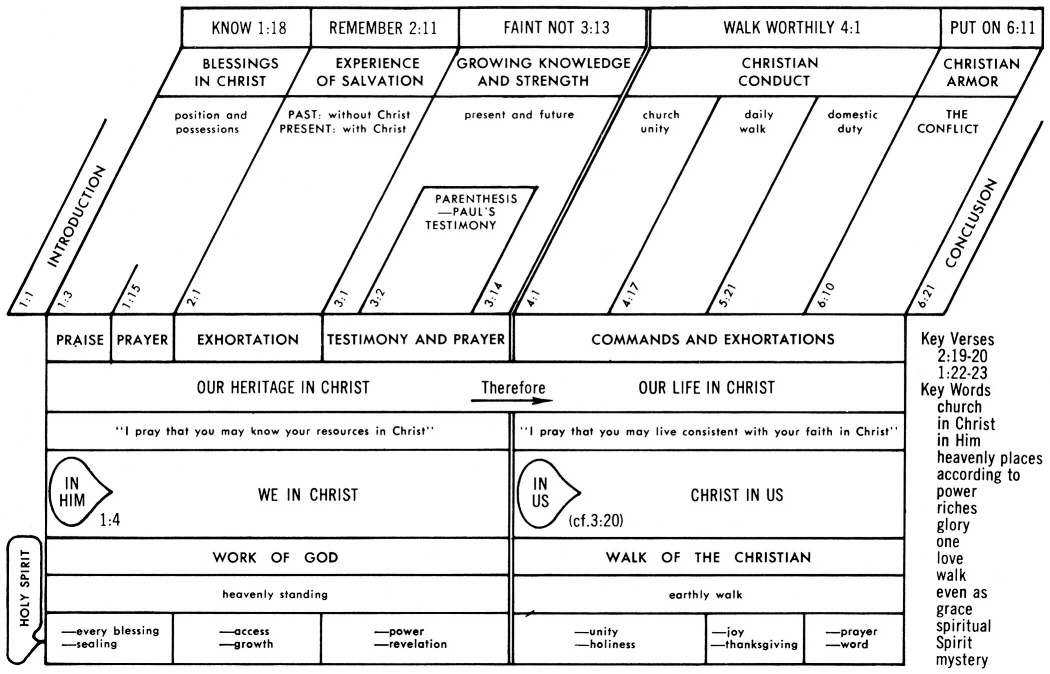
EPHESIANS - CHRIST AND THE CHURCH
Click chart to enlarge
Charts from Jensen's Survey of the NT - used by permission
| SYMMETRY OF EPHESIANS |
|
| EPHESIANS 1-3 | EPHESIANS 4-6 |
| The Root | The Fruit |
| Spiritual Wealth | Spiritual Walk |
| Christian Privilege | Christian Conduct |
| The Position of the Believer |
The Practice of the Believer |
| God Sees Us in Christ |
World Sees Christ in Us |
| Privilege | Practice |
| Doctrine | Duty |
| Doctrinal | Practical |
| Revelation | Responsibility |
| Christian Blessings |
Christian Behavior |
| Belief | Behavior |
| Privileges of the Believer |
Responsibilities of the Believer |
| Our Heritage In Christ |
Our Life In Christ |
| Know your Resources (Riches) in Christ |
Live by faith in the light of your Resources (Riches) in Christ |
| The Finished Work of Christ |
The Faithful Walk of the Christian |
| Work of Christ In Us |
Work of Christ Through Us |
| We in Christ |
Christ in Us |
| Word of God |
Walk of the Christian |
| Heavenly Standing |
Earthly Walk |
| Who You Are In Christ |
Whose You Are In Christ |
| Identity | Responsibility |
| Position of the Believer |
Practice of the Believer |
| Theology | Ethics |
Ephesians 5:28 So husbands ought also to love their own wives as their own bodies. He who loves his own wife loves himself; (NASB: Lockman)
Greek: houtos opheilousin (3PPAI) [kai] oi andres agapan (PAN) tas heauton gunaikas os ta heauton somata. o agapon (PAPMSN) ten heautou gunaika heauton agapa, (3SPAI)
Amplified: Even so husbands should love their wives as [being in a sense] their own bodies. He who loves his own wife loves himself. (Amplified Bible - Lockman)
NLT: In the same way, husbands ought to love their wives as they love their own bodies. For a man is actually loving himself when he loves his wife. (NLT - Tyndale House)
Phillips: Men ought to give their wives the love they naturally have for their own bodies. The love a man gives his wife is the extending of his love for himself to enfold her. (Phillips: Touchstone)
Wuest: In this manner ought also the husbands to love their wives as their own bodies. The one who loves his own wife loves himself,
Young's Literal: so ought the husbands to love their own wives as their own bodies: he who is loving his own wife--himself he doth love;
SO HUSBANDS OUGHT ALSO TO LOVE THEIR OWN WIVES AS THEIR OWN BODIES: houtos opheilousin (3PPAI) [kai] oi andres agapan (PAN) tas heauton gunaikas os ta heauton somata:
- Ep 5:31,33; Genesis 2:21-24; Matthew 19:5
- Ephesians 5 Resources - Multiple Sermons and Commentaries
- Ephesians 5:25-31: Spirit-Filled Families - 2 - Wayne Barber
- Ephesians 5:25-33 Do You Really Love Your Wife? (Part 1) - Steven Cole
- Ephesians 5:25-33 Do You Really Love Your Wife? (Part 2) - Steven Cole
- Ephesians 5:25-33 A Job Description For Husbands - Steven Cole
- Ephesians 5:25-33 I'm the Boss, Aren't I? - Steven Cole
- Ephesians 5:25: God's Pattern for Husbands-1 - John MacArthur
- Ephesians 5:25-33: God's Pattern for Husbands-2 - John MacArthur
Note: All verbs in bold red indicate commands, not suggestions! Also hold mouse pointer over underlined links for pop up of Scripture which stays open and can be copied.
So (3779) (houtos) means in this manner, on this wise, thus, so. It refers to what precedes.
Ought also to love their own wives as their own bodies - The meaning of this statement is made clear in Eph 5:31(note) where Paul quotes from Genesis 2:24 which shows that a husband and wife become “one flesh”. It follows that a husband’s love for his wife is his love for his own body.
Ought (3784) (opheilo from ophelos = profit) conveys the basic meaning of owing a debt or having a strong obligation - he is bound by moral obligation and personal duty. Opheilo expresses the necessity or compulsion that arises from a given set of circumstances. The present tense indicates this is the husband's continual duty.
Love (25) (agapao related to noun agape - see word study) describes the love God gives freely, sacrificially and unconditionally regardless of response -- love that goes out not only to the lovable but to one’s enemies or those that don't "deserve" it. Agapao speaks especially of love as based on evaluation and choice, a matter of will and action. This love is not sentimental or emotional but obedient and reflective of the act of one's will with the ultimate desire being for another's highest good. Since it is unconditional, this love is still given if it's not received/returned! Agape gives and give and gives. It is not withheld.
Agape love is commanded of believers, empowered by His Spirit, activated by personal choice of one's will, not based on one's feelings toward the object of one's love and manifested by specific actions (see 1Cor 13:4-8 (notes) for a succinct list of these actions). Agape love speaks of a love called out of one’s heart by the preciousness of the one loved, a love that impels one to sacrifice one’s self for the benefit of the object loved. It is the love shown at Calvary. The prototype of this quality of supernatural love is the Father's love for sinful men as manifest by the Son's sacrifice on the Cross.
Speaking to faithless Israel God speaks of coming days of restoration declaring…
"I have loved you with an everlasting love; Therefore I have drawn you with lovingkindness. (Jeremiah 31:3)
In Romans Paul explains that even while we were helpless and ungodly, Christ died for the ungodly adding…
But God demonstrates His own love toward us, in that while we were yet sinners, Christ died for us. (Ro 5:8-note)
John writes…
In this is love, not that we loved God, but that He loved us and sent His Son to be the propitiation for our sins. (1John 4:10)
HE WHO LOVES HIS OWN WIFE LOVES HIMSELF: o agapon (PAPMSN) ten heautou gunaika heauton agapa, (3SPAI):
- Ephesians 5 Resources - Multiple Sermons and Commentaries
- Ephesians 5:25-31: Spirit-Filled Families - 2 - Wayne Barber
- Ephesians 5:25-33 Do You Really Love Your Wife? (Part 1) - Steven Cole
- Ephesians 5:25-33 Do You Really Love Your Wife? (Part 2) - Steven Cole
- Ephesians 5:25-33 A Job Description For Husbands - Steven Cole
- Ephesians 5:25-33 I'm the Boss, Aren't I? - Steven Cole
- Ephesians 5:25: God's Pattern for Husbands-1 - John MacArthur
- Ephesians 5:25-33: God's Pattern for Husbands-2 - John MacArthur
Loves (agapao) (present tense = continually) - Paul's point is that we don't have any difficulty loving ourselves as men but to really "love ourselves" we must love our mate sacrificially and unconditionally, willing to die to our self interests, etc.
- Should have but one wife -Ge 2:24; Mk 10:6, 7, 8; 1Co 7:2, 3, 4
- Have authority over their wives -Ge 3:16; 1Co 11:3; Ep 5:23
DUTY OF, TO WIVES
- To respect them -1Pe 3:7
- To love them -Ep 5:25, 26, 27, 28, 29, 30, 31, 32, 33; Col 3:19
- To regard them as themselves -Ge 2:23; Mt 19:5
- To be faithful to them -Pr 5:19; Mal 2:14,15
- To dwell with them for life -Ge 2:24; Mt 19:3, 4, 5, 6, 7, 8, 9
- To comfort them -1Sa 1:8
- To consult with them -Ge 31:4, 5, 6, 7
- Not to leave them, though unbelieving -1Co 7:11,12,14,16
- Duties of, not to interfere with their duties to Christ -Lk 14:26; Mt 19:29
Good-Exemplified
- Isaac -Ge 24:67
- Elkanah -1Sa 1:4,5
Bad-Exemplified
- Solomon -1Ki 11:1, 2, 3, 4, 5, 6, 7, 8, 9, 10, 11
- Ahasuerus -Esther 1:10,11
Ephesians 5:29 for no one ever hated his own flesh, but nourishes and cherishes it, just as Christ also does the church, (NASB: Lockman)
Greek: oudeis gar pote ten heautou sarka emisesen, (3SAAI) alla ektrephei (3SPAI) kai thalpei (3SPAI) auten, kathos kai o Christos ten ekklesian,
Amplified: For no man ever hated his own flesh, but nourishes and carefully protects and cherishes it, as Christ does the church, (Amplified Bible - Lockman)
NLT: No one hates his own body but lovingly cares for it, just as Christ cares for his body, which is the church. (NLT - Tyndale House)
Phillips: Nobody ever hates or neglects his own body; he feeds and looks after it. And that is what Christ does for his body, the Church. (Phillips: Touchstone)
Wuest: for no one ever yet hated his own flesh, but nourishes and cherishes it, even as the Christ, the Church,
Young's Literal: for no one ever his own flesh did hate, but doth nourish and cherish it, as also the Lord--the assembly,
FOR NO ONE EVER HATED HIS OWN FLESH: oudeis gar pote ten heautou sarka emisesen, (3SAAI):
- Ep 5:31; Proverbs 11:17; Ecclesiastes 4:5; Romans 1:31
- Ephesians 5 Resources - Multiple Sermons and Commentaries
- Ephesians 5:25-31: Spirit-Filled Families - 2 - Wayne Barber
- Ephesians 5:25-33 Do You Really Love Your Wife? (Part 1) - Steven Cole
- Ephesians 5:25-33 Do You Really Love Your Wife? (Part 2) - Steven Cole
- Ephesians 5:25-33 A Job Description For Husbands - Steven Cole
- Ephesians 5:25-33 I'm the Boss, Aren't I? - Steven Cole
- Ephesians 5:25: God's Pattern for Husbands-1 - John MacArthur
- Ephesians 5:25-33: God's Pattern for Husbands-2 - John MacArthur
For (gar) is a strategic term of explanation which we do well to pause and ponder. In this case "for" introduces Paul's straightforward explanation of why men should have no difficulty loving their wives as they love themselves. We don't hate ourselves and should not hate our wives, with whom we are one flesh through the covenant of marriage.
No one (3762) (oudeis from ou = absolute negation + de = marker of an additive relation + heis = one) means that absolutely no one hated his own body (flesh). This pronoun emphasizes not even one person ever!
Hated (3404) (miseo) means detested, rejected or abhorred. Miseo means to have a strong aversion to something. The aorist tense is referred to by some as gnomic aorist expressing something which is always true.
Flesh (4561) (sarx) can be used in many ways in the NT, so context is mandatory to determine the meaning (this principle applies to all lexicon definitions - make sure the definition you select fits with the context!). In the present context, Paul is referring to the physical body as functioning entity.
BUT NOURISHES AND CHERISHES IT: alla ektrephei (3SPAI) kai thalpei (3SPAI) auten:
- Isaiah 40:11; Ezekiel 34:14,15,27; Matthew 23:37; John 6:50-58
- Ephesians 5 Resources - Multiple Sermons and Commentaries
- Ephesians 5:25-31: Spirit-Filled Families - 2 - Wayne Barber
- Ephesians 5:25-33 Do You Really Love Your Wife? (Part 1) - Steven Cole
- Ephesians 5:25-33 Do You Really Love Your Wife? (Part 2) - Steven Cole
- Ephesians 5:25-33 A Job Description For Husbands - Steven Cole
- Ephesians 5:25-33 I'm the Boss, Aren't I? - Steven Cole
- Ephesians 5:25: God's Pattern for Husbands-1 - John MacArthur
- Ephesians 5:25-33: God's Pattern for Husbands-2 - John MacArthur
But - always query this term of contrast.
Nourishes and cherishes - Both words have an emotional content and express tenderness and concern.
Nourishes (1625) (ektrepho from ek = out or intensifying meaning + trepho = nourish, rear, feed) means to nourish up to maturity, to nourish in general, to nurture, to bring up from childhood, to raise a child to maturity by providing not just for physical and but also for emotional, soul needs (Eph 6:4-note). Ektrepho means to provide food for with the implication of a considerable period of time and the food being adequate nourishment. This word could mean that the man is to be the "breadwinner" or provider.
Webster says that nourish (from Latin nutrire = to feed, nourish) means to nurture, to rear, to promote the growth of, to provide with the food or other substances necessary for growth and health
The present tense pictures the continual process of nourishing leading up to an attained goal.
Ektrepho is found in a secular Greek writing…
“I have made the agreement and I will nurse (ektrepho) the infant slave Thermoutharion for the two years”
Ektrepho is used 19 times in the Septuagint (LXX) (Ge. 45:7, 11; 47:17; 2 am. 12:3; 1 Ki. 11:20; 12:8, 10; 2 Ki. 10:6; 2 Chr. 10:10; Job 31:18; 39:3; Ps. 23:2; Prov. 23:24; Isa. 23:4; 49:21; Ezek. 31:4; Hos. 9:12; Jon. 4:10; Zech. 10:9) and 2 times in the NT, here and Ephesians 6:4. Here are a few examples of the uses in the Lxx.
Genesis 45:7 "And God sent me before you to preserve for you a remnant in the earth, and to keep you alive (Lxx = ektrepho) by a great deliverance… 11 "There I will also provide (Lxx = ektrepho) for you, for there are still five years of famine to come, lest you and your household and all that you have be impoverished."'
2 Samuel 12:3 "But the poor man had nothing except one little ewe lamb Which he bought and nourished (Lxx = ektrepho); And it grew up together with him and his children. It would eat of his bread and drink of his cup and lie in his bosom, And was like a daughter to him.
Psalm 23:2 He makes me lie down in green pastures; He leads me beside quiet waters. (Lxx is rendered "he has nourished [Lxx = ektrepho] me by the water of rest.")
Zechariah 10:9 "When I scatter them among the peoples, They will remember Me in far countries, and they with their children will live (Lxx = nourish "they shall nourish their children") and come back.
Cherishes (2282) (thalpo) originally meant to warm, to brood, or to keep warm (as with with body heat), to soften by heat. The idea is to cherish with a tender love and care.
Josephus uses thalpo to describe the young woman who provided warmth for King David (Jos., Ant. 7, 343)
Webster says that cherish (Old French chier = dear) means to hold dear, to feel or show affection for, protect and care for lovingly, to keep or cultivate with care and affection.
Thalpo is used in the Septuagint (LXX) to describe a bird sitting on her nest…
Deuteronomy 22:6 "If you happen to come upon a bird's nest along the way, in any tree or on the ground, with young ones or eggs, and the mother sitting (Septuagint = thalpo = idea of brooding) on the young or on the eggs, you shall not take the mother with the young.
Job 39:14 For she abandons her eggs to the earth, and warms (Septuagint = thalpo) them in the dust,
Husbands are to provide a secure, warm place for their wives. The Septuagint (LXX) usages of thalpo suggest that men are to provide their wives with a nest, which pictures a place of a security, a place of warmth, and a place of nourishment.
The only other NT use is found in first Thessalonians Paul explaining…
nor did we seek glory from men, either from you or from others, even though as apostles of Christ we might have asserted our authority. 7 But we proved to be gentle among you, as a nursing (trophos related to trepho as in ektrepho in Eph 5:29) mother tenderly cares (thalpo in the present tense) for her own children. (1Thes 2:6-7-note)
Neufeld writes that "In other literature, these two verbs (ektrepho, thalpo) together sometimes stipulate the husband’s duties in a marriage contract (Gnilka, 285; Perkins: 134). But here they depict the depth of care and concern the husband is to have for his wife. Such care is measured by the degree of love all have for their own flesh and, much more important, by Christ’s care for his own body, the church. (Neufeld, T. R. Y. Ephesians. Believers church Bible Commentary. Scottdale, PA: Herald Press)
JUST AS CHRIST ALSO DOES THE CHURCH: kathos kai o Christos ten ekklesian:
- Ephesians 5 Resources - Multiple Sermons and Commentaries
- Ephesians 5:25-31: Spirit-Filled Families - 2 - Wayne Barber
- Ephesians 5:25-33 Do You Really Love Your Wife? (Part 1) - Steven Cole
- Ephesians 5:25-33 Do You Really Love Your Wife? (Part 2) - Steven Cole
- Ephesians 5:25-33 A Job Description For Husbands - Steven Cole
- Ephesians 5:25-33 I'm the Boss, Aren't I? - Steven Cole
- Ephesians 5:25: God's Pattern for Husbands-1 - John MacArthur
- Ephesians 5:25-33: God's Pattern for Husbands-2 - John MacArthur
Just as - See discussion of terms of comparison.
Just as Christ does for the church - The Lord clearly supplies every need of His body the Church and husbands likewise are to do the same for their wives. They are not to just provide for most of her needs or just provide when she is not too picky or too demanding. What the church needs Christ supplies and husbands are to do the same to their wives without caveats or qualifiers. There is one caveat - husbands are not to provide for her every want but her every need. However even in this situation the husband is to help her discern the difference between wants and needs, but to do it with gentleness and kindness. The husband is the provider, the protector and the preserver. Husbands are missing the mark when they view their wives as objects - cooks, baby sitter, house cleaner, sex partner, etc. She is God's gift and is be continually cherished and nourished.
Just as (2531) (kathos) means that the manner and the extent of the care of the husband for his wife is to be in a measure identical to that of Christ for His Bride, the Church.
Christ (5547) (Christos from chrio = to anoint, rub with oil, consecrate to an office) is the Anointed One, the Messiah, Christos being the Greek equivalent of the transliterated Hebrew word Messiah.
Church (1577) (ekklesia from ekkaléo = call out in turn from ek = out + kaleo= call) literally "called-out ones". The Greeks used ekklesia for assembly of citizens called out to transact city business. The church is a living organism, composed of living members joined together; through which Christ works, carries out His purposes and He lives.
Everyone who has been saved belongs to the body of Christ, the universal church. The universal church is manifested in the world by individual local churches, each of which is to be a microcosm of the body of Christ. The church is to function under the leadership of the Holy Spirit, operating under His sovereign rule. Jesus Christ is the Founder and Lord of His church and has guaranteed its perpetuity until He returns.
Ephesians 5:30 because we are members of His body. (NASB: Lockman)
Greek: oti mele esmen (1PPAI) tou somatos autou.
Amplified: Because we are members (parts) of His body. (Amplified Bible - Lockman)
NLT: And we are his body. (NLT - Tyndale House)
Phillips: And we are all members of that body, we are his flesh and blood! ' (Phillips: Touchstone)
Wuest: because members are we of His Body.
Young's Literal: because members we are of his body, of his flesh, and of his bones;
BECAUSE WE ARE MEMBERS OF HIS BODY: oti mele esmen (1PPAI) tou somatos autou:
- Ep 1:23; Genesis 2:23; Romans 12:5; 1Cor 6:15; 12:12, 13, 14, 15, 16, 17, 18, 19, 20, 21, 22, 23, 24, 25, 26, 27; Col 2:19
- Ephesians 5 Resources - Multiple Sermons and Commentaries
- Ephesians 5:25-31: Spirit-Filled Families - 2 - Wayne Barber
- Ephesians 5:25-33 Do You Really Love Your Wife? (Part 1) - Steven Cole
- Ephesians 5:25-33 Do You Really Love Your Wife? (Part 2) - Steven Cole
- Ephesians 5:25-33 A Job Description For Husbands - Steven Cole
- Ephesians 5:25-33 I'm the Boss, Aren't I? - Steven Cole
- Ephesians 5:25: God's Pattern for Husbands-1 - John MacArthur
- Ephesians 5:25-33: God's Pattern for Husbands-2 - John MacArthur
Because - Pause and ponder this term of explanation.
Because we are members of His body - A man’s treatment of his body is compared to Christ’s treatment of the church; he “nourishes and cherishes” the church, and verse 30 gives the basis for this declaration. The NAS is a bit misleading for Paul is not giving the reason why Christ nourishes and cherishes the church. The Bible Jerusalem rendering effectively conveys the meaning…
This is precisely what Christ does for the Church: are we not the members of his Body?
Hodge adds that "This verse assigns the reason of the preceding declaration. Christ acts towards his church as a man does towards his body, for we are members of his body. This might mean simply that we stand before him in the same intimate and vital union that a man’s body sustains to the man himself. The union between Christ and His people is mysterious. It may be illustrated but cannot be fully explained. It is analogous to the union between husband and wife, who are declared to be one flesh to express their community of life, and is especially analogous to the union between Adam and Eve, because she derived her life from his flesh. As the relationships are thus analogous, what is said of the one may be said of the other. To prove this and to justify the use of the language which he had employed, the apostle cites the language of God in Genesis 2:24. (Ephesians 5 Commentary)
Members (3196) (melos) is literally a limb or member of the body. Here melos is used metaphorically of "members" ("limbs") of the Church of which Christ is the Head.
John Eadie - The apostle has the idea of marriage and its relations before him, and he employs the imagery of the original institute, which first depicted the unity of man and wife, to describe the origin and union of the church and Christ. As the woman was literally, by being taken out of Adam, bone of his bone and flesh of his flesh; as this duality sprung from unity, and was speedily resolved into it: so the church is originated out of Christ, and, united to Him as its Head or Husband, is one with Him. The language is, therefore, a metaphorical expression of this union, borrowed from the graphic diction of Genesis; and this image evidently presented itself to the apostle's mind from its connection with the origin and nature of those conjugal duties which he is inculcating in the paragraph before us. The error of Meyer's exegesis is his restriction of the imagery to the one example of Adam and Eve, whereas it has its verification in every nuptial union, and hence the apostle's use of it. As Eve derived her life and being out of Adam, and was physically of his body, his flesh, and his bones, so believers are really of Christ—of His body, His flesh, and His bones, for they are one with Christ in nature and derive their life from His humanity, nay, are connected with Him, not simply and generally by a spiritual union, but in some close and derivative way which the apostle calls a mystery, with His body; so that they live as its members, and become with it “one flesh.” Besides, in the next verse, the apostle takes his readers to the source of his imagery. (Ephesians 5 Commentary)
Expositors Greek Testament - We are not something apart from Christ, nor do we occupy only an incidental relation to Him. We are veritable parts of that body of which He is Head, and this is the reason why He nourishes and cherishes the Church. (Ephesians 5 Commentary)