Ephesians 5:2
Ephesians 5:3
Ephesians 5:4
Ephesians 5:5
Ephesians 5:6
Ephesians 5:7
Ephesians 5:8
Ephesians 5:9
Ephesians 5:10
Ephesians 5:11
Ephesians 5:12
Ephesians 5:13
Ephesians 5:14
Ephesians 5:15
Ephesians 5:16
Ephesians 5:17
Ephesians 5:18
Ephesians 5:19
Ephesians 5:20
Ephesians 5:21
Ephesians 5:22
Ephesians 5:23
Ephesians 5:24
Ephesians 5:25
Ephesians 5:26
Ephesians 5:27
Ephesians 5:28
Ephesians 5:29
Ephesians 5:30
Ephesians 5:31
Ephesians 5:32
Ephesians 5:33
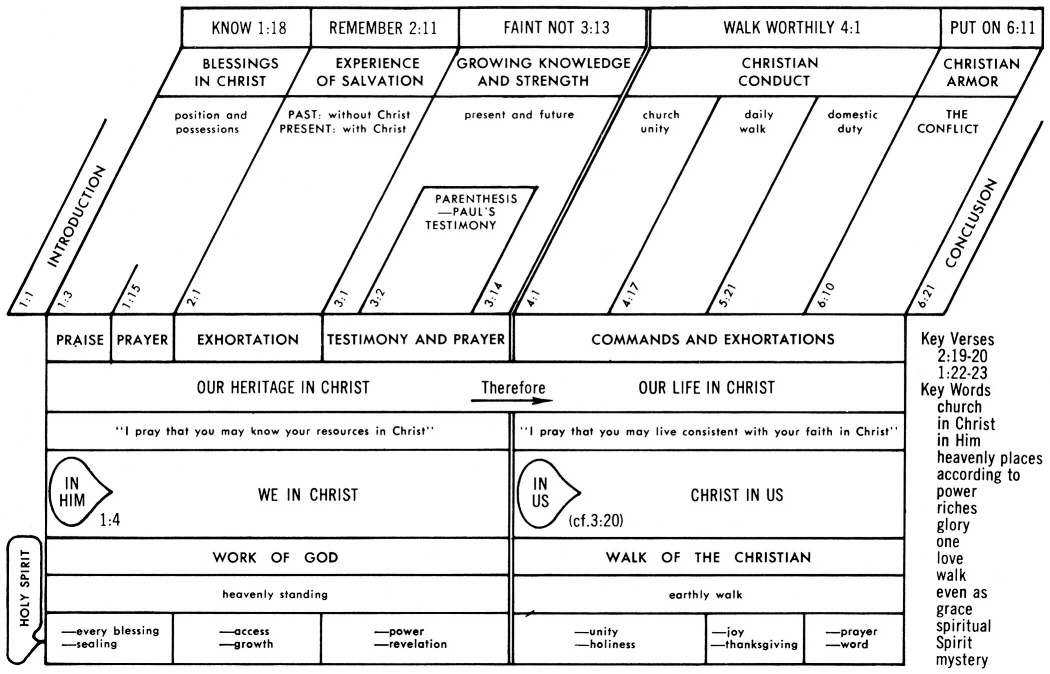
EPHESIANS - CHRIST AND THE CHURCH
Click chart to enlarge
Charts from Jensen's Survey of the NT - used by permission
| SYMMETRY OF EPHESIANS |
|
| EPHESIANS 1-3 | EPHESIANS 4-6 |
| The Root | The Fruit |
| Spiritual Wealth | Spiritual Walk |
| Christian Privilege | Christian Conduct |
| The Position of the Believer |
The Practice of the Believer |
| God Sees Us in Christ |
World Sees Christ in Us |
| Privilege | Practice |
| Doctrine | Duty |
| Doctrinal | Practical |
| Revelation | Responsibility |
| Christian Blessings |
Christian Behavior |
| Belief | Behavior |
| Privileges of the Believer |
Responsibilities of the Believer |
| Our Heritage In Christ |
Our Life In Christ |
| Know your Resources (Riches) in Christ |
Live by faith in the light of your Resources (Riches) in Christ |
| The Finished Work of Christ |
The Faithful Walk of the Christian |
| Work of Christ In Us |
Work of Christ Through Us |
| We in Christ |
Christ in Us |
| Word of God |
Walk of the Christian |
| Heavenly Standing |
Earthly Walk |
| Who You Are In Christ |
Whose You Are In Christ |
| Identity | Responsibility |
| Position of the Believer |
Practice of the Believer |
| Theology | Ethics |
Ephesians 5:31 FOR THIS REASON A MAN SHALL LEAVE HIS FATHER AND MOTHER AND SHALL BE JOINED TO HIS WIFE, AND THE TWO SHALL BECOME * ONE FLESH. (NASB: Lockman)
Greek: anti toutou kataleipsei (3SFAI) anthropos [ton] patera kai [ten] metera kai proskollethesetai (3SFPI) pros ten gunaika autou, kai esontai (3PFMI) oi duo eis sarka mian.
Amplified: For this reason a man shall leave his father and his mother and shall be joined to his wife, and the two shall become one flesh. (Amplified Bible - Lockman)
NLT: As the Scriptures say, "A man leaves his father and mother and is joined to his wife, and the two are united into one." (NLT - Tyndale House)
Phillips: For this reason a man shall leave his father and mother and be joined to his wife, and the two shall become one flesh'. (Phillips: Touchstone)
Wuest: Because of this a man shall leave behind his father and his mother and shall be joined to his wife, and the two shall become one flesh.
Young's Literal: `for this cause shall a man leave his father and mother, and shall be joined to his wife, and they shall be--the two--for one flesh;'
FOR THIS REASON A MAN SHALL LEAVE HIS FATHER AND MOTHER AND SHALL BE JOINED TO HIS WIFE: anti toutou kataleipsei (3SFAI) anthropos [ton] patera kai proskollethesetai (3SFPI) pros ten gunaika autou:
- Genesis 2:24; Matthew 19:5; Mark 10:7,8; 1 Corinthians 6:16
- Ephesians 5 Resources - Multiple Sermons and Commentaries
- Ephesians 5:25-31: Spirit-Filled Families - 2 - Wayne Barber
- Ephesians 5:25-33 Do You Really Love Your Wife? (Part 1) - Steven Cole
- Ephesians 5:25-33 Do You Really Love Your Wife? (Part 2) - Steven Cole
- Ephesians 5:25-33 A Job Description For Husbands - Steven Cole
- Ephesians 5:25-33 I'm the Boss, Aren't I? - Steven Cole
- Ephesians 5:25: God's Pattern for Husbands-1 - John MacArthur
- Ephesians 5:25-33: God's Pattern for Husbands-2 - John MacArthur
Note: All verbs in bold red indicate commands, not suggestions! Also hold mouse pointer over underlined links for pop up of Scripture which stays open and can be copied.
For this reason - Whenever you see a term of conclusion, stop and ask "what reason?" (or similar questions).
On for this reason, Hodge says…
That is, because the relationship between husband and wife is more intimate than any other, even than that between parents and children, therefore a man shall consider all other relationships subordinate to that which he has with his wife, with whom he is connected in the bonds of a common life. (Ephesians 5 Commentary)
Paul is quoting Genesis…
Genesis 2:24 For this cause a man shall leave his father and his mother, and shall cleave (Heb = dabaq; Lxx = proskollao) to his wife; and they shall become one flesh.
J Vernon McGee writes that…
Paul here refers to the relationship that existed in the Garden of Eden between Adam and Eve. That first couple is a figure of the future union of Christ and the church as Bridegroom and bride. Eve was created to be a helpmeet for Adam. She was taken from his side, not molded from the ground as were the animals. Adam was incomplete until they were together. God fashioned her, and I think she was the loveliest thing in creation when God brought her to Adam. One wag has said that she had to be better looking than man because God had practiced on man but He had experience when He made woman. She was a helpmeet for Adam. She compensated for what he lacked. She was made for him and they became one. In the Hebrew the word for “man” is ish and for “woman” it is isha. The word is almost the same—she was taken out of man. (McGee, J V: Thru the Bible Commentary: Thomas Nelson)
Leave (2641) (kataleipo from kata = intensifies meaning + leipo = leave behind) means to leave behind and here speaks of the shift of the husband's loyalty and devotion from his parents to his spouse.
Expositor's comments that "The marriage tie takes precedence over every other human relationship and for this reason is to be regarded as inviolable. Nevertheless, what is basically a divine ordinance is graciously designed for mutual satisfaction and delight. (Gaebelein, F, Editor: Expositor's Bible Commentary 6-Volume New Testament. Zondervan Publishing)
LEAVE AND CLEAVE
Joined (4347) (proskollao from prós = to, toward, in compounds prós implies motion, direction + kollao = to glue) literally means to glue one thing to another so that it cleaves or adheres. To unite. To cleave. To be united with. To join oneself to closely. To stick to. It is used metaphorically in this verse to describe the marriage bond. To adhere to closely, be faithfully devoted to.
Proskollao was a medical term used to describe the uniting of wounds. Here this compound verb denotes the most intimate union. This verb emphasizes not only permanence but also unity of the two who have been "glued" together. Take a picture of a husband and another of his wife and glue them together. Allow time for the glue to set. What happens when you try to take the two individual pictures apart? Do you see what God is saying about the dissolution of the marriage covenant between a husband and a wife?
Proskollao - Used in the Mt 19:5, Mark 10:7, Acts 5:36 (in the sense of "to join" but not found in all Greek manuscripts), Eph 5:31.
Proskollao - 18v in the non-apocryphal Septuagint - Gen 2:24; Lev 19:31; Num 36:7, 9; Deut 11:22; 13:17; 28:21; Josh 23:8; Ruth 2:21, 23; 2 Sam 23:10; Job 41:17; Ps 73:28; Ezek 29:4; Dan 2:43
Ruth 2:21 Then Ruth the Moabitess said, "Furthermore, he said to me, 'You should stay close to my servants until they have finished all my harvest.'"… 23 So she stayed close by the maids of Boaz in order to glean until the end of the barley harvest and the wheat harvest. And she lived with her mother-in-law.
Deuteronomy 11:22 "For if you are careful to keep all this commandment which I am commanding you to do, to love the LORD your God, to walk in all His ways and hold fast to Him,
Deuteronomy 13:17 "Nothing from that which is put under the ban shall cling to your hand, in order that the LORD may turn from His burning anger and show mercy to you, and have compassion on you and make you increase, just as He has sworn to your fathers,
Deuteronomy 28:21 "The LORD will make the pestilence cling to you until He has consumed you from the land where you are entering to possess it.
Joshua 23:8 "But you are to cling to the LORD your God, as you have done to this day.
Job 41:17 "They (scales - Job 41:15, 16) are joined one to another; They clasp each other and cannot be separated.
Psalm 73:28 But as for me, the nearness (proskollao - to cleave close to) of God is my good; I have made the Lord GOD my refuge, That I may tell of all Your works.
Hughes comments that…
there is an amazing unity in marriage. The sexual union entails mysterious and sacred depths. That men and women become “one flesh” suggests an exchange of soul and indicates something of the psychological depth of the marital union. Marriage ideally produces two people who are as much the same person as two people can be. Christians in marriage have the same Lord, the same family, the same children, the same future, and the same destiny. (Hughes, R. K.: Ephesians: The Mystery of the Body of Christ. Crossway Books)
AND THE TWO SHALL BECOME ONE FLESH: kai esontai (3PFMI) oi duo eis sarka mian.:
- Genesis 2:24; Matthew 19:5; Mark 10:7,8; 1Corinthians 6:16
- Ephesians 5 Resources - Multiple Sermons and Commentaries
- Ephesians 5:25-31: Spirit-Filled Families - 2 - Wayne Barber
- Ephesians 5:25-33 Do You Really Love Your Wife? (Part 1) - Steven Cole
- Ephesians 5:25-33 Do You Really Love Your Wife? (Part 2) - Steven Cole
- Ephesians 5:25-33 A Job Description For Husbands - Steven Cole
- Ephesians 5:25-33 I'm the Boss, Aren't I? - Steven Cole
- Ephesians 5:25: God's Pattern for Husbands-1 - John MacArthur
- Ephesians 5:25-33: God's Pattern for Husbands-2 - John MacArthur
The two shall become one flesh - This is a very real union, mystical to be sure, but nevertheless very real! We seem to have forgotten the significance of the sanctity and holiness of this union in our modern cultural which has gone to great lengths to remove God and godliness from America. American marriages are in trouble. When a country's families are in trouble, that country is in trouble. And it all begins because of our rejection of God's supreme authority and right to rule our land and our lives. Pray for revival (2Chr 7:13,14). See related study of Covenant: As It Relates to Marriage.
In the context of Paul's charge to the husband to love his wife as Christ loves His Bride, this verse clearly speaks of and calls for an "unbreakable" love. The husband is now united to the wife in a supernatural, mystical way and even as Christ will never break this union with His Bride, Spirit filled husbands (and wives for that matter) are called to lay aside the "old man" with his selfish thoughts of separating from one another and of tearing the "one body" apart! Perish the thought dear Spirit filled believer! What a radical concept Paul introduced in an age (first century and our "modern" era) in which men and women changed partners much like they changed clothes!
Flesh (4561) (sarx) can be used in many ways in the NT, so context is mandatory to determine the meaning (this principle applies to all lexicon definitions - make sure the definition you select fits with the context!). In the present context, Paul is referring to the divine creation of one man and one woman into one supernatural body as a functioning "mystical" entity.
John Eadie writes that "The love which a son bears to a father and a mother, is at length surmounted by a more powerful attachment. He leaves them in whose love and society he has spent his previous life; so that, while love cements families, love also scatters them. “He is joined to his wife” in a union nearer and more intimate than that which united him to his parents; for his wife and he become “one flesh”—not one in spirit, or in affection, or in pursuit, but in personality, filled with “coequal and homogeneal fire”— “The only bliss Of Paradise that has survived the fall.” They are “one flesh,” and a junction so characterized supplied the apostle with language to describe the union of Christ and His Church—“we are of His flesh and of His bones.” This doctrine of marriage must have excited surprise when divorce was of scandalous frequency by an action of apoleipsis or apopempsis in Grecian states, and with less formality under the emperors in the West (Ephesians 5 Commentary)
Ray Stedman writes the following thoughts in his devotional entitled Husbands And Wives
This verse is not simply an example of beautiful, poetic language. There is a fundamental reality behind this: Husband and wife are not just two people rooming together. Their lives actually do blend into one another. They actually become one. It is, therefore, true that what hurts the wife damages the husband. It cannot help but do so. If he is bitter toward her, it will eat like a cancer in his own life and heart. That is why, if you have had a squabble with your spouse, you may find yourself unable to do your work properly that day.
In Dr. Henry Brandt's helpful book The Struggle for Peace, he tells of a woman who came to him because of a great fear she had of going into supermarkets. She came to him for help in this problem, and he relied, as he always does, on the wisdom of Scripture. Remembering the verse "Perfect love drives out fear" (1 John 4:18b), he began to look for a violation of love in her life, for fear comes when there is something inhibiting the flow of love. He said to her, "With whom are you angry?" Finally she was able to realize that she was angry at her husband for an incident that had occurred a number of years before in a supermarket when they had had an unpleasant flare-up. As a result, she was emotionally disturbed whenever she went into a supermarket. When she dealt with her lack of love, her fear left. What happened, because of her injury toward him, reflected right back on herself. This is also true of the husband toward the wife. If we would understand this and realize that injuring our mate is the same as taking a hammer and pounding ourselves on the head or neglecting some part of our own body, we would stop trying to hurt one another. Injury to our mate is bound to come back upon us in some way.
The final point the apostle makes here is given in verse 33:
"However, each one of you also must love his wife as he loves himself; and the wife must respect her husband."
Notice that the basis for accomplishing this is that both partners in the marriage relationship fulfill their responsibility to Christ, regardless of what the other does. That is the key. It is not "Wait until he starts loving me, and then I'll submit to him," or 'Wait until she starts submitting to me, and then I'll love her," but it is essential to your responsibility before Christ, regardless of what the other does. To do so breaks through the vicious circle of marriage conflict and serves to restore peace and permit the other to fulfill his or her responsibility.
I have seen such unilateral obedience work wonders in marriage relationships. Husbands and wives have been brought together, harmony restored in bitterly divided homes, grace and peace made to reign where there has been battle and conflict, violence, and ugliness before. Therefore, husbands, love your wife as yourself, and let the wife see that she respects her husband.
God grant to me the willingness and the grace to be obedient to the Lord Jesus, who is with me in every circumstance and every relationship of my life regardless of what the other person does. (Ephesians 5:22-33 Husbands And Wives)
- As Head of the Church -Ephesians 1:22,23; 4:15,16; Colossians 1:18
- Christ prayed that all saints might have -John 17:21,23
DESCRIBED AS
- Christ being in us -Ephesians 3:17; Colossians 1:27
- Our being in Christ -2 Corinthians 12:2; 1 John 5:20
- Includes union with the Father -John 17:21; 1 John 2:24
- Is of God -1Corinthians 1:30
MAINTAINED BY
- Faith -Galatians 2:20; Ephesians 3:17
- Abiding in him -John 15:4,7
- His word abiding in us -John 15:7; 1 John 2:24; 2 John 1:9
- Feeding on him -John 6:56
- Obeying him -1 John 3:24
- The Holy Spirit witnesses -1 John 3:24
- The gift of the Holy Spirit is an evidence of -1 John 4:13
SAINTS
- Have, in mind -1Corinthians 2:16; Philippians 2:5
- Have, in spirit -1Corinthians 6:17
- Have, in love -Solomon 2:16; 7:10
- Have, in sufferings -Philippians 3:10; 2 Timothy 2:12
- Have, in his death -Romans 6:3-8; Galatians 2:20
- Have assurance of -John 14:20
- Enjoy, in the Lord’s supper -1Corinthians 10:16,17
- Identified with Christ by -Matthew 25:40,45; Acts 9:4; 8:1
- Are complete through -Colossians 2:10
- Exhorted to maintain -John 15:4; Acts 11:23; Colossians 2:7
- Necessary to growth in grace -Ephesians 4:15,16; Colossians 2:19
- Necessary to fruitfulness -John 15:4,5
BENEFICIAL RESULTS OF
- Righteousness imputed -2 Corinthians 5:21; Philippians 3:9
- Freedom from condemnation -Romans 8:1
- Freedom from dominion of sin -1 John 3:6
- Being created anew -2 Corinthians 5:17
- The spirit alive to righteousness -Romans 8:10
- Confidence at his coming -1 John 2:28
- Abundant fruitfulness -John 15:5
- Answers to prayer -John 15:7
- They who have, ought to walk as he walked -1 John 2:6
- False teachers have not -Colossians 2:18,19
- Is indissoluble -Romans 8:35
- Punishment of those who have not -John 15:6
Illustrated
- Vine and branches -John 15:1,5
- Foundation and building -1Corinthians 3:10,11; Ephesians 2:20,21; 1 Peter 2:4-6
- Body and members -1Corinthians 12:12,27; Ephesians 5:30
- Husband and wife -Ephesians 5:25-32