Ephesians 5:2
Ephesians 5:3
Ephesians 5:4
Ephesians 5:5
Ephesians 5:6
Ephesians 5:7
Ephesians 5:8
Ephesians 5:9
Ephesians 5:10
Ephesians 5:11
Ephesians 5:12
Ephesians 5:13
Ephesians 5:14
Ephesians 5:15
Ephesians 5:16
Ephesians 5:17
Ephesians 5:18
Ephesians 5:19
Ephesians 5:20
Ephesians 5:21
Ephesians 5:22
Ephesians 5:23
Ephesians 5:24
Ephesians 5:25
Ephesians 5:26
Ephesians 5:27
Ephesians 5:28
Ephesians 5:29
Ephesians 5:30
Ephesians 5:31
Ephesians 5:32
Ephesians 5:33
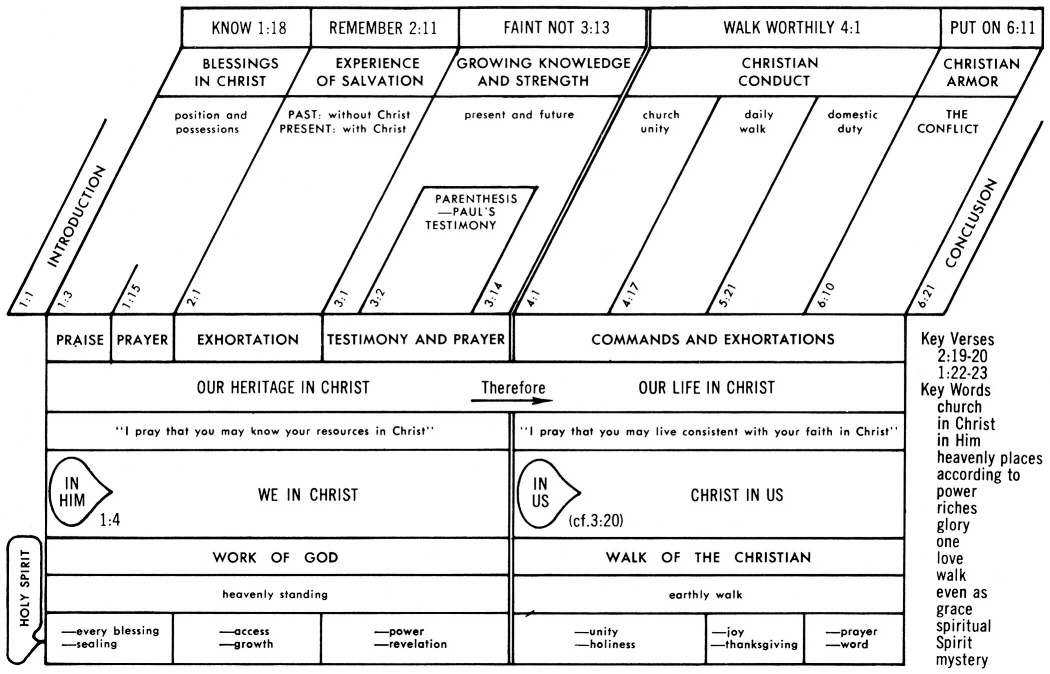
EPHESIANS - CHRIST AND THE CHURCH
Click chart to enlarge
Charts from Jensen's Survey of the NT - used by permission
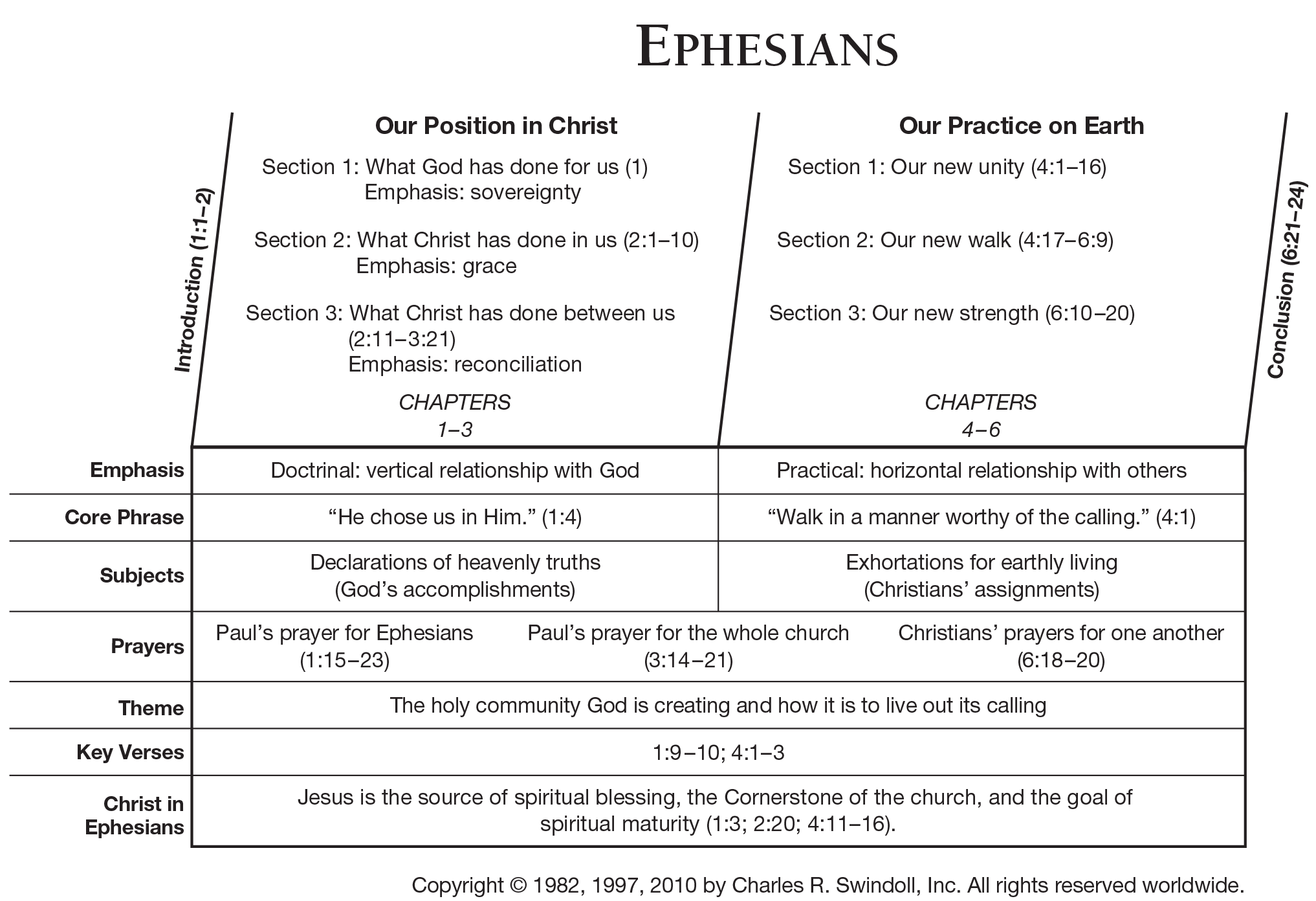
Click chart by Charles Swindoll -Note "EMPHASIS" --
Ephesians 1-3 = Doctrinal: vertical relationship with God
Ephesians 4-6 = Practical: horizontal relationship with others
Ephesians 5:7 Therefore do not be partakers with them; (NASB: Lockman)
Greek: me oun ginesthe (2PPMM) summetochoi auton;
Amplified: So do not associate or be sharers with them. (Amplified Bible - Lockman)
NLT: Don't participate in the things these people do. (NLT - Tyndale House)
Phillips: Have nothing to do with men like that (Phillips: Touchstone)
Wuest: Stop therefore becoming joint-participants with them (Eerdmans Publishing - used by permission)
Young's Literal: become not, then, partakers with them,
THEREFORE DO NOT BE PARTAKERS WITH THEM: me oun ginesthe (2PPMM) summetochoi auton:
- Eph 5:11; Numbers 16:26; Ps 50:18; Proverbs 1:10, 11, 12, 13, 14, 15, 16, 17; 9:6; 13:20; 1Ti 5:22; Rev 18:4
- Ephesians 5 Resources - Multiple Sermons and Commentaries
- Ephesians 5:7-10: Walk As Children of Light - Wayne Barber
- Ephesians 5:6-17 - Wayne Barber
- Ephesians 5:6-14: The Power of the New Garment - Wayne Barber
- Ephesians 5:7-14 Children of Light in a Dark World - Steven Cole
- Ephesians 5:8-14: Living in the Light - John MacArthur
- Ephesians 4:17-5:14 Study Guide (see dropdown menu) - John MacArthur
Therefore (3767) (oun) is a term of conclusion - whenever you encounter conjunctions like this ("for this reason", "so that", "so then", etc), use them as an opportunity to slow down and interrogate the text, for in so doing you are learning to meditate on the text and the spiritual benefits of meditation are priceless! (see Ps 1:2-note, Ps 1:3-note, Joshua 1:8-note). In this context, Paul is saying in light of the truth that those who practice this type of lifestyle (immorality, etc) will not enter heaven, don't be defiled by them! Paul is not saying we are no longer to be "in" the world but that we are not to be "of" the world. For example, believers should not date sons of disobedience, should not marry them, etc, because the danger is that bad company corrupts good morals (1Cor 15:33). Beloved, be aware that you cannot carry out Paul's command to not be a partaker in your own inherent strength (e.g., your own "willpower", etc) but you need to continually be strengthened with power in the inner man by the Spirit of God (Eph 3:16-note).
Paul is warning the Gentile saints not to lapse into their old sin patterns.
Wuest's paraphrase conveys the sense of Paul's command "Stop (Ed: Implying that it was already taking place) therefore becoming joint-participants with them." (Eerdmans Publishing - used by permission)
Be (1096) (ginomai) means to become. The present imperative with a negative commands them to stop an action already in progress or forbidding it from continuing. Paul is warning them against lapsing into their old vices, falling back into the old ruts in the road they once traveled. This is an important command for all of us, for if any man thinks he stands, he better take heed, lest he falls (1Cor 10:12)! Remember that God's commandments always include His enablements! Don't try to obey in your own (old) natural strength, for you will end up placing yourself under the law (note how the flesh reacts in Ro 7:5-note) and ultimately you will fail to keep the commandment! We need supernatural enablement to succeed! The solution is in daily surrender to, filling with and walking by the indwelling Spirit, which is exactly what Paul prayed for the Ephesians in Ephesians 3:16-note! We would all do well to make this prayer a regular part of our prayers to our Father, remembering that "this is the confidence which we have before Him, that, if we ask anything according to His will, He hears us. And if we know that He hears us [in] whatever we ask, we know that we have the requests which we have asked from Him. (1Jn 5:14-15)
Partakers with (4830) (summetochos from sun/syn = with, together, implying a closer relationship, intimacy or union + metochos = a partaker or sharer as one who participates with and shares common blessings with another) means to share in the possession of something, in this case disobedience.
Summetochos was used in the papyri of those who were joint possessors of a house. Carrying this picture into the moral/ethical realm, Paul is saying in a sense, don't be "joint possessors" or sharers in their filthy, ungodly lifestyle!
What a difference context makes in the meaning of a word, for summetochos is used only one other time in Scripture in Ephesians 3 where we read "to be specific, that the Gentiles are fellow heirs and fellow members of the body, and fellow partakers of the promise in Christ Jesus through the gospel (Ep 3:6-note)
Jon Courson - if I sit in the theater and watch people indulging their fleshly lusts on the screen, I am a partaker of their activity. I support it financially when I buy the ticket. And I vote for our culture to keep making this kind of movie whenever I fill a seat to watch it. There’s a better way. We can pray, “You know I struggle with my flesh, Lord. You know I’m tempted by it. But, Lord, I want nothing to do with it. I’ve learned through Your Word and by experience that sin stinks. I’m not going to justify it any longer. I’m not going to excuse it anymore. Instead, I choose to walk in the light.” (Ed: Compare the enabling power of the Spirit in Ro 8:13-note) (Courson, J. Jon Courson's Application Commentary. Nashville, TN: Thomas Nelson)
Charles Hodge - God is determined to punish the impure and the greedy; so the apostle says, Therefore do not be partners with them. That is, do not be their partners in these sins, which would necessarily expose you to the penalty threatened against them. (See the parallel thought is Psalm 1:1 where the blessed are those who do not associate with the ungodly [see Notes on Psalm 1:1] but associate with the Word of God and the God of the Word - Psalm 1:2,3 - see notes Ps 1:2; 1:3) (Ephesians 5 Commentary)
Ephesians 5:8 for you were formerly darkness, but now you are Light in the Lord; walk as children of Light (NASB: Lockman)
Greek: ete (2PIAI) gar pote skotos, nun de phos en kurio; os tekna photos peripateite (2PPAM)
Amplified: For once you were darkness, but now you are light in the Lord; walk as children of Light [lead the lives of those native-born to the Light]. (Amplified Bible - Lockman)
NLT: For though your hearts were once full of darkness, now you are full of light from the Lord, and your behavior should show it! (NLT - Tyndale House)
Phillips: once you were "darkness" but now you are "light". Live then as children of the light. (Phillips: Touchstone)
Wuest: for you were at one time darkness, but now you are light in the Lord. As children of light be habitually conducting yourselves (Eerdmans Publishing - used by permission)
Young's Literal: for ye were once darkness, and now light in the Lord; as children of light walk ye,
FOR YOU WERE FORMERLY DARKNESS: ete (2PIAI) gar pote skotos:
- Eph 2:11,12; 4:18; 6:12; Ps 74:20; Isaiah 9:2; 42:16; 60:2; Jeremiah 13:16; Matthew 4:16; Luke 1:79; Acts 17:30; 26:18; Romans 1:21; 2:19; 2Corinthians 6:14; Colossians 1:13; Titus 3:3; 1Peter 2:9; 1John 2:8
- Ephesians 5 Resources - Multiple Sermons and Commentaries
- Ephesians 5:7-10: Walk As Children of Light - Wayne Barber
- Ephesians 5:6-17 - Wayne Barber
- Ephesians 5:6-14: The Power of the New Garment - Wayne Barber
- Ephesians 5:7-14 Children of Light in a Dark World - Steven Cole
- Ephesians 5:8-14: Living in the Light - John MacArthur
- Ephesians 4:17-5:14 Study Guide (see dropdown menu) - John MacArthur
"B.C."
BEFORE CHRIST
For (gar) introduces an explanation (Whenever you encounter a term of explanation, always stop and interrogate with the 5W/H'S -- questions such as "What the for there for?" which facilitates the discipline of Biblical Meditation which in turn God promises to richly reward - see Ps 1:2-note, Ps 1:3-note, Joshua 1:8-note). In this case Paul gives a reason for them not to partake but instead to remain separate from the sons of disobedience. (cp 1Co 15:33!) Their past state (darkness) and their present state (light) stand in striking contrast and as Paul asks elsewhere "what fellowship has light with darkness?" (2Cor 6:14).
In Ephesians 5:6-note Paul had given a "negative" reason (future judgment of God) to motivate his readers to not be deceived but he now gives a positive reason (the miraculous conversion wrought by the Gospel which gives light from the God Who is light) to not share company with those who disobey God and instead to live in the light. Previously Paul had described the difference between believers and non-believers in terms of the 'old self' versus the 'new self' (Eph. 4:22-note, Eph 4:24-note). Now Paul reiterates the clear contrast the new birth has wrought by describing the imagery of darkness and light, where unbelievers are darkness and believers are light.
|
Devil as father |
God as Father |
|
Sons of disobedience |
Children (Sons) of Light |
|
Kingdom of Darkness - |
Kingdom of Light - |
|
What We All Were Formerly... |
What Believers Are Now... |
|
In Adam |
In Christ |
A THOUGHT TO
PONDER
Every man but a believer walks in darkness; nay, he is darkness! Father, cause this truth to "saturate" our minds so that it serves to motivate each of us to walk in the light as children of light so that the those lost in the dark might see Your light in us and be drawn to the Light of the world (John 8:12). Amen.
Charles Hodge explains that Paul is exhorting these believers to not be partakers with the sons of disobedience (Eph 5:6) - This (exhortation) is enforced by a reference to their conversion from a previous state of sin and misery to one of holiness and blessedness. For ye were sometime darkness. As light stands for knowledge, and as knowledge, in the scriptural sense of the word, produces holiness, and holiness happiness (blessedness); so darkness stands for ignorance, such ignorance as inevitably produces sin, and sin misery. Therefore, the expression, “ye were darkness,” means ye were ignorant, polluted, and wretched. (Ephesians 5 Commentary)
It is notable that the rabbinic writings often used darkness and light to contrast good and evil.
As John Eadie explains Paul's word for darkness here "is the abstract—darkness itself—employed to intensify the idea expressed. Darkness is the emblem and region of ignorance and depravity, and in such a miserable condition they were “once.” But that state was over—“the dayspring from on high” (Lk 1:78, 79) had visited them. (Ephesians 5 Commentary)
THAT WAS THEN
THIS IS NOW!
You were - This verb (ete) is emphatic (first in the Greek sentence for emphasis) to throw stress on the fact that all the horrible behaviors he had just described were now behind them ("That was then!"). In darkness we chased sin, but beloved, be sober minded, because now sin chases us! It tries to draw us back into the darkness. The idea is that "You Gentiles who are now believers were. So do not again behave like those who are in the darkness!". We need to be constantly mindful from whence we came, that the glorious contrast of truth of where we are seated (in the heavenly places in Christ Jesus Eph 2:6-note) and the greatness of the divine privileges and power we now possess (every spiritual blessing in the heavenly places in Christ Jesus Eph 1:3-note, surpassing greatness of God's power Eph 1:18, 19-note Eph 3:16-note, Eph 5:18-note) does not become a fading, dim memory. Remembering keeps us humble and thankful and re-kindles in our hearts an appropriately high view of our "so great a salvation" (Heb 2:3-note).
John Phillips on not partakers with them - No true child of God can compromise when tempted to take part in immoral behavior. God demands that we make a clean break with the ungodly lifestyle of our unregenerate days. Such a deliberate break with our past sins is proof that we not only profess Christianity, but we also possess Christ. (See Exploring Ephesians & Philippians: An Expository Commentary)
John Calvin - The precepts which immediately follow derive greater weight from the motives with which they are mingled. Having spoken of unbelievers, and warned the Ephesians not to become partakers of their crimes and their destruction, he argues still further, that they ought to differ widely from the life and conduct of those men. At the same time, in order to guard them against ingratitude to God, he refreshes their remembrance of their own past life. “You ought,” he says, “to be very different persons from what you formerly were; for out of darkness God hath made you light.” (Ephesians 5 Commentary)
Matthew Henry - The apostle calls their former condition darkness in the abstract, to express the great darkness they were in. They lived wicked and profane lives, being destitute of the light of instruction without and of the illumination and grace of the blessed Spirit within. Note, A state of sin is a state of darkness. Sinners, like men in the dark, are going they know not whither, and doing they know not what. But the grace of God had produced a mighty change in their souls: Now are you light in the Lord, savingly enlightened by the Word and the Spirit of God. Now, upon your believing in Christ, and your receiving the Gospel.
Formerly (4218) (pote) is a generalization concerning time and means at some time and when referring to past time as in this verse means once or at one time in the past.
Paul is not trying to make the believers dwell with morbid introspection on their past (Christ has FOREVER paid the price in full for every one of our former [and present and future] sins! Hallelujah!), but he does want them to remember what the darkness was like and how great has been their deliverance (rescue) from darkness into God's marvelous light ( Col 1:12, Col 1:13-note, 1Pe 2:9-note).
Peter uses a similar "motif" of describing what the saints were formerly, and what they should be now...now that they had been born again (1Pe 1:3+, 1Pe 1:23+)...
As obedient children, do not be conformed (suschematizo) to the former lusts which were yours in your ignorance, but like the Holy One who called you, be (aorist imperative = command calling for a once for all choice to be) holy yourselves also in all your behavior (1Pe 1:14\+, 1Pe 1:15+)
Peter issues another exhortation, calling for positive (in the light) conduct which contrasts with their former (in the dark) conduct as unregenerate ungodly rebels...
Live the rest of the time in the flesh (Here flesh is not the fallen sin nature we all inherited from Adam but refers to literal "flesh" - i.e., physical flesh) no longer for the lusts of men, but for the will of God. For (Peter explains why they should now "walk as children of light" reminding them of what they were formerly outside of Christ) the time already past is sufficient for you to have carried out the desire of the Gentiles, having pursued a course of sensuality, lusts, drunkenness, carousals, drinking parties and abominable idolatries. (1Peter 4:2, 3+)
Meditate on this great miracle, beloved, the next time you are being tempted to drift back into the darkness to become partakers with those whose only world is darkness. And then make the choice to not put on those filthy, rotten garments you once wore when you were darkness in the old man in Adam. Now, enabled by the Spirit (Php 2:12-note = our responsibility, our choice enabled by Php 2:13-note = God's promise to give us the desire [to will] and power [to work]), you can say "NO" to the flesh and the siren seductions of darkness (Ro 8:13-note) because you are light in the Lord! Hallelujah! Walk out now in the light of the victory and surpassing power which Christ Jesus the Lord secured for each of us at Calvary, the victory over the darkness of the world (Gal 6:14-note), the flesh (Ro 6:6-note) and the devil (Heb 2:14, 15-note), the prince of the power of the air (Eph 2:2-note), the prince of darkness (cp Lk 22:53, Acts 26:18, Eph 6:12-note, 1Jn 5:19).
Darkness (4655) (skotos from skia = shadow thrown by an object) is literally that sphere in which light is absent. Skotos can refer to literal darkness as occurred on the day of Jesus' crucifixion (Mt 27:45) or darkness as opposed to light in the creation (2Cor 4:6). Skotos is used as another name for the place of punishment, eternal misery and eternal separation from God.
Neufeld elaborates that darkness "represents the chaos out of which God creates the light (Gen. 1:2–4; cf. Job 12:22). It also serves to depict death, the cessation of life (e.g., Job 10:20–22; 38:17). Frequently darkness denotes sin, rebellion, and oppression (e.g., Job 24:13–17; Ps. 44:19; Isa. 59:9). Its overtones of chaos, death, and alienation suggest God’s fearsome wrath and judgment (e.g., Isa. 47:5; Jer. 13:16; Ezek. 32:8; Joel 2:2, 31; Amos 5:20; Zeph 1:15). (Neufeld, Thomas R. Yoder. Believers Church Bible Commentary)
Here Paul uses darkness to describe the character of the life of the Ephesians before conversion -- they were void of divine truth and virtue in ethical and moral matters. They were characterized by all the sinful behaviors of the Old Man (old self) still "in Adam" (1Cor 15:22). Paul does not say that they were formerly in the darkness (that was true as well) but that they were formerly the very essence of darkness!
Thomas Boston has some weighty thoughts on the darkness of the unbeliever...
The natural man's apprehension of divine things is corrupt (1Cor 2:14, Ro 3:11-note, Eph 4:18-note). The understanding, that leading faculty, is despoiled of its primitive glory (before the Fall), and covered over with confusion. Tell them how they may advance their worldly wealth, or how they may gratify their lusts—and they will quickly understand these things. But it is very hard to make them know how their souls may be saved, or how their hearts may find rest in Christ. They are very stupid and unteachable in the matters of God. What woeful delusions prevail over them!
Do we not often see those, who in other things are the wisest of men—yet are notorious fools with respect to their soul's interest?
Many who are eagle-eyed in the trifles of time—yet are like owls and bats in the light of eternal realities. Nay, truly, the life of every natural man is but one continued dream and delusion, out of which he never awakes, until either, by a divine light darted from heaven into his soul, he comes to himself—or, in hell he lifts up his eyes in torment!
Sin has closed the windows of the soul;
darkness covers the whole.
The prince of darkness reigns there, and nothing but the works of darkness are framed there. We are born spiritually blind—and cannot be restored without a miracle of grace. (From Human Nature in its Fourfold State)
Calvin - Darkness is the name here given to the whole nature of man before regeneration; for, where the brightness of God does not shine, there is nothing but fearful darkness.
Expositor's Greek Testament - They (unregenerate) were darkness itself...so utterly sunk in ignorance of Divine things, so wholly lost in the evils accompanying such ignorance. (Ephesians 5 Commentary)
Moule...(they were) not merely in the dark, but impregnated and as it were identified with the "darkness" of ignorance and sin.
Ellicott...They were not only living or abiding in it, but themselves actual and veritable darkness.
William Hendricksen...Not only had they been in darkness as in an evil environment, but they themselves had been part of that realm. The darkness had been in them, namely, the darkness of lack of the true knowledge of God (2Cor 4:4, 6), depravity (Acts 26:18), and despondency (Isa 9:1, 2). (Ephesians)
Peter O'Brien observes that "Surprisingly, the readers are not presented simply as having been in the realm of darkness and being now in the sphere of light, although this would have been true enough (cf. John 8:12; 1Pe 2:9; 1Jn 1:5-7; 2:9). It is not their environment or the surroundings in which they and the rest of humanity live that is in view. Rather, they themselves were once darkness, but now they are light in the Lord. Those ruled by the dominion of darkness or of light represent that dominion in their own persons. So when they were converted, it was their lives, not their surroundings, that were changed from darkness to light. This radical transformation had taken place in the Lord. He is the one who has made the decisive difference, and it is through their union with him that they have entered a new dominion and become light. (Pillar New Testament Commentary – The Letter to the Ephesians. Eerdmans)
LOST IN DARKNESS
SAVED BY THE LIGHT!
Since unbelievers are in the darkness and spiritually blind, the Bible often uses light to picture salvation - See Acts 26:18, Acts 26:23; Acts 13:47; Mt 4:16; Jn 1:4,5,7,8,9; Jn 3:19-21; Jn 8:12; Jn 9:5; Jn 12:36; 2Co 4:4+; 2Cor 6:14; Ep 5:8, Eph 5:14+; Col 1:12, 13+; 1Th 5:5+; 1Pe 2:9+; 1Jn 1:7+; 1Jn 2:8, 9, 10, cf Isa 35:5+; 42:6; 61:1.
The Scriptures frequently describes spiritual darkness in opposition to spiritual light...
(Isaiah prophesied of the deliverance of the Gentiles from darkness) But there will be no more gloom for her who was in anguish; in earlier times He treated the land of Zebulun and the land of Naphtali with contempt, but later on He shall make it glorious, by the way of the sea, on the other side of Jordan, Galilee of the Gentiles. The people who walk in darkness will see a great light (The Messiah, the Light of the world). Those who live in a dark land, the light will shine on them. (Isaiah 9:1-2+ quoted by Matthew in Mt 4:16+)
(Zacharias prophesied of the coming of Messiah, the Light of the world) To give to His people the knowledge of salvation by the forgiveness of their sins, because of the tender mercy (splagchnon = strongest word in Greek for feeling of compassion) of our God, with which the Sunrise (Messiah's coming would be like the coming of dawn, light driving away darkness) from on high shall visit us, TO SHINE UPON THOSE WHO SIT IN DARKNESS AND THE SHADOW OF DEATH, to guide (the picture of opening up the way by the removal of obstacles so that the desired goal may be reached) our feet into the way of peace." (Luke 1:78-79+)
(Jesus declared) And this is the judgment, that the light is come into the world, and men loved the darkness rather than the light; for (see term of explanation) their deeds were evil. For everyone who does evil hates the light, and does not come to the light, lest his deeds should be exposed. But he who practices the truth comes to the light, that his deeds may be manifested as having been wrought in God." (John 3:19-21+).
Comment: Don't miss what Jesus is saying -- "their deeds were evil". This was their practice. Their practice proved what was in their heart, what they really loved! They loved darkness. They loved their sin! Unrepentant sinners don’t want the light because they do not want to be exposed. This truth should help us understand when someone rejects our presentation of the Gospel -- they are not rejecting the lack of erudition or eloquence of our presentation. They are rejecting Jesus, the Light of the World!
Again therefore Jesus spoke to them, saying, "I am the light of the world; he who follows Me shall not walk in the darkness, but shall have the light of life. (John 8:12)
Comment: It is this powerful, spiritual darkness out of which the Gospel has the power (dunamis - Ro 1:16+) to rescue sinners spiritually dead in their trespasses and sins!
(Jesus again said) I have come as light into the world, that everyone who believes in Me may not remain in darkness. (John 12:46)
(Jesus gives Paul his commission to take the Gospel to the Gentiles in order to) open their eyes so that they may turn from darkness to light and from the dominion (exousia = the right and the might) of Satan to God, (Why?) in order that they may receive forgiveness (aphesis = sending away) of sins and an inheritance (contrast with Eph 5:5+) among those who have been sanctified by faith in Me. (Acts 26:18+)
Comment: Before we were born again we were "darkness" subject to the rule of Satan, enslaved to the prince of darkness! God's miraculous rescue operation transferring us into the kingdom of light should motivate a continual gratefulness and a consuming passion to walk as children of light!
For He delivered us from the domain of darkness (skotos) and transferred us to the kingdom of His beloved Son, (Col 1:13+)
And this is the message we have heard from Him and announce to you, that God is light (He is not like light but He is the Light, the very eternal essence), and in Him there is no darkness (skotia) at all. 6 If we say (Our Profession must be authenticated by our practice) that we have fellowship with Him (something in common with God -- Who is light) and yet walk (present tense = as our lifestyle, continually - something a genuine believer cannot do! cp 2Cor 6:14+) in the darkness (skotos), we lie (present tense) and do not practice (present tense) the truth (truth is not only something we should believe and teach but also something we should practice, otherwise our life is a "lie") 7 but (note the definite contrast) if we walk in the light as He Himself is in the light, we have fellowship with one another, and the blood of Jesus His Son cleanses us from all sin. (1Jn 1:5+, 1Jn 1:6+, 1Jn 1:7+).
Comment: Although you will read a few evangelical commentaries (eg, Constable's Notes) that say that the one habitually walking in darkness is a believer who is simply out of fellowship with God, such an interpretation does not do justice to the overall context of First John or to the verb tenses. If a person is habitually conducting their life in the sphere of darkness, then they are not born again. God is light and in Him there is absolutely no darkness. Therefore, what possible fellowship could light have with darkness (2Co 6:14)? It is crucial (It has eternal ramifications!) to understand that what we profess with our lips (eg, "I am a Christian") should be validated by our life! If our life fails to back up what our lips proclaim, John says we are lying. We are not only lying to the world (telling them we are Christians) but we are lying to ourselves. (See 2Cor 13:5+, 2Pe 1:10, 11+, Mt 7:21+, Mt 7:22, 23+)
Steven Cole: To understand this paragraph, we must see that John is writing against the false claims of the false teachers. Their claims are introduced by the phrase, “if we say" (1Jn 1:6, 8, 10). John here shifts the we from the apostles to a hypothetical group that may include anyone, but especially targets the false teachers. Their first claim was, “We have fellowship with God” (1Jn 1:6), but John says that their lives did not back up their claim. They walked in darkness, they lied, and they did not practice the truth. (How to Have Fellowship With God 1 John 1:5-10)
John MacArthur: In spite of their claims to enlightenment and although the false teachers may have claimed fellowship with Christ, their walking in darkness refuted such claims, and consequently, demonstrated their lack of genuine salvation. The reference to “lie” in 1Jn 1:6b refers to the claim of fellowship in v. 6a. do not practice. This points to their habitual failure regarding the practice of the truth. (See The MacArthur Study Bible)
KJV Bible Commentary: It is obvious that if there are false teachers or any others who claim to have fellowship (Greek koinonia) with God (having something in common with God), and at the same time (both verbs are in the progressive present in Greek) continue to live according to the standards of darkness only, there is no way around the conclusion that they are lying! (Dobson, E G, Charles Feinberg, E Hindson, Woodrow Kroll, H L. Wilmington: KJV Bible Commentary: Nelson ')
For He (God the Father) delivered us from the domain (exousia = the right and the might) of darkness, and transferred us to the kingdom of His beloved Son, (Col 1:13+)
Comment: God's Spirit has brought about a miraculous rescue in the life of every believer, transferring us from the kingdom of darkness (remember every kingdom has a "king" - king of the darkness = Satan) to the kingdom of light qualifying "us to share in the inheritance of the saints in light. (Col 1:12+)
For even though they knew God, they did not honor Him as God, or give thanks; but they became futile (empty, vain) in their speculations (they were now forced to "speculate" because they had made the choice to reject the truth about God, about why we are here, about what happens when we die - they tried to come up with myths and tales but these are all "empty" for they are lies), and their foolish heart was darkened. (This is the result of their rejection. God judicially darkens their heart. Beware dear skeptical reader of rejecting the Light, the Truth about God, lest He allow a judicial darkening of your heart and you be lost forever! Read what happens to those who steadfastly refuse to receive and believe the Truth in 2Th 2:10-12+, Jn 3:36+) (Ro 1:21+)
Comment: Here Paul explains how men actively, continually, willfully suppressed the truth about God's natural revelation (Ro 1:19+, Ro 1:20+) which results in an inevitable, inexorable spiritual declension (see thrice repeated phrase "God gave them over to..." Ro 1:24+, Ro 1:26+, Ro 1:28+) ...
As an aside, this passage applies to those who the skeptic often asks about "Those who have never heard the Gospel." Paul's point is they "knew" who God is, but made a choice to turn from Him. The are not "innocent" natives. In fact they are without excuse.
The night is almost gone, and the day is at hand. Let us therefore lay aside the deeds of darkness and put on the armor of light. (Ro 13:12-note)
Comment: Laying aside the deeds of darkness parallels Paul's charge to the Ephesians to walk as children of light. What is the truth which should motivate all of us to lay aside the deeds of darkness? This present world ruled by the devil is a "night", one that will soon be brought to an abrupt end in the day of Christ's return (He Who is the Light of the World [Jn 8:12] the Sun of righteousness [Mal 4:2], the "Morning Star" Who will soon appear [2Pe 1:19+] )!
But you are A CHOSEN RACE, A royal PRIESTHOOD, A HOLY NATION, A PEOPLE FOR God's OWN POSSESSION, that you may proclaim the excellencies of Him who has called you out of darkness into His marvelous light; (1Pe 2:9-note)
The night is almost gone, and the day (of our Lord's return) is at hand. Let us therefore lay aside the deeds of darkness and put on the armor of light. 13 Let us behave properly as in the day, not in (deeds that characterize spiritual darkness) carousing and drunkenness, not in sexual promiscuity and sensuality, not in strife and jealousy. But put on (like a new garment) (aorist imperative = Do it now! Don't delay! see our need to depend on the Holy Spirit to obey) the Lord Jesus Christ (How? Enabled by the Spirit of Christ, we imitate our Lord 1Pe 2:21+, we walk as He walked, 1Jn 2:6+), and make no provision (present imperative = with negative means stop making provision) for the flesh in regard to its lusts. (Ro 13:12+, Ro 13:, 13-14+) (See The Holy Spirit-Walking Like Jesus Walked!)
Comment: Observe the "order" in Ro 13:14 - First put on Christ. Then, make no provision. Here's the important point -- don't "try" to make no provision for your flesh, mistakenly thinking that in so doing you are putting on Christ! Christ and specifically His Spirit indwelling us is our enabling power, including the power to say "no" to the lusts of the flesh! We see an identical pattern in Galatians 5:16+ where we must first surrender to the Spirit's enabling power to walk and when that is taking place the result is that we will not fulfill the desire of the flesh (which parallels making "no provision for the flesh") This passage wonderfully illustrates the vital principle of the Expulsive Power of a New Affection.
Darkness is also used to describe the spiritual powers of Satan and his evil empire...
While I was with you daily in the temple, you did not lay hands on Me; but this hour and the power of darkness are yours. (Luke 22:53+)
Comment: Power is exousia, the right and the might that God allowed Satan. Darkness is the domain of Satan.
For our struggle is not against flesh and blood, but against the rulers, against the powers, against the world forces of this darkness, against the spiritual forces of wickedness in the heavenly places. (Eph 6:12+)
Jesus uses the picture of darkness to describe the ultimate destiny of the lost declaring...
the sons of the kingdom (speaking of the Jews who had the special privilege as the chosen nation) shall be cast out into the outer darkness (the final hell); in that place there shall be weeping and gnashing of teeth." (Mt 8:12+)
Then the king said to the servants, 'Bind him hand and foot, and cast him into the outer darkness; in that place there shall be weeping and gnashing of teeth (describes the extreme torment that sadly will be true of those who inhabit hell away from the presence of the Lord).' (Mt 22:13)
Cast out the worthless slave into the outer darkness; in that place there shall be weeping and gnashing of teeth. (Mt 25:30)
Steven Cole summarizes the figurative meanings of darkness and light...
Darkness symbolizes Satan’s domain (Is 49:24,25, Lk 11:21, 22, Col 1:13-note, 2Ti 2:26-note, Heb 2:14,15-note, 1Jn 3:8, 5:19, 1Pe 2:9-note Rev 20:2,3-note), and the sinful deeds of those who do not obey God (Ed: Cp "does not obey the Son" = Jn 3:36, "do not obey the Gospel" = 2Th 1:7, 8, 9)(Ed note: Salvation is by faith alone, but salvation that is genuine births a "new creation" with a "new heart", one that generally desires [even if imperfectly] to obey Christ and His Word. And we are speaking not of perfection but of direction of one's life).
Darkness also represents the spiritual ignorance of those whose sin has blinded their eyes from the light of God’s truth (Eph 4:18-note; 2Cor. 4:4-note).
Light pictures the knowledge of the truth that comes when God shines into our lives. As Paul wrote (2Cor 4:6-note)
For God, who said, ‘Light shall shine out of darkness,’ is the One who has shone in our hearts to give the Light of the knowledge of the glory of God in the face of Christ.
Light also pictures the holiness of God (1Jn 1:5-note), who dwells in unapproachable light (1Ti 6:16, Ps 104:2, Hab 3:4, Mt 17:2, Re 21:23-note, Rev 22:5-note).
So as believers, we are called to walk in the light, just as He Himself is in the light (1Jn 1:7-note), living with every area of our lives exposed to God (Heb 4:13-note, Pr 15:3). (Children of Light in a Dark World Ephesians 5:7-14)
BUT NOW YOU ARE LIGHT IN THE LORD: nun de phos en kurio:
- Isaiah 42:6,7; 49:6,9; 60:1,3,19,20; John 1:4,5,9; 8:12; 12:46; 1 Corinthians 1:30; 2 Corinthians 3:18; 4:6; 1 Thessalonians 5:4-8; 1 John 2:9-11
- Ephesians 5 Resources - Multiple Sermons and Commentaries
- Ephesians 5:7-10: Walk As Children of Light - Wayne Barber
- Ephesians 5:6-17 - Wayne Barber
- Ephesians 5:6-14: The Power of the New Garment - Wayne Barber
- Ephesians 5:7-14 Children of Light in a Dark World - Steven Cole
- Ephesians 5:8-14: Living in the Light - John MacArthur
- Ephesians 4:17-5:14 Study Guide (see dropdown menu) - John MacArthur
"A.C."
AFTER CHRIST
But now - This is one of those great and mercy filled "but now's" (See also Ro 3:21-note, Ro 6:22-note, Ro 7:6-note, Ro 11:30-note, Ro 16:25-note, Ro 16:26-note; 1Cor 15:20, Gal 4:9, Eph 2:13-note, Col 3:8-note, cp "But God" Ro 5:8-note, 1Cor 1:27, 1Cor 3:6, Gal 3:18, Eph 2:4-note) in Scripture, here signifying the great "Divine Transfer!" Who "you were" is no longer who "you are"! May the ever present memory of our Father's great transfer from the kingdom of darkness to light, continually motivate us (enabled by the Spirit) to discipline ourselves for godliness, as we strive to follow in Jesus' steps. Amen (1Ti 4:7, 8-note, 1Pe 2:21-note, 1Jn 2:6).
Why do we as the children of light so often sneak into the dark thinking we can take just a moment to "enjoy" the things of the darkness? The darkness is now foreign and indeterminably opposed to our new nature in Christ! By God's grace and Spirit may we all daily seek to walk in the light as children of light who are filled with the light of the world and are now instructed to let our light shine in the darkness. Amen!
Note that Paul's repeatedly reminds them of who they were. Remembering who you were should serve to motivate you now to live as who you truly (and eternally) are! See the contrasts - “you were... but now” is like Paul’s earlier language in Eph 2:2, 3, 4-note ("you... were...but God") and Eph 2:11, 12, 13-note ("you were...but now") Think of a black drop cloth in the jewelry store on which is set the beautiful diamond necklace. Your old life is the "black drop cloth" and your new life in Christ is the "beautiful diamond necklace!"
BELIEVERS ARE NO LONGER
WHAT THEY ONCE WERE!
HALLELUJAH!
Paul reminds the Colossians of a similar divine transfer in order to motivate the readers to make the choice to walk as children of light...
For it is on account of these things (What things? [Always interrogate the text!] See context = Col 3:5-note) that the wrath of God will come, and in them you also once walked (cp "you formerly were darkness"), when you were living in them. BUT NOW you also, put them all aside (aorist imperative - Command to do this now! Do it effectively! "Just do it!" Bur remember the only way you can "do it" is with the enabling power of the Spirit of Christ! Otherwise it becomes legalism and will only produce frustrating, futile failure!): anger, wrath, malice, slander, and abusive speech from your mouth. (Col 3:6, 7, 8-note)
Paul uses a similar before/after contrast to urge his readers in Thessalonica not to become "sleepy saints"...
While they are saying, "Peace and safety!" then destruction will come upon them suddenly like birth pangs upon a woman with child; and they shall not escape. BUT YOU, brethren, are not in darkness, that the day should overtake you like a thief; for you are all sons (children - ESV) of light and sons (children - ESV) of day. We are not of night nor of darkness; so then let us not sleep as others do, but let us be alert and sober. (1Th 5:3-note, 1Th 5:4, 5-note 1Th 5:6-note)
Jack Cottrell remarks that...
The light and darkness imagery shows the uncompromising nature of Paul’s ethical demands. There appears to be no room for shady gray areas. Christians have quit the darkness; now they live in the light. (College Press NIV Commentary)
William Dyer...
Now, in a spiritual sense, there is no seeing man—but a believer. No man saw Christ savingly—but those who saw him believingly. Every man but a believer walks in darkness; nay, he is in darkness...In the Lord Jesus Christ—a believer sees. He was once as dark as others, and as blind as others, until he was in the Lord; and no sooner was he in the Lord—but he was light in the Lord. (Christ's Famous Titles)
Puritan writer Thomas Brooks...
God gives spiritual light, which is a mercy of mercies. He gives that light whereby His people are enabled to see sin to be the greatest evil, and Himself to be the chief good. He gives that light . . .
which melts the soul,
which humbles the soul,
which warms the soul,
which quickens the soul,
which quiets the soul, and
which gladdens the soul.
Man is not born with heavenly light in his heart, as he is born with a tongue in his mouth. Until Christ comes and sets up a light in the soul, the soul lives in darkness, and lies in darkness, yes, is darkness in the very abstract.
Light (5457) (phos) can refer to literal light but here is used figuratively as those enlightened with the truth. But Paul goes even a step further, to describe the Gentile believers as "light itself, not a mere lamp!" (Wuest)
Related Resource: See Harrison's Excellent Discussion of Walking in the Light
Moule adds that the believers now were
not merely in the light, but (were) filled and, as it were, identified with the sunshine of knowledge and of holiness.
Joseph Beet comments that..
Light is a condition of sight and therefore of knowledge. In darkness we know not where we are going: 1Jn 2:11. The Gospel gives light: for it reveals to us our own nature and our environment. And, to those who believe, it becomes the mother of a new nature: children of light. Moreover, since the light enters into them and becomes in some sense a part of themselves, they are themselves light. This lays upon them an obligation to choose such steps as are in harmony with the light which has transformed them. Similar thought in Ro 13:13-note. (Ephesians 5:8-10 Commentary)
Pastor Steven Cole explains that...
Paul does not say that we used to be in the darkness, whereas now we are in the light, although this is true (Col 1:13-note; John 8:12; 1Pe 2:9-note; 1John 1:5-note, 1Jn 1:6-note, 1Jn 1:7-note; 1Jn 2:9). Rather, he says that we used to be darkness, but now we are light in the Lord. Being children of light implies that this profound change comes from God’s power in the new birth. It is an act of His creative power. Just as He at the first created light out of the darkness, so now He has changed us from being darkness itself into being light in the Lord. Most of us have had the experience of visiting a cave where the guide turned off all of the lights for a few seconds (which always seem like minutes!). You can’t even see your hand in front of your face. For a few awful seconds, you realize what it would be like to be totally blind.
Paul says that we formerly were darkness. We were spiritually blind. We not only didn’t see God’s glory and truth, we didn’t have the ability or desire to see such things. We didn’t sense our need for the Savior, because we thought we were good enough to go to heaven and we didn’t understand the absolute holiness and justice of God. So we lived entirely for ourselves and our own pleasure, avoiding the thought of death and eternity. But, when God saved us (Titus 3:5-note, cp Gal 2:16, 17, 18, 19, 20, 21), He opened the eyes of our understanding so that we saw “the Light of the knowledge of the glory of God in the face of Christ” (2Cor 4:6-note). We saw our true condition as guilty sinners, but we also saw the all sufficiency of Jesus and His death on the cross to cover all our sins. We had a new understanding of God’s Word and a new desire to know God and His truth more and more. We now hate the sin that we formerly lived in and we long to be like our Savior, holy in all our ways. We now walk in the light, rather than in darkness, because God has made us light in the Lord. While some of us (and I am one) can’t say exactly when this change took place, you know that it took place, because you know that God changed your heart. “You were formerly darkness, but now you are Light in the Lord” (Ep 5:8). To walk as children of light, you must be a child of light by God’s saving power. (Children of Light in a Dark World Ephesians 5:7-14)
Illustrations of Bible Truth: H. A. Ironside tells the story of a new convert who gave his testimony during a church service.
With a smile on his face and joy in his heart, the man related how he had been delivered from a life of sin. He gave the Lord all the glory, saying nothing about any of his own merits or what he had done to deserve the blessings of redemption. The person in charge, who was very legalistic, didn’t fully appreciate the reality of salvation by grace through faith alone, apart from human works (Eph 2:8,9). So he responded to the young man’s comments by saying, “you seem to indicate that God did everything when He saved you. Didn’t you do your part before God did His?” The new Christian jumped to his feet and said, “Oh yes, I did. For more than 30 years I ran away from God as fast as my sins could carry me. That was my part. But God took out after me and ran me down. That was His part.” Praise God for His persistent, pursuing, plenteous love for rebellious, God rejecting men and women!
Expositors Greek Testament comments that "The completeness of the change is indicated again by the use of the abstract term—so possessed and penetrated were they by that truth that they could be described not simply as enlightened but as themselves now light. And this ‘in the Lord,’ for it was in virtue of their fellowship with Christ that this new apprehension of things came to them, transforming their lives. (Ephesians 5 Commentary)
In the Lord - This phrase should excite thankfulness! Paul had said they were darkness and now says you are light. And we are light ONLY in the Lord! We did not earn nor merit this "light"! While Paul made no qualifying statement for them being darkness, with the phrase in the Lord, he emphasizes that they are light because they have vital union with Jesus, the very One Who had declared Himself to be "the Light of the world" (Jn 8:12). Thus Paul is saying that these regenerate (born again) Gentile readers are now light by virtue of the fact that they are in eternal covenant oneness and unbreakable fellowship with God the Son, "the Light of the world", Who in turn is in perfect fellowship with the God the Father (1Jn 1:3-note) Who John says is Himself Light (1Jn 1:5-note).
Moule explains that in the Lord means "in your grace-given union with Him who is the Light; in whom is now your home, your sphere, so that if His radiance does not consciously fill you it is only that you do not open your eyes to take it in. (Ephesian Studies: Expository Readings on the Epistle of Saint Paul to the Ephesians)
Hughes notes that believers...
actually become light ourselves...Our light is derived from Him — not a ray of it comes from ourselves. But somehow our incorporation in Christ allows us to actually be light, however imperfect. We “participate in the divine nature,” says Peter (2Pe 1:4). So authentic is our participation, so real is our light, that in eternity we will actually be part of the light ourselves. Jesus said in his Mystery Parables, “Then the righteous will shine like the sun in the kingdom of their Father” (Mt 13:43).
As C. S. Lewis noted, the heavens reflect the glory of God. But we share the glory of the Father in Christ — and we shall be more glorious than the heavens. Lewis said:
Nature is mortal. We shall outlive her. When all the suns and nebulae have passed away, each one of you will still be alive. Nature is only the image, the symbol.… We are summoned to pass in through nature beyond her to the splendor which she fitfully reflects.
As Christians there is a glory awaiting us that involves, in some mysterious way, shining. Somehow we are going to enter into the fame and approval of God, and we will be glorious beings far beyond description. Because we are light, we have a huge responsibility in the world. (Ephesians - The Mystery of the Body of Christ)
Lord (2962) (kurios) means lord, master, owner and describes one who has absolute ownership. Kurios signifies sovereign power and absolute, supreme authority. Jesus is referred to some ten times as Savior and some seven hundred times as Lord. Kurios translates Jehovah (LORD in OT) in Septuagint (LXX) 7000 times.
Wayne Barber explains now you are light in the Lord this way...
It is all because of Him. Outside of Him there is no light. In Him is where the light is. Remember, I am not the light. He is the light. I am light because the Light is within me (Col 1:27b). His Spirit has entered and turned on the light, and now I can understand and comprehend. I can walk the way He wants me to walk. His Spirit can teach me the things I need to know, and I can live a life that reflects the essence of light. We were once darkness. Now we have been made light. Not just put in the light, but we are now made light because He is in us. The Light is in us (Jn 8:12, 1Jn 2:9, 10, cp Jn 3:20, 21, 11:10, 12:36)...We are accountable for sin now...Now that you are in Christ, you are responsible to call them (confession of sins) by name because you have light within you and you know what you are doing your own choice. You can choose not to put that filthy garment on (the garment of the "Old Man"). You have light in you. That is why confession of sin is such an important word in the vocabulary of the believer. (Reference)
Thomas Vincent (1634-1678) writes...
You have spiritual LIGHT from Christ. Christ is the Sun from whom all the beams of this light come. Time was, when you were not only in the dark, you were darkness; but Jesus Christ enlightened you, Ephesians 5:8, "For you were once darkness—but now are you light in the Lord—walk as children of light!" It is Christ Who has turned you from darkness to light, that has translated you out of darkness, into His marvelous light. He has caused a marvelous light to shine into your minds, whereby He has revealed to you the wonderful things of the Law, that thereby you might discern the odious nature of sin. By this also, He has revealed to you the wonderful mysteries of the Gospel, that thereby you might discern the excellency of Gospel-privileges, and the exceeding riches of God's grace and kindness through Jesus Christ.
Christ has opened your eyes to see the chief evil—that you might be delivered from it, and the chief good and happiness—that you might attain unto it. And does not this light which you have from Christ, call for your love?
If the man that was born blind, and was cured of his natural darkness by Christ, loved Christ for this favor so as boldly to plead for Him before the Pharisees, though for it he was cast out of the synagogues, as you may read in John 9 (Jn 9:22)—how much more reason have you to love Christ, Who has cured you of your spiritual darkness which, had it continued, you would have gone blindfold to hell, where there is blackness of darkness forever! (The True Christian's Love to the Unseen Christ)
WALK AS CHILDREN OF LIGHT: os tekna photos peripateite (2PPAM):
- Eph 5:2; Isaiah 2:5; Luke 16:8; John 12:36; Galatians 5:25; 1Pe 2:9, 10, 11-note; 1John 1:7-note
- Ephesians 5 Resources - Multiple Sermons and Commentaries
- Ephesians 5:7-10: Walk As Children of Light - Wayne Barber
- Ephesians 5:6-17 - Wayne Barber
- Ephesians 5:6-14: The Power of the New Garment - Wayne Barber
- Ephesians 5:7-14 Children of Light in a Dark World - Steven Cole
- Ephesians 5:8-14: Living in the Light - John MacArthur
- Ephesians 4:17-5:14 Study Guide (see dropdown menu) - John MacArthur
THE BELIEVER'S
NEW WALK
Our new identity ( in Christ) calls for a new lifestyle! Since God is light, and light exposes, to walk as a child of light is to live one's life Coram Deo, before the eyes of God, not hiding anything from He Who sees all (Heb 4:13-note, Pr 15:3). And since God is light, we as His children are to walk in a manner that reveals Him to the world lost in spiritual darkness. Paul consistently charges us
Paul routinely links "theological indicatives" (here truth about who we have become) with "moral imperatives" (commands to act in concordance with the truth). For example after describing the promises of God in 2Cor 6:17, 18, Paul presents his exhortation...
Therefore, having these promises, beloved, let us cleanse ourselves from all defilement of flesh and spirit, perfecting holiness in the fear of God. (2Corinthians 7:1-note)
Neufeld adds that this indicative/imperative motif by Paul is "highly reminiscent of Galatians 5:25: “If we live by the Spirit, let us also walk by (line up with) the Spirit”. Such exhortation assumes the Spirit’s transforming and empowering presence in the lives of believers, who are a part of the new human created by God. If it is true that believers participate in this new creation (cf. Gal 6:15; 2Cor 5:17; cf. Eph 4:24), one would expect their “walk” to emerge as natural “fruit” from such a renewed nature. (Ibid)
Walk is one of some with 16 commands Paul directs to Christians in chapter 5. Be careful not to put yourself under the law. Yes, obey these commands, but do so in reliance on your enabling Helper, the Holy Spirit (pray Eph 3:16-note, be filled - Eph 5:18-note, walk - Gal 5:16-note). The fallen flesh loves the law (Cp "legalism") and is stimulated by it (Ro 7:5-note). The Spirit controlled and empowered life is a life of liberty - freedom to do as you should, motivated by love, making it your ambition to be pleasing to your heavenly Father. (cp James 1:25-note, Gal 3:2-3, 5:1, 13)
Paul's commands in Ephesians 5 -
- Be imitators of God (Eph 5:1 - Think about this command - There is simply no way to obey this in our own strength. We must renounce self effort and learn by practice to rely on the Spirit's strengthening - as is true for every command in this list)...
- Walk in love (Eph 5:2 The foremost evidence of a "family resemblance" to the Father!)
- Do not let sexual sins be named among you (Eph 5:3);
- Let no one deceive you (Eph 5:6);
- Do not be partakers with them (Eph. 5:7),
- Walk as children of light (Eph. 5:8),
- Have no fellowship with the works of darkness (Eph. 5:11),
- Expose the works of darkness (Eph. 5:11),
- Awake from sleep and death (Eph. 5:14),
- Walk circumspectly (Eph. 5:15),
- Walk as wise men (Eph. 5:15),
- Redeem the time (Eph. 5:16),
- Do not be foolish (Eph 5:17);
- Understand the will of God (Eph. 5:17),
- Do not be drunk with wine (Eph. 5:18),
- Be continually filled with (controlled by) the Spirit (Eph 5:18)
Walk as children of light - How? Paul had just charged them that one way was to "Walk in love" (Eph 5:2-note). In Galatians 5:25-note Paul explained that this supernatural Christlike walk is made possible by the Spirit of Christ Who indwells every believer. (Ro 8:9-note)
Enoch gives us a wonderful OT example of one who walked in the light ("God is light")...
And Enoch walked with God; and he was not, for God took him. (Genesis 5:24)
Paul had explained to his readers their new position in Christ (children of light), but position is not a guarantee that we will live that way consistently. And so here Paul gives a command saying in essence "Make it your habit to live what you are and in light of Whose you are!". Let your practice "back up" your profession! In other words, conduct yourselves consistent with your character as those in an covenant with the Lord Jesus Christ (See discussion of in Christ and in Christ Jesus and our union with Christ in The Oneness of Covenant)
Walk (4043) (peripateo from peri = about, around + pateo = walk, tread) (Click word study on peripateo) means literally to walk about here and there or to tread all around. Peripateo then came to mean, to make one’s way, to make progress, to make due use of one’s opportunities and finally (as used by Paul in Ephesians), to live, to regulate one’s life, to conduct one’s self. Most of the NT uses refer to the daily conduct of one's life or how one orders their behavior or passes their life.
In contrast to those who walk in spiritual darkness, Paul uses the present imperative to command believers to continually walk in the light into which they have been transferred. Keep walking in the light, step by step, ever making progress.
Walk as children of light for as Paul says "what fellowship has light with darkness?" (2Cor 6:14). This is clearly a rhetorical question. Paul's point is that there is no fellowship with darkness and the One Whose very essence is light (1Jn 1:5-note). Those who willfully insist on walking in the darkness (as manifest not by what they say or profess but by the deeds [just described] they practice. See 1Jn 1:6-note) would never enjoy fellowship in the Kingdom of Light in the presence of the One Who Alone is the Light of the World and in Whom there is no darkness at all!
Kistemaker writes in view of each saint's privileged position in Christ...
let them be consistent. Let them in their daily life be and constantly remain true to what in principle they have become. Let them walk and keep on walking as children of light; that is, let the true knowledge of God and of his will be their standard constantly; let righteousness and holiness characterize all their attitudes, words, and actions; and let the joy of salvation be the very tenor of their lives. (Baker New Testament Commentary - Exposition of Galatians, Ephesians, Philippians, Colossians, and Philemon)
Bishop H C G Moule comments that...
as Light's children, walk, live out your real life, in the real world of duty and temptation, as those who are in living and intense connection with the truth and the purity that is for you in Christ. In that "childhood," break utterly with "the sons of disobedience," and take that narrow path which "is as the shining light, that shines more and more until the (Eph 5:9) perfect day" (Pr 4:18). (Ephesian Studies: Expository Readings on the Epistle of Saint Paul to the Ephesians)
John Eadie explains that "Negatively they were not to be partakers; but neutrality is not sufficient—positively they were to walk as children of the light. “As children of light,” they were to show by their conduct that they loved it, enjoyed it, and reflected its lustre. Their course of conduct ought to prove that they hated the previous darkness, that they were content with no ambiguous twilight, but lived and acted in the full splendour of the Sun of Righteousness, hating the secret and unfruitful deeds of darkness referred to in the following context. First, the apostle has referred to love as an element of Christian walk, Eph 5:1,2 (note); and now he refers to light as an element of the same walk; different aspects of the same spiritual purity; love, and not angry and vengeful passions; light, and not dark and unnameable deeds. (Ephesians 5 Commentary)
F B Meyer...
Walk In The Light.—God is light; and when we live in daily, hourly communion with Him, in such a frame of mind as that his name is frequently in our hearts, or murmured softly by our lips, or spoken as a talisman when temptation is near, we may be said to be walking in the light. And it is just in proportion as our steps tread the crystal pathway of light, that our understanding becomes enlightened. In God's light we see light. When the heart is pure, the eye is single. The contrary to this is also true. When we are alienated from the life of God, our understanding is darkened to the truth of God. The seat of infidelity is in the heart. Once let a soul become shut out from the life of God through the hardening of the heart; once let it give itself up to lasciviousness, and to make a trade of uncleanness with greediness: then the light of the knowledge of the glory of God beats against a shuttered window, asking for admittance in vain. If you would know God, you must resemble God. If you would learn God's secrets, you must walk with God. If you would know the doctrine, you must be willing to do his will. But there is something even better than walking in the light; it is to become children of the light. What an exquisite conception! Dewdrops sparkling in the light of dawn; star-dust glittering on the vault of night; humming-birds flashing in the tropic sun; children dancing in light-hearted glee, none of these are so truly sons of light as they who have been begotten by the Father of Lights; who carry within them the Light that lights up hearts, and who, in goodness, righteousness, and truth, prove what is well-pleasing unto the Lord. Let us live as such. (Our Walk in The Epistle to the Ephesians-A Devotional Commentary)
J H Evans on what it means to walk as a child of light...
1. If you ask for a simple view of their “walking as children of light” — I would say first of all it is to walk in the brightness of that light: to walk in the light of God’s precious Gospel, to walk in the light of God’s perfections, to walk in the realizing view of His pardoning mercy, to walk in the light of His adoption, to walk as righteous ones, righteous in the righteousness of the Lord Jesus Christ. “Surely the light is sweet, and a pleasant thing it is to behold the sun.”
2. He “walks as a child of light,” beloved, as he walks in the purity of that light. Observe, this is an essential part of the subject — it is the very subject for which the apostle introduced it; “ye were sometimes darkness, but now are ye light in the Lord: walk as children of light (for the fruit of the Spirit is in all goodness and righteousness and truth): proving what is acceptable unto the Lord.” My dear hearers, we are to “walk as children of light” — only be you thankful and grateful for being thus brought into the light. To be brought into the light, to one that once was blind, would be one of the first things that would fill his heart with joy. What were ye once? I am persuaded too, beloved, that if we are “children of light,” we shall rejoice that others be made to “walk in the light” of that same gospel; we shall rejoice to diffuse, as far as in us lies, that gospel around us. (Biblical Illustrator)
Children (5043) (teknon from tikto = bring forth, bear children, be born) means literally "a born one" and refers to a child as viewed in relation to the one who bore him (in this case of course the Spirit of the Living God). It follows that teknon takes on special theological significance when the Bible calls believers the children of God. God's spiritual children possess His divine nature (not little gods), the nature of light. In Ephesians 5:1-note, Paul used teknon to describe the born again Gentiles as beloved children (teknon).
Children of light - This phrase reminds one of the Hebraism which often describes one who manifests a particular trait or characteristic "son of _______ (that trait)" And so believers are no longer "children of wrath" (Eph 2:3-note) or "sons of disobedience" (Eph 2:2-note; Eph 5:6-note), but "children of light."
Light describes the essence of the Father ("God is light" 1Jn 1:5-note). Children of God Who is light should show a "family resemblance." The Spirit of Christ is in us and so His light is within us (Jn 8:12, cp Jn 12:36, Jn 3:20, 21, 11:10). We are born of Him Who is light and we are the children of light. It was because of His light in our darkened hearts that we were enabled to recognize our sinfulness and our need for a Savior, through Whom we became His children (Jn 1:12, 1Jn 3:1-note).
Light (5457) (phos) is used figuratively of believers who shine forth Christ in them the hope (absolute certainty of future good) of glory. Paul is giving his warning to those who are children of God, thus light in the Lord, thus, children of light (cp 1Th 5:4, 5, 6-note)
Expositors Greek Testament - If these Ephesians were now ‘light in the Lord,’ it was not for themselves only but for others. They were called to live a life beseeming those to whom Christian enlightenment and purity had become their proper nature. (Ephesians 5 Commentary)
Jesus commands all of His disciples to be lights declaring...
You are the light of the world. A city set on a hill cannot be hidden. Nor do men light a lamp, and put it under the peck-measure, but on the lampstand; and it gives light to all who are in the house. Let your light shine (aorist imperative = Command to do this now. Do it effectively. "Just do it!" His Spirit will enable you to "do it" but you must submit, surrender, yield to the Spirit) before (the Spirit controlled life is to be lived out in the sight of) men in such a way (not doing it for your glory or praise from men, but for His glory!) that they may see your good works , and glorify (doxazo) your Father Who is in heaven. (Mt 5:14-16-see notes Mt 5:14; 15; 16)
Charles Hodge writes that...
now you are light in the Lord—i.e., in virtue of union with the Lord, you are enlightened, sanctified, and blessed. Live as children of light—i.e., as the children of holiness and truth. Children of light means “enlightened,” and “children of famine” means the famished: see Ephesians 2:2. The exhortation is that they should walk in a way consistent with their character, as people illuminated and sanctified by their union with the Lord Jesus.(Ephesians 5 Commentary) (See discussion related to our union with Christ - The Oneness of Covenant)
Comment: Paul's letters are replete with the charge to believers to walk consistent with their position and privilege in Christ - Ro 13:13-note; Eph 4:1-note, Eph 5:15-note, Php 1:27, 28, 29-note, Col 1:10-note, Col 2:6-note; 1Th 2:11, 12-note, 1Th 4:1-note, Peter also alluded to a worthy walk - 2Pe 1:4-note, based on the truth just stated 2Pe 1:5, 6, 7, 8, 9-note; 2Pe 3:11-note; 2Pe 3:14-note)
Maxie Dunnam reminds us as believers "We are not actors"...
Dorothy Sayers, the theologian and mystery novelist, likened our thoughtless, purposeless, rote participation in public worship to those “bit actors” who appear at the studio, play through the brief scene and shots to which they are assigned, and leave, unaware of the meaning of the drama in which they are cast, ignorant of whether it is comedy, tragedy, drama, or melodrama. Is not this the Christian problem? We want to be “bit actors,” moving in and out of the drama of redemption—the new life of justification and sanctification—as we please. It can’t be so. “For you were once darkness, but now you are light in the Lord. Walk as children of light” (Eph. 5:8). The passage calls to mind two other passages: (1) the familiar words of John 12:35, 36: “Walk while you have the light … that you may become sons of the light”; (2) the passage in Rom. 13:8–14 which has the same challenging ring and makes the same contrast as this passage—“Let us cast off the works of darkness and let us put on the armor of light; let us walk properly as in the day” (vv. 12, 13). The Romans passage closes with that favorite image of Paul: “Put on the Lord Jesus Christ.” We are not actors.” (The Preacher's Commentary Series, Volume 31 : Galatians / Ephesians / Philippians / Colossians / Philemon)
Thomas Sherman (1689) makes an interesting observation that...
When men would dignify people, it is customary to attribute such titles to them as are derived from light: as, "Most Splendid," "Most Serene," "Most Illustrious;" titles frequently misapplied, for how often are they ascribed to the sons of darkness! We read of Antiochus Epiphanes, or Antiochus the Illustrious; whereas the Holy Spirit, speaking of the same person, as some conclude, calls him "a vile person," (Da 11:21.) Such titles, therefore, declare what their owners should be, rather than what they are. If light then is so glorious, surely the righteous is more excellent than his neighbor; yes, the most excellent in all the earth, (Pr 12:26; Ps 16:3.) They are, not in title only but in truth, said to be "light in the Lord," (Eph 5:8.) They are called by the Holy Spirit himself, "children of the light and of the day," (1Th 5:5-note) Let your dignity, therefore, engage you to your duty. Are you children of light? Then walk as children of light. (Aids to the Divine Life)
Creator, Upholder and Proprietor of all things,
We cannot escape from Thy presence
and control,
nor do we desire to do so.
Our privilege is to be under the agency
of Thy omnipotence,
righteousness, wisdom, patience, mercy and grace;
For Thou art Love with more than parental affection.
We admire Thy goodness,
stand in awe of Thy power,
abase ourselves before Thy purity.
It is the discovery of Thy goodness alone that
can banish our fear
allure us into Thy presence,
help us to bewail and confess our sins.
We review our past guilt
and are conscious of present unworthiness.
We bless Thee that Thy steadfast love and attributes
are essential to our happiness and hope;
Thou hast witnessed to us Thy grace and mercy
in the bounties of nature,
in the fullness of Thy providence,
in the revelations of Scripture,
in the gift of Thy Son,
in the proclamation of the Gospel.
Make us willing to be saved in Thy own way,
perceiving nothing in ourselves but all in Jesus.
Help us not only to receive Him but to
walk in Him,
depend upon Him,
commune with Him,
follow Him as dear children,
imperfect, but still pressing forward,
not complaining of labor, but valuing rest,
not murmuring under trials, but thankful for our state.
And by so doing let us silence the ignorance
of foolish men.
(From Arthur Bennett's compilation of Puritan prayers in the Valley of Vision)
Illustration of Those who were Darkness now made Light - (This is from early in the 20th Century) We hear much in these days about the electric light. It is much more brilliant than the old-fashioned lamps. I was looking at one the other day, and noticing particularly that the “candles,” as they are called, are only black, ugly pieces of charcoal. Nothing more. As I looked at them I could not but wonder that things which by their nature were so black, could, when connected with the mysterious power which causes the flame to glow, give out such wonderful light. Truly the light is not in them. It is the unseen but mighty power working in them and through them that enables them to be useful. A tiny flaw may break the connection and stop the light —disconnected for one instant from the source the light dies instantly, and utterly.
HOW TO KEEP THE LIGHT SHINING: As Christians, we are “light in the Lord.” Jesus said in the Sermon on the Mount, “You are the light of the world” (Matthew. 5:14). The more luminous our integrity — our goodness, righteousness, and truth — the brighter the light. How can we shine more brightly? A man returning from a journey brought his wife a matchbox that would glow in the dark. After giving it to her she turned out the light, but the matchbox could not be seen. Both thought they had been cheated. Then the wife noticed some French words on the box and asked a friend to translate them. The inscription said: “If you want me to shine in the night, keep me in the light.” We need to spend time alone with Jesus — the Light — in prayer, exposing our lives like photographic plates to His presence so that His image, His character, is burnt into ours. If we do this, we will spiritually be like Moses when he descended Sinai after being alone with God — his face shone with the light of God. We need to open our Bibles and allow God’s truth to illumine our eager faces with goodness and righteousness and truth. If you want to shine in the night, keep in the light of Christ. (Ephesians - The Mystery of the Body of Christ- Page 165-166)
F B Meyer has the following devotional comments...
God is light; and when we live in daily, hourly communion with Him, in such a frame of mind as that His name is frequently in our hearts, or murmured softly by our lips, or spoken as a talisman when temptation is near, we may be said to be walking in the light. And it is just in proportion as our steps tread the crystal pathway of light, that our understanding becomes enlightened. In God's light we see light. When the heart is pure, the eye is single.
The contrary to this is also true. When we are alienated from the life of God, our understanding is darkened to the truth of God. The seat of infidelity is in the heart. Once let a soul become shut out from the life of God through the hardening of the heart; once let it give itself up to lasciviousness, and to make a trade of uncleanness with greediness: then the light of the knowledge of the glory of God beats against a shuttered window, asking for admittance in vain.
If you would know God, you must resemble God. If you would learn God's secrets, you must walk with God. If you would know the doctrine, you must be willing to do his will.
But there is something even better than walking in the light; it is to become children of the light. What an exquisite conception! Dewdrops sparkling in the light of dawn; star-dust glittering on the vault of night; humming-birds flashing in the tropic sun; children dancing in light-hearted glee, none of these are so truly sons of light as they who have been begotten by the Father of Lights; who carry within them the Light that lights up hearts, and who, in goodness, righteousness, and truth, prove what is well-pleasing unto the Lord. Let us live as such. (Our Daily Walk)
WALKING IN THE LIGHT F B Meyer Our Daily Walk
"God said, Let there be Light; and there was Light."--- Gen 1:3.
"Ye were sometimes darkness, but now are ye light in the Lord: Walk as children of Light."-- Eph5:8.
ST. PAUL makes use of this passage in Genesis, when He says, that "God who commanded the fight to shine out of darkness, hath shined in our hearts, to give the light of the knowledge of the glory of God in the face of Jesus Christ." He seems to go back in his experience to that remarkable vision on the road to Damascus, when the light shone, and he saw the face of the Lord Jesus. It was as though he had passed through the experience of chaos, while kicking against the goad of conviction, and at that moment, which he could never forget, God said: "Let there be light." Looking up, he saw the light of the glory of God reflected in that dear Face that looked down on him with ineffable love. It was life out of death; light replaced darkness, and peace chased away the last vestige of storm.
This is ever the result and climax of the work in our hearts wrought by the Holy Spirit. He leads us out of darkness; He takes of the things of Christ and shows them unto us. His one aim is to glorify our Saviour, and to make Him the Alpha and Omega of our faith, as we walk in the light.
When I was in Tasmania, I was shown a great mountain range on which was a vast lake, fifty-two miles in circumference. The overflow yielded a perennial waterfall of a thousand feet, the force of which was translated into electricity which made light and power cheap for great factories and for domestic needs. It seemed to me, as I thought about it, that the great sheet of water resembled the Love of God, in its longing to help mankind; that the descending waterfall might be taken to illustrate the Incarnation of our Saviour, who was the Sent-One of the Eternal Trinity; and that the electric current, invisible but mighty, was typical of the Holy Spirit, who brings to our hearts the Light and Power of the Divine Nature. The lesson is obvious, that as the manufacturer or the scientist invents machinery to meet the conditions on which alone the electric current can do its work, so must we learn to adapt ourselves to receive and transmit the power and light of God, which comes to us through our union with Jesus.
PRAYER - May the Holy Spirit keep us ever walking in the light of Thy countenance. May He fill our hearts with the sense of Thy nearness and loving fellowship. Order our steps in Thy way, and then walk with us, for in Thee is no darkness at all. AMEN.
ONLY ON SUNDAY? - One controversy in professional sports today is the matter of prayer on the field. Sometimes after a big play or a victory, a player will drop to his knees and thank God. Some people object to this practice.
One newspaper writer suggested that the playing fields should be off-limits to such religious practices. He said that anything having to do with God should be confined to church. To him, it's "absolutely ridiculous" for people to talk to God anywhere else.
As Christians, we would disagree with this kind of thinking. But we sometimes give the impression by our behavior that we believe it. We set Sundays aside to worship and serve God but act as if the rest of the week is ours to do with as we please.
For the believer, however, living for God is a 24-hours-a-day, 7-days-a-week proposition. Notice Paul's teaching in Ephesians 5. When he talked about walking "as children of light" (Eph 5:8), he wasn't referring only to the way we behave in church on Sundays. When we are filled with the Spirit,
we will exemplify compassion, kindness, humility, forgiveness, thankfulness, and love all the time.
The Christian life is not for Sunday only. It's a day-to-day, all-the-time way of life - even on the playing field. -- J. David Branon
AMAZING LIGHT - Light can do startling things! One single burst from a laser beam can drill a hole through a diamond. Such a ray of concentrated and amplified power can melt steelplate in a fraction of a second. A laser beam aimed at the retro-reflector placed on the moon by the astronauts has given the scientists greater ac-curacy in measuring the distance between the earth and the lunar surface. Medical science too is broadening its field in the use of light. A tiny laser aimed at cells diseased by cancer will in a split second destroy a great number of them. What amazing energy! I remember seeing (or was it hearing?) music transmitted on a ray of light in one of the "Sermons from Science" conducted by Keith Hargett of the Moody Institute of Science. That was an interesting demonstration — an uninterrupted flow of sharply focused electrons carrying a beautiful melody!
And divine Light—who can tell its great effect? Every child of God is not only the possessor but the reflector of it. Jesus said, "Ye are the light of the world."
Light must be concentrated and directed, however, to be most effective. Lives controlled by God's Spirit will shine with a glowing witness, bringing spiritual health and blessing to others. Indeed, heavenly harmonies will be transmitted when the Lord Jesus shines in and through us. As the hymn writer reminds us:
Out in the highways and byways of life,
Many are weary and sad;
Carry the sunshine where darkness is rife,
Making the sorrowing glad.
Jesus said, "Let your light so shine before men, that they may...glorify your Father, who is in heaven" (Matt. 5:16).
Is your life a shining witness
With a testimony true?
Could the world be won to Jesus
Just by what they see in you?
— Adams
The light that shines farthest
shines brightest at home.
Lehman Strauss has an excellent discussion of the contrast of the believer's past (darkness) and present (light)...
Here Paul again contrasts the believer’s past with his present. Earlier in the epistle the contrast was between death and life (Ep 2:1); here the contrast is between darkness and light. The appeal is made to what we now are in contrast to what we once were. We were darkness but now are we light in the Lord; hence we are not to be partakers with the children of disobedience.
There are two great kingdoms, in one of which every man is to be found. There is the kingdom of Satan, which is the kingdom of darkness; and there is the kingdom of our Lord, which is the kingdom of light. The unsaved man is by choice under the dominion of the rulers of the darkness of this world (Eph. 6:12). He prefers the darkness to the light because his deeds are evil (John 3:19). He is not merely in the dark, but he is darkness. Darkness is ignorance, and every unsaved man is ignorant of the things of God. They are foolishness to him, nor can he know them, because they are spiritually discerned (1 Cor. 2:14). He practices the works of darkness by choice, since that is all he knows.
Every Christian was at one time in darkness. But when Christ, who is the Light of the world (John 8:12), came into our hearts, we were immediately delivered from the power of darkness and translated into the kingdom of God’s dear Son (Col. 1:13). Now since “God, who commanded the light to shine out of darkness, hath shined in our hearts, to give the light of the knowledge of the glory of God in the face of Jesus Christ” (2 Cor. 4:6), we walk as children of light, no longer practicing those things of which we are now ashamed. The coming of the Light has dispelled the darkness, so that engaging in those things for which the wrath of God now cometh upon the children of disobedience has long since passed. The actions of the believer should differ widely from those of the unbeliever; hence Paul refreshes the remembrance of the Christians by contrasting their former position with the present: “Ye were darkness; ye are light.”
Our Lord said to His disciples: “Ye are the light of the world … Let your light so shine before men, that they may see your good works, and glorify your Father which is in heaven” (Matt. 5:14, 16). Many kinds of darkness abound in the world—sin, suffering, and sorrow. Instead of complaining that we must live in the midst of such darkness, we should thank God that He has placed us here as the light of the world, to shine in the midst of such conditions and circumstances.
The light must be securely fixed in a conspicuous place, not under a bushel, “but on a candlestick,” or lampstand (Matt. 5:15). We will need to be kept filled with the oil of the Holy Spirit and kept trimmed, not that we should be looked at, but that He might be seen and the Father glorified. It was the glory of the Father that Christ ever had in mind all during His earthly life. Guy H. King has said: “The shining of our light is not to say ‘Look at me!’ but ‘Look at Him!’” Never allow the bushel of cowardice or compromise or carelessness to hide the light, for “if our gospel be hid, it is hid to them that are lost” (2Cor. 4:3). Of John the Baptist our Lord said: “He was a burning and a shining light” (John 5:35). (Ephesians 4-6 Notes)
Puritan writer Thomas Manton writes on Change of state demands change of life:
In the words we have —
1. An antecedent (or argument).
2. A consequent (or inference)
First: The antecedent, or argument, is taken from their present compared with their past estate, what they are with what they were.
1. The grace received — “You are light”; that is, filled with the light of wisdom and holiness. But can it be used of any mere man liable to such imperfections?
(1) It notes not their perfection so much as the perfection of the dispensation they are under. Not their perfection, as if there were no darkness in them at all, but the clearness of the Gospel which then shined brightly to them. There is a difference between the Gospel and believers; the Gospel is a perfect light, but we imperfectly receive it.
(2) It notes some good measure and degree of participation, but not complete fruition. Participation it notes, for otherwise it could not be said that we are not only enlightened, but light itself; not complete fruition, for those that are said to he “light in the Lord” are presently called “children of the light”; which doth somewhat abate of the expression.
(3) It notes that we have received grace, not only for ourselves, but for the good of others.
2. The author of this grace — “In the Lord”; that is, Christ; for there is but “one Lord,” as well as “one God and Father of all” (Ephesians 4:5, 6); and whatever good we have, we have it from Christ and in Christ.
I. Let me speak of the two opposite states, “darkness” and “light,” and there show you that the carnal estate is an estate of darkness, and the renewed state is a state of light.
1. The carnal estate is an estate of darkness. So the apostle tells the Ephesians, You were not only darksome, but darkness itself, for the greater vehemency of the expression.
(1) The darkness of the understanding is ignorance; they are incapable of discerning between good and evil, know nothing of the nature and will of the true God.
(2) There is downright and apparent wandering from God.
(3) Eternal misery is the issue and close of it (Matthew 25:30; 2Peter 2:17).
2. The renewed estate is an estate of light. Light is a quality pure and unmixed, and implies both knowledge, holiness, and happiness. Knowledge, as it discovers all things; holiness, as it is pure, and can shine on the filthiest dunghill without any stain; felicity, as it is the smile of heaven upon the earth.
II. That there is a mighty change wrought in them who are called out of one estate into the other.
1. They have a different principle. All things work according to their nature; as fire ascends and water descends; fishes go to the water, and beasts keep on dry land; it is according to their nature, and that principle of life which they have. The saints have a Divine nature: “Whereby ye are made partakers of the Divine nature” (2Peter 1:4).
2. As the internal principle of our operation is unlike, so the external rule of our conversations are quite different, viz., the will of God revealed in the word, which they study to know and obey: “Proving what is acceptable unto the Lord” (Ephesians 5:10); “Be not unwise, but understanding what the will of the Lord is” (Eph 5:17); “That ye may prove what is that good and acceptable and perfect will of God” (Romans 12:2).
III. That it is good often to compare those two estates, and to consider what we are by nature and what we are by grace.
First: That we ought frequently to reflect on our former woeful estate. Reasons there are for this.
1. To magnify the riches of God’s mercy in our deliverance from that woeful estate. We wonder at it more when we compare both together (1Peter 2:9).
2. That we may admire His power in the change (1 Corinthians 6:11).
3. To keep us humble (1 Corinthians 15:9; 2Corinthians 12:7.
4. It makes us more compassionate to others, we having once had as blind a mind and hard a heart as they (Titus 3:2, 3).
5. It makes us more watchful. A man who has escaped a dangerous disease or surfeit is very careful not to lapse into it again.
6. It quickens us to greater fruitfulness for time to come. Was I so zealous for sin, and shall I not do so much for God (Romans 6:19)? Since we set out so late, let us mend our pace.
7. It makes our conversion more evident and sensible, and so quickens us to thankfulness and praise.
8. It increases our confidence and hopes of eternal life. He that could take us with all our faults, and love us, and pardon us, and heal our natures, and reconcile us to Himself, will He not give us eternal life after we begin to obey, love, and serve Him in our measure? (Romans 5:9, 10).
9. It puts an argument in our hands against sin (Romans 6:20, 21).
Secondly: We ought to remember what we were by nature, so as not to deny what we are by grace (Romans 6:17).
IV. This change must be manifested by a suitable conversation: “Walk,” etc. Children of the light may refer to the dispensation we are under, or the grace we have received by it.
1. The dispensation we are under, as those that live in the clearness of gospel light are children of the day. Ye are not of the night; walk as children of light, that have the light of the gospel, or becoming that most holy religion which Christ hath taught us.
(1) In the light all blemishes are soon discovered, and so our sins are without excuse; whereas people that have not the gospel, or not so fully preached, are more excusable. Men might plead this, that they knew no better; but now they “have no cloak for their sin” (John 15:22).
(2) As they are without sin, so without shame, when they sin in the open light: “Every morning doth He bring His judgment to light; He faileth not, but the unjust knoweth no shame” (Zephaniah 3:5).
(3) Sins are more dangerous and deadly: “And this is the condemnation, that light is come into the world, and men loved darkness rather than light, because their deeds are evil” (John 3:19).
2. The grace received by it. (Biblical Illustrator)