Ephesians 5:2
Ephesians 5:3
Ephesians 5:4
Ephesians 5:5
Ephesians 5:6
Ephesians 5:7
Ephesians 5:8
Ephesians 5:9
Ephesians 5:10
Ephesians 5:11
Ephesians 5:12
Ephesians 5:13
Ephesians 5:14
Ephesians 5:15
Ephesians 5:16
Ephesians 5:17
Ephesians 5:18
Ephesians 5:19
Ephesians 5:20
Ephesians 5:21
Ephesians 5:22
Ephesians 5:23
Ephesians 5:24
Ephesians 5:25
Ephesians 5:26
Ephesians 5:27
Ephesians 5:28
Ephesians 5:29
Ephesians 5:30
Ephesians 5:31
Ephesians 5:32
Ephesians 5:33
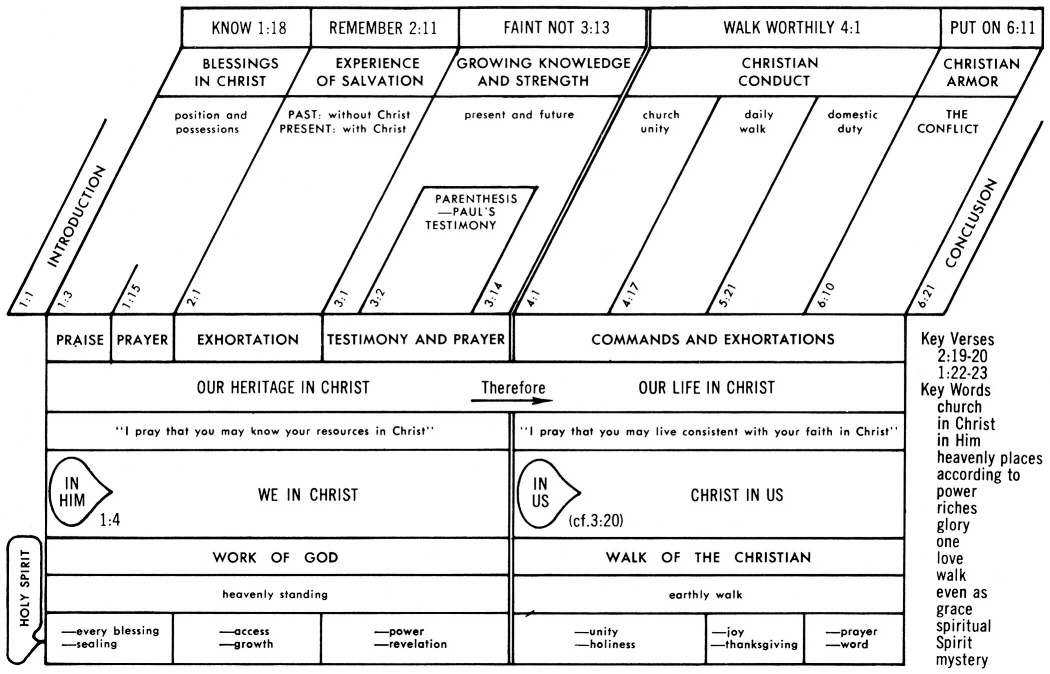
EPHESIANS - CHRIST AND THE CHURCH
Click chart to enlarge
Charts from Jensen's Survey of the NT - used by permission
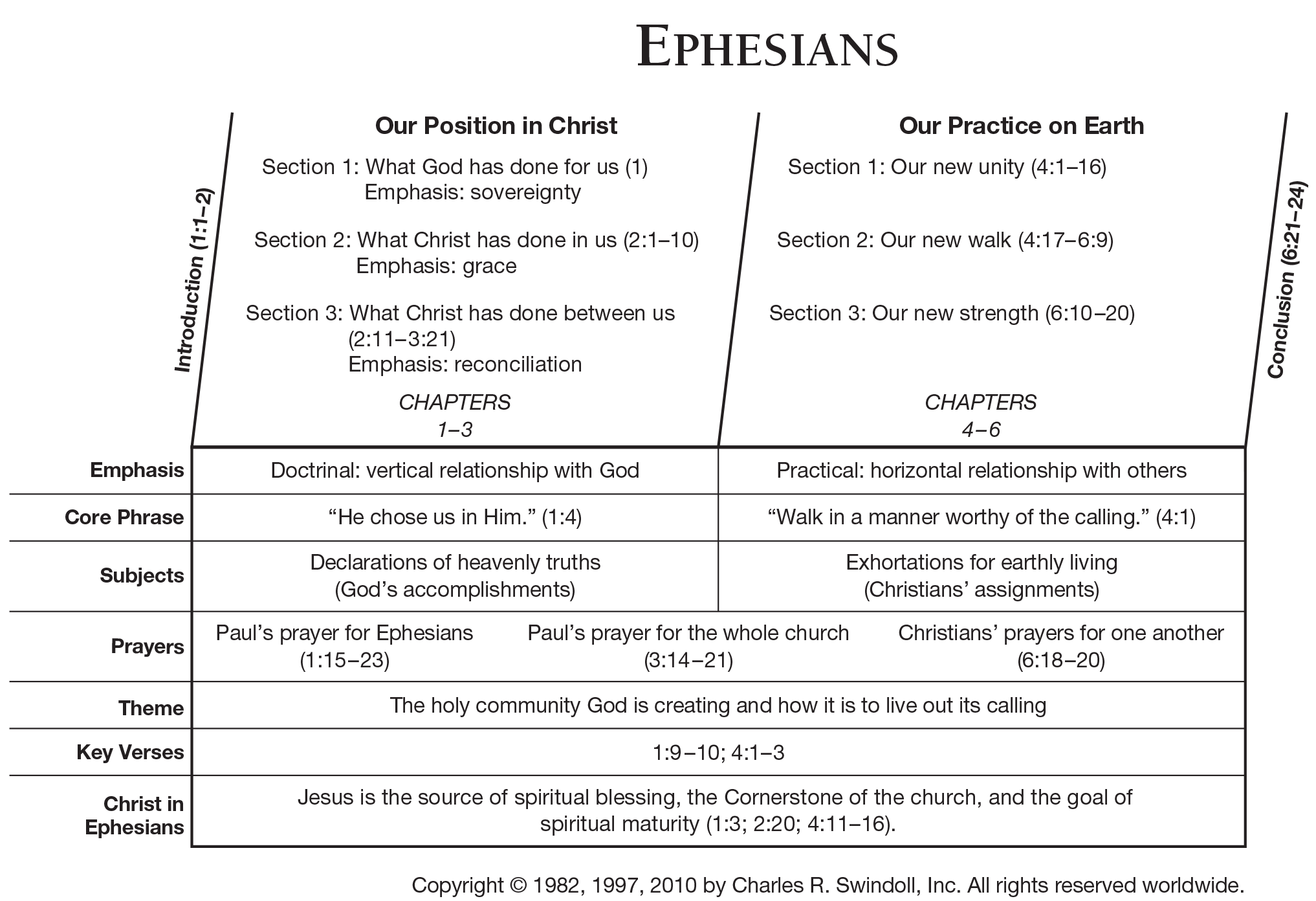
Click chart by Charles Swindoll -Note "EMPHASIS" --
Ephesians 1-3 = Doctrinal: vertical relationship with God
Ephesians 4-6 = Practical: horizontal relationship with others
Ephesians 5:9 (for the fruit of the Light consists in all goodness and righteousness and truth ). (NASB: Lockman)
Greek: o gar karpos tou photos en pase agathosune kai dikaiosune kai aletheia
Amplified: For the fruit (the effect, the product) of the Light or the Spirit [consists] in every form of kindly goodness, uprightness of heart, and trueness of life. (Amplified Bible - Lockman)
KJV: For the fruit of the Spirit is in all goodness and righteousness and truth
NLT: For this light within you produces only what is good and right and true. (NLT - Tyndale House)
Phillips: The light produces in men quite the opposite of sins like these - everything that is wholesome and good and true. (Phillips: Touchstone)
Wuest: for the fruit of this light is in the sphere of every beneficence and righteousness and truth (Eerdmans Publishing - used by permission)
Young's Literal: for the fruit of the Spirit is in all goodness, and righteousness, and truth,
(FOR THE FRUIT OF THE LIGHT CONSISTS: o gar karpos tou photos:
- For the fruit of the light - Galatians 5:22,23
- Ephesians 4:17-5:14 Study Guide (see dropdown menu) - John MacArthur
- Ephesians 5 Resources - Multiple Sermons and Commentaries
Note that the Textus Receptus has Spirit in place of light, the latter being favored by what most scholars feel are the more accurate manuscripts. This is not a major difference for Paul describes goodness as part of the fruit of the Spirit in Galatians writing…
Galatians 5:22 But the fruit (karpos) of the Spirit is love, joy, peace, patience, kindness, goodness, faithfulness,
For (gar) is a term of explanation that we do well to learn to observe and interrogate. As explained by John Eadie for "is used here, as often, to introduce a parenthetic confirmation. The verse not only explains what is meant by walking as children of light, but really holds out an inducement to the duty = “The fruit is” (Ephesians 5 Commentary)
Fruit (2590)(karpos) is used in its literal sense to refer to fruit, produce or offspring, which describes that which is produced by the inherent energy of a living organism. Karpos is what something naturally produces. Figuratively, karpos is used of the consequence of physical, mental, or spiritual action. In the NT the figurative (metaphorical) uses metaphorical uses predominate and this is particularly true in the Gospels, where human actions and words are viewed as fruit growing out of a person's essential being or character.
Karpos refers to that which originates or comes from something producing an effect or result (benefit, advantage, profit, utility).
Karpos is used 67 times in the NT - Mt. 3:8, 10; 7:16, 17, 18; 12:33; 13:8, 26; 21:19, 34, 41, 43; Mk. 4:7, 8, 29; 11:14; 12:2; Lk. 1:42; 3:8, 9; 6:43, 44; 8:8; 12:17; 13:6, 7, 9; 20:10; Jn. 4:36; 12:24; 15:2, 4, 5, 8, 16; Acts 2:30; Ro 1:13; 6:21, 22; 15:28; 1Co. 9:7; Gal. 5:22; Eph. 5:9; Phil. 1:11, 22; 4:17; 2Ti 2:6; 4:13; Heb. 12:11; 13:15; James. 3:17, 18; 5:7, 18; Rev. 22:2
The fruit or effect of divine illumination consists in all the forms of goodness, righteousness, and truth.
Light (5457) (phos) in context speaks of spiritual light that God is and which He has bestowed on believers, making us light in the Lord.
The Fruit of Light
In Our Face
The story is told of the time when the great missionary to Burma, Adoniram Judson, (or here) was home on furlough, and happened to pass through the city of Stonington, Connecticut. A young boy playing about the wharves at the time of Judson’s arrival was struck by the man’s appearance. Never before had he seen such a light on any human face. He ran up the street to a minister to ask if he knew who the stranger was. The minister hurried back with him, but became so absorbed in conversation with Judson that he forgot all about the impatient youngster standing near him. Many years afterward that boy—who could never get away from the influence of that wonderful face—became the famous preacher Henry Clay Trumbull. In a book of memoirs Trumbull penned a chapter entitled:
"What a Boy Saw in the Face of Adoniram Judson"
That lighted countenance had changed his life. Even as flowers thrive when they bend to the light, so shining, radiant faces come to those who constantly turn toward Christ! (Read the original story in context of H C Trumbull's life story)
IN ALL GOODNESS AND RIGHTEOUSNESS AND TRUTH): en pase agathosune kai dikaiosune kai aletheia:
- In all goodness - Psalm 16:2,3; Romans 2:4; 15:14; 1Pe 2:25; 3Jn 1:11
- Righteousness - Phil 1:11; 1Ti 6:11; Heb 1:8; 11:33; 1Pe 2:24; 1Jn 2:29; 3:9,10
- truth - Eph 4:15,25; 6:14; Jn 1:47
- Ephesians 4:17-5:14 Study Guide (see dropdown menu) - John MacArthur
- Ephesians 5 Resources - Multiple Sermons and Commentaries
Eadie feels that the idea of the phrase in all goodness (etc) means "that the fruit is always associated with goodness as its element or sphere. These qualities uniformly characterize its fruits. (Ephesians 5 Commentary)
Goodness (19) (agathosune from agathos =benevolent, profitable, benefiting others) describes active goodness, virtue, excellence or beneficence. It is high moral character reflected in to being good in both nature and effectiveness. Agathosune finds its fullest and highest expression in that which is willingly and sacrificially done for others. It is moral and spiritual excellence manifested in active kindness. Agathosune describes a positive moral quality characterized especially by interest in the welfare of others. Agathosune refers to active goodness as an energetic principle. It is the generosity which springs from the heart that is kind and will always take care to obtain for others that which is useful or beneficial. Thayer says that agathosune is found only in Biblical and ecclesiastical writings.
Goodness then describes behavior that benefits others instead of self. A good person is concerned for the well-being of others, spiritually and in every way. The child of light who walks in daily dependence on the Holy Spirit, brings forth goodness as a fruit of the Spirit (Gal 5:22). Since it is fruit, it takes time to develop, but over the years, children of light are to be growing in all goodness.
Agathosune according to Eadie signifies "that moral excellence which springs from religious principle (Gal 5:22-note; Ro 15:14-note), and leads to kindness, generosity, or goodness. It here may stand opposed to the dark and malignant passions which the apostle has been reprobating (kakia). (Ephesians 5 Commentary)
Recall also that goodness is one of God’s attributes (see God's goodness), so to live in all goodness is to imitate our Father (cp Eph 5:1,2-note).
Wuest writes that agathosune refers "to that quality in a man who is ruled by and aims at what is good, namely, the quality of moral worth. (Wuest Word Studies - Eerdman Publishing Company Volume 1, Volume 2, Volume 3 - used by permission)
Agathosune is a fruit of the Spirit and a fruit of the Light. Agathosune is moral goodness found only in believers and only as the result of the working of the Holy Spirit in the lives of those who submit to His divine will and power. Paul prayed for this fruit of goodness to be manifest in the lives of the believers at Thessalonica and was convinced it was being manifest in the lives of the saints (the body of Christ) at Rome. Paul had heard about their goodness, implying that the way they lived and interacted with others gave proof of their possession of the Spirit and His fruit.
Barclay writes that agathosune "is a peculiarly Bible word and does not occur in secular Greek). It is the widest word for goodness; it is defined as “virtue equipped at every point.” What is the difference? Agathosune might, and could, rebuke and discipline; chrestotes can only help. Trench says that Jesus showed agathosune when he cleansed the Temple and drove out those who were making it a bazaar; but he showed chrestotes when he was kind to the sinning woman who anointed his feet. The Christian needs that goodness which at one and the same time can be kind and strong. (Ephesians 5 Commentary)
Agathosune is found 13 times in the Septuagint (LXX) (Jdg. 9:16; 2Chr. 24:16; Neh. 9:25, 35; 13:31; Ps. 52:3; Eccl 4:8; 5:11, 18; 6:3, 6; 7:14; 9:18) and 4 times in the NAS (see below).
Romans 15:14+ And concerning you, my brethren, I myself also am convinced that you yourselves are full of goodness, filled with all knowledge, and able also to admonish one another.
Galatians 5:22 But the fruit (karpos) of the Spirit is love, joy, peace, patience, kindness, goodness, faithfulness,
Ephesians 5:9 (for the fruit of the light consists in all goodness and righteousness and truth),
2 Thessalonians 1:11 To this end also we pray for you always that our God may count you worthy of your calling, and fulfill every desire for goodness and the work of faith with power
And righteousness - Righteousness (and goodness) is the fruit of the Light and of the Spirit Who motivates our will to consider and then enables or empowers (Php 2:13-note) the rightness of character (ultimately Christ-likeness) before God and rightness of actions before men. Both goodness and righteousness are based on truth, which is conformity to the Word and will of God.
Righteousness (1343) (dikaiosune from dikaios = just, righteous = root idea of conforming to a standard or norm) is derived from a root word that means “straightness.” It refers to a state that conforms to an authoritative standard or norm and so is in keeping with what God is in His holy character. Righteousness is a moral concept. God’s character is the definition and source of all righteousness. God is totally righteous because He is totally as He should be. The righteousness of human beings is defined in terms of God’s. Righteousness in Biblical terms describes the righteousness acceptable to God and thus which is in keeping with what God is in His holy character. Rightness means to be as something or someone should be.
In short, the righteousness of God is all that God is, all that He commands, all that He demands, all that He approves and all that He provides (through the gospel of Jesus Christ, the perfectly Righteous One.) So here the fruit of light is a life that is righteous, rightly related to God and rightly interacting with men. We are now light in the Lord and as we walk in that truth in the power of the Spirit, He bears fruit one component of which is righteousness.
Eadie says that righteousness "is integrity or moral rectitude (Ro 6:13-note; 1Ti 6:11), and is in contrast not only with the theft and covetousness already condemned, but with all defective sense of obligation, for it rules itself by the Divine law (cp how this is possible in Php 2:13-note), and in every relation of life strives to be as it ought to be—and is opposed to adikia. (Ephesians 5 Commentary)
Truth (225) (aletheia from alethes = true in turn from a + lêthô = that which is hidden or lanthanô = conceal, this combination meaning out in the open, containing nothing that is hidden) describes the body of reality (facts, events, etc) or the content which is true, or which is in accordance to what actually occurred. Truth is the unveiled reality lying at the basis of and agreeing with an appearance; the manifested, the veritable essence of matter. Truth is the correspondence between a reality and a declaration which professes to set it forth. Truth is a declaration which has corresponding reality, or a reality which is correctly set forth. Since God is Himself the great reality, that which correctly sets forth His nature is pre-eminently the Truth. Obviously whatever God says is "the truth", and in fact "the Truth" is actually embodied in the Person of Christ Jesus!
Eadie writes that "Truth stands opposed to insincerity and dissimulation—pseudos. These three ethical terms characterize Christian duty… For the good, the right, and the true, distinguish that fruit which is produced out of, or belongs to, the condition which is called “light in the Lord,” and are always distinctive elements of the virtues which adorn Christianity (cp the idea of "adorn" in Titus 2:10-note). (Ephesians 5 Commentary)
Words are true when they correspond with objective reality and Paul has just spoken of speaking the truth in love as well as laying aside falsehood and speaking truth with our neighbor. As we walk in light, the fruit that comes from lips will be truth or words spoken in truth.
Persons and things are true when they correspond with their profession. So we as believers are walking in the light, letting the Spirit empower us, we are demonstrating to the world that our walk corresponds to our profession of Christ as our Lord. We are a living demonstration of the truth of the gospel that takes an "old man" and clothes him in a robe of righteousness, making him a "new man" in Christ.
In the context of Ephesians truth stands in stark contrast to the life of unbelievers, who are deceived (Eph 4:22; 5:6). Believers having been created in righteousness and holiness of the truth (Eph 4:24) are able to speak the truth in love (Ep 4:15, 25). Practically, we as believers are to be people of our word, maintaining integrity in all that we say (and do). And because walk in the light, we are people of all truth and are to have nothing to hide (this even includes our thought life dear saint -- no secret thought life allowed for that is darkness and not light!)
Charles Hodge explains that "the fruit or effect of divine illumination—consists in all goodness, righteousness and truth. Here goodness is what makes a person good, and righteousness is what makes a person righteous. The Greek words differ from each other just as the corresponding English terms do. Goodness is benevolence and beneficence; righteousness is adherence to the rule of right. Yet both are used for moral excellence in general. The evil and the good included all classes of the vicious and the virtuous. “Good works” are works of any kind which are morally excellent (Ed: They are good if they are initiated by and empowered by the Spirit of Christ - cp Jn 15:5. Some "works" look good but they are not genuine "good works" for they originate from the heart and mind of fallen man, and include base motives - see 1Cor 4:5). When, however, the words are contrasted, as in Romans 5:7 (note), or distinguished, as in Romans 7:12 (note), “good” means benevolent or beneficent, and “righteous,” just or upright. Goodness is that quality which adapts a thing to the end for which it was designed and makes it serviceable (Compare the Greek word arete). Hence we speak of a good tree, of good soil, as well as of a good man. Righteousness can correctly be predicated only of people or of what is susceptible of moral character, as it means conformity to law; or if predicated of the law itself, it means conformity to the nature of God, the ultimate standard of rectitude (Ed: Ultimately such acceptable righteousness is in Christ and is worked out as we allow Him to life His righteous life in and through us - cp 1Co 1:30, 2Co 5:21, Php 3:9 -note - based on these truths we can carry out Ro 6:13, breastplate of righteousness = Eph 6:14-note). Truth here means religious or moral truth, or religion itself. The fruit of the light, therefore, includes all the forms of piety and virtue. (Ephesians 5 Commentary)
Wayne Barber writes regarding goodness, righteousness and truth that…
these are categories into which you put everything that you do, say or think. They are going to fall into three categories. One is goodness. The word there is agathosune which describes that which is always spiritually edifying and beneficial to everybody you come in contact with. How do you know that someone has the garment of light on? Just get around him, and you are going to find out. You are going to walk away either convicted or lifted up because everything he does is spiritually beneficial to everybody who comes in contact with him. Hey, do you want to raise your family in a manner pleasing to the Lord? Put that garment on and once you get that garment on, the fruit of the Light that is a part of that garment is going to reach out and touch those kids like you wouldn’t believe. It will send a message. You don’t even have to tell them you love them. Its goodness which flows out of you.
Righteousness is that which conforms to all the claims of Christ over us. In other words, what comes out, whatever deeds they are, somehow is going to conform with everything He has as a right over us. It has the idea of how we live under the rights of God over us. It is a mark upon people who are righteous that they live submissive to the One Who has rights over them.
Then thirdly is the word truth. That means all honesty, reliability and integrity. There is something about being around somebody who has the right garment on. There is something about being around somebody who has the light and walks as a child of light because you can trust them. They are reliable. They are honest. They are filled with integrity.
It is an incredible mark you make on the world when you live a life that bears the fruit of the light, having His nature within you. I’m telling you what, the people you work for can’t get over it because of the way you will work. The people you live with can’t get over it because of the way that you live. This is the fruit of the light. (Walk As Children of Light)
Here is a devotional from Our Daily Bread: A Daily Devotional entitled "Seeing the Gospel" -
A man once asked a new acquaintance in a remote area of the world, "Have you ever heard the Gospel?" "No," the other replied, "I have never heard it, but I have seen it." "What do you mean by that?" the Christian responded. "Simply this," he said, "there is a man in our village whose life has been greatly influenced by a missionary who passed this way. Never have I seen such a change in a person! Before he met the man of God, alcohol ruled his life. He was lazy, neglected his family, and showed no interest in anyone else. Since then, however, his manner of living is completely different. He is no longer a slave to liquor. He works hard and is a good husband and father. I would be proud to have him as my neighbor. Yes, I have seen the Gospel and like it so well I would now like to hear it!" Because the Gospel had been lived eloquently, it could be told effectively.
To be faithful in our witness for Christ, it is essential that the message of His saving grace and transforming power be shown as well as told. If our deeds contradict our words, we might better remain silent. May the example of our lives be so consistent with the testimony of our lips that no one could ever say to us, "Your actions speak so loud that I can't hear what. you say."
The walk of the believer should be a living sermon. The world is watching us with a critical eye. Let us be careful, then, making sure that others are "seeing the Gospel" at its very best!
Jesus bids us shine with a clear, pure light, Like a little candle burning in the night, In this world of darkness we must shine, You in your small corner, and I in mine.
Jesus bids us shine, first of all for Him;
Well He sees and knows it if our light is dim;
He looks down from Heaven, sees us shine,
You in your small corner; and I in mine! —Warner
The only sermon that never wearies us is that of an eloquent life!
Kent Hughes offers all those who have been delivered from darkness into God's marvelous light to walk as light in the Lord for…
in eternity we will be part of the shining light ourselves… I believe that with all my heart. I do not understand it, but I believe that for us as Christians there is a glory awaiting us that involves, in some way, an even greater shining forth. I do not know if we will be 100 watts or 200, 300, or 1,000! We might be like fireflies or we might be like supernovas. But somehow we are going to enter into the fame and approval of God, and we will be glorious beings, far beyond all imagination.
But at the same time we are light right now. Jesus says, "You [you alone] are the light of the world."
Let us covenant with all our being to shine as brightly as possible in this dark world.
Let us covenant to expose ourselves to the face of Jesus in prayer.
Let us covenant to be visible for Him.
Let us covenant to shine wherever He places us. Let us covenant to do beautiful works.
Let us covenant to remind ourselves that we always will be light - and to live in that reality. (Hughes, R. K. Sermon on the Mount: The Message of the Kingdom. Crossway Books)
The Light of Boris Kornfeld
One is reminded of the Russian Jewish doctor, Boris Kornfeld, who one night in prison in Siberia sat up with a man who was desperately ill and told him the story of his conversion to Christ, shining forth the light and love of Jesus. That listening man's name? The future Nobel Prize winner, Alexander Solzhenitsyn, who later came to saving faith in Christ. In his modern classic The Gulag Archipelago Solzhenitsyn recalls the Dr Kornfeld's light and how it paradoxically shown forth in an almost completely dark room …
Fervently he tells me the long story of his conversion from Judaism to Christianity. I am astonished at the conviction of the new convert, at the ardor of his words.
We know each other very slightly, and he was not the one responsible for my treatment, but there was simply no one here with whom he could share his feelings. He was a gentle and well-mannered person. I could see nothing bad in him, nor did I know anything bad about him. However, I was on guard because Kornfeld had now been living for two months inside the hospital barracks, without going outside. He had shut himself up in here, at his place of work, and avoided moving around camp at all.
This meant that he was afraid of having his throat cut. In our camp it had recently become fashionable to cut the throats of stool pigeons. This has an effect. But who could guarantee that only stoolies were getting their throats cut? One prisoner had had his throat cut in a clear case of settling a sordid grudge. Therefore the self-imprisonment of Kornfeld in the hospital did not necessarily prove that he was a stool pigeon.
It is already late. The whole hospital is asleep. Kornfeld is finishing his story:
"And on the whole, do you know, I have become convinced that there is no punishment that comes to us in this life on earth which is undeserved. Superficially it can have nothing to do with what we are guilty of in actual fact, but if you go over your life with a fine-tooth comb and ponder it deeply, you will always be able to hunt down that transgression of yours for which you have now received this blow."
I cannot see his face. Through the window come only the scattered reflections of the lights of the perimeter outside. The door from the corridor gleams in a yellow electrical glow. But there is such mystical knowledge in his voice that I shudder.
Those were the last words of Boris Kornfeld. Noiselessly he went into one of the nearby wards and there lay down to sleep. Everyone slept. There was no one with whom he could speak. I went off to sleep myself.
I was wakened in the morning by running about and tramping in the corridor; the orderlies were carrying Kornfeld's body to the operating room. He had been dealt eight blows on the skull with a plasterer's mallet while he slept. He died on the operating table, without regaining consciousness.
That very night Kornfeld had shone so brightly the light of Christ, he was clubbed to death. We must shine wherever and whenever the Lord gives us a venue, redeeming the precious moments for the days are evil.
Beloved, have you ever had someone who saw the light of Christ in you later turn to the Lord? It is a wonderful, glorious, mysterious gift of grace to experience. Dr Kornfeld knows this today in glory in a way that we cannot even imagine. May his tribe increase!
Phil Newton has the following illustration…
R. L. Dabney told a story of a very worldly-minded attorney in the 19th century that had nothing for Christianity. After years of ungodly living and scorning of Christians, as he grew old he went to live with his sister who happened to be a Christian. Her son was a pastor, and he had opportunity to engage the old man in conversation about Christ and even recommend some books to him. Some time later, ill in health, the old attorney asked to confess his faith in Christ publicly. The nephew was eager to get the full story and wondered if his conversation had been the instrument of turning the callused man’s heart to Christ. But as the story unfolded he discovered that it was not the pastor’s words or even the books that he recommended that the man read, but it was the godly life of the pastor’s sister, still living at home and around the old man. He saw her godliness and radiance as a Christian in every situation, and it caused him to seek the Lord to know that same relationship to Jesus Christ. Dabney adds,
“The light of a holy example is the gospel’s main argument”
[Discussions of Robert Lewis Dabney, vol. I, 114]. Is your life a good argument for the gospel? (The Power of Christians as Light) (Bolding added)
Ephesians 5:10 trying to learn what is pleasing to the Lord. (NASB: Lockman)
Greek: dokimazontes (PAPMPN) ti estin (3SPAI) euareston to kurio;
Amplified: And try to learn [in your experience] what is pleasing to the Lord [let your lives be constant proofs of what is most acceptable to Him]. (Amplified Bible - Lockman)
NLT: Try to find out what is pleasing to the Lord. (NLT - Tyndale House)
Phillips: Let your lives be living proofs of the things which please God. (Phillips: Touchstone)
Wuest: putting to the test and then approving what is well pleasing to the Lord. (Eerdmans Publishing - used by permission)
Young's Literal: proving what is well-pleasing to the Lord,
TRYING TO LEARN WHAT IS PLEASING TO THE LORD: dokimazontes (PAPMPN) ti estin (3SPAI) euareston to kurio;:
- 1Sa 17:39; Ro 12:1,2; Php 1:10; 1Th 5:21
- Ps 19:14; Pr 21:3; Is 58:5; Jer 6:20; Ro 14:18; Phil 4:18; 1Ti 2:3; 1Ti 5:4; Heb 12:28; 1Pe 2:5,20
- Ephesians 5 Resources - Multiple Sermons and Commentaries
Hodge writes that…
Verse 9 is a parenthesis, as the 10th verse is grammatically connected with the 8th. “Walk as children of the light, proving, etc.,” dokimazonetes is to try, to put to the test, to examine; then to judge or estimate; and then to approve. Thus it is said, “The fire shall try every man’s work”; God is said “To try the heart”; we are said “To be renewed so as to prove the will of God,” Romans 12:2; that is, to examine and determine what the will of God is.
And so in this passage believers are required to walk as children of light, examining and determining what is acceptable to the Lord. They are to regulate their conduct by a regard to what is well pleasing to Him. That is the ultimate standard of judging whether anything is right or wrong, worthy or unworthy of those who have been enlightened from above.
The word Lord is in the New Testament so predominantly used to designate the Lord Jesus Christ, that is always to be referred to Him unless the context forbids it. Here the context so far from forbidding, requires such reference. For in the former part of the sentence Lord evidently designates Christ. “Ye are light in the Lord, therefore, walk as children of the light, proving what is acceptable to the Lord.” This, therefore, is one of the numerous passages in the New Testament, in which Christ is recognized as the Lord of the conscience, whose will is to us the ultimate standard of right and wrong, and to whom thus that the sacred writers show that Christ was their God, in whose presence they constantly lived, whose favor they constantly sought, and on whom all their religious affections terminated. He was not merely the God of their theology, but of their religion. (Ephesians 5 Commentary)
David prayed a prayer that he would be pleasing to the Lord "Let the words of my mouth and the meditation of my heart Be acceptable in Thy sight, O LORD, my rock and my Redeemer. (Ps 19:14+)
Regarding pleasing the Lord we read that "without faith it is impossible to please Him, for he who comes to God must believe that He is, and that He is a rewarder of those who seek Him. (Heb 11:6+)
Paul writes to young Timothy that living in live in peace and quietness, in godliness and dignity "is good and acceptable in the sight of God our Savior (1Ti 2:3)
Trying to learn - means putting to the test for the purpose of approving, proving , commending or accepting as good and authentic. As our minds are renewed through God’s Word, we prove in our experience what pleases God.
Eadie explains that "The participle (trying) agrees with the previous verb walk (Eph 5:8+), as a predicate of mode, and so used in its ordinary sense—trying—proving. Compare Php 1:10 (so that you may approve the things that are excellent) (see note). As they walked, they were to be examining or distinguishing what is pleasing to the Lord. (Ephesians 5 Commentary)
MacDonald writes that "Those who walk in the light not only produce the type of fruit listed in the preceding verse, but also find out what is acceptable to the Lord. They put every thought, word, and action to the test (1Th 5:21,22, Ro 12:2). What does the Lord think about this? How does it appear in His presence? Every area of life comes under the searchlight—conversation, standard of living, clothes, books, business, pleasures, entertainments, furniture, friendships, vacations, cars, and sports.
Two good tests of whether something is pleasing to the Lord…
(1). Will it make others stumble?
(2) Will I be ashamed if Jesus should return?
Steven Cole - We do not determine what pleases the Lord by our own feelings, which fluctuate, or by what the world or other Christians say or think. We don’t even determine it by our own conscience, in that our conscience may be improperly informed. Rather, we learn what pleases the Lord through growing to understand His Word. Living to please the Lord is a fundamental difference between the believer and the unbeliever. An unbeliever may be a good man and even be somewhat righteous or upright, at least outwardly. He may be truthful. But, he does it all out of selfish motives, for his own self-respect, or so that others will think highly of him. But, only believers live to please the Savior. We have a new personal relationship with this One who snatched us out of a horrible pit. We now evaluate everything we do by the question, “Does this please the Lord, who loved me and gave Himself for me?” So, the first requirement for living in this dark world is to be children of light and to walk as children of light, doing everything to please the Lord. (Ref)
Trying to learn (1381) (dokimazo from dokimos = tested, proved or approved, tried as metals by fire and thus purified from dechomai = to accept, receive) (Click word study on dokimazo) means to assay, to test, to prove, to put to the test, to make a trial of, to verify, to discern to approve. Dokimazo involves not only testing but determining the genuineness or value of an event or object. That which has been tested is demonstrated to be genuine and trustworthy. Dokimazo was used in classic Greek to describe the assaying of precious metals (especially gold or silver coins), usually by fire, to prove the whether they were authentic and whether they measured up to the stated worth. That which endures the test was called dokimos and that which fails is called adokimos. Dokimazo means to put to the test for the purpose of approving, and finding that which is tested meets the specifications prescribed, and thus one can approve of that which is tested.
There are 20 uses of dokimazo in the NT - Lk. 12:56; 14:19; Ro 1:28; 2:18; 12:2; 14:22; 1Co. 3:13; 11:28; 16:3; 2Co. 8:8, 22; 13:5; Gal. 6:4; Eph. 5:10; Phil. 1:10; 1Th 2:4; 5:21; 1Ti 3:10; 1Pe 1:7; 1Jn. 4:1
Dokimazo means to make a critical examination of something to determine its genuineness. Dokimazo was used in a manuscript of 140AD which contains a plea for the exemption of physicians, and especially of those who have "passed the examination (dokimazo)". Dokimazo was thus used as a technical expression referring to the action of an examining board putting its approval upon those who had successfully passed the examinations for the degree of Doctor of Medicine. Dokimazo was also used to describe the passing of a candidate as fit for election to public office.
Pleasing (2101) (euarestos from eu = well + arésko = please) means that which causes someone to be pleased. It is something which is well approved, eminently satisfactory, or extra-ordinarily pleasing.
Here are the 9 uses of euarestos in the NT - Ro 12:1, 2; 14:18; 2Co 5:9; Eph 5:10; Phil 4:18; Col. 3:20; Titus 2:9; Heb 13:21
Eadie explains that pleasing refers to "what the Lord has enjoined and therefore approves. The obedience of Christians is not prompted by traditional or unthinking acquiescence, but is founded on clear and discriminative perception of the law and the will of Christ. And that obedience is accepted not because it pleases them to offer it, but because the Lord hath exacted it. The believer is not to prove and discover what suits himself, but what pleases his Divine Master. The one point of his ethical investigation is, Is it pleasing to the Lord, or in harmony with His law and example? (Ephesians 5 Commentary)
- To Be Pleasing You - Maranatha Singers - Play this song and make it the desire of your heart!
Paul is instructing the Gentile saints to be putting every thought, word, and action to the test to discern "What does the Lord think about this?" "How does this appear in His presence?" Every area of our life should come under this searchlight, our… conversation, standard of living, clothes, books, business, pleasures, web surfing habits, friendships, sports, etc. The ultimate question should be… Will it be well pleasing (euarestos) to the Lord? Will it bring forth the fruit of goodness, righteousness and truth? And so, before you think, do or say it always ask…
Will it please my Lord?
Lord (2962) (kurios) signifies sovereign power and absolute authority. It is the one who has absolute ownership and uncontested power.
Wayne Barber explains the idea of "trying to learn" (dokimazo) writing that it means "proving what is pleasing to the Lord. Every day I say, "God, the light is in me. Show me now. If I make this choice, if I make that choice, if I say this word, if I say that word, what is it that pleases you?" Remember the prayer in Eph 3:17 (note)? I have to learn to accommodate His presence in my life. I have to learn what it is that pleases Him. So daily I am living a life seeking out those things that bring pleasure to my Lord. That is the way we are supposed to walk. (Walk As Children of Light)