Ephesians 6:2
Ephesians 6:3
Ephesians 6:4
Ephesians 6:5
Ephesians 6:6
Ephesians 6:7
Ephesians 6:8
Ephesians 6:9
Ephesians 6:10
Ephesians 6:11
Ephesians 6:12
Ephesians 6:13
Ephesians 6:14
Ephesians 6:15
Ephesians 6:16
Ephesians 6:17
Ephesians 6:18
Ephesians 6:19
Ephesians 6:20
Ephesians 6:21
Ephesians 6:22
Ephesians 6:23
Ephesians 6:24
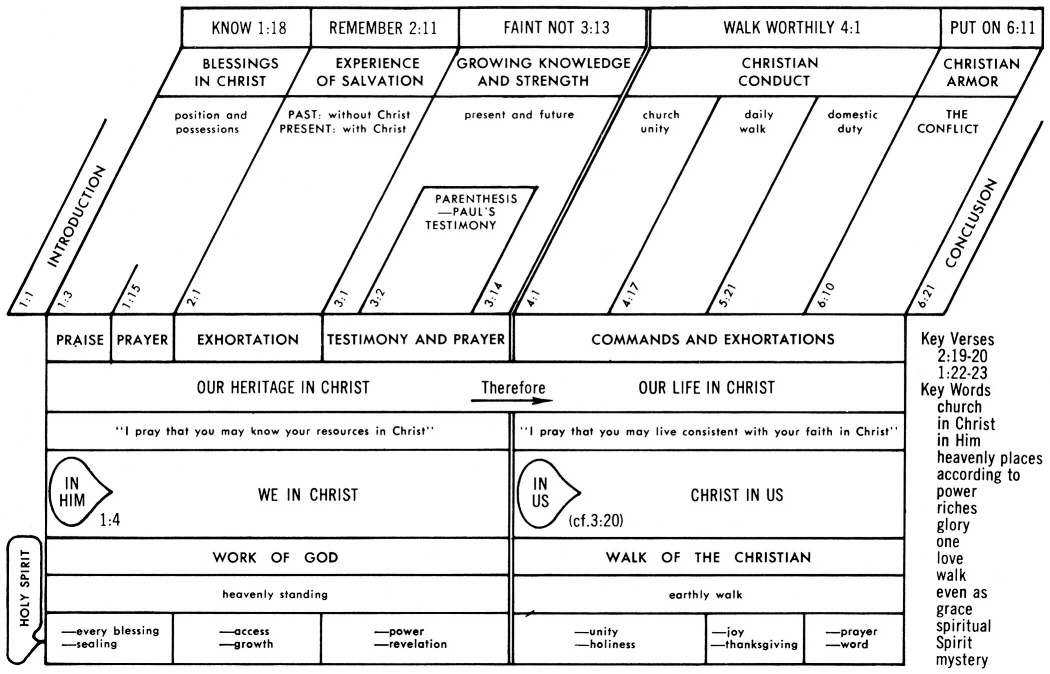
EPHESIANS - CHRIST AND THE CHURCH
Click chart to enlarge
Charts from Jensen's Survey of the NT - used by permission
| SYMMETRY OF EPHESIANS |
|
| EPHESIANS 1-3 | EPHESIANS 4-6 |
| The Root | The Fruit |
| Spiritual Wealth | Spiritual Walk |
| Christian Privilege | Christian Conduct |
| The Position of the Believer |
The Practice of the Believer |
| God Sees Us in Christ |
World Sees Christ in Us |
| Privilege | Practice |
| Doctrine | Duty |
| Doctrinal | Practical |
| Revelation | Responsibility |
| Christian Blessings |
Christian Behavior |
| Belief | Behavior |
| Privileges of the Believer |
Responsibilities of the Believer |
| Our Heritage In Christ |
Our Life In Christ |
| Know your Resources (Riches) in Christ |
Live by faith in the light of your Resources (Riches) in Christ |
| The Finished Work of Christ |
The Faithful Walk of the Christian |
| Work of Christ In Us |
Work of Christ Through Us |
| We in Christ |
Christ in Us |
| Word of God |
Walk of the Christian |
| Heavenly Standing |
Earthly Walk |
| Who You Are In Christ |
Whose You Are In Christ |
| Identity | Responsibility |
| Position of the Believer |
Practice of the Believer |
| Theology | Ethics |
Ephesians 6:1 Children, obey your parents in the Lord, for this is right. (NASB: Lockman)
Greek: Ta tekna, hupakouete (2PPAM) tois goneusin humon [en kurio], touto gar estin (3SPAI) dikaion.
Amplified: CHILDREN, OBEY your parents in the Lord [as His representatives], for this is just and right. (Amplified Bible - Lockman)
NLT: Children, obey your parents because you belong to the Lord, for this is the right thing to do. (NLT - Tyndale House)
Phillips: 1 - Children, the right thing for you to do is to obey your parents as those whom God has set over you. (Phillips: Touchstone)
Wuest: The children, be always obedient to your parents in the Lord, for this is a righteous thing.
Young's Literal: 6:1 The children! obey your parents in the Lord, for this is righteous;
CHILDREN, OBEY YOUR PARENTS IN THE LORD: Ta tekna, hupakouete (2PPAM) tois goneusin humon [en kurio]:
- Ge 28:7; 37:13; Lev 19:3; Dt 21:18; 1 Sa 17:20; Esther 2:20; Pr 1:8; 6:20; 23:22; 30:11,17; Jer 35:14; Lk 2:51; Col 3:20-25
- Eph 6:5,6; Ro 16:2; 1 Cor 15:58; Col 3:16,17,23,24; 1 Pet 2:13
- Ephesians 6 Resources - Multiple Sermons and Commentaries
- Ephesians 6:1-3: Spirit-Filled Families - 4 - Wayne Barber
- Ephesians 6:1-4 Key Principles for Parents - Steven Cole
- Ephesians 6:1-3 The Spirit-filled Home (Part 1) - Steven Cole
- Ephesians 6:1-4: God's Pattern for Children-1 - John MacArthur
- Ephesians 6:1-3: God's Pattern for Children-2 - John MacArthur
|
THE SYMMETRICAL STRUCTURE |
|
|
EPHESIANS 1-3 |
EPHESIANS 4-6 |
| Spiritual Wealth | Spiritual Walk |
| The Position of the Believer |
The Practice of the Believer |
| God Sees Us in Christ |
The World Should See Christ in Us |
| Privilege | Practice |
| Doctrine | Duty |
| Doctrinal | Practical |
| Revelation | Responsibility |
| Christian Blessings |
Christian Behavior |
| Belief | Behavior |
| Privileges of the Believer |
Responsibilities of the Believer |
| Our Heritage In Christ |
Our Life In Christ |
| Know your Resources (Riches) in Christ |
Live by faith in the light of your Resources (Riches) in Christ |
| Work of Christ |
Walk of the Christian |
| Work of Christ In Us |
Work of Christ Through Us |
| We in Christ |
Christ in Us |
| Word of God |
Walk of the Christian |
| Heavenly Standing |
Earthly Walk |
| Who You Are In Christ |
Whose You Are In Christ |
| Identity | Responsibility |
| Position of the Believer |
Practice of the Believer |
| Theology | Ethics |
Paul continues to emphasize the importance of Spirit filled believers in interpersonal relationships, particularly as the Spirit's control is evidenced by a submissive spirit in the believer, in this case believing children. As discussed below Paul does not use hupotasso which describes submission between equals (husband and wife) but hupakouo which speaks of one who is not the other's equal (this same usage being applied to master/slave relationships). By the way, don't misinterpret this verse. Yes, the primary instruction is to believers, children and parents, but that does not mean that children are to obey parents only if their parents are believers!
Johnson puts this section dealing with children in a proper cultural perspective writing that...
The callousness of the Roman Empire with respect to children throws this into very broad relief because, just as in our society today, the signs of breakdown were not only in the Roman Empire, but had come to pass. And in their society, children were unwanted. They were abandoned. They were mistreated. They were abused. They were raped, and furthermore, they were murdered. Everyone of those experiences are experiences that are characteristic of our society today. So, the Apostle’s words were addressed to a society that was very much like ours: it did not have concern for children. (Ephesians 6:1-9 Paul to Children & Fathers Audio)
Barclay adds that...
Under the patria potestas a Roman father had absolute power over his family. He could sell them as slaves, he could make them work in his fields even in chains, he could punish as he liked and could even inflict the death penalty. Further, the power of the Roman father extended over the child’s whole life, so long as the father lived. A Roman son never came of age. Even when he was a grown man, even if he were a magistrate of the city, even if the state had crowned him with well-deserved honours, he remained within his father’s absolute power. “The great mistake,” writes Becker, “consisted in the Roman father considering the power which Nature imposes as a duty on the elders, of guiding and protecting a child during infancy, as extending over his freedom, involving his life and death, and continuing over his entire existence.” It is true that the father’s power was seldom carried to its limits, because public opinion would not have allowed it, but the fact remains that in the time of Paul the child was absolutely in his father’s power. There was the custom of child exposure. When a child was born, it was placed before its father’s feet, and, if the father stooped and lifted the child, that meant that he acknowledged it and wished it to be kept. If he turned and walked away, it meant that he refused to acknowledge it and the child could quite literally be thrown out.
A Roman baby always ran the risk of being repudiated and exposed. In the time of Paul that risk was even greater. We have seen how the marriage bond had collapsed and how men and women changed their partners with bewildering rapidity. Under such circumstances a child was a misfortune. So few children were born that the Roman government actually passed legislation that the amount of any legacy that a childless couple could receive was limited. Unwanted children were commonly left in the Roman forum. There they became the property of anyone who cared to pick them up. They were collected at nights by people who nourished them in order to sell them as slaves or to stock the brothels of Rome. (Daily Study Bible)
It was into such an upside down world that the Gospel shined forth to light the way for children to be set free from this horrible darkness and despair.
Boice has the following introductory comment...
Norman Corwin wrote in an article for Reader’s Digest entitled “Perfect Home”: “One child makes a home a course in liberal education for both himself and parents; two children make it a private school; three or more make it a campus.” But many parents today are not sure that they are up to being professors in this university, and even then they are unsure of what should be offered in the curriculum. (Boice, J. M.: Ephesians: An Expositional Commentary)
Obedience and honor sum up the whole distinctive duty of the child, not just in the New Testament but also in the Old, the latter recording that...
Leviticus 19:3 'Every one of you shall reverence his mother and his father, and you shall keep My sabbaths; I am the LORD your God. (Note that in Lev 19:3-4, three of the Ten Commandments are reiterated as being particularly important - concerning parents, sabbaths, and idolatry).
Deuteronomy 21:18 "If any man has a stubborn and rebellious son who will not obey his father or his mother, and when they chastise him, he will not even listen to them, 19 then his father and mother shall seize him, and bring him out to the elders of his city at the gateway of his home town. 20 "And they shall say to the elders of his city, 'This son of ours is stubborn and rebellious, he will not obey us, he is a glutton and a drunkard.' 21 "Then all the men of his city shall stone him to death; so you shall remove the evil from your midst, and all Israel shall hear of it and fear.
Comment: Morris writes that "Records indicate no rebellious son was ever put to death under this law. Every father elected to spare his own son, no matter how sinful the son might have been. Only Christ, the perfectly obedient Son [John 8:29;17:4] was not spared [Ro 8:32] [Ref]).
Proverbs 1:8 Hear, my son, your father's instruction, And do not forsake your mother's teaching;
Proverbs 6:20 My son, observe the commandment of your father, And do not forsake the teaching of your mother; 21 Bind them continually on your heart; Tie them around your neck. 22 When you walk about, they will guide you; When you sleep, they will watch over you; And when you awake, they will talk to you. 23 For the commandment is a lamp, and the teaching is light; And reproofs for discipline are the way of life,
Proverbs 23:22 Listen to your father who begot you, And do not despise your mother when she is old.
Pr 30:11 There is a kind of man who curses his father, And does not bless his mother.
Pr 30:17 The eye that mocks a father, And scorns a mother, The ravens of the valley will pick it out, And the young eagles will eat it. (Their body will lie unburied for the birds to feed on)
Colossians 3:20 Children, be obedient (present imperative) to your parents in all things, for this is well-pleasing (well approved, eminently satisfactory, or extra-ordinarily pleasing) to the Lord. (see note)
Comment: In the ancient world children were very much under the domination of their parents. The supreme example was the Roman Patria Potestas, the law of the father's power. Under it a parent could do anything he liked with his child. He could sell him into slavery; he could make him work like a laborer on his farm; he had even the right to condemn his child to death and to carry out the execution. All the privileges and rights belonged to the parent and all the duties to the child.
To disobey parents is a symptom of a disintegrating, decaying society, and Christian families have a distinct responsibility not to contribute to the collapse of the ordered community. To disobey parents is named in the horrible list of sins ascribed to those with who "did not see fit to acknowledge God any longer" and who God therefore gave "over to a depraved mind, to do those things which are not proper"...
slanderers, haters of God, insolent, arrogant, boastful, inventors of evil, disobedient to parents (See notes Romans 1:28; 1:29; 1:30)
Paul says parental disobedience will characterize the last days writing...
But realize (present imperative) this, that in the last days difficult times (grievous times, violent, fierce, wild, hard to bear times) will come. 2 For men will be lovers of self, lovers of money, boastful, arrogant, revilers, disobedient (apeithes = literally those who refuse to be persuaded!) to parents, ungrateful, unholy (See notes 2 Timothy 3:1; 3:2)
McGee observes that "Disobedience to parents is the last and lowest form of lawlessness to occur on this earth. Disobedience to parents is one of the characteristics of the last days. Today we hear of many cases of children rejecting parental authority and even killing their parents! This is indicative of the times in which we live." [Ref])
Children (5043) (teknon from tikto = bring forth, bear children, be born) is strictly a child produced, male or female, son or daughter. Teknon naturally includes learning from mentors – which is very positive as it exalts depending on the Lord Himself. (See 1 Ti 1:18; 2 Ti 1:2; Philemon 10). The greater our dependence on the Lord, the greater we develop in knowing Him. Jesus Himself set the model for us when saying, "I do nothing unless I see My Father doing it first" (Jn 5:19). Teknon is thus a child as viewed in relation to his or her parents or family. In the plural, teknon is used generically of descendants, posterity or children. Teknon is "a child living in willing dependence" which illustrates how believers must live in utter dependence upon the Lord moment-by-moment. They draw guidance (care, nurture) from their heavenly Father as Christ speaks His rhēma-word within to impart faith (cf. Ro 8:16,17 with Ro 10:17, Gk text). Ironically we only grow up, by growing in dependence on our heavenly Father! Doing this always brings eternal transformation ("spiritual formation" in Christ) – i.e. more conformity to Him as we are transformed from "glory to glory" (2 Cor 3:18). Teknon emphasizes the childlike (not childish) attitude of heart that willingly (gladly) submits to the Father. Note that another Living in faith transforms the believer from child to Bride (cf. Eph 5:27)! We successfully make this "journey" by discerning what pleases the Lord by hearing His voice and doing what we hear. The goal of life is growing from child to the glorified bride of Christ (cf. Rev 19:7-9)! While the Lord is Creator of all people, He is only the Father of His born-again children. Salvation means a believer is spiritually begotten of God (re-born, adopted by the Lord). This brings the new status of being in Christ, i.e. belonging to the Lord as His true child (téknon).
Note that another Greek word huios (5207), translated son, differs from teknon because the latter gives prominence to the fact of birth, whereas huios stresses the dignity and character of the relationship and usually speaks of one who is fully mature. Despite these distinctions, because these words often overlap in meaning and are used seemingly without discrimination, one should not press their semantic differences in every case but allow the context to rule in the interpretation (always a good rule!)
Teknon - 99x in 91v-child, 13; children, 76; children's, 2; son, 8; sons, 1. Mt 2:18; 3:9; 7:11; 9:2; 10:21; 15:26; 18:25; 19:29; 21:28; 22:24; 23:37; 27:25; Mark 2:5; 7:27; 10:24, 29f; 12:19; 13:12; Luke 1:7, 17; 2:48; 3:8; 7:35; 11:13; 13:34; 14:26; 15:31; 16:25; 18:29; 19:44; 20:31; 23:28; John 1:12; 8:39; 11:52; Acts 2:39; 7:5; 13:33; 21:5, 21; Rom 8:16f, 21; 9:7f; 1 Cor 4:14, 17; 7:14; 2 Cor 6:13; 12:14; Gal 4:19, 25, 27f, 31; Eph 2:3; 5:1, 8; 6:1, 4; Phil 2:15, 22; Col 3:20f; 1Th 2:7, 11; 1 Tim 1:2, 18; 3:4, 12; 5:4; 2 Tim 1:2; 2:1; Titus 1:4, 6; Philemon 1:10; 1 Pet 1:14; 3:6; 2 Pet 2:14; 1 John 3:1f, 10; 5:2; 2 John 1:1, 4, 13; 3 John 1:4; Rev 2:23; 12:4f
Teknon is used some 142 times in the Septuagint (LXX) Gen. 3:16; 17:16; 22:7f; 27:13, 18, 20f, 25f, 37, 43; 30:1; 31:16, 43; 32:11; 33:6f; 43:29; 48:19; 49:3; Exod. 10:2; 17:3; 20:5; 34:7; Lev. 25:41, 46; Num. 14:18, 23; 16:27; Deut. 2:34; 3:19; 5:9; 11:19; 21:17; 22:6; 24:16; 28:54f, 57; 29:29; 32:5; 33:24; Jos. 14:9; 22:24, 27; Jdg. 18:21; 1 Sam. 1:8; 2:5, 24; 3:9, 16; 4:16; 6:7, 10; 14:32; 24:16; 26:17, 21, 25; 30:22; 1 Ki. 8:25; 9:6, 15; 12:24; 15:4; 17:12f, 15; 20:3, 5; 1 Chr. 2:30, 32; 22:7; 2 Chr. 25:4; 28:3; 30:9; 33:6; 35:7; Ezra 8:21; Neh. 12:43; Est. 3:13; 7:4; 9:25; Job 5:25; 21:8; 39:4, 16; Ps. 34:11; 78:4; 109:13; 113:9; Prov. 7:7; 14:26; 17:6; 30:4; 31:2, 26; Isa. 2:6; 13:16, 18; 14:21; 27:6; 29:23; 30:1; 39:7; 44:3; 51:18; 54:1, 13; 57:4f; 60:4, 9; 63:8; Jer. 2:30; 3:19; 19:2; 31:17, 29; 32:18, 39; 35:14; 38:23; Ezek. 5:10; 16:21, 36, 45; 18:2; 20:18, 21; 23:37, 39; Dan. 6:24; Hos. 1:2; 2:4; 4:6; 5:7; 9:12f; 10:9, 14; 11:1, 10; 13:13; Joel 1:3; 2:23; Mic. 1:16; Zech. 9:13; 10:7, 9)
Teknon was used in secular Greek writings as a form of familiar, tender or affectionate address to speak of one kindly even if they were adults referring to them as "my son" or "my child". For example Jesus speaking to the paralytic declared
"Take courage, My son (teknon), your sins are forgiven." (Mt 9:2)
In the NT, pupils or disciples are called children of their teachers, because the latter by their instruction nourish the minds of their pupils and mold their characters. For example Paul writes...
For this reason I have sent to you Timothy, who is my beloved and faithful child (teknon) in the Lord (see notes 2 Timothy 1:2), and he will remind you of my ways which are in Christ, just as I teach everywhere in every church. (1Cor 4:17) (Comment: In his first epistle Paul writes as a spiritual father "to Timothy, my true child [teknon] in the faith: Grace, mercy and peace from God the Father and Christ Jesus our Lord." 1Ti 1:2. In Titus Paul again writes as a spiritual father "to Titus, my true child [teknon] in a common faith: Grace and peace from God the Father and Christ Jesus our Savior." see note Titus 1:2 )
Teknon takes on special theological significance when the Bible calls believers the children of God (Jn. 1:12; Jn. 11:52; Acts 17:29; Rom. 8:16; Rom. 8:21; Rom. 9:8; Phil. 2:15; 1 Jn. 3:1; 1 Jn. 3:2; 1 Jn. 3:10; 1 Jn. 5:2 are the 11 NT uses of this wonderful phrase - but note one use by Paul is not of those who are born again and uses genos -- "offspring" -- not teknon - see if you can determine which one is not referring to the born again members of the family of God) or more literally "born ones" of God. In using teknon in this context the NT is not saying believers are "childlike" but that we are members of God's family as thus heirs, Paul affirming...
and if children (teknon), heirs also, heirs of God and fellow heirs with Christ, if indeed we suffer with Him in order that we may also be glorified with Him. (See notes Romans 8:17)
Teknon is used in a number of phrases in the NT, and one must examine the context to determine whether the phrase refers to believers or non-believers:
• children of the flesh (unsaved Jews -Ro 9:8)
• children of the promise (Jews who have placed their faith in the Messiah -Ro 9:8)
• children of the desolate (those saved by grace through faith, Gal 4:27),
• children of promise (any believer in Messiah, Jew or Gentile, Gal 4:28),
• children of the bondwoman (unbelievers in Gal 4:31),
• children of wrath (unbelievers - Eph 2:3),
• children of light (believers - Eph 5:8),
• children of the devil (unbelievers - 1Jn 3:10 - read this text which clearly divides all of humanity into one of two camps).
Teknon views the child in relation to his parents or family and this use is especially significant in the New Testament, in which we see all of mankind divided into one of two families from a spiritual standpoint -- either the family of God or the family of the Devil. As such we can apply the common saying "Like father, like son". In one of the most scathing discourses of Jesus against the Jews (who had "believed" in Him in John 8:30, but not with a belief unto salvation as context shows, eg, these same Jews "picked up stones to throw at Him" in John 8:59) we read the following interchange
They (the Jews who had "believed" in Jesus) answered and said to Him, "Abraham is our father." Jesus said to them, "If you are Abraham's children (teknon), do the deeds of Abraham." (John 8:39)
Comment: Read this entire incredible exchange -- John 8:30-59 -- where Jesus goes on to declare that these "believing" Jews are actually of their father the Devil, as their deeds, even in context, clearly demonstrate. As an aside, this text clearly points out that if what we say we believe does not correspond to our deeds or behavior, we are deceiving ourselves and will had better carefully examine our profession of faith in Christ. And simply sitting in the pew on Sunday is not sufficient evidence of our deeds. Our deeds Monday through Saturday are a far better barometer of what we say we believe. Be careful to make certain that your practice does not belie your profession!
The derivative word teknion (5040) designates a little child and was used for example by the apostle John (7 of 9 uses of teknion are in 1John written somewhere around 85-90AD possibly from Ephesus) to address the followers of Jesus, who must have seemed like very little ones to the aged apostle.
In Matthew 23 Jesus uses teknon in a "Hebraistic" sense to refer to the inhabitant of Jerusalem as if she were their mother, declaring...
O Jerusalem, Jerusalem, who kills the prophets and stones those who are sent to her! How often I wanted to gather your children together, the way a hen gathers her chicks under her wings, and you were unwilling. (Mt 23:37)
In other Hebraistic uses teknon describes a person as characterized by some condition or quality -- "children of light" (Eph 5:8), "as obedient children" (Greek reads literally "children of obedience" 1Pe 1:14), "accursed children" (more literally "children of a curse", 2Pe 2:14)
In summary, in the present usage of teknon, Paul is referring to literal children as those born of their parents. In context of his discussion of the relationships in which one lives out the reality of a Spirit filled life, it appears that these children are best considered as believers.
Related Resources:
- What does the Bible say about raising children?
- What does the Bible say about disobedient children?
- How should Christians discipline their children? What does the Bible say?
- How do I survive trying to raise a teenager?
- Does the Bible really say that parents should have their disobedient childrenren stoned?
- How should parents who are divorcing/separating deal with child custody issues?
- What does it mean to "spare the rod, spoil the child"?
J Vernon McGee tells the story of "When I was a pastor, I remember visiting in a home in which the father and I couldn’t even carry on a conversation because his little boy occupied the center ring of the circus. He was a little circus himself, and if you ask me, the dear little fellow was a brat. The father said, “I just can’t make that child obey me.” The father weighed about two hundred pounds, and the boy weighed about thirty pounds. Yet the father said, “I just can’t make him obey me.” Well, I think he could have, and I think he should have. God intended for the father to make him obey at that age. (McGee, J V: Thru the Bible Commentary: Thomas Nelson)
Obey (5219) (hupakouo from hupó = agency or means, under, assumes the need for submission + akoúo physical hearing and apprehension of something with the mind - akouo gives us our English acoustics - the science of design which helps one hear) (Click study on related noun hupakoe) literally means "under the hearing" or to listen under, listening with attentiveness and then responding positively to what is heard -- to obey what is heard. The sense is that one understands and responds accordingly. Hupakouo implies really listening with a readiness to execute (obey) what is requested or ordered.
Hupakouo implies an inward attitude of respect and honor, as well as external act of obedience. Obedience on the part of children consists in listening to the advice given by parents. In Genesis 22 Isaac's willingness to be offered as a sacrifice is a model of such submission.
Hupakouo means to hear under authority and pictures the one hearing as being under the authority of some one else. Hupakouo means to obey on the basis of having paid attention to.
In short, the picture of hupakouo is that of placing oneself under what has been heard and submitting to and obeying what is heard.
Hupakouo is present imperative which is a command for children to obey as a lifestyle. In the present context of Paul's extended description of Spirit filled individuals (wives, husbands, children, masters, servants, "spiritual warriors," "prayer warriors" - Eph 6:18) hupakouo means that Spirit filled children (Eph 5:18) are to continually put themselves under the words and authority of their parents. They are to continually exhibit a readiness to hearken (give respectful attention, give heed to) to the parent's commands and instructions. How else could a naturally rebellious child do this unless he or she was filled with (controlled by, yielded to and controlled by) the enabling power of the Holy Spirit Who indwells them and continually gives them the desire and the power to obey (cp Php 2:13NLT)?
Hughes adds that "Obedience involves conscious listening. If you do not really listen, you cannot really obey. That is why parents are always saying, “Listen to me!” The idea is to listen under with the intent to understand and do it... Much of this is a matter of attitude. We are not to be like the little boy who misbehaved and was told by his teacher to sit in the corner, which he did with grudging obedience, all the while saying to himself, “I’m sitting down on the outside, but I’m standing up on the inside!” (Hughes, R. K.: Ephesians: The Mystery of the Body of Christ. Crossway Books)
Thayer's first entry states that hupakouo is "properly, of one who on a knock at the door comes to listen who it is." Similarly, in secular Greek hupakouo spoke of one standing at a door, listening intently, almost eavesdropping. Plato used the word to describe a doorkeeper. Later the word came to mean obedience, for after one hears and understands a command or request, he should obey it. For example Luke records...
And when he (Peter - Acts 12:11,12) knocked at the door of the gate, a servant-girl named Rhoda came [proserchomai] to answer [hupakouo] . (Acts 12:13)
In the context of family relationships, it is notable that the wife is not commanded to obey her husband, as children are to obey their parents and slaves their masters. In other words, a husband is to treat his wife as an equal and not as his servant or as if she were a child. The husband is not to order the wife about, calling on her to respond to his every wish and command.
OBEDIENCE OF FAITH
Faith and obedience are closely related, C H Spurgeon writing that...
Faith and obedience are bound up in the same bundle. He that obeys God, trusts God; and he that trusts God, obeys God.
If you desire Christ for a perpetual guest, give him all the keys of your heart; let not one cabinet be locked up from him; give him the range of every room and the key of every chamber.
There are at least four NT uses of hupakouo that relate to the Gospel and salvation - Acts 6:7, Ro 6:17, Ro 10:16, 2Th 1:8 and Hebrews 5:9 (See these verses below) and in each use hupakouo is closely related to the phrase "obedience of faith" Dr Charles Ryrie summarizing the two main ways one might interpret this phrase explaining that it could refer to...
Either obedience that leads to initial faith (as in Acts 6:7) or obedience that results from faith. (The Ryrie Study Bible)
D. B. Garlington, in his study of the phrase obedience of faith feels that this phrase is deliberately ambiguous and includes both of the primary interpretations as noted above by Ryrie. (The Obedience of Faith in the Letter to the Romans Pt I: The Meaning of hupakoen pisteos Ro 1:5; 16:26" - Westminster Theo J V52, P223, Fall, 1990)
- The Obedience of Faith in the Letter to the Romans Part I: The Meaning of Hupakoen pisteos (Ro 1:5; 16:26);
- The Obedience of Faith in the Letter to the Romans Part II- The Obedience of Faith and Judgment by Works
- The Obedience of Faith in the Letter to the Romans — Part III- The Obedience of Christ and the Obedience of the Christian
- The Obedience of Faith in the Letter to the Romans — Part III Continued
Kenneth Wuest writes that "As to the meaning of the words, “for obedience to the faith,” scholars differ. Some say that it means obedience to the Faith, the Christian system of belief, as in Acts 6:7 where a great company of the priests were obedient to the faith. Others say that obedience is the obedience which springs from and is produced by faith."
Study (in context) the 21 NT uses of hupakouo...
Matthew 8:27 And the men marveled, saying, "What kind of a man is this, that even the winds and the sea obey Him?"
Mark 1:27 And they were all amazed, so that they debated among themselves, saying, "What is this? A new teaching with authority! He commands even the unclean spirits, and they obey Him."
Mark 4:41 And they became very much afraid and said to one another, "Who then is this, that even the wind and the sea obey Him?"
Luke 8:25 And He said to them, "Where is your faith?" And they were fearful and amazed, saying to one another, "Who then is this, that He commands even the winds and the water, and they obey Him?"
Luke 17:6 And the Lord said, "If you had faith like a mustard seed, you would say to this mulberry tree, 'Be uprooted and be planted in the sea'; and it would obey you.
Acts 6:7 And the word of God kept on spreading; and the number of the disciples continued to increase greatlhy in Jerusalem, and a great many of the priests were becoming obedient to the faith.
Acts 12:13 And when he knocked at the door of the gate, a servant-girl named Rhoda came to answer (to hearken).
Romans 6:12 (note) Therefore do not let sin reign in your mortal body that you should obey its lusts...6:16 Do you not know that when you present yourselves to someone as slaves for obedience (hupakoe), you are slaves of the one whom you obey (hupakouo), either of sin resulting in death, or of obedience (hupakoe) resulting in righteousness? 6:17 But thanks be to God that though you were slaves of sin, you became obedient (hupakouo) from the heart to that form of teaching to which you were committed.
Comment: In this context hupakouo is referring to yielding to one's the strong desires that are "barked out" by the Sin nature that still resides in believers. Paul's point is that now we do not have to obey those strong desires.
Romans 10:16 (note) However, they did not all heed the glad tidings; for Isaiah says, "LORD, who has believed our report?"
Ephesians 6:1+ Children, obey your parents in the Lord, for this is right...6:5 (note) Slaves, be obedient to those who are your masters according to the flesh, with fear and trembling, in the sincerity of your heart, as to Christ;
Philippians 2:12 So then, my beloved, just as you have always obeyed, not as in my presence only, but now much more in my absence, work out your salvation with fear and trembling;
Colossians 3:20+) Children, be obedient to your parents in all things, for this is well-pleasing to the Lord...3:22 (note) Slaves, in all things obey those who are your masters on earth, not with external service, as those who merely please men, but with sincerity of heart, fearing the Lord.
2 Thessalonians 1:8 dealing out retribution to those who do not know God and to those who do not obey the gospel of our Lord Jesus.
2 Thessalonians 3:14 And if anyone does not obey our instruction in this letter, take special note of that man and do not associate with him, so that he may be put to shame.
Hebrews 5:9 And having been made perfect, He became to all those who obey Him the source of eternal salvation,
Comment: Since we know that faith alone in Christ alone saves a soul, the verb obey in this context reflects a faith that obeys.
MacArthur adds that "True salvation evidences itself in obedience to Christ, from the initial obedience to the gospel command to repent and believe (cf. Acts 5:32; Ro 1:5; 2Th 1:8; 1 Pe 1:2, 22; 4:17) to a life pattern of obedience to the Word (cf. Ro 6:16) (ED: THIS PATTERN IS NOT PERFECTION BUT DIRECTION - "HEAVENWARD")." (The MacArthur Study Bible)
Hebrews 11:8 By faith Abraham, when he was called, obeyed by going out to a place which he was to receive for an inheritance; and he went out, not knowing where he was going.
Comment: Note the clear association between faith and obedience.
1 Peter 3:6 Thus Sarah obeyed Abraham, calling him lord, and you have become her children if you do what is right without being frightened by any fear.
Puritan Thomas Adams wrote that "True obedience hath no lead at its heels."
It is not what we do that matters, but what a sovereign God chooses to do through us. God doesn’t want our success; he wants us. He doesn’t demand our achievements; he demands our obedience. F.A.T. - Faithful, Available, Teachable.
Corrie Ten Boom once said that "When we are obedient, God guides our steps and our stops."
Elisabeth Elliot also emphasized the importance of obedience when she wrote "Throughout the Bible ... when God asked a man to do something, methods, means, materials, and specific directions were always provided. The man had one thing to do: obey."
Trust and Obey
John H Sammis
When we walk with the Lord in the light of His Word,
What a glory He sheds on our way!
While we do His good will, He abides with us still
And with all who will trust and obey
Refrain
Trust and obey, for there's no other way
To be happy in Jesus but to trust and obey.
Not a burden we bear, not a sorrow we share,
But our toil He doth richly repay;
Not a grief or a loss, not a frown or a cross,
But is blessed if we trust and obey.
RefrainBut we never can prove the delights of His love
Until all on the altar we lay;
For the favor He shows, for the joy He bestows,
Are for them who will trust and obey.
RefrainThen in fellowship sweet we will sit at His feet.
Or we’ll walk by His side in the way.
What He says we will do, where He sends we will go;
Never fear, only trust and obey.
Parents (1118) (goneus from ginomai = to generate) describes either the mother or father. Goneus is in the plural in this verse which would signify both parents.
In the Lord - A few Greek manuscripts omit this phrase, but the bulk of evidence supports its validity. Paul's point is that this prescribed obedience to parents is the child's obligation to Christ whether or not the parents are believers. "In the Lord" defines the quality of the obedience by defining the sphere in which that obedience is to be carried out. How else could supernatural obedience be carried out, except in a supernatural sphere? It follows that the obedience in this context describes a Spirit filled child in communion or fellowship with Christ and their obedience should be as if to Him, as if obeying the Lord Himself. Children are not commanded to obey their parents if their parents tell them to disobey the Lord. The principle is the same stated by Peter who declared
We must obey God rather than men. (Acts 5:29)
Our Lord gave the perfect example of obedience expected of Spirit filled children, Luke recording that...
He (Jesus as a boy) went down with them, and came to Nazareth; and He continued in subjection to (hupotasso) them; and His mother treasured all these things in her heart. (Luke 2:51)
Children are not simply to follow the example of Jesus when He subjected Himself to His parents, but must also realize that both they and their parents are under the authority of Christ.
The writer of Hebrews adds that...
Although He (Jesus) was a Son, He learned obedience from the things which He suffered. (Heb 5:8)
John Eadie writes that the phrase in the Lord describes" the element or sphere of that obedience which children are to render to their parents, and certainly do not qualify goneus—as if the reference were to fathers in the faith, in contrast to fathers after the flesh. Not merely natural instinct, but religious motive (Ed: Spirit enabled) should prompt children to obedience, and guard them in it. The love which Jesus showed to children, when He took them in His arms and blessed them, should induce them, in a spirit of filial faith and fondness, to obey their parents, and to regard with special sacredness every parental injunction. And that obedience, if prompted, regulated, and bounded by a sense of religious obligation (Ed: Note well - not a legalistic obligation, but an "obligation" motivated by love and enabled by the Spirit), will be cheerful, and not sullen; prompt, and not dilatory; uniform, and not occasional; universal, and not capricious in its choice of parental precepts. (John Eadie, D., LL.D. The Epistle of St Paul to the Ephesians)
Blaikie writes that in the Lord "qualifies, not parents, but obey, and indicates that the element or life which even children lead in fellowship with Christ makes such obedience more easy and more graceful. (The Pulpit Commentary: Ephesians 6)
Salmond writes that in the Lord "defines the quality of the obedience by defining the sphere within which it is to move—a Christian obedience fulfilled in communion with Christ.
Vincent adds that the idea is that "The children being with their parents in the Lord, are to be influenced by religious duty as well as by natural affection. (Vincent, M. R. Word Studies in the New Testament 3:403)
FOR THIS IS RIGHT: touto gar estin (3SPAI) dikaion:
- Nehemiah 9:13; Job 33:27; Psalms 19:8; 119:75,128; Hosea 14:9; Romans 7:12; 12:2; 1Timothy 5:4
- Ephesians 6 Resources - Multiple Sermons and Commentaries
- Ephesians 6:1-3: Spirit-Filled Families - 4 - Wayne Barber
- Ephesians 6:1-4 Key Principles for Parents - Steven Cole
- Ephesians 6:1-3 The Spirit-filled Home (Part 1) - Steven Cole
- Ephesians 6:1-4: God's Pattern for Children-1 - John MacArthur
- Ephesians 6:1-3: God's Pattern for Children-2 - John MacArthur
WHAT IS RIGHT
BEFORE THE LORD
For this is right - right not just in the sense of befitting but in that it is righteous or what is defined by law as proclaimed in the Divine commandment. It is the proper course to follow in an orderly society. This is God's righteous design, His template for a family life of order rather than disorder and even utter chaos. Therefore, it should not be surprising to discover that virtually every culture and society recognizes and is built upon the premise that children are to respect and obey their parents. There is an order in nature, ordained of God, that argues for the rightness of an action.
Warren Wiersbe quips that "The “modern version” of Ephesians 6:1 would be, “Parents, obey your children, for this will keep them happy and bring peace to the home.” But this is contrary to God’s order in nature." (Bible Exposition Commentary. 1989. Victor)
Hosea writes...
Whoever is wise, let him understand these things; Whoever is discerning, let him know them. For the ways of the LORD are right, And the righteous (Lxx = dikaios) will walk in them, but transgressors will stumble in them. (Hosea 14:9)
David adds that ...
The precepts of the LORD are right, rejoicing the heart; The commandment of the LORD is pure, enlightening the eyes. (Psalms 19:8)
Paul writes...
So then, the Law is holy, and the commandment is holy and righteous (right - dikaios) and good. (See note Romans 7:12)
Right (1342) (dikaios from dike = originally manner or tendency then coming to mean the designation for the right of established custom or usage. Dike is an expected behavior or conformity, not according to one's own standard, but according to an imposed standard.) describes that which is in accordance with what God requires and so is in accordance with His compelling standards. In man to man relations dikaios describes a right relationship, here of parent to child, where the child's hearkening to the parent is the essence of godly parent-child relationship.
Vine has this note on dikaios noting that it was "first used of persons observant of dike, custom, rule, right, especially in the fulfilment of duties towards gods and men, and of things that were in accordance with right. The English word “righteous” was formerly spelt ‘rightwise’, i.e., (in a) straight way. In the N.T. it denotes righteous, a state of being right, or right conduct, judged whether by the Divine standard, or according to human standards, of what is right. Said of God, it designates the perfect agreement between His nature and His acts (in which He is the standard for all men).
J Vernon McGee notes that "It is right because it is according to the will of God. It is actually more than right; it is just. It is a righteous thing to do because it is God’s way. The first lesson that a soldier must learn is obedience to those in authority. He must follow orders. This basic training is learned in the home. After the soldier has learned to obey, then he is in a position to be promoted to the rank of an officer where he gives commands to others. To know how to give orders depends largely on how the soldier learned to obey. This basic training is found in the home with the parent-child relationship, and then with the master-servant relationship. The victories of the Christian life are won in the home and in the place of business. (McGee, J V: Thru the Bible Commentary: Thomas Nelson)
Ephesians 6:2 HONOR YOUR FATHER AND MOTHER (which is the first commandment with a promise ), (NASB: Lockman)
Greek: tima (2SPAM) ton patera sou kai ten metera, etis estin (3SPAI) entole prote en epaggelia,
Amplified: Honor (esteem and value as precious) your father and your mother—this is the first commandment with a promise—[Exod. 20:12.] (Amplified Bible - Lockman)
NLT: "Honor your father and mother." This is the first of the Ten Commandments that ends with a promise. (NLT - Tyndale House)
Phillips: The first commandment to contain a promise was: 'Honour your father and your mother, (Phillips: Touchstone)
Wuest: Be always honoring your father and your mother, which is a commandment of such a nature as to be the first commandment with a promise,
Young's Literal: honour thy father and mother,
HONOR YOUR FATHER AND MOTHER (WHICH IS THE FIRST COMMANDMENT WITH A PROMISE): tima (2SPAM) ton patera sou kai ten metera, etis estin (3SPAI) entole prote en epaggelia:
- Exodus 20:12; Deuteronomy 27:16; Proverbs 20:20; Jeremiah 35:18; Ezekiel 22:7; Malachi 1:6; Matthew 15:4, 5, 6; Mark 7:9, 10, 11, 12, 13; Romans 13:7
- Ephesians 6 Resources - Multiple Sermons and Commentaries
- Ephesians 6:1-3: Spirit-Filled Families - 4 - Wayne Barber
- Ephesians 6:1-4 Key Principles for Parents - Steven Cole
- Ephesians 6:1-3 The Spirit-filled Home (Part 1) - Steven Cole
- Ephesians 6:1-4: God's Pattern for Children-1 - John MacArthur
- Ephesians 6:1-3: God's Pattern for Children-2 - John MacArthur
HONOR TO WHOM HONOR IS DUE:
CHILDREN TO PARENTS!
Paul is quoting from the "Ten Commandments" and as is usually his practice quotes almost exactly from the Septuagint (LXX)...
Exodus 20:12 "Honor your father and your mother, that your days may be prolonged in the land which the LORD your God gives you."
Comment: It is worth noting that in the New Testament all Ten Commandments except the fourth [Honor the Sabbath] are restated and are to be obeyed in the power of the Spirit's filling and under grace.)
Jesus sets the example declaring
"I do not have a demon; but I honor My Father, and you dishonor Me. (John 8:49)
Solomon warns that...
He who curses his father or his mother, His lamp will go out in time of darkness. (Proverbs 20:20)
Honor your father and mother - honor describes the disposition out of which obedience is born. In other words, obedience is the duty. Honor is the disposition. To honor one's parents means to show them respect and love, to care for them as long as they need, and to seek to bring honor to them by the way one lives.
John MacArthur has an excellent application point noting that "Honor is the attitude behind the act. The act is obedience, and honor is the attitude. Remember that an act without the proper attitude is hypocrisy. If you do what your parents tell you to do but you hate it and you’re unwilling and nasty about it, then you’re a hypocrite. If you do what your parents tell you to do but you’re bitter, fearful, reluctant, and selfish, that’s not the right spirit. God is after the attitude much more than He’s after the act, because if the attitude is right, the act will follow. But a right act with a wrong attitude is nothing but hypocrisy. (MacArthur, J. The Fulfilled Family. Chicago: Moody Press)
Honor (5091) (timao for time = honor, prize) means to show high regard respect for and so to count as valuable, to esteem, to value, to honor or to revere. To show respect to someone is to recognize their worth as a person (and if they are a parent to recognize the validity of their role and their authority) and implies a considered evaluation or estimation. Therefore, timao means to ascribe worth to someone. To hold in awe. To assign value to something, including people considered as property (slaves). It means to fix a value or price upon something and so to prize it. The idea is to treat as precious! To honor is a social action describing how people within a society should evaluate one another. Honor usually results in people being elevated in the eyes of the community. Honoring involves a proper attitude as well as appropriate behavior.
To honor is to manifest an attitude of love, respect, and disposition of one's heart which in the context of the child/parent relationship yields the fruit of obedience. Lenski comments that to honor reflects "the form love assumes towards those who are placed above us by God"
Time/timao are the root of the rare English word timocracy which describes a government which is dominated by those who love special honors, a concept developed by Plato and expanded on by Aristotle. To the early Greeks honor meant the value placed on a person and then began to describe those people of high position. At first honor related to the possessions which one had and only later did it come to mean the honor which is conferred on a deserving person. In the great Greek city-states of Athens and Sparta honor was a matter of civic recognition.
This word group (timao and time) is often used as a term of reverence, preciousness, and honor regarding God the Father and Christ.
Detzler notes that...
There are several sound reasons why we should honor other people. First, Christ set the example for us in giving honor where it is due. Second, the image of God stamped on us by our Creator qualifies each one for honor. Third, it is part of Christian humility to give honor to others. Fourth, it helps unify the church when we honor other Christians, and the same can be said about one's family. It is therefore right to give honor. (Detzler, Wayne E: New Testament Words in Today's Language. Victor. 1986)
NIDNTT has this note on the use of the root word time (honor) in classical Greek writing that "The word time (from the Iliad on) is used in secular Gk. with the following main meanings: (a) worship, esteem, honour (used of people); (b) worth, value, price (of things); (c) compensation, satisfaction, penalty. In Gk. thought time is the proper recognition which a man enjoys in the community because of his office, position, wealth etc., and then the position itself, the office with its dignity and privileges. The time of a person, state, or deity must be distinguished from that of another. It is a personal possession. Slaves had no time. (Brown, Colin, Editor. New International Dictionary of NT Theology. 1986. Zondervan)
The Dictionary of Biblical Imagery writes that "To honor someone or something is to acknowledge and show respect for the authority or worthiness of the object of one’s honor. To show honor entails an affective side (a feeling of respect or reverence) and a set of outward manifestations, such as gestures (bowing before or being attentive) or actions (conferring titles or privileges). All these ways of showing honor elevate the person or thing that is honored. In addition to the primary meaning, honor is used in the Bible to name something possessed by certain people or things as an innate quality. (Ryken, L., et al. Dictionary of Biblical Imagery Downers Grove, IL: InterVarsity Press)
Timao can mean to provide for someone financially as a means of showing due respect, as in assisting widows (1Ti 5:3). Thus it includes the ideas of showing respect, treating graciously and meeting needs, including financial ones.
Larry Richards adds that timao and time "are also social terms, referring to the proper respect gained through one's position or wealth, or to the position itself. The use of "honor" in the NT parallels the concept in the OT and in secular Greek. God is honored when we respect his Word and do those things that please him (e.g., Jn 8:49-51; 1 Co 6:20). We are to obey governing authorities and treat them with due respect (Ro 13:1-7). Believers are encouraged to "honor one another above" themselves (Ro 12:10) and indeed to "show proper respect [timao, "honor"] to everyone: Love the brotherhood of believers, fear God, honor the king" (1 Pe 2:17). We are to treat everyone with whom we come in contact with appropriate respect. (Richards, L O: Expository Dictionary of Bible Words: Regency)
Timao is in the is present imperative which is a command for children to continually honor their parents. It is singular so Paul is addressing each child individually. We are to have this attitude of honor, respect, and reverence toward our parents all our lives.
Timao is found about 20 times in the Septuagint (LXX) (Ex. 20:12; Lev. 19:32; 27:8, 12, 14; Num. 22:17, 37; 24:11; Deut. 5:16; Est. 8:12; 9:3; Ps. 139:17; Prov. 3:9; 4:8; 6:8; 7:1; 14:31; 15:22; 25:2, 27; 27:18, 26; Isa. 29:13; 55:2; Dan. 11:38)
Timao is used 21 times in the NASB...
Matthew 15:4 "For God said, 'Honor your father and mother,' and, 'He who speaks evil of father or mother, let him be put to death.'...8 'This people honors Me with their lips, But their heart is far away from Me.
Matthew 19:19 Honor your father and mother; and You shall love your neighbor as yourself."
Matthew 27:9 Then that which was spoken through Jeremiah the prophet was fulfilled, saying, "And they took the thirty pieces of silver, the price (time) of the one whose price had been set by the sons of Israel; (Fulfilling the Messianic prophecy in Zechariah 11:12-13)
Mark 7:6 And He said to them, "Rightly did Isaiah prophesy of you hypocrites, as it is written, 'This people honors Me with their lips, But their heart is far away from Me...10 "For Moses said, 'Honor your father and your mother'; and, 'He who speaks evil of father or mother, let him be put to death';
Mark 10:19 "You know the commandments, 'Do not murder, Do not commit adultery, Do not steal, Do not bear false witness, Do not defraud, Honor your father and mother.'"
Luke 18:20 "You know the commandments, 'Do not commit adultery, Do not murder, Do not steal, Do not bear false witness, Honor your father and mother.'"
John 5:23 in order that all may honor the Son, even as they honor the Father. He who does not honor the Son does not honor the Father who sent Him.
John 8:49 Jesus answered, "I do not have a demon; but I honor My Father, and you dishonor Me.
John 12:26 "If anyone serves Me, let him follow Me; and where I am, there shall My servant also be; if anyone serves Me, the Father will honor him.
Acts 28:10 And they also honored us with many marks of respect; and when we were setting sail, they supplied us with all we needed.
Ephesians 6:2 Honor your father and mother (which is the first commandment with a promise),
1 Timothy 5:3 Honor widows who are widows indeed;
1 Peter 2:17 Honor all men; love the brotherhood, fear God, honor the king.
Mark Twain once said "It is better to deserve honors and not to have them than to have them and not to deserve them."
There is a great story about Queen Victoria bestowing honor - Queen Victoria frequently attended a Bible study led by one of her footmen. One evening she asked him: "When do you think the Lord will return?" The footman was perplexed, and told the monarch that the Bible gave no specific time for the Lord's return. So we should always be ready for His return. At this the Queen said: "Oh, I do hope that the Lord returns during my lifetime. I should love to lay at His feet the crown of the kingdom and the empire." That gracious old Queen knew to whom honor truly belongs, the King of kings.
When a child marries, his relationship to his parents changes ("FOR THIS CAUSE A MAN SHALL LEAVE HIS FATHER AND MOTHER, AND SHALL CLEAVE TO HIS WIFE..." Eph 5:31) but not his responsibility to provide for them as Paul explains in his first epistle to Timothy writing...
Honor widows who are widows indeed; but if any widow has children or grandchildren, let them first learn to practice piety in regard to their own family, and to make some return to their parents; for this is acceptable in the sight of God. (1 Ti 5:3-4).
Comment: Meeting the physical needs of one's family is a part of Christian stewardship. Christians should manage personal resources in a responsible way to care for family needs.
In short, children are not just to manifest an attitude of honor but to back it up with appropriate action, especially financial support if that is needed. In the Old Testament the child was to honor their parent with respect and support for as long as they lived. This is God's design for the family and assures that in this way the family stays together.
First (4413) (protos) in the present context refers to first in respect to time. The fifth commandment (Ex 20:12; Deut 5:16) is actually the only commandment accompanied by a specific earthly promise.
Commandment (1785) (entole from entellomai = to order, give commandments) is an order authorizing a specific action.
Several commentators have noted that the fifth commandment is actually the second command with a promise...
but showing lovingkindness to thousands, to those who love Me and keep My commandments. ( Ex. 20:6)
Hoehner explains that most likely "Paul meant that this is “first” in the sense of being “a primary commandment,” that is, of primary importance for children and it also has a promise. (Walvoord, J. F., Zuck, R. B., et al: The Bible Knowledge Commentary. 1985. Victor)
Entole is most common of the words meaning commandment, stressing the authority of the one commanding, while éntalma (1778), a religious commandment, stresses the thing commanded.
Promise (1860) (epaggelia from epaggello = announce upon, announce with certainty as to what one will do) was primarily a legal term in ancient Greece and denoted summons which came to mean a promise to do or give something.
It is worth noting that the other commandments promised something if they were not kept!
The fifth commandment so important that God attaches the inherent motivation of a promise, because this commandment is the key to all human relationships and the passing on of a righteous heritage. God designed the family and if this commandment is not "functioning", that design will be disturbed. Witness the dissolution of the family in America, one cause being the failure of children to obey this one command!
Related Resources:
- What does it mean to honor my father and mother? | GotQuestions.org
- How do we honor an abusive parent? | GotQuestions.org
- What does the Bible say about disrespectful children? | GotQuestions.org
- Does the Bible say anything about grandparents? | GotQuestions.org
- What does the Bible say about raising children? | GotQuestions.org
- What does the Bible say about disobedient children? | GotQuestions.org
- What does the Bible say about obeying parents? | GotQuestions.org
- What does God have to say to single fathers? | GotQuestions.org
- What does the Bible say about children’s rights?
Ephesians 6:3 SO THAT IT MAY BE WELL WITH YOU AND THAT YOU MAY LIVE LONG ON THE EARTH. (NASB: Lockman)
Greek: hina eu soi genetai (3SAMS) kai ese (2SFMI) makrochronios epi tes ges.
Amplified: That all may be well with you and that you may live long on the earth. (Amplified Bible - Lockman)
NLT: And this is the promise: If you honor your father and mother, "you will live a long life, full of blessing." (NLT - Tyndale House)
Phillips: that it may be well with you and that you may live long on the earth'. (Phillips: Touchstone)
Wuest: in order that it may be well with you, and in order that you may live long upon the earth.
Young's Literal: which is the first command with a promise, 'That it may be well with thee, and thou mayest live a long time upon the land.'
SO THAT IT MAY BE WELL WITH YOU: hina eu soi genetai (3SAMS):
- Deut 4:40; 5:16; 6:3,18; 12:25,28; 22:7; Ruth 3:1; Ps 128:1,2; Isaiah 3:10; Jeremiah 42:6
- Ephesians 6 Resources - Multiple Sermons and Commentaries
- Ephesians 6:1-3: Spirit-Filled Families - 4 - Wayne Barber
- Ephesians 6:1-4 Key Principles for Parents - Steven Cole
- Ephesians 6:1-3 The Spirit-filled Home (Part 1) - Steven Cole
- Ephesians 6:1-4: God's Pattern for Children-1 - John MacArthur
- Ephesians 6:1-3: God's Pattern for Children-2 - John MacArthur
A PROMISE CONDITIONED
ON OBEDIENCE
Notice that the text in the NAS is in all capital letters. What is the significance? The NAS is unique among all the translations in that it uses all caps to "identify" Old Testament quotations, in the present case identifying Eph 6:3 as a quotation from Deut 5:16.
So that (hina) introduces a purpose clause. As an aside, as you are reading the Scriptures and encounter a "so that" (occurs 975x in NAS95), always pause to ponder the passage, asking questions such as "What is the purpose?" "What are the conditions necessary for fulfilling that purpose?" "Who is impacted by the fulfillment of that purpose?" These questions will usually "force" you to re-read the preceding passage or passages. As this practice (inductive Bible study) becomes more habitual and natural, you will find that your comprehension and retention of those passages increases. What you are doing when you engage in this practice is establishing the context and at the same time in effect are meditating on the passage, a spiritual discipline God promises to bless (Josh 1:8, Ps 1:1, Ps 1:2, Ps 1:3)
It is interesting to note that Paul in quoting the OT stops short of the last portion of the verse, deleting the phrase on the land which the LORD your God gives you (Deut 5:16, cp Dt 4:40 is a parallel conditional promise directed primarily to the parents) for that portion of the promise (the land) was specifically for Israel.
Constable explains that "When he restated the promise connected with obeying the fifth commandment, Paul changed it. God promised obedient Jewish children long life in the Promised Land (Ex 20:12; Deut 5:16). Since He has not promised Christians a particular piece of land Paul stated the more general promise that lay behind the specific promise, namely longer physical life on earth. Normally children who obey their parents avoid the perils that would shorten their lives. (Bolding added)
It may be well with you - That it would be well is logical. What would happens to children who received no instruction or correction from their parents? This would be social anarchy, and is a sad apt description of much of our modern society, where the break up of families has been accompanied by a void in the exercise parental authority and the result is not well.
It is interesting (and sad) to note that One of the reasons God gave for the Jews being sent into Babylonian exile was a failure to honor parents (Ezek. 22:7, 15 "They have treated father and mother lightly within you."). The blessing aspect of this command is wonderful, but here is a suggestion of the opposite effect for mistreating parents. This is a very serious commandment and calls for serious hearkening!
Obedience and honor to those who give birth and life is regarded as a virtue among all nations and religions. How much more should this be true in the case of children whose parents have led them into spiritual birth and life as well.
Well (2095) (eu) is an adverb meaning fine, well, good. It pertains to that which is good and beneficial (especially in a moral or ethical sense), as for example in interpersonal relationships (eu poieo = do good or show kindness, Mark 14:7). Eu is found in the phrase "eu prassein" meaning to do well, act correctly, get along well, be prosperous (Acts 15:29). Eu is used in commendations to mean "Well done!". "Excellent!" "Splendid!" (Mt 25:21, 23, Lk 19:17). Eu is frequently found as the prefix to compound verbs where it can either convey the meaning of well or good or can intensify the meaning of the main verb.
Eu is found 38 times in the Septuagint (LXX) Ge 12:13, 16; 32:9, 12; 40:14; Exod. 1:20; 20:12; Num. 10:29, 32; Deut. 4:40; 5:16, 29, 33; 6:3, 18, 24; 8:16; 10:13; 12:25, 28; 15:16; 19:13; 22:7; 28:63; 30:5; Jos. 24:20; Ruth 3:1; Job 24:21; 28:23; Ps. 48:2; Pr. 3:27f; Isa. 41:23; 53:11; Jer. 7:23; 13:23; Ezek. 21:15; 36:11
These LXX uses help understand the meaning of eu in the NT, for in the OT it is clearly associated with obedience and of children and adults (note repeated uses in Deuteronomy)
Genesis 12:13 "Please say that you are my sister so that it may go well (Lxx = eu) with me because of you, and that I may live on account of you."
Genesis 40:14 (Joseph to Pharaoh's chief cup bearer after he interprets the cup bearer's dream) "Only keep me in mind when it goes well (Lxx = eu) with you, and please do me a kindness by mentioning me to Pharaoh, and get me out of this house.
Exodus 1:20 So God was good (Lxx = eu) to the midwives, and the people multiplied, and became very mighty.
Deuteronomy 4:40 "So you shall keep His statutes and His commandments which I am giving you today, that it may go well (Lxx = eu) with you and with your children after you, and that you may live long on the land which the LORD your God is giving you for all time."
Deuteronomy 5:29 'Oh that they had such a heart in them, that they would fear Me, and keep all My commandments always, that it may be well (Lxx = eu) with them and with their sons forever!
Deuteronomy 5:33 "You shall walk in all the way which the LORD your God has commanded you, that you may live, and that it may be well (Lxx = eu) with you, and that you may prolong your days in the land which you shall possess.
Deuteronomy 6:18 "And you shall do what is right and good in the sight of the LORD, that it may be well (Lxx = eu) with you and that you may go in and possess the good land which the LORD swore to give your fathers,
Deuteronomy 6:3 "O Israel, you should listen and be careful to do it, that it may be well (Lxx = eu) with you and that you may multiply greatly, just as the LORD, the God of your fathers, has promised you, in a land flowing with milk and honey.
Deuteronomy 6:24 "So the LORD commanded us to observe all these statutes, to fear the LORD our God for our good (Lxx = eu) always and for our survival, as it is today.
Deuteronomy 10:13 and to keep the LORD's commandments and His statutes which I am commanding you today for your good (Lxx = eu)?
Deuteronomy 12:25 "You shall not eat it (referring to the blood), in order that it may be well (Lxx = eu) with you and your sons after you, for you will be doing what is right in the sight of the LORD.
Deuteronomy 12:28 "Be careful to listen to all these words which I command you, in order that it may be well (Lxx = eu) with you and your sons after you forever, for you will be doing what is good and right in
Joshua 24:20 "If you forsake the LORD and serve foreign gods, then He will turn and do you harm and consume you after He has done good (Lxx = eu) to you."
Ruth 3:1 Then Naomi her mother-in-law said to her, "My daughter, shall I not seek security for you, that it may be well (Lxx = eu) with you?
Proverbs 3:27-note by William Arnot Do not withhold good (Lxx = eu) from those to whom it is due, When it is in your power to do it.
Eu is found 6 times in the NT...
Matthew 25:21 "His master said to him, 'Well done, good and faithful slave; you were faithful with a few things, I will put you in charge of many things, enter into the joy of your master.'...23 "His master said to him, 'Well done, good and faithful slave; you were faithful with a few things, I will put you in charge of many things; enter into the joy of your master.'
Mark 14:7 "For the poor you always have with you, and whenever you wish, you can do (poieo) them good; but you do not always have Me.
Luke 19:17 "And he said to him, 'Well done, good slave, because you have been faithful in a very little thing, be in authority over ten cities.'
Acts 15:29 that you abstain from things sacrificed to idols and from blood and from things strangled and from fornication; if you keep yourselves free from such things, you will do (prasso) well. Farewell."
Ephesians 6:3 that it may be well with you, and that you may live long on the earth.
AND THAT YOU MAY LIVE LONG ON THE EARTH: kai ese (2SFMI) makrochronios epi tes ges:
- live long. Dt 5:16. Ps 91:16 Is 38:10
- on the earth Mt 5:5
- Ephesians 6 Resources - Multiple Sermons and Commentaries
- Ephesians 6:1-3: Spirit-Filled Families - 4 - Wayne Barber
- Ephesians 6:1-4 Key Principles for Parents - Steven Cole
- Ephesians 6:1-3 The Spirit-filled Home (Part 1) - Steven Cole
- Ephesians 6:1-4: God's Pattern for Children-1 - John MacArthur
- Ephesians 6:1-3: God's Pattern for Children-2 - John MacArthur
THE SECRET OF
A LONG LIFE
That - This word (hina) is not present in the Greek text, but added by most translations to emphasize that long life is also the result of obedience to parents.
Those who act properly toward parents are promised well-being and longevity as a general principle. In other words, obedience to this commandment yields a qualitative and quantitative benefit. The quality of the child's life will be richer and fuller. The quantity (so to speak) of the child's life will be longer, living out the fullness of time God has allotted to them on the earth.
John MacArthur applies this promise eschatologically writing that "When we are obedient children, when we honor our parents, and when our relationships in the home are right, we’ll have a full and rich lifetime here, we’ll live with Him in the kingdom for a thousand years (see study of The Millennium), and we’ll live with Him in the new heavens and the new earth for eternity. (MacArthur, J. The Fulfilled Family. Chicago: Moody Press)
Live long (3118) (makrochronis from makro = long + chronos = time) literally means long timed and so long lived. Enduring a long time. Although this promise is true in principle, the blessed hope (Titus 2:13) of the imminent return of our Bridegroom to catch up His Bride is to be more desired, longed for, expected and anticipated than long life in these mortal bodies, the outer man of which is decaying day by day (cp 2Cor 4:16).
Wiersbe writes that live long "does not mean that everyone who died young dishonored his parents. He was stating a principle: when children obey their parents in the Lord, they will escape a good deal of sin and danger and thus avoid the things that could threaten or shorten their lives. But life is not measured only by quantity of time. It is also measured by quality of experience. God enriches the life of the obedient child no matter how long he may live on the earth. Sin always robs us; obedience always enriches us. (Bible Exposition Commentary. 1989. Victor)
Hoehner comments here Paul reiterates "a general principle that obedience fosters self-discipline, which in turn brings stability and longevity in one’s life. (Stated conversely, it is improbable that an undisciplined person will live a long life. An Israelite who persistently disobeyed his parents was not privileged to enjoy a long, stable life in the land of Israel. A clear example of this was Eli’s sons Hophni and Phinehas [1Sa 4:11].) Though that promise was given to Israel in the Old Testament, the principle still holds true today. (Walvoord, J. F., Zuck, R. B., et al: The Bible Knowledge Commentary. 1985. Victor)
McGee notes that "Samson and Absalom are two examples in Scripture of boys who did not follow this commandment, and their lives were short. Samson, a judge, died when he was a young man. Absalom rebelled against his father David, and he was killed when he was a young man. (McGee, J V: Thru the Bible Commentary: Thomas Nelson)
MacDonald - In the OT, a Jewish child who obeyed his parents did enjoy a long life. In this Gospel Age, it is not a rule without exceptions. Filial obedience is not always connected with longevity. A dutiful son may die at an early age. But it is true in a general way that the life of discipline and obedience is conducive to health and longevity, whereas a life of rebellion and recklessness often ends prematurely. (MacDonald, W & Farstad, A. Believer's Bible Commentary: Thomas Nelson)