Ephesians 6:2
Ephesians 6:3
Ephesians 6:4
Ephesians 6:5
Ephesians 6:6
Ephesians 6:7
Ephesians 6:8
Ephesians 6:9
Ephesians 6:10
Ephesians 6:11
Ephesians 6:12
Ephesians 6:13
Ephesians 6:14
Ephesians 6:15
Ephesians 6:16
Ephesians 6:17
Ephesians 6:18
Ephesians 6:19
Ephesians 6:20
Ephesians 6:21
Ephesians 6:22
Ephesians 6:23
Ephesians 6:24
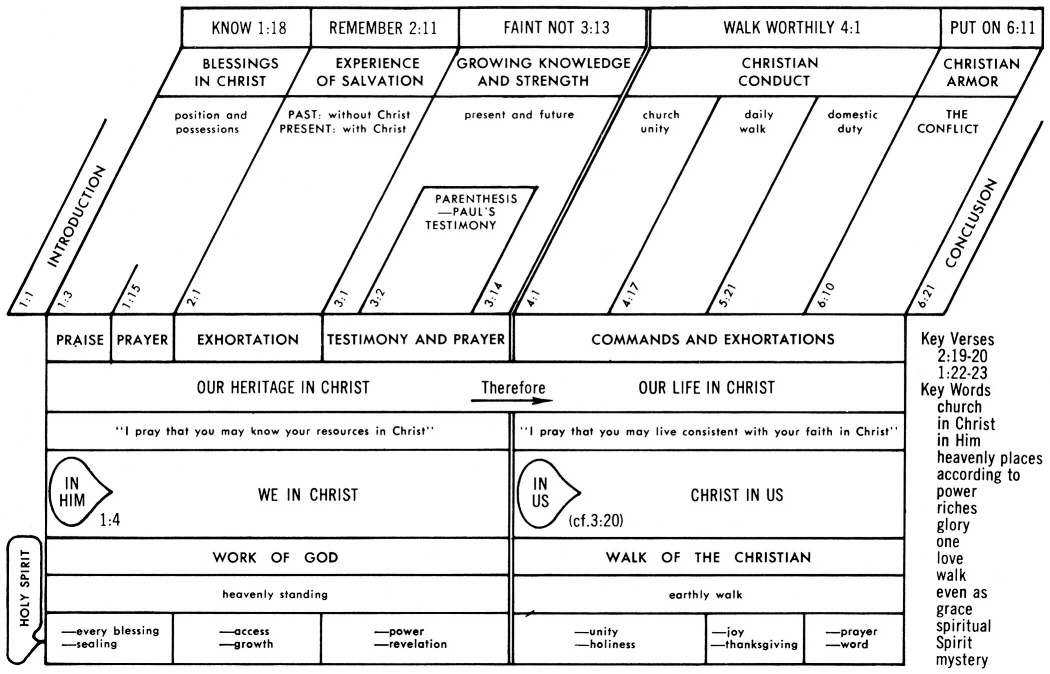
EPHESIANS - CHRIST AND THE CHURCH
Click chart to enlarge
Charts from Jensen's Survey of the NT - used by permission
| SYMMETRY OF EPHESIANS |
|
| EPHESIANS 1-3 | EPHESIANS 4-6 |
| The Root | The Fruit |
| Spiritual Wealth | Spiritual Walk |
| Christian Privilege | Christian Conduct |
| The Position of the Believer |
The Practice of the Believer |
| God Sees Us in Christ |
World Sees Christ in Us |
| Privilege | Practice |
| Doctrine | Duty |
| Doctrinal | Practical |
| Revelation | Responsibility |
| Christian Blessings |
Christian Behavior |
| Belief | Behavior |
| Privileges of the Believer |
Responsibilities of the Believer |
| Our Heritage In Christ |
Our Life In Christ |
| Know your Resources (Riches) in Christ |
Live by faith in the light of your Resources (Riches) in Christ |
| The Finished Work of Christ |
The Faithful Walk of the Christian |
| Work of Christ In Us |
Work of Christ Through Us |
| We in Christ |
Christ in Us |
| Word of God |
Walk of the Christian |
| Heavenly Standing |
Earthly Walk |
| Who You Are In Christ |
Whose You Are In Christ |
| Identity | Responsibility |
| Position of the Believer |
Practice of the Believer |
| Theology | Ethics |
Ephesians 6:11 Put on the full armor of God, so that you will be able to stand firm against the schemes of the devil. (NASB: Lockman)
Greek: endusasthe (2PAMM) ten panoplian tou theou pros to dunasthai (PPN) humas stenai (AAN) pros tas methodeias tou diabolou;
Amplified: Put on God’s whole armor [the armor of a heavy-armed soldier which God supplies], that you may be able successfully to stand up against [all] the strategies and the deceits of the devil. (Amplified Bible - Lockman)
NLT: Put on all of God's armor so that you will be able to stand firm against all strategies and tricks of the Devil. (NLT - Tyndale House)
Phillips: Put on God's complete armour so that you can successfully resist all the devil's methods of attack. (Phillips: Touchstone)
Wuest: Clothe yourselves with the full armor of God to the end that you will be able to hold your ground against the strategems of the devil, . (Eerdmans Publishing - used by permission)
Young's Literal: put on the whole armour of God, for your being able to stand against the wiles of the devil,
PUT ON THE FULL ARMOR OF GOD: endusasthe (2PAMM) ten panoplian tou theou:
- Eph 4:24; Romans 13:14; Colossians 3:10) (Eph 6:13; Romans 13:12; 2Corinthians 6:7; 10:4; 1Thessalonians 5:8
- Ephesians 6 Resources - Multiple Sermons and Commentaries
- Ephesians 6:11: Spiritual Warfare - 2 - Wayne Barber
- Ephesians 6:10-11 Standing Strong, Standing Firm - Steven Cole
- Ephesians 6:10-13 The Believer's Warfare, Part 1 - John MacArthur
- Ephesians 6:10-13 The Believer's Warfare, Part 2 - John MacArthur
Paul gives further explanation of what has to be done in order to be strong enough to meet spiritual enemies, especially the devil. It's not your armor that you are to put on but the armor God supplies. Another necessity in victorious warfare is to know the enemy. Don't try to fight your spiritual struggles based on human ingenuity or inherent personal strength. You don't stand a chance against the schemes of the invisible, powerful, crafty foe the devil. Spiritual warfare demands spiritual armor which can only be the "armor of God", the accoutrement He provides and which is even modeled on what He Himself wears as described by the prophet Isaiah....
Also righteousness will be the belt about His loins, and faithfulness the belt about His waist. (Isaiah 11:5 ) (Comment: compare this OT description to the picture of the Resurrected Lord Jesus Christ in Rev 1:13 where John saw "one like a son of man, clothed in a robe reaching to the feet, and girded across His breast with a golden girdle.")
And He put on righteousness like a breastplate, and a helmet of salvation on His head; and He put on garments of vengeance for clothing, And wrapped Himself with zeal as a mantle. (Isaiah 59:17)
Put on (also used in Eph 6:14) (1746) (enduo) from en = in + dúo = to sink, go in or under, to put on) means literally to clothe or dress someone and to put on as a garment, to cause to get into a garment (eg, Lk 15:22 where the father says "quickly bring out the best robe and put it on him...").
The aorist imperative is a command to do put on the armor now. Don't delay. There is a sense of urgency in the aorist imperative. Just do it like the Nike commercial says. The middle voice conveys the idea that it is your choice to do it. You put on yourself this armor. You make the choice to initiate the putting on of God's armor and then you participate in the benefits of having it on. Not one is going to put it on you. God is not going to force you to put it on. His command and His good and acceptable and perfect will is for you to put it on, but it still comes down to a choice you must make. It has to do with surrendering your will to His will. Saying no to self (self sufficiency, self confidence, etc) and saying yes to God, obeying Him out of love, as a son or daughter would their Abba, their Daddy.
Note also that this garment is unusual because it has to be put on from the inside! Ultimately this "new self" is Christ Himself (Ro 13:14) Legalism is putting them on the outside. You may look good in the pew or the pulpit but you won't be able to stand firm in the moment of temptation! Knowing the truth is not enough. You have to eat it, digest it, be renewed in your mind by it so that your futile thinking is taught, reproved, corrected and trained in the direction of righteousness then you are transformed from inside out by the Spirit.
The basic necessity for the believer is to depend on the Lord and put on the armor—and leave it on. We are gullible and vulnerable if we think that merely knowing the facts in Ephesians 6:10-18 will protect us. The armor is an absolute requirement for daily victorious living. And even the battles seem to wane, we cannot become apathetic or forget that we are in spiritual warfare everyday for the rest of our life until the day we die!
In the Gospels, enduo is used primarily in a literal sense e.g.
Matthew 6:25 "For this reason I say to you, do not be anxious for your life, as to what you shall eat, or what you shall drink; nor for your body, as to what you shall put on. Is not life more than food, and the body than clothing?
Matthew 22:11 "But when the king came in to look over the dinner guests, he saw there a man not dressed in wedding clothes,
Matthew 27:31 And after they had mocked Him, they took His robe off and put His garments on Him, and led Him away to crucify Him.
Mark 1:6 And John was clothed with camel's hair and wore a leather belt around his waist, and his diet was locusts and wild honey.
Mark 6:9 but to wear sandals; and He added, "Do not put on two tunics."
Mark 15:17 And they dressed Him up in purple, and after weaving a crown of thorns, they put it on Him...20 And after they had mocked Him, they took the purple off Him, and put His garments on Him. And they led Him out to crucify Him.
Luke 12:22 And He said to His disciples, "For this reason I say to you, do not be anxious for your life, as to what you shall eat; nor for your body, as to what you shall put on.
Luke 15:22 "But the father said to his slaves, 'Quickly bring out the best robe and put it on him, and put a ring on his hand and sandals on his feet
Jesus uses enduo once in a figurative sense in the Gospels declaring to His disciples...
Luke 24:49 "And behold, I am sending forth the Promise of My Father upon you; but you are to stay in the city until you are clothed with power (dunamis) from on high." (Comment: The Power, the Promise is His Spirit, Who God had promised in the description of the New Covenant in the Old Testament, [Ezekiel 36:27 "I will put My Spirit within you"], promised again in Acts 1:8 and realized in Acts 2:4 at Pentecost and then in every believer thereafter as described in Romans 8:9, Ephesians 1:13; 1:14])
Paul uses enduo are all figurative describing the putting on of "ethical, moral or spiritual" garments. And what a "wardrobe" he lays out for believers in his epistles...
THE ARMOR OF LIGHT
Romans 13:12 The night is almost gone, and the day is at hand. Let us therefore lay aside (middle voice = you yourself initiate this action and participate in the effect) the deeds of darkness and put on (clothe yourself = middle voice = you yourself initiate this action and participate in the effect) the armor of light. (See notes)
CHRIST HIMSELF AS OUR GARMENT
Galatians 3:27 For all of you who were baptized into Christ have clothed yourselves with Christ. (Comment: This putting on refers to salvation, at which time the Spirit replaced our filthy rags of sin with the righteousness of Christ - this is now and forever our new position before God. He sees us in Christ's righteousness - the theologians refer to this as positional truth = past tense salvation = justification).
Romans 13:14 But put on (our practice = present tense salvation = progressive sanctification - put Him on each morning and every moment of the day - aorist imperative [middle voice = you initiate the action and participate in the result = put Him yourself]) the Lord Jesus Christ, and make (present imperative = with the negative means to stop an action already in progress! You know what I am talking about!) no provision for the flesh in regard to its lusts. (See notes) (Comment: As you study the pieces of armor, you can see that ultimately putting each of them on is equivalent to clothing one's self with Christ - truth, righteousness, peace, faith
THE NEW SELF
Ephesians 4:24 and put on (not a command - aorist tense) the new self, which in the likeness of God has been created in righteousness and holiness of the truth. (Comment: As discussed in the notes there is debate between excellent commentators, some favoring this putting on as indicative of positional truth and others favoring it as calling for this to be our practice - progressive sanctification or present tense salvation).
Colossians 3:10 and have put on (past tense salvation = positional sanctification = our position now and forever in Christ - see our practice in Col 3:12) the new self who is being renewed to a true knowledge according to the image of the One Who created him (See notes)
Colossians 3:12 And so, as those who have been chosen of God (cf notes Eph 1:5), holy and beloved, put on (present tense salvation = progressive sanctification = our practice - a command be clothed [middle voice = clothe yourself] now = aorist imperative) a heart of compassion, kindness, humility, gentleness and patience (See notes)
THE BREASTPLATE OF FAITH AND LOVE
1 Thessalonians 5:8 But since we are of the day, let us be sober, having put on (at the time of our new birth = justification = our position = past tense salvation) the breastplate of faith and love, and as a helmet, the hope of salvation.
IMPERISHABLE, IMMORTAL GARMENTS
1 Corinthians 15:53 For this perishable must put on (glorification = future tense salvation) the imperishable, and this mortal must put on immortality. 54 But when this perishable will have put on the imperishable, and this mortal will have put on immortality, then will come about the saying that is written, "Death is swallowed up in victory.
What a "wardrobe" God has made available for believers! We're the "best dressed" folks in the world and most of us don't even know it!
And the best is yet to come for John describes our new...
GARMENTS OF FINE LINEN, WHITE AND CLEAN...
Revelation 19:14 And the armies (this is us, those redeemed by the blood of the Lamb) which are in heaven, clothed (enduo) in fine linen, white and clean, were following Him (the Lamb = Faithful and True = the Word of God) on white horses. (Comment: This incredible historical event will occur at the end of the 7 year period, Daniel's Seventieth Week, and marks the defeat of the antichrist and his armies and the inception of Messiah's Millennial Reign)
Full armor of God - genitive of source or origin indicating that God provides the armor. So we need not only Divine armor but that equipment in its completeness and with no part missing or in disrepair.
Paul frequently pictures the Christian as a soldier in his writings - see Ro 6:13, 23, Ro 13:12, 2Cor 10:4, 1Thes 5:8, 1Ti 1:18, 1Ti 6:12, 2Ti 2:3-4, 4:7). It is not surprising that Paul would draw the analogy of the Christian life with that of a soldier, for it was to a soldier that he was chained while in prison.
Wiersbe writes that...
Paul emphasizes the fact that the full armor is necessary if we are to defeat Satan. The area in our life that we leave unguarded is sure to be the very place that Satan attacks. On October 17, 1586, Sir Philip Sidney was killed at the Battle of Zutphen, because he was not wearing his full armor. He saw that Sir William Pelham was not wearing leg armor, so Sidney removed his. He was struck in the leg and died from the wound. I cannot stress enough the importance of complete protection. (Wiersbe, W: Strategy of Satan: How to Detect and Defeat Him)
Full armor (3833) (panoplia from pás = all, every + hoplon = weapon, originally any tool or implement for preparing a thing, became used in the plural for weapons of warfare) is literally wholly armed and refers to the complete set of instruments used in offensive and defensive war. The literal meaning referred to the full preparation of a foot soldier for offense and defense - the complete suit of armor. Certainly Paul could claim knowledge of the Roman soldier’s armor, being chained to one for some three years.
This armor is of God both is the sense that it is from Him, and in the sense that it is His actual armor Isaiah recording that the Messiah also wears this armor (Isaiah 59:17). It is His armor that Messiah now shares with every person who places their faith in Him. Truths such as these explain why Paul can exclaim...
But in all these things we overwhelmingly conquer (we continually -present tense- super-conquer) through Him who loved us. (We win the supreme victory through Him Who loved us. See note Romans 8:37) (Comment: Stedman writes "If we barely manage to win our way to heaven by the skin of our teeth, we could be said to be a conqueror, but a "more than conqueror" is someone who takes the worst that life can throw at him and uses that to become victorious. "More than conqueror" is one who, by the grace and the gift of God, and in the strength of God within him, actually takes the very things that are designed to destroy him, and they become stepping stones instead of stumbling blocks. That is being "more than conquerors." William Newell adds that "loved us" is past tense and "It is this past tense gospel the devil hates . . . Let a preacher be continually saying, ‘God loves you, Christ loves you,’ and he and his congregation will by and by be losing sight of both their sinnerhood and of the substitutionary atonement of the cross, where the love of God and of Christ was once for all and supremely set forth.")
God has supplied the complete armor, but He expects the Christian to put it on. We need the divine equipment in its completeness, without the lack of any single part. God has not sent us out into battle without everything we need at our disposal. However, there is no armor for the back -- we are expected to face our foe!
This Greek word gives us our English word, panoply, which refers to a full suit of armor; ceremonial attire; something forming a protective covering; a magnificent or impressive array; display of all appropriate appurtenances.
Expositor's writes that - The soldier must be protected from head to foot and the panoplia is made up of all the various hopla (hoplon = singular) or pieces of armor, both defensive and offensive. Polybius has left a detailed description of the heavily armed Roman infantryman or hoplite. Paul may have drawn his picture "live" from the soldier he was chained to in his house arrest, though it is not altogether certain that such a custodian would have been in full battle dress. (Gaebelein, F, Editor: Expositor's Bible Commentary 6-Volume New Testament. Zondervan Publishing)
TDNT - The soldier's equipment remains much the same for centuries but with minor variations, e.g., in the size of shields or the weight of armor. The Roman legionary carries a lance or spear, a shield, javelins, helmet, and breastplate of coat of mail. In the OT we read of shields, helmets, armor, shoes, spears, bows and arrows, and slings... The word is used only figuratively in the NT. (Kittel, G., Friedrich, G., & Bromiley, G. W. Theological Dictionary of the New Testament. Eerdmans)
Other than the use here and in Ephesians 6:13, there is only one other NT use...
Luke 11:22 but when someone stronger than he attacks him and overpowers him, he takes away from him all his armor on which he had relied, and distributes his plunder.
How does the believer put on the full armor of God? One of the most important ways is to hide God's Word in our heart (Ps 119:9-11) as if our very life depended upon it because our spiritual vitality does. Toward the close of World War II, Allied forces were mopping up against remaining Nazi resistance. One particular unit was assigned a crucial mission in Berlin. Each soldier had to memorize a map detailing all of Berlin's important military sites -- and they had to do it in a single night! In just a few hours, each soldier in the unit had committed the map to memory. The mission was a success. Several years later, the Army conducted an experiment to see if that original feat could be duplicated. They offered a similar unit an extra week's furlough--an attractive incentive--if they could carry out a comparable mission without a hitch. But the second unit could not match the success of the first. What made the difference? The lives of the men were not at stake. Surviving in battle was a greater motivation than a week's vacation. Christians are engaged in spiritual warfare. Our road map, our plan of strategy against Satan's military strongholds, is the Bible. The more we read it, the more of it we memorize, and the more thoroughly we know it, the more effective we will be for God. We must approach God's Word as if our lives depended on it--because they do. That's real motivation!
Thy Word is like an armory,
Where soldiers may repair,
And find, for life's long battle-day,
All needful weapons there. --Hodder
If your life depended on knowing the Bible, how long would you last?
How important is the full armor? Here's an illustration - Bull Moose - Recently National Geographic ran an article about the Alaskan bull moose. The males of the species battle for dominance during the fall breeding season, literally going head-to-head with antlers crunching together as they collide. Often the antlers, their only weapon are broken. That ensures defeat. The heftiest moose, with the largest and strongest antlers, triumphs. Therefore, the battle fought in the fall is really won during the summer, when the moose eat continually. The one that consumes the best diet for growing antlers and gaining weight will be the heavyweight in the fight. Those that eat inadequately sport weaker antlers and less bulk. There is a lesson here for us. Spiritual battles await. Satan will choose a season to attack. Will we be victorious, or will we fall? Much depends on what we do now—before the wars begin. The bull-moose principle: Enduring faith, strength, and wisdom for trials are best developed before they’re needed. (Craig Brian Larson - Bible.org)
VERSE BY VERSE EXPOSITION ON EPHESIANS 6:10-18...
- Ephesians 6:10
- Ephesians 6:11
- Ephesians 6:12
- Ephesians 6:13
- Ephesians 6:14
- Ephesians 6:15
- Ephesians 6:16
- Ephesians 6:17
- Ephesians 6:18
EPHESIANS 6:10-18 BY WAYNE BARBER
- Ephesians 6:10: Spiritual Warfare, Pt 1
- Ephesians 6:11: Spiritual Warfare, Pt 2
- Ephesians 6:14: Spiritual Warfare, Pt 3
- Ephesians 6:15,16 Spiritual Warfare, Pt 4
- Ephesians 6:17: Spiritual Warfare, Pt 5
- Ephesians 6:12,13 Spiritual Warfare, Pt 6
- Ephesians 6:18: Spiritual Warfare, Pt 7
VERSE BY VERSE EXPOSITION ON THE FALLEN FLESH
VERSE BY VERSE EXPOSITION ON RESISTING THE ROARING LION
VERSE BY VERSE EXPOSITION ON THE BATTLE IN OUR MIND
THE METAPHOR OF THE CHRISTIAN SOLDIER
- Soldier Illustrations
- Exposition of 2 Timothy 2:3-4
- Three Kinds of Soldiers - Ten Principles of Warfare
- Roman Soldier by Edward Gibbon (Decline & Fall of Roman Empire)
- The Roman Soldier - Description from Jewish Historian Josephus
- A Few Soldier Stories and Sermons
THE AMALEKITES: A PICTURE OF PERSISTENT SPIRITUAL WARFARE
SO THAT YOU WILL BE ABLE TO STAND FIRM AGAINST : pros to dunasthai (PPN) humas stenai (AAN) pros:
- Ep 6:13; Luke 14:29, 30, 31; 1Corinthians 10:13; Hebrews 7:25; Jude 1:24
- Ephesians 6 Resources - Multiple Sermons and Commentaries
- Ephesians 6:11: Spiritual Warfare - 2 - Wayne Barber
- Ephesians 6:10-11 Standing Strong, Standing Firm - Steven Cole
- Ephesians 6:10-13 The Believer's Warfare, Part 1 - John MacArthur
- Ephesians 6:10-13 The Believer's Warfare, Part 2 - John MacArthur
So that (4314) (pros) means "towards" and in this context introduces a purpose clause.
Expositor's Greek NT adds that "the general sense of direction (is) conveyed by the flexible preposition pros... In this short sentence it expresses mental direction, aim or object, and local direction, against."
Will be able (1410) (dunamai - see also related word dunamis = gives us English words like dynamic, dynamite, dynamo, etc) means to have power by virtue of inherent ability and resources. In this context this enablement is supernatural power. How else could we ever stand firm against our Adversary (or his demonic host of henchmen)? Simply put - we could not stand without the Spirit's supernatural enablement. Thank you Father for providing for us everything necessary for life and godliness (according to a true knowledge of Christ - 2Pe 1:3-note) and victory over our mortal foes, the the world, the flesh and the devil. Amen.
Paul uses the present tense and thus is saying that we are to continually be provided with this Divine enablement. No power outages or shorted circuits (because of willful sin for example) are allowed if we are to win each battle. Dunamis is God's omnipotent, omnipresent, inherent (miracle working) ability to enable us to accomplish what He commands us to do -- in this case to stand firm when the battle is raging all around us!
Note the passive voice (You may see in some of the online sources that include tense, voice and mood that the Textus Receptus says "middle or passive deponent" but clearly the context favors the passive voice) indicates that this enabling is an internal enablement provided by an outside source, the Spirit of God (see notes on "surpassing greatness of His power" - Eph 1:19-note; "strengthened with power through His Spirit in the inner man" - Eph 3:16-note; "Him Who is able to do...according to the power that works within us" -Eph 3:20-note ; "be filled filled [controlled] with the Spirit"-Eph 5:16-note).
What does that mean practically? It simply means that we have to be willing to let God enable us (See Php 2:13-note for how we even become "willing"!) We have to surrender. We have to yield our "rights." We have to be willing to let Him have His way rather than us having our way. We have to be willing to allow His Spirit to strengthen and control us at every moment during the battle. And thus strengthened in our inner man, we can then make the choice to take a stand, to hold firmly to our position, to resist the temptation to doubt, to fear, to gratify, etc, etc. We are more than conquerors through Christ Who loved us on Calvary and will love us eternally (Ro 8:37KJV). With such assurance and empowerment we can stand firm against every assault to the praise of the glory of His grace which He so richly lavishes upon us.
Notice that Paul uses dunamai three times in this short treatise on spiritual warfare indicating our need for enablement and our need to be willing to yield and receive power from the Spirit! (See note on Eph 6:16- note, cp Eph 6:13-note) In other words, attitudes such as self confidence, self sufficiency and self assurance, etc, have to be cast off like filthy garments of unrighteousness if we are to receive the necessary divine empowerment God graciously makes available.
To stand firm against - to hold a watch post, to stand and hold out in a critical position on a battlefield. This phrase belongs to the soldier's language and conveys the idea of standing one's ground, as opposed to taking flight. Note that stand is a key word in warfare (see notes Ephesians 6:11; 6:13; 6:14 - in verse 14 note that resist is a derivative of the Greek word for stand)
John Stott quotes Simpson writing that...
The tactics of intimidation and insinuation alternate in Satan’s plan of campaign. He plays both the bully and the beguiler. Force and fraud form his chief offensive against the camp of the saints.
Wayne Barber writes that...
The word "stand" there has the idea not of a casual standing but of a digging in.  The sandals of the Roman soldiers had spikes on them so they could dig in and hold their ground and not be knocked off course. (Click picture to enlarge figure of the spiked soldier shoes called "caligae") That is the idea of standing. It is not just a casual standing up. It has the idea of standing firm and holding the ground that you are on, not being knocked off course. You need to understand that Satan is in this world and wants to come in your face and put deceit in your mind. If you are not being strengthened in the inner man, your mind being affected by truth, letting the Lord Jesus Christ motivate you and live His life through you, you are a "dead duck". If you are not in the Word of God, you are not consistently seeking to let Him control your life...If you are not putting the Word in your mind, letting truth affect your life, then you have missed the whole point of what this conflict is over. It is not power against power. God can sneeze and put him down. It is the battle of truth. That is why it is so important for us to understand that we need to be strengthened in the inner man at all times because that affects the way we think and that affects the way we live.
Stand firm (2476) (histemi) means to stand. In context it conveys the idea of digging in (the Roman sandals had spikes for this purpose). It was a military term for holding one's position. Hold your ground. Don't give an inch of territory to the enemy. That is the picture.
From a practical standpoint one stands firm by living the obedient, Scripture–dominated, Spirit–empowered life - the Spirit in such a state is not quenched or grieved and strengthens the obedient believer to stand firm.
The greatest weapon we have in warfare is not what we say to the devil but how we live the ''Christ life''. Obey, surrender, submit for this is your greatest weapon. It's not binding but it's bowing, saying ''yes'' to Jesus and committing to do His Word...at the moment He says it...then at that moment you become a fortress against the devil.
We must live in light of the fact that just as much as "God loves you and has a wonderful plan for your life," so it is true that "Satan hates you and has a terrible plan for your life" - we do have an enemy who wishes us nothing but evil
Using the metaphor of a battle, in the military sense to stand firm meant to hold a watch post or to stand and hold a critical position on a battlefield while under attack! The intent of Paul's exhortation is not unlike that of our Lord to the embattled church at Thyatira, whom He commanded, “hold fast until I come” (Rev 2:25). The believer needs to be strengthened in the inner man, letting our mind be affected by the truth, and letting the Spirit of Christ motivate us (Ezekiel 36:27, see note Philippians 2:12) and live His life through you. Stand firm by being in His word, obeying His word, repenting quickly and returning to your first Love. If you are disobedient you are deceived and a deceived person doesn't even know it! Furthermore when you are deceived you are primed for defeat! That is how good the Deceiver is. Remember his territory is the darkness, this present world system, and even though believers have been transferred out of darkness and into God's marvelous light, we can still choose to place ourselves under his domain by willing disobedience.
AGAINST THE SCHEMES OF THE DEVIL : pros tas methodeias tou diabolou:
- Eph 4:14; Mk 13:22; 2Cor 2:11; 4:4; 11:3,13-15; 2Th 2:9, 10, 11; 1Pe 5:8; 2Pe 2:1, 2, 3; Rev 2:24; 12:9; 13:11-15; 19:20; 20:2,3,7,8
- Ephesians 6 Resources - Multiple Sermons and Commentaries
- Ephesians 6:11: Spiritual Warfare - 2 - Wayne Barber
- Ephesians 6:10-11 Standing Strong, Standing Firm - Steven Cole
- Ephesians 6:10-13 The Believer's Warfare, Part 1 - John MacArthur
- Ephesians 6:10-13 The Believer's Warfare, Part 2 - John MacArthur
Schemes of the devil - Here we encounter the commander in chief of the invisible army arrayed against us. He is our sworn, mortal enemy. This is not a video game or a fairy tale but a very real war with a very real, deceptive foe.
Earlier Paul had warned about the devil's schemes to disrupt the unity of the body writing that...
As a result, we are no longer to be children, tossed here and there by waves, and carried about by every wind of doctrine, by the trickery of men, by craftiness in deceitful scheming (Ep 4:14-note)
Against (4314) (pros) expresses direction - toward, on the side of, in the direction of. It can serve as a marker of closeness of relation or proximity. Pros is most commonly translated...against (21), before (10), toward (9). The picture is that of the believer facing these schemes.
The schemes of the devil - Note Paul's use of the definite article in Greek ("the") which defines these as specific schemes, not just general schemes. It suggests that the devil and his minions have specific schemes, "tailor made" for each person, for he is aware of the sin that so easily entangles each of us! Note that these schemes involve shrewdly devious and intriguing methods that entail following an orderly, technical procedure in the handling of a subject. Schemes is used to describe a wild animal cunningly stalking and unexpectedly pouncing on prey (cp 1Pe 5:8-note). Satan’s schemes to destroy us and do us harm are built around stealth and deception but as Paul writes to the Corinthians "we are not ignorant of his schemes." (2Corinthians 2:11)
Comment: Here schemes is not methodeia but noema [from nous = mind] and refers to the content of thinking and reasoning.
Samuel Rutherford reminds us that "Satan is only God’s master fencer to teach us to use our weapons."
Schemes (3180) (methodeia from methodeuo = to work by method in turn from meta = with, after + hodos = a way) refers to an orderly, logical, effective arrangement, usually in steps followed to achieve an end. It describes deliberate planning or a systematic approach and can have a positive or negative connotation. The negative meaning of methodeia implies the use of clever methods or strategies to attain the desired end. The Scripture always uses methodeia with a negative connotation.
Methodeia has reference to planned, subtle, systematized error. Error organizes. It has its systems and its logic. Be alert! Be mature! Satan’s scheming, crafty actions and artful designs have ‘method’ and purpose, for his aim is to mislead the immature who are not grounded on apostolic doctrine. Behind the evil men and women who seek to expound false teaching, there is also a supernatural evil power who seeks to deceive unwary saints with his "devilish" cunning.
Think about this simple definition in the context of spiritual warfare. Satan is orderly and logical in his steps employed against you to achieve his nefarious purposes. This realization should prompt each of us to be even more appreciative of the fact that we cannot stand against our invisible enemy in our own intelligence, our own strength or our own human "methods" or "schemes". We must put on the full armor that God supplies in Christ.
As alluded to above, the negative connotation of methodeia implies the use of cleverness, craftiness, cunning and deception. The "deceiver" uses specific, subtle, stealthy plans to target each individual, his goal being to defeat, discourage and dishearten. Stated another way, Satan's attacks are "tailor made" ("the schemes"), carefully and methodically selected to attack each person's specific weaknesses and vulnerabilities. His wiles and methods are usually attractive, always deceptive, and often ensnaring. Stay sober and alert!
Spurgeon has the following cautions regarding our Adversary, the devil writing that...
He will attack you sometimes by force and sometimes by fraud. By might or by sleight he will seek to overcome you, and no unarmed man can stand against him. Never go out without all your armor on, for you can never tell where you may meet the devil. He is not omnipresent, but nobody can tell where he is not, for he and his troops of devils appear to be found everywhere on this earth.
Puritan Thomas Watson wrote that...
Satan tempts after some discoveries of God’s love. As a pirate sets on a ship that is richly laden, so when a soul hath been laden with spiritual comforts the devil will be shooting at him, to rob him of all. The devil envies to see a soul feasted with spiritual joy.
David Jeremiah has an interesting thought on Satan's methodeia writing that...
If you could sneak into Satan’s office, wherever that might be (he’s not in hell yet), and take a peek into his files, you might be surprised to find a file folder with your name on it. I’m not exaggerating. He keeps a file on you, and inside that file are all the strategies he’s tried on you—the ones that have worked and the ones that have failed. He doesn’t waste his time with the ones that don’t work anymore. Instead, he uses variations on the strategies that have caused you to stumble in the past. As long as they keep working, he keeps using them. Somewhere in that file cabinet there’s a file labeled: Jeremiah, David. In this file, I wouldn’t be surprised at all if there was a notation that reads something like this: Subject may be prone to discouragement, especially if he becomes overly weary. This has worked several times before and seems a promising method of attack. Suggestion: Make sure he stays very busy, overcommitted, and physically tired. At all costs, keep him from extended times of Bible reading and prayer.
So what is Satan’s strategy for me? He looks for ways to discourage me, and if possible, cause me some depression. He will use whatever people, means, or circumstances it takes to achieve his goal.
It’s the same for you. Maybe your file says, “Frequently tempted to gossip,” or “quick temper,” or “prone to coveting and jealousy,” or “weak in the area of lust.”
Don’t kid yourself, he knows very well where your vulnerabilities lie. It’s all in his file. You’ve heard, perhaps, that God loves you and has a wonderful plan for your life. That’s very good news, but it is also true that Satan hates you and has a plan and strategy to destroy your walk with Jesus Christ.
That’s one big reason why you experience struggle and discouragement in your Christian experience. Sometimes I hear people say,
“Well, if you’re a Christian, you shouldn’t have any struggles. You shouldn’t ever feel discouraged. All is peace and joy and love and happiness.”
I don’t think so. I personally think that description fits better with life before you found salvation in Christ. Do you know why? Because you only had one influence in your life at that time. There was no contest for your heart. There was no tug-of-war for your soul. (Jeremiah, D. . God In You: Releasing the Power of the Holy Spirit in Your Life. Multnomah Publishers)
Methodeia is translated with a number of words as shown in the list below with each word followed by a definition. As you read through this list think about how each describes your mortal foe, the devil.
Craftiness - adept in the use of subtlety and cunning. No place in Scripture reveals Satan’s schemes better than Genesis 3, which records Satan’s initial contact with man.
Cunning - characterized by wiliness and trickery. It describes the faculty of executing well what one has devised.
Scheming - given to making plots; shrewdly devious and intriguing. Synonyms include artful, calculating, conniving, cunning, deceitful, designing, duplicitous, foxy, Machiavellian, slippery, sly, tricky, underhand, wily.
Strategies - careful plans or methods. Strategy can also refer to the art or science of the planning and conduct of a war. The Columbia Encyclopedia notes that "strategy and tactics, in warfare are related terms referring, respectively, to large-scale and small-scale planning to achieve military success. Strategy may be defined as the general scheme of the conduct of a war, tactics as the planning of means to achieve strategic objectives. Synonyms for strategy include: blueprint, design, game plan, project, scheme.
Stratagems - an artifice or trick in war for deceiving and outwitting the enemy. A cleverly contrived trick or scheme for gaining an end. Stratagem implies a ruse used to entrap, outwit, circumvent, or surprise an opponent or enemy.
Tactics - The derivation of the word tactic is very interesting and gives us some insight into the meaning of the devil's methods. The word "tactics" is from the Greek word taktikos which means "of order, of tactics, fit for arranging" and which in turn is derived from "tassein" which means to arrange or place in battle formation. Tactics is defined then as the science and art of disposing and maneuvering forces in combat. It refers to the art or skill of employing available means to accomplish an end. In short, the tactics of the devil are calculated plans specifically designed to bring the downfall of God’s people and His kingdom.
Trickery - the practice of crafty underhanded ingenuity to deceive or cheat. It implies ingenious acts intended to dupe or cheat.
Wiles - tricks or strategy carried out with the intent to entice, ensnare or deceive. Wiles suggests an attempt to entrap or deceive with false allurements. In short they are attractive!
Friberg states that methodeia can have a neutral or positive meaning referring simply to a...
"method or procedure (but) in the NT (is used) in a bad sense, (and refers to) scheming to deceive, craftiness, cunning, deception (see notes Ephesians 4:14); In the plural (as used in Ephesians 6:11) methodeia can refer to stratagems, cunning attacks, tricks" (Adapted from Friberg, T. Analytical lexicon of the Greek New Testament. Grand Rapids, Mich.: Baker Books)
John MacArthur writes that methodeia ("wiles") conveys...
the idea of cleverness, crafty methods, cunning, and deception. Satan’s schemes are propagated through the evil world system over which he rules, and are carried out by his demon hosts. “Wiles” is all-inclusive, encompassing every sin, immoral practice, false theology, false religion, and worldly enticement." (MacArthur, J.: The MacArthur Study Bible Nashville: Word Pub)
The Theological Dictionary of the New Testament has the following note on methodeia specifically commenting on its use in Ephesians 6:11...
"The reference is to machinations or (in military terms) attacks against which one must be armed. The nature of the attacks (the plural suggests that they are constantly repeated or are of incalculable variety) constitutes their great danger, against which the armour of God is the only defence. They are distinguished not so much by technique or strategy as by refinement and insidiousness (Vulgate translates insidiae, Luther “cunning attacks,” A.V. “wiles”)" (Kittel, G., Friedrich, G., & Bromiley, G. W. Theological Dictionary of the New Testament. Eerdmans)
The only other use of methodeia is in Ephesians 4:14 where as a result of being equipped and growing in maturity, the saints "are no longer to be children, tossed here and there by waves and carried about by every wind of doctrine, by the trickery of men, by craftiness (methodeia) in deceitful scheming." (See notes Ephesians 4:14)
The KJV has a picturesque rendering of Ephesians 4:14 stating that "they lie in wait (methodeia) to deceive."
Kenneth Wuest writes that "methodeia" is derived "from the verbal form methodeuo “to follow up or investigate by method and settled plan, to follow craftily, frame devices, deceive.” (Wuest Word Studies - Eerdman Publishing Company Volume 1, Volume 2, Volume 3 - used by permission)
Methodeia was used to describe a wild animal who cunningly stalked and unexpectedly pounced on its prey, a vivid depiction of the Adversary's "methods" against believers.
Satan’s schemes are propagated through the evil world system over which he rules, and are carried out by his demon hosts. “Wiles” is all-inclusive, encompassing every sin, immoral practice, false theology, false religion, and worldly enticement. Methodeia is a Greek word that denotes a path or roadway that is traveled over. This is because the devil continuously attempts to secure a foothold so that he may begin construction of a roadway to your mind."
Marvin Vincent adds that "methodeia means a deliberate planning or system."
Albert Barnes writes that "methodeia means properly that which is traced out with “method;” that which is “methodized;” and then that which is well laid - art, skill, cunning." (Albert Barnes' Notes on the Bible)
Ray Stedman in his excellent book "Spiritual Warfare" has this note regarding "methodeia":
"What are the tactics the devil employs? He destroys by deceiving, by lying, by distorting, by counterfeiting, by masquerading, by clouding human minds with illusion and fantasy. This is what Paul calls "the devil's schemes," or as some translations put it, "the wiles of the devil" Read through the Bible and see how many times the work of the devil is referred to in that manner - the snares and the traps of the devil, the lies and illusions, the stratagems and the wiles. That is why we must look closely at the tactics the devil uses against us so that we can be strong and well-defended when he comes to us to defeat us, weaken us, and ruin our lives....
By far, the majority of attacks of the devil against Christians are not direct but indirect. That is why they are called the "schemes" of the devil. Schemes suggest deviousness or acting in a way that is subtle, secretive, and treacherous.
We need to examine this more thoroughly, for the major attack of the devil and his powers against human life is not by direct means, but indirectly by satanic suggestions through the natural and commonplace situations of life (Click for more in depth discussion)...
So we have an enormous responsibility before God and before the entire world to give ourselves, body and soul, to this great battle against the schemes of the evil one. We have a responsibility to battle the schemes of the devil in this world, and to point the way to the peace and security that lies ahead of us in the world to come...most often the devil comes in disguise, through the channel of "the flesh" our inner selves with silken, subtle, suggestive schemes. That is the avenue of satanic attack the apostle Paul warns us most strenuously about: the subtle schemes of the devil." (Stedman, Ray. Spiritual Warfare. Revised edition, 1999 -- highly recommended) (Bolding added)
Stedman goes on to write "Friend, in Christ there is nothing that more clearly indicates that we have succumbed to the schemes of the devil than to complain about our lot in life. Again and again, the Word of God shows that the mark of a Christian who has learned how to be a Christian is that he rejoices in everything and gives thanks in all things." (Ed note: Only possible for one continually filled with the Spirit - see notes Ephesians 5:18) (Ibid) (Bolding added)
Murphy writes that "The idea behind methodeia is deception. The apostle is warning us that the devil’s entire system of warfare against us is based on deception. He fights not on a pitched field, but by sudden assault and secret and cunning onslaught." (Murphy, E. F. Handbook for Spiritual Warfare. Nashville: Thomas Nelson)
Eadie in his classic commentary on Ephesians adds that...
The great enemy of man, a veteran fierce and malignant, has a method of warfare peculiar to himself, for it consists of “wiles.” His battles are the rush of a sudden ambuscade (ambush). He fights not on a pitched field, but by sudden assault and secret and cunning onslaught. Vigilance, self-possession, and promptitude are therefore indispensable to meet him: and as his aim is to throw his opponents off their guard and then to surprise them, so there is need to be ever clothed in this complete armour of God. His “wiles” are seen in unsettling the mind of Eve by representing God as jealous of the first man and woman; in stirring up the warlike aspirations of David to take a military census and force a conscription as the basis of a standing army; in inflaming the avaricious and sordid spirit of Judas; and in his assaults on our Lord by an appeal to appetite, piety, and ambition. (John Eadie, D., LL.D. The Epistle of St Paul to the Ephesians)
Oswald Chambers has a good word about the methodeia of the devil writing that...
We cannot stand against the wiles of the devil by our wits. The devil only comes along the line that God understands, not along the lines we understand, and the only way we can be prepared for him is to do what God tells us, stand complete in his armor, indwelt by His Spirit, in complete obedience to Him." (Oswald Chambers 1874–1917)
Jonathan Edwards wrote that "the best protection one can have from the devil and his schemes is a humble heart."
James Burns writes that...
The danger of listening to the voice of the Tempter, and the subtlety by which he accomplishes his wiles, is illustrated by R. Spencer Stanhope in a picture in the Manchester Art Gallery, entitled “Eve.” In it he represents the Serpent whispering in her ear while she listening, plays with the sin within her mind. At the same time, unseen by her, he bends a branch of the tree with a coil of his body, and lo! as she dallies with the sin in her mind, an apple drops into her open hand. When the temptation has once been permitted to enter, the means of gratifying it is at hand." (Tan, P. L. Encyclopedia of 7700 illustrations)
MacDonald warns that
"the devil has various stratagems—discouragement, frustration, confusion, moral failure and doctrinal error. He knows our weakest point and aims for it. If he cannot disable us by one method, he will try for another....
Most serious of all is the danger of deception. Those who are babes are unskillful in the word of righteousness, their senses are not exercised to discern between good and evil (Heb. 5:13, 14). They inevitably meet some false cultist who impresses them by his zeal and apparent sincerity. Because he uses religious words, they think he must be a true Christian. If they had studied the Bible for themselves, they would be able to see through his deceitful juggling of words. But now they are carried about by his wind of doctrine and led by unprincipled cunning into a form of systematized error. (MacDonald, W & Farstad, A. Believer's Bible Commentary: Thomas Nelson)
The Open Bible defines our Adversary's "schemes" as "superhuman craftiness, capable of drawing careless Christians into sin."
Warren Wiersbe writes that "The danger on the battlefield is that we do not take the enemy seriously and therefore fail to put on all of the armor. By faith, you put on the armor through prayer, which must be done at the beginning of every day. Never underestimate the strategy and strength of the devil." (Wiersbe, W. W. With the Word : The Chapter-by-Chapter Bible Handbook Nashville: Thomas Nelson)
Seldom does Satan ever attack openly with an overt frontal assault (and by the way most of us will probably never be attacked by Satan himself as he is a finite not omnipresent being. But he does command a host of fallen angels who share his evil design for mankind). In contrast, Satan's Schemes are nearly always unseen, shrewd, and perfectly tailored to ensnare his victim like a fowler camouflaging his net to trap a bird ("methodical"). "Schemes, wiles and methods" speak of the trickery and subterfuge by which evil and temptation present themselves in our lives. Evil rarely looks evil until it accomplishes its goal. It gains entrance by appearing attractive, desirable, and perfectly legitimate. But to reiterate it is a baited and camouflaged trap. As Paul puts it in 2 Corinthians 11:14, Satan masquerades as an angel of light.

Statue of Arrow in Achilles' Heel!
Spurgeon - Satan and Our Weak Spot - We all have our tender spots. When Thetis dipped Achilles in the River Styx, you remember she held him by the heel; he was made invulnerable wherever the water touches him, but his heel not being covered with the water, was vulnerable, and there Paris shot his arrow, and he died. It is even so with us. We may think that we are covered with virtue till we are totally invulnerable, but we have a heel somewhere; there is a place where the arrow of the devil can make way; hence the absolute necessity of taking to ourselves “the whole armor of God,” so that there may not be a solitary joint in the harness that shall be unprotected against the arrows of the devil. Satan is very crafty; he knows the “ins” and “outs” of manhood. There is many an old castle that has stood against every attack, but at last some traitor from within has gone outside, and said, “I know an old deserted passage, a subterranean back way, that has not been used for many a day. In such and such a field you will see an opening; clear away a heap of stones there, and I will lead you down the passage; you will then come to an old door of which I have the key, and I can let you in; and so by a back way I can lead you into the very heart of the citadel, which you may then easily capture.” It is so with Satan. Man does not know himself so well as Satan knows him. There are back ways and subterranean passages into man’s heart which the devil well understands (ED: "METHODEIA"); and he who thinks that he is safe, let him take heed lest he fall (1 Cor 10:12).
THOUGHT - Where (what) is your achilles heel? Be alert to "arrows" being shot at that spot to take you out of action! Is there a part of the "whole armor" you are failing to put on? If so you are vulnerable to the schemes of the devil!
Satan’s Tools - An old fable says that the devil once offered his tools for sale, intending to give up his business. He displayed these tools—malice, hatred, jealousy, deceit, and several others, with the prices marked on them. One of them was set apart, marked with a higher price than the others. When the devil was asked why this was, he said, “Because that is my most useful tool; it is called depression; with that I can do anything with people.” How true! Let us watch, therefore, when it makes its appearance and take our stand against depression; it is often from the devil. (AMG Bible Illustrations)
God's Word teaches that Satan, our relentless, determined Adversary, the Devil, carries out the following with great craft and cunning (and even this long list is not exhaustive!)
(1) ACCUSES
Job 1:6-11 Now there was a day when the sons of God came to present themselves before the LORD, and Satan also came among them. 7 And the LORD said to Satan, "From where do you come?" Then Satan answered the LORD and said, "From roaming about on the earth and walking around on it." 8 And the LORD said to Satan, "Have you considered My servant Job? For there is no one like him on the earth, a blameless and upright man, fearing God and turning away from evil." 9 Then Satan answered the LORD, "Does Job fear God for nothing? 10 "Hast Thou not made a hedge about him and his house and all that he has, on every side? Thou hast blessed the work of his hands, and his possessions have increased in the land.11 "But put forth Thy hand now and touch all that he has; he will surely curse Thee to Thy face."
Job 2:1-7 Again there was a day when the sons of God came to present themselves before the LORD, and Satan also came among them to present himself before the LORD. 2 And the LORD said to Satan, "Where have you come from?" Then Satan answered the LORD and said, "From roaming about on the earth, and walking around on it." 3 And the LORD said to Satan, "Have you considered My servant Job? For there is no one like him on the earth, a blameless and upright man fearing God and turning away from evil. And he still holds fast his integrity, although you incited Me against him, to ruin him without cause." 4 And Satan answered the LORD and said, "Skin for skin! Yes, all that a man has he will give for his life. 5 "However, put forth Thy hand, now, and touch his bone and his flesh; he will curse Thee to Thy face." 6 So the LORD said to Satan, "Behold, he is in your power, only spare his life." 7 Then Satan went out from the presence of the LORD, and smote Job with sore boils from the sole of his foot to the crown of his head.
Zechariah 3:1-2 Then he showed me Joshua the high priest standing before the Angel of the LORD, and Satan standing at his right hand to accuse (Hebrew = satan!) him. 2 And the LORD said to Satan, "The LORD rebuke you, Satan! Indeed, the LORD who has chosen Jerusalem rebuke you! Is this not a brand plucked from the fire?"
Revelation 12:10-11 And I heard a loud voice in heaven, saying, "Now the salvation, and the power, and the kingdom of our God and the authority of His Christ have come, for the accuser (kategoros - one who speaks openly against, to condemn or accuse mainly in a legal sense) of our brethren has been thrown down, who accuses them before our God day and night. 11 "And they overcame (nikao = get the victory, conquer, prevail, "Nike missile") him because of the blood of the Lamb and because of the word of their testimony, and they did not love their life even to death. (See notes Revelation 12:10; Revelation 12:11)
(2) AFFLICTS
Job 1:12-19 Then the LORD said to Satan, "Behold, all that he has is in your power, only do not put forth your hand on him." So Satan departed from the presence of the LORD. 13 Now it happened on the day when his sons and his daughters were eating and drinking wine in their oldest brother's house, 14 that a messenger came to Job and said, "The oxen were plowing and the donkeys feeding beside them, 15 and the Sabeans attacked and took them. They also slew the servants with the edge of the sword, and I alone have escaped to tell you." 16 While he was still speaking, another also came and said, "The fire of God fell from heaven and burned up the sheep and the servants and consumed them, and I alone have escaped to tell you." 17 While he was still speaking, another also came and said, "The Chaldeans formed three bands and made a raid on the camels and took them and slew the servants with the edge of the sword; and I alone have escaped to tell you." 18 While he was still speaking, another also came and said, "Your sons and your daughters were eating and drinking wine in their oldest brother's house, 19 and behold, a great wind came from across the wilderness and struck the four corners of the house, and it fell on the young people and they died; and I alone have escaped to tell you."
Job 2:6-7 So the LORD said to Satan, "Behold, he is in your power, only spare his life."7 Then Satan went out from the presence of the LORD, and smote Job with sore boils from the sole of his foot to the crown of his head.
Luke 13:16 "And this woman, a daughter of Abraham as she is, whom Satan has bound for eighteen long years, should she not have been released from this bond on the Sabbath day?"
Revelation 2:10 'Do not fear what you are about to suffer. Behold, the devil is about to cast some of you into prison, that you may be tested, and you will have tribulation ten days. Be faithful until death, and I will give you the crown of life. (See notes Revelation 2:10)
(3) CONQUERS
Note: Remember that "in all these things we are more than conquerors through Him Who loved us." (NKJV, Ro 8:37)
Acts 10:38 "You know of Jesus of Nazareth, how God anointed Him with the Holy Spirit and with power, and how He went about doing good, and healing all who were oppressed (katadunasteuo = to tyrannize, rule over as a potentate, oppress harshly, exercise dominion against) by the devil; for God was with Him.
Ephesians 6:16; in addition to all, taking up the shield of faith with which you will be able to extinguish all the flaming missiles of the evil one.
2Timothy 2:25-26 (The Lord's bondservant) with gentleness correcting those who are in opposition, if perhaps God may grant them repentance leading to the knowledge of the truth, 26 and they may come to their senses and escape from the snare of the devil, having been held captive by him to do his will. (Comment: Note what sets the captive free - The Truth. The struggle is not a power struggle but a truth struggle!) (See notes 2 Timothy 2:25; 2:26)
(4) DECEIVES
Genesis 3:1-6,13 Now the serpent was more crafty than any beast of the field which the LORD God had made. And he said to the woman, "Indeed, has God said, 'You shall not eat from any tree of the garden'?" 2 And the woman said to the serpent, "From the fruit of the trees of the garden we may eat; 3 but from the fruit of the tree which is in the middle of the garden, God has said, 'You shall not eat from it or touch it, lest you die.'" 4 And the serpent said to the woman, "You surely shall not die! 5 "For God knows that in the day you eat from it your eyes will be opened, and you will be like God, knowing good and evil." 6 When the woman saw that the tree was good for food, and that it was a delight to the eyes, and that the tree was desirable to make one wise, she took from its fruit and ate; and she gave also to her husband with her, and he ate...13 Then the LORD God said to the woman, "What is this you have done?" And the woman said, "The serpent deceived (beguiled, led astray, deluded, seduced) me, and I ate." (cf 1Ti 2:14 And it was not Adam who was deceived, but the woman being quite deceived (seduced into error, enticed into sin), fell into transgression.)
John 8:44 "You are of your father the devil, and you want to do the desires of your father. He was a murderer from the beginning (see Genesis 3:1-6,13+), and does not stand in the truth, because there is no truth in him. Whenever he speaks a lie, he speaks from his own nature; for he is a liar, and the father of lies. (Comment: Oliver Wendell Holmes wrote, “Sin has many tools, but a lie is the handle which fits them all.”)
Acts 13:10 (Saul known as Paul filled with the Holy Spirit spoke to Elymas the magician who was opposing the apostles) and said, "You who are full of all deceit (dolos = deliberate attempt to mislead other people by telling lies, duplicity, deliberate dishonesty, deceitful cunning) and fraud (recklessness, malignity, mischief, intrigue, unscrupulousness), you son of the devil, (in Acts 13:6 he is called "Bar-Jesus" = son of Jesus or son of Joshua! cf 2Cor 11:13-15 below) you enemy of all righteousness, will you not cease to make crooked the straight ways of the Lord?
2Cor 4:3-4 And even if our gospel is veiled (kalupto = covered over and hence not visible), it is veiled to those who are perishing (apollumi = pertains to destruction but not annihilation, to that which is ruined and is no longer usable for its intended purpose), 4 in whose case the god of this world (aion) (cf 1John 5:19) has blinded (tuphloo - cf use in 1John 2:11) the minds of the unbelieving (note that this speaks of their rejection of the light of the gospel which leaves only one alternative, the darkness of unbelief!), that they might not see the light of the gospel of the glory of Christ, Who is the image of God.
2Cor 11:13-15 For such men (those who were boasting that their work was like Paul's and the real apostles) are false apostles (pseudapostolos), deceitful (dolios - guile filled, from dolos = one who deliberately attempt to mislead by telling lies with desire to gain advantage or preserve position) workers, disguising (metaschematizo from metá = change of place or condition + schematízo = change outward form without a change in the internal character as in metamorphoo = transfigure, transform, the outward here being truly representative of the inward nature) themselves as apostles of Christ. 14 And no wonder, for even Satan disguises himself as an angel of light. 15 Therefore it is not surprising if his servants also disguise themselves as servants of righteousness; whose end shall be according to their deeds.
2Thess 2:8-10 And then that lawless one (Anti-Christ, man of lawlessness, son of destruction in 2Thess 2:3-4, the "little horn" of Da 7) will be revealed (apokalupto - he will be caused to be fully known, this "revelation" corresponding to the midpoint [3.5 years, time, times, half a time, 42 months, 1260 days] of Daniel's Seventieth Week) whom the Lord will slay with the breath of His mouth (cf Rev 19:15, 20) and bring to an end by the appearance (epiphaneia - literally His "shining forth" or upon with the idea of sudden and unexpected!) of His coming (parousia - the Second Coming of Christ); 9 that is, the one whose coming is in accord with the activity (energeia - operative power) of Satan, with all power and signs and false (pseudos = lying) wonders, 10 and with all the deception (apate = that which gives a false impression, whether by appearance, statement or influence; causes one to have misleading or erroneous views concerning the Truth) of wickedness for those who perish, because they did not receive the love of the truth so as to be saved. 11 And for this reason God will send upon them a deluding influence (this is a Divine judicial decree, a reaping of their sowing, a consequence of their refusal to readily and deliberately make the choice to accept the Truth by which they could have been delivered and born again) so that they might believe what is false.
Revelation 2:9 'I know your tribulation and your poverty (but you are rich), and the blasphemy by those who say they are Jews and are not, but are a synagogue of Satan. (See notes Revelation 2:9)
Revelation 3:9 'Behold, I will cause those of the synagogue of Satan, who say that they are Jews, and are not, but lie-- behold, I will make them to come and bow down at your feet, and to know that I have loved you. (See notes Revelation 3:9)
(5) HINDERS
1Thessalonians 2:18 For we wanted to come to you-- I, Paul, more than once-- and yet Satan thwarted (egkopto from en = in + kopto = cut down, strike. To hinder, impede, detain. In classic Greek a military metaphor = to cut in on, throw obstacles in the way of or cut up the road so that normal movement is impossible!) us.
(6) MURDERS
John 8:44 (See #4 above)
(7) PERVERTS
Acts 13:10 (See #4 above)
2Th 2:9-10 (See #4 above)
(8) PROMPTS
1Chr 21:1 Then Satan stood up against Israel and moved David to number Israel. (Note: Actually God permitted Satan to prompt David to take a census of the people, and David insisted on doing it, contrary to Joab's advice. 2 Sa 24:1 "Now again the anger of the LORD burned against Israel, and it incited David against them to say, "Go, number Israel and Judah." The point is that Satan can only do what God allows! God here is said to have caused the action in the sense of permitting Satan to put David to the test. Be careful when you commit sins, for you are entering into Satan's domain of darkness!)
John 13:2,26-27, 30 And during supper, the devil having already put into the heart of Judas Iscariot, the son of Simon, to betray Him... 26 Jesus therefore answered, "That is the one for whom I shall dip the morsel and give it to him." So when He had dipped the morsel, He took and gave it to Judas, the son of Simon Iscariot. 27 And after the morsel, Satan then entered into him. Jesus therefore said to him, "What you do, do quickly."...30 And so after receiving the morsel he went out immediately; and it was night (an appropriate time for Judas who was now fully controlled by darkness, cf Luke 22:53 "While I was with you daily in the temple, you did not lay hands on Me; but this hour and the power [exousia] of darkness are yours.").
Acts 5:3, 9 But Peter said, "Ananias, why has Satan filled your heart to lie to the Holy Spirit, and to keep back some of the price of the land?...9 Then Peter said to her, "Why is it that you have agreed together to put the Spirit of the Lord to the test? Behold, the feet of those who have buried your husband are at the door, and they shall carry you out as well."
(9) SCHEMES
2Cor 2:11 (repent of an unforgiving spirit) in order that no advantage be taken of us by Satan; for we are not ignorant of his schemes. (Comment: When we sin and fail to repent we give the devil an opportunity. In this verse the sin is unforgiveness and it allows Satan to take advantage, to exploit, to cheat or to defraud. We need to get out of the darkness and walk in the light, where Satan cannot gain an advantage. If the church family—or any person in the family—carries an unforgiving spirit, then Satan will use that attitude as a beachhead for new assaults against the church.
As someone has well said an unforgiving spirit is the devil’s playground, and before long it becomes the Christian’s battleground. If somebody hurts us, either deliberately or unintentionally, and we do not forgive them, then the potential is for us to develop bitterness, which hardens the heart. We should be tenderhearted and kind, but instead we are hardhearted and bitter. Actually, we are not hurting the person who hurt us but are only hurting ourselves. Bitterness in the heart makes us treat others the way Satan treats them, when we should treat others the way God has treated us. In His gracious kindness, God has forgiven us, and we should forgive others. God Himself is infinitely kind, tender–hearted, and forgiving, and we show those virtues by imitating their Source. We do not forgive for our sake or even for their sake, but for Jesus’ sake. Learning how to forgive is one of the secrets of a happy Christian life and allows one to stand firm against the schemes of the devil.
Ephesians 6:11 (see notes)
1Timothy 3:7 And he must have a good reputation with those outside the church, so that he may not fall into reproach and the snare (pagis - a trap which is fixed or fastened by a noose or notch and which can fall unexpectedly or suddenly so that wild animals and birds are caught by surprise) of the devil.
(10) STALKS
1Peter 5:8-5:9 Be of sober spirit, be on the alert. Your adversary, the devil, prowls about like a roaring lion, seeking someone to devour. 9 But resist him, firm in your faith, knowing that the same experiences of suffering are being accomplished by your brethren who are in the world. (See notes 1 Peter 5:8; 1 Peter 5:9)
(11) STEALS
Mt 13:19 "When anyone hears the word of the kingdom, and does not understand it, the evil one comes and snatches away what has been sown in his heart. This is the one on whom seed was sown beside the road.
Luke 8:12 "And those beside the road are those who have heard; then the devil comes and takes away the word from their heart, so that they may not believe and be saved.
(12) TEMPTS
Mark 1:12-13 And immediately the Spirit impelled Him to go out into the wilderness. 13 And He was in the wilderness forty days being tempted (peirazo) by Satan; and He was with the wild beasts, and the angels were ministering to Him.
Luke 4:1-13 And Jesus, full of the Holy Spirit, returned from the Jordan and was led about by the Spirit in the wilderness 2 for forty days, being tempted (peirazo) by the devil. And He ate nothing during those days; and when they had ended, He became hungry. 3 And the devil said to Him, "If You are the Son of God, tell this stone to become bread."4 And Jesus answered him, "It is written, 'MAN SHALL NOT LIVE ON BREAD ALONE.'" 5 And he led Him up and showed Him all the kingdoms of the world in a moment of time. 6 And the devil said to Him, "I will give You all this domain (exousia) and its glory; for it has been handed over to me, and I give it to whomever I wish (Jesus did not correct Satan - the world system indeed had been given to him as John wrote "We know that we are of God, and the whole world lies [asleep like a baby in a cradle!] in the power of the evil one" 1John 5:19). 7 "Therefore if You worship before me, it shall all be Yours." 8 And Jesus answered and said to him, "It is written, 'YOU SHALL WORSHIP THE LORD YOUR GOD AND SERVE HIM ONLY.'" 9 And he led Him to Jerusalem and had Him stand on the pinnacle of the temple, and said to Him, "If You are the Son of God, throw Yourself down from here; 10 for it is written, 'HE WILL GIVE HIS ANGELS CHARGE CONCERNING YOU TO GUARD YOU,' 11 and, 'ON their HANDS THEY WILL BEAR YOU UP, LEST YOU STRIKE YOUR FOOT AGAINST A STONE.'" (Here the devil misquotes Scripture to his advantage - this promise applies only to those whose ways are in God's will and Satan left that critical detail out of the verse when he quoted Ps 92:11-12) 12 And Jesus answered and said to him, "It is said, 'YOU SHALL NOT PUT THE LORD YOUR GOD TO THE TEST.'" 13 And when the devil had finished every temptation, he departed from Him until an opportune time (see study of kairos).
1Cor 7:5 Stop depriving (present imperative = with negative implies this practice was already ongoing) one another, except (1) by agreement (2) for a time (kairos - a specified aliquot of time) (3) that you may devote yourselves to prayer, and come together again lest Satan tempt (peirazo) you because of your lack of self-control. (Comment: The general rule is that neither husband nor wife has the right to refuse the physical relationship of marriage. Here Paul presents a possible exception that applies if all three conditions are fulfilled = sexual abstinence is permissible if the couple agrees in advance, set a specific time limit, and does so for the purpose of prayer. The KJV adds "fasting and prayer". Sexual abstinence can become a tool of Satan and is never to be used as pretense for spiritual superiority or as a means of intimidating or manipulating one’s spouse. Physical love is to be a normal and regular experience shared by both marriage partners and avoids "the schemes of the devil"!)
1Thess 3:5 For this reason (knowing they were going to suffer affliction which might have made them vulnerable to the schemes of the devil), when I could endure it no longer, I also sent to find out about your faith, for fear that the tempter (peirazo) might have tempted you, and our labor should be in vain (empty, fruitless, without success).
(13) THREATENS
Heb 2:14-15 Since then the children share in flesh and blood, He Himself likewise also partook of the same, that through death He might render powerless him who had the power of death, that is, the devil; 15 and might deliver those who through fear of death were subject to slavery all their lives. (Comment: The wages of sin are death, spiritually and eternally. Christ died as a satisfactory sacrifice [see Heb 2:16-17] and paid the price for our sins, the wages of which were death [see note Romans 6:23] so that the devil no longer holds the power of death over believers and we no longer are held in bondage to that fear). (See notes Hebrews 2:14; 2:15; 2:16; 2:17)
This list (which is not exhaustive) of the "wiles of the devil" should thoroughly convince each of us of our need to be totally dependent on the full of armor of God and His Spirit's strengthening of our inner man, causing us not to hesitate for even a moment to put on the whole armor! What are you waiting for dear Christian friend? Are any of the "pieces" missing or in disrepair. Then return and confess and repent and go forth into battle as more than a conqueror through Him Who loved us.
"Repent (aorist imperative = urgent. Do it now!) therefore and return (aorist imperative = urgent. Don't procrastinate!), that your sins may be wiped away (blotted out, erased, obliterated), in order that times of refreshing (literally recovery of breath and so revival) may come from the presence of the Lord" (Acts 3:19) (Comment: This verse in context was Peter's call to the Jewish audience to be saved, but is still applicable in principle to believer's who have chosen momentarily to walk in darkness instead of the light.)
Men don’t believe in a devil now
As their fathers used to do,
They reject one creed because it is old
For another because it is new.But who dogs the steps of the toiling saint?
Who spreads the net for his feet?
Who sows the tares in the world’s broad fields,
Where the Savior sows His wheat?They may say the devil has never lived,
They may say the devil has gone,
But simple people would like to know
Who carries the business on?
Gem Cyclopedia
A. T. Robertson warns that the devil "is a crafty foe and knows the weak spots in the Christian’s armor."
Expositor's Bible Commentary writes that..
In the second century A.D. the church interpreted these (schemes or methodeia) as torture inflicted on the martyrs. But in the context of Ephesians they are more likely to have been deliberate attempts to destroy the unity of Christ's body (Eph 3:14-22; 4:1-16, 27) through the invasion of false doctrine and the fomenting of dissension (Eph 4:2, 21, 31, 32; 5:6). (Gaebelein, F, Editor: Expositor's Bible Commentary 6-Volume New Testament. Zondervan Publishing)
A few of the Devil's schemes...
A. Makes us think money is more important than living sincerely before God.
B. Defames God’s character by accusing him of impure motives.
C. Opposes the necessity of Christ’s death for our salvation.
D. Tries to cripple spiritual leaders.
E. Prevents believers from meeting together in fellowship.
F. Prevents non-Christians from understanding and believing the gospel.
G. Sends his evil supporters to infiltrate the ranks of true Christians. (from Discipleship Journal. Issue 2. Mar/Apr 1981)
One of the Devil’s most effective schemes or stratagems is to instill doubts about God’s goodness. These seeds of "doubt" can grow into an ungrateful spirit that refuses to thank God at all times for all things. Doubts about God was one of Satan's greatest tools against Martin Luther. After the frightful Anfechtung (Contestation) of 1527 Luther wrote that
"For more than a week I was close to the gates of death and hell."
It is therefore no surprise that Luther's great hymn A Mighty Fortress Is Our God has such great stanzas on "spiritual warfare.
Roland Bainton, Luther’s biographer, writes:
“The content of his depressions was always the same, the loss of faith that God is good and that He is good to me."
Stand Up, Stand Up for Jesus
(Play)
“Stand up, stand up for Jesus,
Stand in His strength alone;
The arm of flesh will fail you,
You dare not trust your own.
Put on the gospel armor,
Each piece put on with prayer;
Where duty calls or danger,
Be never wanting there.”
-----George Duffield
The devil (1228)(diabolos from diá = through, between + ballo = to cast, throw) means a false accuser, slanderer (one who utters false charges or misrepresentations which defame and damage another’s reputation), backbiting (malicious comment about one not present), one given to malicious gossip or a calumniator (one who utters maliciously false statements, charges, or imputations about, this term imputes malice to the speaker and falsity to the assertions). See the discussion on the background on spiritual warfare (Click Ephesians 6:12)
The New York Times, in reporting on a survey by the Barna Group, noted that two-thirds of Americans do not believe in the devil as a living entity. The Times called it “a result of fundamental, long-term shifts in the nation’s religious culture.”
Ray Stedman writes that...
The devil is real, he is active, he is working day and night, trying to subvert and undo and defeat God's plan in human history. The devil is our enemy. And this is war. There is a spiritual war going on behind the scenes of history, and that spiritual war in the unseen world is driving events in our own visible world. There is no peace in the material world because there is a war now raging in the spiritual world. There is nothing more meaningful, more relevant, more real that we could be involved in than the cause of God in this vast spiritual war. The biblical teaching of spiritual warfare shines a spotlight of truth on the basic problem of human existence and human history. (Stedman, Ray. Spiritual Warfare)
Wuest has an interesting comment that the literal meaning of "to throw through" means “to riddle one with accusations.” (Wuest Word Studies - Eerdman Publishing Company Volume 1, Volume 2, Volume 3 - used by permission)
Warren Wiersbe makes an important point about dealing with the devil...
I was watching an electrician install a complex control panel. I said to the man, “It just amazes me how you fellows can calmly work on those lines with all of that power there. How do you do it?” The electrician smiled and said, “Well, the first thing you have to do is respect it. Then you can handle it.”
Satan is a dangerous enemy. He is a serpent who can bite us when we least expect it. He is a destroyer (Rev 12:11; Abaddon and Apollyon both mean “destruction”) and an accuser (Zech. 3:1, 2, 3, 4, 5; Rev. 12:9, 10, 11). He has great power and intelligence, and a host of demons who assist him in his attacks against God’s people (Eph 6:10ff). He is a formidable enemy; we must never joke about him, ignore him, or underestimate his ability. We must “be sober” and have our minds under control when it comes to our conflict with Satan.
A part of this soberness includes not blaming everything on the devil. Some people see a demon behind every bush and blame Satan for their headaches, flat tires, and high rent. While it is true that Satan can inflict physical sickness and pain (Luke 13:16; Job 1:8, 9, 10, 11, 12, 13, 14, 15, 16,1 7, 18, 19, 20, 21 - see especially Job 1:22!), we have no biblical authority for casting out “demons of headache” or “demons of backache.” One lady phoned me long distance to inform me that Satan had caused her to shrink seven and a half inches. While I have great respect for the wiles and powers of the devil, I still feel we must get our information about him from the Bible and not from our own interpretation of experiences. (Wiersbe, W: Bible Exposition Commentary. 1989. Victor)
In warfare knowledge of one's enemy is vital in order to assure victory in battle. General Erwin Rommel was known as the "Desert Fox" because of his military prowess, especially in the North African desert in WWII. It is said that one of the keys that eventually led to his defeat was the fact that the Allied command was able to "get inside his head" and gain a sense of how he would strategize. How did they do this? They studied his detailed memoirs which had been published and thus began to gain insights into his personality, and thus his methods! In the same way, although believers are not to focus on Satanology, they are called to be aware of his schemes. Paul emphasized the importance of forgiveness to the church at Corinth...
in order that no advantage (pleonekteo = from pleion = more + echo = have > the idea is to outwit, get the better of, cheat, exploit or defraud) be taken of us by Satan (literally = Adversary); for we are not ignorant (unaware, uninformed about) of his schemes (KJV = devices = noema = purposes conceived by thinking = designs, intentions, schemes, plots, stratagems). (2Cor 2:11)
The works of the devil are defined as "schemes" (Ephesians 6:11), "devices" (KJV) (2Cor 2:11), "snares" (2Ti 2:26-note). Our adversary beguiles, seduces, opposes, resists, deceives, sows tares, hinders, buffets, tempts, persecutes, blasphemes. Our adversary is personal, aggressive, intelligent, cunning and destructive, and is to be reckoned with seriously, vigilantly and intelligently.
Be careful to avoid one of two extremes in regard to the devil. First, do not think that Satan causes everything and is everywhere. Satan is a created being and a controlled being (cf. see especially Job 1-2; Zech. 3:1, 2, 3, 4, 5) and is neither omnipresent nor omniscient. The other extreme is justly as dangerous and that is to think that there is no such being as the devil, but that he is imaginary or myth. He is very real and very wily believers need to be very wary (not frightened). As stated elsewhere in the notes the spiritual struggle believers face with the devil and his demonic henchmen is not a power struggle as much as it is a truth struggle and the primary battlefield is therefore our minds.
In Ephesians 2:1, 2:2 (see notes) we are introduced to him.
And you were dead in your trespasses and sins, in which you formerly walked according to the course of this world, according to the prince of the power of the air, of the spirit that is now working in the sons of disobedience" (Ep 2:1, 2-notes)
Comment: Satan occupies a twofold in the earth and in the air; ruling over both evil men and evil spirits. Christ never acknowledged Satan as king, but three times he calls him "the prince of this world," thereby acknowledging his governmental authority. Ephesians teaches that he is the ruling spirit over "the sons of disobedience," which includes all unregenerate mankind.
In John 8:44 Jesus said
"You are of your father the devil, and you want to do the desires of your father. He was a murderer from the beginning, and does not stand in the truth, because there is no truth in him. Whenever he speaks a lie, he speaks from his own nature; for he is a liar, and the father of lies." (Comment: Because he is a liar and a murderer, the devil's work is to deceive and to destroy. There you have the explanation for all the misery, hatred, murder, war, and other evils that have taken place in human history. Whom the devil cannot deceive, he tries to destroy, and whom he cannot destroy, he attempts to deceive. That is the working of the devil)
The devil was once an angel in heaven, the most beautiful angel in heaven. He led a rebellion against God and, as a result, was cast into the lower heavens. He walks on this earth, but he still has access into heaven to accuse the brethren both day and night.
In Genesis 3 we read that
"the serpent was more crafty than any beast of the field which the LORD God had made. And he said to the woman, "Indeed, has God said, 'You shall not eat from any tree of the garden'?"
The devil deceived the woman and caused the man to sin. By getting Adam to sin, sin entered the world and something else happened. Paul writes...
"Therefore, just as through one man sin entered into the world, and death through sin, and so death spread to all men, because all sinned-- (Ro 5:12-note)
As a result of the sin of Adam, the depravity of man, the authority of this earth, its inhabitants and its lower atmosphere became Satan’s legally in the just system of God. When man sinned, it was like the world was turned over to the authority (exousia = now Satan had the right and might) of darkness, legally, because man chose to disobey his God. Death, the result of the curse of sin, was his weapon. His kingdom is a kingdom of darkness and deceit. Every person is born into his kingdom.
Wayne Barber writes that...
Before the cross and the substitutionary death of Jesus on the cross, man lived in fear of the devil and death. But Jesus conquered them both. In Ephesians 1:20 it says that He, Jesus, was seated far above all principality and powers. As a matter of fact, look at verse 20:
which He brought about in Christ, when He raised Him from the dead, and seated Him at His right hand in the heavenly places, far above all rule and authority and power and dominion, and every name that is named, not only in this age, but also in the one to come. (See notes Ephesians 1:20; 1:21)
He didn’t say He seated Him above, he said He seated Him "far above". Let me explain to you what that means. If you could take the power of Satan and put it on a scale next to the power of God, his doesn’t even show up. God’s is far above all principalities and powers. I want you to know that warfare is not a struggle against power. It is a struggle to maintain truth. We will see that as we walk through this. Satan is no equal to God. He is a creation. God is the Creator!
SPIRITUAL WARFARE
is not a struggle against
POWER.
It is a struggle to maintain
the TRUTH.
Well, the believer needs to be aware that Satan is around. We are told that by Peter in his epistle. We need to be aware of the demonic. We need to be aware of darkness. We need to be aware that it has infected a world system and is in our face daily. We need to be aware of that, however, our focus is not to be on that. Our focus is to be on the resurrected, ascended, glorified Lord Jesus Christ and on His resurrection power in each individual life.
FOCUS ON THE LIGHT
Our FOCUS is to be on the resurrected, ascended, glorified Lord Jesus Christ and on His resurrection power in each individual life. That is our focus. We do not focus on darkness. We focus on light. The Prince and the power of light is the Lord Jesus Himself.
1John 5:18-19 says...
"We know that no one who is born of God [transformed, delivered, made into a new creature] sins [habitually = present tense] but He who was born of God keeps him, and the evil one does not touch him. We know that we are of God, and that the whole world (kosmos) lies (present tense = continually) in [the power of] the evil one." (Comment: Note that "touch him" means touch to do harm.)
J Vernon McGee has an interesting comment on "lies" in 1John 5:19...
This is the text of a sermon which I have preached on several occasions entitled “When the Devil Puts the Baby to Sleep.” “And we know that we are of God, and the whole world lieth [actually, lies asleep - e.g., see Lk 2:12,16] in wickedness [or, in the arms of the wicked one].” In other words, the Devil has the world asleep. The Devil is saying to Vernon McGee, “Sh-h-h. Hush! You’re waking people up, and we don’t want to do that! They are very comfortable. Many people in churches are dead in trespasses and sins, and we don’t want to wake them up. Let’s leave them alone.” The Devil is concerned when people are awakened. You and I are living in a world that is asleep in the arms of the wicked one—if you look around today, you must agree with that statement. (McGee, J V: Thru the Bible Commentary: Thomas Nelson)
Paul had warned about the wiles of the devil earlier writing...
and do not give (stop giving = present imperative with a negative) the devil an opportunity. (Ep 4:27-note) (See Dwight Pentecost's comment)
The KJV Commentary warns that...
Men dream of a devil that is a hideous, horned, and hoofed monster who haunts the vice dens of the world; but God says he fashions himself into an angel of light and fashions his ministers as ministers of righteousness (2Cor 11:14,15). He is the champion of liberalism, ritualism, rationalism, and every other “ism” that seeks to displace Christ. His aim is to substitute something else and something different for the grace and truth of Christ. Never underestimate the enemy. (Dobson, E G, Charles Feinberg, E Hindson, Woodrow Kroll, H L. Wilmington: KJV Bible Commentary: Nelson)
John Eadie writes that...
The great enemy of man, a veteran fierce and malignant, has a method of warfare peculiar to himself, for it consists of “wiles.” His battles are the rush of a sudden ambuscade. He fights not on a pitched field, but by sudden assault and secret and cunning onslaught. Vigilance, self-possession, and promptitude are therefore indispensable to meet him: and as his aim is to throw his opponents off their guard and then to surprise them, so there is need to be ever clothed in this complete armour of God. His “wiles” are seen in unsettling the mind of Eve by representing God as jealous of the first man and woman; in stirring up the warlike aspirations of David to take a military census and force a conscription as the basis of a standing army; in inflaming the avaricious and sordid spirit of Judas; and in his assaults on our Lord by an appeal to appetite, piety, and ambition. (Ephesians 6 Commentary)
Diabolos is the noun form of the verb diaballo which describes not only those who bring a false charge against one, but also those who disseminate the truth concerning a man, and do so maliciously, insidiously and with hostility.
Notice how the root words (diá = through + ballo = throw) picture what the devil does. He constantly throws between seeking to divide whether it be between a husband and wife, a child and parent, a church, etc. Resist his divisive, condemnatory accusations firm in your faith. Wuest has an interesting comment that the literal meaning of "to throw through" means “to riddle one with accusations.” (Wuest Word Studies - Eerdman Publishing Company Volume 1, Volume 2, Volume 3 - used by permission)
Diabolos is applied some 34 times to Satan, the god of this world, and in each case has the definite article in the Greek ("the" = defining a specific entity) and is never in the plural (the three uses below in the pastoral epistles are all plural) as when applied to men who, by opposing the cause of God, may be said to act the part of the devil or to side with him.
Note that this discussion of diabolos is intended to focus primarily on the meaning of the Greek word and not the more general Biblical teaching on the devil. For more all inclusive articles on "the Devil" click one of the following resources: Torrey's Topical provides an excellent Scriptural summary of "The Devil" (see also Torrey's topic on the various Names of the Devil) ; Holman's Bible Dictionary article has a well done summary on "Devil"; Nave's Topical Analysis of Satan; in depth article on "Satan" in International Std Bible Encyclopedia.
Diabolos is coupled with the word “Satan” (transliteration of Hebrew word meaning “adversary”) in the Revelation, John recording that an angel from heaven
laid hold of the dragon, the serpent of old, who is the devil and Satan, and bound him for a thousand years (Re 20:2-note)
Diabolos is used of one who makes accusations and presses charges. In Revelation 12:9-10, we read that "the great dragon was thrown down, the serpent of old who is called the devil and Satan, who deceives the whole world; he was thrown down to the earth, and his angels were thrown down with him. And I heard a loud voice in heaven, saying, "Now the salvation, and the power, and the kingdom of our God and the authority of His Christ have come, for the accuser (kategor) of our brethren has been thrown down, who accuses (kategoreo - present tense = describes the devil's continual activity) them before our God day and night." How grateful saints can be that "There is therefore now no condemnation for those who are in Christ Jesus." (Ro 8:1-note:1)
Are you safe and protected from the devil's accusations "in Christ Jesus" dear reader? If not, cry out this very moment to the Most High God for Him to give you His grace that you might this moment experience eternal security in Christ through your exercising of personal faith in Christ's life, death, burial, resurrection and sure, soon return. God is faithful.
Constable has an excellent summary of Satan's schemes...
Satan has consistently aimed his personal attacks at getting people to doubt, to deny, to disregard, and to disobey the revealed will of God (cf. Gen. 3; Matt. 4). The world system seeks to get people to believe that they do not need God but can get along very well without Him (1 John 2). The flesh tempts us to think that we can find satisfaction, joy, and fulfillment on the physical, material level of life alone (Ro 7). (Ephesians Expository Notes) (Boding added)
Wiersbe gives us...
A word of caution here: never discuss things with Satan or his associates. Eve made this mistake, and we all know the sad consequences. Also, never try to fight Satan in your own way. Resist him the way Jesus did, with the Word of God (Mt 4:1-11). (Wiersbe, W: Bible Exposition Commentary. 1989. Victor)
William Evans wrote that it is popular in some circles to day to spell the word devil with the letter "d" left off thus reducing the idea of an actual person called the devil to a mere influence called evil. The devil may be out of fashion, but he's not out of business and as Evans adds...
"If the devil can't mislead people that way, he would have them think of him as a horrible, monstrous-looking creature with a forked tail, dressed in a fiery red suit, and with horns protruding from his head. If the devil can get folks to think of him like that, then when he comes as an 'angel of light', he will not be recognized, and so find it easier to beguile his unsuspecting victims."
Discipleship Journal asked its readers to rank the areas of greatest spiritual challenge to them. The results came back in this order:
1. Materialism
2. Pride
3. Self-centeredness
4. Laziness
5. (Tie) Anger/Bitterness and Sexual lust
6. Envy
7. Gluttony
8. Lying
The respondents also noted that temptations were more potent when they had neglected their time with God (81 percent) and when they were physically tired (57 percent). Resisting temptation was accomplished by prayer (84 percent), avoiding compromising situations (76 percent), Bible study (66 percent), and being accountable to someone else (52 percent).
Spurgeon said...:
Where he cannot destroy, there is no doubt that Satan’s object is to worry. He does not like to see God’s people happy. Martin Luther used to say, “Let us sing psalms and spite the devil,” and I have no doubt Martin Luther was pretty nearly right; for that lover of discord hates harmonious, joyous praise.
As the worker in metals knows that one metal is to be worked at such a heat, and another at a different temperature; as those who have to deal with chemicals know that at a certain heat one fluid will boil, while another reaches the boiling-point much earlier, so Satan knows exactly the temperature at which to work us to his purpose. Small pots boil directly when they are put on the fire, and so little men of quick temper are soon in a passion; larger vessels require more time and coal before they will boil, but when they do boil, it is a boil indeed, not soon forgotten or abated. The enemy, like a fisherman, watches his fish, adapts his bait to his prey; and knows in what seasons and times the fish are most likely to bite.
Grant Richison warns us that...
"The Devil uses stealth. He stalks every Christian. He is now on the loose. He is on the prowl looking to trap you in his devices. The Devil always seeks opportunities to undermine our Christian walk. He is constantly on the prowl. He is not omnipresent for he can only be in one place at a time. However, he has a massive infrastructure of emissaries (demons) who do his bidding. They seek to seduce every one of us. The Devil says,
"I am looking for the spiritually naive. I'm patrolling the earth for simple souls who think that I am not real."
The idea that the Devil walks about in a red union suit, having a forked tail and cloven hoofs and carries a pitch fork is a religious fairy tale. He camouflages himself with this idea." (Richison, G. Today's Word)
by Martin Luther
A mighty fortress is our God,
A bulwark never failing;
Our helper he, amid the flood
Of mortal ills prevailing:
For still our ancient foe
Doth seek to work us woe;
His craft and power are great,
And, armed with cruel hate,
On earth is not his equal.
Did we in our own strength confide,
Our striving would be losing;
Were not the right Man on our side,
The Man of God’s own choosing:
Dost ask who that might be?
Christ Jesus, it is he;
Lord Sabaoth, his name,
From age to age the same,
And he must win the battle.
And tho this world, with devils filled,
Should threaten to undo us,
We will not fear, for God hath willed
His truth to triumph thro’ us:
The Prince of Darkness grim,
We tremble not for him;
His rage we can endure.
For lo, his doom is sure,
One little word will fail him.
That word above all earthly pow’rs,
No thanks to them, abideth;
The Spirit and the gifts are ours
Thro’ him who with us sideth:
Let goods and kindreds go,
This mortal life also;
The body they may kill:
God’s truth abidest still,
His kingdom is forever.
The following devotional illustrations are all from Our Daily Bread (Our Daily Bread, Copyright RBC Ministries, Grand Rapids, MI. Reprinted by permission. All rights reserved)
Shrike System Ephesians 6:10-18 April 4, 2006
The ancient sport of falconry used trained hawks or falcons in the pursuit of wild game. When the "educated predator" was allowed to fly, however, it often rose too high for human eyes to see. So a hunter often carried a small caged bird called a shrike. By watching the antics of the little bird, the man could always tell where his hawk was, for the shrike instinctively feared the predator and cocked its head to keep it in view.
Christians desperately need an alert perception similar to that of the shrike to detect their spiritual enemy. Our adversary, Satan, "walks about like a roaring lion, seeking whom he may devour" (1 Peter 5:8). Our responsibility, according to the apostle Peter, is to be sober and vigilant. In other words, we’re to be always on the alert.
It would be nice if God had giant sirens to warn us of an attack by the devil. But He doesn’t operate that way. Instead, we must read the Bible regularly, meditate on its truths, maintain a prayerful attitude throughout the day, and be filled with the Holy Spirit. Only then will we be sensitive to an imminent assault by the evil one, and be armed by grace to meet it. —Mart De Haan
The devil is clever, deceiving us all,
He cunningly causes the strongest to fall;
But we his sly methods are sure to discern
By making God’s warnings our daily concern. —D. De Haan
He who is in you is greater than he who is in the world. —1John 4:4
The Angel Of Music Ephesians 6:10-18 May 28, 2006
In Andrew Lloyd Webber’s musical The Phantom of the Opera, a young chorus girl named Christine Daae receives voice training from a mysterious musician she calls the “Angel of Music.” Christine believes this is the angel her dying father had promised to send to complete her musical training.
As the plot thickens, we find that her mysterious mentor is really a demented man who wants to carry her away into a bizarre underworld beneath the opera house. What the girl thinks is a supernatural agent sent by her beloved father is really a madman who wants to possess her for his own ends. The “Angel of Music” is evil masquerading as good.
The believer in Christ also faces an evil one who masquerades. One of Satan’s key strategies is to look like someone who is good. Paul told us, “Satan himself transforms himself into an angel of light” (2Corinthians 11:14). The Greek word translated as “transforms” means “to change appearance, masquerade, or disguise oneself.”
In preparing us to face the evil strategies of the devil, God has provided all the equipment we need to stand our ground. Protecting ourselves with the armor of God unmasks the evil that opposes us and stabilizes our spiritual walk (Ephesians 6:10-18). —Dennis Fisher
When you’re making a decision,
Evil sometimes wears a mask;
Trust the Lord for true discernment—
He’ll give wisdom if you ask. —Hess
God’s armor is tailor-made for us, but we must put it on.
Blackbeard March 22, 2006 Ephesians 6:10-18
As a young man in the late 1600s, Edward Teach joined the crew of a British ship that was headed to the Caribbean. Much later in his nautical career, he managed to capture a merchant vessel and turn it into a 40-gun warship. Teach soon became known as Blackbeard—the most feared pirate in the hemisphere.
Blackbeard had some success as a pirate, but his “career” abruptly ended when he encountered a contingent of the British Royal Navy. In a desperate battle, he and his fellow pirates were killed, putting an end to their terrorizing exploits.
Long ago in the heavenly places, an angel fell into spiritual piracy. Lucifer was a cherub who stood in the radiant glory of God (Ezekiel 28:11, 12, 13, 14, 15). But his own self-love replaced love for his Creator. Desiring to be like the Most High, he led a rebellion and was cast out of heaven (Isaiah 14:12, 13, 14, 15). Today he and his henchmen are doing whatever they can to commandeer the lives of human beings (Luke 8:12; 2Cor 4:4).
Even so, we don’t need to be afraid. Satan is a dangerous enemy, but Jesus sealed his ultimate fate when He rose from the dead. And He has given us everything we need to withstand the devil’s attacks (Ephesians 6:10-18). —Dennis Fisher
And though this world with devils filled
Should threaten to undo us;
We will not fear, for God has willed
His truth to triumph through us. —Luther
He who is in you is greater than he who is in the world. —1John 4:4
My Achilles Heel Ephesians 6:10-18 July 17, 2001
Nobody is temptation-proof. Even mature Christians have weaknesses in their spiritual armor that make them vulnerable to a wounding attack by the enemy of their souls. Our pride can provide the very opening needed for the sharp thrust of a satanic dart. So can the love of money, a quick temper, a critical tongue, or chronic impatience.
What, after all, is temptation? It's any enticement to think, say, or do something contrary to God's holy will. It may be a weak impulse or a powerful urge. It's anything that's against what God approves or desires for us.
The ancient Greeks told a story of a warrior named Achilles. His mother had been warned that he would die of a wound, so she dipped him as an infant in the river Styx. That was supposed to make him invincible. But she held him by one heel which the protective waters didn't cover. And it was through that heel that he received his fatal wound.
Each of us must ask: What is my Achilles heel? We need to know our weaknesses, where we could easily be wounded spiritually. Then, as we rely on the Lord for His help, we will be protected from "the fiery darts of the wicked one" (Ephesians 6:16). —V C Grounds
Leave no unguarded place,
No weakness of the soul;
Take every virtue, every grace,
And fortify the whole. —Wesley
Our greatest weakness may be our failure to ask for God's strength.