Ephesians 6:2
Ephesians 6:3
Ephesians 6:4
Ephesians 6:5
Ephesians 6:6
Ephesians 6:7
Ephesians 6:8
Ephesians 6:9
Ephesians 6:10
Ephesians 6:11
Ephesians 6:12
Ephesians 6:13
Ephesians 6:14
Ephesians 6:15
Ephesians 6:16
Ephesians 6:17
Ephesians 6:18
Ephesians 6:19
Ephesians 6:20
Ephesians 6:21
Ephesians 6:22
Ephesians 6:23
Ephesians 6:24
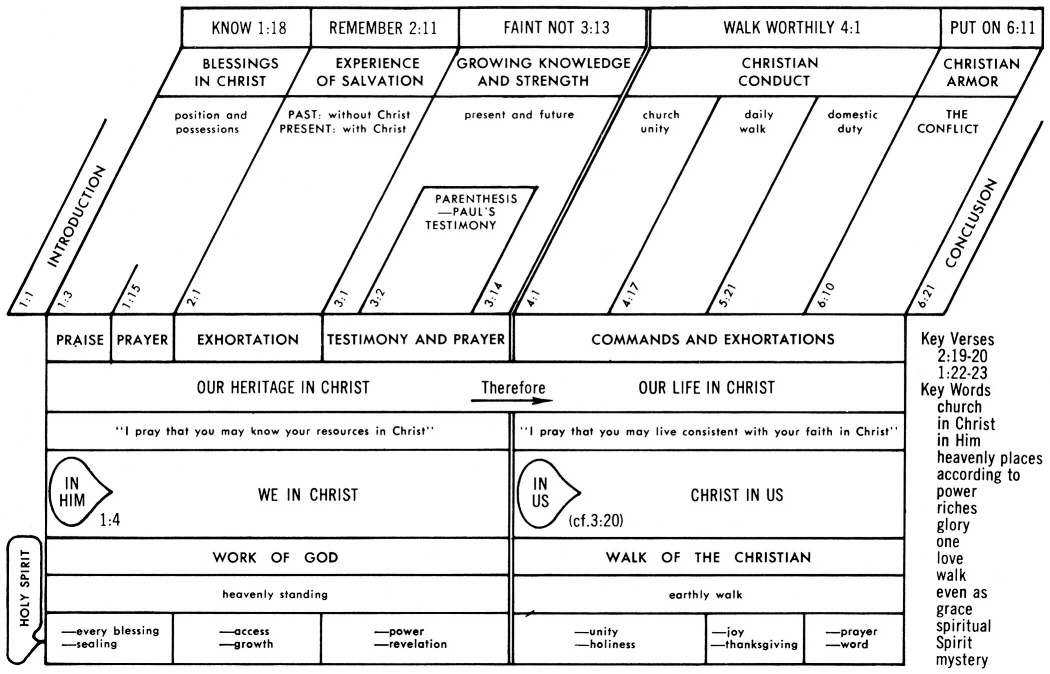
EPHESIANS - CHRIST AND THE CHURCH
Click chart to enlarge
Charts from Jensen's Survey of the NT - used by permission
| SYMMETRY OF EPHESIANS |
|
| EPHESIANS 1-3 | EPHESIANS 4-6 |
| The Root | The Fruit |
| Spiritual Wealth | Spiritual Walk |
| Christian Privilege | Christian Conduct |
| The Position of the Believer |
The Practice of the Believer |
| God Sees Us in Christ |
World Sees Christ in Us |
| Privilege | Practice |
| Doctrine | Duty |
| Doctrinal | Practical |
| Revelation | Responsibility |
| Christian Blessings |
Christian Behavior |
| Belief | Behavior |
| Privileges of the Believer |
Responsibilities of the Believer |
| Our Heritage In Christ |
Our Life In Christ |
| Know your Resources (Riches) in Christ |
Live by faith in the light of your Resources (Riches) in Christ |
| The Finished Work of Christ |
The Faithful Walk of the Christian |
| Work of Christ In Us |
Work of Christ Through Us |
| We in Christ |
Christ in Us |
| Word of God |
Walk of the Christian |
| Heavenly Standing |
Earthly Walk |
| Who You Are In Christ |
Whose You Are In Christ |
| Identity | Responsibility |
| Position of the Believer |
Practice of the Believer |
| Theology | Ethics |
Ephesians 6:12 For our struggle is not against flesh and blood, but against the rulers, against the powers, against the world forces of this darkness, against the spiritual forces of wickedness in the heavenly places. (NASB: Lockman)
Greek: hoti ouk estin (3SPAI) hemin e pale pros aima kai sarka, alla pros tas archas, pros tas exousias, pros tous kosmokratoras tou skotous toutou, pros ta pneumatika tes ponerias en tois epouraniois.
Amplified: For we are not wrestling with flesh and blood [contending only with physical opponents], but against the despotisms, against the powers, against [the master spirits who are] the world rulers of this present darkness, against the spirit forces of wickedness in the heavenly (supernatural) sphere. (Amplified Bible - Lockman)
CEV - We are not fighting against humans. We are fighting against forces and authorities and against rulers of darkness and powers in the spiritual world.
NLT: For we are not fighting against people made of flesh and blood, but against the evil rulers and authorities of the unseen world, against those mighty powers of darkness who rule this world, and against wicked spirits in the heavenly realms. (NLT - Tyndale House)
Phillips: For our fight is not against any physical enemy: it is against organisations and powers that are spiritual. We are up against the unseen power that controls this dark world, and spiritual agents from the very headquarters of evil. (Phillips: Touchstone)
Wuest: because our wrestling is not against blood and flesh, but against the principalities, against the authorities, against the world rulers of this darkness, against spirit forces of perniciousness in the heavenly places. (Eerdmans Publishing - used by permission)
Young's Literal: because we have not the wrestling with blood and flesh, but with the principalities, with the authorities, with the world-rulers of the darkness of this age, with the spiritual things of the evil in the heavenly places;
FOR OUR STRUGGLE IS NOT AGAINST FLESH AND BLOOD: hoti ouk estin (3SPAI) hemin e pale pros aima kai sarka:
- Luke 13:24; 1Corinthians 9:25, 26, 27; 2Timothy 2:5; Hebrews 12:1,4
- Matthew 16:17; 1Corinthians 15:50; Galatians 1:16
- Ephesians 6 Resources - Multiple Sermons and Commentaries
- Ephesians 6:12-13 Spiritual Warfare - 6 - Wayne Barber
- Ephesians 6:12-13 Why Christians Must be Fighters - Steven Cole
- Ephesians 6:10-13 The Believer's Warfare, Part 1 - John MacArthur
- Ephesians 6:10-13 The Believer's Warfare, Part 2 - John MacArthur
YOUR REAL WAR NOT AGAINST
PEOPLE BUT DEMONIC FORCES
For (hoti) - Notice the little preposition "for" (there are over 7000 "for's" in Scripture) and if the context indicates, as it does in this passage, that the "for" is a term of explanation, pause and ask yourself what is the Spirit seeking to explain?
As Adrian Rogers said "We are at spiritual war! Therefore, the church is not a cruise ship with the pastor as the master of ceremonies. Indeed it is not a showboat, but a battleship. We're called to see Satan's strongholds crumble under the power of heaven's artillery. We do not have the luxury of neutrality. We must engage in the fight. A truce will never be called. God's will for his saints is not that we merely survive, but that we thrive in total victory. General Douglas MacArthur spoke rightly when he said, "In war there is no substitute for victory." We must be aware of our enemy if we would have this victory. We need to learn of our infernal foe."
Martyn Lloyd Jones from his introduction to Ephesians 6:10-20 - Then go on to realize that there is nothing quick and easy about all this (fighting spiritual warfare). You have to go on doing it. ‘Put on the Gospel armour. Each piece put on with prayer.’ You do not simply do one thing and then all is right and well. No, Paul gives us all these details, and it takes time to work them out. There is nothing quick and ready-made about this; you have to work it out in detail. Finally, you have to keep on doing it. There is ‘no discharge in this war’. While you and I are alive in this world the devil will be there with all his evil and malignity; and he will fight us to the end, he will fight us to our deathbed. Is this hopeless? It is the reverse! It is glorious. We are given the privilege of following in our Lord and Master’s footsteps; ‘As he is, so are we in this world’ (1 John 4:17, 4:4). It is a mighty conflict; but I can be ‘strong in the Lord and in the power of his might’, (Eph 6:10) I can clothe myself with ‘the whole armour of God’. (Eph 6:11) Are you ready for the battle? Are you on the alert, are you on your feet? (1 Pe 5:8-9) Are you just indulging your weaknesses and whims and fancies, and pitying yourself, and grumbling and complaining about this and that problem or situation? Rise up, shake them off, stand on your feet, be a man! Realize that you are a member of this mighty regiment of God, fighting the battle of the Lord and destined to enjoy the glorious fruits of victory throughout the countless ages of eternity. Have you heard the trumpet call? ‘Be strong in the Lord and in the power of his might. Put on the whole armour of God.’ (Listen to Dr Martyn Lloyd-Jones' Introduction to Spiritual Warfare. In fact if you desire to be edified and equipped in the truths of spiritual warfare listen to all of Dr Lloyd-Jones' sermons on Ephesians 6:10-20. It will be time well spent and your investment will yield spiritual fruit in this life and the life to come!)
YOU ARE IN THE ARMY NOW!
GOD'S ARMY!
If you think as a believer in Jesus Christ that you are NOT in a spiritual war, then you are deceived and/or ignorant! As Dr Walter Martin said "When you enlist in the armor of God (Ed: the moment you are born again you are in His army forever!), you personally become a target! No more mister nice guy. You are on the satanic hit list and if you really are a Christian living and walking with Jesus Christ, they're coming after you!...There is a fact of enlistment - you are in army of God. If you will not fight in the army of God, then the Lord will discipline you until you get to the place where you will, because you get so many attacks that you will eventually have to do something. That's a warning! It's also Biblical Theology. You're in the middle of a war! People who walk around in the middle of a war acting as if there was no war are called casualties! And there are people all over the landscape scattered around ineffective in their Christian lives, neutralized in their Christian witness, paralyzed in their Christian activities, simply because they don't realize they're a casualty and they have got to be restored by God so they can get back into the battle." (Listen to Dr Martin's entire 27' audio to help you understand the struggle you ARE now in!)
For our struggle - Note that Paul does not call the believer to enter into spiritual warfare. He simply announces it as a fact and explains that it is not mere men you face but the wiles of the scheming devil. In military strategy one must never underestimate the strength of the enemy. Paul is certainly not guilty of such fatal misjudgment but gives a realistic report of its potential. As discussed below this struggle involves hand to hand combat using trickery, cunning and strategy. But here is where the analogy with wrestling breaks down somewhat, for this spiritual battle is not a power struggle but a truth struggle. God's Word of Truth renews our mind (Ep 4:23), and determines how we think and believe and therefore how we act and behave. Then as we obey the truth we are in fact standing firm, resisting the lies of the devil and the world (and our flesh) which says you can serve two masters and still be a disciple, and still be controlled by the Spirit. Don't be so rigid, so radical, so judgmental. One of the best friends Satan has is Hollywood which suggests the evil forces are effective predominantly because of the power they wield (they do have power but this is not the focus). Don't be fooled by the horror movies. It's a truth struggle NOT a power struggle. So come to the foot of the cross every day, staying there, denying self, holding fast to the traditions you have been taught, and obeying the truth and the truth will set you free as you enter His victory over sin and Satan at the cross. It's no more complicated then that. And be careful to avoid morbid preoccupation with the demonic ("behind every rock", "a demon of this and a demon of that", etc) and fear of the spiritual forces of darkness. We are called to fear God.
Is (2076) (esti) represents the present tense of the verb eimi (1510). So what? Clearly the implication is that this struggle or hand to hand combat is not a one time occurrence but is a daily, ongoing, continual warfare, whether we like it or not. The lie of Satan is that we have a battle here and there, and so we don't need the armor at all times. That is a lie and to act on it leaves the Christian soldier vulnerable. Ask yourself "Do I really believe I am in a persistent, personal and pernicious war?" If you don't believe this you are already in trouble! But even if you believe it, you are in jeopardy, unless you fail to act on this truth by walking in a conscious awareness of your need to be clothed with Christ, the armor of light, the armor of the God. To reiterate, don't just study Ephesians 6:10-18 or you will have a flawed view of the struggle and your resources. You must study the preceding 5 chapters for they explain your spiritual resources and spiritual responsibility, both of which are absolutely mandatory if you are to stand firm.
Ray Stedman writes that...
Paul then goes on to analyze and define for us the nature of the struggle and this is a crucial point to understand. He tells us that our conflict is not against flesh and blood. That is, spiritual warfare is not about the struggle of man against man. It is not a political struggle, a social struggle, an economic struggle, or even a religious theological-doctrinal struggle. It is not a struggle between human beings. It is a struggle within human beings. Let me ask you a question: What is the one thing that gives you the most difficulty in life? For most of us, the answer to that question, in one form or another, comes down to one thing: People. You may struggle intensely with a family member, your spouse or child or a parent. Or you may have personality conflicts and struggles in your office, or in your church, or in your neighborhood...But the apostle Paul says that our struggle is not against flesh and blood. Our true battle is not against our political opponents or the IRS or family or co-workers or neighbors or any other human agency. The battle is not against people, but against unseen spiritual powers. In fact, the entire human race is under a vicious assault by certain principalities and powers, world rulers of darkness, wicked spirits in high places. (Stedman, Ray. Spiritual Warfare)
Ruth Paxson writes...
The warfare involves powerful antagonists in terrific, desperate, hand-to-hand battle. Tremendous issues of life and death, defeat and destruction must be at stake, for it is no ordinary combat. The word "against" stands out five times upon the page. We have an out-and-out adversary who is actively and aggressively warring against us, assisted by powerful and wicked allies.
"Not against flesh and blood." This negative statement clarifies the atmosphere immediately regarding the nature of our foe. The conflict is not with the human and the visible, but with the superhuman and the invisible. We do not belong to the same order of being or to the same plane of life as our foe.
Ephesians 6:10-18 reveals a battlefield where the empowered, energized hosts of the Lord are pitted against the demonized, mobilized hosts of the devil. It is a mass organization of the supernatural forces of heaven against the subtle fiends of hell. One necessity in victorious warfare is to know the enemy. (Paxson, Ruth: The Wealth, the Walk and the Warfare of the Christian. 1939. Revell)
Remember that we do not fight a visible enemy and therefore ordinary weapons will not suffice in this war. Paul explains that...
though we walk in the flesh (as flesh and blood men and women), we do not (ou = absolute negation!) war (strateuo = literally serve in the army and figuratively engage in spiritual conflict) according to the flesh, for the weapons of our warfare (strateia = military engagement, a military campaign) are not of the flesh, but divinely powerful (dunatos = means they are capable and competent, in context because they are God's not ours) for the destruction (causing destruction by tearing down) of fortresses. We are destroying speculations (reasonings) and every lofty thing raised up against the knowledge of God, and we are taking every thought captive to the obedience of Christ (2 Co 10:3, 4, 5)
Wayne Barber explains who our real enemy is writing that...
Our enemy is not flesh and blood. Our enemy is not people! They are not our true enemy. Now I don’t know about you, but that kind of confuses me sometimes when I get out in the real world. When I get out there I realize I can see people. I just can’t see the unseen enemy. How quickly I am suckered into the trap of thinking that people are my enemy. I have said many times, "If it were not for people, I could live the Christian life." You’ve done it, too. In your prayer time you have said, "God, if You will just get rid of this person who is bothering me, it will be alright." We have this paranoia when it comes to people. We think people are our enemies. It is what controls the person that is my true enemy. People are not my enemy. That is why God consistently says in Ephesians, "Be diligent to preserve the unity of the Spirit in the bonds of peace." He is saying, "People, you are not each other’s enemy. We mistakenly think people are our enemies; our boss, our husband, our wife, our children, people we work with, whoever. What do we do? We think if we can defeat them in some way, if we can get rid of them, we can have peace and victory. That is all upside down. We end up fighting each other. That is what Paul said, "Flesh and blood are not our enemy." They are not our enemy. We use hateful words, critical things. We have to tear somebody else down to build ourselves up as if we are in some kind of competition with one another. We forget we are on the same team. If we fight we lose. The war was won at Calvary. We are not to be each other’s enemy...(You may be saying now wait a minute) Flesh and blood are the ones bringing me all the harm. Flesh and blood are the ones injuring me. I don’t understand. Paul is trying to say, "Hey, folks, you need to realize the war zone you are in is not the people. Our enemy is what controls the people. We don’t war against flesh and blood.
Paul is saying, "We war not against flesh and blood." Behind every person who harms and injures us and deceives us is a spiritual enemy. Now I think that is the confusing part to me. Though we don’t war against flesh and blood, flesh and blood are the pawns that he uses to come against us. That is what bothers me. Because you see, I can see flesh and blood. I can’t see what is behind them when somebody writes a letter, when somebody says something to you, when somebody tears you apart, when somebody disappoints you. That hurts you and you want to go after them. But you have to remember he is using them. Love them but hate what is using them.
Evidently this person is coming against you and his mind is totally upside down. He doesn’t have a clue what he is doing. What is going on in your life right now? Who is it that is threatening you? Who is it that is bothering you right now? What is it that is bothering you? Track it back. You will find deception of some kind at the root of that whole thing. The only thing we have in this world to stand on that is the truth, besides the Lord Jesus, is His Word. When you start believing a lie, it will flip you over and you won’t even realize it. You will end up fighting the wrong thing and not even know that there was a spiritual enemy behind it. There is deceit in this world we live in today. (Spiritual Warfare)
Guzik draws our attention to some commentaries that draw a questionable conclusion regarding the nature of our adversaries noting that "Some interpret the nature of principalities and powers in purely naturalistic terms. Markus Barth wrote, “We conclude that by principalities and powers Paul means the world of axioms and principles of politics and religion, of economics and society, of morals and biology, of history and culture.” But this contradicts what Paul says about our battle not being against flesh and blood. (Ephesians 6)"
Paxson - The warfare involves powerful antagonists in terrific, desperate, hand-to-hand battle. Tremendous issues of life and death, defeat and destruction must be at stake, for it is no ordinary combat. The word “against” stands out five times upon the page. We have an out-and-out adversary who is actively and aggressively warring against us, assisted by powerful and wicked allies. “Not against flesh and blood.” This negative statement clarifies the atmosphere immediately regarding the nature of our foe. The conflict is not with the human and the visible, but with the superhuman and the invisible. We do not belong to the same order of being or to the same plane of life as our foe.
Spurgeon - Our great fight is not against our fellow-men. As Christians, we go not forth armed with sword and shield to fight against “flesh and blood,” —Our battle is against evil wherever it is to be found, against evil in every shape and form. Evil is as much in the world today as it was in Paul’s time, and we must fight against it everywhere. We are not to shut our eyes to it, or try to patch up a compromise with it. Christians are bound to fight against evil principalities, evil powers, the evil rulers of the darkness of this world, and wicked spirits in high places....Have you never noticed in religious controversies how men will fall foul of each other and make personal remarks and abuse each other? What is that but forgetting what Christ’s war is? We are not fighting against men; we are fighting for men.
The Assault of Aqaba - Aqaba in 1917 seemed impregnable. Any enemy vessel approaching the port would have to face the battery of huge naval guns above the town. Behind Aqaba in every direction lay barren, waterless, inhospitable desert. To the east lay the deadly "anvil of the sun." The Turks believed Aqaba to be safe from any attack. But they were wrong. Lawrence of Arabia led a force of irregular Arab cavalry across the "anvil of the sun." Together, they rallied support among the local people. On July 6, 1917, the Arab forces swept into Aqaba from the north, from the blind side. A climactic moment of the magnificent film Lawrence of Arabia is the long, panning shot of the Arabs on their camels and horses, with Lawrence at their head, galloping past the gigantic naval guns that are completely powerless to stop them. The guns were facing in the wrong direction. Aqaba fell, and the Turkish hold on Palestine was broken, to be replaced by the British mandate and eventually by the State of Israel. The Turks failed to defend Aqaba because they made two mistakes. They did not know their enemy, and they did not have the right weapons. We must be careful not to make the same mistakes. Ephesians 6:12 makes it very clear who our enemy is: "Our struggle is not against flesh and blood, but against the rulers, against the authorities, against the powers of this dark world."
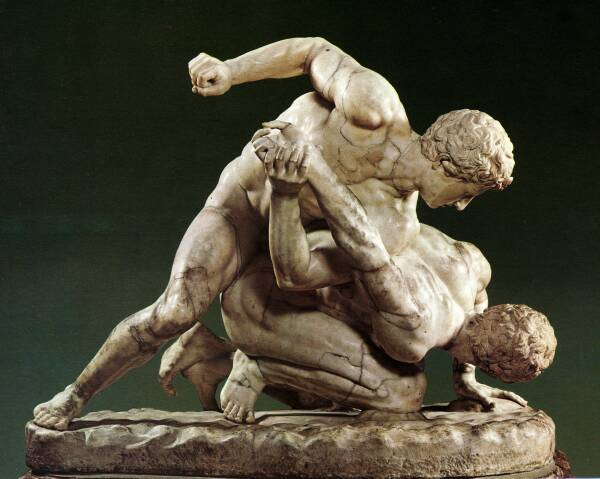
Struggle (3823) (pale from pállo = shake, vibrate; related word palaio = wrestle) is used only here in the Bible (not in the LXX). Pale is the literal word for wrestling. As such it pictured hand–to–hand combat between wrestling athletes, this combat in the ancient world being characterized by trickery, cunning and deception.
Pale thus describes the contest between two individuals in which each endeavors to throw the other and which ultimately is decided when the victor is able to press down his prostrate antagonist with his hand upon his neck! When we consider that often the loser in a Greek wrestling contest had his eyes gouged out with resulting blindness for the rest of his days, we have a taste of how the Ephesian saints who read Paul's letter would have received this illustration. The believer's wrestling against the powers of darkness is no less desperate and fateful.
Pale was also used to describe hand–to–hand combat of soldiers, such combat requiring both deftness and speed.
Pale describes the struggle between individual combatants which distinguishes it from strateia (4752) which refers more to the entire military expedition or campaign, to military service or to warfare
Pale pictures one engaged in an intense struggle involving physical or nonphysical force against strong opposition. Paul uses pale in the figurative sense to picture the believer's struggle and conflict against evil angelic forces arranged in a military like hierarchy described below.
Wuest - One might be troubled at the change of figure from that of a Roman soldier to that of a Greek wrestler, arguing that a soldier does not engage in a wrestling contest clad in full armor. But the difficulty disappears when one sees that the figure of a wrestling match speaks of a contest at close quarters, and an individual contest, between the Christian and his demon enemies. (Wuest Word Studies - Eerdman Publishing Company Volume 1, Volume 2, Volume 3 - used by permission)
Against (4314) (pros) is marker of direction, of movement toward or of closeness of relation or proximity which in this context clearly pictures an unfriendly, hostile relation (against, toward). Pros (against) is repeated before each of the designations -- rulers, powers, world forces, spiritual forces.
In Ephesians 2 Paul explains to his readers that when they were non-believers they were under the power of these evil forces writing "you were dead in your trespasses and sins, in which you formerly walked according to the course of this world, according to the prince of the power of the air, of the spirit that is now working in the sons of disobedience. (See notes Ephesians 2:1; 2:2)
ANCIENT GREEK
OLYMPICS
Rick Renner explains that "pale is also the Greek word from which the Greeks derived their name for the Palastra— a huge palace of combat sports that was situated in the center of most larger, ancient cities. The Palastra was a huge building that outwardly looked like a palace but was dedicated to the cultivation of athletic skills. Every morning, afternoon, and night, the most committed, determined, and daring athletes of the day could be found in this fabulous building, working out and training for their respective sports. Three kinds of athletes primarily worked out at the Palastra: boxers, wrestlers (see article Greek wrestling), and pankratists. Let me tell you a little about how these sports functioned in the first century when Paul wrote this verse, because it forms the backdrop to the word "wrestle" in Ephesians 6:12. The first and most feared combat sport was boxing. But the boxers from the first century were not like our boxers today. Their sport was extremely violent— so violent that they were not permitted to box without wearing helmets. Without the protection of helmets, their heads would have been crushed! In fact, this sport was so severe that few boxers ever lived to retire from their profession. Most of them died in the ring. Of all the sports, the ancients viewed boxing as the most hazardous and deadly. In this brutal and barbaric sport, the ancient boxers wore gloves ribbed with steel and spiked with nails. At times the steel wrapped around their gloves was serrated, like the blade of a hunting knife, in order to make deep gashes in the opponent's skin. In addition to this, they used extremely heavy gloves that made every punch more damaging. It is quite usual to find artwork from the time of the ancient Greeks that includes boxers whose faces, ears, and noses are totally deformed from being struck by these dangerous gloves. Making this sport even more dangerous was the fact that there were no rules— except that a boxer couldn't clench his opponent's fist. That was the only rule of the game! There were no "rounds" like there are in boxing today. The fight just went on and on until one of the two surrendered or died in the ring. Next, there were wrestlers! Wrestling was also a deadly sport in the first century. In fact, most wrestlers chose to fight to the death rather than walk out of the ring in humiliation and defeat. As you see, it was an ugly, bloody sport. In order to make an opponent surrender, it was quite normal to strangle him into submission. Choking was another acceptable practice in wrestling. Like boxing, wrestling was an extremely violent and bloody sport that tolerated every imaginable tactic: breaking fingers, breaking ribs by a waist lock, gashing the face, gouging out the eyes, and so on. Wrestling was a bitter struggle to the very end. The third combat sport was pankration, from the Greek words pan and kratos. The word pan means all, and kration is from the word kratos, which means power. When these two words were put together, they formed the word pankration, which means all powerful. These fighters were the fiercest, toughest, and most committed of all! In this sport, they were permitted to kick, punch, bite, gouge, strike, break fingers, break legs, and to do any other horrible thing you could imagine. There was no part of the human body that was off limits. They could do anything they wanted to any part of their competitor's body, for there were basically no rules.
An early inscription from a father to his sons who participated in pankration says this: "If you should hear your son has died, you can believe it. But if you hear he has been defeated and chose to retire, do not believe it!" Why? Because like the other combat sports, pankration was extremely violent. While participating in this sport, more professional pankratists died than surrendered or were simply defeated. I realize that these are very graphic images, but they are also very important images, for they are all contained in the word "wrestle" that Paul uses in Ephesians 6:12. In the day when Paul wrote this letter, everyone who saw the Greek word pale ("wrestle") saw all these images in their minds. You can see, then, that this was a powerful, pungent word for Paul to use when he started to describe our conflict with unseen, demonic powers that Satan has marshaled together to try to destroy us. By using the word "wrestle" from the Greek word pale, Paul was telling every reader (and us) that spiritual warfare can be a bitter struggle and an intense conflict. (Sparkling Gems from the Greek).

Vance Havner - Wrestling is perhaps the most strenuous of all sports. Every muscle is strained, every nerve is taut, and the shoulders are never more than a few inches from the mat. There is nothing dainty about it. It is not a graceful exercise of give and take. Our Lord wrestled from the temptation to His arrest when He said, "... This is your hour and the power of darkness" (Luke 22:53). Paul believed he contended with demonic hosts under the devil. We had better know what we are up against and not underestimate our adversary.
Onward, Christian soldiers, marching as to war,
With the cross of Jesus going on before!
Christ, the royal Master, leads against the foe;
Forward into battle see His banner go! —Baring-Gould
Christ's soldiers fight best on their knees.
Flesh (4561) (sarx) is used 147 times in the NT. Note that a simple definition of sarx is somewhat difficult because sarx has many nuances (some Greek lexicons list up to 11 definitions for sarx!). The diligent disciple must carefully observe the context of in order to discern which nuance is intended. The range of meaning extends from the substance flesh (both human and animal), to the human body, to the entire person, and to all humankind. Refer to the table below for the 4 basic definitions of sarx in Strong's Lexicon. In the present context Paul is referring to the human body composed of "flesh and blood" and standing for men in general.
Blood (129) (haima) refers to blood as the basis of life or what constitutes the life of an individual. (Lev 17:11). Blood is the basic component of a living organism. Here the phrase "flesh and blood" indicates our struggle is not against men but against invisible spiritual beings.
Ray Pritchard - Here are four facts about our satanic opponents: 1. They are numerous. Note the various expressions in verse 12. They are principalities and powers. They are rulers. They are authorities. These different expressions describe the many different ranks and categories of evil spirit beings. 2. They are powerful. Don’t think of Casper the Friendly Ghost or of some nice spirit beings who like to play tricks on you. The demons are real and they aren’t on your side. J. B. Phillips calls them “spiritual agents from the very headquarters of evil.” 3. They are wicked. They follow no moral code. They live only to do the devil’s bidding. They are opposed to all that is good and holy and right. 4. They are clever. Paul speaks of schemes and diabolical plans. Do not be deceived into thinking the demons are stupid.They are morally corrupt but as spirit beings, they possess enormous intelligence. Like spies working for some lethal enemy, the demons know the weak spots in our armor. They lie in wait, looking for a chance to pounce..... We do not struggle against flesh and blood. Sometimes we focus on the abortionists, the pornographers, the godless politicians, the corrupt business leaders, the drug dealers, and the purveyors of filth, as if they were the source of our problems. Yet those people are unwitting dupes of powerful spiritual forces that they know nothing about. They are morally culpable for their choices, yet they are also in the service of evil beings that influence them in ways they do not realize. Or we could make it more personal. When someone has hurt us deeply, it’s easy to say, “That person is the source of all my problems.” But our struggle is not with flesh and blood-even though it seems that way most of the time.
Our struggle is not with flesh and blood even though it seems that way most of the time.
And though this world with devils filled
Should threaten to undo us;
We will not fear, for God has willed
His truth to triumph through us. —Luther
He who is in you is greater than he who is in the world. —1 John 4:4
VERSE BY VERSE EXPOSITION ON EPHESIANS 6:10-18...
- Ephesians 6:10
- Ephesians 6:11
- Ephesians 6:12
- Ephesians 6:13
- Ephesians 6:14
- Ephesians 6:15
- Ephesians 6:16
- Ephesians 6:17
- Ephesians 6:18
EPHESIANS 6:10-20 - DR MARTYN LLOYD-JONES - classic exposition well worth investing many hours listening
- Ephesians 6:10 Introduction
- Ephesians 6:10-11 The Only Way
- Ephesians 6:11-12 The Enemy
- Ephesians 6:10-13 The Enemy Described
- Ephesians 6:10-13 The Origin of Evil
- Ephesians 6:10-13 The Wiles of the Devil
- Ephesians 6:10-13 The Devil and the Nations
- Ephesians 6:10-13 Spiritism
- Ephesians 6:10-13 Spiritism and the Christian
- Ephesians 6:10-13 Demon Possession
- Ephesians 6:10-13 Common and Special Grace
- Ephesians 6:10-13 The Strong Man Disarmed
- Ephesians 6:10-13 The Christian and the Devil
- Ephesians 6:10-13 Schism in the Church (1)
- Ephesians 6:10-13 Schism in the Church (2)
- Ephesians 6:10-13 Cults
- Ephesians 6:10-13 Counterfeits
- Ephesians 6:10-13 Watchfulness
- Ephesians 6:10-13 Philosophy and Vain Deceit
- Ephesians 6:10-13 Knowledge Puffs Up
- Ephesians 6:10-13 God in the Flesh
- Ephesians 6:10-13 Faith and Experience
- Ephesians 6:10-13 Physical; Psychological; Spiritual
- Ephesians 6:10-13 True and False Assurance
- Ephesians 6:10-13 Attacks on Assurance (1)
- Ephesians 6:10-13 Attacks on Assurance (2)
- Ephesians 6:10-13 Quenching The Spirit (1)
- Ephesians 6:10-13 Quenching The Spirit (2)
- Ephesians 6:10-13 Temptation and Sin
- Ephesians 6:10-13 Discouragement
- Ephesians 6:10-13 Worry and Anxiety
- Ephesians 6:10-13 Mans Greatest Problem - Self
- Ephesians 6:10-13 True and False Zeal
- Ephesians 6:10-13 Worldliness
- Ephesians 6:10-13 The Call to Battle
- Ephesians 6:10-13 God's Battle Not Ours
- Ephesians 6:10-13 Who Does the Fighting?
- Ephesians 6:10-13 Morale
- Ephesians 6:10-13 Food and Drink
- Ephesians 6:10-13 Exercise
- Ephesians 6:10-13 Discipline
- Ephesians 6:10-13 The Promises
- Ephesians 6:10-13 Trust in God and...
- Ephesians 6:10-13 Things to Avoid
- Ephesians 6:10-13 Stand Therefore
- Ephesians 6:14 The Whole Armour of God
- Ephesians 6:14 Loins Girt About with Truth
- Ephesians 6:14 The Only Authority
- Ephesians 6:14 The Scripture of Truth
- Ephesians 6:14 The Truth of God
- Ephesians 6:14 The Faith of the Gospel
- Ephesians 6:14 The Truth Revealed in Scripture
- Ephesians 6:14 Girded with Truth
- Ephesians 6:14 The Breastplate of Righteousness
- Ephesians 6:14 The Righteousness of God by Faith
- Ephesians 6:14 The Putting on the Breastplate
- Ephesians 6:14 Citizens of Heaven
- Ephesians 6:14 Resisting the Devil
- Ephesians 6:14 Looking Unto Jesus
- Ephesians 6:14 Slaves of Christ
- Ephesians 6:14 Marching Orders
- Ephesians 6:15 Stand Fast
- Ephesians 6:15 Mobility
- Ephesians 6:16 The Shield of Faith
- Ephesians 6:17 The Helmet of Salvation
- Ephesians 6:17 The Sword of the Spirit
- Ephesians 6:18 Praying in the Spirit
- Ephesians 6:18-20 Praying for all the Saints
EPHESIANS 6:10-18 BY WAYNE BARBER
- Ephesians 6:10: Spiritual Warfare, Pt 1
- Ephesians 6:11: Spiritual Warfare, Pt 2
- Ephesians 6:14: Spiritual Warfare, Pt 3
- Ephesians 6:15,16 Spiritual Warfare, Pt 4
- Ephesians 6:17: Spiritual Warfare, Pt 5
- Ephesians 6:12,13 Spiritual Warfare, Pt 6
- Ephesians 6:18: Spiritual Warfare, Pt 7
VERSE BY VERSE EXPOSITION ON THE FALLEN FLESH
VERSE BY VERSE EXPOSITION ON RESISTING THE ROARING LION
VERSE BY VERSE EXPOSITION ON THE BATTLE IN OUR MIND
MISCELLANEOUS
- Cyberhymnal Hymns on Topic of Spiritual Warfare (scroll down)
- 2 Chronicles 20:1-25 Ambushing Satan with Song - John Piper
THE METAPHOR OF THE CHRISTIAN SOLDIER
- Soldier Illustrations
- Exposition of 2 Timothy 2:3-4
- Three Kinds of Soldiers - Ten Principles of Warfare
- Roman Soldier by Edward Gibbon (Decline & Fall of Roman Empire)
- The Roman Soldier - Description from Jewish Historian Josephus
- A Few Soldier Stories and Sermons
THE AMALEKITES: A PICTURE OF PERSISTENT SPIRITUAL WARFARE
BUT AGAINST THE RULERS AGAINST THE POWERS AGAINST THE WORLD FORCES OF THIS DARKNESS: alla pros tas archas pros tas exousias pros tous kosmokratoras tou skotous toutou:
- Eph 1:21; 3:10; Ro 8:38; Col 2:15; 1Pe 3:22
- Ep 2:2; Job 2:2; Lk 22:53; Jn 12:31; 14:30; 16:11; Acts 26:18; 2Cor 4:4; Col 1:13
- Ephesians 6 Resources - Multiple Sermons and Commentaries
- Ephesians 6:12-13 Spiritual Warfare - 6 - Wayne Barber
- Ephesians 6:12-13 Why Christians Must be Fighters - Steven Cole
- Ephesians 6:10-13 The Believer's Warfare, Part 1 - John MacArthur
- Ephesians 6:10-13 The Believer's Warfare, Part 2 - John MacArthur
WE FIGHT AGAINS A HIERARCHY
OF INVISIBLE DEMONIC FORCES
But against (term of contrast) - Paul pulls back the curtain of the invisible spiritual "mafia" to give us a brief glimpse of the tremendous spiritual forces arrayed against the children of God. His point is that although interpersonal relationships often appear to be our major battleground (we say things like "I could live this Christian life if it weren't for the people I have to deal with!"), Paul explains that the real battle is against a hierarchy of evil invisible supernatural beings who are organized and determined to disrupt, discourage, disillusion, discomfort, disarm, disrupt, dissatisfy, dissuade, distract, disappoint, disgruntle, disequilibrate, disenthrall, dishearten, dishevel, distress, disqualify, disquiet, dispossess, disturb, disunite, destroy, deceive, etc, etc, all the while seeking to cause believers to doubt the Word of God and the faithfulness and goodness of God. So often we hear the phrase "the battle between good and evil" but this passage makes it abundantly clear that evil is not some imaginary, inanimate force but instead is an active, organized evil perpetrated by an invisible, albeit not invincible, foe. Too many Christians have failed to realize that they are engaged in this titanic spiritual struggle of the ages, and that they were "drafted" into God's army the moment they were saved by grace through faith. To be ignorant of our calling and the magnitude of this great struggle is a dangerous ignorance.
Believers face three enemies -- the world (controlled by Satan - 1 Jn 5:19, Lk 4:6-7), the flesh (fallen in Adam, influenced by Satan and the world he controls) and the devil. In Ephesians 6:10-18, Paul's focus is upon the spiritual adversary, but one needs to remember that these three "divisions" are somewhat arbitrary, because the effects of the world and the flesh cannot always be separated from the devil and his minions who work through these other "enemies". One word of encouragement - you are in a spiritual war and just as occurs in real warfare, you will experience some victories and some defeats in individual battles. That is part of growing in grace and the knowledge of Christ Jesus (2Pe 3:18), maturing in your Christian walk, progressively being set aside more and more (being sanctified, being conformed gradually more and more into the image of God's Son - cp Ro 12:2, 2 Cor 3:18). But as long as we are in these mortal bodies, we are not yet perfect and sin will still bring passing pleasure (emphasize "passing"! Heb 11:25) and will still hold out a lure for us to snatch in a moment of weakness (or perhaps a moment of self-sufficiency, self-assurance, or self-confidence rather than in reliance on Christ, cp James 1:13-16). And so unfortunately we will lose some of the battles. That is a reality, whether your name is Billy Graham or Charles Haddon Spurgeon. But when you lose a particular battle and you lie on the ground, bloody and bruised (spiritually speaking), don't let the enemy (the accuser and slanderer , cp Rev 12:10) tell you that you are a "loser" and you will never have victory (cp 1 Cor 15:57 where "gives" is present tense = God continually gives us the victory in Christ!). Satan is a liar for he knows that he is a defeated enemy (Col 2:15 where Christ disarmed the enemy powers). His continual ploy will be to try to keep you from standing in the shadow of the Cross, which is the power (dunamis) of God for salvation past, present and future (cp 1 Cor 1:18, see Three Tenses of Salvation). And so dear saint, beloved of God (Ro 1:7, 1 Th 1:4), heir of eternal riches with Christ (Ro 8:17), possessor of the Spirit of Truth (Jn 14:16, 17), arise! Shine! (Eph 5:14) Stand! Check your armor! Allow the Comforter to soothe and heal your wounds and renew your mind (Eph 4:23, Ro 12:2), re-energizing you for battle, as you eat the bread of life (Mt 4:4, Lk 4:4), the Word of Truth (Ps 119:43, 2 Cor 6:7, Col 1:5, 2 Ti 2:15, James 1:18). Then walk out, walk worthy of your calling as a fellow soldier (Eph 4:1, Php 1:27, Col 1:10, 1 Th 2:12), walk in love (Eph 5:2), walk in light (1 Jn 1;7), walk filled with God's Spirit (Eph 5:18), walk in the Gospel, the power of God (Ro 1:16), Who gives us the victory through our Lord Jesus Christ. (1 Cor 15:57). Take your position on the battlefield and stand firm! (1 Cor 16:13, Eph 6:11, 13, 14, Php 4:1, 1 Th 3:8, 2 Th 2:15, 1 Pe 5:12) And don't be surprised because the next attack may come sooner than you think. And let's assume that this time you stand firm and win this battle (enabled by the omnipotent Spirit Who empowers you to abstain from those fiery missiles of fleshly lusts which wage war against your soul -- see Eph 6:16, 1Pe 2:11). Be quick to praise God and give Him the glory for that victory (Ps 115:1). Take heed, be careful, for if you think you have just stood and won in your own strength, you will fall (1 Cor 10:12).
In Genesis just after Satan had deceived Eve and sin had entered the world, God predicted a spiritual war between the offspring of the Messiah and of Satan, but in the same verse God also promised that the Messiah would triumph over Satan declaring...
And I (God the Father) will put enmity (hostility, hatred) between you (Satan the Adversary) and the woman (Eve), and between your seed (Satan's children, cf Jn 8:44 "You are of your father the devil", 1John 3:10 "the children of God and the children of the devil are obvious: anyone who does not practice righteousness is not of God") and her seed (the Messiah and the spiritual children of God through faith in the Messiah); He (Messiah) shall bruise you on the head (the more deadly blow), and you shall bruise him on the heel (crucifixion actually did cause bruising of the heel as the victim pushed up with the legs in an attempt to aid breathing). (Genesis 3:15)
THE EPHESIANS HAD
SEEN SPIRITUAL WARFARE
Ephesians 6 is like a reminder to the saints in Ephesus who should have been very familiar with the reality of warfare against invisible demonic forces. In Acts 19 we see a "preview of coming attractions" Luke recording the spiritual warfare in Ephesus in considerable detail...
(Demon possession - God prevails) 11 And God was performing extraordinary miracles by the hands of Paul, 12 so that handkerchiefs or aprons were even carried from his body to the sick, and the diseases left them and the evil (poneros = actively harmful or hurtful) spirits went out. 13 But also some of the Jewish exorcists, who went from place to place, attempted to name over those who had the evil (poneros = actively harmful or hurtful) spirits the name of the Lord Jesus, saying, "I adjure you by Jesus whom Paul preaches." 14 And seven sons of one Sceva, a Jewish chief priest, were doing this. 15 And the evil (poneros = actively harmful or hurtful) spirit answered and said to them, "I recognize Jesus, and I know about Paul, but who are you?" 16 And the man, in whom was the evil (poneros = actively harmful or hurtful) spirit, leaped on them and subdued all of them and overpowered them, so that they fled out of that house naked and wounded.
(Jesus' Name and Word of God magnified and grew) 17 And this became known to all, both Jews and Greeks, who lived in Ephesus; and fear fell upon them all and the name of the Lord Jesus was being magnified. 18 Many also of those who had believed kept coming, confessing and disclosing their practices. 19 And many of those who practiced magic brought their books together and began burning them in the sight of all; and they counted up the price of them and found it fifty thousand pieces of silver. 20 So the word of the Lord was growing mightily and prevailing.
(Ephesus was a center of idol worship of the "goddess" Artemis and this led to conflict between darkness and light) 23 And about that time there arose no small disturbance (stir, commotion) concerning the Way (name for believers in Acts). 24 For a certain man named Demetrius, a silversmith, who made silver shrines of Artemis, was bringing no little business to the craftsmen; 25 these he gathered together with the workmen of similar trades, and said, "Men, you know that our prosperity depends upon this business. 26 "And you see and hear that not only in Ephesus, but in almost all of Asia, this Paul has persuaded and turned away a considerable number of people, saying that gods made with hands are no gods at all. 27 "And not only is there danger that this trade of ours fall into disrepute, but also that the temple of the great goddess Artemis be regarded as worthless (literally = nothing, absolutely nothing) and that she whom all of Asia and the world worship should even be dethroned from her magnificence." 28 And when they heard this and were filled with rage, they began crying out, saying, "Great is Artemis of the Ephesians!"
DEMONS ASSOCIATION
WITH IDOLS
Related topic: Idolatry and Immorality - the relationship and the antidote
The unsaved Gentiles were without God in the world and so they created gods of their own making but the Jews had no excuse for they had been clearly warned by Moses concerning the spiritual danger of idolatry...
They (In verse 15 they = Jeshurun = an affectionate name for Israel = "upright people"!) made Him jealous with strange gods; with abominations (LXX = idols - foul, loathsome things) they provoked Him to anger. They sacrificed to demons (daimonion - those angels who fell with Satan and constitute the evil force that fights against God and His holy angels) who were not God, to gods whom they have not known, new gods who came lately, whom your fathers did not dread. (Deut 32:16-17)
Comment: Moses wrote that the so called "gods" Israel worshiped were not divine but they were real! And that reality was demonic! He explained that idol worship is a form of demon worship because of the fact that evil angelic spirits impersonate the idol and work their wicked strategies through the system of false beliefs that are associated with the idol. The psalmist in fact records that Israel, God's chosen people followed idolatrous pagan practices to such an extent that they even sacrificed “their sons and their daughters to the demons” Ps 106:37!
In a parallel passage in the NT Paul elaborated on the inherent danger of idol worship writing to saints in Corinth a city well known for rampant idol worship, a practice out of which many in the church had been delivered by grace through faith...
(Paul asks) What do I mean then? That a thing sacrificed to idols is anything, or that an idol is anything? 20 No, but I say that the things which the Gentiles sacrifice, they sacrifice to demons, and not to God; and I do not want you to become sharers in demons. 21 You cannot drink the cup of the Lord and the cup of demons; you cannot partake of the table of the Lord and the table of demons. (1Cor 10:19, 20, 21)
Comment: John MacArthur explains that "Demons are the spiritual force behind all idolatry. Those who sacrifice to idols sacrifice to demons. When worshipers believe an idol represents an actual god, Satan sends one of his demon emissaries to act out the part of that imaginary god. There is never a god behind an idol, but there is always a spiritual force; and that force is always evil, always demonic. Demons can exhibit considerable power. Many cultic and pagan religious claims are faked and exaggerated; but many are true. They are evil but true. Much that goes under the name of astrology, for instance, is simply exploitation of the gullible. But many predictions come true through the work of demonic forces. Demons are not unlimited in power, but they have power to perform enough wonders and to make enough predictions come true to keep superstitious worshipers deceived and loyal - 1Corinthians. Chicago: Moody Press)
In chapter one of Ephesians Paul had explained that the Father...
raised Him (Christ) from the dead, and seated Him at His right hand in the heavenly places, 21 far above all rule and authority and power and dominion, and every name that is named, not only in this age, but also in the one to come. 22 And He put all things in subjection under His feet, and gave Him as head over all things to the church, 23 which is His body, the fulness of Him who fills all in all. (See notes Ephesians 1:20; 1:21; 1:22; 1:23)
(Paul also explained that as believers in Christ) the God and Father of our Lord Jesus Christ... has blessed us with every spiritual blessing in the heavenly places in Christ, (See note Ephesians 1:3)
In Ephesians 2 Paul described the believer's former position in Adam (before they believed) and their new position in Christ explaining...
(Our old position - subjects of Satan) And you were dead in your trespasses and sins, 2 in which you formerly walked according to the course of this world, according to the prince (archon - one who was first in rank and power = Satan) of the power (exousia = speaks of the right and the might) of the air (the celestial air surrounding the earth - this would equate with the "first heaven" in a 3 heaven scheme - see the three heavens), of the spirit (in context an actively evil spirit) that is now working (literally energizing) in the sons of disobedience. 3 Among them we too all formerly lived in the lusts of our flesh, indulging the desires of the flesh and of the mind, and were by nature children of wrath, even as the rest. (See notes Ephesians 2:1; 2:2; 2:3)
(Our new position - in Christ) But God, being rich in mercy, because of His great love with which He loved us, 5 even when we were dead in our transgressions, made us alive together with Christ (by grace you have been saved), 6 and raised us up with Him, and seated us with Him in the heavenly places, in Christ Jesus. (See notes Ephesians 2:4; 2:5; 2:6)
In Ephesians 3 Paul explained that one of the purposes of the church was...
in order that the manifold wisdom of God might now be made known through the church to the rulers and the authorities (or powers = same word exousia as in Eph 6:12) in the heavenly places. (Eph 3:10)
In Romans 8 Paul again alludes to angelic beings writing...
For I am convinced that neither death, nor life, nor angels (probably good angels who would not seek to separate us in contrast to the next group of evil angels who could not separate us from Christ's love), nor principalities, (arche = first in rank and referring to fallen angels or demonic spirits with supernatural power) nor things present, nor things to come, nor powers, nor height, nor depth, nor any other created thing, shall be able to separate us from the love of God, which is in Christ Jesus our Lord. (Ro 8:38, 39-notes)
Comment: Our position in Christ is safe and secure even from our supernatural enemies, the evil spirits. As emphasized in these notes, the spiritual war is a battle not so much over power but over truth and the battlefield is our mind. Truths such as this renew our mind and strengthen us for the warfare.
In the book of Daniel God pulls back the curtain ever so slightly to let us see into the spiritual war going on in the heavenlies. Daniel records his encounter with an angelic messenger...
Then behold, a hand touched me (Daniel) and set me trembling on my hands and knees. 11 And he said to me, "O Daniel, man of high esteem, understand the words that I am about to tell you and stand upright, for I have now been sent to you." And when he had spoken this word to me, I stood up trembling. 12 Then he said to me, "Do not be afraid, Daniel, for from the first day that you set your heart on understanding this (a "message...true and one of great conflict" Da 10:1) and on humbling yourself before your God, your words were heard, and I have come in response to your words. 13 "But the prince (LXX = strategos -- 4755 -- from stratos = an army + ago = lead = military leader or officer and also the name given to Roman officers as consuls and also the leaders of cities) of the kingdom of Persia was withstanding me for twenty-one days (Da 10:2 "In those days I, Daniel, had been mourning for three entire weeks."); then behold, Michael, one of the chief princes (LXX = two words, chief = protos = first in rank or order , princes = archon = ruler as of a nation, commander, one who has eminence in a ruling capacity) came to help me, for I had been left there with the kings of Persia. 14 "Now I have come to give you an understanding of what will happen to your people in the latter days, for the vision pertains to the days yet future." 15 And when he had spoken to me according to these words, I turned my face toward the ground and became speechless. 16 And behold, one who resembled a human being was touching my lips; then I opened my mouth and spoke, and said to him who was standing before me, "O my lord, as a result of the vision anguish has come upon me, and I have retained no strength. 17 "For how can such a servant of my lord talk with such as my lord? As for me, there remains just now no strength in me, nor has any breath been left in me." 18 Then this one with human appearance touched me again and strengthened (LXX = enischuo = to make strong, to strengthen one in soul as in Lk 22:43 "Now an angel from heaven appeared to Him, strengthening Him" speaking of Jesus in the Garden of Gethsemane when the spiritual battle against Him must have been the most intense) me. 20 Then he said, "Do you understand why I came to you? But I shall now return to fight against the prince of Persia; so I am going forth, and behold, the prince (LXX = archon = ruler, commander, chief, the one exercising authority or who has eminence in a ruling capacity) of Greece is about to come. 21 "However, I will tell you what is inscribed in the writing of truth. Yet there is no one who stands firmly with me against these forces except Michael your prince (LXX = archon). (Daniel 10:10-18, 20-21)
SATAN'S FATE
In Revelation 20 John records that Satan will be bound for 1000 years (see studies on Millennium)...
so that he should not deceive the nations any longer, until the thousand years were completed; after these things he must be released for a short time. (Re 20:3)
Comment: Who is Satan allowed to deceive? "The nations" [which could refer to Gentiles but could also refer to actual nations composed of Gentiles] and in Daniel's time it appears that he worked through our evil angels such as the prince of Persia.
In the gospel of John Jesus prophesied of His triumph over the powers of darkness declaring...
"Now judgment is upon this world; now the ruler of this world (Satan) shall be cast out. "And I, if I be lifted up from the earth, will draw all men to Myself." (John 12:31-32)
Comment: Jesus is predicting His death on the Cross which brought condemnation to the world who rejected Him and which brought defeat on Satan, which will be consummated in the future when he is cast into the Lake of fire to be tormented forever. Even though for a season he will be permitted to go to and fro on the earth [Job 1:7, 2:2, 1Pe 5:8], Satan is a defeated enemy.
(Jesus addressing His disciples declared) "I will not speak much more with you, for the ruler (archon = first in rank and power) of the world (Satan) is coming, and he has nothing in Me (Satan possessed nothing in Christ and had no power over Him) but that the world may know that I love the Father, and as the Father gave Me commandment, even so I do. Arise, let us go from here. (John 14:30,31)
Comment: Satan had come to Jesus at the beginning of His earthly ministry and claimed He was ruler of the world, a claim our Lord did not deny then or in this passage.
(Jesus again affirmed that) "the ruler of this world has been judged (perfect tense = has been judged and stands as still judged) ." (John 16:11)
Comment: Jesus was referring to His judgment of Satan that would be finalized by Christ's death on the cross. Satan is the prince of this world, but he is a defeated prince. Satan has been judged and the verdict announced. All that remains is the executing of the sentence, and that will occur when Jesus returns.
In Colossians 2 Paul describes Jesus' victory over the powers of darkness writing to the saints that...
when you were dead in your transgressions and the uncircumcision of your flesh, He (God the Father) made you alive together with Him (Christ), having forgiven us all our transgressions, 14 having canceled out (wiped away, blotted out our bond of debt wrought by the wages of sin, Christ completely cancelled our "IOU" to God) the certificate of debt consisting of decrees against us and which was hostile to us; and He has taken it out of the way, having nailed it to the cross (When a criminal was crucified, the charges against him were specified and nailed to his cross). 15 When He had disarmed the rulers (arche) and authorities (exousia), He made a public display of them, having triumphed over them (Paul pictures Christ's triumph over Satan and his evil spiritual forces, using a word that described a victorious Roman general returning to Rome in a long procession preceded by city magistrates and trumpeters, then the enemy spoils taken, then the captives headed by the king of the conquered country, then officials of the victorious army and at last the victorious general himself) through Him. (Col 2:13, 14,1 5-See notes Col 2:13; 14; 15)
Comment: Disarmed is in the middle voice which pictures Jesus initiating and participating in the disarming, stripping off and divesting the rulers of their authority and power. Satan and the demons no longer have authority over the believer who is walking in the light. Paul's description would have been familiar to his readers as "disarm" was used of a triumphant Roman general who stripped his foes and led them as captives behind his chariot in his victory procession.
In a parallel passage, Peter records that...
And corresponding to that (Noah and 7 others brought safely through the deadly worldwide flood), baptism now saves you-- not the removal of dirt from the flesh, but an appeal to God for a good conscience-- through the resurrection of Jesus Christ, 22 who is at the right hand of God, having gone into heaven, after angels and authorities and powers had been subjected to Him. (1Pe 1:21, 22-See notes 1Pe 1:21; 22 )
Comment: Peter is not teaching as some twist the Scriptures that immersion in water by a particular denomination saves you. Peter pictures the waters of baptism as corresponding to and prefigured by the deliverance of Noah’s family by water. Noah and his family's identification with the Ark by going into the ark when the flood came is a type of the believer's identification today, in which he or she identifies Christ's finished work on the Cross and in so doing in a manner of speaking that person is now safe within the "Ark", Who is Christ Jesus Himself. See discussion of Greek word baptizo
In the Revelation John described Satan's future writing that...
there was war in heaven, Michael and his angels waging war with the dragon. And the dragon and his angels waged war, 8 and they were not strong enough, and there was no longer a place found for them in heaven. 9 And the great dragon was thrown down, the serpent of old who is called the devil and Satan, who deceives the whole world; he was thrown down to the earth, and his angels were thrown down with him. 10 And I heard a loud voice in heaven, saying, "Now the salvation, and the power, and the kingdom of our God and the authority of His Christ have come, for the accuser of our brethren has been thrown down, who accuses them before our God day and night.
Comment: This event will transpire in the middle of Daniel's Seventieth Week contemporaneous with the inception of the last 3.5 year time period which Jesus identified specifically as the Great Tribulation.
D L Moody - THE reason why so many Christians fail all through life is just this—they under-estimate the strength of the enemy. We have a terrible enemy to contend with. Don’t let Satan deceive us. Unless we are spiritually dead, it means warfare. Nearly everything around tends to draw us away from God. We do not step clear out of Egypt on to the throne of God. There is the wilderness journey, and there are enemies in the land.
Rulers (746) (arche) means first, chief or beginning. Here arche is a metonym (a figure of speech consisting of the use of the name of one thing for that of another of which it is an attribute or with which it is associated) that stands for those having the position of priority and preeminence.
In context Paul is saying there is an invisible audience of evil princes or chiefs among angels (rulers is plural in the Greek so he is not referring only to Satan). Paul is also teaching that even in the invisible angelic world there is a stratification of authority.
As an aside it is worth noting that "The word “rulers” doesn’t refer to mayors or governors or presidents.....On those days when people treat you badly, you may feel like they are the enemy. But they aren’t, not in the deepest sense." (Pritichard)
In John 14 Jesus speaking of Satan declares...
"I will not speak much more with you, for the ruler (archon - first in rank) of the world is coming, and he has nothing in Me (John 14:30)
Comment: Satan the ruler of the world has no power over Him whatsoever.
John Phillips - Our enemies are not people. We must see beyond people. Satan may use people to persecute us, lie to us, cheat us, hurt us, or even kill us. But our real enemy lurks in the shadows of the unseen world, moving people as pawns on the chessboard of time. As long as we see people as enemies and wrestle against them, we will spend our strength in vain. Certainly we see wicked people, hear the evil things they say, and feel the hurts they inflict on us. People are involved, but they are not the real problem. This is not an ordinary battle. We are in a greater arena than the one we can see. (Ephesians Commentary)
Principalities and powers,
Mustering their unseen array,
Wait for thy unguarded hours,
Watch and pray.
Powers (1849) (exousia from exesti = it is permissible or allowed) means permission, authority, right, liberty, power to act. Until the end of the age these demonic forces, already defeated by Christ on the cross, are allowed to exercise a certain limited exousia (plural in this verse) in temporarily opposing the purposes of God.
The idea in exousia can be summed up as the right and the might. In this verse exousia is a metonym that stands for those invested with the "right and the might". As in Ep 1:21 (note) the context of the book indicates that those invested with the right and the might are the hosts of heaven, the angelic forces of God, including the good angels and the host of fallen angels ruled by Satan and inextricably arrayed against God and His eternal purpose.
The following two passages from Colossians and Acts show that Satan and his demons have the exousia or the right and the might to rule over the kingdom of darkness (note contrasting kingdoms of darkness and light in both these passages). In Colossians Paul describes the before/after picture of a believer writing that God the Father...
has qualified us to share in the inheritance of the saints in light (believers live in the kingdom of light with Christ as their kind King) for He delivered (rhuomai - aorist tense = past completed action) us from the domain (exousia) of darkness (unbelievers live in the kingdom of darkness where Satan is their malevolent master), and transferred us to the kingdom of His beloved Son, in Whom we have redemption, the forgiveness of sins. (Col 1:16,17-See notes Col 1:16; 17)
Jesus uses exousia in His instruction to Paul to preach the gospel to the Gentiles...
to open their eyes so that they may turn from darkness (skotos = the essence of darkness) to light and from the dominion (exousia) of Satan to God, in order that they may receive forgiveness of sins and an inheritance among those who have been sanctified by faith in Me.' (Acts 26:18)
Wayne Barber applies this truth about the evil forces having the right and the might in the kingdom of darkness writing...
I don’t know about you, but to choose not to obey truth, to choose not to surrender to Jesus Christ automatically puts me into a realm that I am not supposed to be in (the kingdom of darkness). Immediately I become one who suffers the consequences of the evil one who has the authority, the right and the might in the sphere of darkness. That scares me. I think of all the dumb choices I have made in my life. Only in the realm of darkness do they have that authority. (Spiritual Warfare)
Exousía denotes the executive power whereas arche represents authority granting the power.
The exousia is the one who has the power to delegate authority, and the word exousia, is the one who carries it out and executes that authority or power. Arche is the authority granting the power, and exousia is the one who executes the power which pictures a divine order or an invisible rank.
Vine explains that exousía evolved
"from the meaning of "leave or permission" or "liberty of doing as one pleases" and passed to that of "the ability or strength with which one is endued," then to that of the "power of authority," the right to exercise power or "the power of rule or government," the power of one whose will and commands must be obeyed by others." (Vine, W E: Vine's Complete Expository Dictionary of Old and New Testament Words. 1996. Nelson)
Vincent adds that "Authority or right is the dominant meaning in the New Testament." (Word studies in the New Testament. Vol. 1, Page 3-171)
World forces of this darkness - These are "the world-rulers of the darkness". Where do they reign? Over the realm of darkness, not over light, so they do not rule over believers, who are light in the Lord, unless the believer chooses to sin and walk in the darkness. Then he is in the kingdom of the world rulers whose realm is the darkness. Next time when you are making provision to sin, think for a moment about the kingdom you preparing to enter! Do you really want to walk into the realm of darkness?
World forces (2888) (kosmokrator from kósmos = world, the world system opposed to God + krateo = to hold) describes one holding power over the world and thus means ruler of the world system, that system that is actively opposed to everything that God stands for. In the plural as used in this verse it speaks of Satan and his demonic forces composed of fallen angels who control the present evil world system.
Kosmokrator was used by the Greeks to describe their so-called gods who rule the world (Helios, Zeus, Hermes) and also to refer to “cosmic” spiritual beings (planets). The Emperor Caracalla received this title in an Egyptian inscription.
Expositor's notes that "The title kosmokrator (power, potentate) occurs frequently in classical and rabbinical literature. It denotes one who aspires to world control. It was attached to savior gods in the ethnic religions and identified with the sun. (Gaebelein, F, Editor: Expositor's Bible Commentary)
TDNT writes that kosmokrator is a "This rare and late word is used for the gods, and in astrology for the planets, as heavenly rulers. In Eph 6:12 it is one of the terms used to describe the evil forces with which believers have to contend. It denotes the force and comprehensiveness of their designs. (Kittel, G., Friedrich, G., & Bromiley, G. W. Theological Dictionary of the New Testament. Eerdmans)
Darkness (4655) (skotos from skia = shadow thrown by an object. Skia it can assume the meaning of skotos and indicate the sphere of darkness) is literally that sphere in which light is absent. Note that skotos is the essence of darkness, darkness itself and as applied to sin is the essence of sin. On the other hand the closely related word skotia speaks more of the consequence of darkness, and so the consequences of sin is the darkness that man has to live in, that darkness entering into Adam in the Garden of Eden.
The dark is the habitation of the enemies of Christ in this world and in the world to come the final goal of those who will not accept Him as Savior and Lord. Consistent and rebellious sinners are those for whom the mist of darkness is reserved (2 Peter 2:9). Darkness is a tragic picture of a life which is separated from God, now and forever, unless the Gospel opens their eyes.
Darkness is metaphorically to describe the spiritual powers of Satan and his evil empire...
"While I was with you daily in the temple, you did not lay hands on Me; but this hour and the power of darkness are yours." (Luke 22:53)
Onward, Christian soldiers, marching as to war,
With the cross of Jesus going on before!
Christ, the royal Master, leads against the foe;
Forward into battle see His banner go! —Baring-Gould
Christ's soldiers fight best on their knees.
DISSENSION—DIVERSION—DESTRUCTION For we wrestle . . . against spiritual wickedness in high places. Ephesians 6:12
While I was enjoying a visit with Mr. H. Hildebrand, of the Briercrest Bible Institute, Caronport, Saskatchewan, he pointed out to me that the book of Acts, chapters 6, 7, and 8, suggests three ways by which the devil tries to hinder the work of the Lord. These three avenues of attack are: (1) dissension, (2) diversion, and (3) destruction. Satan attempts to frustrate our efforts for the Lord by causing dissension and strife within the church. In verse I of Acts 6 we read: "And in those days . . . there arose a murmuring." How often we have seen strong testimonies completely silenced because of dissension, murmuring, complaining, bickering, and backbiting on the part of some within the church. In addition to dissension, however, the evil one will also resort to diversion, sidetracking us from our main purpose. How he would like to have seen the twelve apostles in Acts 6 "leave the word of God and serve tables." The devil is busy at work using this very same tactic today. It is easy in our busy church programs to become side-tracked, diverted, and engaged in everything else but the ministry of the Word. In addition to dissension and diversion, the devil uses destruction. In chapter 7 we see Stephen martyred, and in chapter 8 we are told that Saul "made havoc of the church." But, even as the Psalmist declared: "The wrath of man shall praise thee," so Satan's destructive attack is taken by God Him-self and used for the accomplishing of His own program. As a result of the devil's persecution the believers "that were scattered abroad went everywhere preaching the word." Conscious of these three possible areas of attack, let us be on guard and prepared for the onslaughts of the adversary that the "work of the ministry" be not hindered. Let us put on "the whole armour of God" that we "may be able to withstand in the evil day" (Eph. 6:13). And through it all remember, "the battle is not yours, but God's," and He it is who "goeth before you."
I want to live above the world,
Though Satan's darts at me are hurled;
For faith has caught the joyful sound,
The song of saints on higher ground!—J.Oatman, Jr.
Exercise your graces, or Satan will exercise your corruptions!
Believer’s Warfare - Internal, with the flesh Gal. 5:17 Not after the flesh 2 Cor. 10:3 With the armor of light Rom. 13:12 External, with the world John 16:33 Not by resistance but submission James 4:7 With the armor of righteousness 2 Cor. 6:7 Infernal, with the devil Eph. 6:12 Not by submission but resistance James 4:7 With the whole armor of God Eph. 6:13 — 10,000 Sermon Illustrations
Beset by Invisible Powers - For we wrestle not against flesh and blood, but against principalities, against powers, against the rulers of the darkness of this world, against spiritual wickedness in high places. Ephesians 6:12. Another negative-positive verse like yesterday's and this time we read that we are not up against flesh and blood these days. The devil is the prince of the power of the air, and he is assisted by legions of wicked spirits and evil angels. Never mind these wiseacres who talk of "outmoded ideas from ancient demonology." And do not turn all this over to psychiatrists. Any Christian who gets down to business in spiritual warfare soon finds himself against dark and sinister powers. Our Lord contended with that world during the days of His flesh and delivered men and women from it. Satan and his legions are out to disable the body, deceive the mind, and discourage the spirit. Some he devours as a roaring lion. Some he leads astray as an angel of light. Others he besets as the accuser. He attacks through morals, through the mind, through moods. Truly our souls need to be on their guard, for "ten thousand foes arise, the hosts of sin are pressing hard to draw us from the skies." - Vance Havner
SPIRITUAL WARFARE - Paul asked the Galatians, who hath bewitched you. . . T' (Gal. 3:1). This is a day of sorcery, demonic deception in the end of time. The world is tricked, fascinated, under the spell of a thousand evil eyes. The weird, the uncanny, the occult, psychedelic drugs, hallucinations with these humanity is being swept into an orgy of induced insanity. The church is attacked, and Satan would deceive the very elect. Good men are led astray by the liberal gospel, the secular gospel, the social gospel. Jannes and Jambres imitate Moses. The Great Deceiver as an angel of light imitates every work of God, and thousands of poor souls cannot distinguish wheat from tares. Fortune-tellers, necromancers, magicians, are small fry compared to the new witchery let loose upon the world. Men we never dreamed would weaken are giving way, and Satan has so cleverly maneuvered his strategy that it appears un-Christian to lift a voice against his wiles and devices. This procedure is so skillfully executed, that many are afraid to express even doubt of it-much less opposition. We had better take some special courses in Ephesians Six, and learn the true nature of spiritual conflict. We have been provided full equipment for this warfare, and we had better learn how to evaluate both our adversaries and our allies. - Vance Havner
Spiritual Warfare - A letter from a missionary out in the jungles of New Guinea writing to his friends at home caught the nature of spiritual warfare: “Man, it is great to be in the thick of the fight, to draw the old devil’s heaviest guns, to have him at you with depression and discouragement, slander, disease. He doesn’t waste time on a lukewarm bunch. He hits good and hard when a fellow is hitting him. You can always measure the weight of your blow by the one you get back. When you’re on your back with fever and at your last ounce of strength, when some of your converts backslide, when you learn that your most promising inquirers are only fooling, when your mail gets held up, and some don’t bother to answer your letters, is that the time to put on mourning? No, sir. That’s the time to pull out the stops and shout Hallelujah! The old fellow’s getting it in the neck and hitting back. Heaven is leaning over the battlements and watching. ‘Will he stick with it?’ And as they see who is with us, as they see the unlimited reserves, the boundless resources, as they see the impossibility of failure, how disgusted and sad they must be when we run away. Glory to God! We’re not going to run away. We’re going to stand.”
Bobby Leach, an Englishman, startled the world some years ago by his daring feat of going over Niagara Falls in a barrel. He came through the experience miraculously unscratched. Some time later, Leach was walking down the street and slipped on a small orange peel. He was rushed to the hospital with a badly fractured leg. Believers are more frequently brought down by a minor skirmish than by a major battle.
A modern army is fitted with a strategic mix of various weapons to maximize its effectiveness in fulfilling its purpose. Some soldiers receive a rifle and some are given pistols or ride in a tank armed with a cannon and machine guns. Others operate missiles, jet fighters, bombers, or ships. To win the war, it takes the unified effects of all these weapons, operated by the shared efforts of all the variously equipped soldiers. God, as the wise Commander-in-Chief in our spiritual warfare, has likewise given to each of his children in the body of Christ spiritual gifts so that they can work together to be effective in fulfilling his will. And, as in a physical war, if Christian “soldiers” work together and use their gifts, the task of the church on earth will be accomplished.
The story has been told of a mental hospital that many years ago devised an unusual test to determine when their patients were ready to go back into the world. They brought a candidate for release to a room where a water faucet was left on so that the sink overflowed and was pouring water all over the floor. Then they handed the patient a mop and told him to mop up the water. If the patient had enough sense to turn off the faucet before mopping up the water, he was ready to be released. But if, as in the case of many, the patient started mopping while the water was still flowing, they kept the patient for more treatment. As Christians, all of us face the world in which we live and are confronted with the need to do battle with the evil that dominates it. But, like the patients in the mental hospital, until we realize where the source of that evil is, we will make no real contribution. To see less evil in the world means that we must conquer the evil that is pouring forth from our own heart. That is conversion. Then, to deal with the evil around us, we need a “mop and bucket,” the spiritual armor that God has provided for us.
Worship and Warfare - A worshiping church must of necessity be a warring church, for true worship is spiritual warfare. The best example of this truth is seen in the nation of Israel. From the hour that Israel was delivered by God from the bondage of Egypt, the nation was constituted a holy army for the Lord..... Unless you and I are worshiping Christians, and unless our congregations are worshiping assemblies, there's little hope for victory over Satan, no matter what the statistics may show. "I hope I am wrong," writes Michael Green, "but I do not see the modern church, in the West at any rate, as a body which is alive to spiritual warfare. It seems pretty preoccupied with its own survival, its petty concerns, its tradition, its canons and its revised worship books—or else coming out with dicta about many of the contemporary problems of our society without getting to the heart of the matter." The heart of the matter, of course, is the spiritual conflict that we must engage in because we worship the true and living God. Satan doesn't care what the church does so long as it doesn't worship. Once the church really begins to worship, then Satan's territory is under attack and he's in danger of losing some of his spoils. This is an obvious truth, and yet few Christians seem to know it. It seems incredible, but in the books I've read about worship, I have found little or nothing about Satan; and in the books I have read about Satan, I have found little or nothing about worship! No wonder he's winning so many victories! - Wiersbe, Real Worship
Wiersbe wrties - I recognize the fact that the whole concept of spiritual warfare has been abused by some and ridiculed by others, but that shouldn’t stop us from imitating great saints like Daniel and Paul who invaded Satan’s territory and stood their ground when they were threatened. Isaac Watts said it perfectly:
Are there no foes for me to face?
Must I not stem the flood?
Is this vile world a friend to grace,
to help me on to God?
Sure I must fight, if I would reign;
increase my courage, Lord;
I’ll bear the toil, endure the pain,
supported by Thy word.
In this spiritual warfare, we must do our part by believing the promises of God, being equipped with the armor of God, and being filled with the Spirit of God. This means spending time in the Word daily, surrendering to the Spirit, putting on the armor by faith, and taking our stand for Christ. Double-minded Christian soldiers become victims, not victors. As the old hymn puts it, “Stand up, stand up for Jesus!” Witnessing about Jesus goes hand-in-hand with spiritual warfare, and battles give us some of our best opportunities for sharing the Gospel. When the battles come, remember what Nehemiah said: “God will fight for us.” You are not fighting alone. But God doesn’t fight instead of us, because we have our part to do. Fight the good fight of faith. 1 Timothy 6:12 - Old Testament Words for Today - Wiersbe
Spiritual Warfare Quotes
- The hardest victory is victory over self. - Anon.
- If you have been tempted into evil, fly from it. It is not falling into the water, but lying in it, that drowns - Anon.
- Temptation usually comes in through a door that has deliberately been left open. - Anon.
- The best way to overcome temptation is to avoid the tempting situation. . - Anon. (cp Ro 13:14)
- There are many sheep without, many wolves within. - Augustine, Tractates on the Gospel of John
- Whatever good is to be attained, struggle is necessary. So do not fear temptations, but rejoice in them, for they lead to achievement. God helps and protects you. - St Barsanuphius
- Precepts instruct us what things are our duty, but examples assure us that they are possible. . . . When we see men like ourselves, who are united to frail flesh and in the same condition with us, to command their passions, to overcome the most glorious and glittering temptations, we are encouraged in our spiritual warfare. - William Bates
- Be thoroughly acquainted with your temptations and the things that may corrupt you—and watch against them all day long. You should watch especially the most dangerous of the things that corrupt, and those temptations that either your company or business will unavoidably lay before you. - Richard Baxter
- The call to Christian commitment is not basically a call to enjoy happiness but to endure hardness. John Blanchard
- For the Christian, this world is an arena, not an armchair. John Blanchard
- Unlike Israel’s exile, our process of secularization is not clearly marked by a hostile takeover. We are losing the land by way of a thousand little changes. - Jo-Ann Badley
- To clasp hands in prayer is the beginning of an uprising against the disorder of the world. - Karl Barth
- It is foolish to underestimate the power of Satan, but it is fatal to overestimate it. - Corrie ten Boom
- Satan’s biggest lie is that sin is not destructive. - Henry Blackaby
- Don’t excuse yourself by your accusing Satan. - Thomas Brooks
- He that will play with Satan’s bait, will quickly be taken with Satan’s hook. - Thomas Brooks
- Temptations, when we meet them at first, are as the lion that reared upon Samson; but if we overcome them, the next time we see them we shall find a nest of honey within them. - John Bunyan
- Spiritual depression cannot be resisted by flight, but must be struggled with and resisted. John Cassian (See 24 expositions by Martyn Lloyd-Jones on Spiritual Depression).
- All whom the Lord has chosen and received into the society of his saints ought to prepare themselves for a life that is hard, difficult, laborious and full of countless griefs. - John Calvin
- Satan, who is a wonderful contriver of delusions, is constantly laying snares to entrap ignorant and heedless persons. - John Calvin
- The strategies and warfare of Satan against the children of God … are proof positive of the personality of Satan. There is no mention in the Scriptures of warfare by Satan against the unregenerate: they are his own, and therefore under his authority” (John 8:44; Eph. 2:2; 1 John 5:19 R.V.). - Lewis Sperry Chafer
- When facing the Evil One, you must never lay down your arms; you must never take any sleep if you want to remain forever unhurt. You must do one of two things: either take off your armor and so fall and perish, or stand always armed and watchful. - St. John Chrysostom, Six Books on the Priesthood
- If we were aware of a serpent nestling by our bed, we would take the trouble to kill him. But when the devil nestles in our souls, we fancy that we take no harm, but lie at our ease; and the reason is that we do not see him with the eyes of our body. And yet this is why we should rouse ourselves even more and be alert. For against an enemy whom one can perceive, one may easily be on guard; but one that cannot be seen, if we are not continually in arms, we will not easily escape. - St. John Chrysostom
- The man who decides to struggle against his flesh and to overcome it by his own efforts is fighting in vain. The truth is that unless the Lord overturns the house of the flesh and builds the house of the soul, the man wishing to overcome it has watched and fasted for nothing. - John Climacus
- We have forgotten that moral confusion is the enemy’s favorite weapon. - Charles Colson
- We must be careful what we bury in our heart. To bury something does not mean it is dead. It may simply mean we have buried something alive that will devour and destroy us from within. - Maxie Dunnam
- The awful thing is that beauty is mysterious as well as terrible. God and the Devil are fighting there and the battlefield is the heart of man. Fyodor Dostoyevsky, The Brothers Karamazov
- God has appointed this whole life to be all as a race or a battle; the state of rest, wherein we shall be so out of danger as to have no need of watching and fighting, is for another world. Jonathan Edwards
- Unwillingness to accept God’s “way of escape” from temptation frightens me—what a rebel yet resides within. - Jim Elliot
- The further the soul advances, the greater are the adversaries against which it must contend. - Evagrius of Pontus
- Blessed are you, if the struggle grows fierce against you at the time of prayer. - Evagrius of Pontus
- If your soul grows weak, pray. As it is written, pray in fear and trembling, earnestly and watchfully. We ought to pray like that, especially because our unseen and wicked enemies are vehemently trying to hinder us. - Evagrius of Pontus
- A POW IS a prisoner of war. He or she is a person who has been captured by the enemy and is held hostage in the context of a conflict. The situation is where the opposition or the enemy now controls the movements, the actions, or the reactions of the person who has been captured.Many Christians are POWs, prisoners of spiritual warfare. The Enemy has captured them, and there appears to be no way of escape. They feel trapped by situations and circumstances that the world calls “addictions.” Whether it’s drugs, sex, pornography, alcohol, codependency, gambling, or food, they feel trapped, and there seems to be no way out. - Tony Evans
- Satan is a liar, a deceiver, and a counterfeiter. And it’s important for all of us to know that he’s real and that he’s doing everything he can to make our walk with Jesus and our witness for Him ineffective.- Tony Evans
- You can try to adjust or "reboot" the flesh all you want, but nothing will change. It needs to be emphasized again and again that the flesh, our unredeemed humanity, is beyond reclamation and needs to be put to death. It is hostile toward God—and hostility is simply another word for warfare. - Tony Evans
- (On the nature of the spiritual battle) This battle is located in the mind because it involves "speculations," "knowledge," and "every thought" (v. 5). And if the weapons we are to use are not of the flesh, they must be the weapons of the Holy Spirit. Paul said so in so many words when he wrote, "The weapons of our warfare are not of the flesh, but divinely powerful for the destruction of fortresses" (2 Cor 10:4) - Tony Evans
- Satan was decisively and eternally judged for his sin. The final portion of his sentence has not yet been carried out, so right now he has access to the earth and he retains some of his influence. This is crucial to our understanding of spiritual warfare, because he is now our sworn enemy. - Tony Evans
- Satan is called “the prince of the power of the air” with good reason (Ephesians 2:2). In other words, you and I are breathing this stuff. It’s in every compartment of life. There is no place we can go to escape the effect of spiritual warfare. We need to learn how to fight. Our ability to deal with the spiritual realm will determine whether we win or lose in the physical realm. Satan’s job is to get us to ignore the spiritual realm or give it low value (or look at it inappropriately and worship spiritual beings other than God). If he can divert us from the spiritual realm, he can divert us from finding spiritual solutions.. - Tony Evans
- In the Bible, the word heaven describes three levels of existence (see 2 Corinthians 12:2). The first heaven is the atmosphere that surrounds the earth, the environment in which we live.....When you see the stars at night, they should remind you of spiritual beings called angels and the reality of the warfare we are engaged in. - Tony Evans
- God also “raised us up with [Christ], and seated us with Him in the heavenly places” (Ephesians 2:6). Do you get the picture here? You and I as believers are also in heavenly places. You may say, “Wait a minute, I’m here on earth. I’m in a physical place.” But that’s the problem. If you only see where you are physically and never understand where you’re supposed to be spiritually, you’ll never be able to win in spiritual warfare. Paul is saying that when you accepted Christ, you were transported to another sphere. Even though your body is limited to earth, your spirit that should be controlling your body is operating in a wholly different realm. Too many Christians don’t understand that. The most real part of our existence is what happens in our spiritual lives, not what happens in our bodies. We are residents of heaven, in our spirits now and someday in our bodies too. Once you understand how the heavenly sphere operates, you can begin changing what happens on earth. - Tony Evans
- The reason there are so many casualties among believers in spiritual warfare is that we have lost sight of the fact that we are in a perpetual state of warfare, which demands constant alertness. - Tony Evans
- No matter where you are in your Christian walk right now, it is not too late to put on the armor of God, pick up your God-given weapons, and join the battle. It’s time that we learn to wage victorious spiritual warfare using divinely provided weapons. Only then will we experience the thrill of victory rather than the agony of defeat. - Tony Evans
- Spiritual warfare is that conflict being waged in the invisible, spiritual realm that is being manifest in the visible, physical realm. In other words, spiritual warfare is a battle between invisible, angelic forces that affects you and me. The cause of the war is something you and I can’t see. But the effects are very visible in the kinds of problems I mentioned above and in the day-to-day stuff you and I face all the time.
It’s hard enough to fight an enemy you can see. It’s much harder to fight someone you can’t see. - Tony Evans - The weapons of your warfare won’t do you a lot of good if you don’t know how to put them into action. Remember, you need to know how to use your weapons, because we are not in a parade, we are in a war. - Tony Evans
- This world is a puppet, and Satan holds the strings. - Tony Evans
- It is prayer that gains you access to the authority you need for victorious warfare. Prayer is the way you get dressed for battle. - Tony Evans in "The Battle is the Lord's" - Recommended Resource
- Our Adversary majors in three things: noise, hurry, and crowds. If he can keep us engaged in “muchness” and “manyness,” he will rest satisfied. - Richard Foster
- His whole life he accounted a warfare, wherein Christ was his captain, his arms, and tears. The cross his Banner and his motto, “he who suffers conquers. - John Gerea,
- Evil takes on the form of beauty. It is almost beautiful. It is the great aper of God. But the mask is askew; there is always something wrong. Evil masquerades, but if your antennae are up, you’ll detect it. Mel Gibson
- Jesus invited us not to a picnic but to a pilgrimage; not to a frolic but to a fight. - Billy Graham
- I am engaged in spiritual warfare every day. I must never let down my guard—I must keep armed. - Billy Graham
- The devil works in many ways—sometimes openly, more often indirectly. But his goal is always the same: to turn us away from God. - Billy Graham
- No duty can be performed without wrestling. The Christian needs his sword as well as his trowel. -- William Gurnall
- When Satan finds the good man asleep, then he finds our good God awake; therefore thou art not consumed, because God changeth not. -- William Gurnall
- In heaven we shall appear, not in armor, but in robes of glory. But here these are to be worn night and day; we must walk, work, and sleep in them, or else we are not true soldiers of Christ. - William Gurnall
- We must not confide in the armor of God, but in the God of this armor, because all our weapons are only “mighty through God”. -- William Gurnall
- The constant challenge in this life we call Christian is the translation of all we believe to be true into our day-to-day lifestyle. Tim Hansel
- We are not here to commune with darkness but to conquer it. Vance Havner
- We do not become saints in our sleep. Vance Havner
- Scars are the price which every believer pays for his loyalty to Christ. William Hendriksen
- Our journey is uphill, with a dead body upon our backs, the devil doing what he can to pull us down. Philip Henry
- We have a cunning adversary, who watches to do mischief, and will promote errors, even by the words of Scripture. - Matthew Henry
- No sooner is a temple built to God, but the Devil builds a chapel hard by. - George Herbert
- Satan is the prince of this world. He’s like a roaring lion that goes to and fro looking for whom he can devour. Anyone without the protection of God is in trouble if Satan comes after him. Lost people have no defense. None. - Ken Hutcherson
- Christians who take Satan lightly are ignoring Biblical instructions. He is a formidable foe. We need to have a healthy respect for him. We are not more formidable than Satan, but God is. Our proper attitude is to understand the capabilities of this angelic being and to depend on God’s strength for victory. - Chip Ingram - The Invisible War
- It is not possible without temptations for a man to grow wise in spiritual warfare, to know his Provider and perceive his God, and to be secretly confirmed in his faith, save by virtue of the experience which he has gained. - Isaac from Syria
- The Bible says that Satan’s purpose is to blind sinners and beguile Christians, and to hurt and discourage those who belong to God. He will do anything to disturb the mind, deceive the heart, and defeat life. - David Jeremiah
- For all his power, Satan is neither omnipotent, omniscient, nor omnipresent. His power has limitations, and he can only act within the limits imposed upon him by God. God is greater than Satan and his evil, which will never be able to separate Christians from God’s love. - David Jeremiah
- We usually know what we can do, but temptation shows us who we are. -- Thomas à Kempis
- If Satan fume and roar against you, whether it be against your bodies by persecution, or inwardly in your consciences by a spiritual battle, do not be discouraged, as though you were less acceptable in God’s presence, or that Satan might at any time prevail against you.… I have good hope, and my prayer will likewise be, that you may be so strengthened, that the world and Satan himself may understand and perceive, that God is fighting your battle. - John Knox
- “When we are attacked, when our opponent takes hold and attempts to throw us, only then does our strength appear. Each fierce attack inspires more determined resistance, and we put forth all our strength to remain standing. And thus endurance is born. Tribulation and struggle call forth strength to endure; endurance produces the confidence of proven character; and with that new confidence, hope waxes stronger—the hope of never being overcome by an assailant, the hope of winning the crown.Thus the child of God, struggling against the forces of evil in and around him, discovers within himself a God-given strength which enables him to endure all assault triumphantly. - Abraham Kuyper
- Let’s move from theology to kneeology! Power for victory in spiritual warfare is found in prayer. - Robert R. Lawrence
- There are no works of power, dearly beloved, without the trials of temptations; there is no faith without proof, no contest without a foe, no victory without conflict. This life of ours is in the midst of snares, in the midst of battles; if we do not wish to be deceived, we must watch. If we want to overcome, we must fight. - Leo the Great
- It is impossible to be a true soldier of Jesus Christ and not fight. J. Gresham Machen
- Sometimes we are praying when we should be resisting Satan. D. Martyn Lloyd-Jones
- No man should be alone when he opposes Satan. The church and the ministry of the Word were instituted for this purpose, that hands may be joined together and one may help another. If the prayer of one doesn’t help, the prayer of another will. - Martin Luther, The Table Talk of Martin Luther
- The devil and temptations also afford us occasion to learn and understand the Scriptures, by experience and practice. - Martin Luther
- He that believes God’s Word overcomes all, and remains secure everlastingly, against all misfortunes; for this shield fears nothing, neither hell nor the devil. - Martin Luther
- God scorns and mocks the devil, in setting under his very nose a poor, weak, human creature, mere dust and ashes, yet endowed with the first-fruits of the Spirit, against whom the devil can do nothing. - Martin Luther
- We cannot vex the devil more than by teaching, preaching, singing and talking of Jesus. - Martin Luther
- The Christian is at war. Ours is a fight to the finish with a sinister foe, and there are no holds barred. How can we withstand satanic opposition? Only by being filled with the Holy Spirit. - Denis Lyle
- There can never be peace in the bosom of a believer. There is peace with God, but constant war with sin. Robert Murray M'Cheyne
- I know well that when Christ is nearest, Satan also is busiest. - Robert Murray M’Cheyne
- My friends, you are no match for Satan, and when he wants to fight you, just run to your elder Brother, who is more than a match for all the devils in hell. - Dwight L. Moody, Jesus the Anointed
- Satan offers you what he cannot give; he is a liar, and has been from the foundation of the world. - Dwight L. Moody
- The more powerful the testimony, the more powerfully he’ll try to take it. The devil wants no one more than a whole-hearted, sincerely devoted follower of Christ. -- Beth Moore
- The enemy of our souls knows where our flesh is the weakest and he will put temptations in our paths at our most vulnerable points. - Stormie Omartian
- However strong a castle may be, if a treacherous party resides inside (ready to betray at the first opportunity possible), the castle cannot be kept safe from the Enemy. Traitors occupy our own hearts, ready to side with every temptation and to surrender to them all. John Owen
- Watch and pray. This injunction from our Lord implies that we should maintain a clear, abiding apprehension of the great danger we face if we enter into temptation. If one is always aware of the great danger, one will always stand guard. - John Owen
- We must engage in spiritual warfare. We must put on the whole armor of God (Eph 6:12). We must put to death the misdeeds of the body. - John Owen
- Keeping our heads despite the pull of pleasure is as hard a task as any for the affluent believer. J. I. Packer
- Opposition is a fact: the Christian who is not conscious of being opposed had better watch himself for he is in danger. - J. I. Packer
- Regeneration has made our hearts a battlefield. J. I. Packer
- Christianity is a battle—not a dream. Wendell Phillips
- To do its worst, evil needs to look its best. Evil has to spend a lot on makeup.… Vices have to masquerade as virtues—lust as love, thinly veiled sadism as military discipline, envy as righteous indignation, domestic tyranny as parental concern. - Cornelius Plantinga, Jr
- Everything sin touches begins to die, but we do not focus on that. We see only the vitality of the parasite, glowing with stolen life. - Cornelius Plantinga, Jr
- There is no winning without warfare; there is no opportunity without opposition; there is no victory without vigilance. Alan Redpath
- Surrounded as we are today with so many hostile, as well as subtly deceptive, viewpoints, we must always be aware that one of Satan’s oldest and most diabolical strategies is to convince humans that God cannot be trusted. - Fritz Ridenour
- There is only one attitude possible for us if we mean to get to heaven, We must wage a ceaseless warfare against sin within us all the days of our life. Maurice Roberts
- The Devil will use our words and his dictionary. - Adrian Rogers
- When you look for Satan, never fail to look in the pulpit. - Adrian Rogers
- The ironic truth of spiritual warfare is that we must realize our weakness to harness God’s strength (cp 2 Cor 12:9,10, James 4:6,7). - Joshua Rowe
- You will not get leave to steal quietly to heaven in Christ's company without a conflict and a cross. - Samuel Rutherford
- The believer may be known by his inward warfare as well as by his inward peace. J. C. Ryle
- True holiness is much more than tears and sighs … A holy violence, a conflict, a warfare, a fight, a soldier’s life, a wrestling are spoken of as characteristic of the true Christian. - J.C. Ryle
- There is no holiness without a warfare. J. C. Ryle
- Where there is grace there will be a conflict. J. C. Ryle
- What greater encouragement can a man have to fight against his enemy than when he is sure of the victory before he fights—of final victory? Richard Sibbes
- Christianity is a warfare, and Christians are spiritual soldiers. Robert Southwell
- I have never won an inch of the way to heaven without fighting for it. - C. H. Spurgeon
- I thank God with all my heart that I have never known what it is to be out of the seventh of Romans, nor out of the eighth of Romans either: the whole passage has been solid truth to my experience. - C. H. Spurgeon
- You must either be overcome of evil, or you must yourself overcome evil: one of the two. You cannot let evil alone and evil will not let you alone. You must fight, and in the battle you must either conquer or be conquered. The words before us remind me of the saying of the Scotch officer to the Highland regiment when he brought them up in front of the enemy and said, “Lads, there they are: if ye dinna kill them, they’ll kill you.” So does Paul marshal us in front of evil, and like a wise general he puts us on our mettle by saying, “Overcome, or be overcome.” - C. H. Spurgeon
- The flesh is striving against the spirit, and the spirit against the flesh; and though the lion shall one day lie down with the lamb, the flesh will never agree with the spirit. As the Lord hath war with Amalek for ever and ever, so there is war between the spirit and the flesh so long as the two are in the same man.- C. H. Spurgeon
- Victory needs conflict as its preface.- C. H. Spurgeon
- But do not vainly dream that the life which you admire in others will readily be reproduced in yourself. Excellence comes of effort; they laboured and watched, and prayed, and trusted in the Lord, or they never would have become what they were, and be assured there is no royal road for you, you too must wrestle hard ere victory will be won. - C. H. Spurgeon
- As soon as you are washed in Christ’s blood and clothed in His righteousness, you must begin to hew your way through a lane of enemies, right up to the eternal throne. Every foot of the way will be disputed; not an inch will Satan yield to you. - C. H. Spurgeon
- It strikes me that conflict is the principal feature of the Christian life this side of heaven. - C. H. Spurgeon
- Better a brief warfare and eternal rest, than false peace and everlasting torment.- C. H. Spurgeon
- Jesus has emptied the quivers of hell, has quenched every fiery dart, and broken off the head of every arrow of wrath; the ground is strewn with the splinters and relics of the weapons of hell’s warfare, which are only visible to us to remind us of our former danger, and of our great deliverance.- C. H. Spurgeon
- All your wants his love has supplied: there are shoes for your pilgrimage, armour for your warfare, strength for your labour, rest for your weariness, comfort for your sorrow- C. H. Spurgeon
- The devil never points out the abundant blessings of God in your life. The devil always points out what is missing, lacking, or negative. - Charles Stanley
- Listen: I’m against sin. I’ll kick it as long as I’ve got a foot. I’ll fight it as long as I’ve got a fist. I’ll butt it as long as I’ve got a head. I’ll bite it as long as I’ve got a tooth. And when I’m old, fistless, footless, and toothless, I’ll gum it till I go home to glory and it goes home to perdition. - Billy Sunday
- Satan indeed, that cruel jailer, secures his captives in the dark dungeon of ignorance. - George Swinnock
- We ought to be armed at all points against the demons. They come at us from outside; and are invited by the inner man if the soul is weak. Sometimes a ship is crushed by the battering of heavy seas; sometimes it is sunk because the bilge water steadily rises within. And in the same way we are sometimes condemned because we have committed wicked acts, and sometimes because the inner thoughts are evil. So we must watch for the assaults of unclean spirits, and cleanse the thoughts of the heart. - Syncletica of Alexandria
- The Devil is opposed to the truth in many ways. He has sometimes even attempted to destroy it by defending it. - Tertullian
- No man can estimate what is really happening at the present. All we do know, and that to a large extent by direct experience, is that evil labors with vast power and perpetual success—in vain: preparing always only the soil for unexpected good to sprout in. J. R. R. Tolkien
- The reason why many fail in battle is because they wait until the hour of battle. The reason why others succeed is because they have gained their victory on their knees long before the battle came. - R A Torrey
- Dead fish go with the stream, living ones against it. William Tiptaft
- We may not pay [Satan] reverence, for that would be indiscreet, but we can at least respect his talents. A person who has, for untold centuries, maintained the imposing position of spiritual head of four-fifths of the human race, and political head of the whole of it, must be granted the possession of executive abilities of the loftiest order. Mark Twain, in his essay “Concerning the Jews”
- Petitionary prayer … is rebellion—rebellion against the world in its fallenness, the absolute and undying refusal to accept as normal what is pervasively abnormal. - David F Wells
- Temptation commonly comes through that for which we are naturally fitted. -- B.F. Westcott
- The Christian life is not a playground; it is a battle-ground. Warren Wiersbe
- Joy is the wine that God is ever pouring
Into the hearts of those who strive with Him,
Lighting their eye to vision and airing,
Strengthening their arms to warfare glad and grim.
G. A. Studdert Kennedy -
A Mighty Fortress - Martin Luther
A mighty Fortress is our God,
A Bulwark never failing;
Our Helper He amid the flood
Of mortal ills prevailing:
For still our ancient foe
Doth seek to work us woe;
His craft and power are great,
And, armed with cruel hate,
On earth is not his equal.Did we in our own strength confide,
Our striving would be losing;
Were not the right Man on our side,
The Man of God’s own choosing:
Dost ask who that may be?
Christ Jesus, it is He;
Lord Sabaoth His Name,
From age to age the same,
And He must win the battle.And though this world, with devils filled,
Should threaten to undo us,
We will not fear, for God hath willed
His truth to triumph through us:
The Prince of Darkness grim,
We tremble not for him;
His rage we can endure,
For lo! his doom is sure,
One little word shall fell him.That word above all earthly powers,
No thanks to them, abideth;
The Spirit and the gifts are ours
Through Him who with us sideth:
Let goods and kindred go,
This mortal life also;
The body they may kill:
God’s truth abideth still,
His Kingdom is forever.
AGAINST THE SPIRITUAL FORCES OF WICKEDNESS IN THE HEAVENLY PLACES: pros ta pneumatika tes ponerias en tois epouraniois:
- Ephesians 6 Resources - Multiple Sermons and Commentaries
- Ephesians 6:12-13 Spiritual Warfare - 6 - Wayne Barber
- Ephesians 6:12-13 Why Christians Must be Fighters - Steven Cole
- Ephesians 6:10-13 The Believer's Warfare, Part 1 - John MacArthur
- Ephesians 6:10-13 The Believer's Warfare, Part 2 - John MacArthur
Against (pros) - The battle is real and visible, even though the enemy we war against is invisible.
Spiritual (4152) (pneumatikos from pneuma = spirit) refers to that which belongs to the supernatural world as distinguished from what belongs to the natural world. In a word, our struggle is against "invisible" forces whose evil disposition leads them only to intentionally practiced ill will. The phrase spiritual forces of wickedness was used in Paul’s day by astrologers who believed there were angels or gods behind the heavenly bodies (cf. see notes Romans 8:39) that affected human life (horoscope). This all began with Babylonian astrology and is alive and well in our modern world with its affinity for horoscopes, etc.
Wickedness (4189) (poneria from poneros from pónos = labor, sorrow, pain and and poneo = to be involved in work, labor) refers to depravity, to an evil disposition, to badness or to an evil nature. Poneria is used in the NT only in the moral and ethical sense and refers to intentionally practiced ill will. Poneria describes the state of lacking moral or social values (baseness, sinfulness, maliciousness, malevolence). Poneria is active malice. Poneria is malevolence, not only doing evil, but being evil. Webster defines malevolence as the condition which arises from intense often vicious ill will, spite, or hatred.
Kakia is another Greek word for evil which speaks more of the vicious disposition of one's mind (one's ill will or hatefulness, a mean-spirited or vicious attitude or disposition) whereas poneria pictures the active exercise of this evil.
Poneria is used seven times in the New Testament (twice in the plural, Mark 7:22; Acts 3:26) to signify all kinds of evil. Here are the 7 NT uses of poneria...
Matthew 22:18 But Jesus perceived their malice, and said, "Why are you testing Me, you hypocrites?
Mark 7:22 "deeds of coveting and wickedness, as well as deceit, sensuality, envy, slander, pride and foolishness. (Comment: Here coveting or pleonexia, a desire for more, is associated with poneria).
Luke 11:39 But the Lord said to him, "Now you Pharisees clean the outside of the cup and of the platter; but inside of you, you are full of robbery and wickedness.
Acts 3:26 "For you first, God raised up His Servant, and sent Him to bless you by turning every one of you from your wicked ways."
Romans 1:29 (note) being filled with all unrighteousness, wickedness, greed, evil; full of envy, murder, strife, deceit, malice; they are gossips,
1 Corinthians 5:8 Let us therefore celebrate the feast, not with old leaven, nor with the leaven of malice (kakia) and wickedness (poneria), but with the unleavened bread of sincerity and truth.
Ephesians 6:12 (note) For our struggle is not against flesh and blood, but against the rulers, against the powers, against the world forces of this darkness, against the spiritual forces of wickedness in the heavenly places.
Recall that the root word poneros means active evil in opposition to good. When Satan is referred to as the "Evil One", the NT writers chose poneros rather than kakos, this latter word basically denoting a lack of something (it is not as it ought to be and thus is bad) but also used to refer evil in a moral sense.
Wuest writes that poneria "speaks of wickedness, not merely in the abstract, but active. It has in it, the ideas of “dangerous, destructive.” Our word pernicious excellently describes it. (Wuest Word Studies - Eerdman Publishing Company Volume 1, Volume 2, Volume 3 - used by permission) Note that pernicious is defined as highly injurious or destructive and implies irreparable harm done through evil or insidious corrupting or undermining)
Vincent - Wickedness poneria. Plural. Rev., wickednesses. From ponein, to toil. The adjective poneros means, first, oppressed by toils; then in bad case or plight, from which it runs into the sense of morally bad. This conception seems to have been associated by the high-born with the life of the lower, laboring, slavish class; just as our word knave (like the German knabe from which it is derived) originally meant simply a boy or a servant-lad. As ponos means hard, vigorous labor, battle for instance, so the adjective poneros, in a moral sense, indicates active wickedness. So Jeremy Taylor: “Aptness to do shrewd turns, to delight in mischiefs and tragedies; a loving to trouble one’s neighbor and do him ill offices.” Poneros, therefore, is dangerous, destructive. Satan is called ho poneros, the wicked one. Kakos, evil (see evil thoughts, ver. 21), characterizes evil rather as defect: “That which is not such as, according to its nature, destination, and idea it might be or ought to be” (Cremer). Hence of incapacity in war; of cowardice (kakia). Kakos dolos, the evil servant, in Matt. 24:48, is a servant wanting in proper fidelity and diligence. Thus the thoughts are styled evil, as being that which, in their nature and purpose, they ought not to be. Matthew, however (15:19), calls these thoughts poneroi, the thoughts in action, taking shape in purpose. Both adjectives occur in Apoc. 16:2. (Word Studies in the New Testament)
Lawrence Richards says that "poneria and poneros (are translated in NIV and NASB as) "wicked." The concept is a strong one, focusing on actions that are dangerous because they are destructive to others. (Richards, L O: Expository Dictionary of Bible Words: Regency)
William Barclay commenting on Mark 7:22 notes that "There follows evil deeds. In Greek there are two words for evil—kakos, which describes a thing which in itself is evil, and poneros, which describes a person or a thing which is actively evil. Poneria is the word used here. The man who is poneros is the man in whose heart there is the desire to harm. He is, as Bengel said, “trained in every crime and completely equipped to inflict evil on any man.” Jeremy Taylor defined this poneria as “aptness to do shrewd turns, to delight in mischiefs and tragedies; loving to trouble our neighbour, and to do him ill offices; crossness, perverseness and peevishness of action in our intercourse.” Poneria not only corrupts the man who has it; it corrupts others too. Poneros—the Evil One—is the title of Satan. The worst of men, the man who is doing Satan’s work, is the man who, being bad himself, makes others as bad as himself. (The Daily Study Bible Series)
Commenting on poneria in Romans 1:29 (note) William Barclay adds that "this word means more than badness. There is a kind of badness which, in the main, hurts only the person concerned. It is not essentially an outgoing badness. When it hurts others, as all badness must, the hurt is not deliberate. It may be thoughtlessly cruel, but it is not callously cruel. But the Greeks defined poneria as the desire of doing harm. It is the active, deliberate will to corrupt and to inflict injury. When the Greeks described a woman as ponera they meant that she deliberately seduced the innocent from their innocence. In Greek one of the commonest titles of Satan is ho poneros, the evil one, the one who deliberately attacks and aims to destroy the goodness of men. Poneros describes the man who is not only bad but wants to make everyone as bad as himself. Poneria is destructive badness. (Ibid)
TDNT has the following note on poneria...
A. Classical and Hellenistic Greek. This word has such meanings as “defectiveness,” “sickness,” “imperfection,” and “lack.” Morally it means “baseness,” “depravity,” “intentionally practiced evil will.”
B. The OT and Later Judaism. In the LXX the term has such senses as “uselessness,” “badness,” “ugliness,” “displeasure,” “misfortune,” “trouble,” and, morally, “evil” (disposition, plan, will, or acts). The usage of later Judaism is similar; meanings of the equivalent terms range from “imperfection” to “wickedness.” (Kittel, G., Friedrich, G., & Bromiley, G. W. Theological Dictionary of the New Testament. Eerdmans)
Heavenly places (2032) (epouranios from epi = upon + ouranos = heaven) means celestial, what pertains to or is in heaven. A spiritual battle is going on in this world and in the sphere of “the heavenlies,” and you and I are a part of this battle. Knowing this makes “being strengthened standing firm” vital!"
As discussed above (click here) heavenly place in regard to the demonic forces corresponds to the "air" in (Eph 2:2)
Wuest writes that in this context "the heavenly places here are not those highest ones inhabited by the holy angels, but the lower heavens, the lower atmosphere surrounding this earth. (Wuest Word Studies - Eerdman Publishing Company Volume 1, Volume 2, Volume 3 - used by permission)
You're on the Right Track - As we faithfully serve the Lord through the power of His Spirit, the devil's hosts will begin to attack us with all their might. As a result, we may be called upon to suffer for Christ's sake. The veteran missionary Russell Ebersole was once greatly encouraged by the beloved Bible teacher William Pettingill. After Ebersole told him of the disappointments and trials he had faced on the foreign field, Pettingill exclaimed, "Brother, that means you're on the right track. If you never experience any opposition or setbacks in the Lord's work, you ought to get down on your knees and ask Him to show you what you're doing wrong!"
Adrian Rogers - It's true that we have both an external and an internal foe that are working mightily against us, luring us away from our Lord and Savior. But we also have an infernal foe. You have an enemy—Lucifer, the devil. He is your foe. He has a plan to sabotage your life and bring death to your happiness. He wants to utterly destroy your purity, health, and wholeness. Yes, the devil is real and is organized against us. As this verse goes on to say, our fight is against "the rulers, against the authorities, against the world powers of this darkness, against the spiritual forces of evil in the heavens."
Midnight Encouragement - Ephesians 6:10-12 - The Midianites and their allies had invaded Israel. It was the time of the judges, and Gideon could muster only 32,000 men against an army "as numerous as locusts" (Judges 7:12-notes). Then God cut the army down to 300 (Judges 7:2, 3, 4, 5, 6, 7-notes). Gideon was afraid, so God sent him into the enemy camp at night. Crouching behind cover, the Israelite captain heard one soldier tell another about a dream (vv.13-14). A loaf of barley bread had tumbled into the Midianite camp, destroying one of its tents. His friend saw it as a sure sign that Gideon would win the battle.
Gideon was greatly encouraged. After worshiping God, he returned to the camp, organized his 300 men with their trumpets and lamps, and routed the superior Midianite forces (Judges 7:15, 16, 17, 18, 19, 20, 21, 22-notes).
As Christ's followers we're not battling armies, but we are at war. Spiritual foes attack us (Ephesians 6:10-12). They undermine our confidence and sap our strength. We're also battling ourselves—our weaknesses, fears, doubts (Romans 7:15-25). After a while, we can get discouraged.
But our God is the great Encourager. When our resolve weakens or vision fades, by His power He will give us the strength we need (Ephesians 3:16)—even when the enemy seems more numerous than a swarm of locusts.—David C. Egner (Our Daily Bread, Copyright RBC Ministries, Grand Rapids, MI. Reprinted by permission. All rights reserved)
As we meet fierce foes on the pathway of life,
Whether Satan or self or sin,
Let us look to the Lord for encouragement;
If we do, the battle we'll win! —Fitzhugh
To trust is to triumph, for the battle is the Lord's.
No Place For The Devil - A teacher in a Bible school gave his students an hour-long exam. They were to spend half their time writing about the Holy Spirit and the other half about the devil.
One student wrote steadily for the whole hour on the first subject, the Holy Spirit, and then wrote at the bottom of his manuscript, "I had no time for the devil."
That wasn't the way to get a good grade on an exam, but his comment does point us to the only way we can resist and overcome Satan. If we fill ourselves with God's Word, pray, and submit to the Holy Spirit, we will not "give place to the devil" (Eph. 4:27-notes).
The word place in that verse is significant. The devil cannot gain a foothold in an area of our life that the Holy Spirit controls. When we are saved, we receive the Holy Spirit, yet it is possible for a true believer to "give place" to Satan. The only remedy is to be "filled with the Spirit" (5:18), which means to be completely surrendered to the will of God.
Before you launch out into the world today, have you stopped to read the Scripture suggested at the beginning of this article? Have you prayed? Are you filled? If so, go forth to conquer with the shield of faith and quench all the fiery darts of the wicked one (Ep 6:16-notes). --M. R. De Haan, M.D. (Ibid)
There's victory o'er Satan and sin's dark shame,
Look only to Jesus, there's power in His name;
The devil can't harm you nor cause you to sin,
When you trust the Savior, the victory you'll win. --Anon.
The Christian who wields the Sword of the Spirit yields no ground to Satan
Weight Loss- Ephesians 6:11-17 - The army of Alexander the Great was advancing on Persia. At one critical point, it appeared that his troops might be defeated. The soldiers had taken so much plunder from their previous campaigns that they had become weighted down and were losing their effectiveness in combat.
Alexander commanded that all the spoils be thrown into a heap and burned. The men complained bitterly but soon saw the wisdom of the order. Someone wrote, "It was as if wings had been given to them—they walked lightly again." Victory was assured.
As soldiers of Christ, we must rid ourselves of anything that hinders us in the conflict with our spiritual enemy. To fight the battle effectively, we must be clad only with the armor of God (Ephesians 6:11-17).
The Bible also likens Christians to runners. To win the race, we must "lay aside every weight" that would drag us down and rob us of our strength and endurance (Hebrews 12:1-notes). This weight may be an excessive desire for possessions, the captivating love of money, an endless pursuit of pleasure, slavery to sinful passions, or a burdensome legalism.
Yes, if we are to fight the good fight of faith and run the spiritual race with endurance, the watchword must be: Off with the weight!—Richard De Haan (Ibid)
Fight the good fight with all thy might!
Christ is thy strength and Christ thy right;
Lay hold on life and it shall be
Thy joy and crown eternally. —Monsell
If your Christian life is a drag, worldly weights may be holding you back.
A Significant Impact - John Wesley was convinced that the prayers of God's people rather than his preaching accounted for the thousands who came to Christ through his ministry. That's why he said, "God will do nothing except in answer to prayer." An overstatement? Yes. But the fact is that our praying is a powerful weapon in the war between God and Satan.
In today's Scripture reading, Daniel was so disturbed by a revelation about Israel's future that he could do nothing except fast and pray. Three weeks later a heavenly messenger appeared, saying that God had sent him when Daniel prayed, but that the prince of Persia had detained him (Da 10:13). This "prince" was an evil spirit who sought to influence the rulers of Persia to oppose God's plan. He had detained God's messenger, until the archangel Michael came to his aid.
A cosmic conflict between good and evil is continually being fought in the invisible spirit world. Paul reminded us that it involves Christians. He listed the spiritual armor and weaponry we need for these battles (Ephesians 6:13-17), and then he added "praying always" (Ep 6:18).
Our prayers can have a significant impact on the outcome of those spiritual battles. May we, therefore, faithfully pray as we fight the good fight (1Ti 1:18). —Herbert Vander Lugt (Ibid)
Something happens when we pray,
Powers of evil lose their sway,
We gain strength and fear gives way—
Therefore, let us pray. —Anon.
Satan trembles when he sees the weakest saint upon his knees.
Satan - In Helensburgh, Scotland, on William Street, there is a house with a carved stone devil on the roof. Why it's there is an interesting story. The owner of the house had a disagreement with the minister of the church, whose house was opposite his. He put the stone devil on the roof to taunt him. When we are unkind or unforgiving, we offer a real opportunity to the devil that is far more serious than that man's childish act.
The Valley of the Shadow of Death
by William Cowper
My soul is sad, and much dismay’d;
See, Lord, what legions of my foes,
With fierce Apollyon at their head,
My heavenly pilgrimage oppose!
See, from the ever-burning lake,
How like a smoky cloud they rise!
With horrid blasts my soul they shake,
With storms of blasphemies and lies.
Their fiery arrows reach the mark,
My throbbing heart with anguish tear;
Each lights upon a kindled spark,
And finds abundant fuel there.
I hate the thought that wrongs the Lord;
Oh! I would drive it from my breast,
With Thy own sharp two-edged sword,
Far as the east is from the west.
Come, then, and chase the cruel host,
Heal the deep wounds I have received!
Nor let the power of darkness boast,
That I am foil’d, and Thou are grieved!