Ephesians 6:2
Ephesians 6:3
Ephesians 6:4
Ephesians 6:5
Ephesians 6:6
Ephesians 6:7
Ephesians 6:8
Ephesians 6:9
Ephesians 6:10
Ephesians 6:11
Ephesians 6:12
Ephesians 6:13
Ephesians 6:14
Ephesians 6:15
Ephesians 6:16
Ephesians 6:17
Ephesians 6:18
Ephesians 6:19
Ephesians 6:20
Ephesians 6:21
Ephesians 6:22
Ephesians 6:23
Ephesians 6:24
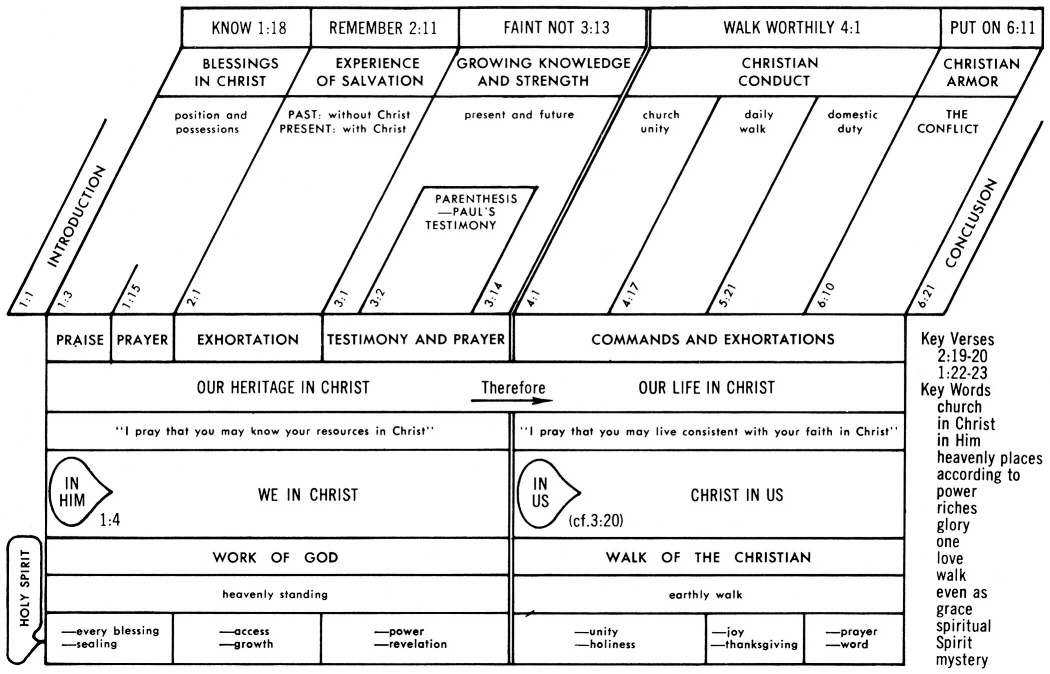
EPHESIANS - CHRIST AND THE CHURCH
Click chart to enlarge
Charts from Jensen's Survey of the NT - used by permission
| SYMMETRY OF EPHESIANS |
|
| EPHESIANS 1-3 | EPHESIANS 4-6 |
| The Root | The Fruit |
| Spiritual Wealth | Spiritual Walk |
| Christian Privilege | Christian Conduct |
| The Position of the Believer |
The Practice of the Believer |
| God Sees Us in Christ |
World Sees Christ in Us |
| Privilege | Practice |
| Doctrine | Duty |
| Doctrinal | Practical |
| Revelation | Responsibility |
| Christian Blessings |
Christian Behavior |
| Belief | Behavior |
| Privileges of the Believer |
Responsibilities of the Believer |
| Our Heritage In Christ |
Our Life In Christ |
| Know your Resources (Riches) in Christ |
Live by faith in the light of your Resources (Riches) in Christ |
| The Finished Work of Christ |
The Faithful Walk of the Christian |
| Work of Christ In Us |
Work of Christ Through Us |
| We in Christ |
Christ in Us |
| Word of God |
Walk of the Christian |
| Heavenly Standing |
Earthly Walk |
| Who You Are In Christ |
Whose You Are In Christ |
| Identity | Responsibility |
| Position of the Believer |
Practice of the Believer |
| Theology | Ethics |
Ephesians 6:18 With all prayer and petition pray at all times in the Spirit, and with this in view, be on the alert with all perseverance and petition for all the saints (NASB: Lockman)
Greek: dia pases proseuches kai deeseos proseuchomenoi (PMPMPN) en panti kairo en pneumati, kai eis auto agrupnountes (PAPMPN) en pass proskarteresei kai deesei peri panton ton hagion,
Amplified: Pray at all times (on every occasion, in every season) in the Spirit, with all [manner of] prayer and entreaty. To that end keep alert and watch with strong purpose and perseverance, interceding in behalf of all the saints (God’s consecrated people). (Amplified Bible - Lockman)
NLT: Pray at all times and on every occasion in the power of the Holy Spirit. Stay alert and be persistent in your prayers for all Christians everywhere. (NLT - Tyndale House)
Phillips: Pray at all times with every kind of spiritual prayer, keeping alert and persistent as you pray for all Christ's men and women. (Phillips: Touchstone)
Wuest: through the instrumentality of every prayer and supplication for need, praying at every season by means of the Spirit, and maintaining a constant alertness in the same with every kind of unremitting care and supplication for all the saints, (Eerdmans Publishing - used by permission)
Young's Literal: through all prayer and supplication praying at all times in the Spirit, and in regard to this same, watching in all perseverance and supplication for all the saints--
| SYMMETRY OF EPHESIANS |
|
| EPHESIANS 1-3 | EPHESIANS 4-6 |
| Spiritual Wealth | Spiritual Walk |
| The Position of the Believer |
The Practice of the Believer |
| God Sees Us in Christ |
The World Should See Christ in Us |
| Privilege | Practice |
| Doctrine | Duty |
| Doctrinal | Practical |
| Revelation | Responsibility |
| Christian Blessings |
Christian Behavior |
| Belief | Behavior |
| Privileges of the Believer |
Responsibilities of the Believer |
| Our Heritage In Christ |
Our Life In Christ |
| Know your Resources (Riches) in Christ |
Live by faith in the light of your Resources (Riches) in Christ |
| Work of Christ |
Walk of the Christian |
| Work of Christ In Us |
Work of Christ Through Us |
| We in Christ |
Christ in Us |
| Word of God |
Walk of the Christian |
| Heavenly Standing |
Earthly Walk |
| Who You Are In Christ |
Whose You Are In Christ |
| Identity | Responsibility |
| Position of the Believer |
Practice of the Believer |
| Theology | Ethics |
WITH ALL PRAYER AND PETITION PRAY AT ALL TIMES IN THE SPIRIT: dia pases proseuches kai deeseos proseuchomenoi (PMPMPN) en panti kairo en pneumati:
- Eph 1:16; Job 27:10; Ps 4:1; 6:9; Isa 26:16; Da 6:10; Lk 3:26,37; 18:1, 2, 3, 4, 5, 6, 7; Luke 21:36; Acts 1:14; 6:4; 10:2; 12:5; Ro 12:12; Php 4:6; Col 4:2; 1Th 5:17; 2Ti 1:3
- 1Ki 8:52,54,59; 9:3; Esther 4:8; Da 9:20; Ho 12:4; 1Ti 2:1; Heb 5:7
- Ep 2:22; Zec 12:10; Ro 8:15,26,27; Gal 4:6; Jude 1:20
- Ephesians 6 Resources - Multiple Sermons and Commentaries
- Ephesians 6:18: Spiritual Warfare - 7 - Wayne Barber
- Ephesians 6:18-19: Standing in the Need of Prayer - Wayne Barber
- Ephesians 6:18-20 How to Fight for God - Steven Cole
- Ephesians 6:18-20 The Armor of God: Praying at All Times - John MacArthur
- Ephesians 6:18-24 Praying At All Times - John MacArthur
Note repetition of "all" in this passage!
Christian, seek not yet repose,
Cast thy dreams of ease away;
Thou art in the midst of foes;
Watch and pray.
Principalities and power,
Mustering their unseen array,
Wait for thy unguarded hours;
Watch and pray.
Watch as if on that alone
Hung the issue of the day,
Pray that help may be sent down;
Watch and pray
--Charlotte Elliot
A reminder -- Remember, beloved of God, this last aspect of our "attire" for spiritual war is still in the context of Paul's instruction in Eph 5:18-note where he commands us to be continually filled with or controlled by the Holy Spirit. Holy War cannot be carried out in our unholy strength but only in His Holy Spirit! Don't fall into the trap of thinking you can stand against supernatural powers in your natural strength! You are already defeated (or soon will feel that way) if that is the way you are thinking you can stand against our unseen foe!
Did we in our own strength confide, our striving would be losing;
Were not the right Man on our side, the Man of God’s own choosing:
Dost ask who that may be? Christ Jesus, it is He;
Lord Sabaoth, His Name, from age to age the same,
And He must win the battle
A Mighty Fortress Is Our God
Not only is the "right Man on our side, but His righteous Gift is IN us (the Spirit of Christ - Ro 8:9-note, 1Cor 3:16) to give us the necessary desire and all sufficient power to fight the good fight of faith for His glory! (cf fourth stanza of A Mighty Fortress - "The Spirit and the gifts are ours through Him Who with us sideth") And of course we carry the "Sword of the Spirit, which is the Word of God." (Eph 6:17-note) (cf third stanza of A Mighty Fortress - "One little word shall fell him.")
Paul had earlier encouraged the Ephesian saints with the fact that he did not cease...
giving thanks for you, while making mention of you in my prayers; that the God of our Lord Jesus Christ, the Father of glory, may give to you a spirit of wisdom and of revelation in the knowledge of Him. I pray that the eyes of your heart may be enlightened, so that you may know what is the hope of His calling, what are the riches of the glory of His inheritance in the saints, and what is the surpassing greatness of His power toward us who believe. (See notes Ephesians 1:16; 1:17; 1:18; 1:19)
Paul had exhorted the saints at Rome to be...
rejoicing in hope, persevering in tribulation, devoted to prayer (see note Romans 12:12)
Paul literally commanded the saints at Philippi to...
Be anxious (present imperative) for nothing, but in everything by prayer and supplication with thanksgiving let your requests be made known (present imperative) to God. And the peace of God, which surpasses all comprehension, shall guard your hearts and your minds in Christ Jesus. (see notes Philippians 4:6; 4:7)
Careful for nothing,
prayerful for everything,
thankful for anything.
—Dwight L. Moody
He gave a similar command to the saints at Colossae...
Devote yourselves (present imperative - keeping this supernatural command necessitates a supernatural Source - jettison SELF reliance and rely wholly on the Spirit's enablement!) to prayer, keeping alert in it with an attitude of thanksgiving; praying at the same time for us as well, that God may open up to us a door for the word, so that we may speak forth the mystery of Christ, for which I have also been imprisoned (see notes Colossians 4:2; 4:3)
And to the saints at Thessalonica Paul gave the well known command to...
Pray (present imperative) without ceasing (1Thes 5:17) ("Keep the phone off the hook at all times.")
With all prayer and petition - This passage serves as a further and final explanation of the manner in which the command to "Stand firm therefore" (aorist imperative) in Ep 6:14-note is to be accomplished in full. Prayer in the Spirit and spiritual warfare go hand in hand.
In Pilgrim’s Progress, John Bunyan refers to one of Christian’s weapons as all prayer, which, when everything else failed, would enable him to defeat the fiends in the valley of the shadow.
MacArthur explains prayer writing that...
All the while that we are fighting in the girdle of truth, the breastplate of righteousness, the shoes of the gospel of peace, the shield of faith, the helmet or salvation, and the sword of the Spirit, we are to be in prayer. Prayer is the very spiritual air that the soldier of Christ breathes. It is the all–pervasive strategy in which warfare is fought....Ephesians begins by lifting us up to the heavenlies, and ends by pulling us down to our knees. (MacArthur, J: Ephesians. Chicago: Moody Press)
Blaikie writes that...
The metaphor of armour is now dropped, but not the idea of the conflict, for what is now insisted on is of the most vital importance for successful warfare. Though prayer is virtually comprehended in most of the previous exhortations, it is now specifically enjoined, and in a great variety of ways; “all prayer and supplication,” equivalent to every form of it, e.g. ejaculatory, secret, spoken, domestic, social, congregational. At all seasons. No period of life should be without it—youth, middle life, old age, all demand it; no condition of life—adversity, prosperity, sunshine, desolation, under sore temptation, under important duty, under heavy trial, under all the changing circumstances of life, personal, social, Christian. See the hymn—
“Go, when the morning shineth;
Go, when the noon is bright;
Go, when the day declineth;
Go, in the hush of night.”
In the Spirit; for true prayer is spiritual, and it is not true prayer unless by the Holy Spirit the heart is filled with heavenward longings and aspirations, changing our prayer from cold form to heartfelt realities. The ordinary habit of the soul should be prayerful, realizing the presence of God and looking for his grace and guidance. And watching thereunto; that is, “towards” spirituality, against formality, as also against forgetfulness and neglect of prayer. Perhaps also the idea of watching for the answer is involved, as you wait for an answer when you have dispatched a letter. In all perseverance; this being very specially needed to make prayer triumphant, as in the case of the Syro-phœnician mother, or in that of Monica, mother of Augustine, and many more. And prayer for all saints; this being one of the great objects for which saints are gathered into the “one body” the Church, that they may be upheld and carried on, in warfare and in work, by mutual prayer, kept from slips and infirmities, and from deadly sins, and enabled one and all to “walk worthy of the vocation wherewith they are called.” (The Pulpit Commentary)
Expositor's Greek Testament writes that...
“This great requirement of standing ready for the combat can be made good only when prayer, constant, earnest, spiritual prayer is added to the careful equipment with all the parts of the panoply.” (Ephesians 6:17-18 Commentary)
E. M. BOUNDS - What the Church needs today is not more machinery or better, not new organizations or more and novel methods, but men whom the Holy Ghost can use—men of prayer, men mighty in prayer. The Holy Ghost does not flow through methods, but through men. He does not come on machinery, but on men. He does not anoint plans, but men—men of prayer.
A C Gaebelein - Praying always. We do not detach this from the armor of God. It belongs to it. Prayer always with all prayer and supplication in the Spirit, is next to the sword of the Spirit the most powerful weapon against the devil and his wicked hosts. We must read the Word and pray. Prayer and the Word cannot be separated. The searching of the Word must be done with prayer and prayer will be effectual through knowing the Word. Prayer is dependence on God; we lean on Him. And as we pray in the Spirit (not for the Spirit) we are to watch also and remember all the saints of God, the blessed members of the body of Christ, the masterpiece of God. (Annotated Bible - Commentary on Ephesians)
H A Kent - The believer must keep in constant communication with his Commander in every season of conflict. Only in this way is he enabled to follow the leading of his Master closely. (Kent, H. A. 1971. Ephesians: The glory of the church Page 119. Chicago, IL: Moody Press)
PRAYER:
OUR WARTIME
"WALKIE TALKIE"
John Piper - Prayer is a war-time walkie-talkie, not a domestic intercom. “I chose you and appointed you,” Jesus said, “that you should go and bear fruit . . . so that whatever you ask the Father in my name, he may give it to you” (John 15:16). I give you a mission so that your prayers will be fruitful. Prayer is for mission. It is mainly for those on the front lines of the war effort to call in to headquarters to send help. One of the reasons our prayer malfunction is that we try to treat it like a domestic intercom for calling the butler for another pillow in the den rather than treating it like a wartime walkie-talkie for calling down the power of the Holy Spirit in the battle for souls.(Missions Exists Because Worship Doesn't)
Prayer (4335) (proseuche from pros = toward or immediately before + euchomai = to pray or vow) is the more general word for prayer and is used only of prayer to God. The prefix "pros" would convey the sense of being immediately before Him and hence the ideas of adoration, devotion, and worship. The basic idea is to bring something, and in prayer this pertains to bringing up prayer requests. In early Greek culture an offering was brought with a prayer that it be accepted. Later the idea was changed slightly, so that the thing brought to God was a prayer. In later Greek, prayers appealed to God for His presence.
If you have any long-standing problems,
try kneeling!
Lawrence Richards explains that proseuche (and the verb form proseuchomai) - "In classical Greek was the technical term for calling on a deity. The NT transforms the classical stiffness into the warmth of genuine conversation. Such entreaty in the NT is addressed to God or Jesus and typically is both personal and specific." (Expository Dictionary)
G G Findlay - Prayer (proseuche) is the universal word for reverent address to God; and "supplication" (petition - deesis) the entreaty for such help as "on every occasion" - at each turn of the battle, in each emergency of life -- we find ourselves in need. And Christian prayer is always "in the Spirit," -- being offered in the grace and power of the Holy Spirit, Who is the element of the believer's life in Christ, Who helps our infirmities and, virtually, intercedes for us (Ro 8:26-27-note)" (The Epistle to the Ephesians)
Petition (1162) (deesis [word study] from deomai = to want, to beg, to pray) refers to making known of one's specific needs, even conveying a sense of an urgent request to meet that need.
Deesis is used in the NT for prayer for particular benefits and gives prominence to one's personal needs. Deesis emphasizes the fact that the suppliant is in need of the thing ask for. Webster says that to supplicate (from Latin supplic-, supplex = entreating for mercy) means to make humble entreaty.
Barnes comments that...
It would be well for the soldier who goes forth to battle to pray--to pray for victory; or to pray that he may be prepared for death, should he fall. But soldiers do not often feel the necessity of this. To the Christian soldier, however, it is indispensable. Prayer crowns all lawful efforts with success, and gives a victory when nothing else would. No matter how complete the armour; no matter how skilled we maybe in the science of war; no matter how courageous we may be, we may be certain that without prayer we shall be defeated. God alone can give the victory; and when the Christian soldier goes forth armed completely for the spiritual conflict, if he looks to God by prayer, he may be sure of a triumph. This prayer is not to be intermitted. It is to be always. In every temptation and spiritual conflict we are to pray. See [Lk 18:1]. (Albert Barnes. Barnes NT Commentary)
At all times - "In every season", at "every opportunity". When God's Spirit reveals to us an opportunity for prayer, we need to seize the moment, choosing to pray and thus redeeming the time (cf note Ephesians 5:16).
"Restraining prayer, we cease to fight;
Prayer makes the Christian armour bright;
And Satan trembles when he sees
The meanest saint upon his knees."
Jesus urged His disciples to pray at all times...
Now He was telling them a parable to show that at all times they ought (must) to pray and not to lose heart (to turn out to be a coward or to lose one’s courage. In the NT it means to be fainthearted or to faint or despond in view of trial or difficulty. It means to lose one's motivation, become discouraged and give up because answers do not come immediately. In spiritual warfare we can either pray or faint!) (Luke 18:1)
Warren Wiersbe gives a wonderful depiction of praying in the Spirit in the pattern of the Old Testament Tabernacle - In the Old Testament tabernacle, there was a small golden altar standing before the veil, and here the priest burned the incense (Ex. 30:1–10; Luke 1:1–11). The incense is a picture of prayer. It had to be mixed according to God’s plan and could not be counterfeited by man. The fire on the altar is a picture of the Holy Spirit, for it is He who takes our prayers and “ignites” them in the will of God. It is possible to pray fervently in the flesh and never get through to God. It is also possible to pray quietly in the Spirit and see God’s hand do great things.(Bible Exposition Commentary)
Times (2540) (kairos [word study]) means a point of time or period of time, time, period, frequently with the implication of being especially fit for something and without emphasis on precise chronology. It means a moment or period as especially appropriate the right, proper, favorable time (at the right time). Kairos speaks of a limited period of time, with the added notion of suitableness ("the suitable time", "the right moment", "the convenient time"). Kairos refers to a distinct, fixed time period, rather than occasional moments.
Kairos is not so much a succession of minutes (Greek chronos 5550), but a period of opportunity. Chronos refers to chronological time, to clock time or calendar time, to a general space or succession of time. Kairos, on the other hand, refers to a specific and often predetermined period or moment of time and so views time in terms of events, eras, or seasons. In other words, kairos defines the best time to do something, the moment when circumstances are most suitable, the psychologically "ripe" moment.
Kairos is a season, an opportune time, an opportunity ("window of opportunity"). It is a fixed and definite time. It is a period possessed of certain characteristics. For example, a "season" is a time characterized by a particular circumstance or feature. Thus the time for bringing forth fruit [karpophoros] is the season (kairos) in which the tree bears fruit, in contrast to late autumn, when there is no more fruit.
Kairos does not emphasize a point of time but rather a time space filled with all kinds of possibilities. And so Kairos characteristically means an "opportunity" (and is so translated in some versions -- in Colossians 4: 5 {see note} in the NIV and NASB) which represents the best time to do something, the moment when circumstances are most suitable.
Webster's defines "opportunity" as a favorable juncture of circumstances or a good chance for advancement or progress. Study the following verses and see if you can discern the "window of opportunity" aspect in each verse to help give you a "feel" for the meaning of Kairos (Mt 13:30, 21:34, Mk 11:13,13:33, Lk 4:13,19:44, Lk 21:24, Acts 1:7, 17:26, 2Co 6:2, Ga 6:9, Eph 2:12, 2Th 2:6, Rev 1:3). There is no good English equivalent to kairos, and when it it plural with chronos it is translated “seasons,” or times at which certain foreordained events take place.
In the Spirit - Barclay "Let the Spirit be the atmosphere in which you pray." The reference is clearly not to our spirit (cf "spirit of the mind" Ep 4:23-note) as if the prayer were initiated by some inward devoutness on our part. Instead Paul calls for spiritual warfare praying (and all praying for that matter) to be in the sphere of influence of the Holy Spirit, which in context would be seen in the one who is filled with or controlled by the Spirit, continually being strengthened by the Spirit, Who enables such prayer to proceed forth and Who Alone truly inspires such heaven sent prayer. If we continually in a state of resisting, grieving, quenching or lying to the Holy Spirit, we should not be surprised that we seldom are stimulated to pray at moments notice. For example, someone may be describing an affliction, trial or some other spiritual attack and feel compelled to offer to pray and petition God on their behalf, whether you're on the sideline of the soccer field, in the hall between services at church, on the telephone, etc. How often do you find yourself led to pray for others when they are clearly describing assaults from the enemy? Be alert like a good soldier of Christ Jesus for those "kairos" opportunities for once they have passed, they cannot be relived. But if you are filled with the Spirit, walking in the Spirit, speaking to others in psalms and hymns, etc, you will be in a sensitive state, and when the Spirit broadcast His "SOS" on the FM Band, you immediately receive because of your spiritually ready and alert state. These kinds of alert prayers are surely some of the contents on the golden altar before the Lord in heaven, John reminding us that one day in the future the following scene will transpire...
And another angel came and stood at the altar, holding a golden censer; and much incense was given to him, that he might add it to the prayers of all the saints upon the golden altar which was before the throne. And the smoke of the incense, with the prayers of the saints, went up before God out of the angel's hand. (Re 8:3, 4-see notes Re 8:3; 8:4)
John MacArthur explains that..
To pray in the Spirit is to pray in the name of Christ, to pray consistent with His nature and will. To pray in the Spirit is to pray in concert with the Spirit, who “helps our weakness; for we do not know how to pray as we should, but the Spirit Himself intercedes for us with groanings too deep for words; and He who searches the hearts knows what the mind of the Spirit is, because He intercedes for the saints according to the will of God” (Ro 8:26, 27-notes). As the “Spirit of grace and of supplication” (Zech. 12:10), the Holy Spirit continually prays for us; and for us to pray rightly is to pray as He prays, to join our petitions to His and our will to His. It is to line up our minds and desires with His mind and desires, which are consistent with the will of the Father and the Son. To be “filled with the Spirit” (Ep 5:18-note) and to walk in His leading and power is to be made able to pray in the Spirit, because our prayer will then be in harmony with His. As we submit to the Holy Spirit, obeying His Word and relying on His leading and strength, we will be drawn into close and deep fellowship with the Father and the Son.
John Eadie comments that...
The theology of the apostle is, that while the Son pleads for His people in heaven, the Spirit within them makes intercession for them and by them, by giving them an enlarged and appropriating view of the Divine promises, that they may plead them in faith and fervor, and by so deepening their own poignant consciousness of want as to induce them to cry for grace with an agony of earnestness that cannot be fitted into words. Ro 8:26. Jude speaks also of “praying in the Holy Ghost” (Jude 1:20), that is, in His exciting and assisting influence.
The soldier needs courage, vigilance, and skill, and therefore he ought, with continued prayer and supplication, to look up to the Lord of hosts, “who teaches his hands to war and his fingers to fight,” and who will make him “more than a conqueror;” so that in due time, the combat being over and his foes defeated, the hand that wielded the sword will carry the palm, and the brow that wore the helmet will be crowned with immortal garlands before the throne. (Ephesians 6 Commentary - Eadie's Commentary)
AND WITH THIS IN VIEW, BE ON THE ALERT: kai eis auto agrupnountes (PAPMPN):
- Matthew 26:41; Mark 13:33; 14:38; Luke 21:36; 22:46; Colossians 4:2; 1Peter 4:7
- Ephesians 6 Resources - Multiple Sermons and Commentaries
- Ephesians 6:18: Spiritual Warfare - 7 - Wayne Barber
- Ephesians 6:18-19: Standing in the Need of Prayer - Wayne Barber
- Ephesians 6:18-20 How to Fight for God - Steven Cole
- Ephesians 6:18-20 The Armor of God: Praying at All Times - John MacArthur
- Ephesians 6:18-24 Praying At All Times - John MacArthur
And with this in view - What in view? Read the context to answer.
Be on the alert (69) (agrupneo from a = without + hupnos = sleep) is literally without sleep and so to be sleepless or to be awake. To chase sleep away. To pass a sleepless night. To suffer from insomnia. The present tense calls for this to be the believer's lifestyle. Be continually on standby alert as you pray! Keep your spiritual eyes open, for the enemy may assault you at any time! And in truth, the only way we can be continually on spiritual "high alert" is to be continually filled with the Spirit Who energizes that spiritual attitude! Our only adequacy in spiritual matters is Christ's adequacy and He makes us adequate not by keeping this instruction under law but as we are led by the Spirit!
No soldier can afford to close his eyes to the enemy. In this regard it is interesting to note that the prayer posture of closing the eyes, bowing the head, and folding the hands is not found in Scripture. In fact the Jews prayed with their eyes open toward heaven and their hands lifted toward God. “Watch and pray” was our Lord’s repeated admonition to his disciples (Mark 13:33, 14:38). Be alert to what the devil is doing or he will attack you while you are praying!
Agrupneo means to exercise constant vigilance over something or to be vigilant in awareness of threatening peril (an image drawn from shepherds), be alert, be on the alert, keep watch over something, be on guard. To be vigilant means to alertly watchful especially to avoid danger. The English word vigilant suggest intense, unremitting, wary watchfulness. To be on the lookout for. To be circumspect, attentive, ready (Mk 13:33, Lk 21:36) Agrupneo is the opposite of listlessness and expresses alertness. The idea of agrupneo is to stay awake in order to carry out a task.
Vincent commenting on the use of agrupneo in Mk 13:33 writes that the word is
he word is derived from agreuo, to hunt, and hupnos (hypnos), sleep. The picture is of one in pursuit of sleep, and therefore wakeful, restless. Wyc.’s rendering of the whole passage is striking: See! wake ye and pray ye! (Vincent, M. R. Word Studies in the New Testament 1:224)
Thayer says that agrupneo...
may be taken to express simply ... absence of sleep, and, pointedly, the absence of it when due to nature, and thence a wakeful frame of mind as opposed to listlessness; whereas gregorein represents a waking state as the effect of some arousing effort...i.e., a more stirring image than the former image (the picture with agrupneo)
MacArthur writes that agrupneo...
refers to staying awake or maintaining a watchful sensitivity. This is strategic in prayer to enable one to know what to pray at the right time and not be asleep at the switch. The person praying is to keep this alert vigil “with all perseverance” (proskarterēsis), a quality of steadfast endurance, literally “a holding fast to.”
Early cowboys guarding a herd at night sometimes took drastic measures to keep alert and hold fast to their work. They rubbed tobacco juice in their eyes to keep at their vigil and to stay awake when weary. They did it in the interests of their boss and for the safety of the cattle. Can we keep effectively steadfast in prayer for the sake of our Lord and for the benefit of others? (MacArthur, J., F., Jr, Mayhue, R., & Thomas, R., L.. Rediscovering Pastoral Ministry : Shaping Contemporary Ministry with Biblical Mandates. Dallas: Word)
Josephus uses agrupneo in the description of the slaying of Saul's son...
So when they once found him alone, and asleep at noon, in an upper room, when none of his guards were there, and when the woman that kept the door was not watching, (agrupneo) but was fallen asleep also, partly on account of the labor she had undergone, and partly on account of the heat of the day, these men went into the room in which Ishbosheth, Saul’s son, lay asleep, and slew him (Ant 7.48). Peabody: Hendrickson.
Agrupneo is us 8 times in the Septuagint (LXX) (2Sa 12:21; Ezra 8:29; Job 21:32; Ps. 102:7; 127:1; Pr 8:34; Song 5:2; Da 9:14). Here is a representative use...
Psalm 127:1 A Song of Ascents, of Solomon. Unless the LORD builds the house, they labor in vain who build it. Unless the LORD guards the city, the watchman keeps awake (Lxx = agrupneo) in vain.
Proverbs 8:34 "Blessed is the man who listens to me, watching (Lxx = agrupneo) daily at my gates, waiting at my doorposts. (Comment: This speaks of keeping watch in an ethical sense.)
Agrupneo is found four times in the NT...
Mark 13:33 "Take heed (blepo - present imperative), keep on the alert (agrupneo - present imperative); for you do not know when the appointed time is.
Luke 21:36 "But keep on the alert (present imperative) at all times (kairos - seasons, opportunities), praying in order that you may have strength to escape all these things that are about to take place, and to stand before the Son of Man." (Comment: Here agrupneo conveys the idea of making an effort to learn of what might be a potential future threat.)
Ephesians 6:18 With all prayer and petition pray at all times in the Spirit, and with this in view, be on the alert with all perseverance and petition for all the saints,
Hebrews 13:17 Obey (present imperative) your leaders, and submit (present imperative) to them; for they keep watch (agrupneo) over your souls, as those who will give an account. Let them do this with joy and not with grief, for this would be unprofitable for you. (Comment: The idea of agrupneo in this verse is to take care of or to look after, with the implication of continuous and wakeful concern for. Vine adds that "Agrupneo signifies to be wakeful, suggestive of the watchful care of shepherds. The overseer must ever carry on his work in view of the Judgment Seat of Christ, where he will give account of his service, its motives and methods. - Collected writings of W. E. Vine. Nashville: Thomas Nelson)
John Eadie comments that...
To secure this earnest supplication at all times in the Spirit, they were to be ever on their guard against remissness, for many “impedimenta” exist in the Christian army. (John Eadie, D., LL.D. The Epistle of St Paul to the Ephesians)
WITH ALL PERSEVERANCE AND PETITION FOR ALL THE SAINTS: en pass proskarteresei kai deesei peri panton ton hagion:
- Ge 32:24, 25,26, 27, 28; Mt 15:25, 26, 27, 28; Luke 11:5, 6, 7, 8; 18:1, 2, 3, 4, 5, 6, 7, 8
- Ep 6:19; 1:16; 3:8,18; Philippians 1:4; 1Ti 2:1; Col 1:4; Phile 1:5
- Ephesians 6 Resources - Multiple Sermons and Commentaries
- Ephesians 6:18: Spiritual Warfare - 7 - Wayne Barber
- Ephesians 6:18-19: Standing in the Need of Prayer - Wayne Barber
- Ephesians 6:18-20 How to Fight for God - Steven Cole
- Ephesians 6:18-20 The Armor of God: Praying at All Times - John MacArthur
- Ephesians 6:18-24 Praying At All Times - John MacArthur
All - Not just a touch of perseverance but "all perseverance" which I submit is something that can only be accomplished as we surrender to the Spirit, allowing Him to fill and control and empower us.
Perseverance (4343) (proskarteresis from pros = direction - toward + kartereo = be strong, steadfast, firm) (See also word study of the related verb proskartereo) means to continue to do something with intense effort with the possible implication of doing so despite difficulties. Proskarteresis pictures one's devotion to the task, keeping on it, persisting in it, being earnest towards (pros) it.
Proskarteresis describes a steadfast single-minded fidelity (faithfulness) to a certain course of action, in this case prayer for the needs of all the saints (regardless of where they attend church or to which denomination they belong). It describes an obstinate persistence, a keeping on task with devotion, a continuing with intense effort, a steadfast attention toward (in Eph 6:18 toward) praying, a giving of unremitting care toward praying, a continuation all the time in a place, a spirit which does not faint, a constant diligence toward praying, assiduous attention toward praying.
The root verb proskartereo is used in Mark 3:9 where Jesus instructs “His disciples to have a boat ready (proskartereo) for Him because of the crowd, so that they would not crowd Him (in essence not crush Him).” A boat was to be set apart, in a sense devoted for the Master's use, for the purpose of taking Jesus away in case the crowd became threatening. “Devoted” then conveys the idea of dedicated for a task, appointed for it, here in Eph 6:18 devoted to the task of praying for all our brethren (The Global Prayer Digest is a great tool to use to motivate you to pray for unreached people groups, that they might receive Christ and enter into the family as brothers and sisters in Christ) . The root verb proskartereo is also used in Paul's command to the saints at Colossae to...
Devote (present imperative) yourselves to prayer (Just try to obey this command in the strength of your fallen flesh! You can't! You must cast off self reliance and put on Spirit of Christ reliance, yielding to His enabling power to accomplish this supernatural effect of continual devotion to prayer), keeping alert (gregoreuo in present tense = continual and also in an "imperative sense") in it with an attitude (How you think! Who or what do you think about? Your problems? Or God? His Word? Christ in you? etc, if the latter, then you will be filled with His Spirit Who energizes a grateful heart - see Eph 5:18-note and Eph 5:20-note) of thanksgiving 3 praying at the same time for us as well, that God may open up to us a door for the word (the Gospel), so that we may speak forth the mystery of Christ, for which I have also been imprisoned (Col 4:2-3-note)
John MacArthur illustrates perseverance...
When the coal truck delivered a ton of coal on the sidewalk in front of her house, a little London girl took her small shovel and began carrying the coal into the basement. When a neighbor man who was watching told her, “You’ll never be able to get it all in,” she replied, “Oh, I will sir, if I work long enough.”
The test of a person’s character is what it takes to stop him. Some people retreat as soon as the first shot is fired, while others fight through battle after battle with no thought of giving up. Satan will try every means to discourage and deter us, reminding us of defeats and dangers and setting every possible object in our way to destroy our assurance in Christ. (MacArthur, J: Ephesians. Chicago: Moody Press)
My Soul Be on Thy Guard
by George Heath
My soul, be on thy guard;
Ten thousand foes arise;
The hosts of sin are pressing hard
To draw thee from the skies.O watch, and fight, and pray;
The battle ne’er give o’er;
Renew it boldly every day,
And help divine implore.Never think the victory won,
Nor lay thine armor down;
The work of faith will not be done,
Till thou obtain the crown.Fight on, my soul, till death
Shall bring thee to thy God;
He’ll take thee, at thy parting breath,
To His divine abode.
Petition (1162) (deesis) (Click word study on deesis) refers to urgent requests or supplications to meet a need and are exclusively addressed to God. Deesis in the New Testament always carries the idea of genuine entreaty and supplication before God. It implies a realization of need and a petition for its supply.
Deesis was used by the angel who assured the godly father of John the Baptist,
“Do not be afraid (stop fearing indicating he already was fearful), Zacharias (means "Jehovah remembers"), for your petition (deesis - specifically their need for God to open his wife's womb) has been heard, and your wife Elizabeth (means "my God is an oath") will bear you a son, and you will give him the name John (means “Jehovah has shown grace”)” (Luke 1:13).
Luke uses deesis again of the disciples of John the Baptist, who were said to “often fast and offer prayers (deesis)" (Luke 5:33).
Deesis was used by Paul of his “prayer for the salvation of his fellow Israelites...
"Brethren, my heart's (deepest, consuming) desire and my prayer prayer (deesis - conveys idea of pleading and entreaty, of persistent petition) to God for them is for their salvation." (Ro 1:10-note).
Paul practiced what he preached as is evident from his letter to the saints at Philippi, writing these encouraging words...
"I thank (eucharisteo > Eucharist used of Lord’s Supper when believers give thanks to God in remembrance of Christ’s substitutionary sacrifice on the cross) my (reflects Paul's deep intimacy) God in all my remembrance of you, always offering prayer (deesis) with joy in my every prayer (deesis) for you all, in view of your (joint) participation (with me) in the gospel from the first day (when Lydia opened her home for the preaching of the Word) until now." (see notes Philippians 1:3; 1:4; 1:5)
For I know that this shall turn out for my deliverance through your prayers (deesis) and the provision of the Spirit of Jesus Christ" (Php 1:19-note)
Stayed upon Jehovah,
Hearts are fully blessed;
Finding, as He promised,
Perfect peace and rest.
(Play Like a River Glorious)
by Frances Ridley Havergal
Prayer is vital in warfare because it represents communication with "Command Central" so to speak and its absence is a sure means of cutting oneself off from God, and making us vulnerable in warfare. Prayerlessness produces sterility of spiritual perception, a life without holiness, and a witness without power.
David Guzik writes that...
The idea is all kinds of prayer or prayer upon prayer. We should use every kind of prayer we can think of. Group prayer, individual prayer, silent prayer, shouting prayer, walking prayer, kneeling prayer, eloquent prayer, groaning prayer, constant prayer, fervent prayer - just pray.
We can say that it is through prayer that spiritual strength and the armor of God go to work. In theory, the prayerless Christian can be strong and wearing all the armor - but actually goes into battle through prayer. Often we just don’t pray because we are simply overconfident in our own abilities. Winston Churchill said to Britain in the early days of World War II: “I must drop one word of caution, for next to cowardice and treachery, overconfidence leading to neglect and slothfulness, is the worst of wartime crimes.” (Ephesians 6)
Often the world system works like a cooling system. John Wesley once said: “Whatever cools my affection toward Christ is the world.” Prayer is the insulation that protects the soul from being chilled to death.
David Jeremiah gives the following illustration...
I once borrowed a car and as a favor to the owner filled it with gas. That big Oldsmobile station wagon had an ornament on the hood that said “diesel,” a sticker on the rear gate that said “Oldsmobile Diesel,” and a note on the fuel gauge reading, “Diesel Fuel Only.” So naturally I put diesel fuel in the tank. Big mistake, since the owner had recently converted it to gasoline. When it broke down on the main street of a village in New York, I had to explain why I had put diesel fuel into a vehicle with a gasoline engine.
I don’t think I’ll ever live that down, so I use it as the perfect illustration of Christians. We are human beings, and we have “Human Being” written all over us, but we’ve been converted into something else. If you try to run your new spiritual self on the old kind of fuel, it won’t work. There are a lot of Christians who haven’t figured that out yet. The fuel for the Christian life is prayer. Prayer is the energy that makes it possible for the Christian warrior to wear the armor and wield the sword.
You cannot fight the battle in your own power. No matter how talented you are, if you try to fight the spiritual battle in your own strength, you will be defeated. (Jeremiah, D. Sanctuary: Finding Moments of Refuge in the Presence of God Nashville, TN: Integrity Publishers)
Adoniram Judson, one of the greatest missionaries ever sent out from American shores, was emphatic in his insistence upon prayer. He said,
“Be resolute in prayer. Make any sacrifice to maintain it. Consider that time is short and that business and company must not be allowed to rob thee of thy God.”
Max Lucado has these thoughts on "living in God's presence"...
How do I live in God’s presence? How do I detect his unseen hand on my shoulder and his inaudible voice in my ear? … How can you and I grow familiar with the voice of God? Here are a few ideas:
Give God your waking thoughts. Before you face the day, face the Father. Before you step out of bed, step into his presence.
Give God your waiting thoughts. Spend time with him in silence.
Give God your whispering thoughts.… Imagine considering every moment as a potential time of communion with God.
Give God your waning thoughts. At the end of the day, let your mind settle on him. Conclude the day as you began it: talking to God. Just Like Jesus. (Lucado, M., & Gibbs, T. A. Grace for the Moment : Inspirational Thoughts for Each Day of the Year. Nashville, Tenn.: J. Countryman)
Praying Hyde was such a man who lived in the presence of God as the following story relates...
During one of Dr. Wilbur Chapman’s campaigns in England, the attendance was consistently small. He received word that an American missionary was going to pray for him. Almost instantly the hall became packed, and at his first invitation 50 men accepted Christ as Savior. One night the missionary was in the congregation. When Dr. Chapman was introduced to him, he asked him to pray for him. The two went to Chapman’s room, dropped on their knees and for five minutes the missionary was quiet. “I could hear my heart thumping,” Chapman said. “I felt hot tears running down my face. I knew I was with God.” Then the missionary said, “O God!” and was silent for another five minutes. When he knew he was talking with God there came from the depth of his heart such petitions for men as I have never heard before. When Chapman rose from his knees, he knew what prayer is. He had learned from the missionary, Praying Hyde, who knew the power of supplication in the Spirit.
Spurgeon writes that...
When you cannot use your sword, and even when you can hardly grasp your shield, you can pray. That weapon of “all prayer” is of the handiest kind, because it can be turned in any and every direction. “Praying always with all prayer” — groaning prayers, weeping prayers, prayers that are made up of single words, prayers that have not a word in them, prayers for others, prayers of confession, prayers of thanksgiving, — “praying always with all prayer and supplication in the Spirit,”
But will prayer for other people help us? Yes, very much. You will sometimes find that, when you cannot pray for yourself, it is a good plan to pray for somebody else. Think of some child of God, and pray for him, and then the fire of supplication will soon burn up in your heart. The Lord turned the captivity of Job when he prayed for his friends, and he will do the same for you. I have heard many of our members say that, when they have felt bound in prayer, they have pleaded for their Pastor and afterwards they have been able to pray for themselves. I advise more of you to try that plan; it will do me good, and then if it also does you good, there will be a double advantage in it. Paul was of the same mind as I am, for he added, —
Saints (40) (hagios) (Click word study on hagios) is literally holy one and refers to one set apart (sanctified) for a special purpose. Hagios describes every saint's position in Christ as set apart from that which is secular, profane, and evil and on the other hand dedicated to worship and service of God. We are holy ones both in character and conduct set apart by God to be exclusively His, dedicated to Him and manifesting holiness of heart and conduct.
Hagios was used throughout the NT to speak of anyone or anything that represents God’s holiness: Christ as the Holy One of God, the Holy Spirit, the Holy Father, holy Scriptures, holy angels, holy brethren, and so on.
The Gentiles understood this term because among the pagans, hagios signified separated and dedicated to the idolatrous gods and carried no idea of moral or spiritual purity. The manmade gods were as sinful and degraded as the men who made them and there simply was no need for a word that represented righteousness! The worshipper of the pagan god acquired the character of that pagan god and the religious ceremonies connected with its worship. The Greek temple at Corinth housed a large number of harlots who were connected with the "worship" of the Greek god. Thus, the set-apartness or holiness of the Greek worshipper was in character licentious, totally depraved, and sinful.
John MacArthur has an interesting note writing that...
Praying for others with sincerity and perseverance is, in God’s immeasurable grace, a great blessing and strength to our own souls. D. Martyn Lloyd–Jones reported that before the outbreak of the Spanish civil war that country was experiencing such an epidemic of neuroses that psychiatrists could hardly handle them all. But the war, terrible and destructive as it was in most respects, had the unexpected effect of “curing” many of Spain’s thousands of neurotics. When they became concerned about the welfare of their families, friends, and country instead of their own, their neuroses disappeared and hospitals and clinics were almost emptied of such cases. “These neurotic people were suddenly cured by a greater anxiety,” an anxiety that reached beyond their own selfish welfare. (The Christian Soldier [Grand Rapids: Baker, 1977], pp. 357–58.) (MacArthur, J: Ephesians. Chicago: Moody Press)
John Bunyan in The Holy War describes the armor of the devil (Diabolus) as basically the opposite of that of the Christian...
‘Another part or piece,’ said Diabolus, ‘of mine excellent armour is a dumb and prayerless spirit—a spirit that scorns to cry for mercy; wherefore be you, my Mansoul, sure that you make use of this. What! cry for quarter, never do that if you would be mine; I know you are stout men, and am sure that I have clad you with that which is armour of proof; wherefore, to cry to Shaddai for mercy, let that be far from you. Besides all this, I have a maul, fire-brands, arrows and death, all good hand-weapons, and such as will do execution.’
C H Spurgeon
Ephesians 6:18. Praying always with all prayer and supplication in the Spirit, —
When you cannot use your sword, and even when you can hardly grasp your shield, you can pray. That weapon of “all prayer” is of the handiest kind, because it can be turned in any and every direction. “Praying always with all prayer” — groaning prayers, weeping prayers, prayers that are made up of single words, prayers that have not a word in them, prayers for others, prayers of confession, prayers of thanksgiving, — “praying always with all prayer and supplication in the Spirit,” —
Ephesians 6:18. And watching thereunto with all perseverance and supplication for all saints;
But will prayer for other people help us? Yes, very much. You will sometimes find that, when you cannot pray for yourself, it is a good plan to pray for somebody else. Think of some child of God, and pray for him, and then the fire of supplication will soon burn up in your heart. The Lord turned the captivity of Job when he prayed for his friends, and he will do the same for you. I have heard many of our members say that, when they have felt bound in prayer, they have pleaded for their Pastor and afterwards they have been able to pray for themselves. I advise more of you to try that plan; it will do me good, and then if it also does you good, there will be a double advantage in it.
Related Resources:
- Devotional on Prayer
- Guide to Praying for Missionaries
- Pithy Prayer Phrases
- Prayer - Greek Words for Prayer
- Prayer Devotionals and Illustrations
- Prayer Hymns and Poems
- Prayer Quotes
- Prayer Quotes, Devotionals and Illustrations
- Praying His Word
- Praying in the Spirit
- Spurgeon's Gems on Prayer
Pulpit Commentary Homilies (The Pulpit Commentaries) -
With all prayer and supplication praying. The metaphor of armor is now dropped, but not the idea of the conflict, for what is now insisted on is of the most vital importance for successful warfare. Though prayer is virtually comprehended in most of the previous exhortations, it is now specifically enjoined, and in a great variety of ways; "all prayer and supplication," equivalent to every form of it, e.g. ejaculatory, secret, spoken, domestic, social, congregational. At all seasons. No period of life should be without it—youth, middle life, old age, all demand it; no condition of life—adversity, prosperity, sunshine, desolation, under sore temptation, under important duty, under heavy trial, under all the changing circumstances of life, personal, social, Christian. See the hymn—
"Go, when the morning shineth;
Go, when the noon is bright;
Go, when the day declineth;
Go, in the hush of night."
In the Spirit; for true prayer is spiritual, and it is not true prayer unless by the Holy Spirit the heart is filled with heavenward longings and aspirations, changing our prayer from cold form to heartfelt realities. The ordinary habit of the soul should be prayerful, realizing the presence of God and looking for his grace and guidance. And watching thereunto; that is, "towards" spirituality, against formality, as also against forgetfulness and neglect of prayer. Perhaps also the idea of watching for the answer is involved, as you wait for an answer when you have dispatched a letter. In all perseverance; this being very specially needed to make prayer triumphant, as in the case of the Syro-phoenician mother, or in that of Monica, mother of Augustine, and many more. And prayer for all saints; this being one of the great objects for which saints are gathered into the "one body" the Church, that they may be upheld and carried on, in warfare and in work, by mutual prayer, kept from slips and infirmities, and from deadly sins, and enabled one and all to "walk worthy of the vocation wherewith they are called."
Ephesians 6:18-20 "Praying always."
Here is a part of the Christian's amour which had nothing corresponding to it in the panoply of the Roman soldier. Prayer comes in without any figure. We are taught that, even when every spiritual weapon is prepared and directed against the spiritual foe, all is in vain without a direct appeal to God. When Jacob, looking for an attack by Esau, had completed his arrangements of his family and flocks, the most important part of his preparations remained—another warfare had to be carried on, he must wrestle with the angel for his blessing. So in the Christian conflict, even when the loins are girt with truth, the heart protected by the breastplate of righteousness, the feet shod with peace, the head crowned with the helmet of salvation, the person protected by the shield of faith, and when the hands are grasping and wielding the sword of the Spirit, there is another duty which is quite indispensable—prayer: "Praying always with all prayer," etc. This is in accordance with the whole tenor of the Bible: Enoch, walking with God; Abraham, interceding for Sodom; Moses, pleading on the mountain; Elijah, praying for rain; David, Hezekiah, Daniel, Simeon, Anna, our blessed Lord in Gethsemane,—all show us that fighting men ought always to pray and not to faint. The soul is thus strengthened and encouraged; it reaches the promises and rests on them; it feels that God is with it; "They that wait on the Lord renew their strength; they mount up with wings as eagles; they run, and are not weary; they walk, and are not faint? The prayer required is marked by six features.
1. Manifold. With all prayer and supplication; all kinds—secret, ejaculatory, domestic, social, public.
2. Incessant. At all seasons:
3. Spiritual. "In the Spirit"—in dependence on his aid and inspiring power, in opposition to the mere form or rhyming of "pater nosters."
4. Watchful. (See Exposition.)
5. Persevering (see Exposition).
6. Comprehensive. "For all saints," and especially for God's servants in the gospel, the men who are bearing the burden and heat of the battle. Men may ridicule prayer; they may scoff at a praying man, a praying family, a praying nation; but the spectacle is really sublime. When Pere Hyacinthe, lecturing on the public immorality of his country, made the aisles of Notre Dame ring with his eloquence, he did not find cause to scoff at prayer. He said that it moved him to find England and the United States not ashamed to pray in the time of calamity, and to give thanks in the hour of deliverance. God, after all, is the Ruler among the nations, and his rule of good will stand true. "Them that honor me I will honor, but they that despise me shall be lightly esteemed."
Ephesians 6:18 The duty of prayer.
We are not to regard prayer as a seventh weapon, but rather as exhibiting the spirit in which the Divine armor is to be assumed and the warfare carried on. It is easy to see the intimate relation existing, between prayer and each individual part of the Christian's armor.
1. It is to be prayer of all kinds—public and private, oral and mental, formal and ejaculatory.
2. It is to be spiritual prayer: "In the Spirit;" for" He makes intercession for the saints with groanings which cannot be uttered" (Romans 8:26). We must "pray in the Holy Ghost" (Jud Ephesians 1:20).
3. It is to be persevering prayer: "At all times; at every suitable season. We must cultivate an habitual frame of prayer.
4. It is to be watchful prayer: "Watching thereunto." We must watch against watchlessness, watch for occasions of prayer, watch for answers to prayer.
5. It is to be intercessory prayer: "For all saints." It is most comprehensive in its character. It is based on the communion of saints. We have every heavenly motive for continuing in prayer. We have no ground to expect blessing without it (Ezekiel 36:37). It is a means of getting all blessings, temporal, and spiritual (Matthew 7:7; Matthew 21:22; James 1:5). It is in itself the most heavenly duty we can perform (Philippians 3:20).—T. C.
Ephesians 6:18 Prayer
1. In prayer. "Praying always with all prayer," or, as Ellicott has rendered it, "with all prayer and supplication praying always in the Spirit." The words teach us:
2. In prayer for the good in general. "For all saints." The apostle would not have them merely to pray for themselves. He who prays exclusively for himself never prays at all. His prayers are but the breath of selfishness. Paul required them to pray for "all saints"—saints of every intellectual grade, of every social position, of every ecclesiastical sect, of every theological school, of every kingdom and every tribe. Why for all saints? Because all saints are members of the grand army battling against the common foe—against the "principalities of evil," etc. The more force, courage, skill, each member of an army possesses, the better for the cause, the more likely the victory in whose advantages all participate. The battle of Christianity is a common battle—a battle against error, wrong, and depravity everywhere. All saints are engaged in it and they should be prayed for.
3. In prayer for gospel ministers in particular. "And for me, that utterance may be given unto me." Why does Paul wish them to pray for him? Is it that he might be liberated from prison? No. He was now, he tells us, an "ambassador in bonds." The clanking chains of the prison hung heavily on him, and one would not have wondered if his first request had been to the Ephesians to pray for his bodily deliverance. But this he does not. He is too absorbed in the cause of Christ and universal happiness for this. What he prayed for was that he might be enabled properly and successfully to preach the gospel. "That I may open my mouth boldly, to make known the mystery of the gospel," that is, the gospel that was once a mystery. The preaching of the gospel was God's grand instrument for restoring the world to intelligence, dignity, and happiness, and because of that, he desired to do it in the most effective way. There are several remarkable things in these words.
Restraining prayer, we cease to fight;
Prayer makes the Christian's armor bright;
And Satan trembles when he sees
The weakest saint upon his knees.
Even the great Commander of all the legions of the good recognized the mighty power of prayer during his struggles on this earth. "Thinkest thou that I cannot now pray to my Father, and he shall presently give me more than twelve legions of angels?" As if he had said, "With one breath of prayer I could bring the mighty battalions of eternity to my aid."—D. T.
Ephesians 6:18-20 True prayer.
The arming and fighting referred to in the previous verses are to be accompanied with praying. Prayer is as necessary as action. The part of Moses on the mount was at least as important as that of Joshua on the plain. Consider the character and object of true prayer.
1. THE CHARACTER OF TRUE PRAYER.
1. Earnestness. What a ring of vehement intensity sounds through the apostle's words! Here is a man who believes in prayer and is greatly anxious to secure it. It would be wonderful if some prayers were answered. When the prayer does not affect the heart of the suppliant how can it touch the heart of God? A half-hearted prayer can bring no blessing from heaven because it is too feeble even to reach heaven.
2. Spirituality. We must pray in the Spirit. Our own thoughts must be spiritual and we must seek the inspiration of God's Spirit to give light and life to our praying (Romans 8:26).
3. Independence of hindering circumstances. "At all seasons." Prayer is always in season. But we are not always inclined to pray. Yet when we least desire to pray prayer is most necessary.
4. Watching, in order that our prayers may be apposite' to the occasion, that we may discern the Divine response, and that we may be roused to renewed earnestness in face of the dangers and needs of the times.
5. Earnest prayer will be persevering prayer. It need be so, for God sometimes delays his reply to test our faith.
II. THE OBJECTS OF TRUE PRAYER.
1. On behalf of all saints. We should pray for all mankind, but especially for those who are of the household of the faith. Christian brotherhood should be seen in prayer. Mutual prayer is the greatest bond of union in the Church.
2. For any in trouble. St. Paul, the "ambassador in chains," seeks the prayers of his friends. He in Rome can find comfort from the prayers of Christians in Asia. It would be well if, instead of condemning our brother when he falls before temptation, we would pray for him while he is in it.
3. For the spread of the gospel. St. Paul is not so anxious that prayer should be offered for the alleviation of his harsh imprisonment and for safe deliverance from the hands of his foes, as for grace to be faithful and bold in his declaration of the mystery of the gospel a noble, self-forgetful request. If the Church at home believed more in the efficacy of prayer and practiced it more earnestly, the missionary abroad would be more successful in his work.—W.F.A. (The Pulpit Commentaries)
F B Meyer has the following on "Praying at all seasons in the Spirit"
The dying Monod regretted he had not prayed more.
We should pray at all seasons. Prayer is never out of place. There is no conceivable circumstance in life where it would be inappropriate to pray. At the wedding or the funeral; as we engage in work or finish it; whether the wind blow from the cold north or the balmy south — it is wise and right to pray. “Prayer and provender (food),” the old proverb says, “hinder no man.”
We should pray in the Spirit. Reversing the order of the words, but bringing in their true meaning, we might say, “Let the Spirit pray in the soul.” It is well in prayer to wait until the scum of our own choice and desire has passed off, that the yearnings of the Holy Spirit may arise and manifest themselves. We need to be in the Spirit, not only on the Lord’s Day, but always, that He may be mightily in us, teaching us the will of God.
We should pray unselfishly. “For all saints,” said the apostle, “and for me.”
We should watch. Do not give runaway knocks. Stand at God’s door till it opens. Be on the alert. Wait on the watch-tower. Many of God’s ships pass in the night, and many of his gifts arrive at the wharf when those to whom they were consigned are asleep or gone.
We should persevere. God keeps us waiting that He may test and humble us, and know what is in our heart. Delays are his winnowing fan, discriminating between the chaff and the wheat. What we asked so vehemently we did not ask wisely. When we pray according to his heart, He graciously sustains us. Persevere; you do not know how near you are to the blessing you have sought for years. (Meyer, F. B. Our Daily Homily. Pleasant Places Press)
Oswald Chambers has a devotional from December 16 entitled "Wrestling before God"...
Wherefore take unto you the whole armour of God,. . . praying always. . . Eph. 6:13,18.
You have to wrestle against the things that prevent you from getting to God, and you wrestle in prayer for other souls; but never say that you wrestle with God in prayer, it is scripturally untrue. If you do wrestle with God, you will be crippled all the rest of your life. If, when God comes in some way you do not want, you take hold of Him as Jacob did and wrestle with Him, you compel Him to put you out of joint. Don’t be a hirpler in God’s ways, but be one who wrestles before God with things, becoming more than conqueror through Him. Wrestling before God tells in His Kingdom. If you ask me to pray for you and I am not complete in Christ, I may pray but it avails nothing; but if I am complete in Christ, my prayer prevails all the time. Prayer is only effective when there is completeness— “Wherefore take unto you the whole armour of God.”
Always distinguish between God’s order and His permissive will, i.e., His providential purpose towards us. God’s order is unchangeable; His permissive will is that with which we must wrestle before Him. It is our reaction to the passive will of God that enables us to get at His order. “All things work together for good to them that love God”—to those who remain true to God’s order, to His calling in Christ Jesus. God’s permissive will is the means whereby His sons and daughters are to be manifested. We are not to be like jelly-fish saying—‘It’s the Lord’s will.’ We have not to put up a fight before God, not to wrestle with God, but to wrestle before God with things. Beware of squatting lazily before God instead of putting up a glorious fight so that you may lay hold of His strength. (Chambers, O.. My Utmost for His Highest)
C H Spurgeon has the following devotional from Morning and Evening...
What multitudes of prayers we have put up from the first moment when we learned to pray. Our first prayer was a prayer for ourselves; we asked that God would have mercy upon us, and blot out our sin. He heard us. But when he had blotted out our sins like a cloud, then we had more prayers for ourselves. We have had to pray for sanctifying grace, for constraining and restraining grace; we have been led to crave for a fresh assurance of faith, for the comfortable application of the promise, for deliverance in the hour of temptation, for help in the time of duty, and for succour in the day of trial. We have been compelled to go to God for our souls, as constant beggars asking for everything. Bear witness, children of God, you have never been able to get anything for your souls elsewhere. All the bread your soul has eaten has come down from heaven, and all the water of which it has drank has flowed from the living rock—Christ Jesus the Lord. Your soul has never grown rich in itself; it has always been a pensioner upon the daily bounty of God; and hence your prayers have ascended to heaven for a range of spiritual mercies all but infinite. Your wants were innumerable, and therefore the supplies have been infinitely great, and your prayers have been as varied as the mercies have been countless. Then have you not cause to say, “I love the Lord, because he hath heard the voice of my supplication”? For as your prayers have been many, so also have been God’s answers to them. He has heard you in the day of trouble, has strengthened you, and helped you, even when you dishonoured him by trembling and doubting at the mercy-seat. Remember this, and let it fill your heart with gratitude to God, who has thus graciously heard your poor weak prayers. “Bless the Lord, O my soul, and forget not all his benefits.” (Spurgeon, C. H. Morning and Evening: Daily readings - February 6, Morning).
Vital intercession - Ephesians 6:18 - Oswald Chambers
As we go on in intercession we may find that our obedience to God is going to cost other people more than we thought. The danger then is to begin to intercede in sympathy with those whom God was gradually lifting to a totally different sphere in answer to our prayers. Whenever we step back from identification with God’s interest in others into sympathy with them, the vital connection with God has gone; we have put our sympathy, our consideration for them, in the way, and this is a deliberate rebuke to God.
It is impossible to intercede vitally unless we are perfectly sure of God, and the greatest dissipator of our relationship to God is personal sympathy and personal prejudice. Identification is the key to intercession, and whenever we stop being identified with God, it is by sympathy, not by sin. It is not likely that sin will interfere with our relationship to God, but sympathy will, sympathy with ourselves or with others which makes us say—‘I will not allow that thing to happen.’ Instantly we are out of vital connection with God.
Intercession leaves you neither time nor inclination to pray for your own ‘sad sweet self.’ The thought of yourself is not kept out, because it is not there to keep out; you are completely and entirely identified with God’s interests in other lives.
Discernment is God’s call to intercession, never to fault finding. (Chambers, O. My Utmost for His Highest)
Confident Prayer - Ephesians 6:18
As one of Africa's first explorers, David Livingstone loved its people and longed to see them evangelized. His journals reveal his spiritual concern and deep faith.
In late March 1872, he wrote, "He will keep His word--the gracious One, full of grace and truth--no doubt of it. He said, 'Him that cometh unto Me, I will in no wise cast out' and 'Whatsoever ye shall ask in my name I will give it.' He will keep His word; then I can come and humbly present my petition, and it will be all right. Doubt is here inadmissible, surely."
Livingstone had rock-like confidence in the Father's promises. In our praying we too can exercise the trust that God will not deny our requests when they are in keeping with His will. (By the way, are we reading His Word so that we know His will?)
We can defeat doubt when we remind ourselves that no matter what happens in life, He cares deeply about us and longs to give us the wisdom to handle what comes our way (1Pe 5:7-note; Jas 1:5-note). Our faith will grow stronger as we realize that our heavenly Father is gracious, delighting to give good gifts to His children (Mt. 7:11-note). Humbly but confidently, we can come to Him with our requests. --V C Grounds (Our Daily Bread, Copyright RBC Ministries, Grand Rapids, MI. Reprinted by permission. All rights reserved)
Thou art coming to a King,
Large petitions with thee bring,
For His grace and power are such,
None can ever ask too much. --Newton
When we love God as our Father,
we won't treat Him as our servant.
Free Prayer -A pastor was asked to call on a woman in a psychiatric hospital and pray for her. After his visit, he thought how good it would be for somebody to go there regularly and pray for the residents. The "somebody" turned out to be him. On a table in one of the wards, he put up a sign saying "Free Prayer." Later he recalled, "Suddenly I had 15 people standing in line to get prayed for."
People often ask for our prayers, but do we faithfully pray for them? Many times we see others in great need but find it easier to discuss their plight with friends rather than to intercede for them. But people need and want our prayers.
Paul concluded his call to put on "the whole armor of God" (Ephesians 6:13, 14, 15, 16, 17) by writing, "Praying always with all prayer and supplication in the Spirit, being watchful to this end with all perseverance and supplication for all the saints" (Ep 6:18).
Oswald Chambers often referred to prayer as "the ministry of the interior" and said, "There is no snare, or any danger of infatuation or pride in intercession; it is a hidden ministry that brings forth fruit whereby the Father is glorified."
Faithful prayer—whether in public or private—is one of the greatest gifts we can give others.—David C. McCasland (Ibid)
To give to others what they need,
We show no greater care
Than when we give them to the Lord,
Upholding them in prayer. —D. De Haan
Our intercession may be the key to God's intervention
LET'S KEEP PRAYING! - Irina Ratushinskaya's childhood quest for God, even while she was hearing school lectures promoting atheism and mocking Christianity, led her to a deep and unflinching faith. Her poetry expressed that faith and brought inspiration and hope to
believers all over Russia.
It also brought her to the attention of the KGB. At age 28, Irina was arrested and sentenced to 7 years hard labor in the Bareshevo labor camp. There she was subjected to relentless interrogations, chilling cold, starvation, hard labor, and months of solitary confinement.
Irina's faith did not break. During the lonely nights, huddled against the cold wall of her cell, she composed poetry in her head about God. When Irina was finally released, she credited the prayers of believers for sustaining her. In one of her poems, she wrote:
Believe me, it was often thus:
In solitary cells, on winter nights
A sudden sense of joy and warmth
And a resounding note of love.
And then, unsleeping, I would know
A-huddle by an icy wall:
Someone is thinking of me now,
Petitioning the Lord for me.
I wonder, have we been faithful in praying for people who are going through difficult situations? Our prayers can make a difference! - David C. Egner (Ibid)
You can expect God to intervene if you're willing to intercede.
Ephesians 6:19 and pray on my behalf, that utterance may be given to me in the opening of my mouth, to make known with boldness the mystery of the gospel, (NASB: Lockman)
Greek: kai huper emou, hina moi dothe (3SAPS) logos en anoixei tou stomatos mou, en parrhesia gnorisai (AAN) to musterion tou euaggeliou
Amplified: And [pray] also for me, that [freedom of] utterance may be given me, that I may open my mouth to proclaim boldly the mystery of the good news (the Gospel), (Amplified Bible - Lockman)
NLT: And pray for me, too. Ask God to give me the right words as I boldly explain God's secret plan that the Good News is for the Gentiles, too. (NLT - Tyndale House)
Phillips: And pray for me, too, that I may be able to speak freely here to make known the secret of that Gospel for which I am, so to speak, (Phillips: Touchstone)
Wuest: and on behalf of me, in order that there might be given me utterance in the opening of my mouth, in every fearless, confident freedom of speaking, to make known the mystery of the good news (Eerdmans Publishing - used by permission)
Young's Literal: and in behalf of me, that to me may be given a word in the opening of my mouth, in freedom, to make known the secret of the good news,
AND PRAY ON MY BEHALF: kai huper emou:
- Romans 15:30; 2 Corinthians 1:11; Philippians 1:19; Colossians 4:3; 1Th 5:25; 2Th 3:1; Philemon 1:22; Hebrews 13:18
- Ephesians 6 Resources - Multiple Sermons and Commentaries
- Ephesians 6:18: Spiritual Warfare - 7 - Wayne Barber
- Ephesians 6:18-19: Standing in the Need of Prayer - Wayne Barber
- Ephesians 6:18-20 How to Fight for God - Steven Cole
- Ephesians 6:18-20 The Armor of God: Praying at All Times - John MacArthur
- Ephesians 6:18-24 Praying At All Times - John MacArthur
NOT TOO PROUD
TO PLEAD
Pray is added by translators for continuity but is not in the original Greek. Note that Paul did not ask to be set free from his imprisonment but that his tongue would be "set free," enabled (by the Spirit) to speak freely of the good news! This is the mindset of a man fully armed for spiritual warfare and controlled by the Spirit (Eph 5:18-note).
On behalf (5228) (huper) means in behalf of, for the sake of. In other words Paul is asking for intercessory prayer. Do believers (especially pastors, teachers, elders, etc) underestimate our continual need for the prayers of the saints? Lord give us the humility and willingness of Paul to ask others to pray for us, not just for physical needs as is to often the case but for more importantly for spiritual needs. Specifically consider asking other saints to pray Scriptural prayers such as Ephesians 3:14, 15,16, 17, 18, 19, 20, 21 (notes), Colossians 1:9, 10, 11, 12 (notes), etc for you and your family members. Remember that those prayers are clearly the will of God for believers and therefore they will be answered according to the good and acceptable and perfect will of God for John writes...
And this is the confidence which we have before Him, that, if we ask anything according to His will, He hears us. And if we know that He hears us in whatever we ask, we know that we have the requests which we have asked from Him. (1John 5:14, 15)
What would happen if a pastor called on his church members to begin to intercede for each other church and for his spiritual well being according to the pattern of the Pauline prayers? And what if he called on them (under grace) to intercede in this manner not just for a week or a month, but year round as the Spirit leads. I think God's Spirit would move in families, in marriages, in teenagers, in individuals, in the pastoral staff, etc, in a way that can only be described as supernatural so that only God receives the glory? If you are a pastor reading these notes, I challenge you to "test" God with a year long vigil of Pauline prayers by all the true believers in your flock. If you do it, please email me so that I can post the testimonies of God's response to such an interceding local body of Christ. And there will be testimonies to praise of the glory of His grace. Of that you can be certain! We have not because we ask not! Ask and ye shall receive, exceeding, abundantly more than you can even imagine according to His power which begins to energize individual lives and the body of Christ, as you seek through prayer to be diligent to guard the unity of the Spirit in the bond of peace!
THAT UTTERANCE MAY BE GIVEN TO ME IN THE OPENING OF MY MOUTH: hina moi dothe (3SAPS) logos en anoixei tou stomatos mou:
- Acts 2:4; 1Corinthians 1:5; 2Corinthians 8:7
- Ephesians 6 Resources - Multiple Sermons and Commentaries
- Ephesians 6:18: Spiritual Warfare - 7 - Wayne Barber
- Ephesians 6:18-19: Standing in the Need of Prayer - Wayne Barber
- Ephesians 6:18-20 How to Fight for God - Steven Cole
- Ephesians 6:18-20 The Armor of God: Praying at All Times - John MacArthur
- Ephesians 6:18-24 Praying At All Times - John MacArthur
That (hina) introduces the purpose for which Paul requests prayer from the saints. The idea behind utterance is clear speaking. Added to boldness, Paul asks for prayer that he might proclaim the gospel both clearly and with a fearless power. It is easy to neglect one or the other.
Application: Whenever you encounter a "that" (hina), pause and ponder the text. Ask what purpose? What is the preceding context? Why? Who? etc. You will be surprised at how this simple technique begins to become an integral part of your "read through the Bible in a year program," etc. Be on the alert for similar words which will help you (with the Spirit's illuminating teaching) unlock the truths of a given passage, paragraph or chapter (See terms of conclusion, terms of explanation, terms of contrast, expressions of time, terms of comparison// simile//metaphor ).
Utterance (3056) (logos) is a general term for speaking, but always used for speaking with rational content. Lógos is a word uttered by the human voice which embodies an underlying concept or idea. When one has spoken the sum total of their thoughts concerning something, they have given to their hearer a total concept of that thing. Thus the word lógos conveys the idea of “a total concept” of anything. Lógos means the word or outward form by which the inward thought is expressed and made known. It can also refer to the inward thought or reason itself. Note then that lógos does not refer merely to a part of speech but to a concept or idea. In other words, in classical Greek, lógos never meant just a word in the grammatical sense as the mere name of a thing, but rather the thing referred to, the material, not the formal part. In fact, the Greek language has 3 other words (rhema, onoma, epos) which designate a word in its grammatical sense. Lógos refers to the total expression whereas rhema for example is used of a part of speech in a sentence. In other words rhema, emphasizes the parts rather than the whole.
Given (1325) (didomi) means to grant someone the opportunity or occasion to do something. Didomi means to grant based on decision of the will of the giver. Note the use of passive voice indicating the subject is the recipient and in this case God (His Spirit) is the Giver.
Opening (Only use of this noun in Scripture) (457) (anoixis from anoigo = to open up or again) literally describes the act of opening. Idiomatically it refers to the speaking of a message or starting to speak.
Mouth (4750) (stoma) refers to the literal bodily opening used for eating and speaking. Stoma is sometimes used metonymically of the action (what the mouth utters) as when Jesus says "these people honor me with their lips (stoma)" (Mt 15:8). The combination of open and mouth as used in this sentence is a Hebraistic way of saying "begin to speak".
Blaikie - With all his practice in preaching, he felt that every instance of right utterance was a gift—“may be given to me;” especially when great matters were involved—“in the opening of my mouth.” To open the mouth denotes an authoritative act of teaching (see Mt 5:2-note); on such occasions he especially desired boldness, not stormy vehemence, but earnestness, fearlessness in making known the destination of the gospel, once secret, now designed for all (comp. Eph. 2). Boldness was needed because the message was so hateful to some and so contemptible to others. (The Pulpit Commentary)
TO MAKE KNOWN WITH BOLDNESS THE MYSTERY OF THE GOSPEL: en parrhesia gnorisai (AAN) to musterion tou euaggeliou:
- Acts 4:13,29,31; 9:27,29; 13:46; 14:3; 18:26; 19:8; 28:31; 2Cor 3:12; 7:4; Php 1:20; 1Th 2:2) (Ep 1:9; 3:3,4; 1Co 2:7; 4:1; Col 1:26,27; 2:2; 1Ti 3:16
- Ephesians 6 Resources - Multiple Sermons and Commentaries
- Ephesians 6:18: Spiritual Warfare - 7 - Wayne Barber
- Ephesians 6:18-19: Standing in the Need of Prayer - Wayne Barber
- Ephesians 6:18-20 How to Fight for God - Steven Cole
- Ephesians 6:18-20 The Armor of God: Praying at All Times - John MacArthur
- Ephesians 6:18-24 Praying At All Times - John MacArthur
To make known (1107) (gnorizo from ginosko = acquire information by whatever means but often with the implication of personal involvement or experience) means to cause information to be known by someone (make known, reveal, point out, explain, cause information to be known by someone), communicating things before unknown or reasserting things already known (Jn 15:15, Acts 7:13). To make clear. To "certify" (Gal 1:11KJV-note). As the result of consideration means to know, to possess information about, to know about, to have knowledge of , to be acquainted with (Php 1:22). Gnorizo is used especially of something unknowable by natural means but communicated by divine initiative (Eph 1:9).
Zodhiates - Spoken of a teacher who unfolds divine things, to announce, declare, proclaim (John 15:15; 17:26; Rom. 16:26; Eph. 1:9; 6:19; 2 Pet. 1:16; Sept.: Ezek. 20:11). In the sense of to put in mind of, impress upon, confirm (1 Cor. 12:3; 15:1).
Gnorizo - 25x in 24v - bring...information(1), have you know(1), inform(1), know(1), made...known(2), made known(11), make...known(2), make known(6), make...known(1).
Luke 2:15 When the angels had gone away from them into heaven, the shepherds began saying to one another, "Let us go straight to Bethlehem then, and see this thing that has happened which the Lord has made known to us."
Luke 2:17 When they had seen this, they made known the statement which had been told them about this Child.
Comment: To know by distinguishing. In Luke 2:17, to make known through a district, spread abroad the tidings.
John 15:15 "No longer do I call you slaves, for the slave does not know what his master is doing; but I have called you friends, for all things that I have heard from My Father I have made known to you.
John 17:26 and I have made Your name known to them, and will make it known, so that the love with which You loved Me may be in them, and I in them."
Acts 2:28 'YOU HAVE MADE KNOWN TO ME THE WAYS OF LIFE; YOU WILL MAKE ME FULL OF GLADNESS WITH YOUR PRESENCE.'
Romans 9:22-note What if God, although willing to demonstrate His wrath and to make His power known, endured with much patience vessels of wrath prepared for destruction? 23 And He did so to make known the riches of His glory upon vessels of mercy, which He prepared beforehand for glory,
Romans 16:26-note but now is manifested, and by the Scriptures of the prophets, according to the commandment of the eternal God, has been made known to all the nations, leading to obedience of faith;
1 Corinthians 12:3 Therefore I make known to you that no one speaking by the Spirit of God says, "Jesus is accursed"; and no one can say, "Jesus is Lord," except by the Holy Spirit.
1 Corinthians 15:1 Now I make known to you, brethren, the gospel which I preached to you, which also you received, in which also you stand,
Comment: The word gnorizo was used to introduce a solemn statement
2 Corinthians 8:1 Now, brethren, we wish to make known ("draw your attention") to you the grace of God which has been given in the churches of Macedonia,
Galatians 1:11-note For I would have you know, brethren, that the gospel which was preached by me is not according to man.
Wuest - Gnorizo means in general “to make known.” But here the Galatians already knew the facts which Paul presents in verses 11 and 12. It has the force here of reminding the Galatians in an emphatic way of what they had already been convinced of.
Vine - sometimes used for the communication of things before unknown, 2 Corinthians 8:1, sometimes for the recapitulation of things already well-known, here and 1 Corinthians 15:1, cp. 1 Corinthians 12:3, and its use of prayer to God in Philippians 4:6. Plainly it is not intended to suggest that the Galatians had not before known the ground of Paul’s claim to apostleship, but to remind them of the facts.
Ephesians 1:9-note He made known to us the mystery of His will, according to His kind intention which He purposed in Him
Ephesians 3:3-note that by revelation there was made known to me the mystery, as I wrote before in brief.
5-note which in other generations was not made known to the sons of men, as it has now been revealed to His holy apostles and prophets in the Spirit;
10-note so that the manifold wisdom of God might now be made known through the church to the rulers and the authorities in the heavenly places.
Ephesians 6:19-note and pray on my behalf, that utterance may be given to me in the opening of my mouth, to make known with boldness the mystery of the gospel,
Comment: Gnorizo is often used of making known past events, especially the kerugma and the musterion (Col 1:27).
Ephesians 6:21-note But that you also may know about my circumstances, how I am doing, Tychicus, the beloved brother and faithful minister in the Lord, will make everything known to you.
Philippians 1:22-note But if I am to live on in the flesh, this will mean fruitful labor for me; and I do not know which to choose.
Vine - the meaning of gnōrizō everywhere else, in the twenty-four other places where it is used (it sometimes meant “to know” in classical Greek). Here it may mean “I do not recognize.”
Philippians 4:6-note Be anxious for nothing, but in everything by prayer and supplication with thanksgiving let your requests be made known to God.
Colossians 1:27-note to whom God willed to make known what is the riches of the glory of this mystery among the Gentiles, which is Christ in you, the hope of glory.
Colossians 4:7-note As to all my affairs, Tychicus, our beloved brother and faithful servant and fellow bond-servant in the Lord, will bring you information.
Colossians 4:9-note and with him Onesimus, our faithful and beloved brother, who is one of your number. They will inform you about the whole situation here.
2 Peter 1:16-note For we did not follow cleverly devised tales when we made known to you the power and coming of our Lord Jesus Christ, but we were eyewitnesses of His majesty.
Gnorizo - 42x in Septuagint (mostly for the Hebrew verb yada - to know, to know intimately) -
Ex 21:36; Ruth 3:3; 1 Sam 6:2; 10:8; 14:12; 16:3; 28:15; 2 Sam 7:21; 1 Kgs 1:27; 8:12; 1 Chr 16:8; Ezra 4:14, 16; 5:10; 7:24f; Neh 8:12; 9:14; Job 34:25; Ps 16:11; 25:4; 32:5; 39:4; 77:14; 78:5; 90:12; 98:2; 103:7; 106:8; 143:8; 145:12; Pr 3:6; 9:9; 15:10; 22:19; Jer 11:18; 16:21; Ezek 20:5, 11; 43:11; 44:23; Hos 8:4; Amos 3:3;
Boldness (3954) (parrhesia from pas = all + rhesis = speech) literally conveys the idea of freedom to say all or of unreservedness in speech. It can also convey the ideas of plainness or outspokenness. Parrhesia is speaking in a way conceals nothing and passes over nothing. It can describe state of boldness and confidence mixed with courage and fearlessness, especially in the presence of persons of high rank or in the face of possible danger. It is that attitude of openness that stems from freedom and lack of fear ("shaking" fear - godly, reverential fear is always appropriate). Greeks used parrhesia of those with the right to speak openly in the assembly.
Parrhesia - 31x - Mark 8:32; John 7:4, 13, 26; 10:24; 11:14, 54; 16:25, 29; 18:20; Acts 2:29; 4:13, 29, 31; 28:31; 2 Cor 3:12; 7:4; Eph 3:12; 6:19; Phil 1:20; Col 2:15; 1 Tim 3:13; Phlm 1:8; Heb 3:6; 4:16; 10:19, 35; 1 John 2:28; 3:21; 4:17; 5:14
Mystery (3466) (musterion [word study] from mustes = one initiated [as into the Greco-Roman religious "mystery" cults] from mueo = to close or shut) as used in classical Greek conveyed the idea of silence in the rites of the "mystery" religions so common in the Greco-Roman Empire. Musterion referred to religious secrets which were confided only to the initiated. Thus in Paul's day, musterion embrace ideas such as "a secret rite," "secret teaching," and "a divine mystery which is beyond human comprehension." The "mystery-religions" had their secrets and signs as modern secret societies have today. Those initiated into these pagan cults, knew these secret signs.
Musterion - 28x in 28v -
Matt 13:11; Mark 4:11; Luke 8:10; Rom 11:25; 16:25; 1 Cor 2:1, 7; 4:1; 13:2; 14:2; 15:51; Eph 1:9; 3:3f, 9; 5:32; 6:19; Col 1:26f; 2:2; 4:3; 2 Thess 2:7; 1 Tim 3:9, 16; Rev 1:20; 10:7; 17:5, 7
Musterion in Scripture takes on a completely different meaning and does not refer to truths know only to a select, initiated few but in contrast was is a previously hidden purpose of God which when uncovered is understood by the Spirit-taught believer. In Ephesians the musterion revealed is that Gentiles and Jews alike and together are one new people, one body, in their life in union with Christ. This is the truth that is revealed in the proclamation of the gospel.
Vincent defines musterion as that
"which was kept hidden from the world until revealed at the appointed time, and which is a secret to ordinary eyes, but is made known by divine revelation." (Vincent, M. R. Word studies in the New Testament. Vol. 4, Page 234-235).
MacArthur adds that
"musterion does not carry the connotation that word has in modern English, as used, for example, of a mystery novel. In the New Testament it refers to something hidden in former times but now made known. Specifically, it refers to a part of God’s truth that was not revealed, or was only partially revealed, in the Old Testament." (MacArthur, J: Romans 1-8. Chicago: Moody Press)
Unger says that
"The NT use of the term “mystery” has reference to some operation or plan of God hitherto unrevealed. It does not carry the idea of a secret to be withheld, but of one to be published...The term mystery, moreover, comprehends not only a previously hidden truth, presently divulged, but one that contains a supernatural element that still remains in spite of the revelation."(Unger, M. F., Harrison, R. K., Vos, H. F., Barber, C. J., & Unger, M. F. The New Unger's Bible Dictionary. Chicago: Moody Press)
Gospel (2098) (euaggelion from eú = good + aggéllo = proclaim, tell) is literally good message and was in common use in first century indicating good news of any kind. A common question must have been “Have you any good news (euaggelion) for me today?”
Euaggelion - 76x in 73v -
Matt 4:23; 9:35; 24:14; 26:13; Mark 1:1, 14f; 8:35; 10:29; 13:10; 14:9; 16:15; Acts 15:7; 20:24; Rom 1:1, 9, 16; 2:16; 10:16; 11:28; 15:16, 19; 16:25; 1 Cor 4:15; 9:12, 14, 18, 23; 15:1; 2 Cor 2:12; 4:3f; 8:18; 9:13; 10:14; 11:4, 7; Gal 1:6f, 11; 2:2, 5, 7, 14; Eph 1:13; 3:6; 6:15, 19; Phil 1:5, 7, 12, 16, 27; 2:22; 4:3, 15; Col 1:5, 23; 1 Thess 1:5; 2:2, 4, 8f; 3:2; 2 Thess 1:8; 2:14; 1 Tim 1:11; 2 Tim 1:8, 10; 2:8; Phlm 1:13; 1 Pet 4:17; Rev 14:6
As in the OT so among the Greeks, euaggelion was used for the proclamation of news of victory and the death or capture of the enemy! Ponder this in terms of our enemies!. Often the news was sent in a letter, but also came from the field of battle by ship, by horse, or a swift runner, who proclaims to the anxiously awaiting city the victory of the army, and the death or capture of the enemy.
Others uses of euaggelion included being gladdened by the birth of a son, by news of an approaching wedding, or of the death of someone.
The Cult of the Caesar was the state religion of the Roman empire, in which the emperor was worshipped as a god. When the announcement of the emperor’s birthday was made, or the accession of a new Caesar (gives rise to our English Kaiser & Czar!) proclaimed, the account of either event was designated by the word euaggelion or “good news.” The NT evangelists appropriated the word, take it out of the secular usage, and applying it to the message of salvation as the "best news" a man could ever hear!
E Stanley Jones wrote that “Religions are man’s search for God; the Gospel is God’s search for man. There are many religions, but one Gospel.”
A B Simpson is reported to have said that the gospel "Tells rebellious men that God is reconciled, that justice is satisfied, that sin has been atoned for, that the judgment of the guilty may be revoked, the condemnation of the sinner cancelled, the curse of the Law blotted out, the gates of hell closed, the portals of heaven opened wide, the power of sin subdued, the guilty conscience healed, the broken heart comforted, the sorrow and misery of the Fall undone."
C H Spurgeon
Ephesians 6:19-20. And for me, that utterance may be given unto me, that I may open my mouth boldly, to make known the mystery of the gospel, for which I am an ambassador in bonds:
“An ambassador in bonds!” Such a thing was never heard of in earthly courts We never think of chaining an ambassador, but this is how men treated this great messenger from the court of heaven.
Ephesians 6:20-22. That therein I may speak boldly, as I ought to speak. But that ye also may know my affairs, and how I do, Tychicus, a beloved brother and faithful minister in the Lord, shall make known to you all things: whom I have sent unto you for the same purpose, that ye might know our affairs, and that he might comfort your hearts.
It is well for Christian people to know how it fares with their spiritual guides. Paul wished the Ephesian
SPEAKING WELL OF GOD'S SON- Scottish missionary Frederick Arnot spoke well of God's Son in central Africa. Indeed, he spoke so well of Him that thousands of people in the area became Christians. But Arnot had made it his practice to speak well of God's Son long before leaving to serve his Lord in that unevangelized field.
When he was still young, Arnot and a friend tried to hold a street meeting in Glasgow's tavern district. As long as they sang hymns, the rough crowd tolerated them, but when they began to preach, their drunken audience drowned out their voices with hoots and profane howling.
Moved to tears, Arnot and his companion prepared to leave. But a tall, elderly Christian who had been listening urged, "Keep at it, laddie. God loves to hear men speak well of His Son." Encouraged by that admonition, he and his friend doggedly continued their witness and gained a more attentive audience. All through his years of ministry, Arnot's highest goal was to speak well of God's Son.
Is that our motive too? When opportunity presents itself, do we speak out boldly, telling who Jesus is and what He has done for us? How about speaking well of God's Son today? -- Vernon C. Grounds
Take control of my words today,
May they tell of Your great love;
And may the story of Your grace
Turn some heart to You above. -- Sees
Keep the faith --
but not to yourself.
Ephesians 6:20 for which I am an ambassador in chains; that in proclaiming it I may speak boldly, as I ought to speak. (NASB: Lockman)
Greek: huper ou presbeus (2SPAI) en alusei, hina en auto parrhesiasomai (1SAMS) os dei (3SPAI) me lalesai. (AAN)
Amplified: For which I am an ambassador in a coupling chain [in prison. Pray] that I may declare it boldly and courageously, as I ought to do. (Amplified Bible - Lockman)
NLT: I am in chains now for preaching this message as God's ambassador. But pray that I will keep on speaking boldly for him, as I should.. (NLT - Tyndale House)
Phillips: an ambassador in chains. Pray that I may speak out about it as my plain and obvious duty. (Phillips: Touchstone)
Wuest: on behalf of which I am an ambassador in a chain, in order that in it I may speak with every fearless and confident freedom as it is necessary in the nature of the case for me to speak. (Eerdmans Publishing - used by permission)
Young's Literal: for which I am an ambassador in a chain, that in it I may speak freely -- as it behoveth me to speak.
FOR WHICH I AM AN AMBASSADOR IN CHAINS: huper ou presbeus (2SPAI) en halusei:
- Proverbs 13:17; Isaiah 33:7; 2Cor 5:20
- Ep 3:1; 4:1; 2Sa 10:2, 3, 4, 5, 6; Acts 26:29; 28:20; Philippians 1:7,13,14; 2Ti 1:16; 2:9; Philemon 1:10
- Ephesians 6 Resources - Multiple Sermons and Commentaries
- Ephesians 6:18: Spiritual Warfare - 7 - Wayne Barber
- Ephesians 6:18-19: Standing in the Need of Prayer - Wayne Barber
- Ephesians 6:18-20 How to Fight for God - Steven Cole
- Ephesians 6:18-20 The Armor of God: Praying at All Times - John MacArthur
- Ephesians 6:18-24 Praying At All Times - John MacArthur
For which (5228) (huper) means in behalf of, for the sake of. On behalf of what? It could be the gospel, the mystery (which is in the gospel) or indicating simply "for this reason". Eadie feels it was not simply "because of the gospel, but because of making known the gospel, that he was imprisoned."
Ambassador (4243) (presbeuo from présbus = an aged person, elder, an ambassador) conveys the idea literally of being a senior ("in the first rank") and then to act as or travel as an ambassador. An ambassador was a messenger or envoy officially representing a higher authority such as an official representative of a king or government.
Eadie - . The person of an ambassador is by international law sacred and inviolable; and yet Paul, a legate from the mightiest Sovereignty, charged with an embassy of unparalleled nobleness and urgency, and bearing with him credentials of unmistakeable authenticity, is detained in captivity. (Eadie's Commentary on Ephesians)
In Second Corinthians Paul explains that...
Therefore (because of the fact that God has committed to believers the word of reconciliation which is in and through Christ and His gospel), we are ambassadors for Christ, as though God were entreating through us; we beg you on behalf of Christ, be reconciled to God. (2Cor 5:20-note)
Chains (254) (halusis from a = negative + luo = loose, but this origin is not accepted by all authorities - this origin means according to Thayer that which is not to be loosed) is literally a chain, bond, manacle or a metonym for imprisonment (Eph 6:20, 2Ti 1:16-note). The word is used especially for handcuffs. Josephus (Ant. 19, 294) speaks of binding someone with chains. Halusis was used in secular Greek for a woman's ornament, such as a bracelet.
Referring to his first imprisonment, Paul had earlier stated that he was "the prisoner of Christ Jesus for the sake of you Gentiles" (Ep 3:1-note) and again "the prisoner of the Lord" (Ep 4:1-note). In Philippians (also referring to the first imprisonment) three times he mentions "my imprisonment" (Php 1:7, 13, 14-see note Php 1:7; 13; 14).
To Philemon Paul wrote...
I appeal to you for my child, whom I have begotten in my imprisonment, Onesimus (Philemon 1:10)
Paul writing to Timothy from his second imprisonment...
The Lord grant mercy to the house of Onesiphorus for he often refreshed me, and was not ashamed of my chains (2Ti 1:16-note)
for which (for "my gospel") I suffer hardship even to imprisonment as a criminal; but the word of God is not imprisoned. (2Ti 2:8-note)
MacDonald comments that...
Ambassadors are generally granted diplomatic immunity from arrest and imprisonment. But men will tolerate almost anything better than they will tolerate the gospel. No other subject stirs such emotion, arouses such hostility and suspicion, and provokes such persecution. So Christ’s representative was an ambassador in chains. Eadie states it well:
A legate from the mightiest Sovereignty, charged with an embassy of unparalleled nobleness and urgency, and bearing with him credentials of unmistakable authenticity, is detained in captivity.
The particular part of Paul’s message that stirred the hostility of narrow religionists was the announcement that believing Jews and believing Gentiles are now formed into one new society, sharing equal privileges, and acknowledging Christ as Head. (MacDonald, W & Farstad, A. Believer's Bible Commentary: Thomas Nelson)
Guzik has an interesting note...
Of course, the ancient Greek word for chains meant a prisoner’s shackles. But it could also be used for the gold adornment worn around the neck and wrists of the wealthy and powerful. On special occasions, ambassadors wore such chains to show the riches, power, and dignity of the government they represented. Paul considers his prisoner’s chains to actually be the glorious adornment of an ambassador of Jesus Christ. (Ephesians 6)
Barclay writes that halusis...
was the short length of chain by which the wrist of a prisoner was bound to the wrist of the soldier who was his guard, so that escape was impossible. The situation was this. Paul had been delivered to the captain of the Praetorian Guard, to await trial before the Emperor. He had been allowed to arrange a private lodging for himself; but night and day in that private lodging there was a soldier to guard him, a soldier to whom he was chained by his halusis all the time. There would, of course, be a rotation of guardsmen assigned to this duty; and in the two years one by one the guardsmen of the Imperial Guard would be on duty with Paul. What a chance was there! These soldiers would hear Paul preach and talk to his friends. Is there any doubt that in the long hours Paul would open up a discussion about Jesus with the soldier to whose wrist he was chained?... There is no self-pity and no sentimental plea for sympathy. (Westminster Press)
Halusis is not used in the but is found 11 times in the NT...
Mark 5:3 and he had his dwelling among the tombs. And no one was able to bind him anymore, even with a chain;4 because he had often been bound with shackles and chains, and the chains had been torn apart by him, and the shackles broken in pieces, and no one was strong enough to subdue him.
Luke 8:29 For He had been commanding the unclean spirit to come out of the man. For it had seized him many times; and he was bound with chains and shackles and kept under guard; and yet he would burst his fetters and be driven by the demon into the desert.
Acts 12:6 And on the very night when Herod was about to bring him forward, Peter was sleeping between two soldiers, bound with two chains; and guards in front of the door were watching over the prison. 7 And behold, an angel of the Lord suddenly appeared, and a light shone in the cell; and he struck Peter's side and roused him, saying, "Get up quickly." And his chains fell off his hands.
Acts 21:33 Then the commander came up and took hold of him, and ordered him to be bound with two chains; and he began asking who he was and what he had done.
Acts 28:20 "For this reason therefore, I requested to see you and to speak with you, for I am wearing this chain for the sake of the hope of Israel."
Ephesians 6:20 for which I am an ambassador in chains; that in proclaiming it I may speak boldly, as I ought to speak.
2 Timothy 1:16 The Lord grant mercy to the house of Onesiphorus for he often refreshed me, and was not ashamed of my chains;
Revelation 20:1 And I saw an angel coming down from heaven, having the key of the abyss and a great chain in his hand.
THAT IN PROCLAIMING IT I MAY SPEAK BOLDLY, AS I OUGHT TO SPEAK: hina en auto parrhesiasomai (1SAMS) os dei (3SPAI) me lalesai. (AAN):
- Ep 6:19; Isaiah 58:1; Jeremiah 1:7,8,17; Ezekiel 2:4, 5, 6, 7; Matthew 10:27,28; Acts 5:29; 28:31; Colossians 4:4; Php 1:20; 1Th 2:2; 1 Jn 3:16; Jude 1:3
- Ephesians 6 Resources - Multiple Sermons and Commentaries
- Ephesians 6:18: Spiritual Warfare - 7 - Wayne Barber
- Ephesians 6:18-19: Standing in the Need of Prayer - Wayne Barber
- Ephesians 6:18-20 How to Fight for God - Steven Cole
- Ephesians 6:18-20 The Armor of God: Praying at All Times - John MacArthur
- Ephesians 6:18-24 Praying At All Times - John MacArthur
That (hina) expresses purpose. Whenever you encounter a "so that" (or "that" with a similar meaning) pause and ponder the text, asking what is the purpose, what conditions enabled Paul to fulfill his purpose, etc. Paul even sees God's purpose in his suffering (to be an "ambassador in chains"). How do we see the "chains" in our life...as obstacles or opportunities?
Proclaiming is added by the translators.
That in (this) - "in making known the gospel"
Speak boldly (3955) (parrhesiazomai from parrhesia [pas = all + rhesis = speech] = freedom or frankness in speaking) means to be frank in utterance, or confident in spirit and demeanor. To peak openly, boldly, and without constraint. The idea is to speak regardless of what might happen.
Ought (1163) (dei [word study] from deo = to bind or tie objects together, put in prison, also root of doulos = bond-servant) refers to what is not optional but needful (in a sense binding) out of intrinsic necessity or inevitability. Dei refers to inward constraint which is why it is often translated must. Dei describes that which is under the necessity of happening or which must necessarily take place, often with the implication of inevitability. Dei To express the sense of necessity dei is translated "one ought", "one should", "one has to" or "one must")
The TDNT comments that dei
"expresses the character of necessity or compulsion in an event. The term itself does not denote the authority which imparts this character. It is thus given its precise significance when conjoined with this power. In most cases the word bears a weakened sense derived from everyday processes. It thus denotes that which in a given moment seems to be necessary or inevitable to a man or group of men...In the language of philosophy the term expresses logical and scientific necessities...Ethical or even religious obligations may also be denoted (as used in Titus 1:7-note)." (Kittel, G., Friedrich, G., & Bromiley, G. W. Theological Dictionary of the New Testament. Eerdmans)
Speak (2980) (laleo) (Click word study of laleo) means to make a sound and then to utter words.
Vincent says that laleo is
"used of speaking, in contrast with or as a breaking of silence, voluntary or imposed. Thus the dumb man, after he was healed, spake (Mt 9:33 "And after the demon was cast out, the dumb man spoke; and the multitudes marveled, saying (lego), "Nothing like this was ever seen in Israel.") and Zacharias, when his tongue was loosed, began to speak (Lk 1:64 "And at once his mouth was opened and his tongue loosed, and he began to speak in praise of God") The use of the word laleo ...contemplates the fact rather than the substance of speech. Hence it is used of God (Heb 1:1-note), the point being, not what God said, but the fact that he spake to men. On the contrary, lego refers to the matter of speech. The verb originally means to pick out, and hence to use words selected as appropriate expressions of thought, and to put such words together in orderly discourse." (Vincent, M. R. Word studies in the New Testament).
Kenneth Wuest adds that
"Laleo (was) used originally just of sounds like the chatter of birds, the prattling of children, (but was also used) of the most serious kind of speech. It takes note of the sound and the manner of speaking. One thinks of the words in the song In the Garden; “He speaks, and the sound of His voice is so sweet, the birds hush their singing.” (Wuest Word Studies - Eerdman Publishing Company Volume 1, Volume 2, Volume 3 - used by permission)
Sammy Tippit writes of the importance of prayer in proclaiming the gospel with boldness...
The greatest ministry any Christian can have is the ministry of intercession. It is this ministry that can turn the heart of a nation. The great soldiers of Christ throughout the ages have won great battles on their knees. It is on our knees that we see His hands stretched out for a lost and dying world. It is on our knees that we see the power available to us by a resurrected Christ. Samuel Chadwick said,
"There is no power like that of prevailing prayer….It turns ordinary mortals into men of power. It brings power. It brings fire. It brings rain. It brings life. It brings God."
Study the history of the church and your will discover that awakening comes when God's people pray. The Spirit of God is searching the entire earth to find the man or woman who will seek His face above all else. His nationality or race matters not. His abilities or social and economic standing are of no special importance. It matters only that he is seeking God's glory.
There was a man know for his ministry of prayer. John Hyde was even nicknamed Praying Hyde. After Wilbur Chapman had met Praying Hyde, he wrote a friend about his experience:
I have learned some great lessons concerning prayer. At one of our missions in England the audience was exceedingly small; but I received a note saying that an American missionary was going to pray God's blessing down upon our work. He was known as "Praying Hyde." Almost instantly the tide turned. The hall became packed and upon my first invitation, 50 men accepted Christ as Savior.
As we were leaving, I said, "Mr. Hyde, I want you to pray for me." He came into my room, turned the key in the door and dropped on his knees and waited five minutes without a single syllable coming from his lips. I could hear my own heart thumping and his beating. I felt the hot tears running down my face. I knew I was with God.
Then, with upturned face, down which the tears were streaming, he said, "Oh, God!" Then for five minutes at least he was still again; and then when he knew that he was talking with God there came up from the depth of his heart such petitions for men as I had never heard before. I arose from my knee to know what real prayer was. We believe that prayer is mighty, and we believe it as we never did before.
Praying Hyde was used of God in India. He became an example of God's using an intercessor to reach the multitudes with the gospel. We need a host of men and women who will stand in the gap and pray in the harvest. This is not a glamorous ministry. The one who prays for the multitudes will never be known by men. He will be known well by the Father.
We hear of the D. L. Moodys and the Billy Grahams. But we seldom hear of common, ordinary people that have prayed for the great evangelists. In prayer, those ordinary people have believed God to do extraordinary things.
In September 1985, Billy Graham visited Romania on an 11-day preaching tour. The Chicago Tribune reported, "His crowds of more than thirty thousand were the largest for religious gatherings in that country since World War II."
The Crusade Information Service for the Billy Graham Team was even more descriptive:
Well over 150,000 turned out to see and hear evangelist Billy Graham on a whirlwind 11-day, seven-stop preaching mission in Romania, described by local officials and religious leaders alike as "extraordinary" and "unprecedented."
Huge throngs-applauding, singing, and chanting, "Billy Graham, Billy Graham"-greeted the American evangelist in the streets of almost every city where he preached….
The crowds were the largest Mr. Graham has attracted in a special ministry that has taken him to six countries in Eastern Europe, including the Soviet Union.
There was one aspect of Dr. Graham's crusade that will never be in the newspapers. God moved mightily through Dr. Graham in the large Second Baptist Church of Oradea, where Josif Ton formerly pastured.
Three months prior to Dr. Graham's visit to Oradea, I preached in that church on the principles of spiritual awakening. A layman asked in English if he could speak with me.
He said, "Friday, I was prompted by the Holy Spirit to cut my vacation short and return immediately to Oradea. I felt I needed to be in my own church on Sunday morning. And you were here preaching on the necessity and principles of spiritual awakening.
"I have been praying for revival in Romania for 11 years. I would like to travel with you throughout Romania and learn more of these principles of spiritual awakenings."
When he told me his name, I realized who he was. An evangelist friend had been to Romania a year earlier and said he had never before met such a man of prayer.
We discussed with the pastors of the church the idea of his traveling with our team. They agreed. He could also serve as interpreter.
It didn't take long for me to realize he would not be learning from me; I would be learning from him. I asked him what he thought of the preaching of my evangelist friend.
"I have never heard him preach."
"I thought he preached a week of evangelistic meetings at your church."
He nodded. "When an evangelist comes to preach, I go to pray. When your friend came to our church, I gathered a group of men. We met prior to the worship service and prayed all through the service. As a result, we saw your friend reap a great harvest each evening."
As we drove from city to city together, he often said,
"Let's pray for this city and this country." Or, "Let's pray and fast today.' He continually challenged me, "We must pray! We must pray!"
I never saw as many conversions to Christ in my ministry in Eastern Europe as I saw in those two weeks. The last four nights I spent in a major university city. Nearly 1,000 commitments to Christ were made in those four days.
The last night was one I'll never forget. Every inch of the church was packed. Every available room was full, and people were gathered all the way out to the street. I preached, and my friend interpreted. We were both exhausted.
MY MESSAGE...NO POWER
My message seemed to have no power. The people were there and hungry, but I seemed unable to feed them. Then something happened. My friend began to pray silently for me while I was preaching, and I prayed for him as he interpreted. After about 10 minutes of ministering in this manner, I felt impressed of God to cease preaching and just quote Scripture. For about 15 minutes I quoted Scripture while he interpreted. And the glory of God came down.
As we quoted Scripture, people inside and outside the building began to weep. Hearts were broken by the Holy Spirit. More people were converted to Christ that one night than any other night of my ministry in Eastern Europe.
I didn't think we would ever be able to get back to the West. Hundreds of people gathered around our van weeping and praying and singing.
We left our new friend at a train station. He would return to Oradea. He said,
"You have your ministry of preaching in the West. I must return to Oradea and pray. Billy Graham is coming, and I must organize the brothers to pray for the mightiest outpouring of God's Spirit that we have ever seen."
I drove all night through Hungary to Austria. I knew my life would never be the same. I had been with a man of prayer. Romania would never be the same again either; not just because Billy Graham was going there, but also because a man of prayer was already there. It was no surprise to hear of the wonderful results of Dr. Graham's ministry. He went to a country where the roots of evangelism were deep in the soil of prayer.
When the winds of revival begin to blow, there's always a wedding between the ministry of the evangelist and the ministry of the intercessor. They can't operate without each other.
Jesus was both the Great Intercessor and the Great Evangelist. When He commissioned His disciples to preach, to win, and to disciple the nations, He told them, "But [stay] in the city of Jerusalem until [you] be endued with power from on high" (Luke 24:29). (Fire in Your Heart by Sammy Tippit) (Bolding added)
EFFECTIVE PRAYER...
A. Related to one’s personal relationship with the Triune God
1. Related to the Father’s will
a. Matt. 6:10
b. 1 John 3:22
c. 1 John 5:14,15
2. Abiding in Jesus John 15:7
3. Praying in Jesus’ name
a. John 14:13, 14
b. John 15:16
c. John 16:23-24
4. Praying in the Spirit
a. Eph. 6:18
b. Jude 1:20
B. Related to one’s personal motives
1. Not wavering
a. Matt. 21:22
b. James 1:6, 7
2. Asking amiss James 4:3
3. Asking selfishly James 4:2, 3
C. Related to one’s personal choices
1. Perseverance
a. Luke 18:1, 2, 3, 4, 5, 6, 7, 8
b. Colossians 4:2
c. James 5:16
2. Discord at home 1 Peter 3:7
3. Sin
a. Psalm 66:18
b. Isaiah 59:1, 2
c. Isaiah 64:7
All prayer is answered, but not all prayer is effective. Prayer is a two-way relationship. The worst thing God could do is grant believers’ inappropriate requests.
(from Utley, R. J. D. Volume 8: Paul Bound, the Gospel Unbound: Letters from Prison. Marshall, Texas: Bible Lessons International)
Recommendation: Study each of these Scriptures in context- click the links and you can observe the context. Journal the notes on the Truth you glean. Then pray it back to God. Memorize some of these Scriptures on prayer. Ask the Spirit to give you the gift of an effective prayer life!