Ephesians 6:2
Ephesians 6:3
Ephesians 6:4
Ephesians 6:5
Ephesians 6:6
Ephesians 6:7
Ephesians 6:8
Ephesians 6:9
Ephesians 6:10
Ephesians 6:11
Ephesians 6:12
Ephesians 6:13
Ephesians 6:14
Ephesians 6:15
Ephesians 6:16
Ephesians 6:17
Ephesians 6:18
Ephesians 6:19
Ephesians 6:20
Ephesians 6:21
Ephesians 6:22
Ephesians 6:23
Ephesians 6:24
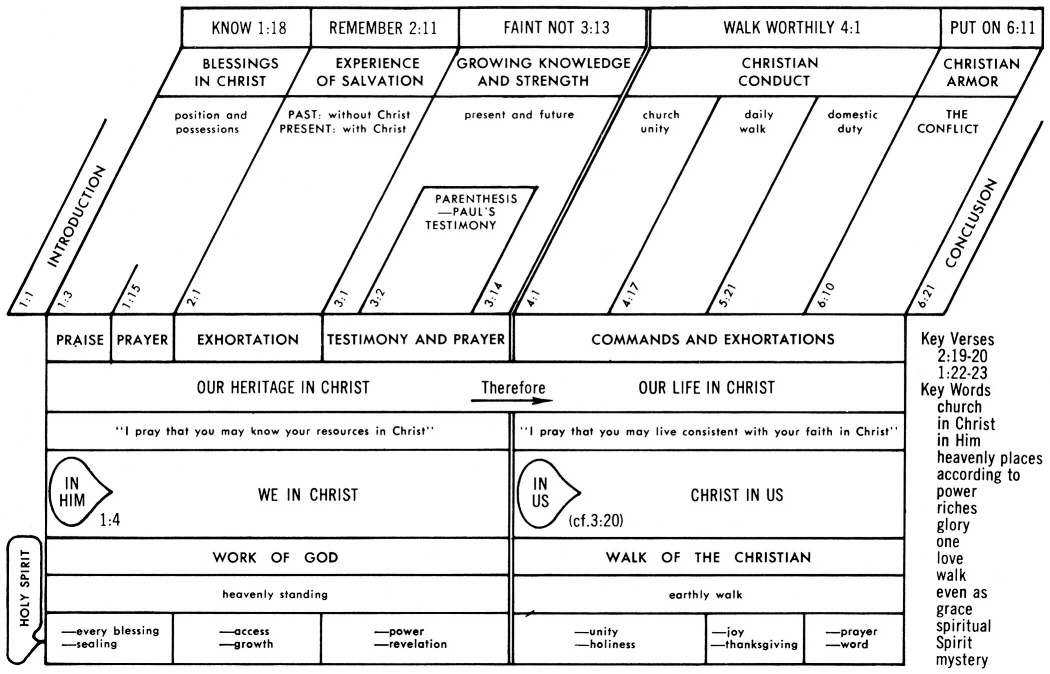
EPHESIANS - CHRIST AND THE CHURCH
Click chart to enlarge
Charts from Jensen's Survey of the NT - used by permission
| SYMMETRY OF EPHESIANS |
|
| EPHESIANS 1-3 | EPHESIANS 4-6 |
| The Root | The Fruit |
| Spiritual Wealth | Spiritual Walk |
| Christian Privilege | Christian Conduct |
| The Position of the Believer |
The Practice of the Believer |
| God Sees Us in Christ |
World Sees Christ in Us |
| Privilege | Practice |
| Doctrine | Duty |
| Doctrinal | Practical |
| Revelation | Responsibility |
| Christian Blessings |
Christian Behavior |
| Belief | Behavior |
| Privileges of the Believer |
Responsibilities of the Believer |
| Our Heritage In Christ |
Our Life In Christ |
| Know your Resources (Riches) in Christ |
Live by faith in the light of your Resources (Riches) in Christ |
| The Finished Work of Christ |
The Faithful Walk of the Christian |
| Work of Christ In Us |
Work of Christ Through Us |
| We in Christ |
Christ in Us |
| Word of God |
Walk of the Christian |
| Heavenly Standing |
Earthly Walk |
| Who You Are In Christ |
Whose You Are In Christ |
| Identity | Responsibility |
| Position of the Believer |
Practice of the Believer |
| Theology | Ethics |
Ephesians 6:23 Peace be to the brethren, and love with faith, from God the Father and the Lord Jesus Christ. (NASB: Lockman)
Greek: Eirene tois adelphois kai agape meta pisteos apo theou patros kai kuriou Iesou Christou.
Amplified: Peace be to the brethren, and love joined with faith, from God the Father and the Lord Jesus Christ (the Messiah, the Anointed One). (Amplified Bible - Lockman)
NLT: May God give you peace, dear friends, and love with faith, from God the Father and the Lord Jesus Christ. (NLT - Tyndale House)
Phillips: Peace be to all Christian brothers, and love with faith from God the Father and the Lord Jesus Christ! (Phillips: Touchstone)
Wuest: Peace to the brethren and love with faith from God the Father and the Lord Jesus Christ. (Eerdmans Publishing - used by permission)
Young's Literal: Peace to the brethren, and love, with faith, from God the Father, and the Lord Jesus Christ!
PEACE BE TO THE BRETHREN: Eirene tois adelphois:
- Romans 1:7; 1Corinthians 1:3; Genesis 43:23; 1Samuel 25:6; Ps 122:6, 7, 8, 9; John 14:27; Galatians 6:16; 1Peter 5:14; Revelation 1:4
- Ephesians 6 Resources - Multiple Sermons and Commentaries
- Ephesians 6:21-24 - Wayne Barber
- Ephesians 6:21-24 The Caring Church - Steven Cole
- Ephesians 6:18-24 Praying At All Times - John MacArthur
Peace (1515)(eirene [word study] from verb eiro = to join or bind together that which has been separated) literally pictures the binding or joining together again of that which had been separated or divided and thus setting at one again. When we are born again we, for the first time in our life, enjoy peace with God (Ro 5:1-note), as we have been immutably and eternally "joined together" with God our Father on the basis of our oneness with His Son through the miracle of the New Covenant. Now, day by day, moment by moment, the charge and the challenge for every believer is to enjoy the experiential blessing of the peace of God (cp Php 4:6-note, Php 4:7-note), which we do by "keeping short accounts" so to speak. Obviously, we are to strive to work out our salvation in fear and trembling (Php 2:12-note), but as those who still possess the fallen, anti-God flesh nature, we are prone to commit sins (1Jn 1:8). Sin erects a barrier which impedes our experiencing the peace of God, but confession and repentance in effect removes that barrier so that we might walk "in a manner worthy of the Lord, to please Him in all respects, bearing fruit in every good work and increasing in the knowledge of God" (Col 1:10-note)
AND LOVE WITH FAITH FROM GOD THE FATHER AND THE LORD JESUS CHRIST: kai agape meta pisteos apo theou patros kai kuriou Iesou Christou:
- Galatians 5:6; 1Timothy 1:3; 5:8; 2Thessalonians 1:3; 1Timothy 1:14; Philemon 1:5, 6, 7
- Ephesians 6 Resources - Multiple Sermons and Commentaries
- Ephesians 6:21-24 - Wayne Barber
- Ephesians 6:21-24 The Caring Church - Steven Cole
- Ephesians 6:18-24 Praying At All Times - John MacArthur
Love (noun) (26) ( agape - see word study) Unconditional love, love like God gives, supernatural love possible only by those who are filled with the Spirit, walk by the Spirit and bear the fruit of the Spirit.
Faith (4102)(pistis-see word study) trust, belief as a gift from the Father and the Son.
From God the Father and the Lord Jesus Christ - This points to the co-equality and deity of Jesus Christ. And implicit is the Spirit (Gal 5:22) and thus the "Trinity."
With (meta) expresses the simple idea of accompanying. The picture is that of a love which is accompanied by faith.
Peace, faith and love all have a two fold source, God the Father and the Lord Jesus Christ, conveying the idea of a joint-bestowal of spiritual blessings.
MacDonald comments that...
Peace would garrison their hearts in every circumstance of life. Love would enable them to worship God and work with one another. Faith would empower them for exploits in the Christian warfare. (MacDonald, W & Farstad, A. Believer's Bible Commentary: Thomas Nelson)
Steven Cole's sermon (the last section - Click link for full message)...
Paul shows us how to be caring, godly brothers and sisters in Christ (Eph 6:23, 24).
We’re probably tempted to skim over these benedictions without much thought, but there is a lot of solid theology here. This benediction varies from Paul’s usual form, which suggests that it was not just a throwaway close to this letter. Paul wanted his readers to think about it. Usually, Paul’s closing words are in the second person (“you”); but this is in the third person. Usually, the close is a single part; but here it consists of two parts. Usually, grace comes first; but here peace, which is usually last, is first (T. K. Abbott, A Critical and Exegetical Commentary on the Epistles to the Ephesians and to the Colossians [T. & T. Clark], p. 190).
A. Skevington Wood writes (The Expositor's Bible Commentary, ed. by Frank Gaebelein [Zondervan], pp. 91-92),
“This is more than a farewell greeting; it is a prayer for reconciliation. Paul longs to see the whole brotherhood of believers in Ephesus and its environs—Jews and Gentiles alike—at peace with each other in the one body of Christ.”
Four key words in Paul’s benediction have played a key role in the message of Ephesians. They are more than Paul’s wish; they are also his prayer, and therefore should be our prayer:
A. Pray for peace for the brethren.
One of the main thrusts in Ephesians is that through the cross of Jesus Christ, we have peace with God and peace with those from whom we formerly were alienated (Eph 2:11-22-note). We have peace with God because the blood of Jesus paid the penalty for our sins, which God’s perfect justice demands. Drawing near to God is not a matter of being religious. The Jews had been as religious as anyone could be, but their religion was not good enough to reconcile them to God. Also, the good news is that being a sinful pagan who has never darkened the door of a church does not mean that there is no hope for you ever to be reconciled to God. Rather, as Paul has shown, the blood of Christ has made it possible for both nonreligious pagans and religious Jews to draw near to God through faith in Jesus.
But this peace with God through the cross of Christ also reconciles groups that formerly were alienated from one another. As Paul wrote (Eph. 2:14-note),
For He Himself is our peace, who made both groups into one and broke down the barrier of the dividing wall.
For Paul, a large part of the glory of the church is that it contained
no distinction between Greek and Jew, circumcised and uncircumcised, barbarian, Scythian, slave and freeman, but Christ is all, and in all (Col. 3:11-note).
This means that a racist church is not compatible with the New Testament church! If you have trusted in Christ as Savior and Lord, every other person who has trusted in Christ is your brother or your sister. Our church should reflect the racial makeup of our community. As various races live in visible peace with one another in the church, it is a testimony to the world of Christ’s saving grace.
B. Pray for love for the brethren.
Peace and love go hand in hand (Eph. 4:1, 2, 3-note). God’s love for us is the example for our love for one another (Ep 5:1, 2-note). Our homes should radiate the self-sacrificing love of Christ between husbands and wives, and parents and children (Ep 5:22-6:4-note). In the church, we must work at building and maintaining loving relationships between one another (Eph 4:31-note, Ep 5:1, 5:2-note).
C. Pray for faith for the brethren.
Paul prays for “love with faith,” as the two qualities are closely connected. In Galatians 5:6, Paul writes,
For in Christ Jesus neither circumcision nor uncircumcision means anything, but faith working through love.
To paraphrase,
The outward keeping of religious rituals is not the main thing, but rather, faith that works itself out in deeds of love.
Since Paul is praying this for the brethren, he is concerned here with the increase of faith and love among those who have already believed in Christ for eternal life. As Christians, we need greater faith in Jesus Christ that will move us toward self-sacrificing love for one another.
The source of this peace, love, and faith is “God the Father and the Lord Jesus Christ.” Paul easily connects the Lord Jesus Christ with God the Father, thus demonstrating His deity and His equality with the Father. We should ask for one another and for ourselves, that God would increase our peace, love, and faith.
D. Pray for grace for all who love our Lord Jesus Christ in incorruption.
This is Paul’s second benediction, that God’s grace would be with these believers. They already have experienced something of the riches of God’s grace, as Paul exulted in Ephesians 1:7, 8a-note,
In Him we have redemption through His blood, the forgiveness of our trespasses, according to the riches of His grace which He lavished on us.
Paul emphasized (Ep 2:5-note, Ep 2:8-note) that salvation is by grace alone,
so that in the ages to come He might show the surpassing riches of His grace in kindness toward us in Christ Jesus (Ep 2:7-note).
In Ep 3:2-note Ep 3:8-note and Ep 4:7-note we saw that the only way we can serve Christ is because of His grace. But because God’s grace is an inexhaustible storehouse, we need to pray for one another and ourselves that we would experience His grace more and more.
Note, also, how Paul describes believers (Eph 6:24): they
love our Lord Jesus Christ with incorruptible love.
That last phrase is literally, “in incorruption.” It may mean, “incorruptible love.” Or, it may refer to the sphere in which our love for Christ takes place, namely, in the sphere of incorruptible or eternal life, which He has given to us. You are a genuine Christian if you know that God has given you eternal life in His Son (cp 1Jn 1:2, 2:25, 3:15, 16, 5:11, 13, 20) and as a result, you love Jesus Christ as your Lord and Savior. Experiencing His grace that saved you, although you should have been condemned, will increase your love for Jesus Christ.
Summary and Review
The great theme of Ephesians is the eternal purpose of God, to sum up all things in Jesus Christ. The book falls into two halves. Chapters 1-3 reveal our exalted position with Christ in the heavenly places (Ep 2:4, 5, 6-note), all because God chose us in Him before the foundation of the world (Ep 1:4-note). Chapters 4-6 show our experiential walk with Christ in this world (Eph 4:1-note, Ep 4:17-note; Ep 5:2-note, Ep 5:8-note, Ep 5:15-note), as we stand firm against the evil forces of darkness in the heavenly places (Eph 6:10-20-note). Our position in Christ and our walk in this world as we stand victoriously against these evil forces demonstrate God’s eternal purpose, to sum up all things in Christ. At the heart of this practical walk is that we get along in unity in the church and in the home, which is the basic unit of the church.
By way of summary and review, here are four main practical lessons from Ephesians:
(1) The gospel is a life-transforming message.
Whether you are from a religious background, as the Jews in Ephesus were, or from a pagan background, as the Gentiles were, believing in Jesus Christ as your Savior and Lord drastically changed your life. As we saw, many of the people in Ephesus were heavily involved in the occult (Acts 19:18, 19). Many had engaged in immorality with the temple prostitutes at the famous Temple of Artemis or Diana in Ephesus. But when they came to Christ, they burned their occult books and they abandoned their immorality (Eph 5:3-12-note). God created them anew in righteousness and holiness of the truth (Eph 4:24-note).
Granted, this transformation works itself out gradually, as we lay aside the old life, are renewed in the spirit of our minds, and put on the new life (Eph 4:22, 23, 24-note). But those who have been saved by grace embark on this new life of transformation in holiness.
(2) What you believe is extremely important.
Paul would not have spent the first three chapters of Ephesians laying the doctrinal foundation if doctrine were not crucial for your Christian life! What you believe determines how you live. If you claim to believe the gospel but live as the world lives, it proves that you really do not believe the gospel. We live in a day when professing evangelical Christians have belittled doctrine as irrelevant or even as divisive. While truth necessarily divides, we should hold to the truth in love (Ep 4:15-note). The doctrine of election, which Paul emphasizes in chapter 1, is divisive. But it’s also vital for your understanding of the gospel and your growth in the Christian life. If it were not, Paul wouldn’t have put it there.
(3) The church is extremely important to God.
Ephesians emphasizes the vital importance of the church. As Paul said Eph 1:23), the church is Christ’s body, “the fullness of Him who fills all in all.” If Christ loved the church and gave Himself for the church as His bride (Eph 5:25, 26, 27-note), then we must love the church and give ourselves for her. True, she is not yet glorified, without spot or blemish. Yes, you will get wounded in the church. But, yes, you must commit yourself to that to which Christ is committed.
You can’t say, “I love Jesus, but I hate His bride.” Or, “I love the Head, but His body stinks!” I recommend that you read Josh Harris’ little book, Stop Dating the Church [Multnomah Press].
(4) Relationships in the church are extremely important to God.
This is the main thrust of Ephesians 2:11-22, Ep 3:4-11, and Ep 4:1-6:9. It’s not a minor theme! Remember, in that culture, Jews and Gentiles were completely alienated from one another. But the church was to demonstrate the saving grace of God, who reconciled these two humanly incompatible groups into one new man. It is vital that we work through relational differences and show the world the love of Jesus Christ through our reconciled relationships. Don’t miss the fact that all of these truths are for those who are brethren (Ep 6:21-note, Ep 6:23-note). You become a brother or sister through the new birth, when God’s Spirit quickens you from spiritual death to spiritual life. So I close our studies in Ephesians by quoting again Ep 2:8, 9-note,
“For by grace you have been saved through faith; and that not of yourselves, it is the gift of God; not as a result of works, so that no one may boast.”
Above all, make sure you have been saved!
Application Questions
1. What do you need to be doing now so that you will hear, “well done” from Jesus at the judgment?
2. How can a Christian discover where he should be serving? What guidelines does Scripture give?
3. Do we really need to work through relational difficulties in the church? Isn’t it more practical just to avoid the other person?
Discuss in light of Romans 12:18-note & Ro 14:19-note.
4. Why is commitment to the local church not optional for believers? How can someone who has been wounded by a church recover? (Used by Permission - Ephesians 6:21-24 The Caring Church)
Ephesians 6:24 Grace be with all those who love our Lord Jesus Christ with incorruptible love (NASB: Lockman)
Greek: e charis meta panton ton agaponton (PAPMPG) ton kurion hemon Iesoun Christon en aphtharsia.
Amplified: Grace (God’s undeserved favor) be with all who love our Lord Jesus Christ with undying and incorruptible [love]. Amen (so let it be). (Amplified Bible - Lockman)
NLT: May God's grace be upon all who love our Lord Jesus Christ with an undying love. (NLT - Tyndale House)
Phillips: Grace be with all those who sincerely love our Lord Jesus Christ. (Phillips: Touchstone)
Wuest: The grace be with all those who are loving our Lord Jesus Christ in sincerity. (Eerdmans Publishing - used by permission)
Young's Literal: The grace with all those loving our Lord Jesus Christ -- undecayingly! Amen.
GRACE BE WITH ALL THOSE: e charis meta panton:
- 1Corinthians 16:23; 2Corinthians 13:14; Colossians 4:18; 2Timothy 4:22; Titus 3:15; Hebrews 13:25
- Ephesians 6 Resources - Multiple Sermons and Commentaries
- Ephesians 6:21-24 - Wayne Barber
- Ephesians 6:21-24 The Caring Church - Steven Cole
- Ephesians 6:18-24 Praying At All Times - John MacArthur
Paul ends the way he began - by pronouncing a blessing, which is his way of helping (exhorting, encouraging) the Ephesian "holy ones" (hagios) (and us dear reader, beloved of God = 1Th1:4-note) to walk (peripateo) (Before Christ = Ep 2:2-note; After Christ = 2Co5:17, Ep 2:10-note, now In Christ = Ep 4:1-note, Ep 4:17-note, Ep 5:2-note, Ep 5:8-note, Ep 5:15-note) in every spiritual blessing in the heavenly places in Christ (Ephesians 1:3-note) that they (and we) might truly (in this present earthly life, not just in eternity future) inherit their inheritance in (union with, oneness of the new covenant with) Christ (cp Jesus' desire for us - Jn 10:10b).
Grace (5485) (charis [word study]) is a beneficent disposition toward someone, and specifically in the Biblical context is God's attitude toward human beings resulting in an outflow from His throne of grace (He 4:16-note) of His inexhaustible kindness, favor, helpfulness, care, help, goodwill.
Grace - Charis is a jewel which "graces" the epistle of Ephesians 12 times in 12 verses - Eph 1:2,1:6,1:7,2:5,2:7,2:8,3:2,3:7,3:8,4:7,4:29,6:24.And notice that grace is like "bookends" to Ephesians (Ep 1:2-note, Ep 6:24-note)
WHO LOVE OUR LORD JESUS CHRIST WITH INCORRUPTIBLE LOVE: ton agaponton (PAPMPG) ton kurion hemon Iesoun Christon en aphtharsia:
- John 21:15, 16, 17; 1Corinthians 16:22
- Matthew 22:37; 2Corinthians 8:8,12; Titus 2:7
- Matthew 6:13; 28:20
- Ephesians 6 Resources - Multiple Sermons and Commentaries
- Ephesians 6:21-24 - Wayne Barber
- Ephesians 6:21-24 The Caring Church - Steven Cole
- Ephesians 6:18-24 Praying At All Times - John MacArthur
Lord (master, owner)(2962)(kurios [word study] from kuros = might or power) has a variety of meanings/uses in the NT and therefore one must carefully examine the context in order to discern which sense is intended by the NT author. For example, some passages use kurios only as a common form of polite address with no religious/spiritual meaning. The reader should also be aware that in view of the fact that kurios is used over 9000 times in the Septuagint (LXX) and over 700 times in the NT, this discussion of kurios at best only "skims the surface" of this prodigious, precious word.
JESUS IS
LORD
In the NT Jesus is referred to as Lord (Kurios) more frequently than by any other title. Therefore it behooves us to understand the truth concerning Jesus as Lord and not allow ourselves to become side tracked in debate over so-called "Lordship salvation". The indisputable Biblical facts are that faith in Jesus saves and Jesus is Lord. This confession of "Jesus is Lord" became a direct affront to the practice of emperor worship. Certain cities even built temples for Caesar-worship as was the case in Smyrna where the command was to honor the emperor by confessing "Caesar is Lord". To declare "Jesus is Lord" became a crime punishable by death, resulting in the martyrdom. I think the first century believers understood "Lordship" in a way modern believers would find it difficult to comprehend! (cp Jesus' "prophetic" warning in Mt 10:22, 23, 24, 25 where "master" is kurios)
Lord is not merely a name that composes a title, but signifies a call to action so that every saint should willingly, reverently bow down to Jesus Christ. If Christ is our Lord, we are to live under Him, consciously, continually submitting our wills to him as His loyal, loving bondservants ("love slaves"), always seeking first His Kingdom and His righteousness (Mt 6:33-note). According to this practical working "definition" beloved we all need to ask ourselves "Is Jesus Christ my Lord?". "Do I arise each day, acknowledges this is the day the Lord hath made?" (Ps 118:24-note) "Do I surrender my will to His will as I begin each day?" (cp Ro 12:1-note, Ro 12:2-note) Beloved, don't misunderstand. None of us have "arrived" in this area of Jesus as Lord of our lives. And it is precisely for that reason that Peter commands us to continually "grow (present imperative) in the grace (unmerited favor, power to live the supernatural, abundant life in Christ) and knowledge (not just intellectual but transformational) of our Lord and Savior Jesus Christ. To Him be the glory, both now and to the day of eternity. Amen." (2Pe 3:18-note) So do not be discouraged. Don't "throw in the towel" as they say. Keep on keeping on, pressing (continually = present tense) "on toward the goal for the prize of the upward call of God in Christ Jesus." (Php 3:14-note)
Love (25) (agapao [word study] related to noun agape - see word study) describes the love God gives freely, sacrificially and unconditionally regardless of response -- love that goes out not only to the lovable but to one’s enemies or those that don't "deserve" it.
Note that the love Paul describes is for our Lord which He Himself said was manifest by keeping His commandments (Jn 14:15), the greatest of which is to love God and love others as ourselves (Mk 12:30, 31, 1Co 13:13). And so our love for our Lord is demonstrated by our love for others. Can people see your love for Jesus by the way you love others?
Agapao speaks especially of love which is based on choice, and thus is a matter of will and action. Of this quality of love "Hollywood" has not one wit of a clue for it is neither characterized by eros or gushing sentimentality and emotionality but represents unhesitating obedience to God's clear command to love others as we love ourselves. Agape love is reflective of the act of one's will which issues in a Spirit enabled desire to seek another's highest good, usually in the form of specific actions (see below). Since agape is unconditional, this quality of divine-like love is given if it's not received or returned (or ever worse "thrown back" into your face!)! Agape gives and give and gives.
Agape love is not a suggestion but a command from the Almighty to all believers, who, enabled by the power of His Spirit, and activated by personal choices of one's will (not based on one's feelings toward the object of one's love) which works its way out in specific actions (See 1Co 13:4-note, 1Co 13:5, 6-note, 1Co 13:7, 8-note for a "Biblical" definition of love, an action verb, where you will note that all the actions are in the present tense = as our lifestyle! Are you as convicted as I am? Here's the question God immediately brought to my mind [because I'm having great difficulty loving my rebellious 30 year old daughter!] Who is it that God has placed in your life today, right now, that you are finding difficulty loving with agape "action"? Stop trying and start dying! (SEE CAVEAT BELOW) Die to self! [cp Mk 8:34, Lk 9:23 to see how we become imitators of the love that characterized our Lord - cp 1Pe 2:21-note] Die to any vain hope that you in the strength of your own flesh can produce this most glorious fruit - see Paul's command which if heeded sets us on the road to producing agape love = Gal 5:16-note, Gal 5:17-note, Gal 5:22-note, Gal 5:23-note, Gal 5:24-note, Ga 5:25--note) (As a "rabbit trail" note God's first use of love in Scripture - Ge 22:1,2. What did Abraham have to do to his flesh in light of God's command? The Septuagint uses the cognate agapetos for the Hebrew 'ahab = love).
ONE CAVEAT REGARDING THE EXHORTATION - "STOP TRYING AND START DYING" - This statement DOES NOT mean that we are to "Let God and Let God" which is a false teaching (probably originating from the Keswick Movement)! And so, as an example, the phrase "stop trying" means stop trying to live the supernatural life in your natural strength, but in dependence on the Spirit. So does this signify you will do nothing? Does this signify you are a "passive participant" in your progressive sanctification? Of course not! Paul was very clear that while believers are totally dependent on the Spirit of Christ to live a supernatural life, we are also totally responsible to work out our salvation -- "So then, my beloved, just as you have always obeyed, not as in my presence only, but now much more in my absence, work out (command in the present imperative - but even obeying this necessitates the Spirit's enablement described in the next verse) your salvation with fear and trembling; 13 for (strategic "term of explanation") it is God who is at work in you, both to will (desire) and to work *power) for His good pleasure. (Php 2:12+, Php 2:13NLT+).
Agape love speaks of a love called out of one’s heart by the preciousness of the one loved, a love that impels one to sacrifice one’s self for the benefit of the object loved. It is the love shown at Calvary. The prototype of this quality of supernatural love is the Father's love for sinful men as manifest by the Son's sacrifice on the Cross.
Speaking to faithless Israel God speaks of coming days of restoration declaring...
"I have loved you with an everlasting love; Therefore I have drawn you with lovingkindness. (Jeremiah 31:3)
In Romans Paul explains that even while we were helpless and ungodly, Christ died for the ungodly adding...
But God demonstrates His own love toward us, in that while we were yet sinners, Christ died for us. (see note Romans 5:8)
John writes...
In this is love, not that we loved God, but that He loved us and sent His Son to be the propitiation for our sins. (1 John 4:10)
Incorruptible (861) (aphtharsia from a = not + phthartós = corruptible from the verb phtheíro = to corrupt, shrivel, wither, spoil by any process, ruin , deprave, defile, destroy) is a state of not being subject to decay or death - immortality, incorruptibility (state of being free from physical decay), perpetuity. Aphtharsia defines the state of not being subject to decay, dissolution or interruption. It speaks of an unending existence, of that which is not capable of corruption. Aphtharsia indicates immunity to the decay that infects all of creation.
The idea is conveyed in our English phrase with an undying love.
MacArthur comments that this love incorruptible is...
the love that belongs to true believers; so Paul is really identifying the ones who will receive grace as only those whose love is not temporary and thus untrue but permanent and thus genuine! (MacArthur, J: Ephesians. Chicago: Moody Press)
The Latin Vulgate translates aphtharsia as incorruptio.
Vine writes that aphtharsia is used
(a) of the resurrection body, 1Cor 15:42, 50, 53, 54;
(b) of a condition associated with glory and honour and life, including perhaps a moral significance, Ro 2:7; 2 Ti 1:10; this is wrongly translated “immortality” in the AV;
(c) of love to Christ, that which is sincere and undiminishing, Eph 6:24 (Vine's Complete Expository Dictionary of Old and New Testament Words. 1996. Nelson)
Freiberg says that aphtharsia in this verse...
has three possible alternatives: (1) as qualifying love unceasing, undying; (2) as qualifying grace with incorruptibility, eternally; (3) as qualifying Christ and Christians in immortal life (Analytical Lexicon of the Greek New Testament.)
Aphtharsia is found only in the NT and is used 7 times...
Romans 2:7 (note) to those who by perseverance in doing good seek for glory and honor and immortality, eternal life;
1 Corinthians 15:42 So also is the resurrection of the dead. It is sown a perishable body, it is raised an imperishable body...50 Now I say this, brethren, that flesh and blood cannot inherit the kingdom of God; nor does the perishable inherit the imperishable...53 For this perishable must put on the imperishable, and this mortal must put on immortality...54 But when this perishable will have put on the imperishable, and this mortal will have put on immortality, then will come about the saying that is written, "Death is swallowed up in victory. (Comment: The resurrection body has undergone a complete change as compared with the body of flesh like the plant from the seed. It is related to it, but it is a different body of glory. Aphtharsia refers to the incapacity of the new resurrection body to deteriorate or decay. This is a quality, however, that our present bodies do not have but will have in the resurrection.)
Ephesians 6:24 Grace be with all those who love our Lord Jesus Christ with a love incorruptible.
2 Timothy 1:10 (note) but now has been revealed by the appearing of our Savior Christ Jesus, who abolished death, and brought life and immortality to light through the gospel
Blaikie writes that "The expression is peculiar—love the Lord Jesus Christ in incorruptible. The word denotes, especially in Paul’s usage, what is unfading and permanent. The love that marks genuine Christians is not a passing gleam, like the morning cloud and the early dew, but an abiding emotion. Nowhere can we have a more vivid idea of this incorruptible love than in the closing verses of Ro 8, “I am persuaded that neither death nor life,” etc. (The Pulpit Commentary)