Ephesians 6:2
Ephesians 6:3
Ephesians 6:4
Ephesians 6:5
Ephesians 6:6
Ephesians 6:7
Ephesians 6:8
Ephesians 6:9
Ephesians 6:10
Ephesians 6:11
Ephesians 6:12
Ephesians 6:13
Ephesians 6:14
Ephesians 6:15
Ephesians 6:16
Ephesians 6:17
Ephesians 6:18
Ephesians 6:19
Ephesians 6:20
Ephesians 6:21
Ephesians 6:22
Ephesians 6:23
Ephesians 6:24
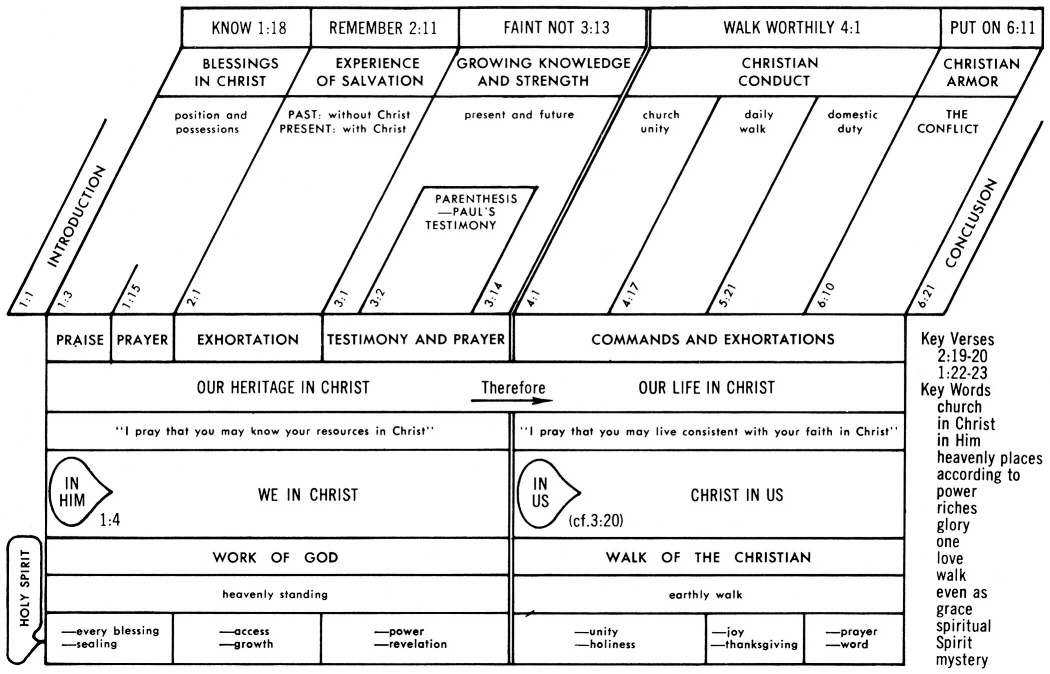
EPHESIANS - CHRIST AND THE CHURCH
Click chart to enlarge
Charts from Jensen's Survey of the NT - used by permission
| SYMMETRY OF EPHESIANS |
|
| EPHESIANS 1-3 | EPHESIANS 4-6 |
| The Root | The Fruit |
| Spiritual Wealth | Spiritual Walk |
| Christian Privilege | Christian Conduct |
| The Position of the Believer |
The Practice of the Believer |
| God Sees Us in Christ |
World Sees Christ in Us |
| Privilege | Practice |
| Doctrine | Duty |
| Doctrinal | Practical |
| Revelation | Responsibility |
| Christian Blessings |
Christian Behavior |
| Belief | Behavior |
| Privileges of the Believer |
Responsibilities of the Believer |
| Our Heritage In Christ |
Our Life In Christ |
| Know your Resources (Riches) in Christ |
Live by faith in the light of your Resources (Riches) in Christ |
| The Finished Work of Christ |
The Faithful Walk of the Christian |
| Work of Christ In Us |
Work of Christ Through Us |
| We in Christ |
Christ in Us |
| Word of God |
Walk of the Christian |
| Heavenly Standing |
Earthly Walk |
| Who You Are In Christ |
Whose You Are In Christ |
| Identity | Responsibility |
| Position of the Believer |
Practice of the Believer |
| Theology | Ethics |
Ephesians 6:7 With good will render service, as to the Lord, and not to men (NASB: Lockman)
Greek: met' eunoias douleuontes, (PAPMPN) os to kurio kai ouk anthropois,
Amplified: Rendering service readily with goodwill, as to the Lord and not to men, (Amplified Bible - Lockman)
NLT: Work with enthusiasm, as though you were working for the Lord rather than for people. (NLT - Tyndale House)
Phillips: but as the servants of Christ conscientiously doing what you believe to be the will of God for you. (Phillips: Touchstone)
Wuest: with good will rendering a slave’s service as to the Lord and not as to men,
Young's Literal: with good-will serving, as to the Lord, and not to men,
WITH GOOD WILL RENDER SERVICE AS TO THE LORD, AND NOT TO MEN: met' eunoias douleuontes, (PAPMPN) os to kurio kai ouk anthropois:
- Ge 31:6,38, 39, 40; 2 Ki 5:2,3,13
- Eph 6:5,6
- Ephesians 6 Resources - Multiple Sermons and Commentaries
- Ephesians 6:5-9: Spirit-Filled Believer in Work Place - Wayne Barber
- Ephesians 6:5-9 Working for God - Steven Cole
- Ephesians 6:5-9 God's Perspective on Work - John MacArthur
- Ephesians 6:5-9 Spirit-Filled Labor Relations - John MacArthur
Whether, then, you eat or drink or whatever you do, do all to the glory of God. (1 Corinthians 10:31)
Here Paul specifies the motive for service to a human master should be as to the Lord Jesus. In other words, the slave should serve the human master as if he were serving the Lord Jesus. The encouragement for doing this is found in the next verse in the fact that whatever good the slave does for his human master, if done as to Christ, shall be rewarded
John Eadie has an interesting note writing that "Slavery existed in all the cities of Ionia and Asia Minor, and in many of them slaves were greatly more numerous than freemen. In fact, the larger proportion of artisans and manufacturers, and in general of the industrial classes, were in bondage. There is little doubt that very many of these bondmen embraced the gospel, and became members of the early churches. Indeed, Celsus said, and no doubt with truth, that those who were active proselytizers to Christianity were weavers, cobblers, fullers, illiterate and rustic men. (Ephesians 6 Commentary)
Good will (2133) (eunoia from eunoéo = to favor, be well disposed, meet halfway <> eú = well + noús = mind) describes a positive attitude exhibited in a relationship, a good attitude, a wholehearted zeal or a willingness. Eunoia describes an eagerness that does not wait to be compelled. It was a common term in diplomatic documents in referring to positive attitudes displayed by a person, city, or state. In this verse the admonition that slaves should serve with eunoia corresponds to a general view of antiquity but is given a new basis, namely, that the service is now rendered to the Lord. This is the only NT use except for one use in Textus Receptus rendering of 1Cor 7:3…
Let the husband render unto the wife due benevolence: and likewise also the wife unto the husband. (euphemistic for conjugal relations)
Webster says goodwill is a kindly or feeling of approval and support. It is benevolent interest or concern.
Eunoia means we serve not just with readiness but with the disposition that wishes one well.
Expositor's Bible Commentary writes that…
Among the Oxyrhynchus papyri there is a will dated A.D. 157 in which the testator freed five slaves "because of their good-will and affection" (III. No. 494, lines 5, 6). If even pagan slaves could display such qualities, how much more should Christians do so, without expecting manumission as a reward. (Gaebelein, F, Editor: Expositor's Bible Commentary 6-Volume New Testament. Zondervan Publishing)
Render service (1398) (douleuo from doulos = servant) means to be a slave, to serve, to do service, to be in the position of a slave and thus act accordingly. It means to act or conduct oneself as one in total service to another. Douleuo means to be owned by another, either literal master or a figurative master (see following discussion). Some NT uses refer to literal servitude as abject slaves (Luke 15:29, John 8:33, 1Ti 6:2 - serving believing masters). Most NT uses are figurative -- serving God or mammon (Mt 6:24, Lu 16:13, Ro 9:12-note), enslaved to sin (Ro 6:6-note), serving God (Ro 7:6-note; 1Th 1:9-note), serving law of God or sin (Ro 7:25-note), slaves serving Christ (Ro 14:18-note; Col 3:24-note), slaves of their own appetites (old nature, Ro 16:18-note), slaves to idols which are not really gods (Gal 4:8), serving Christian brethren out of love (Gal 5:13), enslaved to lusts and pleasures (Titus 3:3-note).
Douleuo is found about 122 times in the Septuagint (LXX)
Gen. 14:4; 15:14; 25:23; 27:29, 40; 29:15, 18, 20, 25, 30; 30:26, 29; 31:6, 41; Exod. 14:5, 12; 21:2, 6; 23:33; Lev. 25:39; Deut. 15:12, 18; 28:64; Jdg. 2:7; 3:8, 14; 9:28, 38; 10:6, 10, 13, 16; 1 Sam. 2:24; 4:9; 7:3f; 8:8; 11:1; 12:10, 14, 20, 23f; 17:9; 26:19; 2 Sam. 10:19; 16:19; 22:44; 1 Ki. 4:20; 9:6, 9; 12:4, 7, 24; 16:31; 22:53; 2 Ki. 10:18; 17:41; 18:7; 21:3; 25:24; 1 Chr. 19:19; 28:9; 2 Chr. 7:22; 10:4; 24:18; 30:8; 33:3, 16, 22; 34:33; 36:5; Neh. 9:35; Job 21:15; 36:11; 39:9; Ps. 2:11; 18:43; 22:30; 72:11; 81:6; 100:2; 102:22; 106:36; Prov. 11:29; 12:9; Isa. 14:3; 19:23; 53:11; 56:6; 60:12; 65:8, 13ff; Jer. 2:20; 5:19; 8:2; 11:10; 13:10; 16:11, 13; 22:9; 25:6, 11; 27:6; 34:9; 35:15; Ezek. 20:40; 29:18, 20; Dan. 4:21, 34; 6:27; 7:14, 27; Hos. 12:12; Zeph. 3:9; Zech. 2:9; Mal. 3:14, 17f
Douleuo is used 25 times in 23 verses in the NAS…
Matthew 6:24 "No one can serve two masters; for either he will hate the one and love the other, or he will hold to one and despise the other. You cannot serve God and mammon.
Luke 15:29 "But he answered and said to his father, 'Look! For so many years I have been serving you, and I have never neglected a command of yours; and yet you have never given me a kid, that I might be merry with my friends;
Luke 16:13 "No servant can serve two masters; for either he will hate the one, and love the other, or else he will hold to one, and despise the other. You cannot serve God and mammon."
John 8:33 They answered Him, "We are Abraham's offspring, and have never yet been enslaved to anyone; how is it that You say, 'You shall become free '?"
Acts 7:7 "'And whatever nation to which they shall be in bondage I Myself will judge,' said God, 'and after that they will come out and serve Me in this place.'
Acts 20:19 serving the Lord with all humility and with tears and with trials which came upon me through the plots of the Jews;
Romans 6:6 (note) knowing this, that our old self was crucified with Him, that our body of sin might be done away with, that we should no longer be slaves to sin
Romans 7: 6 (note) But now we have been released from the Law, having died to that by which we were bound, so that we serve in newness of the Spirit and not in oldness of the letter.
Romans 7:25 (note) Thanks be to God through Jesus Christ our Lord! So then, on the one hand I myself with my mind am serving the law of God, but on the other, with my flesh the law of sin.
Romans 9:12 (note) it was said to her, "The older will serve the younger."
Romans 12:11 (note) not lagging behind in diligence, fervent in spirit, serving the Lord;
Romans 14:18 (note) For he who in this way serves Christ is acceptable to God and approved by men.
Romans 16:18 (note) For such men are slaves, not of our Lord Christ but of their own appetites; and by their smooth and flattering speech they deceive the hearts of the unsuspecting.
Galatians 4:8 However at that time, when you did not know God, you were slaves to those which by nature are no gods. 9 But now that you have come to know God, or rather to be known by God, how is it that you turn back again to the weak and worthless elemental things, to which you desire to be enslaved all over again?… 25 Now this Hagar is Mount Sinai in Arabia, and corresponds to the present Jerusalem, for she is in slavery with her children.
Galatians 5:13 For you were called to freedom, brethren; only do not turn your freedom into an opportunity for the flesh, but through love serve one another.
Ephesians 6:7 With good will render service, as to the Lord, and not to men,
Philippians 2:22 (note) But you know of his proven worth that he served with me in the furtherance of the gospel like a child serving his father.
Colossians 3:24 (note) knowing that from the Lord you will receive the reward of the inheritance. It is the Lord Christ whom you serve.
1Thessalonians 1:9 (note) For they themselves report about us what kind of a reception we had with you, and how you turned to God from idols to serve a living and true God,
1 Timothy 6:2 And let those who have believers as their masters not be disrespectful to them because they are brethren, but let them serve them all the more, because those who partake of the benefit are believers and beloved. Teach and preach these principles.
Titus 3:3 (note) For we also once were foolish ourselves, disobedient, deceived, enslaved to various lusts and pleasures, spending our life in malice and envy, hateful, hating one another.
As to the Lord - our serving earthly masters is to be done as if we were serving the Lord Himself.
Eadie - The spirit of their service was to be Christian. They were to remember Christ the Master, and in serving others were to serve Him—the Master not according to the flesh. In external aspect the service was to men, but in motive and spirit it was to the Lord. It is evident that if the slaves cherished such religious feelings, the hardships of their condition would be greatly lightened. Menander has also said—“serve freely, and you are no longer a slave.” (Ephesians 6 Commentary)
Barnes writing on as to the Lord says the slave…
should regard his lot in life as having been ordered by Divine Providence for some wise and good purpose; and, until he may be permitted to enjoy his liberty in a quiet and peaceable manner, he should perform his duties with fidelity, and feel that he was rendering acceptable service to God. This would reconcile him to much of the hardships of his lot. The feeling that God has ordered the circumstances of our lives, and that He has some wise and good ends to answer by it, makes us contented there; though we may feel that our fellow-man may be doing us injustice. It was this principle that made the martyrs so patient under the wrongs done them by men; and this may make even a slave patient and submissive under the wrongs of a master. But let not a master think, because a pious slave shows this spirit, that therefore the slave feels that the master is right in withholding his freedom; nor let him suppose, because religion requires the slave to be submissive and obedient, that therefore it approves of what the master does. It does this no more than it sanctioned the conduct of Nero and Mary, because religion required the martyrs to be unresisting, and to allow themselves to be led to the stake (Ed note: Nero burned slaves alive). A conscientious slave may find happiness in submitting to God, and doing His will, just as a conscientious martyr may. But this does not sanction the wrong, either of the slave-owner or of the persecutor. (Albert Barnes. Barnes NT Commentary)
Ephesians 6:8 knowing that whatever * good thing each one does, this he will receive back from the Lord, whether slave or free. (NASB: Lockman)
Greek: eidotes (RAPMPN) hoti hekastos, ean ti poiese (3SAAS) agathon, touto komisetai (3SFMI) para kuriou, eite doulos eite eleutheros.
Amplified: Knowing that for whatever good anyone does, he will receive his reward from the Lord, whether he is slave or free. (Amplified Bible - Lockman)
NLT: Remember that the Lord will reward each one of us for the good we do, whether we are slaves or free. (NLT - Tyndale House)
Phillips: You may be sure that God will reward a man for good work, irrespectively of whether the man be slave or free. (Phillips: Touchstone)
Wuest: knowing that each one, whatever good he may do, this he will receive from the presence of the Lord, whether he is a slave or whether he is free.
Young's Literal: having known that whatever good thing each one may do, this he shall receive from the Lord, whether servant or freeman.
KNOWING THAT WHATEVER GOOD THING EACH ONE DOES: eidotes (RAPMPN) hoti hekastos, ean ti poiese (3SAAS) agathon, touto:
- Pr 11:18; 23:18; Is 3:11; Mt 5:12; 6:1,4; 10:41,42; 16:27; Luke 6:35; 14:14; Ro 2:6, 7, 8, 9, 10; 2Co 5:10; Col 3:24; He 10:35; 11:26
- Ephesians 6 Resources - Multiple Sermons and Commentaries
- Ephesians 6:5-9: Spirit-Filled Believer in Work Place - Wayne Barber
- Ephesians 6:5-9 Working for God - Steven Cole
- Ephesians 6:5-9 God's Perspective on Work - John MacArthur
- Ephesians 6:5-9 Spirit-Filled Labor Relations - John MacArthur
Knowing (1492) (eido) means to see with the mind’s eye, signifies a clear and purely mental perception. It describes one as having come to a perception or realization of something.
Good thing - see study of Good Deeds.
Good (18) (agathos) means profitable, benefiting others, whereas the related word kalos means constitutionally good, but not necessarily benefiting others. Saints are made adequate and equipped for these "agathos" works by God's Word for
"All Scripture is inspired by God and profitable for teaching, for reproof, for correction, for training in righteousness that the man of God may be adequate, equipped for every good (agathos) work." (see note 2 Timothy 3:16-17).
Consider the fruit tree. It is not "conscious" of the bearing process. We are to be like the fruit tree for it is God Who is causing fruit be borne in good works which blossom and ripen as we are walk obedient to His revealed will.
Vine comments that every good work
"signifies every kind of activity undertaken for the name of Christ; everything so undertaken is a means of fruitfulness, and the operating power is the indwelling Holy Spirit, upon whom the believer is entirely dependent." (Vine, W. Collected writings of W. E. Vine. Nashville: Thomas Nelson )
One way to think of this is as a process, so that in salvation God does work for us, in sanctification He does work in us and in service He does work through us and bears fruit that remains. God builds character before He calls to service. He must work in us before He can work through us. God spent 25 years working in Abraham before He gave him the promised son Isaac. Remember too that although we are not saved by good works, we are saved unto good works.
Are you bearing fruit in every good work? Dearly beloved, be encouraged for Paul wrote that
"we are (God's) workmanship, created in Christ Jesus for good works, which God prepared beforehand, that we should walk in them." (See note Ephesians 2:10)
Many believers minimize the place of good works in the Christian life reasoning that because we are not saved by good works, then good works are something to be shunned. But our Lord reminds us that our incredible privilege is to
"Let your light shine before men in such a way that they may see your good works, and glorify your Father Who is in heaven.” (see note Matthew 5:16)
It is not only by words that we give testimony to the greatness of God, but also by our works. Our good works in fact pave the way for witness with good words. If our walk contradicts our words, we lose our testimony. Our “walk” and our “talk” must agree. Good works and good words must come from the same yielded heart. Too many believers today emphasize guarding the truth, but downplay living the truth. One of the best ways to guard the truth is to put it into practice. It is good to be defenders of the faith, but we must not forget to be demonstrators of the faith by letting them see our good works!
You are writing a Gospel,
A chapter each day,
By the deeds that you do
And the words that you say.
Men read what you write,
Whether faithful or true:
Just what is the Gospel
According to you?
--- Author unknown
John Eadie - The object of the apostle is, to encourage the slaves to the cultivation of those virtues which he has described. If they obeyed him, and became diligent and industrious, and served their masters with conscientious fidelity and goodwill, then, though their master might fail either to note or reward their conduct, they were not to be disheartened. For the one Master on high is also the Judge, and He will not fail to confer on them a recompense, not of merit indeed, but of grace. The hope of a future world, in which there would be a gracious recognition of their character and actions, would preserve them from impatience and discontent amidst insults and ingratitude on the part of thankless and “frowar d” masters. The Christian doctrine of rewards is too often lost sight of or kept in abeyance, as if it were not perfectly consistent with the freest bestowment of heavenly glory. (Ephesians 6 Commentary)
THIS HE WILL RECEIVE BACK FROM THE LORD WHETHER SLAVE OR FREE: komisetai (3SFMI) para kuriou, eite doulos eite eleutheros:
- Galatians 3:28; Colossians 3:11
- Ephesians 6 Resources - Multiple Sermons and Commentaries
- Ephesians 6:5-9: Spirit-Filled Believer in Work Place - Wayne Barber
- Ephesians 6:5-9 Working for God - Steven Cole
- Ephesians 6:5-9 God's Perspective on Work - John MacArthur
- Ephesians 6:5-9 Spirit-Filled Labor Relations - John MacArthur
This principle of rewards is brought out in many verses in the NT
Do not be deceived, God is not mocked; for whatever a man sows, this he will also reap. 8 For the one who sows to his own flesh shall from the flesh reap corruption, but the one who sows to the Spirit shall from the Spirit reap eternal life. 9 And let us not lose heart in doing good, for in due time we shall reap if we do not grow weary. 10 So then, while we have opportunity, let us do good to all men, and especially to those who are of the household of the faith. (Galatians 6:7-10)
For we must all appear before the judgment seat of Christ, that each one may be recompensed for his deeds in the body, according to what he has done, whether good or bad (phaulos = worthless) (2Cor 5:10)
(Jesus declares) "Behold, I am coming quickly, and My reward is with Me, to render to every man according to what he has done." (Rev 22:12)
Receive (2865) (komizo from komeo = tend, take care of) (Click word study of komizo) means receive back, recover, receive back what is one's own, to be recompensed or rewarded.
As A T Robertson says "This is a general law of life and of God and it is fair and square."
Komizo conveys the thought of getting something for oneself and carrying it off as wages or a prize. The verb implies, not mere obtaining, but receiving and carrying away for use and enjoyment. In the coming Day of Judgment at the bema seat of Christ these faithful saints will joyfully carry away rewards as their own.
Vincent writes that komizo…
originally means to take care of or provide for; thence to receive hospitably or entertain; to bring home with a view to entertaining or taking care of. Hence, to carry away so as to preserve, to save, rescue, and so to carry away as a prize or booty. Generally, to receive or acquire. Paul uses it of receiving the awards of judgment (2 Cor. 5:10; Eph. 6:8; Col. 3:25). In Hebrews it is used of receiving the promise (Hebrews 10:36; 11:39), and of Abraham receiving back Isaac (Hebrews 11:19). Peter uses it thrice, and in each case of receiving the rewards of righteousness or of iniquity. See 1Peter 5:4; 2 Pet. 2:13. (Greek Word Studies)
Barnes writes that…
Whatever a man does that is right, for that he shall be appropriately rewarded. No matter what his rank in life, if he discharges his duty to God and man. he will be accepted. A man in a state of servitude may so live as to honour God; and, so living, he should not be greatly solicitous about his condition. A master may fail to render suitable recompense to a slave; but, if the servant is faithful to God, he will recompense him in the future world. It is in this way that religion would make the evils of life tolerable, by teaching those who are oppressed to bear their trials in a patient spirit, and to look forward to the future world of reward, Religion does not approve of slavery. It is the friend of human rights. If it had full influence on earth, it would restore every man to freedom, and impart to each one his rights. Christianity nowhere requires its friends to make or to own a slave. No one under the proper influence of religion ever yet made a man a slave; there is no one under its proper influence who would not desire that all should be free; and just in proportion as true religion spreads over the world will universal freedom be its attendant. But Christianity would lighten the evils of slavery even while it exists, and would comfort those who are doomed to so hard a lot, by assuring them that there they may render acceptable service to God, and that they soon will be admitted to a world where galling servitude will be known no more. If they may not have freedom here, they may have contentment; if they feel that wrong is done them by men, they may feel that right will be done them by God; if their masters do not reward them for their services here, God will; and if they may not enjoy liberty here, they will soon be received into the world of perfect freedom--heaven. (Albert Barnes. Barnes NT Commentary)
Expositor's Bible Commentary writes that…
this compensation will be awarded. Like Jesus himself, Paul does not shrink from referring to rewards, since they are all of grace. They are undeserved, since the Christian's goodness is simply what God has enabled him to do. These rewards are in no way adjusted to social status. What is under review is man's use of God's grace whatever his status. The same principle of recompense applies both to the slave and to the freeman. This being the case, what Paul has said about employment relationships in the context of prevalent slavery is equally applicable in free societies today. (Gaebelein, F, Editor: Expositor's Bible Commentary 6-Volume New Testament. Zondervan Publishing)
The Real World - The owner of a company was talking with one of his managers about an employee who was stealing from the firm. The owner, who was a follower of Christ, asked, "What do you think we should do about him?"
"Give him the ax!" replied the manager.
"Suppose he admits his wrongdoing and agrees to pay for what he's stolen," said the owner. "Why not let him keep his job? Isn't that how you would want to be treated?"
"Well, yeah," said the manager, "but that's not the real world!"
Jesus calls us to follow the rules of His world, which is the real world. His rules demand our integrity, responsibility, and accountability. When they are practiced, employees become more dependable and fulfilled. And employers make their workers' welfare as important as making a profit. The result? More people stay off welfare rolls and out of unemployment lines.
Paul had some advice for workers and employers. He urged workers to carry out their duties "as bondservants of Christ… as to the Lord, and not to men" (Eph 6:6, 7). And he instructed masters not to threaten their servants, reminding them that their Master shows no partiality (v.9). What about us? Are we living in the real world by the rules Jesus gave us? - D J De Haan (Our Daily Bread, Copyright RBC Ministries, Grand Rapids, MI. Reprinted by permission. All rights reserved)
Thinking It Through
What principle does the golden rule (Mt. 7:12) give us for serving others?
How does it apply in the workplace?
The reward for honest labor is always greater than the wages received.
Ephesians 6:9 And masters, do the same things to them, and give up threatening, knowing that both their Master and yours is in heaven, and there is no partiality with Him (NASB: Lockman)
Greek: Kai oi kurioi, ta auta poieite (2PPAM) pros autous, anientes (PAPMPN) ten apeilen, eidotes (RAPMPN) hoti kai auton kai humon o kuriovs estin (3SPAI) en ouranois, kai prosopolempsia ouk estin (3SPAI) par' auto.
Amplified: You masters, act on the same [principle] toward them and give up threatening and using violent and abusive words, knowing that He Who is both their Master and yours is in heaven, and that there is no respect of persons (no partiality) with Him. (Amplified Bible - Lockman)
NLT: And in the same way, you masters must treat your slaves right. Don't threaten them; remember, you both have the same Master in heaven, and he has no favorites. (NLT - Tyndale House)
Phillips: And as for you employers, be as conscientious and responsible towards those who serve you as you expect them to be towards you, neither misusing the power over others that has been put in your hands, nor forgetting that you are responsible yourselves to a heavenly employer who makes no distinction between master and man. (Phillips: Touchstone)
Wuest: And the masters, be practicing the same things toward them, giving up your threatening, knowing that also their Master and yours is in heaven, and there is not partiality with Him.
Young's Literal: And the masters! the same things do ye unto them, letting threatening alone, having known that also your Master is in the heavens, and acceptance of persons is not with him.
AND MASTERS, DO THE SAME THINGS TO THEM, AND GIVE UP THREATENING: Kai oi kurioi, ta auta poieite (2PPAM) pros autous, anientes (PAPMPN) ten apeilen:
- Lv 19:13; 25:39, 40, 41, 42, 43, 44, 45, 46; Dt 15:11, 12, 13, 14, 15, 16; 24:14,15; Neh 5:5,8,9; Job 24:10, 11, 12; Job 31:13, 14, 15; Is 47:6; 58:3, 4, 5, 6; Amos 8:4, 5, 6, 7; Mal 3:5; Col 4:1; Jas 5:4
- Ep 6:5, 6, 7; Mt 7:12; Lk 6:31; Jas 2:8,13) (Lv 25:43; 1Sa 15:17; Da 3:6,15; 5:19,20
- Ephesians 6 Resources - Multiple Sermons and Commentaries
- Ephesians 6:5-9: Spirit-Filled Believer in Work Place - Wayne Barber
- Ephesians 6:5-9 Working for God - Steven Cole
- Ephesians 6:5-9 God's Perspective on Work - John MacArthur
- Ephesians 6:5-9 Spirit-Filled Labor Relations - John MacArthur
As we read this verse some 2000 years later we can easily miss what a a shocking exhortation Paul is addressing to slave owners in the first-century Greco-Roman world. The first century Roman philosopher Seneca for example said "all slaves were enemies".
John Eadie comments that…
The master needed instruction as well as his slave, for irresponsible power is above all things apt to be abused. Plato has well said, that treatment of slaves is a test of character, because a man may so easily wrong them with impunity. The apostle had stooped to the slave, and he was not afraid to speak with erect attitude to the master. (Ephesians 6 Commentary)
Warren Wiersbe makes an excellent point noting that…
The Christian faith does not bring about harmony by erasing social or cultural distinctions. Servants are still servants when they trust Christ, and masters are still masters. Rather, the Christian faith brings harmony by working in the heart. Christ gives us a new motivation, not a new organization. Both servant and master are serving the Lord and seeking to please Him, and in this way they are able to work together to the glory of God. (Wiersbe, W: Bible Exposition Commentary. 1989. Victor)
Masters (2962) (kurios) signifies those over the slaves who had sovereign power, absolute authority, total ownership and uncontested power.
Do the same things to them - The present imperative is a command to Spirit filled masters to continually do the same things, acting on godly principles, not social privilege. The masters were to act toward their servants in the same Christian way as the servants were called to act to them. Robinson says “act by them, as they are bound to act by you”
Wuest explains that "The words, “do the same things,” do not mean that the masters are to render service to the slaves as the latter do to them, but that they are to treat them with the same Christian principles and consideration that the slaves show to the masters.
O'Brien comments that…
In order to deal with their slaves, owners were known to threaten beatings, sexual harassment, or selling male slaves away from the households with the result that they would be parted forever from their loved ones. Paul’s cryptic exhortation is outrageous. It does not mean, however, that masters are to serve their slaves, as Chrysostom thought. Nor does it refer simply to their doing good, as in v. 8. More likely it points to their attitudes and actions, which, like those of slaves, are to be governed by their relationship to their heavenly Lord… In the immediate context, slaves have already been instructed to show respect, sincerity of heart, and goodwill; now masters are urged to treat them in a similar manner. (O'Brien, P. T. The Letter to the Ephesians. W. B. Eerdmans. 1999)
Wiersbe writes that…
If the employer expects the workers to do their best for him, he must do his best for them. The master must serve the Lord from his heart if he expects his servants to do the same. He must not exploit them. One of the greatest examples of this in the Bible is Boaz in the Book of Ruth. He greeted his workers with, “The Lord be with you!” And they replied, “The Lord bless thee!” (Ruth 2:4-note) Boaz was sensitive to the needs of his workers and generous to the stranger, Ruth. His relationship with his workers was one of mutual respect and a desire to glorify the Lord. It is unfortunate when an employee says, “My boss is supposed to be a Christian, but you’d never know it!” (Wiersbe, W: Bible Exposition Commentary. 1989. Victor)
Give up (447) (aniemi from ana = back + hiemi = send) means to send back, to relax with the basic idea of “relaxation of tension.” To release, loosen or slacken (chains or ropes - Acts 16:26, 27:40), to abandon (a person - Heb 13:5-note) or to cease from, let alone, forbear (an activity - Eph 6:9). "Letting up" or "loosening up" on threatening. The present tense in this context carries the sense of an imperative.
Aniemi is used only 3 other times in the NT…
Acts 16:26 and suddenly there came a great earthquake, so that the foundations of the prison house were shaken; and immediately all the doors were opened, and everyone's chains were unfastened.
Acts 27:40 And casting off the anchors, they left them in the sea while at the same time they were loosening the ropes of the rudders, and hoisting the foresail to the wind, they were heading for the beach.
Hebrews 13:5 Let your character be free from the love of money, being content with what you have; for He Himself has said, "I will never desert you, nor will I ever forsake you,"
Aniemi is found 36 times in the Septuagint (LXX)
Ge 18:24; 49:21; Ex 23:11; Dt. 31:6, 8; Jos 24:19; Jdg 8:3; 1Sa 9:5; 11:3; 12:23; 15:16; 23:13; 27:1; 2Sa 24:16; 1Chr 21:15; 28:20; 2Chr 10:9; Neh 10:31; Ps 39:13; Eccl 7:18; Is 1:14; 2:6, 9; 3:8; 5:6, 24; 25:11; 27:10; 35:3; 37:27; 42:2; 46:4; 62:1; Je 15:6; 50:7; Mal 4:2
In Colossians Paul adds two aspects to his exhortation to masters…
Masters, grant (present imperative) to your slaves justice and fairness (isotes = equality, what is equitable or fair), knowing that you too have a Master in heaven. (See note Colossians 4:1)
The OT likewise warned masters…
'You shall not rule over him with severity, but are to revere your God. (Lev 25:43)
Threatening (547) (apeile from apeileo = to threaten or menace) means a threatening or threat, a warning that one will punish another. In context the Christian master is to be careful not to "throw his weight around" and not to be abusive or inhumane.
Apeile is found 9 times in the Septuagint (LXX) (Job 23:6; Pr 13:8; 17:10; 19:12; 20:2; Isa. 50:2; 54:9; Hab. 3:12; Zech. 9:14)
Here are the 2 other NT uses…
Acts 4:29 "And now, Lord, take note of their threats, and grant that Thy bond-servants may speak Thy word with all confidence,
Acts 9:1 Now Saul, still breathing threats and murder against the disciples of the Lord, went to the high priest,
Vincent writes…
Note the article ("the"), the threatening customary from the master to the slave. (Vincent, M. R. Word Studies in the New Testament 3:405) (Comment: In other words Paul is referring to the well-known habit of masters to threaten their slaves).
Ellicott adds that…
St Paul singles out the prevailing vice and most customary exhibition of bad feeling on the part of the master, and in forbidding this, naturally includes every similar form of harshness.
Eadie - Now, however, not only was no unjust and cruel punishment to be inflicted, but even “threatening” was to be spared. The apostle hits upon a vice which specially marks the slave-holder; his prime instrument of instigation to labour is menace. The slave is too often driven on to his toil by truculent looks, and words and acts of threatening; and, by the sight of the scourge and the imitated application of it, he is ever reminded of what awaits him if his task be not accomplished. Masters were not merely to modify this procedure, but they were at once to give it up. The Lex Petronia had already forbidden a master on his own responsibility to throw a slave to the wild beasts, but no statute ever forbade “threatening.” (Ephesians 6 Commentary)
KNOWING THAT BOTH THEIR MASTER AND YOURS IS IN HEAVEN AND THERE IS NO PARTIALITY WITH HIM: eidotes (RAPMPN) hoti kai auton kai humon o kuriovs estin (3SPAI) en ouranois kai prosopolempsia ouk estin (3SPAI) par' auto:
- 1Co 1:2; Php 2:10,11
- Acts 10:34; Ro 2:11; Col 3:25
- Ephesians 6 Resources - Multiple Sermons and Commentaries
- Ephesians 6:5-9: Spirit-Filled Believer in Work Place - Wayne Barber
- Ephesians 6:5-9 Working for God - Steven Cole
- Ephesians 6:5-9 God's Perspective on Work - John MacArthur
- Ephesians 6:5-9 Spirit-Filled Labor Relations - John MacArthur
Paul has a parallel warning in Colossians writing that…
he who does wrong will receive the consequences of the wrong which he has done, and that without partiality. (See note Colossians 3:25)
Knowing - Since you know or because you know. In other words, Paul reminds the believing slave masters of a pattern of teaching that they would have been familiar with and to which he now appeals.
Knowing (1492) (eido) means to see with the mind’s eye, signifies a clear and purely mental perception. It describes one as having come to a perception or realization of something.
Their Master and yours is in heaven - This is the first basis on which Paul appeals to masters to cease threatening. They have the same Master and both are accountable to Him. In a sense masters are "fellow slaves" (if the earthly master has a Master, the earthly master is a "slave") of the Lord Jesus Christ. As such these earthly masters will render an account to their Master at His judgment seat (bema) including how they treated their slaves.
Wiersbe has an excellent summary statement writing that…
This is practicing the lordship of Christ. The wife submits to her own husband “as unto the Lord” (Ep 5:22-note), and the husband loves the wife “as Christ also loved the church” (Ep 5:25-note). Children obey their parents “in the Lord” (Ep 6:1-note), and parents raise their children “in the nurture and admonition of the Lord” (Ep 6:4-note). Servants are obedient “as unto Christ” (Ep 6:5-note), and masters treat their servants as their “Master in heaven” would have them do. Each person, in submission to the Lord, has no problems submitting to those over him. Jesus said the way to be a ruler is first to be a servant (Mt 25:21). The person who is not under authority has no right to exercise authority. (Wiersbe, W: Bible Exposition Commentary. 1989. Victor)
Eadie - The Master in heaven is your Judge and theirs equally, and you and they are alike responsible to Him. Such an idea and prospect lodged in the mind of a Christian master would have a tendency to curb all capricious and harsh usage, and lead him to feel that really and spiritually he and his serfs were on a level, and that all this difference of social rank belonged but to an external and temporary institution. Could he either threaten or scourge a Christian brother with whom but the day before, and at the Lord's table, he had eaten of the one bread and drunk of the one sacramental cup? (Ephesians 6 Commentary)
No (ou) signifies absolute negation. God is always impartial in His judging for it always a judgment based on truth (not just the externals but even the motives!)
There is no partiality with Him - This is Paul's second basis for appealing to earthly masters. The Lord to Whom slaves and masters are accountable is completely impartial. He keeps accurate records, and we will be judged by the perfect standards of heaven. This is also a reminder that earthly rank has no relevance in heaven. In regard to the treatment of slaves, Spirit filled masters should be impartial like their Master, the Lord Jesus Christ.
KJV Bible Commentary writes that…
God does not have a double standard. He weighs the unfaithfulness in servants and the unkindness in masters in the same scales of divine equity and justice. (Dobson, E G, Charles Feinberg, E Hindson, Woodrow Kroll, H L. Wilmington: KJV Bible Commentary: Nelson)
O'Brien puts it this way…
The higher social status that masters have gives them no advantage whatever. He does not allow himself to be influenced by appearances. No ‘special deals’ can be made with him. Let masters, then, treat their slaves in the light of the fact that they are fellow-servants of this heavenly Lord. (O'Brien, P. T. The Letter to the Ephesians. W. B. Eerdmans. 1999 or computer version)
Paul has a similar thought in his exhortation to Timothy writing…
I solemnly charge you in the presence of God and of Christ Jesus and of His chosen angels, to maintain these principles without bias, doing nothing in a spirit of partiality. (1Ti 5:21)
Partiality (4382) (prosopolepsia [prosopolempsia] from prósopon = face, presence, person + lambáno = receive, take into account) literally means to “receive face” or receive one's countenance or one's person which was a Hebraic concept (see TDNT below). The idea is that of looking to see who someone is before deciding how to treat them! In other words, one judges by appearance and on that basis giving special favor and respect (or the converse - refuses to give respect). This noun then pertains to judging others purely on a superficial level, without consideration of the person’s true merits, abilities, or character.
The Oriental custom of greeting was to bow one's face to the ground. If the one greeted accepted the person, he was allowed to lift his head again. The accepting of the appearance of a person was a Hebraic term for "partiality". To reiterate, the meaning of prosopolepsia is to judge another on the basis of externals or pre-conceived notions, and thereby demonstrate partiality or favoritism. In short, it means to make unjust distinctions between people by treating one person better than another.
Related Resource: See God's Attribute Impartiality
TDNT writes that…
In the OT one finds various phrases that express respectful greeting of reception, e.g., bowing the face, lifting up the face. Out of these arises the idea of showing preference or partiality to certain people. God in contrast respects the face of no one (Dt 10:17)
Following the OT, the NT has different expressions for showing respect of persons, e.g., in Mk. 12:14; Lk 12:21; Jude 16. God, however, shows no partiality (Gal. 2:6). To express this thought the noun prosopolempsia is coined (Ro 2:11; Eph. 6:9; Col. 3:25; Jas. 2:1). In the judgment Jews and Gentiles are treated alike. Over both employers and employees is a Lord who shows partiality to neither. Sinners will be repaid with no respect of persons. God opens salvation to the Gentiles too (Acts 10:34). Believers must be like God in their treatment of one another, not favoring the rich or despising the poor (Jas. 2:1). To show partiality is to commit sin and to fall under conviction by the law (Jas 2:9)
Prosopolepsia is used 4 times in Scripture (no uses in Lxx)…
Romans 2:11 For there is no partiality with God.
Ephesians 6:9 And, masters, do the same things to them, and give up threatening, knowing that both their Master and yours is in heaven, and there is no partiality with Him.
Colossians 3:25 For he who does wrong will receive the consequences of the wrong which he has done, and that without partiality.
James 2:1 My brethren, do not hold your faith in our glorious Lord Jesus Christ with an attitude of personal favoritism. (NET Bible = My brothers and sisters, do not show prejudice if you possess faith in our glorious Lord Jesus Christ.)
Thayer writes regarding respect of persons (as "partiality" is translated in the KJV) that…
“the fault of one who when called on to requite or to give judgment has respect to the outward circumstances of men and not to their intrinsic merits, and so prefers, as the more worthy, one who is rich, high-born, or powerful, to another who is destitute of such gifts.”
J Vernon McGee sums up these exhortations to slaves and masters…
Don’t tell me Christianity is not practical. It is practical, and it will work. A great Chinese Christian, who had attended college here in the United States and knew America pretty well, said, “It is not that in America Christianity has been tried and found wanting. The problem over there is it never has been tried.” That is still the problem today—we have kept it behind stained glass windows. My friend, if Christianity cannot move out of the sanctuary and get down into the secular, there is something radically wrong. It will work if it is tried. It will work in this capital-labor relationship. (McGee, J V: Thru the Bible Commentary: Thomas Nelson)