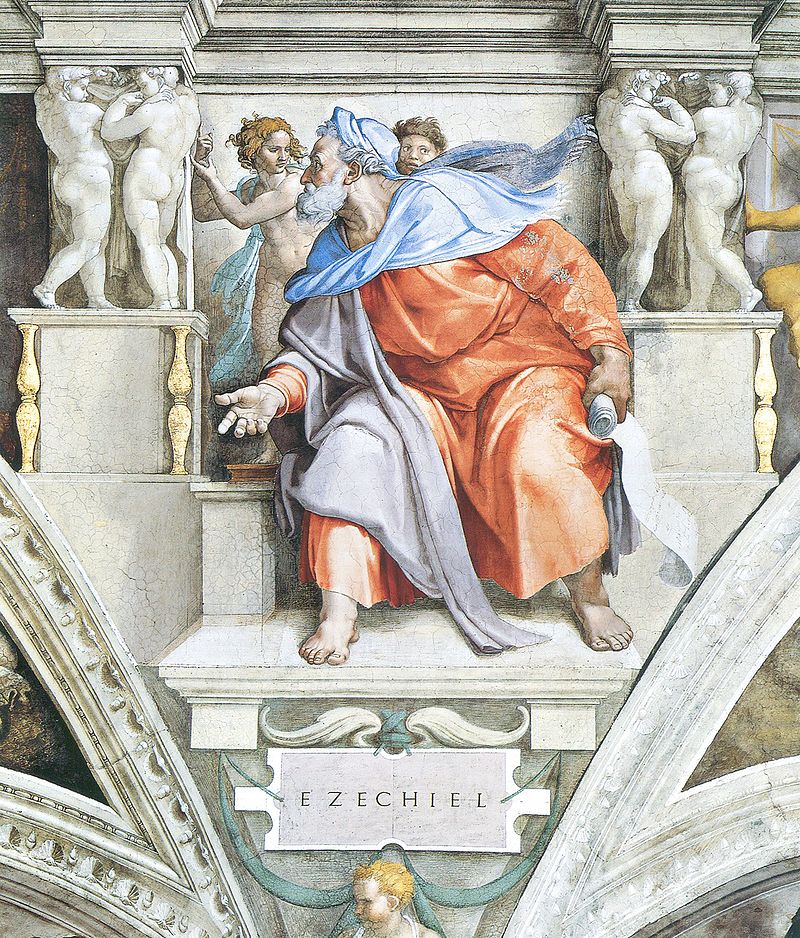
Michelangelo's Ezekiel on the Sistine Chapel
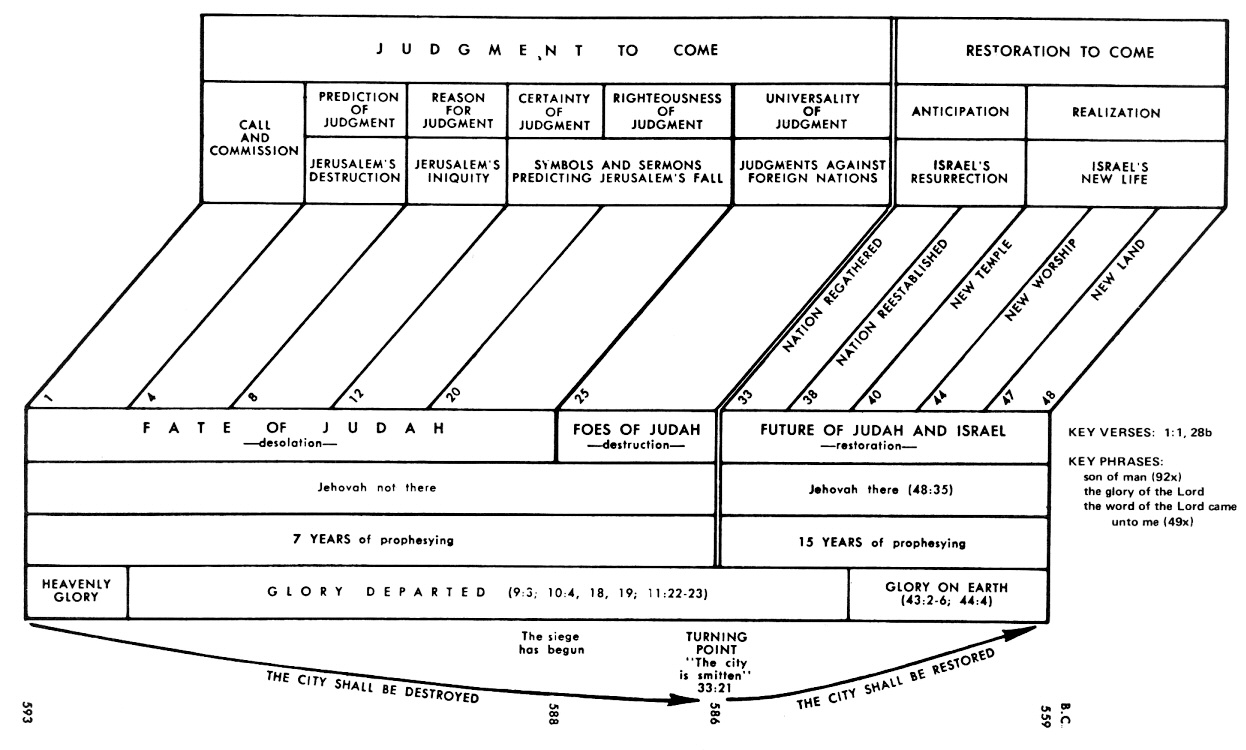
Click chart to enlarge
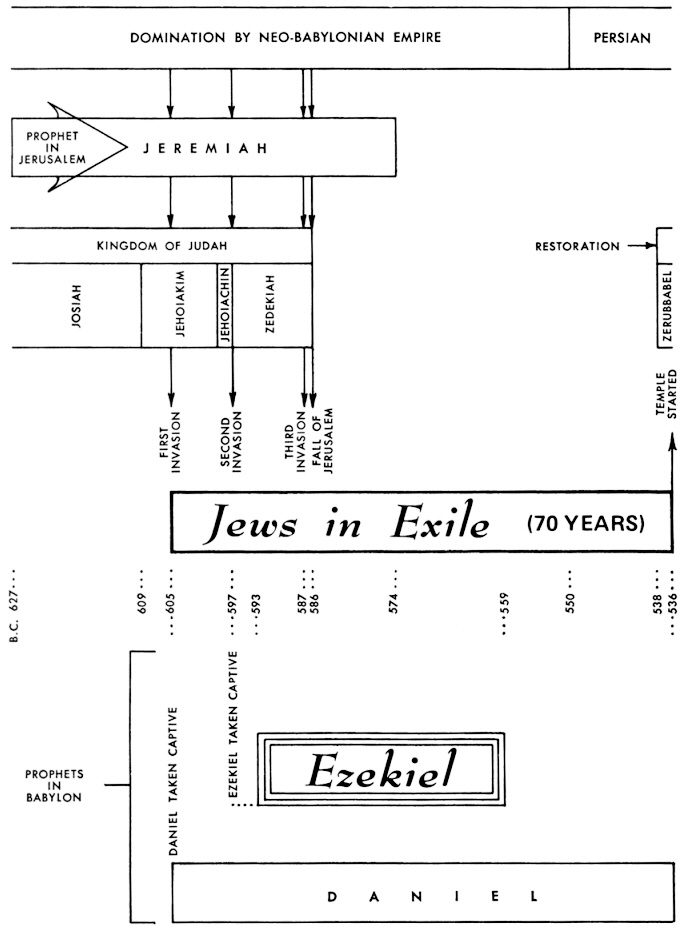
Click chart to enlarge
Chart from recommended resource Jensen's Survey of the OT - used by permission
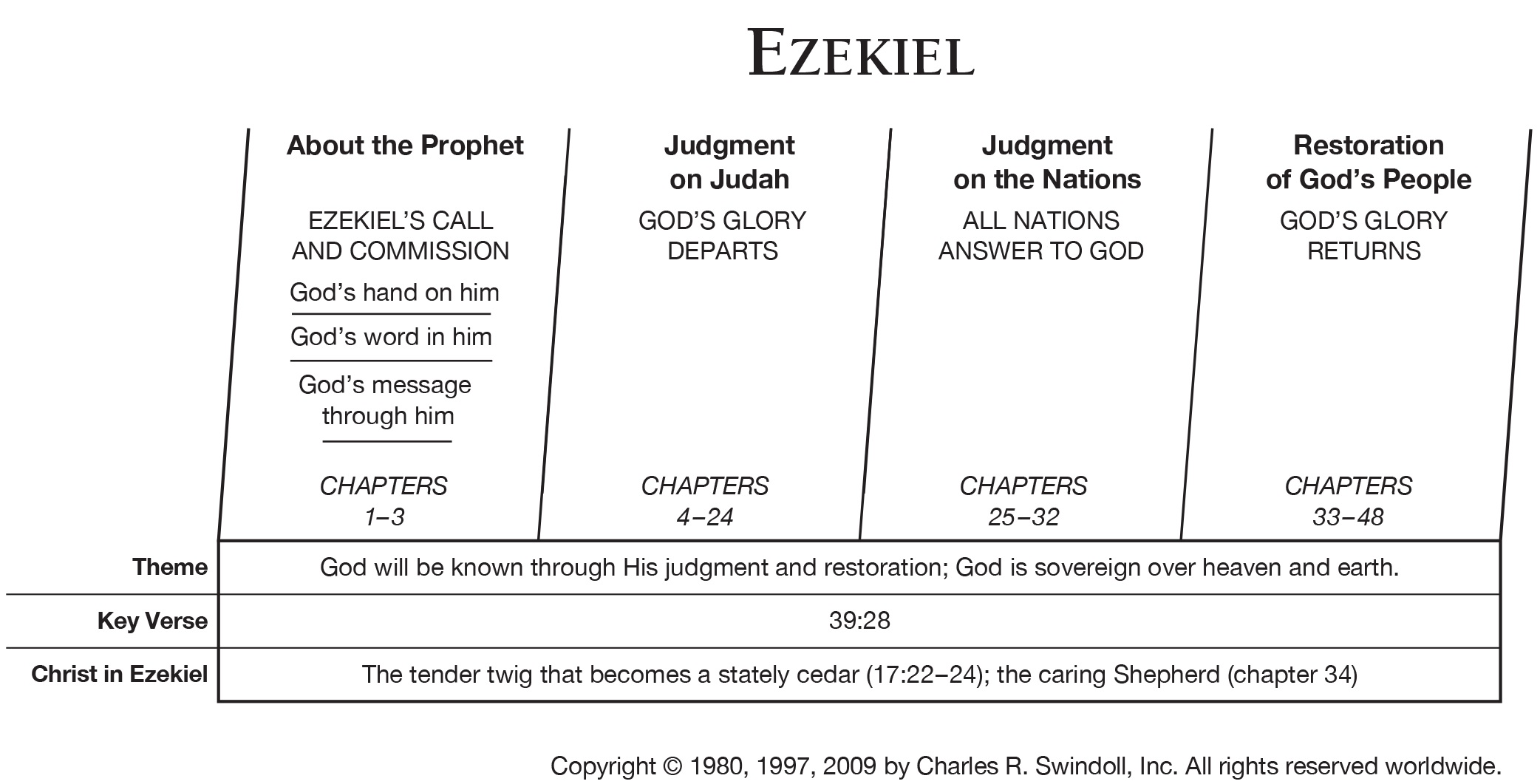
Click Chart from Charles Swindoll
|
PROPHECY OF |
PROPHECY OF |
|||
| FATE OF JUDAH Before the Siege |
FOES OF JUDAH During the Siege |
FUTURE OF JUDAH After the Siege |
||
|
593-588 BC |
587-586 |
586-571 |
||
|
7 YEARS |
15 YEARS |
|||
| Ezekiel 1:1-3:27 Ezekiel Sees the Glory & Receives the Call |
Ezekiel 4:1-24:27 Judgments Against Judah |
Ezekiel 25:1-32:32 Judgments Against the Gloating Nations |
Ezekiel 33:1-39:29 Restoration of Israel to the LORD |
Ezekiel 40:1-48:35 Visions of the Temple Jehovah Shammah |
Outline of the Book of Ezekiel from Dr John MacArthur - The book can be largely divided into sections about condemnation/retribution and then consolation/restoration. A more detailed look divides the book into 4 sections. First, are prophecies on the ruin of Jerusalem (Ezekiel 1:1–24:27). Second, are prophecies of retribution on nearby nations (Ezekiel 25:1–32:32), with a glimpse at God’s future restoration of Israel (Ezekiel 28:25,26). Thirdly, there is a transition chapter (Ezekiel 33:1-33) which gives instruction concerning a last call for Israel to repent. Finally, the fourth division includes rich expectations involving God’s future restoration of Israel (Ezekiel 34:1–48:35). (Reference)
I. Prophecies of Jerusalem’s Ruin (Ezekiel 1:1–24:27)
A. Preparation and Commission of Ezekiel (Ezekiel 1:1–3:27)
1. Divine appearance to Ezekiel (Ezekiel 1:1–28)|
2. Divine assignment to Ezekiel (Ezekiel 2:1–3:27)
B. Proclamation of Jerusalem’s Condemnation (Ezekiel 4:1–24:27)
1. Signs of coming judgment (Ezekiel 4:1–5:4)
2. Messages concerning judgment (Ezekiel 5:5–7:27)
3. Visions concerning abomination in the city and temple (Ezekiel 8:1–11:25)
4. Explanations of judgment (Ezekiel 12:1–24:27)
II. Prophecies of Retribution to the Nations (Ezekiel 25:1–32:32)
A. Ammon (Ezekiel 25:1–7)
B. Moab (Ezekiel 25:8–11)
C. Edom (Ezekiel 25:12–14)
D. Philistia (Ezekiel 25:15–17)
E. Tyre (Ezekiel 26:1–28:19)
F. Sidon (Ezekiel 28:20–24)
Excursus: The Restoration of Israel (Ezekiel 28:25, 26)
G. Egypt (Ezekiel 29:1–32:32)
III. Provision for Israel’s Repentance (Ezekiel 33:1–33)
IV. Prophecies of Israel’s Restoration (Ezekiel 34:1–48:35)
A. Regathering of Israel to the Land (Ezekiel 34:1–37:28)
1. Promise of a True Shepherd (Ezekiel 34:1–31)
2. Punishment of the nations (Ezekiel 35:1–36:7)
3. Purposes of restoration (Ezekiel 36:8–38)
4. Pictures of restoration—dry bones and two sticks (Ezekiel 37:1–28)
B. Removal of Israel’s Enemies from the Land (Ezekiel 38:1–39:29)
1. Invasion of Gog to plunder Israel (Ezekiel 38:1–16)
2. Intervention of God to protect Israel (Ezekiel 38:17–39:29)
C. Reinstatement of True Worship in Israel (Ezekiel 40:1–46:24)
1. New temple (Ezekiel 40:1–43:12)
2. New worship (Ezekiel 43:13–46:24)
D. Redistribution of the Land in Israel (Ezekiel 47:1–48:35)
1. Position of the river (Ezekiel 47:1–12)
2. Portions for the tribes (Ezekiel 47:13–48:35)
Ezekiel 11:1 Moreover, the Spirit lifted me up and brought me to the east gate of the LORD'S house which faced eastward. And behold, there were twenty-five * men at the entrance of the gate, and among them I saw Jaazaniah son of Azzur and Pelatiah son of Benaiah, leaders of the people.
Young's Literal: And lift me up doth a spirit, and it bringeth me in unto the east gate of the house of Jehovah, that is facing the east, and lo, at the opening of the gate twenty and five men, and I see in their midst Jaazaniah son of Azzur, and Pelatiah son of Benaiah, heads of the people.
Amplified: MOREOVER, THE Spirit lifted me up and brought me to the East Gate of the Lord's house, which faces east. And behold, at the door of the gateway there were twenty-five men; and I saw in the midst of them Jaazaniah the son of Azzur and Pelatiah the son of Benaiah, princes of the people.
- the spirit (KJV): Eze 11:24 3:12,14 8:3 37:1 40:1,2 41:1 1Ki 18:12 2Ki 2:16 Ac 8:39 2Co 12:1-4 Rev 1:10
- the east (KJV): Eze 10:19 43:4
- behold (KJV): Eze 8:16
- Jaazaniah (KJV): 2Ki 25:23
- Pelatiah (KJV): Eze 11:13 22:27 Isa 1:10,23 Ho 5:10
ICHABOD - THE
GLORY DEPARTS
Ezekiel 11 might be aptly titled which means "where is the glory?" (1Samuel 4:19-22 ). "Born at the time of Israel's defeat by the Philistines, and his father Phinehas' death; named accordingly by his dying mother. "When she heard that the ark of God was taken, and that her father in law and her husband were dead, she bowed herself and travailed." In vain did the women by her cheer her, "Fear not, for thou hast borne a son." "She answered not, neither did she regard it." As in the case of her pious and patriotic father-in-law, Eli, the overwhelming sorrow that caused her death was "because the ark of God was taken," hence this is thrice repeated. She felt God's presence is a nation's only true "glory" (Jeremiah 2:11; Psalm 78:61; Psalm 106:20; Hosea 9:12 )." (Easton's Dictionary) While Ezekiel makes no mention of the taking of the Ark of the Covenant, the fact that the Temple was destroyed certainly suggests it may have been taken or destroyed (or could it have been hidden?).
In Ezekiel 11:1-13 we see a description of the wicked political leaders of Judah.
Spirit lifted me is same phrase used 6 times in this book - Ezek 3:12 Ezek 3:14 Ezek 8:3 Ezek 11:1 Ezek 11:24 Ezek 43:5
East Gate (Ezek 10:19, 11:1, 40:44) is the gate facing eastward toward the Kidron Valley and the Mount of Olives (directly east of the Temple Mount area). At the beginning of Ezekiel’s vision (Ezek8), he moved gradually into the temple area, starting at the north gate and moving towards the inner court. Now, as the vision draws to a close, Ezekiel's movement is outward in synch with his divine Guide.

Holman Bible Dictionary - East Gate - This designation refers to three different gates. (1) KJV refers to the East Gate of Jerusalem as leading to the Hinnom Valley (Jeremiah 19:2 ). This valley lies to the south of the city rather than the east. Modern speech translations render this phrase Potsherd Gate. This gate may be identified with the Valley Gate (2 Chronicles 26:9; Nehemiah 2:13 ,Nehemiah 2:13,2:15; Nehemiah 3:13 ) or perhaps to the Refuse or Dung Gate (Nehemiah 2:13; Nehemiah 3:13-14; Nehemiah 12:31 ) located 1,000 cubits away. (2) The East Gate of the outer court of the Temple. Since the Temple faced east, this gate was the main entrance to the Temple complex (Ezekiel 47:1 ). Levites in charge of the East Gate of Solomon's Temple had responsibility for the free-will offerings (2 Chronicles 31:14 ). In a vision, Ezekiel saw the glory of the Lord depart through the East Gate before the destruction of the city (Ezekiel 10:19 ). His vision of the new Temple included the return of God's glory through the same gate (Ezekiel 43:1-2 ). God's use of this gate rendered it holy. It was to remain closed. Only the prince (messianic king) was allowed to enter it (Ezekiel 44:1-3 ). (3) The East Gate of the inner court of the Temple. This gate was closed on the six working days but open on the Sabbath (Ezekiel 46:1 ).
And behold, there were twenty-five * men at the entrance of the gate, and among them I saw Jaazaniah son of Azzur and Pelatiah son of Benaiah, leaders of the people. Twenty five men which initially makes you think they are the same 25 who were worshiping the sun in (Ezek 8:16). Most (but not all) commentaries state that they are not the same because in chapter 8 they were most likely Levites (or priests) and more importantly their location was between the porch and the altar whereas the 25 in this vision are designated as the leaders of the people and their location is at the entrance of the gate and the charge against them is not corrupt worship but corrupt leadership.
This Jaazaniah (his father was Azzur) was not identical with the "Jaazaniah" in (Ezek 8:11) for his father's name was Shaphan.
Wiersbe -The caldron (Ezekiel 11:1–13). The leaders in Jerusalem committed two errors. First, they rested on a false confidence that since the deportation was ended, nothing terrible could happen to them. Jerusalem was safe. The second error was that they were the “choice meat” and the people they had slain (the “sighers and criers” of Ezekiel 9:4) were only “scraps.” Pride and false confidence made them arrogant. But God saw things differently. The slain people were the “choice meat,” and the leaders of the city were the “scraps.” The evil men would try to flee the sword, but God would meet them “at the border.” They would almost make it! Then the city would indeed be a caldron where God would pour out His anger (chap. 24). The sanctuary (Ezekiel 11:14–21). The remnant might be taken from their city and temple, but they could not lose the presence of their God. They would one day be regathered, renewed, and restored to their land. There is always hope. The glory (Ezekiel 11:22–25). Judgment cannot fall as long as God’s glory dwells in the city, so the glory moved out to the Mount of Olives. This parallels Matthew 23:38–24:3. If in your character and conduct you major on the glory of God, you need not fear the judgment of God. (Borrow copy of With the Word)
Ezekiel 11:2 He said to me, "Son of man, these are the men who devise iniquity and give evil advice in this city,
Young's Literal: And He saith unto me, `Son of man, these are the men who are devising iniquity, and who are giving evil counsel in this city;
Amplified: then [the Spirit] said to me, Son of man, these are the men who devise iniquity and give wicked counsel in this city,
- Es 8:3 Ps 2:1,2 36:4 52:2 Isa 30:1 59:4 Jer 5:5 18:18 Mic 2:1,2
He said to me, "Son of man, these are the men who devise iniquity and give evil advice in this city, - This is a description of the wicked leaders and their bad advice to those still remaining in Jerusalem.
Devise (chasab/hasab) has the basic idea of employing the mind in a thinking activity. The idea is not so much to "understand" but to create new ideas. Chashab was used as an accounting term (Abraham believed God's promises and it was reckoned or accounted - chashab - to his spiritual account as righteousness).
The Septuagint (Lxx) translates chashab with the Greek verb logizomai which means to think about something in a detailed and logical manner. Logizomai is in the present tense indicating that these leaders were continually thinking about how they would propagate evil or futility (as indicated by the adjective mataios - see below).
Iniquity is translated in the Lxx with the adjective mataios (from maten = groundless, invalid) means vain, empty, devoid of force, lacking in content, nonproductive, useless, dead, fruitless, aimless, of no real or lasting value. This adjective describes an ineffectual attempt to do something or an unsuccessful effort to attain something. Mataios emphasizes aimlessness or the leading to no object or end and thus is used to describe false gods or idols in contrast to the true God.
Ezekiel 11:3 who say, 'Is not the time near to build houses? This city is the pot and we are the flesh.'
Young's Literal: who are saying, It is not near--to build houses, it is the pot, and we the flesh.
Amplified: Who say, [The time] is not near to build houses; this city is the boiling pot and we are the flesh.
- It is not (KJV): etc. or, It is not for us to build houses near, Eze 7:7 12:22,27 Isa 5:19 Jer 1:11,12 Am 6:5 2Pe 3:4
- this city (KJV): Eze 11:7-11 24:3-14 Jer 1:13
"Is not the time near to build houses" could be translated one of two ways…
Option 1: "They say things like, 'Let's build more houses. This city is like a cooking pot over a fire, and we are the meat, but at least the pot keeps us from being burned in the fire." (CEV) "They say, 'We will soon be building houses again. The city is like a cooking pot, and we are like the meat in it, but at least it protects us from the fire." (TEV) "They say, 'It's almost time to rebuild homes. This city is a cooking pot, and we're the meat.'" (GWT), "who say, It is not near, let us build houses; she is the pot, and we are the flesh" (LITV) "Who say, It is not near; let us build houses: this city is the caldron, and we are the flesh" (Webster) "Which say, It is not near; let us build houses: this city is the caldron, and we be the flesh." (KJV) "Shall we not,” they say, “be building houses soon? The city is the kettle, and we are the meat" (NAB) "They say, ‘Will it not soon be time to build houses? This city is a cooking pot, and we are the meat " (NIV) "They say to the people, ‘Is it not a good time to build houses? Our city is like an iron pot. Inside it we will be like meat—safe from all harm" (NLT) "They say, ‘We can make anything happen here. We’re the best. We’re the choice pieces of meat in the soup pot" (MESSAGE)
Option 2: "The time is not near to build houses: this city is the caldron, and we are the flesh" (ASV) "Who say, This is not the time for building houses: this town is the cooking-pot and we are the flesh" (BBE) "who say, It is not the time to build houses: this is the cauldron, and we are the flesh" (Darby) "Who say, 'The time is not near to build houses. This city is the cauldron, and we are the meat.'" (ESV) "They say, "There will be no house-building yet awhile. The city is the cooking pot and we are the meat." (NJB) "they say, 'The time is not near to build houses; this city is the pot, and we are the meat.'" (NRSV) "They say, ‘The time is not near to build houses; the city is a cooking pot and we are the meat in it" (NET) "Who say, [The time] is not near to build houses; this city is the boiling pot and we are the flesh. " (AMP)
As you can see, the translators are "split" on whether this is a statement affirming building houses or advice against building houses. If read as a question as here in the NASB, one gets a hint of their "evil advice".
ESV Study Bible - Unfortunately for interpretation, the wicked counsel announced in v. 2 and quoted in v. 3 is obscure. Verse 3a may be either a statement or a question. If the former, the cauldron and meat metaphor is negative (“we’re cooked!”); but if the latter, the metaphor is positive (“we won’t be burned!”). Since it is unlikely that being cooked is positive, the imagery is best understood to indicate fear, which led to mistrusting God. The metaphor is further developed in Ezekiel 24. (Borrow a copy of ESV study Bible)
Dr Charles Ryrie (NASB Ryrie Study Bible) says "These leaders counseled the people to build houses in Jerusalem, which, like a pot, would supposedly protect the inhabitants from Nebuchadnezzar. As prophesied by Ezekiel (v11), quite the opposite would be true." (The Ryrie Study Bible: New American Standard Translation: 1995. Moody Publishers)
These leaders remind us of those in our day even as Peter warned saying that "in the last days mockers will come with their mocking, following after their own lusts and saying, "Where is the promise of His coming? (His coming brings judgment on those who habitually follow their lusts just as would occur in Jerusalem) For ever since the fathers fell asleep, all continues just as it was from the beginning of creation." (2Pe 3:4-note)
God had given orders through Jeremiah (Jer 29:4-11) that the captives would build houses in Babylon because Jerusalem would fall. These leaders were giving lying advice about building homes, in so doing deceiving those left in Jerusalem.
THIS CITY IS THE POT AND WE ARE THE FLESH: (Ezek 11:7-11; 24:3-14; Jer1:13)
The meaning of this phrase is difficult to state with certainty but could mean something like the meat or flesh was safe in the pot as it was shielded from the fire. It is as if the leaders were declaring that Jerusalem's inhabitants were secure inside Jerusalem's walls by promulgating a proverb "This city is a cooking pot and we are the meat" (safe inside the "pot")
Reformation Study Bible - The leadership of Jerusalem had already been deported by Nebuchadnezzar in 597 B.C.; this deportation included much of the royal family, the leaders of the military, and the craftsmen, leaving only “the poorest people of the land” (2Ki 24:13–16). Those who rose to prominence in the absence of the earlier ruling class appear to have had delusions of grandeur. The analogy they used of a cauldron and meat seems to mean that they considered those who had been deported from the city as the waste parts of a butchered animal, while they were the best parts.
MacDonald sees a parallel between the attitude of the leaders and nominal Christians today, writing that "In the same way, many nominal Christians feel safe from God’s judgment despite the sin in their lives, but the Lord will tell them, “I never knew you.” The fire may be delayed but the fire of judgment is coming. (Believer's Bible Commentary: Thomas Nelson)
Ezekiel 11:4 "Therefore, prophesy against them, son of man, prophesy!"
Young's Literal: Therefore prophesy concerning them, prophesy, son of man.'
Amplified: Therefore prophesy against them; prophesy, O son of man!
- Eze 3:2-15,17-21 20:46,47 21:2 25:2 Isa 58:1 Ho 6:5 8:1
Therefore, prophesy against them, son of man, prophesy! - So, Ezekiel, condemn them!" (CEV) "Now then, denounce them, mortal man" (TEV) Prophesy against them Ezekiel was instructed to reinterpret their "meat in the pot" symbolism quite differently! In the following verses, Ezekiel explains that the city of Jerusalem was the pot and the slain people were the meat! The leaders themselves would be taken out of the city and judged at the border of Israel (2Ki 25:18, 19, 20, 21; Jer 5:24, 25, 26, 27).
Ezekiel 11:5 Then the Spirit of the LORD fell upon me, and He said to me "Say, 'Thus says the LORD, "So you think, house of Israel, for I know your thoughts.
Young's Literal: And fall upon me doth the Spirit of Jehovah, and He saith unto me, `Say: Thus said Jehovah: Rightly ye have said, O house of Israel, And the steps of your spirit I have known.
Amplified: And the Spirit of the Lord fell upon me, and He said to me, Speak. Say, Thus says the Lord: This is what you thought, O house of Israel, for I know the things that come into your mind.
NET - Then the Spirit of the LORD came upon me and said to me, “Say: This is what the LORD says: ‘This is what you are thinking, O house of Israel; I know what goes through your minds.
- the Spirit (KJV): Eze 2:2 3:24,27 8:1 Nu 11:25,26 1Sa 10:6,10 Ac 10:44 11:15
- Speak (KJV): Eze 2:4,5,7 3:11 Isa 58:1
- Thus have (KJV): Eze 28:2 29:3 38:11 Ps 50:21 Isa 28:15 Mal 3:13,14 Mk 3:22-30 Jas 3:6
- for (KJV): Eze 38:10 1Ch 28:9 Ps 7:9 139:2,3 Jer 16:17 17:10 Mk 2:8 Joh 2:24 Joh 2:25 21:17 Heb 4:13 Rev 2:23
Then - Be alert to this expression of time, as it marks progression of events and can be very helpful in following the flow of a passage, especially if the passage is prophetic.
Spirit… fell upon me is only used here in Ezekiel instructing him to prophesy.
In Ezek 8:1 "the hand of the Lord GOD fell on" Ezekiel.
In Ezekiel 2:2 "the Spirit entered" Ezekiel and set him on his feet and spoke to him
The Spirit of the LORD - 28 times in the Bible - Jdg. 3:10; Jdg. 6:34; Jdg. 11:29; Jdg. 13:25; Jdg. 14:6; Jdg. 14:19; Jdg. 15:14; 1 Sam. 10:6; 1 Sam. 16:13; 1 Sam. 16:14; 2 Sam. 23:2; 1 Ki. 18:12; 1 Ki. 22:24; 2 Ki. 2:16; 2 Chr. 18:23; 2 Chr. 20:14; Isa. 11:2; Isa. 40:13; Isa. 61:1; Isa. 63:14; Ezek. 11:5; Ezek. 37:1; Mic. 2:7; Mic. 3:8; Lk. 4:18; Acts 5:9; Acts 8:39; 2 Co. 3:17
I know your thoughts (Heb “I know the steps of your spirits”) - This speaks of God's omniscience and is a truth we all do well to frequently ponder for an awareness of it can be a great deterrent against sin when we are being sorely tempted!
I know the devices of your spirit" (Brenton's translation of the Septuagint) where Hebrew word for "thoughts" is translate with the Greek noun diaboulia = counsels, deliberations, intrigues, plotting
Ezekiel is to remind the leaders that not were their actions not hidden from God's omniscience, neither were their very thoughts. God knew what they were thinking, saying, and doing.
Ezekiel 11:6 "You have multiplied your slain in this city, filling its streets with them." Young's Literal: Ye multiplied your wounded in this city, And filled its out-places with the wounded.
Amplified: You have multiplied your slain in this city and you have filled its streets with the slain.
NET - You have killed many people in this city; you have filled its streets with corpses.’
- Eze 7:23 9:9 22:2-6,9,12,27 24:6-9 2Ki 21:16 Isa 1:15 Jer 2:30,34 Jer 7:6,9 La 4:13 Ho 4:2,3 Mic 3:2,3,10 7:2 Zep 3:3 Mt 23:35
You - The point is that Judah was responsible for the destruction that had been depicted in Ezek 9:7. They were reaping what they had sown.
Multiplied… filling - graphic depiction of loss of human life in Judah.
ESV Study Bible - Although the judgment that multiplies corpses is divine (Ezek 9:7), it has been provoked by the people’s guilt, and they remain responsible. (Borrow a copy of ESV study Bible)
NKJV Study Bible gives a different interpretation - Jerusalem’s official leaders had been accused of wicked activities and giving unrighteous advice (Ezek 11:2); here we discover that they had killed fellow countrymen. (See context in The NKJV Study Bible )
Ezekiel 11:7 'Therefore, thus says the Lord GOD, "Your slain whom you have laid in the midst of the city are the flesh and this city is the pot; but I will bring you out of it.
Young's Literal: Therefore, thus said the Lord Jehovah: Your wounded whom ye placed in its midst, They are the flesh, and it is the pot, And you he hath brought out from its midst.
Amplified: Therefore thus says the Lord God: Your slain whom you have laid in your midst; they are the flesh and this city is the boiling pot, but you shall be brought forth out of the midst of it.
NET - Therefore, this is what the sovereign LORD says: ‘The corpses you have dumped in the midst of the city are the meat, and this city is the cooking pot, but I will take you out of it.
- Your (KJV): Eze 24:3-13 Mic 3:2,3
- but (KJV): Eze 3:9-11 2Ki 25:18-22 Jer 52:24-27
JERUSALEM LIKE
A COOKING POT!
Therefore - Term of conclusion. Ezekiel 11:7-11 announces the "death penalty" on Judah.
They are the flesh - Ezekiel changes the meaning of flesh from "leaders" (they declared "we are the flesh" in Ezek 11:3) to those they killed (which tends to support that Ezek 11:6 refers to those the leaders had killed).
Reformation Study Bible - The prophet makes clear that the best part, the “meat” of the city, was the ones who had been killed. The new leaders had considered themselves to be this best part (Ezek 11:3).
This city is the pot - Jerusalem is caldron. It will not be a place of protection.
I will bring you out of it - Will be rescued from God's wrath.
Ezekiel 11:8 "You have feared a sword; so I will bring a sword upon you," the Lord GOD declares.
Young's Literal: A sword ye have feared, And a sword I bring in against you, An affirmation of the Lord Jehovah.
Amplified: You have feared the sword, and I will bring a sword upon you, says the Lord God.
NET - You fear the sword, so the sword I will bring against you,’ declares the sovereign LORD.
- Job 3:25 20:24 Pr 10:24 Isa 24:17,18 30:16,17 66:4 Jer 38:19-23 42:14-16 44:12,13 Am 9:1-4 Joh 11:48 1Th 2:15,16
WHAT YOU FEAR
YOU WILL RECEIVE!
You - The evil leaders.
Feared the sword - Possibly alludes to how the leaders had gained power (by the sword).
Solomon testified that "What the wicked fears will come upon him, But the desire of the righteous will be granted." (Pr 10:24 )
Ezekiel 11:9 "And I will bring you out of the midst of the city and deliver you into the hands of strangers and execute judgments against you.
Young's Literal: And I have brought you out of its midst, And given you into the hand of strangers, And I have done among you judgments.
Amplified: And I will bring you forth out of the midst of it and deliver you into the hands of foreigners and execute judgments among you.
NET - ‘But I will take you out of the city. And I will hand you over to foreigners. I will execute judgments on you.
- and deliver (KJV): Eze 21:31 De 28:36,49,50 2Ki 24:4 Ne 9:36,37 Ps 106:41 Jer 5:15-17 39:6
- and will (KJV): Eze 5:8,10,15 16:38,41 30:19 Ps 106:30 Ec 8:11 Joh 5:27 Ro 13:4 Jude 1:15
I will bring you out - God carries out this act, whereas in 2Ki 25:4 says the men of war fled in panic ( the Arabah = The Jordan Valley). Once again we see the pattern of God's sovereignty and man's free will, a mystery of mysteries, that we may argue about, but which is repeatedly seen in the Scriptures in numerous different contexts.
Deliver you - Again emphasize God sovereign act of bringing about His justice and fulfilling His prophecy. King Zedekiah was captured at Jericho (2Ki 25:5).
Into the hands of strangers - The Babylonians
Execute judgments against you - Ezekiel prophecies the just demise of the evil leaders at the final attack by the Babylonians in July, 586 BC…
2Kgs 25:4 Then the city (Jerusalem) was broken into, and all the men of war fled by night by way of the gate between the two walls beside the king’s garden, though the Chaldeans (Babylonians) were all around the city. And they went by way of the Arabah . 5 But the army of the Chaldeans pursued the king and overtook him in the plains of Jericho and all his army was scattered from him. 6 Then they captured the king and brought him to the king of Babylon at Riblah, and he passed sentence on him. 7 They slaughtered the sons of Zedekiah before his eyes, then put out the eyes of Zedekiah and bound him with bronze fetters and brought him to Babylon.
Ezekiel 11:10 "You will fall by the sword. I will judge you to the border of Israel; so you shall know that I am the LORD.
Young's Literal: By the sword ye do fall, On the border of Israel I do judge you, And ye have known that I am Jehovah.
Amplified: You shall fall by the sword; I will judge and punish you [before your neighbors] at the border or outside the land of Israel, and you shall know (understand and realize) that I am the Lord.
NET - You will die by the sword; I will judge you at the border of Israel. Then you will know that I am the LORD.
- fall (KJV): 2Ki 25:19-21 Jer 39:6 52:9,10,24-27
- in (KJV): Nu 34:8,9 Jos 13:5 1Ki 8:65 2Ki 14:25
- and ye (KJV): Eze 6:7 13:9,14,21,23 Ps 9:16 Jer 9:24
I will judge you in the border of Israel - Far from the so-called protecting city. The terrible judgment on King Zedekiah and the leaders took place at Riblah (Jer 39:5-7; 52:24-27; 2Ki 25:18-21)
Ezekiel 11:11 "This city will not be a pot for you, nor will you be flesh in the midst of it, but I will judge you to the border of Israel.
Young's Literal: It is not to you for a pot, Nor are ye in its midst for flesh, At the border of Israel I do judge you.
Amplified: This city shall not be your boiling pot, neither shall you be the flesh in the midst of it; I will judge you at the border or outside of Israel;
NET - This city will not be a cooking pot for you, and you will not be meat within it; I will judge you at the border of Israel.
- Eze 11:3,7-10
Ezekiel reverses the meaning of the proverb, stating that the city will not be a pot conveying protection.
Stuart - This message was exactly the opposite of what Jerusalem’s leaders considered appropriate. They saw the exiles as unfortunate victims of their own bad luck and poor judgment for having somehow gotten exiled instead of having been spared as the present leaders had been.
I will judge you to the border of Israel - As King Zedekiah and the leaders fled the city in an attempt to escape the Babylonians, Ezekiel makes it very clear that they may leave the city but they will be judged (Jer 39:5-7; 52:24-27; 2Ki 25:18-21).
Note God's sovereignty in this section - I will bring you out… deliver… execute judgments… I will judge you (Ezek 11:9, 10, 11). And note the result in Ezekiel 11;12 - they will know Who it was Who carried out this judgment against them. Not the Babylonians per se, but the Lord God Almighty. The wages of sin have always been death. Do not be deceived beloved. There is no such thing as a "little sin." (James 1:13-15, cp Song 2:15).
Ezekiel 11:12 "Thus you will know that I am the LORD; for you have not walked in My statutes nor have you executed My ordinances, but have acted according to the ordinances of the nations around you."
Young's Literal: And ye have known that I am Jehovah, For in My statutes ye have not walked, And My Judgments ye have not done, And according to the judgments of the nations Who are round about you--ye have done!'
Amplified: And you shall know (understand and realize) that I am the Lord; for you have not walked in My statutes nor executed My ordinances, but have acted according to the ordinances of the nations around you.
NET - Then you will know that I am the LORD, whose statutes you have not followed and whose regulations you have not carried out. Instead you have behaved according to the regulations of the nations around you!’ ”
- for we have not walked, or, which have not walked, Eze 11:21 20:16,21,24 Lev 26:40 1Ki 11:33 2Ki 21:22 Ezr 9:7 Ne 9:34 Ps 78:10 Jer 6:16 Da 9:10
- but (KJV): Eze 8:10,14,16 16:44-47 Lev 18:3,24-28 De 12:30,31 2Ki 16:3,10,11 2Ki 17:11-23 18:12 21:2 2Ch 13:9 28:3 33:2-9 36:14 Ps 106:35-39 Jer 10:2
Thus - Here is the conclusion. When they are judged they will understand it was Jehovah's hand that brought this about. Indeed, when all the unregenerate stand before the final judgment at the Great White Throne, they will surely know and understand that it is Jehovah Whom they have rejected as Savior has become Jehovah their Righteous Judges! (Rev 20:11-14-note)
You will know that I am the LORD - This phrase is mentioned twice (Ezek 11:10 and here) . In the context of His righteous judgment, when Ezekiel's prophecy comes to pass, the leaders will know that He is Jehovah.
Know that I am the LORD - recall this is a key phrase in this book. God wants His people to know Him - Ezek. 6:7, 10, 13, 14; 7:4, 27; 11:10, 12; 12:15f, 20; 13:9, 14, 21, 23; 14:8; 15:7; 16:62; 17:24; 20:12, 20, 26, 38, 42, 44; 22:16; 23:49; 24:24, 27; 25:5, 7, 11, 17; 26:6; 28:22, 23, 24, 26; 29:6, 9, 16, 21; 30:8, 19, 25f; 32:15; 33:29; 34:27; 35:4, 9, 15; 36:11, 23, 38; 37:6, 13, 28; 38:23; 39:6f, 22, 28;
If you have read through these preceding passages, you will notice that the context in which Jehovah makes Himself known is when He executes judgment. How sad that for many (most) of humanity, it will not be until He executes judgment that they come to realize and understand that God is real, that He really did provide a way of escape in Christ, that they rejected their way of salvation and that they justly deserve their everlasting separation from His holy Presence because of their unredeemed, unholy ways (sins). Dear reader, if you are a skeptic today, there will come a day when you are no longer a skeptic but a "believer" in Jehovah, but that belief won't be by faith but by sight and it will be too late. I pray you hear and heed Paul's urgent message quoted from Isaiah…
AT THE ACCEPTABLE TIME I LISTENED TO YOU, AND ON THE DAY OF SALVATION I HELPED YOU"; behold, now is "THE ACCEPTABLE TIME," behold, now is "THE DAY OF SALVATION" (2Cor 6:2, Isaiah 49:8)
For - This term of explanation explains why they will be judged by Jehovah.
Execute My ordinances - There is in a sense a play on words, poetic justice if you will. Note that here failure to execute God's ordinances describes their "sowing" of evil (failure to obey His laws) and Ezekiel 11:9 ("execute judgments") describes the "reaping" of their evil deeds.
My ordinances - As revealed in the Mosaic Covenant.
But - Term of Contrast
Ordinances of the nations - The leaders actions were based on the ordinances of the godless nations instead of the ordinances of the God of the nations ("My ordinances"). They would be judged because they had been unfaithful to the Mosaic Covenant ("My ordinances").
Their actions are reminiscent of those who lived in the time of the book of Judges 21:25+ - In those days there was no king in Israel; everyone did what was right in his own eyes.
THOUGHT - How many times have we heard justification of lowering our moral standards because of some one else we know who professes to be a godly man or woman… if they did I can too! Believers often err in thinking that their moral standards are okay, not realizing that they have been influenced by the cultural around them ("the ordinances of the nations"). Leaven of sin by nature always spreads. Only the Gospel provides the antidote! Have you noticed over the years how television shows have gradually lowered the bar regarding their language? What would have been censored in the 1950's is now totally acceptable, and sadly is "imbibed" even by genuine believers! We must remember that we are aliens and strangers and are actively (whether we realize it or not) involved in a very real cultural (spiritual) war in America (I write in May, 2014). The fate of America can be no different from that of ancient Judah if we continue to act like godless, amoral pagans.
Revive us O Lord (Ps 119:25), by Thy Spirit of holiness and Thy Word of Truth and Righteousness, for the sake of the Name above all names, Christ Jesus. Amen