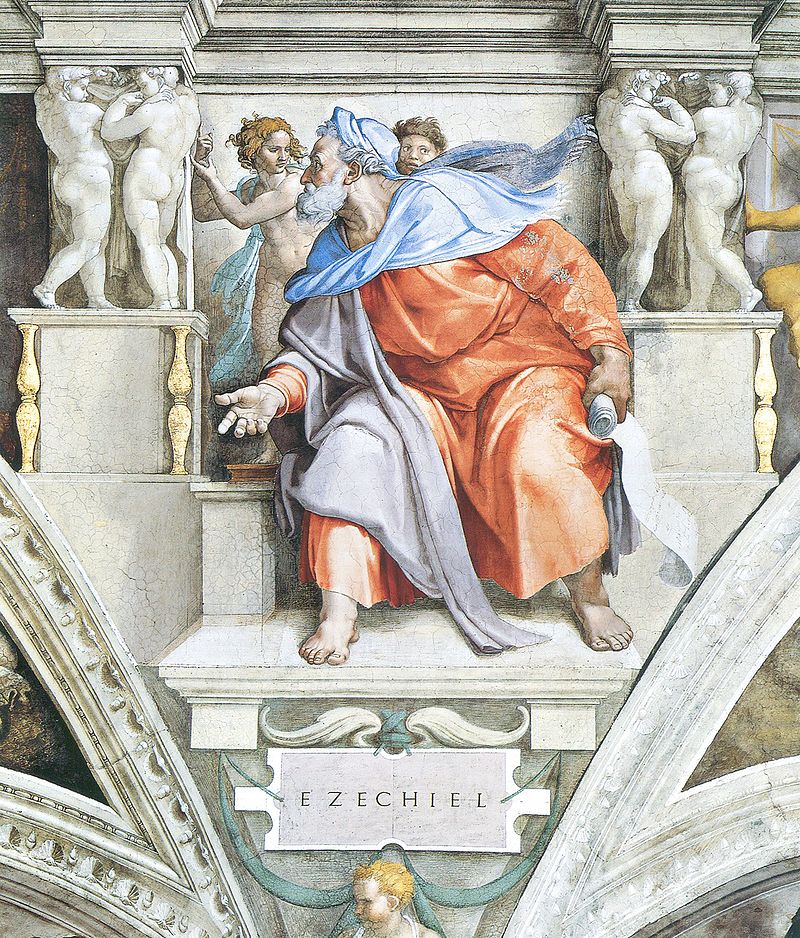
Michelangelo's Ezekiel on the Sistine Chapel
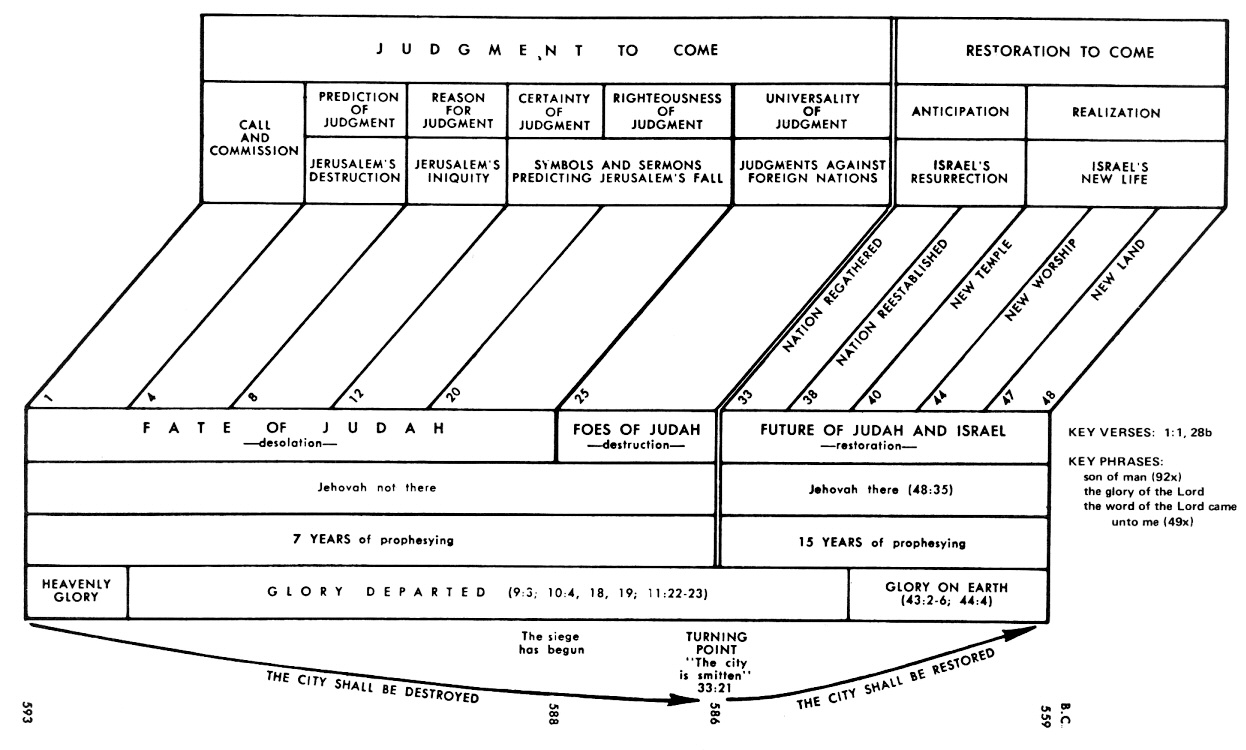
Click chart to enlarge
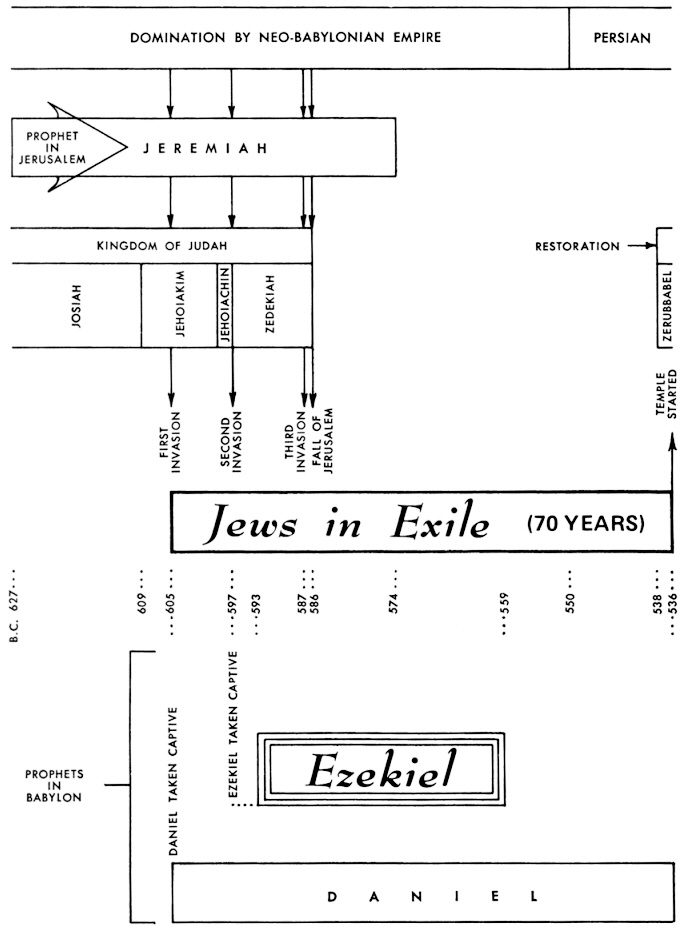
Click chart to enlarge
Chart from recommended resource Jensen's Survey of the OT - used by permission
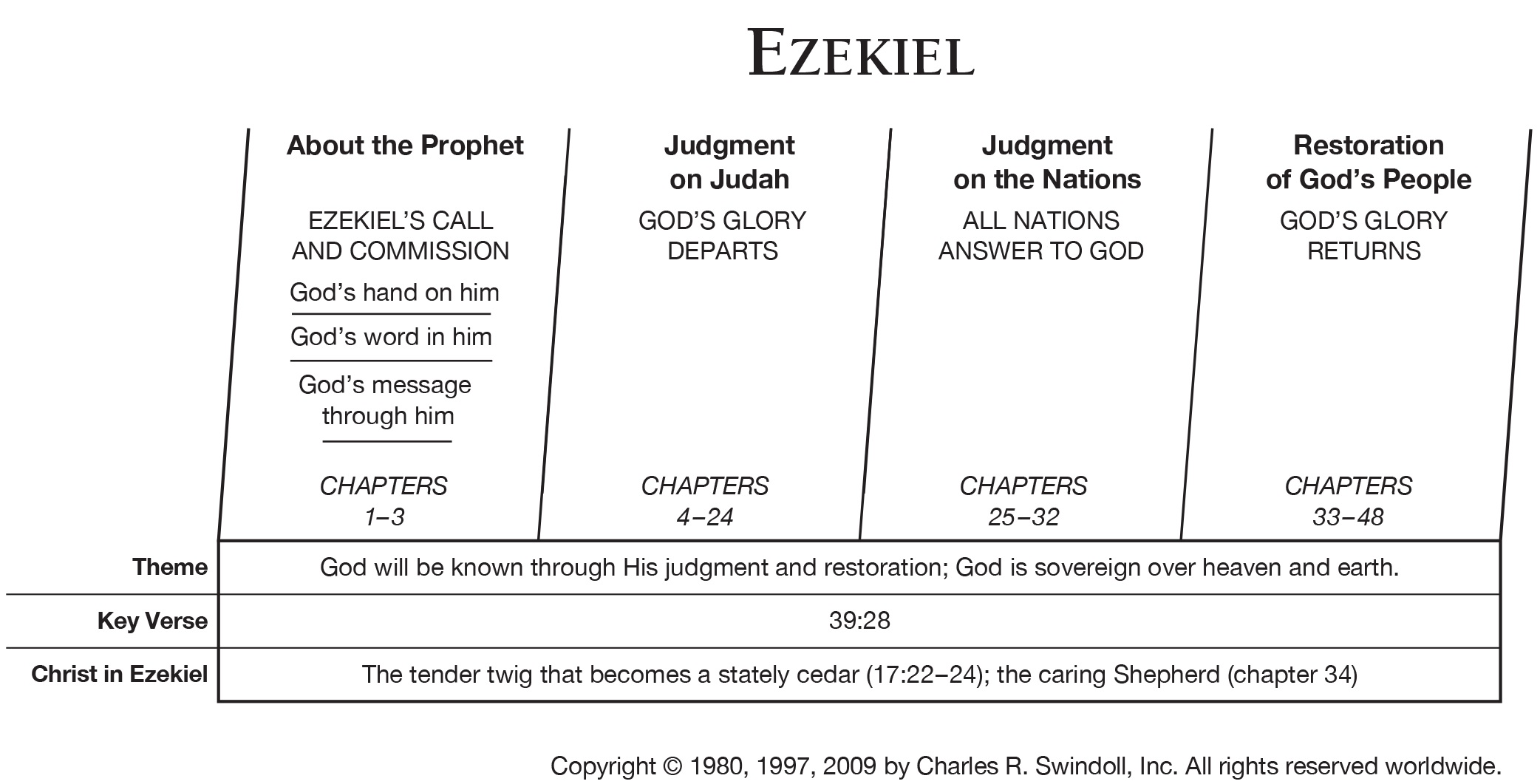
Click Chart from Charles Swindoll
|
PROPHECY OF |
PROPHECY OF |
|||
| FATE OF JUDAH Before the Siege |
FOES OF JUDAH During the Siege |
FUTURE OF JUDAH After the Siege |
||
|
593-588 BC |
587-586 |
586-571 |
||
|
7 YEARS |
15 YEARS |
|||
| Ezekiel 1:1-3:27 Ezekiel Sees the Glory & Receives the Call |
Ezekiel 4:1-24:27 Judgments Against Judah |
Ezekiel 25:1-32:32 Judgments Against the Gloating Nations |
Ezekiel 33:1-39:29 Restoration of Israel to the LORD |
Ezekiel 40:1-48:35 Visions of the Temple Jehovah Shammah |
Outline of the Book of Ezekiel from Dr John MacArthur - The book can be largely divided into sections about condemnation/retribution and then consolation/restoration. A more detailed look divides the book into 4 sections. First, are prophecies on the ruin of Jerusalem (Ezekiel 1:1–24:27). Second, are prophecies of retribution on nearby nations (Ezekiel 25:1–32:32), with a glimpse at God’s future restoration of Israel (Ezekiel 28:25,26). Thirdly, there is a transition chapter (Ezekiel 33:1-33) which gives instruction concerning a last call for Israel to repent. Finally, the fourth division includes rich expectations involving God’s future restoration of Israel (Ezekiel 34:1–48:35). (Reference)
I. Prophecies of Jerusalem’s Ruin (Ezekiel 1:1–24:27)
A. Preparation and Commission of Ezekiel (Ezekiel 1:1–3:27)
1. Divine appearance to Ezekiel (Ezekiel 1:1–28)|
2. Divine assignment to Ezekiel (Ezekiel 2:1–3:27)
B. Proclamation of Jerusalem’s Condemnation (Ezekiel 4:1–24:27)
1. Signs of coming judgment (Ezekiel 4:1–5:4)
2. Messages concerning judgment (Ezekiel 5:5–7:27)
3. Visions concerning abomination in the city and temple (Ezekiel 8:1–11:25)
4. Explanations of judgment (Ezekiel 12:1–24:27)
II. Prophecies of Retribution to the Nations (Ezekiel 25:1–32:32)
A. Ammon (Ezekiel 25:1–7)
B. Moab (Ezekiel 25:8–11)
C. Edom (Ezekiel 25:12–14)
D. Philistia (Ezekiel 25:15–17)
E. Tyre (Ezekiel 26:1–28:19)
F. Sidon (Ezekiel 28:20–24)
Excursus: The Restoration of Israel (Ezekiel 28:25, 26)
G. Egypt (Ezekiel 29:1–32:32)
III. Provision for Israel’s Repentance (Ezekiel 33:1–33)
IV. Prophecies of Israel’s Restoration (Ezekiel 34:1–48:35)
A. Regathering of Israel to the Land (Ezekiel 34:1–37:28)
1. Promise of a True Shepherd (Ezekiel 34:1–31)
2. Punishment of the nations (Ezekiel 35:1–36:7)
3. Purposes of restoration (Ezekiel 36:8–38)
4. Pictures of restoration—dry bones and two sticks (Ezekiel 37:1–28)
B. Removal of Israel’s Enemies from the Land (Ezekiel 38:1–39:29)
1. Invasion of Gog to plunder Israel (Ezekiel 38:1–16)
2. Intervention of God to protect Israel (Ezekiel 38:17–39:29)
C. Reinstatement of True Worship in Israel (Ezekiel 40:1–46:24)
1. New temple (Ezekiel 40:1–43:12)
2. New worship (Ezekiel 43:13–46:24)
D. Redistribution of the Land in Israel (Ezekiel 47:1–48:35)
1. Position of the river (Ezekiel 47:1–12)
2. Portions for the tribes (Ezekiel 47:13–48:35)
Ezekiel 11:13 Now it came about as I prophesied, that Pelatiah son of Benaiah died. Then I fell on my face and cried out with a loud voice and said, "Alas, Lord GOD! Will You bring the remnant of Israel to a complete end? (NASB: Lockman)
Amplified: And you shall know (understand and realize) that I am the Lord; for you have not walked in My statutes nor executed My ordinances, but have acted according to the ordinances of the nations around you. (Amplified Bible - Lockman)
Young's Literal: And it cometh to pass, at my prophesying, that Pelatiah son of Benaiah is dying, and I fall on my face, and cry--a loud voice--and say, `Ah, Lord Jehovah, an end Thou art making of the remnant of Israel.'
NOW IT CAME ABOUT AS I PROPHESIED, THAT PELATIAH SON OF BENAIAH DIED: (
- Ezek 11:1; 37:7; Nu14:35, 36, 37; Dt 7:4; 1Ki13:4; Pr6:15; Jer 28:15, 16, 17; Hos6:5; Ac 5:5,10; 13:11
Pelatiah… died - This gave clear confirmation to Ezekiel that his message was true in addition to foreshadowing ("Pelatiah Preview" of coming attractions) the certain judgment that would soon destroy all the other evil leaders in Jerusalem. There is a ironic play on words for Pelatiah's name means "deliverance of the LORD", "the LORD has set free", "Yahweh delivers" or "Yah (God) has rescued"! Far from "living up to his good name"
Pelatiah became a symbol of those who had planned evil and gave wicked advice in Jerusalem as well as continually committing murder even filling the streets of Jerusalem with their victims. (Ezek 11:2 11:6) Only one "good name" every delivered anyone… for
"there is salvation (rescue from peril) in no one else; for there is no other Name under heaven that has been given among men, by which we must be saved (delivered)." (Acts 4:12)
THEN I FELL ON MY FACE AND CRIED OUT WITH A LOUD VOICE AND SAID, "ALAS, LORD GOD! WILL YOU BRING THE REMNANT OF ISRAEL TO A COMPLETE END:
- Dt 9:18,19; Josh 7:6, 7, 8, 9; 1Chr 21:16,17; Ps 106:23; 119:120
- Ezek 9:8; Am 7:2,5
The remnant (click here for more detailed discussion of this important term) - The death of this leader was a sign that God would indeed carry out His judgment on all of Jerusalem just as He had prophesied. Upon seeing this vision, Ezekiel once again expressed his fear that this death implied death for all Israelites. His reaction was similar in the previous chapter upon hearing of the striking of everyone in the city who did not have the "protective" mark --
"Then it came about as they were striking and I alone was left, that I fell on my face and cried out saying, “Alas, Lord God! Art Thou destroying the whole remnant of Israel by pouring out Thy wrath on Jerusalem?” (Ezek 9:8)
Keep in mind that the exiles were a "physical remnant" but this does not necessarily indicate that they were a "spiritual remnant" reckoned righteous by faith.
Ezekiel 11:14 Then the word of the LORD came to me, saying, (NASB: Lockman)
Amplified: And the word of the Lord came to me, saying, (Amplified Bible - Lockman)
Young's Literal: And there is a word of Jehovah unto me, saying,
THEN THE WORD OF THE LORD CAME TO ME, SAYING:
- Ex 27:1-7; 40:29; 2Chr 4:1
This exact phrase is found in the two prophets who prophesied to Judah in Babylonian captivity - Jer. 13:3, 8; 18:5; 24:4; Ezek. 11:14; 12:1, 21; 13:1; 14:12; 15:1; 16:1; 18:1; 22:1; 33:23; 34:1; 36:16
Word of Jehovah came to me - The words Ezekiel spoke in this book were inspired. Ezekiel perfectly fulfills the defintion of a prophet which Webster says is from Latin propheta, from Greek prophētēs from pro = for + phanai = to speak. Ezekiel speaks for Jehovah. He is as it were Jehovah's mouthpiece.
Then - Always be alert to this "code" word (see expression of time) as it marks a progression in events (next in order of time, following next after in order of position, narration, or enumeration : being next in a series). This word can be especially helpful in discerning the sequence of events in prophetic passages.
In answer to Ezekiel's query, the Lord gives him a comforting assurance that He will preserve a remnant among the exiles, and restore His people (Ezek 11:14-21), which represents the first promise in Ezekiel of future restoration. What is the basis for this promise? Jehovah's covenant with Abraham, the promise that he would have descendants as numerous as the stars of the sky (Ge 15:5), a promise that He could not have kept if there had been no remnant from which the Messiah would one day come (see Gen 15:6, Ge 12:3, Gal 3:8, 16). (See Abrahamic Covenant versus Mosaic Covenant and Covenant - Abrahamic, Old and New)
Ezekiel 11:15 "Son of man, your brothers, your relatives, your fellow exiles and the whole house of Israel, all of them, are those to whom the inhabitants of Jerusalem have said, 'Go far from the LORD; this land has been given us as a possession.' (NASB: Lockman)
Amplified: Son of man, your brethren, even your kindred, your fellow exiles, and all the house of Israel, all of them, are they of whom the [present] inhabitants of Jerusalem have said, They have gone far from the Lord [and from this land]; therefore this land is given to us for a possession. (Amplified Bible - Lockman)
ICB: "Human being, the people still in Jerusalem have spoken about your relatives. And they have spoken about all the people of Israel who are captives with you. The people still in Jerusalem have said, 'They are far from the Lord. This land was given to us as our property.'
NIV: Son of man, your brothers-- your brothers who are your blood relatives and the whole house of Israel-- are those of whom the people of Jerusalem have said, 'They are far away from the LORD; this land was given to us as our possession.'
Young's Literal: Son of man, thy brethren, thy brethren, men of thy kindred, and all the house of Israel--all of it, are they to whom inhabitants of Jerusalem have said, Keep far off from Jehovah;
SON OF MAN, YOUR BROTHERS, YOUR RELATIVES, YOUR FELLOW EXILES AND THE WHOLE HOUSE OF ISRAEL, ALL OF THEM:
- Jer 24:1-5
"Son of man, thy brethren, and the men of thy captivity" (LXX)
Son of man referring to Ezekiel - Ezek. 2:1, 3, 6, 8; 3:1, 3f, 10, 17, 25; 4:1, 16; 5:1; 6:2; 7:2; 8:5f, 8, 12, 15, 17; 11:2, 4, 15; 12:2f, 9, 18, 22, 27; 13:2, 17; 14:3, 13; 15:2; 16:2; 17:2; 20:3f, 27, 46; 21:2, 6, 9, 12, 14, 19, 28; 22:2, 18, 24; 23:2, 36; 24:2, 16, 25; 25:2; 26:2; 27:2; 28:2, 12, 21; 29:2, 18; 30:2, 21; 31:2; 32:2, 4; 39:1, 17; 40:4; 43:7, 10, 18; 44:5; 47:6;
Son of Man referring to Jesus - Dan. 7:13; Matt. 8:20; 9:6; 10:23; 11:19; 12:8, 32, 40; 13:37, 41; 16:13, 27f; 17:9, 12, 22; 18:11; 19:28; 20:18, 28; 24:27, 30, 37, 39, 44; 25:31; 26:2, 24, 45, 64; Mk. 2:10, 28; 8:31, 38; 9:9, 12, 31; 10:33, 45; 13:26; 14:21, 41, 62; Lk. 5:24; 6:5, 22; 7:34; 9:22, 26, 44, 56, 58; 11:30; 12:8, 10, 40; 17:22, 24, 26, 30; 18:8, 31; 19:10; 21:27, 36; 22:22, 48, 69; 24:7; Jn. 1:51; 3:13f; 5:27; 6:27, 53, 62; 8:28; 9:35; 12:23, 34; 13:31; Acts 7:56; Heb. 2:6; Rev. 1:13; 14:14
MacArthur - Ezekiel was told he had a new family, not the priests at Jerusalem to whom he was tied by blood, but his fellow exiles in Babylon, identified as those who were treated as outcasts. The priesthood was about to be ended and he was to have a new family.
ARE THOSE TO WHOM THE INHABITANTS OF JERUSALEM HAVE SAID, 'GO FAR FROM THE LORD; THIS LAND HAS BEEN GIVEN US AS A POSSESSION:
- Ezek 33:24 Isa 65:5; 66:5; Jn 16:2
Go far from the LORD - translated in (NLT) "'They (the exiles) are far away from the LORD, so now He has given their land to us!" The sense is that since the exiles are out of the land, those left in now possessed it because the LORD had given to them!
The sneer of those in Jerusalem (against the exiles of Judah and the descendants of the northern tribes that were exiled by Samaria in 722 B.C.) reflected their belief that God's power was limited to His land. The next verse contradicts that false idea.
MacArthur - The contemptuous words of those still left in Jerusalem at the carrying away of Jeconiah and the exiles indicated that they felt smugly secure and believed the land was their possession.
The Jews in Jerusalem spoke these words almost as a taunt to those who were already in exile and implied that "We are here because the Lord is with us, but you in exile are far from Him. " Those who had not been removed in the first 2 Babylonian invasions brashly assumed that their right to the land was absolute, given to them as their possession. In one sense they were correct -- God had given Israel the land, but He had also decreed that He would remove them from it for disobedience (cf. Deut. 28:36, 64, 65, 66, 67, 68).
God had already promised Ezekiel "
I shall leave a remnant, for you will have those who escaped the sword among the nations when you are scattered among the countries. Then those of you who escape will remember Me among the nations to which they will be carried captive, how I have been hurt by their adulterous hearts which turned away from Me, and by their eyes, which played the harlot after their idols; and they will loathe themselves in their own sight for the evils which they have committed, for all their abominations." (Ezek 6:8-9).
These smug, self assured, self-righteous leaders of Jerusalem however would not be part of the remnant.
Ezekiel 11:16 "Therefore say, 'Thus says the Lord GOD, "Though I had removed them far away among the nations and though I had scattered them among the countries, yet I was a sanctuary for them a little while in the countries where * they had gone (NASB: Lockman)
Amplified: Therefore say, Thus says the Lord God: Whereas I have removed [Israel] far off among the nations, and whereas I have scattered them among the countries, yet I have been to them a sanctuary for a little while in the countries to which they have come. (Amplified Bible - Lockman)
BBE: For this reason say, This is what the Lord has said: Though I have had them moved far off among the nations, and though I have sent them wandering among the countries, still I have been a safe place for them for a little time in the countries where they have come.
Young's Literal: it is ours, the land hath been given for an inheritance; therefore say: Thus said the Lord Jehovah: Because I put them afar off among nations, And because I scattered them through lands, I also am to them for a little sanctuary, In lands whither they have gone in.
THEREFORE SAY, 'THUS SAYS THE LORD GOD THOUGH I HAD REMOVED THEM FAR AWAY AMONG THE NATIONS AND THOUGH I HAD SCATTERED THEM AMONG THE COUNTRIES:
- Jer 24:5,6
Therefore - see value of observing this term of conclusion
Although the exiles had been driven from Jerusalem and its sanctuary (the symbol of God's presence among his people), God himself became their sanctuary, Ezekiel learned that the presence of Yahweh makes the building a "sanctuary," but the "sanctuary," or building, does not insure His presence.
Note that "among the nations" and "among the countries" does not restrict this to the exiles in the country of Babylon but implies another fulfillment at the scattering (or dispersion) of the Jews after the destruction of Herod's Temple in 70AD. And so a literal, albeit partial, fulfillment of this prophecy came in the restoration of the temple under the leadership of Zerubbabel, Ezra, and Nehemiah. Christ Himself is the ultimate fulfillment of this prophecy for He became the "sanctuary" of Israel.
I had removed them - Although God used King Nebuchadnezzar of Babylon to remove them to exile (cf 2Ki 24:12, 13, 14, 15, 16), Nebuchadnezzar was only a vessel in the hands of the sovereign Lord, Whose will will be accomplished. The psalmist Korah recognized God's hand declaring that "Thou dost give us as sheep to be eaten, and hast scattered us among the nations." (Ps 44:11) which was a fulfillment of the prophecy in Leviticus where God says "'You, however, I will scatter among the nations and will draw out a sword after you, as your land becomes desolate and your cities become waste.
In Leviticus God gives this assurance to the remnant, declaring that the land of Israel
shall be abandoned by them (the Jews), and shall make up for its Sabbaths while it is made desolate without them (while they are in 70 years of exile in Babylon). They, meanwhile, shall be making amends for their iniquity, because they rejected My ordinances and their soul abhorred My statutes. 'Yet in spite of this, when they are in the land of their enemies (Babylon), I will not reject them, nor will I so abhor them as to destroy them, breaking My covenant with them; for I am the LORD their God. 'But I will remember for them the covenant with their ancestors (specifically the unconditional covenant with Abraham, Isaac & Jacob), whom I brought out of the land of Egypt in the sight of the nations, that I might be their God. I am the LORD." (Lev26:44, 45)
Scattered them among the countries - In a parallel passage God speaking through Moses to Israel says
You, however, I will scatter among the nations and will draw out a sword after you, as your land becomes desolate and your cities become waste. Then the land will enjoy its sabbaths all the days of the desolation, while you are in your enemies' land; then the land will rest and enjoy its sabbaths. All the days of its desolation (70 years of exile in Babylon) it will observe the rest which it did not observe on your sabbaths, while you were living on it." (Lev 26:33, 34, 35)
The nations to which the Jews were scattered would also be recompensed for their mistreatment of the Jews, Jeremiah recording God's declaration that
"I am with you,' declares the LORD, 'to save you; for I will destroy completely all the nations where I have scattered you, only I will not destroy you completely (alluding to the remnant of believing Jews who would be preserved) but I will chasten you justly, and will by no means leave you unpunished." (Jer 30:11)
YET I WAS A SANCTUARY FOR THEM A LITTLE WHILE IN THE COUNTRIES WHERE THEY HAD GONE:
- Ps 90:1, 91:1,9, 10, 11, 12, 13, 14, 15, 16; Is 4:5; 8:14; Jer 42:11
still I have been a safe place for them for a little time in the countries where they have come" (BBE)
Yet (See value of observing terms of contrast) - Praise God for this word, a word that introduces a "change of direction." Although they were many miles from the literal sanctuary (which in fact would soon be destroyed), God Himself would be their "Sanctuary." What a precious truth this must have been for the believing remnant who had been taken along with all of Judah into captivity.
Jesus, before Thy face we fall—
Our Lord, our life, our hope, our all!
For we have nowhere else to flee—
No sanctuary, Lord, but Thee!
—Samuel Medley
Sanctuary for them a little while - Or "have been partially a sanctuary"; others (NASB, NIV, NRSV, ESV) take this as temporal ("a little while").
Spurgeon - The text begins with “therefore.” There was a reason for God’s speaking in this way. Upon reading the connection, we observe that those who had been carried captive were insulted by those who tarried at Jerusalem. The Lord hears the unkind speeches of the prosperous when they speak bitterly of those who are plunged in adversity. Many a time the cruel word of man has been the cause of a tender word from God. Because of the unkindness of these people, therefore God, in loving kindness, addressed in words of tender grace those whom they despised. Let us take all sharp speeches and cutting criticisms to God. It may be that He will hear what the enemy has said, and that He will be very pitiful to us. Because of the bitterness of the oppressor, He will bring home to our heart by the Spirit, with greater tenderness and power, some sweet word of His which has lain hidden from us in His Book.
I. Where God’s people may be.
1. They may be under chastisement. We may be in great spiritual darkness, and may be compelled to confess that our own sins have procured this unto ourselves. And yet, for all that, the Lord may have sent the chastisement in love, and in nothing else but love; and He may intend by it, not our destruction, but the destruction of the flesh; not our rejection, but our refining; not our curse, but our cleansing.
2. But wherever they are, whether they are under chastisement or not, they are where the Lord has put them. “Although I have cast them far off,” etc. It is well to look beyond all second causes and instrumentalities. Do not get angry with those who are the nearer agents, but look to the First Cause. Though your trials be peculiar, and your way be hedged up, yet the hand of the Lord is still in everything; and it behoves you to recognise it for your strengthening and consolation.
3. The people of Cod may dwell in places of great discomfort. The Jews were not in those days like the English, who colonise and find a home in the Far West, or even dwell at ease beneath sultry skies. An ancient Hebrew out of his own country was a fish out of water: out of his proper element. It must have been a great discomfort to God’s people to dwell among idolaters, and to be forced to witness obscene rites and revolting practices. God’s own favoured ones in these days may be living where they are as much out of place as lambs among wolves, or doves among hawks.
4. The beloved of God may yet be in a place of great barrenness as to all spiritual good. Our education for eternity may necessitate spiritual tribulation, and bereavement from visible comforts. To be weaned from all reliance on outward means may be for our good, that we may be driven in upon the Lord, and made to know that He is all in all.
5. Worse still, the Lord’s chosen may be under oppression through surrounding ungodliness and sin. Is it not still true of us, as well as of our Saviour, “Out of Egypt have I called My Son”?
II. What God will be to his people when they get into these circumstances. “Yet will I be to them as a little sanctuary in the countries where they shall come.”
In using the word “little” the gracious God would seem to say, “I will condescend to them, and I will be as they are. I will bow down to their littleness, and I will be to each little one of them a little sanctuary.”
1. A sanctuary was a place of refuge. In past ages, churches and abbeys and altars have been used as places of sanctuary to which men have fled when in danger of their lives. Now, beloved fellow believer, wherever you are, wherever you dwell, God will be to you a constant place of refuge. You shall flee from sin to God in Christ Jesus. You shall flee from an accusing conscience to His pardoning love. You shall flee from daily cares to Him who careth for you. You shall flee from the accusations of Satan to the advocacy of Jesus. You shall flee even from yourselves to your Lord, and He will be to you in all senses a place of refuge. This is the happy harbour of all saints in all weathers.
2. A sanctuary signifies also a place of worship. It is a place where the Divine presence is peculiarly manifested--a holy place. The Lord Jesus Christ Himself is the true place of worship for saved souls.
3. Now, go a little further. Our God is to us a place of stillness. What was the sanctuary: of old? The sanctuary was the most holy place, the third court, the innermost of all within the veil. It was the stillest place that ever was on earth: a closet of absolute silence. Once in the year the high priest went in, and filled it full of the smoke of incense as he waved his censer in the mystic presence; but otherwise it was a chamber in which there was no footfall of living thing, or voice of mortal man. The stillness within the Holy of Holies of the temple must have reached the intensity of awe. What repose one might enjoy who could dwell in the secret place of the Most High! If you can baptize your spirit into the great deeps of Godhead, if you can take a plunge into the fathomless love of the covenant, if you can rise to commune with God, and speak with Him as a man speaketh with His friend, then will He be unto you as a little sanctuary, and you shall enjoy that solemn silence of the soul which hath music in it like the eternal harmonies. The presence of the Lord will be as a calm hand for that fevered brow, and a pillow for that burdened head. Use your God in this way, for so He presents Himself to you.
4. The sanctuary was a place of mercy. When men have no mercy on you, go to God. When you have no mercy on yourself--and sometimes you have not--run away to God.
5. The sanctuary was the house of mercy, and hence a place of condescension - “a little sanctuary.” To suit our needs the blessings of grace must be given in little forms. When the Lord communes with the greatest of men, He must become little to speak with him.
6. That sanctuary was a place of great holiness. “Holiness becometh Thy house.” This applied to the whole temple, but the inner shrine was called “sanctum sanctorum”--the Holy of Holies, for so the Hebrews make a superlative. It was the holiest place that could be. What bliss to enter into the Holy of Holies! Now, you cannot do that by getting into a ceil, or by shutting yourselves up in your room; but you can enter the most holy place by communion with God. Here is the promise; the text means this--“I will be to them as a little sanctuary--a little Holy of Holies. I will put them into Myself as into the most holy place, and there will I hide them. In the secret of My tabernacle will I hide them. I will set them up upon a rock.”
7. We may regard the Sanctuary as a place of cleansing. That may be gathered, from the other rendering of my text: “I will be unto them a little sanctification.” We want not only the great blood washing, but also the lesser washing of the feet with water; and the Lord Himself wilt give us this blessing. Did not Jesus take a towel, and gird Himself for this very purpose?
8. God will be to us a place of communion and of revelation. In the Holy of Holies God spoke with man, on that one day in the year, in a wondrous manner; and he that had been there, and came forth alive, came out to bless the congregation. Every day of the year the teaching of the sanctuary was that in God there was everything His people wanted. The joys of this life are like the ice palace of Montreal, which is fair to look upon while the winter lasts, but it all dissolves as the spring comes on. All things round about us here are myths and dreams. This is the land of fancies and of shadows. Pray God to get you out of them, and that you may find in Him your sanctuary, and indeed all that you want.
Scofield - "Even in drastic judgment, as in the case of the dispersion of Israel, God provides for His people a place of refuge. This refuge, called here 'a little sanctuary [AV],' is the LORD Himself (cp. Psalms 90:1; Psalms 91:9; Isaiah 4:6). So with all of God's own, Gentile as well as Jew, in the midst of deserved judgment there is still a sanctuary of refuge and peace in Him."
F B Meyer - . They might be far removed from the outer Temple, but God would be their asylum and sanctuary. What a sweet promise Ezekiel 11:16 provides for those who are compelled to go far from home!
F B Meyer - God a sanctuary -
I. To those who are deprived of the means of grace. Sufferers in sick rooms, travellers in lonely and distant places, missionaries amongst the heathen. How often to such comes the vision of the country church, when the summer air stole into the open window, bringing the breath of flowers; or of the great city church, with the well-known voice of a beloved minister. They long for these again. But God will be all and more.
II. To those who cannot derive benefit from the services they attend. The clergyman is broad in his views, and unsympathetic with the deeper moods of the spirit. Still, it may be your duty to attend for example’s sake; but whilst waiting before the Lord, He will draw near and become your sanctuary.
III. To those who are exposed to danger and persecution. In the olden time the sanctuary was a place of refuge. All who fled thither were in safeguard. So let the driven soul haste to the folds of the Tabernacle of God’s presence, None can pursue it into that secret place. No weapon shall smite; and even envying voices shall die into subdued murmurs. (F. B. Meyer, B. A.)
Jamieson - Although — anticipating the objection of the priests at Jerusalem, that the exiles were “cast far off.” Though this be so, and they are far from the outer temple at Jerusalem, I will be their asylum or sanctuary instead (Psalm 90:1; Psalm 91:9; Isaiah 8:14). My shrine is the humble heart: a preparation for gospel catholicity when the local and material temple should give place to the spiritual (Isaiah 57:15; Isaiah 66:1; Malachi 1:11; John 4:21-24; Acts 7:48, Acts 7:49). The trying discipline of the exile was to chasten the outcasts so as to be meet recipients of God‘s grace, for which the carnal confidence of the priests disqualified them. The dispersion served the end of spiritualizing and enlarging the views even of the better Jews, so as to be able to worship God everywhere without a material temple; and, at the same time, it diffused some knowledge of God among the greatest Gentile nations, thus providing materials for the gathering in of the Christian Church among the Gentiles; so marvelously did God overrule a present evil for an ultimate good. Still more does all this hold good in the present much longer dispersion which is preparing for a more perfect and universal restoration (Isaiah 2:2-4; Jeremiah 3:16-18). Their long privation of the temple will prepare them for appreciating the more, but without Jewish narrowness, the temple that is to be (Millennial Temple in Ezekiel 40:1-44:31). A LITTLE — rather, “for a little season”; No matter how long the captivity may be, the seventy years will be but as a little season, compared with their long subsequent settlement in their land. This holds true only partially in the case of the first restoration; but as in a few centuries they were dispersed again, the full and permanent restoration is yet future (Jeremiah 24:6). (Note: Jamieson is one of the better OT commentaries in regard to holding to a literal interpretation - so the promises to Israel are generally considered still valid and have not been "deeded" over so to speak to the church as many "replacement theologians" falsely conclude!)
John Gill - (A Sanctuary for them) Their dwelling place, as He has been to His people in all generations their protection from all their enemies, in Whom, and by Whose power, they should be safe; and whose presence they should enjoy, though deprived of public ordinances, of temple worship and service; though they were at a distance from the great sanctuary, the temple, the inhabitants of Jerusalem boasted of, yet the Lord would make up the want of that to them with Himself. The Targum, Jarchi, and Kimchi interpret this of the synagogues, which were second to the temple, the Israelites had in foreign countries, where they prayed to the Lord, and worshipped him, and enjoyed his presence. It may be rendered, "the sanctuary of a few"; they being but few, especially that were truly godly, that were carried captive: or, "a sanctuary for a little while"; that is, during seventy years, and then they should be returned, as follows.
Ironside - His own near kinsmen were among those who had rebelled against the Lord, and they, with others, had been removed far off among the nations, but God would never forget any who, in the land of their captivity, turned to Him. He said, “Yet will I be to them a sanctuary for a little while in the countries where they are come.” The temple might be destroyed. No place on earth would any longer be designated as that where Jehovah had set His name, but no soul would ever seek Him in vain. No matter what the circumstances in which His people were found, if any turned to Him with all their hearts He would reveal Himself to them and would Himself be a sanctuary unto them. Moreover, in due time He will gather a remnant of His people back to their own land.
John Trapp - What a cornucopia of comfort may this promise be to poor prisoners, forlorn exiles, and such as by sickness or otherwise are necessitated to keep from public ordinances, that they shall have God’s presence and protection, the comfort and conduct of his Spirit, &c. Yet I will be to them as a little sanctuary.] Sanctuarium modicum. By heating their prayers, sanctifying their natures, bringing to their remembrance what things they have heard and learned touching me and my will, themselves and their duties. They should in Babylon worship God in spirit and in truth; and in the life to come the Lord God Almighty and his Lamb should be their temple. [Revelation 21:22]
Keil & Delitzsch - The thought is this: the present position of affairs is unquestionably that Jehovah has scattered them (the house of Israel) among the Gentiles; but He has not therefore cast them off. He has become a sanctuary to them in the lands of their dispersion. (Migdâsh) does not mean either asylum or an object kept sacred (Hitzig), but a sanctuary, more especially the temple. They had, indeed, lost the outward temple (at Jerusalem); but the Lord Himself had become their temple. What made the temple into a sanctuary was the presence of Jehovah, the covenant God, therein. This even the exiles were to enjoy in their banishment, and in this they would possess a substitute for the outward temple. This thought is rendered still more precise by the word מעט, which may refer either to time or measure, and signify “for a short time,” or “in some measure.” It is difficult to decide between these two renderings. In support of the latter, which Kliefoth prefers (after the lxx and Vulgate), it may be argued that the manifestation of the Lord, both by the mission of prophets and by the outward deliverances and inward consolations which He bestowed upon the faithful, was but a partial substitute to the exile for His gracious presence in the temple and in the holy land.
Matthew Henry - Those at Jerusalem have the temple, but without God those in Babylon have God, though without the temple. (1.) God will be a sanctuary to them that is, a place of refuge to him they shall flee, and in him they shall be safe, as he was that took hold on the horns of the altar. Or, rather, they shall have such communion with God in the land of their captivity as it was thought could be had nowhere but in the temple. They shall there see God's power and his glory, as they used to see them in the sanctuary they shall have the tokens of God's presence with them, and his grace in their hearts shall sanctify their prayers and praises, as well as ever the altar sanctified the gift, so that they shall please the Lord better than an ox or bullock
Kretzmann - in the midst of the dispersion, He would be the refuge of them who trusted in him.
Sermon Bible Commentary - In trying to understand the great promise of the text, note—
I. The idea of asylum and protection. "I will be as a little sanctuary." "I will be the shield and protector and sure refuge of trusting souls." Is not this what every awakened soul needs and seeks? Some safe, sure refuge from all that threatens, afflicts, alarms; from the thunders, loud or deep, of broken law; from the accusations of conscience, from the troubles of life, from the terrors of death—asylum from them all? A true and real relief in all soul-trouble—in anything that agitates a man's deepest consciousness; in anything that touches the health, and so the safety of the soul, can be found only in one way—by moving Godwards, and entering, although it may be at first with fear and trembling, into the built and open sanctuary of His presence.
II. A sanctuary means, also, at least in the nomenclature of the Scriptures, a place of purification, where we may wash and be clean; and may so avail ourselves of the helps to goodness which are provided, that the rest of our time may be pure and holy. Our very words tell us this. "Sanctity;" "sanctification"—a sanctuary is not equal to its name if it does not promote these. Safety is a poor, even a mean, thing, if it be indeed conceivable, without purity.
III. A further idea in the word sanctuary is the idea of nourishment. A hospice for the entertainment of strangers, or any hospitable house, is never without bread. And will not God feed His refugees? Will He be a little sanctuary in which they may die? On His table there is bread enough and to spare.
IV. This is a text
(1) for all our changes of place, for our journeys, for our absences. It is a text to take round the world with us if we are going. "I will be to them as a little sanctuary—" where?—"in the countries where they shall come."
(2) In all states. For all times and for all troubles and for all needs, there is a present, gracious God, with all His grace also present, to heal, to help, to love unto the end.
(A. Raleigh, The Little Sanctuary, p. 1.)
Sanctuary (04720)(miqdash from qadash = to set apart, to separate) describes that which is set apart from all common or secular purposes to some religious use. Specifically it means a holy place or sanctuary. The sanctuary (the tabernacle - Lev 12:4, 21:12 or later the Temple 1Chr 22:19, 2Chr 29:21, Da 11:31) was not just the dwelling place of Jehovah (Ex 25:8, Ps 68:35, His throne = Jer 17:12) but was also the place where atonement for sin was accomplished (Lev 16:33). Therefore the sanctuary was to be revered (Lev 19:30, 26:2) and was not to be profaned (Lev 21:12, 23). Although His sanctuary, the Temple in Jerusalem would be destroyed by the Babylonians (God allowed it, even caused it Ezek 24:21), He promises a future sanctuary in their midst forever, a promise to Israel that has not yet been fulfilled but awaits the triumphal return of the King of the Jews, at which time He will establish His Millennial Kingdom and rule in the sanctuary from Jerusalem (Ezek 37:26-28). In fact, this promise is why there is such emphasis (18 uses of miqdash) in Ezekiel 40-48 which provide a detailed description of the glorious Millennial sanctuary. How tragic it is to take these promises in Ezekiel as allegorical or specifically given to the church and to miss the glorious truth that God is a promise keeping God and even in the midst of wrath He remembers mercy for His chosen (undeserving to be sure) people!
Miqdash is used in a few places in the OT for worship places other than the one established by the Lord (Isa. 16:12; Amos 7:13).
Miqdash is plural in some uses, where it refers broadly to all the holy areas and articles of the Tabernacle or temple complex (Lev. 21:23; Jer. 51:51).
Miqdash can also be used narrowly just for the innermost chamber, the Holy of Holies (Lev. 16:33).
LXX translated miqdash in Ezek 11:16 as hagiasma which means a space set aside for devotion, sanctuary
Other Resources: Sanctuary in Baker's Evangelical Dictionary of Biblical Theology
NAS Usage: holy(1), holy place(2), holy places(1), places(1), sacred part(1), sanctuaries(5), sanctuary(65).
Miqdash - 72v - Ex. 15:17; 25:8; Lev. 12:4; 16:33; 19:30; 20:3; 21:12, 23; 26:2, 31; Num. 3:38; 10:21; 18:1, 29; 19:20; Jos. 24:26; 1Chr. 22:19; 28:10; 2Chr. 20:8; 26:18; 29:21; 30:8; 36:17; Neh. 10:39; Ps. 68:35; 73:17; 74:7; 78:69; 96:6; Isa. 8:14; 16:12; 60:13; 63:18; Jer. 17:12; 51:51; Lam. 1:10; 2:7, 20; Ezek 5:11; 7:24; 8:6; 9:6; 11:16; 21:2; 23:38f; 24:21; 25:3; 28:18; 37:26, 28; 43:21; 44:1, 5, 7,8, 9, 11, 15, 16; 45:3, 4, 18; 47:12; 48:8, 10, 21; Da. 8:11; 9:17; 11:31; Amos 7:9, 13 First two uses of miqdash…
Ex 15:17 “You will bring them and plant them in the mountain of Your inheritance, The place, O LORD, which You have made for Your dwelling, The sanctuary, O Lord, which Your hands have established.
Ex 25:8 “Let them construct a sanctuary for Me, that I may dwell among them.
All uses of miqdash in Ezekiel
Ezek 5:11 ‘So as I live,’ declares the Lord GOD, ‘surely, because you have defiled My sanctuary with all your detestable idols and with all your abominations, therefore I will also withdraw, and My eye will have no pity and I will not spare.
Ezek 7:24 ‘Therefore, I will bring the worst of the nations, and they will possess their houses. I will also make the pride of the strong ones cease, and their holy places will be profaned.
Ezek 8:6 And He said to me, “Son of man, do you see what they are doing, the great abominations which the house of Israel are committing here, so that I would be far from My sanctuary? But yet you will see still greater abominations.”
Ezek 9:6 “Utterly slay old men, young men, maidens, little children, and women, but do not touch any man on whom is the mark; and you shall start from My sanctuary.” So they started with the elders who were before the temple.
Ezek 11:16 “Therefore say, ‘Thus says the Lord GOD, “Though I had removed them far away among the nations and though I had scattered them among the countries, yet I was a sanctuary for them a little while in the countries where they had gone.”’
Ezek 21:2 “Son of man, set your face toward Jerusalem, and speak against the sanctuaries and prophesy against the land of Israel;
Ezek 23:38 “Again, they have done this to Me: they have defiled My sanctuary on the same day and have profaned My sabbaths.
Ezek 24:21 ‘Speak to the house of Israel, “Thus says the Lord GOD, ‘Behold, I am about to profane My sanctuary, the pride of your power, the desire of your eyes and the delight of your soul; and your sons and your daughters whom you have left behind will fall by the sword.
Ezek 25:3 and say to the sons of Ammon, ‘Hear the word of the Lord GOD! Thus says the Lord GOD, “Because you said, ‘Aha!’ against My sanctuary when it was profaned, and against the land of Israel when it was made desolate, and against the house of Judah when they went into exile,
Ezek 28:18 “By the multitude of your iniquities, In the unrighteousness of your trade You profaned your sanctuaries. Therefore I have brought fire from the midst of you; It has consumed you, And I have turned you to ashes on the earth In the eyes of all who see you.
Ezek 37:26 “I will make a covenant of peace with them; it will be an everlasting covenant with them. And I will place them and multiply them, and will set My sanctuary in their midst forever.
Ezek 37:28 “And the nations will know that I am the LORD who sanctifies Israel, when My sanctuary is in their midst forever.”’”
Ezek 43:21 ‘You shall also take the bull for the sin offering, and it shall be burned in the appointed place of the house, outside the sanctuary.
Ezek 44:1 Then He brought me back by the way of the outer gate of the sanctuary, which faces the east; and it was shut.
Ezek 44:5 The LORD said to me, “Son of man, mark well, see with your eyes and hear with your ears all that I say to you concerning all the statutes of the house of the LORD and concerning all its laws; and mark well the entrance of the house, with all exits of the sanctuary.
Ezek 44:7 when you brought in foreigners, uncircumcised in heart and uncircumcised in flesh, to be in My sanctuary to profane it, even My house, when you offered My food, the fat and the blood; for they made My covenant void–this in addition to all your abominations.
Ezek 44:8 “And you have not kept charge of My holy things yourselves, but you have set foreigners to keep charge of My sanctuary.”
Ezek 44:9 ‘Thus says the Lord GOD, “No foreigner uncircumcised in heart and uncircumcised in flesh, of all the foreigners who are among the sons of Israel, shall enter My sanctuary.
Ezek 44:11 “Yet they shall be ministers in My sanctuary, having oversight at the gates of the house and ministering in the house; they shall slaughter the burnt offering and the sacrifice for the people, and they shall stand before them to minister to them.
Ezek 44:15 “But the Levitical priests, the sons of Zadok, who kept charge of My sanctuary when the sons of Israel went astray from Me, shall come near to Me to minister to Me; and they shall stand before Me to offer Me the fat and the blood,” declares the Lord GOD.
Ezek 44:16 “They shall enter My sanctuary; they shall come near to My table to minister to Me and keep My charge.
Ezek 45:3 “From this area you shall measure a length of 25,000 cubits and a width of 10,000 cubits; and in it shall be the sanctuary, the most holy place.
Ezek 45:4 “It shall be the holy portion of the land; it shall be for the priests, the ministers of the sanctuary, who come near to minister to the LORD, and it shall be a place for their houses and a holy place for the sanctuary.
Ezek 45:18 ‘Thus says the Lord GOD, “In the first month, on the first of the month, you shall take a young bull without blemish and cleanse the sanctuary.
Ezek 47:12 “By the river on its bank, on one side and on the other, will grow all kinds of trees for food. Their leaves will not wither and their fruit will not fail. They will bear every month because their water flows from the sanctuary, and their fruit will be for food and their leaves for healing.”
Ezek 48:8 “And beside the border of Judah, from the east side to the west side, shall be the allotment which you shall set apart, 25,000 cubits in width, and in length like one of the portions, from the east side to the west side; and the sanctuary shall be in the middle of it.
Ezek 48:10 “The holy allotment shall be for these, namely for the priests, toward the north 25,000 cubits in length, toward the west 10,000 in width, toward the east 10,000 in width, and toward the south 25,000 in length; and the sanctuary of the LORD shall be in its midst.
Ezek 48:21 “The remainder shall be for the prince, on the one side and on the other of the holy allotment and of the property of the city; in front of the 25,000 cubits of the allotment toward the east border and westward in front of the 25,000 toward the west border, alongside the portions, it shall be for the prince. And the holy allotment and the sanctuary of the house shall be in the middle of it.
God asked Ezekiel
"Son of man, do you see what they are doing, the great abominations which the house of Israel are committing here, so that I would be far from My sanctuary? But yet you will see still greater abominations." (Eze 8:6)
In chapter 9 God instructed the destroyers to
"Utterly slay old men, young men, maidens, little children, and women, but do not touch any man on whom is the mark; and you shall start from My sanctuary ." So they started with the elders who were before the temple." (Eze 9:6)
Miqdash is first used by Moses to predict that God would dwell in the midst of Israel, Moses recording that God "wilt bring them and plant them in the mountain of Thine inheritance, the place, O LORD, which Thou hast made for Thy dwelling, the sanctuary, O Lord, which Thy hands have established." (Ex 15:17) and in Exodus instructing Israel to "construct a sanctuary for Me, that I may dwell (shakan = to settle down & from which is derived the rabbinic word "Shekinah") among them." (Ex 25:8)
God instructed Israel "You shall keep My sabbaths and revere My sanctuary; I am the LORD" (Lev 19:30) a command which those remaining in Jerusalem had clearly violated as we saw for example in Ezekiel 8.
Later speaking of Israel's future restoration God says that
I will make a covenant of peace with them; it will be an everlasting covenant with them. And I will place them and multiply them, and will set My sanctuary in their midst forever." (Eze 37:26)
And the nations will know that I am the LORD who sanctifies Israel, when My sanctuary is in their midst forever"' (Eze 37:28)
Here, despite all of Israel's apostasies God says that He would continue to be a "sanctuary" for them. In context He would be their sanctuary, their protection and their provision for 70 years until they were restored. But there is an additional aspect to the fulfillment of this promise for in Isaiah God says
It is the LORD of hosts whom you should regard as holy. And He shall be your fear, and He shall be your dread. Then (when? go back and read the "conditions") He shall become a sanctuary; but to both the houses of Israel, a stone to strike and a rock to stumble over, and a snare and a trap for the inhabitants of Jerusalem." (Is 8:13, 14)
Jehovah will be either your Sanctuary or your Stone of stumbling… a Sanctuary to all who rely on Him, but a Stone of stumbling to deny Him. The Lord Jesus and His gracious provision of salvation are a wonderful Sanctuary for those who truly fear the Lord, but such concepts are offensive to those who do not believe.
Webster defines a sanctuary as a place of refuge and protection from danger. Ponder the synonym for sanctuary including asylum, cover, covert, harbor, harborage, haven, port, protection, refuge, retreat, shelter. In the context of Scripture, a "sanctuary" is a holy place set apart for worship of God.
HCSB Study Bible Word Study - Miqdash, from qadash (be holy), is a noun designating a thing or place as holy or consecrated. Miqdash generally means sanctuary and refers to Israel's tabernacle (Ex 25:8) or temple (Isa 63:18). Sometimes the plural of miqdash connotes the temple's various parts, its sanctuaries (Ezek 21:2), holy places (Jer 51:51), or sacred places (Ezek 7:24). "The sanctuary (miqdash) of the sanctuary (qodesh)" is the most holy place (Lev 16:33), where the ark was. Miqdash can indicate the holy objects carried by Kohathites (Nu 10:21). The Levites presented the consecrated part of Israel's offerings to God, a tenth of the tenth (Nu 18:29). Once miqdash appears as temple (Da 11:31). Miqdash has modifiers indicating God's ownership of the temple: God's (Ps 73:17), My (Ezek 44:7-9), His (Ps 96:6), Your (Ps 74:7). The temple also belongs to Jerusalem (Lam 1:10) and the Israelites (2Ch 36:17). God Himself is a sanctuary (Isa 8:14).
Parallel Scriptures teach us that although God Himself was available as Israel's sanctuary, He would not force His holy presence on anyone. David (who knew about the need for a sanctuary when running for his life from King Saul) wrote
"How great is Thy goodness, which Thou hast stored up for those who fear Thee, which Thou hast wrought for those who take refuge in Thee, before the sons of men! Thou dost hide them in the secret place of Thy presence from the conspiracies of man. Thou dost keep them secretly in a shelter from the strife of tongues." (Ps 31:20)
Notice who God would be a sanctuary for… to those who chose to take refuge in Him. The psalmist adds that
He who dwells in the shelter of the Most High will abide in the shadow of the Almighty. (Ps 91:1)
Spurgeon commenting on Psalm 91:1 adds that
The blessings here promised are not for all believers, but for those who live in close fellowship with God. Every child of God looks towards the inner sanctuary and the mercy-seat, yet all do not dwell in the most holy place; they run to it at times, and enjoy occasional approaches, but they do not habitually reside in the mysterious presence. Those who through rich grace obtain unusual and continuous communion with God, so as to abide in Christ and Christ in them, become possessors of rare and special benefits, which are missed by those who follow afar off, and grieve the Holy Spirit of God. Into the secret place those only come who know the love of God in Christ Jesus, and those only dwell there to whom to live is Christ. To them the veil is rent, and the awful glory of the Most High is apparent: these, like Simeon, have the Holy Spirit upon them, and like Anna they depart not from the temple; of them it is truly said that their conversation is in heaven. Special grace like theirs brings with it special immunity. Outer court worshipers little know what belongs to the inner sanctuary, or surely they would press on until the place of nearness and divine familiarity became theirs. Those who are the Lord’s constant guests will find that he will never let any be injured within his gates."
Again one sees the important element of personal choice. In a parallel passage, Solomon reminds us that
The name of the LORD is a strong tower; the righteous runs into it and is safe. (Pr 18:10) (Click for study on Names of God)
Jesus, before Thy face we fall—
Our Lord, our life, our hope, our all!
For we have nowhere else to flee—
No sanctuary, Lord, but Thee!
—Samuel Medley
Where is His "sanctuary" today? Paul writing to the Corinthians who were surrounded by pagan sanctuaries says
Do you not know that you are a temple of God, and that the Spirit of God dwells in you?" (1Cor 3:16)
And again he writes
Or do you not know that your body is a temple of the Holy Spirit who is in you, whom you have from God, and that you are not your own? For you have been bought with a price: therefore glorify God in your body." (1Cor 6:19, 20)
The sanctuary was to be a place set aside for devotion. Are you defiling the sanctuary like the Jews did? Are you guarding the entrance to the sanctuary so that nothing unholy enters? Are you taking time to enjoy the sanctuary as a place of devotion and worship?
Yates - Ezekiel follows Jeremiah in urging spiritual religion. It is definitely a heart religion that God wants. The heart is beyond repair. A new one will be provided. Formalism must be left behind. The spiritual emphasis will give them touch with Yahweh that will transform their thinking, their worship, their conduct and their loyalty. A new spirit will be their special gift from their God. (Cf. Ezek 18:31; 36:26f).
The real hope for the exiles is based on the Lord’s promise. The promise of one heart (one of flesh) and a new spirit, an unconditional promise. These promises are yet to be fulfilled for the believing remnant of Israel (distinct from the Church) in the New Covenant, a covenant which will be fully consummated when Messiah returns (see Ro 11:26-27-note, cp Zech 12:10, 13:8).
Pulpit Commentary - THIS SANCTUARY IS TO BE FOUND IN EXILE.
1. In exile from the native land. The colonist far removed from the home and Church of his fathers, may find God in the bush or on the prairie. Though no "place of worship" may he within his reach, he need not feel banished from gracious influences. If his heart turn to God, God will be with him as his Sanctuary.
2. In exile from the old delights. When trouble comes, a man is, as it were, driven from the land flowing with milk and honey out into a waste howling wilderness. But One is with him, and the God who met the poor fugitive Jacob will make a Bethel in the desert of trouble.
3. In exile from heaven. We seek another country. Here we are pilgrims and strangers; our citizenship is in heaven. Nevertheless, God is with us here and now to train and guard and cheer us with the sanctuary of his presence.
4. For a short season. God would be the Sanctuary in exile "for a little time," not because he would soon desert the banished, but because he would bring them home again. If God is with us in trouble, he will bring us out of trouble. He is with us here for a season, that he may lead us to be with him in heaven forever. Christ came into exile from heaven to be with us here on earth that he might bring us back to God. He "tabernacled with us," was our Sanctuary in exile during his earthly ministry. Now he has gone to prepare a place for us in the eternal home.
GOD A SANCTUARY FOR A SEASON IN A FOREIGN LAND
1. Every holy place has its true meaning and value from the residence in it of the Eternal. It is not the costly material of which a sanctuary is built, the labour and art with which it is decorated, the robed priesthoods who minister, or the lavish offerings and sacrifices that are presented; it is not these things that make a temple. It is the presence of God himself to receive and bless the worshippers, that endears the building to the enlightened and pious.
2. God may manifest his presence and favour in p!aces where no sacred edifices exist. So Jacob understood, when he awoke from his slumber and his dream, and exclaimed, "Surely the Lord is in this place, and I knew it not!"
"Where'er they seek thee, thou art found,
And every place is hallowed ground."
Those upon the stormy deep, those in the primeval forests, those in the waterless deserts, those in the caverns of the earth, have met with God in the exercises of devotion. And he was a Sanctuary to his banished ones in their captivity in the East, as near to them as he was to those still permitted to resort to the courts of the temple at Jerusalem. "The tabernacle of God is with men."
3. Thus God's spiritual presence may be realized and enjoyed even in a world of sin. Earth is in a sense the scene of exile and of banishment. But for all that, God will be to his people a Sanctuary in the place and during the period of their captivity. His Church is his temple, and from it he never departs.
><>><>><>
I. THE SANCTUARY WAS A PLACE OF REFUGE AND SAFETY. Through centuries men had been accustomed to take refuge in sanctuaries from the enemies or persecutors by whom they were pursued, and there every life was held to he inviolably secure. The most implacable foe was compelled to recognize the security afforded by the holy place (cf. 1 Kings 1:50-53). So Jehovah promises to Israel to be to them a sacred and inviolate asylum from all dangers in the land of their captivity (cf. Isaiah 8:14; Isaiah 32:2; Psalms 9:9; Psalms 46:1, Psalms 46:7, Psalms 46:11). The Lord was a Sanctuary for his scattered people—a Sanctuary from the storm of persecution, from the oppressions of their conquerors, and from the rage of their enemies. He still sustains this relation to his people. He is still "a Refuge for us." How blessed that in a life so stormy as man's often is, God is a Sanctuary unto him! Let us hide ourselves in him.
II. THE SANCTUARY WAS A PLACE OF COMMUNION WITH GOD. There God manifested himself to his people, and made communications of his will to them (cf. Exodus 25:22; Numbers 7:89). So that the promise to be a Sanctuary unto his people was a promise of communion with himself; that, though they were driven from the temple of their fatherland, yet in their exile God would still commune with them. This assurance involves more than we sometimes recognize. If we commune with God we mast receive his thoughts. "How precious are thy thoughts unto me, O God!" etc. Communion with God involves the realization of his gracious presence. In fellowship there is always friendliness. "Henceforth I call you not servants," etc. (John 15:15). How inspiring and blessed it is to feel the friendly presence of God with us! We may always have this sanctuary of communion with the Highest. In all the rush and roar and turmoil of a busy and troubled life we may realize the safety and comfort of the sanctuary of the Divine presence. We may have a Gerizim or a Zion which none can behold but God and the angels. We may have a holy of holies in our poor hearts, which we may carry with us into the Babylon of the world's business and strife.
III. Let us take hold of the principle involved in the text, which we take to be THAT THE LOSS OF EVEN THE MOST PRECIOUS POSSESSIONS IS MADE UP TO US BY GOD OUT OF THE FULNESS WHICH DWELLETH IN HIM, IF HE IS OUR PORTION. The promise of the text involved as much to the exiles in Babylon. If the Lord is our Portion, he will afford us blessed compensations for any privations we may be called to sustain. Let us take illustrations of this. There are times when some of the people of God are subjected to loss of property; their natural comforts are much diminished; many of the enjoyments of life, which they had regarded as essential to their happiness and almost to their life, are taken away; and they have painful misgivings as to how they shall bear these privations in the future. We dread to meet the shock of reduced position and straitened circumstances. But when the shock comes, we find fall compensation in God. His grace sustains us. His peace grows within us. His comforts delight our soul. lie is "the Strength of our heart, and. our Portion forever." We are enabled to say, with St. Paul, "I have learned, in whatsoever state I am, therewith to be content," etc. (Philippians 4:11-13). The Divine comp nations are also given in painful bereavements. In your home there was a beautiful and beloved child; yon held that child as a most precious gift of God; your very worship of God became more impassioned and devout as you thought of that living and dear revelation of his goodness to you. Your child was to you "a little sanctuary;" through his beloved life you drew nearer to God. Yet God took your child away from you; and oh, the anguish of your desolate heart! Perhaps you were in danger of thinking more of the child than of God, of loving the gift more than the Giver, of prizing the sanctuary more than the God of the sanctuary. And so God took away the child whom you almost idolized. At first you were sorely afflicted, but God said, "I will be to thee a Sanctuary," and gradually the troubled heart became still, and was calmed and comforted. And now by his own love God makes up to you for your great loss. And in coming years, when you imagine you will lack the tender filial ministries you had anticipated from your child, he will more than supply the deficiencies by the arrangements of his own infinite tenderness and care. God also compensates his people for the loss of religious privileges. In his providence he sometimes removes us by sickness from the services of the sanctuary, and we have a season of weary waiting for his restoring hand. We anticipate with sadness the Lord's day, when his people will be worshipping in the courts of his house, and we suffering through the lonely hours at home. But the day arrives, and with it a joyous disappointment. God himself becomes to us a Sanctuary. He compensates us for the loss of psalmody by inspiring diviner music in our heart, for the loss of "common worship" by giving us deeper spiritual communion with himself and with all holy souls, and for the loss of sacred ministrations by the immediate and blessed ministry of his Holy Spirit to our spirit. And so the day we dreaded was rich in present blessing, and bright with gleams of the glory that awaits us in the future. Or in his providence God removes us to a district where we are separated from the influence of a generous and godly friend, or from the ministry of a valued teacher or pastor. Our regret is very keen, our misgivings as to our future progress are serious, and perhaps our dissatisfaction with providential arrangements is in danger of becoming great. But in this also the Lord becomes to us a Sanctuary. To our increased need he gives more of his infinite fulness. And we find that by blessing us with another teacher or pastor, or by means of the devout and earnest study of his holy Word, or by the ministry of good literature, or by the immediate action of his Holy Spirit upon our spirit, he compensates us for all our losses. Herein is one of the great blessednesses of the portion of the godly. As our need grows, God reveals unto us his own infinite sufficiency more and more fully, and out of that sufficiency he giveth more grace. The more loud and fierce the storm, the more closely does he enfold us in his inviolate protection. The more numerous and urgent our requirements, the more abundant and prompt are his supplies. Make him your Portion, and infinite resources are yours (cf. Psalms 84:11; Lamentations 3:24; Matthew 6:33; 1 Timothy 4:8).—W.J.
+++
J C Philpot - Ezekiel 11:16 - Every place in which the Lord manifests Himself, is a sanctuary to a child of God. Jesus is now our sanctuary, for He is "the true place of worship that was built by the Lord and not by human hands." We see the power and glory of God, in the face of Jesus Christ. Every place is a sanctuary, where God manifests Himself in power and glory to the soul. Moses, doubtless, had often passed by the bush which grew in Horeb; it was but a common thorn bush, in no way distinguished from the other bushes of the thicket. But on one solemn occasion it was all "in a flame of fire," for "the angel of the Lord appeared unto him in a flame of fire" out of the midst; and though it burned with fire, it was not consumed. God being in the bush, the ground round about was holy, and Moses was bidden to take off his shoes from his feet. Was not this a sanctuary to Moses? It was, for a holy God was there! Thus wherever God manifests Himself, that becomes a sanctuary to a believing soul. We don't need places made holy by the ceremonies of man; but places made holy by the presence of God! Then a stable, a hovel, a hedge, any unadorned corner may be, and is a sanctuary, when God fills your heart with His sacred presence, and causes every holy feeling and gracious affection to spring up in your soul.
But I pass on to our last point, which is, the remembrance that came over the Psalmist's soul of what he had seen and felt in time past, and the place where he had enjoyed it, "To see your power and your glory, so as I have seen you in the sanctuary." We may understand by the "sanctuary" here not merely the tabernacle set up in the wilderness, or the temple afterwards erected at Jerusalem, though we have reason to believe that the Lord did specially manifest his power and glory there to believing Israel; but taking a wider view of the subject, we may say that every place in which the Lord manifests himself, is a sanctuary to a child of God. Thus the Lord promised to his scattered people that "he himself would be as a little sanctuary in the countries where they should come." (Ezekiel 11:16.)
Jesus is now our sanctuary; for he is "the true tabernacle which the Lord pitched and not man." The tabernacle of the wilderness was but a shadow, and the substance having come, the shadow is gone. As, then, David saw the power and glory of God in the sanctuary, so we see that power and that glory in the face of Jesus Christ.
But we may give a further sense to the word. Every place is a "sanctuary" where God manifests himself in power and glory to the soul. Moses, doubtless, had often passed by the bush which grew in Horeb; it was but a common thorn bush, in no way distinguished from the other bushes of the thicket; but on one solemn occasion it was all "in a flame of fire," for "the angel of the Lord appeared unto him in a flame of fire" out of the midst; and though it burned with fire, it was not consumed. God being in the bush, the ground round about was holy, and Moses was bidden to put off his shoes from off his feet. (Exodus 3:2, 5.) Was not this a sanctuary to Moses? It was, for a holy God was there. Thus wherever God manifests himself, that becomes a sanctuary to a believing soul.
We don't need places made holy by the ceremonies of man, but places made holy by the presence of God. Then a stable, a hovel, a hedge, any unadorned corner may be, and is a sanctuary, when God fills your heart with his sacred presence, and causes every holy feeling and gracious affection to spring up in your soul. If ever you have seen this in times past, you have seen God in the sanctuary; for then your heart becomes the sanctuary of God, according to his own words, "You are the temple of the living God; as God has said, I will dwell in them and walk in them." (2 Cor. 6:16.) Are not your very bodies the temples of the Holy Spirit? (1 Cor. 6:19.) Does not Christ dwell in the heart by faith? (Eph 3:17); and is he not formed there, the hope of glory? (Gal. 4:19; Col. 1:27.) It is then not only in Christ without but in Christ within that we see the power and glory of God. It is in this way that we become consecrated to the service and glory of God, set our affections upon heavenly things, and obtain a foretaste of eternal joy.
But, alas! the soul is not often or long here. We lose sight of these blessed realities and get into a "dry and thirsty land where no water is." But the Lord in mercy again revives his work upon the heart, and then springs up afresh the longing desire to see his power and his glory. If we have once seen it, we shall long to see it again– if we have once enjoyed it, we shall desire to enjoy it again. Nor will the Lord deny the earnest desires or turn a deaf ear to the cries of his people. Every visit of his presence is a pledge for another; for whom the Lord loves, he loves to the end, and the grace that he gives he will most certainly crown with glory.
+++
Octavius Winslow - Even now, the believer can realize God in Christ as His true Sanctuary--His Divine Temple everywhere. In the busiest mart or the deepest solitude--in the silent chamber of sickness and in the shadowed house of mourning--at eventide and at day-dawn--on the land and on the sea--at home and abroad, God in Christ is the accessible Sanctuary of His saints. There--at that moment and on that spot--the devout heart may breathe its holy aspirations, the sorrowful unveil its lonely grief, the needy make known its pressing wants, the erring confess its deepest guilt. "And there will I be unto you," says God, "as a little Sanctuary." "In all places where I record My name, I will come unto you and I will bless you." And where in the vast creation of God is His great and holy Name not recorded? To what object does the eye of man turn, or upon what spot does he plant his foot, and God's Name not appear in its own divine grandeur? It is engraved indelible on the granite rock--dazzles resplendent from the snowy mountain--smiles in beauty from the jutting cliff--towers in majesty in the hoary forest--thunders sublimely in the roaring cataract--whispers softly in the evening breeze--breathes from every flower and smiles in every sunbeam, 'You are near, O God! and all creation a sanctuary, and every object an altar where Your presence may be found, and Your great and glorious Name worshiped and adored!'… we shall see God and live. Magnificent thought! Sublime prospect! If the divine presence in the earthly sanctuary is so precious and inspiriting, what will that presence be in the heavenly? O Lord! may our worship of You below resemble more closely our worship of You above--and since You will be our Temple in Heaven, be our Sanctuary on earth, that, when we tread Your courts, we may feel, "How fearsome is this place! this is none other than the house of God, and this is the gate of Heaven."
+++
J C Philpot - "May the Lord answer you when you are in distress—may the name of the God of Jacob protect you. May he send you help from the sanctuary and grant you support from Zion." Psalm 20:1-2
When the soul has to pass through the trying hour of temptation, it needs help from the sanctuary. All other help leaves the soul just where it found it.
Help is sent from the sanctuary because his name has been from all eternity … registered in the Lamb's book of life, engraved upon the palms of His hands, borne on His shoulder, and worn on His heart.
Communications of life and grace from the sanctuary produce spirituality and heavenly-mindedness. The breath of heaven in his soul … draws his affections upward, weans him from earth, and makes him a pilgrim and a sojourner here below, "looking for a city which has foundations, whose builder and maker is God."
+++
In the New Testament we are told that our bodies are the temples of God. We are to live as a sanctuary of His presence.
“Lo, I am with you always, even to the end of the age” (v. 20). God is with us! We celebrate that truth when we call Him “Immanuel.” It means “God with us.” Not God somewhere beyond the stars, but God here with us, encouraging us, ministering to us, helping us. In times when we’re tempted, we understand He is here, and it brings us up short in our conduct. And in times when we have difficulties in life, we know that we don’t go through them by ourselves. His consistent message through the whole Bible is that He will be with us. Because God is with us, we are His sanctuary and He is our Refuge.
+++
One thing is needful (Lk 10:42)
David sought one thing. He was saying, “There is a way of living I seek now. My soul longs for uninterrupted spiritual intimacy with my God.”
May it be so for us as well!
David understood that God was His Sanctuary praying " One thing I have asked from the LORD, that I shall seek: That I may dwell in the house of the LORD (His Sanctuary) all the days of my life, to behold the beauty of the LORD, and to meditate in His temple (His Sanctuary)." (Ps 27:4) As Spurgeon said "Divided aims tend to distraction, weakness, disappointment. The man of one book is eminent, the man of one pursuit is successful. Let all our affections be bound up in one affection, and that affection set upon heavenly things… We pine for our Father's house above, the home of our souls; if we may but dwell there for ever, we care but little for the goods or ills of this poor life… Think of it, dear reader! Better far—behold it by faith! What a sight will that be when every faithful follower of Jesus shall behold "the King in his beauty!" (Sam Storms prayer) Oh, for that infinitely blessed vision! Oh, Father of glory, make us a people of one thing. Give us one heart, one mind, one all-consuming passion for your name. May we, with David, find you to be life-giving light in the midst of today’s darkness. May we, with David, find strength in you as our impenetrable stronghold, the place of peace, where fear cannot flourish.
“Our Lord does not live in temples built by human hands” (Acts 17:24). When David says, “I will live in the house of the LORD forever” (Ps. 23:6), he’s not saying he wants to get away from people. He’s saying that he yearns to be in God’s presence, wherever he is.
"Better is one day in your courts than a thousand elsewhere." (Ps 84:10)
David’s one wish in life was to be near God. To worship him, to delight in his majesty, to meditate on his will and his Word.
+++
A W Tozer - For thus says the High and Lofty One Who inhabits eternity, whose name is Holy: "I dwell in the high and holy place, with him who has a contrite and humble spirit, to revive the spirit of the humble, and to revive the heart of the contrite ones." --Isaiah 57:15
I have been thinking recently about how important my thoughts are. I don't have to do wrong to get under blistering conviction and repent. I can lose the fellowship of God and sense of His presence and a sense of spirituality by just thinking wrong. God has been saying to me, "I dwell in your thoughts. Make your thoughts a sanctuary in which I can dwell. See to it." You can't do anything with your heart--that is too deep--but you can control your thoughts…
Your theology is your foundation. The superstructure is your spiritual experience built on that foundation. But the high bell towers where the carillons are--those are your thoughts. And if you keep those thoughts pure the chimes can be heard ringing out "Holy, Holy, Holy" on the morning air.
Make your thoughts a sanctuary God can inhabit, and don't let any of the rest of your life dishonor God. See to it that not a foot of ground is unholy. See to it that every hour and every place is given over to God, and you will worship Him and He will accept it. Tozer on Worship and Entertainment, 10-11.
"May my thoughts be a sanctuary this morning, Father, where You can dwell comfortably. Amen."
+++
The Sanctuary
L. M. Heber.
Forth from the dark and stormy sky,
Lord, to Thine altar's shade we fly;
Forth from the world, its hope and fear,
Father, we seek Thy shelter here:
Weary and weak, Thy grace we pray;
Turn not, O Lord! Thy guests away.
Long have we roamed in want and pain,
Long have we sought Thy rest in vain;
Wildered in doubt, in darkness lost,
Long have our souls been tempest-tost:
Low at Thy feet our sins we lay;
Turn not, O Lord! Thy guests away.
+++
Under the Law, God had a temple for His people, but under Grace, He has His people for a temple! Hallelujah! Christ is our sanctuary for worship. You may worship God anywhere, if you come to God through Christ. But if you do not come to God through Christ, you can worship nowhere!
+++
Isaiah 8:14 - “Then He shall become a sanctuary; But to both the houses of Israel, a stone to strike and a rock to stumble over, And a snare and a trap for the inhabitants of Jerusalem.
A "Sanctuary" is a place of refuge. "Lord, Thou has been our dwelling place in all generations", we read in Ps 90:1. "Thou hast made the Lord, which is my refuge, even the Most High, thy habitation" (Ps 91:9)… and again in Ezk 11:6: "And I will be to them a little Sanctuary". What a joy to know that in every time of trouble we may find "A Sanctuary" in Him whose arms are always outstretched, where we may find rest and peace and where we may worship Him.
Blessed Lord, Thou Lover of our souls, may we find our refuge in Thee. Amen
+++
C H Spurgeon in Faith's Checkbook - GOD IS A SANCTUARY:
BANISHED from the public means of grace, we are not removed from the grace of the means. The Lord Who places His people where they feel as exiles will Himself be with them, and be to them all that they could have had at home, in the place of their solemn assemblies. Take this to yourselves, O ye who are called to wander! God is to His people a place of refuge. They find sanctuary with Him from every adversary. He is their place of worship too. He is with them as with Jacob when he slept in the open field, and rising, said, “Surely God was in this place.” (Ge 28:16) To them also He will be a Sanctuary of quiet, like the Holy of Holies, which was the noiseless abode of the Eternal. They shall be quiet from fear of evil (Ps 23:4, Ps 112:7). God Himself, in Christ Jesus, is the Sanctuary of mercy. The Ark of the Covenant is the Lord Jesus, and Aaron’s rod, the pot of manna, the tables of the law, all are in Christ our Sanctuary. In God we find the shrine of holiness and of communion. What more do we need? O Lord, fulfill this promise and be ever to us as a little sanctuary!
THE TRUE PLACE OF OUR SANCTUARY is not at Jerusalem… The place of our sanctuary is not the meeting-house where we gather; the place of our Sanctuary is our God Himself. “God is our refuge and strength.” “Lord, thou hast been our dwelling-place in all generations.”
The NT teaches that the believer’s body is, in a real sense, a sanctuary of God (e.g., 2 Cor 6:16). Yet the sanctuary also continues to be heaven, where Jesus our great High Priest is “set on the right hand of the throne of the Majesty in the heavens;. minister of the sanctuary, and of the true tabernacle, which the Lord pitched, and not man” (Heb 8:1–2).
Sanctuary is defined as a place set apart for a holy purpose, a place set apart for worship of God, and a place set apart for rest and refuge in God.. Isaiah records that Jehovah "shall become a sanctuary" (Isa 8:14) Even when Judah was suffering great national discipline for sin, Jehovah promised
A sacred place of resort (a place to go for rest, one that affords aid or refuge) and worship.
Isa 8:14 “Then He shall become a sanctuary; But to both the houses of Israel, a stone to strike and a rock to stumble over, And a snare and a trap for the inhabitants of Jerusalem.
Ex 25:8 "They are to make a sanctuary for Me so I I may dwell in their midst."
Even as Judah had wandered from God and was being disciplined in Babylon, we too at times can wander into sins for a season and be disciplined, but even there as He promised to Judah, He would be to us "as a little sanctuary." (Ezek 11:16)
John 17:21 speaks of oneness - that they may all be one; even as You, Father, are in Me and I in You, that they also may be in Us, so that the world may believe that You sent Me.
Christ became one flesh with us, in order that we might become one Spirit with Him.
Rev 21:3 And I heard a loud voice from the throne, saying, “Behold, the tabernacle (dwelling) of God is among men, and He will dwell among them, and they shall be His people, and God Himself will be among them,
In the New Jerusalem there will be no sanctuary, “for the Lord God Almighty and the Lamb are its temple” (Rev. 21:22). Where all is made sacred, consecrated, and holy by God’s presence, there is no need for one specific holy place.
Ps 20:2 May He send you help from the sanctuary And support you from Zion!
"Send thee help from the sanctuary." Out of heaven's sanctuary came the angel to strengthen our Lord, and from the precious remembrance of God's doings in his sanctuary our Lord refreshed himself when on the tree. There is no help like that which is of God's sending, and no deliverance like that which comes out of his sanctuary. The sanctuary to us is the person of our blessed Lord, who was typified by the temple, and is the true sanctuary which God has pitched, and not man: let us fly to the cross for shelter in all times of need and help will be sent to us. Men of the world despise sanctuary help, but our hearts have learned to prize it beyond all material aid. They seek help out of the armoury, or the treasury, or the buttery, but we turn to the sanctuary.
Ps 90:1 A Prayer of Moses, the man of God. Lord, You have been our dwelling place in all generations.
Ps 91:1 He who dwells in the shelter of the Most High Will abide in the shadow of the Almighty.
CHS: Those who commune with God are safe with Him, no evil can reach them, for the outstretched wings of his power and love cover them from all harm. This protection is constant—they abide under it, and it is all sufficient, for it is the shadow of the Almighty, whose omnipotence will surely screen them from all attack. No shelter can be imagined at all comparable to the protection of Jehovah's own shadow. The Almighty himself is where his shadow is, and hence those who dwell in his secret place are shielded by himself. What a shade in the day of noxious heat! What a refuge in the hour of deadly storm! Communion with God is safety. The more closely we cling to our Almighty Father the more confident may we be.
O God, you are my God-- for you I long! For you my body yearns; for you my soul thirsts, Like a land parched, lifeless, and without water. So I look to you in the sanctuary to see your power and glory.
Yes, Christ Jesus is our sanctuary, beneath whose shadow we are safe.
Ps 114:2 - Reader, do not fail to remark, when Israel was brought out of Egypt the Lord set up his tabernacle among them, and manifested his presence to them. And what is it now, when the Lord Jesus brings out his people from the Egypt of the world? Doth he not fulfil that sweet promise, "Lo, I am with you alway, even unto the end of the world"? Is it not the privilege of his people, to live to him, to live with him, and to live upon him? Doth he not in every act declare, "I will say, it is my people; and they shall say, the Lord is my God"? Mt 28:20; Zec 13:9.—Robert Hawker.
Ps 63:2 - Thus I have seen You in the sanctuary, To see Your power and Your glory.
Oh, my soul, imitate the psalmist, and let all thy desires ascend towards the highest good; longing here to see God, and having no higher joy even for eternity.
Ps 150:1 Praise the LORD! Praise God in His sanctuary;
her is shameful treason; to refuse to render it to him is heartless robbery. Praise God in his sanctuary. Praise El, or the strong one, in his holy place. See how power is mentioned with holiness in this change of names. Praise begins at home. "In God's own house pronounce his praise." The holy place should be filled with praise, even as of old the high priest filled the sanctum sanctorum with the smoke of sweet smelling incense. In his church below and in his courts above hallelujahs should be continually presented. In the person of Jesus God finds a holy dwelling or sanctuary, and there he is greatly to be praised.
Ps 134:2 Lift up your hands to the sanctuary And bless the LORD.
In the holy place they must be busy, full of strength, wide awake, energetic, and moved with holy ardour. Hands, heart, and every other part of their manhood must be upraised, elevated, and consecrated to the adoring service of the Lord. As the angels praise God day without night, so must the angels of the churches be instant in season and out of season.
Ps 73:17 Until I came into the sanctuary of God; Then I perceived their end.
The place where his doubts were removed and his tottering faith reestablished, was the sanctuary of God.
His mind entered the eternity where God dwells as in a holy place, he left the things of sense for the things invisible, his heart gazed within the veil, he stood where the thrice holy God stands. Thus he shifted his point of view, and apparent disorder resolved itself into harmony. The motions of the planets appear most discordant from this world which is itself a planet; they appear as "progressive, retrograde, and standing still; "but could we fix our observatory in the sun, which is the centre of the system, we should perceive all the planets moving in perfect circle around the head of the great solar family. Then understood I their end. He had seen too little to be able to judge; a wider view changed his judgment; he saw with his mind's enlightened eye the future of the wicked, and his soul was in debate no longer as to the happiness of their condition. No envy gnaws now at his heart, but a holy horror both of their impending doom, and of their present guilt, fills his soul. He recoils from being dealt with in the same manner as the proud sinners, whom just now he regarded with admiration.
JFB - Though this be so, and they are far from the outer temple at Jerusalem, I will be their asylum or sanctuary instead (Psalm 90:1; Psalm 91:9; Isaiah 8:14). My shrine is the humble heart: a preparation for gospel catholicity when the local and material temple should give place to the spiritual (Isaiah 57:15; Isaiah 66:1; Malachi 1:11; John 4:21-24; Acts 7:48, Acts 7:49). The trying discipline of the exile was to chasten the outcasts so as to be meet recipients of God‘s grace, for which the carnal confidence of the priests disqualified them.
Play - Dwelling Place by Kari Jobe
In the New Jerusalem there will be no sanctuary, for the Lord God Almighty and the Lamb are its temple” (Rev 21:22-note)
Where all is made sacred, consecrated, and holy by God’s presence, there is no need for one specific holy place. This blessed truth should stimulate a "Hallelujah" from all of God's saints for with David we can truly say
Surely goodness and mercy shall follow me all the days of my life, and I shall dwell in the house of the Lord my whole life long” (Ps 23:6NRSV-note).
GOD HIMSELF IS WITH US
Click to play hymn
Vocal Version of this old German Hymn
God Himself is with us: Let us now adore Him,
And with awe appear before Him.
God is in His temple, all within keep silence,
Prostrate lie with deepest reverence.
Him alone God we own, Him our God and Savior;
Praise His Name forever.
God Himself is with us: Hear the harps resounding!
See the crowds the throne surrounding!
“Holy, holy, holy,” hear the hymn ascending,
Angels, saints, their voices blending!
Bow Thine ear to us here: Hear, O Christ, the praises
That Thy church now raises.
(NOW SING THIS AS YOUR PRAYER)
O Thou fount of blessing, purify my spirit;
Trusting only in Thy merit,
Like the holy angels who behold Thy glory,
May I ceaselessly adore Thee,
And in all, great and small, seek to do most nearly
What Thou lovest dearly. AMEN
---Gerhard Tersteegen
Ezekiel 11:17 "Therefore say, 'Thus says the Lord GOD, "I will gather you from the peoples and assemble you out of the countries among which you have been scattered, and I will give you the land of Israel (NASB: Lockman)
Amplified: Therefore say, Thus says the Lord God: I will gather you from the peoples and assemble you out of the countries where you have been scattered, and I will give back to you the land of Israel. (Amplified Bible - Lockman)
Young's Literal: Therefore say: Thus said the Lord Jehovah: And I have assembled you from the peoples, And I have gathered you from the lands, Into which ye have been scattered, And I have given to you the ground of Israel.
THEREFORE SAY, THUS SAYS THE LORD GOD, "I WILL GATHER YOU FROM THE PEOPLES AND ASSEMBLE YOU OUT OF THE COUNTRIES AMONG WHICH YOU HAVE BEEN SCATTERED, AND I WILL GIVE YOU THE LAND OF ISRAEL: (Ezek 28:25; 34:13; 36:24; 37:21, 22, 23, 24, 25, 26, 27, 28; 39:27-29; Is 11:11, 12, 13, 14, 15, 16; Jer 3:12,18; Jer 24:5; 30:10,11,18; 31:8, 9, 10; 32:37, 38, 39, 40, 41; Ho 1:10,11; Am 9:14,15)
Jehovah promises…
Jer 30:10 ‘Fear not, O Jacob My servant,’ declares the LORD, ‘And do not be dismayed, O Israel; For behold, I will save you from afar And your offspring from the land of their captivity. And Jacob will return and will be quiet and at ease, And no one will make him afraid. 11 ‘For I am with you,’ declares the LORD, ‘to save you; For I will destroy completely all the nations where I have scattered you (Note: Clearly this has not happened - see Da 2:34-35, 44-45-notes), Only I will not destroy you completely. But I will chasten you justly And will by no means leave you unpunished.’… 18 “Thus says the LORD, ‘Behold, I will restore the fortunes of the tents of Jacob And have compassion on his dwelling places; And the city will be rebuilt on its ruin, And the palace will stand on its rightful place.
This is the first mention of a future restoration in Ezekiel. The prophets held out restoration as a continual hope to the righteous. On the basis of the Mosaic covenant, judgment was all the prophets could offer Judah for her sins. The promise of restoration to the land, though declared in the blessings of the Mosaic covenant (Lev 26:40, 42, 43, 44, 45; Dt 30:1, 2, 3, 4, 5, 6, 7, 8, 9, 10), was based on the eternal covenants to Abraham (Ge 12:1, 2, 3), David (2Sa 7:12, 13, 14, 15, 16), and Jeremiah (Jer 31:31, 32, 33, 34).
Even in wrath, God remembers mercy, promising the ultimate restoration of His chosen people to their promised land. The restoration will be physical (the land) and it will also be spiritual (the heart). The purging of sin results in a new "heart" (leb), referring to the "will" or "seat of volitional choice" (cf. Ezek 36:22-38). This prophecy has an initial fulfillment in Jewish believers (the spiritual remnant of Israel) in this present age but complete fulfillment awaits the Millennial Kingdom in the age of the Messiah when Israel will be restored physically and spiritually.
I will gather you - God gave Israel the following promise even before they entered the land declaring
"So it shall be when all of these things have come upon you, the blessing and the curse which I have set before you (for context read Dt26-29), and you call them to mind in all nations (so here the prophecy is not just to Babylonian exile but even alludes to the dispersion after the destruction of the Temple in 70AD) where the LORD your God has banished you , and you return to the LORD your God and obey Him with all your heart and soul according to all that I command you today, you and your sons, then the LORD your God will restore you from captivity, and have compassion on you, and will gather you again from all the peoples where the LORD your God has scattered you. "If your outcasts are at the ends of the earth, from there the LORD your God will gather you, and from there He will bring you back. (don't miss the reiteration of God's promise to Israel - it has yet to be fulfilled) "And the LORD your God will bring you into the land which your fathers possessed, and you shall possess it; and He will prosper you and multiply you more than your fathers." (Dt 30:1, 2, 3, 4, 5)
Jeremiah records this promise
Hear the word of the LORD, O nations, and declare in the coastlands afar off, and say, "He who scattered Israel will gather him, and keep him as a shepherd keeps his flock. (Jer 31:10)
I will gather… assemble… I will give you the land of Israel - Note the divine "I will's." This is not addressed to the church as is interpreted by those who spiritualize the passage. The promise is to the nation of Israel and the land is to be given to Israel, not to the Church. While NT believers clearly have the promises of Abraham (Gal 3:29), the exception is this specific promise of land to the offspring of Abraham, Isaac and Jacob.
H A Ironside - When that day comes the remnant will be accepted of God as the nation and will be regenerated. He says, “I will give them one heart, and I will put a new spirit within you; and I will take the stony heart out of their flesh, and will give them a heart of flesh; that they may walk in My statutes, and keep Mine ordinances, and do them: and they shall be My people, and I will be their God.” This promise has never yet been fulfilled. The present return of many Jews to Palestine, while still in unbelief, is in one sense a partial fulfillment of this prophecy; it is, doubtless, preparatory to it. But when the actual fulfillment comes the people themselves will return to the Lord; they will judge their sins, and bowing before God will confess their guilt, even the guilt, as we now know, of the rejection of their promised Messiah; and when they thus turn back in heart to God He will establish them in the land, and will give them a new nature through a second birth, even as He does to all individuals now who turn to the Lord Jesus Christ for salvation. But when they do come there will be no blessing for those who persist in taking the path of self-will and who go on defiantly in their sins. The word of the Lord is, “I will bring their way upon their own heads.”
Ezekiel 11:18 "When they come there, they will remove all its detestable things and all its abominations from it. (NASB: Lockman)
Amplified: Therefore say, Thus says the Lord God: I will gather you from the peoples and assemble you out of the countries where you have been scattered, and I will give back to you the land of Israel. (Amplified Bible - Lockman)
Young's Literal: And they have gone in thither. And turned aside all its detestable things, And all its abominations--out of it.
WHEN THEY COME THERE, THEY WILL REMOVE ALL ITS DETESTABLE THINGS AND ALL ITS ABOMINATIONS FROM IT: (Ezek 11:21; 5:11; 7:20; 37:23; 42:7,8; Is 1:25, 26, 27; 30:22; Jer16:18; Ho14:8; Micah 5:10-14; Col 3:5, 6, 7, 8; Titus 2:12)
When they come there - This is when God regathers His chosen people, even as Jehovah promised through the prophet Amos…
Amos 9:14 “Also I will restore the captivity of My people Israel, And they will rebuild the ruined cities and live in them; They will also plant vineyards and drink their wine, And make gardens and eat their fruit. 15 “I will also plant them on their land, And they will not again be rooted out from their land Which I have given them,” Says the LORD your God.
They will remove - This is tangible evidence of genuine repentance. Do you repent and fail to remove all the detestable things and the abominations? Then it is not true repentance. Remorse at best. Facade or fake at worst! See Ezek 18:30-31
Detestable things… abominations - Idols and all artifacts of idolatry.
Abominations (detestable, loathsome) (08441)(toebah) refers to an abominable custom or thing. Abomination. Loathsome. Detestable thing. Something or someone who is loathsome and abhorrent. Sometimes toebah is used as a synonym for idol, a repulsive thing, a worship object, with a focus that it is an item to be rejected (Dt 32:16; 2Ch 34:33; Isa 44:19, Jer 16:18; Ezek 5:9; 7:20; 11:18, 21; 16:36). Toebah is even used for a specific pagan deity, as in 2Ki 23:13 where Milcom is called "the abomination of the Ammonites." And even prayer is an abomination when offered by one who refuses to obey God's Word (Pr 28:9).
Moody Bible Commentary (this resource is highly recommended) comments on Ezekiel 11:18-20 - When the Jewish people come back to the land at the end of days, they will remove all its detestable things and all... abominations (cf. Ezek 11:21). The land will be purged of idolatry, and the people purified to the Lord. He will give them one heart and put a new spirit within them... and give them a heart of flesh. This is a picture of the New Covenant described by Jeremiah (cf. comments on Jeremiah 31:31-34), not anything that occurred at the return from Babylon. God's purpose in giving Israel one heart and a new spirit is so they will walk in My statues and keep My ordinances. The Jewish people are always His people, whether in faith or disbelief, obedient or in sin (cf. Romans 11:1, 27-28). Though Hosea described a time when God called Israel "not My people" (Hos 1:9), that is not to say God fully cast off Israel. As Hosea said, for "the LORD loves the sons of Israel though they turn to other gods" (Hos 3:1). For a fuller discussion of Israel's status in unbelief, see Hos 3:1-5. When the Jewish people are faithful to the Lord, however, they will have a spiritual experience that matches their national relationship with the Lord and they will be My people, and I shall be their God (cf. Ezek 14:11; 36:28; 37:23, 27; Hos 2:23). The New Covenant (cf. Jeremiah 31:31) was inaugurated with the death and resurrection of Messiah Jesus (cf. Mt 26:28; Mk 14:24; Luke 22:20; Hebrews 8:6-13; 9:15; 10:14-16; 12:24). But the ultimate fulfillment of physical and spiritual blessings awaits Israel's national recognition of her Messiah Jesus when they call upon Him at His return (cf. Zech 12:10). The Church today is participating in the spiritual aspects (not the physical or national benefits) of the New Covenant, having been grafted into the New Covenant (see comments at Romans 11:17-24). By faith in Jesus all who believe in Him are redeemed and indwelt by His Spirit (Romans 8:9), but these blessings to the Church (made up of both non-Jewish and Jewish believers in Messiah Jesus, Eph 2:11-22) have not superseded God's promises to Israel (Romans 11:27-29). (The Moody Bible Commentary - highly recommended conservative, literal resource)
Ezekiel 11:19 "And I will give them one heart, and put a new spirit within them. And I will take the heart of stone out of their flesh and give them a heart of flesh, (NASB: Lockman)
Amplified: And I will give them one heart [a new heart] and I will put a new spirit within them; and I will take the stony [unnaturally hardened] heart out of their flesh, and will give them a heart of flesh [sensitive and responsive to the touch of their God],(1) (Amplified Bible - Lockman)
Young's Literal: And I have given to them one heart, And a new spirit I do give in your midst, And I have turned the heart of stone out of their flesh, And I have given to them a heart of flesh.
AND I WILL GIVE THEM ONE HEART: (Ezek 36:26,27; Dt 30:6; 2Ch 30:12; Jer 24:7; Jer 32:39,40; Zeph 3:9; Jn 7:21, 22, 23; Acts 4:32; 1Co1:10; Ep 4:3, 4, 5, 6; Php 2:1, 2, 3, 4, 5)
THE NEW COVENANT
IN THE OLD TESTAMENT
Deut 30:6 (Note this prophecy will be fulfilled at the Second Coming of Messiah) “Moreover the LORD your God will circumcise your heart and the heart of your descendants, to love the LORD your God with all your heart and with all your soul, so that you may live.
Comment: See Circumcision of the heart
Ezek 36:26 “Moreover, I will give you a new heart and put a new spirit within you; and I will remove the heart of stone from your flesh and give you a heart of flesh.:27 “I will put My Spirit within you and cause you to walk in My statutes (Note: God's Provision), AND you will be careful to observe My ordinances (Note: Saint's Responsibility ).
Jer 24:7 ‘I will give them a heart to know Me, for I am the LORD; and they will be My people, and I will be their God, for they will return to Me with their whole heart.
Jer 32:39 and I will give them one heart and one way, that they may fear Me always, for their own good and for the good of their children after them.:40 “I will make an everlasting covenant with them that I will not turn away from them, to do them good; and I will put the fear of Me in their hearts so that they will not turn away from Me.
See related study - The New Covenant in the Old Testament
AND PUT A NEW SPIRIT WITHIN THEM: (Ezek 18:31; 2Ki 22:19; Ps 51:10; Jer 31:33; Lk 11:13; Jn 14:26; Ro 11:2; 2Co 5:17; Gal 6:15; Eph 4:23)
Notice the charge (in Hebrew there are two commands) in Ezekiel 18…
Ezek 18:31 “Cast away (imperative) from you all your transgressions which you have committed (Note: Another way to describe repentance - see Ezek 18:30 below) and make yourselves a new heart and a new spirit! For why will you die, O house of Israel?
For context read Ezek 18:30 “Therefore I will judge you, O house of Israel, each according to his conduct,” declares the Lord GOD. “Repent and turn away (both commands) from all your transgressions, so that iniquity may not become a stumbling block to you.
This gracious promise, to be fulfilled in the last days, repeats, in effect, the prophecy of the "new covenant" promised through Jeremiah (Jer 31:31, 32, 33, 34 = The principal OT passage on the new covenant (cf. Isa. 59:20, 21; Jer 32:37, 38, 39, 40; Ezek 16:60, 61, 62, 63; 37:21, 22, 23, 24, 25, 26, 27, 28) and the only mention of a "new covenant" in the OT. It will be made in the future with the whole nation of Israel (v. 31); it will be unlike the Mosaic covenant in that it will be unconditional. Its provisions include
(1) a change of heart,
(2) fellowship with God,
(3) knowledge of the Lord, and
(4) forgiveness of sins.
All of this will be fulfilled for Israel when the Lord returns (Ro 11:26, 27-note).
See The New Covenant in the Old Testament!
This new covenant ("New Testament") applies to all twelve tribes (Israel plus Judah) as God's elect nation. In addition, the Lord Jesus Christ established it by "my blood of the New Testament, which is shed for the remission of sins" (Mt 26:28), as efficacious for Gentiles as well as the children of Israel. Many think that Jesus was alluding to the oneness of covenant when He told the Jews…
The bread that I will give is my flesh, which I will give for the life of the world… Whoso eats my flesh, and drinks my blood, hath eternal life… the flesh profits nothing: the words that I speak unto you are spirit, and life (John 6:51,54,63).
Many of the Jews found this teaching too constraining, too costly, possibly even too "crazy" and so most departed as documented in the sad passage by John 6:66. They were "His disciples" for a moment in time, but tragically not in eternity, for they failed to persevere to the end! (cp Mt 24:13, Mt 24:6, 10:22 Mk 13:13 Lu 8:15 Ro 2:7-note; Heb 3:6,14-note, See also Heb 10:39 Rev 2:10)
The New Covenant is reiterated to Jewish readers who were being tempted to go back up under the Old Covenant of Law in Hebrews 8:1-13-note, which recapitulates Jeremiah 31:31-40.
This covenant is called the "everlasting covenant" in Hebrews 13:20-note. See all uses of this phrase (everlasting covenant) - Gen. 9:16; 17:7, 13, 19; Lev. 24:8; Num. 18:19; 2 Sam. 23:5; 1 Chr. 16:17; Ps. 105:10; Isa. 24:5; 55:3; 61:8; Jer. 32:40; 50:5; Ezek. 16:60; 37:26
AND I WILL TAKE THE HEART OF STONE OUT OF THEIR FLESH AND GIVE THEM A HEART OF FLESH: (Ezek 36:26,27; Is 48:4; Zec 7:12; Ro2:4,5)
I shall remove the heart of stone from their bodies and give them a heart of flesh" (NJB)
This marvelous feature of the new covenant, with God's law written "not in tables of stone, but in fleshy tables of the heart" (2Co 3:3), has specific application to Israel, but also applies to all believers. Note its quotation and application in Heb 8:10, 11, 12, 13 and Heb 10:15, 16, 17, the promises therein clearly applying to all believers in Christ.
Ezekiel 11:20 that they may walk in My statutes and keep My ordinances and do them. Then they will be My people, and I shall be their God. (NASB: Lockman)
Amplified: That they may walk in My statutes and keep My ordinances, and do them. And they shall be My people, and I will be their God. (Amplified Bible - Lockman)
NET Bible: so that they may follow my statutes and observe my regulations and carry them out. Then they will be my people, and I will be their God.
Young's Literal: So that in My statutes they walk, And My judgments they keep, and have done them, And they have been to me for a people, And I am to them for God.
THAT THEY MAY WALK IN MY STATUTES AND KEEP MY ORDINANCES AND DO THEM; (Ezek 11:12; Ps 105:45; 119:4,5,32; Lk 1:6,74,75; Ro 16:26; 1 Cor 11:2; Titus 2:11,12)
so that they can keep my laws and respect my judgments and put them into practice. Then they will be my people and I shall be their God (NJB)
A NEW HEART YIELDS
A NEW WAY OF WALKING
That (so that) (Lxx = hopos = "in order that") - This word introduces a purpose clause (see value of recognizing and interrogating terms of purpose or result)
The results of the new ”heart“ (a heart of flesh instead of a heart of stone) for Israel will be new actions and a new relationship (cp 2 Cor 5:17-note). In their actions the people of Israel will be obedient. Their new internal condition will produce righteous actions and in the next section it will result in a new relationship with God. The corollary application is that if one says they have a new heart and persistently, consistently show their "old walk" (no change from their old way of life prior to their supposed receipt of a "new heart."), this is strong evidence that they have never truly repented and believed in the Messiah (cp the stern, frightening warning of Jesus in Matthew 7:21-note, Mt 7:22, 23-note)
THEN THEY WILL BE MY PEOPLE, AND I SHALL BE THEIR GOD: (Ezek 14:11; 36:28; 37:27; Je 11:4; 24:7; 30:22; 31:33; 32:38; Ho 2:23; Zec 13:9; Heb 8:10; 11:16)
Then - When is then? Clearly in context, God is referring to that glorious day when He gives Judah and Israel a heart of flesh (a description of the New Covenant - cp Jer 31:31-33-note).
This passage is a beautiful reminder of the oneness and intimacy of being in covenant with the Almighty God. (See related discussion - The Oneness of Covenant) See another discussion of Covenant Oneness with God in the commentary notes on Jeremiah 32.
NET Note adds that "The expression They will be my people, and I will be their God occurs as a promise to Abraham (Gen 17:8), Moses (Ex 6:7), and the nation (Ex 29:45)."
See The New Covenant in the Old Testament!
They will be my people - This occurs as a promise to Abraham (Ge 17:8), Moses (Ex 6:7), and the nation (Ex 29:45).
I shall be their God (also Ezek 14:11) - The similar phrase "I shall be their God" occurs in Gen. 17:8; Jer. 24:7; Jer 31:33-note; Jer 32:38-note; Ezek. 37:23, 27; Zech. 8:8; 2 Co. 6:16; Heb. 8:10-note.
Notice that Jer 31:33 is the OT promise of the New Covenant with the house of Israel and house of Judah (Jer 31:31). Most people think the "New Covenant" was promised to the Church (which it certainly is) but in fact it was first promised to Israel and Judah. Some claim that the "Israel" here is a reference to the Church, using passages like Gal 6:16 to buttress their contention. However, they have a bit of a problem when they use that reasoning, because the promise was also made to the house of Judah, which is certainly not another name for the NT Church. See discussion of The Israel of God.
Ezekiel 11:21 "But as for those whose hearts go after their detestable things and abominations, I will bring their conduct down on their heads," declares the Lord GOD. (NASB: Lockman)
Amplified: But as for those whose heart yearns for and goes after their detestable things and their loathsome abominations [associated with idolatry], I will repay their deeds upon their own heads, says the Lord God. (Amplified Bible - Lockman)
Young's Literal: As to those whose heart is going unto the heart Of their detestable and their abominable things, Their way on their head I have put, An affirmation of the Lord Jehovah.'
BUT AS FOR THOSE WHOSE HEARTS GO AFTER THEIR DETESTABLE THINGS AND ABOMINATIONS: (Eccl 11:9; Jer17:9; Mk7:21, 22, 23; Heb 3:12,13; 10:38; Jas1:14,15; Jude 19) (Ezek 11:18; Jer 1:16; 2:20)
But (See value of observing terms of contrast)
Hearts go after - The temptation comes in through the eyes, the ears, the thoughts in our mind and then settles down into our heart and breeds sin and "kills" us (destroys our fellowship at that moment with God, which is why we continually need to repent - "Confess" in 1Jn 1:9-note is in the present tense calling for this to be the believer's lifestyle!) We need to continually guard our "control center," our heart. Solomon was right (but even he failed to heed his own wise saying - let us ponder 1Cor 10:12 lest we too fall prey to the lure of the flesh - James 1:14-15-note)…
Pr 4:23-note Watch over your heart with all diligence, for (always query this "strategic" term of explanation) from it flow the springs of life.
I WILL BRING THEIR CONDUCT DOWN ON THEIR HEADS," DECLARES THE LORD GOD: (Ezek 11:9:10; 20:31,38; 22:31; Jer 29:16, 17, 18 19)
I will bring their conduct - We all love the promises of God, but need to remember that God's justice and holiness also includes promises such as this one. Of course He is speaking to the Chosen People, but the principle is applicable to all saints - the principle of sowing (the sowed "conduct") and reaping ("I will bring down") - see Gal 6:7, 8-note (cp Hos 8:7)
ILLUSTRATION of REAPING: The Emperor Charlemagne wanted to have a magnificent bell cast for the church he had built. An artist named Tancho was employed by the church to make it. He was furnished, at his own request, with a great quantity of copper, and a hundred pounds of silver for the purpose. He kept the silver for his own personal use, however, and substituted in its place a quantity of highly purified tin. When the work was completed, he presented the bell to the Emperor, who had it suspended in the church tower. The people, however, were unable to ring it. So Tancho himself was called in to help. But he pulled so hard that its tongue fell down and killed him.
"Law of reaping and sowing" is "according to" ~ Rev 20:12,13, 22:12, Ps 62:12, Isa 3:10,11, Mt 16:27, Ro 2:5-11, 14:12, 2Co 5:10, 1Pe 1:17, Jer 17:10, Job 4:8, 2Cor 9:6
Sowing usually accomplished by broadcasting seed, could precede or follow plowing. Fields or individual plants were fertilized with dung (Jer 9:22; Lk 13:8), and the rain and sun brought different crops to maturity at different times. Following the winter rains and the ‘latter’ rains of March-April, barley was ready to be harvested in April and May, and wheat matured three or four weeks later. Grain was pulled up by the roots or cut with flint-bladed or iron sickles (Dt 16:9).
J C Ryle: Remember, again, if you cling to earthly pleasures, they will all be unsatisfying, empty, and pointless. Like the locusts of the vision in Revelation, they seem to have crowns on their heads: but like the same locusts, you will find they have stings--real stings--in their tails. All that glitters is not gold. All that tastes sweet is not good. All that pleases for a while is not real pleasure. Go and take your fill of earthly pleasures if you will--you will never find your heart satisfied with them. There will always be a voice within, crying, like the leech in Pr30:15, "Give! Give!" There is an empty place there, which nothing but God can fill. You will find, as Solomon did by experience, that earthly pleasures are but a meaningless show--promising contentment but bringing a dissatisfaction of spirit--gold plated caskets, exquisite to look at on the outside, but full of ashes and corruption within. Be wise in your youth. Write the word "poison" on all earthly pleasures. The most lawful of them must be used in moderation. All of them are soul- destroying if you give them your heart. Pleasure, must first have the guarantee that it is not sinful--then it is to be enjoyed in moderation.
Aristotle: "And thou didst sow shamefully and didst reap miserably [kakoos]." [Rhet." iii. 3, 4]
Reaping follows sowing -- conduct (good and bad) has consequences. Wicked deeds result in suffering and sorrow. Israel sowed the wind of idolatry and reaped the whirlwind of destruction. This principle was applied with great fury to ancient Israel, and a similar time of reaping awaits other nations and individuals that forget God (Ps 9:17).
Sow a thought, and you reap an act;
Sow an act, and you reap a habit;
Sow a habit, and you reap a character;
Sow a character, and you reap a destiny.
—Samuel Smiles
Charles Stanley - Every morning when you and I awaken, we begin sowing. In our minds, we sow thoughts—positive or negative, good or evil. In our actions, our attitudes, our habits all day long, we sow either to the flesh or to the Spirit. Every farmer knows that he cannot expect a crop unless he plants seed. Furthermore, a farmer does not expect to harvest corn if he plants wheat. He knows that what he sows is directly related to what he is going to reap, and that the quality of the seed he sows and the quality of the care with which he nurtures those seeds once they have sprouted are directly related to the quantity of harvest he is going to reap. The more he sows, the better quality seed he sows, and the better the farming methods used to nurture the plants produced from the seed, the greater the harvest. God has built this principle into the natural world, the spiritual realm, the financial realm, and every other area of life. The principle has been in place from the very beginning of creation. In Genesis we read that this principle was in place even before the creation of mankind:
Then God said, “Let the earth bring forth grass, the herb that yields seed, and the fruit tree that yields fruit according to its kind, whose seed is in itself, on the earth”; and it was so. And the earth brought forth grass, the herb that yields seed according to its kind, and the tree that yields fruit, whose seed is in itself according to its kind. And God saw that it was good. (Gen. 1:11–12)
What you sow is what you reap. That law is absolutely unchangeable. And it impacts both the quantity and the nature of the harvests you receive in life as you pursue your God–given goals.
Stanley goes on to add 4 immutable truths regarding sowing and reaping…
1. The principle applies to everyone, both Christians and non-Christians.
This principle is irrevocable; there is no escape, either for the believer or for the unbeliever. It is a law of life.
Did you notice how Galatians 6:7 begins? It says, “Do not be deceived, God is not mocked.” Herein lies the root cause of the careless and indulgent lifestyle of many believers. They are deceived. They either do not believe the truth, or they think they will somehow be the exceptions to God’s laws.
To mock God is to turn up one’s nose at Him, to hope to outwit Him—a foolish thought, as 2 Corinthians 5:10 reveals: “For we must all appear before the judgment seat of Christ, that each one may receive the things done in the body, according to what he has done, whether good or bad.”
If you were required to appear before the judgment seat of Christ in the next five minutes, what kind of crops would you be able to show?
2. We reap what we sow.
The fact that we reap what we sow is good news for those who sow good habits, but a frightening thought for those currently involved in ungodly activities such as promiscuity, drug and alcohol abuse, neglect of family or mistreatment of others in order to climb the ladder of success. We cannot sow crabgrass and expect to reap pineapples. We cannot sow disobedience to God and expect to reap His blessing. What we sow, we reap. Let us not deceive ourselves: we will reap the harvest of our lives.
3. We reap more than we sow.
Why do farmers plant their seed? Because they expect to harvest a great deal more than they sow. A single seed that sprouts can yield dozens, scores, even hundreds of seeds. It is the same way with both sin and righteousness—a small decision to do either good or bad reaps a much bigger crop, for either joy or sorrow.
Jesus used the picture of a sprouting seed to show that when we allow God’s Word to produce good things in us, the results multiply: “He who received seed on the good ground is he who hears the word and understands it, who indeed bears fruit and produces: some a hundredfold, some sixty, some thirty” (Matt. 13:23). On the other side of the ledger, the prophet Hosea describes what awaits those who choose to sow seeds of wickedness: “They sow the wind, and reap the whirlwind” (Hos. 8:7).
4. We reap later than we sow.
Some are deceived because their present seed does not appear to be producing an immediate crop. So they continue down their course, mistakenly believing that there will never be a harvest. But unlike the crops of the field, which get harvested at approximately the same time each year, there is no regular timetable for the harvest of life. Some crops we reap quickly; others take a long time. But do not be deceived—their season will come. And by going the second mile now and giving more than is required, we will reap rich dividends later.
“For whatever a man sows, that he will also reap.” What a comforting and assuring thought to those who faithfully labor under difficult circumstances! Faithfulness in such situations will produce a rich harvest in the future, for our heavenly Father always keeps His promises.
(Charles F. Stanley life principles Bible: New King James Version)
Ezekiel 11:22 Then the cherubim lifted up their wings with the wheels beside them, and the glory of the God of Israel hovered * over them. (NASB: Lockman)
Amplified: Then the cherubim lifted up their wings with the wheels which were beside them, and the glory of the God of Israel [the Shekinah, cloud] was over them. (Amplified Bible - Lockman)
Young's Literal: And the cherubs lift up their wings, and the wheels are over-against them, and the honour of the God of Israel is over them above.
THEN THE CHERUBIM LIFTED UP THEIR WINGS WITH THE WHEELS BESIDE THEM, AND THE GLORY OF THE GOD OF ISRAEL HOVERED * OVER THEM: (Ezek 1:19,20; 10:19)
Ezekiel 10:19 ( See schematic and discussion of the departure of the Glory of the Lord) When the cherubim departed, they lifted their wings and rose up from the earth in my sight with the wheels beside them; and they stood still at the entrance of the east gate of the LORD’S house, and the glory of the God of Israel hovered over them.
Related Resource:
Cherubim (03742)(kerub are angelic heavenly beings who dwell in God's presence and minister to Him. Note that cherubim which are frequently depicted as chubby infants with wings or as feminine creatures has absolutely no scriptural support (Which makes the point again that one should not glean his theology from Biblical art but from the Bible - in fact the first use in Ge 3:24 hardly depicts them as "chubby little babies" but as fearful beings!) In other cultures of the ancient world, cherubim were minor deities protective of palaces and temples; in Israel they symbolized angelic guardians (Gen 3:24).
In the OT the cherubim were symbolic attendants that marked the place of the Lord's "enthronement" in his earthly kingdom
- 1Sa 4:4 = "the LORD of hosts who sits above the cherubim";
- 2Sa 6:2 = "the LORD of hosts who is enthroned above the cherubim";
- 2Ki 19:15 = "the God of Israel, who are enthroned above the cherubim";
- Ps 99:1 = "The LORD reigns, let the peoples tremble; He is enthroned above the cherubim, let the earth shake!"
Kerub in Ezekiel - Ezek. 9:3; Ezek. 10:1; Ezek. 10:2; Ezek. 10:3; Ezek. 10:4; Ezek. 10:5; Ezek. 10:6; Ezek. 10:7; Ezek. 10:8; Ezek. 10:9; Ezek. 10:14; Ezek. 10:15; Ezek. 10:16; Ezek. 10:18; Ezek. 10:19; Ezek. 10:20; Ezek. 11:22; Ezek. 28:14; Ezek. 28:16; Ezek. 41:18; Ezek. 41:20; Ezek. 41:25
QUESTION - What are cherubim? Are cherubs angels?
ANSWER - Cherubim/cherubs are angelic beings involved in the worship and praise of God. The cherubim are first mentioned in the Bible in Genesis 3:24, “After He drove the man out, He placed on the east side of the Garden of Eden cherubim and a flaming sword flashing back and forth to guard the way to the tree of life.” Prior to his rebellion, Satan was a cherub (Ezekiel 28:12-15). The tabernacle and temple along with their articles contained many representations of cherubim (Exodus 25:17-22; 26:1, 31; 36:8; 1 Kings 6:23-35; 7:29-36; 8:6-7; 1 Chronicles 28:18; 2 Chronicles 3:7-14; 2 Chronicles 3:10-13; 5:7-8; Hebrews 9:5).
Chapters 1 and 10 of the book of Ezekiel describe the “four living creatures” (Ezekiel 1:5) as the same beings as the cherubim (Ezekiel 10). Each had four faces—that of a man, a lion, an ox, and an eagle (Ezekiel 1:10; also 10:14)—and each had four wings. In their appearance, the cherubim “had the likeness of a man” (Ezekiel 1:5). These cherubim used two of their wings for flying and the other two for covering their bodies (Ezekiel 1:6, 11, 23). Under their wings the cherubim appeared to have the form, or likeness, of a man’s hand (Ezekiel 1:8; 10:7-8, 21).
The imagery of Revelation 4:6-9 also seems to be describing cherubim. The cherubim serve the purpose of magnifying the holiness and power of God. This is one of their main responsibilities throughout the Bible. In addition to praising God, they also serve as a visible reminder of the majesty and glory of God and His abiding presence with His people. GotQuestions.org
Ezekiel 11:23 The glory of the LORD went up from the midst of the city and stood over the mountain which is east of the city. (NASB: Lockman)
Amplified: Then the glory of the Lord rose up from over the midst of the city and stood over the mountain which is on the east side of the city. (Amplified Bible - Lockman)
Young's Literal: And the honour of Jehovah goeth up from off the midst of the city, and standeth on the mountain, that is on the east of the city.
THE GLORY OF THE LORD WENT UP FROM THE MIDST OF THE CITY AND STOOD OVER THE MOUNTAIN WHICH IS EAST OF THE CITY: (Ezek 8:4; 9:3; 10:4,18; 43:4; Zech 14:4; Mt23:37, 38, 39; 24:1,2) (Ezek 43:2)
This is the last mention of the glory until we come to Ezek 43:2-5 (in the section describing in great detail Messiah's Millennial Temple)…
Ezek 43:2 and behold, the glory of the God of Israel was coming from the way of the east. And His voice was like the sound of many waters; and the earth shone with His glory. 3 And it was like the appearance of the vision which I saw, like the vision which I saw when He came to destroy the city. And the visions were like the vision which I saw by the river Chebar; and I fell on my face. 4 And the glory of the LORD came into the house by the way of the gate facing toward the east. 5 And the Spirit lifted me up and brought me into the inner court; and behold, the glory of the LORD filled the house.
Ezekiel 11:24 And the Spirit lifted me up and brought me in a vision by the Spirit of God to the exiles in Chaldea. So the vision that I had seen left me (NASB: Lockman)
Amplified: And the Spirit lifted me up and brought me in a vision by the Spirit of God into Chaldea, to the exiles. Then the vision that I had seen went up from me. (Amplified Bible - Lockman)
Young's Literal: And a spirit hath lifted me up, and bringeth me in to Chaldea, unto the Removed, in a vision, by the Spirit of God, and go up from off me doth the vision that I have seen;
AND THE SPIRIT LIFTED ME UP AND BROUGHT ME IN A VISION BY THE SPIRIT OF GOD TO THE EXILES IN CHALDEA: (Ezek 11:1; 8:3; 2Ki 2:16; 2Co12:3) (Ezek 1:3; 3:12,15; Ps 137:1)
Ezekiel had several experiences of Divine Transport…
Ezek 11:1 Moreover, the Spirit lifted me up and brought me to the east gate of the LORD’S house which faced eastward. And behold, there were twenty-five men at the entrance of the gate, and among them I saw Jaazaniah son of Azzur and Pelatiah son of Benaiah, leaders of the people.
Ezek 8:3 He stretched out the form of a hand and caught me by a lock of my head; and the Spirit lifted me up between earth and heaven and brought me in the visions of God to Jerusalem, to the entrance of the north gate of the inner court, where the seat of the idol of jealousy, which provokes to jealousy, was located.
SO THE VISION THAT I HAD SEEN LEFT ME: (Ge 17:22; 35:13; Ac 10:16)
Ezekiel's literal mountain-top experience ends. Now he must go about the work of prophesying to the exiles. God often gives us mountain top experiences, but we should never "count" on them, but instead should allow them to encourage us to be faithful to carry out the good works His Spirit has prepared for us (Eph 2:10) "in the trenches."
Ezekiel 11:25 Then I told the exiles all the things that the LORD had shown me (NASB: Lockman)
Amplified: And I told the exiles everything that the Lord had shown me. (Amplified Bible - Lockman)
Young's Literal: and I speak unto the Removed all the matters of Jehovah that He hath shewed me.
THEN I TOLD THE EXILES ALL THE THINGS THAT THE LORD HAD SHOWN ME: (Ezek 2:7; 3:4,17,27)
Put yourself for just a moment in that audience of exiles. What would they have been thinking? Remember the final destruction of the Temple and Jerusalem has not yet occurred. Clearly Ezekiel brought bad news but he also brought good news (look back over Ezekiel 11 to see the points of "good news"). One wonders whether Ezekiel's "sermon" yielded any "spiritual fruit"?
Remember God's earlier words to His prophet…
Ezek 2:7 “But you shall speak My words to them whether they listen or not, for they are rebellious.
Ezek 3:4 Then He said to me, “Son of man, go to the house of Israel and speak with My words to them.
Ezek 3:17 “Son of man, I have appointed you a watchman to the house of Israel; whenever you hear a word from My mouth, warn them from Me.
Ezek 3:27 “But when I speak to you, I will open your mouth and you will say to them, ‘Thus says the Lord GOD.’ He who hears, let him hear; and he who refuses, let him refuse; for they are a rebellious house.