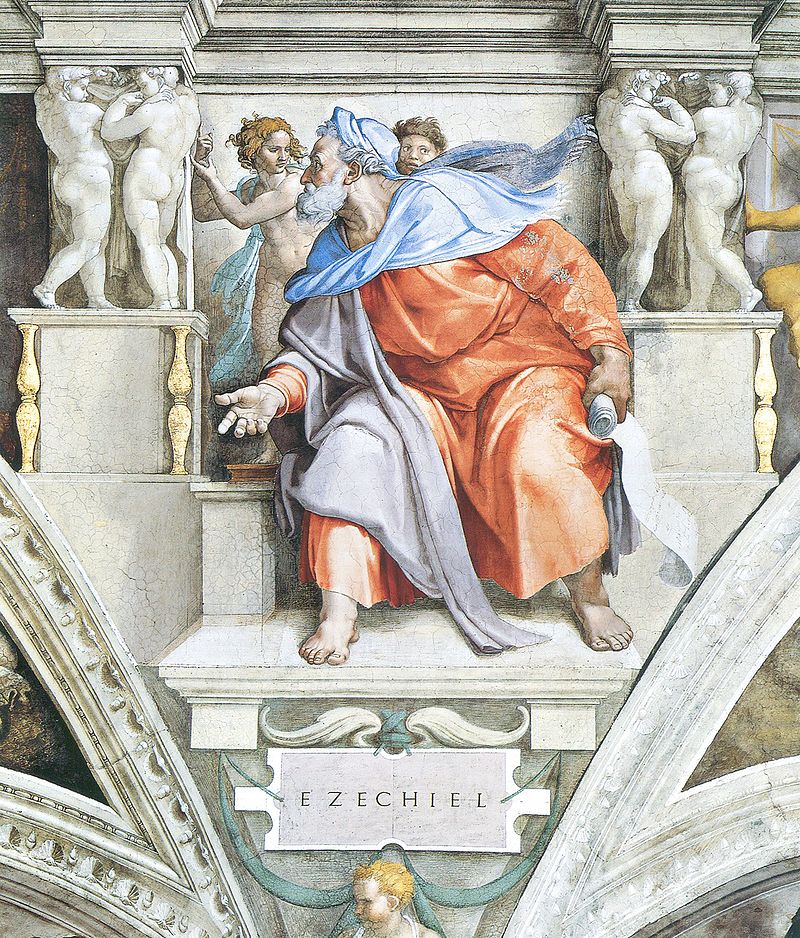
Michelangelo's Ezekiel on the Sistine Chapel
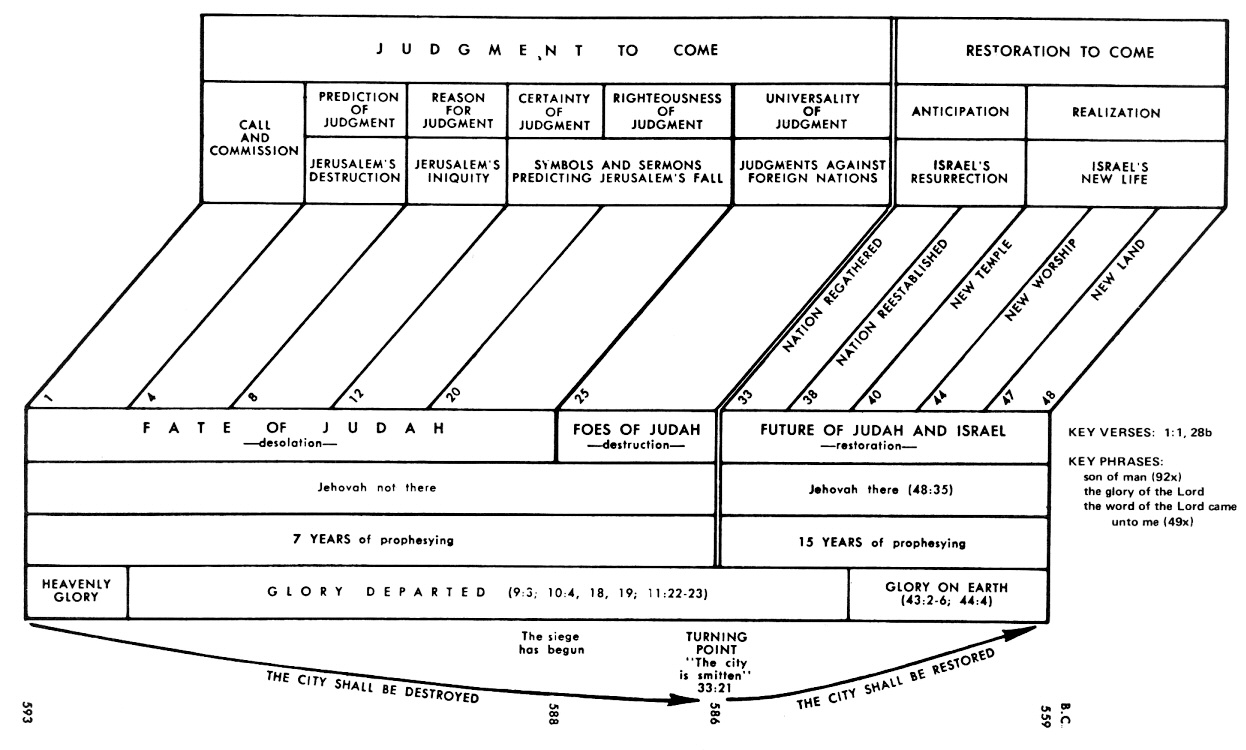
Click chart to enlarge
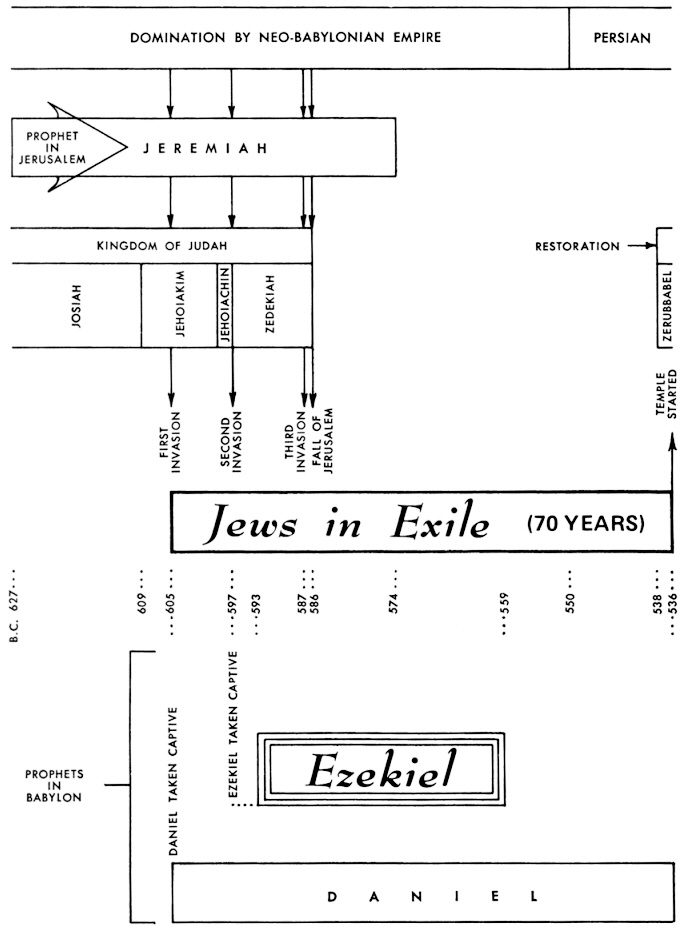
Click chart to enlarge
Chart from recommended resource Jensen's Survey of the OT - used by permission
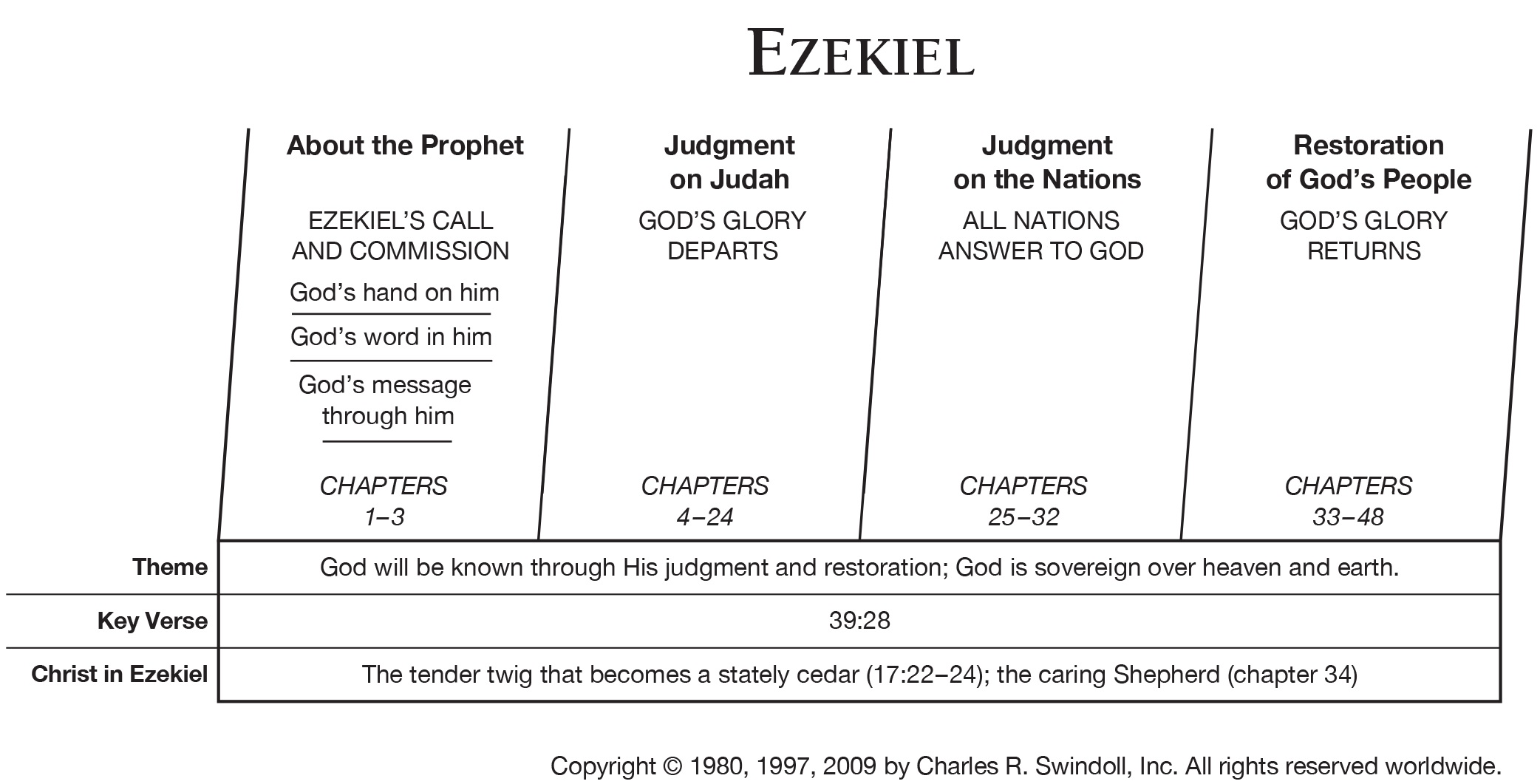
Click Chart from Charles Swindoll
|
PROPHECY OF |
PROPHECY OF |
|||
| FATE OF JUDAH Before the Siege |
FOES OF JUDAH During the Siege |
FUTURE OF JUDAH After the Siege |
||
|
593-588 BC |
587-586 |
586-571 |
||
|
7 YEARS |
15 YEARS |
|||
| Ezekiel 1:1-3:27 Ezekiel Sees the Glory & Receives the Call |
Ezekiel 4:1-24:27 Judgments Against Judah |
Ezekiel 25:1-32:32 Judgments Against the Gloating Nations |
Ezekiel 33:1-39:29 Restoration of Israel to the LORD |
Ezekiel 40:1-48:35 Visions of the Temple Jehovah Shammah |
Outline of the Book of Ezekiel from Dr John MacArthur - The book can be largely divided into sections about condemnation/retribution and then consolation/restoration. A more detailed look divides the book into 4 sections. First, are prophecies on the ruin of Jerusalem (Ezekiel 1:1–24:27). Second, are prophecies of retribution on nearby nations (Ezekiel 25:1–32:32), with a glimpse at God’s future restoration of Israel (Ezekiel 28:25,26). Thirdly, there is a transition chapter (Ezekiel 33:1-33) which gives instruction concerning a last call for Israel to repent. Finally, the fourth division includes rich expectations involving God’s future restoration of Israel (Ezekiel 34:1–48:35). (Reference)
I. Prophecies of Jerusalem’s Ruin (Ezekiel 1:1–24:27)
A. Preparation and Commission of Ezekiel (Ezekiel 1:1–3:27)
1. Divine appearance to Ezekiel (Ezekiel 1:1–28)|
2. Divine assignment to Ezekiel (Ezekiel 2:1–3:27)
B. Proclamation of Jerusalem’s Condemnation (Ezekiel 4:1–24:27)
1. Signs of coming judgment (Ezekiel 4:1–5:4)
2. Messages concerning judgment (Ezekiel 5:5–7:27)
3. Visions concerning abomination in the city and temple (Ezekiel 8:1–11:25)
4. Explanations of judgment (Ezekiel 12:1–24:27)
II. Prophecies of Retribution to the Nations (Ezekiel 25:1–32:32)
A. Ammon (Ezekiel 25:1–7)
B. Moab (Ezekiel 25:8–11)
C. Edom (Ezekiel 25:12–14)
D. Philistia (Ezekiel 25:15–17)
E. Tyre (Ezekiel 26:1–28:19)
F. Sidon (Ezekiel 28:20–24)
Excursus: The Restoration of Israel (Ezekiel 28:25, 26)
G. Egypt (Ezekiel 29:1–32:32)
III. Provision for Israel’s Repentance (Ezekiel 33:1–33)
IV. Prophecies of Israel’s Restoration (Ezekiel 34:1–48:35)
A. Regathering of Israel to the Land (Ezekiel 34:1–37:28)
1. Promise of a True Shepherd (Ezekiel 34:1–31)
2. Punishment of the nations (Ezekiel 35:1–36:7)
3. Purposes of restoration (Ezekiel 36:8–38)
4. Pictures of restoration—dry bones and two sticks (Ezekiel 37:1–28)
B. Removal of Israel’s Enemies from the Land (Ezekiel 38:1–39:29)
1. Invasion of Gog to plunder Israel (Ezekiel 38:1–16)
2. Intervention of God to protect Israel (Ezekiel 38:17–39:29)
C. Reinstatement of True Worship in Israel (Ezekiel 40:1–46:24)
1. New temple (Ezekiel 40:1–43:12)
2. New worship (Ezekiel 43:13–46:24)
D. Redistribution of the Land in Israel (Ezekiel 47:1–48:35)
1. Position of the river (Ezekiel 47:1–12)
2. Portions for the tribes (Ezekiel 47:13–48:35)
Ezekiel 1:15 The appearance of the wheels and their workmanship was like sparkling beryl, and all four of them had the same form, their appearance and workmanship being as if one wheel were within another .
- one: Eze 1:19-21 10:9,13-17 Da 7:9
- had: Eze 1:6 Rev 4:7 https://netbible.org/bible/Ezekiel+1
The appearance of the wheels and their workmanship was like sparkling beryl, and all four of them had the same form, their appearance and workmanship being as if one wheel were within another - The wheels have an appearance somewhat reminiscent of gyroscopes – moving back and forth yet without turning and all at tremendous velocity.
NET NOTE - Another vision which includes wheels on thrones occurs in Dan 7:9. Ezek 10 contains a vision similar to this one.
The interpretation by some that Ezekiel's vision was a UFO is absurd for at the end of the vision he identifies "the unidentified flying object" as having the likeness of the "glory of the LORD" and he "heard a voice speaking". Nevertheless, you should be aware that in the end times in which we live, many individuals interpret this first chapter as a clear manifestation of an ancient UFO sighting. And so if you search the Internet you will find statements like the following: The
"Old Testament Prophet Ezekiel (misspelled in the quote) watched a "wheel" descend from the sky. The craft landed on the banks of the Chebar River where Ezekiel was taken aboard and flown to the Tel Aviv Mountains. The full description of the object is found in Ezekiel Chapter 1."
Let us pray that the Spirit reveals the truth about the "glory of the LORD" to all who are so tragically deluded and that the eyes of their heart might be opened to "know that I am Jehovah"
so that they may turn from darkness to light and from the dominion of Satan to God, in order that they may receive forgiveness of sins and an inheritance among those who have been sanctified by faith in" Christ Jesus. (Acts 26:18)
QUESTION - What were the wheels in Ezekiel 1?
ANSWER - Ezekiel’s vision of the four wheels dramatically illustrates the omnipresence and omniscience of God. These wheels were associated with the “four living creatures” (Ezekiel 1:4), who were later described (Ezekiel 10:5, 20) as cherubim, angelic beings appointed as guardians of the holiness of God.
Each wheel was actually two in one, with one apparently set inside the other at right angles which enabled the “living creatures” to move in any direction instantly without having to turn, like a flash of lightning. These wheels had the appearance of chrysolite, which may have been a topaz or other semiprecious stone. The outer rim of the wheels was described as high and awesome with the outer edge of the rims inset with “eyes” (Ezekiel 1:14-18).
The Spirit of the living creatures was in the wheels (Ezekiel 1:20-21). As a result, the creatures were able to move any direction the wheels moved. Most biblical scholars hold to the idea that the Spirit of God gave direction to the wheels through direct knowledge of and access to the will of God. The mobility of the wheels suggests the omnipresence of God; the eyes, His omniscience; and the elevated position, His omnipotence.
This vision appeared to Ezekiel as a powerful imagery of movement and action demonstrating the characteristics of God’s divine nature. It presented God as being on a chariot-like throne, His glory both supreme and immanent, existing in and extending into all the created universe. As such, the whole revelation by God in this vision to Ezekiel, i.e., the cherubim, the chariot, the Spirit, and the wheels, emphasized their unity and coordination.
As terrifying as this vision was, it vividly displayed the majesty and glory of God (Ezekiel 1:28), who came to Ezekiel and the children of Israel in the midst of their Babylonian exile. It reminded them of His holiness and power as the Lord of all creation. The message was clear: though His people were in exile and their nation was about to be destroyed, God was still on the throne and able to handle every situation. The lesson for us today is that, through His marvelous providence, God moves in the affairs of all nations to work out His own unseen plan, always at work, intricately designed, never wrong, and never late (Romans 8:28).GotQuestions.org
See also What are the ophanim? | GotQuestions.org What are the ophanim? What are the wheels / ophanim mentioned in Ezekiel chapter 1?
Ezekiel 1:16 The appearance of the wheels and their workmanship was like sparkling beryl, and all four of them had the same form, their appearance and workmanship being as if one wheel were within another.
- Wheels - Ezek 10:9; Ex39:13; Da10:6
- Appearance - Ezek 10:10; Job 9:10; Ps 36:6; 40:5; Ro 11:33; Eph 3:10)
The appearance of the wheels and their workmanship was like sparkling beryl, and all four of them had the same form, their appearance and workmanship being as if one wheel were within another - NET NOTE - Some envision concentric wheels here, while others propose “a globe-like structure in which two wheels stand at right angles” (L. C. Allen, Ezekiel [WBC], 1:33–34). The description given in v. 17 favors the latter idea.
Ezekiel 1:17 Whenever they moved, they moved in any of their four directions without turning as they moved.
- without turning Eze 1:9,12 10:1-11:25 Isa 55:11
Whenever they moved, they moved in any of their four directions without turning as they moved.
Craigie writes that "the beings bearing the divine chariot are inevitably reminiscent of the cherubic figures that supported the ark of the covenant (1Sam 4:4) which was kept in the temple in Jerusalem. And the chariot-like vehicle of the vision recalls that the ark itself was called a chariot (1 Chr 28:18). And suddenly, a part of the impact of the vision on Ezekiel becomes clear. He was an exile, cut off not only from his homeland, but also from the temple, the place in which the presence of God was believed to be present in a particular way. Where the temple was, there the ark was, and there the divine presence could be known. But Ezekiel was in the Babylonian wasteland, far from the focus of the divine presence. Yet here, in his vision, the symbols of God’s presence appear. And so it became clear to Ezekiel that to be cut off from Jerusalem was not the same as being cut off from God. He perceived that the Lord could not be confined to a particular place; here, too, by the Chebar Canal, the Lord of heaven and earth could be experienced as a living being… J. B. Phillips entitled one of his books Your God is too Small —the title encapsulates the danger of a … view of God that is totally comprehensible, but much too small. If we fail to understand some of Ezekiel’s vision, then paradoxically we have understood it in part! For its essence is that God is ultimately beyond our comprehension. (Borrow Ezekiel. The Daily study Bible)
Ezekiel 1:18 As for their rims they were lofty and awesome, and the rims of all four of them were full of eyes round about.
- they were: Job 37:22-24 Ps 77:16-19 97:2-5 Isa 55:9
- full: Eze 10:12 Pr 15:3 Zec 4:10 Rev 4:6,8
As for their rims they were lofty and awesome, and the rims of all four of them were full of eyes round about - Full of eyes round about undoubtedly symbolize an all-seeing God (Click here for God's attribute of omniscience), reminding us that nothing is hidden from His sight or transpires without His knowledge. This truth comforts the afflicted, obedient saint but afflicts the comfortable, rebellious person be they saved sinner (saint) or lost sinner. 2Chr 16:9 records that
the eyes of the LORD move to and fro throughout the earth that He may strongly support (Hebrew chazaq = be strong = the root word in Ezekiel's name!) those whose heart is completely His.
This prophetic warning concerning the "eyes of the LORD" was given to good King Asa. Read the verse in context (2Chr16) to see if this knowledge of God's ever presence gaze impacted King Asa and remember there's a bit of King Asa in all of us, who in contrast to King Asa have not just a partial but a full revelation of God. To those who is given much, much is expected.
The eyes of the LORD are in every place, watching the evil & the good." (Pr 15:3)
(Click here for every use of the phrase "eyes of the LORD")
"Can a man hide himself in hiding places so I do not see him?" declares Jehovah. "Do I not fill the heavens and the earth?" declares Jehovah" (Jer 23:23-24)
(Click for God's attribute omnipresence) Do the "rims… full of eyes" make you snicker or do they make you tremble that you might impugn the Name of the LORD Who is there?
Spurgeon adds that "the Puritans believed in an ever-present God. Oh to be able to feel God everywhere, in the little as well as the great, in our rising up and our si tting down, in our going out and our coming in. I cannot imagine a life more blessed or a spirit more related to the spirit of the glorified than the mind and heart of the person who lives in God, who knows and feels that God is ever-present. If you are in personal danger, or in the midst of a storm, or facing illness, and if you hear a voice saying, “Surely the Lord is in this place” (Ge 28:16) you will be perfectly at rest." (Note)
Ezekiel 1:19 Whenever the living beings moved, the wheels moved with them. And whenever the living beings rose from the earth, the wheels rose also.
- Ezek 10:16; Ps 103:20 The wheels moved in harmony with the living creatures.
Whenever the living beings moved, the wheels moved with them. And whenever the living beings rose from the earth, the wheels rose also.
Ezekiel 1:20 Wherever the spirit was about to go, they would go in that direction. And the wheels rose close beside them; for the spirit of the living beings was in the wheels.
- the spirit: Eze 1:12 1Co 14:32
- for the spirit: Eze 10:17 Zec 6:1-8
Wherever the spirit was about to go, they would go in that direction. And the wheels rose close beside them; for the spirit of the living beings was in the wheels. The spirit - Although I cannot find any major translation that capitalizes "spirit" (Hebrew = ruach), it is not unreasonable to interpret this as an allusion to the Holy Spirit of God, especially this initial occurrence. In either event it is clear that God is in control and the "throne chariot" goes where He directs.
Even though the supernatural workings of these wheels are beyond our ability to understand, their responsiveness to the spirit of the cherubim is clear. God's chariot has supernatural angelic power, not "horse" power like earthly vehicles. At the will of God ("wherever the spirit was about to go") the cherubim moved the chariot-throne swiftly.
The New American Commentary (volume 17 Ezekiel) adds that the living creatures
followed the “spirit” in their movement (v12, 20). This refers to the divine Spirit of the One who sat on the throne above them, Who was directing and enabling their movements. The Old Testament taught that the beings who surrounded Yahweh were there to perform his will, and in the New Testament the Spirit is the One Who enables all created beings to perform the will of God (Jn 14:5–31; 16:1–15; Ro8:1–8; Acts 2:1–38; Eph 1:13–14). Block has argued that the frequent use of rûach (“spirit/wind/breath”) in Ezekiel warrants calling him “the prophet of the spirit.” (It is found 52 times Click here for verses, more than in any other prophet. The longer Book of Isaiah uses it 46 times Click here; Jeremiah, only 18 Click here.) Although the term can have many senses (wind, direction, side, agency of conveyance, agency of animation, agency of inspiration, mind, sign of divine ownership) the use here as an agency of animation is the most frequent in Ezekiel … So the cherubim were divinely appointed and empowered to do the will and work of God. "
Ezekiel 1:21 Whenever those went, these went; and whenever those stood still, these stood still. And whenever those rose from the earth, the wheels rose close beside them; for the spirit of the living beings was in the wheels.
NLT: When the living beings moved, the wheels moved. When the living beings stopped, the wheels stopped. When the living beings flew into the air, the wheels rose up. For the spirit of the living beings was in the wheels.
NIV: When the creatures moved, they also moved; when the creatures stood still, they also stood still; and when the creatures rose from the ground, the wheels rose along with them, because the spirit of the living creatures was in the wheels.
Young's Literal: In their going, they go; and in their standing, they stand; and in their being lifted up from off the earth, lifted up are the wheels over-against them; for a living spirit is in the wheels.
- Whenever those went: Eze 1:19,20 10:17
- of the living Ro 8:2
Whenever those went, these went; and whenever those stood still, these stood still. And whenever those rose from the earth, the wheels rose close beside them; for the spirit of the living beings was in the wheels.
Ezekiel 1:22 Now over the heads of the living beings there was something like an expanse, like the awesome gleam of crystal, spread out over * their heads.
ASV: And over the head of the living creature there was the likeness of a firmament, like the terrible crystal to look upon, stretched forth over their heads above.
BBE: And over the heads of the living beings there was the form of an arch, looking like ice, stretched out over their heads on high.
CEV: Above the living creatures, I saw something that was sparkling like ice, and it reminded me of a dome. Each creature had two of its wings stretched out toward the creatures on either side, with the other two wings folded against its body.
ICB: Now there was something like a dome over the heads of the living creatures. It sparkled like ice and was frightening.
NJB: Over the heads of the living creatures was what looked like a solid surface glittering like crystal, spread out over their heads, above them,
Septuagint: And the likeness over the heads of the living creatures was as a firmament, as the appearance of crystal spread out over their wings above.
Young's Literal: And a likeness is over the heads of the living creatures of an expanse, as the colour of the fearful ice, stretched out over their heads from above.
- Now over the heads of the living beings there was something like: Eze 1:26 10:1 Ex 24:10 Job 37:22 Rev 4:3,6 21:11
Now over the heads of the living beings there was something like an expanse, like the awesome gleam of crystal, spread out over * their heads Expanse is the Hebrew word raqia also translated firmament and in the Septuagint is translated with the Greek word "stereoma" which refers to anything firm or solid, thus conveying the picture of stability, firmness or steadfastness. Ezekiel saw in essence a "platform" over the heads of the living creatures that was dazzling like crystal or ice.
This "something like an expanse" however was not an empty space. “Expanse” is the same word used in Genesis when
God said, "Let there be an expanse in the midst of the waters, and let it separate the waters from the waters." (Ge 1:6)
That ”expanse“ was pictured as something solid whose function was to separate the waters above from the waters below. Here in Ezekiel the expanse separates the creatures from the glory of the Lord.
David uses raqia in the opening of the Psalm 19 writing
The heavens are telling of the glory of God; and their expanse is declaring the work of His hands." (Ps 19:1)
John gave a similar description writing that
He who was sitting was like a jasper stone and a sardius in appearance; and there was a rainbow around the throne, like an emerald in appearance… and before the throne there was, as it were, a sea of glass like crystal; and in the center and around the throne, four living creatures full of eyes in front and behind." (Rev 4:3, 6+)
Gill says refers to the the appearance as "exceeding clear and bright, so that there was no looking upon it, without the eyes being dazzled with the glory of it.
Henry writes that this picture was "truly glorious, but terribly so; the vastness and brightness of it put the prophet into an amazement and struck him with an awful reverence. The terrible ice, or frost (so it may be read), the colour of snow congealed, or as mountains of ice in the northern seas, which are very frightful.
Crystal is translated by the Septuagint with the Greek word "krystallos" which is a clear rock.
The Treasury of Scripture Knowledge adds that crystal "is a very large class of silicious minerals, hard, pellucid, naturally colourless, of regularly angular figures, and of simple plates; not flexible, nor elastic, but giving fire with steel; not fermenting by acid menstrua, but calcinable in a strong fire. There are three orders of pure crystal. The first is perfect columnar crystals, with double pyramids, of eighteen planes, in an hexangular pyramid at each end; the second is that of perfect crystals, without a column, of twelve or sixteen planes, in two hexangular pyramids; and the third is that of imperfect crystals, with single pyramids, of ten or twelve planes, in an hexangular or pentangular column. Terrible crystal seems to denote that which was well cut and polished, vividly refracting the rays of light.
Clarke adds that the appearance was "Like a crystal, well cut and well polished, with various faces, by which rays of light were refracted, assuming either a variety of prismatic colors, or an insufferably brilliant splendor."
Ezekiel 1:23 Under the expanse their wings were stretched out straight, one toward the other; each one also had two wings covering its body on the one side and on the other.
- Covering - Ezek 1:11; Job 4:18; Ps 89:7; Lu 17:10
Under the expanse their wings were stretched out straight, one toward the other; each one also had two wings covering its body on the one side and on the other.
Ezekiel 1:24 I also heard the sound of their wings like the sound of abundant waters as they went, like the voice of the Almighty, a sound of tumult like the sound of an army camp; whenever they stood still, they dropped their wings.
- like: Eze 43:2 Rev 1:15 19:6
- like the voice Eze 10:5 Job 37:2,4,5 Ps 18:13 29:3-9 68:33
- the sound of an army camp: Da 10:6 2Ki 7:6
I also heard the sound of their wings like the sound of abundant waters as they went, like the voice of the Almighty, a sound of tumult like the sound of an army camp; whenever they stood still, they dropped their wings: Like the sound of abundant waters… like the voice of the Almighty describes the sound of cherubim wings and bring to mind a thunderous rush of heavy rain or the washing of surf on rocks (cf. (Ezekiel 43:2; Rev 1:15+; Rev 19:6+). In Revelation 1 a similar phrase describes the sound of the voice of the glorified Lord Jesus Christ, John writing that He was
like a son of man, clothed in a robe reaching to the feet, and girded across His breast with a golden girdle. And His head and His hair were white like white wool, like snow; and His eyes were like a flame of fire and His feet were like burnished bronze, when it has been caused to glow in a furnace, and His voice was like the sound of many waters." (see notes Rev 1:13-15+)
The wings of the creatures made an awesome sound. Observe how many ways Ezekiel describes the sound of their wings and don't do so without using your imagination. Ezekiel's senses of sight and sound are being barraged with incredible sights and sounds. Can you imagine what it will be like to see and hear this in glory!
NET NOTE on Almighty - Heb “Shaddai” (probably meaning “one of the mountain”), a title that depicts God as the sovereign ruler of the world who dispenses justice. The Old Greek translation omitted the phrase “voice of the Almighty.”
NET NOTE on tumult - The only other occurrence of the Hebrew word translated “tumult” is in Jer 11:16. It indicates a noise like that of the turmoil of a military camp or the sound of an army on the march.
Related Resource:
Ezekiel 1:25 And there came a voice from above the expanse that was over their heads; whenever they stood still, they dropped their wings.
And there came a voice from above the expanse that was over their heads; whenever they stood still, they dropped their wings.
In context this is the voice of God. The striking elements of this vision communicate that Jehovah is a God of splendor and great power, a truth that had been neglected in the days of spiritual decline prior in Israel.
Ezekiel 1:26 Now above * the expanse that was over their heads there was something resembling a throne, like lapis * lazuli * in appearance; and on that which resembled a throne, high * up, was a figure with the appearance of a man.
- Expanse Mt 28:18; Eph 1:21 22; Php 2:9 2:10; 1Pe 3:22
- Resembling Ps 45:6; Isa 6:1; Da 7:9 7:10 7:14; Zech 6:13; Mt 25:13; Heb 1:8; 8:1; Heb 12:2; Rev 4:2-3; Rev 5:13; 20:11
- like lapis lazuli Ex 24:10 Isa 54:11
- appearance of a man: Ge 32:24-30 Jos 5:13-15 6:1,2 Isa 9:6,7 Jer 23:5,6 Da 10:18 Rev 1:13 3:21 14:14
Related Passages:
Isaiah 6:1+ In the year of King Uzziah’s death I saw the Lord sitting on a throne, lofty and exalted, with the train of His robe filling the temple.
Revelation 4:2-3+ Immediately I was in the Spirit; and behold, a throne was standing in heaven, and One sitting on the throne. 3 And He who was sitting was like a jasper stone and a sardius in appearance; and there was a rainbow around the throne, like an emerald in appearance.
Revelation 5:13+ And every created thing which is in heaven and on the earth and under the earth and on the sea, and all things in them, I heard saying, “To Him who sits on the throne, and to the Lamb, be blessing and honor and glory and dominion forever and ever.”
Now above the expanse that was over their heads there was something resembling a throne, like lapis * lazuli * in appearance; and on that which resembled a throne, high * up, was a figure with the appearance of a man The divine throne was above the expanse over the cherubim, and there God--Who cannot be seen in His fulness by mortal man--allowed Himself to be seen, not as a man but in "the likeness as the appearance of a man," in order to to strengthen the resolve of his young prophet and to as discussed in the next 2 chapters to give him a clear message to proclaim.
The Treasury of Scripture Knowledge has an excellent note recording that Newcome judiciously observes
We need not allegorize the circumstances of this august vision too minutely. Many of them augment the splendour of the scene, while others, no doubt, have much significance; which should be pointed out rather by a correct judgment, than a luxuriant imagination.
Resembling a throne indicates Ezekiel's difficulty in describing it's majesty and grandeur. This reminds us of John's difficulty at finding words to describe the One seated on the throne and being forced to use terms of comparison (Rev 4:1-2+).
The prophet Isaiah had a similar "throne encounter" prior to his call to prophesy recording that
In the year of King Uzziah's death, I saw the Lord sitting on a throne, lofty and exalted, with the train of His robe filling the temple. Seraphim stood above Him, each having six wings; with two he covered his face, and with two he covered his feet, and with two he flew. And one called out to another and said, "Holy, Holy, Holy, is the LORD of hosts, The whole earth is full of His glory. And the foundations of the thresholds trembled at the voice of him who called out, while the temple was filling with smoke." (Isaiah 6:1, 6:2, 6:3, 6:4+)
The prophet Daniel described his "throne encounter" writing
I kept looking until thrones were set up, and the Ancient of Days (God the Father) took His seat. His vesture was like white snow, and the hair of His head like pure wool. His throne was ablaze with flames. Its wheels were a burning fire. A river of fire was flowing and coming out from before Him. Thousands upon thousands were attending Him and myriads upon myriads were standing before Him. The court sat, and the books were opened… I kept looking in the night visions, and behold, with the clouds of heaven One like a Son of Man (Messiah) was coming, and He came up to the Ancient of Days (God the Father) and was presented before Him. And to Him (Messiah) was given dominion, glory and a kingdom, that all the peoples, nations, and men of every language might serve Him. His dominion is an everlasting dominion which will not pass away; and His kingdom is one which will not be destroyed." (Dan 7:9-10, 13-14+)
This description is good to keep in mind so that when we are in the midst of the storms of life, we will be able to recall the truth that God is still on His throne and just as He was not oblivious to the circumstances of Ezekiel or the Jews in exile, so too, He is not oblivious to your circumstances, no matter what you may be experiencing. Look up above the storms, where He sits enthroned. The psalmist records that
The Lord has established His throne in the heavens and His sovereignty rules over all. (Ps 103:19+)
Do you really believe this is true? Remember all through this book, Ezekiel has encounters with the living God and ends with the prophetic declaration that the "LORD is there." Based on Ezekiel's experience, you should be
"convinced that neither death, nor life, nor angels, nor principalities, nor things present, nor things to come, nor powers, nor height, nor depth, nor any other created thing, shall be able to separate (you) from the love of God, which is in Christ Jesus our Lord" (see notes Romans 8:38; 8:39), and that you have "a friend who sticks closer than a brother" (Pr 18:24), Who "Himself has said, "I WILL NEVER DESERT YOU, NOR WILL I EVER FORSAKE YOU," so that (you may) confidently say, "THE LORD IS MY HELPER, I WILL NOT BE AFRAID. WHAT SHALL MAN DO TO ME?" (Hebrews 13:5-6+)
Do you believe this?
Ezekiel sees the throne of God but it’s more than a chair. It’s a chariot or a throne on wheels – powered by supernatural cherubim propulsion. Scripture tells us that the Ark of the Covenant was a small scale replica of God’s throne in heaven and so it is interesting that 1Chronicles 28:18 David specifies that in the building of the Temple of the LORD they were to utilize "gold for the model of the chariot, even the cherubim, that spread out their wings, and covered the ark of the covenant of the LORD."
NIV translates this verse as "He also gave him the plan for the chariot, that is, the cherubim of gold that spread their wings and shelter the ark of the covenant of the LORD."
So here we see King David refer to the Ark of the Covenant as a chariot and in fact in Israel you see ancient depictions of the Ark often with wheels. David gives us a perfect parallel of Ezekiel's vision in Psalm 18 writing that Jehovah
rode upon a cherub and flew; and He sped upon the wings of the wind." (Ps 18:10+)
Robert Morgan writes that…"Recently I read an old book on prayer called The Kneeling Christian, and one of the author’s points was this—we too often rush into God’s presence seeking His grace before we have seen His glory. Prayer, said the author, is first seeing God’s glory, then seeking God’s grace. He suggested that it would be good to begin each day by singing to the Lord a doxology that would bring to our minds His majesty: My God, how wonderful Thou art! Thy majesty how bright. How beautiful Thy mercy-seat in depths of burning light. If we’re going to serve God as we should, we need to see Him as He is. We need an enlarged glimpse of His majesty, His greatness, and His power. (Don't Hang Up)
Lapis lazuli is an azure-blue stone, prized since ancient times when cut and polished for ornamental purposes.
"Lapis lazuli" is the Hebrew word sappîr, translated “sapphire” in some versions (eg, NIV and even in the NASB in Ezek 10:1).
The TWOT comments "that the people of biblical times probably did not understand the word to be the very hard modern sapphire, but lapis lazuli, the rich, azure gem so common to the ancient world… This beautiful gem was… desirable (Ezek 28:13) though less precious than true wisdom (Job 28:16). It adorned the breastplate of the high priest (Ex 28:18; 39:11). Its great value can be seen in that it is used in the throne of God (Ezek 1:26; 10:1) and becomes the pavement under His feet (before Moses & the 70 elders in Ex24:10). It is little wonder, then, that it will be found in the very foundation of the New Jerusalem (Isa 54:11; cf. Rev 21:19). Its beauty and preciousness made it useful to poetic language, such as in Shulamite’s description of her beloved (Song 5:14)… The modern name for the stone is lazurite—a sodium aluminum silicate and sulfide. Its ancient source was the Afghanistan-Iran area north and east of Babylonia.
The vision of the throne is similar to the experience of Moses and the seventy elders in Ex 24:10. The throne also is mentioned again in Ezek 10:1.
A FIGURE WITH THE APPEARANCE OF A MAN: MacArthur explains that "The Godhead appears in the likeness of humanity, though God is a spirit (Jn 4:24). The Messiah, God incarnate, is the representative of the "fullness of Deity" (Col 2:9), so this can be a prelude to the incarnation of Messiah in His character as Savior and Judge (cf. Rev 19:11-16)."
Something resembling… which resembled… figure are all the same Hebrew word (demuwth/demut) regarding which the TWOT has an interesting comment
Although (demut ) is used only twenty-six times in the OT, it is a very important word. It appears in the theophanic section of Ezekiel (1:5, 10, 13, 16, 22, 26, 28; 10:1, 10:21, 10:22) … Ezekiel is very careful never to say that he saw God, ĕlōhım (as did Isaiah in his prophecy, Isa 6:1, the object or content of Isaiah’s vision is ădōnāy ), but only that he saw the likeness of God or the likeness of the entourage that surrounds God. In such practice he is comparable to Daniel (Da10:16) and John in the Apocalypse (Rev 1:13)" (bolding added)
Even in a vision a mortal, sinful prophet cannot come face to face with Him who “dwells in unapproachable light” (1 Ti 6:16; Ex 33:20).
Ryrie adds that "The description suggests that Ezekiel saw a fiery brightness that had human shape and which he knew to be living and personal (cf. John 1:18). However illuminating appearances of God were in OT times, they could not effect redemption. God, not merely appearing as a man, but becoming man in the incarnation of Jesus Christ so that He could die, was essential for the work of redemption. Ezekiel could not have seen God directly or he would have died. But seeing the glory of the LORD in Babylon assured him that God had not deserted His people.
This human-like occupant of the throne undoubtedly symbolizes the One who made us in His own image. Ezekiel's vision reminds us that while we are made in God's likeness, but that we are also very unlike Him. The transcendence (click Attributes of God) of the One on the throne comes through in the guarded language, "with the appearance of a man." The "appearance" was permeated with and surrounded by a glowing fire that produced the colors of the rainbow. The portrait blended dazzling splendor but note the stark lack of detail. The effect on Ezekiel was profound. Like Moses before him and John on the Isle of Patmos after him, he fell on his face in worship. And so should we after "seeing" this glorious vision of our Lord in this chapter.
"The LORD is high above all nations. His glory is above the heavens. Who is like Jehovah our God, Who is enthroned on high?" Ps 113:4 113:5 (Spurgeon)
"It is He who sits above the vault of the earth & its inhabitants are like grasshoppers, Who stretches out the heavens like a curtain & spreads them out like a tent to dwell in." (Isa 40:22)
I tend to agree with Matthew Henry who writes "The eternal Son, the second Person in the Trinity, who afterwards took the human nature, is here denoted. The first thing observed was a throne. It is a throne of glory, a throne of grace, a throne of triumph, a throne of government, a throne of judgment. It is good news to men, that the throne above the firmament is filled with One who appears, even there, in the likeness of a man. The throne is surrounded with a rainbow, the well-known emblem of the covenant, representing God's mercy and covenanted love to his people. The fire of God's wrath was breaking out against Jerusalem, but bounds should be set to it; he would look upon the bow, and remember the covenant. All the prophet saw was only to prepare him for what he was to hear. When he fell on his face, he heard the voice of One that spake. God delights to teach the humble. Let sinners, then, humble themselves before him. And let believers think upon his glory, that they may be gradually changed into his image by the Spirit of the Lord.
Ezekiel's vision and his response recall the worshipful words of the beautiful hymn by Frederick Faber
MY GOD, HOW WONDERFUL THOU ART
My God, how wonderful Thou art,
Thy majesty, how bright;
How beautiful Thy mercy seat
In depths of burning light!How dread are Thy eternal years,
O everlasting Lord,
By prostrate spirits day and night
Incessantly adored!How wonderful, how beautiful,
The sight of Thee must be;
Thy endless wisdom, boundless power,
And glorious purity!O how I fear Thee, living God,
With deep and tender fear;
And worship Thee with trembling hope,
And penitential tears!Yet, I may love Thee, too, O Lord,
Almighty as Thou art;
For Thou hast stooped to ask of me
The love of my poor heart!No earthly father loves like Thee,
No mother, e’er so mild,
Bears and forbears as Thou hast done,
With me, Thy sinful child.Father of Jesus, love’s Reward!
What rapture it will be
Prostrate before Thy throne to lie,
And gaze, and gaze on Thee!
Ezekiel 1:27 Then I noticed from the appearance of His loins and upward something like glowing metal that looked like fire all around within it, and from the appearance of His loins and downward I saw something like fire; and there was a radiance around Him.
- I noticed from the appearance: Eze 1:4 8:2
- looked like fire: De 4:24 Ps 50:3 97:2 2Th 1:8 Heb 12:29 Rev 1:14-16
Then I noticed from the appearance of His loins and upward something like glowing metal that looked like fire all around within it, and from the appearance of His loins and downward I saw something like fire; and there was a radiance around Him Brightness is associated with God’s glory and holiness throughout Scripture.
Bible Knowledge Commentary writes that "Seated on this shining blue throne was Someone who looked like a man. Ezekiel’s gaze was drawn first to the upper part of His body and then to the lower part. Though Ezekiel could describe the cherubim in detail, all he could say of God was that He looked like glowing metal and fire. The splendor of His glory was so bright that Ezekiel could see only His form before he was forced to look down. (See context in The Bible Knowledge Commentary)
The RBC booklet on Ezekiel comments that
The God of the vision had not been defeated by the gods of the Babylonians. He was the Lord of lords who made the power and glory of Babylon look insignificant by comparison. From our perspective, it may sometimes appear that evil people keep God's will from being done. But from His perspective, nothing happens that He has not foreseen and permitted and worked into His plan. All of history is His story. In the face of the terrible events that would soon befall Jerusalem, Ezekiel needed this assurance. So do we!" (Knowing God Through Ezekiel)
Wiersbe - Far above the storm, the wheels, the living creatures, and the firmament is God’s throne ruling over all. It looked as though Nebuchadnezzar was ruling everything, but God was still on His throne: “The LORD sits as King forever” (Ps. 29:10). The next time you face a storm, look high enough to see God’s exalted throne.(Borrow With the Word)
Baker's Evangelical Dictionary of the Bible adds that Ezekiel begins his message of judgment … with the sovereignty of God. People in the ancient world connected their gods with local areas and specific domains (see 1 Kings 20:23-28). A god was supposed to protect his domain, and if one city conquered another, that meant that the god of the victor was greater than the god of the vanquished. Many Jews also embraced this thinking, and it led to two dangerous conclusions. First, they thought that Yahweh was bound to protect Jerusalem. Second, if the city should fall, it meant that Yahweh was weak and small.
VISION OF THE WHEELS
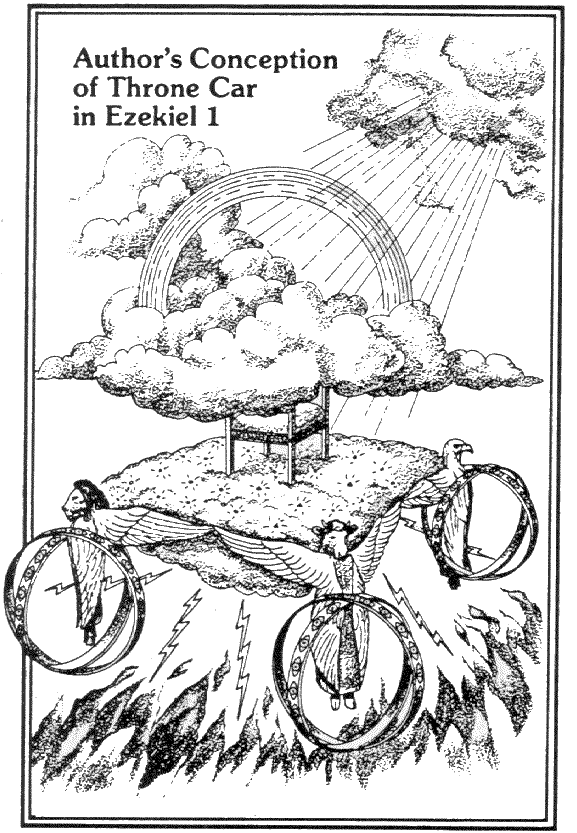
CLICK TO ENLARGE
(Sketch from W. MacDonald: Believer's Bible Commentary)
Ezekiel 1:28 As the appearance of the rainbow in the clouds on a rainy day, so was the appearance of the surrounding radiance. Such was the appearance of the likeness of the glory of the LORD. And when I saw it, I fell on my face and heard a voice speaking.
- the appearance, Ge 9:13-16 Isa 54:8-10 Rev 4:3 10:1
- Such was the appearance of the likeness of the glory of the LORD: Eze 8:4 10:19,20 43:3 Ex 16:7,10 24:16 33:18-23 Nu 12:6-8 1Ki 8:10,11 1Co 13:12
- I fell : Eze 3:23 Ge 17:3 Lev 9:24 Da 8:17 10:7-9,16,17 Mt 17:5,6 Ac 9:4 Rev 1:17,18
As the appearance of the rainbow in the clouds on a rainy day, so was the appearance of the surrounding radiance. - Rainbow is the Hebrew word qeshet, which described a war-bow or weapon used to deliver arrows, with the associative meaning of potency or power. The meaning seems to be that what was ordinarily an instrument of war, and a symbol of vengeance, became a symbol of peace and mercy by virtue of its now being set in the clouds. Against the black storm clouds God’s war-bow is transformed into a rainbow by the sunlight of his mercy and grace. God is at peace with his covenant people.
The rainbow is mentioned in only four circumstances in Scripture, and most appear to be associated with God's mercy in a time of judgment (read in context Gen 9:13, Rev 4:3; 10:1). It is interesting that in Genesis the appearance of the rainbow followed the judgment and was a sign of God's covenant never to destroy the earth by water. Here in Ezekiel and in Revelation, the presence of the rainbow precedes or is in the midst of the announcement of God's judgment. In all these latter uses, however, the rainbow is a sign of the glorious presence of God and in the context of its first use in Genesis, a reminder that His mercy will triumph.
Wiersbe has an interesting note - Usually you see the rainbow when the storm is over (Gen. 9:8–17), and only an arc at that. Ezekiel saw the rainbow during the storm, and it completely encircled the throne! A symbol of God’s grace, the rainbow assures us that the Lord is with us and will not forsake us, especially when we are going through a storm. (Borrow With the Word)
Ezekiel is reminded not only of a God who is near and who reigns, but also of a God who is a covenant-making and covenant-keeping God. Deportation to Babylon does not mean that God has dispossessed his people or that the covenant has been abrogated.
As Cooper writes "The opening vision of Ezekiel’s ministry affirmed three significant truths about God that are summarized in v28. First, the vision was a reaffirmation of the nature of God as holy, powerful, and majestic. Second, the rainbow was a reminder of God’s promise-making and promise-keeping character (Gen 9:13 16). It was a re-kindler of hope that God could and would help. Third, it was an assurance that nothing, including geographic location, separated one from God." (The New American Commentary [Vol. 17: Ezekiel])
Here is a rabbinical view of the meaning of rainbow (I don't espouse this view but present it for interest):
To the biblical account, the rabbis added the notion that the rainbow was created at evening on the sixth day of Creation, and that it did not appear during the lifetime of a saint whose good life was sufficient to preserve the world from destruction. To gaze directly at a rainbow risked injury, since the bow was a reflection of the glory of the Lord. A prescribed blessing was to be recited on seeing a rainbow: “Blessed are Thou O Lord our God, King of the universe, who remembers the covenant, is faithful to the covenant, and keeps His promise.”
I can't argue with the last part of their belief. It is always good to sing praises to our God and King.
Such was the appearance of the likeness of the glory of the LORD. The glory shines fully in the person of Jesus Christ ("the glory of God in the face of Christ" 2Cor 4:6), which is a constant theme in Ezekiel.
This was the indescribable glory of God and human speech failed Ezekiel. As alluded to earlier, notice how many times he used words such as "as" (Hebrew = ke); "resembling"; "looked like" (Hebrew = demut); "like" (Hebrew = kemareh); and "appearance" (Hebrew = mareh) in attempting to describe God's glory. The only appropriate response to such a vision was to fall prostrate before it, as Ezekiel did. At the time of this vision, the Temple in Jerusalem still remained intact and the Shekinah glory of the LORD God dwelt in that place. And so it is noteworthy that in Ezekiel's vision God’s glory appeared outside of the Temple. Imagine the comforting and confidence building effect on Ezekiel as he realized that God was not confined to any specific place, and that God had chosen to personally visit Ezekiel among the exiles.
Remember that it had been five years since Ezekiel had been taken from Jerusalem and he was undoubtedly in need of a vision of His God. This is likewise the need of all who are mired in seemingly hopeless dark circumstances.
Right now as you read these notes, do you find yourself in great need of a "vision" of God? Study of the glory of God in the book of Ezekiel may be just the prescription the Great Physician has to remedy your need. Consider pondering other passages (e.g., Isaiah 6) describing God’s glory. Ask God to help you see His glory in creation (Ps 19:1, 2)– in a storm, in a sunset or in a starry night. Meditate on His glory as revealed in Scripture while you listen to a favorite hymn or praise song. What will happen as you behold the glory of Jehovah in His Word?
Paul says that you will be
transformed (Greek = metamorphoo ~ metamorphosed continually!) into the same image from glory to glory, just as from the Lord, the Spirit." (2Cor 3:18)
Criswell writes that "Ezekiel was a faithful witness to all that he saw. A good witness is marked by five essential characteristics: (1) he has a sense of divine call which gives him his commission and authority (1:28-2:8); (2) he must be saturated with the message of God (2:8-3:3); (3) he shares the message, and does not receive it solely for personal enjoyment (3:4-11); (4) he shares the word with compassion, identifying with the plight of the hearer (3:12-15); and (5) he understands and accepts the responsibility to warn those who are out of God's will, and to call them to repentance (3:16-21)." (Believer's Study Bible)
I love L. E. Cooper's thoughtful comment on this chapter writing that "When people are consumed by insurmountable problems and buffeted by the storms of life, they usually do not need another perspective on their problems. What they do need is a new perspective on God as Lord of life and larger than all its difficulties. Humanity in peril needs a sense of the awesome majesty of God. There needs to be an awareness that God is greater than adversity. He is with his people in the midst of their problems. This was a need of both Ezekiel and the people to whom he ministered. They needed a new vision of and commitment to the holiness and majesty of God. For this reason the opening vision was crucial as the first revelation in the call of Ezekiel to be a prophet to the exiles… People often want to blame the storms of life on God and forget that human sin brought chaos in the world. This lack of accord is evident in the storms of nature as well as the storms of human nature. The only hope for humanity is to recognize God in the midst of the storms as one who can restore them to calm (cf Luke 8:24)." (The New American Commentary [Vol. 17: Ezekiel]) (Bolding added)
And when I saw it, I fell on my face Even though God was not seen in His full glory (cf 1Tim 6:16), Ezekiel could only fall upon his face when he saw "the appearance of the likeness" of His glory.
Scripture records a similar reaction by those who had a personal encounter with the living God --
- Moses (Ex 19:16)
- Job (Job 42:6)
- Isaiah (Isa 6:5)
- Daniel (Da 10:8)
- the disciples (Mt 17:6)
- Paul (Acts 9:4)
- John (Rev 1:17)
No one in all of Scripture is recorded on his face before Jehovah as often as Ezekiel (Click for all 6 times he falls before Jehovah). Abram (Abraham) had a similar experience:
"Now when Abram was ninety-nine years old, the LORD appeared to Abram and said to him, "I am God Almighty (El Shaddai). Walk before Me, and be blameless and I will establish My covenant between Me and you, and I will multiply you exceedingly. And Abram fell on his face, and God talked with him… " (Gen 17:1 ,17:2 17:3)
Do you ever fall on your face before Jehovah in your private times with Him? Ask God to reveal His glory in His Word and then respond appropriately and ready to hear what He says.
Larry Richards adds that
Ezekiel is overwhelmed and falls down. His awed response is appropriate. Ezekiel is about to be called to ministry, and those who minister must serve God in awe of His holiness as well as in appreciation of His love." (The Bible reader's companion. Includes index. (Eze 1:1). Wheaton, Ill.: Victor Book)
So vivid was the image etched into Ezekiel's mind that some 20 years later (573BC) he says that the vision he saw then
was like the appearance of the vision which I saw, like the vision which I saw when He came to destroy the city. And the visions were like the vision which I saw by the river Chebar; and I fell on my face." (Ezek 43:3)
Ezekiel had seen the true and living Most High God and was never the same. When we have a true vision of God and see Him in His glory, we cannot help but realize that God is so exalted, so awesome, and we are but dust and we cannot stand before Him. We are filled with awe and fear and reverence. And when we know God in that manner, we will live a life that is pleasing to Him, a life that honors His name. We will not approach Him lightly, but with awe and reverence.
Concordia self-study commentary has a well written note
At a time when all the stars of hope in the chosen people’s skies were eclipsed by the brilliance of brutal, unrestrained force, “the heavens were opened” (1:1). He whom “heaven and the highest heaven cannot contain” (1 Ki 8:27) let His glory burst upon the mundane scene in such blinding light and cosmic color as to rouse the most dispirited from his gloomy stupor. He is not an idol locked up within the walls of a shrine. He can appear even in the heartland of the conqueror’s domain to assert worldwide dominion. The inanimate forces of nature are at His disposal. At His beck and call stand messengers endowed with the power of all animate creatures, both human and bestial. Chariots of fire, geared to move instantly in any direction, are poised and ready to take off to the four corners of the earth. When Ezekiel “told the exiles all the things that the Lord had showed” him ( 11:25 ), no one should any longer have doubted the power of the God of Abraham, Isaac, and Jacob to execute His threats and keep His promises." (Roehrs, W. H., & Franzmann, M. H. Concordia Self-study Commentary. St. Louis: Concordia Publishing House)
Explorer's Bible Commentary adds that "Ezekiel was awestricken by God's holiness. The indelible impression of this theophany would be a constant encouragement to Ezekiel in his difficult ministry of announcing God's judgments on his own contemporaries. The awesome holiness of God visualized in Ezekiel's commission would be a backdrop against which he could see the wickedness of Israel and thereby understand why God had to judge his sinful people. When the nations profaned the Lord by claiming that Judah was in captivity because her God was weak, Ezekiel would know that his God was greater than Babylonia's gods. Though the Lord had chosen to discipline his people then, he would be victorious over all the nations when he would restore Israel to her Promised Land."
Sidlow Baxter (Explore the Book) writes that Ezekiel "lived and wrought in the light and power of (the vision in chapter 1). We, too, need to live and work in the light and power of this vision, or we shall faint at the discouragements of the times. Servant of Jesus, stand with Ezekiel again: get the sound of the wings and the chariot wheels in your ears again… This is the … vision which turns fear to hope, and sighs to songs. May it be ever before our eyes!"
Richards draws a practical application from Ezekiel's vision pointing out that "There are times when our attention is drawn to spectacular settings—grand cathedrals, stained glass, crowds of thousands singing, beautifully staged TV shows—all may perhaps enhance our worship. But at times they may distract our attention from the Lord. The challenge you and I face is to look above these “platforms” for worship, and to view the intrinsic glory of the One they are intended to honor. For our worship to be meaningful, we need to see the Lord and, in awe of His splendor and love, fall down with Ezekiel before Him." (The 365 Day Devotional Commentary. Wheaton, Ill.: Victor Books)
I agree with Allan McRae who writes that "the primary purpose of the vision in Ezekiel 1 , which impresses some people as simply a picture of “wheels within wheels,” was to impress upon Ezekiel’s mind the fact that the splendor, greatness, and complexity of the gods of Babylon can be paralleled and surpassed by the splendor and complexity of the God of Israel. Israel had been taken into exile, not because the gods of Babylon were stronger than the gods of Israel, but because the Lord chose to chastise His people… other visions of this same figure were given Ezekiel at later times (e.g., Ezek. 3:23 ; Ezek. 8:4 ; Ezek. 10:15–22 ; Ezek. 43:3 ) in order to impress again upon his mind the fact that the God whom he represented was in no way inferior to the gods of Babylon." ("The Key to Ezekiel's First 30 Chapters" in Bibliotheca Sacra:1996, Page 233. Dallas Theological Seminary.)
and heard a voice speaking: In the same way, after Isaiah's vision, he "heard the voice of the Lord, saying, "Whom shall I send, and who will go for Us?" (Isa 6:8)
Ezekiel’s call takes place in two stages. In this chapter (1:4-28) we see the first stage in which the prophet received his initial vision and call followed by an indication of the contents of his message (2:1-3:15). In the second stage, seven days later, he was commissioned to be a watchman for the house of Israel (3:16-21).