
Michelangelo's Ezekiel on the Sistine Chapel
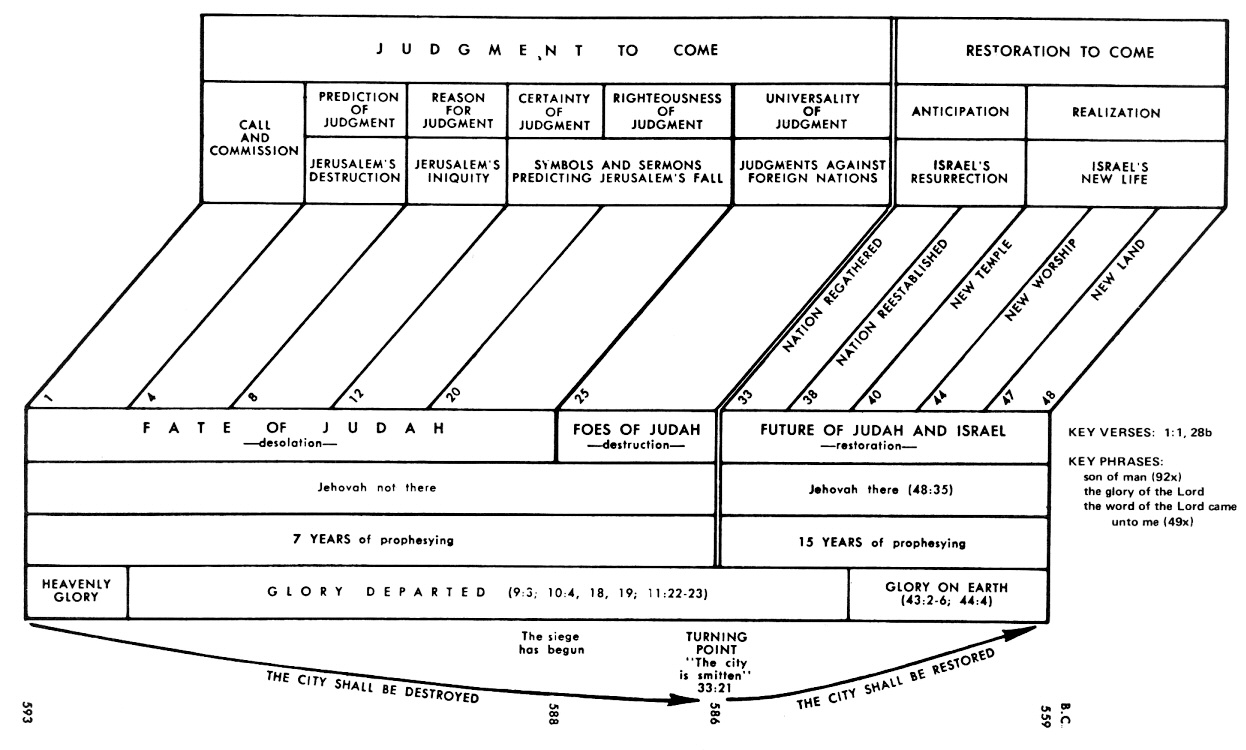
Click chart to enlarge
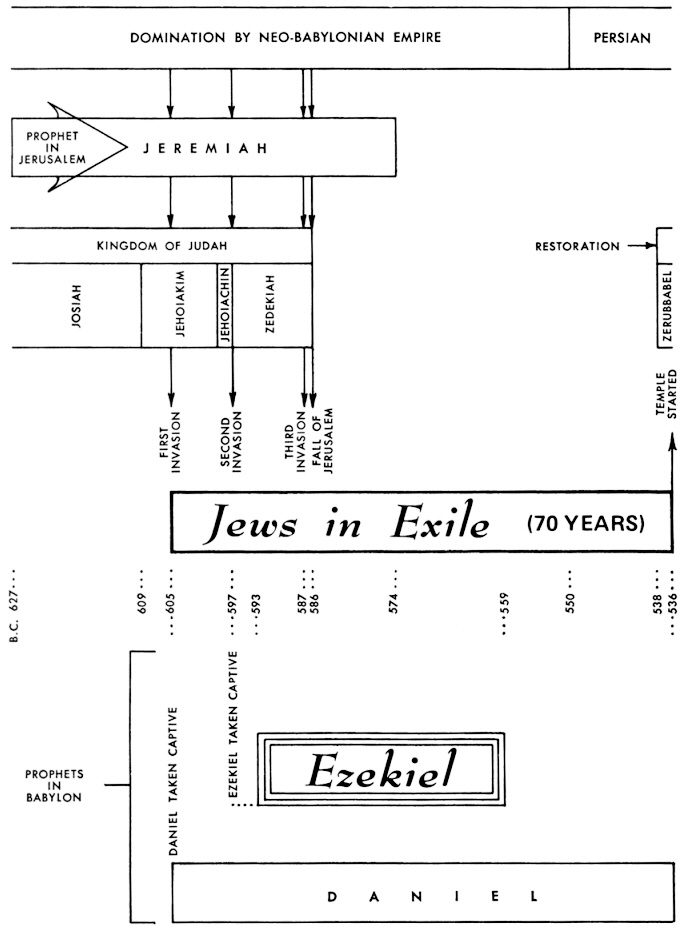
Click chart to enlarge
Chart from recommended resource Jensen's Survey of the OT - used by permission
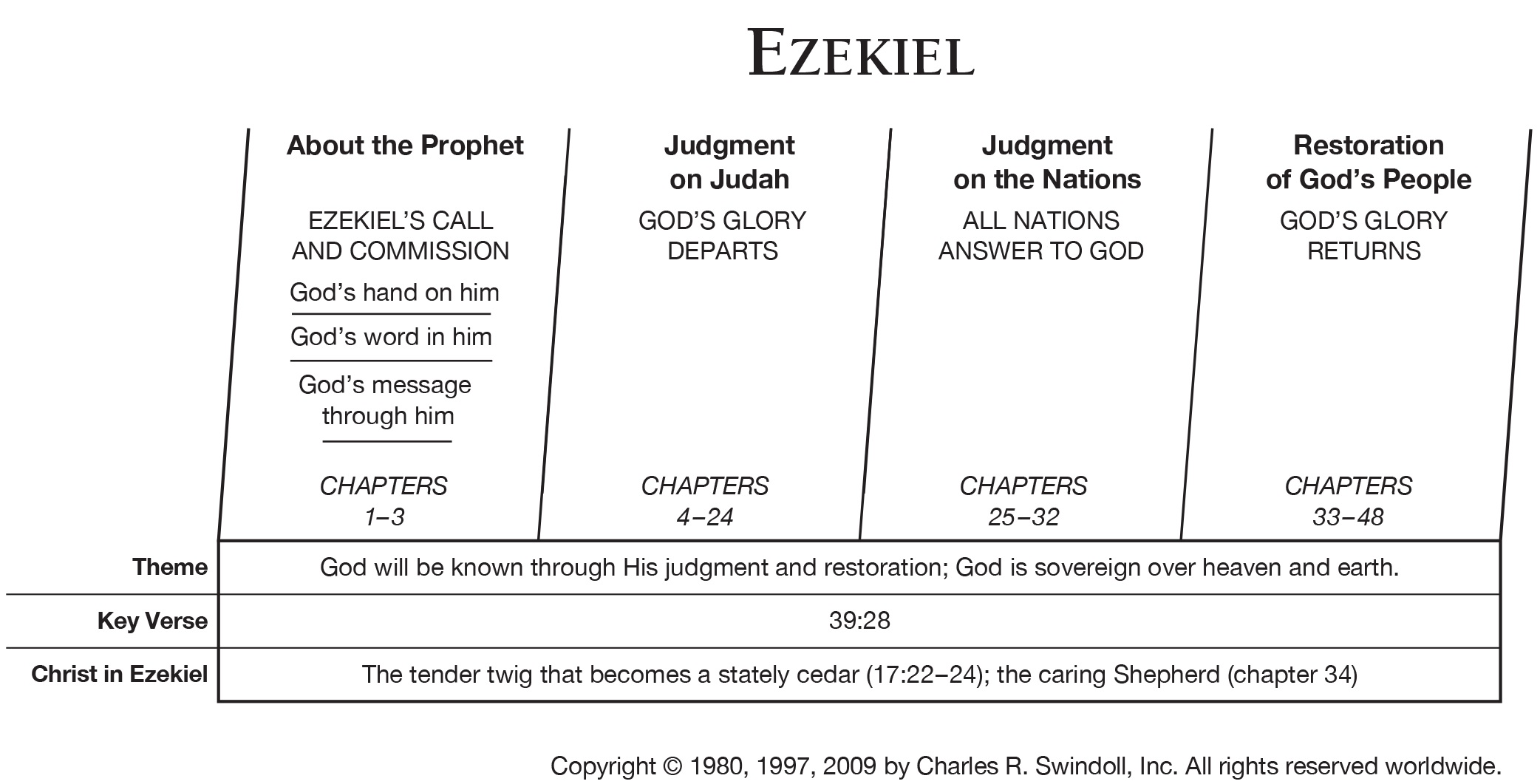
Click Chart from Charles Swindoll
|
PROPHECY OF |
PROPHECY OF |
|||
| FATE OF JUDAH Before the Siege |
FOES OF JUDAH During the Siege |
FUTURE OF JUDAH After the Siege |
||
|
593-588 BC |
587-586 |
586-571 |
||
|
7 YEARS |
15 YEARS |
|||
| Ezekiel 1:1-3:27 Ezekiel Sees the Glory & Receives the Call |
Ezekiel 4:1-24:27 Judgments Against Judah |
Ezekiel 25:1-32:32 Judgments Against the Gloating Nations |
Ezekiel 33:1-39:29 Restoration of Israel to the LORD |
Ezekiel 40:1-48:35 Visions of the Temple Jehovah Shammah |
Outline of the Book of Ezekiel from Dr John MacArthur - The book can be largely divided into sections about condemnation/retribution and then consolation/restoration. A more detailed look divides the book into 4 sections. First, are prophecies on the ruin of Jerusalem (Ezekiel 1:1–24:27). Second, are prophecies of retribution on nearby nations (Ezekiel 25:1–32:32), with a glimpse at God’s future restoration of Israel (Ezekiel 28:25,26). Thirdly, there is a transition chapter (Ezekiel 33:1-33) which gives instruction concerning a last call for Israel to repent. Finally, the fourth division includes rich expectations involving God’s future restoration of Israel (Ezekiel 34:1–48:35). (Reference)
I. Prophecies of Jerusalem’s Ruin (Ezekiel 1:1–24:27)
A. Preparation and Commission of Ezekiel (Ezekiel 1:1–3:27)
1. Divine appearance to Ezekiel (Ezekiel 1:1–28)|
2. Divine assignment to Ezekiel (Ezekiel 2:1–3:27)
B. Proclamation of Jerusalem’s Condemnation (Ezekiel 4:1–24:27)
1. Signs of coming judgment (Ezekiel 4:1–5:4)
2. Messages concerning judgment (Ezekiel 5:5–7:27)
3. Visions concerning abomination in the city and temple (Ezekiel 8:1–11:25)
4. Explanations of judgment (Ezekiel 12:1–24:27)
II. Prophecies of Retribution to the Nations (Ezekiel 25:1–32:32)
A. Ammon (Ezekiel 25:1–7)
B. Moab (Ezekiel 25:8–11)
C. Edom (Ezekiel 25:12–14)
D. Philistia (Ezekiel 25:15–17)
E. Tyre (Ezekiel 26:1–28:19)
F. Sidon (Ezekiel 28:20–24)
Excursus: The Restoration of Israel (Ezekiel 28:25, 26)
G. Egypt (Ezekiel 29:1–32:32)
III. Provision for Israel’s Repentance (Ezekiel 33:1–33)
IV. Prophecies of Israel’s Restoration (Ezekiel 34:1–48:35)
A. Regathering of Israel to the Land (Ezekiel 34:1–37:28)
1. Promise of a True Shepherd (Ezekiel 34:1–31)
2. Punishment of the nations (Ezekiel 35:1–36:7)
3. Purposes of restoration (Ezekiel 36:8–38)
4. Pictures of restoration—dry bones and two sticks (Ezekiel 37:1–28)
B. Removal of Israel’s Enemies from the Land (Ezekiel 38:1–39:29)
1. Invasion of Gog to plunder Israel (Ezekiel 38:1–16)
2. Intervention of God to protect Israel (Ezekiel 38:17–39:29)
C. Reinstatement of True Worship in Israel (Ezekiel 40:1–46:24)
1. New temple (Ezekiel 40:1–43:12)
2. New worship (Ezekiel 43:13–46:24)
D. Redistribution of the Land in Israel (Ezekiel 47:1–48:35)
1. Position of the river (Ezekiel 47:1–12)
2. Portions for the tribes (Ezekiel 47:13–48:35)
Ezekiel 12:1 Then the word of the LORD came to me, saying
the word of the LORD came to me 46/57 occurrences of this phrase occur in Ezekiel and five are in chapter 12. Remember that Ezekiel is in essence "mute" (his continual state the first 7-8 years) unless he has a specific word from the LORD which explains to some degree the concentration of the phrase in this particular book. Also remember that Ezekiel is still in exile in Babylon prophesying prior to the final destruction of Jerusalem and the Temple.
As Richards says "the Jewish captives were still optimistic about an early return home. In these messages Ezekiel systematically destroys the foundations of their false hopes." He goes on to summarize the key concepts (with parallel Scriptures) in Ezekiel 12 as "Exile -Deut 27-28. Rebellion - Numbers 14. Oracle - Psalms 35-37. Remnant - Isaiah 32-33. Judge Psalms 96-100" (The Bible Reader's Companion)
Expositor's Bible Commentary notes that
Ezekiel always gave specific dates for new visions or oracles. Since no new chronological notice was given, and since the speeches of chapters 12-19 were closely related thematically to the foregoing vision, it can be assumed that these messages were uttered shortly after Ezekiel's explanation of the vision in chapters 8-11."
The date of Ezekiel's prophecy in this chapter cannot be stated with absolute certainty, but as Ezekiel generally presents a chronological record, the date is almost certainly between the sixth month of the sixth year of Jehoiachin's captivity, circa 592, ("It came about in the sixth year, on the fifth day of the sixth month, as I was sitting in my house with the elders of Judah sitting before me, that the hand of the Lord GOD fell on me there." Ezek 8:1) and the fifth month of the seventh year, circa 591 ("Now in the seventh year, in the fifth month, on the tenth of the month, certain of the elders of Israel came to inquire of the LORD, and sat before me." Ezek 20:1).
Adam Clarke appears to be correct in his comment that "All the prophecies from this to the twentieth chapter are supposed to have been delivered in the sixth year of Zedekiah, five years before the taking of Jerusalem. How accurate the prediction! and how exactly fulfilled!"
J Vernon McGee sets the context writing that "Zedekiah was on the throne in Jerusalem, and the false prophets were saying to the captives, “Look, Nebuchadnezzar has made two sieges of Jerusalem, and he’s carried away captives, but he did not destroy the city, he did not burn the temple, and he did not execute the king. You are going to be able to return soon. There’s nothing to worry about.” (See context Thru the Bible Ezekiel)
God used Ezekiel's actions as a sign to Israel of what was about to happen. As discussed below, the revealed future hopefully might cause some of the listeners to repent. God's symbolic portrayal of Israel's exile was designed to stun and awaken them to the reality of judgment and God's desire for them to repent and return. God gave similar unusual instructions to Jeremiah to buy a field in Anathoth (near Jerusalem) (Jer 32:6-15), a command that at first glance was somewhat "bizarre" in view of Judah’s imminent loss of its land to Babylon within less than a year of Jeremiah's purchase date. (see Jeremiah 39, 40, 52). .
Ezekiel 12:2 "Son of man, you live in the midst of the rebellious house, who have eyes to see but do not see, ears to hear but do not hear for they are a rebellious house.
K&D: Son of man, thou dwellest amidst the refractory generation, who have eyes to see, and see not; and have ears to hear, and hear not; for they are a refractory generation.
Brenton: Son of man, thou dwellest in the midst of the iniquities of those, who have eyes to see, and see not; and have ears to hear, and hear not: because it is a provoking house (English translation of Greek Septuagint)
- thou (KJV): Eze 2:3,6-8 3:9,26,27 17:12 24:3 44:6 De 9:7,24 31:27 Ps 78:40 Isa 1:23 30:1,9 65:2 Jer 4:17 5:23 9:1-6 Da 9:5-9 Ac 7:51,52
- which (KJV): De 29:1-4 Isa 6:9-10 29:9-12 42:19,20 Jer 5:21 Mt 13:13,14 Mk 4:12 8:17,18 Lu 8:10 Joh 9:39-41 12:40 Ac 28:26,27 Ro 11:7,8 2Co 3:14 4:3,4 Eph 4:18 2Th 2:10,11
- for (KJV): Eze 2:5
Related Passages:
Deuteronomy 29:1-4+ These are the words of the covenant which the LORD commanded Moses to make with the sons of Israel in the land of Moab, besides the covenant which He had made with them at Horeb. 2 And Moses summoned all Israel and said to them, “You have seen all that the LORD did before your eyes in the land of Egypt to Pharaoh and all his servants and all his land; 3 the great trials which your eyes have seen, those great signs and wonders. 4 “Yet to this day the LORD has not given you a heart to know, nor eyes to see, nor ears to hear. (THIS IS RETRIBUTIVE JUSTICE - THEY CHOSE NOT TO SEE SO GOD BLINDED THEM!)
Isaiah 6:9-10+ He said, “Go, and tell this people: ‘Keep on listening, but do not perceive; Keep on looking, but do not understand.’ 10 “Render the hearts of this people insensitive, Their ears dull, And their eyes dim, Otherwise they might see with their eyes, Hear with their ears, Understand with their hearts, And return and be healed.” (See Matthew and John below).
Jeremiah 5:21 ‘Now hear this, O foolish and senseless people, Who have eyes but do not see; Who have ears but do not hear.
Matthew 13:13-15+ “Therefore I speak to them in parables; because while seeing they do not see, and while hearing they do not hear, nor do they understand. 14 “In their case the prophecy of Isaiah is being fulfilled, which says, ‘YOU WILL KEEP ON HEARING, BUT WILL NOT UNDERSTAND; YOU WILL KEEP ON SEEING, BUT WILL NOT PERCEIVE; 15 FOR THE HEART OF THIS PEOPLE HAS BECOME DULL, WITH THEIR EARS THEY SCARCELY HEAR, AND THEY HAVE CLOSED THEIR EYES, OTHERWISE THEY WOULD SEE WITH THEIR EYES, HEAR WITH THEIR EARS, AND UNDERSTAND WITH THEIR HEART AND RETURN, AND I WOULD HEAL THEM.’
John 12:37-43+ But though He had performed so many signs before them, yet they were not believing in Him. 38 This was to fulfill the word of Isaiah the prophet which he spoke: “LORD, WHO HAS BELIEVED OUR REPORT? AND TO WHOM HAS THE ARM OF THE LORD BEEN REVEALED?” 39 For this reason they could not believe, for Isaiah said again, 40“HE HAS BLINDED THEIR EYES AND HE HARDENED THEIR HEART, SO THAT THEY WOULD NOT SEE WITH THEIR EYES AND PERCEIVE WITH THEIR HEART, AND BE CONVERTED AND I HEAL THEM.” 41 These things Isaiah said because he saw His glory, and he spoke of Him. 42 Nevertheless many even of the rulers believed in Him, but because of the Pharisees they were not confessing Him, for fear that they would be put out of the synagogue; 43 for they loved the approval of men rather than the approval of God.
Acts 28:26-28+ saying, ‘GO TO THIS PEOPLE AND SAY, “YOU WILL KEEP ON HEARING, BUT WILL NOT UNDERSTAND; AND YOU WILL KEEP ON SEEING, BUT WILL NOT PERCEIVE; 27 FOR THE HEART OF THIS PEOPLE HAS BECOME DULL, AND WITH THEIR EARS THEY SCARCELY HEAR, AND THEY HAVE CLOSED THEIR EYES; OTHERWISE THEY MIGHT SEE WITH THEIR EYES, AND HEAR WITH THEIR EARS, AND UNDERSTAND WITH THEIR HEART AND RETURN, AND I WOULD HEAL THEM.”’ 28 “Therefore let it be known to you that this salvation of God has been sent to the Gentiles; they will also listen.”
You live in the midst of the rebellious house (Ezek 2:3,6-8; 3:9,26,27; 17:12; 24:3; 44:6; Dt 9:7,24; 31:27; Ps78:40; Is1:23; 30:1,9; 65:2; Je4:17; 5:23; 9:1-6; Da9:5-9; Ac7:51,52) God wastes no time in reminding Ezekiel that he lived right in the middle (that is literally what the Hebrew word pictures) a house of rebels who had been been watching his symbolic acts and hearing his judgment oracles for over a year. Regrettably, this rebellious attitude had characterized Israel's history.
The Greek Septuagint (LXX) phrases it slightly different stating that Ezekiel
"was dwelling in the middle of those who had a general disregard for what was right (Greek = adikia) including a disregard for human rights and characterized by injustice, unrighteousness, disregard for God's laws and disobedience to God."
Expositor's Bible Commentary adds that
"The exiles had not grasped the serious consequences of Ezekiel's warnings. They still hoped for an early return to Palestine, for they viewed the continued preservation of Jerusalem and Judah as signs of security After all, Jerusalem was the eternal city. They presented several reasons for their hope and security--as well as their objections to Ezekiel's warning--in chapters 12-19. First, if judgment was to come, it would not be in their lifetime, as Ezekiel had declared (ch.12). Second, Ezekiel was only one of many prophets. Most prophets and prophetesses announced hope and reasons for optimism. Why should the people listen to Ezekiel (ch. 13)? Third, the leaders in Judah were ultimately responsible. If there was to be any judgment, it would be on them, not the exiles (ch. 14). Fourth, if real danger of judgment should exist, then they would only have to find some righteous man to intercede for them before God. Thus they would be delivered (ch. 14). Fifth, how could Ezekiel possibly believe that God would judge his own chosen people? He would not do that (chs. 15-16). Sixth, it would not be fair for God to judge anyone for his forefathers' sins. The people thought Ezekiel was saying that God did judge one for his forefathers' sins (ch. 17). Seventh, if judgment was really coming, then there was nothing they could do to stop it; for they would be paying for their fathers' sins. It would not make any difference if they repented (ch. 18). Eighth, Zedekiah, the contemporary ruler of Judah, could be trusted. He would throw off the yoke of Babylonia (ch. 19). Ezekiel patiently, systematically, and adamantly (cf. Ezek3:9) challenged the naive reasoning of the exiles, undermining each source of their optimistic rejection to his warnings of judgment. When Ezekiel had finished his challenges, no excuses remained." (Expositor's Bible Commentary or see abridged The Expositor's Bible Commentary )
"Eyes to see but do not see" indicates that they failed to comprehend what they saw, which clearly indicates that they had a spiritual problem. They had eyes to see but willfully chose not to receive the truth! They had heard the truth about the consequences of disobedience many times before, but their unregenerate (spiritually uncircumcised) heart invariably twisted or rejected that truth. Thus the exiles rejected all the signs and sermons from Ezekiel that prophesied the impending destruction of Judah and Jerusalem. The fall of the Northern Kingdom (Israel) in 722BC should have been a lesson in the consequences of national sin but neither the exiles or those remaining in Judah learned their lesson.
How much like Judah we all have been at times… we know what we are doing is a clear violation of God's law and that it has reaped consequences in our life or other people's lives and yet we stubbornly continue in that destructive behavior or attitude! How we all need to remember rebellious Judah's example and that "these things happened to them as an example, and they were written for our instruction, upon whom the ends of the ages have come." (1Cor10:11, cf 10:6)
Richards notes that "Grasping spiritual truth is a matter of attitude rather than intelligence. Eyes to see and ears to hear speak of man’s natural capacity to process information. Don’t be surprised when the “wise” of this world ridicule biblical faith. The failure to truly see or hear is rooted in mankind’s attitude toward God. Only a heart open to the Lord will grasp and respond to His truth. (The Bible Reader's Companion)
The Jews: Unbelief and Spiritual Dullness for the Majority but
Always a Preserved Remnant of Genuine Believers
Israel's spiritual dullness (seeing but not seeing, hearing but not understanding) was predicted by Moses and reiterated by the prophets, by Jesus, and by Paul. Even though most of Israel (Israel and Judah) would reject the truth and become "spiritually dull" and remain in that condition, God had always preserved a remnant of Jews who were true believers who had placed their faith in the promised Messiah, both before His incarnation (looking forward toward the cross at best they understood it based on the revelation that they had available) and after His resurrection. This faithful remnant of Jews continued throughout history because of God's faithfulness to His covenant promises to Abraham, Isaac and Jacob to preserve the Seed, ultimately manifest in the incarnation of that Seed in the birth of Jesus Christ.
Moses predicted this spiritual dullness declaring: "These are the words of the covenant which the LORD commanded Moses to make with the sons of Israel in the land of Moab, besides the covenant which He had made with them at Horeb. And Moses summoned all Israel and said to them, "You have seen all that the LORD did before your eyes in the land of Egypt to Pharaoh and all his servants and all his land; the great trials which your eyes have seen, those great signs and wonders. Yet to this day the LORD has not given you a heart to know, nor eyes to see, nor ears to hear. And I have led you forty years in the wilderness; your clothes have not worn out on you, and your sandal has not worn out on your foot. You have not eaten bread, nor have you drunk wine or strong drink, in order that you might know that I am the LORD your God." (Dt 29:1-6+).
The majority of Israel however steadfastly remained spiritually dull and failed to understand the significance of what the Lord had done for them and of their need for a Kinsman-Redeemer.
Isaiah spoke of this spiritual dullness in a section of Scripture quoted several times in the New Testament. The Lord (the preincarnate Messiah) high and lifted up gave Isaiah his commission, recorded in these famous words of Isaiah:
"Then I heard the voice of the Lord, saying, "Whom shall I send, and who will go for Us?" Then I said, "Here am I. Send me!" "And He said, "Go, and tell this people: 'Keep on listening, but do not perceive; Keep on looking, but do not understand.' Render the hearts of this people insensitive, their ears dull, and their eyes dim, lest they see with their eyes, hear with their ears, understand with their hearts, and return and be healed (spiritually and specifically saved by faith in the Messiah, and John adds "and be converted and I heal them" John 12:40). Then I said, "Lord, how long?" And He answered, "Until cities are devastated and without inhabitant, houses are without people, and the land is utterly desolate, "The LORD has removed men far away, and the forsaken places are many in the midst of the land. Yet there will be a tenth portion in it, and it will again be subject to burning, like a terebinth or an oak whose stump remains when it is felled. The holy seed (the believing remnant) is its stump (the terebinth and oak are prone to produce shoots from their roots!)." (Isaiah 6:9-13+)
The prophecy in Isaiah was echoed in Jeremiah's cry to the residents of Jerusalem:
"Now hear this, O foolish and senseless people, who have eyes but do not see; who have ears but do not hear." (Jer 5:21)
In the New Testament Jesus quotes the passage in Isaiah explaining
Therefore I speak to them in parables; because while seeing they do not see, and while hearing they do not hear, nor do they understand. In their case the prophecy of Isaiah is being fulfilled, which says, 'YOU WILL KEEP ON HEARING, BUT WILL NOT UNDERSTAND; YOU WILL KEEP ON SEEING, BUT WILL NOT PERCEIVE." (Mt 13:13-14) (cf John 12:40)
Jesus said, "For judgment I came into this world, so that those who do not see may see, and that those who see may become blind. Those of the Pharisees who were with Him heard these things and said to Him, "We are not blind too, are we? Jesus said to them, "If you were blind, you would have no sin; but since you say, 'We see,' your sin remains." (Jn 9:39-41)
Paul facing certain death, in his final house arrest in Rome, quoted Isaiah's words to the Jews (he always went to the Jews first cf Ro1:16) who
"came to him at his lodging in large numbers; and he was explaining to them by solemnly testifying about the kingdom of God, and trying to persuade them concerning Jesus, from both the Law of Moses and from the Prophets (reasoning from Messianic prophecy), from morning until evening (Who would not wish to have been present?). And some were being persuaded by the things spoken, but others would not believe. And when they did not agree with one another, they began leaving after Paul had spoken one parting word, "The Holy Spirit rightly spoke through Isaiah the prophet to your fathers, saying, 'GO TO THIS PEOPLE AND SAY, "YOU WILL KEEP ON HEARING, BUT WILL NOT UNDERSTAND; AND YOU WILL KEEP ON SEEING, BUT WILL NOT PERCEIVE; FOR THE HEART OF THIS PEOPLE HAS BECOME DULL, AND WITH THEIR EARS THEY SCARCELY HEAR, AND THEY HAVE CLOSED THEIR EYES; LEST THEY SHOULD SEE WITH THEIR EYES, AND HEAR WITH THEIR EARS, AND UNDERSTAND WITH THEIR HEART AND RETURN, AND I SHOULD HEAL THEM."' "Let it be known to you therefore, that this salvation of God has been sent to the Gentiles; they will also listen." (Acts 28:23-28)
Writing to the church at Corinth Paul amplifies on this truth of spiritual dullness of most of the Jews writing that
"their minds were hardened (covered with a thick callus - being made dull and unable to understand); for until this very day at the reading of the old covenant the same veil remains unlifted, because it is removed in Christ. But to this day whenever Moses is read, a veil lies over their heart. But to this day whenever Moses is read, a veil lies over their heart; but whenever a man turns to the Lord, the veil is taken away." (2Cor 3:14-16+)
Paul (quoting Isa 6:9,10) wrote to the Romans that
"God gave them (the Jews) a spirit of stupor, eyes to see not and ears to hear not, down to this very day.” (Ro 11:8+)
In his letter to the Romans, Paul goes on to explain that Israel's spiritual blindness will be reversed in Israel’s future day of salvation, recording that
"I do not want you, brethren, to be uninformed of this mystery, lest you be wise in your own estimation, that a partial hardening has happened to Israel until the fulness of the Gentiles has come in and thus all Israel will be saved; just as it is written, "THE DELIVERER WILL COME FROM ZION, HE WILL REMOVE UNGODLINESS FROM JACOB. AND THIS IS MY COVENANT WITH THEM, WHEN I TAKE AWAY THEIR SINS." (Ro 11:25, 26, 27+)
In light of this teaching, some might be tempted to question God's fairness toward Israel. We need to remember that the reason the Lord had not given Israel eyes to see, ears to hear and a heart to understand spiritual truth, was because they had first made the willful choice to rebel and to refuse to seek the LORD in holiness and truth. The truth about God's "fairness" regarding Israel and any unrepentant sinner is summed up in (2Chr 7:14) in which God makes it clear that if
"My people who are called by My name humble themselves and pray and seek My face and turn from their wicked ways, then I will hear from heaven, will forgive their sin, and will heal their land."
Peter reminded his readers that
"The Lord is not slow about His promise, as some count slowness, but is patient toward you, not wishing for any to perish but for all to come to repentance." (2Pe3:9+)
Paul added that God our Savior
"desires all men to be saved and to come to the knowledge of the truth." (1Ti 2:3+)
So rest assured God is not unfair in regard to the spiritual blindness of the exiles.
Spiritual Blindness in Dictionary of Biblical Imagery - Figuratively, blindness refers to an inability to recognize the truth, usually a culpable condition. As such, it describes judges whose judgment is perverted because of bribes (Ex 23:8; Deut 16:19; Job 9:24), idolaters whose worship is illogical as well as wrong (Is 44:9–10) and people who simply do not want to know (Is 43:8). Such blindness to the truth and mental confusion could actually be the result of God’s judgment on those who did not want to admit the truth and who therefore forfeit the ability to perceive it at their cost (Deut 28:28–29; Is 6:9–10; 29:9–10). This is true of the Israelites, both leaders (Is 56:10) and followers (Is 42:18–19). Only God in his mercy can reverse this condition (Is 29:18; 35:5; 42:16). Paul describes gradual blindness when he writes of those whose “foolish hearts were darkened” (Rom 1:21). In another vein he talks of seeing poorly now in contrast to seeing perfectly in the life to come (1 Cor 13:12). The imagery of sight and blindness is especially prominent in the account of Jesus’ earthly ministry. The high incidence of physical blindness in the world of the Gospels is attested by the frequency with which Jesus performed miracles of giving sight to the blind. It is, in fact, one of the most vivid signs of Jesus’ supernatural power. Spiritual blindness is no less prominent in the Gospels. Jesus described the religious leaders and teachers of his own generation in terms of blindness (Mt 15:14; 23:16–17, 19, 24, 26). The irony of their situation is that in their spiritual ignorance they assumed that they understand perfectly. Jesus remedied spiritual as well as physical blindness (Mt 13:17; Jn 9:39). Those who rejected Jesus’ words came under a judgment similar to that of Israel-a state of permanent blindness (Jn 12:40; cf. Rom 11:7–10). Although metaphorically blindness may describe mere ignorance (Rom 2:19), it usually carries the overtones of an unwillingness to face up to the truth (Jas 1:23–24); and in the case of those who do not believe in Christ, this is the work of Satan (2 Cor 4:4). As such it requires a miracle in order to become aware of the significance of Christ. Similarly, Christian believers who revert to their pre-Christian ways are described as blind, not perceiving the contradiction expressed in their behavior (2 Pet 1:9; 1 Jn 2:11). Blindness describes the fact that they are unaware of the gravity of their condition (Rev 3:17). (See page 372 Dictionary of Biblical Imagery)
"For they are a rebellious (meri) house" For is an important term of explanation. What is the prophet explaining? (It's fairly clear). The Hebrew word for rebellious (meri) describes a hard hearted attitude which reserves the right to make the final decision regarding one's life independent of any authority. Sin is conscious, obstinate rebellion against the known will of God. It is an attitude manifest by actions which are consciously flung in the face of a holy and righteous God. God says that the whole "house" (Ezekiel and Jeremiah being some of the few exceptions) was rebellious. In the Septuagint, the Greek word (parapikraino from pará = to the point of + pikraíno = to embitter) used to translate "rebellious" means to continually (the verb is present tense = habitual action) provoke or exasperate. Israel and Judah were continually provoking the LORD (the only NT use of parapikraino is found in Heb 3:16 where the writer asks the rhetorical question
"who provoked Him when they had heard? Indeed, did not all those who came out of Egypt led by Moses?" (He 3:16-note)
Matthew Henry writes that God had to give the message first visually and then verbally to the exiles
because they are a stupid, dull, unthinking people, that will not heed or will soon forget what they only hear of, or at least will not be at all affected with it; it will make no impression at all upon them.
Why was Israel spiritually blind? The LORD explains (note the use of the word "for" which is usually a clue that what follows explains the preceding section) that their spiritual blindness was a consequence of their rebellion which denied God's right to rule in their heart. People in our day demonstrate the same rebellious tendencies in their hearts and in their actions. But both then and now, rebellion against God reaps consequences, paying out bad "dividends". One way or another, people who "despise wisdom and instruction" (Pr1:7) always pay a high price.
THOUGHT- Are you suffering from choices you've made that have grieved your heavenly Father?" God can use those consequences for your eternal welfare. Humble yourself and return to Him today! The way back to God begins with a broken heart which sees our sin as God sees it (Ps 51:16-17, cf Pr 28:13, 1Jn 1:9)
The psalmist amplifies on why Israel was spiritually blind and deaf. In psalm 115 he describes an idol as something that "… they have eyes, but they cannot see. They have ears, but they cannot hear… ." (Ps 115:5, 6) Then the psalmist describes the effect of idolatry on the idolater writing that "Those who make them will become like them (SPIRITUALLY BLIND, DEAF). Everyone who trusts in them." (Ps 115:8)
We know from other passages that Israel clearly was guilty of gross idolatry (eg Ezek 6 mentions idols five times). And thus it should be no surprise that the exiles have eyes but cannot see and ears but cannot hear spiritual truth.
THOUGHT - Dearly beloved, are you "toying with idolatry"? Idols come in many different shapes and sizes in our modern world and yet anything that is repetitively coming between you and God is your "idol". So let me ask again: are you worshipping any idol. In John's second epistle he gave a stern warning in the from of an urgent (aorist imperative) command: "Little children, guard yourselves from idols." (1Jn 5:21+) Beware (aorist imperative see our need to depend on the Holy Spirit to obey) of idolatry for it "blinds" us to spiritual truth.
Jamieson, Fausset, Brown has an interesting comment regarding the fact that the rebellious nature of Jewish exiles is reemphasized once again (Hebrew word for "rebellious" was used 7x in the first 3 chapters and last used in Ezek 3:27). They suggest that ""Ezekiel needed often to be reminded of the people's perversity, lest he should be discouraged by the little effect produced by his prophecies. Their "not seeing" is the result of perversity, not incapacity. They are willfully blind...the symbolical prophecy was designed to warn the exiles at Chebar against cherishing hopes, as many did in opposition to God's revealed word, of returning to Jerusalem, as if that city was to stand; externally living afar off, their hearts dwelt in that corrupt and doomed capital."
THOUGHT - Let's Apply this truth: When people become spiritually blind and deaf, God may use unusual means to get their attention and to get His Word to them. God will probably not ask most of us to carry out such bizarre acts as Ezekiel was commanded to perform, but there is an important practical question we must all ask ourselves: Can others tell by my life-style that I really believe Jesus is coming again to judge the world in righteousness. Peter reminds us that "the day of the Lord will come like a thief (just as judgment would finally fall on Jerusalem), in which the heavens will pass away with a roar and the elements will be destroyed with intense heat, and the earth and its works will be burned up (Jerusalem and Judah will be made desolate). Since all these things are to be destroyed in this way, what sort of people ought you to be in holy conduct and godliness, looking for and hastening the coming of the day of God, on account of which the heavens will be destroyed by burning, and the elements will melt with intense heat! But according to His promise we are looking for new heavens and a new earth, in which righteousness dwells. Therefore, beloved, since you look for these things, be diligent to be found by Him in peace, spotless and blameless." (2Pe 3:10-14+)? Remembering that you were created for eternity and that your life on earth is a temporary assignment should radically alter what you value as important and where you spend your time. Am I living my life with the conscious, constant awareness that I am a "sermon" to those around me who are spiritually blind to God’s truth? You may be the only "Bible" someone else ever reads. What do they say about your Jesus and His gospel from reading your "Bible"?
Cooper adds that "Equally representative of their blindness was the way Jeremiah’s message had been largely ignored and at one point clearly rejected by Jehoiakim (Jer 36:1–32) and the priests (Jer 20:1, 2, 3, 4, 5, 6). The rise of Babylon and the establishment of Judah as a vassal state under Jehoiakim in 605 b.c. and subsequently under Jehoiachin and Zedekiah in 597 b.c. (Ed note: all these kings were sons of the godly king Josiah!) failed to bring about any sign that the leaders or people were ready to listen to God’s prophets. Instead they chose to remain rebellious and hardhearted as God had predicted. Sin blinds the heart and mind. Like Samson, who could not see that his chosen path was leading to the loss of his ministry, the sinner does not see the ultimate consequences of sin that produces death and destruction (Jdg13:1-16:1-31:; cf. Isa 6:9, 10, 11, 12, 13; Ro 6:23)." (Ezekiel: An Exegetical and Theological Exposition)
Wiersbe - When people become spiritually blind and deaf, God uses unusual means to get His Word across to them. Ezekiel preached two more action sermons to warn them that judgment was at hand. The prophet lived the message he was declaring. His actions in the morning portrayed the people who were packing to go into captivity, while his actions in the evening portrayed the futile attempt of King Zedekiah to escape. God knew what would occur, and nobody could alter His plans. Ezekiel’s actions at his meals portrayed the terror the people would experience in spite of their believing that the worst was past. The false prophets said that people like Ezekiel and Jeremiah were “doomsayers” and their dire predictions would not occur. But God’s Word never fails, and it is always fulfilled on time. God does not ask you to do bizarre things as He did Ezekiel, but can others tell by your life-style that you believe Jesus is coming and that He will one day judge the world (2 Pet. 3:10–18)? Is your life an action sermon that catches the attention of people who are blind and deaf to God’s truth? (Borrow With the Word)
Rebellious (04805) meri from mārāh, "to be contentious," "to be rebellious," this noun is used twenty-three times in the OT, sixteen of which are in Ezekiel (nearly always in the phrase, "rebellious house"). The other seven occurrences of the merî are found scattered throughout the rest of the OT, with four references to a rebellious group of people, either the people of Israel or Judah, (Num. 17:10; Deut. 31:27; Neh. 9:17; Isa. 30:9), and two references to individual circumstances (Job 23:2 cites Job himself exclaiming, "even today my complaint is bitter"; Proverbs 17:11 says that "an evil person seeks only rebellion." Finally, in the memorable words of 1 Sam. 15:23, the prophet Samuel reminds Saul, "Rebellion is like the sin of witchcraft, and stubbornness like iniquity and idolatry." (Complete Biblical Library)
Meri - 20v - Num. 17:10; Deut. 31:27; 1 Sam. 15:23; Job 23:2; Prov. 17:11; Isa. 30:9; Ezek. 2:5; Ezek. 2:6; Ezek. 2:7; Ezek. 2:8; Ezek. 3:9; Ezek. 3:26; Ezek. 3:27; Ezek. 12:2; Ezek. 12:3; Ezek. 12:9; Ezek. 12:25; Ezek. 17:12; Ezek. 24:3; Ezek. 44:6
Ezekiel 12:3 "Therefore, son of man, prepare for yourself baggage for exile and go into exile by day in their sight; even go into exile from your place to another place in their sight. Perhaps they will understand though they are a rebellious house.
Amp: Therefore, son of man, prepare your belongings for removing and going into exile, and move out by day in their sight; and you shall remove from your place to another place in their sight. It may be they will consider and perceive that they are a rebellious house.
BBE: And you, O son of man, by day, before their eyes, get ready the vessels of one who is taken away, and go away from your place to another place before their eyes: it may be that they will see, though they are an uncontrolled people.
- prepare (KJV): Eze 12:10-12 4:1-17 Jer 13:1-11 18:2-12 19:1-15 27:2
- stuff (KJV): or, instruments, By stuff our translators meant furniture or goods, as the word frequently denotes in our early writers; but the original, {keley,} has not only this sense (as in ver. 4,) but is also used for any kind of utensils or instruments whatever; and here probably denotes carriages, or other means for removing goods. This was intended to signify that the captivity was at hand.
- it may (KJV): Eze 33:11 De 5:29 32:29 Ps 81:13 Jer 18:11 25:4-7 26:3 36:3,7 Lu 13:8,9,34 20:13 2Ti 2:25
THE SIGN
OF THE BAGGAGE
"Prepare for yourself baggage" (Ezek 12:10, 11, 12; 4:1-17; Je13:1-11; 18:2-12; 19:1-15; 27:2) God's servants must be ready to respond to whatever God tells them to do, even though it may not "make much sense" at the time. In these next five verses God gives Ezekiel at least 10 commands.
The Septuagint translates "exile" uses a Greek word which means to be taken into captivity by spear point clearly implying that this is to be exile related to military captivity.
"In their sight" (Septuagint translates the Hebrew with Greek enopion meaning "face to face") is a key phrase in this chapter, mentioned 6 times in these first 7 verses. Do you see the paradox? Ezekiel was to act out this drama in the sight of those who did not have eyes to see with the hope that they would open their eyes to see the underlying spiritual truth! The exiles for whom Ezekiel performed this drama had experienced captivity and exile themselves either in 605 b.c. or in 597 b.c. Therefore it follows that they should be able to recognize what Ezekiel was acting out, but as we see in Ezek 12:8, they fail to understand what he is doing.
Jehovah's declaration "Perhaps they will understand" clearly reflects His longsuffering and lovingkindness toward His unfaithful "wife" Israel (Jer2:2, 3:1, 31:32). God's "ulterior motive" for Ezekiel's strange actions was to hold out His hand of grace in hope that the rebels might come to their senses (2Ti2:25, 26-note), see the error of their ways, repent and return to Him. In Jeremiah God instructs the prophet to record in one volume all the messages since the outset of Jeremiah’s ministry in 627BC. (Jer 1:2) up to 605/604BC, to be read to the people in the temple so that
"Perhaps the house of Judah will hear all the calamity which I plan to bring on them, in order that every man will turn from his evil way; then I will forgive their iniquity and their sin… Perhaps their supplication will come before the LORD and everyone will turn from his evil way, for great is the anger and the wrath that the LORD has pronounced against this people." (Jer 36:3,7)
In Ezekiel 33 God instructs Ezekiel to
"Say to them, 'As I live!' declares the Lord GOD, 'I take no pleasure in the death of the wicked, but rather that the wicked turn from his way and live. Turn back, turn back from your evil ways! Why then will you die, O house of Israel?" (Ezek 33:11)
In Jeremiah God says
"Perhaps they will listen and everyone will turn from his evil way, that I may repent of the calamity which I am planning to do to them because of the evil of their deeds." (Je 26:3)
God's heart of lovingkindness is also seen in Deuteronomy where He says
"Oh that they (His "chosen people") had such a heart in them, that they would fear Me, and keep all My commandments always, that it may be well with them and with their sons forever!… Would that they were wise, that they understood this, that they would discern their future!" (Dt 5:29 32:29)
And in the Psalms God says
"Oh that My people would listen to Me, that Israel would walk in My ways!" (Ps81:13)
Craigie refers to this "perhaps… " clause as
"The ministry of judgment (which) retains the hope of repentance."
He goes on to add that…
"The fact that the prophet’s ministry continues at all is based on this “perhaps”. People seem to be so blind and deaf, but perhaps if something is said and done often enough, someone will understand. And so it becomes clear again that the continuing declaration of judgment is in fact a sign of grace. The warning of impending judgment always leaves open the possibility of repentance." (Ezekiel. The Daily study Bible series. Louisville: Westminster John Knox Press)
This prophetic drama (591bc) was fulfilled several years later (586bc) when after 18 months of laying siege to Jerusalem, the Babylonians finally broke through the city walls
"and all the men of war fled by night by way of the gate between the two walls beside the king’s garden, though the Chaldeans were all around the city. And they went by way of the Arabah. But the army of the Chaldeans pursued the king and overtook him in the plains of Jericho (this equates with God spreading His net and ensnaring Zedekiah) and all his army was scattered from him (exactly as Ezekiel had predicted). Then they captured the king and brought him to the king of Babylon at Riblah, and he passed sentence on him. And they slaughtered the sons of Zedekiah before his eyes, then put out the eyes of Zedekiah and bound him with bronze fetters and brought him to Babylon." (2 Ki 25:4-7).
Jeremiah records a similar description, stating
"it came about, when Zedekiah the king of Judah and all the men of war saw them (the Babylonian officials within the confines of Jerusalem), that they fled and went out of the city at night by way of the king’s garden through the gate between the two walls; and he went out toward the Arabah." (Jer 39:4 cf similar description of Zedekiah's escape attempt in Jer 52:7, 8, 9, 10, 11)
Why would God go to such lengths (visual drama vv3-6 followed by a verbal explanation in vv8-16) to describe the fate of King Zedekiah to the exiles who are not even in Jerusalem? As noted in vv15-16, the over arching goal is clearly that all "might know that I am the LORD". But it is reasonable to speculate that as long as Zedekiah was upon the throne in Jerusalem, the exiles could flatter themselves with the vain hope that he might sign a peace accord or somehow otherwise reconcile with Nebuchadnezzar. Zedekiah, instead of being their deliverer, would very shortly be their fellow-suffer according to the sign and sermon by Ezekiel. In addition since there had been no fulfillment of Ezekiel's doom and gloom predictions given over the previous 2 years, the exiles would have reasoned that there was an increasing likelihood that they would experience an early return to Jerusalem (see Ezek 12:21, 22, 23 24 25).
John MacArthur agrees adding that "The message of Ezekiel was addressed to his fellow exiles who were as hardened as those still in Jerusalem. They were so intent on a quick return to Jerusalem, that they would not accept his message of Jerusalem’s destruction. (See context in The MacArthur Bible Commentary)
Ezekiel 12:4 "Bring your baggage out by day in their sight, as baggage for exile. Then you will go out at evening in their sight, as those going into exile.
- at even (KJV): Eze 12:12 2Ki 25:4 Jer 39:4 52:7
- they that go forth into (KJV): Heb. the goings forth of
ESCAPE WITH
THE BAGGAGE
Bring your baggage out by day In their sight" God wants the exiles to see the message, but since they fail to perceive the meaning it is followed below with the verbal version. In the Septuagint the Greek word enopion translates the Hebrew phrase "in their sight" and is placed first in the Greek for emphasis (also first in Ezek 12:5). They will have no excuse for their rebellion, especially when they see Ezekiel's prophecies come to pass exactly as he predicted. They will know and understand that it is the hand of God. Will some of the exiles repent? Scripture is silent except as it says above "perhaps".
Bring your baggage out by day go out at evening" when the conditions would maximize the chances of escape. This detail was fulfilled to the letter Jeremiah recording that the king and his men of war "fled and went out of the city at night". (Jer 39:4)
Ezekiel 12:5 "Dig a hole through the wall in their sight and go out through it.
- Dig: Heb. Dig for thee, This was to shew that Zedekiah should escape from the city through a breach in the wall. 2Ki 25:4 Jer 39:2-4
"Dig a hole through the wall" What could this action symbolize? This prophetic detail alludes to the fact that the city of Jerusalem was encircled and under siege so that the usual routes of escape would be so heavily guarded by the Babylonians that no one dare traverse them. Instead, one must by select a less obvious escape route, here depicted by digging a hole through the wall.
Ezekiel 12:6 "Load the baggage on your shoulder in their sight and carry it out in the dark. You shall cover your face so that you cannot see the land, for I have set you as a sign to the house of Israel."
- thou shalt (KJV): This intimated that Zedekiah should steal out of the city in the twilight, carrying on his shoulders some of his property, with his head covered, not only as in distress but to escape detection. These prophecies, which were accurately fulfilled, are supposed to have been delivered in the sixth year of Zedekiah, five years before the taking of Jerusalem.
- cover (KJV): 1Sa 28:8 2Sa 15:30 Job 24:17
- for I (KJV): Eze 12:11 4:3 24:24 Isa 8:18 20:2-4
"Load the baggage" the baggage of exile must have brought up painful reminders of to all the exiles of the day they were carried away from them homeland and should have shook them out of their spiritual doldrums but it did not have this effect.
"You shall cover your face so that you cannot see the land" (1Sa28:8; 2Sa15:30) There were occasions when the face was covered in mourning or shame, but those Scriptural allusions use a different Hebrew verb than the one used here. Most scholars agree that Ezekiel's action of covering his face so that he could not see the land (the land he was in at that time was Babylon) predicted the blinding of Zedekiah who then would never be able to see the land of Babylon. Jeremiah records that Nebuchadnezzar "blinded Zedekiah's eyes and bound him in fetters of bronze to bring him to Babylon" (Jer39:7) fulfilling Ezekiel's prediction.
"For I have set you as a sign" (Ezek 12:11; 4:3; 24:24; Is 8:18; 20:2-4) By performing the specific actions, Ezekiel became the message pointing the way. In a similar way the actions of believers today constitute the message of the gospel of Jesus Christ. What message are you giving out?
The Septuagint (LXX) translates "sign" with the Greek word (teras) which means something that astounds because of transcendent association and thus was a portent (something foreshadowing a coming event or a prophetic indication) or an omen. In secular Greek teras was used of terrifying portents caused by a divinity that foretell the destructive results! This word is derived from a verb meaning to watch and thus connotes that which due to its extraordinary character is apt to be observed and kept in the memory or regarded as startling, imposing or amazing. The idea is that which compel one's attention. God would make sure that Ezekiel's actions got the exile's attention.
Ezekiel 12:7 I did so, as I had been commanded. By day I brought out my baggage like the baggage of an exile. Then in the evening I dug through the wall with my hands; I went out in the dark and carried the baggage on my shoulder in their sight.
- I did so (KJV): Eze 2:8 24:18 37:7,10 Jer 32:8-12 Mt 21:6,7 Mk 14:16 Joh 2:5-8 Joh 15:14 Ac 26:19
- I brought (KJV): Eze 12:3-6
- digged (KJV): Heb. digged for me
I did so as I had been commanded Repeatedly we see the Ezekiel unhesitating obedience of Ezekiel to do as commanded, no matter what was involved (Ezek 24:18; 37:7,10). Oh, that all God's children had such obedient hearts. Jesus said
"You are My friends, if you do what I command you." (Jn 15:14)
Are you a friend of Jesus?
"Went out in the dark" is translated in the Septuagint as "went out secretly (Greek = krupto = to hide, keep from being seen, keep secret; root of our English word "cryptic")". Ezekiel's actions were cryptic to the eyes of the bewildered exiles!
Stop for a moment and put yourself in Ezekiel's place. Can you imagine the reaction he must have encountered from the rebellious exiles… here he is, loaded down with baggage, digging through the mud brick wall and then walking out, headed covered, disappearing into the dark night? The exiles would have the evening to reflect on Ezekiel’s latest "dramatic antic". Surely they must have wondered what he was up to now. Remember, that by now the exiles probably were not surprised by his bizarre behavior. But what did this charade mean? In the next section God opens the prophet's mouth to satisfy the curiosity of the exiles.
The fact that Ezekiel's prophesy is given in two stages (visual, then verbal) would have compelled the exiled viewers (stage 1) to reflect on the interpretation before confronted with the verbal explanation (stage 2) the next day. Quite likely the most obvious interpretation to the spiritually dulled exiles who were surviving on (vain) hope would have been that the exile was about to end! They may have reasoned that just as Ezekiel packed and left, so too would they soon leave, setting out again on the road to Jerusalem. Their empty hope however would be dashed, as Ezekiel declared the true meaning the next day.
Matthew Henry adds that "Ezekiel's ready and punctual obedience to the orders God gave him… teaches us all and ministers especially to obey with cheerfulness every command of God, even the most difficult. Christ Himself learned obedience, and so we must all. To do all we can for the good of the souls of others, to put ourselves to any trouble or pains for the conviction of those that are unconvinced. We do all things (that is, we are willing to do any thing), dearly beloved, for your edifying."
Ezekiel 12:8 In the morning the word of the LORD came to me, saying,
"In the morning" suggests that this explanation of the dramatic events occurred on the very next day.
Parenthetically, we should note that if Ezekiel had balked the preceding day and failed to do "as… commanded" (v7), it is not likely that he would have heard a word from the LORD the next morning. Obedience always brings blessing. John echoes this principle recording Jesus' words that
"He who has My commandments and keeps them, he it is who loves Me and he who loves Me shall be loved by My Father, and I will love him, and will disclose Myself to him." (Jn 14:21)
What instruction has God given you that you need to obey, so that you might enjoy the blessing of an ever increasing awareness of His presence?
Expositor's Bible Commentary comments that "basic pattern is noticeable in the structure of Ezekiel's prophecy: each vision is followed by a message that expands and develops the concepts in the vision. The vision of Ezekiel's commission (chs. 1-3) was followed by the announcements of judgment on Jerusalem. The vision of Jerusalem's iniquity and judgment (chs. 8-11) was elaborated in chapters 12-19. The vision of chapters 8-11 chiefly dealt with religious corruption in the temple, whereas chapters 12-19 will develop the wickedness of all leaders in Judah (kings, prophets, and priests) as the core of the nation's iniquity. Emphasis in these chapters will rest on corrupt leadership and reasons for the coming judgment." (Expositor's Bible Commentary)
Ezekiel 12:9 "Son of man, has not the house of Israel, the rebellious house, said to you, 'What are you doing?'
TLB “Son of dust, these rebels, the people of Israel, have asked what all this means.
- the rebellious (KJV): Eze 12:1-3 2:5-8
- What (KJV): Eze 17:12 20:49 24:19
The rebellious house (Ezek 2:5, 6, 7, 8) God once again reminds Ezekiel of Israel's rebellious nature, which explains why they failed to comprehend what Ezekiel's actions signified.
This ("What are you doing?" Ezek 17:12; 20:49; 24:19) is actually the book’s first indication of the people’s response to Ezekiel’s symbolic acts and it indicates the exiles did in fact see Ezekiel's actions although they failed to understand the spiritual implications. Since all the exiles had participated in a deportation themselves (either in 605bc or 597bc), they should have understood. The sovereign LORD instructs Ezekiel to explain the events to those who did not have ears to hear. Ezekiel had obediently carried out his role as a watchman (Ezek 3:17, 33:2,6, 7) and he was not accountable for their blood.
Ezekiel 12:10 "Say to them, 'Thus says the Lord GOD, "This burden concerns the prince in Jerusalem as well as all the house of Israel who are in it."'
Brenton: Say to them, Thus saith the Lord God, the Prince and the Ruler in Israel, even to all the house of Israel who are in the midst of them
NET: Say to them, ‘This is what the Sovereign Lord says: This prophetic oracle concerns the prince in Jerusalem and all the house of Israel within it.’
- This (KJV): 2Ki 9:25 Isa 13:1 14:28 Mal 1:1
- prince (KJV): That is, Zedekiah king of Judah. Eze 7:27 17:13-21 21:25-27 Jer 21:7 24:8 38:18
Remember that Ezekiel's mouth is still stopped and he is not to speak to the exiles unless God tells him. Thus "Say to them… " is Ezekiel's clue that God is opening his mouth, giving him the means and the message to speak. This is a good pattern for all God's "watchmen" to follow.
"This burden" (prophetic oracle) (Hebrew masa') (2Ki 9:25; Is 13:1; 14:28; Mal1:1) can mean a load that is carried about, but in the present context refers to an oracle or a pronouncement, and specifically to a prophetic utterance with the focus being on the content of the prophesy.
"The prince in Jerusalem" (Ezek 7:27; 17:13, 14, 15, 16, 17, 18, 19, 20, 21; 21:25, 26, 27; Je21:7; 24:8; 38:18) is a reference to Zedekiah who the ruler of Judah as Ezekiel prophesied and was the third son of Josiah to sit on the throne and the last ruler of Judah. Ezekiel does not use the Hebrew term melek for "king". The Septuagint concurs, translating "prince" with the Greek word archon, meaning one in a position of eminence, ruling capacity or leadership, especially referring to civic leadership.
John MacArthur observes that "King Zedekiah… was always referred to by Ezekiel as prince, never king. Jehoiachin was regarded as the true king (cf. Ezek 17:13), because the Babylonians never deposed him formally." (See context in The MacArthur Bible Commentary)
Ezekiel 12:11 "Say, 'I am a sign to you. As I have done, so it will be done to them; they will go into exile, into captivity.'
- I am (KJV): Eze 12:6
- remove and go (KJV): Heb. by removing go, Jer 15:2 52:15,28-30
I am a sign indicates Ezekiel and his dramatic actions was to the exiles the discernible indication of what was not itself directly perceptible by their senses or reason.
Matthew Henry explaining the need for a sign for rebellious Israel (and for all who are rebellious) reasons that "The ignorance of those that are willfully ignorant, that have faculties and means and will not use them, is so far from being their excuse that it adds rebellion to their sin. None so blind, so deaf, as those that will not see, that will not hear. They see not, they hear not; for they are a rebellious house. The cause is all from themselves: the darkness of the understanding is owing to the stubbornness of the will. Now this is the reason why he must speak to them by signs, as deaf people are taught, that they might be either instructed or ashamed. Note, Ministers must accommodate themselves not only to the weakness, but to the willfulness of those they deal with, and deal with them accordingly: if they dwell among those that are rebellious they must speak to them the more plainly and pressingly, and take that course that is most likely to work upon them, that they may be left inexcusable."
So it will done to them" Who is them? In context, them refers to King Zedekiah and his court officials. (see note above)
"Exile into captivity" (Je 15:2; 52:15,28-30) can also be translated "captive into captivity". While exile can be voluntary, Zedekiah's exile is forced for the second Hebrew word translated "captivity" "conveys the idea of a military or para-military force subduing a foe and then taking into their possession the men, women, children, cattle, and wealth of the defeated party." (See online TWOT )
Ezekiel 12:12 "The prince who is among them will load his baggage on his shoulder in the dark and go out. They will dig a hole through the wall to bring it out. He will cover his face so * that he can not see the land with his eyes.
- Eze 12:6 2Ki 25:4 Jer 39:4 42:7 "
He will cover His face" (Ezek 12:6; 2 Ki25:4; Je39:4; 42:7) reflects Zedekiah's attempt to minimize his recognition and maximize his chances of escape. Although the context is much different, President George W Bush left his ranch at Crawford, Texas in the dead of night with a baseball cap pulled over his head to minimize recognition and maximize the chances that he would be able to carry out a surprise visit to the American troops in Iraq on Thanksgiving Day, November 27, 2003. His mission succeeded whereas Zedekiah's attempt failed. Why did it fail? Because God said it would fail and God's Word never fails! Ezekiel's prophecy delivered 5 years before Jerusalem fell, came to pass exactly as had been predicted.
As discussed in Ezek 12:6, Cooper agrees that the "covering (of) his face was Ezekiel’s symbolic prophecy of the blinding of Zedekiah by Nebuchadnezzar and his exile in Babylon". (Ezekiel: An Exegetical and Theological Exposition)
Ezekiel 12:13 "I will also spread My net over him, and he will be caught in My snare. And I will bring him to Babylon in the land of the Chaldeans; yet he will not see it, though he will die there.
- My net (KJV): This was to intimate, that though he escaped out of the city, the Chaldeans should overtake him, and carry him to Babylon. Jeremiah had predicted that his "eyes should see the eyes of the king of Babylon," and here Ezekiel foretold that he should not see Babylon, though he should die there; and Josephus says that he thought the two prophecies so inconsistent with each other, that he believed neither; yet both were exactly fulfilled, and the enigma of Ezekiel explained, when Zedekiah was brought to Nebuchadnezzar at Riblah, where he had his eyes put out, and was then carried to Babylon, and there died. Eze 17:16,20 19:8,9 32:3 Job 19:6 Ps 11:6 Isa 24:17,18 Jer 50:24 La 1:13 3:47 4:19,20 Ho 7:12 Lu 21:35
- and I (KJV): 2Ki 25:5-7 Jer 34:3 39:7 52:8-11
"I will spread My net… he will be caught in My snare… I will bring him to Babylon" (2Ki 25:5, 6, 7; Je34:3; 39:7; 52:8, 9, 10, 11) This is the LORD speaking declaring in the first person that He Himself will carry out the capture and exile of King Zedekiah. And yet we know from the Scriptures noted earlier (click here) that Babylon carries out the plan and purpose of God. God is completely sovereign. Jeremiah illustrates Jehovah's sovereignty over earthly "sovereigns" in his prophesy of God
calling a bird of prey from the east (King Cyrus who God summoned to conquer Babylon so that a remnant of Jews could return to Jerusalem at the end of 70 years), the man of My purpose from a far country. Truly I have spoken; truly I will bring it to pass. I have planned it, surely I will do it." (Isa 46:11)
The point is that God may use any tool He wants to accomplish His purposes on earth (Ro 9:14, 15, 16, 17, 18, 19, 20, 21, 22, 23-notes).
Net (Hebrew = reset) (Ezek 17:16,20; 19:8,9; 32:3; Job19:6; Ps 11:6; Is24:17,18; Je 50:24; La 3:47; 4:19,20; Luke 21:35) describes the "instrument used to catch game, as birds (Pr1:17); it was made out of cords woven together. Sometimes a net was spread over a pit; the animal became entrapped in the net as he fell into the hole… This word is employed metaphorically to describe people being trapped by their enemies. The wicked spread nets to overcome the righteous (Ps140:5), and the arrogant lay a net by flattery (Pr29:5). However, they often become trapped in their own deeds (Job 18:8). Priests and rulers too lay a net for the people by entangling them in sin (Ho5:1). On the other hand, God spreads a net for disobedient Israel (Hos 7:12; Ezek 17:20) and for Pharaoh (Ezek 32:3). It means they shall be taken into captivity. This image draws from real life, for a picture… shows a Mesopotamian king containing his enemies in a net (cf. La1:13). The righteous, however, escape the net of the wicked by confidently calling on God, their refuge (Ps 25:15; 31:4)." (See online TWOT )
The IVP Background Commentary adds that "the image of God snaring his enemies in a net is a common one in ancient Near Eastern art. Among the most graphic is the Stele of the Vultures, which depicts the Sumerian god Ningirsu holding a net of woven reeds in his left hand. Imprisoned within the net are the soldiers of Umma who had attacked Eannatum, the king of Lagash. Egyptian art from the reign of Necho II portrays the pharaoh gathering his foes in a gigantic net " (See context in The IVP Bible Background Commentary: Old Testament)
Adam Clarke has an interesting comment on "net" writing that it may be a "reference to an ancient manner of fighting. One, who was called the retiarius, had a small casting net, which if he could throw over his antagonist’s head, he then dispatched him with his sword; if he missed his throw, he was obliged to run in order to get his net once more adjusted for another throw. In the meantime the other pursued him with all his speed to prevent this, and to dispatch him; hence he was called secutor: the first the netman, the second the pursuer."
Allen writes that "The king would be captured not merely by Nebuchadnezzar’s troops but by the divine adversary who masterminded the Babylonian campaign and made it the means of his retribution. Yahweh was the hunter who would trap his prey and give it to his servants to take proudly home. The net is not a sort of giant butterfly net but, as the context of Ezek 19:8 makes clear, part of an ambush toward which the frightened victim would be driven to be entangled by netting spread on the ground or to fall into a pit dug under it." (See context in Ezekiel 1-19, Volume 28 )
"I will bring him to Babylon… yet he will not see it though he will die there" describes a prophecy fulfilled to the letter. Scripture records that Zedekiah was captured by Nebuchadnezzar who passed sentence and
"they slaughtered the sons of Zedekiah before his eyes, then put out the eyes of Zedekiah and bound him with bronze fetters and brought him to Babylon." (2Ki 25:7, repeated in Jer39:7, 52:11)
The practice of gouging out a prisoner’s eyes appears in the Assyrian Annals of Ashurnasirpal II in the ninth century and those of Sargon II in the eighth century. This was simply one of several terror tactics employed to frighten and humiliate their enemies.
Speaking between 592 and 591 bc, Ezekiel predicted the deportation of Jerusalem’s population to Babylon about 5 years later, and prophesied exactly what would happen to Zedekiah. This detailed fulfillment of prophecy should encourage every saint and cause every sinner to tremble. (see devotional below) In Isaiah God asks
"'who is like Me? Let him proclaim and declare it; Yes, let him recount it to Me in order, from the time that I established the ancient nation. And let them declare to them the things that are coming and the events that are going to take place. Do not tremble and do not be afraid. Have I not long since announced it to you and declared it? And you are My witnesses. Is there any God besides Me, Or is there any other Rock? I know of none.'" (Isa44:7, 8)
The land of the Chaldeans - Babylon
The IVP Background Commentary says that "The Chaldeans are first mentioned in Mesopotamian sources in the ninth century b.c. Although related ethnically to the other Aramean tribes of southern Babylonia, they had a distinct tribal structure. As the Assyrian empire began to weaken, Chaldean leaders, including Nabopolassar and Nebuchadnezzar, eventually gained their independence and established the Neo-Babylonian dynasty after 625 b.c. The areas that they controlled and within which they settled the exiles from Judah ranged from all of southern Mesopotamia to the region west of Haran on the upper reaches of the Euphrates River." (See context in The IVP Bible Background Commentary: Old Testament)
The Value of Prophecy - Some people believe that the Bible is merely a haphazard collection of ancient writings. But we have good reason to believe it is God's inspired Word. For example, the Bible contains prophecies that have been fulfilled. Centuries before specific events took place, the writers of Scripture predicted their occurrence, and in the course of time those events came to pass. No matter how farsighted we may be, we cannot foretell the future with any precision. Indeed, our best guesses often turn out to be wrong. Here are some examples:
"Airplanes are interesting toys but of no military value." Who said that? A renowned professor of military strategy. "Stocks have reached what looks like a permanently high plateau." This pronouncement was made by a distinguished economist just before the financial crash of 1929. The Bible, however, is filled with dramatic examples of fulfilled prophecy. Isaiah 52:13-53:12 and Psalm 22:1-18 record details about the crucifixion of Christ hundreds of years before this cruel form of execution was ever practiced. When we pick up the Bible, we can rest assured that we are holding in our hands the one authoritative divine revelation of truth—a claim verified by fulfilled prophecy. —V C Grounds (Our Daily Bread, Copyright RBC Ministries, Grand Rapids, MI. Reprinted by permission. All rights reserved)
God's Word is always true;
So when my faith grows dim,
I look into His Word
And trust my life to Him. —Hess
You can trust the Bible—God always keeps His word.
Can I Really Trust The Bible?
Ezekiel 12:14 "I will scatter to every wind all who are around him, his helpers and all his troops; and I will draw out a sword after them.
- I will scatter (KJV): Eze 5:10-12 17:21 2Ki 25:4,5
- I will draw (KJV): Eze 5:2,12 14:17,21 Lev 26:33 Jer 42:16,22
"I will scatter… all who are around him". Note Who performs the "scattering". In context "him" refers to Zedekiah and those around would be his body guards. Jeremiah records that when
"the city (Jerusalem) was broken into, and all the men of war fled and went forth from the city at night by way of the gate between the two walls which was by the king's garden, though the Chaldeans were all around the city. And they went by way of the Arabah." (Jer 52:7)
He goes on to add that
the army of the Chaldeans pursued the king and overtook Zedekiah in the plains of Jericho, and all his army was scattered from him." (Jer 52:8)
Thus we see a detailed fulfillment of Ezekiel's prophecy.
To every wind probably alludes to the four winds and so to every corner of the world, north, south, east and west.
Allen comments that Zedekiah's
"bodyguard and army would be no match for Yahweh’s punitive onslaught… Dispersed and chased to their deaths, they would be unable to protect their sovereign from divine judgment. By this fate they would recognize at last the work of the divine judge, undoing all their misplaced patriotism and loyalty." (Allen, L. C. Vol. 28: Word Biblical Commentary : Ezekiel 1-19. Word Biblical Commentary. Dallas: Word, Incorporated)
"I will draw a sword after them" (Ezek 5:2,12; 14:17,21; Lv 26:33; Je 42:16,22) is similar to Ezekiel's earlier prophecy that
"One third of you will die by plague or be consumed by famine among you, one third will fall by the sword around you, and one third I will scatter to every wind, and I will unsheathe a sword behind them." (Ezek 5:12)
Ezekiel 12:15 "So they will know that I am the LORD WHEN I scatter them among the nations and spread them among the countries.
NIV: "They will know that I am the LORD, when I disperse them among the nations and scatter them through the countries.
NLT: And when I scatter them among the nations, they will know that I am the LORD.
- Eze 12:16,20 5:13 6:7,14 7:4 11:10 24:27 25:11 26:6 28:26 33:33 Eze 39:28 Eze 14:18 Ps 9:16
"When… " is an important time phrase. The Jews of Jerusalem and the exiles would know for certain that God is the LORD after His judgment had fallen. In the same way, every human being will acknowledge that God is the LORD—willingly, or unwillingly.
"I scatter them among the nations" This great prophecy of the worldwide dispersion of the children of Israel by God Himself is given many times in the Bible.
Moses had warned Israel that the judgment for idolatry would be their dispersion among the Gentile nations declaring that "the LORD will scatter you among the peoples, and you shall be left few in number (a remnant) among the nations (goyim, the Gentiles), where the LORD shall drive you. And there you will serve gods, the work of man’s hands, wood and stone, which neither see nor hear nor eat nor smell. But from there you will seek the Lord your God, and you will find Him if you search for Him with all your heart and all your soul. When you are in distress and all these things have come upon you, in the latter days, you will return to the Lord your God and listen to His voice." (Dt 4:27-30+)
The remarkable fulfillment of the worldwide dispersion of the Jews over the last 2000 years is a testimony to the inerrant accuracy of the Bible and the assurance that in the latter days the Jews will return to the Lord, this period culminating in the time of Jacob's trouble or the great tribulation.
Note once again the frequent use of the Divine first person in this and the surrounding verses (Ezek 12:13, 14,15, 16). God is the righteous Judge Who personally executes the judgment against the rebellious house.
"and spread them… " is the Hebrew verb zarah which literally describes the stirring up of air to produce a scattering and spreading effect. The Greek verb is diaspeiro meaning to scatter abroad or disperse, and here prophesies a worldwide dispersion of the Jews. The picture inherent in the use of this verb is interesting as it was used to describe the cleansing of grain of chaff by the motion of wind.
Here in Ezekiel we see that God's chosen people require a purifying also, but it will be a chastening experience; hence the Lord is said, metaphorically, "to fan" His people ("And I will winnow them with a winnowing fork at the gates of the land. I will bereave them of children, I will destroy My people. (Why?) They did not repent of their ways" Jer 15:7), with the result that they will be scattered as chaff to various distant places.
Moses warned this would happen if Israel forsook the covenant "You, however, I will scatter among the nations and will draw out a sword after you, as your land becomes desolate and your cities become waste" (Lev 26:33+).
Let's apply this truth: Note the crucial time phrase “when”. We can acknowledge Him now, in salvation. Or later, in judgment, when it is too late.
Paul reaffirms this truth declaring that Jesus"humbled Himself by becoming obedient to the point of death, even death on a cross. Therefore also God highly exalted Him, and bestowed on Him the Name which is above every name, that at the Name of Jesus EVERY KNEE SHOULD BOW, of those who are in heaven, and on earth, and under the earth, and that every tongue should confess that Jesus Christ is Lord, to the glory of God the Father." (Phil 2:8, 9, 10, 11+)
He is Lord. Now or later.
Which will you choose?
Allen writes that "Deportation from the capital would result in a fragmentation of their community in exile (cf. Ezek 11:16). Nor would that be the sum of their woes. The three furies of sword, famine, and pestilence, with which Ezek 5:12; 6:11, 12; 7:15 had threatened Jerusalem, would ravage them further, leaving a mere “remnant” of the community. The motif is not used in any positive or reassuring sense, as if a ship, harried by every wind, at last reaches a safe haven. Rather, with sinister irony, it perpetuates the negativism and suffering, as in Ezek 6:9. Their location “among the nations” (v15b) would be where they come to their spiritual senses and at last feel the burden of “all their abominations” that hitherto had burdened only Yahweh. As Ezekiel in his exile had in God’s name accusingly declared the sins or abominations committed in the homeland and the liability to judgment (e.g., Ezek 5:9; 7:3, 4), so they, the accused, in their coming exile would take up his cry in confession. By this grim means Yahweh’s way with them would be acknowledged as justified, and he would be vindicated." (See context in Ezekiel 1-19, Volume 28)
Ezekiel 12:16 "But I will spare a few of them from the sword, the famine and the pestilence that they may tell all their abominations among the nations where * they go, and may know that I am the LORD."
Amp: But I will leave a few survivors who will escape the sword, the famine, and the pestilence, that they may declare and confess all their [idolatrous] abominations among the nations to which they go, and [thus God's punishment of them will be justified before everyone and] they shall know (understand and realize) that I am the Lord.
- I will (KJV): Eze 6:8-10 14:22,23 Isa 1:9 6:13 10:22 24:13 Jer 4:27 30:11 Am 9:8,9 Mt 7:14 24:22 Ro 11:4,5
- a few men (KJV): Heb. men of number, Ge 13:16 Isa 10:19 Ro 9:27
- that they (KJV): Eze 14:22,23 36:31 Lev 26:40,41 Jer 3:24,25 Da 9:5-12
- and they (KJV): De 29:24-28 1Ki 9:6-9 Jer 22:8,9
"But I will spare a few of them… " (leave a remnant) (14:22,23; Is1:9; 6:13; 10:22; 24:13; Je4:27; 30:11; Am9:8,9; Mt7:14; 24:22) reflects God's mercy and His faithfulness to His covenant promise to provide a Seed through Abraham.
Isaiah reminded his Jewish readers that
Unless the LORD of hosts had left us a few survivors, we would be like Sodom, we would be like Gomorrah. (Isa 1:9+)
As discussed in depth in Ezekiel 6:8 the concept of the remnant is interwoven throughout the Old and New Testament. In Romans God confirms the certainty of a preserved remnant , declaring (quoting His response to Elijah)
"I HAVE KEPT for Myself 7000 MEN WHO HAVE NOT BOWED THE KNEE TO BAAL. In the same way then, there has also come to be at the present time a remnant according to God's gracious choice." (Ro11:4,5+)
The persistence of a Jewish remnant is living proof of the grace of God.
Note the two reasons why God says He will spare a few of the Jews (read the verse again to see His reasons).
Earlier God had promised "I shall leave a remnant, for you will have those who escaped the sword among the nations when you are scattered among the countries. Then those of you who escape will remember Me among the nations to which they will be carried captive, how I have been hurt by their adulterous hearts which turned away from Me, and by their eyes, which played the harlot after their idols; and they will loathe themselves in their own sight for the evils which they have committed, for all their abominations. Then they will know that I am the LORD; I have not said in vain that I would inflict this disaster on them."' (Ezek 6:8-10)
"That they may tell all their abomination (toebah) among the nations" (Ezek 14:22,23; 36:31; Lv 26:40,41; Je 3:24,25; Da 9:5, 6, 7, 8, 9, 10, 11, 12), where nations is another name for the Gentiles, heathen, pagans or those who do not know the living God. Thus some of the surviving Jews were dispersed among foreign nations as witnesses that the nation was in exile because of their iniquity and not because of God’s lack of care or inability to defend them. The latter supposition would be a natural interpretation of Israel’s misfortune due to the common view in the ancient Near East of each nation having a patron deity.
"Abomination" means that which is loathed or abhorred and figuratively was used on occasion as a synonym for an idol (see Isa 44:19, 2Ki23:13), which is most likely as least part of the intended meaning in this verse.
The Hebrew word (caphar) for "tell" is interesting as it conveys the idea of taking account of something or of carefully observing and considering and then recounting it in detail to another. The point is that the dispersed Jews would provide a detailed account of why there were in dispersion (see the cross references below which expand on this truth)
In Deuteronomy we read that
"all the nations shall say, 'Why has the LORD done thus to this land? Why this great outburst of anger?' Then men shall say, 'Because they forsook the covenant of the LORD, the God of their fathers, which He made with them when He brought them out of the land of Egypt. And they went and served other gods and worshiped them, gods whom they have not known and whom He had not allotted to them. Therefore, the anger of the LORD burned against that land, to bring upon it every curse which is written in this book; and the LORD uprooted them from their land in anger and in fury and in great wrath, and cast them into another land, as it is this day." (Dt 29:24-28+)
Jehovah again warns King Solomon and the people declaring
"if you or your sons shall indeed turn away from following Me, and shall not keep My commandments and My statutes which I have set before you and shall go and serve other gods and worship them, then I will cut off Israel from the land which I have given them, and the house which I have consecrated for My name, I will cast out of My sight. So Israel will become a proverb and a byword among all peoples. And this house will become a heap of ruins; everyone who passes by will be astonished and hiss and say, 'Why has the LORD done thus to this land and to this house?' And they will say, 'Because they forsook the LORD their God, who brought their fathers out of the land of Egypt, and adopted other gods and worshiped them and served them, therefore the LORD has brought all this adversity on them.'" (1Ki 9:6-9)
Jeremiah warns those with ears that cannot hear again declaring that
"many nations will pass by this city; and they will say to one another, 'Why has the LORD done thus to this great city?' Then they (not the Jews but the Gentiles who are discussing the fate of the Jews) will answer, 'Because they forsook the covenant of the LORD their God and bowed down to other gods and served them.'" (Je 22:8,9)
Gill writes that the Gentiles upon
"observing their calamities, and distresses, would read their sin in their punishment; and conclude they must have been guilty of great enormities, who were punished in such a manner; so that their punishment was a visible and standing declaration to the heathens of the abominable sins they had been guilty of".
They… may know that I am the LORD Once again we see as so often throughout this book, that judgment has a goal, namely the creation of awareness in those that are judged “that I am the Lord” (Ezek 12:15, 16).
This judgment had a purpose for as God said earlier
"… I will leave a remnant, for you will have those who escaped the sword among the nations when you are scattered among the countries. Then those of you who escape will remember Me among the nations to which they will be carried captive, how I have been hurt by their adulterous hearts which turned away from Me, and by their eyes which played the harlot after their idols; and they will loathe themselves in their own sight for the evils which they have committed, for all their abominations. Then they will know that I am the LORD; I have not said in vain that I would inflict this disaster on them."' (Ezek 6:9-11)
As Craigie comments "The purpose (to know God is LORD) makes the judgment positive and worth while. To live life without the knowledge that God is the LORD is to miss the entire point of human existence. And so the judgment may ultimately be seen as an act of mercy: if the truth cannot be learned in peace, then it must be learned in judgment—but either is preferable to not learning the truth at all." (Borrow Ezekiel. The Daily study Bible)
It is sad that there is no report of repentance or revival among the exiles and thus it appears that as Craigie laments, they missed "the entire point of human existence"!
Abominations (detestable, loathsome) (08441) toebah refers to an abominable custom or thing. Abomination. Loathsome. Detestable thing. The abomination may be of a physical, ritual or ethical nature and may be abhorred by God or man. Something or someone who is loathsome and abhorrent. Toebah "is primarily understood in the context of the Law. It identifies unclean food (Dt. 14:3); the activity of the idolater (Isa. 41:24); the practice of child sacrifice (Dt. 12:31); intermarriage by the Israelites (Mal. 2:11); the religious activities of the wicked (Pr 21:27); and homosexual behavior (Lev. 18:22). In a broader sense, the word is used to identify anything offensive (Pr 8:7)." (The Complete Word Study Old Testament) Sometimes toebah is used as a synonym for idol, a repulsive thing, a worship object, with a focus that it is an item to be rejected (Dt 32:16; 2Ch 34:33; Isa 44:19, Jer 16:18; Eze 5:9; 7:20; 11:18, 21; 16:36).