
Michelangelo's Ezekiel on the Sistine Chapel
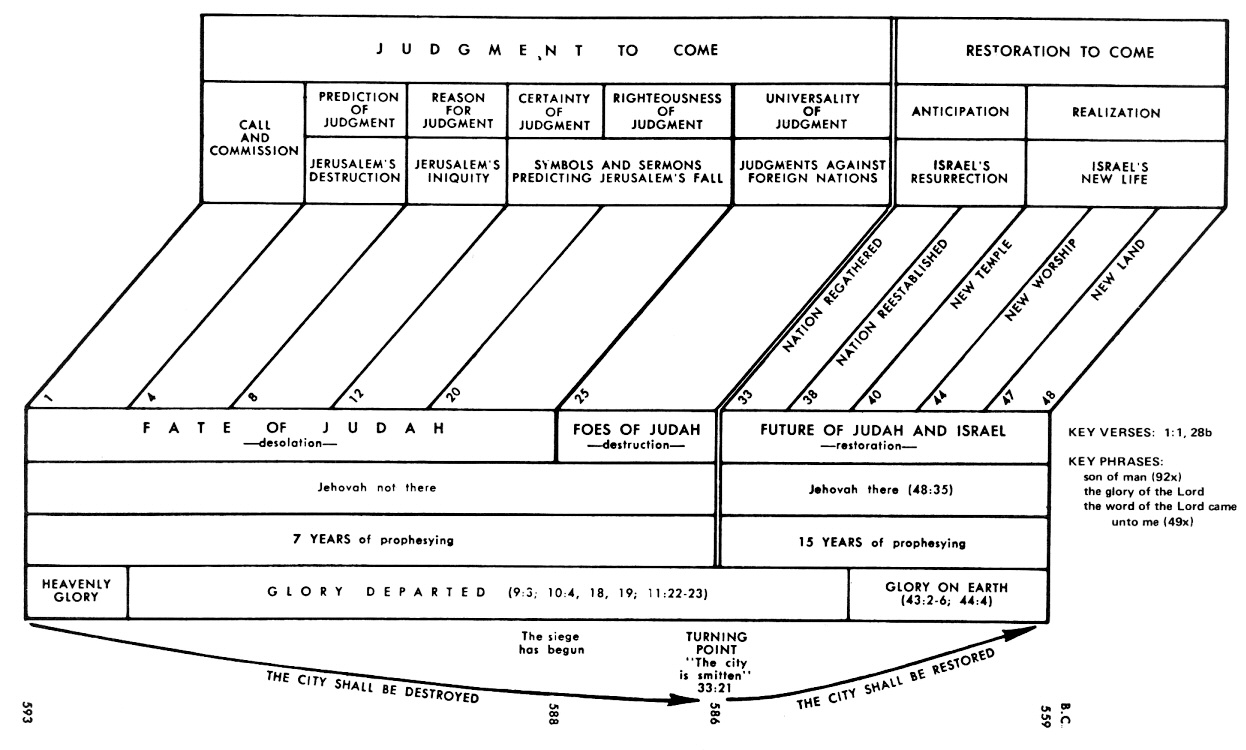
Click chart to enlarge
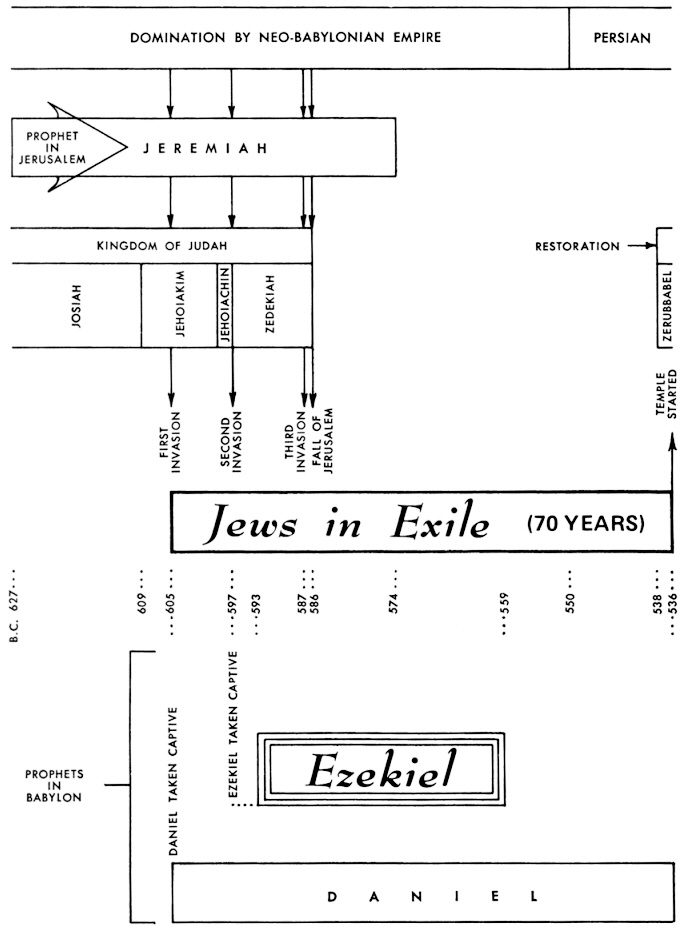
Click chart to enlarge
Chart from recommended resource Jensen's Survey of the OT - used by permission
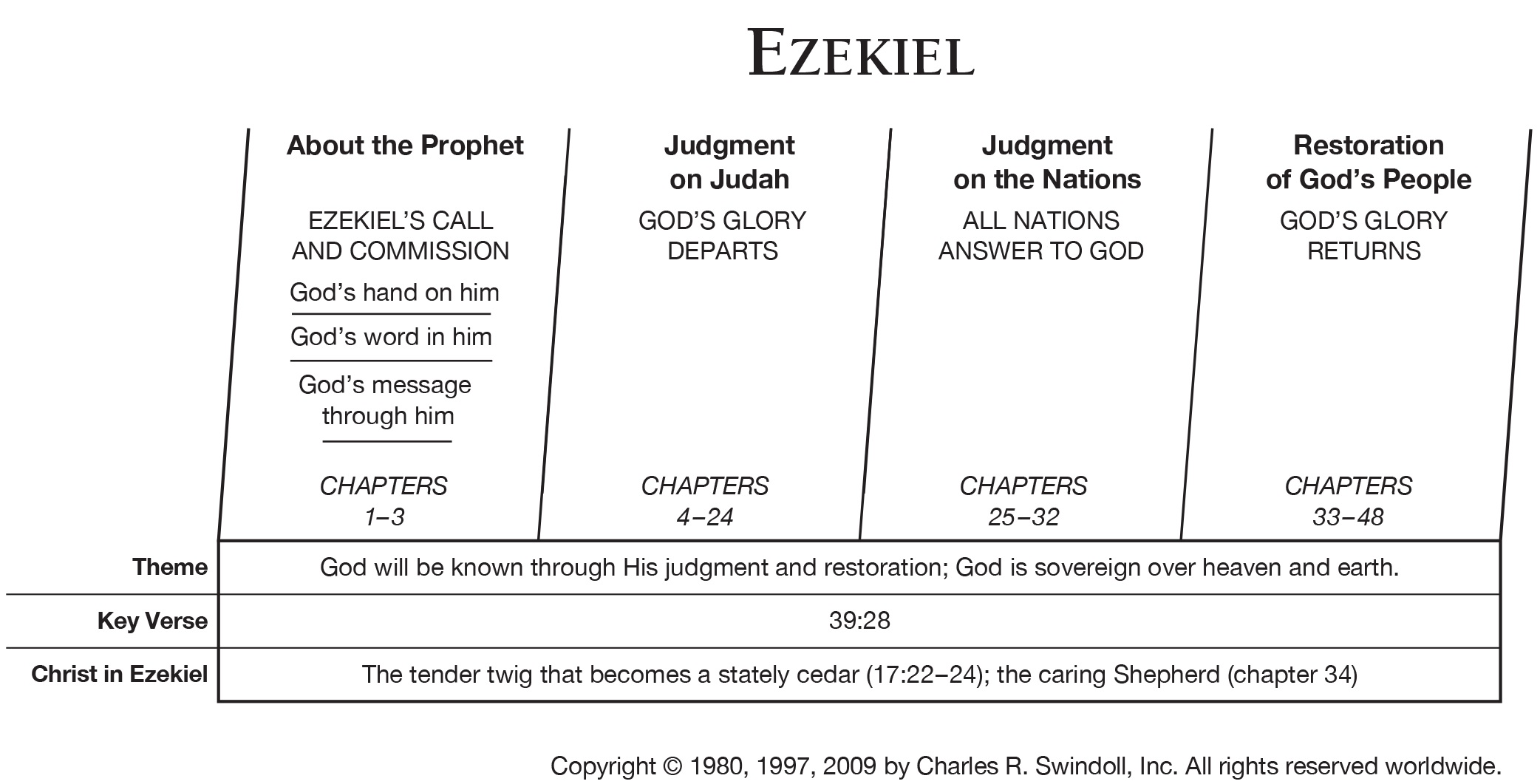
Click Chart from Charles Swindoll
|
PROPHECY OF |
PROPHECY OF |
|||
| FATE OF JUDAH Before the Siege |
FOES OF JUDAH During the Siege |
FUTURE OF JUDAH After the Siege |
||
|
593-588 BC |
587-586 |
586-571 |
||
|
7 YEARS |
15 YEARS |
|||
| Ezekiel 1:1-3:27 Ezekiel Sees the Glory & Receives the Call |
Ezekiel 4:1-24:27 Judgments Against Judah |
Ezekiel 25:1-32:32 Judgments Against the Gloating Nations |
Ezekiel 33:1-39:29 Restoration of Israel to the LORD |
Ezekiel 40:1-48:35 Visions of the Temple Jehovah Shammah |
Outline of the Book of Ezekiel from Dr John MacArthur - The book can be largely divided into sections about condemnation/retribution and then consolation/restoration. A more detailed look divides the book into 4 sections. First, are prophecies on the ruin of Jerusalem (Ezekiel 1:1–24:27). Second, are prophecies of retribution on nearby nations (Ezekiel 25:1–32:32), with a glimpse at God’s future restoration of Israel (Ezekiel 28:25,26). Thirdly, there is a transition chapter (Ezekiel 33:1-33) which gives instruction concerning a last call for Israel to repent. Finally, the fourth division includes rich expectations involving God’s future restoration of Israel (Ezekiel 34:1–48:35). (Reference)
I. Prophecies of Jerusalem’s Ruin (Ezekiel 1:1–24:27)
A. Preparation and Commission of Ezekiel (Ezekiel 1:1–3:27)
1. Divine appearance to Ezekiel (Ezekiel 1:1–28)|
2. Divine assignment to Ezekiel (Ezekiel 2:1–3:27)
B. Proclamation of Jerusalem’s Condemnation (Ezekiel 4:1–24:27)
1. Signs of coming judgment (Ezekiel 4:1–5:4)
2. Messages concerning judgment (Ezekiel 5:5–7:27)
3. Visions concerning abomination in the city and temple (Ezekiel 8:1–11:25)
4. Explanations of judgment (Ezekiel 12:1–24:27)
II. Prophecies of Retribution to the Nations (Ezekiel 25:1–32:32)
A. Ammon (Ezekiel 25:1–7)
B. Moab (Ezekiel 25:8–11)
C. Edom (Ezekiel 25:12–14)
D. Philistia (Ezekiel 25:15–17)
E. Tyre (Ezekiel 26:1–28:19)
F. Sidon (Ezekiel 28:20–24)
Excursus: The Restoration of Israel (Ezekiel 28:25, 26)
G. Egypt (Ezekiel 29:1–32:32)
III. Provision for Israel’s Repentance (Ezekiel 33:1–33)
IV. Prophecies of Israel’s Restoration (Ezekiel 34:1–48:35)
A. Regathering of Israel to the Land (Ezekiel 34:1–37:28)
1. Promise of a True Shepherd (Ezekiel 34:1–31)
2. Punishment of the nations (Ezekiel 35:1–36:7)
3. Purposes of restoration (Ezekiel 36:8–38)
4. Pictures of restoration—dry bones and two sticks (Ezekiel 37:1–28)
B. Removal of Israel’s Enemies from the Land (Ezekiel 38:1–39:29)
1. Invasion of Gog to plunder Israel (Ezekiel 38:1–16)
2. Intervention of God to protect Israel (Ezekiel 38:17–39:29)
C. Reinstatement of True Worship in Israel (Ezekiel 40:1–46:24)
1. New temple (Ezekiel 40:1–43:12)
2. New worship (Ezekiel 43:13–46:24)
D. Redistribution of the Land in Israel (Ezekiel 47:1–48:35)
1. Position of the river (Ezekiel 47:1–12)
2. Portions for the tribes (Ezekiel 47:13–48:35)
Ezekiel 12:17 Moreover, the word of the LORD came to me saying
WBC: I received the following communication from Yahweh:
The third of five divine communiqués to Ezekiel in chapter 12. Remember Ezekiel is prophesying in this section circa 591bc or about 5 years before the final fall of Jerusalem in 586 B.C.
In this communication Jehovah instructs Ezekiel to carry out another sign. Whereas the sign in the previous verses depicted the certainty of Judah going into captivity, this sign speaks of the famine and distress which would occur with the protracted siege of Jerusalem.
Ezekiel 12:18 "Son of man, eat your bread with trembling and drink your water with quivering and anxiety.
WBC: “Human one, you are to quake as you eat your bread, and shudder as you drink your water.
- Eze 4:16,17 23:33 Lev 26:26,36 De 28:48,65 Job 3:24 Ps 60:2,3 Ps 80:5 102:4-9
"Eat your bread with trembling… " (shaking, quaking) In Ezekiel 4 (in Ezekiel's first drama with food) God declared that would He would "break the staff of bread in Jerusalem, and they will eat bread by weight and with anxiety, and drink water by measure and in horror." (Ezek 4:16, read Ezek 4:9-17)
Normally when most of us partake of food and drink, it is a congenial, relaxed, reinvigorating time and the mood at the table often reflects current conditions. Here the anxiety betrays the threat they are living under as Babylon besieged Jerusalem. The word for "trembling" (ra'ash) was used elsewhere in the OT to refer to an earthquake. The use here is of course figurative but still quite paints a dramatic word picture of the fear. The focus here appears to be not so much on a picture of starvation but of the fear and anxiety as the inhabitants of Jerusalem sense the end drawing near.
Matthew Henry draws an excellent application that "When ministers speak of the ruin coming upon impenitent sinners they must endeavor to speak feelingly, as those that know the terrors of the Lord; and they must be content to endure hardness, so that they may but do good.
Although it is not stated, the context suggests that this was yet another prophetic drama portrayed before his fellow exiles. As explained below Ezekiel's actions portend the horrible state of those in Jerusalem encircled by the powerful Babylonian army. Ezekiel is commanded to represent them by acting out that foreboding in an exaggerated physical counterpart, a pitiable trembling that presumably showed itself in spilling his drink and missing his mouth with his food. Just imagine the reaction of the horrified exiles watching yet another of Ezekiel's bizarre behaviors. If you read some of the liberal commentaries, you too will be "horrified" by their bizarre interpretations for some "scholars" have gone so far as to diagnose Ezekiel’s condition as a physiological consequence of the strain he felt from his ecstatic prophetic experiences! That is absurd and not at all what the text clearly states. This type of fallacious interpretation by men who should rightfully and theoretically know better is another reason why you need to be diligent to hone your skills of Inductive Bible study, allowing the inspired text and your infallible Teacher, the Holy Spirit, to guide you into all truth rather than into vain speculation out of which can flow nothing but corrupt application.
"One can visualize the scene: the prophet’s hand would be shaking so that water spilled before reaching his lips and the bread was fumbled at the mouth. By his actions, he was demonstrating to his audience the fearful condition of the inhabitants of Jerusalem, who would dine in trembling in the twilight of their city’s doom." (Craigie, P. C. Borrow Ezekiel. The Daily study Bible))
Ezekiel 12:19 "Then say to the people of the land, 'Thus says the Lord GOD concerning the inhabitants of Jerusalem in the land of Israel, "They will eat their bread with anxiety and drink their water with horror, because their land will be stripped of its fullness on account of the violence of all who live in it.
Brenton: And thou shalt say to the people of the land, Thus saith the Lord to the inhabitants of Jerusalem, on the land of Israel; They shall eat their bread in scarcity, and shall drink their water in desolation, that the land may be desolate with all that it contains: for all that dwell in it are ungodly. (English of Septuagint)
Daily Study Bible: and say of the people of the land, Thus says the Lord God concerning the inhabitants of Jerusalem in the land of Israel: They shall eat their bread with fearfulness, and drink water in dismay, because their land will be stripped of all it contains, on account of the violence of all those who dwell in it.
WBC: Tell the people of the land this message from the Lord Yahweh concerning the residents of Jerusalem still on Israelite soil: They will eat their bread anxiously and drink their water with trepidation, anticipating its territory being desolated and stripped of what now fills it, as a result of the violence perpetrated by all who reside there.
- with carefulness (KJV): 1Ki 17:10-12
- that her (KJV): Eze 6:6,7,14 36:3 Isa 6:11 Jer 4:27 9:10,11 10:22 18:16 32:28 Jer 33:10,12 Mic 7:13 Zec 7:14
- all that is therein (KJV): Heb. the fulness thereof, Ps 24:1 1Co 10:26,28
- because (KJV): Eze 7:23 Ge 6:11-13 Ps 107:34 Jer 6:7 Mic 3:10-12
"The land" in the first use refers to the land of Babylon, and the audience is Ezekiel's fellow exiles. Following a pattern we saw in the first part of chapter 12 (and elsewhere in Ezekiel), the drama of verse 18 is followed by specific explanation from Jehovah through Ezekiel to the exiles. God explains their reaction (anxiety… horror) to the consequence (land… stripped) (and plundered) ) and then explains the reason for the consequence (violence of all) Giving a similar portrayal of the fruit of sin, the psalmist says that God turns "a fruitful land into a salt waste, because of the wickedness of those who dwell in it." (Ps107:34)
Through His prophet Moses God warned Israel that as a consequence of disobedience "your life shall hang in doubt before you; and you will be in dread night and day, and shall have no assurance of your life." (Dt 28:66)
As Henry notes "Anxiety and fear, if they prevail, are enough to embitter all our comforts and are themselves very sore judgments.
In a similar description of Jerusalem and Judah in chapter 7, Ezekiel had painted "the land (as) full of bloody crimes, and the city (as) full of violence." and went on to explain that because of this violence God had stated
I shall bring the worst of the nations, and they will possess their houses. I shall also make the pride of the strong ones cease, and their holy places will be profaned." (Ezek 7:24)
The drama in this section is reminiscent of the one in Ezek 4:10–16, predicting the intense starvation related to the dire shortage of food and water during the coming 18 month siege of Jerusalem.
Ezekiel 12:20 "The inhabited cities will be laid waste and the land will be a desolation. So you will know that I am the LORD."
WBC: The other cities, now inhabited, will also be laid waste, and the country will become desolate. Then you will realize that I am Yahweh.”
- Eze 15:6,8 Isa 3:26 7:23,24 24:3,12 64:10,11 Jer 4:7,23-29 Jer 12:10-12 16:9 19:11 24:8-10 25:9 34:22 La 5:18 Da 9:17
The inhabited cities… the land leaves no corner that will be spared from the LORD's hand of just retribution.
The purpose of the waste and desolation is given -- to know that God is the LORD, clearly a major emphasis of Ezekiel as this same phrase is found 63 times in the book. If they would not know Him in obedience, they would know Him in the just consequences wrought by their disobedience.
Allen commenting on the "waste and… desolation" adds that "The eventual fulfillment of such catastrophe for Jerusalem and Judah would force upon the attention of the Judean hostages God’s role as Judge of His people. If the sign and its interpretation failed to do so, the coming of the terrible event (ed note: the siege in 3.5 years and the fall of Jerusalem in 5 years) to which they pointed would leave no doubt." (See context in Word Biblical Commentary : Ezekiel 1-19)
THOUGHT - Think about the application of this aspect of God's judgment - that the exiles might know Him as Jehovah. Now this is speculation but for a moment imagine yourself as one of the "scoffers" in Ezekiel's audience having heard these prophecies 5 years earlier but now being confronted with the heretofore unthinkable defeat of the "eternal city" and sacking of the Holy Temple. What impact might this detailed fulfillment of Ezekiel's prophecy have had on the exiles? Might not some have been awakened from their spiritual slumber and eternal death? We can't say for certain, but I can personally testify that the Spirit of God used fulfilled prophecy in my "spiritual journey" to bring me to the point of knowing and accepting that "I Am" is the LORD Jesus Christ.
Matthew Henry adds that "if, by these judgments, they learn to know Him aright, that will make up the loss of all they are deprived of by these desolations. Those are happy afflictions, howsoever grievous to flesh and blood, that help to introduce us into (initial salvation) and improve us (continuing salvation = sanctification) in an acquaintance with God."
Ezekiel 12:21 Then the word of the LORD came to me, saying,
WBC: I received the following communication from Yahweh:
"Then" marks a subsequent succeeding event introduced by the fourth of five direct declarations by God in this chapter.
As Matthew Henry comments "Various methods had been used to awaken this secure and careless people to an expectation of the judgments coming, that they might be stirred up, by repentance and reformation, to prevent them. The prophecies of their ruin were confirmed by visions, and illustrated by signs, and all with such evidence and power that one would think they must needs be wrought upon; but here we are told how they evaded the conviction, and guarded against it, namely, by telling themselves, and one another, that though these judgments threatened should come at last yet they would not come of a long time. How they flattered themselves with hopes that the judgments should be delayed."
In this last section God gives Ezekiel the words to respond to the two popular attitudes of contempt toward his (as well as his contemporary Jeremiah's) prophecies of judgment, first citing the common saying that prophecy is no longer fulfilled at all (Ezek 12:21, 22, 23, 24, 25) and then the saying that these prophecies refer to the far distant future (Ezek 12:26, 27, 28).
Ezekiel 12:22 "Son of man, what is this proverb you people have concerning the land of Israel, saying, 'The days are long and every vision fails'?
AMP Son of man, what is this proverb that you have in the land of Israel, saying, The days drag on and every vision comes to nothing and is not fulfilled?
Mt Henry They said, “The days are prolonged; the judgments have not come when they were expected to come, but seem to be still put off and therefore we may conclude that every vision fails
NLT "Son of man, what is that proverb they quote in Israel: 'Time passes, making a liar of every prophet'?
TEV "Mortal man," he said, "why do the people of Israel repeat this proverb: 'Time goes by, and predictions come to nothing'?
WBC: “Human one, what do you all mean by this slogan you are using about the land of Israel, ‘After a long time elapses, every revelation is a dead letter’? (a dead threat)
- what (KJV): Eze 18:2,3 Jer 23:33-40
- The days (KJV): Eze 12:27 11:3 Isa 5:19 Jer 5:12,13 Am 6:3 2Pe 3:3,4
The Hebrew word for proverb (mashal) describes a pithy maxim or brief popular saying that is often memorable and also suggests that it gives special insight and authority. The proverb that prevailed among the Jews at this time could be curtly paraphrased as
Time passes and nothing happens! or "the prophets speak and yet nothing happens" or the prophets had cried "wolf, wolf" for a long time without anything happening.
Over 14 months of Ezekiel's doom and gloom had passed and nothing that he had predicted had come to pass. Some falsely concluded therefore that nothing bad would happen. They had eyes but could not see, ears but could not hear and understand.
The proverb clearly reflected the general feeling of the people that the prophetic doom and gloom of Ezekiel (and his contemporary Jeremiah) was empty rhetoric and not a valid representation of the future. Given that the year was about 591bc, the delay in God's judgment had already been about 6 years (assuming exile in 597bc or 14 years if exiled in 605bc) and thus they falsely reasoned that the stroke of judgment would never come. They reasoned that it was unnecessary to take seriously the declarations of the prophets. They were always warning of terrible disasters, and nothing ever happened. The "proverb" was directed to ridicule Ezekiel (and God) because the warnings had not been immediately fulfilled.
God issues warnings, not as predictions of the future, but as opportunities for men to know the will of God and to change their lives accordingly.
Richards comments that "The “proverb” is a saying that sums up common wisdom, or a people’s point of view. The belief the proverb expresses is, simply, that the message of judgment delivered by Ezekiel and earlier prophets like Isaiah simply was not true. The argument underlying it is basically, “It hasn’t happened yet—so it can’t happen!” That notion is foolish, whether it’s held by a Californian living in an earthquake zone, or a non-Christian hearing about Christ’s Second Coming! God’s patience in delaying judgment is evidence of grace, not evidence no judgment lies ahead!" (cf 2Pe3:15) (Richards, L. 1991. The Bible reader's companion. Wheaton, Ill.: Victor Books)
To cease is the Hebrew verb shabath which in other contexts means to observe the sabbath and cease from activity. s related to the word "Sabbath" and the idea is to rest or cease.
"The days are long" How blind Judah was to the acts of God in their own history. Time had passed and something had already happened to the exiles. They were in exile! Of all people, the exiles should have known the folly of protesting that prophecy would not come true, or would happen only in the distant future. The end was already upon them, if they only had the eyes to perceive it. They were like those Peter writes about who are
"saying, "Where is the promise of His coming? For ever since the fathers fell asleep, all continues just as it was from the beginning of creation." For when they maintain this, it escapes their notice that by the word of God the heavens existed long ago and the earth was formed out of water and by water, through which the world at that time was destroyed, being flooded with water." (2Pe3:4, 5, 6)
Isaiah was confronted with this skeptical, scoffing attitude, his distracters crying out
"Let's see God hurry. Let's see him do his work soon. We want to see it. Let's see the plan of the Holy One of Israel happen soon. Then we would know what it really is." (Isa 5:19, Int'l Children's Bible).
In the same way Ezekiel's contemporary, Jeremiah, records
"People (of Judah) scoff at me and say, "What is this 'message from the LORD' you keep talking about? Why don't your predictions come true?" (Jer 17:15NLT)
Fallen human nature has not changed over 2500 years later, for many "enlightened" men and women attempt to explain away prophetic judgments yet to come.
Evangelical Commentary explains this proverb as an indicator of "the people’s problem is their spiritual insensitivity. They are addicted to a snatch-and-grab mentality, an itch for the instantaneous. Since nothing has apparently happened, they deny the validity of the Word of the Lord."
Ezekiel's contemporary, Jeremiah of Jerusalem, gives a similar portrayal of the Jews cynical attitude towards imminent judgment as expressed "proverbially". Jeremiah records God's words testifying that
"the house of Israel and the house of Judah have dealt very treacherously with Me… They have lied about Jehovah and said (here is the "proverbial" statement), “Not He (Who speaks through His prophets or alternatively there is no God). Misfortune will not come on us and we will not see sword or famine. And the prophets are as wind, and the word is not in them. Thus it will be done to them!” Therefore, thus says the Lord, the God of hosts, "because you have spoken this word, behold, I am making My words in your mouth fire and this people wood, and it will consume them." (Jer 5:11-14)
Albert Barnes writes that "There was prevalent a disregard for the true prophets, which is ever followed by a recognition of the false. First, the true prophet is rejected because it is thought that his prophecies fail. Then men persuade themselves that if the prophecy be true it respects some distant time, and that the men of the present generation need not disturb themselves about it… Against both these delusions Ezekiel is commissioned to protest, and so to lead the way to his condemnation of his countrymen for their blind reliance on false prophets.
As Matthew Henry comments that the "forbearance of God which should have led them to repentance hardened them in sin. They were willing to think their works were not evil because sentence against them was not executed speedily; and therefore concluded the vision itself failed, because the days were prolonged." He goes on to add that "It is a token of universal degeneracy in a nation when corrupt and wicked sayings have grown proverbial"
Ezekiel 12:23 Therefore say to them, 'Thus says the Lord GOD, "I will make this proverb cease so that they will no longer use it as a proverb in Israel." But tell them, "The days draw near as well as the fulfillment of every vision.
WBC:Well, tell them this as a message from the Lord Yahweh: I will put a stop to this slogan, and it will be used in Israel no longer. Say to them rather: The time is near, and so is the content of every revelation.
NLT: Give the people this message from the Sovereign LORD: I will put an end to this proverb, and you will soon stop quoting it. Now give them this new proverb to replace the old one: 'The time has come for every prophecy to be fulfilled!'
- I will (KJV): Eze 18:3 Isa 28:22
- The days (KJV): Eze 12:25 7:2,5-7,10-12 Joe 2:1 Zep 1:14 Mal 4:1 Mt 24:34 Jas 5:8,9
Therefore or because of the fact that "you people" have this false assumption that the delayed judgment equated with no judgment. God instructs Ezekiel to declare that judgment day is coming and will be fulfilled to the minutest detail. It could be paraphrased:
Time’s up and everything is going to happen!
I will make this proverb cease How? When the doubters and scoffer finally experience God's day of vengeance and that not one iota or tittle of the prediction falls to the ground, then they will be ashamed and clearly foolish to continue using it as a proverb.
God counters the saying that the days are long with the exact opposite: "The days draw near"
"The fulfillment of every vision" reminds one of God's declaration
So shall My word be which goes forth from My mouth. It shall not return to Me empty, without accomplishing what I desire, and without succeeding in the matter for which I sent it." (Is 55:11)
Vision Most of the Hebrew words translated “vision” come from the root hazah and each indicates a revelation from God or a special, mystical means through which God communicated His message to the Old Testament prophets.
Ezekiel 12:24 For there will no longer be any false vision or flattering divination within the house of Israel.
WBC: For no longer will any revelation be spoken in vain nor any divination be devoid of reality in the community of Israel.
- Eze 13:23 1Ki 22:11-13,17 Pr 26:28 Jer 14:13-16 23:14-29 La 2:14 Zec 13:2-4 Ro 16:18 1Th 2:5 2Pe 2:2,3
When the judgment comes it will put an end to the false prophecies of the lying prophets and fake soothsayers who decry God's judgment and promulgate hope. The coming judgment would put an end to their predictions of continued well-being and expose their empty delusion.
"False" (Hebrew = shav') means emptiness, vanity, nothingness, deceit, deception, malice, falsehood, anything unsubstantial, unreal, worthless. It is a word that is occasionally used for idols. Shav' describes anything which disappoints the hope which rests upon it! All of these synonyms and short definitions readily describe the character of the visions of the false prophets.
Flattering divination Divination is the attempt to communicate with the supernatural by observing natural phenomena (e.g., stars, entrails of sacrificial animals, clouds, births), manipulating certain objects (arrows, oil and water, lots, etc.), or consulting mediums. The pagans made use of divination, magic, and mediums to learn the mind of the deity (Deut 18:9-12). In true prophecy mechanical arts were discarded, for Jehovah spoke to the mind of the prophet. Flattering or smooth divination promised immunity from trouble (cf. Jer 23:16, 17; 28:1-17).
The IVP Bible background commentary adds that "The task of the diviner was to determine the will of a god or gods through various ritualized actions—the examination of sheep entrails, consultation with the dead (1Sa 28:8) or the study of the astrological configurations. All of these practices were forbidden by Israelite law (see the comment on Deut 18:10, 11, 13) because of their association with false gods and false religions. Naturally, a diviner would wish to please his paying clients and thus might be inclined to flatter or seduce them with his manner and statements (cf Pr26:24, 25, 26). Such desirable predictions were out of place and to be considered similar to those condemned by Jeremiah (see Jer 27:9, 10)." (See context in The IVP Bible Background Commentary: Old Testament)
"Within" (tavek) literally means right in the middle or midst of! The point is that these false visions, etc were not just a few "crazies" on the fringe, but were taking place right in the center of the "house of Israel". How tragic that God's chosen people
professing to be wise… became fools, and exchanged the glory of the incorruptible God… they exchanged the truth of God for a lie… and just as they did not see fit to acknowledge God any longer, God gave them over to a depraved mind, to do those things which are not proper… and, although they know the ordinance of God, that those who practice such things are worthy of death, they not only do the same, but also give hearty approval to those who practice them." (Ro1:22-32)
Matthew Henry writes that "As truth was older than error, so it will survive it; it got the start, and it will get the race. The true prophets' visions and predictions stand, and are in full force, power, and virtue; they give law, and receive credit, when the vain visions, and the flattering divinations, are lost and forgotten, and shall be no more in the house of Israel; for great is the truth, and will prevail.
Ezekiel 12:25 "For I the LORD will speak, and whatever word I speak will be performed. It will no longer be delayed, for in your days, O rebellious house, I will speak the word and perform it," declares the Lord GOD.
WBC: For it is I, Yahweh, who is speaking: whatever word I speak is fulfilled. There will be no further delay. In your lifetime, you rebellious community, I mean to both speak the word and fulfill it. So runs the oracle of the Lord Yahweh.”
- I will (KJV): Eze 12:28 6:10 Nu 14:28-34 Isa 14:24 55:11 La 2:17 Da 9:12 Zec 1:6 Mt 24:35 Lu 21:13,33
- in your (KJV): Jer 16:9 Hab 1:5 Mk 13:30,31
- O rebellious (KJV): Eze 12:1,2
"I the LORD will speak" (Ezek 12:28; 6:10; Numbers 14:28-34; Isaiah 14:24; 55:11; Lamentations 2:17; Daniel 9:12; Zechariah 1:6; Matthew 24:35; Luke 21:13,33) His Name is Jehovah, the God Who keeps His covenant.
Whatever word I speak will be performed is a principle not only applicable to Jerusalem's certain judgment but to all of God's promises, for good or for bad. Isaiah records a similar declaration
"The LORD of hosts has sworn saying, "Surely, just as I have intended so it has happened, and just as I have planned so it will stand" (Isa 14:24)
Writing from exile in Babylon Daniel declares
Thus He has confirmed His words which He had spoken against us and against our rulers who ruled us, to bring on us great calamity; for under the whole heaven there has not been done anything like what was done to Jerusalem." (Da 9:12)
Writing after the destruction of Jerusalem, Jeremiah reiterates that
The LORD has done what He purposed; He has accomplished His word Which He commanded from days of old. He has thrown down without sparing, and He has caused the enemy to rejoice over you; He has exalted the might of your adversaries." (Lam 2:17)
Zechariah adds a hopeful note writing
But did not My words and My statutes, which I commanded My servants the prophets, overtake your fathers? Then they repented and said, 'As the LORD of hosts purposed to do to us in accordance with our ways and our deeds, so He has dealt with us." (Zec 1:6)
Matthew Henry writes "The word that He speaks shall come to pass; it shall infallibly be accomplished according to the true intent and meaning of it, and according to the full extent and compass of it… for His mind is never changed, nor His arm shortened, nor is Infinite Wisdom ever nonplussed. With men saying and doing are two things, but they are not so with God; with Him it is dictum, factum - said, and done. In the works of providence, as in those of creation, he speaks and it is done; for he said, Let there be light, and there was light
In similar tones Moses reminded Israel that
God is not a man, that He should lie, nor a son of man, that He should repent. Has He said, and will He not do it? Or has He spoken, and will He not make it good?" (Nu 23:19)
As Samuel reminded disobedient, rebellious King Saul
the Glory of Israel will not lie or change His mind; for He is not a man that He should change His mind." (1Sa 15:29)
It will no longer be delayed (Jeremiah 16:9; Habakkuk 1:5; Mark 13:30,31) He had borne with Judah a great while, but He would not always forbear and now God's patience has expired and He will no longer defer the execution of the sentence. “Not yet” doesn’t mean “never.”
Let's apply this truth: Simply put: Don’t mistake judgment deferred for judgment denied. Delay is not denial with God.
This present age is drawing to a close and there is a promised judgment by the Almighty and so it should not surprise us to read similar words in the Revelation from the angel who
swore by Him who lives forever and ever, WHO CREATED HEAVEN AND THE THINGS IN IT, AND THE EARTH AND THE THINGS IN IT, AND THE SEA AND THE THINGS IN IT, that there will be delay no longer but in the days of the voice of the seventh angel, when he is about to sound, then the mystery of God is finished, as He preached to His servants the prophets." (Rev 10:6, 7)
With the phrase "in your days" Ezekiel makes it abundantly clear that God's judgment would transpire in their lifetime.
"I will speak the word and perform it"
Matthew Henry presents us with a somber application writing "Behold, the Judge stands at the door. The righteous are taken away from the evil to come, but this rebellious house shall not be so quietly taken away; no, they shall live to be hurried away, to be chased out of the world. There shall none of My words be prolonged any more, but judgment shall now hasten on apace; and the longer the bow has been in the drawing the deeper shall the arrow pierce.” When we tell sinners of death and judgment, heaven and hell, and think by them to persuade them to a holy life, though we do not find them downright infidels (they will own that they do believe there is a state of rewards and punishments in the other world), yet they put by the force of those great truths, and void the impressions of them, by looking upon the things of the other world as very remote; they tell us, “The vision you see is for many days to come, and you prophesy of the times that are very far off; it will be time enough to think of them when they come nearer,” whereas really there is but a step between us and death, between us and an awful eternity; yet a little while and the vision shall speak and not lie, and therefore it concerns us to redeem time, and get ready with all speed for a future state; for, though it is future, it is very near, and while impenitent sinners slumber their damnation slumbers not.”
Ezekiel 12:26 Furthermore, the word of the LORD came to me, saying,
WBC: I received a further communication from Yahweh: For the fifth time in chapter 12, Ezekiel has an up close and personal encounter with Jehovah.
Ezekiel 12:27 "Son of man, behold, the house of Israel is saying, 'The vision that he sees is for many years from now, and he prophesies of times far off.
Brenton Son of man, behold, the provoking house of Israel boldly say, The vision which this man sees is for many days, and he prophesy for times afar off. (English of Septuagint)
WBC: “Human one, I draw your attention to what the community of Israel is saying, ‘The revelation he is giving relates to a long time ahead. It is about the distant future he is prophesying.’
- for (KJV): Eze 12:22 Isa 28:14,15 Da 10:14 2Pe 3:4
"The vision… for many years from now… times far off" (Ezek 12:22; Is 28:14,15; Da10:14; 2Pe 3:4) Instead of implying that prophecies are not true (as in the proverb in verse 22), the second response indicated that the fulfillment of prophecies lay far in the future. There was therefore little need to be worried about them in the present. Let future generations worry! In the next verse God reverses their "saying", emphasizing that it will happen now, in your own time.
Even those who did believe Ezekiel, did not believe that his words would affect them. They thought
Maybe someday. But not now. Maybe someone. But not us."
God’s response through Ezekiel was, “Not someone… you!” And, “Not someday… soon!”
Isaiah speaking at the time the Assyrians were in power and threatening Judah after having defeated Israel, proclaimed to the deceived deceivers in Jerusalem
Therefore (in light of the tragedies that had befallen Ephraim ~ 10 northern tribes described in Isa28:1-13), hear the word of the LORD, O scoffers, who rule this people who are in Jerusalem, because you have said, "We have made a covenant with death, and with Sheol we have made a pact (the scornful leaders in Jerusalem had made an agreement with Egypt to help defend themselves against the Assyrians). The overwhelming scourge will not reach us when it passes by (this phrase combines images of an overflowing river and a whip, as the deceived leaders bragged about their invincibility to foreign invasion), for we have made falsehood our refuge and we have concealed ourselves with deception." (Isa 28:14, 15)
Jerusalem’s leaders yielded to expediency for the sake of security. Without directly admitting it, they had taken refuge in deceit and falsehood.
THOUGHT Let's apply this truth: The attitude of the people of Ezekiel’s day is still pervasive in the modern day church. If only saints would truly believe that Jesus (and judgment) was coming and allow this truth to break the bondage of materialism that entangles so many saints so that they would be set free to live wholly and holy for the Lord to the glory of the Father. Many who have been blind to the truth have found that reading the Bible is a real eye-opener.
Jesus solemnly warned about a similar mindset declaring that
if that evil slave says in his heart, ‘My master is not coming for a long time,’ and shall begin to beat his fellow slaves and eat and drink with drunkards; the master of that slave will come on a day when he does not expect him and at an hour which he does not know, and shall cut him in pieces and assign him a place with the hypocrites; weeping shall be there and the gnashing of teeth." (Mt24:48, 49, 50, 51)
Matthew Henry paraphrases this verse as
The vision is for a great while to come; it refers to events at a vast distance, and he prophesies of things which, though they may be true, are yet very far off, so that we need not trouble our heads about them; we may die in honor and peace before these troubles come
Evangelical Commentary comments that this proverbial" expression emphasizes irrelevance and postponement: “Ezekiel is not talking to us, but to someone down the road. Therefore we do not need to take anything he says personally.” The last thing the people must do is accept personal responsibility for their circumstances. Therefore, they must evade in whatever way possible hearing the Word of the Lord and responding to it."A
Storm is Coming Ezekiel Was Forecasting Judah wasn't Listening!
Several years ago in Florida, I watched the ominously black sky as a howling wind drove the rain in stinging sheets across angrily churning bay waters. A hurricane was approaching! All day long, radio and TV stations gave urgent instructions on how to guard against the destructive winds and surging tides of the impending storm. As residents were frantically preparing for the storm, I asked myself, "Why do people take the warnings issued by the weather bureau so seriously, yet stubbornly refuse to hear God's warnings?" In His Word, God has told us that a much greater disaster will come upon the entire world. The Bible says,
"The day of the Lord will come as a thief in the night, in which the heavens will pass away with a great noise, and the elements will melt with fervent heat; both the earth and the works that are in it will be burned up" (2Peter 3:10-note).
Yes, that dreadful day is coming. But there is a sure way of escaping God's judgment. It's found in Christ. Those who have placed their faith in Him enjoy His peace here on earth and are assured of spending eternity with Him in heaven. Are you prepared? If not, accept the Lord Jesus as your Savior today (Ro1 0:9-13). — (Our Daily Bread - Richard De Haan)
To learn how you can be prepared for the day you will stand before the Lord, read Do I Have The Right Kind Of Faith? - Examining eight wrong objects of faith
To reject God's deliverance is to invite destruction.
God explains to Ezekiel that the exiles still don't understand and have deluded themselves into thinking that the judgment of Jerusalem won't impact them since it is so far in the future. This attitude is always present, for even today no one wants to consider the idea that God might soon judge them or their nation. This delusion is similar to that we see in the end of the age where scoffers question "Where is the promise of His coming?" (2Pet3:4) You can mark it down: Jesus' second coming is as certain as His first!
Ezekiel 12:28 "Therefore say to them, 'Thus says the Lord GOD, "None * of My words will be delayed any longer. Whatever * word I speak will be performed' declares the Lord GOD
WBC: Well, tell them this as a message from the Lord Yahweh: There will be no further delay over any words of mine. Whatever word I speak is fulfilled. So runs the oracle of the Lord Yahweh.”
- There shall (KJV): Eze 12:23-25 Jer 4:7 44:28 Mt 24:48-51 Mk 13:32-37 Lu 21:34-36 1Th 5:2,3 Rev 3:3
"None of My words will be delayed any longer" (shall not be deferred) Jesus' parable of the evil servant gives a similar clear warning to all unbelievers regarding the certainty of God's judgment, Jesus declaring that
if that evil slave says in his heart, 'My master is not coming for a long time,' and shall begin to beat his fellow slaves and eat and drink with drunkards; the master of that slave will come on a day when he does not expect him and at an hour which he does not know, and shall cut him in pieces and assign him a place with the hypocrites; weeping shall be there and the gnashing of teeth." (Mt 24:48, 49, 50, 51)
Similarly, Paul reminded the Thessalonians of the certitude of the wrath of God, writing "For you yourselves know full well that the day of the Lord will come just like a thief in the night. While they are saying, "Peace and safety!" then destruction will come upon them suddenly like birth pangs upon a woman with child; and they shall not escape." (1Th 5:2-3)

Do you recognize this implement? The diagram depicts a stone grinding mill, and brings to mind the crushing power of the slowly grinding stone which eventually pulverizes whatever is placed under its crushing weight. Someone has written a poem that conveys the essence of the truth recorded by Ezekiel and pictured by this heavy grinding stone…
"Though the mills of God grind slowly,
yet they grind exceeding small;
Though with patience He stands waiting,
with exactness grinds He all."
To counter the false conclusions of the exiles God instructs Ezekiel to declare to them that the judgment will be "delayed (no) longer". The LORD's statement reminds us of
the Revelation of Jesus Christ, which God gave Him to show to His bond-servants, the things which must shortly take place". (Rev 1:1-note)
God does not necessarily recompense at the end of every week; but He does pay with perfect timing and in full.