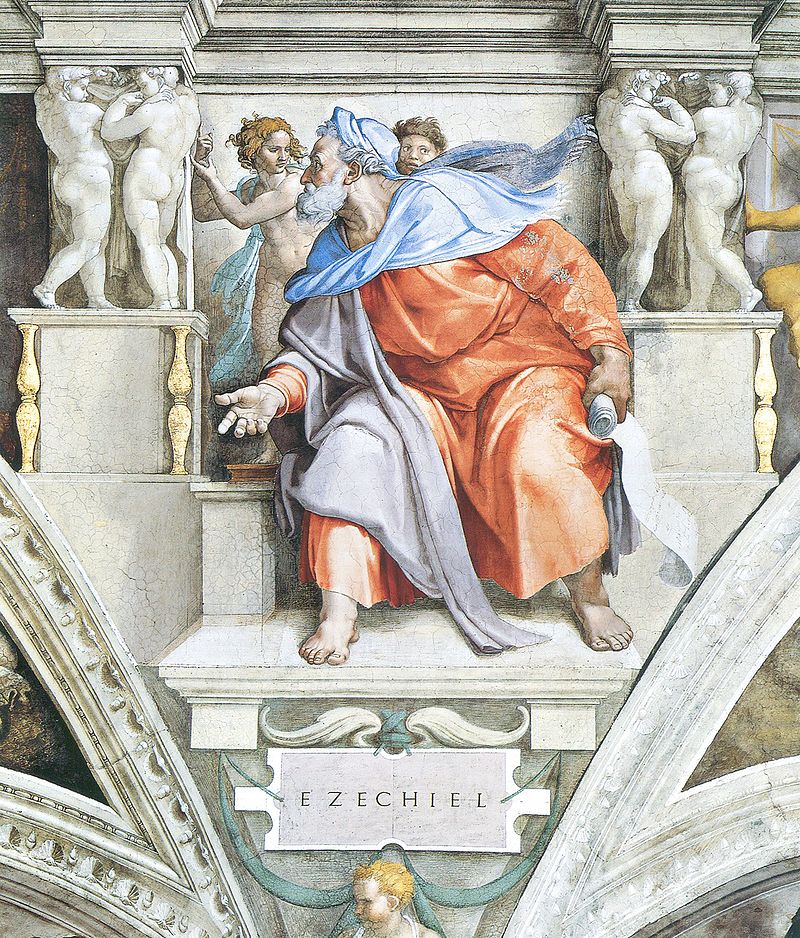
Michelangelo's Ezekiel on the Sistine Chapel
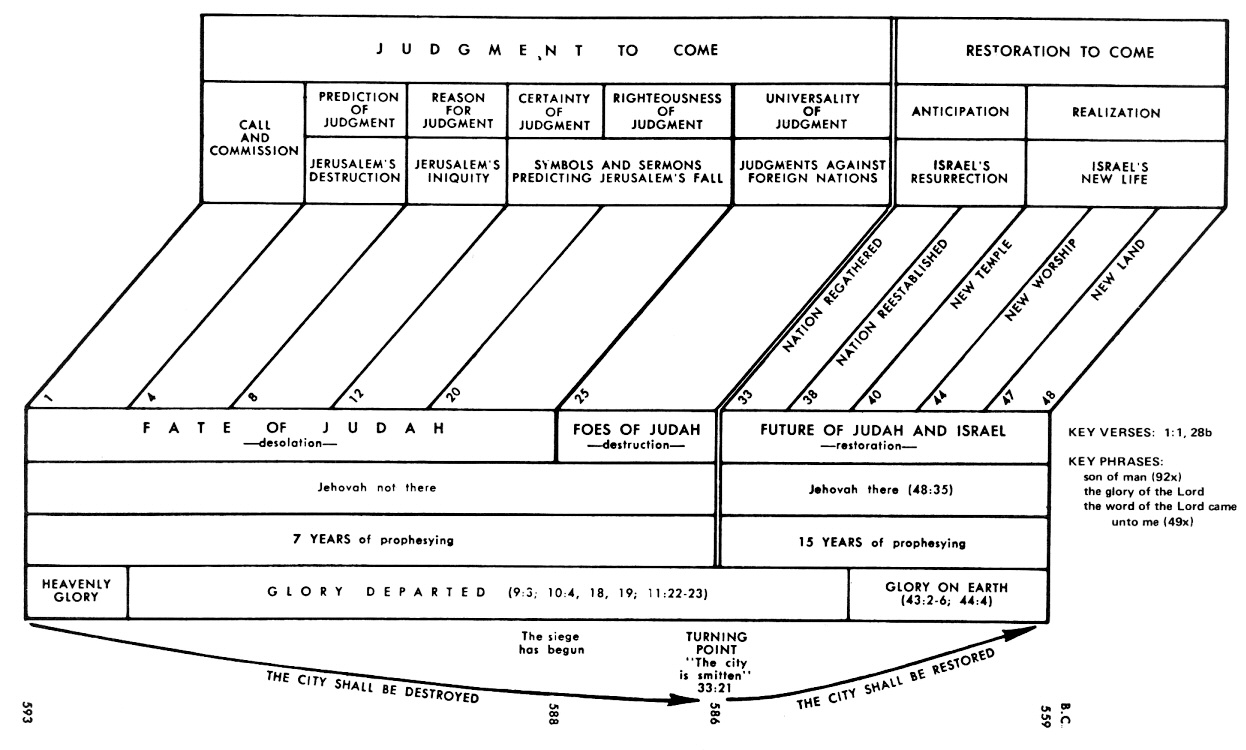
Click chart to enlarge
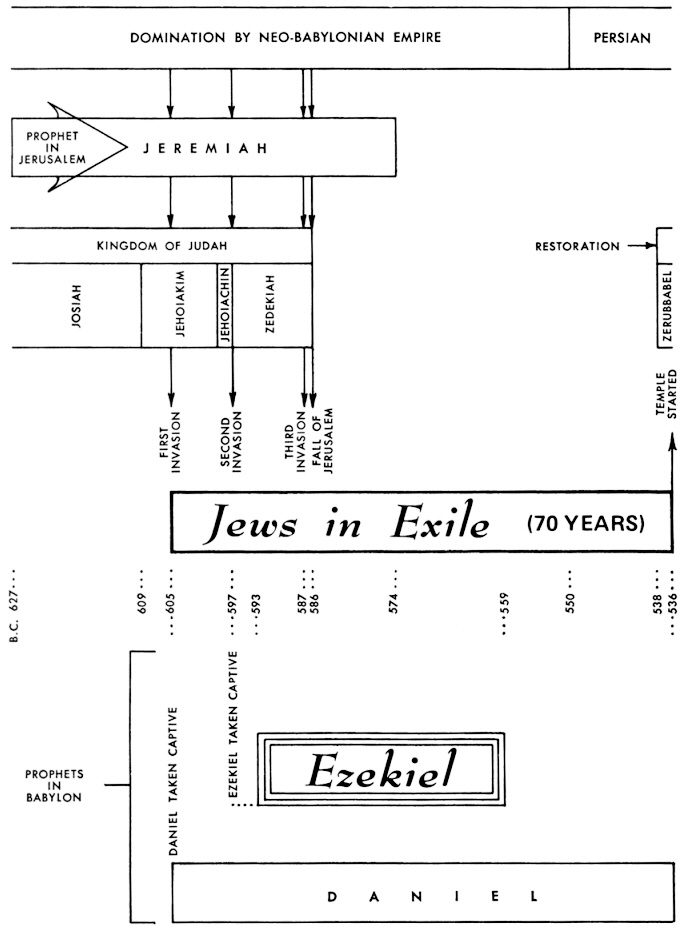
Click chart to enlarge
Chart from recommended resource Jensen's Survey of the OT - used by permission
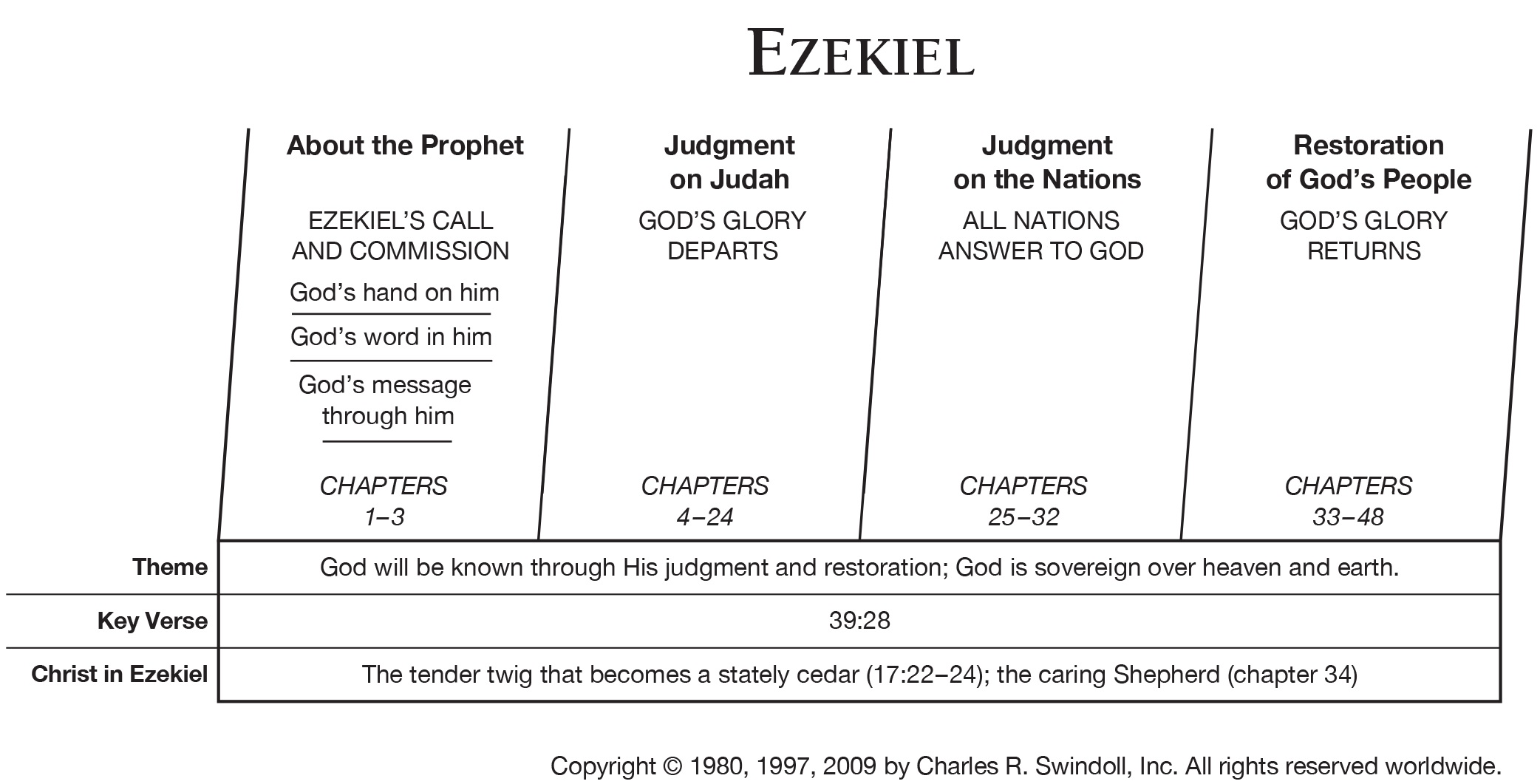
Click Chart from Charles Swindoll
|
PROPHECY OF |
PROPHECY OF |
|||
| FATE OF JUDAH Before the Siege |
FOES OF JUDAH During the Siege |
FUTURE OF JUDAH After the Siege |
||
|
593-588 BC |
587-586 |
586-571 |
||
|
7 YEARS |
15 YEARS |
|||
| Ezekiel 1:1-3:27 Ezekiel Sees the Glory & Receives the Call |
Ezekiel 4:1-24:27 Judgments Against Judah |
Ezekiel 25:1-32:32 Judgments Against the Gloating Nations |
Ezekiel 33:1-39:29 Restoration of Israel to the LORD |
Ezekiel 40:1-48:35 Visions of the Temple Jehovah Shammah |
Outline of the Book of Ezekiel from Dr John MacArthur - The book can be largely divided into sections about condemnation/retribution and then consolation/restoration. A more detailed look divides the book into 4 sections. First, are prophecies on the ruin of Jerusalem (Ezekiel 1:1–24:27). Second, are prophecies of retribution on nearby nations (Ezekiel 25:1–32:32), with a glimpse at God’s future restoration of Israel (Ezekiel 28:25,26). Thirdly, there is a transition chapter (Ezekiel 33:1-33) which gives instruction concerning a last call for Israel to repent. Finally, the fourth division includes rich expectations involving God’s future restoration of Israel (Ezekiel 34:1–48:35). (Reference)
I. Prophecies of Jerusalem’s Ruin (Ezekiel 1:1–24:27)
A. Preparation and Commission of Ezekiel (Ezekiel 1:1–3:27)
1. Divine appearance to Ezekiel (Ezekiel 1:1–28)|
2. Divine assignment to Ezekiel (Ezekiel 2:1–3:27)
B. Proclamation of Jerusalem’s Condemnation (Ezekiel 4:1–24:27)
1. Signs of coming judgment (Ezekiel 4:1–5:4)
2. Messages concerning judgment (Ezekiel 5:5–7:27)
3. Visions concerning abomination in the city and temple (Ezekiel 8:1–11:25)
4. Explanations of judgment (Ezekiel 12:1–24:27)
II. Prophecies of Retribution to the Nations (Ezekiel 25:1–32:32)
A. Ammon (Ezekiel 25:1–7)
B. Moab (Ezekiel 25:8–11)
C. Edom (Ezekiel 25:12–14)
D. Philistia (Ezekiel 25:15–17)
E. Tyre (Ezekiel 26:1–28:19)
F. Sidon (Ezekiel 28:20–24)
Excursus: The Restoration of Israel (Ezekiel 28:25, 26)
G. Egypt (Ezekiel 29:1–32:32)
III. Provision for Israel’s Repentance (Ezekiel 33:1–33)
IV. Prophecies of Israel’s Restoration (Ezekiel 34:1–48:35)
A. Regathering of Israel to the Land (Ezekiel 34:1–37:28)
1. Promise of a True Shepherd (Ezekiel 34:1–31)
2. Punishment of the nations (Ezekiel 35:1–36:7)
3. Purposes of restoration (Ezekiel 36:8–38)
4. Pictures of restoration—dry bones and two sticks (Ezekiel 37:1–28)
B. Removal of Israel’s Enemies from the Land (Ezekiel 38:1–39:29)
1. Invasion of Gog to plunder Israel (Ezekiel 38:1–16)
2. Intervention of God to protect Israel (Ezekiel 38:17–39:29)
C. Reinstatement of True Worship in Israel (Ezekiel 40:1–46:24)
1. New temple (Ezekiel 40:1–43:12)
2. New worship (Ezekiel 43:13–46:24)
D. Redistribution of the Land in Israel (Ezekiel 47:1–48:35)
1. Position of the river (Ezekiel 47:1–12)
2. Portions for the tribes (Ezekiel 47:13–48:35)
Ezekiel 13:1 Then the word of the LORD came to me saying,
Mart De Haan respected author of Radio Bible Class fame writes
"What if I told you that God has been speaking to me about an issue that I haven't been able to put out of my mind? Because you know me, you don't think I'm claiming to have heard God speak in an audible voice. You assume that I have had an idea that I believe has the signature of God written all over it. So you decide to hear me out.
Listen to what I'm saying
You hear me say, "I've been praying about what we can do to reach more people with the message of hope and peace, and the Lord has laid on my heart that we've been too cautious. We need to believe God for miracles, take risks of faith, and commit ourselves to outreach projects that, admittedly, are beyond our ability to afford. After asking God for clear direction, He has given me a pretty amazing vision for an idea I want to talk to you about."
As you listen, you try to keep an open mind, but are not able to share my enthusiasm. You think the idea sounds more like presumption than a way to show our faith. But you don't say this to my face, because who are you to tell me that I haven't heard from the Lord?
What are you to make of this?
What's happening here? Why am I able to believe God for a miracle but you are not? Is it possible that I have a sensitive ear to the Lord's leading while you are more inclined to depend on human logic? Or am I using "spiritual talk" as a cover for my own ambition?
These are not easy issues to talk about. None of us want our efforts for Christ to be motivated by human agenda. We want our leaders to be prayerful, spiritually sensitive, and responsive to what they believe God wants us to do. The Bible makes it clear that God uses people to speak on His behalf. The apostle Paul advised the Thessalonians, "Do not quench the Spirit. Do not despise prophecies" (1Thes 5:19, 20-note).
I'm convinced, though, that the possible misuse of spiritual-sounding language and "God talk" gives us reason to think carefully about how we use phrases like these:
"God has been speaking to me…"
"I've been praying about this…"
"The Lord has laid this on my heart…"
"God told me to say…"
"I was led to come to you…"
"God revealed to me…"
"God reminded me of a Scripture…"
"God called to my mind…"
What are the motives?
Sometimes we talk like this to let others hear our desire to be in step with God. On other occasions we use such phrases as a way of writing God's signature under our ideas to make it difficult for others to disagree with us. We sense, even subconsciously, that when people hear us talk about "what God has laid on our heart," they will be less apt to ask questions.
We can't afford to be gullible or naive
After saying, "Do not quench the Spirit. Do not despise prophecies," the apostle Paul went on to say, "Test all things" (1Th 5:21-note). The apostle John also said in his first New Testament letter, "Test the spirits to see whether they are from God" (1John 4:1 NIV). Both Paul and John reflect a caution that had been expressed earlier by the prophet Ezekiel. In the sixth century before Christ, he quoted God as saying, "Son of man, prophesy against the prophets of Israel who are now prophesying. Say to those who prophesy out of their own imagination: 'Hear the word of the Lord! This is what the Sovereign Lord says: Woe to the foolish prophets who follow their own spirit and have seen nothing!' " (Ezekiel 13:1, 2, 3 NIV).
A subtle misuse of quotes
If we casually say, "God said to me" or "The Lord spoke to my heart," we blur the lines between what we know God said in His Word and what we think He might have said through our inner awareness.
This erasing of boundaries is an important issue. Even under the inspiration of the Holy Spirit, the apostle Paul was careful to distinguish between the Word of God and his own personal conviction (1Cor 7:10,12).
At stake is our own discernment and the honor of the Word of God. If in normal conversation we speak as if what God says to us through our inner inclinations is equal to what He has said through Scripture, we are competing, even unintentionally, with the authority of the Bible.
Honoring the Word of God
So the question then becomes, "How do we speak for God?" After all, the apostle Peter wrote, "If anyone speaks, he should do it as one speaking the very words of God" (1Peter 4:11-note).
Our answer needs to be rooted in an honest and reverent respect for the difference between our thoughts and God's thoughts. If we are sure that God has said something in Scripture, we need to quote Him accurately and with conviction. If we believe we are thinking in a manner that is consistent with His thoughts, then we need to say, "I think," or "I believe this is a course of action that would please God," or "I believe this direction is consistent with the teachings of Scripture." The key factor is honesty.
The addition of "I think" or "I believe" may seem like a small matter. But the issue is big. It is the issue that God Himself expressed to Ezekiel when he said, "They say, 'The Lord declares,' when the Lord has not sent them; yet they expect their words to be fulfilled. Have you not seen false visions and uttered lying divinations when you say, 'The Lord declares,' though I have not spoken?" (Ezekiel 13:6, 7).
Dear Lord, Help us to be sensitive to Your Spirit. We want to speak in Your behalf. We don't want to misquote You. Please help us to show complete confidence in what You have revealed, while being open to questions about our own judgment and opinions." (from Mart De Haan, click here)
Wiersbe - False prophets. Imagine being called to preach against the preachers! Why were those prophets so dangerous? Because they invented their messages and did not get them from the mouth of God. Instead of being shepherds who faithfully led the flock, they were foxes living on refuse. Spiritually speaking, the false prophets were religious scavengers, living among ruins they had made themselves. False peace. This was also Jeremiah’s word of warning (Jer. 6:14; 8:11), and yet the people rejected it. Even though he was running away from God, Jonah was able to sleep in a storm (Jon. 1:5). Having confidence in our feelings is not the same as having confidence from God. False protection. No matter how strong the wall looked, it would not survive the storm. God wanted to wash things white (Isa. 1:18), but the false prophets whitewashed things. The common people rejoiced at the comforting words of the false prophets, but the “sighers and criers” were saddened by them (v. 22). John asserted, “I have no greater joy than to hear that my children walk in truth” (3 John 4). (Borrow copy of With the Word)
Ezekiel 13:2 "Son of man, prophesy against the prophets of Israel who prophesy, and say to those who prophesy from their own inspiration, 'Listen to the word of the LORD!
- prophesy against (KJV): Eze 14:9,10 22:25,28 2Ch 18:18-24 Isa 9:15 56:9-12 Jer 5:31 Jer 6:13,14 8:10 14:13-15 23:2,11-22,25,26 27:14,18 28:12-17 Jer 29:8,9 37:19 La 4:13 Mic 3:6,11 Zep 3:4 2Pe 2:1-3
- prophesy out of (KJV): Heb. are prophets out of, Eze 13:3,17 Jer 14:14 23:16,26
- Hear (KJV): Eze 34:7,9 1Ki 22:19 Isa 1:10 28:14 Jer 28:15 29:20-24,31,32 Am 7:16,17
Son of man, prophesy against the prophets of Israel who prophesy (Ezek 13:3,17; Jer 14:14; 23:16,26) Note that the audience here is the false prophets that were in captivity and who apparently were in opposition to Ezekiel. The false prophets had long flourished in Judah and clearly had been transported to Babylon as well. In Ezekiel 12:21-28 these false prophets were alluded to ("there will no longer be any false vision or flattering divination within the house of Israel") as the source of the "proverb" stating that much time had passed and the vision of God's genuine prophets had still not come to pass. Their conclusion: that the vision had failed. But they were wrong. And so was the saying that the vision was true but would never occur in their lifetime. Ezekiel was instructed to charge the prophets to listen to the Lord's word, not to their own hearts.
One might well ask the question "Why did God allow the false prophets to flourish?"
The answer is found in Deuteronomy
"If a prophet or a dreamer of dreams arises among you and gives you a sign or a wonder and the sign or the wonder comes true (signs and wonders that came true was an indicator of a true prophet (Dt 18:22) but were never meant to be the final test of truth - This warning is as relevant today as it was in ancient Israel, especially in view of the wide resurgence of occultism, new age, and all kinds of paranormal phenomena--all opposing true Biblical Christianity) , concerning which he spoke to you, saying, 'Let us go after other gods (whom you have not known) and let us serve them,' (this should immediately identify a false prophet) you shall not listen to the words of that prophet or that dreamer of dreams; for the LORD your God is testing you to find out if you love the LORD your God with all your heart and with all your soul. "You shall follow the LORD your God and fear Him; and you shall keep His commandments, listen to His voice, serve Him, and cling to Him. "But that prophet or that dreamer of dreams shall be put to death, because he has counseled rebellion against the LORD your God who brought you from the land of Egypt and redeemed you from the house of slavery, to seduce you from the way in which the LORD your God commanded you to walk. So you shall purge the evil from among you." (Dt 13:1-5)
God, in His sovereignty, allowed false prophets to entice the people to test the true disposition of their hearts. Would they listen to God or the false prophets. All too often in Israel's history, they listened to the false rather than the true.
and say to those who prophesy from their own inspiration These prophets weren't speaking His Word, but their own words that came from their "own inspiration" or more literally, "their own heart".
Jeremiah reminds us what comes out of such hearts writing that the fallen, unredeemed
"heart is more deceitful than all else And is desperately sick; Who can understand it?", adding that "the LORD, (searches) the heart, (tests) the mind, even to give to each man according to his ways, according to the results of his deeds." (Jer17:9)
As we see in this section of Ezekiel, the end of these prophets would be according to their deeds.
By contrast a true prophet was one who spoke only God's will and was led by God's Spirit. And so Peter instructs us that
"no prophecy was ever made by an act of human will, but men moved by the Holy Spirit spoke from God." (2Pet 1:21-note).
Similar Paul affirms that the
"things (which he speaks are) not in words taught by human wisdom, but in those taught by the Spirit, combining spiritual thoughts with spiritual words." (1Cor 2:13)
J. Vernon McGee comments
What was the problem? These prophets prophesied "out of their own hearts." God have mercy on the man who stands in the pulpit and gives his own viewpoints and does not give the Word of God. These men were merely giving what they thought: how to make friends, influence people, think positively, be self-reliant, and think of yourself as a wonderful individual, not as a sinner. This was their message: "Everything is all right in Jerusalem."
Listen to the word of the LORD (34:7,9; 1 Ki22:19; Is1:10; 28:14; Jer28:15; 29:20-24,31,32; Am7:16,17) (Click here for 27 uses of "hear the word of the Lord") It's ironic that prophets are told to listen to the Word of Yahweh.
Ezekiel 13:3 'Thus says the Lord GOD, "Woe to the foolish prophets who are following * their own spirit and have seen nothing.
GNB: This is what the Sovereign LORD says: "These foolish prophets are doomed! They provide their own inspiration and invent their own visions.
GWT: "'This is what the Almighty LORD says: How horrible it will be for the foolish prophets. They follow their own ideas, and they have seen nothing.
NLT: This is what the Sovereign LORD says: Destruction is certain for the false prophets who are following their own imaginations and have seen nothing at all!
- Woe (KJV): Eze 13:18 34:2 Jer 23:1 Mt 23:13-29 Lu 11:42-47,52 1Co 9:16
- foolish (KJV): Pr 15:2,14 La 2:14 Ho 9:7 Zec 11:15 Mt 23:16-26 Lu 11:40 1Ti 6:4 2Ti 3:9
- follow (KJV): Heb. walk after
- have seen nothing (KJV): or, things which they have not seen, Eze 13:6,7 Jer 23:28-32
Thus says the Lord GOD Woe It is interesting to note that woe is used occasionally as a funeral lament. More often as in the present use "woe" was used to as an announcement of doom (41x it is used this way and only by the prophets). These wicked false prophets were under the judgment of God and faced a time of ruin and mourning. The only thing left for an unrepentant prophet and people was to mourn the destruction of their lives.
Woe in Scripture - Num. 21:29; 1 Sam. 4:7; 1 Sam. 4:8; Job 10:15; Ps. 120:5; Prov. 23:29; Eccl. 4:10; Eccl. 10:16; Isa. 3:9; Isa. 3:11; Isa. 5:8; Isa. 5:11; Isa. 5:18; Isa. 5:20; Isa. 5:21; Isa. 5:22; Isa. 6:5; Isa. 10:1; Isa. 10:5; Isa. 24:16; Isa. 28:1; Isa. 29:1; Isa. 29:15; Isa. 30:1; Isa. 31:1; Isa. 33:1; Isa. 45:9; Isa. 45:10; Jer. 4:13; Jer. 4:31; Jer. 6:4; Jer. 10:19; Jer. 13:27; Jer. 15:10; Jer. 22:13; Jer. 23:1; Jer. 44:11; Jer. 45:3; Jer. 48:1; Jer. 48:46; Jer. 50:27; Lam. 5:16; Ezek. 2:10; Ezek. 13:3; Ezek. 13:18; Ezek. 16:23; Ezek. 24:6; Ezek. 24:9; Ezek. 34:2; Hos. 7:13; Hos. 9:12; Amos 6:1; Mic. 2:1; Mic. 7:1; Nah. 3:1; Hab. 2:6; Hab. 2:9; Hab. 2:12; Hab. 2:15; Hab. 2:19; Zeph. 2:5; Zeph. 3:1; Zech. 11:17; Matt. 11:21; Matt. 18:7; Matt. 23:13; Matt. 23:14; Matt. 23:15; Matt. 23:16; Matt. 23:23; Matt. 23:25; Matt. 23:27; Matt. 23:29; Matt. 24:19; Matt. 26:24; Mk. 13:17; Mk. 14:21; Lk. 6:24; Lk. 6:25; Lk. 6:26; Lk. 10:13; Lk. 11:42; Lk. 11:43; Lk. 11:44; Lk. 11:46; Lk. 11:47; Lk. 11:52; Lk. 17:1; Lk. 21:23; Lk. 22:22; 1 Co. 9:16; Jude 1:11; Rev. 8:13; Rev. 9:12; Rev. 11:14; Rev. 12:12; Rev. 18:10; Rev. 18:16; Rev. 18:19
to the foolish prophets (Pr15:2,14; La2:14; Ho9:7; Zec11:15; Mt23:16-26; Lu11:40; 1Ti 6:4; 2Ti3:9) "Foolish" (nabal) does not mean they are stupid but that they are insensitive to God and His moral standards. In the original Hebrew there appears to be a play on words (nabal for foolish and nabiy for prophets) which means something like "profitless prophets." Their folly is primarily a moral rather than an intellectual deficiency. In Proverbs, for example, wisdom is set forth as the "fear of the Lord," and folly as disregard for Him and His precepts. The word nabal was used to describe people who blasphemed (Ps 74:18), who were arrogant (1Sam 25:25), who were atheistic (Ps 14:1), and who lacked self-discipline and humility. In the next phrase Ezekiel described the basic cause of their foolishness as their reliance on their own hearts and failure to seek God's revelation.
who are following their own spirit and have seen nothing. The force moving these prophets was their own spirit and not the Spirit of the Lord. As John MacArthur states "Spurious spokesmen prophesy subjectively out of their minds while claiming to have revelation and authority from the Lord. (See context in The MacArthur Study Bible)
Denis Lane (The Cloud and the Silver Lining, pp. 53-62) aptly characterizes the false prophet's message as one which
never rose higher than the preachers' own minds. It deceptively claimed to be God's word. It had no practical or useful effect. It offered cheap grace and a false peace. It simply endorsed the latest world view.
Perhaps the best commentary on these prophet's "empty" message is found in Jeremiah, where God says that
The prophet who has a dream may relate his dream, but let him who has My word speak My word in truth. What does straw (the false prophet's words were like animal fodder) have in common with grain (God's Word spoken by God's prophets was nutritious and like wheat was vital to life, in this case spiritual life)?" declares the LORD. Is not My word like fire?" declares the LORD, "and like a hammer which shatters a rock? Therefore behold, I am against the prophets," declares the LORD "who steal My words from each other. Behold, I am against the prophets," declares the LORD, "who use their tongues and declare, 'The Lord declares. '"Behold, I am against those who have prophesied false dreams," declares the LORD, "and related them, and led My people astray by their falsehoods and reckless boasting; yet I did not send them or command them, nor do they furnish this people the slightest benefit," declares the LORD." (Je 23:28-32)
Ezekiel 13:4 "O Israel, your prophets have been like foxes among ruins.
- prophets (KJV): Crafty, mischievous, and ravenous; always scheming something for their own interest; while they would not risk their persons to avert the mischief which they had caused.
- like (KJV): Song 2:15 Mic 2:11 3:5 Mt 7:15 Ro 16:18 2Co 11:13-15 Ga 2:4 Eph 4:14 2Th 2:9,10 1Ti 4:1,2 Tit 1:10-12 Rev 13:11-14 19:20
O Israel, your prophets have been like foxes among ruins Some interpret the Hebrew word as "jackals" but the picture conveyed is similar of mischievous, deceptive, destructive carnivores who forage on ruins
MacDonald comments that these "False religious leaders, like foxes in the deserts, are always looking for prey in the midst of destruction, filling their own needs and desires." (See context in Believer's Bible Commentary:)
Just as foxes consider ruins to be a perfectly acceptable "home," so also the false prophets were able to flourish in a crumbling society, roaming amid the rubble of ruined city walls.
The false prophets "were like foxes among the ruins because they scavenged for themselves while causing, ignoring, and profiting from the human wreckage surrounding them. They were racketeers instead of reformers." (The Nelson study Bible : Nashville: T. Nelson Publishers)
Paul aptly describes the character of these "foxes" writing that
such men are slaves, not of our Lord Christ but of their own appetites; and by their smooth and flattering speech they deceive the hearts of the unsuspecting." (Ro 16:18)
Although describing NT false apostles, Paul's description certainly applies to these false OT prophets
"for such men are (also)... deceitful workers, disguising themselves as (false prophets of God). And no wonder, for even Satan disguises himself as an angel of light. Therefore it is not surprising if his servants also disguise themselves as servants of righteousness; whose end shall be according to their deeds." (2Cor 11:13, 14, 15+)
Ezekiel 13:5 "You have not gone up into the breaches, nor did you build the wall around the house of Israel to stand in the battle on the day of the LORD.
BBE: You have not gone up into the broken places or made up the wall for the children of Israel to take your place in the fight in the day of the Lord.
CEV: They don't warn the people about coming trouble or tell them how dangerous it is to sin against me.
CSB: They have done nothing to strengthen the breaks in the walls around the nation. They have not helped it to stand firm in battle on the day of the LORD.
GNB: They don't guard the places where the walls have crumbled, nor do they rebuild the walls, and so Israel cannot be defended when war comes on the day of the LORD.
GW: They haven't repaired the gaps in the wall or rebuilt the wall for the nation of Israel. So Israel will not be protected in battle on the day of the LORD.
MSG: They haven't lifted a finger to repair the defenses of the city and have risked nothing to help Israel stand on GOD's Day of Judgment.
NCV: Israel is like a house in ruins, but you have not gone up into the broken places or repaired the wall. So how can Israel hold back the enemy in the battle on the Lord's day of judging?
NLT: They have done nothing to strengthen the breaks in the walls around the nation. They have not helped it to stand firm in battle on the day of the LORD.
- have not (KJV): Eze 22:30 Ex 17:9-13 32:11,12 Nu 16:21,22,47,48 1Sa 12:23 Ps 106:23 Jer 15:1 23:22 27:18 Mal 1:9
- gaps (KJV): or, breaches, Isa 58:12 La 2:13,14
- made up the hedge (KJV): Heb. hedged the hedge
- to stand (KJV): Job 40:9 Ps 76:7 Isa 27:4 Eph 6:13,14 Rev 16:14 20:8,9
- the day (KJV): Eze 30:3 Isa 2:12 13:6,9 34:8 Joe 1:15 2:1,31 3:14 Am 5:18-20 Zep 1:14-18 2:2,3 Mal 4:5 1Th 5:2 2Pe 3:10 Rev 6:17
You have not gone up into the breaches, (gaps, breaks in the wall) In a time of siege when there are literal gaps or breaches in the walls which allow the enemy easy access, it is the part of the leaders to go up to defend them, and to throw up works to stop the influx of the enemy. In context, the "breaches" figuratively speak of Israel's sin and unless the people were called to repent, the vengeance of God would break through the "breach". Israel's "watchmen" had failed to repair the spiritual breach! (cf Ezek 3:16-21)
Adam Clarke paraphrases this verse as - Far from opposing sinners, who are bringing down the wrath of God upon the place, you prevent their repentance by your flattering promises and false predictions. Ye have neither by prayers, example, nor advice, contributed any thing for the preservation of the place, or the salvation of the people's souls.
The psalmist records Moses' example of standing in the "breach" at a time the Lord had determined "that He would destroy them (referring to Israel for her sin of idolatry - golden calf), had not Moses His chosen one stood in the breach before Him, to turn away His wrath from destroying them." (Ps 106:23)
How did Moses stand in the breach? He interceded for them (Ex 32:10-14), something the false prophets clearly did not do.
God later declares "I searched for a man among them who should build up the wall and stand in the gap before Me for the land, that I should not destroy it; but I found no one." (Ezek 22:30)
The Lord sought in vain for a man in a position of authority and with the moral qualities to stem the tide of ruin and turn the fortunes of the people, but there was none to be found (Jeremiah had the qualities but was not accepted as the authority by the Jews in Judah). This is a tragic testimony by the Lord Himself! Will He say the same some day for America?
The application is clear for all NT believers living in a society in which moral standards are under attack by hostile, God hating secularists. As those who "sigh and groan over all the abominations which are being committed" (Ezek 9:4),
we are called to stand in the gap like Moses and to intercede for our society, that perchance God might stay His hand of judgment. Similarly, we are called to stand in the gap and intercede for the true church and those who lead her. What are you doing to stand in the gap? Although it is difficult to understand and even more difficult to explain, remember that
"God's intervention is often the result of our intercession."
To influence others for God, intercede with God for others. (Click here, here or here for illustration on intercession from Our Daily Bread) Remember that the most powerful position on earth is kneeling before the Lord of the universe. Although the context is different, the principle applies that
those from among you will rebuild the ancient ruins... will raise up the age-old foundations and ... will be called the repairer of the breach, the restorer of the streets in which to dwell." (Isa 58:12)
In context the "breaches" in the wall refer to Israel's sin against God, something the false prophets did not seek to "repair". Jeremiah writes to Israel that the false prophets
have seen for you false and foolish visions; and they have not exposed your iniquity so as to restore you from captivity (thus this accusation is addressed especially to the false prophets in captivity), but they have seen for you false and misleading oracles." (Lam 2:14)
If the false prophets of Jerusalem had, in fact, rebuked the sins of the people, and if the people had repented, God would have relented of the threat of judgment of the exile. The verse serves as a solemn reminder of the responsibility of "watchmen on the wall" to warn and their accountability if they kept silent or even more deceptively proclaimed a false hope as did the false prophets.
Dearly beloved watchman, remember that as a NT believer, you are in a sense a "prophet" (literally one who speaks forth) in that you have God's Holy Word and can speak forth His Word as needed to expose sin. If you see sin in the camp of your church and remain silent, not only are you culpable, but the results will be devastating.
As Matthew Henry comments "Prophets should tell people of their faults, should show them their sins, that they may bring them to repentance, and so prevent their ruin; but these prophets (those Jeremiah and Ezekiel were addressing) knew that would lose them the people's affections and contributions, and knew they could not reprove their hearers without reproaching themselves at the same time...."
Commit to pray and intercede--
The battle's strong and great is the need;
And this one truth can't be ignored:
Our only help comes from the Lord.
--Sper
nor did you build the wall (hedge) around the house of Israel to stand in the battle The false prophets did nothing to shore up the spiritual defenses the captives so desperately needed in the face of judgment.
John Calvin adds that those "teachers who discharge their duties honestly and sincerely are like builders, who, if they see a breach in a wall, instantly and carefully repair it: they are like gardeners who do not allow either a field or a vineyard to be exposed to wild beasts."
Day of the LORD (Click here for more discussion of this great and terrible "day") (Click here for all Scripture occurrences of the "day of the LORD") The meaning of this time phrase is dependent on the context. Clearly, in Ezekiel's prophecy some 5 or so years prior to the fall of Jerusalem, the "day of the LORD" refers to the third and final assault of Babylon on Judah with destruction of the Holy Temple and exile of the inhabitants.
This phrase occurs some 22 times in the OT (click here and note Isa 58:13 although in this list refers to a different context) and 4 times in the NT (Acts 2:20; 1Th5:2; 2Th2:2; 2Pe 3:10) and is a Biblical term referring to a time of God's extreme anger or wrath. The "day of the LORD" can refer to a near future judgment (Ezek 13:5; 30:3) or a far future judgment (Zec 14:1; 2Th 2:2). Two "day of the LORD" expressions yet remain to be fulfilled, one at the end of Daniel's 70th week (see Joel 3:14; Mal 4:5; 1Th 5:2) and the other at the end of the Millennium (see 2Pe 3:10-note).
The Nelson study Bible adds that "The day of the LORD refers to times when God triumphs. The phrase is particularly used by the prophets to describe those periods in which God is unusually active in the affairs of His people, either for deliverance or for judgment. In that day, God will actively bring about His purposes for the world (Ed note: God is always sovereignly orchestrating events to bring about His purposes, but this day will see a culmination of His righteous power and justice visible to all) : He will rescue the righteous and judge evildoers." (See context in The NKJV Study Bible: )
Ezekiel 13:6 "They see falsehood and lying divination who are saying 'The LORD declares' when the LORD has not sent them; yet they hope for the fulfillment of their word.
- have seen (KJV): Eze 13:23 12:23,24 22:28 La 2:14 2Pe 2:18
- lying (KJV): Eze 21:23,29 Jer 14:14 29:8 Zec 10:2
- saying (KJV): Eze 13:7 Jer 23:31,32 28:2,15
- made (KJV): Eze 13:22 1Ki 22:6,27,37 Pr 14:15 Jer 29:31 37:19 Mk 13:6,22,23 2Th 2:11
They see falsehood (vanity) and lying divination who are saying,
Divination (qesem) is the the art or practice that seeks to foresee or foretell future events or discover hidden knowledge usually by the interpretation of omens or by the aid of supernatural powers, signs or omens using one of several modes of divination including the position of the stars, speaking with dead spirits, examining animal parts (especially liver) or potsherds or casting lots for a yes or no answer. And as with all other manifestations of the occult, this practice was outlawed in Israel and spoken of with scorn. Moses writes that
There shall not be found among you anyone who makes his son or his daughter pass through the fire, one who uses divination, one who practices witchcraft, or one who interprets omens, or a sorcerer...For those nations, which you shall dispossess, listen to those who practice witchcraft and to diviners, but as for you, the Lord your God has not allowed you to do so." (Dt 18:10,14)
Nebuchadnezzar employs this very method as he prepares to destroy Jerusalem, Ezekiel recording that "the king of Babylon stands at the parting of the way, at the head of the two ways, to use divination; he shakes the arrows, he consults the household idols, he looks at the liver. Into his right hand came the divination, 'Jerusalem,' to set battering rams, to open the mouth for slaughter, to lift up the voice with a battle cry, to set battering rams against the gates, to cast up mounds, to build a siege wall. And it will be to them like a false divination in their eyes; they have sworn solemn oaths. But he brings iniquity to remembrance, that they may be seized." (Ezek 21:21-23)
The LORD declares,' when the LORD has not sent them; These false prophets deceitfully prefaced their falsehood and lying divination with the classic prophetic formula suggesting divine authority -- "The LORD declares." Despite their sincerity and their comforting message these deceiving prophets were wrong, the next phrase showing that they themselves were thoroughly deceived. Note that it is not enough for a "prophet" or NT teacher to be sincere. They may be very sincere and yet be sincerely wrong. Sincerity is not synonymous with legitimacy. They may claim to represent God but here God did not "claim" them!
yet they hope for the fulfillment of their word. (Ezek 13:22; 1Ki 22:6,27,37; Pr14:15; Je29:31; 37:19; Mk13:6,22,23; 2Th2:11) "yet they expect the fulfillment of their word" (NET) This declaration shows that these deceivers were themselves deceived by their own lying lips. Paul emphasizes this same principle writing that
evil men and impostors (originally one who chants spells, as a wizard or sorcerer - see discussion of the female prophetesses in the latter part of Ezekiel 13) will proceed from bad to worse, deceiving (leading astray) and being deceived (led astray)." (2Ti 3:13-note)
Bait-And-Switch- Do not believe every spirit, but test the spirits, . . . because many false prophets have gone out into the world. --1John4:1
In an unethical selling technique called the bait-and-switch method, a retailer lures customers into his store by advertising a well-known product at a very low price. When the buyer asks to purchase it, however, he is told that it is out of stock. The salesperson then tries to sell him an inferior line of merchandise, hoping to pocket a bigger profit. The brand name was used just to get potential customers to step inside.
In a similar way, a false teacher uses biblical words to capture interest and gain a hearing (Ed note: or as with the false prophets who make the claim that they are God's "mouthpiece"). He may talk about Christ, redemption, the cross, and the resurrection, but these "trusted terms" amount to nothing more than a come-on. The "seller" uses them to advertise truths that, as far as he is concerned, are "out of stock." When an interested person responds, he is confronted by beliefs that are completely contrary to God's Word.
Never swallow someone's line just because he uses terms of the Christian faith (Ed note: or because he says "The Lord spoke these words to me..."). Ask the Holy Spirit to help you discern whether or not the speaker is really being true to the Bible. Then you won't get hooked by false teachers who use the doctrinal bait-and-switch method to deceive their hearers. --M R De Haan II (Our Daily Bread, Copyright RBC Ministries, Grand Rapids, MI. Reprinted by permission. All rights reserved)
When someone comes along who says
His message is from God,
What he believes about the Lord
Will show if it is flawed. --Sper
Error often wears the disguise of truth
Ezekiel 13:7 "Did you not see a false vision and speak a lying divination when you said, 'The LORD declares,' but it is not I who have spoken?""'
- The Lord (KJV): Eze 13:2,3,6 Mt 24:23,24
Did you not see a false vision and speak a lying divination when you said, `The LORD declares,' but it is not I who have spoken?
Jeremiah records a similar message declaring
Ah, Lord GOD!" I said, "Look, the prophets are telling them, 'You will not see the sword nor will you have famine, but I will give you lasting peace in this place.'" Then the LORD said to me, "The prophets are prophesying falsehood in My name. I have neither sent them nor commanded them nor spoken to them; they are prophesying to you a false vision, divination, futility and the deception of their own minds." (Jer14:13, 14)
God's declaration regarding these deceptive messages is
"I have heard what the prophets have said who prophesy falsely in My name, saying, 'I had a dream, I had a dream!' "How long? Is there anything in the hearts of the prophets who prophesy falsehood, even these prophets of the deception of their own heart, who intend to make My people forget My name by their dreams which they relate to one another, just as their fathers forgot My name because of Baal?" (Jer 23:25, 26, 27)
False doctrine, the deceit of one's heart, draws people away from God and His truth just as idolatry does.
Ezekiel 13:8 Therefore, thus says the Lord GOD, "Because you have spoken falsehood and seen a lie, therefore behold, I am against you," declares the Lord GOD.
- behold (KJV): Eze 5:8 21:3 26:3 28:22 29:3,4,10 35:3 38:3,4 39:1 Jer 50:31,32 Jer 51:25 Na 2:13 3:5,6 1Ti 4:1,8 1Pe 3:12
Therefore, thus says the Lord GOD, "Because you have spoken falsehood and seen a lie, therefore
I am against you" declares the Lord GOD. God's verdict was simple and clear: "I am against you"
I am against you - 15v - Jer. 21:13; Jer. 50:31; Jer. 51:25; Ezek. 5:8; Ezek. 13:8; Ezek. 21:3; Ezek. 26:3; Ezek. 28:22; Ezek. 29:3; Ezek. 29:10; Ezek. 35:3; Ezek. 38:3; Ezek. 39:1; Nah. 2:13; Nah. 3:5
As Peter records "THE EYES OF THE LORD ARE UPON THE RIGHTEOUS, AND HIS EARS ATTEND TO THEIR PRAYER, BUT THE FACE OF THE LORD IS AGAINST THOSE WHO DO EVIL." (1Pe 3:12-note)
Ezekiel 13:9 "So My hand will be against the prophets who see false visions and utter lying divinations. They will have no place in the council of My people, nor will they be written down in the register of the house of Israel, nor will they enter the land of Israel, that you may know that I am the Lord GOD.
- mine (KJV): Eze 11:13 14:9,10 Ps 101:7 Jer 20:3-6 28:15-17 29:21,22,31,32 Rev 19:20
- assembly (KJV): or, secret, or council
- neither shall they be (KJV): Ex 32:32,33 Ezr 2:59,62,63 Ne 7:62,64 Ps 69:5,28 87:6 Isa 4:3 Da 12:1 Ho 9:3 Lu 10:20 Php 4:3 Heb 12:23 Rev 13:8 20:12,15
- neither shall they enter (KJV): Eze 20:38
- and ye (KJV): Eze 11:10,12 12:20 1Ki 22:24,25 Jer 23:20
So My hand will be against the prophets who see false visions and utter lying divinations.
Divination (07080)(qasam) is derived from an Arabic root which primarily means to distribute, divide, decide (by God or so-called fate) and then to determine by lot or magical scroll, and thus to divine. The pagans (and sadly Israel) would divine by various methods -- sometimes by examining the position of the stars, and other times through casting lots with arrows, consulting idols, examining animal organs such as the liver (see esp Ezek 21:21) or through conjuring up the dead (a sin King Saul committed in 1Sa 28:8). The goal of divination was to attempt to predict the future or discern hidden knowledge by one of these occult methods. A soothsayer was one who attempted to predict the future by magical, intuitive, or more rational means. Notice that divination was just one of a group of evil (occult) spiritual practices (Dt 18:10)
Zechariah gives an excellent summary of the practices of these men and how their occult "arts" deceived Israel declaring "For the teraphim (see Kitto's interesting discussion) speak iniquity, and the diviners see lying visions and tell false dreams. They comfort in vain. Therefore (term of conclusion) the people wander like sheep, they are afflicted, because there is no shepherd." (Zechariah 10:2)
Vine on qasam - Divination was a pagan parallel to prophesying (Dt. 18:10, 14-15—first occurrence.) Qasam is a seeking after the will of the gods, in an effort to learn their future action or divine blessing on some proposed future action (Josh 13:22). It seems probable that the diviners conversed with demons (1Cor 10:20). The practice of divination might involve offering sacrifices to the deity on an altar (Nu 23:1ff.). It might also involve the use of a hole in the ground, through which the diviner spoke to the spirits of the dead (1Sa 28:8). At other times, a diviner might shake arrows, consult with household idols, or study the livers of dead animals (Ezek. 21:21). Divination was one of man’s attempts to know and control the world and the future, apart from the true God. It was the opposite of true prophecy, which essentially is submission to God’s sovereignty (Dt. 18:14).
Hagan defines divination as "Communication with a deity (Ed: I would add - a false one at that!) for the purpose of determining the deity's knowledge, resulting in clarification of a decision or discernment of the future. Two forms of divination developed in the ancient Near East, one using inductive manipulation of natural or human phenomena and the other taking intuitive forms of inner revelation." (See the full article on Divination in Baker's Evangelical Dictionary of Biblical Theology)
They will have no place in the council of My people The false prophets would lose their influence (council). The false prophets had enjoyed favor among Israel's leaders. They were in positions of influence both in Jerusalem and in the exile; but after their prophecies were proved false, they would lose this favor.
nor will they be written down in the register of the house of Israel, - The false prophets would lose their citizenship (register), in essence being "cut off" from Israel. Their names would not be recorded in the city's list of citizens. These false prophets would be excommunicated from the fellowship of Israel. In Ezra a we read concerning those who had returned from Babylonian captivity that one group descended from the priestly line "searched among their ancestral registration, but they could not be located; therefore they were considered unclean and excluded from the priesthood." (Ezra 2:62) In contrast to this near future fulfillment of this prophetic judgment, is a far future fulfillment of these men and of all whose names are "not found written in the book of life" and who therefore will be "thrown into the lake of fire." (Rev 20:15+)
nor will they enter the land of Israel - False prophets would lose their lose their right to return to their homeland after the 70 year period of exile. The near future fulfillment is that they would die as captives in a foreign land. This verse however speaks of a far future fulfillment in which they will not be resurrected with other Old Testament saints at the beginning of the millennial reign of Messiah in the land of Israel (cf Da 12:1, 2+) Daniel a true prophet of God for example is instructed "go your way to the end; then you will enter into rest and rise again (resurrection) for your allotted portion at the end of the age." (Da 12:13+)
that you may know that I am the Lord GOD The purpose of God's judgment was to stimulate the false prophets to repent and turn to the Lord and know that He was the only true God. The implication is that they even these wicked men still had an opportunity to repent and come to the Messiah and eternal salvation.
We recall that in Exodus 7:5 God declared that
"the Egyptians will know that I am the Lord when I stretch out my hand against Egypt and bring the Israelites out of it."
The ironic tragedy is that the revelation of God's character should have come through judgment on Israel's enemies, but the wickedness of God's people made it necessary for Him to reveal Himself in judgment upon them also.
Ezekiel 13:10 "It is definitely because they have misled My people by saying, 'Peace!' when there is no peace. And when anyone builds a wall, behold, they plaster it over with whitewash;
BGT ἀνθ᾽ ὧν τὸν λαόν μου ἐπλάνησαν λέγοντες εἰρήνη εἰρήνη καὶ οὐκ ἦν εἰρήνη καὶ οὗτος οἰκοδομεῖ τοῖχον καὶ αὐτοὶ ἀλείφουσιν αὐτόν εἰ πεσεῖται
KJV Because, even because they have seduced my people, saying, Peace; and there was no peace; and one built up a wall, and, lo, others daubed it with untempered morter:
NET "'This is because they have led my people astray saying, "All is well," when things are not well. When anyone builds a wall without mortar, they coat it with whitewash.
CSB "Since they have led My people astray saying, 'Peace,' when there is no peace, for when someone builds a wall they plaster it with whitewash,
ERV Because, even because they have seduced my people, saying, Peace; and there is no peace; and when one buildeth up a wall, behold, they daub it with untempered mortar:
ESV Precisely because they have misled my people, saying, 'Peace,' when there is no peace, and because, when the people build a wall, these prophets smear it with whitewash,
NIV 'Because they lead my people astray, saying, "Peace," when there is no peace, and because, when a flimsy wall is built, they cover it with whitewash,
NLT "This will happen because these evil prophets deceive my people by saying, 'All is peaceful' when there is no peace at all! It's as if the people have built a flimsy wall, and these prophets are trying to reinforce it by covering it with whitewash!
NRS Because, in truth, because they have misled my people, saying, "Peace," when there is no peace; and because, when the people build a wall, these prophets smear whitewash on it.
YLT Because, even because, they did cause My people to err, Saying, Peace! and there is no peace, And that one is building a wall, And lo, they are daubing it with chalk.
GWN 'They have deceived my people by saying that everything is alright, but it's not alright. When someone builds a flimsy wall, the prophets cover it up with paint.
NKJ "Because, indeed, because they have seduced My people, saying,`Peace!' when there is no peace-- and one builds a wall, and they plaster it with untempered mortar--
NAB For the very reason that they led my people astray, saying, "Peace!" when there was no peace, and that, as one built a wall, they would cover it with whitewash,
LXE Because they have caused my people to err, saying, Peace; and there is no peace; and one builds a wall, and they plaster it,-- it shall fall.
NJB This is because they have misled my people by saying Peace! when there is no peace. When my people were repairing a wall, these men came and plastered it over!
ASV Because, even because they have seduced my people, saying, Peace; and there is no peace; and when one buildeth up a wall, behold, they daub it with untempered mortar:
DBY Because, yea because they have seduced my people, saying, Peace! and there is no peace; and one buildeth up a wall, and lo, they daub it with untempered mortar --
BBE Because, even because they have been guiding my people into error, saying, Peace; when there is no peace; and in the building of a division wall they put whitewash on it:
BHT yaº`an ûbüyaº`an hi†`û ´et-`ammî lë´mör šälôm wü´ên šälôm wühû´ Böºnè Haºyic wühinnäm †äHîm ´ötô Täpël
NAS "It is definitely because they have misled My people by saying, 'Peace!' when there is no peace. And when anyone builds a wall, behold, they plaster it over with whitewash;
NIRV "They lead my people away from me. They say, 'Peace.' But there isn't any peace. They are like people who build a weak wall. They try to cover up the weakness by painting the wall white.
RSV Because, yea, because they have misled my people, saying, `Peace,' when there is no peace; and because, when the people build a wall, these prophets daub it with whitewash;
- seduced (KJV): 2Ki 21:9 Pr 12:26 Jer 23:13-15 1Ti 4:1 2Ti 3:13 1Jn 2:26 Rev 2:20
- Peace (KJV): Eze 13:16 Isa 57:21 Jer 4:10 6:14 8:11,15 14:13 23:17 28:9 Mal 3:15
- and one (KJV): These false prophets pretend to be a wall of defence; but their wall is bad, and their morter is worse. One gives a lying vision; another pledges himself that it is true; and the people believe what they say, and trust not in God, nor turn from their sins.
- a wall (KJV): or, a slight wall
- others (KJV): Eze 22:28 2Ch 18:12 Isa 30:10 Jer 5:31 Mic 2:11
It is definitely because (literally "because even because" = emphasis) they have misled (seduced) My people These false prophets were responsible at least in part for causing God's people to err and to wander from the truth.
by saying, `Peace!' when there is no peace. The false prophets in exile offered the captives a false hope just as did the false prophets in Jerusalem, Jeremiah recording the words of
the Lord of hosts" who says "Do not listen to the words of the prophets who are prophesying to you. They are leading you into futility. They speak a vision of their own imagination, not from the mouth of the Lord. They keep saying to those who despise Me, 'The Lord has said, "You will have peace"'; and as for everyone who walks in the stubbornness of his own heart, they say, 'Calamity will not come upon you.' But who has stood in the council of the Lord, that he should see and hear His word? Who has given heed to His word and listened? Behold, the storm of the Lord has gone forth in wrath, even a whirling tempest. It will swirl down on the head of the wicked. The anger of the Lord will not turn back until He has performed and carried out the purposes of His heart. In the last days you will clearly understand it." (Jer 23:16-20)
Earlier Jeremiah records God's lament that
they have healed the brokenness of My people superficially, Saying, 'Peace, peace,' But there is no peace." (Jer 6:14)
The false prophets of Judah were assuring the people that they were safe in their sins, only "slightly" rebuking them, just as do many modern religious leaders. There may be outward freedom from calamity for a time, but there can be no real peace among men until there is true peace between men and God (cf Ro 5:1ff) Of course, this was a popular message, and the disillusioned Babylonian exiles and frightened Jews in Jerusalem grabbed it and held on to it. But the false prophets hadn't heard that message in God's council but had made it up out of their own hearts. Instead of peace, a storm was brewing from the Lord. God was about to vent His holy anger on His sinful people, and when they finally understood His purposes, it would be too late to stop the whirlwind.
MacDonald adds that "The false message of the prophets has brought a slight (qalal, Heb., "trifle," "scant") healing to the people. Yet this is temporary and superficial. False religion and theological liberalism are always ready to accuse those who are faithful to God's word of pessimism. But far worse is the crime against humanity perpetrated by those perpetual optimists who, in their ignorance of the mind and nature of God, announce peace and hope, bringing false hope of a temporary and unreal nature to the people when, in fact, there is no peace." (Borrow a copy of Believer's Bible Commentary - page 1048)
God is very direct in Isaiah declaring "There is no peace for the wicked." (Isa 57:21)
And when anyone builds a wall, behold, they plaster it over with whitewash - It looks sturdy, but it is not!
Wycliffe Bible Commentary - and he (the people) is building a party-wall (wall of stones loosely piled together without mortar), and behold them (the prophets) daubing it with marly clay plaster, or whitewash. (See conext in The Wycliffe Bible Commentary)
John MacArthur adds that these "False prophets had lulled the people into false security. Phony "peace" promises, while sin continued on the brink of God's judgment, was a way, so to speak, of erecting a defective "wall" and whitewashing it to make it look good. Such an unsafe "wall" was doomed to collapse (v11) when God would bring His storm, picturing the invaders' assault (v11)." (See context in The MacArthur Study Bible)
Expositor's Bible Commentary takes a different view of this section (vv11-15) commenting that
The judgment of the prophets was described in terms of their participation in "whitewashing". The prophets had implemented their proclamations of peace through helping the people remodel their homes and decorate them in this time of false security. Some expositors (Ed note: the majority) look on the "walls" in this passage as symbolic, referring to the outer deception of the prophets. The "flimsy wall" may be seen as a metaphor for the prophets' flimsy prophecies of "peace," whitewashed over to make them look strong and substantial. This, however, would equate the two clauses in v.10 that lead to the conclusion of v.11. Moreover, a non-literal interpretation is not required. If the prophets were declaring a time of peace and prosperity, it was not out of line for them to encourage home building. Consequently they had gone around plastering walls and helping people decorate the thin partitions of their homes. It was the confirmation of a "settle down and live" philosophy. However, God declared that these walls and their decorative plaster would fall beneath the raging rains of his anger and the hail and violent wind of his wrath. When the walls would be destroyed, so also would the prophets be consumed in the destruction. No one would be concerned about house decorations then. God would establish another new proverb: "The wall is gone and so are those who whitewashed it" (See The Expositor's Bible Commentary)
Charlie Dyer takes the symbolic approach commenting that "Instead of calling Israel's attention to the serious cracks (breaches) in its moral foundation, these prophets were "dabbing plaster" to hide the deficiencies. A white paste, formed from the chalk deposits in Israel, was used to plaster over the rocks that formed the walls of most houses. This plaster hid uneven rocks under a smooth surface. The prophets were compounding Israel's difficulties by hiding problems that needed to be exposed...The "whitewash" was their false prophecies; and when Jerusalem was destroyed, this would be revealed. (See context in The Bible Knowledge Commentary)
Adam Clarke adds that a "A true prophet is as a wall of defense to the people. These false prophets pretend to be a wall of defense; but their wall is bad, and their mortar is worse. One gives a lying vision, another pledges himself that it is true; and the people believe what they say, and trust not in God, nor turn from their sins."
The IVP Bible Background Commentary adds that "Ezekiel uses an analogy similar to that in Jeremiah 6:14 and 8:11. In both prophets reality is covered up and people delude themselves into believing that a wound is not serious or a wall is sturdy. It reflects the tendency to hide structural problems with cosmetic solutions. Mesopotamian law codes also deal with unscrupulous builders and homeowners who neglect repairs or attempt to hide unsafe workmanship (see both the Laws of Eshnunna and Hammurabi's Code)." (See context inThe IVP Bible Background Commentary: Old Testament)
Danger Ahead! - Messages of judgment in an age of tolerance are about as welcome as a thunderstorm at a picnic. That was just as true in Jeremiah's (Ed note: and Ezekiel's) day as it is today. Back then, the Lord told the prophet to stand in the court of the temple and speak boldly to the people about their sin. Jeremiah warned the people of Jerusalem that destruction was headed their way if they didn't follow God's laws.
How did they react? The people seized him and said, "You will surely die!" (Jer. 26:8). Jeremiah's life was in danger because he had dared to speak the truth.
In spite of the threats, Jeremiah repeated his warning. After reconsidering, the officials and people said to the priests and false prophets,
This man does not deserve to die. For he has spoken to us in the name of the Lord our God" (Jer. 26:16).
Jeremiah's dilemma points out two important truths.
First, a message of warning will not be eagerly received by those who need to be warned. Second, we must give the warnings and then trust God to protect us.
See any danger signs on the horizon for people you know? Perhaps you need to do the hard thing: With God's guidance, lovingly give them the warning they need. --J D Brannon (Our Daily Bread, Copyright RBC Ministries, Grand Rapids, MI. — Reprinted by permission. All rights reserved)
Thinking It Over
- Do you need to give a loving warning to someone?
- What do James 5:19-20 and Jude 22-23 say about that?
- What should be our attitude in this process? (Gal. 6:1).
Sometimes love must hurt before it can help
Ezekiel 13:11 so tell those who plaster it over with whitewash, that it will fall. A flooding rain will come, and you, O hailstones *, will fall; and a violent wind will break out.
- there shall (KJV): It shall wash off this bad morter, sweep away the wall, and level it with the earth. In the East, where the walls are often built with unbaked bricks, desolations of this kind are frequently occasioned by tempestuous rains. Eze 38:22 Job 27:21 Ps 11:6 18:13,14 32:6 Isa 25:4 28:2,15-18 Isa 29:6 32:19 Na 1:3,7,8 Mt 7:25,27 Lu 6:48,49
so tell those who plaster it over with whitewash, that it will fall. The words of the fraudulent spokesmen were like an unstable wall. The "wall" they built would not protect the people but was something that would collapse at the slightest touch, though they had dressed it handsomely with plaster. When the "Babylonian storms" came, the wall would collapse. This "collapse" reminds one of Jesus' lesson of the two foundations, declaring that
"everyone who hears these words of Mine, and acts upon them, may be compared to a wise man, who built his house upon the rock. And the rain descended, and the floods came, and the winds blew, and burst against that house; and yet it did not fall, for it had been founded upon the rock. And everyone who hears these words of Mine, and does not act upon them, will be like a foolish man, who built his house upon the sand. And the rain descended, and the floods came, and the winds blew, and burst against that house; and it fell, and great was its fall." (Mt 7:24-29).
A flooding rain will come, and you, O hailstones, will fall; and a violent wind will break out. (Ezek 38:22; Job 27:21; Psalms 11:6; 18:13,14; 32:6; Isaiah 25:4; 28:2,15-18; Isaiah 29:6; 32:19; Nahum 1:3,7,8; Matthew 7:25,27; Luke 6:48,49)
Ezekiel 13:12 "Behold, when the wall has fallen, will you not be asked, 'Where is the plaster with which you plastered it?"'
- Where : De 32:37 Jud 9:38 10:14 2Ki 3:13 Jer 2:28 29:31,32 37:19 La 2:14,15
Behold, when the wall has fallen, will you not be asked, Where is the plaster with which you plastered it? (
Ezekiel 13:13 Therefore, thus says the Lord GOD, "I will make a violent wind break out in My wrath. There will also be in My anger a flooding rain and hailstones * to consume it in wrath.
- a stormy (KJV): Lev 26:28 Isa 30:30 Ps 107:25 148:8 Jer 23:19 Jon 1:4
- and great (KJV): Ex 9:18-29 Ps 18:12,13 105:32 148:8 Isa 30:30 Hag 2:17 Rev 8:7 Rev 11:19 16:21
Therefore, thus says the Lord GOD, "I will make a violent wind break out in My wrath God's wrath is intended to introduce Himself to His people and is His inevitable expression against persistent sin. When God's love does not win a response of faith and obedience, God's wrath is the inevitable result. Wrath is the withdrawal of His pity.
There will also be in My anger a flooding rain and hailstones to consume it in wrath. - MacArthur interpreting this section figuratively feels that "These descriptions are all images belonging to the illustration of the wall, not meant to convey real wind, flood, and hail. The Babylonians were the actual destroyers of Israel's hypocritical false spirituality." (See context in The MacArthur Study Bible:)
Ezekiel 13:14 "So I will tear down the wall which you plastered over with whitewash and bring it down to the ground, so that its foundation is laid bare; and when it falls, you will be consumed in its midst. And you will know that I am the LORD.
- the foundation (KJV): Ps 11:3 Mic 1:6 Hab 3:13 Mt 7:26,27 Lu 6:49 1Co 3:11-15
- ye shall be (KJV): Jer 6:15 8:12 14:15 23:15
- and ye shall know (KJV): Eze 13:9,21,23 14:8
So I will tear down the wall which you plastered over with whitewash and bring it down to the ground, so that its foundation is laid bare and when it falls, you will be consumed in its midst
The Nelson study Bible interprets the verse more literally commenting that "These prophets would experience God's wrath—just as the walls of Jerusalem which were being constructed at that time would be destroyed. Jerusalem would be conquered and captured for the sins of its inhabitants. The preaching of a false peace had prompted people to build for a "certain" future; but only the opposite was certain. The false prophets had deceived the people with false hopes of comfort and prosperity (v. 10). Their deception placed them not only at odds with God's truth, but also with God Himself. Their destruction was certain. (See context NKJV, The NKJV Study Bible:)
And you will know that I am the LORD. which again emphasizes that even God's judgment has a purpose.
Ezekiel 13:15 "Thus I will spend My wrath on the wall and on those who have plastered it over with whitewash; and I will say to you, 'The wall is gone and its plasterers are gone,
- The wall (KJV): Ne 4:3 Ps 62:3 Isa 30:13
Thus I will spend My wrath on the wall and on those who have plastered it over with whitewash; and I will say to you, The phrase "My wrath" occurs 45 times in the Scripture with almost one half of the occurrences in Ezekiel. To spend" means first of all to cease or to stop and in the present context means to bring to an end, to complete or to finish His wrath. The near future fulfillment of this prophecy clearly refers to the fall and destruction of Jerusalem in 586 BC but the far future fulfillment will be in the final three and one-half year period, the time of Jacob's distress, when the Jews will experience "great tribulation" (Mt 24:21), "in order to refine, purge, and make them (referring in context to Jews) pure, until the end time" (Da11:35).
My wrath - Num. 25:11; 2 Ki. 22:17; 2 Chr. 12:7; 2 Chr. 34:25; Job 42:7; Isa. 48:9; Isa. 60:10; Isa. 63:3; Isa. 63:5; Isa. 63:6; Jer. 4:4; Jer. 7:20; Jer. 21:12; Jer. 32:31; Jer. 32:37; Jer. 33:5; Jer. 42:18; Jer. 44:6; Ezek. 5:13; Ezek. 6:12; Ezek. 7:8; Ezek. 7:14; Ezek. 13:13; Ezek. 13:15; Ezek. 14:19; Ezek. 20:8; Ezek. 20:13; Ezek. 20:21; Ezek. 21:17; Ezek. 21:31; Ezek. 22:20; Ezek. 22:21; Ezek. 22:22; Ezek. 22:31; Ezek. 24:13; Ezek. 25:14; Ezek. 30:15; Ezek. 36:6; Ezek. 36:18; Hos. 5:10; Hos. 13:11; Zech. 6:8; Heb. 3:11; Heb. 4:3
Daniel later adds that "many (referring in context to Jews) will be purged, purified and refined; but the wicked will act wickedly, and none of the wicked will understand, but those who have insight will understand." (Da12:10)
`The wall is gone and its plasterers are gone, Isaiah (speaking to rebellious Judah in the reign of Hezekiah) records that their "iniquity will be to you like a breach about to fall, a bulge in a high wall, whose collapse comes suddenly in an instant." (Isa 30:13)
Ezekiel 13:16 along with the prophets of Israel who prophesy to Jerusalem, and who see visions of peace for her when there is no peace,' declares the Lord GOD.
- see visions (KJV): Eze 13:10 Jer 5:31 6:14 8:11 28:1,9-17 29:31
- and there (KJV): Isa 48:22 57:20,21
along with the prophets of Israel who prophesy to Jerusalem, and who see visions of peace for her when there is no peace,' declares the Lord GOD. In Jeremiah God says that "The prophets prophesy falsely, And the priests rule on their own authority; And My people love it so! But what will you do at the end of it?" (Jer 5:31)
Isaiah comments that "the wicked are like the tossing sea, for it cannot be quiet, and its waters toss up refuse and mud. There is no peace," says my God, "for the wicked." (Isa 57:20,21)