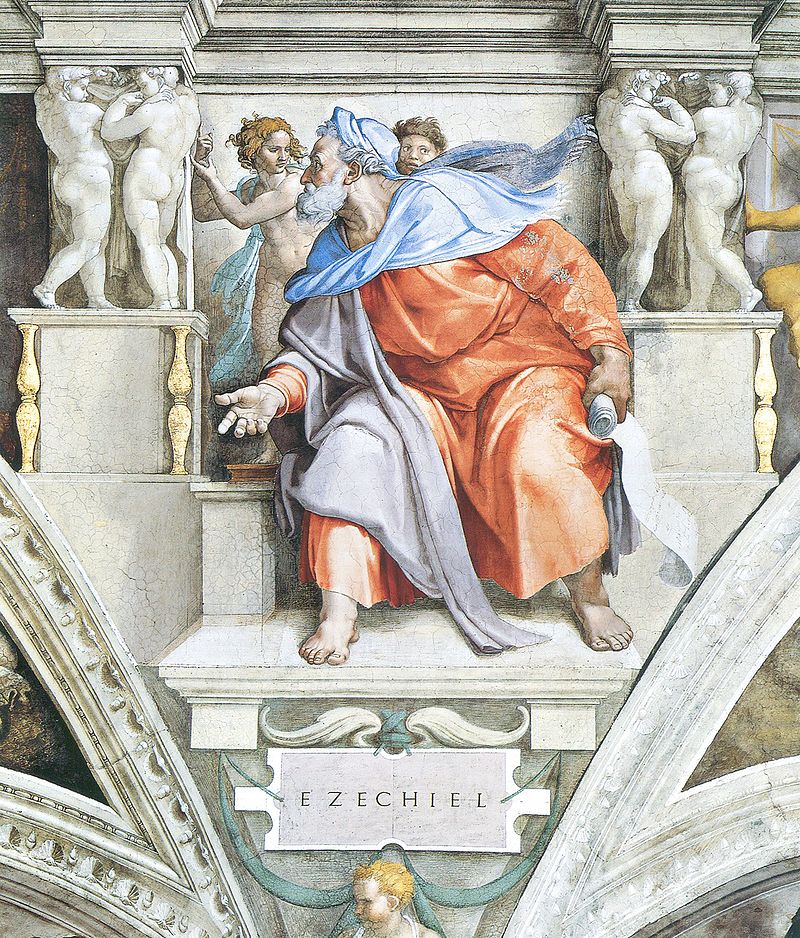
Michelangelo's Ezekiel on the Sistine Chapel
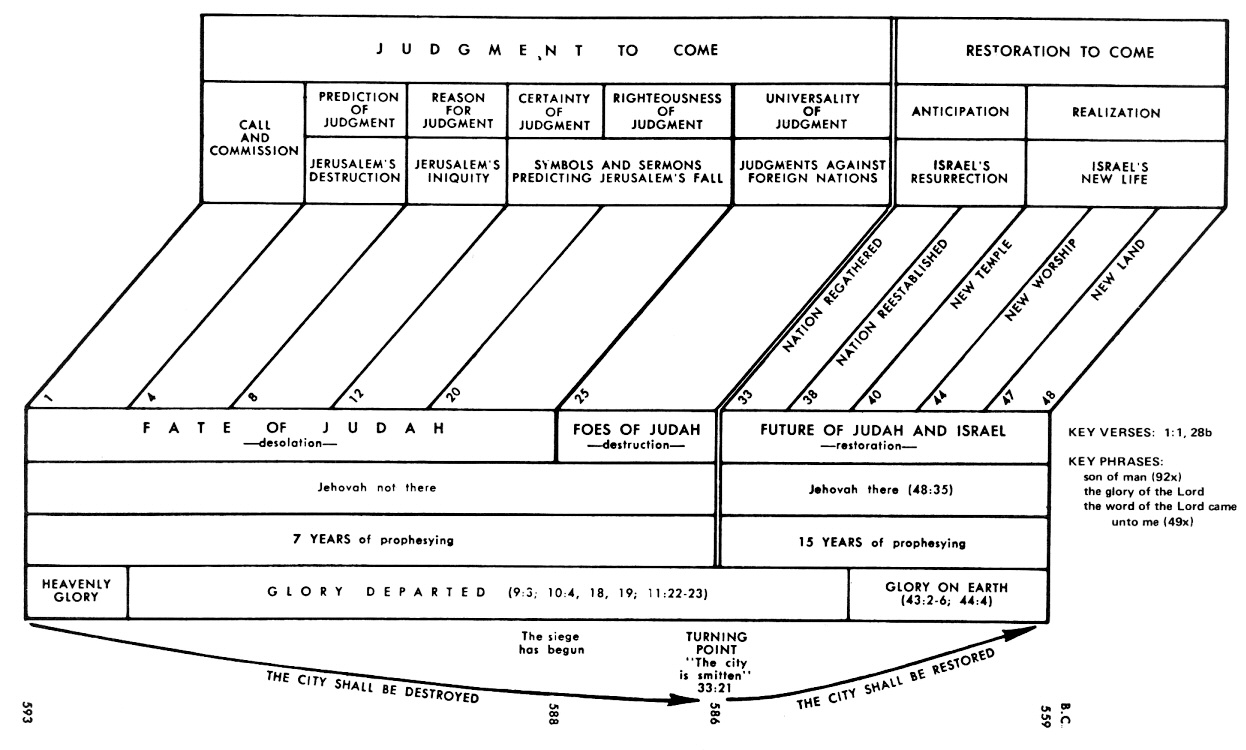
Click chart to enlarge
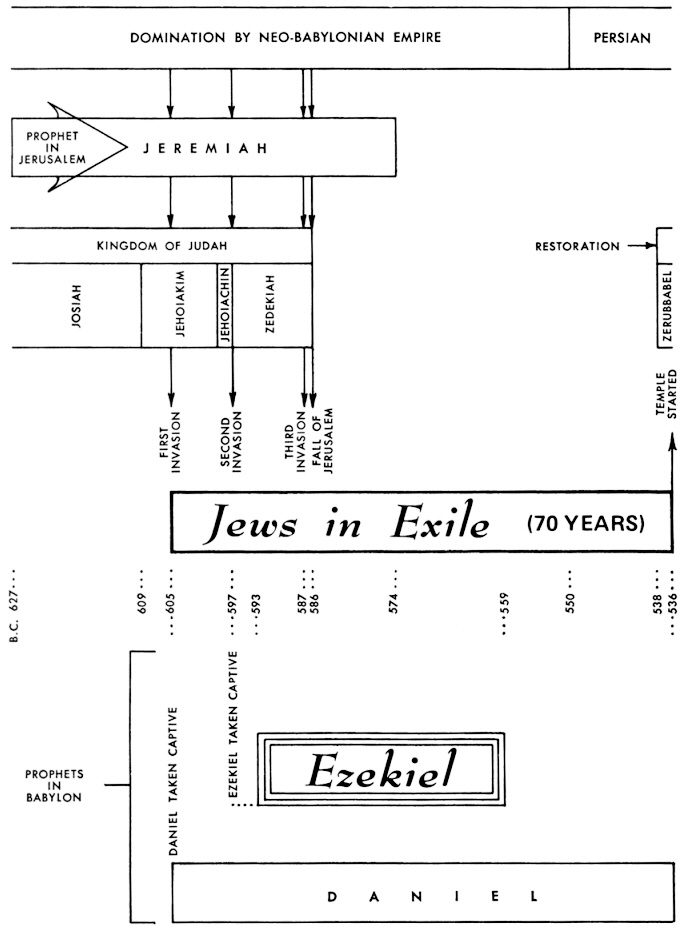
Click chart to enlarge
Chart from recommended resource Jensen's Survey of the OT - used by permission
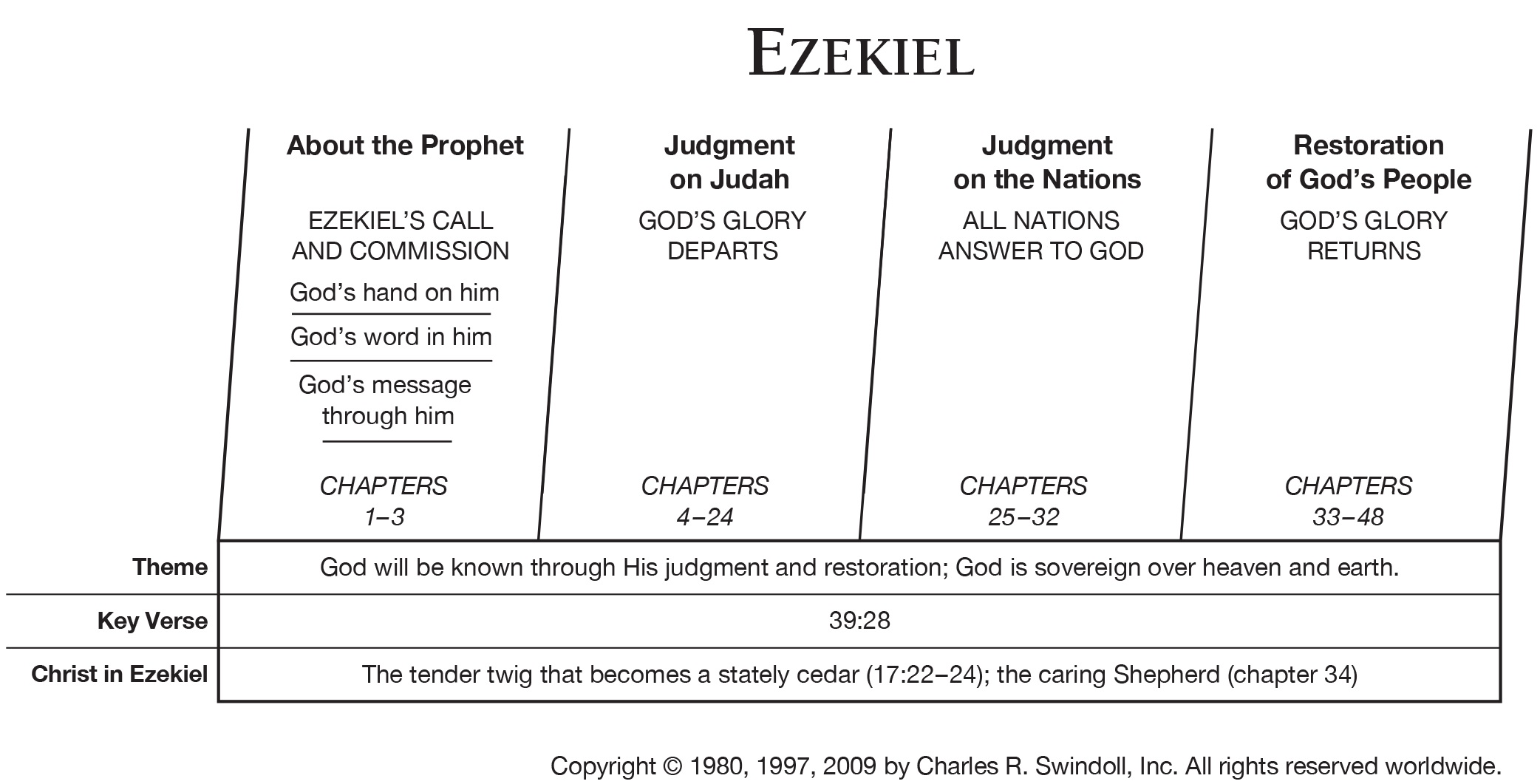
Click Chart from Charles Swindoll
|
PROPHECY OF |
PROPHECY OF |
|||
| FATE OF JUDAH Before the Siege |
FOES OF JUDAH During the Siege |
FUTURE OF JUDAH After the Siege |
||
|
593-588 BC |
587-586 |
586-571 |
||
|
7 YEARS |
15 YEARS |
|||
| Ezekiel 1:1-3:27 Ezekiel Sees the Glory & Receives the Call |
Ezekiel 4:1-24:27 Judgments Against Judah |
Ezekiel 25:1-32:32 Judgments Against the Gloating Nations |
Ezekiel 33:1-39:29 Restoration of Israel to the LORD |
Ezekiel 40:1-48:35 Visions of the Temple Jehovah Shammah |
Outline of the Book of Ezekiel from Dr John MacArthur - The book can be largely divided into sections about condemnation/retribution and then consolation/restoration. A more detailed look divides the book into 4 sections. First, are prophecies on the ruin of Jerusalem (Ezekiel 1:1–24:27). Second, are prophecies of retribution on nearby nations (Ezekiel 25:1–32:32), with a glimpse at God’s future restoration of Israel (Ezekiel 28:25,26). Thirdly, there is a transition chapter (Ezekiel 33:1-33) which gives instruction concerning a last call for Israel to repent. Finally, the fourth division includes rich expectations involving God’s future restoration of Israel (Ezekiel 34:1–48:35). (Reference)
I. Prophecies of Jerusalem’s Ruin (Ezekiel 1:1–24:27)
A. Preparation and Commission of Ezekiel (Ezekiel 1:1–3:27)
1. Divine appearance to Ezekiel (Ezekiel 1:1–28)|
2. Divine assignment to Ezekiel (Ezekiel 2:1–3:27)
B. Proclamation of Jerusalem’s Condemnation (Ezekiel 4:1–24:27)
1. Signs of coming judgment (Ezekiel 4:1–5:4)
2. Messages concerning judgment (Ezekiel 5:5–7:27)
3. Visions concerning abomination in the city and temple (Ezekiel 8:1–11:25)
4. Explanations of judgment (Ezekiel 12:1–24:27)
II. Prophecies of Retribution to the Nations (Ezekiel 25:1–32:32)
A. Ammon (Ezekiel 25:1–7)
B. Moab (Ezekiel 25:8–11)
C. Edom (Ezekiel 25:12–14)
D. Philistia (Ezekiel 25:15–17)
E. Tyre (Ezekiel 26:1–28:19)
F. Sidon (Ezekiel 28:20–24)
Excursus: The Restoration of Israel (Ezekiel 28:25, 26)
G. Egypt (Ezekiel 29:1–32:32)
III. Provision for Israel’s Repentance (Ezekiel 33:1–33)
IV. Prophecies of Israel’s Restoration (Ezekiel 34:1–48:35)
A. Regathering of Israel to the Land (Ezekiel 34:1–37:28)
1. Promise of a True Shepherd (Ezekiel 34:1–31)
2. Punishment of the nations (Ezekiel 35:1–36:7)
3. Purposes of restoration (Ezekiel 36:8–38)
4. Pictures of restoration—dry bones and two sticks (Ezekiel 37:1–28)
B. Removal of Israel’s Enemies from the Land (Ezekiel 38:1–39:29)
1. Invasion of Gog to plunder Israel (Ezekiel 38:1–16)
2. Intervention of God to protect Israel (Ezekiel 38:17–39:29)
C. Reinstatement of True Worship in Israel (Ezekiel 40:1–46:24)
1. New temple (Ezekiel 40:1–43:12)
2. New worship (Ezekiel 43:13–46:24)
D. Redistribution of the Land in Israel (Ezekiel 47:1–48:35)
1. Position of the river (Ezekiel 47:1–12)
2. Portions for the tribes (Ezekiel 47:13–48:35)
Ezekiel 14:1 Then some elders of Israel came to me and sat down before me.
- Elders Ezek 8:1; 20:1; 2 Ki6:32; Ac4:5,8
- Sat down - Ezek 33:31; Is 29:13; Lk 10:39; Ac22:3
Elders is the Hebrew word zaqen which means literally "to be old", and in the present context refers to a leader in the community or one who makes religious, social, and leadership decisions. For example Moses was instructed by God to "gather for Me seventy men from the elders of Israel, whom you know to be the elders of the people and their officers and bring them to the tent of meeting, and let them take their stand there with you." (Nu 11:16)
These elders were to function as leaders under Moses to enable him to delegate responsibility. In Ezekiel we see that the spiritual leaders of the Jews in exile seem to respect Ezekiel even though they for the most part have failed to learn from his repeated warnings. These counselors were not very wise for Proverbs 1:5 says that "a wise man will hear and increase learning, and a man of understanding will attain wise counsel."
The Hebrew word for learning means "a taking in." A willingness to learn and is a mark of growth and wisdom. One must be open to God's truth as He teaches us through His Word and the people around us. Are you listening, testing, and learning? Or are you like these elders who had ears, yet did not hear? What is God saying to you through some circumstance, some friend's advice, the Scripture passage you read this morning, etc?
Wiersbe - The prophet had seen idols in the temple in Jerusalem (chap. 8), but now he saw idols in the hearts of the elders in Babylon (vv. 3, 4, 7). God had disciplined those men by taking them from Judah to Babylon, and He had been merciful to them in sparing their lives; yet nothing brought them to repentance. They pretended to be spiritual by inquiring of Ezekiel, but God saw their hearts and told His servant the truth (Heb. 4:13). Judgment was inevitable: famine, hungry beasts, war, and pestilence (Rev. 6:1–8). Noah saved his family (Heb. 11:7), Daniel rescued his friends (Dan. 2), and Job prayed for his three friends and delivered them (Job 42:7–10); but nobody’s intercession would save Jerusalem or anybody in it. A person’s righteousness could save only himself or herself; it could not save another. Cherishing sin in the heart will lead to practicing sin in the life: “For as he thinks in his heart, so is he” (Prov. 23:7). A good prayer for all of us is Psalm 139:23–24. (Borrow copy of With the Word)
Ezekiel 14:2 And the word of the LORD came to me, saying,
And the word of the LORD came to me, saying - As stated so clearly in Amos "Surely the Lord GOD does nothing unless He reveals His secret counsel to His servants the prophets." (Am 3:7)
Ezekiel 14:3 "Son of man, these men have set up their idols in their hearts and have put right before their faces the stumbling block of their iniquity. Should I be consulted by them at all?
Brenton: Son of man, these men have conceived their devices in their hearts, and have set before their faces the punishment of their iniquities: shall I indeed answer them? (Septuagint Greek translation of Hebrew)
BBE: Son of man, these men have taken their false gods into their hearts and put before their faces the sin which is the cause of their fall: am I to give ear when they come to me for directions?
GWT: Son of man, these people are devoted to their idols, and they are allowing themselves to fall into sin. Should they be allowed to ask me for help?
ICB: "Human being, these men love to worship idols. They put up evil things that cause people to sin. Should I allow them to ask me for help?
TLB: “Son of dust, these men worship idols in their hearts—should I let them ask me anything? Tell them, ‘The Lord God says: I, the Lord, will personally deal with anyone in Israel who worships idols and then comes to ask my help.
YLT Son of man, these men have caused their idols to go up on their heart, and the stumbling-block of their iniquity they have put over-against their faces; am I inquired of at all by them? "These men" (Ezek 14:4,7; Je17:1,2,9; Ep5:5), refers to the elders, the leaders of the exilic community, who knew that Ezekiel was a prophet of God. What their inquiry was we cannot be certain and it is of little import as God would not hear it anyway because of their sin of idolatry.
- these men: Eze 14:4,7 6:9 11:21 20:16 36:25 Jer 17:1,2,9 Eph 5:5
- and put: Eze 3:20 7:19 44:12 Jer 44:16-18 Zep 1:3 1Pe 2:8 Rev 2:14
- should: Eze 20:3 1Sa 28:6 2Ki 3:13 Ps 66:18 101:3 Pr 15:8,29 21:27 28:9 Isa 1:15 33:15 Jer 7:8-11 11:11 42:20,21 Zec 7:13 Lu 20:8
HYPOCRITICAL
ELDERS
The leaders "have set up their idols in their hearts" -- When we hear the word idol, we often think of a statue of a person or animal that is the focus of worship, but remember that an idol is ANYTHING that takes the place of God. In Ezekiel 8 we saw idols in the temple but now we see idols in the hearts of elders who are exile! One would have thought the discipline of exile would have brought them to repentance but that was not to be. Their hearts were stubborn and obstinate!
Nothing between, like worldly pleasure,
Habits of life, though harmless they seem,
Must not my heart from Him ever sever–
He is my all! There's nothing between.
–Tindley
THOUGHT - What's the main focus of your life? The answer may surprise you. As Joanie Yoder writes "I read about a woman who kept her car in showroom condition. One night her garage caught on fire, and her neighbors had to restrain her from rushing into the flames to rescue her car. As it exploded, she realized that she had nearly sacrificed her life for that car. It had become an idol. An even more subtle form of idolatry is the reliance on our church activities to maintain a reputation for being spiritual. Or consider the man who keeps adding "one more gadget" to an already over-equipped home. If anything other than God becomes our primary focus in life, it is an idol."
God had earlier spoken of the effect Israel's idolatry saying "… how I have been hurt by their adulterous hearts which turned away from Me, and by their eyes, which played the harlot after their idols… " (Ezek 6:9) emphasizing that "their heart continually went after their idols." (Ezek 20:16). God decreed that "for those whose hearts go after their detestable things and abominations, (He would) bring their conduct down on their heads" (Ezek 11:21)
Yet even in the face of His decree of certain judgment, God prophesied of a coming day when He would "sprinkle clean water on (Israel), and (Israel would) be clean" and He would "cleanse (her) from all (her) filthiness and from all (her) idols." adding that He would " give (her) a new heart and put a new spirit within (her); and… remove the heart of stone from (her) flesh and give (her) a heart of flesh." (Ezek 36:25-26+)
Henry Morris comments in the Defender's Study Bible that "The elders of Israel in Babylon no longer had actual images to worship, but kept these "idols in their heart," still thinking they could somehow get back to Jerusalem, ignoring God's instructions."
Believer's Study Bible adds that The sin of the inquirers who came to Ezekiel was not open idolatry, but the setting up of "idols in their hearts." They were influenced by pagan thoughts and practices, and no longer gave primary allegiance to Yahweh."
The elders had "put right before their faces the stumbling block of their iniquity" (all 14 uses of mikshowl, "stumbling block" in the OT: Lv19:14, 1Sa25:31, Ps 119:165, Is8:14,57:14, Je6:21, 8 uses in Ezekiel) Although the idolatry in Jerusalem was blatant and openly displayed (as dramatically demonstrated in Ezekiel 8), the idolatry among the exiles in Babylon was more subtle because the "altar" was internal rather than external. A stumbling block is something that would trip someone up and cause them to fall. Here their idolatry is like an obstacle or stumbling block which would cause the people to fall, the fall in this case referring to the defeat and destruction of Jerusalem. In Ezekiel is seen as the major cause of the "fall" of God's people. In Ezekiel 7:19 their silver and gold were the "idol" over which Israel had stumbled into sin.
Jesus speaking to the church at Pergamum warned "I have a few things against you, because you have there some who hold the teaching of Balaam, who kept teaching Balak to put a stumbling block before the sons of Israel, to eat things sacrificed to idols, and to commit acts of immorality." (Rev 2:14+)
The idea of a stumbling block is that which produces a snare or trap. The sin of idolatry may "look good" and therefore deceptively and successfully lure and entrap its victim but the end result is moral devastation and death, even physical death.
The psalmist gives one of the best "shields" against stumbling blocks writing "Those who love Thy law have great peace and nothing cause them to stumble" (Ps 119:165)
Internal idolatry is still idolatry and is still visible to the omniscient eyes of God "for the eyes of the LORD move to and fro throughout the earth that He may strongly support those whose heart is completely His… (1Chr 16:9)
Should I be consulted by them at all? - The implied answer is "no". God asks a similar question in Jeremiah
Will you steal, murder, and commit adultery, and swear falsely, and offer sacrifices to Baal, and walk after other gods that you have not known, then come and stand before Me in this house, which is called by My name, and say, ‘We are delivered!’—that you may do all these abominations?" (Jer7:9-10)
As the psalmist says "If I regard wickedness in my heart, the Lord will not hear." (Ps 66:18)
More to the point God says in Ezekiel "Son of man, speak to the elders of Israel, and say to them, ‘Thus says the Lord God, “Do you come to inquire of Me? As I live,” declares the Lord God, “I will not be inquired of by you." (Ezek 20:3)
Because of his disobedience "when Saul inquired of the Lord, the Lord did not answer him, either by dreams or by Urim or by prophets." (1Sa 28:6) for "He who turns away his ear from listening to the law, even his prayer is an abomination." (Pr 28:9) "The Lord is far from the wicked, but He hears the prayer of the righteous." (Pr15:29)
The Heart Of Idolatry - When my husband and I first went out as missionaries, I was concerned about the growth of materialism in our society. It never even crossed my mind that I myself could be materialistic. After all, hadn't we gone overseas with almost nothing? Weren't we having to live in an old, shabbily furnished, rundown apartment? I thought materialism couldn't touch us.
Nonetheless, feelings of discontent gradually began to take root in my heart. Before long I was craving nice things and secretly feeling resentful over not having them. Then one day God's Spirit opened my eyes with a disturbing insight: Materialism isn't necessarily having things; it can also be craving them. There I stood—guilty of materialism! The Lord had exposed my discontentment for what it really was—an idol in my heart. That day as I repented of this subtle sin, God recaptured my heart as His rightful throne. Needless to say, a deep contentment followed, based not on things but on Him.
In Ezekiel's day, the Lord exposed the idolatry in the hearts of His people (Ezekiel 14:3-7). And today He longs for us to rid our hearts of anything that destroys our contentment with Him. —J Yoder (Our Daily Bread, Copyright RBC Ministries, Grand Rapids, MI. Reprinted by permission. All rights reserved)
The dearest idol I have known,
Whate'er that idol be,
Help me to tear it from Thy throne
And worship only Thee.
—Cowper
An idol is anything that takes God's rightful place
Making Jesus Into An Idol -Why would John end his letter by writing, "Little children, keep yourselves from idols"? (1Jn. 5:21). Certainly his words do not apply to us, do they? We don't have false gods in our living rooms, do we?
What exactly did John mean by "idols"?
It's unlikely he was talking about the gods of metal and stone so prevalent in his time. Those kinds of idols were not as great a temptation to the people he was writing to as they had been to their ancestors.
An idol, however, can be any false idea about God or substitute for Him that turns us away from knowing His true character. John stated that Jesus Christ is the true God (v.20). To know Jesus is to know the Father. To be intimately related to His Son is to be forever related to the eternal God.
It is possible for me to worship an idol I call "Jesus" that leads me away from Him. Perhaps my Jesus resembles a teddy bear that lulls me to sleep, or an indulgent father, or a Santa Claus who doesn't take my sin seriously. Such misconceptions are not the Jesus of the Bible but an idol. That's the reason John warned us to keep ourselves from idols.
Be careful. Devotion to a false Jesus is idolatry. But knowing Jesus, the true God, brings us eternal life. — Haddon W. Robinson (Our Daily Bread, Copyright RBC Ministries, Grand Rapids, MI. Reprinted by permission. All rights reserved)
So often, Lord, in seeking You,
My sin distorts and dims my view;
Help me in prayer to see Your face
And learn Your righteousness and grace.
--Gustafson
We are made in God's image--
He is not to be made in ours
A Slow Fourth - When golf professional Paul Azinger learned in 1993 that he had cancer, he said, "I was in shock. I had thought that Dr. Jobe would tell me they had discovered some form of weird infection in my shoulder or possibly even a stress fracture. The one word I never expected to hear him say was cancer."
The good news was that it was curable. Now, after some time away from the professional golf tour for chemotherapy and radiation treatments, the man who's called "Zinger" is back, cancer-free.
When people ask Azinger if golf is still important to him, he says, "Yes and no. Yes, of course golf is important to me. I love the game; it is how I make a living. But no, golf is no longer at the top of my priority list. In fact, it runs a slow fourth. My priorities now are God, my family, my friends, and golf. Golf is no longer my god. Golf is hitting a little white ball. God is my God, and God is a whole lot bigger than golf."
A serious disease has a way of putting things in perspective. First place belongs to the Lord; we are to worship nothing in our lives above Him (Dt. 6:13-19).
Make God number one in your life, and your dearest pastime on earth will become only a "slow fourth." — David C. Egner (Our Daily Bread, Copyright RBC Ministries, Grand Rapids, MI. Reprinted by permission. All rights reserved)
Let me hold lightly the things of this earth;
Transient treasures, what are they worth?
Moths can corrupt them, rust can decay;
All their bright beauty fades in a day.
--Nicholson
An idol is anything that takes the place of God.
Something Else To Serve - If you were to spend 26 hours a week staring at the same object, what would you call that? If you were so mesmerized by what you saw that you couldn't tear yourself away from it, what would it become to you? If you let it change the way you think and act, would it be too powerful? If you let this object show and tell you things that you knew were wrong and that God didn't want you to be involved with, would it be replacing Him? Wouldn't that be called an idol?
The average American family spends 26 hours a week watching television. It certainly isn't the only idol we have in our society, but it's one of the most powerful. Other things that might be displacing our devotion to God are sports, money, work, hobbies, or even other people. Perhaps music or movies or the Internet has captured our devotion.
Idols come in various forms, and they can control our lives. When they do, we need to look again at God's anger with the Israelites to see what He thinks of idols. They served Baals and Asherahs (Jdg 3:7), and "the anger of the Lord was hot" against them (Jdg 3:8).
Let's check our devotion. Have we given our allegiance to anything other than the Almighty God who created us? We should serve nothing but Him. — Dave Branon (Our Daily Bread, Copyright RBC Ministries, Grand Rapids, MI. Reprinted by permission. All rights reserved)
The gods of this world are empty and vain,
They cannot give peace to our heart;
The living and true One deserves all our love--
From Him may we never depart.
—DJD
An idol is anything that takes the place of God.
Ezekiel 14:4 "Therefore speak to them and tell them, 'Thus says the Lord GOD, "Any man of the house of Israel who sets up his idols in his heart, puts right before his face the stumbling block of his iniquity, and then comes to the prophet, I the LORD will be brought to give him an answer in the matter in view of the multitude of his idols,
AMP: Therefore speak to them and say to them, Thus says the Lord God: Every man of the house of Israel who takes his idols [of self-will and unsubmissiveness] into his heart and puts the stumbling block of his iniquity [idols of silver and gold] before his face, and yet comes to the prophet [to inquire of him], I the Lord will answer him, answer him according to the multitude of his idols,
BBE: For this cause say to them, These are the words of the Lord: Every man of Israel who has taken his false god into his heart, and put before his face the sin which is the cause of his fall, and comes to the prophet; I the Lord will give him an answer by myself in agreement with the number of his false gods;
Brenton: Therefore speak to them, and thou shalt say to them, Thus saith the Lord; Any man of the house of Israel, who shall conceive his devices in his heart, and shall set the punishment of his iniquity before his face, and shall come to the prophet; I the Lord will answer him according to the things in which his mind is entangled (English of Greek Septuagint)
GNB: “Now speak to them and tell them what I, the Sovereign Lord, am saying to them: every Israelite who has given his heart to idols and lets them lead him into sin and who then comes to consult a prophet, will get an answer from me—the answer that his many idols deserve!
ICB: So speak to them. Tell them, 'This is what the Lord God says: Any person in Israel might want to worship idols. He might even put up evil things that cause people to sin. Then he might come to the prophet. When he does, I, the Lord, will answer him. I will put him to death because he worshiped idols.
NIV: Therefore speak to them and tell them, 'This is what the Sovereign LORD says: When any Israelite sets up idols in his heart and puts a wicked stumbling block before his face and then goes to a prophet, I the LORD will answer him myself in keeping with his great idolatry.
YLT 'Therefore, speak with them, and thou hast said unto them: Thus said the Lord Jehovah: Every one of the house of Israel who causeth his idols to go up unto his heart, and the stumbling-block of his iniquity setteth over-against his face, and hath gone in unto the prophet -- I Jehovah have given an answer to him for this, for the abundance of his idols,
- speak: Eze 2:7 3:4,17-21
- I the Lord: Eze 14:7 1Ki 21:20-25 2Ki 1:16 Isa 3:11 66:4
Any man of the house of Israel who sets up his idols in his heart, puts right before his face the stumbling block of his iniquity In Ezekiel 18 God adds "I will judge you, O house of Israel, each according to his conduct,” declares the Lord God. “Repent and turn away from all your transgressions, so that iniquity may not become a stumbling block to you." (Ezek 18:30)
I the LORD will be brought to give him an answer in the matter in view of the multitude of his idols" (Ezek 14:7; 1 Ki21:20-25; 2Ki1:16; Isa3:11; 66:4) These hypocritical elders came to inquire of the true God even though they had another ”god“ in their heart. Because of their divided hearts, they would receive no verbal answer, but would be answered directly by Jehovah Himself in the form of judgment.
Charles Dyer adds that "God was not obligated to answer them when they refused to acknowledge His sovereignty. So instead of giving these elders the information they desired, God instructed Ezekiel to give them the information they needed—God’s attitude toward their idolatry."
In view of the multitude of his idols" - "in keeping with his great idolatry" (NIV), "according to the multitude of his idols" (NKJV). The Greek Septuagint translates the Hebrew "according to the things in which his mind is entangled (translating the Greek verb enecho which in the passive voice means to "let oneself be entangled in", in this case entangled in idolatry)."
This reminds one of David's declaration in Psalm 101 where he says that
I will set no worthless thing before my eyes. I hate the work of those who fall away; It shall not fasten its grip (Hebrew = stick like glue) on me." (Ps101:3)
Idols are like the proverbial "tar baby" and you can't "touch" them without becoming stuck to them, at least to some degree. Do you have any "tar babies" in your heart?
Lest you think that modern societies do not worship idols simply because they may not worship carved images of deities, animals, etc, read the following story from Our Daily Bread…
The Wrong God - A missionary had been witnessing faithfully to a certain man who was an idol worshiper. One day the man placed a small statue and a silver coin on the table in front of the missionary. Then he took two slips of paper and wrote something on each. On the note by the idol he wrote the words heathen god. On the sheet next to the silver coin he wrote the words Christian god.
From what that man had observed in the lives of some people from so-called Christian nations, he had concluded that money was the main object of their adoration and the source of their confidence.
Many people today choose to worship the god of money. They make it the object of their trust, love, and service. But how foolish! Jesus warned, "How hard it is for those who trust in riches to enter the kingdom of God!" (Mk. 10:24).
Who or what is the object of your worship? The psalmist advised, "Put your trust in the Lord" (Ps. 4:5). Moses commanded, "You shall love the Lord" (Dt. 6:5), and Joshua told his people, "As for me and my house, we will serve the Lord" (Josh. 24:15).
Be sure that your confidence is not in the wrong god. Place your trust in Christ. — Richard De Haan (Our Daily Bread, Copyright RBC Ministries, Grand Rapids, MI. Reprinted by permission. All rights reserved)
True joy comes from loving Jesus
Not from things that we amass;
He alone brings joy and gladness,
Peace and love that really last. --Pasch
Never let gold become your god!
Ezekiel 14:5 in order to lay hold of the hearts of the house of Israel who are estranged from Me through all their idols."'
Brenton: that he should turn aside the house of Israel, according to their hearts that are estranged from Me in their thoughts. (English of Greek Septuagint)
CEV When they hear my message, maybe they will see that they need to turn back to Me and stop worshiping those idols.
GWT I will do this to recapture the hearts of the nation of Israel. They have deserted me because of their disgusting idols.'
ICB Then I will win back my people Israel. They have left me because of all their idols.'
NAB Thus would I bring back to their senses the house of Israel, who have become estranged from Me through all their idols.
NET in order to capture the hearts of the house of Israel, who are estranged from Me on account of all their idols.'
NIV I will do this to recapture the hearts of the people of Israel, who have all deserted Me for their idols.'
NKJV that I may seize the house of Israel by their heart, because they are all estranged from Me by their idols."'
Tanakh: Thus I will hold the House of Israel to account for their thoughts, because they have all been estranged from Me through their fetishes.
YLT in order to catch the house of Israel by their heart, in that they have become estranged from off Me by their idols--all of them.
- in order to lay hold of the hearts: Eze 14:9,10 Ho 10:2 Zec 7:11-14 2Th 2:9-11
- estranged: De 32:15,16 Isa 1:4 *marg: Jer 2:5,11-13,31,32 Zec 11:8 Ro 1:21-23,28,30 8:7 Ga 6:7 Eph 4:18 Col 1:21 Heb 3:12
"In order to lay hold of the hearts" The Hebrew verb "lay hold of" means basically to seize or take hold of, sometimes preparatory to further action. Vine and the TWOT say that in this context, the laying hold of the hearts of the house of Israel is for the purpose of terrorizing them. That is certainly possible (especially in the context of the call in verse 6 to "repent") but there is another explanation discussed below.
The Lord would call Israel to account for their idolatry, for He cannot tolerate a divided heart. But He would do so with the purpose of laying hold of (capture, recapture, bring back to their senses, turn aside) their alienated, adulterous hearts (Ezek 14:9,10; Ho10:2; Zech7:11-14; 2Th 2:9, 10, 11).
The idea therefore may be that by bringing them into judgment, some of those in the house of Israel might come to their senses (see NAB translation above) and be convinced by their own smitten consciences when they see the death and destruction their idolatry has reaped. There is a similar idea in 2 Timothy where God's bondservant speak (although here is called to speak gently) to
those who are in opposition, if perhaps God may grant them repentance leading to the knowledge of the truth, and they may come to their senses and escape from the snare of the devil, having been held captive by him to do his will." (2Ti2:25, 26-note)
Israel is "estranged from" zur (the basic meaning is to turn aside but in some other contexts this Hebrew verb zur is translated "commit adultery"!) (Dt 32:15,16; Is 1:4-note; Jer 2:5,11,12, 13,31,32; Zech11:8; Ro1:28,30; Gal6:7; Eph4:18; Col1:21) Idolatry estranges and alienates men from the living God. Israel was called to be the "wife" (cf Isa 54:5, Jer 2:2, 31:32) of God and so has committed "spiritual adultery" by seeking other so-called gods.
To be estranged implies the development of enmity, indifference or hostility with consequent separation or divorcement between the parties in which there had formerly been love, affection, or friendliness.
To be alienated is similar and means to be made unfriendly, hostile, or indifferent where attachment formerly existed. The Greek translation (Septuagint) uses an interesting Greek word to translate the last portion of this verse, describing Israel as "estranged from Me in their thoughts" instead of "through all their idols". Idolatry is not a passive process but does influence our thinking for as a man thinks in his heart (where he has set up his idols) so he is. (cf Pr 23:7)
Earlier Ezekiel had recorded God's reaction to Israel's sin writing that those Jews
who escape will remember Me among the nations to which they will be carried captive, how I have been hurt by their adulterous hearts which turned away from (same Hebrew word zur translated estranged) Me, and by their eyes, which played the harlot after their idols; and they will loathe themselves in their own sight for the evils which they have committed, for all their abominations (see discussion of genuine repentance under next verse)." (Ezek 6:9)
Paul speaks to the root cause of this estrangement and alienation in Romans writing that
even though they knew God, they did not honor Him as God or give thanks, but they became futile in their speculations, and their foolish heart was darkened. Professing to be wise, they became fools, and exchanged the glory of the incorruptible God for an image in the form of corruptible man and of birds and four-footed animals and crawling creatures" (Ro 1:21, 22, 23-note)
Paul adds that
the mind set on the flesh is hostile toward God; for it does not subject itself to the law of God, for it is not even able to do so. (Ro 8:7-note)
The writer of Hebrews exhorts all of us to
Take care, brethren, lest there should be in any one of you an evil, unbelieving heart, in falling away from the living God. But encourage one another day after day, as long as it is still called "Today," lest any one of you be hardened by the deceitfulness of sin." (Heb 3:12-note, Heb 3:13-note) (See Related Discussion: The Deceitfulness of Sin)
Ezekiel 14:6 "Therefore say to the house of Israel, 'Thus says the Lord GOD, "Repent and turn away from your idols and turn your faces away from all your abominations.
Brenton: Therefore say to the house of Israel, Thus saith the Lord God, "Be converted (all three verbs are aorist imperative = do this now! return to the point where you once were, turn around, change direction) and turn (away) from your evil practices (your habitual way of living), and from all your sins (literally asebeia = ungodliness, impiety, lack of reverence for God), and turn your faces back again. (English of Greek Septuagint).
Young's Literal: Therefore say unto the house of Israel: Thus said the Lord Jehovah: Turn ye back (Heb = shub), yea, turn ye back (Heb = shub) from your idols, and from all your abominations turn back (Heb = shub) your faces, In view of the gravity of the consequences of continued estrangement, God gives three staccato like commands (all imperative mood) in this verse (all the same Hebrew verb shub).
- Repent: Eze 18:30 1Sa 7:3 1Ki 8:47-49 Ne 1:8,9 Isa 55:6,7 Jer 8:5,6 Jer 31:18-20 50:4,5 La 3:39-41 Ho 14:1-3,8 Jon 3:7-9 Mt 3:8-10 Ac 3:19 17:30 26:20 Jas 4:8-10
- turn: Eze 14:4 8:16 16:63 36:31,32 2Ch 29:6 Isa 2:20 30:22 Jer 13:27 Zep 3:11 Ro 6:21
Repent and turn away from your idols" The elders came to consult God but God refused to be consulted by them on their terms, instead telling them what they desperately needed to hear, not necessarily what they wanted to hear. God often has to make us miserable through conviction in order to make us joyful through confession.
As someone has well said "Repentance is the hurt that leads to healing."
In Romans Paul addressing the Jews (and "religious" people in general) in chapter 2 asks
do you think lightly of the riches of His kindness and forbearance and patience, not knowing that the kindness of God leads you to repentance?" (Ro 2:4)
This is a mystery of grace to me - God calls them to repent and yet it is God Who grants repentance.
Perhaps, as you are reading about Israel's duplicity and secret sin of idolatry, you are convicted and realize that the Holy Spirit is speaking to some idol in your heart, one that you have held fast to for months or even years. If so the pattern of "repent and return" is your way back to God. In Acts Peter is speaking to the unbelieving Jews and calls them to
Repent therefore and return, that your sins may be wiped away, in order that times of refreshing may come from the presence of the Lord and that He may send Jesus, the Messiah appointed for you." (Acts 3:19, 20).
Perhaps you too need to repent for the first time and be saved. Or perhaps you are a believer and you have slowly drifted away from the fervency of your first love for Jesus. Click "The Way Back Home" for an excellent small booklet from Radio Bible Class that addresses this issue in more detail.
Repentance is to leave the sin
That I had loved before,
And show that I am grieved by it
By doing it no more. –Anon.
Shub indicates a distinct reversal or change of direction, as when "the water receded ("repented" or reversed its direction) steadily from the earth" after the worldwide flood. (Ge 8:3). The repentant person is to have a change of mind about their former sinful ways, to reject past conduct and turn in obedience to the Lord. In other words, genuine repentance is manifest not with just words but with actions.
As Paul wrote
the sorrow (because of the sin) that is according to the will of God produces a repentance without regret, leading to salvation; but the sorrow of the world (remorse because of the consequences) produces death." (2Cor7:10)
When we feel sorry for doing wrong or for getting caught, it is nothing more than a "spiritual cosmetic'. But true repentance occurs deep in our hearts and results in a visible difference in our actions. Repentance means hating sin enough to turn from it. The change of mind that is the heart of repentance should become a pattern of thinking--a lifestyle. Genuine repentance has at least four facets --
comprehension of wrong done, cleansing sought with earnest grief (a "soft face and soft heart"), desire for the presence of God, and changed action." (Ryken, L, et al, Dictionary of biblical imagery: Downers Grove, IL: InterVarsity Press.)
It's never too soon to repent
But
One day it will be too late.
In Hosea we read the call to
Return, O Israel, to the LORD your God, for you have stumbled because of your iniquity. Take words with you and return to the LORD. Say to Him, "Take away all iniquity, and receive us graciously, that we may present the fruit of our lips." (Ho14:1-2)
God says
I have no pleasure in the death of anyone who dies," declares the Lord GOD. "Therefore, repent and live." (Ezek18:32)
In Solomon's prayer at the dedication of the Temple he prayed for Israel asking that
When they sin against Thee (for there is no man who does not sin) and Thou art angry with them and dost deliver them to an enemy, so that they take them away captive to the land of the enemy, far off or near (which is where Ezekiel and the elders were) if they take thought in the land where they have been taken captive (God's reply to the elders was to "lay hold of their hearts" that they might come to their senses) and repent and make supplication to Thee in the land of those who have taken them captive, saying, 'We have sinned and have committed iniquity, we have acted wickedly', if they return to Thee with all their heart and with all their soul in the land of their enemies who have taken them captive, and pray to Thee toward their land which Thou hast given to their fathers, the city which Thou hast chosen (Jerusalem), and the house which I have built for Thy name (God's Temple) then hear their prayer and their supplication in heaven Thy dwelling place, and maintain their cause, and forgive Thy people who have sinned against Thee and all their transgressions which they have transgressed against Thee, and make them objects of compassion before those who have taken them captive, that they may have compassion on them" (1Ki8:46-50)
Turn away from your idols (Ezek 8:16; 16:63; 36:31,32; 2 Chr29:6; Is2:20; 30:22; Jer13:27; Zeph3:11; Ro6:21) True repentance turns from the wrong and returns to the right.
The gods of this world are empty and vain,
They cannot give peace to our heart;
The living and true One deserves all our love--
From Him may we never depart. --DJD
Ezekiel 14:7 "For anyone of the house of Israel or of the immigrants who stay in Israel who separates himself from Me, sets up his idols in his heart, puts right before his face the stumbling block of his iniquity, and then comes to the prophet to inquire of Me for himself, I the LORD will be brought to answer him in My own person.
Brenton: For any man of the house of Israel or of the strangers (proselytos - our English "proselyte" = a religious technical term for one who has come over into Judaism from another religion, becoming a full Jew by being circumcised and by accepting the obligation of observing Jewish laws ) that sojourn (proselyteuo = present tense = continually live among) in Israel, who shall separate (apallotrioo [from apó = marker of dissociation implying rupture of former association & emphasizing the idea of separation + allotrióo = alienate] alienate, estrange, be entirely separated from and implying loss of affection or interest and even hostility) himself from me and conceive his imaginations (enthumema -thought, piece of reasoning, argument, invention, imagination) in his heart, and set before his face the punishment of his iniquity, and come to the prophet to enquire of him concerning me; I the Lord will answer him, according to the things wherein he is entangled. (enecho - present tense = continually being entangled by or under the control of) (English of Greek Septuagint).
ESV: For any one of the house of Israel, or of the strangers who sojourn in Israel, who separates himself from me, taking his idols into his heart and putting the stumbling block of his iniquity before his face, and yet comes to a prophet to consult me through him, I the LORD will answer him myself.
GWT: Suppose an Israelite or a foreigner who lives in Israel deserts me by devoting himself to idols and by allowing himself to fall into sin. If he goes to a prophet to ask for my help, I, the LORD, will give him an answer.
NIV: 'When any Israelite or any alien living in Israel separates himself from me and sets up idols in his heart and puts a wicked stumbling block before his face and then goes to a prophet to inquire of me, I the LORD will answer him myself.
NJB: for if any member of the House of Israel -- or any foreigner living in Israel -- deserts me to enshrine his foul idols in his heart and places the cause of his sinning right before his eyes and then approaches a prophet to consult me through him, he will get his answer from me, Yahweh.
- of the immigrants: Ex 12:48 20:10 Lev 16:29 20:2 24:22 Nu 15:15,29
- separates: Ho 4:14 9:10 Jude 1:19
- and sets: Eze 14:3,4
- and comes: Eze 33:30-32 2Ki 8:8-15 Isa 58:1,2 Jer 21:1,2 37:1-3,9,10,17 Jer 38:14-23
- in My own person: Eze 14:4,7,8
Immigrants (aliens, strangers, foreigners, sojourners) (Ex12:48; 20:10; Lv16:29; 20:2; 24:22; Nu15:15,29) is the Hebrew word (ger) referring to someone who did not enjoy all rights (e.g., they enjoyed civil rights but not property rights) usually possessed by residents. These strangers (in the present context referring to Gentiles) who were residing with the Jewish exiles were specifically included in God's warning against idolatry. This is not surprising for God had instructed Moses that
if a stranger sojourns with you, and celebrates the Passover to the LORD, let all his males be circumcised, and then let him come near to celebrate it; and he shall be like a native of the land. But no uncircumcised person may eat of it." (Ex12:48)
Separates (Ho4:14; 9:10; Jude19) is the Hebrew verb nazar which means to separate oneself, consecrate oneself, or act in a manner which shows devotion, loyalty, and respect toward an object, entity, or event. In this case the description is one who turns away from God and devotes himself or herself to idols. This is the same verb found in the Nazarite vow where the one who separates himself was to
abstain from wine and strong drink; he shall drink no vinegar, whether made from wine or strong drink, neither shall he drink any grape juice, nor eat fresh or dried grapes." (Nu 6:3)
How tragic that those who should have "separated" themselves from the profane and unto God, chose to pursue a path in direct opposition to God. For example in Hosea God says
I found Israel like grapes in the wilderness. I saw your forefathers as the earliest fruit on the fig tree in its first season. But they came to Baal-peor and devoted (nazar - separated) themselves to shame, and they became as detestable as that which they loved." (Hos9:10)
God had made it quite clear what Israel was to separate themselves from the profane.
In Leviticus we read
Do not render yourselves detestable through any of the swarming things that swarm; and you shall not make yourselves unclean with them so that you become unclean. For I am the LORD your God. Consecrate yourselves therefore, and be holy; for I am holy. And you shall not make yourselves unclean with any of the swarming things that swarm on the earth. For I am the LORD, who brought you up from the land of Egypt, to be your God; thus you shall be holy for I am holy.'" (Why Would Anyone Want To Be Holy?) (Lev 11:43-45)
Isaiah writing to Israel declares that
your iniquities have made a separation between you and your God, And your sins have hidden His face from you, so that He does not hear." (Isa 59:2)
God did not initiate the separation from Israel… they sin which resulted in separation from Him. If you feel "separated" from God, James gives the "antidote" writing that God "gives a greater grace" which calls for one to
Draw near to God and He will draw near to you. Cleanse your hands, you sinners; and purify your hearts, you double-minded. Be miserable and mourn and weep; let your laughter be turned into mourning, and your joy to gloom. Humble yourselves in the presence of the Lord, and He will exalt you." (Jas 4:7-10)
Lest we as New Testament saints be to critical of the Jews, we need to remember that
these things happened as examples for us, that we should not crave evil things, as they also craved. And do not be idolaters as some of them were… these things (death) happened to them as an example, and they were written for our instruction, upon whom the ends of the ages have come. Therefore let him who thinks he stands take heed lest he fall." (1Cor 10:6, 7, 11,12)
More purity give me, more strength to o'ercome,
More freedom from earth-stains, more longings for home,
More fit for the kingdom, more used would I be, <
More blessed and holy, more, Savior, like Thee. --Bliss
Take time to be holy, speak oft with thy Lord
Abide in Him always and feed on His Word.
Make friends of God's children, help those who are weak,
Forgetting in nothing His blessing to seek. —Longstaff
Comes to the prophet to inquire of Me" (Ezek 33:30-32; 2Ki8:8-15; Is8:1,2; Jer21:1,2; 37:1-3,9,10,17; Je38:14-23)
"I the LORD will be brought to answer him in My own person" If an Israelite or an alien was duplicitous and presumed on God while harboring idolatry, God would answer them in Person (in judgment). This truth is identical to God's warning in Ezek14:4, repeated here to emphasize the gravity of their sin. They would receive no verbal answer, but an answer directly from the Lord in the form of judgment.
Ezekiel 14:8 "I will set My face against that man and make him a sign and a proverb, and I will cut him off from among My people. So you will know that I am the LORD.
GWT: I will reject him, and I will make an example of him. I will exclude him from my people. Then you will know that I am the LORD.
NJB: I shall set my face against that person; I shall make him an example and a byword; I shall rid my people of him, and you will know that I am Yahweh.
TLB: I will turn upon him and make a terrible example of him, destroying him; and you shall know I am the Lord.
- I will set: Eze 15:7 Lev 17:10 20:3-6 26:17 Ps 34:16 Jer 21:10 44:11
- a sign: Eze 5:15 Nu 26:10 De 28:37 Ps 37:22 44:13,14 Isa 65:15 Jer 24:9 Jer 29:22
- I will cut: Lev 20:3 22:3 Nu 19:20 Ro 11:22 1Co 10:11
- will know that I am the LORD: Eze 6:7 13:23
Make him a sign and a proverb A sign is a non-verbal symbol which conveys a specific message or meaning. In this case the effect of God setting His face against these evil men would result in a significant event (severing these men from Israel) that betokens God presence and His intention.
A proverb is a pithy maxim or a saying which communicates wisdom usually in a terse, vivid and easy to remember manner.
Unger adds that "In the early stages of social intellectual growth, when men begin to observe and generalize on the facts of human life, they clothe the results of observation in the form of short and pithy sentences. Every race not in savage condition has proverbs of this kind. The Hebrew word rendered “proverb” has a special significance. The proverb of the Israelites and other people of the East was primarily and essentially a “similitude.” It was thus a condensed parable or fable, capable at any time of being expanded, sometimes presented with the lesson clearly taught, sometimes involved in greater or less obscurity, that its very difficulty might stimulate the desire to know and so impress the lesson more deeply on the mind." (Unger's Bible dictionary. Moody Press)
So in this sign and proverb the children of Israel would come to know God as "the LORD". Some might come to their senses and come to know Him as their Righteous Redeemer, whereas others would come to know Him as their Righteous Judge. Either way they would know Him in truth.
Ezekiel 14:9 "But if the prophet is prevailed upon (deceived) to speak a word, it is I, the LORD, who have prevailed upon (deceived) that prophet, and I will stretch out My hand against him and destroy him from among My people Israel.
GNB: If a prophet is deceived into giving a false answer, it is because I, the Lord, have deceived him. I will remove him from the people of Israel.
ICB: But the prophet may be tricked into giving a prophecy. Then it is because I, the Lord, have tricked that prophet to speak. Then I will use my power against him. I will destroy him from among my people Israel.
NIV: And if the prophet is enticed to utter a prophecy, I the LORD have enticed that prophet, and I will stretch out my hand against him and destroy him from among my people Israel.
NLT: And if a prophet is deceived and gives a message anyway, it is because I, the LORD, have deceived that prophet. I will stand against such prophets and cut them off from the community of Israel.
- if the: Eze 20:25 2Sa 12:11,12 1Ki 22:20-23 Job 12:16 Ps 81:11,12 Isa 63:16 66:4 Jer 4:10 2Th 2:9-12
- I the: That is, I have suffered him to be deceived; I have given him up to "strong delusions to believe a lie," as a just judgment upon him for going after idols, and setting up false pretensions to inspiration. God, according to the genius of the Hebrew language, is often said to do a thing, which he only suffers, or permits.
- and I will: Eze 16:27 Isa 5:25 9:12,17,21 10:4
"It is I the LORD Who have prevailed upon that prophet" Prevailed (pathah) means to be open, spacious or wide and is figuratively used to describe one who is open to enticement, not having developed discriminating judgment as to what is right or wrong. This word describes one who is easily deceived and is so translated by several of the other versions. God uses this word to warn Israel to
Beware, lest your hearts be deceived and you turn away and serve other gods and worship them." (Dt 11:16)
The Treasury of Scripture Knowledge has this explanatory note
That is, I have suffered him to be deceived; I have given him up to "strong delusions to believe a lie," as a just judgment upon him for going after idols, and setting up false pretensions to inspiration. God, according to the genius of the Hebrew language, is often said to do a thing, which He only suffers, or permits.
God deceives (entices, persuades) the false prophet only in a qualified sense. The Contemporary English Version is in my opinion too "strong" ("If a prophet gives a false message, I am the one who caused that prophet to lie. But I will still reject him and cut him off from my people.") and if that is the only verse some "seeker" were to read about God, they might walk away with a very distorted, inaccurate picture of God's glorious merciful and just character.
The point of this section of Ezekiel is that when one willfully rejects God's Word, He places a "cloud" of darkness over them or He permits their spiritual blindness to persist, the effect being to hide the truth with the result that the person is deceived by his own obstinate self-will. Jeremiah reminds us that the human
"heart is more deceitful than all else and is desperately sick; who can understand it?" (Jer17:9)
The Word already given (regarding God's prohibition against idolatry) must be obeyed before further light is sought or else it would be a mockery.
The pattern of divine discipline and recompense is seen again in Ezekiel where God gives over Israel to the evil statutes that they insisted on listening to, all the while spurning His perfect Word (see Ezek 20:24, 25, 26). When people refuse the truth, He lets them seek after their own inclinations even giving them over to falsehood (Ezek 20:39). This is the God's righteous wrath of abandonment (giving over) as so powerfully described by Paul in (Ro 1:18–32) where on three occasions (Ro 1:24, 26, 28) God gives rebellious men and women over to the power of sin because they chose not to "honor Him as God, or give thanks" (Ro1:21) even though in the
"creation… His invisible attributes, His eternal power and divine nature, have been clearly seen, being understood through what has been made (the creation)" Paul concluding that such thankless rebels "are without excuse." (Ro 1:20)
This specific instance in Ezekiel is one of many examples of God in His sovereignty sometimes allowing evil to occur for His own purposes (see this principle in Job's life in Job 1:6-12; 2:5-6)
One of the best Scriptural illustrations of God giving people what they want is found in 1 Kings 22 where the evil King Ahab seeks the advice of false prophets and then hears and rejects the message of God's true prophet and ends up paying for his choice with his life. In this incredible chapter God allows us a "behind the scenes" look at His sovereign control over even lying spirits (demons or fallen angels) who are sent out from His presence to put a deceiving spirit in the mouth of the false prophets who deceived Ahab. (read especially 1Ki 22:19, 20, 21, 22, 23)
In another Old Testament example, King Saul choose to rebel against God's clear command in 1 Samuel 15 with the result that God tore "the kingdom of Israel" from him (1Sa 15:28, 29).
In this context, in the next chapter we read that
the Spirit of the LORD departed from Saul, and an evil spirit from the LORD terrorized him." (1Sa 16:14)
God is not the Author of evil but He is Sovereign over all. In this case God allowed His Spirit to depart and sent an evil spirit because of Saul had first chosen to depart from Him.
John MacArthur adds that "God, in His sovereignty, allowed an evil spirit to torment Saul (cf. Jdg 9:23; 1Ki22:19, 20, 21, 22, 23; Job 1:6, 7, 8l, 9, 10, 11, 12) for His purpose of establishing the throne of David. This spirit, a messenger from Satan, is to be distinguished from a troubled emotional state brought on by indwelling sin, or the harmful consequences of the sinful acts of others (e.g., spirit of jealousy, Nu 5:14). This demon spirit attacked Saul from without, for there is no evidence that the demon indwelt Saul." (See context in The MacArthur Bible Commentary)
In yet another Old Testament example, almost immediately after being set free from Egyptian bondage, the children of Israel
made a calf and brought a sacrifice to the idol, and were rejoicing in the works of their hands. But God turned away and delivered them up (the Greek verb means to hand over one into another's power for them to use) to serve the host of heaven; as it is written in the book of the prophets, 'IT WAS NOT TO ME THAT YOU OFFERED VICTIMS AND SACRIFICES FORTY YEARS IN THE WILDERNESS, WAS IT, O HOUSE OF ISRAEL?" (Acts 7:41, 42+)
When they abandoned Him, God justifiably delivered His chosen people over to the power of sin, which in the context included idolatrous worship of the sun, moon, and stars ("hosts of heaven"), a problem in Israel which began in the wilderness and persisted through the Babylonian captivity as demonstrated clearly in Ezekiel! The tragic fruit of an evil root which planted hundreds of years earlier should be a strong warning to all of us -- one cannot trifle with sin without consequences and an even more frightening thought is that one cannot know when God might finally fully give the sinner over to the power of the sin.
As John says
Little children, guard (aorist imperative = command to do this effectively because idols always have the potential to seduce and entrap us in this life see our need to depend on the Holy Spirit to obey) yourselves from idols." (1John 5:21+)
In his second letter to the Thessalonians Paul taught this same principle of divine recompense writing
And then that lawless one (the "Anti-Christ") will be revealed (shown for who he really is - the satanic empowered world ruler who calls himself "god") whom the Lord will slay with the breath of His mouth and bring to an end by the appearance of His coming; that is, the one whose coming is in accord with the activity of Satan, with all power and signs and false wonders, and with all the deception of wickedness for those who perish, because they did not receive the love of the truth so as to be saved. And for this reason (for what "reason"?) God will send upon them a deluding influence so that they might believe what is false, in order that they all may be judged who did not believe the truth, but took pleasure in wickedness." (2Th 2:8-12+)
Many believers find this passage in second Thessalonians very frightening because they assume that after the rapture, a 7 year period (often referred to as "the tribulation") ensues in which their loved ones who have heard the gospel but not yet accepted it now have absolutely no chance of salvation because of the delusion sent by God. How should one interpret this difficult passage? The key word in my opinion in this passage is the time phrase "then" (found in 2Th2:8).
When does this "then" occur? Although many excellent evangelical commentators feel that this phrase refers to the beginning of a 7 year period, I think the Scriptures support a different view, and it is a view held by well known evangelical teachers such as Dr John MacArthur and Kay Arthur (see her Revelation Lectures, especially those in Revelation Part 4, for a more detailed exposition and explanation of the timing of the end time events. See also Dr Tony Garland's excellent verse by verse exposition of the Revelation) In my opinion, the "then" is better interpreted as a reference to the midpoint of this 7 year period at which time the man of sin, the Anti-Christ,
takes his seat in the temple of God, displaying himself as being God" (2Th2:4)
Jesus emphasized the importance of recognizing this event declaring that
"when you see the ABOMINATION OF DESOLATION (referring to the Anti-Christ) which was spoken of through Daniel the prophet (see Daniel 9:27), standing in the holy place( let the reader understand)… flee to the mountains… for then there will be a Great Tribulation (see study), (the last 3.5 years = "time of Jacob's distress" Jer 30:7 = "a time of distress such as never occurred since there was a nation until that time" when "many will be purged, purified and refined" Da 12:1,10), such as has not occurred since the beginning of the world until now, nor ever shall." (Mt 24:15-21)
To be sure, the Anti-Christ will be alive and will be known during the first 3.5 years of the 7 year period, for Daniel writes that
he will make a firm covenant with the many (the Jews) for one week" (in context equating with a 7 year period) (Da9:27+) (See Daniel's Seventieth Week - CHART)
But during that time he is not fully revealed in regard to depth of his lawless character, and that will not occur until the midpoint of the 7 year period. Daniel records that
"in the middle of the week (in the middle of the 7 year period) he (referring to the Anti-Christ) will put a stop to sacrifice and grain offering; and on the wing of abominations will come one who makes desolate, even until a complete destruction, one that is decreed, is poured out on the one who makes desolate." (Da 9:27+)
At this crucial midpoint in the 7 year period the anti-christ unveils his true character and his evil agenda which includes the declaration that all who desire to buy or sell goods must receive his mark. on their right hand or their forehead and "his number is six hundred and sixty-six." 666 (Rev 13:16-18+).
God in His grace gives one last call to unbelieving mankind, John recording that
"I saw another angel flying in mid-heaven, having an eternal gospel to preach to those who live on the earth, and to every nation and tribe and tongue and people; and he said with a loud voice, "Fear God, and give Him glory, because the hour of His judgment has come; and worship Him who made the heaven and the earth and sea and springs of waters." (Rev14:6-note).
It is at this crucial midpoint in the 7 year period that I believe the fearful passage in 2Thessalonians 2:3, 4 begins to takes effect. The choice is made inescapably clear - either choose the eternal gospel, Christ and eternal salvation or choose 666, the Anti-Christ and eternal death. Those who reject God's gracious offer of the free gift of eternal life, will instead receive from God a "deluding influence so that they might believe what is false", specifically so that they will be willing to take the mark of the beast (666) and be doomed forever. In summary, God is not unfair, for He gives all mankind three and one-half years to witness and experience a series of tumultuous earth shaking events which will culminate with the opportunity of a clear choice of Christ or the anti-christ. For these reasons, I do not think that the deluding influence is given during the first 3.5 years. We must nevertheless continually be "watchmen on the wall", and as ambassadors of Christ, living out and speaking forth the clarion call to "believe in Christ and you will be saved" for today is the day of salvation.
Ezekiel 14:10 "They will bear the punishment of their iniquity; as the iniquity of the inquirer is, so the iniquity of the prophet will be,
ICB: The prophet will be as guilty as the one who asks him for help. They both will be responsible for their guilt.
NLT: False prophets and hypocrites--evil people who claim to want my advice--will all be punished for their sins.
- they will: Eze 17:18-20 23:49 Ge 4:13 Nu 5:31 Mic 7:9 Ga 6:5
- the punishment: Eze 14:4,7,8 De 13:1-10 17:2-7 Jer 6:14,15 8:11,12 14:15 Rev 19:19-21
They will bear the punishment of their iniquity Both prophet and people will reap what they sow - divine recompense. Both had rejected the truth about God and exchanged His truth for the lie of idolatry (cf Ro1:18-32). Therefore God gave them over to the (power of) the lie, allowing them to be deceived. God is saying is that both are fully culpable for their bad choices and will suffer the consequences thereof. God is not being unfair. They are guilty of rejecting God.
Ezekiel 14:11 in order that the house of Israel may no longer stray from Me and no longer defile themselves with all their transgressions. Thus they will be My people, and I shall be their God,"' declares the Lord GOD."
GWT: Then the people of Israel will no longer wander away from me. They will no longer dishonor me with all their sins. Then they will be my people, and I will be their God, declares the Almighty LORD.
ICB: Then the nation of Israel will not leave me anymore. And they will not make themselves unclean anymore with all their sins. Then they will be my people. And I will be their God, says the Lord God.
NIV: Then the people of Israel will no longer stray from me, nor will they defile themselves anymore with all their sins. They will be my people, and I will be their God, declares the Sovereign LORD.
NLT: In this way, the people of Israel will learn not to stray from me, polluting themselves with sin. They will be my people, and I will be their God, says the Sovereign LORD.
- the house: Eze 34:10-31 44:10,15 48:11 De 13:11 19:20 Ps 119:67 Isa 9:16 Jer 23:15 50:6 2Pe 2:15
- no longer: Eze 11:18-20 36:25-29 37:23
- thus they: Eze 34:30 36:28 37:27 39:22 Ge 17:7 Jer 11:4 31:33 32:38 Zec 13:9 Heb 8:10 11:16 Rev 21:7
In order that expresses purpose and four purposes are listed in quick order: (1) the Jews will no longer wander away from God, (2) they will no longer make themselves unclean with their sins, (3) they will be God's people and (4) He will be their God. Although these promises are partially fulfilled in this present age for any Jew who enters into the New Covenant (see below), the complete fulfillment of these promises awaits the future establishment of the millennial kingdom of the Messiah.
Ezekiel alluded earlier to the New Covenant in chapter 11 in which God declared that He would one day give Israel "one heart, and shall put a new spirit within them. And I shall take the heart of stone out of their flesh and give them a heart of flesh, that they may walk in My statutes (compare "no longer stray from Me") and keep My ordinances and do them (compare "no longer defile themselves with all their transgressions"). Then they will be My people (identical to present verse), and I shall be their God (identical to the present verse)" (Ezek 11:20, 21)
The first promise that God would "be their God" was given to "father" Abraham in Genesis as a repetition of God's covenant promise that
"I will give to you and to your descendants after you, the land of your sojournings, all the land of Canaan, for an everlasting possession; and I will be their God." (Ge 17:8)
In Leviticus God once again reaffirms His promise declaring
I will remember for them the covenant with their ancestors (in the context referring to the Abrahamic covenant), whom I brought out of the land of Egypt in the sight of the nations, that I might be their God. I am the LORD.'" (Lev 26:45)
In Jeremiah God declares
I will give them a heart to know Me, for I am the LORD; and they will be My people, and I will be their God, for they will return to Me with their whole heart." (Jer 24:7)
This promise is fulfilled in any physical Jew who by faith is spiritually circumcised and enters into the New Covenant , but will be most completely fulfilled in the Millennium.
In Jeremiah 31 Jehovah declares
Behold, days are coming… when I will make a New Covenant with the house of Israel and with the house of Judah, not like the covenant which I made with their fathers in the day I took them by the hand to bring them out of the land of Egypt, My covenant which they broke, although I was a husband to them, but this is the covenant which I will make with the house of Israel after those days… I will put My law within them, and on their heart I will write it; and I will be their God, and they shall be My people." (Jer 31:31-33+ quoted in Hebrews 8:10)
The New Covenant produces a New internal condition which results in righteous actions and a New relationship with God. These promises would be true in the life of any Jew who accepted the New Covenant in the blood of the Messiah, but would come to most complete fruition in the millennial reign of Christ.
In Jeremiah 32 God says
Behold, I will gather them out of all the lands to which I have driven them in My anger, in My wrath, and in great indignation; and I will bring them back to this place and make them dwell in safety. And they shall be My people, and I will be their God; and I will give them one heart and one way, that they may fear Me always, for their own good, and for the good of their children after them. And I will make an everlasting covenant with them that I will not turn away from them, to do them good; and I will put the fear of Me in their hearts so that they will not turn away from Me." (Jer 32:37-40+)
In Ezekiel 34:23-24 God speaking of the millennial reign of Messiah says
then I will set over (Israel) one shepherd, My servant David, and he will feed them; he will feed them himself and be their shepherd. "And I, the LORD, will be their God, and My servant David will be prince among them; I, the LORD, have spoken."
In Ezekiel 36 God amplifies on the promises in chapters 11 and 14, declaring
I will take you from the nations, gather you from all the lands, and bring you into your own land. Then I will sprinkle clean water on you, and you will be clean; I will cleanse you from all your filthiness and from all your idols. Moreover, I will give you a new heart and put a new spirit within you; (New Covenant ) and I will remove the heart of stone from your flesh and give you a heart of flesh. And I will put My Spirit within you and cause you to walk in My statutes, and you will be careful to observe My ordinances. And you will live in the land that I gave to your forefathers; so you will be My people, and I will be your God. Moreover, I will save you from all your uncleanness… On the day that I cleanse you from all your iniquities… then they will know that I am the LORD." (Ezek 36:24-38+)
Again in Ezekiel 37 God declares that
they will no longer defile themselves with their idols or with their detestable things or with any of their transgressions; but I will deliver them from all their dwelling places in which they have sinned, and will cleanse them. And they will be My people, and I will be their God… My dwelling place also will be with them and I will be their God and they will be My people." (Ezek 37:23, 27+)
In Zechariah the LORD of hosts says
Behold, I am going to save My people from the land of the east and from the land of the west and I will bring them back, and they will live in the midst of Jerusalem, and they will be My people and I will be their God in truth and righteousness." (Zech 8:7, 8)
How does this great promise given to Israel ("they will be My people and I shall be their God") apply to Gentile believers who have entered into the New Covenant ? Paul utilizes these incredible promises to exhort the Corinthian saints (and by way of application all believers) surrounded by gross idolatry and immorality (much like the conditions in 21st century America), asking rhetorically
what agreement has the temple of God with idols? For we are the temple of the living God; just as God said, "I WILL DWELL IN THEM AND WALK AMONG THEM; AND I WILL BE THEIR GOD, AND THEY SHALL BE MY PEOPLE. Therefore, COME OUT FROM THEIR MIDST AND BE SEPARATE," says the Lord. "AND DO NOT TOUCH WHAT IS UNCLEAN and I will welcome you. And I will be a Father to you, and you shall be sons and daughters to Me," Says the Lord Almighty. Therefore, having these promises, beloved…
Let us cleanse ourselves
from all defilement of flesh and spirit,
Perfecting holiness in the fear of God."
(2Cor 6:16-18, 7:1+)