
Michelangelo's Ezekiel on the Sistine Chapel
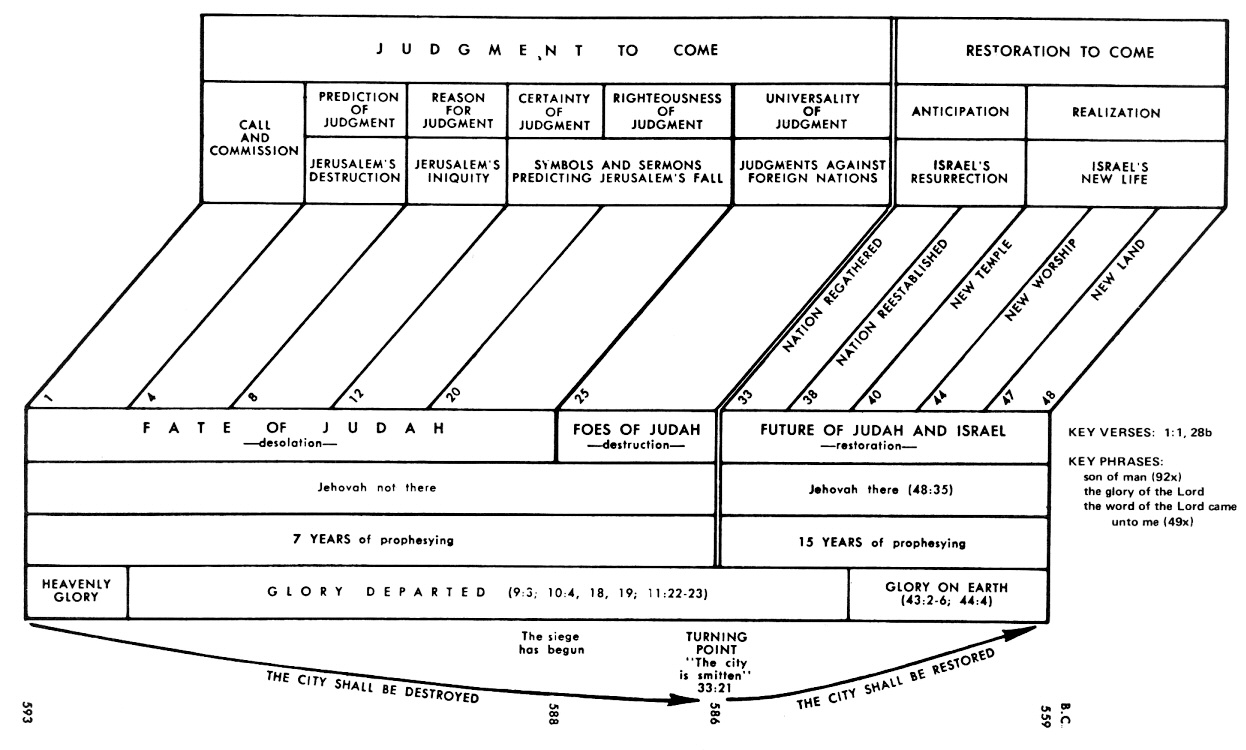
Click chart to enlarge
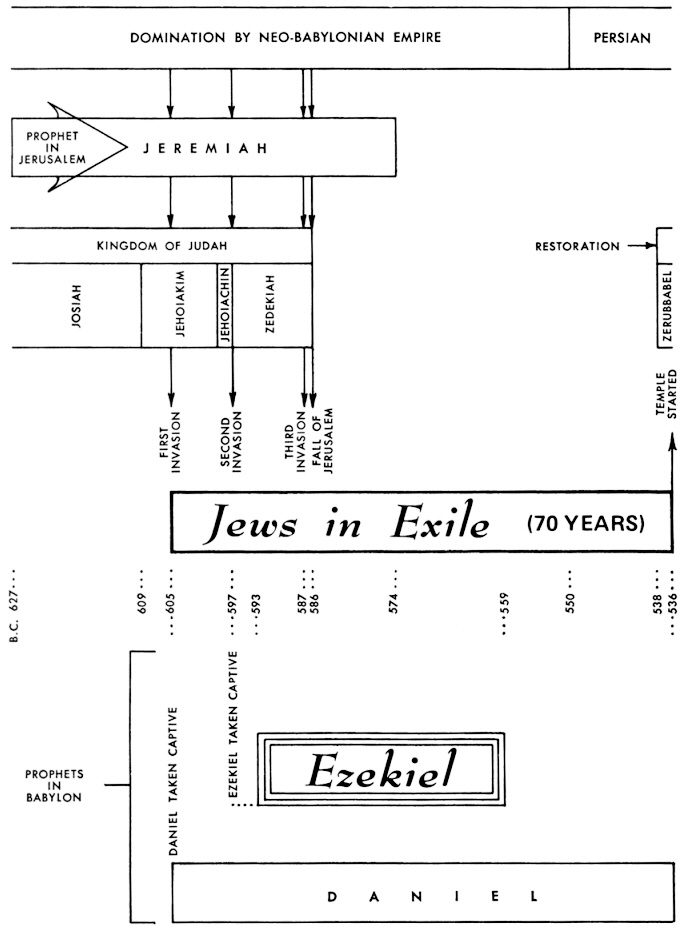
Click chart to enlarge
Chart from recommended resource Jensen's Survey of the OT - used by permission
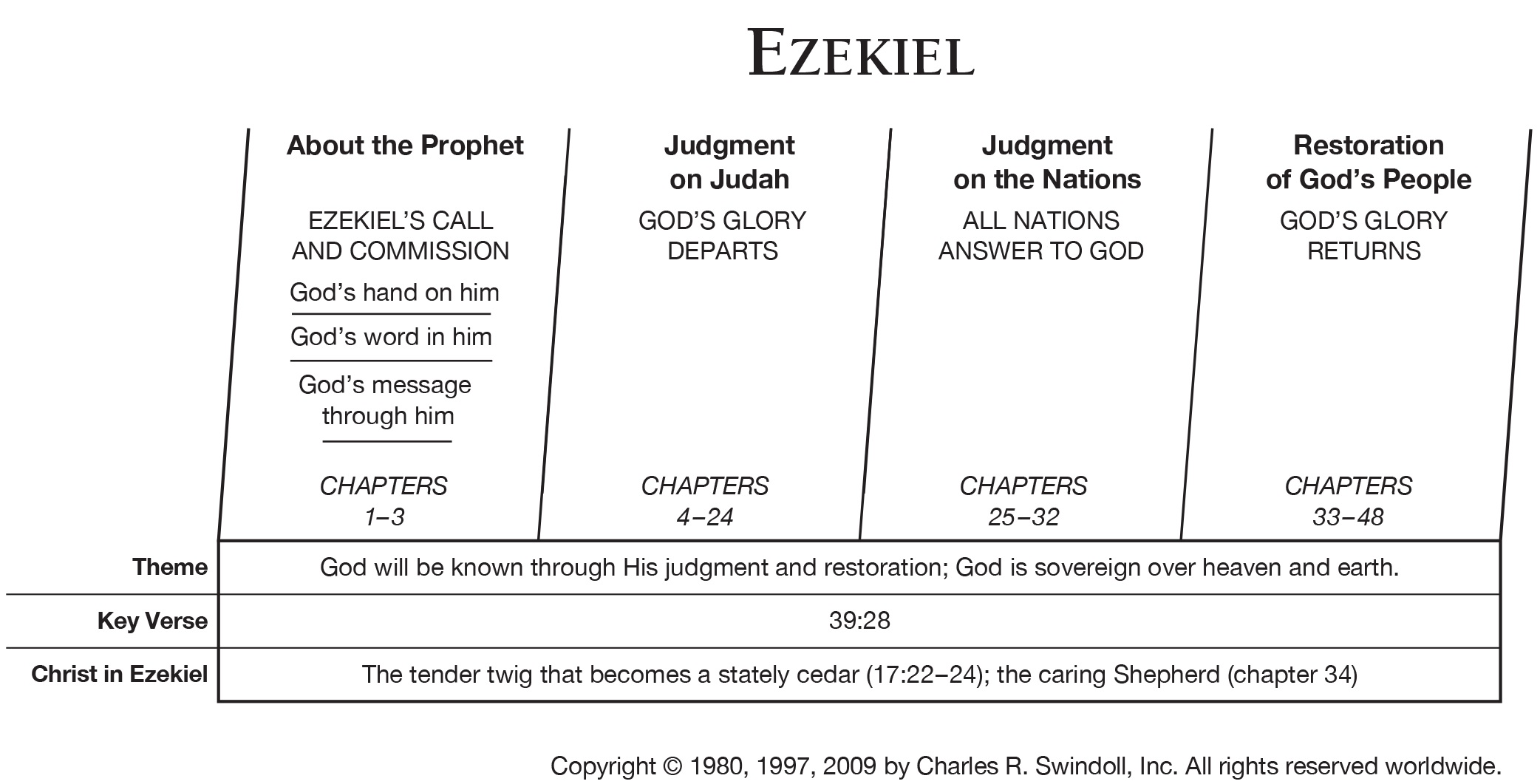
Click Chart from Charles Swindoll
|
PROPHECY OF |
PROPHECY OF |
|||
| FATE OF JUDAH Before the Siege |
FOES OF JUDAH During the Siege |
FUTURE OF JUDAH After the Siege |
||
|
593-588 BC |
587-586 |
586-571 |
||
|
7 YEARS |
15 YEARS |
|||
| Ezekiel 1:1-3:27 Ezekiel Sees the Glory & Receives the Call |
Ezekiel 4:1-24:27 Judgments Against Judah |
Ezekiel 25:1-32:32 Judgments Against the Gloating Nations |
Ezekiel 33:1-39:29 Restoration of Israel to the LORD |
Ezekiel 40:1-48:35 Visions of the Temple Jehovah Shammah |
Outline of the Book of Ezekiel from Dr John MacArthur - The book can be largely divided into sections about condemnation/retribution and then consolation/restoration. A more detailed look divides the book into 4 sections. First, are prophecies on the ruin of Jerusalem (Ezekiel 1:1–24:27). Second, are prophecies of retribution on nearby nations (Ezekiel 25:1–32:32), with a glimpse at God’s future restoration of Israel (Ezekiel 28:25,26). Thirdly, there is a transition chapter (Ezekiel 33:1-33) which gives instruction concerning a last call for Israel to repent. Finally, the fourth division includes rich expectations involving God’s future restoration of Israel (Ezekiel 34:1–48:35). (Reference)
I. Prophecies of Jerusalem’s Ruin (Ezekiel 1:1–24:27)
A. Preparation and Commission of Ezekiel (Ezekiel 1:1–3:27)
1. Divine appearance to Ezekiel (Ezekiel 1:1–28)|
2. Divine assignment to Ezekiel (Ezekiel 2:1–3:27)
B. Proclamation of Jerusalem’s Condemnation (Ezekiel 4:1–24:27)
1. Signs of coming judgment (Ezekiel 4:1–5:4)
2. Messages concerning judgment (Ezekiel 5:5–7:27)
3. Visions concerning abomination in the city and temple (Ezekiel 8:1–11:25)
4. Explanations of judgment (Ezekiel 12:1–24:27)
II. Prophecies of Retribution to the Nations (Ezekiel 25:1–32:32)
A. Ammon (Ezekiel 25:1–7)
B. Moab (Ezekiel 25:8–11)
C. Edom (Ezekiel 25:12–14)
D. Philistia (Ezekiel 25:15–17)
E. Tyre (Ezekiel 26:1–28:19)
F. Sidon (Ezekiel 28:20–24)
Excursus: The Restoration of Israel (Ezekiel 28:25, 26)
G. Egypt (Ezekiel 29:1–32:32)
III. Provision for Israel’s Repentance (Ezekiel 33:1–33)
IV. Prophecies of Israel’s Restoration (Ezekiel 34:1–48:35)
A. Regathering of Israel to the Land (Ezekiel 34:1–37:28)
1. Promise of a True Shepherd (Ezekiel 34:1–31)
2. Punishment of the nations (Ezekiel 35:1–36:7)
3. Purposes of restoration (Ezekiel 36:8–38)
4. Pictures of restoration—dry bones and two sticks (Ezekiel 37:1–28)
B. Removal of Israel’s Enemies from the Land (Ezekiel 38:1–39:29)
1. Invasion of Gog to plunder Israel (Ezekiel 38:1–16)
2. Intervention of God to protect Israel (Ezekiel 38:17–39:29)
C. Reinstatement of True Worship in Israel (Ezekiel 40:1–46:24)
1. New temple (Ezekiel 40:1–43:12)
2. New worship (Ezekiel 43:13–46:24)
D. Redistribution of the Land in Israel (Ezekiel 47:1–48:35)
1. Position of the river (Ezekiel 47:1–12)
2. Portions for the tribes (Ezekiel 47:13–48:35)
ISRAEL…
A Fruitful Vine
Bearing Grapes
or
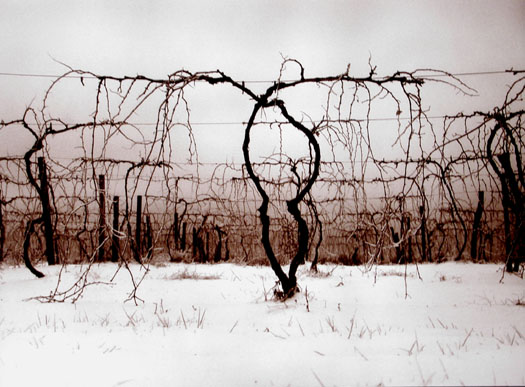
Wood of the Vine
for Burning
Ezekiel 15:1 Then the word of the LORD came to me, saying,
Ezekiel 15 has been referred to as a "parable" by most of the modern commentaries, some specifically referring to it as the "Parable of the Vine".
The dictionary definition of parable is
"a usually short, simple fictitious story that illustrates or communicates a spiritual truth, a moral lesson or a religious principle."
The word parable is derived from two Greek words (para = beside and ballo = to cast or throw) and so literally means a throwing beside, in order that the truth about one may throw light on the other. In other words, something familiar is used to illustrate some truth which is less familiar.
An illustration of one of the best know parables is Nathan’s "short story" of the rich man who took the one little ewe lamb that belonged to a poor man (2Sa 12:1–4). Using this parable, God (through his prophet) reproved King David and convicted him of his sin of committing adultery with Bathsheba (2Sa 12:5-15).
Here in Ezekiel 15, God gives a parable to His prophet that solidifies in no uncertain terms the coming fate of the inhabitants of Jerusalem.
With this background in mind, I would recommend that you review the "Guidelines for Interpreting Parables" and apply these interpretative principles to this short chapter before you read the notes. I am amazed at the different interpretations that are found in conservative commentaries.
Wiersbe - Unfruitfulness (15). The vine was a familiar emblem of Israel (Ps. 80:8–13; Isa. 5:1–7). Vines are good for only two things: bearing or burning. You do not build with wood from the vine because it does not lend itself to being cut and shaped. If the vine does not bear fruit, it is useless, and that was the condition of God’s people in Ezekiel’s day. If you share the life of God through faith in Jesus Christ, let that life reveal itself in the fruit you bear for His glory (Borrow copy of With the Word)
“Lord, let me not live to be useless.”
Wesley
1. Determine the occasion of the parable. Since parables clarify or emphasize a truth, discover why the parable was told. Why was it told? What prompted it? In other words what is the context?
2. Look for the intended meaning of the parable. The meaning will sometimes be stated. If not, it can be discovered by examining the context of the parable. Don't extract a meaning beyond that which is clearly stated or applied to the hearers by the speaker of the parable.
3. Identify the central idea. Every parable has one central theme or primary emphasis. Details of the story should not be given a meaning that is independent of the main teaching of the parable.
4. Since a parable has one central point of emphasis, you must:
a. Identify the relevant details and remember that a detail is relevant only if it reinforces the central theme of the parable. To attach meaning that is not in the context of the occasion or relevant to its central emphasis is to depart from the meaning of the parable.
b. Identify the irrelevant details. Not all details in a parable have significance in regard to the main point. It is tempting to focus on every detail and totally "miss the forest for the trees" as the saying commonly goes.
5. Interpret parables in the context of the culture of Bible times rather than the current culture. In the parable of the wise and foolish virgins, the central emphasis of the parable is, "Be on the alert then, for you do not know the day nor the hour" (Mt 25:13). Understanding Eastern wedding traditions would give insight into the parable and explain why some were ready and others were not.
6. Do not establish doctrine with parables as the primary or only source for that teaching. Parables should amplify or affirm doctrine, not establish it because parables are more obscure than clear doctrinal passages.
Adapted from How to Study Your Bible (borrow a copy) by Kay Arthur, which I highly recommend as the best overview of the inductive Bible Study method available.
The parable in this chapter states that a vine in the forest (this description implying it may be a wild rather than a cultivated vine) is good for nothing except the fire. Although it is not stated in this parable, it should be noted that Israel is elsewhere portrayed as a choice vine of God (see below for the specific Scriptures), so the message in this parable is that she has failed to fulfill her purpose. And what was Israel's purpose? What fruit was expected from her "vines"? Israel was to be a light unto the nations, obeying God's statutes and living in such a way that she would glorify God or give a proper opinion of Him to the Gentiles. In Ezekiel chapter 5, God had said
"This is Jerusalem; I have set her at the center of the (Gentile) nations, with lands around her." (Ezek 5:5) Given such a strategic location, did Israel bear fruit to the glory of God? Not according to God Who said "she has rebelled against My ordinances more wickedly than the nations and against My statutes more than the lands which surround her; for they have rejected My ordinances and have not walked in My statutes.' Therefore, thus says the Lord GOD, 'Because you have more turmoil than the nations which surround you, and have not walked in My statutes, nor observed My ordinances, nor observed the ordinances of the nations which surround you,' therefore, thus says the Lord GOD, 'Behold, I, even I, am against you, and I will execute judgments among you in the sight of the nations." (Ezek5:6-8)
Matthew Henry appropriately notes that "Jerusalem was planted a choice and noble vine, wholly a right seed (Jer2:21) and, if it had brought forth fruit suitable to its character as a holy city, it would have been the glory both of God and Israel. It was a vine which God's right hand had planted, a branch out of a dry ground, which, though its original was mean and despicable, God had made strong for himself (Ps80:15), to be to him for a name and for a praise (Jer13:11, KJV).
Ezekiel 15:2 "Son of man, how is the wood of the vine better than any wood of a branch which is among the trees of the forest? Amp: Son of man, How is the wood of the grapevine [Israel] more than that of any tree, the vine branch which was among the trees of the forest?
- How is the wood - De 32:32,33 Ps 80:8-16 Song 2:13,15 6:11 7:12 8:11,12 Isa 5:1-7 Jer 2:21 Ho 10:1 Mt 21:33-41 Mk 12:1-9 Lu 20:9-16 Joh 15:1-6
Son of man, how is the wood of the vine better than any wood of a branch which is among the trees of the forest? In the preceding section, we noted that this chapter is a short story or parable which gives a clear spiritual message. Although it is very tempting to ascribe a specific spiritual meaning and application to every detail in the parable, to do so will cause you to miss God's main point. Keep this caution (and the guidelines in the table above) in mind as you read through the notes in this section.
Note for example that the Amplified version (see above) translates "grapevine" as synonymous with Israel. While this is not a major error, it does show the failure to adhere to the basic principles of interpretation of parables, specifically that one should look in the parable or the immediate context of the parable for the explanation. In verse 6 God explains that the "wood of the vine among the trees of the forest" equates not with Israel per se, but specifically with "the inhabitants of Jerusalem." While clearly this detail is not a major issue, it does illustrate how easy one can fall into the trap of somewhat "loose" interpretation of parables.
Note that The comparison is not between the vine and other trees, but between the wood of the vine and the wood of other trees (e.g., "cedars of Lebanon… oaks of Bashan" Isa 2:13).
Several commentaries interpret the "vine" as a wild, not cultivated vine, which has no function other than to be burned.
"Wood of the vine" in Hebrew is literally the "vine tree".
Who is the vine? As noted in the guidelines for interpreting parables, one can often find the interpretation of the parable and that is the case here where the vine equates with the "inhabitants of Jerusalem" as described in verse 6. This simple principle of interpretation is important to emphasize lest one arrive at conclusions not necessarily supported by the text as did one commentator who stated that
"The vine, as described by Ezekiel, symbolizes unregenerate man in general and sinful Israel in particular."
This is not an accurate interpretation.
The idea behind this first question ("how is the wood of the vine better… ?") may be that Israel thought she was "special" wood and indestructible because of her chosen status. Although this may be the intended meaning, I realize that one could be accused of trying to focus too specific of an interpretation from this detail in the parable. With that caveat, it is notable that C H Spurgeon seems to have had a similar thought writing in his sermon The Fruitless Vine (exposition on Ezek 15:1-2) that
"the Jewish nation had arrogant ideas of themselves; when they sinned against God, they supposed that on account of the superior sanctity of their forefathers or by reason of some special sanctity in themselves, they would be delivered, sin as they pleased. In consequence of the infinite mercy of Jehovah, which He had displayed toward them, in delivering them our of so many distresses, they gradually came to imagine that they were the favorite children of Providence, and that God could by no means ever cast them away. God, therefore, in order to humble their pride, tells them that they in themselves were nothing more than any other nation; and He asks them what there was about them to recommend them? "I have often called you a vine; I have planted you, and nurtured you in a very fruitful hill, but now you bring forth no fruit; what is there in you why I should continue you in My favor? If you imagine there is any thing about you more than about any other nation, you are mightily mistaken… God humbles Israel, by reminding them that they had nothing which other nations had not; that, in fact, they were a contemptible nation, not worthy to be set side by side with the cedar of Babylon, or with the oak of Samaria; they were of no use, they were worthless, unless they brought forth fruit to him. He checks their pride and humbles them, with the parable we have here before us." (See also Spurgeon's devotional below)
Spurgeon continues on in his sermon (The Fruitless Vine) to note that a vine "is a useless plant apart from its fruitfulness. We sometimes see it in beauty, trained up by the side of our walls, and in the East it might be seen in all its luxuriance, and great care is bestowed in its training; but leave the vine to itself, and consider it apart from its fruitfulness, it is the most insignificant and despicable of all things that bear the name of trees. Now, beloved, this is for the humbling of God's people. They are called God's vine; but what are they by nature more than others? Others are as good as they; yea, some others are even greater and better than they. They, by God's goodness, have become fruitful, have been planted in a good soil; the Lord hath trained them upon the walls of the sanctuary, and they bring forth fruit to his glory. But what are they without their God? What are they without the continual influence of the Spirit, begetting fruitfulness in them? Are they not the least among the sons of men, and the most to be despised of those that have been brought forth of women?"

The Vine metaphor was used by Moses to describe the wicked heathen nations as having their roots in Sodom and Gomorrah:
"For their vine is from the vine of Sodom, and from the fields of Gomorrah. Their grapes are grapes of poison, their clusters, bitter. Their wine is the venom of serpents, and the deadly poison of cobras." (Dt 32:32,33)
The psalmist Asaph (in what some refer to as "The Parable of the Vine") writing approximately 400 years prior to Ezekiel's day describes "God's Vine" as follows:
"Thou didst remove (pull out a vine from Egypt ("unfriendly" soil not "watered" by the Nile). Thou didst drive out the nations, and didst plant it. (seven nations were dug out to make space for the Lord's vine) 9 Thou didst clear the ground before it, and it took deep root and filled the land. (metaphor of the "vine" Israel, transplanted from Egypt and successfully planted in a soil prepared by God Himself) 10 The mountains were covered with its shadow; and the cedars of God with its boughs (picturing Israel's rise to prominence as a nation). 11 It was sending out its branches to the (Mediterranean) sea, and its shoots to the (Euphrates) River (under Solomon Israel came as close to occupying all the land God had promised Abraham but this promise awaits future fulfillment in the Millennial Kingdom). 12 (Asaph asks the question) Why hast Thou broken down (verb describing God's punitive activity against Israel) its hedges, so that all who pass that way pick its fruit? 13 A boar from the forest eats it away, and whatever moves in the field feeds on it. 14 O God of hosts, turn again now, we beseech Thee; Look down from heaven and see, and take care of this vine, 15 Even the shoot which Thy right hand has planted, and on the son whom Thou hast strengthened for Thyself. 16 It is burned with fire, it is cut down. They perish at the rebuke of Thy countenance." Spurgeon comments on this Psalm describing Israel as "small in appearance, very dependent, exceeding weak, and apt to trail on the ground, yet the vine of Israel was chosen of the Lord, because He knew that by incessant care, and abounding skill, He could make of it a goodly fruit bearing plant."
Note that several respected commentaries interpret the "vine" here in Psalm 80 as the "church".
Matthew Henry flatly states that
"The church is here represented as a vine and a vineyard… the root of this vine is Christ… the branches are believers."
Clearly this comment is not correct and reflects a failure to interpret the passage in context. When reading the Old Testament it is critical to let the text speak for itself and to remember that references and metaphors to Israel are just that! On the other hand, clear references to Israel, although having only one correct interpretation, can have many applications but it is important not to confuse interpretation with application.
The church is like a vine, weak and needing support, unsightly and having an unpromising outside, but spreading and fruitful, and its fruit most excellent. The church is a choice and noble vine; we have reason to acknowledge the goodness of God that he has planted such a vine in the wilderness of this world, and preserved it to this day. Now observe here,
Isaiah (writing ~ 100 years prior to Ezekiel 15) presents a "parable" of Israel as God's vine:
"Let me (Isaiah speaking) sing now for my well-beloved, a song of my beloved (Isaiah is referring to God) concerning His vineyard. My well-beloved had a vineyard on a fertile hill. 2 And He dug it all around, removed its stones, and planted it with the choicest vine. And He built a tower in the4 middle of it and hewed out a wine vat in it. Then He expected it to produce good grapes, but it produced only worthless ones. 3 And now, O inhabitants of Jerusalem and men of Judah, judge between Me and My vineyard. 4 What more was there to do for My vineyard that I have not done in it? Why, when I expected it to produce good grapes did it produce worthless ones? 5 So now let Me tell you what I am going to do to My vineyard: I will remove its hedge and it will be consumed (this detail can be accurately interpreted as the destruction of Israel, Judah and specifically Jerusalem). I will break down its wall and it will become trampled ground. 6 And I will lay it waste. It will not be pruned or hoed (which would have led to greater fruitfulness), but briars and thorns will come up. I will also charge the clouds to rain no rain on it. 7 For (note that here Isaiah interprets the parable) the vineyard of the LORD of hosts is the house of Israel and the men of Judah His delightful plant. Thus He looked for (here he describes the good fruit that was expected and which would have brought glory to God and been a light to the Gentiles) justice, but behold, bloodshed; for righteousness, but behold, a cry of distress." (Isa 5:1-7)
What fruit was the Lord expecting from Israel while it was still "intact"?
The NIV Study Bible suggests that a wordplay in Hebrew answers this question: “He looked for justice [mishpat], but saw bloodshed [mispah]; for righteousness [sedaqah], but heard cries of distress [se’aqah]”. In other words, Israel had been equipped to produce justice and righteousness: chosen by God, delivered from oppression by His hand, given the Law and Covenants, and the tabernacle symbolizing God’s very presence. Tragically, Israel produced "fruit" that defied God's careful provision and cultivation.
In Jeremiah (Ezekiel's contemporary in Jerusalem) God declares to Israel
"… I planted you a choice vine, a completely faithful seed. How then have you turned yourself before Me Into the degenerate shoots of a foreign (wild, "adulterous") vine?" (Jer2:21)
Hosea 10:1 tells us that "Israel is a luxuriant (literally the Hebrew word is "degenerate") vine. He produces fruit for himself. The more his fruit, the more altars (to idols) he made. The richer his land, the better he made the sacred pillars (associated with lewd "fertility" rites)."
Economic prosperity had resulted in spiritual corruption. Increased wealth and power brought an increase in idolatry and its attendant evils. Israel prospered but in the process became a "degenerate vine", falsely attributing economic success to idols rather than to Jehovah.
James gives us the proper perspective, reminding us that
"Every good thing bestowed and every perfect gift is from above, coming down from the Father of lights, with Whom there is no variation, or shifting shadow." (Jas1:17)
Paul adds that
"those who want to get rich fall into temptation and a snare and many foolish and harmful desires which plunge men into ruin and destruction. For the love of money is a root of all sorts of evil, and some by longing for it have wandered away from the faith, and pierced themselves with many a pang." (1Ti6:9-10)
Joel 1:6-7 In the context of describing the coming "day of the LORD" God says that
"a nation (in context locusts are portrayed as a huge swarming army) has invaded my land, mighty and without number; its teeth are the teeth of a lion, and it has the fangs of a lioness. It has made My vine a waste and my fig tree splinters. It has stripped them bare and cast them away; Their branches have become white."
Whereas Fruitful vines generally represented the blessing of the Lord on the land, the devastation pictured in this section of Joel is that Jehovah has removed His hedge of protection and His hand of blessing from Israel.
Jer 12:10 "Many shepherds (referring to the civil and spiritual leaders of Israel) have ruined (destroyed, corrupted) My vineyard. They have trampled down My field. They have made My pleasant field a desolate wilderness (a complete wasteland conveying the idea of horror, desert).
The vine was prized for the fruit it bore, and so was an appropriate symbol of God’s people as His prized possession
Spurgeon's Morning Devotional -- Ezekiel 15:2 (Ed: An Application for Believers today of God's Warning to Judah)
"These words are for the humbling of God's people (Ed note: In context Ezekiel is referring to Israel not the church - Spurgeon applies the principles to believers); they are called God's vine, but what are they by nature more than others? They, by God's goodness, have become fruitful, having been planted in a good soil; the Lord hath trained them upon the walls of the sanctuary, and they bring forth fruit to His glory; but what are they without their God? What are they without the continual influence of the Spirit, begetting fruitfulness in them? O believer, learn to reject pride, seeing that thou hast no ground for it. Whatever thou art, thou hast nothing to make thee proud. The more thou hast, the more thou art in debt to God; and thou shouldst not be proud of that which renders thee a debtor. Consider thine origin; look back to what thou wast. Consider what thou wouldst have been but for divine grace. Look upon thyself as thou art now. Doth not thy conscience reproach thee? Do not thy thousand wanderings stand before thee, and tell thee that thou art unworthy to be called his son? And if he hath made thee anything, art thou not taught thereby that it is grace which hath made thee to differ? Great believer, thou wouldst have been a great sinner if God had not made thee to differ. O thou who art valiant for truth, thou wouldst have been as valiant for error if grace had not laid hold upon thee. Therefore, be not proud, though thou hast a large estate-a wide domain of grace, thou hadst not once a single thing to call thine own except thy sin and misery. Oh! strange infatuation, that thou, who hast borrowed everything, shouldst think of exalting thyself; a poor dependent pensioner upon the bounty of thy Saviour, one who hath a life which dies without fresh streams of life from Jesus, and yet proud! Fie on thee, O silly heart!"
Ezekiel 15:3 "Can wood be taken from it to make anything, or can men take a peg from it on which to hang any vessel? Can wood be taken from it to make anything,
- Jer 24:8 Mt 5:13 Mk 9:50 Lu 14:34,35
"Can wood be taken from it to make anything, or can men take a peg from it on which to hang any vessel? This is primarily a rhetorical question (asked primarily for effect) for the answer is obvious to all. The wood of a vine branch is useless and can't even be made into a simple peg on the wall to hold a dish!
Cooper surmises that "Ezekiel’s use of this parable was an answer to those who thought that the vine, that is, Israel, was sacred and indestructible… Ezekiel ignored the fruit-bearing properties that were lacking in Israel and focused instead on the quality of wood for which the vine was notoriously useless." (Vol. 17: Ezekiel. The New American Commentary. Nashville: Broadman & Holman Publishers)
What is the primary purpose of a "vine"? To bear fruit. Other trees, even those that fail to bear fruit, can be used for construction of other things (e.g., pecan or walnut furniture, etc), but a fruitless vine is a useless vine and has no value other than to be burned. Lest we as New Testament believers become too critical of the "inhabitants of Jerusalem", we need to take heed lest we fall.
Paul reminded the Ephesian believers that
we are (God's) workmanship (Greek = poiema = "masterpiece), created in Christ Jesus (and "in Christ Jesus" is the key to genuine fruit bearing as discussed below) for good works, which God prepared beforehand, that we should walk in them." (Eph 2:10)
The people of God have their value and are called to be fruitful. Jesus speaking to His apostles made their "privilege" and purpose clear declaring
"You did not choose Me, but I chose you, and appointed you, that you should go and bear fruit, and that your fruit should remain (whereas fruit borne from our fleshly efforts will not survive God's testing fires), that whatever you ask of the Father in My name, He may give to you." (Jn15:16)
Jesus added that
"every branch that bears fruit, He prunes it, that it may bear more fruit." (Jn15:2)
Is He "pruning" you right now? Be encouraged for He prunes with the purpose to increase your productivity. Jesus reminded the apostles (and NT saints) of the secret of bearing fruit declaring
"I am the vine, you are the branches; he who abides in Me, and I in him, he bears much fruit; for apart from Me you can do nothing." (Jn15:5)
And in (Jn15:8) Jesus reminds us that
"By this is My Father glorified, that you bear much fruit, and so prove to be My disciples."
Fruit bearing proves that one is a genuine fruit tree.
Jesus declared that God's people are to influence the culture around them for we
"are the salt of the earth; but if the salt has become tasteless, how will it be made salty again? It is good for nothing anymore, except to be thrown out and trampled under foot by men. You are the light of the world. A city set on a hill cannot be hidden. Nor do men light a lamp, and put it under the peck-measure, but on the lampstand; and it gives light to all who are in the house. Let your light shine before men in such a way that they may see your good works, and glorify your Father who is in heaven." (Mt 5:13-16)
In simple language, "glorify" means to give a proper opinion of someone, in this case of God. Israel failed to fulfill her holy calling and did not give proper opinion of Jehovah. The inhabitants of Israel were no more than "vine tree" wood fit only for the fire of God's fury.
Ezekiel 15:4 "If it has been put into the fire for fuel, and the fire has consumed both of its ends and its middle part has been charred, is it then useful for anything?
- If it has been put into the fire: Ps 80:16 Isa 27:11 Joh 15:6 Heb 6:8
- the fire: Isa 1:31 Am 4:11 Mal 4:1 Mt 3:12 Heb 12:29
If it has been put into the fire for fuel, and the fire has consumed both of its ends and its middle part has been charred, A dogmatic interpretation of this passage is not possible. The plain sense of this picture is that if the vine wood, in its perfect state, cannot be used for anything, how much less when it is partially scorched and consumed! One must be careful in attaching a specific meaning to every detail in a parable (see "Guidelines on Interpretation of A Parable" above) and the variety of "interpretations" of this verse is a perfect "object lesson" regarding that caution.
Some such as Cooper states somewhat dogmatically that "This was an obvious (Ed comment: actually it is by no means "obvious") reference (Ed note: not in my opinion) to Jerusalem, which twice was invaded by Nebuchadnezzar in 605 b.c. and again in 597 b.c. In that sense it had already been “charred” (v. 5). These words also anticipated the final destruction that came in 586 b.c. when the city was burned and looted (2 Ki 25:8–21). (Vol. 17: Ezekiel. The New American Commentary. Nashville: Broadman & Holman Publishers)
In Psalm 80 ("A Parable of the Vine") the psalmist records that
"It (your vine referring to Israel) is burned with fire, it is cut down; They perish at the rebuke of Thy countenance." (Ps 80:16)
Jesus uses similar figurative language declaring that
"If anyone does not abide in Me, he is thrown away as a branch, and dries up; and they gather them, and cast them into the fire, and they are burned." (Jn15:6)
The imagery here is that of destruction and it thus pictures the judgment awaiting all those who were never saved. Jesus was not teaching that someone who was saved could lose their salvation!
is it then useful for anything? What's the answer? Obviously "no". The implication is that the "inhabitants of Jerusalem" are no longer useful.
Application of the truth of an unfruitful vine to a professor with an unfruitful life
As the vine without its fruit is useless and worthless; so, too, the professor, without fruit, is useless and worthless; yea, he is the most useless thing in the wide world. Now, let us dwell upon this point. A fruitless profession. And while I am preaching on it, let the words go round to each one, and let the minister, and let his deacons, and let his hearers all try their hearts and search their reins, and see whether they have a fruitless profession.
 1. First, a fruitless professor. How do we know him? what is his character? Secondly, What is the reason he is fruitless? Thirdly, What is the estimation God holds him in? He is good for nothing at all. And, then, fourthly, What will be his end? He is to be burned with fire.
First, Where are we to find fruitless professors? Everywhere, dear friends, everywhere—down here, up there, everywhere; in pulpits and in pews. False professors are to be found in every church. Let us leave other denominations alone, then. They are to be found in this church; they are to be found in this present assembly. to whatever denomination you belong, there are some false and fruitless professors in it. How know you that you may not belong to those who bring forth no fruit? There are fruitless professors to be found in every position of the church, and in every part of society. You may find the false professor among the rich; he hath much wealth, and he is hailed with gladness by the church. God hath given him much of this world's good; and therefore, the church, forgetful that God hath chosen the poor, giveth him honor, and what doth she get from him? She getteth but little to help her. Her poor are still neglected, and her means not in the least recruited by his riches. Or if she gain a portion of his riches, yet she getteth none of his prayers; nor is she in the least supported by his holy living, for he that hath riches often liveth in sin, and rolleth in uncleanness; and, then, weareth his profession as a uniform, wherewith to cover his guilt. Rich men have sometimes been false professors; and thy are to be found among poor men too. Full many a poor man has entered into the church, and been cordially received. He has been poor, and they have thought it a good thing that poverty and grace should go together—that grace should cheer his hovel, and make his poverty-stricken home a glad one. But then, this poor man hath turned aside to follies, and hath degraded himself with drunkenness, hath sworn, and by unworthy conduct dishonored his God; or, if not, he hath been idle, and sat still, and been of little service to the church; and so he hath been false and fruitless in his profession.
False professors are to be found in the men that lead the vanguard of God's army; the men who preach eloquently, whose opinion is law, who speak like prophets, and whose language seems to be inspired. They have brought forth the fruit of popularity, ay, and the fruit of philanthropy too, but their heart has not been right with God, therefore, the fruit, good in itself, was not fruit unto holiness; the moral benefit of their labors does not extend to everlasting life. They have not brought forth the fruits of the Spirit, seeing that they were not living branches of the living vine. Then there have been false professors in obscurity; modest people, who have said nothing, and seldom been heard of; they have glided into their pews on the Sunday morning, taken their seats, gone out, and satisfied themselves that by their presence they had fulfilled a religious duty. They have been so silent, quiet, and retired. Lazy fellows, doing nothing. You may think that all the fruitless trees grow in the hedge outside of the garden. No they don't. There are some fruitless trees in the inside of it in the very center of it. There are some fruitless trees in the inside of it in the very center of it. There are some false professors to be found in obscurity as well as in publicity; some among the poor as well as among the rich.
And there are false professors to be found among men that doubt a great deal. They are always afraid they do not love Jesus, and always saying, "Ah, if I did but know I were his!—
"'Tis a point I long to know,
Oft it causes anxious thought."
Yes, and it ought to cause them anxious thought, too, if they are bringing forth no fruit and giving no "diligence to make their calling and election sure." Fruitless professors are to be found, on the other hand, among the confident men, who say, without a blush, "I know whom I have believed; I know I am a Christian, let who will doubt. I am sure and certain my sins can not destroy me, and my righteousness can not save me. I may do what I like; I know I am one of the Lord's." Ah! fruitless professor again; just as fruitless as the other man, who had all doubts and no faith, and did nothing for his Master.
And then there is the fruitless professor, who, when he is asked to pray at the prayer meeting, never does so; and who neglects family prayer. We will not say any thing about private devotion; no doubt he neglects that too: he is a fruitless one. Ah! but there may be another, who stands up and prays such an eloquent prayer for a quarter of an hour, perhaps, just as fruitless a professor as the silent one; with plenty of words, but no realities; many leaves, but no fruits; great gifts of utterance, but no gifts of consistency; able to talk well, but not to walk well; to speak piously, but not to walk humbly with his God, and serve him with gladness. I do not know your individual characters; but I know enough of you to say that your position, however honorable in the church, and your character, however fair before men, is not enough to warrant any of you in concluding at once that you are not a fruitless professor. For fruitless professors are of every character and every rank, from the highest to the lowest, from the most talented to the most illiterate, from the richest to the poorest, from the most retiring to the most conspicuous. Fruitless professors there are in every part of the church.
Now, shall I tell you who is a fruitless professor? The man who neglects private prayer, and does not walk with his God in public; that man whose carriage and conversation before God are hypocritical; who cheats in trade and robs in business, yet wraps it up, and comes out with a fair face, like the hypocrite with a widow's house sticking in his throat, and says, "Lord, I thank thee I am not as other men are!" There is a man for you, who brings forth no fruit to perfection. Another one is he who lives right morally and excellently, and depends upon his works, and hopes to be saved by his righteousness; who comes before God, and asks for pardon, with a lie in his right hand, for he has brought his own self-righteousness with him. Such a man is a fruitless professor; he has brought forth no fruit. That man, again, is a fruitless professor who talks big words about high doctrine, and likes sound truth, but he does not like sound living; his pretensions are high, but not his practice. He can bear to hear it said, "Once in Christ, in Christ for ever," But as for himself, he never was in Christ at all, for he neither loves nor serves his Master, but lives in sin that grace may abound. There is another fruitless vine for you." (For the full exposition click The Fruitless Vine)
Ezekiel 15:5 "Behold, while it is intact, it is not made into anything. How much less, when the fire has consumed it and it is charred, can it still be made into anything!
Behold, while it is intact, it is not made into anything. How much less, when the fire has consumed it and it is charred, can it still be made into anything!
Matthew Henry comments on the charred wood of a vine "If a piece of solid timber be kindled, somebody perhaps may snatch it as a brand out of the burning, and say, “It is a pity to burn it, for it may be put to some better use;” but if the branch of a vine be on fire, and, as usual, both the ends of it and the middle be kindled together, nobody goes about to save it. When it was whole it was meet for no work, much less when the fire has devoured it; even the ashes of it are not worth saving."
Ezekiel 15:6 "Therefore, thus says the Lord GOD, 'As the wood of the vine among the trees of the forest, which I have given to the fire for fuel, so have I given up the inhabitants of Jerusalem; Therefore This marks the beginning of the "explanation" of the "parable" of the "vine tree".
- Eze 15:2 17:3-10 20:47,48 Isa 5:1-6,24,25 Jer 4:7 7:20 21:7 24:8-10 Jer 25:9-11,18 44:21-27 Zec 1:6
Thus says the Lord GOD, 'As the wood of the vine among the trees of the forest, which I have given to the fire for fuel,
Keil and Delitzsch comment that "In the application of the parable, the only thing to which prominence is given, is the fact that God will deal with the inhabitants of Jerusalem in the same manner as with the vine-wood, which cannot be used for any kind of work. This implies that Israel resembles the wood of a forest-vine. As this possesses no superiority to other wood, but, on the contrary, is utterly useless, so Israel has no superiority to other nations, but is even worse than they, and therefore is given up to the fire."
so have I given up the inhabitants of Jerusalem; The comparison is between the wood of the vine and the inhabitants of Jerusalem, which is destined for burning in the coming Babylonian destruction.
Ezekiel's contemporary echoes this judgment recording the Lord God's declaration "Behold, My anger and My wrath will be poured out on this place, on man and on beast and on the trees of the field and on the fruit of the ground; and it will burn and not be quenched." (Jer 7:20)
Ezekiel 15:7 and I set My face against them. Though they have come out of the fire, yet the fire will consume them. Then you will know that I am the LORD, when I set My face against them.
- I will set: Eze 14:8 Lev 17:10 20:3-6 26:17 Ps 34:16 Jer 21:10
- they shall: 1Ki 19:17 Isa 24:18 Jer 48:43,44 Am 5:19 9:1-4
- and ye shall: Eze 6:7 7:4 11:10 20:38,42,44 Ps 9:16
Ezekiel 15:8 'Thus I will make the land desolate, because they have acted unfaithfully,' " declares the Lord GOD and I set My face against them
- I Will Eze 6:14 14:13-21 33:29 Isa 6:11 24:3-12 Jer 25:10,11 Zep 1:18
- Acted unfaithfully 2Ch 36:14-16
Thus I will make the land desolate, because they have acted unfaithfully,' " declares the Lord GOD and I set My face against them This is a terrifying picture of the Almighty Omnipotent God leaving no question about Who is bringing the judgment and also no question about whether that judgment will in fact transpire as prophesied!
The psalmist records that
The face of the LORD is against evildoers, To cut off the memory of them from the earth." (Ps34:16)
In Amos God says in no uncertain terms that the people of Israel are in "big trouble" declaring that
"though they go into captivity before their enemies, from there I will command the sword that it slay them, and I will set My eyes against them for evil and not for good." (Am 9:4)
Though they have come out of the fire, yet the fire will consume them. Many of the survivors of the siege of Jerusalem died soon after its capture (Jer 39:6; 41:3; 44:27, 28).
Then you will know that I am the LORD, when I set My face against them (Ezek 6:7; 7:4; 11:10; 20:38,42,44; Ps9:16) This is the repeated emphasis of God's hand of judgment -- that they would know that He is the LORD.
Set my face against - Lev. 17:10; Lev. 20:3; Lev. 20:5; Lev. 20:6; Lev. 26:17; Jer. 21:10; Jer. 44:11; Ezek. 14:8; Ezek. 15:7
Thus I will make the land desolate (14:13-21; Is6:11; 24:3-12; Je25:10,11; Zeph1:18) Although this prophecy was partially fulfilled in 586 BC, "the land" (a term found frequently in the OT as a reference to Israel) will experience a final and more devastating fire in the time referred to by Jesus as the "great tribulation" (Mt 24:15,21)) or the "time of Jacob's distress" (Jer 30:7), which describes the final three and one half year period that precedes the triumphant return of the Messiah Who defeats the anti-Christ and establishes His 1000 year kingdom in Jerusalem (cf Rev 19-20)
The "I will's" of God are wonderful when they are promises for blessing but they are terrifying when they are promises of His wrath.
This repeats God's earlier decree that
throughout all their habitations I shall stretch out My hand against them and make the land more desolate and waste than the wilderness toward Diblah; thus they will know that I am the LORD."' (Ezek 6:14)
In Ezekiel 33 God says that "Then they will know that I am the LORD, when I make the land a desolation and a waste because of all their abominations which they have committed."' (Ezek 33:29)
In Jeremiah's prophecy, Jehovah declares "Moreover, I will take from them the voice of joy and the voice of gladness, the voice of the bridegroom and the voice of the bride, the sound of the millstones and the light of the lamp. And this whole land shall be a desolation and a horror, and these nations shall serve the king of Babylon seventy years." (Jer 25:10-11)
Cooper notes that Without God no individual or nation will ever realize their true potential or purpose. Like an unproductive vine, they have no purpose beyond fruit-bearing." (Vol. 17: Ezekiel. The New American Commentary. Nashville: Broadman & Holman Publishers)
because they have acted unfaithfully,' " declares the Lord GOD (more literally this read "they have trespassed a trespass") The Jews were not merely sinners as the other nations, for it is one thing to neglect what we know not, but quite another thing to despise what we profess to worship, as the Jews did towards God and the law.
The writer of Chronicles records that "our fathers have been unfaithful and have done evil in the sight of the LORD our God, and have forsaken Him and turned their faces away from the dwelling place of the LORD (His Holy Temple), and have turned their backs (see "sun worshipers" with their backs to the Temple in Ezek 8:16) ." (2Chr29:6)
In Jeremiah God says "My people have committed two evils: They have forsaken Me, the fountain of living waters, to hew for themselves cisterns, broken cisterns, that can hold no water." (Jer 2:13)
One of the most tragic passages in the Old Testament records that "all the officials of the priests and the people were very unfaithful following all the abominations of the nations; and they defiled the house of the LORD (His Holy Temple) which He had sanctified in Jerusalem. And the LORD, the God of their fathers, sent word to them again and again by His messengers, because He had compassion on His people and on His dwelling place; but they continually mocked the messengers of God, despised His words and scoffed at His prophets, until the wrath of the LORD arose against His people, until there was no remedy." (2Chr 36:14-16)
Matthew Henry summarizes this section with an application writing "If a vine be fruitful, it is valuable. But if not fruitful, it is worthless and useless, it is cast into the fire. Thus man is capable of yielding a precious fruit, in living to God; this is the sole end of his existence; and if he fails in this, he is of no use but to be destroyed. What blindness then attaches to those who live in the total neglect of God and of true religion! This similitude is applied to Jerusalem. Let us beware of an unfruitful profession. Let us come to Christ, and seek to abide in him, and to have his words abide in us."