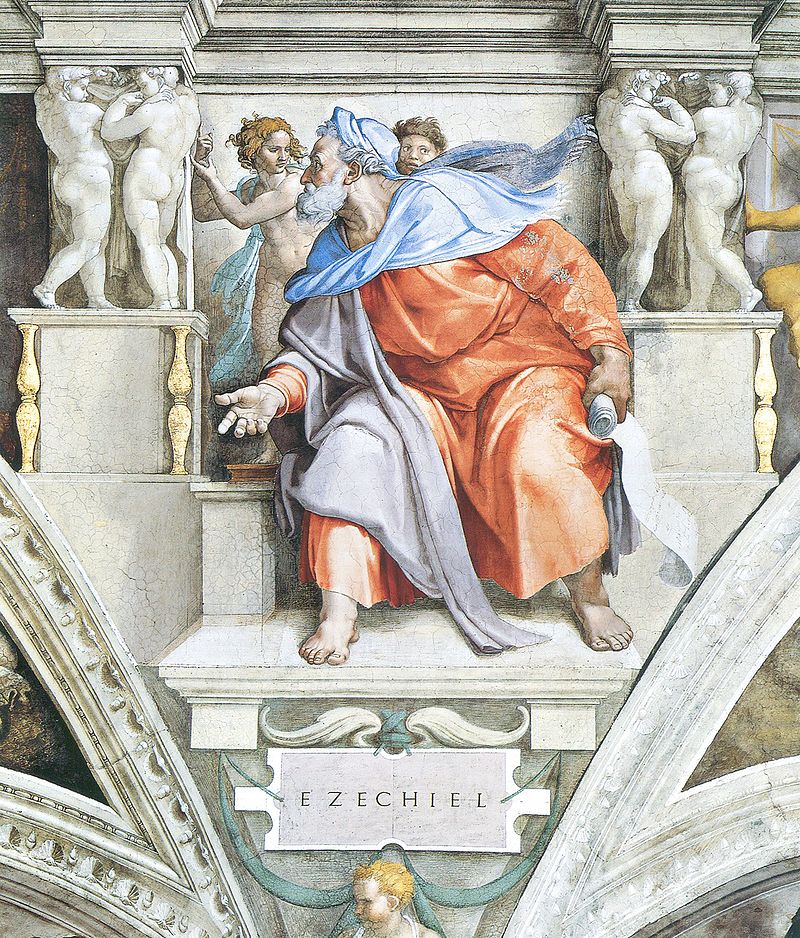
Michelangelo's Ezekiel on the Sistine Chapel
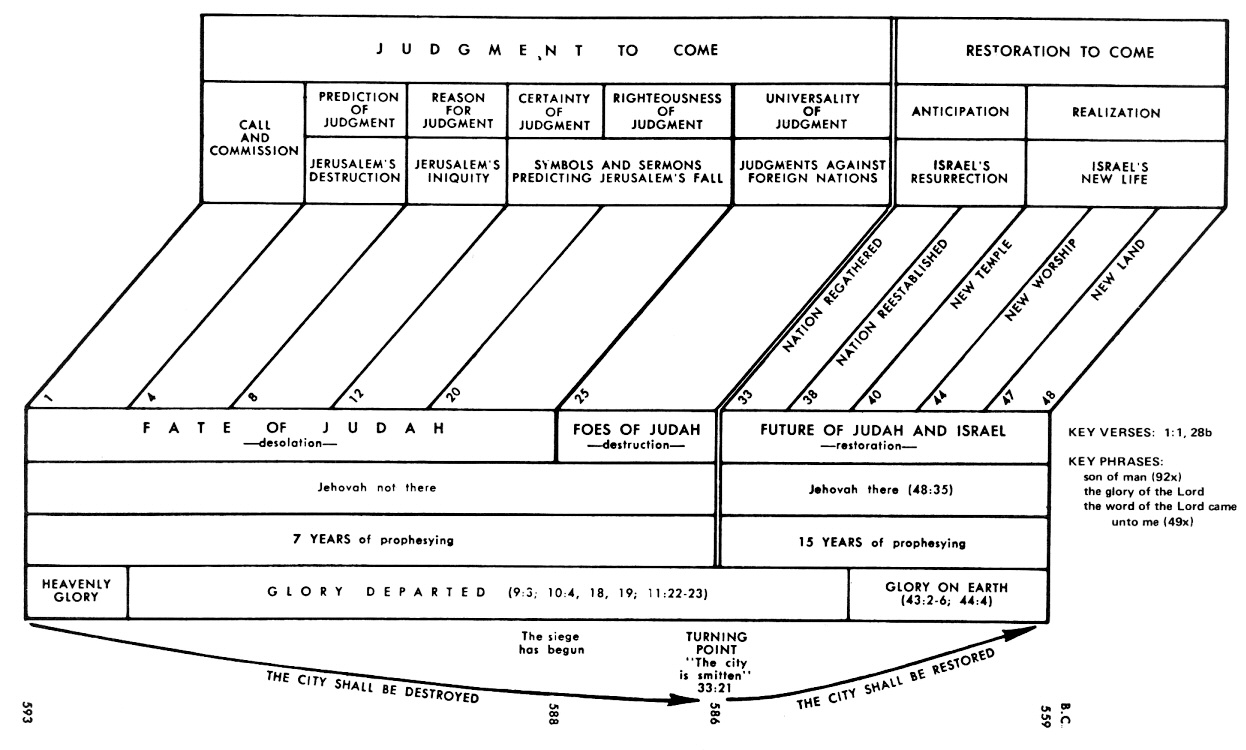
Click chart to enlarge
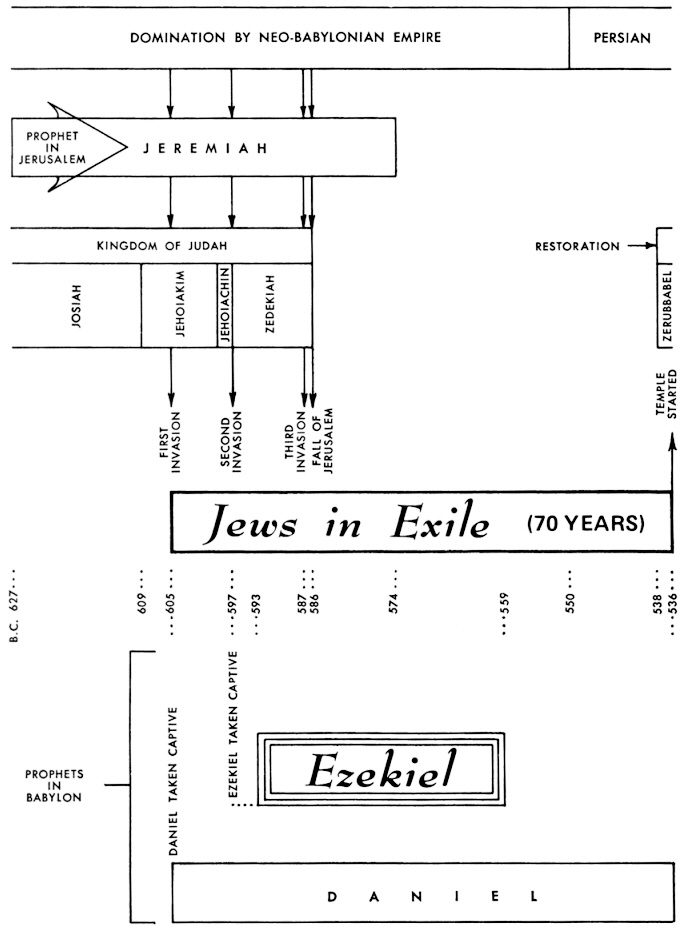
Click chart to enlarge
Chart from recommended resource Jensen's Survey of the OT - used by permission
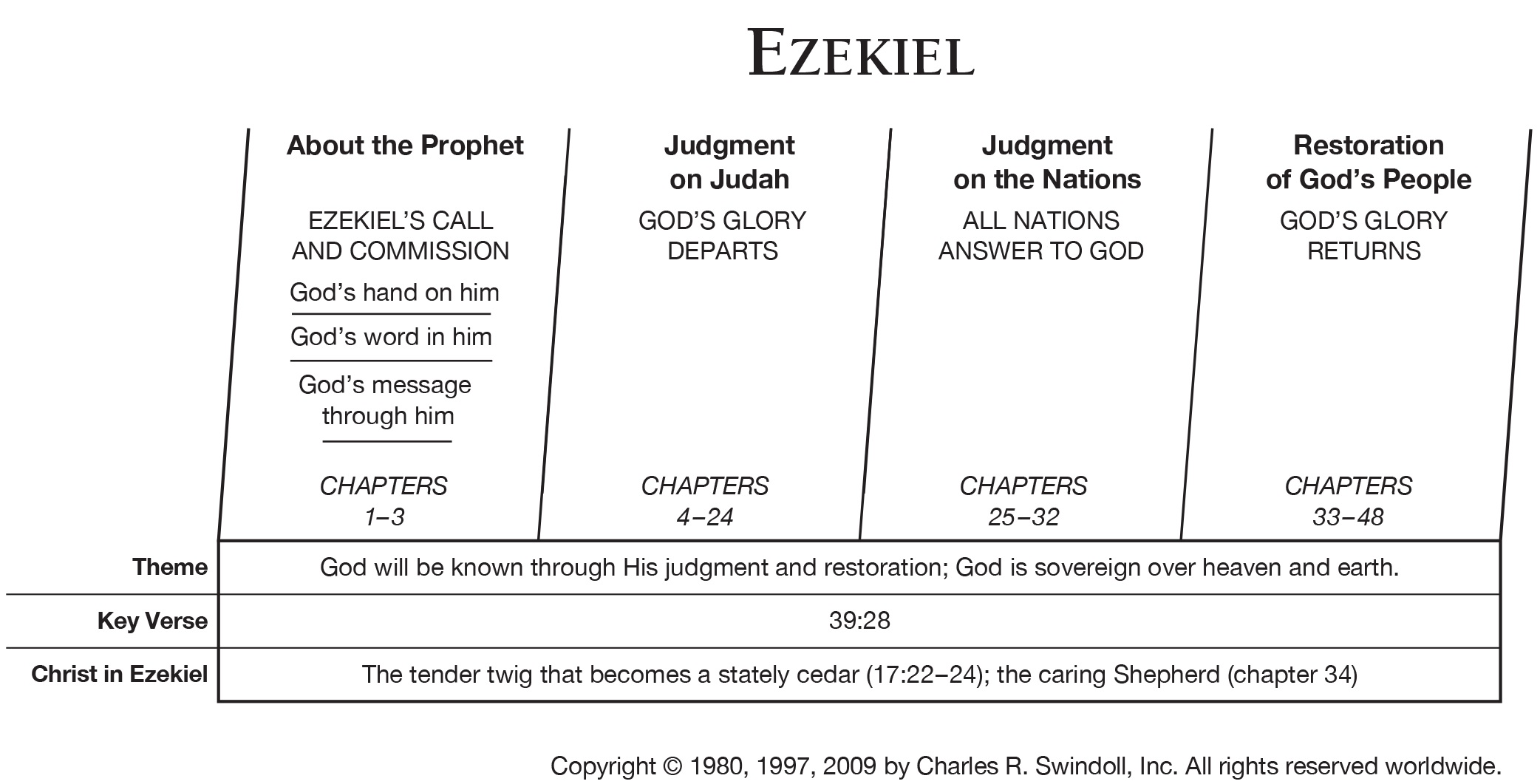
Click Chart from Charles Swindoll
|
PROPHECY OF |
PROPHECY OF |
|||
| FATE OF JUDAH Before the Siege |
FOES OF JUDAH During the Siege |
FUTURE OF JUDAH After the Siege |
||
|
593-588 BC |
587-586 |
586-571 |
||
|
7 YEARS |
15 YEARS |
|||
| Ezekiel 1:1-3:27 Ezekiel Sees the Glory & Receives the Call |
Ezekiel 4:1-24:27 Judgments Against Judah |
Ezekiel 25:1-32:32 Judgments Against the Gloating Nations |
Ezekiel 33:1-39:29 Restoration of Israel to the LORD |
Ezekiel 40:1-48:35 Visions of the Temple Jehovah Shammah |
Outline of the Book of Ezekiel from Dr John MacArthur - The book can be largely divided into sections about condemnation/retribution and then consolation/restoration. A more detailed look divides the book into 4 sections. First, are prophecies on the ruin of Jerusalem (Ezekiel 1:1–24:27). Second, are prophecies of retribution on nearby nations (Ezekiel 25:1–32:32), with a glimpse at God’s future restoration of Israel (Ezekiel 28:25,26). Thirdly, there is a transition chapter (Ezekiel 33:1-33) which gives instruction concerning a last call for Israel to repent. Finally, the fourth division includes rich expectations involving God’s future restoration of Israel (Ezekiel 34:1–48:35). (Reference)
I. Prophecies of Jerusalem’s Ruin (Ezekiel 1:1–24:27)
A. Preparation and Commission of Ezekiel (Ezekiel 1:1–3:27)
1. Divine appearance to Ezekiel (Ezekiel 1:1–28)|
2. Divine assignment to Ezekiel (Ezekiel 2:1–3:27)
B. Proclamation of Jerusalem’s Condemnation (Ezekiel 4:1–24:27)
1. Signs of coming judgment (Ezekiel 4:1–5:4)
2. Messages concerning judgment (Ezekiel 5:5–7:27)
3. Visions concerning abomination in the city and temple (Ezekiel 8:1–11:25)
4. Explanations of judgment (Ezekiel 12:1–24:27)
II. Prophecies of Retribution to the Nations (Ezekiel 25:1–32:32)
A. Ammon (Ezekiel 25:1–7)
B. Moab (Ezekiel 25:8–11)
C. Edom (Ezekiel 25:12–14)
D. Philistia (Ezekiel 25:15–17)
E. Tyre (Ezekiel 26:1–28:19)
F. Sidon (Ezekiel 28:20–24)
Excursus: The Restoration of Israel (Ezekiel 28:25, 26)
G. Egypt (Ezekiel 29:1–32:32)
III. Provision for Israel’s Repentance (Ezekiel 33:1–33)
IV. Prophecies of Israel’s Restoration (Ezekiel 34:1–48:35)
A. Regathering of Israel to the Land (Ezekiel 34:1–37:28)
1. Promise of a True Shepherd (Ezekiel 34:1–31)
2. Punishment of the nations (Ezekiel 35:1–36:7)
3. Purposes of restoration (Ezekiel 36:8–38)
4. Pictures of restoration—dry bones and two sticks (Ezekiel 37:1–28)
B. Removal of Israel’s Enemies from the Land (Ezekiel 38:1–39:29)
1. Invasion of Gog to plunder Israel (Ezekiel 38:1–16)
2. Intervention of God to protect Israel (Ezekiel 38:17–39:29)
C. Reinstatement of True Worship in Israel (Ezekiel 40:1–46:24)
1. New temple (Ezekiel 40:1–43:12)
2. New worship (Ezekiel 43:13–46:24)
D. Redistribution of the Land in Israel (Ezekiel 47:1–48:35)
1. Position of the river (Ezekiel 47:1–12)
2. Portions for the tribes (Ezekiel 47:13–48:35)
Ezekiel 16:15 But you trusted in your beauty and played the harlot because of your fame, and you poured out your harlotries on every passer-by who might be willing (NASB: Lockman)
- Ezekiel 33:13; Dt 32:15; Is 48:1; Jer 7:4; Mic 3:11; Zeph 3:11; Mt 3:9
- See Torrey's Topic Ingratitude to God)
- Ezekiel 20:8; 23:3,8,11,12-21; Ex32:6-35; Nu 25:1,2; Jdg 2:12; 3:6; 10:6; 1Ki 11:5; 12:28; 2Ki 17:7; 21:3; Ps 106:35; Isa 1:21; 57:8; Jer 2:20; Jer 3:1; 7:4; Ho 1:2; 4:10; Rev 17:5
Amplified: But you trusted in and relied on your own beauty and were unfaithful to God and played the harlot [in idolatry] because of your renown, and you poured out your fornications upon anyone who passed by [as you worshiped the idols of every nation which prevailed over you] and your beauty was his. (Amplified Bible - Lockman)
AN OUTLINE OF EZEKIEL 16
An Allegory of Unfaithful Jerusalem (NIV)
God's Unfaithful Bride (NET)
God's Grace to Unfaithful Jerusalem (NASB)
Jerusalem the Unfaithful (Good News Bible)
- Ezekiel 16:1-14 The Lord's Loving kindnesses to Jerusalem
- Ezekiel 16:15-34 Unfaithful Jerusalem's Harlotry
- Ezekiel 16:35-50 God's Judgment on Jerusalem
- Ezekiel 16:51-63
- Sodom & Samaria Will be Restored (Ezek 16:53-58) (GNB)
- Jerusalem Will Be Ashamed (Ezek 16:53-58) (CEV)
- Covenant that Lasts Forever (Ezek 16:59-63) (GNB)
JERUSALEM BECOMES
A HARLOT
Wiersbe - When Israel became prosperous and famous, she forgot the Lord who gave her such great wealth and began to use God’s generous gifts for worshiping idols (Hosea 2:8, 13–14; Deut. 6:10–12; 8:10–20). Like the ignorant heathen nations around her, she worshiped the creation rather than the Creator (Rom. 1:21–25) and abandoned her “husband” for false gods. She didn’t simply occasionally commit adultery, as wicked as that is. She became a professional prostitute, but unlike other prostitutes, she sought out her lovers and paid them to sin with her! She took the very treasures and blessings that God generously gave to her and devoted them to the making and worshiping of idols—her jewels and garments, her food, and even her children (Ezek. 16:20–21)! Idolatry was Israel’s besetting sin, and it wasn’t cured until the nation was exiled for seventy years in Babylon. (Be Reverent)
Guzik - Ezekiel 16:15–35 is one of the strongest denunciations of Israel’s sin found in the entire Bible. “Rebukes of Israel’s sin by the prophets of Israel are many and well known, but none is so vivid, vehement, sordid and piercing as these words.” (Feinberg) “God had warned Israel not to forget him when she came into all the benefits that he would give her in the Promised Land (Deuteronomy 6:10–12). This exhortation was soon forgotten by the nation’s leaders.” (Alexander) To deserve such a strong rebuke, Israel began by forgetting an important principle: everything good they were and all the good they had were the gift of God’s grace to them. Many centuries later the Apostle Paul wrote of this same principle for Christians: For who makes you differ from another? And what do you have that you did not receive? Now if you did indeed receive it, why do you boast as if you had not received it? (1 Corinthians 4:7) If it was possible for blessed Israel to trust in her own beauty, so it is possible for the disciple of Jesus. F. B. Meyer spoke of the Christian’s proper attitude: “Let us not presume. We have nought of our own. When the temptation tries us to pride ourselves on our goodness; to arrogate to ourselves a special position because of our superiority to others; to assume that we can be independent of our immortal Lover—then let us remember what we were.”
But you trusted in your beauty - What was the root? Pride!
What was the root (problem) which led to the abominable conduct of harlotry? Israel trusted in her beauty and her fame. In sum, she became proud. They did not trust God but in what He had by grace made them. Pride preceded their fall as it always does.
Solomon (who sadly seemed to fall prey to this root sin also) wrote
When pride (arrogance, insolence, presumption, an attitude of the heart which deceives the one who is proud) comes, then comes dishonor (confusion, ignominy, reproach, shame), but with the humble (modest, showing lack of pretentiousness) is wisdom (ability to see something from God’s viewpoint). (Pr 11:2)
He also wrote that
Pride (arrogance as overbearing conceit, or the boastful assertion of more than one has a right to) goes before destruction, and a haughty (viewing one as having "high" or majestic status) spirit before stumbling (tottering, calamity, disaster). (Pr 16:18)
A man's pride (arrogance, haughtiness, highness, swelling) will bring him low, but a humble spirit will obtain honor. (Pr 29:23)
Played the harlot because of your fame - "It is an ill sign in any of us when God’s blessings are themselves made into idols. If thou beginnest to worship thy wealth, thy health, thy children, thy learning, or anything that God has given thee, this is exceedingly provoking to the Most High; it is a breach of the marriage covenant between thy soul and God.” (Spurgeon)
Block - “The verb [harlot, root znh] and other derivatives occur twenty-one times in this description of Jerusalem’s unrestrained nymphomaniacal adventures with her lovers.” (NICOT)
The Treasury of Scriptural Knowledge note on this verse says that "Raised from the most abject state to dignity and splendour by Jehovah, Israel became proud of her numbers, riches, strength, and reputation, forgetting that it was "through his comeliness which He had put upon them;" and thus departing from God, made alliances with heathen nations, and worshipped their idols. (Comment: Anything and everything we have that is good is from the Father of lights and it behooves all God's children to frequently recall this truth to mind, lest we begin to think that it is because of our efforts alone that success or wealth have come our way! Ingratitude is sin. We need to constantly recall that God provides all we need for life and godliness [see note 2 Peter 1:3]. We sin against Him when we take His gifts and prostitute them to serve purposes other than His. Our beauty, fame, fortune, skills are all His gracious gifts to us. When we use them selfishly to attract other people whose favors we desire, we sin. When we use them to buy protection from other powers, we sin. When we use them to pay homage to anyone or thing besides God, we sin just as surely as did Israel in the Old Testament.)
The Psalmist reminds that we are to...
Do homage to the Son, lest He become angry, and you perish in the way,for His wrath may soon be kindled. How blessed are all who take refuge in Him! (Ps 2:12)
and you poured out your harlotries on every passer-by who might be willing - They ran after pagan idols like a harlot runs after customers
Block - “Although the root naap [adultery] is more fitting to describe Israel’s covenantal infidelity, znh [harlotry] offers a more forceful rhetorical tool. The innocent young woman, graciously elevated to the status of queen, has become a whore.” (Block)
Taylor - The Christian reader may, not surprisingly, feel nauseated at the indelicate realism of Ezekiel’s language, but Ezekiel meant it that way. He was telling of ugly sins and he made the parable fit the facts.”
On every passer-by - The Amplified version explains this as..."as you worshiped the idols of every nation which prevailed over you".
Years prior to Ezekiel's words, Moses had written prophetically of Israel's behavior declaring...
But Jeshurun ("the upright one", used ironically here as a reference to unrighteous Israel!) grew fat and kicked-- You are grown fat, thick, and sleek-- Then he forsook God who made him, and scorned the Rock of his salvation. 16 "They made Him jealous with strange gods; With abominations they provoked Him to anger. 17 "They sacrificed to demons (see Ps 106:37, 1Cor 10:20) who were not God, to gods whom they have not known, New gods who came lately, Whom your fathers did not dread. 18 "You neglected the Rock who begot you, And forgot the God who gave you birth. (Deut 32:15-18) (Comment: Notice in verse 18 God is described figuratively as both father - begot you - and mother - gave birth to you -- which makes the Chosen nation of Israel's flagrant spiritual adultery all the more reprehensible. Hosea 1-2 is a clear parallel to Ezekiel 16.)
In Isaiah God describes Jerusalem declaring
How the faithful city has become a harlot, she who was full of justice! Righteousness once lodged in her, but now murderers." (Isaiah 1:21)
Feinberg - Notice how pride was singled out as the root of Sodom’s sin when her abominations were traced to their source. God had blessed her abundantly with fullness of bread (Ge13:10), but she monopolized these blessings for her own pleasures and basked in prosperous ease. Provision for her own needs made her insensible to the needs of others; she had no social conscience. Then she committed the abominations and enormities which are linked inseparably with her name. God took her away with a final blow when He saw it " (Feinberg "Ezekiel")
Ezekiel 16:16 You took some of your clothes, made for yourself high places of various colors and played the harlot on them, which should never come about nor happen. (NASB: Lockman)
Net Bible: You took some of your clothing and made for yourself decorated high places; you engaged in prostitution on them. You went to him to become his.
And you took some of your clothes, made for yourself high places of various colors, and played the harlot on them, which should never come about nor happen. Ezek 7:20; 2 Ki 23:7; 2Chr 28:24; Hos 2:8
Earlier Ezekiel had recorded that...
they transformed the beauty of His ornaments into pride, and they made the images of their abominations and their detestable things with it; therefore I will make it an abhorrent thing to them. (see note Ezekiel 7:20)
After King Josiah discovered the book of the Law which has been lost in the house of God he experienced personal revival and he carried out numerous acts to cleanse the land...
He also broke down the houses of the male cult prostitutes which were in the house of the LORD, where the women were weaving hangings for the Asherah. (2Kings 23:7)
High places (01116) (bamah which is used literally in Ezekiel 20:29 Study the uses of bamah in 1 Kings, 2 Kings Jeremiah Ezekiel) were associated with at least six activities--the burning of incense (Jer 48:35), sacrificing (2Ki 16:4), the eating of sacrificial meals, praying, prostitution, and child sacrifice (Jer 7:31 Jer 19:5 Jer 32:35)!
The high places consisted of several basic elements: an altar for offering sacrifices usually built of stone or mud brick, a wooden pole to represent the female goddess of fertility called Asherah, at least one stone pillar called a maššebâ to represent the male deity Baal and a smaller incense altar with a tent for use in eating sacrificial meals, practicing sacred prostitution (1Ki 14:23; 2Ki 21:3), and storage of cultic vessels.
The sad refrain which is repeated over and over in 2 Kings is only the high places were not taken away (click for all 7 occurrences of this phrase in OT) so that these sites of spiritual harlotry and spiritual adultery continued to be a snare for Israel all her days until God says here in Ezekiel in essence "enough is enough".
If Israel and Judah would not destroy the high places, the high places would destroy them and God Himself would destroy the high places!
During the period of the Judges the Israelites adopted the Canaanite custom of offering sacrifices at high places. These were on hilltops and other elevations. The pagan Canaanites felt that the closer they got to heaven the more likely was the possibility that their prayers and offerings would reach their gods. Offering sacrifices at places other than the tabernacle was prohibited in the Law (Lev 17:3 17:4). Nevertheless this practice was commonly observed in Israel at this time, even by Solomon. Even Solomon fell prey to these evil places for Scripture records that
Now Solomon loved the LORD, walking in the statutes of his father David, EXCEPT he sacrificed and burned incense on the high places. And the king went to Gibeon to sacrifice there, for that was the great high place; (the tabernacle was there so this was not inappropriate but note the preceding verse = "high places" plural!) Solomon offered a thousand burnt offerings on that altar." (1Ki 3:3 3:4)
This weak point of Solomon's for high places was exploited (and exploded) in 1Kings 11 for
King Solomon loved many foreign women...from the nations concerning which the LORD had said to the sons of Israel, "You shall not associate with them, neither shall they associate with you, for they will surely turn your heart away after their gods." Solomon held fast to these in love...and his wives turned his heart away...after other gods and his heart was not wholly devoted to the LORD his God, as the heart of David his father had been for Solomon went after Ashtoreth the goddess of the Sidonians and after Milcom the detestable idol of the Ammonites and Solomon did what was evil in the sight of the LORD, and did not follow the LORD fully, as David his father had done. Then Solomon built a high place for Chemosh the detestable idol of Moab (associated with sacrifice of children as a burnt offering!), on the mountain which is east of Jerusalem, and for Molech the detestable idol of the sons of Ammon (also associated with sacrifice of children). (1Ki 11:7)
Thus also he did for all his foreign wives, who burned incense and sacrificed to their gods. Now the LORD was angry with Solomon because his heart was turned away from the LORD, the God of Israel, who had appeared to him twice, and had commanded him concerning this thing, that he should not go after other gods; but he did not observe what the LORD had commanded." (1Kings 11:1-10).
Then some 300 years later (ca 621BC) godly King Josiah's reform (which obviously was only transient as shown by resurgence of high places within less than 30 years) after reading the book of the Law included the defilement of
the high places which were before (east of) Jerusalem, which were on the right of (south of) the mount of destruction (of corruption ~ the Mt of Olives!) which Solomon the king of Israel had built for Ashtoreth the abomination of the Sidonians, and for Chemosh the abomination of Moab, and for Milcom (Molech) the abomination of the sons of Ammon." (2Ki 23:13)
During the reign of Jeroboam, the wicked king of the northern kingdom of Israel, was offering incense at the altar in Bethel and God sent His man from Judah to denounce the idolatrous altar, predicting that a king named Josiah would arise in Judah and would burn the idolatrous priests on the altar. The man of God cried out
against the altar by the word of the LORD, and said, "O altar, altar, thus says the LORD, 'Behold, a son shall be born to the house of David, Josiah by name; and on you he shall sacrifice the priests of the high places who burn incense on you, and human bones shall be burned on you.'" (1Ki 13:2)
Over 300 years later Josiah fulfilled this prophecy to the letter, coming to
the altar that was at Bethel and the high place which Jeroboam the son of Nebat, who made Israel sin, had made, even that altar and the high place he broke down. Then he demolished its stones, ground them to dust, and burned the Asherah. Now when Josiah turned, he saw the graves that were there on the mountain, and he sent and took the bones from the graves and burned them on the altar and defiled it according to the word of the LORD which the man of God proclaimed, who proclaimed these things." (2Ki 23:15-16)
Whose life are you emulating...King Solomon or King Josiah?
Do not let sin reign in your mortal body that you should obey its lusts, and do not go on presenting the members of your body to sin as instruments of unrighteousness; but present yourselves to God as those alive from the dead, and your members as instruments of righteousness to God. For sin shall not be master over you, for you are not under law, but under grace." (see notes Romans 6:12; 6:13; 6:14)
What are the high places in your life that you have refused to destroy because you like the wisest man that ever lived, King Solomon, have made them an "exception clause" and you have underestimated the deceptive power of sin (see note Hebrews 3:13). Be assured that God reads the "fine print" and He desires that we be wholly holy as He is holy.
Remember that...
Sin...
Will take you farther than you ever meant to stray
Keep you longer than you ever meant to stay &
Cost you more than you ever thought you'd have to pay!
Ezekiel 16:17 You also took your beautiful jewels made of My gold and of My silver, which I had given you, and made for yourself male images that you might play the harlot with them. (NASB: Lockman)
Amplified: You did also take your fair jewels and beautiful vessels of My gold and My silver which I had given you and made for yourself images of men, and you played the harlot with them (Amplified Bible - Lockman)
NLT: You took the very jewels and gold and silver ornaments I had given you and made statues of men and worshiped them, which is adultery against me. (NLT - Tyndale House)
Dyer - Ezekiel used vivid imagery to drive home the truth of the vileness of Jerusalem’s sin. He pictured her taking her jewelry to make a phallic image with which she engaged in sex. Similarly the people of Jerusalem took the material benefits given by God to make idols of false gods and committed spiritual adultery with them. (BKC)
You also took your beautiful jewels...and made...images Ezekiel 7:19; 23:14-21; Ex 32:1-4; Hos 2:13; 10:1 Isa 44:19,20; 57:7,8; Jer 2:27,28; 3:9
In a similar passage in Hosea we read...
For she does not know that it was I who gave her the grain, the new wine, and the oil, And lavished on her silver and gold, Which they used for Baal. (Hosea 2:8)
Might play the harlot with them (the images of men) -
Cooper observes that "It was wickedly ironic that the people used God’s gifts to build shrines and make idols of gods that were nonexistent. They took fine jewelry and constructed male idols and engaged in ritual sex as part of the fertility cult (Cooper, L. E. Vol. 17: Ezekiel The New American Commentary. Nashville: Broadman & Holman Publishers)
QUESTION - What are watchmen in the Bible?
ANSWER - Watchmen in the Bible were guards responsible for protecting towns and military installations from surprise enemy attacks and other potential dangers. Ancient Israelite cities often stationed watchmen on high walls or in watchtowers. Their job was to keep watch and warn the townspeople of impending threats. The Hebrew word translated “watchman” means “one who looks out,” “one who spies,” or “one who watches.” Sometimes watchmen were scouts who looked out for approaching friends as well as enemies.
There are many references to watchmen who kept an eye out for physical threats in the Bible: “Now the watchman was standing on the tower in Jezreel, and he saw the company of Jehu as he came and said, ‘I see a company.’ And Joram said, ‘Take a horseman and send to meet them, and let him say, “Is it peace?”’” (2 Kings 9:17ESV).
Watchmen safeguarded fields and vineyards during harvest time (Isaiah 5:1–2; Matthew 21:33; Mark 12:1) and acted as sentinels who announced the start of a new day (Psalm 130:6; Isaiah 21:11–12).
The Bible also refers to watchmen in a spiritual sense. God appointed prophets as spiritual watchmen over the souls of His people: “Son of man, I have made you a watchman for the people of Israel; so hear the word I speak and give them warning from me” (Ezekiel 33:7; also Hosea 9:8).
The prophets’ job as watchmen was to urge God’s people to live faithfully and warn them of the perils involved in falling away from the Lord and doing evil. As watchmen, the prophets were also called to warn wicked people of the judgment and destruction that would come their way unless they turned from their evil ways.
Israel’s spiritual watchmen bore a heavy responsibility before the Lord. If a prophet failed to warn others as God had appointed him to do, his own life was in danger, and he would be held accountable for the people’s sin: “Son of man, speak to your people and say to them: ‘When I bring the sword against a land, and the people of the land choose one of their men and make him their watchman, and he sees the sword coming against the land and blows the trumpet to warn the people, then if anyone hears the trumpet but does not heed the warning and the sword comes and takes their life, their blood will be on their own head. Since they heard the sound of the trumpet but did not heed the warning, their blood will be on their own head. If they had heeded the warning, they would have saved themselves. But if the watchman sees the sword coming and does not blow the trumpet to warn the people and the sword comes and takes someone’s life, that person’s life will be taken because of their sin, but I will hold the watchman accountable for their blood’” (Ezekiel 33:2–6).
A watchman who was blind or disobedient to the Lord’s Word left the people he was called to protect open to danger and suffering (Isaiah 56:10). Obedience is the only course of action for a true watchman: “But if you do warn the wicked person to turn from their ways and they do not do so, they will die for their sin, though you yourself will be saved” (Ezekiel 33:9).
The role of spiritual watchman continues in the New Testament in the form of church leaders: “Obey your spiritual leaders, and do what they say. Their work is to watch over your souls, and they are accountable to God. Give them reason to do this with joy and not with sorrow. That would certainly not be for your benefit” (Hebrews 13:17NLT).
In another sense, God calls not just leaders, but all Christians to be watchmen. Jesus told His disciples to “watch and pray so that you will not fall into temptation. The spirit is willing, but the flesh is weak” (Mark 14:38). We should all be ready and waiting for the Lord’s return: “Be dressed ready for service and keep your lamps burning, like servants waiting for their master to return from a wedding banquet, so that when he comes and knocks they can immediately open the door for him. It will be good for those servants whose master finds them watching when he comes. Truly I tell you, he will dress himself to serve, will have them recline at the table and will come and wait on them. It will be good for those servants whose master finds them ready, even if he comes in the middle of the night or toward daybreak. But understand this: If the owner of the house had known at what hour the thief was coming, he would not have let his house be broken into. You also must be ready, because the Son of Man will come at an hour when you do not expect him” (Luke 12:35–40). GotQuestions.org
Related:
Watchman [NAVE] WATCHMAN, a sentinel.
- On the walls of cities, Song 3:3; 5:7; of Jerusalem, 2 Sam. 13:34; 18:24, 25; Neh. 4:9; 7:3; Isa. 52:8; 62:6; of Babylon, Jer. 51:12.
- On towers, 2 Kin. 9:17; 2 Chr. 20:24; Isa. 21:5-12; Jer. 31:6.
- At the gates of the temple, 2 Kin. 11:6, 7.
- Alarm of, given by trumpets, Ezek. 33:3-6.
- Unfaithfulness in the discharge of duty of, punished by death, Ezek. 33:6; Matt. 28:14; Acts 12:19.
WATCHMAN [ISBE] - woch'-man (tsopheh, shomer, metsappeh, notser): Used to designate a sentinel on the city walls (2 Sam 18:25; 2 Ki 9:18; Ps 127:1; Isa 62:6) or on the hilltops (Jer 31:6). Song 3:3; 5:7 introduces another class, "the watchmen that go about the city," and thus, it would seem, points to some system of municipal police. The distinction in meaning between the various words is clear, tsopheh having the idea of "outlooker" and notser that of "careful watcher" (being applied even to besiegers from outside: Jer 4:16, "watchers"), while shomer also embraces the idea of "defending" or "guarding." In Isa 21:6 metsappeh is to be taken generally in the sense of "watch." In Sirach 37:14 skopos, means simply "looker." W. M. Christie
Ezekiel 16:18 Then you took your embroidered cloth and covered them, and offered My oil and My incense before them. (NASB: Lockman)
Then you took your embroidered cloth and covered them, and offered My oil and My incense before them
If you are a man and married, as God was to Israel, you can understand how flagrant and brazen were Israel's actions. Surely this speaks of the longsuffering of God to hold back His hand of wrath in the face of such bold faced actions against His holiness and His covenant.
Ezekiel 16:19 Also My bread which I gave you, fine flour, oil and honey with which I fed you, you would offer before them for a soothing aroma; so it happened," declares the Lord GOD. (NASB: Lockman)
Also My bread which I gave you, fine flour, oil, and honey with which I fed you, you would offer before them for a soothing aroma; so it happened," declares the Lord GOD.
My bread which I gave you...which I fed you (13; Dt 32:14-17; Ho 2:8-13) - God reminds Israel of how He repeatedly demonstrated His favor upon them.
soothing aroma - The ultimate perversion of God's gift -- offering it to idols. There is a touch of sarcasm in the descriptive word "soothing" (sweet, pleasant, pleasing, delightful). This word was first used in to describe the offering of Noah after the flood abated...
And the LORD smelled the soothing aroma; and the LORD said to Himself, "I will never again curse the ground on account of man, for the intent of man's heart is evil from his youth; and I will never again destroy every living thing, as I have done. (Ge 8:21) (Comment: That which had been a sweet savor to God now had the stench of sinful sacrifices!)
Ezekiel 16:20 Moreover, you took your sons and daughters whom you had borne to Me and sacrificed them to idols to be devoured. Were your harlotries so small a matter? (NASB: Lockman)
NLT: Then you took your sons and daughters—the children you had borne to me—and sacrificed them to your gods. Was it not enough that you should be a prostitute? (NLT - Tyndale House)
Moreover you took your sons and daughters whom you had borne to Me and you sacrificed them to idols to be devoured
- Ezek 16:21; 23:4; Ge 17:7; Ex 13:2,12; Dt 29:11,12) (Ezekiel 20:26,31; 23:37,39; 2 Ki 16:3; 2Chr 33:6; Ps 106:37,38; Isa 57:5; Jer 7:31; 32:35; Micah 6:7
- Ezekiel 8:17; Jer 2:34,35)
Had borne to Me - Notice who the children really belonged to! They took what belonged to God and offered them up as human sacrifices! This is God's chosen people beloved. Be careful when you begin to drift into the path of sin for it will take you a far greater distance into the darkness than you would have ever dreamed possible!
This horrible sin is repeated alluded to in Ezekiel (Ezekiel 20:26,31; 23:37,39)
God had specifically and emphatically forbidden this practice Moses recording...
You shall not behave thus toward the LORD your God, for every abominable act which the LORD hates they have done for their gods; for they even burn their sons and daughters in the fire to their gods. (Deut 12:31)
There shall not be found among you anyone who makes his son or his daughter pass through the fire, one who uses divination, one who practices witchcraft, or one who interprets omens, or a sorcerer (Deut 18:10)
Jeremiah addresses this heinous sin...
And they have built the high places of Topheth, which is in the valley of the son of Hinnom, to burn their sons and their daughters in the fire, which I did not command, and it did not come into My mind. (Jer 7:31)
And they built the high places of Baal that are in the valley of Ben-hinnom to cause their sons and their daughters to pass through the fire to Molech, which I had not commanded them nor had it entered My mind that they should do this abomination, to cause Judah to sin. (Jer 32:35)
Is "Christian" America guilty of a similar evil today in regard to legalization of abortion? You be the judge. And as you contemplate your answer, think too about to Whom these little creations had been borne?
Were your harlotries so small a matter? Clearly a rhetorical question -- For obviously their harlotries were quite the opposite of a "small matter" with God!
Ezekiel 16:21 You slaughtered My children and offered them up to idols by causing them to pass through the fire. (NASB: Lockman)
CHILD SACRIFICE
TO IDOLS!
You slaughtered My children, and offered them up to idols causing them to pass through the fire - Ps 106:37 Lev 18:21; 20:1-5; Dt18:10; 2Ki17:17; 21:6; 23:10
The Amplified Version renders this verse as a question that began at the end of verse 20 - Were your harlotries too little, 21 That you have slain My children and delivered them up, in setting them apart and causing them to pass through the fire for [your idols]?
Today's English Version is similar - Wasn't it bad enough to be unfaithful to me, 21 without taking my children and sacrificing them to idols?
My children - God is the Creator and ultimately they were His children that were being killed and burned.
The Psalmist records that...
They even sacrificed their sons and their daughters to the demons, and shed innocent blood, the blood of their sons and their daughters, whom they sacrificed to the idols of Canaan; and the land was polluted (defiled, corrupted, profaned) with the blood. (Psalm 106:37-38)
To pass through the fire - Moses records...
Leviticus 18:21+ ‘You shall not give any of your offspring to offer them to Molech, nor shall you profane the name of your God; I am the LORD.
Lev 20:1-5+ Then the LORD spoke to Moses, saying, 2 “You shall also say to the sons of Israel: ‘Any man from the sons of Israel or from the aliens sojourning in Israel who gives any of his offspring to Molech, shall surely be put to death; the people of the land shall stone him with stones. 3 ‘I will also set My face against that man and will cut him off from among his people, because he has given some of his offspring to Molech, so as to defile My sanctuary and to profane My holy name. 4 ‘If the people of the land, however, should ever disregard that man when he gives any of his offspring to Molech, so as not to put him to death, 5 then I Myself will set My face against that man and against his family, and I will cut off from among their people both him and all those who play the harlot after him, by playing the harlot after Molech.
Ezekiel 16:22 Besides all your abominations and harlotries you did not remember the days of your youth, when you were naked and bare and squirming in your blood. (NASB: Lockman)
And besides all your abominations and harlotries you did not remember the days of your youth, when you were naked and bare and squirming in your blood. Ezekiel 16:3-7,43,60-63; Jer 2:2; Hos 2:3; 11:1
All your abominations - It is notable that of the 117 uses of abominations (tow'ebah), 41 of the uses (click for these verses) are in Ezekiel, by far the greatest frequency in the entire Old Testament!
You did not remember the days of your youth - God had preserved Jacob's family through the years of severe family by taking them to Egypt where He prospered them until they became a threat to the new pharaoh. And then God delivered them from bondage and cared for them in the frightening wilderness, providing for their every need. And yet Israel had grown fat and forgetful. What were those first days like when you came to Christ and received His gift of salvation? What has happened over the years since that time? Have you failed to remember the joy and amazement that He choose to save a wretch such as you? Have you become complacent and comfortable in your Christianity, going through the motions but without the emotion and profound sense of gratitude you experienced when He first saved you out of the miry clay? Take some time to remember, so that you don't fall into the trap of forgetfulness which breeds ingratitude at best and can lead to flagrant sin at worst.
Cooper remarks that "The basic cause behind all the evil excesses presented in Ezekiel 16:22 was neglect of the covenant. They did not remember the days of their youth. They forgot God in the sense that he made no difference in their daily lives. They were practical atheists, professing to worship Yahweh along with other gods but failing to believe and obey his word. (Cooper, L. E. Vol. 17: Ezekiel The New American Commentary. Nashville: Broadman & Holman Publishers)
Ezekiel 16:23 Then it came about after all your wickedness ('Woe, woe to you!' declares the Lord GOD ), (NASB: Lockman)
Then it came about after all your wickedness ('Woe, woe to you!' declares the Lord GOD) Ezek 2:10; 13:3,18; 24:6; Jer 13:27; Zeph 3:1; Mt 11:21; 23:13-29; Rev 8:13; Rev 12:12
This is a frightening verse. Woe, woe was an expression of lament and horror that was uttered at the arrival of disaster.
One woe from God should be enough to cause any sane person to go "Whoa"! But here are two woes from the Sovereign Lord Himself!
Ezekiel 16:24 that you built yourself a shrine and made yourself a high place in every square. (NASB: Lockman)
Amplified: You have built also for yourself a vaulted chamber (brothel) and have made a high place [of idol worship] in every street
Brenton: that thou didst build thyself a house of fornication, and didst make thyself a public place in every street; (English translation of the Greek Septuagint LXX)
Darby: that thou didst also build unto thee a place of debauchery, and didst make thee a high place in every street:
NIV: you built a mound for yourself and made a lofty shrine in every public square.
NKJV: that you also built for yourself a shrine, and made a high place for yourself in every street.
TEV: by the side of every road you built places to worship idols and practice prostitution.
that you built yourself a shrine and made yourself a high place in every square
- Ezek 16:31,39; 20:28,29; 2 Ki 21:3-7; 23:5-7,11,12; 2 Chr 33:3-7
- Lev 26:30; Ps 78:58; Isa 57:5,7; Jer 2:20; 3:2; 17:3
Adam Clarke writes that the Hebrew word for shrine refers to a...
brothel; Septuagint (LXX). So my old Masoretic (text) Bible, a bordel (Ed note = brothel) house... Diodati translates, Tu hai edificato un bordello, "Thou hast built a brothel." Houses of this kind were of a very ancient date. (Clarke's Commentary: Ezekiel)
Recall that a brothel is a house or other place where men pay to have sexual intercourse with prostitutes.
A number of the translations (see several recorded above) pick up this same idea in translating (or paraphrasing) the Hebrew as a brothel or house of prostitution.
The TWOT observes that...
Three times in Ezekiel 16:24, 16:31, 16:39, Judah is condemned for building for herself, in the fashion of a harlot, a “vaulted chamber” (Hebrew = gab) (KJV “eminent place”) and a lofty place (rāmâ = high place). This (referring to the Hebrew word "gab") may be a reference to an artificially constructed hill on which illegal cultic acts were performed (perhaps a word play between rāmâ and bāmâ [bama = another word translated high place]). Thus the LXX translates gab here as oikēma pornikon “brothels.” (brothel = a house or other place where men pay to have sexual intercourse with prostitutes)
Ezekiel 16:25 You built yourself a high place at the top of every street and made your beauty abominable, and you spread your legs to every passer-by to multiply your harlotry. (NASB: Lockman)
Amplified: At every crossway you built your high place [for idol worship] and have made your beauty an abomination [abhorrent, loathsome, extremely disgusting, and detestable]; and you have made your body available to every passerby and multiplied your [idolatry and spiritual] harlotry.
NJB: At the entry to every alley you made yourself a high place, defiling your beauty and opening your legs to all comers in countless acts of fornication
NCV: You built a place of worship at the beginning of every street. You made your beauty hateful, offering your body for sex to anyone who passed by, so your sexual sins became worse and worse.
NLT: On every street corner you defiled your beauty, offering your body to every passerby in an endless stream of prostitution.
TEV: You dragged your beauty through the mud. You offered yourself to everyone who came by, and you were more of a prostitute every day.
Young's Literal: At every head of the way thou hast built thy high place, And thou dost make thy beauty abominable, And dost open wide thy feet to every passer by, And dost multiply thy whoredoms,
You built yourself a high place at the top of every street
- Ezekiel 16:31; Ge 38:14,21; Pr 9:14,15; Isa 3:9; Jer 2:23,24; 3:2; 6:15
made your beauty abominable (Ezek 23:9,10,32; Rev 17:1-5,12,13,16) Judah had perverted that which was intended by God to0 be lovely (beautiful) to instead become loathsome! Israel who was to be a lovely lighthouse became a licentious lover of idols! She had become a vessel of dishonor, profane, useless to the Master and prepared for destruction!
One is reminded of Paul's wise warning to young Timothy to remember that...
in a large house there are not only gold and silver vessels, but also vessels of wood and of earthenware, and some to honor and some to dishonor. Therefore, if a man cleanses himself from these things, he will be a vessel for honor, sanctified, useful to the Master, prepared for every good work. Now flee from youthful lusts, and pursue righteousness, faith, love and peace, with those who call on the Lord from a pure heart. (See notes 2 Timothy 2:20; 2:21; 2:22)
D. L. Moody said that...
God doesn't seek for golden vessels, and does not ask for silver ones, but He must have clean ones.
Wesley once wrote...
Lord, let me not live to be useless.
and you spread your legs to every passer-by to multiply your harlotry This vile verse needs little amplification. Remember this is God's very own and very accurate assessment of the real spiritual condition of Judah's heart disease!
And so Judah is a picture of the essence of licentiousness -- that undisciplined and unrestrained sexual behavior which flagrantly disregards all restraints of decency and propriety and holiness!
Multiply your harlotry - Believers, beware because sin is not just additive (and addictive) but pursues a dark downward spiral, as one sin gives birth to other sins, multiplying the "offspring" so to speak. The end is death!
Ezekiel 16:26 You also played the harlot with the Egyptians, your lustful * neighbors, and multiplied your harlotry to make Me angry. (NASB: Lockman)
Amplified: You have also played the harlot with the Egyptians, your neighbors, [by adopting their idolatries] whose worship is thoroughly sensuous, and you have multiplied your harlotry to provoke Me to anger. (Amplified Bible - Lockman)
Brenton: And thou didst go a-whoring (indulge in flagrant immorality) after the children of Egypt thy neighbors, great of flesh; and didst go a-whoring, often to provoke me to anger. (Translation of the Greek Septuagint)
NIV: You engaged in prostitution with the Egyptians, your lustful neighbors, and provoked me to anger with your increasing promiscuity. (NIV - IBS)
NLT: Then you added lustful Egypt to your lovers, fanning the flames of my anger with your increasing promiscuity. (NLT - Tyndale House)
Young's Literal: And dost go a-whoring unto sons of Egypt, Thy neighbours -- great of appetite! And thou dost multiply thy whoredoms, To provoke Me to anger.
You also played the harlot with the Egyptians your lustful neighbors and multiplied your harlotry to make Me angry.
- Ezek 8:10,14; 20:7,8; 23:3,8,19-21; Ex 32:4; Dt 29:16,17; Joshua 24:14; Isa 30:21
Played the harlot - KJV is more direct - "committed fornication"! How so? By adopting the idolatrous practices of the godless pagans.
With the Egyptians - Cooper observes that Judah...
They placed hope for present and future security on alliances with idolatrous neighbors who further prostituted the nation. Ezekiel mentioned specifically Egypt (v. 26) and Assyria (v. 28), who captured some of Judah’s territory in Sennacherib’s invasion in 701 b.c., and Babylon (v. 29). The people’s conduct was so depraved that even the Philistines, noted for their debauchery, were “shocked” by their lewd conduct (v. 27). (Cooper, L. E. Vol. 17: Ezekiel The New American Commentary. Nashville: Broadman & Holman Publishers)
Lustful (01320) (basar) has the basic sense of literal flesh but here refers to the sinful and sensuous behavior that characterized pagan idol worship.
The Amplified Version renders says "worship is thoroughly sensuous".
Ezekiel 16:27 Behold now, I have stretched out My hand against you and diminished your rations. And I delivered you up to the desire of those who hate you, the daughters of the Philistines, who are ashamed of your lewd conduct. (NASB: Lockman)
I have stretched out My hand against you (Ezekiel 14:9; Isa 5:25; 9:12,17)
diminished your rations (Dt 28:48-57; Isa 3:1; Hos 2:9-12) - Amplified renders it "ordinary allowance of food".
The NIV rendering suggests instead of diminished...rations Judah's territory was diminished...
So I stretched out my hand against you and reduced your territory
I delivered you up to the desire of those who hate you (Ezekiel 16:37; 23:22,25,28,29,46,47; Ps 106:41; Jer 34:21; Rev 17:16)
Delivered up is translated by the with the Greek verb paradidomi, which Paul uses three times in Romans 1 to describe the pattern of divine retribution in which God gives idolatrous men and women over to the lusts of their own flesh...
22 Professing to be wise, they became fools,
23 and exchanged the glory of the incorruptible God for an image in the form of corruptible man and of birds and four-footed animals and crawling creatures.
24 Therefore God gave them over (paradidomi) in the lusts of their hearts to impurity, that their bodies might be dishonored among them.
25 For they exchanged the truth of God for a lie, and worshiped and served the creature rather than the Creator, who is blessed forever. Amen.
26 For this reason God gave them over (paradidomi) to degrading passions; for their women exchanged the natural function for that which is unnatural,
27 and in the same way also the men abandoned the natural function of the woman and burned in their desire toward one another, men with men committing indecent acts and receiving in their own persons the due penalty of their error.
28 And just as they did not see fit to acknowledge God any longer, God gave them over (paradidomi) to a depraved mind, to do those things which are not proper (See notes Romans 1:22; 1:23; 1:24; 1:25; 1:26; 1:27; 1:28; 1:29)
the daughters of the Philistines (2Ki 24:2; 2Chr 28:18,19; Isa 9:12) - The Philistines were Israel's implacable adversaries. It is dangerous to continue in sin, lest God finally determine to deliver us over to that sin.
A similar idea had been voiced by God earlier when He declared that...
she (Judah) has rebelled against My ordinances more wickedly than the nations and against My statutes more than the lands which surround her; for they have rejected My ordinances and have not walked in My statutes. Therefore, thus says the Lord GOD, 'Because you have more turmoil than the nations which surround you, and have not walked in My statutes, nor observed My ordinances, nor observed the ordinances of the nations which surround you,' (see notes Ezekiel 5:6; 5:7)
In a parallel passage in Amos we read...
Proclaim on the citadels in Ashdod and on the citadels in the land of Egypt and say, "Assemble yourselves on the mountains of Samaria and see the great tumults within her and the oppressions in her midst. "But they (Israel) do not know how to do what is right," declares the LORD, "these who hoard up violence and devastation in their citadels." (Amos 3:9-10)
who are ashamed of your lewd conduct - "who were shocked by your lewd conduct" (NIV)
The Amplified version renders it...
who turned away in shame from your despicable policy and lewd behavior [for they are faithful to their gods]!)
Lewd (02154) (zimmah) refers to the plans and purposes of the mind which give rise to one’s actions and almost always has a negative connotation referring to what is evil. To reiterate, although conveying the idea of evil or wickedness (in this context lewdness), it tends to focus on the thought processes that plots the wickedness. The implication is that their evil behavior was presumptuously premeditated.
The Greek Septuagint translates zimmah with the verb asebeo which means to violate the norms of a proper or professed relation to deity and so to act impiously. Asebeo describes one as living without regard for religion either in belief or in practice and so to be ungodly, to live wickedly and to act profanely (see NT use of related word asebeo in note on 2 Peter 2:6); the only NT use of asebeo is in Jude 1:15 ("deeds which they have done in an ungodly way")
Ezekiel 16:28 Moreover, you played the harlot with the Assyrians because you were not satisfied; you played the harlot with them and still were not satisfied. (NASB: Lockman)
Moreover, you played the harlot with the Assyrians because you were not satisfied; you even played the harlot with them and still were not satisfied.
- Ezek 23:5-9,12-21; Jdg 10:6; 2Ki 16:7,10-18; 21:11; 2Chr 28:23; Jer 2:18,36; Hos 10:6
Were not satisfied - The charges against Israel's whoring continue to mount, but not their satisfaction. The pleasure of sin is for a moment but like a voracious wild animal sin is insatiable and is never satisfied.
Ezekiel 16:29 You also multiplied your harlotry with the land of merchants, Chaldea, yet even with this you were not satisfied. (NASB: Lockman)
You also multiplied your harlotry with the land of merchants, Chaldea
- Ezekiel 13:14-23; Jdg 2:12-19; 2Ki 21:9
Multiplied...not satisfied - "addition" could not satisfy so they resorted to "multiplication" with the same result - "I can't get no...satisfaction" - a refrain made famous by that great "theological" group The Rolling Stones!
Chaldea - The other name for Babylon.
Dr Charles Dyer in the The Bible Knowledge Commentary labels Jerusalem the equivalent of...
...a spiritual nymphomaniac. She had even resorted to paying bribes (rather than receiving a fee) to get the attention that earlier had been lavishly bestowed on her. Such a reversal was remarkably unusual, thus showing her debased commitment to idolatry and foreign alliances. As she departed from God, He then withheld His blessings that He had so freely given (cf. Deut. 28:15-23). Instead of realizing her sin and returning to the true God, she sought out still more gods and offered larger ”bribes“ to induce these other gods to bless her. Jerusalem was squandering her wealth on things that could not bless. (Walvoord, J. F., Zuck, R. B., et al: The Bible Knowledge Commentary. 1985. Victor)
Ezekiel 16:30 How languishing is your heart," declares the Lord GOD, "while you do all these things, the actions of a bold-faced harlot. (NASB: Lockman)
Amplified: How weak and spent with longing and lust is your heart and mind, says the Lord God, seeing you do all these things, the work of a bold, domineering harlot (Amplified Bible - Lockman)
Net Bible: How sick is your heart, declares the sovereign Lord, when you perform all of these acts, the deeds of a bold prostitute (NET Bible)
How languishing is your heart (Pr 9:13; Isa 1:3; Jer 2:12,13; 4:22)
Languishing - sick, feeble, having reached a state of exhaustion or extremity.
In Jeremiah, Jehovah God uses another metaphor to describe Israel's spiritually sick heart declaring...
Be appalled, O heavens, at this, And shudder, be very desolate," declares the LORD. For My people have committed two evils: They have forsaken Me, The fountain of living waters, To hew for themselves cisterns, Broken cisterns, That can hold no water. (Jeremiah 2:12-13) (Ryrie comments that "Ancient landowners would dig cisterns to collect the rainwater. To insure that the cistern would hold water, the landowner plastered it inside with lime. Often cracks would develop and the water would leak out. In like manner Israel had abandoned Yahweh, the "fountain of life" or "fountain of living waters" [cf. Ps. 36:9; Prov. 13:14; 16:22; Isa. 55:1; John 4:10-14; 7:37-39] for man-made powerless gods. They had committed two "evils": they had forsaken Yahweh, and they had tried to improve upon Him.") (The Ryrie Study Bible: New American Standard Translation: 1995. Moody Publishers)
the actions of a bold-faced harlot (Jdg 16:15,16; Pr 7:11-13,21; Isa 3:9; Jer 3:3; Rev 17:1-6) - The Septuagint (LXX) translates bold faced with the Greek word trissos meaning three fold degree or domineering.
Ezekiel 16:31 When you built your shrine at the beginning of every street and made your high place in every square, in disdaining money, you were not like a harlot.
Amplified: In that you build your vaulted place (brothel) at the head of every street and make your high place at every crossing. But you were not like a harlot because you scorned pay
ESV: building your vaulted chamber at the head of every street, and making your lofty place in every square. Yet you were not like a prostitute, because you scorned payment.
at the beginning of every street (Hos 12:11) This verse emphasizes the widespread nature of Judah's idolatrous practices.
in disdaining money you were not like a harlot (Ezek 16:33,34; Isa 52:3)
Disdaining (07046) (qalas) means Judah mocked, ridiculed, disparaged, scoffed or scorned the thought of any payment for her blatant harlotry.
Net Bible Note states that the Hebrew term for money (0868)
which also occurs in Ezekiel 16:34 and Ezekiel 16:41... always refers to the payment of a prostitute (Deut 23:19; Isa 23:17; Hos 9:1; Mic 1:7).
The New Living Translation brings out this idea more vividly rendering it...
so eager for sin that you have not even demanded payment for your love! (NLT - Tyndale House)
The paraphrased Message is a bit strong...
You built your bold brothels at every major intersection, opened up your whorehouses in every neighborhood, but you were different from regular whores in that you wouldn't accept a fee.
The point in this verse and the next two is that when a whore is solicited and paid for immorality, that practice is evil enough. But such evil was not sufficient to satisfy the lusts of Israel for she solicited and even paid her idol consorts!
Literally what this payment refers to in part is the tribute Israel had to pay to the godless nations.
Ezekiel 16:32 You adulteress wife, who takes strangers instead of her husband! (NASB: Lockman)
Amplified: Rather, you were as an adulterous wife who receives strangers instead of her husband! (Amplified Bible - Lockman)
NET: Adulterous wife, who prefers strangers instead of her own husband!
You adulteress wife, who takes strangers instead of her husband! (Ezek 16:8; 23:37,45; Jer 2:25,28; 3:1,8,9,20; Ho 2:2; 3:1; 2 Co 11:2,3)
Here we see another manifestation of Judah's deceived, hard heart, hardened by repeated rebellion and refusal to hearken to the voice of her Creator and submit to the good and acceptable and perfect will of her loving Husband.
Constable sums up this section writing that...
All her brazen adulteries had left Jerusalem with a sick heart; she could no longer feel true love. She was worse than a common prostitute in that she practiced adultery not because she needed money from her lovers but simply because it made her feel good. She took strangers to bed with her instead of her husband. She even gave gifts to her lovers to bribe them to come to her (paying tribute to make alliances) rather giving them what they wanted in payment for the bribes they would normally have offered her. Her adulteries were worse than those of common prostitutes in that she paid her lovers rather than receiving payment from them (Hos. 8:9). (Expository Notes in Pdf format)
Ezekiel 16:33 Men give gifts to all harlots, but you give your gifts to all your lovers to bribe them to come to you from every direction for your harlotries. (NASB: Lockman)
NET: All prostitutes receive payment, but instead you give gifts to every one of your lovers. You bribe them to come to you from all around for your sexual favors!
Men give gifts to all harlots (Ge 38:16-18; Dt 23:17,18; Hos 2:12; Joel 3:3; Micah 1:7; Lu 15:30)
you give your gifts to all your lovers to bribe them to come to you (Isa 30:3,6,7; 57:9; Hos 8:9,10)
Ezekiel 16:34 Thus you are different from those women in your harlotries, in that no one plays the harlot as you do, because you give money and no money is given you; thus you are different." (NASB: Lockman)
NET: You were different from other prostitutes because no one solicited you. When you gave payment and no payment was given to you, you became the opposite!
Cooper sums up this chapter noting that "Ezekiel enumerated at least eight reasons for the exile: pride (Ezek 16:15), spiritual prostitution (Ezek 16:15-19), materialistic idolatry (Ezek 16:16-19), human sacrifices (Ezek 16:20-21), forgetting God (Ezek 16:22), propagating her prostitution (Ezek 16:23-25), trusting relations with pagan nations (Ezek 16:26-29), and a weak will that cast off all moral restraints (Ezek 16:30-34). (New American Commentary Series)