
Michelangelo's Ezekiel on the Sistine Chapel
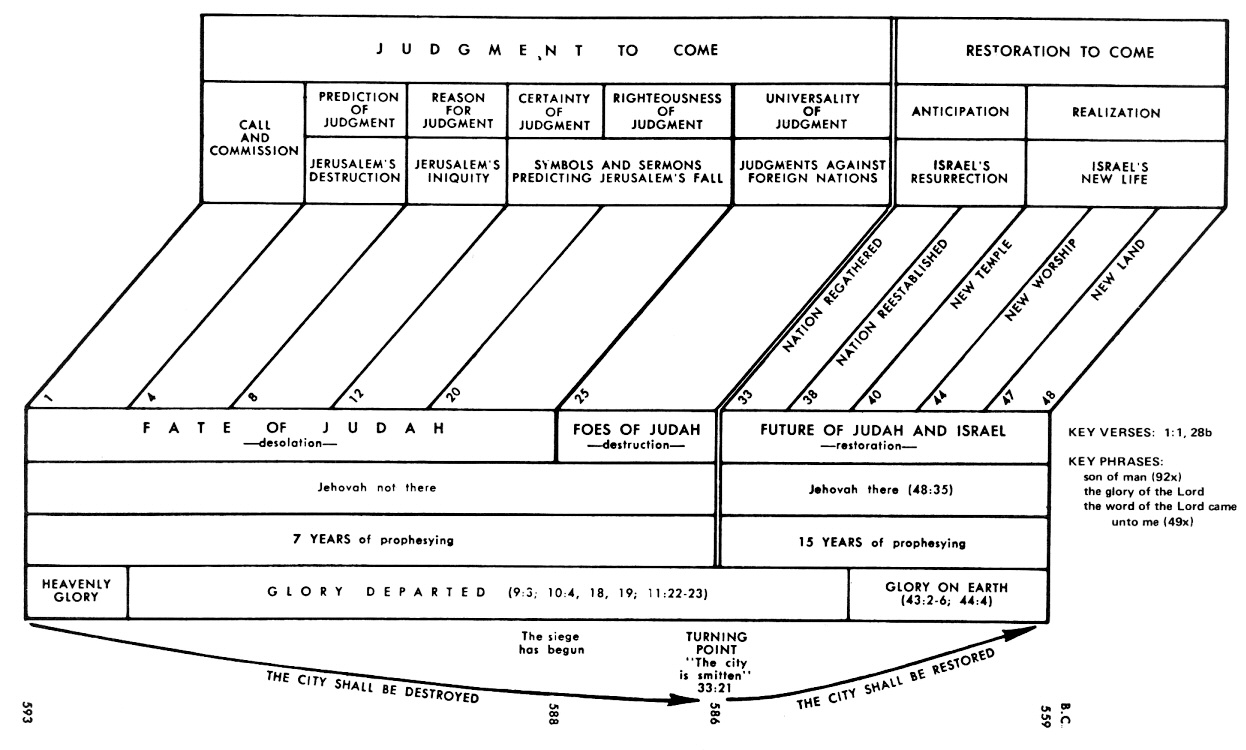
Click chart to enlarge
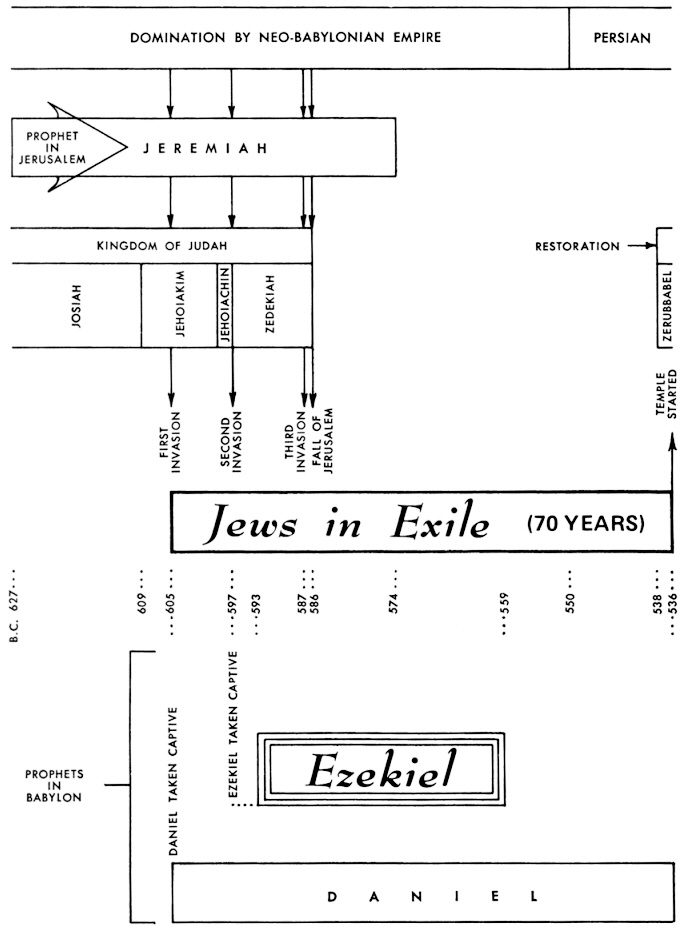
Click chart to enlarge
Chart from recommended resource Jensen's Survey of the OT - used by permission
Click Chart from Charles Swindoll
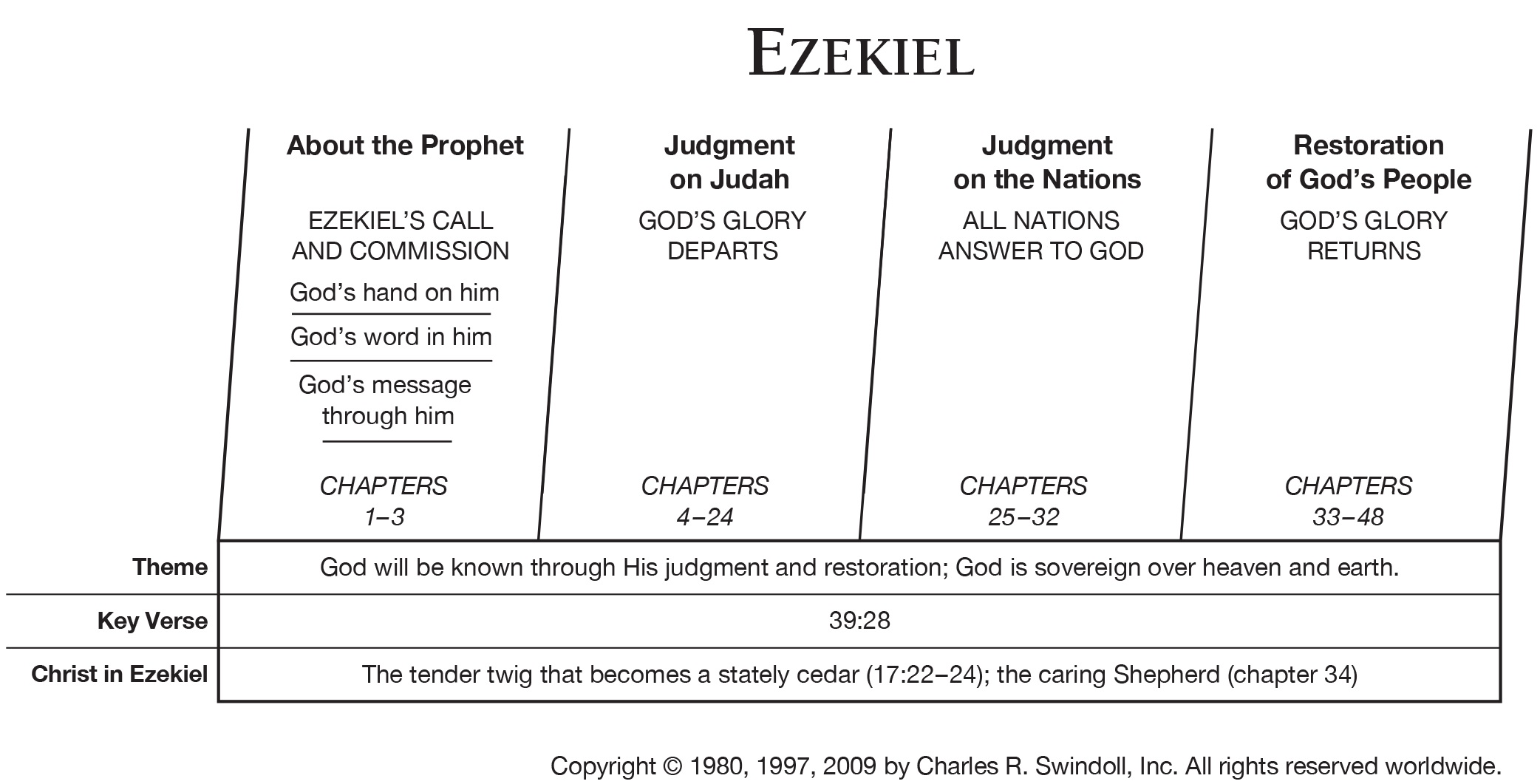
|
PROPHECY OF |
PROPHECY OF |
|||
| FATE OF JUDAH Before the Siege |
FOES OF JUDAH During the Siege |
FUTURE OF JUDAH After the Siege |
||
|
593-588 BC |
587-586 |
586-571 |
||
|
7 YEARS |
15 YEARS |
|||
| Ezekiel 1:1-3:27 Ezekiel Sees the Glory & Receives the Call |
Ezekiel 4:1-24:27 Judgments Against Judah |
Ezekiel 25:1-32:32 Judgments Against the Gloating Nations |
Ezekiel 33:1-39:29 Restoration of Israel to the LORD |
Ezekiel 40:1-48:35 Visions of the Temple Jehovah Shammah |
Outline of the Book of Ezekiel from Dr John MacArthur - The book can be largely divided into sections about condemnation/retribution and then consolation/restoration. A more detailed look divides the book into 4 sections. First, are prophecies on the ruin of Jerusalem (Ezekiel 1:1–24:27). Second, are prophecies of retribution on nearby nations (Ezekiel 25:1–32:32), with a glimpse at God’s future restoration of Israel (Ezekiel 28:25,26). Thirdly, there is a transition chapter (Ezekiel 33:1-33) which gives instruction concerning a last call for Israel to repent. Finally, the fourth division includes rich expectations involving God’s future restoration of Israel (Ezekiel 34:1–48:35). (Reference)
I. Prophecies of Jerusalem’s Ruin (Ezekiel 1:1–24:27)
A. Preparation and Commission of Ezekiel (Ezekiel 1:1–3:27)
1. Divine appearance to Ezekiel (Ezekiel 1:1–28)|
2. Divine assignment to Ezekiel (Ezekiel 2:1–3:27)
B. Proclamation of Jerusalem’s Condemnation (Ezekiel 4:1–24:27)
1. Signs of coming judgment (Ezekiel 4:1–5:4)
2. Messages concerning judgment (Ezekiel 5:5–7:27)
3. Visions concerning abomination in the city and temple (Ezekiel 8:1–11:25)
4. Explanations of judgment (Ezekiel 12:1–24:27)
II. Prophecies of Retribution to the Nations (Ezekiel 25:1–32:32)
A. Ammon (Ezekiel 25:1–7)
B. Moab (Ezekiel 25:8–11)
C. Edom (Ezekiel 25:12–14)
D. Philistia (Ezekiel 25:15–17)
E. Tyre (Ezekiel 26:1–28:19)
F. Sidon (Ezekiel 28:20–24)
Excursus: The Restoration of Israel (Ezekiel 28:25, 26)
G. Egypt (Ezekiel 29:1–32:32)
III. Provision for Israel’s Repentance (Ezekiel 33:1–33)
IV. Prophecies of Israel’s Restoration (Ezekiel 34:1–48:35)
A. Regathering of Israel to the Land (Ezekiel 34:1–37:28)
1. Promise of a True Shepherd (Ezekiel 34:1–31)
2. Punishment of the nations (Ezekiel 35:1–36:7)
3. Purposes of restoration (Ezekiel 36:8–38)
4. Pictures of restoration—dry bones and two sticks (Ezekiel 37:1–28)
B. Removal of Israel’s Enemies from the Land (Ezekiel 38:1–39:29)
1. Invasion of Gog to plunder Israel (Ezekiel 38:1–16)
2. Intervention of God to protect Israel (Ezekiel 38:17–39:29)
C. Reinstatement of True Worship in Israel (Ezekiel 40:1–46:24)
1. New temple (Ezekiel 40:1–43:12)
2. New worship (Ezekiel 43:13–46:24)
D. Redistribution of the Land in Israel (Ezekiel 47:1–48:35)
1. Position of the river (Ezekiel 47:1–12)
2. Portions for the tribes (Ezekiel 47:13–48:35)
Ezekiel 2:1 Then He said to me, "Son of man, stand on your feet that I may speak with you!"
KJV: And he said unto me, Son of man, stand upon thy feet, and I will speak unto thee.
YLT: It is the appearance of the likeness of the honour of Jehovah, and I see, and fall on my face, and I hear a voice speaking, and He saith unto me, 'Son of man, stand on thy feet, and I speak with thee.'
Ezekiel had received his initial "job training", a vision of the glory of God, the single most important aspect of his preparation for his difficult task. Speaking truth to rebellious people is not an easy task but the key is doing so not in our power but God's power. In Acts we see the early church facing intense opposition and yet Luke records that as the Jewish leaders
"observed the confidence of Peter and John, and understood that they were uneducated and untrained men, they were marveling, and began to recognize them as having been with Jesus." (Acts 4:13) Would they say the same about me?
Son of man: (Ezek 2:3,6,8; 3:1,4,10,17; 4:1; 5:1; 7:2; 12:3; 13:2; 14:3,13; 15:2; 16:2; 17:2; 20:3; 37:3; Ps 8:4; Da 8:17; Mt 16:13, 14, 15, 16; Jn 3:13,16) It is noticeable that the phrase (ben adam), as addressed to a prophet, occurs only in Ezekiel, in whom we find it not less than eighty times, and in Daniel 8:17. As used elsewhere, e.g. in Nu 23:19; Psalm 8:4; Job 25:6; Isaiah 51:12; 56:2,and in Ezekiel's use of it, it is probably connected with the history of Adam, as created from the ground (adamah) in Genesis 2:7; 3:19.
In the Gospels "Son of man" refers to Jesus over 80 times where it most often emphasizes His humanity and His dependence on God’s Holy Spirit.
Son of Man (Jesus) - Matt 8:20; 9:6; 10:23; 11:19; 12:8, 32, 40; 13:37, 41; 16:13, 27f; 17:9, 12, 22; 18:11; 19:28; 20:18, 28; 24:27, 30, 37, 39, 44; 25:31; 26:2, 24, 45, 64; Mark 2:10, 28; 8:31, 38; 9:9, 12, 31; 10:33, 45; 13:26; 14:21, 41, 62; Luke 5:24; 6:5, 22; 7:34; 9:22, 26, 44, 56, 58; 11:30; 12:8, 10, 40; 17:22, 24, 26, 30; 18:8, 31; 19:10; 21:27, 36; 22:22, 48, 69; 24:7; John 1:51; 3:13f; 5:27; 6:27, 53, 62; 8:28; 9:35; 12:23, 34; 13:31; Acts 7:56; Heb 2:6; Rev 1:13; 14:14
JFB adds that "son of man" "as applied to Messiah, implies… His lowliness (Ps 8:4-8; Mt 16:13; 20:18) and His exaltation (Da 7:13, 14, Mt 26:64; Jn 5:27)… at His first and second comings respectively."
This designation "son of man" emphasizes Ezekiel's human frailty and ultimately his need to depend on God's vision, Spirit and message for the ability to carry out his commission. The prophet is reminded, in the very moment of his highest inspiration, of his Adam nature with all its infirmity and limitations. In the use of a like phrase (bar enosh, instead of ben adam) in Daniel 7:13 we have the same truth implied. There one like unto man in all things is called to share the sovereignty of the "Ancient of Days," the Eternal One. Here the prophet Ezekiel, nothing in himself, is called to be the messenger of God to other sons of men. It is in many ways suggestive that our Lord should have chosen the same formula for constant use when speaking of himself.
Matthew Henry - "though God had here a splendid retinue of holy angles about His throne, who were ready to go on His errands, yet He passes them all by, and pitches on Ezekiel, a son of man, to be His messenger to the house of Israel"
MacDonald has an interesting note on "son of man" on the translation of this phrase in the New RSV noting that this version "paraphrases “son of man” as “mortal” to avoid the “masculine-oriented” words son and man; this obscures the link with Daniel and our Lord’s usage."
He goes on to quote Taylor's comment that "The first words that God addresses to Ezekiel appropriately put the prophet in his rightful place before the majesty which he has been seeing in his vision. The phrase son of man is a Hebraism which emphasizes Ezekiel’s insignificance or mere humanity. “Son of” indicates “partaking of the nature of” and so when combined with ’adãm, “man,” it means nothing more than “human being.” In the plural it is a common phrase for “mankind”.
The Bible Knowledge Commentary adds that "son of man" "seems to stress the distance that separates man from God. The word ”son“ expresses family and hereditary relationships, but often moves beyond the mere biological to denote association or identification with someone or something (cf ”sons of God,“ Ge 6:2, 6:4 ”son of the dawn,“ Isa 14:12). By this title God was stressing Ezekiel’s association with the human race."
Stand upon thy feet: (Ezek 1:28; Da10:11,19; Mt 17:7; Acts 9:6; 26:16) The attitude of adoration is changed, by the Divine command, into that of expectant service, that of awe and dread for the courage of a soldier of the Lord of hosts (compare the parallels of Ezekiel 3:24; 43:3, 5; Daniel 8:18).
JFB adds that "Humiliation on our part is followed by exaltation on God's part (Ezek 3:23, 24; Job 22:29; Jas 4:6; 1Pe 5:5)" and that "On thy feet" "was the fitting attitude when he was called on to walk and work for God" (Eph 5:8; 6:15).
Calvin comments that "God never prostrates his people so as to leave them lying upon the earth, but continually raises them afterwards… This work of the Spirit, then, is joined with the word of God. But a distinction is made, that we may know that the external word is of no avail by itself, unless animated by the power of the Spirit."
Compare Ezekiel's experience with that of Paul Who fell to the ground upon seeing "the glory of the LORD" Who then commanded him to
"arise, and stand on your feet; for this purpose I have appeared to you, to appoint you a minister and a witness not only to the things which you have seen, but also to the things in which I will appear to you; delivering you from the Jewish people and from the Gentiles, to whom I am sending you, to open their eyes so that they may turn from darkness to light and from the dominion of Satan to God, in order that they may receive forgiveness of sins and an inheritance among those who have been sanctified by faith in Me." ( Acts 26:16-18)
Wiersbe - After the vision came the voice, which is as it ought to be. God’s Word endures after the memory of visions fades (2 Pet. 1:16–21). Ezekiel had all the qualities that make for success in serving the Lord. He saw God’s glory and fell on his face in humble worship (Ezek 1:28). Only a vision of the glorious throne of God can sustain you when the way grows difficult. He stood on his feet, was filled with the Spirit, and listened to the Word of God (Ezek 2:1–5). He fed on the Word, which gave him what he needed to speak God’s Word (2:6–3:3). In this, he was like Jeremiah (Jer. 15:16), John (Rev. 10:9), and Jesus (Matt. 4:4). (Borrow copy of With the Word)
Hindson and Kroll - Ezekiel is addressed as Son of man. The context here would indicate that his human weakness was in view, in contrast to the strength of deity. For the superhuman task about to be given to him, he needed supernatural enablement that he did not have; thus, God the Spirit indwelt him for his work. Being now indwelt by the Spirit of God, he is commissioned to go to the house of Israel, which has been, and continues to be, rebellious. Terms such as rebellious, stubborn, and obstinate are used to describe the nation. They are even likened to thistles, thorns, and scorpions standing in opposition to him. But Ezekiel is given special preparation for the task. First, he is given the message from God to eat and assimilate. He is forewarned that Israel will not receive the message. And finally, he who was naturally fearful will now be made harder in spirit than even the rebellious house of Israel. This will enable him to tell them God’s message whether they believe or not. With this preparation he is directed to go to the exiles already in captivity. Son of man is an emphatic form of man, occurring over ninety times in the book to remind Ezekiel that, in contrast to the majestic God, he was merely a mortal man. Our Lord in His earthly ministry also took this title to Himself. It indicated His perfect identification with man, so as to enable Him to be our perfect substitute. The blood of animal sacrifice was only a temporary covering for sin, whereas He shed blood for the expiation (full removal) of our sins (Heb 2:14; Heb 10:4). Stand upon thy feet. Awestruck by the majestic sight of the divine glory, the prophet had fallen upon his face (Eze 1:28). He is now bidden to stand on his feet and be prepared to receive God’s message (Online KJV Bible Commentary)
Ezekiel 2:2 As He spoke to me the Spirit entered me and set me on my feet; and I heard Him speaking to me.
KJV: And the spirit entered into me when he spake unto me, and set me upon my feet, that I heard him that spake unto me.
YLT: And there doth come into me a spirit, when He hath spoken unto me, and it causeth me to stand on my feet, and I hear Him who is speaking unto me.
Related Passage:
Psalm 119:25 Daleth. My soul cleaves to the dust; Revive me according to Your word (cf "As He spoke to me...).
EZEKIEL'S SOURCE
OF SUPERNATURAL POWER
THOUGHT - God's commission comes with God's enablement. It was true then and true now. Our commission? Make (aorist imperative see our need to depend on the Holy Spirit to obey) disciples (Mt 28:19+). Are you obeying Jesus' command? Are you wasting your time playing with worldly trinkets and passing pastimes? If so, Heaven will be less for you then it could be! Eternity is in the balance and is related on how you redeem today! Do you really believe that is true? If you do, then you need to redeem the precious time! Listen to the words of Adoniram Judson
A life once spent is irrevocable. It will remain to be contemplated through eternity… If it has been a useless life, it can never be improved. Such will stand forever and ever. The same may be said of each day. When it is once past, it is gone forever. All the marks which we put upon it, it will exhibit forever… Each day will not only be a witness of our conduct, but will affect our everlasting destiny (Note: Not in loss of salvation but of rewards - cp 1Co 3:11-15+, Jn 15:5, 2Co 5:10+, cp 1Ti 4:7, 8+). No day will lose its share of influence in determining where shall be our seat in heaven. How shall we then wish to see each day marked with usefulness! It will then be too late to mend its appearance. It is too late to mend the days that are past. The future is in our power. Let us, then, each morning, resolve to send the day into eternity in such a garb as we shall wish it to wear forever. And at night let us reflect that one more day is irrevocably gone, indelibly marked. (See page 33-34 of A memoir of the life and labors of the Rev. Adoniram Judson) This is "Coram Deo" living before the face of God, "Carpe Diem" seizing the day, because "Tempus Fugit", time flies and so our daily prayer should be "So teach us to number our days, that we may present to Thee a heart of wisdom." (Ps 90:12- see note)
"the Spirit entered me" (Ezek 3:12, 3:14 3:24; 36:27; Nu11:25, 11:26; Jdg 13:25; 1Sa16:13; Neh 9:30; Joel 2:28, 2:29; Rev 11:11). Did you notice the sequence? First, God told Ezekiel to stand, but then He Himself provided the enablement to stand by the power of His Spirit. God's commands always include His enablement to carry out the command. (cf Php 2:12, 2:13) This is undoubtedly the same Spirit Who directed the movement of the living creatures in Ezek 1:12, 20, 21. Note some think this is "spirit" with a little "s" but the Holy Spirit is repeatedly referenced in this book - Eze 3:12, Eze 3:14, Eze 3:24; Eze 8:3; Eze 11:1, Eze 11:5, Eze 11:24; Eze 37:1; Eze 43:5).
THOUGHT - Not every believer in the OT had an experience with the indwelling Spirit. How every NT believer should be encouraged by the work and walk of Ezekiel, for the Spirit that indwelt him temporarily, indwells us permanently. The question is are we daily surrendering to His will, which is good and acceptable and perfect?
I love JFB's comment that "The divine Word is ever accompanied by the Spirit." (Ge 1:2, 3).
The Lxx has "the Spirit came upon me" rather than "entered me" but the idea is still the same. "The Spirit" that came upon Ezekiel was to equip and empower him to address the people. Whatever task God calls you to, He will also enable you to complete it.
In Old Testament times the Holy Spirit did not indwell all believers but indwelt selected persons temporarily for divine service. David's prayer of contrition "do not take Thy Holy Spirit from me" (Ps 51:11) reflects the temporary indwelling by the Spirit in the Old Covenant. Obviously in the New Covenant believer's "body is a temple of the Holy Spirit Who is in you Whom you have from God" (1Cor 6:19) and have therefore been "sealed in (Christ) with the Holy Spirit of promise Who is given as a pledge of our inheritance" (Eph 1:13, 14) but we can still "quench the Spirit" (1Th 5:19) or "grieve the Holy Spirit of God, by Whom (we) were sealed for the day of redemption." (Eph 4:30)
Samuel speaking to Saul who is to be Israel's first king tells him
"the Spirit of the LORD will come upon you mightily, and you shall prophesy with them (a group of prophets) and be changed into another man." (1Sa 10:6)
"It’s ironic, when you compare Ezekiel’s experience with what happens in a charismatic service today. In a Benny Hinn meeting supposedly it’s the Holy Spirit who knocks you down - while it’s man who helps you up. But that’s not what happens to Ezekiel. The Spirit doesn’t knock him down, but helps him up. Ezekiel humbles himself and falls on his face, then the Spirit lifts him up! Guys, don’t be mistaken, the Holy Spirit doesn’t slay us - He stands us up again, after we’ve humbled ourselves." (Ref)
Ezekiel 2:3 Then He said to me, "Son of man, I am sending you to the sons of Israel, to a rebellious people who have rebelled against Me; they and their fathers have transgressed against Me to this very day.
KJV: And he said unto me, Son of man, I send thee to the children of Israel, to a rebellious nation that hath rebelled against me: they and their fathers have transgressed against me, even unto this very day.
YLT: And He saith unto Me, 'Son of man, I am sending thee unto the sons of Israel, unto nations who are rebels, who have rebelled against Me; they and their fathers have transgressed against Me, unto this self-same day.
"I am sending you" (Ezek 3:4, 5, 6, 7, 8; 2Chr 36:15,16; Is 6:8, 9, 10; Jer 1:7; 7:2; 25:3, 4, 5, 6, 7; 26:2, 3, 4, 5, 6; 36:2; Mk 12:2, 3, 4, 5; Lk 24:47,48; Jn 20:21,22; Ro 10:15) The LORD now explains the purpose of the vision and the Spirit's enablement, namely, that being armed with authority he might more freely discharge his duty as Prophet among the rebellious people.
"Rebellious… rebelled" (marad) (Ezek 16:1-63; 20:1-49; 23:1-49) (Ezek 20:18-30; Nu 20:10; 32:13,14; Dt 9:24,27; 1Sa 8:7,8; 2Ki 17:17-20; Ezra 9:7; Neh 9:16-18,26,33-35; Ps 106:16-21,28,32-40; Jer 3:25; Jer 16:11,12; 44:21; Da 9:5-13; Acts 7:51)
Torrey's Topics
God's chosen people were rebels from their "birth" and had repeatedly demonstrated opposition to the God's authority.
Webster adds that "rebellion" implies an "open formidable resistance that is often unsuccessful"!
"People" in the phrase "Rebellious people" is the Hebrew word "goyim" which elsewhere refers to the Gentile heathen and that may be Ezekiel's sense here.
JFB comments that "the word (goyim) is usually applied to the heathen or Gentiles (but) here to the Jews, as being altogether heathenized with idolatries. So in Isa 1:10, they are named "Sodom" and "Gomorrah." They were now become "Lo-ammi," not the people of God (Ho 1:9)."
Calvin agrees commenting that "among the Jews (goyim) is a word of reproach; for they often call “Gentiles” "goyim" as if… “profane,” “rejected,” and altogether alienated from God. Lastly… "goyim" means with them “pollution” and “abomination”. In ancient days Gentiles were "to the Jews like dung, and the off-scouring of the world" because they were "goyim". And there is no doubt that this pride filled the minds of the people in the days of the Prophet. God therefore calls them" rebellious "goyim" which would be the ultimate affront.
The Hebrew word for rebel is used in the following passages: For example in Nu 14:9, 10 God had clearly warned "Only do not rebel against the LORD; and do not fear the people of the land, for they shall be our prey. Their protection has been removed from them, and the LORD is with us; do not fear them. But all the congregation said to stone them (Moses and Aaron) with stones. Then the glory of the LORD appeared in the tent of meeting to all the sons of Israel."
Their rebellion was not against Moses' leadership but ultimately was against the LORD. Later God says that they had "rebelled against My command at the waters of Meribah."
Later after having entering the Promised Land under the leadership of Joshua, the congregation makes what would prove to be a shallow declaration
"Far be it from us that we should rebel against the LORD and turn away from following the LORD this day, by building an altar for burnt offering, for grain offering or for sacrifice, besides the altar of the LORD our God which is before His tabernacle." (Josh 22:29)
In Daniel's prayer in Daniel 9+ he specifically addresses the rebellion of Israel, even including himself in his confession:
"And I prayed to the LORD my God and confessed and said, "Alas, O Lord, the great and awesome God, who keeps His covenant and lovingkindness for those who love Him and keep His commandments,5 we have sinned, committed iniquity, acted wickedly, and rebelled, even turning aside from Thy commandments and ordinances.6 "Moreover, we have not listened to Thy servants the prophets, who spoke in Thy name to our kings, our princes, our fathers, and all the people of the land… 9 "To the Lord our God belong compassion and forgiveness, for we have rebelled against Him;10 nor have we obeyed the voice of the LORD our God, to walk in His teachings which He set before us through His servants the prophets."
Thus we see that Israel had been a "rebellious people" from before they entered the Promised Land after being freed from Egyptian bondage to the time of Daniel taken captive in 605BC ("to this very day")
Could Israel blame their fate on the transgressions of their fathers? God says both they and "their fathers have transgressed" against Me. This statement clearly teaches (they… their fathers) that each individual is responsible for his or her own sin. This sin problem is not something that has just developed but has been "festering" and necessitates a holy God's righteous judgment. Like father like son --The "children" are walking in their "father's'" footsteps.
Transgressed is the Hebrew word pasha which is the strongest word available for expressing a covenant violation or one who breaks away from authority. The word is used in the diplomatic arena to express treaty violation (2Ki 1:1; 3:5, 7).
Pasha conveys the fundamental idea of a breach of relationships (civil or religious) between two parties. It means to be in open defiance of an authority or standard of an agreement. Israel stood condemned of rebelling against her King and His covenant (cf Isa1:28; 48:8; Hos 8:1). Webster adds that "transgress" means to go beyond set or prescribed limits (in this case the "limits" set by the Mosaic covenant).
The International Standard Bible Encyclopedia explains that transgression (pasha/pesha) is ""An act of “going beyond” or violating a duty, command, or law. Thus the term connotes lawlessness, iniquity, fault, ungodliness, unrighteousness, and wrongdoing...it has to do with the violation of a relationship… The Bible warns that the person who transgresses is under the power of that act. Bildad the Shuhite wondered aloud whether Job’s children had been destroyed because God had delivered them into the power of their transgression (Job 8:4). More commonly expressed is the warning that repeated transgression ensnares those who engage in it (Pr 12:13; 29:6) and (figuratively) weighs them down (Isa 24:20). Repeated transgression reinforces an attitude of defiance toward God, for there is no longer any fear in the heart of the transgressor (Ps. 36:1)… .Isaiah prophesied that the Servant of Yahweh would be stricken for the transgression of Yahweh’s people (Isa. 53:8), and he promised redemption for those of Jacob who turned from their transgression (Isa 59:20)."
In conclusion, could individual Jews even though in exile in Babylon be forgiven? David answers
"How blessed is he whose transgression is forgiven, whose sin is covered! How blessed is the man to whom the LORD does not impute iniquity, and in whose spirit there is no deceit!" (Ps 32:1, 2)
Irving Jensen…"The idolatry which Ezekiel saw as Judah's blight before he left Jerusalem was the same condition he faced inn the settlements of Jewish exiles in Babylonia. The judgment of captivity did not stir the first contingents of exiles to repentance. In fact, they found it very hard to believe, as Ezekiel was prophesying, that Jerusalem would actually be destroyed by the Babylonians. They were loath to believe that Jehovah had given world dominion to Babylon, and that His will was for Judah to submit to this enemy. Hence, it was necessary for Ezekiel in Babylon -- and Jeremiah in Jerusalem -- to show the people how unfounded were any expectations of immediate deliverance." (Irving Jensen, Jensen's Survey of the Old Testament, 360).
Calvin draws attention to the principle that "when God wishes to stir us up to obedience, He does not always promise a happy result of our labor: but sometimes He so puts our obedience to the test, that He wishes us to be content with His command, even if our labor should be deemed ridiculous before men… .He sometimes proves His people… providing that whatever be the result of their labors, it is sufficient for them to obey His command."
Even as the LORD was giving Ezekiel a difficult charge, In a similar way the LORD also warned Isaiah of the futility of much of his preaching, a telling him to
"Go, and tell this people: 'Keep on listening, but do not perceive. Keep on looking, but do not understand.' "Render the hearts of this people insensitive, their ears dull, and their eyes dim, lest they see with their eyes, hear with their ears, understand with their hearts, and return and be healed. Then I said, "Lord, how long?" And He answered, "Until cities are devastated and without inhabitant, houses are without people, and the land is utterly desolate… " (Isa 6:9-11)
And so the Lord told Isaiah (and later Ezekiel) that his message would not result in national revival for the people had not listened before and they would not listen now and that in fact upon hearing Isaiah’s message, Israel would become even more hardened against the Lord. How would you respond if God told you the ministry you are doing today would be viewed as a failure in men's eyes! This is a difficult word, but the point is not to seek to be fruitful but to submit and be faithful! How are you doing? Has God called you into a difficult field where you are seeing little if any fruit? If God has called you and you are certain of that, as the 1956 Greyhound bus commercial used to say "It's such a comfort to travel by bus and leave the driving to us!" Leave the "driving" to God. You can be
"confident of this very thing, that He who began a good work in you will perfect it until the day of Christ Jesus." (Phil 1:6)
Calvin goes on to conclude "For some who seem to be sufficiently ready to obey, yet when difficulties and obstacles occur, desist in the middle of their course, and many recede altogether; and some we see who have renounced their vocation, because they had conceived great and excessive hopes of success, but when the event does not answer their expectations, they think themselves discharged from duty, and even murmur against God, and reject the burden, or rather shake off what had been imposed upon them. Because, then, many retreat from the course they had undertaken, because they do not experience the success they had imagined, or had presumed upon in their minds, therefore before Ezekiel begins to speak, God sets before him trials of this kind, and informs him that he would have to deal with a rebellious people. "
Rebelled (04775) marad is a primary root and means to revolt or be rebellious against a human king, against God or figuratively against light of God's truth (Job 24:13) To renounce a former allegiance. The idea is resisting authority, God (Nu 14:9, Da 9:9) or men (Ge 14:4, Neh 2:19). Marad describes the rebellious character of a nation (Ezek 2:3, Ezek 20:38) or an individual (Hezekiah in 2Ki 18:7, 20, Isa 36:5), or Zedekiah rebelling against King Nebuchadnezzar (2Ki 24:1, 20, Jer 52:3, Ezek 17:15).
Transgressed (06586)(pasha - cognate verb = pesha' = to transgress) is a verb conveys the fundamental idea of a breach of relationships (civil or religious) between two parties. This word describes those who break away from authority and thus trespass, apostatize, rebel, revolt, transgress.
Pasha in Ezekiel - Ezek. 2:3; Ezek. 18:31; Ezek. 20:38
QUESTION - Why is Ezekiel called son of man if it is a title for Jesus?
ANSWER - The term son of man is used variously in Scripture. Jesus is indeed referred to as the Son of Man in the New Testament—88 times, to be exact. The term son of man is also found in the Old Testament. The prophet Ezekiel is called “son of man” over 90 times. Thus, both Jesus and Ezekiel can rightly be called “son of man”; but there is something unique about the way the title is applied to Christ.
In the gospels, Jesus often refers to Himself as the Son of Man (e.g., Matthew 16:27; Mark 14:21; Luke 7:34; John 3:13). Jesus’ use of this title links Him to Daniel 7:13–14, a passage describing the coming Messiah: “There before me was one like a son of man, coming with the clouds of heaven. . . . He was given authority, glory and sovereign power; all peoples, nations and men of every language worshiped him. His dominion is an everlasting dominion that will not pass away, and his kingdom is one that will never be destroyed.” The teachers of the Law during Jesus’ time on earth would have readily understood Jesus’ meaning when He applied the title Son of Man to Himself. Jesus’ use of the phrase points to His exalted state as a person of the Godhead and the fact that He will fulfill Daniel’s prophecy.
Further, only in the gospels do we find the term son of man associated with the definite article, the. Jesus always called Himself “the Son of Man,” as in the only one there is. In using the definite article, Jesus contrasts Himself with other personalities in the Bible associated with the same term. Ezekiel is never called “the son of man”; he is always just a “son of man,” as in one among many.
Son of man is a rather common term in the Bible, and it simply means “man.” It emphasizes the humanity of a person. In the case of Ezekiel, who was often referred to as “son of man” (e.g., Ezekiel 2:1; 3:1; 4:1; 5:1), God probably chose this manner of direct address to point up the contrast between the human condition of Ezekiel and the transcendent majesty of God. In the first chapter of his book, Ezekiel relates a vision he had of God’s glory—a scene full of wheels and eyes and storms and fire and strange angelic creatures. In the first verse of the next chapter, God addresses Ezekiel as “son of man.” The prophet could not help but realize his own human frailty and limitations in the face of God’s unsurpassable glory. God is God, and Ezekiel is but a “son of man.”
In Jesus’ case, the application of the title Son of Man also highlights the humanity of Christ. The difference is that He is the Son of Man; that is, He is the epitome of humanity. Jesus is the Sinless One, humanity perfected, the one to finally reconcile God and man. GotQuestions.org
Ezekiel 2:4 "I am sending you to them who are stubborn * and obstinate * children, and you shall say to them, 'Thus says the Lord GOD.'
KJV: For they are impudent children and stiff hearted. I do send thee unto them; and thou shalt say unto them, Thus saith the Lord GOD.
DRA: And they to whom I send thee are children of a hard face, and of an obstinate heart: and thou shalt say to them: Thus saith the Lord God:
YLT: And the sons are brazen-faced and hard-hearted to whom I am sending thee, and thou hast said unto them: Thus said the Lord Jehovah:
"I am sending you": God's "jobs" are initiated by God. Listen to what even our Lord Jesus said centuries later (also sent to a "stubborn and obstinate people"):
"I can do nothing on My own initiative. As I hear, I judge; and My judgment is just, because I do not seek My own will, but the will of Him who sent Me." (Jn 5:30)
This is a good pattern for all God's servants to follow. To whom is Ezekiel sent? To Jews already in exile, Jews who have already felt the sting of God's wrath and yet who are still not broken. What does God ultimately desire for these exiles to do? Surely he would be pleased if they confessed and repented. Would He forgive them? Obviously he would. Would they be returned to Jerusalem? No the consequences of the rebellion had sealed the fate of the holy city and holy temple. God in the midst of wrath is remembering mercy and sending a warning to those already punished. The point is that if you have breathe in your lungs, no matter how heinous your rebellion against God, He still desires your repentance rather than your destruction. Peter affirms the Father's heart writing that
"the Lord is not slow about His promise, as some count slowness, but is patient toward you, not wishing for any to perish but for all to come to repentance." (2 Pet 3:9)
Compare God's commission to that of Isaiah (Isa. 6:9, 10, 11, 12) and Jeremiah (Jer. 1:17, 18, 19), both of whom were also sent to a rebellious people.
God had prepared Ezekiel for this commission by giving him a vision of His glory which changed him forever. We may not see visions like Ezekiel but God still desires to reveal Himself to His saints that we might be prepared (changed forever) for His service for His glory. Consider boldly praying like Moses' "I pray Thee, show me Thy glory!" (Ex 33:18) and then wait expectantly to see and hear His answer as you commune with Him in His word, through meditation and prayer.
Stubborn and obstinate children (lit the sons, stiff-faced and hardhearted) (See Torrey's Topic Rebellion Against God National Sins) "defiant and stubborn children" (GWT), "sons are brazen-faced and hard-hearted" (YLT), "impudent and stubborn children" (NKJV), "children of a hard face, and of an obstinate heart:" (DRA), "the children are brazen-faced and stiff-hearted," (JPS) Israel’s problem was not ignorance, but willful obstinate rebellion to the known will of God.
THOUGHT- Beloved, every time we commit a presumptive sin (against the known will of God), we are imitating Israel's pattern!
Stubborn is actually two Hebrew words which are literally "stiff faced". This implies they were callous to their shame! Jeremiah had accused the people of Jerusalem of no longer even being able to blush! This reminds one of Paul's description of the lost describing them as "having become callous, have given themselves over to sensuality, for the practice of every kind of impurity with greediness." (Eph 4:19)
The word for "stiff" (hard, cruel, stubborn) is derived from a Hebrew root that apparently arose from an agricultural milieu and which emphasizes the effect exerted by an overly heavy yoke, which is hard to bear, and secondarily, the rebellious resistance of oxen to the yoke! God's chosen children were acting like dumb resisting oxen!
Calvin sees in this word picture an emphasis on the countenance of the Jews writing "that the Jews were not only rebellious against God and puffed up with proud contempt, but their impiety was so desperate that they opposed themselves to God without disguise, as if they had been horned oxen or furious bulls. We know that hypocrisy often lies hid in the mind, and although men swell with malice, yet they do not betray what they inwardly nourish. But the Prophet here signifies that the Israelites were so immersed in impiety (irreverence, ungodliness), that they displayed themselves as the open enemies of God in their very countenances. The result is, that the Prophet, while he applied himself to perform the commands of God, ought so to determine with himself, when he approaches the people, that his teaching would be not only useless as to them, because it would not be received with the reverence which it deserves, but would be even exposed to many reproaches: since the Israelites were not only filled with a hidden contempt of God, but they openly showed their ferocity, so to speak," since they were of so brazen a front that they would without doubt purposely reject the Prophet."
Obstinate in this verse is two Hebrew words, one meaning hard or firm and the other word meaning heart and thus describes these children as "hard-hearted". "Heart" (leb) in Scripture is the part of our being where we desire, deliberate, and decide. It has been described as "the place of conscious and decisive spiritual activity," "the comprehensive term for a person as a whole; his feelings, desires, passions, thought, understanding and will," and "the center of a person. The place to which God turns" and in the present context the place which is turned against the Lord God. Instead of confessing their sins and seeking repentance, they hardened their hearts and refused to accept God's Word as subsequent chapters reveal.
Elwell adds that “obstinate” (lit. hard-faced) "describes the people on the outside—their passive, emotionless faces. The second and (stubborn) describes the people on the inside—hardhearted. Obviously these are not upbeat, encouraging words for this exilic pastor. But they are accurate, and they delineate precisely the enormity of the task before the prophet. His congregation is not a promising one." (Evangelical Commentary on the Bible. Grand Rapids, Mich.: Baker Book House)
God declared to Moses shortly after their liberation from Egypt
"I have seen this people, and behold, they are an obstinate people" (Ex 32:9)
God went on to add tell Moses
"Now then let Me alone, that My anger may burn against them, and that I may destroy them; and I will make of you a great nation." Then Moses entreated the LORD his God, and said, "O LORD, why doth Thine anger burn against Thy people whom Thou hast brought out from the land of Egypt with great power and with a mighty hand? (Ex 32:10-11)
Thus says the LORD This exact phrase occurs 418 times in the Old Testament (in the NASB). It is interesting that the first 9 uses in Scripture are in declarations by God's prophet Moses to Pharaoh who hardened his heart to the message even as did the children of Israel.
Clarke adds that "Every preacher of God’s word should take heed that it is God’s message he delivers to the people. Let him not suppose, because it is according to his own creed or confession of faith, that therefore it is God’s word. False doctrines and fallacies without end are foisted on the world in this way. Bring the creed first to the Word of God, and scrupulously try whether it be right; and when this is done, leave it where you please; take the Bible, and warn them from God’s word recorded there.
Lord God is the Hebrew 'adonay yehovah translated by the NIV and NLT as "the Sovereign LORD"
BKC adds that
Ezekiel used this title of God 211 times (see uses below). Elsewhere in the Old Testament it occurs only 103 times. This name stresses both God’s sovereign authority and His covenant-keeping faithfulness.
Lord God in Ezekiel -
Ezek 2:4; 3:11, 27; 4:14; 5:5, 7f, 11; 6:3, 11; 7:2, 5; 8:1; 9:8; 11:7f, 13, 16f, 21; 12:10, 19, 23, 25, 28; 13:3, 8f, 13, 16, 18, 20; 14:4, 6, 11, 14, 16, 18, 20f, 23; 15:6, 8; 16:3, 8, 14, 19, 23, 30, 36, 43, 48, 59, 63; 17:3, 9, 16, 19, 22; 18:3, 9, 23, 30, 32; 20:3, 5, 27, 30f, 33, 36, 39f, 44, 47, 49; 21:7, 13, 24, 26, 28; 22:3, 12, 19, 28, 31; 23:22, 28, 32, 34f, 46, 49; 24:3, 6, 9, 14, 21, 24; 25:3, 6, 8, 12ff; 26:3, 5, 7, 14f, 19, 21; 27:3; 28:2, 6, 10, 12, 22, 24f; 29:3, 8, 13, 16, 19f; 30:2, 6, 10, 13, 22; 31:10, 15, 18; 32:3, 8, 11, 14, 16, 31f; 33:11, 25, 27; 34:2, 8, 10f, 15, 17, 20, 30f; 35:3, 6, 11, 14; 36:2ff, 13ff, 22f, 32f, 37; 37:3, 5, 9, 12, 19, 21; 38:3, 10, 14, 17f, 21; 39:1, 5, 8, 10, 13, 17, 20, 25, 29; 43:18f, 27; 44:2, 6, 9, 12, 15, 27; 45:9, 15, 18; 46:1, 16; 47:13, 23; 48:29;
Disciples Study Bible…Judah's sin of rebellion had become so entrenched that her fate was sealed: exile in Babylon. God sent the prophet Ezekiel to proclaim the message of judgment upon Judah. Even when God's people become hopeless rebels, He does not leave them without a prophetic word of warning and hope. The parallel expression revolt (Hebrew marad) comes from Near Eastern laws and covenant treaties. It refers to mutiny against a legally-established vassal relationship. Sin is agreeing to be God's servant and then actively backing out of and refusing to abide by the agreement. Only an obstinate and stubborn people (literally stiff of face and firm of heart) would dare mutiny against God." (Disciple's Study Bible)
The major part of the first half of the Book of Ezekiel is spent in presenting the stubbornness of the people known by His name and God’s wrath against them because of their obstinacy. Moses wrote has a parallel thought
You spread out our sins before you-- our secret sins--and you see them all.” (NLT, Ps 90:8).
The emphasis in the New Testament is upon the love and grace of God. Today we don't talk much about God's holiness and wrath. It is because of the wrath of God that we need the grace of God. The tendency in the church today is to give the “good” news and to minimize the bad news. The fact is that the good news is "good" only in the context of "bad news". In our efforts to be consumer friendly, many pulpits refrain from preaching the wrath of God lest they frighten away the “seekers! And the tragic result is that we have produced a milk toast gospel and a "soft" Christianity that talks mainly about the promises of God, without mentioning our need for commitment to God. The result is God has been lowered to the level of a cosmic vending machine.
J. I. Packer in "Knowing God" has this to say about God’s wrath "The modern habit throughout the Christian church is to play the subject down. Those who still believe in the wrath of God (not all do) say little about it; perhaps they do not think much about it. To an age which has unashamedly sold itself to the gods of greed, pride, sex and self-will, the church mumbles about God’s kindness, but virtually says nothing about God’s judgment.
There is no other book in the whole Bible that presents the sins of God’s people in as much detail as the Book of Ezekiel. Do you want to get the full picture of the sinfulness of man? Do you want to get the full picture of the hopeless situation of man? Do you want to get the full picture of the awesome character of God and His holiness? Do you want to get the full picture of the wrath of God? Study the Book of Ezekiel, and your life will be transformed.
Prayer Grant, O Almighty God, since thou hast counted us worthy of enjoying the privilege of daily listening to thy word, that it may not find our hearts of stone and our minds of iron, but may we so submit ourselves to thee with all due docility, that we may truly perceive thee to be our Father, and may be confirmed in the confidence of our adoption, as long as thou perseverest to address us, until at length we enjoy not merely thy voice, but also the aspect of thy glory in thy heavenly kingdom, which thine only-begotten Son has acquired for us by his blood. — Amen. (Calvin)
Ezekiel 2:5 "As for them, whether they listen or not--for they are a rebellious house --they will know that a prophet has been among them
KJV: And they, whether they will hear, or whether they will forbear, (for they are a rebellious house,) yet shall know that there hath been a prophet among them.
NLT: And whether they listen or not--for remember, they are rebels--at least they will know they have had a prophet among them.
LXX (Greek): And thou, son of man, fear them not, nor be dismayed at their face; (for they will madden and will rise up against thee round about, and thou dwellest in the midst of scorpions): be not afraid of their words, nor be dismayed at their countenance, for it is a provoking house.
YLT: and they -- whether they hear, or whether they forbear, for a rebellious house they are -- have known that a prophet hath been in their midst.
"Among them" is more literally right in the middle (Young's Literal "a prophet hath been in their midst" and the Greek Lxx has mesos = middle or in the middle) of the rebellious people, people who reserve the right to make the final decisions in their life independent of what would please and/or honor God. Thus positioned he would be able to reach the maximum number of rebels.
"Whether they listen or not" (Ezek 2:7; 3:10,11,27; Mt 10:12, 13, 14, 15; Acts 13:46; Ro3:3; 2Co 2:15, 16, 17)
And so we see that Ezekiel was warned that his ministry would not necessarily be well received. Things have not changed much in almost 2500 years since Ezekiel's time. Believers today are forewarned that a true presentation of the gospel will be offensive to unsaved rebels for the cross is a "stumbling block" (Gal5:11) and "the word of the Cross is to those who are perishing foolishness, but to us who are being saved it is the power of God" (1Cor 1:18)
As we go forth with God's message in His authority we will be "a fragrance of Christ to God among those who are being saved and among those who are perishing, to the one an aroma from death to death, to the other an aroma from life to life." (2Cor 2:15 16)
How would like to go to work next week and you receive your assignment with the "guarantee" that you are being given "mission impossible" and you will almost certainly fail to achieve the hoped for results? That's essentially the message that God was giving to Ezekiel. But read the comment below regarding what would ultimately determine the "success" of Ezekiel's mission!
Larry Richards adds that "This is so hard for us to realize. It is so easy to become discouraged when others do not respond to our sharing of God’s Word. Yet the Lord told Ezekiel, and through him us, not to measure the importance of our ministry by how others respond. God’s people are called to faithfully communicate God’s Word. It is faithfulness, not success, that is the measure of our worth as His servants." (The Bible reader's companion. Wheaton, Ill.: Victor Books)
They will know that a prophet has been among them (Ezek 3:19; 33:9,33; Lk 10:10, 11, 12; Jn 15:22) How would they know? Obviously in time the message that Ezekiel spoke to them would come to pass and validate his credentials as a true prophet of the Sovereign Lord.
And so we see in chapter 33 the declaration that "when it comes to pass-- as surely it will-- then they will know that a prophet has been in their midst." (Ezek 33:33). The clear implication of this statement are that God in His longsuffering and lovingkindness has given rebellious Israel due warning and that the rebellious house is without excuse for not receiving and responding to the warnings.
Prophet (Torrey's Topic Prophet) (More detailed discussion of prophets in Int'l Std Bible Encyclopedia Pt1, Pt2 Pt 3 Pt 4)is the Hebrew word for prophet is nabi/nabiy', derived from a verb signifying "to bubble forth" like a fountain or boil forth and hence means one who announces or pours forth the declarations of God or who speaks with fervor of mind under divine inspiration. The primary idea of a prophet, therefore, is a declarer, announcer, one who utters a communication.
Nelson's New Christian Dictionary describes a "prophet" as a "spokesperson for or messenger of God who foretells events that God in his foreknowledge has transmitted to him or her or declares the oracles of God for… edification… The message may be one of admonition or one of consolation and comfort. In contrast to teaching which is bound by tradition, prophecy has the character of a revelation."
Easton's Dictionary adds that a prophet spoke "in God's name and by his authority (Ex 7:1). He is the mouth by which God speaks to men (Jer 1:9; Is 51:16), and hence what the prophet says is not of man but of God (2Pe 1:20,21; cf Heb 3:7; Acts 4:25; 28:25). Prophets were the immediate organs of God for the communication of His mind and will to men (Dt 18:18,19). The whole Word of God may in this general sense be spoken of as prophetic, inasmuch as it was written by men who received the revelation they communicated from God, no matter what its nature might be. The foretelling of future events was not a necessary but only an incidental part of the prophetic office. The great task assigned to the prophets whom God raised up among the people was "to correct moral and religious abuses, to proclaim the great moral and religious truths which are connected with the character of God, and which lie at the foundation of his government."
Locke adds that "Prophecy comprehends three things: prediction; singing by the dictate of the Spirit; and understanding and explaining the mysterious, hidden sense of Scripture by an immediate illumination and motion of the Spirit."
During the later years of the monarchy in Judah, before the Nebuchadnezzar laid his first siege against Jerusalem (605BC), the Jews in Judah had taken Him for granted. They assumed that God’s covenant with their forefathers was irrevocable (which is true), the ownership of the land was permanent (which is true), and that they were immune to any foreign captivity as long as God was in their midst because of the temple in Jerusalem (this was true in one sense but as described in chapters 8-11 the glory departs and He is no longer in their midst). To their dismay and shock, Jerusalem was captured in 605BC, then again in 597BC when Ezekiel was taken with 10,000 into exile. Can you not see the mindset of the Jews in Ezekiel's audience? They were asking "How could this happen? Is our God impotent before the Babylonian gods? Has He forgotten us? Why has He abandoned us?" And thus they were likely angry, disillusioned, bitter, and cynical much like Jews we have heard describe the horrible events of the Holocaust in Nazi Germany -- "Where was God when Hitler killed so many?" To these people, Ezekiel is called to bring God’s message to the people who have constantly rebelled against God.
Ezekiel 2:6 "And you, son of man, neither fear them nor fear their words, though thistles and thorns are with you and you sit on scorpions; neither fear their words nor be dismayed at their presence, for they are a rebellious house.
KJV: And thou, son of man, be not afraid of them, neither be afraid of their words, though briers and thorns be with thee, and thou dost dwell among scorpions: be not afraid of their words, nor be dismayed at their looks, though they be a rebellious house.
NLT: Son of man, do not fear them. Don't be afraid even though their threats are sharp as thorns and barbed like briers, and they sting like scorpions. Do not be dismayed by their dark scowls. For remember, they are rebels!
NIV: And you, son of man, do not be afraid of them or their words. Do not be afraid, though briers and thorns are all around you and you live among scorpions. Do not be afraid of what they say or terrified by them, though they are a rebellious house.
YLT: 'And thou, son of man, thou art not afraid of them, yea, of their words thou art not afraid, for briers and thorns are with thee, and near scorpions thou art dwelling, of their words thou art not afraid, and of their faces thou art not affrighted, for they are a rebellious house,
"Neither fear them nor fear their words" (Ezek 3:8,9; 2Ki1:15; Is 51:12; Jer 1:8,17; Mic 3:8; Mt 10:28; Lk 12:4; Acts 4:13,19,29; Ep 6:19; Php 1:28; 2Ti 1:7 1Pe 3:14).) What does God repeat to Ezekiel? Why? Three times he tells Ezekiel not to fear, implying circumstances will occur that could cause him to shrink back in fear. His hearers will mistreat him because of his message; but he is not to let the apprehension of this persuade him to desist from speaking the truth.
It is interesting that the most frequent command by Jesus to His disciples was "do not fear". (KJV has "fear not" 13 times- Matt 1:20; 10:28; 28:5; Luke 1:13, 30; 2:10; 5:10; 8:50; 12:7, 32; 18:4; John 12:15; Rev 1:17) The subsequent chapters reveal that Ezekiel learned his lesson well. Nowhere is there even a hint that became dismayed, cowered in fear or hesitated to proclaim God’s message.
Dismayed (Hebrew = chathath) has the basic meaning of "to be broken" which Calvin says "is here transferred to the mind, and is to be metaphorically understood for being broken in spirit".
Calvin goes on to add that "this passage teaches us that none are fit to undertake the prophetic office, unless those who are armed with fortitude and perseverance whatever may happen, so that they do not fear any threats, nor hesitate or vacillate when oppressed by unjust calamities. So Paul says, (2Cor6:8) that he persevered through both evil report and good report, although he was unworthily slandered by the wicked. Whoever, therefore, wishes to prepare himself faithfully for undertaking the office of a teacher, should be endued with such constancy that he may oppose, as it were, an iron front to all calumnies and curses, threats and terrors."
Webster says that "dismayed" means to be "deprived of courage, resolution, and initiative through the pressure of sudden fear or anxiety or great perplexity… unnerved or deterred by arousing fear, apprehension, or aversion with the implication that one is disconcerted and at a loss as to how to deal with something."
This man filled with a vision of God's glory, empowered by His Spirit and nourished by His sweet word would not be deterred by the resistance of the rebels. He lived up to his name which means "God my strength." May his tribe increase.
God had given Jeremiah a similar warning to "gird up your loins, and arise, and speak to them all which I command you. (compare this latter phrase to God's next instruction to Ezekiel) Do not be dismayed before them, lest I dismay you before them." (Jer 1:17)
Larry Richards comments that "What Ezekiel had to face was simply harsh and hostile words. Angry words, yes. Ridiculing words, yes. But just words. It’s like this in our day. Fear of witnessing to others isn’t quite rational when we stop to think about it. We’re not likely to be beaten for speaking about Jesus. We’re not likely to be fired from our jobs or lose our homes or be imprisoned. The worst that’s likely to happen is that someone may hurl a few hostile words at us, or talk about us behind our backs. And yet so many Christians are literally afraid to speak out. God didn’t ridicule Ezekiel’s fears, and He doesn’t ridicule ours. He simply told the prophet, whose society was far more hardened than our own, “Do not be afraid of what they say or be terrified by them.” And then God reminded Ezekiel of the obligation which was his because of his own personal experience of the Lord: “You must speak My words.” How people respond to our sharing of the Gospel is irrelevant. God’s command to speak is not." (The 365 day devotional commentary. Wheaton, Ill.: Victor Books)
thistles and thorns… scorpions (2Sa 23:6,7; Is 9:18; Jer 6:28; Mic 7:4) God warns Ezekiel that his job description will not be the proverbial "bed of roses". Thistle... thorns ... scorpions are a pain to a traveler and laborer, and in the same way the stubborn people of Israel would resist the message Ezekiel's message from the Lord.
THOUGHT - Are you preaching the pure milk of the Word? Then chances are good that you are experiencing a few thistles and thorns… scorpions from the very one's to whom you are declaring "Thus saith the LORD!" Continue to be filled with the Word and the Spirit and be bold for the glory of the LORD! Preach the Word and duck!
JFB adds that "The Hebrew (of thistles) is from a root meaning "to sting" as nettles do. The wicked are often so called" (2Sa 23:6; Song 2:2; Is 9:18).
The reaction of the "rebellious house" to Ezekiel's message as well as to that of the other prophets is tragically summarized in 2 Chronicles
And the LORD, the God of their fathers, sent word to them again and again by His messengers, because He had compassion on His people and on His dwelling place; but they continually mocked the messengers of God, despised His words and scoffed at His prophets, until the wrath of the LORD arose against His people, until there was no remedy." (2 Chr 36:16)
Craigie quips that Ezekiel's call is not like the slogan "Join the Navy and see the world”… But a poster would read differently for prophets: “Join the prophets! Be cast among prickles and thorn bushes! Sit on the scorpions!” (verse 6). It is hardly enticing. Yet one is not enticed to prophethood, but compelled." (Ezekiel. The Daily study Bible series )

God says that speaking to his Jewish brethren will be like sitting on venomous scorpions whose sting can be excruciatingly painful. Although clearly "scorpions" is used as a metaphor (figure of speech in which a word or phrase literally denoting one kind of object or idea is used in place of another
to suggest a likeness or analogy between them) to describe the quality or character of the reception of Ezekiel's message by the Jewish exiles, Smith's Bible Dictionary adds that the scorpion was "a well known venomous insect of hot climates, shaped much like a lobster. It is usually not more than two or three inches long, but in tropical climates is sometimes six inches in length. The wilderness of Sinai is especially alluded to as being inhabited by scorpions at the time of the exodus, and to this day these animals are common in the same district, as well as in some parts of Palestine. Scorpions are generally found in dry and in dark places, under stones and in ruins. They are carnivorous in the habits, and move along in a threatening attitude, with the tail elevated. The sting, which is situated at the end of the tail, has at its base a gland that secretes a poisonous fluid, which is discharged into the wound by two minute orifices at its extremity. In hot climates the sting often occasions much suffering, and sometimes alarming symptoms."
they are a rebellious house (Ezek 3:9,26,27; Pr 30:13,14; Is 51:7; Jer 18:18; Am 7:10-17; Heb11:27) (See Torrey's Topic Rebellion Against God)
Ezekiel's "job description" is not an easy one but is one that clearly predicts he will experience resistance from his audience. The truth is that you and I as God's ambassadors of reconciliation have been sent to "sons of Adam" all of whom are rebellious from birth against the Lord God and who will quite likely resist His message from us His messengers, whether we are living it before them or whether we are provided an opportunity to speak it before them. In either case we need not fear, especially if we like Ezekiel have "had a vision". What does that mean practically? Where do we see the "glory of the LORD" today? Primarily in His written word of course. So as we take time to sit at the feet of the Living Word of the Living Lord Jesus we will be transformed into that same image by His Spirit. And we will begin to fulfill our purpose on earth even as did Peter and John of whom Luke documents that as their enemies
observed the confidence of Peter and John, and understood that they were uneducated and untrained men, they were marveling, and began to recognize them as having been with Jesus." (Acts 4:13).
Have you "been with Jesus" today?
Centuries later Peter writes to saints who were experiencing affliction
"But even if you should suffer for the sake of righteousness, you are blessed. AND DO NOT FEAR THEIR INTIMIDATION, AND DO NOT BE TROUBLED" (1Pe 3:14)
Ezekiel 2:7 "But you shall speak My words to them whether they listen or not, for they are rebellious.
KJV: And thou shalt speak my words unto them, whether they will hear, or whether they will forbear: for they are most rebellious.
NLT: You must give them my messages whether they listen or not. But they won't listen, for they are completely rebellious!
ICB: But speak my words to them. They may listen, or they may not, because they turn against me.
YLT: And thou hast spoken My words unto them, whether they hear or whether they forbear, for they are rebellious.
A TRUE PROPHET
SPEAKS GOD'S WORDS
"But you shall speak My words" (Ezek 3:10,17; Jer1:7,17; 23:28; 26:2; Jonah 3:2; Matthew 28:20) Ezekiel has a two-fold message. On the one hand, he brings the message of judgment. The holiness of God cannot tolerate sin, especially sin in the life of His own people, people known by His name. So He has to bring judgment on them. God seems to be saying,
“I have not forgotten you, you have forgotten Me; I have not been unfaithful to you, you have been unfaithful to Me.”
THOUGHT - When you preach or teach, whose words do you speak/teach? Yours or His? Only His will meet the standard of Isaiah 55:11! Don't waste your breath on futile, empty words! The people may respond negatively, but you must speak faithfully. And do not be discouraged, for great is your reward in Heaven! (Mt 5:11-12+)
If God seems far away, before blaming Him, consider who has moved! The first half of the book, chapters 1-24, presents this message of judgment. On the other hand, Ezekiel brings the message of hope. God cannot forsake His people. God cannot forget His covenant.
Jesus (and I believe that it was the pre-incarnate Jesus speaking to Ezekiel) gave the same message to His disciples encouraging them that
"when they deliver you up, do not become anxious about how or what you will speak; for it shall be given you in that hour what you are to speak. For it is not you who speak, but it is the Spirit of your Father who speaks in you." (Mt 10:19-20).
BKC makes the interesting observation that
"Ezek 2:7-8 are a bridge between two major sections. The first section (Ezek 1:4-2:7) reports the visions for the work. The next section (Ezek 2:8-3:11) gives the message for the work."
Whether they listen or not repeats God's earlier warning emphasizing as Calvin says that Ezekiel "should not desist in the midst of his course, if he saw that he did not obtain what he wished and hoped for. For when we apply ourselves to what God commands, we ought to be of good cheer, and expect that some fruit of our labor may appear. We may, therefore, indulge both hopes and wishes, but if it should turn out otherwise than we anticipated, yet we ought to leave the result in the hands of God, and to proceed even to the goal in the discharge of our duty.
Ezekiel is responsible for speaking God's Word, not for how the people responded to it. This principle is important for all believer's to grasp. We are called to bear witness with our walk and our words of a glorious God and His eternal gospel but we are not responsible for the results. Paul writes that he was
not ashamed of the gospel, for it is the power of God for salvation to everyone who believes, to the Jew first and also to the Greek. (Ro 1:16)
If you have been faithfully living out or speaking forth the gospel message to a rebellious person, don't cease and desist! Your very presence in that person's life is proof that God has not given up on him or her. If you have fear of failure about speaking the gospel to someone, God's words to Ezekiel should encourage you.
They are rebellious the Biblical Illustrator says that since the Hebrew is a noun here, the phrase is more literally translated "they are rebellion or stubbornness itself."!
Ezekiel 2:8 "Now you, son of man, listen to what I am speaking to you; do not be rebellious like that rebellious house. Open your mouth and eat what I am giving you."
KJV: But thou, son of man, hear what I say unto thee; Be not thou rebellious like that rebellious house: open thy mouth, and eat that I give thee.
YLT: 'And thou, son of man, hear that which I am speaking unto thee: Thou art not rebellious like the rebellious house, open thy mouth, and eat that which I am giving unto thee.'
"Do not be rebellious" conveys a warning against our natural weakness and tendency to shrink away from conflict and dissension. Ezekiel must not lower himself to the people’s spiritual level.
Calvin adds that "God continues to confirm his servant, but he advises him of a cause of stumbling which might break his spirit; for when he perceived the great obstinacy of the house of Israel, he might refuse the office of their teacher a hundred times over… For we know that a multitude has much influence over us to disturb us: for the consent of a whole people is like a violent tempest, where all conspire together, and even those who are not wicked yet are carried forward with the crowd. Since, therefore, the, multitude sometimes carries away even the servants of God, here God meets his Prophet and puts a bridle upon him, that thou be not rebellious, says he, like the house of Israel."
Rebellious house (Lv 10:3; Nu 20:10, 11, 12, 13,24; 1Ki 13:21,22; Is 50:5; 1Pe 5:3): note God calls the chosen privileged people, a "rebellious people (nation)", "stubborn and obstinate children", and a "rebellious house".
Open your mouth (Ezek 3:1, 2, 3,10; Je 15:16; 1Ti 4:14, 15, 16; Rev 10:9) This message was not to be some superficial pabulum for infants but was to enter so intimately into the prophet's innermost life as to nourish his soul, invigorating him for the difficulties that lie ahead. Are you regularly taking in a diet of "solid food" (Heb5:14) and "sound (hygienic, healthy, health giving) doctrine" (Titus 1:9) that you might "may be adequate, equipped for every good work"? (2Ti 3:17)
Jeremiah had a similar experience in a difficult chapter writing
Thy words were found and I ate them, And Thy words became for me a joy and the delight of my heart; For I have been called by Thy name, O LORD God of hosts." (Je 15:16)
Social Stomachs - Honey ants survive in difficult times by depending on certain members of their group, known as "honey pots." They take in so much nectar that they swell into "little round berries" hardly able to move. When food and water become scarce, they act as "social stomachs" and sustain the entire ant colony by dispensing what they have stored in their own bodies.
Similarly, the messenger of God must fill his heart and mind with the truths of Scripture. Only as he is faithful to apply the Word of God to his own life can he honestly give its nourishing encouragement and exhortation to help others.
The Lord told the prophet Ezekiel to eat a scroll that contained a message full of "lamentations and mourning and woe" (Ezek. 2:10). Because he was submissive to the Lord and applied the lesson to his own heart first, he could boldly present the life-giving message to all who would listen.
As believers, we too must develop a "social stomach" by digesting the truths of the Bible and allowing the Spirit of God to make them a part of our lives. Then, filled with God's Word, we can speak effectively to others in need. --M R De Haan II (Our Daily Bread, Copyright RBC Ministries, Grand Rapids, MI. Reprinted by permission. All rights reserved)
After I have eaten, Lord,
And on Your Word have fed,
Help me share with others from
Your precious, living bread.
--DJD
Before we can serve the Bread of Life to others, we must feast on it ourselves.
Ezekiel 2:9 Then I looked, and behold, a hand was extended to me; and lo, a scroll * was in it.
KJV: And when I looked, behold, an hand was sent unto me; and, lo, a roll of a book was therein;
YLT: And I look, and lo, a hand is sent forth unto me, and lo, in it a roll of a book,

THE VISION OF THE
LEATHER SCROLL
"a hand was extended" (Ezek 8:3; Je 1:9; Da 5:5; 10:10,16-18)
Scroll (Hebrew = meghillah) from the root galal = to roll) was a rolled manuscript (Ezek 3:1; Heb 10:7; Rev 5:1, 2, 3, 4, 5; 10:8, 9, 10, 11) usually inscribed on only one side. This particular scroll was inscribed on both back and front, indicating an extensive message, one of judgment. God had much to say. Scrolls were used before the development of the codex in the first or second century AD (codex = writing done on flat surfaces such as boards, vellum, or parchment, which were sometimes folded once and bound or sewn). A papyrus scroll (without writing) was found in an Egyptian tomb dating to circa 3000BC.
Harper's Bible dictionary adds that "To make a papyrus scroll even strips cut from the pith of the papyrus plant were laid side by side in horizontal and vertical rows, forming the front and back side of the sheet, respectively. Water and pressure were applied to make the strips adhere. After drying, the sheets were rubbed smooth with shells or stones. Leather scrolls were made of sheep, goat, or calf skin that had been dehaired, scraped, washed, stretched on a frame, and dried. The hair side, on which the writing was done, was scraped smooth and rubbed with a pumice stone. Rectangles of prepared leather were stitched together to make a scroll. Vertical and horizontal guide lines were traced with a dry point and a straight edge. Black ink was made from carbon soot mixed with water and gum, red ink from red ocher or iron oxide. While writing could be erased from papyrus with water (Nu 5:23), errors on leather had to be marked out or scraped off. Scribes wrote with pens made from rushes, frayed at the end, and from the Hellenistic period on (after 63 b.c.), with pointed reed pens split at the end. Equipment was carried in a case tied to the scribe’s waist (Ezek 9:2). Whether papyrus or leather scrolls were customarily used for writing biblical books in the pre-exilic period (prior to 586 b.c.) is disputed, but at least by the Hellenistic period leather was the preferred material (e.g., the Dead Sea Scrolls), and was required by rabbinic tradition."
Ezekiel 2:10 When He spread it out before me, it was written on the front and back, and written on it were lamentations, mourning and woe
KJV: And he spread it before me; and it was written within and without: and there was written therein lamentations, and mourning, and woe.
NLT: He unrolled it, and I saw that both sides were covered with funeral songs, other words of sorrow, and pronouncements of doom.
GWT: He spread the scroll in front of me. There was writing on the front and back. There were funeral songs, songs of mourning, and horrible things written on it.
ICB: The Lord opened the scroll in front of me. The scroll was written on the front and back. Funeral songs, sad writings and troubles were written on the scroll.
YLT: and He spreadeth it before me, and it is written in front and behind, and written on it are lamentations, and mourning, and woe!
When He spread it out before me (Isaiah 30:8, 9, 10, 11; Habakkuk 2:2)
It was written on the front and back contrary to the state of rolls in general, which are written on the inside only. Zech 5:3 and Rev 5:1 for the same description. It was as if its divine author had so much to say that the conventional space was insufficient; the writing must be squeezed into every blank space!
Hindson and Kroll - The message no doubt dealt with Israel’s past history of disobedience, idolatry, bloodshed, chastisement, and woe over her impending judgment.
Lamentations (qiynah) (Is 3:11; Jer 36:29, 30, 31, 32; Rev 8:13; 9:12; 11:14) refers to a funeral dirge with beating of breasts or instruments, indicating the activity of mourners intoned. It might be sung during the mourning rites. Used by the prophets it speaks of impending death and/or destruction (Jer 7:19).
Lamentations is a key word in this book, being found 9 times (Ezek 2:10; 31:15, 19:1, 14; 26:17; 27:2, 32; 28:12; 32:2, 16). The meaning is not so much that the message as such was mournful; rather, its effect on those who read, or heard, it would be to create misery and woe.