
Michelangelo's Ezekiel on the Sistine Chapel
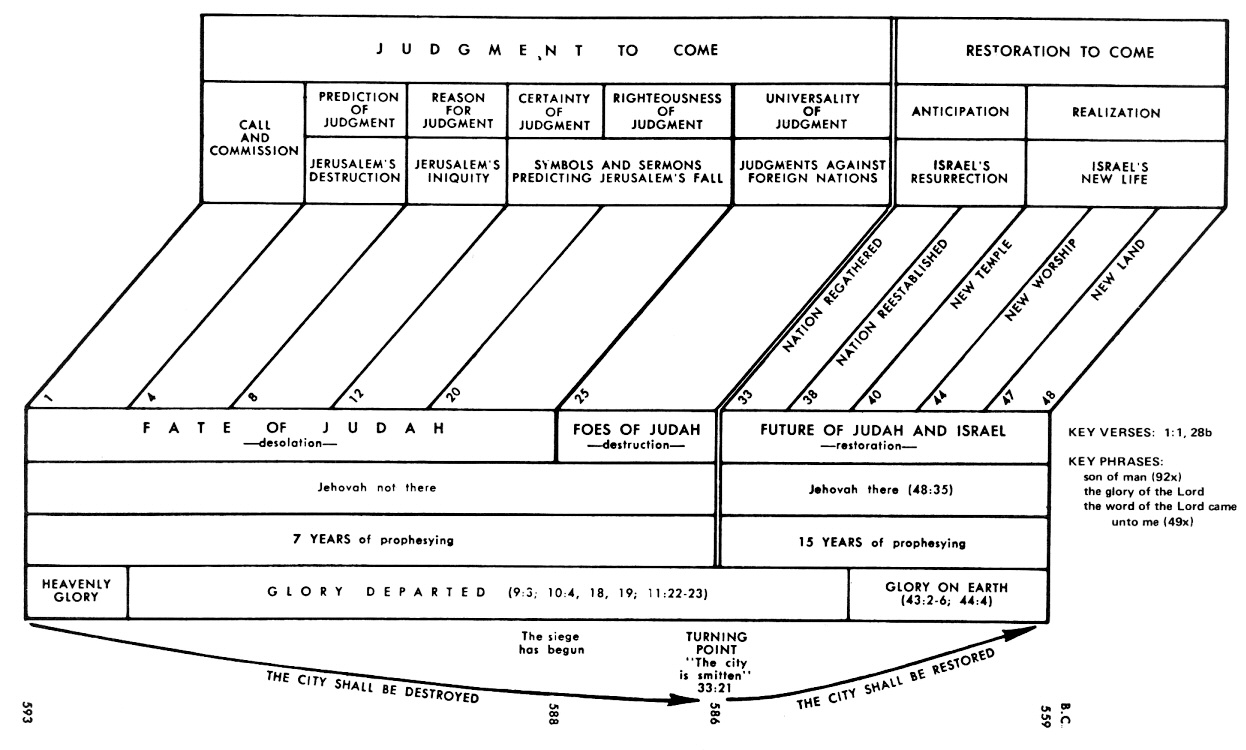
Click chart to enlarge
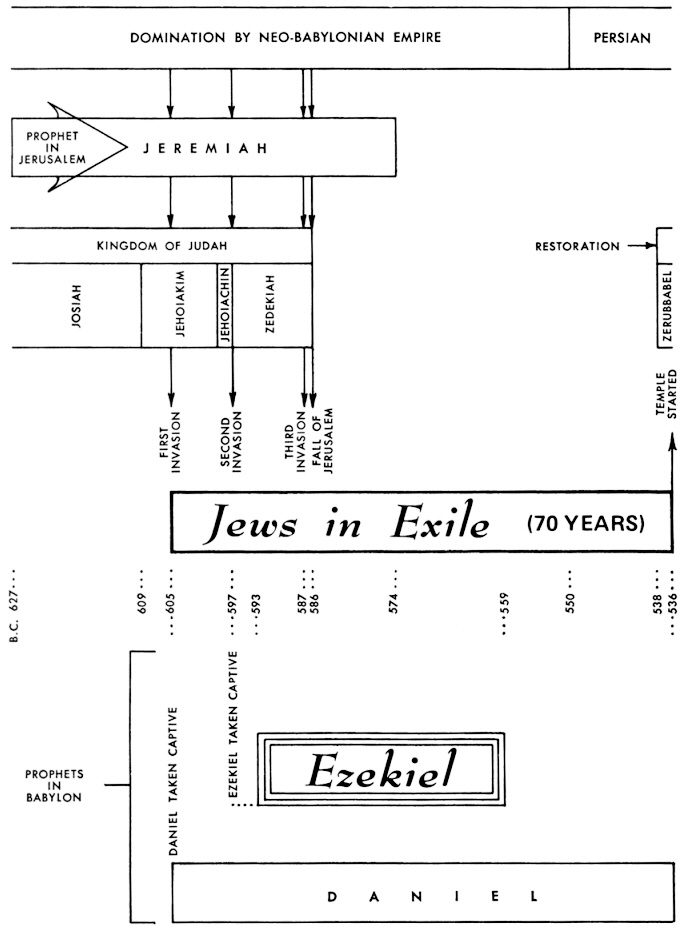
Click chart to enlarge
Chart from recommended resource Jensen's Survey of the OT - used by permission
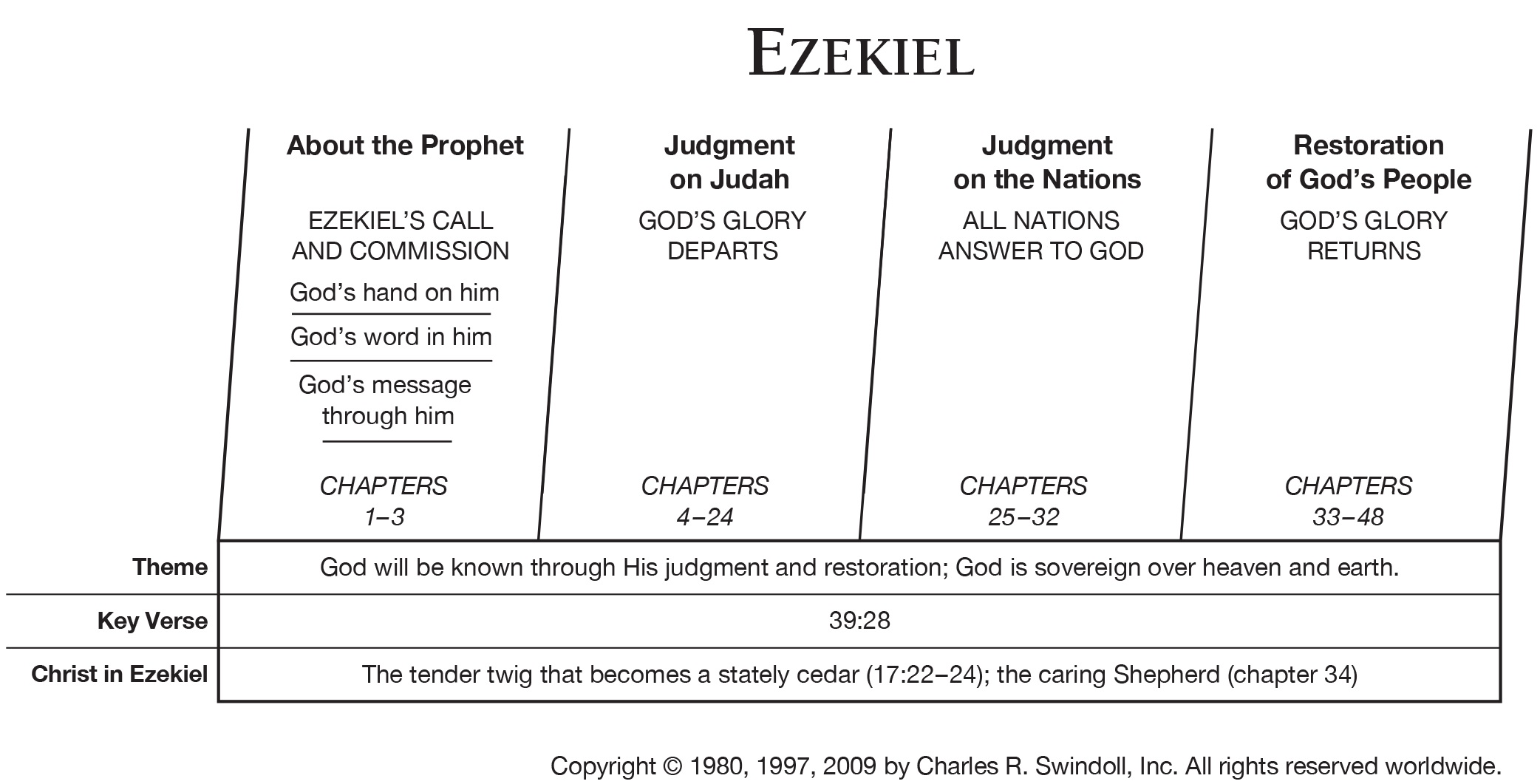
Click Chart from Charles Swindoll
|
PROPHECY OF |
PROPHECY OF |
|||
| FATE OF JUDAH Before the Siege |
FOES OF JUDAH During the Siege |
FUTURE OF JUDAH After the Siege |
||
|
593-588 BC |
587-586 |
586-571 |
||
|
7 YEARS |
15 YEARS |
|||
| Ezekiel 1:1-3:27 Ezekiel Sees the Glory & Receives the Call |
Ezekiel 4:1-24:27 Judgments Against Judah |
Ezekiel 25:1-32:32 Judgments Against the Gloating Nations |
Ezekiel 33:1-39:29 Restoration of Israel to the LORD |
Ezekiel 40:1-48:35 Visions of the Temple Jehovah Shammah |
Outline of the Book of Ezekiel from Dr John MacArthur - The book can be largely divided into sections about condemnation/retribution and then consolation/restoration. A more detailed look divides the book into 4 sections. First, are prophecies on the ruin of Jerusalem (Ezekiel 1:1–24:27). Second, are prophecies of retribution on nearby nations (Ezekiel 25:1–32:32), with a glimpse at God’s future restoration of Israel (Ezekiel 28:25,26). Thirdly, there is a transition chapter (Ezekiel 33:1-33) which gives instruction concerning a last call for Israel to repent. Finally, the fourth division includes rich expectations involving God’s future restoration of Israel (Ezekiel 34:1–48:35). (Reference)
I. Prophecies of Jerusalem’s Ruin (Ezekiel 1:1–24:27)
A. Preparation and Commission of Ezekiel (Ezekiel 1:1–3:27)
1. Divine appearance to Ezekiel (Ezekiel 1:1–28)|
2. Divine assignment to Ezekiel (Ezekiel 2:1–3:27)
B. Proclamation of Jerusalem’s Condemnation (Ezekiel 4:1–24:27)
1. Signs of coming judgment (Ezekiel 4:1–5:4)
2. Messages concerning judgment (Ezekiel 5:5–7:27)
3. Visions concerning abomination in the city and temple (Ezekiel 8:1–11:25)
4. Explanations of judgment (Ezekiel 12:1–24:27)
II. Prophecies of Retribution to the Nations (Ezekiel 25:1–32:32)
A. Ammon (Ezekiel 25:1–7)
B. Moab (Ezekiel 25:8–11)
C. Edom (Ezekiel 25:12–14)
D. Philistia (Ezekiel 25:15–17)
E. Tyre (Ezekiel 26:1–28:19)
F. Sidon (Ezekiel 28:20–24)
Excursus: The Restoration of Israel (Ezekiel 28:25, 26)
G. Egypt (Ezekiel 29:1–32:32)
III. Provision for Israel’s Repentance (Ezekiel 33:1–33)
IV. Prophecies of Israel’s Restoration (Ezekiel 34:1–48:35)
A. Regathering of Israel to the Land (Ezekiel 34:1–37:28)
1. Promise of a True Shepherd (Ezekiel 34:1–31)
2. Punishment of the nations (Ezekiel 35:1–36:7)
3. Purposes of restoration (Ezekiel 36:8–38)
4. Pictures of restoration—dry bones and two sticks (Ezekiel 37:1–28)
B. Removal of Israel’s Enemies from the Land (Ezekiel 38:1–39:29)
1. Invasion of Gog to plunder Israel (Ezekiel 38:1–16)
2. Intervention of God to protect Israel (Ezekiel 38:17–39:29)
C. Reinstatement of True Worship in Israel (Ezekiel 40:1–46:24)
1. New temple (Ezekiel 40:1–43:12)
2. New worship (Ezekiel 43:13–46:24)
D. Redistribution of the Land in Israel (Ezekiel 47:1–48:35)
1. Position of the river (Ezekiel 47:1–12)
2. Portions for the tribes (Ezekiel 47:13–48:35)
Ezekiel 3:1 Then He said to me, "Son of man, eat what you find; eat this scroll, and go, speak to the house of Israel."
ICB: Then the Lord said to me, "Human being, eat what you find. Eat this scroll. Then go and speak to the people of Israel."
Young's Literal: Then He said to me, "Son of man, eat what you find; eat this scroll, and go, speak to the house of Israel."
THREE COMMANDS:
EAT, GO, SPEAK
Son of man is translated by the TEV as "mortal man" and the Living Bible as "son of dust"! If we kept these latter pictures in mind, it would probably be easier for most of us
not to think more highly of (ourselves) than (we) ought to think." (Ro 12:3 )
Eat what you find, eat the scroll" (Ezek 3:10; 2:8, 9; 1Ti4:15; Rev 10:9, 10) - Eating speaks of assimilating as part of your very being, so that out of your mouth comes that which fills your heart.
THOUGHT- Dear follower of Christ - are you eating God's Word or are you just tasting it? Are you like the Psalmists -Ps 119:97 "Mem. O how I love Your law! It is my meditation all the day. "
The inner compulsion of the true prophet sent by God is described in Jeremiah 20:9 But if I say, “I will not remember Him Or speak anymore in His name,” Then in my heart it becomes like a burning fire Shut up in my bones; And I am weary of holding it in, And I cannot endure it." In a similar way Peter and John testified before the august Sanhedrin "for we cannot stop speaking about what we have seen and heard.” (Acts 4:20)
In our society “to eat one's words” is generally a negative unpleasant experience but in biblical thought it is an agreeable experience. The message was given by God but was to be assimilated by the prophet and made his own.
Here’s God’s point - His Word needs to be digested and consumed. Don’t just nibble – scarf it up, pig out, chow down! There used to be a Lipton ad that portrayed a bold and feisty image. The punch line was, "This ain’t no sip’n tea." Well, this ain’t no sip’n book. The Bible is not a finger food. You’ve got to chew on its message." (Brian Bell)
Scroll is used in 18 verses in the OT prophetic passages (Jer 36:2, 4, 6, 14, 20, 21, 23, 25, 27, 28, 29, 32; Ezek 2:9; 3:1, 2, 3; Zech 5:1, 2).
Go, speak to the house of Israel (Ezek 3:11, 15, 17, 18, 19, 20, 21; 2:3)
The LORD stretched out His hand and touched my mouth, and the LORD said to (Jeremiah), "Behold, I have put My words in your mouth." (Jer 1:9)
For Isaiah God had a "seraphim" fly to him
with a burning coal in his hand which he had taken from the altar with tongs. And he touched (Isaiah's) mouth with it and said, "Behold, this has touched your lips; and your iniquity is taken away, and your sin is forgiven."
And here He had Ezekiel eat a scroll. The Lord touched Jeremiah’s mouth (Jer 1:9), but gave Ezekiel a scroll to eat.
Eating Words - I read about an Australian woman who developed a craving for paper. She began her unusual diet as a child, and as she grew older she ate as many as 10 tissues and a half page of the newspaper every day. The woman had also consumed small quantities of blotting paper, sheets from exercise books, and petty cash vouchers. Of course, there's no relationship between that woman's strange habit and the symbolic actions of the prophet Ezekiel. His eating of a scroll was meant to illustrate a spiritual exercise that all of us should engage in. If we are to declare God's truth with meaning and power, we must take time to let it fill our hearts. We need to feel the implications of what God has said. We are to let His Word become a vital part of us so that we can't talk about it glibly as uninvolved, detached students, but as those who have personally "tasted" it.
The actual words and thoughts of God are revealed in the Bible. Don't just read them and repeat them. Think them. Feel them. Ask the Lord to clarify them, to make them a part of your experience, and to teach you.
Yes, today's Bible reading contains a profound principle: We must "eat" the Word before we speak it. Maybe then we won't have to eat our own words later on. —Mart De Haan (Our Daily Bread, Copyright RBC Ministries, Grand Rapids, MI. Reprinted by permission. All rights reserved)
Lord, teach us from Your holy Word
The truth that we must know;
And help us share the joyous news
Of blessings You bestow.
—D. De Haan
Let God's Word (and Spirit)
fill your mind,
rule your heart,
and guide your steps
Ezekiel 3:2 So I opened my mouth, and He fed me this scroll.
English of Septuagint: So He opened my mouth, and caused me to eat the volume.
Young's Literal: So I opened my mouth, and He fed me this scroll.
I opened my mouth (Jer 25:17) Immediate obedience (delayed "obedience" is really disobedience!).
The apostle Paul on trial for his life was given a similar difficult command from the Lord and yet he stood firm declaring
King Agrippa, I did not prove disobedient to the heavenly vision" (Acts 26:19)
In the case of both Ezekiel and Paul, their obedience was but an overflow of their steadfast faith.
As the writer of Hebrews says
without faith it is impossible to please Him, for he who comes to God must believe that He is, and that He is a rewarder of those who seek Him." (Heb11:6)
When the LORD gives you clear instruction in His Word, do you obey or delay?
Obedience is the door to blessing and usefulness for Kingdom Work. To reiterate (we need to hear some things over and over!) don't fool yourself "delayed obedience" is still disobedience!
Ezekiel's response of ready reception of God's Word was in stark contrast with the utter rejection the rebellious house. The clear implication is that Ezekiel also accepted the perfect will of God because God's word is His will.
Ezekiel's presentation of his body, mind and spirit to the Lord for His use is a beautiful Old Testament illustration of Paul's exhortation to all believers today in Romans 12
I urge you therefore, brethren, by the mercies of God, to present your bodies a living and holy sacrifice, acceptable to God, which is your spiritual service of worship. And do not be conformed (present imperative- command calling for us to stop this, implying it may be happening) to this world, but be transformed (present imperative - calls for us to allow this to occur as our lifestyle or practice - remember God does not expect perfection, but He is commanding direction! ) by the renewing of your mind, that you may prove what the will of God is, that which is good and acceptable and perfect." (Ro 12:1, Ro 12:2)
Ezekiel came to know the "will of God" because of his willingness to humble himself to God. Are you wrestling with God's will for your life? Ezekiel's submission and reception of the LORD's word gives us a pattern by which we too can know His "good and acceptable and perfect" will in our life. Are you in the Word so that His Word can get in "your stomach and fill your body" and thereby you can be enabled to "prove what the will of God" is in specific situations?
Ezekiel 3:3 He said to me, "Son of man, feed your stomach and fill your body with this scroll which I am giving you." Then I ate it, and it was sweet as honey in my mouth.
BBE: And he said to me, Son of man, let your stomach make a meal of it and let your inside be full of this roll which I am giving you. Then I took it, and it was sweet as honey in my mouth.
ICB: The Lord said to me, "Human being, eat this scroll which I am giving you. Fill your stomach with it." Then I ate it. And it was sweet like honey in my mouth.
Young's Literal: And He said to me, "Son of man, feed your stomach, and fill your body with this scroll which I am giving you." Then I ate it, and it was sweet as honey in my mouth.
One practical application of this passage is that intake of God's Word is to be more than head knowledge but is to be so devoured that it becomes assimilated as part of our very being.
As Paul wrote to young Timothy
Meditate on these things; give yourself entirely to them, that your progress may be evident to all." (1Ti 4:15NKJV)
Writing to the church at Colossae Paul said
Let the word of Christ richly dwell (present imperative = command to make this our continual pursuit… why? because it is our continual need!) within you, with all wisdom teaching and admonishing one another with psalms and hymns and spiritual songs… " (Col 3:16)
I believe that the vision or theophany (theos = God + phaino = appear) in chapter 1 was almost certainly one of many Old Testament appearances of our Lord Jesus Christ (prior to His incarnation) and so the word Ezekiel ate was the "Word of Christ" which would soon enable him "with all wisdom" to teach and admonish his Jewish brethren. (see related topic on The Angel of Jehovah on this site)
It was sweet as honey - What did it contain? "lamentations, mourning and woe" (Ezek 2:10) Why then would it be sweet? Although the words were bitter, the scroll tasted sweet because its contents were God’s word, and as discussed above would facilitate the carrying out of will of God which is always pleasing.
David agrees that
The judgments of the LORD are true; they are righteous altogether." and yet "They are more desirable than gold, yes, than much fine gold; Sweeter also than honey and the drippings of the honeycomb." (Ps 19:9, Ps 19:10)
The psalmist writes
How sweet are Thy words to my taste! Yes, sweeter than honey to my mouth!" (Ps 119:103)
Feed your stomach and fill your body (Ezek 2:10; Job 32:18, 19; Jer 6:11; 20:9; Jn 7:38) signifies a complete assimilation of God's Word, not a superficial or simply intellectual reading of it. Only when God’s Word had become a part of Ezekiel's very being would he be able to share it with others. In a similar way, when God’s Word becomes a part of us, we are then equipped and enabled to share the message.
THOUGHT - Let me ask you a practical question? How do you best assimilate it so that it fills your body? Is not the most practical way to realize this objective memorization of His precious sweet truth? And then the "book of the law shall not depart from your mouth, but you shall meditate on it day and night, so that you may be careful to do according to all that is written in it; for then you will make your way prosperous, and then you will have success." (Joshua 1:8) (See also study on The Power of God's Word)
Related Resources:
Then I ate it (Ps 119:11; Jn 6:53, 54, 55, 56, 57, 58, 59, 60, 61, 62, 63) Ezekiel was to be a prophet to a rebellious people who refused to obey God, and so the first thing he was asked to do was obey. In obeying the command to eat, he immediately distinguished himself from the disobedient people to whom he was sent. And in his act of obedience, he discovered the taste of the scroll to be “sweet as honey”. The same scroll that would taste so bitter to the house of Israel, tasted sweet on the prophet’s tongue.
There is in every act of obedience a sweet taste. Obedience as such guarantees no freedom from pain, but it does bring the satisfaction of a life being fulfilled, a life which is pleasing to our Father (1Sa 15:22)
"and it was sweet as honey" (Ps119:97; Pr 2:10, 11)
Whenever we "eat" God’s word, we experience a sweetness, for God’s words always contain hope. Yes, God’s judgment will come upon the rebellious, but in the midst of wrath He remembers mercy and so His judgment also holds promise for those who repent and return.
Jeremiah during a difficult time (read Jeremiah 15:1-15 for the context) said
Thy words were found and I ate them, and Thy words became for me a joy and the delight of my heart; for I have been called by Thy name, O LORD God of hosts." (Jer15:16)
Job said
I have not departed from the command of His lips; I have treasured the words of His mouth more than my necessary food." (Job 23:12)
Comment: I am firmly convinced in this statement Job we find a major "clue" to "Job's secret of success" in the midst of unspeakable affliction! As food sustains the physical body, God's word sustained Job's soul, cp his affirmation in Job 23:10.
Food that truly sustains in a time of trial or temptation is indeed the "bread of life". It is often (probably usually!) in the humbling circumstances of the trials that we come to
understand that man does not live by bread alone, but man lives by everything that proceeds out of the mouth of the LORD." (Dt 8:3, read Dt 8:1, 2, 3, 4, 5)
The apostle John describes a similar experience in the Revelation recording that
the voice which I heard from heaven, I heard again speaking with me, and saying, "Go, take the book which is open in the hand of the angel who stands on the sea and on the land." And I went to the angel, telling him to give me the little book. And he said to me, "Take it, and eat it; and it will make your stomach bitter, but in your mouth it will be sweet as honey." And I took the little book out of the angel's hand and ate it, and it was in my mouth sweet as honey; and when I had eaten it, my stomach was made bitter. And they said to me, "You must prophesy again concerning many peoples and nations and tongues and kings." (Re 10:8, 9, 10, 11)
Ezekiel 3:4 Then He said to me, "Son of man, go * to the house of Israel and speak with My words to them.
Brenton's English of Greek Septuagint And he said to me, Son of man, go (2SPAM - command to keep going) thy way, and go (2SAAM = calls for action, sense of urgency) in to the house of Israel, and speak (2SAAM = do this now, sense of urgency) My words to them.
KJV And he said unto me, Son of man, go, get thee unto the house of Israel, and speak with my words unto them.
NRSV: He said to me: Mortal, go to the house of Israel and speak my very words to them.
TLB: Then he said: “Son of dust, I am sending you to the people of Israel with my messages.
Young's Literal: And He saith unto me, 'Son of man, go (qal imperative), enter (qal imperative) in unto the house of Israel, and thou hast spoken (piel perfect) with My words unto them.
- Eze 3:11 2:3,7 Mt 10:5,6 15:24 Ac 1:8
EAT THE WORD
BEFORE
YOU FEED OTHERS!
Then He said to me, "Son of man, go to the house of Israel: go, enter (YLT) go, get thee (KJV) Note these 2 versions are more accurate as there are 2 verbs in the original Hebrew (go and enter), whereas NASB and most other modern translations drop one of these verbs, both of which are commands in the original Hebrew. Note in the samples above that the Greek Septuagint translates both of these verbs.
Don't be confused by the use of "Israel" which is here used to refer to Judah.
Why "then"? The context is that he has just eaten the Word of God, been filled with the Spirit and seen the exalted Lord. Now Ezekiel is commanded to "go".
The Lord told the prophet Ezekiel to eat a scroll that contained a message full of "lamentations and mourning and woe" (Ezek 2:10). Because he was submissive to the Lord and applied the lesson to his own heart first, he could boldly present the message.
The messenger of God must fill his heart and mind with the truths of Scripture. Only as he is faithful to apply the Word of God to his own life can he honestly give its nourishing encouragement and exhortation to help others. As believers, we too must digest the truths of the Bible and allow the Spirit of God to make them a part of our lives. Then, filled with God's Word, we can speak effectively to others in need. Before we can serve the Bread of Life to others, we must feast on it ourselves.
After I have eaten, Lord,
And on Your Word have fed,
Help me share with others from
Your precious, living bread.
--DJD
Go is an important command providing specific instructions to Ezekiel from the One seated upon the chariot like throne.
Proverbs says "The mind of man plans his way, but the LORD directs his steps (Pr 16:9)
Clearly at the inception of his prophetic ministry God is carefully "directing the steps" of Ezekiel, a fact which becomes even more obvious as one comes to the end of this chapter. The prophet Jeremiah understood this important principle declaring
"I know, O LORD, that a man's way is not in himself; nor is it in a man who walks to direct his steps." (Jer 10:23)
Watch how Ezekiel responds to the "go" of the LORD.
How do you respond when the LORD says
"Go "? Or "whoa"?.
and speak with My words to them. My words" is such a little phrase but it is so important for Ezekiel and every believer in every age to remember. God explains to Jeremiah why it is to be My words" not the prophet's words: "Is not My word like fire?" declares the LORD, "and like a hammer which shatters a rock? (Jer 23:29)
This is the perfect rhetorical question (ask merely for the effect with no answer expected or needed). Whose words do I speak? Out of my mouth comes the word that fills my heart. Eat (memorize [see Memorizing His Word], meditate [see Primer on Biblical Meditation]) His word like honey each day as if your life depended on it (your spiritual vitality does!) and then you will be ready to speak His word to anyone who asks you to give a reason for the hope that you have even though you yourself may be going through a trial.
Richards points out that - Ezekiel is the model of an unheralded missionary: a man who evangelizes in his own country. Yes, there’s a need for foreign missionaries. But most Christians are called to minister to people in their own society, whose language and customs are familiar. The eager 20-year-old applying to the mission board for overseas service was asked how many people he had witnessed to during the preceding week. His answer was, “Well, none.” How about the preceding month? Six months? Again, the answer was, “No one.” The chairman of the interviewing board then asked him, “Young man, what makes you think being overseas will make you into a missionary, when you do no missionary work at home?" (The 365 day devotional commentary. Wheaton, Ill.: Victor Books)
Wiersbe - He set his face to do God’s will (Ezek 3:4–11; Isa. 50:7; Luke 9:51). Several times in the book God tells him to “set his face” against something. Ezekiel depended on the hand of God to strengthen him (3:12–14). He sat with the people and identified with their pain (Ezek 3:15), and he waited patiently for God’s word to come to him Ezek 3:16–23). When God spoke, He made Ezekiel a watchman and told him to stay home and be quiet until he received the message to speak. His solitude and silence were signs to the people that God was angry with them for rejecting His Word. Ezekiel knew that he had been called at a difficult time to do a difficult work with a difficult people, and yet he obeyed the Lord. Little did he know the price he would have to pay to be a watchman, but he was faithful. (Borrow copy of With the Word)
Ezekiel 3:5 "For you are not being sent to a people of unintelligible speech or difficult language, but to the house of Israel,
NCV: You are not being sent to people whose speech you can’t understand, whose language is difficult. You are being sent to Israel.
NKJV: "For you are not sent to a people of unfamiliar speech and of hard language, but to the house of Israel,
Young's Literal: "For you are not being sent to a people of unintelligible speech or difficult language, but to the house of Israel,
- thou (KJV): Jon 1:2 3:2-4 Ac 26:17,18
- of a strange speech and of an hard language (KJV): Heb. deep of lip and heavy of tongue, and so, Eze 3:6 Ps 81:5 Isa 33:19
For you are not being sent to a people of unintelligible speech or difficult language but to the house of Israel: For you are not sent to a people of a foreign speech and of a difficult language" (Amp) "whose language is hard to understand or difficult to speak" (GWT), "I am not sending you to a nation that speaks a difficult foreign language" (TEV), "I am not sending you to some far-off foreign land where you can’t understand the language" (TLB) Unintelligible speech is more literally "deep lip and heavy tongue" and refers to a foreign language. Ezekiel was not commissioned to speak to the Babylonians but to his own people in their native tongue.
Ezekiel 3:6 nor to many peoples of unintelligible speech or difficult language, whose words you cannot understand. But I have sent you to them who should listen to you;
Amp Not to many peoples of foreign speech and of a hard language, whose words you cannot understand. Surely, had I sent you to such people, they would have listened to you and heeded My words.
BBE Not to a number of peoples whose talk is strange and whose language is hard and whose words are not clear to you. Truly, if I sent you to them they would give ear to you.
NLT No, I am not sending you to people with strange and difficult speech. If I did, they would listen!
NIV not to many peoples of obscure speech and difficult language, whose words you cannot understand. Surely if I had sent you to them, they would have listened to you.
NJB Not to big nations that speak difficult foreign languages, and whose words you would not understand–if I sent you to them, they would listen to you;
Young's Literal: nor to many peoples of unintelligible speech or difficult language, whose words you cannot understand. But I have sent you to them who should listen to you;
- of a strange speech and of an hard language (KJV): Heb. deep of lip and heavy of language. Surely, etc. or, If I had sent thee to them, would they not have hearkened? etc. Jon 3:5-10 Mt 11:20-24 12:41,42 Lu 11:30-32 Ac 27:28 Ro 9:30-33
- Torrey's Topic Character of the Wicked,
- Torrey's Topic Rebellion Against God
nor to many peoples of unintelligible speech or difficult language whose words you cannot understand: Not to many peoples of foreign speech and of a hard language" (Amp) Unintelligible speech is literally "deep speech", conveying the picture of words that are unfathomable or difficult to comprehend. "Difficult language" is literally "heavy (Hebrew kabed) tongue" denoting speech that is thick or sluggish. Moses used a similar phrase when objecting to the LORD's commissioning him to return to Egypt saying
to the LORD, "Please, Lord, I have never been eloquent, neither recently nor in time past, nor since Thou hast spoken to Thy servant; for I am slow (kabed) of speech and slow (kabed) of tongue." (Ex 4:10)
But I have sent you to them who should listen to you (If I did, they would listen!)" (TLB) Brenton's English of the Greek Septuagint has "if I had sent thee to such, they would have hearkened to thee."
to them who should listen to you - Note that most of the other translations give a slightly different meaning then is apparent in the NASB. E.g., the NIV says
Surely if I had sent you to them, they would have listened to you. The point is that Israel was more hardened than the worst of the nations round her. Going to another culture and nation would have been difficult because of the language barrier, the results would have been more rewarding for they would listen to him. It is amazing and sad that those who knew nothing of the One Living God would have been more responsive than those who claimed His Name.
Listen is the Hebrew word shama and means to hear intelligently and so to listen with attention with the idea of obeying what you hear. Even Webster's modern definition says that to really listen is to "hear something with thoughtful attention"!
Given this definition, we must all ask
"Am I a good listener?"
Specifically am I a good listener when God is speaking? Am I even in His word daily that I might be able to listen? God says Israel will hear and they will even understand Ezekiel (Ezekiel is not speaking "unintelligible speech") but they won't listen! The Greek Septuagint does not use the usual word (akouo = hear) for hearing but the word (eisakouo) which specifically describes "active" listening or listening attentively to someone with the implication of heeding and responding to what is heard.
Indeed when Jonah begrudgingly (contrast his heart attitude with that of Ezekiel) went to a people "of unintelligible speech" (the wicked, vicious Assyrian people) Scripture records that
"the people of Nineveh believed in God; and they called a fast and put on sackcloth from the greatest to the least of them. When the word reached the king of Nineveh, he arose from his throne, laid aside his robe from him, covered himself with sackcloth, and sat on the ashes. And he issued a proclamation and it said, "In Nineveh by the decree of the king and his nobles: Do not let man, beast, herd, or flock taste a thing. Do not let them eat or drink water. "But both man and beast must be covered with sackcloth; and let men call on God earnestly that each may turn from his wicked way and from the violence which is in his hands." Who knows, God may turn and relent, and withdraw His burning anger so that we shall not perish?" When God saw their deeds, that they turned from their wicked way, then God relented concerning the calamity which He had declared He would bring upon them. And He did not do it." (Jonah 3:5-10, see also discussion of next verse)
Paul picks up on this same theme in Romans 9 in explaining how it was that many of the Jews had "missed" salvation reminding his readers
that Gentiles ("peoples of unintelligible speech" like the Assyrians Jonah spoke to), who did not pursue righteousness, attained righteousness, even the righteousness which is by faith (they were saved by faith) but Israel, pursuing a law of righteousness, did not arrive at that law. Why? Because they did not pursue it by faith, but as though it were by works. They stumbled over the stumbling stone" just as they would "stumble" over Ezekiel's message for God forewarned Ezekiel that Israel will not be willing to listen (and obey)" because all of them are "hard headed and hard hearted"! (Ro 9:30, 31, 32, 33-see notes)
Ezekiel 3:7 yet the house of Israel will not be willing to listen to you, since they are not willing to listen to Me. Surely the whole house of Israel is stubborn * and obstinate *.
NLT I am sending you to the people of Israel, but they won't listen to you any more than they listen to me! For the whole lot of them are hard-hearted and stubborn
NET But the house of Israel will not listen to you, because they are not willing to listen to me, for the whole house of Israel is hard-headed and hard-hearted.
- Israel will (KJV): 1Sa 8:7 Jer 25:3,4 44:4,5,16 Lu 10:16 13:34 19:14 Joh 5:40-47 Joh 15:20-24
- all the (KJV): Eze 2:4 24:7 Isa 3:9 Jer 3:3 5:3
- impudent and hardhearted (KJV): Heb. stiff of forehead and hard of heart
yet the house of Israel will not be willing to listen to you since they are not willing to listen to Me. the house of Israel will not listen to you and obey (Amp) The Amplified translation ("will not listen to you and obey") emphasizes the important link between listening and obeying, which is implicit in the Hebrew (shama') and Greek verbs used to translate "listen".
James reinforces the importance of this principle calling on us (in truth he is commanding us) to be
doers of the word, and not merely hearers who delude themselves. For if anyone is a hearer of the word and not a doer, he is like a man who looks at his natural face in a mirror; for once he has looked at himself and gone away, he has immediately forgotten what kind of person he was. But one who looks intently at the perfect law, the law of liberty, and abides by it, not having become a forgetful hearer but an effectual doer, this man shall be blessed in what he does." (Jas 1:22, 23, 24, Jas 1:25)
The house of Israel will not be willing to listen Ezekiel’s task did not involve linguistic barriers. Indeed, language barriers can be overcome but the barrier of a hard forehead and a stiff heart is difficult to penetrate.
(The prophet)
Samuel (speaking to King Saul after he had spared King Agag the Amalekite) said "Has the LORD as much delight in burnt offerings and sacrifices as in obeying (shama' = listen in Ezekiel 3) the voice of the LORD? Behold, to obey (shama' = listen) is better than sacrifice, and to heed than the fat of rams, for rebellion (same Hebrew word describing Israel as "rebellious") is as the sin of divination, and insubordination is as iniquity and idolatry. Because you have rejected the word of the LORD, He has also rejected you from being king." (1Sa 15:22, 23)
And so too He would reject those who were unwilling to listen but remember that because of His eternal, unconditional covenant with Abraham, Isaac and Jacob, He would preserve a remnant of Israel who did listen, who did obey, and who were made righteous by faith. So the phrase "house of Israel" does no signify ALL of Israel denied Him and His Word, although it does appear that the majority did what was right in their own eyes. Things haven't changed much have they!
The LORD had similarly warned Isaiah not to expect dramatic results from his ministry, commissioning him with the promise to
Go, and tell this people: 'Keep on listening, but do not perceive; Keep on looking, but do not understand.' Render the hearts of this people insensitive, their ears dull, And their eyes dim, lest they see with their eyes, hear with their ears, understand with their hearts, and return and be healed." Then I said, "Lord, how long?" And He answered, "Until cities are devastated and without inhabitant, houses are without people, and the land is utterly desolate" (Isaiah 6:9, 10, 11)
In a parallel passage in the New Testament Jesus
came to His own (the Jews) and those who were His own did not receive Him. (Jn 1:11)
As a result of their refusal to receive Jesus as their saving Messiah
He began to reproach the cities in which most of His miracles were done, because they did not repent. "Woe to you, Chorazin! Woe to you, Bethsaida! For if the miracles had occurred in Tyre and Sidon which occurred in you, they would have repented long ago in sackcloth and ashes. "Nevertheless I say to you, it shall be more tolerable for Tyre and Sidon in the day of judgment, than for you. "And you, Capernaum, will not be exalted to heaven, will you? You shall descend to Hades; for if the miracles had occurred in Sodom which occurred in you, it would have remained to this day. "Nevertheless I say to you that it shall be more tolerable for the land of Sodom in the day of judgment, than for you." (Mt 11:20, 21, 22, 23, 24)
"for they are not willing to listen to Me" Jesus also warned His disciples that
The one who listens to you listens to Me, and the one who rejects you rejects Me; and he who rejects Me rejects the One who sent Me. (Lk 10:16)
There is none so deaf as the person who does not want to hear. Israel’s unnatural unresponsiveness would not result from a lack of understanding but from a spiritual barrier, a deliberate refusal.
The point is that Ezekiel is not to "take it personally" when his message is rejected for this was in the "job description" for God's prophets.
The BKC explains that
the people were not prepared to ”listen to“ or respond to Ezekiel because they were not willing to listen to God. Their spiritual deafness was acquired over long years of exposure to and rejection of God’s word given by the prophets. Israel’s response to God in the past was a harbinger of the response Ezekiel could expect.
For example,
the LORD (had) said to Samuel, "Listen to the voice of the people in regard to all that they say to you, for they have not rejected you, but they have rejected Me from being king over them. (1Sa 8:7)
Jeremiah had a similar experience declaring that for
twenty three years the word of the LORD has come to me, and I have spoken to you again and again, but you have not listened (shama' = listen attentively so as to obey) and the LORD has sent to you all His servants the prophets again and again, but you have not listened nor inclined your ear to hear" the message of His prophets which was
Turn now everyone from his evil way and from the evil of your deeds, and dwell on the land which the LORD has given to you and your forefathers forever and ever… " (Je 25:3, 4, 5; cf Jer 44:4, 5, 16)
THOUGHT - Does this warning to Ezekiel have practical application for God's ambassadors today? In the "job description" of a disciple Jesus forewarned us to not be surprised at resistance and rejection but to remember the word that I said to you, 'A slave is not greater than his master.' If they persecuted Me, they will also persecute you; if they kept My word, they will keep yours also. But all these things they will do to you for My name's sake, because they do not know the One who sent Me." (Jn 15:20, 21) Have you experienced persecution (for His Name's sake) at work, in your school, even in your own family? (cp 2Ti 3:12, Php 1:29) If so, dear tried and true saint, listen to Jesus' encouraging words declaring that
Blessed are those who have been persecuted for the sake of righteousness, for theirs is the kingdom of heaven. Blessed are you when men cast insults at you, and persecute you, and say all kinds of evil against you falsely, on account of Me. Rejoice and be glad (more literally jump for joy), for your reward in heaven is great, for so they persecuted the prophets (like Ezekiel, Jeremiah, et al) who were before you." (Mt 5:12-notes, Mt 5:13, Mt 5:14)
Surely the whole house of Israel is stubborn and obstinate: All of them are stubborn and defiant." (TEV) all the people of Israel are stubborn and will not obey" (NCV) the whole house of Israel is stubborn of brow and obstinate in heart." (NAB) all the children of Israel have a hard brow and a stiff heart. " (BBE)
Charlie Dyer explains that "the whole house of Israel (Judah)" "does not imply that every Israelite had rejected God, for Habakkuk, Jeremiah, Ezekiel, and Daniel were all ministering faithfully. God was referring to all parts of Israel rather than every Israelite. Rebellion had made its way into the royal household, the temple, the courts of justice, and into every city and town in the land. Though individuals here and there were still responding to the Lord, the nation as a whole had turned from Him. (See context in The Bible Knowledge Commentary)
Stubborn is actually two Hebrew words which literally mean a hard forehead ("stern brows"). The word for “hard” (chazaq) is the same word as the first half of Ezekiel’s name.
Isaiah records a similar description of Israel, declaring that
The look on their faces shows they are guilty of doing wrong. Like the people of Sodom, they are proud of their sin. They don't care who sees it. How terrible it will be for them! They have brought much trouble to themselves." (Int'l Children's Bible, Is 3:9)
Jeremiah helps us understand the picture of a "hard forehead" declaring to Israel that
you had a harlot's forehead. You refused to be ashamed" (Jer3:3) later adding that "they refused to take correction. They have made their faces harder than rock. They have refused to repent." (Jer 5:3)
Sin not only hardens the heart so that sinning becomes easier, but it produces a contemptuous spirit that is so deceived that it even disdains God and His right to judge.
"Obstinate" is more literally "a stiff heart". Lxx for obstinate = sklerokardios = literally hard hearted; translates "crooked mind" in Pr 17:20.
Obstinate describes the whole house of Israel as fixed and unyielding in course or purpose with the implication of usually an unreasonable persistence in such behavior. The whole house of Israel is perversely adhering to their opinion, purpose, and course (in this case headed for disaster) in spite of God's reasoning, arguments, and persuasion through his prophets like Ezekiel. In 3:10 Ezekiel by contrast was to have a supple, teachable, tender heart ready and willing to receive all of the Words of the LORD. How is your heart? Tough or tender? Resistant or receptive to His Word.
HARD; HARDINESS; HARDDINESS; HARDLY [ISBE] - hard, har'-di-nes, hard'-nes, hard'-li (qasheh, pala'; skleros) : The senses in which hard is used may be distinguished as:
(1) "Firm," "stiff," opposite to soft: Job 41:24, yatsaq, "to be firm," "his heart .... as hard as a piece of the nether millstone," the Revised Version (British and American) "firm"; Ezek 3:7, qasheh, "sharp," "hard of heart"; chazaq, "firm," "As an adamant harder than flint have I made thy forehead"; Jer 5:3, "They have made their faces harder than a rock"; Prov 21:29, `azaz, "to make strong," "hard," "impudent," "a wicked man hardeneth his face"; Prov 13:15 probably belongs here also where 'ethan is translated "hard": "The way of the transgressor is hard," the English Revised Version "The way of the treacherous is rugged"; the Hebrew word means, "lasting," "firm," poet. "rocks" (the earth's foundations, Mic 6:2), and the meaning seems to be, not that the way (path) of transgressors, or the treacherous (Delitzsch has "uncultivated"), is hard (rocky) to them, but that their way, or mode of acting, is hard, unsympathetic, unkind, "destitute of feeling in things which, as we say, would soften a stone" (Delitzsch on passage); also Mt 25:24, skleros, "stiff," "thou art a hard man"; The Wisdom of Solomon 11:4, skleros, "hard stone," the Revised Version (British and American) "flinty rock," margin "the steep rock."
(2) "Sore," "trying," "painful," qasheh (Ex 1:14, "hard service"; Deuteronomy, 26:6; 2 Sam 3:39; Ps 60:3; Isa 14:3); qashah "to have it hard" (Gen 35:16,17; Dt 15:18); `athaq, "stiff" (Ps 94:4 the King James Version, "They utter and speak hard things"); skleros (Jn 6:60, "This is a hard saying"--hard to accept, hard in its nature; Acts 9:5 the King James Version; 26:14; Jude 1:15, "hard speeches"; The Wisdom of Solomon 19:13).
(3) "Heavy," "pressing hard," kabhedh, "weighty" (Ezek 3:5,6, "a people of a strange speech and of a hard language," the Revised Version margin (Hebrew) "deep of lip and heavy of tongue"); camakh, "to lay" (Ps 88:7, "Thy wrath lieth hard upon me").
(4) "Difficult," "hard to do," "know," etc., pala', "difficult to be done" (Gen 18:14, "Is anything too hard for Yahweh?"; Jer 32:17,27; Dt 17:8; 2 Sam 13:2); qasheh (Ex 18:26, "hard causes"); qashah (Dt 1:17; 2 Ki 2:10); chidhah, "something twisted," "involved," "an enigma"; compare Jdg 14:14 (1 Ki 10:1; 2 Ch 9:1, "to prove Solomon with hard questions"); 'ahidhan, Aramaic (Dan 5:12); duskolos, literally, "difficult about food," "hard to please," hence, "difficult to accomplish" (Mk 10:24, "How hard is it for them that trust in riches to enter into the kingdom of God"); dusnoetos, "hard to be understood" (Heb 5:11; 2 Pet 3:16; compare Ecclesiasticus 3:21, "things too hard for thee," chalepos).
(5) "Close," or "near to" (hard by), naghash, "to come nigh" (Jdg 9:52, the American Standard Revised Version "near"); dabhaq and dabheq, "to follow hard after" (Jdg 20:45; Ps 63:8, etc.); 'etsel, "near" (1 Ki 21:1); le'ummath, "over against" (Lev 3:9); `adh, "to" "even to" (1 Ch 19:4, the King James Version "hard by," the Revised Version (British and American) "even to").
Hardiness occurs in Judith 16:10 thrasos, the Revised Version (British and American) "boldness."
Hardness is the translation of mutsaq, "something poured out," "dust wetted," "running into clods" (Job 38:38), the Revised Version (British and American) "runneth into a mass"; "hardness of heart" occurs in the Gospels; in Mk 3:5, it is porosis, "hardness," "callousness"; Mt 19:8; Mk 10:5; 16:14, sklerokardia, "dryness," "stiffness of heart"; compare Ecclesiasticus 16:10; in Rom 2:5, it is sklerotes; in 2 Tim 2:3 the King James Version we have, "Endure hardness, as a good soldier of Jesus Christ," the Revised Version (British and American) "Suffer hardship with me" (corrected text), margin "Take thy part in suffering hardship" (kakopatheo, "to suffer evil").
Hardly occurs in the Old Testament (Ex 13:15), "Pharaoh would hardly let us go," qashah, literally, "hardened to let us go," the Revised Version margin "hardened himself against letting us go"; "hardly bestead" (Isa 8:21) is the translation of qadshah, the American Standard Revised Version "sore distressed." In the New Testament "hardly" is the translation of duskolos, "hard to please," "difficult," meaning not scarcely or barely, but with difficulty (Mt 19:23, "A rich man shall hardly enter into the kingdom of heaven," the Revised Version (British and American) "it is hard for"; Mk 10:23; Lk 18:24, "how hardly" ("with what difficulty")); of mogis, "with labor," "pain," "trouble" (Lk 9:39, "hardly departeth from him" ("painfully")); of molis "with toil and fatigue" (Acts 27:8, the Revised Version (British and American) "with difficulty"; The Wisdom of Solomon 9:16, "Hardly do we guess aright at things that are upon earth"; Ecclesiasticus 26:29, "A merchant shall hardly keep himself from wrong doing"; 29:6, "He shall hardly receive the half," in each instance the word is molis, but in the last two instances we seem to see the transition to "scarcely"; compare also Ex 13:15).
The Revised Version has "too hard" for "hidden" (Dt 30:11, margin "wonderful"); "hardness" for "boldness" (of face) (Eccl 8:1); for "sorrow" (Lam 3:65); "deal hardly with me" for "make yourselves strong to me" (Job 19:3); omits "It is hard for thee to kick against the pricks" (Acts 9:5, corrected text); "hardship" for "trouble" (2 Tim 2:9). W. L. Walker
Ezekiel 3:8 "Behold, I have made your face as hard as their faces and your forehead as hard as their foreheads.
Amp Behold, I have made your face strong and hard against their faces and your forehead strong and hard against their foreheads.
GWT Yet, I will make you as stubborn and as hardheaded as they are.
KJV Behold, I have made thy face strong against their faces, and thy forehead strong against their foreheads.
NET "I have made your face adamant to match their faces, and your forehead hard to match their foreheads.
NJB: But now, I am making you as defiant as they are, and as obstinate as they are;
TLB: But see, I have made you hard and stubborn too—as tough as they are.
Young's Literal: 'Lo, I have made thy face strong against their face, and thy forehead strong against their forehead.
- Ex 4:15,16 11:4-8 1Ki 21:20 Isa 50:7 Jer 1:18 15:20 Mic 3:8 Ac 7:51-56 Heb 11:27,32-37
Behold (hinneh), I have made your face as hard as their faces, and your forehead as hard as their foreheads. But I will make you as unyielding and hardened as they are." (NIV) I will make you as stubborn and as tough as they are." (TEV) brazen-faced and strong-hearted" (YLT) Behold (hinneh) calls attention to the text and directs reader to give special attention. Hinneh can be translated Here!, There!, Look!, Now! all of which serve as markers used to enliven a narrative, to change a scene, to emphasize an idea or to call attention to a detail.
God now gives Ezekiel an encouraging word to enable him to minister in such a discouraging setting. God knows when and how to encourage us for as Paul recorded centuries later
No temptation has overtaken you but such as is common to man and God is faithful, Who will not allow you to be tempted beyond what you are able, but with the temptation will provide the way of escape also, that you may be able to endure it." (1Cor 10:13)
Note that the verse does not say "escape" that we may be able to "escape" but that we may be able to continue to bear up despite difficulty, suffering or persecution. How does God encourage and undergird Ezekiel?
I have made your face as hard as their faces - NET = "I have made your face adamant to match their faces" - This pictures resolve, determination and defiance, providing Ezekiel the strength and the ability to stand firm in the evil day. Ezekiel is now steeled to confront his opponents without flinching. The exiles would be a tough "congregation" but Ezekiel would be an even tougher "preacher" for God had made him hard, unyielding, stubborn and defiant.
The word for "hard" is the same Hebrew word forming the first part of Ezekiel's name. And so even Ezekiel's name ("God is my strength") implied the Lord's strengthening him for the difficult task. You too as a soldier of the Lord, can be confident that the Lord always prepares and reassures His messengers with the needed equipment. It is interesting that the phrase "set your face" occurs 11 times (click here) in Ezekiel.
Similarly, God encouraged and equipped Jeremiah reminding him
behold, I have made you today as a fortified city (symbol of security & impregnability), and as a pillar of iron and as walls of bronze against the whole land, to the kings of Judah, to its princes, to its priests and to the people of the land. And they will fight against you, but they will not overcome you, for I am with you to deliver you," declares the LORD." (Jer 1:18, 19 cf Jer 15:20)
In Jeremiah's darkest hours these words would sustain him mentally, emotionally, and spiritually, just as would God's words to Ezekiel. Perhaps today you need to recall God's promise first given to Israel but in principle applicable to you as a child of God --
Do not fear, for I am with you. Do not anxiously look about you, for I am your God. I will strengthen you, surely I will help you. Surely I will uphold you with My righteous right hand." (Isa 41:10)
The prophet Micah asserts that will be able to reveal God's Word of judgment empowered by the Lord, declaring
I am filled with power-- with the Spirit of the LORD-- and with justice and courage to make known to Jacob his rebellious act, even to Israel his sin." (Mic 3:8)
As hard as their foreheads Centuries later Stephen a man filled (controlled, empowered) with the Holy Spirit confronted the Jewish leaders with their hardness declaring
You men who are stiff-necked (literally "hard" necked or obstinate) and uncircumcised in heart (see Excursus on Circumcision) and ears are always resisting the Holy Spirit; you are doing just as your fathers did." (Acts 7:51)
Behold (02009) hinneh is an interjection meaning behold, look, now; if. "It is used often and expresses strong feelings, surprise, hope, expectation, certainty, thus giving vividness depending on its surrounding context." (Baker) Hinneh generally directs our mind to the text, imploring the reader to give it special attention. In short, the Spirit is trying to arrest our attention! And so hinneh is used as an exclamation of vivid immediacy (e.g., read Ge 6:13)! Hinneh is a marker used to enliven a narrative, to express a change a scene, to emphasize an idea, to call attention to a detail or an important fact or action that follows (Isa 65:17, Ge 17:20, 41:17). The first use of hinneh in Ge 1:29 and second in Ge 1:31 - "And God saw all that He had made, and behold, it was very good. And there was evening and there was morning, the sixth day." Hinneh is oftn used in the idiom "Here I am" in Ge 22:1, 7,11 Ge 27:1,18, Ge 31:11, Ge 46:2 Ex 3:4 1Sa 3:4, 3:16, 12:3, 2Sa 1:7, Isa 52:6, Isa 58:9. Hinneh is used most often to point out people but also to point out things (Ge 31:41, 17:4). God uses hinneh to grab man's attention before He brings destruction (Ge 6:13, 17). God uses hinneh when He establishes covenants (Ge 9:9, 15:12, 17 [when Jehovah cut the Abrahamic covenant], Ge 17:4, cp Ge 28:13, 15), when He provided a sacrificial substitute for Isaac (foreshadowing His giving us His only Son!) (Ge 22:13). Hinneh marks the "chance (The Providence of God)" arrival of Boaz at the field where Ruth was gleaning (Ru 2:4-read about this "chance romance" - Indeed, "Behold!"). Hinneh is used to announce the Lord’s sending of a child as a sign and a prophecy of Immanuel-Emmanuel, the Messiah (Isa. 7:14-note). In fact W E Vine says that it is notable that when behold (hinneh) is used in Isaiah, it always introduces something relating to future circumstances.
Spurgeon reminds us that "Behold is a word of wonder; it is intended to excite admiration. Wherever you see it hung out in Scripture, it is like an ancient sign-board, signifying that there are rich wares within, or like the hands which solid readers have observed in the margin of the older Puritanic books, drawing attention to something particularly worthy of observation." I would add, behold is like a divine highlighter, a divine underlining of an especially striking or important text. It says in effect "Listen up, all ye who would be wise in the ways of Jehovah!"
Hinneh is clearly a KEY WORD in Ezekiel - (ABOUT 10% OF ALL OT USES ARE IN EZEKIEL) - Ezek. 1:4; Ezek. 1:15; Ezek. 2:9; Ezek. 3:8; Ezek. 3:23; Ezek. 4:8; Ezek. 4:14; Ezek. 4:16; Ezek. 5:8; Ezek. 6:3; Ezek. 7:5; Ezek. 7:6; Ezek. 7:10; Ezek. 8:2; Ezek. 8:4; Ezek. 8:5; Ezek. 8:7; Ezek. 8:8; Ezek. 8:10; Ezek. 8:14; Ezek. 8:16; Ezek. 8:17; Ezek. 9:2; Ezek. 9:11; Ezek. 10:1; Ezek. 10:9; Ezek. 11:1; Ezek. 12:27; Ezek. 13:8; Ezek. 13:10; Ezek. 13:12; Ezek. 13:20; Ezek. 14:22; Ezek. 15:4; Ezek. 15:5; Ezek. 16:8; Ezek. 16:27; Ezek. 16:37; Ezek. 16:44; Ezek. 16:49; Ezek. 17:7; Ezek. 17:10; Ezek. 17:12; Ezek. 17:18; Ezek. 18:14; Ezek. 18:18; Ezek. 20:47; Ezek. 21:3; Ezek. 21:7; Ezek. 22:6; Ezek. 22:13; Ezek. 22:19; Ezek. 23:22; Ezek. 23:28; Ezek. 23:39; Ezek. 23:40; Ezek. 24:16; Ezek. 24:21; Ezek. 25:4; Ezek. 25:7; Ezek. 25:8; Ezek. 25:9; Ezek. 25:16; Ezek. 26:3; Ezek. 26:7; Ezek. 28:3; Ezek. 28:7; Ezek. 28:22; Ezek. 29:3; Ezek. 29:8; Ezek. 29:10; Ezek. 29:19; Ezek. 30:9; Ezek. 30:21; Ezek. 30:22; Ezek. 31:3; Ezek. 33:32; Ezek. 33:33; Ezek. 34:10; Ezek. 34:11; Ezek. 34:17; Ezek. 34:20; Ezek. 35:3; Ezek. 36:6; Ezek. 36:9; Ezek. 37:2; Ezek. 37:5; Ezek. 37:7; Ezek. 37:8; Ezek. 37:11; Ezek. 37:12; Ezek. 37:19; Ezek. 37:21; Ezek. 38:3; Ezek. 39:1; Ezek. 39:8; Ezek. 40:3; Ezek. 40:5; Ezek. 40:17; Ezek. 40:24; Ezek. 42:8; Ezek. 43:2; Ezek. 43:5; Ezek. 43:12; Ezek. 44:4; Ezek. 46:19; Ezek. 46:21; Ezek. 47:1; Ezek. 47:2; Ezek. 47:7;
QUESTION - What does it mean to set your face like flint in Isaiah 50:7?
ANSWER - Isaiah 50:4–11 contains the third Servant Song, wherein the prophet speaks of the suffering of the Messiah. In verse 7, the Servant expresses His complete confidence in God, declaring that He will not shrink back from His mission, despite severe suffering, opposition, and humiliation: “Because the Sovereign LORD helps me, I will not be disgraced. Therefore have I set my face like flint, and I know I will not be put to shame” (Isaiah 50:7).
Flint, a very hard, dark rock, is used figuratively in the Bible to express hardness, as in the firmness of horses’ hoofs (Isaiah 5:28), the toughness of an impossible task (Deuteronomy 8:15; Psalm 114:80), and the inflexibility of unwavering determination (Ezekiel 3:8–9).
Set your face like flint is the figure of speech the prophet uses to describe the Messiah’s unwavering determination to persevere in the excruciating task set before Him. Christ would endure humiliation on His journey to the cross to die for our sins. Nearly 800 years before it happened, Isaiah foretold the suffering of the Lord’s Servant: “I offered my back to those who beat me, my cheeks to those who pulled out my beard; I did not hide my face from mocking and spitting” (Isaiah 50:6; cf. Matthew 26:67; 27:26; Mark 15:19; Luke 22:63).
Luke echoes this resolute image of Christ set on saving His people: “When the days drew near for him to be taken up, he set his face to go to Jerusalem” (Luke 9:51, ESV). In Jerusalem Jesus would face arrest, torture, and agonizing death. With trust in God the Father to help and defend Him before His enemies, Jesus set off firmly and unflinchingly committed to finish His mission. There would be no backing out, and no enemy or accuser could deter Him from accomplishing His purpose. He had set His face like flint.
Staying on track in the Christian life requires setting our faces like flint. The apostle Paul teaches us to run the race with our eyes on the prize (1 Corinthians 9:24–27). Paul set his face like flint to finish his course: “Not that I have already obtained all this, or have already arrived at my goal, but I press on to take hold of that for which Christ Jesus took hold of me. Brothers and sisters, I do not consider myself yet to have taken hold of it. But one thing I do: Forgetting what is behind and straining toward what is ahead, I press on toward the goal to win the prize for which God has called me heavenward in Christ Jesus” (Philippians 3:12–14).
Nothing was more important to Paul than completing His God-given mission, no matter the cost: “But my life is worth nothing to me unless I use it for finishing the work assigned me by the Lord Jesus—the work of telling others the Good News about the wonderful grace of God” Acts 20:24 (NLT).
Hebrews 12:1–2 also presents an excellent picture of setting our faces like flint: “Therefore, since we are surrounded by such a great cloud of witnesses, let us throw off everything that hinders and the sin that so easily entangles. And let us run with perseverance the race marked out for us, fixing our eyes on Jesus, the pioneer and perfecter of faith. For the joy set before him he endured the cross, scorning its shame, and sat down at the right hand of the throne of God.”
In a compelling sermon titled “The Redeemer’s Face Set Like a Flint,” Charles H. Spurgeon strongly urged believers to imitate the Lord’s steadfast determination:
“My great object is to lead you to love him who so loved you that he set his face like a flint in his determination to save you. O ye redeemed ones, on whose behalf this strong resolve was made,—ye who have been bought by the precious blood of this steadfast, resolute Redeemer, come and think awhile of him, that your hearts may burn within you, and that your faces may be set like flints to live and die for him who lived and died for you!” (In The Metropolitan Tabernacle Pulpit Sermons, Vol. 47, p. 362. London: Passmore & Alabaster).
Ezekiel 3:9 "Like emery harder than flint I have made your forehead. Do not be afraid of them or be dismayed before * them, though they are a rebellious house."
Amplified: Like an adamant harder than flint or a diamond point (adamant) have I made your forehead; fear them not, neither be dismayed at their looks, for they are a rebellious house
Brenton's English of Greek Septuagint: And it (referring to his forehead) shall be continually stronger than a rock: be not afraid of them, neither be dismayed at their faces, because it is a provoking house.
KJV: As an adamant harder than flint have I made thy forehead: fear them not, neither be dismayed at their looks, though they be a rebellious house.
NIV: I will make your forehead like the hardest stone, harder than flint. Do not be afraid of them or terrified by them, though they are a rebellious house.”
TEV: I will make you as firm as a rock, as hard as a diamond; don’t be afraid of those rebels.”
Young's Literal: As an adamant harder than a rock I have made thy forehead; thou dost not fear them, nor art thou affrighted before them, for a rebellious house are they.'
- adamant (KJV): Zec 7:12
- fear (KJV): Eze 2:6 Isa 41:10,14 50:7 Jer 1:8,17 17:18 Mic 3:8 1Ti 2:3 2Ti 2:6
Like emery ( adamant ) harder than flint I have made your forehead I have made your face harder than flint—like diamond!" (NET) I am making your resolution as hard as a diamond, harder than flint" (NJB) Like an adamant harder than flint or a diamond point" (Amp)
Emery or adamant refers to a stone formerly believed to be of impenetrable hardness and then of any unbreakable or extremely hard substance. The same Hebrew word is translated "diamond" in (Jer 17:1) where Jehovah declares that
The sin of Judah is written down with an iron stylus; with a diamond point it is engraved upon the tablet of their heart (Why did one need a diamond point to engrave on their hearts?) and on the horns of their altars.
NET NOTE - The Hebrew term translated "diamond" is parallel to "iron" in Jer 17:1. The Hebrew uses two terms which are both translated at times as "flint," but here one is clearly harder than the other. The translation "diamond" attempts to reflect this distinction in English.
Hindson and Kroll - I have made thy face strong (hard) ... As an adamant. As special preparation against the stubbornness of Israel, Ezekiel will be steeled in nerve and courage for whatever opposition he may face. Symbolically, he will be made as hard as adamant. This word is used frequently by Isaiah meaning “thorn-bushes.” In Jeremiah 17:1 it is translated “diamond” and denotes the point of an engraving implement. It also appears figuratively to describe hardness of heart (Zech 7:12). Unless we are dealing with two different words, the only connecting link with the present use is that of sharpness, which comes out clearly in Jeremiah 17:1, “with the point of a diamond: it is graven ...”
ADAMANT [ISBE] - ad'-a-mant (shamir (Ezek 3:9; Zec 7:12)): In the passages cited and in Jer 17:1, where it is rendered "diamond" the word shamir evidently refers to a hard stone. The word adamant ("unconquerable") is used in the early Greek writers for a hard metal, perhaps steel, later for a metal-like gold and later for the diamond. The Hebrew shamir, the Greek adamas (from which word "diamond" as well as "adamant" is derived) and the English adamant occur regularly in figurative expressions. All three are equally indefinite. Adamant may therefore be considered a good translation for shamir, though the Septuagint does not use adamas in the passages cited. There is a possible etymological identification of shamir with the Greek smyris (smeris or smiris), emery, a granular form of corundum well known to the ancients and used by them for polishing and engraving precious stones. Corundum in all its forms, including the sapphire and ruby, is in the scale of hardness next to the diamond. In English Versions of the Bible Isa 5:6; 7:23-25; 9:18; 10:17; 27:4; 32:13, shamir is translated "brier". Alfred Ely Day
The point of the comparison ("like emery") is that emery or adamant was used to cut flint or stones as hard as flint and so by analogy Ezekiel's "forehead" would be fully capable of "cutting" the hard foreheads of the house of Israel. Hardened in sin as the people were, they would meet their match in his resolute hardness in standing firm for God. Like diamond, the hardest substance known, he would resist their browbeating.
Ezekiel was soon to pass from the "twilight zone" of a visionary encounter with the glory of the LORD into the "war zone" with the house of Israel. For this spiritual war Ezekiel (and every saint) needed to
(continually) be strong (present imperative) in the Lord (Note: "in" = not in your strength but His! cp 2Co 12:9, 2Co 12:10), and in the strength of His might" (Ezekiel's name = "God is my strength") and must "put on the full armor of God, that (he) may be able to stand firm against the schemes of the devil. For our struggle is not against flesh and blood, but against the rulers, against the powers, against the world forces of this darkness, against the spiritual forces of wickedness in the heavenly places". It was imperative that he "take up the full armor of God, that (he) may be able to resist in the evil day, and having done everything, to stand firm." (Eph 6:10, Ep 6:11, 12, Ep 6:13)
Although Ezekiel would be confronted by resistance from the whole house of Israel he needed to remember as do all God's soldier saints that
though we walk in the flesh (sons of dust), we do not war according to the flesh, for the weapons of our warfare are not of the flesh, but divinely powerful for the destruction of fortresses. We are destroying speculations and every lofty thing raised up against the knowledge of God, and we are taking every thought captive to the obedience of Christ." (2Cor 10:3, 10:4 10:5-see notes)
Charlie Dyer comments that "Ezekiel’s determination would not waver when beset by opposition. ”Flint,“ the hardest stone in Palestine, was used by Israel for knives (cf. Josh 5:2, 3) and other implements. Ezekiel’s God-given strength and determination would withstand any opposition (cf. Jer 1:18)." (See context in The Bible Knowledge Commentary)
I like MacDonald's reminder that "True servants of Christ must be tough-minded but not hard-hearted." (Believer's Bible Commentary: Thomas Nelson)
Do not be afraid of them or be dismayed before them though they are a rebellious house: So don't be afraid of them or fear their angry looks" (NLT) Don't be afraid of them. Don't be terrified in their presence" (GWT) have no fear of them and do not be overcome by their looks, for they are an uncontrolled people (BBE) God's exhortation to Ezekiel "Do not be afraid" is the second time (see Ezek 2:6) in the prophet's commissioning that he has been told there is no reason to fear. The response of the exiles to Ezekiel's message was not to govern the nature or manner of his ministry. God had similarly encouraged Jeremiah
Do not be afraid of them, For I am with you to deliver you," declares the LORD… gird up your loins, and arise, and speak to them all which I command you. Do not be dismayed before them, lest I dismay you before them." (Jer 1:8 1:17)
This was a message that Jeremiah later "preached" to himself saying
Let those who persecute me be put to shame, but as for me, let me not be put to shame. Let them be dismayed, but let me not be dismayed. Bring on them a day of disaster, and crush them with twofold destruction!" (Jer17:18)
What God commands (“do not be afraid”) He gives sufficiency to do (“I have made”) so God will enable the prophet to live up to his name (“strengthened by God”).
So sure was Ezekiel to be of the Lord God’s help that he was to resolutely determine to remain unswayed by whatever hardship might await Him. Jesus demonstrated this same determination for
when the days were approaching for His ascension, that He resolutely set His face to go to Jerusalem" (Lk 9:51) (to be crucified!)
Dismayed is the Hebrew verb which refers to the shattering of an object and here is applied figuratively to describe a feeling of discouragement, implying fear, terror, and/or panic and confusion. Word Biblical Commentary translates this section as
You will not be afraid of them nor intimidated by their facial expression rebel community as they are.
I also like the BBE translation of
"do not be overcome by their looks".
We have all experienced those despising looks filled with daggers of hatred which cut deep into our innermost being. God is saying to Ezekiel
"Don't be discouraged, in dread or shattered in spirit."
Years earlier God had given similar encouragement to Israel faced with the certainty of warfare upon entering Canaan saying
the LORD is the one Who goes ahead of you. He will be with you. He will not fail you or forsake you. Do not fear, or be dismayed." (Deut 31:28)
And to Joshua who would lead the children of God into the promised land God said
Have I not commanded you? Be strong and courageous! Do not tremble or be dismayed, for the LORD your God is with you wherever you go." (Josh 1:9)
The promise to Joshua is a promise available to every child of God in the New Covenant. (cf Heb13:5, 2Peter 1:4)
Ezekiel need not fear them for he had been armed with the "Spirit of the Lord" and the "sword of the Spirit" which is
living and active and sharper than any two-edged sword, and piercing as far as the division of soul and spirit, of both joints and marrow, and able to judge the thoughts and intentions of the heart. And there is no creature hidden from His sight, but all things are open and laid bare to the eyes of Him with whom we have to do (to whom we must give account)." (Heb 4:12, He 4:13)
Rebellious house in a sense "Israel's nickname" in Ezekiel is a key phrase occurring 13x in 12v = (Ezek 2:5, 6, 8; 3:9, 26, 27; 12:2, 3, 9, 25; 17:12; 24:3).
SYNONYMS FOR REBELLIOUS
The description that permeates Ezekiel then is that Israel (Judah) was consistently in active opposition to the authority of the Most High God. Synonyms of rebellious apropos to Israel include bullheaded, headstrong, intractable, mulish, perverse, self-willed, stiff-necked, stubborn, unyielding, contumacious, factious, insurgent, mutinous, seditious, disaffected, disloyal, disobedient, disorderly, insubordinate, insurrectionary, recalcitrant, revolutionary, turbulent, ungovernable, unruly, defiant, difficult, incorrigible, obstinate, refractory, resistant, unmanageable… just to mention a few!
THOUGHT - Would any of these synonyms describe your current walk with the LORD?
The Greek Septuagint gives us an additional insight into the nature/effect of this rebellion. Eight times in chapters 2-3 "rebellious house" is translated with the Greek verb parapikraino (pará = implying movement toward a certain point + pikrós = bitter, originally “pointed,” “sharp”) which means to provoke to bitterness or anger, to exasperate or to arouse to indignation (see only NT use in Heb 3:16). The implication is clear - the house of Israel was continually (the verb is in the present tense in the Septuagint) provoking God to anger, arousing the indignation of the Almighty! And such is the effect of rebellion. Praise God for His lovingkindness and compassion that flow freely from the Cross of Christ, His precious blood covering all who once were in the rebel Adam but now by faith are safe in the Ark of Christ, the glory of the LORD.
FLINT [ISBE] - flint (challamish (Dt 8:15; 32:13; Job 28:9; Ps 114:8), tsor (Ex 4:25; Ezek 3:9), tser (Isa 5:28), tsur (Job 22:24; Ps 89:43), tsurim (Josh 5:2 f); (= kechlex "pebble"), kochlax (1 Macc 10:73)): The word challamish signifies a hard stone, though not certainly flint, and is used as a figure for hardness in Isa 50:7, "Therefore have I set my face like a flint." A similar use of tsor is found in Ezek 3:9, "As an adamant harder than flint have I made thy forehead," and Isa 5:28, "Their horses' hoofs shall be accounted as flint"; and of tsela` in Jer 5:3, "They have made their faces harder than a rock." The same three words are used of the rock from which Moses drew water in the wilderness: challamish (Dt 8:15; Ps 114:8); tsur (Ex 17:6; Dt 8:15; Ps 78:20; Isa 48:21); cela` (Nu 20:8; Neh 9:15; Ps 78:16). Tsur and cela` are used oftener than challamish for great rocks and cliffs, but tsur is used also for flint knives in Ex 4:25, "Then Zipporah took a flint (the King James Version "sharp stone"), and cut off the foreskin of her son," and in Josh 5:2 f, "Yahweh said unto Joshua, Make thee knives of flint (the King James Version "sharp knives"), and circumcise again the children of Israel the second time." Surgical implements of flint were used by the ancient Egyptians, and numerous flint chippings with occasional flint implements are found associated with the remains of early man in Syria and Palestine. Flint and the allied mineral, chert, are found in great abundance in the limestone rocks of Syria, Palestine and Egypt. Alfred Ely Day
Ezekiel 3:10 Moreover, He said to me, "Son of man, take into your heart all My words which I will speak to you and listen closely.
Brenton's English of Greek Septuagint And he said to me, Son of man, receive (2nd person Sing Aorist Act Imperative = do it now, speak of urgency) into thine heart all the words that I have spoken (Perfect tense = speaks of the permanence of God's Words to Ezekiel) to thee, and hear (2nd Sing Present Act Imperative = command to continually hear) them with thine ears.
TLB: Then he added: “Son of dust, let all my words sink deep into your own heart first; listen to them carefully for yourself.
TEV: God continued, “Mortal man, pay close attention and remember everything I tell you.
Young's Literal: Moreover, He said to me, "Son of man, take (Qal Imperative = command) into your heart all My words which I shall speak to you, and listen closely (Qal Imperative = command).
- receive (KJV): Eze 3:1-3 2:8 Job 22:22 Ps 119:11 Pr 8:10 19:20 Lu 8:15 1Th 2:13 1Th 4:1
Moreover, He said to me, "Son of man, take into your heart all My words which I shall speak to you and listen closely. ll My words that I shall speak to you, receive in your heart and hear with your ears" (Amp) take into your heart all my words which I am about to say to you, and let your ears be open to them. (BBE)
Take into your heart all My words. Not "your head" but "your heart". Not for information but transformation.
"Your heart" is one of the key phrases in the Old Testament, especially in the book of Deuteronomy. If you need a "heart checkup" or just want a fascinating study that will give you God's insights into the matter of your "heart" click here and study the 31 uses in Deuteronomy or here for 18 occurrences in Proverbs (or if you want more of a challenge click here to study all 123 uses in the Old Testament).
Related Resource:
- Study of kardia - Greek word for heart.
How does one take all God's words into his or her heart today? The psalmist says "Thy word I have treasured in my heart… " (Ps119:11). How better to treasure God's Word than to bury it deep within our heart through memorization.
As Billy Graham once said "I am convinced that one of the greatest things we can do is to memorize Scripture."
Charles Swindoll said "I know of no other single practice in the Christian life more rewarding, practically speaking, than memorizing Scripture… No other single exercise pays greater spiritual dividends! Your prayer life will be strengthened. Your witnessing will be sharper and much more effective. Your attitudes and outlook will begin to change. Your mind will become alert and observant. Your confidence and assurance will be enhanced. Your faith will be solidified."
All my words The stress lies on the first word "all". The prophet was not to pick and choose out of the message, but was to be like the apostle Paul and "not shrink from declaring… the whole purpose (whole will, whole counsel) of God." (Acts 20:27)
The LORD empowered Jeremiah with His word when He "stretched out His hand and touched (his) mouth, and… said to (him), "Behold, I have put My words in your mouth." (Jer 1:9)
Listen closely is a marked contrast to the exiles, who would refuse to listen. Ezekiel is to make God's Words his own words.
Related Resources:
- Meditate
- Primer on Biblical Meditation
- Thoughts on the Quiet Time
- Memorizing His Word
- Memory Verses by Topic
- Quiet Time: 7 Minutes With God
Ezekiel 3:11 "Go to the exiles, to the sons of your people, and speak to them and tell them, whether they listen or not, 'Thus says the Lord GOD.' "
BBE And go now to those who have been taken away as prisoners, to the children of your people, and say to them, This is what the Lord has said; if they give ear or if they do not.
Brenton's English of Greek Septuagint And go (2nd Sing Present Act Imperative = command to continually go) thy way, go (2nd person Sing Aorist Act Imperative = do it now, speaks of urgency) in to the captivity, to the children of thy people, and thou shalt speak to them, and say to them, Thus saith the Lord; whether they will hear, or whether they will forbear.
TEV Then go to your countrymen who are in exile and tell them what I, the Sovereign Lord, am saying to them, whether they pay attention to you or not.”
Young's Literal and go (Qal Imperative = command) , enter in (Qal Imperative = command) unto the Removed, unto the sons of thy people, and thou hast spoken unto them, and hast said unto them: Thus said the Lord Jehovah: whether they hear, or whether they forbear.'
- get (KJV): Eze 3:15 11:24,25 Da 6:13
- the children (KJV): Eze 33:2,12,17,30 37:18 Ex 32:7 De 9:12 Da 12:1
- speak (KJV): Eze 3:27 2:5,7 Ac 20:26,27
And go to the exiles to the sons of your people: And go, get you to the [Jewish] captives [in Babylon], to the children of your people." (Amp) Two groups of exiles had already been brought to Babylon, one in 606-605 B.C. (Daniel taken in this group), and another in 597 B.C., Ezekiel being in this second group of 10,000. God does not call them "My" people but "your" people for Jehovah can no longer recognize them as His children but as rebels.
and speak to them and tell them whether they listen or not, 'Thus says the Lord GOD (Adonai jehovah). - whether they will hear or refuse to hear." (Amp) whether they heed or resist!" (NAB) This is what the Sovereign Lord says,’ whether they pay attention or not" (NET)
God repeats the same phrase mentioned in (Ezek 2:5,7)
Ezekiel has the authority of the Sovereign LORD to validate his message.
Some would listen (obey) and others would fail to listen, that is, refuse to obey
Hindson and Kroll - Ezekiel was sent to them to show God’s justice in their being chastened. The very fact of Ezekiel being sent to them indicates God’s love and compassion by pleading with them to repent and turn to Him.
Ezekiel 3:12 Then the Spirit lifted me up, and I heard a great rumbling sound behind me, "Blessed be the glory of the LORD in His place."
Brenton's English of Greek Septuagint Then the Spirit took me up, and I heard behind me the voice as of a great earthquake (seismos = series of violent movements causing shaking, agitation), saying, Blessed be the glory of the Lord from His place.
NLT Then the Spirit lifted me up, and I heard a loud rumbling sound behind me. (May the glory of the Lord be praised in his place!)
Young's Literal And lift me up doth a spirit, and I hear behind me a noise, a great rushing -- 'Blessed is the honour of Jehovah from His place!'--
- Spirit: Eze 3:14 2:2 8:3 11:1,24 40:1,2 1Ki 18:12 2Ki 2:16 Ac 8:39
- a voice: Ac 2:2 Rev 1:10,15
- Blessed: Ps 72:18,19 103:20,21 148:2 Isa 6:3 Rev 5:11-14 19:6
- glory: Eze 9:3 10:4,18,19 11:22,23 Ex 40:34,35 1Sa 4:21,22
Then the Spirit lifted me up: Luther translates it I think incorrectly as "a wind lifted me up" which although the same Hebrew word (Ruach) does not fit the context as well as the Holy Spirit. In the NT we see a similar action by the Spirit, Luke recording that when the Ethiopian eunuch and Philip
came up out of the water, the Spirit of the Lord snatched Philip away; and the eunuch saw him no more, but went on his way rejoicing." (Acts 8:39 )
and I heard a great rumbling sound behind me: a great rushing" (ASV), a great commotion" (DRA), a great vibrating sound (NJB), a great thunderous voice" (NKJV), a great roaring sound (TANAKH) Great rumbling" is translated by the Greek Septuagint with seismos which can be translated as a shaking, a tempest or an earthquake. This was in effect a supernatural seismic encounter!
Blessed be the glory of the LORD in His place. Blessed be the glory of the Lord from His place [above the firmament]. (Amp)
The glory of the LORD occurs 11 times in the first 11 chapters. You will want to mark this phrase in a distinctive in your Bible. Here in context it appears to clearly refer to the throne chariot of God initially described at the end of chapter 1 and apparently remaining in place during the succeeding description of Ezekiel's commission.
Ezekiel 3:13 And I heard the sound of the wings of the living beings touching ("kissing") one another and the sound of the wheels beside them, even a great rumbling sound.
Young's Lit even a noise of the wings of the living creatures touching one another, and a noise of the wheels over-against them, even a noise of a great rushing.
- the sound: Eze 1:24 Eze 10:5 2Sa 5:24
- touching: Heb. kissed
- and the sound: Eze 10:16,17
Related Passages:
Ezekiel 1:23-24 Under the expanse their wings were stretched out straight, one toward the other; each one also had two wings covering its body on the one side and on the other. like the sound of an army camp; whenever they stood still, they dropped their wings.
Ezekiel 10:5; Moreover, the sound of the wings of the cherubim was heard as far as the outer court, like the voice of God Almighty when He speaks.
And I heard the sound of the wings of the living beings touching one another: I heard the noise of the wings of the living creatures as they touched and joined each one the other [its sister wing]" (Amp)
and the sound of the wheels beside them, even a great rumbling sound. and I heard the noise of the wheels beside them and the noise of a great rushing." (Amp)
Hindson and Kroll have an interesting note - Ezekiel appears to have been bodily carried by the Spirit. Furthermore, while being transported, he seems to be aware that he was in the fiery chariot that he had seen previously in connection with the vision of the glory of the Lord (ch. Eze 1:24). This would be an encouragement to follow through in ministering to his people by means of acting out symbolically the sign messages. The evangelist Philip was similarly carried away by the Spirit (Acts 8:39). But later, Ezekiel seems to have been transported to Jerusalem in vision only, not actually in body (Eze 8:3; Eze 11:24).
Ezekiel 3:14 So the Spirit lifted me up and took me away; and I went embittered in the rage of my spirit, and the hand of the LORD was strong on me.
CEV Then the Spirit carried me away. The LORD's power had taken complete control of me, and I was both annoyed and angry.
NAB The spirit which had lifted me up seized me, and I went off spiritually stirred, while the hand of the LORD rested heavily upon me.
NET The Spirit lifted me up and carried me away. I went bitterly, my spirit full of anger, and the hand of the Lord rested powerfully on me.
TEV The power of the Lord came on me with great force, and as his spirit carried me off, I felt bitter and angry.
Young's Literal And a spirit hath lifted me up, and doth take me away, and I go bitterly, in the heat of my spirit, and the hand of Jehovah on me is strong.
- the Spirit: Eze 3:12 8:3 37:1
- in bitterness, in the heat of my spirit: Heb. bitter in hot anger, Nu 11:11-19 Jer 6:11 20:14-18 Joh 4:1,3,9
- and: Eze 1:3 8:1 37:1 1Ki 18:46 2Ki 2:16 3:15 Jer 20:7-9
TRANSPORTATION PROVIDED
BY THE SPIRIT
So (term of conclusion) the Spirit lifted me up and took me away and I went embittered (mar) in the rage (chemah) of my spirit: and I went in bitterness [of discouragement] in the heat of my spirit" (Amp) and I went in bitterness and in the anger of my spirit" (NIV) I went in bitterness and turmoil" (NLT) I went bitterly, my spirit full of anger" (NET) Ezekiel felt anguished, vexed, or burdened. Ezekiel appears to have been bodily carried by the Spirit. Why is Ezekiel embittered in the rage of (his) spirit? Ezekiel wasn’t indifferent — he felt the weight of his calling and the resistance of the people. In the context of the persistent rebellious spirit of his fellow Jews, Ezekiel exhibits a righteous anger toward their sin (cf Eph 4:26).
Ezekiel 3:14 shows the emotional weight of prophetic ministry: God’s calling is not always comfortable — it often requires speaking truth to hardened hearts. Ezekiel’s bitterness isn’t rebellion — it’s an honest struggle under the pressure of a holy calling. The “hand of the LORD” being strong on him means God doesn’t call without equipping — Ezekiel is empowered to obey, despite resistance. Prophets are not stone-faced messengers — they often carry the burden of God's grief.
Bitterness (mar) is that which is distasteful or distressing to the mind and causes affliction and misery. He had just been told to "take to your heart" all the words so it seems likely that his bitterness and heat of anger are the result of Ezekiel associating himself with God and feeling the same emotions toward Israel’s sin as God did. Note that the Greek Septuagint does not translate the Hebrew word for embittered but does translate the next phrase as "I went in the impulse of my spirit".
"In the rage of my spirit" is more literally heat, hot displeasure, indignation, anger, wrath of my spirit.
The Pulpit Commentary says that "Here probably it points to the conflict of emotions — indignation against the sins of his people, the dread of failure, the consciousness of unfitness.
The expression in the heat of spirit may refer to the prophet’s knowledge that his ministry would be largely one of rejection and pain. He experienced the same type of anger that the Lord had toward His rebellious people. Ezekiel’s “seven days” may refer symbolically to the traditional time of mourning for the dead (see Gen. 50:10; Num. 19:11; Job 2:13), as well as to the period of consecration for a priest (see Lev. 8:33).
Clarke comments that the sense of this verse is that "Being filled with indignation at the wickedness and obstinacy of my people, I went, determining to speak the word of God without disguise, and to reprove them sharply for their rebellion; and yet I was greatly distressed because of the heavy message which I was commanded to deliver.
The Evangelical Commentary feels that "Ezekiel’s bitterness and anger are either reflections of God’s attitude toward his people, or more likely a reflection of the prophet’s realization that he has to pronounce doom on those he loves." (Elwell, W. A. Evangelical commentary on the Bible. Baker Book House)
he hand of the LORD was strong on me" most likely refers to the LORD's empowerment of Ezekiel much like the situation in First Kings when
the hand of the LORD was on Elijah, and he girded up his loins and outran Ahab to Jezreel." (1Ki18:46).
Elijah, empowered by God, ran on foot ahead of King Ahab’s chariot some 15-25 miles from Mt. Carmel to Jezreel, clearly indicating he was not running according to his own power but according to the power of the LORD. May his tribe increase!
Related Resource:
Embittered (04751) mar is an adjective most often used figuratively to express the emotional response to a destructive, heart-crushing situation. It is used in a literal sense - bitter grape clusters (Dt. 32:32); bitter water (Ex 15:23); food in general (Pr 27:7). Although an adjective, mar can function alone as the noun bitterness (Isa. 38:15, 17) or as an adverb, bitterly (Isa 33:7, Ezek 27:30, Zeph 1:14). Mar can describe results of continued fighting (2 Sa 2:26). Figuratively modifies Esau's cry (Ge 27:34; Esther 4:1; Ezek 27:30); bitterness of death (1 Sa 15:32); or to describe a person discontented (1 Sa 22:2); provoked (2 Sa 17:8); anguished (Ezek. 27:31); ruthless (Hab. 1:6). Naomi's name for herself (Ru 1:20).
Victor Hamilton gives a good survey of the figurative uses - Some of these situations are: (1) in the case of a woman, barrenness and sterility, 1 Samuel 1:10; (2) an unfulfilled death-wish, Job 3:20; (3) family turmoil, Genesis 27:34; (4) the exploitation and deprivation of minority peoples, Esther 4:1; (5) personal suffering and hardship, Job 7:11; Job 10:1; Isaiah 38:15; (6) a hostile and precarious situation, Psalm 64:3 [H 4]; grief over the apostasy of believers, Jeremiah 2:19; (7) the Lord's judgment on unbelievers, Zeph. 1:14; (8) discontentment with lacklustre leadership, 1 Samuel 22:2; (9) the thought of death, 1 Samuel 15:32; (10) the crumbling of dreams and aspiration, Ezekiel 27:30, 31. (Theological Wordbook of the Old Testament)
Rage (anger, fury, venom, hot-tempered) (02534) chemah from yacham = to be hot, Delitzsch says it is related to an Arabic word hamiy = to glow) is a noun which can refer to physical heat, but more often is used figuratively to convey the picture of inner, emotional "heat" which rises and is fanned to varying degrees. And thus chemah can mean hot displeasure, indignation, anger, wrath, and even poison (figuratively speaking). This type of anger is anger at its fever pitch so to speak.
The first use of chemah describes Esau's "fury" (Lxx = thumos - describes a tumultuous welling up of the whole spirit; a mighty emotion which seizes and moves the whole inner man. Greeks likened thumos to a fire amongst straw, which quickly blazed and just as quickly burned itself out.) which Rebekah knew would flare up when Esau discovered that Jacob had tricked him out of the inheritance of the first born (Ge 27:44) Chemah describes God's prophetic promise to Israel if she disobeys the covenant, for then He "will act with wrathful hostility!" (Lev 26:28 - God's hostility would be bad enough but for it to be modified by "wrathful" is almost incomprehensible!) When Phinehas speared the unfaithful Israelite man and his Midianite mistress (Nu 25:6-7), the divine plague was checked (Nu 25:8), God testifying that Phinehas had "turned away (His) wrath (Lxx = thumos) from the sons of Israel." (Nu 25:11)
Ezekiel 3:15 Then I came to the exiles who lived beside the river Chebar at Tel-abib, and I sat there seven days where they were living, causing consternation among them
KJV Then I came to them of the captivity at Telabib, that dwelt by the river of Chebar, and I sat where they sat, and remained there astonished among them seven days.
NET I came to the exiles at Tel Abib, who lived by the Kebar River. And I sat among them there, where they were living, for seven days, dumbfounded.
Young's Literal And I come in unto the Removed, at Tel-Ahib, who are dwelling at the river Chebar, and where they are dwelling I also dwell seven days, causing astonishment in their midst.
SEVEN DAYS
OF SILENCE
Then I came to the exiles who lived beside the river Chebar at Tel-abib: Young's Literal has an interesting translation of "the exiles" rendering the Hebrew as "the Removed"!
We now enter on the first scene of the prophet’s ministry in "Tel-Abib" which most major reference works indicate is the translation "mound of ears of grain" or "mound of corn" probably related to the fertility of the surrounding valley. Other references state that the meaning is "mound of the flood" which may reflect the fact that there are many places in Babylon with the closely related name, Tel-Abubi, meaning ‘mound of the deluge’ (‘place destroyed by the deluge’). It is not to be confused with the modern city of Tel Aviv on the western coast of Israel.
and I sat there seven days where they were living causing consternation (shamen) among them: I sat where they sat and remained there among them seven days, overwhelmed with astonishment and silent." (Amp) I sat among them for seven days--overwhelmed" (NIV) remained there astonished among them seven days" (NKJV) I sat there among them for seven days, overwhelmed" (NLT) I sat there seven days where these people lived. I was shocked" (ICB), appalled" (Jewish Pub Soc) stunned (TANAKH) distraught (NAB) feeling shocked (NCV) dumbfounded (NET) in a stupor (NJB) God sets up his Ezekiel's speaking engagement but he can't speak. We would have expected him to begin at once to deliver Gods message but instead he sat shocked and overwhelmed among them seven days.
A similar response to a divine encounter is found in Acts 9:8, 9 Luke recording that
Saul got up from the ground, and though his eyes were open, he could see nothing; and leading him by the hand, they brought him into Damascus. And he was three days without sight, and neither ate nor drank."
Hindson and Kroll - The Spirit bodily transported Ezekiel to the exiles at Tel-abib on the large irrigation canal at Chebar. His ministry to them was in the form of seven days of complete silence among them. He thereby communicated a message most terrible and awesome to them, and it caused great consternation.
Seven days may be related to a period of mourning. In Genesis on the occasion of Jacob's death and burial we find that when the entourage of Joseph
came to the threshing floor of Atad, which is beyond the Jordan, they lamented there with a very great and sorrowful lamentation; and he observed seven days mourning for his father." (Ge 50:10)
Job records that his "friends"
sat down on the ground with him for seven days and seven nights with no one speaking a word to him, for they saw that his pain was very great." (Job 2:13)
Seven days was also the period during which one is unclean after touching a corpse (Num 19:11), and the period of consecration for a priest (Lev 8:33). As noted in (Ezek 1:3), Ezekiel was a priest whom God had now commissioned to carry out the work of a prophet and this fact may have something to do with the seven days but that is somewhat speculative. In fact we can't be absolutely certain what the "seven days" signifies.
Ezekiel’s emotional and mental state after this vision is described as one of "Consternation" the Hebrew verb (shamen) the basic meaning being desolation caused by some great disaster especially that related to divine judgment and stresses the horror caused by the desolation of judgment. The result of this devastation is what the verb refers to in the present context and so conveys the sense of being appalled, dismayed, stupefied, shocked, horrified. Appalled means overcome with consternation, shock, or dismay and implies that one is faced with that which perturbs, confounds, or shocks. "Astonished" (NKJV, KJV, YLT) is not a good translation. I like the New Jerusalem Bible's rendering "I stayed with them in a stupor" or the NET Bible's "dumbfounded" which suggests intense but momentary confounding. The character of the vision Ezekiel had just seen and the awesomeness of the task before him left the prophet stunned.
Hindson and Kroll - As Job’s three friends sat in silence with him for seven days (Job 2:13), thus comforting him, so Ezekiel entered into anguish for his people in view of the calamities that he knew would come upon them. They did become greatly aroused, but apparently were not yet told of the coming judgment.
Ezra the scribe had a similar reaction when he learned that Israelites had taken foreign women as wives, recording that
when I heard about this matter, I tore my garment and my robe, and pulled some of the hair from my head and my beard, and sat down appalled (shamen). Then everyone who trembled at the words of the God of Israel on account of the unfaithfulness of the exiles gathered to me, and I sat appalled (shamen) until the evening offering." (Ezra 9:3, 4).
In a chapter in which he denounces the false prophets of Israel, Jeremiah describes a reaction similar to Ezekiel's recording
My heart is broken within me, all my bones tremble. I have become like a drunken man, even like a man overcome with wine, because of the LORD and because of His holy words. (Jer 23:9)
Someone has commented that Ezekiel was transported from God’s glorious presence to the harshness of exile (Ezek 3:12, 13, 14, 15) so that there is little wonder he sat overwhelmed for seven days!
The prophet Habakkuk likewise is deeply affected by the thought of judgment recording that
I heard and my inward parts trembled, At the sound my lips quivered. Decay enters my bones, And in my place I tremble. Because I must wait quietly for the day of distress, For the people to arise who will invade us. (Hab 3:16)
Consternation (be desolate, appalled, astonished) (08074) shamen/samen
Shamen in Ezekiel - 23/91 OT uses found in Ezekiel -- Ezek. 3:15; Ezek. 4:17; Ezek. 6:4; Ezek. 6:6; Ezek. 20:26; Ezek. 25:3; Ezek. 26:16; Ezek. 27:35; Ezek. 28:19; Ezek. 29:12; Ezek. 30:7; Ezek. 30:12; Ezek. 30:14; Ezek. 32:10; Ezek. 32:15; Ezek. 33:28; Ezek. 35:12; Ezek. 35:15; Ezek. 36:3; Ezek. 36:4; Ezek. 36:34; Ezek. 36:35; Ezek. 36:36;