
Michelangelo's Ezekiel on the Sistine Chapel
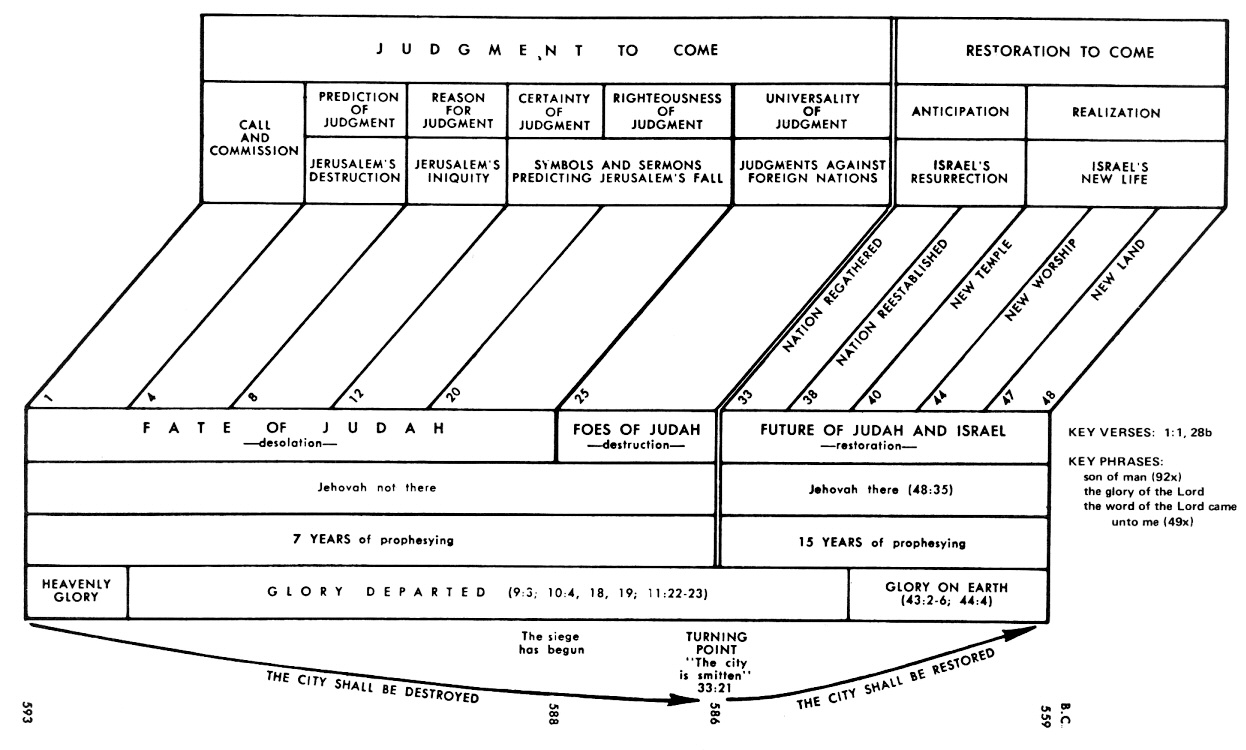
Click chart to enlarge
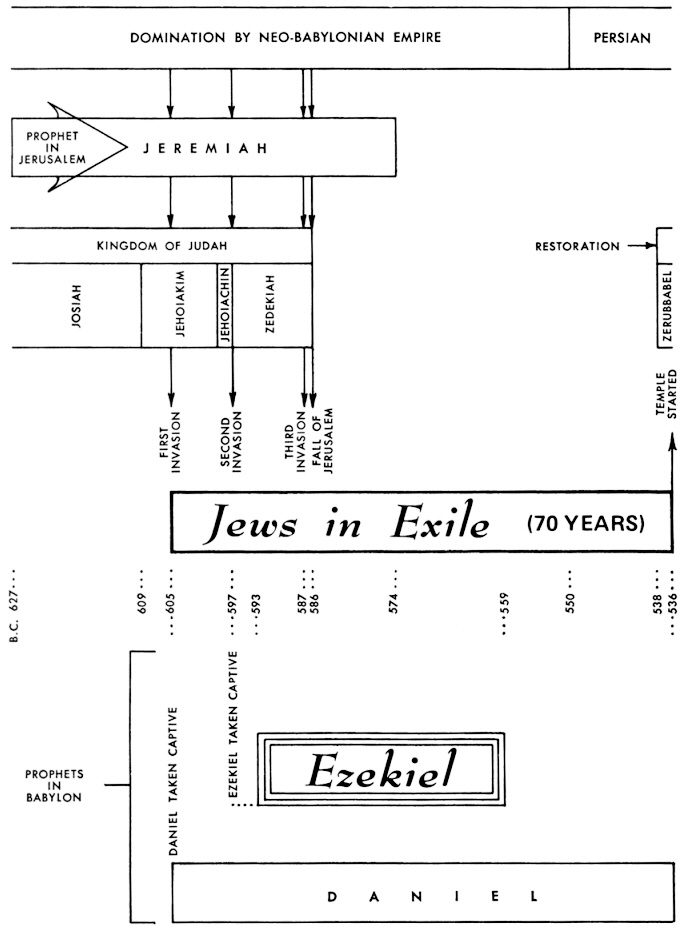
Click chart to enlarge
Chart from recommended resource Jensen's Survey of the OT - used by permission
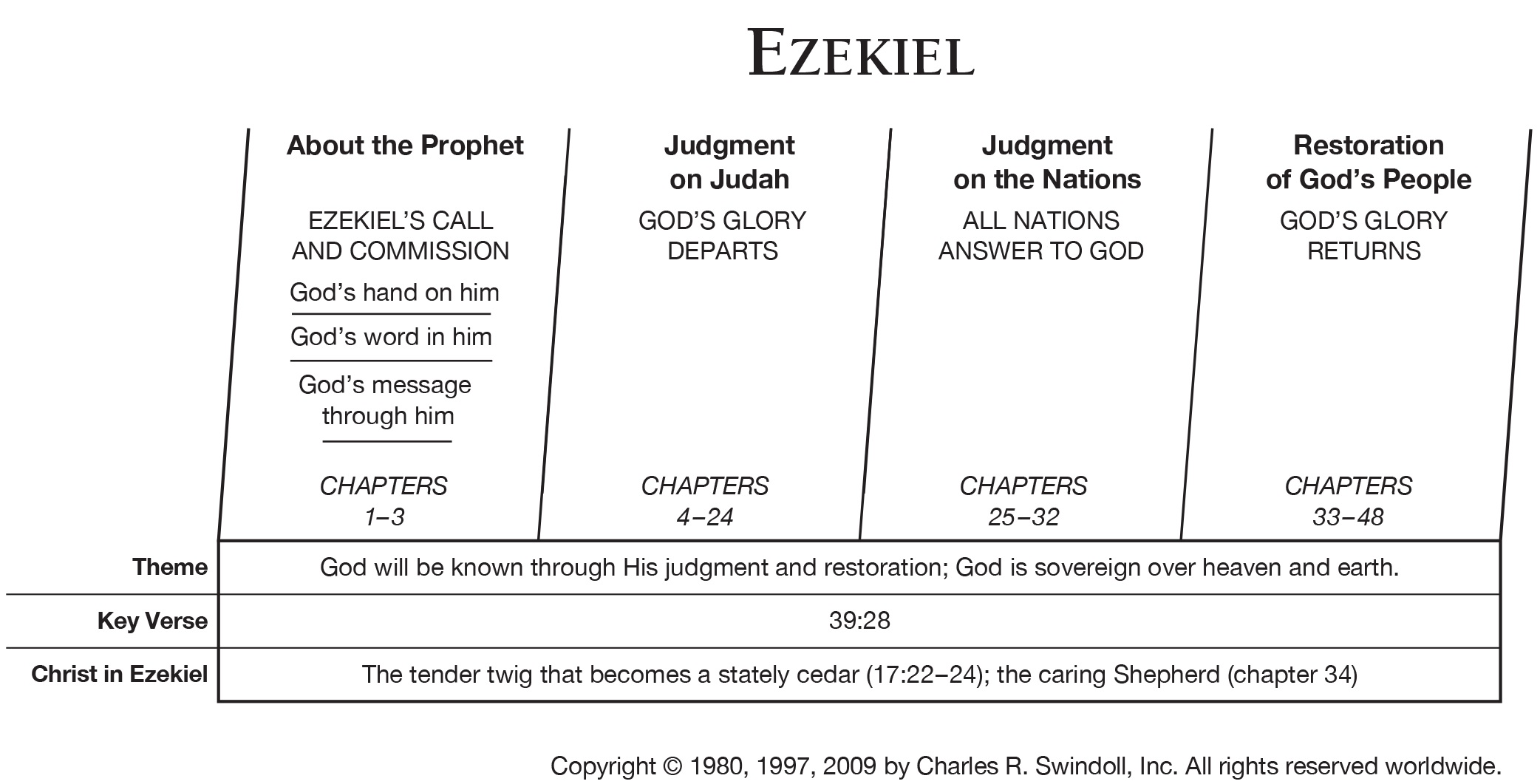
Click Chart from Charles Swindoll
|
PROPHECY OF |
PROPHECY OF |
|||
| FATE OF JUDAH Before the Siege |
FOES OF JUDAH During the Siege |
FUTURE OF JUDAH After the Siege |
||
|
593-588 BC |
587-586 |
586-571 |
||
|
7 YEARS |
15 YEARS |
|||
| Ezekiel 1:1-3:27 Ezekiel Sees the Glory & Receives the Call |
Ezekiel 4:1-24:27 Judgments Against Judah |
Ezekiel 25:1-32:32 Judgments Against the Gloating Nations |
Ezekiel 33:1-39:29 Restoration of Israel to the LORD |
Ezekiel 40:1-48:35 Visions of the Temple Jehovah Shammah |
Outline of the Book of Ezekiel from Dr John MacArthur - The book can be largely divided into sections about condemnation/retribution and then consolation/restoration. A more detailed look divides the book into 4 sections. First, are prophecies on the ruin of Jerusalem (Ezekiel 1:1–24:27). Second, are prophecies of retribution on nearby nations (Ezekiel 25:1–32:32), with a glimpse at God’s future restoration of Israel (Ezekiel 28:25,26). Thirdly, there is a transition chapter (Ezekiel 33:1-33) which gives instruction concerning a last call for Israel to repent. Finally, the fourth division includes rich expectations involving God’s future restoration of Israel (Ezekiel 34:1–48:35). (Reference)
I. Prophecies of Jerusalem’s Ruin (Ezekiel 1:1–24:27)
A. Preparation and Commission of Ezekiel (Ezekiel 1:1–3:27)
1. Divine appearance to Ezekiel (Ezekiel 1:1–28)|
2. Divine assignment to Ezekiel (Ezekiel 2:1–3:27)
B. Proclamation of Jerusalem’s Condemnation (Ezekiel 4:1–24:27)
1. Signs of coming judgment (Ezekiel 4:1–5:4)
2. Messages concerning judgment (Ezekiel 5:5–7:27)
3. Visions concerning abomination in the city and temple (Ezekiel 8:1–11:25)
4. Explanations of judgment (Ezekiel 12:1–24:27)
II. Prophecies of Retribution to the Nations (Ezekiel 25:1–32:32)
A. Ammon (Ezekiel 25:1–7)
B. Moab (Ezekiel 25:8–11)
C. Edom (Ezekiel 25:12–14)
D. Philistia (Ezekiel 25:15–17)
E. Tyre (Ezekiel 26:1–28:19)
F. Sidon (Ezekiel 28:20–24)
Excursus: The Restoration of Israel (Ezekiel 28:25, 26)
G. Egypt (Ezekiel 29:1–32:32)
III. Provision for Israel’s Repentance (Ezekiel 33:1–33)
IV. Prophecies of Israel’s Restoration (Ezekiel 34:1–48:35)
A. Regathering of Israel to the Land (Ezekiel 34:1–37:28)
1. Promise of a True Shepherd (Ezekiel 34:1–31)
2. Punishment of the nations (Ezekiel 35:1–36:7)
3. Purposes of restoration (Ezekiel 36:8–38)
4. Pictures of restoration—dry bones and two sticks (Ezekiel 37:1–28)
B. Removal of Israel’s Enemies from the Land (Ezekiel 38:1–39:29)
1. Invasion of Gog to plunder Israel (Ezekiel 38:1–16)
2. Intervention of God to protect Israel (Ezekiel 38:17–39:29)
C. Reinstatement of True Worship in Israel (Ezekiel 40:1–46:24)
1. New temple (Ezekiel 40:1–43:12)
2. New worship (Ezekiel 43:13–46:24)
D. Redistribution of the Land in Israel (Ezekiel 47:1–48:35)
1. Position of the river (Ezekiel 47:1–12)
2. Portions for the tribes (Ezekiel 47:13–48:35)
Ezekiel 3:16 At the end of seven days the word of the LORD came to me, saying,
NLT: At the end of the seven days, the LORD gave me a message. He said,
Young's Literal: And it cometh to pass, at the end of seven days, that there is a word of Jehovah unto me, saying,
SEVEN DAYS OF R&R
REST AND REGROUP
Now it came about at the end of seven days that the word of the LORD came to me, saying - Why did God wait 7 days to bring a word?
The word of the LORD occurs 60 times in the NASB in Ezekiel, more any other OT prophet. How wonderful to know that the Word of the Lord is never far from God’s servant who are willing to listen. Ezek 1:3; 3:16; 6:1, 3; 7:1; 11:14; 12:1, 8, 17, 21, 26; 13:1f; 14:2, 12; 15:1; 16:1, 35; 17:1, 11; 18:1; 20:2, 45, 47; 21:1, 8, 18; 22:1, 17, 23; 23:1; 24:1, 15, 20; 25:1, 3; 26:1; 27:1; 28:1, 11, 20; 29:1, 17; 30:1, 20; 31:1; 32:1, 17; 33:1, 23; 34:1, 7, 9; 35:1; 36:1, 4, 16; 37:4, 15; 38:1
Ezekiel 3:17 "Son of man, I have appointed you a watchman to the house of Israel; whenever you hear a word from My mouth, warn them from Me.
NLT: "Son of man, I have appointed you as a watchman for Israel. Whenever you receive a message from me, pass it on to the people immediately.
Word Biblical Commentary: Human one, I appoint youa lookout for the community of Israel. Whenever you hear a message from my lips, you are to caution them against me
Young's Literal: 'Son of man, a watchman I have given thee to the house of Israel, and thou hast heard from My mouth a word, and hast warned them from Me.
- I have (KJV): Eze 33:2-9 1Co 12:28
- a watchman (KJV): Song 3:3 5:7 Isa 21:6,8,11,12 52:8 56:10 62:6 Jer 6:17 31:6 Ac 20:28-31 Heb 13:17
- hear (KJV): Eze 33:6-8 2Ch 19:10 Isa 58:1 Jer 6:10 Hab 2:1 Mt 3:7 1Co 4:14 2Co 5:11,20 Col 1:28 1Th 5:14
EZEKIEL A WATCHMAN
FOR ISRAEL
Son of man, I have appointed you a watchman (tsaphah; Lxx -skopos) to the house of Israel: The phrase "I have appointed you" emphasizes God's sovereignty. He is in charge.
A watchman is the Hebrew word tsaphah which conveys the idea of being fully aware of a situation in order to gain some advantage or keep from being surprised by an enemy. More than any word it describes the special characteristic of Ezekiel’s work for he is to watch personally over individual souls. In a similar sense the writer of Hebrews emphasizes this principle of accountability of Christian leaders exhorting the flock to
Obey your leaders, and submit to them; for they keep watch over (literally sleepless & so keep awake and watch) your souls, as those who will give an account. Let them do this with joy and not with grief, for this would be unprofitable for you." (Heb 13:17)
Spurgeon comments that "one of the devices of Satan" is that "he seeks to lull God's prophets into slumber, for he knows that dumb dogs that are given to sleep will never do any very great injury to his cause. The wakeful watchman he always fears, for then he cannot take the city by surprise; but if he can cast God's watchman into slumber, then he is well content, and thinketh it almost as well to have a Christian asleep as to have him dead: he would certainly sooner see him in hell, but next to that, he is most glad to see him rocked in the cradle of presumption, fast asleep."
Watchmen in ancient times were sentinels stationed on city walls, hilltops or specially built watchtowers to warn citizens of danger. The office of watchman was extremely important because the safety of the entire population rested upon his diligence to carry out his task. The role of the watchman is illustrated in the following passage
Now David was sitting between the two gates (city gates) and the watchman went up to the roof of the gate by the wall, and raised his eyes and looked, and behold, a man running by himself. And the watchman called and told the king. And the king said, "If he is by himself there is good news in his mouth." And he came nearer and nearer." (2 Sa18:24, 25;cf 2Ki 9:18-20)
In 2 Kings we see another illustration "Now the watchman was standing on the tower in Jezreel and he saw the company of Jehu as he came, and said, "I see a company." And Joram said, "Take a horseman and send him to meet them and let him say, 'Is it peace?'" (2Ki 9:17)
The watchman was not to slumber on his post. The psalmist teaches the futility of functioning as a watchman without the LORD, writing that "Unless the LORD guards the city, the watchman keeps awake in vain." (Ps 127:1)
Thus they had to remain awake and alert for approaching enemies and warn of impending attack and give those who dwelt outside the walls an opportunity to seek protection and time to secure the gates and man the defenses.
What an irony… any rational person in and around the city would never ignore the cry or trumpet of a secular watchman and yet God says they would refuse to hearken to a spiritual watchman.
Note that although Ezekiel is sent to the house of Israel, in these verses he is charged to warn individuals, emphasizing that independent of the national sins of Judah, each individual is responsible for his or her own behavior. This same theme of personal responsibility is described in more detail in chapters 18 and 33.
Ezekiel was responsible for sounding the warning of impending judgment to individuals in the house of Israel. Speaking of Israel God says "And I set watchmen over you, saying, 'Listen to the sound of the trumpet!' (the sound of the watchman's trumpet on a city wall would have been cause for alarm and preparation) but they said, 'We will not listen.' (Jer 6:17)
In Isaiah God reminded Israel that "On your walls, O Jerusalem, I have appointed watchmen. All day and all night they will never keep silent… " (Isa 62:6)
As we see in this passage Ezekiel was silent (made mute by God) until he heard a word from the Lord and then he was to speak "Thus says the Lord God." (3:27)
Warren Wiersbe reminds us that "It is a serious thing to be a watchman, for the destiny of precious souls is at stake (Ezek. 3:16, 17, 18, 19, 20, 21; 33:1-9). The watchman must be alert to every opportunity and must not be afraid to sound the alarm. False watchmen are not faithful (Isa 56:10, 11, 12) and will have much to answer for at the Judgment. Paul was a faithful watchman who was able to say, “I am innocent of the blood of all men. For I have not shunned to declare to you the whole counsel of God” (Acts 20:26, 27+) (Borrow With the Word)
whenever you hear a word from My mouth, warn them from Me: whenever I send my people a warning, pass it on to them at once" (TLB) give ear to the word of My mouth, and give them word from Me of their danger" (BBE) A watchman warns of coming danger and in the historical context, that danger would be the destruction of the Temple in Jerusalem in 586 BC.
Whenever you hear a word from My mouth This is a good word for all God's children for as Spurgeon says "if we would be found really useful and serviceable for our Lord and Master" our ears need to be disciplined so that we hear only "the word from My mouth”, recognizing its Divine authority, studying it diligently as Spurgeon says going straight "to that fountain of truth… and never be satisfied with a second-hand version of it. Go you to the fountain head and drink there or ever the streams have been mudded by human blundering."
The prophet Habakkuk gives us a good picture of how a prophet functions as a watchman declaring
I will stand on my guard post and station myself on the rampart; and I will keep watch to see what He will speak to me… " (Hab 2:1)
Warn them from me The Greek Septuagint translates "warn" with the Greek verb (diapeileo) which means to intimidate or to threaten violently!
Believers today, although not called to intimidate or threaten violently, do have a commission to be God's "mouthpiece" and to be "ambassadors for Christ, as though God were entreating through us; we beg you on behalf of Christ, be reconciled to God." (2Cor 5:20)
"At the end of chapter 3 Ezekiel receives another nudge to get on with his ministry. In ancient times watchmen were stationed on top of the city’s walls as look-outs. Their job was to spot approaching danger. God appoints Ezekiel to be a spiritual watchman over Israel. The watchman’s job is to sound the alarm. If his warning goes unheeded, he’s done his job. He’s not responsible for the disaster that results. But if he goes to sleep on the job, or gets distracted… if he neglects to sound the alarm - God will hold him responsible for the destruction. God has also set you up as a watchman on the walls. Who’s within your walls? Who are the folks within the sphere of your influence? People at work? Neighbors? Family? Friends at the health club, or ballpark? Perhaps God has laid a whole country on your heart? Hey, you’re not responsible for how people react to God’s message – just as long as you speak up, and sound the alarm. It’s up to you to present the truth of the Gospel, and provide an opportunity to repent. Are you a good watchman? God holds you responsible for the people within your walls!" (Ref)
Watchman (06822) tsaphah conveys idea of being fully aware of a situation in order to gain some advantage or keep from being surprised by an enemy. The root carries with it the meaning of "being alert" and "active in watching" rather than simply gazing at something in the distance. It speaks literally of keeping watch for some event (a Watchman). Tsaphah means t
God watches over the nations (Ps 66:7) and literally over everything, everywhere (Pr 15:3)! It is used figuratively of waiting to see something, what God will do (Ps. 5:3; Nah. 2:1; Hab. 2:1). The wicked watch the righteous to do them harm (Ps. 37:32).
In Micah 7:7 the prophet says "But as for me, I will watch expectantly (Lxx = epiblepo = gaze on attentively, paying close attention) for the LORD; I will wait for the God of my salvation. My God will hear me.
To keep an eye on something or someone, as God watching over the covenant cut between Laban and Jacob - "And Laban said, “This heap is a witness between you and me this day.” Therefore it was named Galeed; and Mizpah, for he said, “May the LORD watch between you and me when we are absent one from the other." (Ge 31:48-49)
The idea is to be a watchman, to keep an eye on something or someone, to guard someone, to watch over. Watchmen on ancient city walls were to warn citizens of danger (cp use in Ezek 33:2-6).
Tsaphah conveys the idea of being fully aware of a situation in order to gain some advantage or keep from being surprised (as by an enemy).
Most of the uses of tsaphah that are translated as "watchman" are in turn translated in the Lxx by the noun skopos = a distant mark looked at, a goal and then the one watching this mark (Used in Php 3:14).
The Christian as A Sentinel (Watchman) from C H Spurgeon
When a sentinel is set upon the watch, he must not come off without the commander’s leave, and till he is discharged by authority. God hath set us in a watch, and we must not leave our ground till we have done all that is enjoined upon us, and receive a fair discharge.” The instance of the sentinel in Pompeii, whose skeleton was found erect at the city gate, when all but he had fled, need not be repeated in words; but it should be copied by each one of us in his life. If the earth should reel, it is ours to keep our place. If set to preach the Gospel, let us maintain the truth, though philosophy should thin the number of our comrades till we remain alone. Imagine what the universe would be if the stars forsook their marches, and the sun forbore to shine; yet this would only be among inanimate objects an imitation of the conduct of men who quit their posts, and leave their work undone. This is the spirit out of which fiends are made: first neglect, then omission, then treachery and rebellion. A sentinel must not leave his post even to gather pearls or diamonds; nor must we forsake our duty in order to acquire the highest honours. It matters nothing how well we have done other things if we neglect the thing. God bids us do this, and if we fail it will be no excuse to be able to say — we have done that. If the watcher forsakes his post it will not avail that he climbed a mountain, or swam a river: he was not where he was ordered to be.
Which station has He called you to man,
O beloved watchman on the wall?
Will you be found faithful?
Ezekiel 3:18 "When I say to the wicked, 'You will surely die,' and you do not warn him or speak out to warn the wicked from his wicked way that he may live, that wicked man shall die in his iniquity, but his blood I will require at your hand.
NLT: If I warn the wicked, saying, 'You are under the penalty of death,' but you fail to deliver the warning, they will die in their sins. And I will hold you responsible, demanding your blood for theirs.
GWT: Suppose I tell you that wicked people will surely die, but you don't warn them or speak out so that they can change their wicked ways in order to save their lives. Then these wicked people will die because of their sin, but I will hold you responsible for their deaths.
NIV: When I say to a wicked man, 'You will surely die,' and you do not warn him or speak out to dissuade him from his evil ways in order to save his life, that wicked man will die for his sin, and I will hold you accountable for his blood.
Word Biblical Commentary: When I tell someone who is wicked,a ‘You are doomed to die,’ and you have not cautioned him, giving the wicked person an explicit caution against his wicked behavior in order that he may live, the wrongdoing of that wicked person will cause his death, but I will hold you responsible for his demise.
Young's Literal: In My saying to the wicked: Thou dost surely die; and thou hast not warned him, nor hast spoken to warn the wicked from his wicked way, so that he doth live; he -- the wicked -- in his iniquity dieth, and his blood from thy hand I require.
- I say (KJV): Eze 18:4,13,20 33:6,8 Ge 2:17 3:3,4 Nu 26:65 2Ki 1:4 Isa 3:11 Lu 13:3,5 Eph 5:5,6
- to save (KJV): Eze 18:30-32 Ac 2:40 3:19 1Ti 4:16 Jas 5:19,20
- the same (KJV): Eze 33:6,9,10 Pr 14:32 Joh 8:21,24
- but (KJV): Eze 34:10 Ge 9:5,6 42:22 2Sa 4:11 Lu 11:50,51 Ac 20:26,27 1Ti 5:22
When I say to the wicked, 'You shall surely die': You are doomed to die" (WBC) You are under the penalty of death" (NLT) When I say to the evil-doer, Death will certainly be your fate" (BBE) You shall surely die is literally, dying thou shalt die which echoes God's warning to Adam in Ge 2:17+
In this section God begins to teach the principle that every individual (in the house of Israel) will be responsible for their own iniquity, a principle elaborated on more in Ezekiel 18 where for example God says…
The person who sins will die. The son will not bear the punishment for the father's iniquity, nor will the father bear the punishment for the son's iniquity; the righteousness of the righteous will be upon himself, and the wickedness of the wicked will be upon himself." (Ezek 18:20)
This truth is one that Satan has attacked from the beginning, the serpent declaring to Eve that "
You surely shall not die!" (Gen 3:4)
Read again what God Himself clearly reiterates in this verse "You shall surely die". God always keeps His promises, and after the sons of Israel expressed disbelief in His promise to give them the land of milk and honey He fulfilled the "flipside" of that promise declaring that
"They shall surely die in the wilderness." And not a man was left of them, except Caleb the son of Jephunneh, and Joshua the son of Nun." (Nu 26:65)
and you do not warn him or speak out to warn the wicked from his wicked way that he may live: (Ezek 18:30, 31, 32; Acts 2:40; 3:19; 1Ti4:16 Jas 5:19, 20)
"and you give him no word of it and say nothing to make clear to the evil-doer the danger of his evil way, so that he may be safe" (BBE),
"you do not warn him or speak out to dissuade him from his wicked conduct " (NAB),
"and you do not warn him—you do not speak out to warn him to turn from his evil conduct so that he may live" (NET)
Note the emphasis of singular pronouns (him… his… he) was on individuals. Ezekiel’s ministry was personal, focused on individual responsibility to trust and obey God.
From his wicked way is translated by the Greek Septuagint "to turn from his ways" utilizing the verb apostrepho (apo = from, implying rupture of a former association + strepho = turn quite around) which means literally to turn away from and which refers to causing someone to turn away from a previous belief, changing from incorrect to correct behavior.
that wicked man shall die in his iniquity: "that same evil man will come to death in his evil-doing" (BBE)
Through Isaiah God reiterated "Woe to the wicked! It will go badly with him, for what he deserves will be done to him." (Isa 3:11)
Die in his iniquity Over seven centuries later Jesus referring ultimately to eternal death said "that you shall die in your sins; for unless you believe that I am He, you shall die in your sins." (Jn 8:24)
but his blood I will require at your hand: "I will make you responsible for his blood." (BBE), "I will punish you. I will demand your blood for theirs" (TLB), "I shall hold you responsible for that death" (NJB), "I will hold you accountable for his blood" (NIV), "And I will hold you responsible, demanding your blood for theirs" (NLT) In ancient times, a night watchman guarded the city against danger, usually under penalty of death for failure.
But his blood I will require at your hand” The expression “require blood at your hand” is equivalent to requiring the death penalty. It is as though the blood of the sinner who dies in his iniquity had been shed because Ezekiel had failed to warn him and according to the law of retribution, Ezekiel was liable for the loss of life payable by the forfeit of his own.
This is illustrated in (2Sa 4:11, 12) where David addressed the killers of Ish-bosheth, he declared to them
"How much more, when wicked men have killed a righteous man in his own house on his bed, shall I not now require his blood from your hand, and destroy you from the earth?" Then David commanded the young men, and they killed them and cut off their hands and feet, and hung them up beside the pool in Hebron. But they took the head of Ish-bosheth and buried it in the grave of Abner in Hebron."
This principle of individual responsibility and accountability ("His blood I will require") finds its genesis in the book of Genesis where God declares
surely I will require your lifeblood; from every beast I will require it. And from every man, from every man's brother I will require the life of man. Whoever sheds man's blood, By man his blood shall be shed, for in the image of God He made man." (Ge 9:5, 6)
The Int'l Children's Bible paraphrases this verse
I will demand your blood for your lives. That is, I will demand the life of any animal that kills a person. And I will demand the life of anyone who takes another person's life. Whoever kills a human being will be killed by a human being. This is because God made humans in his own image."
THE NEGLIGENT WATCHMAN - Public sentiment in New York has been aroused against a poor brakeman on the New York Central railroad because he failed to give the danger signal to the St. Louis express. He was sent with a red lantern to wave down the approaching train, but, instead of doing so, he went into a depot and sat down by the fire. As the express thundered by he asked, “What’s that?” and, when told, he disappeared in the darkness and has not yet been found by the police. The express dashed into the train on the track and killed twelve persons. Everybody feels that such neglect was criminal, and yet how about us who believe that our friends are going headlong to ruin and we have not warned them of their danger?" (from The Biblical Illustrator)
In Ezekiel 33 God reiterates the seriousness of role of watchman declaring that
if the watchman sees the sword coming and does not blow the trumpet, and the people are not warned, and a sword comes and takes a person from them, he is taken away in his iniquity; but his blood I will require from the watchman's hand… But if you on your part warn a wicked man to turn from his way, and he does not turn from his way, he will die in his iniquity; but you have delivered your life." (Ezek 33:6, 9)
The apostle Paul in his final address to the Ephesian elders (who in turn would be held accountable) was fully conversant with the "watchman principle" declaring
Therefore I testify to you this day, that I am innocent of the blood of all men, (why is he innocent?), for I did not shrink from (draw back) declaring to you the whole purpose (God's determined will not just His inclination) of God." (Acts 20:26, 27)
In ancient times shepherds performed for sheep a similar watching, protecting role as the town watchman. God uses the shepherd metaphor to refer to Israel's leaders in Ezekiel 34 emphasizing their accountability and declaring
"Behold I am against the shepherds & I shall demand My sheep from them & make them cease from feeding sheep. So the shepherds will not feed themselves anymore but I shall deliver My flock from their mouth that they may not be food for them." (Ezek 34:10)
No More Excuses (READ: Ezekiel 18:1, 2, 3, 4, 5-18) - When salmon travel hundreds of miles up rivers and streams to spawn, they are acting on instinct. They are in a sense being driven by an uncontrollable force.
I read about a young convict who thinks that human conduct is similar to that of the salmon. Referring to the murders he committed and to his own fate, he said, "Things just happen." He thinks some kind of force was responsible for his pulling the trigger and killing two people. But he is wrong. Man is free and cannot blame his sinful actions on an uncontrollable force such as instinct.
More than 2,500 years ago, some Israelites were using a similar excuse for their sin. They quoted a well-known proverb that placed the blame for their sins on their ancestors (Ezekiel 18:2). But God told them they were wrong. He said that a good man will not be punished for the sins of a wicked son. Nor will a godly son be punished for the sins of his evil father.
Make no mistake. No matter what your situation, you are responsible for what you do. Stop offering excuses for your sins. Instead, acknowledge your guilt to God and accept the forgiveness He offers (Psalm 32:5). That's the first step in exercising your individual responsibility. — Herbert Vander Lugt (Our Daily Bread, Copyright RBC Ministries, Grand Rapids, MI. Reprinted by permission. All rights reserved)
Our actions are accountable
In God's just court above,
So we must face this certain fact:
We need His pardoning love. —Branon
There's no excuse for excusing sin.
Ezekiel 3:19 "Yet if you have warned the wicked and he does not turn from his wickedness or from his wicked way, he shall die in his iniquity; but you have delivered yourself.
NLT: If you warn them and they keep on sinning and refuse to repent, they will die in their sins. But you will have saved your life because you did what you were told to do.
Word Biblical Commentary: On the other hand, you have cautioned the wicked person, but he has failed to give up his wickedness or any of his wicked behavior,a his wrongdoing will cause his death, but you will have saved your life.
Young's Literal: And thou, because thou hast warned the wicked, and he hath not turned back from his wickedness, and from his wicked way, he in his iniquity dieth, and thou thy soul hast delivered.
- if thou (KJV): 2Ki 17:13-23 2Ch 36:15,16 Pr 29:1 Jer 42:19-22 44:4,5 Lu 10:10,11 Ac 18:5,6 1Th 4:6 Heb 2:1-3 12:25
- he shall (KJV): Eze 3:18 2Th 1:8,9 Heb 10:26,27
- but thou (KJV): Eze 3:21 14:14,20 33:5,9 Isa 49:4,5 Ac 13:45,46 20:26 2Co 2:15-17
"NO REMEDY"
SOME OF THE MOST FRIGHTENING
WORDS IN SCRIPTURE!
Yet if you have warned the wicked and he does not turn from his wickedness or from his wicked way he shall die in his iniquity: But if you warn them, and they keep on sinning and refuse to repent, they will die in their sins" (TLB) But if you give the evil–doer word of his danger, and he is not turned from his sin or from his evil way, death will overtake him in his evil–doing." (BBE)
Why does God warn through Ezekiel? In 2 Chronicles we read that
Jehovah, the God of their fathers, sent word to them again and again by His messengers, because He had compassion on His people and on His dwelling place." (2Chr 36:15)
Did they respond? Surely they listened to the repeated pleas and warnings from Jehovah! The writer sadly records that
they continually mocked the messengers of God, despised His words and scoffed at His prophets (Read those verbs again - what do I do every time I commit a sin in His Holy sight?! - If you don't agree read about the man after God's own heart and what he did [same Hebrew verb for despise] - 2Sa 12:9,10!) until (A strategic expression of time! Until signifies not a maybe someday, but a payday someday! God's warning alarm will one day stop, so let us all be careful to hear and heed and walk righteously in the power of the Spirit… lest we commit that "pet sin" one too many times!) the wrath of the LORD arose against His people, until there was no remedy." (2Chr 36:16)
As the proverb declares "A man who hardens his neck after much reproof will suddenly be broken beyond remedy." (Pr 29:1, cp Pr 6:15, 28:18 Isa 30:13,14 Zech 7:11, 12, 13, 14 1Th 5:3-note)
A good illustration of the fulfillment of the responsibility of warning the wicked is found in Acts when Paul arrived at Corinth and "began devoting himself completely to the word, solemnly testifying to the Jews that Jesus was the Christ (the Messiah). And when they resisted and blasphemed, he shook out his garments and said to them, "Your blood be upon your own heads! I am clean. From now on I shall go to the Gentiles." (Acts 18:5, 6)
The writer of Hebrews brings this principle out strongly, warning that if someone goes
on sinning willfully after receiving the knowledge of the truth, there no longer remains a sacrifice for sins, but a certain terrifying expectation of judgment, and THE FURY OF A FIRE WHICH WILL CONSUME THE ADVERSARIES." (Heb 10:26, 27) adding a later warning to all to
See to it that you do not refuse Him Who is speaking. For if those (house of Israel) did not escape when they refused him who warned them on earth (in context refers to the prophet Moses), much less shall we escape who turn away from Him Who warns from heaven." (Heb 12:25)
Indeed as the Sovereign LORD has already explained to Ezekiel, the rebellious house of Israel will not listen to him because they refuse to listen to the Lord God Who "warns from heaven".
Bishop Simpson writes in The Biblical Illustrator - Often on the ocean I have gone to the prow of the vessel and looked out into the darkness of the night. I have found the watchman not one moment from his post, his eye gazing far over the sea, where he might discern at the greatest distance and at the earliest moment any cause of possible danger. The lives of the crew and passengers were in his hands. The mist might come down heavily, the wind might blow furiously, the storm rage incessantly; but still on and ever the watchman looks out in the one direction. The whales may sport in multitudes around the vessel, the whole sea behind him be in a phosphorescent glow. His own great object is not to care for these things, but to look ahead! So you are watchmen. You are on the ship. The vessel may be running towards shore; there may be breakers ahead. You are to sound the alarm.
but you have delivered yourself: also thou hast delivered thy soul" (KJV) but you are blameless—you have done all you could" (TLB) your life will be spared" (TEV) but your life will be safe." (BBE) Note some versions have translations like "save yourself" or "save your life" but there is no implication of salvation as used in the New Testament sense of being born again. Delivered yourself Here the words do not imply more than deliverance from bodily death. Note that Ezekiel cannot deliver the wicked (or the righteous) but only himself. As God says in verse 27, to quote from God's Word Translation "Some will listen, and some will refuse to listen. They are rebellious people."
Ezekiel can warn but he can't force them to listen and obey (SOUNDS LIKE WHAT I HAVE LEARNED WITH MY KIDS!). This principle is elaborated on In Ezekiel 14 where the Sovereign LORD declares to Ezekiel that
even though these three men, Noah, Daniel, and Job were in its midst (of a rebellious country), by their own righteousness they could only deliver themselves." (Ezek 14:14, 20, 33:5, 9)
The dread warning has for its complement a message of comfort. The judgment passed on the prophet does not depend on the results of his ministry. “Whether men will bear, or whether they will forbear,” Ezekiel has “delivered his soul” (i.e. saved his life) when he has done his duty as a watchman.
Warning! (READ: Ezekiel 18:26, 27, 28, 29, 30, 31, 32) - During the past year, cars, trucks, tires, window blinds, and toy xylophones have been recalled by their manufacturers. In every case, the message was similar: "This product is defective or dangerous and could cause serious injury or even death. Return it to us and we will correct the problem." But it's up to the consumer to heed the warning and return the dangerous item.
Suppose God put this warning on the heart and soul of every person: "Because of a fatal attraction to sin and willful misuse, this item is defective. Failure to correct this problem will result in certain spiritual death."
Through the prophet Ezekiel, God said that the hearts of His people had become adulterous (Ezekiel 6:9) and as hard as a rock (Ezek 11:19). Yet the Lord longed for their hearts to be softened, and for them to come back to Him. He made this impassioned plea: "Repent, and turn from all your transgressions, so that iniquity will not be your ruin… Get yourselves a new heart and a new spirit. For why should you die, O house of Israel? For I have no pleasure in the death of one who dies … Therefore turn and live!" (Ezek 18:30-32).
Today, by turning from sin to God through faith in Jesus Christ, anyone can have a new heart. — David C. McCasland (Our Daily Bread, Copyright RBC Ministries, Grand Rapids, MI. Reprinted by permission. All rights reserved)
The power of God can turn a heart
From evil and the power of sin;
The love of God can change a life
And make it new and cleansed within. —Fasick
Salvation is not turning over a new leaf,
but receiving a new life.
Ezekiel 3:20 "Again, when a righteous man turns away from his righteousness and commits iniquity, and I place an obstacle before him, he will die; since you have not warned him, he shall die in his sin, and his righteous deeds which he has done shall not be remembered; but his blood I will require at your hand.
BBE: Again, when an upright man, turning away from his righteousness, does evil, and I put a cause of falling in his way, death will overtake him: because you have given him no word of his danger, death will overtake him in his evil–doing, and there will be no memory of the upright acts which he has done; but I will make you responsible for his blood.
NLT: If good people turn bad and don't listen to my warning, they will die. If you did not warn them of the consequences, then they will die in their sins. Their previous good deeds won't help them, and I will hold you responsible, demanding your blood for theirs.
GWT: If righteous people turn from living the right way and do wrong, I will make them stumble, and they will die. If you don't warn them, they will die because of their sin, and the right things they did will not be remembered. I will hold you responsible for their deaths.
NIV: "Again, when a righteous man turns from his righteousness and does evil, and I put a stumbling block before him, he will die. Since you did not warn him, he will die for his sin. The righteous things he did will not be remembered, and I will hold you accountable for his blood
NJB: When someone upright renounces uprightness to do evil and I set a trap for him, it is he who will die; since you failed to warn him, he will die for his guilt, and the uprightness he practised will no longer be remembered; but I shall hold you responsible for his death.
Word Biblical Commentary: Moreover, when someone who is virtuous gives up his virtuea and does wrong, I will put in his path an obstacle that causes his downfall: he will die. If you have not cautioned him, his sin will cause his death and no cognizance will be taken of his virtuous deeds that he has done, but I will hold you responsible for his demise.
Young's Literal: 'And in the turning back of the righteous from his righteousness, and he hath done perversity, and I have put a stumbling-block before him, he dieth; because thou hast not warned him, in his sin he dieth, and not remembered is his righteousness that he hath done, and his blood from thy hand I require.
- When (KJV): Eze 18:24,26 33:12,13 2Ch 24:2,17-22 Ps 36:3 125:5 Zep 1:6 Mt 13:20,21 Heb 10:38 2Pe 2:18-22 1Jn 2:19
- righteousness (KJV): Heb. righteousnesses, Isa 64:6 Da 9:18
- and I lay (KJV): Eze 7:19 14:3,7-9 De 13:3 Ps 119:165 *marg: Isa 8:14 Jer 6:21 Lu 2:34 Ro 9:32,33 11:9 1Co 1:23 2Th 2:9-12 1Pe 2:8
- because (KJV): Eze 3:18 Lev 19:17 2Sa 12:7-13 2Ch 19:2-4 25:15 Pr 25:12 Mt 18:15
- and his (KJV): Eze 18:24,26 33:12,13 Mt 12:43-45 Lu 8:15 Ro 2:7,8 Heb 10:38 2Pe 2:21
- but his (KJV): Eze 3:18 33:6 Heb 13:17
Again, when a righteous man turns away from his righteousness and commits iniquity: his righteousness (right doing and right standing with God)" (Amp)
And I place an obstacle (stumbling block) before him, he shall die: some gift or providence which I lay before him he perverts into an occasion to sin " (Amp) I will put in his path an obstacle that causes his downfall" (WBC) I put a stumbling block before him, he will die" (NIV) I will make them stumble, and they will die" (GWT) I put a cause of falling in his way, death will overtake him" (BBE) I set a trap for him, it is he who will die" (NJB)and I put a cause of falling in his way" (BBE)
Obstacle or stumbling block (mikshowl) is a keyword in Ezekiel with 8 of 14 OT occurrences being found in Ezekiel (Lev 19:14; 1Sa 25:31; Ps 119:165; Is 8:14; 57:14; Je 6:21; Ezek 3:20; 7:19; 14:3f, 7; 18:30; 21:15; 44:12). In Leviticus mikshowl refers to a literal obstacle in the path, Moses recording that
You shall not curse a deaf man, nor place a stumbling block before the blind, but you shall revere your God; I am the LORD." (Lev 19:12)
The Pulpit Commentary has the following interesting note on "obstacle/stumbling block" explaining that "One of the acts of Eastern malignity was to put a stone in a man’s way, that he might fall and hurt himself Here the putting the stone is described as the act of Jehovah, and is applied to anything that tempts a man to evil, and so to his own destruction (Jeremiah 6:21). The thought is startling to us, and seems at variance with true conceptions of the Divine will (James 1:13). The explanation is to be found in the fact that the prophet’s mind did not draw the distinction which we draw between evil permitted and the same evil decreed. All, from this point of view, is as God wills, and even those who thwart that will are indeed fulfilling it. Glimpses are given of the purpose which leads to the permission or decree. In the case now before us the man has turned from his righteousness before the stumbling block is laid in his way. The temptation is permitted that the man may become conscious of his evil (Ro 7:13). If the prophet preacher does his duty, the man may conquer the temptation, and the stumbling block may become a “stepping stone to higher things.” If, through the prophet’s negligence, he comes unwarned, and stumbles and falls, he, as in the case of the wicked, bears the penalty of his guilt, but the prophet has here also the guilt of blood upon his soul. The “righteousnesses” of the man (here, as before, we have the plural), his individual acts of righteousness, shall not be remembered, because he was tried, and found wanting in the essential element of all righteousness. The highest development of the thought is found in the fact that Christ himself is represented as a “stumbling stone” (Isaiah 8:14;Ro 9:32, 33; 1Cor 1:23)."
The psalmist gives one of the best ways for a righteous man to avoid stumbling over an "obstacle" or stumbling block, writing that
"Those who love Thy law have great peace, and nothing causes them to stumble." (literally = they have no stumbling block) (Ps 119:165)
In Ezekiel 18 God says to Israel
I will judge you, O house of Israel, each according to his conduct… Repent and turn away from all your transgressions, so that iniquity may not become a stumbling block (your downfall or ruin) to you. Cast away from you all your transgressions which you have committed, and make yourselves a new heart and a new spirit! (What is the ultimate effect of the stumbling block?) For why will you die, O house of Israel? For I have no pleasure in the death of anyone who dies," declares the Lord GOD. "Therefore, repent and live." (Ezek 18:30-32)
In Jeremiah God reiterates the effect of the stumbling block declaring
Behold, I am laying stumbling blocks before this people. And they will stumble against them, fathers and sons together; neighbor and friend will perish." (Jer 6:21)
since you have not warned him, he shall die in his sin: (Ezek 3:18; Lv 19:17; 2Sa 12:7-13; 2Chr 19:2, 3, 4; 25:15; Mt 18:15)
and his righteous deeds which he has done shall not be remembered: (Ezek 18:24, 26; 33:12, 13; Lk 8:15; Ro 2:7 2:8; Heb 10:38; 2Pe 2:21)
no cognizance will be taken of his virtuous deeds that he has done (WBC)
Their previous good deeds won't help them (NLT)
and there will be no memory of the upright acts which he has done (BBE)
but his blood I will require at your hand: (Ezek 3:18; 33:6; Heb 13:17)
I will hold you responsible for his demise" (WBC)
I will hold you accountable for his blood" (NIV)
I will hold you responsible, demanding your blood for theirs" (NLT)
The Apostle Paul had this passage (and Ezek 33:6,8) in view in Acts 18:6 and Acts 20:26. Even for preachers today, there is such a warning, Hebrews exhorting believers to
Obey your leaders and submit to them; for they keep watch over your souls, as those who will give an account.… " (Heb 13:17).
Certainly the consequence for such unfaithfulness on the preacher’s part includes divine chastening and loss of eternal reward (cf. 1Cor. 4:1, 2, 3, 4, 5).
Richards applies this truth to believers pointing out that "Today it’s helpful if we think of each Christian’s “job description” in the same way (as Ezekiel's). It takes no special qualification to serve our neighbors as a watchman. No seminary degree is required. Not even mastery of Scripture, or great spiritual depth. All that’s called for is awareness that friends without Christ are in terrible peril—and a voice to lift to give them warning. We can’t guarantee that any individual will respond. But if we remain silent, we carry some responsibility for that other’s fate. A word of warning to another clears us of guilt, and may lead him or her to eternal life." (The 365 day devotional commentary. Wheaton, Ill.: Victor Books)
Ezekiel 3:21 "However, if you have warned the righteous man that the righteous should not sin and he does not sin, he shall surely live because he took warning; and you have delivered yourself
NLT: "But if you warn them and they repent, they will live, and you will have saved your own life, too."
Word Biblical Commentary: on the other hand, you have cautioned the virtuous person that as a virtuous person he should not sin, and he stops sinning, he will certainly live, because he heeded the caution, while you will have saved your life.” —
Young's Literal: And thou, because thou hast warned him -- the righteous -- that the righteous sin not, and he hath not sinned, he surely liveth, because he hath been warned; and thou thy soul hast delivered.'
- if thou (KJV): Mt 24:24,25 Ac 20:31 1Co 4:14 10:12 Ga 1:6-10 5:2-7 Eph 4:17-21 5:5,6 Col 1:28 3:5-8 1Th 4:6-8 5:14 Tit 2:15 1Jn 3:6-9 Rev 3:19
- he shall (KJV): Eze 3:20 Ps 19:11 Pr 9:9 17:10 Ga 2:11-13 Jas 5:20
- also (KJV): Eze 3:19 1Ti 4:16
However, if you have warned the righteous man that the righteous should not sin:
Spurgeon - Christ’s battles are not such as require strength of muscle and bone, nor do they need great mental capacity. Even the appointed watchman is set only to warn the people: he has not to charm them with eloquence, nor to electrify them with novelties of oratory: he is simply to warn them, and the plainest language may suffice for that.
and he does not sin, he shall surely live because he took warning:
Proverbs records that "Like an earring of gold and an ornament of fine gold Is a wise reprover to a listening (obeying) ear." (Pr25:12)
David adds that God's righteous judgment "Thy servant is warned. In keeping them there is great reward." (Ps 19:11)
and you have delivered yourself:
James reiterates this teaching declaring "My brethren, if any among you strays from the truth, and one turns him back, let him know that he who turns a sinner from the error of his way will save his soul from death, and will cover a multitude of sins." (Jas 5:19 20)
Ezekiel 3:22 The hand of the LORD was on me there, and He said to me, "Get up, go out to the plain, and there I will speak to you."
Young's Literal: And there is on me there a hand of Jehovah, and He saith to me, 'Rise, go forth to the valley, and there I do speak with thee.'
NLT: Then the LORD took hold of me, and he said to me, "Go out into the valley, and I will talk to you there."
GWT: The power of the LORD came over me. He said, "Get up, and go to the plain. I will speak to you there."
Word Biblical Commentary: felt Yahweh’s hand on me there. “Get up,” he told me, “and go out to the plain so I can speak with you there.”
- the hand (KJV): Eze 3:14 1:3 37:1
- Arise (KJV): Eze 8:4 Ac 9:6
And the hand of the LORD was on me there: I felt the powerful presence of the Lord " (TEV) Then I felt the power of the Lord there" (NCV) The hand of the Lord rested on me there" (NET) While I was there the hand of Yahweh came on me" (NJB) Then the Lord took hold of me" (NLT)
Hand of the LORD in the Old Testament often refers to "power" or enablement (Study in context the 37 uses of this exact phrase - Ex 9:3; Deut 2:15; Josh 4:24; 22:31; Jdg 2:15; Ruth 1:13; 1Sam 5:6, 9; 7:13; 12:15; 2Sam 24:14; 1 Kgs 18:46; 2 Kgs 3:15; 1 Chr 21:13; Ezra 7:6, 28; Job 12:9; Ps 75:8; 118:15f; Pr 21:1; Isa 19:16; 25:10; 41:20; 62:3; 66:14; Jer 51:7; Ezek 1:3; 3:14, 22; 8:1; 33:22; 37:1; 40:1; NT uses = Luke 1:66; Acts 11:21; 13:11). When the hand of God came upon Elijah he received supernatural strength and direction (1Ki 18:46).
Hand of the LORD" is found 7 times in Ezekiel (Ezek 1:3; 3:14, 22; 8:1; 33:22; 37:1; 40:1).
Related Resources:
- See in depth study on Ezra 7:10 and the relationship with the good hand of the LORD.
- The Hand of the Lord
and He said to me, "Get up, go out to the plain, and there I will speak to you. (Acts 9:6) Get up, go out to the valley, and I will speak with you there (NET)
Ezekiel like the apostle Paul after seeing the risen Lord and receiving His appointment was summoned to go into the desert to receive further instruction for his assignment (Gal 1:16 1:17).
"Plain" (biq'ah) is probably more accurately translated "valley" as it is translated in (Ezek37:1), where Ezekiel has another vision in the "valley of bones". God calls Ezekiel out of the midst of the rebellious sons of Israel and to a place of solitude, that he might be alone with the "glory of the LORD" and receive refreshment and instruction for the difficult task that lay before him. Do you have times where you "get up, go out to the plain" that you might be alone with the Almighty, away from hustle and bustle which distracts our attention and all but drowns out God's voice? If you answer "No I've never done that" then you need to consider your ways and get alone with Him for He says "there I will speak to you."
When God says "I will speak to you" it is an invitation and appointment from a Friend. God does not say “I will lighten and thunder” or “I will overpower you with My strength” but simply “I will speak to you” as a father might speak with his only son. Ezekiel again finds himself prostrate before God's glory, but the Spirit enables him to arise. He did not arise unchanged as subsequent verses testify and neither can we walk away unchanged after being in His presence.
As Parker says "When Moses talked with God, his face shone; when we commune with Him, our life will be full of brightness. Divine fellowship may be kept silent, but it cannot be kept secret. Jesus Christ Himself went away from men to commune with God. If the Master required solitude, can the servant safely do without it?" (The Biblical Illustrator)
The Pulpit Commentary comments that "Psychologically, it seems probable that the effect of the message was to fill him with an overwhelming, crushing sense of the burden of his responsibility. How was he to begin so terrible a work?" What were to be the nearer, and the remoter, issues of such a work? Apparently, at least, he does not then begin it by a spoken warning. He passes, at the Divine command borne in on his soul, from the crowd that had watched him during the seven days’ silence, and betakes himself to the solitude of the “plain,” as distinct from the “mound” where the exiles dwelt, and there the vision appears again in all points as he had seen it when he stood on the river’s bank."
Ezekiel 3:23 So I got up and went out to the plain; and behold, the glory of the LORD was standing there, like the glory which I saw by the river Chebar, and I fell on my face.
BBE: Then I got up and went out into the valley; and I saw the glory of the Lord resting there as I had seen it by the river Chebar; and I went down on my face.
NLT: So I got up and went, and there I saw the glory of the LORD, just as I had seen it in my first vision by the Kebar River. And I fell face down in the dust.
Word Biblical Commentary: Getting up, I went out to the plain, where I found the glorious manifestation of Yahweh’s presence resting, just asa I had seen it by the Kebar Canal. I threw myself down on my face,
Young's Literal: And I rise and go forth unto the valley, and lo, there the honour of Jehovah is standing as the honour that I had seen by the river Chebar, and I fall on my face.
- the glory (KJV): Eze 1:4,28 9:3 10:18 Nu 16:19,42 Ac 7:55
- river (KJV): Eze 1:1-3
- and I fell (KJV): Eze 1:28 Da 8:17 10:8,9 Rev 1:17 4:10 5:8,14
So I got up and went out to the plain; and behold, the glory of the LORD was standing there: (Ezek 1:4 1:28; 9:3; 10:18; Nu16:19, 42; Acts 7:55) (Ezek 8:4; 10:19, 20; 43:3; Ex16:7, 10; 24:16; 33:18, 19, 20, 21, 22, 23; Nu 12:6, 7, 8 1Ki8:10, 11; 1Co 13:12)
like the glory which I saw by the river Chebar, and I fell on my face:(Ezek 1:28; Ge17:3; Lv 9:24; Da8:17; 10:7, 8, 9, 10:16, 17; Mt 17:5; 6 Acts 9:4; Rev 1:17, 18 Rev 4:10; 5:8, 14)
Ezekiel 3:24 The Spirit then entered me and made me stand on my feet, and He spoke with me and said to me, "Go, shut yourself up in your house.
NLT: Then the Spirit came into me and set me on my feet. He talked to me and said, "Go, shut yourself up in your house.
Word Biblical Commentary: whereupon the spirit entered me and made me stand on my feet. Yahweh spoke with me: “Go home,” he told me, “and shut yourself indoors—
Young's Literal: And come into me doth a spirit, and causeth me to stand on my feet, and He speaketh with me, and saith unto me, 'Go in, be shut up in the midst of thy house.
- the spirit (KJV): Eze 2:2 37:10 Da 10:8-10,19
- Go (KJV): Eze 4:1-4
The Spirit then entered me and made me stand on my feet:
and He spoke with me and said to me, "Go, shut yourself up in your house. Go, imprison yourself in your house (TLB)
We often talk about "getting alone with God" but this pushes the envelope.
Ezekiel 3:25 "As for you, son of man, they will put ropes on you and bind you with them so that you cannot go out among them.
NET: As for you, son of man, they will put ropes on you and tie you up with them, so you cannot go out among the people.
NLT: There you will be bound with ropes so you cannot go out among the people.
Word Biblical Commentary: they will actually put ropes round you, human one, and tie you up, so that you will not be able to mix with them outdoors
Young's Literal: 'And thou, son of man, lo, they have put on thee thick bands, and have bound thee with them, and thou goest not forth in their midst;
- Eze 4:8 Mk 3:21 Joh 21:18 Ac 9:16 20:23 21:11-13
As for you, son of man, they will put ropes on you and bind you with them, so that you cannot go out among them: You will be tied with ropes, mortal man, and you will not be able to go out in public. (TEV) While some commentaries reject the idea of a literal binding of the prophet, there seems no reason to take it as figurative. Assuming that the ropes are literal, it is not clear how long he was tied up. His confinement reminds one of the truth that Ezekiel was not his own but belonged to the Lord and the Lord could do with him whatever He desired.
John MacArthur who I hold in the highest regard and who usually takes a very literal approach does not on this verse writing that the ropes "were not literal, but spiritual. On one hand, they could be the inner ropes of depressing influence which the rebellious Jews exerted on his spirit. Their perversity, like ropes, would repress his freedom in preaching. More likely, they imply the restraint that God placed on him by supernatural power, so that he could only go and speak where and when God chose." (See context in The MacArthur Bible Commentary)
Hindson and Kroll - Nowhere in the book do we find evidence of actual physical violence upon the prophet, though admittedly this is an argument from silence. Some have suggested that it may have reference to bands of moral restraint, such as the people’s rejection of the prophet’s warning against their sin and impending judgment.
Ezekiel 3:26 "Moreover, I will make your tongue stick to the roof of your mouth so that you will be mute and cannot be a man who rebukes them, for they are a rebellious house.
NLT: "And I will make your tongue stick to the roof of your mouth so you won't be able to pray for them, for they are rebellious.
Word Biblical Commentary: and I will make your tongue stick to your palate, and you will be dumb and so unable to relate to them as an agent of punishment, rebel community though they are.
Young's Literal: and thy tongue I cause to cleave unto thy palate, and thou hast been dumb, and art not to them for a reprover, for a rebellious house are they.
BGT καὶ τὴν γλῶσσάν σου συνδήσω καὶ ἀποκωφωθήσῃ καὶ οὐκ ἔσῃ αὐτοῖς εἰς ἄνδρα ἐλέγχοντα διότι οἶκος παραπικραίνων ἐστίν
KJV And I will make thy tongue cleave to the roof of thy mouth, that thou shalt be dumb, and shalt not be to them a reprover: for they are a rebellious house.
NET I will make your tongue stick to the roof of your mouth so that you will be silent and unable to reprove them, for they are a rebellious house.
CSB I will make your tongue stick to the roof of your mouth, and you will be mute and unable to rebuke them, for they are a rebellious house.
ERV and I will make thy tongue cleave to the roof of thy mouth, that thou shalt be dumb, and shalt not be to them a reprover: for they are a rebellious house.
ESV And I will make your tongue cling to the roof of your mouth, so that you shall be mute and unable to reprove them, for they are a rebellious house.
NIV I will make your tongue stick to the roof of your mouth so that you will be silent and unable to rebuke them, though they are a rebellious house.
NRS and I will make your tongue cling to the roof of your mouth, so that you shall be speechless and unable to reprove them; for they are a rebellious house.
GWN I will make your tongue stick to the roof of your mouth so that you can't talk or criticize them, even though they are rebellious people.
NKJ "I will make your tongue cling to the roof of your mouth, so that you shall be mute and not be one to rebuke them, for they are a rebellious house.
NAB I will make your tongue stick to your palate so that you will be dumb and unable to rebuke them for being a rebellious house.
LXE Also I will bind thy tongue, and thou shalt be dumb, and shalt not be to them a reprover: because it is a provoking house.
NJB I am going to make your tongue stick to the roof of your mouth; you will be dumb, and no longer able to reprove them, for they are a tribe of rebels.
ASV and I will make thy tongue cleave to the roof of thy mouth, that thou shalt be dumb, and shalt not be to them a reprover; for they are a rebellious house.
DBY And I will make thy tongue cleave to the roof of thy mouth, that thou shalt be dumb, and shalt not be to them a reprover; for they are a rebellious house.
- I will (KJV): Eze 24:27 Ps 51:15 137:6 Jer 1:17 Lu 1:20-22
- and shalt (KJV): Ps 36:11,12 La 2:9 Ho 4:17 Am 5:10 8:11,12 Mic 3:6,7
- a reprover (KJV): Heb. a man reproving
- for (KJV): Eze 2:3-8 Isa 1:2
Moreover, I will make your tongue stick to the roof of your mouth so that you will be dumb: The binding of Ezekiel’s body and tongue showed that he could only act and speak as God enabled him.
Hindson and Kroll - Thou shalt be dumb. The dumbness of the prophet may have a double significance. First, his message would have divine authentication if he could speak only when relaying the message from the Lord. Secondly, it certainly would remove the temptation any prophet might have to speak flattering words to the people, rather than God’s words.
The Evangelical Commentary poses an interesting question "In light of Ezek 3:16, 17, 18, 19, 20, 21 the divine command of Ezek 3:24 is almost inexplicable: “Go, shut yourself inside your house.” First he is commanded to be a sentry. Then he is ordered to confine himself to his house! And to complicate matters, God will make his tongue stick to the roof of his mouth. Ezekiel will lose his capacity for speech. How does a dumb, tongue-tied prophet under house confinement warn his people of impending danger?" (Borrow Evangelical Commentary on the Bible)
and cannot be a man who rebukes them for they are a rebellious house.: You will not be able to argue with the people, even though they turn against me" (NCV) so that you have no voice and may not make protests to them: for they are an uncontrolled people" (BBE)
Rebukes (yakach) is translated in the Greek Septuagint by elegcho which means to bring to the light and so to expose which conveys the idea of showing someone that he has done something wrong and summoning him to repent. Ezekiel will be unable to rebuke them (at least at this time), but God would open his mouth to speak his words, which in the first 24 chapters will definitely include words of rebuke.
The prophet Amos presents a parallel thought recording the Sovereign LORD's declaration that
days are coming… when I will send a famine on the land, not a famine for bread or a thirst for water, but rather for hearing the words of the LORD. And people will stagger from sea to sea, and from the north even to the east. They will go to and fro to seek the word of the LORD, but they will not find it." (Amos 8:11, 8:12)
Ezekiel 3:27 "But when I speak to you, I will open your mouth and you will say to them, 'Thus says the Lord GOD.' He who hears, let him hear; and he who refuses, let him refuse; for they are a rebellious house
NLT: "But whenever I give you a message, I will loosen your tongue and let you speak. Then you will say to them, 'This is what the Sovereign LORD says!' Some of them will listen, but some will ignore you, for they are rebels.
GWT: But when I speak to you, I will open your mouth. You will tell them, 'This is what the Almighty LORD says.' Some will listen, and some will refuse to listen. They are rebellious people."
Word Biblical Commentary: But whenever I speak with you, I will open your mouth and you will tell them ‘This is the message of the Lord Yahweh.’ Anyone ready to listen may listen and anyone who refuses to do so may refuse, rebel community as they are.
Young's Literal: And in My speaking with thee, I do open thy mouth, and thou hast said unto them: Thus said the Lord Jehovah; the hearer doth hear, and the forbearer doth forbear; for a rebellious house are they.
- I will (KJV): Eze 11:25 24:27 29:21 33:32 Ex 4:11,12 Lu 21:15 Eph 6:19
- Thus (KJV): Eze 3:11 2:5 Mt 11:15 13:9 Rev 22:10,11
- for they (KJV): Eze 3:9,26 12:2,3
But when I speak to you, I will open your mouth, and you will say to them 'Thus says the Lord GOD.' :But whenever I give you a message, then I will loosen your tongue and let you speak, and you shall say to them: ‘The Lord God says." (TLB) Ezekiel couldn’t talk most of the time, but when he did he would speak and say, “Thus says the Sovereign LORD.”
Can you imagine what his wife must have thought? Furthermore it appears that this speech impediment lasted for the next 71/2-8 years, until the news of the fall of Jerusalem reached him. In chapter 24 we find God says
As for you, son of man, will it not be on the day when I take from them their stronghold, the joy of their pride, the desire of their eyes, and their heart's delight, their sons and their daughters, that on that day he who escapes will come to you with information for your ears? On that day your mouth will be opened to him who escaped, and you will speak and be dumb no longer. Thus you will be a sign to them, and they will know that I am the LORD.'" (Ezek 24:25, 26, 27)
Note the 2 effects of these events: Ezekiel would be a "sign" to the exiles and they would know that God was the LORD. Chapter 33 gives us the specific dating of this event recording that
"it came about in the twelfth year (586 BC) of our exile, on the fifth of the tenth month, that the refugees from Jerusalem came to me, saying, "The city has been taken." Now the hand of the LORD had been upon me in the evening, before the refugees came. And He opened my mouth at the time they came to me in the morning; so my mouth was opened, and I was no longer speechless." (Ezek 33:21, 22)
And so for almost 8 years Ezekiel is to give out nothing but God’s Word to the rebellious house people, and that is the only time he’s to speak to them. He had only the Word of God to give them.
At first glance Ezekiel's speech impediment seems to be incompatible with his appointment as a watchman who was to warn the wicked and the righteous. How could he fulfill the serious responsibility to warn sinners, a responsibility for which he would be accountable to God? Who would speak to the wicked? In verse 18 God says "when I say to the wicked" but in this verse He says He will speak to Ezekiel and through Ezekiel and in so doing Ezekiel would fulfill his function as a watchman saying "thus says the Lord God" every time he opened his mouth.
"I will open your mouth" When Moses complained that he was not eloquent enough to be the LORD's spokesman, God reminded him
Who has made man's mouth? Or who makes him dumb or deaf, or seeing or blind? Is it not I, the LORD? Now then go, and I, even I, will be with your mouth, and teach you what you are to say." (Ex 4:11, 12)
Jesus encouraged His disciples that although difficult times would come, it would lead to an opportunity for their testimony and that they were to
"make up (their) minds not to prepare beforehand to defend (themselves)" because He would give them "utterance and wisdom which none of (their) opponents (would) be able to resist or refute." (Lk 21:15)
Paul wrote the Ephesian church to
"pray on my behalf, that utterance may be given to me in the opening of my mouth, to make known with boldness the mystery of the gospel" (Ep 6:19)
He who hears, let him hear; and he who refuses, let him refuse: Let anyone listen who wants to, and let anyone refuse who wants to, for they are rebels" (TLB)
Refuse (chadel) means to refrain from doing something and pertains to being deliberately disobedient. Chadel is translated "forbear" by the KJV, forbear meaning to to hold oneself back from, especially with an effort. The Greek Septuagint translates "refuse" with the word apeitheo which means to disobey, be disobedient, to refuse to believe and so is translated "he that is (present tense = continuously, as a habit of their life) disobedient, let him be (present imperative = a command to continuously be) disobedient." Is it as if these individuals make the choice to be habitually disobedient, and if that is what they want, then they are in a sense given over to power of their choice. It's almost like once they have made their mind up to have "their way", they are commanded (even in a judicial sense) to continue along that path, ultimately to perdition. The same idea is apparent in the passage in Revelation where the angel tells John
Let the one who does wrong (present tense = continuously), still (present imperative = commanded to continually) do wrong; and let the one who is filthy, still be filthy; and let the one who is righteous, still practice righteousness; and let the one who is holy, still keep himself holy." (Rev 22:11+)
Regardless of the hearer's response, they would be personally responsible for their response.
Craigie adds this explanatory note regarding "he who hears let him hear, etc": The words characterize the form of the divine address that Ezekiel was to deliver to Israel, and Jesus too was frequently to use these words in his ministry of teaching. The word was to be spoken, but no speech is complete without hearing. And with respect to the audience, it was not their auditory facility as such that was in question; rather, it was the facility to hear with understanding and with the intention of acting on the basis of understanding. Thus, whenever one hears the divine word, whether through the ancient prophets, through the teaching of Jesus, or through some modern medium, one is placed in a situation of freedom. The physical act of hearing is in a sense involuntary; freedom is exercised in the response we make to that which we hear. The word thus comes to us with a respect for our persons; we are not bludgeoned into action, nor is the divine word like the electrical impulse that directs the actions of a robot. It comes to us and invites reaction; we are free to choose our response. But our freedom may be our salvation or our downfall. Aware of the responsibility involved in our freedom, we must listen with understanding, and understand with obedience." (Borrow Ezekiel. The Daily study Bible)
for they are a rebellious house: (Ezek 3:9,26; 12:2, 3)
The difficult, restrictive aspects of his ministry described in these last several verses emphasize Ezekiel’s need to be faithful regardless of the response of the people who are as the Greek translation puts it "a provoking house."