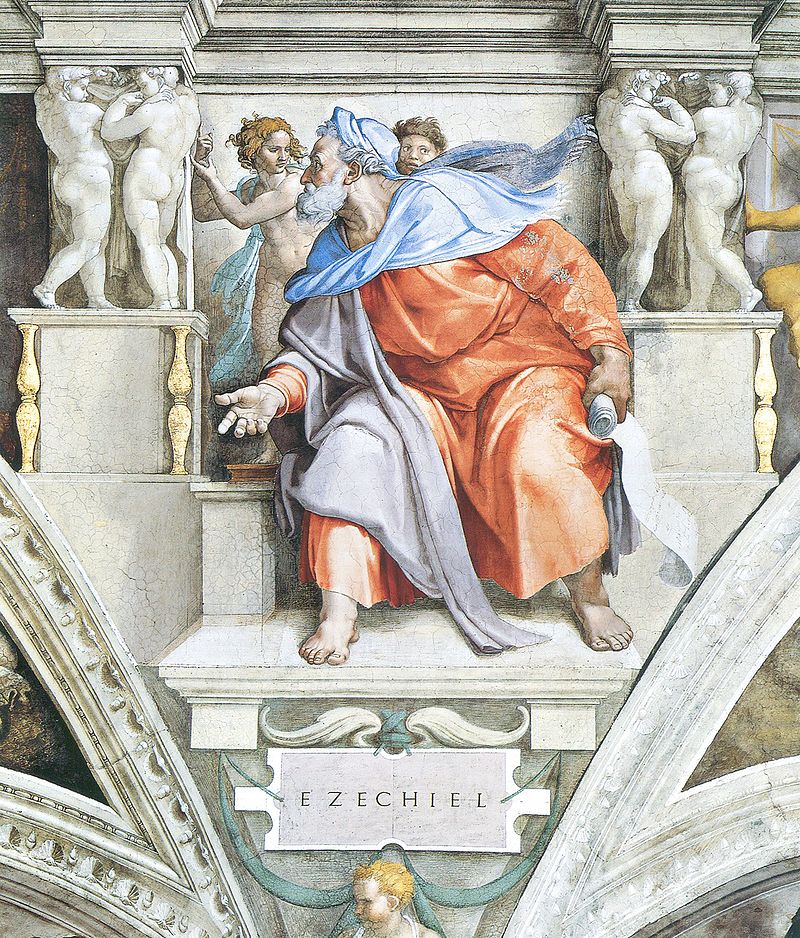
Michelangelo's Ezekiel on the Sistine Chapel
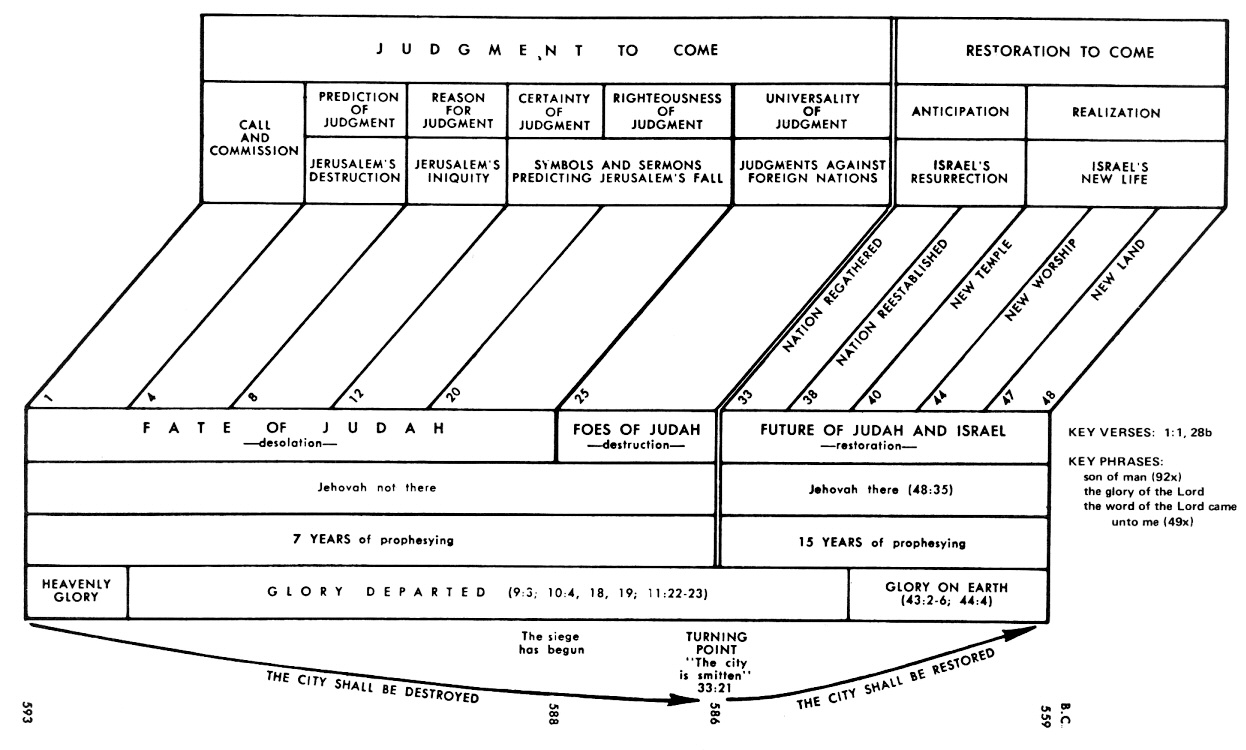
Click chart to enlarge
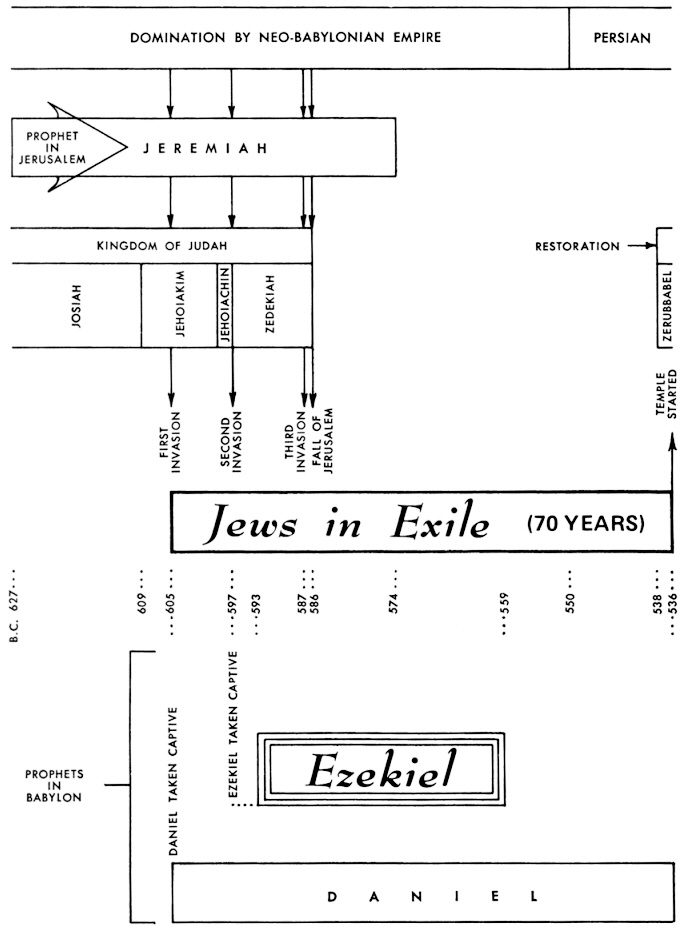
Click chart to enlarge
Chart from recommended resource Jensen's Survey of the OT - used by permission
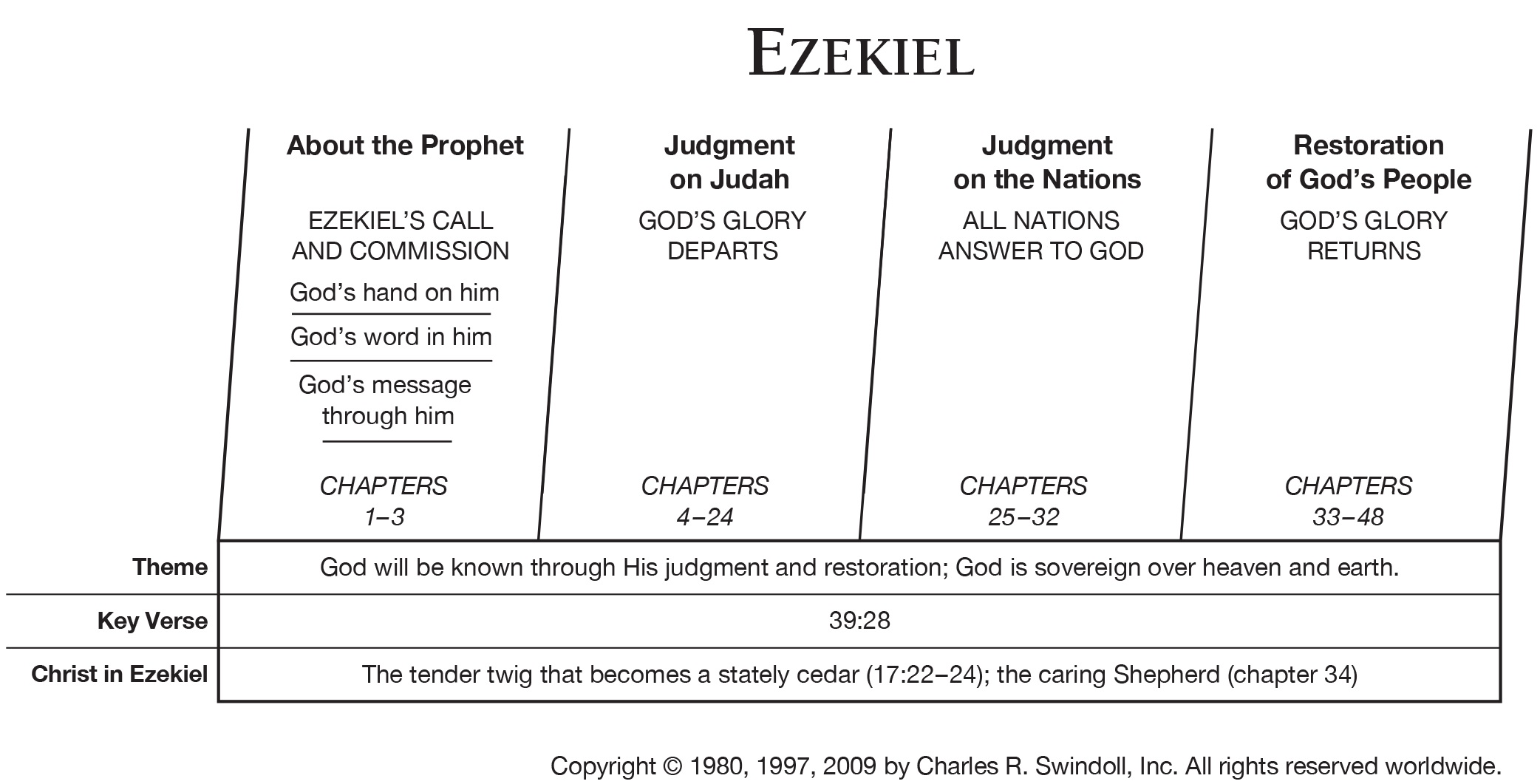
Click Chart from Charles Swindoll
|
PROPHECY OF |
PROPHECY OF |
|||
| FATE OF JUDAH Before the Siege |
FOES OF JUDAH During the Siege |
FUTURE OF JUDAH After the Siege |
||
|
593-588 BC |
587-586 |
586-571 |
||
|
7 YEARS |
15 YEARS |
|||
| Ezekiel 1:1-3:27 Ezekiel Sees the Glory & Receives the Call |
Ezekiel 4:1-24:27 Judgments Against Judah |
Ezekiel 25:1-32:32 Judgments Against the Gloating Nations |
Ezekiel 33:1-39:29 Restoration of Israel to the LORD |
Ezekiel 40:1-48:35 Visions of the Temple Jehovah Shammah |
Outline of the Book of Ezekiel from Dr John MacArthur - The book can be largely divided into sections about condemnation/retribution and then consolation/restoration. A more detailed look divides the book into 4 sections. First, are prophecies on the ruin of Jerusalem (Ezekiel 1:1–24:27). Second, are prophecies of retribution on nearby nations (Ezekiel 25:1–32:32), with a glimpse at God’s future restoration of Israel (Ezekiel 28:25,26). Thirdly, there is a transition chapter (Ezekiel 33:1-33) which gives instruction concerning a last call for Israel to repent. Finally, the fourth division includes rich expectations involving God’s future restoration of Israel (Ezekiel 34:1–48:35). (Reference)
I. Prophecies of Jerusalem’s Ruin (Ezekiel 1:1–24:27)
A. Preparation and Commission of Ezekiel (Ezekiel 1:1–3:27)
1. Divine appearance to Ezekiel (Ezekiel 1:1–28)|
2. Divine assignment to Ezekiel (Ezekiel 2:1–3:27)
B. Proclamation of Jerusalem’s Condemnation (Ezekiel 4:1–24:27)
1. Signs of coming judgment (Ezekiel 4:1–5:4)
2. Messages concerning judgment (Ezekiel 5:5–7:27)
3. Visions concerning abomination in the city and temple (Ezekiel 8:1–11:25)
4. Explanations of judgment (Ezekiel 12:1–24:27)
II. Prophecies of Retribution to the Nations (Ezekiel 25:1–32:32)
A. Ammon (Ezekiel 25:1–7)
B. Moab (Ezekiel 25:8–11)
C. Edom (Ezekiel 25:12–14)
D. Philistia (Ezekiel 25:15–17)
E. Tyre (Ezekiel 26:1–28:19)
F. Sidon (Ezekiel 28:20–24)
Excursus: The Restoration of Israel (Ezekiel 28:25, 26)
G. Egypt (Ezekiel 29:1–32:32)
III. Provision for Israel’s Repentance (Ezekiel 33:1–33)
IV. Prophecies of Israel’s Restoration (Ezekiel 34:1–48:35)
A. Regathering of Israel to the Land (Ezekiel 34:1–37:28)
1. Promise of a True Shepherd (Ezekiel 34:1–31)
2. Punishment of the nations (Ezekiel 35:1–36:7)
3. Purposes of restoration (Ezekiel 36:8–38)
4. Pictures of restoration—dry bones and two sticks (Ezekiel 37:1–28)
B. Removal of Israel’s Enemies from the Land (Ezekiel 38:1–39:29)
1. Invasion of Gog to plunder Israel (Ezekiel 38:1–16)
2. Intervention of God to protect Israel (Ezekiel 38:17–39:29)
C. Reinstatement of True Worship in Israel (Ezekiel 40:1–46:24)
1. New temple (Ezekiel 40:1–43:12)
2. New worship (Ezekiel 43:13–46:24)
D. Redistribution of the Land in Israel (Ezekiel 47:1–48:35)
1. Position of the river (Ezekiel 47:1–12)
2. Portions for the tribes (Ezekiel 47:13–48:35)
Ezekiel 4:1 "Now you son of man, get yourself a brick, place it before you and inscribe a city on it, Jerusalem.
Brenton's English of Greek Septuagint: And thou, son of man, take thee a brick, and thou shalt set it before thy face, and shalt portray on it the city, even Jerusalem.
WBC: You, human one, are to take a brick and, setting it in front of you, draw a city on it.
Young's Literal: And thou, son of man, take to thee a brick, and thou hast put it before thee, and hast graven on it a city -- Jerusalem,
- Get - Ezek 5:1-17; 12:3-16; 1Sa 15:27 15:28; 1Ki11:30 11:31; Isa20:2-4; Jer13:1-14; 18:2-12; 19:1-15; 25:15-38; 27:2-22; Ho1:2-9; 3:1-5; Ho12:10)
- Even - Jer 6:6 32:31 Am 3:2
THE SIGN OF
A BRICK
Ryrie on Ezekiel 4:1-3 - Ezekiel was told to "act out" the coming siege of Jerusalem (in 587; 2 Kings 24:20-25:21; Jer. 52:4-11). On a brick of soft clay he drew a picture of Jerusalem, built a siege wall (a tower), connected the two with a ramp, and arranged camps (soldiers) to besiege it. The strength of the besiegers and the impossibility of escape was represented by the iron plate Ezekiel set up (v. 3). (Borrow Ryrie Study Bible)
NOW YOU SON OF MAN, GET YOURSELF A BRICK, PLACE IT BEFORE YOU - And now, son of man, take a large brick and set it down in front of you (NLT) To summarize events to this point (Ezekiel is laid out very chronologically) remember that Ezekiel’s ministry began with a dramatic personal encounter with the "glory of the LORD", a good place for every minister and ministry to have it's inception. After emphasizing that Ezekiel's ministry would not be well received, the Lord appointed him as the watchman who was to sound the alarm of coming judgment to the exiles in Babylon. In Chapters 4-24 we see and hear watchman’s cry. The specific prophecy that begins this chapter is the first of a series of prophecies addressing the coming fall of Jerusalem, these prophecies being given over a year’s time in the next 4 chapters (through Ezek 7:27).
Richards quips that Ezekiel "begins his confrontation with his stubborn community by “playing toy soldier.” (Richards, L. (1991). The Bible reader's companion. Wheaton, Ill.: Victor Books.)
The Believer's Study Bible - Though mute, Ezekiel was to declare a message in mime for the city of Jerusalem. Ezekiel scratched either the city map or a view of the skyline of Jerusalem upon the "clay tablet," a sunbaked mud brick commonly used in writing. This was the first of a series of symbolic acts, found in Ezek. 4:1-6:7, which were part of his messages to the exiles. Such symbolic acts were one of the ways that the prophets communicated their messages. Jeremiah wore a yoke about his neck (Jer. 27:1, 2). Isaiah walked "naked and barefoot" for three years (Isa. 20:3).
Craigie writes "Ezekiel's ministry as such begins abruptly. The call and commission are complete; now the action must begin. And if Ezekiel had not been thoroughly prepared for his task, the first job he was given to do would have seemed very curious; “take a brick”, God says to him! The prophetic ministry, as becomes so clear in the life of Ezekiel, involves more than preaching; he is to begin by being a map-maker and model-builder. But actions may speak as loudly as words. The actions that Ezekiel is now to undertake will communicate as forcibly as a sermon the divine message. (Borrow Ezekiel. The Daily study Bible)
Get yourself a brick - Get is a command in Hebrew. Some commentaries take the events in these next 2 chapters as the effects of a vivid imagination and not visible events that the other Jewish exiles could witness. Verse 4 clearly calls this first one a "sign" which leaves little doubt that these strange depictions were to "point out the way" as is the function of any sign and that could hardly be possible if these were events that occurred only in Ezekiel's mind. The use of real life events as a mode of teaching is found (albeit to a lesser extent) in the records of other prophet’s. And so we encounter Isaiah walking “naked and barefoot” for three years (Isa 20:3); Jeremiah wearing yokes of wood (Jer 27:2) and Hosea being called to marry Gomer, a harlot (Hosea 1-3).
God's selection of a "brick" is interesting because Jerusalem was a city built with stones (1Ki10:27) on a rock foundation and the man made brick was the primary material used for construction of buildings in Babylon, where stones were scarce.
"Bricks" were not like the rectangular brick we encounter today. One ancient historian records "Let the bricks be two feet long, one foot broad, and four inches thick.” On a surface as large as this the whole siege might be easily portrayed. In Babylonia there was a lack of both timber and stone, and the thick clay deposited by the overflowing rivers was the only material adaptable to building.
The New Unger's Bible Dictionary has an describes "bricks" in Babylon: "The following account taken from Maspero (Dawn of Civilization, pp. 622–23) especially applies to Mesopotamia and Egypt: “In the estimation of the Chaldean architects stone was a matter of secondary consideration. As it was necessary to bring it from a great distance and at considerable expense, they used it very sparingly...Crude brick, burnt brick, enameled brick, but always and everywhere brick was the principal element in their construction. The soil of the marshes or of the plains, separated from the pebbles and foreign substances which it contained, mixed with grass or chopped straw, moistened with water, and assiduously trodden under foot, furnished the ancient builders with material of incredible tenacity. This was molded into thin, square brick, eight inches to a foot across and three or four inches thick, but rarely larger. They were stamped on the flat side, by means of an incised wooden block, with the name of the reigning sovereign (See the example on the left of a characteristic square, tile-like Assyrian brick inscribed with King Shalmanesser's name & title [from Smith's Bible Dictionary] Some peasant houses found near Babylon have bricks containing King Nebuchadnezzar’s stamp! Bricks were in essence the books of that time and whole libraries of these have been brought to light in recent excavations)." (Borrow The New Unger's Bible Dictionary - see page 184)
Babylonian bricks were "made with clay mixed with chopped straw or grass that, on decaying, released acids that gave the substance greater malleability. The brick maker added water, kneaded the mixture by foot, and molded it into square bricks, each about 8-12 inches across and 3-4 inches thick....Babylonian bricks were commonly burned in brick kilns (cf Ge11:3) rather than sun-dried. Sun-dried bricks disintegrated easily in heavy rainfall, whereas bricks burned in a kiln were virtually indestructible" (Tyndale Bible dictionary. Page 237. Wheaton, Ill.: Tyndale House Publishers)
Smith's Dictionary adds that "the bricks in use among the Jews...possessed more of the character of tiles." (KJV translates the Hebrew as "tile")
Place it before you - literally before your face
AND INSCRIBE A CITY ON IT, JERUSALEM. "on it scratch a city, Jerusalem" (NJB), "draw upon it the plan of the city of Jerusalem" (DRA), "Then draw a map of the city of Jerusalem on it" (NLT), "scratch lines on it to represent the city of Jerusalem" (TEV)
What is fascinating in this "sign of the brick" is that Jerusalem was built with stones on a rock foundation. Brick was a symbol of Babylon and was instrumental in Nimrod's instigation of rebellion against Yahweh at Babel (Ge10:10 Ge11:3). To depict Jerusalem with a symbol indigenous to idolatrous, rebellious Babylon would suggest that the holy city had become even worse than Babylon in her morals and idolatry.
"Inscribe" (chaqaq) means to engrave, inscribe, mark out, make meaningful marks on an object, to chisel or hew out on stone.
Matthew Henry comments that "It was Jerusalem’s honour that while she kept her integrity God had graven her upon the palms of his hands (Isa49:16), and the names of the tribes were engraved in precious stones on the breast-plate of the high priest; but, now that the faithful city has become a harlot, a worthless brittle tile or brick is thought good enough to portray it upon. This the prophet must lay before him, that the eye may affect the heart."
News of Ezekiel’s strange action would have spread quickly through the community of Jewish exiles and they would have come to watch. The meaning of the display would not be too difficult to discern. There beloved city, Jerusalem surrounded by siege-works certainly indicated that it would again be besieged by an enormously powerful army. Imagine what must have gone through the minds of the exiles. Surely, in this case the sign would be as impressive and perhaps even more so than any spoken utterance. Ezekiel's was demonstrating that "A picture is worth a thousand words!" because pictures convey strong, memorable images and pictures etched on bricks would not quickly fade away.
Now think about this drama. Who should be seeing this pictorial prophecy concerning Jerusalem? Would it not have more effect on the Jews still remaining in Jerusalem? And so why present it to the exilic community?
Craigie offers an interesting analysis writing that "(a) In the immediate context of exile, the Jews had to cling to hope of some kind. The natural focus of such hope was the city of Jerusalem, from which they had been exiled; there, God’s intimate presence had been known. But this source of hope was dashed by Ezekiel’s action; if salvation were to be found, it would not be in Jerusalem, for God’s face was steadfastly set against that city. (b) As it would gradually become clear in the prophet’s unfolding ministry, the reason for God’s wrath against his own city was the evil of its inhabitants. If there was any hope at all for the future, it would only be found in turning from evil, for evil brought only siege and destruction. The faith of the Jews was being weaned gradually from its attachment to a particular place; the prophet was calling for a commitment to God, unlinked to a city and transcending Tel Abib, that was rooted in repentance and righteousness." (Borrow Ezekiel. The Daily study Bible)
Wiersbe - Ezekiel began his public ministry with four action sermons that declared God’s judgment against Jerusalem. First, he “played war” to demonstrate the siege of the city (Ezek 4:1–3). The iron plate represented the barrier between God and His people (Lam. 3:43–44). Nothing could stop Babylon from capturing the city. Then, he lay bound for part of each day, 390 days on left side and then 40 days on the right, to show how many years both Israel and Judah had sinned. How long-suffering God was during those years and how they broke His heart (Ezek 6:9)! During those fourteen months and ten days, Ezekiel had to ration his food and water as the people in Jerusalem would do. Compare 4:14 with Acts 10:14. Though he was not serving as a priest, Ezekiel still obeyed the priestly code. No doubt the people watched him day after day and told others about his bizarre behavior, and that helped to spread the message. His fourth sign involved shaving his head and face, a real sacrifice for a Jew. The hair represented the people in Jerusalem who faced three destinies: death by famine, death by the sword, and dispersion among the nations (Deut. 28:47–57). But a believing remnant would be protected and saved by the Lord. (Borrow copy of With the Word)
Source: Ryrie Study Bible
Ezekiel 4:2 "Then lay siege against it, build a siege wall, raise up a ramp, pitch camps and place battering rams against it all around.
Brenton's English of Greek Septuagint: And thou shalt besiege it, and build works against it, and throw up a mound round about it, and pitch camps against it, and set up engines round about.
CEV: Then prepare to attack the brick as if it were a real city. Build a dirt mound and a ramp up to the top and surround the brick with enemy camps. On every side put large wooden poles as though you were going to break down the gate to the city.
TEV: Then, to represent a siege, put trenches, earthworks, camps, and battering rams all around it.
TLB: Draw a picture of siege mounds being built against the city, put enemy camps around it and battering rams surrounding the walls.
WBC: Then set against it siege appliances: erect a siege tower against it, pile up a ramp against it, station against it army encampments, and set battering rams all around.
Young's Literal: and hast placed against it a siege, and builded against it a fortification, and poured out against it a mount, and placed against it camps, yea, set thou against it battering-rams round about.
- Then lay siege against it Jer 39:1,2 52:4 Lu 19:42-44
- battering rams Eze 21:22
Then lay siege against it- And make an attack on it, shutting it in" (BBE) Set up a blockade against it" (GWT)
Lay siege (matsowr) describes the process of shutting up and confining a city, and methodically attacking the walls (see Dt 20:19). Ezekiel would be very familiar with the significance of a "siege" for he had been carried captive to Babylon after the siege of Jerusalem in 597 BC (2Ki24:10-16), and he was writing these prophecies before the final siege (2Ki25:1-11). Quite likely many of the exiles in his audience were also all too familiar with the picture of a siege. Keep in mind that Jerusalem was a well-fortified city and it would take Babylon months to capture it.
A siege or prolonged military blockade of Jerusalem would force it to surrender by taking away the advantage of the city’s defensive walls by cutting outside contact and halting the flow of food, supplies, and weapons.
Who is to lay siege against Jerusalem in this drama? Obviously Ezekiel would be the one laying siege, but the prophet was God’s representative, thus clearly this was symbolic of Jehovah Himself besieging His beloved Jerusalem
"the city of...God, His holy mountain, beautiful in elevation, the joy of the whole earth"! (Ps 48:1-2)
How this must have hurt the heart of the LORD (see Ezek 6:9a 6:9b) Centuries latter our Lord lamented
O Jerusalem, Jerusalem, who kills the prophets and stones those who are sent to her! How often I wanted to gather your children together, the way a hen gathers her chicks under her wings, and you were unwilling. Behold, your house is being left to you desolate!" (Mt 23:37-38)
The siege of Jerusalem in spite of Zedekiah’s Egyptian alliance, had been decreed. Ezekiel begins his with the siege sign some four years before it came — in this chapter we are somewhere between the fourth month of the fifth year (Ezek1:1 1:2) and the sixth month of the sixth year (Ezek 8:1) of Zedekiah and the siege began in the ninth year recorded as follows
Now it came about in the ninth year of his (Zedekiah's) reign, on the tenth day of the tenth month, that Nebuchadnezzar king of Babylon came, he and all his army, against Jerusalem, camped against it, and built a siege wall all around it. So the city was under siege until the eleventh year of King Zedekiah." (2Ki 25:1 25:2).
build a siege wall,:
build forts against it (ASV)
building strong places against it" (BBE)
build attack walls around it (GWT)
In Deuteronomy we find a description of a "siegework", Moses instructing Israel that
When you besiege a city a long time, to make war against it in order to capture it, you shall not destroy its trees by swinging an axe against them; for you may eat from them, and you shall not cut them down. For is the tree of the field a man, that it should be besieged by you? Only the trees which you know are not fruit trees you shall destroy and cut down, that you may construct siegeworks against the city that is making war with you until it falls." (cf Deut 20:19, 20)
And so in ancient warfare, hewn trees together with earth and other materials at hand were used to form an embankment (raised structure to enclose or confine) around the besieged city. This "siege wall" not only cut off the besieged city from the surrounding country, but also served as a base of operations for the besiegers.
raise up a ramp: cast up a mound against it (ASV) and making high an earthwork against it (BBE) throw up a mound round about it (Brenton's of Lxx) put up dirt ramps around it (GWT) The second phase of the siege involved throwing out from the "siege wall" one or more mounds, banks or ramps in the direction of the city (cf 2Sa20:15; 2Ki19:31 32). These ramps were gradually increased in height until they were about half as high as the city wall. On these mounds or “siege walls” the army could erect towers from which slingers and archers might attack effectively. The ramp provided a relatively smooth incline up which siege towers and Battering rams could be pushed up to the walls.
raise up a ramp, pitch camps and place battering rams against it all around: set camps also against it (ASV) and put up tents against it" (BBE) have troops ready to attack it (GWT)
and place battering rams against it all around: placing engines all round it for smashing down its walls (BBE) On every side put large wooden poles as though you were going to break down the gate to the city (CEV) and place battering rams all around it (GWT) Once the ramps were built the battering rams were brought forward to begin hammering the city walls which were progressively weakened.
Battering rams - This is an interesting Hebrew word kar (plural = karim) which initially referred to a “lamb” (Deut32:14 1Sa15:9) or full grown rams. This Hebrew word and the Latin word Aries (ram) was transferred to the battering ram which was used to “butt,” like a ram, against the walls of a besieged city, and which, in Roman warfare, commonly terminated in a ram’s head in bronze or iron. Ezekiel is the only Old Testament writer who utilizes this word for a battering ram in this verse and (Ezek 21:22). The "engine" consisted of a large wooden beam suspended on a frame in a fashion that allowed it to be worked back and forth so that it could be driven with force and beat down fortified massive stone walls and city gates. The end of the beam that impacted against the wall was often shaped like the head of a ram (click thumbnail to enlarge) A crew of several men would operate the war engine which was armored to afford protection, since the city’s defenders naturally would fire upon them as they worked to breach the city. The whole engine was mounted on wheels for easy movement up an earthen ramp and position it at the base of the walls of a city under siege.
The following excerpt from the International Bible Encyclopedia (click for article on "siege") describes a "battering ram"
The earthworks having been thrown up, and approaches to the walls secured, it was possible to set and to work the battering-rams (karim =plural; kar = singular) which were to be employed in breaching the walls (Ezek4:2), or in bursting open the gates (Ezek21:22). The battering-rams were of different kinds. On Assyrian monuments they are found joined to movable towers holding warriors and armed men, or, in other cases, joined to a stationary tower constructed on the spot. When the men who are detailed to work the ram get it into play, with its heavy beams of planks fastened together and the great mass of metal forming its head, they can hardly fail to make an impression, and gradually, by the constantly repeated shocks, a breach is opened and the besiegers are able to rush in and bear down the defenders. It is to the shelter furnished by these towers that the prophet Nahum refers (Nahum2:5) when he says,"The mantelet is prepared," and that Isaiah points when he declares that the king of Assyria "shall not come unto this city, nor shoot an arrow there, neither shall he come before it with shield (maghen), nor cast up a mound against it" (Isa37:33). Ezekiel has the same figure when, describing the siege of Tyre by Nebuchadnezzar, he declares that he shall "cast up a mound" against her, and "raise up the buckler," the buckler (qinnah) being like the Roman testudo, or roof of shields, under cover of which the besiegers carried on operations (Ezek26:8). Under the shelter of their movable towers the besiegers could push forward mines, an operation known as part of siege craft...."
Luke records that as Jesus approached Jerusalem
He saw the city and wept over it" (Lk 19:41+)
Then He predicted the Roman siege declaring to the multitudes following him (including Pharisees) that
If you had known in this day, even you, the things which make for peace! But now they have been hidden from your eyes." (Lk19:42+)
Then Jesus went on to describe the Roman siege in imagery similar to Ezekiel, declaring that
the days shall come upon you when your enemies will throw up a bank before you and surround you (build a wall around) and hem you in on every side, and will level you to the ground and your children within you, and they will not leave in you one stone upon another, because you did not recognize the time of your visitation." (Lk 19:43, 44+)
In perfect fulfillment of Jesus' prophecy, in AD70 the Roman general Titus surrounded Jerusalem with a siege wall. The Jews managed to destroy this embankment of hewn trees (cf Deut 20:20), after which Titus surrounded the city with a wall of masonry. This latter which normally took months to build was built in 3 days by the determined Roman Army. This strategy cut off all hope of escape and led to the unparalleled horror that followed. (See Siege of Jerusalem.)
Ezekiel 4:3 "Then get yourself an iron plate and set it up as an iron wall between you and the city, and set your face toward it so that it is under siege, and besiege, * it. This is a sign to the house of Israel.
Brenton's English of Greek Septuagint: And take thou to thyself an iron pan, and thou shalt set it for an iron wall between thee and the city: and thou shalt set thy face against it, and it shall be in a siege, and thou shalt besiege it. This is a sign to the children of Israel.
NAB: Then take an iron griddle and set it up as an iron wall between you and the city. Fix your gaze on it: it shall be in the state of siege, and you shall besiege it. This shall be a sign for the house of Israel.
NJB: Then take an iron pan and place it as though it were an iron wall between you and the city. Then fix your gaze on it; it is being besieged and you are besieging it. This is a sign for the House of Israel.
NLT: Then take an iron griddle and place it between you and the city. Turn toward it and demonstrate how the enemy will attack Jerusalem. This will be a warning to the people of Israel.
WBC: so, you are to take an iron baking plate and use it as an iron wall separating you from the city. Stare fixedly at it and regard it as in a state of siege, and besiege it. It is to be a sign for the community of Israel.
Young's Literal: And thou, take to thee an iron pan, and thou hast made it a wall of iron between thee and the city; and thou hast prepared thy face against it, and it hath been in a siege, yea, thou hast laid siege against it. A sign it is to the house of Israel.
- A sign - Eze 12:6,11 24:24-27 Isa 8:18 20:3 Lu 2:34 Heb 2:4
EZEKIEL'S SYMBOLIC
OBJECT LESSON
Then get yourself an iron plate and set it up as an iron wall between you and the city Then take an iron baking plate (NET) Then take an iron griddle (NAB) Then take an iron pan and place it as though it were an iron wall between you and the city (NJB)
Iron wall between you and the city - The "Iron wall " (cf Lev 2:5) was a convex iron plate or griddle that was normally placed over the fire, with the edges resting on bricks surrounding the fire and on which cakes and bread were baked.
The Pulpit Commentary says that this iron griddle "was to represent the kind of shield or fence set up on the ground, from behind which the besiegers discharged their arrows. Such shields are seen, like the battering rams, in Assyrian bas-reliefs".
The following comments are somewhat speculative and thus against the usual approach of these verse by verse notes so read them with that thought in mind. While one cannot be dogmatic, clearly this wall indicates a barrier between Ezekiel and Jerusalem because God tells him to "set it up...between...". Furthermore since Ezekiel is God's representative to the rebellious house, it would follow that the iron wall represents a barrier
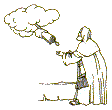
between God and the house of Israel. A parallel thought is found in Isaiah where the prophet records that Israel's
iniquities have made a separation between you and your God, and your sins have hidden His face from you, so that He does not hear." (Isa 59:2)
Jeremiah laments to God that
Thou hast covered Thyself with a cloud so that no prayer can pass through." (Lam3:44)
In fact, as the siege progressed, Jerusalem would cry out for deliverance, but God would not answer her prayers. The Pulpit Commentary feels that this "spiritual" meaning (which is probably the most common interpretation of the iron wall) is out of harmony with the context.
AND SET YOUR FACE TOWARD IT SO THAT IT IS UNDER SIEGE AND BESIEGE IT: Then fix your gaze on it; it is being besieged and you are besieging it (NJB); Turn your face toward the city as if to attack it. Then surround it and attack it (ICB); Turn toward it and demonstrate how the enemy will attack Jerusalem (NLT); Turn your face toward the city as if you were going to attack it, and then attack it (GWT); Stare fixedly at it and regard it as in a state of siege, and besiege it. (WBC)
Set your face - Several times in this book Ezekiel sets his face in the direction of the target of judgment, in
Ezek 6:2 "toward the mountains of Israel"
Ezek 21:2 "toward Jerusalem".
In Jeremiah we find God say referring to Jerusalem
I have set My face against this city for harm and not for good," declares the LORD. "It will be given into the hand of the king of Babylon, and he will burn it with fire." (Jer 21:10).
In Ezekiel's call and preparation God had equipped him for this task instructing him
Behold, I have made your face as hard as their faces, and your forehead as hard as their foreheads. Like emery harder than flint I have made your forehead. Do not be afraid of them or be dismayed before them, though they are a rebellious house." (Ezek 4:8-9)
The point is that God equips us for the work He calls us to. A NT prayer found in Hebrews emphasizes this principle, the writer praying for the saints that
the God of peace, Who brought up from the dead the great Shepherd of the sheep through the blood of the eternal covenant, even Jesus our Lord, equip (katartizo) means to make someone completely adequate or sufficient so that they might fulfill the task for which they were prepared) you in every good thing to do His will, working in us that which is pleasing in His sight, through Jesus Christ, to whom be the glory forever and ever. Amen." (Heb 13:20 21+)
THOUGHT - Dearly beloved saint, whatever God has clearly called you to do, He will fully furnish you to allow you to fulfill your call. Now we understand better why Ezekiel's face had been hardened.
THIS IS A SIGN TO THE HOUSE OF ISRAEL: (Isa 8:18; Heb 2:4)
This will be a warning to the people of Israel. (NLT)
The fact that this drama was a sign clearly indicates that "the house of Israel" was the "audience" who saw Ezekiel's "silent movie". This group of Jewish spectators is then taken as representative of the whole house of Israel. Be aware however that there is an exception to the meaning below in verse 5, where "the house of Israel" in context refers to the 10 northern tribes. (as does Ezek 37:16)
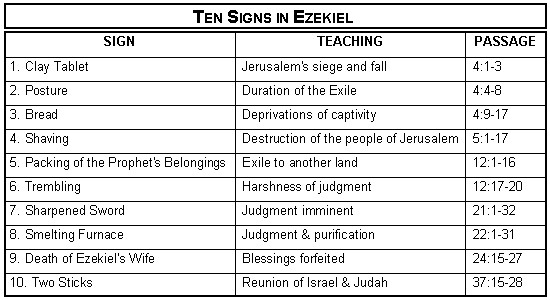
Sign ('owth or 'owt) is used 9 times in Ezekiel ( Ezekiel 12:6, 11; 14:8 20:12 20:20 21:19 24:24, 27).
A "sign" generally describes something that points to or represents something larger or more important than itself. In the present context the "sign" represents a non-verbal symbol or signal which is meant to be a discernible indication of what is not itself directly perceptible (the exiles can neither see the city of Jerusalem or its destruction). In this case the visible drama was a foreshadowing of coming events in Jerusalem in 586BC (cf Isa 20:3). We might say that Ezekiel was presenting a "preview of coming attractions".
Simeon addressing Mary the mother of Jesus declared one of the most famous "signs" declaring
Behold, this Child (Jesus) is appointed for the fall and rise of many in Israel and for a sign to be opposed..." (Lk 2:34) (Comment: Even as the rebellious house of Israel would refuse to hearken to Ezekiel's signs. cf Ezek 3:7)
God is not restricted in the means He uses to get our attention as shown by this "silent movie". Has God been doing something unusual in your life that could indicate He is trying to get your attention? Are you listening?
House of Israel - 83x in 73 v in Ezekiel -
Ezek 3:1, 4f, 7, 17; 4:3ff; 5:4; 6:11; 8:6, 10ff; 9:9; 11:5, 15; 12:6, 9f, 24, 27; 13:5, 9; 14:4ff, 11; 17:2; 18:6, 15, 25, 29ff; 20:13, 27, 30f, 39f, 44; 22:18; 24:21; 28:24f; 29:6, 16, 21; 33:7, 10f, 20; 34:30; 35:15; 36:10, 17, 21f, 32, 37; 37:11, 16; 39:12, 22f, 25, 29; 40:4; 43:7, 10; 44:6, 12, 22; 45:6, 8, 17
It is interesting that he uses this term House of Israel as only 2 of the tribes of Israel were in captivity in Babylon, the other 10 having been removed to Assyria in 722BC.
Ezekiel 4:4 "As for you, lie down on your left side and lay the iniquity of the house of Israel on it; you shall bear their iniquity for the number of days that you lie on it.
Brenton's English of Greek Septuagint: And thou shalt lie upon thy left side, and lay the iniquities of the house of Israel upon it, according to the number of the hundred and fifty days during which thou shalt lie upon it: and thou shalt bear their iniquities.
WBC: You are also to lie down on your left side and let it feel the guilt of the community of Israel. You are to bear their guilt for as many days as you lie on it.
Young's Literal: and thou, lie on thy left side, and thou hast placed the iniquity of the house of Israel on it; the number of the days that thou liest on it, thou bearest their iniquity.
- Lie down: Eze 4:5,8
- lay: 2Ki 17:21-23
- you shall bear: Lev 10:17 16:22 Nu 14:34 18:1 Isa 53:11,12 Mt 8:17 Heb 9:28 1Pe 2:24
AS FOR YOU, LIE DOWN ON YOUR LEFT SIDE AND LAY THE INIQUITY OF THE HOUSE OF ISRAEL ON IT: Richards observes that "Preaching isn’t the only way to win a hearing for what you have to share." (The Bible reader's companion)
It is not clearly stated whether Ezekiel actually lay on his side day and night for these the 430 day period. Most commentators suggest, but without clear Scripture support, that he was supine only during that part of each day when he would be seen and this period would serve as a sufficient visual aid for the curious probably castigating exilic community.
John MacArthur makes a good observation supporting the argument that Ezekiel only lay supine part of each day -- It is not necessary to assume that Ezekiel was in the prone position all the time. It was doubtless part of each day, as his need for preparing food (Ezek 4:9) indicates. (See context in The MacArthur Bible Commentary)
Left side - This probably refers to the "north", the geographic location of the 10 northern tribes of Israel.
The following note is somewhat technical but explains why it is "fair" to interpret "left side" as "north" and "right side" (Ez 4:6) as "south".
The Hebrew word for left (sema'liy) is derived from the Hebrew root (semo'wl) which is also translated "left" but in Ezek 16:46 is translated "north" -- "Now your older sister is Samaria, who lives north (semo'wl, KJV translates it "at the left hand") of you with her daughters; and your younger sister, who lives south (yamiyn; KJV translates it "at the right hand") of you, is Sodom with her daughters." The Hebrew word (yamiyn) which is translated "south" in Ezekiel 16 is the source of the Hebrew word translated "right" in Ezekiel 4:6. In sum, it is reasonable to interpret Ezekiel's positioning on his left side with his head toward the east and facing to the north (the northern kingdom of Israel) and on his right side as facing toward the south (the southern kingdom of Judah). In sum, most scholars interpret lying on the left side as representing the northern kingdom of Israel. Later in verse 6, Ezekiel lies on his right side for Judah, the southern kingdom. The left-right distinction reflects the divided monarchy: Left side = Israel (north) and Right side = Judah (south).
YOU SHALL BEAR THEIR INIQUITY FOR THE NUMBER OF DAYS THAT YOU LIE ON IT: Ezekiel's bearing was only symbolic and had no "atoning" value. The main value would be to stir the hearts of the spectators to the reality of coming judgmentn.
Craigie notes that "We should probably be mistaken if we visualized Ezekiel’s daily audience staring thoughtfully at his actions, attempting to discern their meaning; many would likely have laughed, suspecting that exile and the heat of the Babylonian sun had affected his mental stability. But Ezekiel, for his part, was learning that the servant of God must enter into the suffering of God." (Borrow Ezekiel. The Daily study Bible)
| Body Orientation | Symbolic Role |
|---|---|
| Left side down | Bearing the iniquity of Israel (northern kingdom); lying with the left arm and shoulder to the ground symbolizes taking on their guilt. |
| Facing north | Symbolically oriented toward Israel's geographical direction; facing the region he is prophesying against. |
| Head to the north | Aligns with the spiritual "target" of judgment — Israel. His gaze, though silent, is fixed on their coming destruction. |
| Right side exposed (unused) | This comes into play later when Ezekiel lies on his right side for Judah (Ezekiel 4:6). For now, it is turned away — not yet judged in this act. |
Ezekiel 4:5 "For I have assigned you a number of days corresponding to the years of their iniquity, three hundred and ninety days; thus you shall bear the iniquity of the house of Israel.
Brenton's English of Greek Septuagint: And thou shalt accomplish this, and then shalt lie on thy right side, and shalt bear the iniquities of the house of Juda forty days: I have appointed thee a day for a year.
WBC: I assign you 390 days corresponding to their years of guilt, during which time you are to bear the guilt of the community of Israel.—
Young's Literal: And I -- I have laid on thee the years of their iniquity, the number of days, three hundred and ninety days; and thou hast borne the iniquity of the house of Israel.
- I have - Isa 53:6
FOR I HAVE ASSIGNED YOU A NUMBER OF DAYS CORRESPONDING TO THE YEARS OF THEIR INIQUITY THREE HUNDRED AND NINETY DAYS: (Isa53:6)
390 days - Suffice it to say that the interpretation of this number is fraught with difficulty and commentaries vary widely. For that reason I will avoid speculating on the interpretation, which is made even more confusing by the Greek translation (Septuagint) which renders the number as "190"! This drama does indicate that there was a beginning and an end.
Craigie makes an excellent point that "it would be a mistake to take the numbers to be the central aspect of this symbolic action. For the audience at that time, the most evident aspect of the action would be that day after day, month after month, there was Ezekiel prostrate on his side on the ground, symbolising the weight of God’s punishment on his people. It was the length and continuity of the actions that would carry such impact to the audience; only after the actions were completed would the numbers suddenly assume significance. (Borrow Ezekiel. The Daily study Bible)
THUS YOU SHALL BEAR THE INIQUITY OF THE HOUSE OF ISRAEL:
Ezekiel obviously represents Israel bearing her iniquity not vicariously suffering for it.
As day after day Ezekiel acted out this drama, imagine what must have been going through the mind of the exilic audience as they observed Ezekiel laying prostrate on the ground.
Ezekiel 4:6 "When you have completed these, you shall lie down a second time, but on your right side and bear the iniquity of the house of Judah; I have assigned it to you for forty days, a day for each year.
Brenton's English of Greek Septuagint: And thou shalt accomplish this, and then shalt lie on thy right side, and shalt bear the iniquities of the house of Juda forty days: I have appointed thee a day for a year.
WBC: When you have completed that period, you are to lie down again, this time on your right side, and bear the punishment of the community of Judah; forty days I assign you, a day for each year.—
Young's Literal: And thou hast completed these, and hast lain on thy right side, a second time, and hast borne the iniquity of the house of Judah forty days -- a day for a year -- a day for a year I have appointed to thee.
- a day for each year: Nu 14:34 Da 9:24-26 12:11,12 Rev 9:15 11:2,3 12:14 13:5
WHEN YOU HAVE COMPLETED THESE, YOU SHALL LIE DOWN A SECOND TIME, BUT ON YOUR RIGHT SIDE AND BEAR THE INIQUITY OF THE HOUSE OF JUDAH; I HAVE ASSIGNED IT TO YOU FOR FORTY DAYS, A DAY FOR EACH YEAR:
MacArthur notes that Ezekiel lying on his right side indicates that "Judah was also guilty, but the 40 cannot represent less guilt (cf. Ezek 23:11)...the exact timing is uncertain. (See context in MacArthur Study Bible)
A day for each year - This is the Hebrew formula of iteration — “a day for a year, a day for a year” which we first encounter in Nu14:34 which records God's judgment on Israel for failing to enter the promised land, God declaring that
According to the number of days which you spied out the land, forty days, for every day you shall bear your guilt a year, even forty years, and you shall know My opposition.
This verse in Numbers provides essentially the only Biblical argument for the "year/day" school of prophetic interpretation, which converts prophetic "days" into years, especially in the prophecy of the “seventy weeks” of Daniel 9:24, 25, 26, 27 (See notes Daniel 9:24; Daniel 9:25; Daniel 9:26; Daniel 9:27) but this verse was spoken explicitly as a judgment on the faithless generation of Israelites, not as a key to future prophecy.
Ezekiel 4:7 "Then you shall set your face toward the siege of Jerusalem with your arm bared and prophesy against it.
Brenton's English of Greek Septuagint: So thou shalt set thy face to the siege of Jerusalem, and shalt strengthen thine arm, and shalt prophesy against it.
WBC: Stare fixedly, then, at Jerusalem under siege, with your arm bared, and prophesy against it.
Young's Literal: 'And unto the siege of Jerusalem thou dost prepare thy face, and thine arm is uncovered, and thou hast prophesied concerning it.
- set: Eze 4:3 6:2
- your arm: Isa 52:10
THEN YOU SHALL SET YOUR FACE TOWARD THE SIEGE OF JERUSALEM WITH YOUR ARM BARED AND PROPHESY AGAINST IT : Arm bared - Symbol of being ready to take action as in Is 52:10 "The LORD has bared His holy arm In the sight of all the nations, that all the ends of the earth may see The salvation of our God."
The prophet was not to be an apathetic spectator of the siege which he was thus dramatizing, but actively to dramatize the event. This picture of the prophet not merely resting on his side and folding his hands as a man at ease might do, but instead looking intently, with bare outstretched arm at the scene inscribed on the brick, must have added to the startling effect of this "sign to the house of Israel".
Note that “set thy face,” is specially characteristic of Ezekiel (Ezek 4:3).
The words “prophesy against it” imply some spoken utterance which in fact begins in Ezek 5:5 when the LORD opens his mouth to speak "Thus says the Lord God."
Ezekiel 4:8 "Now behold, I will put ropes on you so that you cannot turn from one side to the other until you have completed the days of your siege.
Brenton's English of Greek Septuagint: And, behold, I have prepared bonds for thee, land thou mayest not turn from thy one side to the other, until the days of thy siege shall be accomplished.
WBC: In fact, I will put ropes round you, to stop you turning from one side to the other until you have completed your period for the siege.
Young's Literal: And lo, I have put on thee thick bands, and thou dost not turn from side to side till thy completing the days of thy siege.
- Put ropes Eze 3:25
Now behold, I will put ropes on you so that you cannot turn from one side to the other until you have completed the days of your siege - The symbolizes the fact that Judah would not be able to escape their punishment.