
Michelangelo's Ezekiel on the Sistine Chapel
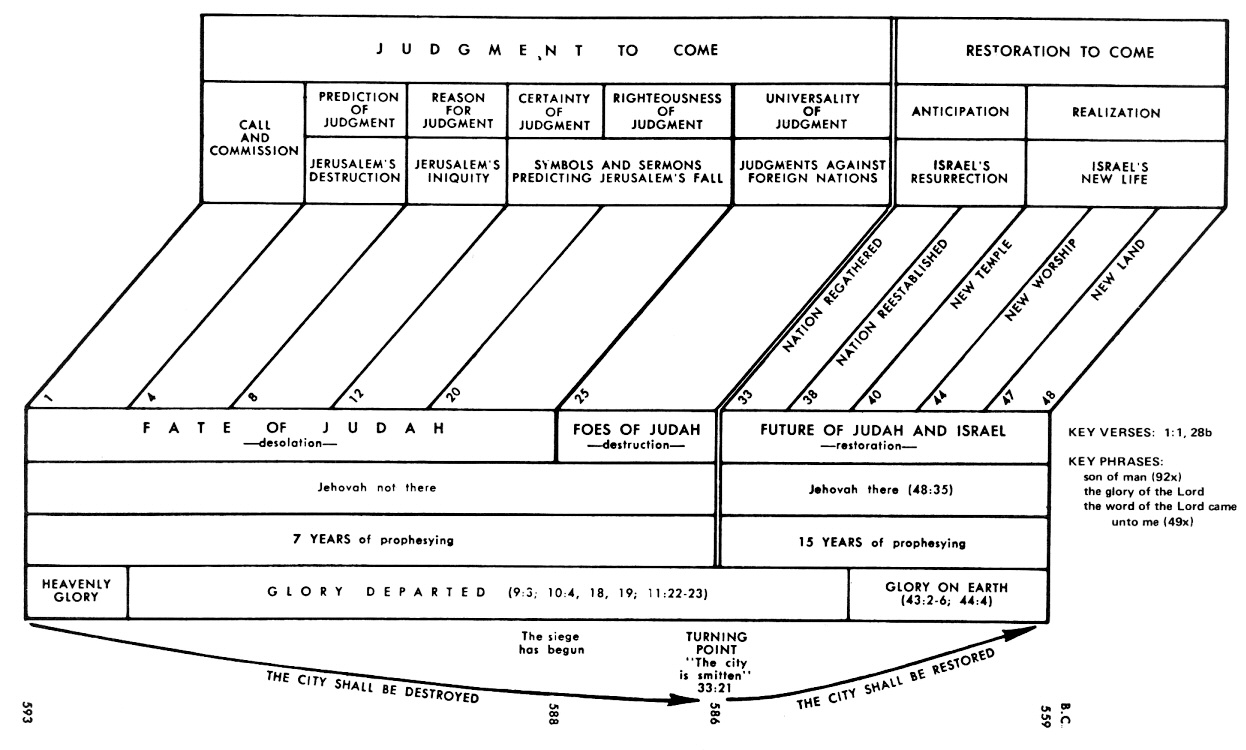
Click chart to enlarge
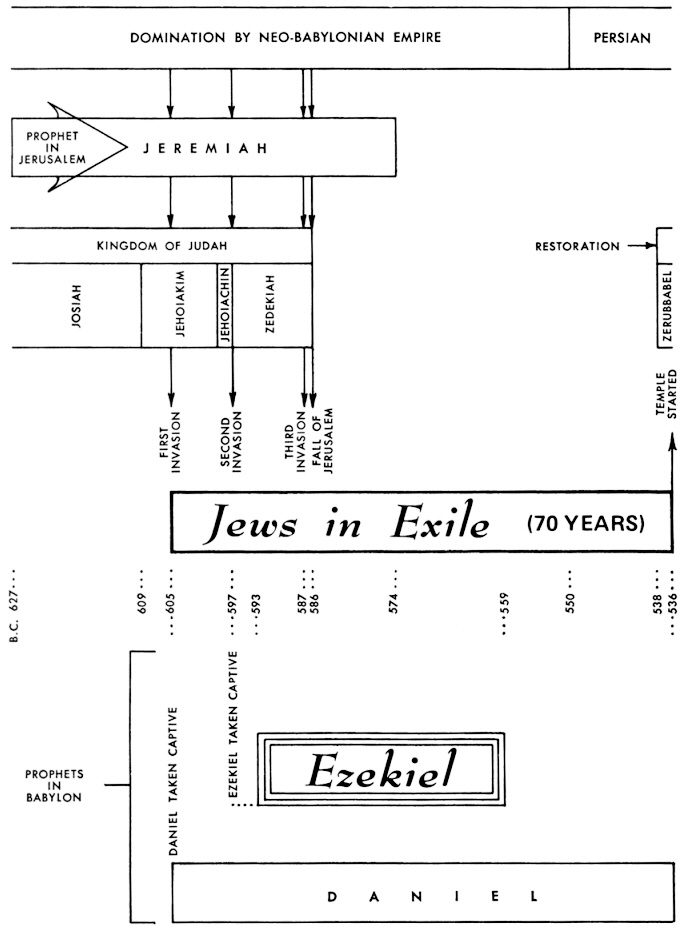
Click chart to enlarge
Chart from recommended resource Jensen's Survey of the OT - used by permission
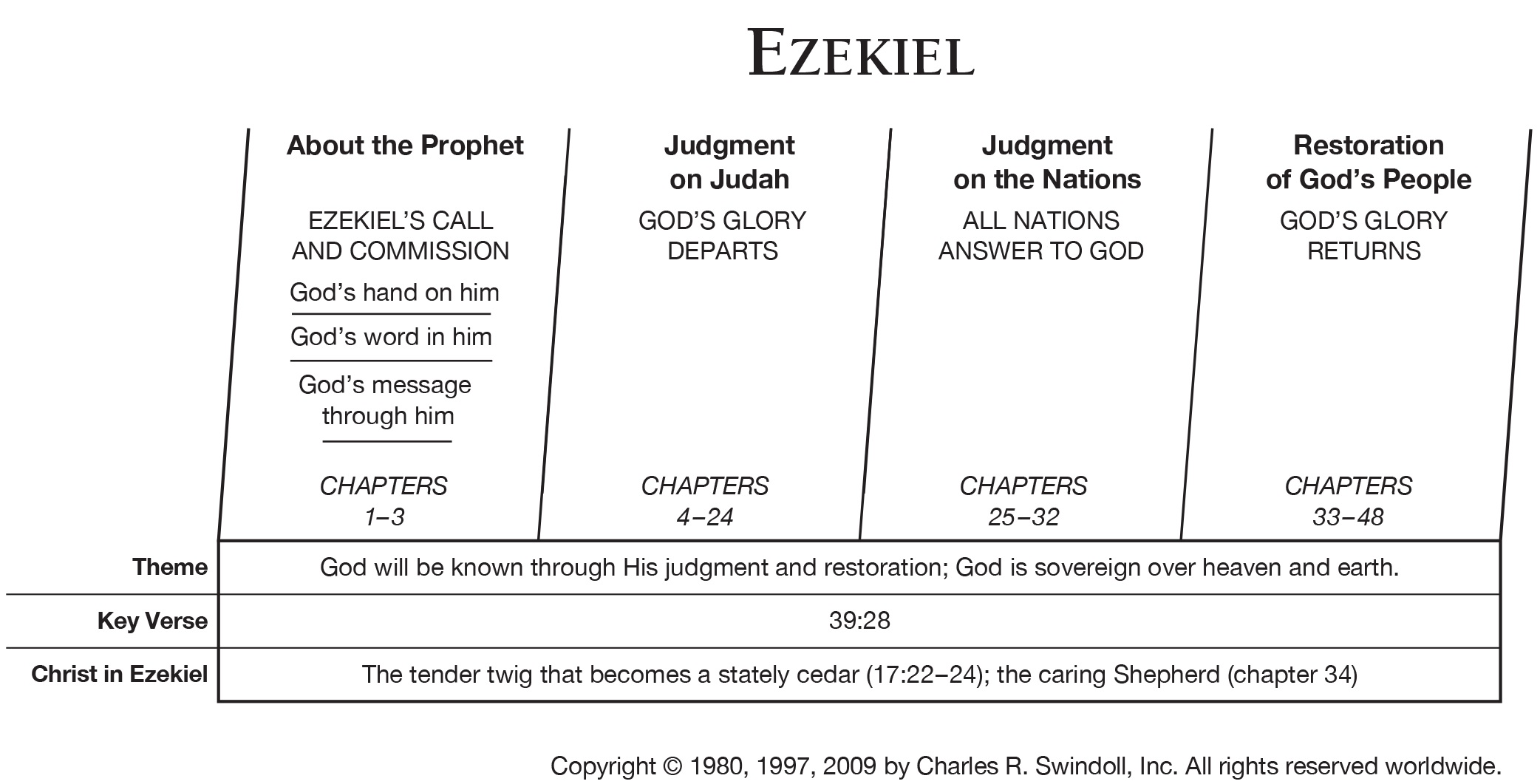
Click Chart from Charles Swindoll
|
PROPHECY OF |
PROPHECY OF |
|||
| FATE OF JUDAH Before the Siege |
FOES OF JUDAH During the Siege |
FUTURE OF JUDAH After the Siege |
||
|
593-588 BC |
587-586 |
586-571 |
||
|
7 YEARS |
15 YEARS |
|||
| Ezekiel 1:1-3:27 Ezekiel Sees the Glory & Receives the Call |
Ezekiel 4:1-24:27 Judgments Against Judah |
Ezekiel 25:1-32:32 Judgments Against the Gloating Nations |
Ezekiel 33:1-39:29 Restoration of Israel to the LORD |
Ezekiel 40:1-48:35 Visions of the Temple Jehovah Shammah |
Outline of the Book of Ezekiel from Dr John MacArthur - The book can be largely divided into sections about condemnation/retribution and then consolation/restoration. A more detailed look divides the book into 4 sections. First, are prophecies on the ruin of Jerusalem (Ezekiel 1:1–24:27). Second, are prophecies of retribution on nearby nations (Ezekiel 25:1–32:32), with a glimpse at God’s future restoration of Israel (Ezekiel 28:25,26). Thirdly, there is a transition chapter (Ezekiel 33:1-33) which gives instruction concerning a last call for Israel to repent. Finally, the fourth division includes rich expectations involving God’s future restoration of Israel (Ezekiel 34:1–48:35). (Reference)
I. Prophecies of Jerusalem’s Ruin (Ezekiel 1:1–24:27)
A. Preparation and Commission of Ezekiel (Ezekiel 1:1–3:27)
1. Divine appearance to Ezekiel (Ezekiel 1:1–28)|
2. Divine assignment to Ezekiel (Ezekiel 2:1–3:27)
B. Proclamation of Jerusalem’s Condemnation (Ezekiel 4:1–24:27)
1. Signs of coming judgment (Ezekiel 4:1–5:4)
2. Messages concerning judgment (Ezekiel 5:5–7:27)
3. Visions concerning abomination in the city and temple (Ezekiel 8:1–11:25)
4. Explanations of judgment (Ezekiel 12:1–24:27)
II. Prophecies of Retribution to the Nations (Ezekiel 25:1–32:32)
A. Ammon (Ezekiel 25:1–7)
B. Moab (Ezekiel 25:8–11)
C. Edom (Ezekiel 25:12–14)
D. Philistia (Ezekiel 25:15–17)
E. Tyre (Ezekiel 26:1–28:19)
F. Sidon (Ezekiel 28:20–24)
Excursus: The Restoration of Israel (Ezekiel 28:25, 26)
G. Egypt (Ezekiel 29:1–32:32)
III. Provision for Israel’s Repentance (Ezekiel 33:1–33)
IV. Prophecies of Israel’s Restoration (Ezekiel 34:1–48:35)
A. Regathering of Israel to the Land (Ezekiel 34:1–37:28)
1. Promise of a True Shepherd (Ezekiel 34:1–31)
2. Punishment of the nations (Ezekiel 35:1–36:7)
3. Purposes of restoration (Ezekiel 36:8–38)
4. Pictures of restoration—dry bones and two sticks (Ezekiel 37:1–28)
B. Removal of Israel’s Enemies from the Land (Ezekiel 38:1–39:29)
1. Invasion of Gog to plunder Israel (Ezekiel 38:1–16)
2. Intervention of God to protect Israel (Ezekiel 38:17–39:29)
C. Reinstatement of True Worship in Israel (Ezekiel 40:1–46:24)
1. New temple (Ezekiel 40:1–43:12)
2. New worship (Ezekiel 43:13–46:24)
D. Redistribution of the Land in Israel (Ezekiel 47:1–48:35)
1. Position of the river (Ezekiel 47:1–12)
2. Portions for the tribes (Ezekiel 47:13–48:35)
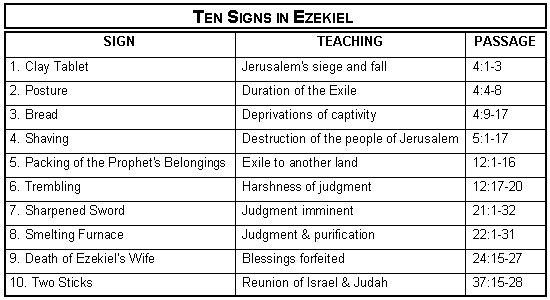
Ezekiel 4:9 "But as for you, take wheat, barley, beans, lentils, millet and spelt, put them in one vessel and make them into bread for yourself; you shall eat it according to the number of the days that you lie on your side, three hundred and ninety days.
Brenton's English of Greek Septuagint: Take thou also to thee wheat, and barley, and beans, and lentils, and millet, and bread-corn; and thou shalt cast them into one earthen vessel, and shalt make them into loaves for thyself; and thou shalt eat them a hundred and ninety days, according to the number of the days during which thou sleepest on thy side.
WBC: “You are also to take some wheat,a barley, beans, lentils, millet, and emmer, and, putting them in a pot, make them into bread for yourself. You are to eat it as many days as you lie on your side, 390 days.
Young's Literal: 'And thou, take to thee wheat, and barley, and beans, and lentiles, and millet, and spelt, and thou hast put them in one vessel, and made them to thee for bread; the number of the days that thou art lying on thy side -- three hundred and ninety days -- thou dost eat it.
BUT AS FOR YOU, TAKE WHEAT, BARLEY, BEANS, LENTILS, MILLET AND SPELT, PUT THEM IN ONE VESSEL AND MAKE THEM INTO BREAD FOR YOURSELF:
Why mix the ingredients all of which were common in Israel's diet according to (2Sa17:27, 28, 29)?
The severity of the 18 month siege of Jerusalem would make it necessary to mix all available grain to derive sufficient material to bake into bread. Some modern references record that "spelt" is a species of hardy wheat regarded as inferior, since the hulled grains could not be freely threshed and which in some regions of the world is grown for feeding livestock. To be sure the final mixed grain produced a grade of flour inferior to pure wheat or barley flour.
Cooper notes that “Wheat” and “barley” were the most important and widely used grains in the ancient Near East. “Beans” and “lentils” also were staple products usually not mixed with grain or used for flour. These four items, wheat and barley, beans and lentils, often are listed in pairs. “Millet” is mentioned only here in the OT but was used in Mesopotamia. “Spelt” sometimes was planted as a border to wheat or barley. " (Ezekiel: An Exegetical and Theological Exposition)
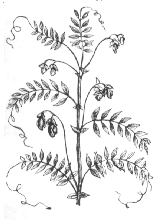
As alluded to above, the final siege of Jerusalem began in January 588 B.C. and lasted 18 months, during which the supplies of food became scarce. In times of scarcity in order to make the supplies last longer it was customary to mix several coarser grains (picture is of lentil) with the finer less readily available grains such as wheat and barley and grind these together to make flour.
"The outcome of this mixture would be a coarse, unpalatable bread, not unlike that to which the population of Paris was reduced in the siege of 1870-71. This was to be the prophet’s food, as it was to be that of the people of Jerusalem during … siege." (Pulpit Commentary)
"If you live near a health-food store, see if they carry "Ezekiel Bread." It is made according to the recipe that God gave Ezekiel. While it may not be palatable to those who are accustomed to refined sugars and flours, it is interesting to note that when made according to God's recipe it produces a complete protein. God, the Creator of all things, knew exactly how to illustrate the reality of famine without jeopardizing the health of His obedient servant, Ezekiel!"
YOU SHALL EAT IT ACCORDING TO THE NUMBER OF THE DAYS THAT YOU LIE ON YOUR SIDE, THREE HUNDRED AND NINETY DAYS: Presumably the food was to be kept in storage jars and the preparation was to be repeated in Ezekiel’s “off-duty” hours. The Greek Septuagint again translates the Hebrew here with "190 days" which makes attaching any specific meaning to the time period fraught with great difficulty.
Source: Ryrie Study Bible
Ezekiel 4:10 "Your food which you eat shall be twenty shekels a day by weight; you shall eat it from time to time.
Young's Literal: And thy food that thou dost eat is by weight, twenty shekels daily; from time to time thou dost eat it.
Brenton's English of Greek Septuagint: And thou shalt eat thy food by weight, twenty shekels a day: from time to time shalt thou eat them.
WBC: The food you eat is to be rationed to twenty shekels per day: you are to eat it at the same time each day.
YOUR FOOD WHICH YOU EAT SHALL BE TWENTY SHEKELS A DAY BY WEIGHT YOU SHALL EAT IT FROM TIME TO TIME: (Dt 28:49-68; Is 3:1)
Shekel - One shekel weighed 0.40 ounces. Shekel is the standard monetary unit in modern Israel and in Ezekiel's day also referred to coins which were weighed rather than counted, the weighing being a necessity because of a widespread practice of shaving some silver from shekels to make more shekels! If a little silver was shaved off each of two hundred shekels, for example, one could create an extra ten or twenty shekels. Weighing shekels was an attempt to stop this practice and standardize currency.
So here we find that "Twenty shekels" equates with about 8 ounces of this unusual grain mixture per day. The point is clear that this is not a significant quantity of nutrition for a grown man. In Ezekiel 4:16 God goes on to explain the meaning stating that He (God) was
"going to break the staff of bread (or cut off the bread supply) in Jerusalem and they will eat bread by weight and with anxiety, and drink water by measure (water will be rationed) and in horror… "
God repeated the warning about famine in chapter 14 explaining to Ezekiel that
"if a country sins against Me by committing unfaithfulness and I stretch out My hand against it, destroy its supply of bread, send famine against it, and cut off from it both man and beast, even though these three men, Noah, Daniel, and Job were in its midst, by their own righteousness they could only deliver themselves… " (Ezek 14:13,14)
Through the prophet Moses God had warned Israel that
"if (they did) not obey (Him) and (did) carry out all (the) commandments" (Lev 26:14)
He would "break (their) staff of bread" which would be so scarce that "ten women (would) bake… bread in one oven, and they (would) bring back… bread in rationed amounts, so that (they would) eat and not be satisfied." (Lev 26:26)
The Pulpit Commentary adds that "The common allowance in England for prison or pauper dietaries gives, I believe from 24 to 32 ounces, Besides other food. And this was to be taken, not as hunger prompted, but at the appointed hour. once a day. The whole scene of the people of the besieged city coming for their daily rations is brought vividly before us."
The historical accuracy of this prophecy is illustrated in Jer 37:21, where "King Zedekiah gave commandment and they committed Jeremiah to the court of the guardhouse" and were also commanded to give Jeremiah a "loaf of bread daily from the bakers' street, until all the bread in the city was gone. So Jeremiah remained in the court of the guardhouse." (Beloved, will God provide for you in the midst of whatever "siege" you might be experiencing?) In regard to the scarcity of water during the siege we read that the officials of King Zedekiah "took Jeremiah and cast him into the cistern… in the court of the guardhouse and… let Jeremiah down with ropes… in the cistern there was no water but only mud, and Jeremiah sank into the mud." (Jer 38:6)
According to which Jeremiah was allowed a loaf of bread per day till the supply ran out, and from Jer 38:6, where one cistern at least had only muddy ooze at the bottom into which Jeremiah sank.
Ezekiel 4:11 "The water you drink shall be the sixth part of a hin by measure; you shall drink it from time to time.
Brenton's English of Greek Septuagint: And thou shalt drink water by measure, even from time to time thou shalt drink the sixth part of a hin.
WBC: As for water, you are to drink a controlled amount, a sixth of a hin, drinking it at the same time each day.
Young's Literal: 'And water by measure thou dost drink, a sixth part of the hin; from time to time thou dost drink it.
THE WATER YOU DRINK SHALL BE THE SIXTH PART OF A HIN BY MEASURE: (Isa5:13)
the sixth part of a him is less than one quart of water per day clearly a minimal amount of water considering what were often elevated temperatures and dry conditions. God explains this sign later declaring that the inhabitants of Jerusalem would
"drink water by measure (water will be rationed) and in horror because bread and water will be scarce; and they will be appalled with one another and waste away in their iniquity." (Ezek 4:16,17)
Jerusalem, like most ancient Middle Eastern cities, had to rely on water supplied from outside the city walls which made her vulnerable during long sieges and necessitated watering rationing.
YOU SHALL DRINK IT FROM TIME TO TIME: In summary, Ezekiel is prescribed what amount to starvation rations. Now just consider what he might have looked like after 390 days (the time specified in 4:9) of this divinely imposed starvation diet! The text does not say, but it would be surprising if he were not thin and gaunt, resembling someone who had endured an 18 month siege as would soon occur in Jerusalem.
Ezekiel 4:12 "You shall eat it as a barley cake, having baked it in their sight over human dung *."
Brenton's English of Greek Septuagint: And thou shalt eat them as a barley cake: thou shalt bake them before their eyes in man's dung.
WBC: The form in which you are to eat it is to be that of a barley cake, and you are to bake it in stools of human excrement, in public view.”—
Young's Literal: A barley-cake thou dost eat it, and it with dung -- the filth of man -- thou dost bake before their eyes.
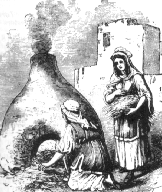
"Having baked it in their site over human dung" ("bake it in stools of human excrement, in public view" -WBC) God is indicating that the conditions in Jerusalem will not only be austere but downright revolting as the siege progresses and as supplies of staples and necessities of life dwindle to the point of non-existence.
The process of baking in ashes was as old as the time of Abraham (Ge 18:6, cf 1Ki 19:6), and continues in Arabia and Syria to the present day. The kneaded dough was rolled into thin flat cakes, and they were placed upon, or hung over, the hot wood embers of the hearth or oven. But in a besieged city the supply of wood for fuel soon fails and the inhabitants would be forced to dried animal dung and then to use of human excrement. The besieged Jews would be forced to use the dried contents of the cesspools of Jerusalem. All this "dung sign" drama was to be before the eyes of the exiles and to show the extreme degree of wretchedness to which the besieged city would be exposed.
Dung - Dung mixed with straw and dried was commonly used as fuel throughout the Middle East because of the scarcity of wood. The dried dung burned slowly but gave off an unpleasant odor. As implied by this passage, despite the odor, there was no defilement associated with use of animal dung. Ezekiel understood the symbolism of the "dung sign", but he considered this action distasteful and defiling and implored the Sovereign Lord that he might not have to endure this ignominious fate. Remember that Ezekiel was a priest (Ezek 1:3) and as such had been careful to keep himself undefiled and the baking of bread upon human dung was especially revolting (cf. Deut 23:12, 13, 14).
Ezekiel 4:13 Then the LORD said, "Thus will the sons of Israel eat their bread unclean among the nations where * I will banish them."
Brenton's English of Greek Septuagint: And thou shalt say, Thus saith the Lord God of Israel; Thus shall the children of Israel eat unclean things among the Gentiles.
WBC: “This,” explained Yahweh,a “represents the unclean way in which members of Israel will eat among the nations.”—
Young's Literal: And Jehovah saith, 'Thus do the sons of Israel eat their defiled bread among the nations whither I drive them.'
THEN THE LORD SAID, "THUS WILL THE SONS OF ISRAEL EAT THEIR BREAD UNCLEAN AMONG THE NATIONS WHERE I WILL BANISH THEM: (Hos 9:3 9:4)
"Then the LORD said, "In the same way, the people of Israel will eat unclean bread among the nations where I scatter them." (GWT)
Unclean bread ("bread all filthy" [DRA], “defiled bread” [YLT]) - The exiles would be reduced to eat what was "unclean" because the practices of preparing food in these pagan countries would be unlikely to produce "clean" food . So taken, the words remind us of the risk of eating unclean, food, which almost inevitably attended the position of the exiles (Hosea 9:3; Daniel 1:8), and which, it may be, Ezekiel had already tell keenly.
"I will banish them" ("I will drive them" [Darby], "I scatter them." [GWT])
Ezekiel 4:14 But I said, "Ah, Lord GOD! Behold, I have never been defiled; for from my youth until now I have never eaten what died of itself or was torn by beasts, nor has any unclean meat ever entered my mouth."
Brenton's English of Greek Septuagint: Then I said, Not so, Lord God of Israel: surely my soul has not been defiled with uncleanness; nor have I eaten, that which died of itself or was torn of beasts from my birth until now; neither has any corrupt flesh entered into my mouth. |
WBC: “No, Lord Yahweh,” I said. “My throat has never been defiled. From my childhood till now I have never eaten a carcass or ravaged animal, nor has expired sacrificial meat entered my mouth.”
Young's Literal: And I say, 'Ah, Lord Jehovah, lo, my soul is not defiled, and carcase, and torn thing, I have not eaten from my youth, even till now; nor come into my mouth hath abominable flesh.'
BUT I SAID AH, LORD GOD! BEHOLD, I HAVE NEVER BEEN DEFILED: (Ezek 9:8; 11:13 20:49)
Ah Lord God - This is a phrase characteristic of Ezekiel (9:8; 11:13 20:49) and of his contemporary (Jer1:6; 4:10; 14:13;32:17).
Ezekiel's plea reminds one of a similar action of his fellow prophet Daniel who
made up his mind that he would not defile himself with the king's choice food or with the wine which he drank" and like Ezekiel appealed to a higher authority, seeking "permission from the commander of the officials that he might not defile himself." (Da1:8+)
In the New Testament we see Peter when commanded to
Arise… kill and eat" (unclean animals) make a similar appeal, declaring "By no means, Lord, for I have never eaten anything unholy and unclean." (Acts 10:14)
FOR FROM MY YOUTH UNTIL NOW I HAVE NEVER EATEN WHAT DIED OF ITSELF OR WAS TORN BY BEASTS, NOR HAS ANY UNCLEAN MEAT EVER ENTERED MY MOUTH:
God had instructed Israel "you shall be holy men to Me, therefore you shall not eat any flesh torn to pieces in the field; you shall throw it to the dogs." (Ex 22:31).
In Leviticus He said that "when any person eats an animal which dies, or is torn by beasts, whether he is a native or an alien, he shall wash his clothes and bathe in water, and remain unclean until evening; then he will become clean." (Lev 17:15)
It appears that Ezekiel based his appeal on God's Word, which suggests that in fact knew the law and had sought to keep it (cf Ps 119:9,11), in marked contrast to most of the rest of the rebellious house of Israel. And God showed mercy to Ezekiel in granting his request.
Ezekiel 4:15 Then He said to me, "See, I will give you cow's dung in place of human dung over which you will prepare your bread."
Brenton's English of Greek Septuagint: And he said to me, Behold, I have given thee dung of oxen instead of man's dung, and thou shalt prepare thy loaves upon it.
WBC: “Look,” he told me, “I allow you cattle dung in place of human stools, and you may prepare your bread on that.”
Young's Literal: And He saith unto me, 'See, I have given to thee bullock's dung instead of man's dung, and thou hast made thy bread by it.'
THEN HE SAID TO ME, "SEE, I WILL GIVE YOU COW'S DUNG IN PLACE OF HUMAN DUNG OVER WHICH YOU WILL PREPARE YOUR BREAD:
Craigie comments that this "concession" by God "meant that something of the power of the symbolic message would be lost. Yet the message was modified for the sake of the messenger. For all the suffering He asked of His servant, God was not unfeeling; He was concerned for His messenger as well as for those to whom the message was sent. Ezekiel had no guarantee of such a concession in response to his outburst, but its receipt was an encouragement of love. And for all who would serve God, and accept the hardships which service brings, this little incident is a source of encouragement. We do not know that concessions will be made; but, when they are, their impact sheds light on the dark path that service may call us to tread." (Borrow Ezekiel. The Daily study Bible)
Ezekiel 4:16 Moreover, He said to me, "Son of man, behold, I am going to break the staff of bread in Jerusalem, and they will eat bread by weight and with anxiety, and drink water by measure and in horror,
Brenton's English of Greek Septuagint: And he said to me, Son of man, behold, I break the support of bread in Jerusalem: and they shall eat bread by weight and in want; and shall drink water by measure, and in a state of ruin:
WBC: He also told me, “Human one, I am going to break the bread sticks in Jerusalem. They will eat rationed amounts of bread and also drink controlled amounts of water.
Young's Literal: And He saith unto me, 'Son of man, lo, I am breaking the staff of bread in Jerusalem, and they have eaten bread by weight and with fear; and water by measure and with astonishment, they do drink;
MOREOVER, HE SAID TO ME, "SON OF MAN, BEHOLD, I AM GOING TO BREAK THE STAFF OF BREAD IN JERUSALEM: (Ezek 5:16; 14:13; Lev 26:26)
In these last two verses, we have the explanation of the drama God prescribed for Ezekiel to portray before the exiles.
Break the staff of bread - "Staff" is used elsewhere to describe a physical rod (e.g., Moses' staff) used for support, etc, and in this verse refers to bread as that which is indispensable for the preservation (support) of life. The psalmist writes that God in order to force Jacob to go to Egypt "called for a famine upon the land. He broke the whole staff of bread" (Ps105:16) so clearly this phrase is associated with famine.
Isaiah says that because of sin
the Lord GOD of hosts is going to remove from Jerusalem and Judah both supply and support, the whole supply of bread, and the whole supply of water." (Isa 3:1)
AND THEY WILL EAT BREAD BY WEIGHT AND WITH ANXIETY, AND DRINK WATER BY MEASURE AND IN HORROR: (Ezek 4:10 11; 12:18 12:19; Ps 60:3; La 1:11; 4:10; 5:9)
Eat bread by weight - Cooper draws an interesting parallel with the manna in the wilderness: "God had provided manna in the days of wilderness wandering that he might teach them to trust him. They had to learn that “man does not live on bread alone but on every word that comes from the mouth of the Lord” (Dt 8:3). But the reverse also was true. Neglect of the word produced a famine (In Am 8:11 the Lord God says "Behold, days are coming… when I will send a famine on the land, not a famine for bread or a thirst for water, but rather for hearing the words of the LORD." cf Hos 4:6) both of food and of the knowledge of God and spiritual truths."(Ezekiel: An Exegetical and Theological Exposition)
Craigie adds that "Just as, physically, one must eat to live, so too the spiritual life is dependent on partaking of the bread of life, the Word of God. But for ordinary humans, the first of these truths is more evident than the latter. Hunger will reduce the body to weakness and eventually death; but the well-fed and hungry alike may starve the soul and hardly be aware of what they are doing. The prophet’s symbolic diet reveals the reverse of this ancient truth. A people who for so long had ignored the bread of God’s word, would eventually be reduced to emergency rations for the body. In a sense, the diet symbolized judgment; in a deeper sense, it contained a message, a reminder of the true starvation of the spiritual life which was the root cause of the physical crisis" (Borrow Ezekiel. The Daily study Bible)
With anxiety… horror - Jeremiah writing the post mortem on ravaged Jerusalem declared
All her people groan seeking bread. They have given their precious things for food to restore their lives themselves." (La 1:11)
Jeremiah added that
better are those slain with the sword than those slain with hunger; for they pine away, being stricken for lack of the fruits of the field." (La 4:9)
The futility of materialism became evident for those who had more silver and gold than bread. Beloved, where are you laying up your treasure?
The fate predicted for rebellious Israel was prefigured in their first king rebellious Saul, to whom the prophet Samuel decreed that
rebellion is as the sin of divination, and insubordination is as iniquity and idolatry. Because you have rejected the word of the LORD, He has also rejected you from being king." (1Sa 15:23)
In a similar fashion, Israel had not just neglected God's life giving Word, but by God's own accusation had actually "rejected My ordinances" (Ezek 5:6)
How could we apply these truths to modern Christianity? Paul wrote that
these things happened to them as an example, and they were written for our instruction (warning, admonition)" (1Cor 11:11)
Beloved, are you living abundantly because you are feasting fabulously on His life giving Word? Or are you starving yourself spiritually and experiencing famine deep within your soul? Beloved, forsake the broken cisterns that can hold no water and run to the well of living water and be revived by the Living Word and His life giving Spirit, for as our Lord Jesus said
It is the Spirit Who gives life. The flesh profits nothing. The words that I have spoken to you are spirit and are life." (John 6:63)
Ezekiel 4:17 because bread and water will be scarce; and they will be appalled with one another and waste away in their iniquity
Brenton's English of Greek Septuagint: that they may want bread and water; and a man and his brother shall be brought to ruin, and they shall pine away in their iniquities
WBC: My intent is that they should be short of bread and water and that they should one and all be filled with despair, mortified by their guilt.
Young's Literal: so that they lack bread and water, and have been astonished one with another, and been consumed in their iniquity
BECAUSE BREAD AND WATER WILL BE SCARCE; AND THEY WILL BE APPALLED WITH ONE ANOTHER AND WASTE AWAY IN THEIR INIQUITY: (Ezek 24:23)
They will be appalled - ("they fall into a stupor" - NJB; "will look at one another in terror" - NLT; "will look at one another in dismay" - NRS, "They will be shocked at the sight of each other because of the lack of food and water" - GWT) The anxiety and astonishment indicates that the joy of mealtimes would vanish from Jerusalem. (cf Ezek 12:19).
Waste away (maqaq) - David in acknowledging his suffering is related to his sin gives us a vivid picture of the meaning of maqaq, declaring
My wounds grow foul and fester (maqaq - English meaning of "fester" = to putrefy, rot, generate pus, progressively deteriorate), because of my folly" (Ps38:5)

David recognized that his painful plight was directly related to his personal sin and he found himself wasting away.
As the adage goes "Oh what a wicked web we weave, when at first we do deceive"
Hebrews warns us against the "deceitfulness of sin." (Heb 3:13) (See Related Discussion: The Deceitfulness of Sin)
Here in Ezekiel we see the deadliness of sin. Paul warned the Galatian church
Do not be deceived, God is not mocked; for whatever a man sows, this he will also reap. For the one who sows to his own flesh shall from the flesh reap corruption (decay, deterioration, ruin), but the one who sows to the Spirit shall from the Spirit reap eternal life." (Gal 6:7, 8)
Israel would reap a bitter harvest from the seeds of sin she had sown. Oh, beloved, do not the tragedy and gravity of these pictures in Ezekiel arrest your attention and grip your soul? Beloved, have you been "playing" with the venomous viper called sin?
Puritan Richard Baxter wrote, "Use sin as it will use you; spare it not, for it will not spare you; it is your murderer, and the murderer of the world: use it, therefore, as a murderer should be used. Kill it before it kills you; and though it bring you to the grave, as it did your Head, it shall not be able to keep you there” (cf Col 3:5+)
Israel's sin was not one of ignorance for God had warned her of the consequences in Leviticus declaring that
those of you who may be left will rot away (maqaq) because of their iniquity in the lands of your enemies; and also because of the iniquities of their forefathers they will rot away (maqaq) with them." (Lev 26:39)
To the wretchedness of physical privation there was to be added the consciousness of the sufferers that it was caused by their own evil deeds.