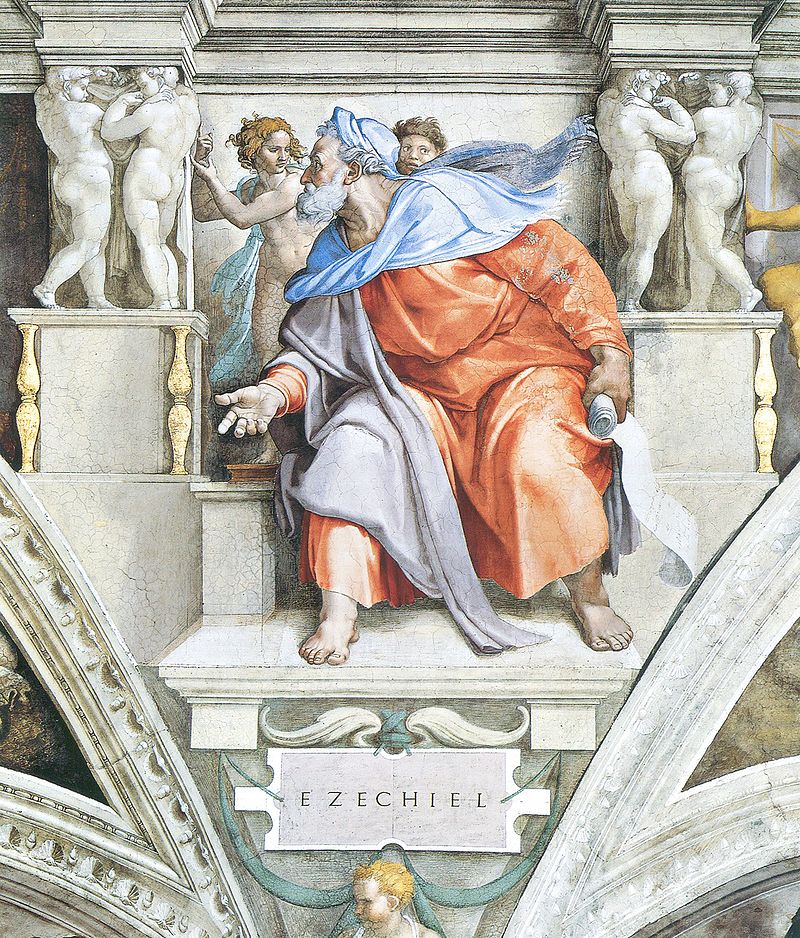
Michelangelo's Ezekiel on the Sistine Chapel
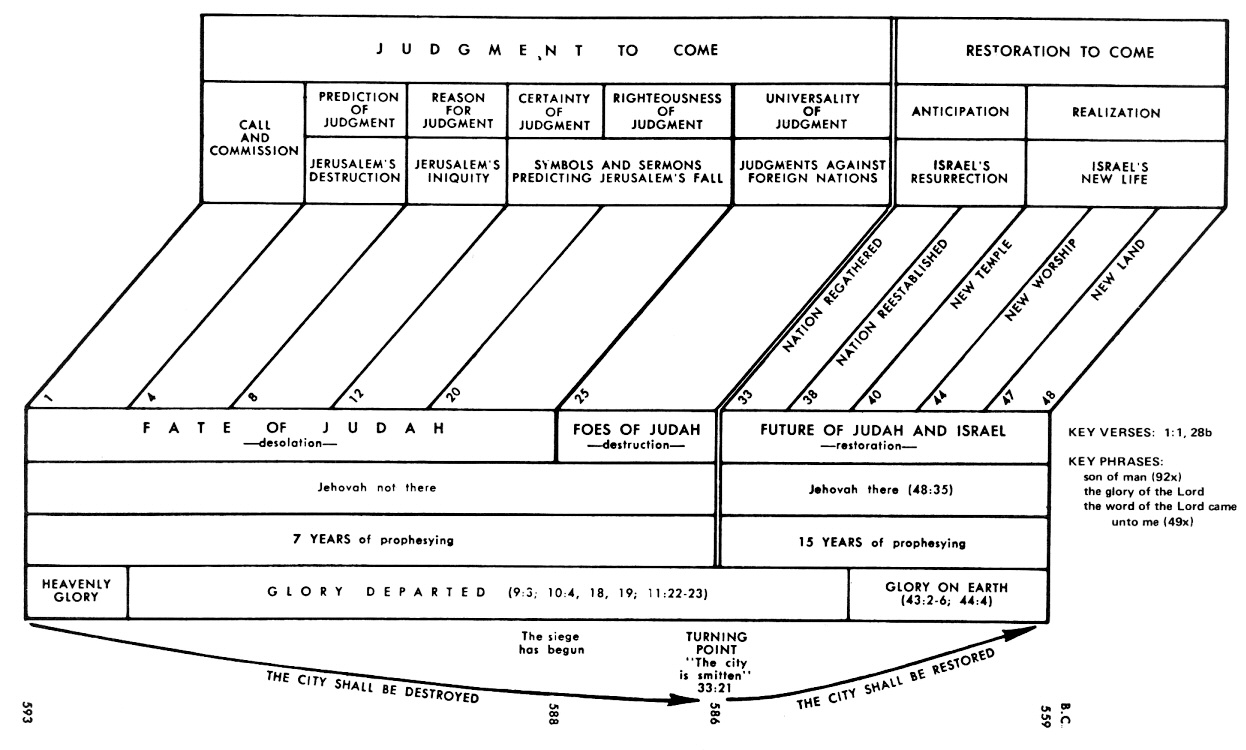
Click chart to enlarge
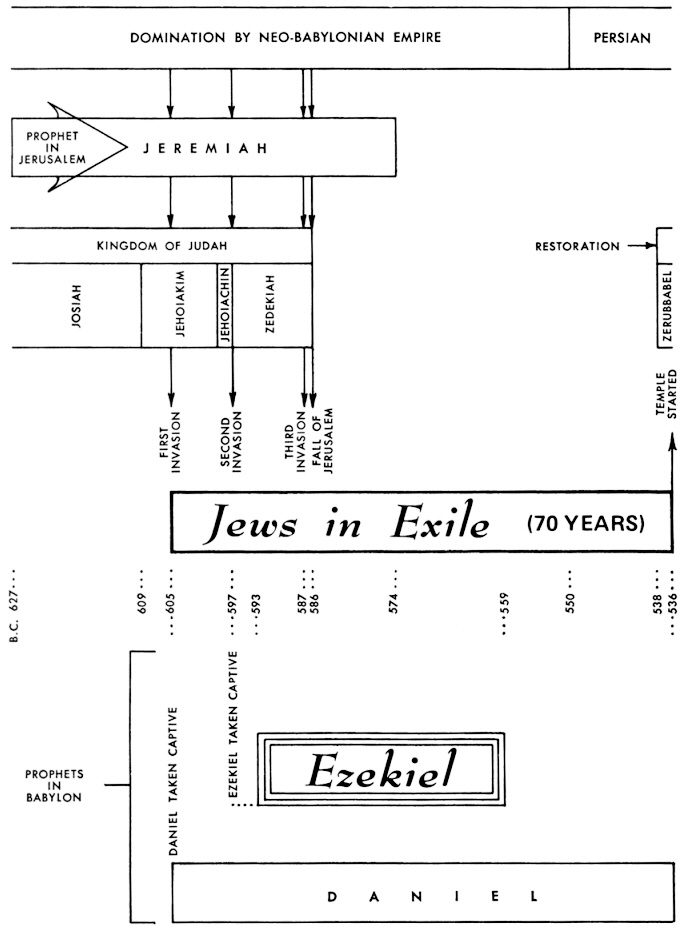
Click chart to enlarge
Chart from recommended resource Jensen's Survey of the OT - used by permission
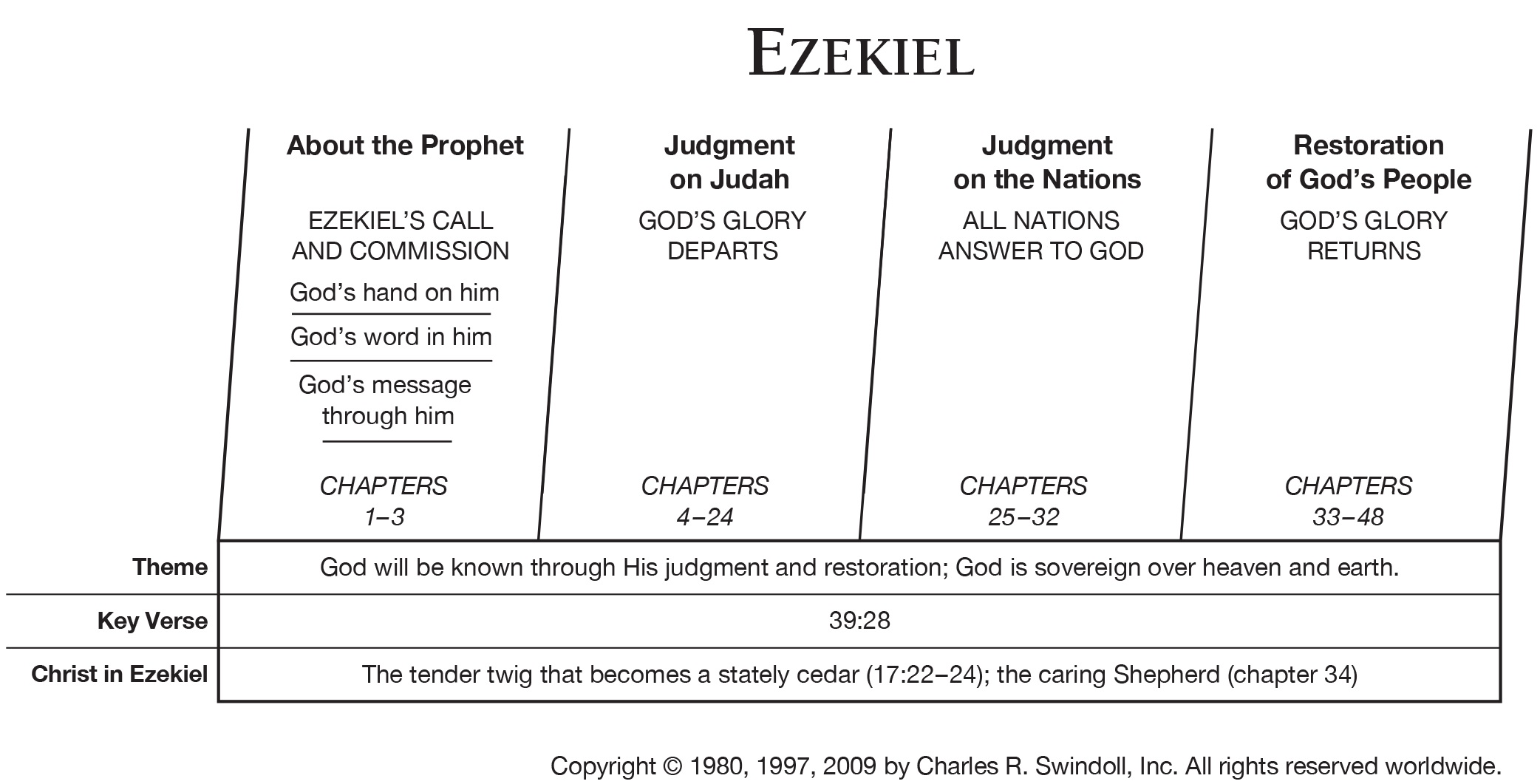
Click Chart from Charles Swindoll
|
PROPHECY OF |
PROPHECY OF |
|||
| FATE OF JUDAH Before the Siege |
FOES OF JUDAH During the Siege |
FUTURE OF JUDAH After the Siege |
||
|
593-588 BC |
587-586 |
586-571 |
||
|
7 YEARS |
15 YEARS |
|||
| Ezekiel 1:1-3:27 Ezekiel Sees the Glory & Receives the Call |
Ezekiel 4:1-24:27 Judgments Against Judah |
Ezekiel 25:1-32:32 Judgments Against the Gloating Nations |
Ezekiel 33:1-39:29 Restoration of Israel to the LORD |
Ezekiel 40:1-48:35 Visions of the Temple Jehovah Shammah |
Outline of the Book of Ezekiel from Dr John MacArthur - The book can be largely divided into sections about condemnation/retribution and then consolation/restoration. A more detailed look divides the book into 4 sections. First, are prophecies on the ruin of Jerusalem (Ezekiel 1:1–24:27). Second, are prophecies of retribution on nearby nations (Ezekiel 25:1–32:32), with a glimpse at God’s future restoration of Israel (Ezekiel 28:25,26). Thirdly, there is a transition chapter (Ezekiel 33:1-33) which gives instruction concerning a last call for Israel to repent. Finally, the fourth division includes rich expectations involving God’s future restoration of Israel (Ezekiel 34:1–48:35). (Reference)
I. Prophecies of Jerusalem’s Ruin (Ezekiel 1:1–24:27)
A. Preparation and Commission of Ezekiel (Ezekiel 1:1–3:27)
1. Divine appearance to Ezekiel (Ezekiel 1:1–28)|
2. Divine assignment to Ezekiel (Ezekiel 2:1–3:27)
B. Proclamation of Jerusalem’s Condemnation (Ezekiel 4:1–24:27)
1. Signs of coming judgment (Ezekiel 4:1–5:4)
2. Messages concerning judgment (Ezekiel 5:5–7:27)
3. Visions concerning abomination in the city and temple (Ezekiel 8:1–11:25)
4. Explanations of judgment (Ezekiel 12:1–24:27)
II. Prophecies of Retribution to the Nations (Ezekiel 25:1–32:32)
A. Ammon (Ezekiel 25:1–7)
B. Moab (Ezekiel 25:8–11)
C. Edom (Ezekiel 25:12–14)
D. Philistia (Ezekiel 25:15–17)
E. Tyre (Ezekiel 26:1–28:19)
F. Sidon (Ezekiel 28:20–24)
Excursus: The Restoration of Israel (Ezekiel 28:25, 26)
G. Egypt (Ezekiel 29:1–32:32)
III. Provision for Israel’s Repentance (Ezekiel 33:1–33)
IV. Prophecies of Israel’s Restoration (Ezekiel 34:1–48:35)
A. Regathering of Israel to the Land (Ezekiel 34:1–37:28)
1. Promise of a True Shepherd (Ezekiel 34:1–31)
2. Punishment of the nations (Ezekiel 35:1–36:7)
3. Purposes of restoration (Ezekiel 36:8–38)
4. Pictures of restoration—dry bones and two sticks (Ezekiel 37:1–28)
B. Removal of Israel’s Enemies from the Land (Ezekiel 38:1–39:29)
1. Invasion of Gog to plunder Israel (Ezekiel 38:1–16)
2. Intervention of God to protect Israel (Ezekiel 38:17–39:29)
C. Reinstatement of True Worship in Israel (Ezekiel 40:1–46:24)
1. New temple (Ezekiel 40:1–43:12)
2. New worship (Ezekiel 43:13–46:24)
D. Redistribution of the Land in Israel (Ezekiel 47:1–48:35)
1. Position of the river (Ezekiel 47:1–12)
2. Portions for the tribes (Ezekiel 47:13–48:35)
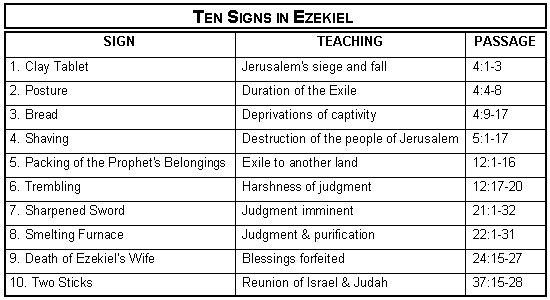
Ezekiel 5:1"As for you, son of man, take a sharp sword; take and use it as a barber's razor on your head and beard. Then take scales for weighing and divide the hair.
Young's Literal: And thou, son of man, take to thee a sharp weapon, the barber's razor thou dost take to thee, and thou hast caused it to pass over thy head, and over thy beard, and thou hast taken to thee weighing scales, and apportioned them.
Brenton's English of Greek Septuagint: And thou, son of man, take thee a sword sharper than a barber's razor; thou shalt procure it for thyself, and shalt bring it upon thine head, and upon thy beard: and thou shalt take a pair of scales, and shalt separate the hair.
WBC: Next, human one, you are to take a sharp sword and use it as a barber’s razor,a applying it all over the hair of your head and beard. Then take scales to weigh it, and divide it up.
AS FOR YOU, SON OF MAN, TAKE A SHARP SWORD. TAKE AND USE IT AS A BARBER'S RAZOR ON YOUR HEAD AND BEARD:
In Ezek 4:1–3 Ezekiel had portrayed the role of God the divine punisher (Ezek 4:3 "set your face toward it so that it is under siege, and besiege" Jerusalem) and we see him do so again, by being the one who does the shaving. On the other hand, by being the one shaved, Ezekiel portrays the people in the city as he represented them earlier (Ezek 4:9–12, 14–17).
"Sword" (chereb) is the common word for this ancient weapon of war and is used 79 times (Click for all 79) by Ezekiel (out of a total of 413 OT uses) to describe the mode of destruction of various lands: Jerusalem (6:11), Edom (Ezek 25:13), Tyre (Ezek 26:6 26:8), Egypt (Ezek 29:8-9), and Gog (Ezek 38:21).
"Use it… on your head and beard"
Ordinarily the Jews allowed their hair to grow long, and was only cut at intervals (cf Absalom annual haircut in 2Sa 14:26). Nazarites (Ezekiel was not a Nazarite) however were completely forbidden to use razors (Nu 6:5; Jdg 13:5). On the other hand when a Levite was were consecrated he was shaved all over with a razor (Nu 8:7; Cf Ps 52:2). But these references would have no parallel in the present use. There are other Scriptural allusions to shaving that would help understand the significance of this sign. For example, shaving one's head was often a sign of mourning (Deut 14:1. Job 1:10). Priests (Ezekiel was a priest) were not to "make any baldness on their heads, nor shave off the edges of their beards, nor make any cuts in their flesh" (Lev 21:5) One of the qualifications of the priests in the future millennial temple was to "not shave their heads, yet they shall not let their locks grow long; they shall only trim the hair of their heads." (Ezek 44:20) . Shaving one's head was also considered an act of humiliation as suggested by Ezek 7:18 (referring to the fall of Jerusalem) "And they will gird themselves with sackcloth, and shuddering will overwhelm them; and shame will be on all faces, and baldness on all their heads."
"your… beard" The beard was held in high respect and greatly valued in the East and the possessor considered it as his greatest ornament, often swore by it; and, in matters of great importance, pledged it and nothing can be more secure than such a pledge for its owner will redeem it at the hazard of his life. The beard was never cut off but in mourning, or as a sign of slavery. In Leviticus God said "You shall not round off the side-growth of your heads, nor harm the edges of your beard." (Lev 19:27). It was customary to shave the Ottoman princes, as a mark of their subjection to the reigning emperor. The beard was a mark of authority and liberty among Muslims and among ancient Arabs, it was more infamous for anyone to appear with his beard cut off, than to be publicly whipped or branded; and many would prefer death to such a punishment. Scripture records that it was a great embarrassment and insult when Hanun, king of the Ammonites, cut off the half of the beards of the Israelites whom David had sent to him (2Sa 10:4). Thus you can begin to get a picture of the significance of Ezekiel's acts before the on looking exiles.
The “razor” was the symbol of the devastation wrought by an invading army (Isa 7:20), Isaiah prophesying to the northern kingdom declared that "In that day the Lord will shave with a razor, hired from regions beyond the Euphrates (that is, with the king of Assyria), the head and the hair of the legs; and it will also remove the beard."
Leviticus had forbidden its use for the head and beard of the priests (Leviticus 19:27;21:5). Once again Ezekiel is commanded to do a forbidden thing as a symbolic act. He is, for the moment, the representative of the people of Jerusalem, and there is to be, as of old, a great destruction of that people as “by a razor that is hired.”
THEN TAKE SCALES FOR WEIGHING AND DIVIDE THE HAIR:

"Scales" refers to a set of scales (depicted below), which was an implement for weighing which consisted of two balance pans with a standardized weight in one pan and the object to be weighed in the other. The scales portray the exactness of each aspect of God's judgment. Using a similar figure, Daniel explaining the meaning of the handwriting on the wall to the Babylonian king Belshazzar interpreted "'TEKEL" as meaning "you have been weighed on the scales and found deficient." (Da 5:27)
In this "sign" Ezekiel himself portrays the role of the Jewish nation and his hair specifically symbolizes the people. The sword (note the use of a sword instead of a razor emphasizes the effect) portrays the Babylonian destruction of Jerusalem at the end of the18 month siege. The cutting of the hair, speaks of the calamities and disgrace coming upon them and as explained by God in verse 12.
Wiersbe - His fourth sign involved shaving his head and face, a real sacrifice for a Jew. The hair represented the people in Jerusalem who faced three destinies: death by famine, death by the sword, and dispersion among the nations (Deut. 28:47–57). But a believing remnant would be protected and saved by the Lord. Why was God angry with His people? Because they rebelled against His law (5:6), defiled His temple (5:11), and did more abominations than the heathen nations around them (5:6–7). They did not glorify the Lord but used all His blessings to promote their sin. Three hundred and ninety years is a long time to continue in sin! We can only marvel at the long-suffering of the Lord (2 Pet. 3:1–9). (Borrow copy of With the Word)
Source: Ryrie Study Bible
Ezekiel 5:2 "One third you shall burn in the fire at the center of the city, when the days of the siege are completed. Then you shall take one third and strike it with the sword all around the city, and one third you shall scatter to the wind; and I will unsheathe a sword behind them.
Young's Literal: A third part with fire thou dost burn in the midst of the city, at the fulness of the days of the siege; and thou hast taken the third part, thou dost smite with a weapon round about it; and the third part thou dost scatter to the wind, and a weapon I draw out after them.
Brenton's English of Greek Septuagint: A fourth part thou shalt burn in the fire in the midst of the city, at the fulfillment of the days of the siege: and thou shalt take a fourth part, and burn it up in the midst of it: and a fourth part thou shalt cut with a sword round about it: and a fourth part thou shalt scatter to the wind; and I will draw out a sword after them.
WBC: A third part you are to burn in flames inside the city, when the period of representing the siege is over; another third you are to cut up with your sword all round the city; and the remaining third you are to disperse to the wind. I will chase after them with drawn sword.
ONE THIRD YOU SHALL BURN IN THE FIRE AT THE CENTER OF THE CITY, WHEN THE DAYS OF THE SIEGE ARE COMPLETED:
- Ezek 5:12; Jer9:21 9:22; 15:2; 24:10; 38:2
THEN YOU SHALL TAKE ONE THIRD AND STRIKE IT WITH THE SWORD ALL AROUND THE CITY, AND ONE THIRD YOU SHALL SCATTER TO THE WIND; AND I WILL UNSHEATHE A SWORD BEHIND THEM:
- Ezek 5:12; 12:14; Lev 26:33; Jer 9:16; Am 9:2 9:3
This symbolic act could represent defilement, for a priest could "not make any baldness on their heads, nor shave off the edges of their beards, nor make any cuts in their flesh." (Lev 21:5). Shaving all hair was also a forbidden pagan rite in honor of the dead —in this case, the death of the sinful nation.
The hair itself symbolized the inhabitants of Jerusalem, and the way in which Jeremiah disposed of it represented their fates.
As Matthew Henry says referring to stubborn, rebellious Israel "Those will be ruined that will not be reformed."
Ezekiel 5:3 "Take also a few in number from them and bind them in the edges of your robes
Young's Literal: And thou hast taken thence a few in number -- and hast bound them in thy skirts;
Brenton's English of Greek Septuagint: And thou shalt take thence a few in number, and shalt wrap them in the fold of thy garment.
WBC: Then take a small amount of it and wrap it in your skirt,
TAKE ALSO A FEW IN NUMBER FROM THEM AND BIND THEM IN THE EDGES (wings) OF YOUR ROBES :
- 2 Ki25:12; Jer39:10; 40:6; 52:16; Mt7:14; Lu13:23 13:24; 1Pe4:18)
Ezekiel 5:4 "Take again some of them and throw them into the fire and burn them in the fire; from it a fire will spread to all the house of Israel.
Young's Literal: and of them thou dost take again, and hast cast them unto the midst of the fire, and hast burned them in the fire -- out of it cometh forth a fire unto all the house of Israel.
Brenton's English of Greek Septuagint: And thou shalt take of these again, and cast them into the midst of the fire, and burn them up with fire: from thence shall come forth fire; and thou shalt say to the whole house of Israel,
WBC: but some of this you are to take again and throw into the fire and burn it up. Out of it fire will come to the whole community of Israel.
TAKE AGAIN SOME OF THEM AND THROW THEM INTO THE FIRE AND BURN THEM IN THE FIRE:
- 2Ki 25:25; Jer 41:1-44; 52:30
25 But it came about in the seventh month, that Ishmael the son of Nethaniah, the son of Elishama, of the royal family, came with ten men and struck Gedaliah down so that he died along with the Jews and the Chaldeans who were with him at Mizpah.
FROM IT A FIRE WILL SPREAD TO ALL THE HOUSE OF ISRAEL:
Ezekiel 5:5 "Thus says the Lord GOD, 'This is Jerusalem; I have set her at the center of the nations, with lands around her
Young's Literal: Thus said the Lord Jehovah: this is Jerusalem, In the midst of the nations I have set her, And round about her are the lands.
Brenton's English of Greek Septuagint: Thus saith the Lord; This is Jerusalem: I have set her and the countries round about her in the midst of the nations.
WBC: “The Lord Yahweh’s message is as follows: This refers to Jerusalem, which I have put at the center of the other nations, with other countries surrounding it.
THUS SAYS THE LORD GOD, 'THIS IS JERUSALEM:
- Ezek 4:1; Jer 6:6; Lu 22:19 Lk 22:20; 1 Co10:4
When the time (God's time) was right, God opened Ezekiel's mouth to speak and he spoke exactly as directed in Ezek 3:27 where God said "I will open your mouth and you will say to them 'Thus says the Lord God."
I HAVE SET HER AT THE CENTER OF THE NATIONS, WITH LANDS AROUND HER: (Micah 5:7)
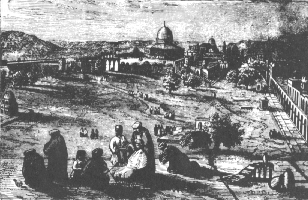
"Center of the nations" Modern computer studies have shown that Jerusalem is, indeed, very near the geographical center of all the earth's land areas and, therefore, the "center of the nations". Later Ezekiel (Ezek 38:14) refers to those who live at Jerusalem as those "who live at the center (navel) of the world." Why does God make this geographical point? God had called Israel to be a light to the nations and placed her strategically in their midst to facilitate the fulfillment of her calling. Yet she rebelled and rejected her "yoke" of responsibility.
In Deuteronomy God had instructed Israel to "Faithfully obey these laws. This will show the people of the world your wisdom and insight. When they hear about all these laws, they will say, "What wise and insightful people there are in this great nation!" (New Living Translation) (Dt4:6) Believers are given a similar charge by Jesus who reminds us that our purpose is to be "the salt of the earth but if the salt has become tasteless, how will it be made salty again? It is good for nothing anymore, except to be thrown out and trampled under foot by men. You are the light of the world. A city set on a hill cannot be hidden. Nor do men light a lamp, and put it under the peck-measure, but on the lampstand; and it gives light to all who are in the house. Let your light shine before men in such a way that they may see your good works, and glorify your Father who is in heaven." (Mt 5:13-16) Are you redeeming the time, letting your light shine? Or have you lost your savor like Israel and in danger of being thrown out and trampled under foot by men? As MacDonald says "We as Christians have even higher privileges than the Jews. May the Lord give us grace not to misuse them and thus bring about our own temporal judgment and loss of eternal rewards! "
Later in Ezekiel, God reminds Jerusalem of the advantages she received and how her "fame went forth among the nations on account of your beauty, for it was perfect because of My splendor which I bestowed on you," declares the Lord GOD." (Ezek 16:14)
Matthew Henry notes that "Jerusalem was not situated in a remote obscure corner of the world, far from neighbors, but in the midst of kingdoms that were populous, polite, and civilized, famed for learning, arts, and sciences, and which then made the greatest figure in the world… Jerusalem was designed to have a good influence upon the nations and countries round about, was set in the midst of them as a candle upon a candlestick, to spread the light of divine revelation, which she was blessed with, to all the dark corners of the neighboring nations, that from them it might diffuse itself further, even to the ends of the earth. Jerusalem was set in the midst of the nations, to be as the heart in the body, to invigorate this dead world with a divine life as well as to enlighten this dark world with a divine light, to be an example of every thing that was good." Specifically in regard to God's statutes and judgments Israel was to "observe them carefully, for this will show your wisdom and understanding to the (surrounding Gentile, pagan, idolatrous, lost) nations, who will hear about all these decrees and say, "Surely this great nation is a wise and understanding people." (Deut 4:6) Henry goes on to observe that "had they preserved this reputation and made a right use of it, what a blessing would Jerusalem have been to all the nations about! … Note, When places and persons are made great, it is with design that they may do good and that those about them may be the better for them, that their light may shine before men." Are others "better off" for having been in your presence this week?
Peter wrote that "judgment (would) begin with the household of God" (1Pe 4:17) and here we see God beginning with the center of revealed religion, Jerusalem site of His temple, the pride and glory of the Jews.
Richards notes that "Ezekiel’s dramatic and strange actions had been the talk of the community. But the prophet had to explain their meaning. There is a school of Christian thought which assumes that if a believer lives a good life, his acts are sufficient witness to the world. Without words any act of witness is liable to be misunderstood." (The Bible reader's companion. Wheaton, Ill.: Victor Books)
Ezekiel 5:6 'But she has rebelled against My ordinances more wickedly than the nations and against My statutes more than the lands which surround her; for they have rejected My ordinances and have not walked in My statutes.
Young's Literal: And she changeth My judgments into wickedness more than the nations, And My statutes more than the lands that are round about her, For against My judgments they have kicked, And My statutes -- they have not walked in them.
Brenton's English of Greek Septuagint: And thou shalt declare mine ordinances to the lawless one from out of the nations; and my statutes to the sinful one of the countries round about her: because they have rejected mine ordinances, and have not walked in my statutes.
WBC: But it has wickedly rebelled against my standards more than the other nations, and against my rulings more than the countries around it, in that they have rejected my standards and failed to follow my rules.
BUT SHE HAS REBELLED AGAINST MY ORDINANCES MORE WICKEDLY THAN THE NATIONS AND AGAINST MY STATUTES MORE THAN THE LANDS WHICH SURROUND HER:
- Ezek 16:47; Dt 32:15-21; 2 Ki 17:8-20; Ps 106:20; Ro 1:23-25; 1 Co 5:1; Jude 4
FOR THEY HAVE REJECTED MY ORDINANCES AND HAVE NOT WALKED IN MY STATUTES:
NAB "she has spurned my ordinances and has not lived by my statutes."
- Neh 9:16 17; Ps 78:10; Jer5:3; 8:5; 9:6; 11:10; Zec7:1
Verses 6 and 7 represent God’s accusation against His Jerusalem's (who represented the people therein) rebellion against His holy "ordinances" and conformed to the standards of pagan nations. Their rebellion was not a result of unwitting failure, but a sin against God's clear revelation in the Torah.
Ezekiel 5:7 "Therefore, thus says the Lord GOD, 'Because you have more turmoil than the nations which surround you and have not walked in My statutes, nor observed My ordinances, nor observed the ordinances of the nations which surround you,
Young's Literal: Therefore, thus said the Lord Jehovah: Because of your multiplying above the nations that are around you, In My statutes ye have not walked, And My judgments ye have not done, According to the judgments of the nations That are round about you ye have not done.
Brenton's English of Greek Septuagint: Therefore thus saith the Lord, Because your occasion for sin has been taken from the nations round about you, and ye have not walked in my statutes, nor kept mine ordinances, nay, ye have not even done according to the ordinances of the nations round about you; therefore thus saith the Lord;
WBC: Therefore this is the message of the Lord Yahweh: Inasmuch as you have been more insolent than the nations around you, failing to follow my rules or put my standards into practice or even to meet the standards of the nations around you,
GWT: "So this is what the Almighty LORD says: <People of Jerusalem,> you have caused more trouble than the nations around you. You haven't lived by my laws or obeyed my rules. You haven't even lived up to the standards of the nations around you.
THEREFORE, THUS SAYS THE LORD GOD, 'BECAUSE YOU HAVE MORE TURMOIL THAN THE NATIONS WHICH SURROUND YOU AND HAVE NOT WALKED IN MY STATUTES, NOR OBSERVED MY ORDINANCES:
"You caused more confusion than the nations around you" (ICB), "ye have been turbulent more than the nations that are round about you" (Darby)
"For this cause the Lord has said: Because you have been more uncontrolled than the nations round about you, and have not been guided by my rules or kept my orders" (BBE), "Because you have surpassed the Gentiles that are round about you," (DRA)
NOR OBSERVED THE ORDINANCES OF THE NATIONS WHICH SURROUND YOU:
- Ezek 5:11; 16:47 48 54; 2 Ki21:9-11; 2Chr33:9; Jer2:10 11)
"You have not even conformed to the standards of the nations around you" (NIV) "and have not even acted according to the rules of the nations that are all around you" (ESV) "since you do not respect even the observances of the surrounding nations," (NJB) "but have kept the orders of the nations round about you" (BBE)
"Nor observed the ordinances of the nations which surround you" God's point is that not only had they failed to fulfill their calling to be a light to the other nations, they had even "outsinned" the pagan idolaters!
MacArthur reminds us that "The judgments of God are always relative to light and privilege granted. Since Ezekiel’s people were unique in their disobedience, they were to be outstanding in their punishment."
MacDonald draws a pithy application from the fact that in spite of Israel's greater privileges, she acted even more wickedly than the surrounding nations: "We as Christians have even higher privileges than the Jews. May the Lord give us grace not to misuse them and thus bring about our own temporal judgment and loss of eternal rewards!"
Ezekiel 5:8 therefore, thus says the Lord GOD, 'Behold, I, even I, am against you, and I will execute judgments among you in the sight of the nations.
Young's Literal: Therefore, thus said the Lord Jehovah: Lo, I am against thee, even I, And I have done in thy midst judgments, Before the eyes of the nations.
Brenton's English of Greek Septuagint: Behold, I am against thee, and I will execute judgement in the midst of thee in the sight of the nations.
WBC: therefore the Lord Yahweh’s message is as follows: I for my part am your adversary; I will carry out acts of judgment inside you in full view of the nations.
THEREFORE, THUS SAYS THE LORD GOD, 'BEHOLD, I, EVEN I, AM AGAINST YOU:
- Ezek 15:7; 21:3; Deut29:20; La2:5; Zech 14:2 14:3; Mt22:7
This is frightful verse - the Almighty taking an oath swearing His unwavering attitude of justice against Judah.
This short but powerful phrase "against you" is found 27x (click for all uses) in Ezekiel with God usually the subject and Judah most often being the recipient but in several instances referring to the surrounding nations.
In Leviticus God through His prophet Moses had warned Israel "if you do not obey Me and do not carry out all these commandments, if, instead, you reject My statutes, and if your soul abhors My ordinances so as not to carry out all My commandments, and so break My covenant… I will set My face against you so that you shall be struck down before your enemies; and those who hate you shall rule over you, and you shall flee when no one is pursuing you."(Lev 26:14ff) Read Levitcus 26 where God continues this dreadful litany of warnings over the succeeding 26 verses.
In Jeremiah in answer to King Zedekiah's inquiry, God says that He is bringing the king of Babylon into the heart of Jerusalem explaining that "I Myself shall war against you with an outstretched hand and a mighty arm, even in anger and wrath and great indignation." (Jer 21:5, 21:13) In his lamentation
AND I WILL EXECUTE JUDGMENTS AMONG YOU IN THE SIGHT OF THE NATIONS:
- Dt 29:23-28; 1 Ki 9:8 9:9; La 2:15 16 17
"Execute judgments" is a key phrase in Ezekiel where it is used 10 times (out of only 14 total OT uses) (click here for all 10) and three of the uses are in chapter 5. Note also that in this chapter, "I will" occurs 13 times in 9 verses, leaving little doubt about God's personal, active involvement in the exercise of these judgments.
"In the sight of the nations" ("in front of the nations" = GWT), "Before the eyes of the nations" (YLT), "in your midst in the sight of the nations" (NKJV), "and the nations will watch" (ICB)
At the conclusion of the building of the first Temple, God appeared to King Solomon and warned him that "if you or your sons shall indeed turn away from following Me, and shall not keep My commandments and My statutes which I have set before you and shall go and serve other gods and worship them, then I will cut off Israel from the land which I have given them, and the house which I have consecrated for My name, I will cast out of My sight. So Israel will become a proverb and a byword among all peoples. And this house will become a heap of ruins; everyone who passes by will be astonished and hiss and say, 'Why has the LORD done thus to this land and to this house?' And they will say, 'Because they forsook the LORD their God, who brought their fathers out of the land of Egypt, and adopted other gods and worshiped them and served them, therefore the LORD has brought all this adversity on them.'" (1 Ki 9:6-9) And so as the New Living Translation phrases this section "I will punish you publicly while all the nations watch". Jeremiah adds that "many nations will pass by this city; and they will say to one another, 'Why has the LORD done thus to this great city?' Then they will answer, 'Because they forsook the covenant of the LORD their God and bowed down to other gods and served them.'" (Jer 22:8 22:9)
Ezekiel 5:9 'And because of all your abominations, I will do among you what I have not done, and the like of which I will never do again
Young's Literal: And I have done in thee that which I have not done, And that which I do not its like again, Because of all thine abominations.
Brenton's English of Greek Septuagint: And I will do in thee things which I have not done, and the like of which I will not do again, for all thine abominations.
WBC: I will do in you what I have never done before and will not do again, because of all your shocking practices:
AND BECAUSE OF ALL YOUR ABOMINATIONS, I WILL DO AMONG YOU WHAT I HAVE NOT DONE, AND THE LIKE OF WHICH I WILL NEVER DO AGAIN:
- La 4:6 4:9; Am 3:2
- Click here for discussion of abominations
"I will do among you what I have not done before"
Daniel speaking of the 70 year Babylonian exile records that God "has confirmed His words which He had spoken against us and against our rulers who ruled us, to bring on us great calamity; for under the whole heaven there has not been done anything like what was done to Jerusalem." (Da 9:12)
"The like of which I will never do again" This prophecy was partially fulfilled in the Babylonian siege and sacking of Jerusalem in 586BC, and then again in the destruction of Jerusalem and the Temple in 70AD and will be completely fulfilled in the last three and one half years of the seven year period often referred to as the "tribulation" as predicted by Jesus Who said that "then there will be a great tribulation, such as has not occurred since the beginning of the world until now, nor ever shall." (Mt 24:21+)
Ezekiel 5:10 'Therefore, fathers will eat their sons among you, and sons will eat their fathers; for I will execute judgments on you and scatter all your remnant to every wind
Young's Literal: Therefore fathers do eat sons in thy midst, And sons eat their fathers, And I have done in thee judgments, And have scattered all thy remnant to every wind.
Brenton's English of Greek Septuagint: Therefore the fathers shall eat their children in the midst of thee, and children shall eat their fathers; and I will execute judgments in thee, and I will scatter all that are left of thee to every wind.
WBC: so parents will eat children inside you, and children will eat their parents. I will carry out acts of judgment in you and disperse all those of you who are left to every wind.
THEREFORE, FATHERS WILL EAT THEIR SONS AMONG YOU, AND SONS WILL EAT THEIR FATHERS:
- Dt 28:55-57-commentary Isa 9:20; 49:26; Jer 19:9; Lam 2:20
God had warned Israel that if they did not obey Him they would be force to "eat the flesh of your sons and the flesh of your daughters you shall eat." (Lev 26:29 cf Dt 28:53 Dt 28:54) "Then you shall eat the offspring of your own body, the flesh of your sons and of your daughters whom the LORD your God has given you, during the siege and the distress by which your enemy shall oppress you.") This was literally fulfilled at the siege of Jerusalem. Josephus gives a dreadful detail respecting a woman named Mary, who, in the extremity of the famine, during the siege, killed her sucking child, roasted, and had eaten part of it, when discovered by the soldiers! (War VI, 15-32 [3-4]) The horrors of ancient sieges are matched perhaps only by the modern siege of Leningrad in World War II. There also cannibalism occurred. There are biblical references to these horrors in the sieges of Samaria (2 Ki 6:29) and Jeremiah records the post-mortem on the siege of Jerusalem writing that "The hands of compassionate women boiled their own children. They became food for them Because of the destruction of the daughter of my people." (Lam4:10)
Richards comments that "Again we sense the horror of sin, not so much by the listing of evils, but by descriptions of the punishments Judah would experience. As the desperate people of Jerusalem turned to cannibalism, eating even members of their own families, we sense a revulsion that captures something of God’s feelings about the acts of sin which led to these terrible consequences. If you and I fail to be horrified at sin itself, and draw back, God will horrify us with the punishment our sins bring!" (Richards, L. O. The 365 day devotional commentary. Wheaton: Victor Books)
FOR I WILL EXECUTE JUDGMENTS ON YOU AND SCATTER ALL YOUR REMNANT TO EVERY WIND:
- click here for "execute judgment" in all 10 verses in Ezekiel;
- Lev 26:33; Deut 4:27; 28:64; 32:26; Neh 1:8; Ps 44:11; Jer 9:16; 44:12; 50:17; Amos 9:9; Zech 2:6; 7:14; Lu 21:24)
"Scatter all your remnant to every wind"
Although this prophecy was partially fulfilled with the fall of Jerusalem in 586BC, Jesus predicted that it would Jerusalem and its inhabitants would "fall by the edge of the sword, and… be led captive into all the nations; and Jerusalem will be trampled under foot by the Gentiles until the times of the Gentiles be fulfilled." Many believe that the times of the Gentiles began with the fall of Jerusalem in 586BC and these "times of the Gentile" domination will last until the events in Revelation 11 which indicate that "the nations (Gentiles)… will tread under foot the holy city (Jerusalem) for forty-two months." (Rev 11:1 11:2)
The "remnant" here refers to a physical remnant and not necessarily a spiritual remnant of Jews who trust in Messiah for their salvation as alluded to in (Ezek 6:8)
Ezekiel 5:11 'So as I live,' declares the Lord GOD, 'surely *, because you have defiled My sanctuary with all your detestable idols and with all your abominations, therefore I will also withdraw, and My eye will have no pity and I will not spare
Young's Literal: Therefore, I live -- an affirmation of the Lord Jehovah: Because My sanctuary thou hast defiled, With all thy detestable things, And with all thine abominations, Mine eye pitieth not, and I also spare not. Do not even I also diminish?
Brenton's English of Greek Septuagint: Therefore, as I live, saith the Lord; surely, because thou hast defiled my holy things with all thine abominations, I also will reject thee; mine eye shall not spare, land I will have no mercy.
WBC: Therefore I swear on my life, runs the Lord Yahweh’s oracle: because you have defiled my sanctuary with all your detestable objects of worship and with all your other shocking practices, I for my part will resort to shearing, with no pitying glance or personal compassion.
SO AS I LIVE,' DECLARES THE LORD GOD:
- Nu14:28-35; Amos 8:7
"As I live" expresses a solemn oath in which God pledges His very existence as assurance that the prophecy will be fulfilled. This same phrase (as I live) is found 16 times in Ezekiel (click here).
God is swearing an oath based upon Himself much like He did when Israel liberated from Egyptian bondage tested and tried Him in the wilderness even though they had seen His mighty acts. As a result God loathed this generation for 40 years and described them as "a people who err in their heart and they do not know My ways." Then He swore in His anger and said "Truly they shall not enter into My rest." (Ps95) There can be no oath greater than that which the LORD God Himself declares "for when God made the promise to Abraham, since He could swear by no one greater, He swore by Himself." (Heb 6:13)
'SURELY BECAUSE YOU HAVE DEFILED MY SANCTUARY WITH ALL YOUR DETESTABLE IDOLS AND WITH ALL YOUR ABOMINATIONS:
- Ezek 8:5 8:6 8:16; 23:28; 44:7; 2Ki 23:12; Jer7:9; 7:10 7:11 32:34
"Defiled" (tame) refers to that which is unclean, polluted, profaned or desecrated in a religious, ritual or moral sense. For example, birth, menstruation, emissions from the body, leprosy, sexual relations, contact with death could cause personal uncleanness but idolatry was by far the most serious type of uncleanness for it was associated with not just an external problem but an internal or heart problem. Tame is used primarily in Leviticus describing things that were unclean, but the next most frequent use is in the book of Ezekiel (Click for the 28 uses). When told to cook his bread over human dung Ezekiel himself had appealed to God that he had "never been defiled" (Ezek 4:14)
2 Chronicles 36 summarizes Judah's defilement of God's holy place and her stubborn disobedience recording that "all the officials of the priests and the people were very unfaithful following all the abominations of the nations; and they defiled the house of the LORD which He had sanctified in Jerusalem. And the LORD, the God of their fathers, sent word to them again and again by His messengers, because He had compassion on His people and on His dwelling place but they continually mocked the messengers of God, despised His words and scoffed at His prophets, until the wrath of the LORD arose against His people, until there was no remedy." (2Chr 36:11-23)
"Detestable idols" (shiqquwts; shiqquts [Click for 8/28 OT uses in Ezekiel] from shaqats = to be filthy, to loathe, pollute, abhor, make abominable, detest) is a strong word and by using such an intense word God wanted His people to recognize the extreme seriousness and wickedness of this sin, however attractive and popular it might have been among the majority. God's own people need to view sin from God's perspective. How are you viewing your sin? Do you view it as detestable or disgusting and filthy? Shiqquts is often used by itself to describe idols (as in this verse of idols - there is no separate Hebrew word here for "idols"). That which is detestable denotes that which is particularly offensive to the moral sense, the religious feeling, or the natural inclination of the soul. For example Solomon although filled with wisdom choose to go "after Milcom (whose "worship" involved child sacrifice) the detestable idol of the Ammonites." (1Ki11:5)
Ezekiel uses this same Hebrew word (shiqquts) in a similar context in Chapter 7, where God says that Judah has "transformed the beauty of His ornaments (Hebrew is singular - ornament - not plural and the Temple treasures they were making into pagan idols!) into pride, and they made the images of their abominations and their detestable things with it; therefore I will make it an abhorrent thing to them." (7:20)
"Abominations" (tow'ebah) (A Keyword in Ezekiel - click for 41/118 OT in Ezekiel) refers to an object which is loathsome and abhorrent. For more detailed discussion of the Hebrew word (tow'ebah) on this website click here.
Although many kings of Judah were guilty of the charges in Ezekiel 5:11, Manasseh (who reigned almost one century prior to this Ezekiel's prophecy) proved himself one of the worst of the worst, Scripture recording that "he reigned fifty-five years in Jerusalem… and he did evil in the sight of the LORD, according to the abominations of the nations whom the LORD dispossessed before the sons of Israel. For he rebuilt the high places which Hezekiah his father had destroyed; and he erected altars for Baal and made an Asherah, as Ahab king of Israel had done, and worshiped all the host of heaven and served them. And he built altars in the house of the LORD, of which the LORD had said, "In Jerusalem I will put My name." For he built altars for all the host of heaven in the two courts of the house of the LORD. And he made his son pass through the fire, practiced witchcraft and used divination, and dealt with mediums and spiritists. He did much evil in the sight of the LORD provoking Him to anger. Then he set the carved image of Asherah (fertility figures associated with "impure" acts of so called "worship") that he had made, in the house of which the LORD said to David and to his son Solomon, "In this house and in Jerusalem, which I have chosen from all the tribes of Israel, I will put My name forever. "And I will not make the feet of Israel wander anymore from the land which I gave their fathers, if only they will observe to do according to all that I have commanded them, and according to all the law that My servant Moses commanded them." But they did not listen, and Manasseh seduced them to do evil more than the nations whom the LORD destroyed before the sons of Israel." (2 Ki 21)
THEREFORE I WILL ALSO WITHDRAW, AND MY EYE WILL HAVE NO PITY AND I WILL NOT SPARE:
- Deut 29:20; Zech 11:6; 11:21; 2 Pe 2:4 2:5
Later in Ezekiel God explains that these actions will bring about a specific effect declaring that 'My eye will have no pity on you nor shall I spare you, but I shall bring your ways upon you and your abominations will be among you; then you will know that I am the LORD!' (7:4, 7:9 cf "pity" & spare" in Ezek 8:18; 9:5, 9:10, 24:14 Lam2:21
Although again and again in Ezekiel God reminds the people He will not spare them, Malachi breathes a ray of hope into this otherwise grave prognosis, declaring that when God's purging is finished (ultimately at the end of the "great tribulation" Mt 24:21, the time of "Jacob's distress" Jer 30:7) Israel "will be Mine," says the LORD of hosts, "on the day that I prepare My own (treasured) possession and I will spare them as a man spares his own son who serves him." (Mal 3:17) The godly remnant (Click Ezek 6:8 discussion of "remnant") will belong to Him and will be His special treasure. And so in the midst of judgment, Jehovah will spare the god fearing (Messiah receiving Jn 1:11-13) Jewish remnant for "Just as a father has compassion on his children, so Jehovah has compassion on those who fear Him." (Ps 103:13). And how is it possible for God to spare those who do not deserve sparing? Paul explains that "He who did not spare His own Son, but delivered Him up for (on our behalf) us all, how will He not also with Him freely give us all things?" (Ro 8:32)
Ezekiel 5:12 'One third of you will die by plague or be consumed by famine among you, one third will fall by the sword around you, and one third I will scatter to every wind, and I will unsheathe a sword behind them
Young's Literal: Thy third part -- by pestilence they die, And by famine are consumed in thy midst, And the third part, by sword they fall round about thee, And the third part, to every wind I scatter, And a sword I draw out after them.
Brenton's English of Greek Septuagint: A fourth part of thee shall be cut off by pestilence, and a fourth part of thee shall be consumed in the midst of thee with famine: and as for another fourth part of thee, I will scatter them to every wind; and a fourth part of thee shall fall by sword round about thee, and I will draw out a sword after them.
WBC: A third of you will die of plague or perish of famine inside you, another third will fall to the sword around you, while the remaining third I will disperse to every wind and chase after them with drawn sword.
ONE THIRD OF YOU WILL DIE BY PLAGUE OR BE CONSUMED BY FAMINE AMONG YOU:
- Zech 13:7-9
God explains that in verse 2 ("One third you shall burn in the fire at the center of the city, when the days of the siege are completed") the "one third… in the fire" is those who "will die by plague or be consumed by famine" and reiterates this verdict in Ezekiel 6:12 (see Jer15:2 21:9)
ONE THIRD WILL FALL BY THE SWORD AROUND YOU, :
- Ezek 6:8; Zech 7:14
Jeremiah's prophecy echoes this prophecy, God declaring "I will scatter them among the nations, whom neither they nor their fathers have known; and I will send the sword after them until I have annihilated (but He "will not execute a complete destruction" see Jer4:27) them." (Jer 9:16)
AND ONE THIRD I WILL SCATTER TO EVERY WIND AND I WILL UNSHEATHE A SWORD BEHIND THEM:
This was in one sense fulfilled in the destruction of those who retired to Egypt (Jeremiah recorded "that the sword, which you are afraid of will overtake you there in the land of Egypt… " Jer 42:16, 44:27) but as often with prophetic passages, there is another sense in which the "unsheathed sword" continued to pursue them as has been remarkably verified in the many pogroms and holocausts which the Jews have suffered over the last two millennia, not just under Hitler but in various other countries into which they were dispersed after the Roman siege and destruction of Herod's Temple in 70AD.
Amos wrote that "though they go into captivity before their enemies, from there I will command the sword that it slay them, and I will set My eyes against them for evil and not for good." (Am 9:4)
Through His prophet Moses Jehovah had warned Israel declaring to her "You, however, I will scatter among the nations and will draw out a sword after you, as your land becomes desolate and your cities become waste. Then the land will enjoy its sabbaths all the days of the desolation, while you are in your enemies' land; then the land will rest and enjoy its sabbaths." (Lev 26:33, 34)
Up to this point, God had chastened the people in their land, but He soon would remove them from the land. In 722 B.C., the Assyrians took captive ("scattered") the Northern Kingdom of Israel; and then in 586 B.C., the Babylonians would complete the scattering as they captured Jerusalem and Judah. The seventy years of Babylonian Captivity allowed the land to rest and “enjoy her sabbaths” (2Chr 36:20 21). During 490 years Israel failed to give the land its sabbaths. That means the land missed seventy sabbath years. The people of Israel thought they were getting by with it, but finally God said it was enough. If they wouldn’t give the land its sabbaths, God would and so He scattered them out of the land for seventy years. How accurate are God's scales of just retribution! The Lord would mercifully bring back a physical remnant of Jews to the land after the Babylonian exile, but Judah never regained her former power or glory. Except for short periods of freedom, such as under the Maccabees, the Jews were destined to always be under the control ("a sword behind them") of some foreign power. As noted above, the ultimate dispersion (scattering) of the Jews among the nations was in 70AD and as Moses recorded "among those nations you shall find no rest, and there shall be no resting place for the sole of your foot; but there the LORD will give you a trembling heart, failing of eyes, and despair of soul." (Dt 28:65)
God explains later that this dispersion or scattering is not without purpose, declaring specifically to King Zedekiah that "I shall scatter to every wind all who are around him, his helpers and all his troops; and I shall draw out a sword after them. So they will know that I am the LORD when I scatter them among the nations, and spread them among the countries." (Ezek 12:14 12:15)