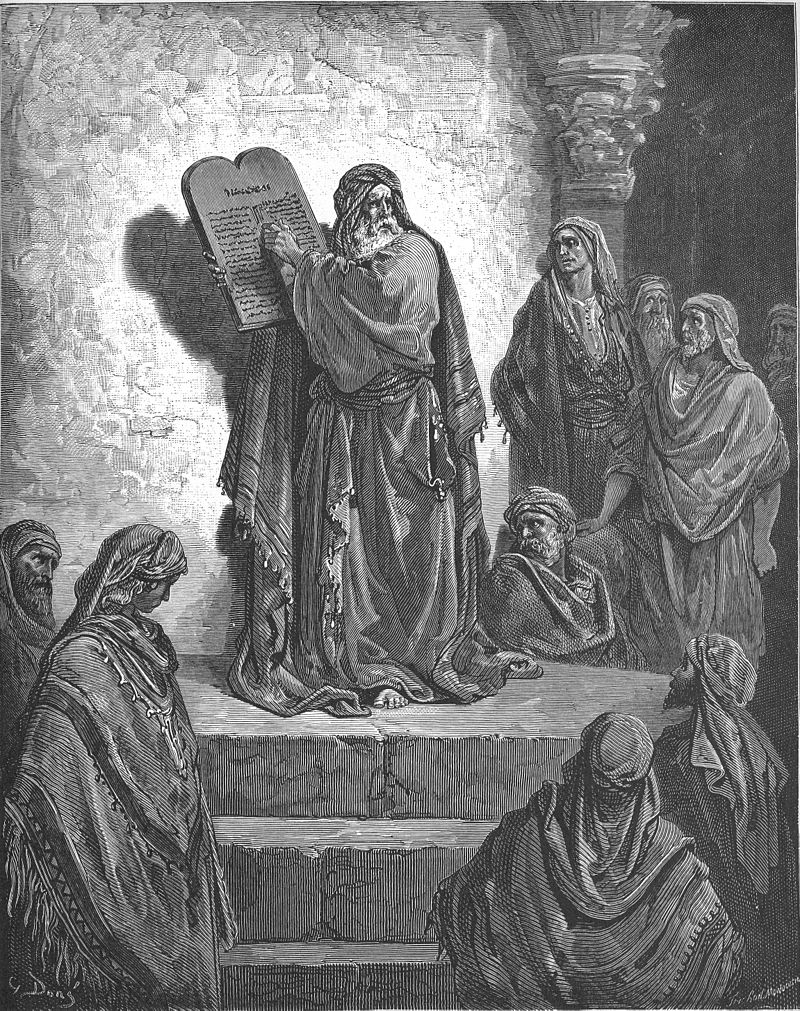
Ezra Reads the Law to the People by Gustave Doré
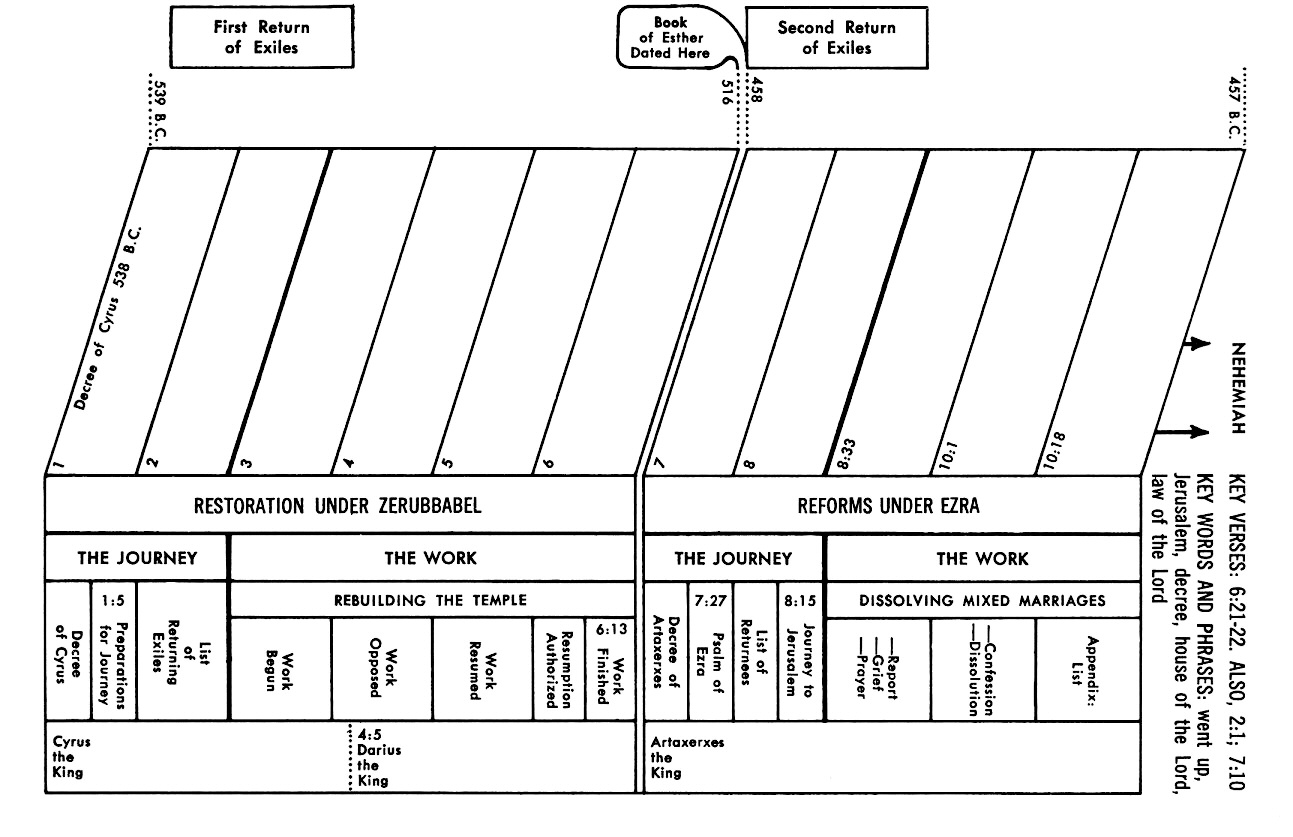
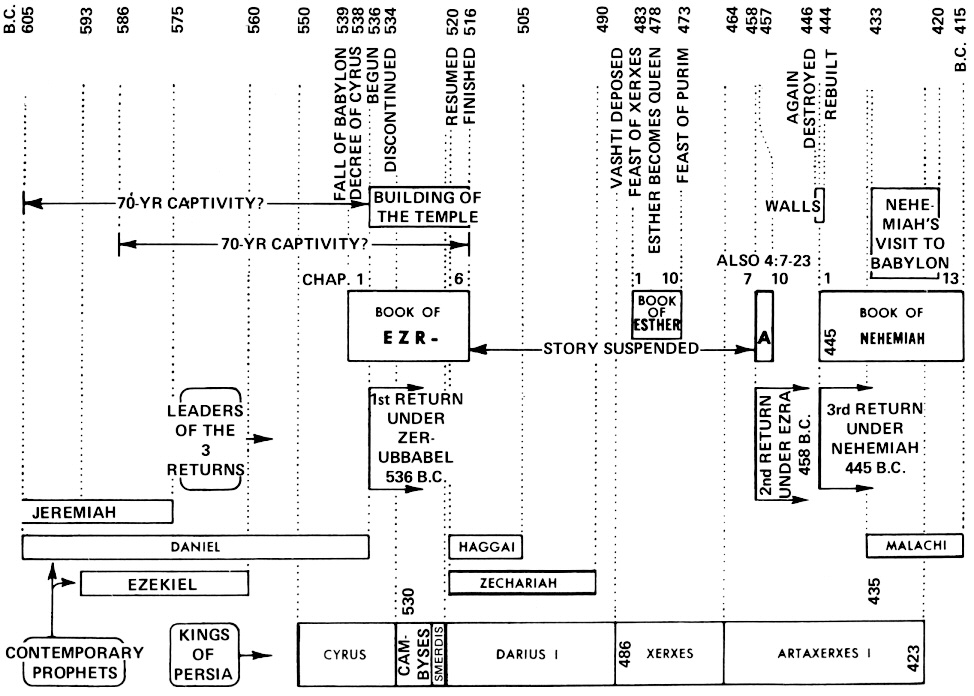
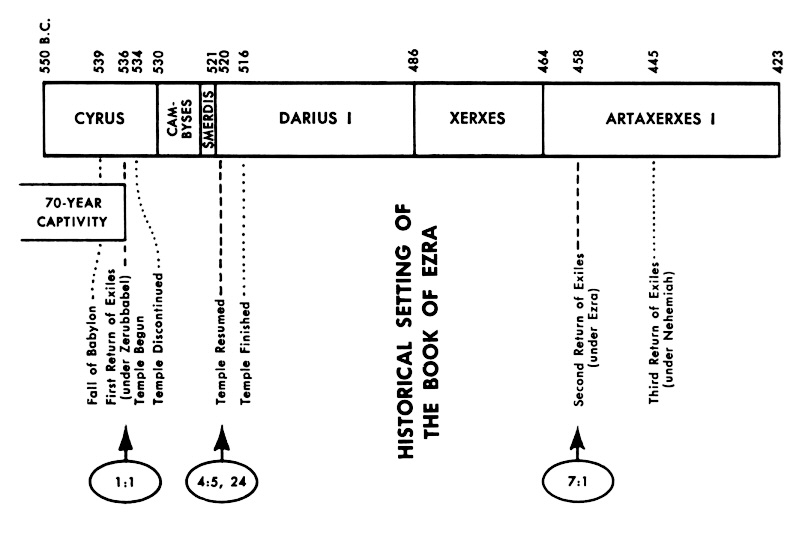
Click charts to enlarge
Charts from Jensen's Survey of the NT - used by permission
Introduction and Chart of Ezra - Swindoll
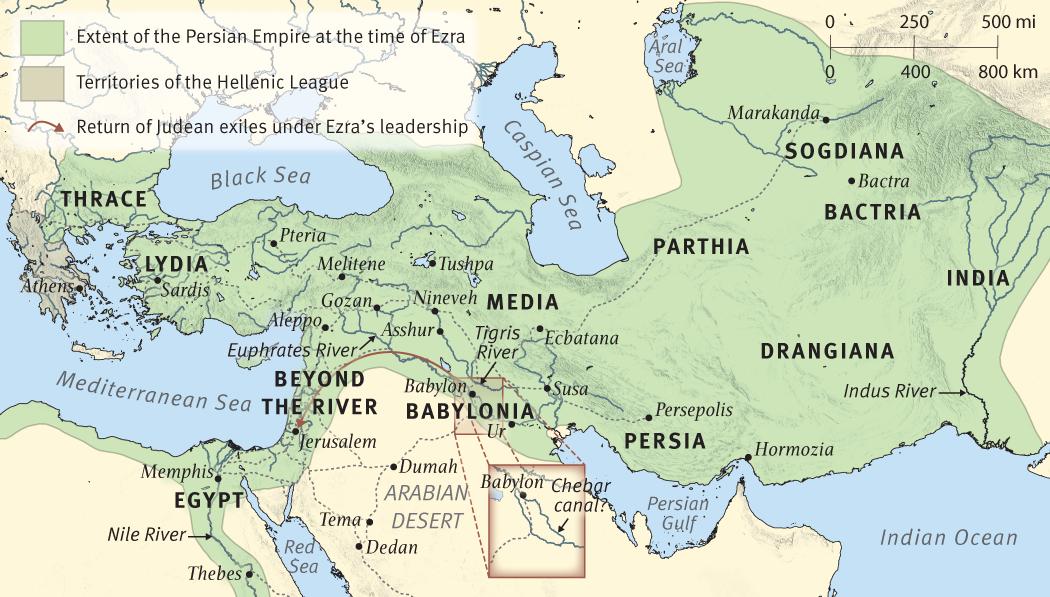
The Persian Empire at the Time of Ezra c. 458 B.C.
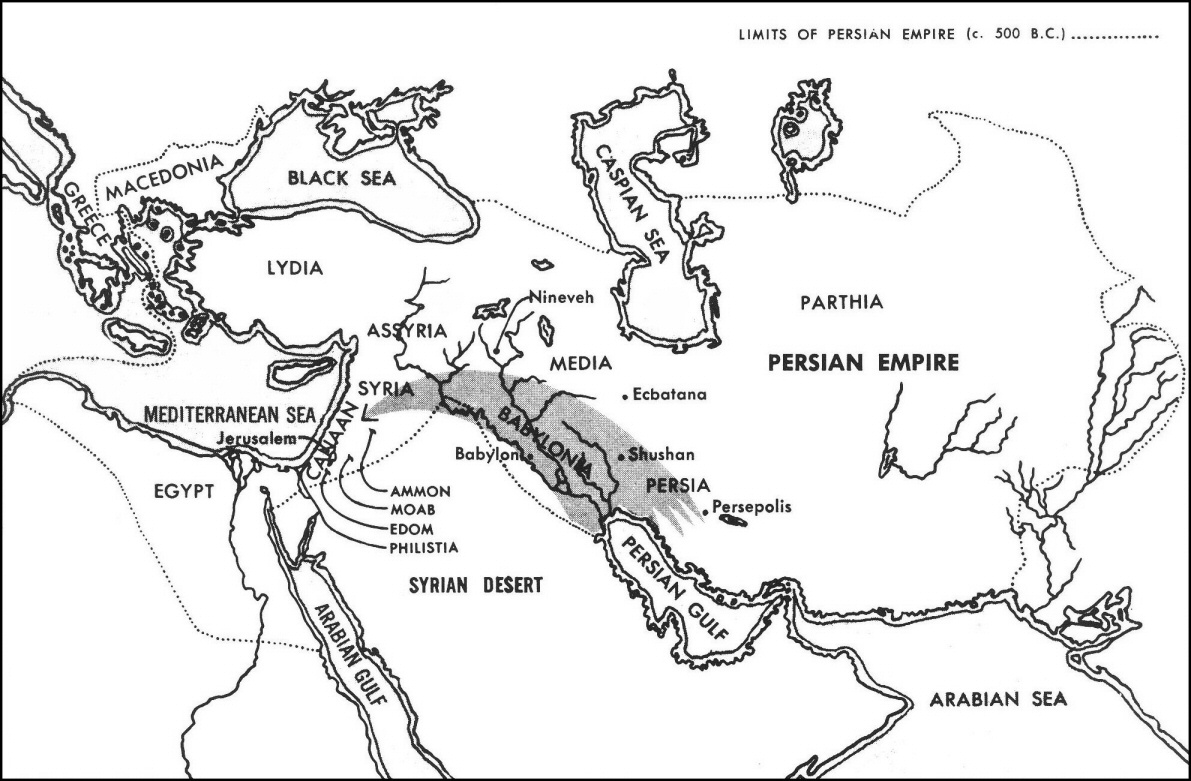
During the time of Ezra the Persian Empire had reached its greatest extent, engulfing nearly the entire Near East. In 539 B.C. the Persians under Cyrus the Great defeated the Babylonians and absorbed their territory into the empire, including the lands of Israel and Judah (known as Beyond the River). The next year Cyrus allowed the people of Judah to return home under the leadership of Zerubbabel and rebuild the temple of the Lord. Later, around 458 B.C., another group of Judean exiles returned under Ezra’s leadership. (ESV.org)
Kings of Persia Mentioned in Ezra–Nehemiah
- Cyrus 539–530 B.C.
- Darius I 522–486
- Xerxes (Ahasuerus) 485–464
- Artaxerxes I 464–423
| CHRONOLOGICAL RELATIONSHIP OF EZRA-NEHEMIAH-ESTHER |
||||
| 538-515BC | 483-473BC | 457BC |
13 Year Gap |
444-425BC |
| Ezra 1-6 | Book of Esther | Ezra 7-10 | Book of Nehemiah | |
| First Return of Jews from Babylonian Exile |
58 Year Gap |
Second Return of Jews from Babylonian Exile |
Third Return of Jews from Babylonian Exile |
|
| EZRA: RESTORATION AND REFORM |
|||
| Restoration of the Temple Under Zerubbabel |
Reform of the People Under Ezra |
||
| First Return To Jerusalem Ezra 1:1-Ezra 2:70 |
Construction of The Temple Ezra 3:1-Ezra 6:22 |
Second Return to Jerusalem Ezra 7:1-8:36 |
Restoration of the People Ezra 9:1-Ezra 10:44 |
| First Return of 49, 897 |
Second Return of 1754 |
||
| 22 Years (538-516BC) |
1 Year (458-457BC) |
||
| Key Passages: Ezra 1:3, Ezra 2:2, Ezra 6:21, 22, Ezra 7:10 Key Words: Went up (Ezra 1:11, 7:1, 6, 7, 8:1), Jerusalem (48x), Decree (17x), House of the LORD (Ezra 1:3, 5, 7, 2:68, 3:8, 11, 7:27, 8:29), Law (...of the LORD, ...of Moses, ...of God) (Ezra 3:2, 7:6, 10, 12, 14, 21, 26, 10:3) |
|||
| CHRONOLOGY OF EZRA | ||
|
Cyrus king of Persia captures Babylon |
539 B.C. |
Dan. 5:30–31 |
|
First year of King Cyrus; issues proclamation freeing Jewish exiles to return |
538–537 |
Ezra 1:1–4 |
|
Jewish exiles, led by Sheshbazzar, return from Babylon to Jerusalem |
537? |
Ezra 1:11 |
|
Altar rebuilt |
537 |
Ezra 3:1–2 |
|
Temple rebuilding begins |
536 |
Ezra 3:8 |
|
Adversaries oppose the rebuilding |
536–530 |
Ezra 4:1–5 |
|
Temple rebuilding ceases |
530–520 |
Ezra 4:24 |
|
Temple rebuilding resumes (2nd year of Darius) |
520 |
Ezra 5:2; cf Hag. 1:14 |
|
Temple construction completed (6th year of Darius) |
516 |
Ezra 6:15 |
|
Ezra departs from Babylon to Jerusalem (arrives in 7th year of Artaxerxes) |
458 |
Ezra 7:6–9 |
|
Men of Judah and Benjamin assemble at Jerusalem |
458 |
Ezra 10:9 |
|
Officials conduct three-month investigation |
458–457 |
Ezra 10:16–17 |
|
Source: ESV.org |
||
Explanation - Most of the resources below are newer commentaries (written after 1970) and other Bible resources which previously were available only for purchase in book form or in a Bible computer program. The resources are made freely available by archive.org but have several caveats - (1) they do not allow copy and paste, (2) they can only be checked out for one hour (but can be checked out immediately when your hour expires giving you time to read or take notes on a lengthy section) and (3) they require creating an account which allows you to check out the books free of charge. To set up an account click archive.org and then click the picture of the person in right upper corner and enter email and a password. That's all you have to do. Then you can read these more modern resources free of charge! I have read or used many of these resources but not all of them so ultimately you will need to be a Berean (Acts 17:11+) as you use them. I have also selected works that are conservative and Biblically sound. If you find one that you think does not meet those criteria please send an email at https://www.preceptaustin.org/
STUDY BIBLES - ONE VOLUME COMMENTARIES OF ENTIRE BIBLE, BIBLE DICTIONARIES, GENERAL REFERENCE WORKS
EXPOSITOR'S BIBLE COMMENTARY - Volume 4 - 1-2 Kings, 1-2 Chronicles, Ezra, Nehemiah, Esther, Job - 1092 pages (1976)
If you are eager to get a complete commentary set, I think the Expositor’s Bible Commentary is probably the best of the bunch for your money. —Paul Westervelt, Discipleship Journal
The single work that I recommend to cover the whole Bible is The Expositor’s Bible Commentary. —Emmaus Journal, Emmaus Bible College
Bible Knowledge Commentary - Old Testament - 1608 pages. Dallas Theological Seminary Faculty
Ezra, Nehemiah, Esther by Larson, Knute. This is the Holman Old Testament Commentary - well done series
The books of Ezra and Nehemiah by Fensham, F. Charles
Tim Challis - Most commentators on the commentaries rate this as the best volume on Ezra and Nehemiah. Fensham takes the traditional approach to the books’ dating, authorship and other elements. His strength is apparently in his emphasis on history and culture. Jim Rosscup says this commentary is “an evangelical effort knowledgeably rich in exegesis with a firm grasp of Hebrew, matters of introduction, and solid explanation of many of the verses.”
James Rosscup - An evangelical effort knowledgeably rich in exegesis with a firm grasp of Hebrew, matters of introduction, and solid explanation of many of the verses. He shows a more meaningful grip on the relationship of the material in Ezra and Nehemiah than Williamson, and is better overall.
Cyril Barber - "A thoroughly competent conservative commentary, well worthy of the series. It will meet the needs of readers at every level. The preacher should be sparked by it to many useful lines of thought about the application of the unchanging Word of God to our modern situation" (Donald J. Wiseman)
Ezra, Nehemiah, Esther : a self-study guide by Jensen, Irving
Ezra, Nehemiah, and Esther by Adeney, Walter F. (Walter Frederic),
Cyril Barber - One of the best works on this facet of Israel's postexilic history. Can be read with profit by both pastor and layperson.
Ezra, Nehemiah and Esther by McConville, J. G 11 ratings
Ezra and Nehemiah by Williamson, H. G. M. (Hugh Godfrey Maturin), Word Biblical Commentary
Tim Challis - There is not only near-consensus on the best commentary on Ezra and Nehemiah, but also near-consensus on the second best–Williamson’s contribution to the WBC. Williamson takes a more scholarly and technical approach than Fensham, making this a little bit more difficult to read. His strength is in word study, background, customs and the like. With Fensham this should make a pretty good one-two punch in understanding and interpreting the text.
KJV Bible Commentary - Hindson, Edward E; Kroll, Woodrow Michael. Over 3000 pages of the entire OT/NT - no restriction on length of time one can use it. No copy and paste. Well done conservative commentary that interprets Scripture from a literal perspective. User reviews - it generally gets 4/5 stars from users. - 372 ratings
Very well done conservative commentary that interprets Scripture from a literal perspective (pre-millennial) user reviews
The King James Version Bible Commentary is a complete verse-by-verse commentary. It is comprehensive in scope, reliable in scholarship, and easy to use. Its authors are leading evangelical theologians who provide practical truths and biblical principles. Any Bible student will gain new insights through this one-volume commentary based on the timeless King James Version of the Bible.
NKJV Study Bible: New King James Version Study Bible by Radmacher, Earl D; Allen, Ronald Barclay; House, H. Wayne; 917 ratings Very helpful notes. Conservative.
New Bible Commentary - (1994) See user reviews
The Experiencing God Study Bible : the Bible for knowing and doing the will of God - Blackaby, Henry (1996) 1968 pages - CHECK THIS ONE! Each chapter begins with several questions under the title "PREPARE TO MEET GOD." Then you will interesting symbols before many of the passages. The chapter ends with a "DID YOU NOTICE?" question. This might make a "dry chapter" jump off the page! Read some of the 48 ratings
Wycliffe Bible Commentary - OT and NT - Charles Pfeiffer - 1560 pages (1962). 214 ratings Less detailed than the KJV Bible Commentary.
The New Testament and Wycliffe Bible commentary - This version has no time restriction but only has the NT.
The Defender's Study Bible : King James Version by Morris, Henry M. Excellent notes for well known creationist. 45 ratings
The MacArthur study Bible - John MacArthur. Brief but well done notes 1,275 ratings
The David Jeremiah study bible - (2013) 2208 pages. 2,272 ratings Logos.com - "Drawing on more than 40 years of study, Dr. David Jeremiah has compiled a legacy resource that will make an eternal impact on generations to come. 8,000 study notes. Hundreds of enriching word studies"50+ Essentials of the Christian Faith" articles."
ESV study Bible - Excellent resource but not always literal in eschatology and the nation of Israel 6,004 ratings
Believer's Bible Commentary by MacDonald, William (1995) 2480 pages
Dr. John MacArthur, Jr. - "Concise yet comprehensive - the most complete single-volume commentary I have seen."
Warren Wiersbe - "For the student who is serious about seeing Christ in the Word."
Life application study Bible : New Living Translation. Has some very helpful notes. 4,445 ratings
The Lion handbook to the Bible - (1999) 822 pages. This resource is absolutely loaded with very nice color pictures and charts.
NIV archaeological study Bible (2005) 2360 pages 950 ratings (See also Archaeology and the Bible - OT and NT)
The NIV study Bible by Barker, Kenneth L; Burdick, Donald W (1995) 2250 pages. Note this is the first edition. This resource has been fully revised in 2020.
The Ryrie study Bible - Charles Ryrie (1978) 2142 pages. Conservative. 216 ratings
With the Word - Devotional Commentary - Warren Wiersbe - 428 ratings
Wiersbe's expository outlines on the Old Testament by Wiersbe, Warren W 113 ratings
"Even the most difficult Scriptures come alive as Warren Wiersbe leads you book-by-book through the Old Testament and helps you to see the "big picture" of God's revelation. In this unique volume, you will find: • Introductions and/or outlines for every Old Testament book • Practical expositions of strategic chapters • Special studies on key topics, relating the Old Testament to the New Testament • Easy-to-understand expositions that are practical, preachable, and teachable If you have used Dr. Wiersbe's popular BE series, you know how simple and practical his Bible studies are, with outlines that almost teach themselves. If not, you can now discover a wonderful new resource. This work is a unique commentary on every book of the Old Testament. It contains new material not to be found in the BE series.
Evangelical Commentary on the Bible - editor Walter Elwell (1989) 1239 pages. User reviews.
Eerdmans' family encyclopedia of the Bible (1978) 344 pages
Eerdmans' handbook to the Bible (1983) 688 pages
Tyndale handbook of Bible charts & maps by Wilson, Neil
Bible handbook and A-Z bible encyclopedia
International children's Bible field guide : answering kids' questions from Genesis to Revelation by Richards, Larry
The illustrated guide to Bible customs & curiosities by Knight, George W. (George William),
Today's handbook of Bible times & customs by Coleman, William L
The Shaw pocket Bible handbook - Editor - Walter Elwell (1984) 408 pages.
"This hardback is small in size but packed full of content: Brief summaries of every book of the bible, cultural, archaeological and historical info, word definitions, pictures, maps and charts." Worth checking!
Unger's Commentary on the Old Testament (Volume 2 - Isaiah - Malachi) by Unger, Merrill Frederick, 1909- (1981) 972 pages.
Zondervan illustrated Bible backgrounds commentary - New Testament - 552 pages. (2002) See user reviews.
The new Unger's Bible dictionary by Unger, Merrill Frederick, 1909-
Survey of the Bible : introductory insights, background studies, book-by- book survey by Unger, Merrill Frederick
The parallel New Testament and Unger's Bible handbook : produced for Moody monthly by Unger, Merrill (1975) 744 pages 4 ratings
The Hodder Bible handbook by Unger, Merrill
Nelson's expository dictionary of the Old Testament by Unger, Merrill
Kregel Bible handbook : a full-color guide to every book of the Bible by Kerr, William 3 ratings
The new encyclopedia of Christian quotations by Water, Mark
Zondervan handbook to the Bible
Dictionary of Biblical Imagery - free for use online with no restrictions (i.e., you do not need to borrow this book). Editors Leland Ryken, J C Wilhoit, Tremper Longman III - This is a potential treasure chest to aid your preaching and teaching as it analyzes the meaning of a host of Biblical figures of speech. Clue - use the "One-page view" which then allows you to copy and paste text. One downside is there is no index, so you need to search 3291 pages for entries which are alphabetical.
Theological Wordbook of the Old Testament by Harris, R. Laird - 229 ratings (5/5 Stars) One of the best OT lexicons for laymen.
Here is another link to the TWOT which has no time limit on use and does allow copy and paste. Can be downloaded as PDF.
So That's What it Means - This is another book formerly titled "Theological Wordbook" edited by Charles Swindoll. It is now under this new title So That's What it Means and can be borrowed - it is more like a dictionary than a lexicon but the comments are superb! The contributors include DKC—Donald K. Campbell, WGJ—Wendell G. Johnston, JAW—John A. Witmer, JFW—John F. Walvoord
Hebrew honey : a simple and deep word study of the Old Testament by Novak, Alfons, (332 pages) Indexed by English words. No Strong's numbers to help you determine if you are researching the correct Hebrew word. Here is a "work around" - go to page 289 and see if there is an annotation of the Scripture you are studying. E.g., say you want to see if there is anything for "heart" in Ezek 11:19. In the Scripture list find an entry for Ezek 11:19 with the English word "Heart." Now go look up "Heart" (on page 123). It does take some effort, but you might glean an insight not described in other Hebrew lexicons.
Christian Words By: Turner, Nigel, Published: 1980 - >500 pages. An interesting, unique resource on Greek words (no Hebrew) with extensive bibliography. For an example see "Abba" and "Alleluia" - "In Christian vocabulary Alleluia is a heavenly song, a chant of saints in the bliss of Paradise, echoed on earth as joyful seasons." One caution is he uses the Apocryphal writings extensively - I am not sure of his theological persuasion.
Nelson's Expository Dictionary of the Old Testament by Unger, Merrill. Indexed by English word and then any related Hebrew nouns or verbs. Definitions are solid and geared to the lay person.
Cyril J. Barber - This set, originally published in 1903, contains expositions by both conservative and liberal theologians. The most important works are by Dod (Genesis), Chadwick (Exodus and Mark), Kellogg (Leviticus), Blaikie (Joshua, I and II Samuel), Adeney (Ezra, Nehemiah and Esther), Maclaren (Psalms), Moule (Romans), Findlay (Galatians and Ephesians), Plummer (Pastoral Epistles and the Epistles of James and Jude), and Milligan (Revelation.)
Warren W. Wiersbe - If you can locate the six-volume edition of the Expositor’s Bible, buy it immediately! It takes up less space than the original fifty-volume set, and not everything in the original set is worth owning. Samuel H. Kellogg on Leviticus is a classic; so is Alexander Maclaren on the Psalms and on Colossians.
What the Bible Teaches – The author draws on a wide range of interesting information from outside Scripture relating to the post-exilic period. The book is full of applications, not all of which will be acceptable to readers. Readers also need to be warned that he takes the view that Ezra was wrong in sending away the strange wives.
- Ezra and Nehemiah
- Ezra 1:1 - Cyrus
- Ezra 1:2-4, 7-11 The Royal Edict
- Ezra 2:1-67 The Second Exodus
- Ezra 2:68-Ezra 3 - The New Temple
- Ezra 3 - The New Temple
- Ezra 4:1-5, 24 The Limits of Comprehension
- Ezra 4:6-23 The Cost of an Idealist's Success
- Ezra 5:1-2 Zechariah the Prophet; The Mission of Prophecy
- Ezra 5:3-6:5 New Difficulties Met in a New Spirit
- Ezra 6:6-22 The Dedication of the Temple
- Ezra 7:1-10 Ezra the Scribe
- Ezra 7:11-Ezra 8 - Ezra's Expedition
- Ezra 9 Foreign Marriages
- Ezra 10 The Home Sacrificed to the Church
- Ezra 1,2 Should I Stay or Should I Go Now?
- Ezra 3 Worship Restored
- Ezra 4-6 Check...Check...Checkmate
- Ezra 7,8 Rebuilding the People
- Ezra 9,10 Ezra’s 10 Step Program in confronting sin
| Ezra 1 | Ezra 2 | Ezra 3 | Ezra 4 |
| Ezra 5 | Ezra 6 | Ezra 7 | Ezra 8 |
| Ezra 9 | Ezra 10 |
James Rosscup writes that Barnes "includes 16 volumes on the Old Testament, 11 on the New Testament. The New Testament part of this old work was first published in 1832–1851. Various authors contributed. It is evangelical and amillennial… Often the explanations of verses are very worthwhile." (Commentaries for Biblical Expositors: An Annotated Bibliography of Selected Works)
C H Spurgeon "Albert Barnes is a learned and able divine, but his productions are unequal in value, the gospels are of comparatively little worth, but his other comments are extremely useful for Sunday-school teachers and persons with a narrow range of reading, endowed with enough good sense to discriminate between good and evil… Placed by the side of the great masters, Barnes is a lesser light, but taking his work for what it is and professes to be, no minister can afford to be without it, and this is no small praise for works which were only intended for Sunday-school teachers." (Spurgeon, C. H. Lectures to my Students, Vol. 4: Commenting and Commentaries; Lectures Addressed to the students of the Pastors' College, Metropolitan Tabernacle)
Has some nice charts, timelines and tables with extensive reference notes. Excellent background material if you are preaching, teaching or studying the Book of Ezra!
- Introduction to A Literary and Theological Analysis of the Book of Ezra
- Ezra 1 Temporal Ordering In Ezra Part I
- Ezra 2 Temporal Ordering In Ezra Part II
- Ezra 3 An Analysis Of Plot In Ezra
- Ezra 4 An Analysis of Point of View in Ezra
- Ezra 5 Yahweh: God of Israel, God of Heaven and Earth
- Ezra 6 Holiness in Ezra Separated Fr Uncleanness and Seeking the Lord
- Ezra 7 Continuity With The Past And Hope For The Future
- Ezra 8 A Reader’s Guide to the Theological Message of Ezra
- Conclusion to A Literary and Theological Analysis of the Book of Ezra
- References To God In Ezra
- Selected Bibliography for the Book of Ezra
Notes include frequent illustrations
Click for brief critique
James Rosscup - This old, conservative Wesleyan Methodist work is good devotionally and aggressive for righteous living. Laypeople can find it still valuable today. It is Arminian in viewpoint and thus helpful, for example, in showing the reader how this approach deals with texts involving the eternal security question. The work contains much background material from many sources on all books of the Bible.
Over 100 Pages of Expositional Sermons, Functions much like a Commentary - Recommended
- Ezra 1:1-11 God's Way Of Renewal
- Ezra 2:1-70 Lessons From A List (God's Faithfulness)
- Ezra 3:1-13 A New Beginning With God (Renewal)
- Ezra 4:1-24 Spiritual Setbacks (Perseverance)
- Ezra 5:1-39 Overcoming Discouragement
- Ezra 6:1-22 God, the Cause of our Joy
- Ezra 7:1-28 The Life that God Blesses
- Ezra 8:1-36 The Work that God Blesses
- Ezra 9:1-15 The Godly Reaction to Sin
- Ezra 10:1-44 Genuine Repentance
What the Bible Teaches – A very helpful commentary, highly commended by C. H. Spurgeon. It has stood the test of time. Its views are not always sound.
See also Unabridged version of Commentary Critical and Explanatory on the Whole Bible
Note: Commentary does not include introduction with can be found here.
Rosscup has these comments on Davis' exposition of the Book of Joshua: Former Professor of Old Testament at Reformed Theological Seminary. Davis furnishes evangelical material to help preachers blend sound exegesis, theological substance, interesting exposition and practical application....The studies are not on every verse but key portions out of each chapter, done in a very readable style...(that) preachers or lay people can enjoy...(with) many ideas to provoke sermons and point to application. (Commentaries for Biblical Expositors: An annotated bibliography of selected works)
Keith Mathison in his review of best commentaries on Judges makes general comments that would apply to his short commentary on Nehemiah - “If you can only have one commentary on the historical books, get the commentaries by Davis. There are other commentaries that go into more detail on technical issues (see below), but Davis provides what most Christian readers of these books need — a concise and readable explanation of the text that sets each book within the larger context of biblical redemptive history all without ever becoming boring or trite. This commentary (referring to Davis' commentary on Judges), like the others, is also very practical, but it avoids the kind of moralizing exposition that rips passages out of context in order to make some vague inspirational point.” (Keith Mathison - Ligonier Ministries Blog)
Richard Pratt - “There is no more gifted expositor of the Old Testament in our day than Ralph Davis.”
Derek Thomas - “Dale Ralph Davis is among the finest expositors of the Old Testament alive today. His style is unique and his content infectious. A pastor at heart, his insights are always governed by an absolute loyalty to the text, a belief that the Bible was written for today as much as yesterday, and a desire to encourage his readers to fall in love with Scripture and to trust it.”
- Ezra 1:1-11 Introduction; God Moves History for his People Webpage
- Ezra 2:1-70 What You Can Discover on the Church Roll Webpage
- Ezra 3:1-13 God's People in Gray Times Webpage
- Ezra 4:1-24 No Surprises, or "Let the Troubles Begin" Webpage
- Ezra 5:1-6:22 God is the Ruler Yet Webpage
- Ezra 7:1-8:36 The Strong Hand Webpage,
- Ezra 9:1-15 Trouble in Covenant City, part 1 Webpage
- Ezra 10:1-44 Trouble in Covenant City, part 2 Webpage
- Debriefing (Summary of Ezra & Nehemiah): Webpage
- Nehemiah 1:1-11 Prayer in the Palace Webpage
- Nehemiah 2:1-20 From Court to City Webpage
- Nehemiah 3:1-32 Blessed Builders Webpage
- Nehemiah 4:1-23 Thru Many Dangers, Toils & Snares, pt 1:Threats against God's Work Webpage
- Nehemiah 5:1-6:19 Through Many Dangers, Toils and Snares, part 2 Webpage
- Nehemiah 7:1-73 Reformation Days, part 1 Webpage
- Nehemiah 8:1-18 Reformation Days, part 2 Webpage
- Nehemiah 9:1-38 Reformation Days, part 3 Webpage
- Nehemiah 10:1-39 Reformation Days, part 4 Webpage
- Nehemiah 11:1-12:26 The Work of Consolidation, part 1 Webpage
- Nehemiah 12:27-13:3 The Work of Consolidation, part 2 Webpage
- Nehemiah 13:4-31 Is Reformation an Event or a Process? Ongoing Perils of the Church Webpage
- Debriefing (Summary of Ezra & Nehemiah): Webpage
Here is a sample excerpt from Davis' comments on Ezra 7:10 - Design (Ezra 7:10) Note the initial ki (for, because) in the Hebrew text. It explains why the good hand of his God was upon him (Ezra 7:9). God prospered the venture because of Ezra’s purpose. This then is a warning against sloth and carelessness, and a sloppy view of grace. The subject comes before the verb in the Hebrew text, so there is some stress on “Ezra.” On “setting the heart,” the Hiphil of kun plus leb, see Psalm 78:8; 2Chr 12:14; 20:33 (all negative); and 1Sa 7:3; 2Chr 19:3; 30:19. The language of Ezra 7:10 speaks of a ministry that is focused in its objective (set his heart) and intense in its labor (to seek). It is both anchored and vigorous, not content with a little ministerial piddling. Note that Ezra purposes a total ministry: seek, do, teach; the cognitive, the experiential, and the didactic. Note that there are both academic and existential qualifications before
teaching. The process, ever repeated, is: concentration (seek), consistency (do), communication (teach).
You might also want to listen to Dr Davis' Mp3 messages on Ezra-Nehemiah
Note: Words and phrases below based on KJV
- Ezra 1:2 Cyrus The LORD God of heaven house at Jerusalem
- Ezra 1:3 let him go up
- Ezra 1:7 vessels
- Ezra 1:8 Even those Sheshbazzar prince
- Ezra 1:9 chargers
- Ezra 2:1 came again unto Jerusalem
- Ezra 2:2 Zerubbabel
- Ezra 2:43 Nethinims
- Ezra 2:63 Tirshatha Thummim
- Ezra 2:64 forty and two thousand
- Ezra 2:65 Beside their servants
- Ezra 3:1 to Jerusalem
- Ezra 3:6 the seventh month
- Ezra 3:12 wept with a loud voice
- Ezra 4:2 Esar-haddon King of Assur
- Ezra 4:3 nothing to do with us
- Ezra 4:4 people of the land
- Ezra 4:5 frustrate their purpose
- Ezra 4:6 Ahasuerus
- Ezra 4:7 Syrian tongue
- Ezra 4:8 Artaxerxes
- Ezra 4:10 Asnapper the river
- Ezra 4:23 made them to cease
- Ezra 4:24 Darius
- Ezra 5:1 Then Zechariah
- Ezra 5:3 Tatnai, governor
- Ezra 5:11 servants of the God of heaven
- Ezra 5:14 Sheshbazzar
- Ezra 6:2 Achmetha
- Ezra 6:4 great stones
- Ezra 6:8 even of the tribute
- Ezra 6:13 they did speedily
- Ezra 6:15 house was finished
- Ezra 6:21 separated themselves
- Ezra 6:22 king of Assyria
- Ezra 7:1 Artaxerxes king of Persia Ezra Hilkiah
- Ezra 7:6 the hand of the LORD
- Ezra 7:10 prepared his heart
- Ezra 7:11 king Artaxerxes scribe of the words
- Ezra 7:12 God of heaven
- Ezra 7:18 that do
- Ezra 7:25 set magistrates and judges
- Ezra 8:1 them that went up with me
- Ezra 8:17 Nethinims
- Ezra 8:22 I was ashamed
- Ezra 8:31 he delivered us
- Ezra 8:35 twelve bullocks
- Ezra 9:1 princes came to me
- Ezra 9:2 mingled themselves
- Ezra 9:4 trembled at the words
- Ezra 9:6 I am ashamed
- Ezra 9:8 a nail in His holy place
- Ezra 9:10 forsaken thy commandments
- Ezra 10:8 three days
- Ezra 10:11 separate yourselves
- Ezra 10:15 were employed about this matter
- Ezra 10:17 all the men
- Ezra 10:44 strange wives
- Ezra 1:1-6; 3:1-3,10-11 Seizing New Opportunities
- Ezra 4:4-5,24; 5:1-5; 6:8,13-16 Working with Confidence in God
- Ezra 7:8-10; 9:1-2,4; 10:1-5 Following Godly Spiritual Leaders
What the Bible Teaches – Each page of this commentary has the AV text at the top and a commentary on some of the words and phrases underneath. Now over a century old, it is still very helpful.
What the Bible Teaches – A very full and detailed commentary which is extremely helpful. It is one of the best on Ezra. However, a full understanding of this volume demands a knowledge of Hebrew.
Mp3's Only
Right click and select "Save Target As" (to Desktop, Ipod, etc)
- Ezra Intro
- Ezra Writer
- Ezra 1:1
- Ezra 1:2
- Ezra 1:3-11
- Ezra 2:1-40
- Ezra 2:41-70
- Ezra 3:1
- Ezra 3:2-3
- Ezra 3:4-11
- Ezra 3:12-13
- Ezra 4:1-24
- Ezra 5 Intro
- Ezra 5:1-4
- Ezra 5:5-17
- Ezra 6:1-5
- Ezra 6:6-22
- Ezra 7 Intro
- Ezra 7:1-5
- Ezra 7:6-10
- Ezra 7:11-28
- Ezra 8:1-36
- Ezra 9:1
- Ezra 9:2-3
- Ezra 9:4-5
- Ezra 9:6-7
- Ezra 9:8
- Ezra 9:9-15
- Ezra 10:1-3
- Ezra 10:4-6
- Ezra 10:7-8
- Ezra 10:9-44
Alternative Source
| Introduction | Ezra 1 | Ezra 2 | Ezra 3 |
| Ezra 4 | Ezra 5 | Ezra 6 | Ezra 7 |
| Ezra 8 | Ezra 9 | Ezra 10 |
An annual $50 or monthly $5 subscription (click here) is required to view the entire article but will give you access to literally thousands of conservative articles. Click the following links to search by topic, author, or bible reference.
- Russell T. Fuller, "Ezra: The Teacher of God’s Word and Agent of Revival," Southern Baptist Journal of Theology 9.3 (Autumn 2005): 52-61. - Excellent Discussion
- Stephen Dray, "Ezra: an Applied Overview," Evangel 24.2 (Summer 2006): If you are going to preach through Ezra check out this resource
- H. L. Ellison, From Babylon to Bethlehem. The People of God from the Exile to the Messiah. Exeter: The Paternoster Press, Ltd., 1976. Pbk. ISBN: 0853641900. pp.41-54
- P. Richard Choi, "The Intra-Jewish dialogue in 4 Ezra 3:1-9:25," Andrews University Seminary Studies 41.2 (Autumn 2003): 237-254
- Leslie McFall, "Was Nehemiah contemporary with Ezra in 458 BC," Westminster Theological Journal 53.2 (Fall 1991): 263-293
- Ezra’s Ethics on Intermarriage and Divorce -- By: William R. Eichhorst
- A Philip Brown II - Temporal Ordering In Ezra- Part II - Bible.org
- A Chronological and Literary Harmony of Ezra & Nehemiah - Time Chart:
- H. G. M. Williamson, "Ezra and Nehemiah in the Light of the Texts from Persepolis," Bulletin for Biblical Research 1 (1991): 41-61
- J. Stafford Wright, The Date of Ezra's Coming to Jerusalem, 1947. London: The Tyndale Press, 1958. pp.32.
- J. Stafford Wright, The Building of the Second Temple. London: The Tyndale Press, 1958. pp.20.
- Edwin M. Yamauchi, "The reverse order of Ezra/Nehemiah Reconsidered," Themelios 5.3 (1980): 7-13
- Best Commentaries - Ligonier
- Best Commentaries - Tim Challies
- Best Commentaries
- Ezra - Bible Study Old Testament - Powerpoints
- The Big Idea: Ezra - nice 36 slide power point (check it out)
The Babylonian Exile
Judah during the Exile — The Kingdom of Judah — Exile; Palestine in the Post-Exilic Period — Jewish Exiles in Babylon — Jewish Refugees in Egypt
The Persian Period
World Powers of the 6th century BCE — The Conquests of Cyrus the Great — The Persian Empire — The Return of the Jewish Exiles to Judah — Judah in the 5th century BCE — Palestine after the Exile
The Hellenistic Period
Alexander the Great's Empire — The Division of Alexander's Empire ca. 275 BCE — Palestine under the Ptolemies — The Seleucid Empire and Antiochus III — Campaigns of Antiochus IV against Egypt — The Maccabees in 168 BCE — Selected Events in the Maccabean Revolt — Jewish Expansion under the Hasmonean Dynasty — Pompey's Campaign against Jerusalem
JIM BOMKAMP - Click for studies listed below:
- Ezra 1-3 "Introduction To Ezra / God's Heroes Who Left Persia To Rebuild The Work Of God"
- Ezra 4-6 "The Opposition Is Continual But The Temple Is Finally Completed"
- Ezra 7-8 "Ezra Is Called To Go To Jerusalem & Garners Favor Of The King And Of The Lord"
- Ezra 9-10 "Ezra Leads Revival & Israel's Foreign Wives Are Put Away"
- The Book of Ezra with Notes (1873)
COLLEGE PRESS
- Ezra Commentary - includes maps - Be a Berean: Church of Christ perspective
From the Intro: Ezra provides an unusually clear and inspiring pattern of expository preaching in his ministry to the people of Judah at the outset of the postexilic period. He models an expositor's commitment "studying, practicing godliness, and teaching" which leads him to perform an expositor's task reading distinctly and explaining the Scriptures. In so doing, he challenges expositors of all generations to handle accurately the Word of truth. (See related article by Richard Mayhue - Rediscovering Expository Preaching)
- Ezra -Theology of - Baker's Evangelical Dictionary of Biblical Theology
- Ezra - Hastings Dictionary
- Easton's Bible Dictionary Ezra, Book of
- Fausset Bible Dictionary Ezra, the Book of
- Holman Bible Dictionary Ezra, Book of
- Hastings' Dictionary of the Bible Ezra, Book of
- Morrish Bible Dictionary Ezra, Book of
- McClintock and Strong's Bible Encyclopedia Ezra, Book Of
- The Jewish Encyclopedia Ezra, Book of
- American Tract Society Ezra
- Bridgeway Bible Dictionary Ezra
- Easton's Bible Dictionary Ezra
- Fausset Bible Dictionary Ezra
- Hitchcock Bible Names Ezra
- Hastings' Dictionary of the Bible Ezra
- Morrish Bible Dictionary Ezra
- Hawker's Poor Man's Dictionary Ezra
- People's Dictionary of the Bible Ezra
- Whyte's Bible Characters Ezra
- Watson's Theological Dictionary Ezra
- 1911 Encyclopedia Britannica Books of Ezra and Nehemiah
- International Standard Bible Encyclopedia Ezra
- Kitto Biblical Cyclopedia Ezra book of Ezra
- The Nuttall Encyclopedia Ezra
- The Temple--It's Ministry and Services - Chapter 4 (scroll down to section subtitled "The Courses After the Captivity" for mentions of Ezra)
- Table of Contents of The Temple--Its Ministry and Services
- Holman Christian Standard Bible Study Bible - Nice study notes but you need to open a free account. They are a bit difficult to locate but once you find them, you will find that although they are brief and not on every verse, they are conservative and often have related word studies.
- 23 Sermons in Series on Ezra - Jim Drake
- An Introduction to the Books of Ezra-Nehemiah
- An Argument of the Books of Ezra-Nehemiah
- Selected Bibliography of the Books of Ezra and Nehemiah
Outline
I. The First Return under Zerubbabel (Ezra 1:1–6:22)
A. Cyrus’ Decree to Return (Ezra 1:1–4)
B. Treasures to Rebuild the Temple (Ezra 1:5–11)
C. Those Who Returned (Ezra 2:1–70)
D. Construction of the Second Temple (Ezra 3:1–6:22)
1. Building begins (Ezra 3:1–13)
2. Opposition surfaces (Ezra 4:1–5)
3. Excursus on future opposition (Ezra 4:6–23)
4. Construction renewed (Ezra 4:24–5:2)
5. Opposition renewed (Ezra 5:3–6:12)
6. Temple completed and dedicated (Ezra 6:13–22)
II. The Second Return under Ezra (Ezra 7:1–10:44)
A. Ezra Arrives (Ezra 7:1–8:36)
B. Ezra Leads Revival (Ezra 9:1–10:44)
OUTSTANDING TEACHINGS:
In contrast to Assyrian and Babylonian kings, the Persians had a national policy (no doubt GOD's direction) to repatriate deported people. Thus the way was opened for Israel to return to her land.
The first step in re-establishing the nation was to begin rebuilding the temple and observing national religious feasts. This was wise, and GOD gave joy in this (Ezra 3:1ff).
Opposition inevitably developed when GOD's work began (Ezra 4:1-22). But with the leadership of the patriots and the encouragement of the prophets, Haggai and Zechariah, the work of the temple was completed.
King Artaxerxes (Ezra 7:1) was the stepson of Queen Esther. Some 59 years after the dedication of the temple in Jerusalem, Ezra the priest-scribe led another expedition under the King's favorable commandment (Ezra 7:11-26). Thus Queen Esther may have been responsible under GOD for the impetus given to the work of the restoration. Ezra took with him 1754 men.
The section of Ezra 7-10 shows a period of reform. Ezra found a rather sad situation in Jerusalem. The very thing which GOD had forbidden was happening without restraint; intermarriage with the peoples of the land. Ezra was astounded.
Ezra's prayer is one of the Bible's great ones (Ezra 9:5-15). He confessed the sins of the people and they became deeply moved, promising before GOD to rectify the abuses, especially the unlawful marriages.
The greatest accomplishments of Ezra occurred when GOD sent another great man to aid him, in the person of Nehemiah. Here are two whose gifts beautifully supplemented each other, supplying to each what the other lacked.
The key to Ezra's character is the statement, "For Ezra had prepared his heart to seek the law of the Lord, and do it, and to teach in Israel statutes and judgments" (Ezra 7:10).
KEY TO UNDERSTANDING:
GOD is behind all that happens to the Jew, opening the way, encouraging hearts, giving victories. Yet this captivity was but a sample of the world-wide dispersion that was yet to come. Most of the people of GOD had not learned what GOD was trying to teach.
Since the books of Ezra, Nehemiah and Esther are closely connected and deal with the same period, we give here the principal events covered by those books, in order that the student may see at a glance the history of the period following the captivity.
1. The exiles return under Zerubbabel. 536 B. C.
2. The rebuilding of the temple. 535 B. C.
3. The ministry of the prophets Haggai and Zechariah. 520 B. C.
4. The dedication of the temple. 515 B. C.
5. The events related in the book of Esther 478-473 B. C.
6. Ezra visits Jerusalem. 458 B. C.
7. Nehemiah sent to Jerusalem as governor. He rebuilds the wall. 446 B. C.
8. Malachi prophesies.
- Ezra & Nehemiah: Restoration & Reform
- Chronology of the Kingdom of Israel (Nice timeline of Israel's history)
- Ezra, Nehemiah, Esther Chart
- The Book of Ezra - Title, Author, Timeline, Outline, etc For Example here are John Stevenson's life lessons from the introduction...
LIFE LESSONS
1. The Sovereignty of God.
The Lord is seen to be directing the events of history as He moves pagan kings to do His will (Proverbs 21:1).
2. The Continuing Need for a Land.
God’s plan called for a return of the Jews to the land. They had been taken away as a punishment for their idolatry. They are now brought back so that they might serve Him and worship them in the land. This would be necessary so that the Messiah could be born in Bethlehem.
3. The Grace of God.
God is a God of second chances. He was bringing the people back into the land to give them a second chance to serve Him and to follow Him. They had formerly sinned in their idolatry. Now there is a call to renewed purity.
This is a book of covenant renewal. The people return to their covenant relationship with God and renew their promises to follow Him.
What the Bible Teaches - A classic which is full of appropriate and timely applications of the lessons of the book.
What the Bible teaches - A very brief commentary with some useful spiritual applications, which sees the return at the commencement of Ezra as a picture of the Sixteenth Century Reformation, and the evils at the end of the book as typical of the union of church and state which did so much harm to the true testimony in later centuries.
| Ezra 1 | Ezra 2 | Ezra 3 | Ezra 4 |
| Ezra 5 | Ezra 6 | Ezra 7 | Ezra 8 |
| Ezra 9 | Ezra 10 |
Rosscup - He is staunchly evangelical, showing good broad surveys based on diligent study, practical turns, even choice illustrations. In prophecy he is premillennial dispensational. Many preachers have found that Ironside works, read along with heavier books on details of exegesis, help them see the sweep of the message and prime their spirits for practical relevance.
| Introduction | Ezra 1 | Ezra 2 | Ezra 3 |
| Ezra 4 | Ezra 5 | Ezra 6 | Ezra 7 |
| Ezra 8 | Ezra 9 | Ezra 10 |
- Defender's Study Bible - See links to notes below - Excellent, conservative, literal study Bible notes from a leading creationist commentator, Dr Henry Morris.
| Introduction | Ezra 1 | Ezra 2 | Ezra 3 |
| Ezra 4 | Ezra 5 | Ezra 6 | Ezra 7 |
| Ezra 8 | Ezra 9 | Ezra 10 |
His insights are rich in application.
- Ezra Commentary - 29 pages
- Ezra Studies (1910)
1. The Proclamation of Cyrus. Ezra 1:1–4.
2. The Response of the Chiefs of Judah and Benjamin. Ezra 1:5–6.
3. The Vessels of the House of the Lord restored. Ezra 1:7–11.
- Ezra 1-4 Witnesses for God in Dark and Evil Times
- Table of Contents of Witnesses for God In Dark and Evil Times
1. The Leaders. Ezra 2:1–2.
2. The Names of the Returning Exiles. Ezra 2:3–35.
3. The Priests. Ezra 2:36–39.
4. The Levites and Singers. Ezra 2:40.
5. The Porters and Nethinim. Ezra 2:42–54.
6. Solomon’s Servants. Ezra 2:55–58.
7. Those of Doubtful Descent. Ezra 2:59–63.
8. The Number of the Whole Company. Ezra 2:64–67.
9. The Offering of the House of God. Ezra 2:68–70.
1. The Altar Set Up. Ezra 3:1–3.
2. The Feast of Tabernacles Celebrated. Ezra 3:4.
3. The Sacrifices Brought. Ezra 3:5–7.
4. The Foundation of the Temple Laid. Ezra 3:8–13.
- Ezra 3:8 Devotional
- Ezra 3:12 All Generations (a different one on "All Generations")
- Ezra 3:10-13 Joy In The Midst Of Grief
1. The Offer of the Samaritans Refused. Ezra 4:1–6
2. The Letter to King Artaxerxes. Ezra 4:7–16.
3. The King’s Reply. Ezra 4:17–22.
4. The Work is Stopped. Ezra 4:23–24.
1. The Prophetic Ministry of Haggai and Zechariah. Ezra 5:1.
2. The Result of their Ministry. Ezra 5:2.
3. Tatnai’s Interference. Ezra 5:3–5.
4. The Letter to Darius. Ezra 5:6–17.
- Ezra 5-6 Witnesses for God in Dark and Evil Times
- Table of Contents of Witnesses for God In Dark and Evil Times
1. The Search of the King and the Result. Ezra 6:1–5.
2. The Command of Darius. Ezra 6:6–12.
3. The King’s Command Obeyed. Ezra 6:13.
4. The House finished. Ezra 6:14–15.
5. The Dedication of the House. Ezra 6:16–18.
6. The Feast of Passover and Unleavened Bread. Ezra 6:19–22.
1. The Journey of Ezra to Jerusalem. Ezra 7:1–10.
2. The Decree of Artaxerxes. Ezra 7:11–26.
3. Ezra’s Thanksgiving. Ezra 7:27–28.
- Ezra 7-10 Witnesses for God in Dark and Evil Times
- Table of Contents of Witnesses for God In Dark and Evil Times
- Ezra 7:1-10 - Distinctive Life in a Decaying Culture Part I -- Mp3
- From The Return to the Coming of Christ – The Evolution of Error - Ezra/Nehemiah
- Ezra 7:1-28 Ezra - A Man of the Word Mp3 Only
- Ezra 7:6-10 Marks of a Mature Believer - 54 minutes - recommended
1. Those who Returned with Ezra. Ezra 8:1–14.
2. The Gathering at Ahava. Ezra 8:15–20.
3. The Fast Proclaimed. Ezra 8:21–23.
4. The Appointment of Guardians. Ezra 8:24–30.
5. The Departure and Arrival in Jerusalem. Ezra 8:31–36.
- Ezra 8:18 The Good Hand of Our God Upon Us
- Ezra 8:21-23 Put on the Spot for God
- Ezra 8:21-23 Bragging on God
- Ezra 8:22 The Good Hand of Our God
1. Ezra’s Astonishment and Grief. Ezra 9:1–4.
2. Ezra’s Confession and Prayer. Ezra 9:5–15.
- Ezra 9:5,6 Ezra's Humiliation for the Sins of His People
- Ezra 9:13, 14 Use of God's Diversified Dispensations
1. The Effect of Ezra’s Prayer on the People. Ezra 10:1–4.
2. Ezra Summons an Assembly. Ezra 10:5–8.
3. The Gathering. Confession and the Evil Judged. Ezra 10:9–17.
4. The Register of those who had Married Strange Women. Ezra 10:18–44.
NETBible notes are in the right panel. You can also select the tab for "Constable's Notes." As you scroll the Bible text in the left panel, the notes are synchronized and will scroll to the same passage. This is a very helpful feature.
Updated November 29, 2018
- Ezra 1:1-4 The Cyrus Cylinder
- Ezra 1:1-11 Beginning Again
- Ezra 3:8 Devotional
- Ezra 3:1-6 As It Is Written
- Ezra 3:7–13 Tears and Laughter
- Ezra 3:12 All Generations (a different one on "All Generations")
- Ezra 3:10-13 Joy In The Midst Of Grief
- Ezra 4:1, 4-5 Rebuilding the Temple
- Ezra 4:1-5 Him Only
- Ezra 5:7-17 Keep Calm And Carry On
- Ezra 5:1-5 Don't Stop Building
- Ezra 5:6-17 With Respect
- Ezra 7:10, 9:5-15 Mom's Translation
- Ezra 7:10 Seeing God's Hand
- Ezra 7:10 No Appetite
- Ezra 8:21-35 Prayer, Work and Praise
- Ezra 9:1-10:1 Devotional
- Ezra 9:1-9 Pride at the Core
- Ezra 9:5-9 Tree Of Rest
- Ezra 9:5-15 Mom's Translation
- Ezra 9:9 Out of the Ruins
See More Devotionals from Biblegateway
Ezra 1 Exposition (Hint: Scroll down for the homilies in each chapter)
- Ezra 1:1 The Fulfilment of the Word of the Lord
- Ezra 1:1 Resemblance between the Proclamation of Cyrus and the Gospel
- Ezra 1:2-4 The Edict of Cyrus
- Ezra 1:1-5 The Proclamation of Cyrus
- Ezra 1:3 God with us
- Ezra 1:3,5 The Release of the Jews from Babylon an Illustration of the Redemption of Man from Sin
- Ezra 1:5-6 The Return of the Exiles
- Ezra 1:5-6 The Results of the Captivity
- Ezra 1:7-11 The Restoration of the Sacred Vessels
- Ezra 2:1-2 Going up out of Captivity
- Ezra 2:2 A Suggestive Record
- Ezra 2:36-58 Religious Service
- Ezra 2:59-63 The Importance of a Clear Spiritual Pedigree
- Ezra 2:65-70 Possessions and Offerings
- Ezra 3:1-3 The Rebuilding of the Altar: Exemplary Features of Divine Worship
- Ezra 3:4-6 The Celebration of the Sacred Festivals Resumed
- Ezra 3:4 The Work of the Day done in the Day
- Ezra 3:6b-7 The Preparations for Rebuilding the Temple
- Ezra 3:8-13 Laying the Foundation of the Temple
- Ezra 3:11-13 The Building of the Temple
- Ezra 3 The Altar and the Foundation of the Temple
- Ezra 4:1-3 The Proposal of the Samaritans to the Jews
- Ezra 4:1-3 The Proposals of the Wicked and how to Treat them
- Ezra 4:3 The True Builders of the Spiritual Temple of God
- Ezra 4:4-5, 24 The Hostility of the Samaritans to the Jews
- Ezra 4:6-16 The Antagonism of the World to the Church
- Ezra 4:14 Good Cause for Great Zeal
- Ezra 4:17-23 The Success of the Subtle Scheme of the Samaritans, or the Temporary Triumph of the Wicked
- Ezra 5:1-2 The Great Work Resumed
- Ezra 5:3-5 The Great Work Investigated and Continued
- Ezra 5:6-17 The Letter to the King concerning the Work
- Ezra 5:11 The Supremacy of God
- Ezra 5:12 Arguments Against Sinning
- Ezra 6:1-5 A Thorough Search and an Important Discovery
- Ezra 6:6-12 The Decree of Darius
- Ezra 6:4 A Believer's Expenses
- Ezra 6:10 The Desire of a Sovereign and the Duty of Subjects
- Ezra 6:13-15 The Completion of the Temple
- Ezra 6:14 The Subserviency of a Faithful Ministry to the Erection of God's Spiritual Temple
- Ezra 6:16-18 The Dedication of the Temple
- Ezra 6:19-22 The Celebration of the Passover
- Ezra 6:16-22 The Dedication of the Second Temple
- Ezra 6 (Outline of Entire Chapter) The Dedication of the Temple
- Ezra 7:1-10 Ezra the Distinguished
- Ezra 7:10 Studying, Practising, and Teaching the Sacred Scriptures
- Ezra 7:10 The Christian Ministry
- Ezra 7:10 Divine Sequence
- Ezra 7:11-26 The Commission of Artaxerxes to Ezra
- Ezra 7:23 Reasons for Active Devotedness to the Cause of God
- Ezra 7:23 The Decree of Artaxerxes
- Ezra 7:27-28 Exemplary Praise
- Ezra 8:1-20 The Assembly at Ahava
- Ezra 8:1-20 The Companions of Ezra on His Journey to Jerusalem
- Ezra 8:18 Men of understanding
- Ezra 8:21-23 Ezra's Confidence in God
- Ezra 8:21-23 Faith and Prudence
- Ezra 8:21-23 Ezra and His Times
- Ezra 8:21-23 Ezra an Example in Business
- Ezra 8:22 Contrasts
- Ezra 8:22 Seeking the Lord and its Advantages
- Ezra 8:24-30 The Guardianship of the Sacred Treasures
- Ezra 8:31-32 From Ahava to Jerusalem: An Illustration of the Pilgrimage of the Christian
- Ezra 8:33-36 At Jerusalem: The Faithful Surrender of Important Trusts
- Ezra 9:1-4 The Good Man's Sorrow Over the People's Sin
- Ezra 9:5-15 The Good Man's Confession of the People's Sin
- Ezra 9:5-6 Ezra's Humiliation for the Sins of His People
- Ezra 9:8 Ezra's Address
- Ezra 9:12 Forbidden Marriages
- Ezra 9:13-14 Use of God's Diversified Dispensations
- Ezra 10:1-25 The Reformation Proposed
- Ezra 10:4 True Loyalty
- Ezra 10:6-12 The Reformation Decided Upon
- Ezra 10:9 A Great and Troubled Assembly
- Ezra 10:13-17 The Reformation Effected
- Ezra 10:18-44 The List of Offenders
The Pulpit Commentary Homiletical Index
Here are links Homilies by Chapter (Includes all the homilies listed below, all on one page)
- Ezra 1:1 The Crisis
- Ezra 1:2-4 The Edict
- Ezra 1:1 The Sovereignty of God
- Ezra 1:1-4, 7-11 The Wide Reach of the Rule of God
- Ezra 1:5-11 The Muster
- Ezra 1:5-6 God's Action on the Minds of His People
- Ezra 1:5-6 The Return
- Ezra 1:5-6 The Response
- Ezra 1:1-11 The Beginning of a Great Religious Movement
- Ezra 2:1-67 The Muster-Roll
- Ezra 2:1-2 The Restoration of Israel
- Ezra 2:1-67 Spiritual Significance
- Ezra 2:61-63 The Privileges of the Priesthood
- Ezra 2:1-70 Men Forsaking the Worldly Life
- Ezra 2:68-70 The Arrival
- Ezra 2:68-70 Social and Spiritual Gradations
- Ezra 3:1-3 The First Sacrifice
- Ezra 3:1-3 The Altar Rebuilt
- Ezra 3:1-7 Acceptable Service
- Ezra 3:1-7 Aspects of Worship
- Ezra 3:4-7 The First Feast
- Ezra 3:4-6 The Worship of the First Year
- Ezra 3:8-13 The First Stone
- Ezra 3:7-13 Thought, Work, and Feeling
- Ezra 3:7-13 The Founding of the Temple
- Ezra 3:8-13 The Joyful and Sorrowful in Religious Worship
- Ezra 4:1-3 The Work Endangered
- Ezra 4:1-3 Peace and Purity
- Ezra 4:1-5 A Sinful Alliance Sought and Rejected
- Ezra 4:1-5 The Friendship of the World
- Ezra 4:4-5 The Work Checked
- Ezra 4:4-5 Human Hatred
- Ezra 4:6-16 The Work Maligned
- Ezra 4:4-16 The World's Opposition to the Church
- Ezra 4:6-24 Three Thoughts from Old Documents
- Ezra 4:17-24 The Work Stopped
- Ezra 4:17-24 Man Hindering the Work of God
- Ezra 4:24 Hindrances
- Ezra 5:1-2 The Work Revived
- Ezra 5:1-2 The Inspiration of Prophecy
- Ezra 5:1-5 A Faithful Ministry in the Church
- Ezra 5:3-17 Opposition Revived
- Ezra 5:3-5 The Eye of God
- Ezra 5:3-17 Wisdom in Trial
- Ezra 5:5 The Providence of God over the Church
- Ezra 5:6-17 The Letter to Darius
- Ezra 5:11-17 Things a Church Should Understand Concerning Itself
- Ezra 6:1-12 Opposition Silenced
- Ezra 6:1-5 The Decree of Cyrus
- Ezra 6:1-12 Some Useful Things
- Ezra 6:6-13 The Degree of Darius
- Ezra 6:13-22 The Work Completed
- Ezra 6:12-15 Overthrow and Upbuilding
- Ezra 6:13-15 The Successful Issue
- Ezra 6:14-16 The Temple Finished
- Ezra 6:15 Church Prosperity
- Ezra 6:15 Church Building
- Ezra 6:16-18 The Dedication of the Temple
- Ezra 6:16-22 Timely and Wise Enthusiasm
- Ezra 6:16-22 Church Dedication
- Ezra 6:19-22 The Passover
- Ezra 7:1-10 The Work Completed
- Ezra 7:1-10 The Exodus Under Ezra
- Ezra 7:1-10 Ezra: His Character and Work
- Ezra 7:1-10 Ezra: the Type of an Ideal Minister
- Ezra 7:9-10 Ezra and His Mission
- Ezra 7:11-26 The Reformer's Commission
- Ezra 7:11 The Royal and the Religious
- Ezra 7:11-26 Pagan Piety
- Ezra 7:11-26 Ezra's Commission from Artaxerxes
- Ezra 7:21-24 The Decree of Artaxerxes to the Treasurers
- Ezra 7:27-28 The Extension of the Mercy of the Covenant
- Ezra 7:27-28, Ezra 8:1-20 Influence
- Ezra 8:1-20 The Rendezvous or the Second Muster
- Ezra 8:1-20 The Church Preparing Itself for Duty
- Ezra 8:15-20 The Halt at the Ahava
- Ezra 8:21-30 Before Starting
- Ezra 8:31-36 After Arriving
- Ezra 8:21-23 The Fast at the Ahava
- Ezra 8:21-23 The Spiritual and Secular Aids of Life
- Ezra 8:24 The Sacred Trusts of Life
- Ezra 8:24 The Custody of the Treasure
- Ezra 8:24-36 Zionwards
- Ezra 8:32-36 Progress
- Ezra 9:1-4 An Astounding Discovery
- Ezra 9:5-15 A Flood of Tears
- Ezra 9:1-4 Spiritual Separation
- Ezra 9:1-4 Ezra's Grief
- Ezra 9:1-4 Disappointment and Disobedience
- Ezra 9:4-15 Sensibility
- Ezra 9:5 The Dawn of Hope
- Ezra 9:5-15 A Good Man's Sight of Sin
- Ezra 9:6-15 Ezra's Prayer
- Ezra 10:6 Ezra's Fast
- Ezra 10:1-5 The Speech of Shekinah
- Ezra 10:5-15 A Flood of Tears
- Ezra 10:18-44 The Names of those Who Had Married the Strange Wives
- Ezra 10:1-5 A Gleam of Hope
- Ezra 10:6-12 A National Call
- Ezra 10:13-44 A Satisfactory Close
- Ezra 10:1-8 Things Exceptional
- Ezra 10:6-44 The Reformation
- Ezra 10:9-44 Sin and Repentance
- Ezra 1:1–3
- Ezra 1:1
- Ezra 1:2–4
- Ezra 1:2
- Ezra 1:3
- Ezra 1:4
- Ezra 1:5
- Ezra 1:8
- Ezra 1:9–11
- Ezra 1:11
- Ezra 2
- Ezra 2:2
- Ezra 2:2–35
- Ezra 2:36–58
- Ezra 2:59–63
- Ezra 2:62
- Ezra 2:63
- Ezra 2:64
- Ezra 2:68
- Ezra 2:70
- Ezra 3–6
- Ezra 3:1
- Ezra 3:2
- Ezra 3:3
- Ezra 3:4–6
- Ezra 3:7
- Ezra 3:8
- Ezra 3:10
- Ezra 3:12
- Ezra 4:1
- Ezra 4:3
- Ezra 4:4
- Ezra 4:5
- Ezra 4:6–23
- Ezra 4:6
- Ezra 4:7
- Ezra 4:8–6:18
- Ezra 4:8
- Ezra 4:9
- Ezra 4:10
- Ezra 4:12
- Ezra 4:14
- Ezra 4:15
- Ezra 4:16
- Ezra 4:18
- Ezra 4:20
- Ezra 4:24
- Ezra 5:1–2
- Ezra 5:1
- Ezra 5:2
- Ezra 5:3–4
- Ezra 5:5
- Ezra 5:8
- Ezra 5:9
- Ezra 5:11–16
- Ezra 5:11
- Ezra 5:12
- Ezra 5:13
- Ezra 5:14
- Ezra 5:16
- Ezra 5:17
- Ezra 6:1–2
- Ezra 6:3–5
- Ezra 6:3
- Ezra 6:6–12
- Ezra 6:9
- Ezra 6:10
- Ezra 6:11
- Ezra 6:13
- Ezra 6:14
- Ezra 6:15
- Ezra 6:16
- Ezra 6:17
- Ezra 6:18
- Ezra 7:1
- Ezra 7:6
- Ezra 7:7
- Ezra 7:9
- Ezra 7:10
- Ezra 7:11–26
- Ezra 7:11
- Ezra 7:12
- Ezra 7:13
- Ezra 7:14
- Ezra 7:15–17
- Ezra 7:18
- Ezra 7:20
- Ezra 7:23
- Ezra 7:25
- Ezra 7:26
- Ezra 7:27
- Ezra 7:28
- Ezra 8:1–14
- Ezra 8:15
- Ezra 8:16
- Ezra 8:17
- Ezra 8:18–20
- Ezra 8:21
- Ezra 8:22
- Ezra 8:23
- Ezra 8:24
- Ezra 8:25
- Ezra 8:28
- Ezra 8:31
- Ezra 8:32
- Ezra 8:35
- Ezra 9:1
- Ezra 9:2
- Ezra 9:3
- Ezra 9:4
- Ezra 9:5
- Ezra 9:6
- Ezra 9:7
- Ezra 9:8
- Ezra 9:9
- Ezra 9:10
- Ezra 9:11
- Ezra 9:13
- Ezra 9:14
- Ezra 9:15
- Ezra 10:1
- Ezra 10:2
- Ezra 10:3
- Ezra 10:5
- Ezra 10:6
- Ezra 10:8
- Ezra 10:9
- Ezra 10:11
- Ezra 10:12
- Ezra 10:13
- Ezra 10:15
- Ezra 10:18–44
PDF transcripts - variable quality. Be a Berean.
- Ezra 1 Sermons
- Ezra 2 Sermons
- Ezra 3 Sermons
- Ezra 4 Sermons
- Ezra 5 Sermons
- Ezra 6 Sermons
- Ezra 7 Sermons
- Ezra 8 Sermons
- Ezra 9 Sermons
- Ezra 10 Sermons
NOTE: If you are not familiar with the great saint Charles Simeon see Dr John Piper's discussion of Simeon's life - you will want to read Simeon's sermons after meeting him! - click Brothers We Must Not Mind a Little Suffering (Mp3 even better)
Includes well done tables
- Ezra Introduction - Coming Back to God
- Ezra 1. The Decree to Return
- Ezra 2. The Number of Those Who Came
- Ezra 3. The Rebuilding of Worship
- Ezra 4. A Rising Opposition
- Ezra 5-6. Opposition Overcome - The Completion of the Temple
- Ezra 7. Enter Ezra - the Leader of the Second Return
- Ezra 8. The Second Return
- Ezra 9. A Crisis of Faith and Family
- Ezra 10. The Great Divorce
THEOLOGY OF WORK - From the Theology of Work Project. CLICK HERE FOR LIST OF COMMENTARIES ON ALL 66 BOOKS - click "Bible Commentary" in upper left corner, select book of interest. (This work was published as a book in 2014-2016) but is available at no charge on the web.
C H Spurgeon: Would it be possible to eulogize too much the incomparably sententious and suggestive folios of JOHN TRAPP?[6] Since Mr. Dickinson has rendered them accessible,[7] I trust most of you have bought them. Trapp will be most valuable to men of discernment, to thoughtful men, to men who only want a start in a line of thought, and are then able to run alone. Trapp excels in witty stories on the one hand, and learned allusions on the other. You will not thoroughly enjoy him unless you can turn to the original, and yet a mere dunce at classics will prize him. His writings remind me of himself: he was a pastor, hence his holy practical remarks; he was the head of a public school, and everywhere we see his profound scholarship; he was for some time amid the guns and drums of a parliamentary garrison, and he gossips and tells queer anecdotes like a man used to a soldier's life; yet withal, he comments as if he had been nothing else but a commentator all his days. Some of his remarks are far fetched, and like the far fetched rarities of Solomon's Tarshish, there is much gold and silver, but there are also apes and peacocks. His criticisms would some of them be the cause of amusement in these days of greater scholarship; but for all that, he who shall excel Trapp had need rise very early in the morning. Trapp is my especial companion and treasure; I can read him when I am too weary for anything else. Trapp is salt, pepper, mustard, vinegar, and all the other condiments. Put him on the table when you study, and when you have your dish ready, use him by way of spicing the whole thing. Yes, gentlemen, read Trapp certainly, and if you catch the infection of his consecrated humor, so much the better for your hearers.
Note: Click Chapter Title for Multiple Devotionals on each chapter
Bonus feature: Devotionals by G Campbell Morgan on each chapter