Galatians 5:2
Galatians 5:3
Galatians 5:4
Galatians 5:5
Galatians 5:6
Galatians 5:7
Galatians 5:8
Galatians 5:9
Galatians 5:10
Galatians 5:11
Galatians 5:12
Galatians 5:13
Galatians 5:14
Galatians 5:15
Galatians 5:16
Galatians 5:17
Galatians 5:18
Galatians 5:19
Galatians 5:20
Galatians 5:21
Galatians 5:22
Galatians 5:23
Galatians 5:24
Galatians 5:25
Galatians 5:26
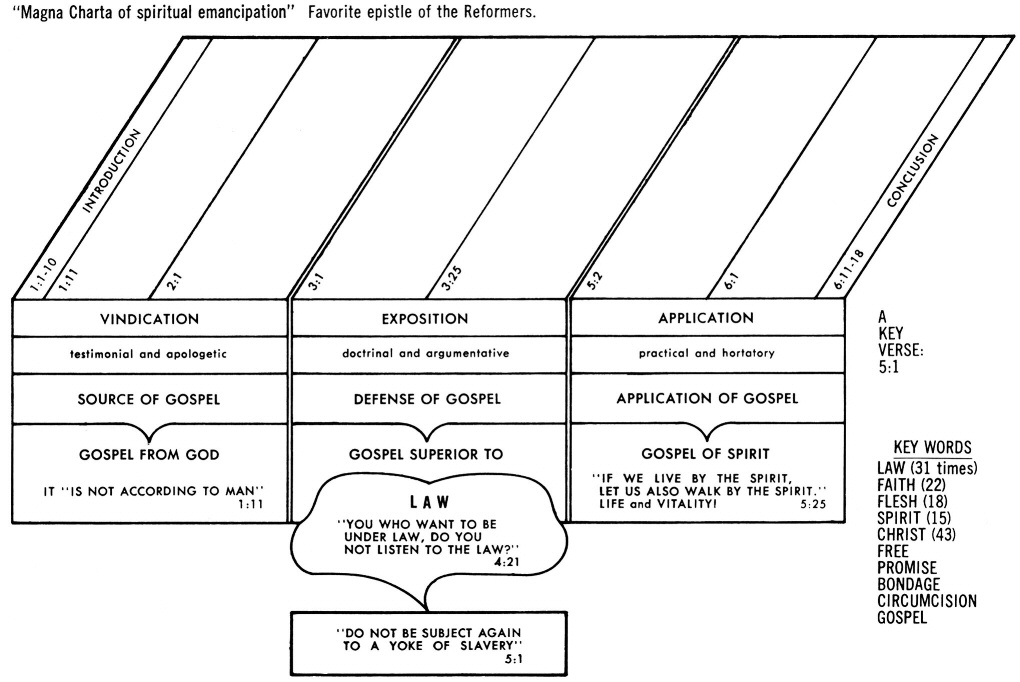
Magna Carta of Spiritual Emancipation
Click chart to enlarge
Charts from Jensen's Survey of the NT - used by permission
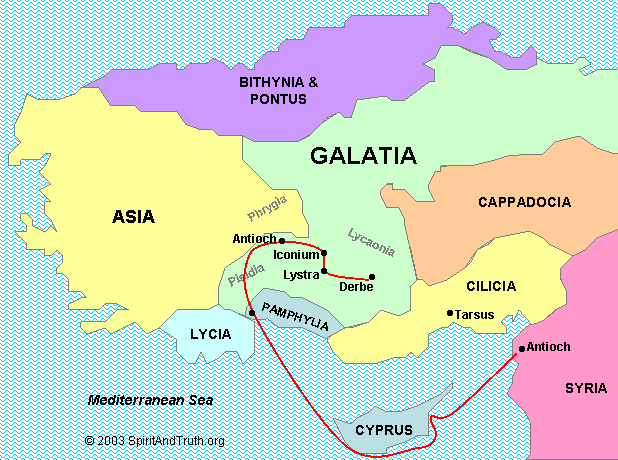
Click to Enlarge
See Also:
Paul's First Missionary Journey
Paul's Second Missionary Journey
Paul's Third Missionary Journey
Maps from Holman Bible Atlas (digital book; Hardcover/Paperback version) copyright © 1998 B&H Publishing Group, used by permission, all rights reserved.
This is one of the best resources for Bible maps as the maps also include helpful short descriptions of the events portrayed on the maps.
| SUMMARY CHART: EPISTLE TO THE GALATIANS |
|||||||
| Gospel of Grace Defended |
Gospel of Grace Explained |
Gospel of Grace Applied |
|||||
| Defense of the Gospel Gal 1:1-2:21 |
Freedom from Legalism Gal 3:1-4:31 |
Freedom to Love and to Serve Gal 5:1-6:18 |
|||||
| Labor | Liberty | Life | |||||
| Authority Not Opinion |
Freedom Not Bondage |
Spirit Not Flesh |
|||||
| Personal Autobiography |
Doctrinal Accuracy |
Practical Application |
|||||
| Paul the Apostle (Gal 1:1-24) |
Paul's Authority (Gal 2:1-21) |
Justified by Faith not Works (Gal 3:1-9) |
Justified by Faith not the Law (Gal 3:10-4:20) |
Grace and Law Cannot Co-Exist (Gal 4:21-31) |
Position and Practice of Liberty (Gal 5:1-15) |
Power of Liberty
(Gal 5:16-26) |
Performance in Liberty
(Gal 6:1-18) |
| Vindication | Exposition | Application | |||||
| Testimonial and Apologetic |
Doctrinal and Argumentative |
Practical and Hortatory |
|||||
| Biographical Explanation |
Doctrinal Exposition |
Practical Exhortation |
|||||
| Authentication of Liberty |
Argumentation for Liberty |
Application of Liberty |
|||||
|
Style or Tone: Vigorous, blunt, aggressive, direct, corrective, urgent, brief, righteous anger, strong words |
|||||||
|
Theme: Justification by Faith and not by Works of the Law |
|||||||
|
Author: Paul in large letters (Gal 6:11) |
|||||||
|
Recipients: Churches in Galatia (Gal 1:2) (Most likely the Southern Region) |
|||||||
|
Christ in Galatians: Jesus is the Source and Power for the believer's New Life. (Gal 2:20, 5:16) |
|||||||
Related Resource: Purpose of the Law
An Outline of Galatians - D Edmond Hiebert
THE INTRODUCTION (Galatians 1:1-10)
1. The salutation (Galatians 1:1-5)
a. The writer (Galatians 1:1-2a)
i. Paul, the Apostle (Galatians 1: 1)
ii. The brethren with him (Galatians 1:2a)
b. The readers (Galatians 1:2b)
c. The greeting (Galatians 1:3-5)
i. The contents of the greeting (Galatians 1:3a)
ii. The source of the grace and peace (Galatians 1:3b-4)
iii. The doxology (Galatians 1:5)
2. The rebuke (Galatians 1:6-10)
a. His astonishment at their fickleness (Galatians 1:6-7)
i. The reason for the astonishment (Galatians 1:6)
ii. The explanation of the departure (Galatians 1:7)
b. His assertion about its seriousness Galatians 1:8-9)
i. The seriousness asserted (Galatians 1:8)
ii. The seriousness reaffirmed (Galatians 1:9)
c. His attitude in the matter (Galatians 1:10)
I. PERSONAL: THE VINDICATION OF HIS APOSTOLIC AUTHORITY (Galatians 1:11-2:21)
1. How he got his Gospel (Galatians 1:11-24)
a. The origin of his Gospel through revelation (Galatians 1: 11-12)
i. The assertion as to its nature (Galatians 1:11)
ii. The manner of its reception (Galatians 1:12)
b. The previous conduct of the one given the revelation (Galatians 1:13-14)
i. The manner of his former life known to them Galatians 1:13a)
ii. The description of his former life (Galatians 1:13b-14)
a. In relation to the Church of God (Galatians 1:13b)
b. In relation to Judaism (Galatians 1:14)
c. The description of the revelation received (Galatians 1:15-17)
i. The source of the revelation (Galatians 1:15)
ii. The subject of the revelation (Galatians 1:16a)
iii. The purpose of the revelation (Galatians 1:16b)
iv. The response to the revelation (Galatians 1:16c-17)
d. His independence of the Jerusalem apostles (Galatians 1:18-24)
i. The first visit to Jerusalem (Galatians 1:18-20)
a. The time of the visit (Galatians 1:18a)
b. The purpose of the visit (Galatians 1:18b)
c. The duration of the visit (Galatians 1:18c)
d. The scope of contacts during the visit (Galatians 1:19-20)
ii. The subsequent absence from Jerusalem (Galatians 1:21-24)
a. The place of his withdrawal (Galatians 1:21)
b. The lack of acquaintance with the Judean churches (Galatians 1:22)
c. The response of the churches to reports about him (Galatians 1:23-24)
2. How his Gospel was confirmed by the apostles at Jerusalem (Galatians 2:1-10)
a. The circumstances of its presentation to them (Galatians 2:1-2)
i. The journey to Jerusalem (Galatians 2:1-2a)
ii. The presentation made at Jerusalem (Galatians 2:2b)
b. The outcome of his presentation of his Gospel to them (Galatians 2:3-10)
i. The maintenance of his position, as seen in Titus Galatians 2:3)
ii. The conflict with the false brethren (Galatians 2:4-5)
a. The presence of the false brethren (Galatians 2:4)
b. The refusal to yield to their demands (Galatians 2:5)
iii. The approval of his Gospel by the Jerusalem leaders (Galatians 2:6-10)
a. Their failure to add anything to his Gospel (Galatians 2:6)
b. Their approval of his Gospel in full (Galatians 2:7-10)
1. The basis of their approval (Galatians 2:7-9a)
2. The expression of their approval (Galatians 2:9b)
3. The one request with their approval (Galatians 2:10)
3. How he rebuked Peter's inconsistent conduct (Galatians 2:11-21)
a. The circumstances when giving the rebuke (Galatians 2:11-13)
i. The fact of his rebuke of Peter (Galatians 2:11)
ii. The reason for his rebuke of Peter (Galatians 2:12)
iii. The effect of the inconsistent conduct of Peter (Galatians 2:13)
b. The justification for giving the rebuke (Galatians 2:14-21)
i. His question of rebuke to Peter (Galatians 2:14)
ii. His explanation of his doctrinal position (Galatians 2:15-21)
a. The insufficiency of the law (Galatians 2:15-18)
1. The discovery of believing Jews about justification (Galatians 2:15-16)
2. The rejection of a conclusion from Peter's action (Galatians 2:17)
3. The significance of a return to law-works (Galatians 2:18)
b. The new life in Christ (Galatians 2:19-21)
1. The effect of the law led to the new life (Galatians 2:19)
2. The nature of the new life (Galatians 2:20)
3. The grace of God nullified by law-keeping (Galatians 2:21)
II. DOCTRINAL: THE EXPOSITION OF JUSTIFICATION BY FAITH (Galatians 3:1-4:31)
1. The elaboration of the doctrine of justification (Galatians 3:1-4:7)
a. The nature of justification as by faith, not law (Galatians 3:1-14)
i. The inconsistency of their conduct (Galatians 3:1-5)
a. The question about their turning from the crucified Christ (Galatians 3:1)
b. The question about the beginning of their Christian life (Galatians 3:2)
c. The question about their method of perfection (Galatians 3:3)
d. The question about their sufferings as believers (Galatians 3:4)
e. The question about the basis of God's work among them (Galatians 3:5)
ii. The example of Abraham's justification (Galatians 3:6-9)
a. The means of Abraham's justification (Galatians 3:6)
b. The identity of the sons of Abraham (Galatians 3:7)
c. The announcement to Abraham concerning Gentile justification by faith (Galatians 3:8)
d. The sharers in the blessings of Abraham (Galatians 3:9)
iii. The deliverance from law-works through Christ (Galatians 3:10-14)
a. The curse upon those under law-works (Galatians 3:10)
b. The inability of law-works to justify (Galatians 3:11-12)
c. The deliverance from the curse through Christ (Galatians 3:13-14)
1. The fact of our deliverance through Christ (Galatians 3:13a)
2. The means of our deliverance from the curse (Galatians 3:13b)
3. The purpose in our deliverance from the curse (Galatians 3:14)
b. The limitations of the law and its relations to faith (Galatians 3:15-4:7)
i. The covenant with Abraham unaltered by the law (Galatians 3:15-18)
a. The illustration of a man's covenant as binding (Galatians 3:15)
b. The fact illustrated is the divine promise to Abraham (Galatians 3:16)
c. The application of the principle of an unalterable covenant (Galatians 3:17-18)
1. The law did not alter the promise (Galatians 3:17)
2. The inheritance is not through law but promise (Galatians 3:18)
ii. The true place and purpose of the law (Galatians 3:19-29)
a. The temporary nature of the law (Galatians 3:19-20)
1. The reason for the adding of the law (Galatians 3:19a)
2. The time limit for the law (Galatians 3:19b)
3. The manner of the establishment of the law (Galatians 3:19c-20)
b. The inability of the law to produce life (Galatians 3:21-22)
1. The law not contrary to the promise (Galatians 3:21a)
2. The law unable to produce life (Galatians 3:21b)
3. The Scripture shut up all to faith in Christ (Galatians 3:22)
c. The law as a child-leader to Christ with His blessings (Galatians 3:23-29)
1. The old position under law (Galatians 3:23-24)
a. The position of confinement under law (Galatians 3:23)
b. The function of the law as child-leader to Christ (Galatians 3:24)
2. The new position in Christ (Galatians 3:25-29)
a. The nature of the new position (Galatians 3:25-26)
b. The entry into the new life (Galatians 3:27)
c. The effect of the new life (Galatians 3:28)
d. The fulfillment of the promise to Abraham (Galatians 3:29)
iii. The contrasted position under law and faith (Galatians 4:1-7)
a. The illustration of the position of the heir as a minor (Galatians 4:1-2)
b. The application of the illustration to believers (Galatians 4:3-6)
1. The condition of bondage as minors (Galatians 4:3)
2. The position as free sons through God's Son (Galatians 4:4-6)
a. The sending of the Son of God (Galatians 4:4-5)
b. The sending of the Spirit of God (Galatians 4:6)
3. The conclusion for the believer (Galatians 4:7)
2. The appeal for them to drop their legalism (Galatians 4:8-31)
a. The acceptance of Jewish legalism is a return to bondage (Galatians 4:8-11)
i. Their past condition of bondage (Galatians 4:8)
ii. Their present deliverance from bondage (Galatians 4:9a)
iii. Their legalism as a return to bondage (Galatians 4:9b-10)
iv. Their action a cause of concern to him (Galatians 4:11)
b. The appeal from his relations to them (Galatians 4:12-20)
i. The appeal for them to adopt his position (Galatians 4:12a)
ii. The reminder of his past relations to them (Galatians 4:12b-14)
iii. The change in their relation to him (Galatians 4:15-18)
iv. The travail he is undergoing for them (Galatians 4:19-20)
c. The appeal from the two contrasted covenants (Galatians 4:21-31)
i. The question to those desiring to be under law (Galatians 4:21)
ii. The story of Abraham's two sons (Galatians 4:22-23)
iii. The allegorical interpretation of the story (Galatians 4:24-30)
a. The two mothers representing two covenants (Galatians 4:24a)
b. The description of the two covenants (Galatians 4:24b-28)
1. The one representing a covenant of bondage (Galatians 4:24b-25)
2. The other representing a covenant of freedom (Galatians 4:26-28)
c. The expulsion of the slave woman and her son (Galatians 4:29-30)
iv. The conclusion from the story (Galatians 4:31)
III. PRACTICAL: THE LIFE OF CHRISTIAN LIBERTY (Galatians 5:1-6:10)
1. The call to maintain their Christian liberty (Galatians 5:1)
2. The peril to Christian liberty (Galatians 5:2-12)
a. The peril to them in circumcision (Galatians 5:2-6)
i. The consequences of accepting circumcision (Galatians 5:2-4)
a. It renders Christ useless to them (Galatians 5:2)
b. It makes a man debtor to do the whole law (Galatians 5:3)
c. It severs them from Christ (Galatians 5:4a)
d. It constitutes a fall from grace (Galatians 5:4b)
ii. The attitude of the true believer (Galatians 5:5-6)
b. The condemnation of the false teacher (Galatians 5:7-12)
i. The explanation for their defection (Galatians 5:7)
ii. The characterization of the teaching (Galatians 5:8-9)
iii. The condemnation of the one troubling them (Galatians 5:10-12)
a. The confidence he has in them (Galatians 5:10a)
b. The troubler will bear his judgment (Galatians 5:10b)
c. The refutation of charges that he preaches circumcision (Galatians 5:11)
d. The wish that these teachers would go to the consistent end (Galatians 5:12)
3. The life of Christian liberty (Galatians 5:13-6:10)
a. It is directed by love (Galatians 5:13-15)
i. The believer called to liberty (Galatians 5:13a)
ii. The use of Christian liberty (Galatians 5:13b)
iii. The fulfillment of the law through love (Galatians 5:14)
iv. The results of the lack of love (Galatians 5:15)
b. It is a walk in the Spirit, not in the flesh (Galatians 5:16-25)
i. The command to walk by the Spirit (Galatians 5:16)
ii. The conflict between the Spirit and the flesh (Galatians 5:17-18)
iii. The contrasted products of the flesh and the Spirit (Galatians 5:19-23)
a. The works of the flesh (Galatians 5:19-21)
b. The fruit of the Spirit (Galatians 5:22-23)
iv. The persons living by the Spirit (Galatians 5:24-25)
c. It is a life of mutual burden-bearing (Galatians 5:26-6:10)
i. The burden of moral faults (Galatians 5:26-6:5)
a. The warning against wrong attitudes towards others (Galatians 5:26)
b. The attitude of humility in restoring the fallen (Galatians 6:1)
c. The duty of mutual burden-bearing (Galatians 6:2)
d. The proper attitude toward self (Galatians 6:3-5)
ii. The burden of temporal needs (Galatians 6:6-10)
a. The exhortation to communicate with their teachers (Galatians 6:6)
b. The law of the spiritual harvest (Galatians 6:7-8)
c. The encouragement to welldoing (Galatians 6:9-10)
THE CONCLUSION (Galatians 6:11-17)
1. His reference to his large letters (Galatians 6:11)
2. His rebuke of his adversaries (Galatians 6:12-13)
3. His confidence in the cross (Galatians 6:14-16)
a. His glorying only in the cross (Galatians 6:14a)
b. His crucifixion through the cross (Galatians 6:14b)
c. His evaluation of things through the cross (Galatians 6:15)
d. His benediction upon those accepting this principle (Galatians 6:16)
4. His marks of apostleship (Galatians 6:17)
THE BENEDICTION (Galatians 6:18)
Galatians 5:19 Now the deeds of the flesh are evident, which are: immorality, impurity, sensuality, (NASB: Lockman)
Greek: phanera de estin (3SPAI) ta erga tes sarkos, atina estin (3SPAI) porneia, akatharsia, aselgeia,
Amplified: Now the doings (practices) of the flesh are clear (obvious): they are immorality, impurity, indecency, (Amplified Bible - Lockman)
Barclay: The deeds of the lower side of human nature are obvious—fornication, impurity, wantonness, (Westminster Press)
KJV: Now the works of the flesh are manifest, which are these; Adultery, fornication, uncleanness, lasciviousness,
NLT: When you follow the desires of your sinful nature, your lives will produce these evil results: sexual immorality, impure thoughts, eagerness for lustful pleasure, (NLT - Tyndale House)
Phillips: The activities of the lower nature are obvious. Here is a list: sexual immorality, impurity of mind, sensuality, (Phillips: Touchstone)
Weymouth: Now you know full well the doings of our lower natures. Fornication, impurity, indecency, idol-worship, sorcery;
Wuest: Now the works of the evil nature are well known, works of such a nature as, for example, fornication, uncleanness, wantonness, (Eerdmans Publishing - used by permission)
Young's Literal: idolatry, witchcraft, hatred, strifes, emulations, wraths, rivalries, dissensions, sects,
NOW THE DEEDS OF THE FLESH ARE EVIDENT, WHICH ARE: IMMORALITY, IMPURITY, SENSUALITY: phanera de estin (3SPAI) ta erga tes sarkos, atina estin (3SPAI) porneia, akatharsia, aselgeia:
- Gal 5:13,17; 6:8; Ps 17:4; John 3:6; Romans 7:5,18,25; 8:3,5,9,13; 1Corinthians 3:3; 1Peter 4:2
- Immorality - Ezek 22:6, 7, 8, 9, 10, 11, 12, 13; Mt 15:18,19; Mk 7:21, 22, 23; Ro 1:21,-32; 1Co 6:9,10; 2 Co 12:20,21; Ep 4:17, 18, 19; 5:3, 4, 5, 6; Colo 3:5, 6, 7, 8; 1 Ti 1:9,10; Titus 3:3; James 3:14,15; 1 Pe 4:3,4; Rev 21:8; 22:15)
As an introductory thought before expositing this "ugly list", it is noteworthy that as I have read many sermons and commentaries on walking in the Spirit and not the flesh, I have observed that there is a definitive tendency to only briefly exposit these vile vices. It is not that the authors and pastors don't recognize the seriousness of these sins, but that they nevertheless seem to "shy away" from discussing them in any depth. This list is not "fun" to write commentary on, and is in some ways very "painful", as it is like picking up a mirror and looking at my own face. It seems to me that although we certainly should not "major" on these negatives, neither should we gloss them over as "dirty sins" (which they are), but that we should do what God calls us to do with all of Scripture… we should meditate on these painful passages… we should seek to grasp their heinousness… we should seek to recognize how offensive they are to God's holiness, etc, etc. Then, having our senses trained, we might be forearmed the next time our unredeemed flesh seeks to cause us to act out or lash out with one of these sins. Thus armed with God's truth, we can instead choose the will of God, and praise Him for His enabling grace to walk in the power of His Spirit, Who gives us the victory in Christ Jesus our Lord. Amen.
James Montgomery Boice introduces the two sets of lists explaining that "the lists are more than a mere proof of what he has written earlier. For by raising these particulars of conduct, Paul also provides a checklist for measuring the conduct of those who consider themselves spiritual. If one's conduct is characterized by the traits in the first list, then he is either not a believer or else a believer who is not being led by God's Spirit. The same standards of evaluation hold true for churches. (Gaebelein, F, Editor: Expositor's Bible Commentary)
How to you know if you are walking in the Spirit? Too often we talk as if this is some mystical experience available only to a select few who know the secret of the victorious Christian life. Paul does away with the "mystery" and says it will be evident - clearly if the flesh is continuously hostile to the Spirit, it follows that when the deeds of the flesh are evident in our lives we are not walking by the Spirit, allowing ourselves to be led by the Spirit or keeping in step with the Spirit. Paul's point in this very practical section is that the works of the flesh are plainly visible so that fleshly behavior (often referred to as carnal behavior) is readily apparent to all observers. In other words, to use a Biblical analogy, "the tree is known by its fruit", in this case "bad fruit" or more accurately the deeds or works.
The Greek literally reads evident now are… which clearly emphasizes the visibility of these deeds. There are in plain view and obvious to one and all. While the flesh nature per se may not be visible, its deeds are clearly erupt forth in public works and words! Paul now proceeds to list some (but far from all) of the deeds that emanate from the desire of the flesh (Gal 5:16), which the KJV terms the lust of the flesh. When we hear "lust" we immediately think "sexual", but clearly that is not the sole manifestation of the depraved flesh as indicated by this "vice list" of 15 sins, which have been categorized roughly into 4 categories - sexual (sensual sins), religious (idolatry and sorcery), social (interpersonal relations) and drink.
Lightfoot comments that "Though no systematic classification is to be looked for in the catalogue which follows, yet a partial and unconscious arrangement may perhaps be discerned. The sins here mentioned seem to fall into four classes: (1) Sensual passions, ‘fornication, uncleanness, licentiousness’; (2) Unlawful dealings in things spiritual, ‘idolatry, witchcraft’; (3) Violations of brotherly love, ‘enmities… murders’; (4) Intemperate excesses, ‘drunkenness, revellings.’ From early habit and constant association a Gentile Church would be peculiarly exposed to sins of the first two classes. The third would be a probable consequence of their religious dissensions, inflaming the excitable temperament of a Celtic people. The fourth seems to be thrown in to give a sort of completeness to the list, though not unfitly addressed to a nation whose Gallic descent perhaps disposed them too easily to these excesses (Epistle of St Paul to the Galatians)
C Norman Bartlett - Having reminded his readers that a relentless warfare between the old nature and the new nature is inescapable, the apostle in the remainder of Galatians 5 draws a picture of the sharp and vivid contrast between the works of the flesh and the fruits of the Spirit. We turn to his comprehensive catalogue of the sins of the flesh in Galatians 5:19-21. It may be well to remind ourselves again at this point that the word "flesh" here indicates not the body - although that is included - but the natural man, the old nature. "Now the works of the flesh are manifest … " Let us pause right here. "The works of the flesh are manifest" - that is to say, they are going to be shown for what they really are, in all their naked hideousness. The Word strips of glamour the sins that the world clothes with glamour. We do well from time to time to gaze upon the loathsome picture of sin which Scripture paints. But the average man pays more heed to the world's light estimate of sin than to what GOD says about it, blissfully unmindful of the fact that the sins which men call smart will smart throughout all eternity unless they are washed away in the penitently accepted blood of Jesus. Our souls are the more easily tarnished by the sins that are varnished (Ed note: covered or concealed in such a way as to making it superficially attractive). The fashion of sin is not changed by making it fashionable. Changing the label on the bottle does not convert poison into a harmless beverage. Would that men could see that the exciting currents of sin upon which they so gleefully launch their lives are but carrying them to the cataract (a large waterfall over a precipice) of eternal ruin where the mirth of each gives way to the gloom of doom! (C. Norman Bartlett: Galatians and You: Studies in the Epistle of Paul to the Galatians, 1948)
Spurgeon on deeds of the flesh - A black catalogue, but sin is very prolific. There are four classes of sins mentioned here. First Paul mentions sins of lust. Next, idolatry and witchcraft. Then follows a third set, which may be classed under the head of sins of temper. Lastly Paul mentions sins of appetite. We must take care that we avoid each one of these works of the flesh, or else we shall give no proof that we are led by the Spirit of God and possess the grace of God. No matter what they profess, or what sacraments they may partake of, those who live in these sins are not alive unto God.
Deeds (2041) (ergon from ergo = to work) refers to toil as an effort or occupation. This suggests my fallen diligently "works at" evil!
Jamieson - The hidden fleshly principle betrays itself palpably by its works, so that these are not hard to discover, and leave no doubt that they come not from the Spirit. (Jamieson, Fausset, Brown )
Flesh (4561) (sarx) is used here to refer not to the physical flesh but to that aspect in man which is orientated toward self (self will, self effort, selfish, etc). The flesh then is our fallen nature, inherited from Adam, which is prone to commit sins, is opposed to God and which incessantly seeks its own ends. Flesh is the urge within us toward total autonomy (self-directing freedom and especially moral independence. It is that aspect of fallen human nature that does not relish the things of God and prefers to get satisfaction from independence, power, prestige, and worldly pleasures. See chart contrasting in the flesh vs in the Spirit
In short, flesh is all that one is separated from God.
Kistemaker quips that "What today is often called “sickness” is by Scripture called “obvious work of the flesh.” (Hendriksen, W., & Kistemaker, S. J. NT Commentary Set. Exposition of Galatians Baker Book)
Are (2076) (estin) is in the present tense indicating that these deeds are continually obvious. In other words one can readily discern when they are being "energized" by the flesh rather than the Spirit.
Evident (5318) (phanerós = manifest, visible, conspicuous, from phaino = give light to shine; become visible from phos = light) means visible, apparent or manifest (as opposed to that which is hidden). It stresses what is visible to the sight so that anyone may see. Phaneros pertains to being clearly and easily able to be known. The idea of these deeds or works of the flesh is that they are plain or open, with overtones of being unashamed and blatant. Paul appeals to their common knowledge. The flesh may be concealed within us but it betrays itself by its own works, so that is recognition is easy.
Vincent phrases it this way…
You have a clearly defined standard by which to decide whether you are led by the Spirit or by the flesh. Each exhibits its peculiar works or fruits.
James Montgomery Boice explains that…
When Paul says that the acts of the flesh are obvious, he does not mean that they are all committed publicly where they may be seen. Some are, some are not. Instead, he means that it is obvious to all that such acts originate with the sinful nature, and not with the nature given believers by God. (Gaebelein, F, Editor: Expositor's Bible Commentary 6-Volume New Testament. Zondervan Publishing)
Steve Zeisler offers some very insightful remarks on the phrase the deeds of the flesh are evident writing that…
The flesh brings us temptations in such attractive guise that it's often difficult to know when we are being tempted to turn our freedom into fleshly indulgence. The flesh disguises its temptations magnificently, but the results are always the same: sin always pays its servants, and the wages of sin is always death. If we are willing to be honest about what is happening to us, if we are willing to look at ourselves as we really are, then we will either see that the flesh is producing its deeds--strife, enmity, immorality, sorcery, drunkenness--or we will see that the Spirit of God is truly producing his fruit in our lives and there is more love, more real joy, greater peace and more self-control than ever before.
In the well-known story of the emperor's new clothes, a foolish emperor is tricked by wily tailors who claim to have made him a suit so beautiful, raiment so glorious that it is absolutely astonishing to behold. When the king looks in the mirror, however, he cannot see these new clothes. In fact, it seems to him that he is in his underwear. But he doesn't admit that because the tailors keep praising his beautiful new clothes. In a big parade everybody in the crowd reacts the same way: they assume there is a problem with them. Finally, one little boy says, "The emperor has no clothes." The bubble is burst, to the embarrassment of the king. The crowd breaks into laughter.
The point that Paul is making here is if we are willing to be honest, if we are willing to look at things as they really are and not hide behind clever tricks, then when we are in the flesh (Ed note: Behaving fleshly or living according to the fleshly impulses) it will be quite obvious to us. Likewise, if the Spirit is bearing His fruit that too will be obvious; it will not be hard to discover. The difficulty is in being honest, in being willing to examine ourselves. The deeds of the flesh, Paul declares, are evident.
I once played in a football game following a torrential downpour. It was a mud bowl. The light was bad. The rain was falling. By the end of the game it was absolutely impossible to tell who was on our team and who was not, because of the mud. When we called plays we didn't know whether we were running into our opponents or into our own team. But in this conflict that Paul is talking about, the apostle says that you can always tell what's going on if you are willing to be honest. The jerseys always are clearly distinguishable. The difficulty for us is in being willing to be honest. People are forever excusing sin by saying, "It's modern, it's scholarly, it's advanced, it's different." A whole litany can be recited as to why a particular activity ought to be put in a "right" category. But Christian honesty must agree that immorality is not changed by being named something else. I may offer all kinds of justification for why I am doing what I am doing, but if at the end of the process I am filled with anger and envy, that is the flesh. "The deeds of the flesh are evident." (See his entire sermon Fight the Good Fight)
C Norman Bartlett organizes this list of vices into…
the following threefold division: (1) sensual works of the flesh, (2) religious works of the flesh, and (3) social works of the flesh. We could classify them as sins of impurity, idolatry, hostility and revelry. In any event, the list of moral offenses here given by the apostle is suggestive merely, and by no means exhaustive. All of us, it is to be feared, are prone to let our freedom from certain types of sins blind us to our bondage to other kinds no less hateful, and perhaps even more hateful, in the sight of the Lord. Are sins of the mind less revolting to Him than those of the flesh?
Adultery, fornication, uncleanness, lasciviousness… Never, perhaps, has there been a day when it was more difficult to live a clean life than at this present time. Appeals to the flesh abound on every hand. Indecency is brazenly flaunted before our eyes. The vileness in our current magazines know no bounds. If it be true that "as goes the home, so goes the nation," then there is grave cause for concern as to the future of our beloved country in the steadily mounting divorce rate and the trail of broken homes from one end of the land to the other. (Ed note: And this was published in 1948! Woe!) Sensual sins of all kinds are frightfully prevalent in all strata of American society. (C. Norman Bartlett: Galatians and You: Studies in the Epistle of Paul to the Galatians, 1948)
Spurgeon comments that…
Any kind of sensual indulgence — whatever it may be — a lustful glance, the cherishing of an unclean desire,— the utterance of a foul expression, all this is condemned, as well as the overt acts of adultery and fornication.
Immorality (4202)(porneia from porneúo = commit fornication or any sexual sin) originally referred to any excessive behavior or lack of restraint, but eventually became associated with sexual excess and indulgence, of every kind of extramarital, unlawful, or unnatural sexual intercourse.
Immorality was scarcely reckoned as a sin in the opinion of most of the pagan Gentiles in Paul's day (sounds very familiar to our modern amoral culture!) And so Paul begins with immorality, not because it was worse than the fourteen other vices, but because immorality was the most open and shameless vice in the Greek and Roman "culture".
Porneia originally was used especially to describe the practice of consorting with prostitutes (porneis = “prostitute”) and eventually came to mean “habitual immorality.” Porneia is the opposite of the Greek word enkrateia/egkrateia (literally "holding oneself in"), which usually referred to sexual self-control (see Acts 24:25)
Porneia as used in the Scriptures describes any illicit sexual activity outside of the divine bounds established by marriage and thus includes the ideas of unlawful sexual intercourse, unchastity and fornication.
Porneia includes including (but not limited to) adultery, premarital sex, homosexuality, bestiality, incest, and prostitution. As an aside, porneia refers primarily to sins of the flesh, but those sins can never be divorced from the sins of the mind or heart, because all sin is related. Sin in one area always makes us more susceptible to sin in other areas. Whenever the NT mentions immorality, there is at least an implied condemnation. Certainly no where does Scripture sanction the commitment of any form of extramarital sexual activity… a far cry from our modern American culture!
As an aside, porneia refers primarily to sins of the flesh, but those sins can never be divorced from the sins of the mind or heart, because all sin is related. Sin in one area always makes us more susceptible to sin in other areas (don't be deceived). No where does Scripture sanction the commitment of any form of extramarital sexual activity… a far cry from our modern American culture!
Our English word pornography is from porneia + graph = a writing and thus pornography (or colloquially "porn") is thus a writing (or picture) relating to sexual sin (missing the mark).
Expositors Greek Testament writes that…
The term porneia (fornication) is to be taken in its proper sense and is not to be restricted to any one particular form—the license practiced at heathen festivals, concubinage, marriage within prohibited degrees, or the like. The moral life of the Greco-Roman world had sunk so low that, while protests against the prevailing corruption were never entirely wanting, fornication had long come to be regarded as a matter of moral indifference, and was indulged in without shame or scruple, not only by the mass, but by philosophers and men of distinction who in other respects led exemplary lives.” (Nicoll, W Robertson, Editor: Expositors Greek Testament: 5 Volumes. Out of print. Search Google) (Comment: Does this comment remind you of any modern day society?)
Christianity brought chastity, a virtue that was foreign to the Greco-Roman world. Into this world of pagan idolatry where sexual immorality was not only condoned, but regarded as normal, the Christian faith came as a purifying fire. Twentieth-century America has reverted back to the “normality of sexual immorality” and the revival fire of the Christian faith is desperately needed.
Remember the context of the society Paul was addressing. In the Greek culture of that day, prostitution and fornication were considered permissible activities. A married man in Greece cold engage in extramarital sexual intercourse as much as he wished, but this practice was forbidden for the wife! Athenaeus, a writer in the second century AD, quotes from a speech of Demosthenes,
“We keep mistresses for pleasure, concubines for daily concubinage, but wives we have in order to produce children legitimately and to have a trustworthy guardian of our domestic property.”
Kenneth Wuest records that "The moral life of the Greco-Roman world had sunk so low that, while protests against the prevailing corruption were never entirely wanting, fornication had long come to be regarded as a matter of moral indifference, and was indulged in without shame or scruple, not only by the mass, but by philosophers and men of distinction who in other respects led exemplary lives. (Galatians Commentary - Verse by Verse)
In Acts the early church condemned all sexual experimentation outside of marriage James declaring that the Gentiles who were turning to God from idols be instructive
"that they abstain from things contaminated by idols and from fornication (porneia - in this context the reference is to sexual sins in general but orgies that were associated with the worship of the pagan idols) and from what is strangled and from blood." (Acts 15:20)
As discussed elsewhere the association of idolatry and immorality is frequently noted in Scripture.
In Romans 1 Paul clearly links idolatry with immorality writing…
"Professing to be wise, they became fools, 23 and exchanged the glory of the incorruptible God for an image in the form of corruptible man and of birds and four-footed animals and crawling creatures (idolatry). 24 Therefore God gave them over (a judicial term in Gr., used for handing over a prisoner to his sentence. When men consistently abandon God, He will abandon them) in the lusts of their hearts to impurity (a general term describing decaying matter, like the contents of a grave and in context speaks of sexual immorality), that their bodies might be dishonored among them. 25 For they exchanged the truth of God for a lie (an idol is a lie, a false representation of God), and worshiped and served the creature (idolatry) rather than the Creator, who is blessed forever. Amen. 26 For this reason God gave them over (God's judicial sentence because of their idolatry was to deliverer them over to the power of) to degrading (dishonoring, disgracing, shameful) passions (which resulted in erotic activity with members of their own sex); for their women exchanged the natural function for that which is unnatural, 27 and in the same way also the men abandoned the natural function of the woman and burned in their desire toward one another, men with men committing indecent acts and receiving in their own persons the due penalty of their error." (Romans 1:22-27)(see notes beginning with Ro 1:22)
In Paul’s day Corinth was like much of our culture today, for people were strongly intent on having their own ways, doing what was right in their own eyes, and this aberrant behavior was especially manifest in fulfilling their physical lust. Corinth was so conspicuous for its immorality that to “corinthianize” was the term for reckless debauchery. And so sexual permissiveness was rampant and then, as now the church was not unaffected. Sensuality in the guise of religion was rife. And so Paul writing to the Corinthian church declares that
"It is actually reported that there is immorality (porneia) among you, and immorality (porneia) of such a kind as does not exist even among the Gentiles, that someone has (present tense = an ongoing, habitual activity) his father's wife." (1Cor 5:1 read the entire chapter which is devoted to immorality in the church - and by the way - this chapter is directed not so much to those committing immorality but to the church who stood by doing nothing about it and in fact arrogantly refusing to do anything about it!)
Sexual sin not only is against God and other persons, it is also against ourselves. Part of our moral responsibility to ourselves is to be sexually pure. When Christians are immoral, the testimony of the gospel is polluted.
Don't dabble with porneia, (and "pornography") trifle with it, argue about it, debate it, explain it and certainly don't try to rationalize as a "spiritual challenge" to be met but as a "spiritual trap" to be escaped. Solomon tragically knew from personal experience that…
His own iniquities will capture the wicked, and he will be held with the cords of his sin. (Pr 5:22)
Comment: Divine justice is seen in that the wicked get ensnared in their own iniquities. This general principle is especially true of adultery. One act leads to another, especially if punishment for the sin is delayed. Each repetition of sin becomes like a strand in the rope with which a sinner is held in bondage.
IMPURITY
Impurity (167) (akatharsia [word study] from a = without + kathairo = cleanse) is a broad term referring to moral uncleanness in thought, word, and deed. It describes a state of moral impurity, especially sexual sin. The term akatharsia refers to filth or refuse. Akatharsia is moral defilement whether in the form of lust or profligate living. It is a state of moral impurity related to thought, action or speech.
Akatharsia - 10x in 10v - NAS = impurity(9), uncleanness(1).
Mt 23:27; Ro 1:24; Ro 6:19; 2Cor 12:21; Gal 5:19; Ep 4:19; Ep 5:3; Col 3:5; 1Th 2:3; 1Th 4:7
Akatharsia - 42x in the non-apocryphal Septuagint -
Lev 5:3; 7:20f; 15:3, 24ff, 30f; 16:16, 19; 18:19; 19:23; 20:21, 25; 22:3ff; Num 19:13; 2 Sam 11:4; 2 Chr 29:5, 16; Ezra 6:21; 9:11; Prov 6:16; 24:9; Jer 19:13; 32:34; Lam 1:9; Ezek 4:14; 7:20; 9:9; 22:10, 15; 24:11; 36:17, 25, 29; 39:24; Hos 2:10; Mic 2:10; Nah 3:6
Akatharsia describes a filthiness of heart and mind (so it is internal as compared to anomia discussed below) that makes the person defiled. The unclean person sees dirt in everything. The word akatharsia suggests especially that it defiles its participants, making them unusable for sacred purpose. While akatharsia includes sexual sin, it comes from a wider Septuagint (Greek translation of the Hebrew OT) usage where “unclean” could refer to anything that made a person unfit to go to the temple and appear before God. In a medical sense Hippocrates used this word to describe an infected, oozing wound with pus and crusty impurities that gather around the sore or wound. What is “impure” is filthy and repulsive, especially to God. Akatharsia was a general term often used of decaying matter, like the contents of a grave. In short akatharsia describes any excessive behavior or lack of restraint and speaks more of an internal disposition. An immoral filthiness on the inside whereas the lawless acts of ''immorality'' are on the outside.
Barton says that akatharsia refers to…
Moral uncleanness. Perhaps no sexual act has taken place, but the person exhibits a crudeness or insensitivity in sexual matters that offends others and leads them to false conclusions about the other person’s character. An example today would be the excessive use of sexual humor (or what is supposed to be humor), where people make statements with a sexual double meaning. (Barton, B. B., et al. Life Application Bible Commentary. Romans: Tyndale House Publishers)
William Barclay writes that akatharsia means "everything which would unfit a man to enter into God’s presence. It describes the life muddied with wallowing in the world’s ways. Kipling prayed, “Teach us to rule ourselves always, Controlled and cleanly night and day.” (Galatians 5 Commentary)
Akatharsia is the very opposite of that clean purity… It can be used for the pus of an unclean wound, for a tree that has never been pruned, for material which has never been sifted. In its positive form (katharos, an adjective meaning pure) it is commonly used in housing contracts to describe a house that is left clean and in good condition. But its most suggestive use is that katharos is used of that ceremonial cleanness which entitles a man to approach his gods. Impurity, then, is that which makes a man unfit to come before God, the soiling of life with the things which separate us from him… Jesus used the word to describe the rottenness of decaying bodies in a tomb (Matthew 23:27). The other ten times the word is used in the New Testament it is associated with sexual sin. It refers to immoral thoughts, passions, ideas, fantasies, and every other form of sexual corruption." (Galatians 5 Commentary) (Bolding added)
SENSUALITY
Sensuality (766) (aselgeia from aselges = licentious <> a = negates next word + selges = continent) originally referred to any excess or lack of restraint but came to convey the idea of shameless excess and the absence of restraint, especially with sexual excess. Thus like koite, aselgeia was used almost exclusively of especially lewd sexual immorality, of uninhibited and unabashed lasciviousness. It refers to the kind of sexual debauchery and abandonment that characterizes much of modern society and that is often flaunted almost as a badge of distinction! Aselgeia refers to uninhibited sexual indulgence without shame and without concern for what others think or how they may be affected (or infected). It describes absence of restraint and reckless sinning with little sense of shame even though it shocks public civility because of its lack of regard for society.
Aselgeia - 11x in 11v - Mark 7:21; Rom 13:13; 2 Cor 12:21; Gal 5:19; Eph 4:19; 1 Pet 4:3; 2 Pet 2:2, 7, 18; Jude 1:4. NAS = licentiousness(1), sensual(1), sensuality(8).
The Greeks defined aselgeia as “a disposition of soul that resents all discipline,” as “a spirit that acknowledges no restraints, dares whatsoever its caprice and wanton insolence may suggest.”
Eadie comments that aselgeia
It is the self-asserting propensity indulged without check or regard to ordinary propriety, especially in libidinous gratification. (Eadie: Epistle of St Paul to the Galatians)
MacArthur writes that…
Aselgeia (sensuality) refers to total licentiousness, the absence of all moral restraint, especially in the area of sexual sins. One commentator says the term relates to “a disposition of the soul incapable of bearing the pain of discipline.” The idea is that of unbridled self–indulgence and undisciplined obscenity…
All people initially recognize at least some standard of right and wrong and have a certain sense of shame when they act against that standard. Consequently, they usually try to hide their wrongdoing. They may continually fall back into it but still recognize it as wrong, as something they should not be doing; and conscience will not let them remain comfortable. But as they continue to overrule conscience and train themselves to do evil and to ignore guilt, they eventually reject those standards and determine to live solely by their own desires, thereby revealing an already seared conscience. Having rejected all divine guidelines and protection, they become depraved in mind and give themselves over to sensuality. Such a person cares nothing about what other people think—not to mention about what God thinks—but only about what gratifies the cravings of his own warped mind. (MacArthur, J: Ephesians. Chicago: Moody Press)
Barclay writes that aselgeia…
does not solely mean sexual uncleanness; it is sheer wanton insolence. As Basil defined it, “It is that attitude of the soul which has never borne and never will bear the pain of discipline.” It is the insolence that knows no restraint, that has no sense of the decencies of things, that will dare anything that wanton caprice demands, that is careless of public opinion and its own good name so long as it gets what it wants… It has been defined as “readiness for any pleasure.”…
The great characteristic of aselgeia is this—the bad man usually tries to hide his sin (they have enough respect for common decency not to wish to be found out); but the man who has aselgeia in his soul does not care how much he shocks public opinion so long as he can gratify his desires… the man who is guilty of aselgeia is that he is lost to decency and to shame… he does not care who sees his sin. It is not that he arrogantly and proudly flaunts it; it is simply that he can publicly do the most shameless things, because he has ceased to care for decency at all… Sin can get such a grip of a man that he is lost to decency and shame. He is like a drug taker who first takes the drug in secret, but comes to a stage when he openly pleads for the drug on which he has become dependent. A man can become such a slave of liquor that he does not care who sees him drunk. A man can let his sexual desires so master him that he does not care who sees him satisfy them… It has been defined as “readiness for any pleasure.”…
Jezebel was the classic instance of aselgeia when she built a heathen shrine in Jerusalem the Holy City. Josephus ascribed it to Jezebel when she built a temple to Baal in Jerusalem. The idea is that of a man who is so far gone in desire that he has ceased to care what people say or think… Aselgeia is the insolently selfish spirit, which is lost to honour, and which will take what it wants, where it wants, in shameless disregard of God and man. (Galatians 5 Commentary)
Galatians 5:20 idolatry, sorcery, enmities, strife, jealousy, outbursts of anger, disputes, dissensions, factions, (NASB: Lockman)
Greek: eidololatria, pharmakeia, ecthrai, eris, zelos, thumoi, eritheiai, dichostasiai, haireseis,
Amplified: Idolatry, sorcery, enmity, strife, jealousy, anger (ill temper), selfishness, divisions (dissensions), party spirit (factions, sects with peculiar opinions, heresies), (Amplified Bible - Lockman)
Barclay: Idolatry, witchcraft, enmity, strife, jealousy, uncontrolled temper, self-seeking, dissension, heretical division, (Westminster Press)
KJV: Idolatry, witchcraft, hatred, variance, emulations, wrath, strife, seditions, heresies,
NLT: idolatry, participation in demonic activities, hostility, quarreling, jealousy, outbursts of anger, selfish ambition, divisions, the feeling that everyone is wrong except those in your own little group, (NLT - Tyndale House)
Phillips: worship of false gods, witchcraft, hatred, quarrelling, jealousy, bad temper, rivalry, factions, party-spirit, (Phillips: Touchstone)
Weymouth: enmity, strife, jealousy, outbursts of passion, intrigues, dissensions, factions, envyings;
Wuest: idolatry, witchcraft, enmities, strife, jealousy, angers, self-seekings, divisions, factions, (Eerdmans Publishing - used by permission)
Young's Literal: idolatry, witchcraft, hatred, strifes, emulations, wraths, rivalries, dissensions, sects,
IDOLATRY, SORCERY, ENMITIES, STRIFE, JEALOUSY, OUTBURSTS OF ANGER, DISPUTES, DISSENSIONS, FACTIONS: eidololatria, pharmakeia, ecthrai, eris, zelos, thumoi, eritheiai, dichostasiai, haireseis:
- Ezekiel 22:18; Deuteronomy 18:10; 1Samuel 15:23; 1Chronicles 10:13,14; 2Chronicles 33:6; Acts 8:9, 10, 11; Acts 16:16, 17, 18, 19) (2Corinthians 11:19; Titus 3:10; 2Peter 2:1
C Norman Bartlett writes that…
MAN MADE GODS…
GOD MADE MEN
Idolatry… That man is incurably religious and will worship false gods rather than none at all, the non-Christian religions of the world abundantly prove. But in so-called Christian lands hosts of men and women, who would never sink to such depths of ignorance and superstition as to bow down to images of wood and stone, are nevertheless worshipers of idols - wealth, pleasure, power, fame. These they set upon the throne of their hearts which none but God has a right to occupy. How much better off the world would be if man-made gods were to give way to God-made men! (C. Norman Bartlett: Galatians and You: Studies in the Epistle of Paul to the Galatians, 1948)
IDOLATRY
Idolatry (1495) (eidololatreia from eidolon = idol + latreia = service, worship) (See multiple Bible dictionary articles on idolatry) speaks of extreme admiration or reverence for something other than God. Idolatry more specifically is the worship of something created which is in direct opposition to the worship of the Creator Himself. Originally, a physical idol helped visualize the god it represented but later people worshipped the physical object itself (Ro 1:19; 20; 21; 22; 23 see notes Ro 1:19; 20; 21; 22; 23).
Paul explains the "pathogenesis" of idolatry in Romans 1 explaining that…
Romans 1:18 (note) the wrath of God is revealed from heaven against all ungodliness and unrighteousness of men, who suppress the truth in unrighteousness, 19 because that which is known about God is evident within them; for God made it evident to them. 20 For since the creation of the world His invisible attributes, His eternal power and divine nature, have been clearly seen, being understood through what has been made, so that they are without excuse.21For even though they knew God, they did not honor Him as God, or give thanks; but they became futile in their speculations, and their foolish heart was darkened.
EXCHANGE OF GOD
FOR IDOLATRY
22 Professing to be wise, they became fools, 23 and exchanged the glory of the incorruptible God for an image in the form of corruptible man and of birds and four-footed animals and crawling creatures. 24 Therefore God gave them over in the lusts of their hearts to impurity, that their bodies might be dishonored among them. 25 For they exchanged the truth of God for a lie, and worshiped and served the creature rather than the Creator, Who is blessed forever. Amen.
In Paul's day, clearly idolatry referred to worship of carved images, leaders who foolishly "deified" themselves, etc, but in our day the "idols" have adapted to our modern culture and take on manifold manifestations including sports, pop stars, possessions, money, and the list goes on an on. The principle of course is that anything that receives our adoration other than the only One Who rightly desires it has become an idol in our life. The warnings by Paul (see passage below from 1 Corinthians) and John are still apropos and need to be heeded by all saints…
Little children, guard (phulasso - aorist imperative) yourselves from idols. (1 John 5:21) (Comment: Note John's focus is "yourselves"!)
Eerdman's writes that idolatry…
In the Old Testament, the worship of gods other than Yahweh, especially through images representing them. The New Testament extends the concept to include any ultimate confidence in something other than God, e.g., covetousness, surrender to appetites (see Eph 5:5; Php 3:19; Col 3:5; cf. "two masters " - Mt 6:24 ; 1Sa 15:23). (Myers, A. C.. The Eerdmans Bible dictionary. Grand Rapids, Mich.: Eerdmans)
Morris has an interesting note on the meaning of idols writing that they…
are either physical images or mental constructs with which men try to explain and control the forces and systems of nature without acknowledging the one true God as Creator and Sustainer of all things. Paganism, with its pantheism and polytheism, worshipping the various forces and systems of nature personified as Mother Earth with all her other personifications as various gods and goddesses, was rife in John's day and, through various forms of evolutionism, has always been arrayed in opposition to the true God of creation and redemption. This is more true today than ever before, and it is absolutely vital that true Christians should refrain from all forms of idolatry, whether rationalistic humanism, economic materialism, or New Age pantheism--all of which are founded on an evolutionary world view. (Morris, Henry: Defenders Study Bible. World Publishing)
Unger adds that…
Idolatry may be classified as follows: (1) the worship of inanimate objects, such as stones, trees, rivers, etc.; (2) of animals; (3) of the higher powers of nature, such as the sun, moon, stars; and the forces of nature, as air, fire, etc.; (4) hero-worship or of deceased ancestors; (5) idealism, or the worship of abstractions or mental qualities, such as justice.
Another classification is suggestive: (1) the worship of Jehovah under image or symbol; (2) the worship of other gods under image or symbol; (3) the worship of the image or symbol itself. Each of these forms of idolatry had its peculiar immoral tendency. (The New Unger's Bible Dictionary)
We need to be ever vigilant against the flesh's attraction to idols even in the area of "religion" as sadly illustrated by the trap Israel fell into with the bronze serpent episode…
Then (after the people cried out because they were dying from snake bites) the LORD said to Moses, "Make a fiery serpent, and set it on a standard; and it shall come about, that everyone who is bitten, when he looks at it, he shall live." And Moses made a bronze serpent and set it on the standard; and it came about, that if a serpent bit any man, when he looked to the bronze serpent, he lived. (Numbers 21:8,9)
Comment: During the period of the wilderness wanderings, Israel murmured against the Lord. As a disciplinary measure, God sent “fiery serpents” among them (Nu 21:5-9). When the stricken people imploringly turned to Moses, he at the command of God, made a BRONZE SERPENT, a replica of the viper with the stinging, deadly bite which had already bitten them.
This standard over time (the details are not in Scripture) degenerated into the idolatrous practice of BRONZE SERPENT WORSHIP which persisted to the time of King Hezekiah (729-686 BC, some 700-800 years after the episode in Numbers!) as recorded in Second Kings…
He (King Hezekiah) removed the high places and broke down the sacred pillars and cut down the Asherah. He also broke in pieces the bronze (nechosheth) serpent (nahas/nachash) that Moses had made, for until those days the sons of Israel burned incense to it; and it was called Nehushtan (Hebrew means "a mere piece of brass" which appears to be a play on the word nahas/nachash = serpent). (2Kings 18:4)
What was originally a symbol of sin judged and salvation given (Jesus made reference to and application of the serpent episode to the salvation through Himself - see John 3:14 - see study of typology), was perverted into an idol for the practice of idolatry. The flesh is incorrigible and if it won't worship the Creator, it will end up worshipping the creation (study Romans 1, beginning in Romans 1:18ff [see notes]) As we walk by and are led by the Spirit, we must continually choose to heed the NT imperatives to guard and to flee from seductive idols which are an abomination to God.
Vine explains that…
Heathen sacrifices were sacrificed to demons, 1Co 10:19; there was a dire reality in the cup and table of demons and in the involved communion with demons. In Romans 1:22; 23; 24; 25 (see notes), idolatry, the sin of the mind against God (see Eph 2:3 ), and immorality, sins of the flesh, are associated, and are traced to lack of the acknowledgment of God and of gratitude to Him. An “idolater” is a slave to the depraved ideas his idols represent, Gal. 4:8, 9; and thereby, to divers lusts, Titus 3:3 (see note) (Vine's Complete Expository Dictionary of Old and New Testament Words)
GREED IS
IDOLATRY
As Paul explains in Colossians (see below), greed or covetousness is synonymous with idolatry because it places selfish desire above obedience to God. Note that covetousness is the root cause of all sin, because when people sin, it is basically people doing what they desire, rather than what God desires. This in turn amounts to worship of self rather than worship of God, and this is the very essence of idolatry! The great Puritan writer Stephen Charnock spared no words in describing it this way…
All sin is founded in a secret atheism… All the wicked inclination sin the heart… are sparks from this latent fire; the language of everyone of these is, “I would be a Lord to myself, and would not have a God superior to me.”… In sins of omission we own not God, in neglecting to perform what He enjoins; in sins of commission we set up some lust in the place of God, and pay to that the homage which is due to our Maker… We deny His sovereignty when we violate His laws… Every sin invades the rights of God, and strips Him of one or other of His perfections… Every sin is a kind of cursing God in the heart; an aim at the destruction of the being of God; not actually, but virtually… A man in every sin aims to set up his own will as his rule, and his own glory as the end of his actions against the will and glory of God. (from his book The Existence and Attributes of God) (Bolding added)
There are 4 uses of eidololatreia (not used in the LXX) in the NT…
1 Corinthians 10:14 Therefore, my beloved, flee (present imperative - Do this continually -- you will never outlive the need to flee) from idolatry.
Galatians 5:20 (note) idolatry, sorcery, enmities, strife, jealousy, outbursts of anger, disputes, dissensions, factions,
Colossians 3:5 (note) Therefore consider (aorist imperative - Do this now! Do it effectively! It is urgent!) the members of your earthly body as dead to immorality, impurity, passion, evil desire, and greed, which amounts to idolatry.
1 Peter 4 :3 (note) For the time already past is sufficient for you to have carried out the desire of the Gentiles, having pursued a course of sensuality, lusts, drunkenness, carousals, drinking parties and abominable idolatries.
C Norman Bartlett writes that…
As for witchcraft, it is an all too-familiar fact that many people who boast of being too intelligent to accept the Gospel are daily victimized by fortune-tellers, clairvoyants, spiritualistic mediums, and all sorts of religious imposters who prey upon the credulity of the followers. (Ed note: Not to mention the pervasive influence of the New Age movement in America) (C. Norman Bartlett: Galatians and You: Studies in the Epistle of Paul to the Galatians, 1948)
SORCERY
Sorcery (5331) (pharmakeia from phamakeus = one who prepares or uses magical remedies; from pharmakon = a drug or spell giving potion, but also used of medicinal drugs; English - pharmacy, etc) primarily signified the use of medicine, drugs, spells, then, poisoning and finally sorcery. It was used to describe the use of magic which often involved the taking of drugs. Sorcery per se describes an occult practice in which the adherents claim to have supernatural powers and knowledge, including the ability to foretell the future and to summon evil spirits through charms and magical spells.
Lightfoot refers to idolatry as
the open recognition of false gods" and sorcery as "the secret tampering with the powers of evil.
Eadie writes that
The term, from its association with idolatry, denotes incantation—superstitious dealings with the spirit-world. These practices were common in Asia Minor.
Practice of magic was a very real issue in Paul's day, Luke recording the effect of the gospel to set the captives free in Ephesus…
And many of those who practiced magic brought their books together and began burning them in the sight of all; and they counted up the price of them and found it fifty thousand pieces of silver. So the word of the Lord was growing mightily and prevailing. (Acts 19:19,20) (Note the "power" of the power of darkness, compared to the glorious light of the Gospel! The battle is not a "power struggle" but is more accurately understood as truth struggle, for the primary battle field is in our heart and mind.)
A T Robertson writes the root word pharmakon meant…
a drug, the ministering of drugs), but the sorcerers monopolized the word for a while in their magical arts and used it in connection with idolatry.
Wuest adds that pharmakeia "speaks in general of the use of drugs, whether helpfully by a physician, or harmfully by someone whose purpose it is to inflict injury, hence, in the sense of poisoning. Aristotle, Polybius, and the LXX use the word of witchcraft, since witches used drugs. In Isaiah 47:9, it is a synonym of the word epaiode which means enchantment. (Galatians Commentary - Verse by Verse)
The UBS Handbook - Sorcery translates a word which originally meant simply “use of medicine or drugs,” but which had the derived meaning of the use of drugs for magical purposes. Therefore it came to mean, in the biblical writings, magic, sorcery, or witchcraft… Witchcraft may be rendered as “they practice black magic against one another,” “they do sorcery,” “they cause curses to come upon people,” or “they cause curses by magic.” (Arichea, D. C., & Nida, E. A The United Bible Societies' New Testament Handbook Series)
Ancient sorcerers and oracles commonly used mind-altering drugs to induce their visions and healings. The use of hallucinatory drugs has become commonplace today and will become almost universal in the time of the last 7 years of this present age (Daniel's Seventieth Week), associated with the spread of related sins such as fornication.
Magic is closely related to sorcery and in Paul's day was not a benign form of entertainment using illusory tricks. To the contrary, magic was a far more serious occult practice that was based on the belief in and use of supernatural powers to achieve goals otherwise unattainable, these supernatural powers being harnessed by using correct techniques such as recitation of formulas, etc.
The only other NT uses of pharmakeia is in the Revelation, John recording that in time of the Great Tribulation marked by the outpouring of God's wrath rebellious earth…
the light of a lamp will not shine in you any longer; and the voice of the bridegroom and bride will not be heard in you any longer; for your merchants were the great men of the earth, because all the nations were deceived by your sorcery (pharmakeia) (see Rev 18:23 )
Comment: John describes the sorcery by which Babylon deceived all the nations, the implication being that mind altering agents will be part and parcel of that great deception of mankind!
In the Textus Receptus (source of the English translation of the KJV) there is one additional use of pharmakeia…
and they did not repent (here we see the flesh in its full orbed depravity and rebelliousness to the Almighty Creator) of their murders nor of their sorceries (Textus Receptus = pharmakeia; Nestle Aland = pharmakon = a drug used to control one's mind in an evil sense) nor of their immorality nor of their thefts. (see note Revelation 9:21)
There are 6 uses of pharmakeia in the Septuagint (LXX) (Ex 7:11, 22; 8:7, 18; Is 47:9, 12).
Exodus 7:11 Then Pharaoh also called for the wise men and the sorcerers (pharmakos - those who prepare and use drugs for magical purposes or ritual witchcraft), and they also, the magicians of Egypt, did the same with their secret arts (Lxx = their sorceries = pharmakeia).
Exodus 8:7 And the magicians did the same with their secret arts (Lxx = their sorceries = pharmakeia), making frogs come up on the land of Egypt.
Isaiah 47:9 (These are the judgments prophesied on Babylon, which will one day future be completely fulfilled - see note on related verse Rev 18:23)"But these two things shall come on you suddenly in one day: Loss of children and widowhood. They shall come on you in full measure In spite of your many sorceries (Lxx = pharmakeia), In spite of the great power of your spells.
To emphasize the fact that the abuse of drugs will be a major "cultural aberration" in the end times, notice that words in the same family (pharmakos, pharmakeus) are used repeatedly in the Revelation (much more concentrated use than anywhere else in the New Testament)…
But for the cowardly and unbelieving and abominable and murderers and immoral persons and sorcerers (pharmakos = one who uses drugs to induce false "religious" fantasies and occult experiences) and idolaters and all liars, their part will be in the lake that burns with fire and brimstone, which is the second death." (See note Revelation 21:8)
Outside are the dogs and the sorcerers (pharmakeus - one who prepares [a pharmacist] and uses drugs for magical purposes or ritual witchcraft) and the immoral persons and the murderers and the idolaters, and everyone who loves and practices lying. (See note Revelation 22:15)
Notice in the Revelation references that sorcery is intimately associated with immorality and idolatry and that the habitual practice of these sins (if not therefrom repented, which is always a possibility because of God's amazing grace , longsuffering and mercy toward sinners) is a sure sign that one is on the pathway to the Lake of fire which is the second death characterized by eternal torment and eternal separation from God.
Tony Garland has an interesting discussion of sorcery writing that…
Sorcery was forbidden by the Law of Moses (Ex. 22:18; Deut. 18:10, 11) as were all practices which involved communication with the dead such as conjuring spells (Deut 18:11), consulting mediums (1Sa 28:3, 4, 5, 6, 7, 8, 9), spiritism, or calling up the dead (really the demonic realm). This included all forms of magic (Ex. 22:18; Lev. 19:31; Lev. 20:6, 27; 2Chr. 33:6; Mal. 3:5). God condemned all of these practices and was indignant that men would “seek the dead on behalf of the living” (Isaiah 8:19). Instead, they were to seek the living God.
One need only view modern cartoons on television or observe the recent Harry Potter phenomenon to observe how the foundation continues to be laid for subsequent generations who will have little reservation to participate in these forbidden practices.
That people are today [1983] being prepared for an irruption of demons, however, seems very probable. The plethora of movies, television programs, and books with demonic themes, along with the latter-day mushroom growth of occult religions and practices, are all surely conditioning men to a widespread belief in Satan and his demons. Furthermore, none of this is driving men to refuge in Christ, as one might at first suppose it would. (Henry Morris, The Revelation Record (Wheaton, IL: Tyndale House Publishers, 1983) Rev 9:6)
In response to those who believe that participating in activities such as reading the Harry Potter books is “harmless creativity” we respond with the simple question: Does it not grieve God that we will not train our children in the things of God, but readily expose them to the influence of magic? To believe otherwise is to demonstrate a lack of appreciation for our own tendencies as well as an ignorance of God’s word. Moreover, God knows that even if today’s train ride may seem “harmless” and not end in disaster, the eventual destination—given our dark hearts—is a guaranteed train wreck! His prohibitions against these practices are numerous and serious because He alone understands the nature of man. If we call ourselves Christians, then why would we participate in activities which are unbiblical and undoubtedly grieve our Lord?
Drugs are used in association with sorcery because they place the practitioner into an altered state of consciousness whereby he or she becomes more open to contact with the demonic realm.
The following account of a shaman from the Yanomamo tribe illustrates the connection between drug use and the demonic realm—a connection well-known even among “primitive” peoples:
I recently interviewed a man who had spent most of his life communing with spirit entities. There is no doubt as to his “authenticity.” He was a shaman, a medicine man and chief of his Yanomamo tribe, which resides deep in the Amazonian rain forest of Venezuela. At odds with the lie promoted in anthropological circles that the lives of primitive tribes-people are pure, natural and Eden-like and therefore best kept from outside influence—Chief Shoefoot and his people's violent, fear-filled existence is documented in a book titled The Spirit of the Rain Forest, written by Mark Ritchie …
As a young boy, Shoefoot was singled out as one sensitive to the spirit realm and subsequently initiated into the sorcerers world. Again, a shaman is one who, through knowledge and power obtained from the spirits, heals and guides his people. Although the initial process of enabling him to contact the spirits was brutal, involving days of food and water deprivation and having someone force hallucinogenic drugs into his system by blowing them up his nose, the spirits he met were at first benign and curiously captivating… Shoefoot increased his drug intake in order to go deeper into the spirit world to find more trustworthy and benevolent spirits. That led to even more wicked spirits (Luke 11:26), greater frustration, and intense despair. (T. A. McMahon, “The Spirits of the Lie,” The Berean Call, November 2003. [www.TheBereanCall.org].)
Some, who deny the reality of the spiritual realm, believe experiences such as those of this shaman are brought on by natural causes, such as drug use:
I asked Shoefoot through interpreter Mike Dawson, Joe’s son, who grew up among the Yanomamo, how he would answer a skeptic who thought his experiences with the spirits were nothing more than hallucinations brought on by the drugs he took. Shoefoot’s 70-something-year-old eyes sparkled at the question; he enjoys responding to challenges by skeptics, especially when he speaks to university anthropology students. Its ironic that this “primitive” man considers the highly educated anthropologists who study his people naive at best, deceived at worst. He told me of knowing shamans who had many of the same spirits he had had, yet, unlike him, they did not come to know them as a result of taking drugs. Whether the contacts were made with a clear mind or in a drug-induced state, descriptions and details were nearly always identical they all communed with the same spirits.
“Mike added that we of the sophisticated West have trouble relating to a culture in which spirits, i.e., demons, are a real, everyday part of life. However, that doesn’t mean they’re necessarily exclusive to the dense jungles of the Yanomamo. He said that on one autumn trip to the U.S. with Shoefoot, he was shocked as his friend, the former shaman, continually pointed out representations of spirits he had known being featured across America as it celebrated its most financially successful holiday: Halloween. Some time later, Shoefoot was given a sampling of TVs Saturday-morning cartoon characters and power figures. It was more of the same. He was not aware of the worldwide popularity of the Harry Potter books, which introduce children to sorcery and encourage them in the practice of witchcraft. As Mike explained this series of books to him, he was grieved that so many young people were being set up for the suffering and bondage that had tormented his own people.”—T. A. McMahon, “The Spirits of the Lie,” The Berean Call, November 2003. [www.TheBereanCall.org]
During the awful days of the tribulation, the breakdown of law and order will mean that there will be no more restraints on drug use. Furthermore, the fearful judgments on the earth will drive many to drugs as a form of escapism. The merchants of the earth will gladly cooperate because of the great profits involved [Rev 18:13].
Interestingly, Jezebel of the church of Thyatira apparently taught believers to experience “the depths of Satan” (Rev 2:24), much like her namesake in the OT practiced witchcraft (2Ki 9:23). As we discussed previously, Jezebel at Thyatira can be seen as a type for the church which enters the Great Tribulation (Rev 2:22) whereas those who overcome and reject her teaching will receive “the morning star” (Rev 2:28). Those who practice sorcery will also have their part in the second death (Rev 21:8) and will never enter through the gates of the eternal city (Rev 22:15). (From Garland, Tony: The Testimony of Jesus Christ - a verse by verse study of the Revelation from a conservative, evangelical, literal perspective)
Rob Morgan gives some practical advice related to this vice noting that…
The teaching of the Bible, from the first books of Moses through to the final book of Revelation is clear. Sorcery and witchcraft are manifestations of Satan’s power and influence in this world. They are evil and wrong, they are destined for eternal judgment, but in the meantime they have the potential of causing harm. How can we protect ourselves? What do we need to do?
• First, pay no attention to superstitions. Don’t worry about black cats, broken mirrors, four-leaf clovers, or spilled salt. Don’t follow old wives’ tales.
• Second, avoid anything remotely connected with the occult such as ouiji boards, séances, etc. Don’t call the psychic hotline, and don’t consult the horoscopes in the newspapers. Avoid entertainment that majors on these elements.
• Third, be a student of the Scriptures. Isaiah 8:19 says, "When men tell you to consult mediums and spiritists, who whisper and mutter, should not a people inquire of their God? Why consult the dead on behalf of the living? To the law and to the testimony!"
• Most of all, make sure you are covered with the blood of Christ. Take Jesus Christ as your Savior and Lord. Appropriate the power of His blood over your life. There’s an old Gospel song that says, "Would you be free from the burden of sin? There’s power in the blood, power in the blood. Would you o’er evil a victory win? There’s wonderful power in the blood." (See his sermon A World Of Evil)
C Norman Bartlett concludes that…
Estrangement from God (as manifest in idolatry and sorcery) is a fruitful source of all manner of enmities and quarrels among men. What else is to be expected but that, in the absence of the restraints which a true faith in God imposes, unbridled greed and selfishness should break lose and work havoc in human society? (C. Norman Bartlett: Galatians and You: Studies in the Epistle of Paul to the Galatians, 1948)
ENMITIES
Enmities (2189)(echthra from echthros = speaks of an enemy in an active sense, of one who is hostile to another) means antagonistic, expressing enmity (this word suggests positive hatred which may be open or concealed, expressing deep-rooted hatred or irreconcilable hostility (this word suggests an enmity showing itself in attacks or aggression) or expressing antagonism (actively expressed opposition or hostility). In its essence echthra is the opposite of love. It describes being the enemy of another in this case of God. The sinner is a rebel against God and in active hostility to Him. If any proof were needed, it is seen most clearly in the crucifixion of the Lord Jesus Christ.
Echthra describes that extreme negative attitude that is the opposite of love and friendship. The NT views this attitude as the source from which hostile acts flow. It is the inner source rather than the acts themselves that are focused on.
TDNT says that echthra…
“Hatred,” “hostility” is a disposition, objective opposition, and actual conflict. In the LXX canon the word mostly denotes individual hostility, in the apocrypha national enmity. In the NT hatred is one of the works of the flesh in Gal 5:20 (cf. Herod and Pilate in Lk 23:12). Christ, however, has broken down the wall of human hostility (see Ep 2:14). The carnal mind means enmity against God (see Ro 8:7; cf. James 4:4). (Kittel, G., Friedrich, G., & Bromiley, G. W. Theological Dictionary of the New Testament. Eerdmans)
Larry Richards writes that…
Echthra is translated "hostility" and "hatred." These words describe that extreme negative attitude that is the opposite of love and friendship. The NT views this attitude as the source from which hostile acts flow. It is the inner source rather than the acts themselves that are focused on. (Richards, L O: Expository Dictionary of Bible Words: Regency)
STRIFE
Strife (2054)(eris) means contention, wrangling, quarrels. It refers to engagement in competition and rivalry, especially with reference to positions taken in a matter.
Strife is a general term that carries the ideas of all kinds of self-centered rivalry and contentiousness about the truth. Strife is an expression of enmity with bitter sometimes violent conflict or dissension. It refers to persistent contention, bickering, petty disagreement, and enmity. It reflects a spirit of antagonistic competitiveness that fights to have its own way, regardless of cost to itself or of harm to others. It is produced by a deep desire to prevail over others, to gain the highest prestige, prominence, and recognition possible. Strife is characterized by self-indulgence and egoism. It has no place even for simple tolerance, much less for humility or love.
Eris - 9x in 9v (not in Lxx) = NAS = quarrels(1), strife(8).
Ro 1:29; Ro 13:13; 1Cor 1:11; 3:3; 2Cor 12:20; Gal 5:20; Php 1:15; 1Ti 6:4; Titus 3:9
Barclay writes that strife (eris)…
is the contention which is born of envy, ambition, the desire for prestige, and place and prominence. It comes from the heart in which there is jealousy. If a man is cleansed of jealousy, he has gone far to being cleansed of all that arouses contention and strife. It is God-given gift to be able to take as much pleasure in the successes of others as in one’s own…
Eris is the spirit that is born of unbridled and unholy competition. It comes from the desire for place and power and prestige and the hatred of being surpassed. It is essentially the sin which places self in the foreground and is the entire negation of Christian love…
(Eris) is a word of battles. It denotes rivalry and competition, discord about place and prestige. It is the characteristic of the man who has forgotten that only he who humbles himself can be exalted. (Galatians 5 Commentary)
Strife is a characteristic of those who are unsaved (Ro 1:29) and of who are who are of the night (Ro 13:13), is productive of divisions (1Cor 1:11), is one of the deeds of the flesh (1Cor 3:3, 2Cor 12:20, Gal 5:20), characterized those who preached Christ from selfish motives (Php 1:15)
JEALOUSY
Jealousy (2205) (zelos from zeo = to be hot, to boil [from the sound of bubbling water], figuratively to be fervent or show great enthusiasm; see related studies zeloo; zelotes) was originally a good word which described fervour in advancing a cause or in rendering service. Zelos for example gives us our English word zeal (zealous - filled with intense enthusiasm) which is generally a "good" word which describes eagerness, earnestness, enthusiastic devotion, single-minded allegiance, fervency, eager desire or ardent interest in pursuit of something, but it can take on a negative connotation when it describes a reaction which borders on extreme or fanatical.
A T Robertson comments that zelos…
In itself it means only warmth, ardour, zeal, but for a bad cause or from a bad motive, jealousy, envy, rivalry results (Robertson, A. Word Pictures in the New Testament)
Zelos is used to describe an intense positive interest in something, such as godly jealousy, active enthusiasm or zeal, (eg, John 2:17, 2Cor 7:7, 11, 9:2, 11:2). In the NT zelos can also convey a negative meaning, especially jealousy (Acts 5:17, 13:45, Ro 13:13, 1 Cor 3:3, 2 Cor 12:20, Gal 5: 20, Phil 3:6, James 3:14, 16). Jealousy describes envy of someone else’s possessions, achievements, or advantages. It describes the spirit which cannot be content with what it has and looks with jealous eye on every blessing given to someone else and denied to itself.
NIDNTT writes that in classic Greek use…
zelos (from the Attic tragedians on) has zeal as its underlying idea, and means an emotional going out to a person, idea or cause. There are two clear meanings depending on the object of the zeal. Where the goal is good, zelos means eager striving, competition, enthusiasm, admiration, and in suitable contexts praise, glory. In a bad sense, the zeal has had a wrong goal and has become a defect; it then means jealousy, ill-will, envy. Accordingly, zelotes, zealot, can mean one seeking to reach good goals or a jealous man, an envious man. Equally, according to the context, the vb. zeloo can mean be zealous, consider fortunate, strive after or envy, be jealous.
William Barclay makes the point that zelos
is a great word which has come down ("degenerated") in the world. Originally it described a great emotion, that of the man who sees a fine life or a fine action and is moved to emulation (attempt to match or surpass, typically by imitation). But emulation can so easily become envy, the desire to have what is not ours to have, the spirit which grudges others the possession of anything denied to us. Emulation in fine things is a noble quality; but envy is the characteristic of a mean and little mind. (Galatians 5 Commentary)
The KJV translates zelos with the word emulations which Wuest observes "refers to jealousy, the unfriendly feeling excited by another’s possession of good, and to envy, the eager desire for possession created by the spectacle of another’s possessions. (Galatians Commentary - Verse by Verse)
In many languages jealous is expressed by an idiomatic phrase, for example, “their hearts burned” or “their livers were yellow.” (The United Bible Societies' New Testament Handbook Series)
A Jewish proverb says that…
Love is blind; jealousy sees too much.
Milton says…
Jealousy is the injured lover’s hell
William Penn wrote that…
The jealous are troublesome to others; a torment to themselves
Shakespeare wrote…
O, beware, my lord, of jealousy;
It is the green-ey’d monster which doth mock
The meat it feeds on. [Shakespeare: Othello, III.iii]
In the OT jealousy speaks of God's demand for exclusive loyalty. See Spurgeon's sermon A Jealous God (Exodus 34:14)
The TDNT writes that…
the usual translation of this term is “zeal”:
a. as the capacity of state of passionate commitment;
b. comprehensively for the forces that motivate personality (e.g., interest, taste, imitative zeal, rivalry, fame, enthusiasm);
c. in the bad sense jealousy, envy, competition, contention. (Kittel, G., Friedrich, G., & Bromiley, G. W. Theological Dictionary of the New Testament. Eerdmans)
The Wycliffe Bible Encyclopedia states that zelos…
denoted “the capacity or state of passionate committal to a person or cause” (Albrecht Stumpff, “Zelos, etc,” TDNT, II, 877-888), either as a noble impulse toward the development of character or as the opposite and poisonous passion of jealousy (q.v.). The context determines the significance of this human emotion. In Koiné Gr. the term has both a good sense—“ardor, zeal,” and a bad sense—“jealously, envy.” (Pfeiffer, C. F., Vos, H. F., & Rea, J. The Wycliffe Bible Encyclopedia. Moody Press)
Eerdman's Dictionary of the Bible defines zeal as…
The display of fervent devotion or jealousy on behalf of valued possessions (including persons) perceived to be under threat from rival claimants.
There are 16 uses of zelos in the NT…
John 2:17 His disciples remembered that it was written, "Zeal for Thy house will consume me."
Acts 5:17 But the high priest rose up, along with all his associates (that is the sect of the Sadducees), and they were filled with jealousy; (Comment: They were "filled with" or controlled by jealousy - see similar picture below in passages using thumos [translated rage])
Acts 13:45 But when the Jews saw the crowds, they were filled with jealousy, and began contradicting the things spoken by Paul, and were blaspheming.
Romans 10:2 (note) For I bear them witness that they have a zeal for God, but not in accordance with knowledge. (See Spurgeon's sermon on this passage Zealous But Wrong - Pdf)
Romans 13:13 (note) Let us behave properly as in the day, not in carousing and drunkenness, not in sexual promiscuity and sensuality, not in strife and jealousy.
1 Corinthians 3:3 for you are still fleshly. For since there is jealousy and strife among you, are you not fleshly, and are you not walking like mere men? (Comment: Paul is describing genuine believers who are acting fleshly [like mere men who have no Spirit enabled power to behave in any fashion other than that dictated by their flesh nature.])
2 Corinthians 7:7 and not only by his coming, but also by the comfort with which he was comforted in you, as he reported to us your longing, your mourning, your zeal for me; so that I rejoiced even more.
2 Corinthians 7:11 For behold what earnestness this very thing, this godly sorrow, has produced in you: what vindication of yourselves, what indignation, what fear, what longing, what zeal, what avenging of wrong! In everything you demonstrated yourselves to be innocent in the matter.
2 Corinthians 9:2 for I know your readiness, of which I boast about you to the Macedonians, namely, that Achaia has been prepared since last year, and your zeal has stirred up most of them.
2 Corinthians 11:2 For I am jealous for you with a godly jealousy; for I betrothed you to one husband, that to Christ I might present you as a pure virgin.
2 Corinthians 12:20 For I am afraid that perhaps when I come I may find you to be not what I wish and may be found by you to be not what you wish; that perhaps there may be strife, jealousy, angry tempers, disputes, slanders, gossip, arrogance, disturbances;
Galatians 5:20 idolatry, sorcery, enmities, strife, jealousy, outbursts of anger, disputes, dissensions, factions,
Philippians 3:6 (note) as to zeal, a persecutor of the church; as to the righteousness which is in the Law, found blameless.
Hebrews 10:27 (note) but a certain terrifying expectation of judgment, and the fury of a fire which will consume the adversaries.
James 3:14 But if you have bitter jealousy and selfish ambition in your heart, do not be arrogant and so lie against the truth.
Vincent comments on zelos in this passage: The word is used in the New Testament both in a bad and a good sense. For the latter, see John 2:17; Ro 10:2; 2 Cor. 9:2. From it is our word zeal, which may be either good or bad, wise or foolish.
The bad sense is predominant in the New Testament. See Acts 5:17; Ro 13:13; Gal. 5:20, and here, where the bad sense is defined and emphasized by the epithet bitter. It is often joined with eris, strife, as here with eritheia, intriguing or faction. The rendering envying, as A. V., more properly belongs to phthonos, which is never used in a good sense. Emulation is the better general rendering, which does not necessarily include envy, but may be full of the spirit of self-devotion. Rev. renders jealousy. (Word Studies in the New Testament, Volume 1, page 753)
James 3:16 For where jealousy and selfish ambition exist, there is disorder and every evil thing.
There are 28 uses of zelos in the Lxx (Nu 25:11; Deut. 29:20; 2Ki. 19:31; Job 5:2; Ps. 69:9; 79:5; 119:139; Pr 6:34; 27:4; Eccl. 4:4; 9:6; Song 8:6; Is 9:7; 11:13; 26:11; 37:32; 42:13; 63:15; Ezek. 5:13; 16:38, 42; 23:25; 36:6; 38:19; Zeph. 1:18; 3:8; Zech. 1:14; 8:2). Below are some representative uses. Notice that most of OT uses of zelos are used in a good sense and are applied to God, for example several passage describing Jehovah's jealousy toward sin, including even the sin of His people Israel. In the Zephaniah passage God's His jealousy reaches it's limit, which is manifest by the outpouring of His fury against the entire world (see the Day of the Lord; cp the Great Tribulation)
Numbers 25:11 (Context - The Israelites had been seduced by the Midianite women and joined themselves to Baal of Peor - immorality and idolatry are close allies in Scripture. So serious was this breach of covenant, especially when Israel was on the threshold of the land of promise, that the Lord commanded Moses to take serious action—all the guilty individuals involved must die.) "Phinehas the son of Eleazar, the son of Aaron the priest, has turned away My wrath (spearing a Israelite man who with weeping brought a Midianite women into the midst of the camp - this checked the plague on the sons of Israel) from the sons of Israel, in that he was jealous (verb = zeloo) with My jealousy (Hebrew = qin'ah = ardor, zeal, jealousy; Lxx = zelos) among them, so that I did not destroy the sons of Israel in My jealousy (Hebrew = qin'ah = ardor, zeal, jealousy; Lxx = zelos).
Deuteronomy 29:20 "The LORD shall never be willing to forgive him (the man who boasts "that 'I have peace though I walk in the stubbornness of my heart in order to destroy the watered land with the dry"), but rather the anger of the LORD and His jealousy (Hebrew = qin'ah = ardor, zeal, jealousy; Lxx = zelos) will burn against that man, and every curse which is written in this book will rest on him, and the LORD will blot out his name from under heaven. (Comment: Compare this use with the NT reference to God's zeal likened to a consuming fire in Hebrews 10:27)
Psalm 69:9 For zeal (Hebrew = qin'ah = ardor, zeal, jealousy; Lxx = zelos) for Thy house has consumed me, And the reproaches of those who reproach Thee have fallen on me. (Comment: The first part of this verse is quoted in John 2:17 in reference to Jesus' first cleansing of the temple. Paul quotes the latter part of the verse in Ro 15:3 as finding its ultimate fulfillment in Christ.)
Psalm 79:5 How long, O LORD? Wilt Thou be angry forever? Will Thy jealousy (Hebrew = qin'ah = ardor, zeal, jealousy; Lxx = zelos) burn like fire?
Proverbs 6:34 For jealousy (Hebrew = qin'ah = ardor, zeal, jealousy; Lxx = zelos) enrages a man, and he will not spare in the day of vengeance.
Proverbs 27:4 Wrath is fierce and anger is a flood, but who can stand before jealousy?
Isaiah 9:7 There will be no end to the increase of His government or of peace, On the throne of David and over his kingdom, To establish it and to uphold it with justice and righteousness From then on and forevermore. The zeal (Hebrew = qin'ah = ardor, zeal, jealousy; Lxx = zelos) of the LORD of hosts will accomplish this.
Isaiah 42:13 The LORD will go forth like a warrior, He will arouse His zeal (Hebrew = qin'ah = ardor, zeal, jealousy; Lxx = zelos) like a man of war. He will utter a shout, yes, He will raise a war cry. He will prevail against His enemies.
Ezekiel 5:13 'Thus My anger will be spent, and I will satisfy My wrath on them, and I shall be appeased; then they will know that I, the LORD, have spoken in My zeal when I have spent My wrath upon them.
Ezekiel 16:38 (Context: God's zeal against the apostasy of His "wife" Israel as jealousy toward her spiritual adultery) "Thus I shall judge you, like women who commit adultery or shed blood are judged; and I shall bring on you the blood of wrath and jealousy.
Zephaniah 1:18 (Context: Day of the Lord) Neither their silver nor their gold Will be able to deliver them On the day of the LORD's wrath; And all the earth will be devoured in the fire of His jealousy, For He will make a complete end, Indeed a terrifying one, Of all the inhabitants of the earth. (cp Zeph 3:8 "the fire of My zeal')
Zechariah 1:14 So the angel who was speaking with me said to me, "Proclaim, saying, 'Thus says the LORD of hosts, "I am exceedingly jealous for Jerusalem and Zion.
OUTBURSTS
OF ANGER
Outbursts of anger (2372) (thumos from thúo = move impetuously, particularly as the air or wind, a violent motion or passion of the mind; move violently, rush along) describes passion (as if breathing hard) and so speaks of an agitated or "heated" anger that rushes along (impulse toward a thing). Thumos describes a tumultuous welling up of the whole spirit; a mighty emotion which seizes and moves the whole inner man. Thumos (especially when accompanied by breathing violently or hard) pictures a "panting rage". We've all seen individuals in whom there was a sudden outburst of this type of passionate anger. You can even see their nasal passages widening to take in more air in the heat of their passion. As Paul taught in verse 16, walking in the Spirit provides an excellent preventative against this type of sudden, explosive rage.
Eadie says thumos is…
explosions of rage that proceed from a vindictive heart and an ungovernable temper.
NIDNTT writes that…
thumos (the root thum is cognate with Lat. fumus, smoke, steam), occurs from Homer onwards, meaning (a) breath, life (Homer, Il, 6, 17; 5, 852), (b) spirit, strength (Od., 10, 78; Il. 17, 744), (c) soul as shown by feelings and passions, including desire and appetite (Il., 4, 263), anger (Il, 9, 496, 598), the heart as the seat of emotions (Il, 14, 156; 7, 189) and the mind as the seat of thought (Il., 1, 193; 4, 163). (Brown, Colin, Editor. New International Dictionary of NT Theology. 1986. Zondervan)
As noted above, the root verb thuo has to do with moving rapidly and was used of a man’s breathing violently while pursuing an enemy in great rage. Thumos thus speaks of a turbulent commotion, the boiling agitation of the feelings, in which anger boils up and then subsides. It is a blaze of sudden anger which is quickly kindled and just as quickly dies.
Barclay wrote that…
The Greeks likened thumos to a fire amongst straw, which quickly blazed and just as quickly burned itself out. Orge is anger which has become inveterate; it is long-lasting, slow-burning anger, which refuses to be pacified and nurses its wrath to keep it warm…
(Thumos) does not denote a settled and prolonged wrath. It denotes sudden explosions of passionate anger. It is the kind of anger which Basil described as the intoxication of the soul, that sweeps a man into doing things for which afterwards he is bitterly sorry. The ancients said themselves that such outbursts were more characteristic of beasts than men. The beast cannot control itself; man ought to be able to do so; and when passion runs away with him he is more kin to the unreasoning and undisciplined beast than he is to thinking man. (Galatians 5 Commentary)
Orge comes from a root meaning “to grow ripe for something”. It portrays wrath as something that builds up over a long period of time, like water collecting behind a dam. When used of God, orge describes His anger as gradually building and smoldering in righteous opposition to sin. Thumos refers to a passionate outburst, and is used to describe God's final outpouring of His anger against sin in the last half of the Tribulation (the Great Tribulation), until as John describes it "the wrath (thumos) of God is finished" (Rev 15:1). When used to describe mankind, thumos refers to the bursting forth of what is almost always an unrighteous, uncontrollable anger, while with God thumos pictures a righteous and controlled outburst.
MacArthur elaborates on the distinction between orge and thumos noting that…
In his study of The Apostolic Preaching of the Cross, Leon Morris notes that apart from the Book of Revelation, which describes the final outpouring of God’s wrath in all its unleashed fury, thumos is used only once of God’s anger. The word used in every other passage is orge. Morris observes, “The biblical writers habitually use for the divine wrath a word which denotes not so much a sudden flaring up of passion which is soon over, as a strong and settled opposition to all that is evil arising out of God’s very nature.” (MacArthur, J: Romans 1-8. Chicago: Moody Press)
Thayer describes thumos as…
angry heat… anger forthwith boiling up and soon subsiding again (while) orge on the other hand, denotes indignation which has arisen gradually and become more settled.
Twice the apostle John uses uses thumos to refer to the passion of Babylon's immorality (Rev 14:8; Re 18:3) where the idea is of an intense, driving, or overmastering feeling. The interpretation of these two verses is not quite that straightforward because the other possibility is that thumos refers to the wrath of God that came upon the nations ensnared in Babylon's godlessness. John MacArthur feels that in Revelation 14:8, thumos (passion) "describes strong, consuming lusts and desires. As a result of their passion, sinners will engage in an orgy of rebellion, idolatry, and hatred of God."
In the Revelation John repeatedly uses thumos to describe the passionate, righteous, holy outbursts of God's anger in the last half of the tribulation (Great Tribulation)
TDNT writes that thumos is from thuo which
denotes violent movement (of air, water, the ground, or living creatures). From the sense “to boil up” comes “to smoke” and then “to sacrifice.” Thumos means what is moved or moves, i.e., vital force, and it may then denote such varied things as desire, impulse, spirit, anger, sensibility, disposition, and thought. (Kittel, G., Friedrich, G., & Bromiley, G. W. Theological Dictionary of the New Testament. Eerdmans)
There are 18 uses of thumos in the NT…
Luke 4:28 And all in the synagogue were filled with rage as they heard these things (Comment: Here thumos describes the fury the Jews in the synagogue at Nazareth felt which caused them to seek to throw Jesus off a cliff. Rage is a violent, intense and uncontrolled anger, a fit of violent wrath.)
Acts 19:28 And when they heard this and were filled with rage, they began crying out, saying, "Great is Artemis of the Ephesians!" (Comment: Remember that what "fills you" will control you [see "filled with the Spirit" Eph 5:18] - so in contrast to the fruit of the Spirit, we see these idol worshipping pagans in Acts 19 were filled with anger which burst forth and was directed at Paul’s preaching of the gospel and especially his claim that their idols “made with hands [were] no gods at all” - cp Acts 19:26, 27, 28)
Romans 2:8 (note) but to those who are selfishly ambitious and do not obey the truth, but obey unrighteousness, wrath (orge) and indignation.
2 Corinthians 12:20 For I am afraid that perhaps when I come I may find you to be not what I wish and may be found by you to be not what you wish; that perhaps there may be strife, jealousy, angry tempers, disputes, slanders, gossip, arrogance, disturbances;
Galatians 5:20 idolatry, sorcery, enmities, strife, jealousy, outbursts of anger, disputes, dissensions, factions,
Ephesians 4:31 (note) Let all bitterness and wrath (thumos) and anger (orge) and clamor and slander be put away from you, along with all malice.
Colossians 3:8 (note) But now you also, put them all aside: anger (orge), wrath (thumos), malice, slander, and abusive speech from your mouth.
Hebrews 11:27 (note) By faith he left Egypt, not fearing the wrath of the king; for he endured, as seeing Him who is unseen.
Revelation 12:12 (note) "For this reason, rejoice, O heavens and you who dwell in them. Woe to the earth and the sea, because the devil has come down to you, having great wrath, knowing that he has only a short time."
Revelation 14:8 (note) And another angel, a second one, followed, saying, "Fallen, fallen is Babylon the great, she who has made all the nations drink of the wine of the passion of her immorality."
Tony Garland comments: It is called “the wine of the wrath (passion) of her fornication.” Although it primarily intoxicates the nations to participate in her fornication (Rev. 17:4), it is also brings them under God’s wrath for their participation. (note)
Revelation 14:10 (note) he also will drink of the wine of the wrath of God, which is mixed in full strength in the cup of His anger; and he will be tormented with fire and brimstone in the presence of the holy angels and in the presence of the Lamb.
Revelation 14:19 (note) And the angel swung his sickle to the earth, and gathered the clusters from the vine of the earth, and threw them into the great wine press of the wrath of God.
Revelation 15:1 (note) And I saw another sign in heaven, great and marvelous, seven angels who had seven plagues, which are the last, because in them the wrath of God is finished.
Revelation 15:7 (note) And one of the four living creatures gave to the seven angels seven golden bowls full of the wrath of God, who lives forever and ever.
Revelation 16:1 (note) And I heard a loud voice from the temple, saying to the seven angels, "Go and pour out the seven bowls of the wrath of God into the earth."
Revelation 16:19 (note) And the great city was split into three parts, and the cities of the nations fell. And Babylon the great was remembered before God, to give her the cup of the wine of His fierce wrath. (Comment: The same cup with which Babylon intoxicated the nations will now be used to serve her the wine of God’s wrath. This verse is very interesting in the Greek for "fierce wrath" is a combination of thumos and orge, which together give one some sense of the intensity of the outpouring of Divine wrath in the Great Tribulation)
Revelation 18:3 (note) "For all the nations have drunk of the wine of the passion of her immorality, and the kings of the earth have committed acts of immorality with her, and the merchants of the earth have become rich by the wealth of her sensuality."
Revelation 19:15 (note) And from His mouth comes a sharp sword, so that with it He may smite the nations; and He will rule them with a rod of iron; and He treads the wine press of the fierce wrath of God, the Almighty. (Comment: Like Rev 16:19 earlier, the Greek for "fierce wrath" is a combination of thumos and orge, which together gives one a sense of the outpouring wrath on the antichrist and the rebellious kings in this final battle of the Great Tribulation)
Kistemaker remarks that so-called…
“Private” sins, such as jealousy and envy, are not any better than “public” sins, such as drinking bouts and revelries. (Hendriksen, W., & Kistemaker, S. J. NT Commentary Set. Exposition of Galatians Baker Book)
DISPUTES
Disputes (2052) (eritheia) means self seeking, strife, contentiousness, extreme selfishness, rivalry and those who seek only their own. It is the desire to be number one no matter the cost!
Eritheia - 7x in 7v (not in Lxx) = Ro 2:8; 2Cor 12:20; Gal 5:20; Php 1:17; Php 2:3; Jas 3:14, 16 NAS = disputes(2), selfish ambition(3), selfishly ambitious(1), selfishness(1).
Eadie says eritheia refers to
dark, selfish, unscrupulous intriguing, that alike sacrifices peace and truth to gain its end.
Thayer adds that it refers to
a courting distinction, a desire to put oneself forward, a partisan and factious spirit which does not disdain low arts; partisanship, factiousness.
It describes personal gratification and self-fulfillment at any cost, which are the ultimate goals of all fleshly endeavors. Eritheia has no room for others, much less genuine humility. It is that ultimate self-elevation rampant in the world today which is the antithesis of what the humble, selfless, giving, loving, and obedient child of God is called to be in Christ and only possible in the power of His Spirit.
As discussed below eritheia did not originally have such a negative connotation but merely referred to a day laborer. It came to be used metaphorically, and almost exclusively, of a person who persistently seeks personal advantage and gain, regardless of the effect on others and by New Testament times, it had come to mean unbridled, selfish ambition in any field of endeavor. Eritheia was often associated with personal and party rivalry, quarreling, infighting, and strife (as KJV renders it five times). It usually conveys the idea of building oneself up by tearing someone else down, as in gambling, where one person’s gain is derived from others’ losses. The word accurately describes someone who strives to advance himself by using flattery, deceit, false accusation, contentiousness, and any other tactic that seems advantageous. It is hardly surprising, then, that Paul lists eritheia (“disputes”) as one of the works of the flesh (Gal 5:20).
Eritheia originally referred to spinning thread for hire, then more broadly to sewing for hire, then more broadly still to any sort of work or undertaking that was done for personal gain -- the work of a hired laborer (root word erithos). So it came to refer essentially to any work done for pay. Sadly eritheia degenerated into a description of the work which is done for no other motives other than for pay. The one who works solely for pay works from a low motive and is out solely to benefit self.
Eritheia thus evolved into a description of one who was out for an office as a means of magnifying self and came to be connected with politics (wonder why?!) and to mean canvassing for political or public office. And so it described a person who wanted office, not from a motives of public service, but for what he could get out of it. At it's base level eritheia came to describe the utterly selfish and self-centered ambition which has no desire to serve another but is only in something for what it can get out of it for self. Furthermore, the person who is eritheia does not care what level or method it must stoop in order to attain its objective! Eritheia is more eager to display self than to display the truth. It is interested more in the victory of its own opinions than in the victory of the truth. Crooked politicians, who serve in office only for what they can get out of it, are a good example of this.
Eritheia is found before NT times only in Aristotle where it denotes a self-seeking pursuit of political office by unfair means. Thayer says it is "used of those who electioneer for office, courting popular applause by trickery and low arts." (Times haven't changed very much have they!) The idea is that this person is like a mercenary, who does his work simply for money, without regard for the issues or any harm he may be doing. Everything he does is for the purpose of serving and pleasing SELF. Certainly this fits the Bible’s emphasis that the basic problem of unregenerate man is his being totally wrapped up in SELF and having no place in his life for God.
DISSENSIONS
Dissensions (1370) (dichostasia from dicha = asunder, apart + stasis = a standing) means literally a standing apart which is a picture of dissension, discord, disunity, contention, division into opposing groups. The idea of dissension is disagreement which leads to discord. Dissension is strife that arises from a difference of opinion and stresses a division into factions (especially factions in the early church).
Eadie writes that dichostasia describes
the decided and violent taking of a side on selfish and unyielding grounds.
In secular Greek this word was used to describe “political revolt” or “party dissension”
The only other NT use of dichostasia is in…
Romans 16:17 (note) Now I urge you, brethren, keep your eye on (notice carefully, watch out for, pay careful attention to; present tense = continually) those who cause dissensions (dichostasia) and hindrances (skandalon) contrary to the teaching which you learned, and turn away (present imperative = make it your habit to steer clear or keep away) from them.
FACTIONS
Factions (139) (hairesis from haireo = to choose, elect, prefer; only in the middle voice = to take for oneself; see word study of hairetikos) denotes a choosing or a choice. It came to mean an opinion chosen or a tenet (a principle, belief, or doctrine generally held to be true) and then came to refer to a sect, party or faction that held tenets distinctive to it.
Hairesis is the source of our English words heresy, heretic, heretical, but (with the exception of the "destructive heresies" in 2 Peter 2:1) heresy as we think of it today was not usually the meaning in the NT.
Vine explains that as hairesis evolved it came to mean
“an opinion,” especially a self-willed opinion, which is substituted for submission to the power of truth, and leads to division and the formation of sects… such erroneous opinions are frequently the outcome of personal preference or the prospect of advantage. (Vine, W. Collected writings of W. E. Vine. Nashville: Thomas Nelson)
In ancient Greece hairesis was used to describe the teaching or the school of a particular philosopher with which a person identified himself by his own choice. A school of philosophy, which gathered around the authoritative figure of its teacher, was defined by dogmas to which the followers assented and by a communal set of rules governing their style of life. Within Judaism there were distinct splinter groups as discussed in the next paragraph.
Hairesis is used in the book of Acts to describe various parties or sects in Acts 5:17 = Sadducees; Acts 15:5; 26:5 = Pharisees; Acts 24:5-14, 28:22 = Christians. Thus hairesis was applied by the Jews to the Christians (sect) and by the Christians to the Pharisees (sect) and Sadducees (sect). To reiterate hairesis did not originally refer to heresy in the modern sense. As illustrated in Acts, hairesis was used for a school of thought and could designate the particular teaching of such a school (eg, Christian, Pharisee or Sadducee). In other words, there was no inherently evil meaning suggested, but simply a difference in their teaching. Factions became heretical only when they substantially contradicted a clear doctrine of Scripture (cp 2Pe 2:1).
Vincent adds that…
Heresy is a transcript of hairesis, the primary meaning of which is choice; so that a heresy is, strictly, the choice of an opinion contrary to that usually received; thence transferred to the body of those who profess such opinions, and therefore a sect.
Wuest comments that "The verb of the same stem means “the act of taking, of choosing.” Thus the noun means “that which is chosen.” It can refer therefore to a chosen course of thought or action, hence one’s chosen opinion, and according to the context, an opinion varying from the true exposition of the Word of God, in the latter sense, heresy. It also refers to a body of men separating themselves from others and following their own tenets. The word could have incidental reference to the Judaizers and their teachings. (Galatians Commentary - Verse by Verse)
Barclay writes that in the present context (the deeds of the flesh) hairesis…
might be described as crystallized dissension… Hairesis was not originally a bad word at all. It comes from a root which means to choose, and it was used for a philosopher’s school of followers or for any band of people who shared a common belief. The tragedy of life is that people who hold different views very often finish up by disliking, not each others’ views, but each other. It should be possible to differ with a man and yet remain friends.
(In another note Barclay writes) Originally hairesis was a perfectly honourable word. It simply meant a line of belief and action which a man had chosen for himself. In the New Testament we read of the hairesis of the Sadducees, the Pharisees, and the Nazarenes (Acts 5:17; 15:5; 24:5). It was perfectly possible to speak of the hairesis of Plato and to mean nothing more than those who were Platonist in their thought. It was perfectly possible to speak of a group of doctors who practiced a certain method of treatment as a hairesis. But very soon in the Christian Church hairesis changed its complexion. In Paul’s thought heresies and schisms go together as things to be condemned (1Corinthians 11:18, 19); haireseis (the plural form of the word) are part of the works of the flesh; a man that is a heretic is to be warned and even given a second chance, and then rejected (Titus 3:10). (Galatians 5 Commentary)
Jamieson comments that hairesis refers to
Self-constituted parties; from a Greek root, to choose. A schism is a more recent split in a congregation from a difference of opinion. Heresy is a schism become inveterate [Augustine, Con. Crescon. Don., 2, 7]. (In Paul's day) “Heresies” had not yet its technical sense ecclesiastically, referring to doctrinal errors: it means confirmed schisms. St. Augustine’s rule is a golden rule as regards questions of heresy and catholicity: “In doubtful questions, liberty; in essentials, unity; in all things, charity.” (Jamieson, Fausset, Brown )
Paul uses a derivative word hairetikos instructing Titus to…
Reject (present imperative) a factious (hairetikos) man after a first and second warning, knowing that such a man is perverted and is sinning, being self-condemned. (See notes Titus 3:10; 11)
Comment: In this context the hairetikos describes one who willfully chooses for himself and sets up a faction, sect or party, thus promoting divisions in a church, instead of aiming to promote unity. Barclay adds that a bad meaning
"creeps in when a man erects his private opinion against all the teaching, the agreement and the tradition of the Church. A heretic is simply a man who has decided that he is right and everybody else is wrong. Paul’s warning is against the man who has made his own ideas the test of all truth. A man should always be very careful of any opinion which separates him from the fellowship of his fellow believers. True faith does not divide men; it unites them." (Galatians 5 Commentary)
There are 9 uses of hairesis in the NT…
Acts 5:17 But the high priest rose up, along with all his associates (that is the sect of the Sadducees), and they were filled with jealousy
Comment: In Acts hairesis can have either a favorable or an unfavorable connotation, but here in Acts 5:17 the meaning is positive, because the party of the Sadducees was in effect the ruling political party in Israel. The high priest and his associates were not only spiritual overseers who controlled the temple services and grounds, but were also the political rulers who gave leadership in the Sanhedrin. In short, hairesis or sect is used in this verse for a spiritual and political party.
Acts 15:5 But certain ones of the sect of the Pharisees who had believed, stood up, saying, "It is necessary to circumcise them, and to direct them to observe the Law of Moses."
Acts 24:5 "For we have found this man a real pest and a fellow who stirs up dissension among all the Jews throughout the world, and a ringleader of the sect of the Nazarenes.
Acts 24:14 "But this I admit to you, that according to the Way which they call a sect I do serve the God of our fathers, believing everything that is in accordance with the Law, and that is written in the Prophets;
Acts 26:5 since they have known about me for a long time previously, if they are willing to testify, that I lived as a Pharisee according to the strictest sect of our religion.
Acts 28:22 "But we desire to hear from you what your views are; for concerning this sect, it is known to us that it is spoken against everywhere."
1 Corinthians 11:19 For there must also be factions among you, in order that those who are approved may have become evident among you.
Galatians 5:20 idolatry, sorcery, enmities, strife, jealousy, outbursts of anger, disputes, dissensions, factions,
2 Peter 2:1 (note) But false prophets also arose among the people, just as there will also be false teachers among you, who will secretly introduce destructive heresies, even denying the Master who bought them, bringing swift destruction upon themselves.