Galatians 5:2
Galatians 5:3
Galatians 5:4
Galatians 5:5
Galatians 5:6
Galatians 5:7
Galatians 5:8
Galatians 5:9
Galatians 5:10
Galatians 5:11
Galatians 5:12
Galatians 5:13
Galatians 5:14
Galatians 5:15
Galatians 5:16
Galatians 5:17
Galatians 5:18
Galatians 5:19
Galatians 5:20
Galatians 5:21
Galatians 5:22
Galatians 5:23
Galatians 5:24
Galatians 5:25
Galatians 5:26
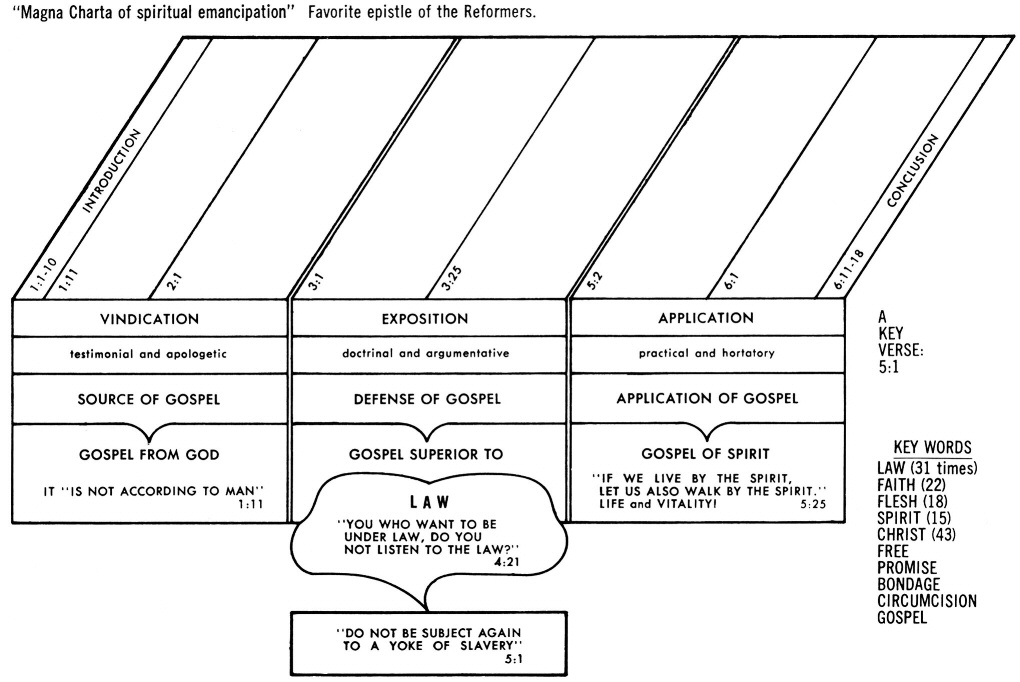
Magna Carta of Spiritual Emancipation
Click chart to enlarge
Charts from Jensen's Survey of the NT - used by permission

Click to Enlarge
See Also:
Paul's First Missionary Journey
Paul's Second Missionary Journey
Paul's Third Missionary Journey
Maps from Holman Bible Atlas (digital book; Hardcover/Paperback version) copyright © 1998 B&H Publishing Group, used by permission, all rights reserved.
This is one of the best resources for Bible maps as the maps also include helpful short descriptions of the events portrayed on the maps.
| SUMMARY CHART: EPISTLE TO THE GALATIANS |
|||||||
| Gospel of Grace Defended |
Gospel of Grace Explained |
Gospel of Grace Applied |
|||||
| Defense of the Gospel Gal 1:1-2:21 |
Freedom from Legalism Gal 3:1-4:31 |
Freedom to Love and to Serve Gal 5:1-6:18 |
|||||
| Labor | Liberty | Life | |||||
| Authority Not Opinion |
Freedom Not Bondage |
Spirit Not Flesh |
|||||
| Personal Autobiography |
Doctrinal Accuracy |
Practical Application |
|||||
| Paul the Apostle (Gal 1:1-24) |
Paul's Authority (Gal 2:1-21) |
Justified by Faith not Works (Gal 3:1-9) |
Justified by Faith not the Law (Gal 3:10-4:20) |
Grace and Law Cannot Co-Exist (Gal 4:21-31) |
Position and Practice of Liberty (Gal 5:1-15) |
Power of Liberty
(Gal 5:16-26) |
Performance in Liberty
(Gal 6:1-18) |
| Vindication | Exposition | Application | |||||
| Testimonial and Apologetic |
Doctrinal and Argumentative |
Practical and Hortatory |
|||||
| Biographical Explanation |
Doctrinal Exposition |
Practical Exhortation |
|||||
| Authentication of Liberty |
Argumentation for Liberty |
Application of Liberty |
|||||
|
Style or Tone: Vigorous, blunt, aggressive, direct, corrective, urgent, brief, righteous anger, strong words |
|||||||
|
Theme: Justification by Faith and not by Works of the Law |
|||||||
|
Author: Paul in large letters (Gal 6:11) |
|||||||
|
Recipients: Churches in Galatia (Gal 1:2) (Most likely the Southern Region) |
|||||||
|
Christ in Galatians: Jesus is the Source and Power for the believer's New Life. (Gal 2:20, 5:16) |
|||||||
Related Resource: Purpose of the Law
An Outline of Galatians - D Edmond Hiebert
THE INTRODUCTION (Galatians 1:1-10)
1. The salutation (Galatians 1:1-5)
a. The writer (Galatians 1:1-2a)
i. Paul, the Apostle (Galatians 1: 1)
ii. The brethren with him (Galatians 1:2a)
b. The readers (Galatians 1:2b)
c. The greeting (Galatians 1:3-5)
i. The contents of the greeting (Galatians 1:3a)
ii. The source of the grace and peace (Galatians 1:3b-4)
iii. The doxology (Galatians 1:5)
2. The rebuke (Galatians 1:6-10)
a. His astonishment at their fickleness (Galatians 1:6-7)
i. The reason for the astonishment (Galatians 1:6)
ii. The explanation of the departure (Galatians 1:7)
b. His assertion about its seriousness Galatians 1:8-9)
i. The seriousness asserted (Galatians 1:8)
ii. The seriousness reaffirmed (Galatians 1:9)
c. His attitude in the matter (Galatians 1:10)
I. PERSONAL: THE VINDICATION OF HIS APOSTOLIC AUTHORITY (Galatians 1:11-2:21)
1. How he got his Gospel (Galatians 1:11-24)
a. The origin of his Gospel through revelation (Galatians 1: 11-12)
i. The assertion as to its nature (Galatians 1:11)
ii. The manner of its reception (Galatians 1:12)
b. The previous conduct of the one given the revelation (Galatians 1:13-14)
i. The manner of his former life known to them Galatians 1:13a)
ii. The description of his former life (Galatians 1:13b-14)
a. In relation to the Church of God (Galatians 1:13b)
b. In relation to Judaism (Galatians 1:14)
c. The description of the revelation received (Galatians 1:15-17)
i. The source of the revelation (Galatians 1:15)
ii. The subject of the revelation (Galatians 1:16a)
iii. The purpose of the revelation (Galatians 1:16b)
iv. The response to the revelation (Galatians 1:16c-17)
d. His independence of the Jerusalem apostles (Galatians 1:18-24)
i. The first visit to Jerusalem (Galatians 1:18-20)
a. The time of the visit (Galatians 1:18a)
b. The purpose of the visit (Galatians 1:18b)
c. The duration of the visit (Galatians 1:18c)
d. The scope of contacts during the visit (Galatians 1:19-20)
ii. The subsequent absence from Jerusalem (Galatians 1:21-24)
a. The place of his withdrawal (Galatians 1:21)
b. The lack of acquaintance with the Judean churches (Galatians 1:22)
c. The response of the churches to reports about him (Galatians 1:23-24)
2. How his Gospel was confirmed by the apostles at Jerusalem (Galatians 2:1-10)
a. The circumstances of its presentation to them (Galatians 2:1-2)
i. The journey to Jerusalem (Galatians 2:1-2a)
ii. The presentation made at Jerusalem (Galatians 2:2b)
b. The outcome of his presentation of his Gospel to them (Galatians 2:3-10)
i. The maintenance of his position, as seen in Titus Galatians 2:3)
ii. The conflict with the false brethren (Galatians 2:4-5)
a. The presence of the false brethren (Galatians 2:4)
b. The refusal to yield to their demands (Galatians 2:5)
iii. The approval of his Gospel by the Jerusalem leaders (Galatians 2:6-10)
a. Their failure to add anything to his Gospel (Galatians 2:6)
b. Their approval of his Gospel in full (Galatians 2:7-10)
1. The basis of their approval (Galatians 2:7-9a)
2. The expression of their approval (Galatians 2:9b)
3. The one request with their approval (Galatians 2:10)
3. How he rebuked Peter's inconsistent conduct (Galatians 2:11-21)
a. The circumstances when giving the rebuke (Galatians 2:11-13)
i. The fact of his rebuke of Peter (Galatians 2:11)
ii. The reason for his rebuke of Peter (Galatians 2:12)
iii. The effect of the inconsistent conduct of Peter (Galatians 2:13)
b. The justification for giving the rebuke (Galatians 2:14-21)
i. His question of rebuke to Peter (Galatians 2:14)
ii. His explanation of his doctrinal position (Galatians 2:15-21)
a. The insufficiency of the law (Galatians 2:15-18)
1. The discovery of believing Jews about justification (Galatians 2:15-16)
2. The rejection of a conclusion from Peter's action (Galatians 2:17)
3. The significance of a return to law-works (Galatians 2:18)
b. The new life in Christ (Galatians 2:19-21)
1. The effect of the law led to the new life (Galatians 2:19)
2. The nature of the new life (Galatians 2:20)
3. The grace of God nullified by law-keeping (Galatians 2:21)
II. DOCTRINAL: THE EXPOSITION OF JUSTIFICATION BY FAITH (Galatians 3:1-4:31)
1. The elaboration of the doctrine of justification (Galatians 3:1-4:7)
a. The nature of justification as by faith, not law (Galatians 3:1-14)
i. The inconsistency of their conduct (Galatians 3:1-5)
a. The question about their turning from the crucified Christ (Galatians 3:1)
b. The question about the beginning of their Christian life (Galatians 3:2)
c. The question about their method of perfection (Galatians 3:3)
d. The question about their sufferings as believers (Galatians 3:4)
e. The question about the basis of God's work among them (Galatians 3:5)
ii. The example of Abraham's justification (Galatians 3:6-9)
a. The means of Abraham's justification (Galatians 3:6)
b. The identity of the sons of Abraham (Galatians 3:7)
c. The announcement to Abraham concerning Gentile justification by faith (Galatians 3:8)
d. The sharers in the blessings of Abraham (Galatians 3:9)
iii. The deliverance from law-works through Christ (Galatians 3:10-14)
a. The curse upon those under law-works (Galatians 3:10)
b. The inability of law-works to justify (Galatians 3:11-12)
c. The deliverance from the curse through Christ (Galatians 3:13-14)
1. The fact of our deliverance through Christ (Galatians 3:13a)
2. The means of our deliverance from the curse (Galatians 3:13b)
3. The purpose in our deliverance from the curse (Galatians 3:14)
b. The limitations of the law and its relations to faith (Galatians 3:15-4:7)
i. The covenant with Abraham unaltered by the law (Galatians 3:15-18)
a. The illustration of a man's covenant as binding (Galatians 3:15)
b. The fact illustrated is the divine promise to Abraham (Galatians 3:16)
c. The application of the principle of an unalterable covenant (Galatians 3:17-18)
1. The law did not alter the promise (Galatians 3:17)
2. The inheritance is not through law but promise (Galatians 3:18)
ii. The true place and purpose of the law (Galatians 3:19-29)
a. The temporary nature of the law (Galatians 3:19-20)
1. The reason for the adding of the law (Galatians 3:19a)
2. The time limit for the law (Galatians 3:19b)
3. The manner of the establishment of the law (Galatians 3:19c-20)
b. The inability of the law to produce life (Galatians 3:21-22)
1. The law not contrary to the promise (Galatians 3:21a)
2. The law unable to produce life (Galatians 3:21b)
3. The Scripture shut up all to faith in Christ (Galatians 3:22)
c. The law as a child-leader to Christ with His blessings (Galatians 3:23-29)
1. The old position under law (Galatians 3:23-24)
a. The position of confinement under law (Galatians 3:23)
b. The function of the law as child-leader to Christ (Galatians 3:24)
2. The new position in Christ (Galatians 3:25-29)
a. The nature of the new position (Galatians 3:25-26)
b. The entry into the new life (Galatians 3:27)
c. The effect of the new life (Galatians 3:28)
d. The fulfillment of the promise to Abraham (Galatians 3:29)
iii. The contrasted position under law and faith (Galatians 4:1-7)
a. The illustration of the position of the heir as a minor (Galatians 4:1-2)
b. The application of the illustration to believers (Galatians 4:3-6)
1. The condition of bondage as minors (Galatians 4:3)
2. The position as free sons through God's Son (Galatians 4:4-6)
a. The sending of the Son of God (Galatians 4:4-5)
b. The sending of the Spirit of God (Galatians 4:6)
3. The conclusion for the believer (Galatians 4:7)
2. The appeal for them to drop their legalism (Galatians 4:8-31)
a. The acceptance of Jewish legalism is a return to bondage (Galatians 4:8-11)
i. Their past condition of bondage (Galatians 4:8)
ii. Their present deliverance from bondage (Galatians 4:9a)
iii. Their legalism as a return to bondage (Galatians 4:9b-10)
iv. Their action a cause of concern to him (Galatians 4:11)
b. The appeal from his relations to them (Galatians 4:12-20)
i. The appeal for them to adopt his position (Galatians 4:12a)
ii. The reminder of his past relations to them (Galatians 4:12b-14)
iii. The change in their relation to him (Galatians 4:15-18)
iv. The travail he is undergoing for them (Galatians 4:19-20)
c. The appeal from the two contrasted covenants (Galatians 4:21-31)
i. The question to those desiring to be under law (Galatians 4:21)
ii. The story of Abraham's two sons (Galatians 4:22-23)
iii. The allegorical interpretation of the story (Galatians 4:24-30)
a. The two mothers representing two covenants (Galatians 4:24a)
b. The description of the two covenants (Galatians 4:24b-28)
1. The one representing a covenant of bondage (Galatians 4:24b-25)
2. The other representing a covenant of freedom (Galatians 4:26-28)
c. The expulsion of the slave woman and her son (Galatians 4:29-30)
iv. The conclusion from the story (Galatians 4:31)
III. PRACTICAL: THE LIFE OF CHRISTIAN LIBERTY (Galatians 5:1-6:10)
1. The call to maintain their Christian liberty (Galatians 5:1)
2. The peril to Christian liberty (Galatians 5:2-12)
a. The peril to them in circumcision (Galatians 5:2-6)
i. The consequences of accepting circumcision (Galatians 5:2-4)
a. It renders Christ useless to them (Galatians 5:2)
b. It makes a man debtor to do the whole law (Galatians 5:3)
c. It severs them from Christ (Galatians 5:4a)
d. It constitutes a fall from grace (Galatians 5:4b)
ii. The attitude of the true believer (Galatians 5:5-6)
b. The condemnation of the false teacher (Galatians 5:7-12)
i. The explanation for their defection (Galatians 5:7)
ii. The characterization of the teaching (Galatians 5:8-9)
iii. The condemnation of the one troubling them (Galatians 5:10-12)
a. The confidence he has in them (Galatians 5:10a)
b. The troubler will bear his judgment (Galatians 5:10b)
c. The refutation of charges that he preaches circumcision (Galatians 5:11)
d. The wish that these teachers would go to the consistent end (Galatians 5:12)
3. The life of Christian liberty (Galatians 5:13-6:10)
a. It is directed by love (Galatians 5:13-15)
i. The believer called to liberty (Galatians 5:13a)
ii. The use of Christian liberty (Galatians 5:13b)
iii. The fulfillment of the law through love (Galatians 5:14)
iv. The results of the lack of love (Galatians 5:15)
b. It is a walk in the Spirit, not in the flesh (Galatians 5:16-25)
i. The command to walk by the Spirit (Galatians 5:16)
ii. The conflict between the Spirit and the flesh (Galatians 5:17-18)
iii. The contrasted products of the flesh and the Spirit (Galatians 5:19-23)
a. The works of the flesh (Galatians 5:19-21)
b. The fruit of the Spirit (Galatians 5:22-23)
iv. The persons living by the Spirit (Galatians 5:24-25)
c. It is a life of mutual burden-bearing (Galatians 5:26-6:10)
i. The burden of moral faults (Galatians 5:26-6:5)
a. The warning against wrong attitudes towards others (Galatians 5:26)
b. The attitude of humility in restoring the fallen (Galatians 6:1)
c. The duty of mutual burden-bearing (Galatians 6:2)
d. The proper attitude toward self (Galatians 6:3-5)
ii. The burden of temporal needs (Galatians 6:6-10)
a. The exhortation to communicate with their teachers (Galatians 6:6)
b. The law of the spiritual harvest (Galatians 6:7-8)
c. The encouragement to welldoing (Galatians 6:9-10)
THE CONCLUSION (Galatians 6:11-17)
1. His reference to his large letters (Galatians 6:11)
2. His rebuke of his adversaries (Galatians 6:12-13)
3. His confidence in the cross (Galatians 6:14-16)
a. His glorying only in the cross (Galatians 6:14a)
b. His crucifixion through the cross (Galatians 6:14b)
c. His evaluation of things through the cross (Galatians 6:15)
d. His benediction upon those accepting this principle (Galatians 6:16)
4. His marks of apostleship (Galatians 6:17)
THE BENEDICTION (Galatians 6:18)
Galatians 5:21 envying, drunkenness, carousing, and things like these, of which I forewarn you, just as I have forewarned you, that those who practice such things will not inherit the kingdom of God. (NASB: Lockman)
Greek: phthonoi, methai, komoi, kai ta homoia toutois, a prolego (1SPAI) humin kathos proeipon (1SAAI) hoti oi ta toiauta prassontes (PAPMPN) basileian theou ou kleronomesousin. (3PFAI)
Amplified: Envy, drunkenness, carousing, and the like. I warn you beforehand, just as I did previously, that those who do such things shall not inherit the kingdom of God. (Amplified Bible - Lockman)
Barclay: envy, drunkenness, carousing, and all that is like these things. I warn you, as I have warned you before, that those who do things like that will not inherit the Kingdom of God. (Westminster Press)
KJV: Envyings, murders, drunkenness, revellings, and such like: of the which I tell you before, as I have also told you in time past, that they which do such things shall not inherit the kingdom of God.
NLT: envy, drunkenness, wild parties, and other kinds of sin. Let me tell you again, as I have before, that anyone living that sort of life will not inherit the Kingdom of God. (NLT - Tyndale House)
Phillips: envy, drunkenness, orgies and things like that. I solemnly assure you, as I did before, that those who indulge in such things will never inherit God's kingdom. (Phillips: Touchstone)
Weymouth: hard drinking, riotous feasting, and the like. And as to these I forewarn you, as I have already forewarned you, that those who are guilty of such things will have no share in the Kingdom of God.
Wuest: envyings, drunkenness, carousings, and the things of such a nature which are like these things, respecting which things I am telling you beforehand even as I told you in advance, that those who are in the habit of practicing things of that nature shall not inherit the kingdom of God
Young's Literal: envyings, murders, drunkennesses, revellings, and such like, of which I tell you before, as I also said before, that those doing such things the reign of God shall not inherit.
ENVYING, DRUNKENNESS, CAROUSING, AND THINGS LIKE THESE, OF WHICH I FOREWARN YOU, JUST AS I HAVE FOREWARNED YOU, THAT THOSE WHO PRACTICE SUCH THINGS WILL NOT INHERIT THE KINGDOM OF GOD:
- Drunkenness - Deuteronomy 21:20; Luke 21:34; Romans 13:13; 1Corinthians 5:11; 6:10; Ephesians 5:18; 1Thessalonians 5:7
- Carousing - 1Peter 4:3
- That those - Isaiah 3:11; Romans 2:8,9; 8:13; 1Corinthians 6:9,10; Ephesians 5:5,6; Colossians 3:6; Revelation 21:27; Revelation 22:15
- Inherit - Matthew 25:34; 1 Corinthians 6:10; 15:50; Ephesians 5:5
- The Manifestations of the Sin Nature and the Spirit - Jack Arnold
- Galatians 5 Resources - Multiple Sermons and Commentaries
THE ROTTEN REWARD
OF ROTTEN FRUIT
S Lewis Johnson remarks that the deeds of the flesh "are the evidence that the life is not under the control of the Spirit. Where these things are the individual's pattern of life, there is no evidence that they belong to the holy Triune God. It is almost impossible to classify the works of the flesh. The words used to describe the works far outnumber the words used for the virtues of the fruit of the Spirit. Someone once said that it was a proof of our fallen state that our vocabularies are much richer in words for sin than in words for the graces. There are sex sins , social sins, and spiritual sins. (Galatians 5:13-26 Life by the Spirit)
Sir Walter Scott put it this way
Oh, what a tangled web we weave
When first we practice to deceive!
Related Resources:
Spurgeon comments…
Paul never said, nor ever thought of saying, that s man might live in sin, that grace might abound. No, no; these evil things must be given up. Christ has come to save us from every evil work. And this is the salvation that we preach,— not simply salvation from hell, but salvation from sin, which is the very fire that has kindled the infernal flame. But how different from all this evil is the fruit of the Spirit!
Observe that the Gospel gives no toleration to sin. Some people tell us that the doctrine of faith is not practical, but they know better although they say that. They have only to observe those who are actuated by the principle of faith, and they will find them abounding in good works, while the men who are swayed by the principle of law talk a great deal about works, but have little enough of them in practice. The gospel denounces sin, ay, and kills it; it gives us the force with which we fight against it and overcome it.
Not so much the desire to enrich oneself at another’s expense, as a wolfish craving to impoverish him and pull him down for the mere sake of it. This is a very acrid form of undiluted hate and leaves but one stronger form of hate. To desire another’s dishonor merely from envy of his superiority is simply devilish and is a sort of murder of the man’s best life.
Envying (5355) (phthonos) describes pain felt and malignity conceived at the sight of excellence or happiness. It means not just wanting what another person has, but also resenting that person for having it. It is an attitude of ill-will and jealousy that leads to division and strife and even murder. When we envy, we cannot bear to see the prosperity of others, because we ourselves feel continually wretched.
In Greek mythology, phthonus was the personification of jealousy and envy, especially in matters of love. Phthonus was said to have married many different women and killed most of them because he suspected that they cheated on him. So much for the "holiness" of these man made gods, who were really no gods at all.
Envy is a sin that carries its own reward for it guarantees its own frustration and disappointment. By definition, the envious person cannot be satisfied with what he has and will always crave for more. His evil desires and pleasures are insatiable, and he cannot abide any other person’s having something that he himself does not have or having more of something than he himself has.
As lust is directed toward a specific object, so envy is directed toward a specific person. (cp Mt 27:18!)
Vine says that "envy differs from jealousy in that the former desires merely to deprive another of what he has, whereas the latter desires as well to have the same, or a similar, thing for itself." On this account envy is said to be “as the rottenness of the bones (Pr 14:30)."
Thus Trench calls envy “the meaner sin” of the two.
Barclay adds that
there is the envy which is essentially a grudging thing. It looks at a fine person, and is not so much moved to aspire to that fineness, as to resent it. It is the most warped and twisted of human emotions… a mean word. Euripides called it
the greatest of all diseases among men.
The essence of it is that it does not describe the spirit which desires, nobly or ignobly, to have what someone else has. It describes the spirit which grudges the fact that the other person has these things at all. It does not so much want the things for itself; it merely wants to take them from the other.
The Stoics defined it as "grief at someone else’s good."
Basil called it "grief at your neighbor's good fortune."
It is the quality, not so much of the jealous, but rather of the embittered mind. (Galatians 5 Commentary)
F. B. Meyer held meetings in Northfield, Mass., and large crowds thronged to hear him. Then the great British Bible teacher G. Campbell Morgan came to Northfield and people were soon flocking to hear his brilliant expositions of scripture. Meyer confessed at first he was envious. He said, "The only way I can conquer my feelings is to pray for Morgan daily, which I do. "
Dwight L. Moody once told the fable of an eagle who was envious of another that could fly better than he could. One day the bird saw a sportsman with a bow and arrow and said to him, “I wish you would bring down that eagle up there.” The man said he would if he had some feathers for his arrow. So the jealous eagle pulled one out of his wing. The arrow was shot, but it didn’t quite reach the rival bird because he was flying too high. The first eagle pulled out another feather, then another—until he had lost so many that he himself couldn’t fly. The archer took advantage of the situation, turned around, and killed the helpless bird. Moody made this application: if you are envious of others, the one you will hurt the most by your actions will be yourself.
Matthew Henry comments that malice and envy are "both roots of bitterness, whence many evils spring: evil thoughts and speeches, tongues set on fire of hell, detracting from and impairing the just and due praises of others. Their words are swords, wherewith they slay the good name and honour of their neighbor. This was the sin of Satan, and of Cain who was of that evil one, and slew his brother; for wherefore slew he him, but of this envy and malice, because his own works were evil, and his brother's righteous? These were some of the sins in which we lived in our natural state.
Drunkenness (3178) (methe) (ISBE entry) is the Greek word most often was used of intentional and habitual intoxication. It is worth noting that in two of the three NT uses (Gal 5:21; 1Pe 4:3) carousing and drunkenness are found side-by-side, which is not surprising to see one sin begat another.
Barclay comments that "Drunkenness in the ancient world this was not a common vice. The Greeks drank more wine than they did milk; even children drank wine. But they drank it in the proportion of three parts of water to two of wine. Greek and Christian alike would have condemned drunkenness as a thing which turned a man into a beast. (Galatians 5 Commentary)
The TDNT has this note on the word group (methe, methuo, methusko = to get drunk) - In 1Thes 5:6 Paul warns believers, as those who belong to the new aeon, to be vigilant and sober; drunkenness belongs to the night. In the parable in Mt 24:45ff. the bad steward, not living in eschatological tension, gives way to selfishness and hedonism, drinking with the drunkards. In 1Cor 11:21 the Corinthians disrupt the fellowship of the Lord's Supper; some are hungry while the wealthy are drunk. Unlike the feasts of Dionysus, the Lord's Supper is no place for intoxication. Intoxication is the direct opposite of spiritual drink. Thus Peter in Acts 2:15 resists strongly the accusation of drunkenness, and Paul in Eph 5:18 contrasts orgiastic enthusiasm with the infilling of the Spirit that comes to expression in praise, thanksgiving, and love (vv. 19ff.). (Kittel, G., Friedrich, G., & Bromiley, G. W. Theological Dictionary of the New Testament. Eerdmans)
Spurgeon - It is not merely that you may drink to excess, but you may eat to excess, or clothe your body too sumptuously, or there may be some other spending of money upon your own gratification that is not according to sober living.
Carousing (2970) (komos) originally referred to a band of friends who accompanied a victor in a military engagement or athletic contest on his way home, singing with rejoicing and praises to the victor. But the word "degenerated:" until it came to mean "carousal" or a noisy, nocturnal and riotous procession of half drunken revelers and frolicsome fellows who after supper paraded through the streets at night with torches and music in honor of Bacchus or some other deity, singing and playing before houses of male and female friends (and causing a major public disturbance). Hence komos generally refers to feasts and drinking parties that are protracted till late at night and indulge in revelry.
F F Bruce writes that "W. M. Ramsay (Galatians, 453) reminds us that among the Greeks ‘Komos, the Revel, was made a god, and his rites were carried on quite systematically, and yet with all the ingenuity and inventiveness of the Greek mind, which lent perpetual novelty and variety to the reveling. The Komos was the most striking feature in Greek social life.’ (Bruce, F. F. The Epistle to the Galatians: A Commentary on the Greek Text. Grand Rapids, Mich.: W. B. Eerdmans Pub. Co. 1982)
Peter reminds believers that…
1 Peter 4:3 For the time already past is sufficient for you to have carried out the desire of the Gentiles, having pursued a course of sensuality, lusts, drunkenness, carousing, drinking parties and abominable idolatries.
Barclay writes that komos "describes the kind of revelry which lowers a man’s self and is a nuisance to others… A komos was a band of friends who accompanied a victor of the games after his victory. They danced and laughed and sang his praises. It also described the bands of the devotees of Bacchus, god of wine. It describes what in regency England would have been called a rout. It means unrestrained revelry, enjoyment that has degenerated into license. (Galatians 5 Commentary)
Things like these (5108) (toioutos) means such as these or of such a kind (as the sins he has just mentioned). This phrase implies that the list is not complete. In Romans Paul says fallen men become literally "inventors of evil"! (see note Romans 1:30)
Spurgeon - The list is always too long to be completed. We are obliged to sum up with a kind of et cetera.
Jack Arnold - The sin nature is capable of producing every conceivable type of sin. This is why the Christian must be constantly depending upon the Holy Spirit in his experience, or he may find himself doing something that will: (1) displease his God; (2) defile himself; (3) offend others; (4) disgrace his loved ones, and (5) place him directly in line for God’s discipline. It is important to know the specific weaknesses of your own sin nature because when the evil impulses come you will try to rationalize or justify your actions, saying something like the following: “I know these evil desires are wrong, but they seem so right, so I will just give into them and stop fighting.” “Surely a little sin can’t hurt that much so I will yield to the desires of my sin nature and do the act of sin.” “Everyone has his or her evil impulses so why should I be different? I will give in and be like everyone else.” I know it is wrong to give into my evil impulses but God is full of mercy and grave so I will go ahead and sin and He will forgive me." (The Manifestations of the Sin Nature and the Spirit )
Forewarn (4302) (prolego from pró = before + lego = to say) means literally to say or tell beforehand (in advance and so to predict), to foretell or to forewarn (the idea is the to warn in advance). Forewarned is forearmed.
In an ancient Greek secular use of prolego we read "Gaius, an attorney, before his death expresses his thoughts in an epitaph for his tomb."
I forewarn you, just as I have forewarned you - Paul is "dead serious" about this subject! As Arnold says "Paul expected true Christians to walk in dependence on the Spirit to some degree. Paul knew that the Holy Spirit had taken up residence in every true Christian, and the work of the Holy Spirit would be manifest to some degree in every true child of God."
Practice (4238)(prasso) means to be occupied with, to accomplish or to practice. The idea is to perform repeatedly or habitually and thus describes repetition or continuous action.
Paul uses the present tense which describes the practice as habitual, as one's lifestyle or bent of life. One might say the direction of their life is "downward" not "upward!" If one of the sins in this list is your lifestyle you need to examine yourself to determine whether there is evidence that you are genuinely saved. In this case the adage does not hold - practice does not make perfect! On the other hand even true believers will fall into the sins listed in Gal 5:19-21, but the important point is that the sin is not continual in one's life.
Eadie explains that "They prove by their perseverance in such practices that they are not led by the Spirit; that they are not justified through faith; that they are not children, and therefore not heirs of the promise… Heaven, according to the popular adage, is a prepared place for a prepared people. The kingdom of Christ exists on earth, with Him as its Head and Defence, and only those who are qualified, through a change inwrought and sustained by His Spirit, are admitted into it in its ultimate and glorious form in heaven. The inheritor of the kingdom must be brought into congenial harmony with its occupations and enjoyments. They “which do such things” prove their want of meetness “for the inheritance of the saints in light,” and therefore cannot enter it; it has no attraction for them, and they could find no enjoyment in it. (Galatians 5 Commentary)
Spurgeon on practice - All who commit any of the sins in this long black catalogue are sowing to the flesh, and not to the Spirit. When a man sows to the flesh, what will the harvest be? “The one who sows to his own flesh will reap corruption” (Gal 6:8)—putridity, rottenness, death! The sin that the sinner thought was sweet as honey turns bitter as gall to him. There are many men and women in this world who have lived in sin until it has become its own punishment, and if it is not so in this world, it will be so in the world to come.
C Norman Bartlett comments that the word practice…
means, the habitual practice of such things. The Bible bases its estimate of a person's character, not upon his infrequent, out-of-the-ordinary actions, but upon his habitual ones. To live in sin as a settled choice and principle of life is a far more serious matter than to fall into sins through weakness and carelessness. Far from loving and clinging to sin, the born-again child of God loathes and shrinks from it as from deadly poison; and when he does yield to temptation, he is in misery until he has confessed his sin and found forgiveness through the merits of the shed blood of his Redeemer:
But if we walk in the light, as he is in the light, we have fellowship one with another, and the blood of Jesus Christ his Son cleanseth us from all sin. If we say that we have no sin, we deceive ourselves, and the truth is not in us. If we confess our sins, he is faithful and just to forgive us our sins, and to cleanse us from all unrighteousness. If we say that we have not sinned, we make him a liar, and his word is not in us. My little children, these things write I unto you, that ye sin not. And if any man sin, we have an advocate with the Father, Jesus Christ the righteous: And he is the propitiation for our sins: and not for ours only, but also for the sins of the whole world" (1John 1:7, 8, 9, 2:1, 2:2)
And as for the unregenerate man, even if he were admitted to heaven at death, he would be wretched beyond words in an atmosphere and environment so utterly alien to his unredeemed nature. As well expect a fish to live on dry land as to imagine for a moment that a sinner could ever be happy in Heaven. Since everlastingness is an indestructible property of the soul in the image of God, the only possible alternative to eternal fellowship with GOD is eternal separation from GOD - and that is hell. (C. Norman Bartlett: Galatians and You: Studies in the Epistle of Paul to the Galatians, 1948)
Wayne Barber explains that "when you become a Christian, something changes. You stop chasing sin. Sin starts chasing you. It doesn’t mean you can’t fall in one of those areas, but it means you cannot pursue it and claim to know Jesus Christ. The seed of God inside of you will not let that take place. You’ve got to remember, when you receive Christ it is not some religious insurance policy, it is a heart change. The Spirit of the living God comes inside of you. That doesn’t mean that a person cannot have tendencies and weaknesses and times of wearing the wrong garment and falling back into sins and being pulled that direction, but he cannot habitually pursue it anymore and call himself a Christian. (Ephesians 5:6-7: Don't Be Deceived)
Spurgeon on will not inherit - A very solemn, searching, sweeping declaration. Let each man judge himself by this test. Read over the list. Put the question to conscience: “Am I guilty of such things?” (Ed: Habitually, for few believers could ever claim they are perfectly free of the entire list - e.g., do you ever envy? Point made!) If so, do not suppose that the holding of orthodox doctrine will save you, or that any kind of religious ceremony will save you. You must be delivered from these lusts of the flesh—these deeds of the flesh—or you cannot inherit the kingdom of God.
Will not inherit the kingdom of God - This is another way of saying they are unredeemed and not saved by grace through faith in Christ. They are not regenerated or born again by the Spirit!
THOUGHT - Beware of the teaching in some "evangelical circles" which says that this passage (as well as 1 Cor 6:10, Eph 5:5) describes a genuine "believer" who will enter the Kingdom of God, but simply will not receive rewards! That is a dangerous teaching as it gives those who have "professed Christ" a license to sin, thinking they have been justified by grace through faith even though there has never been a change in their life or lifestyle as Paul describes in 2 Cor 5:17! This passage describes an unbeliever who will end up in hell and will "inherit" eternal punishment. For more on this topic see the article "Those Who Do Not Inherit The Kingdom . . .Are They Saved or Unsaved?."
James Montgomery Boice writes that "Paul adds a solemn warning, saying that those who habitually practice such things will never inherit God's kingdom. This does not mean that if a Christian falls into sin through getting drunk, or some such thing, he thereby loses his salvation. The tense of the verb (present) indicates a habitual continuation in fleshly sins rather than an isolated lapse, and the point is that those who continually practice such sins give evidence of having never received God's Spirit. When Paul says that he warned the Galatians of this previously (presumably when he was among them), he reveals that his preaching was never what one might call mere evangelism but that it always contained a strong dose of the standard of morality expected from Christians. (Gaebelein, F, Editor: Expositor's Bible Commentary 6-Volume New Testament. Zondervan Publishing)
Paul gives us a brief description of the kingdom in Romans writing that "The kingdom of God is not eating and drinking, but righteousness and peace and joy in the Holy Spirit." (see note Romans 14:17)
With this description in mind, we must ask ourselves "What is righteousness?". The short answer is the behavior which is acceptable to God and is in keeping with what God is in His holy character. Rightness means to be as something or someone should be. In short, the righteousness of God is all that God is, all that He commands, all that He demands, all that He approves and all that He provides through faith in Christ, the Righteous One. Those who continually practice these vices mentioned are practicing unrighteousness as their lifestyle, a lifestyle which is diametrically opposed to that which one would expect to see in a citizen of the kingdom of God. Those who live a life of unrighteousness will be excluded from this kingdom. Their unrighteous deeds give evidence that they are not in Christ, but still in Adam. And since they do not…
belong to Christ then they are not Abraham's offspring and it follows that they are not heirs according to promise (Galatians 3:29, cp note Hebrews 6:12)
Inherit (2816) (kleronomeo from from kleros = First a pebble, piece of wood used in casting lots as in Acts 1:26 then the allotted portion or inheritance, and so a lot, heritage, inheritance + nemomai = to possess) means to receive a share of an inheritance, inherit a portion of property or receive a possession as gift from someone who has died. The idea is to receive a share of that which has been "allotted" to one.
Paul gives a similar forewarning in two other epistles…
Or do you not know that the unrighteous shall not (absolutely not) inherit the kingdom of God? Do not be deceived (present imperative with a negative means "stop being deceived", implying some were being misled); neither fornicators, nor idolaters, nor adulterers, nor effeminate, nor homosexuals, nor thieves, nor the covetous, nor drunkards, nor revilers, nor swindlers, shall inherit the kingdom of God. And such were some of you; but (praise God) you were washed, but you were sanctified, but you were justified in the name of the Lord Jesus Christ, and in the Spirit of our God. (1Cor 6:9, 10, 11)
Comment: Paul is not saying a homosexual or thief cannot be saved (in fact praise God, he says some of them were genuinely new creatures in Christ), but he is saying that a homosexual or a thief who professes that they are "born again" and yet fails to ever manifest any change whatsoever in their lifestyle (they continue to actively, habitually practice their specific sin) is deceiving themselves and is not in fact genuinely saved. Paul is not saying a genuine believer will never fall back into their previous lifestyle for a period of time, but he is saying that if a person is genuinely a new creation in Christ, they will exhibit behavior which is generally oriented toward heaven. Ryrie puts it this way "People whose lifestyles exhibit wickedness, not fruit, show they are unsaved and will, therefore, not inherit the kingdom of God." A T Robertson adds that "All these will fall short of the kingdom of God. This was plain talk to a city like Corinth. It is needed today. It is a solemn roll call of the damned even if some of their names are on the church roll in Corinth whether officers or ordinary members."
For this you know with certainty, that no (absolutely no) immoral or impure person or covetous man, who is (present tense = as their lifestyle) an idolater, has an inheritance in the kingdom of Christ and God. Let no one deceive you with empty words, for because of these things the wrath of God comes upon the sons of disobedience. (See notes Ephesians 5:5; 5:6)
Comment: Paul is saying that those who have a lifestyle characterized by the sins just listed are unregenerate, lost, still in their sins and destined for the Lake of fire and eternal separation from God. The kingdom in simple terms is where Christ and God rule as King. The unregenerate have no part in the present invisible Kingdom nor in the future earthly kingdom of Christ. Note that Paul is not referring to the Judgment Seat of Christ and loss of rewards but to salvation and loss of eternal life with God. These individual may have professed a belief in Christ but they lack the power of Christ to enable a changed lifestyle, a change which would validate them as possessors of Christ. Their lifestyle of sinful conduct discloses their true character as those still in Adam and not those who are by grace through faith now in Christ. Paul is not saying of course that they cannot be saved but that if their salvation is genuine they will repent of these heinous sins.
Wayne Barber comments on those who do not have an inheritance in the kingdom of heaven noting first that the…
word "no" means absolutely none of any kind. They absolutely do not have an inheritance in the kingdom of Christ and of God.
What is he saying? If you are habitually living the way Paul has just described, you do not have an inheritance in the kingdom of God. The argument has popped up recently in circles, can a man be a Christian and be a practicing homosexual? Can a man be a Christian and be a habitually practicing adulterer? No way. Let me show you something. Look at 1John 3:1-8a and see what you think.
See how great a love the Father has bestowed upon us, that we should be called children of God; and such we are. For this reason the world does not know us, because it did not know Him. Beloved, now we are children of God, and it has not appeared as yet what we shall be. We know that, when He appears, we shall be like Him, because we shall see Him just as He is. And everyone who has this hope fixed on Him purifies himself, just as He is pure. Everyone who practices sin also practices lawlessness; and sin is lawlessness. And you know that He appeared in order to take away sins; and in Him there is no sin. No one who abides in Him sins [habitually]; no one who sins [habitually] has seen Him or knows Him. Little children, let no one deceive you; the one who practices righteousness is righteous, just as He is righteous; the one who practices sin is of the devil; for the devil has sinned from the beginning.
The purpose of the book of Ephesians is to raise people’s view of salvation. When you have a low view of salvation, it allows for the view that you can habitually practice these sins. When you have a high view of salvation, it throws out this false reasoning. There is a brand new life. It doesn’t mean you cannot sin. It does not mean you cannot struggle with a specific sin. It does not mean that you can’t repeat that sin. But you are miserable when you do repeat that sin because the Holy Spirit lives within you. The Holy Spirit is there to convict you and bring you back to the Cross to where you can repent and go on and wear that new garment.
Well, we have an old garment (deeds of the flesh) and a new garment (fruit of the Spirit). But what does First John say about the one who habitually wears the old garment? The same thing Ephesians says. He in no way has any inheritance in the kingdom of Christ or of God. If you have struggles with that, go to the Scriptures and see what it teaches you. That is the key. Don’t argue with your experience. Go to see what God’s Word has to say. We need a high view of salvation. Salvation means more than just joining a church. It means that something has happened to us and the nature of God has come into us. His Spirit lives in us that Christ might live out His live through us.
Jack Arnold - Obviously Paul has the unsaved or unregenerate in view here. Yet it is a particular kind of unregenerate person—the professing Christian. The man who says he is a Christian and is constantly producing the works of the flesh and gives no evidence of a changed life has only made a profession but there is not real possession of Christ. (cf Eph 5:3-7 1 Cor. 6:9-11). This (practice) is a present tense in the Greek and could be translated; “He who keeps on living, repeatedly living like this will not inherit the kingdom of God.” Paul is obviously talking about habitual practice rather than an isolated lapse into sin. Every Christian has certain weaknesses and areas of sin in his personality that keeps cropping up over and over again. The issue is desire not perfection. The Christian will desire to bring his sin nature under the control of the Spirit. If a professing Christian has no desire to control the sin nature, then it is time to question the reality of one’s salvation. The Christian may lapse into the flesh because of his failure to depend upon the Holy Spirit. If he does, he will have the conviction of the Holy Spirit and be a miserable person. He will not have inner peace until he confesses that sin to God, purposes to turn from it, and gets up by faith and again walks in dependence upon the Spirit. Christians can sin but their action will always be followed by great conviction from God. (Sermon)
Martin Luther - Christians also fall and perform the lusts of the flesh. David fell horribly into adultery. Peter also fell grievously when he denied Christ. However great these sins were, they were not committed to spite God, but from weakness. When their sins were brought to their attention, these men did not obstinately continue in their sin, but repented. Those who sin through weakness are not denied pardon as long as they rise again and cease to sin. There is nothing worse than to continue in sin. If they do not repent, but obstinately continue to fulfill the desires of the flesh, it is a sure sign that they are not sincere. (Commentary on Galatians)
S Lewis Johnson comments that the deeds of the flesh "are the evidence that the life is not under the control of the Spirit. Where these things are the individual's pattern of life, there is no evidence that they belong to the holy Triune God. It is almost impossible to classify the works of the flesh. The words used to describe the works far outnumber the words used for the virtues of the fruit of the Spirit. Someone once said that it was a proof of our fallen state that our vocabularies are much richer in words for sin than in words for the graces. There are sex sins , social sins, and spiritual sins." (Galatians 5:13-26 Life by the Spirit)
Beecher wrote that "Heaven will be inherited by every man who has heaven in his soul: it is equally true that there are materials enough in every man’s mind to make a hell."
D Martyn Lloyd-Jones explains the concept of the kingdom of God (the third "component" below corresponds to the meaning in Gal 5:21) noting that…
It means, in its essence, Christ's rule or the sphere and realm in which He is reigning. It can be considered in three ways as follows. Many times when He was here in the days of His flesh our Lord said that the kingdom of heaven was already present. Wherever He was present and exercising authority, the kingdom of heaven was there. You remember how on one occasion, when they charged Him with casting out devils by the power of Beelzebub, He showed them the utter folly of that, and then went on to say, 'If I cast out devils by the Spirit of God, then the kingdom of God is come unto you' (Mt 12:28). Here is the kingdom of God. His authority, His reign was actually in practice. Then there is His phrase when He said to the Pharisees, 'the kingdom of God is within you, or, 'the kingdom of God is among you' (NAS "is in your midst" Lk 17:21). It was as though He were saying,
It is being manifested in your midst. Don't say "look here" or "look there". Get rid of this materialistic view. I am here amongst you; I am doing things. It is here.
Wherever the reign of Christ is being manifested, the kingdom of God is there. And when He sent out His disciples to preach, He told them to tell the cities which received them not, 'Be ye sure of this, that the kingdom of God is come nigh unto you.' (Lk 10:9, 11, cf Lk 19:11, 21:31)
It means that; but it also means that the kingdom of God is present at this moment in all who are true believers… In writing to the Colossians he gives thanks to the Father 'who hath delivered us from the power of darkness, and hath translated us into the kingdom of his dear Son' (Col 1:13). The 'kingdom of his dear Son' is 'the kingdom of God, it is 'the kingdom of heaven', it is this new kingdom into which we have entered. Or, again, in his letter to the Philippians he says, 'Our conversation is in heaven,' or, `Our citizenship is in heaven.' We are here on earth, we obey the powers that be, we live our lives in this way. Yes; but 'our citizenship is in heaven; from whence also we wait for a Saviour' (Php 3:20 ). We who recognize Christ as our Lord, and in whose lives He is reigning and ruling at this moment, are in the kingdom of heaven and the kingdom of heaven is in us. We have been translated into the 'kingdom of his dear Son'; we have become a 'kingdom of priests. (cf notes 1 Peter 2:9; 2:10, Rev 1:6, 5:10)
The third and last way of looking at the kingdom is this. There is a sense in which it is yet to come. It has come; it is coming; it is to come. It was here when He was exercising authority; it is here in us now; and yet it is to come. It will come when this rule and reign of Christ will be established over the whole world even in a physical and material sense. The day is coming when the kingdoms of this world will have become 'the kingdoms of our Lord, and of his Christ, when Jesus shall reign where'er the sun Doth his successive journeys run; His kingdom stretch from shore to shore, Till moons shall wax and wane no more. (Play Isaac Watts precious hymn - Jesus Shall Reign sing it out unto the Lord)
It will then have come, completely and entirely, and everything will be under His dominion and sway. Evil and Satan will be entirely removed; there will be `new heavens and a new earth, wherein dwelleth righteousness' (2Pe 3:13), and then the kingdom of heaven will have come in that material way. The spiritual and the material will become one in a sense, and all things will be subject to His sway, that 'at the name of Jesus every knee should bow, of things in heaven, and things in earth, and things under the earth; and that every tongue should confess that Jesus Christ is Lord, to the glory of God the Father' (Php 2:10, 11 - see note Php 2:10-note; 2:11-note). (Lloyd-Jones, D. M. Studies in the Sermon on the Mount) (Bolding added)