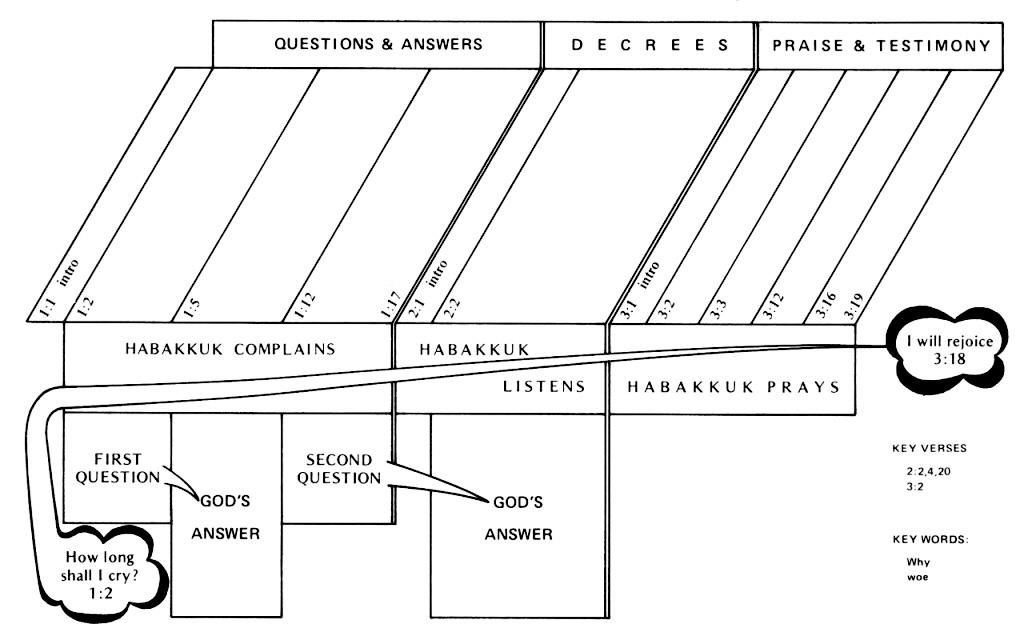
Click chart to enlarge
Chart from recommended resource Jensen's Survey of the OT - used by permission
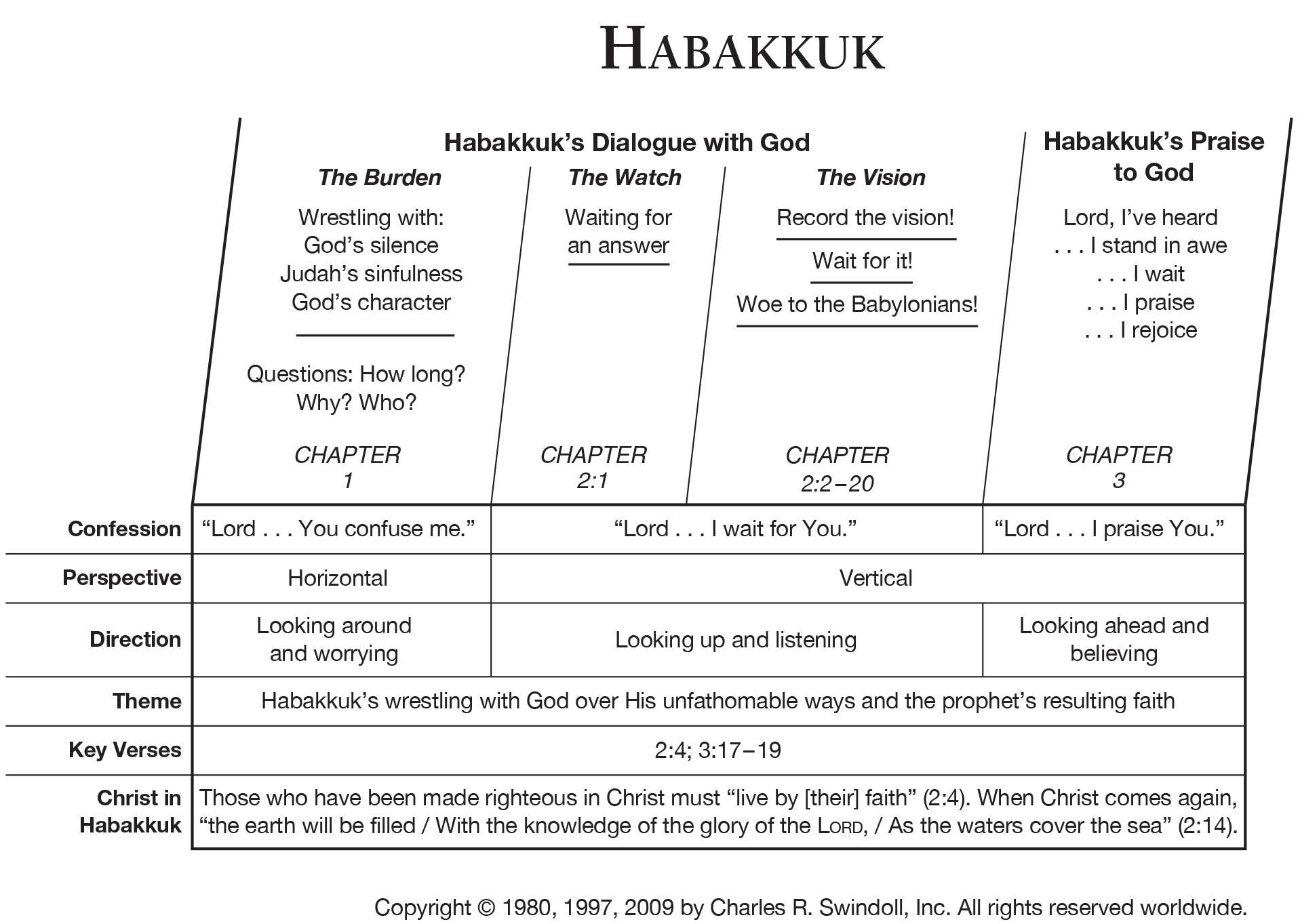
Habakkuk Chart from Charles Swindoll
Another Habakkuk Chart
Multiple Book Charts
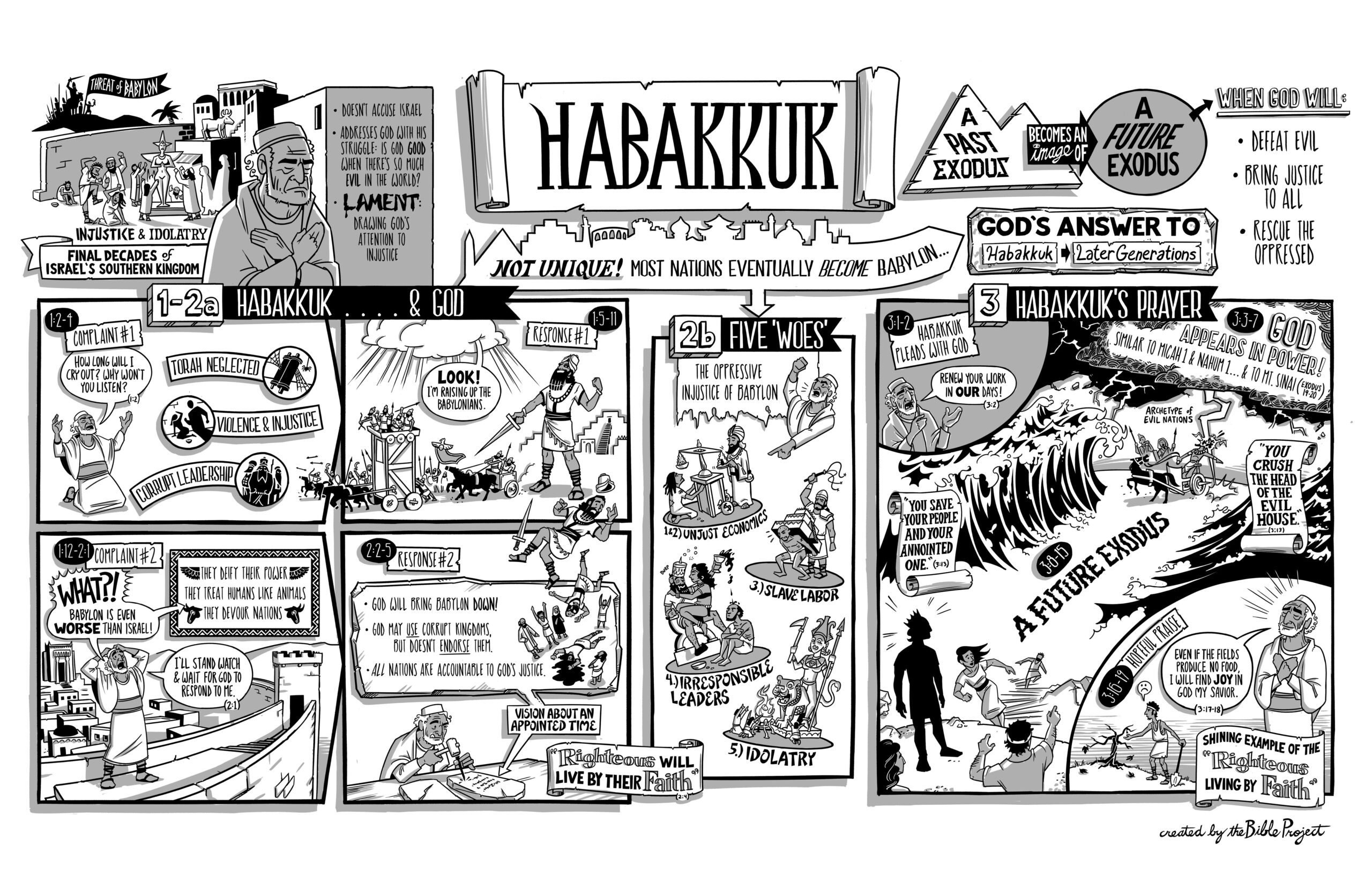
Habakkuk Drawn out in Pictures - Interesting
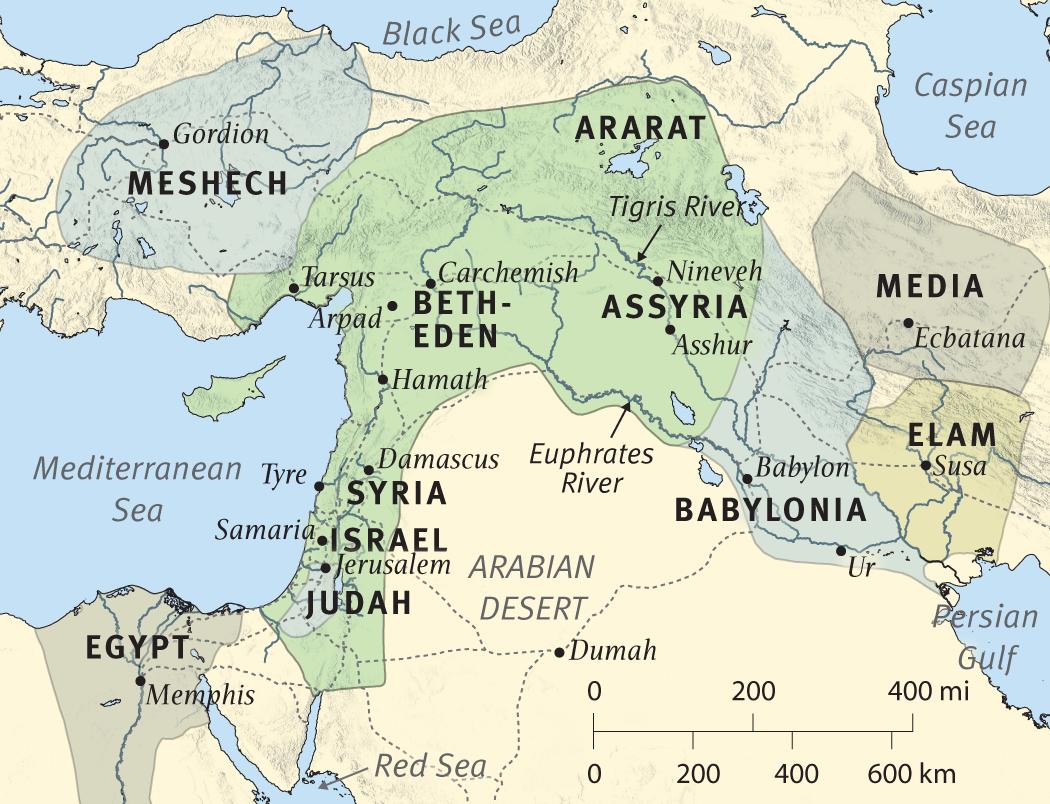
Circa 620 B.C.(Source: ESV.org)

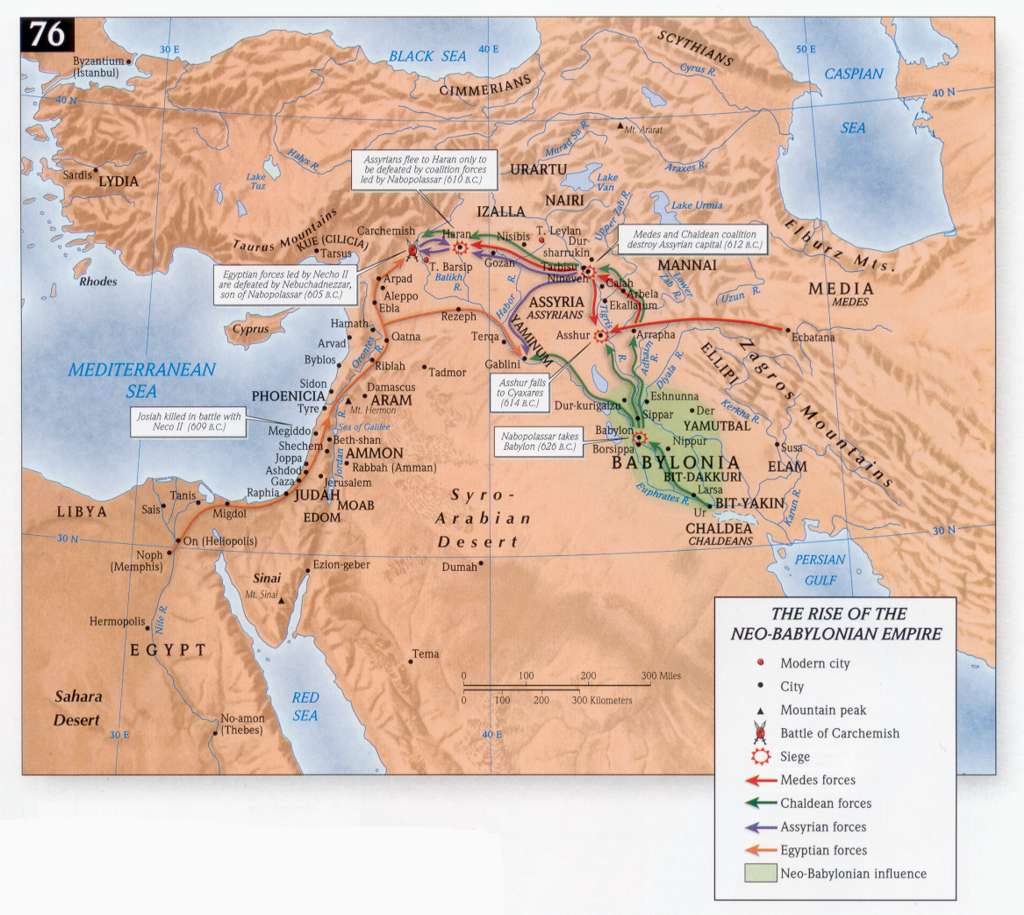
Though the exact date of the prophecies of Habakkuk is difficult to determine, it is likely that he prophesied a short time before the Babylonian invasions of Judah, which began in 605 B.C. During this time the Assyrian Empire was in decline, and the Babylonians were rising to replace them as the dominant power in the Near East.
MacArthur Study Bible - Intro, Date, Setting, Themes, Interpretative Challenges, Outline
Swindoll Overview - Includes "Listen to Chuck Swindoll’s overview in his audio message" - 27 minutes
KJV Bible Commentary - Intro, Outline and Verse by Verse Commentary
The King James Study Bible Second Edition - short introduction
NKJV Study Bible: New King James Version Study Bible (loads slow) - Introduction, Historical Setting, Purpose, Timeline, Christ in the Scriptures
|
HABAKKUK |
||||
|
HABAKKUK 1-2 |
HABAKKUK 3 WORSHIP |
|||
|
Problems of Habakkuk |
Praise of Habakkuk Hab 3:1-19 |
|||
|
Opens in Gloom: |
Closes in Glory: Ends with an Exclamation Mark! |
|||
| Faith Troubled: A Wail An Inquiry |
Faith Triumphant: A Song An Affirmation |
|||
| What is God Doing? ("Doubts") |
Who God Is ("Shouts") |
|||
| What is God Doing? | Song of Salvation | |||
| Perplexity of the Prophet Hab 1:1-17 |
Perspicuity of the Prophet Hab 2:1-20 |
Pleasure of the Prophet Hab 3:1-19 |
||
| Habakkuk Complains Hab 1:1-17 |
God Replies Hab 2:1-20 |
Habakkuk Sings Hab 3:1-19 |
||
| Watch and See | Stand and See | Kneel and See | ||
| Habakkuk Troubled |
Habakkuk Taught |
Habakkuk Triumphant |
||
| The Prophet Wondering & Worrying |
The Prophet Watching & Waiting |
The Prophet Worshiping & Witnessing |
||
| Habakkuk's First Question Hab 1:1-4 |
God's First Answer Hab 1:5-11 |
Habakkuk's Second Question Hab 1:12-2:1 |
God's Second Answer Hab 2:2-2:20 |
Habakkuk's Prayer of Praise |
| Habakkuk Speaks: Why Does God not Punish Wicked Judah? |
God Speaks: Judah Will Be Punished! |
Habakkuk Speaks: Why Will God use Pagans to Punish Judah? |
God Speaks: Yes Pagans Will Punish Judah! |
Word of Praise 1-15 Words of fear & faith Hab 3:16-19 |
| Prophet Speaks to Judah ca 607BC |
||||
• Favorite Verses: Hab 2:4 - This verse was the heart of God's answer to the prophets questions and the foundation of the doctrine of justification by faith. As Martin Luther was crawling on his knees up the Scala Scanta in Rome (see picture of people STILL crawling up these stairs - THIS IS SO TERRIBLY SAD! AND IF YOUR HEART IS NOT ALREADY BROKEN FOR THESE SOULS, WATCH THIS VIDEO!), the Spirit used this passage to pierce this burdened monk's heart of stone and set in motion the Reformation! Contrary to what some teach, salvation in the Old Testament has always been by faith and never by good works, keeping the law or performing sacrifices. Hab 2:4 is quoted with different emphasis 3x in the NT: Ro 1:17, Gal 3:11; Heb 10:38.

Hab 2:14. “For the earth will be filled with the knowledge of the glory of the LORD, as the waters cover the sea." (Maranatha! 1Cor 16:22)
Hab 2:20 "But the LORD is in His holy temple. Let all the earth be silent before Him.” (Amen!)
Hab 3:2 "LORD, I have heard the report about Thee and I fear. O LORD, revive Thy work in the midst of the years, In the midst of the years make it known; In wrath remember mercy." (I like the NLT paraphrase "I have heard all about you, LORD, and I am filled with awe by the amazing things you have done. In this time of our deep need, begin again to help us, as you did in years gone by. Show us your power to save us. And in your anger, remember your mercy.")
- Why? (4x/3v - Hab 1:3, 13, 14);
- Faith (1x - Hab 2:4)
- Save/Salvation (yesha root of Yeshua = Jehovah saves = Jesus) (5x - Hab 1:2, 3:8, 3:13 = 2x, Hab 3:18);
- Selah (a call to pause and be silent that the soul may “listen to the divine illuming” (3x - Hab 3:3, 9, 13 - elsewhere only in Psalms). Of course,
- LORD/God is always a key word (12x)!
- See related discussion - key words and marking key words
A quotation is a word-for-word citation of the original source, often preceded by “it is written.” In addition in the NAS, these direct quotes are easily identified by being in ALL CAPS. An allusion is a reference to the original source using the the same key words or thoughts without quoting word for word.
- Hab 1:5 > Acts 13:41;
- Hab 2:3 > 2Pe 3:9; Heb 10:37-38;
- Hab 2:4 > Ro 1:17 (emphasis on "righteous"), Gal 3:11 (emphasis on "live"), Heb 10:37-38 (emphasis on "faith") - "It takes three books to explain and apply this one verse!" (Wiersbe);
- Hab 2:18-19 >1Cor 12:2;
- Hab 3:17 > Lk 13:6.
Habakkuk - Means "embrace" or "one who strongly enfolds." He has been referred to by some as the "doubting Thomas" of the Old Testament, but in reality he is better called "the prophet of faith!" Yes, he had questions for God, but in the end, He trusted God and it caused him to worship God with one of the most magnificent descriptions of the glory of God in all the Bible (In reverential awe be still and know that He is God as you read - Hab 3:3-15)!
Martin Luther: “Habakkuk signifies an embracer, or one who embraces another, takes him into his arms. He embraces his people and takes them to his arms, i.e., he comforts them and holds them up, as one embraces a weeping child, to quiet it with the assurance that, if God wills, it shall soon be better.”
Notable Contrasts:
(1) Hab 1:1 "How long shall I cry?" and Hab 3:18 "I will exult...I will rejoice!", which demonstrates the radical impact/transformation that can occur when one has a personal encounter with Living God and "live by faith" (Hab 2:4) trusting in Him no matter what might transpire.
(2) Observe also the striking contrast (and transformation) from the complaint "You do not save" (Hab 1:2) to "The God of my salvation" again reflecting Habakkuk's "close encounter of the God kind!" We can expect similar transformative effects as we seek His face in His Word and His Spirit uses those times to transform us from glory to glory. PTL! Amen! (2Cor 3:18)
Habakkuk is the only OT book consisting entirely of a dialogue between God and a man. Other prophetic books consist mainly of a record of the prophets' message (preaching) to the people.
Habakkuk and Jeremiah - These were God's last prophets to Judah before He brought about the invasion by Babylon = Judah's last warning & explanation of why God was using the idolatrous nation of Babylon. Habakkuk gave the "preview of coming attractions" while Jeremiah filled in the details of the "full feature."
G. Campbell Morgan says that when Habakkuk looked at his circumstances he was perplexed (Habakkuk 1:3), but when he waited for God and listened to Him, he sang one of the greatest praise songs in the Bible (Habakkuk 3:17-19).
J Vernon McGee: "Habakkuk is a big WHY? Why God permits evil is a question that every thoughtful mind has faced. The book is the answer to the question: Will God straighten out the injustice of the world? This book answers the question: Is God doing anything about the wrongs of the world? This book says that He is."
Ryrie describes Habakkuk as "a theodicy, a defense of God's goodness and power in view of the existence of evil."
Habakkuk moves from burden to blessing, from wonder/worry to worship, from restlessness to rest, from a focus on the problem with God to a focus on the Person of God, and from a complaint to consolation. God turns sighing into singing if we (like Habakkuk) take time to wait before Him in prayer and listen to His Word.
Habakkuk goes from worrying to watching and waiting to worshiping! Habakkuk is a changed man! Instead of complaining, he is praising the Lord.
Habakkuk is the prophet of faith. His name means “Embrace,” or “one who strongly enfolds.” Through all the mystery of sin and its apparent success, through the mystery of suffering and of God’s judgments, he lays hold of God’s promises, and clings to Him with faith triumphant.
He tells us nothing about himself except that he was a prophet, and we may infer from Habakkuk 3, which is evidently a Psalm for the Temple, that he had to do with arranging its services, and was probably a Levite, as he speaks of “my stringed instruments.”
Habakkuk opens his prophecy with the cry, “O Lord, how long shall I cry and Thou wilt not hear?” as he looks round upon the iniquity which prevailed in Judah.
The Lord’s answer is that He is about to bring a punishment upon this sinful nation in the form of the terrible Chaldean invasion.
The Chaldeans were noted for their cavalry (Habakkuk 1:8); they were noted also for scoffing at their captive kings (Habakkuk 1:10). Jeremiah’s prophecy was fulfilled that Jehoiakim should be “buried with the burial of an ass,” that is, “cast forth beyond the gates of Jerusalem,” as food for the vultures (Jeremiah 22:19).
Having seen in vision the destruction of his people, Habakkuk again brings his questionings in confidence to God (Habakkuk 1:12): “Art Thou not from everlasting, O Lord, my God, mine Holy One? we shall not die.”
“The Just shall live by Faith.” Habakkuk’s next question is, How is it that He who is of purer eyes than to behold iniquity will execute His vengeance upon Judah by a people even worse than themselves? He then resolves to wait for God’s answer to his complaint.
As he waits upon God on his watch-tower God speaks again, and tells him to make plain, so that he that runs may read it, this glorious message for all time, “The just shall live by faith.” “This motto became the center of Paul’s teaching (Roman 1:17; Galatians 3:11; Hebrew 10:38). In Romans just is the emphatic word; in Galatians faith; in Hebrews live” (Dr. Pierson). Habakkuk speaks of an immediate vision, but he looks on to the end. “At the end it shall speak ... though it tarry wait for it; because it will surely come, it will not tarry.” In Hebrews the quotation, “The just shall live by faith,” is preceded by the words, “For yet a little while, and He that shall come will come, and will not tarry.” “Surely I come quickly” are our Savior’s last words in the Bible.
Then God shows Habakkuk that the Chaldeans will be destroyed themselves for their iniquity. God had used Babylon as His hammer to punish the nations, and He was about to break the hammer itself in pieces (Jeremiah 50:23). And He points forward to the Day of Christ when the earth shall be full of the knowledge of the glory of the Lord, as the waters cover the sea (Habakkuk 2:14).
Habakkuk’s Prayer. Then follows the prayer of Habakkuk. His description of the majesty of God is as fine as any in the whole Bible. He describes the wonderful history of God’s dealings with His people in bringing them into Canaan. Here again there are foreshadowings of a greater salvation yet to come, as we catch glimpses of the working of Him who is the brightness of His Father’s glory.
Three times in this prayer he uses the exclamation Selah, found elsewhere only in the Psalms. It is a call to pause and be silent that the soul may “listen to the divine illuming,” as in Habakkuk 2:20, “The Lord is in His holy temple, let all the earth keep silence before Him,” and the words of Habakkuk 2:1, “I will watch to see what He will say unto me.” How much we need this silence of soul before the Lord in these days, that we may give Him time to speak to us, that we may “listen to the divine illuming.” As we saw in studying the book of Job, the rays of light are vocal, but it needs a finely-tuned ear indeed to hear them.
Though the prophet trembles at the revelations of the Lord, yet he stays himself upon Him in quiet confidence, knowing that he can rest in the day of trouble. He sums up in the finest poetical language the failure of everything of earth, and when all nature and every seeming hope is dead, he adds, “Yet will I rejoice, as with exulting joy, in the God of my salvation.” It is almost the name of Jesus, for Jesus is ‘Jehovah—Salvation,” or “Jehovah is Salvation,” whence the words are here rendered, even by a Jew, “in God the Author of my redemption,” and by Augustine, “In God my Jesus.”
CHUCK SWINDOLL
OVERVIEW of HABAKKUK
- Habakkuk: Wrestling, Waiting, Praying, Praising, Part 1 (Audio about 27 min)
- Habakkuk: Wrestling, Waiting, Praying, Praising, Part 2 (Audio about 27 min)
We have often commented on how up-to-date Scripture really is. There is no doubt that it is “living and active, sharper than any two-edged sword” (Hebrews 4:12). The book we are considering in this message is a perfect example of biblical relevance. Time and again, you will find yourself in the verses of Habakkuk! The ancient prophet, witnessing the evils around him, wrestled with God’s seemingly indifferent attitude. It was an offensive contradiction to His holy nature. But when God revealed His plan, an even greater problem arose. So Habakkuk decided to get alone and wait for his mind to clear. God gave him a fresh vision . . . hope beyond his despair, which resulted in a time of meaningful prayer as Habakkuk praised the awesome Lord of heaven and earth.
Discovering the Way
1. The Burden
Habakkuk had a complaint to bring against the Lord (Hab 1:1–4). The Lord heard Habakkuk’s complaint and answered (1:5 –11). But Habakkuk couldn’t believe his ears and reacted (Hab 1:12–17).
2. The Watch
Habakkuk waited for the Lord to help him understand God’s ways (Hab 2:1).
3. The Vision
God spoke to Habakkuk and told him to write (Hab 2:2) and to wait (Hab 2:3 –6) because woe would come to the Chaldeans (Hab 2:6–20).
4. The Prayer
Habakkuk composed a prayer/psalm praising God’s person (Hab 3:4 –7), God’s Word (Hab 3:8–15), and God’s help (Hab 3:16–19).
Starting Your Journey
The application from the book of Habakkuk is threefold. First, God can handle all our questions but will answer only a few. Second, waiting strengthens our patience and lengthens our perspective. Third, the bottom line of faith is not to remove all doubts but to be sure of God. (Source)
Related Resources:
- Chart: Bible History at a glance (excellent from https://www.wednesdayintheword.com/)
- Blue Letter Bible: Old Testament Timeline
- Biblehub: Habakkuk Overview
- Biblehub: The Divided Kingdom
- Chart: Kings of Israel & Judah
- Bible Atlas: Assyria
- Bible Atlas: Babylon
- Bible Atlas: Chaldea
- Bible Atlas: Jerusalem
- Ray C Stedman: Overview of the Book
- John MacArthur: Author, Date, Background
- NIV: Introduction to Minor Prophets
- ESV: Introduction to Habakkuk
- ESV: The Global Message of Habakkuk
- NIV: Introduction to Habakkuk
The prophet Habakkuk probably lived and proclaimed the message of God in the days of Josiah, the last [good] king of Judah. We may assume this because Josiah observed the Passover and attempted to purify the temple [following a long period of national neglect toward the service of the Lord]. As Nahum had to bear the burden of Nineveh, so Habakkuk was chosen to bear the burden of Judah, who would soon fall to the Babylonians. These Chaldeans were to be used of God for the punishment of the Jews.
Habakkuk's prophecy, like that of Nahum, consists of three brief chapters. His name means ''embracing.'' Not only did this name demonstrate his great love for God's people, but it also indicates that amid the gathering judgments, he was safe in the embrace of God's love. Like most Old Testament prophets, Habakkuk saw judgment, dispersion, and future glory. The prophet's mind and message are centered upon Jehovah Himself.
OUTLINE OF HABAKKUK--
- Habakkuk 1 - The Prophet Pleads for Judah
- Habakkuk 2- God's Response: Judgment and Promise
- Habakkuk 3 - The Prophet's Prayer and Song
CHAPTER SUMMARIES--
In Chapter 1, the announcement was made of the coming of the Chaldeans. Habakkuk earnestly entreated God to spare His people and deal justly with their enemies.
In Chapter 2, the prophet is in his watchtower, patiently waiting to hear how the Lord would respond to him. He learned that the vision was for an appointed time, ''but at the end it shall speak, and not lie; though it tarry, wait for it, because it will surely come, it will not tarry'' (Hab 2:3). This promise reaches beyond Habakkuk's day and brings us to the close of this present dispensation. Then follow four woes upon Babylon (Hab 2:9, 12, 15, 19). Babylon symbolizes the world's evil. But in the midst of this declaration of coming judgment, is a wonderful promise that breaks out like sunshine through the storm: ''For the earth shall be filled with the knowledge of the glory of the Lord, as the waters cover the sea'' (Hab 2:14).
In Chapter 3 are recorded a prayer and song of the prophet that take in the whole history of God's relationship with Israel. The book closes with a lofty expression of the confidence of faith (Hab 3:17,18).
THE PROPHET'S QUESTION--
The keynote of faith rings throughout the entire prophecy. That resounding theme is introduced as follows: ''...the just shall live by his faith'' (Hab 2:4). This follows a dialog between Habakkuk and God, in which the prophet complained that God had permitted him to see only the iniquity of Israel (Hab 1:3). When Habakkuk learned that God was going to send the Chaldeans upon Judah as punishment for their sins, he challenged God. He asked why the Lord would use the heathen nation, when they were so much more wicked than God's covenant people. In fact, Habakkuk raised one of the common questions of the ages, ''Thou art of purer eyes than to behold evil, and canst not look on iniquity; why lookest Thou upon them that deal treacherously, and holdest Thy tongue when the wicked devoureth the man that is more righteous than he?'' (Hab 1:13). Much the same attitude was expressed by the psalmist when he wrote, ''For I was envious of the foolish, when I saw the prosperity of the wicked'' (Psalm 73:3).
You and I must admit that the earth is filled with glaring inequity. The wicked do seem to prosper while the righteous suffer. And I'm sure you've asked the same question, perhaps in a different way.
GOD'S ANSWER--
We should pay close attention to the answer God gave the prophet Habakkuk. It will help make us better Christians, better servants of the Lord, and less inclined to complaining. Observe that Jehovah's answer began with the command to ''write the vision.'' The world needs this message; preserve it. ''...make it plain upon tablets'' (Hab 2:2); that is, carve it in stone, put it on the signposts so that every passerby can read it. In essence, Jehovah was saying that He wanted everyone to know His answer to the prophet's question.
The first thing we learn is that God is running things on schedule (Hab 2:3). Our time and God's time are not measured on the same dial. For centuries, Israel had to offer sacrifices for sins. They pointed toward Christ, the coming sacrifice for sins. But Israel became tired and lapsed into idolatry. Yet, ''when the fullness of the time was come, God sent forth His Son'' (Galatians 4:4). You can count on it-- not a single promise will fail! A thousand years are as a day in God's sight.
These truths are steppingstones to the theme verse of the book (Hab 2:4). It is God's answer to all the questions of Habakkuk, and it's His answer to the questions of our own souls as well. It's expressed in the words, ''The just shall live by his faith'' (Hab 2:4). That great statement made by Jehovah to Habakkuk is repeated three times in the New Testament. All three express an aspect of the sufficient work of Christ on behalf of the believer. Although the truth is developed in the New Testament, the seed plot is in the Old, here in Habakkuk. We will benefit from a brief look at the three places the statement appears in the New Testament.
Romans 1:17+.
This verse follows the well-known statement of the apostle, ''For I am not ashamed of the gospel of Christ'' (Rom 1:16). Paul continued, ''For in it is the righteousness of God revealed from faith to faith; as it is written, The just shall live by faith'' (Rom 1:17). The apostle is standing on the threshold of the great epistle of justification. This doctrine includes not only the wiping away of the believing sinner's guilt and the penalty of sin, but also the placing of the believer in a righteous position before God. God has left us a record, the Bible, telling us what He has done. By faith, we accept it. This is the initial step in the pathway of belief. Abel is the first example of this, because the Scripture says, ''By faith Abel offered unto God a more excellent sacrifice than Cain, by which he obtained witness that he was righteous'' (Hebrews 11:4).
Galatians 3:11+..
The next use of these words from Habakkuk is as follows: ''But that no man is justified by the law in the sight of God, it is evident; for, The just shall live by faith'' (Gal 3:11). Why did the apostle Paul use this quotation in writing to the Galatian Christians? Well, they had begun by faith. Paul had preached; they had believed. But now they were tempted to go back to the works of the law as a principle of the Christian walk. The apostle, therefore, showed them that just as they were saved by faith, they were to walk by faith. This is how Abraham ''looked for a city whose builder and maker is God'' (Heb 11:10) and did not know the place where he was going (Heb 11:8). In addition, he did not know how the seed was to be born (Heb 11:11). Nor did he know why Isaac would be offered and then raised (Heb 11:17-19). All of this speaks of the walk of faith.
Hebrews 10:38+..
This quotation of the verse from Habakkuk appears in the context of scriptural teaching about the believer's assurance. When the night is blackest, faith pierces the darkness and sees the coming of morning. We are justified by faith; we walk by faith; we will be delivered by faith. This is the vision God gave the prophet of old. He let His servant know that He was working out His eternal purposes; He lets us know too. Here is a promise for our faith to rest upon: ''For the earth shall be filled with the knowledge of the glory of the Lord, as the waters cover the sea'' (Hab 2:14).
As in previous books of the Old Testament, the name ''LORD'' is the name ''Jehovah.'' This is the covenant-keeping God of redemption; it is the Lord Jesus Christ. Habakkuk's own faith shown through the shadows of great trial, and this song welled up within his heart: ''Yet I will rejoice in the Lord, I will joy in the God of my salvation'' (3:18). Who is the ''God of salvation''? ''Thou shalt call His name Jesus; for He shall save His people from their sins'' (Mat 1:21).
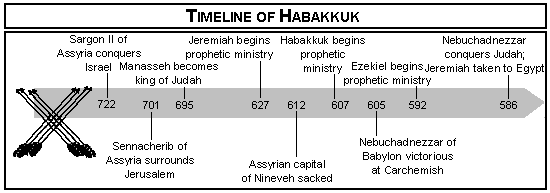
BC
722: Northern Kingdom of Israel (10 tribes) falls & is exiled to Assyria (2 Ki 17:22-23)
640 – Josiah becomes King of Judah (2 Kings 22:1-2)
627: Jeremiah begins his prophetic ministry (Jer 1:1-3)
626 – The Babylonian prince Nabopolassar (Jewish Encyclopedia) re-establishes Babylon as an independent city. The Babylonians — also known as the Chaldeans — are one of the vassal states of Assyria and they are threatening rebel.
621: Rediscovery of Book of Law which had been lost in House of God! Josiah's reformation (but not lasting revival) (2 Ki 22:8-20)
612: Nabopolassar forms an alliance with the Medes and seeks to gain dominance over Assyria sacking Nineveh, the capital of Assyria
609: Death of godly King Josiah at Megiddo when he tried to stop Pharaoh Neco king of Egypt from forming an alliance with the king of Assyria (2 Ki 23:29-37).
607: Habakkuk begins his prophetic ministry
605: Nebuchadnezzar defeats Pharaoh Necho of Egypt at Battle of Carchemish = "the turning point of world history"
605: First invasion of Judah by Nebuchadnezzar King of Babylon; Daniel taken captive
597: Second invasion of Judah by Babylon; Ezekiel and 10,000 taken captive
592: Ezekiel begins his prophetic ministry to Babylonian exiles
586: Fall of Jerusalem, Destruction of Temple
538: Exiles return from Babylon to Judah (relatively small number return)
Pictorial Timeline from Ryrie Study Bible-NASB
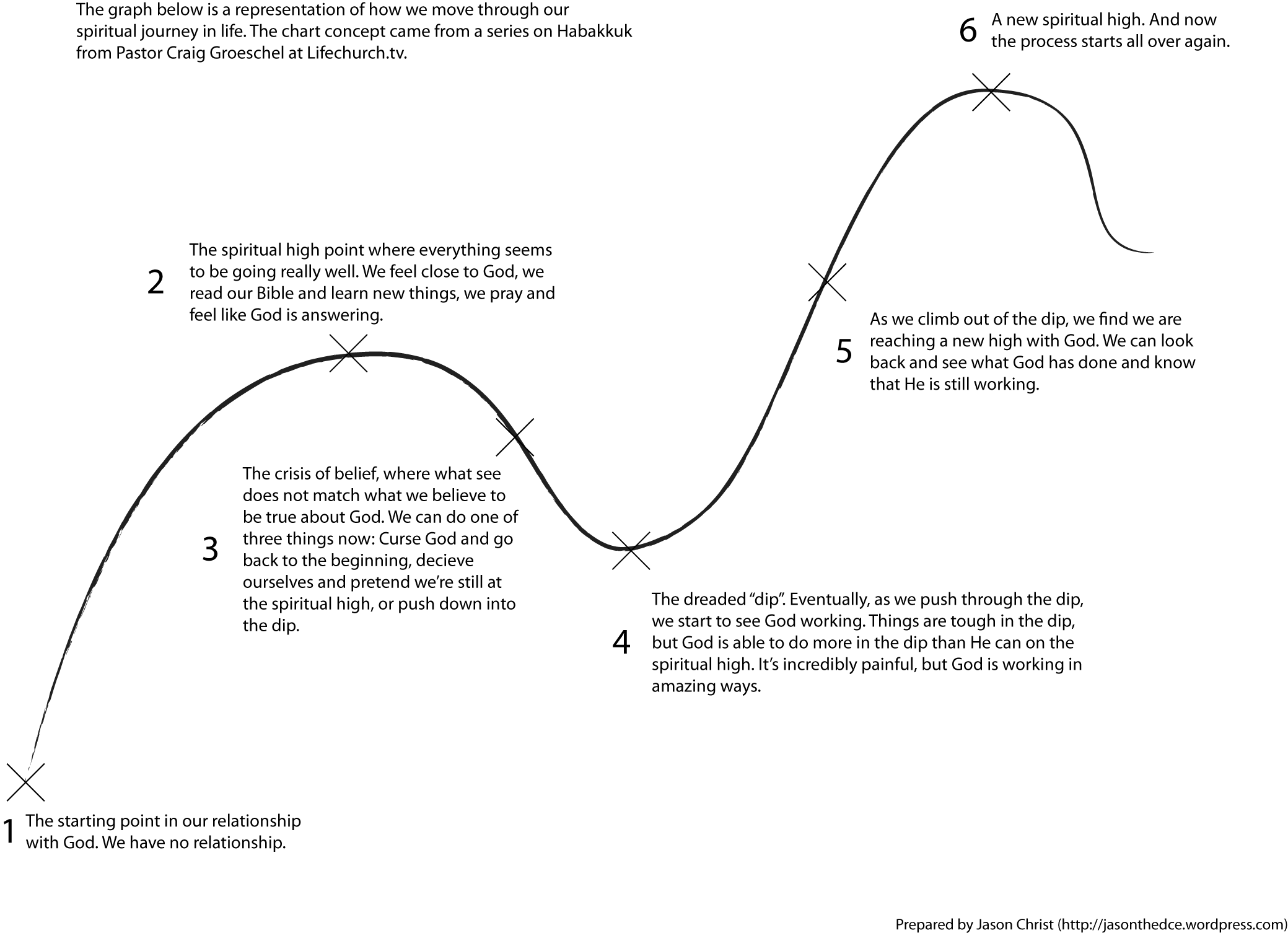
HABAKKUK 1-3 SYMBOLIZES
THE JOURNEY OF FAITH
Explanation - The following list includes not only commentaries but other Christian works by well known evangelical writers. Most of the resources below are newer works (written after 1970) which previously were available only for purchase in book form or in a Bible computer program. The resources are made freely available by archive.org but have several caveats - (1) they do not allow copy and paste, (2) they can only be checked out for one hour (but can be checked out immediately when your hour expires giving you time to read or take notes on a lengthy section) and (3) they require creating an account which allows you to check out the books free of charge. To set up an account click archive.org and then click the picture of the person in right upper corner and enter email and a password. That's all you have to do. Then you can read these more modern resources free of charge! I have read or used many of these resources but not all of them so ultimately you will need to be a Berean (Acts 17:11) as you use them. I have also selected works that are conservative and Biblically sound. If you find one that you think does not meet those criteria please send an email at https://www.preceptaustin.org/
Bible Knowledge Commentary - Old Testament - 1608 pages. Dallas Theological Seminary Faculty
From fear to faith : studies in the book of Habakkuk By: Lloyd-Jones, David Martyn - 84 page book
Habakkuk and Zephaniah By: Barber, Cyril J
James Rosscup - Barber, perhaps best known for his The Minister’s Library, gives a knowledgeable introduction of Habakkuk with a clear outline of the book. Synopses at the outset of sections offer perspective, he deals with verses well and has some help on problems. He sees the gazelle in 3:19 as picturing the sure-footedness and freedom in a life of faith. He is helpful on the Day of the Lord, seeing it as both near and far and involving both judgment and blessing (pp. 79–81). He is premillennial on Zephaniah 3:9–20.
The Minor Prophets - borrow this well done commentary by Charles Feinberg (see also The Major Messages of the Minor Prophets)
Cyril Barber - A forthright study denouncing formalism and heartlessness in worship. Formerly published between 1948 and 1952 in a series of volumes under the title Major Messages on the Minor Prophets, these studies have served well the needs of laypeople for more than thirty years.
Rosscup - A Jewish Christian scholar in Hebrew who taught in Old Testament at Dallas Seminary and later at Talbot Seminary, where he also was Academic Dean, did this exposition of all the minor prophets. Feinberg made biblical prophecy one of his specializations and does a good survey, being aware of interpretive problems, main views, contextual factors and correlation with other Old Testament and New Testament prophetic passages in a premillennial dispensational understanding. This is a I-volume edition of what originally was issued as 5 small volumes.
The Minor Prophets : an expositional commentary by Boice, James Montgomery, 292 pages
James Rosscup: The large, two-column pages contain much good material on the relevance of the words for then and for now, dealing with such topics as love, repentance, and sincerity (Hosea 6). A prolonged contemplation of these pages and an application of their principles will produce substantial Christian growth. The author could improve the work by being more definite sometimes in specifying in what framework God will bless Israel in the future (e.g., Hosea 14). Vagueness such as in Joel 2:1-11, where he says the invader is neither locusts nor a human army, is a drawback. Wordiness and wandering in his discussions is another shortcoming, as in using Joel 2:28 to take off into a long discussion of clericalism. He finds fulfillment of Joel 2:28 at Pentecost, yet it would help to point out some aspects that were (Rosscup)
The prophets of Israel by Wood, Leon James
James Rosscup - This quite readable work by a premillennialist covers the overall range of Old Testament prophets, various key subjects under “Prophetism” such as what “to prophesy” means, the prophets’ function, early prophets, Samuel, monarchy prophets, and writing prophets both major and minor. Wood has solid sections on Elijah and Elisha (their spiritual features, episodes, miracles). The Elisha part surveys each miracle. Some sections, as on Hosea, even discuss in some detail leading problems such as whether Gomer was tainted before marriage or became unfaithful later. But sections on the books do not delve into nearly the detail Chisholm gives. Wood does sum up the message well, has an outline on each book, and organizes much on background, character qualities and work of each prophet. He deals with each prophet in relation to the reign he fitted into. Chisholm and Freeman deal more with various problems. Cf. Hobart Freeman, Introd. to the Old Testament Prophets, available now only in some theological libraries.
Enjoying the Minor Prophets - a devotional commentary - By: MacDonald, William - same author of Believer's Bible Commentary
Hearing God's voice above the noise - The Twelve Minor Prophets By: Briscoe, D. Stuart
The Layman's Bible commentary By: Kelly, Balmer H. (Micah through Malachi)
Living prophecies; the Minor prophets paraphrased with Daniel and the Revelation (The Living Bible paraphrase) By: Taylor, Kenneth Nathaniel
Twelve Prophets By: Craigie, Peter C Published: Jan 01, 1984 - The Daily Study Bible Series - beware as he is not always literal in his interpretation
Cyril Barber - (These volumes adequately introduce the writing of each minor prophet. The exposition contains something good on each canonical book. Craigie's writings always give evidence of being well researched, and this study is no exception. Interesting sidelights are to be found on the history and culture of the times. The eschatology of these OT writers is marred, however, by the author's amillennialism
Interpreting the Minor Prophets By: Chisholm, Robert B - conservative, premillennial.
James Rosscup - This well-informed survey is by a professor of Old Testament studies, Dallas Seminary, who wrote on Hosea and Joel in the Bible Knowledge Commentary. Chisholm looks broadly at each prophet’s structure, message, doctrinal themes, literary and rhetorical features. After a brief survey of overall themes—sin, judgment, salvation—he takes up each prophet from Hosea to Malachi successively. On long-range prophecy he is presumably premillennial, but in several texts where one would expect a commitment, he keeps things so vague that one finds no distinct word as to when the fulfillment will come (Hosea 3, 14; Joel 3:9ff.; Zechariah 14, etc.). He surveys each book section by section with much that helps, dealing briefly with main problems. At the end of each survey of a book he sums up points of theology. He views Joel 2:1–11 as meaning a human army but is not distinct on what army and when. The work is good but general. The reader who has the Bible Knowledge Commentary from Dallas Seminary would already have the books covered in greater premillennial specificity in many cases.
Nahum, Habakkuk, and Zephaniah : an introduction and commentary By: Baker, David W. (David Weston)
Cyril Barber - Tyndale Old Testament Commentary. Downers Grove, IL: InterVarsity Press, 1988. This readily comprehensible commentary treats with admirable skill God's prediction concerning Nineveh, the Neo-Babylonian empire's chastening of Judah, and Zephaniah's prediction of the Day of the Lord. Approaches the prophetic portions of these books first from an historical point of view, and then from the perspective of amillennial hermeneutics.
James Rosscup - As Baker did in Obadiah in this series, he again presents a brief introduction and a well-studied survey of each book with a good outline, handling most things rather carefully, in a conservative stance. He sees the “Day” of Zephaniah 3 as one of wrath and also hope and help (p. 116), but is very general and vague about when and where and in what form the blessed state will be realized. He is typical of many who do not nail down things in any framework so as to clarify just where he stands.
Micah-Malachi Volume: 32 in Word Biblical Commentary - By: Smith, Ralph L.
Cyril Barber - Adheres to the format established for this series. Handles textual problems adroitly. Discusses the theological implications of these writings, and provides a variety of insights into the text. A necessary volume.
James Rosscup This quite readable work by a premillennialist covers the overall range of Old Testament prophets, various key subjects under “Prophetism” such as what “to prophesy” means, the prophets’ function, early prophets, Samuel, monarchy prophets, and writing prophets both major and minor. Wood has solid sections on Elijah and Elisha (their spiritual features, episodes, miracles). The Elisha part surveys each miracle. Some sections, as on Hosea, even discuss in some detail leading problems such as whether Gomer was tainted before marriage or became unfaithful later. But sections on the books do not delve into nearly the detail Chisholm gives. Wood does sum up the message well, has an outline on each book, and organizes much on background, character qualities and work of each prophet. He deals with each prophet in relation to the reign he fitted into. Chisholm and Freeman deal more with various problems. Cf. Hobart Freeman, Introd. to the Old Testament Prophets, available now only in some theological libraries.
The books of Nahum, Habakkuk, and Zephaniah New International Commentary on the Old Testament By: Robertson, O. Palmer
Walter C. Kaiser, Jr. "[This] is a first-class theological commentary with unique applications to the present day. His conclusions are balanced and well aimed with regard to the particulars of the immediate historical situation as well as with regard to the overall canonical stance of the ongoing drama of revelation."
James Rosscup - This is a very good conservative work, both perceptive on issues and in lucid style. The writer provides a good translation and commentary, often graphic. He looks at Habakkuk 2:4 from many angles (pp. 173–83), and also clearly catches the picture of living by faith in 3:19 that ties in with 2:4b. To a large extent the explanations of verses are full enough and satisfying. At times, however, questions in serious minds are not dealt with. For example, why make a sweeping statement in Zephaniah 3:12 about no deceit in the future remnant if this is in a state of imperfection and believers still have some deceit when less than absolutely perfect?
Nahum, Zephaniah, Habakkuk; minor prophets of the seventh century B.C. By: Freeman, Hobart E
James Rosscup - A helpful survey by the author of the very fine Introduction to the Old Testament Prophets.
Obadiah, Nahum, Habakkuk and Zephaniah; introduction and commentary By: Eaton, J. H. (John Herbert)
James Rosscup - This is a good exegesis of these books, with much help.
The books of Joel, Obadiah, Jonah, Nahum, Habakkuk, and Zephaniah Published: 1975 John D W Watts
James Rosscup - Watts uses the NEB and gives brief introductions (1–3 pp.) and expositions. He late dates Joel. On problem verses he is usually succinct. Locusts are literal in both chapters, but in the latter case Watts sees them as symbolic of the Lord’s “true Mighty army” (p. 26), whatever that means. He sees a future for Israel in Joel 2:18–27 but leaves vaguely obscure what this means. He refers to use of Joel 2 in Acts 2 but does not discuss the problem of some details not seeming to have been realistically fulfilled in Acts 2. He discusses Joel 3:9ff. in a general haze, and is mediocre among commentaries on these books.
Be amazed By: Wiersbe, Warren W - Some but not all the minor prophets - Hosea, Joel, Jonah, Nahum, Habakkuk, Malachi
Bible Exposition Commentary - Old Testament - Warren Wiersbe - always worth checking
Wiersbe's Expository Outlines on the Old Testament by Wiersbe, Warren W
"Even the most difficult Scriptures come alive as Warren Wiersbe leads you book-by-book through the Old Testament and helps you to see the "big picture" of God's revelation. In this unique volume, you will find: • Introductions and/or outlines for every Old Testament book • Practical expositions of strategic chapters • Special studies on key topics, relating the Old Testament to the New Testament • Easy-to-understand expositions that are practical, preachable, and teachable If you have used Dr. Wiersbe's popular BE series, you know how simple and practical his Bible studies are, with outlines that almost teach themselves. If not, you can now discover a wonderful new resource. This work is a unique commentary on every book of the Old Testament. It contains new material not to be found in the BE series.
With the Word - Devotional Commentary - Warren Wiersbe
Twelve voices for truth confronting a falling world with hope : a study of the minor prophets By: Hayford, Jack W
The minor prophets By: Lewis, Jack Pearl, 1919- Does not go into much depth.
Wrath and mercy : a commentary on the books of Habakkuk and Zephaniah By: Eszenyei Szeles, Maria
James Rosscup - This is by Professor of Old Testament, United Protestant Theological Seminary, in Cluj-Napoca, Romania. The work has many thorough and good exegetical comments on the Hebrew drawn from much study, yet some thin and cursory statements. Often the book furnishes help on theological meaning. But the authoress at times reflects higher critical loyalties as in claiming arbitrarily that certain statements must be a redactor’s later insertion if the writer does not grasp them. She is flimsy or non-existent in convincing proof of her biases (cf. on Habakkuk 2:6–20 at p. 36; also cf. p. 41, etc.). A pastor or student using the work with good discernment can profit from it by exercising his own judgment.
The minor prophets By: Theo. Laetsch, D.D.
James Rosscup - This is a very good amillennial commentary on the minor prophets as a whole. Laetsch deals with the text verse-by-verse, grapples with difficult phrases and explains them, uses the Hebrew extensively, and presents illuminating word studies. The lucid presentation helps make it a very interesting commentary to read. In crucial prophetical sections, his strong amillennialism appears. His weakness here is offset by his helpfulness in exegesis generally plus his good background material.
Unger's Commentary on the Old Testament (Volume 2 - Isaiah - Malachi) by Unger, Merrill Frederick, 1909- (1981) 972 pages.
The Minor Prophets by Lewis, Jack
The Broadman Bible commentary Volume: 7
The Book Of Twelve Prophets Commonly Called The Minor By: George Adam Smith
James Rosscup - Though old this is well-written and often cited, with many good statements on spiritual truths. Users will find much that is worthwhile, and sometimes may disagree, as when he sees the Jonah account as allegorical.
Understanding the Old Testament by Scripture Union - All 12 minor prophets. 100 pages.
James Rosscup - This succinct effort gets directly at issues, as in giving three views on what Gomer was when Hosea married her, and views on the woman Hosea took in 3:1. He is fuzzy on what the future of Israel will be (1:10; 2:16–23 etc.) but a bit clearer on 3:5 (p. 7; cf. p. 20). Sometimes he is clear, sometimes vaguely general, as on the heavenly signs in Joel 2. He sees Amos 9:11–15 as not fulfilled literally in such aspects as agricultural prosperity, but figuratively, as if 9:13b proves his view. Reference, he feels, is to the New Jerusalem. Strangely, he also sees Zechariah 14:20–21 as in the New Jerusalem, after describing the verses before where imperfection is evident. Often, though, his work gives the lay reader a good survey without getting bogged down.
J.Sidlow Baxter: Explore The Book - pdf Vol. 4 Ezekiel to Malachi
Thru the Bible with J. Vernon McGee - Proverbs - Malachi
The twelve minor prophets By: Robinson, George L.
James Rosscup - This is a reprint of the 1926 edition (New York: Harper and Brothers). He devotes a chapter to each prophet, “Hosea the Prophet of Love,” etc. The studies are terse summaries. On Hosea he lists and comments on steps in Israel’s downfall and has five points on the message to men today. He packs a lot of information in and organizes it well. His word portrait of Jonah is choice (pp. 74–75), and he has interesting accounts of great fish swallowing men. Though brief, the book has frequent material a preacher can use.
The Book Of Twelve Prophets Commonly Called The Minor By: George Adam Smith
James Rosscup - Though old this is well-written and often cited, with many good statements on spiritual truths. Users will find much that is worthwhile, and sometimes may disagree, as when he sees the Jonah account as allegorical.
The minor prophets By: Theo. Laetsch, D.D.
James Rosscup - This is a very good amillennial commentary on the minor prophets as a whole. Laetsch deals with the text verse-by-verse, grapples with difficult phrases and explains them, uses the Hebrew extensively, and presents illuminating word studies. The lucid presentation helps make it a very interesting commentary to read. In crucial prophetical sections, his strong amillennialism appears. His weakness here is offset by his helpfulness in exegesis generally plus his good background material.
Believer's Bible Commentary - OT and NT - MacDonald, William (1995) 2480 pages. Conservative. Literal. Often has very insightful comments. John MacArthur, says "Concise yet comprehensive - the most complete single-volume commentary I have seen." Warren Wiersbe adds "For the student who is serious about seeing Christ in the Word." One hour limit.
James Rosscup - This work, originally issued in 1983, is conservative and premillennial, written to help teachers, preachers and people in every walk of life with different views, explanation and application.
New Bible Commentary - (1994) See user reviews
Evangelical Commentary on the Bible - editor Walter Elwell (1989) 1239 pages
Unger's Commentary on the Old Testament (Volume 2 - Isaiah - Malachi) by Unger, Merrill Frederick, 1909- (1981) 972 pages.
Compact Bible commentary by Radmacher, Earl D; Allen, Ronald Barclay; House, H Wayne, et al - 954 pages. Multiple contributors to the comments which are often verse by verse. The comments are brief but meaty and can really help your study through a given book. A sleeper in my opinion.
STUDY BIBLES, ETC
Note: The first 3 resources have no time restriction and allow copy and paste function:
(1) KJV Bible Commentary - Hindson, Edward E; Kroll, Woodrow Michael. Over 3000 pages of the entire OT/NT. Well done conservative commentary that interprets Scripture from a literal perspective. Pre-millennial. User reviews - it generally gets 4/5 stars from users.
Very well done conservative commentary that interprets Scripture from a literal perspective user reviews
The King James Version Bible Commentary is a complete verse-by-verse commentary. It is comprehensive in scope, reliable in scholarship, and easy to use. Its authors are leading evangelical theologians who provide practical truths and biblical principles. Any Bible student will gain new insights through this one-volume commentary based on the timeless King James Version of the Bible.
(2) The King James Study Bible Second Edition 2240 pages (2013) (Thomas Nelson) General Editor - Edward Hindson with multiple contributing editors. Pre-millennial. See introduction on How to Use this Study Bible.
(3) NKJV Study Bible: New King James Version Study Bible (formerly "The Nelson Study Bible - NKJV") by Earl D Radmacher; Ronald Barclay Allen; Wayne H House. 2345 pages. (1997, 2007). Very helpful notes. Conservative. Pre-millennial.
HCSB Study Bible : Holman Christian Standard Bible - General Editor Jeremy Royal Howard (2010) 2360 pages. Conservative. Good notes. Include Holmans excellent maps. One hour limit
Life Application Study Bible: Old Testament and New Testament: New Living Translation. Has some very helpful notes especially with application of texts. See also Life application New Testament commentary - Bruce Barton
The MacArthur Study Bible - John MacArthur. Brief but well done notes for conservative, literal perspective.
ESV Study Bible - Excellent resource but not always literal in eschatology and the nation of Israel
NIV Study Bible - (2011) 2570 pages - Use this one if available as it has more notes than edition below.
The David Jeremiah Study Bible - (2013) 2208 pages. Logos.com - "Drawing on more than 40 years of study, Dr. David Jeremiah has compiled a legacy resource that will make an eternal impact on generations to come. 8,000 study notes. Hundreds of enriching word studies"50+ Essentials of the Christian Faith" articles."
Wycliffe Bible Commentary - Charles Pfeiffer - 1560 pages (1962). Less detailed than the KJV Bible Commentary. Conservative. Notes are generally verse by verse but brief.
Rosscup - Conservative and premillennial scholars here have been experts in their fields. The work contains brief introductions and attempts to give a verse-by-verse exposition, though it does skip over some verses. The treatments vary with the authors, but as a whole it is a fine one-volume commentary for pastors and students to use or give to a layman. Outstanding sections include, for example: Whitcomb on Ezra-Nehemiah-Esther; Culver on Daniel; Ladd on Acts; Harrison on Galatians; Johnson on I Corinthians; and Ryrie on the Johannine Epistles.
Ryrie Study Bible Expanded Edition (1994) 2232 pages
The Defender's Study Bible : King James Version by Morris, Henry M. Excellent notes by well known creationist.
NLT Study Bible (Illustration Version)
Disciple's Study Bible: New international version Not that helpful for verse by verse study. Focuses on application of Christian doctrines. 10,000 annotations; doctrinal summaries, "Life Helps" section relate doctrine to everyday discipleship.
The Living Insights Study Bible : New International Version - Charles Swindoll. Notes are good but somewhat sparse and not verse by verse.
The Apologetics Study Bible Understand Why You Believe by Norman Geisler - Apologetics Study Bible on Haggai
NIV Archaeological Study Bible (2005) 2360 pages (See also Archaeology and the Bible - OT and NT)
The Experiencing God Study Bible: the Bible for knowing and doing the will of God - Blackaby, Henry (1996) 1968 pages - CHECK THIS ONE! Each chapter begins with several questions under the title "PREPARE TO MEET GOD." Then you will interesting symbols before many of the passages. The chapter ends with a "DID YOU NOTICE?" question. This might make a "dry chapter" jump off the page!
MISCELLANEOUS RESOURCES
IVP Background Commentary - OT - John Walton
Zondervan Atlas of The Bible By: Umair Mirza
Unger's bible handbook : a best-selling guide to understanding the bible by Unger, Merrill F
Dictionary of Biblical Imagery - free for use online with no restrictions (i.e., you do not need to borrow this book). Editors Leland Ryken, J C Wilhoit, Tremper Longman III - This is a potential treasure chest to aid your preaching and teaching as it analyzes the meaning of a host of Biblical figures of speech. Clue - use the "One-page view" which then allows you to copy and paste text. One downside is there is no index, so you need to search 3291 pages for entries which are alphabetical.
Dictionary of deities and demons in the Bible (DDD) - 950 pages (1995) Read some of the 65 ratings (4.8/5 Stars). A definitive in depth resource on this subject. Very expensive to purchase.
Halley's Bible Handbook Henry H. Halley - (2000) 2720 pages (much larger than original edition in 1965 and no time limit on use). (Halley's Bible handbook : an abbreviated Bible commentary - one hour limit 1965 872 pages)
Rosscup - A much-used older evangelical handbook bringing together a brief commentary on Bible books, some key archaeological findings, historical background, maps, quotes, etc. It is helpful to a lay Bible teacher, Sunday School leader, or pastor looking for quick, pertinent information on a Bible book. This is the 72nd printing somewhat revised. Halley packed in much information. Unger’s is better overall, but that is not to say that Halley’s will not provide much help on basic information.
The Shaw Pocket Bible Handbook - Editor - Walter Elwell (1984) 408 pages.
"This hardback is small in size but packed full of content: Brief summaries of every book of the bible, cultural, archaeological and historical info, word definitions, pictures, maps and charts." Worth checking!
Eerdmans' Handbook to the Bible (1983) 688 pages
The New Unger's Bible Dictionary by Unger, Merrill Frederick, 1909-
Every prophecy of the Bible: Walvoord, John F
MANNERS AND CUSTOMS IN THE BIBLE
Today's Handbook of Bible Times & Customs by Coleman, William L
Nelson's New Illustrated Bible Manners & Customs : How the People of the Bible Really Lived by Vos, Howard Frederic
Manners & Customs of the Bible (The New Manners and Customs) Freeman, James M., 1827-1900 Published 1998
The New Manners and Customs of Bible Times: Gower, Ralph, 1933- Published 1987
Manners and Customs of Bible lands By: Wight, Fred Published 1983
Manners and Customs in the Bible By: Matthews, Victor Harold Published 1991
Handbook of life in Bible times By: Thompson, J. A. (John Arthur), 1913-2002 Published 1986
Illustrated dictionary of Bible manners and customs By: Deursen, A. van (Arie), 1891-1963 Published 1982
The Illustrated Guide to Bible Customs & Curiosities by Knight, George W.
Orientalisms in Bible lands, giving light from customs, habits, manners, imagery, thought and life in the East for Bible students By: Rice, Edwin Wilbur, 1831-1929 Published 1910
Bible manners and customs By: Mackie, G. M. 1854-1922 Published 1898
Teach it to your children : how kids lived in Bible days By: Vamosh, Miriam Feinberg, author
Everyday life in Bible times : work, worship, and war By: Embry, Margaret Published 1994
Everyday living : Bible life and times : fascinating, everyday customs and traditions from the people of the Bible Published 2006
The Land and the Book; or, Biblical illustrations drawn from the manners and customs, the scenes and scenery, of the Holy land By: Thomson, William M. (William McClure), 1806-1894 Published 1880
Eastern manners illustrative of the Old Testament history By: Jamieson, Robert, 1802-1880 Published 1838
Scripture manners and customs : being an account of the domestic habits, arts, etc., of Eastern nations mentioned in Holy Scripture Published 1895
APOLOGETICS
The Apologetics Study Bible Understand Why You Believe - Comments from over 90 leading apologists, including: Ted Cabal, Lee Strobel, Chuck Colson, Norm Geisler, Josh McDowell, Albert Mohler, J.P. Moreland, see reviews. Here is a review from The Christian Reviewer.
Baker Encyclopedia of Christian Apologetics by Geisler, Norman
Cyril Barber - This is a goldmine of valuable information! Well-indexed. Covers everything from “Absolute Truth” to “Zen Buddhism.” Extensive articles on such topics as “Agnosticism,” “Annihilationism,” “Bible, Alleged Errors in,” “Gnosticism,” “Miracles in the Bible,” “New Testament Manuscripts,” and “Objections to Resurrection,” “Big Bang Theory,” “Edward John Carnell,” “Christ, Death of,” are only a few of the insightful essays in this masterful work. Each article has been written in an understandable way, and a 28 page bibliography forms a valuable source for further research. An excellent resource.
Evidence That Demands A Verdict - Josh McDowell
The New Evidence that Demands a Verdict - Josh McDowell
More Than A Carpenter - A modern classic by Josh McDowell - Great resource for those who are skeptical that Jesus is fully God, fully Man.
Encyclopedia of Bible difficulties by Archer, Gleason L - or here with no restrictions
Hard Sayings of the Bible - Walter Kaiser
When Critics Ask - Norman Geisler
HEBREW WORD STUDY
RESOURCES
Theological Wordbook of the Old Testament by Harris, R. Laird - (5/5 Stars) One of the best OT lexicons for studying Hebrew words.
Here is another link to the TWOT which has no time limit on use and does allow copy and paste. Can be downloaded as PDF.
Vine's Expository Dictionary of Old Testament and New Testament Words - Online pdf
Hebrew Honey: a simple and deep word study of the Old Testament - 330 pages. The definitions have more of a devotional flavor. For example, see the descriptive definition for "Abide" (Hebrew - gur).
Expository Dictionary of Bible Words by Richards, Larry, It does not go into great depth on the Greek or Hebrew words but does have some excellent insights.
So That's What it Means (Theological Wordbook) - Formerly titled "Theological Wordbook" edited by Charles Swindoll. It is now under this new title So That's What it Means and can be borrowed - it is more like a dictionary than a lexicon but the comments are superb! The contributors include Donald Campbell, Wendell Johnston, John Witmer, John Walvoord
Nelson's Expository Dictionary of the Old Testament by Unger, Merrill. Indexed by English word and then any related Hebrew nouns or verbs. Definitions are solid and geared to the lay person.
Synonyms of the Old Testament-Robert Girdlestone
- September, 2012
Habakkuk 1:2 Commentary
Habakkuk 1:3 Commentary
Habakkuk 1:4 Commentary
Habakkuk 1:5 Commentary
Habakkuk 1:6 Commentary
Habakkuk 1:7 Commentary
Habakkuk 1:8 Commentary
Habakkuk 1:9 Commentary
Habakkuk 1:10 Commentary
Habakkuk 1:11 Commentary
Habakkuk 1:12 Commentary
Habakkuk 1:13 Commentary
Habakkuk 1:14 Commentary
Habakkuk 1:15 Commentary
Habakkuk 1:16 Commentary
Habakkuk 1:17 Commentary
Habakkuk 2:2 Commentary
Habakkuk 2:3 Commentary
Habakkuk 2:4 Commentary
Habakkuk 2:5 Commentary
Habakkuk 2:6 Commentary
Habakkuk 2:7 Commentary
Habakkuk 2:8 Commentary
Habakkuk 2:9 Commentary
Habakkuk 2:10 Commentary
Habakkuk 2:11 Commentary
Habakkuk 2:12 Commentary
Habakkuk 2:13 Commentary
Habakkuk 2:14 Commentary
Habakkuk 2:15 Commentary
Habakkuk 2:16 Commentary
Habakkuk 2:17 Commentary
Habakkuk 2:18 Commentary
Habakkuk 2:19 Commentary
Habakkuk 2:20 Commentary
Habakkuk 3:2 Commentary
Habakkuk 3:3 Commentary
Habakkuk 3:4 Commentary
Habakkuk 3:5 Commentary
Habakkuk 3:6 Commentary
Habakkuk 3:7 Commentary
Habakkuk 3:8 Commentary
Habakkuk 3:9 Commentary
Habakkuk 3:10 Commentary
Habakkuk 3:11 Commentary
Habakkuk 3:12 Commentary
Habakkuk 3:13 Commentary
Habakkuk 3:14 Commentary
Habakkuk 3:15 Commentary
Habakkuk 3:16 Commentary
Habakkuk 3:17 Commentary
Habakkuk 3:18 Commentary
Habakkuk 3:19 Commentary
Well done - Recommended
Well done - Recommended
- Habakkuk 1:1-11 The Mystery of History
- Habakkuk 1:12-2:1 Questions about God and Evil
- Habakkuk 2:2-6 Two Distinct Ways of Life
- Habakkuk 2:6-3:2 Retribution And Revival
- Habakkuk 3:1-19 Joy for the Fearful
Caveat: Be an Acts 17:11 Berean (note): Not always literal, especially on prophetic passages
Caveat: Be an Acts 17:11 Berean (note): Not always literal, especially on prophetic passages
- Habakkuk 1-3
- Habakkuk Thumbnail Pictures (34)
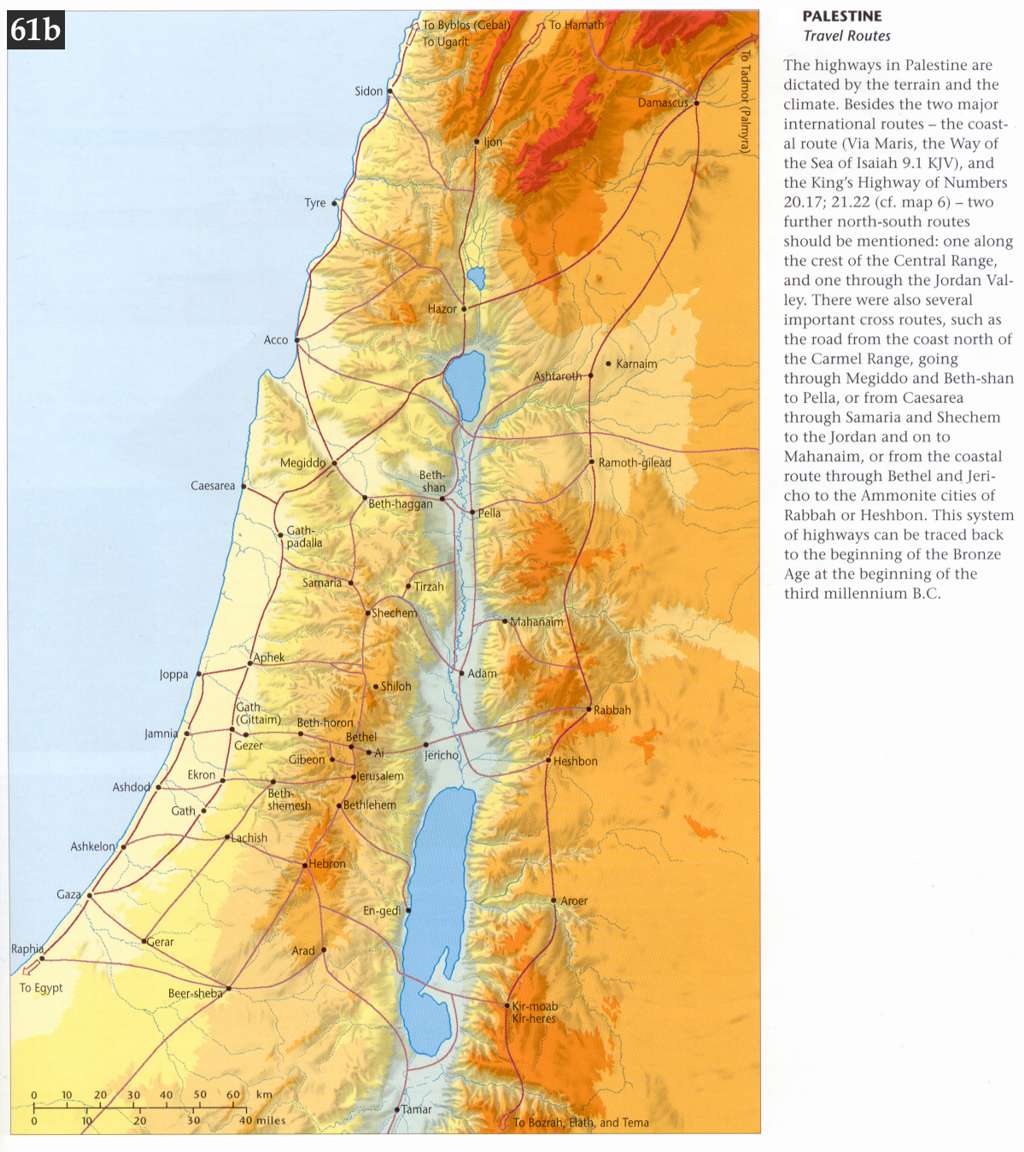
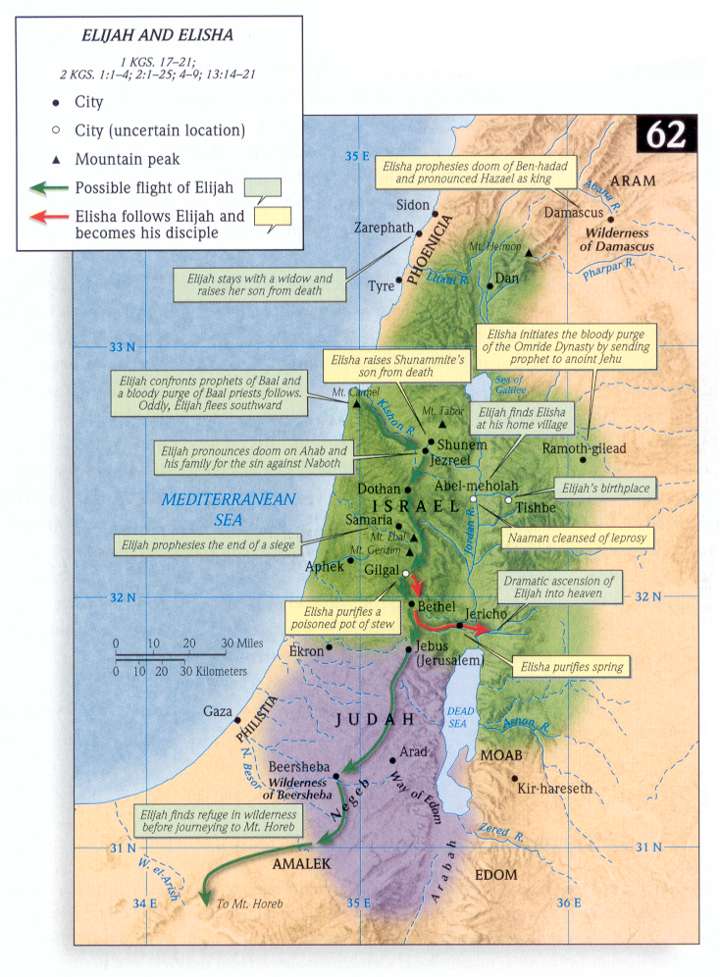
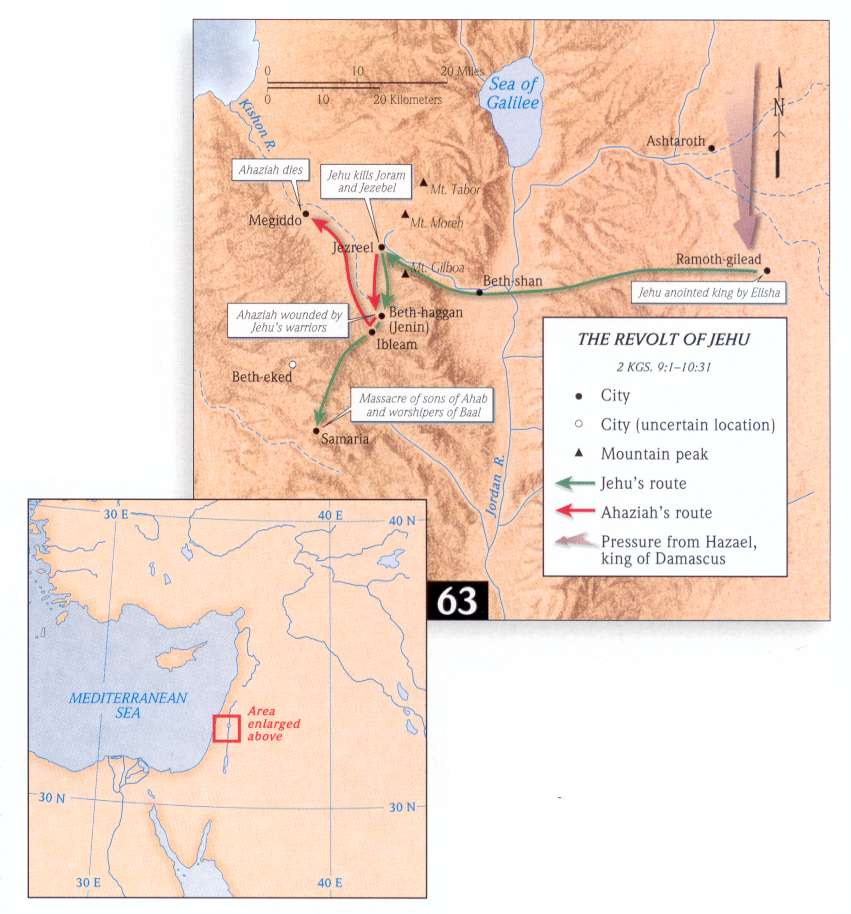
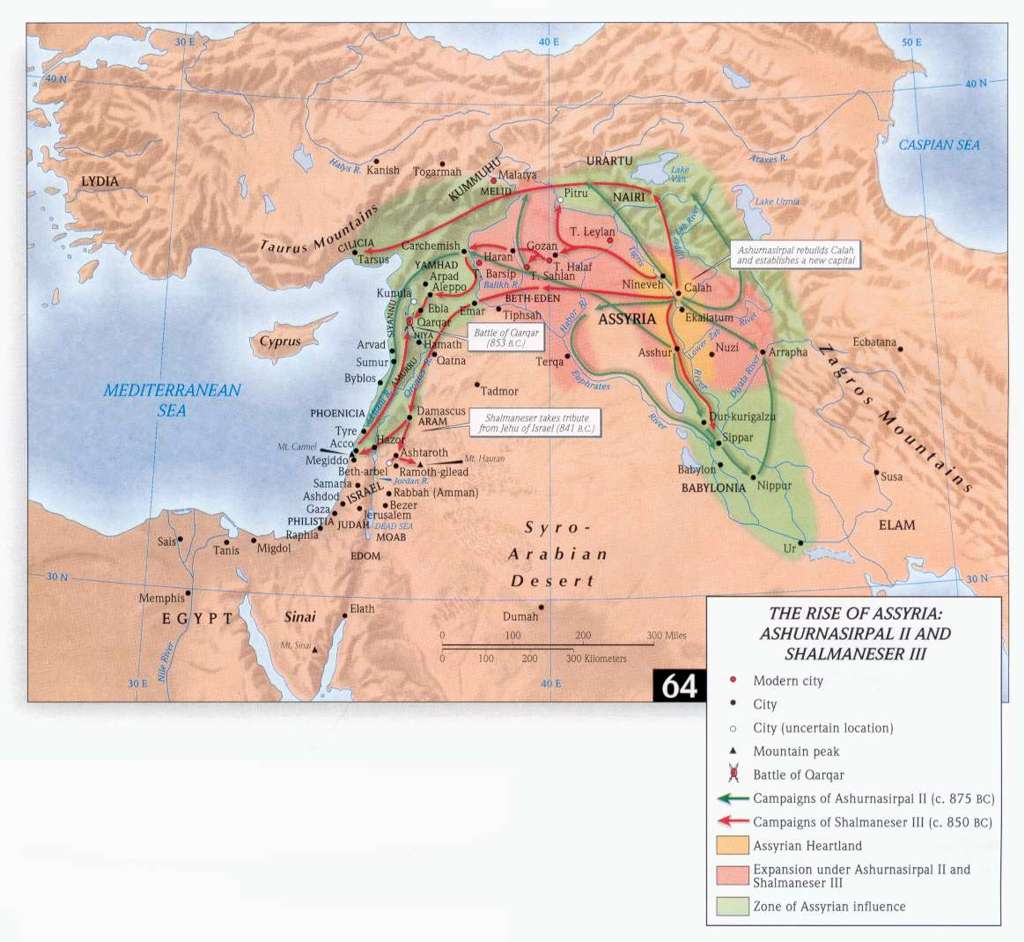
- Maps Related to Habakkuk
- Map Related - The Rise of the Neo-Babylonian Empire
These are the from the Holman Bible Atlas (digital book; Hardcover) copyright © 1998 B&H Publishing Group, used by permission, all rights reserved. This is one of the best resources for Bible maps.
MAPS COVERING ISRAEL PRE- AND POST-EXILE
These are excellent full color, modern maps with events marked on many of the maps
The Kingdom of David and Solomon
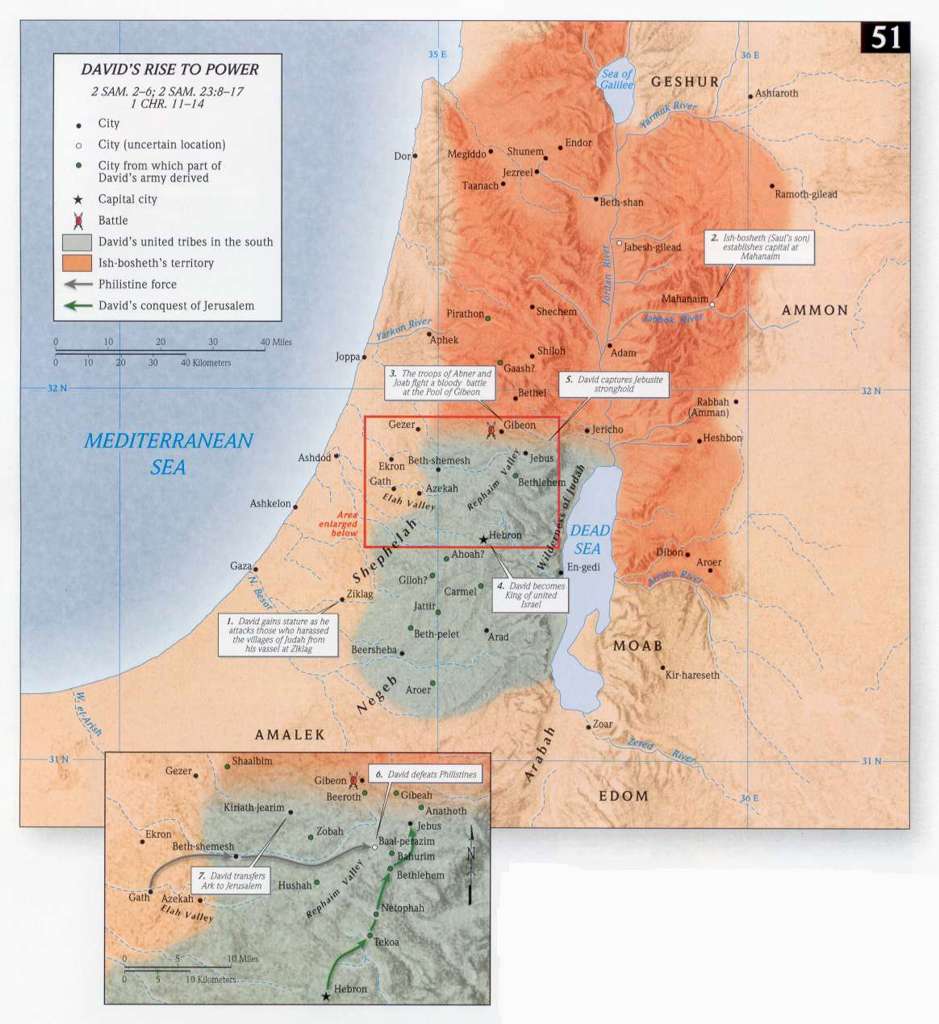
- David's Rise to Power
- David in Conquest of Canaan
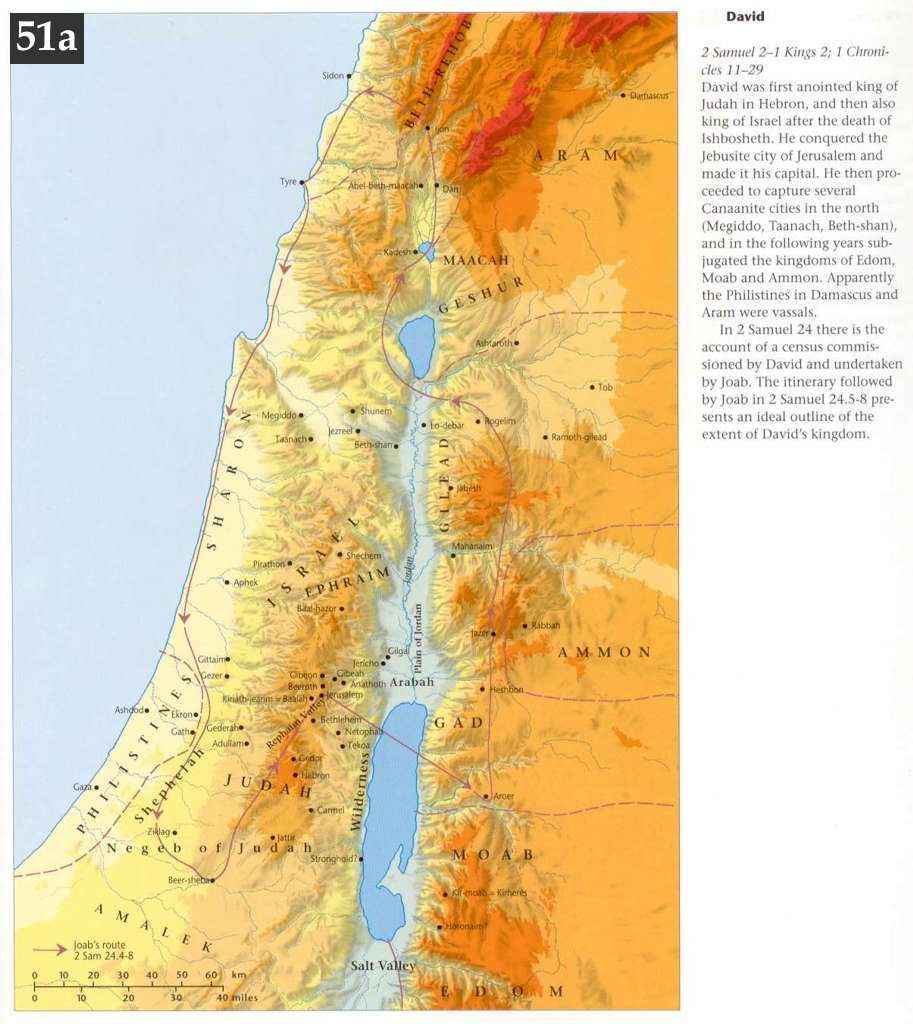
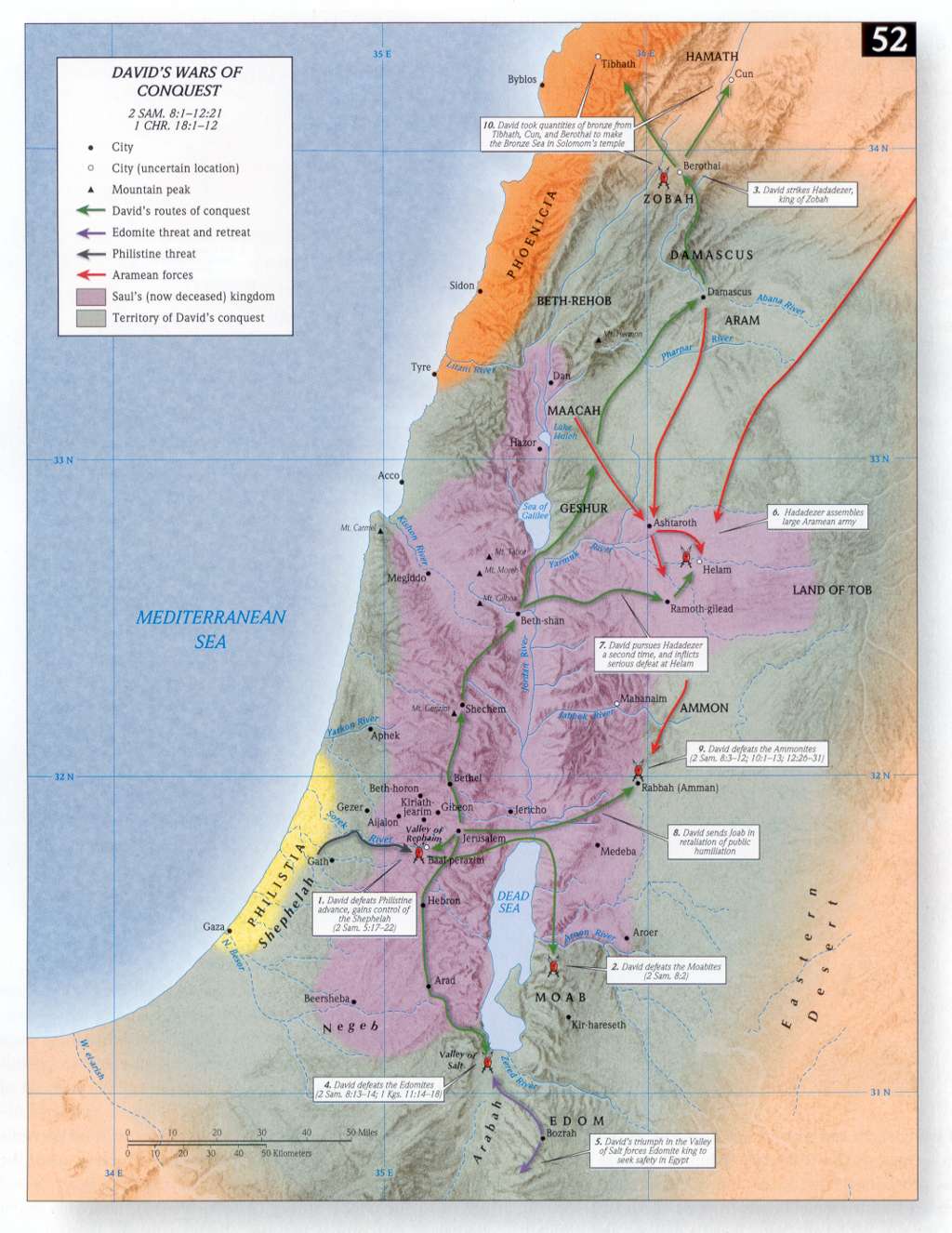
- David's Wars of Conquest
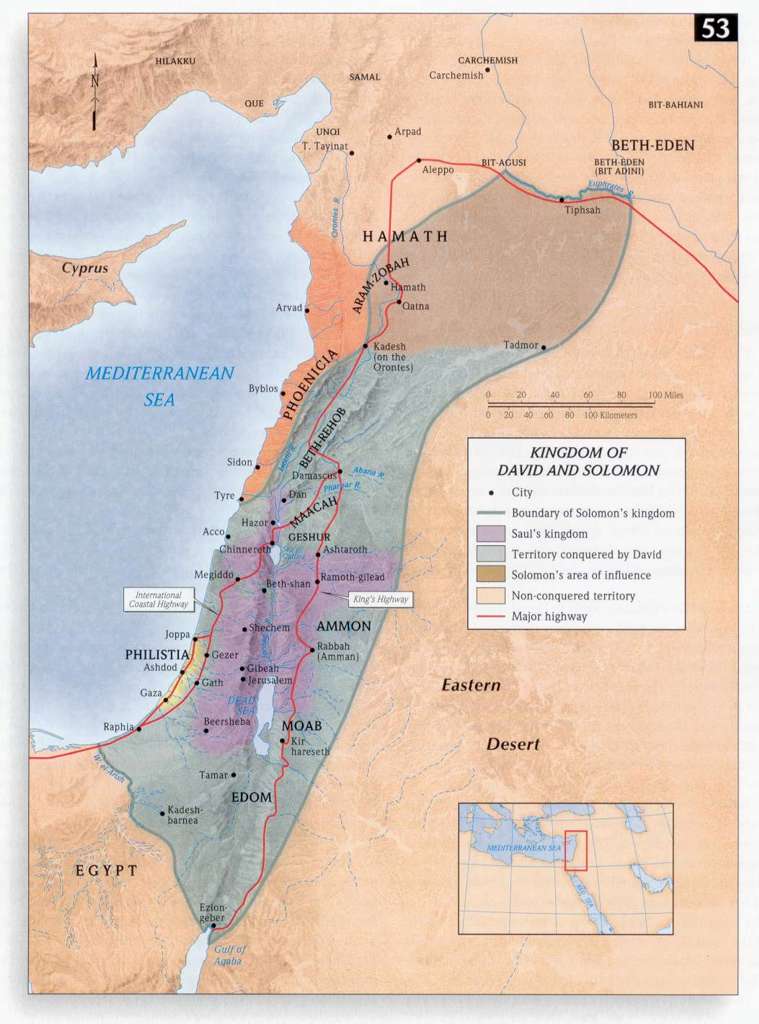
- Kingdom of David and Solomon
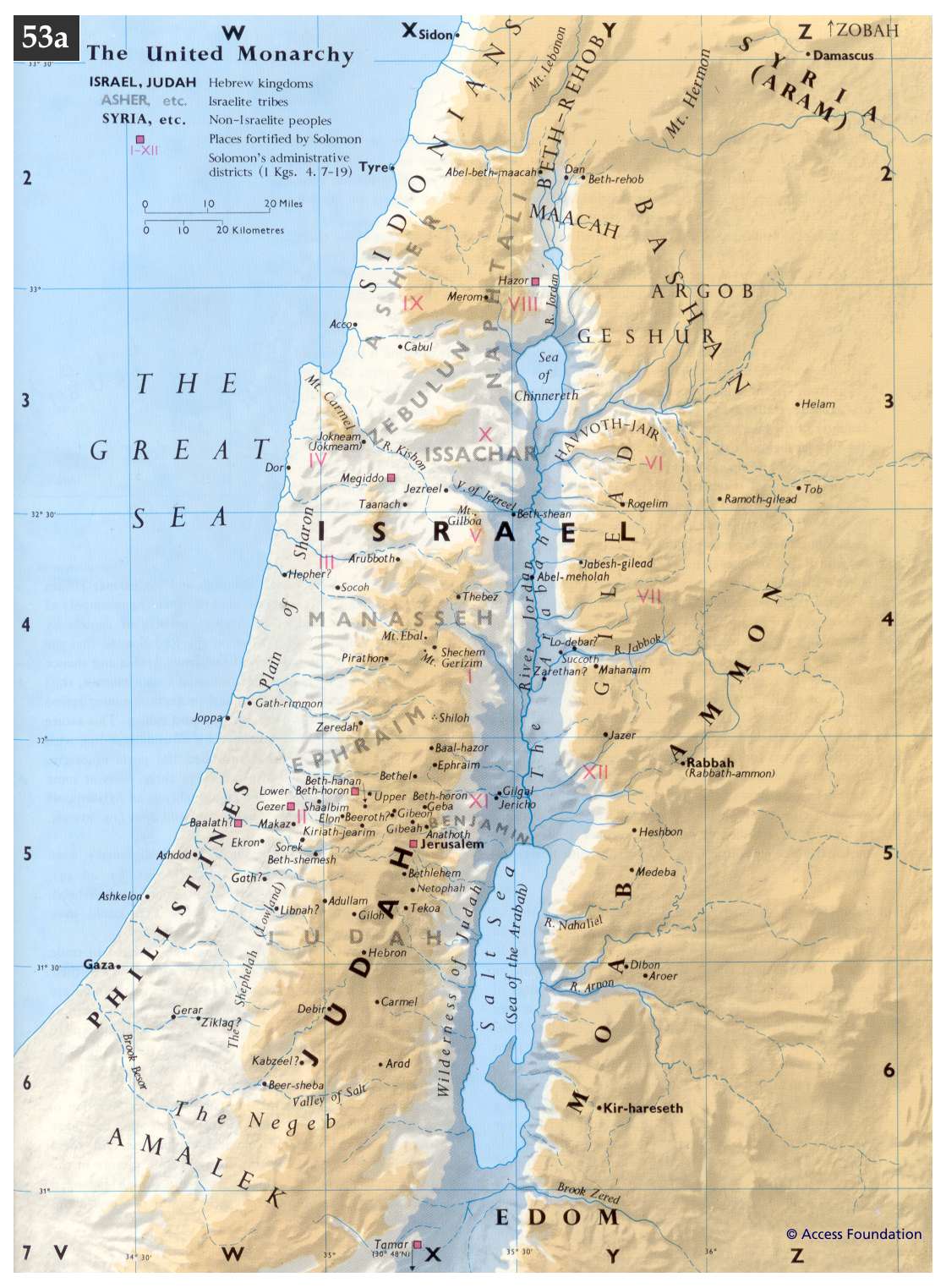
- The United Monarchy under Solomon (1)
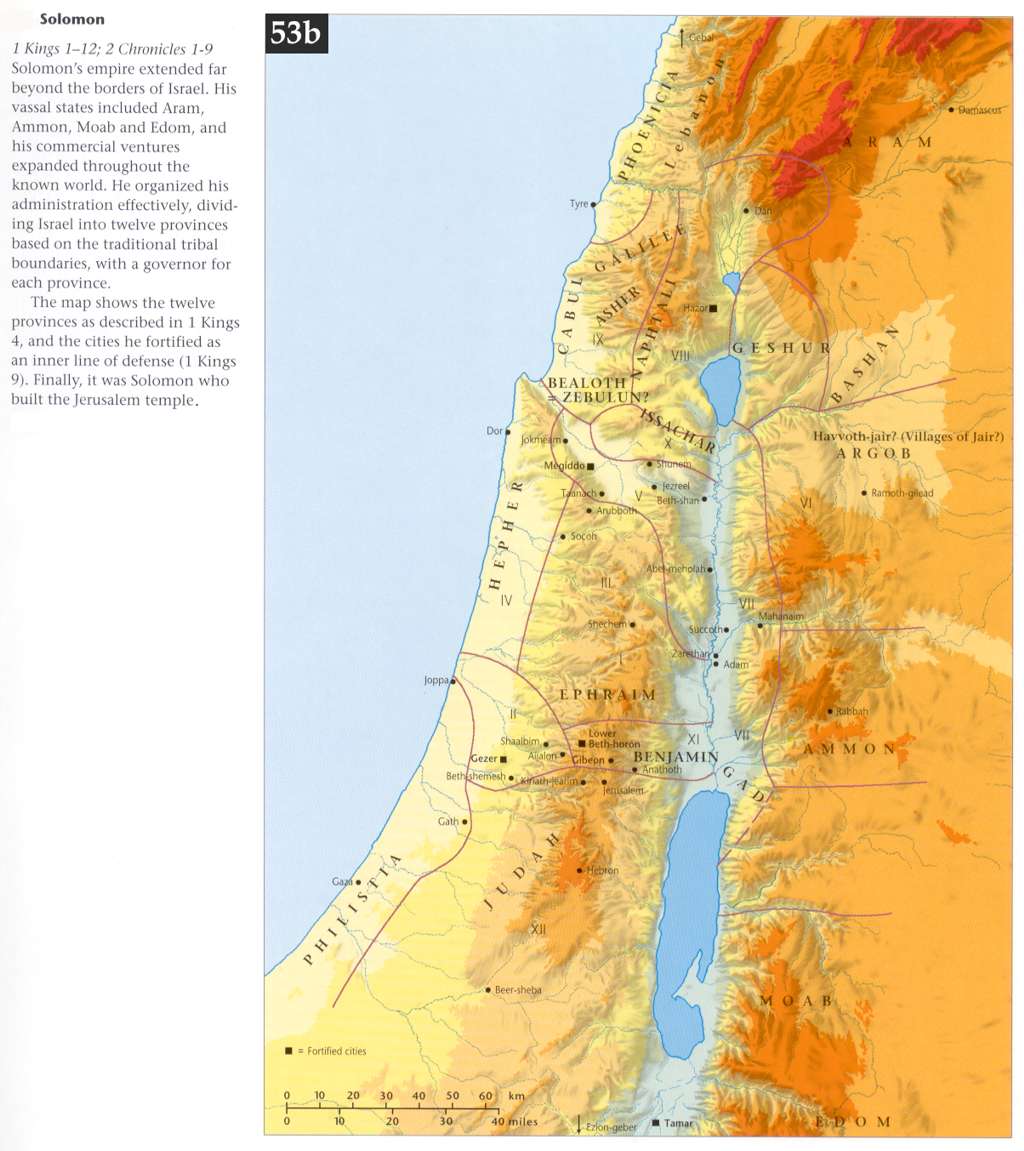
- The United Monarchy under Solomon (2)
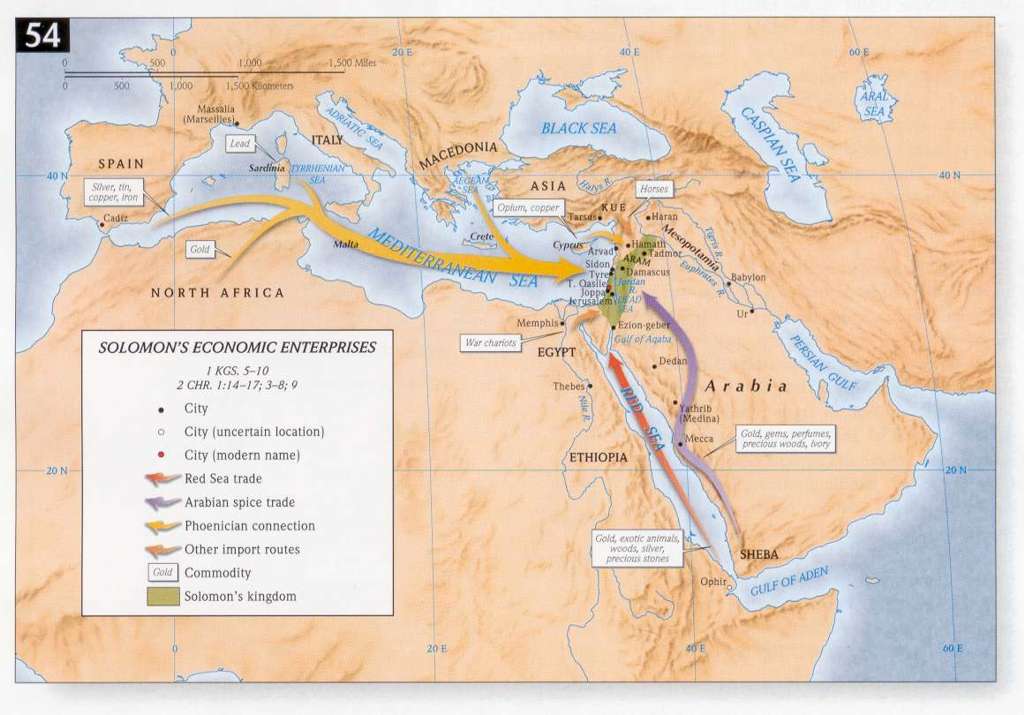
- Solomon's Economic Enterprises
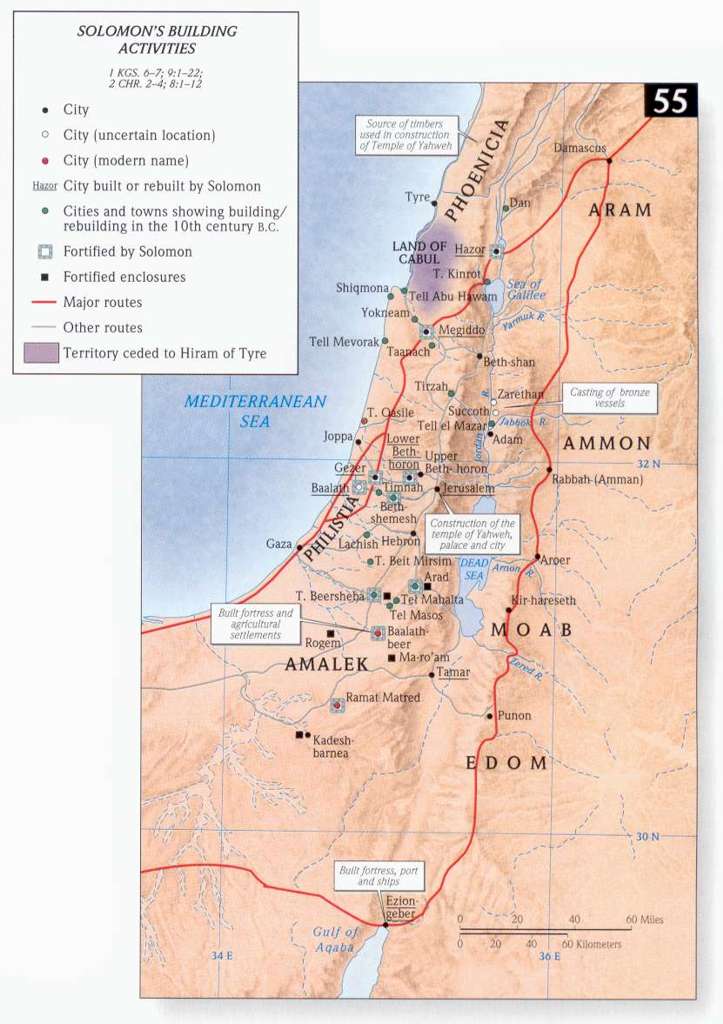
- Solomon's Building Activities
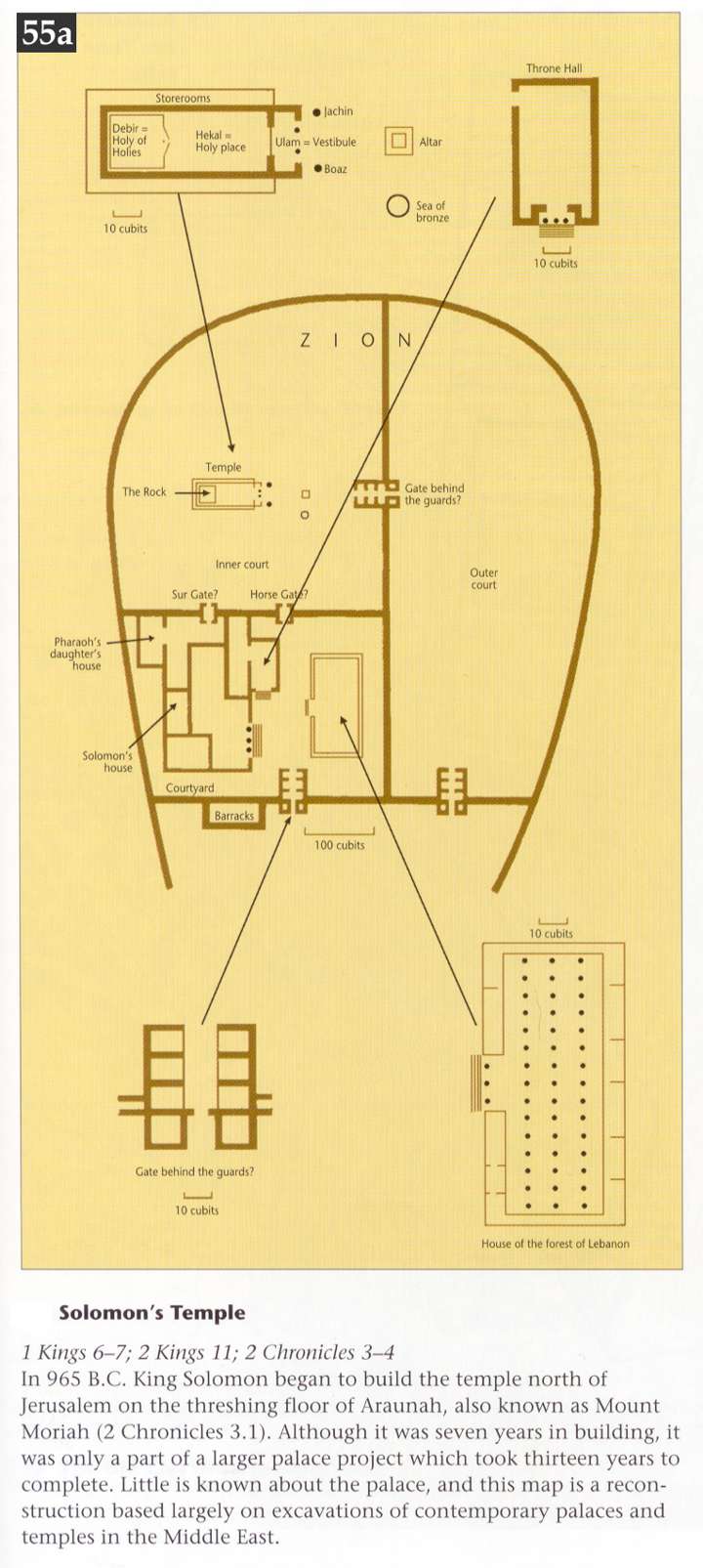
- Solomon's Temple
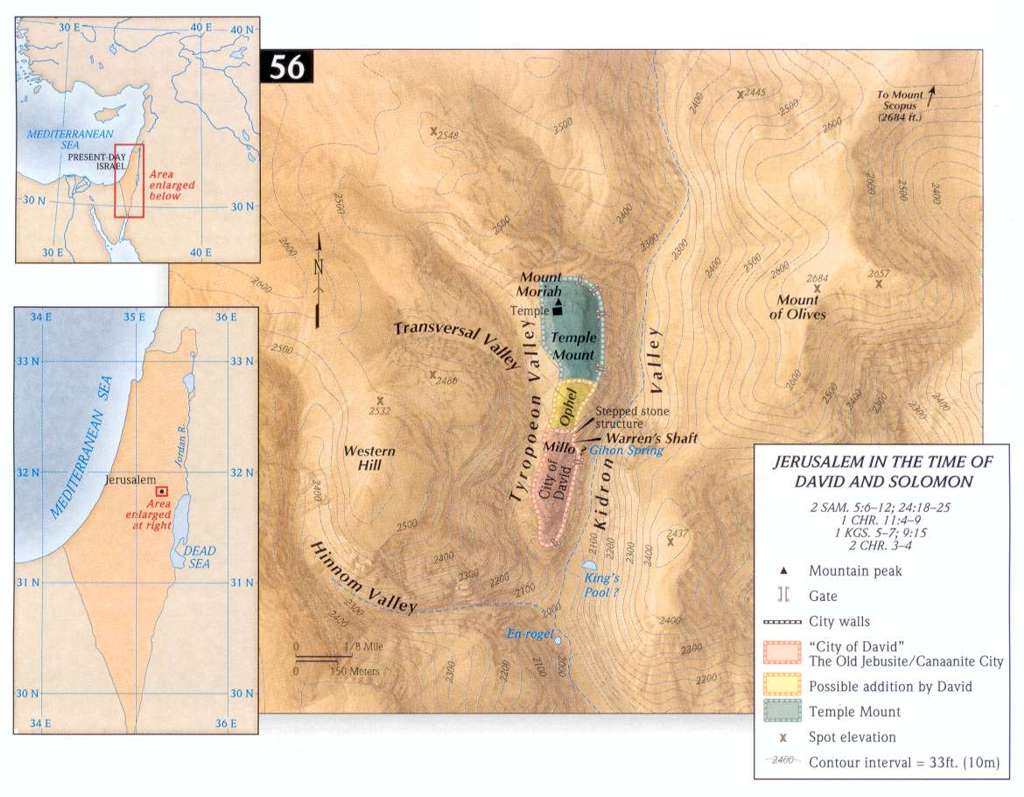
- Jerusalem in the Time of David and Solomon
The Kingdoms of Israel and Judah
- The Kingdoms of Israel and Judah (1)
- The Kingdoms of Israel and Judah (2)
- The Kingdoms of Israel and Judah (3)
- The Campaign of Shishak
- Conflicts between Israel and Aram-Damascus
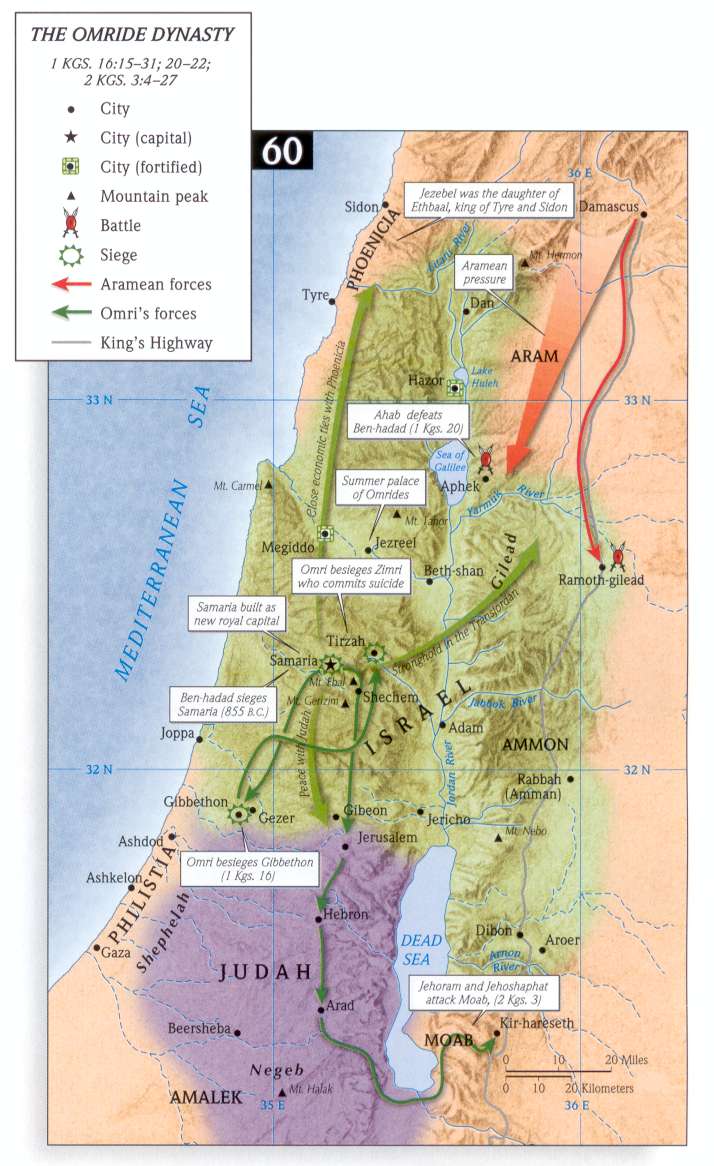
- The Omride Dynasty
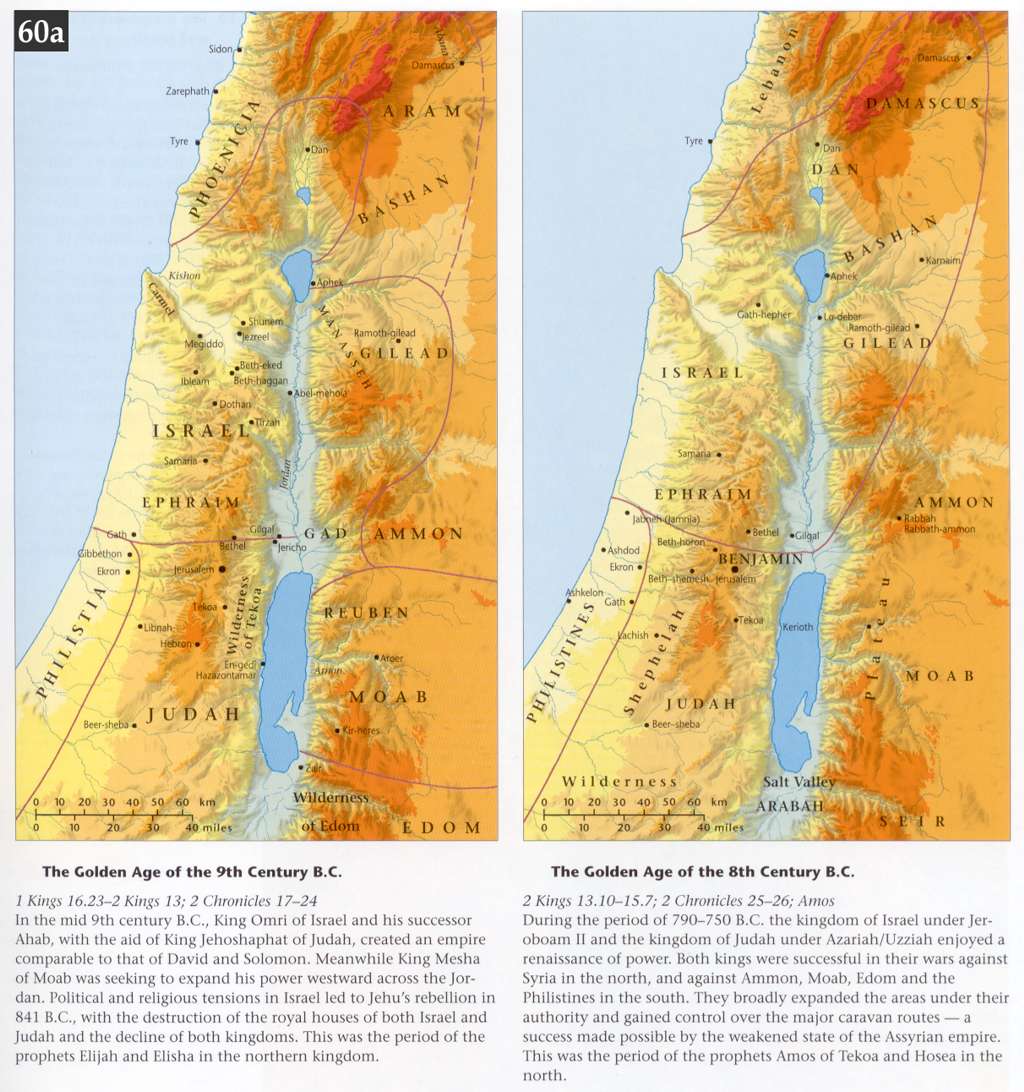
- The Golden Ages of the 9th & 8th centuries BCE
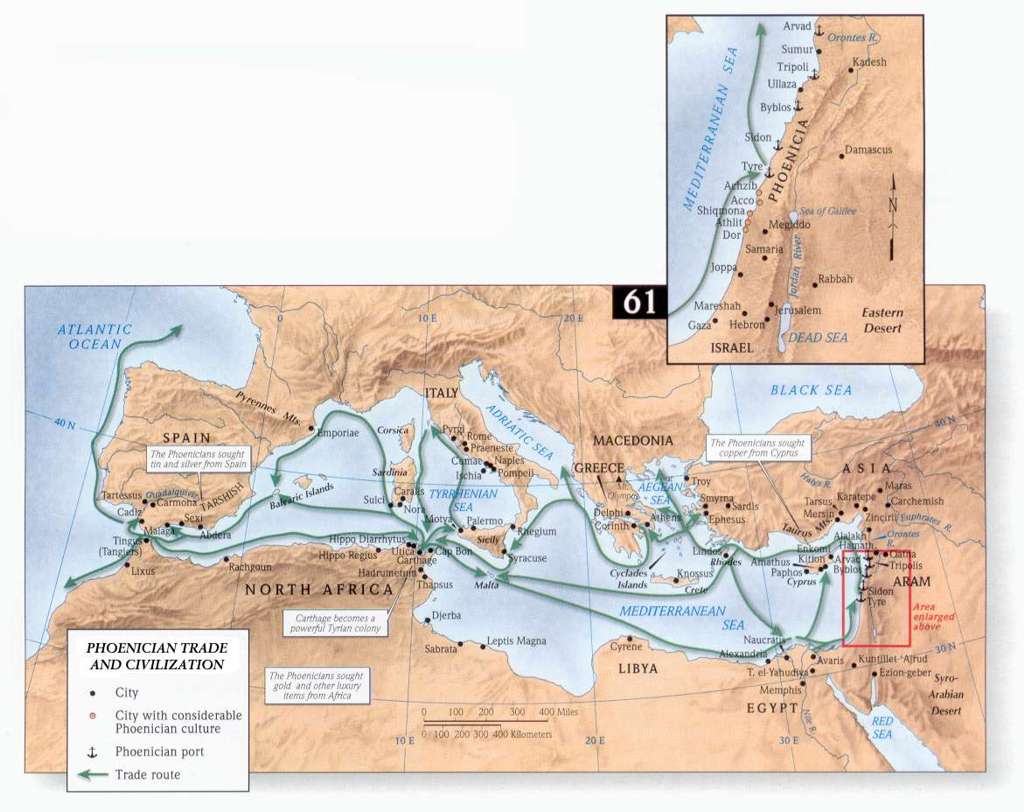
- Phoenician Trade and Civilization
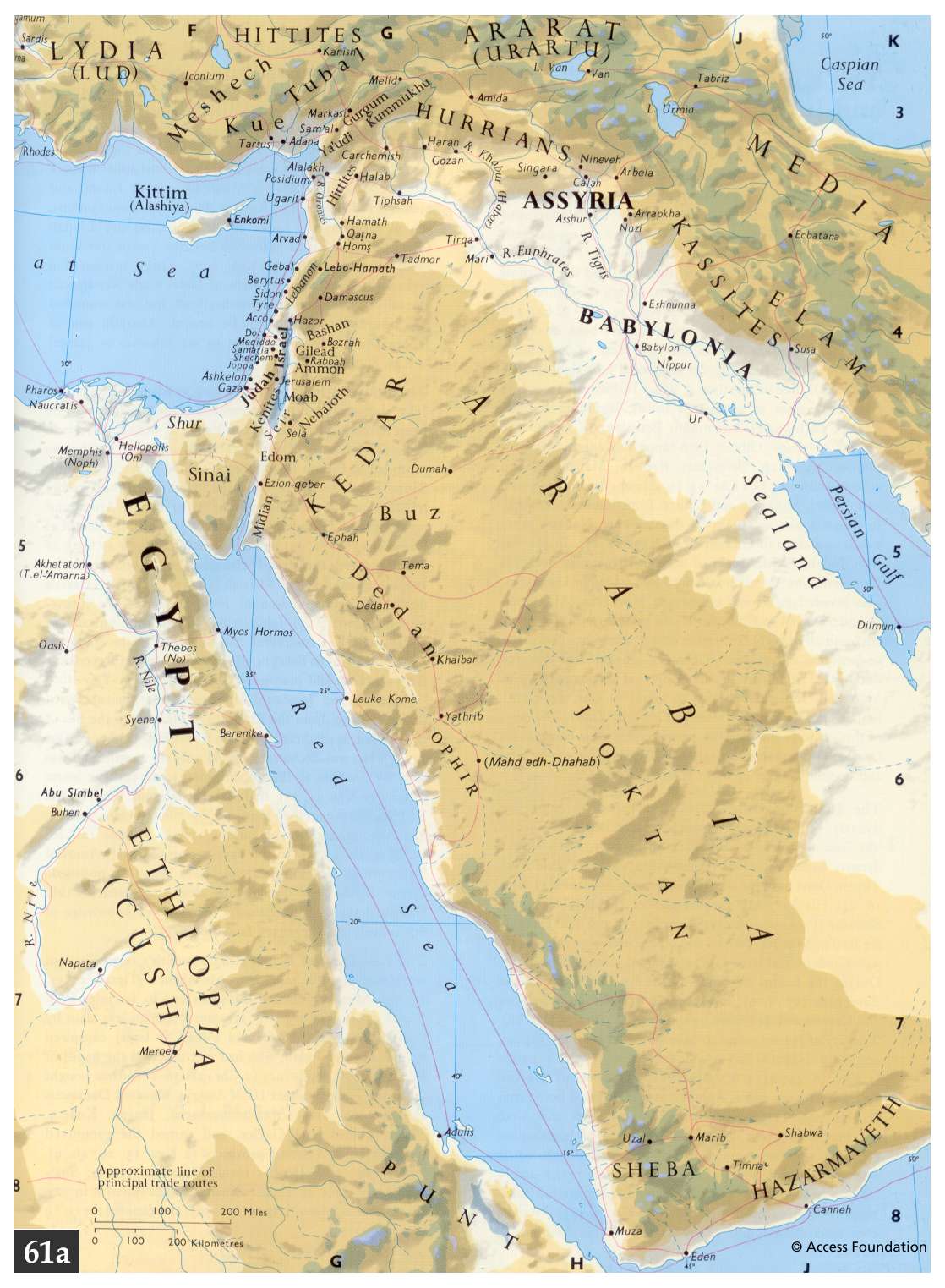
- Trade Routes throughout the Middle East
- Travel Routes throughout Palestine
- Elijah and Elisha
- The Revolt of Jehu
- The Rise of Assyria
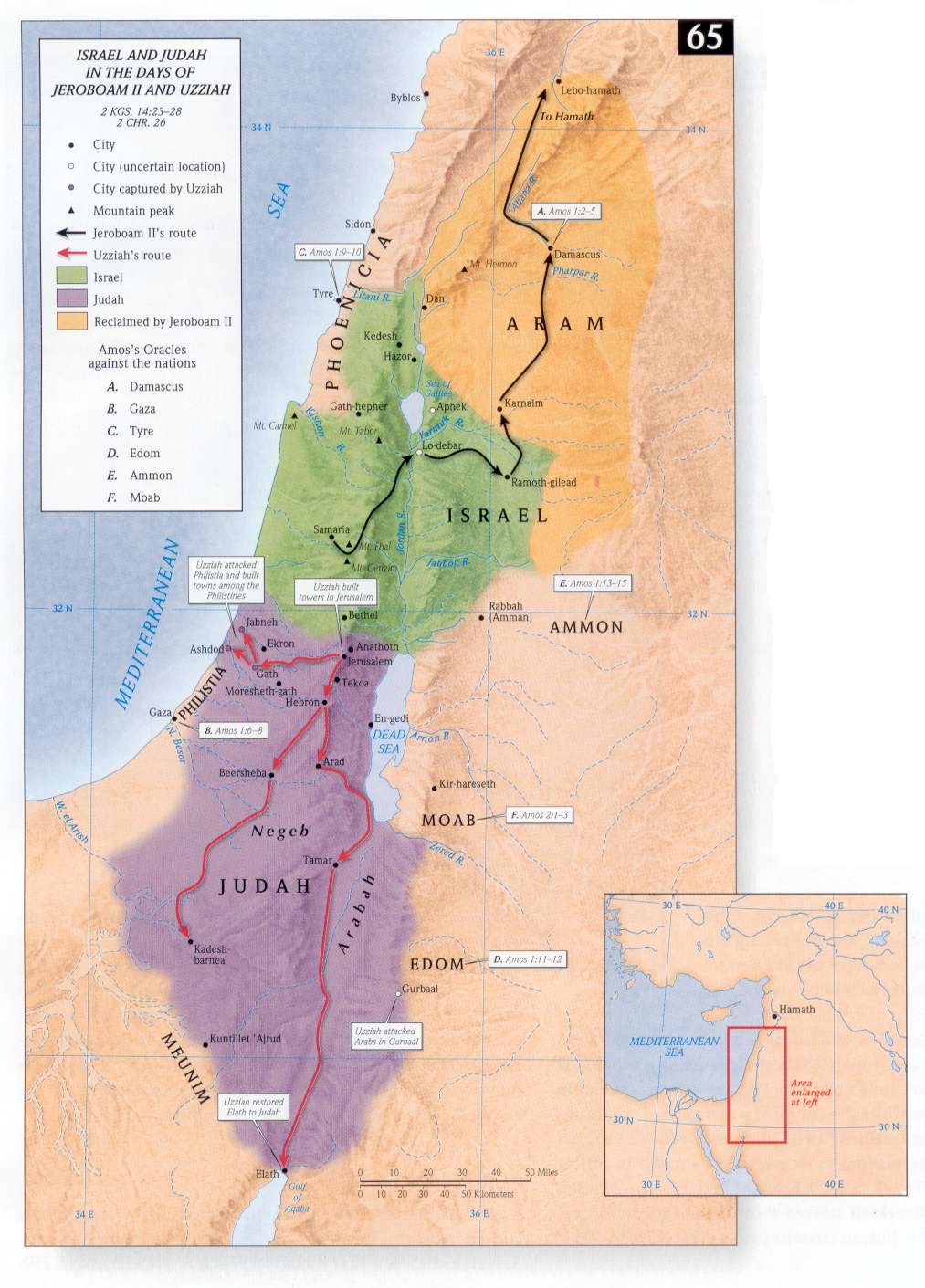
- Israel & Judah in the days of Jeroboam II and Uzziah
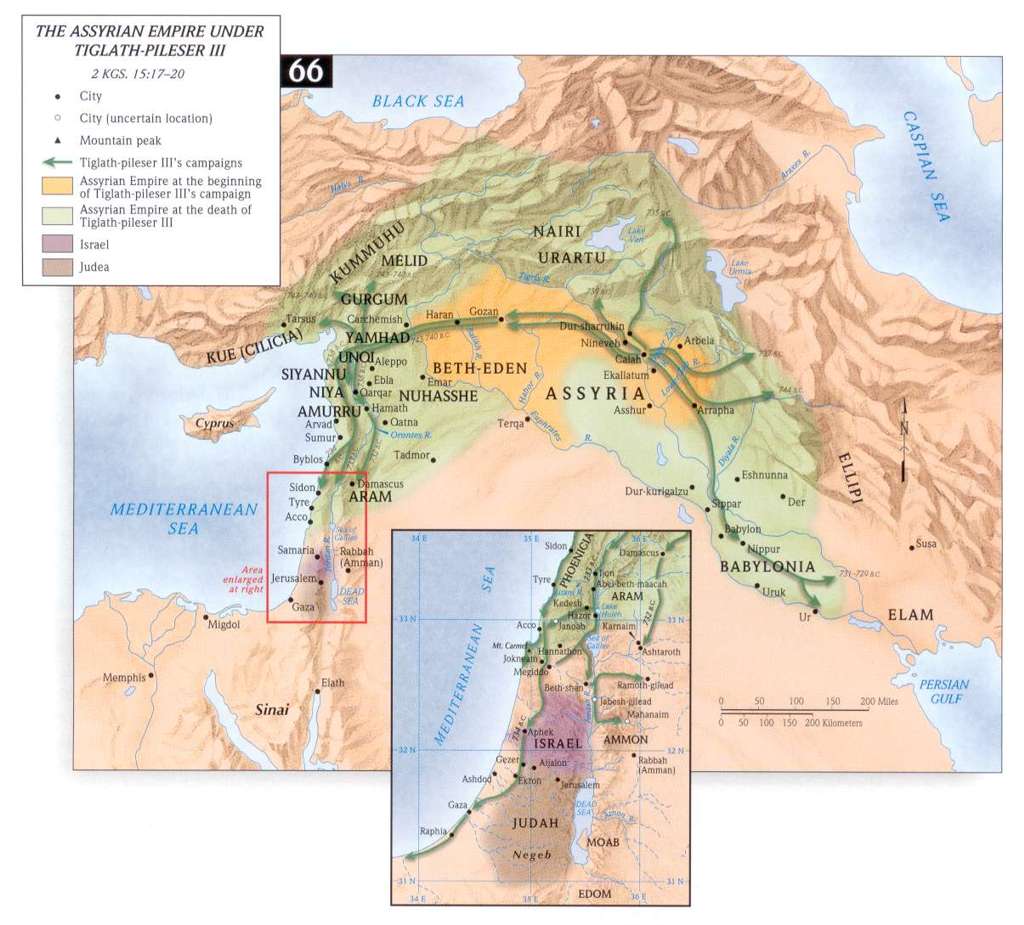
- The Assyrian Empire under Tiglath-Pileser III
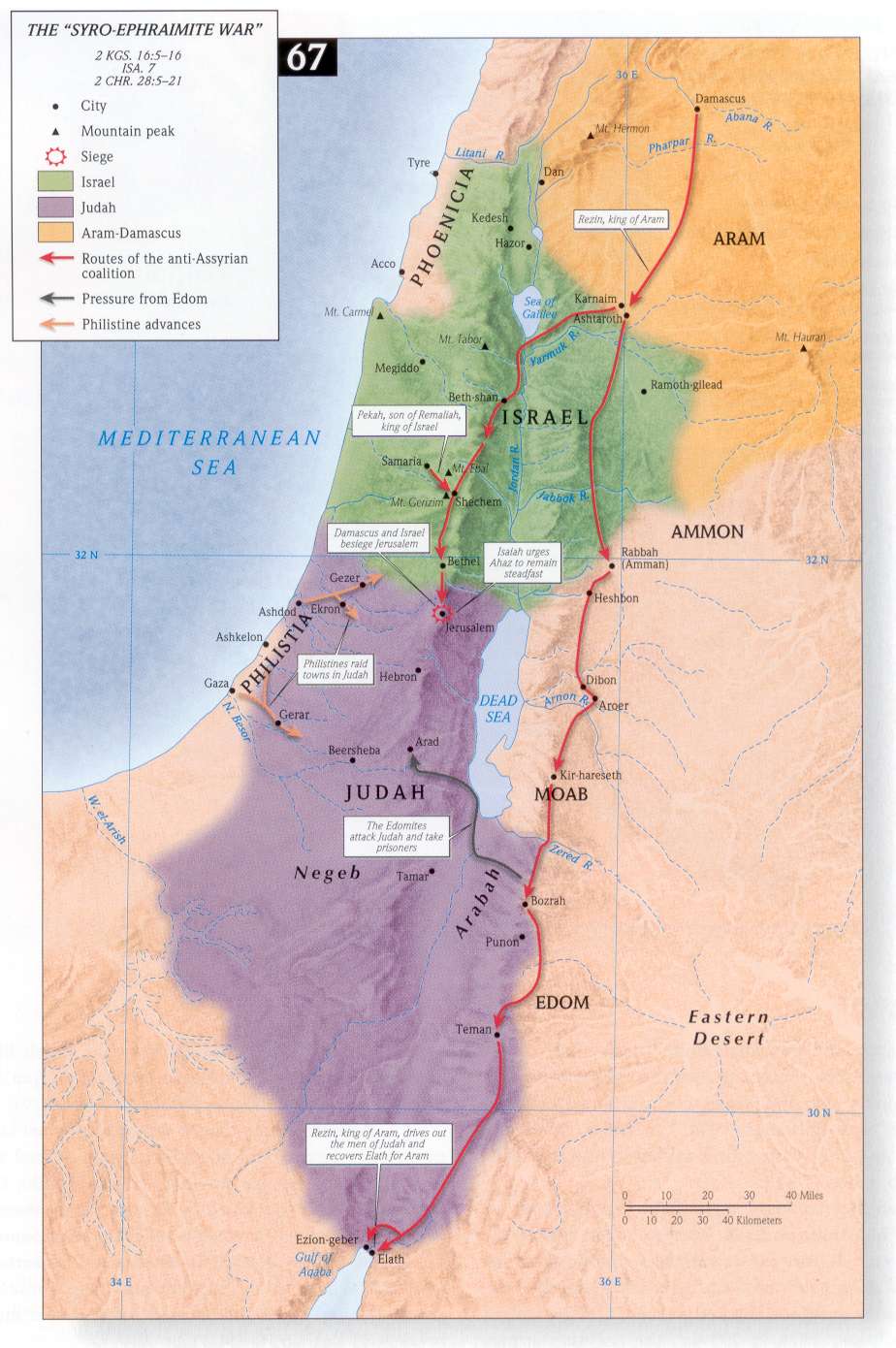
- The Syro-Ephraimite War
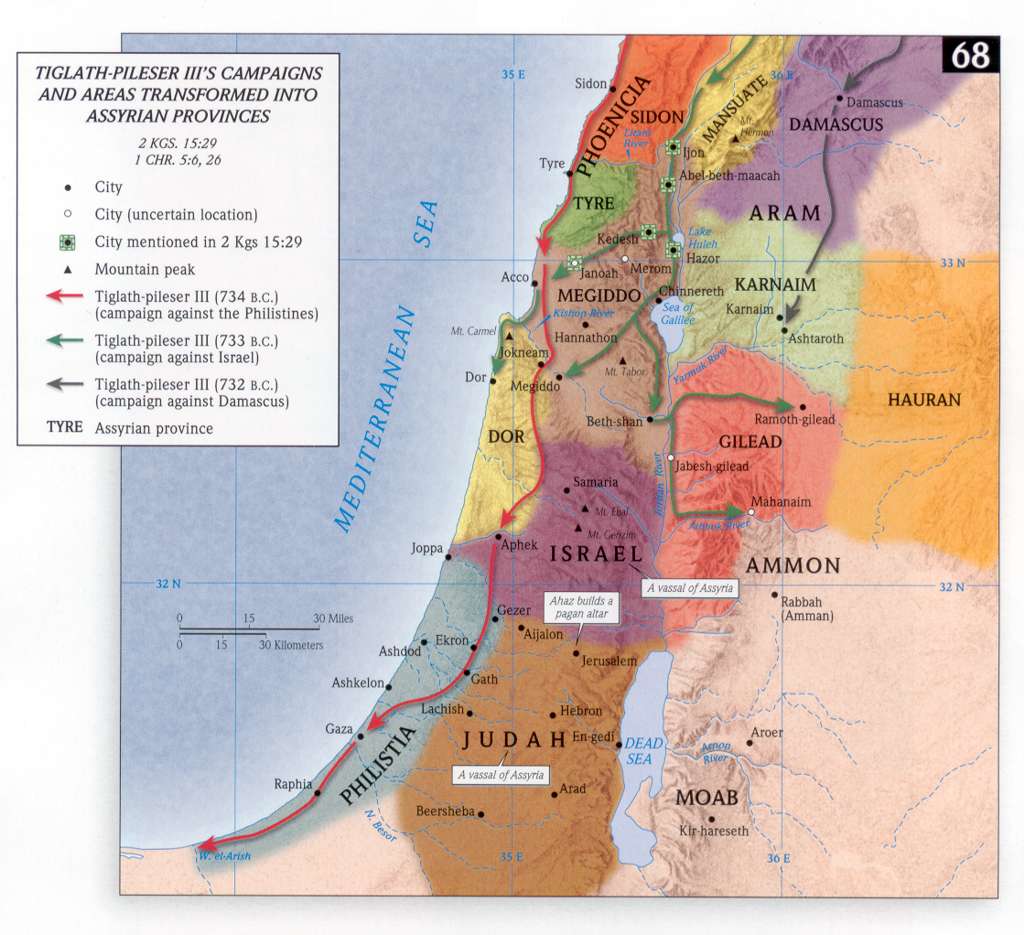
- Tiglath-Pileser III's Campaigns
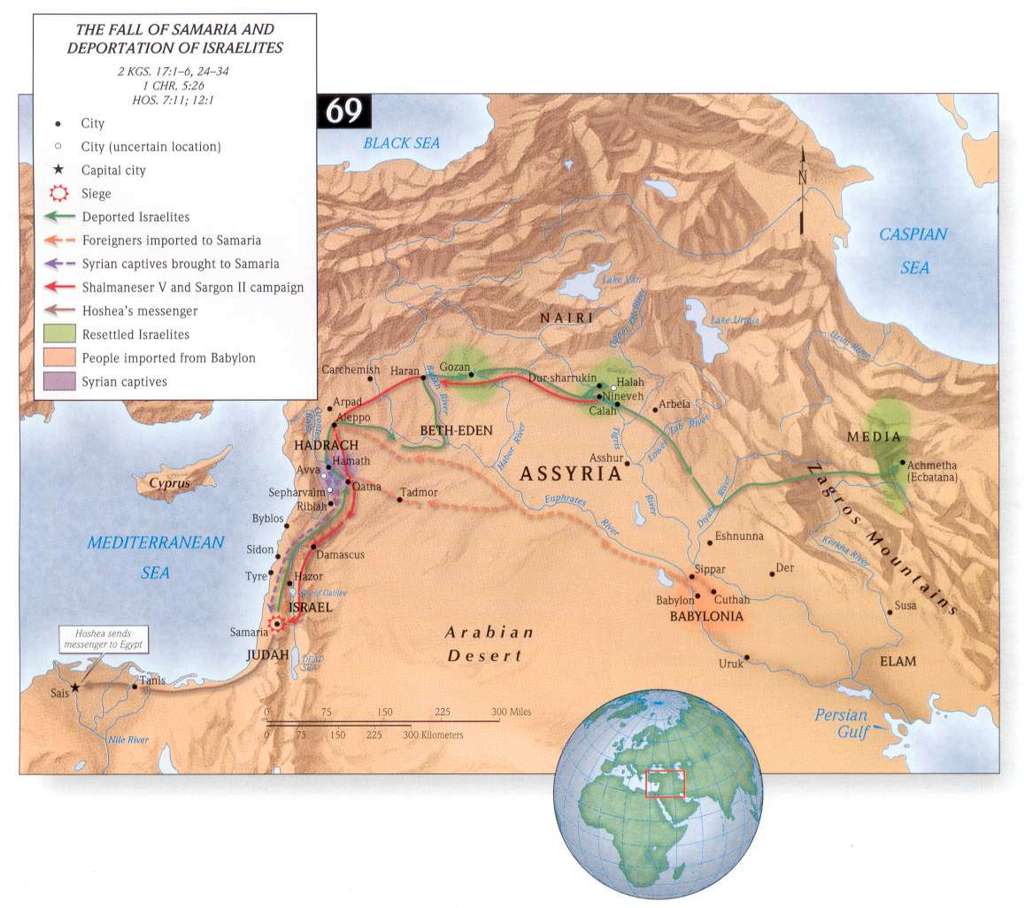
- Fall of Samaria and Deportation of Israelites
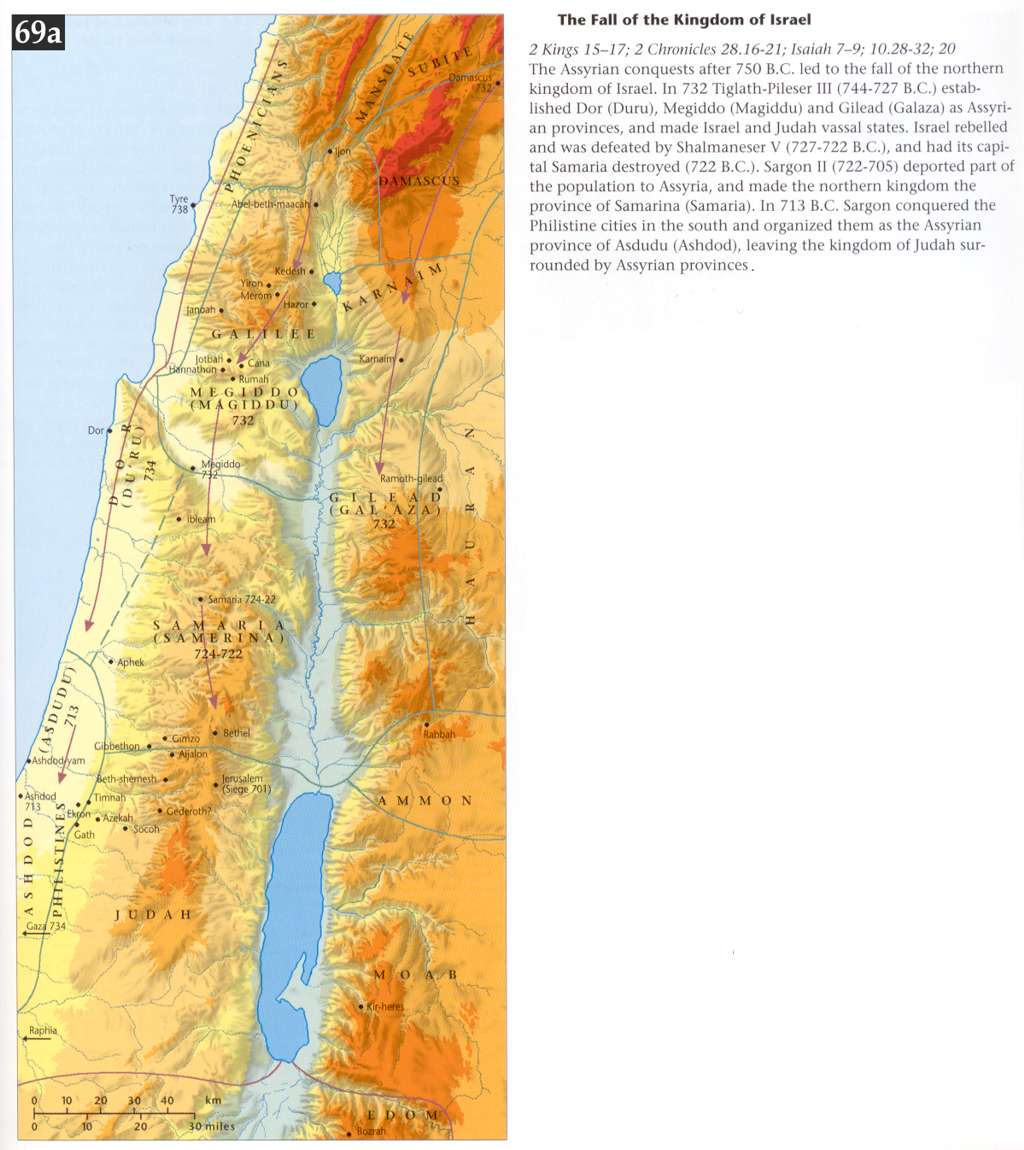
- The Fall of the Kingdom of Israel
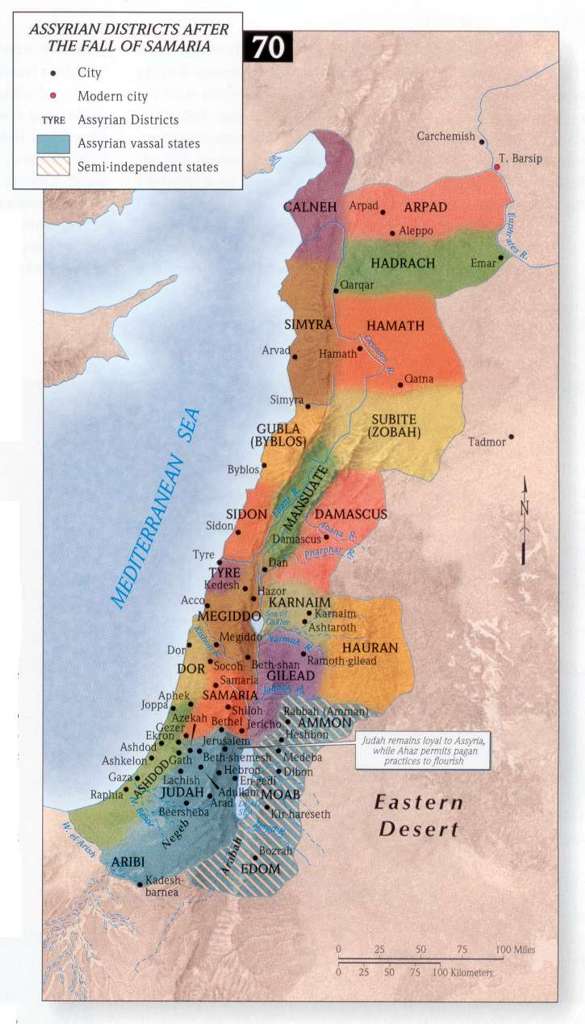
- Assyrian Districts after the Fall of Samaria
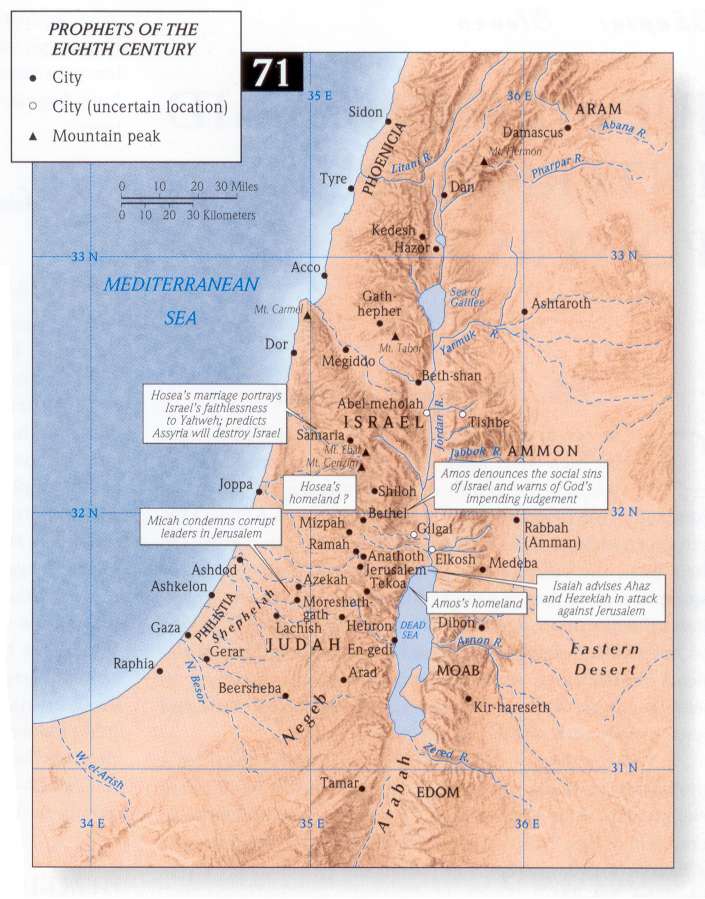
- Prophets of the 8th Century BCE
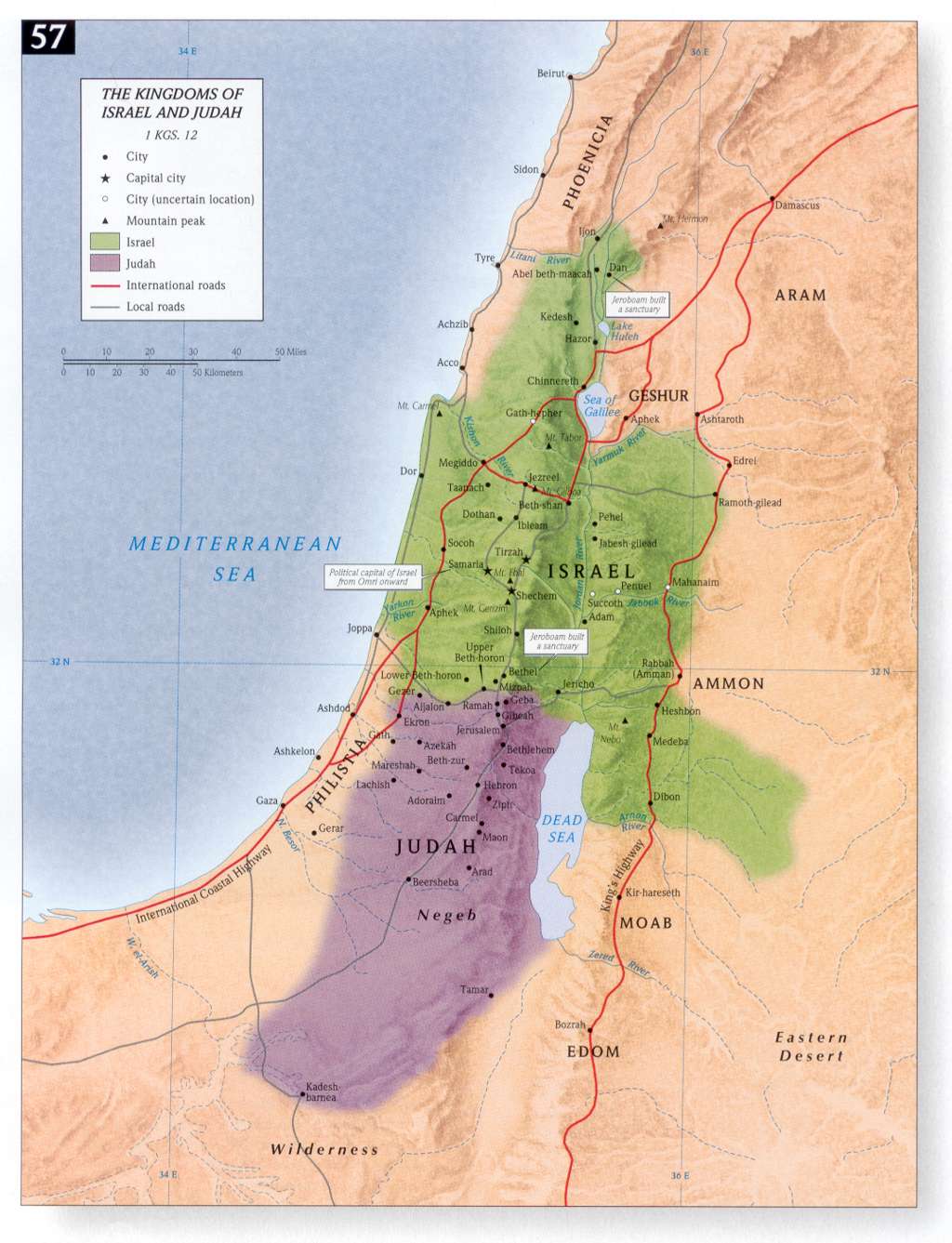

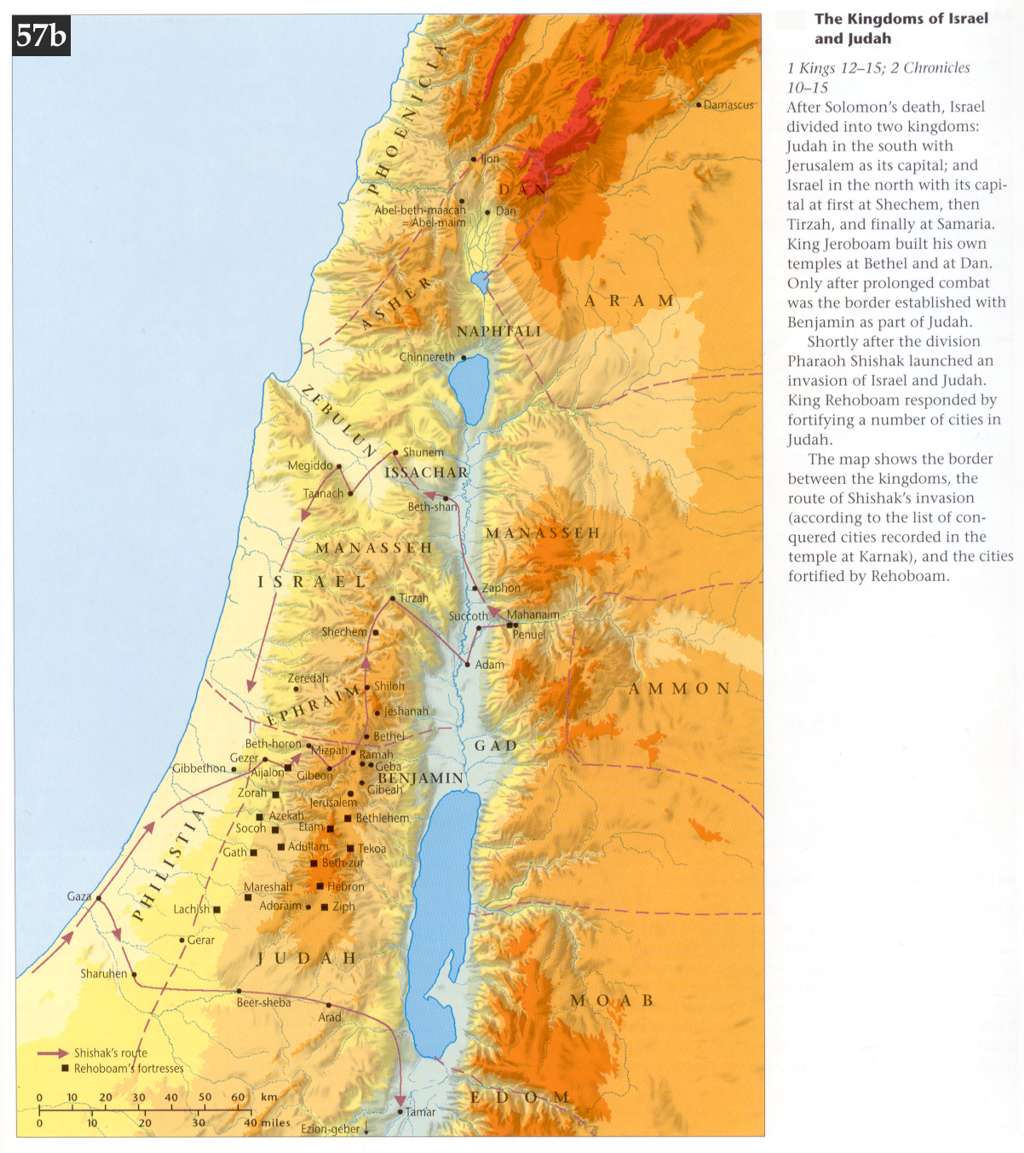
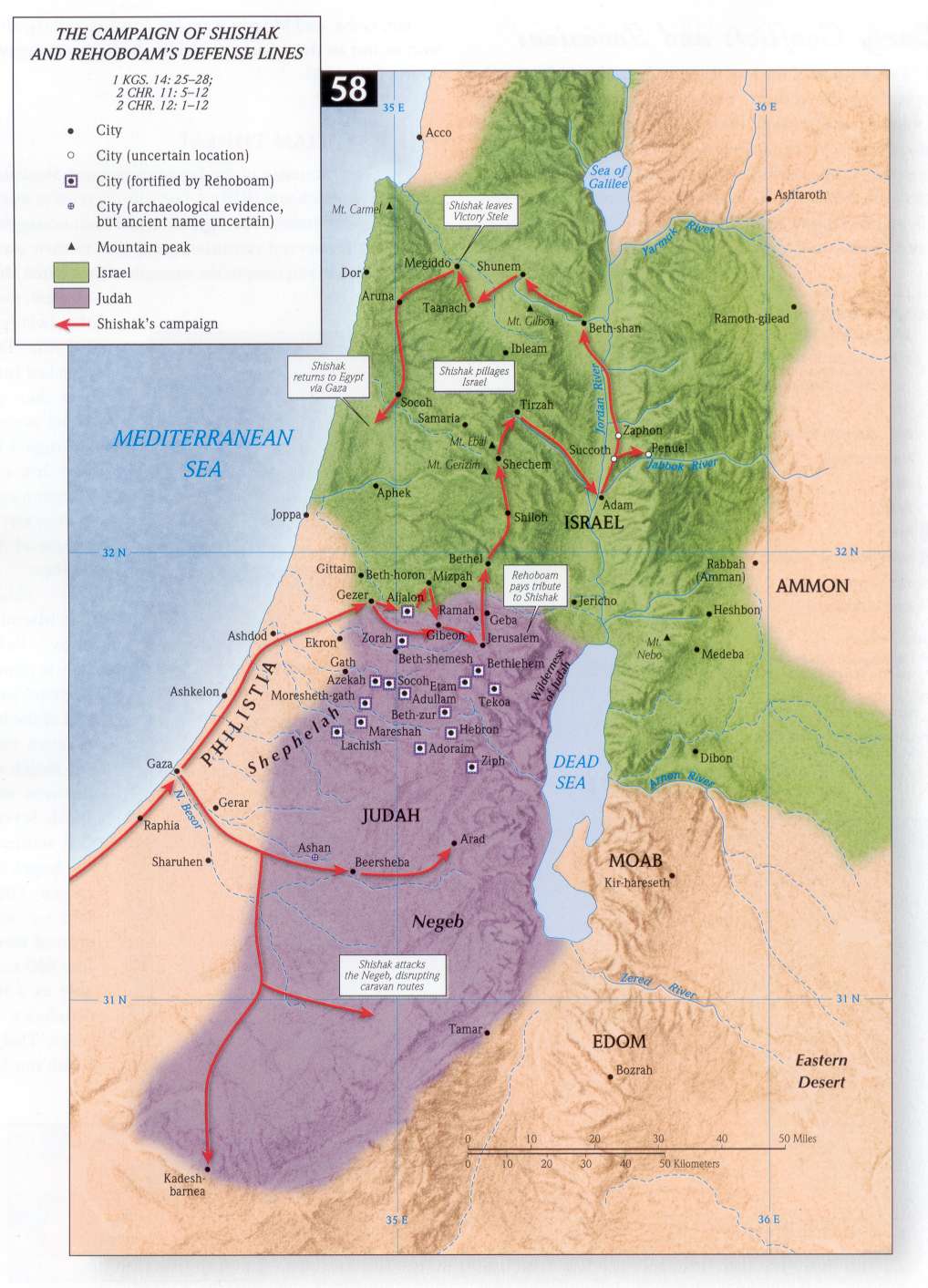
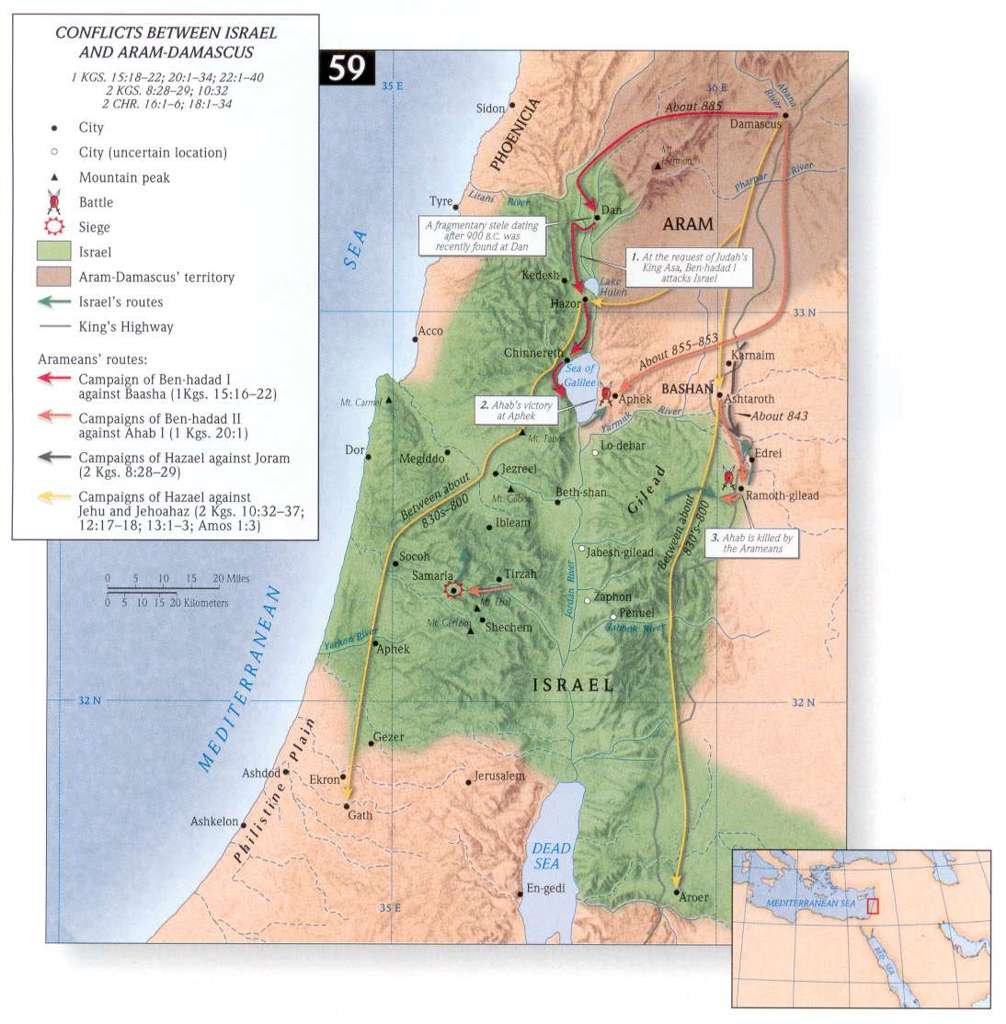
Judah Alone amid International Powers
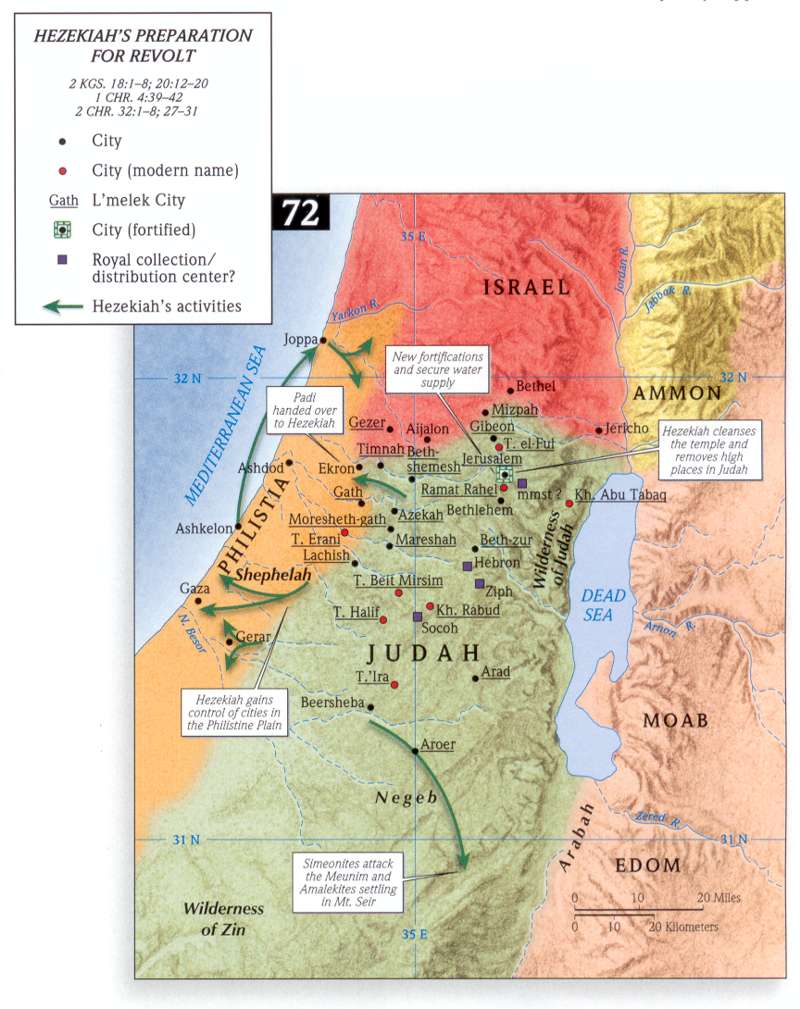
- Hezekiah's Preparation for Revolt
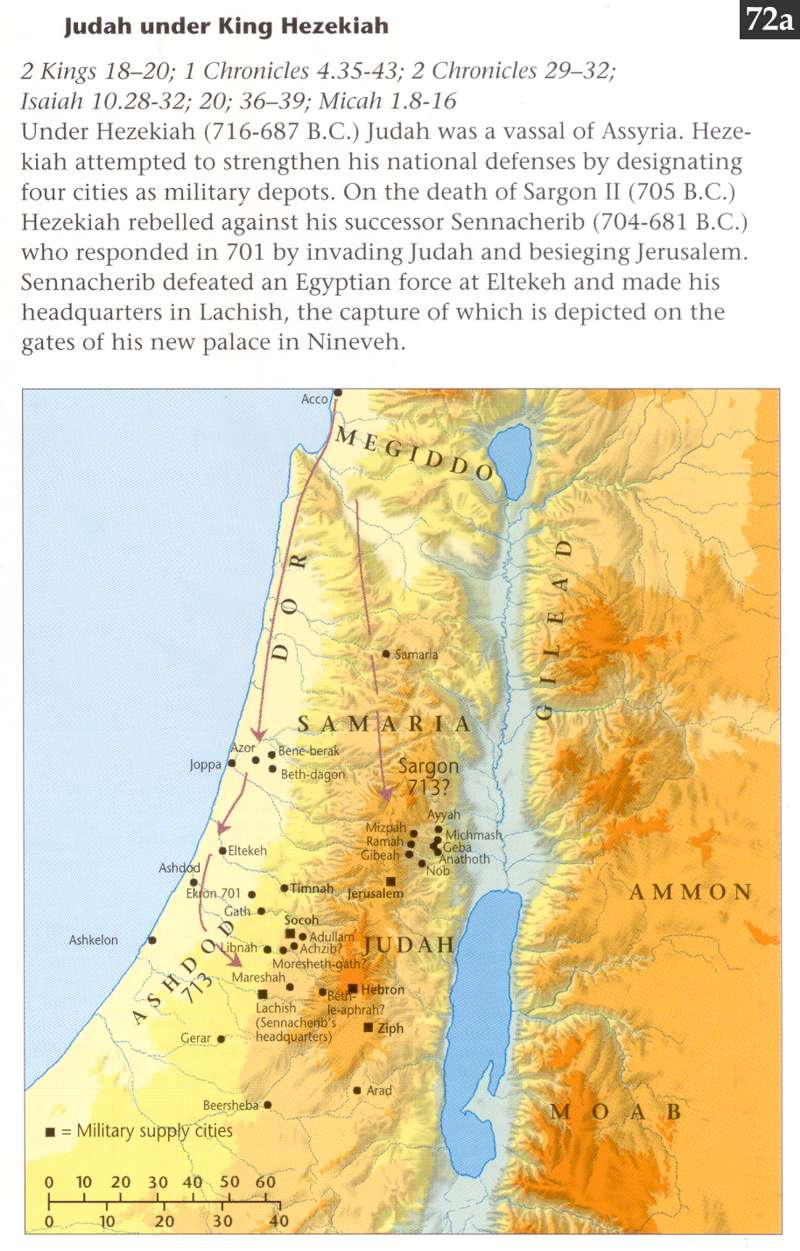
- Judah under King Hezekiah
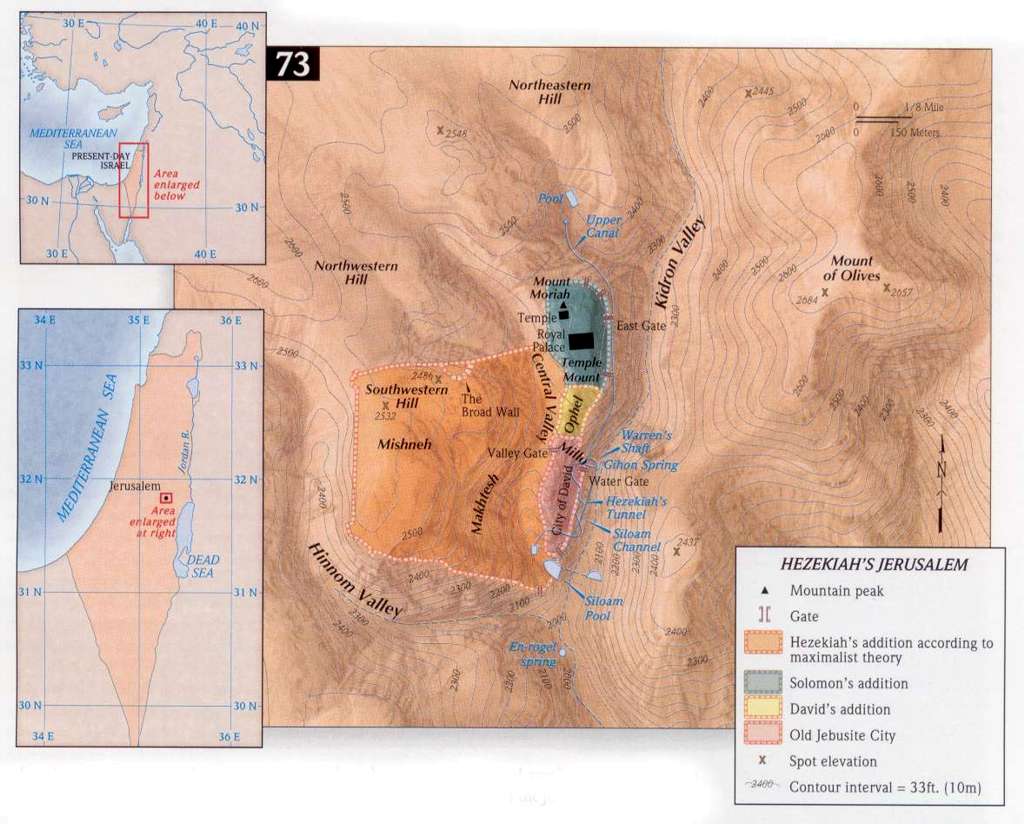
- Hezekiah's Jerusalem
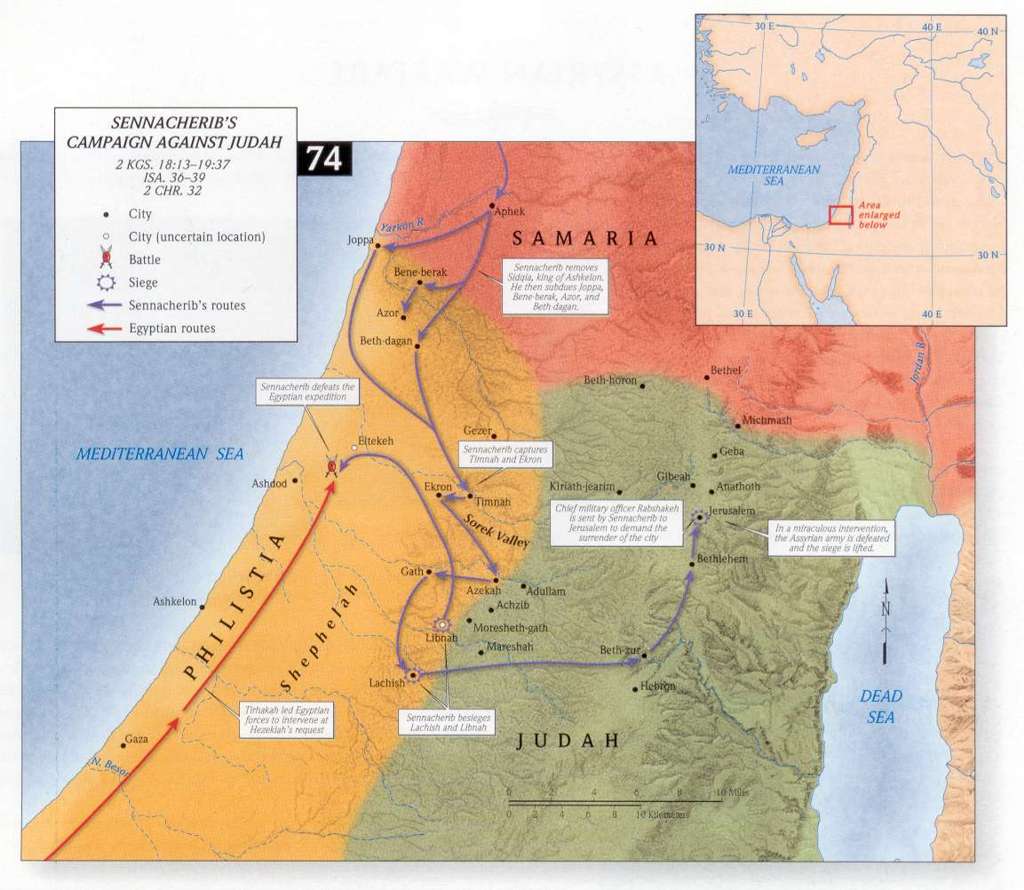
- Sennacherib's Campaign against Judah
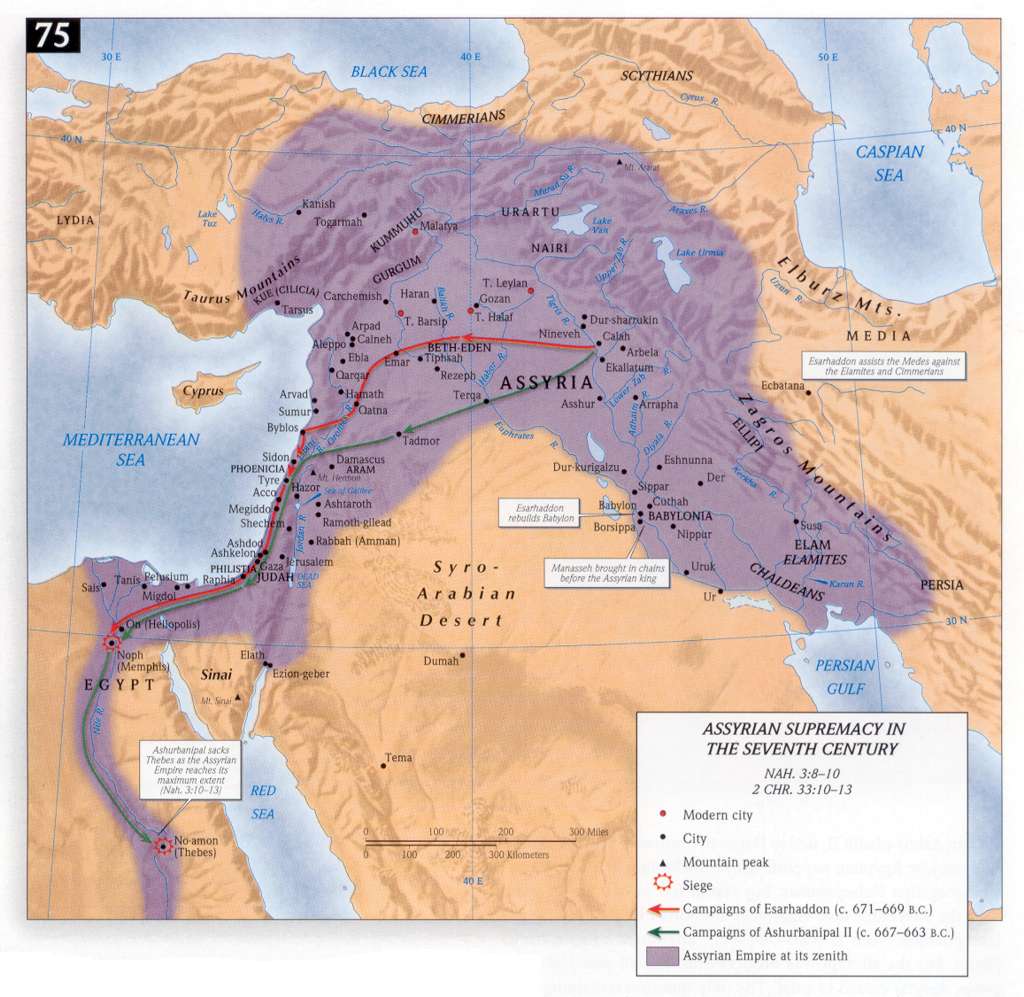
- Assyria in the 7th century BCE
- The Rise of the Neo-Babylonian Empire
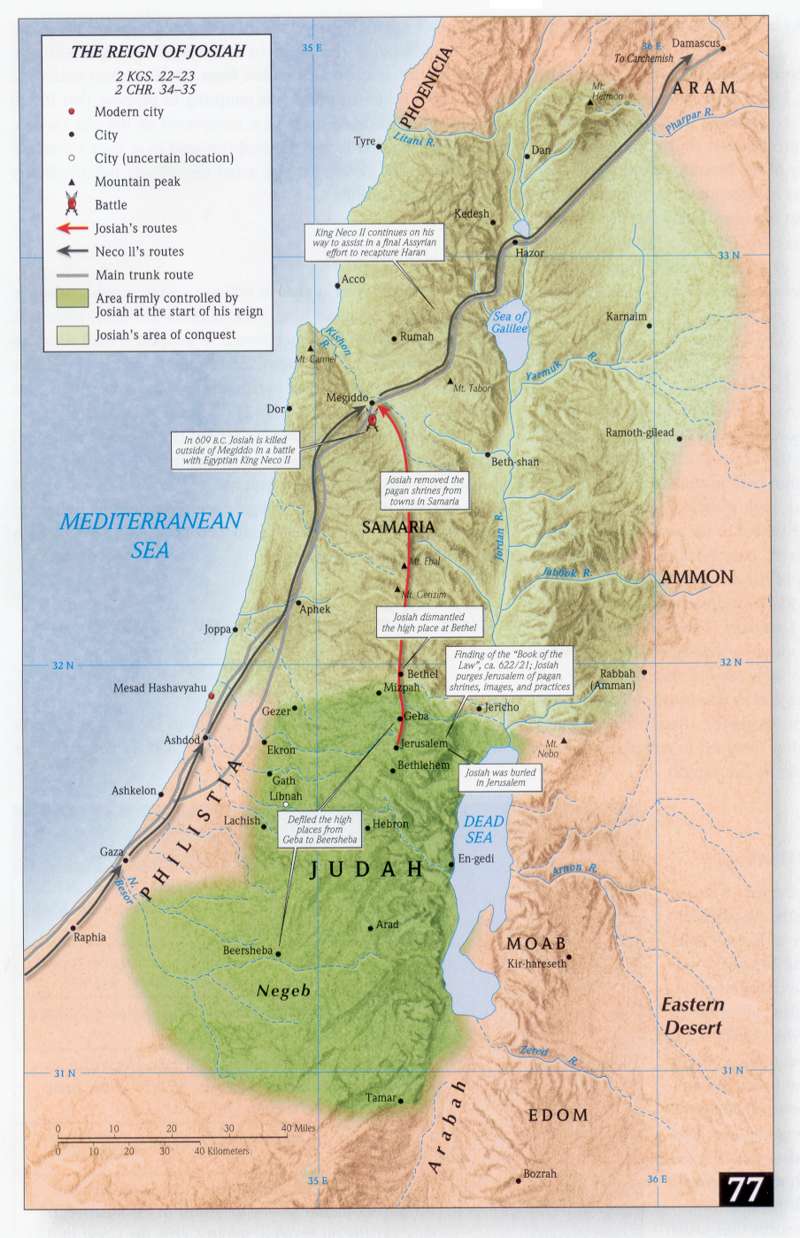
- The Reign of Josiah
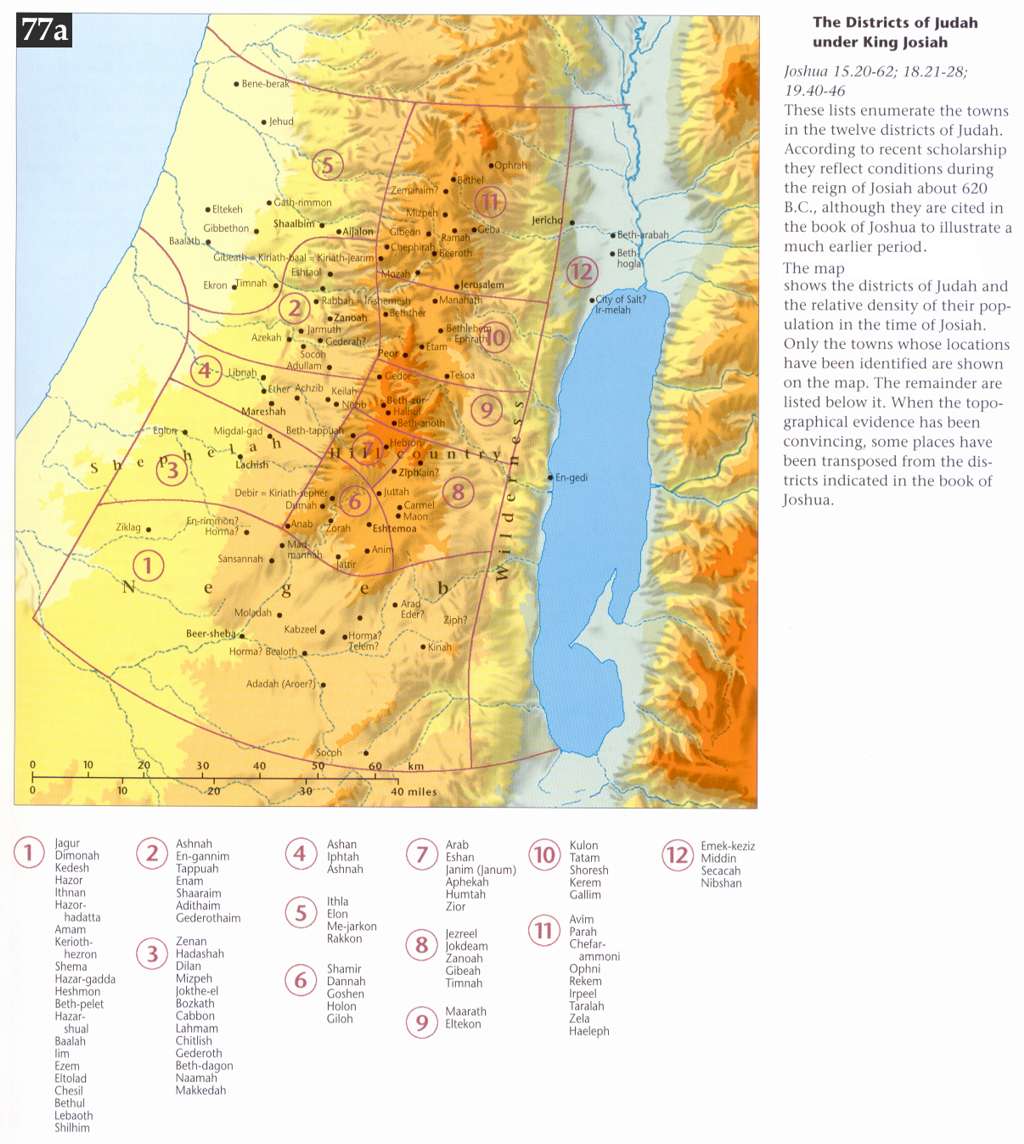
- The Districts of Judah under King Josiah
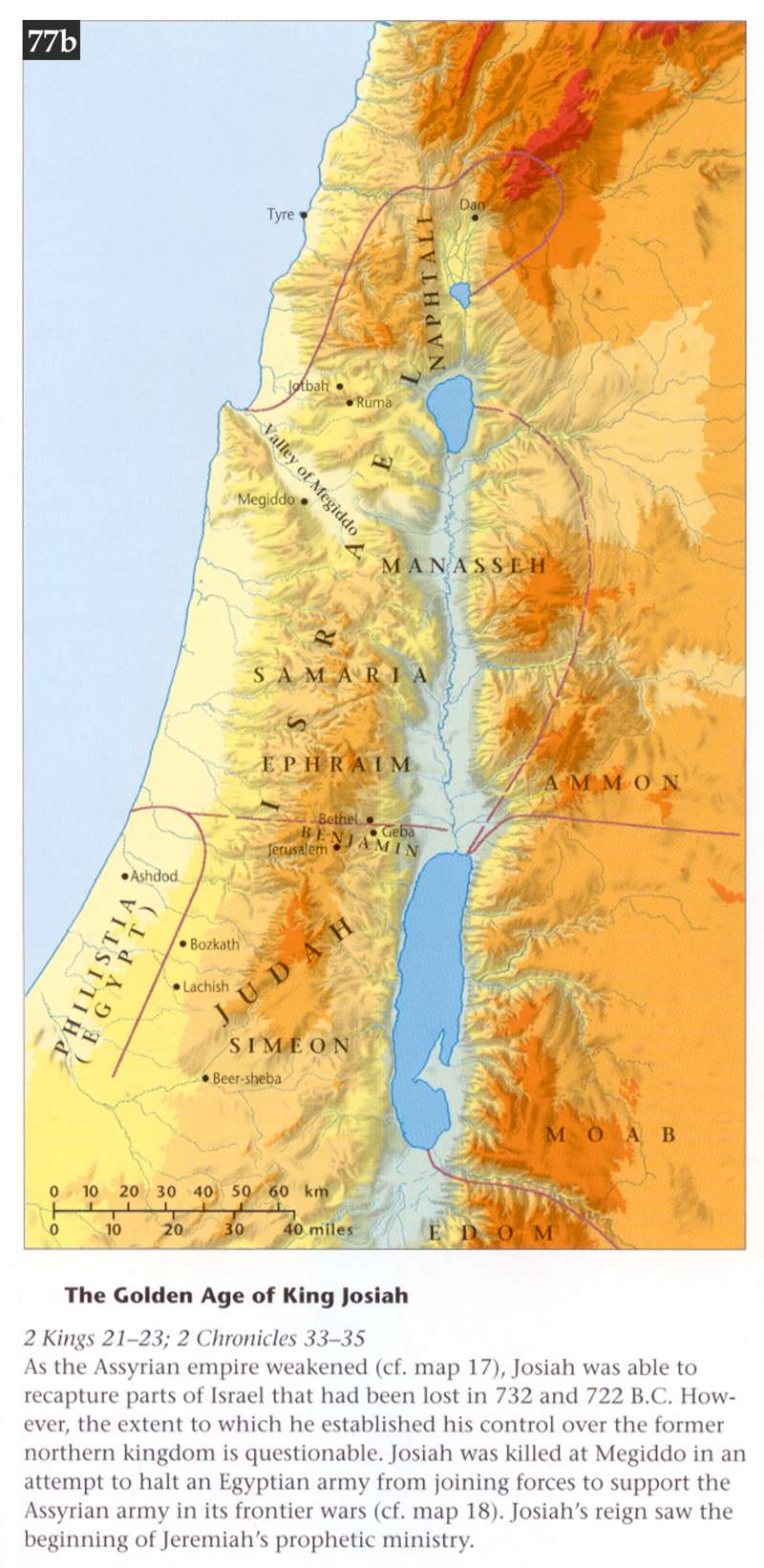
- The Golden Age of King Josiah
- Nebuchadnezzar's Campaigns against Judah
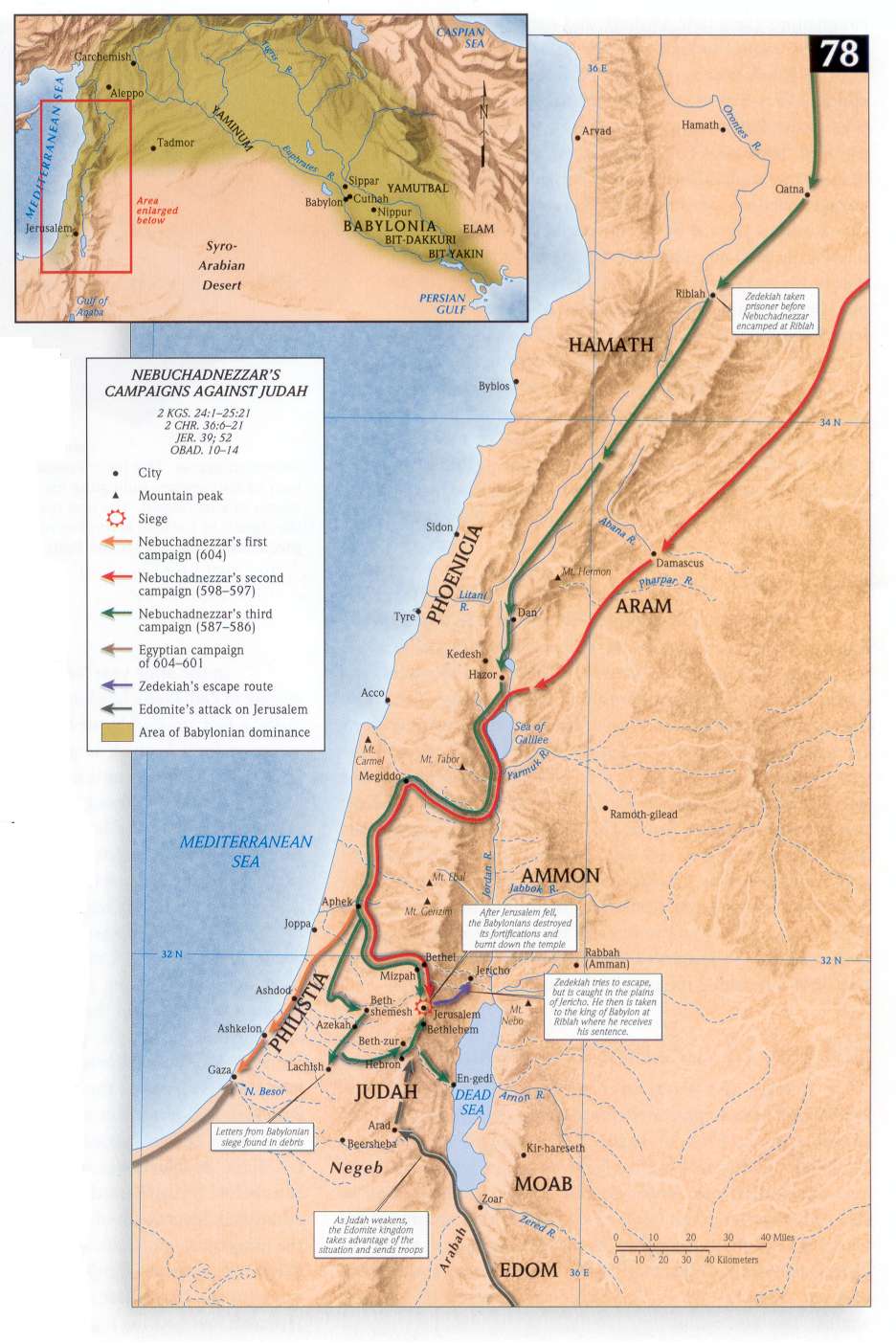
The Babylonian Exile up to the early Rome
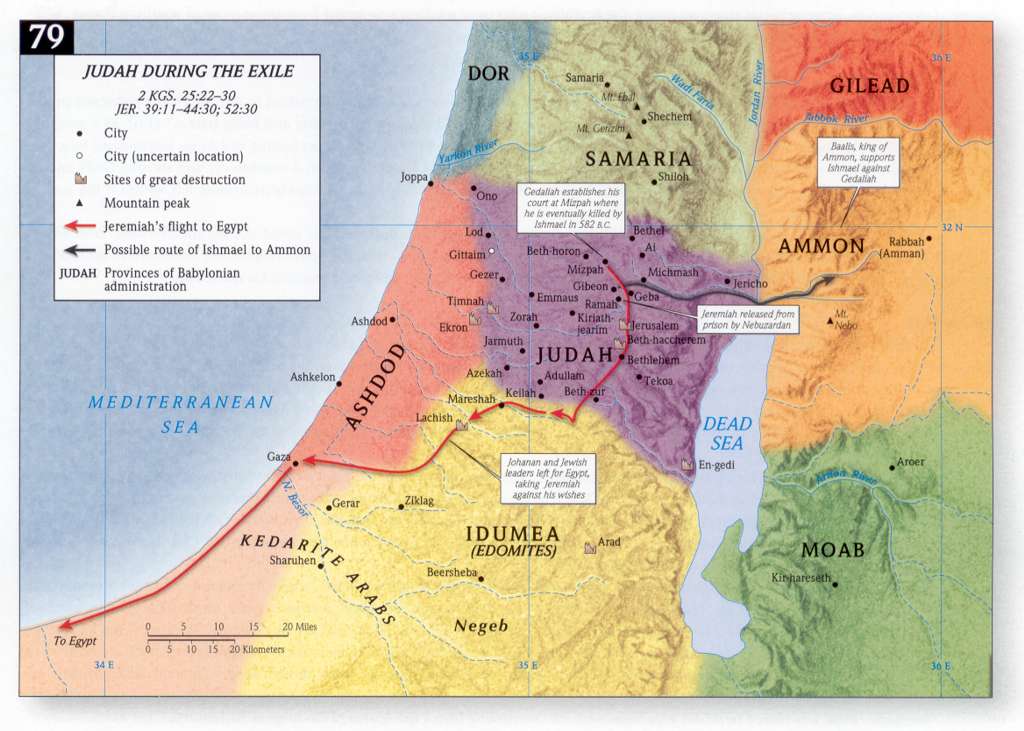
- Judah during the Exile
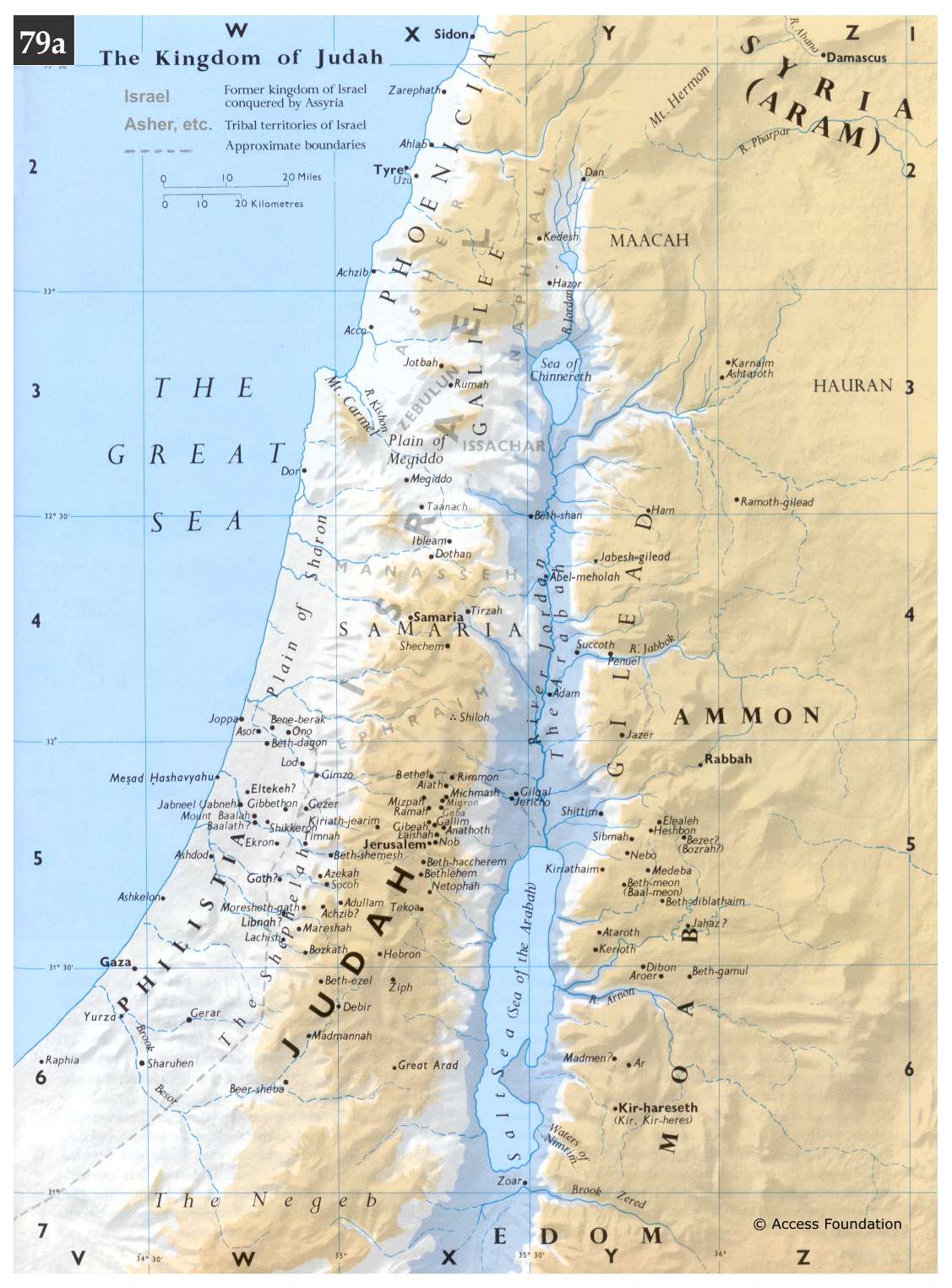
- The Kingdom of Judah
- Exile; Palestine in the Post-Exilic Period
- Jewish Exiles in Babylon
- World Powers of the 6th century BCE
- The Conquests of Cyrus the Great
- The Persian Empire
- The Return of the Jewish Exiles to Judah
- Judah in the 5th century BCE
- Palestine after the Exile
- Alexander the Great's Empire
- The Division of Alexander's Empire ca. 275 BCE
- Palestine under the Ptolemies
- The Seleucid Empire and Antiochus III
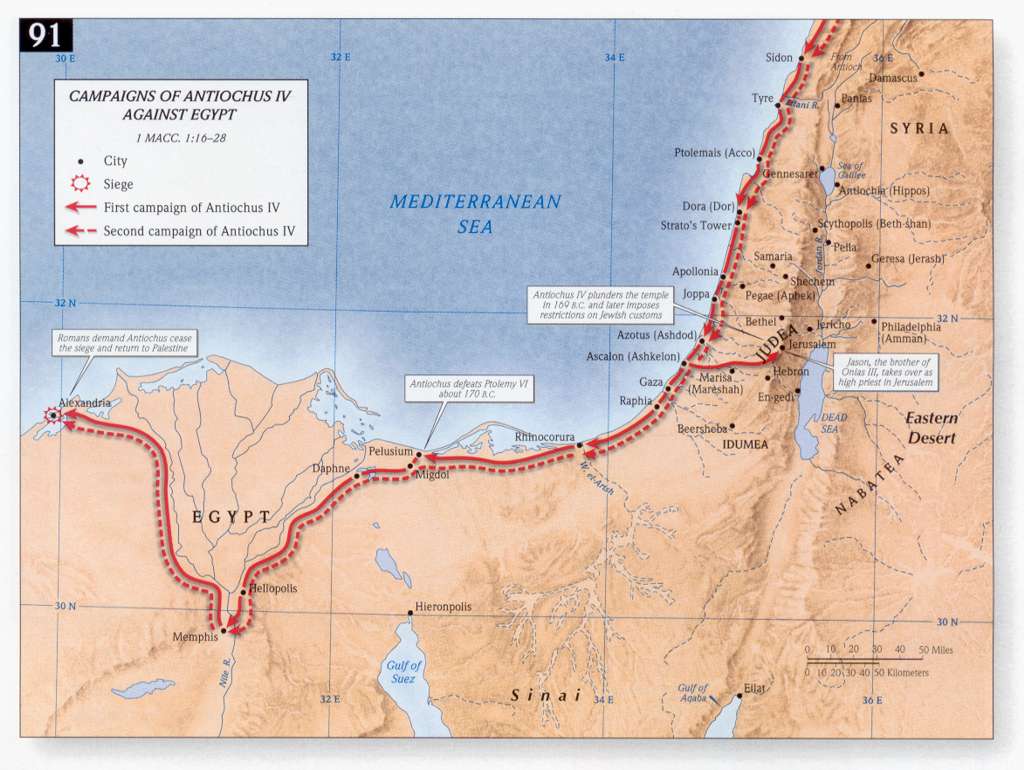
- Campaigns of Antiochus IV against Egypt
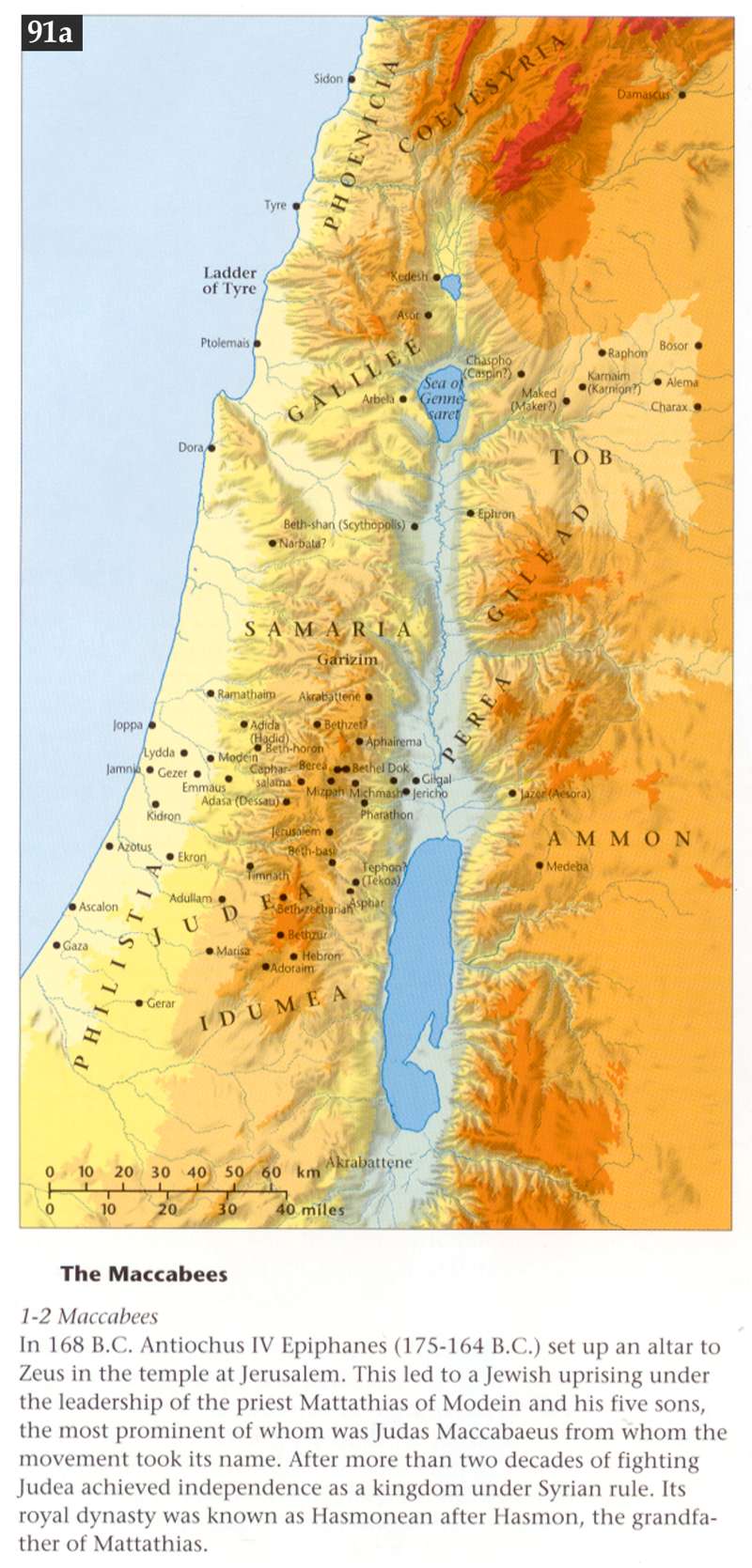
- The Maccabees in 168 BCE
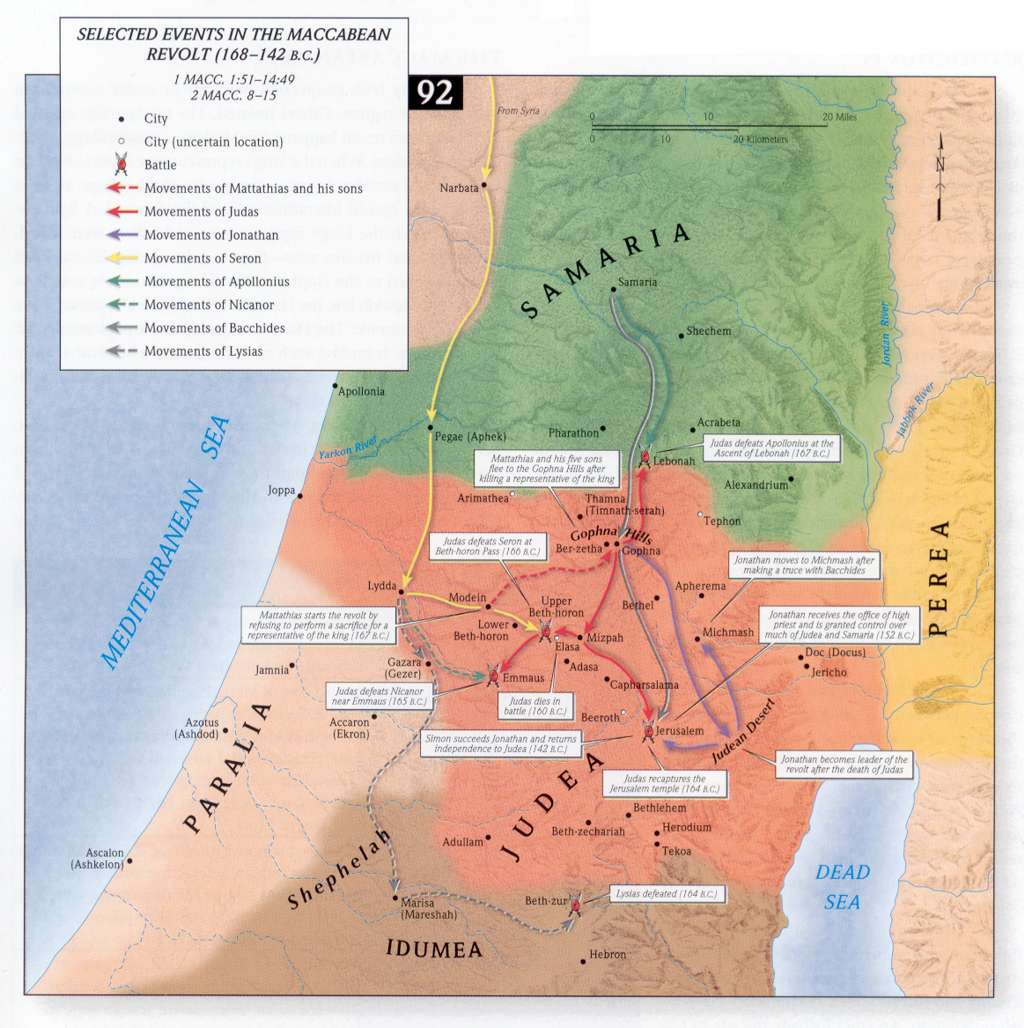
- Selected Events in the Maccabean Revolt
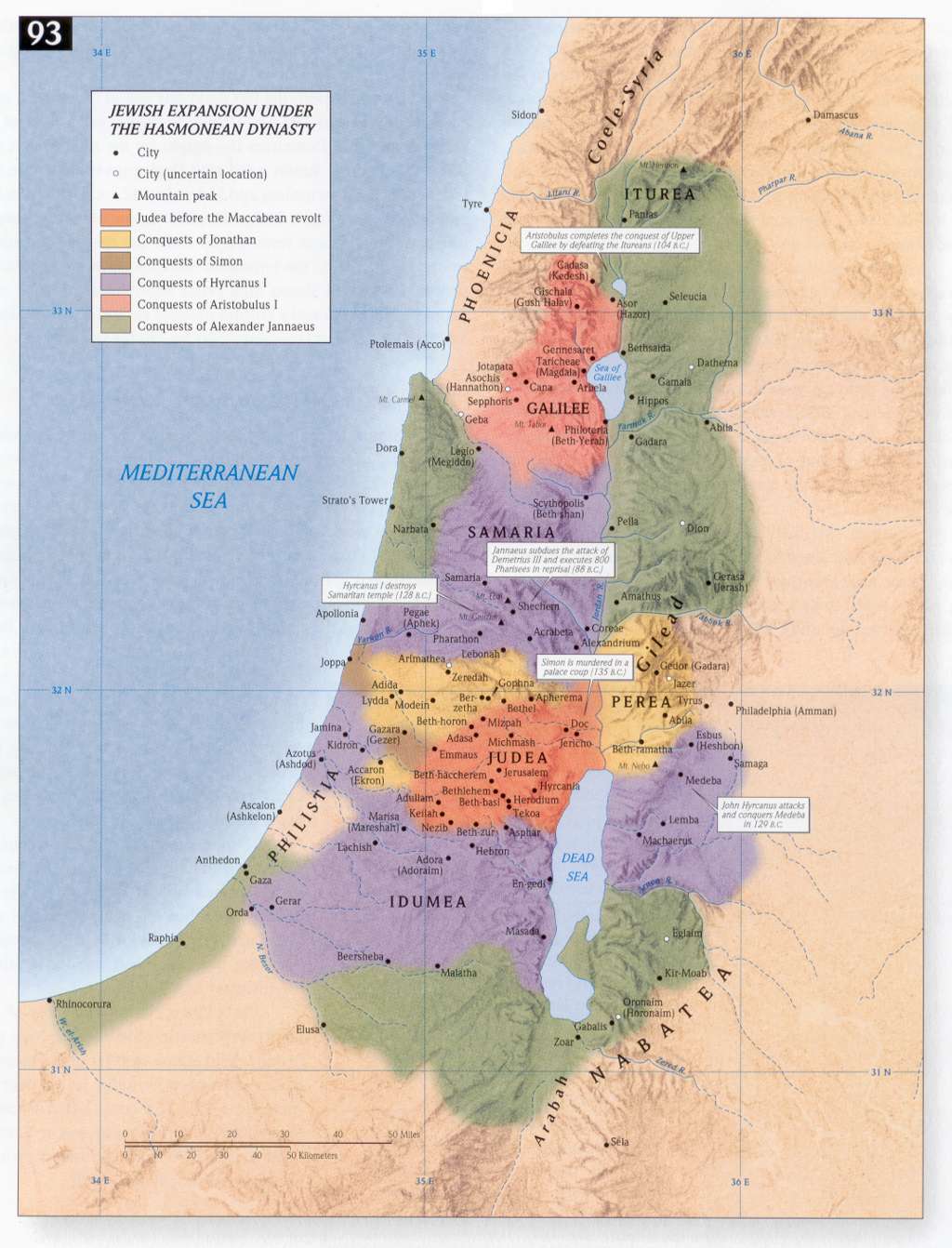
- Jewish Expansion under the Hasmonean Dynasty
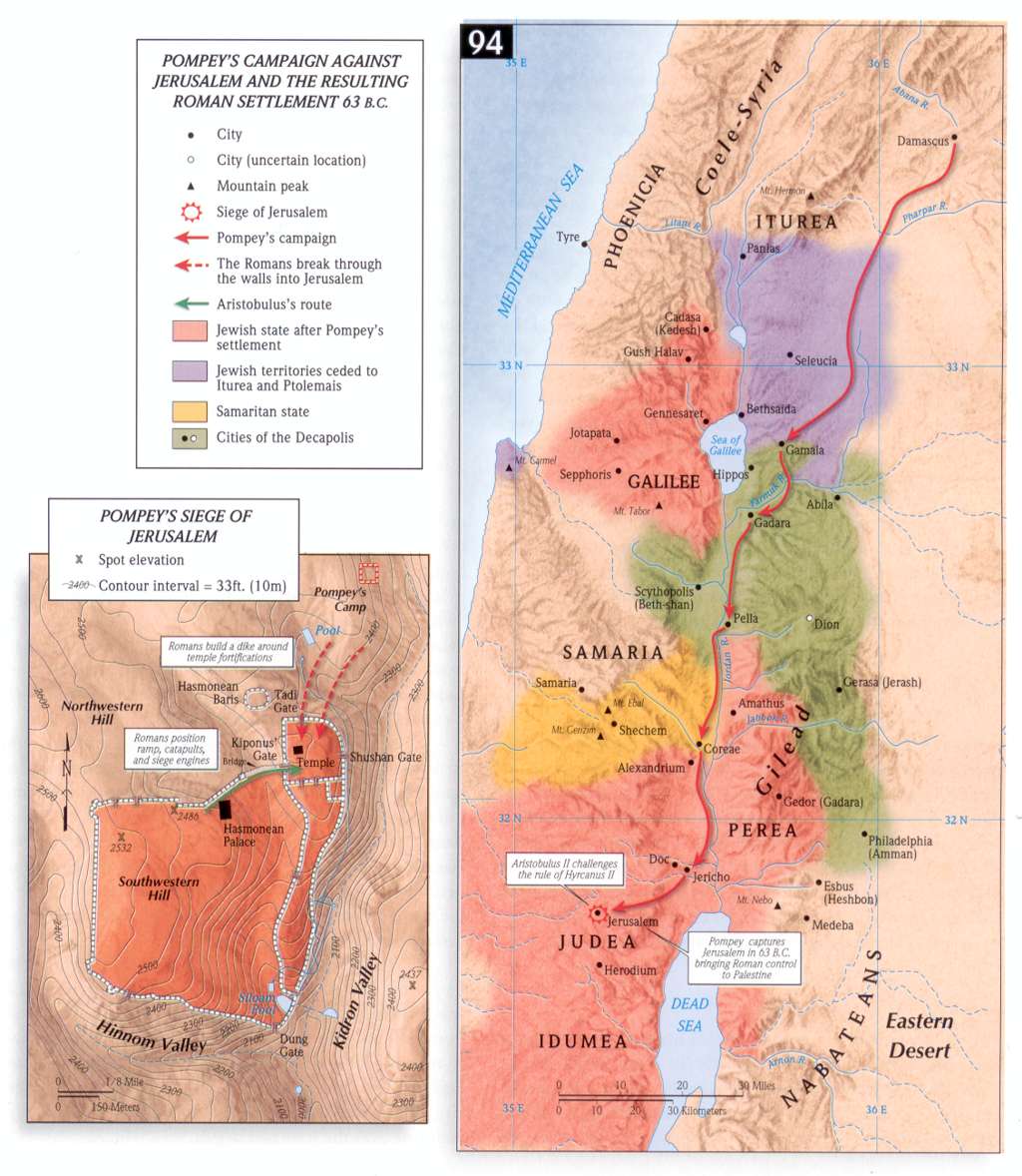
- Pompey's Campaign against Jerusalem
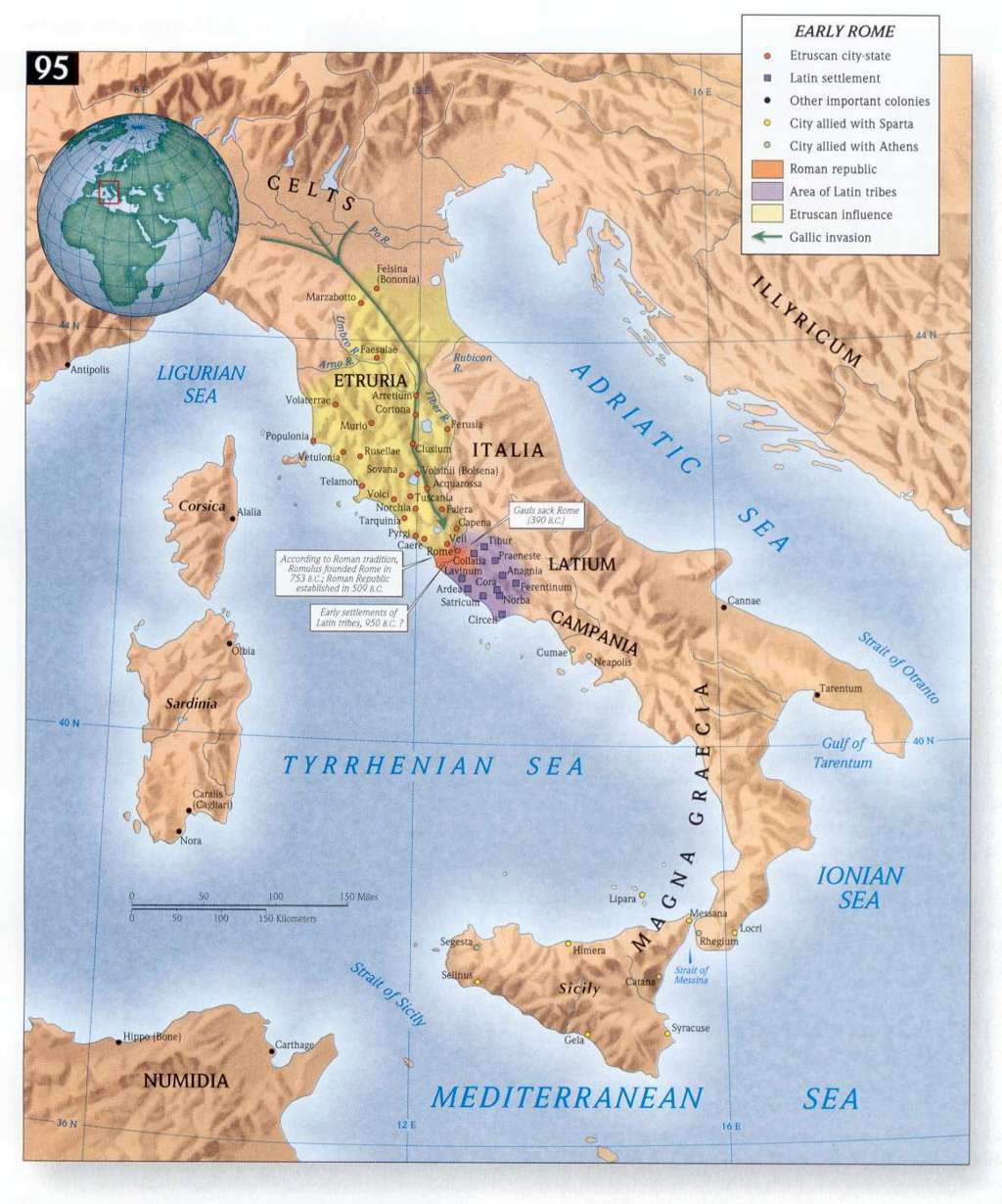
- Early Rome
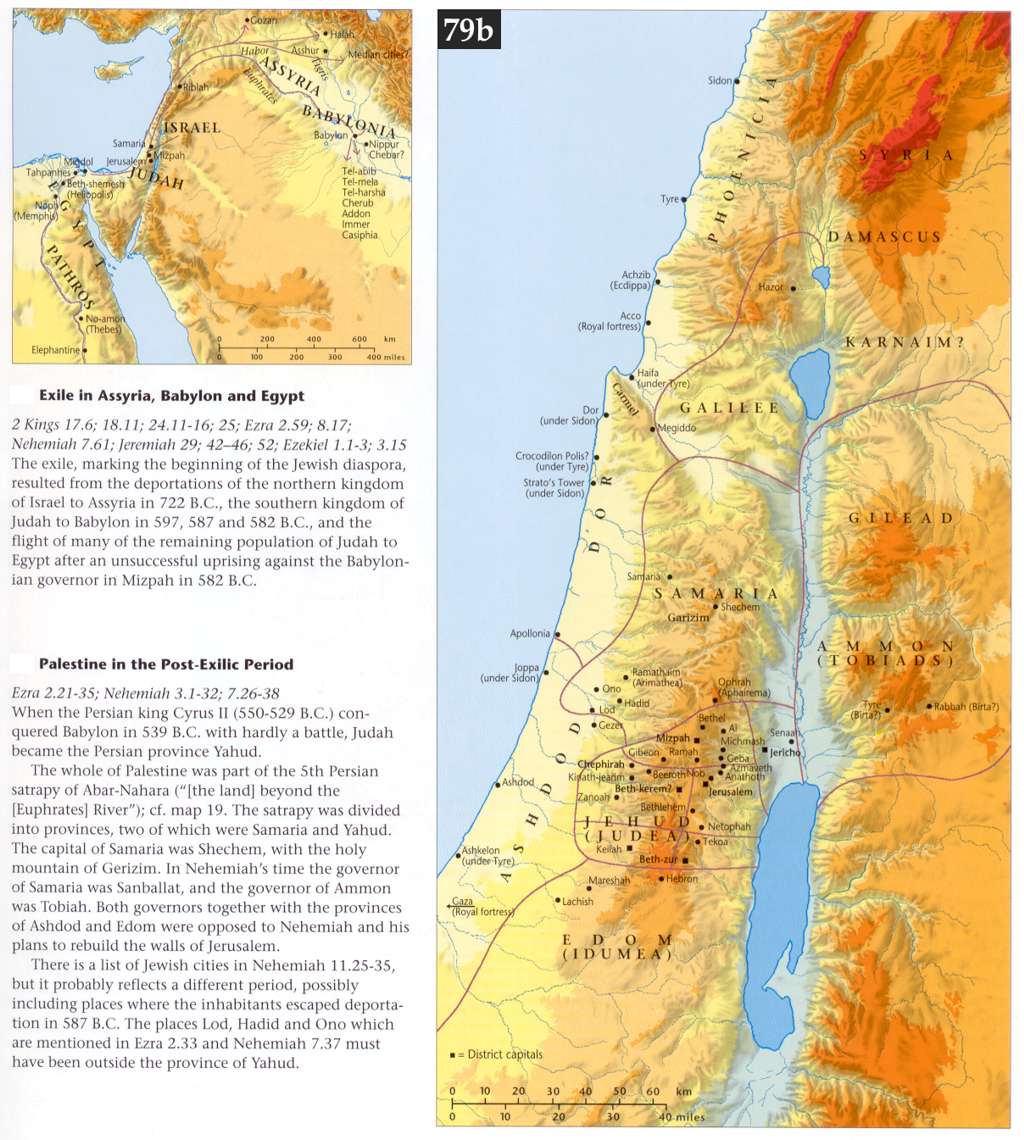
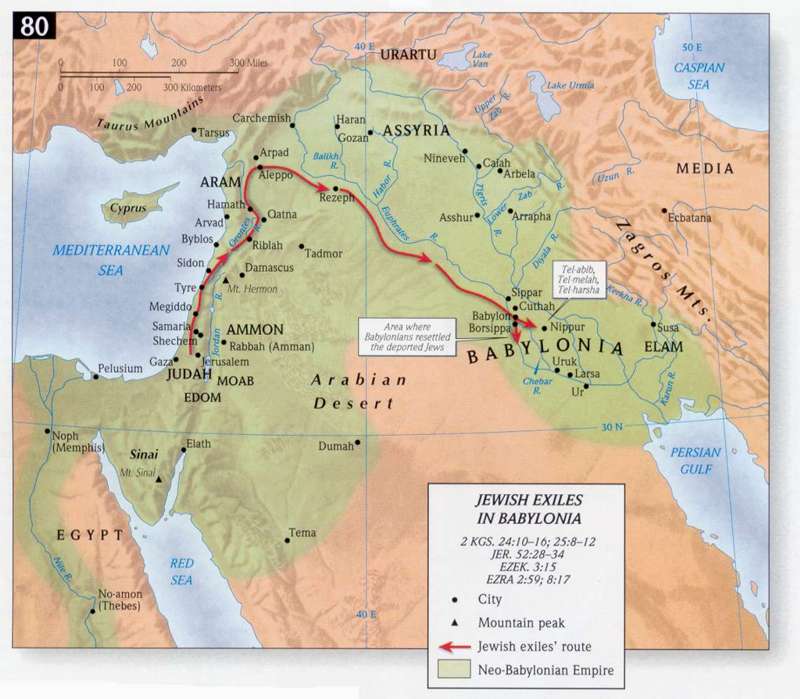
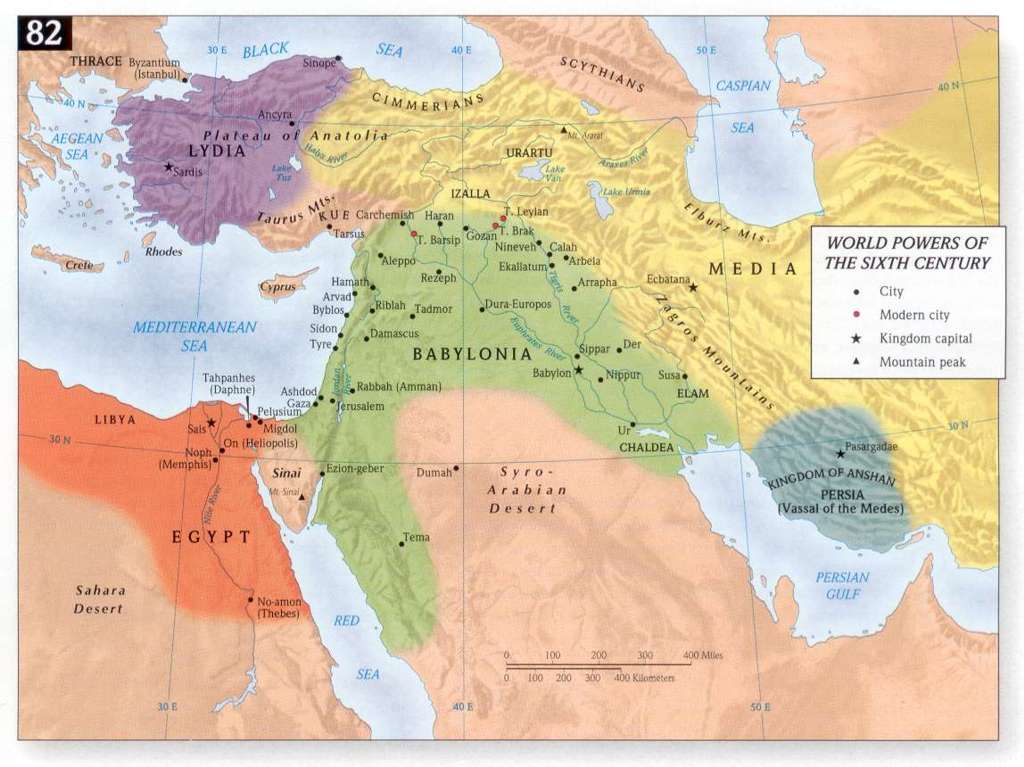
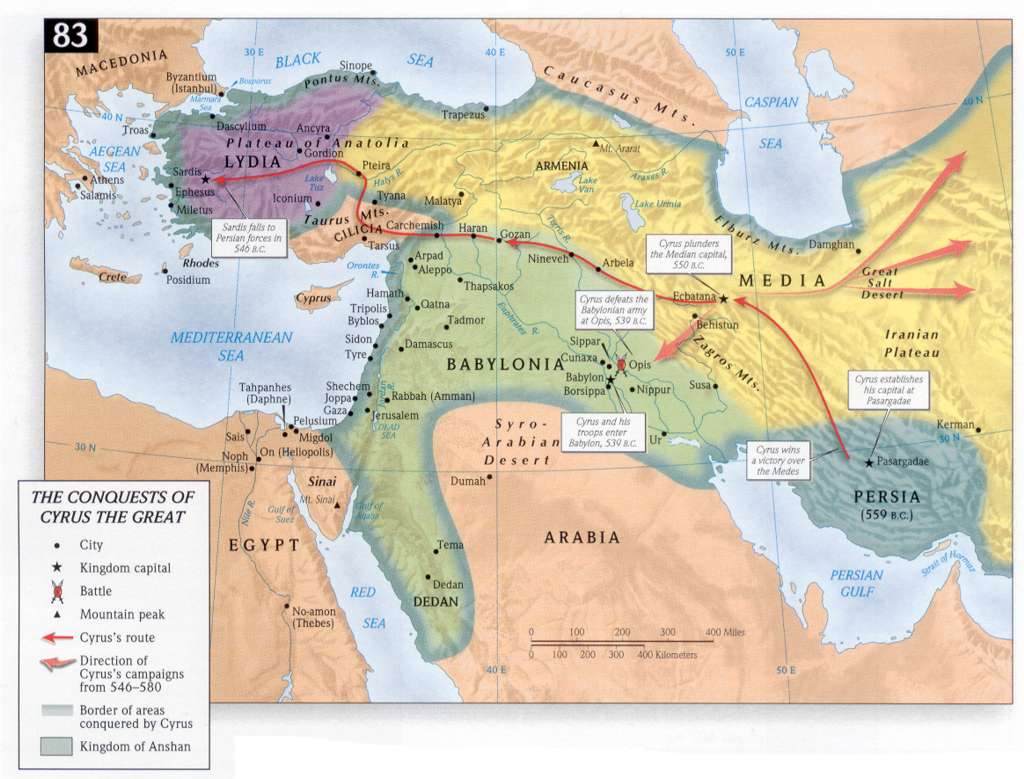
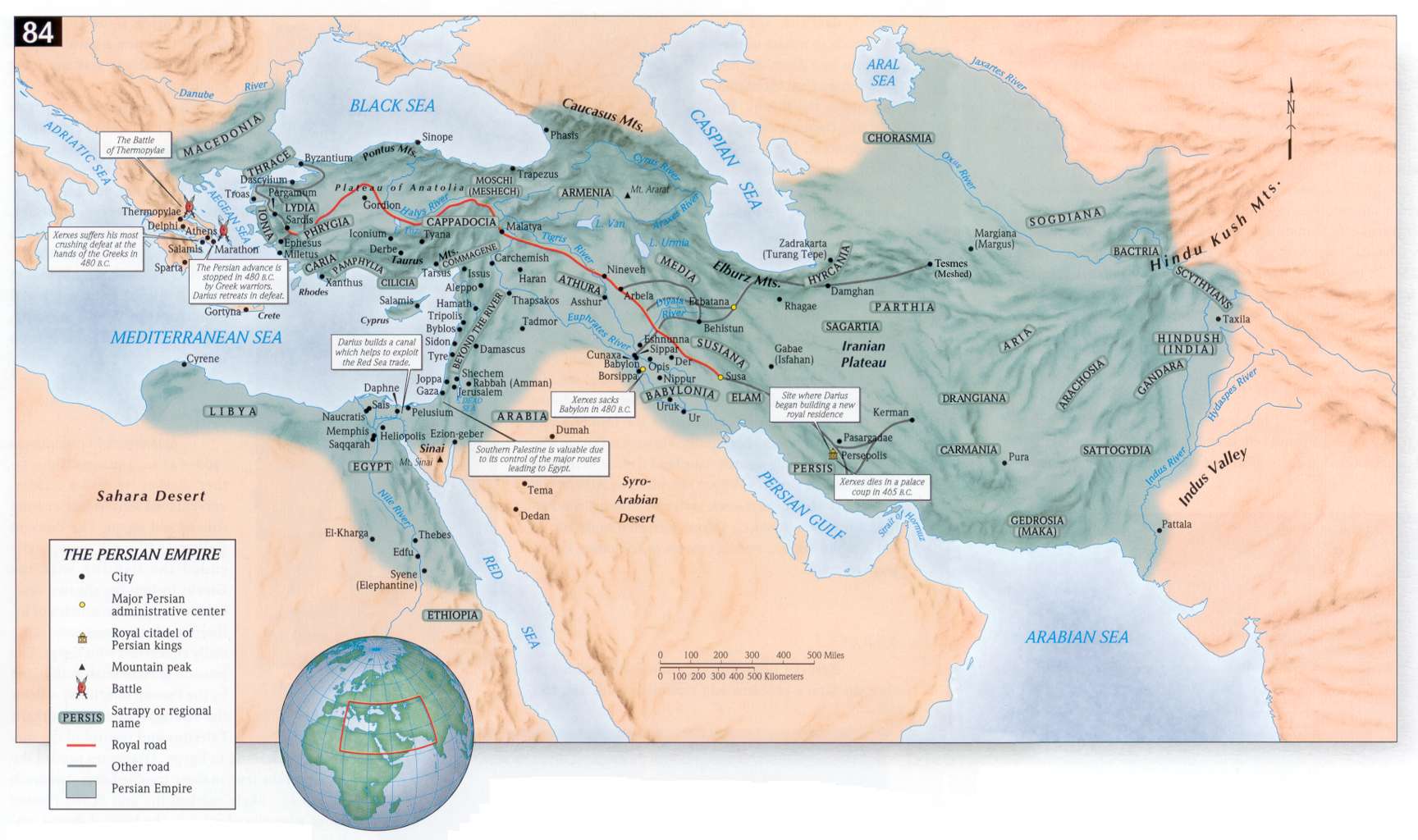
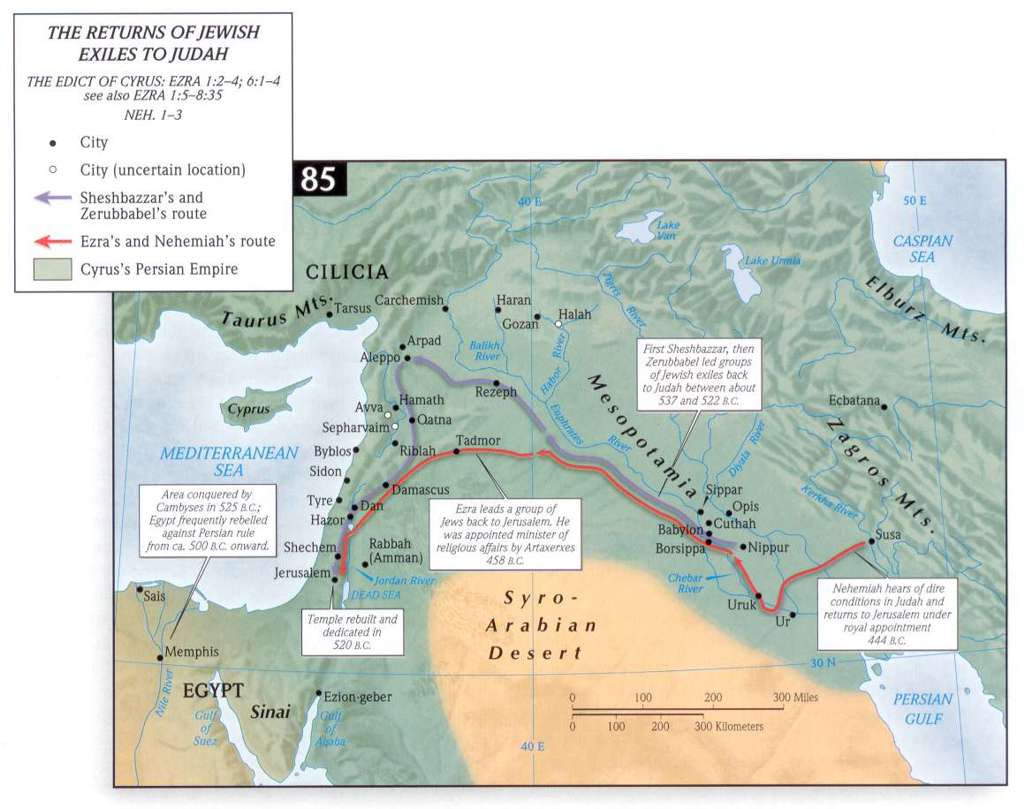
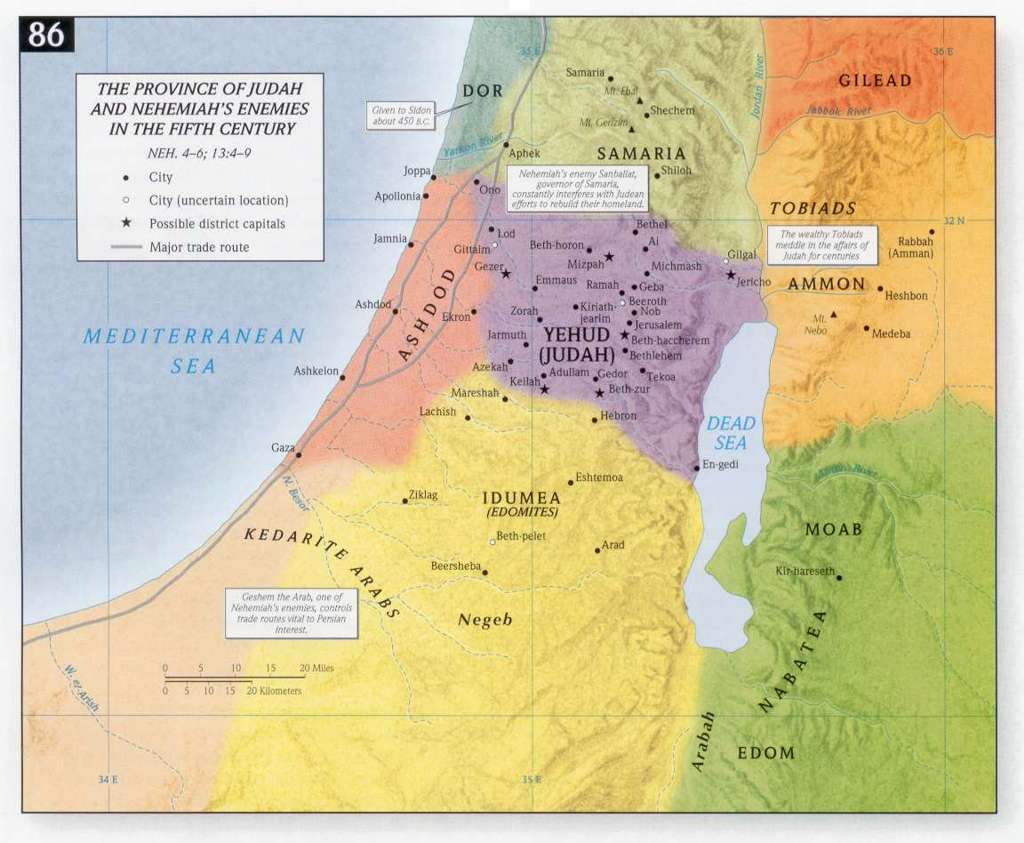
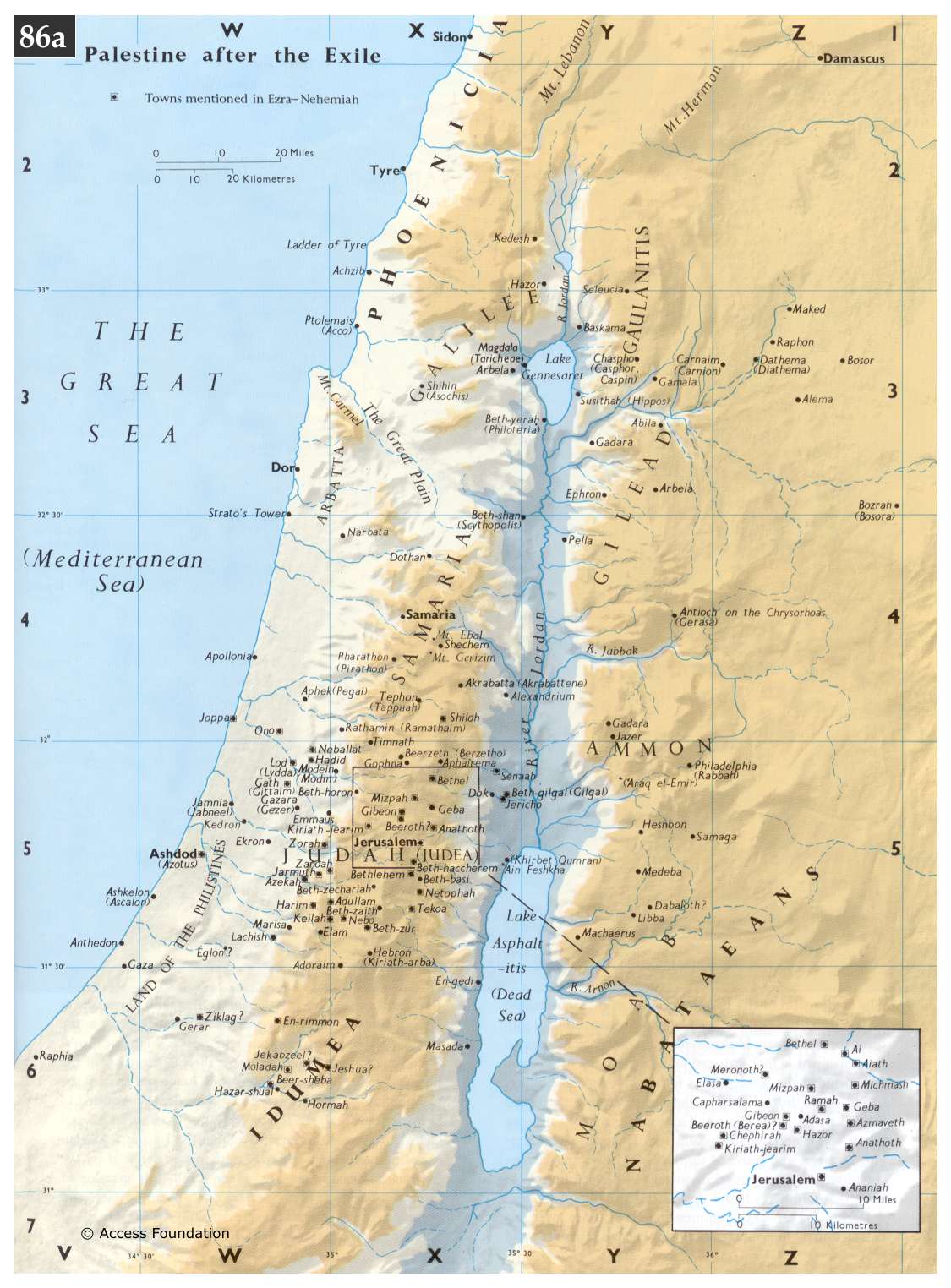
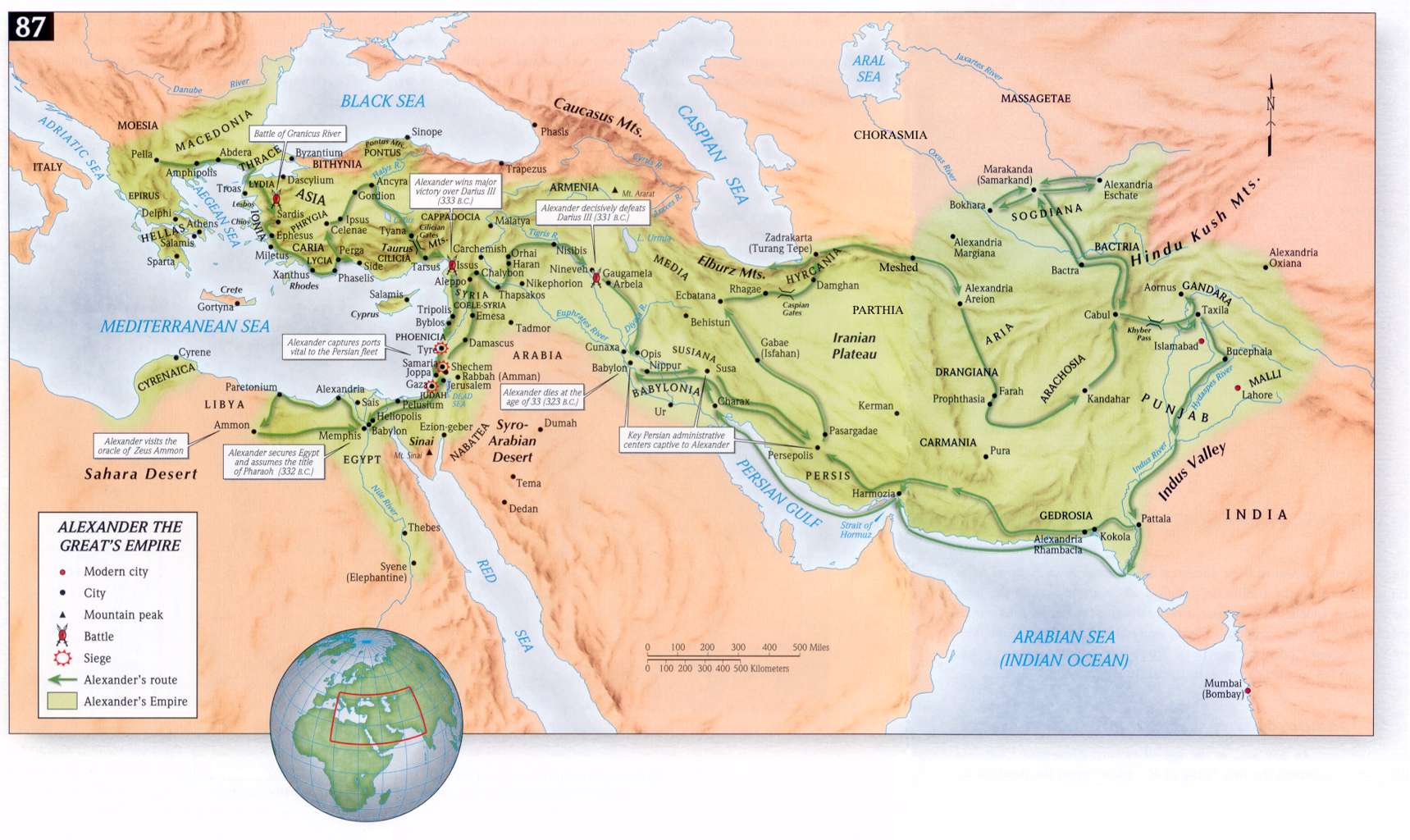
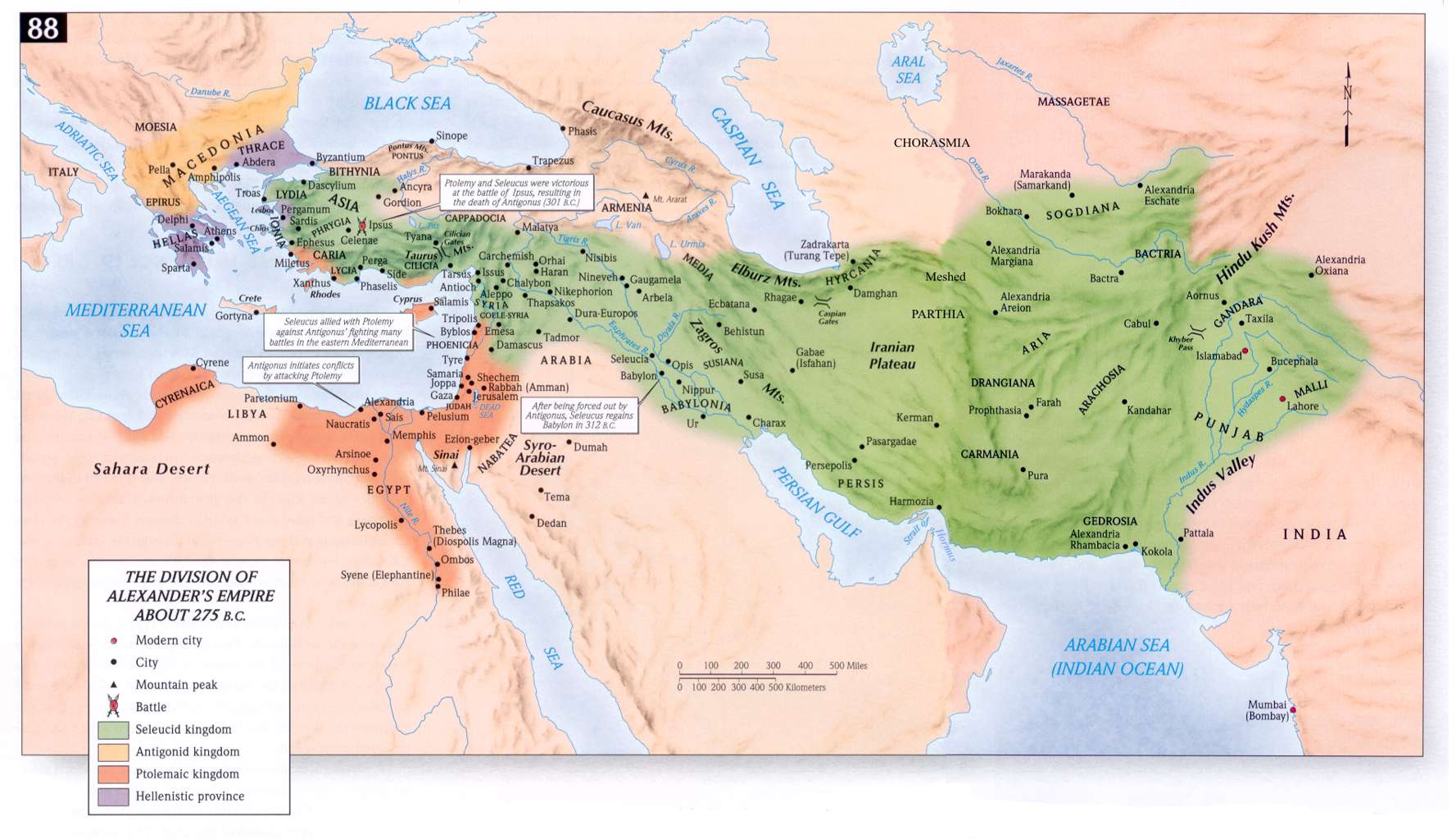
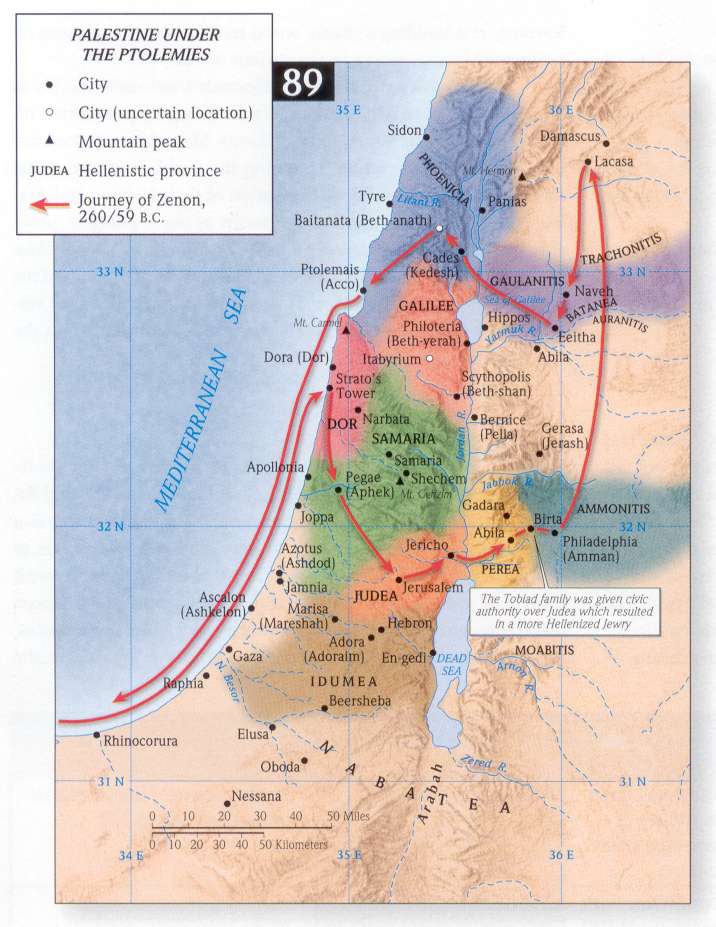
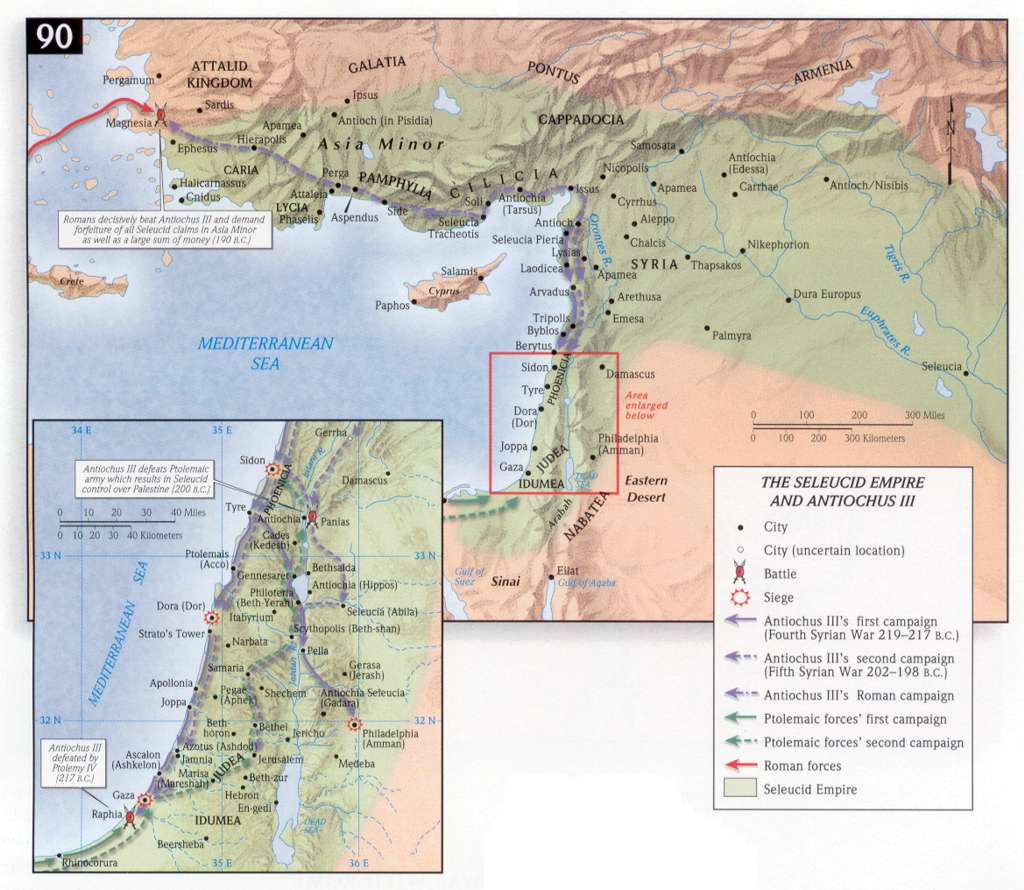
MAPS FROM ESV
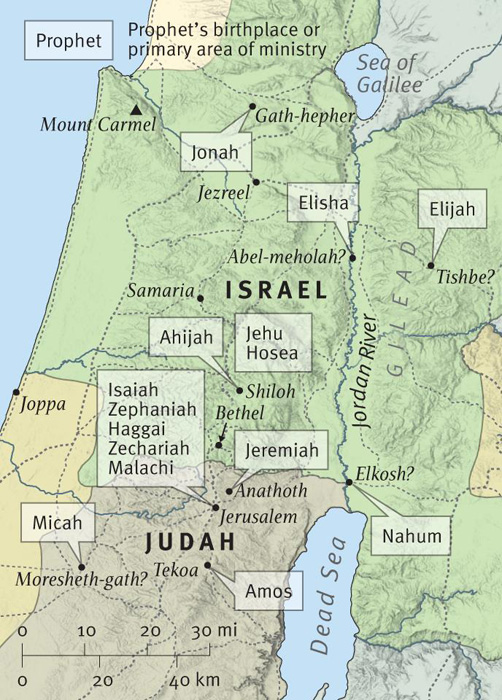
Prophets of Israel and Judah
c. 875–430 B.C.
- Extent of Solomon’s Kingdom
- Israel and Judah in 2 Kings
- Solomon’s Administrative Districts
- The Kingdom Divides
- Syria Captures Gilead
- Resurgence during Azariah, Jeroboam II
- Prophets of Israel and Judah
- Resurgence of Assyrian Influence
- Fall of Samaria, Deportation of Israelites
- Exile to Babylon
- Extent of David’s Kingdom
- Solomon’s International Ventures
- Syria and Israel Attack Judah
- Judah after the Fall of Israel
- Persian Empire at the Time of Ezra
- Persian Empire at the Time of Nehemiah
- Judea under Persian Rule
- Persian Empire at the Time of Esther
- Near East at the Time of Isaiah
- Israel and Judah at the Time of Jeremiah
- Babylonian Empire
- Babylon Attacks Judah
- Jeremiah Prophesies against Egypt
- Near East at the Time of Ezekiel
- Ezekiel’s Vision of Israel’s New Boundaries
- Introduction to Daniel: Babylonian Empire
- Empires of Daniel’s Visions: Persians
- Empires of Daniel’s Visions: Greeks
- Empires of Daniel’s Visions: Ptolemies and Seleucids (Early)
- Empires of Daniel’s Visions: Ptolemies and Seleucids (Late)
- Maccabean Kingdom
Caveat: Be an Acts 17:11 Berean (note): Not always literal, especially on prophetic passages
- Introduction
- Habakkuk 1 Sermons, Illustrations, Outlines, Commentary
- Habakkuk 2 Sermons, Illustrations, Outlines, Commentary
- Habakkuk 3 Sermons, Illustrations, Outlines, Commentary
Caveat: Be an Acts 17:11 Berean (note): Not always literal, especially on prophetic passages
Caveat: Be an Acts 17:11 Berean (note): Not always literal, especially on prophetic passages - drr critique
HINT: Click here to Scroll Bible text synchronized with Constable's notes. Very useful feature!
- Habakkuk 1-2 Seeking an Answer from God
- Habakkuk 3:1-2 This is Revival
- Habakkuk 3:1-2 The Day of Revival
- Habakkuk 3:2 A Revival of the Word of God
Caveat: Be an Acts 17:11 Berean (note): Not always literal, especially on prophetic passages
Caveat: Be an Acts 17:11 Berean (note): Not always literal, especially on prophetic passages
- Habakkuk 1:1-3:19 Habakkuk - The Wonder of Divine Providence
- Habakkuk 1:1-2:1 Light for Times of Great Darkness
- Habakkuk 1:3 The Sight of Sin
- Habakkuk 1:5 In Wrath Mercy Remembered
- Habakkuk 1:5 A Work You will not Believe
- Habakkuk 1:5 Behold
- Habakkuk 1:11-3:6 Five Stark Contrasts
- Habakkuk 1:12-17 Doesn't God Care
- Habakkuk 1:12-13 Eternality, Sovereignty and Holiness
- Habakkuk 1:13 The Only Explanation
- Habakkuk 1:13 Facts, Questions, and Conclusions
- Habakkuk 2:1-4 Faith Is
- Habakkuk 2:1-4 From Fear to Faith
- Habakkuk 2:1-4 Watching to See
- Habakkuk 2:2-4 Watch, Write, Wait, Believe
- Habakkuk 2:3 When Its Time
- Habakkuk 2:3-4 What is Faith
- Habakkuk 2:4 The Just Shall Live by Faith
- Habakkuk 2:4 The Greatest Evil and the Greatest Gift
- Habakkuk 2:4-20 The Mystery of Babylon
- Habakkuk 2:4-20 Babylon's Woes
- Habakkuk 2:4-20 Five Woes or False Prophets Exposed and Condemned
- Habakkuk 2:5-20 Out of Tragedy Triumph
- Habakkuk 2:8 What's Wrong with My Religion
- Habakkuk 2:12-14 The Knowledge of the Glory
- Habakkuk 2:18-20 The Solitariness of God
- Habakkuk 2:18-19 Useless Religion
- Habakkuk 3:1-19 Revive Remember Rejoice
- Habakkuk 3:1-2 A Terrified Prophet
- Habakkuk 3:3-16 Three Great Wonders of Grace
- Israelology: Part 1 of 6 Introduction: Definition of Terms
- Israelology: Part 2 of 6 Israel Present (Note: Article begins on Page 2)
- Israelology: Part 3 of 6 Israel Present (Continued)
- Israelology: Part 4 of 6 - Israel Future (Part One)
- Israelology: Part 5 of 6 - Israel Future (Part Two)
Sample Excerpt from Part 5/6: "Israel, in the period of the Messianic Kingdom, is a major theme of the Old Testament prophets and the high point of their prophecy....Every writing prophet (other than Jonah, Nahum, Habakkuk, and Malachi) had something to say about it."
Conservative, Literal Interpretation
The Judgment of Judah Through the Chaldeans Announced
- Habakkuk 1:1-4 The Prophet's Cry to Jehovah
- Habakkuk 1:5-11 The Answer
- Habakkuk 1:12-17 The Prophet's Plea
Ungodliness of the Chaldeans and Their Destruction
- Habakkuk 2:1-4 The Waiting Prophet and the Message He Received
- Habakkuk 2:5-20 The Five-Fold Woe Upon the Chaldeans
The Vision of the Coming of the Lord
- Habakkuk 3:1-2 The Prophet's Prayer
- Habakkuk 3:3-15 The Coming of the Lord for Judgment and Redemption
- Habakkuk 3:16-19 The Effect Upon the Prophet
Sample Comment from Gaebelein on Habakkuk 3:3-15-see also related in depth notes: It has been said, “The poet describes a great storm, advancing from the south, the region of Paran and Sinai. In the dark storm clouds he conceives Jehovah to be concealed; the lightning flashes which illumine heaven and earth disclose glimpses of the dazzling brightness immediately about him; the earth quakes, the hills sink, and the neighboring desert tribes look on in dismay” (Canon Driver). Thus higher criticism, reduces one of the sublimest inspired prophecies, concerning the future appearing of the Lord, to the level of poetry. The great description of His coming must be linked with similar prophecies Deut 33:22; Ps 18:8-50; Ps 18:33-50; Ps 68:8; Ps 68:34; Ps 77:17-20. The great ode, cast in the form of a Psalm, begins with the statement that God cometh from Teman and the Holy One from Mount Paran. Moses in his prophetic blessing also begins with a similar declaration. “The LORD came from Sinai, and rose from Seir unto them; He shined from Mount Paran, and He came with the thousands of His saints (angels); from His right hand went a fiery law for them.” Just as He was manifested when He had redeemed them out of Egypt, and constituted them His Kingdom people at Sinai Ex 19:1-25, so will He appear again to deliver the remnant of His people from the dominion of the world-power, and judge them as He judged Egypt. He comes from the direction of Edom, for Teman is the southern district of Idumea, while Paran is more southward. Isaiah also beheld him advancing from the same direction. “Who is this that cometh from Edom, with dyed garments from Bozrah (See discussion on Bozrah as it relates to the Second Coming of the Messiah- scroll down for map)?” Isaiah 63:1-19. It is unfortunate that the Authorized Version has “God came from Teman,” when it is “God cometh,” not a past but a future event. After this opening statement the first Sela is put. This means to pause and to lift up. We are to pause and meditate, and then to lift up our hearts and voices in praise and thanksgiving. It is found seventy-one times in the Psalms and three times in this chapter of Habakkuk.
Does not always interpret the Scripture literally (see example)
Conservative, Literal Interpretation
Be cautious (Acts 17:11): Does not always interpret the Scripture literally
James Rosscup "This 1858 work supplies much help on matters of the text, word meaning, resolving some problems, etc. Some have found it one of the most contributive sources in getting at what a text means." (Commentaries for Biblical Expositors: An Annotated Bibliography of Selected Works)
Be cautious (Acts 17:11): Does not always interpret the Scripture literally and sometimes replaces Israel with the Church (note) Click example of his interpretative approach which is often allegorical) (Or another example
Caveat: Be an Acts 17:11 Berean (note): Not always literal, especially on prophetic passages
- Introduction
- Habakkuk 1 Commentary - Critical Notes
- Habakkuk 1:2 The Importunate Prayer
- Habakkuk 1:2-4 The Lamentable Sight
- Habakkuk 1:5 The Wonderful Work
- Habakkuk 1:5-10 The Wonderful Work Accomplished
- Habakkuk 1:8 Evening Wolves
- Habakkuk 1:11, 16 Success Abused
- Habakkuk 1:13 God's Character A Ground of Consolation in Distress
- Habakkuk 1:13 God Does Not Approve of Sin
- Habakkuk 1:13-17 The Enigmas of Life
- Habakkuk 1 Illustrations to Chapter 1
- Habakkuk 2 Commentary - Critical Notes
- Habakkuk 2:1, 2 The Waiting Servant
- Habakkuk 2:2, 3 The Appointed Vision
- Habakkuk 2:4 The Great Contrast or the Believer and the Unbeliever
- Habakkuk 2:5 Wine A Deceiver
- Habakkuk 2:6-8 The Sin of the Avaricious
- Habakkuk 2:9-11 The Evil Covetousness
- Habakkuk 2:12-14 The City of Blood
- Habakkuk 2:14 A Glorious Day
- Habakkuk 2:15-17 The Three Cups
- Habakkuk 2:18, 19 The Unprofitableness of Idolatry
- Habakkuk 2:20 The Divine Court
- Habakkuk 2 Illustrations to Chapter 2
- Habakkuk 3 Commentary - Critical Notes
- Habakkuk 3:2 God's Voice and Human Fear
- Habakkuk 3:2 The Revival of God's Work
- Habakkuk 3:3-6 God's Glory in Days of Old
- Habakkuk 3:4 The Hidings of Divine Power
- Habakkuk 3:6, 7 The Measured Inheritance
- Habakkuk 3:8-11 The Chariots of Salvation
- Habakkuk 3:12-15 The Royal March
- Habakkuk 3:16-18 A Song of Triumph
- Habakkuk 3:19 God All-Sufficiency in Trouble
- Habakkuk 3 Illustrations to Chapter 3
Note: JFB is one of the more literal, conservative older commentaries (prior to 1900). Sample excerpt of eschatological (prophetic, apocalyptic) passage Zechariah 14:2 - "gather all nations, etc. — The prophecy seems literal (compare Joel 3:2). If Antichrist be the leader of the nations, it seems inconsistent with the statement that he will at this time be sitting in the temple as God at Jerusalem (2Thessalonians 2:4); thus Antichrist outside would be made to besiege Antichrist within the city. But difficulties do not set aside revelations: the event will clear up seeming difficulties (Ed: Interesting statement!). Compare the complicated movements, Daniel 11:1-45." Comment on Zech 14:11 - "no more utter destruction — (Jer 31:40). Literally, “no more curse” (Rev 22:3; compare Malachi 4:6), for there will be no more sin. Temporal blessings and spiritual prosperity shall go together in the millennium: long life (Isaiah 65:20-22), peace (Isaiah 2:4), honor (Isaiah 60:14-16), righteous government (Isaiah 54:14; Isaiah 60:18). (Zechariah 14 - Commentary Critical and Explanatory on the Whole Bible)
One of the Best "devotional flavor" commentaries on the Minor Prophets
- Habakkuk 1:1-11 The Unconcern of God
- Habakkuk 1:12-2:1 A Holy God and His Unholy Instrument
- Habakkuk 2:2-30 The Just Shall Live by Faith
- Habakkuk 3 God’s Providence for the Fearful
See caveat regarding this commentary
Rosscup - This is the best older, overall treatment of a critical nature on the Old Testament Hebrew text verse by verse and is a good standard work to buy. The student can buy parts or the whole of this series. Sometimes it is evangelical, at other times liberal ideas enter...In prophecy it is amillennial. (Commentaries for Biblical Expositors: An Annotated Bibliography of Selected Works).
- Habakkuk - Intro
- Habakkuk 1 - Chastisement of Judah Through the Chaldeans
- Habakkuk 2 - Destruction of the Ungodly World Power
- Habakkuk 3 - Prayer for Compassion in the Midst of Judgment
Caveat: Be an Acts 17:11 Berean (note): Not always literal, especially on prophetic passages
Caveat: Be an Acts 17:11 Berean (note): Not always literal, especially on prophetic passages
Caveat: Be an Acts 17:11 Berean (note): Not always literal, especially on prophetic passages
- Introduction and Background
- Habakkuk 1:1-11 The Strangeness of God's Ways
- Habakkuk 1:12-2:20 The Prophet's Perplexity
- Habakkuk 3:1-19 Praise the Lord Anyhow
Literal, futuristic interpretation
Complete Commentary of Habakkuk on one zip file
The Theological Journal Library on galaxie.com
An annual $50 or monthly $5 subscription (click here) is required to view the entire article but will give you access to literally thousands of conservative articles. Click the following links to search by topic, author, or bible reference.
Example Journal Articles
- Grow your Faith with Habakkuk -- By Robert Spender
- The Song of Habakkuk Part I -- By J. Ellwood Evans
- The Song of Habakkuk Part II -- By J. Ellwood Evans
- The Song of Habakkuk Part III -- By J. Ellwood Evans
- “The Just Shall Live By Faith” Habakkuk 2:4 in Romans 1:16-17 - Robert P. Martin
- The Function of LXX Habakkuk 1:5 in the Book of Acts - Robert W. Wall
- A Literary Look at Nahum, Habakkuk, and Zephaniah -- Richard Patterson
- The Psalm of Habakkuk -- Richard D. Patterson
- Habakkuk -- H. L. Ellison, Men Spake from God, Exeter: Paternoster Press, 1958
- Interpretive Challenges Relating to Habakkuk 24b -- George J. Zemek, Jr.
- Prayer, Oracle And Theophany The Book Of Habakkuk - Michael E.W. Thompson
- The Dead Sea Habakkuk Scroll - F F Bruce
- Ugaritic Poetry And Habakkuk 3 - David Toshio Tsumura
- The Laments of Habakkuk's Prophecy - J G Harris
- 'Trust in the Lord': Hezekiah, Kings and IsaiaJohn W. Olley Tyndale Bulletin 50.1 (1999): 59-77.
- The Function of LXX Habakkuk 1:5 in the Book of Acts, Robert W. Wall Bulletin for Biblical Research 10.2 (2000): 247-258.
- Hearing the Children’s Cries Commentary, Deconstruction, Ethics, and the Book of Habakkuk, R. Christopher Heard Semeia (1997) 75-89.
- “The Righteous Live By Their Faith” In A Holy God Complementary Compositional Forces And Habakkuk’s Dialogue With The Lord - Ernst R. Wendland
- The Translation of Romans 1:17 - A Basic Motif in Paulism - Wilber B Wallis - Habakkuk 2:4
- Revival: A Solution or A Problem? The Definition of Revival in the Old Testament - Robert H. Lescelius
Rosscup on Kaiser: A careful evangelical gives contemporary outlines usable to pastors. He has occasional illustrations and serious explanation of the text. He is premillennial, as on Zechariah 14, and packs in much expositional help, relating it strategically to life. (Commentaries for Biblical Expositors: An Annotated Bibliography of Selected Works)
Rosscup comments: The large, two-column pages contain much good material on the relevance of the words for then and for now, dealing with such topics as love, repentance, and sincerity (Hosea 6). A prolonged contemplation of these pages and an application of their principles will produce substantial Christian growth. The author could improve the work by being more definite sometimes in specifying in what framework God will bless Israel in the future (e.g., Hosea 14). Vagueness such as in Joel 2:1-11, where he says the invader is neither locusts nor a human army, is a drawback. Wordiness and wandering in his discussions is another shortcoming, as in using Joel 2:28 to take off into a long discussion of clericalism. He finds fulfillment of Joel 2:28 at Pentecost, yet it would help to point out some aspects that were (Rosscup)
Review - In his review of this work, Hebrew scholar, Dr William Barrick, writes "“Based on my experience as a Bible translator . . . , I have often said, ‘If you want to discover how little you really know, become involved in translating all the books of the Bible from Hebrew, Aramaic, and Greek into English or any other language.’ The same applies to writing a commentary (7).” With these words Barker introduces his masterfully written and eminently readable commentary on the Book of Micah (21-136). Every page drips with exegetical insights drawn from the original Hebrew text. Every section includes clear and practical applications for the modern Christian reader (69, 81-82, 115). The breadth of information is impressive: everything from hymns (134, 135) and historical anecdotes (82, 113, 131) to detailed grammatical and textual analyses of the Hebrew. Bailey’s more extensive contribution (commentaries on Nahum, Habakkuk, and Zephaniah, 137-500) is equally impressive, informative, and readable. Barker and Bailey direct the reader to a wealth of resources by means of extensive footnotes. When pertinent to the reader’s understanding of the text, the commentators identify significant views and related arguments. Anyone studying these four minor prophets will benefit from this volume. (Click to read this excellent,review)
Rosscup on John Phillips - A respected popular expositor on a number of biblical books here has two introductory chapters, then a chapter of about 20–30 pp. on each prophet (50 on Zech.). Several charts aid readers, and a detailed outline runs before each exposition. The exposition is in general surveys of sections, at times taking a view on a main problem. In Hosea 1:2, he feels that God had Hosea marry an immoral woman but Phillips offers no help on the moral issue. Phillips is premillennial, seeing Israel’s future kingdom blessings as in the Millennium after Christ’s Second Coming (Hosea 3:5; Joel 3:14ff; Amos 9:15; Zeph. 3:9ff; Zech 2:10–13; 14:1–21). In Mal. 2:15 he has “one” refer to God making husband and wife into one, and in Mal 4:5 he thinks the Elijah will be fulfilled in one of the two witnesses in Rev 11:3-13. The work helps on broad coverage, and is quite readable for preachers, church teachers, students and lay people wanting a general devotional sweep. (Ibid)
Rosscup says "This is an outstanding conservative, detailed work backed by scholarly awareness and expertise. Comments reflect fine-tuned ability in the Hebrew text, philology, exegesis, history, and literature. Patterson has premillennial convictions in the final verses of Zephaniah. He shows the shaky reasoning of critical arguments against the unity of Nahum, and defends unity of Nahum and Habakkuk. In a long Excursus he defends New Testament uses of Habakkuk 2:4 (pp. 21–23), But some will doubt that he captures the significance of the picture of a hind in Habakkuk 3:19 when he sees only swiftness ascending and gracefully gliding (262–63). But in most details he is excellent, and the work is well worth the cost and time. (Commentaries for Biblical Expositors: An Annotated Bibliography of Selected Works)
- Ligonier's Top 5 - Caveat Emptor! some are amillennial and not literal/futuristic
- Book Review - The Message of Joel, Micah, and Habakkuk- Listening to the Voice of God David Prior - scroll down to page 204 on pdf
- Book Review - The Books of Nahum, Habakkuk and Zephaniah - O Palmer Robertson
- Book Review - The Minor Prophets- An Exegetical and Expositional Commentary. - Thomas McComiskey - Zephaniah, Haggai, Zechariah, Malachi
- Old Testament Commentaries for Bible Expositors 1987-92 -James Rosscup
- Annotated Old Testament Bibliography - 2007 - Denver Seminary
Rosscup Ranks Commentaries on Minor Prophets
Minor Prophets Overall Ranking by Rosscup
EXEGETICAL COMMENTARIES
1. T. Laetsch (Amill)
2. R. Chisholm (Premill)
3. C. Bullock (Premill)
4. C. F. Keil/ F. Delitzsch (Amill)
EXPOSITIONAL COMMENTARIES
1. Bible Knowledge Commentary entries
2. C. Feinberg
3. J. Boice (Premill)
4. P. Fink (Premill)
DEVOTIONAL COMMENTARIES
1. H. A. Ironside
2. J. Phillips
HABAKKUK Overall Ranking by Rosscup
EXEGETICAL COMMENTARIES
1. R. Patterson
2. O. P. Robertson
3. W. Bailey
EXPOSITIONAL COMMENTARIES
1. J. N., Heflin
2. C. Feinberg
3. J. R. Blue (BKC)
4. C. Barber
5. R. Chisholm
DEVOTIONAL COMMENTARIES
1. D. M. Lloyd-Jones
2. J. M. Boice
3. J. Phillips
4. H. A. Ironside
- Habakkuk: From Perplexity to Faith - interesting article from a Jewish perspective (Note - the site is safe
Excerpt: It is the interpretation of the term emunah (see word study on preceptaustin.org) that caused the division of Judaism and Christianity. In the Jewish interpretation, emunah stands for steadfastness and loyalty to God and the Mitzvot (see: and his hands remained steady [va-yehi yadav emunah] Ex. 17:12). By an ironic twist, Paul made it into faith without the encumbrance of mitzvot that leads to salvation. "To prove the transitory nature of the law, Paul derived his great anti-Jewish motto 'the just shall live by his faith' after giving it a new meaning".
- Habakkuk Articles
- Habakkuk in Holman Bible Dictionary
- American Tract Society Habakkuk
- Bridgeway Bible Dictionary Habakkuk
- Easton's Bible Dictionary Habakkuk
- Fausset Bible Dictionary Habakkuk
- Hitchcock Bible Names Habakkuk
- Hastings' Dictionary of the Bible Habakkuk
- Hawker's Poor Man's Dictionary Habakkuk
- People's Dictionary of the Bible Habakkuk
- Watson's Theological Dictionary Habakkuk
- 1911 Encyclopedia Britannica Habakkuk
- International Standard Bible Encyclopedia Prayer of Habakkuk Habakkuk
- Kitto Biblical Cyclopedia Habakkuk
- McClintock and Strong's Bible Encyclopedia Habakkuk (2) Habakkuk
- The Nuttall Encyclopedia Habakkuk
- The Jewish Encyclopedia Habakkuk
- Baker's Evangelical Dictionary of Biblical Theology Habakkuk, Theology of
- Habakkuk 1:1-17 - Unanswered Questions
We are to accept the reality that there are some questions that will never be answered until we are in God's presence in eternity. - Habakkuk 2:1-20 - Saved by Faith
Though we do not know the answers to all of life's questions, we are to make sure we have by faith received God's gift of eternal life. - Habakkuk 3:1-19 - Living by Faith
Though we do not understand all that happens in life, and we might even experience deep fear and persistent anxiety, we are to trust and worship God.
- HCSB Study Bible : Holman Christian Standard Bible - BORROW (HCSB Study Bible) Excerpt -
Hab 3:1 The prayer of Habakkuk 3 is a psalm to be sung to musical instruments and presented to a music director (Hab 3:19). This psalm represents the prophet's response to God's message to him. The Hebrew word shigionoth refers to a type of song. Like many musical terms in the Psalms, its precise meaning is unknown; "dirge" and "song of irregular beat" are educated guesses (see note at Ps 7 title). The meaning of Hebrew selah (in Hab 3:3,9,13 and 71 times in Psalms) is also obscure (see word study at Ps 46:3,7,11).
Hab 3:2 The report about You (or "what You have reported") perhaps alludes to the revelation that God was punishing Judah through Babylon (Hab 1:5-11). God's coming deeds made Habakkuk stand in awe (lit "fear") and beg for mercy.
Hab 3:3-7 This vision portrays God marching north in power and wrath from the direction of Mount Sinai (Teman was in Edom to the south; Paran was in the wilderness of Sinai; Dt 33:2). God was casting lightning bolts (Hab 3:4), and was accompanied front and back by personified plague and pestilence. Earthquakes associated with God's presence terrorized Bedouin peoples such as the Cushan and Midian.
Excerpt: THEME AND PURPOSE: The theme of this prophecy flows out of Habakkuk’s perplexity over the coming invasion of the wicked Babylonians. It concerns the problems of his faith in the face of two apparent difficulties: (1) Why did God permit the increasing evil in Judah to go unpunished (Hab 1:2-4)? And how could a Holy God (Hab 1:13) use sinful nations like Babylon as His source of judgment (Hab 1:12-2:1)? Habakkuk grapples with these difficulties which are solved in the light of God’s continuing revelation, and the prophet closes in a psalm of joyous trust. The book is thus a theodicy, a defense of God’s goodness and power in view of the problem of evil.
KEY WORD: Two words are key not because of their repetition but because of the content of the book. One is “why” as Habakkuk struggled with the issues here and the other is “faith” as declared in 2:4, “the just shall live by faith.” (Read full discussion)
Excerpt: Interpretive Challenges - The queries of the prophet represent some of the most fundamental questions in all of life, with the answers providing crucial foundation stones on which to build a proper understanding of God’s character and His sovereign ways in history. The core of his message lies in the call to trust God (Hab 2:4), “the just shall live by his faith.” The NT references ascribe unusual importance theologically to Habakkuk. The writer of Hebrews quotes Hab. 2:4 to amplify the believer’s need to remain strong and faithful in the midst of affliction and trials (Heb. 10:38). The apostle Paul, on the other hand, employs the verse twice (Ro. 1:17; Gal. 3:11) to accentuate the doctrine of justification by faith. There need not be any interpretive conflict, however, for the emphasis in both Habakkuk and the NT references goes beyond the act of faith to include the continuity of faith. Faith is not a one-time act, but a way of life. The true believer, declared righteous by God, will habitually persevere in faith throughout all his life (cf. Col 1:22,23; Heb 3:12–14). He will trust the sovereign God who only does what is right.
Excerpt: The book opens in gloom and closes in glory. It begins with an interrogation mark and closes with an exclamation point. Habakkuk is a big "WHY?" Why God permits evil is a question that every thoughtful mind has faced. The book is the answer to the question: Will God straighten out the injustice of the world? The book answers the question: Is God doing anything about the wrongs in the world? This book says that He is!
Excerpt: Habakkuk’s Statement of Confidence--Trust in Yahweh Regardless: Even though Habakkuk was frightened when he heard of the Lord’s work, and knew that God’s time of ultimate victory might be long in coming, he vowed to wait for the judgment to come and rejoice and exalt in the Lord even without visible signs of His blessing because He will enable him to endure hardship Hab 3:16-19a
1. Fear of the Lord’s Coming Judgment: Hab 3:16a
2. One Must Wait for the Lord’s Time of Judgment: Hab 3:16b
3. Vow of Unwavering Confidence--to Wait and Rejoice in the Lord Who Will Enable him to Endure Hardship: Hab 3:17-19
E. Concluding Musical Notation: Hab 3:19b
Excerpt: PURPOSES:
A. To proclaim that Yahweh, Judah’s sovereign warrior, will appropriately judge the evil of Judah by bringing the Babylonians against them
B. To proclaim that Yahweh, as the protector of His people, will sustain those who trust in Him
C. To proclaim that Yahweh, as the protector of His people, will deliver Israel from the Babylonians some day
D. To proclaim that Yahweh, as Judah’s sovereign warrior, will one day judge the unjust Babylonians
- Habakkuk 1:16 Worship of Weapons
- Habakkuk 2:11 The Use of Wood in Walls
- Habakkuk 2:20 Silence
- Habakkuk 3:9 The Naked Bow
- Living Messages of Habakkuk - devotional/practical thoughts make good fodder for sermon preparation!
- Hab 1:1
- Hab 1:2–4
- Hab 1:2
- Hab 1:3
- Hab 1:4
- Hab 1:5–11
- Hab 1:5
- Hab 1:6
- Hab 1:7
- Hab 1:8–9
- Hab 1:10
- Hab 1:11
- Hab 1:12–17
- Hab 1:12
- Hab 1:14
- Hab 1:16
- Hab 2
- Hab 2:1
- Hab 2:2
- Hab 2:3
- Hab 2:4
- Hab 2:5
- Hab 2:6–20
- Hab 2:6–8
- Hab 2:6
- Hab 2:8
- Hab 2:9–11
- Hab 2:9
- Hab 2:11
- Hab 2:12–14
- Hab 2:12
- Hab 2:13
- Hab 2:15–17
- Hab 2:16
- Hab 2:17
- Hab 2:18–20
- Hab 2:20
- Hab 3
- Hab 3:1
- Hab 3:2
- Hab 3:3–15
- Hab 3:3
- Hab 3:5
- Hab 3:7
- Hab 3:8–11
- Hab 3:11
- Hab 3:12–15
- Hab 3:12
- Hab 3:13
- Hab 3:15
- Hab 3:16
- Hab 3:17–18
- Hab 3:19
Excerpt: What's the big idea? As the prophet Habakkuk stood in Jerusalem and pondered the state of his nation, Judah, he must have been dumbfounded. So much evil thrived, completely in the open, but God remained strangely silent. Where was He? How long would He allow this mess to continue? Not long, according to the Lord (Habakkuk 2:2–3). Another nation, the Babylonians, would come and execute justice on the Lord’s behalf. The wicked in Judah, those who thought they would get away with their evil deeds forever, were soon to be punished. The book of Habakkuk offers us a picture of a prideful people being humbled, while the righteous live by faith in God (Hab 2:4). It reminds us that while God may seem silent and uninvolved in our world, He always has a plan to deal with evil and always works out justice . . . eventually. The example of the prophet Habakkuk encourages believers to wait on the Lord, expecting that He will indeed work out all things for our good (Romans 8:28). How do I apply this? Habakkuk asked God the kind of question that so many of us have pondered, “Why do You make me see iniquity, and cause me to look on wickedness? Yes, destruction and violence are before me. Strife exists and contention arises.” (Habakkuk 1:3). We have all seen the evidence of evil in our lives. We’ve all been touched by it. And we bear scars at various stages of healing. Surrounded by evil as if we are trapped in a dark prison cell of our own making, we are often downtrodden by our poor choices and our fallen world. However, the book of Habakkuk reminds us that no place is too dark and no wall too thick for God’s grace to penetrate in a powerful and life-affirming way.
- Analysis of Habakkuk - Well Done
- Minor Prophets Study Guide - Questions/Lessons Learned - scroll down to page 72
Excerpt: Lessons from Habakkuk...
1: How many times have we complained to the Lord that He is not hurrying fast enough to accomplish what we think must be done now?
2: “Wait for the Lord; be strong and take heart and wait for the Lord” (Psalm 27:14).
3: Many times God is much at work and we are just not aware of what He is doing.
4: “Habakkuk, you have been so busy doing what you thought was My work that you have forgotten to be checking in for signals.”
5: Waiting and trusting reflect my submission and obedience.
6: Looking at circumstances alone can often cause us to form a wrong opinion.
Excerpt: What do you do when life takes a turn for the worse? What do you do when it seems like God is silent? What do you do when life doesn’t make sense?
- Habakkuk - The Man Who Rejoiced In Spite Of An Invasion - Excerpt
Every Christian wrestles with two problems: Why doesn’t God answer my prayers sometimes? And, why does God allow the evil to prosper while the righteous suffer? We especially wrestle with these two questions when they converge on us personally. When an evil person is harming us or someone we love and we pray, but God does not answer, it is especially tough.
Just recently Martin Burnham, a missionary to the Philippines, was killed in an attempt to free him and his wife from terrorists who had taken them hostage over a year before. His wife escaped with a bullet wound in the leg. Those close to him are left wondering, “Why didn’t God get him out of there alive?” God’s people were praying for his release. The men who kidnapped him are evil to the core, bent on killing others to obtain their objectives. God could have protected him, but He did not.
The prophet Habakkuk wrestled with these sorts of questions. He is unique among the prophets in that he did not, in his written message, speak for God to the people, but rather spoke to God about his struggles over these basic human questions. Why does God allow evil to go unchecked, especially when the righteous cry out to Him for justice?
We cannot be certain about the exact time of Habakkuk’s ministry, but the most likely scenario is that he wrote just after the godly King Josiah was killed in battle and the wicked King Jehoiakim had succeeded him. It was hard to understand why God would allow Josiah to be killed by the Egyptian army in that he had instituted many much-needed spiritual reforms in Judah (2 Chronicles 34-35). He was only 39 at the time of his death, and easily could have served for another 25-30 years.
But now his son, Jehoiakim was on the throne. Jeremiah confronted this king: “But your eyes and your heart are intent only upon your own dishonest gain, and on shedding innocent blood and on practicing oppression and extortion” (Jer. 22:17). No doubt Habakkuk and other godly people in Judah struggled with the question, “Why does God allow the increasing evil in Judah to go unpunished?” And, “Why isn’t God answering our prayers?” (Hab. 1:2-4).
Then God answered Habakkuk’s prayer and he now had a bigger problem! The Lord said, “You’re not going to believe this, but I’m going to send the Chaldeans to punish Judah’s sins” (Hab 1:5-6). Habakkuk thought, “No way! Those guys are far more evil than the evildoers in Judah that they’re coming to punish! How can a holy God do such a thing?”
To put this in perspective, suppose that you were burdened about the sinful, worldly condition of the American church and you prayed and prayed, but got no answers. Then the Lord answered and said that He was going to use Muslim terrorists to take over our country and destroy all of our Christian places of worship! Many Christians would be slaughtered. Others would be taken captive to Islamic countries where they would serve as slaves. You would think, “Wait a minute, Lord! The cure is far worse than the illness!” That’s similar to what the Lord told Habakkuk in answer to his prayers about ungodliness in Judah. The Chaldeans were going to wipe out the country!
So Habakkuk honestly shares his struggles as he works through this difficult issue, until he comes out at the glorious closing affirmations of 3:17-19, that no matter how bad things got, he would exult in the Lord and rejoice in the God of his salvation. From his experience we learn that…
When we wrestle with the problem of evil, we should go deeper in understanding, faith, and prayer, finding joy in our sovereign God......
Habakkuk has just rehearsed how God has acted in history, especially in the exodus, to deliver His people and defeat their enemies. Sometimes, when doubts crowd into our minds because of trials that we’re going through, we need to go back to the facts of how God has worked in history, especially in the life, death, and resurrection of our Savior. When we stand there, we stand firm, because the God of our salvation is our rock and hiding place. Thus from prison, with Christians criticizing him and non-Christians after his life, Paul could say, “Rejoice in the Lord always; again, I will say, rejoice!” (Phil. 4:4).
- Habakkuk 1:1-3, 5-6, 13; 2:1, 4-6; 3:2, 17-19 Habakkuk: A Message of Faith
- Be a Berean - Not always a literal interpretation. Caveat Emptor!
- Habakkuk 1 Commentary for English Readers
- Habakkuk 2 Commentary for English Readers
- Habakkuk 3 Commentary for English Readers
DAVID FIRTH - Habakkuk Commentary
- Invitation to Habakkuk
- Introduction
- Purpose
- Key Verse
- Outline
- Title (1:1)
- Dialog between Habakkuk and Yahweh (1:2–2:5)
- Five Woes against Workers of Injustice (2:6–20)
- The First Woe (2:6b–9)
- The Second Woe (2:9–11)
- The Third Woe (2:12–14)
- The Fourth Woe (2:15–17)
- The Fifth Woe (2:18–20)
- Habakkuk’s Psalm (3:1–19)
- Bibliography
- Endnotes & Permissions
- Book of Habakkuk - Bible Survey
- Habakkuk 1:5-11 Does God sometimes use evil to accomplish His plans?
- Habakkuk 2:4 What does it mean that the righteous will live by faith?
- Habakkuk 3:17-19 How can we learn to trust God like the prophet Habakkuk?
- Habakkuk 3:3 What does it mean that God came from Teman?
- Habakkuk 3:1 What is the meaning of shigionoth in Habakkuk?
- Habakkuk 3:3, 9, 13 What does selah mean in the Bible?
- Habakkuk 3:7 Who were the Cushites?
- Transcript - Excerpt - "Though the fig tree may not blossom, nor fruit be on the vines, though the labor of the olive may fail and the field yield no food, though the flock may be cut off from the fold and there be no herd in the stalls, yet I will rejoice," or exult in Hebrew. Jump for joy (Ed Note on gil from TWOT - Root meaning is "to circle around" from which such ideas as "to circle in joy" are readily derived. The root meaning is more applicable to vigorous, enthusiastic expressions of joy; but, in the OT, it and its derivatives serve as poetic and prophetic terms for various kinds of joy) Spin around. A hallelujah jig. "I will rejoice in the Lord. I will joy in the God of my salvation. The Lord God is my strength. He will make my feet like deer's feet. He will make me walk on my high hills to the chief musician with my stringed instruments." He looks ahead. He sees the Babylonians coming. He doesn't understand the means that God is going to use to judge His own people, the Jews. But he does trust in the motives of God, and that's important. Sometimes we question the means that God uses to do His work. Why would God do that? I don't get it. But never question God's motive. Here the prophet ends in faith. He begins with a furrowed brow. He ends with his hands raised. I'm going to rejoice in the Lord. Though I know the Babylonians are coming and they're going to strip the vines and the fig trees and the olive groves, and they're going to wipe us out with our animals in the stalls, I, he says, will rejoice not in my situation, not in the sorrowful condition and the temporary punishment. I'll rejoice in the Lord. I will joy in the God of my salvation. When we face trouble and our first instinct is, oh, Lord, how can I get out of this? Stop and think. Hold on to those things you know to be true about God. God's holy. He's my God. I'm under his new covenant, the blood of the cross. He has a plan for me. He has a plan to deal with the evil. In the meantime, I'm going to trust. The just shall trust. That will bring a level of joy as you commit it to the Lord. Your eyes are off of what you see, and by faith, you see him. And the joy comes from him. So instead of, how can I get out of this? Lord, what can I get out of this? What are you trying to teach me? So from perplexity to anxiety, and now to ecstasy, how? The same journey as the prophet. The life of faith. Now you know, we do suffer. In this world, you will have tribulation. That's a promise for you from the word of God. It's not a promise you like to hear, but it is a promise. In this world, you will have tribulation. However, do you know that suffering in the hands of a loving God can result in some of the most marvelous work of God in your life? God can take and use the most horrible situations and bring about great good. And if you think about it, God proved that on himself. God played by His own rules God show that the very worst thing that could ever happen in human history could actually become the best thing. I'm talking about the cross. When God died, that could be regarded as the greatest historic tragedy. Deicide. God was killed on a cross. But God showed that what could be regarded as the greatest tragedy was actually the greatest blessing, because it opened wide the doors of salvation to anyone who would believe in the finished work on that cross. God showed that He can take the worst situation and work the best. If God can do that at Calvary, then God over and over again in our lives can bring great good out of what we think is horrible. God, I don't get it. I don't understand. Shh. The just shall trust. Live by faith. Your joy will go sky high when you learn to commit what you don't understand to God. And just hold on to those things you do, understand. (Full Transcript)
MARTYN LLOYD-JONES
- From Fear to Faith - Borrow - 84 page book
Excerpt: Warren Wiersbe entitles his book on Habakkuk as From Worry to Worship. Dr. Martyn Lloyd-Jones calls his, “From Fear to Faith.” While Habakkuk begins by wondering or worrying about the world around him and God’s seeming indifference, he ends by worshipping God.1 When he heard who was coming 3:16 says he trembled, but he certainly ends up expressing faith by the end of the book. What they are trying to capture in the titles of their books is the progression Habakkuk makes from questioning God to trusting God.
LIGONIER MINISTRIES
- Habakkuk 1:12-13 The Reality of Our Sin
- Habakkuk 2:4 Justification by Faith
- Habakkuk 3:17–19 Counting It All Joy
- Habakkuk 3:17–19 Counting It All Joy
Rosscup's comments (on Patterson's commentary - Nahum, Habbakuk and Zephaniah. Wycliffe Exegetical Commentary;) This is an outstanding conservative, detailed work backed by scholarly awareness and expertise. Comments reflect fine-tuned ability in the Hebrew text, philology, exegesis, history, and literature. Patterson has premillennial convictions in the final verses of Zephaniah. He shows the shaky reasoning of critical arguments against the unity of Nahum, and defends the unity of Nahum and Habakkuk. In a long excursus he defends NT uses of Hab 2:4 (21-23). But some will doubt that he captures the significance of the picture of a hind in Hab 3:19 when he sees only swiftness ascending and gracefully gliding (262-63). Yet in most details he is excellent. The work is well worth the cost and time spent on it.(Old Testament Commentaries for Bible Expositors 1987-92 -James Rosscup)
- Habakkuk: Verse by Verse Commentary - Bibliography of 647 resources!
Excerpt from Introduction - Taken at face value Habakkuk’s short prophecy is set in a time of national upheaval characterized by gross social injustice (Hab 1:2-4) and by the imminent advent of the Babylonians (Chaldeans) as the foremost international power (Hab 1:5-11). Accordingly evangelical commentators have opted for a preexilic setting that antedates the fall of Jerusalem in 586 B.C. Three main positions have been articulated among such scholars. (1) The majority (e.g., Archer, Freeman, Hailey, R. K. Harrison, Hummel, E. J. Young) date the prophecy to the time of Jehoiakim, whose godless disposition (2 Kings 24:1-3; Jer. 26; 36) occasioned prophetic utterances of condemnation together with the threat of a Babylonian invasion (Jer. 25). (2) Others (e.g., Bullock, Laetsch, Pusey, Unger) decide for a date in the reign of Josiah before the finding of a copy of the law in 621 B.C. They argue that the desperate moral conditions denounced by Habakkuk could well be reflective of that period (cf. Jer. 1-6) and relate Habakkuk’s prediction of the coming Chaldeans to the transitional nature of the period near the end of the Neo-Assyrian era. (3) Still others (e.g., Keil) defend a date in the time of Judah’s most wicked king, Manasseh.228 They cite the degraded moral and spiritual level of that time (2 Kings 21:1-16; 2 Chron. 33:1-10), an era whose debauchery was so pronounced that it drew God’s declaration that He would effect a total “disaster on Jerusalem and Judah” (2 Kings 21:12).
- The Messianic Hope of Israel - See his discussion "The Witness of Habakkuk"
The Witness of Habakkuk The prophecy of three chapters is in the first two chapters a dialogue between the prophet and the LORD. He voices his perplexities, as he finds himself in a world where the powers of darkness and of brute force seem to triumph over righteousness and truth. Babylon was the expression of the kingdom of evil hostile to the Kingdom of GOD, but the principle goes beyond the local background and coloring out of which the prophecy sprung. It is for our day also. It is clear that Habakkuk has an apocalyptic and eschatological outlook. And as the name of the prophet means "one embraced," he reminds us of "the disciple whom Jesus loved" and who "leaned on his breast," and from thence reviewed the procession of events in the last hour.- Chapter 1 speaks of the apparent triumph of the kingdoms of "this present evil world."
- Chapter 2 of the Parousia of the Messiah, a vision sure to be fulfilled, though long delayed.
Hebrews 10:37 shows that the early church saw CHRIST in that passage in Habakkuk: "For yet a little while, and he that shall come will come, and will not tarry." The end is that "the earth shall be filled with the knowledge of the glory of the LORD, as the waters cover the sea." This passage is found in beautiful connections in II Corinthians 4: "The knowledge of the glory of God" is found "in the face of Jesus Christ" (2 Cor 4:6), and illuminates our hearts.
No wonder that the third chapter, which celebrates in a psalm the Parousia of JESUS in the endtime, to vindicate His holiness and establish His rights, ends with one of the most sublime expressions of confidence in GOD in a dark day, illustrating the doctrine learned by Habakkuk when on the watchtower, that "the just shall live by his faith" "Although the fig tree shall not blossom, neither shall fruit be in the vines; the labour of the olive shall fail, and the fields shall yield no meat; the flock shall be cut off from the fold, and there shall be no herd in the stalls: Yet I will rejoice in the LORD, I will joy in the God of my salvation. The LORD God is my strength, and he will make my feet like hinds' feet, and he will make me to walk upon mine high places" (3:17-19). He obtains "hinds' feet" which enable him to leap beyond the confusion and distress of the present into the blessedness of the age to come.
- Habakkuk: Lord How Long? - Background Introduction
- Habakkuk: Pattern For Prayer - Prayer and the Prophet Habakkuk
- Habakkuk: The Lord God is My Strength
- Micah; Nahum; Habakkuk - Understanding the Anger of God - download lesson 1 of inductive study on these 3 OT books -
- See page 45 for MAP locating the cities of Habakkuk's time
- See Related Resources: Inductive Bible study, Observation, Interpretation, Application
ADRIAN ROGERS - Click for sermons below
- Don’t Let an Election Steal Your Song—Habakkuk 1–3
- Giving Thanks in Dark Days—Habakkuk 1–3
- Giving Thanks in Dark Days—Habakkuk 1–3
- How to Stay Together When the World Comes Apart—Habakkuk 1–3
Short to the point notes but well done
- Habakkuk 1:5-11 ( doc, pdf)
- Habakkuk 1:12-17 ( doc, pdf)
- Habakkuk 2:1-4 ( doc, pdf)
- Habakkuk 2:5-8 ( doc, pdf)
- Habakkuk 2:9-11 ( doc, pdf)
- Habakkuk 2:12-14 ( doc, pdf)
- Habakkuk 2:15-19 ( doc, pdf)
- Habakkuk 2:18-20 ( doc, pdf)
JAMES SMITH
- Handfuls on Purpose - click for topics below
- Habakkuk 2 On the Watch Tower
- Habakkuk 3 The Secret of Abiding Joy
Excerpt: How do I apply this? Habakkuk asked God the kind of question that so many of us have pondered, “Why do you force me to look at evil, / stare trouble in the face day after day?” (Habakkuk 1:3 MSG). We have all seen the evidence of evil in our lives. We’ve all been touched by it. And we bear scars at various stages of healing. Surrounded by evil as if we are trapped in a dark prison cell of our own making, we are often downtrodden by our poor choices and our fallen world. However, the book of Habakkuk reminds us that no place is too dark and no wall too thick for God’s grace to penetrate in a powerful and life-affirming way.
WARREN WIERSBE - Outline of Habakkuk from "Be Amazed" (page 134)
Key theme: The just shall live by faith
Key verse:Habakkuk 2:4
I. The prophet wondering and worrying—(Chap. 1)
1. God is indifferent—1:2–4
God’s reply: I am working—1:5–11
2. God is inconsistent—1:12–17
II. The prophet watching and waiting—(Chap. 2)
1. Write God’s vision—2:1–3
2. Trust God’s world—2:4–5
“The just shall live by faith.”—2:41
3.Declare God’s judgment—2:6–20
(1) Woe to the selfish—2:6–8
(2) Woe to the covetous—2:9–11
(3) Woe to the exploiters—2:12–14
“God’s glory will fill the earth.” 2:14
(4) Woe to the drunkards—2:15–17
(5) Woe to the idolaters—2:18–20
“God is still on His throne.” 2:20
III. The prophet worshiping and witnessing—(Chap. 3)
1. He prays to God—3:1–2
2. He ponders God’s ways—3:3–15
3. He praises God—3:16–19
THOUGHT- OBSERVE WIERSBE'S OUTLINE - Habakkuk begins with worrying and ends up worshiping (and witnessing)! What a powerful pattern for all of us to emulate!
- Habakkuk - Talking To God When Life Makes No Sense
One of the most difficult things we live with as believers is the unexplained hardships that faithful saints sometimes must go through. Yet, God has promised that all things do work together for good to those who love Him and are called according to His purpose. This sermon is designed to encourage and exhort the believer who cannot understand some difficulty which is presently pressing down upon his or her life.
There is always a need for godly leaders in the Church of our Lord. Some people view leadership in the local church as a privilege, a title or a source of power. Actually, when God offers us a position of leadership, it is purely to serve Him, His cause and His interests. Dr. Jerry Watts discusses the heart of a godly leader in this sermon. May God give us more devout and pious leaders in the Kingdom of God – that is our prayer!
- Habakkuk 1 Wrestling
- Habakkuk 2 Watching
- Habakkuk 3 A Prayer Hymn!
- Habakkuk 1:2 When God is Silent
Excerpt - The silence of God is one of the most difficult things that the believer has to contend with. A. When you pray and it seems that God is not hearing. O Lord how long shall I cry and you will not hear? We have all experienced this kind of a test of faith in our lives. We pray for a situation and nothing seems to change. Or what is even worse, sometimes the situation even gets worse. Habakuk was concerned about the moral conditions of the nation.
- Habakkuk 1:16 Trusting In Our Own Means Or The Power Of The Holy Spirit (Mp3)
Jim Cymbala shares about how it is very dangerous and grieving to the Lord to trust in our own means and methods in the Church. He clearly shows that we must trust in the work of the Holy Spirit, no method works except God. God works in many ways and desires to get all the glory. May we in North America look towards God afresh for His Spirit's leading in the work of His Gospel and Church.
Though we classify Habakkuk as a Minor Prophet, there's nothing minor about this book. Habakkuk brings a major message during a time when the world seemed to be coming apart and calamity was on the horizon.
- Habakkuk 2:1-4 - The Problem with Good Advice is Short Memory
You must choose which way you will walk. You will either take God’s Word and live by it or you won’t. You will either base your life on God’s promises or you won’t. If the Word of God is not trustworthy for part of my life, then it isn’t trustworthy for any of my life. You can stake your life on what you read in the news and see on television, or you can get alone with God to watch, wait, listen, and live by faith.
“If any promise of God should fail, the heavens would clothe themselves with sackcloth, the sun, moon, and stars would reel from their courses, the universe would rock and a hollow wind would moan through the ruin creation that God can lie.” – F. B. Meyer
Have you heard any good advice lately? Have you done anything with it? Do you plan to? If the request is wrong, God will say, “No.”
If the timing is wrong, God will say, “Slow.”
If you are wrong, God will say, “Grow.”
ADRIAN ROGERS - click for more sermons in pdf
- Habakkuk 1:13-17 - Worship the Net - (click for entire devotional)
Excerpt - It's a tragedy to reach the place where you worship your net. In Habakkuk 1:13-17, Habakkuk tearfully prays asking how the Lord can allow the Chaldeans to come and devour His people. In Hab 1:15, Habakkuk depicts the invading army coming across the land as a net swallowing up the people, "They take up all of them with the angle [hook] they catch them in their net and they gather them in their drag and therefore they rejoice and are glad." As the Chaldeans rejoice in their victory, verse sixteen continues, "Therefore they sacrifice unto their net, and burn incense unto their drag"; they had something that worked so well and was so slick, that tragically they started to worship it. And to worship anything other than almighty God is idolatry. The most valuable thing is not the net; it's the souls. Adopt the characteristic of a fisherman by having compassion on the souls that are lost and courage to step out and cast your net.A wise man once said when we fish for fish, we take them out of the beautiful life into death, but when we fish for men we take them out of death into a beautiful life.
- Habakkuk 1:2 (et al Scriptures) - The Discipline of Darkness - Part 1 & 2 -
There are times in a Christian’s life when the lights just seem to go out and we enter a season of darkness. When faced with calamity and nothing makes sense, the first question we ask is, “Why did God let this happen?” We feel we can bear just about anything if we only knew why. But what we need to ask is HOW. How are we going to respond? We might as well admit it — Christians are often left in the dark. As you read this, you may be at the deathbed of a child. You may be going through financial distress. You may be enduring misrepresentation and disgrace or have a broken heart because of a broken home. The question haunts you — why? What do you do when the lights go out? In this message and the next, I have five propositions to consider. Here are the first three.#1: Those of Greatest Devotion May Know the Deepest Darkness.
“Who is among you that fears the LORD, that obeys the voice of His servant, that walks in darkness, and has no light? Let him trust in the name of the LORD, and stay upon his God.” (Isaiah 50:10)
Darkness is not unusual for God’s choicest saints. No matter how close we walk to God, it’s not always sweetness and light. Who ever came up with the distorted idea that if we give our lives to Jesus, all will be joy and rose petals? We’re not going to waltz through life with ever-increasing health, success, a serene old age and a glorious exit. Thousands of saints who love God are deeply perplexed. Think of these Bible saints:
Job, godly man, wrote, “He hath fenced up my way that I cannot pass, and He hath set darkness in my paths” (Job 19:8).
Habakkuk prayed, “O LORD, how long shall I cry, and Thou wilt not hear! Even cry out unto Thee of violence, and Thou wilt not save!” (Habakkuk 1:2) The heavens seemed like brass.
John the Baptist found himself in prison. It didn’t make sense that Jesus could work miracles, even raise the dead, and yet John was in prison. He asked Jesus, “Are You the one who was to come, or should we expect someone else?” (Luke 7:19).
Even Paul, the great apostle, said, “We are troubled on every side, yet not distressed; we are perplexed, but not in despair; Persecuted, but not forsaken; cast down, but not destroyed” (2 Corinthians 4:8-9). Great saints of history had the same experience. Read their biographies — many spoke of a dark night of the soul. So if you’re in darkness, you’re in good company.
Notice that Isaiah describes the person in darkness as one who “fears Him and obeys the voice of His servant.” Darkness, therefore, does not mean we have sinned or are out the will of God.
# 2: The Faith That Is Born in the Light Often Grows in the Dark
“We should never doubt in the dark what God has shown us in the light.”
It is in darkness that we have to trust the Lord and “stay” upon Him. Think carefully: when have you grown the most? In sunny days when everything seemed perfect? Or at midnight when you cried out to God? It was in the darkness that you grew, wasn’t it?
Faith, like film, is developed in the dark. God wants us to develop a faith that goes beyond our understanding and experience.
How you act in the dark is the real test of your character. Have you noticed in a building when the lights suddenly go out, it’s the little children who begin to run and scream with fear? When the lights come back on, they behave once more.
“We walk by promises, not by explanations.” —Warren Wiersbe
What should you do when the lights suddenly go out in your life?
(a) First, look to the Lord. Isaiah 50:10 says “trust in Him.” Just because things don’t make sense to you doesn’t mean they don’t make sense. And just because they don’t make sense now, doesn’t mean they won’t make sense some day. If it doesn’t make sense, nonetheless trust the Lord.
(b) Not only trust, but also obey. Don’t stop praying for an unsaved spouse, even if they seem to get worse. Don’t stop giving in a financial reverse. Don’t stop witnessing, even if no one seems to respond. Don’t stop praising, even if you don’t feel like praising.
(c) Lean upon the Lord. “Stay” comes from the word for “staff.” Just as a shepherd leans on his staff, lean upon the Lord. David said, “Yea, though I walk through the valley of the shadow of death, I will fear no evil: for Thouart with me.” (Psalm 23:4) It’s better to be in a dark valley, leaning on Jesus, than on a sunlit mountain without Him.
We may not understand, but relationship is really more important than reason. It may be that we do not know Why in order that we may know Who. In the dark valley, David no longer talks about the Lord (“the Lord is my shepherd”), he now talks to the Lord (“Thou are with me”).
However dark life becomes, you will find Jesus standing somewhere in the shadows. Sometimes in life we come to a time of darkness when the lights go out and nothing seems to make sense. Job was so perplexed, he demanded, “God, you owe me some answers!” Although God never specifically answered Job’s questions, Job came to learn something critically important: that God alone was enough — even without the answers. A beautiful song by Scott Wesley Brown and Greg Nelson says,
When answers aren’t enough, there is Jesus.
He is more than just an answer to your prayer.
And your heart will find a safe and peaceful refuge.
When answers aren’t enough, He is there.Sometimes God may put us into darkness so we’ll learn that even without the answers, He is enough. We may not be able to say that and mean it until He is all that we have.
#3: Some Things Are Seen in the Dark That Cannot Be Seen in the Light
“And I will give thee the treasures of darkness, and hidden riches of secret places, that thou mayest know that I, the LORD, which call thee by thy name, am the God of Israel.” Isaiah 45:3
Sometimes the greatest treasures are discovered in the darkness. Darkness is not always the work of the evil one. It’s also one of God’s ways to teach. The stars that hang like chandeliers in the velvet canopy of space are only seen in the darkness. Stars don’t “come out” at night; they’re there all the time. Sometimes on the darkest night, the stars seem brightest. In the daylight, we may think the brightest thoughts, but at night we think the deepest thoughts.
#4: It Is Better to Lean on God in Darkness Than to Stand Alone in Man-Made Light
Isaiah 50:11 warns about lighting our own fire. Man-made enlightenment can be deceptive. Ron Dunn said, “You cannot look at a sundial with a flashlight and tell the correct time.” If we light our own fires and walk in that light, we’ll ultimately lie down in sorrow.
Abraham kindled his own fire after receiving God’s promise of a son. Tired of waiting, he produced Ishmael. Today the children of Abraham are still lying down in sorrow because of their conflict with Ishmael. Moses received God’s promise but took things into his own hands. He became a murderer and set God’s work back forty years. Moses knew for forty years what it was to lie down in sorrow. Simon Peter boasted that he would follow Jesus even to death. Then came dark Gethsemane. Peter did not understand and tried to light his own fire, cutting off the high priest’s servant’s ear. What an embarrassment to the cause of Christ! Peterwould lie down in sorrow that terrible night.
In a time of darkness, don’t create you own man-made light
#5: If Your Sun Has Set, Be Sure Morning Will Come
Your dark night will come to an end. God will turn every hurt to a hallelujah, every tear into a pearl. Your Calvary will one day be an Easter.
It was a dark night for the disciples when Jesus was nailed to the cross and hung there, three hours of it literal darkness. It all seemed so inky black. His kingdom had shrunk to the narrow dimensions of a grave. But then came that glorious morning.
“Unto the upright there ariseth light in the darkness: He is gracious, and full of compassion, and righteous.” Psalm 112:4
“Weeping may endure for a night, but joy cometh in the morning.” Psalm 30:5
Didn’t David say he would walk through the valley of the shadow of death? Remember, the God who leads us in is the God who leads us through. One day Jesus will pull back the shades of night and pin them with a star. He will open the door of morning and flood your world with the sunshine of His love. That day will be all the more wonderful after the darkness.
“Yea, the darkness hideth not from Thee; but the night shineth as the day: the darkness and the light are both alike to thee.” Psalm 139:12
God sees through the dark. His eyes are upon you in your darkness.
A little girl’s mother had died. Her first night apart from her mother, she felt alone in the darkness of her bedroom and left it to sleep with her daddy. They tried to sleep, but unable to see her father’s face, the little girl said, “Daddy, it is so dark. Is your face toward me?”
“Yes, darling, my face is toward you.”
“Daddy, you love me through the dark, don’t you?”
“Yes, sweetheart, Daddy loves you through the dark.” The little girl drifted off to sleep.
That strong man slipped out of bed, fell on his knees and prayed, “Heavenly Father, it is so dark. Is Your face toward me?”
The answer came from heaven, “Yes, My child, My face is toward you.” “Father, do You love me through the dark?”
“Yes, My child, I love you through the darkest night.” The father joined his precious daughter in much-needed sleep.
An unknown poet has written:
So I go on, not knowing;
I would not know if I might.
I would rather walk with Christ in the dark
Than to walk alone in the light.
VALLEY BIBLE CHURCH
- Habakkuk 2 Homilies
Excerpt from S D Hillman - Waiting for the Vision - SPIRITUAL DEPRESSION. The Christian life is not all shadow. It has its sunny as well as its shady side. The good have their seasons of joy - seasons in which, believing, they can rejoice with joy unspeakable and full of glory. Yet they have also their seasons of depression. There is "the midnight of the soul," when the vision of spiritual light and peace and joy tarries; and it is then their truest wisdom to trust and to wait, assured that in due time God will make them glad by lifting upon them "the light of his countenance." "Who is among you that feareth the Lord?" etc. (Isaiah 50:10); "Though the vision," etc. (ver. 3).
- Habakkuk 2:4 Nothing But Faith
Excerpt - In the year 1483 in Eisleben, Saxony, a baby boy was born to a poor coal miner. As he grew up and observed the poverty of his father, this boy named Martin chose to pursue a different vocation. He decided to become a lawyer and, in 1501, entered the University of Erfurt, where he excelled in his studies. As he came to the end of his schooling in 1504, an event took place which changed his life. While he was walking the campus grounds, a storm broke so forcefully that Martin fell on his face in fear. The thunder was deafening and lightning struck all around him. Instinctively, he cried out to the patron saint of coal miners, whose name he had heard invoked during his childhood, Saint Anne! Save me from this lightning. If you save me, I will become a monk. Shortly thereafter, the storm stopped. Being a man of his word, Martin withdrew from Law school and entered an Augustinian monastery where he applied himself so diligently that he obtained his Doctorate of Theology within a few years. But the more he studied, the more troubled his heart became; for although he was becoming an expert in theology, he lacked peace personally. The question he repeatedly wrote in his diary was: How can a man find favor with God? In search of such peace, Martin devoted himself to an exceedingly pious lifestyle. He would fast for 10 to 15 days at a time. When temperatures dropped below freezing, he slept outside without a blanket. Between his studies, he beat his body until it was black and blue and bleeding hoping that somehow by punishing his flesh, he could rid himself of the thoughts and motives that he knew were not right. He went to confession so many times a day that finally the abbot said, Martin, either go out and commit a sin worth confessing, or stop coming here so often. Martin was introspective and continually plagued by what he knew of his own depravity and sinfulness. Once, while sitting at his desk writing theology, he felt the presence of Satan so tangibly that he grabbed a bottle of ink and hurled it across the room to where he thought the devil was standing. The bottle crashed against the wall and left a mark that can still be seen today. Whipping, fasting, praying, confessing Martin did everything possible to gain peace with this God Whom he knew to be righteous, holy, and awesome. Finally, in 1509, Martin decided to make a pilgrimage to Rome in hope of finding the elusive peace for which he longed. He set out on foot and crossed the Alps. On his descent, he almost died of a high fever before making his way to a monastery at the foot of the mountains where the Brothers nursed him back to health. While there, a wise monk approached him and said, You need to read the Book of Habakkuk. And so Martin did just that. He read Habakkuk. It was a good word from that insightful old monk, who perhaps had a sense of Martins struggle......The average person who lives to be 70, will have spent 20 years of his life sleeping, 6 years eating, 5 years dressing, 2 years on the telephone, 3 years waiting, and 5 months tying shoes. After spending huge chunks of time waiting or tying shoes or talking on the phone, people cant help but wonder what life is really about. Whats life about? The just shall live by faith, declares Paul.
- Habakkuk 2 Expositional Notes -
Hab 2:2 - Is that a contradiction,—“Though it tarry,.... it will not tarry” ? No; to us, it appears to tarry; but, in God’s way of reckoning, it does not really tarry. To our impatient spirits, it seems long in coming; but God knows that it will not be a moment beyond the appointed time.Hab 2:4 - This grand text was quoted by Paul when he wrote his Epistles to the Romans, the Galatians, and the Hebrews. It proves that Old Testament saints understood New Testament life. David and Abraham lived by faith, even as Paul and Peter and the other apostles did.
Hab 2:6 - That which is said of ambition may also be said of covetousness. What an idle task it is for a man to go on perpetually hoarding,— heaping together more than he can possibly enjoy himself, as if it were made for nobody but for one man, and he must needs grasp all the wealth of the world. There is scope enough for the loftiest ambition when you seek the nobler joys of grace; there is room for a sacred covetousness when you “covet earnestly the best gifts;” but, in every other respect, may these two things —ambition and covetousness — be ever thrust far from us!
Hab 2:7 - So it happened to Chaldea that the nations, which they had spoiled, by-and-by grew strong enough to take vengeance upon them, and to spoil them in their turn. Usually, when men do wrong, it comes home to them sooner or later. The chickens they hatch come home to roost; at night, at any rate, if not before. Towards the end of life, a man begins to gather the fruit of his doings; or if he does not reap it in this world, certainly he will in the world to come.
- Habakkuk 2:4 It's A Wonderful Life
Excerpt -The Christian life commences with allegiance to the King of kings and Lord of lords, Jesus Christ. As Peter states in the conclusion of his sermon on the day of Pentecost, “Therefore let all the house of Israel know assuredly that God has made this Jesus, whom you crucified, both Lord and Christ” (Acts 2:36).
Dr. George W. Sweeting shares, “A favorite feature in Reader’s Digest, almost since its beginning, has been the articles recalling ‘My Most Unforgettable Character.’
Sometimes well-known persons have been highlighted, but far more frequently these features have pointed to little-known men and women. They have been persons whose lives mattered in some special way because of their character, their personality, or of what they meant to others.
The true Christian is an unforgettable character who, day after day, is becoming more and more like the most unforgettable Person the world has ever known. I speak, of course, of Jesus Christ.
The Christian life is not a matter of following a list of ‘dos’ or observing a longer list of ‘don’ts.’ The Christian life is a pledge of allegiance to Jesus Christ. It is becoming so occupied with Him that the values of the world have little attraction.
If you have been born of God, if you have trusted Jesus Christ as your Savior, you have experienced a wonderful transformation. You are a new creature. You have a brand-new nature. You belong to a new family.
As a result, you have a new outlook. A new destination is now yours. Your whole attitude is changed.”[3]
Dr. Stephen F. Olford (1918-2004) warns about, “A Pretentious Allegiance Without Obedience”, “Not everyone who says to Me, 'Lord, Lord,' shall enter the kingdom of heaven, but he who does the will of My Father in heaven" (Matthew 7:21).
Dr. Olford explains, “Jesus is not speaking here of the heretic, but to those false prophets whose theology and language throughout is orthodox and unquestionable. Indeed, there is not only faithfulness in the use of the correct terms— ‘Lord, Lord’—but also the feeling of emotion and fervency; yet all this without genuine obedience to Jesus Christ.
There are thousands of religious leaders and members in our churches who profess allegiance to Jesus Christ without heart obedience to Jesus Christ. Like the people described by Paul in his letter to Timothy, they are ‘always learning and never able to come to the knowledge of the truth’ (2 Tim. 3:7). The Savior is not interested so much in what a man preaches as in what he produces. The spurious type of Christian usually attracts people to himself, rather than to the Lord. The only test we can apply to this characteristic is that of the experience of truth. If a man does not pass this test then a pretentious allegiance without obedience will suffer eternal disqualification.”[4]
Dr. Lawrence O. Richards writes, “This First Epistle of Peter was probably written about a.d. 64 or 65. But its theme of submission despite unjust suffering remained particularly relevant to the church for several hundred years. During this period Christians experienced significant persecution. A letter written about a.d. 110 by the younger Pliny, a provincial administrator, asks the Emperor Trajan ‘whether it is the mere name of Christian which is punishable, even if innocent of crime, or rather the crimes associated with the names.’ Trajan's answer instructs Pliny not to accept anonymous charges against anyone as a Christian, or to ‘hunt them down.’ But he says that ‘if [Christians] are brought before you and the charge against them [that they are in fact Christians] is proved, they must be punished.’ Less than 50 years after Peter wrote, to bear the name ‘Christian’ in the Roman Empire was considered a capital offense. What a need for Peter, aware of growing hostility even in the 60s, to write and show believers how to live in times when maintaining allegiance to Jesus means suffering, discrimination, ridicule, and even death.”[5]
Expect opposition because of your allegiance to Jesus Christ according to 2 Timothy 3:12-15, where we read, “Yes, and all who desire to live godly in Christ Jesus will suffer persecution. But evil men and impostors will grow worse and worse, deceiving and being deceived. But you must continue in the things which you have learned and been assured of, knowing from whom you have learned them, and that from childhood you have known the Holy Scriptures, which are able to make you wise for salvation through faith which is in Christ Jesus.”
- Habakkuk 2:1-4 The Place of Victory
Excerpt - The just shall live by His faith. Believing what I can't understand. Believing what I can't see. This is the only place of true rest in this world of turmoil. THE VICTORY OF FAITH. 3:17, 18.
- Habakkuk 2:3 The Passion of Patience
'Though it tarry, wait for it.' Habakkuk 2:3 Patience is not indifference; patience conveys the idea of an immensely strong rock withstanding all onslaughts. The vision of God is the source of patience, because it imparts a moral inspiration. Moses endured, not because he had an ideal of right and duty, but because be had a vision of God. He "endured, as seeing Him Who is invisible." A man with the vision of God is not devoted to a cause or to any particular issue; he is devoted to God Himself. You always know when the vision is of God because of the inspiration that comes with it; things come with largeness and tonic to the life because everything is energized by God. If God gives you a time spiritually, as He gave His Son actually, of temptation in the wilderness, with no word from Himself at all, endure, and the power to endure is there because you see God. "Though it tarry, wait for it." The proof that we have the vision is that we are reaching out for more than we have grasped. It is a bad thing to be satisfied spiritually. "What shall I render unto the Lord?" said the Psalmist. "I will take the cup of salvation." We are apt to look for satisfaction in ourselves - "Now I have got the thing; now I am entirely sanctified; now I can endure." Instantly we are on the road to ruin. Our reach must exceed our grasp. "Not as though I had already attained, either were already perfect." If we have only what we have experienced, we have nothing; if we have the inspiration of the vision of God, we have more than we can experience. Beware of the danger of relaxation spiritually.
- Habakkuk 2:4 The Life of Faith
"The just shall live by his faith" Habakkuk 2:4."We are delivered from the law, that we should serve in newness of spirit, and not in the oldness of the letter" Romans 7:6.
"I live; and yet not I, but Christ liveth in me: and the life which I now live in the flesh I live by the faith of the Son of God, who loved me, and gave Himself for me" Galatians 2:20.
The word from Habakkuk is quoted three times in the New Testament as the divine representation of salvation in Christ by faith alone.1 But that word is very often misunderstood--as if it ran, Man will be justified by faith on his conversion. The word includes this, but signifies much more. It says that the just will live by faith--the whole life of the righteous, from moment to moment, will be by faith.2
As presented in God's Word, we all know how sharp the opposition is between the grace that comes by faith and the law that demands our works. This is generally noted with reference to justification. But that distinction holds just as much for the whole life of sanctification. The just will live by faith alone. That is, they will have power to live according to the will of God. At his conversion, the sinner found it necessary to understand that there was nothing good in him--that he must receive grace as one who was powerless and godless. As a believer, he must understand just as clearly that in him there is nothing good--that every moment he must receive his power for good from above.3 And his work must therefore be to look up and believe and receive his power from above--from his Lord in heaven--every morning and every hour. I am not to do what I can, and hope in the Lord to supply strength. No, as one who has been dead--literally able for nothing in himself, and whose life is in his Lord above--I am to lean by faith on Him who will work mightily in me.4
Happy is the Christian who understands that his greatest danger is to fall under the law--to be eager to serve God in the flesh with his own strength. Happy is he when he realises that he is not under the law--which demands and yet is powerless through the flesh--but is under grace where he simply has to receive what has been given. Happy is he when he fully accepts for himself the promise of the Spirit who transfers all that is in Christ to him. Yes, happy is he when he understands what it is to live by faith--to serve, not in the oldness of the letter, but in the newness of the Spirit.5
Let us make the words of Paul our own. They present the true life of faith to us, "I am crucified with Christ; nevertheless I live" (Galatians 2:20). Not only my sin, but my flesh, all that is of myself--my own living and willing, my own power and working--I have given up to death. I no longer live of myself. I cannot. I will not live or do anything.6 Christ lives in me. He Himself--by His Spirit--is my power, and teaches and strengthens me to live as I ought to. And that life which I now live in the flesh, I live by faith in Him. It is my responsibility to believe in Him to work the willing as well as the accomplishment.
Young Christian, let this life of faith be your faith.
Lord Jesus, You are my life. Yes, my life. You live in me, and are willing to take my whole life into Your own hands. And my whole life may be a joyful trust and experience that You are working all in me daily.
Precious Lord, to that life of faith I will surrender myself. Yes, to You I surrender myself, to teach me and to reveal Yourself fully in me. Amen.
- Habakkuk 3:1-19 - A Prayer Hymn
Excerpt - Hymn! (Hab 3:16-19) Here is one of the greatest confessions of faith. Though Babylon comes to destroy; though You send away your people; though the bottom drops out of everything…yet I will trust in you!!! Had he looked ahead he would only see the invading Babylonian army; Had he looked within he would only see fear & trembling; If he looked around he would only see everything falling apart; But by looking up by faith he saw God…& all his fears vanished. To walk by faith means to focus on the greatness & glory of God! "I'm only in the kindergarten of suffering," W.E.Sangster....Faith always lifts us higher & makes us happier!.....Q: Can you worship Him no matter how you feel or what you see? (Hab 3:19) We started in the valley(of despair,ch.1). - We moved to the watchtower in ch.2. - And here we end up on the mountain top. God became Habakkuk's Strength, Song, & his Salvation! If my legs were shaking, I probably would be looking for a place to sit down…not bounding up the side of a mountain, like a deer! The Lord gives us "bounding feet" so we can overcome the obstacles of life. God doesn't always change the circumstances, but He can change us to meet the circumstances! Faith gives you the ability to stand sure-footed like a deer, & to be able to run-swiftly & go higher then ever before! Like the eagle & like the deer, God made us for the heights! They both will go down into the valley but that's not where they live! (us too!) A thought to ponder: "God doesn't reveal Himself to superficial saints who are only looking for a new experience they can brag about, or to curious Christians who want to sample deeper fellowship w/God but not at too great a price." Is.66:2 "But on this one will I look: On him who is poor and of a contrite spirit, And who trembles at My word."
These are uncertain times. Terrorism, financial collapse, health care issues and many other issues are pressing upon the hearts and minds of people everywhere. How do we, as God’s people, deal with these times? Dr. Rick Lance reminds us to face life honestly, but to face life with trust and faith in the Sovereign God!
- Habakkuk 2:20 Just Wait on God
But the Lord is in His holy temple. Let all the earth keep silence before Him. --Habakkuk 2:20I think we are the busiest bunch of eager beavers ever seen in the religious world. The idea seems to be that if we are not running in a circle, breathing down the back of our own neck, we are not pleasing God!
When Jesus said, "Go ye into all the world, and preach the gospel to every creature" (Mark 16:15 KJV), Peter probably leaped to his feet and, no doubt, scooped up his hat on the way out. He was going to go right then!
But the Lord said, "Peter, come back, and 'stay in the city until you have been clothed with power from on high' (Luke 24:49)."
I heard a Christian leader warn recently that we are suffering from a rash of amateurism in Christian circles. Christianity has leveled down and down and down. We are as light as butterflies-- though we flit, flit, flit around in the sunshine and imagine that we are eagles flapping our broad wings.
Sometimes I think the Church would be better off if we would call a moratorium on activity for about six weeks and just wait on God to see what He is waiting to do for us. That's what they did before Pentecost. The Counselor, 95.
"Lord, this morning I'll stop for a while at least to 'just wait on God.' I know You're wanting to work, and I for one am willing to wait this morning to hear Your voice and discover what You want to do for me today. Amen."
- Habakkuk 3:17-18 Jubilation in Desolation -
Excerpt - How shall we rise to this height of triumph over all circumstances? First, by recognition of the fact that amid the prevailing conditions which appall us Christ is at work. Is not our Master making this appeal to us today, that we trust Him even though He seem to be using strange instruments? Let us see the goings and victories of Christ, and dare to affirm them as such, even though we may not have been the instruments in His hands for the winning of these victories. To summarize our meditation in a final word, What is the value of it? I would state it thus. Our joy is in proportion to our trust. Our trust is in proportion to our knowledge of God. To know Him is to trust Him. To trust Him is to triumph and excel. May we be led into fuller knowledge and so find fuller faith and so enter the fuller joy.
Excerpt - When a grief-stricken woman was sharing her feelings, her friend said sympathetically, “Sorrow does color life, doesn't it?” “Yes,” the woman agreed, and then added, “but I intend to choose the colors.” (Our Daily Bread 10/3/98) How do we respond in the face of difficulty? How do we react when the bottom seems to fall out? Do we let sorrow and grief rob our joy and drive us away from God? Or do we choose the colors? Habakkuk wrote this book under the inspiration of God to warn Judah that God was going to use a pagan nation to chastise Israel because of her backslidings. By this time in Israel’s history, they were not openly practicing idolatry, but had relapsed into carelessness and forgetfulness of God, and various evil practices. God commissions Habakkuk to tell Israel that God would use the Babylonians to punish her for her sinfulness.
VALLEY BIBLE CHURCH
WARREN WIERSBE
- Habakkuk 3:2 - Devotional
Excerpt - We will depend on God’s strength and not our own (v. 19). “Do not sorrow, for the joy of the LORD is your strength” (Neh. 8:10). It is God’s work we are doing and he will provide all that we need, including the strength and wisdom required for each day. We live and work a day at a time, and “as your days, so shall your strength be” (Deut. 33:25). How many times I have looked at a week’s schedule and wondered if I could make it—but with God’s help, I did! “My grace is sufficient for you, for My strength is made perfect in weakness” (2 Cor. 12:9). We will move from pleasing ourselves to giving God the glory. When we look ahead, we will say, “The earth will be filled with the knowledge of the glory of the LORD, as the waters cover the sea” (Hab. 2:14). When we look back, we will say, “This was the LORD’s doing; it is marvelous in our eyes” (Ps. 118:23). When the Lord’s work is done the Lord’s way for the Lord’s glory, all is well. For of Him and through Him and to Him are all things, to whom be glory forever. Amen. Romans 11:36 -
Conservative notes from Dr Morris who approaches the text seeking it's literal meaning in the context. Millennial. Click the words or phrases after the Scripture for the Study Notes and note that they are from the KJV translation.
Habakkuk 1
- Habakkuk 1:1 Habakkuk
- Habakkuk 1:5 ye will not believe
- Habakkuk 1:6 Chaldeans breadth of the land
- Habakkuk 1:9 sup up
- Habakkuk 1:10 heap dust
- Habakkuk 1:11 his god
- Habakkuk 1:12 from everlasting; judgment
- Habakkuk 1:13 look on iniquity
Habakkuk 2
- Habakkuk 2:2 run that readeth it
- Habakkuk 2:3 will not tarry
- Habakkuk 2:4 live by his faith
- Habakkuk 2:5 proud man hell
- Habakkuk 2:14 earth shall be filled
- Habakkuk 2:15 giveth his neighbor drink
- Habakkuk 2:19 no breath at all
- Habakkuk 2:20 his holy temple keep silence
Habakkuk 3
- Habakkuk 3:1 Shigionoth
- Habakkuk 3:2 was afraid revive thy work
- Habakkuk 3:3 Teman
- Habakkuk 3:4 as the light
- Habakkuk 3:6 measured the earth
- Habakkuk 3:11 stood still
- Habakkuk 3:13 thine anointed the head
- Habakkuk 3:18 Yet I will rejoice
Recommended: NETBible notes are in the right panel. You can also select the tab for "Constable's Notes."
Sample Comment - Habakkuk 3:13 "Your anointed one" - Heb “anointed one.” In light of the parallelism with “your people” in the preceding line this could refer to Israel, but elsewhere the Lord’s anointed one is always an individual. The Davidic king (Ed: The future "Davidic King" is the Messiah - cf Rev 19:16) is the more likely referent here. (Ed: Anointed = mashiach 04899 = see interesting discussion from an orthodox Jewish perspective concerning Mashiach- The Messiah "Belief in the eventual coming of the mashiach is a basic and fundamental part of traditional Judaism.")
Caveat: Be an Acts 17:11 Berean (note): Not always literal, especially on prophetic passages
- Habakkuk 1:1-4 The Bible's School of Prayer
- Habakkuk 1:1-4 The Secret Of Joy
- Habakkuk 1:1-11 Doesn’t God Care?
- Habakkuk 1:2-11 How Long?
- Habakkuk 1:2 Silence
- Habakkuk 1:12-2:4 Waiting For God
- Habakkuk 1:12-2:3 - God’s Delays
- Habakkuk 1:13 Hiding My Face
- Habakkuk 2:1-8 Begin With God
- Habakkuk 2:1-14 God Still Rules
- Habakkuk 2:1-14 Divine Perspective
- Habakkuk 2:3 Prayer Eggs
- Habakkuk 2:3 Obedience to the Heavenly Vision
- Habakkuk 2:4 Only One Option
- Habakkuk 2:14 Our Only Hope
- Habakkuk 2:15-20 Quiet Time
- Habakkuk 2:20 The Beauty Of Silence
- Habakkuk 2:20 Our God Is Marching On
- Habakkuk 3:16-19 Strength for Your Journey
- Habakkuk 3:16-19 Joy in Hard Places
- Habakkuk 3:18-19 Faith That Works
- Habakkuk 3:18 The Choice To Rejoice
- Habakkuk 3:14-19 Joy—Even In Poverty
- Habakkuk 3:17-19 Can We Rejoice?
- Habakkuk 3:17-19 Undeserved Blessings
- Habakkuk 3:17-19 Always Thankful
- Habakkuk 3:17-19 Above The Circumstances
- Habakkuk 3:17-19 The Smile Of Joy
- Habakkuk 3:17-19 Undeserved Blessings
- Habakkuk 3:17-19 God is Good
- Habakkuk 3:17-18 The Secret Of Joy
- Habakkuk 3:17-18 Counterfeit Happiness
- Habakkuk 3:18 Yet I Will Rejoice
- Habakkuk 3:19 Fast Feet
- Habakkuk 3:19 From Fear to Faith
Caveat: Be an Acts 17:11 Berean (note): Not always literal, especially on prophetic passages
Caveat: Be an Acts 17:11 Berean (note): Not always literal, especially on prophetic passages
Caveat: Be an Acts 17:11 Berean (note): Not always literal, especially on prophetic passages
James Rosscup writes "This work originally appeared in 1860. The present publication is set up in two columns to the page with the text of the Authorized Version reproduced at the top. Scripture references, Hebrew words, and other citations are relegated to the bottom of the page. The work is detailed and analytical in nature. Introduction, background and explanation of the Hebrew are quite helpful. Pusey holds to the grammatical-historical type of interpretation until he gets into sections dealing with the future of Israel, and here Israel becomes the church in the amillennial vein." (Commentaries for Biblical Expositors: An Annotated Bibliography of Selected Works)
- Habakkuk 1-2 Disappointment With God
- Habakkuk 2:4 How to Live By Faith
- Habakkuk 3:17-19 Unconditional Thanksgiving
Be a Berean - Variable Quality
- Habakkuk 1 - 148 Pdfs
- Habakkuk 2 - 120 Pdfs
- Habakkuk 3 - 113 Pdfs
Caveat: Be an Acts 17:11 Berean (note): Not always literal, especially on prophetic passages
NOTE: If you are not familiar with the great saint Charles Simeon see Dr John Piper's discussion of Simeon's life - you will want to read Simeon's sermons after meeting him! - click Brothers We Must Not Mind a Little Suffering (Mp3 even better)
James Rosscup writes "Though old this is well-written and often cited, with many good statements on spiritual truths. Users will find much that is worthwhile, and sometimes may disagree, as when he sees the Jonah account as allegorical (Ed: See Tony Garland's article on the Rise of Allegorical Interpretation)." (Commentaries for Biblical Expositors: An Annotated Bibliography of Selected Works)
- Introduction
- Habakkuk 1:1-2:4 The Prophet As Skeptic
- Habakkuk 2:5-20 Tyranny is Suicide
- Habakkuk 3 In the Midst of the Years
Caveat: Be an Acts 17:11 Berean (note): Not always literal, especially on prophetic passages
- Habakkuk - Introduction
- Habakkuk 1:1-3 Commentary
- Habakkuk 1:4-5 Commentary
- Habakkuk 1:5 Explanatory Note
- Habakkuk 1:6-8 Commentary
- Habakkuk 1:9 Explanatory Note
- Habakkuk 1:9-11 Commentary
- Habakkuk 1:12-14 Commentary
- Habakkuk 1:15-16 Commentary
- Habakkuk 1:11 Explanatory Note
- Habakkuk 2:1-3 Commentary
- Habakkuk 2:4-5 Commentary
- Habakkuk 2:4 Explanatory Note
- Habakkuk 2:6-9 Commentary
- Habakkuk 2:6 Explanatory Note
- Habakkuk 2:10-13 Commentary
- Habakkuk 2:14-17 Commentary
- Habakkuk 2:18-20 Commentary
- Habakkuk 2:17 Explanatory Note
- Habakkuk 3:1-2 Commentary
- Habakkuk 3:3-4 Commentary
- Habakkuk 3:5-8 Commentary
- Habakkuk 3:9-11 Commentary
- Habakkuk 3:9 Explanatory Note
- Habakkuk 3:12-15 Commentary
- Habakkuk 3:18-19 Commentary
- Habakkuk 1:3 The Sight of Iniquity
- Habakkuk 2:1-4 Watching to See
- Habakkuk 2:1-4 Sermon Notes - Watching, Waiting, Writing
- Habakkuk 2:1-11 Expository Notes
- Habakkuk 2:4 Luther Sermon at the Tabernacle
- Habakkuk 2:4 Pride the Destroyer
- Habakkuk 2:4 Sermon Notes - Pride the Destroyer
- Habakkuk 2:4 Faith: Life
- Habakkuk 2:4 Sermon Notes - Faith: Life
- Habakkuk 3:2 Revival Work
- Habakkuk 3:2 Message from God to His Church & People
- Habakkuk 3:2 Spiritual Revival, the Need of the Church
- Habakkuk 3:2 The Middle Passage
OTHERS FROM PBC
| Date | Sermon | Scripture References | Speaker | Sermon Series |
|---|---|---|---|---|
| 02 Aug 2020 | A Prayer When There Is No Way Out | Habakkuk 3:1-19 | Louie, Jeff | Prayers For the Moment |
| 18 Jun 2000 | The Perspective of Faith | Habakkuk | Hall, Danny | The Just Shall Live By Faith |
| 31 Dec 1980 | Prayer's Delays | Habakkuk 1:1-17, 2:1-20, 3:1-19 | Stedman, Ray | Prayers of the Old Testament |
| 28 Aug 1966 | Habakkuk: History is in God's Hands | Habakkuk | Stedman, Ray | Adventuring through the Bible |
Caveat: Be an Acts 17:11 Berean (note): Not always literal, especially on prophetic passages
- 1-11 God’s ways, mysterious, misunderstood yet sure
- 1:12-2:1 I will stand at my watch
- 2:2-4 The just shall live by faith
- 2:4-17 God taunts His enemies and fills the Earth with His Glory
- 2:18-20 Can men’s idols give them guidance?
- 3:1-16 In wrath remember mercy
- 3:17-19 The sovereign Lord is my strength
Conservative, pre-millenial, about 6-7 pages per sermon
- Introduction to Habakkuk
- Habakkuk 1:1-11
- Habakkuk 1:12-2:1
- Habakkuk 2:2-4
- Habakkuk 2:5-20
- Habakkuk 3:1-2
- Habakkuk 3:3-7
- Habakkuk 3:8-15
- Habakkuk 3:16-19
Main page of Theology of Word - See "Bible Commentary" at top of page for list of all 66 books - recommended site
Faith and Work During the Exile—Nahum, Habakkuk, Zephaniah
Nahum, Habakkuk and Zephaniah were active during the period when the southern kingdom began a rapid decline. Internal incoherence and external pressure from the burgeoning Babylonian empire resulted in Judah becoming a vassal state to Babylon. Shortly afterwards, an ill-advised rebellion brought down the wrath of the Babylonians in 587 BC, leading to the collapse of the state of Judah and the deportation of the elites to the center of the Babylonian empire (2 Kings 24-25). In exile, the people of Israel had to work out how to be faithful while separated from their key religious institutions, the temple, the priesthood, even the land. If, as we have seen, the first six books are about the effect of the people’s sin, these three—Nahum, Habakkuk and Zephaniah—are about the resultant punishment during this period.
God’s Punishing Hand at Work (Nahum 1:1-12; Habakkuk 3:1-19; Zephaniah 1:1-13)
Nahum’s chief contribution is to make it clear that the political and economic disaster is God’s punishment or disciplining of Israel. “I have afflicted you,” God declares (Nahum 1:12). Habakkuk and Zephaniah declare that an essential part of God’s punishment is that the people’s ability to make an adequate living is diminished.
The fig tree does not blossom, and no fruit is on the vines; though the produce of the olive fails and the fields yield no food; though the flock is cut off from the fold and there is no herd in the stalls. (Habakkuk 3:17)
All the traders have perished; all who weigh out silver are cut off. (Zephaniah 1:11)
This is seen not only in economic woes, but also in environmental problems (see below under Haggai: Work, Worship and the Environment).
Are contemporary political, economic, and natural disasters punishments from God? There is no shortage of people willing to declare that particular disasters are signs of God’s wrath. The 2011 earthquake and tsunami in Japan were attributed to divine punishment by both the Governor of Tokyo[5]and the host of an MSNBC television news show. But unless we have joined the ranks of the Twelve or the other prophets of Israel, we should be very reluctant to declare God’s wrath in the events of the world. Did God himself reveal the reasons for the tsunami to these commentators, or did they draw conclusions on their own? Did he reveal his intent to a substantial number of people, well in advance, over many years, as he did with the prophets of Israel, or did it come to one or two people the day after? Were the modern-day declarers of God’s punishment forged as prophets by years of suffering alongside those afflicted, as Jeremiah, the Twelve and the other prophets of ancient Israel?
Idolatrous Work (Habakkuk 2:1-20; Zephaniah 1:14-18)
The punishment is of the people’s own making. The people have been working faithlessly, turning good materials of stone, wood and metal into idols. Work that creates idols has no value, no matter how expensive the materials or well-crafted the results are.
What use is an idol once its maker has shaped it—a cast image, a teacher of lies? For its maker trusts in what has been made, though the product is only an idol that cannot speak! (Habakkuk 2:18)
As Zephaniah puts it, “neither their silver nor their gold will be able to deliver them” (Zeph. 1:18).
Faithfulness is not a superficial matter of uttering praises to God while we work. It is the act of putting God’s priorities first in our work. Habakkuk reminds that “the Lord is in his holy temple; let all the earth keep silence before him!” (Hab. 2:20). This silence is not merely a religious observation, but a silencing of our own broken ambitions, fears, and motivations, so that the priorities of God’s covenant can become our priorities. Consider what awaits those who defraud others in banking and finance.
“Alas for you who heap up what is not your own!” How long will you load yourselves with goods taken in pledge? Will not your own creditors suddenly rise, and those who make you tremble wake up? Then you will be booty for them. (Hab. 2:6–7)
Those who accumulate their ill-gotten gain in real estate—a phenomenon that seems constant throughout all the ages—are similarly traps for themselves.
“Alas for you who get evil gain for your houses, setting your nest on high to be safe from the reach of harm!” You have devised shame for your house by cutting off many peoples; you have forfeited your life. The very stones will cry out from the wall, and the plaster will respond from the woodwork. (Hab. 2:9–11)
Those who exploit others’ vulnerabilities also bring judgment on themselves.
“Alas for you who make your neighbors drink, pouring out your wrath until they are drunk, in order to gaze on their nakedness!” You will be sated with contempt instead of glory. Drink, you yourself, and stagger! The cup in the Lord’s right hand will come around to you, and shame will come upon your glory. (Hab. 2:15–16)
Work that oppresses or takes advantage of others ultimately brings about its own downfall.
Today we may not be literally crafting idols of precious materials before which we bow down. But work also may be idolatrous if we imagine that we are capable of producing our own salvation. For the essence of idolatry is that “its maker trusts in his own handiwork” (Hab. 2:18, NASB, cf. NRSV above), rather than trusting in the God by whose guidance and power we are created to work. If we are ambitious for power and influence because we think without our wisdom, skill and leadership, or work group, company, organization, or nation is doomed, then our ambition is a form of idolatry. In contrast, if we are ambitious for power and influence so that we can draw others into a network of service in which everyone brings forth God’s gifts for the world, then our ambition is a form of faithfulness. If our response to success is self-congratulation, we are practicing idolatry. If our response is thankfulness, then we are worshiping God. If our reaction to failure is despair, then we are feeling the hollowness of a broken idol, but if our reaction is perseverance, then we are experiencing the saving power of God.
Faithfulness in the Midst of Toil (Habakkuk 2:1; Zephaniah 2:1-4)
There is another dynamic at work in the exile. Notwithstanding the emphasis of Nahum, Habakkuk and Zephaniah on punishment, people also begin to re-learn how to work in faithful service to God during this period. This is fully explored in Theology of Work Project articles such as Jeremiah & Lamentations and Work and Daniel and Work, but is also hinted at here in the Book of the Twelve. The key point of this is that even in the wretched circumstances of the exile, it is still possible to be faithful. As he watched the carnage around him, no doubt wishing he could be somewhere else, Habakkuk determined to stay at his post and listen for the Word of God there (Hab. 2:1). But more is possible than simply staying at one’s post, valuable as that may be. We may also find a way to be righteous and humble.
Seek the Lord, all you humble of the land, who do his commands; seek righteousness, seek humility; perhaps you may be hidden on the day of the Lord’s wrath. (Zephaniah 2:3)
There are no ideal places of work. Some are deeply challenging to people of God, compromised in all sorts of ways, while others are flawed in more mundane ways. But even in difficult work places, we may still be faithful witnesses to God’s purposes, both in the quality of our presence and the quality of our work. Habakkuk reminds us that no matter how fruitless our work seems, God is present with us in our work, giving us a joy that even the worst conditions of labour cannot completely overcome.
Though the fig tree does not blossom, and no fruit is on the vines;
though the produce of the olive fails and the fields yield no food;
though the flock is cut off from the fold and there is no herd in the stalls,
yet I will rejoice in the Lord; I will exult in the God of my salvation.
God, the Lord, is my strength; he makes my feet like the feet of a deer,
and makes me tread upon the heights. (Habakkuk 3:17–19)
Or, as the paraphrase by Terry Barringer puts it,
Though the contract finishes, And there is no work to be had;
Though there is no demand for my skills, And no one publishes my work.
Though the savings run out, And the pension is not enough to live on;
Yet will I rejoice in the Lord, I will rejoice in God my Saviour.[6]
As verse 19 suggests, good work is possible even in the midst of difficult circumstances, for “the Lord is my strength.” Faithfulness is not only a matter of enduring hardship, but of making even the worst situation better in whatever ways we can.
Chapter 1
- Title - Habakkuk 1:1
- First Complaint and Response - Habakkuk 1:2-11
- Complaint: Against Judah - Habakkuk 1:2-4
- Response: Babylonian Judgment - Habakkuk 1:5-11
- Second Complaint and Response - Habakkuk 1:12-2:20
- Complaint: Against Babylon - Habakkuk 1:12-2:1
Chapter 2
- Response: Babylon's Judgment - Habakkuk 2:2-20
- The Righteous Shall Live by Faith - Habakkuk 2:2-5
- Woes Against the Wicked - Habakkuk 2:6-20
Chapter 3
- Closing Prayer of Submission - Habakkuk 3:1-19
- Superscription - Habakkuk 3:1
- A Petition - Habakkuk 3:2
- Divine Theophany - Habakkuk 3:3-15
- Triumphant Trust - Habakkuk 3:16-19a
- Subscription - Habakkuk 3:19b
- Habakkuk 1:2 Devotional
- Habakkuk 1:13 Devotional
- Habakkuk 2:4-5 Devotional
- Habakkuk 3:1-19 Devotional
Caveat: Be an Acts 17:11 Berean (note): Not always literal, especially on prophetic passages
NO. 2809
INTENDED FOR READING ON LORD’S-DAY, DECEMBER 14TH, 1902,DELIVERED BY C. H. SPURGEON,
AT THE METROPOLITAN TABERNACLE, NEWINGTON,
ON LORD’S-DAY EVENING, MAY 10TH, 1877.
“The just shall live by his faith.”-Habakkuk 2:4.
“The just shall live by faith.”-Romans 1:17.
“The just shall live by faith”-Galatians 3:11.
“Now the just shall live by faith.”-Hebrews 10:38.
THE fact that these words are so frequently found in the Word of God is a sufficient justification for often preaching from them. There seems to be, among certain preachers and hearers, some sort of question about preaching more than once from the same text; yet it would appear that this is by no means a wrong practice, but a most proper one. Indeed, our Lord Jesus Christ may be thought to have preached the same sermon more than once, for the sermon on the mount contains many passages similar to those uttered by him on other occasions. The apostle Paul imitated his Master’s example when he wrote to the Philippians, “To write the same things to you, to me indeed is not grievous, but for you it is safe.” We need not hesitate to follow such leaders as these.
As the truth contained in our texts is so often brought before us in the Scriptures,-and is revealed at least four times in almost the same words,-we ought to regard it as of the greatest imaginable importance, as indeed it is. A mistake upon this subject would be a mistake concerning life,-for we are told, again and again, “The just shall live by faith;”-and a mistake concerning life is a vital mistake, and will be a fatal mistake to those who make it unless it be corrected and rectified by a power higher than their own. Therefore, we ought to give most earnest heed to that which lies near to the very heart of true religion, and which is, indeed, its very life. To the believer, faith is of the utmost importance. He should endeavor not to lose any of his graces; he should seek, by the power of the blessed Spirit, neither to lose patience, nor hope, nor love, nor any other grace or virtue; still, the root of true religion is faith so he must first of all see to that. If we fail in faith, we shall fail everywhere. I might almost say of faith, with regard to religion that it is like the heart, out of which are the issues of life. If faith be weak, we are weak all over,-for service, for suffering for everything; but when faith is strong, it imparts strength to all the members of the spiritual body, and the whole spiritual manhood is full of vigor. So, my brother, or sister, see thou first and foremost to thy faith. May God the Holy Spirit graciously strengthen it, and may our consideration of these four texts tend to the same end!
First, in time great change from condemnation to justification, these words are true: “The just shall live by faith;” and, secondly, using a very wide term to take in all the rest of our daily life,-in reference to what we have been accustomed to call sanctification,-these words are also true: “ The just shall live by faith.” It is the same life all the way through, and the same method of living that life, namely, by faith.”
I. First, then, In The Great Change From Condemnation To Justification, these words are true: “The just shall live by faith.”
We all need to be delivered from the condemnation, which is our due because of sin. When a man’s conscience is aroused to see the fearful penalty which he has incurred by his transgressions, he cries out for someone to rescue him from the death which looms before him as the result of his condemnation. He begins to seek a way of escape, and he tries all sorts of ways, and runs in them with great perseverance, and earnestness, and self-denial; but he makes a mistake as to every way of escape until he comes to this way, “The just shall live by faith.”
This is the famous text which was the means of the emancipation of the soul of Martin Luther. I have stood at the bottom of the Santa Scala, or holy staircase, at Rome, which is superstitiously believed to be the very one down which the Savior came from Pilate’s hall; I have never gone up those stairs, because no one may go up them except upon his knees, and I would not do that; but I have walked up and down the steps by the side of them. There are certain hole’s cut in the wooden floor which encases the marble staircase, and that wooden floor has been worn away many time by the pilgrims’ knees. There are places cut,-where the priests say that the blood of Jesus fell,-in order to enable the poor votaries of superstition to kiss the spot where the blooddrops fell. I have seen scores of men and women going up that staircase on their bended knees, for they are told that there are great indulgences to be obtained by crawling up those stairs. Luther was doing this, for he had gone to Rome determined to get rid of his sins, if possible; and while he was in the middle of that slavish toil, seeking to gain everlasting life by his penance’s, this text came into his mind,-he had read it in the Bible in the monastery,-”The just shall live by faith;” and, to the astonishment of those who looked on, he rose from his knees, never to go up the Santa Scala any more in that fashion, for he had discovered that which he was looking for, the true way of living; and you know that it was not long before he wanted to tell others of the life and peace that he had discovered. An old monk, who knew something about these truths, but who did not want to have any noise made concerning them, said to him, “Go thou back to thy cell, and live near to God, and do not make a stir.” But God did not mean him to go back to his cell, and he began to speak, and very soon the world knew that a mighty change had been wrought, but it all came, instrumentally, through Luther learning this great truth, “The just shall live by faith.”
If I am addressing any who are trying to procure eternal life by their own works;-if you have mended your ways a good deal, it was time you did so;-if you have obtained a great many virtues to which you were strangers before, I am very glad to hear it, for it was your duty to do so;-but, if you are hoping, by any such means, to put away your sin, oh that some voice, more potent than mine, would speak not only to your ear, but to your heart, and say, “The just shall live by faith”! It is well that you have forsaken the ale-bench, it is right that you have abstained from profane language, it is good that you are honest, it is most commendable that you are seeking to be a comfort to your friends at home, and to observe all the laws of domestic and social life; but if you are seeking, in this way, to obtain eternal life, you will miss the object of your search. It is not so that you can be made just in the sight of God, or that you can secure true spiritual life, for “the just shall live by faith,” that is, by faith in Jesus Christ. You know “the old, old story,” but I will tell it you once again. To obtain life, you must believe in that dear Son of God who came to earth, and took our nature, and took our sin, and was made a curse for us that we might be no more a curse, and died, “the Just for the unjust, that he might bring us to God.” Your faith must be fixed on what he did, not on what you can do; and on what he suffered, not on what you can suffer by way of repentance, despondency and distress of soul. You must look right away from anything there is within or about you, or anything you can possibly perform or achieve, to the ransom price paid by Christ upon the cross of Calvary, for you must live-you can live only-by faith in Jesus Christ, for “by the deeds of the law there shall no flesh be justified in his sight”
Some, however, place a great deal of reliance in various forms of religious observances, as Luther himself did until his eyes were opened by the Holy Spirit. If that is your case, my dear friend, let me say that it is well that you should attend the house of God, and I am glad that you do; but if you get the idea that you are to be saved because you go so many times a week to the assembly of the saints, you are making a fatal mistake. It is well to search the Scriptures; but if you imagine that the searching of them will save you,-if you think that in them there is eternal life,-you will find that there is something else to be done before you can get that great blessing, namely, coming to Christ that you may have eternal life, for you will search the Scriptures in vain if you regard that exercise as one which merits salvation. It is well that you have begun to pray; but all the praying in the world, if it be relied on as a ground of salvation, is like a sandy foundation for a man to build on. You may weep over your sinful state, your tears may flow until, like Niobe, you are transformed into a perpetual fountain; but salvation comes not so. “The just shall live by faith.” All the devotional exercises in which you can possibly engage, in public or in private, with all the so called “sacraments” thrown in, and all the priestly efficacy of which men dream,-even if there were such a thing in reality,-all this could not save you. “The just hall live by faith.” This is the only way of living that God has ordained for sinners dead in trespasses and sins.
There is a notion more common, perhaps, than either of these two, of salvation by works or ceremonies, and that is the idea of a certain amount of terror of conscience, which is often confounded with true conviction of sin. According to the ideas of some people, this state must be passed through before you can be saved. You must dream about dreadful things at night, and wake in the morning full of horror and confusion, and go about your business in the utmost conceivable despair. So some say, and it is true that there are many who do come to God in that way. I do not doubt that there are thousands who reach the Celestial City by way of the Slough of Despond; nay, how can I doubt it, when I went that way myself? Yet that is not the best way; it is our wandering and blundering that leads us to go that way, for the just shall not live by despondency, but by faith. The just shall not find eternal life through terror and despair; but they shall find it through believing in the Lord Jesus Christ. The prophets of Baal were under a gross delusion when “they cried aloud, and cut themselves after their manner with knives and lancets, till the blood gushed out upon them;” but they are equally deluded who think that, by lacerating their conscience, and by endeavoring to make themselves miserable, they shall thereby obtain the favor of God. That is not true, you may even be put into the mortar of conviction, and brayed there with the pestle of the law until you are ground to atoms, and there is no hope left in you; but that is not the way of salvation. “Believe and live” is the gospel precept. “God so loved the world that he gave his only begotten Son, that whosoever believeth in him should not perish, but have everlasting life.” “The just shall live by faith.” Do not, therefore, try and set up another mode of salvation, “for other foundation can no man lay than that is laid, which is Jesus Christ;” and salvation comes by building upon that foundation, resting and relying only upon him.
There are, no doubt, others who are looking in various directions for salvation, but we may say to them all that it is of no use which way they look,-this way or that, up, down, to the right, or to the left,-until they look by faith to Jesus Christ; but, oh, what life comes streaming into the soul as soon as the eye is fixed upon Jesus! In the case of some of us, the thrill that went through our heart, directly we looked to Jesus, was like a little heaven. It seemed to us as if we were suddenly brought into a new world. To me, believing in Jesus brought such a change in me, at once, that I can only compare it to the experience of a blind man, who, having never seen a ray of light, should be suddenly taken out in the night, set under the sky studded with stars, and then should have an instantaneous operation performed upon his eyes so that in a moment he could see clearly. Oh, how ravished he would be, how astonished, how delighted! How every little star would seem to twinkle for him! How every beam of light would seem to make him glad! He would clap his hands, he would leap for joy in the new sense of sight, and the newly discovered pleasure which it had brought into his life. This is the kind of bliss that comes through believing in Jesus. It is like the discovery of buried treasure; there comes such a flood of delight upon the soul as must be experienced to be understood, for it cannot be described. It does not come to all so suddenly, for some eyes are opened gradually; first they see men, as trees, walking; and, by-and-by, they see more fully; but, however it is manifested, the change that faith works in the soul is truly marvelous. Beloved, he that believeth in Jesus is “justified from all things, from which he could not be justified by the law of Moses.”
He relies upon a perfect atonement that puts away the whole sin of the man’s earthly existence, and he rejoices with joy unspeakable and full of glory. Man, thou wilt die; the sentence already passed upon thee will be executed ere long unless thou believest in Jesus, for “he that believeth not is condemned already, because he hath not believed in the name of the only begotten Son of God.” But, man, if thou believest in Jesus, thou canst never be executed for thy sin. For thee, there is no hell; for thee, there is no undying worm, no Tophet, no Gehenna; there cannot be any of these things, for thou hast no sin now. “Thy sins, which are many, are all forgiven thee.” “There is therefore now no condemnation to them which are in Christ Jesus, who walk not after the flesh, but after the Spirit.” “Therefore being justified by faith, we have peace with God through our Lord Jesus Christ: by whom also we have access by faith into this grace wherein we stand, and rejoice in hope of the glory of God.” Faith brings life, and liberty, and love, and everlasting joy into the heart; but nothing else will do this.
This then, is the first sense of the expression, “The just shall live by faith;” and many of us have realized it, and bless God that we have. I wish that all in this place did not only know about faith, but really had faith. Oh, that some might have it now, and that, ere this congregation shall break up, each of them might be able to say, “I do believe in Jesus. I repose myself upon him. Sink or swim, I fall into his arms. Come what may, Christ shall be to me, from this time forward, all my salvation and all my desire”! O blessed Spirit, work this faith in every heart here present now, for Jesus’ sake! Amen.
II. Now comes the second part of the subject, namely, that The Whole After-Life Of The Christian, After He Is Made To Live, Is Still By Faith.
Note, first, that the believer, after his conversion, lives in no other way but by faith. No Christian remains a Christian except by still believing. Where we began, there we continue; we looked unto Jesus at the first, and we are still looking unto Jesus. We came to him at the first, and we are still coming unto him “as unto a living stone, disallowed indeed of men, but chosen of God, and precious.” We know of no future ground of hope that can be any stronger or better than this nay, we know of no other than believing in Jesus Christ. I beg you, beloved Christian people, try to avoid all attempts to live in any other way.
There are some professing Christians who live upon their devotions. Now, no Christian can live without prayer,-without praise-without feeding upon the Word of God. Nobody ought to attempt to do that; but if any man should begin to say, “Now I can do without faith in Jesus, because I read so many chapters of a morning, and I spend so much time in prayer, and I also attend so many public services;”-ah! my brother, you have wandered out of the right track now, for you are not living by faith. But if you pray in faith, and praise in faith, and read the Word of God in faith, then all these things shall become helpful to your spiritual life; but if faith be left out, all these things shall be but as mere husks which contain no wheat in them whatsoever. I do fear that there are some professors of religion who feel perfectly satisfied if they have gone through the regular routine of the day. I admire habits of devotion; they should be maintained; but if the mere habit is mistaken for living power, and if it takes the place of coming continually to Jesus by living personal faith, you will soon find yourselves in a very strange case. “The just shall live by faith,” and not by these things apart from faith. Faith puts power into them, but they have no living force apart from faith.
There are some other Christians who try to live by their works. They are believers in Jesus, but they have got into such a state of heart that they are happy, and restful, and comfortable, only when they can have a certain amount of activity in the service of God. But if, through illness, or any other cause, they are hindered from active service, they are full of doubts, and begin to think that they are not saved, which proves that they were at least somewhat resting upon their activities. Now by all means, let us be active in the service of our Savior; let us be zealous in good works, for to this end were we called, and this is for the glory of God. But, beloved, if I were to begin to draw comfort as to my soul’s salvation from the fact of my diligence in preaching the gospel, I should be making a great mistake; or if you began to draw comfort from your earnestness in the Sabbath-school class, or if you should rest upon your devotion to various benevolent societies, or upon anything that you do, you would be upon the wrong track altogether. You would be feeding where God would not have you feed. Do all you can do, but live by faith. Serve God with all your might, but never make your service into a prop or pillow of confidence; for, even when we have done all that we ought to do, we are still unprofitable servants; and we must bring our best works, and ask forgiveness for their imperfections, even as there was a sacrifice appointed for the sins of Israel’s holy things. What sin there is even in our holy things, so that they might sooner damn us than save us! Let us put no confidence in them, nor try to live by them as some do.
There are other Christians who live by feeling. Indeed, I have heard some advocate that we ought to live by feeling. Now, a true Christian man cannot be without feeling. God forbid that he should! Feelings of sorrow, feelings of joy, feelings of spiritual depression, and feelings of holy elation,-these are all necessary in their time and place; but to live by feeling, and to gauge our security by our state of feeling, would be truly dreadful work, because our feelings are more fickle than the weather. It is fine just now; but in another half-hour, it may rain. In such a variable climate as ours, we can never reckon for long upon any sort of weather; and as to our hearts, and our feelings, so dependent upon our bodily health, or upon the kindness or the unkindness of our friends,-so dependent upon a thousand little things almost too minute to be observed,-if we begin estimating our safety by our ups and downs, we shall feel lost and then feel saved a hundred times a day. That plan will not do. “The just shall live by faith.” I like to believe in Jesus, when I have the worst feelings, just as firmly as when I have the best of them, and to trust in God just the same when my full assurance in him brims with delight as I did when my soul was emptied by sorrow. Do you think I put that sentence the wrong way upwards? I did not, for it is easier, I believe, to trust Christ in the depths of sorrow than it is when you are high up in your stirrups, and feel yourself to be somebody; for then, almost insensibly, you get away from the sole foundation of your standing by faith in the Lord Jesus Christ.
There are some, too, who live very much, even in religious matters, upon their outward circumstances. There are some who, if they become poor, almost give up all profession of religion. They say that they have not proper clothe in which to come to God’s house, and that they do not like to be seen by people who knew them when they were in better circumstances; so that their religion depends upon how many shillings a week they can earn, and that is a very poor concern. But, if we have learnt to live by faith, we shall follow the Lord in rags if he gives us nothing better to wear; and if we have not a shoe to our foot, we shall go after him all the same. Let us be in whatever condition we may, we shall never be worse off than he was; so come poverty, or come wealth; come the lowest possible ebb of outward fortunes; yet, still, if we live by faith, we shall keep close to the heels of the Crucified. God grant us grace to live above our outward circumstances! Remember that inspired message, “Man shall not live by bread alone, but by every word that proceedeth out of the mouth of God.” Thus, you see that the Christian lives in no other manner than by faith.
And, beloved friend, he lives in all forms of his life by faith. I can only speak, for a minute or two, upon this thought. In one form of his life, the Christian is a child at home with his Father. Well, as a child, he lives by faith, for “as many as received him, to them gave he power to become! the sons of God, even to them that believe on his name’, Our sonship and adoption remain to us matters of faith, and we continually look up to God our Father by faith. As his children, we receive teaching, supplies, food, clothing, and everything, and we receive all by faith. To the child of God, faith is the hand that takes everything from God. I am his child, and I know that he will supply my every need; but faith prompts me to tell him my need,-yea, makes me feel that he knows what I need before I ask him, and so I take from him what he freely gives by believing in him.
The Christian is, next, described in the Word of God as a pilgrim. He is journeying to “a city that bath foundations;” but, all the way there, he goes by faith, he never takes a step heavenward except by faith. An unbelieving step is not a step towards heaven. All the progress that is made by any child of God is due to faith.
The Christian is also described as a warrior; and there is no fighting except by faith, and no weapon of defense like the great shield of faith. No victory is won by doubting; no devil is ever overthrown by desponding. Mistrust of God never yet put to flight the armies of the aliens; unbelief never stopped the mouths of lions, or quenched the violence of fire, or divided the sea, or conquered the land. Point to the wonders wrought by unbelief if you can. All it can show is ruin and desolation; for unbelief is powerless except for mischief. The just, when he fights, must fight by faith, and faith is the victory that overcometh the world.
The Christian is also continually described in the Word of God as a servant. Now, all service done for God must be done by faith. One of the first objects of our service must be to please God, but “without faith it is impossible to please him.” O brothers and sisters, if we always go to our work, as Christians, saying, “I am going to do it by faith,” how differently we should act from what we now do! We sit down, and think of our many infirmities, and we say, “We shall never accomplish that task.” But, sirs, have you forgotten the everlasting arms and the omnipotent might of Jehovah? We observe how difficult the duty is, and how strong the opposition, and so we go to work very mistrustfully; but if, instead thereof, we were to say, “Who art thou, O great mountain? before Zerubbabel thou shalt become a plain,” we should be sure to conquer. Service rendered in unbelief is like a vessel marred on the potter’s wheel; but as long as faith can turn it round upon the wheel, and fashion it, it will come to something that the Master can use. Thou must believe, for so wilt thou be able to serve. “Trust in the Lord, and do good;” but be sure to do the first thing. The trusting must come before the doing, and be mingled with all the doing, or else it will be a very poor piece of doing indeed.
Well, then, in any capacity in which a Christian is found, he must always be believing. If you have to go home, and go to bed, and lie there for a month and suffer, go upstairs believing that the Lord will make your bed in all your sickness. If you have to go back to a business where everything seems to be going wrong with you, go in faith, and know that he has said, “Bread shall be given thee, thy waters shall be sure.” Or if you are going, next Sunday, to teach a class in the Sunday-school, or going round with your tracts in a district where you have to call upon some ugly-minded people, go in faith. Has not the Lord said, “Certainly I will be with thee. I will bless thee, and help thee “? Then, go in faith. It will change the whole color and tenor of your life if you remember that “the just shall live by faith,” whatever form his life takes.
Very rapidly, let me also say to you that this is the way the just are to live in every case and every condition. The prophet Habakkuk is the one who first uttered these words: “The just shall live by his faith.” I wonder whether he fully understood them himself. It is always pleasant to see whether a doctor takes his own physic, and whether a preacher practices his own precepts. I think this is how Habakkuk understood these words; here is his practical exposition of them, in the last verses of his prophecy: “Although the fig tree shall not blossom, neither shall fruit be in the vines; the labor of the olive shall fail, and the fields shall yield no meat; the flock shall be cut off from the fold, and there shall be no herd in the stalls: yet I will rejoice in the Lord; I will joy in the God of my salvation. The Lord God is my strength, and he will make my feet like hinds’ feet, and he will make me to walk upon mine high places. To the chief singer on my stringed instruments.” Why, it is a hymn, is it not?-the hymn of a man who saw the bread going, and the meat going, and the oil going, and everything going, and yet he rejoiced in the Lord. This is what he meant by living by faith,-faith, you see, about fruit,-faith about flocks,-faith about cattle,- faith about fig trees,-faith about everything,-yea, a faith that does without anything,-a faith that can take nothing, and be content with it because it finds every thing in God,-faith under the worst conceivable conditions. This is how the just are to live.
And as they are to live thus at their worst, so should they live at their best,-still by faith. I was told of a friend, who walked with that blessed man of God, Mr. George Muller of Bristol, and who made the remark to him that he thought he had £5,000 balance one year. “Yes,” said Mr. Muller, “God had been very gracious, and we had a large balance.” “And I think,” said the friend, “for some years, you have always had a large balance.” “Yes,” he replied, “we have.” “Well,” asked the other, “do you now, my brother, trust in God just as simply as you did when you had to call the children together to pray because there was no bread to give them for dinner, and God graciously sent you the dinner just at the right time? Is your faith just as simple? Do you walk by faith as you did then?” And that good man said, “Yes, my dear brother, I live by faith now as I did then, only a great deal more so, for I find I have more need of faith now to prevent me beginning to trust in what I have in store.” It is just so; if you are getting on in life, you need more faith to keep you from making a god of what you have, and trusting in it. Instead of less faith in time of prosperity, you will need even more. There are some people, you know, who lean upon God because they have no one else to lean upon. They are like that famous rider of whom Cowper sang, who was-
“Stooping down as needs he must
Who cannot sit upright.”
That is how it is with the faith of these people, and very good faith it is, too; but that faith is even nobler that has some apparent means of sitting upright, that does seem to have something to confide in, yet will not do it because it disdains to have even things visible, of the best and most powerful kind, to rest upon, but will rest on nothing but God. Why, ye props and buttresses, if I trust you today, I may want you tomorrow, and where shall I be then l No; as Abraham said to the king of Sodom, “I will not take from a thread even to a shoe latchet, I will not take any thing that is thine, lest thou shouldest say, I have made Abraham rich,” “so often have we to cast aside what is offered to us, and say,” I cannot and will not have it, lest my heart should, at any time, rely upon those gifts rather than upon my God.” You know how the devil spoke to God concerning Job, “Hast not thou made a hedge about him, and about his house, and about all that he hath on every side? thou hast blessed the work of his hands, and his substance is increased in the’ land. But put forth thine hand now, and touch all that he hath, and he will curse thee to thy face.” That is what the devil said, but it was not true; yet, in some cases, there is a danger of it getting to be true. We are getting on so well, and the hedge is all around us. Ah! but we must not get to love the hedge, or it will be taken from us. If you love the fields, and the gold, and the silver, and begin to confide in them, you will lose them. “The just shall live by faith,”-faith as much in the summer weather as in the winter cold; see to that matter, O thou who art the child of God!
“The just shall live by faith “in every condition. When he comes to die, he shall live by faith. I recollect what a negro said about his master who was a Christian man. The minister said to the negro, “Sam, is your master dying?” “Yes, sir,” he said, “he be dying.” “And how is he dying, Sam?” “Sir,” said the negro, “he be dying full of life.” That is how a Christian should die, “full of life.” The life of God is within him even to the last. Till he gets into glory, “the just shall live by faith.” Ay, and before he gets there, he shall taste some of the joys of heaven, for living by faith means living in the heavenly; it means getting to anticipate the glory that is yet to be revealed. Living by faith makes us live the life of God; and he that lives the’ life of God must, in some degree, live the life of heaven. Oh, to have it so developed, strengthened, and full-grown that, from this time forth, we may live by faith even to the end!
The Lord bless you, for Christ’s sake! Amen.
In regard to the OT Prophetic books such as Isaiah, Jeremiah, Daniel, and the 12 "Minor" Prophets, remember that the most accurate interpretation is derived by applying the following principles:
(1) Read the Scripture literally (unless the text is clearly figurative, e.g., Jesus said "I am the door..." Jn 10:9). If one interprets a text symbolically (allegorically, figuratively, spiritualizing) when that text makes good sense literally, one potentially opens themselves to the danger of inaccurate interpretation, for then the question arises as to who's "symbolic" interpretation is correct and how imaginative one should be in evaluating a "supposed symbol"? Many of the commentaries and sermons on the OT prophetic books unfortunately are replete with non-literal interpretations (except when it comes to Messianic Passages, which are usually interpreted literally). Therefore the watchword when reading any commentary on Old Testament prophecy is caveat emptor ("buyer beware"). Read all commentaries like the Bereans (Acts 17:11).
(2) Study the context which is always "king" in interpretation (don't take verses out of context.)
(3) Passages addressed to Israel should be interpreted as directed to the literal nation of Israel and should not be interpreted as addressed to the NT Church, an entity not mentioned in the Old Testament. The promises of Jehovah to the nation of Israel (e.g., see Millennial Promises) remain valid (Jer 31:35, 36, 37, Nu 23:19, Lk 21:33) and have not been passed on to the NT Church because Israel has "defaulted" (See study Israel of God). Remember that while Scripture has only one correct interpretation, there can be many legitimate applications (See Application), and therefore the OT prophetic books are extremely applicable in the lives of NT believers.
(4) Scripture is always the best commentary on Scripture. While an attempt has been made to list resources that adhere to these basic interpretative guidelines, not all the works listed in these collections have been read in detail. Therefore should you discover a resource you feel is NOT conservative and/or orthodox, please email your concerns.
Related Resources:
- Inductive Bible Study - Guidelines to Assure Accurate Interpretation
- Inductive Bible Study Interpretation of Prophetic Scripture
- Interpretative Views of the Revelation of Jesus Christ
- Allegorical Interpretation - Tony Garland
- Interpreting Symbols - Tony Garland
- Basic Considerations in Interpreting Prophecy - John Walvoord
- Millennium - Biblical descriptions of this time on earth, primarily from the OT prophets