Hebrews 10:1
Hebrews 10:2
Hebrews 10:3
Hebrews 10:4
Hebrews 10:5
Hebrews 10:6
Hebrews 10:7
Hebrews 10:8
Hebrews 10:9
Hebrews 10:10
Hebrews 10:11
Hebrews 10:12
Hebrews 10:13
Hebrews 10:14
Hebrews 10:15
Hebrews 10:16
Hebrews 10:17
Hebrews 10:18
Hebrews 10:19
Hebrews 10:20
Hebrews 10:21
Hebrews 10:22
Hebrews 10:23
Hebrews 10:24
Hebrews 10:25
Hebrews 10:26
Hebrews 10:27
Hebrews 10:28
Hebrews 10:29
Hebrews 10:30
Hebrews 10:31
Hebrews 10:32
Hebrews 10:33
Hebrews 10:34
Hebrews 10:35
Hebrews 10:36
Hebrews 10:37
Hebrews 10:38
Hebrews 10:39
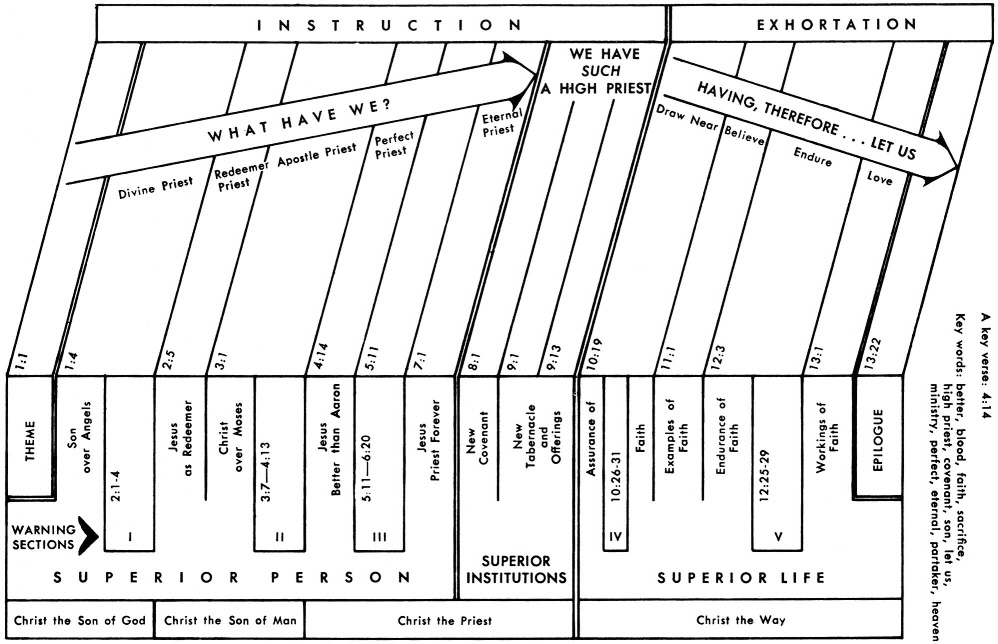
CONSIDER JESUS OUR GREAT HIGH PRIEST
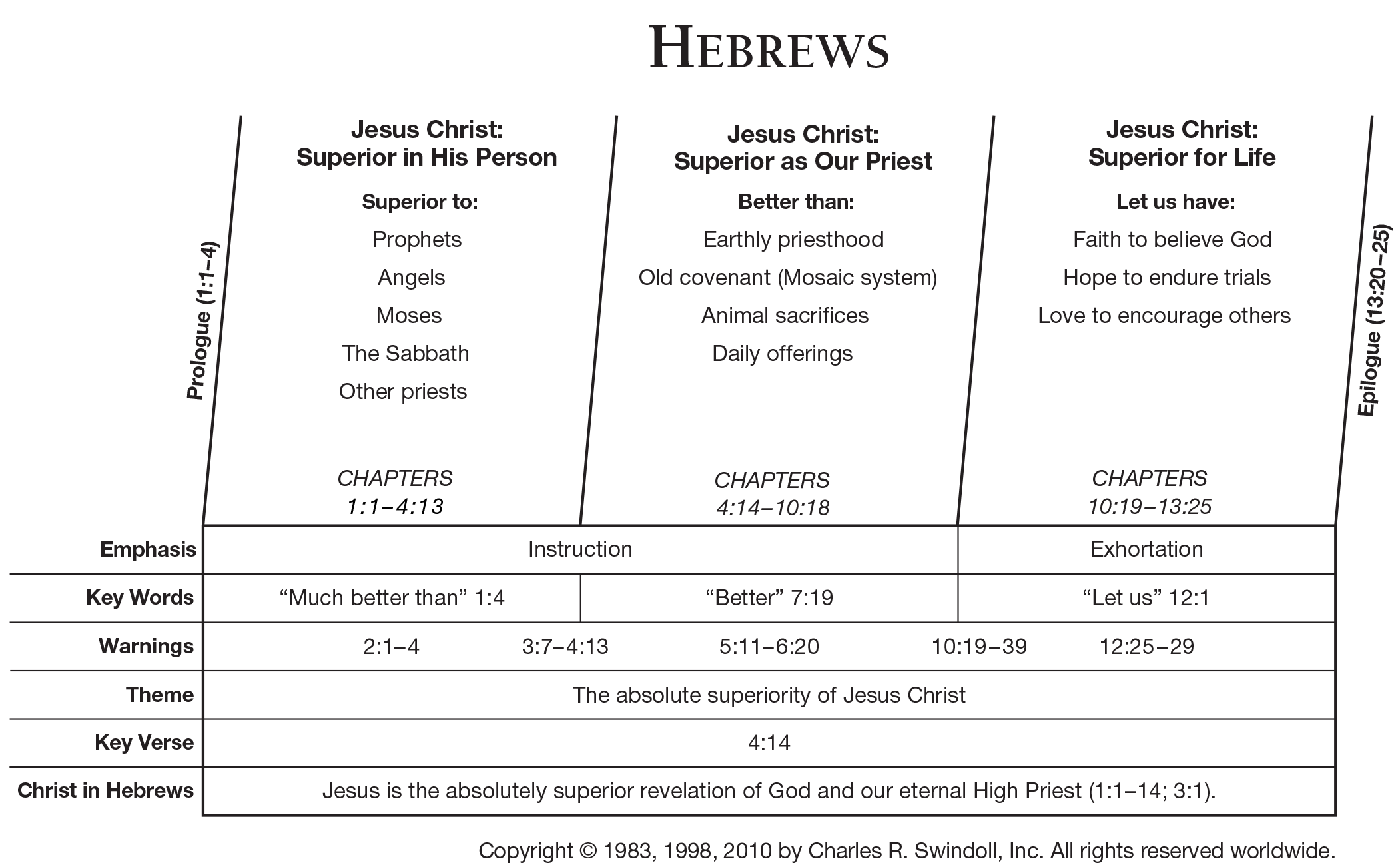
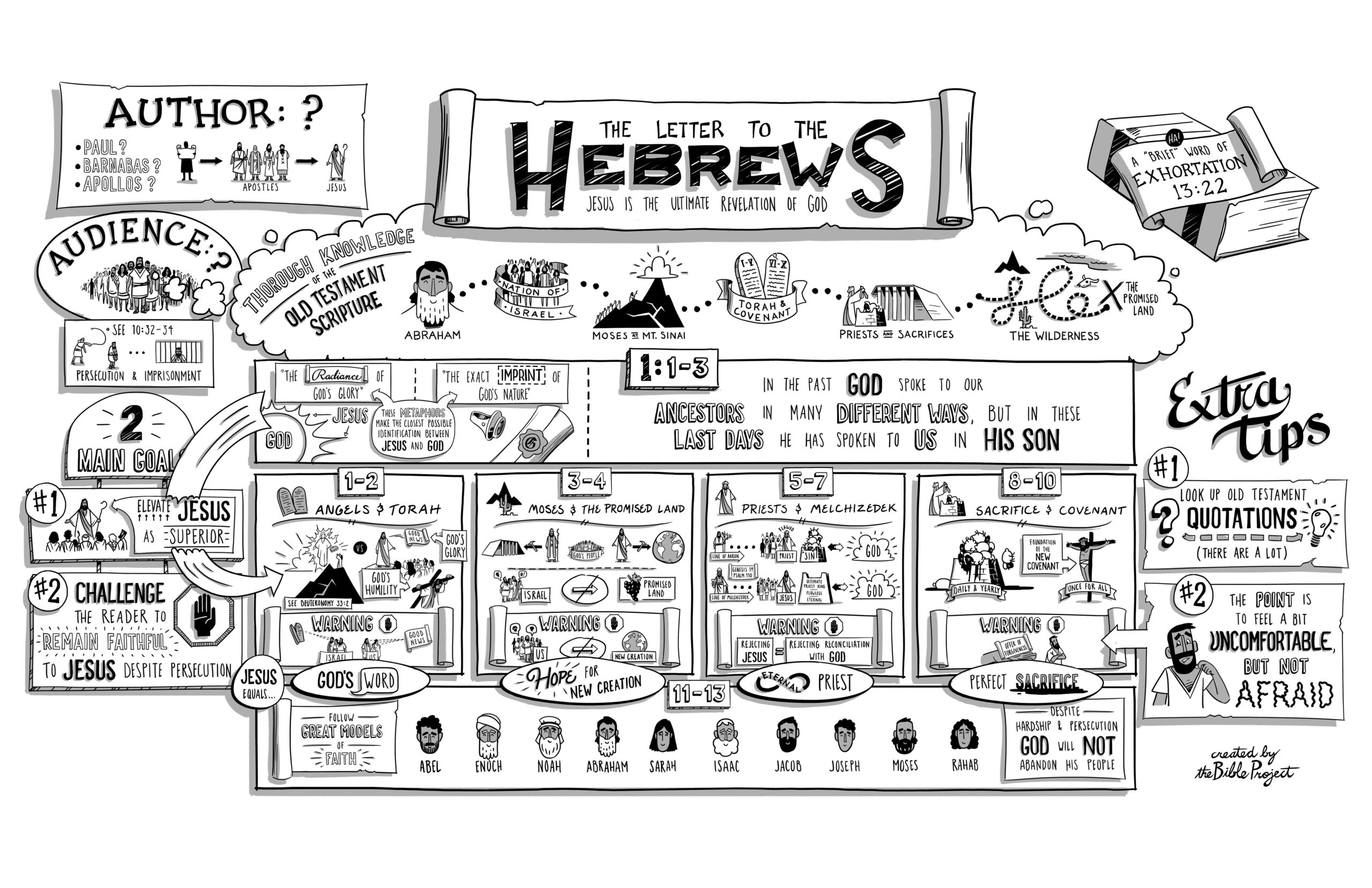
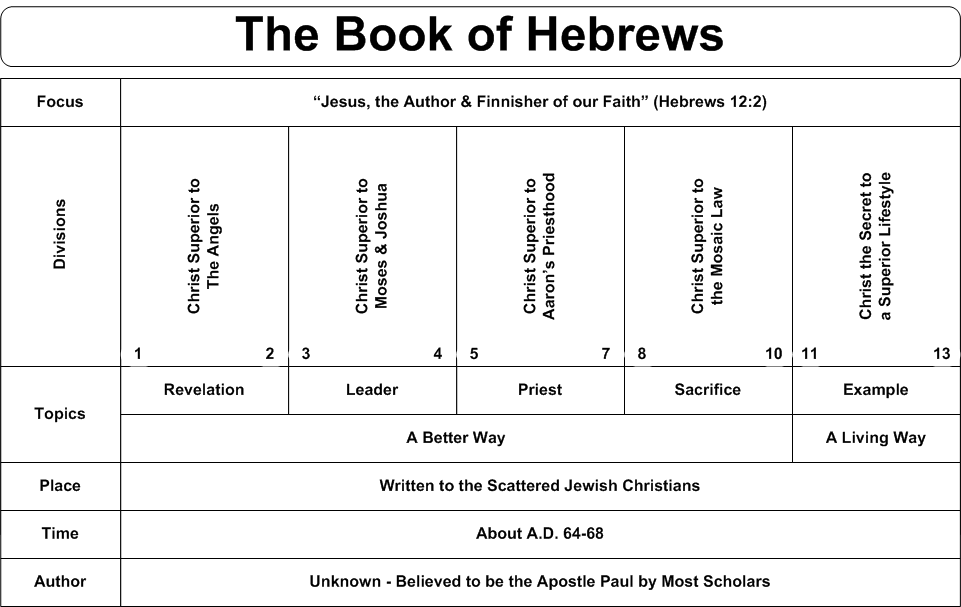
Click chart to enlarge
Charts from Jensen's Survey of the NT - used by permission
Swindoll's Chart, Interesting Pictorial Chart of Hebrews, Another Chart
|
The Epistle |
||||
| INSTRUCTION Hebrews 1-10:18 |
EXHORTATION Hebrews 10:19-13:25 |
|||
| Superior Person of Christ Hebrews 1:1-4:13 |
Superior Priest in Christ Hebrews 4:14-10:18 |
Superior Life In Christ Hebrews 10:19-13:25 |
||
| BETTER THAN PERSON Hebrews 1:1-4:13 |
BETTER PRIESTHOOD Heb 4:14-7:28 |
BETTER COVENANT Heb 8:1-13 |
BETTER SACRIFICE Heb 9:1-10:18 |
BETTER LIFE |
| MAJESTY OF CHRIST |
MINISTRY OF CHRIST |
MINISTERS FOR CHRIST |
||
|
DOCTRINE |
DUTY |
|||
|
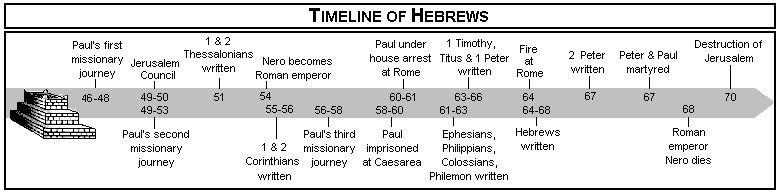
DATE WRITTEN: |
||||

See ESV Study Bible "Introduction to Hebrews"
(See also MacArthur's Introduction to Hebrews)
Borrow Ryrie Study Bible
Hebrews 10:15 And the Holy Spirit also testifies to us; for after saying, (NASB: Lockman)
Greek: Marturei (3SPAI) de emin kai to pneuma to agion; meta gar to eirekenai, (RAN)
BGT Μαρτυρεῖ δὲ ἡμῖν καὶ τὸ πνεῦμα τὸ ἅγιον· μετὰ γὰρ τὸ εἰρηκέναι·
Amplified: And also the Holy Spirit adds His testimony to us [in confirmation of this]. For having said, (Amplified Bible - Lockman)
Barclay: And to this the Holy Spirit is our witness, for after he has said: (Westminster Press)
NLT: And the Holy Spirit also testifies that this is so. First he says, (NLT - Tyndale House)
KJV Whereof the Holy Ghost also is a witness to us: for after that he had said before,
NKJ But the Holy Spirit also witnesses to us; for after He had said before,
NET And the Holy Spirit also witnesses to us, for after saying,
CSB The Holy Spirit also testifies to us about this. For after He says:
ESV And the Holy Spirit also bears witness to us; for after saying,
NIV The Holy Spirit also testifies to us about this. First he says:
Phillips: The Holy Spirit himself endorses this truth for us, when he says, first: (Phillips: Touchstone)
Wuest: Moreover, there testifies also to us the Holy Spirit. For after having said,
Young's Literal: and testify to us also doth the Holy Spirit, for after that He hath said before,
- Heb 2:3,4; 3:7; 9:8; 2 Sa 23:2; Neh 9:30; Jn 15:26; Acts 28:25; 1Pe 1:11,12; 2Pe 1:21; Rev 2:7,11,17,29; 3:6,13,22; 19:10
- Hebrews 10 Resources - Multiple Sermons and Commentaries
- Click for 5W/H Study Questions — ideal for leading a group or personal study of Hebrews
Related Passages:
Romans 15:4+ For whatever was written in earlier times (OLD TESTAMENT LIKE JEREMIAH 31) was written for our instruction, so that through perseverance and the encouragement of the Scriptures we might have hope.
THE HOLY SPIRIT
TESTIFIES
Having presented the finished work of Christ as the ground of our sanctification and perfection, the writer now brings in the Divine Witness to confirm it. It is not merely the author’s reasoning nor human theology—it is the Holy Spirit Himself who affirms the truth of Christ’s completed sacrifice. The Spirit, who inspired the Scriptures, now quotes from Jeremiah’s prophecy of the New Covenant (Jer. 31:33–34) as irrefutable evidence that forgiveness is final and complete. Thus, the testimony of the Spirit seals the argument: Christ’s one offering has perfectly accomplished what the Law could never do. The same Spirit who indwells believers bears continual witness that their sins have been forgiven and that God’s law is now written upon their hearts. The writer shifts from doctrinal explanation to divine authentication—God Himself is the confirming voice. Praise the Lord!
And the Holy Spirit also testifies (martureo) to us; for after saying - Note that to us personalizes the message (and to YOU!) This is not merely historical testimony to these first century Jews, but is the Spirit's ongoing witness to every believer under the New Covenant. In effect what the writer is saying now is “You don’t have to take my word for it—the Holy Spirit Himself confirms that this salvation is complete.” The Spirit is saying to believers there is a brand new arrangement regarding the Law (He will put the Law in our heart and mind) (Heb 10:16) and then He describes that our sins are forgiven and remembered no more (Heb 10:17) all possible because of the once for all sacrifice of our Great High Priest, Christ Jesus. The Holy Spirit is the One Who spoke in Jeremiah 31:31-34+ and He still speaks these words to us that we might not doubt for a moment their truth, for as Jesus said we shall know the truth and the truth will set us free. (Jn 8:32+) We are free in Christ.
And what more veritable witness can we have? That to
which the Holy Ghost bears testimony must never be questioned by us.
-- C H Spurgeon
This verse shows that the Holy Spirit is our Teacher, the One Jesus promised declaring that "When the Helper comes, Whom I will send to you from the Father, that is the Spirit of truth, who proceeds from the Father, He will bear witness (martureo) of Me." (Jn 15:26+) The Spirit reveals God the Father and God the Son by inspiring the writing of Scripture. The Spirit has revealed in the past "The Holy Spirit is signifying this, that the way into the holy place has not yet been disclosed while the outer tabernacle is still standing." (He 9:8+) He reveals in the present as in this verse (bears witness = present tense = ongoing activity - martureo is also the first word in Heb 10:15 for emphasis!) It was the Spirit Who first led people to write the Scriptures Peter recording that "no prophecy was ever made by an act of human will, but men (cf Neh 9:30) moved by the Holy Spirit spoke from God." (2Pe 1:21+) The Holy Spirit continues to guide God's people to understand them, as Hebrews shows (cf 1 Jn 2:20+, 1 Jn 2:27+, 1 Cor 2:13-16+). The Spirit is the Inspirer and Teacher of Scriptures and the One Who enables us to understand and to live (Php 2:13+) according to the Scriptures.
The verb tense of testifies here is interesting as well. The Holy Spirit bears witness in the present, through the prophet Jeremiah, who He inspired in the past. This tells us that not only did the Holy Spirit inspire Jeremiah but currently speaks through him to us. The Scriptures, though they were written long ago, speak to us today. Hallelujah!
W H Griffith Thomas adds that “We have the threefold revelation of God in this passage, a very definite spiritual and practical exemplification of the Holy Trinity, in the will of God (Hebrews 10:9), the work of Christ (Hebrews 10:12), and the witness of the Spirit (Hebrews 10:15). The old covenant meant bondage: the new, liberty; the old spoke of fear, the new of assurance; the old emphasized distance, the new, nearness; the old spoke of separation, the new speaks of fellowship. (BORROW Hebrews; a devotional commentary PAGE 128)
🙏 THOUGHT - God does not leave us to reason alone—He gives us the inward testimony of the Spirit and the outward testimony of the Word. The Spirit whispers to the redeemed heart what Christ shouts from Calvary “It is finished!”
The Spirit speaks where Christ has bled;
The Word confirms what Jesus said.
The covenant sealed in crimson flow—
Your sins are gone; He made it so.
After saying (lego) is in the perfect tense which speaks of the permanence and lasting effect of what the Spirit has spoken through the prophets. It was spoken in time and it will stand for eternity. You can stake your life on this "perfect tense!" His promise of the New Covenant will endure eternally. Hallelujah!
Testifies (3140) (martureo from martus/martys = witness, one who has information or knowledge of something & hence can bring to light or confirm something; English ~ martyr) ) means to be a witness, to testify, to give evidence, to give testimony, to affirm that one has seen or heard or experienced something. To be well reported. It means to provide information about a person or an event concerning which the speaker has direct knowledge. Martureo in some context is used in the sense of making an important and solemn declaration. It can be used in the sense of confirmation or approval and so to affirm n a supportive manner.
Martureo - 76x in 72v - add… testimony(1), attested(1), bear… witness(1), bear witness(1), continued to testify(1), gained approval(2), given(1), gives(1), good reputation(1), having a reputation(1), obtained the testimony(1), obtained the witness(1), received a good testimony(1), speaking well(1), testified(17), testifies(7), testify(25), testifying(5), testimony(5), well spoken(3), witness(1), witnessed(2), witnesses(1). Matt 23:31; Luke 4:22; John 1:7f, 15, 32, 34; 2:25; 3:11, 26, 28, 32; 4:39, 44; 5:31ff, 36f, 39; 7:7; 8:13f, 18; 10:25; 12:17; 13:21; 15:26f; 18:23, 37; 19:35; 21:24; Acts 6:3; 10:22, 43; 13:22; 14:3; 15:8; 16:2; 22:5, 12; 23:11; 26:5; Rom 3:21; 10:2; 1 Cor 15:15; 2 Cor 8:3; Gal 4:15; Col 4:13; 1 Tim 5:10; 6:13; Heb 7:8, 17; 10:15; 11:2, 4, 5, 39; 1 John 1:2; 4:14; 5:6f, 9f; 3 John 1:3, 6, 12; Rev 1:2; 22:16, 18, 20.
Martureo is another key word in Hebrews, with 7/81 (almost 10% of the NT uses)
Hebrews 7:8+ - In this case mortal men receive tithes, but in that case one receives them, of whom it is witnessed that he lives on.
Hebrews 7:17+ - For it is attested of Him, "YOU AREA PRIEST FOREVER ACCORDING TO THE ORDER OF MELCHIZEDEK ."
Hebrews 10:15+ - And the Holy Spirit also testifies to us; for after saying,
Hebrews 11:2+ - For by it the men of old gained approval.
Hebrews 11:4+ - By faith Abel offered to God a better sacrifice than Cain, through which he obtained the testimony that he was righteous, God testifying about his gifts, and through faith, though he is dead, he still speaks.
Hebrews 11:5+ - By faith Enoch was taken up so that he would not see death; AND HE WAS NOT FOUND BECAUSE GOD TOOK HIM UP; for he obtained the witness that before his being taken up he was pleasing to God.
Hebrews 11:39+ - And all these, having gained approval through their faith, did not receive what was promised
Cross References on Holy Spirit spoke…
2Sa 23:2 (The last words of David - 2Sa 23:1) "The Spirit of the LORD spoke by me, And His word was on my tongue.
Neh 9:30 "However, Thou didst bear with them for many years, And admonished them by Thy Spirit through Thy prophets, Yet they would not give ear. Therefore Thou didst give them into the hand of the peoples of the lands.
John 15:26 "When the Helper comes, whom I will send to you from the Father, that is the Spirit of truth, who proceeds from the Father, He will bear witness (martureo) of Me,
Act 28:25 And when they did not agree with one another, they began leaving after Paul had spoken one parting word, "The Holy Spirit rightly spoke through Isaiah the prophet to your fathers,
Heb 2:3 how shall we escape if we neglect so great a salvation? After it was at the first spoken through the Lord, it was confirmed to us by those who heard, 4 God also bearing witness (sunepimartureo - present tense) with them, both by signs and wonders and by various miracles and by gifts of the Holy Spirit according to His own will.
Heb 3:7 Therefore, just as the Holy Spirit says, (lego - present tense) "Today if you hear His voice,
Heb 9:8 The Holy Spirit is signifying (deloo - present tense) this, that the way into the holy place has not yet been disclosed, while the outer tabernacle is still standing,
1 Peter 1:10-12+ As to this salvation, the prophets who prophesied of the grace that would come to you made careful search and inquiry, 11 seeking to know what person or time the Spirit of Christ within them (reflects the fact that in the OT, the Spirit took up temporary residence in some men in order to accomplish a specific purpose for God - He has the same "job" today in believers, except of course He dwells in us forever and ever, Amen!) was indicating as He predicted the sufferings of Christ and the glories to follow. 12 It was revealed to them that they were not serving themselves, but you, in these things which now have been announced to you through those who preached the gospel to you by the Holy Spirit (referring of course to the Spirit's activity in the NT saints) sent from heaven—things into which angels long to look.
2Pe 1:21 for no prophecy was ever made by an act of human will, but men moved by the Holy Spirit spoke from God.
Rev 2:7 He who has an ear, let him hear what the Spirit says to the churches. To him who overcomes, I will grant to eat of the tree of life, which is in the Paradise of God.
Rev 2:11 He who has an ear, let him hear what the Spirit says to the churches. He who overcomes shall not be hurt by the second death.
Rev 2:17 He who has an ear, let him hear what the Spirit says to the churches. To him who overcomes, to him I will give some of the hidden manna, and I will give him a white stone, and a new name written on the stone which no one knows but he who receives it.
Rev 2:29 He who has an ear, let him hear what the Spirit says to the churches.
Rev 3:6 He who has an ear, let him hear what the Spirit says to the churches.
Rev 3:13 He who has an ear, let him hear what the Spirit says to the churches.
Rev 3:22 He who has an ear, let him hear what the Spirit says to the churches. "
Rev 19:10 And I fell at his feet to worship him. And he said to me, "Do not do that; I am a fellow servant of yours and your brethren who hold the testimony of Jesus; worship God. For the testimony of Jesus is the spirit of prophecy."
W H Griffith Thomas succinctly sums up the role of the Holy Spirit in Hebrews 10:15-18
THE PERFECT FULFILMENT OF ALL CONDITIONS (Hebrews 10:15–18)
Now come the last words, clinching the argument.
(1) The Witness of the Holy Spirit.—Here, again, with great significance, the Holy Spirit is mentioned. Not only is He the author and source of the divine message in Ps. 3:7, and of the true meaning of the tabernacle (9:8), but He is shown to be witnessing through the statements of Scripture to the reality and power of the new covenant. This is the true witness of the Spirit, not something dependent upon our own variable emotions, but that which is objective to us, and fixed, the Word of God.
(2) The Work of the Spirit (vv. 16, 17).—The passage of Scripture already used in connection with the covenant (8:10–12) is here summarized, and associated with the Holy Spirit. The law is put into the heart, and into the mind; and then the love of God is shed abroad in the soul by making real His blessed forgiveness (Rom. 5:5).
(3) The great conclusion naturally follows (v. 18). God’s Will, written on the heart by the Holy Spirit, is the proof of the sufficiency of Christ’s sacrifice, and there is no need of repetition or supersession. “By promising to forget, He has forgiven, and therefore no more sacrifice in plea of forgiveness is necessary” (Wickham).
Hebrews 10:16 "THIS IS THE COVENANT THAT I WILL MAKE WITH AFTER THOSE DAYS, SAYS THE LORD: I WILL PUT MY LAWS UPON THEIR HEART, AND ON THEIR MIND I WILL WRITE THEM," He then says, (NASB: Lockman)
Greek: Aute e diatheke en diathesomai (1SFMI) pros autous meta tas hemeras ekeinas, legei (3SPAI) kurios, didous (PAPMSN) nomous mou epi kardias auton, kai epi ten dianoian auton epigrapso (1SFAI) autous
BGT αὕτη ἡ διαθήκη ἣν διαθήσομαι πρὸς αὐτοὺς μετὰ τὰς ἡμέρας ἐκείνας, λέγει κύριος· διδοὺς νόμους μου ἐπὶ καρδίας αὐτῶν καὶ ἐπὶ τὴν διάνοιαν αὐτῶν ἐπιγράψω αὐτούς,
Amplified: This is the agreement (testament, covenant) that I will set up and conclude with them after those days, says the Lord: I will imprint My laws upon their hearts, and I will inscribe them on their minds (on their inmost thoughts and understanding), (Amplified Bible - Lockman)
Barclay: “This is the covenant I will make with them after these days, says the Lord. I will put my laws upon their hearts; and I will write them upon their minds,” (Westminster Press)
NLT: "This is the new covenant I will make with my people on that day, says the Lord: I will put my laws in their hearts so they will understand them, and I will write them on their minds so they will obey them." (NLT - Tyndale House)
KJV This is the covenant that I will make with them after those days, saith the Lord, I will put my laws into their hearts, and in their minds will I write them;
NKJ "This is the covenant that I will make with them after those days, says the LORD: I will put My laws into their hearts, and in their minds I will write them,"
NET "This is the covenant that I will establish with them after those days, says the Lord. I will put my laws on their hearts and I will inscribe them on their minds,"
CSB This is the covenant I will make with them after those days, says the Lord: I will put My laws on their hearts and write them on their minds,
ESV "This is the covenant that I will make with them after those days, declares the Lord: I will put my laws on their hearts, and write them on their minds,"
NIV "This is the covenant I will make with them after that time, says the Lord. I will put my laws in their hearts, and I will write them on their minds."
Phillips: 'This is the covenant that I will make with them after those days, says the Lord: I will put my laws into their hearts, and in their minds I will write them'. (Phillips: Touchstone)
Wuest: This is the testament which I will make with them after those days, the Lord says, I am putting my laws upon their hearts, and upon their minds I will write them.
Young's Literal: 'This is the covenant that I will make with them after those days, saith the Lord, giving My laws on their hearts, and upon their minds I will write them,'
- Heb 8:8, 9, 10, 11, 12; Jer 31:33,34; Ro 11:27
- Hebrews 10 Resources - Multiple Sermons and Commentaries
- Click for 5W/H Study Questions — ideal for leading a group or personal study of Hebrews
Related Passages:
Hebrews 8:8-12+ For finding fault with them, He says, "Behold, days are coming, says the Lord, When I will effect a new covenant With the house of Israel and with the house of Judah;
Jeremiah 31:33+ "But this is the covenant which I will make with the house of Israel after those days," declares the LORD, "I will put My law within them, and on their heart I will write it; and I will be their God, and they shall be My people. 34 "And they shall not teach again, each man his neighbor and each man his brother, saying, Know the LORD, for they shall all know Me, from the least of them to the greatest of them," declares the LORD, "for I will forgive their iniquity, and their sin I will remember no more."
Romans 11:26-27+ and so all Israel will be saved; just as it is written, “THE DELIVERER (MESSIAH) WILL COME FROM ZION, HE WILL REMOVE UNGODLINESS FROM JACOB.” 27 "And this is My covenant with them (REFERRING TO THE COVENANT PROPHESIED IN JEREMIAH), When I take away their sins."
GOD'S PROMISE TO CUT
A NEW COVENANT WITH ISRAEL
Having announced that the Holy Spirit testifies, the writer now quotes the very words through which the Spirit had spoken centuries earlier to Jeremiah. These verses form the heart of the New Covenant—the divine promise that Christ’s once-for-all sacrifice would not only remove sin but also transform the inner life of the believer. The writer shows that both of these covenant blessings—inward renewal and complete forgiveness—are the direct result of Christ’s offering described in Heb 10:10–14.
THIS IS THE COVENANT (diatheke) THAT I WILL MAKE (diatithemi) WITH THEM AFTER THOSE DAYS SAYS THE LORD (kurios) - Remember that these are the words the Holy Spirit is speaking (Heb 10:15). And they refer of course to the New Covenant promised in the Old Testament in Jeremiah and other passages. Them of course refers to the Jews (cp the intended audience of the announcement of the New Covenant in Jer 31:31-33+) yet this covenant is now available to anyone who believes that Christ's blood is satisfactory and sufficient to save them from the penalty of their sins -- eternal destruction and separation.
The writer again quotes Jeremiah (quoting from the Greek, the Septuagint -Lxx, not quite but almost verbatim)…
Jeremiah 31:33+ “But this is the covenant which I will make with the house of Israel (He 10:16 = "with them") after those days,” declares the Lord, “I will put My law within them and on their heart I will write it; and I will be their God, and they shall be My people.
This is the same promise Paul records in Romans 9-11 which deals with the "Jewish Question" (What will God do with the Jews?) writing…
"All Israel (see Zech 13:8-9+) will be saved; just as it is written, “THE DELIVERER WILL COME FROM ZION (see Zech 12:10-14+, Zech 13:1+, Zech 13:8-9+), HE WILL REMOVE UNGODLINESS FROM JACOB.” “This is My covenant (referring to the New Covenant) with them (the Jews - Je 31:31+), when I take away their sins.” (Romans 11:26-27+)
Wuest - The writer now quotes the prophet Jeremiah again as to the finality of the New Testament. He places the Jewish recipients of this letter in the position where they will either accept their prophet and thus the New Testament, or in rejecting the New Testament, they will be rejecting their own prophet. He declares the inspiration of the Old Testament, for he says that the Holy Spirit spoke the words. Jeremiah was only His penman. (Hebrews Commentary)
The writer again quotes Jeremiah (quoting from the Greek, the Septuagint -Lxx, not quite but almost verbatim)…
Jeremiah 31:33+ “But this is the covenant which I will make with the house of Israel (He 10:16 = "with them") after those days,” declares the Lord, “I will put My law within them and on their heart I will write it; and I will be their God, and they shall be My people.
This is the same promise Paul records in Romans 9-11 which deals with the "Jewish Question" (What will God do with the Jews?) writing…
"All Israel (see Zech 13:8-9+) will be saved; just as it is written, “THE DELIVERER WILL COME FROM ZION (see Zech 12:10-14+, Zech 13:1+, Zech 13:8-9+), HE WILL REMOVE UNGODLINESS FROM JACOB.” “This is My covenant (referring to the New Covenant) with them (the Jews - Je 31:31+), when I take away their sins.” (Romans 11:26-27+)
The ultimate fulfillment of some of God's promises to Israel in Jer 31:38-40+ await complete fulfillment in the millennial age
Behold, days are coming,” declares the LORD, “when the city will be rebuilt for the LORD from the Tower of Hananel to the Corner Gate. 39 “The measuring line will go out farther straight ahead to the hill Gareb; then it will turn to Goah. 40“And the whole valley of the dead bodies and of the ashes, and all the fields as far as the brook Kidron, to the corner of the Horse Gate toward the east, shall be holy to the LORD; it will not be plucked up or overthrown anymore forever.”
F F Bruce - "In Ch 8 the oracle of Jeremiah 31:31-34 was quoted in order to prove the obsolescence of the old economy; now it is quoted again in order to establish the permanence of the era of "perfection" inaugurated under the new covenant. "God has spoken in His Son"; and He has no word to speak beyond Him." (See The Epistle to the Hebrews - Page 454)
Ms. Marsh once said, “There was quoted to my father, the Reverend W. Marsh, a saying of old Fuller’s. ‘He that falls into sin is a man. He that grieves at sin is a saint. He that boasts of sin is a devil.’ My father replied, ‘There is only one thing more, he that forgives sin is God.’”
Covenant (1242) (diatheke from dia = two + tithemi = to place pictures that which is placed between two) and thus a covenant is something placed between two, an arrangement between two parties. This term was a commonly used in the Greco-Roman world to define a legal transaction in settling an inheritance. Diatheke denotes an irrevocable decision which cannot be cancelled by anyone. A prerequisite of its effectiveness is the death of the disposer and thus diatheke was like a "final will and testament". In reference to the divine covenants, such as the Abrahamic covenant, diatheke is not a covenant in the sense that God came to agreement or compromise with fallen man as if signing a contract. Rather, it involves declaration of God’s unconditional promise to make Abraham and his seed the recipients of certain blessings. The New Covenant of course is made effective by the blood of Jesus Christ shed on the Cross for on the night before he was crucified Luke records "And in the same way He took the cup after they had eaten, saying, "This cup which is poured out for you is the new covenant in My blood. (Lk 22:20+)
Related Resource:
Make (grant) (1303)(diatithemi from dia = through or as an intensive, root meaning = "two" + tithemi = to place or put) properly means, to place apart, to set in order, to arrange. If one considers the root meaning of dia ("two"), then the definition could be rendered "to place between two" as a covenant which is something that is placed between two, an arrangement between two parties. This verb is used in the NT only in the middle voice.
Diatithemi - Lk. 22:29; Acts 3:25; Heb. 8:10; Heb. 9:16; Heb. 9:17; Heb. 10:16
Hebrews 8:10 “FOR THIS IS THE COVENANT THAT I WILL MAKE WITH THE HOUSE OF ISRAEL AFTER THOSE DAYS, SAYS THE LORD: I WILL PUT MY LAWS INTO THEIR MINDS, AND I WILL WRITE THEM ON THEIR HEARTS. AND I WILL BE THEIR GOD, AND THEY SHALL BE MY PEOPLE.
Hebrews 9:16 For where a covenant is, there must of necessity be the death of the one who made it.
Hebrews 9:17 For a covenant is valid only when men are dead, for it is never in force while the one who made it lives.
Hebrews 10:16 “THIS IS THE COVENANT THAT I WILL MAKE WITH THEM AFTER THOSE DAYS, SAYS THE LORD: I WILL PUT MY LAWS UPON THEIR HEART, AND ON THEIR MIND I WILL WRITE THEM,” He then says,
I WILL PUT MY LAWS UPON THEIR HEART AND UPON THEIR MIND I WILL WRITE THEM: didous (PAPMSN) nomous mou epi kardias auton kai epi ten dianoian auton epigrapso (1SFAI) autous:
- Hebrews 10 Resources - Multiple Sermons and Commentaries
EXTERNAL LAW ON STONE
INTERNAL LAW ON HEARTS
I WILL PUT MY LAWS UPON THEIR HEART, AND ON THEIR MIND I WILL WRITE THEM - External laws now are made internal. This is a bit mysterious to me, but God says it, so I believe it! We have the Law in our heart and the Spirit of Jesus in our heart to enable us to obey. The Spirit gives us the desire (the "want to" - my fallen flesh still does not "want to") and the power (Php 2:13NLT+). With God's sufficient supply of His Word and His Spirit, we are now equipped to obey the command to "Work out (present imperative = command to make this our lifestyle, our habitual practice - only possible as we jettison self-reliance and lean wholly on the Holy Spirit Who enables us to obey) our salvation in fear and trembling." (Php 2:12+), which is simply a call to progressive sanctification or progressive growth in Christ-likeness, a progressive growth in holiness. But notice that even here, while we are clearly responsible to "work out," we can only do so by depending on the supernatural power of the Holy Spirit, to work out what He has worked in! Does that make sense? It is not "Let go, let God," but "Let God and let's go!" His part, our part! God's sovereign provision and our solemn responsibility! The result is supernatural synergism (so to speak).
🙏 THOUGHT - Every truly redeemed person experiences this inward change—a new heart that delights to do God’s will (not speaking of perfection but of general direction!) The rule of law that once condemned us now becomes the rule of love that motivates us. Amazing grace indeed.
Kenneth Wuest - A distinctive feature of the new (covenant) was to be the sanctifying work of the Holy Spirit Who would be caused to take up His permanent abode in the believer under the New Testament dispensation (1 Cor 6:19-20). Heretofore, He had come upon or in individuals in order to equip them for a certain ministry, and then would leave them when the time of that ministry was over. He did not personally indwell them for purposes of sanctification. The Old Testament saint was regenerated, thus becoming a partaker of the divine nature, and thus had that impetus to the living of a holy life. The New Testament saint has both the advantages of regeneration and the personal indwelling and the sanctifying work of the Holy Spirit. Thus, under the First Testament God wrote His laws on stone, whereas under the New Testament He writes them upon the heart. (Hebrews Commentary)
Charles Swindoll - This new arrangement now made possible through Christ brings all the resources we need and places them within us. As the apostle Peter put it: “His divine power has granted to us everything pertaining to life and godliness” (2 Pet. 1:3). The sin issue that had destroyed our relationship with God and hindered righteousness and spiritual growth has been dealt with. And more than that, we have a new ability to follow in Christ’s footsteps—to offer our bodies as “a living and holy sacrifice, acceptable to God” (Rom. 12:1). The Hebrew believers who had been slipping backward into their old fascination with the Law and its sacrifices needed to be reminded of its limitations. They had to hear in no uncertain terms that it was impossible for the blood of animal sacrifices to take away sins (Heb. 10:4). In essence, they needed to hear the good news that the perfect sacrifice of Christ was one for all, once for all, and free for all. (See Insights on Hebrews)
C H Spurgeon - What the law could not do with its iron fetters, the Gospel has done with its silken bonds. If God had thundered at you, you would have grown proud like Pharaoh when he said, “Who is Yahweh that I should listen to his voice?” (Ex 5:2) But when the Lord Jesus spoke softly to you, you bowed before Him, and said, “He is my Lord and my God” (John 20:28). The blustering wind of the law made you bind about yourself the cloak of your sins, but the genial warmth of the sun of the Gospel constrained you to cast away the garments of your sin (Ed: The exact meaning of the rare verb periaireo "take away" in Heb 10:11+), and fly to the Savior. Oh, what a blessed covenant this is! Christ’s death has established a covenant of grace in which there is no flaw, and no possibility of failure, for the one condition of the covenant has been fulfilled by Christ and now it stands as a covenant of “shalls” and “wills” on God’s part from which He will never run back. It is not, “If they do this, and if they do that, I will do the other,” but it is all “I will.”
Upon (epi) means to place upon. It is interesting that the Greek of the Hebrew (Septuagint - LXX) of this passage from Jer 31:33 has the preposition eis, which means "into" and has the primary meaning of motion or direction toward (their hearts), while epi has the idea of "upon their hearts."
God supernaturally deals with the deadly otherwise undefeatable power of Sin (notes on Sin in Romans 6) by writing His perfect law on our hearts so that by virtue of our new nature (2Co 5:17+) we now supernaturally hate sin (something we "naturally" love!) from the inside out (so to speak) and love God's will and walk in His ways (we are not puppets, but still must daily, moment by moment make the conscious choice for God's will - cp Php 2:12+), not by external laws constraint (but by His holy law and His Holy Spirit - see Php 2:13+, see Ezekiel 36 below). That's the new covenant = a New Heart
Ezekiel records God's promises concerning the New Covenant and this great passage also includes God's immutable promise of the "power Source" to enable us to obey His Law...
Moreover, I will give you a new heart and put a new spirit within you; and I will remove the heart of stone from your flesh and give you a heart of flesh. And I will put My Spirit within you and cause you to walk in My statutes (God's provision - cf Php 2:13+), and you will be careful to observe My ordinances (Believer's responsibility - cf Php 2:12+). (Ezekiel 36:26-27+)
And I shall give them one heart, and shall put a new spirit within them. And I shall take the heart of stone out of their flesh and give them a heart of flesh, that (term of purpose) they may walk in My statutes and keep My ordinances, and do them (Ed: empowered by the indwelling Spirit). Then they will be My people, and I shall be their God. (Ezekiel 11:19-20+)
Thomas Vincent writes… Labor for a thorough understanding of the covenant, both the covenant which God made with Christ on behalf of man—and the covenant which God has made with man through Christ. Acquaint yourselves with the covenant God made with Christ on behalf of man. Whatever worth and value there was in the righteousness of Christ, yet God might have required a personal righteousness and satisfaction, and Christ's righteousness might have stood us in no stead. But God eternally covenanted and agreed with Christ that if He would take human nature, and work out a righteousness for fallen man, it would be accepted; that if He would take to Himself the body of a man that God would prepare for Him, and make His soul an offering for sin, that is, suffer what His justice required for the sins of man—He would see His seed and justify many (Isaiah 53:10, 11). It is through this covenant with Christ that Christ's righteousness is accepted on behalf of sinners, God having agreed before that it should so be. Acquaint yourselves with the covenant which God has made with man through Christ, where upon the account of Christ God has promised remission of sins and eternal life. (The Only Deliverer from the Wrath to Come)
Related Resources: Study of Covenant in the Scripture
- Lesson 1 Covenant: Summary Table
- Lesson 2 Covenant: The Exchange of Robes
- Lesson 3 Covenant: The Exchange of Armor and Belts
- Lesson 4 Covenant: Solemn and Binding
- Lesson 5 Covenant: A Walk Into Death
- Lesson 6 Covenant: The Oneness of Covenant
- Covenant: Oneness Notes
- Lesson 7 Covenant: Withholding Nothing from God
- Lesson 8 Covenant: Abrahamic versus Mosaic
- Lesson 9 Covenant: New Covenant in the Old Testament
- Lesson 10 Covenant: Why the New is Better
- Lesson 11 Covenant: Abrahamic vs Old vs New
Devotional The Mercy Seat
“This is the covenant I will make with them after that time, says the Lord. I will put my laws in their hearts, and I will write them on their minds.” [Heb. 10:16, see Jer. 31:33]
In 1 Chronicles 28:2, David says concerning the temple: “I had it in my heart to build a house as a place of rest for the ark of the covenant of the LORD, for the footstool of our God, and I made plans to build it.” The ark is the footstool. We need to bear that in mind as we consider Hebrews 10:15–17.
Inside the ark was the tablets of the law of Moses. Above the ark was the mercy seat, on which the blood of the sacrifice was sprinkled on the Day of Atonement. We who were Christ’s enemies have been made his footstool. We have become the human form of the ark of the covenant.
The author of Hebrews combines this symbolism with a statement from Jeremiah 31:33–34. These verses say that God will write his laws on our hearts. This fulfills the symbolism of the ark. Just as the law was inside the ark, so it is now inside of us. Just as the ark journeyed through the wilderness, with God enthroned above it, so now we journey toward our sabbath, with Christ enthroned above us.
Between the ark and God’s enthroned presence in the pillar of cloud was a slab of gold called the mercy seat. Remember that blood was put on the mercy seat. When God looked down at the ark, representing his people, he saw them symbolized through the blood on the mercy seat, the blood that represented Christ.
Christ now sits enthroned on the mercy seat. When God the Father looks down at us, the new ark, he sees us through Jesus. Jesus is above us. God sees him and remembers his blood. And so the author of Hebrews continues his quotation from Jeremiah: “The sins and lawless acts I will remember no more” (Heb. 10:17).
The animal sacrifices reminded God of sins year by year, because that blood could never remove sin (Heb. 10:3–4). But the blood of Jesus, which we plead, reminds God of Christ’s atoning death. For this reason God does not remember our sins any longer. Instead he remembers Jesus, and through Jesus he remembers that we have fled for refuge under his feet.
Coram Deo -- Imagine this scene that has been painted for us. Above is God, angry at sin. Below is the ark, or rather it is we who now are in the place of the ark. Between God and us is the mercy seat, Jesus. Jesus mediates between God and us, and God is now satisfied and at peace with us. Think through the implications of this picture as we pray “in Jesus’ name.” Does that add meaning to this phrase we often say without meaning at the end of our prayers?
THE NEW COVENANT, WRITTEN IN THE HEART
TEXT: “I will put my laws on their hearts, and write them on their minds” (Heb. 10:16b).
INTRODUCTION: Read Jeremiah 31:31–34. God says in this Scripture, “I will make a new covenant” (Jer. 31:31). The newness of it is, “I will put my law within them, and I will write it upon their hearts” (Jer. 31:34).
In Hebrews 8:10 and 10:16 this “new covenant” is presented; “I will put my laws on their hearts, and write them on their minds.”
I. This new covenant is established with us by a birth from above.
A. “You must be born from above” (John 3:1–16).
B. “… a new creation” (2 Cor. 5:17).
C. It makes us “partakers of the divine nature” (2 Peter 1:4).
D. “His law” is in the “new born,” in the “new creation,” and in the “partaker of the divine nature.”
Illustration: Native pecan tree receives a paper shell pecan graft. Henceforth it bears only paper shell pecans from its paper shell pecan nature.
II. No law of God is pleasing or acceptable to the person who has not been born again.
A. By the new birth, we enter the kingdom of God (see John 3).
B. In that kingdom God’s will is His law.
C. His law is set forth in His commandments. Being born from above we love His law, His kingdom.
III. In Romans 8:1–4 Paul declares that through the redemptive work of Christ, the law is fulfilled in us, who walk in the Spirit.
CONCLUSION: The laws which have been written on the heart correspond to the laws written in the Bible. “This is the love of God, that we keep his commandments” (1 John 5:3).
Hebrews 10:17 "AND THEIR SINS AND THEIR LAWLESS DEEDS I WILL REMEMBER NO * MORE." (NASB: Lockman)
Greek: kai ton amartion auton kai ton anomion auton ou me mnesthesomai (1SFPI) eti.
Amplified: He then goes on to say, And their sins and their lawbreaking I will remember no more. [Jer. 31:33, 34.] (Amplified Bible - Lockman)
Barclay: he goes on to say: “And I will not remember any more their sins and their breaches of the law.” (Westminster Press)
NLT: Then he adds, "I will never again remember their sins and lawless deeds." (NLT - Tyndale House)
KJV And their sins and iniquities will I remember no more.
NKJ then He adds, "Their sins and their lawless deeds I will remember no more."
NET then he says, "Their sins and their lawless deeds I will remember no longer."
BGT καὶ τῶν ἁμαρτιῶν αὐτῶν καὶ τῶν ἀνομιῶν αὐτῶν οὐ μὴ μνησθήσομαι ἔτι.
CSB He adds: I will never again remember their sins and their lawless acts.
ESV then he adds, "I will remember their sins and their lawless deeds no more."
NIV Then he adds: "Their sins and lawless acts I will remember no more."
Phillips: And then, he adds, 'Their sins and their lawless deeds I will remember no more'. (Phillips: Touchstone)
Wuest: And their sins and their lawlessnesses I will positively not remember any more.
Young's Literal: and 'their sins and their lawlessness I will remember no more;'
- Hebrews 10 Resources - Multiple Sermons and Commentaries
- Click for 5W/H Study Questions — ideal for leading a group or personal study of Hebrews
Related Passages:
Jeremiah 31:34 They will not teach again, each man his neighbor and each man his brother, saying, ‘Know the Lord,’ for they will all know Me, from the least of them to the greatest of them,” declares the Lord, “for I will forgive their iniquity, and their sin I will remember no more.”
Psalm 103:12 "As far as the east is from the west, so far has He removed our transgressions from us".
Isaiah 38:17 “Lo, for my own welfare I had great bitterness; It is You who has kept my soul from the pit of nothingness, For You have cast all my sins behind Your back.
Isaiah 43:25 "I, even I, am the one who wipes out your transgressions for My own sake; and I will not remember your sins."
Isaiah 44:22 “I have wiped out your transgressions like a thick cloud And your sins like a heavy mist. Return to Me, for I have redeemed you.”
Micah 7:19 He will again have compassion on us; He will tread our iniquities under foot. Yes, You will cast all their sins Into the depths of the sea.
AN INCREDIBLE
DIVINE PROMISE!
The divine testimony of the Spirit now reaches its climax. Having promised inward renewal through the writing of His law upon the heart (Heb 10:16), God now declares the glorious result—complete and irreversible forgiveness. This is the crowning blessing of the New Covenant: not only transformation within, but total pardon without. Under the Old Covenant, sin was continually brought to remembrance through repeated sacrifices (Heb 10:3). But under the New, God Himself pledges never again to recall our sins for judgment. This is not forgetfulness but forbearing faithfulness representing a deliberate act of divine mercy. The omniscient God chooses never again to hold our sins against us, for they have been fully, forever judged in Christ. Thus, the believer’s conscience finds perfect rest in the promise that God no longer remembers, so we need no longer fear condemnation (Ro 8:1). The blood of Christ has not only cleansed the record but has silenced it forever.
AND THEIR SINS (hamartia - acts falling short of God's holiness) AND THEIR LAWLESS DEEDS (anomia - willful defiance of God's authority) I WILL REMEMBER (mimnesko) NO MORE - By pairing SINS and LAWLESS DEEDS, the Spirit encompasses every form of human guilt, from moral failure to deliberate transgression.The writer's argument is in essence if Christ’s one sacrifice has truly atoned for sins and lawless deeds, then God’s forgiveness must be absolute and final. And so he quotes the Spirit's statement that God will remember sins no more (Hebrews 10:17) and that He will no longer call them back to memory with a view to condemning the sinner (cf. Ro 8:1). Since God is omniscient He remembers everything, but He does not hold the forgiven sinner"s sins against him or her. This verse has been a great help to many sinners who have found it hard to believe that God really has forgiven them (cf. 1Jn 2:2). No more is a great double negative (ou me) which gives the strongest negation to this "negative promise" expressing a decisive, irreversible choice of God’s will! This should be cause for God's people to begin shouting "Hallelujah"! This does not mean that God “forgets” in the human sense (as if He loses knowledge), but that He chooses not to recall our sins for judgment. He no longer brings them to His mind as a basis for condemnation.
Our sins are completely removed from God's remembrance,
because they have been completely borne by His Son.
Our sins are gone from God’s recall,
For Christ has paid the debt of all.
Upon the cross our guilt was done—
Remembered never, borne by the Son.
The Mosaic Law and the sacrifices of the Law brought a remembrance of sin (Heb 10:3) and the offerer’s conscience could not be cleansed (Heb 10:2 where "consciousness" is the Greek word for "conscience"). But Christ’s sacrifice is the basis for the New Covenant and any sinner who comes to Christ by grace through faith will have his sins forgiven and God will remember them no more. Sins are forever washed away by the sacrifice of Christ and the sins of God’s blood-purchased people cannot again come up. Why? They are remembered no more, having been cast into the sea of God’s forgetfulness “forever.”
No record stands of sins once known,
For Jesus bore them all Alone.
The Father sees us, pure and free—
Clothed in the Son’s own purity.
🙏 THOUGHT - Clearly the omniscient God knows everything, but here we see on the basis of His infinite, transcendent grace, mercy and love, He covenants to deal with us by putting our sins behind His back (Is 38:17), casting them into the sea (Mic 7:19), wiping them out (Is 44:22), placing them as far as the East is from the West (Ps 103:12 - Why didn't He say "north" and "south"? Clue: Where is the "east pole"?) And all God's people respond "Glory! Hallelujah! Thank you LORD!"
To summarize the testimony of the Spirit - Hebrews 10:16 describes inner transformation (“I will put My laws on their hearts”), and Heb 10:17 declares complete remission (“I will remember no more”). Together, these two verses summarize the twofold grace of the New Covenant: (1) Renewed hearts (inward holiness) (2) Removed sins (outward forgiveness).
Kenneth Wuest - The other distinctive feature of the New Testament is the fact that God remembers sins and iniquities no more. The constant repetition of the sacrifices demonstrated that the sin question was not settled. The once for all offering of the Messiah shows that sin is paid for and put away. (Hebrews Commentary)
Christ bore our blame, our curse, our loss,
And sealed our pardon on the Cross.
The Father now calls the sinner “clean,”
For grace remembers not the scene.
🙏 THOUGHT - The Christian should strive (enabled by the Holy Spirit) to treat sin as God does (out of sight, out of mind, so to speak) and not continually bring it to mind. This truth also reminds us that the believer is not on probation with God. Our past sin has no bearing on His present dealings with us, for our past sins have been fully forgiven and forever forgotten.
C H Spurgeon - When the prodigal is received and forgiven, he is not put at the end of the table, below the salt, or sent into the kitchen with the servants, as if his faults were forgiven but yet remembered. He is invited to the table, and he feasts there upon the best the house affords. The fatted calf is killed, the ring is on his finger, and there are music and dancing for him—as sweet music and as joyous dancing as for the constantly obedient elder son. Not only so but more, for there is more joy over him than over the son who did not go astray. God in this sense forgets His people’s sins.
Puritan Thomas Brooks wrote that "Caesar was painted with his finger upon his scar, his wart. God puts His fingers upon all His people's scars and warts—upon all their weaknesses and infirmities, that nothing can be seen but what is fair and lovely. "You are so beautiful, My beloved; there is no flaw in you!" Song 4:7. The meaning is, "I will fully forgive their sins; I will never more mention them; I will never more take notice of them; they shall never more hear of them from Me!" Though God has an iron memory to remember the sins of the wicked—yet He has no memory to remember the sins of the godly! "I will be merciful to their unrighteousness, and their sins and their iniquities will I remember no more." (Hebrews 8:12)
Spurgeon - What a wonderful covenant that is—not that He will bless you if you keep the law, but that you shall be enabled to keep it, and that He will lead you to do so by putting His law, not on tables of stone, where your eye can see it, but on the fleshy tablets of your heart, where your soul shall feel its force and power, so that you shall be obedient to it. Meditate on those glorious words: “Their sins and their lawless deeds I will never remember again.” Once in the end of the world God Himself descended from the skies and was veiled in our inferior clay. Here on earth God’s eternal Son lived and dwelt like one of us. In the fullness of time, when the sins of all His people had been laid upon Him, He was seized by the officers of justice and was taken away as having our sins upon His own person. On the tree was He fastened that He might die, the just for the unjust that He might bring us to God. Christ stood in the place of His people, and when God’s wrath fell upon sin it fell upon Him and spent itself upon His person. There is no wrath left in God’s heart now against those for whom the Savior died. Christ has suffered all. (Surgeon's Expositions)
Sins (266)(hamartia) literally conveys the idea of missing the mark as when hunting with a bow and arrow (in Homer some hundred times of a warrior hurling his spear but missing his foe). Later hamartia came to mean missing or falling short of any goal, standard, or purpose. Hamartia in the Bible signifies a departure from God's holy, perfect standard of what is right in word or deed (righteous). It pictures the idea of missing His appointed goal (His will) which results in a deviation from what is pleasing to Him. In short, sin is conceived as a missing the true end and scope of our lives, which is the Triune God Himself. As Martin Luther put it "Sin is essentially a departure from God." Ryrie adds that sin "is not only a negative idea but includes the positive idea of hitting some wrong mark."
B. F. Westcott lists three consequences of sin: debt which requires forgiveness, bondage which requires redemption, alienation which requires reconciliation. Christ's death took care of each of these consequences!
Spurgeon - Sin.” It is a very little word, but it contains an awful abyss of meaning. “Sin” is transgression against God, rebellion against the King of kings, violation of the law of right, commission of all manner of wrong. Sin is in every one of us. We have all committed it; we have all been defiled with it. Christ came to put away sin. You see, the evil is put in one word, as if wrongdoing was made into one lump, all heaped together, and called, not “sins,” but “sin.” Can you catch the idea? All the sinfulness, all the omissions, all the commissions, and all the tendencies to rebel that ever were in the world are all piled together, hill upon hill, mountain upon mountain, and then called by this one name, “sin.” Christ was revealed to put away sin. He did not come into the world to palliate it merely, or to cover it up, but He came to put it away. Observe, He not only came to put away some of the attributes of sin, such as the filth of it, the guilt of it, the penalty of it, the degradation of it; He came to put away sin itself. For sin, you see, is the fountain of all the mischief. He did not come to empty out the streams, but to clear away the fatal source of the pollution. He appeared to put away sin itself, sin in its essence and being.
HAMARTIA IS A KEY WORD IN HEBREWS - 25X OUT OF 150V IN NT - Heb. 1:3; Heb. 2:17; Heb. 3:13; Heb. 4:15; Heb. 5:1; Heb. 5:3; Heb. 7:27; Heb. 8:12; Heb. 9:26; Heb. 9:28; Heb. 10:2; Heb. 10:3; Heb. 10:4; Heb. 10:6; Heb. 10:8; Heb. 10:11; Heb. 10:12; Heb. 10:17; Heb. 10:18; Heb. 10:26; Heb. 11:25; Heb. 12:1; Heb. 12:4; Heb. 13:11
Hebrews 1:3 When He had made purification of sins, He sat down at the right hand of the Majesty on high,
Hebrews 2:17 to make propitiation for the sins of the people.
Hebrews 3:13 so that none of you will be hardened by the deceitfulness of sin.
Hebrews 4:15 One who has been tempted in all things as we are, yet without sin.
Hebrews 5:1 in order to offer both gifts and sacrifices for sins;
Hebrews 5:3 and because of it he is obligated to offer sacrifices for sins
Hebrews 7:27 who does not need daily, like those high priests, to offer up sacrifices, first for His own sins
Hebrews 7:27 then for the sins of the people, because this He did once for all when He offered up Himself.
Hebrews 8:12 AND I WILL REMEMBER THEIR SINS NO MORE.”
Hebrews 9:26 He has been manifested to put away sin by the sacrifice of Himself.
Hebrews 9:28 so Christ also, having been offered once to bear the sins of many
Hebrews 10:2 having once been cleansed, would no longer have had consciousness of sins?
Hebrews 10:3 But in those sacrifices there is a reminder of sins year by year.
Hebrews 10:4 For it is impossible for the blood of bulls and goats to take away sins.
Hebrews 10:6 IN WHOLE BURNT OFFERINGS AND sacrifices FOR SIN YOU HAVE TAKEN NO PLEASURE.
Hebrews 10:8 WHOLE BURNT OFFERINGS AND sacrifices FOR SIN YOU HAVE NOT DESIRED
Hebrews 10:11 the same sacrifices, which can never take away sins;
Hebrews 10:12 but He, having offered one sacrifice for sins for all time
Hebrews 10:17 AND THEIR SINS AND THEIR LAWLESS DEEDS I WILL REMEMBER NO MORE
Hebrews 10:18 there is no longer any offering for sin
Hebrews 10:26 there no longer remains a sacrifice for sins,
Hebrews 11:25 than to enjoy the passing pleasures of sin,
Hebrews 12:1 let us also lay aside every encumbrance and the sin which so easily entangles us
Hebrews 12:4 You have not yet resisted to the point of shedding blood in your striving against sin;
Hebrews 13:11 whose blood is brought into the holy place by the high priest as an offering for sin
Lawless (458)(anomia from a = negates what follows + nomos = law) literally describes that which is without the law and signifies, not merely the abstract idea, but disregard for, or actual breach of, the law of God. Anomia means “no law,” and emphasizes an attitude of disregard for the statutes of God. It means living as if there were no law. A person who rejects God’s authority doesn’t care what God thinks about his habits. The only other use in Hebrews is Hebrews 1:9 "You (MESSIAH) have hated lawlessness."
Lawlessness is living as though your own ideas are superior to God's.
Lawlessness says, "God may demand it but I don't prefer it."
Lawlessness says, "God may promise it but I don't want it."
Lawlessness replaces God's law with my contrary desires. I become a law to myself.
Lawlessness is rebellion against the right of God to make laws and govern His creatures. Lawlessness signifies everything that is contrary to the will and law of God and is more intentional and flagrant sin. It is direct and open rebellion against God and His ways.
Remember (3403) (mimnesko through the idea of fixture in mind or of mental grasp) means to recall information from memory, but without necessarily implication persons have actually forgotten. As a reflexive it means to remind oneself, recall to mind, remember. In the passive voice it means to be mentioned or be called to remembrance.
MIMNESKO - 23V - Matt. 5:23; Matt. 26:75; Matt. 27:63; Lk. 1:54; Lk. 1:72; Lk. 16:25; Lk. 23:42; Lk. 24:6; Lk. 24:8; Jn. 2:17; Jn. 2:22; Jn. 12:16; Acts 10:31; Acts 11:16; 1 Co. 11:2; 2 Tim. 1:4; Heb. 2:6; Heb. 8:12; Heb. 10:17; Heb. 13:3; 2 Pet. 3:2; Jude 1:17; Rev. 16:19
Hebrews 2:6 ( But one has testified somewhere, saying, “WHAT IS MAN, THAT YOU REMEMBER HIM? OR THE SON OF MAN, THAT YOU ARE CONCERNED ABOUT HIM?
Hebrews 8:12 “FOR I WILL BE MERCIFUL TO THEIR INIQUITIES, AND I WILL REMEMBER THEIR SINS NO MORE.”
Hebrews 10:17 “AND THEIR SINS AND THEIR LAWLESS DEEDS I WILL REMEMBER NO MORE.”
Hebrews 13:3 Remember the prisoners, as though in prison with them, and those who are ill-treated, since you yourselves also are in the body.
Spurgeon in Faith's Checkbook has the following devotional entitled…
Absolutely No Remembrance: According to this gracious covenant the Lord treats His people as if they had never sinned. Practically, He forgets all their trespasses. Sins of all kinds He treats as if they had never been, as if they were quite erased from His memory. O miracle of grace! God here doth that which in certain aspects is impossible to Him. His mercy work miracles which far transcend all other miracles. Our God ignores our sin now that the sacrifice of Jesus has ratified the covenant. We may rejoice in Him without fear that He will be provoked to anger against us because of our iniquities. See! He puts us among the children; He accepts us as righteous; He takes delight in us as if we were perfectly holy. He even puts us into places of trust; makes us guardians of His honor, trustees of the crown jewels, stewards of the gospel. He counts us worthy and gives us a ministry; this is the highest and most special proof that He does not remember our sins. Even when we forgive an enemy, we are very slow to trust him; we judge it to be imprudent so to do. But the Lord forgets our sins and treats us as if we had never erred. O my soul, what a promise is this! Believe it and be happy.
Spurgeon - God’s non-remembrance of sin
‘I, even I, am he that blotteth out thy transgressions for mine own sake, and will not remember thy sins.’ Isaiah 43:25
‘For I will forgive their iniquity, and I will remember their sin no more.’ Jeremiah 31:34
‘For I will be merciful to their unrighteousness, and their sins and their iniquities will I remember no more.’ Hebrews 8:12
‘And their sins and iniquities will I remember no more.’ Hebrews 10:17
We may not speak, except after the manner of men, of the Lord God as having memory; and yet how blessed it is that he should himself use the speech which is current among ourselves, and represent himself after the manner of a man, and then say, ‘their sins and their iniquities will I remember no more.’ He wishes us to know that his pardon is so true and deep that it amounts to an absolute oblivion, a total forgetting of all the wrong-doing of the pardoned ones. You know what we do when we exercise memory. To speak popularly, a man lays up a thing in his mind: but when sin is forgiven it is not laid up in God’s mind. A certain matter has happened, and we remember it, storing it away in our memory. We read that ‘Mary kept all these things, and pondered them in her heart.’ We make a kind of storeroom of our memory, and there things are preserved, like fruits in autumn, stored up to be used by and by. We reckon a man to be fortunate who has a good memory, so that he can lay by things in his brain where he can get at them in time of need. The Lord will not do this with our sins. He will not store them in his archives: he will not give them house-room. The record of our sin shall not be laid up in the divine treasury: we shall not cry with Job, ‘My transgression is sealed up in a bag, and thou sewest up mine iniquity.’ As for the ungodly, their sins are written with an iron pen, and the measure of their iniquity is daily filling, till it be poured out upon their own head: their sins have gone before them to the judgment seat, and are crying aloud for vengeance.
Spurgeon - A Saviour such as you need
‘And their sins and iniquities will I remember no more. Now where remission of these is, there is no more offering for sin.’ Hebrews 10:17–18
There is no more sacrifice for sin, because Christ supplies all that is needed. Just see what a broom this doctrine is to sweep this country from popery, and to sweep all nations of it. Think of what is called ‘the unbloody sacrifice of the mass, for quick and dead.’ What becomes of that? The apostle says, ‘Where remission of these is, there is no more offering for sin.’ Where, then, did the mass come from, and of what avail is it? The Lord’s Supper was intended to be the remembrancer to us of our Lord’s sufferings; instead of which it has been prostituted by the church of Rome into the blasphemy of a pretended continual offering up of the body of the Lord Jesus Christ, a continual sacrifice. According to the Romish doctrine the offering upon Calvary is not enough; the atonement for sin is not finished; it has to be performed every day, and many times a day, in the divers churches of Christendom, by certain appointed persons, so that that sacrifice is always being offered. Do you notice how strongly the apostle speaks in this matter? He says Christ offered a sacrifice for sin once. He declares that while other priests stood ministering at the altar, this man, the Lord Jesus, offered a sacrifice once only, and has by that one offering perfected for ever his set apart ones. Brethren, the mass is a mass of abominations, a mass of hell’s own concocting, a crying insult against the Lord of glory. It is not to be spoken of in any terms but those of horror and detestation. Whenever I think of another sacrifice for sin being offered, by whoever it may be presented, I can only regard it as an infamous insult to the perfection of the Saviour’s work.
Charles Stanley - WHY WE STRUGGLE Pathways to His Presence: A Daily Devotional - Page 26
SCRIPTURE READING: HEBREWS 10:16–18
KEY VERSE: HEBREWS 10:17 Then He adds, “Their sins and their lawless deeds I will remember no more.”
All of us have been hurt at one time or another, and the offender may well have been someone we love. We often attempt to get past the pain of such situations with comments like “That’s okay” or “Don’t worry about it,” and yet we just can’t seem to shake that penetrating sting. Why aren’t we able to let it go?
One reason we struggle with unforgiveness is a simple matter of pride. Why don’t we forgive? “Because that person hurt ME,” we cry. As a result of our offended pride, the injustice grows much greater than we should allow. It becomes an issue of personal insult rather than an honest mistake or flash of insensitivity.
Another factor in our unforgiveness is bitterness. We become resentful when we refuse to deal honestly with hurt feelings, and then allow the matter to fester in our heart. A growing sense of irritation spreads through our spirit like an infection.
It has been rightly said that bitterness is like a poison that you prepare for someone else and then drink yourself. While it silently destroys our life, the person who hurt us may remain completely unaware of our dark feelings.
Finally, we struggle with unforgiveness because we often have a poor idea of what it is all about. Or we might be sitting around waiting for an apology that may never come.
If you have been hurt recently, pray for the strength and honesty to approach the offender and say, “You did this and it hurt me. But I love you and refuse to allow this to destroy our relationship.”
Lord, cleanse me from bitterness. Help me understand the true spirit and power of Your forgiveness manifested to and through me.
ILLUSTRATIONS -
1. The Erased Record
A pastor once illustrated forgiveness by holding up a ledger full of sins written in red ink. Then he took a white cloth soaked in red dye and wiped across the page — the red ink lists of our sins disappeared completely. “That’s what the blood of Christ does,” he said. “It doesn’t just cover the record — it removes it. God doesn’t keep a backup copy.”
“Though your sins are as scarlet,
they shall be as white as snow.”
--Isaiah 1:18
2. The Ocean Depths
When Micah 7:19 says God casts our sins “into the depths of the sea,” to which someone has remarked “and He puts up a sign that reads, No Fishing!” That’s Hebrews 10:17 in picture form — God doesn’t go dredging up forgiven sins; He remembers them no more.
“As far as the east is from the west…”
-- Ps. 103:12
(Play Casting Crowns "East to West")
(From one scarred hand to the other!)
3. The Erased Blackboard
Imagine a classroom chalkboard covered with every wrong word, thought, and deed you’ve ever done. Christ walks up, takes the eraser of His own blood, and wipes it clean. Not a trace remains. That’s divine amnesia — chosen forgetfulness.
🕊 “The blood of Jesus cleanses (present tense - continually cleanses) us from all sin.”
-- 1 Jn 1:7
4. The Pardon from the King
A condemned criminal received a full pardon signed by the king. When asked if he would frame it and hang it where he could always see it, he replied, “No — I will keep it folded near my heart, but live as though the crime never existed.” So it is with us: God not only forgives but forgets, and calls us to live in the liberty of that pardon.
5. The Deleted File
Modern imagery: a believer once said, “When I confessed my sin, I pictured God pressing delete—and then emptying the recycle bin.” Hebrews 10:17 reminds us that God’s forgiveness is not temporary storage; it’s total removal.
6. The Faded Tattoo
A tattoo artist once removed an old, painful name that marked someone’s past. It took time, but the scar was gone. Christ, however, removes the deepest marks instantly and perfectly. He doesn’t just fade the stain; He erases it entirely.
7. The Ledger Closed
Under the old covenant, the priest’s work was never done — new sins, new sacrifices, endless records. But under Christ, the ledger has been stamped in bold red letters: “Paid in Full.” God closes the book, never to reopen it.
8. The Forgotten Offense
Corrie ten Boom said, “When God forgives, He buries our sins in the deepest sea and puts up a sign that says No Fishing Allowed!” She lived her life refusing to fish in the waters of what God had already forgotten.
9. The Two Books
When a Christian once doubted his forgiveness, his pastor told him, “There are two books — one the record of your sins, one the record of Christ’s righteousness. At the cross, the books were exchanged.” Now God opens the book of His Son and says, “This is who you are.”
10. The Blank Page
Imagine standing before God and He opens the record of your life — but instead of long lists of failure, there’s nothing but a blank page with a crimson title across the top: “Forgiven.” THE GOOD NEWS IS YOU DON'T HAVE TO "IMAGINE"! IT IS ALREADY DONE!
Charles Stanley - In the book, Tramp for the Lord, Corrie Ten Boom addresses the subject of forgiveness:
“Forgiveness is the key which unlocks the door of resentment and the handcuffs of hatred. It breaks the chains of bitterness and the shackles of selfishness. The forgiveness of Jesus not only takes away our sins, it makes them as if they had never been.”
This is the same principle mentioned in Hebrews 10:17 (NASB): “THEIR SINS AND THEIR LAWLESS DEEDS I WILL REMEMBER NO MORE.” (Ed: Of course God is omniscient but He chooses to not remember our sins) Hanging on to past failures and sins distorts God’s view of who we are in Christ. He tells us that we are new creatures, saved and redeemed, but guilt and shame keep us from looking up into His wondrous face of love and acceptance. By focusing on the past, we block God’s future intent for our lives. Buying into false guilt leads to feelings of defeat that may end in hopelessness and fear. People who struggle with lingering guilt often have a hard time accepting God’s love. They cannot imagine how the Lord could possibly use them for His glory, especially when they think about their past sins. But think for a moment. If this were true, God would have never chosen Moses, David, and Paul (3 "big time" sinners) as vessels for His work. Corrie had a saying that many people have come to love:
“When God forgives your sin, He buries it in the deepest sea and puts up a ‘no fishing’ sign.”
(Corrie also had a great quote - ‘Faith sees the invisible, believes the unbelievable, and receives the impossible.’)
James Smith - DIVINE FORGETFULNESS
Political offenders are sometimes granted what is called “an amnesty”—that means a not remembering. This is what God grants to all who submit to Him through His Son Jesus. No matter how many the offences, the God who is ready to pardon says, “Their sins and iniquities will I remember no more” (Heb. 10:17).
A Past Long Gone - According to the English novelist Aldous Huxley, "There are no back moves on the chessboard of life." Yet we remain aware of things we have done and things we have left undone. Our sins worry us. They motivate us to wish fervently that somehow we could undo the past.
That's why those who put their faith in Jesus can be thankful for God's message in both the Old and New Testaments. When Paul preached in Antioch, he said, "By [Jesus], everyone who believes is justified from all things from which you could not be justified by the law of Moses" (Acts 13:39). The law condemned us (Ro 7:10, 11), but Jesus offers deliverance and new life (Ro 8:1).
Are you worried about what you've done in the past? Rejoice! God has "cast all our sins into the depths of the sea" (Micah 7:19, cp Is 38:17). Are you still concerned about your sins? Rejoice! "Their sins and their lawless deeds I will remember no more" (Hebrews 10:17). And "I have blotted out, like a thick cloud, your transgressions" (Isaiah 44:22).
If you have put your faith in Jesus and asked Him to forgive you, the past is truly forgotten. "As far as the east is from the west, so far has He removed our transgressions from us" (Psalm 103:12). Trust and rejoice!—Vernon C Grounds (Our Daily Bread, Copyright RBC Ministries, Grand Rapids, MI. Reprinted by permission. All rights reserved)
My sin—O, the bliss of this glorious thought—
My sin, not in part but the whole,
Is nailed to the cross and I bear it no more,
Praise the Lord, praise the Lord, O my soul.
—SpaffordGod's forgiveness frees us from the chains of regret.
Hebrews 10:18 Now where there is forgiveness of these things, there is no longer any offering for sin (NASB: Lockman)
Greek: opou de aphesis touton, ouketi prosphora peri amartias
BGT ὅπου δὲ ἄφεσις τούτων, οὐκέτι προσφορὰ περὶ ἁμαρτίας.
Amplified: Now where there is absolute remission (forgiveness and cancellation of the penalty) of these [sins and lawbreaking], there is no longer any offering made to atone for sin. (Amplified Bible - Lockman)
Barclay: Now, where there is forgiveness of these things, a sacrifice for sin is no longer necessary. (Westminster Press)
NLT: Now when sins have been forgiven, there is no need to offer any more sacrifices. (NLT - Tyndale House)
KJV Now where remission of these is, there is no more offering for sin.
NKJ Now where there is remission of these, there is no longer an offering for sin.
NET Now where there is forgiveness of these, there is no longer any offering for sin.
CSB Now where there is forgiveness of these, there is no longer an offering for sin.
ESV Where there is forgiveness of these, there is no longer any offering for sin.
NIV And where these have been forgiven, there is no longer any sacrifice for sin.
Phillips: Where God grants remission of sin there can be no question of making further atonement. (Phillips: Touchstone)
Wuest: Now where a putting away of these is, no longer is there an offering for sin.
Young's Literal: and where forgiveness of these is, there is no more offering for sin.
- Forgiveness - Mt 26:28, He 10:2,14
- Hebrews 10 Resources - Multiple Sermons and Commentaries
- Click for 5W/H Study Questions — ideal for leading a group or personal study of Hebrews
Related Passages:
Matthew 26:28+ for this is My blood of the covenant, which is poured out for many for forgiveness (aphesis - release, remission, sending away) of sins.
Hebrews 10:2+ Otherwise, would they not have ceased to be offered, because the worshipers, having once been cleansed, would no longer have had consciousness of sins?
ABSOLUTELY COMPLETE
FORGIVENESS
The long section on the high priestly ministry of Jesus ends here ( Hebrews 7:1 to Hebrews 10:18). Priestly ministry was such an important part of old Israelite worship that the writer gave it lengthy attention here. The writer showed that Jesus is a superior priest compared with the Levitical priests, and that His priesthood supersedes the Levitical priesthood. He also pointed out that Jesus serves under the New Covenant that is superior to the Old Covenant. Furthermore His sacrifice is superior to the animal sacrifices of the Old Covenant. Finally, Jesus" priesthood brings the believer into full acceptance with God, something the former priesthood could not do. Therefore the readers would be foolish to abandon Christianity to return to Judaism. Contemporary believers are also foolish to turn away from Christ and the gospel.
Now where there is forgiveness (aphesis - release, sending away) of these things (sins and lawless deeds), there is no longer any offering (phosphora) for sin (hamartia) - Now where there is introduces the logical and spiritual consequence of complete forgiveness under the new covenant. To paraphrase it the writer is saying in the realm where forgiveness exists, where sin has been sent away, there is no longer any need for sacrifice.
Forgiveness (aphesis) means release, remission, or sending away and in context refers to a complete release from the guilt and penalty of sin and not merely postponement (as under the Old Covenant) but full remission. The imagery points back to Leviticus 16, where on the Day of Atonement the scapegoat symbolically bore away the sins of the people (aphesis is used in Lxx of Lev 16:26 for "sends forth the goat"). Christ fulfilled that type once and for all (Heb 9:26).
No longer any offering is a declaration that when God forgives sins on the basis of the atoning work of His Son, the forgiveness is perfect and complete and no longer needs sacrificial offerings. When the real Lamb has come there is no longer need for the "symbolic" lambs, which were but shadows of the Lamb of God. There might also be an implied warning here that to depend on another offering (animal or even self-effort) is to deny the sufficiency of Christ’s cross.
This short verse emphatically conveys the utter finality
of Christ’s offering and the sheer impossibility of anything further.
-- Leon Morris
John MacArthur explains that "The work of sacrifice is done. There will be no more. Forgiveness is already provided for those who trust in this one perfect sacrifice. Why would anyone want to go back to the old sacrifices, which were never finished and never effective? To reject is to have no other hope of forgiveness—ever." (See Hebrews Commentary - Page 257)
Homer Kent adds "Here is the grand conclusion to the doctrinal section of the epistle. God promised that in the new covenant He would remember sins no more. Inasmuch as Christ’s death provided the blood of the new covenant, it follows that those who are the beneficiaries of its provisions have had their sins fully and finally remitted. It should then be obvious to all that if full remission has occurred, there is no longer any necessity for sin offerings of any sort. The logic should have been compelling to every reader. First century recipients of this letter, particularly those Jewish Christians who were toying with the notion of returning to Judaism, should recognize the foolishness of such a step. Since Christ’s offering secured complete remission of sin, no further need exists for Levitical sacrifices or any other kind. The argument is no less relevant to modern readers. When a large segment of Christendom regularly re-offers the sacrifice of Christ in the Mass, it is obvious that the forthright implications of this verse need to be more clearly understood and proclaimed." (Borrow The Epistle to the Hebrews : a commentary page 194)
Hebrews 10:18 marks the turning point of Hebrews, for up to this verse the writer has primarily given Doctrine, especially the finished work of Christ. Now from Hebrews 10:19 onward he moves to application of how believers should live in light of the doctrine. Doctrine always demands duty.
S Lewis Johnson adds that "Now, finally, in Hebrews 10:18, he comes to the climactic statement, “Now where there is remission of these, there is no longer an offering for sin.” No more remembrance of sin, he has said earlier, no more offering of sin, no more conscience of sins because there is no more offering for sin.This is a truth Mr. Spurgeon said, “That might well make David dance before the Ark of the Lord.” In a sense, this is the last, it’s the decisive word of the argument of the section of the Epistle to the Hebrews from chapter 1 until here."
Kenneth Wuest - The writer now draws an important conclusion to all this. He says that in view of the fact that sin has been paid for, there is no more need of the constant repetition of sacrificial offerings. And that is exactly what the writer is attempting to instill into the minds and hearts of his readers, namely, that the New Testament in Jesus’ blood is superior to and takes the place of the First Testament in animal blood. (Hebrews Commentary online)
Spurgeon reasons that "If the sins themselves have gone, and God will remember them no more, no further sacrifice is required for them. What need do you have of cleansing if you are so clean that God Himself sees no sin in you? O glorious purgation by the atoning sacrifice of Christ! Rejoice in it, and praise the Lord for it forever and ever."
The OT sacrifices were merely an "offering" and while they were the means God had specified to provide for temporary "relief" (covering the sins), they did give at least limited access of sinful man to a thrice holy God. In Christ's redemptive work, ''FORGIVENESS'' was the perfect completion of atonement. The blood of sacrificial animals effected a temporary covering, but the sacrificial system in itself could not take away the sin and its debt (which required forgiveness), the debt of which was slavery to Sin in this life and death in eternal separation from God in the next life. Christ's sacrificial death provided the perfect atonement (He 9:14) with everlasting efficacy (thus there was no longer any offering necessary).
Simon Kistemaker has an interesting comment the fact that now it was no longer necessary to bring an offering for sin - For the Christian, because he has never known the ritual of animal sacrifices, the words “there is no longer any sacrifice for sin” are somewhat matter-of-fact. But for the person of Jewish descent in the second half of the first century, these words must have struck with thunderous finality. The age-old Levitical system of presenting sacrifices to God was rendered pointless with the death of Christ. To be sure, the termination took place in A.D. 70 when the Roman army destroyed the sanctuary in Jerusalem. Christ’s sacrifice was final, for it brought an end to all sacrifices for sin. What man was unable to do because of his sin, the curse of death, and his inability to keep the law of God, Christ did. He paid the penalty, removed the curse, and lived a life of perfect obedience. (BORROW Exposition of the Epistle to the Hebrews PAGE 282)
Donald Guthrie - As a sort of parting shot, the writer again draws the conclusion that there is no longer any offering for sin. Since forgiveness is promised under the new covenant, the need for such an offering has ceased to exist. It cannot be doubted that since this main section of the epistle ends in this way, the perfection of the offering which Christ has made is intended finally to dispose of the continuous performance of the old cultus. A new era has dawned. A new covenant is in force which makes the Leviticus sacrifices obsolete. Whatever message they were intended to convey is more perfectly fulfilled in Christ. (Borrow Hebrews An Introduction and Commentary page 210)
Spurgeon - The Christ who died on Calvary’s cross, will not have to die again for my new sins, or to offer a fresh atonement for any transgressions that I may yet commit. No; but, once for all, gathering up the whole mass of his people’s sins into one colossal burden, he took it upon his shoulders, and flung the whole of it into the sepulcher wherein once he slept, and there it is buried, never to be raised again to bear witness against the redeemed any more for ever......The work of Jesus for atonement is finished. If it is not enough for us, then nothing will be. “God has set forth Christ for you as guilty sinners to rest on; and if that is not enough for you, what more would you have? Christ has offered himself, and died and suffered in our stead, and gone into his glory; and, if you cannot depend upon him, what more would you have him do? Shall he come and die again? You have rejected him once; you would reject him though he died twice.”
Forgiveness (859) (aphesis from aphiemi = action which causes separation and is in turn derived from apo = from + hiemi = put in motion, send) literally means to send away or to put apart. The root meaning of forgiveness is to put away an offense. In secular Greek literature, the related word aphiemi was used to indicate the sending away of an object or a person and came to include the release of someone from the obligation of marriage, or debt, or even a religious vow. In its final form this word group came to embrace the principle of release from punishment for some wrongdoing.
APHESIS - 16V - Matt. 26:28; Mk. 1:4; Mk. 3:29; Lk. 1:77; Lk. 3:3; Lk. 4:18; Lk. 24:47; Acts 2:38; Acts 5:31; Acts 10:43; Acts 13:38; Acts 26:18; Eph. 1:7; Col. 1:14; Heb. 9:22; Heb. 10:18
Hebrews 9:22 And according to the Law, one may almost say, all things are cleansed with blood, and without shedding of blood there is no forgiveness (aphesis).
All men are born captives of sin (we incurred a debt we could not pay and thus were given over to enslavement to the harsh taskmaster "Sin") and also slaves of Satan (cp He 2:14, 15+) and in need of release. (and redemption which effects the release because redemption pays the price to set us free. Release = the putting away of our debts because of the payment of the price of Christ's precious blood). The truth alone can release and set men free (Jn 8:31, 32, 36+) and this is the truth about the Messiah, our eternal "Scapegoat" (cf the OT teaching on the scapegoat on the day of atonement described in Lev 16:8, 10, 26+ - "send" in Lev 16:26+ is aphiemi cognate of aphesis) Who carried away our sin debt forever, having paid the price in full (Jn 19:30+)!
🙏 THOUGHT - Are you still captive to sin? You are if you have never received Christ's free gift of His full payment for your sins. Come to the fountain of blood that flows from Immanuel's veins and be set free so that you might be free indeed.
Warren Wiersbe on the value of forgiveness - I once shared a conference with a fine Christian psychiatrist whose lectures were very true to the Word. “The trouble with psychiatry,” he told me, “is that it can only deal with symptoms. A psychiatrist can remove a patient’s feelings of guilt, but he cannot remove the guilt. It’s like a trucker loosening a fender on his truck so he won’t hear the motor knock. A patient can end up feeling better, but have two problems instead of one!” When a sinner trusts Christ, his sins are all forgiven, the guilt is gone, and the matter is completely settled forever.
Aphesis means release, as from bondage, imprisonment. Luke gives us insight into this aspect of aphesis quoting Jesus' proclamation in the synagogue in Nazareth declaring that
THE SPIRIT OF THE LORD IS UPON ME, BECAUSE HE ANOINTED ME TO PREACH THE GOSPEL TO THE POOR. HE HAS SENT ME TO PROCLAIM RELEASE (aphesis) TO THE CAPTIVES, AND RECOVERY OF SIGHT TO THE BLIND, TO SET FREE THOSE WHO ARE OPPRESSED" (Lk 4:18+ quoting from Isaiah 61:1 where the Septuagint translates the Hebrew word deror = liberty, Lxx = aphesis).
Year of Jubilee - Leviticus 25:8–17 also used aphesis in the description of the Year of Jubilee, observed every 50th year after seven cycles of seven years. During Jubilee: Debts were canceled. Slaves were set free. Land was restored to its original family owners. The trumpet of liberty sounded throughout the land (Lev 25:9–10). It was a year of restoration, release, and rejoicing — all by grace, not by human effort. Jubilee was a foreshadowing of the release (forgiveness) provided by the blood of Christ. This same Greek word for forgiveness, aphesis is used in the Septuagint for the Year of Jubilee describing "a release (Septuagint = aphesis) through the land to all its inhabitants" (Lev 25:10ff+)
Gotquestions adds that "The Year of Jubilee involved a year of release from indebtedness (Leviticus 25:23-38) and all types of bondage (vv. 39-55). All prisoners and captives were set free, all slaves were released, all debts were forgiven, and all property was returned to its original owners. In addition, all labor was to cease for one year, and those bound by labor contracts were released from them. One of the benefits of the Jubilee was that both the land and the people were able to rest. The Jubilee presents a beautiful picture of the New Testament themes of redemption and forgiveness. Christ is the Redeemer who came to set free those who are slaves and prisoners to sin (Romans 8:2; Galatians 5:1; 3:22). The debt of sin we owe to God was paid on the cross as Jesus died on our behalf (Colossians 2:13-14), and we are forgiven the debt forever. We are no longer in bondage, no longer slaves to sin, having been freed by Christ, and we can truly enter the rest God provides as we cease laboring to make ourselves acceptable to God by our own works (Hebrews 4:9-10)."
The Theological Lexicon of the NT…(Aphesis) has multiple shades of meaning, some of them quite everyday, like the sending out of ships (Demosthenes, Corona 18.77–78); but there are also technical applications, for example in architecture, and in sports, where it refers to the starting line for the athletes in the diaulos; in astrology, it refers to the point of departure, the beginning. In Aristotle, it refers to the emission or expulsion of fish roe (bees release their excrement; 6.22.576a25: a mare remains standing at the moment of delivery; Part. An. 4.13.697a24: “the spiracle of cetaceans is for expelling water.”), and in Hippocrates it becomes a medical term, the emission of gas being a symptom of illness. Aphesis can also mean “exhaustion, prostration”: “forgetfulness and prostration, loss of voice … signs of illness” (Epid. 3.6).
Aphesis is used especially for persons, usually as a legal term for a layoff, for the release of slaves or prisoners (Polybius 1.79.12; Plato, Plt. 273c), the repudiation of a spouse (“Pompey sent his wife a bill of divorce”), an exemption from military service (Plutarch, Ages. 24.3), a dispensation from an obligation: “A councillor who does not come to the meeting chamber at the appointed time shall pay one drachma for each day’s absence unless the council grants him a dispensation” (ean mē heuriskomenos aphesin tēs boulēs apē, Aristotle, Ath. Pol. 30.6). In Demosthenes, aphesis is usually a “discharge” in the technical sense of freeing someone from an obligation (“There was a settling of accounts and a release relative to the bank lease”; C. Naus. 28.5), but also a “settlement” (“My father was able to recover the debt after the settlement,” C. Naus. 38.14) and a “remission” (“This remission of interest did not wrong the creditors”). On rare occasions (Ed: In contrast to Biblical use) it refers to the forgiveness of an offense: “What we have said concerning forgiveness of a parricide by a father shall be valid for similar cases” (Plato, Leg. 9.869 d). The term does not seem to have been used by the moralists, however.
In the papyri, aphesis refers especially to the draining of water from pools and especially to sluice gates (“the sluice gates at Phoboou" or the conduits from which water flows out into the fields. (Spicq, C., & Ernest, J. D. Theological Lexicon of the New Testament. 1:238. Peabody, MA.: Hendrickson)
Offering (4376)(phosphora from pros = toward, before + phero = to bring or bear) literally is "a bringing before" and thus describes the act of offering or a bringing to and metonymically to that which is offered (a gift, a present). The word means originally “the act of bringing” and thus “what is brought,” or “offering.” Here it is practically equivalent to “sacrifice.” The major Scriptural use of prosphora is found in Hebrews 10 (5x out of a total of 9 uses in the NT - Acts 21:26; 24:17; Ro 15:16; Eph 5:2; Heb 10:5, 8, 10, 14, 18), thus it behooves one to study these passages in context to derive a good sense of the meaning of the word.
Horatius Bonar gives us some history on this offering writing that…
All through Scripture we find traces of the blood. 'You shall bruise His heel' was the first reference to it (Ge 3:15). The bruised heel of the woman's seed was to be the foundation stone of our deliverance. It was to be deliverance by blood. The bruised heel was to tread upon the serpent's head (Ro 16:20-note) In connection with this announcement as to the bruised heel, sacrifice was ordained; and thus the truth began to be developed; victory for the sinner through the blood of One who was to be slain.
'The blood is the life' (Dt 12:23). Not that blood and life are actually the same thing—the one is material, the other immaterial. But the blood is the 'life made visible'—the liquid link between body and soul, which, once broken, brings death. The blood poured out is the life drained away from the body—the departure of the soul from its material dwelling. Thus the blood and the life are identified. God identifies them; law identifies them. Blood 'shed' is the symbol or visible exhibition of 'death'.
Death was the penalty of man's guilt. The wages of sin is death (Ro 6:23). The soul that sins—it shall die (Ezek 18:4). If, then, another life is to be taken for our life, and another death is to be substituted for ours, the true expression of this is the drawing the blood from the victim, and putting that blood on us. This is the symbolic declaration of the great substitution, the great transference—one life for another, one death for another (cp Ge 9:4,5). Death, with all its consequences, lies on the transgressor until another death comes (in the symbolic form of blood), and washes it away. When the sinner receives God's testimony to 'the blood of the Lamb' (Re 7:14-note, Re 12:11-note), then the transference is at once completed—death passes away…
The blood of the Lamb contains the pardon. (Hebrews 9:22-note) 'Without shedding of blood is no remission.' By the shedding of blood then, there is remission of sins. The many blood sheddings have ceased (Hebrews 10:18); and the one blood shedding, which in its value, and efficacy, and suitableness is everlasting and infinite, remains. Taking it as the payment of the penalty, substituted by God for our non-payment of it, we are forgiven. He who receives the divine testimony to the blood is in so doing forgiven. That blood, by covering his sins, brings pardon—pardon to anyone who is willing to take pardon in this way from God. (See The Blood Of The Covenant)
Forgiveness - aphesis - love the picture of this word (apo = from and hiemi = send, put in motion) sending away -- action causing separation. Was a legal term meaning to repay or cancel a debt. Thru shedding of His blood Christ took the sins of world upon Himself & carried them an infinite distance away with no return possible (compare the scapegoat in Lev 16:21 which clearly pointed to Jesus).
Folks still wrestle with memories of sins Christ has carried away and need to be reminded that the gracious God has given us several pictures to help us understand that forgiveness means they are totally forever forgiven...
- Ps 103:12 As far as the east is from the west, So far has He removed our transgressions from us. (Notice it does not say as far as "north is from south" - We have a north and south pole but no east or west pole - speaks of infinite, endless forgiveness)
- Isaiah 38:17 "Lo, for my own welfare I had great bitterness; It is Thou who hast kept my soul from the pit of nothingness, For Thou hast cast all my sins behind Thy back.
- Isaiah 44:22 "I have wiped out your transgressions like a thick cloud, And your sins like a heavy mist. Return to Me, for I have redeemed you."
- Micah 7:19 He will again have compassion on us; He will tread our iniquities under foot. Yes, You will cast all their sins Into the depths of the sea.
God is able to forget our past. Why can’t we? God throws our sins into the depths of the sea and puts up a sign on the shore that reads, “No fishing.” In ancient times the depths of the sea were completely inaccessible to us. The limits were how far a man could dive with one lungful of air. In modern times we have submarines that can go anywhere on or below the sea’s surface, so we do not fully appreciate this figure of speech. Perhaps the inaccessible aspect would be clearer if we changed the statement to “God has cast all of our sins into a nuclear waste dump.” That’s truly inaccessible! And that’s forgiveness!
When we are attacked by fiery missiles of past sins confessed and repented of, we need to recall the truth to mind of the breadth and length and height and depth of God's forgiveness on the Cross, foreshadowed by beautiful OT metaphors and types -
- Lev 16:20, 21 the scapegoat sent off into the wilderness never to be seen again!
- Ps 103:12 - as far as E is from W! Isa 38:17 - Cast all my sins behind His back!
- Isa 44:22 - wiped them clean!
- Micah 7:19 - Tread them under foot, cast them into the depths of the sea! --- and put up a "No Fishing" sign like Corrie Ten Boom likes to say)
Story of Corrie Ten Boom having to put in practice what she believed about FORGIVENESS -
Commenting on Micah 7:19 Corrie Ten Boom wrote “When God forgives your sin, He buries it in the deepest sea and puts up a ‘no fishing’ sign.”
BUT THERE IS MORE TO THE STORY!
Corrie Ten Boom had been a prisoner in the German concentration camp at Ravensbruck. The conditions were horrible and the treatment by the guards was no better!
Two years after the war, Corrie is speaking at a church in Munich. She has come from Holland to a defeated Germany, bringing with her the message that God does indeed forgive. There in the crowd, a solemn face stares back at her. As the people file out, a balding, heavyset man moves toward her—a man in a gray overcoat, a man clutching a brown felt hat. Suddenly a scene flashes back in her mind: the blue uniform; the visored cap with its skull and crossbones; the huge room with its harsh, overhead lights; the humiliation of walking naked past this man… this man who is now standing before her. "You mentioned Ravensbruck in your talk. I was a guard there," he says. "But since that time I have become a Christian. I know that God has forgiven me for the cruel things I did there, but I would like to hear it from your lips as well." He extends his hand toward her and asks, "Will you forgive me?" Corrie stares at the outstretched hand. The moment seems like hours as she wrestles with the most difficult decision she has ever had to make. Corrie knows Scripture well, but applying this passage seems to be too much…
If your brother sins, rebuke him, and if he repents, forgive (aphiemi in the aorist imperative = command conveying a sense of urgency - Do this now and do it effectively!) him. If he sins against you seven times in a day, and seven times comes back to you and says, 'I repent,' forgive (aphiemi) him." (Luke 17:3, 4)
Here stands the enemy, the former Nazi SS officer. His very presence stands for cruelty and the stench of crematoriums at Ravensbruck. As Corrie ten Boom stares at the rough hand offered by her former captor, she knows in her head what she has to do—forgive! But her emotions scream silently in opposition. The very message she has been sharing with the victims of Nazi brutality emphasizes that she must forgive those who persecuted her. Forgiveness is a necessity. But Corrie stands paralyzed as the battle rages between her mind and her emotions. She recalls that moment in her classic book "The Hiding Place"
And I stood there—I whose sins had again and again to be forgiven—and could not forgive. [My sister] Betsie had died in that place—could he erase her slow terrible death simply for the asking?
Imagine Corrie's dilemma. She knows that those who have forgiven their enemies have also been able to rebuild their lives regardless of the physical horrors they suffered. But those who continue to nurse their bitterness remain imprisoned… not in Hitler's horrid concentration camps… but within their own wounded souls. Corrie knows the cost of bitterness—the very bitterness she is battling—because the Bible says, See to it that no one misses the grace of God and that no bitter root grows up to cause trouble and defile many. (Hebrews 12:15-note, quoting from Dt 29:17
Corrie ten Boom learned that she not only needed to be forgiven by God, but also that she needed to forgive as God forgives… She needed to show mercy
The horrors of World War II are now far behind Corrie, but the horrors of the war between forgiveness and unforgiveness still rage. How can she find the strength to take the hand of someone who represents the evil regime that destroyed the two people she held most dear? How can she forgive this man? To Corrie's dismay, she discovers she cannot!
Corrie writes of this fateful moment in The Hiding Place -
His hand was thrust out to shake mine. And I, who had preached so often… the need to forgive, kept my hand at my side. Even as the angry, vengeful thoughts boiled through me, I saw the sin of them. Jesus Christ had died for this man; was I going to ask for more? Lord Jesus, I prayed, forgive me and help me to forgive him. I tried to smile. I struggled to raise my hand. I could not. I felt nothing, not the slightest spark of warmth or charity. And so again I breathed a silent prayer. Jesus, I cannot forgive him. Give me Your forgiveness. As I took his hand, the most incredible thing happened. From my shoulder along my arm and through my hand a current seemed to pass from me to him, while into my heart sprang a love for this stranger that almost overwhelmed me. And so I discovered that it is not on our forgiveness any more than on our goodness that the world's healing hinges, but on His. When He tells us to love our enemies, He gives, along with the command, the love itself.
Steven Cole - If the Roman Catholic Church and the Orthodox Churches would accept the message of our text, they would do away with the doctrine of purgatory, which is not in the Bible anyway. Purgatory is supposed to be a place where, after death, our remaining sins are purged away. Supposedly, the friends and loved ones of the deceased person can pay to have masses or prayers said on their behalf to shorten the time in purgatory. What a blatant denial of the gospel of God’s grace in Christ! If His death places us in perfect standing with God, purgatory is a lie!
Our text also eliminates the practice of penance. Not to be confused with penitence (a synonym for repentance), penance is the Catholic teaching that certain good deeds prescribed by the church will make satisfaction for sins and thus lessen time in purgatory. Sometimes this is coupled with indulgences, which supposedly remove the guilt or punishment of temporal sins.
All of these unbiblical practices detract from the total merit of Christ’s sacrificial death for us. His death obtained total forgiveness for believers. His death perfected us for all time. His death sanctified us once for all. His death completely takes away the guilt of our sins. To believe in purgatory and to practice penance and indulgences is like going back to the Jewish sacrificial system!
Imagine a young man who falls in love, but he and his lover are separated by distance. He has a beautiful photograph of her that he gazes at every day. Finally, the two get married. The photo is still there, but now he has her.
But then one day, he starts behaving rather strangely. He stands before his wife, clutching the photo to his chest. He tells her, “I’ve really missed your photo, so I’m going back to it. He passionately kisses the picture and goes out the door mumbling, “Oh, how I love you, dear photo! You’re everything to me.” (Adapted from Kent Hughes, Hebrews: An Anchor for the Soul [Crossway], 2:19). We would rightly conclude that this guy’s dipstick reads a quart low!
But that guy’s weird behavior illustrates what people do when they abandon Christ for the shadow. Christ and His sufficient sacrifice on the cross provide total forgiveness of all of our sins. Any religious system that devises human works to atone for sins is a mere shadow. Trust in Christ alone and God bestows on you by grace alone His total forgiveness! (Total Forgiveness)
THE writer has concluded his argument. He has made clear that the sacrifice of Christ, as the offering up of His body to the will of God, had opened for us a new way into the Holiest. Through the offering of the body of Jesus Christ we have been sanctified. When He had offered one sacrifice for ever, He sat down on the right hand of God. By one offering He hath perfected for ever them that are sanctified. His sacrifice is over, and has everlasting power; in virtue of it He sits on the throne, expecting His final triumph; those He has sanctified are perfected for ever. The sacrifice is of infinite worth; it has opened the entrance to a state of perfect and everlasting holiness and glory; nothing is now needed but to rejoice and wait and see the King on the throne applying and revealing the power of His finished work.
The writer appeals to the words of the institution of the new covenant (Hebrews 8:6-13), in support of what he has said. He does so with the words, And the Holy Ghost also beareth witness to us. The words of Jeremiah are to him the words of the Holy Spirit. He believes in a direct inspiration. It was the God who knows the end from the beginning, who had planned all from the least to the greatest in the preparation of redemption, who had revealed to Jeremiah the new covenant that would be made centuries later. It was the same Holy Spirit who had inspired the first record of Melchizedek, and the Psalm with the oath of God, who had ordered the tabernacle and the veil to signify that the way into the Holiest was not yet open, and had watched over the first covenant, and its dedication not without blood, through whom the promise of the new covenant was spoken and recorded. Our writer appeals to Him and His witness.
He does so as one who himself has the teaching of that Spirit. Anyone might read the words of the covenant, and of the death of Jesus; no one could connect and expound them in their divine harmony and their everlasting significance but one taught by the same Spirit. These men preached the gospel with the Holy Ghost sent down from heaven; the Spirit, from the King sat down upon the throne, revealed in and to them the will of God, and the eternal power of the one sacrifice, to open the way into the Holiest.
And what is now the witness of the Holy Ghost in the new covenant? The witness to the two blessings of the covenant in their divine inseparable unity. I will put My laws in their heart, and their sins will I remember no more. The complete remission of sins, the removal of sin out of God's sight and remembrance for ever, was promised. Now, our writer argues, where remission of these is, there is no more offering for sin. The one offering hath perfected for ever them that are sanctified. The death of Christ has opened up and introduced us into a relationship to God, a state of life before Him, in which sin has been finally put away, and God receives us into His fellowship as those who have been sanctified in Christ. He receives us into the Holiest of All through the blood. The blood that sprinkles the mercy-seat also sprinkles and cleanses our conscience, bringing the full remission, the full deliverance from sin and its power, into our inmost being; and, fitting our heart to receive that Spirit of heaven which witnesses with the blood, as a Spirit of life, puts the law within us, as the law of our life.
And so we enter into the finished work of Christ, and the rest of God in it; enter the perfection with which He Himself was perfected for evermore, and hath perfected us for ever; into that Holiest of All, into which God fulfils the promise, I will be to them a God, and they shall be to Me a people. And the offering of the body of Christ once for all, the one sacrifice for ever, becomes, in ever-growing blessedness, the one thought, the one trust, the one joy, the one life of the believer. His salvation and redemption are finished and eternal realities, His perfection and sanctification too. Our one need is to believe and abide in and receive what our Priest-King on the throne imparts through His Spirit: a full entrance into the no more offering for sin, with all that flows from it, in the person and throne and work of our Priest for ever: this is the entrance into the Holiest.
And the Holy Ghost also beareth witness to us. It is easy to understand the truth of the forgiveness of sin as one of the elementary foundation truths, of which we read in (Hebrews 6:1). But if we seek to press on to perfection, and to know what the fulness of salvation is into which it leads, we may count upon the Holy Spirit to reveal it, to witness to it, in our inner life. He reveals it not to the mind, or as the reward of earthly study, but to the poor in spirit and them that are of a lowly heart. It is in the heart God sends forth the Spirit of His Son; the heart that longs for and chooses and loves and waits for this life of perfect fellowship with God more than its chief joy, shall have it witnessed by God's Spirit that the no more offering for sin is indeed the opening up of the Holiest of All. The Holy Ghost who comes from heaven, bears witness of what is in heaven. We can know nothing really of what takes place in heaven but by the Holy Ghost in our heart. Dwelling in us He gives in our inmost life the full witness to all the efficacy of Christ's atonement and His enthronement in the presence of God.
1. The one central truth to which the Holy Spirit testifies is this: that the old way of living and serving God is now completely and for ever come to an end. Death and the devil are brought to nought; the veil is rent: sin is put away; the old covenant is disannulled, vanished away, taken away. A new system, a new way, a new and eternal life has been opened up in the power of Christ Jesus. Oh to have our eyes and hearts opened to see that is not merely a thought, a truth for the mind, but a spiritual state of existence which the Holy Ghost can bring us into.
2. The Holy Ghost beareth witness. For this He came down on the day of Pentecost out of the heavenly sanctuary and from our exalted Priest-King, to bring down the heavenly life, the kingdom of heaven to the disciples, and make it real to them, as a thing found and felt in their hearts.
Each one of us needs and may claim the Holy Ghost in the same Pentecostal power, and the new, the eternal, the heavenly life will fill us too. Andrew Murray. The Holiest of All