Hebrews 10:1
Hebrews 10:2
Hebrews 10:3
Hebrews 10:4
Hebrews 10:5
Hebrews 10:6
Hebrews 10:7
Hebrews 10:8
Hebrews 10:9
Hebrews 10:10
Hebrews 10:11
Hebrews 10:12
Hebrews 10:13
Hebrews 10:14
Hebrews 10:15
Hebrews 10:16
Hebrews 10:17
Hebrews 10:18
Hebrews 10:19
Hebrews 10:20
Hebrews 10:21
Hebrews 10:22
Hebrews 10:23
Hebrews 10:24
Hebrews 10:25
Hebrews 10:26
Hebrews 10:27
Hebrews 10:28
Hebrews 10:29
Hebrews 10:30
Hebrews 10:31
Hebrews 10:32
Hebrews 10:33
Hebrews 10:34
Hebrews 10:35
Hebrews 10:36
Hebrews 10:37
Hebrews 10:38
Hebrews 10:39
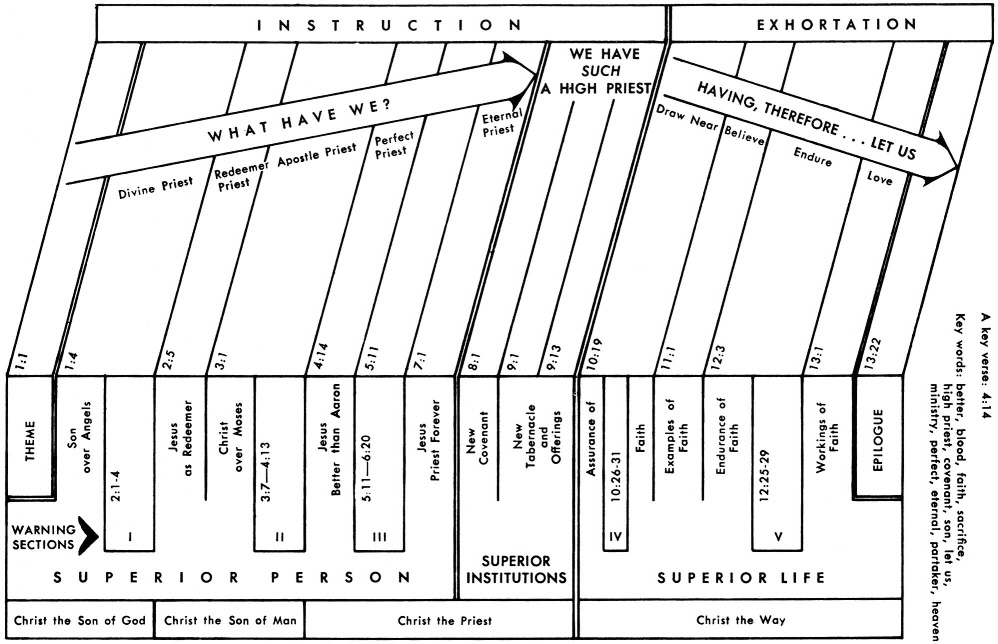
CONSIDER JESUS OUR GREAT HIGH PRIEST
Click chart to enlarge
Charts from Jensen's Survey of the NT - used by permission
Swindoll's Chart, Interesting Pictorial Chart of Hebrews, Another Chart
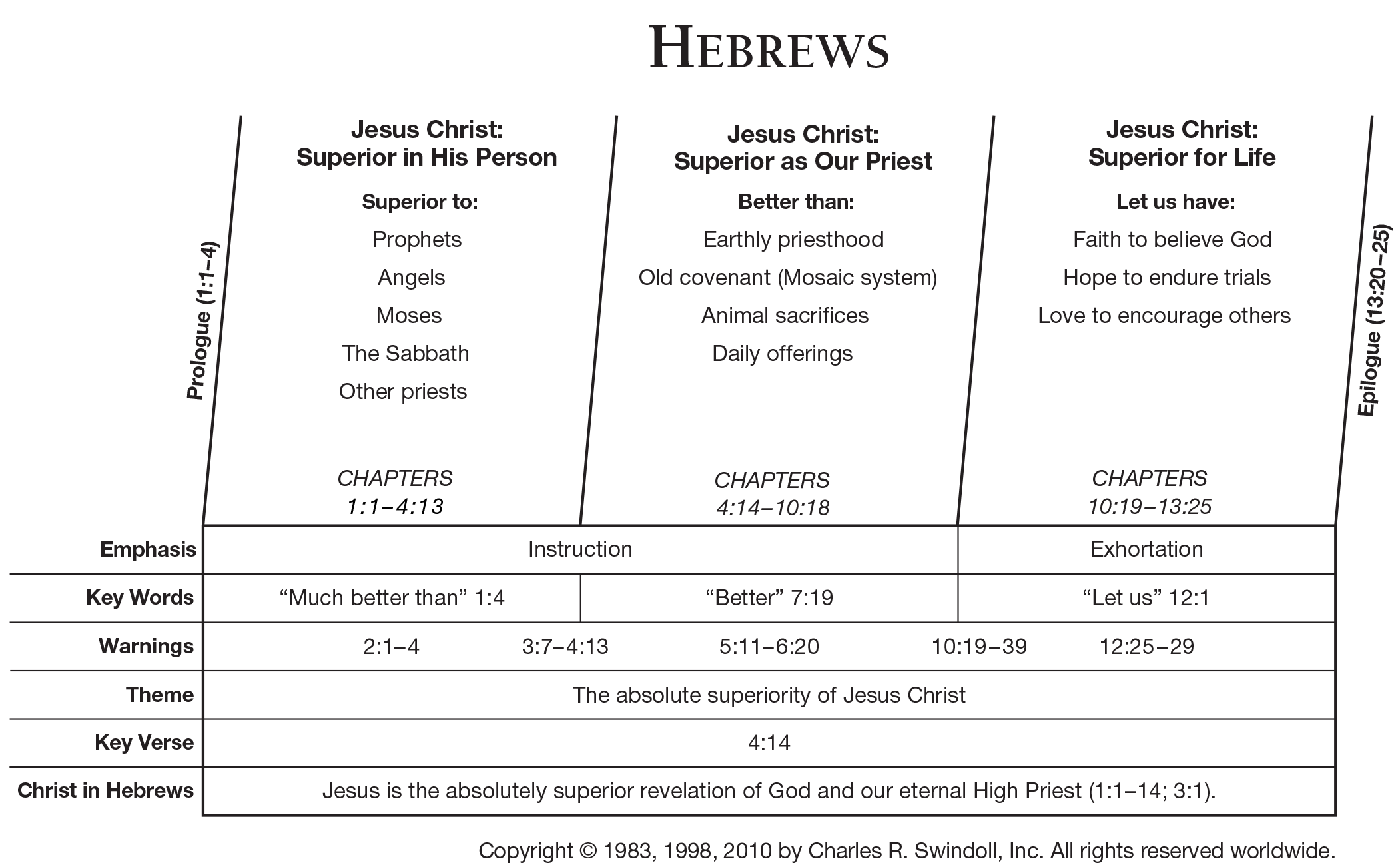
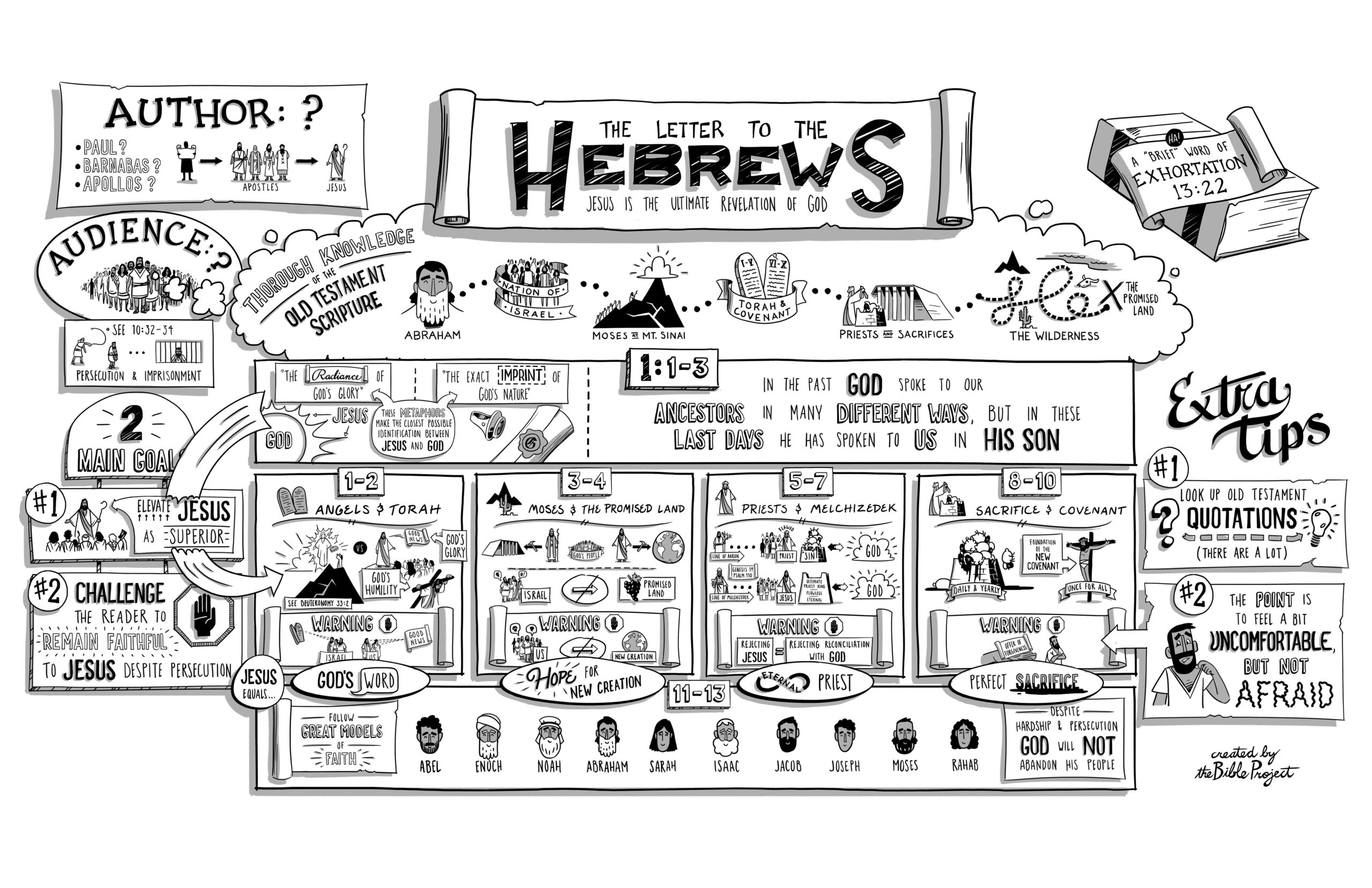
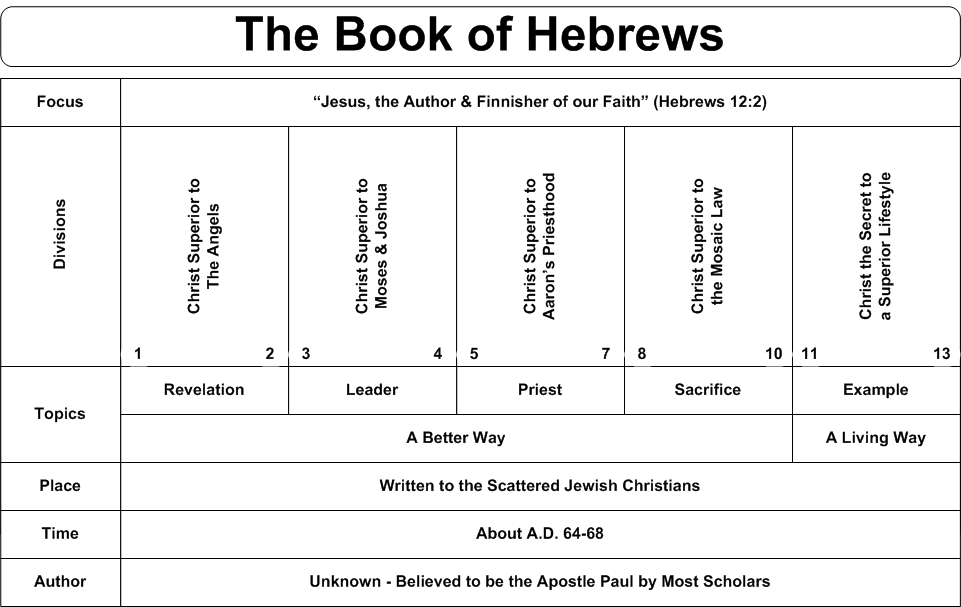
|
The Epistle |
||||
| INSTRUCTION Hebrews 1-10:18 |
EXHORTATION Hebrews 10:19-13:25 |
|||
| Superior Person of Christ Hebrews 1:1-4:13 |
Superior Priest in Christ Hebrews 4:14-10:18 |
Superior Life In Christ Hebrews 10:19-13:25 |
||
| BETTER THAN PERSON Hebrews 1:1-4:13 |
BETTER PRIESTHOOD Heb 4:14-7:28 |
BETTER COVENANT Heb 8:1-13 |
BETTER SACRIFICE Heb 9:1-10:18 |
BETTER LIFE |
| MAJESTY OF CHRIST |
MINISTRY OF CHRIST |
MINISTERS FOR CHRIST |
||
|
DOCTRINE |
DUTY |
|||
|
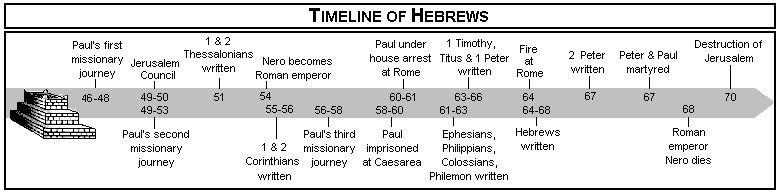
DATE WRITTEN: |
||||

See ESV Study Bible "Introduction to Hebrews"
(See also MacArthur's Introduction to Hebrews)
Borrow Ryrie Study Bible
|
THE FIVE WARNING PASSAGES |
| Heb 2:1-4+ |
| Heb 3:7-4:13+ |
| Heb 5:11-6:12+ |
| Heb 10:26-31+ |
| Heb 12:14-29+ |
Hebrews 10:19 Therefore, brethren, since we have confidence to enter the holy place by the blood of Jesus, (NASB: Lockman)
Greek: Echontes (PAPMPN) oun, adelphoi, parresian eis ten eisodon ton agion en to aimati Iesou
Amplified: Therefore, brethren, since we have full freedom and confidence to enter into the [Holy of] Holies [by the power and virtue] in the blood of Jesus, (Amplified Bible - Lockman)
Barclay: Since then, brother, in virtue of what the blood of Jesus has done for us, we can confidently enter into the Holy Place (Westminster Press)
NLT: And so, dear friends, we can boldly enter heaven's Most Holy Place because of the blood of Jesus. (NLT - Tyndale House)
Phillips: So by virtue of the blood of Jesus, you and I, my brothers, may now have courage to enter the holy of holies (Phillips: Touchstone)
Wuest: Having therefore, brethren, confidence in the entering into the Holy of Holies by the blood of Jesus, which [entrance into] He inaugurated for us,
Young's Literal: Having, therefore, brethren, boldness for the entrance into the holy places, in the blood of Jesus,
- Therefore brethren - He 4:16; Heb 12:28; Ro 8:15; Gal 4:6,7; Ep 3:12; 2Ti 1:7; 1Jn 3:19-21; 4:17
- Enter - He 7:25; 9:3,7,8,12,23, 24, 25; Ro 5:2; Ep 2:18; 1Jn 2:1,2
- Hebrews 10 Resources - Multiple Sermons and Commentaries
- Hebrews 10:19-39 The Danger of Defection - John MacArthur (excellent sermon including several illustrations)
- Click for 5W/H Study Questions — ideal for leading a group or personal study of Hebrews
Related Passages: (SEE MULTIPLE PASSAGES BELOW THAT SPEAK OF OUR ACCESS TO THE THRONE OF GRACE)
Hebrews 4:16 Therefore let us draw near with confidence (parrhesia) to the throne of grace, so that we may receive mercy and find grace to help in time of need.
Ephesians 3:12 in Whom (CHRIST) we have boldness and confident (parrhesia) access through faith in Him.
1 John 3:21 Beloved, if our heart does not condemn us, we have confidence (parrhesia) before God;
Hebrews 7:25 Therefore He is able also to save forever those who draw near to God through () Him, since He always lives to make intercession for them.
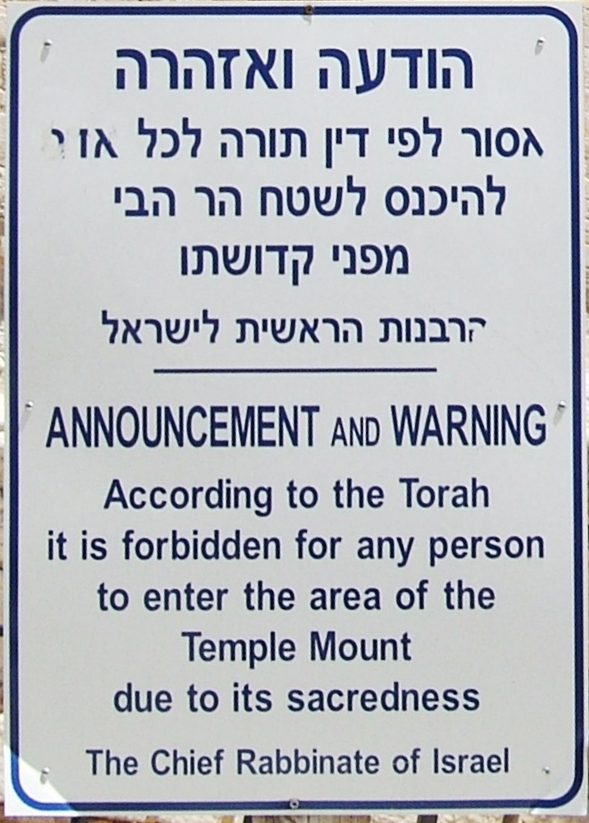
Do Not Enter
Temple Mount
OUR HOLY PRIVILEGE:
ENTREE INTO THE THRONE ROOM
Entree is an interesting word as it has two distinct meanings. If we were eating we would say entree refers to the the main course of the meal. in modern French entree refers to a dish served before the main course of a meal, and is generally synonymous with the terms hors d'oeuvre, appetizer or starter. However as entree is most commonly used in English it generally refers to the main meal. Hebrews 1:1 through Hebrews 10:18 is as it were the "appetizer," and this next section is the entree, the main meal! Entree also means freedom of access. It speaks of a way or passage by which has the right or privilege to enter some place! You can see where we are going. The truth is that we can have the freedom to enter God's Throne Room, into His very presence, for we are washed white as snow (Isa 1:18+) by the blood of the Lamb (1 Peter 1:19+). There is a nice play on words here for in Hebrews 5:14+ the writer has already stated that "solid food (KJV = meat) is for the mature, who because of practice have their senses trained (gymnazo - work out not in "Gold's gym" but "God's gym!") to discern good and evil." The truths in this section are surely "solid food!" which we can put into practice and train our spiritual senses, growing in Christ-likeness. And so the writer of Hebrews (and I as I exposit his words) will now set the table for you beloved. This truth begs several questions - Will you come to the table and eat? Are you hungry? Do you "hunger and thirst for righteousness"? If you do, then in partaking of this solid food in Hebrews 10:19-25, you "shall be satisfied." (Mt 5:6+) O, that God the Spirit would make us all hunger and thirst for this great righteousness and then would feed us with the Bread of life, the truths about our great High Priest, Jesus Christ, all the while transforming us from glory to glory into His likeness (2 Cor 3:18). Amen.
John MacArthur gives us an excellent background summary of this exhortation section in Hebrews 10:19-39 (see the Table above for the divisions).
When a man hears the Gospel, the good news of salvation from sin through Jesus Christ, and when that man understands the Gospel, and when that man believes that the Gospel is true, and when he, to some extent, commits himself to that understanding, then he will from that point either go on to be a true believer or fall back to be an apostate. You see, there are only two possible responses to the knowledge of the Gospel. When an individual knows the truth of the Gospel, he either goes on to believe or he falls back into apostasy, and an apostate is one who rejects the truth, having known it. That’s different from somebody who maybe rejects only knowing a portion of it. There are only two possible responses to the individual who intellectually understands the truth of the Gospel, and that is to go on to faith or to fall back into a state of apostasy, which deserves the severest kind of punishment.Now, tonight we’re going to consider the first of those two possibilities, and that is the positive response to the new covenant, or salvation. A man knows the truth. He understands the truth. To a certain measure he acquiesces to the truth. And at that point, if he goes forward and commits his life to Christ, he has taken a positive response to the truth. If he falls back, it’s a negative response....We will consider the negative response, the horrible tragedy, beginning in Hebrews 10:26, of willful apostasy and what happens when a man willingly has a negative response to the Gospel. But tonight it’s going to be positive (Hebrews 10:19-25). (Responding to the New Covenant) (Bold added)
Wuest - When a Gentile like the Philippian jailor is dealt with about his soul, the approach is “Believe on the Lord Jesus Christ and thou shalt be saved” (Acts 16:31+). When a Jew is appealed to, the approach is in terms of First Testament typology as we have it in Heb 10:19-20. The exhortation to enter into the Holy of Holies of heaven by the blood of Jesus would bring to the Jewish reader’s mind the picture of the high priest in Israel on the Day of Atonement entering the tabernacle for him. He stood in the Holy of Holies, not actually, but in the person of the high priest. The high priest’s presence in the Holy of Holies meant his presence there too, for the high priest had offered sacrifice first for his own sins and was thus accepted with God, and then for the people’s sins (He was functioning as their mediator). The individual Israelite (IN THE OLD TESTAMENT) who trusted Jehovah for his salvation, that Jehovah who would some day offer a sacrifice which would pay for his sins, thus stood symbolically in his high priest for salvation, but actually in the coming Messiah who would some day be the real High Priest. (Hebrews Commentary)
Note that this Greek sentence continues for 7 verses (He 10:19-25).
The writer began this section on the superiority of Christ High Priesthood with almost identical invitation in Heb 4:16+, and his desire is that this Truth might Transform our walk and cause a response.
While Hebrews 10:19,20 speaks of our Access, Hebrews 10:21 speaks of our Advocate (cp 1 Jn 2:1+).
Here are some other reasons believers now can have confidence before God - Heb 12:28+ Ro 8:15+ Gal 4:6+ (see also related passages below)
The author now gives a second (first Heb 8:1-6+) résumé of the five arguments concerning the superior priestly work of Christ (Heb 10:19-25)
So we come here to the great turning-point in Hebrews where the writer turns from the explanation of the superiority of the Person and work of Christ to the application of it in the lives of the storm-tossed church, from doctrine to duty, from creed to conduct, from precept to practice, from instruction to exhortation—the writer becomes very explicit regarding how Christians ought to live.
Since therefore (oun) brethren (adelphos - "of the same womb") we (echo - hold, possess ~ present tense - continually) have confidence (parrhesia - "all speech") to enter (eisodos) the holy place (hagios) by (en - literally "in") the blood (haima) of Jesus (Iesous) - The first word in Greek for emphasis is have (see note) and in the present tense signifies believers continually have access to the Throne of God! Amazing grace! Therefore (oun) is a term of conclusion which draws a conclusion based upon previous information or truth. In this case the therefore (oun) in one sense goes all the way back to Hebrews 1:1 and is based on the truths (the doctrines) that are presented through Hebrews 10:18. Truth always calls for a response.
🙏 THOUGHT - This exhortation in Hebrews 10:19ff reminds me of the exhortation in Ro 12:1+ where the "therefore" is the conclusion based on the incredible truth of Romans 1:1-11:33! Doctrine demands duty! Have you presented yourself recently (or better daily) to the Almighty God as a living and holy sacrifice (are you crawling off the altar during the day?), daily drawing near to Him through your Great High Priest? If not, try it! You'll like it! But enter by grace, not because I am telling you to do so! In His presence is fullness of joy, now and forevermore. Amen (Ps 16:11+). And remember, presenting your body to God is not a passive act but a practical one, as commanded in Romans 12:2+! In other words offering your body to God is not merely a passive surrender but an active obedience, as commanded in Romans 12:2+!
Brethren (adelphos) in context it probably refers to the entire group of Jews (cf use in general sense in He 7.5+, cp Ro 9:3+) among whom are some who are truly regenerate, others who are interested seekers, and finally those who profess faith (intellectual assent to the truth of Messiah) but have yet entered into salvation rest (absence of genuine saving faith effecting circumcision of their heart). Recall that in Heb 3:1 the writer used the phrase "holy brethren" which undoubtedly was a reference to genuine believers.
John MacArthur adds that the writer is now giving an "appeal for men to come to Christ on the basis of doctrine. No biblical appeal is ever really made apart from a solid foundation in doctrine. (ED: Similarly the imperatives, the commands, usually follow the indicatives, the facts) That’s true all the way through Scripture. All solid appeals are based on doctrine. And so ten chapters of basic doctrine about the identity of Christ and finally he says, “Now here’s the opportunity for you to respond.” And the first, then, is a positive response...The positive response is salvation.
🙏 THOUGHT - Have is the first word in Greek for emphasis. What does it emphasize? We have a continual possession/privilege because the verb have (echo) is in the present tense. The active voice speaks of the subject making a (volitional) choice of their will. In other words, you can choose not to believe that you have free access to the Throne Room of God and shy away from entering His presence. You might think "I have committed such a heinous sin, He would never allow me into His presence." But you are wrong! If you are a genuine believer and confess and repent of that "heinous sin," the Lord will welcome you just as the father did the prodigal son - read with gratitude and amazement Lk 15:20-24+. If you still are hesitating to draw near, listen to the words of John Newton - "With my burden I begin/Lord, remove the load of sin/Let Thy blood, for sinners spilt/Set my conscience free from guilt/Set my conscience free from guilt." And remember that the Greek word for confidence (parrhesia) is the picture literally of "all speech" (confidence that "speaks up") implying we can come to God with anything and everything that is on our heart! He is our Father. He is the One that because of Jesus finished work as High Priest, we can now approach and actually speak the term of endearment to Him - Abba, Father (Ro 8:15+, Gal 4:6+)!
The writer goes on to add two reasons we can continually have confidence to enter God's presence - (1). Blood of Jesus and (2) the truth that we have a Great Priest over the house of God.
🙏 THOUGHT - Parrhesia was used in a secular sense to describe outspokenness, frankness, freedom of speech which was claimed by the Athenians as their privilege! If these pagan intellectuals could claim it as their privilege, how much more can blood bought, heaven bound saints claim it as their privilege, the privilege to come into the presence of the Holy One? Are you availing yourself of this privilege? It is called prayer, praying without ceasing (1Th 5:17+)! O how this incalculably priceless privilege should spur all believers to genuinely desire to pray (converse with God in His Throne Room) without ceasing! O dear Father please stir our hearts with this truth so that we might be men and women motivated by love and empowered by Your Spirit who would then desire to come into Your presence and speak boldly with You through our Great High Priest, Jesus Christ the Lord of all. Amen. I love the precious words of the redeemed slave master John Newton's hymn....
Thou art coming to a King,
Large petitions with thee bring;
For His grace and power are such,
None can ever ask too much;
None can ever ask too much.
(Play beautiful vocal by Matt Foreman)
(Listen and I promise you will be blessed!)
Bold, confident speech is a dominant note all through the Epistle (He 3:6; 4:16; 10:19, 35). Some of the Hebrew readers were tempted to give up Christ. Here the writer calls them to boldness (courage) (Heb 3:6, 4:16, 10:35 Eph 3:12+, 1Jn 3:19, 20, 21). And by way of application, he is calling all believers to Holy Spirit enabled, Christ mediating boldness before our Father in Heaven!
How is confidence possible? As a result of the guilt having been removed by the blood of Jesus. Whereas before the Jews could only have "surrogate" (or "vicarious") access through the high priest, who went behind the veil of the tabernacle or temple only once a year. Now they had permanent access through the blood and torn body of Christ. Can you imagine the High Priest on the Day of Atonement (see also Atonement, Day of) coming with boldness?
It would be difficult to overestimate the value of confidence in human motivation, for a confident spirit is essential to success.
John MacArthur comments that in the OT "there was a tabernacle or a temple, and inside of the totality of this outer courtyard there was what was called the holy places, the holy place, and inside behind the veil, was the Holy of Holies, where God dwelt. No man could enter into that place except the high priest once a year to offer atonement for the sins of the nation Israel. But now he is saying, “You all can enter into God’s presence. The veil has been torn down, and you can all enter in, and you can enter in boldly.” So we have this new entrance into the holiest by the blood of Jesus. And this is a fantastic statement to a Jew because to a Jew, entering into the holiest is absolutely forbidden. And if a Jew ever tried to do that under the old economy, he would’ve been instantly consumed in the flames of the fire of almighty wrath. And no Jew would ever conceive of going into the Holy of Holies. In fact, it’s interesting if you go to Jerusalem, you will find that there’s a certain area of the temple mount where it is forbidden to Jews to walk because it may be the area where the Holy of Holies once stood, and no Jew would ever put his foot on the Holy of Holies. Therefore, there are big signs outside the gates of the temple that say Orthodox Jews have been forbidden by the rabbi to enter into this place lest they step on the Holy of Holies. (See Temple Warning) They have a fear, still today, the Orthodox Jews, of ever going into the presence of God. But because of the New Covenant, he says we can have boldness. We don’t even go in sheepishly, saying, “God, I’m coming, don’t step on me,” see. We can enter in boldly. It’s a fantastic concept for the Jewish mind to understand. Now, when he uses the term “brethren,” just a point of information, when he uses the term “brethren” here as on other occasions in the book of Hebrews and also in the book of Romans, he’s talking to Jewish brethren, not Christians. (Responding to the New Covenant)
Andrew Murray outlines this section...OF LIFE IN THE HOLIEST OF ALL. Hebrews 10:19-25
IT may help us the better to master the rich contents of this central passage, containing a summary of the whole Epistle, if we here give the chief thoughts it contains.
I. The four great Blessings of the new worship:
1. The Holiest opened up.
2. Boldness in the Blood.
3. A New and Living Way.
4. The Great High Priest.
II. The four chief Marks of the true worshipper:
1. A True Heart.
2. Fulness of Faith.
3. A Heart sprinkled from an Evil Conscience.
4. The Body washed with Clean Water,
III. The four great Duties to which the opened Sanctuary calls
1. Let us draw nigh (in the fullness of faith.)
2. Let us hold fast the profession of our hope.
3. Let us consider one another to provoke unto love.
4. Let us not forsake the assembling of ourselves together
Andrew Murray. The Holiest of All
TO ENTER THE HOLY PLACE BY THE BLOOD OF JESUS: eis ten eisodon ton hagion en to haimati iesou:
- Isa 57:15, He 7:25, Eph 2:18
- Hebrews 10 Resources - Multiple Sermons and Commentaries
- Hebrews 10:19-39 The Danger of Defection - John MacArthur (excellent sermon including several illustrations)
- Click for 5W/H Study Questions — ideal for leading a group or personal study of Hebrews
Related Passages:
1 Peter 1:18-19+ knowing that you were not redeemed with perishable things like silver or gold from your futile way of life inherited from your forefathers, 19 but with precious blood, as of a lamb unblemished and spotless, the blood of Christ.
ENTRANCE INTO
THE HOLY PLACE
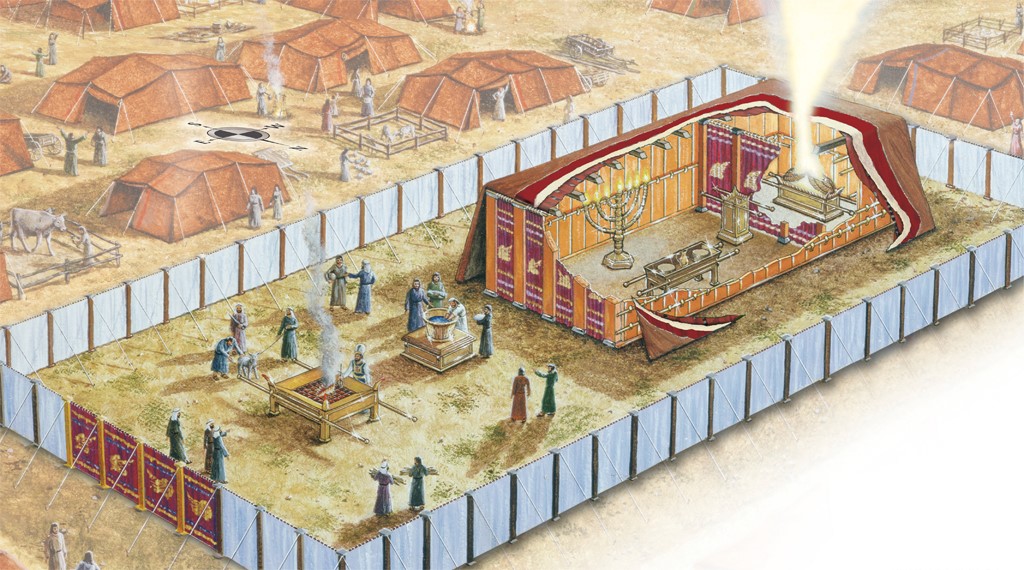
Tabernacle Cutaway
Rose Guide to the Tabernacle
© 2005 RW Research
To enter (eisodos - entrance into) the holy place (hagios) by (en - literally "in") the blood (haima) of Jesus (Iesous - "Yahweh saves") - The writer explains to his Jewish readers how it is now possible to enter into the "Holy Place," (Holy of holies - see diagram above with Shekinah Cloud in Holy of holies) into the very presence of God, something that an OT Jew could only dream about and something only one Jew (High priest) could do only one time each year (Day of Atonement - see Lev 16:1-34+). The precious blood of Jesus changes everything forever!
“Soli Deo Gloria!”
The veil is torn, the way is free,
All grace, all love, all victory;
No work of mine, no boast, no plea—
All glory, Lord, belongs to Thee.
Enter (eisodos) speaks of free, confident access to God, a privilege once denied but now granted to all believers. Enter (eisodos) also signifies not merely “permission” to enter, but a welcome, a new and living access into God’s immediate presence. The holy place (hagios) in context refers to the true dwelling of God’s presence (Heb 9:24+). And so the to enter the holy place means to come directly into the presence of God, not symbolically through ritual, but spiritually and truly through Christ. Note the contrast of the Old with New, for under the Law there was distance and restriction (“Keep back!”). Now under Grace there is nearness and relationship (“Draw near!”). We now have permanent access to God’s presence! By is the preposition en which does not simply mean “by means of” (instrumental), but “in the sphere or power of.” (cf locative of sphere) We don’t enter God’s presence by our own merit, but IN the virtue, protection, and cleansing power of Jesus’ blood. Our access is enclosed WITHIN the efficacy of that blood, so that we stand IN it (cf "grace IN [en] which we stand" - Ro 5:2+), as our covering and confidence. We enter the holy presence of God IN the blood of Jesus — clothed IN its cleansing, sheltered IN its power. The blood (haima) of Jesus (Iesous) is the literal blood of Christ shed on the Cross in His sacrificial death and forever symbolizing His life poured out (cf Lev 17:11+). Our approach to God's throne is secured in the power of Jesus' blood. In Hebrews, blood always carries the idea of atoning sacrifice (see all 22 uses), a life given to satisfy divine justice and remove sin’s barrier, something only prefigured by animal blood but only fully accomplished by the blood of Jesus. It is the blood of Jesus that opens the way which sin had closed (Heb 9:12, 14, 22 - see Garden of Eden below). The use of the Name Jesus (Iesous - "Yahweh saves") emphasizes the humanity of the Savior, for only a human who was sinless could accomplish redemption. So, haîma here is shorthand for the entire redemptive work of Christ, climaxing in His sacrificial death. The believer’s entrance into God’s presence is not tentative but triumphant, not because of self-worth, but because of Christ’s worth. Thank You Jesus! Amen.
By His blood I enter—bold and free,
The veil once torn is torn for me;
No earthly priest, no rite, no plea—
The blood of Christ, my entry key.
One needs to understand how the concept of coming to God was simply unthinkable to the Jewish hearers. When Adam sinned, God put him out of the Garden and "stationed the cherubim and the flaming sword which turned every direction to guard the way to the tree of life." (Ge 3:24+) shutting Adam out from the close fellowship he had experienced before sin entered the Garden when "the LORD God walking in the garden" (Ge 3:8+, Ro 5:12+). In a similar way the Jews were forbidden from entering the Holy of holies lest they be struck dead by God. Now the writer of Hebrews says that Jesus’ blood has in effect torn the veil that had separated sinful man from holy God for thousands of years!
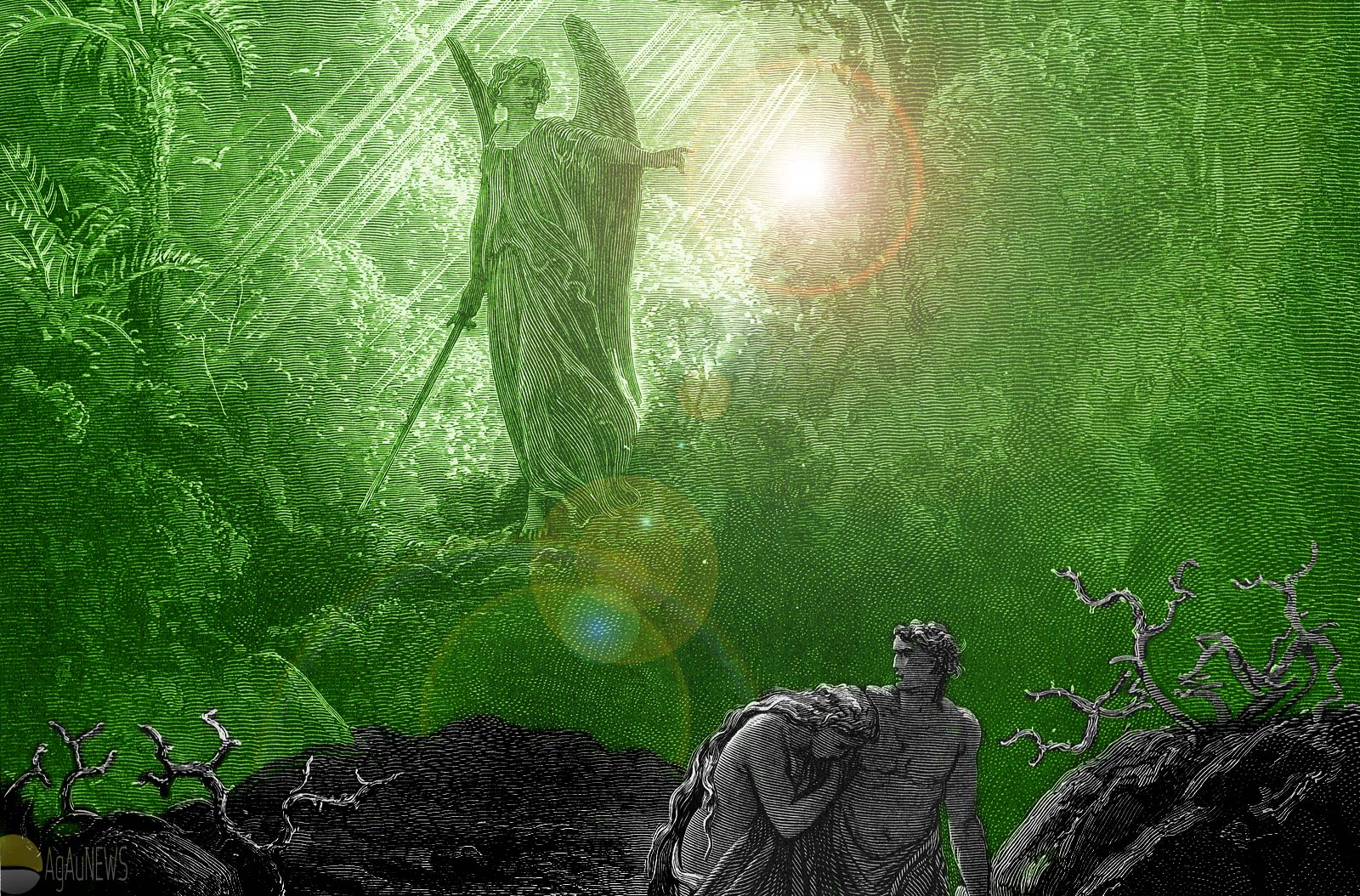
Adam & Eve Expelled from Garden & Tree of Life
Click to Enlarge
To enter (eisodos - entrance into) the holy place (hagios) (The Holy of holies) - To a Jew who took the Old Covenant seriously, the prospect of entering the holy place was inconceivable and impossible. Remember that the writer's exhortation is based on 10 chapters of deep doctrine. It is now time for the readers to take what is in their head and work it out of their heart! The writer thus uses a persuasive argument to bring his wavering Jewish readers to a positive decision concerning the Messiah, not just in their head but in their heart, the goal he has been aiming toward for 10 chapters of deep doctrinal truths.
Kenneth Wuest - The writer makes it plain that he does not have reference to the earthly Holy of Holies. In the first place, it is by means of the blood of Jehoshua, his Jehovah-Saviour that he is to enter, not by means of the blood of animals. In the second place, he calls the road into the Holy of Holies, “a new and living way.” (Heb 10:20) The Greek word translated “way” is hodos, “a road.” The order in the Greek text is, “Having therefore, brethren, boldness for the entering of the holiest by means of the blood of Jesus, which He inaugurated for us, a road, a freshly-slain one, a living one.” The order of the words in the Authorized Version, makes the word “which” in verse 20 refer back to the word “way,” but as the above shows, it goes back to the words “to enter,” namely, “the entering.” It was the entrance into the Holy of Holies of heaven which Messiah consecrated for us. (Hebrews Commentary online)
All believers may come into His presence by faith
at any time and from any place on earth
William MacDonald - The common people during the Jewish economy were barred from the Holy Place and the Most Holy Place; only the priests could enter the first room, and only the high priest could enter the second. Now that is all changed. God has no special place where only a special caste of men may approach Him. Instead, all believers may come into His presence by faith at any time and from any place on earth. (Borrow Believer's Bible Commentary)
Spurgeon - There was under the (Old Testament) Law this ordinance—that no man should ever go into the holiest of all, with the one exception of the high priest, and he but once in the year, and not without blood. If any man had attempted to enter there he must have died, as guilty of great presumption and of profane intrusion into the secret place of the Most High. Who could stand in the presence of Him who is a consuming fire? This ordinance of distance runs all through the law; for even the holy place, which was the vestibule of the holy of holies, was for the priests alone. Those who refuse Jesus refuse the only way of access to God. God is not approachable except through the rending of the veil by the death of Jesus. There was one typical way to the mercy seat of old, and that was through the turning aside of the veil; there was no other. And there is now no other way for any of you to come into fellowship with God except through the rent veil, even the death of Jesus Christ, whom God has set forth to be the propitiation for sin. Come this way, and you may come freely. Refuse to come this way, and there hangs between you and God an impassable veil. Without Christ you are without God, and without hope.
Grant Osborne - On the basis of Christ’s blood sacrifice, our boldness is “to enter” (eisodon) the holy of holies directly. There is quite a bit of background to this earlier in the letter. In Heb 6:19–20 our new hope in Christ affords our “entry” into “the inner sanctuary behind the curtain.” Then in Heb 8:1–2 it is Christ as heavenly high priest who is enthroned and “serves in the sanctuary, the true tabernacle,” thereby affording us our place there as well. In Heb 9:11–12 it is Christ’s blood that has brought about our “eternal redemption” by enabling him to pass through “the greater and more perfect tabernacle.” Finally, in Heb 9:24 Christ never entered the earthly temple after his death on the cross but rather the true temple in heaven itself, appearing in God’s presence on our behalf. (See Hebrews Verse by Verse - Page xc)
As the writer of Hebrews said "And according to the Law, one may almost say, all things are cleansed with blood, and without shedding of blood there is no forgiveness." (Heb 9:22) Only the shedding of blood could brink forgiveness, but the blood shed by all of the OT sacrifices was never sufficient or efficient in accomplishing true forgiveness, for as he said in Hebrews 10:4 "it is impossible for the blood of bulls and goats to take away sins."
Blood, blood, blood throughout the Old Testament, every day, every year, every Passover, each marked by the shedding of blood. The blood of these countless animal sacrifices was like a giant blood stained finger pointing the Jews to the coming perfect Lamb of God (Jn 1:29+) and "the precious blood, as of a lamb unblemished and spotless, the blood of Christ." (1 Pe 1:19+) The blood of the sacrificial animals could effect only a temporary atonement, but the blood of animal sacrifices could not take away sin or pay for the debt (which required forgiveness), redeem from slavery (which called for redemption), or reversal of alienation (which demanded reconciliation). So it is on this backdrop of the hopelessness of the OT sacrifices to ever bring about forgiveness of sins that the writer now exhorts his readers to enter the Holy Place by the blood of Jesus, the Better Sacrifice, the Better Covenant, the Better Mediator.
The blood (haima) of Jesus (Iesous - "Yahweh saves") is the better sacrifice just discussed (Heb 9:23+, cf Heb 9:13-10:18) and is the basis on which we can now draw near to God in faith. Jesus (Iesous) is used 13x in Hebrews - Heb 2:9; 3:1, 4:14, 6:20, 7:22, 10:10, 10:19, 12:2, 12:24, 13:8, 13:12, 13:20, 13:21. The name "Jesus" emphasizes the humanity of Christ, and the validity of his redemptive sacrifice on behalf of the human family. It is striking that whenever the writer makes his most emphatic assertions concerning the saving work of Christ, he makes an explicit reference to the blood of Jesus (Heb 9:12, 14; 10:19, 29; 12:24; 13:12, 20).
The idea of coming into the presence through the veil of Christ's flesh has been alluded to several times in Hebrews...
Hebrews 4:16 Let us therefore draw near with confidence to the throne of grace, so that we may receive mercy and find grace to help in time of need.
Hebrews 7:19...on the other hand there is a bringing in of a better hope, through which we draw near to God.
Hebrews 7:25 Hence, also, He is able to save forever those who draw near to God through Him,
Hebrews 13:15 Through Him then, let us continually offer up a sacrifice of praise to God, that is, the fruit of lips that give thanks to His name.
Through the veil God bids me enter
By the new and living way;
Not in trembling hope I venture—
Boldly I His call obey;
There, with Christ my God, I meet
God upon the mercy-seat!
All the worth I have before Him
Is the value of the blood:
I present, when I adore Him
Christ, the First-fruits, unto God.
Him with joy doth God behold;
Thus is my acceptance told!
—Author unknown.
Look at these other NT verses now with the understanding that we can enter with confidence into the Throne room of Heaven because Messiah's torn flesh made the Way accessible, so that now we can go THROUGH (dia) HIM Who sits enthroned at God's right hand as our Great High Priest our Mediator or "Middle Man"...
Ep 2:18 for through (dia) Him we both have our access (prosagoge) in one Spirit to the Father.
Ep 3:12 IN Whom we have boldness and confident access (prosagoge) through (dia) faith in Him.
Ro 5:2 through (dia) Whom also we have obtained our introduction (prosagoge) by faith into this grace in which we stand; and we exult in hope of the glory of God.
1Pe 3:18 For Christ also died for sins once for ( huper = substitution) all, the just for the unjust, in order that (hina = purpose clause) He might bring (prosago - see derivative prosagoge in Ro 5:2) us to God, having been put to death in the flesh, but made alive in the spirit;
Ro 7:25 Thanks be to God through (dia) Jesus Christ our Lord! So then, on the one hand I myself with my mind am serving the law of God, but on the other, with my flesh the law of sin.
2Co 5:18 Now all these things are from God, who reconciled us to Himself through (dia) Christ, and gave us the ministry of reconciliation,
1Pe 2:5 you also, as living stones, are being built up as a spiritual house for a holy priesthood, to offer up spiritual sacrifices acceptable to God through (dia) Jesus Christ.
Jude 1:25 to the only God our Savior, through (dia) Jesus Christ our Lord, be glory, majesty, dominion and authority, before all time and now and forever. Amen.
Brethren (80)(adelphos from a = denotes unity + delphus = a womb) is literally "from the same womb," and in its most literal sense, adelphos means a brother, one born of the same parents — “a male sibling.” But the New Testament, especially in the writings of Paul, expands the term far beyond blood relation.. Adelphós generally denotes a fellowship of life based on identity of origin such as members of the same family (Mt. 1:2; Lk 3:1, 19; 6:14) and in this use in Hebrews 10:19 presumably refers to the same ethnicity (Jewish).
Below are examples of the range of meaning of adelphos
-
Literal / physical brother - A male sibling in a family - Matt 1:2 — “Jacob was the father of Judah and his brothers.”
- Kinsman / fellow Jew - Members of the same people or nation - Acts 2:29 — “Brethren, I may confidently say to you…”
- Fellow believer in Christ - One united by faith and the Spirit - Ro 1:13 — “I do not want you to be unaware, brethren…”
- Spiritual kinship beyond gender - Inclusive of both men and women as members of God’s family - Ro 8:29 — “That He might be the firstborn among many brethren.”
In Christ, adelphos expresses the new spiritual relationship created by redemption. Believers are no longer merely individuals — they are members of a divine household (Eph 2:19). God is our Father (Gal 4:6). Christ is our Elder Brother (Rom 8:29; Heb 2:11–12). All believers are brothers and sisters in Him. Adelphos captures the unity, equality, and mutual care of those who share the same spiritual birth — “born of God” (John 1:12–13).
In the early church, this word broke through social barriers, uniting Jew and Gentile, slave and free, male and female (Gal 3:28). Adelphos reminds us: We share the same Father → divine origin. We share the same faith → common bond. We share the same future → eternal inheritance.
The church is not a club of the like-minded,
but a family of the blood-bought.
ADELPHOS IN HEBREWS - Heb. 2:11; Heb. 2:12; Heb. 2:17; Heb. 3:1; Heb. 3:12; Heb. 7:5; Heb. 8:11; Heb. 10:19; Heb. 13:22; Heb. 13:23;
Hebrews 2:11 for which reason He is not ashamed to call them brethren,
Hebrews 2:12 I WILL PROCLAIM YOUR NAME TO MY BRETHREN,
Hebrews 2:17 Therefore, He had to be made like His brethren in all things,
Hebrews 3:1 Therefore, holy brethren, partakers of a heavenly calling, consider Jesus,
Hebrews 3:12 Take care, brethren, that there not be in any one of you an evil
Hebrews 7:5 that is, from their brethren, although these are descended from Abraham.
Hebrews 8:11 AND EVERYONE HIS BROTHER, SAYING, ‘KNOW THE LORD,’
Hebrews 10:19 Therefore, brethren, since we have confidence to enter the holy place
Hebrews 13:22 But I urge you, brethren, bear with this word of exhortation, for I have written to you briefly.
Hebrews 13:23 Take notice that our brother Timothy has been released
Confidence (boldness) (3954) (parrhesia from pas = all + rhesis = speech) is literally all speech or speaking all things and thereby conveys the idea of freedom to say all. The basic idea in the word is freedom of speech, when the word flowed freely. It is that attitude of openness that stems from freedom and lack of fear ("shaking" fear - godly, reverential fear is always appropriate) means in essence the freedom to say all. Greeks used parrhesia of those with the right to speak openly in the assembly. Speaking with plainness, openness and confidence (Acts 2:29+). Speaking publicly or in the open (Jn 7:13, 11:54, 18:20) and then something done in public (Jn 7:26, Col 2:15+) (Borrow Zodhiates page 1124)
PARRHESIA - 31V - Mk. 8:32; Jn. 7:4; Jn. 7:13; Jn. 7:26; Jn. 10:24; Jn. 11:14; Jn. 11:54; Jn. 16:25; Jn. 16:29; Jn. 18:20; Acts 2:29; Acts 4:13; Acts 4:29; Acts 4:31; Acts 28:31; 2 Co. 3:12; 2 Co. 7:4; Eph. 3:12; Eph. 6:19; Phil. 1:20; Col. 2:15; 1 Tim. 3:13; Phlm. 1:8; Heb. 3:6; Heb. 4:16; Heb. 10:19; Heb. 10:35; 1 Jn. 2:28; 1 Jn. 3:21; 1 Jn. 4:17; 1 Jn. 5:14
Hebrews 3:6 but Christ was faithful as a Son over His house–whose house we are, if we hold fast our confidence and the boast of our hope firm until the end.
Hebrews 4:16 Therefore let us draw near with confidence to the throne of grace, so that we may receive mercy and find grace to help in time of need.
Hebrews 10:19 Therefore, brethren, since we have confidence to enter the holy place by the blood of Jesus,
Hebrews 10:35 Therefore, do not throw away your confidence, which has a great reward.
Enter (1529)(eisodos from eis = into + hodos = a way, journey) is literally a way in or entering into and is used in the spatial sense to describe a way, entry (access), or approach to a place or building. Eisodos is the point or process of entering, or the access route into something. Exodos is the antithesis meaning “exit,” “departure” and together they frame life’s movements in and out.As an action, eisodos can describe a coming in or entering. Eisodos also describes a reception given, an acceptance or a welcome extended to a person on the occasion of a visit.
Literal / physical entrance - Entry into a city, house, or region - Acts 13:24 — “After John had proclaimed before His coming (eísodos) a baptism of repentance…”
Arrival / coming of a person - A person’s arrival or entrance among others - 1 Thess 1:9 — “They themselves report what kind of entrance (eísodos) we had with you.”
Figurative / spiritual entrance - Entry into salvation, the kingdom, or eternal life - 2 Pet 1:11 — “For in this way the entrance (eísodos) into the eternal kingdom… will be abundantly supplied to you.”
EISODOS - 4X - coming, 1; enter, 1; entrance, 1; reception, 1 - Acts 13:24; 1Th. 1:9; 2:1; Heb. 10:19; 2Pet. 1:11
Theological nuances of eisodos -
- Entrance of the Gospel — In 1 Thessalonians 1:9 and 1Th 2:1, Paul uses eísodos metaphorically for the impact and acceptance of the gospel: “Our entrance (eísodos) among you was not in vain.”This describes not just physical arrival, but the spiritual opening God created for the message to enter hearts.
- Entrance into Eternal Life — 2 Peter 1:11 uses the term for the believer’s rich “entry” into Christ’s everlasting kingdom: “An abundant entrance will be supplied to you.” This portrays salvation’s completion — not barely entering heaven, but a triumphant welcome into the eternal realm.
- Christ’s Coming — In Acts 13:24, the word refers to Christ’s coming into His public ministry — His “entrance” into the world’s redemptive stage. The word eísodos beautifully captures both the beginning of faith and the end of the journey. The gospel’s entrance into our hearts leads ultimately to our entrance into Christ’s eternal kingdom.
He who entered once into our hearts
will one day welcome us into His home.
Holy place (40) (hagios) is literally the word holy and strictly speaking refers to whoever or whatever is set apart (sanctified) for a special purpose. In the New Testament, saints are holy ones in character having been set apart by God to be exclusively His possession, to be dedicated to Him and to manifest holiness of heart and conduct in contrast to the impurity of the unbelievers (Jew or Gentile). Saints are set aside for sacred use. In Heb 10:19 a specific local (holy place in heaven) is set apart for sacred use.
🙏 THOUGHT - Are you taking advantage of your holy privilege to enter the holy place?
HAGIOS KEYWORD IN HEBREWS: Heb. 2:4; Heb. 3:1; Heb. 3:7; Heb. 6:4; Heb. 6:10; Heb. 8:2; Heb. 9:1; Heb. 9:2; Heb. 9:3; Heb. 9:8; Heb. 9:12; Heb. 9:24; Heb. 9:25; Heb. 10:15; Heb. 10:19; Heb. 13:11; Heb. 13:24
Hebrews 2:4 Holy Spirit
Hebrews 3:1 holy (brethren)
Hebrews 3:7 Holy Spirit
Hebrews 6:4 Holy Spirit
Hebrews 6:10 saints
Hebrews 8:2 sanctuary (heavens)
Hebrews 9:1 sanctuary (earthly)
Hebrews 9:2 holy place
Hebrews 9:3 Holy of holies
Hebrews 9:8 Holy Spirit...holy place
Hebrews 9:12 holy place
Hebrews 9:24 holy place
Hebrews 9:25 holy place
Hebrews 10:15 Holy Spirit
Hebrews 10:19 holy place
Hebrews 13:11 holy place
Hebrews 13:24 saints
Blood (129) haima is literally the red fluid that circulates in the heart, arteries, capillaries, and veins of a vertebrate animal carrying nourishment and oxygen to and bringing away waste products from all parts of the body and thus is essential for the preservation of life. Haima gives us English words like hemorrhage (Gk - haimorragia from haimo- + rragia from regnuo - to burst) English derivatives inclue hematology (study of blood) and "leukemia" which is from leuco (white) plus haima (blood), which is fitting as leukemia is a disease that affects the white blood cells. Derivatives of haima are : haimatekchusía (130), shedding of blood; haimorroéō (131), to hemorrhage. Haima was used to describe “descent” or “family” in ancient times. “To shed blood” is to destroy life.
Zodhiates adds that "haima is used to denote life given up or offered as an atonement since, in the ritual of sacrifice, special emphasis is laid upon it as the material basis of the individual life. The life of the animal offered for propitiation appears in the blood separated from the flesh which the Jews were forbidden to eat (Ge. 9:4; Lev. 3:17; 17:10-14; Deut. 12:23; Heb. 9:7-13, 18-25; 11:28; 13:11). This life is, on the one hand, in the blood, presented to God; on the other hand by sprinkling, appropriated to man (Heb. 9:7, 19, 20). This blood thus becomes the blood of the covenant or testament (see diathekē) which God commanded to us (Heb. 9:20)." (See following resources for multiple pages on haima) (BORROW Complete Word Study Dictionary- New Testament PAGE 118)
HAIMA IS A KEYWORD IN HEBREWS - 22X OUT OF 97X IN NT - Heb. 2:14; Heb. 9:7; Heb. 9:12; Heb. 9:13; Heb. 9:14; Heb. 9:18; Heb. 9:19; Heb. 9:20; Heb. 9:21; Heb. 9:22; Heb. 9:25; Heb. 10:4; Heb. 10:19; Heb. 10:29; Heb. 11:28; Heb. 12:4; Heb. 12:24; Heb. 13:11; Heb. 13:12; Heb. 13:20
Hebrews 2:14 Therefore, since the children share in flesh and blood,
Hebrews 9:7 only the high priest enters once a year, not without taking blood,
Hebrews 9:12 and not through the blood of goats and calves, but through His own blood
Hebrews 9:13 For if the blood of goats and bulls
Hebrews 9:14 how much more will the blood of Christ, who through the eternal Spirit offered Himself
Hebrews 9:18 even the first covenant was not inaugurated without blood.
Hebrews 9:19 he took the blood of the calves and the goats
Hebrews 9:20 saying, “THIS IS THE BLOOD OF THE COVENANT WHICH GOD COMMANDED YOU
Hebrews 9:21 he sprinkled both the tabernacle and all the vessels of the ministry with the blood
Hebrews 9:22 almost say, all things are cleansed with blood,
Hebrews 9:22 and without shedding of blood there is no forgiveness.
Hebrews 9:25 high priest enters the holy place year by year with blood that is not his own.
Hebrews 10:4 For it is impossible for the blood of bulls and goats to take away sins.
Hebrews 10:19 confidence to enter the holy place by the blood of Jesus,
Hebrews 10:29 has regarded as unclean the blood of the covenant by which he was sanctified
Hebrews 11:28 By faith he kept the Passover and the sprinkling of the blood
Hebrews 12:4 have not yet resisted to the point of shedding blood
Hebrews 12:24 Jesus, the mediator of a new covenant, and to the sprinkled blood
Hebrews 12:24 which speaks better than the blood of Abel.
Hebrews 13:11 For the bodies of those animals whose blood is brought into the holy place
Hebrews 13:12 He might sanctify the people through His own blood
Hebrews 13:20 the great Shepherd of the sheep through the blood of the eternal covenant
Spurgeon has the following sermons related to blood…
- Exodus 12:13 The Blood
- Hebrews 12:24-25 The Blood Of Sprinkling
- Hebrews 12:24-25 The Blood Of Sprinkling
- Hebrews 13:20 The Blood Of The Everlasting Covenant
- Hebrews 9:19-20 The Blood Of The Testament
- Hebrews 9:22 Blood-Shedding
YIN AND YANG OF FAITHFUL PERSEVERANCE - Grant Osborne makes an interesting statement that "The next two sections could be labeled the yin and yang of faithful perseverance, with verses 19–25 providing the positive side, the blessings attendant on drawing near to God, and verses 26–31 the negative counterpart, the terrible consequences of apostatizing from the faith. (See Hebrews Verse by Verse - Page lxxxix)
Brian Bell - Outline: Having Access. Having Advocacy. Let us Draw Near. Let us Hold Fast. Let us Consider. Let us not forsake one another. Let us encourage one another.
Boldness/confidence to enter - By itself human effort is doomed to ultimate failure. B. Confidence training seems to be the cry of the day: We have seminars to build our confidence in our business ventures. Sports camps to build confidence in our kids. 1. David makes it clear, Unless the LORD builds the house, They labor in vain who build it; Unless the LORD guards the city, The watchman stays awake in vain. Ps127:1 a) He doesn’t ask whether you feel confident. He says a believer has it. Not, have I measured up? Not, have I lived up to certain standards? He says a believer has it, period! (1) Confidence of that conviction will always prevail...Christ in you the hope of glory. (2) It’s only by the blood of Jesus. (19b)
Octavius Winslow in his devotion Morning Thoughts...
MARCH 30. "Having therefore, brethren, boldness to enter into the holiest by the blood of Jesus." Hebrews 10:19.
In all true prayer great stress should be laid on the blood of Jesus; perhaps no evidence distinguishes a declension in the power and spirituality of prayer more strongly than an overlooking of this. Where the atoning blood is kept out of view, not recognized, not pleaded, not made the grand plea, there is a deficiency of power in prayer. Words are nothing, fluency of expression nothing, niceties of language and brilliancy of thought nothing, and even apparent fervor nothing, where the blood of Christ- the new and the living way of access to God, the grand plea that moves Omnipotence, that gives admission within the holy of holies- is slighted, undervalued, and not made the groundwork of every petition. Oh, how much is this overlooked in our prayers, how is the atoning blood of Immanuel slighted! How little mention we hear of it in the sanctuary, in the pulpit, in the social circle! whereas it is this that makes prayer what it is with God. All prayer is acceptable with God, and only so, as it comes up perfumed with the blood of Christ; all prayer is answered as it urges the blood of Christ as its plea; it is the blood of Christ that satisfies justice, and meets all the demands of the law against us; it is the blood of Christ that purchases and brings down every blessing into the soul; it is the blood of Christ that sues for the fulfilment of His last will and testament, every precious legacy of which comes to us solely on account of His death; this it is, too, that gives us boldness at the throne of grace. How can a poor sinner dare approach with out this? How can he look up, how can he ask, how can he present himself before a holy God, but as he brings in the hand of faith the precious blood of Jesus? Outside of Christ, God can hold no communication with us; all communion is suspended, every avenue of approach is closed, all blessing is withheld. God has crowned His dearly beloved Son, and He will have us crown Him too; and never do we place a brighter crown upon His blessed head, than when we plead His finished righteousness as the ground of our acceptance, and His atoning blood as our great argument for the bestowment of all blessing with God. If, then, dear reader, you feel yourself to be a poor, vile, unholy sinner; if a backslider, whose feet have wandered from the Lord, in whose soul the spirit of prayer has declined, and yet still feel some secret longing to return, and dare not, because so vile, so unholy, so backsliding; yet you may return, "having boldness to enter into the holiest by the blood of Jesus." Come, for the blood of Jesus pleads; return, for the blood of Christ gives you a welcome. "If any man sin, we have an Advocate with the Father, Jesus Christ the righteous."
J C Philpot devotional thoughts on Hebrews 10:19...
June 5 - "Having therefore, brethren, boldness to enter into the holiest by the blood of Jesus." Hebrews 10:19
Nothing will satisfy a living soul but coming "into the holiest." He wants to have communion with God, the holy, holy, holy Lord God of hosts. He is not dealing with a God distant and afar off--an idol, a God in whom he has neither faith, nor hope, nor love; who can neither see, nor hear, nor save; a God of his own conception or of some indistinct, traditional opinion; but he feels in his very conscience that he is carrying on a sacred and holy communion with the God of heaven and earth, the God who has made himself in some measure known to his soul as the God and Father of the Lord Jesus Christ. With him he has to do; to him he must come; and with him he must hold holy communion. Before his heart-searching eyes he feels he stands; into his ever-open ears he pours his petition; to his mercy and pity he appeals; his compassion he craves; his love he seeks; his salvation he longs for; and his presence above all things he earnestly desires. So he must come into the holiest, for there God dwells; and to come unto God is to come there.
The man who thus feels and acts is an Israelite indeed in whom there is no deceit; one of the true circumcision who worship God in the Spirit, rejoice in Christ Jesus, and have no confidence in the flesh. Others are satisfied with the courts of the house, with admiring the external building, or the painted windows, carved pews, and long drawn aisles; with the mere worship of God as so much lip service. But the living soul goes beyond all that into the very heart of the sanctuary itself. As the high priest on the day of atonement did not tarry among the people in the court, nor with the priests in the holy place, but pressed on, ever pressed on through the thick veil until he got into the holy of holies; so with the saint of God--he does not tarry in the outer court with the profane, nor in the sanctuary with the professor, so as to be satisfied with seeing God with a veil between. But he must come into that immediate presence of God, where he may see something of his grace, behold something of his glory, feel something of his mercy, and taste something of his power. And this makes him press forward into the holiest.
Vicarious Intercession - Beware of thinking that intercession means bringing our own personal sympathies and concerns into the presence of God, and then demanding that He do whatever we ask. Our ability to approach God is due entirely to the vicarious, or substitutionary, identification of our Lord with sin. We have "boldness to enter the Holiest by the blood of Jesus."
Spiritual stubbornness is the most effective hindrance to intercession, because it is based on a sympathetic "understanding" of things we see in ourselves and others that we think needs no atonement. We have the idea that there are certain good and virtuous things in each of us that do not need to be based on the atonement by the Cross of Christ. Just the sluggishness and lack of interest produced by this kind of thinking makes us unable to intercede. We do not identify ourselves with God’s interests and concerns for others, and we get irritated with Him. Yet we are always ready with our own ideas, and our intercession becomes only the glorification of our own natural sympathies. We have to realize that the identification of Jesus with sin means a radical change of all of our sympathies and interests. Vicarious intercession means that we deliberately substitute God’s interests in others for our natural sympathy with them. Am I stubborn or substituted? Am I spoiled or complete in my relationship to God? Am I irritable or spiritual? Am I determined to have my own way or determined to be identified with Him? (O Chambers)
Horatius Bonar on the Blood of the Covenant...
"They overcame him by the blood of the Lamb."—Rev 12:11.
"Behold, the blood of the covenant."—Ex 24:8.
All through Scripture we find traces of the blood. 'You shall bruise His heel' was the first reference to it. The bruised heel of the woman's seed was to be the foundation stone of our deliverance. It was to be deliverance by blood. The bruised heel was to tread upon the serpent's head. In connection with this announcement as to the bruised heel, sacrifice was ordained; and thus the truth began to be developed; victory for the sinner through the blood of One who was to be slain.
'The blood is the life' (Dt 12:23). Not that blood and life are actually the same thing—the one is material, the other immaterial. But the blood is the 'life made visible'—the liquid link between body and soul, which, once broken, brings death. The blood poured out is the life drained away from the body—the departure of the soul from its material dwelling. Thus the blood and the life are identified. God identifies them; law identifies them. Blood 'shed' is the symbol or visible exhibition of 'death'.
Death was the penalty of man's guilt. The wages of sin is death. The soul that sins—it shall die. If, then, another life is to be taken for our life, and another death is to be substituted for ours, the true expression of this is the drawing the blood from the victim, and putting that blood on us. This is the symbolic declaration of the great substitution, the great transference—one life for another, one death for another. Death, with all its consequences, lies on the transgressor until another death comes (in the symbolic form of blood), and washes it away. When the sinner receives God's testimony to 'the blood of the Lamb', then the transference is at once completed—death passes away.
Let us see the different aspects in which the blood is presented to us in Scripture; the manifold blessings with which it is connected; the various points at which we come into contact with it.
I. The blood of the Lamb contains the good news. (Hebrews 12:24) It 'speaks better things than that of Abel.' It speaks of grace, not of wrath; of mercy, not of vengeance; of peace returning, not of peace departing. As seen on the altar, it tells the good news of life given for life; as seen upon the mercy seat, it says, 'Let us come boldly to the throne of grace.' Glad tidings of great joy to the sinfullest are contained in the blood—the precious blood of Christ. It offers to the sinner a reversal of the sentence of death, by presenting him with the death of another in his stead.
II. The blood of the Lamb is the purchase money for the Church. (Acts 20:28) As God's eternal purpose deals both with the Church as a whole, and with each chosen soul, so does the blood. It is the price or ransom of the whole Church; it is the price and ransom of each should that is saved. Of the church it is true—'she is bought with a price;' of each saint it is true—he is bought with a price. The 'blood of the covenant' is the payment demanded by the Father, and paid by the Son. Not without blood can the purpose of the Father be carried out. It is the legal payment of the price or penalty, because it was the death which the Church should have died—but which her Surety took upon Him.
III. The blood of the Lamb is the atonement. (Exodus 30:10) 'Aaron shall make an atonement upon the horns of the altar with the blood of the sin-offering' (Leviticus 17:11). 'The life of the flesh is in the blood, and I have given it to you upon the altar to make an atonement for your souls; for it is the blood that makes an atonement for the soul.' The Old Testament word "atonement" means 'to cover;' and the blood is that which 'covers' sin, so that it becomes hidden and indiscernible by God Himself—as if the only thing through which the eye of God could not penetrate was the altar blood. To him whose sin is thus 'covered' by the blood, God is propitious. The blood propitiates; and the blood, received by the sinner (in the belief of God's testimony to it), propitiates God toward the sinner himself personally. Only the blood can cover! Not mountains, nor seas, nor the thick forests of earth; only blood—the blood of the one Sacrifice. In this is atonement; and, as the result of atonement, reconciliation with God. Looking at the paschal blood, God says, 'Pass over, slay not;' looking at the sacrificial blood, God says, 'Their sins and iniquities will I remember no more!'
IV. The blood of the Lamb is the redemption. (Ephesians 1:7; Colossians 1:14; 1 Peter 1:18,19; Revelation 5:9) Redemption is not the same as the atonement or the purchase money, already noticed. It is the carrying out of that for which the price was paid and the atonement made. The paying down the money is one thing; the redeeming the person so paid for, so ransomed, is something more. It is nearly synonymous with salvation, only it expresses the way by which the salvation has been obtained—by ransom or purchase. Hence the expression, 'the redemption of the purchased possession' (Ephesians 1:14). Redemption by blood is our gospel; redemption presented fully by the redeeming One to the 'lawful captive,' to the imprisoned and exiled sinner. He who believes enters into possession of all that it contains.
V. The blood of the Lamb is the bringing near. (Ephesians 2:13) The far off are made near by the blood. It is the blood which removes the distance; that brings God near to us, and us near to God. It annihilates all distance, and all variance. The blood brings about the meeting between us and God. Incarnation is not the bringing near, nor the thing which brings us near; it is merely the first step in a process, which, had it not ended in the blood shedding, would have been all in vain. It is the blood that emboldens us to draw near to God, and justifies God in drawing near to us. 'Let us draw near' is the voice of the blood, speaking both from the altar and the mercy seat. And how? 'With at true heart and in the full assurance of faith.' And the blood provides for both of these.
VI. The blood of the Lamb contains the cleansing. (1 John 1:7) This is spoken of also as 'purging' (Hebrews 9:14, 22), and as 'washing' (Revelation 1:5); and it is to this that Zechariah refers, when he speaks of the fountain opened for sin and for uncleanness (ch. 13:1); and David, when he prays, 'Purge me with hyssop, and I shall be clean; wash me, and I shall be whiter than the snow' (Psalm 51:7). It is specially to the guilt that these passages refer—the judicial or legal defilement or condemnation, as the consequence of sin committed; so that, when that defilement or condemnation was removed by the application of the blood of the substitute, the man became clean in the sight of God and of His law. He was purged in conscience and in heart; in body, soul, and spirit. After this, the inward purification began, and was carried on in connection with the blood, through the power of the Spirit. We preach the purging and cleansing blood. It has lost none of its efficacy. The Lamb slain is the same as ever; and the High Priest is the same as ever; and the blood is the same as ever—as able to purge and purify.
VII. The blood of the Lamb contains the peace. (Colossians 1:20) 'Peace through the blood of His cross;' for 'He is our peace' (Ephesians 2:14); and because of the blood, God 'is pacified towards us for all that we have done' (Ezekiel 16:63). It is the blood that has made the peace, for it removes that which produced the controversy and contention. The blood pacifies. It removes that which drew on us the wrath of God, quenching that wrath; it removes that which made us dread God and flee from Him, like Adam. Peace through the blood is our message! To the guiltiest rebel upon earth it comes!
VIII. The blood of the Lamb contains the pardon. (Hebrews 9:22) 'Without shedding of blood is no remission.' By the shedding of blood then, there is remission of sins. The many blood sheddings have ceased (Hebrews 10:18); and the one blood shedding, which in its value, and efficacy, and suitableness is everlasting and infinite, remains. Taking it as the payment of the penalty, substituted by God for our non-payment of it, we are forgiven. He who receives the divine testimony to the blood is in so doing forgiven. That blood, by covering his sins, brings pardon—pardon to anyone who is willing to take pardon in this way from God.
IX. The blood of the Lamb contains justification. (Romans 5:9) 'Justified by His blood.' We get justification by His grace and by His righteousness. Here it is said to be by His blood. Justification seems here opposed to 'condemnation'—the sweeping away of everything that brought us under condemnation. This the blood accomplishes; meeting every accusation, answering every plea, setting aside everything that is laid to our charge. Looking to the blood, we can say, 'who is he who condemns?' The blood sets us right in conscience and in law with God. It justifies the ungodly.
X. The blood of the Lamb contains that which makes white. (Revelation 8:14) 'They have washed their robes and made them white in the blood of the Lamb.' Not only the man, but his garments are made white. This is more than cleansing. It is the word used regarding Christ's transfiguration-garments (Matthew 17:2); the angel-robes (Matthew 28:3); the heavenly clothing (Revelation 4:4); the judgment throne (Revelation 20:2). Whiter than snow or wool, white as the garments of Christ—no, the 'head and hair' of Christ (Revelation 1:14). This is the result of the application of the blood to those who were 'blacker than the coal,' redder than crimson. What potency, what virtue, what excellency does this blood contain! How it beautifies and glorifies!
XI. The blood of the Lamb contains that which sanctifies. (Hebrews 13:12) 'That He might sanctify the people with His own blood.' This is consecrating them as His kings and priests, setting them apart for service, making them 'saints,' holy ones. The blood of the great Sin-offering (outside the gate) sanctifies. As soon as the blood touches us, by our believing, we are set apart—we become the royal priesthood, holy to the Lord.
XII. The blood of the Lamb contains the power to conquer. (Revelation 12:2) 'They overcame by (on account of) the blood of the Lamb.' No victory without the blood! No power to fight; no motive in fighting; no hope of overcoming. The blood takes the strength from the enemy. The blood supplies us with all these. We look to it, and out of weakness we are made strong. We look to it, and we are cheered as well as nerved for conflict with the enemy.
XIII. The blood of the Lamb contains our right of entrance into the holiest. (Hebrews 10:19) He entered 'by His own blood' (Hebrews 9:12). He gives us this blood as our right of entrance is sprinkled and consecrated by His blood. Let us draw near! The blood removes all cause of dread, all possibility of rejection, more—gives the certainty of reception. Let us go in! We are sure of a welcome. It gives boldness as well as right of entrance. It says, 'Draw near boldly.'
XIV. The blood of the Lamb contains the seal of the covenant. (Luke 22:20) 'This cup is the new testament in my blood.' The blood seals the covenant—and the cup is the symbol of that seal. It is 'the everlasting covenant' (Hebrews 13:20); the 'covenant of peace' (Isaiah 54:10); 'the new covenant' (Jeremiah 31:31); the covenant which is absolute and unconditional; which not only gives to each sinner who believes a present standing before God of favor and love, but which secures his eternal future beyond the possibility of a second fall. The blood covenant makes us safe forever. O blood-sealed covenant, ordered in all things and sure, what a foundation are those for our faith to rest upon, and of our hope to rejoice in! Yes, and the ages to come are all contained within your ample compass.
XV. The blood of the Lamb contains the true drink for the soul. 'My blood is the true drink' (John 6:55). It quenches the thirst of the soul—the thirst of parching produced by an evil conscience and a sense of wrath, which dries up the frame like a potsherd (Psalm 22:15). It removes the wrath and the sense of wrath—by showing us that wrath transferred to the Substitute. It relieves the conscience when first we come into contact with it; and it keeps it relieved from day to day, as we drink it by faith. It is 'drink indeed.' It calms, it revives, it refreshes, it soothes; it is like cold water to the thirsty lips under a scorching sun. Nothing but the blood can allay this thirst; nothing else can be drink for the soul, for the intellect, the conscience, the heart.
XVI. The blood of the Lamb contains life. (John 6:53) 'Unless you eat the flesh and drink the blood of the Son of man, you have no life in you.' The blood not only 'removes death' (judicial and spiritual), but it gives and 'preserves life' (judicial and spiritual). It quickens! Israel was forbidden to taste the literal blood, and would have been punished with death had they done so; we are commanded to drink the spiritual or symbolical blood, with the promise and assurance that it contains life for us. Without it we have no life. We are not only to be sprinkled with it outwardly, but we are to receive it inwardly—to drink it. As with the water, so with the blood. They are for inward as well as for outward application. We drink them and live; and are washed with them and made clean.
XVII. The blood of the Lamb contains protection. (Exodus 12:13; Hebrews 6:28) The blood of the paschal lamb was Israel's protection. No sword could reach the man on the door of whose dwelling God saw the sprinkled blood. So the blood of Christ our Passover protects. In believing God's testimony to the blood; it becomes sprinkled upon us; and from that moment we are safe. The blood is our security. God sees it, and bids the sword pass by.
XVIII. The blood of the Lamb contains separation from the world. (Hebrews 13:2) As the Sin-offering, Jesus suffered outside the gate; thereby not only fulfilling His sacrificial work, and completing the sacrificial symbol or type, but leaving us an example that we should follow His steps. 'Let us go forth' is the voice that comes to us from the blood. Come out and be separate, and touch not the unclean thing; for the blood of the sin offering is upon us, and Jesus is before us. Let us go forth not only from Babylon and Egypt, but from 'Jerusalem'—Jerusalem, which had become the type of the false Church—the mere religious professor—which, while naming His name, rejects Him and His cross, more—crucifies Him afresh! Let us keep ourselves unspotted not only from the ungodly world as such, but from a worldly Church—worldly professors, who, instead of bearing Christ's reproach, bring reproach upon Him!
XIX. The blood of the Lamb contains resurrection. (Hebrews 13:20) By the blood of the everlasting covenant, Christ was raised. Our sins had slain Him, shed His blood, and brought Him down to the grave! But that shed blood was the removal of the sins that had weighed Him down. God saw in that blood the finished substitution. He accepted it, and gave evidence to that completed work of propitiation, by raising the Substitute. As the great Shepherd, He gave His life for the sheep; His life was accepted instead of theirs; His death made their dying no longer necessary—no, unjust. The blood was the payment of that which had brought death on Him and us; and therefore He was raised. With Him we rise—by the efficacy of the same blood. That blood, which is the symbol of death, is the seal of resurrection.
XX. The blood of the Lamb contains condemnation. (Matthew 27:4, 25; Acts 5:28; Hebrews 10:29) It thus contains the condemnation of Judas, of Jerusalem and Israel—of all rejecters of Christ. The same blood that spoke of pardon speaks of condemnation. Under the weight of 'rejected blood' the unbelieving sinner perishes. This is the condemnation which the church in these last days is preparing for itself—(1) slighting the blood; (2) rejecting it; (3) trampling on the Son of God, and counting the blood of the covenant an unholy thing. Under this aggravated guilt the world shall go down to wrath; for it is guilt of the deepest dye—the deliberate refusal of and contempt for all that God has provided for the sinner. If an Israelite had torn down the tabernacle, overthrown altar and laver, slain the priest, cast forth the blood and water, defiled the mercy-seat, he would be but a type of him who values at nothing the Son of God, and slights His blood. This is the millstone which the world is fastening to its own neck, which shall sink it in the abyss forever!
Yet still the value and the virtue of the blood of the Lamb remain the same. It has lost none of its efficacy. It can still cleanse, and redeem, and purify. It can still pacify the conscience and reconcile of God. Not even its most deliberate rejecters need despair, or fear that it may not avail for them. It cannot lose its power. Up to the very last it avails. Of its divine value the chief of sinners may avail himself without fear or distrust. In crediting the Holy Spirit's testimony to its undiminished and unchangeable sufficiency, the guiltiest upon earth will draw out all its fullness to himself; the whole value of the blood passes over to him who believes, as soon as he has believed. Not upon feeling, but upon believing, does the obtaining of its benefits depend. As soon as we receive the divine testimony, all that the blood has secured for sinners passes over to us as our righteous and everlasting possession. The preciousness of the blood is transferred to us; the preciousness of Him whose blood it is becomes ours, and we are accepted in the Beloved! 'Jehovah our righteousness' is our joy and our song!
Hebrews 10:20 by a new and living way which He inaugurated for us through the veil, that is, His flesh, (NASB: Lockman)
Greek: en enekainisen (3SAAI) hemin hodon prosphaton kai zosan (PAPFSA) dia tou katapetasmatos, tout' estin (3SPAI) tes sarkos autou,
BGT ἣν ἐνεκαίνισεν ἡμῖν ὁδὸν πρόσφατον καὶ ζῶσαν διὰ τοῦ καταπετάσματος, τοῦτ᾽ ἔστιν τῆς σαρκὸς αὐτοῦ,
Amplified: By this fresh (new) and living way which He initiated and dedicated and opened for us through the separating curtain (veil of the Holy of Holies), that is, through His flesh, (Amplified Bible - Lockman)
Barclay: by the new and living way which Jesus inaugurated for us through the veil—that is, through his flesh— (Westminster Press)
NLT: This is the new, life-giving way that Christ has opened up for us through the sacred curtain, by means of his death for us. (NLT - Tyndale House)
KJV By a new and living way, which he hath consecrated for us, through the veil, that is to say, his flesh;
NKJ by a new and living way which He consecrated for us, through the veil, that is, His flesh,
NET by the fresh and living way that he inaugurated for us through the curtain, that is, through his flesh,
CSB by a new and living way He has opened for us through the curtain (that is, His flesh),
ESV by the new and living way that he opened for us through the curtain, that is, through his flesh,
NIV by a new and living way opened for us through the curtain, that is, his body,
Phillips: by way of the one who died and is yet alive, who has made for us a holy means of entry by himself passing through the curtain, that is, his own human nature. (Phillips: Touchstone)
Wuest: a road freshly slain and living, through the veil, namely, His flesh,
Young's Literal: which way he did initiate for us -- new and living, through the vail, that is, his flesh--
- A new and living way - John 10:7,9; 14:6
- Hebrews 10 Resources - Multiple Sermons and Commentaries
- Hebrews 10:19-39 The Danger of Defection - John MacArthur (excellent sermon including several illustrations)
Related Passages:
Hebrews 9:8+ The Holy Spirit is signifying this, that the way (hodos) into the holy place (hagios) has not yet been disclosed while the outer tabernacle is still standing,
"FRESHLY SLAUGHTERED"
THE WAY IS OPEN!
What a dramatic picture the writer is "painting" in the minds of the Jewish readers, by choosing a word that would have radically arrested their attention - "Freshly Slaughtered!"
By a new (prosphatos - freshly slain) and (zao - present tense - continually) living way (hodos - means of access) - The New and Living way was in contrast to the old way which the writer said was passing away "When He said, “A new covenant,” He has made the first obsolete. But whatever is becoming obsolete and growing old is ready to disappear." (Hebrews 8:13+) New (prosphatos) is used only here and presents an incredible picture of what Christ did for us on the Cross for it literally means "Freshly Slaughtered." The Lamb of God, Jesus Christ, had been freshly slaughtered on the Cross (Jn 1:29+, 1Co 5:7+). Now think about this for a moment. Hebrews is written some 30 years after the Crucifixion of Christ and yet the writer still describes Christ's death as "fresh!" And note that this living way (hodos) is new not only in time, but also in quality, for it is a freshly opened pathway through Christ’s once-for-all death.
Behold the Lamb! Once slain for me,
Whose blood has set the guilty free;
The Cross, His altar. Love, the flame—
My sin is gone, His praise my theme.
The living way stands in stark contrast to the dead path marked by slain animal sacrifices. It is a living way because the sacrifice—the One who opened it—still lives! The way (hodos) once blocked by the veil is now opened by the Cross. Note the seeming paradox (a truth that appears contradictory on the surface but reveals a deeper harmony) of a "freshly slaughtered" way that is also a living way (see related study of walking between two pieces of slain flesh - Covenant A Walk Into Death). It is paradoxical because: Death produced life. Slaughter opened access. The slain One became the living Way. So, what seems contradictory—“slain” yet “living”—is actually the profound theological truth of the gospel: through Christ’s death, the way to life was opened. (See Spiritual Paradox) Jesus’ death conquered death (1Co 15:54-56, 57+) and opened the door to eternal life for those who receive Him (Col 2:6+) and take the "walk of death" (death to self effort to attain righteousness), entering into His New Covenant, receiving His propitiatory sacrifice and His life (cp Jn 20:31+, Col 3:4+). The living Way was opened by the dying Savior. His death is the only way to enter into eternal life.
Christ died that I might live.
I must die that Christ might live in me.
--Bob Roe
John MacArthur "The old covenant fades. And, incidentally, the old covenant could only bring a man partially into the presence of God anyway. It just barely got him into relationship, but never into the fullness of dwelling in the presence of God. And we know it’s a new way not only because it gets you to God and the old way did not, but we know it’s a new way because it is by the blood of Jesus and not the blood of animals, and that is new. And so the Spirit calls it a new and living way." (Responding to the New Covenant)
He was pierced that I might be perfected;
I was crucified that He might be magnified.
-- Paul (Galatians 2:20+)
John MacArthur adds "His sacrifice is effectual for all of time and thus it is spoken of as fresh. It’s ever fresh because He’s really "the Lamb slain from the foundation of the world." (Rev 13:8KJV+) His sacrifice is always fresh. And for the man who comes to Jesus Christ, the sacrifice of Jesus Christ is fresh. Because the Bible says through the Apostle Paul that the moment you are saved, you die with Christ. “You are crucified with Christ, nevertheless you live.” And so in a very real sense, Christ’s crucifixion is just as fresh as the moment that you experience Him. It’s a fresh way. Not only that, it’s a living way." (Responding to the New Covenant)
I love Charles Wesley's hymn Arise, My Soul, Arise...
My God is reconciled,
His pardoning voice I hear.
He claims me as His child,
I can no longer fear.
With confidence I now draw nigh,
And Father, Abba, Father, cry
A LIVING WAY
FROM A FRESH SLAUGHTER!
What does the writer mean by the phrase "living way?" O my, are you sitting down? Read and weep and rejoice and shout!
Living (present tense = continually living)(zao) refers literally to natural physical life (opposite of death. And in the context of Christ being "freshly slaughtered" living refers to the resurrection. What a paradoxical thought this must have been to the ears of his Jewish audience. In the Old Testament the fleshly slaughtered sacrificial animal remained dead and never came to life! But now the writer is indicating by using the phrase living that even though Jesus was "freshly slaughtered" He did not remain dead like the OT sacrifices! He arose from the dead and He is alive forevermore as our Living Hope. (1Pe 1:3+)
Simon Kistemaker adds "The adjective living signifies that the way Christ has opened up for us is not a road without an exit: a dead-end street. Rather, this road leads us to salvation, into the very presence of God." (Borrow Exposition of the Epistle to the Hebrews page 286)
And John adds an amazing truth in his description of the Lamb of God in the Revelation where he says "And I saw between the throne (with the four living creatures) and the elders a Lamb standing, as if slain." (Rev 5:6+, also in Rev 5:9+ and Rev 5:12+) The verb for slain (in all 3 uses) is sphazo which means "slaughtered!" As if that was not exciting enough, the verb sphazo in Rev 5:6+ is in the perfect tense which indicates a past completed act at a point in time (the Crucifixion) with enduring effect forever and ever. Our Living Slain Lamb (Rev 1:18+)! Amen!
J Vernon McGee - We enter into the holiest by the blood of Jesus. Our right of entrance is not through His incarnation but through the rending of the veil; that is, through His death. You and I have the privilege of worshiping God, not because of the life of Jesus, but because of His death for us upon the cross. Oh, my friend, this distinction is so important! (Borrow Thru the Bible page 574)
In other words one day in glory we will behold the Lamb and when we do we will be aghast and amazed that His body still bears the scars of that day when He was "freshly slaughtered." In short, those scars are the mark of His cutting covenant with us in His blood, a New Covenant, which will endure as long as His covenant marks endure, which is forever and ever. Amen. If you have doubts about Eternal Security, may the truths of the freshly slaughtered Lamb of God quell your doubts. Those who the Lamb saves are saved forever! And all God's people shout "“Hallelujah! For the Lord our God, the Almighty, reigns!" (Rev 19:6+)
A DEBTOR TO MERCY ALONE
Augustus Toplady
My name from the palms of His hands
Eternity will not erase;
Impressed on His heart it remains,
In marks of indelible grace.
(Another beautiful version)
MacArthur adds that not only does this New and Living Way indicate Jesus is alive, but it also called "a living way because we are alive. When you came to Jesus Christ, what did He do? Ephesians 2:4-5+, “But God, being rich in mercy, because of His great love with which He loved us, even when we were dead in our transgressions, made us alive together with Christ (by grace you have been saved).” What does it mean to make us alive. You see, men in this world are spiritually dead (Eph 2:1+ says " you were dead in your trespasses and sins."). You know that, don’t you? And what is spiritual death? It is the total inability to respond to a spiritual stimulus. It is like physical death. Physical death means you cannot react to physical stimulus. (Spiritual death) means that no matter what happens in a divine sense, no matter what happens in the revelation of God, no matter what God says, you don’t understand it because you’re not receiving those impulses. And you’re dead to God. And so you live in life, and you bang around against the flow all the time, but you really can’t be helped, because you can’t sense God anyway. And then all of a sudden Jesus Christ reaches down and makes you alive, and you begin to sense God. All of a sudden God is alive, and you’re alive. And things begin to make sense. And you begin to see what God wants and to think with the thoughts of God. And all of a sudden a whole new dimension opens up to you, and it’s real life, and you’re now really alive for the first time, which means you are sensitive to God....And so it’s a living way because it makes us alive. The day I met Jesus Christ, I came alive – in the truest sense. John said in John “In Him was life, and the life was the light of men.” (John 1:4+) Jesus said, “I am the way, the truth and” – what? - “the life.” (Jn 14:6+) He said to Martha, “I am the resurrection and the life; he who believes in Me will -- What? -- live even if he dies, and everyone who lives and believes in Me will never die. Do you believe this?” (Jn 11:25-26+) Oh, the body may drop, but he’s alive to God, and he’ll stay that way forever. (Responding to the New Covenant)
WHICH HE INAUGURATED FOR US THROUGH THE VEIL THAT IS, HIS FLESH: en enekainisen (3SAAI) hemin dia tou katapetasmatos, tout estin (3SPAI) tes sarkos autou:
- Through the veil - He 6:19; 9:3; Ex 26:31-38; Lev 16:2,15; 21:23; Mt 27:51; Mk 15:38; Lk 23:45
- His flesh - John 6:51, 52, 53, 54, 55, 56; Eph 2:15; 1Ti 3:16; 1Pe 3:18; 1Jn 4:2; 2Jn 1:7
- Hebrews 10 Resources - Multiple Sermons and Commentaries
- Hebrews 10:19-39 The Danger of Defection - John MacArthur (excellent sermon including several illustrations)
- Click for 5W/H Study Questions — ideal for leading a group or personal study of Hebrews
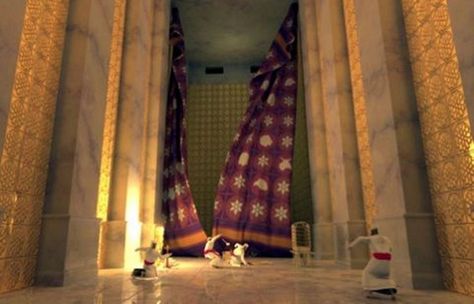
Temple Veil Torn from Top to Bottom
"FRESHLY SLAUGHTERED"
THE VEIL HAS BEEN TORN
Which He inaugurated (egkanizo) for us through (dia) the veil (katapetasma), that is, His flesh (sarx) - Inaugurated means to make new, bring about the beginning of something, in context a new "way" ("the way" Jn 14:6+). The freshly slaughtered lamb opened a way that had never been open before! The aorist tense indicates this was a past completed action. The indicative mood indicates that this was a reality or an actual event (alluding to the Crucifixion of Christ). Christ's death was the dedication ceremony of the new and living way into God’s presence.
The symbol of distance
became the sign of deliverance.
Through (dia) expresses means or instrumentality—the channel or medium by which an action takes place. In this verse, dia shows the means by which the believer gains access to God’s presence —“through the veil.” Dia answers the question, "How was this new and living way opened?" It was through (dia)—by means of—the tearing of the veil, which symbolizes the death of Christ, His flesh being torn and pierced (Jn 19:34, 37+). In sum, this small word, dia, in effect, tells the whole story of redemption—we come through Him, not around Him; by His death, not by our deeds.
Through the veil—His flesh once torn,
We enter where the light is born;
Through death to life, through blood to grace,
We approach at last, the Father’s place.
The veil (katapetasma), that is, His flesh (sarx) The veil represented restricted access to God—under the Old Covenant only the high priest could enter the Holy of Holies, and that but once a year, and only with blood (Lev 16:1–30+). Thus the veil served as a visible barrier declaring sinful man’s separation from a holy God. At Christ’s death, that barrier was forever removed. The veil of the temple was torn from top to bottom (Matt 27:51+), symbolizing that direct access to God was now open through the blood of Jesus. (cf Heb 4:16+; Ro 5:2+)
The writer of Hebrews explains that the tearing of the veil pictured Christ’s flesh being torn. Indeed, just as the earthly veil was rent, so His flesh was literally pierced and torn (Ps 22:16+; Zech 12:10+; Isa 53:5+; Jn 19:34, 37+; Rev 1:7+). Thus, the old rugged cross transformed the old veil of separation into the new way of salvation—a beautiful yet heart-rending picture of the cost of access: the death of the Son of God.
His death tore the veil;
His life keeps the way open.
When the veil was torn, heaven’s door swung open. What once barred sinners from God became the passage into His presence. His torn flesh turned the barrier into a bridge—the cross changed distance into nearness. What once said ‘Keep out’ now whispers ‘Draw near’—through His torn flesh. The cross transformed the curtain of separation into the corridor of salvation.
The torn veil was God’s invitation.
The cross was the key that opened the door.
The way is new — never old.
The way is living — never closed.
Through the torn flesh of Christ,
the sinner finds not a barrier but a welcome.
John MacArthur asks how did Christ inaugurate this new and living way? - "Through His flesh. And here, His flesh is called a veil. This is interesting. The inner Holy of Holies was separated from the Holy Place by this heavy veil. That was to keep anybody out that wanted to get in. You just couldn’t get in there. This great veil was there. It barred – watch this – it barred man’s access to God, you see. And when the high priest in Israel went into the Holy of Holies on that one day, he just brushed the veil aside and went in. When Christ died, He didn’t brush the veil aside. He split it from top to bottom, and left it wide open (Ed: See diagram above). But there’s even a deeper thought than that here. The writer says the veil is Christ’s flesh. Fantastic thought. What’s he saying? He’s saying this: As long as Christ stayed alive, and as long as He was living, the way to God was barred, even though He was telling us about God. Christ came into the world and said this and this and so about God, and if He remained alive, and if His flesh was never torn on the cross, then the way was never open. But when the flesh of Jesus Christ was ripped asunder at the cross, the way to God was open. And so Christ’s flesh, in a very real sense, veiled off God until it was rent. Do you see? Until Christ’s flesh was split, the way to God was barred, even though He was here. An uncrucified Savior is no savior at all. If Jesus just came into the world, talked a lot, said what He wanted us to do and left, the way would still be barred, wouldn’t it? He had to die and rise again, so that we could die to sin and live to God. So as long as in the flesh He was alive, it was a veil. When He died, the veil of His flesh was rent, and the way to God was opened. And it was symbolized as the veil in the temple was split and access to God was provided. And so the Messiah had provided actual entrance into the presence of God. The reality had come. And all the Old Testament things could fall away. They were no longer needed. He opened the way. But not only did He open it.
The veil was torn, the way made new,
Through crimson path and pain;
The Life was slain that life might bloom,
Through death, the Lamb was slain.
He died that I might live again,
His cross my only plea;
I die each day to self and sin,
That Christ might live in me.
William MacDonald - In order for us to have access into God's presence, the veil had to be rent, that is, His body had to be broken in death. This reminds us that we cannot draw near by Christ's sinless life, but only by His vicarious death. Only through the mortal wounds of the Lamb can we go in. Every time we enter God's presence in prayer or worship, let us remember that the privilege was bought for us at tremendous cost. (Borrow Believer's Bible Commentary)
Kenneth Wuest on the veil - This entering into the Holy of Holies which the Messiah inaugurated for sinners was by way of a freshly-slain and living road, and this road went “through the veil, that is to say, His flesh.” The inner veil of the tabernacle separated the Holy Place from the Holy of Holies. It barred man’s access to God. When the high priest in Israel went into the Holy of Holies, he brushed aside that veil. The writer speaks of Messiah’s humanity, as the veil through which the entrance into the heavenly Holy of Holies was made. As the veil in the tabernacle of Israel while it was not rent, barred man’s access to God, so Messiah’s humanity, before it was rent on the Cross, barred man’s access to God. An uncrucified Saviour is no Saviour. When the Messiah died on the Cross, the veil of the temple was rent by the unseen hand of God, showing Israel two things, that the Messiah had now provided the actual entrance for the sinner into the presence of God, and that the symbolic sacrifices were to be discontinued, for the Reality to whom they pointed had come (Heb 9:7–10). The unsaved Jew of the first century who had made a profession of Messiah but had not placed a heart faith in Him for salvation, is now exhorted to do the latter, the writer using Jewish terminology and typology in his exhortation. (Hebrews Commentary online)
Let us never try to pray without Christ;
never try to sing without Christ;
never try to preach without Christ.
C H Spurgeon on the rent veil - The precept to keep back is abrogated, and the invitation is, “Come to me, all of you who labor and are burdened” (Mt 11:28+). “Let us draw near” is now the filial spirit of the gospel. How thankful I am for this! What a joy it is to my soul! Some of God’s people have not yet realized this gracious fact, for still they worship afar off. Much prayer is to be highly commended for its reverence but it has in it a lack of childlike confidence. I can admire the solemn and stately language of worship that recognizes the greatness of God, but it will not warm my heart nor express my soul until it has also blended with the joyful nearness of that perfect love that drives out fear (1John 4:18) and ventures to speak with our Father in heaven as a child speaks with its father on earth. In the East, men express their sorrow by rending their garments. The temple, when it beheld its Master die, seemed struck with horror and rent its veil. Shocked at the sin of man, indignant at the murder of its Lord, in its sympathy with Him who is the true temple of God the outward symbol tore its holy vestment from the top to the bottom. Did not the miracle also mean that from that hour the whole system of types and shadows and ceremonies had come to an end? The ordinances of an earthly priesthood were rent with that veil. The veil has not been merely lifted up for a while, and then dropped down again; it is not rolled up ready for future use; it is rent in twain, destroyed. Since Jesus has died, there is no separation now between the believer and his God except by means of such a veil as our base unbelief may please to hang up. The crimson way of Christ’s shed blood lies open to all believers; therefore, “let us approach with a true heart in the full assurance of faith, having our hearts sprinkled clean from an evil conscience, and our bodies washed with pure water” (Heb 10:22). Whoever beneath the wide heavens is conscious of the plague of his own heart, or has anything that plagues him or anything that troubles him, may turn his eyes towards Christ, the true temple, with a certainty that God will hear his prayer and answer his request and send to him deliverance. “We have an altar” (Heb 13:10+), and that altar is our Lord’s own blessed person; we have but one, and we tremble for those who set up another, but to that one we look with confident hope, being assured that the sacrifice once offered there has made our peace with God, and procured acceptance for our supplications. Let us never try to pray without Christ; never try to sing without Christ; never try to preach without Christ. Let us perform no holy function, nor attempt to have fellowship with God in any shape or way, except through the rent that He has made in the veil by His flesh, sanctified for us, and offered upon the cross on our behalf. (Full sermon The Rent Veil)
F F Bruce - So here, as is indicated by the words “through the curtain (veil),” it is to the very throne of God that believers in Christ have free entry—not to the material symbol of his throne where, as in the pre-exilic holy of holies, his invisible presence was upborne by the cherubim; but to his true and spiritual dwelling. Believers have no need to ask “Who shall ascend into heaven?” when it is a question of their approaching God; here upon earth they may enter his heavenly abode and know direct communion with him “by Jesus’ blood.”84 He who, “by virtue of his own blood, entered the holy place once for all” (9:12) has procured for his people equal right of entry there by means of that same blood—that is, on the ground of his accepted sacrifice. (See The Epistle to the Hebrews - Page 250)
We are invited into
the Holy of Holies itself.
John Phillips - the believer is given, by God, a tremendous welcome. Mention is made of the place of access. The believer is invited to do something only the high priest of Israel could do: have “boldness to enter into the holiest by the blood of Jesus” (10:19). We are invited into the Holy of Holies itself. (Borrow Exploring Hebrews page 126)
We are invited in—
Not to the courts afar,
But through the torn and crimson veil,
Beyond the outer bar.
The way once closed by sin,
Now radiant, open lies;
The blood of Christ has bid us come,
Where mercy never dies.
No priest need lead us there,
No incense-clouded plea;
The Lamb Himself our entrance won—
His wounds the only key.
So let us draw in near,
With hearts made pure and true;
The Holy of Holies welcomes now—
And God Himself meets you.
New (4372) (prosphatos from prós = towards, near and in context nearness of time + phéno = to kill, slaughter or phatos from pephamai, the perfect tense of phenein = to kill) is an adjective which literally describes that which is newly slain, freshly slaughtered or newly killed (See Ex 26:31, 32, 33; 35:12;40:3, Mt 27:50, 51) By extension (as used here in Heb 10:20 and in the Lxx uses below), prosphatos means newly made or new and different (recent). It describes some thing (in this case some WAY) not previously available. The idea of new in the context of Heb 10:20 is not only in the sense that it is a way which was before unknown but also one that retains its freshness and never grows old. Compare the related adverb prosphatōs, lately, recently, Acts 18:2 ("recently come")
Vincent - “The original sense would be, ‘newly slain.’ … Later the word was weakened into ‘new.’ ”
Gilbrant on prosphatos - In the classical literature the word has the connotation of “new” in the sense of “recent” or “lately.” In the papyri it is often used in the sense of fresh food (see Moulton-Milligan). In the Septuagint the word is used to indicate something new or different. In Psalm 81:9 (LXX 80:9) the Psalmist talks about the people worshiping “strange (or new) gods,” and in Ecclesiastes 1:9 Solomon bemoans the fact there is “no new thing under the sun.” (Complete Biblical Library Greek-English Dictionary)
Maurer on prosphatos - In the NT the adjective occurs only at Heb. 10:20: "which (access) he has newly established for us by a new and living way through the veil, i.e., his flesh." The transition to the admonitory (exhortation) part of Hebrews (Heb 10:19 ff.) sums up once again the results of the work of Christ. Through the definitive sacrifice of the High-priest Jesus the new community possesses a hitherto unrevealed (Heb 9:8) right of access to the sanctuary, i.e., to God Himself (cf. Heb 9:24), Heb 10:19. The result of the work of Jesus is a newly made way which is now open for use. Two thoughts are here combined in prosphatos. In time the revelation in Christ is the new thing compared with which the old way to the holy of holies has now been done away as a mere shadow of what was to come, cf. Heb 8:13; 10:1. But there is also a qualitative aspect. As the way is shown to be living by its powerful effects (cf. Hebrews 4:12; Hebrews 7:25), so prosphatos expresses the incorruptible freshness of the new revelation, so that the abandoned rites and ceremonies seem like dead works in comparison with the service of the living God, cf. Heb 9:14. The compressed line of thought in Heb 10:20, which is meant to be an elucidation of Heb 10:19, contains a rather obscure parallel. The idea of ἐν τῷ αἵματι Ἰησοῦ is taken up again in [δὶ] τῆς σαρκὸς αὐτοῦ and said to be the basis of the right of access. The new way no longer leads via the old offerings, i.e., through the veil of the temple. It is via the event of redemption in the person and death of Jesus, i.e., through His flesh. Jesus and the ancient veil are at one in granting access, the one to the holy of holies in the type, the other to the full presence of God. (Theological Dictionary of the New Testament - Theological Dictionary of the New Testament – Volume VI)
Wuest - The word “new” in the Greek text is very interesting. It is prosphaton, made up of pros meaning “near to,” and phatos from pephamai the perfect of phenein “to kill.” The original meaning of the total word is “newly-slain.” Here the contrast is between the “old-slain road” of the earthly tabernacle where the high priest would sprinkle the blood of the sacrificial animal seven times on the ground as he approached the mercy seat in the Holy of Holies (Lev. 16:14), and the freshly-slain road into the Holy of Holies of heaven, sprinkled with the blood of the Lamb of God. Over this latter road is the Jewish recipient of this letter urged to come. The old road to the mercy seat of the tabernacle in Israel was a dead road. There was no life there. It was all symbolism, an index-finger pointing to the reality with which this first-century Jew was then faced. In the new road was life. (Hebrews Commentary online)
NKJV Study Bible Note - Because Christ shed His blood to prepare the way for us to enter the Most Holy Place, this way is “a freshly slain way,” a way ever fresh because of the eternal efficacy of Jesus’ blood. At the same time, this is the living way, for this way leads to our source of spiritual life, namely God Himself. Therefore, this way, prepared by Jesus’ death, leads to eternal life.
Phosphatos - only here in NT and 4x in the Septuagint (below)
Numbers 6:3 he shall abstain from wine and strong drink; he shall drink no vinegar, whether made from wine or strong drink, nor shall he drink any grape juice nor eat fresh (Heb = lach = fresh, new; Lxx = prosphatos) or dried grapes.
Deuteronomy 32:17 "They sacrificed to demons who were not God, To gods whom they have not known, New gods who came lately (NET = recently), Whom your fathers did not dread.
Psalm 81:9 "Let there be no strange (Lxx = prosphatos = "new") god among you; Nor shall you worship any foreign god.
Ecclesiastes 1:9 That which has been is that which will be, And that which has been done is that which will be done. So there is nothing new (Heb - chadash - new; Lxx = prosphatos) under the sun.
Inaugurated (1457)(egkainizo from en = in or at + kainizo = to make new from kainos = that which is new kind unprecedented, novel, uncommon, unheard of, not previously present) means to renew, to make new, to cause to go into effect, with the root word kainos giving the implication of something being newly established or not previously present. It denotes putting something into operation for the first time, especially in a sacred or covenantal sense. It means to cause something to be used for the first time. Egkainizo is used in the Septuagint to mean renew (the kingdom - 1Sa 11:14) and dedicate (the house of the Lord - 1Ki 8:63) To consecrate, to innovate, to initiate, to dedicate. To bring in as new. The idea of egkainizo is to introduce something new with the concepts of inauguration and dedication closely related. To renew qualitatively or make qualitatively new or initiate its qualitatively different effect or to innovate or begin its operation. In other words now "under the new (kainos) covenant the blood of Christ dedicates, or consecrates, all things for the believer, and renders them acceptable to God." (Vine)
Egkainizō in Hebrews carries the idea of inauguration through sacrifice. The old covenant was inaugurated with animal blood. The new covenant was inaugurated with the blood of Christ. So the term emphasizes both newness (kainos) and dedication through blood — the formal beginning of a new way of access to God. The old covenant altar was inaugurated by the blood of bulls, but the new covenant was inaugurated by the blood of the Lamb. Christ didn’t merely open a door — He consecrated a new and living way for us to enter God’s presence.
The only other NT use is Heb 9:18 "Therefore even the first covenant was not inaugurated without blood."
EGKAINIZO - 9X IN SEPTUAGINT - Deut. 20:5; 1 Sam. 11:14; 1 Ki. 8:63; 2 Chr. 7:5; 2 Chr. 15:8; Ps. 51:10; Isa. 16:11; Isa. 41:1; Isa. 45:16 The word is used in the LXX of the inauguration of a house, kingdom, temple, altar.
1 Kings 8:63+ Solomon offered for the sacrifice of peace offerings, which he offered to the LORD, 22,000 oxen and 120,000 sheep. So the king and all the sons of Israel dedicated (Lxx - egkainizo) the house of the LORD.
Psalm 51:10 Create in me a clean heart, O God, And renew (Lxx - egkainizo) a steadfast spirit within me.
Veil (2665)(katapetasma from [Source = W E Vine] kata = before + petannumi = that which is spread out) hence a veil. It describes that which is spread out downward and thus a curtain, clothe drape or veil. One purpose of a veil is to conceal, to hide or to obscure, in the case of the Tabernacle and Temple, to conceal the presence of God manifest by the Ark of the Covenant from man.
Katapetasma - 6x in 6v in NAS:
Matthew 27:51 And behold, the veil of the temple was torn in two from top to bottom; and the earth shook and the rocks were split.
Mark 15:38 And the veil of the temple was torn in two from top to bottom.
Luke 23:45 because the sun was obscured; and the veil of the temple was torn in two.
Hebrews 6:19 This hope we have as an anchor of the soul, a hope both sure and steadfast and one which enters within the veil,
Hebrews 9:3 Behind the second veil there was a tabernacle which is called the Holy of Holies,
Hebrews 10:20 by a new and living way which He inaugurated for us through the veil, that is, His flesh
Katapetasma - 35x in 33v in the non-apocryphal Septuagint (LXX) -Ex 26:31, 33 (3x), Ex 26:34, 35, 37; 27:21; 30:6; 35:12; 37:3, 5, 16; 38:18; 39:4, 19; 40:3, 5, 21f, 26; Lev 4:6, 17; 16:2, 12, 15; 21:23; 24:3; Nu 3:10, 26; 4:5, 32; 18:7; 1Ki 6:36; 2Chr 3:14
ISBE entry...VEIL (2) - (1) katapetasma): In Exodus, Leviticus, Numbers, the veil that hung between the two holy chambers of the tabernacle is mentioned 23 times (Ex 26:31, etc.). In several places it is termed "the veil of the screen" and it is distinguished from "the screen for the door of the tabernacle" (Ex 35:12,15; 39:34,38). By the latter is meant the curtain that hung outside the holy place, i.e. at the tabernacle entrance. Ex 26:31 informs us that the veil was made of fine-twined linen, and that its colors were blue and purple and scarlet. It was embroidered with cherubim. At each removal of the tabernacle the veil was used to enwrap the ark of the testimony (Nu 4:5). From its proximity to this central object of the Hebrew ceremonial system, the veil is termed "the veil of the testimony" (Lev 24:3), "the veil which is before the testimony" (Ex 27:21), etc. In Solomon's Temple the veil is mentioned but once (2Chr 3:14). It was protected by doors of olive wood (1Ki 6:31). In the later temple it is alluded to in 1 Macc 1:22. Its presence in Herod's temple is attested by the statement in each of the Synoptists that at the time of Christ's death the veil of the temple was rent from top to bottom, or in the midst (Mt 27:51; Mk 15:38; Lk 23:45; compare in Mishna, Mid. ii. 1; iv.7). This fact is the basis of the profound truth expressed by the writer to the Hebrews that Jesus, by His sacrificial death, opened for all believers a way into the holiest "through the veil, that is to say, his flesh" (Heb 10:20).
Flesh (4561)(sarx) has a variety of meanings but in context refers to the physical body of Jesus. Flesh in the book of Hebrews refers to the incarnation of Jesus (Heb 2:14+; He 5:7+). The death of His flesh was the state through which He had to pass before He might enter heaven on our behalf (as our Great High Priest) (He 2:9-18; 5:7, 8, 9; 10:5). Believers have the glorious privilege of approaching God directly (cp Ro 5:1, 2+). Jesus Himself explained the efficacy of His flesh (and the sacrifice thereof) declaring that "the life of the world is My flesh." (Jn 6:51)
SARX -126V - Heb. 2:14; Heb. 5:7; Heb. 9:10; Heb. 9:13; Heb. 10:20; Heb. 12:9;
Hebrews 2:14 Therefore, since the children share in flesh and blood, He Himself likewise also partook of the same, that through death He might render powerless him who had the power of death, that is, the devil,
Hebrews 5:7 In the days of His flesh, He offered up both prayers and supplications with loud crying and tears to the One able to save Him from death, and He was heard because of His piety.
Hebrews 9:10 since they relate only to food and drink and various washings, regulations for the body imposed until a time of reformation.
Hebrews 9:13 For if the blood of goats and bulls and the ashes of a heifer sprinkling those who have been defiled sanctify for the cleansing of the flesh,
Hebrews 10:20 by a new and living way which He inaugurated for us through the veil, that is, His flesh,
Hebrews 12:9 Furthermore, we had earthly fathers to discipline us, and we respected them; shall we not much rather be subject to the Father of spirits, and live?
Note the beautiful pictures of Jesus Christ scattered throughout the book of Hebrews:
- Mediator Heb 9:15
- purification ("Purifier") He 1:3
- Author (Captain, Pioneer, Champion, Leader) Heb 2:10, cf Heb 12:2
- propitiation ("Propitiator") Heb 2:17
- Source (Heb 5:9),
- Anchor (Heb 6:19),
- Forerunner (Heb 6:20),
- Torn Veil (Heb 10:20),
- Great Shepherd (Heb 13:20)
Today in the Word - Foreign leaders who come to Washington, D.C. for state visits are often stunned to learn that ordinary American citizens are allowed inside the White House. When George Bush was president, he would often introduce his foreign guests to the people who came for daily tours of the presidential mansion's first floor. One writer says, "The White House's accessibility continues to stagger visiting heads of state." For many of the world's kings and rulers, these times are too dangerous to allow access to their palaces, much less to their presence. But there is no such difficulty in heaven. We who have put our faith in Christ have free, unlimited access into God's presence. Today's verse and Scripture reading teach the truth of our freedom to come before God confidently in prayer. (MBI - Today in the Word)
Brian Bell - Heb 10:20 Veil – once a barrier now a portal (gate/entrance).
Charles Wesley stated it best,
Veiled in flesh, the Godhead see,
Hail the incarnate Deity
Pleased as man with man to dwell,
Jesus, our Emmanuel.
QUESTION - What was the significance of the temple veil being torn in two? GOTQUESTIONS.ORG WATCH VIDEO
ANSWER - During the lifetime of Jesus, the holy temple in Jerusalem was the center of Jewish religious life. The temple was the place where animal sacrifices were carried out and worship according to the Law of Moses was followed faithfully. Hebrews 9:1-9 tells us that in the temple a veil separated the Holy of Holies—the earthly dwelling place of God’s presence—from the rest of the temple where men dwelt. This signified that man was separated from God by sin (Isaiah 59:1-2). Only the high priest was permitted to pass beyond this veil once each year (Exodus 30:10; Hebrews 9:7) to enter God’s presence for all of Israel and make atonement for their sins (Leviticus 16).
Solomon’s temple was 30 cubits high (1 Kings 6:2), but Herod had increased the height to 40 cubits, according to the writings of Josephus, a first-century Jewish historian. There is uncertainty as to the exact measurement of a cubit, but it is safe to assume that this veil was somewhere near 60 feet high. An early Jewish tradition says that the veil was about four inches thick, but the Bible does not confirm that measurement. The book of Exodus teaches that this thick veil was fashioned from blue, purple, and scarlet material and fine twisted linen.
The size and thickness of the veil make the events occurring at the moment of Jesus’ death on the cross so much more momentous. “And when Jesus had cried out again in a loud voice, he gave up his spirit. At that moment the curtain of the temple was torn in two from top to bottom” (Matthew 27:50-51a).
So, what do we make of this? What significance does this torn veil have for us today? Above all, the tearing of the veil at the moment of Jesus’ death dramatically symbolized that His sacrifice, the shedding of His own blood, was a sufficient atonement for sins. It signified that now the way into the Holy of Holies was open for all people, for all time, both Jew and Gentile.
When Jesus died, the veil was torn, and God moved out of that place never again to dwell in a temple made with human hands (Acts 17:24). God was through with that temple and its religious system, and the temple and Jerusalem were left “desolate” (destroyed by the Romans) in A.D. 70, just as Jesus prophesied in Luke 13:35. As long as the temple stood, it signified the continuation of the Old Covenant. Hebrews 9:8-9 refers to the age that was passing away as the new covenant was being established (Hebrews 8:13).
In a sense, the veil was symbolic of Christ Himself as the only way to the Father (John 14:6). This is indicated by the fact that the high priest had to enter the Holy of Holies through the veil. Now Christ is our superior High Priest, and as believers in His finished work, we partake of His better priesthood. We can now enter the Holy of Holies through Him. Hebrews 10:19-20 says, “We have confidence to enter the Most Holy Place by the blood of Jesus by a new and living way opened for us through the curtain, that is, his body.” Here we see the image of Jesus’ flesh being torn for us just as He was tearing the veil for us.
The profound significance of the tearing of the veil is explained in glorious detail in Hebrews. The things of the temple were shadows of things to come, and they all ultimately point us to Jesus Christ. He was the veil to the Holy of Holies, and through His death the faithful now have free access to God.
The veil in the temple was a constant reminder that sin renders humanity unfit for the presence of God. The fact that the sin offering was offered annually and countless other sacrifices repeated daily showed graphically that sin could not truly be atoned for or erased by mere animal sacrifices. Jesus Christ, through His death, has removed the barriers between God and man, and now we may approach Him with confidence and boldness (Hebrews 4:14-16).
Judson W. VanDeVenter had erected a veil between himself and God! But while singing in a choir during a revival campaign in Sharon, Pennsylvania, he responded to the invitation and committed his life to the Lord’s service. He forsook all and became an evangelist, ministering in America, England, and Scotland. Years later he wrote about his commitment in the famous hymn...
All to Jesus I surrender,
All to Him I freely give;
I will ever love and trust Him,
In His presence daily live.
All to Jesus I surrender;
Humbly at His feet I bow,
Worldly pleasures all forsaken;
Take me, Jesus, take me now.
All to Jesus, I surrender;
Make me, Savior, wholly Thine;
Let me feel the Holy Spirit,
Truly know that Thou art mine.
All to Jesus I surrender,
Lord, I give myself to Thee;
Fill me with Thy love and power,
Let Thy blessing fall on me.
All to Jesus I surrender;
Now I feel the sacred flame.
O the joy of full salvation!
Glory, glory, to His Name!
Refrain
I surrender all, I surrender all,
All to Thee, my blessèd Savior,
I surrender all.
Horatius Bonar has an interesting article on the The New Things Of God
And the one sitting on the throne said, "Look, I am making all things new!" And then he said to me, "Write this down, for these words are true and faithful."—Revelation 21:5.
There are many 'new things' spoken of in Scripture, some of more, and some of less importance. Of the less important we have such as these—Samson's new cords (Judges 15:13); David's new cart for the ark (2Samuel 6:7); the new sword of the giant who sought to slay David (2Samuel 21:16); Elisha's new cruse (2Kings 2:20) the new tongues of Pentecost (Matthew 16:17); Joseph's new tomb (Matthew 27:60). These are not so directly connected with things spiritual and eternal, and so we may call them of less importance; yet they have all their important lessons.
But let us take up the following as specially the new things of God—
I. The new TESTAMENT or covenant (Matthew 26:28). That which was old has vanished away. It was insufficient; it could not help the sinner; it said nothing of forgiveness. But the new covenant is all a sinner needs; it comes at once with a free pardon; it presents a work done for the sinner, not a work for the sinner to do. The motto or theme of the new covenant is, 'Their sins and iniquities will I remember no more.'
II. The new MAN (Ephesians 4:24). This seems to correspond with the 'new creature' (2 Corinthians 5:17); with the 'new heart' (Ezekiel 18:31); with the 'new spirit' (Ezekiel 11:9); with the 'heart of flesh' (Ezekiel 36:26); with the 'new birth' (John 3:3); and the being 'begotten again' (1 Peter 1:3). It supposes the destruction or removal of the old man and the creation of the new—this new thing being the workmanship of God, the production of the Holy Spirit. Newness of nature, or heart, of life, of words, of the entire being, is the basis of all religion and true worship.
III. The new WAY (Hebrews 10:19). The approach or access to God by the sinner is said to be by a 'new and living way'—that way being Christ Himself, for through Him we have access by on Spirit to the Father. It is a new way in contrast with Adam's old way; a new way, because newly made by Him who had newly died; a way into the holiest; a way through the veil, by means of the blood. All God's dealings with the sinner are on a new footing, that of free love, simple grace. It is a free way, a sufficient way, an open way, a perfect way. He who walks thereon is safe; for the way not only leads to life, but is the life. Yes, life and truth are in Him who is the way; for Christ is all and in all.
IV. The new SONG (Psalm 33:3; Revelation 5:9). Every new day brings with it a new song; or rather it brings materials for many new songs, which we should be always singing. Our whole life should be full of new songs. Yet the old songs are not thereby made obsolete; they do not grow tame or unmeaning. As the old songs of a land are always fresh and sweet, so is it with the old songs of faith. They never come amiss, and they help us with the new. These new songs have to do with the past—for often, in looking into the past, we get materials for a new song—with the present, and with the future. They are connected with ourselves, our families, with the Church, with our nation, with the work of God just now, with resurrection, with the restitution of all things, with the glory, the new Jerusalem, and the new creation. It is specially with the last that the new song of the Apocalypse is connected,
V. The new COMMANDMENT (John 13:34; 1 John 2:8). It is both an old and a new commandment which Christ gives us; substantially the same as from the beginning, yet in many respects altogether new; a new lawgiver, a new motive, a new standing-place (Zion, not Sinai), new light fullness; everything in the commandment now connected with Christ Himself and with His love. This new commandment bases itself on 'God is love,' and revolves round the cross. Love me, says the Master; love one another with a pure heart fervently; love the brethren as I have loved you—thus fulfilling both the old and the new commandment at the same time, more—treating them as one.
VI. The new WINE (Matthew 26:29). In one sense the Lord's Supper is new wine; and there we remember His love, which is 'better than wine.' But Christ, in using the expression, 'until I drink it new with you,' refers to the heavenly feast, the marriage supper of the Lamb. There is in the highest sense and degree 'the new wine'—wine made from no earthly vine, but from him who is the true vine, and from the juice of whose grapes there comes the new and royal wine, the wine of the kingdom. He is Himself the giver and the gift. His blood is drink indeed here—much more hereafter. It is 'new' here—it will much more new hereafter.
VII. The new Jerusalem (Revelation 3:12, 21:3, 10). This is no earthly city. It is not the old Jerusalem rebuilt; that is another thing. This is a new and more glorious city, heavenly and divine, which comes down out of heaven from God; and it has the glory of God and of the Lamb. It is altogether new; for the risen and the glorified; for God's kings and priests; the city and the palace of the Great King.
VIII. The new HEAVENS and new EARTH (Isaiah 65:17; 2 Peter 3:13). The whole of what God had made, and which sin had defiled, is made new. The universe is renewed; it is the restitution of all things; it is the replacing of all creation on a higher and more glorious footing, from which there shall be no second fall. There dwells righteousness; it is the kingdom of the righteous King.
IX. The new NAME (Revelation 2:17). This is for the dwellers in the new Jerusalem, the inhabitants of the new heavens and earth. Let us consider what it is and what it means. What the actual individual name is we know not; it will be as unlike the past as 'Israel' (the prince with God) was unlike 'Jacob' (the supplanter). It will be—
(1) A name of love—The Father's love will be in it—Christ's love will be in it.
(2) A name of honor—It will be no mean nor common name—but glorious and celestial.
(3) Of blessing—It will proclaim blessing—it will be a name of blessing—a blessed name.
(4) A name of wonder—It will astonish the possessor, and everyone who hears it; no one shall know it or guess it until it comes out. As Christ's new name is one which no one knows but Himself (Revelation 19:12), so with the conqueror. It will be a name of glad astonishment.
(5) Given by Christ—'I will give.' As He gave names to Abram, Jacob, Peter, John—so will He give this new name, superseding our old earthly appellation.
(6) A name most suitable and characteristic—It will in itself condense and summarize our past history and character, or perhaps our eternal prospects, as seen by God Himself. It will be a name full of divine meaning—interpretative, perhaps, of God's dealings with us, and indicative of His love.
(7) A name contained in a white stone—The white stone is the stone of acquittal. In that stone of acquittal the new name is inscribed by Christ. It is as an acquitted man, a conqueror, one to whom the Master says, 'Well done,' that we get the name. It is the everlasting seal of forgiving love.
They shall see His face, and His name shall be in their foreheads. The Father's name is there (Revelation 3:12, 14:1). But this new name is something more. What manner of love is this
F B Meyer on the veil...
THE VEIL -Passed only once a year by the high-priest, carrying blood, reminded the worshipers that the way into the holiest was not yet perfect. There were degrees of fellowship with God to which those rites could give no introduction. "The way into the holiest was not yet made manifest." (He 9:8) "The veil, that is to say, his flesh" (Heb. 10:20).
Oh, fine twined linen, in thy purity,
thou wert never so pure as that body
which was conceived without sin!
Oh, exquisite work of curious imagery,
thou canst not vie with the marvelous mysteries
that gather in that human form!
Yet, till Jesus died, there was a barrier, an obstacle, a veil. It was bespattered with blood, but it was a veil still. But at the hour when he breathed out his soul in death, the veil was rent by mighty unseen hands from top to bottom, disclosing all the sacred mysteries beyond to the unaccustomed eyes of any priests who at that moment may have been burning incense at the hour of prayer, while the whole multitude stood without (Luke 1:9). It is a rent veil now, and the way into the holiest lies open. It is new and living and blood-marked; we may therefore tread it without fear or mistake, and pass in with holy boldness to stand where angels veil their faces with their wings in ceaseless adoration (Heb. 9:19, 20). (F. B. Meyer. The Way Into the Holiest)
Andrew Murray
Enter into the Holiest. This word brought us the message of the Epistle. Christ has in very deed opened the Holiest of All for us to enter in and to dwell there. The Father would have His children with Him in His holy home of love and fellowship, abiding continually all the time. The Epistle seeks to gather all in. Having boldness to enter, let us draw near!
It may be that some, as in the study of the Epistle the wondrous mystery of the way into the Holiest now opened was revealed to them, have entered in; they have said, in faith: Lord, my God; I come. Henceforth I would live in Thy secret place, in the Holiest of All. And yet they fear. They are not sure whether the great High Priest has indeed taken them in. They know not for certain whether they will be faithful, always abiding within the veil. They have not yet grasped what it means--having boldness to enter in.
And there may be others, who have with longing, wistful hearts, heard the call to enter in. and yet have not the courage to do so. The thought that a sinful worm can every day and all the day dwell in the Holiest of All is altogether too high. The consciousness of feebleness and failure is so strong, the sense of personal unfaithfulness so keen, the experience of the power of the world and circumstances, of the weakness of the flesh and its efforts, so fresh, that for them there is no hope of such a life. Others may rejoice in it, they must even be content without it. And yet the heart is not content.
To both such, those who have entered but still are full of fears, and those who in fear do not enter, the Holy Spirit speaks--To-day, if you shall hear His voice, harden not your hearts; Having boldness in the blood of Jesus to enter into the Holiest, let us draw nigh. The boldness with which we are to enter is not, first of all, a conscious feeling of confidence; it is the objective God-given right and liberty of entrance of which the blood assures us. The measure of our boldness is the worth God attaches to the blood of Jesus. As our heart reposes its confidence on that in simple faith, the feeling of confidence and joy on our part will come too, and our entrance will be amid songs of praise and gladness.
Boldness in the blood of Jesus. Everything depends upon our apprehension of what that means. If the blood be to us what it is to God, the boldness which God means it to give, will fill our hearts. As we saw in Hebrews 9, what the blood has effected in rending the veil and cleansing the heavens, and giving Jesus; the Son of Man, access to God, will be the measure of what it will effect within us, making our heart God's sanctuary, and fitting us for perfect fellowship with the Holy One. The more we honour the blood in its infinite worth, the more will it prove its mighty energy and efficacy, opening heaven to us and in us, giving us, in divine power, the real living experience of what the entrance into the Holiest is.
The blood of Jesus. The life is the blood. As the value of this life, so the value of the blood. In Christ there was the life of God; infinite as God is the worth and the power of that blood. In Christ there was the life of man in its perfection; in His humility, and obedience to the Father, and self-sacrifice, that which made Him unspeakably well-pleasing to the Father. That blood of Jesus, God and man, poured out in a death, that was a perfect fulfilment of God's will, and a perfect victory over all the temptations of sin and self, effected an everlasting atonement for sin, and put it for ever out of the way, destroying death and him that had the power of it. Therefore it was, that in the blood of the everlasting covenant Jesus was raised from the dead; that in His own blood, as our Head and Surety, He entered heaven; and that that blood is now for ever in heaven, in the same place of honour as God the Judge of all, and Jesus the Mediator (Hebrews 12:24). It is this blood, now in heaven before God for us, that is our boldness to enter in, even into the very Holiest of All.
Beloved Christian! The blood of Jesus! The blood of the Lamb! Oh think what it means. God gave it for your redemption. God accepted it when His Son entered heaven and presented it on your behalf. God has it for ever in His sight as the fruit, the infinitely well-pleasing proof, of His Son's obedience unto death. God points you to it and asks you to believe in the divine satisfaction it gives to Him, in its omnipotent energy, in its everlasting sufficiency. Oh, will you not this day believe that that blood gives you, sinful and feeble as you are, liberty, confidence, boldness to draw nigh, to enter the very Holiest? Yes, believe it, that the blood and the blood alone, brings you into the very presence, into the living and abiding fellowship of the everlasting God. And let your response to God's message concerning the blood, and the boldness it gives you be nothing less than this, that this very moment you go with the utmost confidence, and take your place in the most intimate fellowship with God. And if your heart condemn you, if coldness or unbelief appear to make a real entrance impossible, rest not till you believe and prove to the full the power of the blood indeed to bring you nigh. Having boldness by the blood of Jesus,--what then--let us draw nigh!
1. Which is now greater in your sight: your sin or the blood of Jesus? There can be but one answer, Then draw nigh, and enter in, into the Holiest of All. As your sin has hitherto kept you back, let the blood now bring you nigh. And the blood will give you the boldness and the power to abide.
2. "One drop of that blood, coming out of the Holiest on the soul, perfects the conscience, makes that there is no more conscience of sin, and enables us to live in the fellowship of God and His Son. Such a soul, sprinkled with the blood, is able to enjoy the heavenly treasures, and to accomplish the heavenly service of the living God."
3. And that blood, such is its heavenly cleansing power, can keep the soul clean. "If we walk in the light, as He is in the light," if me live in the Holiest, in the light of His countenance, "we have fellowship one with another, and the blood of Jesus Christ, His Son, cleanseth us from all sin," so that no sin touch us, whereby we lose the fellowship with the Father.
4. Understand how the Father's heart longs that His children draw near to Him boldly. He gave the blood of His Son to secure It. Let us honour God, and honour the blood, by entering the Holiest with great boldness.
Andrew Murray. The Holiest of All
Hebrews 10:21 and since we have a great priest over the house of God, (NASB: Lockman)
Greek: kai hierea megan epi ton oikon tou theou
BGT καὶ ἱερέα μέγαν ἐπὶ τὸν οἶκον τοῦ θεοῦ,
Amplified: And since we have [such] a great and wonderful and noble Priest [Who rules] over the house of God, (Amplified Bible - Lockman)
Barclay: and since we have a great High Priest who is over the house of God, (Westminster Press)
NLT: And since we have a great High Priest who rules over God's people, (NLT - Tyndale House)
NKJ and having a High Priest over the house of God,
NET and since we have a great priest over the house of God,
CSB and since we have a great high priest over the house of God,
ESV and since we have a great priest over the house of God,
NIV and since we have a great priest over the house of God,
Phillips: Further, since we have a great High Priest set over the household of God, (Phillips: Touchstone)
Wuest: and having a Priest, a Great One, over the house of God,
Young's Literal: and a high priest over the house of God,
- A great high priest - He 2:17; 3:1; 4:14, 15, 16; 6:20; 7:26; 8:1
- House of God - Heb 3:3-6; Mt 16:18; 1Co 3:9-17; 2Co 6:16,17; Eph 2:19-22; 1Ti 3:15
- Hebrews 10 Resources - Multiple Sermons and Commentaries
- Hebrews 10:19-39 The Danger of Defection - John MacArthur (excellent sermon including several illustrations)
- Click for 5W/H Study Questions — ideal for leading a group or personal study of Hebrews
Related Passages:
Hebrews 4:14-16+ Therefore, since we have a great high priest who has passed through the heavens, Jesus the Son of God, let us hold fast our confession. 15 For we do not have a high priest who cannot sympathize with our weaknesses, but One who has been tempted in all things as we are, yet without sin. 16 Therefore let us draw near with confidence to the throne of grace, so that we may receive mercy and find grace to help in time of need.
1 Peter 2:5+ you also, as living stones, are being built up as a spiritual house for a holy priesthood, to offer up spiritual sacrifices acceptable to God through Jesus Christ.
OUR GREAT PRIEST
OVER GOD'S HOUSE
An alternative title might be "Our Advocate at the Altar of Heaven."
Having just declared that the veil has been torn and the way to God opened through Christ’s flesh, the writer now adds another glorious assurance: we not only have access, but we have an Advocate. The opened way would be of little comfort without a faithful High Priest to welcome, represent, and sustain us there.
And (kai - connective hinge word) - And (kai) connects the previous two privileges or grounds for the following exhortations. In other words (1) We have bold access to God (Heb 10:19–20) and (2) We have a great High Priest over God’s house (Heb 10:21). Together (as linked by the "and" or kai) these are the two reasons for the following “Let us” exhortations (Heb 10:22–25).
A little more technically stated, in context, and (kai) functions as a coordinating conjunction of addition —linking two complementary realities that form the basis of Christian confidence in the three exhortations. Because Christ opened the way (Heb 10:19–20), and because Christ now presides as High Priest (Heb 10:21), therefore, let us draw near, hold fast, and encourage one another (Heb 10:22–25). Thus, and (kai) links not just words, but the two great provisions of grace: the way to God and the mediator with God.
The cross opened the way;
the Christ over God’s house keeps it open.
Since we have a great priest (hiereus) over the house (oikos) of God (theos) - Since we have is added by the translators. Literally the Greek reads - and a high priest over the house of God. This truth was meant to inspire confidence (Heb 10:22, 23). Jesus is not merely a priest but the great Priest, the supreme Mediator who ever lives to make intercession for His people (Heb 7:25). The Old Covenant priest entered a man-made sanctuary once a year, trembling and temporary; but our Priest ministers continually in the true sanctuary—the heavenly Holy of Holies itself. And in a real sense, He now functions as the Living Veil through whom we enter. Just as the Old Testament high priests entered the Holy Place once a year, we, as priests of God (1 Peter 2:9), are now invited to draw near continually—yet we do so through Jesus, the true and living way, the "Living Veil" so to speak.
The veil once torn now welcomes me;
The way once closed is open, free.
Through Jesus’ flesh I find my place—
Before the throne, upheld by grace.
NOTE: Great Priest is just another way to designate Jesus as "High Priest." Why do I say that? Because Hierea megan is the alternative designation for the HIGH PRIEST in the Septuagint Old Testament. (cf. Lv 21:10 = "priest who is highest" Lxx = ho hiereus ho megas); Nu 35:25, 28 where the Lxx the phrase "ho hiereus ho megas" means "the priest, the great").
The torn veil gave us access;
the living Priest gives us advocacy.
Warren Wiersbe comments that "On the basis of these assurances—that we have boldness to enter (ED: ACCESS) because we have a living High Priest (ED: ADVOCACY)—we have an “open invitation” to enter the presence of God. The Old Covenant high priest visited the holy of holies once a year, but we are invited to dwell in the presence of God every moment of each day. What a tremendous privilege! (Bible Exposition Commentary)
William MacDonald reminds us that "Even though we are priests (1 Pet. 2:9+; Rev. 1:6+), yet we still need a Priest ourselves." (Borrow Believer's Bible Commentary)
Kenneth Wuest on great priest - Not only is Messiah now a high priest, but He is a great one, and His greatness is shown by the fact that He is the priest over the actual house of God, the One who by His death on the Cross saves all those who belong to the house of God in all dispensations. (Hebrews Commentary online)
C H Spurgeon - The Israelite could not pass through the veil that hid from public gaze the glory of the Shekinah, and Jesus Christ’s humanity was a veil that somewhat concealed the glory of His Deity. But the flesh of Christ having been crucified, the veil has been rent, and now we may come right up to the throne of God without trembling. We may come even with holy boldness and familiarity, and speak to God without alarm. Having such a privilege as this, let us not neglect it. It was denied to prophets and kings in the olden time; but now that it is given to us, let us avail ourselves of it.
Homer Kent - These two advantages (access to God, and a great priest) should give constant encouragement for a continual approach to God (Borrow The Epistle to the Hebrews : a commentary page 198)
Our Great/High Priest as has been masterfully presented explained by our writer in his argument in Hebrews 4:14+ through Hebrews 7:28+. But even earlier the writer had begun to introduce the truths about Jesus as the "new style" of High Priest...
Hebrews 1:3+ And He is the radiance of His glory and the exact representation of His nature, and upholds all things by the word of His power. When He had made purification of sins (THIS WAS THE WORK OF THE JEWISH HIGH PRIEST IN THE OLD COVENANT), He sat down at the right hand of the Majesty on high;
Hebrews 2:17+ Therefore, He had to be made like His brethren in all things (speaking of Jesus' incarnation), so that He might become a merciful and faithful high priest in things pertaining to God, to make propitiation (satisfactory sacrifice which appeased God the Father) for the sins of the people.
Hebrews 3:1+ Therefore, holy brethren, partakers of a heavenly calling, consider Jesus, the Apostle and High Priest of our confession;
Hebrews 4:14+ Therefore, since we have a great high priest who has passed through the heavens, Jesus the Son of God, let us hold fast our confession. 15 For we do not have a high priest who cannot sympathize with our weaknesses, but One who has been tempted in all things as we are, yet without sin. 16 Therefore let us draw near with confidence to the throne of grace, so that we may receive mercy and find grace to help in time of need.
Hebrews 6:20+ where Jesus has entered as a forerunner for us, having become a high priest forever according to the order of Melchizedek.
Hebrews 7:26+ For it was fitting for us to have such a high priest, holy, innocent, undefiled, separated from sinners and exalted above the heavens;
Hebrews 8:1+ Now the main point in what has been said is this: we have such a high priest, who has taken His seat at the right hand of the throne of the Majesty in the heavens,
Ray Stedman - It would be difficult to overestimate the value of confidence in human motivation. It is the proffered goal of any number of special courses, weekend retreats, training classes and personal development programs today. Confidence training is the cry of the hour. In the first century, too, men clearly understood that a confident spirit was essential to success in any enterprise. But as the psalmist made abundantly clear,
Unless the LORD builds the house,
its builders labor in vain.
Unless the LORD watches over the city,
the watchmen stand guard in vain. (Ps 127:1)
By itself, human effort is doomed to ultimate failure. Only that jointly shared effort, when God works through expectant humanity, can be permanently successful. Confidence born of that conviction will always prevail. But believers have more than a confident spirit. They are also reminded that (2) we have a great priest over the house of God. All that the writer has said about the Melchizedek priesthood of Jesus is recalled here. Believers have not only a confident spirit, but also a competent advocate. He is continually available, completely aware of our present situation, and vitally involved with us in working all things together for good. His great concern is the welfare of each member of the household of God, and “we are his house,” as the writer has told us unmistakably in Heb 3:6. (Let Us Go On!)
Over the house (oikos) of God (theos) - The house is not a place but a people. In other words the phrase does not mean Christ is ruling over a building but over a spiritual household—the community of believers indwelt by the Spirit, God’s family, His redeemed temple (1 Pet 2:5). In other words it refers to the redeemed (Heb 3:6; 1Ti 3:15). Christ rules not as a distant overseer but as a gracious Shepherd, guiding, guarding, and granting continual access to the Father. The Son serves in the sanctuary and supervises the saints
Recall that in Hebrews 3:6 the writer said "Christ was faithful as a Son over His house—whose house we are, if we hold fast our confidence and the boast of our hope firm until the end.” In that passage he was showing that those who persevere until the end are genuine believers and thus are of the household of God. Remember that perseverance does not save them (that is self-effort) but it only shows they are genuine saints (possessing the Spirit Who enables them to persevere). So here in Hebrews 10:21, the author is echoing that earlier truth that Christ, as the Great Priest, is not only in God’s house but over it—He is the divine High Priest, Head, and Steward of the redeemed household.
House of God - This phrase occurs 73 times in the OT so it would have been familiar terminology to the Jewish recipients of this epistle. In the OT it referred to a place, but as discussed below, in the book of Hebrews it refers to a people, not a place.
House of God - 5x in NT: Mt 12:4, Mk 2:26, Lk 6:4, 11:51, Heb 10:21 In the Gospels House of God clearly refers to the Temple of God in Jerusalem.
One other possibility that has been suggested for house of God is that it refers to God's "house" in heaven. This interpretation is unlikely for the writer nowhere else refers to the heavenly sanctuary under the metaphor of the house of God. The other possibility described above is that it is a metaphor for the family of God. Hebrews 3:6 supports the latter interpretation for there we read..
Adam Clarke (Wiersbe, Calvin, et al agree)...The house or family of God is the Christian Church, or all true believers in the Lord Jesus. Over this Church, house, or family, Christ is the High Priest-in their behalf he offers his own blood, and their prayers and praises; and as the high priest had the ordering of all things that appertained to the house and worship of God, so has Christ in the government of his Church.
Simon Kistemaker - The believer has been given double assurance that he may approach God, first, because he has confidence through the shed blood of Christ and, second, because Jesus is the “great priest over the house of God.” Should there be any hesitation at all in the mind of the believer, the writer of Hebrews is saying, let him look to the one and only great priest, Jesus Christ (Heb 4:14). We are exhorted to come to God; in this earthly life we do so in prayer....This great priest never loses sight of those who belong to the house of God, for he and they belong to the same family (Heb 2:11). (Borrow Exposition of the Epistle to the Hebrews page 286)
John MacArthur - Jesus not only opened the way to God but He is now our great priest over the house of God. He does not merely show the way to God, or even just provide the way to God; He takes us with Him to God and ministers for us in heaven. A paraphrase of Romans 5:10 could be: “If His death could do so much to save me, what must His life be doing in the presence of God to keep me!” (See Hebrews Commentary - Page 261)
Today the temple of God is the believer's body! (1Co 3:16, 6:19+, 2Co 6:16)
🙏 THOUGHT - Think about this! Is God able to "rest" in His Temple, your body?
When Chrysostom was brought before the Roman emperor, the emperor threatened him with banishment if he remained a Christian. Chrysostom replied: “You can not banish me for this world is my Father’s house.” “But I will slay you,” said the Emperor. “No, you can not,” said the noble champion of the faith, “for my life is hid with Christ in God.” “I will take away your treasures.” “No, but you can not for my treasure is in heaven and my heart is there.” “But I will drive you away from man and you shall have no friend left.” “No, you can not, for I have a Friend in heaven from Whom you can not separate me. I defy you, for there is nothing you can do to hurt me.”
Priest (2409)(hiereus from hieros = sacred, holy, consecrated to God, English "hierarchy" = leadership) is a sacred or consecrated person who serves deity. Priests in the NT refer primarily to the ceremonial officials of Jesus' day, that group of men who offered Temple sacrifices and carried out the other sacred rites associated with the Jewish Temple and Jewish people (cp Heb 8:4) . Most of the uses of hiereus refer to Jewish priests, but Acts 14:13+ refers to a priest of the pagan cult of Zeus (patron little g god of the city of Lystra). Jesus is our Great High Priest, which describes His primary ministry in our behalf today (Heb 7:1, 3, 11, 14, 15, 17, 20, 21, 23), one aspect of that ministry being His continual intercession for us (Heb 7:25+, Ro 8:34+). Hiereus describes the position and not necessarily a priest’s character (e.g., see Lk 10:31 where a priest was a "bad Samaritan" so to speak). Now here is where it really gets exciting -- in Revelation hiereus describes believers who will rule and reign as priests with Christ the Great Priest -- Read Rev 1:6+, Rev 5:10+, Rev 20:6+. Even though the hiereus described religious men, it did not signify necessarily that they were saved (cp Acts 6:7+).
Hierus - 30v in the NT Matt. 8:4; Matt. 12:4; Matt. 12:5; Mk. 1:44; Mk. 2:26; Lk. 1:5; Lk. 5:14; Lk. 6:4; Lk. 10:31; Lk. 17:14; Jn. 1:19; Acts 4:1; Acts 6:7; Acts 14:13; Heb. 5:6; Heb. 7:1; Heb. 7:3; Heb. 7:11; Heb. 7:14; Heb. 7:15; Heb. 7:17; Heb. 7:21; Heb. 7:23; Heb. 8:4; Heb. 9:6; Heb. 10:11; Heb. 10:21; Rev. 1:6; Rev. 5:10; Rev. 20:6
Jesus not only is our Access and but our Advocate, confidence, both the Veil (our Access) and the Priest (our Advocate). His torn body and shed blood provides our access to the presence of the Father. And in our access He is our eternal priestly Advocate. Hallelujah! Thank You Father.
Brian Bell - Heb 10:21 HAVING ADVOCACY our High Priest
Believers not only have a confident spirit, but also a competent advocate.
Our Advocate/Jesus is continually available; completely aware (of our present situations); & constantly involved with us, working all things together for good.
This verse helps us to confidently point our ship into the high seas w/strength & power. 1. We are not only to exist in a hostile culture but to buck its waves.
In A.D. 404 John Chrysostom (golden mouth), the early church father, was brought in before the Roman emperor. The emperor threatened him with banishment if he remained a Christian. Chrysostom responded, You cannot banish me, for this world is my Father’s house. But I will kill you,’ said the emperor. No, you cannot, for my life is hid with Christ in God,’ said Chrysostom. I will take away your treasures. No, you cannot, for my treasure is in heaven and my heart is there. But I will drive you away from your friends and you will have no one left. No, you cannot, for I have a friend in heaven from whom you cannot separate me. I defy you, for there is nothing you can do to harm me.
To show why we need to be very careful reading commentaries (yes, even the one you are now reading!) here is a quote from an Early Church Father, Justin Martyr (ca AD 130-50) who cites Heb 6:19, 20, 10:19,20 and comments that by virtue of the sacrificial death of the crucified High Priest, Jesus Christ, Christians have become "the true high priestly people of God". Now in one sense he may be correct (eg, 1Pe 2:9)...but I don't see us called "high" anywhere...I think personally there is and will always be ONLY ONE Great High Priest, even as there was only ONE in ancient Israel in the OT, although there were many other priests.
Andrew Murray
Enter into the Holiest. With these words the second half of the Epistle begins. Hitherto the teaching has been mainly doctrinal. The glory of Christ's person and priesthood, of the heavenly sanctuary which He, through His own blood, has opened and cleansed and taken possession of for us, of the way of obedience and self-sacrifice which led Him even to the throne, has been unfolded. Now comes the practical part, and our duty to appropriate the great salvation that has been provided is summed up in the one thought: Having boldness to enter into the Holiest; let us draw nigh. Access to God's presence and fellowship, the right and the power to make that our abiding dwelling-place, to live our life there, has been provided in Christ: let us draw nigh, here let us abide.
Enter into the Holiest. It is a call to the Hebrews to come out of that life of unbelief and sloth, that leads to a departing from the living God, and to enter into the promised land, the rest of God, a life in His fellowship and favour. It is a call to all lukewarm, half-hearted Christians, no longer to remain in the outer court of the tabernacle, content with the hope that their sins are pardoned. Nor even to be satisfied with having entered the Holy Place, and there doing the service of the tabernacle, while the veil still hinders the full fellowship with the living God and His love. It calls to enter in through the rent veil, into the place into which the blood has been brought, and where the High Priest lives, there to live and walk and work always in the presence of the Father. It is a call to all doubting, thirsting believers, who long for a better life than they have yet known, to cast aside their doubts, and to believe that this is what Christ has indeed done and brought within the reach of each one of us: He has opened the way into the Holiest! This is the salvation which He has accomplished, and which He lives to apply in each of us, so that we shall indeed dwell in the full light of God's countenance.
Enter into the Holiest. This is, in one short word, the fruit of Christ's work, the chief lesson of the Epistle, the one great need of our Christian life, the complete and perfect salvation God in Christ gives us to enjoy.
Enter into the Holiest. What Holiest? To the reader who has gone with us through the Epistle thus far, it is hardly needful to say, No other than that very same into which Christ, when He had rent the veil in His death, entered through His own blood, to appear before the face of God for us. That Holiest of All is the heavenly place. But not heaven, as it is ordinarily understood, as a locality, distinct and separate from this earth. The heaven of God is not limited in space in the same way as a place on earth. There is a heaven above us, the place of God's special manifestation. But there is also a spiritual heaven, as omnipresent as God Himself. Where God is, is heaven; the heaven of His presence includes this earth too. The Holiest into which Christ entered, and into which He opened the way for us, is the, to nature, inaccessible light of God's holy presence and love, full union and communion with Him. Into that Holiest the soul can enter by the faith that makes us one with Christ. The Holy Spirit, who first signified that the way of the Holiest was not yet open; through whom Jesus "shed the blood that opened the way; who, on the day of Pentecost, witnessed in the heart of the disciples, that it was now indeed open; waits to testify to us what it means to enter in and to bring us in. He lifts the soul up into the Holiest; He brings the Holiest down into the soul.
Enter into the Holiest. Oh, the glory of the message. For fifteen centuries Israel had a sanctuary with a Holiest of All into which, under pain of death, no one might enter. Its one witness was: man cannot dwell in God's presence, cannot abide in His fellowship. And now, how changed is all I As then the warning sounded: Enter not so now the call goes forth: Enter in the veil is rent; the Holiest is open; God waits to welcome you to His bosom. Henceforth you are to live with Him. This is the message of the Epistle: Child thy Father longs for thee to enter, to dwell, and to go out no more for ever.
Oh the blessedness of a life in the Holiest! Here the Father's face is seen and His love tasted. Here His holiness is revealed and the soul made partaker of it. Here the sacrifice of love and worship and adoration, the incense of prayer and supplication, is offered in power. Here the outpouring of the Spirit is known as an ever-streaming, overflowing river, from under the throne of God and the Lamb. Here the soul, in God's presence, grows into more complete oneness with Christ, and more entire conformity to His likeness. Here, in union with Christ, in His unceasing intercession, we are emboldened to take our place as intercessors, who can have power with God and prevail. Here the soul mounts up as on eagle's wings, the strength is renewed, and the blessing and the power and the love are imparted with which God's priests can go out to bless a dying world. Here each day we may experience the fresh anointing, in virtue of which we can go out to be the bearers, and witnesses, and channels of God's salvation to men, the living instruments through whom our blessed King works out His full and final triumph.
O Jesus! our great High Priest, let this be our life!
1. "One thing have I desired of the Lord, that will I seek after; that I may dwell In the house of the Lord all the days of my life, to behold the beauty of the Lord, and to enquire in His temple." Here the prayer is fulfilled.
2. " Did not Jesus say, 'I am the door of the sheepfold'? What to us is the sheepfold, dear children? It is the heart of the Father, whereunto Christ is the gate that is called Beautiful. O children, how sweetly and how gladly has He opened that door into the Father's heart, into the treasure-chamber of God! And there within He unfolds to us the hidden riches, the nearness and the sweetness of companionship with Himself.'--TAULER.
3. We have read of a man's father or friends purchasing and furnishing a house for a birthday or a wedding gift. They bring him there, and, handing the keys, say to him: "This is now your house." Child of God! the Father opens unto thee the Holiest of All, and says now be thy home." What shall our answer be? Andrew Murray. The Holiest of All
Andrew Murray
WE said before that in the symbols of the Mosaic worship there were specially four things that, as types of the mystery of the coming redemption, demand attention. These are--the Sanctuary, the Blood, the Way into the Holiest, the Priest. The first three, all heavenly things, we have had; we now come to the fourth, the chief and the best of all--a living Person, Jesus, a great High Priest over the house of God. The knowledge of what He has won for me, the entrance into the Holiest; of the work He did to win it, the shedding of His blood; of the way in which I am to enter into the enjoyment of it all--all this is very precious. But there is something better still: it is this, that the living, loving, Son of God is there, personally to receive me and make me partaker of all the blessedness that God has for me. This is the chief point: we have such a High Priest, who sat down on the right hand of the majesty in the heavens. Wherefore, brethren, having a great Priest over the house of God, let us draw near.
And what is now the work we need Jesus to do for us? Has it not all been done? The Holiest is opened. Boldness through the blood has been secured. The living way has been dedicated to carry us in. What more is there that Jesus has to do for us? Nothing more; it has all been finished, once and for ever. And why is it then we are pointed to Him as the great Priest over the house of God? And what is it we may expect of Him? What we need, and what we must look to Him for is this, so to work in us that the work He has done for us may be made real within us, as a personal experience of the power of an endless life in which He was constituted Priest. Because He liveth ever, we read, He is able to save completely. Salvation is a subjective, experimental thing, manifest in the peace and holiness of heart He gives. We, our life, our inner man, our heart, our will and affections, are to be delivered from the power of sin, and to taste and enjoy the putting away of sin as a blessed experience. In our very heart we are to find and feel the power of His redemption. As deep and strong as sin proved itself in its actual power and its mastery within us, is Jesus to prove the triumph of redeeming grace.
His one work as Priest over the house of God is to bring us into it, and enable us to live there. He does this by bringing God and the soul into actual harmony, sympathy, and fellowship with each other. As Minister of the sanctuary He does all that is to be done in heaven with God; as Mediator of the new covenant He does all that is to be done here on earth, in our heart--the one as effectually as the other. The two offices are united in the one great Priest; in each act of His He unites both functions, to the soul that knows what to expect, and trusts Him. Every movement in the presence of God can have its corresponding movement in the heart of man.
And how is this effected a--In virtue of His union with us, and our union with Him. Jesus is the Second Adam; the new Head of the race. He is it in virtue of His real humanity, having in it the power of true divinity that filleth all Just as Adam was our forerunner into death, and we have all the power of his sin and death working in us and drawing us on, so we have Jesus as our Forerunner into God's presence, with all the power of His death and His resurrection-life working in us, and drawing and lifting us with divine energy into the Father's presence. Yes, Jesus with His divine, His heavenly life, in the power of the throne on which He is seated, has entered into the deepest ground of our being, where Adam, where sin, do their work, and is there unceasingly carrying out His work of lifting us heavenward into God's presence, and of making God's heavenly presence here on earth our portion.
And why is it we enjoy this so little? And what is needed that we come to its full enjoyment? And how can Jesus truly be to us a great High Priest, giving us our actual life in the Holiest of All? One great reason of failure is what the Epistle so insists on: our ignorance of the spiritual perfection-truth it seeks to teach, and specially of what the Holy Spirit witnesseth of the way into the Holiest. And what we need is just this, that the Holy Spirit Himself, that Jesus in the Holy Spirit, be waited on, and accepted, and trusted to do the work in power Do keep a firm hold of this truth, that when our great High Priest once for all entered the Holiest, and sat down on the throne, it was the Holy Ghost sent down in power into the hearts of His disciples, through whom the heavenly High Priest became a present and an indwelling Saviour, bringing down with Him into their hearts the presence and the love of God, That Pentecostal gift, in the power of the glorified Christ, is the one indispensable channel of the power of Jesus' priesthood. Nothing but the fulness of the Spirit in daily life, making Jesus present within us, abiding continually, can keep us in the presence of God as full experience. Jesus is no outward High Priest, who can save us as from a distance. No, as the Second Adam, He is nowhere if He is not in us. The one reason why the truth of His heavenly priesthood is so often powerless, is because we look upon it as an external distant thing, a work going on in heaven above us. The one cure for this evil is to know that our great Priest over the house of God is the glorified Jesus, who in the Holy Spirit is present in us, and makes all that is done in heaven above for us to be done within us too by the Holy Spirit.
He is Priest over the house of God, the place where God dwells; we are His house too. And as surely as Jesus ministers in the sanctuary above, He moment by moment ministers in the sanctuary within. Wherefore, brethren, having,--not only in gift, not only in the possession of right and thought, but in our hearts,--having a great Priest over the house of God, let us draw near.
1. Having a great Priest! You know a great deal of Jesus, but do you know this that His Chief, His all-comprehensive work, is to bring you near, oh so near, to God? Has He done this for you? If not, ask Him, trust Him for It.
2. It is Jesus Himself I want. Himself alone can satisfy me. It is in the holy faith of Jesus, the compassionate sympathiser, in the holy love of Jesus who calls us brethren that we can draw near to God. It is in a heart given up, with its trust and love and devotion to Jesus, that the presence of God will be felt.
3. We have such a High Priest! Yes say I have Him; In all His power and Love he is mine; and yield to Him to do His work. Andrew Murray. The Holiest of All
Horatius Bonar
A. His All-Prevailing Intercession
We are now led to another character of our blessed Lord, as wearing our nature in the courts of heaven, for in the prophecy of him just quoted, it is promised that "he shall be a priest upon his throne." The high priest under the law never sat upon a throne. He was a servant, not a sovereign; for he "served unto the example and shadow of heavenly things." Hebrews 8:5+. But Jesus is a royal Priest, and as such was typified by Melchizedek, who united in himself the two characters of priest and king, for he was "King of Salem, and Priest of the most high God." Hebrews 7:1+. This was "the order of Melchizedek," according to which Jesus was made a high priest by virtue of the ancient oath—"The Lord has sworn, and will not repent. You are a priest forever after the order of Melchizedek." Psalm 110:4+. There were three especial features in the priesthood after the order of Melchizedek, which distinguished it from the Levitical order:
1. It was a royal priesthood; for Melchisedek was "by interpretation King of righteousness that being the meaning of his name, and after that also King of Salem, which is King of peace." Hebrews 7:2+.
2. It was made by an oath. "And inasmuch as not without an oath he was made priest; For those priests were made without an oath; but this with an oath by him that said unto him. The Lord swore and will not repent. You are a priest forever after the order of Melchisedek. By so much was Jesus made a surety of a better testament." Hebrews 7:20, 21, 22+.
3. It was forever, for so ran the promise, "You are a Priest forever." Jesus was, therefore, not a temporary high priest, as the high priests under the law, whom sickness struck and death removed, for "there truly were many priests, because they were not allowed to continue by reason of death." Hebrews 7:23+. But Jesus being "made not after the law of a carnal commandment," as was the high priest under the law—"but after the power of an endless life," continues ever, as having an unchangeable priesthood. And in this consists much of the suitability and blessedness of his priestly office as now carried on in heaven, as the apostle speaks—"therefore he is able also to save to the uttermost, all who come unto God by him, seeing he ever lives to make intercession for them." Hebrews 7:25+.
Let us, then, as the Lord may enable, now take a view by faith of the Lord Jesus, as the high priest over the house of God, and this may give us holy boldness to venture near.
"Having therefore, brethren, boldness to enter into the holiest by the blood of Jesus, by a new and living way, which he has consecrated for us, through the veil, that is to say, his flesh." Hebrews 10:19,20.
If thus enabled to draw near with a true heart, we may find a benefit in meditating upon our blessed Lord in this relationship to his church and people.
The high priest, under the law, on the great day of atonement, which occurred once a year, on the tenth day of the seventh month, made a solemn atonement, first for the sins of himself and his house, and then for the iniquities of the children of Israel. Lev. 16:34. But this he did in two ways by offering a bullock as a sin offering for himself, and a goat, upon which the Lord's lot fell, as a sin offering for the people; Lev. 16:6,9,11; by taking a censer full of burning coals from off the altar, and filling his hands with sweet incense beaten small, and entering therewith into the most holy place. This was that sacred spot called "the holy of holies" or "the holiest of all" Hebrews 9:3+; which contained the ark of the covenant on which, between the cherubim, was the Shekinah or visible manifestation of the presence and glory of God (See Shekinah glory cloud). Into this holiest of all, the high priest never entered but on the great day of atonement; and even on that day he was forbidden, under the penalty of death, to come within the veil which separated it from the holy place, unless he had washed his flesh, had put on the holy linen garment, taken with him the blood of the sacrifice, and put the incense upon the burning coals in the censer.
All these things were highly typical of Jesus as the great high priest. The washing of the flesh denoted his purity as high priest; the holy linen garments, the holiness of his human nature; the blood, his atoning blood shed upon the cross; and the incense, his meritorious intercession. The most holy place was typical of heaven, and the veil typical of the separation between God and us, and that "the way into the holiest of all was not yet made manifest, while as the first tabernacle was yet standing." Hebrews 9:8+. When Jesus died, this veil was rent in twain from the top to the bottom Matthew 27:51; to show that there was no longer a separating veil between God and his people.
But the high priest going within the veil, with the blood and the incense, was a special type of Jesus, our risen High Priest, entering into the courts of heaven. There was a connection between the intercession of the high priest without, and within the veil. Outside the veil the sacrifice was offered, but the blood was taken inside it. The bronze altar was without the veil, but the ark of the covenant was within. The high priest shed the blood without, but sprinkled it within. The burning coals were taken from the bronze altar which stood in the open court; but the incense was put upon them as he entered into the most holy place, that the cloud of its fragrance might cover the mercy seat on and before which he sprinkled the blood of the bullock, offered for his sins, and that of the goat, for the sins of the people.
Thus our most blessed High Priest, after he had offered his holy body and soul as a sacrifice for sin, rose from the dead, and ascended up on high to enter into heaven in his pure and sacred humanity, typified by the holy linen garments worn by Aaron, when he went within the veil, that he might there fulfill that part of his priestly office—to make intercession for us. This was beautifully typified, as we have already hinted, by the high priest taking the incense beaten small within the veil, together with the atoning blood. The incense was beaten small—bruised, not cut, not only that the fragrance might more freely flow forth when lighted by the coals, but as typical of the sufferings and sorrows of our agonizing High Priest.
"It pleased the Lord to bruise him." Isa 53:10.
"He was wounded for our transgressions; he was bruised for our iniquities." Isa 53:5
The coals from off the bronze altar typified the wrath of God, for the fire on the bronze altar, kindled in the first instance by the Lord himself, Lev. 9:24, was never put out; and on it were burnt not only all the whole burnt-offerings, but every part of the other sacrifices, as the fat of the sin-offering, which was laid thereon for that express purpose. The cloud of incense which filled the most holy place, and covered the mercy seat, represented the fragrances of the present intercession of our great and glorious High Priest in heaven. (SEE COMMENT BELOW ON THIS NEXT STATEMENT BY BONAR) And the blood, sprinkled on and before the mercy seat, typified "the blood of sprinkling which speaks better things than that of Abel;" Hebrews 12:24+; even that precious blood "which cleanses from all sin;" which he took with him into heaven when he entered there in his holy humanity, and the efficacy of which to purge a guilty conscience from filth, guilt, and dead works, to serve a living God, he still makes manifest when the Holy Spirit takes of the things of Christ, and reveals them to the soul with his own divine power.
EDITORIAL COMMENT - Christ in heaven has a real, glorified human body (Luke 24:39; Acts 1:11). Does His body contain blood in the mortal, biological sense. I think that it is unlikely because His resurrection body is immortal and spiritual in composition (1 Corinthians 15:50). See Related Comments on this topic under Sprinkled Blood.
A believing view of Christ, as typified by the high priest under the law entering within the veil, on the great day of atonement, will prepare our minds more clearly and fully to contemplate him as now carrying on his priestly office in the glorious temple above; for he
"is not entered into the holy places made with hands, which are the figures of the true, but into heaven itself, now to appear in the presence of God for us." Hebrews 9:24+.
The entering in of the high priest within the veil was one special part of his sacred office, by which he was distinguished from his priestly brethren, who might offer the ordinary sacrifices, Lev. 1:5, but not go into the most holy place with the blood of the bullock and the goat. Lev. 16:1. Thus part of his priestly office was without, and part within the veil; and yet the two parts were continuous, connected, and inseparable.
So it is with our great and glorious High Priest now within the veil—hidden, indeed, from mortal eyes, as the high priest was from the children of Israel by the veil of the tabernacle, but as really and truly still ministering in our nature there as Aaron ministered in the holy of holies, when he sprinkled the blood on and before the mercy-seat, and filled the place with the smoke and fragrance of the incense. We have already traced a connection between the blood of the sacrifice shed without the veil and the same blood carried within, and a similar connection between the coals taken from the bronze altar and the incense beaten small, the smoke of which covered the mercy-seat. So there is a necessary and most blessed connection between the blood-shedding and sacrifice of Christ on earth and his intercession in heaven. The fragrance of his intercession rises from the altar of his sacrifice, as typically from the burnt offering of Noah "a sweet smelling savor" ascended up to the Lord; and as he is ever presenting his blood-shedding and death on behalf of his people here below, he, in this sense, "ever lives to make intercession for them." Hebrews 7:25+.
We need not suppose, therefore, that the intercession of our blessed High Priest is a vocal intercession, carried on by actual prayers and supplications. In the typical intercession of the high priest, on the great day of atonement, it was not his vocal prayers which prevailed with God, for of them no mention was made or commandment given, but the blood of the sacrifice and the smoke of the incense. Thus his office is described by the apostle—"For every high priest taken from among men is ordained for men in things pertaining to God, that he may offer both gifts and sacrifices for sins." Hebrews 5:1+. And as a remarkable illustration of this we may instance what occurred when the congregation of the children of Israel murmured against Moses and Aaron, and the Lord was about to consume them as in a moment—"And Moses said unto Aaron, Take a censer, and put fire therein from off the altar, and put on incense, and go quickly unto the congregation, and make an atonement for them; for there is wrath gone out from the Lord; the plague is begun. And Aaron took as Moses commanded, and ran into the midst of the congregation; and, behold, the plague was begun among the people; and he put on incense, and made an atonement for the people." Nu 16:46,47. Moses did not bid Aaron pray for the people, but make an atonement for them; so that it was not the prayers of Aaron, as the interceding high priest and typical mediator, but the incense lighted with fire from the bronze altar, which prevailed with the Lord, and stayed the plague which had already begun. Nu 16:45, 46, 47, 48.
So it is the presence of Jesus in heaven in our nature, and the continual presentation of his blood-shedding and sacrifice on earth before the eyes of his Father in which the power and prevalence of his intercession consist. Thus he is represented as "clothed with a vesture dipped in blood;" Rev. 19:13+; and John had a view of him in the courts of heaven as a slaughtered lamb, for he says,
"And I beheld, and lo! in the midst of the throne and of the four beasts, and in the midst of the elders, stood a Lamb as it had been slain." Rev. 5:6+.
His office as an interceding High Priest was thus represented, for as "a lamb as it had been slain" is a type of his sacrifice for sin, so his standing as a slain lamb in the midst of the throne denotes that his precious blood, as of a lamb without blemish and without spot, 1Pe 1:19+, yes, of "the Lamb slain from the foundation of the world," in the predestinating counsels and purposes of God, Rev. 13:8+, now continually avails for the salvation of the redeemed, and is ever presented before the eyes of the Father.
The present intercession of our great High Priest at the right hand of the Father, as viewed by the eye of faith, is full of encouragement and consolation to every believing heart. There are but few of the Lord's living family who do not at various times and seasons sigh and groan under a load of sin and sorrow. Now there are two especial features in the intercession of Jesus within the veil which meet this twofold burden—the prevalency of his intercession; the sympathy and compassion of his loving heart. The former suits the burden of their sins; the latter that of their sorrows. We will, with God's help and blessing, consider these two points separately.
Let us first, then, take a glance at the prevalency of his intercession, and see how suitable it is to relieve the soul under a burden of sin.
"If any man sins," says John, "we have an Advocate with the Father, Jesus Christ the righteous." 1John 2:1.
What can we do with our sins?—their burden, their guilt, their filth, and their power? Nothing, absolutely nothing, but to sink under them; for we can neither put them away nor subdue them. But Jesus can do both, for he
"of God is made unto us wisdom, and righteousness, and sanctification, and redemption." 1Co 1:30.
To him, then, a poor, guilty, miserable, sinking sinner may look to plead his case, for in him he has "an Advocate with the Father," one of God's own appointing, and therefore sure of the ear of the Judge, a wonderful Counselor, Isa 9:6, who can stand up in the court of heaven on his behalf; one who never lost a cause, rejected a humble petition, or disappointed a client.
But the power and prevalency of this advocacy in heaven rest on his atoning sacrifice offered on earth; for John immediately adds, "And he is the propitiation for our sins." It is because "he has put away sin by the sacrifice of himself," and "was once offered to bear the sins of many," Hebrews 9:26+,He 9:28+; it is because he "blotted out the handwriting of ordinances that was against us, which was contrary to us, and took it out of the way, nailing it to his cross;" Col 2:14+; it is because his is a finished work; John 17:4. John 19:30; and he has made peace through the blood of his cross, Col 1:21+, that he is now our prevailing Advocate and successful Intercessor in heaven, where the cause is heard and decided.
We are very apt to lose sight of these most blessed truths, and that we have such a Friend above. We believe them, indeed, firmly and fully, anchor in them, and have no hope but what is connected with and springs out of them. But in seasons of darkness and distress, when guilt from repeated backslidings lies hard and heavy on the conscience; when the mists and fogs of unbelief gather over the foundations of our hope; when our evidences are beclouded and our signs but dimly seen, then we need a living Advocate who can plead our cause, we being unable to do it ourselves, and by presenting on our behalf his blood and obedience, his sufferings, sacrifice, and death, may bring us off more than conquerors against every accusing plea and every opposing adversary. As Satan stood at the right hand of Joshua the high priest, to resist him; Zec 3:1; as the accuser of the brethren accuses them before God day and night; Rev. 12:10+; and neither Joshua nor the brethren could plead a word in their own defense, and yet both came off conquerors by the help of the Lord and the blood of the Lamb; so poor guilty sinners now prevail through the power of their heavenly Advocate.
It is, then, because we feel the weight and burden of sin, yet see by faith that our great High Priest has passed within the veil, that our eyes, hands, and hearts are all up unto him. As thus realized by faith, there is a peculiar power in this believing view of our heavenly Advocate, which draws desire and supplication out of the soul unto and after him. No, it is this living and daily communion with Jesus in heaven in which the very life and power of godliness consist. "Because I live, you shall live also." John 14:19. He, as exalted above all principality and power, is the church's glorious Head, Eph 1:22+, "from which all the body, by joints and bands, having nourishment ministered, and knit together, increases with the increase of God." Col 2:19+. This union with him as a living Head brings about communion with him; for as he communicates grace out of his own fullness, there springs up in the soul a sweet and sacred fellowship with him, as viewed by faith on his throne of grace as the Mediator between God and man. And these communications of divine light and life out of his fullness, enlightening the eyes of the understanding, and being attended by the spirit of wisdom and revelation in the knowledge of him Eph 1:17,18+, there arises in the heart a gracious view of his beauty and blessedness, of his grace and his glory. Psalm 112:4+. Isa 33:17. Luke 1:78,79. 2Pe 1:19+. This is drinking at the fountain of life and seeing light in God's light; Psalm 36:9; and is the very "light of life," which the Lord gives to those that follow him. John 8:12.
As, then, the soul walks in the light of these gracious teachings, the blood of Jesus is seen as a fountain of infinite value and unspeakable efficacy for sin and uncleanness; his righteousness as a most blessed covering for all its shame and nakedness; his bleeding, dying love as a most healing balm for a wounded conscience, and a heavenly cordial for a fainting spirit. It is by these teachings that the reality of true religion and of vital godliness is learned; and in no other way. No truly exercised soul can be satisfied with seeing salvation as a mere doctrine of the gospel—a fixed and certain truth that shines in the inspired page. Glad, indeed, he is that the way of salvation is so clearly revealed in the word of truth; and that there is the light, and life, and power of the Spirit within to bear his inward witness to the truth and certainty of the written testimony; but all this light and knowledge in the letter of truth falls short of a salvation revealed and manifested to his own heart and conscience.
Here, then, comes in the blessedness of an ever-living Advocate and Intercessor at the right hand of the Father, who, by applying his blood and love with power, says to the soul, "I am your salvation." It is therefore said of him, "therefore he is able also to save to the uttermost those who come unto God by him, seeing he ever lives to make intercession for them." Who shall describe, as who shall limit God's "uttermost?" David, "from the ends of the earth;" Psalm 61:2+. ; Heman, when "laid in the lowest pit, in darkness, in the deeps;" Psalm 88:6+; Hezekiah, "from the gates of the grave and the pit of corruption;" Isa 38:16,17; Jeremiah, "out of the low dungeon," where "the waters flowed over his head, and he said, I am cut off;" La 3:54,55; Jonah, "out of the belly of hell;" Jon 2:2; all these deeply-taught and deeply-tried saints of God knew both man's uttermost and God's uttermost, and that man's uttermost was sin, hell, and despair; and God's uttermost was mercy, salvation, and heaven.
Never is the prevalency of our Great High Priest's intercession so proved as when it thus saves to the uttermost. And who that knows anything of himself as a sinner, or in whose heart the fountains of the great deep have in any measure been broken up; who that has ever had a view of sin as seen in the light of God's infinite purity and holiness, and trembled before him; who that has ever felt the guilt of backslidings, the pangs of slips and falls, and his own miserable helplessness, not only in the hour of temptation, but to remove the load of transgression off his conscience—who of all these but has his "uttermost," if not really so deep and desperate as Heman's and Jonah's, yet, in his own feelings, such an uttermost as none can save him from but that High Priest and Advocate who lives at God's right hand to make intercession for him? It is here we prove the experimental reality and felt blessedness of having such an Advocate with the Father, against whom and before whom we have sinned. May the Lord enable us to commit our cause into his hand, however deep or desperate, and wait and watch for him to appear and save!
B. His Sympathy and Compassion
Having attempted, then, to show the nature and prevalency of the intercession of Jesus at the right hand of the Father, and how mercifully and graciously it meets our case as burdened with countless sins and pressed down with innumerable infirmities, we come now to the consideration of the blessed Lord as our most compassionate and sympathizing High Priest in the courts of heaven. Sympathy and compassion are necessary qualifications of a high priest, as sustaining the office of a mediator. A priest implies a sacrifice; a sacrifice implies a sinner; a sinner implies a guilty, burdened wretch, justly deserving of the wrath of God, and therefore in a most pitiable condition. For such a one the high priest offers a sacrifice, that he may obtain thereby the pardon of his sins. He must, therefore, compassionate the case of this guilty sinner, that, as feeling sympathy with him, he may present prayer and supplication on his behalf, that the sacrifice offered for his sins may be accepted. The apostle, therefore, says, "For every high priest, taken from among men, is ordained for men in things pertaining to God, that he may offer both gifts and sacrifices for sins; who can have compassion on the ignorant, and on those who are out of the way; for that he himself also is compassed with infirmity. And by reason hereof he ought, as for the people so also for himself, to offer for sins." Hebrews 5:1, 2, 3+. The high priest under the law differed in this point from the blessed Lord in that he was himself a sinner, and as such had to offer sacrifice for his own sins as well as for the sins of the people. By this offering for his own sins two things were intimated—that as a sinner he himself needed a propitiating sacrifice; and, he was reminded thereby that, though a high priest, he was really no better than the sinner for whose sins he offered sacrifice. By this sense, then, of his own sinfulness, thus vividly and distinctly brought before his eyes, he was taught to have compassion on his fellow-sinners, and especially on those who had sinned ignorantly, and were "out of the way" through backsliding or infirmity, for there was no sacrifice provided for presumptuous sinners. Nu 15:27, 28, 29, 30, 31.
Our blessed Lord, then, as the great High Priest over the house of God, would not have been suitable to us, as encompassed with infirmities, unless he could compassionate our case, and sympathize with us in our troubles and sorrows. It is true that, as perfectly free from sin, both in body and soul, he had no necessity to offer sacrifice for himself; but, as a most loving and tender High Priest, he could compassionate the sinner without partaking of his sins. But this was not all—for even in eternity, before he gave himself for his people, he had pity on them; and we read that, apart from electing love or saving grace, in the days of his flesh, he had compassion on the hungry multitude. But that he might become a merciful and compassionate High Priest he had to learn sympathy with his people in a very different way. In the wondrous depths of the wisdom and grace of God, he learned to sympathize with us in our afflictions by a personal experience of them. This is the apostle's declaration—"For we have not a High Priest who cannot be touched with the feeling of our infirmities; but was in all points tempted like as we are, yet without sin." Hebrews 4:15+. And what a most encouraging conclusion does he draw from this most blessed view of the compassion of our once suffering Head—"Let us therefore come boldly unto the throne of grace, that we may obtain mercy and find grace to help in time of need." Hebrews 4:16+.
We showed in the last chapter the close and intimate connection that exists between the two main branches of our Lord's priestly office—the sacrifice which he offered in the days of his flesh on earth and his present intercession in heaven. So there is a similar connection between the personal experience of suffering and temptation which the Lord endured here below and his present sympathy above—with his tempted and suffering people still in the wilderness. We must not, however, suppose the personal experience of suffering was essential to his knowledge of it. As omniscient in his divine nature, the Lord perfectly knows what his people suffer, for "he knows our frame, he remembers that we are dust." Psalm 103:14+. In this sense he searches and knows us, for he understands our thought afar off; he compasses our path and our lying down, and is acquainted with all our ways. Psalm 139:2,3+. As the all-seeing, heart-searching God, he sees and knows all our afflictions and sorrows as he knows everything in heaven and earth. But he could only have the personal experience of suffering by becoming himself a sufferer. This is a deep mystery; but as it is revealed to our faith in the word of truth and is full of blessed consolation to the afflicted family of God, we will approach it with all reverence as a part of our Meditations.
It was the eternal will of God that his dear Son should take the flesh and blood of the children, and that he should take it without sin, but not without suffering. Suffering was a part of the atonement—"For Christ also has once suffered for sins, the just for the unjust, that he might bring us to God." 1Pe 3:18+. Our blessed Lord was "a man of sorrows and acquainted with grief," not only that by these sorrows and griefs he might redeem us from the depths of the fall—but that he might experimentally learn to feel for, and sympathize with us in our troubles and afflictions.
None can really sympathize with the afflicted but those who have passed or are passing through similar afflictions. We might as well expect an unmarried woman to sympathize with a bereaved widow, as for the unafflicted to sympathize with the afflicted. The very word "sympathy" means a "suffering with"; but how can there be a suffering with another if the suffering itself be personally unknown? The primary element of the whole feeling is lacking, if suffering be absent on the part of the sympathizer. Thus, in order that our blessed Lord might personally, feelingly, and experimentally sympathize with his suffering people, there was a necessity that he must himself suffer. O mystery of mysteries! O wondrous heights and depths of redeeming love! that the Son of God should suffer, not only that he might redeem, but that he might personally feel for and experimentally sympathize with his suffering people!
But though we feel our inability and inadequacy to open up this sacred subject, yet, as we have proposed it as a part of our Meditations, let us now examine this point a little more closely, and see what sufferings the blessed Lord endured that he might learn thereby to sympathize with his afflicted ones, who drink of his cup and are baptized with his baptism.
In viewing these, we cannot well distinguish between the Lord's sufferings as meritorious and his sufferings as intended to teach him compassion and sympathy; for all his sufferings were a part of his atoning sacrifice—"By his stripes you were healed." 1Pe 2:24+. He that was "wounded for our transgressions and bruised for our iniquities" has also surely "borne our griefs and carried our sorrows." Isa 53:4,5. In fact, by the sorrows and sufferings of the blessed Lord several purposes, according to the sovereign will and wisdom of God, were at once accomplished, and principally these following:
1. God was glorified, as the Lord himself said, "Now is the Son of man glorified, and God is glorified in him." John 13:31. "I have glorified you on the earth; I have finished the work which you gave me to do." John 17:4. By his meek endurance of the sufferings laid upon him, and by his voluntary and patient obedience to the will of his heavenly Father, through the whole course of his suffering life, from the manger to the cross. God was supremely glorified.
2. The work of redemption was fully accomplished.
3. He learned obedience by the things which he suffered. Hebrews 5:8+.
4. He left us an example, that we should follow his steps. 1Pe 3:21+.
5. He was made perfect; Hebrews 5:9; that is, he became by suffering perfectly qualified to sustain his high office as a merciful and faithful High Priest, who, "in that he himself has suffered being tempted, is able to help those who are tempted." Hebrews 2:17+, He 2:18+.
It is the last point which chiefly demands our present consideration, as contemplating him now in our nature at the right hand of the Father. The sympathy and compassion of the blessed Lord, as now exercised in the courts of heaven, are chiefly shown under the following circumstances:
1. To his people under affliction.
2. To his people under temptation.
1. The Lord's people are all, without exception, an afflicted people. This was their promised character from the days of old—"I will also leave in the midst of you an afflicted and poor people, and they shall trust in the name of the Lord." Zeph 3:12. Their afflictions, indeed, widely vary as regards nature, number, length, degree, but all find the truth of that solemn declaration that we must "through much tribulation enter into the kingdom of God."
1. Thus, some are afflicted in body, racked with continual pain, or suffering perhaps for years from some severe illness which may not much shorten life, yet render life often a burden. If health be the greatest, as all must admit, of temporal blessings, the lack of it must be the greatest of all temporal miseries. The blessed Lord, indeed, had no personal experience of sickness, for in his holy, immortal body there were the seeds neither of sickness nor death; but he experienced bodily pain, as when scourged by Pilate's command, when he wore the crown of thorns, when struck and buffeted by the crude Roman soldiery, and more especially when nailed to the cross. Thus, even in the matter of bodily suffering, our gracious Lord can sympathize from personal experience with his poor afflicted family still in the flesh who are racked with pain on their bed of languishing.
2. Many again of the Lord's people are deeply tried in providence. Poverty is the daily cross of many of the excellent of the earth. But what a personal experience their gracious Lord had of this sharp trial, who had neither purse nor bag, but was maintained by the contributions of the women who ministered to him of their substance. Luke 8:3. Did he not hunger in the wilderness, and before the barren fig-tree? Did he not thirst at Samaria's well and on the cross? And did he not say of himself, "The foxes have holes, and the birds of the air have nests, but the Son of man has nowhere to lay his head?" Matthew 8:20. He who for our sakes became poor that we through his poverty might be rich, not only spiritually made himself poor by laying aside his divine glory, but actually and literally made himself poor by voluntarily submitting to the pain and pressure of bodily poverty.
3. Others of the Lord's people are subject to cruel persecutions. This, indeed, has been the lot of all the saints from the days of righteous Abel, and will be to the end of time, for "all that will live godly in Christ Jesus shall suffer persecution." Fire and faggot are now unknown, and the spirit of the times, at least in this country, will not allow fine and imprisonment, and the other acts of violence which our godly forefathers endured for conscience sake; but the scourge of the tongue is still wielded, heads cut off instead of ears, and reputations branded instead of foreheads. But what a deep and personal experience had the blessed Lord of persecution from the day that Herod sought his life until he was nailed to the cross! How every word was watched which fell from his lips, every action misinterpreted, his character calumniated as a glutton and a wine-bibber, and shame and contempt poured upon him until, as the consummation of hatred, and to cover him, as they thought, with everlasting ignominy, they crucified him between two thieves.
4. Others of the Lord's people suffer from the treachery of false friends. Had not our blessed Lord an experience of this in the treachery of Judas, so that he could say, "He who eats bread with me has lifted up his heel against me."
But it is not necessary for us to dwell longer on those temporal afflictions which press down so many of the Lord's people, but in which their gracious Head still sympathizes with them. He who wept at the grave of Lazarus; he who had compassion on the widow of Nain, Luke 7:13, on the beseeching leper, Mark 1:41, on the man possessed with a devil, Mark 5:19, on the blind, Matthew 20:34, and on the fainting, scattered multitudes, Matthew 9:36, surely pities and sympathizes with his people in all their temporal sorrows, however diversified.
These, though heavy, are not the severest afflictions which befall the saints of the Most High. We will now, therefore, divert our thoughts to those spiritual sorrows and troubles which all the family of God experience, though these, too, vary widely in number and degree, yet are allotted to each living member of the mystical body of Christ, according to the appointed measure. In these, as peculiar to the Lord's people, Jesus has a special sympathy with his afflicted people, for of this cup he drank to the very dregs, and with this baptism he was baptized with all its billows and waves rolling over him. Whatever spiritual troubles and sorrows the Lord's people may be called upon to endure, their gracious Lord and Master suffered much more deeply than their heart, however deeply lacerated, can feel or their tongue, however eloquent, can express. But we will look at some of these SPIRITUAL AFFLICTIONS, and endeavor to show how the blessed Lord had a personal experience of them, and thus learned to sympathize with his people under them.
1. The chief burden of the Lord's living family is sin. This is the main cause of all their sighs and groans, from the first quickening breath of the Spirit of God in their hearts until they lay down their bodies in dust.
But it may be asked, what experience could the blessed Lord have had of sin. Seeing he was perfectly free from it both in body and soul? It is indeed a most certain and a most blessed truth that our gracious Redeemer "knew no sin;" 2Co 5:21; was "a lamb without blemish and without spot;" 1Pe 1:19+; and was "holy, harmless, undefiled, and separate from sinners." Hebrews 7:26+. Still, sin was so imputed to him, and the Lord so "laid on him the iniquities of us all," that he felt them just as if they had been his own. "He was made sin for us;" its guilt and burden were laid on his sacred head, and so became by imputation his, that it was as if he had committed the sins charged upon him.
Take the following illustration. View sin as a debt to the justice of God. Now, if you are a surety for another, and he cannot pay the debt, it becomes yours just as much as if you had yourself personally contracted it. The law makes no distinction between his debt and yours; and the creditor may sell the very bed from under you to pay the debt, just as if you were the original debtor. So the blessed Lord, by becoming Surety for his people, took upon him their sins, and thus made them his own. How else can we explain those expressions in the Psalms, which are evidently the language of his heart and lips, such as the following? "For innumerable evils have compassed me about; my iniquities have taken hold upon me, so that I am not able to look up; they are more than the hairs of my head; therefore my heart fails me." Psalm 40:12+. Does not the Lord here speak of his iniquities taking hold upon him, so that under their weight and burden he could not look up, and that they were more in number than the hairs of his head?
2. With the burden and weight of sin comes the wrath of God into the sinner's conscience; and this is the most distressing feeling that can be well experienced out of hell. So the blessed Lord, when he took the burden and weight of sin, came under this wrath. This was "the horrible pit" into which he sank, Psalm 40:2+, "the deep mire in which there was no standing," "the deep waters where the floods overflowed him." Psalm 69:2. This made him say, "For my days are consumed like smoke, and my bones are burned as a hearth. My heart is smitten and withered like grass, so that I forget to eat my bread. For I have eaten ashes like bread, and mingled my drink with weeping, because of your indignation and your wrath; for you have lifted me up and cast me down." Psalm 102:3,4,9,10+. None who read the word of truth with an enlightened eye can doubt that these Psalms refer to the blessed Lord, and that it is he who speaks in them.
3. Then there is the curse of the law, which peals such loud thunders, and sinks so deeply into the heart and conscience of the awakened sinner. But did not Jesus endure this too? Surely he did, both in body and soul, as the apostle declares, "Christ has redeemed us from the curse of the law, being made a curse for us; for it is written. Cursed is every one that hangs on a tree." Ga 3:13.
4. Then there are the hidings of God's countenance, the withdrawings of his presence, and his forsakings of the soul that still hangs upon him and cleaves to him. But cannot our gracious Lord here deeply sympathize with his people who are mourning and sighing under the hidings of God's countenance, for was not this the last bitter drop of the cup of suffering which he drank to the very dregs? Did heaven or earth ever hear so mournful a cry as when the darling Son of God, in the agony of his tortured soul, cried out, "My God, my God! why have you forsaken me?"
Thus, whatever in number or degree be the spiritual griefs and sorrows of the Lord's people; whatever convictions, burdens, sorrows, distresses, pangs of conscience, doubts, fears, and dismay under the wrath of God, the curse of the law, the hidings of his face, and the withdrawings of the light of his countenance they may grieve and groan under. Jesus, their blessed Forerunner, experienced them all in the days of his flesh, and to a degree and extent infinitely beyond all human conception. Can any heart conceive, or any tongue express what the dear Redeemer experienced in the garden of Gethsemane, when his soul was exceeding sorrowful, even unto death; when he thrice prayed that the cup might pass from him, and being in an agony, prayed more earnestly, so that his sweat was as it were great drops of blood falling to the ground? Might he not truly say, "Is it nothing to you, all you that pass by? Behold and see if there be any sorrow like unto my sorrow, which is done unto me, with which the Lord has afflicted me in the day of his fierce anger." La 1:12.
An awakened sinner, under divine quickening, has to bear but the weight of his own sins; but Jesus had to bear the sins of millions. It is at best but a few drops of the wrath of, God, and that wrath as already appeased, that fall into a trembling sinner's conscience; but Jesus had to endure all the wrath of God due to millions of ransomed transgressors. It is but the distant peals of the law which sound in a convinced sinner's soul; but the whole storm burst upon the head of the Surety. In a little wrath God hides his face from his Zion for a moment; but in great wrath he hid his face from his dear Son. Thus, whatever be the spiritual sorrows and troubles of afflicted Zion, even though she be "tossed with tempest and not comforted," in all she has a Head who suffered infinitely more than all the collective members. They do but "fill up what is behind of the afflictions of Christ;" Col 1:24+; but O how small is that measure of affliction compared with his! It was, then, his personal experience of these spiritual afflictions which makes the blessed Lord so sympathizing a High Priest at the right hand of God. Though now exalted to the heights of glory, he can still feel for his suffering saints here below. The garden of Gethsemane, the cross of Calvary, are still in his heart's remembrance, and all the tender pity and rich compassion of his soul melt towards his afflicted saints; for,
His heart is touched with tenderness.
His affections melt with love.
But the gracious Lord can also sympathize with his saints under all their TEMPTATIONS. This is a deep mystery, but not more deep than blessed; and as it is pregnant with consolation to the tried and tempted children of God, we will attempt to unfold it to the best of our ability. The Holy Spirit expressly declares that our blessed Lord "was in all points tempted like as we are, yet without sin." Hebrews 4:15. This, then, we must accept as a most solemn and, as viewed by faith, a most blessed truth. Nor must we limit the language of the Holy Spirit, but as he has said "in all points," so must we receive it on the testimony of him who cannot lie.
But as the word "temptations" has in the original two significations, including in its meaning "trials" as well as "temptations" properly so called, we will extend the sense of the term, and view our Lord's trials, and our Lord's temptations. The distinction between them is sufficiently evident. Trials may have God for their author, but not temptations, for we are expressly told that God tempts no man. James 1:13. Indeed, as temptation implies the presentation of sin to the mind, it would make God the Author of sin to make him the Author of temptation. But do we not read, it may be asked, that God "tempted Abraham?" Genesis 22:1. The word "tempted" there should be rendered "tried," for in Hebrew as well as Greek the same word means to tempt and to try. God did not tempt Abraham to sin, as Satan tempted Eve, or as he tempted David, but "tried" him, as the apostle speaks, Hebrews 11:17+, whether his faith was genuine.
Thus our blessed Lord was tried, and tried by God himself; for he is "a stone, a tried stone," of God's own laying. Isa 28:16. When the Father provided him with a body in which to do his will, he became God's servant, as he speaks, "Behold my servant, whom I uphold; my elect, in whom my soul delights." Isa 42:1. As a servant he yielded obedience, for he became obedient unto death, even the death of the cross. Php 2:8+. His obedience was a tried obedience. God tried it; men tried it; devils tried it; enemies tried it; friends tried it. The weakness and ignorance of his disciples; the treachery of Judas; the desertion and denial of Peter; the craft and malice of the Scribes and Pharisees; the unbelief and infidelity of the people; the sins by which he was surrounded; the sinless infirmities of the flesh and blood which he had assumed—as hunger, thirst, and weariness, the long journeyings, nightly watchings, the daily spectacle of sickness and misery—all these, and a thousand other circumstances beyond our conception tried the blessed Lord during his sojourn here below. But he bore all that was laid upon him. The purity of his human nature, in which were no seeds of sin actual or original, the strength of his divine nature with which it was in union, and the power of the Holy Spirit, which rested on him without measure, all concurred to bring him through every trial, and give him victory over every foe.
But by these trials he learned to sympathize with his tried people. He is "touched with the feeling of our infirmities." Hebrews 4:15+. We may then freely go to him with our trials, may spread them before his face, as Hezekiah did the letter of Sennacherib in the temple, may feel a sweet persuasion that he sympathizes with us under our heavy burdens, and will alleviate them, or support us under them, or if they be not removed will sanctify them, and make them work for our spiritual and eternal good. Thus faith in the sympathy of our blessed Lord is wonderfully calculated to subdue fretfulness, murmuring, and self-pity, to teach us submission and resignation under afflictions, and to reconcile us to a path of sorrow and tribulation. It brings before our eyes the sufferings of the blessed Lord here below, the trials which he endured, and his holy meekness and submission under them when he was led as a lamb to the slaughter, and as a sheep before her shearers is dumb, so he opened not his mouth. If we compare our sorrows and troubles with his—how light they seem! This works submission to them, and when we can look up in faith and love, and see the once suffering Lord now sympathizing with us under our afflictions, it makes even sorrow sweet.
A conformity to the dying image of Jesus is hereby wrought into the soul, a fellowship given of his sufferings, a crucifixion of the flesh with its affections and lusts, a deadness to the world, a mortification of the whole body of sin, a separation of heart and spirit from everything ungodly and evil, and a communion produced with the blessed Lord at the right hand of the Father.
Thus we may bless God for our afflictions and trials, our sicknesses, our bereavements, our losses and crosses, our vexations and disappointments, our persecutions, our being despised by the world and graceless professors, our doubts, fears, and exercises, our sighs and groans under a body of sin and death, and, in a word, for every footstep in the way of tribulation which brings us nearer to Jesus, and opens to us more and more of his love and blood, grace and glory, sympathy and compassion, and all that he is as a merciful and faithful High Priest, whom God has raised from the dead, and seated at his own right hand in the heavenly places, far above all principality and power and might and dominion and every name that is named, not only in this world, but also in that which is to come; and has put all things under his feet, and gave him to be the head over all things to the church, which is his body, the fullness of him that fills all in all. Eph 1:21+, Ep 1:22, 23+.
C. Blessing the People
One important part of the ministry of the blessed Lord, as the great High Priest over the house of God, we have not yet touched upon. This is his blessing the people.
This, we know, was committed to the typical high priest under the law as one of the functions of his ministerial office.
"Instruct Aaron and his sons to bless the people of Israel with this special blessing: 'May the Lord bless you and protect you. May the Lord smile on you and be gracious to you. May the Lord show you his favor and give you his peace.' This is how Aaron and his sons will designate the Israelites as my people, and I myself will bless them." Numbers 6:23, 24, 25, 26, 27
The chief season when the high priest blessed the people according to this formula was on the great day of atonement, when, after having carried the blood of the bullock and the goat into the holy of holies, and sprinkled it on and before the mercy-seat, he laid aside his linen garments, and, putting on the garments of glory and beauty, showed himself to the people who were praying outside. Luke 1:10. In all this there was a beautiful propriety. The high priest had two distinct sets of consecrated garments. One set was made wholly of linen, which he wore on the great day of atonement. This was simplicity and purity itself, and as such is elsewhere used as a type of the pure humanity of the Son of God in the flesh, as Eze 9:2. Eze 9:11. Da 10:5.
The other set of consecrated garments was worn on days of high and great solemnity; and being made of gold, and blue, and purple, and scarlet, and fine twined linen, was called "golden," or "garments of glory and beauty." The linen garments, then, which the high priest wore when he offered the bullock and the goat, and took their blood into the most holy place, were not only typical of the pure and perfect human nature of the Lord Jesus, but of that nature in its state of humiliation on earth. Similarly, the garments of glory and beauty, such as the robe of the ephod of woven work, all of blue, with its hem adorned with bells of pure gold and pomegranates of blue, and purple, and scarlet, and twined linen, and the ephod on the breast, with the twelve precious stones on which the names of the tribes were engraved, Exodus 39. typically and figuratively represented the glorified humanity of the blessed Lord, which he now wears at the right hand of the Father.
As, then, the high priest, when he had laid aside his linen garments, and assumed the garments of glory and beauty, blessed the people from the court of the tabernacle—so the Lord in his glorified humanity blesses his waiting people here below from the courts of bliss. In him, as the church's risen Head, all spiritual blessings are lodged—
"Blessed be the God and Father of our Lord Jesus Christ, who has blessed us with all spiritual blessings in heavenly places in Christ." Eph 1:3+.
He is the living Fountain whence all the streams flow to water his church here below. The ancient promise made to Abraham was, that "in his seed," that is, Christ, as the apostle explains the word, Ga 3:16, "all the nations of the earth should be blessed." Every blessing, then, which the elect enjoy either for time or eternity, in providence or in grace, comes from him as their covenant Head. They are blessed in him as they are chosen, adopted, and accepted in him. Eph 1:4+, Ep 1:5, 6+. Not to speak of his blessings in providence, though in these "he daily loads us with benefits," Psalm 68:19, how unspeakable are his blessings in grace!
Look at the blessing of eternal life which hangs before the eyes of the poor way-worn pilgrim in this world of sin and sorrow, as the prize of his high calling, the prospect of which, at the end of his race, animates his drooping spirits—this rich and glorious crown, without which all others would cease to be blessings, is given in Christ. "And this is the record that God has given to us eternal life, and this life is in his Son." 1John 5:11. This blessing the risen Lord bestows on his people when he first quickens their souls into spiritual life, for he is "the resurrection and the life," John 11:25, and "quickens whom he will;" John 5:21; and the life thus given he ever maintains, for his own words are, "Because I live you shall live also." John 14:19. As, then, he ever lives at God's right hand, for he says, "I am he who lives and was dead; and behold, I am alive for evermore;" Rev. 1:18; and again, "Seeing he ever lives to make intercession for them;" Hebrews 7:25+; he sends down the blessing of eternal life into their soul. And this blessing of eternal life which he thus bestows has a sweet connection with the anointing which he received as the consecrated High Priest; for the droppings of that rich unction went down to the very skirts of his garments, and falls in regenerating grace upon the hearts of his people, like the dew of Hermon—"It is like the precious ointment upon the head that ran down upon the beard, even Aaron's beard; that went down to the skirts of his garments. As the dew of Hermon, and as the dew that descended upon the mountains of Zion; for there the Lord commanded the blessing, even life for evermore." Psalm 133:2,3+. How sweet to carry in the bosom the pledge and foretaste of eternal life, and to feel it to be the gift of God; Romans 6:23+; stored up in Christ, who is himself "the true God and eternal life;" 1John 5:20. ; manifested and brought to light in the Person of Jesus; 1John 1:2; and firmly secured by covenant oath and everlasting promise. Psalm 21:2, 3, 4+. Psalm 89:34, 35, 36, 37+. Titus 1:2+. 1John 2:25.
From this ever-flowing and overflowing fountain of eternal life proceed all other spiritual blessings, such as—reconciliation to God by the blood of the Lamb; free and full justification by his imputed righteousness; deliverance from all condemnation, past, present, and to come; and, as a consequence of these glorious mercies, manifested pardon of sin; peace of conscience; fellowship with the Father and his Son Jesus Christ; revelations of his presence, power, loveliness, glory, and beauty; sips and tastes of his dying love; spiritual affections; heavenly desires; holy longings after conformity to his image, for grace and strength to imitate his example and walk in his footsteps, for power to do that which is pleasing in his sight, and to live to his praise—in a word, all that sweet and sacred communion with the blessed Lord which is the very life and power, sum and substance of all vital godliness; and without which all religion is but an empty form, a name, and a notion.
It is thus that the reality of the presence of the Lord Jesus at the right hand of the Father is made experimentally known. He is seen, felt, and believed in as the Way, the Truth, and the Life; for he is walked in as the Way of access unto God; sought unto as the Truth, the knowledge of which makes free; and cleaved unto as the Life, from whom it was first received, and by whom it is ever maintained.
Our blessed Lord was to be "a High Priest after the order of Melchizedec." It will be remembered that Melchizedec met Abraham returning from the conquest of the kings, and blessed him. Genesis 14:19. In the same way our great High Priest blesses the seed of Abraham; for "they which be of faith are blessed with faithful Abraham;" Ga 3:9; and as believers in the Lord Jesus Christ, they walk in his steps who "believed God, and it was counted unto him for righteousness." Romans 4:3+, Ro 4:12+. But Melchizedec the type could only ask God to bless Abraham. He could not himself confer the blessing; but Jesus, the antitype, our great Melchizedec, whose priesthood is after the power of an endless life, Hebrews 7:16+, blesses his people, not by merely asking God to bless them, but by himself showering down blessings upon them, and by communicating to them out of his own fullness every grace which can sanctify as well as save. Even before his incarnation, when he appeared in human form, as if anticipating in appearance that flesh and blood which he should afterwards assume in reality, he had power to bless.
Thus we read that when Jacob wrestled with the angel—which was no created angel, but the Angel of the covenant (See Angel of the LORD ><> Jehovah = Jesus), even the Son of God himself in human shape—he said, "I will not let you go unless you bless me." And in answer to his wrestling cry we read that "he blessed him there." Jacob knew that no created angel could bless him. He therefore said, when he had got the blessing, "I have seen God face to face, and my life is preserved." Genesis 32:26, 27, 28, 29, 30. To this blessing Jacob afterward referred when, in blessing Ephraim and Manasseh, he said, "The angel which redeemed me from all evil, bless the boys." Genesis 48:16.
Thus, also, our gracious Lord, immediately before his ascension to heaven, as if in anticipation of the gifts and graces which he was to send down upon them when exalted to the right hand of the Father, "lifted up his hands and blessed his disciples;" and as if to show that he would still ever continue to bless them, "he was parted from them and carried up into heaven," even "while he blessed them," as if he were blessing them all the way up to heaven, even before he took possession of his mediatorial throne. Luke 24:50, 51.
As, then, he sits in glory at the right hand of the Father, he sends down blessings upon his people. He blesses them "with the blessings of heaven from above, blessings of the deep that lies under, blessings of the breasts and of the womb, and unto the utmost bound of the everlasting hills." Genesis 49:25,26. He holds all nature in his hands; the gold and the silver are his, and the cattle upon a thousand hills; his is the earth and the fullness thereof; all power is given unto him in heaven and in earth; he holds the reins of government, doing according to his will in the army of heaven, and among the inhabitants of the earth; so that none can stay his hand, or say unto him, What are you doing? He is the sun and shield of God's people—their sun, ever to be their light; their shield, to be ever their defense. He gives grace and glory—grace here, glory hereafter. Psalm 84:11+. He makes his strength perfect in their weakness, that they may glory in their infirmities; 2Co 12:9; nourishes and cherishes them, as being members of his body, of his flesh, and of his bones; Eph 5:29,30+; and communicates to them more than heart can conceive or tongue express out of his own fullness; for it has pleased the Father that in him should all fullness dwell. 1Co 2:9,10. John 1:16. Col 1:19+. He can see all the designs of their enemies, and defeat them; all the temptations of Satan, and overrule them; all his snares, and break them to pieces; all his enmity and malice, and can bruise him under their feet shortly. He can pity their case when bowed with grief and afflictions; can hear their sigh and cry out of the depths of trouble and sorrow; and can stretch forth his hand to deliver them from the worst of foes and the worst of fears.
And what a matter this is of living, daily experience, so as to make the presence of Jesus at the right hand of the Father no mere doctrine seen in the letter of truth, but a very fountain of spiritual life in the heart. How continually, how, in deep trouble, almost unceasingly, is the poor, tried, tempted, and afflicted child of God, looking up to this merciful and faithful High Priest and begging of him to appear and bless his soul! This is all that he needs. For the Lord himself to bless him comprises every desire of his heart. One word, one look, one touch, one manifestation of his love and blood, is all that he wants. But if he did not see him by the eye of faith at the right hand of the Father, and able to bless him with the blessing that makes rich and adds no sorrow with it, would his prayers, desires, tears, and supplications be so directed toward him? If, too, at times he has been blessed with a sweet sense of his presence and his love, he cannot rest satisfied without some fresh manifestation of these blessings to his soul.
And how fully adapted and divinely qualified he is to communicate these rich blessings; for God, by exalting him to his own right hand, has "made him most blessed forever;" or as we read in the margin, "set him to be blessings." Psalm 21:6+. He has "prevented him" (or, as the word means, anticipated him in his wishes and petitions) "with the blessings of goodness, and set a crown of pure gold upon his head." This is the reward of his sufferings, for "his glory is great in God's salvation," and therefore "honor and majesty has laid upon him." Psalm 21:5+. And does he not deserve it all? Has he not "obtained eternal redemption for us"? Hebrews 9:12+; and is he not "of God made unto us wisdom, and righteousness, and sanctification, and redemption"? 1Co 1:30. Is he not "the end of the law for righteousness to every one who believes;" Romans 10:4+; and "the author of eternal salvation to all who obey him?" Hebrews 5:9+.
How, then, can we doubt that he is "able to save to the uttermost all that come unto God by him"? For what is there which he has not done for their salvation in his finished work? and what is there which he cannot do in the application of that finished work to their heart? For we need his present help as well as his present obedience. When the soul, then, sinks low into trouble or dejection; when troops of sins come to view, like so many gaunt spectres of the past; when innumerable backslidings, slips, and falls crowd in upon the conscience, bringing guilt and fear in their train, how the cast-down spirit will sometimes look at and ponder over the various cases of those sinners of every shape, and hue, and dye, whose salvation, without money and without price, is recorded in the word of truth. How it looks, for instance, at a sinning David, a blood-stained Manasseh, a dying thief, a returning prodigal, a weeping Mary Magdalene, a denying Peter, a persecuting Saul, a trembling jailer, the Jerusalem sinners who killed the Prince of life. And as it views these self-condemned, self-abhorred sinners, so freely accepted, so everlastingly saved, how it looks up to the Lord of life and glory that it may receive similar blessings out of his fullness.
It is in this and similar ways that communication is kept up with the risen and ascended Lord upon his throne of grace; and as he, in answer to prayer, from time to time drops down an encouraging word into the soul, each fresh discovery of his Person and work, of his beauty and blessedness, of his grace and glory, raises up renewed actings of faith, strengthens a living hope, and draws forth every tender affection of the heart to flow unto and center in him. Seeing light in his light, and how rich and free his blessings are, it cries out with Jabez of old, "O that you would bless me indeed!" An "indeed" blessing is what the soul is seeking after which has ever felt the misery and bitterness of sin, and ever tasted the sweetness of God's salvation. And these "indeed" blessings are seen to be spiritual and eternal.
Compared with such blessings as these, it sees how vain and empty are all earthly things, what vain toys, what idle dreams, what passing shadows! It wonders at the folly of men in hunting after such vain shows, and spending time, health, money, life itself, in a pursuit of nothing but misery and destruction. Every passing death-bell that it hears, every corpse borne slowly along to the grave that it sees, impresses it with solemn feelings as to the state of those who live and die in their sins. Thus it learns more and more to contrast time with eternity, earth with heaven, sinners with saints, and professors with possessors. By these things it is taught, with Baruch, not "to seek great things" for itself, Jer 14:5, but real things—things which will outlast time, and fit it for eternity.
It is thus brought to care little for the opinion of men as to what is good or great, but much for what God has stamped his own approbation upon, such as a tender conscience, a broken heart, a contrite spirit, a humble mind, a separation from the world and everything worldly, submission to his holy will, a meek endurance of the cross, a conformity to Christ's suffering image, and a living to God's glory. Compared with spiritual blessings like these, it sees how vain and deceptive is a noisy profession, a presumptuous confidence, a sound creed in the letter of truth, without an experience of its life and power; and afraid of being deceived and deluded, as thousands are, it is made to prize the least testimony from the Lord's own lips that its heart is right before him.
Looking around then, as with freshly-enlightened eyes, it sees how the world is filled with sin and sorrow; how God's original curse on the earth has embittered every earthly good; how it has marred the nearest and dearest social relationships; how trial and affliction, losses, crosses, bereavements, vexations, and disappointments enter every home, and especially that where God is feared; how, amid these scenes of sorrow and trouble, all human help or hope is vain, that it is dying in a dying world, and must soon pass away from this time-state, where all is shadow—into eternity, where all is substance.
As, then, the gracious Lord is pleased to indulge it with some discovery of himself, shedding abroad a sweet sense of his goodness and mercy, atoning blood, and dying love, it is made to long more and more for the manifestation of those blessings which alone are to be found in him. For his blessings are not like the mere temporal mercies which we enjoy at his hands, all of which perish in the using, but are forever and ever; and when once given are never taken away. They thus become pledges and foretastes of eternal joys, for they are absolutely irreversible. When Isaac had once blessed Jacob in God's name, though the blessing had been obtained by deceit, yet having been once given, it could not be recalled. He said, therefore, to Esau, "I have blessed him, and he shall be blessed." Genesis 27:33. So when the Lord has blessed his people with any of those spiritual blessings which are stored up in his inexhaustible fullness, these blessings are like himself, unchanging and unchangeable; for "he is in one mind and none can turn him;" "The same yesterday, today, and forever." Those whom he loves he loves to the end; and his gifts and calling are without repentance; Romans 11:29+. As everlasting love is their unvarying, unceasing source, he never repents of having bestowed them.
But these blessings have more than sweetness of their present communication. They stretch forward as well as reach backward; look into eternity to come, as well as from eternity past. By their communication and manifestation his people are made fit for the inheritance of the saints in light, for these blessings have a sweet sanctifying influence. Thus, believers in Jesus are said "to rejoice in him with joy unspeakable and full of glory;" 1Pe 1:8+; and having a hope of seeing him as he is, to "purify themselves even as he is pure." 1John 3:3+. Spiritual blessings are not like mere doctrinal opinions, which often leave a man just where they found him—a slave to sin, self, Satan, and the world. They have a blessed sanctifying influence upon the heart. They prepare the soul for glory; they are pledges and foretastes of it, and are an enjoyment beforehand on earth of the delights of heaven. Thus, their effect is to separate the heart with its affections from the world; to subdue and crucify a worldly spirit; to mortify pride and covetousness; to cause the conscience to be tender and alive in the fear of God; to make sin exceedingly sinful, its remembrance bitter, and its indulgence dreaded; to draw forth a spirit of prayer and supplication; to open up the scriptures in their spiritual meaning; to encourage holy meditation; to feed the soul with choice fruit out of the word of truth; to breathe into it that spirit of faith which gives life and feeling to every gracious movement Godwards, and in a word, to communicate, maintain, and keep alive that inward holiness without which no man shall see the Lord.
Can earth show a more blessed sight than a believer upon his knees before the throne of grace, looking up to the most blessed Lord at the right hand of the Father—and his sympathizing High Priest looking down upon him with love in his heart, pity in his eye, and blessings in his hand? These are, indeed, for the most part but rare seasons, and are often sadly broken through and interrupted by coldness, carnality, and death; but it is only in this way, however long the interval or dark the mind in the intermediate season, that fellowship is maintained with Jesus as the great High Priest over the house of God, and he experimentally made the soul's all in all.