Hebrews 10:1
Hebrews 10:2
Hebrews 10:3
Hebrews 10:4
Hebrews 10:5
Hebrews 10:6
Hebrews 10:7
Hebrews 10:8
Hebrews 10:9
Hebrews 10:10
Hebrews 10:11
Hebrews 10:12
Hebrews 10:13
Hebrews 10:14
Hebrews 10:15
Hebrews 10:16
Hebrews 10:17
Hebrews 10:18
Hebrews 10:19
Hebrews 10:20
Hebrews 10:21
Hebrews 10:22
Hebrews 10:23
Hebrews 10:24
Hebrews 10:25
Hebrews 10:26
Hebrews 10:27
Hebrews 10:28
Hebrews 10:29
Hebrews 10:30
Hebrews 10:31
Hebrews 10:32
Hebrews 10:33
Hebrews 10:34
Hebrews 10:35
Hebrews 10:36
Hebrews 10:37
Hebrews 10:38
Hebrews 10:39
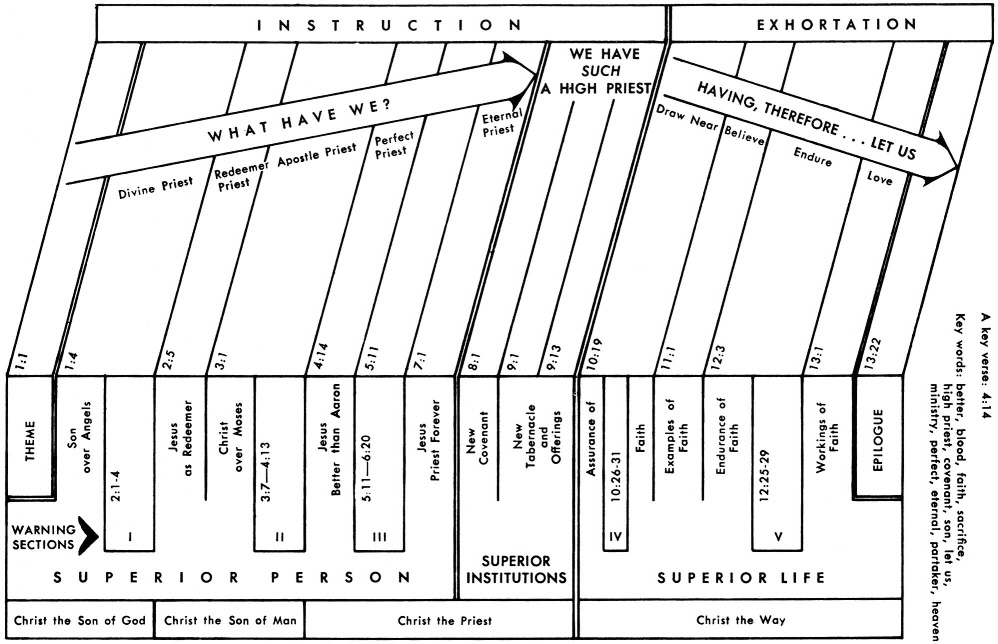
CONSIDER JESUS OUR GREAT HIGH PRIEST
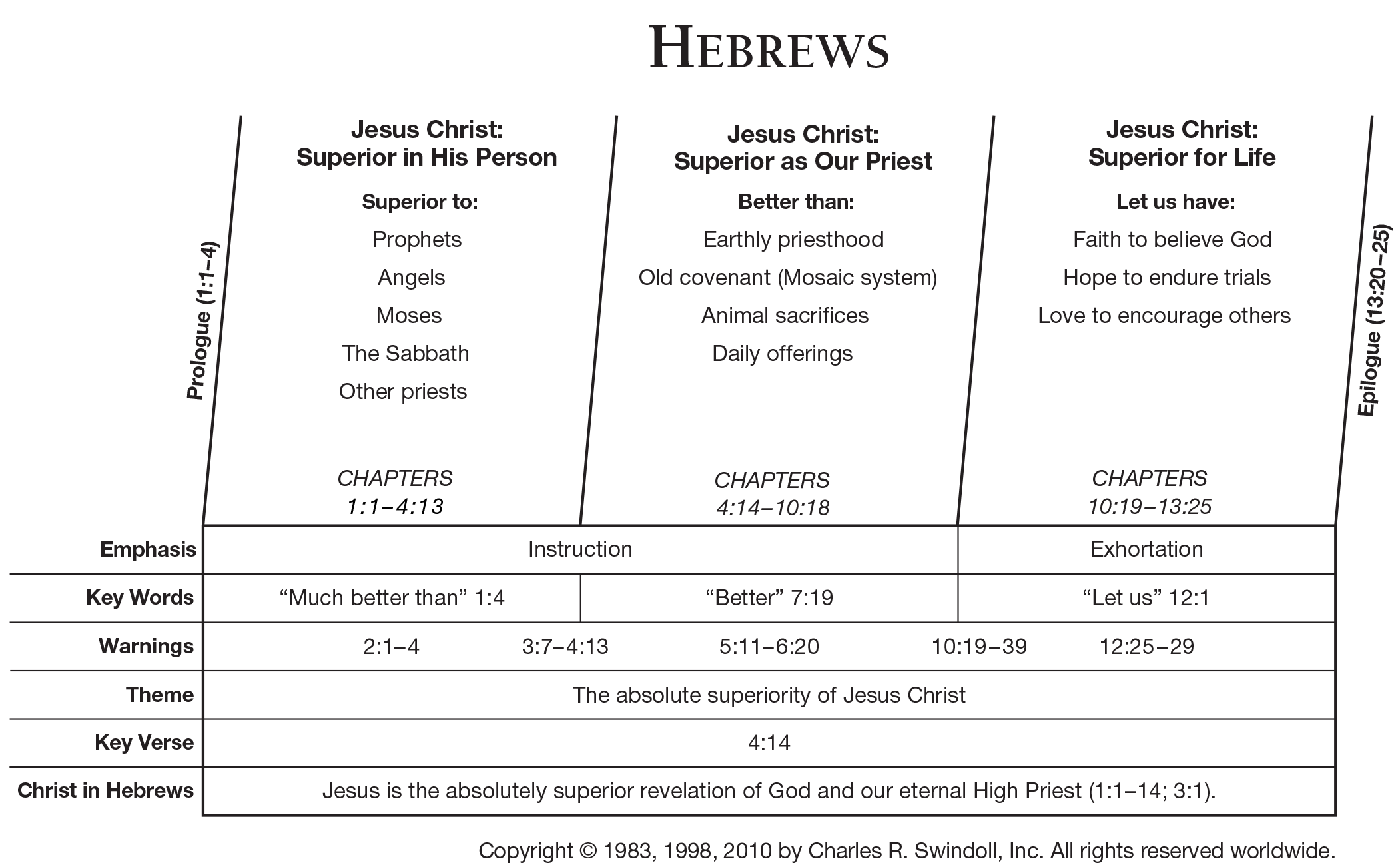
Click chart to enlarge
Charts from Jensen's Survey of the NT - used by permission
Swindoll's Chart, Interesting Pictorial Chart of Hebrews, Another Chart

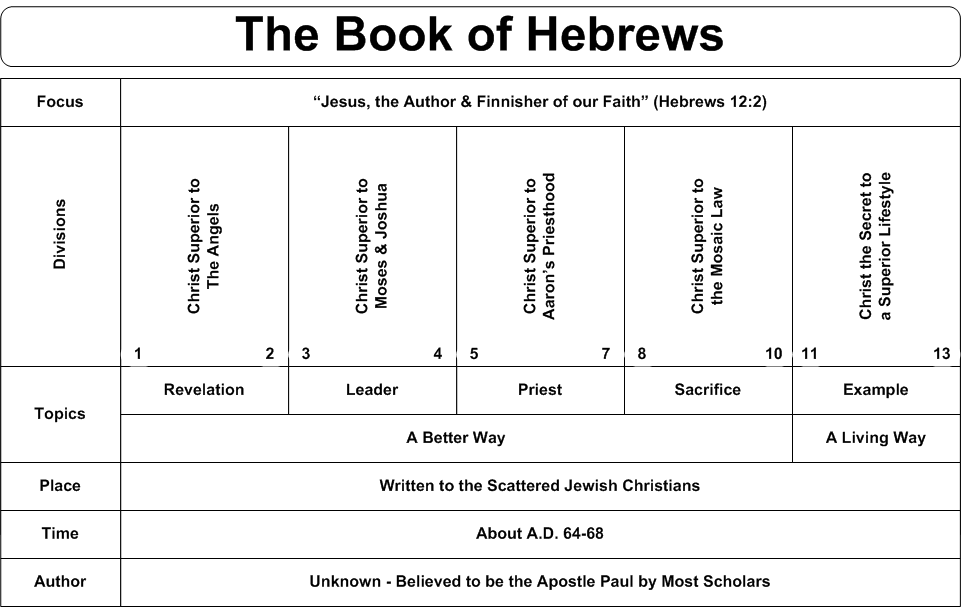
|
The Epistle |
||||
| INSTRUCTION Hebrews 1-10:18 |
EXHORTATION Hebrews 10:19-13:25 |
|||
| Superior Person of Christ Hebrews 1:1-4:13 |
Superior Priest in Christ Hebrews 4:14-10:18 |
Superior Life In Christ Hebrews 10:19-13:25 |
||
| BETTER THAN PERSON Hebrews 1:1-4:13 |
BETTER PRIESTHOOD Heb 4:14-7:28 |
BETTER COVENANT Heb 8:1-13 |
BETTER SACRIFICE Heb 9:1-10:18 |
BETTER LIFE |
| MAJESTY OF CHRIST |
MINISTRY OF CHRIST |
MINISTERS FOR CHRIST |
||
|
DOCTRINE |
DUTY |
|||
|
DATE WRITTEN: |
||||

See ESV Study Bible "Introduction to Hebrews"
(See also MacArthur's Introduction to Hebrews)
Borrow Ryrie Study Bible
Hebrews 10:22 let us draw near with a sincere heart in full assurance of faith, having our hearts sprinkled clean from an evil conscience and our bodies washed with pure water. (NASB: Lockman)
Greek: proserchometha (1PPMS) meta alethines kardias en plerophoria pisteos, rerantismenoi (RPPMPN) tas kardias apo suneideseos poneras kai lelousmenoi (RMPMPN) to soma udati katharo
Amplified: Let us all come forward and draw near with true (honest and sincere) hearts in unqualified assurance and absolute conviction engendered by faith (by that leaning of the entire human personality on God in absolute trust and confidence in His power, wisdom, and goodness), having our hearts sprinkled and purified from a guilty (evil) conscience and our bodies cleansed with pure water. (Amplified Bible - Lockman)
My Amplified Paraphrase: Let us draw near—come close, approach with confidence, freedom, and reverent boldness—with a sincere heart, a heart that is whole, genuine, undivided, fully open before God, in full assurance of faith, the settled certainty produced by trusting Christ’s finished work, having our hearts sprinkled clean from an evil, guilty conscience (cleansed by Christ’s once-for-all sacrifice), and having our bodies washed with pure water, symbolically portraying the complete purification and consecration that God has accomplished for us.
Barclay: let us approach the presence of God with a heart wherein the truth dwells and with the full conviction of faith, with our hearts so sprinkled that they are cleansed from all consciousness of evil and with our bodies washed with pure water. (Westminster Press)
NLT: let us go right into the presence of God, with true hearts fully trusting him. For our evil consciences have been sprinkled with Christ's blood to make us clean, and our bodies have been washed with pure water. (NLT - Tyndale House)
Phillips: let us draw near with true hearts and fullest confidence, knowing that our inmost souls have been purified by the sprinkling of his blood just as our bodies are cleansed by the washing of clean water. (Phillips: Touchstone)
Wuest: let us keep on drawing near with a genuinely true heart in full assurance of faith, having had our hearts sprinkled from an evil conscience and having had our body washed with pure water.
Young's Literal: may we draw near with a true heart, in full assurance of faith, having the hearts sprinkled from an evil conscience, and having the body bathed with pure water;
- Let us draw near - Heb 4:16; 7:19; Ps 73:28; Isaiah 29:13; Jeremiah 30:21; James 4:8
- With a sincere heart - 1Ki 15:3; 1Chr 12:33; 28:9; 29:17; Ps 9:1; 32:11; 51:10; 84:11; 94:15; Ps 111:1;119:2,7,10,34,58,69,80,145; Pr 23:26; Jer 3:10; 24:7; Acts 8:21; Eph 6:5
- Full assurance of faith - He 10:19 Mt 21:21,22 Mk 11:23,24 Eph 3:12 Jas 1:6 1Jn 3:19,21,22
- Hearts sprinkled clean - He 9:13,14,19 11:28 12:24 Lev 14:7 Nu 8:7 19:18,19 Isa 52:15 Eze 36:25 1Pe 1:2
- An evil conscience - Joh 8:9 1Ti 4:2 1Jn 3:20
- Our bodies washed - He 9:10 Ex 29:4 Lev 8:6 Eze 16:9 36:25 Zec 13:1 Mt 3:11 Joh 3:5 Joh 13:8-10 1Co 6:11 2Co 7:1 Eph 5:26 Tit 3:5 1Pe 3:21 Rev 1:5
- Hebrews 10 Resources - Multiple Sermons and Commentaries
- Hebrews 10:19-39 The Danger of Defection - John MacArthur (excellent sermon including several illustrations)
- Click for 5W/H Study Questions — ideal for leading a group or personal study of Hebrews
Related Passages:
Exodus 19:12 (BELIEVERS EXHORTED TO DRAW NEAR = OPPOSITE OF CHARGE TO ISRAEL AT SINAI PICTURING THE LAW) “You shall set bounds for the people all around, saying, ‘Beware that you do not go up on the mountain or touch the border of it; whoever touches the mountain shall surely be put to death."
Numbers 18:22 “The sons of Israel shall not come near the tent of meeting again, or they will bear sin and die.
Proverbs 23:26 Give me your heart, my son, And let your eyes delight in my ways.
1 Corinthians 6:11 Such were some of you; but you were washed, but you were sanctified, but you were justified in the name of the Lord Jesus Christ and in the Spirit of our God.
Titus 3:5 He saved us, not on the basis of deeds which we have done in righteousness, but according to His mercy, by the washing of regeneration and renewing by the Holy Spirit,
Ephesians 5:25-26 Husbands, love your wives, just as Christ also loved the church and gave Himself up for her, 26 so that He might sanctify her, having cleansed her by the washing of water with the word,
A GRACIOUS INVITATION:
DRAW NEAR TO GOD
Having shown that the veil is torn and the way is open through the blood of Christ (Heb 10:19–21), the writer now issues a heartfelt invitation: “Let us draw near.” This is not a call to ritual but to relationship—not to a place, but to a Person. The worshiper who once stood afar off (cf Ex 19:12) is now summoned to approach with confidence, for the barrier of sin has been removed and our Great Priest now intercedes within the true sanctuary. This exhortation marks a transition from doctrine to devotion—from what Christ has done to how we must respond. Yes, he has been giving the readers heavy theology, but that truth was necessary so that his readers might now respond and act on that truth. Beloved, you can mark it down as an indelible truth that creed shapes conduct, orthodoxy must precede orthopraxy, and right doing flows from right knowing! And so now the writer exhorts his shy readers to come into the very presence of God—not timidly or temporarily, but continually and confidently. The old covenant said, “Stay back!” The new covenant says, “Draw near!” Yet such nearness demands preparation of both heart and conscience. We must come “with a sincere heart in full assurance of faith,” our hearts cleansed from guilt and our bodies washed in purity. This is not self-confidence but Christ-confidence—a boldness grounded in His finished work.
In the fearful shadow of Sinai, men trembled to approach.
In the glorious light of Calvary, believers are invited to draw near.
J Ligon Duncan adds that "The author of Hebrews piles this heavy theology on us, not because he wants us to be the number one student in the class, but because he knows that unless we know these things, we will be ill equipped to face the struggles of life. So he is piling up this truth, not so we will be eggheads, not so that we will able to impress everyone with the theological terms that we know, but because truth stored in the heart makes you strong for every contest. The author of Hebrews wants us to be strong in the word so that we can be strong in the way. So this passage reminds us of the importance of studying the Bible. That is why we take the Catechism seriously here. That is why we take the study of the Scripture and theology seriously here." (Let Us Draw Near to God)
Let us draw near (proserchomai - present tense - continually approach) with a sincere (alethinos) heart (kardia) in full assurance (plerophoria) of faith (pistis), having our hearts (kardia) sprinkled clean (rhantizo) from an evil (poneros) conscience (suneidesis) and our bodies (soma) washed (louo) with pure (katharos) water - Let us is a hortatory subjunctive which is used 13 times in Hebrews. Draw near (proserchomai) in the present tense (not an imperative as some teach) calls for this to be not a one time act (say on Sunday morning) but a way of life, a continual partaking of the incredible invitation to live in the nearness to God which Christ has secured for us. Imagine how his Jewish audience might have been taken aback by this exhortation. Why? For one thing the writer used the same verb (proserchomai) used in the Septuagint in Leviticus to describe the Levitical priests approaching the altar (e.g. Lev 9:7 Moses tells Aaron "Come near [Lxx - proserchomai] to the altar"). Secondly, this Jewish audience had been raised with the ritual of drawing near only once a year and only by the high priest! One can only imagine how they are feeling on hearing the call to them to "Draw Near!" The writer has been building his case and is saying now that the veil is split (access) in Christ, the way into the throne room is open, and Christ is now their Great Priest (their Advocate - cf 1Jn 2:1), the call is not to "come" just once, but "keep coming" daily, even throughout the day! Note that Let us draw near (proserchomai) is in the plural which speaks of corporate worship, not just individual worship. It might be paraphrased “Let us continually keep on drawing near to God together.” The upshot is that proserchomai here speaks of intimacy restored, of communion lost through sin which is now reopened through the blood and Priesthood of Christ.
🙏 THOUGHT- This is not a light invitation but a lifelong call to closeness with God, a call to continual communion and fellowship with the Living God. The God who once said “Do not come near” (Ex 19:12) now beckons, “Draw near” and not once a year, but every moment, in every place. Have you drawn near to the Throne of Grace today? This week? If not let me encourage you to....
Draw near—O soul, the way is clear,
His blood has silenced every fear;
No veil remains, no bar, no wall—
Come boldly now, for Christ is all.
Look at the table above and find the section "Christ the Priest" toward the bottom of the table. Note that the writer began the section on the superiority of Christ’s High Priesthood with a nearly identical invitation in Hebrews 4:16—forming, in a sense, a set of bookends. Now, having unfolded the profound doctrines of Christ's Priesthood in Hebrews 4:14–10:18, he rests his appeal to draw near on these truths.
Let us exhortations in Hebrews -13X/12V - Heb 4:1, 11, 14, 16; 6:1; 10:22, 23, 24; 12:1 (2x), Heb 12:28; 13:13
William MacDonald on draw near - This is the believer's blood-bought privilege. How wonderful beyond all words that we are invited to have audience, not with this world's celebrities, but with the Sovereign of the universe! The extent to which we value the invitation is shown by the manner in which we respond to it. (Borrow Believer's Bible Commentary)
J Ligon Duncan writes that draw near "speaks of our personal devotion and relationship with God. Isn't it interesting what we are commanded to do here? It is what Israel, as a people, was explicitly commanded not to do. You remember Mt. Sinai? What was the command? "Do not draw near the mountain or I will strike you down." "If man or beast touches this mountain, I will strike you down." Now what is the New Covenant command? "Draw near." The author of Hebrews has that in the back of his mind because, as you remember, he is going to come to that illustration himself in Hebrews 12:18 and following. He is going to compare Mt. Sinai and Mt. Zion. Basically the argument is going to be this: The old priesthood and the old system required you to stay the distance. Because real mediation had not yet been accomplished in time. But now that we live in the time of the New Covenant and Jesus' finished sacrifice has been offered, you are now invited by God the Father Himself to come into His presence without human mediation. Because divine human mediation has been offered for you in Jesus Christ and what human mediation could possibly help that? What human mediation could possibly be needed to supplement that? You have been brought into the very presence of God by the finished work of the Lord Jesus Christ — you don't need a human priest anymore." (Let Us Draw Near to God)
J Vernon McGee - “Let us draw near with a true heart in full assurance of faith, having our hearts sprinkled from an evil conscience, and our bodies washed with pure water.” This means that you and I as believers are members of a priesthood. One of the great truths that John Calvin recovered was the priesthood of all believers. Every believer is a priest, and as such, you can come to God with boldness of speech. So many people ask the preacher to pray for them, which is all right, but we need to remember that all believers have access to God. You have as much right in God’s presence as I have, or as anyone else has, because we come by this “newly sacrificed” way that Christ has made for us. It is on that basis that we come to God. (Borrow Thru the Bible page 574)
With a sincere (alethinos - genuine, authentic) heart (kardia) - With a sincere heart describes the manner in which believers are to approach God after Christ’s work has opened the way. Alethinos often describes what is divinely real in contrast to shadow or imitation (cf. Heb 8:2 – “the true tabernacle,” meaning the heavenly one). So here, a sincere heart is one that is genuine, unhypocritical, transparent before God—not pretending devotion but actually desiring fellowship. It is the opposite of a divided, double-minded heart (cf. Ps 86:11; Jas 4:8). This description is the antithesis of the "evil, unbelieving heart" that falls away from the Living God (Heb 3:12)(as exemplified by the wilderness generation who could not "draw near" to the promised land!) In contrast a sincere heart is one "that has been examined by the word of God (Heb 4:12–13); a New Covenant heart upon which God has written his laws (Jer 31:33, Heb 8:10, Heb 10:16). Thus, the person with a “true heart” is characterized by the “fullness of faith” or the “full assurance (conviction) of faith." (Cockrell) A sincere heart is one that is not "hardened" (Heb 3:8, 15, Heb 4:7) or go astray (Heb 3:10).
The derivation of the Greek word for sincere (alethinos) gives us a vivid word picture of the character of the heart the writer is calling for -- the word is from "a" which negates what follows which is the word "lanthano" meaning to to hide, and so the picture is of a heart that has nothing hidden! Of course God is omniscient and we cannot hide anything from Him, even though we think in our deceived state that we can. Here the picture is coming before Him conscious that we are not vainly trying to conceal anything from Him. In a sense, isn't that what confession of sins does? We bring our dark deeds to His holy light and He in mercy forgives our sins and cleanses us from all unrighteousness! Amazing grace indeed (1 Jn 1:9).
The people who find God are the people who seek Him with their whole heart,
total genuineness, the honest, wholehearted seeker.
John MacArthur says a sincere heart is "true in the sense of genuine, with no ulterior motives, no hypocrisy, no superficiality. Genuinely. In Proverbs 23:26 God says, “Son, give me thine heart.” This is coming to God with a total commitment in your heart. In Jeremiah 3, just to give you a couple of verses that might open this thought to you, Jeremiah 3:10 says this: “And yet for all this, her treacherous sister Judah hath not turned unto me with her whole heart, but feignedly.” Hypocritically. “I never had her whole heart,” God says. Jer 24:7 says “And I will give them an heart to know me, that I am the Lord and they shall be my people and I will be their God, for they shall return unto me with their whole heart.” He says, “Come on, draw near, but do it genuinely, with a whole heart.” And we talked a little about this this morning, didn’t we? About coming to God with real commitment. Oh, there have been a lot of people who have just come, and it’s been shallow. Even in that beautiful, pure church in the book of Acts, there was a guy like that. In Acts 8, he showed up, a man named Simon who thought this would be a good thing to get into, so he jumped in, tried to buy the Holy Spirit with money, so that he could market the miracle ability and all of that. He didn’t have a pure heart. Ephesians 6:5 talks to employees and says they ought to serve their employers with singleness of heart ("sincerity of your heart"), as unto Christ, which implies that we come to Christ with only a pure heart. And there’s a beautiful verse that maybe gives you the key to this whole thought in Deuteronomy 4:29 “But from there you will seek the LORD your God, and you will find Him if you search for Him with all your heart and all your soul.” The people who find God are the people who seek Him with their whole heart, total genuineness, the honest, wholehearted seeker. (Responding to the New Covenant)
Simon Kistemaker on sincere heart - The author stresses that the heart must be sincere if faith is to be genuine. The word sincere describes the heart of a person who is honest, genuine, committed, dependable, and without deceit. When the believer’s heart is sincere, faith is evident in full assurance. The believer has complete confidence in God, because he fully accepts the truth of the gospel. By contrast, doubt keeps the believer from approaching God. Doubt insults whereas faith exalts. (BORROW Exposition of the Epistle to the Hebrews PAGE 288)
Robert Gundry on sincere heart - “A true heart” is usually understood as a sincere and faithful one (compare Isaiah 38:3). But “after having received the knowledge of the truth” (Heb 10:26) suggests that a true heart is one that’s filled with that knowledge. “Faith” means belief in and faithfulness to the gospel. Such belief and faithfulness stem from “the full assurance” of the gospel’s truth (compare Heb 4:2–3; 6:1, 11–12; 11:6 and contrast “an evil heart of unbelief/unfaithfulness in apostatizing from the living God” [Heb 3:12]). “A true heart in the full assurance of faith” thus underlies approaching God, fortifies against apostasy, and prepares for the exemplars of faithful faith throughout chapter 11, plus Jesus in 12:1–3. (See Commentary on Hebrews)
Kenneth Wuest - He is to (draw near) with a sincere (true) heart. The word “sincere” is alethinos, which means “true” in the sense of “genuine,” and speaks of that which measures up to or consists of all that would make that person or thing that which is expected of him or it. Vincent says, “A true heart is required to enter the sanctuary. The phrase means more than in sincerity. Sincerity is included, but with all that enters into a right attitude toward God as revealed in our Great High Priest,—gladness, freedom, enthusiasm, bold appropriation of all the privileges of sonship.” (Hebrews Commentary)
Paul had dealt with the "heart" of the matter in his discussion of genuine salvation of the Jews writing that "he is not a Jew who is one outwardly (external obedience, keeping of rituals, etc); neither is circumcision that which is outward in the flesh. But he is a Jew who is one inwardly; and circumcision is that which is of the heart, by the Spirit (and thus a "spiritual" or supernatural work, a divine surgery of one's heart if you will), not by the letter (the law, the keeping of the law, by which no man can be justified or declared righteous, for no one could ever keep the law perfectly, cp Js 2:10); and his praise is not from men (legalists love to boast and bath in the adulation of others who proclaim them as "so spiritual", when in fact they are really full of "dead men's bones"!), but from God. (Ro 2:28, 29-) Comment: A sincere heart is one that has undergone supernatural "circumcision".
Hebrews 10:22 evokes the relationship of heart-obedience to God that Jeremiah envisioned in terms of the "new heart" God would create in his people (Jer 31:33). For a similar phrase see the Septuagint (LXX) translation of Isa 38:3 (with a whole heart = en kardia alethine)
R Kent Hughes emphasizes the importance of one's heart writing "The “heart” represents the whole inner life. There must be inner sincerity from one’s whole being. One must be true, completely genuine, “wholehearted” (Moffatt). Commentators have noted that although the language is different, the sixth Beatitude carries the same idea, where we are called to be “pure in heart” (Matthew 5:8). There are to be no mixed motives or divided loyalties. There must be pure and unmixed devotion, “sincere” love for God. Negatively, we can picture this idea from everyday life as we reflect on those people who, after being introduced to us, keep talking and smiling but at the same time looking behind and around us at other people and things. They really are not interested in us. They only see us as objects or a means for something they want. In our relationship with the God-man, such behavior is anathema. Positively stated, a “sincere” heart is represented in the words focus or wholeheartedness. Jesus makes essentially the same point in John 4:23 when he says God desires those who worship “in spirit”—that is, those whose entire human spirit is engaged in worship. This is how we are to draw near to God in prayer—real, genuine, absorbed. The preacher sees this as being of key importance to those who are being distracted by the menacing waves. He knows that essential to their survival is the ability to perpetually come to God in prayer that is sincere and wholehearted, true and engaged. If they do this, they will emerge victorious. They must prayerfully “draw near to God with a sincere heart in full assurance of faith” The wisdom of this exhortation is as relevant and necessary today as it was in the first century. (See Hebrews: An Anchor for the Soul)
William MacDonald gives a good summary - This is the believer's blood-bought privilege. How wonderful beyond all words that we are invited to have audience, not with this world's celebrities, but with the Sovereign of the universe! The extent to which we value the invitation is shown by the manner in which we respond to it.
There is a fourfold description of how we should be spiritually groomed in entering the throne room. (ED NOTE: J Ligon Duncan sees four conditions for drawing near (1) sincere heart (2) full assurance of faith (3) clean heart (4) washed bodies. Let Us Draw Near to God; Grant Osborne adds "The “how-to” is then presented in four parts, two prepositional phrases followed by two participial clauses, all of them showing what constitutes a God-centered lifestyle." )
1. With a true heart. The people of Israel drew near to God with their mouth, and honored Him with their lips, but their heart was often far from Him (Matt. 15:8). Our approach should be with utter sincerity.
2. In full assurance of faith. We draw near with utter confidence in the promises of God and with the firm conviction that we shall have a gracious reception into His presence.
3. Having our hearts sprinkled from an evil conscience. This can be brought about only by the new birth. When we trust Christ, we appropriate the value of His blood (ED: cf 1Pe 1:2). Figuratively speaking, we sprinkle our hearts with it, just as the Israelites sprinkled their doors with the blood of the Passover lamb. This delivers us from an evil conscience. Our testimony is:
Conscience now no more condemns us,
For His own most precious blood
Once for all has washed and cleansed us,
Cleansed us in the eyes of God.
—Frances Bevan
4. And our bodies washed with pure water. Again this is symbolic language. Our bodies represent our lives. The pure water (SEE MORE COMMENTS BELOW) might refer either to the word (Eph 5:25, 26), to the Holy Spirit (John 7:37-39), or to the Holy Spirit using the word in cleansing our lives from daily defilement. We are cleansed once for all from the guilt of sin by the death of Christ, but cleansed repeatedly from the defilement of sin by the Spirit through the word (see John 13:10). Thus we might summarize the four requisites for entering God's presence as sincerity, assurance, salvation, and sanctification.(Borrow Believer's Bible Commentary)
Warren Wiersbe adds "Of course, we must prepare ourselves spiritually to fellowship with God. The Old Testament priest had to go through various washings and the applying of blood on the Day of Atonement (Lev. 16). Also, during the regular daily ministry, the priests had to wash at the laver before they entered the holy place (Ex. 30:18–21). The New Testament Christian must come to God with a pure heart and a clean conscience. Fellowship with God demands purity (1 John 1:5–2:2)." (Bible Exposition Commentary)
Hortatory Subjunctive - a first-person plural subjunctive verb used to urge a group to do something. (Let us go…” “Let us draw near…” “Let us hold fast…” “Let us consider…”) These are not suggestions; they are strong, urgent exhortations. The hortatory subjunctive expresses: exhortation (strong urging), encouragement, group inclusion (“we together”), an invitation with authority, a call to decisive action. It has the force of:“We must…” “Let us now…” “We should immediately…” It is authoritative yet pastoral.
Why Greek uses the Hortatory Subjunctive - Greek has no first-person imperative (“we, do this!”), so the hortatory subjunctive serves this function. It is the strongest way to urge a group to action.
Summary - This is a statement urging others to join in some action (commanding oneself and one’s associates). (It is roughly the same as first person imperative, which does not exist in Greek.) It is easily identified because it will always be the first person plural form of the subjunctive mood. This verb form will often come near the beginning of the sentence.It is usually translated "let us…." (Thus, as a mnemonic device, it can be referred to as the ‘Salad Subjunctive’. cf "let us" with "lettuce" - a bad joke!)
"LET US" IN HEBREWS - 13x/12v - Heb. 4:1; Heb. 4:11; Heb. 4:14; Heb. 4:16; Heb. 6:1; Heb. 10:22; Heb. 10:23; Heb. 10:24; Heb. 12:1; Heb. 12:28; Heb. 13:13; Heb. 13:15
IN FULL ASSURANCE OF FAITH: en plerophoria pisteos:
- Full assurance of faith - Matthew 21:21,22; Mark 11:23,24; Eph 3:12; James 1:6; 1 Jn 3:19,21,22
- Hebrews 10 Resources - Multiple Sermons and Commentaries
- Hebrews 10:19-39 The Danger of Defection - John MacArthur (excellent sermon including several illustrations)
- Click for 5W/H Study Questions — ideal for leading a group or personal study of Hebrews
Related Passages:
Ephesians 3:12+ in Whom (CHRIST) we have boldness and confident access through faith in Him.
ASSURED ACCESS
THROUGH A LIVING WAY
In full assurance (plerophoria - complete certainty) of faith (pistis) - This is not hesitant faith, but deep unshakable confidence that Christ’s work (not our worthiness!) has opened the way to the Throne of God, the Holy Place. It is full conviction engendered by faith. It pictures faith that is completely filled up—overflowing with confident certainty. It describes not a wavering or partial faith but one fully persuaded that Christ’s work is sufficient. Faith is the basis of all right relation to God. The climax of faith is commitment, the follow through if you will. Professing Christ, without commitment to Christ, is not saving faith. Faith (pistis) is not self-confidence but Christ-confidence—resting the entire weight of one’s hope upon His finished work as our Great Priest as taught in Hebrews 4:14 through Hebrews 10:18. It is the settled, sure conviction that Christ's sacrifice has secured access to God. Doubt hesitates at the door, while faith walks boldly in. The same blood that tore the veil open now invites the believer into unbroken fellowship with the Father.
The veil is torn, the way is clear;
Faith enters in and silences fear.
No merit of mine, no work of my hand—
Only Christ's blood makes me bold to stand.
The Amplified Bible is excellent - Let us all come forward and draw near with true (honest and sincere) hearts in unqualified assurance and absolute conviction engendered by faith (by that leaning of the entire human personality on God in absolute trust and confidence in His power, wisdom, and goodness), having our hearts sprinkled and purified from a guilty (evil) conscience and our bodies cleansed with pure water. (Amplified Bible - Lockman)
The writer has just declared that the way to God is open (Heb 10:19–20) and that we have a Great Priest (Heb 10:21). Now he calls his audience to draw near in faith’s full assurance, in the confidence that what Christ has done is enough and that they are fully welcome in God’s presence. What a contrast this is to the old covenant worshiper who stood afar off from God, dependent on continual sacrifices that never took away guilt.
This full assurance of faith rests on fact (the truth taught in Hebrews 1-10:18 and Heb 10:19-21), and not on feeling. It is not presumption but persuasion based on the revelation about Jesus Christ. It is trusting God’s promise rather than one's perception. And so in the context of the exhortation to draw near, the readers are encouraged to come not because they feel worthy, but because Christ is worthy. In sum, full assurance of faith is confidence without conceit, boldness without boasting, access without anxiety—because the blood of Jesus has made the way sure.
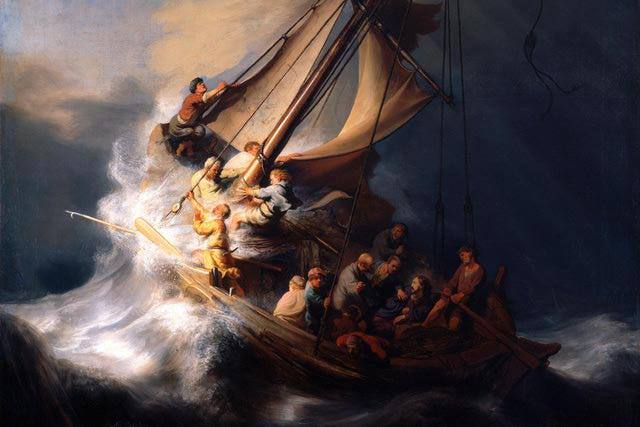
J Vernon McGee on plerophoria - Full assurance is an interesting expression; it literally means “to be under full sail.” It means that believers should be moving along spiritually—they should be moving along for God."
Greek writers (both classical and later Hellenistic) used plērophoreō (the verb form, πληροφορέω) in nautical contexts to describe a ship being driven forward by a full wind, all sails filled — hence the metaphor “to be under full sail.” (see depiction of sails filled above) Applying that picture to Hebrews 10:22 one might paraphrase it "Approach the throne of grace with the sails of faith fully unfurled, driven onward by complete trust in Christ’s finished work.”
Donald Guthrie - This fullness of assurance is important, for there is no longer any reason to doubt that access will be gained. The writer is not only clear about the possibility of full assurance, but assumes it to be present in all worshippers who take advantage of the ‘new way’.
Gareth Cockrell on Full assurance of faith - Such people live with a robust confidence in God’s promise for the future and sturdy reliance on his power for sustenance in the present. The people of the wilderness generation were completely devoid of faith. The soon-to-be-described faithful (Heb 11:1–12:3) live by the “fullness of faith.” Such “fullness of faith” is based on the proven faithfulness of God and results in obedient surrender to his gracious purposes.37 The pastor urges his hearers to “draw near” to God with such obedient confidence and singleness of purpose. (See The Epistle to the Hebrews - Page 473)
Wuest - He is to draw near to God in full assurance of faith. The very thing which this Jew lacked was faith. And because he had no faith, he had no assurance of salvation. He should draw near in the attitude of full assurance which faith produces. (Hebrews Commentary)
MacArthur on full assurance of faith - So He says, “Let us draw near honestly” – now watch this – “in full assurance of” – what? - “faith.” In full assurance of faith. He must come to God in faith. Not works, not self-righteousness. Faith. And not doubting, but believing God. “He that cometh to God must believe that He is, and that He is a rewarder of them that” – what? - “diligently seek Him.” You must believe to come to God, and that’s really all God asks, is that you believe. Believing is so important. Hebrews 11:6 says “without faith, it is impossible to please Him.” Without faith, it is impossible to please Him. Then it goes on to say, as I quoted, “He that cometh to God must believe that He is, and that He is a rewarder of them that diligently seek Him.” You can’t please God apart from faith. Not by any of your works or anything else --- only faith pleases God. Only faith. Somebody asked the question to me this morning, “What about faith? Does everybody have faith?” Sure, everybody lives by faith. There’s a certain amount of faith that’s just built into human nature. I mean, you eat certain food and you don’t even ask any questions. You go to the store and you buy a can of food, take the top of the can off, and eat it. And then the next day you read in the paper about botulism found in somebody’s string beans, you know. Or you’ve got to watch the tuna because there’s mercury in it or whatever. And, you know, even though the performance of certain things isn’t really accurate, we’re so trusting. We live by so much faith. We just take everything for granted. We turn on our faucet and we drink it, and we don’t know what’s playing in the pipes, you know, we just take it for granted. I always tell the kids, “Who knows what really goes on behind the golden arches?” I mean we live by faith. Everybody has a certain commodity, if we didn’t have faith, that couldn’t exist in the world. I mean that money you have in your pocket is only faith because that money’s not worth anything by itself. You’re assuming the government has something behind it. Which, on the basis of past performance, may or may not be true. We all live by faith, and faith is a commodity that every man has to a certain limited degree, but when a man comes to Jesus Christ, he comes with a faith that is more than just the natural man has. The Bible says in Ephesians 2:8-9, “For by grace are ye saved through faith, and that not of yourselves.” What not of yourselves? Faith. It is a gift of God. Saving faith is a gift of God, just like everything else. It’s when God plants within your heart the ability to believe and gives you the faith to respond when your heart is open and ready. And no man really comes to God unless he believes. Don’t fool God. If you don’t really believe, you’re not ready. (Responding to the New Covenant)
Faith is the foot of the soul by which it can
march along the road of the commandments.
-- C H Spurgeon
Spurgeon - God cannot talk with an imperfect being. He could talk with Adam in the garden, but he could not talk with you or with me, even in paradise itself, as imperfect creatures. How, then, am I to have fellowship with God, and access to his throne? Why, simply thus: “For by one offering he has perfected for all time those who are made holy” (Heb 10:14). Consequently, we have access with boldness to the throne of the heavenly grace, and may come boldly in all our time of need. And what is better still, we are always perfect, always fit to come to the throne, whatever our doubts, whatever our sins. Trembling though it be, our faith is true; and though it does not always work in us all the fruit we would desire, yet it does operate in a very blessed way upon our walk and conversation. We believe that Jesus is the Christ, and our trust for eternal life is in Him alone.
The Confidence of Cleansed Conscience - When the heart is convinced of Christ’s sufficiency, worship becomes a delight, not a duty. The believer no longer draws near uncertain, filled with guilt or ashamed, for faith rests where fear of rejection once ruled. The conscience, once clouded by guilt, is now cleared by amazing grace. To draw near in full assurance of faith is to stand before God without trembling—because the blood of Jesus speaks better things than our failures ever could. This assurance is not arrogance but adoration: a holy confidence born of a holy Sacrifice. The same faith that opened the way now anchors the heart within the veil.
Draw near, O soul, through crimson grace,
The Savior stands to intercede your case;
No wrath remains, no sin divides,
The blood still speaks, the Priest abides.
G Campbell Morgan - In a previous note (Hebrews 7.25) we considered the fact that the intercessory work of our High Priest is only operative on behalf of those who draw near to God through Him. In these words we are called upon to avail ourselves of the privilege He has created of access to God. It is that possibility of approach and access which is the supreme and glorious fact resulting from the work of our Priest. The very nature of this appeal emphasizes this. The one thing we are called upon to do is to draw near. In God, and the eternal order, there is no reason why we should not do so. Everything which excluded men from God has been put away. The rending of the Temple veil at the death of Jesus was symbolic. That which, in its wholeness, had been the symbol of man's exclusion from God through sin, in its rent condition was the symbol of the open way to God. The life of Jesus in its final perfection was a perpetual message to men concerning their unfitness to enter the Divine Presence. Because He lived a life of unbroken fellowship with God, I know that I cannot do so; His fellowship resulted from His being well-pleasing to God. Nothing ever has separated between man and God, save sin. He was sinless, and so lived with God. But the death of Jesus has dealt with my sin, and so has made possible my return to God, my access to Him at all times and under all circumstances. Therefore the appeal tome is not a call to prepare myself, or to make a way for myself to God. It is simply to come, to draw near, to enter in. This I do only through my great High Priest, but this I may do through Him without faltering and without fear. (Morgan, G. C. Life Applications from Every Chapter of the Bible)
Brian Bell - LET US DRAW NEAR (Heb 10:22)
Since Jesus provided access to the God of heaven, the readers can draw near to him.
1. Here we find the motive for all subsequent action.
2. It means more than drawing near by praying, for it is in the present tense...inferring a continual drawing near.
a) This is like what the wick is to a lamp. It continually draws oil for the light. So we ought to continually draw from God the strength & grace we need to function.
B. How do we do this?
1. Draw near w/ sincerity (true heart) – w/o religious pretense.
2. Draw near w/ belief (full assurance of faith) – believe in simple faith…God means what He says.
3. Draw near without guilt (hearts sprinkled from an evil conscience) – We become guilt free, only when our conscience is clear (Heb 9:14) & that, only via the sprinkled blood of Jesus. [this happens at salv] [It’s that inner cleansing that is far superior to the outside]
4. Draw near w /Integrity (bodies washed w/pure water) – baptism is our time to publicly profess our commitment to Christ, which symbolizes our being made clean.
ILLUSTRATION - When missionary John Paton was translating the Scripture for the South Sea islanders, he was unable to find a word in their vocabulary for the concept of believing, trusting, or having faith. He had no idea how he would convey that to them. One day while he was in his hut translating, a native came running up the stairs into Paton's study and flopped in a chair, exhausted. He said to Paton, “It’s so good to rest my whole weight in this chair.” John Paton had his word: Faith is resting your whole weight on God. That word went into the translation of their New Testament and helped bring that civilization of natives to Christ. Believing is putting your whole weight on God. If God said it, then it’s true, and we’re to believe it.
Nothing before, nothing behind,
The steps of faith
Fall on the seeming void, and find
The rock beneath
-- Whittier
HAVING OUR HEARTS SPRINKLED CLEAN FROM AN EVIL CONSCIENCE: rerhantismenoi (RPPMPN) as kardia apo suneideseos poneras:
- Hearts sprinkled clean - He 10:9, 13,14,19;11:28; 12:24; Lev 14:7; Nu 8:7; 19:18,19; Isa 52:15; Ezek 36:25; 1Pe 1:2
- An evil conscience - John 8:9; 1Ti 4:2; 1Jn 3:20
- Hebrews 10 Resources - Multiple Sermons and Commentaries
- Hebrews 10:19-39 The Danger of Defection - John MacArthur (excellent sermon including several illustrations)
Related Passages:
Ezekiel 36:25; 26 “Then I will sprinkle clean water on you, and you will be clean; I will cleanse you from all your filthiness and from all your idols. 26 “Moreover, I will give you a new heart and put a new spirit within you; and I will remove the heart of stone from your flesh and give you a heart of flesh.
1 Peter 1:1-2 Peter, an apostle of Jesus Christ, To those who reside as aliens, scattered throughout Pontus, Galatia, Cappadocia, Asia, and Bithynia, who are chosen 2 according to the foreknowledge of God the Father, by the sanctifying work of the Spirit, to obey Jesus Christ and be sprinkled with His blood: May grace and peace be yours in the fullest measure.
Hebrews 9:13 For if the blood of goats and bulls and the ashes of a heifer sprinkling those who have been defiled sanctify for the cleansing of the flesh (EXTERNAL NOT INTERNAL),
Hebrews 9:18-22 Therefore even the first covenant was not inaugurated without blood. 19 For when every commandment had been spoken by Moses to all the people according to the Law, he took the blood of the calves and the goats, with water and scarlet wool and hyssop, and sprinkled both the book itself and all the people, (EXTERNAL NOT INTERNAL), 20 saying, “THIS IS THE BLOOD OF THE COVENANT WHICH GOD COMMANDED YOU.” 21 And in the same way he sprinkled both the tabernacle and all the vessels of the ministry with the blood. 22 And according to the Law, one may almost say, all things are cleansed with blood, and without shedding of blood there is no forgiveness.
HEARTS SPRINKLED
CLEAN
Having our hearts (kardia) sprinkled clean (rhantizo) from an evil (poneros) conscience (suneidesis) and our bodies (soma) washed (louo) with pure (katharos) water - The writer returns to the heart calling for his readers to have a heart sprinkled clean where the verb is in the perfect tense which describes a past completed action with ongoing results/effects. Clearly, this speaks of the readers past conversion, for the moment they entered the New Covenant by grace through faith (Eph 2:8-9), their hearts were sprinkled clean (rhantizo) from an evil (poneros) conscience (suneidesis). Sprinkling in this context is figurative, describing the internal work of the Spirit on the sinner's heart, the moment they believed on Messiah (cf 1Pe 1:1-2) The resulting cleansing was not external but an internal (and eternal) cleansing of their evil conscience.
Note that the writer has previously alluded to sprinkling in Hebrews 9:13 and Hebrews 9:18-22, but both of these were external rites which were not necessarily (in most of the recipients) associated with internal "sprinkling" or transformation of their hearts. In the present context the sprinkling refers to an internal transformation of one's heart (cf Ezek 36:25; 26)
Steven Cole on “our hearts sprinkled clean from an evil conscience.” -- For this and the following expression (washed with pure water), the author is drawing on the picture of the Old Testament priests, who were consecrated for their office by being washed with water and sprinkled with blood (Ex 29:4, 21). Also, the author is probably referring to the ritual of the red heifer (Nu 19; Heb. 9:13-14), where the ritual sprinkling cleansed the outward man so that he was not ceremonially defiled. But the blood of Christ cleanses the inner man, the conscience, from dead works so that we may serve the living God.
Phil Newton on having our hearts sprinkled clean from an evil conscience and our bodies washed with pure water." The tense and mood of the participial verbs (perfect passive participles) indicate a completed, past action that these believers received. They did not cleanse their consciences from evil or wash their bodies with pure water. This was done to them (ED: INDICATED BY passive = "DIVINE PASSIVE"). We have a combination of both the inward reality of faith and the outward profession of faith in this statement. First, he takes us back to the cross, back to the place of the one sacrifice for our sins that cleanses our consciences from dead works to serve the living God (9:14), and that was the sacrifice of Christ. Look back to Jesus Christ. Look back to the cleansing that he provided you through his own God-satisfying death. Just like the ancient priests that sprinkled the blood of the sacrifice upon the people, more so the blood of Christ has sprinkled you clean from living under the guilt of your sin. "The blood of Christ effects the purification of the conscience from dead works, powerfully penetrating to the very root of man's need" [P. Hughes, 411].
Kenneth Wuest - The words “having our hearts sprinkled from an evil conscience and our bodies washed with pure water” speak of the Levitical ceremonies with reference to the preparation of the priests for their priestly service (Ed: See Leviticus 8:1-36). Vincent puts this very succinctly: “This qualification for a right approach to God is stated typologically. As the priests were sprinkled with the sacrificial blood and washed with water before ministering, so do you who have now the privilege and standing of priests in approaching God, draw near, priest like, as sharers in an economy which purges the conscience (Heb 9:14), having your consciences purged. Your own hearts must experience the effects of the great sacrifice of Christ,—pardon, moral renewal, deliverance from a legal spirit.” Regarding the words “bodies washed with pure water,” Vincent says that most expositors refer that to water baptism. But the present writer agrees with Vincent when he says that they “indicate generally the thoroughness of the cleansing process undergone by one who surrenders himself, soul, body, and spirit, to God.” (Hebrews Commentary)
R Kent Hughes - Under the Old Covenant, when priests were consecrated they were sprinkled with blood (Exodus 29:21). Also, when the Old Covenant began, the people had been sprinkled with blood (Exodus 24:8). But with the New Covenant, when the people of this Hebrew church came to faith, their hearts were inwardly “sprinkled” with Christ’s blood to cleanse them “from a guilty conscience” (cf. Heb 9:14 ED: cf 1Pe 1:2). For the first time in their lives the guilt was completely gone, and their conscience rested easy. (See Hebrews: An Anchor for the Soul)
John MacArthur explains hearts sprinkled clean - Now, you remember that this is, of course, a picture of the Old Testament ritual. The priest would wash himself. The holy things were cleansed. And everything was sprinkled with the blood of the sacrifice. And all through all of this sprinkling of blood and everything, the priest was constantly bathing and cleansing himself in the laver, which was the basin of clear water. But it was all external, you see. It was the body and everything else sprinkled. And it was the body washed with water. It never got inside. Only Jesus can really cleanse a man’s heart. (ED: Ezek 36:25 “Then I will sprinkle clean water on you, and you will be clean; I will cleanse you from all your filthiness and from all your idols. 26“Moreover, I will give you a new heart and put a new spirit within you; and I will remove the heart of stone from your flesh and give you a heart of flesh., cf Ezek 11:19, 20, 21) His is no external purification, but by His Spirit He cleanses the inmost thoughts and desires of a man. Now, notice the statement “having our hearts sprinkled from an evil conscience.” This is a beautiful picture of deliverance. The same kind of deliverance in Heb 9:14, where it says, “cleanse your conscience from dead works.” Conscience condemns. Conscience brings guilt. And the guilt can never be removed until the sin is removed. And when Jesus died, His blood removed our sins, and thus our conscience becomes free from guilt. When Jesus’ blood is shed and we believe, our sins are forgiven. And when the burden of a guilt-ridden conscience is removed, we’ve been cleansed from an evil conscience. The precious blood of Jesus Christ removes the evil conscience, that condemning, guilty feeling, and we don’t condemn ourselves anymore. Now, that has to do with God’s side. You see, when you’re saved, sin is forgiven. Sin is forgiven. You’re sprinkled, as it were. Like on the Passover, the blood was sprinkled and the angel of death passed by. You’re sprinkled and cleaned. That’s satisfaction toward God, or expiation, if you want a theological word. It’s the cleansing that applies toward God. In other words, sin is removed. (Responding to the New Covenant) (Bold added)
A T Robertson adds that sprinkled is "an evident allusion to the sprinkling of blood in the old tabernacle (He 9:18, 19, 20, 21, 22) and the shedding of Christ’s blood for the cleansing of our consciences (He 10:1-4, 1:3)."
The phrase our hearts sprinkled recalls to mind Moses sprinkling the children of Israel in the 1st Covenant (Ex 24:8), the High Priest once/year "sprinkling" the Mercy Seat with the blood of the sacrificial animal to cover the sins (Lev 16:14-15). Under the Old Covenant, when priests were consecrated they were sprinkled with blood (Ex 29:21, Lev 8:23,24, 30) which is interesting for all believers are now priests (cp 1Pe 2:9, Revelation 1:5KJV; see 1Pe 1:2; See ISBE article on Sprinkling) We are to come “having our hearts sprinkled from an evil conscience, and our bodies washed with pure water,” which was typical of the high priest who, before he could approach God, had to be sprinkled with the blood of the sacrifice and wash his body at the laver. Then, and only then, could he enter the holy of holies with a pure conscience before God. We, too, must experience the cleansing power of Christ’s blood, freeing us from an evil conscience of sin, so that we can come into God’s presence with bold confidence in our worship. We are cleansed "positionally" when we first believe (justification), but we need to daily be cleansed by confessing our sins before entering boldly into the Holy of holies (1Jn 1:9, Heb 4:16) (See Spurgeon's comment below)
This figure is taken from the sacrificial ceremonies of the Old Covenant. The priests were continually washing themselves and the sacred vessels in the basins of clear water, and blood was continually being sprinkled as a sign of cleansing. But all the cleansing, whether with water or blood, was external. Only Jesus can cleanse a man’s heart. By His Spirit He cleanses the innermost thoughts and desires.
Take me as I am, Lord,
And make me all Your own;
Make my heart Your palace
And Your royal throne.
-Anon.
Kenneth Osbeck writes that "The conscience has been described as the “rudder of the soul” or the believer’s “principle within.” One of the prime responsibilities of Christian living is to keep the conscience clear as to the things of God so that we might live worthy lives before our fellowmen. But the conscience must be continually enlightened and developed by an exposure to God’s Word if it is to serve as a reliable guide for our lives. A conscience that is allowed to become hardened and insensitive to sin will ultimately lead to spiritual and moral disaster. We must allow God to develop our consciences and then our consciences are able to develop us. (BORROW Osbeck, K. W. Amazing Grace: 366 Inspiring Hymn Stories for Daily Devotions. Kregel Publications)
I Want a Principle Within
by Charles Wesley
I want a principle within of watchful, Godly fear,
A sensibility of sin, a pain to feel it near.
Help me the first approach to feel of pride or wrong desire,
To catch the wand’ring of my will and quench the Spirit’s fire.
From Thee that I no more may stray, no more Thy goodness grieve,
Grant me the filial awe, I pray, the tender conscience give.
Quick as the apple of an eye, O God, my conscience make!
Awake my soul when sin is nigh and keep it still awake.
Almighty God of truth and love, to me Thy pow’r impart;
The burden from my soul remove, the hardness from my heart.
O may the least omission pain my reawakened soul,
And drive me to that grace again which makes the wounded whole.
C H Spurgeon spoke frequently about conscience as seen in the following quite pithy quotations...beloved if you are contemplating sinning as you read this or are caught in the web of some sin, may the Holy Spirit of the Living God convict you of sin, righteousness and the judgment to come, not only for your sake of your Christian life but even more so for the sake of His name...
Conscience may tell me that something is wrong, but how wrong it is conscience itself does not know. Did any man's conscience, unenlightened by the Spirit, ever tell him that his sins deserved damnation? Did it ever lead any man to feel an abhorrence of sin as sin? Did conscience ever bring a man to such self-renunciation that he totally abhorred himself and all his works and came to Christ?
A man sees his enemy before him. By the light of his candle, he marks the insidious approach. His enemy is seeking his life. The man puts out the candle and then exclaims, "I am now quite at peace." That is what you do. Conscience is the candle of the Lord. It shows you your enemy. You try to put it out by saying, "Peace, peace! Put the enemy out!" God give you grace to thrust sin out!
Conscience is like a magnetic needle, which, if once turned aside from its pole, will never cease trembling. You can never make it still until it is permitted to return to its proper place.
I recollect the time when I thought that if I had to live on bread and water all my life and be chained in a dungeon, I would cheerfully submit to that if I might but get rid of my sins. When sin haunted and burdened my spirit, I am sure I would have counted the martyr's death preferable to a life under the lash of a guilty conscience
O believe me, guilt upon the conscience is worse than the body on the rack. Even the flames of the stake may be cheerfully endured, but the burnings of a conscience tormented by God are beyond all measure unendurable.
This side of hell, what can be worse than the tortures of an awakened conscience?
He was a fool who killed the watchdog because it alarmed him when thieves were breaking into his house. If conscience upbraids you, feel its upbraiding and heed its rebuke. It is your best friend.
Give me into the power of a roaring lion, but never let me come under the power of an awakened, guilty conscience. Shut me up in a dark dungeon, among all manner of loathsome creatures—snakes and reptiles of all kinds—but, oh, give me not over to my own thoughts when I am consciously guilty before God!
Fire such as martyrs felt at the stake were but a plaything compared with the flames of a burning conscience. Thunderbolts and tornadoes are nothing in force compared with the charges of a guilty conscience.
When a swarm of bees gets about a man, they are above, beneath, around, everywhere stinging, every one stinging, until he seems to be stung in every part of his body. So, when conscience wakes up the whole hive of our sins, we find ourselves compassed about with innumerable evils: sins at the board and sins on the bed, sins at the task and sins in the pew, sins in the street and sins in the shop, sins on the land and sins at sea, sins of body, soul, and spirit, sins of eye, of lip, of hand, of foot, sins everywhere. It is a horrible discovery when it seems to a man as if sin had become as omnipresent with him as God is.
The conscience of man, when he is really quickened and awakened by the Holy Spirit, speaks the truth. It rings the great alarm bell. And if he turns over in his bed, that great alarm bell rings out again and again, "The wrath to come! The wrath to come! The wrath to come! "
Nothing can be more horrible, out of hell, than to have an awakened conscience but not a reconciled God—to see sin, yet not see the Savior—to behold the deadly disease in all its loathsomeness, but not trust the good Physician, and so to have no hope of ever being healed of our malady.
I would bear any affliction rather than be burdened with a guilty conscience.
It is a blessed thing to have a conscience that will shiver when the very ghost of a sin goes by—a conscience that is not like our great steamships at sea that do not yield to every wave, but, like a cork on the water, goes up and down with every ripple, sensitive in a moment to the very approach of sin. May God the Holy Spirit make us so! This sensitiveness the Christian endeavors to have, for he knows that if he has it not, he will never be purified from his sin.
There are thousands of people in this country who would be greatly troubled in their minds if they did not go to church twice on Sundays. And they get comfort in this because their conscience is dead. If their conscience were really awakened, they would understand that there is no connection between conscience and outward forms.
When Sgt. Ray Baarz of the Midvale, Utah, police department opened his wallet, he noticed his driver's license had expired. Embarrassed at having caught himself red-handed, he had no alternative. He calmly and deliberately pulled out his ticket book and wrote himself a citation. Then Baarz took the ticket to the city judge who fined him five dollars. "How could I give a ticket to anyone else for an expired license in the future if I didn't cite myself?" Baarz asked.
The trouble with the advice, "Follow your conscience" is that most people follow it like someone following a wheelbarrow--they direct it wherever they want it to go, and then follow behind.
"Did you know that ever since 1811 (when someone who had defrauded the government anonymously sent $5 to Washington D.C.) the U.S. Treasury has operated a Conscience Fund? Since that time almost $3.5 million has been received from guilt-ridden citizens." (Chuck Swindoll, The Quest For Character)
In a number of languages it would be entirely misleading to speak of `a guilty conscience,' for this would seem to imply that there is something sinful about the conscience itself. In reality, it is the conscience that says that a person is guilty, and therefore it may be necessary to translate Heb10:22 as `with hearts that have been purified from a condition in which their conscience has said that they are guilty.
There is a treasure you can own
That's greater than a crown or throne;
This treasure is a conscience clear
That brings the sweetest peace and cheer.
--Isenhour
See 1Pe 3:19 where Peter is encouraging the believers who are suffering (or will soon go thru a fiery trial) with the doctrinal truth that "baptism now saves you" and he equates this "baptism" not with water baptism of Christianity or ritual Jewish baptismal washing for "purification" but with the obtaining of a "good conscience". And in these verses in Hebrews we see the only way one can obtain a clean conscience is by having one's heart sprinkled (with the blood of Jesus) (1Pe1:2) representing the blood of the New Covenant in which the unregenerate person is born from above and receives a new heart (with a new conscience).
Our Daily Bread - A Clear Conscience
In 1971 he killed a man. Even though he was the prime suspect in the murder, no one could prove it and the case was abandoned. So, he got away with it. Or did he? Nearly three decades later, in failing health and living in a nursing home, he confessed to the crime. A detective who headed the original investigation said, "He was looking over his shoulder for the last 26 years, not only for the law, but for his Maker. I think he wants to clear his conscience before he meets his Maker--or try to at least."
How's your conscience today? Clear or clouded? What would it take to be ready to meet your Maker? How can you be made clean? It may seem strange to speak of blood as a cleansing agent, but that's how the Bible connects the death of Jesus on the cross to our standing before God (Heb. 10:19). Christ shed His blood so that we might be forgiven and made clean inside. Because of what He has done, we can have a clear conscience and "draw near with a true heart in full assurance of faith" (v.22). No matter who you are or what you've done, Jesus Christ can give you a clear conscience. Why not confess your sin and make things right with your Maker today. --DCM
Now in His mercy He waits to impart
Peace to the conscience and joy to the heart,
Waits to be gracious, to pardon and heal
All who their guilt and their sinfulness feel. --Anon.
A clear conscience is a soft pillow.
The 50-Year Desire -- Years ago I was standing by the deathbed of an old minister down in Alabama. The old man had been a preacher for fifty years. I saw his son, who also was a minister, kneel by his father’s bed. “Father, you have preached for fifty years, and have done more good than any man I know.” The old man, with feeble but distinct voice, said: “Don’t tell me about that, son. Tell me about the blood of Jesus. Nothing but the blood of Jesus will do for a dying man.” If a man who had preached for fifty years and who had lived a pure, straight life, in his dying hour had to rely upon the blood of Jesus Christ, don’t you ever think there is any hope for you aside from this atoning blood?
F B Meyer JESUS, THE MEDIATOR OF A NEW COVENANT
THIS IS called the Better Covenant. There are no ifs; no injunctions of "'observe to do"; no conditions of obedience to be fulfilled. From first to last it consists of the I Wills of the Most High.
I will put my laws into their minds, refers to the intellectual faculty, which thinks, remembers, and reasons.
I will write them upon their hearts, the seat of the emotional life and affections. What a man loves, he is pretty certain to follow and obey. "A little lower," said the dying veteran, as they probed for the bullet, "and you will find the Emperor." So with the Christian who has been taken into the Covenant with God, the law is inscribed on the deepest affections of his being. He obeys because he loves.
I will be to them a God, and they shall be to Me a people. This last clause is even better than the first, because it implies the keeping power of God. If we are to be a people for His peculiar possession, it can only result from the operation of His gracious Spirit, who keeps us, as the sun restrains the planets from becoming wandering stars.
All shall know Me. Oh, wonder of wonders. Can it be? To know God! To know Him as Abraham did, to whom He told His secrets; as Moses did, who conversed with Him face to face; or as the Apostle John did when he beheld Him in the visions of the Apocalypse. And that this privilege should be within the reach of the least!
I will be merciful to their iniquities, and their sins will I remember no more. As a score is forgotten when blotted from a slate, so shall sin be obliterated from the memory of God. It will be forgotten as a debt paid years ago.
Do you ask how God can call this a covenant, in which there is no second covenanting party? The answer is easy: Jesus Christ has stood in our stead, and has not only negotiated this covenant, but has fulfilled in our name, and on our behalf, all the conditions which were necessary and fight. He has become our Sponsor and Surety, so God is able to enter into these liberal terms with us, if we will identify ourselves with Him by a living faith. This is the new and better covenant.
PRAYER - Holy Father! I claim from Thee the fulfilment of Thy Covenant Promise, that Thou shouldst write Thy law upon my heart, and remember my sins and iniquities no more. May I hear Thee say: "Thy faith hath saved thee; Go, and sin no more!" AMEN (F. B. Meyer. Our Daily Walk)
THE RECEPTIVITY OF FAITH
"'Let us draw near with a true heart, in full assurance of faith."--Heb. 10:22.
"That Christ may dwell in your hearts by faith."--Eph. 3:17.
FAITH IS our power of appropriation. The pity is that we are so slow to make use of our Lord s resources! He does not force Himself upon us. Though He brings with Him gold tried in the fire that we may be enriched, and white raiment for our clothing, and eye-salve for our blindness; and though He knows how urgently we need these things, He will not force them on our acceptance. Rather, He stands and knocks, as a travelling merchant knocks at the door, who has wares to dispose of, and we need to open the door and receive the gifts which are offered, without money and without price (Rev. 3:18, 19, 20; Isa. 55:1, 2).
Faith is our reception of the spiritual to make good the lack of the physical. It is a drawing on the Eternal for the deficiencies of our earthly pilgrimage. Probably when we look back on our present life, we shall find that our deficiencies were permitted, and even assigned, that we might be driven to avail ourselves of the fullness of the Lord Jesus (John 1:16; Eph. 3:19). We were allowed to wander in the sultry heat, that we might know Him as the shadow of a great Rock in a weary land; we were exposed to wild tempests and storms, that we might make for alcoves and harbours in Him that we should otherwise have missed.
It has been truly observed that Job's rebellious moods arose when he thought that God was afar off, but there was a difference when he realised that God was suffering with him. Remember that you are not divided from God by a deep chasm. He knows your sorrows. In all your afflictions He is afflicted. We have not a High Priest, who cannot be touched with the feeling of our infirmities. When Jesus saw the sisters weeping, He not only succoured them, but entered into their distress, and wept with them.
Are you weary with burdens that are crushing you? Is your lot cast with them that hate peace? Is your heart oppressed with loneliness? Take Jesus into account. Don't face your difficulties alone, but meet them in the fellowship of your Saviour. Have faith, i.e., reckon on God. Let the Lord Christ dwell in your heart, and He will be responsible for all, as you reckon on Him for all.
PRAYER - O Lord, I open my nature, and since my capacity is small, I pray that by love and faith, by patience and suffering, Thou wilt enlarge my heart, that it may be filled with all the fullness of God. AMEN. (F. B. Meyer. Our Daily Walk)
A reflection on HOPE When I see despair in others - Chris Tiegreen The One Year Walk with God Devotional: 365 Daily Bible ...One of the most common maladies of our generation is hopelessness. Many people have a pervasive sense that this visible life is all there is, and it isn’t very satisfying. We must not let the hopelessness of our age infect us. We are to fix our hope on eternity, and we must share that hope with an anxiety-ridden generation. They are convinced that our hope is groundless. One of the most meaningful, lasting things we can do is to tell them otherwise.
TODAY IN THE WORD
Let us draw near to God with a sincere heart in full assurance of faith. - Hebrews 10:22
John Bunyan, author of The Pilgrim's Progress, once wrote that when Christians begin to lose communion with God, one of the first things forgotten is that they live in God's very presence and their lives are in God's hands.
This kind of spiritual affliction should sound very familiar by now. We have been following the reasoning that the author of Hebrews used to convince his readers that defection from Christ was nothing but spiritual disaster. The final verse of today's reading underscores the danger in stark terms: ""It is a dreadful thing to fall into the hands of the living God"" (v. 31).
We're in the middle of another warning section in which the Hebrews were cautioned against turning away from grace and going back to the dead rituals of Law. Most Bible teachers call this a ""parenthetical"" warning, since the writer seems to interrupt his thought to give this warning.
When you compare the warm exhortations of verses 19-25 with the strong warnings of verses 26-31, you can see why generations of Bible commentators have wrestled with the meaning of Hebrews.
These people are the writer's ""brothers."" They are urged to draw near to God in complete confidence, meeting together as the church for mutual teaching and encouragement (v. 25). All of this is possible because the God who called them to Himself is faithful (v. 23).
Yet with the next strokes of his writing instrument, the author says that anyone who rejects Christ can look forward to nothing but God's fearful judgment. Some try to solve the puzzle of this passage by claiming that the Hebrews were not true believers and that the judgment spoken of is eternity in hell, the final penalty for all unbelief.
But we believe these people were genuine Christians. That doesn't weaken the author's warning, because God takes sin among His people very seriously. We can fall into God's hands in the sense of experiencing His fiery judgment without being lost forever. Some Corinthian believers had died prematurely for their sin (see 1 Cor. 11:30), but Paul does not imply eternal separation from God.
The lesson for us is that instead of trying to walk on the edge, we need to draw close to our Lord in loving fellowship!
TODAY ALONG THE WAY One key to understanding this passage and our response to it, is found in the phrase ""deliberately keep on sinning"" (v. 26). The idea is to willfully continue sinning. This recalls the defiant sins for which no sacrifice was possible (Num. 15:30-31). In light of this, what must we do today? We need to continually adopt God's attitude toward sin, which is to loathe it and run from it. Today, let's take the warning of Hebrews seriously and pray that God will keep our hearts tender toward Him.
GET ON YOUR KNEES
Let us draw near with a true heart in full assurance of faith . . . . Hebrews 10:22
Has your child ever rushed up to you in a moment of fear or panic, nestled in your arms and said, "Daddy (or Mommy), you'll take care of me, won't you?" Well, that's the way God wants His own to "draw near . . . in full assurance of faith." When such warm trust is displayed, the Heavenly Father loves to comfort and reassure His trembling child and give him the protection, blessing, and answers to prayer he seeks.
But I hear some fatalist exclaim, "Hasn't God predestined all things? How then can our prayers have any effect?" Ah, but my friend, you are forgetting that God does more than predestine the end, He also predestines the means to that end. He has decreed that His child shall pray, and, because he does, the things that befall him will turn out for his highest good. The Lord consequently moves upon the hearts of His own to pray for that which He has already determined to grant them! In the process, faith is strengthened, and God's name glorified, as men see their petitions bear fruit. Is it any wonder then that James declares: "The effectual, fervent prayer of a righteous man availeth much" (James 5:16)!
A band of tourists were once attempting to climb the snow-clad Matterhorn. The way was steep and perilous. On a particularly dangerous and narrow passage, where the snow and ice made the upward journey extremely hazardous, a sudden gust of wind swept down upon the party just as they were rounding a sharp curve in the mountain track. The guide, accustomed to such unexpected blasts but knowing the imminent danger, shouted at the top of his voice, "Get down on your knees! You're safe only when you're on your knees!" What a parable on the Christian life. We often find the upward path difficult and beset with trials. Storms may burst upon us suddenly, but when they do, our Guide is just saying to us, "Get on your knees!" Get down on your knees!"
Prayer is not overcoming God's reluctance, it is laying hold of His highest willingness. —Trench
Spurgeon - Let us hold fast the profession of our faith.
Faith is the cable which binds our boat to the shore, and by pulling at it we draw ourselves to the land; faith unites us to God, and then draws us near to Him.
Spurgeon - He is faithful that promised.
I would sooner walk in the dark and hold hard to a promise of my God, than trust in the light of the brightest day that ever dawned.
J C Philpot - Faith cannot rest upon fancy; it can only rest upon the solid truth of God, as revealed in the Scriptures. And when it comes into the truth of God, as Noah’s dove came into the ark as its own nest and home, then it finds rest and peace. Many persons think we build our faith and hope not on the Scriptures, but on some mental feelings, or fancies of our own, distinct from the word of God. I do not and cannot build my faith on anything but what is revealed in the Bible; and I must do it because I have no other foothold for it to stand upon. Do you not feel the same, you who know anything of the trial of faith? You have had many a tossing up and down, and have often wanted a foothold for your faith to stand upon. You have tried to believe this or that doctrine, or to get into this or that experience; but you kept still falling short, for you found that your faith wanted something stronger than the testimony of men; you needed a solid foundation on which to build for eternity; for the things to be believed were so invisible and so mysterious, that nothing but the word of God could suffice for your faith to stand upon and rest in. When, then, in this trial of faith, the truth of God as it stands revealed in the Scriptures was applied to your heart by a divine power, then you found that there was a foothold for belief, and that your faith could then rest upon the inspired word of God, as a rock on which to build, for life and death, time and eternity. It was so with Abraham. When Abraham was looking forward to the birth of the promised seed, many a doubt or fear might have arisen in his mind as to whether he should have a son by Sarah. But he rested upon the word of promise, and thus obtained a foothold for his faith. As the Apostle speaks, “Who against hope believed in hope, that he might become the father of many nations; according to that which was spoken, So shall thy seed be.” Our faith must in the same way rest on the word of promise, that “by two immutable things, in which it was impossible for God to lie, we might have a strong consolation, who have fled for refuge to lay hold upon the hope set before us.”
We Have Access!
The word “access” is found only 3 times in the N.T. (Rom. 5:1–2; Eph. 2:18, Eph. 3:12). These 3 passages teach us 4 things about access.
1. We have access into grace (Rom. 5:2) God’s throne is the throne of grace (Heb. 4:16).
2. We have access unto the Father (Eph. 2:18). Though He is sovereign, we can still approach Him as a child does a father (Luke 11:11–13, Rom. 8:15).
3. We have access through Jesus Christ (I Tim. 2:5). The blood gives us boldness (Heb. 10:19).
4. We have access by our faith (Rom. 5:2; Eph. 3:12). The essential ingredient is prayer (Heb. 10:22).
The Prince of the Outcasts
Many years ago the Prince of Wales visited the capital city of India. A formidable barrier had been set up to keep back the masses of people who wanted to catch a glimpse of royalty. When the prince arrived, he shook hands with some of the political dignitaries who were presented to him. Then, looking over their heads to the crowds beyond, he said, “Take down those barriers!” They were quickly removed, and all the people, regardless of social rank, had free access to the heir of the British empire. Some time later when the prince came to that district again, 10,000 outcasts waited under a banner inscribed with these words: “The Prince of the Outcasts.” What a great description of Jesus, who by his death has broken every barrier down between us and God. See: Hebrews 10:22
APOLOGIZING AT A COST
Topics: Apology; Confession; Foolishness; Greed; Human Nature; Hypocrisy; Reconciliation; Repentance; Self-centeredness; Sports
References: Psalm 32:5; 62:10; Proverbs 22:1; Joel 2:12–13; Acts 3:19; Hebrews 10:22; 1 John 1:8–10
Pete Rose has finally admitted that he bet on baseball games while employed as manager of the Cincinnati Reds, an infraction that produced a lifetime ban from the sport in 1989. Rose’s admission of guilt in his autobiography in 2004 came after almost fifteen years of denying wrongdoing.
He has not stopped confessing. In September 2006, Rose began using his website to personally apologize to each fan he had failed or offended. For only $299 (plus $4.95 for shipping and handling), Pete Rose will send you an autographed baseball that reads, “I’m sorry I bet on baseball.”
The marketing copy on the website says: “Now you can get the baseball collectible everyone’s talking about—Pete Rose’s personal apology for betting on baseball, newly inscribed on an actual baseball—at a fantastic price.”—Associated Press, “Rose Says ‘Sorry,’ but It’ll Cost You,” Houston Chronicle (September 20, 2006)
Our Great Assurance - Billy Graham
Let us draw near with a true heart in full assurance of faith. Hebrews 10:22
Disregard your feelings when you come to Christ. You aren’t saved by your feelings; you are saved by Christ. Feelings come and go, but Christ remains.
Only the facts matter—the fact that Jesus Christ died for your sins and rose again; the fact that if you have committed your life to Him, He has promised to forgive you and save you. The Bible says, “God has given us eternal life, and this life is in His Son. He who has the Son has life” (1 John 5:11–12).
That is God’s promise to you—and He cannot lie. Your feelings will lie to you, and Satan may even use them to convince you that God has abandoned you or that you have lost your salvation. But remember: “There is no truth in [Satan]. When he lies, he speaks his native language, for he is a liar and the father of lies” (John 8:44NIV).
How wonderful to know our faith is based on God’s truth, and not our feelings!
A Guilty Conscience
Topics: CONSCIENCE, GUILT
Bible Verses: Hebrews 10:22; 1 Peter 3:16
In the early hours of August 8, 1963, fifteen men wearing ski masks and helmets stopped a British train in the Buckinghamshire countryside, swarmed onto it, and grabbed $7,300,000. It became known as the “Great Train Robbery.”
The scale and style of the heist captivated Britain and a huge police operation was launched.
Police eventually captured fourteen of the fifteen members of the gang.
Here are some of the confessions of the members of the gang:
The mastermind was Bruce Reynolds, a known armed burglar, said: “Anyone who thinks crime pays must be mad.”
Charles Wilson said: “It wasn’t worth it.” Wilson’s wife echoed that sentiment saying: “The nagging fear of discovery gave me a permanent headache.”
James White, noting that he was “at the end of his tether,” said thankfully that he was “glad it’s all over.”
Ronald Edwards, who fled to Mexico but surrendered to authorities after three years on the run, said he was living “a crazy, unnatural life.”
And Ronnie Biggs, who in May 2001 gave himself up to authorities at age 71 after living in Brazil for more than 30 years, indicated his desire to return to England even if it meant being imprisoned for his crimes.
Sin comes at a price, a guilty conscience that haunts us.
Guilt
According to Time magazine, in 1970 Katherine Power, a student at Brandeis University in Boston, was a leader of the radical National Student Strike Force. She and several others planned to raise money to buy arms for the Black Panthers by robbing a bank.
Kathy drove the getaway car. But the robbery went awry. A silent alarm was quickly answered by patrolman Walter Schroeder. Shots were fired by one of Kathy’s accomplices, and patrolman Schroeder was killed.
That night Kathy began what would be twenty-three years of life on the lam. Listed as armed and “very dangerous,” she was on the FBI’s most-wanted list.
In the late 1970s, Power moved to Oregon. There she assumed the name Alice Metzinger, settled down, started a new life in the restaurant business, bought a house, gave birth to her son, and married. She was an active part of the community and seemingly had every reason to be at peace.
But at age forty-four Kathy Power was desperately tired, tormented by guilt, and chronically depressed. Finally Kathy did the only thing she felt could end her agony. In September 1993 she turned herself in to Boston police. She explained why this was so important: “I am now learning to live with openness and truth,” she said, “rather than shame and hiddenness.”
Shame and guilt are feelings from which you cannot run and cannot hide. Freedom comes only by facing up to the truth—with people and with God.
Confession, Depression, Shame, Truth Heb. 10:22; James 5:16; 1 John 1:9
A TALE OF TWO BROTHERS The Christian History Devotional: 365 Readings & Prayers
Let us draw near to God with a sincere heart. HEBREWS 10:22
1593: The English writers George and Edward Herbert had the same parents and the same upbringing, but religiously they were poles apart. Edward was known in his lifetime, and later, as the great defender of Deism, which had a great influence on intellectuals in the 1700s, including some of America’s Founding Fathers. Disgusted with all the religious discord in Europe and with Christians executing each other for heresy, Edward decided that the way to bring such strife to an end was to discard Christianity and practice a simple religion based on reason, not revelation. He believed that God exists but does not interfere in human affairs, and people should treat their fellow man well, but beyond these basic beliefs nothing is essential. Edward had let his intellectual pride lead him away from the God of the Bible.
His younger brother, George Herbert, born on April 3, 1593, was a different sort altogether. George imbibed his mother’s warm devotion to the Christian faith. He became a minister, and early in life he decided that he would let other poets write about their favorite subject of man and woman while he would write of a greater subject, the Christian and God.
George Herbert published no poetry in his lifetime, though some of his poems circulated among friends. In his lifetime he did gain fame as a pastor who took his duties seriously, and he wrote a book about pastoral care, The Priest to the Temple. As he lay dying in 1633, Herbert gave his poems to a friend, who published them under the title The Temple. They are some of the finest Christian poems ever written, a record of Herbert’s own spiritual life with its highs and lows. Like the best religious poets, he makes the life of faith seem appealing not burdensome. Unlike his Deist brother, George knew that a religion based on cold reason and a distant God could never satisfy the mass of people.
Prayer: Father, thank you for the great saints of the past, whose writings still comfort and inspire us. Amen.
Andrew Murray - HEBREWS 10:22
God is the incomprehensible, the hidden One. The Holy Spirit is the secret, incomprehensible working and presence of God. Do not seek to understand everything. Draw nigh—it never says with a clear head, but with a true heart. Rest upon God to do for you far more than you understand in fullness of faith.
IN FULLNESS OF FAITH, and not in fullness of feeling. When you come, and, gazing into the opened Holiest of All, hear the voice of Him that dwells between the cherubim call you to come in; and as you gaze—long, indeed—to enter and to dwell there, the word comes again, DRAW NEAR WITH A TRUE HEART!
Your answer is, Yes, Lord; with my whole heart—with that new heart Thou Thyself has given me. You make the surrender of yourself, to live only and always in His presence and for His service. The voice speaks again: Let it be Today—Now, IN FULLNESS OF FAITH. You have accepted what He offers. YOU have given what He asks. You believe that he accepts the surrender. You believe that the great Priest over the house takes possession of your inner life, and brings you before God. And yet you wonder why you feel so little changed. You feel just like the old self you were. Now is the time to listen to the voice—IN FULLNESS OF FAITH, not of feeling!
Look to God, who is able to do above what we ask or think. Trust His power. Look to Jesus on the throne, living there to bring you in. Claim the Spirit of the exalted One as His pentecostal gift.
Remember these are all divine, spiritual mysteries of grace, to be revealed in you. Apart from feeling, without feeling, in fullness of faith, in bare, naked faith that honors God, enter in. Reckon yourself to be indeed alive to God in Christ Jesus, taken in into His presence, His love, His very heart.
HOW IS YOUR HEART? - Barry Davis - 52 Topical Sermons
ILLUSTRATION: Imagine you’re out for a hike on a beautiful spring day and you come to a creek. But there’s something wrong with this picture. You notice that someone has dumped trash into the stream—an ugly sight. Judging by some of the empty soda cans, the trash has been there awhile. And there is an ugly film on top of the water. You can’t just leave the scene as you found it, because it would bother your conscience. So you stoop down and begin gathering the trash.
It actually takes several hours before you can begin to see a difference; it’s amazing how much junk is there. You sit back, rest for a moment, and realize you’ll have to keep returning each day until the site is truly clean. But when you come back the next day, it’s as if your work has been undone.
In fact there’s more trash than before. Somehow the garbage bred overnight. You think about the unlikelihood of someone coming to this very spot to dump their garbage in the few hours while you were away, and you realize that something smells fishy—so to speak. So you begin to follow the creek upstream.
Sure enough, you come to a garbage dump that has been there for years. It’s emptying into the passing creek. Your cleaning job only opened up a gap for more stuff to settle. You could go and clean every day.… If you want your creek to be clean, that means going directly to the source and dealing with what’s there.
Possible Preaching Angles: According to the Bible, your heart is the source from which your life flows. Unfortunately, we spend great amounts of time, money, and energy—even in the church—doing trash removal “downstream.” But real transformation begins when we travel upstream to the source of our heart. Our real battles take place in our heart.
1. A TRUE HEART—DRAWS NEAR TO GOD
Let us draw near with a true heart in full assurance of faith, having our hearts sprinkled from an evil conscience, and our bodies washed with pure water.—Hebrews 10:22
2. AN EVIL HEART—DEPARTS FROM GOD
Take heed, brethren, lest there be in any of you an evil heart of unbelief, in departing from the living God.—Hebrews 3:12
Daily Light on the Daily Path - The sprinkled blood that speaks a better word than the blood of Abel.
“Behold, the Lamb of God, who takes away the sin of the world!”—The Lamb who was slain.— For it is impossible for the blood of bulls and goats to take away sins. Consequently, when Christ came into the world, he said, “Sacrifices and offerings you have not desired, but a body have you prepared for me. . . . And by that will we have been sanctified through the offering of the body of Jesus Christ once for all.
And Abel . . . brought of the firstborn of his flock and of their fat portions. And the Lord had regard for Abel and his offering.—Christ loved us and gave himself up for us, a fragrant offering and sacrifice to God.
Let us draw near with a true heart in full assurance of faith, with our hearts sprinkled clean from an evil conscience and our bodies washed with pure water.—Therefore, brothers . . . we have confidence to enter the holy places by the blood of Jesus.
Heb. 12:24; John 1:29; Rev. 13:8; Heb. 10:4–5, 10; Gen. 4:4; Eph. 5:2; Heb. 10:22; Heb. 10:19
Daily Light on the Daily Path - For me it is good to be near God.
O Lord, I love the habitation of your house and the place where your glory dwells.—For a day in your courts is better than a thousand elsewhere. I would rather be a doorkeeper in the house of my God than dwell in the tents of wickedness.—Blessed is the one you choose and bring near, to dwell in your courts! We shall be satisfied with the goodness of your house, the holiness of your temple!
The Lord is good to those who wait for him, to the soul who seeks him.—Therefore the Lord waits to be gracious to you, and therefore he exalts himself to show mercy to you. For the Lord is a God of justice; blessed are all those who wait for him.
Therefore, brothers, since we have confidence to enter the holy places by the blood of Jesus, by the new and living way that he opened for us, . . . let us draw near with a true heart in full assurance of faith, with our hearts sprinkled clean from an evil conscience.
Ps. 73:28; Ps. 26:8; Ps. 84:10; Ps. 65:4; Lam. 3:25; Isa. 30:18; Heb. 10:19–20, 22
Daily Light on the Daily Path - “And you shall put the mercy seat on the top of the ark. . . . There I will meet with you.”
The way into the holy places is not yet opened.—And Jesus cried out again with a loud voice and yielded up his spirit. And behold, the curtain of the temple was torn in two, from top to bottom.
Therefore, brothers, since we have confidence to enter the holy places by the blood of Jesus, by the new and living way that he opened for us through the curtain, that is, through his flesh, . . . let us draw near with a true heart in full assurance of faith, with our hearts sprinkled clean from an evil conscience and our bodies washed with pure water.—Let us then with confidence draw near to the throne of grace, that we may receive mercy and find grace to help in time of need.
. . . Christ Jesus, whom God put forward as a propitiation by his blood, to be received by faith. This was to show God’s righteousness, because in his divine forbearance he had passed over former sins.—Through him we . . . have access in one Spirit to the Father.
Ex. 25:21–22; Heb. 9:8; Matt. 27:50–51; Heb. 10:19–20, 22; Heb. 4:16; Rom. 3:24–25; Eph. 2:18
Daily Light on the Daily Path - “Hallowed be your name.”
“You shall worship no other god, for the Lord, whose name is Jealous, is a jealous God.”
“Who is like you, O Lord, among the gods? Who is like you, majestic in holiness, awesome in glorious deeds, doing wonders?”—“Holy, holy, holy, is the Lord God Almighty.”
Worship the Lord in the splendor of holiness.—I saw the Lord sitting upon a throne, high and lifted up; and the train of his robe filled the temple. Above him stood the seraphim. . . . One called to another and said: “Holy, holy, holy is the Lord of hosts; the whole earth is full of his glory!” . . . And I said: “Woe is me! For I am lost.”—“I had heard of you by the hearing of the ear, but now my eye sees you; therefore I despise myself.”
The blood of Jesus his Son cleanses us from all sin.—That we may share his holiness.—Therefore, brothers, since we have confidence to enter the holy places by the blood of Jesus, . . . let us draw near with a true heart.
Matt. 6:9; Ex. 34:14; Ex. 15:11; Rev. 4:8; 1 Chron. 16:29; Isa. 6:1–3, 5;
Job 42:5–6; 1 John 1:7; Heb. 12:10; Heb. 10:19, 22
Daily Light on the Daily Path - Our bodies washed with pure water.
“You shall . . . make a basin of bronze. . . . You shall put it between the tent of meeting and the altar, and you shall put water in it, with which Aaron and his sons shall wash their hands and their feet. When they go into the tent of meeting, . . . they shall wash with water, so that they may not die. They shall wash their hands and their feet, so that they may not die.”—Your body is a temple of the Holy Spirit within you.—If anyone destroys God’s temple, God will destroy him. For God’s temple is holy, and you are that temple.
“In my flesh I shall see God, whom I shall see for myself, and my eyes shall behold, and not another.”—But nothing unclean will ever enter it.—You who are of purer eyes than to see evil and cannot look at wrong.—I appeal to you therefore, brothers, by the mercies of God, to present your bodies as a living sacrifice, holy and acceptable to God, which is your spiritual worship.
Heb. 10:22; Ex. 30:18–21; 1 Cor. 6:19; 1 Cor. 3:17; Job 19:26–27; Rev. 21:27; Hab. 1:13; Rom. 12:1
Daily Light on the Daily Path - The curtain of the temple was torn in two, from top to bottom.
The Lord Jesus on the night when he was betrayed took bread, and when he had given thanks, he broke it, and said, “This is my body which is for you. Do this in remembrance of me.”—“The bread that I will give for the life of the world is my flesh.”
“Unless you eat the flesh of the Son of Man and drink his blood, you have no life in you. Whoever feeds on my flesh and drinks my blood has eternal life. . . . Whoever feeds on my flesh and drinks my blood abides in me, and I in him. As the living Father sent me, and I live because of the Father, so whoever feeds on me, he also will live because of me. . . . Do you take offense at this? Then what if you were to see the Son of Man ascending to where he was before? It is the Spirit who gives life; the flesh is no help at all.”
The new and living way that he opened for us through the curtain, that is, through his flesh . . . let us draw near.
Matt. 27:51; 1 Cor. 11:23–24; John 6:51; John 6:53–54, 56–57, 61–63; Heb. 10:20, 22
Daily Light on the Daily Path - One of the soldiers pierced his side with a spear, and at once there came out blood and water.
“Behold the blood of the covenant that the Lord has made with you.”—“The life of the flesh is in the blood, and I have given it for you on the altar to make atonement for your souls.”—It is impossible for the blood of bulls and goats to take away sins.—And he said to them, “This is my blood of the covenant, which is poured out for many.”—He entered once for all into the holy places, not by means of the blood of goats and calves but by means of his own blood, thus securing an eternal redemption.—Peace by the blood of his cross.—Knowing that you were ransomed . . . not with perishable things such as silver or gold, but with the precious blood of Christ, like that of a lamb without blemish or spot. He . . . was made manifest in the last times for the sake of you.—I will sprinkle clean water on you, and you shall be clean, . . . from all your idols I will cleanse you.—Let us draw near with a true heart in full assurance of faith, with our hearts sprinkled clean from an evil conscience.
John 19:34; Ex. 24:8; Lev. 17:11; Heb. 10:4; Mark 14:24; Heb. 9:12; Col. 1:20; 1 Pet. 1:18–20; Ezek. 36:25; Heb. 10:22
Daily Light on the Daily Path - The king . . . held out to Esther the golden scepter. . . . Then Esther approached and touched the tip of the scepter.
“If he cries to me, I will hear, for I am compassionate.”
So we have come to know and to believe the love that God has for us. God is love, and whoever abides in love abides in God, and God abides in him. By this is love perfected with us, so that we may have confidence for the day of judgment, because as he is so also are we in this world. There is no fear in love, but perfect love casts out fear. For fear has to do with punishment, and whoever fears has not been perfected in love. We love because he first loved us.—Let us draw near with a true heart in full assurance of faith, with our hearts sprinkled clean from an evil conscience and our bodies washed with pure water.— For through him we both have access in one Spirit to the Father.—We have boldness and access with confidence through our faith in him.—Let us then with confidence draw near to the throne of grace, that we may receive mercy and find grace to help in time of need.
Est. 5:2; Ex. 22:27; 1 John 4:16–19; Heb. 10:22; Eph. 2:18; Eph. 3:12; Heb. 4:16
Daily Light on the Daily Path - You were washed, you were sanctified, you were justified.
The blood of Jesus his Son cleanses us from all sin.—Upon him was the chastisement that brought us peace, and with his wounds we are healed.—Christ loved the church and gave himself up for her, that he might sanctify her, having cleansed her by the washing of water with the word, so that he might present the church to himself in splendor, without spot or wrinkle or any such thing, that she might be holy and without blemish.—“It was granted her to clothe herself with fine linen, bright and pure”—for the fine linen is the righteous deeds of the saints.—Let us draw near with a true heart in full assurance of faith, with our hearts sprinkled clean from an evil conscience and our bodies washed with pure water.
Who shall bring any charge against God’s elect? It is God who justifies.—Blessed is the one whose transgression is forgiven. . . . Blessed is the man against whom the Lord counts no iniquity, and in whose spirit there is no deceit.
1 Cor. 6:11; 1 John 1:7; Isa. 53:5; Eph. 5:25–27; Rev. 19:8; Heb. 10:22; Rom. 8:33; Ps. 32:1–2
Daily Light on the Daily Path -For the life of the flesh is in the blood, and I have given it for you on the altar to make atonement for your souls, for it is the blood that makes atonement by the life.”
“Behold, the Lamb of God, who takes away the sin of the world!”—The blood of the Lamb.—The precious blood of Christ, like that of a lamb without blemish or spot.—Without the shedding of blood there is no forgiveness of sins.—The blood of Jesus his Son cleanses us from all sin.
He entered once for all into the holy places, not by means of the blood of goats and calves but by means of his own blood, thus securing an eternal redemption.—Therefore, brothers, since we have confidence to enter the holy places by the blood of Jesus, by the new and living way that he opened for us through the curtain, that is, through his flesh . . . let us draw near with a true heart in full assurance of faith.
You were bought with a price. So glorify God in your body.
Lev. 17:11; John 1:29; Rev. 7:14; 1 Pet. 1:19; Heb. 9:22; 1 John 1:7; Heb. 9:12; Heb. 10:19–20, 22; 1 Cor. 6:20
Kenneth Osbeck (borrow Amazing Grace) - I AM THINE, O LORD Fanny J. Crosby, 1820–1915
Let us draw near to God with a sincere heart in full assurance of faith. (Hebrews 10:22)
Each new day requires a fresh renewal of our dedication to the Lord. The strongest of Christians can be drawn away by the pressures of daily living. And we are vulnerable to the lusts of the flesh and the eyes as well as the subtle temptations that constitute the “pride of life” (1 John 2:16). The warning of Scripture is clear: “Let him that thinketh he standeth take heed lest he fall” (1 Corinthians 10:12). God must always have His rightful place on the throne of the heart. Nothing in life—not job, not recreation, not even family—should have the top priority of our daily concerns. Anything that replaces the Lordship of Christ can become idolatrous and cause us to be susceptible to a spiritual disaster. We must each day say, “I am Thine, O Lord.”
Fanny Crosby wrote this consecration hymn while visiting in the home of the composer of the music, William H. Doane, in Cincinnati. The family’s conversation that night centered around the blessedness of enjoying the nearness of God. Suddenly in a moment of inspiration, Fanny started giving the words of the hymn—line by line, verse by verse, and then the chorus. Soon after Doane supplied the music, and another of the more than 8,000 Fanny Crosby hymns was born. Since that day in 1875, these moving lines have ministered to and challenged countless numbers of God’s people to keep their lives dedicated to their Lord:
I am Thine, O Lord—I have heard Thy voice, and it told Thy love to me; but I long to rise in the arms of faith and be closer drawn to Thee.
Consecrate me now to Thy service, Lord, by the pow’r of grace divine; let my soul look up with a steadfast hope and my will be lost in Thine.
O the pure delight of a single hour that before Thy throne I spend, when I kneel in pray’r and with Thee, my God, I commune as friend with friend.
There are depths of love that I cannot know till I cross the narrow sea; there are heights of joy that I may not reach till I rest in peace with Thee.
Chorus: Draw me nearer, nearer, blessed Lord, to the cross where Thou hast died; draw me nearer, nearer, nearer, blessed Lord, to Thy precious, bleeding side.
For Today: Psalm 16:11; 73:28; Romans 12:1, 2; 1 Corinthians 7:22–24; Hebrews 12:28
Begin this new day, with all of its unknown pressures and temptations, with this musical prayer upon your lips—
FAITH IS A FACT - Billy Graham Peace with God: The Secret of Happiness - Page 208
Let us draw near with a true heart in full assurance of faith. HEBREWS 10:22
Disregard feelings. You’re not saved by feeling, and you may or may not feel the Spirit. Accept Him by faith as a fact. He lives within you right now to help you live the Christian life. He is living in you in order to magnify, glorify, and exalt Christ in you so that you can live a happy, victorious, radiant, Christ-honoring life.
The Bible commands, “Be filled with the Spirit” (Ephesians 5:18). If you are filled with Spirit, then you are going to produce the fruit of the Spirit, which is “love, joy, peace, long-suffering, gentleness, goodness, faith, meekness, temperance” (Galatians 5:22–23). To be filled with the Spirit is not optional. It is a command to be obeyed, a duty to be done.
How do you know that you are filled? And how can you be filled? Is it some emotional experience through which you must pass? Not necessarily. When you give all you know of yourself to all that you know of Him, then you can accept by faith that you are filled with the Spirit of God. That means that He can have all of you. Commitment actually is surrender—total, absolute, unconditional, irreversible surrender. “I beseech you therefore, brethren, by the mercies of God, that ye present your bodies a living sacrifice, holy, acceptable unto God, which is your reasonable service” (Romans 12:1).
It is only the consecrated, Spirit-filled Christian who can have victory over the world, the flesh, and the devil. It is the Holy Spirit who will do the fighting for you. “We wrestle not against flesh and blood, but against the rulers of darkness” (Ephesians 6:12). This is a spiritual warfare. You cannot fight against these three enemies with normal weapons. Only as we become channels and let the Holy Spirit do the fighting through us are we going to get complete victory. Don’t hold back anything from Christ. Let Him be completely the Lord and master of your life. He said, “Ye call me Master and Lord: and ye say well; for so I am” (John 13:13).
Our Father and our God, I bring You my overflowing heart—wholly, humbly, completely. Fill me with Your Spirit so I may be victorious over the enemy, Satan. You are my Master, my Ruler. I will try to do whatever You ask of me. And with the constant help of Jesus my Savior, I can, and through Him I pray. Amen.
Robert Morgan - A Tender Conscience On This Day: 365 Amazing and Inspiring Stories about Saints
Samuel Ward stuffed himself with plums one evening. In his journal the next morning, July 19, 1596, he confessed his sin—“my gluttony in eating plums and raisins and drinking so much after supper.” It was one of many such confessions.
Samuel was a Puritan, born in 1577, who attended St. John’s College, Cambridge, and was a fellow at Sidney College. In 1603 he became town preacher at St. Mary’s in Ipswich. He married Deborah Bolton, a widow from Cambridgeshire, the following year. When King James approved a new translation of the Bible, Samuel was selected as part of the New Testament translating team. Samuel, known as the youngest of the King James translators, is better known for his diary in which he daily confessed his sins:
May 13—My desire of preferment over much. Thy (he often addressed himself in the second person) wandering regard in the chapel at prayer time.
May 17—Thy gluttony the night before.
May 23—My sleeping without remembering my last thought, which should have been of God.
May 26—Thy dullness this day in hearing God’s word … thy by-thoughts at prayer time same evening.
June 12—My too much drinking after supper.
June 14—My negligence … in sleeping immediately after dinner.
June 22—My immoderate diet of eating cheese.
June 27—My going to drink wine and that in the tavern, before I called upon God.
July 8—My immoderate laughter in the hall.
July 15—My incontinent thoughts at Hobsons.
July 23—For eating so many plums, although thou heard that many died of surfeits (intemperance).
August 13—My intemperate eating of damsons, also my intemperate eating of cheese after supper.
August 21—My long sleeping in the morning.
Despite his vices (and perhaps because of his diligence in confessing them, being tender of conscience) he did a great work for Christ and helped translate the most beautiful version of the Bible in history.
Let’s come near God with pure hearts and a confidence that comes from having faith. Let’s keep our hearts pure, our consciences free from evil, and our bodies washed with clean water. Hebrews 10:22
Never the Same Journey Day by Day: Living Life Well - Page 238
Let us draw near with a true heart in full assurance of faith, our hearts sprinkled clean from an evil conscience and our bodies washed in pure water. (Heb. 10:22)
My fifteen-year-old daughter, Jodi, needed to work on a school project, but our main computer had crashed. So I told her to use the computer in her dad’s office. A few minutes later she walked into the kitchen. “Mom?” she asked, looking pale.
“What is it? Is something wrong with Dad’s computer?”
“It’s fine. I went to pull up the website I was on yesterday, and I saw several weird sites listed. I clicked one and a porn site came up. Do you think Dad is into porn?”
“What? No! Dad would never do anything like that!”
“But, Mom,” she said, “go see for yourself.”
After sending her to her room, I slowly walked into the office. What I saw on that computer screen was vile! I ran to the bedroom and wept, punching and screaming into the pillows so Jodi wouldn’t hear. After a while Jodi knocked on the door. “Mom? Are you OK?”
“Just a minute,” I said, blowing my nose and opening the door. She’d been crying too. “What’s going to happen now?” she whispered, as I hugged her. “Do you think he’s addicted?”
“I hope not. I’m so sorry you saw that, Jodi. I will pray that God will completely erase it from your mind and free you from it. And I want us to pray for your dad.” She nodded. I hugged her again, knowing our lives would never be the same.
Pornography addiction destroys marriages, families, and lives. If your husband is viewing porn in any form, know that you are not the cause. He chose that sin, and he must repent from it. Resist the temptation to believe it will go away on its own. He needs counseling and firm accountability.
Sure Thing: How to Be Certain of Heaven - anonymous
Scripture: Hebrews 10:22 Let us draw near with a true heart in full assurance of faith, having our hearts sprinkled from an evil conscience and our bodies washed with pure water.
Introduction: We live in an insecure world, and unexpected events could occur any moment that would change our lives forever. In his book, The West’s Last Chance, Tony Blankley of the Washington Times points out that human history tends to unfold with sudden, unexpected changes of course. “King Darius of Persia never imagined—even as he faced Alexander at the Battle of Issus in 333 B.C.—that within three years he would be dead, His Achaemenid Dynasty ended, and the great hegemonic Persian Empire crushed and conquered.… American farmers in 1860 never dreamed that within months their husbands, sons, and brothers would be killed in battle and that America would be transformed by continental war. And Londoners in the summer of 1939… never expected that forty thousand of their fellow Londoners would soon lie dead in the streets from German bombing.…”1 We live uncertain lives. But as Christians, we know God is in control, nothing happens outside His knowledge, and underneath are everlasting arms. Our lives are hidden with Christ in God (Col. 3:3), and we have absolute assurance of our eternal salvation. The earth may shake, the mountains may fall, the stars may roll from their sockets, and the nations may collapse—but through Christ we are eternally safe, secure, and blessed. We’re to draw near with full assurance of faith. The truth of personal assurance of salvation is taught throughout the Bible, but let me show you four passages that are especially reassuring.
1. Test Yourselves (2 Cor. 13:5–6). In this passage, the Bible tells us to examine ourselves as to whether we are in the faith. In His Sermon on the Mount, Jesus warned that some people mistakenly think they are going to heaven because of their good lives and religious acts (Matt. 7:21–23). It’s important to realize that we are qualified for heaven, not through our own good works or merits, but purely on the basis of the sacrificial death and resurrection of Jesus Christ. If we have received Him by grace through faith, we are qualified for heaven on the basis of His shed blood. Then you can “know that Jesus Christ is in you,” as Paul put it in this passage. So we should examine and test ourselves, asking, “Have I committed my life to Jesus Christ by faith and am I trusting His grace alone for my eternal salvation?”
2. Nothing Can Separate Us (Rom. 8:31–39). The eighth chapter of Romans ends with a doxology of praise for the unfailing security of God’s love, telling us that if God is for us, no one can stand against us; nothing can separate us from His love.
3. Nothing Can Pry Us from His Hand (John 10:25–29). In John 10, Jesus paints a wonderful picture of the Good Shepherd giving us abundant life. The terminology of this passage breathes assurance with every sentence. In verses 25–29, Jesus states emphatically, “My sheep hear My voice … I give them eternal life, and they shall never perish; neither shall anyone snatch them out of My hand … no one is able to snatch them out of My Father’s hand.”
4. Theses Are the Facts (1 John 5:11–13). In 1 John 5, we have one of the Bible’s premiere texts offering full assurance of eternal life. The words in verse 11, “This is the testimony,” are sometimes rendered, “These are the facts—God’s facts, eternal facts, indisputable and immutable facts.” God HAS given us eternal life in His Son, and those who have the Son HAVE eternal life. No ifs, ands, or buts. These biblical truths are written that we might KNOW that we have eternal life (v. 13).
Conclusion: If you struggle with knowing for certain that you’re going to heaven, you can ARM yourself with assurance in three ways:
A = Ask yourself: Have I sincerely asked Jesus Christ to forgive my sins? Am I trusting His blood for eternal salvation? If not, it’s important to do so today (2 Cor. 6:2).
R = Realize that doubting your salvation is an insult to the Lord. It’s questioning His faithfulness to His promises. Tell God you’re sorry for doubting His integrity, and ask Him to strengthen your faith.
M = Memorize one of the passages we’ve read today, meditate on it whenever you’re tempted with fear, and appropriate the promises of God’s Word. For by this we know that we are of the truth, and shall assure our hearts before Him (1 John 3:19).
Robert Neighbour - “Let us draw near with a true heart in full assurance of faith.” (Heb. 10:22.)
Let us draw near
In full assurance of our faith,
And trust the Lord unto the death,
In joy, not fear.
Let us draw near
With bodies washed and hearts made clean,
With spirits true, and naught between,
And God will hear.
Let us draw near,
All grace He’ll give in time of need,
Yet, we must crown Him Lord, indeed,
With hearts sincere.
An open door is a glad sight to a weary pilgrim; a loving invitation to enter an open door, and a warm welcome awaiting beyond the door is still better. This we have from the Lord Jesus. His throne room is our room where we are invited to draw near with full assurance of faith, that we may find help in the time of need.
Our Lord wants us to come and confer with Him over all those things which concern us. He is interested even in the minutiae of our lives. He enters into everything that touches our welfare.
Dear, so dear, we could not dearer be.
Dear, so dear, through all eternity,
This we know—we have the guarantee
Of His love;
Loving us, He loved us to the end,
Loving us, salvation He did send,
Now He lives His chosen to befriend
From above.
Near, so near, we could not nearer be,
Near, so near, all happy, glad and free,
Resting, trusting all believingly,
All content:
Basking in the glory of His face,
Happy in the riches of His grace,
Living in the beauties of His place,
All intent.
Robert Morgan - All Praise to Thee, My God, This Night
Let us draw near with a true heart in full assurance of faith. – Hebrews 10:22
All Praise to Thee, My God, This Night
A hundred years ago, this hymn was considered one of the four greatest in the Anglican church, the others being “Hark! The Herald Angels Sing,” “Rock of Ages,” and “Lo, He Comes with Clouds Descending.” This was an evening hymn, part of a trilogy written by Thomas Ken. It’s been said that his three hymns—a morning hymn, an evening hymn, and a midnight hymn—conferred a greater benefit on the world than if he had founded three hospitals. On March 10, 1711, realizing death was near, Bishop Ken spent the evening destroying papers and files that might in any way injure others. Afterward he took to his bed, and on March 19, he passed away. Two days later, twelve poor men carried him to his grave just as the sun was rising in the east.
All praise to Thee, my God, this night,
For all the blessings of the light!
Keep me, O keep me, King of kings,
Beneath Thine own almighty wings.
Forgive me, Lord, for Thy dear Son,
The ill that I this day have done,
That with the world, myself, and Thee,
I, ere I sleep, at peace may be.
When in the night I sleepless lie,
My soul with heavenly thoughts supply;
Let no ill dreams disturb my rest,
No powers of darkness me molest.
Praise God, from Whom all blessings flow;
Praise Him, all creatures here below;
Praise Him above, ye heavenly host;
Praise Father, Son, and Holy Ghost.
The Problem of Guilt
Topics: CONSCIENCE, GUILT
Bible Verses: Leviticus 7:1; Hebrews 10:22
In 1848, thirteen-year old Andrew Carnegie came to America from his native Scotland. A bright, industrious young man, he became the richest man in the world by 1900. But Carnegie was no worshiper of money. “No idol [is] more debasing than the worship of money,” Carnegie wrote in his diary.
Carnegie became one of the greatest philanthropists, establishing universities, free libraries and museums, hospitals, medical colleges, public parks, meeting and concert halls. “The gospel of wealth but echoes Christ’s words,” he wrote. “It calls upon the millionaire to sell all that he hath and give it in the highest and best form to the poor.”
Carnegie was not a particularly religious man, but he often felt a guilt about his wealth.
“I have no religion to speak of,” Andrew Carnegie once confided to a friend. “But on Sunday morning, when other people are going to church, I like to float about in my swimming pool while a Highlander in all his regalia plays sacred music on his pipes. And as I lie there in the water, thinking over my possessions, the conviction comes to me that if a commission were sent down from heaven to assess what I have, I should be deprived of a great part of it.” Guilt is a belief that one has done something wrong. The Lord built it into our make-up so that we would seek Him, confess our sin, and desire reconciliation with Him.
Spiritual Confirmation Men Who Met God: Twelve Life-Changing Encounters A W Tozer
Let us draw near with a true heart in full assurance of faith. (Hebrews 10:22)
The human personality has a right to be consciously aware of a meeting with God. There will be a spiritual confirmation, an inward knowledge or witness!
This kind of confirmation and witness was taught and treasured by the great souls throughout the ages.
Conscious awareness of the presence of God! I defy any theologian or teacher to take that away from the believing church of Jesus Christ!
But be assured they will try. And I refer not just to the liberal teachers. God has given us the Bible for a reason—so it can lead us to meet God in Jesus Christ, in a clear, sharp encounter that will burn on in our hearts forever and ever.
When the Bible has led us to God and we have experienced God in the crisis of encounter, then the Bible has done its first work. That it will continue to do God’s work in our Christian lives should be evident!
Go Where God Sends You
Let us all come forward and draw near with true (honest and sincere) hearts in unqualified assurance and absolute conviction engendered by faith (by that leaning of the entire human personality on God in absolute trust and confidence in His power, wisdom, and goodness). Hebrews 10:22
One of the main reasons people don’t enjoy their lives is that they don’t follow the leading of the Holy Spirit. Because Jesus fulfilled the law, we have full freedom to enter into the Holy of Holies and fellowship with the Father. Hebrews calls this “a fresh (new) and living way” to enjoy our relationship with God (see Hebrews 10:20).
Spend time with God today, and go wherever the Spirit of God leads you. He will always give you the grace to do what He calls you to do.
A W Tozer - The Cleansed Conscience Tozer on Christian Leadership: A 366-Day Devotional - Page 30
Let us draw near with a true heart in full assurance of faith, having our hearts sprinkled from an evil conscience, and our bodies washed with pure water. —Hebrews 10:22
What a relief to find the writer to the Hebrews encouraging us to “draw near with a true heart in full assurance of faith, having our hearts sprinkled from an evil conscience” (Hebrews 10:22).
A sprinkled conscience—surely this is a gracious thing for men and women in the world to know!
One of the most relieving, enriching, wholesome, wondrous things we can know is that sudden sense of the lifting of the burden as the conscience goes free—God giving freedom to that conscience which has been evil, diseased and protesting.
Peter wrote about this and called it “the answer of a good conscience toward God, [saves us] by the resurrection of Jesus Christ” (1 Peter 3:21).
This is the kind of conversion I believe in—when your sins are cleansed and forgiven through the blood of the Lamb, you will know it!…
A transaction has taken place within the human spirit. The heart suddenly knows itself clean and the burden lifts from the mind and there is a true sense that heaven is pleased and God is smiling and the sins are gone. EFE065–066
Lord, I fall on my face before You in heartfelt worship. Amen.
J C Philpot - The Christian's conscience
"Having our hearts sprinkled from an evil conscience." Hebrews 10:22
Christ dwells in the Christian's conscience. He makes the conscience tender in His fear. He, when He has convinced it of the evil of sin, purges and cleanses it from guilt, filth, and dead works to serve the living God. He moves in it, and acts upon it, reveals to it His precious blood, bids it open to receive His word, and bids it close itself against all error. He makes it move in accordance with His precepts—softens it into contrition and godly sorrow for sin—heals it when wounded—binds it up when broken—comforts it when cast down—soothes it when, like a crying child, it would lie weeping in His arms, or upon His lap. Thus by making the conscience tender, and applying His precious blood to remove guilt and filth from it, He softens and conforms it to His own suffering image.
Example of conscience that cannot be cleansed: Albert Speer was once interviewed about his last book on ABC’s “Good Morning, America.” Speer was the Hitler confidant whose technological genius was credited with keeping Nazi factories humming throughout World War II. In another era he might have been one of the world’s industrial giants. He was the only one of twenty-four war criminals tried in Nuremburg who admitted his guilt. Speer spent twenty years in Spandau prison. The interviewer referred to a passage in one of Speer’s earlier writings: “You have said the guilt can never be forgiven, or shouldn’t be. Do you still feel that way?” The look of pathos on Speer’s face was wrenching as he responded, “I served a sentence of twenty years, and I could say, ‘I’m a free man, my conscience has been cleared by serving the whole time as punishment.’ But I can’t do that. I still carry the burden of what happened to millions of people during Hitler’s lifetime, and I can’t get rid of it. This new book is part of my atoning, of clearing my conscience.” The interviewer pressed the point. “You really don’t think you’ll be able to clear it totally?” Speer shook his head. “I don’t think it will be possible.” For thirty-five years Speer had accepted complete responsibility for his crime. His writings were filled with contrition and warnings to others to avoid his moral sin. He desperately sought expiation. All to no avail.
Charles Simeon, one of the greatest preachers of the Church of England, explained his coming to Christ like this: As I was reading Bishop Wilson on the Lord’s supper, I met with an expression to this effect—“That the Jews knew what they did, when they transferred their sin to the head of their offering.” The thought came into my mind, “What, may I transfer all my guilt to another? Has God provided an Offering for me, that I may lay my sins on His head? Then, God willing, I will not bear them on my own soul one moment longer.” Accordingly I sought to lay my sins upon the sacred head of Jesus.
So near, so very near to God,
We cannot nearer be;
For in the Person of His Son,
We are as near as He.
So dear, so very dear to God,
We cannot dearer be,
For in the Person of His Son,
We are as dear as He.
—Author unknown
AND OUR BODIES WASHED WITH PURE WATER: kai lelousmenoi (RMPMPN) to soma hudati katharo:
- Bodies washed - He 9:10; Ex 29:4; Lev 8:6; Ezek 16:9; 36:25; Zech 13:1; Mt 3:11; Jn 3:5; Jn 13:8-10; 1Co 6:11; 2Co 7:1; Eph 5:26; Titus 3:5; 1Pe 3:21; Rev 1:5
- Hebrews 10 Resources - Multiple Sermons and Commentaries
- Hebrews 10:19-39 The Danger of Defection - John MacArthur (excellent sermon including several illustrations)
- Click for 5W/H Study Questions — ideal for leading a group or personal study of Hebrews
Related Passages:
Ephesians 5:25; 26 Husbands, love your wives, just as Christ also loved the church and gave Himself up for her, (5:26) so that He might sanctify her, having cleansed her by the washing of water with the word,
Titus 3:5 He saved us, not on the basis of deeds which we have done in righteousness, but according to His mercy, by the washing of regeneration and renewing by the Holy Spirit,
Ezekiel 36:25; 26 “Then I will sprinkle clean water on you, and you will be clean; I will cleanse you from all your filthiness and from all your idols. 26 “Moreover, I will give you a new heart and put a new spirit within you; and I will remove the heart of stone from your flesh and give you a heart of flesh.
And our bodies (soma) washed (louo) with pure (katharos) water - As noted above with the verb sprinkled, the verb washed is also in the perfect tense, which describes action accomplished in past and continuing in the effect/benefit. Washed is in the passive voice indicating it was an action performed on them by an outside force (I think the Holy Spirit ~ Divine Passive) But what action? Some take this passage as referring to action of water baptism. While I personally do not favor that as the primary interpretation, if one means washed with pure water refers to the external act of baptism which is performed because the person has a new heart by grace through faith, then it would be a reasonable interpretation. It cannot be just the external act of water baptism by itself, for this act does not change the internal person. In that sense, it would be analogous to all the OT rituals the Jews did (priests washing their body before entering the Tabernacle, Ex 29:4, washing on Day of Atonement Lev 16:4, etc) which dealt only with the external, not the internal. While not referring directly to the act of baptism, the phrase would naturally remind early Christians of their own baptism, which symbolized the inward cleansing of sin and their public consecration to God (Acts 22:16 — “Be baptized, and wash away your sins”).
Steven Cole The fourth description of the regenerate person is having “our bodies washed with pure water.” Although not all agree, this seems to refer to baptism. Both the sprinkling clean and the washing are perfect participles in Greek, which point to a past action with ongoing results. In other words, both of these cleansings took place at salvation, but have ongoing effects. Baptism, which in the New Testament is closely associated with salvation, pictures outwardly what God did to us inwardly, namely, He cleansed our hearts by faith (Acts 15:9; 1 Pet. 3:21). Taken together, having our hearts sprinkled clean from an evil conscience and our bodies washed with pure water, point to inward purity that manifests itself in outward behavior. Both stem from our salvation. If we do not have a clean conscience or if we are aware of sins in our conduct, we will not draw near to the holy God. So we must confess and forsake our sins, so that we can draw near.
I like Phil Newton's middle of the road comment on our bodies washed with pure water stating that it describes "what is likely a two-fold practice: one inward and the other external. Water has been used to describe both the regenerating work of the Spirit (Titus. 3:5) and the application of the living Word of God in cleansing power to the heart (Eph. 5:26). Inwardly, you have been washed by the Holy Spirit's application of the gospel message to your heart. Outwardly, you have expressed this through water as well in baptism. So the writer does not hesitate to remind these believers of that joyous, yet solemn time in which they declared publicly their faith in Christ alone. It cost them dearly as they identified with Jesus Christ and the Church. Yet what joy they had as they passed through the waters of baptism, having buried their old lives in Christ and being raised to walk in newness of life through the regenerating work of the Spirit. Baptism expressed outwardly what the Holy Spirit had already applied inwardly.
F F Bruce also seems to take somewhat of a middle ground stating that bodies washed with pure water most probably refers to "Christian baptism—consisting, of course, not merely in the outward application of water, but in the outward application of water as the visible sign of the inward and spiritual cleansing wrought by God in those who come to him through Christ. (See The Epistle to the Hebrews - Page 255) (Bolding added)
S Lewis Johnson on “with our heart sprinkled from an evil conscience and our bodies washed with pure water.” writes "this is the imagery of the blood and water, which is the imagery derived from the high priestly work of carrying out his priesthood, because he was anointed with blood, his body was washed with water. And so the idea lying back of it is the imagery of the priests, and we, of course, are priests of the great High Priest, and so with “our hearts sprinkled and our bodies washed” we enter his presence. And, I think, also, that since we have the imagery of the blood and then the water, that probably we are justified in thinking of the blood as suggestive of divine justification from guilt because that is what we have as a result of the blood shed on Calvary’s Cross; and then, of the cleansing from the filth of sin that is suggested by the washing of the water, and you know, in the New Testament, in several places, that figure is used of that. This is the basis of our approach; having our hearts sprinkled, our bodies washed. Just like the High Priest had to be consecrated to his task, we have that in Exodus chapter 29, and Leviticus chapter 8, set forth.....all Christians, of course, have been sprinkled with the blood and washed by water if they belong to the Lord.
C H Spurgeon writes that " We have been once washed in the blood of Jesus, and we are clean before the bar of God, and yet in the divine family we need that our feet be washed after walking awhile in this dusty world, and there is not one disciple who is above the need of this washing (Jn 13:10). To one and all our Lord saith, “If I wash thee not, thou hast no part in me.” (The Red Heifer)
Many writers are dogmatic that bodies washed with pure water refers to baptism. For example, William Lane in Word Biblical Commentary (one of Tim Challies most highly rated commentaries on Hebrews) makes the following statement re "washed with pure water": "The reference in v22b is almost certainly to CHRISTIAN BAPTISM…."
As alluded to above, while clearly baptism under ideal circumstances is an outward sign of an inward cleansing (Ro 6:4), but baptism as a Christian rite does not seem to fit as well with flow of the book. What do I mean by that? Recall that the author has been trying to take his readers from shadows to the substance, from external cleansing of their rituals (cp Heb 9:13,14) to the reality of Christ's once for all sacrifice for sins. Why would he so quickly interject an external work like baptism? In my own case I was baptized at least twice BEFORE I was actually regenerated by the Spirit at age 39 and finally understood what baptism symbolized. Prior to that I was just going through the motions. In fairness, Christian baptism is important and is commanded, so that all true believers should willingly, joyously give witness of their new birth with water baptism. But water baptism but does not make us more acceptable in the throne room of God. Our acceptability before God's Throne is based ONLY on the sufficiency and eternality of Christ's once for all blood sacrifice (See Accepted in the Beloved).
J Ligon Duncan - "You come with washed bodies." He is not just talking about baptism there, although outward baptism is certainly a sign of this. He is talking about the purification of life that is accomplished by the regenerating and sanctifying work of the Holy Spirit that is symbolized in the washing of baptism. So he says to these Christians, 'You come in this way. You come with a sincere heart. And you come with a full assurance. And you come with hearts that have been cleansed because of the justifying work of the Lord Jesus. And you come with lives that have been transformed by the work of the Holy Spirit. That is how you come to God.' But the main thrust of verse 22 is that we draw near with holy boldness, with full assurance. What is the author of Hebrews saying here? He is saying that he knows that is sadly possible for Christians not to realize the blessings that are theirs in Christ. And he is saying, "Don't do that. Don't walk through this life as a believer and not realize the significance of what Jesus has done for you. Don't waste this time. Don't go for years and then realize what you have been given in the Lord Jesus Christ." He is saying, "Draw near with a full assurance into the presence of God."
Charles Swindoll - Though the phrase “our bodies washed with pure water” could be taken as a reference to water baptism,[98] the author’s emphasis is actually on what baptism itself signifies: the dedication of a person’s life to following Christ with a changed lifestyle.[99] Thus, the exhortation to “draw near” invites believers who have been eternally forgiven by faith and who have committed to a life of obedience to go deeper in their personal relationship with Him. (See Insights on Hebrews - Page 158)
Raymond Brown - The phrase our bodies washed with pure water is probably a reference to Christian baptism. It may well be a gentle though direct tilt at those Jews, and possibly Jewish Christians, who continued to place some reliance on continuing ceremonial ablutions. Our writer may be insisting that Christians do not place their confidence in external ritual of that kind (Heb9:10), but in a confession of Christ made once in the past at baptism (see ‘confession’ in the next verse) and in the continuous inward purification made possible and available by Christ’s eternal sacrifice. (The message of Hebrews : Christ above all page 184)
R Kent Hughes - Then they were baptized and their “bodies washed with pure water”—an outward, visible sign of the inner sprinkling or cleansing, they had experienced (cf. 1 Peter 3:21; Ephesians 5:25, 26). (See Hebrews: An Anchor for the Soul)
David Allen on sprinkling and washing - They function to give the reasons why we can draw near with a sincere heart and full confidence: because we have been cleansed and washed. These are actions which have already been accomplished for us at the moment of conversion (ED: BOTH ARE IN THE perfect tense) , when the atonement is applied to our hearts resulting in the objective forgiveness of sins, internal cleansing, and the concomitant deliverance from a guilty conscience.38 This metaphorical language of sprinkling a heart emphasizes the internal nature of salvation in contrast to the external nature of the old covenant. It was precisely at this point, according to our author, where the old covenant failed. The “washing” of our bodies has usually been viewed as a reference to baptism. Calvin, however, rightly dissented from this, stating the author contextually is referring to the “old ceremonies of the law” where the priests had to wash at the laver in the tabernacle before beginning their daily duties. He also rightly connects the “washing” concept with other Old and New Testament passages which use this language to refer to cleansing by the Holy Spirit or the Word of God and not to baptism.39 Guthrie correctly pointed out that our author “gives no overt signals that he has the Christian rite [of baptism] in mind,” and that the author is continuing his use of the Old Testament imagery of purification from Hebrews 9.40 (See Hebrews: An Exegetical and Theological Exposition) (Bolding added)
Draw near (4334) (proserchomai from prós = facing + érchomai = come) means literally to come facing toward and so to approach or come near. To come to visit or associate with. It describes the approach to or entry into a deity’s presence. In the Septuagint (LXX) proserchomai was the verb used to describe the approach of the priests to Jehovah for worship and to perform of their priestly (Levitical) functions. But here in Hebrews, under the New covenant, all seven uses of proserchomai refer to believers possessing the privilege of access to God the Father through Christ the Great High Priest.
PROSERCHOMAI - 86V - 7X IN HEBREWS Heb. 4:16; Heb. 7:25; Heb. 10:1; Heb. 10:22; Heb. 11:6; Heb. 12:18; Heb. 12:22;
Hebrews 4:16 Let us therefore draw near with confidence to the throne of grace, that we may receive mercy and may find grace to help in time of need.
Comment: "Let us… " emphasizes that this privilege is always available to those under the New Covenant. Do we really comprehend and avail ourselves of the profundity of this privilege?
Hebrews 7:25 Hence, also, He is able to save forever those who draw near (present tense = emphasizes continual activity) to God through Him, since He always lives to make intercession for them.
Hebrews 10:1 For the Law, since it has only a shadow of the good things to come and not the very form of things, can never by the same sacrifices year by year, which they offer continually, make perfect those who draw near.
Hebrews 10:22 let us draw near with a sincere heart in full assurance of faith, having our hearts sprinkled clean from an evil conscience and our bodies washed with pure water.
Hebrews 11:6 And without faith it is impossible to please Him, for he who comes (drawn near) to God must believe that He is, and that He is a rewarder of those who seek Him.
Hebrews 12:18 For you have not come (drawn near) to a mountain that may be touched and to a blazing fire, and to darkness and gloom and whirlwind,
Hebrews 12:22 But you have come (drawn near) to Mount Zion and to the city of the living God, the heavenly Jerusalem, and to myriads of angels
Draw Near (1) proserchomai (J D Watson - A Word for the Day: Key Words from New Testament)
Hebrews 10:22 declares, “Let us draw near with a true heart in full assurance of faith, having our hearts sprinkled from an evil conscience, and our bodies washed with pure water.” Draw near is proserchomai <G4334>, to approach, accede to. It is usually used in the Septuagint to translate the Hebrew qērab <H7126>, which also means to come near or approach but also pictures the idea of closeness to the object being approached.
The Greek likewise pictures such closeness. This word appears in Matthew 4:11, for example, where the angels “came and ministered unto [Jesus]” after Satan tempted Him and then departed. Jesus’ disciples also “came to Him” often (5:1; 8:25; etc.) showing their closeness to Him. Of special note is 1 Timothy 6:3–5, where Paul writes that we should withdraw ourselves from anyone who does not “consent” to (i.e., accede or agree to) sound doctrine.
What, then, does it mean biblically to draw near to God?
First, and foremost, drawing near to God means having a sincere desire for truth. The words true heart are alēthinēs kardias. As we studied on February 1–3, both the English word truth and the Greek behind it (aletheia, 225) speak of that which is absolute, incontrovertible, irrefutable, incontestable, unarguable, and unchanging. The specific form of the Greek here also refers to “sincerity.” Kardia (2588, heart, see Nov. 14) refers not just to the emotional nature, but also to the reason and to the faculty of intelligence.
While many people today say such things as, “I want to be near God,” or “I want to get close to God,” when confronted with the absolutes of God’s Word, they rebel. That’s a staggering contradiction! They don’t want to draw near to God at all. They are like the Israelites, of whom Isaiah wrote, “Wherefore the Lord said, Forasmuch as this people draw near me with their mouth, and with their lips do honour me, but have removed their heart far from me, and their fear toward me is taught by the precept of men” (29:13). Yes, they say the words, but when it comes down to real truth, they reject it and live according to their own ways. The most important thing that drawing near to God means is that we sincerely want to hear, receive, and obey God’s truth.
We’ll continue these thoughts tomorrow.Scriptures for Study: Where can we “come” boldly, according to Hebrews 4:16? (See also Jan. 5.) What is a prerequisite for coming close to God (Heb. 11:6)?
Draw Near (2) proserchomai (J D Watson - A Word for the Day: Key Words from New Testament)
We continue our thoughts today on, “Let us draw near with a true heart in full assurance of faith, having our hearts sprinkled from an evil conscience, and our bodies washed with pure water” (Heb. 10:22). Drawing near to God first means having a sincere desire for truth.
Second, drawing near to God means having absolute confidence in God. The words “full assurance” translate plerophoria <G4136>, which means “entire confidence, full assurance.” To be near to God, then, means that we have total confidence in His promises, absolute assurance of His provision, and full trust in His sovereignty. The more we doubt Him, the more we question Him, the farther away from Him we drift.
Third, drawing near to God means having a desire for holiness. The imagery in the words “having our hearts sprinkled from an evil conscience” is distinctly OT, referring to the sprinkling of the blood of the sacrifice for the cleansing of sin. But not only are we saved by this blood, but we are constantly brought back to it for daily cleansing. As the apostle John declares, “If we confess our sins, he is faithful and just to forgive us our sins, and to cleanse us from all unrighteousness” (1 John 1:9). We are forever coming back to the Cross, for it is there that our sin was dealt with and our conscience was cleared.
Fourth, drawing near to God means having a desire for His Word. While the first principle was one of attitude, we see here the action. Some interpreters view the words “our bodies washed with pure water” as a reference to baptism (see June 24f). But that is clearly incorrect because baptism is not a washing away of sin, but rather a symbol of identification, a public testimony of what has occurred in the heart. This phrase means that God’s Word is the commodity that is going to keep us clean by our constant “bathing” in it. Paul meant this when he wrote to the Ephesians: “Christ also loved the church, and gave himself for it; That he might sanctify and cleanse it with the washing of water by the word” (5:25–26). Drawing near to God means that we are constantly involved with His Word, constantly “immersed” in it.
Dear Christian friend, are you drawing near to God each day?
Scriptures for Study: In Matthew 8:19, what requirement did Jesus give to the scribe who “came” to him wanting to follow? Read Exodus 3:1–6 (“nigh” in v. 5 is qērab, the Hebrew equivalent to proserchomai we noted yesterday). Note the need for our holiness.
Sincere (228) (alethinos from alethes = true, one who cannot lie from a = without + lêthô or lanthanô = to conceal = that which is out in the open) refers to words that conform to facts and thus are true, correct and dependable. And so alethinos describes that which conforms to reality, that which has not only the name and resemblance, but the real nature corresponding to the name. Alethinos is the opposite of counterfeit, imaginary or pretended. Alethinos speaks of that which measures up to or consists of all that would make a person that which is expected of him or her. And so when alethinos describes people as in this verse, it describes those who are characterized by integrity and trustworthiness, those who are true and dependable. Sincere describes that which is genuine without superficiality, hypocrisy or ulterior motive.
ALETHINOS - 26V - Lk. 16:11; Jn. 1:9; Jn. 4:23; Jn. 4:37; Jn. 6:32; Jn. 7:28; Jn. 8:16; Jn. 15:1; Jn. 17:3; Jn. 19:35; 1 Thess. 1:9; Heb. 8:2; Heb. 9:24; Heb. 10:22; 1 Jn. 2:8; 1 Jn. 5:20; Rev. 3:7; Rev. 3:14; Rev. 6:10; Rev. 15:3; Rev. 16:7; Rev. 19:2; Rev. 19:9; Rev. 19:11; Rev. 21:5; Rev. 22:6
Hebrews 8:2 a minister in the sanctuary and in the true tabernacle, which the Lord pitched, not man.
Hebrews 9:24 For Christ did not enter a holy place made with hands, a mere copy of the true one, but into heaven itself, now to appear in the presence of God for us;
Hebrews 10:22 let us draw near with a sincere heart in full assurance of faith, having our hearts sprinkled clean from an evil conscience and our bodies washed with pure water.
Heart (2588) (kardia [word study) in Scripture never refers to the physical organ but is always used figuratively to describe the seat and center of human life, the center of one's personality, a person's "control center" which directs and guides the intellect, emotions, and will.
KARDIA IN HEBREWS -Heb. 3:8; Heb. 3:10; Heb. 3:12; Heb. 3:15; Heb. 4:7; Heb. 4:12; Heb. 8:10; Heb. 10:16; Heb. 10:22; Heb. 13:9
Hebrews 3:8 DO NOT HARDEN YOUR HEARTS AS WHEN THEY PROVOKED ME, AS IN THE DAY OF TRIAL IN THE WILDERNESS,
Hebrews 3:10 “THEREFORE I WAS ANGRY WITH THIS GENERATION, AND SAID, ‘THEY ALWAYS GO ASTRAY IN THEIR HEART, AND THEY DID NOT KNOW MY WAYS’;
Hebrews 3:12 Take care, brethren, that there not be in any one of you an evil, unbelieving heart that falls away from the living God.
Hebrews 3:15 while it is said, “TODAY IF YOU HEAR HIS VOICE, DO NOT HARDEN YOUR HEARTS, AS WHEN THEY PROVOKED ME.”
Hebrews 4:7 He again fixes a certain day, “Today,” saying through David after so long a time just as has been said before, “TODAY IF YOU HEAR HIS VOICE, DO NOT HARDEN YOUR HEARTS.”
Hebrews 4:12 For the word of God is living and active and sharper than any two-edged sword, and piercing as far as the division of soul and spirit, of both joints and marrow, and able to judge the thoughts and intentions of the heart.
Hebrews 8:10 “FOR THIS IS THE COVENANT THAT I WILL MAKE WITH THE HOUSE OF ISRAEL AFTER THOSE DAYS, SAYS THE LORD: I WILL PUT MY LAWS INTO THEIR MINDS, AND I WILL WRITE THEM ON THEIR HEARTS. AND I WILL BE THEIR GOD, AND THEY SHALL BE MY PEOPLE.
Hebrews 10:16 “THIS IS THE COVENANT THAT I WILL MAKE WITH THEM AFTER THOSE DAYS, SAYS THE LORD: I WILL PUT MY LAWS UPON THEIR HEART, AND ON THEIR MIND I WILL WRITE THEM,” He then says,
Hebrews 10:22 let us draw near with a sincere heart in full assurance of faith, having our hearts sprinkled clean from an evil conscience and our bodies washed with pure water.
Hebrews 13:9 Do not be carried away by varied and strange teachings; for it is good for the heart to be strengthened by grace, not by foods, through which those who were so occupied were not benefited.
Full assurance (4136)(plerophoria from pleres = full + phoreo = to bear ; cf plerophoreo = to fulfill) literally means complete carrying or bearing ("full carry-through" is the idea). In the NT it then comes to mean entire confidence, perfect certitude, full conviction. This noun carries a strong implication of certainty, a wealth of certainty, an absolute and entire confidence. Plerophoria describes a state of complete certainty, full persuasion, or entire confidence. It is not mere intellectual agreement but settled conviction born of faith and experience. It’s the inward fullness that comes when truth so fills the heart that doubt has no room to dwell. Plerophoria speaks of the believer’s settled certainty—a confidence that fills the soul because of what Christ has accomplished. It is the “fullness of faith” that arises when doctrine becomes delight, and truth becomes trust. Greek writers (both classical and later Hellenistic) used plērophoreō (the verb form, πληροφορέω) in nautical contexts to describe a ship being driven forward by a full wind, all sails filled — hence the metaphor “to be under full sail.”
Notice that full assurance for believers is linked to faith, understanding and hope....
(1) Full assurance of faith—we rest on God’s word, His testimony to us (Hebrews 10:22). Faith gives us full assurance (like Abraham in Ro 4:21)
(2) Full assurance of understanding—we know and are assured (Colossians 2:2). Understanding (spiritual things) gives us full assurance.
(3) Full assurance of hope—we press on with confidence as to the outcome (Hebrews 6:11). Hope gives us full assurance.
Gary Hill adds that "plērophoria ("full carry-through") conveys the full assurance God gives to believers who live in His preferred-will (thélēma). The Lord fully carries through on all inbirthings of faith, giving inwrought assurance about His personal revelation to them." (Discovery Bible)
Herman Witsius, the seventeenth-century Dutch theologian, writes: Plerophoria, “full assurance,” is an expression which occurs more than once in the writings of the Apostle Paul (ED: not everyone agrees Paul wrote Hebrews) He speaks of plerophoria suneseos, “the full assurance of understanding” (Col. 2:2); plerophoria tes elpidos, “the full assurance of hope” (Heb. 6:11); and plerophoria pisteos, “the full assurance of faith” (Heb. 10:22). According to its etymology, this word denotes “a carrying with full sail”; the metaphor being taken, probably, from ships when their sails are filled with favorable gales. Thus it may here signify the vehement inclination of the mind, impelled by the Holy Spirit (ED: "Spirit" = pneuma = wind!), towards an assent to the truth perceived.
John speaks of full assurance before God...
1 John 3:18 Little children, let us not love with word or with tongue, but in deed and truth.19 We will know by this that we are of the truth, and will assure our heart before Him. (In this context their faith is shown by their works)
1 John 3:21 Beloved, if our heart does not condemn us, we have confidence before God; 22 and whatever we ask we receive from Him, because we keep His commandments and do the things that are pleasing in His sight.
Faith (4102)(pistis) is synonymous with trust or belief and is the conviction of the truth of anything, but in Scripture usually speaks of belief respecting man's relationship to God and divine things, generally with the included idea of trust and holy fervor born of faith and joined with it.
As pistis relates to God, it is the conviction that God exists and is the Creator and Ruler of all things well as the Provider and Bestower of eternal salvation through Christ. As faith relates to Christ it represents a strong and welcome conviction or belief that Jesus is the Messiah, through Whom we obtain eternal salvation and entrance into the Kingdom of Heaven. Stated another way, eternal salvation comes only through belief in Jesus Christ and no other way.
True faith that saves one's soul includes at least three main elements (1) firm persuasion or firm conviction, (2) a surrender to that truth and (3) a conduct emanating from that surrender. In sum, faith shows itself genuine by a changed life. (Click here for W E Vine's similar definition of faith)
Respected theologian Louis Berkhof defines genuine faith in essentially the same way noting that it includes an intellectual element (notitia), which is "a positive recognition of the truth”; an emotional element (assensus), which includes “a deep conviction of the truth”; and a volitional element (fiducia), which involves “a personal trust in Christ as Savior and Lord, including a surrender … to Christ.” (Louis Berkhof, Systematic Theology. Grand Rapids: Eerdmans, 1939)
Faith is relying on what God has done rather than on one’s own efforts. In the Old Testament, faith is rarely mentioned. The word trust is used frequently, and verbs like believe and rely are used to express the right attitude to God. The classic example is Abraham, whose faith was reckoned as righteousness (Ge 15:6). At the heart of the Christian message is the story of the cross: Christ’s dying to bring salvation. Faith is an attitude of trust in which a believer receives God’s good gift of salvation (Acts 16:30,31) and lives in that awareness thereafter (Gal 2:20; cf. Heb 11:1).
J. B. Lightfoot discusses the concept of faith in his commentary on Galatians. He notes that in Hebrew, Greek, and Latin, the definition of the word for faith "hovers between two meanings: trustfulness, the frame of mind which relies on another; and trustworthiness, the frame of mind which can be relied upon...the senses will at times be so blended together that they can only be separated by some arbitrary distinction. The loss in grammatical precision is often more than compensated by the gain in theological depth...They who have faith in God are steadfast and immovable in the path of duty."
Faith, like grace, is not static. Saving faith is more than just understanding the facts and mentally acquiescing. It is inseparable from repentance, surrender, and a supernatural longing to obey. None of those responses can be classified exclusively as a human work, any more than believing itself is solely a human effort.
Faith is manifest by not believing in spite of evidence but obeying in spite of consequence. John uses the related verb pisteuo to demonstrate the relationship between genuine faith and obedience writing..."He who believes (present tense = continuous) in the Son has eternal life; but he who does not obey the Son shall not see life, but the wrath of God abides on him." (John 3:36)
Charles Swindoll commenting on faith and obedience in John 3:36 concludes that...In Jn 3:36 the one who “believes in the Son has eternal life” as a present possession. But the one who “does not obey the Son shall not see life.” To disbelieve Christ is to disobey Him. And logically, to believe in Christ is to obey Him. As I have noted elsewhere, “This verse clearly indicates that belief is not a matter of passive opinion, but decisive and obedient action.” (quoting J. Carl Laney)...Tragically many people are convinced that it doesn’t really matter what you believe, so long as you are sincere. This reminds me of a Peanuts cartoon in which Charlie Brown is returning from a disastrous baseball game. The caption read, “174 to nothing! How could we lose when we were so sincere?” The reality is, Charlie Brown, that it takes more than sincerity to win the game of life. Many people are sincere about their beliefs, but they are sincerely wrong!" (Swindoll, C. R., & Zuck, R. B. Understanding Christian Theology.: Thomas Nelson Publishers) (This book is recommended if you are looking for a very readable, non-compromising work on "systematic theology". Wayne Grudem's work noted above is comparable.)
Subjectively faith is firm persuasion, conviction, belief in the truth, veracity, reality or faithfulness (though rare). Objectively faith is that which is believed (usually designated as "the faith"), doctrine, the received articles of faith. Click separate study of "the faith (pistis)"
True faith is not based on empirical evidence but on divine assurance.
PISTIS IS A KEY WORD IN HEBREWS - 31 uses only Romans surpasses the book of Hebrews (Romans = 35, Hebrews = 31, out of 243 NT uses)
Hebrews 4:2 - For indeed we have had good news preached to us, just as they also; but the word they heard did not profit them, because it was not united by faith in those who heard.
Hebrews 6:1 - Therefore leaving the elementary teaching about the Christ, let us press on to maturity, not laying again a foundation of repentance from dead works and of faith toward God,
Hebrews 6:12 -so that you will not be sluggish, but imitators of those who through faith and patience inherit the promises.
Hebrews 10:22 - let us draw near with a sincere heart in full assurance of faith, having our hearts sprinkled clean from an evil conscience and our bodies washed with pure water.
Hebrews 10:38 - BUT MY RIGHTEOUS ONE SHALL LIVE BY FAITH; AND IF HE SHRINKS BACK, MY SOUL HAS NO PLEASURE IN
Hebrews 10:39 - But we are not of those who shrink back to destruction, but of those who have faith to the preserving of the soul.
Hebrews 11:1 - Now faith is the assurance of things hoped for, the conviction of things not seen.
Hebrews 11:3 - By faith we understand that the worlds were prepared by the word of God, so that what is seen was not made out of things which are visible.
Hebrews 11:4 - By faith Abel offered to God a better sacrifice than Cain, through which he obtained the testimony that he was righteous, God testifying about his gifts, and through faith, though he is dead, he still speaks.
Hebrews 11:5 - By faith Enoch was taken up so that he would not see death; AND HE WAS NOT FOUND BECAUSE GOD TOOK HIM UP; for he obtained the witness that before his being taken up he was pleasing to God.
Hebrews 11:6 - And without faith it is impossible to please Him, for he who comes to God must believe that He is and that He is a rewarder of those who seek Him.
Hebrews 11:7 - By faith Noah, being warned by God about things not yet seen, in reverence prepared an ark for the salvation of his household, by which he condemned the world, and became an heir of the righteousness which is according to faith.
Hebrews 11:8 - By faith Abraham, when he was called, obeyed by going out to a place which he was to receive for an inheritance; and he went out, not knowing where he was going.
Hebrews 11:9 - By faith he lived as an alien in the land of promise, as in a foreign land, dwelling in tents with Isaac and Jacob, fellow heirs of the same promise;
Hebrews 11:11 - By faith even Sarah herself received ability to conceive, even beyond the proper time of life, since she considered Him faithful who had promised.
Hebrews 11:13 - All these died in faith, without receiving the promises, but having seen them and having welcomed them from a distance, and having confessed that they were strangers and exiles on the earth.
Hebrews 11:17 - By faith Abraham, when he was tested, offered up Isaac, and he who had received the promises was offering up his only begotten son;
Hebrews 11:20 - By faith Isaac blessed Jacob and Esau, even regarding things to come.
Hebrews 11:21 - By faith Jacob, as he was dying, blessed each of the sons of Joseph, and worshiped, leaning on the top of his staff.
Hebrews 11:22 - By faith Joseph, when he was dying, made mention of the exodus of the sons of Israel, and gave orders concerning his bones.
Hebrews 11:23 - By faith Moses, when he was born, was hidden for three months by his parents, because they saw he was a beautiful child; and they were not afraid of the king's edict.
Hebrews 11:24 - By faith Moses, when he had grown up, refused to be called the son of Pharaoh's daughter,
Hebrews 11:27 - By faith he left Egypt, not fearing the wrath of the king; for he endured, as seeing Him who is unseen.
Hebrews 11:28 - By faith he kept the Passover and the sprinkling of the blood, so that he who destroyed the firstborn would not touch them.
Hebrews 11:29 -By faith they passed through the Red Sea as though they were passing through dry land; and the Egyptians, when they attempted it, were drowned.
Hebrews 11:30 - By faith the walls of Jericho fell down after they had been encircled for seven days.
Hebrews 11:31 - By faith Rahab the harlot did not perish along with those who were disobedient, after she had welcomed the spies in peace.
Hebrews 11:33 -who by faith conquered kingdoms, performed acts of righteousness, obtained promises, shut the mouths of lions,
Hebrews 11:39 - And all these, having gained approval through their faith, did not receive what was promised,
Hebrews 12:2 - fixing our eyes on Jesus, the author and perfecter of faith, who for the joy set before Him endured the cross, despising the shame, and has sat down at the right hand of the throne of God.
Hebrews 13:7 - Remember those who led you, who spoke the word of God to you; and considering the result of their conduct, imitate their faith.
Faith Backed by Action - The story is told of a tightrope walker who liked to walk a wire across Niagara Falls-preferably with someone on his back. Many people on the bank expressed complete confidence in his ability to do it, but he always had a difficult time getting a volunteer to climb up on him.
Many people express complete confidence in Christ but never entrust themselves to Him (Note the tragic term "many" and compare with Jesus' fateful words in Mt 7:21, Mt 7:22, 23!)
Related Resources:
- James 2:14-26 Commentary on Relationship between Faith and Works
- Relationship of faith and obedience
- Obedience of faith - Roman 1:5, 16:25 - What does it mean?
- Fact! Faith! Feeling! - an excellent message from F B Meyer
- "the faith"
- obedience of faith".
- Study on pistos
Having...sprinkled (4472)(rhantizo from rhaino - to sprinkle; cp cognate = rhantismos) by implication meant to cleanse by sprinkling, purify, free from pollution. It was used in secular Greek to describe common sprinkling in a non-religious sense but there were uses in which sprinkling conveyed the idea of religious cleansing. Rhantizo speaks of internal (heart) cleansing in Heb 10:22).
The perfect tense of both verbs in this passage (sprinkled and washed) describes actions accomplished in past and continuing in the effect/benefit. In other words, Hearts sprinkled clean pictures our once for all past tense salvation (the act of having been justified) when we were declared righteous by faith & the Spirit circumcised (Dt 30:6) our hearts (Ro 2:28, 29-note, Colossians 2:11-note, Dt 30:6, Ezekiel 11:19,20-note, Ezek 18:31, Ezek 36:26,27-note) "transplanting" a new heart with this new heart exerting a continuing effect on our current and future behavior and actions (perfect tense).
RHANTIZO - 5V -
Mark 7:4 ( and when they come from the market place, they do not eat unless they cleanse themselves; and there are many other things which they have received in order to observe, such as the washing of cups and pitchers and copper pots.)
Hebrews 9:13 For if the blood of goats and bulls and the ashes of a heifer sprinkling those who have been defiled sanctify for the cleansing of the flesh,
Hebrews 9:19 For when every commandment had been spoken by Moses to all the people according to the Law, he took the blood of the calves and the goats, with water and scarlet wool and hyssop, and sprinkled both the book itself and all the people,
Hebrews 9:21 And in the same way he sprinkled both the tabernacle and all the vessels of the ministry with the blood.
Hebrews 10:22 let us draw near with a sincere heart in full assurance of faith, having our hearts sprinkled clean from an evil conscience and our bodies washed with pure water.
Evil (wicked, bad) (4190)(poneros) from poneo = work or toil, Robertson says the idea is that labor is an annoyance, bad, evil; Noun poneria derived from poneros) means evil including evil, malignant character, pernicious (see Webster 1828 definition below), that which is morally or socially worthless, wicked, base, bad, degenerate. Poneros denotes determined, aggressive, and fervent evil that actively opposes what is good. Poneros is not just bad in character (like kakos - see below), but bad in effect (injurious)! Poneros describes evil in active opposition to good. It means not only evil in its nature but viciously evil in its influence and actively harmful. Poneros used to describe Satan (ho poneros = "Evil one"), the god of this age, who is corrupting man and dragging him to destruction. This denotes someone who is not content in being corrupt themselves. They seek to corrupt others and draw them into the same destruction! What a horrid description of a conscience!
The only other use of poneros in Hebrews is Hebrews 3:12 - "Take care, brethren, that there not be in any one of you an evil, unbelieving heart that falls away from the living God."
Conscience (4893)(suneidesis from sun = with + eido = know) literally means a "knowing with", a co-knowledge with oneself or a being of one's own witness in the sense that one's own conscience "takes the stand" as the chief witness, testifying either to one's innocence or guilt. It describes the witness borne to one's conduct by that faculty by which we apprehend the will of God. (Click here for more notes on on this website on conscience) Webster defines "conscience" as the sense or consciousness of the moral goodness or blameworthiness of one’s own conduct, intentions, or character together with a feeling of obligation to do right or be good. The Greek noun suneidesis is the exact counterpart of the Latin con-science, “a knowing with,” a shared or joint knowledge. It is our awareness of ourselves in all the relationships of life, especially ethical relationships. We have ideas of right and wrong; and when we perceive their truth and claims on us, and will not obey, our souls are at war with themselves and with the law of God. Suneidesis is that process of thought which distinguishes what it considers morally good or bad, commending the good, condemning the bad, and so prompting to do the former and avoid the latter.
SUNEIDESIS is a KEY WORD in Hebrews
Hebrews 9:9 which (the outer tabernacle) is a symbol for the present time. Accordingly both gifts and sacrifices are offered which cannot make the worshiper perfect in conscience,
Hebrews 9:14 how much more will the blood of Christ, who through the eternal Spirit offered Himself without blemish to God, cleanse your conscience from dead works to serve the living God?
Hebrews 10:22 let us draw near with a sincere heart in full assurance of faith, having our hearts sprinkled clean from an evil conscience and our bodies washed with pure water.
Hebrews 13:18 Pray for us, for we are sure that we have a good conscience, desiring to conduct ourselves honorably in all things.
For the first time in their lives as Jews who worshiped Jehovah the guilt was completely gone, and their conscience could rest easy. This refers to the positional truth because of the cleansing provided by the blood of Christ. But there is also a practical (daily practice or sanctification) aspect to the conscience for Paul writes "I thank God, whom I serve (present tense = continually) with a clear conscience the way my forefathers did, as I constantly remember you in my prayers night and day, (2Ti 1:3)
Under the New Covenant, believing Jews who worshiped Jehovah had the guilt was completely gone, and their conscience could rest easy. This refers to the positional truth because of the cleansing provided by the blood of Christ. But there is also a practical (daily practice or sanctification) aspect to the conscience for Paul writes...
I thank God, whom I serve (present tense = continually) with a clear conscience the way my forefathers did, as I constantly remember you in my prayers night and day, (2Ti 1:3)
Webster defines "conscience" as the sense or consciousness of the moral goodness or blameworthiness of one’s own conduct, intentions, or character together with a feeling of obligation to do right or be good.
The Greek noun suneidesis is the exact counterpart of the Latin con-science, “a knowing with,” a shared or joint knowledge. It is our awareness of ourselves in all the relationships of life, especially ethical relationships. We have ideas of right and wrong; and when we perceive their truth and claims on us, and will not obey, our souls are at war with themselves and with the law of God
Suneidesis is that process of thought which distinguishes what it considers morally good or bad, commending the good, condemning the bad, and so prompting to do the former and avoid the latter.
To have a "clear conscience" does not mean that we have never sinned or do not commit acts of sin. Rather, it means that the underlying direction and motive of life is to obey and please God, so that acts of sin are habitually recognized as such and faced before God (1Jn 1:9)
A "clear conscience" consists in being able to say that there is no one (God or man) whom I have knowingly offended and not tried to make it right (either by asking forgiveness or restoration or both). Paul wanted Timothy to have no doubt that he endured his present physical afflictions, as he had countless others, because of his unswerving faithfulness to the Lord, not as a consequence of unfaithful, ungodly living. So as Paul neared his death, he could testify that his conscience did not accuse or condemn him. His guilt was forgiven, and his devotion was undivided. To continually reject God’s truth causes the conscience to become progressively less sensitive to sin, as if covered with layers of unspiritual scar tissue. Paul’s conscience was clear, sensitive, & responsive to its convicting voice. Click on the books below to study the NT picture of conscience.
Washed (3068)(louo) means to wash or bathe and is used both literally (Acts 9:37; 16:33; 2 Peter 2:22) and figuratively (Textus Receptus has Louo in Rev 1:5, but not in Nestle-Aland). In John 13:10 the Lord Jesus referred to the customary ritual bath which preceded the Passover meal. Since all had bathed (louō), they needed only to have their feet washed (niptō). Hebrews 10:22 refers to the baptism ritual as a washing of the body which represents by an outward act the cleansing that has taken place internally as a result of Christ’s blood.
Louō means “to bathe an entire body” as distinguished from washing a part of the body niptō or from washing inanimate objects such as clothes plunō. In classical Greek the word is used both for routine bathing and for ritual purification. Both of these uses are also found in the Septuagint where louō frequently translates rāchats. It is especially common in the requirements for ceremonial bathing under the Mosaic law (e.g., Lev. 14:8; Lev. 14:9; Lev. 15:5; Lev. 15:6; Lev. 15:7; Lev. 15:8; Lev. 15:10; Lev. 15:11; Lev. 15:13; Lev. 15:16; Lev. 15:18; Lev. 15:21; Lev. 15:22; Lev. 15:27; Lev. 16:4; Lev. 16:24; Lev. 16:26; Lev. 16:28).
Zodhiates (BORROW) - To bathe oneself, used of washing the whole body and not part of it as indicated by níptō. Both of these verbs refer to the washing of living persons while plúnō refers to the washing of inanimate things. Trans. spoken only of persons, followed by the acc. (Acts 9:37). With the acc. implied and followed by apó , from (Acts 16:33). Pass. (John 13:10; Heb. 10:22; 2 Pet. 2:22; Sept.: Lev. 8:6; Ruth 3:3). Figuratively to cleanse, purify, with the acc. and apó, from (Rev. 1:5 [{TR} cf. Sept.: Isa. 1:16]). For the relationship of the verb loúō and loutrón , bath, see báptisma, baptism.
Louo - 5x in 5v - bathed(1), washed(3), washing(1).
John 13:10 Jesus said to him, "He who has bathed needs only to wash his feet, but is completely clean; and you are clean, but not all of you."
Acts 9:37 And it happened at that time that she fell sick and died; and when they had washed her body, they laid it in an upper room.
Acts 16:33 And he took them that very hour of the night and washed their wounds, and immediately he was baptized, he and all his household.
Hebrews 10:22 let us draw near with a sincere heart in full assurance of faith, having our hearts sprinkled clean from an evil conscience and our bodies washed with pure water.
2 Peter 2:22 It has happened to them according to the true proverb, "A DOG RETURNS TO ITS OWN VOMIT," and, "A sow, after washing, returns to wallowing in the mire."
Louo - 50x in 50v in the Septuagint - Exod. 2:5; Exod. 29:4; Exod. 40:12; Lev. 8:6; Lev. 11:40; Lev. 14:8; Lev. 14:9; Lev. 15:5; Lev. 15:6; Lev. 15:7; Lev. 15:8; Lev. 15:10; Lev. 15:11; Lev. 15:13; Lev. 15:16; Lev. 15:18; Lev. 15:21; Lev. 15:22; Lev. 15:27; Lev. 16:4; Lev. 16:24; Lev. 16:26; Lev. 16:28; Lev. 17:15; Lev. 17:16; Lev. 22:6; Num. 19:7; Num. 19:8; Num. 19:19; Deut. 23:11; Ruth 3:3; 2 Sam. 11:2; 2 Sam. 12:20; 1 Ki. 21:19; 1 Ki. 22:38; 2 Ki. 5:10; 2 Ki. 5:12; 2 Ki. 5:13; Ps. 6:6; Cant. 5:12; Isa. 1:16; Ezek. 16:4; Ezek. 16:9; Ezek. 23:40
Pure (2513) katharos literally describes that which is free of dirt and thus clean. It describes that which is free from admixture or adulteration and thus is pure. From a biblical standpoint the concept of cleansing is deeply rooted in both the Old and the New Testaments. As discussed more below under the Levitical laws heavy emphasis was placed on ceremonial cleansing and thus contact with any unclean animal, substance, person, or place was strictly forbidden. By the time Christ came this preoccupation with ceremonial cleanness had unfortunately displaced true worship with many of the Jews, most notably the Pharisees. It is not surprising then that the New Testament focuses mainly on an inward cleanness (heart, conscience), rather than on an external or ceremonial cleanness.
Katharos is blameless, innocent, unstained with the guilt and is used to describe that which is ceremonially or ritually pure or clean (in a "Levitical sense"). Katharos was a word used of soiled clothing which had been washed clean, grain from which all chaff had been removed, metal without any trace of alloy, or a man with all his bills and taxes paid.
F B Meyer...THE WITNESS OF CONSCIENCE - Romans 2:15
CONSCIENCE HOLDS the mirror to the inner life, and shows us just what we are in the light of God's infinite purity and righteousness. The word is derived from the Latin con, with; scio, I know. Conscience is what a man knows with or against himself.
Sometimes we can meet ourselves with a smile; this is what we term a good conscience; at other times we do not like to meet ourselves, but feel ashamed--we cannot deceive ourselves, or hoodwink conscience. We know, and we know that we know, that this is right and that wrong; this is good, and that evil. Conscience is an ill bed-fellow, says the old proverb, and when we are troubled with evil dreams, turning, tossing, starting up in fear, rest becomes impossible. It is very necessary to keep on good terms with your conscience, and we do not wonder that the Apostle made it his aim to preserve a conscience void of offence towards God and man (Acts 24:16).
All men have a conscience, else God could not judge them; there would be no standard by which to try or convict, but in most cases conscience is uninstructed. It judges rightly, so far as it knows, but its knowledge is scant, and its power of making accurate distinctions is limited. The Christian conscience is illumined and instructed by the light that falls on it from the face of Christ. See to it that your conscience is constantly corrected by Christ's standard. Never tamper with conscience, nor gag her protestations, nor drown her voice. Never say it does not matter for once in a way. Never dare to let her voice wear itself out. To behave thus is to tamper with the most delicate moral machinery in the universe. Let us see that our hearts are sprinkled from an evil conscience in the blood of Jesus, so that we may draw near with a true heart in full assurance of faith (Heb. 10:19, 20, 21, 22, 23).
PRAYER -O Lord, give me Thy Holy Spirit in greater measure, that His saving presence may cleanse my conscience, and His holy inspiration enlighten my heart. AMEN. (F. B. Meyer. Our Daily Walk)
Assurance How it must have startled those early Jewish Christians to read in the letter to the Hebrews, "Let us draw near." Their whole Jewish tradition said just the opposite: "Stand back!" The architecture of their temple said it with an outer court for the Gentiles, an inner court for the women, and an inmost court for the men. After that came the temple proper, which only the priests could enter. The whole message of that architecture was "Stand back!" There were ranks of people to match the temple's architecture—a high priest, and then lesser priests, then the men, then the women, and finally the Gentiles. There were rituals to match the ranks. Burnt offerings were offered at an open-air altar in sight of all. The altar of incense was inside the temple, seen only by the high priests and seen only dimly by them, in a shadowy room lit by seven candles. Shed blood was offered for the sins of the people in the inmost room, shrouded in complete and perpetual darkness. All was calculated to say, "Stand back!" Against this background, the letter to the Hebrews offers us a blessed assurance: "Let us draw near to God, with a sincere heart in full assurance of faith" (Hebrews 10:22).
Let us go right into the presence of God with sincere hearts fully trusting him. Hebrews 10:22
In the days of the Tabernacle and the Temple, the place of God’s Presence was designated as a small “Holy of Holies” in which the Ark of the Covenant was placed. Only the high priest could enter, and then only once a year, and even then only after a series of purifying rituals that would protect the priest from death. No one just waltzed into the place where God dwelled.
But a greater High Priest came, and at His death, the thick curtain of the Holy of Holies was torn from top to bottom. God removed the barrier between the hearts of His people and His dangerous but awesome Presence. An encounter that once would have consumed us now enlivens us. We can enter the throne room of God confidently.
What does that mean for us practically? Long before Jesus came, God’s people prayed, and He heard. Anyone could speak with the invisible God at any time. And we still pray to an invisible God and know that He hears us. So what’s different now? How does access to the Presence change the way we relate to Him? What does it mean to “go right into the presence of God”?
For one thing, it means that we pray not to a distant God but to a God who lives within us. For another, it means that we pray with complete assurance that there is no obstacle between us and Him. And finally, it means we can expect to experience His Presence if we ask. Instead of relating to Him as someone sitting across the table trying to negotiate an agreement, we connect with Him as a partner working on the same project. Or instead of knowing Him as someone else’s father, we can crawl into His lap with full confidence that we are welcome.
Father, let me never take my access into Your Presence for granted. And let me never relate to You as though You stand at a distance.
Adrian Rogers - THE DISCIPLINE OF THE CONSCIENCE
1. At salvation the conscience is cleansed.
Hebrews 10:22 “Let us draw near with a true heart in full assurance of faith, having our hearts sprinkled from and evil conscience, and our bodies washed with pure water.”
A. This is done by the blood.
Hebrews 9:14 “How much more shall the blood of Christ, who through the eternal Spirit offered himself without spot to God, purge your conscience from dead works to serve the living God?”
B. The blood of Christ cries for forgiveness of our sins.
C. The Holy Spirit and faith tell us that we are cleansed.
2. Yet a cleansed conscience can be defiled again.
1 Corinthians 8:7 “Howbeit there is not in every man that knowledge: for some with conscience of the idol unto this hour eat it as a thing offered unto an idol; and their conscience being weak is defiled.”
This is why some do not have full assurance of their salvation.
Hebrews 10:22 “Let us draw near with a true heart in full assurance of faith, having our hearts sprinkled from an evil conscience, and our bodies washed with pure water.”
Kenneth Osbeck (borrow Amazing Grace)- Play BLESSED ASSURANCE Fanny J. Crosby, 1820–1915
Let us draw near to God with a sincere heart in full assurance of faith, having our hearts sprinkled to cleanse us from a guilty conscience and having our bodies washed with pure water. Let us hold unswervingly to the hope we profess, for He who promised is faithful. (Hebrews 10:22, 23)
Beware of despairing about yourself.
You are commanded to put your trust in God, and not in yourself.
—St. Augustine
Some people claim to have accepted Christ as Savior, yet they live in the tragic uncertainty of doubting their personal relationship with God. The Scriptures teach, however, that we can know with absolute confidence that we have the life of God within us (1 John 5:13). This confidence is not based on inner feelings or outer signs. Rather, this assurance is founded upon the promises of a faithful God and His inspired Word. It depends not on the amount of our faith but on the object of our faith—Christ Himself.
Though blinded at six weeks of age through improper medical treatment, Fanny Crosby wrote more than 8,000 gospel songs texts in her lifetime of 95 years. Her many favorites such as “Blessed Assurance” have been an important part of evangelical worship for the past century. Only eternity will disclose the host of individuals whose lives have been spiritually enriched through the texts of Fanny Crosby’s many hymns. Engraved on Fanny J. Crosby’s tombstone at Bridgeport, Connecticut, are these significant words taken from our Lord’s remarks to Mary, the sister of Lazarus, after she had anointed Him with costly perfume—“She hath done what she could” (Mark 14:8).
Blessed assurance, Jesus is mine! O what a foretaste of glory divine! Heir of salvation, purchase of God, born of His Spirit, washed in His blood.
Perfect submission, perfect delight! Visions of rapture now burst on my sight; angels descending bring from above echoes of mercy, whispers of love.
Perfect submission—all is at rest; I in my Savior am happy and blest; watching and waiting, looking above, filled with His goodness, lost in His love.
Chorus: This is my story, this is my song, praising my Savior all the day long; this is my story, this is my song, praising my Savior all the day long.
For Today: Isaiah 12:2; Romans 8:16, 17; 15:13; Titus 2:13, 14; 1 John 5:13; Revelation 1:5, 6
If you have accepted Christ as personal Savior, live with the absolute conviction and triumphant faith that the apostle Paul had when he exclaimed—“I know whom (not merely what) I have believed … (2 Timothy 1:12). Carry Fanny Crosby’s musical praise with you—
J C Ryle - Let us draw near … in full assurance of faith.
Faith, let us remember, is the root, and assurance is the flower. Doubtless you can never have the flower without the root; but it is no less certain you may have the root and not the flower. Faith is that poor trembling woman who came behind Jesus in the press, and touched the hem of His garment; Assurance is Stephen standing calmly in the midst of his murderers, and saying, “I see the heavens opened, and the Son of man standing on the right hand of God.” Faith is the penitent thief, crying, “Lord, remember me;” Assurance is Job sitting in the dust, covered with sores, and saying, “I know that my Redeemer liveth”; “Though He slay me, yet will I trust in Him.” Faith is Peter’s drowning cry, as he began to sink, “Lord, save me!” Assurance is that same Peter declaring before the council, in after-times, “This is the stone which was set at naught by you builders, which is become the head of the corner. Neither is there salvation in any other; for there is none other name under heaven given among men whereby we must be saved.” Faith is the anxious, trembling voice, “Lord, I believe; help Thou mine unbelief;” Assurance is the confident challenge, “Who shall lay anything to the charge of God’s elect? Who is he that condemneth?” Faith is Saul praying in the house of Judas at Damascus, sorrowful, blind, and alone; Assurance is Paul, the aged prisoner, looking calmly into the grave, and saying, “I know whom I have believed. There is a crown laid up for me.” Faith is life. How great the blessing! Who can tell the gulf between life and death? And yet life may be weak, sickly, unhealthy, painful, trying, anxious, worn, burdensome, joyless, smileless to the very end. Assurance is more than life. It is health, strength, power, vigor, activity, energy, manliness, beauty.
Draw Near in Heb 10:22 is present tense calling for us to enter into His presence all week long - Brian Bell has an interesting picture of what this should look like on Sunday mornings...
Do you know what makes a stew tasty? Hours of simmering, so you get all the juices out of all the ingredients. And when you taste it, you're getting the best of what's in each ingredient. 1. Sunday morning is (should be) a culmination of a people who've been simmering all week in the presence of God. 2. When we simmer every day in the presence of God and then come on Sunday morning & mix all of it together, there's an aroma and a smell of the grace & the goodness of God that lifts up to heaven. And God pulls off the lid and goes, "Mmm, that's my people in their corporate gatherings this morning." And that's worship.
Outline: Having Access. Having Advocacy. Let us Draw Near. Let us Hold Fast. Let us Consider. Let us not forsake one another. Let us encourage one another.
Adrian Rogers - I was making a ministry call in the hospital with a lady who was dying. I had been called to her bedside to pray with her.
I asked her if she was assured of salvation. She answered, "No." I asked her if she wanted to be saved. She said, "Indeed, I do." So I explained to her from the Word of God how to be saved, and I led her as she asked Jesus Christ to forgive her sins and come into her heart. Here was a precious lady who in just a little while would be going into the presence of God, and now she had the blessed assurance of being welcomed there—an assurance each of us can enjoy.
Catherine of Siena
Catherine of Siena one time spent three days in a solitary retreat, praying for a greater fullness and joy of the divine presence of God. Instead of this it seemed as though legions of wicked spirits assailed her with blasphemous thoughts and evil suggestions. At length, a great light appeared to descend from above. The devils fled and the Lord Jesus came to converse with her. Catherine asked him, "Lord, where were you when my heart was so tormented?" "I was in your heart," he replied. "Oh, Lord," she cried, "You are everlasting truth and I humbly bow before your word, but how can I believe you were in my heart when it was filled with such detestable thoughts?" "Did these thoughts give you pain or pleasure?" he asked. "An exceeding pain and sadness," was Catherine's reply. "You were in woe and sadness because I was in the midst of your heart. It was my presence which rendered those thoughts insupportable to you. When the period I had determined for the duration of the combat had elapsed I sent forth the beams of my light and the shadows of hell were dispelled because they cannot resist the light."
See: Psalm 16:8; Hebrews 10:22
RELIEVED OF STOLEN MONEY
Topics: Change; Confession; Conscience; Consequences; Emptiness; Forgiveness; Guilt; Honesty; Integrity; Pardon; Reconciliation; Shame
References: Psalm 32:5; Proverbs 28:13; Ezekiel 18:31; Acts 3:19; Romans 6:16; 2 Corinthians 7:10; Hebrews 10:22; 1 John 1:9
After John Jefferson robbed a Krispy Kreme Doughnut store in Kingsport, Tennessee, in 1999, he bought dope. But he couldn’t enjoy it because he was plagued with guilt. Months later, even after moving to Kansas, the guilt remained. So Jefferson decided to confess.
Jefferson called Detective David Cole of the Kingsport Police Department and identified himself as the robber. "I couldn’t take it anymore," Jefferson said in an interview. "I was sick and tired of the way I was living. I didn’t want to die in a crack house, and I didn’t want to smoke crack anymore."
After pleading guilty, Jefferson served a six-year sentence. Upon his release, he tried several times to return to the Krispy Kreme store and repay the money he had stolen, but he kept turning around before he could get there. Finally, Jefferson called David Cole again and asked him to accompany him to the store. Though he had stolen $300, Jefferson returned $400 to the robbery victim, who asked him to donate the money to St. Jude Children’s Research Hospital. "I felt like a million bucks when I walked out of that place," Jefferson said.—"What Goes Around, Comes Around," FoxNews.com (December 21, 2005)
James Smith - SEVEN EVILS TO BE DELIVERED FROM.
DISCIPLES saw Jesus praying, and noticed the great difference between His prayers and theirs, so they requested to be taught how to pray. He alone can deliver us from evil. Said he to Moses: "I am come down to deliver them," i.e., Israel. So deeply sunk are we in the mire of sin that only He can lift us out.
"Deliver us from evil." What evils? There are seven to be delivered from:
I. Evil Conscience. By Blood of Christ (Heb. 10:22).
II. Evil Heart of Unbelief. By Regeneration (Heb. 3:12).
III. Evil Speaking. By filling our hearts with such love that will lead us to cover other people's sins (Eph. 4:31).
IV. Evil Communications. By setting a watch before our mouths, and keeping the door of our lips (1 Cor. 15:33).
V. Every Evil Work, every evil intention, and plot of the devil and his emissaries (2 Tim. 4:18), by God's loving Providence.
VI. All Appearance of Evil. By a spirit of great carefulness (1 Thess. 5:22). Observe, not merely evil, but that which may not be evil to us, yet would appear to be so to others.
VII. Present Evil World. When He comes for us (Gal. 1:4), He will save us now from the world, by taking the world out of our hearts. By and by He will take us out of the world to the glorious Home on High.
Built-in Alarm System
Many of the later-model cars are equipped with theft alarm systems. The more sensitive ones can be annoying to the general public... But that obnoxious sensitivity is purposefully designed to be protection against unwanted entry.
God has built into each of us an alarm system to warn us of the unwanted entry of sin into our lives. The alarm system is called guilt. Guilt is our friend. Without it we would go on in sin until we were dominated and defeated by it.
In our pleasure-seeking, anything-goes, feel-good society, guilt is anathema. We run from it... but we can't rid ourselves of it!... The only thing that can "wash away" our sin and guilt before God is the blood of Jesus Christ. —Anne Graham Lotz in The Glorious Dawn of God's Story. Christianity Today, Vol. 43, no. 7.
James Smith- THE HEART
WHAT is meant by it? The seat of the affections and the centre of the moral man.
1. Its Inherent Character. "Deceitful and wicked," Jer. 17:9
2. Its Natural Outcome. "Evil continually," Gen. 6:5
3. What should be Done with it? "My son, give me thine heart," Prov. 23:26
4. What God can Do with it. Remove and renew, Ezek. 11:19
5. The Purpose of the New Heart. "To know Me," Jer. 24:7
6. The Vision of the New Heart. "See God," Matt. 5:8
7. The Privilege of the True Hearted. Nearness, full assurance, worship, Heb. 10:22
The Conscience informs against Itself From Generation to Generation: Devotional Thoughts Drawn ...
"Let us draw near to God with a sincere heart in full assurance of faith, having our hearts sprinkled to cleanse us from a guilty conscience and having our bodies washed with pure water."—Hebrews 10:22
This is the story of Ibycus and the cranes:
"Ibycus was a pious Greek poet on his way to the chariot races and musical competitions held in Corinth. He was alone but for a flock of cranes overhead taking the same course in their migration to a southern climate. "Good luck to you, my friends, I take your company for a good omen," called Ibycus.
He entered a narrow pass in the road—two robbers accosted him. Realizing that his death was close at hand, he called, "Cranes, take up my cause since no voice but yours answers to my cry" So saying, he died.
The crowd at the coliseum was buzzing with talk of the recent murder. A chorus sang tribute to Ibycus "Happy is the man who keeps his heart pure from guilt and crime! But woe to him who has done the secret murder." Just then the flock of cranes flew over and a cry burst forth from an uppermost bench: "Look! Look! My friend, there are the cranes of Ibycus!"
"Of Ibycus! Did he say?" the crowd wondered. "The murderer has informed against himself Seize the man who uttered that cry and the other to whom he spoke!" Pale with terror the murderers went before the judge, confessed their crime, and suffered punishment."
God has cleansed us from guilt through Jesus Christ. Are you feeling guilty of any sin? Today in prayer confess your sins. God desires you to have a clean conscience.
"No flattery can heal a bad conscience, so no slander can hurt a good one."—Thomas Watson
Joseph Stowell - SHRINKING THE DISTANCE
LET US DRAW NEAR TO GOD WITH A SINCERE HEART IN FULL ASSURANCE OF FAITH, HAVING OUR HEARTS SPRINKLED TO CLEANSE US FROM A GUILTY CONSCIENCE.—Hebrews 10:22
When I was dating, I always enjoyed the sense of anticipation when it came time to pick her up for that special evening together. I’d walk up the sidewalk and press the doorbell—and when she answered, we’d walk down the sidewalk together, and, being the gentleman that I am, I’d open the car door for her. As she slid in, I’d shut the door and hope that she was in the process of sliding over to be as close to me as possible. (Of course, this was back in those no-seat-belt, pre-bucket-seat days.) But instead of sliding over, sometimes she’d be hugging her door. What a blow! I knew something had happened between us, and job number one for me was to fix it.
I find myself wondering if that’s how God feels about us. He’s courted us, redeemed us, and made us His own. Yet to His disappointment, He discovers that while we are content to ride with Him, there’s a significant and increasing distance between us. Someone has well said, “If God seems far away, guess who has moved?” Distance between our heart and His is never His problem. What, then, can we do to shrink the distance?
• Keep short accounts with sin (1 John 1:9).
• Stay in communication with Him through the Word and prayer (Colossians 3:16; 1 Thessalonians 5:16–22).
• Refuse to let bitterness toward Him or others occupy our heart (Ephesians 4:31).
• Live in awareness of His presence, and keep a spirit of gratitude and praise alive and well in our spirit (Colossians 3:15–17).
• Find someone who seems closer to God than we do and learn from them (Galatians 6:2; Philippians 2:1–4).
I always find that keeping company with a friend who is farther down the road than I, stimulates my heart to get closer to Jesus as well.
That old hymn that speaks to the issue. “Nothing between my soul and the Saviour, naught of this world’s delusive dream; I have renounced all sinful pleasure, Jesus is mine; there’s nothing between.”
What should you do today to shrink the distance?
Are You Washed?
Let us draw near … having our hearts sprinkled from an evil conscience (Hebrews 10:22).
While visiting in an Egyptian home, Bradford Abernethy saw a servant give a pitcher of water and a rug to a boy who lived there. Three times, the lad washed his hands, feet, face, neck, ears, and arms. Then he kneeled on the rug, bowed his head to the floor, and began to pray.
The Scriptures teach that a right relationship to God comes from being "justified in the name of the Lord Jesus" (1 Cor. 6:11) . The outward washing of the body referred to in the Old Testament was a symbolic act to remind God's people that when they entered the Lord's presence their hearts were to be free from unconfessed sin. David declared, "If I regard iniquity in my heart, the Lord will not hear" (Ps. 66:18) .And in another psalm he wrote, "He who has clean hands and a pure heart … shall receive blessing from the LORD" (Ps. 24:4-5). It is foolish for those living in sin to expect the Lord to hear and answer their prayers. It's the prayer of a "righteous man" that is effective (James 5:16).
The Word of God assures us, "If we confess our sins, He is faithful and just to forgive us our sins and to cleanse us from all unrighteousness" (1 John 1:9). A clean heart is necessary if we expect God to hear our prayers. —R W De Haan
The words of our prayers are not as important as the condition of our hearts.
Phil Newton - There are several important applications I want to call to your attention:
1. The Christian is to live daily in light of the sacrificial death and continuing mediatorial work of Christ. He is both sacrifice offered once for us, and a great high priest who continues to intercede for us. Keep your eye ever upon that reality.
2. You are called to communion with God. This takes place in our worship, prayer, and meditation upon him. Do you make communion with God a priority? Jesus Christ saved you so that you might commune with the Triune God. Those things that we allow to hinder communion constitute sins that we need to turn from.
3. You are to approach God with confidence that Jesus Christ has borne your sin and cleansed your conscience. Ask the Lord for full assurance of faith. Be diligent to live in such assurance.
4. Your baptism is to be an encouragement in worship and communion with God. If you have come to know Christ through faith but have not been baptized, then you are to be obedient to the Lord in this, so that you might approach him as not only cleansed in conscience but obedient in baptism. Reflect upon your baptism as an encouragement to press on in faithfulness to Christ and to draw near to God in worship.
See the sufficiency of Jesus Christ and move into worshipful action as those who are redeemed by the blood of Jesus.
Conscience is the judgment which we pronounce on our own conduct by putting ourselves in the place of a bystander. (Adam Smith.)
Conscience is a dainty, delicate creature, a rare piece of workmanship of the Maker. Keep it whole without a crack, for if there be but one hole so that it break, it will with difficulty mend again. (S. Rutherford.)
The Christian can never find a “more faithful adviser, a more active accuser, a severer witness, a more impartial judge, a sweeter comforter, or a more inexorable enemy.” (Bp. Sanderson.)
Conscience in everything: — Trust that man in nothing who has not a conscience in everything. (Sterne.)
Conscience makes cowards of us; but conscience makes saints and heroes too. (J. Lightfoot.)
Conscience is a marvelous gift from God, the window that lets in the light of His truth. If we sin against Him deliberately, that window becomes dirty, and not as much truth can filter through. Eventually, the window becomes so dirty that it no longer lets in the light. The Bible calls this a defiled, seared conscience...Do you keep a clean conscience? It is a part of your inner being that responds to God's truth. When you sin, the window of your conscience becomes dirty and filters out truth. Avoid sin in your life and live with a clean conscience. Every day feed yourself truth from the Word of God. (Wiersbe, W: Prayer, Praise and Promises: Ps 51:3-6)
S. Rutherford - Hurt not your conscience with any known sin.
“Conscience is that faculty in me which attaches itself to the highest that I know, and tells me what the highest I know demands that I do."
“When there is any debate, quit. There is no debate possible when conscience speaks.”
Sidney J. Harris - Once we assuage our conscience by calling something a “necessary evil,” it begins to look more and more necessary and less and less evil. -
Bob Goddard - As someone else has said, "She won't listen to her conscience. She doesn't want to take advice from a total stranger."
Leo Tolstoy - The antagonism between life and conscience may be removed in two ways: By a change of life or by a change of conscience. .
Conscience is God’s spy and man’s overseer. (John Trapp)
A good conscience and a good confidence go together. (Thomas Brooks)
Franklin P. Jones wrote that "Conscience is a small, still voice that makes minority reports."
Someone added "Conscience is also what makes a boy tell his mother before his sister does."
H. C. Trumbull wrote that "Conscience tells us that we ought to do right, but it does not tell us what right is--that we are taught by God's word.
Christopher Morley said about conscience Pop used to say about the Presbyterians, 'It don't prevent them committing all the sins there are, but it keeps them from getting any fun but of it.'
The late General Omar Bradley was more serious in commenting on conscience "The world has achieved brilliance without conscience," he conceded. "Ours is a world of nuclear giants and ethical infants."
On the subject of conscience Martin Luther declared before the court of the Roman Empire at Worms in 1521 "My conscience is captive to the Word of God. ... I am more afraid of my own heart than of the pope and all his cardinals. I have within me the great pope, Self."
When a person comes to faith in Christ, his conscience becomes acutely sensitive to sin. No longer as a Christian can he sin with impunity. The story is told about an old Indian chief who was converted. Later a missionary asked him:
"Chief, how are you doing spiritually? Are you experiencing victory over the devil?"
"It's like this," the chief replied. "I have two dogs inside me: a good dog and a bad dog. They are constantly fighting with each other."
"Which dog wins?" asked the puzzled missionary.
"Whichever one I feed the most," retorted the wise old man. His conscience was being shaped by the Scriptures.
Billy Graham set out the importance of a clear conscience "To have a guilty conscience is a feeling. Psychologists may define it as a guilt complex, and may seek to rationalize away the sense of guilt, but once it has been awakened through the application of the law of God, no explanation will quiet the insistent voice of conscience."
Hebrews 10:23 Let us hold fast the confession of our hope without wavering, for He who promised is faithful; (NASB: Lockman)
Greek: katechomen (1PPAS) ten omologian tes elpidos akline, pistos gar o epaggeilamenos; (AMPMSN)
BGT κατέχωμεν τὴν ὁμολογίαν τῆς ἐλπίδος ἀκλινῆ, πιστὸς γὰρ ὁ ἐπαγγειλάμενος,
Amplified: So let us seize and hold fast and retain without wavering the hope we cherish and confess and our acknowledgement of it, for He Who promised is reliable (sure) and faithful to His word. (Amplified Bible - Lockman)
My Amplified Paraphrase: Let us hold fast—grip tightly, cling unwaveringly, refuse to loosen our grasp—the confession of our hope, the open, public declaration of our trust in Christ and our confident expectation of His promises, without wavering, without bending, drifting, hesitating, or being tossed about, for He who promised is faithful—utterly reliable, unchanging, trustworthy, and certain to fulfill every word He has spoken. Amen!
Barclay: Let us hold fast to the undeviating hope of our creed, for we can rely absolutely on him who made the promises; (Westminster Press)
NLT: Without wavering, let us hold tightly to the hope we say we have, for God can be trusted to keep his promise. (NLT - Tyndale House)
KJV Let us hold fast the profession of our faith without wavering; (for he is faithful that promised;)
NKJ Let us hold fast the confession of our hope without wavering, for He who promised is faithful.
NET And let us hold unwaveringly to the hope that we confess, for the one who made the promise is trustworthy.
CSB Let us hold on to the confession of our hope without wavering, for He who promised is faithful.
ESV Let us hold fast the confession of our hope without wavering, for he who promised is faithful.
NIV Let us hold unswervingly to the hope we profess, for he who promised is faithful.
Phillips: In this confidence let us hold on to the hope that we profess without the slightest hesitation - for he is utterly dependable - (Phillips: Touchstone)
Wuest: Let us constantly be holding fast our confession of the hope, doing so without wavering, for faithful is He who promised.
Young's Literal: may we hold fast the unwavering profession of the hope, (for faithful is He who did promise),
- Let us hold fast the confession - Heb 3:6,14; 4:14; Revelation 3:11
- Without wavering - James 1:6
- Hebrews 10 Resources - Multiple Sermons and Commentaries
- Hebrews 10:19-39 The Danger of Defection - John MacArthur (excellent sermon including several illustrations)
- Click for 5W/H Study Questions — ideal for leading a group or personal study of Hebrews
Related Passages:
Hebrews 6:13-18 For when God made the promise to Abraham (Ge 12:1-3, Ge 15:4-6, Ge 22:16-17), since He could swear by no one greater, He swore by Himself, 14 saying, “I WILL SURELY BLESS YOU AND I WILL SURELY MULTIPLY YOU.” 15 And so, having patiently waited, he obtained the promise. 16 For men swear by one greater than themselves, and with them an oath given as confirmation is an end of every dispute. 17 In the same way God, desiring even more to show to the heirs of the promise the unchangeableness of His purpose, interposed with an oath, 18 so that by two unchangeable things (HIS PROMISE & HIS OATH) in which it is impossible for God to lie, we who have taken refuge would have strong encouragement to take hold of the hope set before us.
Luke 8:15 (GENUINE BELIEVERS) “But the seed in the good soil, these are the ones who have heard the word in an honest and good heart, and hold it fast, and bear fruit with perseverance.
Genesis 28:15 “Behold, I am with you and will keep you wherever you go, and will bring you back to this land; for I will not leave you until I have done what I have promised you.”
Deuteronomy 31:6; 8 “Be strong and courageous, do not be afraid or tremble at them, for the LORD your God is the one who goes with you. He will not fail you or forsake you.” (31:8) “The LORD is the one who goes ahead of you; He will be with you. He will not fail you or forsake you. Do not fear or be dismayed.”
Joshua 1:5 “No man will be able to stand before you all the days of your life. Just as I have been with Moses, I will be with you; I will not fail you or forsake you.
1 Thessalonians 5:24 Faithful is He who calls you, and He also will bring it to pass.
1 Corinthians 10:13 No temptation (TEST) has overtaken you but such as is common to man; and God is faithful, Who will not allow you to be tempted beyond what you are able, but with the temptation will provide the way of escape also, so that you will be able to endure it.
HOLD FAST YOUR
CONFESSION OF HOPE
Having urged us to draw near to God in full assurance of faith (Heb 22), the writer now exhorts us to hold fast to the confession of our hope. Access to God must be matched by allegiance to God (cf Heb 3:6, 14). Nearness must be accompanied by (and should energize) steadfastness. In short, the great value of this "let us exhortation" is to energize one another to perseverance until the end (cf Heb 3:6,14).
Let us hold fast (katecho - keep a firm grasp on, hold unswervingly) the confession (homologia - public acknowledgment or declaration) of our hope (elpis) without wavering (aklines - unswerving, steady under pressure), for He who promised (epaggello) is faithful (pistos - utterly reliable!) - The context of this verse shows that the writer is addressing believers who faced persecution and the temptation to abandon their faith, something trying to pry them lose from their confession of hope. The exhortation (not a command) to hold fast (katecho) means to grip or possess firmly, adhere to steadfastly, cling to without letting go. Literally hold fast (katecho) means “to grip tightly” and was used of grasping in such a way so as not to lose what was in one's possession. Here hold fast in the present tense carries the sense of continual, active, ongoing holding (active voice = choice of their will to hold fast), and thus holding something so that it does not drift away as in the other "hold fast" exhortations in Heb 3:6 (hold fast confidence), Heb 3:14 (hold fast assurance), and Heb 4:14 (hold fast our confession), all of which use the same verb katecho. To say it another way, the present tense describes one who is persevering (See Perseverance of the Saints). The storms of persecution, doubt, and delay may pull against one's faith, but the believer is encouraged to keep clinging to Christ and His promises. And remember that holding fast is not doing so in reliance on one's own strength but instead relying wholly on the Holy Spirit of grace (Heb 10:29)!
This is a call not only to perseverance,
but also to witness.
The confession (homologia) we are to hold fast is our open declaration that Christ Alone as our hope—our salvation, our continually interceding Great High Priest, and our soon-coming King of kings (Heb 9:28, Heb 10:25, Heb 10:37). In a world that pressures believers to let go, Hebrews calls us to stand firm upon the faith we profess (confess). This is not saying what is sometimes called "let go, let God," (which is not Biblically sound) but is more like "hold fast, let God." (a variation of "Let God, let's go." His part, our responsibility) The confession (homologia) is their willingness to openly, unashamedly publicly acknowledge Christ as their Lord and Great High Priest, doing so in Spirit energized boldness (cf "filled with the Spirit" in Acts 4:31)
Their hope (elpis) first of all is not like the world's hope which is a "hope so," but is a "hope sure!" Hope includes the desire of some good promised by God with the expectation of obtaining it in the future. Hope is truth which gives the Jewish believers (and us) full assurance (Heb 6:11). Hope is like their (and our) refuge in this godless world that hates genuine believers (Heb 6:18). Hope is their (and our) soul's anchor, so that when the storms come (which they did for these Jewish believers), their "ships" would not be drifting and eventually destroyed, but would remain sure and stedfast despite the "crashing waves" of persecution and affliction. Ultimately their (and our) hope is not just these sound doctrines but a Person, "Christ Jesus our hope,(1Ti 1:1). Their (our) hope was a better hope through which they could draw near to God (Heb 7:19). And how were they to draw near to God? Through the "veil" through Christ Jesus, Who in that sense is the better hope. John 14:6 says Jesus is the One (the Way, the Truth, the Life) through Whom they (and we) draw near to the Father.
The storms may shake, but faith must stay,
Gripped by grace, not blown away.
Hope’s anchor holds through every test,
For He Who promised—keeps the rest.
Grant Osborne - For the unbeliever, hope is always ephemeral and without an anchor in reality. However, for the child of God, hope looks to a certain future that has not yet unfolded but has been grounded in God’s sovereignty over his creation. So for us hope is very real and concrete, for our future ends in an eternity in heaven with the Lord, the angels, and all the saints....This hope is “professed” or “confessed” (homologian), an act that is both upward (the worship of God) and outward (the corporate witness of the church). (See Hebrews Verse by Verse - Page xcii)
John MacArthur - Holding on does not keep us saved, any more than good works will make us saved. But both are evidence that we are saved. Many people who have confessed Christ continue to give evidence, by their lives, that they have never known Him....How sad that many come to Christ and say they believe and yet are gone so soon....A true believer will be around in the end. He may become discouraged or frustrated, and occasionally fall into a sinful habit. But he will hold fast the confession." (See Hebrews Commentary - Page 266)
Without wavering (aklines) calls for hope that is unswerving, steady under pressure, not bending or yielding to doubt or caving in to pressure (e.g., to return to the Temple rituals). These Hebrew readers were not to bend back toward Judaism with all the rituals and sacrifices and offerings. They were to steadfastly hold on to Jesus and His once for all sacrifice for sins! The picture is that of a saint who stands steadfastly upright, like a tree rooted and grounded in Christ and thus unmoved by the winds, this stability from the Spirit Who enables the saint to resist drifting away from the blessed hope when trials, tests and afflictions come (like they will to all God's children)! The writer's use of aklines reflects the rich secular background in Greek moral and philosophical writings, where aklines referred to a person of unbending integrity or resolute loyalty. This picture of "spiritual straightness" reminds me of God's charge to Joshua before he entered the Promised Land, instructing him "Only be strong and very courageous; be careful to do according to all the law which Moses My servant commanded you; do not turn from it to the right or to the left (cf "unwavering"), so that you may have success wherever you go." (Joshua 1:7, cf Dt 5:32 = "you shall not turn aside to the right or to the left")
Hold fast the hope, without wavering stay,
Though night grows long, still trust His way;
For His promises stand when all else fails—
God’s faithfulness forever prevails.
Let us - exhortations in Hebrews (in the NASB). 13x/12v - Heb 4:1, 11, 14, 16; 6:1; 10:22, 23, 24; 12:1 (2x), He 12:28; 13:13, 15
Brian Bell - LET US HOLD FAST - Hold fast what?…the confession of our hope – i.e. the sharing/confession of our faith & hope w/ others, which is the next logical step after believing.
Our confidence rests not in our grip on Him,
but in His grip on us!🙏 THOUGHT - This exhortation to hold fast flows naturally from what precedes it: Because the way has been opened through Christ (Heb 10:20), we can continually draw near the the Throne Room. Because our Priest is faithful (Heb 10:21), we can hold fast (God's sovereignty, our responsibility). The anchor of our perseverance is not our grit or our determination but our Great High Priest's divine dependability “for He who promised is faithful.” In other words, our confidence rests not in our grip on Christ, but in His grip on us (Jn 10:28–29; 1Th 5:24). In the storms of persecution and the drift of doubt, hope must be anchored, confession must be constant, and faith must be firm. Are you daily drawing near to the Throne of Grace, so that you might be enabled to hold fast to your confession?
if the night darkens into a sevenfold blackness,
believe that the morning comes despite the darkening glooms.
Spurgeon - We have a blessed hope (Titus 2:13)—a hope most “firm and steadfast, and entering into the inside of the curtain” (Heb 6:19). If I begin to describe our hope, I must begin with what, I think, is always the topmost stone of it: the hope of the second advent of our Lord and Savior Jesus Christ; for we believe that when He shall appear, we shall also appear with Him in glory (Col 3:4). Hope in Christ, and in His coming, and in the victory of the truth. If the storms lower, believe that there is fair weather yet ahead; and if the night darkens into a sevenfold blackness, believe that the morning comes despite the darkening glooms. Do you have faith and trust in Him Who lives, and was dead, and is alive for evermore? (Rev 1:18) Let your hope begin to hear the hallelujahs, which proclaim the reign of the Lord God omnipotent; for reign He must, and the victory shall be unto Him and to His truth. Hold fast your faith. Hold fast your hope. Not only hold it, but hold it fast without wavering. Let us never have a question about it. God grant that we may have an unquestioning, unstaggering faith! To hold fast the profession of our faith seems enough, but to hold it fast without wavering is better still; and so we ought to do.
Warren Wiersbe - When a believer has his hope fixed on Christ, and relies on the faithfulness of God, then he will not waver. Instead of looking back (as the Jews so often did), we should look ahead to the coming of the Lord. (Bible Exposition Commentary)
In Hebrews 10:22 the author records the familiar triad of faith (Heb 10:22), hope (Heb 23), and love (Heb 10:24)
Draw near in FAITH
Hold fast your HOPE
Encourage to LOVE
The confession (homologia - our open declaration and steadfast agreement with God’s truth) of our hope (elpis - confident expectation of future glory, not wishful thinking) - As discussed above Hope is the desire of some good with an expectation of obtaining it. Even when faith falters, hope comes to the rescue. Hope is analogous to a "long rope" (a "spiritual rope") that keeps us attached to the sovereignty and power of God. Victory over present circumstances comes when you focus on your eternal inheritance (Heb 9:15, Heb 6:12) and praise God regardless of your circumstances (cf 1Th 5:18). A Christian's hope is grounded on the historical facts of the life, death, resurrection, ascension, and intercession (He 7:25) of our Lord Jesus Christ. And so the believer's hope is sure, steadfast and anchored within the veil (see He 6:18, 19, 20) at the right hand of the Father's Throne in heaven.
🙏 THOUGHT - No sailor would take an ocean voyage in a ship without an anchor, because they understand that situations might arise when the "hope" of the ship will depend not so much on the captain, etc, but on the integrity of the anchor. When all people and systems fail, there remains a steadfast hope in the anchor. And so the storms of life, pressure to conform to this world, the persistent passions of our fallen flesh, keep battering us like a ship on a stormy sea, and yet the Anchor holds! Jesus is our Rock. Let us pray for one another that we will finish well, holding fast to Truth. In His saving Name. Amen (Adapted from R Kent Hughes - Hebrews: An Anchor for the Soul)
We see the need for the call to hold fast exemplified in the OT, where many of the Hebrews who left Egypt, quickly returned in their hearts to Egypt. The writer is issuing this exhortation to encourage the Jewish readers who might be wavering (some of whom are likely simply professors but who have never truly believed in Jesus) might hold fast to their confession. Apparently, a number of the Jewish readers were wavering between faith in Messiah versus returning to the Law and the Old Covenant rituals.
Simon Kistemaker on confession - The content of this confession is the expectation that Christ will fulfill all the promises he has made and that all those who profess the name of Christ possess these promises. The author states that we profess hope, a virtue he has emphasized throughout his epistle (3:6; 6:11, 19; 7:19; 10:23). Hope relies on faith and looks to the future. Faith is therefore placed in God alone who is able to fulfill the promises he has made, for God is faithful. (BORROW Exposition of the Epistle to the Hebrews PAGE 288)
Wuest on without wavering - The word “without wavering” is the translation of aklines. The word is made up of klino “to incline, bow,” thus “to lean towards,” and Alpha privative ("a"), which when prefixed to a word makes it mean the opposite to what it meant originally. The writer urges the recipients not to lean back towards the First Testament (Old Covenant). Like the generation which left Egypt, who in their hearts were returning to that place of slavery, so these unsaved Jews under stress of persecution were leaning back in their hearts to the First Testament. The Holy Spirit was leading them on toward the act of faith in the Lord Jesus, while at the same time there was that tug of the evil nature urging them to return to the temple sacrifices and escape the persecution. Thus, they were wavering between two things, either to go on to the act of faith in Messiah or to go back to the First Testament. (Hebrews Commentary)
C H Spurgeon - You are Christians, not for a time, but for eternity. Your new birth is not into a dying existence but into life everlasting. Continue your confession, and never conceal it. There are times when you will be inclined to put your flag away into the canvas case and hide your coat of arms in the cellar. Then you may fitly judge that the devil is getting advantage over you, and that it is time that you ceased to be beguiled by his sorceries. Tear up the wrappings, throw the bag away, and nail your flag aloft where every eye can see it. Whenever you feel inclined to be ashamed of Christ, do not deliberate but say, “This is wrong. There is coming over me something that I must not endure. If I were in a right state of mind I should never feel like this.” Never yield to shameful cowardice; scorn such detestable meanness. Perhaps you may have to go into a certain company where you do not want to have it known that you are a Christian. It is imperative that you break through that snare and put the case beyond debate. If I were you, I would make my profession known in that very company, because the idea that you must not be known to be a Christian will be very dangerous to you. I cannot exactly tell in what way it may endanger you, but it will surely do so. Therefore, whenever the thought of concealment crops up, down with it, and come out clear and straight for Jesus. Only when you are out-and-out for Jesus can you be in a right condition. Anything short of this is full of evil. Since Satan tempts you to hide your faith, feel that he seeks your harm, and therefore come out all the more decidedly. (Holding Fast our Profession)
THE ULTIMATE
PROMISE KEEPER
For (gar) is a which is a term of explanation that always worth prayerfully pondering and interrogating. In this case it explains how it was possible to hold fast their confess of hope without wavering.
The believer’s security
is anchored in God’s fidelity.
He Who promised (epaggello) is faithful (pistos - utterly trustworthy, true to His Word) - This is the foundation of the exhortation hold fast. Our steadfastness depends not on our grip on God but His grip on us. The writer emphasizes the complete reliability of God (Heb 6:17, 18). He can be trusted to complete the good work He began (Php 1:6). His promise is absolutely certain because "it is impossible for God to lie" (He 6:18). To place one's unwavering trust in the unwavering God is not a gamble, but a sure thing! The practical effect of trusting God's trustworthiness is that our fears tend to dissipate.
When trials whisper “let go,”
remember Who holds you.
His grip is strong, His promise true,
He’ll carry you and see you through.
Leon Morris - Christians can hold fast to their hope in this way because behind it is a God in whom they can have full confidence. God is thoroughly to be relied on. When he makes a promise, that promise will infallibly be kept. He has taken the initiative in making the promise, and he will fulfill his purposes in making it. (See The Expositor's Bible Commentary - Abridged Edition)
I love Jesus' Name, Faithful and True when He returns as Victor over all His enemies. (Rev 19:11)
Faith looks back to what Christ accomplished.
Hope looks forward to what Christ will complete.
And love holds on to everything in between.
So we hold fast—
not because our hands are strong,
but because He is strong and His promise is sure.
Our salvation is kept by Christ’s holding us fast,
not primarily by our holding Him fast.
Our holding onto Him is evidence that He is holding onto us!
Hold fast (occupy, restrain, possess) (2722) (katecho from katá = intensifies meaning + écho = have, hold) means to retain as by avoiding the relinquishing of something. It was used literally of holding one to keep them from going (Lk 4:42). Katecho was used figuratively in this verse (cp similar use in 1Co 15:2) meaning to adhere firmly to the teaching, one's convictions, and one's beliefs. Please do not misunderstand what the writer is teaching. Our salvation is kept by Christ’s holding us fast, not primarily by our holding Him fast. Our holding onto Him is evidence that He is holding onto us! The present tense calls for the hearer to keep on holding on to the One Who will never leave us nor forsake us.
KATECHO - 18V - Lk. 4:42; Lk. 8:15; Lk. 14:9; Jn. 5:4; Acts 27:40; Rom. 1:18; Rom. 7:6; 1 Co. 7:30; 1 Co. 11:2; 1 Co. 15:2; 2 Co. 6:10; 1 Thess. 5:21; 2 Thess. 2:6; 2 Thess. 2:7; Phlm. 1:13; Heb. 3:6; Heb. 3:14; Heb. 10:23
Hebrews 3:6 but Christ was faithful as a Son over His house–whose house we are, if we hold fast our confidence and the boast of our hope firm until the end.
Hebrews 3:14 For we have become partakers of Christ, if we hold fast the beginning of our assurance firm until the end,
Hebrews 10:23 Let us hold fast the confession of our hope without wavering, for He who promised is faithful;
Wuest - The words “hold fast” are the translation of katecho which means literally “to hold down.” It speaks here of a firm hold which masters that which is held. (Hebrews Commentary)
Holding on is not something believers do to keep themselves saved,
but it is evidence from the human perspective that one is saved.Hold fast is literally “hold down” and speaks of a firm hold which masters that which is held. Holding on is the human side of eternal security. The Reformers called it “the perseverance of the saints”, a topic with which not everyone agrees but which has Biblical support (cp He 3:6, He 3:14, He 4:11, He 6:11, He 10:38, 39). Holding on is not something believers do to keep themselves saved, but it is evidence from the human perspective that one is saved. Unsaved people would not keep on holding on, especially when the going gets "tough" and persecution begins to rise. They are like those Jesus described in His parable of the "soils" (see also below)...
Mark 4:16 "And in a similar way these are the ones on whom seed was sown on the rocky places, who, when they hear the word, immediately receive it with joy 17 and they have no firm root in themselves, but are only temporary; then, when (not "if", but "when" = when you stand for Jesus, everything that stands against Him, stands against you! cp Jn 15:18-20; 2Ti 3:12, Php 1:29) affliction or persecution arises because of the word, immediately they fall away.
Steadfast faith marks the elect. Persistence and hope characterize members of God's family. (holding fast to the end - see Mt 10:22, Mt 24:13,Lk 8:15, 2Jn 9, Col 1:23, 1Co 15:2, Rev 2:25, Re 3:11). The greatest American theologian Jonathan Edwards once said that the sure proof of election is that one holds out to the end. How sad that many individuals come to Christ and say they believe and yet are gone so soon. Mass evangelistic campaigns that have followed up the "decisions" several years latter usually reveal a significant number who fail to hold fast.
In the parable of the sower, Jesus described four kinds of soil representing four different responses to the sowing of the seed of the Gospel. Some people are so far from wanting salvation that the devil simply takes away the seed of God’s Word before it has time to germinate (Mt 13:19). Others hearers respond with joy when they hear the Word, but their “belief” is only short lived and they fall away when their holding fast to the Word begins to bring affliction or persecution (which it will always bring! - Mt 13:20, 21). Others hear the Word but the worry of the world and the deceitfulness of riches choke out the Word (Mt 13:22), so that they bring forth no spiritual fruit (cp how to discern false teachers - Mt 7:15, 16, 17, 18, 19, 20). The fourth group constitutes genuine believers who hear the "word in an honest and good heart, and hold it fast, and bear fruit with perseverance” (Lk 8:15, Mt 13:23).
We see a similar description of "belief" that falls short of salvation in John 2, during the first Passover when “many believed in His name, beholding His signs which He was doing.” But Jesus, knowing their hearts were not with Him, “was not entrusting Himself to them” (Jn 2:23, 24). Jesus could see their hearts and knew they were not sincere believers See also Jn 8:30,31, and compare it with the actions of this same group of Jews in Jn 8:58, 59 (and Jesus' assessment of their "belief" in Jn 8:44, 50).
To reiterate holding fast to the confession is not a meritorious work and in no way keeps one saved, any more than good works can save a person. But both holding fast and good works are evidence that one is genuinely saved.
Professor William M. Marston of New York University asked three thousand people, “What have you to live for?” He was shocked to discover that 94 percent were simply enduring the present while they waited for the future…waited for “something to happen”…waited for “next year”… waited for a “better time”… waited for “someone to die”… waited “for tomorrow.” So many people live on so little, surviving in this world, just putting one foot in front of the other as they depend on unsubstantiated, ungrounded “hope.” (R Kent Hughes - Hebrews: An Anchor for the Soul)
Confession (3671)(homologia from homoú = together with + légo = say) means literally to say the same and so to agree in one's statement. Homologia has strong legal connotations. A person can confess to a charge in court and thus openly acknowledge guilt. Or one may agree with a court order and thus make a legally binding commitment to abide by it. This last sense is implied in passages such as this one that call on us to acknowledge Jesus. We are to express our binding commitment to Jesus publicly and thus acknowledge our relationship to him as our Lord. The apostle John puts the importance of this issue succinctly writing that "No one who denies the Son has the Father; whoever acknowledges the Son has the Father also" (1John 2:23-see in depth note). Commitment to Jesus brings us into full relationship with God.
Wuest - Confession is the translation of homologia, the verb form of this word being homologeo which means, “to say the same thing” as another, thus “to agree with the statement of another,” thus “to confess one’s faith in the statements of another.” Here the confession is that of the recipient’s professed faith in the Messianic sacrifice of the New Testament, on the part of some, a heart faith, on the part of others, a mere intellectual assent. It was this latter class which the writer was especially desirous of reaching. Under stress of persecution, these were wavering. (Hebrews Commentary)
HOMOLOGIA IS a key word in Hebrews
Hebrews 3:1 - Therefore, holy brethren, partakers of a heavenly calling, consider Jesus, the Apostle and High Priest of our confession;
Hebrews 4:14 - Therefore, since we have a great high priest who has passed through the heavens, Jesus the Son of God, let us hold fast our confession.
Hebrews 10:23 - Let us hold fast the confession of our hope without wavering, for He who promised is faithful;
Hope (1680) (elpis) in Scripture is not the world's definition of "I hope so", with a few rare exceptions (e.g., Acts 27:20) but is is an absolute certainty of future good. Hope is defined as a desire for some future good with the expectation of obtaining it. Hope is confident expectancy. Hope is the looking forward to something with some reason for confidence respecting fulfillment. See related study on the Believer's Blessed Hope.
Hope as the world typically defines it is a desire for some future occurrence of which one is not assured of attaining. The ancient world did not generally regard hope as a virtue, but merely as a temporary illusion. Historians tell us that a great cloud of hopelessness covered the ancient world. Philosophies were empty; traditions were disappearing; religions were powerless to help men face either life or death. People longed to pierce the veil and get some message of hope from the other side, but there is none outside of Christ.
In the OT there are several Hebrew words translated hope but each has the idea of inviting us to look ahead eagerly with confident expectation, the same idea conveyed by elpis. Each Hebrew word for "hope" calls for patience, reminding us that the fulfillment of our hope lies in the future ("hold on...the best is yet to come").
Hope is a repeated theme in Hebrews. Study the 5 uses in context...
Hebrews 3:6 - but Christ was faithful as a Son over His house --whose house we are, if we hold fast our confidence and the boast of our hope firm until the end.
Hebrews 6:11 - And we desire that each one of you show the same diligence so as to realize the full assurance of hope until the end,
Hebrews 6:18 - so that by two unchangeable things in which it is impossible for God to lie, we who have taken refuge would have strong encouragement to take hold of the hope set before us.
Hebrews 7:19 - (for the Law made nothing perfect ), and on the other hand there is a bringing in of a better hope, through which we draw near to God.
Hebrews 10:23 - Let us hold fast the confession of our hope without wavering, for He who promised is faithful;
Gabriel Marcel said, “Hope is for the soul what breathing is for the living organism.”
A study of concentration camp survivors found that those prisoners who were able to hold onto their sense of hope (‘things are going to get better’ or ‘we’re going to get out of here one day’ ) were much more likely to survive. Hope then is not optional but for these prisoners proved to be a matter of life and death.
Vincent writes that hope "in classical Greek, has the general signification of expectancy, relating to evil as well as to good. Thus Plato speaks of living in evil hope (“Republic,” i., 330); i.e., in the apprehension of evil; and Thucydides, of the hope of evils to come; i.e., the expectation or apprehension. In the New Testament the word always relates to a future good." (Vincent, M. R. Word Studies in the New Testament Vol. 1)
Seneca, Rome's leading intellectual figure, tutor of the depraved emperor Nero (who forced Seneca to commit suicide!) and contemporary of Paul tragically defined hope as “an uncertain good”, the antithesis of Biblical hope! What a difference the new birth in Christ makes in one's perspective.
The cynical editor H. L. Mencken also inaccurately defined hope as “a pathological belief in the occurrence of the impossible.”
His cynical definition does not even agree with the secular Webster's Collegiate dictionary which defines "Hope" much like the NT declaring that hope means "to cherish a desire with anticipation, desire with expectation of obtainment, expect with confidence."
Biblical hope is not "finger crossing", but is alive and certain because of the resurrection of Jesus Christ from the dead. Life without Christ is a hopeless end whereas life in Christ is an endless hope.
The book of Hebrews defines hope as that which gives "full assurance" (see note Hebrews 6:11). Thus we can have strong confidence that God is going to do good to us in future. The opposite of hope is despair, (hopelessness; a hopeless state; a destitution of hope or expectation) which is all that those without Christ as Savior can know, for Paul defines hope as "Christ Jesus, Who is our Hope" (1Ti 1:1). Thus genuine Biblical hope is not a concept but a Person, Christ Jesus!
Jeremiah pleaded with God on the basis of His Name, "Hope of Israel" (God's Names all reveal some aspect or attribute of His character), declaring "Thou Hope of Israel, its Savior in time of distress. Why art Thou like a stranger in the land Or like a traveler who has pitched his tent for the night?" (Jer14:8)
Again Jeremiah says "O LORD, the hope of Israel, all who forsake Thee will be put to shame. Those who turn away on earth will be written down, because they have forsaken the fountain of living water, even the LORD." (Jer 17:13)
The psalmist declares "Thou art my hope; O Lord GOD, Thou art my confidence from my youth." (Ps 71:5)
Paul uses makes an allusion to this OT name ("Hope of Israel") speaking to the Jews explaining that "I requested to see you and to speak with you, for I am wearing this chain for the sake of the hope of Israel." (Acts 28:20)
Although the Old revealed spoke of the Hope of Israel and predicted His coming to save His people as well as Gentiles, there was no mention that the Messiah of hope would actually live within each member of His redeemed church. Paul explained that in the New Covenant, "God willed to make known what is the riches of the glory of this mystery among the Gentiles, which is Christ in you, the hope of glory." (Col 1:27) The unsaved are born into the world but have "no hope and (are) without God in the world" (Ep 2:12, 1Thes 4:13) and if they die without Christ, he will be hopeless forever.
The Italian poet, Dante, in his Divine Comedy, put this inscription over the world of the dead: “Abandon all hope, you who enter here!”
In other words, life without Christ is a hopeless end whereas life in Christ is an endless hope.
Hope in Scripture is the absolute certainty of future good and believers are to be continually, actively, expectantly "looking for the blessed hope and the appearing of the glory of our great God and Savior, Christ Jesus." (Titus 2:13).
A living hope should motivate a "looking" hope, so that we are waiting anxiously for Christ's return at any time, this event providing great incentive to "discipline (one's self) for the purpose of godliness" (1Ti 4:7) knowing that godliness "is profitable for all things, since it holds promise for the present life and also for the life to come." (1Ti 4:8)
G K Chesterton said that "Hope means hoping when things are hopeless or it is no virtue at all...As long as matters are really hopeful, hope is mere flattery or platitude. It is only when everything is hopeless that hope begins to be a strength."
Hope is an essential and fundamental element of Christian life, so essential indeed, that, like faith and love, Peter refers to it in this verse to designate the essence of Christianity
Hope is one component of the great triad of Christian virtues, along with faith and love. “But now abide faith, hope, love, these three; but the greatest of these is love” (1Cor 13:13; 1Th 1:3; 1Th 5:8; Gal 5:5-6; Ep 1:15-18, Ep 4:2-5; Col 1:4,5; He 10:22-24; 1Pe 1:21, 22).
Faith and hope are inseparably linked. We believe and so we hope.
Paul prayed for believers "that the eyes of (our) heart may be enlightened, so that (we) may know what is the hope of His calling." (Ep 1:18)
Hope is a "helmet of salvation" for we know that "God has not destined us for wrath but for obtaining salvation through our Lord Jesus Christ" (1Th 5:8).
Hope as you can see is a deep well, which is well worth lingering over if you have time. To renew your mind with this great Biblical truth go over the following Scriptures, asking what each teaches about the "source" of hope, the stabilizing effect of the truth, the sanctifying effect, etc.
Without wavering (186)(aklines from a = without + klíno = to cause to bend, to slant, slope, incline) means literally not leaning, without wavering, without inclining or giving way and thus steady or firm. The only other use of aklines is in the Apocrypha - 4 Maccabees 6:7 = And though he fell to the ground because his body could not endure the agonies, he kept his reason upright and unswerving. and 4 Maccabees 17:3 = Nobly set like a roof on the pillars of your sons, you held firm and unswerving against the earthquake of the tortures.
Promised (1861) epaggello from epi = an intensifier of the verb + aggello = to tell, declare) means to proclaim, promise, declare, announce, claim (profess).
Friberg - (1) as a divine or human declaration, offering to do something (make a) promise, offer (James 1.12); (2) as what one is asserting about himself profess, lay claim to (1Ti 2.10) (Borrow Analytical Lexicon of the Greek New Testament)
Vine - "to announce, proclaim," has in the NT the two meanings "to profess" and "to promise," each used in the Middle Voice; "to promise" (a) of "promises" of God, Acts 7:5 ; Romans 4:21 ; in Galatians 3:19 , Passive Voice; Titus 1:2 ; Hebrews 6:13 ; 10:23 ; 11:11 ; 12:26 ; James 1:12 ; 2:5 ; 1 John 2:25 ; (b) made by men, Mark 14:11 ; 2 Peter 2:19. (Vine's Expository Dictionary)
EPAGGELLO - 15V - Mk. 14:11; Acts 7:5; Rom. 4:21; Gal. 3:19; 1 Tim. 2:10; 1 Tim. 6:21; Tit. 1:2; Heb. 6:13; Heb. 10:23; Heb. 11:11; Heb. 12:26; Jas. 1:12; Jas. 2:5; 2 Pet. 2:19; 1 Jn. 2:25
Hebrews 6:13 For when God made the promise to Abraham, since He could swear by no one greater, He swore by Himself,
Hebrews 10:23 Let us hold fast the confession of our hope without wavering, for He who promised is faithful;
Hebrews 11:11 By faith even Sarah herself received ability to conceive, even beyond the proper time of life, since she considered Him faithful who had promised.
Hebrews 12:26 And His voice shook the earth then, but now He has promised, saying, “YET ONCE MORE I WILL SHAKE NOT ONLY THE EARTH, BUT ALSO THE HEAVEN.”
Faithful (4103) (pistos from peitho = to persuade - induce one by words to believe, have confidence) is something or someone who is worthy of faith or keeps promises and is applied to God, humans, His Word, etc Webster says that "Faithful" means firm in adherence to whatever one owes allegiance and implies unswerving adherence to a person or thing or to the oath or promise by which a tie was contracted. Vincent gives a nice summary on the meaning of pistos, faithful, writing that it is used "(1), of one who shows Himself faithful in the discharge of a duty or the administration of a trust (Mt 24:45). Hence, trustworthy (2Ti 2:2). Of things that can be relied upon (2Ti 2:11). (2), Confiding; trusting; a believer (Gal 3:9; Acts 16:1; 2Cor 6:15; 1Ti 5:16)" (Word Studies in the New Testament)
PISTOS-63V - USES IN Heb. 2:17; Heb. 3:2; Heb. 3:5; Heb. 10:23; Heb. 11:11
Hebrews 2:17 Therefore, He had to be made like His brethren in all things, so that He might become a merciful and faithful high priest in things pertaining to God, to make propitiation for the sins of the people.
Hebrews 3:2 He was faithful to Him who appointed Him, as Moses also was in all His house.
Hebrews 3:5 Now Moses was faithful in all His house as a servant, for a testimony of those things which were to be spoken later;
Hebrews 10:23 Let us hold fast the confession of our hope without wavering, for He who promised is faithful;
Hebrews 11:11 By faith even Sarah herself received ability to conceive, even beyond the proper time of life, since she considered Him faithful who had promised.
Pistos is used in two senses in the NT - (1) An active meaning = trusting or believing - This is the less frequent usage. This sense speaks of a sinner exercising faith in the Lord Jesus. In the first NT use in this sense, Jesus "said to Thomas, “Reach here your finger, and see My hands; and reach here your hand, and put it into My side; and be not unbelieving, but believing." (Jn 20:27) Paul instructs Timothy to "let those who have believers (pistos) as their masters not be disrespectful to them because they are brethren, but let them serve them all the more, because those who partake of the benefit are believers (pistos) and beloved. Teach and preach these principles." (1Ti 6:2) When pistos is used in this active sense to refer to the faith which a lost sinner must place in the Lord Jesus in order to be saved, it includes the following ideas -- the act of considering the Lord Jesus worthy of trust as to His character and motives, the act of placing confidence in His ability to do just what He says He will do, the act of entrusting the salvation of his soul into the hands of the Lord Jesus, the act of committing the work of saving his soul to the care of the Lord. This means a definite taking of one’s self out of one’s own keeping and entrusting one’s self into the keeping of the Lord Jesus. Thus Paul says "So then those who are of faith are blessed with Abraham, the believer (pistos)." (Gal 3:9) Using a striking contrast, Paul asks "what harmony has Christ with Belial, or what has a believer in common with an unbeliever?" (2Cor 6:15) Luke records that Paul "came also to Derbe and to Lystra. And behold, a certain disciple was there, named Timothy, the son of a Jewish woman who was a believer, but his father was a Greek." (Acts 16:1) Note also that with regard to believers, they are spoken of sometimes in the Active sense (as "believers") and sometimes in the Passive (as "faithful").The New Testament concept of faith includes three main elements, mutually connected and requisite, though according to circumstances sometimes one and sometimes another may be more prominent - (1) a fully convinced acknowledgement of the revelation of grace; (2) a self-surrendering fellowship (adhesion); and (3) a fully assured and unswerving trust (and with this at the same time hope) in the God of salvation or in Christ. (Modified from Cremer) (2) A passive meaning = trustworthy or faithful - which is the use here in Hebrews 11 - Here the basic idea is that of trustworthiness. In this sense pistos describes God, Christ, servants, His Word as faithful, reliable, worthy of belief or trust, , , dependable.
Marvin Vincent adds that pistos used of God describes Him as "True to his own nature and promises; keeping faith with Himself and with man."
Paul writes that even "if we are faithless, He remains faithful; for He cannot deny Himself." (2Ti 2:13)
Pistos in this passive sense is used of one who shows Himself faithful in the discharge of a duty or the administration of a trust "Who then is the faithful and sensible slave whom his master put in charge of his household to give them their food at the proper time?" (Mt 24:45).
Hence, pistos describes the one who is trustworthy "And the things which you have heard from me in the presence of many witnesses, these entrust to faithful men, who will be able to teach others also." 2Ti 2:2).
Of the Word of God (which is the sense pistos is used in Titus 1:9) that can be relied upon
"It is a trustworthy statement: if any man aspires to the office of overseer, it is a fine work he desires to do." 1Ti 3:1
"It is a trustworthy statement: For if we died with Him, we shall also live with Him." - 2Ti 2:11
In this passive sense of trustworthy or faithful, pistos is applied to God as fulfilling His own promises (He 10:23; He 11:11), as fulfilling the purpose for which He called men (1Th 5:24; 1Cor 1:9), as responding with guardianship to the trust reposed in Him by men (1Cor 10:13; 1Pe 4:19). Christ is faithful (2Thes 3:3; He 3:2; Heb 2:17 Revelation 19:11) Christ as the faithful witness (Rev 1:5; Rev 3:14). God’s and Christ's faithfulness in these verses speak not only of His essential being (faithful is Who He is), but also of His faithfulness toward us, as shown for example in the famous verse "If we confess our sins, He is faithful and righteous to forgive us our sins and to cleanse us from all unrighteousness." (1Jn 1:9)
In the papyri, we find the following illustrations of the use of pistos -- "Whom no one would trust even if they were willing to work" = confidence in the person’s character and motives. "I have trusted no one to take it to her" = confidence in the ability of another to perform a certain task.
Moses in turn records the following of God writing "Know therefore that the LORD your God, He is God, the faithful (Lxx = pistos) God, Who keeps His covenant and His lovingkindness to a thousandth generation with those who love Him and keep His commandments." (Dt 7:9)
Our Daily Bread - "A young paratrooper admitted that he had been frightened the first time he jumped. There was nothing but a big piece of fabric between him and death. What if that fabric accidentally tore apart? What if his ripcord didn't work and the parachute failed to open? But when he jumped, everything functioned perfectly. Supported by that life-preserving umbrella over his head, the man floated earthward. He said, "I had a release from fear and a marvelous feeling of exhilaration." What about the promises God makes in the Bible? Will they uphold us in times of crisis? It all depends on whether we believe them to be God's promises--not merely printed words, black marks on white paper, nor simply the guesses of fallible human beings like ourselves. Because they are the promises of God, we can cling to them with assurance. This will bring relief from fear and impart a deep inner peace. Throughout the ages, our God has been trusted millions upon millions of times. And He has never been proven untrustworthy. So let's trust Him today and add our personal testimony to that of the countless host of fellow believers who have found that our promise-keeping God is unfailingly faithful. --VCG (Our Daily Bread, Copyright RBC Ministries, Grand Rapids, MI. Reprinted by permission. All rights reserved)
Bruce Barton - HOLDING FAST How do we develop skill at “holding fast”—staying faithful to Jesus during life’s stormy days? Here are three suggestions:
1. Practice the habit of transparency with God and others. When you feel happy, express it. When you feel down, say so. When storms hit, the worst response is a veneer of gaiety covering misery inside. Be an honest person. (ED: DON'T BE LIKE KING DAVID IN WHO HAD NO ONE TO WHOM HE WAS ACCOUNTABLE IN 2 Sa 11:1-2 BUT GET YOU AN ACCOUNTABILITY PARTNER TODAY AND DO NOT LIE TO THEM!)
2. Practice the habit of meditation on the word of God. Memorize verses of Scripture. Wonder (ED: AND "WANDER") over those promises during the day. Sing a little praise for God’s promises.
3. Practice the habit of giving God priority. Pray early in the day. Worship regularly. Share your resources generously. Study the Bible systematically. Many diversions will crowd your schedule, but as God comes first in your day, so the dike of faith will hold against the flood of trouble. (ED: See Thoughts on a Quiet Time and Quiet Time: 7 Minutes With God) (See Hebrews - Page 161)
ILLUSTRATION - There was once a young boy whose dad left him on a downtown corner one morning and told him to wait there until he returned in about half an hour. But the father’s car broke down and he could not get to a phone. Five hours went by before the father managed to get back, and he was worried that his son would be in a state of panic. But when the father got there, the boy was standing in front of the dime store, looking in the window and rocking back and forth on his heels. When the father saw him, he ran up to him and threw his arms around him and hugged and kissed him. The father apologized and said, “Weren’t you worried? Did you think I was never coming back?” The boy looked up and replied, “No, Dad. I knew you were coming. You said you would.” (Hebrews: Christ: Perfect Sacrifice, Perfect Priest)
Standing on the Promises
Standing on the promises of Christ, my King!
Through eternal ages let His praises ring.
"Glory in the highest!" I will shout and sing,
standing on the promises of God.
Refrain:
Standing, standing,
standing on the promises of God, my Savior;
standing, standing,
I’m standing on the promises of God.
2 Standing on the promises that cannot fail!
When the howling storms of doubt and fear assail,
by the living Word of God I shall prevail,
standing on the promises of God. [Refrain]
3 Standing on the promises, I now can see
perfect, present cleansing in the blood for me;
standing in the liberty where Christ makes free,
standing on the promises of God. [Refrain]
4 Standing on the promises of Christ, the Lord,
bound to Him eternally by love’s strong cord,
overcoming daily with the Spirit’s Sword,
standing on the promises of God. [Refrain]
5 Standing on the promises I cannot fall,
list'ning ev'ry moment to the Spirit’s call,
resting in my Savior as my all in all,
standing on the promises of God. [Refrain]
There was once a young boy whose dad left him on a downtown corner one morning and told him to wait there until he returned in about half an hour. But the father’s car broke down and he could not get to a phone. Five hours went by before the father managed to get back, and he was worried that his son would be in a state of panic. But when the father got there, the boy was standing in front of the dime store, looking in the window and rocking back and forth on his heels. When the father saw him, he ran up to him and threw his arms around him and hugged and kissed him. The father apologized and said, “Weren’t you worried? Did you think I was never coming back?” The boy looked up and replied, “No, Dad. I knew you were coming. You said you would.”
Henry Blackaby - Confident Hope Experiencing God Day by Day: Daily Devotional - Page 202
Let us hold on to the confession of our hope without wavering, for He who promised is faithful.—Hebrews 10:23
Hope in the Christian's life is not wishful thinking. It is confident expectation. Those without Christ may wish things were different and wish they knew someone who could change their situations. The Christian is personally related to the Lord of the universe, who is sovereign not only over all creation but also over every circumstance we experience. We can live with confidence because our hope is in One who is faithful.
When God speaks, He stands by His word to see that it comes to pass (Isa. 55:11). When God speaks a word to you, trust Him completely, for God never deceives His children. If God has indicated to you that He is going to do something, you can be absolutely confident that He will do it.
Do you wonder why unrighteous people seem to prosper while righteous people suffer? Jesus promised that each would eventually receive a just reward (Luke 16:19–31). Do you wonder if all the effort you have put into training your children in God's ways will bear fruit when they become adults? God promised it would (Prov. 22:6). Do you wonder if the things you renounced when you became a Christian will be replaced by God's blessings? Jesus assured us we would receive a hundred times as much (Mark 10:29–30). Do you doubt that Jesus will return and join us with those who have already died? Scripture indicates this certainty (1 Thess. 4:13–18).
Our hope is not mere speculation in what God might do. God has given His word on many areas of life regarding things He will do. We can have confident hope in everything that He has promised.
PROMISE KEEPERS - He who promised is faithful.- Hebrews 10:23
Joe was a behind-the-scenes kind of person - quiet, unassuming, often unnoticed. To see him, you wouldn't think he had been carrying a heavy burden for more than 11 years. But Joe carried it well.
Every so often I would think about Joe. I hardly knew him, but just knowing what he had to live with encouraged my faith in God. Joe was being faithful to his wife, who for 11 years lay in the hospital following brain surgery. With the exception of just 2 or 3 days, Joe visited her in the hospital every day until she died.
Such unfailing fidelity is the stuff God-fearing men and women are made of. It's the fruit of the Spirit rooted in the hearts of people who hold firm to God's love through life's trials. And when you talk with these people, they take no credit for their fidelity but give God all the credit. One Sunday at church before Joe's wife died, I told him what an inspiration he was to me. He said humbly, "It's all by God's grace."
As we appropriate God's grace in Jesus Christ and persevere in faith, He gives us what we need to keep the promises we make according to His will. And when one day He says to us, "Well done," we will respond, "It's all because You were faithful in keeping Your promises to us." Dennis J. DeHaan (Our Daily Bread, Copyright RBC Ministries, Grand Rapids, MI. Reprinted by permission. All rights reserved)
In scenes exalted or depressed,
Thou art our joy and Thou our rest;
Thy goodness all our hopes shall raise,
Adored through all our changing days.- Doddridge
Because God is faithful to us,
we can be faithful to our promises.
GOD IS A FAITHFUL PROMISER - It has been said that God’s promises are dated in heaven. And since we know only “in part,” as the Bible says (I Cor. 13:12), we don’t always know then they will be fulfilled. But that shouldn’t matter, for we do have the confidence that God will keep them. Suppose a wealthy man were to give you a note saying, “Sometime in the future, a time I’ve decided upon, you will receive $50,000 that I have set aside for you.” Although you might become impatient as you wait for the money, you confidently expect to get it. But if that same man were to say, “If everything works out, I might give you $50,000,” you’d expect the money only if he didn’t go bankrupt, change his mind, forget his promise, or die. Of course, the first situation carries the greatest certainty. And that’s the way it is in God’s economy. He dates, as it were, many of His promises according to His sovereign will and in keeping with His perfect knowledge of what is best for us. This in no way diminishes the value of God’s promises, for He backs them all with the infinite riches of His character. He never changes His mind. He never forgets His word. He never dies. God may seem to delay the fulfillment of a promise, but we can be encouraged that every promise is as good as His word.
Most of us have come to the end of our resources and then have discovered that at the right time and in the right way God imparted His strength. He was neither slow nor tardy. So don’t be discouraged, Christian. Keep on claiming the promises. God is the faithful Promiser. - P. R. Van Gorder. (Ibid)
James Smith - JILTED.
Jilted love must be a very painful experience. The man or woman who indulges in it is in league with hell. But the pleasures of the world and of sin jilt all who love and court them. Christ woos to win. "He is faithful that has promised" (Heb. 10:23). No matter how poor or uncomely, He never jilts, not even at death.
Let us hold fast the confession of our hope without wavering, for He who promised is faithful.HEBREWS 10:23
Your body is an amazing creation. It has the ability to move around, to feel a summer breeze, to hear a crack of thunder, to differentiate between the taste of a strawberry and a kiwi.
Taking care of such an incredible masterpiece is a big responsibility. But, despite its complexity, God has kept the maintenance of your body rather simple. Get enough sleep. Eat a balanced diet. Get up and move around on a regular basis. Praise God when you’re feeling well. Ask for His help and healing when you’re not. -- God’s Daily Answer
Chris Tiegreen -The One Year At His Feet Devotional
Your body is a gift from God. Why not take a moment right now and thank Him for the miracle He has entrusted into your care?
A reflection on UNBELIEF
When I feel myself resisting God
We tend to think of unbelief as the result of intellectual stumbling blocks to the gospel, or philosophical objections, or a lack of evidence and authentic miracles. But these things are usually cited by unbelievers simply as a covering for deeper issues. The real issue of unbelief is the inclination of the human heart. It wants to remain enthroned. It cannot accept a savior without denying its own ability to save.
Watch for this tendency in your own heart. Often we assent to Jesus mentally but resist Him deep within. Have you known this struggle? It’s subtle, but human nature often is. We come across as enthusiastic believers, but the unbelief deep inside wants to put up a good fight. It wants to retain the right to a little bit of sin, to maintain a little autonomy. We often really want only a partial submission to our Creator. Let the Holy Spirit search —and transform —the deep places of your heart. Let Jesus complete His miracle in you.
Let us hold tightly without wavering to the hope we affirm. HEBREWS 10:23
David Jeremiah - HOPE-FULL Discovering God: 365 Daily Devotions - Page 241
Let us hold fast the confession of our hope without wavering, for He who promised is faithful. HEBREWS 10:23
Be honest: How often do you catch yourself feeling hopeful? Hope is one of those emotions that we seem to know more by its absence than by its presence. (Not that it should be that way, but it often is.) Even though you may not recall the last time you felt hope-full, you can probably remember the last time you felt hope-less.
Hope, often taken for granted, is nothing more than rock-solid assurance that what God has said is true and that it will come to pass —even when there is nothing except His Word to back up that hope. Hope is not dependent on circumstances. Seeing is not believing. Hoping is believing! Hope is the confidence that wells up as a result of our believing God. There’s a fine line between the two, and the transition is almost imperceptible. But you have to believe before you can hope, and hope happens as soon as you believe. So if you are walking confidently today in your relationship with Christ —at peace about today and the future —you are hope-full.
The Bible says to “hold fast the confession of [your] hope.” Stay hopeful by staying faithful, just as God is faithful.
Charles Stanley - Divine Provision - See related discussion Charles Stanley Life Principles - Page 84
SCRIPTURE READING: Hebrews 10:19–23
KEY VERSE: Hebrews 10:23
Let us hold fast the confession of our hope without wavering, for He who promised is faithful.
He had decided to buy the new car regardless of his financial state. He also tried to “forget” that his wife had just had a baby. He refused to consider a nice, affordable used car.
God is committed to meeting your needs. However, He is not committed to meeting all your wants. Several things work against God’s desire to meet your needs:
Disobedience. When you disobey God, you face the consequences of your sin. Often that means waiting for the things He wants to build into your life.
Doubt. It defuses God’s plan for you. It also signals a lack of faith in His ability to provide for you.
Manipulation. Trying to meet your needs your way leads to spiritual fraud. God sees through manipulation. He wants your life to be sincerely obedient before Him.
Wrong motivation. Motives that are not God–centered never yield lasting peace. Set your focus on God, not the things of this world.
Ignoring responsibilities. When you ignore your God-given responsibilities such as family, friends, and job, your fellowship with God becomes clouded, and you struggle spiritually.
Let Christ be your Divine Provider, and He will meet your needs perfectly.
Dear Lord, free me from disobedience, doubt, manipulation, wrong motivation, and ignoring my responsibilities.
The Call of Faith - Charles Stanley On Holy Ground: A Daily Devotional - Page 5
SCRIPTURE READING: Genesis 12:1–9
KEY VERSE: Hebrews 10:23 Let us hold fast the confession of our hope without wavering, for He who promised is faithful.
Suppose you plan a wonderful surprise vacation for your family or friends. The big day finally comes. The car is loaded, everyone has taken care of all those last-minute details, and your tank is full of gas. Everyone piles in the car and fastens seat belts in anticipation.
Finally someone asks the fateful question, “Hey, where are we going?” And you say with great authority, “Well, I don’t know exactly.” After the bewildered looks and cries of dismay, probably the only one left in the car with you is the dog, and he isn’t looking too certain either. People simply don’t make big trips without knowing where they’re going—unless God asks them to. And that is precisely what God asked of Abram and his family: “Go forth from your country, and from your relatives and from your father’s house, to the land which I will show you; and I will make you a great nation, and I will bless you, and make your name great” (Gen. 12:1–2 NASB).
God gave them some very important information, but He did not hand them a road map. Why? He wanted them to trust Him for the journey. Abram did not know where they were headed, but he knew their future was blessed, more than he could conceive.
Are you letting God take you in His direction, or are you still insisting on a travel plan?
Lord, take me in Your direction. Help me learn to walk by faith. I know my future will be blessed, more than I can imagine. No travel plan is necessary for my journey—I need only You as my Guide.
George Mueller - I TRUST IN GOD
He is faithful that promised. HEBREWS 10:23
OCTOBER 21,1868 - AS THE days come, we make known our requests to Him, for our outgoings have now been for several years at the rate of more than one hundred pounds each day; but though the expenses have been so great, He has never failed us. We have been, as to the outward appearance, like the "Burning Bush in the Wilderness"; yet we have not been consumed. Moreover, we are full of trust in the Lord, and therefore of good courage, though we have before us the prospect, that, year by year, our expenses will increase more and more.
If all my beloved fellow disciples, who seek to work for God, knew the blessedness of looking truly to God alone, and trusting in Him alone, they would soon see how soul refreshing this way is, and how entirely beyond disappointment, so far as He is concerned. Earthly friends may alter their minds regarding the work in which we are engaged; but if indeed we work for God, whoever may alter his mind regarding our service, He will not. Earthly friends may lose their ability to help us, however much they may desire so to do; but He remains throughout eternity the infinitely rich one. Earthly friends may have their minds after a time diverted to other objects, and, as they cannot help everywhere, much as they may desire it, they may have to discontinue to help us; but He is able, in all directions, though the requirements were multiplied a million times, to supply all that can possibly be needed. And He does it with delight, where His work is carried on and where He is confided in. Earthly friends may be removed by death, and thus we may lose their help, but He lives for ever; He cannot die.
In this latter point of view I have especially, during the past 40 years, in connection with this instruction, seen the blessedness of trusting in the living God alone. Not one or two, nor even five or ten, but many more, who once helped me much with their means, have been removed by death; but have the operations of the institution been stopped on that account? No. And how came this? Because I trusted in God, and in Him alone.
C H Spurgeon - Holding fast our profession (Sermon)
‘Let us hold fast the profession of our faith without wavering; (for he is faithful that promised).’ Hebrews 10:23
Only when you are out-and-out for Jesus can you be in a right condition. Anything short of this is full of evil. Since Satan tempts you to hide your faith, feel that he seeks your harm and, therefore, come out all the more decidedly. Beloved friends, may God help us never to do anything contrary to the confession of our faith. I have heard of such a thing as a Christian man making a confession of his faith by paying sixpence in the pound in the Bankruptcy Court. They say that he is making a good thing out of his failure. He is making his own damnation sure if he is robbing his creditors and yet professing to be a Christian. Here is a man making a confession of his faith. He is a very good Christian man in his own esteem, but he also knows a good glass of wine and is most fluent when he is getting far into the bottle. Have drunkards any hope of eternal life? Look at yonder professor; he is going across to the public-house to stand at the counter and drink with those who blaspheme. That is his way of confessing his faith, I suppose. It is not mine. Have I not seen Christian women become noisily angry and say harsh things to their servants? That is showing your Christianity, is it? I do not want to be sarcastic, but I want you not to tempt me to be so. If you love the Lord, live as if you loved him. Let us all try to do so and let us watch that we never undo with our hands what we say with our tongues. I heard in Lancashire of some people who preached with their feet. It is the best way of preaching in the world. By your walk and conversation you will preach twice as well as by your talk. Your tongue is too soft a thing to influence dull minds; you must influence such by your lives.
Holding to Our Profession
Let us hold fast the profession of our faith without wavering, for he is faithful that promised.—Heb. 10:23.
Solomon charges us to “buy the truth, and sell it not.” Purchase it at any price, and part with it at none. Many have refused to give its price, and others have parted with it, always infinitely below its worth. Paul, who had made great sacrifices to obtain this precious pearl, when writing to the Christian Hebrews, who had also given their all for it, said, “Let us hold fast the profession of our faith without wavering; for he is faithful that promised.” Not a few have done this. A poor girl, who resided on the sea-coast of England, was asked, when dying, by a clergyman, what she thought of Jesus: her reply was beautiful and sublime—“Jesus?” said she; “I cleave to him as the limpets to the rocks.” Excellent girl! who does not almost envy her? Yes, the Christian will cleave to Jesus in spite of everything. The stormy ocean, hurling its destructive fury around, only causes the limpets to cleave to the rocks more firmly. So was it with Job; the more heavily his sorrows fell upon him, the more fully did he determine, “though he slay me, yet will I trust in him.”
When tempted to desert the truth, or to renounce the cause of Christ, “we may.” says Andrew Fuller, “imagine that the martyrs in heaven are calling to us. One may say, ‘Hold it fast; I died in a dungeon rather than forego it.’ ‘Hold it fast,’ says another; ‘I bled for it.’ ‘Hold it fast,’ says a third; ‘I burned for it.’ ”
Let this duty be considered as practically devolving on every one who has named the name of Christ. Let us boldly confess Christ, and cleave to him constantly, that so we may humbly expect that he will own us in the presence of his Father and an assembled universe. Such a line of conduct ennobles us in the esteem of all holy beings, while even the most ungodly can not despise us; it strengthens us for the discharge of all duties, and makes us blessings to the world. We thus serve the church while we live, and obtain a victory over the last enemy when we die.
Unswerving Hope
Topics: FAITH, HOPE
Bible Verses: Colossians 1:22–23; Hebrews 10:23
Katie Moreau was born in Chicopee, Massachusetts on November 9, 1894. She attended her first Boston Red Sox baseball game in 1912 at the age of 17 and cheered on Babe Ruth who was a Red Sox ballplayer at the time. She became a devoted fan and she closely followed each Red Sox game.
In 1918, Boston won its fifth World Series, and then went into one of the longest championship droughts in baseball history.
“She always had a yellow legal pad in her lap, and she would write every play—runs, hits, errors, she kept everything,” her daughter Lucille Findley describing her mother’s devotion to the Red Sox through the many decades. “She knew all the team members. She knew their batting averages. She’d yell at them, ‘Do it. Do it! You can do it!’ ”
When her husband, Ovella, returned home from work, “We’d sit down at the table and she would read it to him,” said Lucille.
In October 2004, the Red Sox drought ended when the team won their sixth World Series Championship. And miraculously, Katie was still alive and at 109 years old her hope was rewarded.
The Red Sox put their 2004 World Series trophy on display for their fans to admire. Confined to a wheelchair, Katie could not travel to see it, so team representatives brought it to Katie on her 111th birthday, on November 9, 2005.
“It was remarkable for us to visit someone who was actually a true testament to what a lifelong Red Sox fan really means, someone who stuck with us the entirety of those 86 years,” said Marty Ray of the team’s public relations department. “She was an eternal Red Sox fan in the truest sense of the word.”
If we persevere in our hope in Jesus Christ, our hope will be rewarded because He is faithful.
A W Tozer - HAVING FAITH IN FAITH IS NOT SUFFICIENT Evenings with Tozer: Daily Devotional Readings - Page 278
Let us hold fast the profession of our faith without wavering; for he is faithful that promised. HEBREWS 10:23
At first thought it may sound strange to you—but I cannot recommend that we have faith in “faith.”
There is a good deal of preaching that is devoted only to faith. As a result, people have faith in “faith”—and are inclined to forget that our confidence is not in the power of faith but in the person and work of the Saviour, Jesus Christ.
We have full confidence in Jesus Christ—and that is the origin and source and foundation and resting place for all of our faith. In the kingdom of faith, we are dealing with Him, with God Almighty, the One whose essential nature is holiness, the One who cannot lie.
Our confidence rises as the character of God becomes greater and more beautiful and more trustworthy to our spiritual comprehension. The One with whom we deal is the One before whom goes faithfulness and truth.
Actually there is a great difference between believing God and having confidence in Him because of His character, instead of believing that the things of God can be proven and grasped by human reason.
So, this is the confidence we have in Him. Faith mounts up on its long, heavenly boots—up the mountain top, up toward the shining peaks, and says in satisfaction: “If God says it, I know it is so!”
It is the character of God Himself—the One who cannot lie—that gives us this confidence!
Promises - David Jeremiah One Minute a Day - Page 13
If there’s one thing most people don’t like about the modern political process, it would have to be the abundance of promises candidates make, but often can’t keep. After they are elected, the political process gets so complicated it becomes impossible for politicians to keep all their campaign promises.
But promises are important—and not just in politics. We depend on the ability to trust one another’s words in order to have meaningful relationships in life. The Bible tells us that God’s words are wholly trustworthy—that they last forever. Whatever God says, whatever promises He makes, we know His words will never fail.
An absolutely perfect promise keeper—that’s the kind of God He is!
Let us hold fast the confession of our hope without wavering, for He who promised is faithful. HEBREWS 10:23
Charles Stanley - WALKING BY GOD’S WORD
Let us hold fast the confession of our hope without wavering. HEBREWS 10:23
Left to our own devices, we tend to lie to ourselves—we deceive ourselves into hearing what we want to hear, doing what is pleasing to our senses, and pursuing what makes us feel happy.
When we seek to live according to God’s wisdom, we are saying to our emotions: “I walk by faith, not by sight. I will not base every decision on the way that I feel—or the way that I think a certain decision will cause me to feel. I will walk by what the Word of God says. I am going to trust the Holy Spirit to guide me, not my own desires, impulses, and emotions.”
Hebrews 10:23 - He is faithful that promised - See page 90 - BORROW Springs in the Valley
Oftentimes it is difficult to see how certain promises of God are to be realized. We have nothing to do with that whatever! God keeps our hands off His promises quite as surely as He keeps them off His stars. If He will not let us intermeddle with His planets, He will not ask us to have anything to do with the outworking and realization of His promises. He asks that their fulfillment be left to Him; and afterwards He will challenge our own life as the witness and answer, and confirmation of all that is gracious and all that is sure in the outworking of His words of promise. JOSEPH PARKER
The One who rolls the stars along Speaks all the promises. Trust the untraceable ways of God and remember that “these are parts of his ways.”
In Thy strong arms I lay me down,
So shall the work be done;
For who can work so wondrously,
As the Almighty One!
Charles Swindoll - BORROW NOTHING HELPS LIKE HOPE
Let us hold tightly without wavering to the hope we affirm, for God can be trusted to keep his promise. HEBREWS 10:23
Hope is a wonderful gift from God, a source of strength and courage in the face of life’s harshest trials.
- When we are trapped in a tunnel of misery, hope points to the light at the end.
- When we are overworked and exhausted, hope gives us fresh energy.
- When we are discouraged, hope lifts our spirits.
- When we are tempted to quit, hope keeps us going.
- When we struggle with a crippling disease or a lingering illness, hope helps us persevere beyond the pain.
- When we fear the worst, hope brings reminders that God is still in control.
- When we are forced to sit back and wait, hope gives us the patience to trust.
Put simply, when life hurts and dreams fade, nothing helps like hope.
Hope Again
Are you clinging tightly to hope right now?
What promises are you trusting God to keep?
Let us hold tightly without wavering to the hope we affirm. HEBREWS 10:23 - BORROW Springs in the Valley
He is faithful that promised. (Heb. 10:23)
God’s power will keep God’s promises! Promises for the soul, promises for the body, promises for others, promises for our work, promises for our business, promises for time and for eternity: these are all ours! It is not your weakness that can defeat God’s promise, nor your strength that can fulfill the promise: He that spoke the Word will Himself make it good. It is neither your business nor mine to keep God’s promises: that is His grace.
The signed check is given us. How foolish if we fear to present it! Never yet has one single check been dishonored! “He is faithful that promised.”
I take; He undertakes!
We may pray much over a promise, and yet never obtain it. Asking is not taking. Beseeching is not claiming.
I clasp the hand of Love Divine,
I claim the gracious promise mine,
And add to His my countersign.
I take, He undertakes.
I simply take Him at His Word;
I praise Him that my prayer is heard
And claim my answer from the Lord.
I take, He undertakes.
A. B. SIMPSON
Remember what you take is all you will ever get.
Future
In the fall of 1989 as glasnost and perestroika were changing the map of Europe, a poll taken in the Soviet Union showed that fifty- seven percent of the adults surveyed said they had no confidence in the future. Of course the poll had to do with the immediate future and with material things such as food, fuel and medicine. If we were to ask the people in any country to answer spiritually, not materially, and long-term, not short-term, how many would say they have confidence in the future?
SEE: HEBREWS 10:23; 1 PETER 3:15; REVELATION 1:1–3
Charles Stanley - SAFE IN GOD’S ARMS
He who promised is faithful. HEBREWS 10:23
Focus on God’s unconditional love for you and anybody else who may be involved in the crisis you face. Focus on His power and ability to control all circumstances. Focus on His always-listening ear that hears you and His always-watchful eye that sees you day and night.
Remember this: The larger your thoughts about God, the smaller your thoughts about your problem!
Refuse to have a pity party or slide into depression. Choose instead to see God’s loving arms wrapped around you, lifting you up to safety, provision, and peace!
Daily Light on the Daily Path - And [Abraham] believed the Lord, and he counted it to him as righteousness.
No unbelief made him waver concerning the promise of God, but he grew strong in his faith as he gave glory to God, fully convinced that God was able to do what he had promised. That is why his faith was “counted to him as righteousness.” But the words “it was counted to him” were not written for his sake alone, but for ours also. It will be counted to us who believe in him who raised from the dead Jesus our Lord.
For the promise to Abraham and his offspring that he would be heir of the world did not come through the law but through the righteousness of faith.—“The righteous shall live by faith.”— Let us hold fast the confession of our hope without wavering, for he who promised is faithful.—Our God is in the heavens; he does all that he pleases.—“For nothing will be impossible with God.” . . . “And blessed is she who believed that there would be a fulfillment of what was spoken to her from the Lord.”
Gen. 15:6; Rom. 4:20–24; Rom. 4:13; Rom. 1:17; Heb. 10:23; Ps. 115:3; Luke 1:37, 45
Henry Blackaby - Confident Hope - BORROW Experiencing God day-by-day
Let us hold fast the confession of our hope without wavering, for He who promised is faithful. Hebrews 10:23
Hope in the Christian's life is not wishful thinking. It is confident expectation. Those without Christ may wish things were different and wish they knew someone who could change their situations. The Christian is personally related to the Lord of the universe, who is sovereign not only over all creation but also over every circumstance we experience. We can live with confidence because our hope is in One who is faithful.
When God speaks, He stands by His word to see that it comes to pass (Isa. 55:11). When God speaks a word to you, trust Him completely, for God never deceives His children. If God has indicated to you that He is going to do something, you can be absolutely confident that He will do it.
Do you wonder why unrighteous people seem to prosper while righteous people suffer? Jesus promised that each would eventually receive a just reward (Luke 16:19–31). Do you wonder if all the effort you have put into training your children in God's ways will bear fruit when they become adults? God promised it would (Prov. 22:6). Do you wonder if the things you renounced when you became a Christian will be replaced by God's blessings? Jesus assured us we would receive a hundred times as much (Mark 10:29–30). Do you doubt that Jesus will return and join us with those who have already died? Scripture indicates this certainty (1 Thess. 4:13–18). Our hope is not mere speculation in what God might do. God has given His word on many areas of life regarding things He will do. We can have confident hope in everything that He has promised.
Daily Light on the Daily Path - The Lord visited Sarah as he had said, and the Lord did to Sarah as he had promised.
Trust in him at all times, O people; pour out your heart before him; God is a refuge for us.—David strengthened himself in the Lord his God.—“God will visit you and bring you up out of this land to the land that he swore to Abraham, to Isaac, and to Jacob.”—“‘I have surely seen the affliction of my people who are in Egypt, and have heard their groaning, and I have come down to deliver them.’ This man led them out, performing wonders and signs in Egypt and at the Red Sea and in the wilderness for forty years.”—Not one word of all the good promises that the Lord had made to the house of Israel had failed; all came to pass.
He who promised is faithful.—Has he said, and will he not do it? Or has he spoken, and will he not fulfill it?—“Heaven and earth will pass away, but my words will not pass away.”—The grass withers, the flower fades, but the word of our God will stand forever.
Gen. 21:1; Ps. 62:8; 1 Sam. 30:6; Gen. 50:24; Acts 7:34, 36; Josh. 21:45; Heb. 10:23; Num. 23:19; Matt. 24:35; Isa. 40:8
J C Philpot - "Let us hold fast the profession of our faith without wavering; for he is faithful who promised." Hebrews 10:23
Faith cannot rest upon fancy; it can only rest upon the solid truth of God, as revealed in the Scriptures. And when it comes into the truth of God, as Noah's dove came into the ark as its own nest and home, then it finds rest and peace. Many people think we build our faith and hope, not on the Scriptures, but on some mental feelings, or fancies of our own, distinct from the word of God. I do not and cannot build my faith on anything but what is revealed in the Bible; and I must do it because I have no other foothold for it to stand upon. Do you not feel the same, you who know anything of the trial of faith? You have had many a tossing up and down, and have often needed a foothold for your faith to stand upon. You have tried to believe this or that doctrine, or to get into this or that experience; but you kept still falling short, for you found that your faith needed something stronger than the testimony of men; you needed a solid foundation on which to build for eternity; for the things to be believed were so invisible and so mysterious, that nothing but the word of God could suffice for your faith to stand upon and rest in.
When, then, in this trial of faith, the truth of God as it stands revealed in the Scriptures was applied to your heart by a divine power, then you found that there was a foothold for belief, and that your faith could then rest upon the inspired word of God, as a rock on which to build, for life and death, time and eternity.
It was so with Abraham. When Abraham was looking forward to the birth of the promised seed, many a doubt or fear might have arisen in his mind as to whether he would have a son by Sarah. But he rested upon the word of promise, and thus obtained a foothold for his faith. As the Apostle speaks, "Who against hope believed in hope, that he might become the father of many nations; according to that which was spoken, So shall your seed be" (Romans 4:18). Our faith must in the same way rest on the word of promise, that "by two immutable things, in which it was impossible for God to lie, we might have a strong consolation, who have fled for refuge to lay hold upon the hope set before us."
THE FRUIT OF THE SPIRIT--FAITH Hebrews 10:23
FAITH IS an attribute of the heart, rather than of the head. It is largely intuitive in its first promptings. It is impossible to argue men into faith. Do not think, discuss, or reason too much about Faith, or you will miss it. It is like Love in this, that when you turn the dissecting knife on it for the purpose of analysis, its spirit and life vanish, leaving only the faded relics of what was once a thing of beauty and a joy for ever. If, however, turning from Faith to any object which is worthy of it, you concentrate heart and mind there, almost unconsciously Faith will have arisen and thriven to maturity.
Faith has two kinds of objective, first a person, and secondly a statement. When we are drawn powerfully towards a person, so as to feel able to entrust our soul, our destiny, our most precious possessions to His care, with an inward feeling of tranquillity and certainty that all is safe with Him, and that He will do better for us than we could do for ourselves, that is faith.
We may be attracted by a statement, which appeals to our moral sense; it is consistent with the decisions of our conscience; or perhaps, as the utterance of One in whom we repose utter confidence, it commends itself to us for His sake. We accept that statement; we rest on it. We believe that what it attests as fact either did happen or will happen. We are as sure of it as though we have been able to attest it by our senses of sight, hearing, or touch. That also is faith. "Faith is a well grounded assurance of that for which we hope, and a conviction of the reality of the unseen" (Heb. 11:1. Weymouth).
We must indicate a difference between this faith and "the faith once delivered to the saints." The former is the heart that accepts, and the hand that reaches out to obtain; the latter is the body of Truth to be accepted.
Out of faith comes faithfulness. Faith is your trust in another; faithfulness is your worthiness to be trusted. A faithful soul, one that can be absolutely relied upon, is of great price. Nothing so quickens our faith as to meditate on God's absolute trustworthiness. "Blessed is the man that trusteth in Him."
PRAYER - Give us faith in Thy love that never wearies or faints. Whatever else we doubt, may we never question the perfectness of Thy lovingkindness. Fulfil in US the good pleasure of Thy will, and the work o f faith with power. AMEN. (F. B. Meyer. Our Daily Walk)
Future
In the fall of 1989 as glasnost and perestroika were changing the map of Europe, a poll taken in the Soviet Union showed that fifty- seven percent of the adults surveyed said they had no confidence in the future. Of course the poll had to do with the immediate future and with material things such as food, fuel and medicine. If we were to ask the people in any country to answer spiritually, not materially, and long-term, not short-term, how many would say they have confidence in the future?
SEE: HEBREWS 10:23; 1 PETER 3:15; REVELATION 1:1-3
Keeping Promises
Ted Engstrom gives a succinct definition of integrity: Simply put, integrity is doing what you said you would do. It means you keep your promises.
When you promised to be faithful to your mate, integrity says you'll stay with that person no matter what—for better or for worse, for richer or for poorer, in sickness and in health.
If you promised the Lord that you would give Him the glory, integrity means you keep on doing that whether you're reduced to nothing or exalted to the highest pinnacle on earth.
If you promised a friend that you would return a call, integrity means you return it.
If you promised your child that you would spend Saturday together, integrity means you keep that appointment.
A promise is a holy thing, whether made to a chairman of the board—or to a child.
See: Nehemiah 5:2; Proverbs 20:7; Romans 12:17; Hebrews 10:23
Experiencing God Today
God is absolutely trustworthy. You can trust Him to guide you and provide for you. Remember: “It is God who works in you both to will and to do for His good pleasure” (Phil. 2:13). Would you carefully consider doing the following?
• Agree with God that you will follow Him one day at a time.
• Agree to follow Him even when He does not spell out all the details.
• Agree that you will let Him be your Way.
My Surrender to God’s Way
Lord, I will do anything that Your kingdom requires of me. Wherever You want me to be, I’ll go. Whatever the circumstances, I’m willing to follow. If You want to meet a need through my life, I am Your servant; and I will do whatever is required.
Absolutely Trustworthy
He who promised is faithful.--Hebrews 10:23
A young paratrooper admitted that he had been frightened the first time he jumped. There was nothing but a big piece of fabric between him and death. What if the fabric accidentally tore apart? What if his ripcord didn't work and the parachute failed to open?
But when he jumped, everything functioned perfectly. Supported by the life-preserving umbrella over his head, the man floated earthward. He said, "I had a release from fear and a marvelous feeling of exhilaration."
What about the promises God makes in the Bible? Will they uphold us in times of crisis? It all depends on whether we believe them to be God's promises -- not merely printed words, black marks on white paper, nor simply the guesses of fallible human beings like ourselves. Because they are the promises of God, we can cling to them with assurance. This will bring relief from fear and impart a deep inner peace.
Throughout the ages, our God has been trusted millions upon millions of times. And He has never been proven untrustworthy. So let's trust Him today and add our personal testimony to that of the countless host of fellow believers who have found that our promise-keeping God is unfailingly faithful. - V C Grounds (Reprinted by permission from Our Daily Bread Ministries. Please do not repost the full devotional without their permission.)
Standing on the promises that cannot fail,
When the howling storms of doubt and fear assail,
By the living Word of God I shall prevail,
Standing on the promises of God.
--Carter
Trusting God's faithfulness dispels our fearfulness.
Warren Wiersbe - (Heb. 10:23).HANGING ON TO HOPE
The readers of this epistle were being tempted to forsake their confession of Jesus Christ by going back to the Old Covenant worship. The writer did not exhort them to hold on to their salvation because their security was in Christ and not in themselves (v. 25). Rather, he invited them to hold fast to "the hope we profess."
We have noted in our study of Hebrews that there is an emphasis on the glorious hope of the believer. God is "bringing many sons to glory" (2:10). Believers "share in the heavenly calling" (3:1) and therefore can rejoice in hope (3:6). Hope is one of the main themes of Hebrews 6. We are looking for Christ to return (9:28), and we are seeking that city that is yet to come (13:14).
When a believer has his hope fixed on Christ, and relies on the faithfulness of God, then he will not waver. Instead of looking back (as the Jews so often did), we should look ahead to the coming of the Lord.
Applying God's Truth:
1. How would you define "the hope [you] profess"?
2. If you became even more sure of the faithfulness of God than you are now, how might your spiritual life be affected?
3. If you knew for sure that Jesus would return two weeks from today, what would you want to do during the next two weeks? Are they things you should be doing anyway? Wiersbe Bible Commentary NT - Page 964
BREAKING WISHBONE FAITH
Topics: Belief; Christian ity; Faith; Loyalty; Support; Trust; Unbelief
References: 2 Timothy 1:12; Hebrews 10:23, 35–39; 11
Alumni and fans made UCLA football coach Pepper Rodgers’s life miserable the year his Bruins got off to a horrible start. Nobody in Southern California would hang out with him. "My dog was my only true friend," Rodgers said.
"I told my wife that every man needs at least two good friends. She bought me another dog."
Rodgers is tough in the face of adversity, however. When his players at UCLA were having difficulty adapting to the wishbone offense he’d installed and the school’s alumni demanded that he adopt another system, Rodgers didn’t budge. "The wishbone is like Christianity," he said. "If you believe in it only until something goes wrong, you didn’t believe in it in the first place."
—"A Look at Our Legacy," coachwyatt.com (August 29, 2003)
Absolutely Trustworthy
He who promised is faithful.--Hebrews 10:23
A young paratrooper admitted that he had been frightened the first time he jumped. There was nothing but a big piece of fabric between him and death. What if the fabric accidentally tore apart? What if his ripcord didn't work and the parachute failed to open?
But when he jumped, everything functioned perfectly. Supported by the life-preserving umbrella over his head, the man floated earthward. He said, "I had a release from fear and a marvelous feeling of exhilaration."
What about the promises God makes in the Bible? Will they uphold us in times of crisis? It all depends on whether we believe them to be God's promises -- not merely printed words, black marks on white paper, nor simply the guesses of fallible human beings like ourselves. Because they are the promises of God, we can cling to them with assurance. This will bring relief from fear and impart a deep inner peace.
Throughout the ages, our God has been trusted millions upon millions of times. And He has never been proven untrustworthy. So let's trust Him today and add our personal testimony to that of the countless host of fellow believers who have found that our promise-keeping God is unfailingly faithful. - V C Grounds (Reprinted by permission from Our Daily Bread Ministries. Please do not repost the full devotional without their permission.)
Standing on the promises that cannot fail,
When the howling storms of doubt and fear assail,
By the living Word of God I shall prevail,
Standing on the promises of God.
--Carter
Trusting God's faithfulness dispels our fearfulness.
Wait for the Promises - Suppose a wealthy man were to give you a note saying, "Sometime in the future, a time I've decided upon, you will receive fifty thousand dollars that I have set aside for you." Although you might become impatient as you wait for the money, you would confidently expect to get it. But if that same man were to say, "If everything works out, I might give you fifty thousand dollars" you'd expect the money only if he didn't go bankrupt, change his mind, forget his promise, or die. The first situation carries the greatest certainty.
That's the way it is in God's economy. His promises are dated in heaven. And since we know only "in part" (1Co 13:12), we don't always know when they will be fulfilled. But that doesn't matter, for we do have the confidence that God will keep them. Nor does this diminish the value of God's promises, for He backs them all with the infinite riches of His character. He never changes. He never forgets His Word. He never dies. God may seem to delay the fulfillment of a promise, but we can be encouraged that every promise is as good as His word.
Most of us have come to the end of our resources. And there we have discovered that God, at the right time and in the right way, imparted His strength. He was neither slow nor tardy. So we need not be discouraged. We can keep on claiming the promises. God is the faithful promiser. —P. R. Van Gorder (Ibid)
Our prospects are as bright as the promises of God.
John Bunyan, author of The Pilgrim's Progress, once wrote that when Christians begin to lose communion with God, one of the first things forgotten is that they live in God's very presence and their lives are in God's hands.
Faithfulness in a Snow Storm
John Egglen had never preached a sermon in his life. Never. Wasn't that he didn't want to, just never needed to. But then one morning he did. The snow left his town of Colchester, England, buried in white. When he awoke on that January Sunday in 1850, he thought of staying home. Who would go to church in such weather? But he reconsidered. He was, after all, a deacon. And if the deacons didn't go, who would? So he put on his boots, hat, and coat and walked the six miles to the Methodist Church. He wasn't the only member who considered staying home. In fact, he was one of the few who came. Only thirteen people were present. Twelve members and one visitor. Even the minister was snowed in. Someone suggested they go home. Egglen would hear none of that. They'd come this far; they would have a service. Besides, they had a visitor. A thirteen-year-old boy.
But who would preach? Egglen was the only deacon. It fell to him. And so he did. His sermon lasted only ten minutes. It drifted and wandered and made no point in an effort to make several. But at the end, an uncharacteristic courage settled upon the man. He lifted his eyes and looked straight at the boy and challenged: "Young man, look to Jesus. Look! Look! Look!" Did the challenge make a difference? Let the boy, now a man, answer. "I did look, and then and there the cloud on my heart lifted, the darkness rolled away, and at that moment I saw the sun." The boy's name? Charles Haddon Spurgeon. England's prince of preachers.
See: Psalm 89:1; 1 Corinthians 1:9; Hebrews 10:23
As Good As His Word - Insurance agent Ken Specht had called on Medicus Robertson at the TV store where he worked. Robertson agreed to purchase a $5,000 life insurance policy, which would double in value in case of his accidental death. Mr. Specht said that his company would cover the client until the formal policy application could be issued.
Just then an irate customer burst through the door and shot Robertson, killing him instantly. The insurance company later paid the widow $10,000, minus the $10.50 premium Robinson had not paid. Instead of seeking a legal loophole, the agent kept his word.
We who have put our trust in Jesus Christ for our salvation can be sure that God will keep His word. Because "He who promised is faithful" (He 10:23), the author of Hebrews encouraged believers to boldly "draw near" to God, confident that He has accepted us and our sins have been forgiven (He 10:22). And we are to encourage one another to be faithful to Him because we know that He will one day return for us (He 10:24, 25).
We have a hope that is based on the trustworthy promises of God. Our future is secure. God has always proven Himself to be as good as His word. --D C Egner (Ibid)
Standing on the promises that cannot fail,
When the howling storms of doubt and fear assail,
By the living Word of God I shall prevail,
Standing on the promises of God. --Carter
To trust in God is not a gamble,
it's a sure thing.
MARTIN LUTHER HELD FAST AT WORMS - Still, Luther had deeply rocked the boat of the church world. The full imposing might of a papal council was called against him; they summoned him before them to Worms, demanding he recant. Terrified, some of his best friends left him. Yet Luther set his face like a flint. He bravely set out for the trial with a: "If there be as many devils at Worms as tiles on the roof-tops, I will enter!" There on that awesome day they pointed to a row of his books; he was asked whether he would retract them or not? Faced with the combined might of his intellectual and theological peers, his courage almost failed him. He requested time to think it over. They gave him a day. Friends came to encourage him and next afternoon he was once more before the assembly. He acknowledged in the heat of controversy, he had expressed himself too strongly against persons. But the substance of what he had written he could not retract, unless convinced of its wrongfulness by Scripture or adequate argument. The Emperor could hardly believe someone, would dare deny the infallibility of a general council and cut the discussion short. Eck, a chief Church official, told him (in Latin) "Martin, your plea to be heard from Scripture is the one always made by heretics. You do nothing but renew the errors of Wycliffe and Huss . .. would you put your judgment above that of so many famous men and claim you know more than any of them? . . . I ask you, Martin - answer candidly and without distinctions - do you or do you not repudiate your books and the errors they contain?" In German Luther replied, ". . . Unless I am convicted by the testimony of Sacred Scripture or by evident reason . . . my conscience is captive to the Word of God. I cannot and I will not recant anything, for to go against my conscience is neither right nor safe." Then, fully prepared to die for what he believed, Luther supposedly cried out the words engraved on his memorial at Worms: "Here I stand; I can do no other. God help me. Amen."
Let us hold fast the confession of our hope without wavering, for He who promised is faithful. —Hebrews 10:23
Bible in a Year:
Joshua 13-15; Luke 1:57-80
Although I try not to be shocked by the things I see these days, I was caught off-balance by the message on the woman’s T-shirt as she walked past me in the mall. The bold letters declared: “Hope Is For Suckers.” Certainly, being naïve or gullible can be foolish and dangerous. Disappointment and heartache can be the tragic offspring of unfounded optimism. But not allowing oneself to have hope is a sad and cynical way to view life.
Biblical hope is unique; it’s a confident trust in God and what He is doing in the world and in our lives. That’s something everyone needs! The writer to the Hebrews clearly stated the importance of hope when he wrote, “Let us hold fast the confession of our hope without wavering, for He who promised is faithful” (Heb. 10:23).
Having biblical hope is not foolish, because it has a strong foundation. We hold fast to the hope we have received in Christ because our God is faithful. He can be trusted with anything and everything we will ever face—both for today and forever. Our hope is grounded in the trustworthy character of the God who loves us with an everlasting love. So, the T-shirt had it wrong. Hope is not for suckers; it’s for you and for me!
My hope is built on nothing less
Than Jesus’ blood and righteousness;
I dare not trust the sweetest frame,
But wholly lean on Jesus’ name. —Mote
Hope that has its foundation in God will not crumble under the pressures of life.
Let It Go
March 24, 2013 — by David C. Egner
THE NEW AND LIVING WAY
Hebrews 10:19-22
THE Holiest of All is opened for us to enter in and appear before God, to dwell and to serve in His very presence. The blood of the one sacrifice for ever, taken into heaven to cleanse away all sin for ever, is our title and our boldness to enter in. Now comes the question, What is the way that leads up and through the opened gate, and in which we have to walk if we are to enter in. This way, the only way, the one infallible way is, a new and living way, which Jesus dedicated for us, through the veil, that is to say, His flesh. The boldness we have through the blood is the right or liberty of access Jesus won for us, when we regard His death as that of our Substitute, who did what we can never do--made redemption of transgressions, and put away sin for ever. The new and living way, through the rent veil, that is, His flesh, has reference to His death, regarded as that of our Leader and Forerunner, who opened up a path to God, in which He first walked Himself, and then draws us to follow Him. The death of Jesus was not only the dedication or inauguration of the new sanctuary and of the new covenant, but also of the new way into the holy presence and fellowship of God. Whoever in faith accepts of the blood He shed as His boldness of entrance, must accept, too, of the way He opened up as that in which he walks.
And what was that way? The way through the veil, that is, His flesh The veil is the flesh. The veil that separated man from God was the flesh, human nature under the power of sin. Christ came in the likeness of sinful flesh, and dwelt with us here outside the veil. The Word was made flesh. He also Himself in like manner partook of flesh and blood. In the days of His flesh, He was tempted like as we are; He offered prayer and supplication with strong crying and tears. He learned obedience even to the death. Through the rent veil of His flesh, His will, His life, as yielded up to God in death, He entered into the Holiest. Being made in likeness of men, He humbled Himself, becoming obedient even unto death. Whore-fore also God highly exalted Him. Through the rent veil He rose to the throne of God. And this is the way He dedicated for us. The very path in which, as our Substitute, He accomplished redemption, is the path which He opened for us to walk in, the path of obedience unto death. "Christ suffered for you, leaving you an example that ye should follow His steps." Christ our High Priest is as literally and fully Leader and Forerunner as He is Substitute and Redeemer.
His way is our way. As little as He could open and enter the Holiest for us, except in His path of suffering and obedience and self-sacrifice, as little can we enter in unless we walk in the same path. Jesus said as much of His disciples as of Himself: Except a corn of wheat fall into the ground, and die, it abideth alone. He that hateth his life in this world shall keep it unto life eternal. Paul's law of life is the law of life for every believer: Bearing about in the body the dying of Jesus, that the life also of Jesus may be manifested in our body. The way into the Holiest is the way of the rent veil, the way of sacrifice and of death. There is no way for our putting away sin from us but the way of Jesus; whoever accepts His finished work accepts what constitutes its Spirit and its power; it is for every man as for the Master--to put away sin by the sacrifice of self. Christ's death was something entirely and essentially new, and so also His resurrection life; a life out of death, such as never had been known before. This new death and new life constitute the new and living way, the new way of living in which we draw nigh to God.
Even as when Christ spoke of taking His flesh as daily food, so here where the Holy Spirit speaks of taking the rent veil of His flesh as our daily life, many say: This is a hard saying; who can bear it? Who then can be saved? To those who are willing and obedient and believe, all things are possible, because it is a new and living way. A new way. The word means ever fresh, a way that never decays or waxes old (Hebrews 8:13) but always retains its first perfection and freshness. A living way. A way always needs a living man to move upon it; it does not impart either life or strength. This way, the way of obedience and suffering and self-sacrifice and death, however hard it appears, and to nature utterly impossible, is a living way. It not only opens a track, but supplies the strength to carry the traveller along. It acts in the power of the endless life, in which Christ was made a High Priest. We saw how the Holy Spirit watches over the way into the Holiest, and how He, as the Eternal Spirit, enabled Christ, in opening the way, to offer Himself without spot unto God; it is He whose mighty energy pervades this way, and inspires it with life divine. As we are made. partakers of Christ, as we come to God through Him, His life, the law of the Spirit of life in Christ Jesus, takes possession of us, and in His strength we follow in the footsteps of Christ Jesus. The way into the Holiest is the living way of perfect conformity to Jesus, wrought in us by His Spirit.
The new and living way through the rent veil into the Holiest. We now know what it is: it is the way of death. Yes, the way of death is the way of life. The only way to be set free from our fallen nature, with the curse and power of sin resting on it, is to die to it. Jesus yielded Himself absolutely to the will of God, even unto death. Let us not fear to yield ourselves in full surrender to that will, even unto death. The Spirit of Jesus will make it to us a new and living way. As we know Him in the power of His resurrection, He leads us into the conformity to His death. He does it in the power of the Holy Spirit. So His death and His life, the new death and the new life of deliverance from sin, and fellowship with God, which He inaugurated, work in us, and we are borne along as He was to where He is. Having therefore boldness, to enter in by the new and living way, let us draw nigh.
1. When first a believer avails himself of the boldness He has in the blood, and enters into the Holiest, he does not understand all that is meant by the new and living way. It is enough if his heart is right, and he is ready to deny himself and take up his cross. In due time it will be re-sealed what the full fellowship is with His Lord in the way He opened up, of obedience unto death.
2. The new and living way is not only the way for once entering in, but the way for a daily walk, entering ever deeper into God's love and will.
3. The Way of life is the way of death. This fallen life, this self, is so sinful and so strong, there is no way of deliverance but by death. But, praise God! the way of death is the way of life; in the power of Christ's resurrection and indwelling we dare to walk in it. Andrew Murray. The Holiest of All
WITH A TRUE HEART
Hebrews 10:22
WE have been looking at the four great blessings of the new worship by which God encourages us to draw near to Him. We shall now see what the four chief things are that God seeks for in us as we come to Him. Of these the first is, a true heart.
In man's nature the heart is the central power. As the heart is so is the man. The desire and the choice, the love and the hatred of the heart prove what a man is already, and decide what he is to become. Just as we judge of a man's physical character, his size and strength and age and habits, by his outward appearance, so the heart gives the real inward man his character; and "the hidden man of the heart" is what God looks to. God has in Christ given us access to the secret place of His dwelling, to the inner sanctuary of His presence and His heart; no wonder that the first thing He asks, as He calls us unto Him, is the heart--a true heart; our inmost being must in truth be yielded to Him, true to Him.
True religion is a thing of the heart, an inward life. It is only as the desire of the heart is fixed upon God, the whole heart seeking for God, giving its love and finding its joy in God, that a man can draw near to God. The heart of man was expressly planned and created and endowed with all its powers, that it might be capable of receiving and enjoying God and His love. God's great quarrel with His people is that their heart is turned from Him. In Hebrews 3. we heard Him complain of the hardening of the heart, the wandering heart, the unbelieving heart. No wonder that the first requisite for entering the Holiest of All should be a true heart. It is only with the heart that religion, that holiness, that the love and the will of God can be known. God can ask for nothing else and nothing less than the heart--than a tame heart.
What the word true means we see from the use of it made previously (Hebrews 8:2 and Hebrews 9:24), the true tabernacle, and, the Holy Place, which are figures of the true. The first tabernacle was only a figure and a shadow of the true. There was, indeed, a religious service and worship, but it had no real abiding power; it could not make the worshipper perfect. The very image, the substance and reality, of the heavenly things themselves, were only brought by Christ. And God now asks that, to correspond with the true sanctuary, there shall be a true heart. The old covenant, with its tabernacle and its worship, which was but a shadow, could not put the heart of Israel right. In the new covenant God's first promise is, I will write My law in the heart: a new heart will I give thee. As He has given His Son, full of grace and truth, in the power of an endless life, to work all in us as the Mediator of a new covenant, to write His law in our hearts, He calls us to draw nigh with a true heart.
God asks for the heart. Alas, how many Christians serve Him still with the service of the old covenant. Religion is a thing of times and duties. There are seasons for Bible-reading and praying and church-going. But when one notices how speedily and naturally and happily, as soon as it is freed from restraint, the heart turns to worldly things, one feels how little there is of the heart in it: it is not the worship of a true heart of the whole heart. The heart, with its life and love and joy, has not yet found in God its highest good. Religion is much more a thing of the head and its activities, than of the heart and its life, of the human will and its power, than of that Spirit which God gives within us.
The invitation comes: Let us draw near with a true heart. Let no one hold back for fear, my heart is not true. There is no way for obtaining the true heart, but by acting it. God has given you, as his child, a new heart--a wonderful gift, if you but knew it. Through ignorance or unbelief or disobedience it has grown feeble and withered; its beating can, nevertheless, still be felt. The Epistle, with its solemn warnings and its blessed teaching, has come to bring arousing and healing. Even as Christ said to the man with the withered hand, Stand forth, He calls to you from His throne in heaven, Rise, and come and enter in with a true heart. As you hesitate, and look within to feel and to find out if the heart is true, and in vain to do what is needed to make it true, He calls again, Stretch forth thy hand. When He spake that to him of the withered arm, whom He had called to rise up and stand before Him, the man felt the power of Jesus' eye and voice, and he stretched it forte Do thou, likewise. Stretch forth, lift up, reach out that withered heart of thine, that has so been cherishing its own impotence,--stretch forth, and it will be made whole. Yes, in the very act of obeying the call to enter in, it will prove itself a true heart--a heart ready to obey and to trust its blessed Lord, a heart ready to give up all and find its life in the secret of His presence. Yes, Jesus, the great Priest over the house of God, the Mediator of the new covenant, with the new heart secured thee, calls, Draw nigh with a true heart.
During these last years God has been rousing His people to the pursuit of holiness, that is, to seek the entrance into the Holiest, a life in full fellowship with Himself, the Holy One. In the teaching which He has been using to this end, two words have been very much in the foreground--Consecration and Faith. These are just what are here put first, a true heart and the fulness of faith. The true heart is nothing but true consecration, the spirit that longs to live wholly for God, that gladly gives up everything that it may live wholly for Him, and that above all yields up the heart, as the key of the life, into His keeping and rule. True religion is an inward life, in the power of the Holy Spirit. Let us enter in into the inner sanctuary of God's love, and the Spirit will enter into the inner sanctuary of our love, into our heart. Let us draw nigh with a true heart--longing, ready, utterly given up to desire and receive the blessing.
1. If you look at your own constitution, you see how the head and the heart are the two great centers of life and action. Much thought and study make the head weary, Strong emotion we excitement affects the heart. It is the heart God asks--the power of desire and affection and will. The head and the heart are in partnership. God tells us that the heart must rule and lead, that it is the heart He wants. Our religion has been too much that of the head--hearing and reading and thinking. Let us beware of allowing these to lead us astray. Let them stand aside at times. Let us give the heart time to assert its supremacy. Let us draw nigh with a true heart.
2. A true heart--true in what it says that it thinks of Itself; true in what it says that it believes of God; true in what it professes to take from God and to give to Him.
3. It is the heart God wants to dwell in. It is in the state of the heart God wants to prove His power to bless. It is in the heart the love and the joy of God are to be known. Let us draw near with a true heart.
THE FULNESS OF FAITH.
Hebrews 10:22
THIS translation, the fulness of faith, is not only more correct than that of, full assurance of faith, but much more significant. Full assurance of faith refers only to the strength and confidence with which we believe. The truth we accept may be very limited and defective, and our assurance of it may be more an undoubting conviction of the mind than the living apprehension of the heart. In both respects the fulness of faith expresses what we need,--a faith that takes in objectively all that God offers it in its fulness, and subjectively all the powers of our heart and life in their fulness. Lot us draw near, in fulness of faith.
Here, if anywhere, there is indeed need of fulness of faith, that we may take in all the fulness of the provision God has made, and of the promises that are waiting for us to inherit. The message comes to a sinful man that he may have his continual abode in the Most Holy; that, more real and near than with his nearest earthly friend, he may live in unbroken fellowship with the Most High God. He is assured that the blood of Christ can cleanse his conscience in such power that he can draw nigh to God with a perfect conscience and with undoubting confidence, and can ask and expect to live always in the unclouded light of God's face. He receives the assurance that the power of the Holy Ghost, coming from out of the Holiest, can enable him to walk exactly in the same path in which Christ walked on His way to God, and make that way to him a new and living way, with nothing of decay or weariness in his progress. This is the fulness of faith we are called to. But, above all, to look to Jesus in all the glory in which He has been revealed in the Epistle, as God and Man, as Leader and Forerunner, as Melchizedek, as the Minister of the sanctuary and Mediator of the new covenant--in one word, as our great Priest over the house of God. And, looking to Him, to claim that He shall do for us this one thing, to bring us nigh, and even on earth give us to dwell for ever in the presence of God.
Faith ever deals with impossibilities. Its only rule or measure is what God has said to be possible to Him. When we look at our lives and their failures, at our sinfulness and weakness, at those around us, the thought will come up--Is it for me? Dare I expect it? Is it not wearying myself in vain to think of it or to seek for it? Soul! the God who redeemed thee, when an enemy, with the blood of His Son--what thinkest thou? would He not be willing thus to take thee to His heart? He who raised Jesus, when He had died under the curse of thy sins, from the death of the grave to the throne of His glory, would He not be able to take thee, too, and give thee a place within the veil? Do believe it. He longs to do it; He is able to do it. His home and His heart have room for thee even now. Let us draw near in fulness of faith.
In fulness of faith. The word has also reference to that full measure of faith which is found when the whole heart is filled and possessed by it. We have very little idea of how the weakness of our faith is owing to its being more a confident persuasion of the mind with regard to the truth of what God says, than the living apprehension and possession of the eternal spiritual realities of the truth with the heart. The Holy Spirit asks us first for a true heart, and then at once, as its first exercise, for fulness of faith. There is a faith of insight, a faith of desire, a faith of trust in the truth of the word, and a faith of personal acceptance. There is a faith of love that embraces, a faith of will that holds fast, and a faith of sacrifice that gives up everything, and a faith of despair that abandons all hope in self, and a faith of rest that waits on God alone. This is all included in the faith of the true heart, the fulness of faith, in which the whole being surrenders and lets go all, and yields itself to God to do His work. In fulness of faith let us draw nigh.
In fatness of faith, not of thought. What God is about to do to you is supernatural, above what you can think. It is a love that passes knowledge is going to take possession. God is the incomprehensible, the hidden One. The Holy Spirit is the secret, incomprehensible working and presence of God. Do not seek to understand everything. Draw nigh--it never says with a clear head, but with a true heart. Rest upon God to do for you far more than you understand.
In fulness of faith, and not in fulness of feeling. When you come, and, gazing into the opened Holiest of All, hear the voice of Him that dwells between the cherubim call you to come in; and, as you gaze, long indeed to enter and to dwell there, the word comes again, Draw nigh with a true heart! Your answer is, Yes, Lord; with my whole heart with that new heart thou thyself hast given me. You make the surrender of yourself, to live only and always in His presence and for His service. The voice speaks again: Let it be To-day--Now, in fulness of faith. You have accepted what He offers You have given what he asks. You believe that He accepts the surrender, You believe that the great Priest over the house takes possession of your inner life, and brings you before God. And yet you wonder you feel so little changed. You feel just like the old self you were. Now is the time to listen to the voice--In fulness of faith, not of feeling! Look to God, who is able to do above what we ask or think. Trust His power. Look to Jesus on the throne, living there to bring you in. Claim the Spirit of the exalted One as His Pentecostal gift. Remember these are all divine, spiritual mysteries of grace, to be revealed in you. Apart from feeling, without feeling, in fulness of faith, in bare, naked faith that honours God, enter in. Reckon yourself to be indeed alive to God in Christ Jesus, taken in into His presence, His love, His very heart.
1. Be followers of those who, through faith and longsuffering, inherited the promises. Faith accepts and rejoices in the gift; longsuffering waits for the full enjoyment; and so faith in due time inherits, and the promise becomes an experience. By faith at once take your place in the Holiest; wait on the Holy Spirit in your inner life to reveal it in the power of God; your High Priest will see to your inheriting the blessing.
2. In the fulness of the whole heart to accept the whole fulness of God's salvation--this is what God asks.
3. As in heaven so on earth. The more I look at the fulness of grace in Christ, the more the fulness of faith will grow in me. Of His fulness have we received, and grace for grace.
4. A whole chapter is to be devoted to the exhibiting of what this fulness of faith implies, Let us go on to study it with the one object for which it is given--our entering into that life in the will and love of God which Jesus has secured for us..
OUR HEARTS SPRINKLED
Hebrews 10:22
IN Hebrews 10:19 we had boldness through the blood of Jesus, as one of the four precious things prepared for us by God. It is that actual liberty or right which the blood of Jesus gives, apart from any use we make of it. Along with the opened sanctuary, and the living way, and the great Priest, the blood and our boldness in it is a heavenly reality waiting our faith and acceptance. Here the blood is mentioned a second time, and our being sprinkled with it as one of the things God asks of us. It is in the personal application and experience of the power of the blood we are to draw nigh. This second mention of the blood is in accord with what we had in Hebrews 9. of its twofold sprinkling. First, Christ entered with it into heaven, to cleanse the heavenly things, and fulfil the type of the sprinkling on the mercy-seat. It proved its power with God in putting away sins. And then we read of its cleansing our conscience. The blood which has had its mighty operation in heaven itself has as mighty power in our hearts. It makes us partakers of a divine and eternal cleansing. In heaven the power of the blood is proved to be infinite and immeasurable, never-ceasing and eternal, giving boldness to enter even as Christ did. As the soul learns to believe and rejoice in this heavenly power of the blood, it will claim and receive the very same power in the heart; as Jesus washes us in His blood, we know by faith what it is to have, in a heavenly reality, a heart sprinkled from an evil conscience.
There will ever be harmony between a home and those who dwell in it, between an environment and the life that is sustained by it. There must be harmony between the Holiest of All and the soul that is to enter in. That harmony begins with, and has its everlasting security in, the blood of sprinkling. The ever-living and never-ceasing energy of the blood, ever speaking better things than the blood of Abel and keeping heaven open for me, has a like effect on my heart. The blood has put away the thought of sin from God; He remembers it no more for ever. The blood puts away the thought of sin in me too, taking away the evil conscience that condemns me. The better things which the blood speaks in heaven, it speaks in my heart too; it lifts me into that heavenly sphere, that new state of life and intercourse with God, in which an end has been made of sin, and the soul is taken in to the full and perfect enjoyment of the love of God.
The action of the blood in heaven is unceasing--never a moment but the blood is the delight of the Father and the song of the ransomed. Draw nigh when thou wilt, the blood is there, abiding continually; not a moment's interval. And even so will it be in the soul that enters in. The difficulty that staggers the faith of many lies just here: they cannot understand how one who has to live amid the cares and engagements and companionships of this daily life can every moment maintain heart sprinkled from an evil conscience. They do not know that, if once, with a heart sprinkled they enter in, they are in an inner sanctuary, where everything acts in the power of the upper world, in the power of an endless life. They breathe the inspiring, invigorating air of the Holiest of All; they breathe the Holy Spirit, and enjoy the power of the resurrection life. The Minister of the heavenly sanctuary is also the Mediator of the new covenant in our hearts. All He does in heaven He does each moment on earth in our hearts, if faith will trust Him; for the blood of sprinkling is the blood of the covenant.
And what may be the reason that so few Christians can testify of the joy and the power of a heart at all times sprinkled from an evil conscience? The answer is, That in the apprehension of this, as of every other truth, there are stages according to the measure of faith and faithfulness. See it in Israel. There you have three stages. The Israelite who entered the outer court saw the altar and the blood sprinkled there, and received such assurance of pardon as that could give him. The priest who was admitted to the Holy Place not only saw the blood sprinkled on the brazen altar, he had it sprinkled upon himself, and might see it sprinkled on the golden altar in the Holy Place. His contact with the blood was closer, and he was admitted to a nearer access. And the access of the high priest was still more complete; he might, with the blood for the mercy-seat, once a year enter within the veil. Even so there are outer-court Christians, who trust in Christ who died on Calvary, but know very little of His heavenly life, or near access to God, or service for others. Beyond these there are Christians who know that they are called to be priests and to live in the service of God and their fellow-men. They know more of the power of the blood as setting apart for service; but yet their life is still without the veil. But then come those who know what Christ's entering with His blood implies and procures, and who experience that the Holy Spirit applies the blood in such power, that it indeed brings to the life in the inner sanctuary, in the full and abiding joy of God's presence.
Let us draw near, with a true heart, in fulness of faith, having our hearts sprinkled from an evil conscience. Oh, let us not bring a reproach upon the blood of the Lamb by not believing in its power to give us perfect access to God. Let us listen and hear them sing without ceasing the praise of the blood of the Lamb in heaven; as we trust and honour and rejoice in it we shall enter the heaven of God's presence.
1. "Wherein is the blood of Jesus better than the blood of goats and bulls, If it cannot free us from the spirit of bondage and the evil conscience, if It cannot give as a full glad confidence before God? What Jesus hath perfected we can experience and enjoy as perfect in our heart and conscience. You dishonour your Saviour when you do not seek to experience that He has perfected you as touching the conscience, and when you do not live with a heart entirely cleansed from the evil conscience."--STEINHOFER.
2. A true heart--a heart sprinkled: you see everything depends upon the heart. God can do nothing for us from without, only by what He can put into the heart. Of all that Jesus is and does as High Priest in heaven I cannot have the least experience, but as it is revealed in the heart The whole work of the Holy Spirit is in the heart. Let us draw nigh with a true heart, a sprinkled heart, our inmost being entirely and unceasingly under the heavenly power of the blood.
OUR BODY WASHED
Hebrews 10:22
MAN belongs to two worlds, the visible and the invisible. In his constitution, the material and the spiritual, body and soul, are wonderfully united. In the fall both came under the power of sin and death; in redemption deliverance has been provided for both. It is not only in the interior life of the soul, but in that of the body too, that the power of redemption can be manifested.
In the Old Testament worship the external was the more prominent. It consisted mostly in carnal ordinances, imposed until a time of reformation. They taught a measure of truth, they exercised a certain influence on the heart, but they could not make the worshipper perfect. It was only with the New Testament that the religion of the inner life, the worship of God in spirit and truth, was revealed. And yet we need to be on the watch lest the pursuit of the inner life lead us to neglect the external. It is in the body, as much as in the spirit, that the saving power of Christ Jesus must be felt. It was with this view that our Lord adopted one of the Jewish washings, and instituted the baptism with water. He that believed with the heart, came with the body to be baptized. It was a token that the whole exterior physical life, with all its functions and powers, was to be His too. In was in this connection John wrote: There are three who bear witness, the Spirit and the water and the blood. The same Spirit who applies the blood in power to the heart, takes possession and mastery of the body washed with water. And where in Scripture the word and water are joined together (Eph. 5:26; John 13:10; 15:3), it is because the word is the external manifestation of what must rule our whole outer life too.
It is in this connection the two expressions are used here: Our hearts sprinkled from an evil conscience, our bodies washed with pure water. The thought was suggested to our author by the service of the tabernacle. In the court there were only two things to be seen--the brazen altar and the laver. At the one, the priest received and sprinkled the blood; at the other, he found the water in which he washed, ere he entered the Holy Place. At the installation of the priests in their office they were first washed and then sprinkled with blood (Ex. 29:4, 20). On the great day of atonement the high priest, too, had first to wash ere he entered into the Holiest with the blood (Lev. 16:4). And so the lesson comes to us that if we draw near with hearts sprinkled from an evil conscience, we must also have the body washed with pure water. The liberty of access, the cleansing the blood gives, can only be enjoyed in a life of which every action is cleansed by the word. Not only in the heart and the disposition, but in the body and the outer visible life, everything must be clean. Who shall ascend into the hill of the Lord? or who shall stand in His Holy Place? He that hath clean hand,, and a pure heart. A heart sprinkled with the blood, a body washed with pure water from every stain,--these God hath joined together; let no matt separate them. There have been some who have sought very earnestly to enter into the Holiest of All and have failed. The reason was that they had not clean hands, they were not ready to have everything that is not perfectly holy discovered and put away. Cleanse your hands, ye sinners, and purify your hearts, ye double-minded--is a word that always holds. The blood of Christ has unspeakable and everlasting power for the soul that, with a true heart, is ready to put away every sin. Where this is not the case, and the body is not washed with pure water, the perfect conscience which the blood gives cannot be enjoyed.
Our body washed with pure water. It is not only in spirit, but with the body too, we enter into the Holiest of All. It is on as here, where we are in the body, that the presence of God descends. Our whole life in the flesh is to be in that presence; the body is very specially the temple, and in charge of the Holy Spirit; in the body the Father is to be glorified. Our whole being, body, soul, and spirit, is in the power of the Holy Spirit, a holy sacrifice upon the altar, a living sacrifice for service before God. With the body, too, we live and walk in the Holiest. Our eating and drinking, our sleeping, our clothing, our labour and relaxation, all these things have more influence on our spiritual life than we know. They often interrupt and break the fellowship we seek to maintain. The heart and the body are inseparably joined--a heart sprinkled from an evil conscience needs a body washed with pure water.
When He cometh into the world He saith, A body didst thou prepare for Me. This word of Christ must be adopted by each of His followers. Nothing will help us to live in this world, and keep ourselves unspotted, but the Spirit that was in Christ, that looked upon His body as prepared by God for His service; that looks upon our body as prepared by Him too, that we might offer it to Him. Like Christ we too have a body, in which the Holy Spirit dwells. Like Christ we too must yield our body, with every member, every power, every action, to fulfil HIS will, to be offered up to Him, to glorify Him. Like Christ we must prove in our body that we are holy to the Lord.
The blood that is sprinkled on thy heart came from the body of Jesus, prepared by God, and, in His whole life, even to His one offering, given up to God. The object of that blood sprinkling is that thy body, of which the heart sprinkled with the blood is the life, should, like His, be wholly given up to God. Oh, seek to take in this blessed truth, and to accept it fully. The heart sprinkled from the evil conscience will then become an unbroken experience, and the blood of the Lamb the ever-living motive and power for a life in the body, like Christ's, a sacrifice holy and acceptable to God.
1. I am deeply persuaded that in the self-pleasing which we allow in gratifying the claims of the body, we shall find one of the most frequent causes of the gradual decline of our fellowship with God. Do remember, it was through the body that Satan conquered in Paradise; it was in the body he tempted Christ and had to be resisted. It was in suffering of the body, as when He hungered, that Christ was perfected. It is only when the law of self-denial is strictly applied to the body, that we can dwell in the Holiest.
2. He was tempted in all points, like as we are--in His body very specially, and is able to succour us. Let the committal of our body into the keeping and the rule of Jesus be very definite add entire.
3. "If Miranda was to run a race for her life, he mould submit to a diet that was proper for it. As the race which is set before her is a race for holiness and heavenly affection, so her every Day diet has only this one end--to make her body fitter for this spiritual life."
LET US DRAW NEAR
Hebrews 10:22
WE have studied the four great blessings of the new worship, as the motives and encouragements for us to draw nigh. They are--the Holiest opened up, Boldness through the blood, the New and living way, and the Great Priest over the house of God. And we have considered the four great marks of the true worshipper--A true heart, Fulness of faith, The heart sprinkled, and The body cleansed. We now come to the four injunctions which come to us out of the opened sanctuary, and specially to the first Let us draw near. Both in speaking of the entering in of Christ, and the power of His blood in Hebrews 9., and in the exposition of our context, we have had abundant occasion to point out what is meant by this entering in, and what is needed for it. And yet it may be well to gather up all we have said, and in the very simplest way possible, once again, by the grace of God, to throw open the door, and to help each honest-hearted child of God to enter in, and take his place for life in the home the Father has prepared for him.
And first of all I would say: Believe that a life in the Holiest of All, a life of continual abiding in God's presence, is most certainly your duty and within your power. As long as this appears a vague uncertainty, the study of our Epistle must be in vain. Its whole teaching has been to prove that the wonderful priesthood of Christ, in which He does everything in the power of an endless life, and is therefore able to save completely; that His having opened a way through the rent veil into the Holiest, and entered in with His blood; that His sitting on the throne in heavenly power, as Minister of the sanctuary and Mediator of the covenant; that all this means nothing if it does not mean--the Holiest is open for us. We may, we must, and we can live there. What is the meaning of this summing up of all, Wherefore brethren, having boldness to enter--let us draw nigh, if a real entrance into and abode in the Holiest is not for us? No, beloved Christian, do believe, it can be. Let no thought of thy weakness and unfaithfulness hold thee back. Begin to look at God, who has set the door open and calls thee in; at the blood that has prevailed over sin and death, and given thee a boldness that nothing can hinder; at Christ the almighty and most loving High Priest, who is to bring thee in and keep thee in; and believe: yes, such a life is meant for me; it is possible; it is my duty; God calls me to it; and say, then, whether thy heart would not desire and long to enter into this blessed rest, the home of God's love.
The second step is, the surrender to Christ, by Him to be brought into the life of abiding fellowship with God. This surrender implies an entire giving up of the life of nature and of self; an entire separation from the world and its spirit; an entire acceptance of God's will to command my life, in all things, down to the very least. To some this surrender comes as the being convicted of a number of things which they thought harmless, and which they now see to have been in the will of the flesh and of man. To others it comes as a call to part with Some single doubtful thing, or some sin against which they have hopelessly struggled. The surrender of all becomes only possible when the soul sees how truly and entirely Jesus, the Mediator of the new covenant, has undertaken for all, and engages to put His own delight in God's law into the heart, to give the will and the strength to live in all God's will. That faith gives the courage to place oneself before Christ and to say, Lord, here am I, ready to be led by Thee in the new and living way of death to my will, and a life in God's will alone: I give up all to Thee.
Then comes, accompanying this surrender, the faith that Jesus does now accept and undertake for all. The more general faith in His power, which led to the surrender, becomes a personal appropriation. I know that I cannot lift or force myself into the Holiest. I trust Jesus, as my almighty and ever-living Priest on the throne, even now, at this moment, to take me in within the veil, to take charge of me there, and enable me to walk up and down before the face of the living God, and serve Him. However high and impossible such a life appears, I cannot doubt but that He who with His blood opened the Holiest for me will take me in; and that He who sits on the throne as my great High Priest is able and faithful to keep me in God's presence. Apart from any feeling or experience of a change I believe He takes me in, and I say: Thank God, I am in the Holiest. Let us draw nigh in fulness of faith.
And then follows, the life of faith in the Holiest, holding fast my confidence and the glowing of hope firm to the end. I believe Jesus takes me in to the fulfilment and the experience of all the new covenant blessings, and makes me inherit all the promises. I look to Him day by day to seal my faith with the Holy Ghost sent down from heaven in my heart, The disciples, when their Lord ascended the throne, kept waiting, praising, praying, (till the Spirit came as the witness and the revealer within their hearts of the glory of Jesus at the right hand of God. It was on the day of Pentecost that they truly entered within the veil, to which the Forerunner had drawn their longing hearts. The soul that gives itself over to a life within the veil, in full surrender and in simple faith, can count upon this most surely, that, in the power of the eternal, the Pentecostal Spirit in the heart, faith will become experience, and the joy unspeakable be its abiding portion--Wherefore brethren, let us draw near.
1. Having boldness to enter in is the summary of the doctrinal teaching of the first half of the Epistle; let us draw nigh, the summery of the life and practice which the second half expounds.
2. The faith that appropriates the blessing, Jesus now takes me in and gives me my place and my life in the Father's presence, is but a beginning. Faith must now count upon the Holy Spirit, in His Pentecostal power, bringing down the kingdom of heaven to us, to make it a personal experience. Until this comes, faith must in patience wait till it obtains the promise, in accordance with the teaching we had: " Cast not away therefore your boldness. For ye have need of patience, that, having done the will of God, ye may receive the promise."
THE CONFESSION OF OUR HOPE
Hebrews 10:23
THE three chief words of this injunction we have had before--Hold fast, Confession, Hope. If we hold fast the glorying of our hope firm to the end. Give diligence to the fulness of hope. Christ the High Priest of our profession. Let us hold fast our confession. A better hope, by which we draw nigh to God. We have now been brought to see what Christian perfection is, in that perfect life in God's presence to which Jesus brings us in: here, more than ever, we shall need to hold fast our hope.
Faith and hope ever go together. "Faith is the substance of things hoped for." Faith accepts the promise in its divine reality, hope goes forward to examine and picture and rejoice in the treasures which faith has accepted. And so here, on the words Let us draw near in fulness of faith, there follows immediately, Let us hold fast the confession of our hope. Life in the Holiest, in the nearness of God, must be characterised by an infinite hopefulness.
It is not difficult to see the reason of this. Entering into the Holiest is only the beginning of the true Christian life. As we tarry there God can begin to do His work of grace in power. There the holiness of God can overshadow us, and can be assimilated into our life and character. There we can learn to worship in that true humility and meekness and resignation to God's will, which does not come at once, but in which we may grow up even as Jesus did. There we have to learn the holy art of intercession, so as to pray the prayer that prevails. There we wait to receive in larger measure, in ever-fresh communication, that fulness of the Spirit which comes and is maintained only by close and living contact with Jesus on the throne. The entrance into the Holiest is only a beginning. It is to be a life in which we every hour receive everything from God, in which God's working is to be all in all. Here, if anywhere, we have need of an infinite hopefulness. After we have entered in, we shall very probably not find what we expected. The light and the joy and the power may not come at once. Within the veil it is still, nay rather it is eminently, a life of faith, not looking to ourselves, but to God, and hoping in Him. Faith will still be tried, will perhaps most be tried when God wants most to bless. Hope is the daughter of faith, the messenger it sends out to see what is to come: it is hope that becomes the strength and support of faith.
Let us hold fast the confession of our hope. Men always speak out of the abundance of the heart of that which they hope for. We, too, must confess and give expression to our hope. The confession strengthens the hope; what we utter becomes clearer and more real to us. It glorifies God. it helps and encourages those around us. It makes God, and men, and ourselves, see that we are committed to it. Let us hold fast the confession of our hope, that it waver not. Let the better hope by which we draw nigh to God, by which we enter within the veil, be the one thing we hold fast and confess with a confidence that never wavers.
For He is faithful that promised. Study the references on the word "promise" in this Epistle, and see what a large place they take in God's dealings with His people, and learn how much your life depends on your relation to the promises. Connect the promises, as is here done, with the promiser; connect the promiser with His unchanging faithfulness as God, and your hope will become a glorying in God, through Jesus Christ our Lord. Faithful is He that promised: that word lies at the root of the life within the veil. Just as it is God who speaks in Christ, who sent Him, who appointed Him Priest, who perfected Him, so it is God to whom Christ brings us into the Holiest, for Him now to work directly and continually in us that life in which, as His redeemed creatures, we are to live. This is the blessedness of being brought into the Holiest: Christ has brought us to God. And we are now in the right place and spirit for honouring Him as God--that is, for allowing Him to work freely, immediately, unceasingly in us such a life as He wrought in Christ. He is faithful that promised. God is going to fulfil His promises of life and love, of blessing and fruitfulness, in a way we have no conception of. Let us hold fast the confession of our hope, for He is faithful that promised.
My reader, thou hast heard the call, Let us draw near in fulness of faith. And hast obeyed? And hast believed that Jesus takes thee into a life of abiding in God's presence? And art, even amid the absence of feeling or experience, even amid the doubts and fears that threaten to press in, holding fast the confession of thy hope?--Listen, look up--He is faithful that promised! Let this be thy rock. Say continually--O my soul, hope thou in God, for I shall yet praise Him. Thou art my hope, O God! I will hope continually, and praise Thee yet more and more. This is the blessing of the inner sanctuary, that thou hast found thy true place at God's feet, there to wait in absolute dependence and helplessness on His working. Look up in the boldness the blood gives thee. Look up with a true heart, an which the Holy Spirit dwells and works. Look up with a heart sprinkled by thy blessed High Priest with the blood--and hope, yes hope, in God to do His divine work in thy soul. Let Him be to thee more than ever the God of hope. Claim the fulfilment of the promise of His word: The God of hope fill you with all joy and peace in believing, that ye may abound in hope, in the power of the Holy Ghost. The infinite faithful God, as the God of our hope, filling us with joy and peace in believing, and we learning to abound in hope through the power of the Holy Ghost: Be this our life in the secret of God's presence!
1. Fulness of faith and fulness of hope are two dispositions that mark the true heart. It is because we are to have nothing in ourselves, and God is to be all and to do all, that our whole attitude is to be looking up to Him, expecting and receiving what He is to do.
2. That ye may abound in hope, through the power of the Holy Ghost. See how the life of hope in the Holiest depends entirely upon the Holy Spirit dwelling within us. To live this life, we need to be filled with the Spirit. Not a moment can we dwell in the Holiest, but by the Holy Spirit. Not a moment but we can dwell in the Holiest, by the Holy Spirit. Let us abound in hope, through the power of the Holy Spirit. Andrew Murray. The Holiest of All