Hebrews 10:1
Hebrews 10:2
Hebrews 10:3
Hebrews 10:4
Hebrews 10:5
Hebrews 10:6
Hebrews 10:7
Hebrews 10:8
Hebrews 10:9
Hebrews 10:10
Hebrews 10:11
Hebrews 10:12
Hebrews 10:13
Hebrews 10:14
Hebrews 10:15
Hebrews 10:16
Hebrews 10:17
Hebrews 10:18
Hebrews 10:19
Hebrews 10:20
Hebrews 10:21
Hebrews 10:22
Hebrews 10:23
Hebrews 10:24
Hebrews 10:25
Hebrews 10:26
Hebrews 10:27
Hebrews 10:28
Hebrews 10:29
Hebrews 10:30
Hebrews 10:31
Hebrews 10:32
Hebrews 10:33
Hebrews 10:34
Hebrews 10:35
Hebrews 10:36
Hebrews 10:37
Hebrews 10:38
Hebrews 10:39
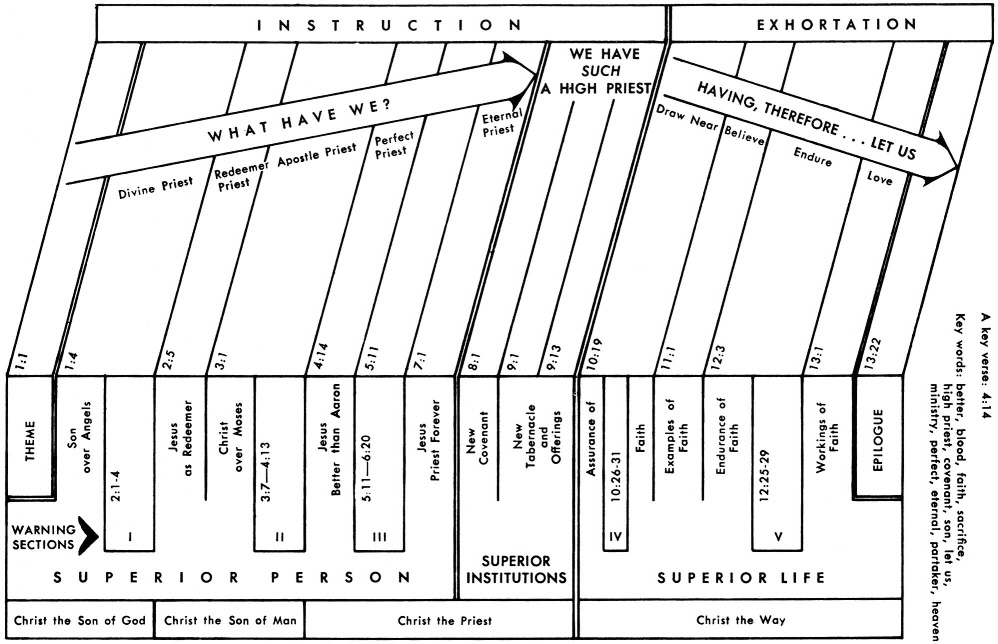
CONSIDER JESUS OUR GREAT HIGH PRIEST
Click chart to enlarge
Charts from Jensen's Survey of the NT - used by permission
Swindoll's Chart, Interesting Pictorial Chart of Hebrews, Another Chart
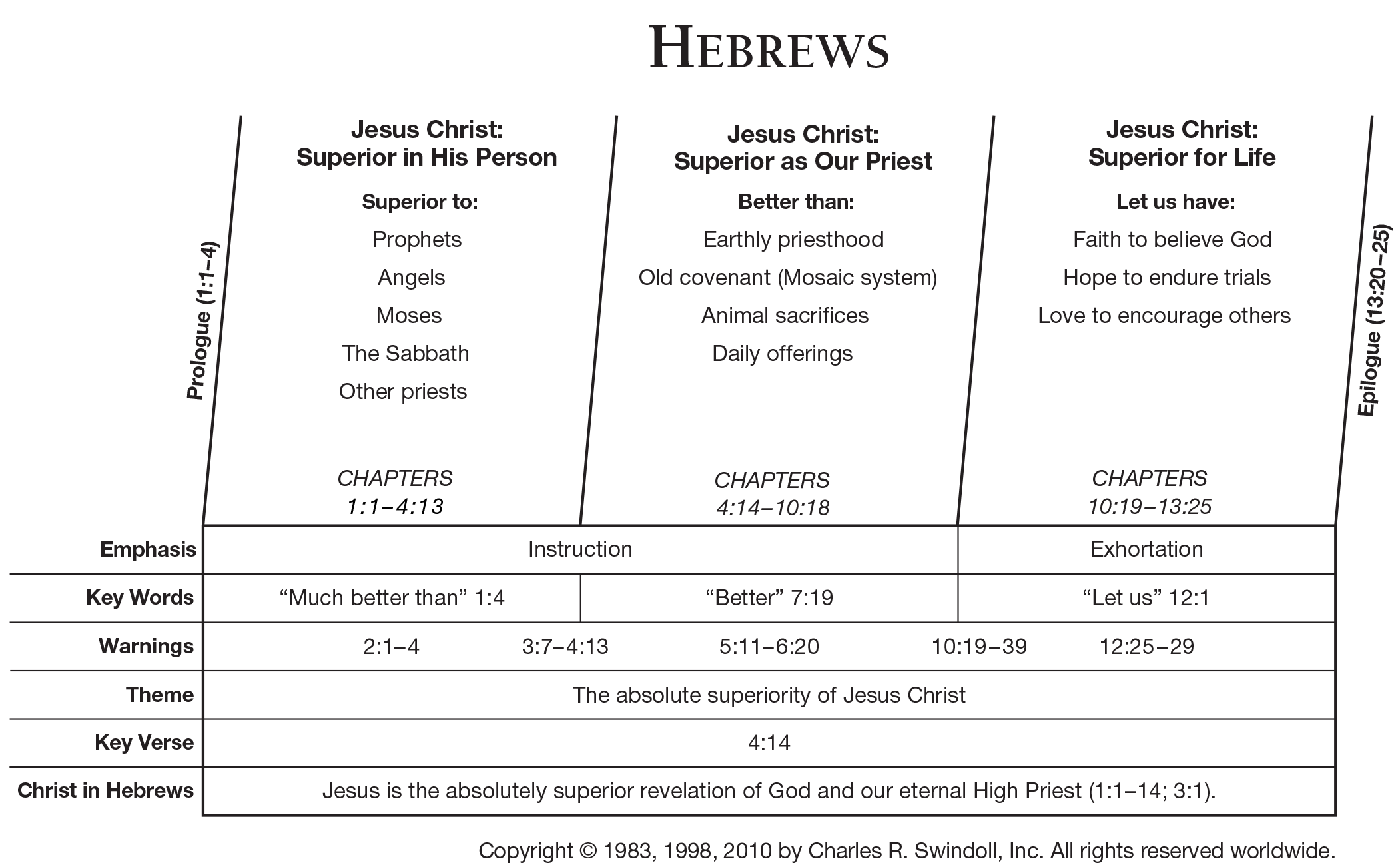

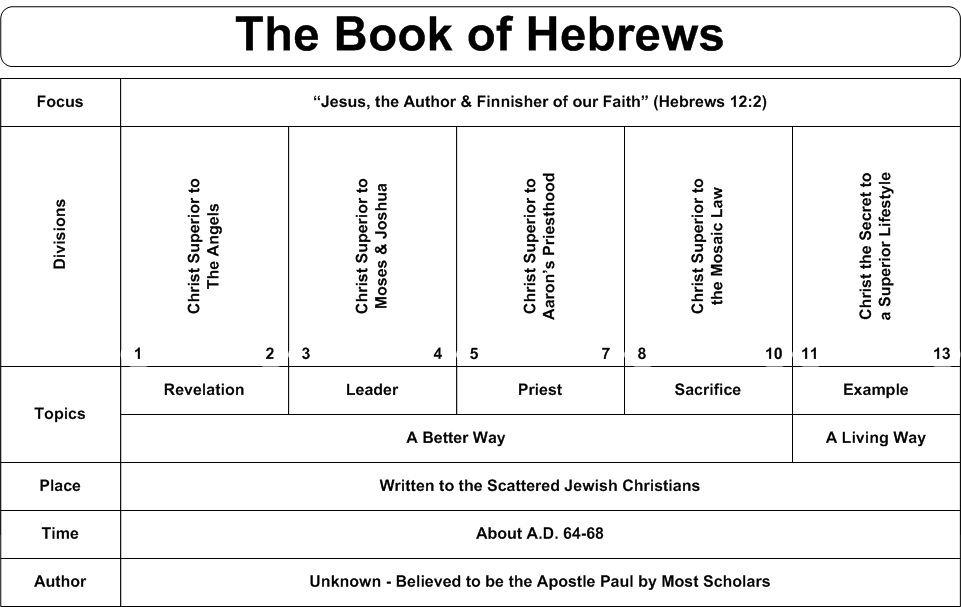
|
The Epistle |
||||
| INSTRUCTION Hebrews 1-10:18 |
EXHORTATION Hebrews 10:19-13:25 |
|||
| Superior Person of Christ Hebrews 1:1-4:13 |
Superior Priest in Christ Hebrews 4:14-10:18 |
Superior Life In Christ Hebrews 10:19-13:25 |
||
| BETTER THAN PERSON Hebrews 1:1-4:13 |
BETTER PRIESTHOOD Heb 4:14-7:28 |
BETTER COVENANT Heb 8:1-13 |
BETTER SACRIFICE Heb 9:1-10:18 |
BETTER LIFE |
| MAJESTY OF CHRIST |
MINISTRY OF CHRIST |
MINISTERS FOR CHRIST |
||
|
DOCTRINE |
DUTY |
|||
|
DATE WRITTEN: |
||||

See ESV Study Bible "Introduction to Hebrews"
(See also MacArthur's Introduction to Hebrews)
Borrow Ryrie Study Bible
Hebrews 10:26 For if we go on sinning willfully after receiving the knowledge of the truth, there no longer remains a sacrifice for sins, (NASB: Lockman)
Greek: Ekousios gar amartanonton (PAPMPG) emon meta to labein (AAN) ten epignosin tes aletheias, ouketi peri amartion apoleipetai (3PPPI) thusia
BGT Ἑκουσίως γὰρ ἁμαρτανόντων ἡμῶν μετὰ τὸ λαβεῖν τὴν ἐπίγνωσιν τῆς ἀληθείας, οὐκέτι περὶ ἁμαρτιῶν ἀπολείπεται θυσία,
Amplified: For if we go on deliberately and willingly sinning after once acquiring the knowledge of the Truth, there is no longer any sacrifice left to atone for [our] sins [no further offering to which to look forward]. (Amplified Bible - Lockman)
Barclay: For, if we deliberately sin after we have received full knowledge of the truth, no sacrifice for sin is left. (Westminster Press)
NLT: Dear friends, if we deliberately continue sinning after we have received a full knowledge of the truth, there is no other sacrifice that will cover these sins. (NLT - Tyndale House)
KJV For if we sin wilfully after that we have received the knowledge of the truth, there remaineth no more sacrifice for sins,
NKJ For if we sin willfully after we have received the knowledge of the truth, there no longer remains a sacrifice for sins,
NET For if we deliberately keep on sinning after receiving the knowledge of the truth, no further sacrifice for sins is left for us,
CSB For if we deliberately sin after receiving the knowledge of the truth, there no longer remains a sacrifice for sins,
ESV For if we go on sinning deliberately after receiving the knowledge of the truth, there no longer remains a sacrifice for sins,
NIV If we deliberately keep on sinning after we have received the knowledge of the truth, no sacrifice for sins is left,
Phillips: Now if we sin deliberately after we have known and accepted the truth, there can be no further sacrifice for sin for us (Phillips: Touchstone)
Wuest: For if we go on sinning willfully after having received a full knowledge of the truth, no longer for sins does there remain a sacrifice,
Young's Literal: For we -- wilfully sinning after the receiving the full knowledge of the truth -- no more for sins doth there remain a sacrifice,
|
THE FIVE WARNING PASSAGES |
| Heb 2:1-4+ |
| Heb 3:7-4:13+ |
| Heb 5:11-6:12+ |
| Heb 10:19-39+ |
| Heb 12:14-29+ |
- If we go on sinning willfully He 6:4-6; Lev 4:2,13; Nu 15:28-31; Dt 17:12; Ps 19:12,13; Da 5:22,23; Mt 12:31,32,43-45; Jn 9:41; 1Ti 1:13; 2Pe 2:20, 21, 22; 1Jn 5:16
- Hebrews 10 Resources - Multiple Sermons and Commentaries
- Click for 5W/H Study Questions — ideal for leading a group or personal study of Hebrews
Related Passages:
Hebrews 6:4-6+ For in the case of those who have once been enlightened and have tasted of the heavenly gift and have been made partakers of the Holy Spirit, 5 and have tasted the good word of God and the powers of the age to come, 6 and then have fallen away, it is impossible to renew them again to repentance, since they again crucify to themselves the Son of God and put Him to open shame.
John 6:66+ As a result of this many of His disciples withdrew and were not walking with Him anymore (ouketi).
1 John 2:19+ They went out (exerchomai - aorist active indicative) from (ek - out) us, but they were not (ou - absolutely not) really of us; for if they had been of us, they would have remained with us; but they went out, so that it would be shown (made clear was was hidden) that they all are not (ou - absolutely not) of us.
WHAT IS WILLFUL
OR DELIBERATE SIN?
The writer now somewhat abruptly turns from exhortation to a grave and sobering warning that will surely get his reader's full attention. After inviting believers through beautiful exhortations to draw near, hold fast, and encourage one another (Heb 10:22–25), now he explains the fearful reality that to receive full light and then deliberately turn from it, committing apostasy, could send your soul to Hell (this is the this writer holds).
In fairness, be aware that not everyone interprets this passage as describing unsaved individuals bound for Hell. Some interpret these individuals as believers who lose their salvation. A third group (Zane Hodges, Thomas Constable, Charles Swindoll, all from Dallas Theological Seminary, Warren Wiersbe) interprets these individuals as saved but suffering a loss of rewards (although I see no mention of rewards in Heb 10:26-31). (See various interpretations and see Steven Cole's analysis also a graduate from DTS!)
For (gar) is a term of explanation and begs the question, what is the author explaining? In context, he has just given three stirring exhortations (Heb 10:23-25) and it is reasonable to see that the for” explains why these exhortations are so urgent. Why? Because to willfully turn away after knowing the truth is spiritually catastrophic which ends in eternal punishment! In the immediate context the most relevant exhortation is not to forsake your own assembling together, which if practiced with sincerity and integrity provides a strong impediment to slip sliding away into apostasy.
If we go on sinning (hamartano in present tense - continually sinning) willfully (hekousios) after receiving (lambano) the knowledge (epignosis) of the truth (aletheia) , there no longer (ouketi) remains (apoleipo) a sacrifice (thusia) for sins (hamartia) - On if we see Utley's note below. If we go on sinning - Although the writer includes himself in this warning (just as he did in his first warning in Heb 2:3+ "how will we escape") but notice that he switches pronouns in Hebrews 10:29+ to "he". And at the end of the chapter (Heb 10:39+), the writer makes it clear that he considers himself a true believer by including himself in the "we" who do not "shrink back to destruction". These uses of pronouns would strongly argue against those who use "we" as justification for interpreting this as a warning to believers. (see interpretations from a number of commentaries below).
Bob Utley on if we go on sinning - "if we" This is not a typical structure of a CONDITIONAL SENTENCE. Possibly the GENITIVE ABSOLUTE (hamartanontōn hēmōn) is functioning as the PROTASIS (if clause). Surprisingly the author grammatically identifies himself with the wilfully sinning group, but this may be a literary technique (editorial plural) similar to Heb. 2:3+. The first person does not automatically identify him with the group spoken of in Heb. 10:26-29. This same type of literary technique using the first person can be found in 1 Cor. 13:1-3+.
Phil Newton astutely observes that "Willfully (hekousios) stands at the front of the sentence (ED: In the original Greek text) in an emphatic position as a reminder that the ones he addresses are not the weak or immature or ignorant or occasional doubters that are true believers but struggling with their perseverance. It is the deliberate, intentional, voluntary rejection of the sufficiency of Christ that he refers to. (Hebrews 10:26-31 The Peril of Playing Christian)
John MacArthur comments that "This chapter could be titled, "The Tragedy of Getting over It," because it deals with those who had heard the gospel, had come face-to-face with the claims of Christ, had been associated to some extent with His church, but had gone away. These were people whose hearts had been warmed toward the gospel of Christ, who had made a superficial commitment of faith in Him, and had identified themselves visibly with the true church. But their enthusiasm was cooling and the cost of being a Christian was becoming too high. They were "getting over" the gospel, and were in danger of becoming apostate. Of the five warnings given in Hebrews, the one in this passage is by far the most serious and sobering. It may be the most serious warning in all of Scripture. It deals with apostasy." (SEE Hebrews Commentary - Page 270) (Bold added)
Before we get into this terrifying passage, we need to understand the main issue the writer is addressing and that is the issue of sinning willfully. Just these words send shivers down our spine! And in one sense they should, but it is important to understand to whom this description of willful sinning applies. So let's first look in the mirror and see how this relates to genuine, born again believers, which is most of you reading this commentary.
Willful (hekousios) describes that which is done intentionally or deliberately. It is doing what one what one wants to do even when he knows it is wrong. The word deliberate (as an adjective) means that which is characterized by or results from careful and thorough consideration. It refers to a mental process in which one proceeds to take some action after thoughtfully weighing the options. Spiritually speaking it would describe a "conversation" as it were with one's conscience regarding whether one should take a particular action in a certain direction! I think you can see where this is going! And in the context of sin, especially the sin which so easily entangles a person, it might even include the idea of planning out a situation that might place us in the path of temptation to commit that sin. Romans 13:14+ commands against such foolish logic (actually more like illogic or overt stupidity - Sin is stupidity!) Paul commanding believer to "make no provision (stop making provision - pronoia - present imperative with a negative which calls for dependence on the Holy Spirit to obey) for the flesh in regard to its lusts." When we make deliberate decisions to dabble with deceptive, destructive sin, we are walking into the snare of the fallen flesh and we will almost certainly commit the sin we are playing games with and it becomes by definition a willful or deliberate sin! James 1:13-16+ explains the sequential process that almost invariably follows when we begin to deliberate (verb) over whether to sin or not to sin...
Let no one say when he is tempted, “I am being tempted by God”; for God cannot be tempted by evil, and He Himself does not tempt anyone. But each one is tempted when he is carried away and enticed (means to bait a hook, to set a trap with bait, lure into a moral trap by targeting one's innate selfish impulses) by his own lust. 15 Then when lust has conceived, it gives birth to sin; and when sin is accomplished, it brings forth death. 16 Do not be deceived, my beloved brethren. (James 1:13-16+).
While we do sometimes sin inadvertently,
most of our sins are willful!
We sin because we choose to sin!
-- Steven Cole
So then, in a sense we need to be clear, ALL of us are guilty of deliberate or "willful sinning" in the sense that there are (many) times when we know the truth of God's Word regarding what would constitute righteous, godly behavior (i.e., obedience) and yet we stubbornly walk down the path of temptation until we are guilty of overt, deliberate disobedience. While this should not be taken lightly for a believer, please note that this is NOT what the writer is talking about in this sobering passage. The context is not a person who is a believer and then one day ceases to be a believer (or loses their salvation). So do not let anyone tell you that you can lose your salvation if you willfully or deliberately sin. That is a false teaching which goes against a flood of Bible passages that teach eternal security (read Jesus' promise in Jn 10:27-29+, etc). But on the other hand, just because God's infinite mercy does not strike us down when we commit deliberate sin, his grace and mercy should never be treated as a invitation to live licentiously! While we are no longer under law but under grace (Ro 6:14+), grace does not give us a license to sin (cf Ro 6:1-2+, Ro 6:15+, Gal 5:13+, 1Pe 2:16+, Ro 8:12, 13+). Let me repeat (as I look in my mirror!) - We are not at liberty to sin willfully or deliberately! Freedom in Christ is not the right to do as we please, but the power to do as we should! So now we have the power to enable us to fight against the temptation to deliberately sin, for in Ro 8:13+ Paul says "if by the Spirit you are putting to death (thanatoo - present tense - continually killing) the deeds of the body, you will live." In short, kill sin lest it be killing you! And how do we kill sin? Empowered by the Spirit, not the flesh! We will fail and fall, but it should always be the exception and never the rule, certainly not the habitual practice of our lives. Before we were saved we chased after sin, but now that we are saved, sin chases after us! If willful sinning is an individual's lifestyle, then that individual needs to be very honest with himself or herself and ask "Is my Christian profession really a possession of Christ?" (They need to soberly ponder Paul's words in 2 Cor 13:5+) The incomprehensible truth that Christ in us (Col 1:27+) and His Spirit is in us (1 Cor 6:19+) should serve to motivate us out of love for our Lord, enabling us to resist committing willful sins and empower us to fight off those temptations that assault our minds enticing us to commit that willful sin, for "he old things passed away; behold, new things have come." (2 Cor 5:17+).

One Way to "Bury the Hatchet"

Another Way to find the buried hatchet!
Let me give you an illustration of making provision for sin - say there is someone who you know that your conscience and the Spirit is leading you to forgive lest a root of bitterness begins to spring up (Heb 12:15+). And so you begin well, determining (led by the Spirit - Ro 8:13, 14+, Gal 5:18+) to "bury the hatchet.' But our fallen flesh is very clever and will attempt to make provision for stirring up your unforgiveness. And so what do we do? Yes, we bury the hatchet, but we leave the handle exposed (see picture above)! Or in another crafty move, the flesh leads us to write ourselves a note that says something like "I will bury the hatchet but make a map of where I have it buried!" So can you see how subtle and persistent the lust of the flesh is to take us down the path of provision for later willfully or deliberately committing a sin? That is why we need to be continually filled with and controlled by the Holy Spirit (Eph 5:18+), so that we might be supernaturally enabled to fight the good fight of faith (1 Ti 6:12+) against the serpentine snares of sin that continually come from our fallen flesh.
Now all of the preceding is simply background to help you understand what the writer of Hebrews means when he warns against willful or deliberate sin. As you study this difficult and disturbing passage, ask your Teacher the Spirit of Truth to lead you into all the Truth (Jn 14:26+, Jn 16:13+, 1Jn 2:27+, 1Cor 2:12+)
R Kent Hughes gives a superb introduction to this difficult passage - It is commonly thought by those who have only a passing recognition of Jonathan Edwards that his famous sermon “Sinners in the Hands of an Angry God” was preached with sadistic glee to his bewildered congregation. The supposition is that Edwards enjoyed afflicting his people and that the sermon was preached with pulpit-pounding vehemence. Such thinking is wide of the mark. Shouting was not Edwards’s style. It is a matter of historical fact that Edwards quietly read his sermons from tiny pieces of paper he held up in front of him. Neither did Edwards enjoy such preaching. Rather, it was necessitated by the famous “halfway” covenant, an earlier Puritan attempt to keep as many people as possible under the influence of the church, though they were not professed believers. The church in Enfield contained baptized unbelievers who were barred from the Lord’s Table. Ultimately, Edwards was dismissed as pastor over the question of the admission of the unconverted to the Lord’s Supper. Edwards was preaching for their souls, and also against the follies of the “halfway” covenant. Therefore, we must understand that Jonathan Edwards’s passionate love for God and his flock was the reason he employed every tool in his considerable stores of logic and metaphor to plead for his people’s souls in “Sinners in the Hands of an Angry God.” He was less concerned with God’s wrath than with his grace, which was freely extended to sinners who repented. Jonathan Edwards gave his people a whiff of the sulphurs of Hell that they might deeply inhale the fragrances of grace. Edwards’s intense concern joins him in heart with the preacher who wrote to the Hebrews some 1,700 years earlier. The stakes were identical—Heaven or Hell. And the symptoms, though not identical, were similar as well—a declining regard for the church’s authority, a willfulness to define one’s relationship to the church in one’s own terms, and, in some cases, quitting the church altogether. To such are addressed the thunderous warnings in verses 26–31, in which the brilliant writer summons his own prodigious logic and literary talents. (ILLUSTRATION) To glimpse his passion, we can imagine ourselves as parents raising our children along a boulevard on which huge trucks regularly pass at great speed. Our warnings are couched in the most dramatic terms and lurid illustrations—“Do you know what happens to little children if…”—in the hope that somehow what we say will penetrate the imagination and thinking process of our children, so they will stay out of the deadly street! (See Hebrews: An Anchor for the Soul)
Another anecdote about Edward's sermon...
Jonathan Edwards started a sermon that he did not finish. Such was the impact of his preaching that the people listening shrieked and cried out, and the crying and weeping became so loud that Edwards was forced to discontinue the sermon. Instead, the pastors went down among the the people and prayed with them in groups. Many came to a saving knowledge of Christ that day.
As noted above the verb Sinning is in the present tense this indicates this is their lifestyle, their habitual practice. It describes an abiding state of willful, deliberate sinning! To be sure saved souls still commit sins (and as noted above, sadly even do so deliberately) but sinning is not their continual practice once they are born again by the Holy Spirit. They become new creations in Christ "the old things passed away (INCLUDING CONTINUALLY LIVING IN SIN); behold, new things (A NEW DIRECTION, NEW POWER, NEW MOTIVATION, NEW LOVE TO NOW LIVE FOR JESUS) have come." (2Cor 5:17+). If such a spiritual transaction has not occurred, then such a person should considering performing a sober, honest self-examination (cp 2Cor 13:5+) to be absolutely certain there is tangible evidence one is a possessor of Christ and not simply a professor of Christ. Remember, if there is not spiritual fruit in your life, it is difficult to say there is a root (cf Col 2:6,7+).
Jesus gave a stern, even frightening warning that "many" (not "few") would profess knowing Him, but that their life would indicate otherwise and when their charade is exposed, it is too late!
“Not everyone who says (present tense) to Me (THEIR CONTINUAL PROFESSION) ‘Lord, Lord,’ will enter the kingdom of heaven, but he who does (present tense - continually because they are enabled by the indwelling Spirit - NOTE: Jesus is not describing PERFECTION but DIRECTION!) the will of My Father Who is in heaven will enter. Many (WOE! cf Many in Mt 7:13+) will say to Me on that day, ‘Lord, Lord, did we not prophesy in Your name, and in Your name cast out demons, and in Your name perform many miracles?’ (NOTE CAREFULLY JESUS DOES NOT DENY THEY DID THESE THINGS! THEY WERE NOT GENUINE "FRUIT") “And then I will declare to them, ‘I never (oudepote = ABSOLUTE NEGATION - NEVER AT ANY POINT IN TIME - IN OTHER WORDS THESE ARE NOT FOLKS WHO WERE SAVED AND THEN LOST THEIR SALVATION! JESUS NEVER, EVER KNEW THEM!) knew (ginosko SPEAKS OF INTIMACY, FELLOWSHIP, ONENESS, COMMUNION) you; DEPART (apochoreo - command - present imperative) FROM ME, (THEIR PRACTICE CONDEMNS THEM! see Titus 3:11+) YOU WHO PRACTICE (ergazomai = ACTIVELY WORK TO CARRY OUT! present tense - willfully, deliberately, continually) LAWLESSNESS.’ (anomia Mt 7:21+, Mt 7:22-23+)
And later Jesus explains where they are to depart " ‘Depart (poreuo command present imperative) from Me, accursed (kataraomai) ones, into the eternal fire which has been prepared for the devil and his angels." (Mt 25:41+)
Beloved, do not confuse what the writer of Hebrews is saying and not saying -- he is NOT teaching sinless perfection, but he is teaching about the "general direction" of your life as indicated by your day to day behavior.
THE CHRISTIAN LIFE IS ABOUT
DIRECTION NOT PERFECTION
As an aside one day in glory we will in fact attain sinless perfection forever and ever. Amen. (Glorification).
Phil Newton applies the idea of (SINNING IN) the present tense which indicates habitual or continuous action to make the important point that "Apostasy does not happen overnight. It is a process, a deliberate process, on the part of one who is not satisfied with the revelation of God in Christ and the effectiveness of the redemptive work of Christ. (Hebrews 10:26-31 The Peril of Playing Christian) (Bolding added)
Newton goes on to explain that "The "sinning" has reference to rejection of precisely what this writer has set forth: the person of Christ and his effective work as our great high priest. They are rejecting or speaking against the revelation of Jesus Christ as the one in whom God has spoken with finality, Who created and upholds all things in the world, and Who as the Incarnate Son came to make purification for sins (Heb 1:1-3). They reject that Christ is more excellent than the angels and Moses and all the Aaronic priesthood (Heb 1:5-2:9; Heb 3:1-6; Heb 5:1-10). They reject that Christ mediated a new covenant that totally replaces the old covenant, and that He ratified its excellence by His atoning death (Heb 8:6-13; Heb 9:11-28). Instead of depending upon the atoning death of Christ they cling to the blood of bulls and goats as superior to that of the Son of God offered at Calvary (Heb 10:1-18). It was not a momentary lapse, a struggle because of pressure from family or culture that was the problem. They "willfully" sinned, in calculated fashion they picked through the revelation of God in Christ and rejected precisely what the gospel reveals. (Hebrews 10:26-31 The Peril of Playing Christian) (Bolding added)
The NIV gives an accurate sense of the present tense of the verb rendering it - "If we deliberately keep on sinning".John gives a similar warning explaining that "the one who practices (present tense again indicating not perfection but "direction" of one's life) sin is of the devil" (1 Jn 3:8+) adding that "no one who is born of God practices (present tense) sin". Why not? Simply put, it is IMpossible! They can't habitually, willfully, deliberately, continually sin because God's holy "seed abides in (them - "HIMpossible!")… because (they are) born of God." (1 Jn 3:9+)
This description is not referring to "sins of ignorance" (Heb 9:7+) or weakness, but to those that are planned out, determined, done with forethought (cp Paul's command in Ro 13:14+ to "make no provision [pronoia] for the flesh in regard to its lusts."). Again, do not misunderstand. If the truth be told, we most of us sin, it is often because we have made some provision to carry out that sin. But this is not our lifestyle, our habitual practice.
A similar warning against defection from the faith (falling away from the truth about the great High Priest Jesus) is presented in Heb 2:1+, He 2:3+ where it is described as letting truth slip away, in Heb 3:7, 8+ where it is described as hardening the heart against the Holy Spirit, in He 6:4, 5+, He 6:6+ where it is described as falling away and crucifying the Son of God and lastly in Heb 12:25+ where it is described as a refusal to hear and heed God's warning from heaven. Clearly, the writer of Hebrews viewed Apostasy as a very real and serious possibility for his Jewish audience who had heard the good news about their Messiah, Jesus.
John gives a descriptive "definition" of Apostasy...
They went out (exerchomai) from us, but they were not (ou = absolutely not) really of us; for if they had been of us, they would have remained with us; but they went out, so that it would be shown that they all are not of us. (1Jn 2:19+).
COMMENT - In 1 Jn 2:19+ concerning those who “went out (active voice = expresses a decision of one's will, a volitional choice) from us” shows that their departure (compare "apostasy") was clear indication that they were not genuine believers. They had known about the way of life (cf Jn 14:6+), but they had not chosen to "receive" (Jn 1:11, 12+) the truth. An unmistakable sign of apostasy is an unwillingness to continue association with true believers, although this does not mean apostates might not hide as wolves mixed in with the sheep or tares mixed with the real wheat (cf Mt 13:24–30+)!
Henry Morris adds that "There is probably an allusion here to such Old Testament passages as Nu 15:30,31; Dt 17:2-7; etc. The presumptuous sins (Ps 19:13), especially of deliberate apostasy into idolatry and paganism, were punishable by death. In similar fashion, the deliberate rejection of Christ and His sacrifice for one's sins, after one fully understands its significance and may even have made profession of faith therein, is without remedy. This is the only means God has provided, and there is nothing more that can be said or done to save such a person. That person already knows and understands it all and has rejected it (Heb 6:4-6). Such a person, regardless of outward appearances, had never truly committed his faith and life to Christ in the first place (1Jn 2:19+). This verse does not, in context, apply to other sins of a true Christian (He 10:39). The remedy for these is repentance and confession, for the blood of Christ has already paid for them (1Jn 1:7, 8, 9)."
Gotquestions has an interesting (if not disturbing) quote related to apostasy - A recent example of this process is a 2010 study done by prominent atheist Daniel Dennett and Linda LaScola called “Preachers Who Are Not Believers”. Dennett and LaScola’s work chronicles five different preachers who over time were presented with and accepted heretical teachings about Christianity and now have completely fallen away from the faith and are either pantheists or clandestine atheists. One of the most disturbing truths highlighted in the study is that these preachers maintain their position as pastors of Christian churches with their congregations being unaware of their leader’s true spiritual state. (WOE!!!) (What is apostasy)
F F Bruce comments "What he has in mind is rather that “deserting the living God” of which he spoke in 3:12, that renunciation of Christianity against which he warned his readers in 6:4–8. To have received the knowledge of the truth and then reject it is to give up the only way of salvation. “No further sacrifice for sins is left” which can avail for those who have deliberately abandoned reliance on the perfect sacrifice of Christ. That outright apostasy is intended here seems plain from the language of v. 29; the man who has committed this wilful sin is described as having “spurned the Son of God, and profaned the blood of the covenant by which he was sanctified, and outraged the Spirit of grace” (RSV)." (The Epistle to the Hebrews)
JUDAS ISCARIOT IS THE PERFECT PROTOTYPE OF AN APOSTATE! - What do I mean by prototype? Prototype in English means “something that is representative of a category of things.” Webster’s Dictionary says a prototype is “an individual that exhibits the essential features of a later type.” So if we know about Judas (which almost everyone does – for example, have you ever heard of any parent naming their son “JUDAS”?), we have a good picture of apostasy for he is a “prototype!”
Every apostate is an unbeliever,
but not every unbeliever is an apostate
John MacArthur amplifies the idea of Judas as the perfect prototype of an apostate and goes on to give us an excellent definition of apostasy...
"Judas Iscariot is, of course, the classic apostate. No other rejecter of Christ ever had the exposure to God's truth, love, and grace as did Judas. He knew the Lord intimately. He was one of the twelve of Jesus' inner circle of disciples. Had he believed, he would have become an apostle. But he rejected the truth and became an apostate. His story is the supreme contradiction to the common excuse, "I would probably believe in Christ if I just had a little more evidence, a little more light." Judas had the perfect evidence, the perfect light, the perfect example. For some three years he lived with Truth incarnate and Life incarnate, yet turned his back on the One who is truth and life.
Apostasy is an intentional falling away or withdrawal, a defection.... There are people who move toward Christ, right up to the edge of saving belief. They hear of Him and they are drawn to Him. They are perhaps deeply convicted of sin and even make a profession of faith. But their interest in the things of God begins to wane, and the pressures and attractions of the world distract them further still, until they have no interest at all They may turn to another religion or to no religion at all. Apostasy is determined by what you leave, not where you go after you leave. After a person leaves God, it makes little difference where he then goes.
Many years ago I had a friend who often went with me to Pershing Square in Los Angeles to witness. He was raised in the church and was a regular and dependable member, but I always felt that something was missing in his life. Then, suddenly, I did not see him anymore. About three years later, I met a mutual friend and asked if she knew what had happened to him. "oh, he's an atheist now," was the reply. "He doesn't believe in God anymore. He has accepted situation ethics, and sees everything as amoral. He doesn't believe anything is good nor bad in itself." Apparently he had had enough of God, and simply turned away.
Here is possibly the clearest and most concise scriptural definition of apostasy—receiving knowledge of the truth, that is, the gospel, but willfully remaining in sin. An apostate has seen and heard the truth—he knows it well—but he willfully rejects it. Apostasy has two major characteristics: knowledge of the truth of the gospel and willful rejection of it.
Every apostate is an unbeliever, but not every unbeliever is an apostate. Many people have never had the opportunity to hear the gospel, even in part. They are sinful and, of course, do not believe in Christ, because they have never heard of Him or of His claims. An apostate, however, is well acquainted with the gospel. He knows more than enough to be saved. (SEE Hebrews Commentary - Page 272)
W A Criswell adds that to "Sin willfully" is similar to the rebellion against God that is described in the O.T. as sinning "with a high hand" or "presumptuously" (Nu 15:30, 31; defiantly, literally "with a high hand"). This sin is a sin of premeditation, committed only by those who have had the advantage of great light. In the rejecting of Christ's sacrifice, they discover that there is no other acceptable sacrifice for sin.
Moses records…
'You shall have one law for him who does anything unintentionally, for him who is native among the sons of Israel and for the alien who sojourns among them. 30 'But the person who does anything defiantly, whether he is native or an alien, that one is blaspheming the LORD; and that person shall be cut off from among his people. 31 'Because he has despised the word of the LORD and has broken His commandment, that person shall be completely cut off; his guilt shall be on him.'" (Nu 15:29, 30+)
Comment: "Defiantly" is a vivid picture in Hebrew as the words "yad ramah" literally describe "a hand exalted" or "a high hand". The Septuagint translates it similarly (en cheiri huperephanias), this Greek phrase meaning "with a raised fist so to speak". NET Bible note adds that "The expression ("a high hand") means that someone would do something with deliberate defiance, with an arrogance in spite of what the LORD said. It is as if the sinner was about to attack God, or at least lifting his hand against God. The implication of the expression is that it was done in full knowledge of the Law (especially since this contrasts throughout with the sins of ignorance). Blatant defiance of the word of the LORD is dealt with differently. For similar expressions, see Ex 14:8+, Nu 33:3+).
To reiterate, these are NOT those willful sins most believers commit from time to time, but in the immediate context define this sin as one that continually forsakes the only means of grace God provides for salvation.
Steven Cole recognizing that the warning passages in Hebrews do not make for popular pulpit preaching introduces his sermon in Hebrews 10:26-31 with a pithy illustration…
Charles Spurgeon tells about a church that was asked to accept as their minister a man who did not believe in hell. They said, “You have come to tell us that there is no hell. If your doctrine is true, we certainly do not need you. And if it’s not true, we don’t want you. So either way, we can do without you” (Spurgeon's Expository Encyclopedia [Baker], 10:149; slightly edited).
To speak about God’s terrifying future judgment is not pleasant, but it is necessary, since the Bible clearly teaches that it will happen. Although some prominent evangelical leaders deny the doctrine of hell, we need to remember that Jesus spoke more about the terrors of hell than anyone else in the Bible. We cannot claim to follow Christ and at the same time reject the doctrine of eternal punishment. It is a doctrine with great practical ramifications.
Spurgeon also said (ibid., p. 146), “Think lightly of hell, and you will think lightly of the cross. Think little of the suffering of lost souls, and you will soon think little of the Savior who delivers you from them.”
Although Jonathan Edwards based his famous sermon, “Sinners in the Hands of an Angry God,” on a verse from Deuteronomy, he got the title from verse 31 of our text. God used that powerful sermon to convert many to Christ. I have read it many times, but I recently listened to an actor delivering the sermon as Edwards may have given it. He hammers home with frightening force the terrors of impending judgment, but also the refuge of the cross. (The Only Options: Christ or Judgment?)
Phil Newton introduces this difficult teaching harking back to Jonathan Edwards' famous sermon Sinners in the Hands of an Angry God…
The 18th century was a remarkable time of divine awakenings. Throughout New England the Spirit of God invaded one community after another, bringing the spiritually dead to life, and transforming the worship of churches. During this era awakening appeared to follow the strong doctrinal preaching of the evangelical pastors, often setting forth the righteousness and severity of God in justice before broaching the subject of the gospel of grace. It was not that there were no professing Christians in these villages. Each little community had a village church with many of the townspeople having been baptized into membership. But there was little spiritual reality until the Spirit of God blew in gale force upon the dry, dusty corpses of church members. Like Ezekiel's vision of the valley of dry bones, upon the preaching of the Word, the Spirit of God breathed life.
One such village was the town of Enfield, Connecticut. Though neighboring villages had tasted of the goodness of God in spiritual awakening, they had not. They remained stubborn and defiant, self-satisfied with an outward form of religion; playing Christian we might say, without knowing the peril before them. On July 8, 1741, Jonathan Edwards arose as a substitute preacher to declare before them the word of the Lord, accompanied by his friend and co-laborer, Eleazer Wheelock who was later founder of Dartmouth College. The sermon was not new to Edwards since he had preached it previously in his own church of Northampton, MA. Without any pulpit antics, Edwards carefully followed his manuscript, delivering a picture of divine judgment upon sinful men, particularly upon those who were the baptized members of the Enfield church and yet gave no evidence of regenerate life. It was based upon a text from Deuteronomy 32:35, "Their foot shall slide in due time."
It was this same passage and context that was quoted in Hebrews 10:30 of our text. The last verse of our text provided the basis for Edwards' title,"It is a terrifying thing to fall into the hands of the living God." Sinners in the Hands of an Angry God was no delicate, entertaining sermon, but a striking exaltation of God in his righteousness and exposing of man in his sinfulness. The effect of the sermon was immediate. Wheelock reported to a friend that these "thoughtless and vain" people were changed before the sermon ended so that they were "bowed down with an awful conviction of their sin and danger."
Another eyewitness recorded in his diary, "There was a great moaning and crying out through ye whole House-"What Shall I do to be saved"-"Oh I am going to Hell"-"Oh what shall I do for Christ" etc. So yet ye minister was obliged to desist-ye shrieks and cries were piercing and amazing… "
After referring to Edwards and Wheelock praying and then speaking with one after another of the people under conviction, the diarist continues, "Some in one place and Some in another-and Amazing and Astonishing ye power God was seen--and Several Souls were hopefully wrought upon [that] night, & oh ye cheerfulness and pleasantness of their countenances [that] received comfort" [quoted by Iain Murray, Jonathan Edwards: A New Biography, 167-169].
Edwards' sermon made ten doctrinal points regarding the certainty of divine judgment for all who reject the gospel of Jesus Christ, and among them I would identify the following:
There is no want of power in God to cast men into hell at any moment… They deserve to be cast into hell; so that divine justice never stands in the way, it makes no objection against God's using his power at any moment to destroy them… They are already under a sentence of condemnation to hell… They are now the objects of that very same anger and wrath of God, that is expressed in the torments of hell… There are in the souls of wicked men those hellish principles reigning, that would presently kindle and flame out into hell-fire, if it were not for God's restraints… It is no security to wicked men for one moment, that there are no visible means of death at hand… All wicked men's pains and contrivance which they use to escape hell, while they continue to reject Christ, and so remain wicked men, do not secure them from hell one moment… God has laid himself under no obligation, by any promise, to keep any natural man out of hell one moment [Jonathan Edwards, The Works of Jonathan Edwards, vol. 2, pp. 7-9].
Though he used the text in Deuteronomy as his base, Edwards had to have considered our text in this sermon. It breathes of the same air that we find in the clear warning before us.
I can think of no text that offers a more sobering look at the final reality of playing Christian than the one before us.
Its details are clear, and warning is alarming. After layering one truth on top of another in explaining the supremacy of Jesus Christ in his person and sufficiency in his redemptive work, our writer gives a series of summarizing applications. In the first he exhorts on the basis of the work of Christ to draw near to God, hold fast the confession of hope, and consider how to stimulate the church to love and good deeds (Heb 10:19-25). In the second, that of our text, he warns of the consequence of apostasy, the deliberate turning away from faith in Christ and association with the church (Heb 10:26-31). And in the third application he encourages them to endure their present persecution in light of how God has worked in them formerly and what he has promised for their future (Heb 10:32-39). (Hebrews 10:26-31 The Peril of Playing Christian)
- What is the “Sinners in the Hands of an Angry God” sermon?
- Take about 45 minutes and listen to Max Maclean's reading of the sermon with about 4 minute introduction by R C Sproul - if you dare, give it a listen - “Sinners in the Hands of an Angry God”.
Calvin - He shows how severe a vengeance of God awaits all those who fall away from the grace of Christ; for being without that one true salvation, they are now as it were given up to an inevitable destruction.
Matthew Henry commenting on the related passage in 1 Jn 2:19 writes that "They were not inwardly such as we are: But they were not of us; they had not from the heart obeyed the form of sound doctrine delivered to them; they were not of our union with Christ the head. Then here is, the reason upon which it is concluded that they were not of us, were not what they pretended, or what we are, and that is their actual defection: "For, if they had been of us, they would no doubt have continued with us" (1Jn 2:19); had the sacred truth been rooted in their hearts it would have held them with us (Ed: cp "rocky soil" Mk 4:5, 6, 17); had they had the anointing from above, by which they had been made true and real Christians, they would not have turned antichrists. Those that apostatize from religion sufficiently indicate that, before, they were hypocrites in religion: those who have imbibed the spirit of gospel truth have a good preservative against destructive error.
MacArthur - A believer may sometimes lapse into sin and stray from intimacy with the Lord and with His people. But, unless the Lord disciplines him and takes him to heaven, he will come back. He will be too much under conviction to stay away permanently. In the meanwhile, he will be robbed of joy and peace and of many other blessings. We cannot always determine who is apostate and who is backsliding, and we should not try. (See The Hebrews Commentary)
In the present passage, such persons, regardless of their outward appearance which might otherwise suggest they were believers never actually believed in Christ. (See related studies on - The verb to believe = pisteuo; the noun faith = pistis)
Other NT passages have a similar warning about the danger of those who profess to be believers, but who fail to continue in the faith and thereby demonstrate that they are not truly born again. Here are a few examples to ponder…
1Cor 5:11+ But actually, I wrote to you not to associate with any so-called brother if he is an immoral person, or covetous, or an idolater, or a reviler, or a drunkard, or a swindler—not even to eat with such a one.
1Cor 6:9+ Or do you not know that the unrighteous shall not inherit the kingdom of God (cp Jn 3:3, 4, 5, Jn 3:36)? Do not be deceived (suggesting some were being deceived - the teaching that you can be saved and live any way you please is not the true gospel of grace! Do not be deceived by those who teach this deadly doctrine!); neither fornicators, nor idolaters, nor adulterers, nor effeminate, nor homosexuals, 10 nor thieves, nor the covetous, nor drunkards, nor revilers, nor swindlers, shall inherit the kingdom of God (unbelievers).11 And such were some of you; but you were washed, but you were sanctified, but you were justified in the name of the Lord Jesus Christ, and in the Spirit of our God.
COMMENT - Be a Berean! Be aware there are some evangelical commentaries that say Paul is not speaking of unbelievers in verse 9. E.g., Constable comments on 1Co 6:9-10 - "Therefore what Paul said about the unrighteous in this verse seems to apply to anyone who is unrighteous in his or her behavior whether saved or unsaved. It does not apply just to the unrighteous in their standing before God, namely unbelievers." The ESV Study Bible (which I agree with) counters Constable's comment writing "Paul’s use of the word unrighteous (Gk. adikos again; see note on vv. 7-8) implies that those whose behavior is indistinguishable from the unbelieving world may not be among the “saints” (v. 1) at all. See also 2 Cor. 13:5.) Commenting on the same verse, Reformation Study Bible agrees that "Persistence in wickedness would be an indication that their faith is false and that they have no place in the kingdom." David Guzik adds that "We shouldn’t think that a Christian who has committed an act of fornication or homosexuality (or any of the other listed sins) is automatically excluded from the kingdom of God. Instead, since Paul describes these people by their sins, he means those whose lives are dominated and characterized by these sins. (ED: contra Constable) So, is an occasional act of fornication or homosexuality no big deal to God? Of course it is a significant matter, because it goes against everything we have been given in Jesus, and because a lifestyle of sin begins with single acts of sin."
Col 1:21-23+ And although you were formerly alienated and hostile in mind, engaged in evil deeds, 22 yet He has now reconciled you in His fleshly body through death, in order to present you before Him holy and blameless and beyond reproach--23 if indeed you continue in the faith firmly established and steadfast, and not moved away from the hope of the gospel that you have heard, which was proclaimed in all creation under heaven, and of which I, Paul, was made a minister.
Comment: One's perseverance does not earn their salvation but it does show that person is saved because only a born again person (enabled by the indwelling Spirit) could persevere to the end. O Lord, how this message needs to be sounded forth boldly from the pulpits across America as so many I fear are deceived by their profession as indicated by their absence of a changed life.
Wuest - The word “if” in Col 1:23 is not ean, an unfulfilled, hypothetical condition used with the subjunctive mode, presenting the possibility of a future realization, but ei with the indicative, having here the idea of “assuming that you continue in the faith.” That is, continuance in the gospel as it was preached by Paul would show that the person was saved and thus would be presented holy, without blemish, and unchargeable before God. That is, Paul was here addressing truly born-again Colossians, not unsaved professors of Christianity who would follow the Colossian heresy. Heretics would not so be presented, only true believers. It is not the retention of salvation that is in the apostle’s mind, but the possession of it that would be shown by their continuance in the gospel.
Titus 1:16+ They profess to know God, but by their deeds they deny (deny is present tense = this speaks of one's lifestyle, the habitual practices of one's life - their lips lie, but their actions tell the truth about their unregenerate heart) Him, being detestable (bdekluktos from bdelusso = to emit a foul odor in turn from bdeo = to stink!) and disobedient (apeithes), and worthless (adokimos) for any good deed.
James 2:14+ What use is it, my brethren, if a man says he has faith, but he has no works? Can that faith save him? 15 If a brother or sister is without clothing and in need of daily food, 16 and one of you says to them, "Go in peace, be warmed and be filled," and yet you do not give them what is necessary for their body, what use is that? 17 Even so faith, if it has no works, is dead, being by itself. 18 But someone may well say, "You have faith, and I have works; show me your faith without the works, and I will show you my faith by my works." 19 You believe that God is one. You do well; the demons also believe, and shudder. 20 But are you willing to recognize, you foolish fellow, that faith without works is useless? 21 Was not Abraham our father justified by works, when he offered up Isaac his son on the altar? 22 You see that faith was working with his works, and as a result of the works, faith was perfected; 23 and the Scripture was fulfilled which says, "AND ABRAHAM BELIEVED GOD, AND IT WAS RECKONED TO HIM AS RIGHTEOUSNESS," and he was called the friend of God. 24 You see that a man is justified by works, and not by faith alone. 25 And in the same way was not Rahab the harlot also justified by works, when she received the messengers and sent them out by another way? 26 For just as the body without the spirit is dead, so also faith without works is dead. (Jas 2:14, 15, 16, 17+, Jas 2:18, 19, 20+, Jas 2:21, 22, 23+, Jas 2:24, 25, 26+).
As alluded to at the beginning of the comment on this passage most believers either commit willful sins or can even lapse into a season of sin and will experience broken fellowship and intimacy with the Lord and with His people, but they are not be guilty of the sin which this passage is describing. Believers who commit such willful sins, will return to the Lord, for they are under too great a conviction by their cleansed conscience (Heb 9:13+, Heb 10:22+) and the Holy Spirit to stay away permanently. In the meanwhile, they will be robbed of the Spirit-given love, joy and peace, spiritual power, intimacy, etc. And of course if they persist in sin and do not confess and repent, they will likely experience the discipline of God (see Hebrews 12:5-11+). For a believer who commits willful sin the price of unconfessed sin is "steep". Ponder these passages…
Proverbs 28:13 (in depth commentary) He who conceals (intentionally, actively covering over sin so as to keep secret, cp Adam and Eve in Ge 3:7, 8, 10+!) his transgressions will not prosper (Be profitable, succeed. Root word means to accomplish satisfactorily what is intended), but (O, the mercy of God) he who confesses and forsakes (leaves it in a lurch = not only giving it up but also actually "forgetting" it, so there is no longer desire for it) them will find compassion.
Comment by J Vernon McGee - This is a great proverb. It seems a common practice today for Christians to try to cover their sins. You will find in the average church that there is a Band-Aid of silence wrapped over the cancer of sin. People don’t like to talk about it; in fact, they don’t admit its existence. They like to think they are very good.
There are two kinds of forgiveness, judicial and parental. When we trust Christ as Lord and Savior, we receive forgiveness from the penalty of sins; that is judicial forgiveness. When we, as believers, confess our sins, we receive parental forgiveness (1Jn 1:9); this maintains fellowship with God our Father. Anyone who confesses and forsakes his sins has the assurance that God not only forgives but forgets (Heb 10:17).
Illustration: In a conservative southern church, the pastor's wife found pornography on her husband's computer. After confronting him with the evidence, he admitted downloading the images off the internet, even using the computer in his study which was located in the church itself. Somehow he had separated his ongoing sexual sin from his responsibilities and duties as a man of God. He who covers his sin will not prosper…
Illustration: In an August 2000 poll conducted by Christianity Today on internet pornography, 33% of active ministers admitted having visited porn sites. Over half of those ministers said that they had visited those sites more than once. A total of 18 percent of clergy said they visit sexually explicit Web sites between a couple of times a month and more than once a week. This poll includes many liberal and 'mainstream' ministers, but it would be naive to think that porn was not a problem for some Bible-believing ministers. He who covers his sin will not prosper…
Illustration: A nice Christian family joined the church by letter from another city. Brad and Susan had four wonderful little boys ranging in age from two years up to ten years. Susan had a beautiful voice and sang specials in the church. Brad was a bible teacher and had taught Sunday school at their former church. But Brad and Susan had a terrible secret. He had a terrible temper that caused him to abuse Susan both physically and emotionally. No one in the church had any idea until she took her boys and left to return to her hometown. Brad followed her back and tried to reconcile with her. But his secret was now public and there was no turning back. He who covers his sin will not prosper…
Spurgeon "You say that you can handle your secret sins, that there is no one hurt by them. But you may as well ask the lion to let you put your head into his mouth. You cannot regulate his jaws: neither can you regulate sin. Once done, you cannot tell when you will be destroyed. You may put your head in and out a great many times; but one of these days it will be a costly venture. "
Christian friend, do not continue to hide your sin.
Don't harbor that sin, buried deep in the tent floor of your heart. It will affect your family, your home, your spiritual inheritance, and your purpose in life.
There is no sin worthy of separating us from our Father. It is not necessary to confess your secret sins to everyone, for it is none of their business. Do business with God. Repent and let God restore you to fellowship.
Don't sweep sin under the rug.
Instead put it under the blood!
Psalm 32:3-5+ (David when he sinned with Bathsheba) When I kept silent about my sin, my body wasted away through my groaning all day long. For day and night Thy hand was heavy upon me; My vitality was drained away as with the fever heat of summer. Selah. I acknowledged my sin to Thee, and my iniquity I did not hide; I said, "I will confess my transgressions to the LORD"; and Thou didst forgive the guilt of my sin. Selah.
C H Spurgeon on Psalm 32:3-5 - When I kept silent. When through neglect I failed to confess, or through despair dared not do so, my bones, those solid pillars of my frame, the stronger portions of my bodily constitution, waxed old, began to decay with weakness, for my grief was so intense as to sap my health and destroy my vital energy.
What a killing thing is sin!
It is a pestilent disease!
A fire in the bones!
While we smother our sin it rages within, and like a gathering wound swells horribly and torments terribly.
Through my groaning all the day long. He was silent as to confession, but not as to sorrow. Horror at his great guilt, drove David to incessant laments, until his voice was no longer like the articulate speech of man, but so full of sighing and groaning, that it resembled to hoarse roaring of a wounded beast.
None knows the pangs of conviction
but those who have endured them.
The rack, the wheel, the flaming fagot are ease compared with the Tophet which a guilty conscience kindles within the breast: better suffer all the diseases which flesh is heir to, than lie under the crushing sense of the wrath of almighty God. The Spanish inquisition with all its tortures was nothing to the inquest which conscience holds within the heart.
For day and night thy hand was heavy upon me. God's finger can crush us -- what must His hand be, and that pressing heavily and continuously! Under terrors of conscience, men have little rest by night, for the grim thoughts of the day dog them to their chambers and haunt their dreams, or else they lie awake in a cold sweat of dread. God's hand is very helpful when it uplifts, but it is awful when it presses down: better a world on the shoulder, like Atlas, than God's hand on the heart, like David.
My vitality was drained away as with the fever heat of summer. The sap of his soul was dried, and the body through sympathy appeared to be bereft of its needful fluids. The oil was almost gone from the lamp of life, and the flame flickered as though it would soon expire. Unconfessed transgression, like a fierce poison, dried up the fountain of the man's strength and made him like a tree blasted by the lightning, or a plant withered by the scorching heat of a tropical sun.
Alas! for a poor soul when it has learned its sin
but forgets its Saviour, it goes hard with it indeed.
Selah. It was time to change the tune, for the notes are very low in the scale, and with such hard usage, the strings of the harp are out of order: the next verse will surely be set to another key, or will rehearse a more joyful subject.
I acknowledged my sin unto Thee. After long lingering, the broken heart bethought itself of what it ought to have done at the first, and laid bare its bosom before the Lord. The lancet must be let into the gathering ulcer before relief can be afforded. The least thing we can do, if we would be pardoned, is to acknowledge our fault; if we are too proud for this we double deserve punishment.
And my iniquity have I not hid. We must confess the guilt as well as the fact of sin. It is useless to conceal it, for it is well known to God; it is beneficial to us to own it, for a full confession softens and humbles the heart. We must as far as possible unveil the secrets of the soul, dig up the hidden treasure of Achan (Josh 7:20, 21), and by weight and measure bring out our sins.
I said. This was his fixed resolution. I will confess my transgressions unto the Lord.
Not to my fellow men or to the high priest, but unto Jehovah!
Even in those days of symbol the faithful looked to God alone for deliverance from sin's intolerable load, much more now, when types and shadows have vanished at the appearance of the dawn. When the soul determines to lay low and plead guilty, absolution is near at hand; hence we read,
And Thou didst forgive the guilt of my sin. Not only was the sin itself pardoned, but the iniquity of it; the virus of its guilt was put away, and that at once, so soon as the acknowledgment was made. God's pardons are deep and thorough:
the knife of mercy
cuts at the roots of the ill weed of sin.
Selah. Another pause is needed, for the matter is not such as may be hurried over.
The sins that would entangle us
Must never be ignored;
For if we try to cover them
They'll pierce us like a sword.
Go on sinning (264) (hamartano) means to miss a mark and in this context means to miss God's will. It means to act contrary to the will and law of God. In classic Greek hamartano was used to describe a warrior who threw his spear but failed to strike his adversary or a traveler who missed his way. Hamartano emphasizes loss which always results from missing God's mark or target, His good and acceptable and perfect will (Ro 12:2). Gary Hill adds that "hamartánō ("choosing sin") asserts the agenda of self, by (for) self, over God's loving plan. Ironically, this insists on bringing self-made condemnation (cf. Titus 3:11 = "and is sinning, being self-condemned."). In sum, hamartánō always results in loss of reward for believers, and everlasting condemnation for unbelievers.
HAMARTANO - 37V - Matt. 18:15; Matt. 18:21; Matt. 27:4; Lk. 15:18; Lk. 15:21; Lk. 17:3; Lk. 17:4; Jn. 5:14; Jn. 8:11; Jn. 9:2; Jn. 9:3; Acts 25:8; Rom. 2:12; Rom. 3:23; Rom. 5:12; Rom. 5:14; Rom. 5:16; Rom. 6:15; 1 Co. 6:18; 1 Co. 7:28; 1 Co. 7:36; 1 Co. 8:12; 1 Co. 15:34; Eph. 4:26; 1 Tim. 5:20; Tit. 3:11; Heb. 3:17; Heb. 10:26; 1 Pet. 2:20; 2 Pet. 2:4; 1 Jn. 1:10; 1 Jn. 2:1; 1 Jn. 3:6; 1 Jn. 3:8; 1 Jn. 3:9; 1 Jn. 5:16; 1 Jn. 5:18
Hebrews 3:17+ And with whom was He angry for forty years? Was it not with those who sinned, whose bodies fell in the wilderness?
Willfully (1596) (hekousios from hekousios = voluntary) means willing to do something without being forced or pressured. Doing something of one's own free will = voluntarily, deliberately, willfully, intentionally. Willing to do it without being pressured or forced. Hekousios connotes a conscious expression of an attitude that displays contempt for God!
Wuest - This sin is described as a wilful sin. The word is hekousios, which means, “voluntarily, of one’s own accord.” It is opposed to sins committed inconsiderately, and from ignorance or weakness. The Greek has it, “If we go on sinning wilfully,” stress being placed upon the habitual aspect of the sin. The immediate context defines that sin as one of the continued forsaking of the means of grace at the services of the Christian assemblies, and the habitual commission of the sin defined in Heb 10:29+. (Hebrews Commentary online)
Hekousios in context conveys the idea of deliberate intention that is habitual without being forced or pressured. In other words, in context this adverb modifies the present tense verb sinning indicating that this is a personal choice to deliberately rebel against the truth God has graciously revealed!
The only other NT use of hekousios is in a positive context where Peter exhorts the elders to…"shepherd the flock of God among you, exercising oversight not under compulsion, but voluntarily, according to the will of God; and not for sordid gain, but with eagerness (1Pe 5:2+)
Hebrews 10:26 Willful, Determined Renunciation
Today’s text speaks of trampling underfoot the precious Son of God. This warning, along with Hebrews 6:1-8, has caused untold agony to many sensitive Christians. It’s as if Satan uses Hebrews 6:4 and Hebrews 10:26 to create hopelessness and despair. But what do these passages teach? F. F. Bruce points out that they refer to people who have deliberately abandoned reliance on the perfect sacrifice of Christ. Raymond Brown said that theirs is not a single act of falling away, but a state of willful, determined renunciation of all dependence on Christ’s atoning work. God has no other plan for saving those who regard Christ’s sacrifice as useless. - D. J. De Haan
ILLUSTRATIONS -
The Bridge Out
A sign on the highway warns: “Bridge Out Ahead!”
A man reads it, laughs, and drives on. The bridge has been washed away — and he plunges into the river to his death.
So it is with those who sin willfully after receiving the knowledge of the truth. The warning signs of grace are clear, but they choose to ignore them. The tragedy is not ignorance, but defiance.
The Closed Door of the Ark
When Noah entered the ark, “the Lord closed the door.” Those who mocked outside had laughed at the warnings until the rain began to fall — and then it was too late. The writer of Hebrews says the same — after rejecting the one sacrifice, none remains. The door of mercy is shut to willful scorners.
The Dead Battery of Conscience
A man ignores the warning light on his dashboard until the engine dies. He then blames the car. Likewise, conscience is the Spirit’s warning light. The one who keeps sinning willfully eventually sears the conscience (1 Tim 4:2) and silences the Spirit of grace (v. 29).
The Seared Hand
A blacksmith keeps testing molten metal with his bare hand, boasting of toughness. Soon he loses all sensation — the flesh is deadened. So the willful sinner keeps testing sin until sensitivity to conviction is gone. He sins with a deadened heart — sinning willfully with no fear of consequence.
TODAY IN THE WORD Hebrews 10:26–39
In 1912, the volcano Novarupta in southern Alaska erupted, the largest of its kind in the twentieth century. The blast had worldwide impact. In the next few days, Kodiak Island, which is 100 miles away, became covered in a foot of ash—the nearby Knife Creek valley was so filled with ash, it appeared perfectly flat. Within two weeks, clouds of ash reached all the way to Africa. Due to the lack of modern seismology, no one had seen the eruption coming.
Sometimes as the benefactors of God’s grace, we treat the Lord’s wrath as if it’s a volcano that has gone permanently dormant. But unlike the case of Mount Novarupta, we are without excuse if we aren’t prepared for the coming eruption. Much of Hebrews has featured reminders from the Old Testament that God’s merciful plan of salvation has its roots in God’s earliest promises to His people, probably because many Jewish believers appeared to have trouble connecting the new covenant of Christ with the old traditions of Israel. Today’s reading corrects an equally dangerous error: thinking that God’s intolerance of unbelief was limited to the Old Testament.
At the outset of this passage, the author issued his sternest warning yet. Deliberate, sustained, rebellious sin is a serious offense, and the author of Hebrews did not see how genuine faith could produce such callously wicked results. Moreover, he did not see how the believers he knew and loved could ever become guilty of turning away.
The audience of this letter had already suffered for the cause of Christ with the knowledge that something better awaited them (v. 34). It would have been the pinnacle of foolishness to endure the punishment of society now and the wrath of God in the future. Were true believers really in danger of falling away in such a manner? The author himself doesn’t appear to think so, as he wrote, “But we do not belong to those who shrink back and are destroyed, but to those who have faith and are saved” (v. 39). Nevertheless, the idea that our actions are without consequence is preposterous. God judges unbelief. And true faith bears no resemblance to the wickedness that incurs God’s wrath.
Apply the Word
The natural inward reaction to the warnings in Hebrews, such as the one beginning in verse 26, is to ask yourself, “Have I sinned so greatly as to deserve God’s judgment?” But that’s the wrong question to ask. To dwell on past sins is to focus on your own spiritual depravity. Your works are what condemned you, not what saves you. Turn your eyes instead on your high priest, Jesus Christ, and His Spirit who indwells and seals you for salvation. Now obey Him with confidence
James Smith - REJECTING THE LIGHT.
"This is the condemnation, that light is come into the world, and men loved darkness rather than light, because their deeds were evil" (John 3:19).
As the Light of the world Jesus Christ was a great Teacher come from God.
I. A Joyful Announcement. "Light is come into the world," a light brighter than the sun.
1. WHAT THIS LIGHT IS. It is the Light of Life (chap. 1:4). This is no mere cold, shining moonlight. It is the warm, living, compassionate light of the life of Jesus (2 Tim. 1:10).
2. WHERE THIS LIGHT HAS COME. "Into the world." "In Him was life," and He was in the world (chap. 1:10). Into the place of darkness and death, to shed abroad the light of life (John 3:16).
3. WHAT THIS LIGHT REVEALS. The revelation is twofold. The life of Christ, like the light of the sun, reveals His own hidden glory and power. The wisdom and love of the Father shine out in the Son. He is the image of the invisible God. It reveals, also, the true condition and destiny of man as an unclean and guilty sinner in His sight. The holiness of God and the awfulness of sin appear in eye-blinding brightness.
II. A Lamentable Condition. "Men love darkness rather than the light." What is the darkness? Just that place, or condition, where Christ is not. A Christ less life; they love—
1. THE DARKNESS OF IGNORANCE rather than the light of the knowledge of God as seen in the face of Jesus (2 Cor. 4:6).
2. THE DARKNESS OF SINFUL PLEASURE rather than the light of the glorious Gospel of Christ (2 Cor. 4:4).
3. THE DARKNESS OF DEATH rather than the light of life. This miserable choice reveals the depravity and perversity of man—a mind blinded by the god of this world.
III. A Sorrowful Reason. "Because their deeds were evil." Evil deeds lead to shame and confusion when suddenly brought into the light. The Holy Spirit has come to reprove the world of sin. At the shining of the light some confess their sin and forsake it. Others hug to their hearts their evil deeds, and deliberately hide their face from Heaven's merciful light. The Light has come; the responsibility is now with those who reject it (1 Kings 22:8).
IV. A Solemn Conclusion. "This is the condemnation." The condemnation will be just, because they loved the darkness. It is the wilful sinning for which there remaineth no more sacrifice (Heb. 10:26). ILLUSTRATION - If a man turn away from the sun, and refuse its light, then he can never see any light more convincing. If the deep ocean of God's mercy is reckoned too shallow to cover a man's sins, then they can never be covered. The presumptuous soul shall be cut off (Num. 15:30). While ye have the Light, believe in the Light. Yet a little while is the light with you. Has not Jesus said, "I am the Light of the world; he that followeth Me shall not walk in darkness, but shall have the Light of life" (John 8:12).
QUESTION - What is apostasy and how can I recognize it? GOTQUESTIONS.ORG WATCH VIDEO
ANSWER - Apostasy, from the Greek word apostasia, means “a total desertion of, or departure from, one’s faith, principles, or party”; in theology, “a total abandonment of the Christian faith” (The Century Dictionary, vol. I, p. 265). It is a turning away from God, a rejection of core doctrine, and a separation from the people of God. The apostles addressed apostasy in the early church, and the battle against apostasy has continued through the years. Today, sadly, some still choose to totally abandon their Christian faith.
Apostasy often shows up in the Old Testament. Every time Israel fell into idolatry, it was an example of apostasy (see Judges 2:11–13). In the New Testament, onetime followers of Jesus turned their backs on Him (John 6:66). Demas, “because he loved this world,” deserted Paul (2 Timothy 4:10). The Bible often warns against apostasy (e.g., 1 Timothy 4:1; Hebrews 3:12; 10:35–38; and 2 Peter 2:15).
Christians should understand how to recognize apostasy and apostate teachers, and they should consider apostate teaching to be spiritually dangerous.
Recognizing Apostasy
Apostasy comes in two forms. One is a falling away from key biblical doctrines into heretical teachings that claim to be the “real” Christian doctrine. The second is a complete renunciation of the Christian faith, which results in a full abandonment of Christ.
The second form of apostasy often begins with the first. A heretical belief takes root and grows until it pollutes all aspects of a person’s faith, and that can lead to a complete abandonment of Christianity.
In 2010, Daniel Dennett and Linda LaScola published a study called “Preachers Who Are Not Believers.” Dennett and LaScola’s work chronicled five different preachers who over time were presented with and accepted heretical teachings and now have completely departed from the faith (Evolutionary Psychology, Vol. 8(1), 2010). These pastors ended up being either pantheists or clandestine atheists. One of the most disturbing findings of the study is that these preachers maintained their pastoral positions. They led their churches, but their congregations were unaware of the true spiritual state of the preacher in the pulpit.
A. W. Tozer wrote, “So skilled is error at imitating truth, that the two are constantly being mistaken for each another. It takes a sharp eye these days to know which brother is Cain and which is Abel” (That Incredible Christian, Bailey, A., ed., Moody, 2008, ch. 14, p. 53). The discerning believer—and we all must be discerning—can spot doctrines that depart from the truth.
A crucial doctrine that cannot be compromised concerns the person and work of Jesus Christ: “Who is the liar? It is whoever denies that Jesus is the Christ. Such a person is the antichrist—denying the Father and the Son” (1 John 2:22). In other words, Jesus Christ and His work of redemption are of utmost importance; anyone who denies Jesus’ deity or humanity or who downplays Jesus’ sacrificial death is teaching falsehood.
Apostasy can be recognized as a departure from Jesus’ clear teaching in the Gospels: “Anyone who goes too far and does not remain in the teaching of Christ, does not have God; the one who remains in the teaching has both the Father and the Son” (2 John 1:9, NASB).
The elements of the gospel are another litmus test in identifying apostasy. Paul defines the gospel as the good news concerning Jesus’ death for our sins and His bodily resurrection (1 Corinthians 15:1–4). As nice as they sound, the statements “God loves you,” “God wants us to feed the hungry,” and “God wants you to be wealthy” are not the complete message of the gospel. Paul warns against those who “pervert the gospel of Christ” through the addition of law-keeping as a requirement (Galatians 1:7). No one, not even the greatest preacher, has the right to change the message of the gospel. “If anybody is preaching to you a gospel other than what you accepted, let them be under God’s curse!” (Galatians 1:9).
Recognizing Apostates
Jude was the half-brother of Jesus and a leader in the early church. In his New Testament letter, he outlines how to recognize apostasy and strongly urges those in the body of Christ to “contend earnestly for the faith” (Jude 1:3, NKJV). The Greek verb translated “contend earnestly” is the source of our word agonize. It is in the present infinitive form, which means that the struggle will be continuous. So, we should expect that false teachers will put up a constant fight against the truth, and we should take it seriously. Every Christian is called to this fight, not just church leaders, so all believers should sharpen their discernment skills to recognize and combat apostasy in their midst.
Jude highlights the reason we must contend for the faith: “For certain persons have crept in unnoticed, those who were long beforehand marked out for this condemnation, ungodly persons who turn the grace of our God into licentiousness and deny our only Master and Lord, Jesus Christ” (Jude 1:4, ESV). In this one verse, Jude reveals three traits of apostate teachers:
1. Apostates are subtle in their approach. They have “secretly slipped in” to infiltrate the church. The Greek word literally means “slipped in sideways; came in stealthily; sneaked in.” Compare this with Paul’s description of false apostles as “deceitful” men who “masquerade as servants of righteousness” (2 Corinthians 11:13–15). It is rare that apostasy begins in an overt and easily detectable manner; instead, it starts as a small, seemingly insignificant alteration of the truth.
2. Apostates are ungodly in their actions. They commit immorality and justify it by claiming to be under the grace of God. Jude points out that this is a perversion of grace; no Christian has a license to sin. In addition to their immorality, the apostates are guilty of rebellion (verse 8), grumbling and faultfinding (verse 16), selfishness, arrogance, and flattery (verse 16), and divisiveness and worldliness (verse 19).
3. Apostates are heretical in their theology. They “deny Jesus Christ our only Sovereign and Lord.” Either in what they say or what they do, the apostates reject Christ. They might deny His deity, His humanity, or His eternal sonship. They might oppose the teaching that Jesus is the Messiah or the only Savior. They might downplay the effectiveness of Jesus’ sacrifice or deny the need for it.
A person who falls away from the truth of God’s Word and His righteousness will eventually show his or her true colors. Apostates are adept at covering up the truth and showing a false front, but they cannot maintain the ruse forever. The apostle John says about apostates, “These people left our churches, but they never really belonged with us; otherwise they would have stayed with us. When they left, it proved that they did not belong with us” (1 John 2:19, NLT).
Consequences of Apostasy
Every New Testament book except Philemon contains warnings about false teaching. God does not want His people to be fooled. He wants them to be “filled with the fruit of righteousness that comes through Jesus Christ” (Philippians 1:11).
Ideas have consequences. Satan did not come to the first couple in the garden with a visible weapon; instead, he came to them with an idea. That idea, embraced by Adam and Eve, led to an action that condemned them and the rest of humankind. We have the command to guard against false ideas: “See to it that no one takes you captive through hollow and deceptive philosophy, which depends on human tradition and the elemental spiritual forces of this world rather than on Christ” (Colossians 2:8).
Apostates face condemnation, according to Jude 1:4. “They will bring sudden destruction on themselves,” according to 2 Peter 2:1. The great tragedy is that “many will follow their depraved conduct” (2 Peter 2:2). The apostate teacher dooms his followers. Jesus called false teachers “blind guides” and warned that “if the blind lead the blind, both will fall into a pit” (Matthew 15:14). Christian philosopher Søren Kierkegaard put it this way: “For it has never yet been known to fail that one fool, when he goes astray, takes several others with him” (Philosophical Fragments, trans. by Swenson, D., Princeton University Press, ch. 1, § A, “A Project of Thought,” 1936).
Conclusion
In AD 325, the Council of Nicea convened primarily to take up the issue of the heresy of Arius. Much to Arius’s dismay, the end result was his excommunication and a statement in the Nicene Creed that affirms Christ’s divinity: “We believe in one God, the Father Almighty, maker of all things visible and invisible; and in one Lord Jesus Christ, the Son of God, the only-begotten of his Father, of the substance of the Father, God of God, Light of Light, very God of very God, begotten not made, being of one substance with the Father.”
Arius may have died centuries ago, but his spiritual children are still with us in the form of groups that deny Christ’s true essence and person. Until Christ returns, tares will be present among the wheat (Matthew 13:24–30). In fact, Scripture says apostasy will worsen as Christ’s return approaches: “Many will turn away from the faith” (Matthew 24:10; cf. 2 Timothy 3:1–2, 5).
Now more than ever, every believer should pray for discernment and “contend for the faith that was once for all entrusted to God’s holy people” (Jude 1:3).
Related Resource:
QUESTION: If our salvation is eternally secure, why does the Bible warn so strongly against apostasy?
ANSWER: The Bible teaches that everyone who is born again by the power of the Holy Spirit is saved forever. We receive the gift of eternal life (John 10:28), not temporary life. Someone who is born again (John 3:3) cannot be “unborn.” After being adopted into God’s family (Romans 8:15), we will not be kicked out. When God starts a work, He finishes it (Philippians 1:6). So, the child of God—the believer in Jesus Christ—is eternally secure in his salvation.
However, the Bible also contains some strong warnings against apostasy. These warnings have led some to doubt the doctrine of eternal security. After all, if we cannot lose our salvation, why are we warned against falling away from the Lord? This is a good question. First, we must understand what is meant by “apostasy.”
An apostate is someone who abandons his religious faith. It is clear from the Bible that apostates are people who made professions of faith in Jesus Christ but never genuinely received Him as Savior. They were pretend believers. Those who turn away from Christ never really trusted Him to begin with, as 1 John 2:19 says, “They went out from us, but they did not really belong to us. For if they had belonged to us, they would have remained with us; but their going showed that none of them belonged to us.” Those who apostatize are simply demonstrating that they are not true believers, and they never were.
The Parable of the Wheat and the Tares (Matthew 13:24–30) provides a simple illustration of apostasy. In the same field were growing wheat and “false wheat” (tares or weeds). At first, the difference between the two types of plants was undetectable, but as time went on, the weeds were seen for what they were. In the same way, in any given church today, there may be true, born-again believers side by side with pretenders—those who enjoy the messages, the music, and the fellowship but have never repented of their sins and accepted Christ by faith. To any human observer, the true believer and the pretender look identical. Only God can see the heart. Matthew 13:1–9 (the Parable of the Sower) is another illustration of apostasy in action.
The Bible’s warnings against apostasy exist because there are two types of religious people: believers and unbelievers. In any church there are those who truly know Christ and those who are going through the motions. Wearing the label “Christian” does not guarantee a change of heart. It is possible to hear the Word, and even agree with its truth, without taking it to heart. It is possible to attend church, serve in a ministry, and call yourself a Christian—and still be unsaved (Matthew 7:21–23). As the prophet said, “These people come near to me with their mouth and honor me with their lips, but their hearts are far from me” (Isaiah 29:13; cf. Mark 7:6).
God warns the pretender who sits in the pew and hears the gospel Sunday after Sunday that he is playing with fire. Eventually, a pretender will apostatize—he will “fall away” from the faith he once professed—if he does not repent. Like the tares among the wheat, his true nature will be manifest.
The passages warning against apostasy serve two primary purposes. First, they exhort everyone to be sure of their salvation. One’s eternal destiny is not a trifling matter. Paul tells us in 2 Corinthians 13:5 to examine ourselves to see whether we are “in the faith.”
One test of true faith is love for others (1 John 4:7–8). Another is good works. Anyone can claim to be a Christian, but those who are truly saved will bear “fruit.” A true Christian will show, through words, actions, and doctrine, that he follows the Lord. Christians bear fruit in varying degrees based on their level of obedience and their spiritual gifts, but all Christians bear fruit as the Spirit produces it in them (Galatians 5:22–23). Just as true followers of Jesus Christ will be able to see evidence of their salvation (see 1 John 4:13), apostates will eventually be made known by their fruit (Matthew 7:16–20) or lack thereof (John 15:2).
The second purpose for the Bible’s warnings against apostasy is to equip the church to identify apostates. They can be known by their rejection of Christ, acceptance of heresy, and carnal nature (2 Peter 2:1–3).
The biblical warnings against apostasy, therefore, are warnings to those who are under the umbrella of “faith” without ever having truly exercised faith. Scriptures such as Hebrews 6:4–6 and Hebrews 10:26–29 are warnings to “pretend” believers that they need to examine themselves before it’s too late. Matthew 7:22–23 indicates that “pretend believers” whom the Lord rejects on Judgment Day are rejected not because they “lost faith” but because the Lord never knew them. They never had a relationship with Him.
There are many people who love religion for religion’s sake and are willing to identify themselves with Jesus and the church. Who wouldn’t want eternal life and blessing? However, Jesus warns us to “count the cost” of discipleship (Luke 9:23–26; 14:25–33). True believers have counted the cost and made the commitment; apostates fail to do so. Apostates had a profession of faith at one time but not the possession of faith. Their mouths spoke something other than what their hearts believed. Apostasy is not loss of salvation but evidence of past pretension.
SIN MAKES US STUPID! The Power Of Sin - I was having lunch with a pastor-friend when the discussion sadly turned to a mutual friend in ministry who had failed morally. As we grieved together over this fallen comrade, now out of ministry, I wondered aloud, “I know anyone can be tempted and anyone can stumble, but he’s a smart guy. How could he think he could get away with it?” Without blinking, my friend responded, “Sin makes us stupid.” It was an abrupt statement intended to get my attention, and it worked. I have often thought of that statement in the ensuing years, and I continue to affirm the wisdom of those words. How else can you explain the actions of King David, the man after God’s own heart turned adulterer and murderer? Or the reckless choices of Samson? Or the public denials of Christ by Peter, the most public of Jesus’ disciples? We are flawed people who are vulnerable to temptation and to the foolishness of mind that can rationalize and justify almost any course of action if we try hard enough. If we are to have a measure of victory over the power of sin, it will come only as we lean on the strength and wisdom of Christ (Ro 7:24, 25+; ED: AND I WOULD ADD EVEN MORE IMPORTANT IS TO LEARN TO PUT SIN TO DEATH BY THE SPIRIT! - Ro 8:13+). As His grace (ED: cf Spirit of grace - Heb 10:29+) strengthens our hearts and minds (2 Ti 2:1+), we can overcome our own worst inclination to make foolish choices. —Bill Crowder (Our Daily Bread, Copyright RBC Ministries, Grand Rapids, MI. Reprinted by permission. All rights reserved)
The price of sin is very high
Though now it may seem low;
And if we let it go unchecked,
Its crippling power will grow.
—Fitzhugh
God’s Spirit is your power Source—
Don’t let sin break the connection.
("for if you are living according to the flesh, you must die;
but if by the Spirit you are putting to death the deeds of the body, you will live.")
Romans 8:13+
Sin Is Like An Insect! - It was reported recently that an enormous pine tree in the mountains of Colorado had fallen victim to a pine beetle and died. According to locals, up to that point the tree was thought to be indestructible. It had survived fourteen lightning strikes and many years of Colorado winters, including avalanches and fires. But it was eventually brought down from within by a tiny insect that did its work silently. That's the way it is with sin in a person's life, be they a Christian or a non-Christian. Watch over your heart with all diligence.
Rousseau's "Self-Ruse" - The deceitfulness of sin is vividly seen in the life of the French philosopher Rousseau. He declared, “No man can come to the throne of God and say, ‘I’m a better man than Rousseau.’” When he knew death was close at hand, he boasted, “Ah, how happy a thing it is to die, when one has no reason for remorse or self-reproach.” Then he prayed, “Eternal Being, the soul that I am going to give Thee back is as pure at this moment as it was when it proceeded from Thee; render it a partaker of Thy felicity!”
This is an amazing statement when we realize that Rousseau didn’t profess to be born again. In his writings he advocated adultery and suicide, and for more than 20 years he lived in licentiousness. Most of his children were born out of wedlock and sent to a foundling home. He was mean, treacherous, hypocritical, and blasphemous. (Our Daily Bread, Copyright RBC Ministries, Grand Rapids, MI. Reprinted by permission. All rights reserved)
Another French writer was not quite to cavalier on his deathbed - VOLTAIRE, the noted French infidel and one of the most fertile and talented writers of his time, used his pen to retard and demolish Christianity. Of Christ, Voltaire said: "Curse the wretch!" He once boasted, "In twenty years Christianity will be no more. My single hand shall destroy the edifice it took twelve apostles to rear." Shortly ,after his death the very house in which he printed his foul literature became the depot of the Geneva Bible Society. The nurse who attended Voltaire said: "For all the wealth in Europe I would not see another infidel die." The physician, Trochim, waiting up with Voltaire at his death said that he cried out most desperately "I am abandoned by God and man! I will give you half of what I am worth if you will give me six months' life. Then I shall go to hell; and you will go with me. O Christ! O Jesus Christ!" (Borrow Last Words of Saints and Sinners by Hebert Lockyer, a fascinating book).
We would expect John Wesley to come to the last hour in a different frame of mind from Voltaire, who carried no hope beyond the grave.
'Tis sweet to grow old in the fear of the Lord,
As life's shadows longer creep.
Till our step grows slow, and our sun swings low —
He gives His beloved sleep.
SIN IS LIKE A BOA CONSTRICTOR! - Are you being deceived by sin and tolerating it like a pet? If you are, then you need to remember the fate of the man with the pet boa constrictor (Do a Google search - use the following three words in your search keeping the quotation marks as written >> "pet boa" killed). After 15 years of living with his owner, one day the "pet boa" would not let its "owner" out of its grip resulting in the owner's tragic death. Wild animals remain wild and so does Sin. Do not be deceived (Stop being deceived)!
No Small Deviations in God's Economy! - In St. Louis there is a railroad switchyard. One particular switch begins with just the thinnest piece of steel to direct a train away from one main track to another. If you were to follow those two tracks, however, you would find that one ends in San Francisco, the other in New York. Sin is like that. Just a small deviation from God’s standards can place us far afield from our intended destination. Don't be deceived by the world, flesh or devil who say "It's no big deal!" Wrong!
Entanglement by the Cords of one's own Sin - Not long after a wealthy contractor had finished building the Tombs prison in New York, he was found guilty of forgery and sentenced to several years in the prison he had built! As he was escorted into a cell of his own making, the contractor said, “I never dreamed when I built this prison that I would be an inmate one day.” (cp Nu 32:23+, Pr 5:22+)
TWENTY REASONS NOT TO SIN! - Just for "fun" take a moment to review the following list of 20 reasons not to commit sins (hamartano)…
1. A little sin leads to more sin. (2 Pe 2:18-19, Pr 5:22)
2. Sin invites the discipline of God. (Heb 12:5-11)
3. The time spent in my sin is forever wasted. (Eph 5:16)
4. My sin never pleases but always grieves the God Who loves me. (Ge 39:9, Ezek 6:9, Eph 4:30)
5. My sin places a greater burden on my spiritual leaders. (Heb 13:17)
6. In time, sin always brings heaviness to my heart. (Ps 32:4)
7. Others, including my family, suffer consequences due to my sin. (2 Sa 12:10)
8. My sin makes the enemies of God rejoice. (Jdg 16:25-27, Ps 35:15, Ps 69:12)
9. Sin deceives me into believing I have gained when in reality I have lost. (Heb 3:13, Heb 11:25)
10. Sin may keep me from qualifying for spiritual leadership. (1 Ti 3:2, 10)
11. The supposed benefits of sin will never outweigh the consequences of disobedience. (Heb 11:25)
12. Repenting of sin is a painful process. (2 Cor 7:9-11)
13. My sin may influence others to sin. (cf 1 Cor 5:9-13)
14. My sin may keep others from knowing Christ. (cf 2 Pe 2:18)
15. Sin makes light of the Cross, upon which Christ died for the very purpose of taking away my sin. (Heb 10:29)
16. It is impossible to sin and follow the Spirit at the same time. (1 Th 5:19, Eph 4:30, Jdg 16:19,20)
17. Others more earnest than I have been destroyed by just such sins. (Jdg 16:28-31)
18. God chooses not to hear the prayers of those who cherish their sin (Ps 66:18, Pr 15:8, 29, Pr 21:13, Pr 28:9, Isa 1:15, Jn 9:31, Jas 4:3).
19. My unwillingness to reject this sin now grants it authority over me greater than I understand. (Pr 5:22, Eccl 7:26)
20. I promised God He would be the Lord of my life. (Ro 10:9-10) (Source unknown)
Sin will take you farther than you ever thought you’d stray
Sin will leave you so lost, you think you’ll never find your way
Sin will keep you longer than you ever thought you’d stay
Sin will cost you more than you ever thought you’d pay
AFTER RECEIVING THE KNOWLEDGE OF THE TRUTH: meta to labein (AAN) ten epignosin tes aletheias ouketi peri hamartion apoleipetai (3PPPI) thusia:
- After receiving the knowledge of the truth - Luke 12:47; John 13:17; 15:22, 23, 24; 2Th 2:10; James 4:17
- Hebrews 10 Resources - Multiple Sermons and Commentaries
- Click for 5W/H Study Questions — ideal for leading a group or personal study of Hebrews
FULL KNOWLEDGE CONVEYS
FULL RESPONSIBILITY!
Spiritual light brings personal responsibility. How will I respond to the light I have been given?
After receiving (lambano) the knowledge (epignosis) of the truth (aletheia) - Notice these individuals are without excuse for the writer says they actually received the full knowledge of the truth, but the truth is that they did not truly receive it, in the sense of accepting it and believing it in their heart! In short, you can "receive" and yet "not receive" truth! In one ear and out the other! This is not "gnosis" but "epignosis" (full knowledge - see below)! The "full" knowledge of the truth about Jesus the Great High Priest and His better covenant promises. In short, these individuals have not been "short changed". The cannot claim ignorance and say that God is being unjust in "His austere dealing (judgment and the fury of a fire) with them." They have not been given a "watered down" version of the good news. They have received the unadulterated truth! The implication is that they clearly understood the truth they had heard about Jesus. It was their overt rejection of that truth which defined their apostasy which in turn warranted such a severe "judicial sentence" by God.
Note also that the phrase the truth (aletheia) has the definite article in the Greek ("tes" = the) signifying that this was not truth in general but a specific body of truth, which in context is the truth about Jesus as the Truth (Jn 14:6+)! They had no excuse such as "if I had only heard the truth," etc. They had heard the truth but they made the willful choice to reject the truth and they will be held responsible for the truth they rejected. They will be treated at the Great White Throne judgment (Rev 20:11-15+) in a way similar to those Jews in Capernaum to whom Jesus gave a frightening warning "And you, Capernaum, will not be exalted to heaven, will you? You shall descend to Hades; for if the miracles had occurred in Sodom which occurred in you, it would have remained to this day. "Nevertheless I say to you that it shall be more tolerable for the land of Sodom in the day of judgment, than for you." (Mt 11:23-24+) The principle is that the more spiritual truth or light that is available and rejected, the greater will be the rejecter's punishment in hell! WOE!
There no longer (ouketi) remains (apoleipo) a sacrifice (thusia) for sins (hamartia) - The point is that they once had access to the true sacrifice (Christ), but their willful rejection left no other sacrifice and in 70 AD the destruction of their Temple would put a stop even to their "shadow" sacrifices! Jesus was crystal clear when He declared the "gate is small and the way is narrow that leads to life" and some of these Hebrew readers instead of entering the narrow gate, willfully sinned and chose the broad way that leads to eternal destruction. (Mt 7:13, 14+) While it is not identical, this picture in Hebrews 10:26-31 reminds me of the "unpardonable sin." There is no second chance for these individuals in their state of fixed apostasy. While the door to salvation is not broken, it is as if the willful sinner rejects the only door there is, for Jesus said "I am the door (THE ONLY DOOR); if anyone enters through Me, he will be saved, and will go in and out and find pasture." (Jn 10:9+) It is not that Christ’s sacrifice “expires,” but simply that no substitute remains, once He is rejected. When the grace of Lord Jesus Christ (2Co 13:14+) is fully refused, it leaves judgment as the only alternative.
If you are a true child of God, though a wanderer from His ways,
you will be brought back to Him
C H Spurgeon - It would have been better for you never to have had any knowledge of the truth, than to have known it, and then sinned willfully against it, and so, after all, to be a castaway. If you are a true child of God, though a wanderer from His ways, you will be brought back to Him, and I pray that you may be brought back to Him this very hour. But if you are an apostate, a backslider in heart, you will be filled with your own ways. Having filled up the measure of your iniquity, you will be driven from God’s presence into the place of woe where hope and mercy never can come. How foolish you are who are looking for signs and wonders or else you will not believe. May the Spirit of God show you that Jesus is now able and willing to save you, and that all you have to do is to take what He has done, and simply trust Him, and you shall be saved, completely saved, perfected through His one sacrifice. There remains no more to be done by the Redeemer. He sits down, and He will not rise for any further sacrifice.
The same phrase (the knowledge of the truth) appears in the pastoral epistles…
1 Timothy 2:4+ who desires all men to be saved and to come to the knowledge of the truth.
2 Timothy 2:25+ with gentleness correcting those who are in opposition, if perhaps God may grant them repentance leading to the knowledge of the truth,
2 Timothy 3:7+ always learning and never able to come to the knowledge of the truth.
Titus 1:1+ Paul, a bond-servant of God and an apostle of Jesus Christ, for the faith of those chosen of God and the knowledge of the truth which is according to godliness,
COMMENT - Note above that in Titus Paul links the phrase knowledge the truth and to godliness, which is what knowledge of the truth can and should produce. The failure of the knowledge of the truth to produce godliness does not diminish the power of the truth itself, but rather exposes the perversity of the hearer’s heart.
C H Spurgeon asks "Have you ever considered how much you insult God the Father by rejecting Christ? If you were invited to a feast and you should come to the table and dash down every dish, and throw them on the ground, and trample on them, would not this be an insult? If you were a poor beggar at the door, and a rich man had bidden you into his feast out of pure charity, what would you deserve if you had treated his provisions in this way? And yet this is just your case. You were not deserving of God, you were a poor sinner without any claim upon Him, and yet He has been pleased to prepare a table. His oxen and His fattened cattle have been killed, and now you will not come. You do worse: you raise objections to the feast; you despise the pleasant land and the goodly provision of God. Just think at what an expense the provision of salvation has been made." (Unbelievers Stumbling—Believers Rejoicing)
F F Bruce has an interesting comment - We shall not properly understand the anxiety which this problem caused unless we realize that the kind of sin which in practice aroused greatest concern was sexual irregularity. It was precisely here that the ordinary canons of everyday behavior differed most between Christians and pagans. We may think today that equal attention ought to be paid to the other six deadly sins; the fact remains that this was the one which involved the greatest heart-searching in the Christian community. (For full discussion see The Epistle to the Hebrews - Page 263)
Knowledge (1922)(epignosis from verb epiginosko from epí = upon + ginosko = to know) is a strengthened or intensified form of "gnosis" and conveys the thought of a more full, larger and thorough knowledge. Epignosis "implies “a penetrating and certain knowledge” (Riggenbach, 325), a clear perception of the truth." (Lane) It also conveys the idea of an intimate and personal relationship than the simple term. Vine says the verb form epiginosko suggests generally a directive, a more special, recognition of the object known than ginosko. This is the only use of epignosis in Hebrews.
There are a few resources that suggest there is very little difference between gnósis and epignosis. This discussion holds the opinion that epignosis does have subtle but real differences. Epígnosis refers to exact, complete, thorough, accurate, experiential knowledge, not just abstract, intellectual, head knowledge of God or even facts about Him. Epígnosis always describes moral and religious knowledge in the NT and especially refers to full and comprehensive knowledge of God’s will that rests on the knowledge of God and of Christ found today in His Word.
Wuest - The word “knowledge” is not the simple word gnosis, but the stronger word epignosis. Alford quotes Delitzsch as saying: “When epignosis is used, there is the assumption of an actual direction of the spirit to a definite object and of a real grasping of the same: so that we may speak of a false gnosis, but not of a false epignosis. And the Writer, by the use of this word, gives us to understand that he means by it not only a shallow historical notion about the Truth, but a living believing knowledge of it, which has laid hold of a man and fused him into union with itself.” Thus it is clear that the Jew who committed this sin, was fully informed by the Holy Spirit of the issues involved between the First Testament and the New Testament, and also of the meaning and the implications of the New Testament, (cp Heb 6:4+, “who were once enlightened”) and therefore, he sinned with his eyes wide open. Should he commit this sin, there would remain no more sacrifice for sin. Expositor’s quotes Delitzsch as follows: “The meaning is not merely that the Jewish sacrifices to which the apostate has returned have in themselves no sin-destroying power, nor even that there is no second sacrifice additional to that of Christ, but further that for a sinner of this kind the very sacrifice of Christ itself has no more atoning or reconciling power.” Alford, commenting upon this same thing says: “There is but One true sacrifice for sins: if a man, having availed himself of that One, then deliberately casts it behind him, there is no second left for him. It will be observed that one thing is not, and need not be, specified in the text. That he has exhausted the virtue of the one sacrifice, is not said: but in proportion to his willing rejection of it, has ceased to operate for him. He has in fact, as Delitzsch observes, shut the door of repentance behind him, by the very fact of his being in an abiding state of willing sin.” All of which means that this abandonment of the New Testament sacrifice, the Messiah, and the return to the abrogated sacrifices of the First Testament, was not a snap judgment on the part of this first century Jew, but a confirmed state of heart. (Hebrews Commentary online) (Bolding added)
No longer (3765)(ouketi from ou = absolute negation + eti = yet, any longer) is an adverb meaning no longer, no more, no further, no longer at any time. OUKETI expresses a final cessation — something that was once true or available is no longer so. It is stronger than a simple negation; it indicates termination or final discontinuance. No more, no longer, no further—1. literally of time Mt 19:6; Mk 9:8; Lk 15:19, 21; Jn 4:42; 6:66; 14:19; never again Ro 6:9a; Ac 20:25, 38; 2 Cor 1:23. ouketi ou me, never again Mk 14:25; Rev 18:14.—2. in a nontemporal use then not Ro 11:6a; 14:15; Gal 3:18.
Friberg - adverb; (1) literally, negating an extension of time beyond a certain point = no longer, no further, no more (Mk 12.34); (2) logically, to mark logical progression = then not, accordingly not ( Ro 11.6a) (Borrow Analytical Lexicon of the Greek New Testament)
In John 14:30 Jesus said “I will not talk much with you any longer (ouketi).” The time for conversation had ended. In Romans 6:9 Paul said “knowing that Christ, having been raised from the dead, is never (ouketi) to die again; death no longer (ouketi) is master over Him," indicating that death’s rule was finished. In Ephesians 4:14 Paul wrote “So that we are no longer (ouketi) children, tossed about...” speaking of a change of condition from immaturity to maturity. In one of the saddest uses John wrote "As a result of this many of His disciples withdrew and were not walking with Him anymore (ouketi)." (Jn 6:66). In other words, they never were His genuine disciples!
OUKETI - 46V - Matt. 19:6; Matt. 22:46; Mk. 5:3; Mk. 7:12; Mk. 9:8; Mk. 10:8; Mk. 12:34; Mk. 14:25; Mk. 15:5; Lk. 15:19; Lk. 15:21; Lk. 20:40; Lk. 22:16; Jn. 4:42; Jn. 6:66; Jn. 11:54; Jn. 14:19; Jn. 14:30; Jn. 15:15; Jn. 16:10; Jn. 16:16; Jn. 16:21; Jn. 16:25; Jn. 17:11; Jn. 21:6; Acts 8:39; Acts 20:25; Acts 20:38; Rom. 6:9; Rom. 7:17; Rom. 7:20; Rom. 11:6; Rom. 14:15; 2 Co. 1:23; 2 Co. 5:16; Gal. 2:20; Gal. 3:18; Gal. 3:25; Gal. 4:7; Eph. 2:19; Phlm. 1:16; Heb. 10:18; Heb. 10:26; Rev. 10:6; Rev. 18:11; Rev. 18:14
THE ONLY OTHER USE IN HEBREWS - Hebrews 10:18+ Now where there is forgiveness of these things, there is no longer any offering for sin.

ILLUSTRATION OF A MODERN DAY APOSTATE WHO FITS THE DESCRIPTION OF Hebrews 10:26-31 – The picture above is from 1946 – do you recognize the man on the right? Yes, that is young Billy Graham! The man on the left is Charles Templeton. But first let’s back up! In 1936 at age of 19 Templeton after a night of partying experienced what he called a “profound change!” He said his life seemed “empty, wasted and sordid. It was though a black blanket had been draped over me. A sense of enormous guilt descended and invaded every part of me. I felt unclean.” As he was kneeling at his bedside pleading “Lord come down. Come down.” Then he said a weight was lifted off and “an ineffable warmth began to suffuse every corpuscle of his body.” That was 1936. Then in 1941 Templeton founded a church in Toronto, Canada which grew quickly. In 1945 at Winona Lake, Templeton met with other your fundamentalist leaders including a young Billy Graham to found what we now call Youth For Christ International. It was Templeton who recommended that Graham become the organization’s first evangelist. And together they toured the US and Europe (photo below is before their European trip). During the 1950’s Templeton preached in 14 countries including to some crowds as large as 70,000. One Easter sunrise he preached to 50,000 in the Rose Bowl. It has been said had Templeton continued as an evangelist, we would be asking ourselves “Billy who?” Such was his power and influence. The National Association of Evangelicals in 1946 named Templeton one of the “best used of God.” So what happened? Where is he today? Templeton said that the many years that he preached the Gospel he always doubted the Genesis account of Creation and he secretly rejected the Biblical teaching on divine judgment and hell. In 1957 after a long time of introspection he publicly declared himself to be an agnostic, someone who believes there is a God but cannot really know Him. In 1986 he published his spiritual memoir entitled “Farewell to God – My Reasons for Rejecting the Christian Faith.” In this book he described his pilgrimage from Christian faith to agnosticism to atheism. How does this happen to one of the world’s greatest evangelist, who had dedicated himself to preaching the Gospel and founded organizations to promote the Gospel and even to be an encourager to the man we see as the “poster boy” of evangelism, Billy Graham?
Here is a quote from Templeton spoken to Edward Babinski -
"When I finally shook free of Christianity, it was like being born again. I began to see all of life differently. The things that had once seemed important now seemed trivial. And things I'd never seen the meaning of or the essence of I began to appreciate for the first time." (Leaving the Fold: Testimonies of Former Fundamentalists by Edward Babinski who has a blog "debunking Christianity" - and so clearly I am not recommended his work but only linking to document the quote)
MORE ON CHARLES TEMPLETON
FOLLOWING MAY HAVE SOME REPETITION
One of the most significant problems churches face is the problem of false converts or apostates. There are 4 categories of people in every church – genuine believers and who are confident in Christ for their salvation, genuine believers who have doubts and lack assurance of their salvation, those who think they are Christians but they are not, and those who know they are not believers. It is the third group that the writer of Hebrews is addressing in this section.
You may never have heard the name Charles Templeton, but you surely have heard the name Billy Graham. Charles Templeton (1915-2001) first professed faith in 1936 when he “got religion” as he put it, and everything changed. Lured by the news that the Cleveland Colored Quartet would be performing at Toronto’s Parkdale Church of the Nazarene, he attended the service and experienced an emotional "conversion." For the next twenty years, he devoted himself to bringing about the same experience in the lives of others. Along with Oswald J. Smith, as well as several American evangelists and church leaders, he formed Youth for Christ International and led some of the largest weekly Youth for Christ gatherings in North America. From 1944 to 1948, Templeton’s evangelistic rallies packed 2,800 young people into the auditorium of Toronto’s Massey Hall. Each Saturday evening, the audience heard what one reporter referred to as “old-fashioned repent-and-be-saved gospel preaching.” Drawing on traditional evangelical Protestantism, Templeton urged young men and women to confess their sins, accept Christ as their Savior, and, with the Holy Spirit’s help, live a life pleasing to God. Living for Jesus was the ultimate “thrill,” Templeton informed his audiences. He told young men and women that Christ was “the most exciting man who’s ever lived … the most extraordinary man who’s ever lived,” and not just a man, but God Himself.
In 1945 Templeton met Billy Graham and the two became friends, rooming and ministering together during a 1946 YFC evangelistic tour in Europe (Click to see the photographs and go to the bottom of the page to see how large the gatherings were). Despite these experiences one of the two men wrote the following about himself...
The particular intellectual problem I was wrestling with, for the first time since my conversion as a teenager, was the inspiration and authority of the Scriptures. Seeming contradictions and problems with interpretation defied intellectual solutions, or so I thought. Could the Bible be trusted completely?...
You are probably thinking that was Charles Templeton, but you would be wrong, for it was Billy Graham. And yet within two years after the European tour, in about 1948 Templeton’s life and worldview was beginning to go in a different direction than Graham’s (who obviously had resolved his doubts about the authority of the Scriptures). So instead of Graham, it was Templeton who began to have serious doubts about the Christian faith as he was planning to enter Princeton Theological Seminary. And even after he began to drift from Biblical truth, during the 1950s and ’60s, Templeton preached to crowds of 10,000 to 30,000 nightly. He packed stadiums and thrilled audiences with his proclamation of “the gospel of Christ,” as he believed it to be. And then we "fast forward" to about 1957, when Templeton would publicly declare that he had become an agnostic!
In his 1996 memoir, Farewell to God: My Reasons for Rejecting the Christian Faith, Templeton recounted a conversation with Graham in Montreat prior to entering seminary...
All our differences came to a head in a discussion which, better than anything I know, “explains” Billy Graham and his phenomenal success as an evangelist. In the course of our conversation I said, “But, Billy, it’s simply not possible any longer to believe, for instance, the biblical account of creation. The world was not created over a period of days a few thousand years ago; it has evolved over millions of years. It’s not a matter of speculation; it’s a demonstrable fact.”
“I don’t accept that,” Billy said. “And there are reputable scholars who don’t.”
“Who are these scholars?’ I said. “Men in conservative Christian colleges?”
“Most of them, yes,” he said. “But that is not the point. I believe the Genesis account of creation because it’s in the Bible. I’ve discovered something in my ministry: When I take the Bible literally, when I proclaim it as the word of God, my preaching has power. When I stand on the platform and say, ‘God says,’ or ‘The Bible says,’ the Holy Spirit uses me. There are results. Wiser men than you or I have been arguing questions like this for centuries. I don’t have the time or the intellect to examine all sides of the theological dispute, so I’ve decided once for all to stop questioning and accept the Bible as God’s word.”
“But Billy,” I protested, “You cannot do that. You don’t dare stop thinking about the most important question in life. Do it and you begin to die. It’s intellectual suicide.”
“I don’t know about anybody else,” he said, “but I’ve decided that that’s the path for me.”
(Another quote from Farewell to God - My Reasons for Rejecting the Christian Faith - page 232) - "I believe that there is no supreme being with human attributes--no God in the Biblical sense --but that life is the result of timeless evolutionary forces, having reached its present transient state over millions of years....How can one believe the Biblical account of the creation of the world in six days when every eminent physicist agrees that all living species have evolved over millions of years from primitive beginnings. (ED: BUT WHO BEGAN THOSE "PRIMITIVE BEGINNINGS?")....‘I believe that, in common with all living creatures, we die and cease to exist as an entity.’ (page 233)."
And so we have in the life of Charles Templeton, a man who surely experienced all of the attributes described in Hebrews 6:4-5 and yet he fell away from all he had experienced from 1936 to 1948, over 20 years of evangelizing for Christ! And as the writer of Hebrews warns, it is impossible to renew such a one again to repentance.
Some 50 years after Templeton had begun to reject Christ as the Way, the Truth and the Life, investigative reporter Lee Strobel interviewed him for his best selling book The Case for Christ (the writing of which led Strobel to become a believer in Jesus Christ!) published in 2000 and here is Strobel's record of the interchange as Strobel ask Templeton (see picture of the aged Templeton)...

“And how do you assess this Jesus?” It seemed like the next logical question—but I wasn’t ready for the response it would evoke.
Templeton’s body language softened. It was as if he suddenly felt relaxed and comfortable in talking about an old and dear friend. His voice, which at times had displayed such a sharp and insistent edge, now took on a melancholy and reflective tone. His guard seemingly down, he spoke in an unhurried pace, almost nostalgically, carefully choosing his words as he talked about Jesus.
“He was,” Templeton began, “the greatest human being who has ever lived. He was a moral genius. His ethical sense was unique. He was the intrinsically wisest person that I’ve ever encountered in my life or in my readings. His commitment was total and led to his own death, much to the detriment of the world. What could one say about him except that this was a form of greatness?”
I was taken aback. “You sound like you really care about him,” I said.
“Well, yes, he is the most important thing in my life,” came his reply. “I . . . I . . . I . . . ,” he stuttered, searching for the right word, ‘I know it may sound strange, but I have to say . . . I adore him!” . . .
” . . . Everything good I know, everything decent I know, everything pure I know, I learned from Jesus. Yes . . . yes. And tough! Just look at Jesus. He castigated people. He was angry. People don’t think of him that way, but they don’t read the Bible. He had a righteous anger. He cared for the oppressed and exploited. There’s no question that he had the highest moral standard, the least duplicity, the greatest compassion, of any human being in history. There have been many other wonderful people, but Jesus is Jesus….’
“Uh . . . but . . . no,’ he said slowly, ‘he’s the most . . .” He stopped, then started again. “In my view,” he declared, “he is the most important human being who has ever existed.”
That’s when Templeton uttered the words I never expected to hear from him. “And if I may put it this way,” he said as his voice began to crack, ‘I . . . miss . . . him!”
With that tears flooded his eyes. He turned his head and looked downward, raising his left hand to shield his face from me. His shoulders bobbed as he wept. . . .
Templeton fought to compose himself. I could tell it wasn’t like him to lose control in front of a stranger. He sighed deeply and wiped away a tear. After a few more awkward moments, he waved his hand dismissively. Finally, quietly but adamantly, he insisted: “Enough of that.”
And so we see a living example of Hebrews 6:4-6+! A man who professed Jesus and even spoke of Him affectionately, but not as the sinless Son of God, not as the One Who bore Templeton's sins on Calvary. This has to be one of the saddest, most tragic stories of falling away in the twentieth century!
Related Resources:
- Counterfeit New Births - What the New Birth is Not!
- What is apostasy and how can I recognize it?
- If our salvation is eternally secure, why does the Bible warn so strongly against apostasy?
- How can I have assurance of my salvation?
- Eternal security - is it biblical?
- Is eternal security a “license” to sin?
- The slippery slide to unbelief - This is a very interesting article and speaks of well known names vacillating on Creationism, men like Charles Hodge and B B Warfield (who apparently accepted Darwinism) at Princeton, which is where Templeton went as he began his slippery slide to apostasy!
- Death of an apostate - Short article on Charles Templeton
- 19th century minister to colleague: Darwin will drag you down
All who examine their lives according to Jesus’ standards discover sin; it may not be a frequent event or a flagrant sin, but none of us has lived up to what Jesus has revealed of the Father’s character. We are also forced to admit that some of our sin is deliberate. That is, we do not deliberately set out to sin, but we know in ourselves that some deed or activity is wrong (at least for us, if not for everyone), yet we stifle our consciences and do it anyway. At times we may even recognize that we planned our sin quite carefully (Ro 13:14), or at least planned to walk into temptation (contra 1Co 6:18), knowing full well (in our hearts, if not in our minds) that we would give in. If this is an accurate description of the human condition, then Hebrews 10:26 is very disturbing. Is this verse making the distinction that the Old Testament does between deliberate and accidental sins? Is it saying that there is forgiveness for accidental or unknowing sins, but not for the other type? And if this is the case, are all of us who have knowingly sinned after our conversion lost? If that is in fact the meaning, this verse should cause terror and despair rather than mere concern.
The Old Testament makes a clear distinction between willful or deliberate sin and inadvertent sins. After discussing the procedure for obtaining forgiveness for inadvertent sins in Numbers 15:22–29, the author adds, “But anyone who sins defiantly, … that person must be cut off from his people” (Num 15:30). The example that follows this passage tells of a person who gathered wood on the sabbath, presumably because his fire was going out and he had neglected to gather enough wood the previous day. Surely this was a small act, unlike murder or even theft. But it was also clear that he had consciously gone out to do work on the sabbath and was not ignorant of the law against work on that day. It was a deliberate sin. He was stoned to death at the command of the Lord. A deliberate sin is not to be taken lightly.
Although the Old Testament makes a distinction between deliberate and accidental sin, that does not appear to be the point being made in Hebrews, which looks at life from a perspective of Jesus’ already having come and died for sin. If Jesus understands human weakness and helps those who are tempted (Heb 2:17–18; 4:15), he is hardly going to fail to understand our failure. Similarly, Paul’s response to failure was to restore the person (Gal 6:1), even when the sin was quite serious (2 Cor 2:5–11). Hebrews is not a Pauline writing, but it comes out of the same circle of acquaintances (Heb 13:23). We would therefore expect similar attitudes toward forgiveness of sin.
The point Hebrews is making can best be seen by following the author’s progression of thought. Having noted the adequacy of Christ’s sacrifice in Hebrews 10:1–18, he urges the readers to draw near to God with confidence (Heb 10:19–22). This is expressed in (1) holding on to the hope that we have in Christ, (2) encouraging each other to live the faith in practice and (3) gathering together (Heb 10:23–25). The opposite of these would be to withdraw from the Christian gatherings, to stop doing public expressions of faith, and to give up commitment to Christ and hope in him. In other words, the opposite would be apostasy.
That this is the point of the passage is clearly seen in Hebrews 10:29, where the “deliberate” sinners are described as those who have “trampled the Son of God under foot,” treated the “blood of the covenant” as something common (in other words, looked upon Jesus’ death as just any common criminal’s death) and “insulted the Spirit of grace.” This is deliberate sin, but deliberate in the sense that a person willfully is renouncing Christianity and rejecting Jesus, his death and the personal experience of the Spirit (which is the slander against the Holy Spirit condemned in Mk 3:28–29).
It is not that such deliberate sinners (or apostates) did not know the truth. The author is clear on that point. Only “after we have received the knowledge of the truth” is such an action so serious. Like those mentioned in Hebrews 6:4–8, they have been fully initiated into Christianity, for the phrase “knowledge of the truth” is common in the later New Testament writings for having come to full Christian conversion (Jn 8:32; 1 Tim 2:4; 4:3; 2 Tim 2:25; Tit 1:1; 1 Jn 2:21; 2 Jn 1). But they have chosen to reject their experience of Christ. Had they received a distorted picture of Christianity there might have been hope, for one could correct the distortion. But they have developed a “sinful, unbelieving heart that turns away from the living God” (Heb 3:12). For such people there is no sacrifice for sin remaining; they have rejected the only one that exists. What remains is the judgment of God.
This does not mean that the early church took sin lightly, deliberate or accidental. Any sin called for rebuke and restoration or, if unrepented of, discipline (see Mt 18:15–20; 1 Cor 5:1–5). And sinning could lead to sickness (Jas 5:15) or death (1 Cor 11:30). Furthermore, deliberately hardening one’s conscience and disobeying God could start one on the way to this outright rejection of the faith. It might also indicate that the person remains outside the faith, for Jesus is not yet Lord to the one who disobeys him (1 Cor 6:9–10; Gal 5:19–21). Yet serious as their condition is, the possibility remains that all such people can be brought to repentance in one way or another. There are still arguments to be put forward and evidence to be shown. For the people the author is talking about, however, nothing of the kind is possible. They knew the truth fully, but have deliberately renounced what they once embraced. There is no new evidence or arguments to present. We can only tremble at the thought of the judgment awaiting them and take care that we stay far away from the slope that leads down into that pit. (See Hard Sayings of the Bible: Walter C. Kaiser Jr - page 646)
This is just a sampling of generally conservative sources on this difficult verse.
Leon Morris (applies it to non-believers) - It is clear that the writer has apostasy in mind. He is referring to people who “have received the knowledge of the truth,” where “truth” (alētheia) stands for “the content of Christianity as the absolute truth” (BAG, s.v.), as it frequently does in the NT. The people in question, then, know what God has done in Christ; their acquaintance with Christian teaching is more than superficial. If, knowing this, they revert to an attitude of rejection, of continual sin (cf. the present participle hamartanontōn rendered “keep on sinning”), then there remains no sacrifice for sins. Such people have rejected the sacrifice of Christ, and the preceding argument has shown that there is no other. If they revert to the Jewish sacrificial system, they go back to sacrifices that their knowledge of Christianity teaches them cannot put away sin (v. 4). The writer adopts no pose of superiority, but his “we” puts him in the same class as his readers. While he emphasizes the danger of others, he does not forget that he too is weak and liable to sin. (See The Expositor's Bible Commentary - Abridged Edition)
Everett F Harrison (formerly on faculty at Dallas Theological Seminary) (applies it to non-believers) says "This hopeless apostasy and ultimate and irrevocable rejection leads only to the fiercest judgment from God." (See page 929 Wycliffe Bible Commentary )
R C H Lenski (applies it to non-believers) - “We” means any of us; “willingly” has the emphasis. We construe: “Willingly we sinning after receiving (aorist, actually having received) the realization of the truth.” Sinning in ignorance or in weakness is not referred to but the deliberate, voluntary sinning of one who has really received the knowledge which is realization (ἐπίγνωσις, not mere Kenntnis but Erkenntnis) of the divine, saving truth, the actual reality of the gospel contents.....It is, of course, not merely one deed but a continuous sinning, a habitus....It is after the whole exposition about Christ’s sacrifice that the writer can now say of this sin: “no longer is there left a sacrifice for sins,” i.e., any sacrifice for sins that would have any effect on sinners of this kind. Since they permanently repudiate the one, final, supreme sacrifice of Christ, what is there left that might be brought to bear on these sinners? (Borrow the interpretation of the epistle to the hebrews page 356)
Thomas Lea (applies it to non-believers) - The present writer feels that the author of Hebrews addressed a message to those who professed to be Christians and urged them to show their genuine profession by their refusal to apostatize (see the discussion in ch. 6). Hebrews calls the readers, brothers. That means the author related to the readers as fellow Christians. He could not evaluate clearly their inward commitment. If the readers left Christ for Judaism, they would show that they had never responded in faith to Christ. The author of Hebrews spoke to them as Christians and urged them to show their real faith by endurance in their commitment. He probably suspected that all his readers would not respond in the same way. He assumed their continuance in commitment to Christ would demonstrate authentic Christianity. Any other response would show they had never become believers in Christ. He wrote those thinking of returning to Judaism, making sure they understood the serious nature of such action. (Holman New Testament Commentary – Hebrews & James)
Phillip E Hughes (applies it to non-believers) - The very real danger of apostasy and its dire consequences, against which the most solemn warnings have already been given (Heb 2:1ff.; Heb 3:12; 4:1ff.; and especially Heb 6:4ff.), is now stressed once more. Persons who lapse into the irremediable state of apostasy are precisely those members of the Christian fellowship who sin deliberately after receiving the knowledge of the truth, in distinction, that is, from those described in 5:2 as “the ignorant and wayward,” whose sinning is either inadvertent or not demonstrative of a radical rebellion against the gospel.....There is an abandonment of the Christian profession and of the way of holiness inseparable from that profession. Such a sinner turns away, of set purpose, from what he knows to be the truth. He rebels against the covenant with whose sign he has been sealed. He sins against the light (Heb. 6:4), showing that he loves darkness rather than light (Jn. 3:19). He repudiates salvation and chooses judgment (cf. Dt. 30:15–20). (See A Commentary on the Epistle to the Hebrews - Page 418)
Simon Kistemaker (applies it to non-believers) The author of Hebrews is rather specific. He writes concerning a person who sins intentionally and who keeps on doing this in open rebellion against God and his Word. To reach his readers in a pastoral manner, he even includes himself in the warning not to sin defiantly. He is not talking about a believer who falls into sin unintentionally and finds forgiveness in God’s grace and mercy. Rather, he points to the same sin that Jesus calls the sin against the Holy Spirit (Matt. 12:32; Mark 3:29) and that John describes as “a sin that leads to death” (1 John 5:16). Although he employs different terms, the writer virtually repeats the same thought he expressed in 3:12 and 6:4–6, where he speaks of falling away from the living God....They know that Christ’s sacrifice is the only sacrifice that removes sin (have received the knowledge of the truth). If they deliberately reject Christ and His atoning work, they reject salvation. For them, says the writer, “no sacrifice for sins is left.” (BORROW Exposition of the Epistle to the Hebrews PAGE 292)
ESV Study Bible (applies it to non-believers) - Willfully sinning and refusing to repent. after receiving. The author refers especially to people within the Christian community, who have thus heard the truth. The fact that they “go on sinning deliberately even after receiving knowledge of the truth” indicates that the people in view are not (and never were) genuine believers; that is, these are people who have never genuinely embraced the gospel in a way that has resulted in a life of faith, obedience, and the bearing of fruit. no longer remains a sacrifice for sins. This could refer to the inability of willful, unrepentant sinners to be restored (see 6:4-6), or more likely to the fact that there is no place for them to turn for forgiveness outside of Christ’s sacrifice—which they have rejected. judgment. All people face judgment (see 9:27-28), and apart from Christ’s sacrifice his adversaries receive eternal damnation. These verses, then, function as a means used by God to call genuine Christians to faith, obedience, and perseverance; and, if there is no evidence of fruit in one’s life, to challenge such people to give fearful consideration as to whether they are in fact genuine believers. (Borrow ESV Study Bible page 2378)
Phil Newton (applies it to non-believers) "Willfully (hekousios) stands at the front of the sentence (ED: In the original Greek text) in an emphatic position as a reminder that the ones he addresses are not the weak or immature or ignorant or occasional doubters that are true believers but struggling with their perseverance. It is the deliberate, intentional, voluntary rejection of the sufficiency of Christ that he refers to. (Hebrews 10:26-31 The Peril of Playing Christian)
William Newell (applies it to non-believers) - “To fall into the hands of the Living God is, therefore, to have resisted His love, refused His salvation, despised the warnings of His Spirit, and to have persisted thus past the point where God can consistently show further grace.”
J. M. Flanigan (applies it to non-believers) - The awful sin here referred to is not moral sin. It is neither the trespass which overtakes a man, as in Gal 6:1, nor the grievous sin which required the ultimate discipline as in 1 Cor 5:9-13. It is the sin of apostasy. It is the crime of rejecting revealed truth in a wilful, coldly-intelligent manner, and this though there may have been an earlier mental assent to it, and a certain sympathy with it, even a profession of adherence to it. Apostasy is an abandonment of truth and principles previously professed and owned. Receiving the knowledge of the truth is not the same as receiving the truth. A man may be granted the knowledge of the truth and yet never in heart embrace the truth to the saving of the soul. Judas Iscariot is the great example. He had received the same knowledge of the same truth as had the others. Together the twelve had listened to the Master's unfolding of divine things. They had heard His parables and His expositions of truth. He had instructed them as to sin and salvation, as to grace and faith and hope and eternity. Judas had listened with the eleven. He received the knowledge of the truth. But while the others embraced the revealed truth and believed it, Judas rejected it. The love of silver was preferred over love to the Saviour. The material loomed larger than the spiritual. He had received intellectually all the knowledge that was necessary for salvation but he rejected what had been taught him. It was a wilful sin indeed, the sin of apostasy (What the Bible teaches – Hebrews)
C H Spurgeon (applies it to non-believers) - if we keep on sinning deliberately It would have been better for you never to have had any knowledge of the truth, than to have known it, and then sinned wilfully against it, and so, after all, to be a castaway. If you are a true child of God, though a wanderer from His ways, you will be brought back to Him, and I pray that you may be brought back to Him this very hour. But if you are an apostate, a backslider in heart, you will be filled with your own ways. Having filled up the measure of your iniquity, you will be driven from God’s presence into the place of woe where hope and mercy never can come.....there no longer remains a sacrifice for sins How can there be? Do you think when you are in hell that Christ will come a second time to die for you?
John MacArthur - Of the five warnings given in Hebrews, the one in this passage is by far the most serious and sobering. It may be the most serious warning in all of Scripture. It deals with apostasy. When the gospel of Jesus Christ is presented to an unbeliever, only two responses are possible. After he has heard the basic truths and claims of Jesus Christ, he either believes and is saved or he disbelieves and becomes apostate. Apostasy, as we will see, is the sin of rejecting the gospel for which there is no forgiveness....Apostasy is not new, nor is God’s attitude toward it. It is the most serious of all sins, because it is the most deliberate and willful form of unbelief. It is not a sin of ignorance, but of rejecting known truth...Apostasy is an intentional falling away or withdrawal, a defection.....Many years ago I had a friend who often went with me to Pershing Square in Los Angeles to witness. He was raised in the church and was a regular and dependable member, but I always felt that something was missing in his life. Then, suddenly, I did not see him anymore. About three years later, I met a mutual friend and asked if she knew what had happened to him. “Oh, he’s an atheist now,” was the reply. “He doesn’t believe in God anymore. He has accepted situation ethics, and sees everything as amoral. He doesn’t believe anything is good nor bad in itself.” Apparently he had had enough of God, and simply turned away.....Here is possibly the clearest and most concise scriptural definition of apostasy—receiving knowledge of the truth, that is, the gospel, but willfully remaining in sin. An apostate has seen and heard the truth—he knows it well—but he willfully rejects it. Apostasy has two major characteristics: knowledge of the truth of the gospel and willful rejection of it. (See Hebrews Commentary - Page 270) (Bolding added)
MacArthur has an interesting analysis of causes of apostasy - "What may drive a believer closer to the Lord will likely drive an unbeliever further from Him." (1) persecution (2) False teachers also cause their share of apostasy. (3) Temptation - Apostasy is sometimes triggered by temptation. (4) Neglect - Perhaps the saddest cause of apostasy is neglect. A person can put off deciding for Christ so long that he loses the opportunity. (5) Clinging to the old. (6) Forsaking Christian fellowship (See Hebrews Commentary - Page 275)
Moody Bible Commentary (applies it to non-believers) - This abandonment is motivated by the refusal to have faith in Jesus as Messiah by someone who had never genuinely come to know Him. (Borrow The Moody Bible Commentary page 1940)
Life Application Study Bible (applies it to non-believers)- If someone deliberately rejects the sacrifice of Christ after clearly understanding the Good News teaching about it, then there is no way for that person to be saved, because God has not provided any other name in all of heaven for people to call on to save them (see Acts 4:12).....This judgment is for those who have rejected God's mercy. For them, falling into God's hands will be a dreadful experience. They will have no more excuses. They will discover that they were wrong, but it will be too late. (Borrow Life Application Study Bible page 1974)
W E Vine (applies it to non-believers) - and hath counted the blood of the covenant, wherewith he was sanctified, an unholy thing,—for the phrase “the blood of the covenant,” see on Heb 9:20. Just as under the legal sacrifices the blood of the covenant outwardly set apart Israel to God as a people, sanctifying them in that respect, so in the case of Hebrews who had professed the Christian faith, the blood of Christ designedly set apart to God the professor, even in respect of his profession, as being outwardly identified with the people of God. To return to Judaism was to count the blood an “unholy” thing (koinos, common, i.e., having no cleansing value, no divine virtue). More too than this, it meant that the apostate thereby necessarily regarded the blood of Christ as that of a criminal, executed for His own crime. Thus it was not a case of disobedience, it was contempt of God’s grace through and in His Son.
R Kent Hughes (applies it to non-believers) - Here is the point: this individual has “received the knowledge of the truth”—the content of Christianity as truth. He knows what God has done in Christ, and he understands it.3 But he intentionally—knowingly—rejects it and willfully continues on in an unremitting state of sin—as an apostate.....What is in view is what Jesus calls the sin against the Holy Spirit (Matthew 12:32; Mark 3:29).....The point here is that those who have rejected Christ inherit a fearful expectation of judgment, whether or not they are aware of it. Some, of course, mask it, like Edward F. Prichard, a sometime politician and crook who used to say that when the last trumpet sounded, the Lord is not going to send people to Heaven or Hell. Rather, “He’s going to take away their inhibitions, and everybody’s going to go where he belongs.”....Or consider Thomas Paine, the renowned American author and enemy of Christianity who exerted considerable influence against belief in God and the Scriptures. He came to his last hour in 1809, a disillusioned and unhappy man. During his final moments on earth he said: "I would give worlds, if I had them, that Age of Reason had not been published. O Lord, help me! Christ, help me! O God what have I done to suffer so much? But there is no God! But if there should be, what will become of me hereafter? Stay with me, for God’s sake! Send even a child to stay with me, for it is hell to be alone. If ever the devil had an agent, I have been that one." (See Hebrews: An Anchor for the Soul)
Raymond Brown (applies it to non-believers) - Some professing Christians, known to the writer and readers of this letter, either had not been given or had not responded to the encouragement of their fellow believers. They began by drifting away from the moorings of truth (2:1), then they neglected to ‘meet together’ (10:25); gradually they had been lured on from spasmodic doubt to a persistent apostasy which expressed itself not only in unbelief, but in violent opposition to Christ and his people. Calvin points out here that in this passage we are not dealing with either the weak backslider or the penitent offender:
The apostle describes as sinners not those who fall in any kind of way but those who forsake the Church and separate themselves from Christ … there is a great difference between individual lapses and a universal desertion of this kind … He says that there is no offering left for those who reject the death of Christ because such rejection does not come from some particular offence, but from a total rejection of faith.
These apostates have swept aside the eternal, blessings of the triune God. (Borrow The message of Hebrews : Christ above all page 188)
Donald Guthrie (applies it to non-believers) - It seems best therefore to suppose that these strong warnings are set out to show the contrast between those who enter into the benefits of Christ’s sacrifice and those who resolutely refuse to do so.....Hence in this context ‘the hands of God’ are against those who through their actions or attitudes have placed themselves outside of his mercy. (Borrow Hebrews : an introduction and commentary page 222)
William MacDonald (applies it to non-believers) noting that "there is considerable disagreement among Christians as to the real nature of this sin. The problem, in brief, is whether it refers to: 1. True Christians who subsequently turn away from Christ and are lost. 2. True Christians who backslide but who are still saved. 3. Those who profess to be Christians for a while, identify themselves with a local church, but then deliberately turn away from Christ. They were never truly born again, and now they never can be. No matter which view we hold, there are admitted difficulties. We believe that the third view is the correct one because it is most consistent with the overall teaching of Hebrews and of the entire NT. (Borrow Believer's Bible Commentary)
John Phillips (applies it to non-believers) - The willful sin envisioned by the writer of Hebrews is that of apostasy. The truth has been received, but not Christ. The warning is against turning from Christ in favor of an obsolete religion, a Christ-rejecting religion as, indeed, Judaism had become.This sin is not only a deliberate sin; it is a damning sin. (BORROW Exploring Hebrews: An Expository Commentary page 130) (Bolding added)
John Piper (applies it to non-believers) - they go on sinning willfully. Both the tense of the verb (present continuous action in Greek)—they go on sinning—and the word “willfully” show us that it is not any one particular sin in view here. It is the extent and willfulness that is in view here. The unpardonable sin is not a particular kind of sin, but a particular extent and willfulness of sinning against great grace—until one becomes like Esau and cannot repent (Heb 12:16–17).
Ray Stedman (from Dallas Theological Seminary favors it applies it to non-believers) - Yet despite the advantage of full enlightenment, if there is no change in behavior and sin continues to dominate the life of professed believers, they will find no other hiding place from God’s wrath, for there is no other sacrifice than Christ’s which will avail for sin. Since by unchanged behavior such individuals give evidence that Christ’s sacrifice is rejected, the one way of escape is rejected also. Only judgment and “blazing fire” after death awaits, as one of the enemies of God (2 Thess 1:7). This behavior parallels those “having fallen away” of Heb 6:6, where apostasy also led to irremediable judgment. The NIV has properly translated the opening phrase of verse 26 as, if we deliberately keep on sinning. It is not a sin one can stumble into suddenly. It is not the normal falterings of a Christian still learning how to walk in the Spirit. It has been well termed “the leukemia of noncommitment.” It is choosing to live for self behind a Christian veneer and refusing to be delivered from sin’s reign by the past sacrifice and present high priestly ministry of Jesus. It is not continual sinning from ignorance as many church members manifest, but occurs after full enlightenment. Such people know of the power of Christ to deliver, but have not chosen to avail themselves of it. Their life may appear to be fairly respectable when judged by the world’s standards, but what it is like in God’s eyes is described in verses 28–30. (See Hebrews - Page 111) (or here A Fourth Warning Against Apostasy) (Bolding added)
William Lane (seems to apply it to non-believers) - The motif of inescapable judgment is developed with an allusion to Isa 26:11. The imagery of “raging fire ready to consume God’s adversaries” is vividly suggestive of the prospect awaiting the person who turns away from God’s gracious provision through Christ. The apostate is regarded as the adversary of God. The description of judgment as a fire that devours and utterly destroys recalls the actual experience of the followers of Korah who were consumed by fire because they had shown contempt for God (Num 16:35; 26:10). The consequence of apostasy is terrifying, irrevocable judgment. .... (THIS NEXT STATEMENT LEAVES ME IN DOUBT AS TO HIS FINAL OPINION) Apostasy reaffirms the values of the world, which permit those who stand outside the community to regard Jesus Christ with contempt (cf. 6:6). Consequently, those who once were cleansed and consecrated to God become reinfected with a permanent defilement that cannot be purged....The final statement thus affirms the magnitude of the sin of apostasy and of the impending judgment from which there is no escape.(See Hebrews 9-13, Volume 47B - Page 292) (Bolding added)
Grant Osborne (possibly applies it to non-believers) - Two factors make the sin particularly heinous. It is continuous, and it is deliberate (called sinning “defiantly” in Num 15:22–31; see Prov 2:13–14) in direct defiance of God. They obviously delight in thwarting God and persist, turning it from an act into a lifestyle. They know it is wrong, and that just makes them enjoy it all the more. It should not be surmised that persistence in sin is always apostasy, for that is untrue. Apostasy includes willful sin but goes a critical step beyond in consciously repudiating God and Christ. The person caught in ongoing sin can be brought back to the Lord and find forgiveness (Jas 5:19–20), while the person who actively and willfully rejects Christ cannot be brought back (Heb 6:4–6). Unintentional sins could be forgiven via the sacrificial system, but intentional sins could not and meant rejection and removal of the covenant status as an Israelite....they have gone over the cliff in their rebellion against God and become his implacable “enemies.” The “judgment” is the final judgment of Revelation 20:11–15, the Great White Throne that will end with the “raging fire that will consume the enemies of God” (Heb 10:27)—namely, the lake of fire. (See Hebrews Verse by Verse - Page xciii)
COMMENT - Note the text I have put in bold above. What does that seem to suggest regarding Osborne's interpretation. But then in a book entitled "Four Views of the Warning Passages in Hebrews" (if you want more discussion I recommend this book) Osborne makes this statement "The author uses “we” to include himself with his readers. Such language strongly indicates the warning is addressed to believers." (SO I AM NOT SURE WHERE OSBORNE STANDS).
Warren Wiersbe (applies it to believers) - In stating that this exhortation applies to believers today, but that it does not involve loss of salvation, I am not suggesting that chastening is unimportant. On the contrary, it is important that every Christian obey God and please the Father in all things. Dr. William Culbertson, late president of the Moody Bible Institute, used to warn us about “the sad consequences of forgiven sins.” God forgave David’s sins, but David suffered the sad consequences for years afterward (2 Sam. 12:7–15). David had “despised the commandment of the Lord” (2 Sam. 12:9) and God dealt with him. (Bible Exposition Commentary)
Homer Kent (confusing interpretation) - Just as in the case of the previous warnings, it should be understood that the readers are Christians....The judgment awaiting those who will not trust for their salvation in the sacrifice of Christ must consist of eternal loss in hell. It is pictured as a fire that is almost personified and is possessed of zeal which is about to consume the opponents of Christ. (BORROW The Epistle to the Hebrews)(ED: IS KENT SAYING THIS IS A TRUE CHRISTIAN AND THAT HE WILL GO TO HELL? IF SO HE IS IN EFFECT FAVORING THAT HE CAN LOSE HIS SALVATION! VERY CONFUSING INTERPRETATION!)
Kenneth Wuest (unusual interpretation with which I disagree with) - This sin could only be committed in the first century while the temple was still standing and only by an unsaved Jew or proselyte to Judaism. In this case, there can be no secondary application to present day circumstances or individuals. (ED: SCRIPTURE IS ALWAYS APPLICABLE. BY HIS LOGIC THE OT SCRIPTURES WRITTEN TO THE JEWS ARE NOT APPLICABLE TO US TODAY!)
David Allen (applies it to believers) The author uses “we” to include himself with his readers. Such language strongly indicates the warning is addressed to believers. (See Hebrews: An Exegetical and Theological Exposition)
Zane Hodges (of Dallas Theological Seminary applies it to believers) (extreme caution is advised in using his commentaries on Hebrews, James and 1 John in the otherwise generally excellent resource Bible Knowledge Commentary - he believes a person can be saved and then live the remainder of their life in sin and still go to heaven! See The Unusual Teachings of Zane Hodges) writes "A Christian who abandons "the confidence [he] had at first" (3:14) puts himself on the side of God's enemies and, as the writer had already said, is in effect "crucifying the Son of God all over again and subjecting Him to public disgrace" (6:6). Such reprehensible conduct can scarcely be worthy of anything but God's flaming indignation and retribution. This, however, as stated earlier (cf. comments on 6:8), is not a reference to hell (cf. comments on 10:29). (Bible Knowledge Commentary - Page 805) (Bolding added)
Thomas Constable (of Dallas Theological Seminary applies it to believers) - Willful sin in the context of Hebrews is deliberate apostasy, turning away from God (Heb 2:1; 3:12; 6:4-8). If an apostate rejects Jesus Christ's sacrifice, there is nothing else that can protect him or her from God's judgment (cf. Heb 6:6). The judgment in view will take place at the judgment seat of Christ, not the great white throne. It is the judgment of believers (cf. 2 Cor. 5:10), not of unbelievers (cf. Rev. 20:11-15). It will result in loss of reward, not loss of salvation. The same fire (judgment) that will test believers will also consume unbelievers.
Charles Swindoll (also fo Dallas Theological Seminary applies it to believers - do you see a "seminary trend"?) - Who does the “we” refer to when the author writes, “If we go on sinning willfully”? Some say it’s the unsaved—people with an ungenuine profession of faith, as evidenced by the fact that they fail to cease from sin.[101] Others say it refers to those who were once genuinely saved but who lose their salvation due to their apostasy: “true believers denying their faith.”[102] Because the language, imagery, and even structure of this warning passage is very similar to that of Hebrews 6, Bible scholars usually treat the recipients of these two warning passages as belonging to the same category: either those who were not truly saved, those who lose their salvation, or those who are saved but face severe judgment. My view falls into the third category. The warning in Hebrews 10 addresses those who have genuinely received eternal salvation by grace through faith, but who, through backsliding, can enter a state of sin from which there is no possibility of return. As such, they face temporal judgment and loss of heavenly reward, but not the loss of eternal life. (See Insights on Hebrews - Page 160) (ED: I do not see anything in the text in Heb 10:26-31 that specifically addresses rewards at the Bema Seat of Christ. As an aside many who favor this interpretation place heavy emphasis on "we" in v26, but ignore the writer's change to "he" in Heb 10:29).
THERE NO LONGER REMAINS A SACRIFICE FOR SINS: ouketi peri hamartion apoleipetai (3PPPI) thusia:
- There no longer remains - Heb 10:3-10
- Hebrews 10 Resources - Multiple Sermons and Commentaries
- Click for 5W/H Study Questions — ideal for leading a group or personal study of Hebrews
REJECTION OF CHRIST'S SACRIFICE
LEAVES NO ALTERNATIVE SACRIFICE
There no longer (ouketi) remains (apoleipo) a sacrifice (thusia) for sins (hamartia) - No longer (ouketi) means absolutely no longer. In other words when one knows the truth about Jesus and rejects Jesus, the "time is up!" so to speak. This is a serious and hopefully sobering warning. There are no second chances! Rejection of the sacrifice of Christ leaves no alternative, for there was only one perfect Lamb. God has no plan B! It is interesting that the verb remains is used 3x (out of 7 NT uses) in Hebrews and the first two uses (Heb 4:6 Heb 4:9) convey a positive sense in contrast to the use in this verse.
A T Robertson “No longer is there left behind” (present passive indicative as in Heb 4:9), for one has renounced the one and only sacrifice for sin that does or can remove sin."
Marvin Vincent answers "Of course not. For the Levitical sacrifices are abolished. It is Christ’s sacrifice or none."
Spurgeon on no longer remains a sacrifice - How can there be? Do you think when you are in hell that Christ will come a second time to die for you? Will He pour out His blood again to bring you from the place of torment? Have you so vain an imagination as to dream that there will be a second ransom offered for those who have not escaped the wrath to come, and that God the Holy Ghost will again come and strive with sinners who willfully rejected Him? All the atonement that could save me in ten years’ time is here now. All that I can ever rely upon if I postpone all thoughts of faith—all is here already. There will be no improvement in Christ. He has perfected His work. Oh, poor troubled soul, rest on Him now.
Just like Hebrews 6:6+ (impossible to renew then again to repentance) warns of the critical danger of turning from Christ’s once-for-all, perfect sacrifice back to the shadows which could never make the worshiper perfect in conscience.
SOME TRUE BELIEVERS MIGHT WORRY
THEY HAD COMMITTED THIS SIN
Matthew Henry has some comforting remarks writing that "This text has been the occasion of great distress to some gracious souls; they have been ready to conclude that every willful sin, after conviction and against knowledge, is the unpardonable sin: but this has been their infirmity and error. The sin here mentioned is a total and final apostasy, when men with a full and fixed will and resolution despise and reject Christ, the only Saviour, -- despise and resist the Spirit, the only Sanctifier, -- and despise and renounce the gospel, the only way of salvation, and the words of eternal life; and all this after they have known, owned, and professed, the Christian religion, and continue to do so obstinately and maliciously."
Adam Clarke writes that this sin "has nothing to do with backsliders in our common use of that term (See Backsliding). A man may be overtaken in a fault, or he may deliberately go into sin, and yet neither renounce the Gospel, nor deny the Lord that bought him. His case is dreary and dangerous, but it is not hopeless.”
Dennis De Haan adds that since this "text speaks of trampling underfoot the precious Son of God… this warning, along with Hebrews 6:1-8, has caused untold agony to many sensitive Christians. It’s as if Satan uses Hebrews 6:4 and Hebrews 10:26 to create hopelessness and despair. But what do these passages teach? F. F. Bruce points out that they refer to people who have deliberately abandoned reliance on the perfect sacrifice of Christ. Raymond Brown said that theirs is not a single act of falling away, but a state of willful, determined renunciation of all dependence on Christ’s atoning work. God has no other plan for saving those who regard Christ’s sacrifice as useless.
Remember that under the Mosaic system, sacrifices could be repeated for unintentional sins, but deliberate, high-handed rebellion had no sacrificial remedy (cf. Nu 15:30–31). Hebrews 10:26 draws from that very background stating “If we sin willfully… there no longer remains a sacrifice for sins.” It follows that just as the Law offered no atonement for willful rebellion, so now, under the New Covenant, there is no atonement for those who deliberately, habitually, willfully reject Christ’s once-for-all sacrifice. Christ’s offering was Once for all (Heb 10:10), Perfect and complete (Heb 10:14) and Final and unrepeatable (Heb 9:26). If a person willfully repudiates Christ's offering, they have removed themselves from the only provision God has made for sin. Mark it down that there are not “many ways” to God but there is one way, and to reject Him is to reject forgiveness itself. As Peter so eloquently said
"And there is salvation in (ABSOLUTELY) no one else; for there is (ABSOLUTELY) no other Name under heaven that has been given (IT IS A GIFT FROM GOD - cf Ro 6:23b+) among men by which we must (NOT "MIGHT" BUT "MUST") be saved.” (Acts 4:12+)
Remains (620) (apoleipo from apo = from + leipo = lack, leave, forsake) means literally to leave behind. Paul uses it in the active voice to describe leaving behind of his cloak (2Ti 4:13-note cp the two other uses of the active voice - 2Ti 4:20-note; Titus 1:5-note). The passive voice as used here in Hebrews means to be reserved or to remain, to be left over.
Apoleipo - 7x in 7v - 2Ti 4:13, 20; Titus 1:5; Heb 4:6, Heb 4:9; Heb 10:26; Jude 1:6
Hebrews 4:6 Therefore, since it remains for some to enter it, and those who formerly had good news preached to them failed to enter because of disobedience,
Hebrews 4:9 So there remains a Sabbath rest for the people of God.
Hebrews 10:26 For if we go on sinning willfully after receiving the knowledge of the truth, there no longer remains a sacrifice for sins,
Steven Cole in his sermon The Only Options: Christ or Judgment? on Hebrews 10:26-31 emphasizes that…
If we reject Christ as God’s sacrifice for our sins, we will face His certain, terrifying judgment.
This is the second difficult warning passage in Hebrews (Heb 6:4, 5, 6, 7, 8 was the other). It is difficult not only because of the subject, but also because some of it is difficult to interpret. Before we work through the text, I will give you the major options, beginning with the least likely, as I understand things.
(1) The least likely view is the Arminian view, that our text describes true believers who sin and lose their salvation. The problem with this view is that they have to explain away the many passages that clearly teach that salvation is God’s free gift, not based on anything in us, but only on the shed blood of Jesus Christ. Even this very chapter (Heb 10:1-18) strongly makes the point that Christ’s sacrifice once for all perfected us and took away all of our guilt (Ed note: cp Heb 10:1+ and Heb 10:14+ - notice that the verb "perfect" is in the perfect tense which defines a past completed action with ongoing effect or result; thus even the perfect tense speaks of the permanence of Christ's perfection of the believer!). Some early church fathers, however, mistakenly inferred from this and other passages in Hebrews that there was no forgiveness for sins committed after baptism. This judgment was usually reserved for “big” sins, such as denial of the faith under persecution, murder, idolatry, and sexual sins. But, the problem was, baptized Christians did sometimes commit such sins and later repent. Could they not be forgiven? Some, following The Shepherd of Hermas (ca., A.D. 140), argued that forgiveness could be obtained once after baptism, but no more. Tertullian, who was more strict, condemned Hermas for this concession, which he saw as the thin edge of a dangerous wedge. Others who were more tolerant extended Hermas’ concession indefinitely, but demanded penance. F. F. Bruce, who discusses this (Commentary on the Epistle to the Hebrews [Eerdmans], pp. 260-262), points out the irony, that this strong warning in Hebrews could give rise to a system that was quite similar to the Jewish sacrificial system that Hebrews dismisses as forever superseded! Any system that teaches the loss of salvation or penance to restore it is contrary to God’s free grace in Christ.
(2) A second view is that the author is talking about genuine believers who renounce the faith, but the punishment he describes is not hell, but some awful temporal judgment (Zane Hodges, The Bible Knowledge Commentary, ed. by John Walvoord & Roy Zuck [Victor Books], 2:805). This view is in line with Mr. Hodges’ non-lordship salvation view, that a person can believe in Christ, subsequently deny and strongly oppose the faith, and yet he will be saved, although he will lose his rewards (1Cor 3:15). Apart from the many problems with non-lordship salvation, in our text the judgment is described as “the fury of a fire that will consume the adversaries” (Heb 10:27+). Limiting this to temporal judgment, no matter how severe, does not do justice to the severity of the warnings.
(3) A third view is that the author is warning true believers, who cannot possibly lose their salvation, about what would happen to them if they did apostatize (which true believers cannot do). So, it is a hypothetical warning used to frighten believers away from leaving the faith (Homer Kent, The Epistle to the Hebrews [Baker], pp. 206-207). But, as I argued when we studied Hebrews 6, a hypothetical warning is really pointless. If these people were truly regenerate, how could God hypothetically cast them into hell if they hypothetically apostatized, none of which is possible? This entire line of thinking makes no sense to me. (Ed comment: I agree!)
(4) The correct explanation, as I understand it, is that the passage is warning those who have made a profession of faith and have associated themselves with the church, of the danger of God’s eternal judgment if they turn back to Judaism. These people outwardly seem to be regenerate, but they are not truly so. To abandon Christ’s sacrifice and to return to Judaism would show that they had never truly trusted Christ in the first place.
The main difficulty for this view is the phrase “by which he was sanctified” (Heb 10:29). There are several ways that those who take this view explain the phrase.
(a) John Owen (An Exposition of Hebrews [The National Foundation for Christian Education], 4:545) argues that it does not refer to the apostate, but to Christ Himself, “who was sanctified and dedicated unto God to be an eternal high priest, by the blood of the covenant which he offered unto God….” This is possible grammatically, although it seems to force into the context something that is specifically taught in John 17:19, but only alluded to in Hebrews (Hebrews 2:10; 5:7, 9; 9:11, 12).
(b) A second way to understand “sanctified” is that it refers to outward sanctification in the sense of being identified with God’s people, but not to the person’s true heart condition before God. This outward sanctification may have been through baptism or communion. The person is “set apart” from the world in the sense that he has joined with the church and its ordinances. He sits under the preaching of the Word and even agrees with it intellectually (Hebrews 10:26, he has received “the knowledge of the truth”). But his heart has not been transformed by God’s saving grace (Ed: Jn 3:3, 5). When pressure comes to turn away from Christ due to persecution or temptation to sin (Ed: Mk 4:7, 18, 19), he shows his true colors by repudiating his faith in Christ.
This terrible sin (further described in Hebrews 10:29) puts the apostate on the path toward certain, terrifying judgment.
This view is in line with the interpretation that I took of Hebrews 6:4-8 (See sermon Hebrews 6:4-8 When Repentance Becomes Impossible). The difficulty of the view, I admit, is that you must take the word “sanctified” in an outward sense (contrary to its use in Hebrews 10:10+ & Hebrews 10:14+, but in line with Hebrews 9:13+). But in spite of this difficulty, I think that it best fits the context of Hebrews. It also lines up with Hebrews 10:39+, which contrasts those who shrink back to destruction with those who have faith to the preserving of the soul.
With that as an overview, let’s work through the text, which falls into three sections.
1. To reject Christ willfully after receiving the knowledge of the truth is to reject God’s only sacrifice for sins and to fall under His certain, terrifying judgment (Hebrews 10:26, 27).
When the author says, “if we go on sinning willfully,” he is not talking about the “normal” sins that every believer commits. If he were, then who could be saved (?), because no one has ever lived without sin after salvation!
While we do sometimes sin inadvertently,
most of our sins are willful!
We sin because we choose to sin!
But the Bible is clear that if we sin, God graciously forgives and cleanses us when we confess our sins (1Jn 1:7, 8, 9+).
“Sinning willfully” refers to what Numbers 15:30+ calls sins of defiance, for which there was no sacrifice available. Commentators compare such sins to the sin of blasphemy against the Holy Spirit, representing an unpardonable sin of “high treason and revolt against God” (Walter Kaiser, Borrow Toward Rediscovering the Old Testament, p. 132). To go on sinning willfully means deliberately and knowingly to renounce the faith by repudiating Christ’s sacrifice for sins.
It is a total defection
from the faith in Christ as Savior.
The only ones who can commit this sin are those who have received “the knowledge of the truth.” These people had come into the church and had heard teaching on the meaning and significance of the death of Christ, such as the author has just given (Heb 10:1-18). These apostates knew that Christ is God’s only, once-for-all sacrifice, who fulfilled and thus abolished the Old Testament sacrificial system. They knew the truth about the person of Christ and His exalted role as High Priest.
Yet even so, some were forsaking the assembly of the church and returning to Judaism (Hebrews 10:25). The author is saying that to make such a choice is to trample on the Son of God and to treat His shed blood as worthless. It is to turn from the only way of salvation to an obsolete system that never could remove the guilt of sins (Heb 10:4-note). It is to place oneself on the side of God’s adversaries. All that awaits them is not salvation, but a “terrifying expectation of judgment and the fury of a fire that will consume the adversaries.” The word “terrifying” is emphatic in the Greek. He repeats it in Heb 10:31-note (the only other NT occurrence is in Heb 12:21-note). He wants to hit us with the frightening consequences of turning away from Christ!
2. If the Law of Moses had stiff penalties for disregarding it, the penalty will be much greater for spurning the Son of God who fulfilled the Law (Heb 10:28-29-note).
In Heb 10:28, the author states what every Jew knew well: If a person brazenly defied the Law of Moses, he or she was to be stoned to death on the evidence of two or three witnesses (Deut. 17:2-6). There was no place for mercy or a second chance (Deut. 13:8). The Law was to be applied to all (see Lev. 24:10-23; Num. 15:32-36). The author has just shown how that Jesus is greater than Moses (Heb. 3:1-6). He is a superior priest to the Levitical priests (Heb 5:1-10; Heb 7:1-28). He inaugurated the new covenant, which is better than the old (Heb 8:6-13). He is the better sacrifice (Heb 9:23). So the author is saying, in effect, “In light of the superiority of Jesus to Moses, and in light of the severity of punishment under Moses, go figure what will happen to the person who deliberately rejects Christ!”
He describes such apostates by three phrases.
(1) First, he “has trampled under foot the Son of God.” To trample something under foot is to treat it as completely worthless. The use of the title, “Son of God,” seems “to indicate that the form of apostasy in view involves a scornful denial of the deity of Christ” (Philip Hughes, A Commentary on the Epistle to the Hebrews [Eerdmans], p. 422). It means repudiating all that the author has argued for ten chapters on the supremacy and superiority of Jesus Christ, who is God’s final word to us. He is the radiance of God’s glory, the exact representation of His nature, and He upholds all things by the word of His power (Heb 1:1-3). To treat this exalted Son of God like a bug under one’s foot is an indescribably horrific sin!
(2) Second, such an apostate “has regarded as unclean the blood of the covenant by which he was sanctified.” The first charge trashed the person of Christ. This one despises His work on the cross. I have already explained that the best way to understand “sanctified” is in an outward sense, of being set apart with God’s people through public worship and outward confession of Christ. “To regard as unclean” means, literally, “to treat as common.” It may refer to partaking of communion even though his faith was not genuine, and so profaning the cup representing the blood of the covenant (Hughes, p. 423). Or, it could mean viewing the death of Jesus as a common death. The apostates shrugged off any vi-carious, substitutionary significance to Christ’s death. Maybe they viewed His death as a noble tragedy, but nothing more. By so doing, they treated the blood of the new covenant as commonplace.
(3) The third charge was that the apostates had “insulted the Spirit of grace.” (This is the only time this phrase is applied to the Holy Spirit; but see Zech. 12:10.) He imparts God’s undeserved favor to us through the sacrifice of God’s own Son. The phrase shows that the author viewed the Holy Spirit as a person, not as just an influence, since He could be insulted. “Insulted” has a nuance of arrogance or insolence (“hubris” comes from the Greek word). This is similar to the unpardonable blasphemy against the Spirit of which Jesus spoke. (Matt. 12:31, 32). For a guilty sinner to spit in God’s face when His Spirit offers a free pardon made possible through the death of God’s Son is simply outrageous.
Picture a man lying in the gutter in rags, covered with sores, hungry and homeless. He is there because of his own sinful choices. A kind, generous man offers to take this man to the hospital, pay all of his bills, and then to bequeath on him all that he would ever need in life. He would have a comfortable home, all the food he could eat, and every comfort he could dream of. But the ungrateful wretch in the gutter spits in the man’s face, curses at him, and then tells others that the man’s offer was worthless. That would not be as bad as insulting the Spirit of grace by turning your back on the free pardon that He offers through the blood of Jesus Christ! The person who spurns God’s grace in Christ deserves far greater punishment than physical death by stoning. He will suffer justly throughout eternity.
3. We know that God’s judgment is as certain as His Word, and it will be terrifying (Heb 10:30-31).
Even though he has been issuing this strong warning, the author has all along included himself with his readers by using the first person plural (“Let us,” Heb 10:22, 23, 24; “we,” 10:26, 30). Here he says, “For we know Him who said,” and then he cites two references from the Song of Moses (Dt. 32:35, 36). As we have seen before (Heb 3:7; 8:8; 10:15), for this author what Scripture says, God says. The first quote establishes God’s sole right to take vengeance, but here the emphasis is on the fact that those who wrong such a Being as God have no chance of escape. You may wrong another person and somehow manage to escape his vengeance. But God will repay!
The second quote in its original context has the nuance of God vindicating His people by judging their enemies. Although the apostates had formerly been associated with God’s people, their rebellion has put them on the side of God’s adversaries (Heb 10:27). They will not escape. Leaving the fellowship and repudiating the sacrifice of Christ does not remove them from judgment, but rather, places them squarely in line for judgment! As Hughes says (p. 426), “So far from escaping from God, the apostate falls into the hands of the living God: he abandons God as his Savior only to meet him as his Judge.” So the author concludes, “It is a terrifying thing to fall into the hands of the living God.” He is trying, quite literally, to scare the hell out of them!
The Apostle John (Rev. 6:12-17) describes the terror of God’s judgment as it overtakes kings and commanders, the rich and the poor. After a great earthquake, the sun turns black and the moon turns blood red. The stars fall to earth and the sky splits apart. Mountains and islands move out of their places. Hiding themselves in caves and among the rocks of the mountains, everyone cries out to the mountains and to the rocks,
“Fall on us and hide us from the presence of Him who sits on the throne, and from the wrath of the Lamb; for the great day of their wrath has come, and who is able to stand?”
Conclusion -
Sometimes people will say, “I don’t believe in a God of judgment. My God is a God of love.” If you subscribe to that view, then your “god” is not the living God who reveals Himself through His Word! In one of the earliest records of God’s revelation of Himself, He said to Moses,
“The Lord, the Lord God, compassionate and gracious, slow to anger, and abounding in lovingkindness and truth; who keeps lovingkindness for thousands, who for-gives iniquity, transgression and sin.” [So far, we all cheer, “Yeah! That’s my kind of God!”] But keep going: “yet He will by no means leave the guilty unpunished, visiting the iniquity of fathers on the children and on the grandchildren to the third and fourth generations” (Ex 34:6-7).
You may protest, “But that’s the God of the Old Testament. I believe in Jesus, who was always gentle and kind.”
Really? I again remind you that Jesus spoke more often about the terrors of hell than anyone else in the Bible. He called it a place “where their worm does not die, and the fire is not quenched” (Mark 9:48, citing Isa. 66:24). He said that the punishment for one who causes one of His little ones to stumble would be far worse than if he had a mill-stone hung around his neck and was cast into the sea (Mark 9:42). He described hell as a place of outer darkness, where there will be weeping and gnashing of teeth (Mt 8:12; 24:5 1). He said that it’s better to pluck out your eye or cut off your hand than for your whole body to go to hell (Mt 5:29, 30). He described the rich man in hell as being in agony in the flames (Luke 16:24). He further described those flames as “eternal fire,” which is the same word used for “eternal life” (Mt 25:41, 46).
Also, our text is in the New Testament, and its very argument is that judgment will be more severe for rejecting the Son of God than it was for the one in the Old Testament who disregarded the Law. The God of both Testaments is the same God, who is rich in mercy and love towards all who repent of their sins and trust in Christ. But He is terrifying in His judgment against those who reject His Son, who is the only sacrifice for sin.
Note carefully who is most in danger of committing this terrible sin of turning away from Christ: it is those who knew the truth and who had associated with God’s people! It is not those who are notorious sinners. It is those who think,
“I’m a child of Abraham! I’m not a sinner like the Gentiles! I keep the Law. I offer my sacrifices. That’s good enough! I don’t need a crucified Savior and His blood to atone for my sins!”
In other words, it’s the church-going religious person who does not see his need for the blood of Christ!
I once conducted a funeral where I got to the service and read the little bulletin that the mortuary prints up. It quoted John 3:16 as follows: “For God so loved the world that He gave His only be-gotten Son, that whoever believes in Him shall have eternal life.” It omitted ´shall not perish! I don’t know whether the mortuary or the family of the deceased man was responsible, but I didn’t let them get away with it! I called attention to this glaring omission and made the point: If you do not put your trust in Christ, you will perish!
The only options are: Christ or judgment. If you reject Christ after hearing the gospel and being associated with God’s people, you will fall into the hands of the living God, and it will be an eternally terrifying ordeal! You don’t want to go there! But if you entrust yourself into the hands of Christ, which were pierced for you, you will find God’s abundant mercy and grace to cover all your sins!
Discussion Questions
Some evangelicals have denied the doctrine of hell as being “morally repugnant” and not worthy of God. How would you answer this charge?
Why should it send off warning signals when someone pits the “Old Testament God” against the “New Testament God”?
Is it biblically correct to tell sinners, “God loves you” or should we (with Edwards) say, “God is angry with you”?
List as many practical benefits as you can from the doctrine of hell. (The Only Options: Christ or Judgment?)
ILLUSTRATIONS -
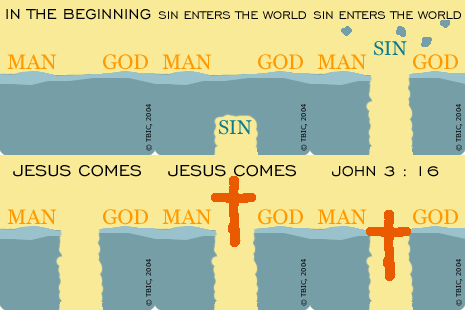
The Burning Bridge
A traveler crosses a great bridge to reach safety, but once on the other side, he turns back in pride and burns the only bridge that could bring him home. That’s what the apostate does—after seeing the beauty and sufficiency of Christ’s sacrifice, he rejects it and destroys the only way of return. There is no other bridge to God, for the Cross is the last and only one. “No longer remains a sacrifice…” because Christ’s bridge was "burned" in unbelief.
The Rejected Rescue
Firefighters extend the ladder to a man trapped in the top floor of a burning building. He hears their call, sees the flames, and even grips the rung—then defiantly turns away, trusting his own strength. Moments later, the roof collapses. So too, those who reject Christ after knowing His truth perish not for lack of provision, but for refusing the only rescue God provided.
The Last Train Out
Picture a city under siege. The last train is about to leave, the whistle sounds, and the conductor calls, “All aboard!” Some scoff and linger, believing another train will come. But when the tracks fall silent, there is no next train. Christ’s sacrifice was the “last train” of grace; to miss it is to remain behind forever.
The Sunlight Refused
A man closes every curtain, boards every window, and then curses the darkness. God has shone His light in Christ, but those who shut Him out cannot blame Him for their night. When light is rejected, darkness remains by default.
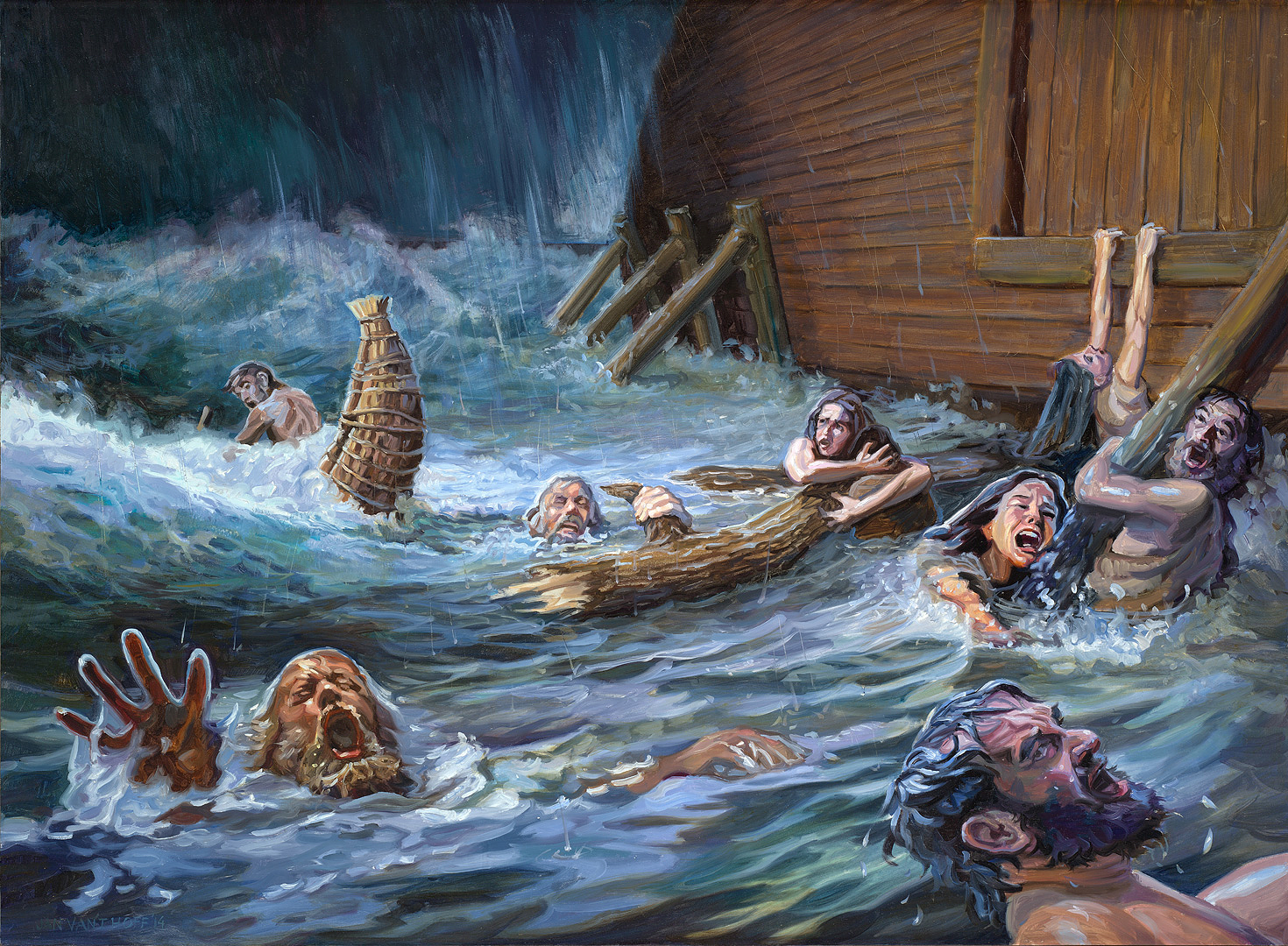
The Final Door
Like Noah’s ark, the door of salvation stands open until the rain begins to fall. Once God shut the door, it stayed shut. So too, when one persistently rejects Christ, he finds that the day of grace is past. The same hand that opened the door in mercy will one day close it in judgment.
Genesis 7:15-16+ - So they went into the ark to Noah, by twos of all flesh in which was the breath of life. 16 And those that entered, male and female of all flesh, entered as God had commanded him; and the LORD closed it behind him.
Adrian Rogers - Listen to Hebrews 10:26: “For if we sin willfully after we have received the knowledge of the truth, there remaineth no more sacrifice for sins, But a certain fearful looking for of judgment and fiery indignation, which shall devour the adversaries.” There were some who began to be Christians, they thought, but then they wanted to go back to Judaism, to the Old Testament sacrifices. He said, “No, you can’t go back. You can’t go back. The only thing is fiery indignation, if you fall away from Jesus.”
He wasn’t much for stirring about,
It wasn’t his desire;
No matter what the others did,
he was sitting by the fire.
Same old story, day by day,
He never seemed to tire;
While others worked to build their church,
He was sitting by the fire.
At last, he died, as all must do,
Some say he went up higher;
But if he’s doing what he used to do,
He’s sitting by the fire.
IN mentioning those who forsake the assembling together of God's people, the writer has touched one of those sore places which, to him, are the symptom of imminent danger. This neglect of Christian fellowship is at once the indication of that indifference which is so dangerous, and the cause of further backsliding. All this leads him once again to sound the alarm, and to point out how neglect of outward, apparently secondary duties, opens the way to positive sin and eternal loss. He has scarcely finished his wondrous exposition of the glory of the heavenly Priest and the heavenly sanctuary and the way into it, he has only just begun to speak of the life and walk to which that opened sanctuary calls us, when, thinking of the state of the Hebrews, he sounds a trumpet-blast of warning more terrible than any we have heard yet. In the three previous warnings he had spoken first of neglect (Hebrews 2:1-4), then of unbelief and disobedience (Hebrews 3:1; 4:13), then of sloth, leading to hopeless falling away (Hebrews 5:3; 6:9): here he now speaks of wilful sinning, with the awful rejection of God's mercy it implies, and the sore and certain punishment it will inevitably bring. John Bunyan, in his dream, saw a way leading from the very gate of heaven down to the pit. It is not only the Holiest of All that is set wide open for us; the gate of hell is opened wide, too, to receive all who neglect or refuse to enter the gate of mercy and of heaven. Let all who believe that it is indeed God who, by His Spirit speaks in this word, listen with holy fear.
For if we sin wilfully after that we have received the knowledge of the truth, there remaineth no more a sacrifice for sins. As we had in Hebrews 10:26. mention of those who were once enlightened, and tasted the heavenly gift and the good word of God, and who yet fell away, so here he speaks of those who, after having received the knowledge of the truth, yet sin wilfully. The expressions used show us that in the case of these the enlightening and the acceptance of the truth had been more with the mind than with the heart. Their judgment had been convinced, through the mind their desire and will had been affected and wrought upon; and yet, the heart, the whole inner life, had never been truly regenerate, had never received that eternal life, which cannot be taken away. And so there was a possibility of their still sinning wilfully and being shut out for ever from the one sacrifice for sin. As we saw before, the true assurance of salvation, the assuring of our hearts before God, cam only be enjoyed in a life under the teaching of the Spirit, and a walk in obedience to God's will (1 John 3:19-24.) True assurance of faith is the witness of the Holy Spirit that is given in living fellowship with and obedience to Christ as Leader.
If we sin wilfully. The question will be asked, But what is wilful sin? How are we to know when we are guilty of it? No answer can be given; no one on earth can draw the line between what is and what is not wilful sin. Only He who sits on the throne, and who knows the heart, can judge. But how will this warning profit, if we cannot see what wilful sin is? The warning will just thus profit us most--it will make us fearful of committing any sin, lest it might be, or lead us into wilful sin. He that would know what wilful sin is, with the thought that he is safe, as long as he keeps from that extreme, deceives himself. The only sure way of being kept from wilful sin is to keep far from all sin.
A captain of a ship, sailing between two harbours on a rocky coast, was once asked by an anxious passenger if the coast was not very dangerous. The answer was, Very. And was he not afraid? No; our way is perfectly safe; you can be at ease. But how, if the rocks are so dangerous? Oh, very simply! I put out to sea, and keep far from the rocks. O Christian! here is thy only safety: launch out into the deep of full obedience to all the will of God; keep far from all sin, and thou shalt be kept from wilful sinning.
For if we sin wilfully, there remaineth no more a sacrifice for sins. What a terrible contrast to the same expression as we had it before (Hebrews 10:18): No more offering for sin. There it was the blessed secret of the glory of the gospel and redemption, the joy of Christian faith and life no more offering for sin: salvation finished and perfected for ever. Here it is the awful revelation of the highest sin and its terrible doom: the one sacrifice rejected, and now no more a sacrifice for sins ever to be found, How awful to sin wilfully.
There remaineth no more a sacrifice for sins, but a certain fearful expectation of judgment, and a fierceness of fire, which shall devour the adversaries. Fearful judgment, fierceness of fire, devouring the adversaries,--these words are in God's gospel; they follow close on its highest teaching; they are words He speaks to us in His Son. In the religion of the world, alas, in a great deal of the Christian teaching and the religious literature of our day, professing to honour the God of love whom the Bible reveals--these words are set aside and rejected. And yet there they stand, and behind them stand the divine realities they express. God help us to believe them with our whole heart, and to exhort one another, if so be we may save some, snatching them out of the fire!
1. Let all who have entered the Holiest of All turn round and look to the hole of the pit--the horrible pit--whence they have been drawn up. And as they see the multitudes going down to the pit, oh let them remember that the highest glory of life in the Holiest is, even as it is of Him who opened it with His blood and sits on the throne, to go out and bring others in.
2. Even though thou knewest, through grace, that thou hadst escaped the judgment and the fire, take time to gaze upon them. Take upon thee the burden of those who are asleep, and plead with Christ to use thee to warn and to save them. Andrew Murray. The Holiest of All
William MacDonald - For if we sin wilfully after that we have received the knowledge of the truth, there remaineth no more sacrifice for sins, but a certain fearful looking for of judgment and fiery indignation, which shall devour the adversaries.” (Heb. 10:26, 27)
This is one of several verses in the New Testament which proves extremely unsettling to many earnest, conscientious Christians. They reason this way: I am faced with a temptation to sin. I know it is wrong. I know I shouldn’t do it, and yet I go ahead and do it anyway. I deliberately disobey. It seems to me that I am sinning willfully. Therefore, it sounds from this verse as though I have lost my salvation.
The problem arises because they take the verse out of its context and make it say something it was never intended to say. The context has to do with the sin of apostasy—the sin of one who professes to be a believer for a while, but who subsequently repudiates the Christian faith and usually identifies himself with some system that opposes Christ. The apostate is described in verse 29: he has trodden under foot the Son of God, and has counted the blood of the covenant wherewith he was sanctified an unholy thing, and has done despite to the Spirit of grace. He shows by his bitter turning against Christ that he was never born again.
Suppose that a man hears the Gospel and develops warm feelings toward the Christian faith. He leaves his ancestral religion and adopts the Christian label without being genuinely converted. But then persecution begins, and he has second thoughts about being known as a Christian. Finally he decides to go back to his old religion. But it isn’t that easy. Suppose “that before the leaders are willing to take the turncoat back, they have a little ceremony that he must go through. They take the blood of a pig and sprinkle it on the floor. Then they say, “That blood represents the blood of Christ. If you want to return to your parents’ religion, you must walk over it.” And so he does. In effect, he is trampling under foot the Son of God and counting His blood as an unholy thing. That man is an apostate. He has committed the willful sin.
A true believer cannot commit this willful sin. He may commit other acts of sin when he knows it is wrong. He may deliberately violate his conscience. This is serious in God’s eyes, and we must not say anything that would excuse it. But still he can find forgiveness by confessing and forsaking his sin. Not so with the apostate. For him the verdict is that there remains no more sacrifice for sins (verse 26b), and it is impossible to renew him again to repentance (Heb. 6:6).
Tony Evans on the type of sin meant in Hebrews 10:26 - Finally, real quick, Heb 10:26, “If we go on sinning willfully;” know its sin, know it’s wrong, going to do it anyway, don’t care. This is not for the person struggling with sin. This is not for the person who is in it, don’t want to be in it, want to get out of it. They are trapped by sin. That’s different. This (Heb 10:26) is the person that doesn’t care.
Wayne Grudem - Hebrews 10:26–31: People Who Deliberately Keep on Sinning
A similar teaching is found in Hebrews 10:26–31. There the author says, “If we go on sinning deliberately after receiving the knowledge of the truth, there no longer remains a sacrifice for sins” (Heb. 10:26). Also, a person who rejects Christ’s salvation and “has profaned the blood of the covenant by which he was sanctified, and has outraged the Spirit of grace” (Heb. 10:29) deserves eternal punishment. This again is a strong warning against falling away, but it should not be taken as proof that someone who has truly been born again can lose his or her salvation. When the author talks about the blood of the covenant “that sanctified him,” the word sanctified is used simply to refer to “external sanctification, like that of the ancient Israelites, by outward connection with God’s people.” (A. H. Strong, Systematic Theology (Valley Forge, PA: Judson, 1907), 884. Strong mentions an appropriate parallel use of the verb sanctify in 1 Cor. 7:14, which speaks about the unbelieving husband being sanctified by the believing wife (1 Cor. 7:14, where the same Greek word, hagiazō, is used). Outward ceremonial sanctification is also referred in Heb. 9:13; cf. Matt. 23:17, 19.) The passage does not talk about someone who is genuinely saved, but someone who has received some beneficial moral influence through contact with the church. (Ex. 24:7–8 speaks of the blood of the covenant that set apart the people as God’s people even though not all were truly born again. In the context of Heb. 10, such imagery, taken from the Old Testament process of sanctifying a people so that they could come before God to worship, is an appropriate background.) (See Wayne Grudem's Systematic Theology page 700 - this is an entry under this topic Those Who Finally Fall Away May Give Many External Signs of Conversion which begins on page 693)
R C Sproul - What Is the Unpardonable Sin?
Anyone who speaks a word against the Son of Man will be forgiven, but anyone who speaks against the Holy Spirit will not be forgiven, either in this age or in the age to come. [Matt. 12:32]
Sometimes fearful Christians wonder if they have committed the “unpardonable sin.” They read in Hebrews 10:26–27, “If we deliberately keep on sinning after we have received the knowledge of the truth, no sacrifice for sins is left, but only a fearful expectation of judgment and of raging fire that will consume the enemies of God.”
To understand these verses and similar passages elsewhere, we have to keep in mind their redemptive and historical context. During his earthly ministry, our Lord frequently concealed who he was. After doing a miracle he would say, “Tell no one.” This was because the time of his full manifestation had not yet come.
Only after the resurrection, and especially after the coming of the Holy Spirit at Pentecost, was the “messianic secret” openly published. For this reason, Jesus says, those who rejected him during his earthly ministry were guilty of a lesser degree of sin (though still a sin) than those who would reject the post-Pentecost testimony of the Holy Spirit. As Hebrews 10:26 puts it, after we have received the full knowledge of the truth it becomes possible to commit this unpardonable sin.
After Pentecost, rejecting the full testimony of the Spirit is the same as rejecting the Son of Man. Thus, in one sense, perseverance in unbelief is an unpardonable sin. Jesus, however, was speaking of some kind of particular sin. From the context it appears that blasphemy against the Holy Spirit is with malice aforethought, with deliberate hostility, and with the intention to equate Jesus with the powers of darkness when the individual knows that he is the Son of God.
Coram Deo - Believers can become plagued with the dreadful thought that they have committed this sin. One comforting assurance that this has not occurred is the very apprehension that it might have. No one who has committed the unpardonable sin would fret about it. Their callused heart is unable to express such remorse.
H A Ironside —Heb. 10:26, 27.
Judgment is God’s strange work. He delights in mercy. The cross is the supreme testimony of His grace and tells out as nothing else could His love for and interest in a lost world.
The preaching of the gospel is the appointed method of making known the heart of God to those who are arrayed in rebellion against Him. He calls upon all men everywhere to repent because He is not willing that any should perish. But if sinners persist in refusing His grace, if they continue to spurn His offer of mercy, then there is nothing left for them but judgment, a certain fearful-looking-for of His wrath which is to devour the adversaries.
God will never have to apologize to any man for dealing thus with him if he has refused to believe the gospel. All His ways, whether of grace or of judgment are perfect, and in all His dealings with mankind He will be glorified at last.
“God’s house is filling fast,
‘Yet there is room!’
Some guest will be the last,
‘Yet there is room!’
Yes! soon salvation’s day
To you will pass away,
Then Grace no more will say—
‘Yet there is room!’ ”
—G. W. Frazer.
James Smith - The Willful Sin!
A reply to several questions on Hebrews 10:26, 27.
"If we deliberately sin willfully after we have received the knowledge of the truth — no sacrifice for sins is left, but only a fearful expectation of judgment and of raging fire that will consume the enemies of God!"
Beloved in the Lord Jesus,
It is a great mercy for the Church of God, that she possesses the Word of God; and is also promised the Spirit of God to lead into a knowledge of its contents. God's book is a God-likebook, there is something of infinity about it. I conceive that no man can fully comprehend its contents, or reconcile all its statements. It is given us as a light — to instruct, direct, and cheer us in this gloomy wilderness of woe. It is . . .
to be received with reverence,
to be believed with implicit faith, and
to be obeyed with cheerfulness and gratitude.
The Epistle to the Hebrews, was written to Jews who professed the Lord Jesus Christ; they were exposed to persecution, excommunication, and great trials from their countrymen and others. The apostle writes to them in order to instruct, confirm, caution, encourage, comfort, and exhort them. He sets before them the divinity of our Lord's person; his apostleship; his priesthood; and shows him to be the sum and substance of the old dispensation. He points out . . .
our obligations in reference to the Gospel,
the nature and consequences of unbelief,
the superior privileges we enjoy, and
exhorts to a variety of duties, especially steadfastness in the faith.
Toward the close of the tenth chapter, he cautions them against neglecting public ordinances, to which no doubt they were tempted, in consequence of the persecution they suffered; he intimates that neglect of ordinances is the first step to apostasy, and therefore bids them exhort one another to a diligent attendance on them. Then come the verses you refer to, "For if we sin willfully," etc.
By "the truth" in these verses, I understand the truth respecting the divinity, messiahship, priesthood, sacrifice, atonement, and grace of the Lord Jesus Christ. Or that Jesus Christ was really what he professed to be, and what his apostles proclaimed him to be. They had preached this truth to the people; the Holy Spirit had confirmed the same by miracles, wonders, and signs; and they received it, and professed Christ accordingly. They were in consequence exposed to the bitter rage and determined opposition of their carnal neighbors; they were stripped of their goods, cast out of the synagogue, and suffered the loss of all things. These things are bad at first — but their continuance is worse; the intention was to lead them to apostasy, and therefore the apostle especially cautions them against that.
By sinning willfully, I understand the willful rejection of the truth of God — in consequence of persecution; or a rejection of Christ as the Messiah, the Son of God, the Savior of the world. They had been convinced he was this; they professed the same; they had suffered on account of it: but now the apostle assures them if they deny him after such convictions and professions, and join with the Jews in counting Jesus an impostor — and treating his Gospel as an imposition, there remains no more sacrifice for sin, etc.
God will not pardon without a sacrifice; the old ceremonial economy is abolished; and if Christ is rejected — then there is no other sacrifice; consequently there can be no pardon, or hope, or salvation. The Son of God is treated with the greatest indignity, trodden under foot; his blood is counted as no better than the blood of a common malefactor; contempt is poured upon the Spirit of grace, who witnessed to his divinity and messiahship by miracles and signs — and now there remains only "a fearful expectation of judgment and of raging fire that will consume the enemies of God!"
The Law of Moses, the servant, punished presumption with death; the Gospel of Christ punishes the apostate with eternal damnation. Mercy is scorned, grace is despised, justice is insulted, and God will take vengeance; "it is a fearful thing to fall into the hands of the living God!"
But I look at the questions separately:
"Is any particular sin implied in the words — If we sin willfully?"
Yes, apostasy from Christ — a drawing back to perdition — a giving up the confidence, that Jesus was really and truly that Prophet who would come into the world. It is called a falling away, a crucifying to themselves the Son of God afresh, and putting him to an open shame. Such people being persuaded that Jesus was the Christ — yet nevertheless through fear (Rev. 21:8), love of the present life, or other carnal motives — willfully deny him, join with his enemies, and are doomed to darkness, death, and black despair. "If a man abides not in me, he is cast forth as a branch, and is withered; and men gather them, and cast them into the fire, and they are burned." John 15:6, Matthew 13:41, 42. "Let him that thinks he stands, take heed lest he fall." "You stand by faith, be not high-minded but fear;" "for if God spared not the natural branches, take heed lest he also spare not you!" 1 Corinthians 10:12; Romans 11:20, 21: Hebrews 4:1; 3:12, 13.
"Do the words, "knowledge of the truth" imply a bare reception of the truth literally — and not spiritually?" All professors receive the truth into the head — but in some it sinks down into the heart; when it gets into the heart — it produces lasting effects.
When the Holy Spirit enlightens the mind — then it sees the glory, majesty, suitability, and excellency of the truth; faith springs up and embraces it, and it now becomes an instrument of sanctification. Every faculty of the soul then becomes affected by the truth:
the memory finds a place for it and hides it;
the understanding is illuminated by it;
the affections are set on the great Object which it presents;
the will is regulated by it; and
the conscience becomes instructed and tender.
The man obeys from the heart, the form of doctrine which is delivered to him. He beholds as in a looking-glass the glory of the Lord, and is changed into the same image, from glory to glory, as by the Spirit of the Lord. Romans 6:17; 2 Corinthians 3:18. He feels what David utters, "O how I love your law — it is my meditation all the day!" Such a one will never fall away, or willfully deny Christ.
But others are intellectually convinced of the truth of the doctrines — who never see their glory; they are affected with them — but not sanctified by them; they mentally embrace them — but are not united to them; they find a place in the mind — but have not a home in the soul. See Hebrews 6:4-8; iv. 2; 1 Thessalonians 2:13; James 1:21; John 15:5-11. Such may sin willfully, and deny the Savior who is above.
Spiritual knowledge makes a man humble, watchful, prayerful, and dependent on his God — these preserve him.
Natural knowledge of spiritual things, makes a man proud, self-sufficient, careless, and often imprudent; consequently is expected that he will fall. We can only tell the nature of the knowledge we possess — by its effects or fruits; therefore we should be diligent that we may be found of him in peace, without spot, and blameless. 2 Peter 3:11; 1 John 2:28; Rev. 16:15; 1 John 2:4, 5; Rev. 22:14.
"Have those words reference to the whole of divine truth?" All truth is sacred — and we are bound to receive all that God has revealed; we are not at liberty to reject any one portion of God's book. Our understandings should be entirely subjected to the Word of God. We ought to receive it without asking, why? or disputing about its importance.
But the truth referred to by the apostle conceive is, the truth of the Redeemer's profession, word, and work. He professed to be the Christ, the Son of the living God: that his word was the word of God; and that his work is our salvation. If these are denied — salvation cannot be obtained: for there is salvation in no other; for there is none other name given under Heaven among men, whereby we must be saved. Acts 4:12. He is Jehovah, and beside him there is no Savior. Isaiah 43:11.
"Can none be the children of God who are only partially endowed with the light or knowledge of divine truth?" It is impossible to say with how little knowledge a person may be saved — or how much error may remain in a sanctified mind. A man must know himself as a sinner, and the Lord Jesus Christ as a Savior, in order to salvation; but I am not sure that anything further is absolutely necessary. The dying thief had not much knowledge — but he was saved. There are doubtless thousands in glory, who while on earth had but very little knowledge of the great and glorious doctrines of the everlasting Gospel. They knew Jesus; they found him to be precious; they trusted their soul in his hands; they depended on his one sacrifice; they slipped through the world, and out of time, almost unobserved, and were introduced into his presence and glory.
But who is more than partially endowed with the knowledge of divine truth? According to my apprehension, it would require an infinite intellect to grasp all the truth God has revealed. Paul himself only knew in part, he prophesied in part, and waited for further discoveries of the truth to his mind. I Corinthians 13:9-13; Philippians 3:10.
"Do not the children of God sin willfully after having received the knowledge of the truth?"Yes, to their shame, sorrow, and confusion — they do. Most of our sins, are in a sense willful sins: we are not dragged to sin against our will, but our wills under the influence of the depraved principles which are in our nature, go forth in the commission of sins. But then we are checked, hindered, and condemned in the commission — by grace which dwells in us. 1 John 3:20,21.
Nothing can be more dangerous, than for a person to presume to sin — because he believes sin cannot damn him; yet a believer may be tempted to this, yes, and at times is tempted to it. But he trembles at the idea; exclaims, God forbid! He turns to the throne of grace and prays, "Keep your servant also from willful sins; may they not rule over me. Then will I be blameless, innocent of great transgression." Psalm 19:13; 1 John 5:16, 17.
None have more reason to make sure of the greater damnation — than those who live in sin, assuring themselves of salvation. If our religion does not lead us to hate sin, fear sin, forsake sin, and pant for freedom from sin — it is not the religion of Christ — but we are under a most awful delusion.
When a believer has been guilty of willful sin, he feels condemned, is distressed, and cast down. And before he can recover his former standing, he is led to aggravate his sin in reflecting upon it; he condemns himself, rejecting all vain excuses; humbly confesses it before God. He then loathes and abhors himself in his own sight on account of it; and when he obtains a pardon, is more watchful, doubly jealous of himself, and earnest with God to keep him in future.
He who makes excuses, or accepts excuses for his sins — is in a most doubtful state. He is very different to Peter who went out and wept bitterly; or to David whose experience you read in the fifty-first Psalm. "Stand in awe, and sin not; commune with your own heart upon your bed, and be still." Psalm 4:4.
Beware how you walk on the margin of your liberty. "You have been called unto liberty; only use not liberty for an occasion to the flesh — but by love serve one another." Galatians 5:13.
Observe, 1. Timid, fearful, doubting believers, are not at present in danger of committing this willful sin. Satan may misrepresent the truth, bring charges against them, and fill their consciences with terror and alarm; but they are innocent of this great transgression. They still desire to love Jesus, they believe he is the Savior of the guilty and undone, and they would give a world if they could claim him, ardently love him, and like glorified spirits adore him. They look at his word, think of his grace, and flee to his cross.
Your vengeance will not strike me here,
Nor Satan dares my soul invade.
Yes, my poor brother, you are safe at the cross of Jesus; he does speak to you and says, "All that the Father gives me shall come to me, and him that comes to me I will never cast out." His heart yearns over you with indescribable pity, compassion, and love; and he directs you to his Word for comfort, peace, and joy: he spoke it, and caused it to be written that you might have his joy fulfilled in you. John 17:13; 1 John 1:4; 5:13. He knows your infirmities, pities your weaknesses, and will be merciful to you as he is accustomed to be to those who fear his name. So long as you . . .
fear to offend him,
pant to enjoy him,
long to be with him,
pray to be like him —
there is no fear of your rejecting his claims, denying his messiahship, joining the camp of his enemies, and blaspheming his dear name; consequently there is nothing in these fearful verses to terrify you.
2. The vain-confident, trifling, and incautious professor is in the greatest danger on this subject: therefore "blessed is the man that fears always." The man who concludes he is safe, and shrouds himself in his sound creed and lofty notions — is a pitiable character; if God leaves him to his vanity — he is sure of broken bones, if not of a broken neck! The trifler, who can trifle with God's Word, treating it as though it was the word of man, as though it was submitted to his revision, and may be re-molded by his imagination, is in a most dangerous state!
O, I tremble for some, whom I see taking such daring liberties with God's Book; they act as though they were at liberty to reject whatever they do not approve; to pervert whatever does not accord with their notions, or fall in with their creed; to wrest the plain meaning of words to suit their fancies. Indeed I fear that many of us have taken very undue liberties with the holy Scriptures; we have not read them under the impression that they were God's writings, and would judge us at the last day. John 12:48. We have not realized sufficiently our own ignorance and liability to err — nor our absolute dependence on the Holy Spirit to unfold their meaning.
Here I would just drop a word to young Christians, especially to young men who are imagining that God intends them for preachers of his holy Word: my brethren, beware how you treat God's book, never take your creed to it — but derive your creed from it; admit that the Scriptures are wiser than you are. I often grieve over the manner in which I have treated the Scriptures in years that are past; I admire the goodness and forbearance of my God toward me; and in love I would say to all my brethren: the Bible brings with it a solemn responsibility — let us be serious, prayerful, childlike learners, whenever we turn over the sacred pages. There is such a thing as wresting the Scriptures to our own destruction, 2 Peter 3:16, 17; and also to the injury of others, many have been stripped of their simplicity, tenderness of conscience, and holy fear of sin, through connection with those who have wrested the Scriptures. Others have been robbed of their confidence, comfort, and joys; and some have been drowned in destruction and perdition. 2 Peter; Jude; 1 Timothy 4:9.
3. The passage which we have been considering was intended to stir up professors to diligence in attending ordinances, how many neglect them as though they were not of divine institution, or of real importance. It was designed to prompt them to perseverance in the path of tribulation. Sometimes we are allured by prospects, Hebrews 12:1,2; sometimes exhorted on the ground of obligation, 1 Corinthians 6:19, 20; and sometimes urged from the idea of danger, as here, and elsewhere.
How solemn, how awful, how startling the words of the Holy Spirit by Peter, which will fill up my paper: "If they have escaped the corruption of the world by knowing our Lord and Savior Jesus Christ and are again entangled in it and overcome — they are worse off at the end than they were at the beginning. It would have been better for them not to have known the way of righteousness, than to have known it and then to turn their backs on the sacred command that was passed on to them. Of them the proverbs are true: "A dog returns to its vomit," and, "A sow that is washed goes back to her wallowing in the mire!" 2 Peter 2:20-22
Hebrews 10:27 but a terrifying expectation of judgment and THE FURY OF A FIRE WHICH WILL CONSUME THE ADVERSARIES. (NASB: Lockman)
Greek: phobera de tis ekdoche kriseos kai puros zelos esthiein (PAN) mellontos (PAPNSG) tous upenantious.
BGT φοβερὰ δέ τις ἐκδοχὴ κρίσεως καὶ πυρὸς ζῆλος ἐσθίειν μέλλοντος τοὺς ὑπεναντίους.
Amplified: [There is nothing left for us then] but a kind of awful and fearful prospect and expectation of divine judgment and the fury of burning wrath and indignation which will consume those who put themselves in opposition [to God]. [Isa. 26:11.] (Amplified Bible - Lockman)
Barclay: All that we can expect is to wait in terror for judgment and for that flaming wrath which will consume the adversaries of God. (Westminster Press)
NLT: There will be nothing to look forward to but the terrible expectation of God's judgment and the raging fire that will consume his enemies. (NLT - Tyndale House)
KJV But a certain fearful looking for of judgment and fiery indignation, which shall devour the adversaries.
NKJ but a certain fearful expectation of judgment, and fiery indignation which will devour the adversaries.
NET but only a certain fearful expectation of judgment and a fury of fire that will consume God's enemies.
CSB but a terrifying expectation of judgment and the fury of a fire about to consume the adversaries.
ESV but a fearful expectation of judgment, and a fury of fire that will consume the adversaries.
NIV but only a fearful expectation of judgment and of raging fire that will consume the enemies of God.
Phillips: but only a terrifying expectation of judgment and the fire of God's indignation, which will one day consume all that sets itself against him. (Phillips: Touchstone)
Wuest: but a certain fearful expectation of judgment and fiery indignation which is about to be devouring the adversaries.
Young's Literal: but a certain fearful looking for of judgment, and fiery zeal, about to devour the opposers;:
- A certain terrifying expectation - He 2:3; 12:25; 1Sa 28:19,20; Isaiah 33:14; Da 5:6; Hosea 10:8; Matthew 8:29; Luke 21:26; 23:30; Rev 6:15, 16, 17
- The fury of a fire - Heb 12:29; Nu 16:35; Ps 21:9; Jer 4:4; Ezekiel 36:5; 38:19; Joel 2:30; Nahum 1:5,6; Zeph 1:18; 3:8; Mal 4:1; Mt 3:10,12; 13:42,50; 25:41; Mark 9:43, 44, 45 ,46 47, 48, 49; Luke 16:24; 2Th 1:8; James 5:3; Rev 20:15
- Hebrews 10 Resources - Multiple Sermons and Commentaries
- Click for 5W/H Study Questions — ideal for leading a group or personal study of Hebrews
Related Passages:
John 3:36+ (SIMILAR NEGATIVE "CONTRAST") “He who believes in the Son has eternal life; BUT he who does not obey the Son will not see life, but the wrath of God abides on him.”
Romans 2:4-5+ (SIMILAR NEGATIVE "CONTRAST") Or do you think lightly of the riches of His kindness and tolerance and patience, not knowing that the kindness of God leads you to repentance? 5 BUT because of your stubbornness and unrepentant heart you are storing up wrath for yourself in the day of wrath and revelation of the righteous judgment of God,
1 Thessalonians 5:9+ (A POSITIVE CONTRAST) For God has not destined us for wrath, BUT for obtaining salvation through our Lord Jesus Christ,
John 5:28-29+ Do not marvel at this; for an hour is coming, in which all who are in the tombs will hear His voice, 29and will come forth; those who did the good deeds to a resurrection of life, those who committed the evil deeds to a resurrection of judgment.
Matthew 13:38-42+ and the field is the world; and as for the good seed, these are the sons of the kingdom; and the tares are the sons of the evil one; 39 and the enemy who sowed them is the devil, and the harvest is the end of the age; and the reapers are angels. 40 “So just as the tares are gathered up and burned with fire, so shall it be at the end of the age. 41 “The Son of Man will send forth His angels, and they will gather out of His kingdom all stumbling blocks, and those who commit lawlessness, 42 and will throw them into the furnace of fire; in that place there will be weeping and gnashing of teeth.
2 Thessalonians 1:7-9+ and to give relief to you who are afflicted and to us as well when the Lord Jesus will be revealed from heaven with His mighty angels in flaming fire, 8 dealing out retribution to those who do not know God and to those who do not obey the gospel of our Lord Jesus. 9 These will pay the penalty of eternal destruction, away from the presence of the Lord and from the glory of His power,
Deuteronomy 4:24+ “For the LORD your God is a consuming fire, a jealous God.
Isaiah 26:11 O LORD, Your hand is lifted up yet they do not see it. They see Your zeal for the people and are put to shame; Indeed, fire will devour Your enemies.
Deuteronomy 32:22+ For a fire is kindled in My anger, And burns to the lowest part of Sheol, And consumes the earth with its yield, And sets on fire the foundations of the mountains.
Isaiah 33:14 Sinners in Zion are terrified; Trembling has seized the godless. “Who among us can live with the consuming fire? Who among us can live with continual burning?”
Nahum 1:6 Who can stand before His indignation? Who can endure the burning of His anger? His wrath is poured out like fire And the rocks are broken up by Him.
Zephaniah 1:18+ Neither their silver nor their gold Will be able to deliver them On the day of the LORD’S wrath; And all the earth will be devoured In the fire of His jealousy, For He will make a complete end, Indeed a terrifying one, Of all the inhabitants of the earth.
Zephaniah 3:8+ “Therefore wait for Me,” declares the LORD, “For the day when I rise up as a witness. Indeed, My decision is to gather nations, To assemble kingdoms, To pour out on them My indignation, All My burning anger; For all the earth will be devoured By the fire of My zeal (THIS DESCRIBES REVELATION 6-18!)
Malachi 4:1+ “For behold, the day is coming, burning like a furnace; and all the arrogant and every evildoer will be chaff; and the day that is coming will set them ablaze,” says the LORD of hosts, “so that it will leave them neither root nor branch.”
Psalm 79:5+ How long, O LORD? Will You be angry forever? Will Your jealousy burn like fire?
"About face!" From grace to wrath!
PERSISTENTLY WILLFUL
SINNERS - BEWARE!
But (term of contrast) Stark contrast! This HINGE WORD "but" introduces the inevitable, inestimably terrifying alternative to every person who has ever received and rejected the light of the gospel of Jesus Christ. This contrast (an "about face" so to speak, a change of direction) is a contrast between the sacrifice for sins and the dreadful alternative faced by those who persist in willful rebellion. Think of verse 27 as a door slamming shut: On one side: the altar of mercy (Christ’s cross). On the other side: the consuming fire (God’s judgment). The HINGE WORD “BUT” marks the instant that door swings from grace refused to wrath revealed. WOE TO THAT SOUL!
Hebrews 2:3+ the writer asks his wavering readers "how will we escape if we neglect so great a salvation?" and here in Hebrews 10:27 the writer answers that question stating emphatically "If we neglect God's great salvation, we can't escape God's great fire"!
In Hebrews 12:25+ we see another allusion to "no escape" - "See to it that you do not refuse Him who is speaking. For if those did not escape when they refused him who warned them on earth, much less will we escape who turn away from Him who warns from heaven."
A terrifying (phoberos - dreadful, fearful) expectation (ekdoche) of judgment (krisis - "crisis" ~ decisive verdict, righteous verdict and sure sentence) and THE FURY (zelos - fierceness & zeal against sin, "jealousy" cf Ex 34:14+) OF A FIRE (pur) WHICH WILL (mello ~ that is about to") CONSUME (esthio - "eat" devour) THE ADVERSARIES (hupenantios- active opponents) - Plainly stated the judgment of God is inevitable and unavoidable for willful sinners who reject the truth about Jesus and such an ominous truth should incite fear in those who have a reason to fear. Terrifying (phoberos) is used again in Heb 10:31+ “It is a terrifying thing to fall into the hands of the living God" and this repetition in the same section (with such an uncommon Greek word) underscores the intensity of warning the author desires to convey! Expectation (ekdoche) in context conveys an emotional tension between expectation and dread in the soul of this Christ rejecter! The thought is not of a momentary fright but of ongoing fearful anticipation. Judgment (krisis) was described in Heb 9:27 the writer stating "it is appointed for men to die once and after this comes judgment." So the timing of the terrifying judgment is certain, and is not corrective but condemning, conclusive and irrevocable! WOE! A later use amplifies the terror of this description as the writer describes "our God is a consuming fire." (Heb 12:29+) The fire (pur) is of God's justice, depicting the burning intensity of His holiness that cannot tolerate sin (See discussion is it literal fire?) It is notable that God uses fire (metaphorically) to purify the faithful (1Pe 1:6-7+, 1Pe 4:12-13+, Jewish believers in Zech 13:9+, cf Ps 66:10, Pr 17:3) but here will use fire (whether literal or figurative) to forever consume the rebellious. When God’s holiness is rejected, it becomes an unquenchable fire which will consume the apostate who once spurned knowledge of the truth about the Lamb as Savior and who will soon stand before Him as Righteous Judge (Rev 20:11-15+)!
It is interesting to note how the writer portrays two dramatically different destinies in this section, for believers there was “confidence to enter the Holy Place” (Heb 10:19), but for apostates there was “a terrifying expectation of judgment.” (Heb 10:27). But ultimately aren't these reflective of the fact that there are only two roads for all humanity to choose from, one leading to eternal bliss and the other to eternal punishment? (cf Mt 7:13-14+)
Wuest - Instead of a sacrifice for sin awaiting this apostate, there awaits him a certain fearful looking for of judgment and fiery indignation. The Greek could be rendered, “a kind of fearful expectation.”(Hebrews Commentary online)
Saul was an example of "willful sinning" in OT = see his terrifying expectation = (Samuel who had died is supernaturally present and declares to Saul) "Moreover the Lord will also give over Israel along with you into the hands of the Philistines, therefore tomorrow you and your sons will be with me. Indeed the Lord will give over the army of Israel into the hands of the Philistines!” Then Saul immediately fell full length upon the ground and was very afraid because of the words of Samuel; also there was no strength in him, for he had eaten no food all day and all night." (1Sa 28:19, 20+)
Belshazzar the king upon defiling the Lord's holy vessels suddenly saw a hand appear with handwriting on the palace wall and "Then the king's face grew pale, and his thoughts alarmed him; and his hip joints went slack, and his knees began knocking together… 30 That same night Belshazzar the Chaldean king was slain. (Da 5:6+, Da 5:30+)
At the breaking of the fourth seal we see the God rejecting world's fearful reaction - And the kings of the earth and the great men and the commanders and the rich and the strong and every slave and free man, hid themselves in the caves and among the rocks of the mountains; 16 and they said to the mountains and to the rocks, "Fall on us and hide us from the presence of Him who sits on the throne, and from the wrath of the Lamb; 17 for the great day of their wrath has come; and who is able to stand?" (Rev 6:15-17+)
We see the certain expectation of the demons when confronted by Jesus - And behold, they cried out, saying, "What do we have to do with You, Son of God? Have You come here to torment us before the time?" (Mt 8:29+)
Jesus describes the reaction of the Christ rejecting world when the events of the Great Tribulation begin to unfold - "And there will be signs in sun and moon and stars, and upon the earth dismay among nations, in perplexity at the roaring of the sea and the waves, 26 men fainting from fear and the expectation of the things which are coming upon the world; for the powers of the heavens will be shaken. (Luke 21:25,26+)
Jesus foretold the destruction of Jerusalem in 70AD and the terrifying expectation "But Jesus turning to them said, "Daughters of Jerusalem, stop weeping for Me, but weep for yourselves and for your children. "For behold, the days are coming when they will say, 'Blessed are the barren, and the wombs that never bore, and the breasts that never nursed.' "Then they will begin TO SAY TO THE MOUNTAINS, 'FALL ON US,' AND TO THE HILLS, 'COVER US.' (Luke 23:18, 29, 30+)
You cannot have the Jesus of the Scriptures without the doctrines of judgment and Hell. Or as Spurgeon put it “Think lightly of hell, and you will think lightly of the cross”.
FURY (zelos - fierceness) OF A FIRE (pur) - Quoting from Septuagint of Isa 26:11. Literally = "zeal of fire" = a fiery passion. This phrase describes an anger (zeal, jealousy) marked by fire, the blazing jealousy of God expressed in judgment. The emotional picture is that His wrath is "the fury of a fire." God is not just a little bit angry, but passionate with fury! The imagery is not of small, passing flame, but of God's blazing holy passion, a consuming zeal, directed against the willful, persistent, defiant apostasy of those who have (in effect, metaphorically) trampled His Son under their feet (Heb 10:29).
Marvin Vincent says this phrase conveys "the radical idea of… ferment of spirit". Vincent adds that this phrase is an adaptation from Isaiah 26:11 - "O Lord, Your hand is lifted up yet they do not see it. They see Your zeal for the people and are put to shame; Indeed, fire will devour Your enemies." (Is 26:11).
God's "burning anger" is frequently pictured in the Old Testament and here are a few examples - 250 men who rebelled w/ Korah = Nu 16:35; Against Judah = Jer 4:4; Nineveh = Na 1:5-6; Zeph 1:18 (the fire of His jealousy); Zeph 3:8; Mal 4:1; Ps 79:5.
John MacArthur makes an interesting observation - There is nothing in the Old Testament to compare in severity to the judgment described in the New. People often think of the Old Testament as showing a harsh, judgmental God, while the New shows one of mercy and compassion. But God’s mercy and His wrath are clearly revealed in both testaments. It is true that we have a more complete and beautiful picture of God’s grace and love in the New Testament; but we also have here a more complete and terrifying picture of His wrath. (See Hebrews Commentary)
Paul records a NT account of the "certain terrifying expectation" -- "For after all it is only just for God to repay with affliction those who afflict you, 7 and to give relief to you who are afflicted and to us as well when the Lord Jesus shall be revealed from heaven with His mighty angels in flaming fire, 8 dealing out retribution to those who do not know God and to those who do not obey the gospel of our Lord Jesus. 9 And these will pay the penalty of eternal destruction, away from the presence of the Lord and from the glory of His power, 10 when He comes to be glorified in His saints on that day, and to be marveled at among all who have believed-- for our testimony to you was believed. (2Th 1:8-10+)
Peter observes that "the present heavens and earth are reserved for fire, being kept for the day of judgment and destruction of ungodly men." (2Pe 3:7+).
Jude cites the fate of Sodom and Gomorrah “as example of those who suffer punishment of eternal fire” (Jude 1:7+) and encourages his readers to “snatch others from the fire and save them” (Jude 1:23+).
In Revelation, those who worship the beast “will be tormented with burning sulfur” (Re 14:10-note) while the beast, the devil, death, and Hades are all thrown into “the lake of burning sulfur” (Re 19:20+; 20:9-10, 14, 15+) which is the “second death” (Rev 21:8+). Such will be the inescapable fate of all of those who are found to be “the enemies of God.” And such will be the case for any of us should we persist in a purposeful choice of deliberate and continual sin and persistent rejection of Jesus.
Phil Newton asks a pragmatic question - Does this (apostasy) happen today? It might be seen in young people that grew up in the church with Christian parents, hearing the gospel on a regular basis. They professed to be Christians at some point in their early years and gave outward appearance of being serious. But the day came when they were challenged about the gospel and rather than believing God, they embraced a lie. Not repenting of such sin they continued to grow cold toward any thought of divine truth. They gave themselves to sin, indulging their desires without restraint, maybe even laughing at the thought of the law of God. The years pass and they care nothing of the church of Jesus Christ, easily forsaking the church because they have forsaken the gospel of Christ. They shunned warnings with ease. Their heart gets harder. They can still rattle off the basic elements of biblical truth but it means nothing to them. In willful defiance they turn away from Christ, the gospel, and the church. They are apostates, the sow (female pig) after the outward washing returning to the wallowing in the mire of their own sinful, unregenerate nature. Are you playing loosely with this perilous process of deliberately turning from the gospel of Christ? (Hebrews 10:26-31 The Peril of Playing Christian)
Terrifying (5398) phoberos from phobeo = to put to flight, to terrify, frighten or from phébomai = flee from) is an adjective which means causing or inspiring fear, frightful, formidable: fearful, dreadful, terrible, horrifying. Phoberos is frequently used in the OT (Septuagint) to describe God as awesome (Dt 10:17, Neh 1:5, Neh 9:32, Ps 66:5, 89:7, 99:3, 111:9, Da 9:4) as well as His awesome deeds (Ps 66:3, 5, 106:22, 145:6) Vine on phoberos - "fearful" (akin to A, No. 1 - phobos), is used only in the Active sense in the NT, i.e., causing "fear, terrible." (Vine's Expository Dictionary)
PHOBEROS 3x in Hebrews -
Hebrews 10:27+ but a terrifying expectation of judgment and THE FURY OF A FIRE WHICH WILL CONSUME THE ADVERSARIES.
Hebrews 10:31+ It is a terrifying thing to fall into the hands of the living God.
Hebrews 12:21+ And so terrible was the sight, that Moses said, “I AM FULL OF FEAR and trembling.”
Phoberos - 39v in the Septuagint - Gen 28:17; Dt 1:19; 2:7; 8:15; 10:17; Jdg 13:6; 1Chr 16:25; Neh 1:5; 4:14; 9:32; Esther 5:1; Ps 47:2; 66:3, 5; 76:7, 12; 89:7; 96:4; 99:3; 106:22; 111:9; 145:6; Pr 12:25; Isa 21:1; Dan 2:31; 4:1; 7:7, 19; 9:4; Hab 1:7;
Genesis 28:17 He was afraid and said, "How awesome (Heb - yare = to fear, be afraid, frightened; Lxx = phoberos) is this place! This is none other than the house of God, and this is the gate of heaven."
Deuteronomy 1:19 (Dt 8:5 similar) "Then we set out from Horeb, and went through all that great and terrible (Heb - yare = to fear, be afraid, frightened; Lxx = phoberos) wilderness which you saw on the way to the hill country of the Amorites, just as the LORD our God had commanded us; and we came to Kadesh-barnea.
Deuteronomy 10:17 "For the LORD your God is the God of gods and the Lord of lords, the great, the mighty, and the awesome (Heb - yare = to fear, be afraid, frightened; Lxx = phoberos) God who does not show partiality nor take a bribe.
Judges 13:6 Then the woman came and told her husband, saying, "A Man of God came to me and His appearance was like the appearance of the Angel of God (In context it was a pre-incarnate Christophany = Angel of the LORD - see Jdg 13:3), very awesome (Heb - yare = to fear, be afraid, frightened; Lxx = phoberos). And I did not ask Him where he came from, nor did He tell me His Name."
1 Chronicles 16:25 For great is the LORD, and greatly to be praised; He also is to be feared (Literally "fearful He is" - Heb - yare = to fear, be afraid, frightened; Lxx = phoberos) above all gods.
Phoberos gives a further indication of the awesomeness of God and the solemnity life under the Law. The words quoted are not found in the Sinai narrative but do occur at the time of the golden calf (Dt 9:11-18) -
For I was afraid of the anger and hot displeasure with which the LORD was wrathful against you in order to destroy you, but the LORD listened to me that time also. (Dt 9:19).
The picture is of an awful and overpowering occasion, one that affected all the people and terrified even Moses, the man of God the one with whom God would speak “face to face, as a man speaks with his friend”. (Ex 33:11)
Expectation (1561) ekdoche from ekdechomai = to wait expectantly. It speaks of of future events describing looking for or expectation. The idea behind this word is a “reception,” a “waiting for” or “looking for” an event to transpire. Liddell-Scott = a receiving from another, succession. Thayer- 1. reception. 2. succession. 3. (a taking in a certain sense, i. e. “after having made the interpretation of the decree puerile,” ) interpretation. 4. once in the sacred writings, expectation, awaiting. The idea in Hebrews 10:27 is not uncertainty, but certain anticipation so that the event is sure to come, only the timing is unknown. It describes a settled, inevitable anticipation, not ‘if,’ but ‘when!'
Fire (4442) pur refers to literal fire (Mt 13:40; 17:15; Mk 9:22, Lk 17:29; Acts 2:3; Acts 7:30; Acts 28:5; 1 Cor 3:15; Jas 5:3; Heb 12:18; 2 Pet 3:7; Rev 1:14; 4:5; 8:7; 17:16; 19:20. Pur is used figuratively of God inflicting punishment (Heb 12:29), of disunion (Lk 12:49), of the tongue that kindles strife and discord (James 3:5-6), of trials (1 Pe 1:7, Rev 3:18), at Pentecost (Acts 2:3 = " tongues as of fire "), of burning up useless works (1 Cor 3:10-15), as a description of doing something with great difficult in Jude 1:23 ("snatching them out of the fire"). Fire in the context of judgment, the eternal fire, the place of punishment (Mt. 13:42, 50; Mt. 5:22; 18:9; Mk 9:4 Mt. 18:8; 25:41; Jude 1:7 Rev. 14:10); the lake of fire (Rev. 19:20; Rev 20:10, 14, 15; Rev 21:8).
PUR IN HEBREWS - Heb. 1:7; Heb. 10:27; Heb. 11:34; Heb. 12:18; Heb. 12:29;
Hebrews 1:7 And of the angels He says, “WHO MAKES HIS ANGELS WINDS, AND HIS MINISTERS A FLAME OF FIRE.”
Hebrews 10:27 but a terrifying expectation of judgment and THE FURY OF A FIRE WHICH WILL CONSUME THE ADVERSARIES.
Hebrews 11:34 quenched the power of fire, escaped the edge of the sword, from weakness were made strong, became mighty in war, put foreign armies to flight.
Hebrews 12:18 For you have not come to a mountain that can be touched and to a blazing fire, and to darkness and gloom and whirlwind,
Hebrews 12:29 for our God is a consuming fire.
Gilbrant - In addition to the literal sense of the term, there are many other usages. Positively, pur describes the fire of the Spirit that John the Baptist said Jesus would bring to the earth (Matthew 3:11; Luke 3:16; cf. Acts 2:3). Fire, furthermore, depicts trials and adversities that cleanse and purify the believer’s faith (1 Peter 1:7). Elsewhere, however, fire denotes the turmoil caused by an uncontrolled, evil tongue (James 3:5,6). Paul spoke of “burning” in the sense of passion’s force (1 Corinthians 7:9). God’s judgment is often symbolized by fire. Fire will be the standard of testing for everyone’s deeds in life (1 Corinthians 3:13-15). If his works stand the test he will receive a reward, but if they are consumed by the fire the reward is lost, although he is “saved, but only as through fire” (RSV). Fire, moreover, describes God’s judgment upon the ungodly at the end of the age. Christ will be “revealed from heaven with his mighty angels, in flaming fire taking vengeance on them that know not God” (2 Th 1:7-9). Jesus referred to hell as a place of fire, of unquenchable flame (Mt 5:22; 13:42,50; 18:8,9; 25:41; Mk 9:43,48; Lk 3:17). No less horrible is the idea of being eternally lost in the lake of fire (Rev 14:9-11; 19:20; 20:14,15; 21:8). God’s two witnesses in the last days call fire down to consume their opponents (Rev 11:5). The false prophet causes fire to fall from heaven (Rev 13:13), and fire consumes Babylon the Great (Rev 17:16; 18:8). God reveals His glory in fire. The glorified Son of Man is shown having eyes like the flame of a fire and feet like burnished brass (Rev 1:14,15). Seven lamps of fire burn in front of the heavenly throne (Rev 4:5), and the sea of glass is mingled with fire (Rev 15:2). (Complete Biblical Library Greek-English Dictionary)
Adversaries (enemies) (5227) hupenantios from hupó = intensifies meaning + enantios = opposite to, contrary, used by Matthew to describe the wind as contrary, Mt 14:24) literally means set over against or opposite and thus an apt description of those who are opposed or contrary, those who are hostile toward another. Webster adds that the English word adversary describes one that contends with, opposes, or resists. Opposed, contrary, adverse, with the idea of stealth, covertness, secretiveness.
Gilbrant - Hupenantios is a double compound of antios, “over against, opposite,” an adjectival counterpart of the preposition anti . The additional compounding with hupo seems to strengthen the idea of opposition. In classical Greek hupenantios can refer to an “enemy” or a meeting of armies. It means “opposite” or “contrary” and used as a substantive can mean “incongruities” (Liddell-Scott). Hupenantios occurs over three dozen times in the Septuagint, always in reference to “the adversaries” or “(the) enemy” (cf. Genesis 22:17). It appears in the New Testament twice, once purely as an adjective (Colossians 2:14, “the handwriting of ordinances . . . , which was contrary to us”) and once functioning as a plural noun (Hebrews 10:27, “fiery indignation, which shall devour the adversaries”). (Complete Biblical Library)
QUESTION - Is hell literally a place of fire and brimstone? GOTQUESTIONS.ORG
ANSWER - By raining down fire and brimstone upon the cities of Sodom and Gomorrah, God not only demonstrated how He felt about overt sin, but He also launched an enduring metaphor. After the events of Genesis 19:24, the mere mention of fire, brimstone, or Sodom and Gomorrah conjures up images of God’s judgment. A “fire and brimstone preacher,” also called a “hellfire preacher,” is one who emphasizes God’s fiery judgment, often with lurid descriptions and over-the-top presentations.
Fire and brimstone is an emotionally potent symbol, however, and has trouble escaping its own gravity. This fiery metaphor can impede, rather than advance, its purpose. A symbol should show a similarity between two dissimilar entities. Fire and brimstone describes some of what hell is like—but not all of what hell is. (See hades)
The word the Bible uses to describe a burning hell—Gehenna (see geenna)—comes from an actual place, the valley of Gehenna adjacent to Jerusalem on the south. Gehenna is an English transliteration of the Greek form of an Aramaic word, which is derived from the Hebrew phrase “the Valley of (the son[s] of) Hinnom.” In one of their greatest apostasies, the Jews (especially under kings Ahaz and Manasseh) burned their children in sacrifice to the god Molech in that very valley (2 Kings 16:3; 2 Chronicles 33:6; Jeremiah 32:35). Later, King Josiah desecrated the pagan altar there to prevent it from ever being used again for abominable sacrifices (2 Kings 23:10). So, in Jesus’ day Gehenna had a history of uncleanness, demonic activity, and grotesque rituals—a fitting metaphor for hell.
In Mark 9:43+ Jesus used another powerful image to illustrate the seriousness of hell:
“If your hand causes you to sin, cut it off; it is better for you to enter life maimed, than, having your two hands, to go into hell, into the unquenchable fire” (NASB).
For most readers, this image does escape its own gravity—in spite of the goriness! Few believe that Jesus wants us to literally cut off our own hands. He would rather that we do whatever is necessary to avoid going to hell, and that is the purpose of such language—to polarize, to set up an either/or dynamic, to compare. Since the first part of the verse (about amputation) uses hyperbolic imagery, it could be that the second part (about fire) does also. In any case, we should probably not take Mark 9:43 as an encyclopedic description of hell.
In addition to a place of fire, the New Testament describes hell as a bottomless pit or abyss (Revelation 20:3), a lake (Revelation 20:14), darkness (Matthew 25:30), death (Revelation 2:11), destruction (2 Thessalonians 1:9), everlasting torment (Revelation 20:10), a place of wailing and gnashing of teeth (Matthew 25:30), and a place of gradated punishment (Matthew 11:20–24; Luke 12:47–48; Revelation 20:12–13). The very variety of hell’s descriptors argues against applying a literal interpretation to any particular one. The variety and symbolic nature of descriptors do not lessen hell, however—just the opposite. Their combined effect is to present a hell that is worse than death, darker than darkness, and deeper than any abyss. Hell is a place with more wailing and gnashing of teeth than any single descriptor could portray. Its symbolic descriptors bring us to a place beyond the limits of our language—to a place far worse than we could ever imagine. (See Eternal Punishment)
Related Resources:
- How is eternity in hell a fair punishment for sin?
- Where is hell? What is the location of hell?
- Is hell eternal conscious torment?
- What does it mean that hell is referred to as a lake of fire?
- If God is omnipresent, does that mean God is in hell?
WHICH WILL CONSUME THE ADVERSARIES: esthiein (PAN) mellontos (PAPNSG) tous hupenantious:
- Which will consume - Dt 32:43; Ps 68:1,2; Nah 1:2,8, 9, 10; Lk 19:27; 1Th 2:15,16
- Hebrews 10 Resources - Multiple Sermons and Commentaries
- Click for 5W/H Study Questions — ideal for leading a group or personal study of Hebrews
Related Passages:
Deuteronomy 32:43 “Rejoice, O nations, with His people; For He will avenge the blood of His servants, And will render vengeance on His adversaries, And will atone for His land and His people.”
Psalm 68:1; 2 For the choir director. A Psalm of David. A Song. Let God arise, let His enemies be scattered, And let those who hate Him flee before Him. 2 As smoke is driven away, so drive them away; As wax melts before the fire, So let the wicked perish before God.
Philippians 3:18 For many walk, of whom I often told you, and now tell you even weeping, that they are enemies of the cross of Christ,
Colossians 1:21 And although you were formerly alienated and hostile in mind, engaged in evil deeds,
DIVINE CONSUMPTION
OF GOD'S ENEMIES
Which (the fire of God's zeal) will (mello - signifies impending certainty) consume (esthio - devour) the adversaries (hupenantios - enemies, those who are hostile to Jesus) - Adversaries (hupenantios) speaks of active hostility, not passive indifference (like many unbelievers). The word describes those who have become enemies of God by rejecting His Son (cf. Phil 3:18, Col 1:21). The use of this Greek word shows that the apostates were not regarded as holding a neutral position but have become "out and out" enemies of Christ!
The truth about God in Hebrews 10:27 is an extension of similar truths recorded in the OT in such passages as…
A jealous and avenging God is the LORD; The LORD is avenging and wrathful. The LORD takes vengeance on His adversaries, and He reserves wrath for His enemies. The LORD is slow to anger and great in power, and the LORD will by no means leave the guilty unpunished. In whirlwind and storm is His way, and clouds are the dust beneath His feet. (Nah 1:2,3)
In Numbers Moses records that…
Fire also came forth from the LORD and consumed the two hundred and fifty men who were offering the incense. (Nu 16:35)
As noted above, Paul associates the second appearance of Jesus with “blazing fire” and the punishment of those who do not know God or obey the gospel (2Th 1:8).
James addresses those rich with material goods in this present world warning them that…
Your gold and your silver have rusted; and their rust will be a witness against you and will consume your flesh like fire. It is in the last days that you have stored up your treasure! (Jas 5:3)
Adversaries (5227) (hupenantios from hupo = intensifies + enantios = contrary > cp wind as contrary = Mt14:24 or people as hostile toward = 1Th 2:15) literally means set over against or opposite and thus an apt description of those who are opposed or contrary, those who are hostile toward another. Webster adds that the English word adversary describes one that contends with, opposes, or resists.
To what/who are they opposed? Obviously to God and to His Son and the new covenant He puts into effect in His blood, a better covenant than the old system of law and/or works based salvation which can never satisfy God's demands for perfection. In context these are those men and women who have heard the good news clearly presented but who have clearly rejected that news and now are in effect enemies of the Most High God. The have become apostates, those who have abandoned what they previously professed. They have deserted Jesus and His promise of a better covenant and departed only to return to the obsolete covenant of the law practices by Judaism.
A TERRIFYING JUDGMENT
IS A PROMISED CERTAINTY!
God haters include depraved men like Voltaire who said of Christ the frightening words "Curse the wretch!… In twenty years Christianity will be no more. My single hand shall destroy the edifice it took twelve apostles to rear.”
Ironically, shortly after his death the very house in which Voltaire printed his foul anti-Christ literature became the depot of the Geneva Bible Society! Does God have a "sense of humor"! But His judgment is real and it is no joke!
The nurse who attended Voltaire in his last days said "For all the wealth in Europe I would not see another infidel (an opponent of Christianity who disbelieves the inspiration of the Scriptures, and the divine origin of Christianity) die."
Voltaire's physician Trochim, waiting with Voltaire at his death, said he cried out most desperately "I am abandoned by God and man! I will give you half of what I am worth if you will give me six months’ life. Then I shall go to hell and you will go with me."
Ed comment: In fact then, Voltaire did in one sense, like the demons, seem to believe and yet he rejected the life transforming heart reception of that belief, just as did some of the readers of the epistle of Hebrews! And just as so man modern men still do, for men's depraved, wicked hearts have not changed! In fact instead of evolving man has if anything devolved!
Consider Thomas Paine, the enemy of Christianity whose last hour came in 1809, finding him a disillusioned and unfulfilled individual who in his final moments declared…
I would give worlds, if I had them, that Age of Reason had not been published. O Lord, help me! Christ, help me! O God what have I done to suffer so much? But there is no God! But if there should be, what will become of me hereafter? Stay with me, for God’s sake! Send even a child to stay with me, for it is hell to be alone. If ever the devil had an agent, I have been that one.
Here is another quote of Thomas Paine on religion confessing that he was one who in essence trampled under foot the Son of God (Heb 10:29)...
The opinions I have advanced ... are the effect of the most clear and long-established conviction that the Bible and the Testament are impositions upon the world, that the fall of man, the account of Jesus Christ being the Son of God, and of his dying to appease the wrath of God, and of salvation, by that strange means, are all fabulous inventions, dishonorable to the wisdom and power of the Almighty; that the only true religion is Deism, by which I then meant, and mean now, the belief of one God, and an imitation of his moral character, or the practice of what are called moral virtues – and that it was upon this only (so far as religion is concerned) that I rested all my hopes of happiness hereafter. So say I now – and so help me God. (Wikipedia - Paine's Religious Views)
Consume (2068)(esthio) literally means to consume as when one eats or drinks but here is used figuratively meaning to destroy or devour with the implication of doing away with all traces of an object, in this case the adversary. These are surely words that should cause any enemy of God great woe.
ESTHIO - 158x - Twice in Hebrews - Heb 10:27; Heb 13:10 "We have an altar from which those who serve the tabernacle have no right to eat."
The Septuagint uses esthio in a passage that is related to Hebrews 10:27
Isaiah 26:11 O LORD, Your hand is lifted up yet they do not see it. They see Your zeal for the people and are put to shame; Indeed, fire will devour (Lxx = esthio) Your enemies. (compare similar use of esthio in Isa 10:17)
Compare a similar sense of esthio in…
Isaiah 30:27 Behold, the name of the LORD comes from a remote place; Burning is His anger and dense is His smoke; His lips are filled with indignation And His tongue is like a consuming (Lxx = esthio) fire;